
Computer Security Introduction 9172020 1 Basic Components 1
Computer Security Introduction 9/17/2020 1
Basic Components 1. Confidentiality: Concealment of information (prevent unauthorized disclosure of information). 2. Integrity: Trustworthiness of data/resources (prevent unauthorized modifications). • • Data integrity Origin integrity (authentication) 3. Availability: Ability to use information/resource (prevent unauthorized withholding of 9/17/2020 information/resources). 2
Basic Components Additionally: Authenticity, accountability, reliability, safety, dependability, survivability. . . 9/17/2020 3
Confidentiality Historically, security is closely linked to secrecy. Security involved a few organizations dealing mainly with classified data. However, nowadays security extends far beyond confidentiality. Confidentiality involves: 9/17/2020 • privacy: protection of private data, 4

Integrity “Making sure that everything is as it is supposed to be. ” For Computer Security this means: Preventing unauthorized writing or modifications. 9/17/2020 5
Availability For Computer Systems this means that: Services are accessible and useable (without undue Delay) whenever needed by an authorized entity. For this we need fault-tolerance. Faults may be accidental or malicious (Byzantine). 9/17/2020 Denial of Service attacks are an example of 6
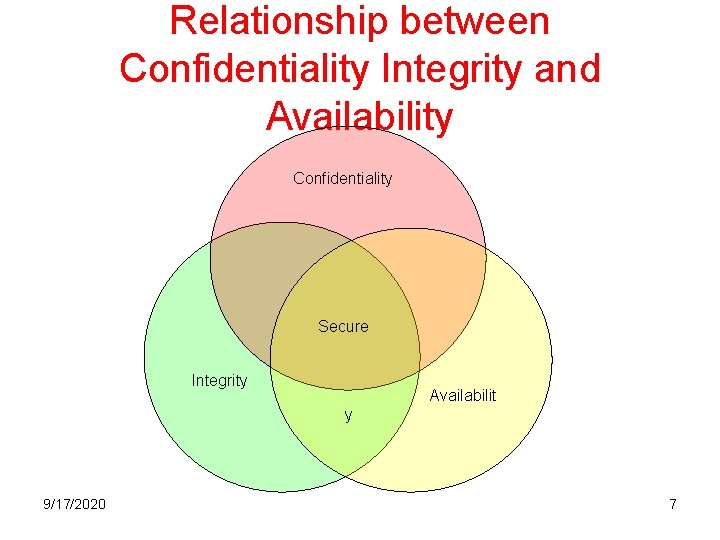
Relationship between Confidentiality Integrity and Availability Confidentiality Secure Integrity Availabilit y 9/17/2020 7
Other security requirements • Reliability – deals with accidental damage, • Safety – deals with the impact of system failure caused by the environment, • Dependability – reliance can be justifiably placed on the system • Survivability – deals with the recovery of the system after massive failure. • Accountability -- actions affecting security must be traceable to the responsible party. For this, – Audit information must be kept and protected, – Access control is needed. 9/17/2020 8
Basic Components Threats – potential violations of security Attacks – violations Attackers – those who execute the violations 9/17/2020 9
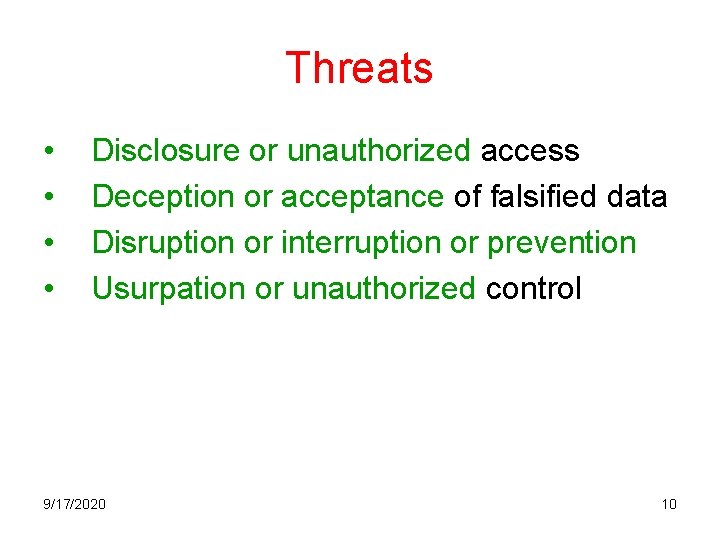
Threats • • Disclosure or unauthorized access Deception or acceptance of falsified data Disruption or interruption or prevention Usurpation or unauthorized control 9/17/2020 10
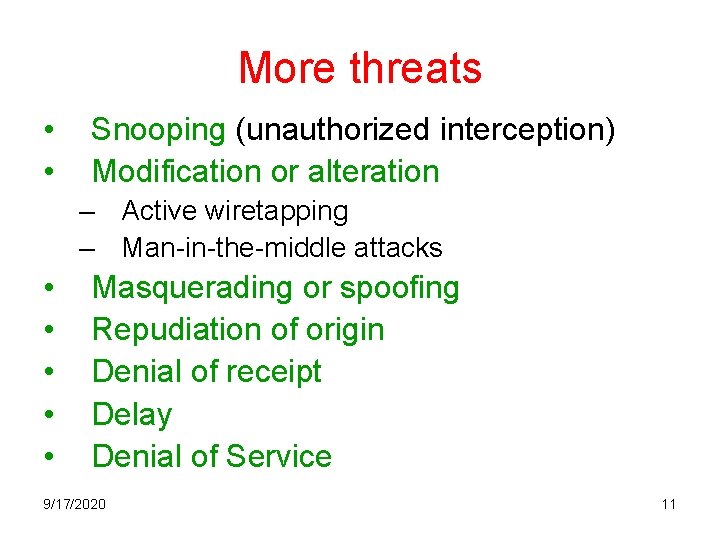
More threats • • Snooping (unauthorized interception) Modification or alteration – Active wiretapping – Man-in-the-middle attacks • • • Masquerading or spoofing Repudiation of origin Denial of receipt Delay Denial of Service 9/17/2020 11
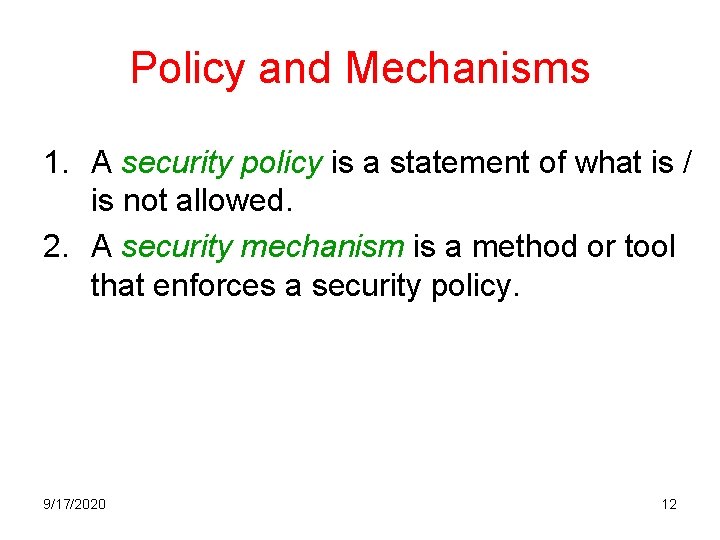
Policy and Mechanisms 1. A security policy is a statement of what is / is not allowed. 2. A security mechanism is a method or tool that enforces a security policy. 9/17/2020 12
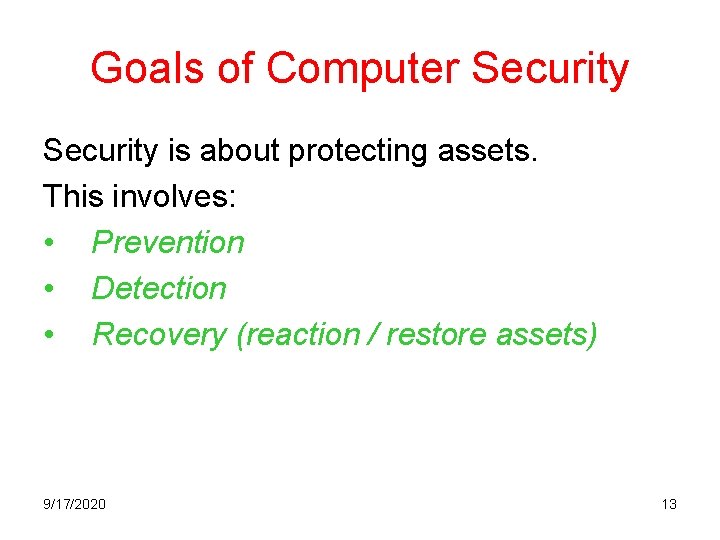
Goals of Computer Security is about protecting assets. This involves: • Prevention • Detection • Recovery (reaction / restore assets) 9/17/2020 13
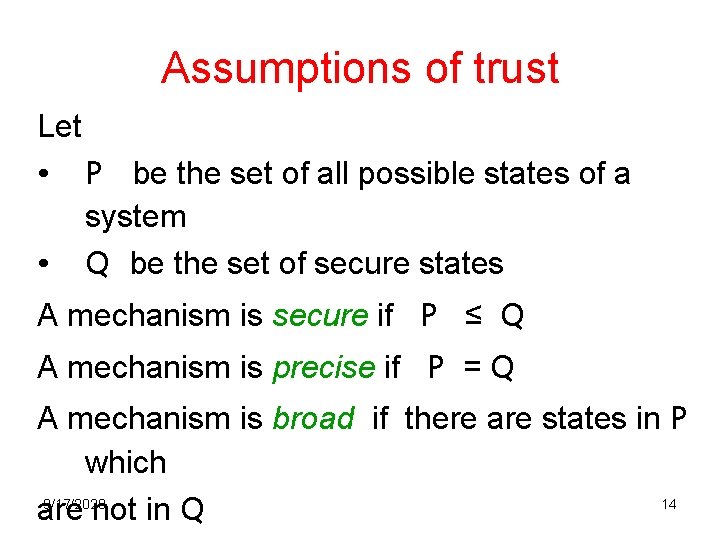
Assumptions of trust Let • P be the set of all possible states of a • system Q be the set of secure states A mechanism is secure if P ≤ Q A mechanism is precise if P = Q A mechanism is broad if there are states in P which 9/17/2020 14 are not in Q

Assurance Trust cannot be quantified precisely. System specifications design and implementation can provide a basis for how much one can trust a system. This is called assurance. A system is said to satisfy a specification if the specification correctly states how the system will function. 9/17/2020 15
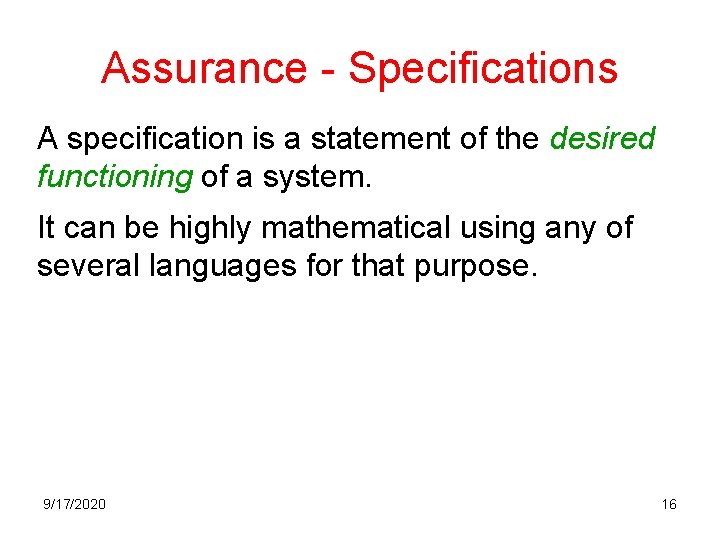
Assurance - Specifications A specification is a statement of the desired functioning of a system. It can be highly mathematical using any of several languages for that purpose. 9/17/2020 16
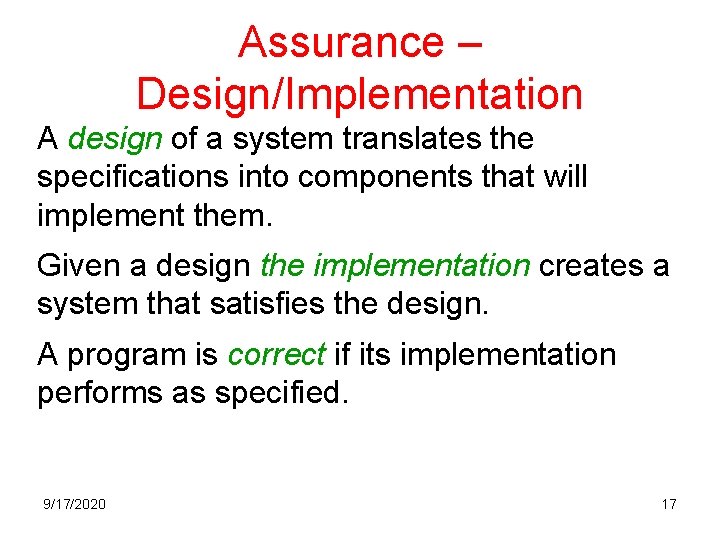
Assurance – Design/Implementation A design of a system translates the specifications into components that will implement them. Given a design the implementation creates a system that satisfies the design. A program is correct if its implementation performs as specified. 9/17/2020 17
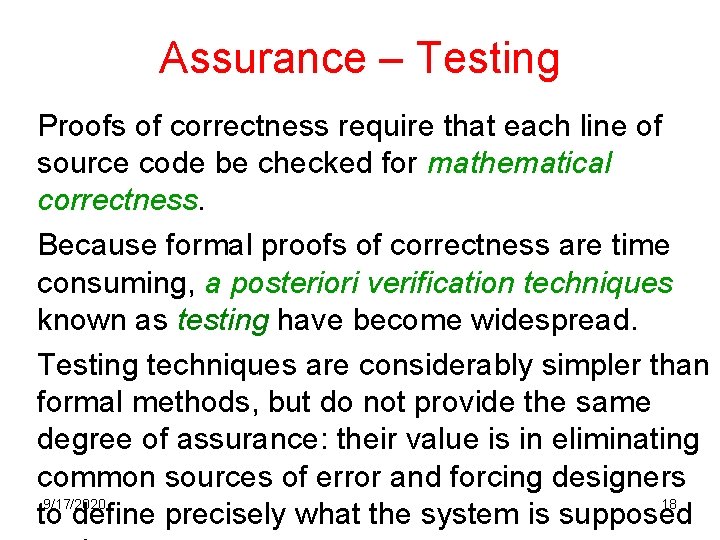
Assurance – Testing Proofs of correctness require that each line of source code be checked for mathematical correctness. Because formal proofs of correctness are time consuming, a posteriori verification techniques known as testing have become widespread. Testing techniques are considerably simpler than formal methods, but do not provide the same degree of assurance: their value is in eliminating common sources of error and forcing designers 9/17/2020 18 to define precisely what the system is supposed
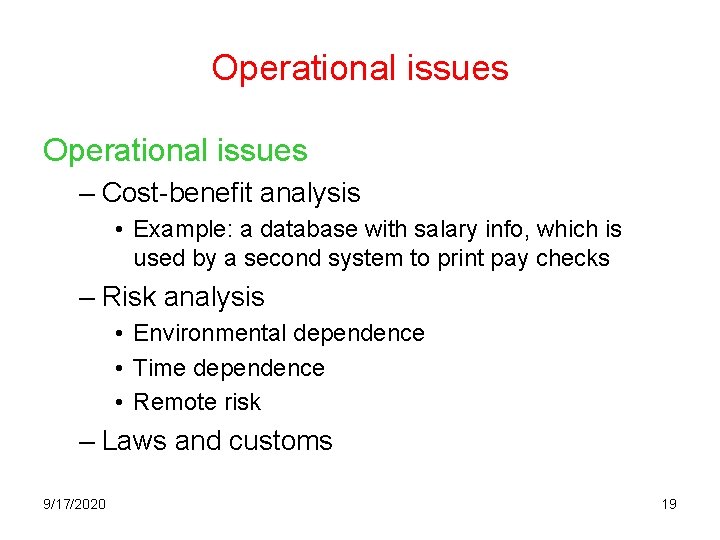
Operational issues – Cost-benefit analysis • Example: a database with salary info, which is used by a second system to print pay checks – Risk analysis • Environmental dependence • Time dependence • Remote risk – Laws and customs 9/17/2020 19
Fundamental Dilemma Functionality or Assurance • Security mechanisms need additional computational • Security policies interfere with working patterns, and can be very inconvenient. • Managing security requires additional effort and costs. • Ideally there should be a tradeoff. 9/17/2020 20
Laws and Customs • Export controls • Laws of multiple jurisdiction • Human issues 9/17/2020 21
Human issues • Organizational problems (who is responsible for what) • People problems (outsiders/insiders) 9/17/2020 22
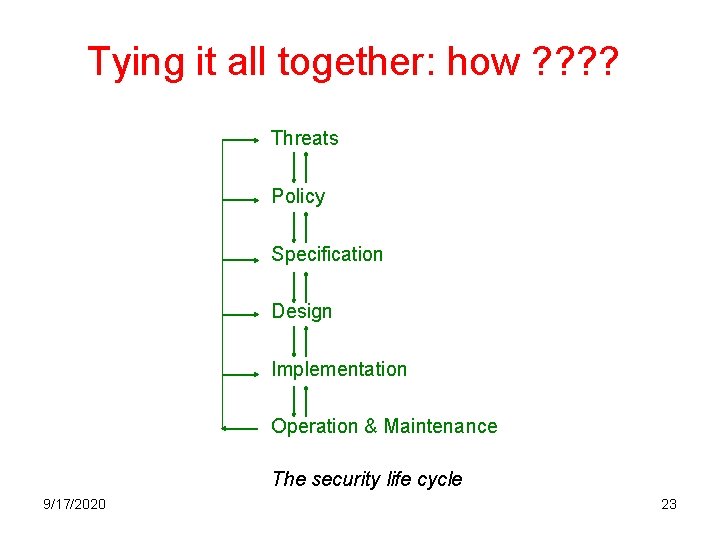
Tying it all together: how ? ? Threats Policy Specification Design Implementation Operation & Maintenance The security life cycle 9/17/2020 23
Computer Security -- Summary How to achieve Computer Security: 1. Security principles/concepts: explore general principles/concepts that can be used as a guide to design secure information processing systems. 2. Security mechanisms: explore some of the security mechanisms that can be used to secure information processing systems. 3. Physical/Organizational security: consider physical & organizational security measures 9/17/2020 24
Computer Security Even at this general level there is disagreement on the precise definitions of some of the required security aspects. References: • Orange book – US Dept of Defense, Trusted Computer System Evaluation Criteria. • ITSEC – European Trusted Computer System Product Criteria. • CTCPEC – Canadian Trusted Computer System Product Criteria 9/17/2020 25
- Slides: 25