ALevel Maths Core 3 for Edexcel C 3

- Slides: 64
A-Level Maths: Core 3 for Edexcel C 3. 2 Algebra and functions 2 This icon indicates the slide contains activities created in Flash. These activities are not editable. For more detailed instructions, see the Getting Started presentation. 1 of 64 © Boardworks Ltd 2006
Functions and mappings Contents Finding the range of a function Composite functions Inverse functions and their graphs The modulus function Transforming functions Examination-style questions 2 of 64 © Boardworks Ltd 2006
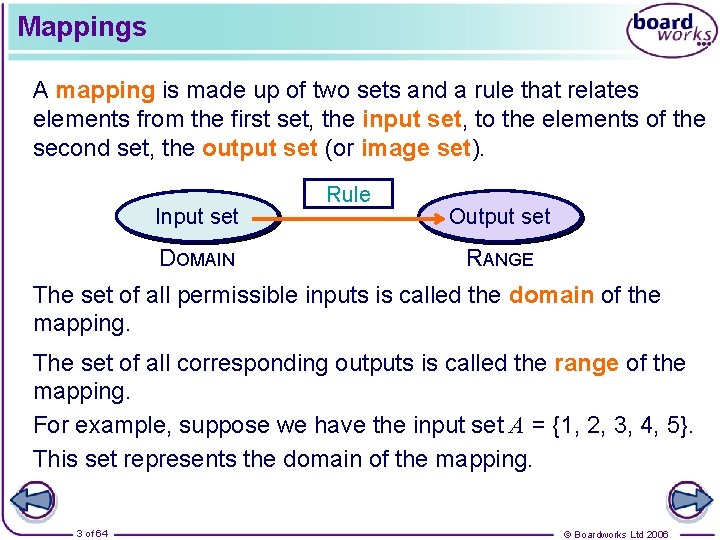
Mappings A mapping is made up of two sets and a rule that relates elements from the first set, the input set, to the elements of the second set, the output set (or image set). Input set DOMAIN Rule Output set RANGE The set of all permissible inputs is called the domain of the mapping. The set of all corresponding outputs is called the range of the mapping. For example, suppose we have the input set A = {1, 2, 3, 4, 5}. This set represents the domain of the mapping. 3 of 64 © Boardworks Ltd 2006
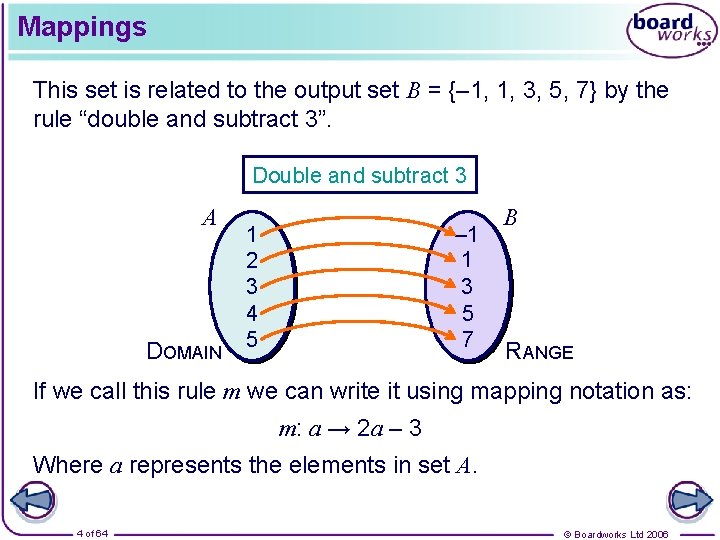
Mappings This set is related to the output set B = {– 1, 1, 3, 5, 7} by the rule “double and subtract 3”. Double and subtract 3 A DOMAIN 1 2 3 4 5 – 1 1 3 5 7 B RANGE If we call this rule m we can write it using mapping notation as: m: a → 2 a – 3 Where a represents the elements in set A. 4 of 64 © Boardworks Ltd 2006
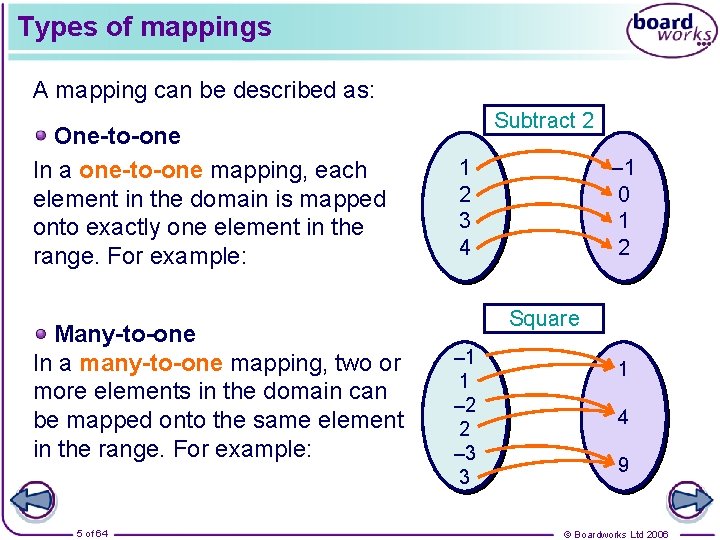
Types of mappings A mapping can be described as: One-to-one In a one-to-one mapping, each element in the domain is mapped onto exactly one element in the range. For example: Many-to-one In a many-to-one mapping, two or more elements in the domain can be mapped onto the same element in the range. For example: 5 of 64 Subtract 2 1 2 3 4 – 1 0 1 2 Square – 1 1 – 2 2 – 3 3 1 4 9 © Boardworks Ltd 2006
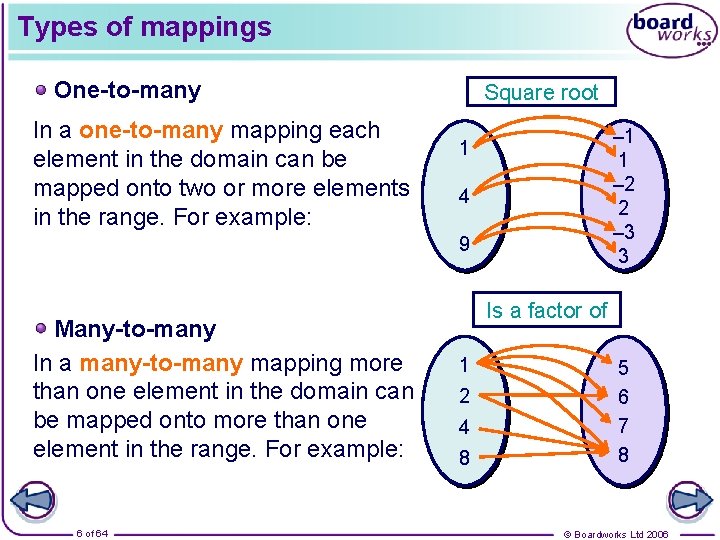
Types of mappings One-to-many In a one-to-many mapping each element in the domain can be mapped onto two or more elements in the range. For example: Square root – 1 1 – 2 2 – 3 3 1 4 9 Many-to-many In a many-to-many mapping more than one element in the domain can be mapped onto more than one element in the range. For example: 6 of 64 Is a factor of 1 2 4 8 5 6 7 8 © Boardworks Ltd 2006
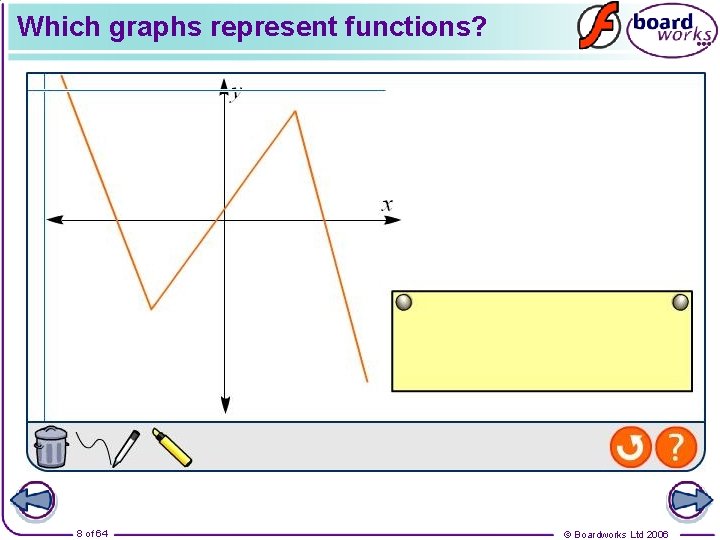
Functions A function is a special type of mapping such that each member of the domain is mapped to one, and only one, element in the range. In other words, Only a one-to-one or a many-to-one mapping can be called a function. One-to-many and many-to-many mappings are not functions. Most functions you will meet are defined over a continuous domain, such as the set of all real numbers. Such functions are best represented by a graph plotting the elements in the domain along the horizontal axis against the corresponding members of the range along the vertical axis. 7 of 64 © Boardworks Ltd 2006
Which graphs represent functions? 8 of 64 © Boardworks Ltd 2006
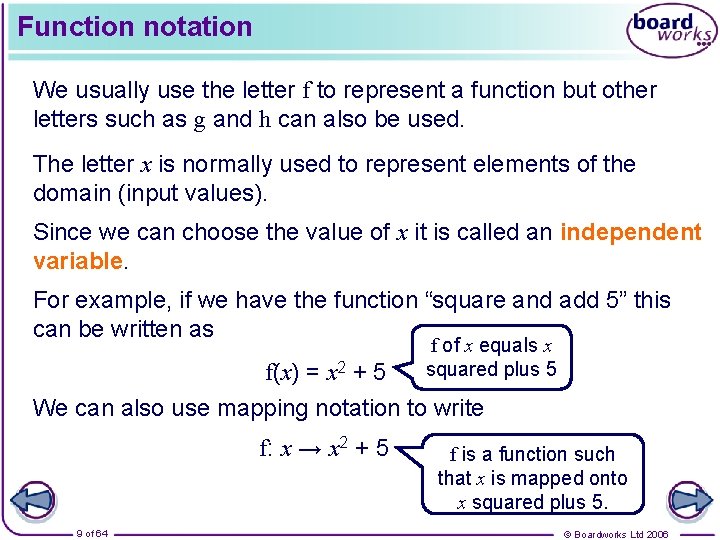
Function notation We usually use the letter f to represent a function but other letters such as g and h can also be used. The letter x is normally used to represent elements of the domain (input values). Since we can choose the value of x it is called an independent variable. For example, if we have the function “square and add 5” this can be written as f(x) = x 2 + 5 f of x equals x squared plus 5 We can also use mapping notation to write f: x → x 2 + 5 9 of 64 f is a function such that x is mapped onto x squared plus 5. © Boardworks Ltd 2006
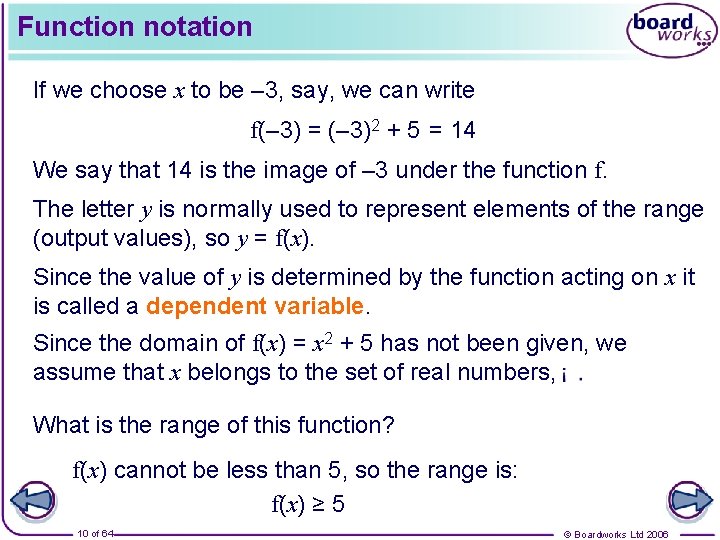
Function notation If we choose x to be – 3, say, we can write f(– 3) = (– 3)2 + 5 = 14 We say that 14 is the image of – 3 under the function f. The letter y is normally used to represent elements of the range (output values), so y = f(x). Since the value of y is determined by the function acting on x it is called a dependent variable. Since the domain of f(x) = x 2 + 5 has not been given, we assume that x belongs to the set of real numbers, What is the range of this function? f(x) cannot be less than 5, so the range is: f(x) ≥ 5 10 of 64 © Boardworks Ltd 2006
Finding the range of a function Contents Functions and mappings Finding the range of a function Composite functions Inverse functions and their graphs The modulus function Transforming functions Examination-style questions 11 of 64 © Boardworks Ltd 2006
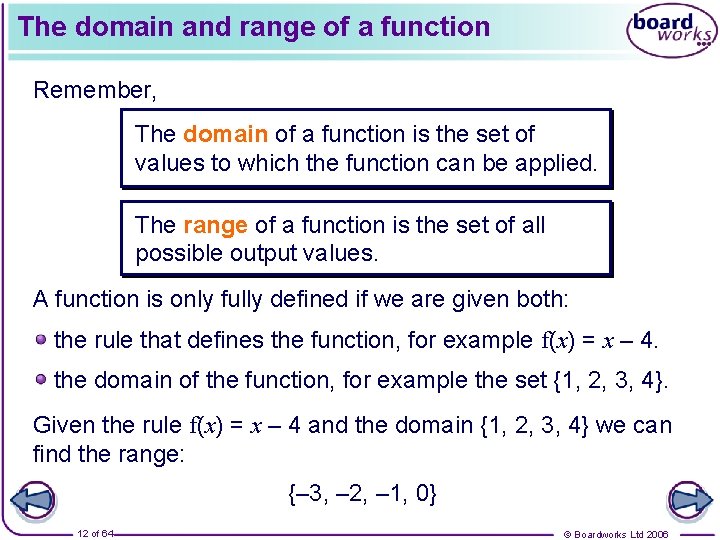
The domain and range of a function Remember, The domain of a function is the set of values to which the function can be applied. The range of a function is the set of all possible output values. A function is only fully defined if we are given both: the rule that defines the function, for example f(x) = x – 4. the domain of the function, for example the set {1, 2, 3, 4}. Given the rule f(x) = x – 4 and the domain {1, 2, 3, 4} we can find the range: {– 3, – 2, – 1, 0} 12 of 64 © Boardworks Ltd 2006
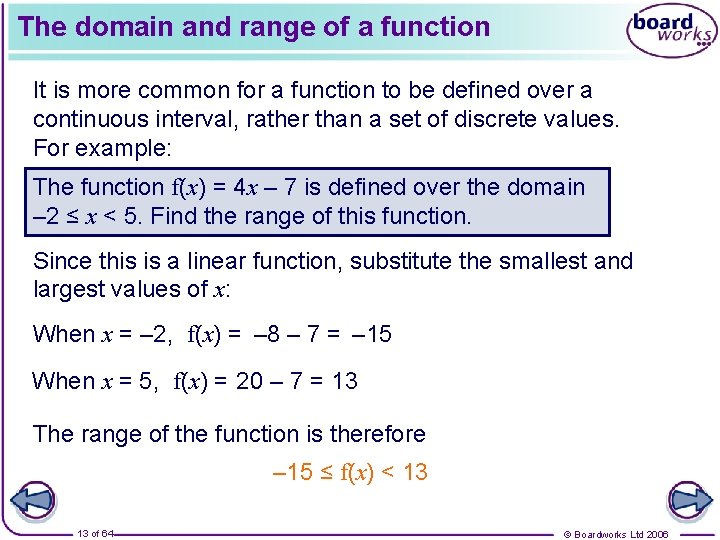
The domain and range of a function It is more common for a function to be defined over a continuous interval, rather than a set of discrete values. For example: The function f(x) = 4 x – 7 is defined over the domain – 2 ≤ x < 5. Find the range of this function. Since this is a linear function, substitute the smallest and largest values of x: When x = – 2, f(x) = – 8 – 7 = – 15 When x = 5, f(x) = 20 – 7 = 13 The range of the function is therefore – 15 ≤ f(x) < 13 13 of 64 © Boardworks Ltd 2006
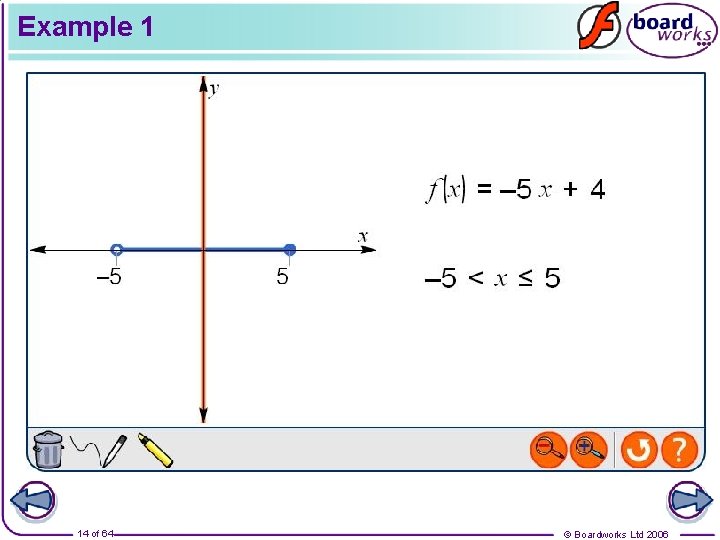
Example 1 14 of 64 © Boardworks Ltd 2006
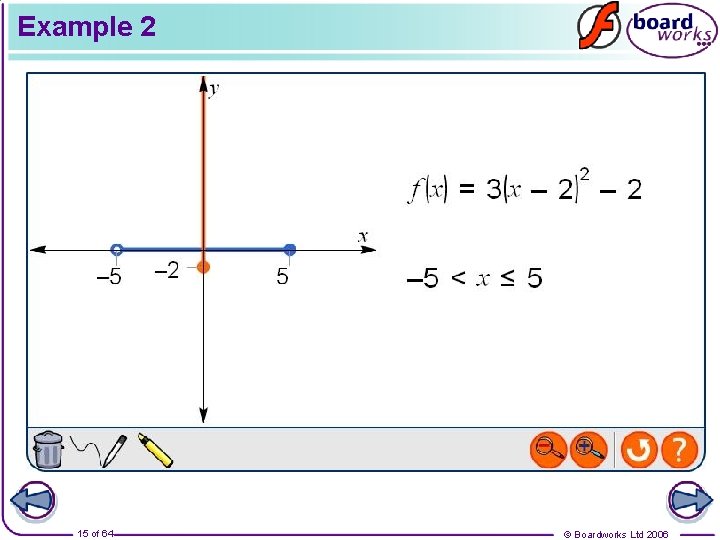
Example 2 15 of 64 © Boardworks Ltd 2006
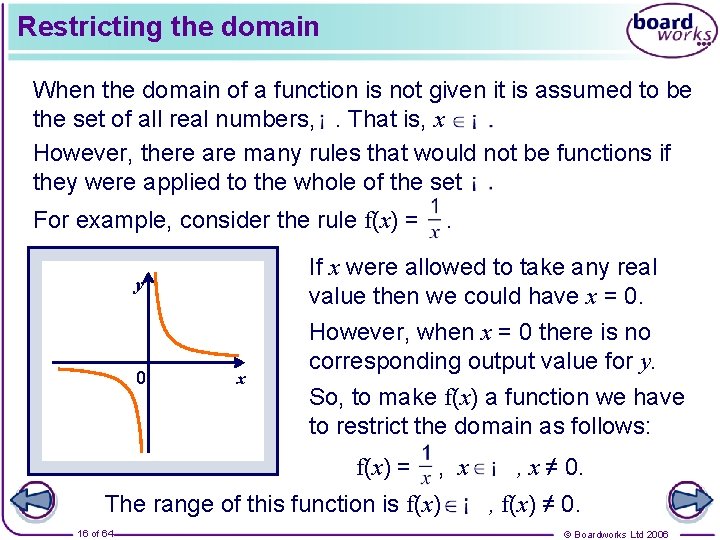
Restricting the domain When the domain of a function is not given it is assumed to be the set of all real numbers, . That is, x However, there are many rules that would not be functions if they were applied to the whole of the set For example, consider the rule f(x) = If x were allowed to take any real value then we could have x = 0. y 0 . x However, when x = 0 there is no corresponding output value for y. So, to make f(x) a function we have to restrict the domain as follows: f(x) = , x The range of this function is f(x) 16 of 64 , x ≠ 0. , f(x) ≠ 0. © Boardworks Ltd 2006
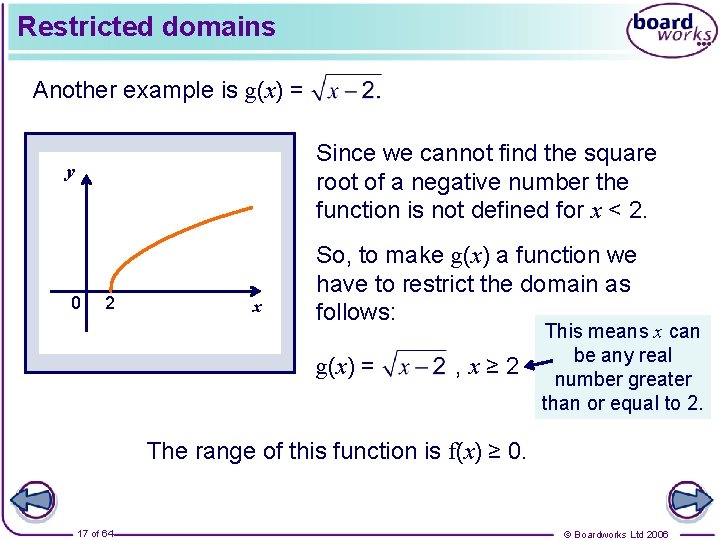
Restricted domains Another example is g(x) = Since we cannot find the square root of a negative number the function is not defined for x < 2. y 0 2 x So, to make g(x) a function we have to restrict the domain as follows: g(x) = , x≥ 2 This means x can be any real number greater than or equal to 2. The range of this function is f(x) ≥ 0. 17 of 64 © Boardworks Ltd 2006
Composite functions Contents Functions and mappings Finding the range of a function Composite functions Inverse functions and their graphs The modulus function Transforming functions Examination-style questions 18 of 64 © Boardworks Ltd 2006
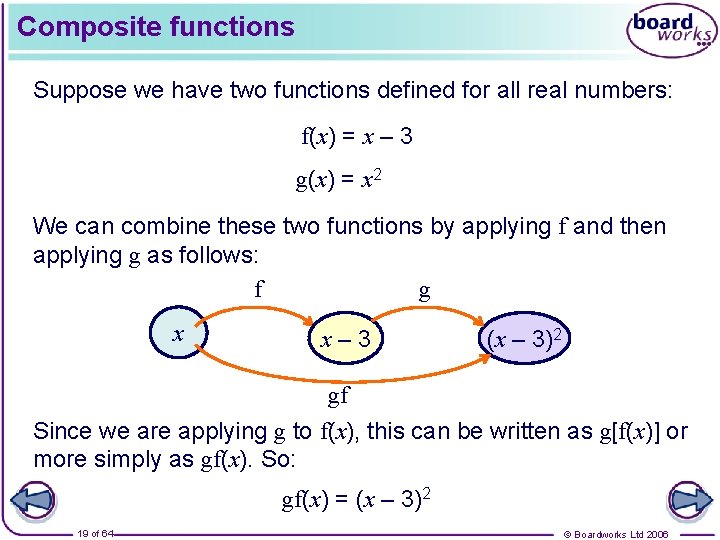
Composite functions Suppose we have two functions defined for all real numbers: f(x) = x – 3 g(x) = x 2 We can combine these two functions by applying f and then applying g as follows: f g x x– 3 (x – 3)2 gf Since we are applying g to f(x), this can be written as g[f(x)] or more simply as gf(x). So: gf(x) = (x – 3)2 19 of 64 © Boardworks Ltd 2006
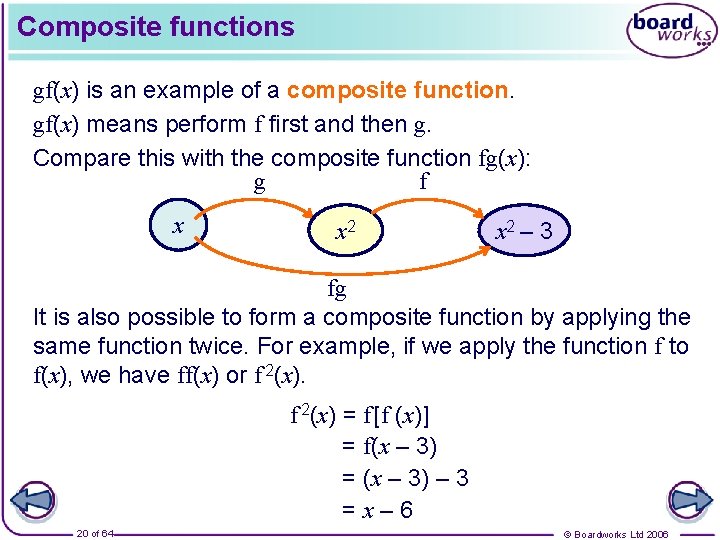
Composite functions gf(x) is an example of a composite function. gf(x) means perform f first and then g. Compare this with the composite function fg(x): g f x x 2 – 3 fg It is also possible to form a composite function by applying the same function twice. For example, if we apply the function f to f(x), we have ff(x) or f 2(x) = f [f (x)] = f(x – 3) = (x – 3) – 3 =x– 6 20 of 64 © Boardworks Ltd 2006
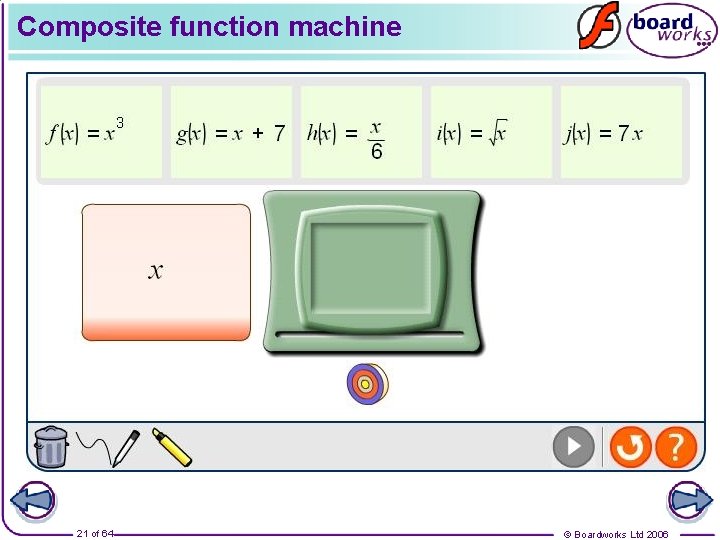
Composite function machine 21 of 64 © Boardworks Ltd 2006
Inverse functions and their graphs Contents Functions and mappings Finding the range of a function Composite functions Inverse functions and their graphs The modulus function Transforming functions Examination-style questions 22 of 64 © Boardworks Ltd 2006
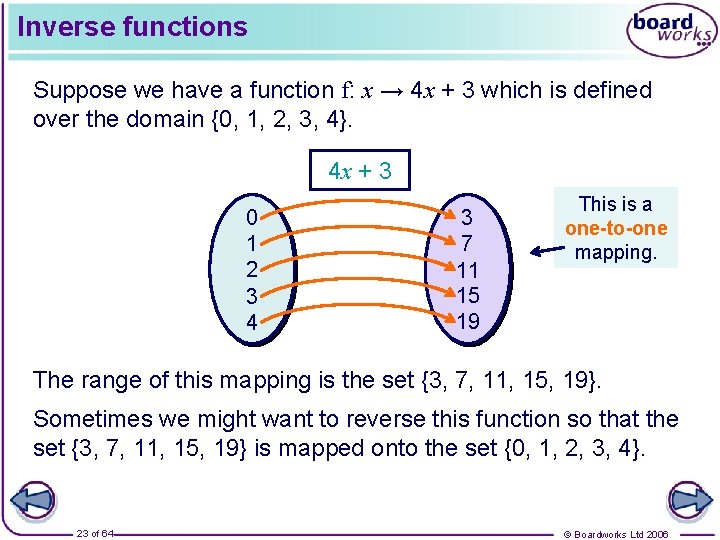
Inverse functions Suppose we have a function f: x → 4 x + 3 which is defined over the domain {0, 1, 2, 3, 4}. 4 x + 3 0 1 2 3 4 3 7 11 15 19 This is a one-to-one mapping. The range of this mapping is the set {3, 7, 11, 15, 19}. Sometimes we might want to reverse this function so that the set {3, 7, 11, 15, 19} is mapped onto the set {0, 1, 2, 3, 4}. 23 of 64 © Boardworks Ltd 2006
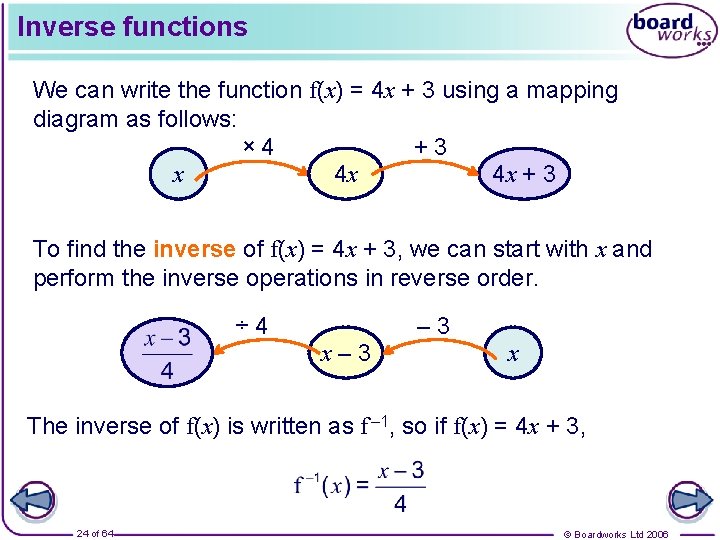
Inverse functions We can write the function f(x) = 4 x + 3 using a mapping diagram as follows: × 4 +3 x 4 x 4 x + 3 To find the inverse of f(x) = 4 x + 3, we can start with x and perform the inverse operations in reverse order. ÷ 4 – 3 x The inverse of f(x) is written as f – 1, so if f(x) = 4 x + 3, 24 of 64 © Boardworks Ltd 2006
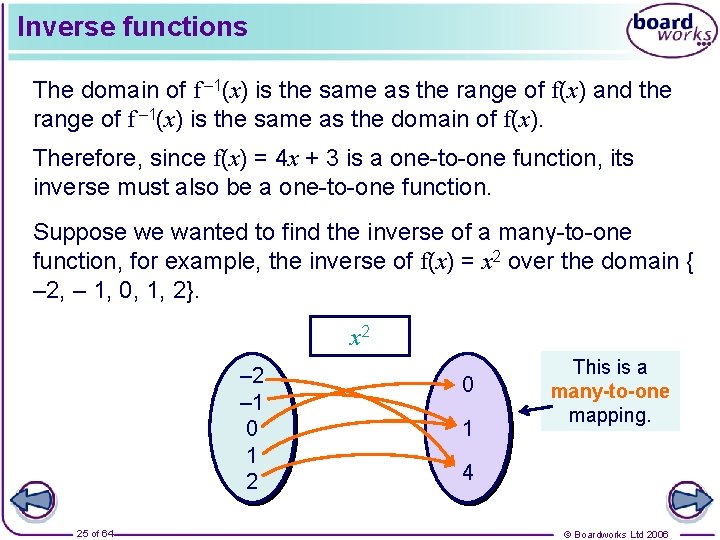
Inverse functions The domain of f – 1(x) is the same as the range of f(x) and the range of f – 1(x) is the same as the domain of f(x). Therefore, since f(x) = 4 x + 3 is a one-to-one function, its inverse must also be a one-to-one function. Suppose we wanted to find the inverse of a many-to-one function, for example, the inverse of f(x) = x 2 over the domain { – 2, – 1, 0, 1, 2}. x 2 – 1 0 1 2 25 of 64 3 0 7 11 1 15 4 19 This is a many-to-one mapping. © Boardworks Ltd 2006
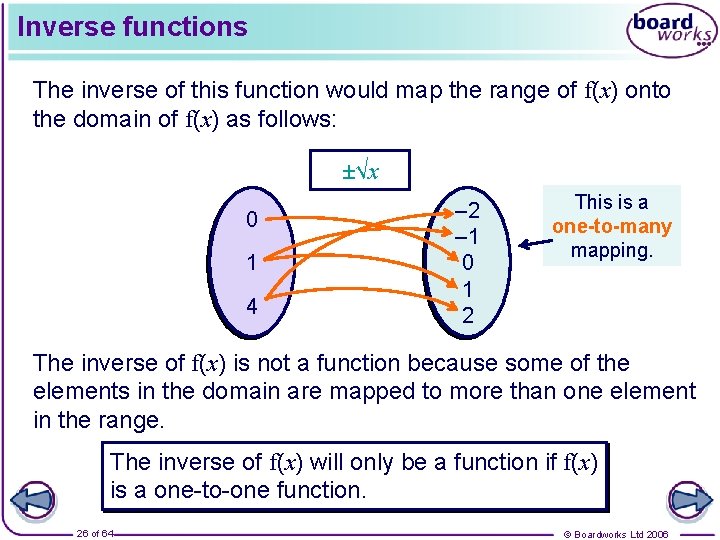
Inverse functions The inverse of this function would map the range of f(x) onto the domain of f(x) as follows: ±√x 3 0 7 11 1 15 4 19 – 2 – 1 0 1 2 This is a one-to-many mapping. The inverse of f(x) is not a function because some of the elements in the domain are mapped to more than one element in the range. The inverse of f(x) will only be a function if f(x) is a one-to-one function. 26 of 64 © Boardworks Ltd 2006
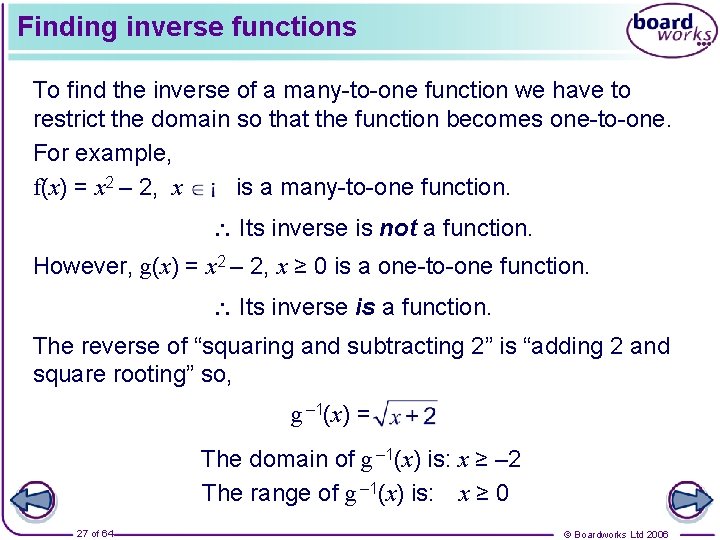
Finding inverse functions To find the inverse of a many-to-one function we have to restrict the domain so that the function becomes one-to-one. For example, f(x) = x 2 – 2, x is a many-to-one function. Its inverse is not a function. However, g(x) = x 2 – 2, x ≥ 0 is a one-to-one function. Its inverse is a function. The reverse of “squaring and subtracting 2” is “adding 2 and square rooting” so, g – 1(x) = The domain of g – 1(x) is: x ≥ – 2 The range of g – 1(x) is: x ≥ 0 27 of 64 © Boardworks Ltd 2006
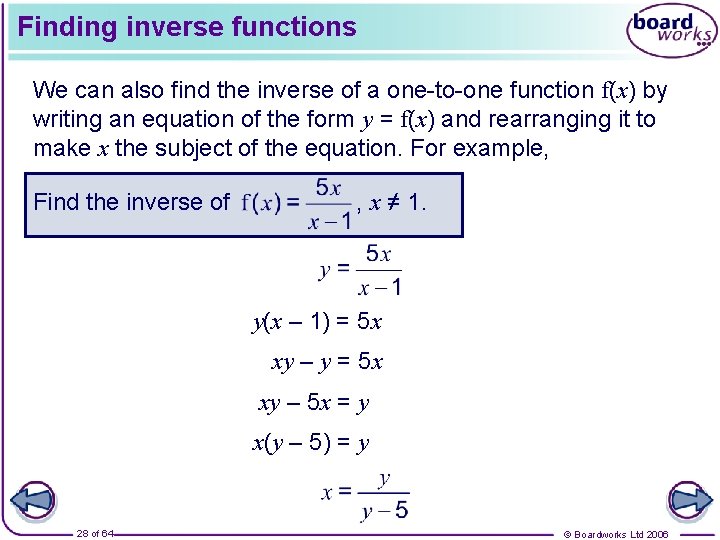
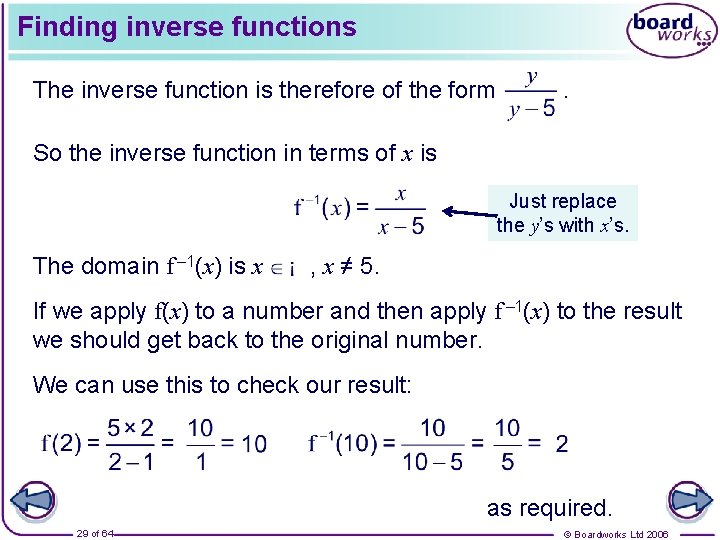
Finding inverse functions We can also find the inverse of a one-to-one function f(x) by writing an equation of the form y = f(x) and rearranging it to make x the subject of the equation. For example, Find the inverse of , x ≠ 1. y(x – 1) = 5 x xy – y = 5 x xy – 5 x = y x(y – 5) = y 28 of 64 © Boardworks Ltd 2006
Finding inverse functions The inverse function is therefore of the form . So the inverse function in terms of x is Just replace the y’s with x’s. The domain f – 1(x) is x , x ≠ 5. If we apply f(x) to a number and then apply f – 1(x) to the result we should get back to the original number. We can use this to check our result: as required. 29 of 64 © Boardworks Ltd 2006
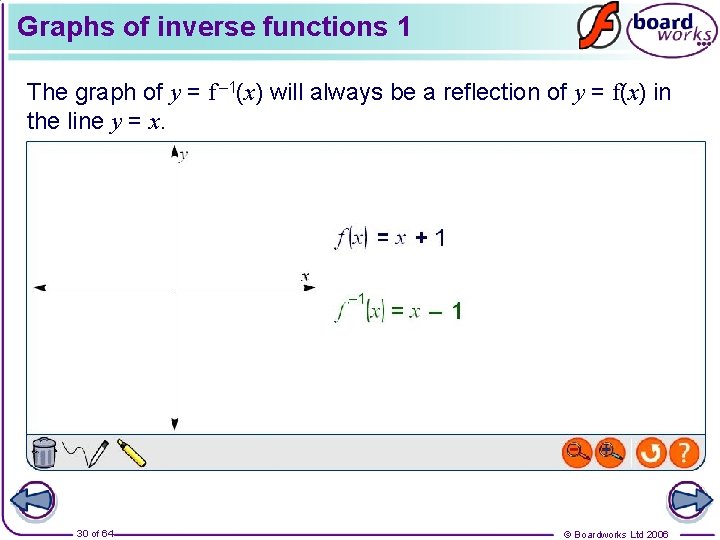
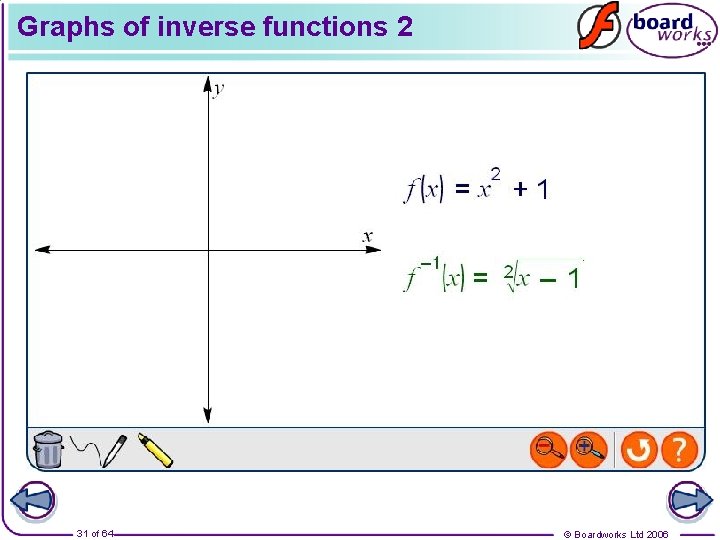
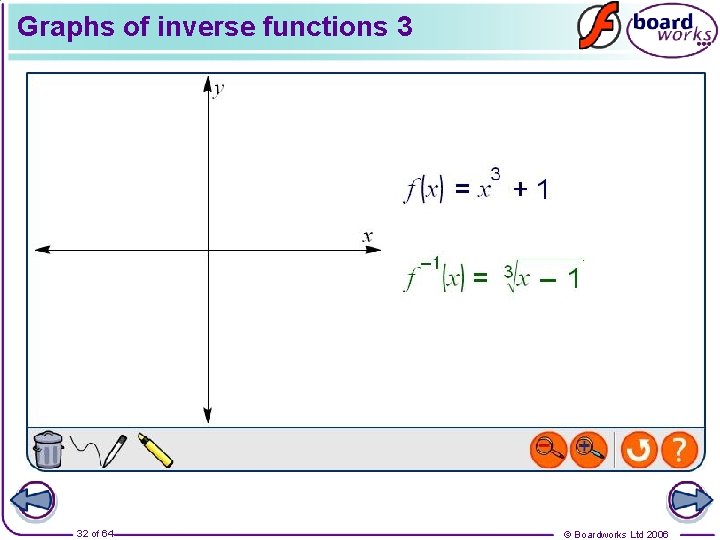
Graphs of inverse functions 1 The graph of y = f – 1(x) will always be a reflection of y = f(x) in the line y = x. 30 of 64 © Boardworks Ltd 2006
Graphs of inverse functions 2 31 of 64 © Boardworks Ltd 2006
Graphs of inverse functions 3 32 of 64 © Boardworks Ltd 2006
The modulus function Contents Functions and mappings Finding the range of a function Composite functions Inverse functions and their graphs The modulus function Transforming functions Examination-style questions 33 of 64 © Boardworks Ltd 2006
The modulus function The modulus of a number is its absolute value or magnitude. In other words, if a number has a negative sign in front of it this is dropped to leave just the number. mod – 3 For example, the modulus of – 3 is written |– 3| = 3 The modulus of a positive number is just the number itself. For example, |5. 8| = 5. 8 In general, for any number x, |x| = 34 of 64 x when x ≥ 0 –x when x < 0 © Boardworks Ltd 2006
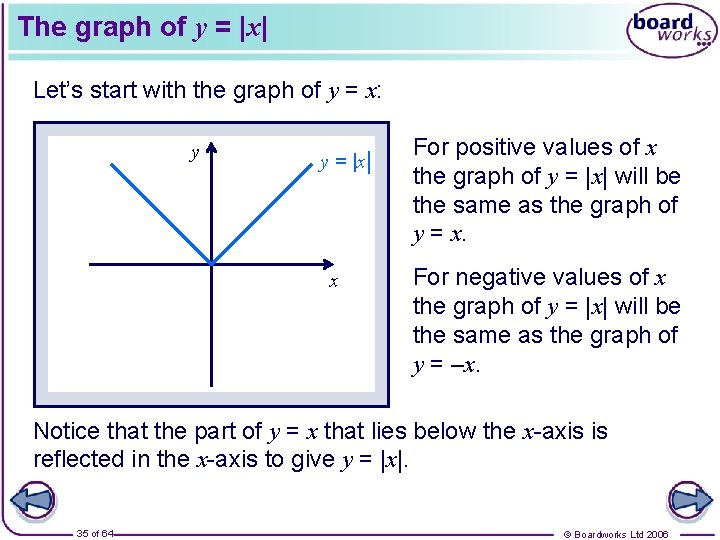
The graph of y = |x| Let’s start with the graph of y = x: y x| y = |x x For positive values of x the graph of y = |x| will be the same as the graph of y = x. For negative values of x the graph of y = |x| will be the same as the graph of y = –x. Notice that the part of y = x that lies below the x-axis is reflected in the x-axis to give y = |x|. 35 of 64 © Boardworks Ltd 2006
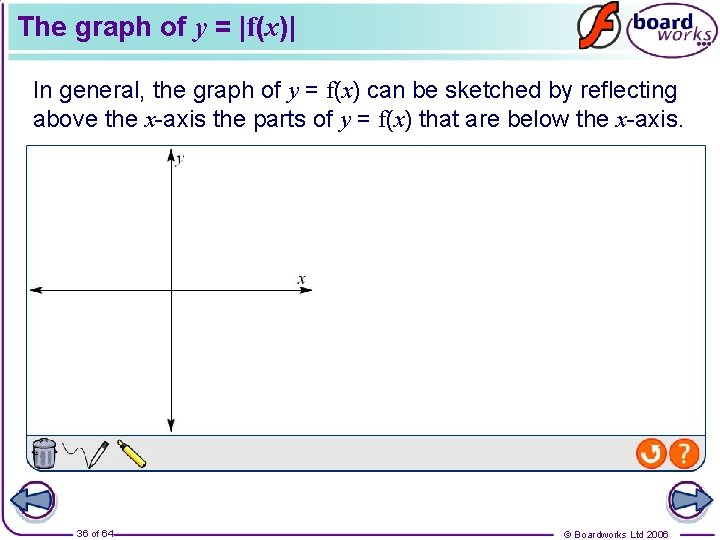
The graph of y = |f(x)| In general, the graph of y = f(x) can be sketched by reflecting above the x-axis the parts of y = f(x) that are below the x-axis. 36 of 64 © Boardworks Ltd 2006
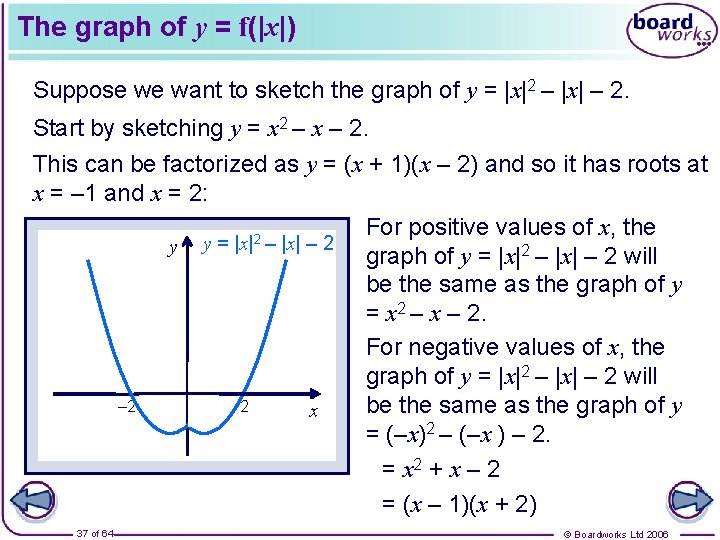
The graph of y = f(|x|) Suppose we want to sketch the graph of y = |x|2 – |x| – 2. Start by sketching y = x 2 – x – 2. This can be factorized as y = (x + 1)(x – 2) and so it has roots at x = – 1 and x = 2: For positive values of x, the 2 2 x ––x |x| – 2– 2 y y = |x| graph of y = |x|2 – |x| – 2 will be the same as the graph of y = x 2 – x – 2. For negative values of x, the graph of y = |x|2 – |x| – 2 will – 2 – 1 2 be the same as the graph of y x = (–x)2 – (–x ) – 2. = x 2 + x – 2 = (x – 1)(x + 2) 37 of 64 © Boardworks Ltd 2006
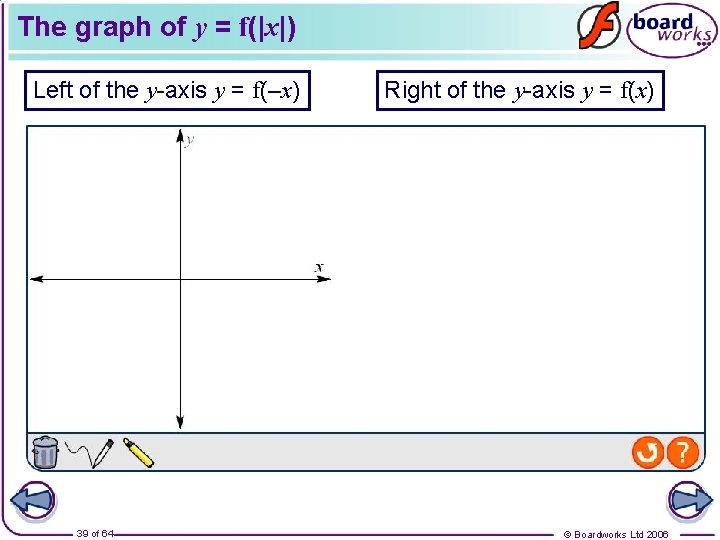
The graph of y = f(|x|) In general, for positive values of x (that is, for parts of the curve to the right of the y-axis) the graph of y = f(|x|) will be the same as the graph of y = f(x). For negative values of x (that is, for parts of the curve to the left of the y-axis) the graph of y = f(|x|) will be the same as the graph of y = f(–x). From previous work on transformations you will remember that the graph of y = f(–x) is a reflection of the graph of y = f(x) in the y-axis. Therefore, starting with the graph of y = f(x), the graph of y = f(|x|) can be sketched by reflecting left of the y-axis any part of y = f(x) that is to the right of the y-axis. Any part of y = f(x) that is to the left of the y-axis is ignored. 38 of 64 © Boardworks Ltd 2006
The graph of y = f(|x|) Left of the y-axis y = f(–x) 39 of 64 Right of the y-axis y = f(x) © Boardworks Ltd 2006
Equations involving the modulus function In general, for any positive constant a: if |f(x)| = a then either f(x) = a or f(x) = – a Find all values of x such that |2 x – 5| = 3. For this equation either 2 x – 5 = – 3 2 x – 5 = 3 or 2 x = 8 2 x = 2 x=4 x=1 So the solutions to |2 x – 5| = 3 are x = 1 or x = 4. 40 of 64 © Boardworks Ltd 2006
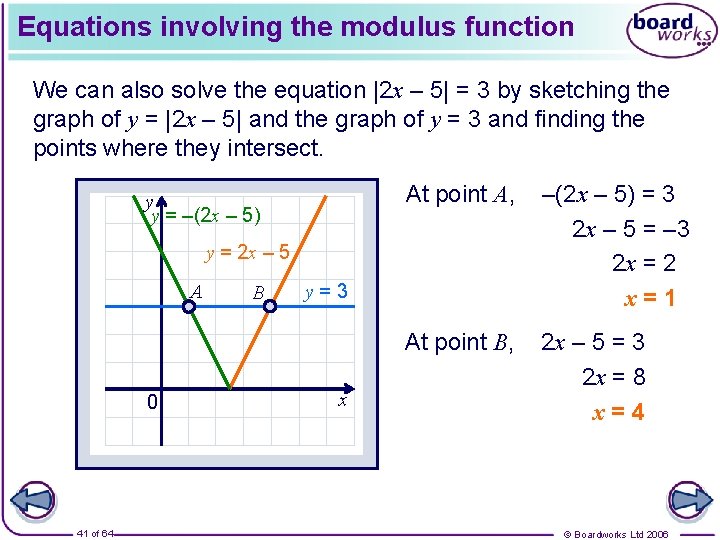
Equations involving the modulus function We can also solve the equation |2 x – 5| = 3 by sketching the graph of y = |2 x – 5| and the graph of y = 3 and finding the points where they intersect. y y = –(2 x – 5) At point A, –(2 x – 5) = 3 2 x – 5 = – 3 2 x = 2 x=1 At point B, 2 x – 5 = 3 2 x = 8 x=4 y = 2 x – 5 A 0 41 of 64 B y=3 x © Boardworks Ltd 2006
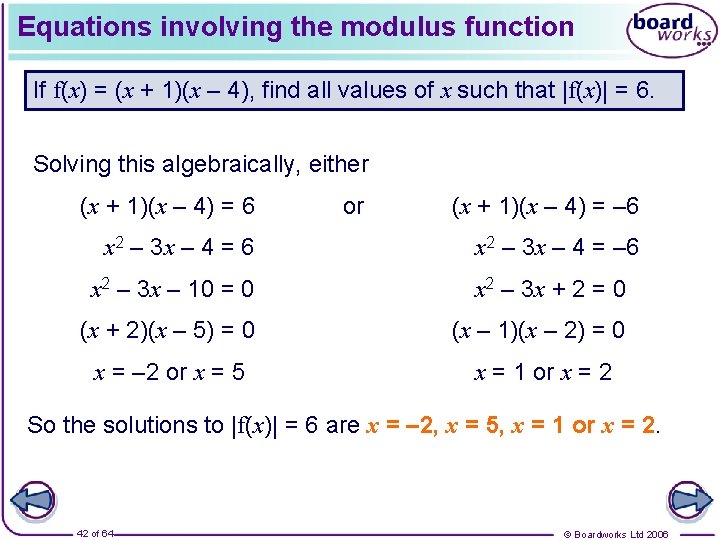
Equations involving the modulus function If f(x) = (x + 1)(x – 4), find all values of x such that |f(x)| = 6. Solving this algebraically, either (x + 1)(x – 4) = 6 or (x + 1)(x – 4) = – 6 x 2 – 3 x – 4 = – 6 x 2 – 3 x – 10 = 0 x 2 – 3 x + 2 = 0 (x + 2)(x – 5) = 0 (x – 1)(x – 2) = 0 x = – 2 or x = 5 x = 1 or x = 2 So the solutions to |f(x)| = 6 are x = – 2, x = 5, x = 1 or x = 2. 42 of 64 © Boardworks Ltd 2006
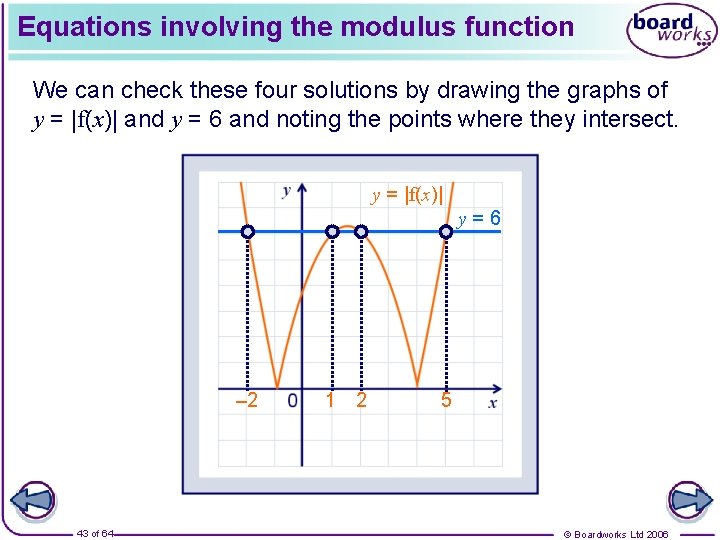
Equations involving the modulus function We can check these four solutions by drawing the graphs of y = |f(x)| and y = 6 and noting the points where they intersect. y = |f(x)| y=6 – 2 43 of 64 1 2 5 © Boardworks Ltd 2006
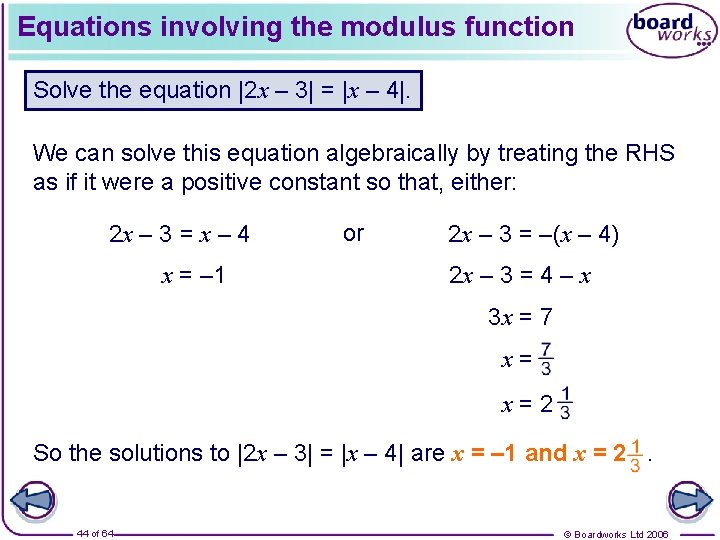
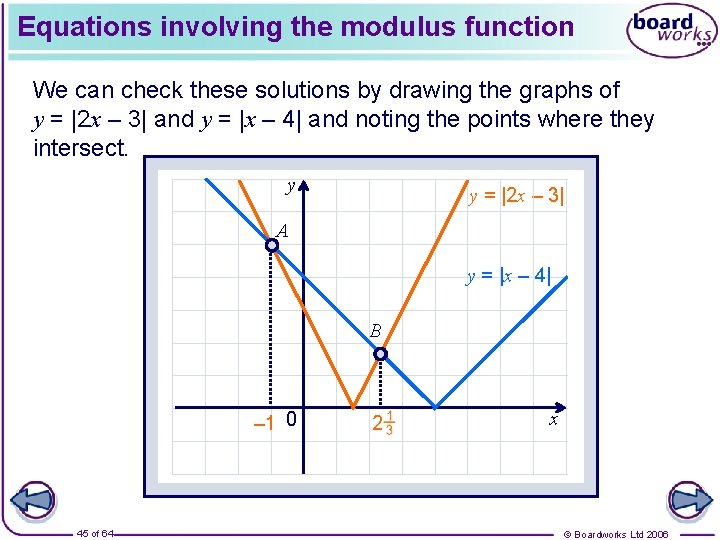
Equations involving the modulus function Solve the equation |2 x – 3| = |x – 4|. We can solve this equation algebraically by treating the RHS as if it were a positive constant so that, either: 2 x – 3 = x – 4 x = – 1 or 2 x – 3 = –(x – 4) 2 x – 3 = 4 – x 3 x = 7 x= x=2 So the solutions to |2 x – 3| = |x – 4| are x = – 1 and x = 2. 44 of 64 © Boardworks Ltd 2006
Equations involving the modulus function We can check these solutions by drawing the graphs of y = |2 x – 3| and y = |x – 4| and noting the points where they intersect. y y = |2 x – 3| A y = |x – 4| B – 1 0 45 of 64 2 x © Boardworks Ltd 2006
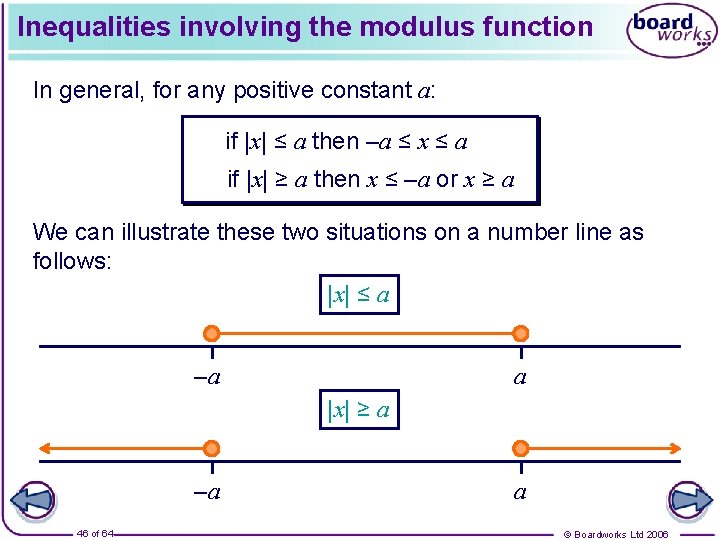
Inequalities involving the modulus function In general, for any positive constant a: if |x| ≤ a then –a ≤ x ≤ a if |x| ≥ a then x ≤ –a or x ≥ a We can illustrate these two situations on a number line as follows: |x| ≤ a –a a |x| ≥ a –a 46 of 64 a © Boardworks Ltd 2006
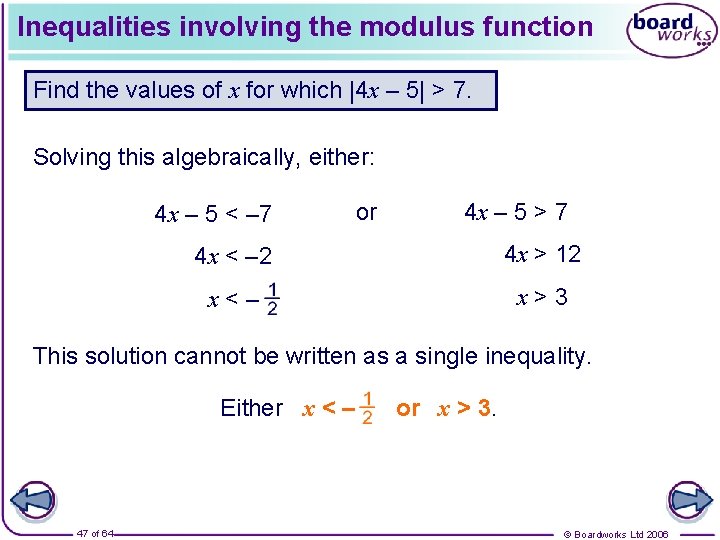
Inequalities involving the modulus function Find the values of x for which |4 x – 5| > 7. Solving this algebraically, either: 4 x – 5 < – 7 or 4 x – 5 > 7 4 x < – 2 4 x > 12 x<– x>3 This solution cannot be written as a single inequality. Either x < – 47 of 64 or x > 3. © Boardworks Ltd 2006
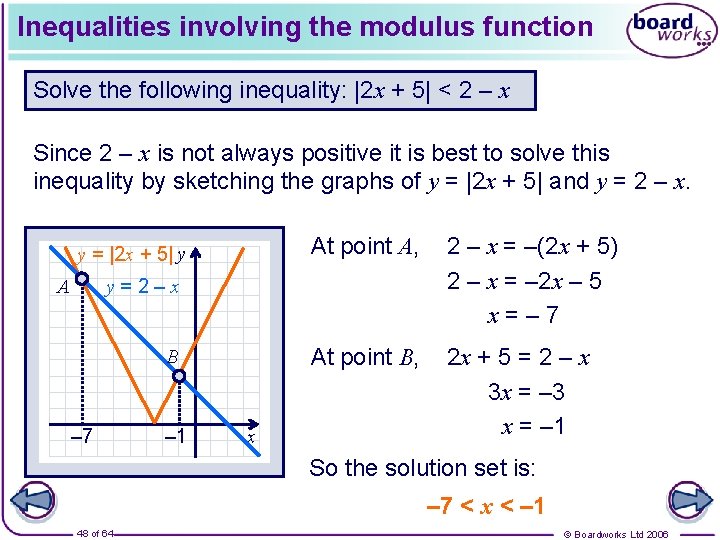
Inequalities involving the modulus function Solve the following inequality: |2 x + 5| < 2 – x Since 2 – x is not always positive it is best to solve this inequality by sketching the graphs of y = |2 x + 5| and y = 2 – x. y = |2 x + 5| y At point A, 2 – x = –(2 x + 5) 2 – x = – 2 x – 5 x=– 7 At point B, 2 x + 5 = 2 – x 3 x = – 3 x = – 1 y=2–x A B – 7 – 1 x So the solution set is: – 7 < x < – 1 48 of 64 © Boardworks Ltd 2006
Transforming functions Contents Functions and mappings Finding the range of a function Composite functions Inverse functions and their graphs The modulus function Transforming functions Examination-style questions 49 of 64 © Boardworks Ltd 2006
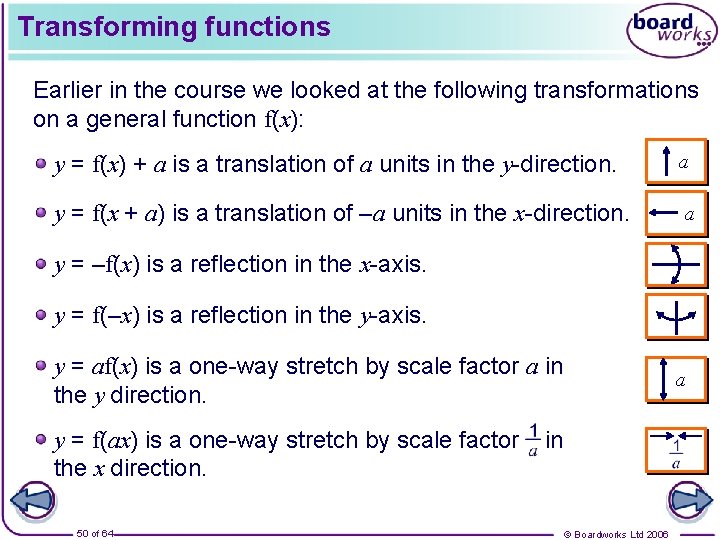
Transforming functions Earlier in the course we looked at the following transformations on a general function f(x): y = f(x) + a is a translation of a units in the y-direction. a y = f(x + a) is a translation of –a units in the x-direction. a y = –f(x) is a reflection in the x-axis. y = f(–x) is a reflection in the y-axis. y = af(x) is a one-way stretch by scale factor a in the y direction. y = f(ax) is a one-way stretch by scale factor the x direction. 50 of 64 a in © Boardworks Ltd 2006
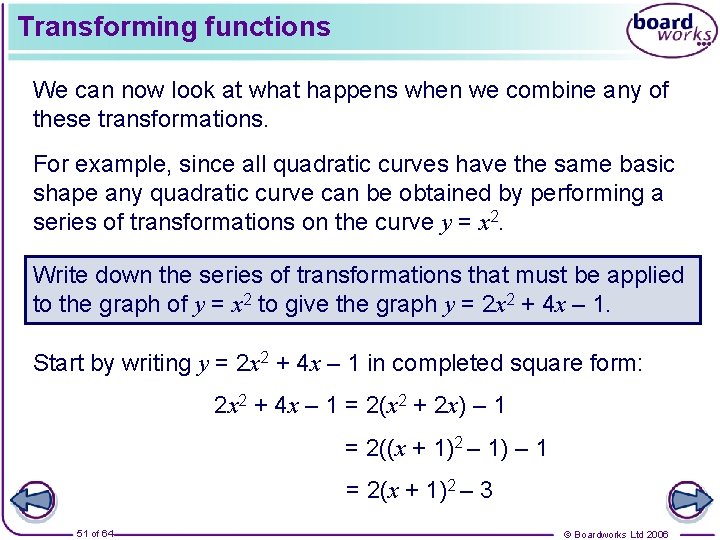
Transforming functions We can now look at what happens when we combine any of these transformations. For example, since all quadratic curves have the same basic shape any quadratic curve can be obtained by performing a series of transformations on the curve y = x 2. Write down the series of transformations that must be applied to the graph of y = x 2 to give the graph y = 2 x 2 + 4 x – 1. Start by writing y = 2 x 2 + 4 x – 1 in completed square form: 2 x 2 + 4 x – 1 = 2(x 2 + 2 x) – 1 = 2((x + 1)2 – 1) – 1 = 2(x + 1)2 – 3 51 of 64 © Boardworks Ltd 2006
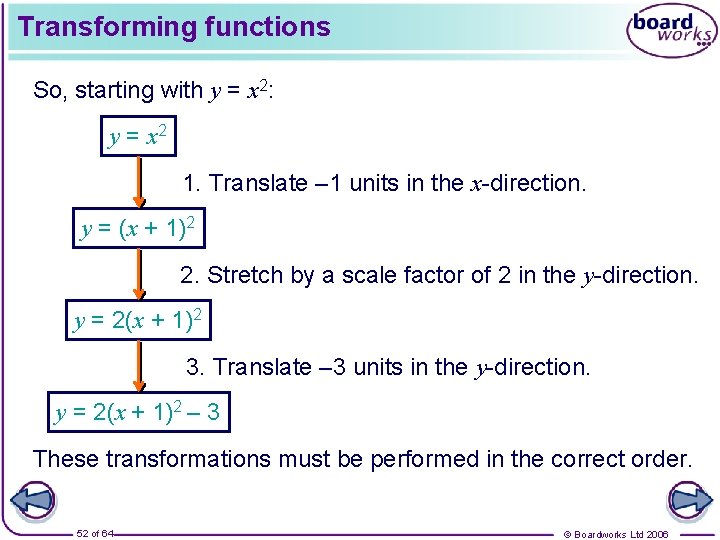
Transforming functions So, starting with y = x 2: y = x 2 1. Translate – 1 units in the x-direction. y = (x + 1)2 2. Stretch by a scale factor of 2 in the y-direction. y = 2(x + 1)2 3. Translate – 3 units in the y-direction. y = 2(x + 1)2 – 3 These transformations must be performed in the correct order. 52 of 64 © Boardworks Ltd 2006
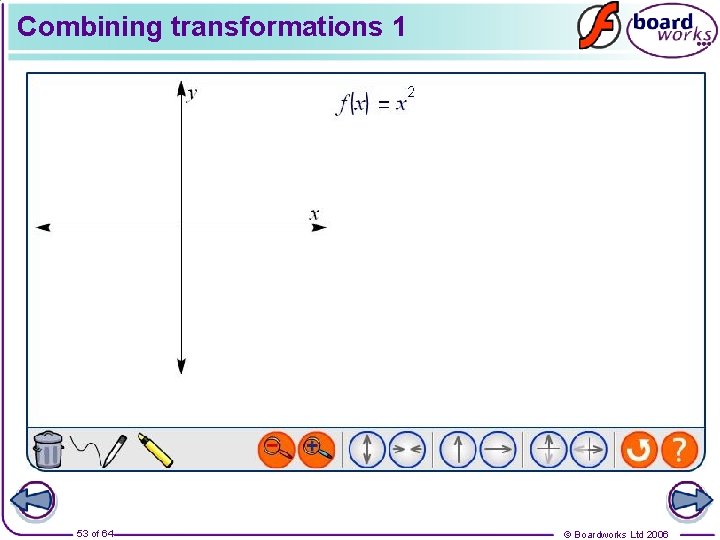
Combining transformations 1 53 of 64 © Boardworks Ltd 2006
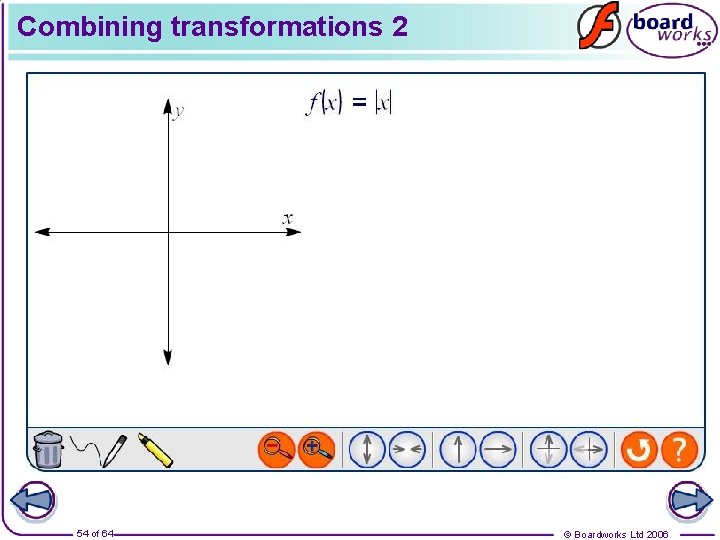
Combining transformations 2 54 of 64 © Boardworks Ltd 2006
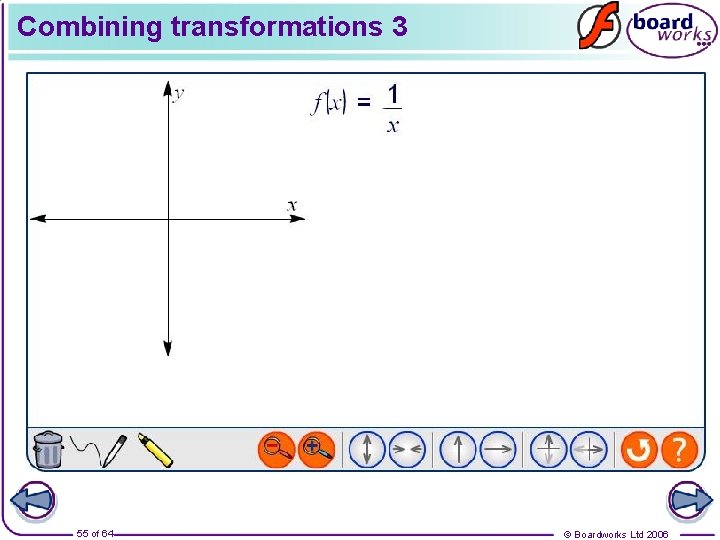
Combining transformations 3 55 of 64 © Boardworks Ltd 2006
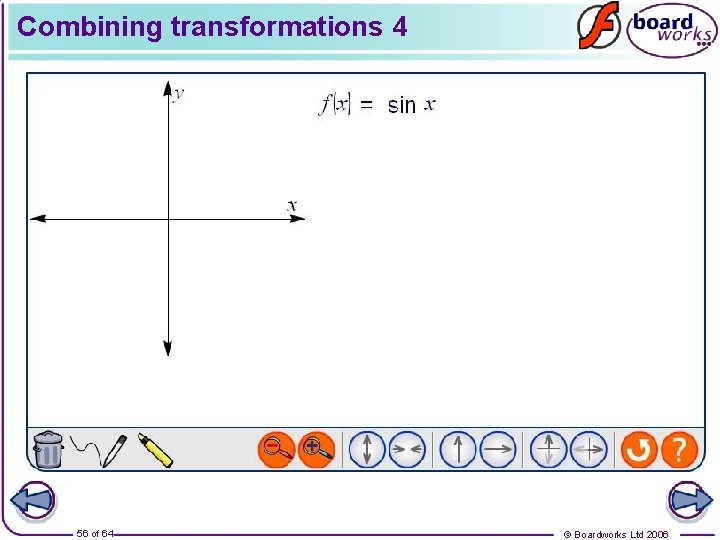
Combining transformations 4 56 of 64 © Boardworks Ltd 2006
Examination-style questions Contents Functions and mappings Finding the range of a function Composite functions Inverse functions and their graphs The modulus function Transforming functions Examination-style questions 57 of 64 © Boardworks Ltd 2006
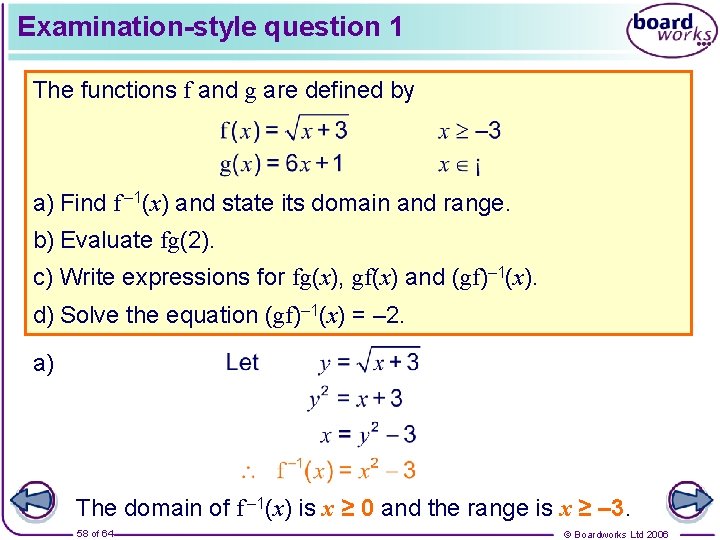
Examination-style question 1 The functions f and g are defined by a) Find f – 1(x) and state its domain and range. b) Evaluate fg(2). c) Write expressions for fg(x), gf(x) and (gf)– 1(x). d) Solve the equation (gf)– 1(x) = – 2. a) The domain of f – 1(x) is x ≥ 0 and the range is x ≥ – 3. 58 of 64 © Boardworks Ltd 2006
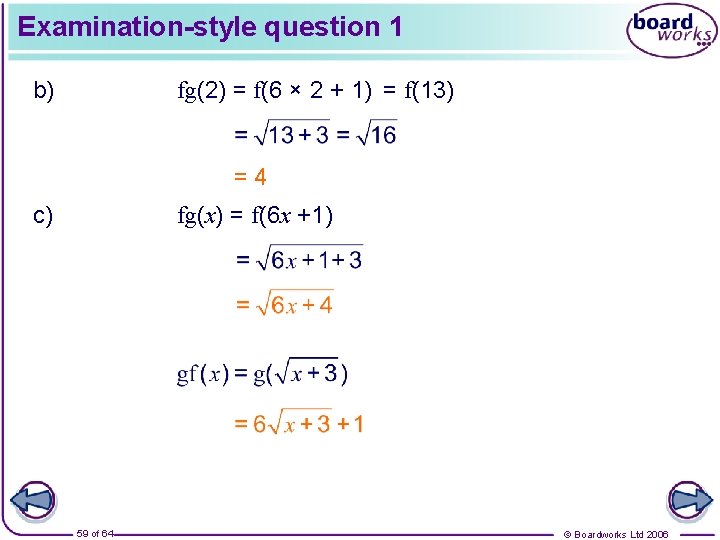
Examination-style question 1 b) fg(2) = f(6 × 2 + 1) = f(13) =4 c) fg(x) = f(6 x +1) 59 of 64 © Boardworks Ltd 2006
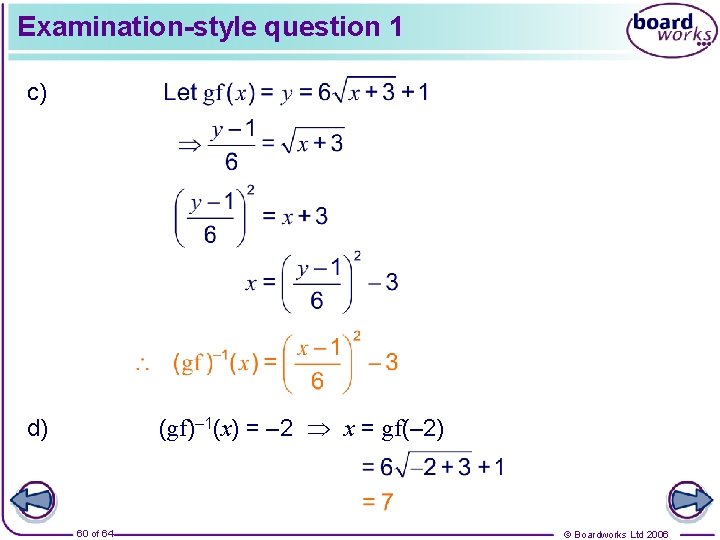
Examination-style question 1 c) (gf)– 1(x) = – 2 x = gf(– 2) d) 60 of 64 © Boardworks Ltd 2006
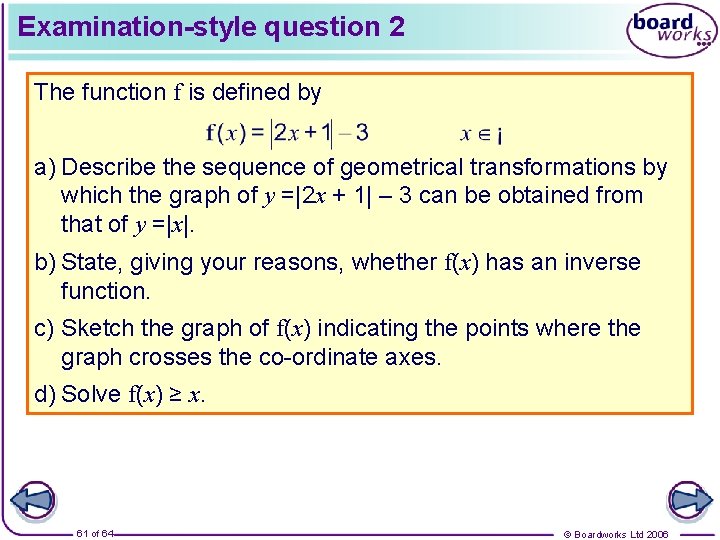
Examination-style question 2 The function f is defined by a) Describe the sequence of geometrical transformations by which the graph of y =|2 x + 1| – 3 can be obtained from that of y =|x|. b) State, giving your reasons, whether f(x) has an inverse function. c) Sketch the graph of f(x) indicating the points where the graph crosses the co-ordinate axes. d) Solve f(x) ≥ x. 61 of 64 © Boardworks Ltd 2006
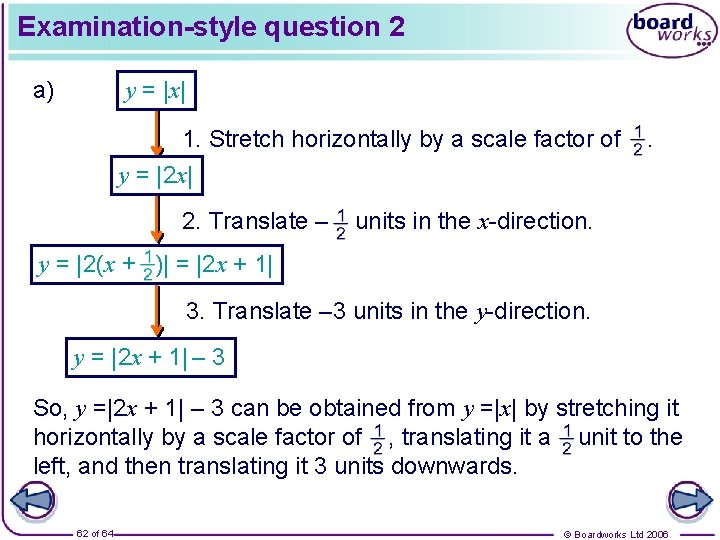
Examination-style question 2 y = |x| a) 1. Stretch horizontally by a scale factor of y = |2 x| 2. Translate – . units in the x-direction. y = |2(x + )| = |2 x + 1| 3. Translate – 3 units in the y-direction. y = |2 x + 1| – 3 So, y =|2 x + 1| – 3 can be obtained from y =|x| by stretching it horizontally by a scale factor of , translating it a unit to the left, and then translating it 3 units downwards. 62 of 64 © Boardworks Ltd 2006
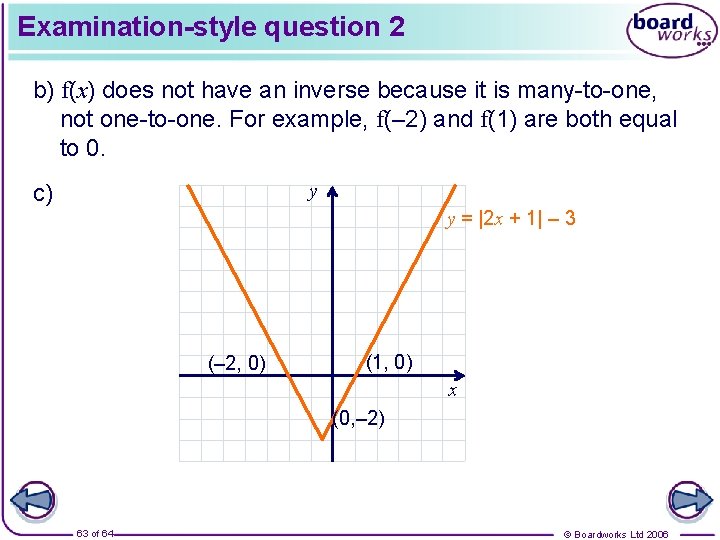
Examination-style question 2 b) f(x) does not have an inverse because it is many-to-one, not one-to-one. For example, f(– 2) and f(1) are both equal to 0. c) y y = |2 x + 1| – 3 (– 2, 0) (1, 0) x (0, – 2) 63 of 64 © Boardworks Ltd 2006
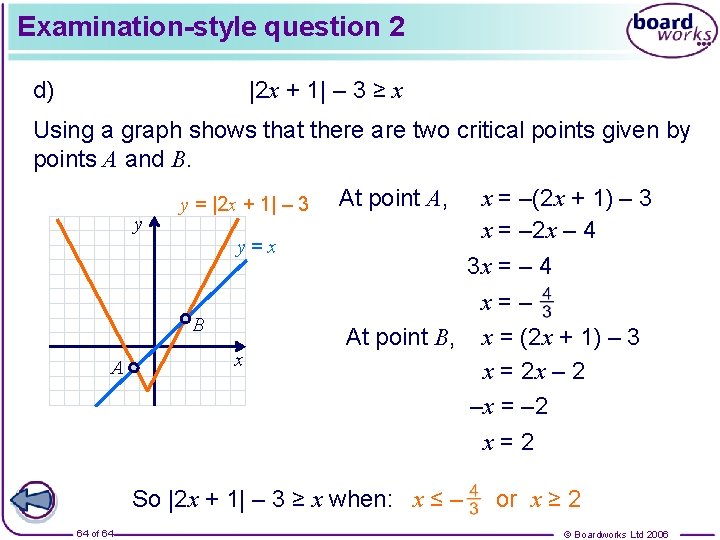
Examination-style question 2 d) |2 x + 1| – 3 ≥ x Using a graph shows that there are two critical points given by points A and B. y y = |2 x + 1| – 3 y=x B A x At point A, x = –(2 x + 1) – 3 x = – 2 x – 4 3 x = – 4 x=– At point B, x = (2 x + 1) – 3 x = 2 x – 2 –x = – 2 x=2 So |2 x + 1| – 3 ≥ x when: x ≤ – 64 of 64 or x ≥ 2 © Boardworks Ltd 2006