A Framework for Financial Statement Analysis Chapter 11



















- Slides: 72
A Framework for Financial Statement Analysis Chapter 11
Why Financial Statements Are Analyzed • In order for financial information to be useful, it must be interpreted.
Why Financial Statements Are Analyzed • A comprehensive set of ratios allows the user to make sense of all the financial information reported in the financial statements.
Users of Financial Information • Users of financial information may be current or future users.
Users of Financial Information • Some of the users of financial information are the following: – – Investors Managers Customers Potential suppliers and creditors – Government regulators – Employee unions – Public interest and community groups
Sources of Financial Information • The major source of financial information is a firm's annual report.
The following are elements of most annual reports: • Management discussion and analysis • Independent auditor's report • Primary financial statements • Secondary financial statements • Notes to the financial statements
Other Sources of Information • Reports filed with regulatory agencies (special, quarterly, and annual) • Business periodicals (magazines, newspapers, newsletters) • Investment advisory services (Standard & Poor, Moody's, etc. )
Basis of Comparison • When analyzing financial reports, one of the first decisions is to identify the basis of comparison.
Data may be compared with the following: • The firm's own data from prior years • Data from another firm in the same industry • Data from another firm in which the analyst may invest • Industry averages • Benchmarks or targets
Restatements May Be Necessary • The statements may need to be restated when significant unusual events have occurred which would distort comparisons.
Restatements May Be Necessary • Such events include, among others, mergers or acquisitions, discontinued operations, changes in accounting principles, and extraordinary items.
More Comparability Is Better • Comparability is enhanced when firms' size, capital structure, and product mix are similar.
A summary of the steps: • Identify the purpose and objectives of analysis.
A summary of the steps: • Review the financial statements, notes, and audit opinion to identify any unusual events or characteristics and to become familiar with the nature of the firm’s operation.
A summary of the steps: • Determine whether any restatements due to mergers, discontinued operations, etc. , are necessary to enhance comparability of the firm’s financial statements.
A summary of the steps: • Determine whether the firm’s size, capital structure, and product mix are sufficiently comparable (between firms or time periods) to proceed with the ratio calculations.
Financial Statement Analysis Ratios & Framework • The analyst usually performs horizontal and vertical analyses of the financial statements.
Financial Statement Analysis Ratios & Framework • Horizontal analysis focuses on changes or growth, year to year, for each major element on the income statement and the balance sheet.
Financial Statement Analysis Ratios & Framework • Vertical analysis examines the percentage composition of the income statement and the balance sheet: It uses common-size financial statements for this analysis.
Categories of Financial Ratios • Ratios are usually grouped into broad categories.
Categories of Financial Ratios • Four widely used major headings are liquidity, profitability, capital structure, and investor.
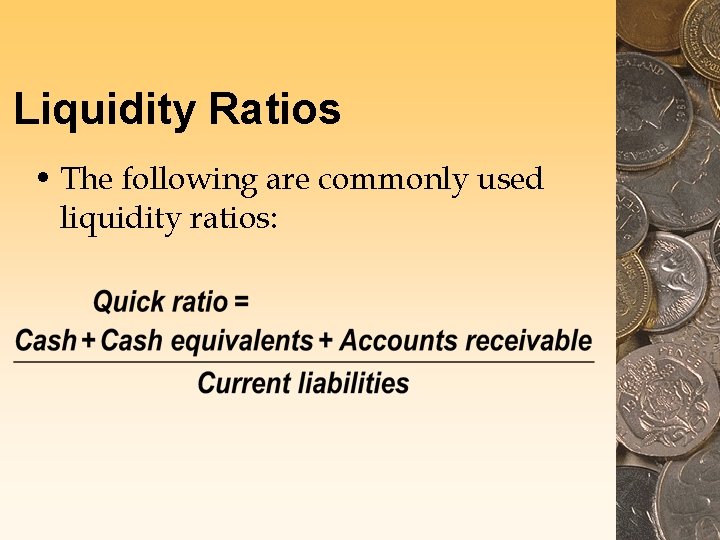
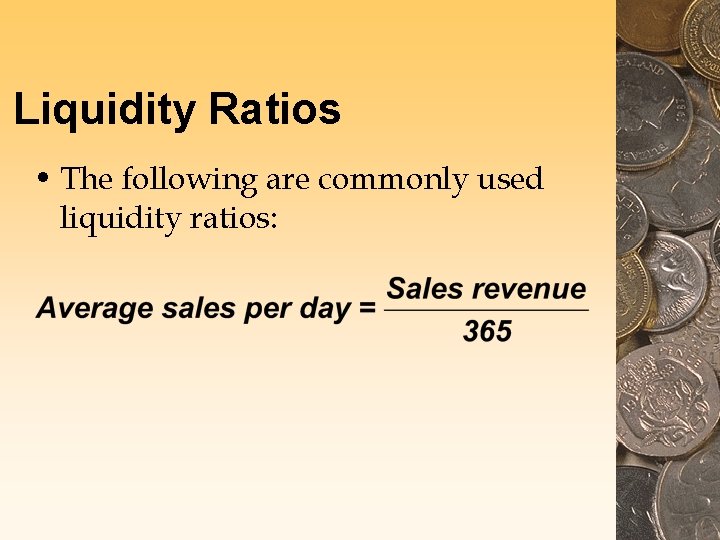
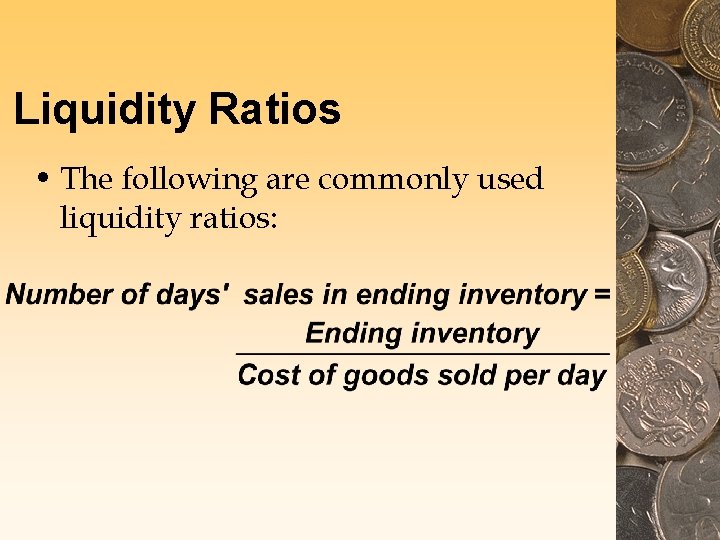
Liquidity Ratios • Liquidity ratios indicate the short-term solvency of the firm.
Liquidity Ratios • They also indicate how effectively the firm is managing its working capital.
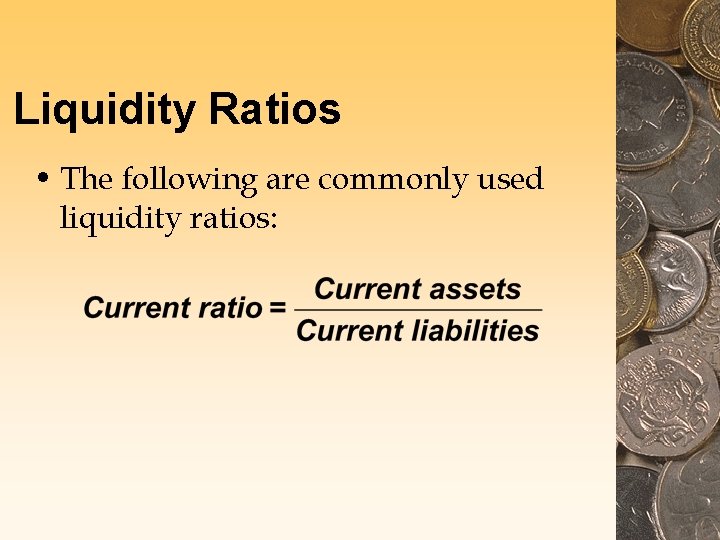
Liquidity Ratios • The following are commonly used liquidity ratios:
Liquidity Ratios • The following are commonly used liquidity ratios:
Liquidity Ratios • The following are commonly used liquidity ratios:
Liquidity Ratios • The following are commonly used liquidity ratios:
Liquidity Ratios • The following are commonly used liquidity ratios:
Profitability Ratios • Profitability ratios measure how profitable a firm is.
Profitability Ratios • This is very important for investors who want to invest in a firm which can return their investment to them.
Profitability Ratios • The following are commonly used profitability ratios:
Profitability Ratios • The following are commonly used profitability ratios:
Profitability Ratios • The following are commonly used profitability ratios:
Profitability Ratios • The following are commonly used profitability ratios:
Profitability Ratios • The following are commonly used profitability ratios:
Profitability Ratios • The following are commonly used profitability ratios:
Capital Structure Ratios • Capital structure ratios help in assessing a firm's strategies for financing its assets.
Capital Structure Ratios • Capital structure indicates the relative amounts of debt and equity capital.
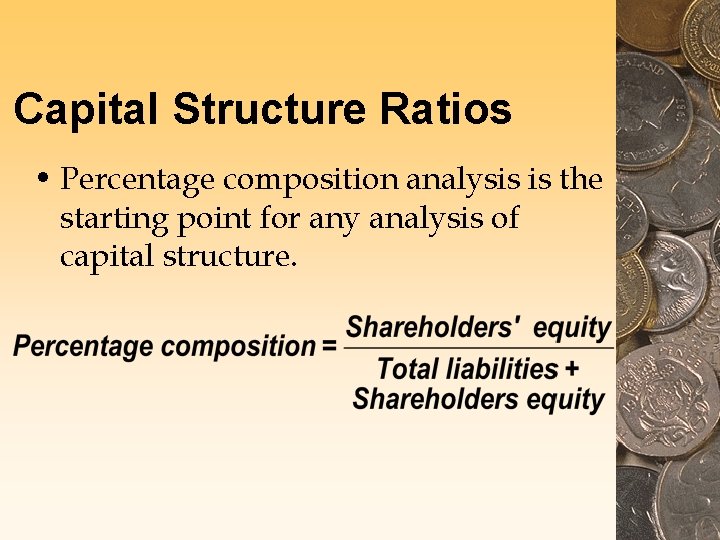
Capital Structure Ratios • Percentage composition analysis is the starting point for any analysis of capital structure.
Capital Structure Ratios • Percentage composition analysis describes the relative amounts of capital obtained from each major source of financing.
Capital Structure Ratios • Current liabilities, long-term debt, deferred taxes and other similar liabilities, and shareholders' equity all will be divided by the total of total liabilities and shareholders' equity.
Capital Structure Ratios • Percentage composition analysis is the starting point for any analysis of capital structure.
Capital Structure Ratios • Percentage composition analysis is the starting point for any analysis of capital structure.
Capital Structure Ratios • Percentage composition analysis is the starting point for any analysis of capital structure.
Capital Structure Ratios • Percentage composition analysis is the starting point for any analysis of capital structure.
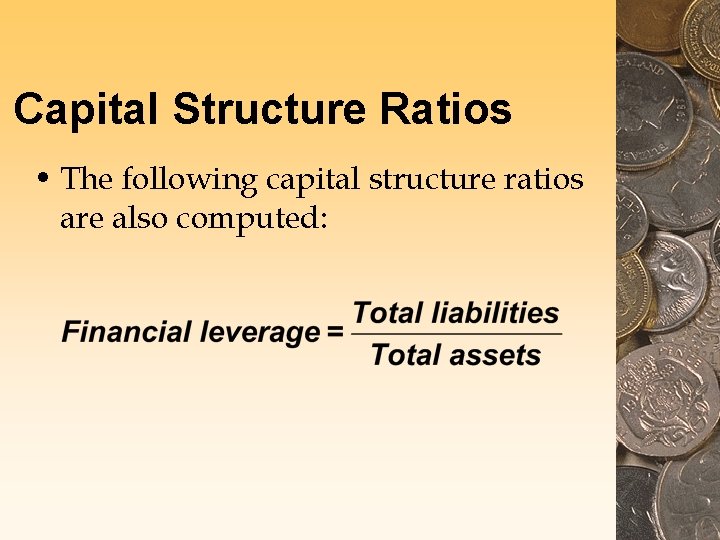
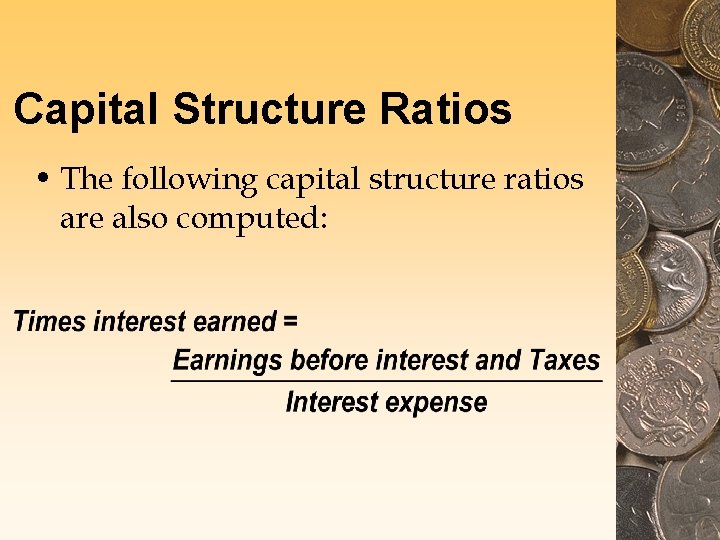
Capital Structure Ratios • The following capital structure ratios are also computed:
Capital Structure Ratios • The following capital structure ratios are also computed:
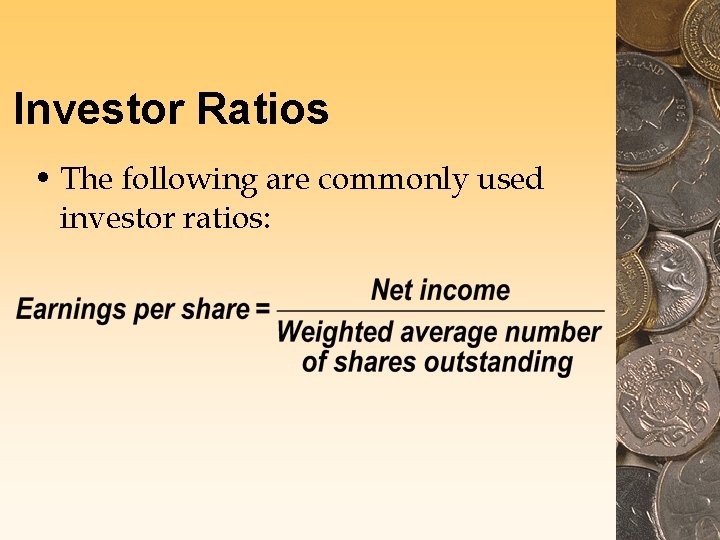
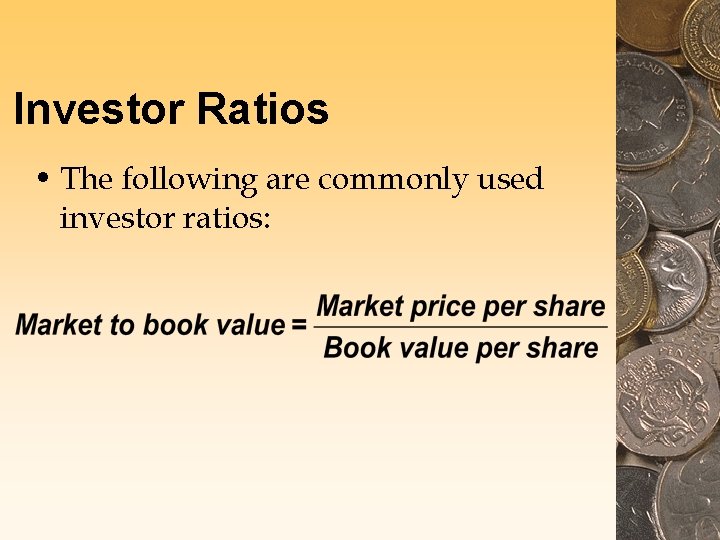
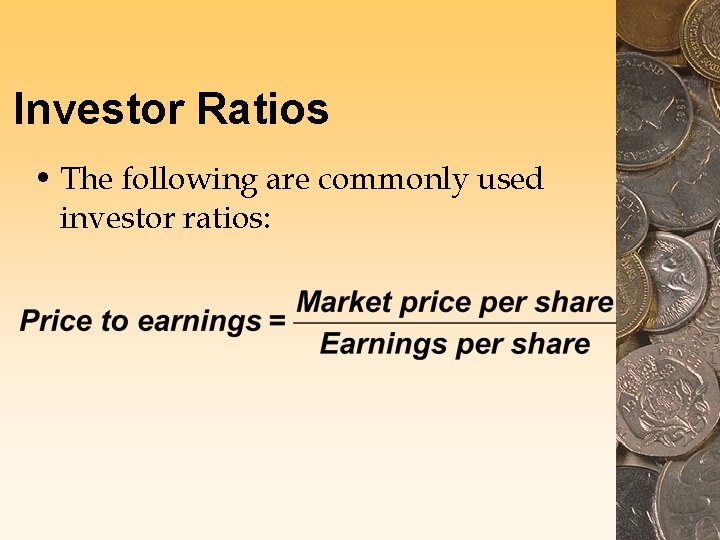
Investor Ratios • Investor ratios all relate to an external dimension of ownership interest. • Most indicate how a firm is performing with regard to the market value of its shares.
Investor Ratios • The following are commonly used investor ratios:
Investor Ratios • The following are commonly used investor ratios:
Investor Ratios • The following are commonly used investor ratios:
Financial Statement Analysis Framework • The financial statement analysis framework includes the following steps.
Financial Statement Analysis Framework • Identify the purpose and objectives of the analysis.
Financial Statement Analysis Framework • Review the financial statements, notes and audit opinion.
Financial Statement Analysis Framework • Determine whether restatements are necessary to enhance the comparability of the statements.
Financial Statement Analysis Framework • Determine whether the firm's size, capital structure, and product mix are appropriate to proceed with the ratio calculations.
Financial Statement Analysis Framework • Conduct horizontal and vertical analyses of each financial statement, with special emphasis on the income statement.
Financial Statement Analysis Framework • Calculate the basic liquidity ratios.
Financial Statement Analysis Framework • Calculate profitability ratios based on net income and on cash flow from operating activities. Evaluate trends.
Financial Statement Analysis Framework • Evaluate the firm's capital structure with special emphasis on trends in the percentage composition ratios.
Financial Statement Analysis Framework • Examine the firm's market performance using the investor ratios.
Financial Statement Analysis Framework • Examine any inconsistencies in the ratio results, review notes, and recalculate the ratios.
Limitations of Financial Statement Analyses • Financial statement analysis is limited due to several items.
Limitations of Financial Statement Analyses • GAAP presents some limits.
Limitations of Financial Statement Analyses • GAAP presents some limits. • Managers often have the ability to select favorable accounting methods.
Limitations of Financial Statement Analyses • Many major factors affecting profitability and survival of the firm are not included in the financial statements.
Limitations of Financial Statement Analyses • Many major factors affecting profitability and survival of the firm are not included in the financial statements. – A perfect example is human resources.
Limitations of Financial Statement Analyses • Many major factors affecting profitability and survival of the firm are not included in the financial statements. – While employees are often a firm's most important asset, a value for employees does not appear on the balance sheet.
Limitations of Financial Statement Analyses • "Real" events are often hard to distinguish from the effects of alternative accounting methods or principles.
Limitations of Financial Statement Analyses • Financial statement analysis relies on past numbers, and the past may not be a reliable indication of the future.
A Framework for Financial Statement Analysis End of Chapter 11