Transformation Leadership Culture CCLs innovation in the field




























- Slides: 68
Transformation & Leadership Culture CCL’s innovation in the field of change, essentially reforms traditional change management methods, to be consciously driven through the senior team’s Leadership Culture, Its beliefs and practices. ~ The Art of Change Leadership in Organizational Complex Challenges Polarity Thinking Learning Community Conference Colorado Springs, September 27 -8, 2016 John B. Mc. Guire & Laura Quinn © 2016 Center for Creative Leadership. All rights reserved.
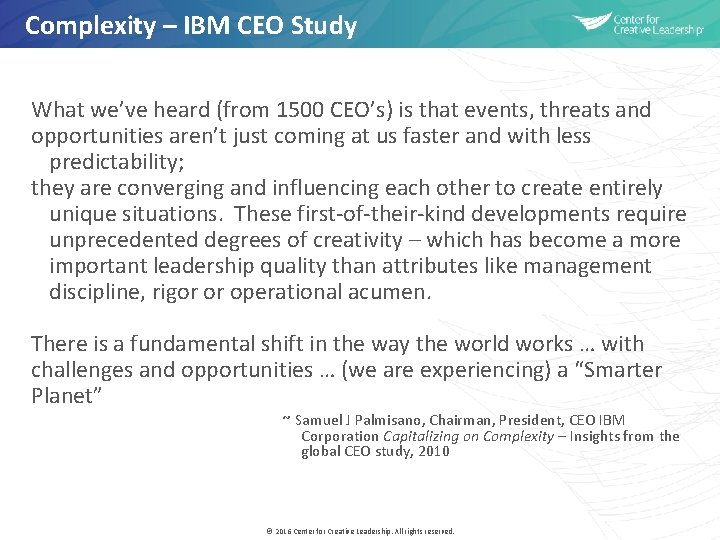
Complexity – IBM CEO Study What we’ve heard (from 1500 CEO’s) is that events, threats and opportunities aren’t just coming at us faster and with less predictability; they are converging and influencing each other to create entirely unique situations. These first-of-their-kind developments require unprecedented degrees of creativity – which has become a more important leadership quality than attributes like management discipline, rigor or operational acumen. There is a fundamental shift in the way the world works … with challenges and opportunities … (we are experiencing) a “Smarter Planet” ~ Samuel J Palmisano, Chairman, President, CEO IBM Corporation Capitalizing on Complexity – Insights from the global CEO study, 2010 © 2016 Center for Creative Leadership. All rights reserved.
Leadership for an Interdependent World “The world is shifting in such magnitude that there is not enough physical resource for us to view our market places in the traditional ways… in a fundamentally interconnected world our leaders face new and greater challenges that require new and greater leadership strategies…. Our future performance will increasingly require our top leaders to think and act interdependently and above all to influence the men and women throughout our company to think and act inter-dependently to move towards a higher organizational aim. ” Bob Mc. Donald Chairman of the Board, President and CEO The Procter & Gamble Company © 2016 Center for Creative Leadership. All rights reserved.
Major Challenges in Leadership Complexity Culture Paradox The most important challenges we face today are interdependent: they can only be solved by groups of people working collaboratively across boundaries © 2016 Center for Creative Leadership. All rights reserved.
Systems COMPLEX COMPLICATED • • • Interdependent variables create predictable responses in one direction. Technical/Linear (NON-ADAPTIVE) Example: Space Shuttle • Failure = Catastrophe Failure = Regeneration (Learning) • • Interdependent variables self -organize; new, emergent, unpredictable outcomes. ADAPTIVE Example: Human Interaction © 2016 Center for Creative Leadership. All rights reserved.
What CCL is learning about Transformation … • • • The key for sustainable transformation is alignment of collective beliefs and practices with new strategy/new business model. The sooner and more meaningfully involved people can be, the greater the chances of successful transformation. Adequate dialogue must precede action in order to create the full support needed to succeed in facing the challenges of transformation. Leaders can edict compliance but not commitment. Leaders underestimate the need for information and collaboration in undertaking change efforts. How direction, alignment and commitment are created in framing the change will set irreversible dynamics in motion that affect how the transformation plays out. Senior Leaders need to model the new changes/beliefs/practices – and share their learning in making these changes (public learning). Transformation happens through advancing beliefs, practices and behaviors simultaneously. Transformation efforts shouldn’t be ‘something separate’ from the work – efforts should be embedded in the organization’s work. © 2014 Center for Creative Leadership. All rights reserved.
Your Complex Challenges Leadership for an Interdependent World © 2016 Center for Creative Leadership. All rights reserved.
© 2014 Center for Creative Leadership. All rights reserved.
Our Interdependent World * A global Financial Crisis ripples & cripples economies * A terrorist attack closes a country * Social networking contributes to political upheaval * Globalization, competition and systems proliferation spikes complexity daily * An erupting volcano shuts down global business travel * One person steps across a line that closes a local airport and affects the entire U. S. air-transportation system for a day * Foreign species invade local eco-systems; sustainability is elusive * Supply chain disruptions loom – a pandemic, new terrorist sophistication, basic supply chains of food and water threatened. © 2016 Center for Creative Leadership. All rights reserved.
Interdependence & Solutions Interdependence - Awakening: global financial crisis - Connected Leadership: collaborative innovation - Culture Eats Strategy for Breakfast: Both/And Leadership Solutions - Programs build competencies - Solutions create organizational capability ~ Both/And - L Solutions drive client’s performance * Business orgs & Public communities … ? ? © 2014 Center for Creative Leadership. All rights reserved.
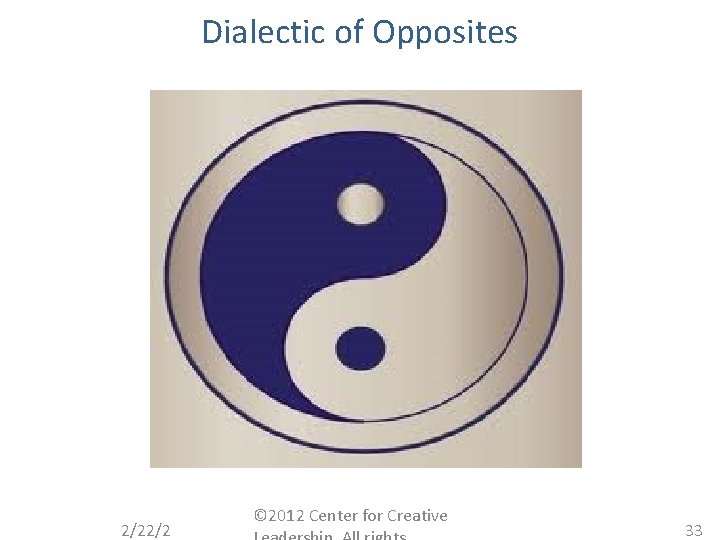
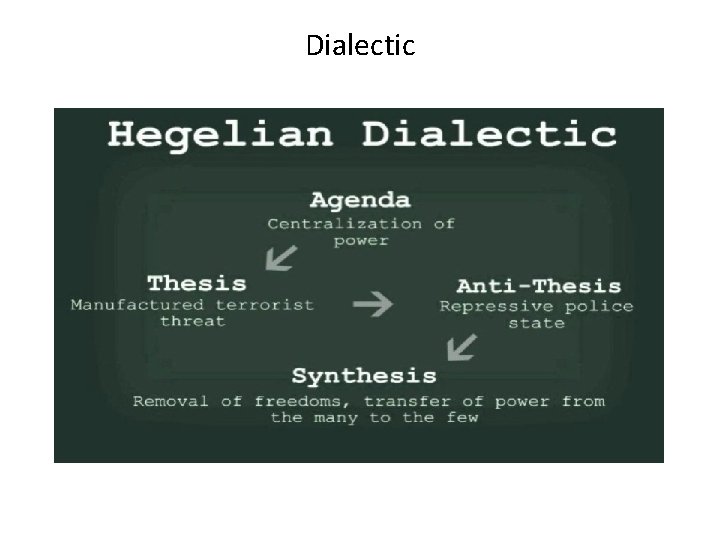
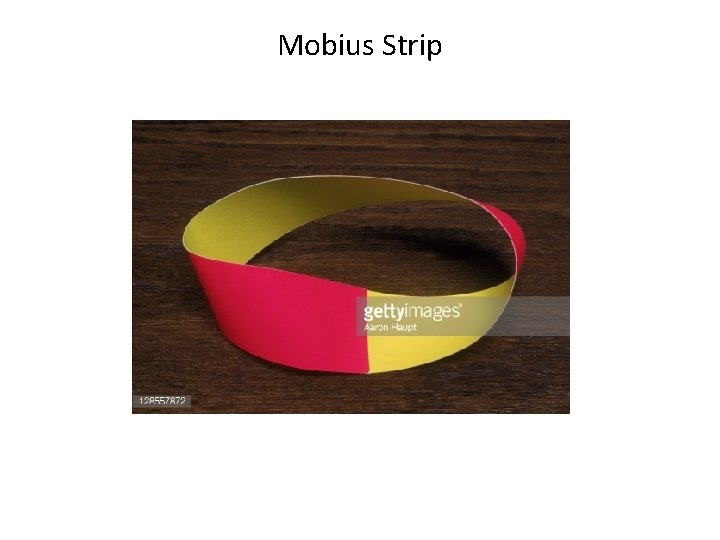
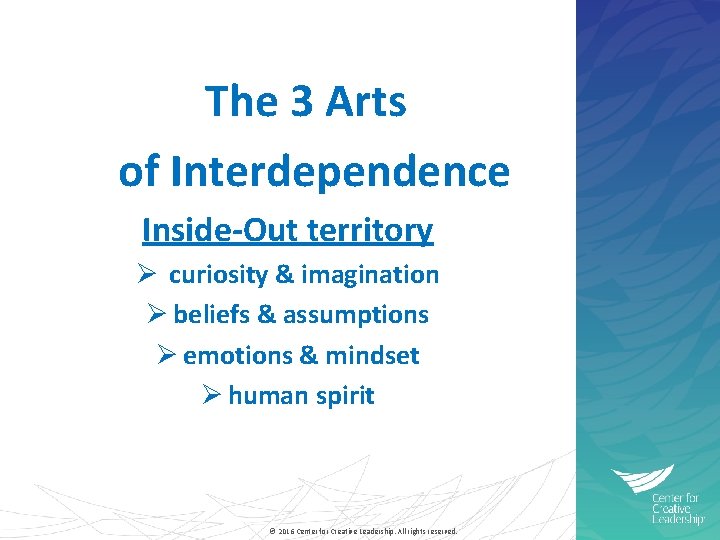
Interdependence & Solutions Interdependence 3 Tell Tales of Both/And - Dialectic: paradox, polarity-pairs, infinity/mobius loop, Hegel - Double loop learning: awareness of assumptions while doing tasks - Inter-systemic thinking: seeing whole systems and parts simultaneously Leadership Solutions 3 Arts of transformation* - Headroom or Bigger Mind or Both/And or Head/Heart room - Mediated Dialogue: ‘putting something in the middle’ - Boundary spanning Collaboration * the Inside-Out Zone: curiosity & imagination; assumptions & beliefs; emotions & mindset; human spirit © 2014 Center for Creative Leadership. All rights reserved.
Thriving Practice Whole Part + -Super Products -Module/Program Offers -Leadership Packages -See/Use Part -Align to Product -Integrated Products -Service Offerings -Leadership Solutions -See/Use Whole -Aligned Practices Whole Part - + -Disintegrated products -No Services -One Size Fits all -Hammer seeks Nail -Parts Stagnate -Misaligned Whole -Product Pipeline draining -Products Peak -Excess conformity -Whole stagnation -Misaligned Parts Stagnant Practice - © 2014 Center for Creative Leadership. All rights reserved.
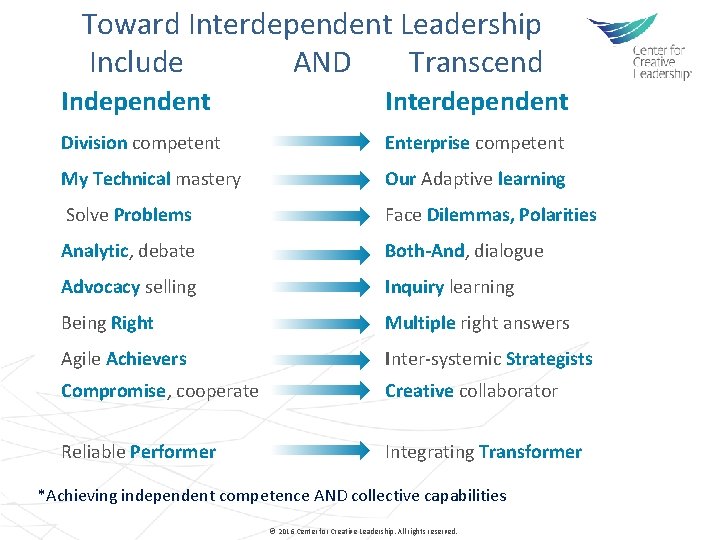
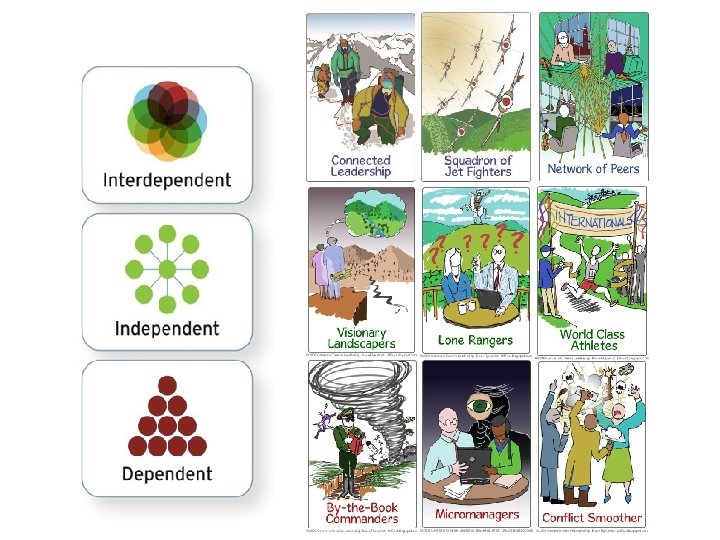
Toward Interdependent Leadership Include AND Transcend Independent Interdependent Division competent Enterprise competent My Technical mastery Our Adaptive learning Solve Problems Face Dilemmas, Polarities Analytic, debate Both-And, dialogue Advocacy selling Inquiry learning Being Right Multiple right answers Agile Achievers Inter-systemic Strategists Compromise, cooperate Creative collaborator Reliable Performer Integrating Transformer *Achieving independent competence AND collective capabilities © 2016 Center for Creative Leadership. All rights reserved.
Leadership Solutions: the essentials © 2016 Center for Creative Leadership. All rights reserved.
Mindsets When technical systems are not enough …. . adaptive, generative human systems are required © 2016 Center for Creative Leadership. All rights reserved.
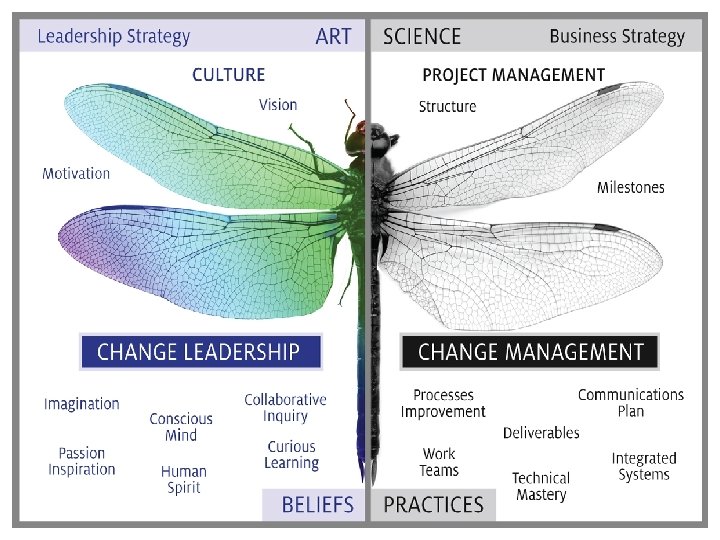
Our Transformation Frameworks Leadership Culture Direction, Alignment, Commitment Change Leadership ~ Change Management © 2016 Center for Creative Leadership. All rights reserved.
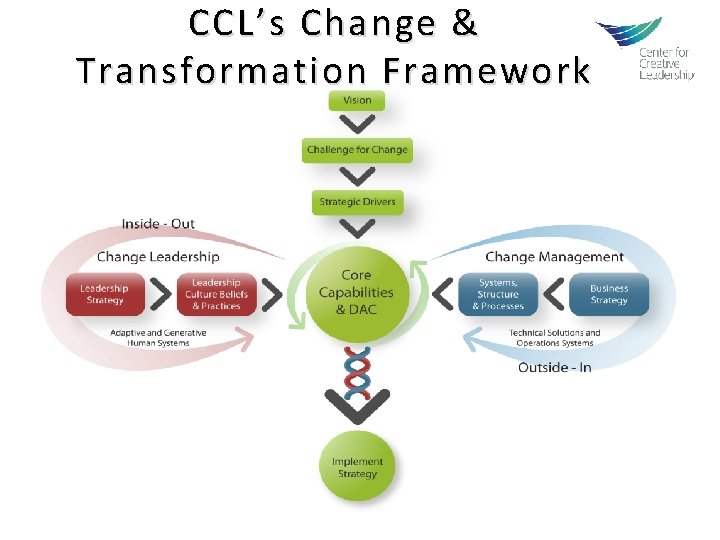
CCL’s Change & Transformation Framework © 2014 Center for Creative Leadership. All rights reserved.
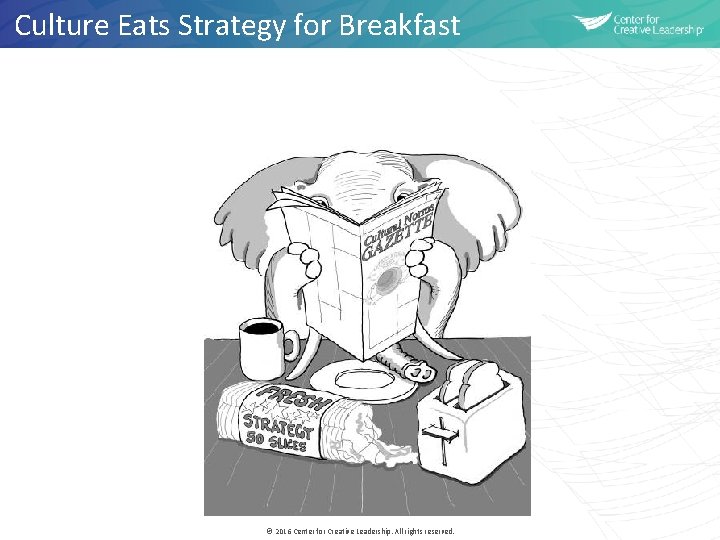
Culture Eats Strategy for Breakfast © 2016 Center for Creative Leadership. All rights reserved.
© 2014 Center for Creative Leadership. All rights reserved.
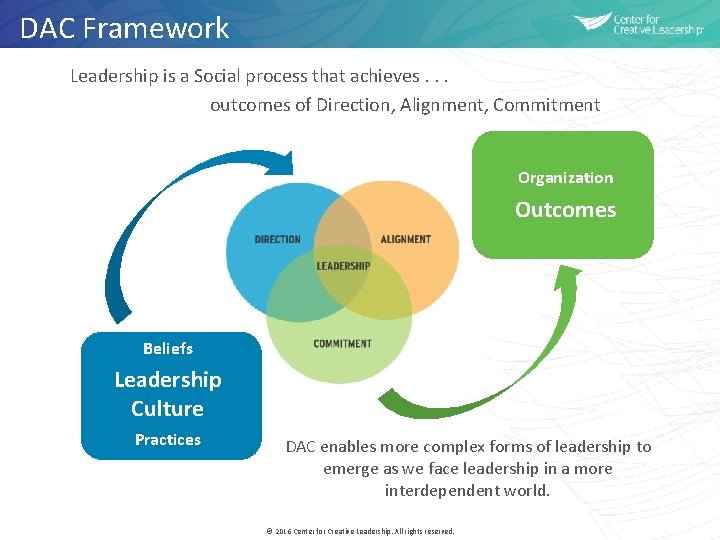
DAC Framework Leadership is a Social process that achieves. . . outcomes of Direction, Alignment, Commitment Organization Outcomes Beliefs Leadership Culture Practices DAC enables more complex forms of leadership to emerge as we face leadership in a more interdependent world. © 2016 Center for Creative Leadership. All rights reserved.
Leadership Culture Beliefs Ø Beliefs drive Decisions Ø Repeated Decisions create Practices (behaviors) Ø If you want Best Practices you need Best Beliefs What behaviors do the current collective beliefs drive in your organization? © 2016 Center for Creative Leadership. All rights reserved.
Organizational Evolution © 2016 Center for Creative Leadership. All rights reserved.
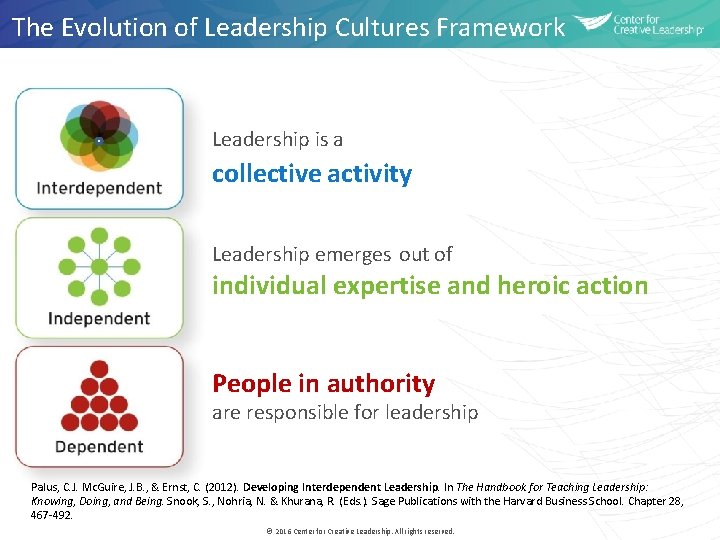
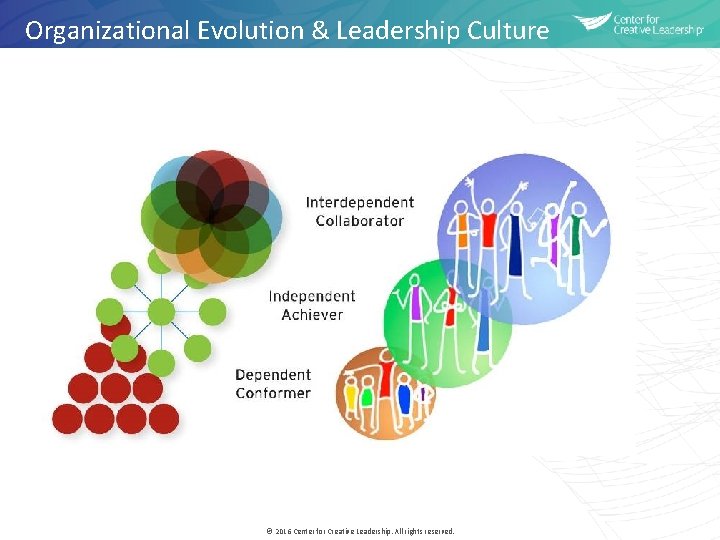
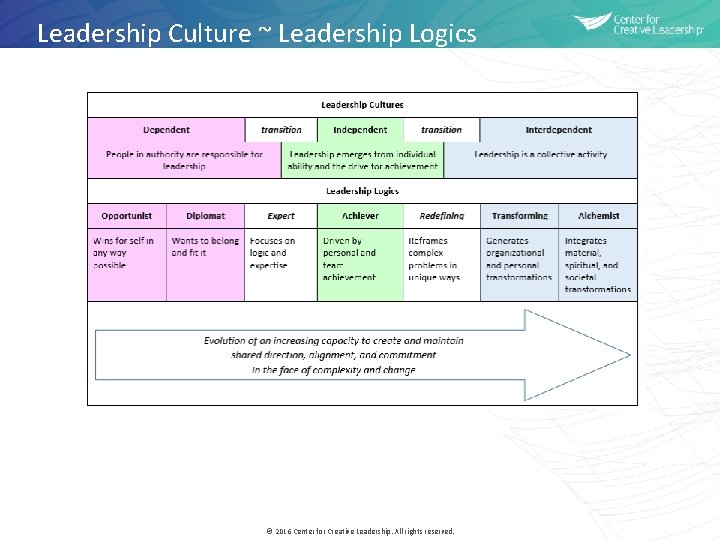
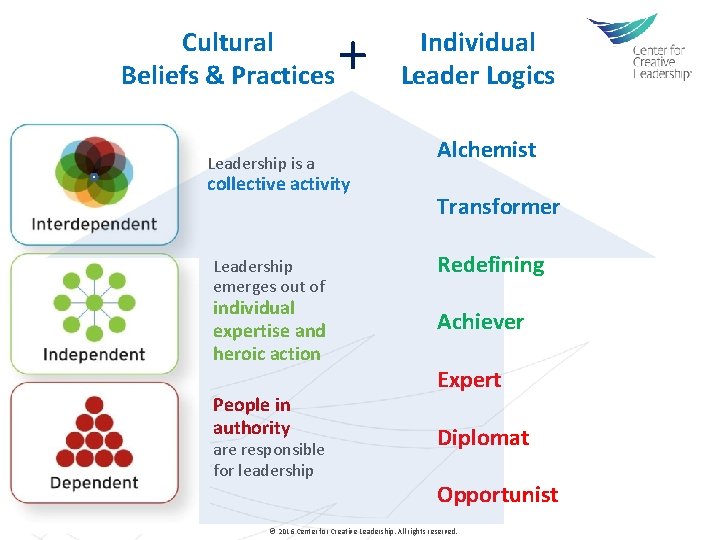
The Evolution of Leadership Cultures Framework Leadership is a collective activity Leadership emerges out of individual expertise and heroic action People in authority are responsible for leadership Palus, C. J. Mc. Guire, J. B. , & Ernst, C. (2012). Developing Interdependent Leadership. In The Handbook for Teaching Leadership: Knowing, Doing, and Being. Snook, S. , Nohria, N. & Khurana, R. (Eds. ). Sage Publications with the Harvard Business School. Chapter 28, 467 -492. © 2016 Center for Creative Leadership. All rights reserved.
Organizational Evolution & Leadership Culture © 2016 Center for Creative Leadership. All rights reserved.
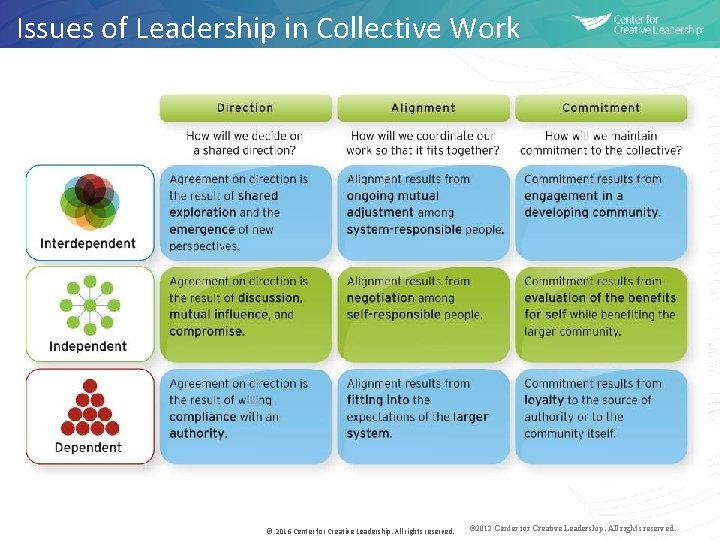
Issues of Leadership in Collective Work © 2016 Center for Creative Leadership. All rights reserved. © 2012 Center for Creative Leadership. All rights reserved.
Our Leadership Culture Research © 2016 Center for Creative Leadership. All rights reserved.
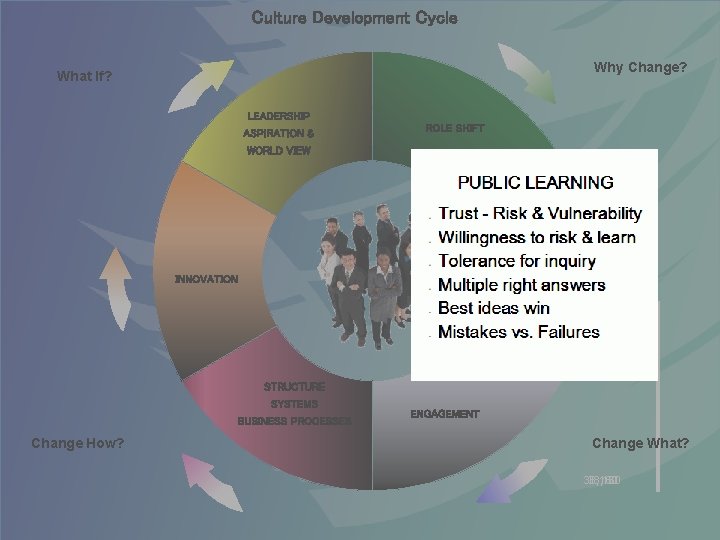
Culture Development Cycle Why Change? What If? LEADERSHIP ASPIRATION & ROLE SHIFT WORLD VIEW PUBLIC LEARNING • Trust – Risk & Vulnerability • Willingness to risk & learn • Tolerance for inquiry INNOVATION • Multiple right answers • Best ideas win • Mistakes vs. Failures STRUCTURE SYSTEMS BUSINESS PROCESSES Change How? ENGAGEMENT Change What? 38, 160
Public Learning Loop Reflection Curiosity Imagination Action © 2016 Center for Creative Leadership. All rights reserved.
The Telltales of Interdependence © 2016 Center for Creative Leadership. All rights reserved.
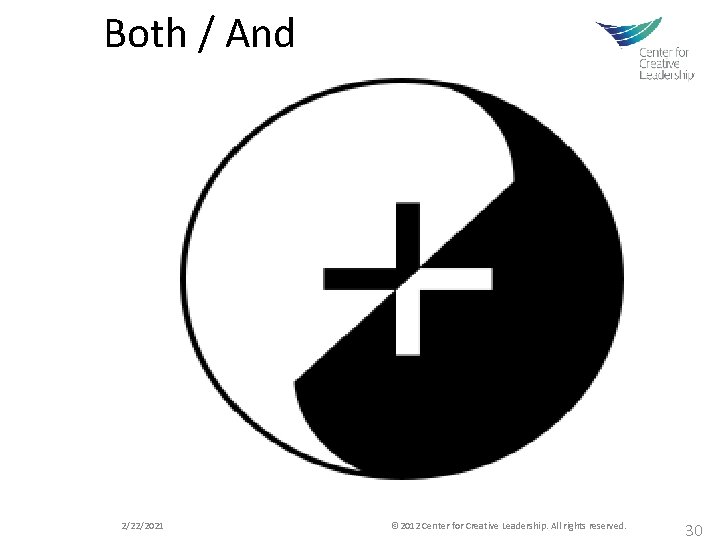
Both / And 2/22/2021 30 © 2012 Center for Creative Leadership. All rights reserved. © 2014 Center for Creative Leadership. All rights reserved.
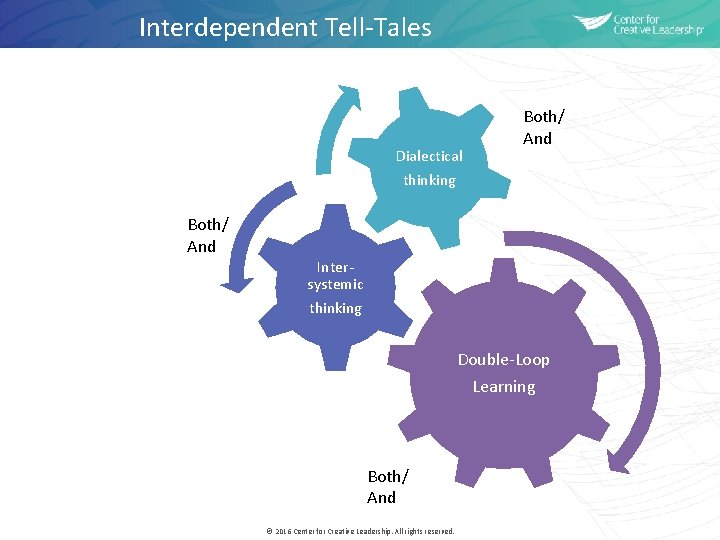
Interdependent Tell-Tales Dialectical thinking Both/ And Intersystemic thinking Double-Loop Learning Both/ And © 2016 Center for Creative Leadership. All rights reserved.
Interdependent Tell-Tales Dialectical thinking refers to the ability to view issues from multiple perspectives (sometimes opposites) and to arrive at the most economical and reasonable reconciliation of seemingly contradictory information and postures. Systems thinking is the process of understanding how things, regarded as systems, influence one another within a whole. Double Loop learning is when an individual, organization or entity is able, having attempted to achieve a goal on different occasions, to modify the goal in the light of experience or possibly even reject the goal. © 2016 Center for Creative Leadership. All rights reserved.
Dialectic of Opposites 2/22/2 © 2012 Center for Creative 33
Dialectic
Mobius Strip
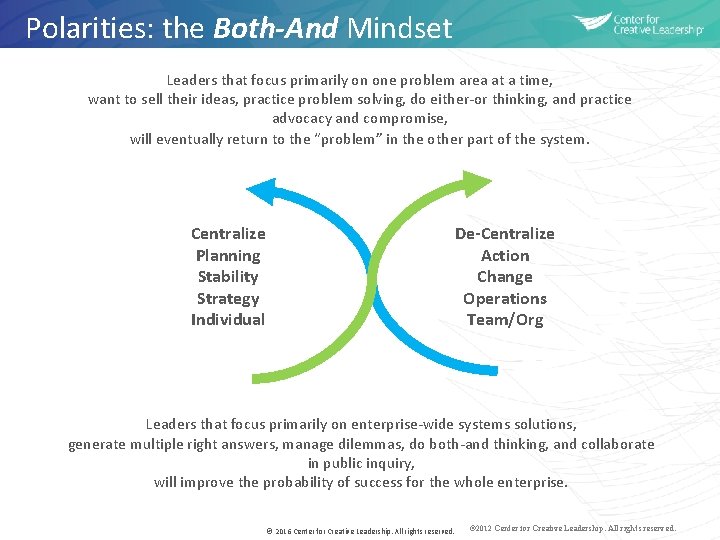
Polarities: the Both-And Mindset Leaders that focus primarily on one problem area at a time, want to sell their ideas, practice problem solving, do either-or thinking, and practice advocacy and compromise, will eventually return to the “problem” in the other part of the system. Centralize Planning Stability Strategy Individual De-Centralize Action Change Operations Team/Org Leaders that focus primarily on enterprise-wide systems solutions, generate multiple right answers, manage dilemmas, do both-and thinking, and collaborate in public inquiry, will improve the probability of success for the whole enterprise. © 2016 Center for Creative Leadership. All rights reserved. © 2012 Center for Creative Leadership. All rights reserved.
Conscious Capitalism Action Steps How will we gain or maintain the positive results from focusing on this left pole? What? Who? By When? Measures? 1. Thriving Democracy Positive results from focusing on this left pole: 1. 2. 3. Early Warnings*** Measurable indicators (things you can count) that will let you know that you are getting into the downside of this left pole. Freedom Uniqueness Initiative of each part * Action Steps How will we gain or maintain the positive results from focusing on this right pole? **Positive results from focusing on this right What? Who? By When? Measures? pole: 1. Equality 2. Connectedness 3. Synergy of all parts Part Whole Negative results of over-focusing on this left pole to the neglect of the right pole: Negative results of over-focusing on this right pole to the neglect of the left pole: 1. Inequality 2. Isolation 3. Lack of coordination 1. Over-control 2. Sameness 3. Excess Conformity 1. Declining Democracy * Thanks to John Scherer, Center for Work and the Human Spirit ** Thanks to The Strategy Academy, Rotterdam, The Netherlands *** Thanks to Todd Johnson, Rivertown Consultants © 2016 Center for Creative Leadership. All rights reserved. Early Warnings Measurable indicators (things you can count) that will let you know that you are getting into the downside of this right pole. 1.
Interdependent systems 2/22/2 © 2012 Center for Creative 38
A Systems View
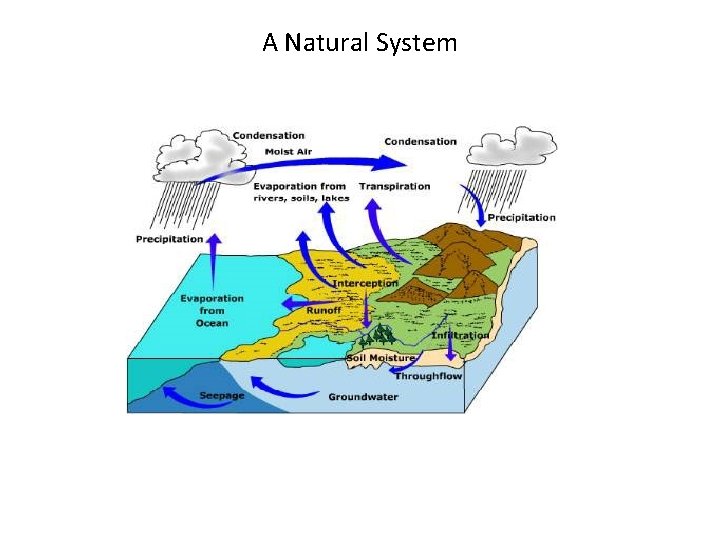
A Natural System
Double Loop Learning 2/22/2 © 2012 Center for Creative 41
Double Loop Learning? 2/22/2 © 2012 Center for Creative 42
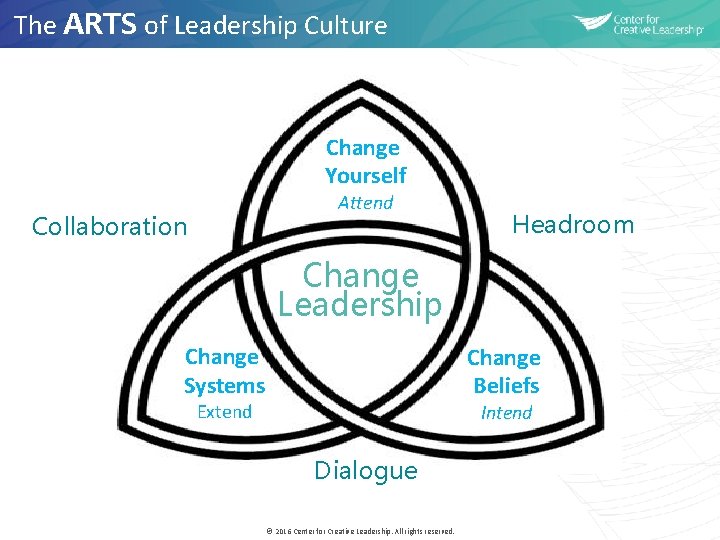
The 3 Arts of Interdependence Inside-Out territory Ø curiosity & imagination Ø beliefs & assumptions Ø emotions & mindset Ø human spirit © 2016 Center for Creative Leadership. All rights reserved.
The Collaboration Challenge © 2016 Center for Creative Leadership. All rights reserved.
© 2016 Center for Creative Leadership. All rights reserved.
Both/And Bigger Minds
Leadership Culture ~ Leadership Logics © 2016 Center for Creative Leadership. All rights reserved.
Leader Logics revisited … 1. 2. 3. 4. 5. 6. 7. Opportunist/Dominator: I catch many fish to eat and live. Its about survival. Diplomat/Moderator: I am a fisher. You are a fisher. There are rules. Expert/Specialist: I study fly fishing. There are many kinds of fishing. Achiever/Performer: I am the best fisherman, I catch big fish. Follow me. Re-definer/Freethinker: Fish can be farmed. Fishing is a metaphor. Transformer/Collaborator: The Zen of fishing. Fishing is a spiritual practice. Alchemist: Its not about fishing at all. © 2014 Center for Creative Leadership. All rights reserved.
Cultural Beliefs & Practices + Leadership is a collective activity Leadership emerges out of individual expertise and heroic action People in authority are responsible for leadership Individual Leader Logics Alchemist Transformer Redefining Achiever Expert Diplomat Opportunist © 2016 Center for Creative Leadership. All rights reserved.
© 2016 Center for Creative Leadership. All rights reserved. © 2012 Center for Creative Leadership. All rights reserved.
Boundary Spanning Collaboration © 2016 Center for Creative Leadership. All rights reserved.
Our Theory of Leadership Culture © 2016 Center for Creative Leadership. All rights reserved.
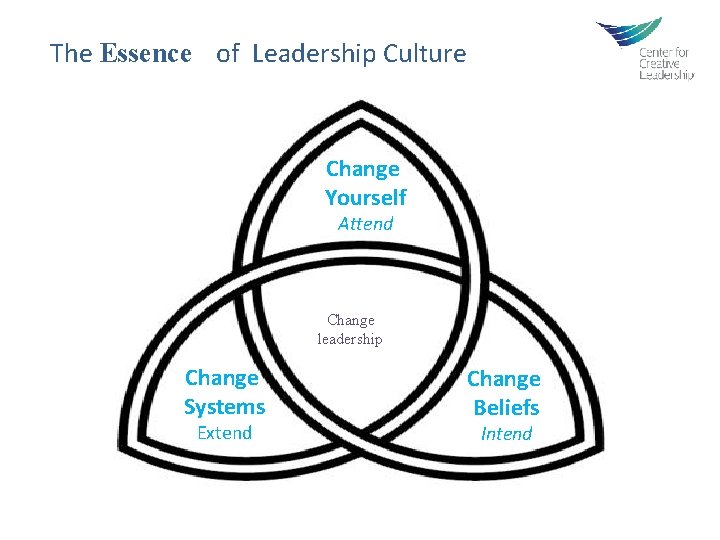
The Essence of Leadership Culture Change Yourself Attend Change leadership Change Systems Extend Change Beliefs Intend © 2014 Center for Creative Leadership. All rights reserved.
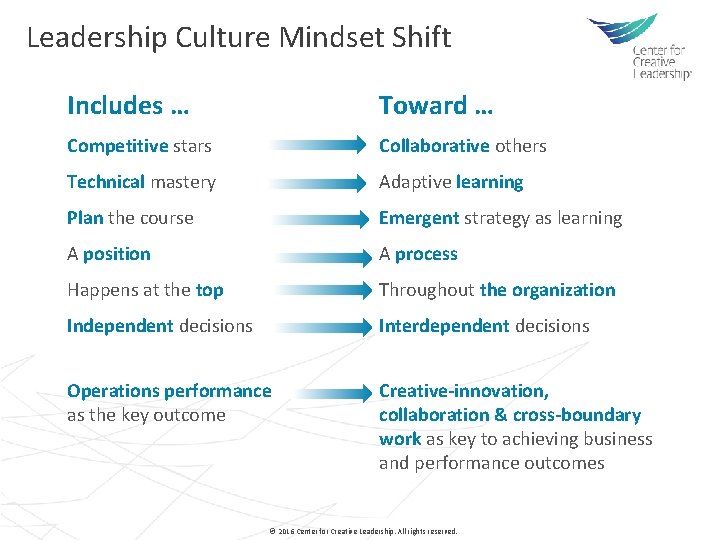
Leadership Culture Mindset Shift Includes … Toward … Competitive stars Collaborative others Technical mastery Adaptive learning Plan the course Emergent strategy as learning A position A process Happens at the top Throughout the organization Independent decisions Interdependent decisions Operations performance as the key outcome Creative-innovation, collaboration & cross-boundary work as key to achieving business and performance outcomes © 2016 Center for Creative Leadership. All rights reserved.
The ARTS of Leadership Culture Change Yourself Attend Collaboration Headroom Change Leadership Change Systems Change Beliefs Extend Intend Dialogue © 2016 Center for Creative Leadership. All rights reserved.
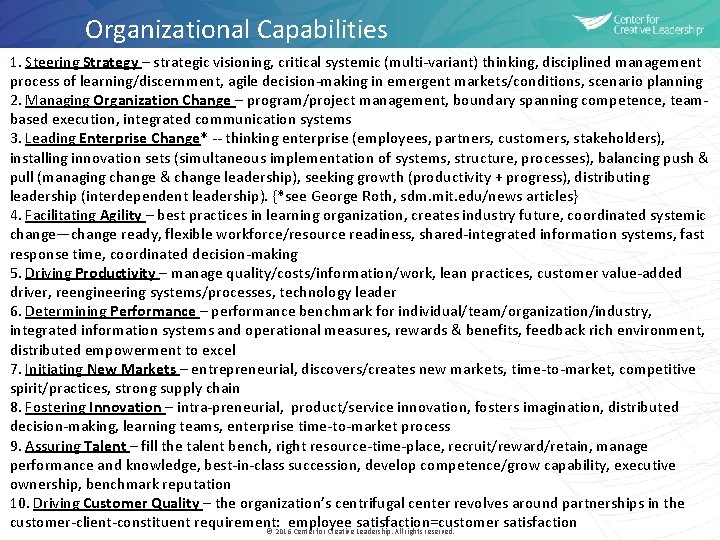
Organizational Capabilities 1. Steering Strategy – strategic visioning, critical systemic (multi-variant) thinking, disciplined management process of learning/discernment, agile decision-making in emergent markets/conditions, scenario planning 2. Managing Organization Change – program/project management, boundary spanning competence, teambased execution, integrated communication systems 3. Leading Enterprise Change* -- thinking enterprise (employees, partners, customers, stakeholders), installing innovation sets (simultaneous implementation of systems, structure, processes), balancing push & pull (managing change & change leadership), seeking growth (productivity + progress), distributing leadership (interdependent leadership). {*see George Roth, sdm. mit. edu/news articles} 4. Facilitating Agility – best practices in learning organization, creates industry future, coordinated systemic change—change ready, flexible workforce/resource readiness, shared-integrated information systems, fast response time, coordinated decision-making 5. Driving Productivity – manage quality/costs/information/work, lean practices, customer value-added driver, reengineering systems/processes, technology leader 6. Determining Performance – performance benchmark for individual/team/organization/industry, integrated information systems and operational measures, rewards & benefits, feedback rich environment, distributed empowerment to excel 7. Initiating New Markets – entrepreneurial, discovers/creates new markets, time-to-market, competitive spirit/practices, strong supply chain 8. Fostering Innovation – intra-preneurial, product/service innovation, fosters imagination, distributed decision-making, learning teams, enterprise time-to-market process 9. Assuring Talent – fill the talent bench, right resource-time-place, recruit/reward/retain, manage performance and knowledge, best-in-class succession, develop competence/grow capability, executive ownership, benchmark reputation 10. Driving Customer Quality – the organization’s centrifugal center revolves around partnerships in the customer-client-constituent requirement: employee satisfaction=customer satisfaction © 2016 Center for Creative Leadership. All rights reserved.
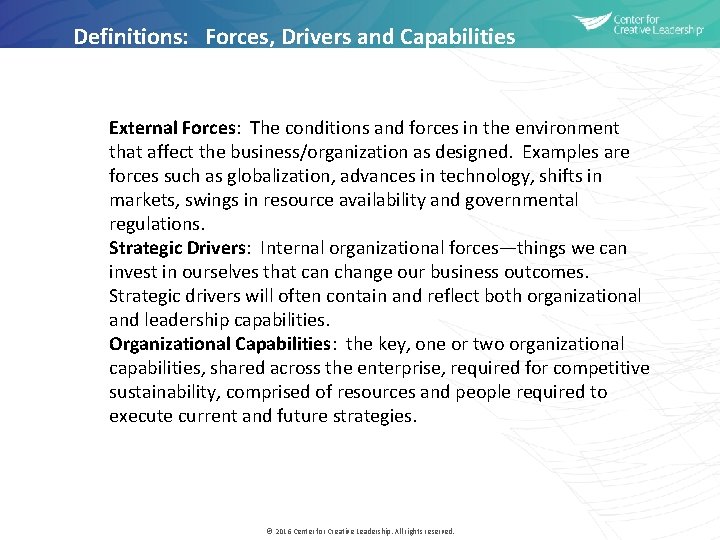
Definitions: Forces, Drivers and Capabilities External Forces: The conditions and forces in the environment that affect the business/organization as designed. Examples are forces such as globalization, advances in technology, shifts in markets, swings in resource availability and governmental regulations. Strategic Drivers: Internal organizational forces—things we can invest in ourselves that can change our business outcomes. Strategic drivers will often contain and reflect both organizational and leadership capabilities. Organizational Capabilities: the key, one or two organizational capabilities, shared across the enterprise, required for competitive sustainability, comprised of resources and people required to execute current and future strategies. © 2016 Center for Creative Leadership. All rights reserved.
Our Transformation Methodology Leadership Culture is the Operating System of Change Leadership © 2016 Center for Creative Leadership. All rights reserved.
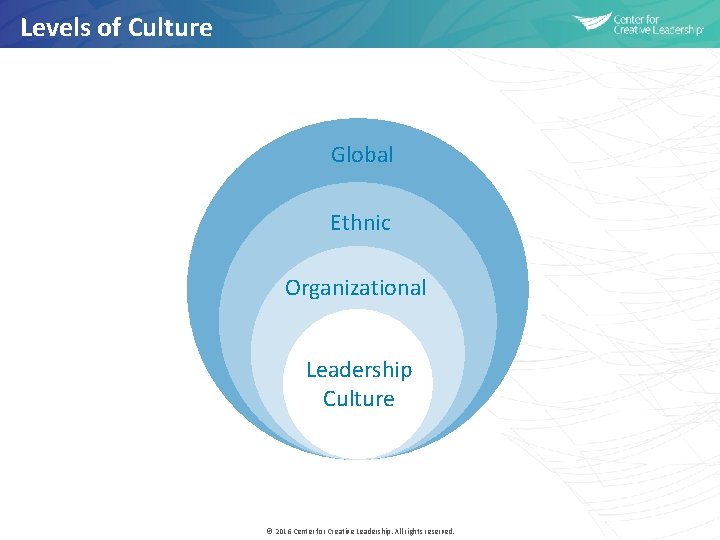
Levels of Culture Global Ethnic Organizational Leadership Culture © 2016 Center for Creative Leadership. All rights reserved.
Leading Change is a guided, public learning process Senior leaders do the change work first CCL’s Organizations navigate complexity by developing collaborative capability Principles Of Change & Transformation Culture changes through advancing beliefs, practices and behaviors aligned with systems & © 2016 Center for Creative Leadership. All rights reserved. processes Sustainable Change is a continuous learning process embedded in an organization’s work
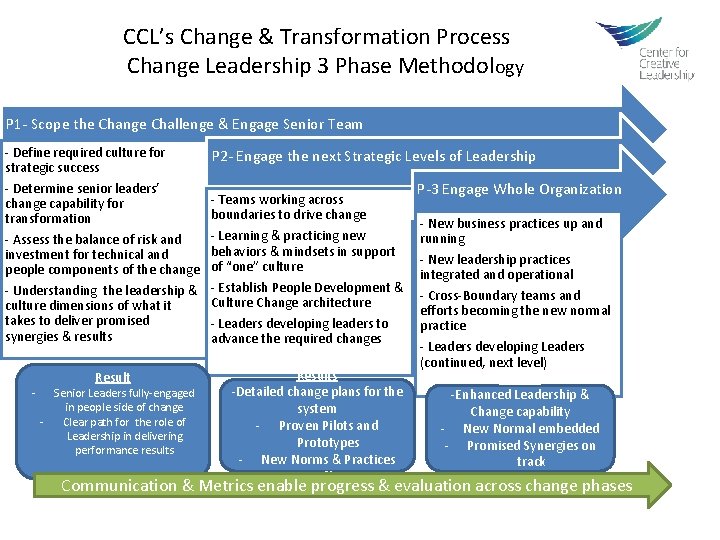
CCL’s Change & Transformation Process Change Leadership 3 Phase Methodology P 1 - Scope the Change Challenge & Engage Senior Team - Define required culture for strategic success - Determine senior leaders’ change capability for transformation - Assess the balance of risk and investment for technical and people components of the change - Understanding the leadership & culture dimensions of what it takes to deliver promised synergies & results P 2 - Engage the next Strategic Levels of Leadership - Teams working across boundaries to drive change P-3 Engage Whole Organization - New business practices up and running - Learning & practicing new behaviors & mindsets in support - New leadership practices of “one” culture integrated and operational - Establish People Development & - Cross-Boundary teams and Culture Change architecture efforts becoming the new normal - Leaders developing leaders to practice advance the required changes - Leaders developing Leaders (continued, next level) Results -Detailed change plans for the - Senior Leaders fully-engaged -Enhanced Leadership & in people side of change system Change capability - Clear path for the role of - Proven Pilots and - New Normal embedded Leadership in delivering Prototypes - Promised Synergies on performance results - New Norms & Practices track - N - Communication & Metrics enable progress & evaluation across change phases © 2014 Center for Creative Leadership. All rights reserved.
Change Leadership – 3 Phase Methodology Phase & Purpose P-1: Scope challenge, engage ET Align Strategy & Culture Slow Down to Power Up P-2: Engage levels strategic leaders Design the Culture Prototype in Organization’s Work P-3: Engage whole organization Implement the Culture Applying new Beliefs & Practices WHO Senior Leadership: Must Do Changes Strategic Leadership: Targeted, Pilot Changes All Leadership: Required, Systemic Changes EVENTS *Transforming Your Organization workshop *Change Leadership Team: quarterly change integration reviews *Top X 00 Leadership: Setting Direction with Key Leadership *Change Leadership Team: quarterly change integration reviews *Manage large group change workshops *Change Leadership Team: quarterly change integration reviews WHAT • • • RESULTS Enroll leaders to engage in change Define & assess culture required for strategic success Determine willingness and feasibility of transformational change Coach & Guide senior leadership Learn how to innovate through creative conversations Enhance readiness, improve the probability of success • • Establish new Leadership Practices Map business & leadership strategies to work processes & systems Prototype strategic change targets Leaders Developing Leaders training & development Cascading Boundaries (? ? ? ) Leadership Teams learning how to learn across boundaries Create Take it to the Middle change plan *Current & Required Culture target ~ *Framing Change ~ Designing the process transformation scenario across the enterprise *Develop Deep Understanding ~ What *Information & Metrics ~ enable progress change “here” really takes & evaluate as you go • • • Implement and coach action development teams Senior leaders host local change leadership learning dialogues Identify required leadership initiatives Leaders Developing Leaders teams in action Strategic change initiative reviews Change management methods reviews *Grow Leadership Capability ~ increase enterprise capacity to change *Develop respect for the whole value chain, and grow local ownership
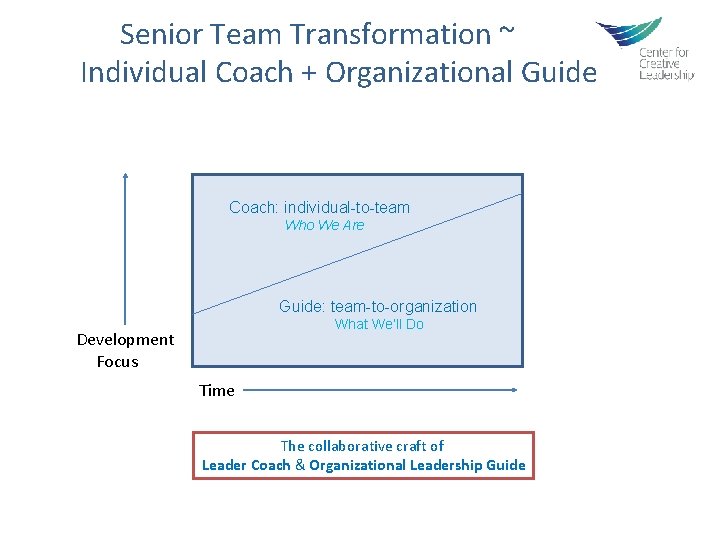
Senior Team Transformation ~ Individual Coach + Organizational Guide Coach: individual-to-team Who We Are Guide: team-to-organization What We’ll Do Development Focus Time The collaborative craft of Leader Coach & Organizational Leadership Guide © 2014 Center for Creative Leadership. All rights reserved.
The 3 Phase Methodology in practice is actually both: - Serial phases, and - Simultaneous, Overlapping, Concurrent, Recurrent Phase 2 1 e s a Ph Phase 3 © 2014 Center for Creative Leadership. All rights reserved.