Transcutaneous Aortic Valve Implantation TAVI Dr Sandeep Mohanan




- Slides: 75
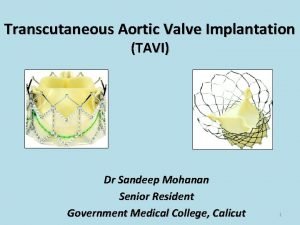
Transcutaneous Aortic Valve Implantation (TAVI) Dr Sandeep Mohanan Senior Resident Government Medical College, Calicut 1
OVERVIEW • BACKGROUND : AS-EPIDEMIOLOGY? • MANAGEMENT OF AORTIC STENOSIS AND ROLE OF TAVI • THE ADVENT OF TAVI • CURRENT DATA AND EVIDENCE FOR TAVI • TAVI- HARDWARE, PLANNING and PROCEDURE • PROS & CONS OF TAVI • ADVANCES IN TAVI • THE FUTURE FOR TAVI
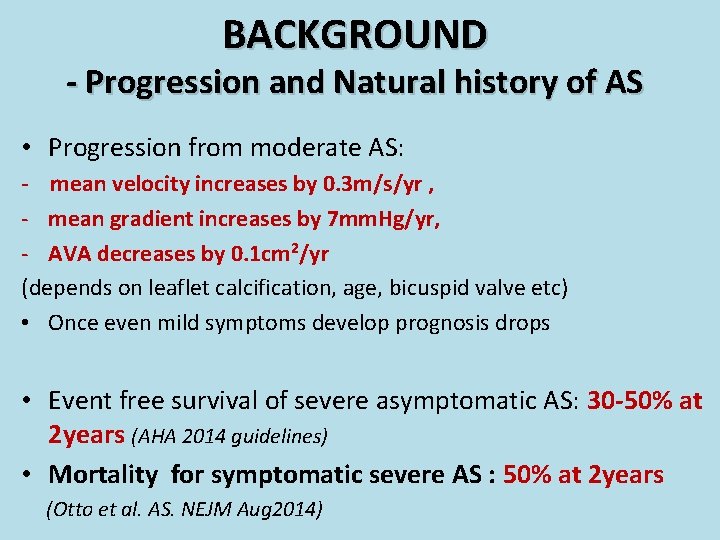
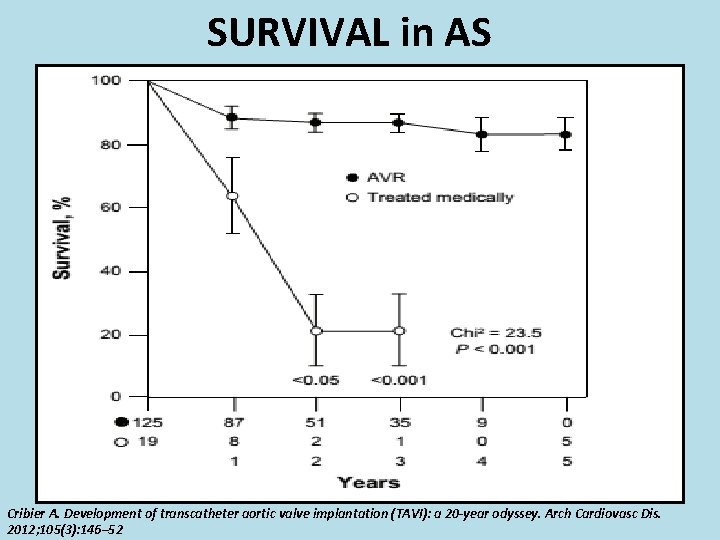
BACKGROUND - Progression and Natural history of AS • Progression from moderate AS: - mean velocity increases by 0. 3 m/s/yr , - mean gradient increases by 7 mm. Hg/yr, - AVA decreases by 0. 1 cm 2/yr (depends on leaflet calcification, age, bicuspid valve etc) • Once even mild symptoms develop prognosis drops • Event free survival of severe asymptomatic AS: 30 -50% at 2 years (AHA 2014 guidelines) • Mortality for symptomatic severe AS : 50% at 2 years (Otto et al. AS. NEJM Aug 2014)
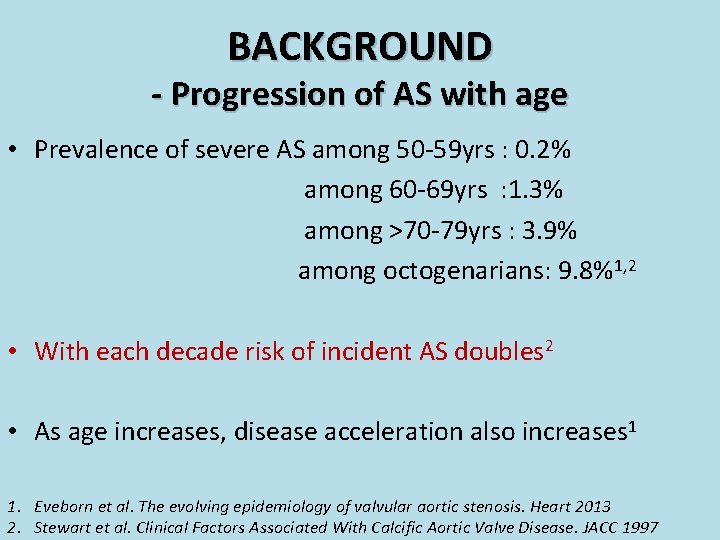
BACKGROUND - Progression of AS with age • Prevalence of severe AS among 50 -59 yrs : 0. 2% among 60 -69 yrs : 1. 3% among >70 -79 yrs : 3. 9% among octogenarians: 9. 8%1, 2 • With each decade risk of incident AS doubles 2 • As age increases, disease acceleration also increases 1 1. Eveborn et al. The evolving epidemiology of valvular aortic stenosis. Heart 2013 2. Stewart et al. Clinical Factors Associated With Calcific Aortic Valve Disease. JACC 1997
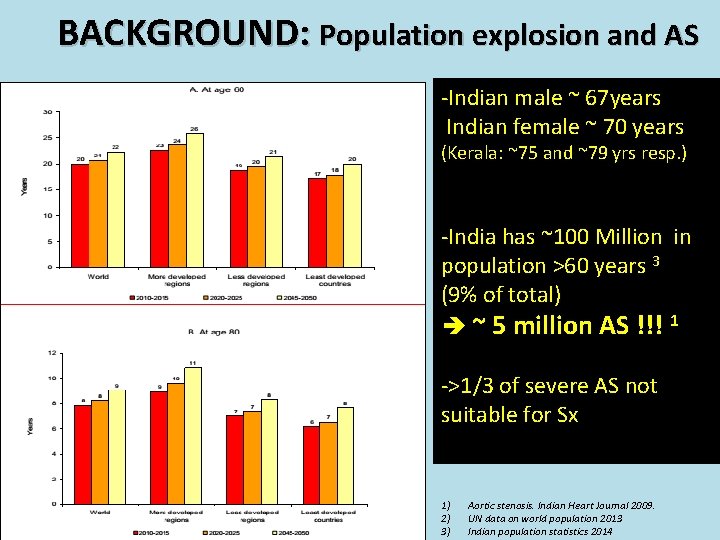
BACKGROUND: Population explosion and AS -Indian male ~ 67 years Indian female ~ 70 years (Kerala: ~75 and ~79 yrs resp. ) -India has ~100 Million in population >60 years 3 (9% of total) ~ 5 million AS !!! 1 ->1/3 of severe AS not suitable for Sx 1) 2) 3) Aortic stenosis. Indian Heart Journal 2009. UN data on world population 2013 Indian population statistics 2014
SURVIVAL in AS Cribier A. Development of transcatheter aortic valve implantation (TAVI): a 20 -year odyssey. Arch Cardiovasc Dis. 2012; 105(3): 146– 52
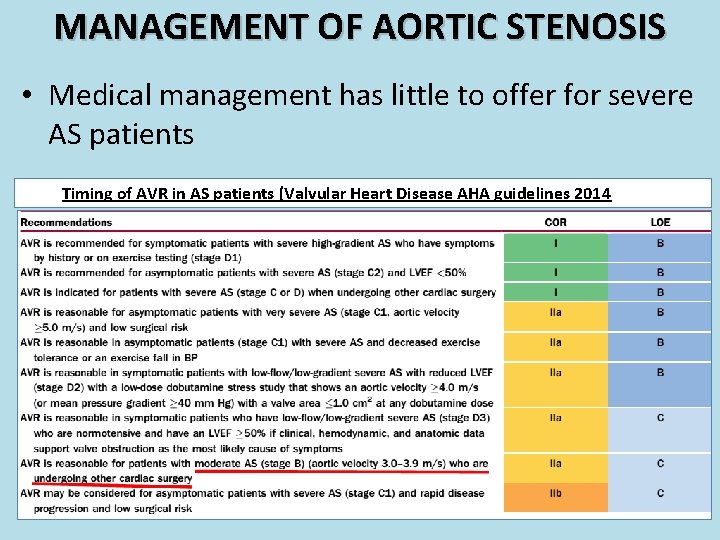
MANAGEMENT OF AORTIC STENOSIS • Medical management has little to offer for severe AS patients Timing of AVR in AS patients (Valvular Heart Disease AHA guidelines 2014
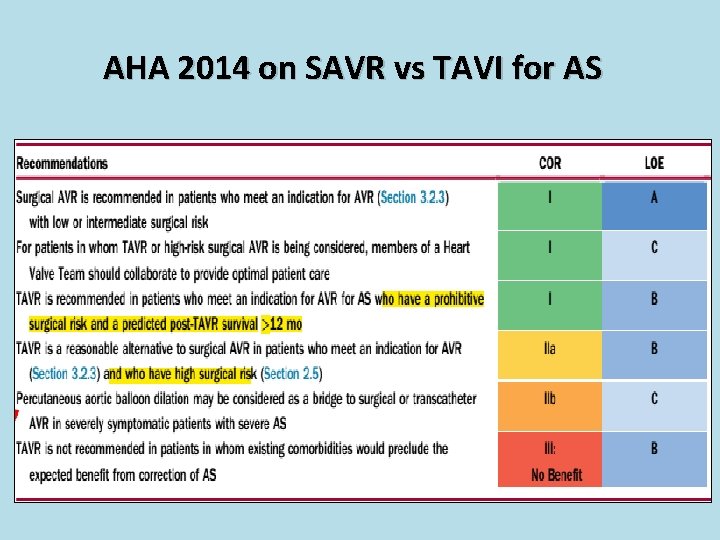
AHA 2014 on SAVR vs TAVI for AS
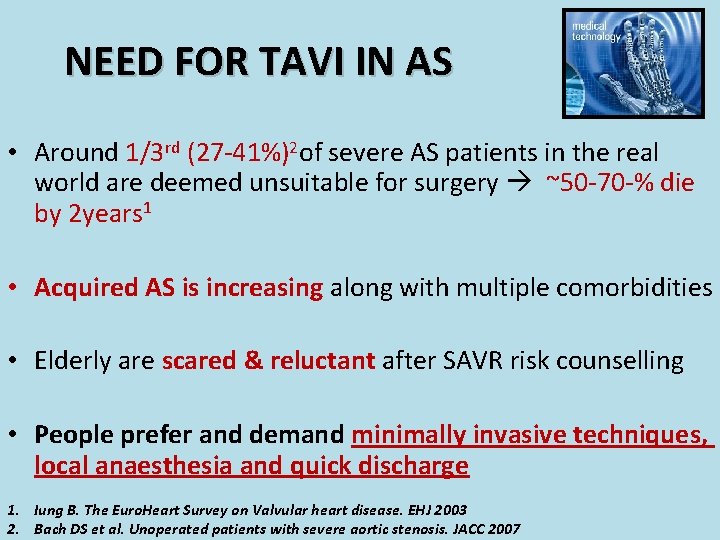
NEED FOR TAVI IN AS • Around 1/3 rd (27 -41%)2 of severe AS patients in the real world are deemed unsuitable for surgery ~50 -70 -% die by 2 years 1 • Acquired AS is increasing along with multiple comorbidities • Elderly are scared & reluctant after SAVR risk counselling • People prefer and demand minimally invasive techniques, local anaesthesia and quick discharge 1. Iung B. The Euro. Heart Survey on Valvular heart disease. EHJ 2003 2. Bach DS et al. Unoperated patients with severe aortic stenosis. JACC 2007
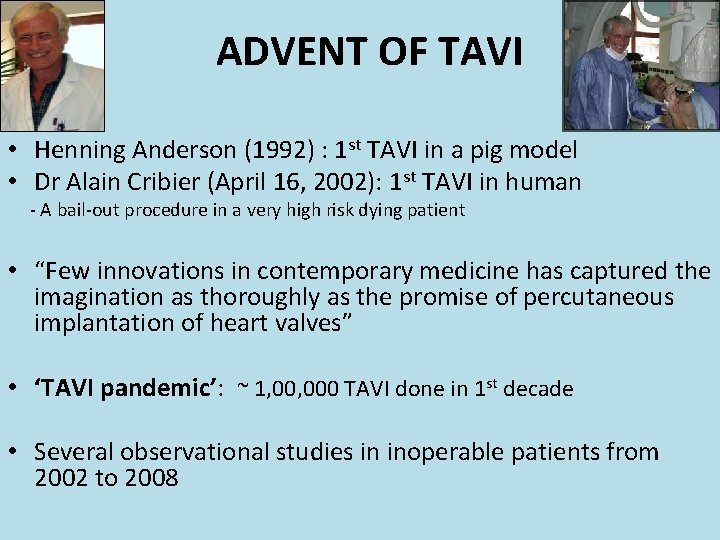
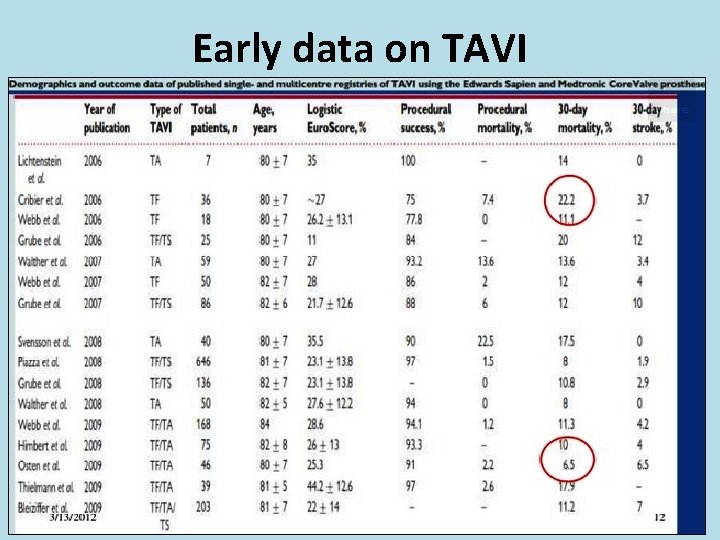
ADVENT OF TAVI • Henning Anderson (1992) : 1 st TAVI in a pig model • Dr Alain Cribier (April 16, 2002): 1 st TAVI in human - A bail-out procedure in a very high risk dying patient • “Few innovations in contemporary medicine has captured the imagination as thoroughly as the promise of percutaneous implantation of heart valves” • ‘TAVI pandemic’: ~ 1, 000 TAVI done in 1 st decade • Several observational studies in inoperable patients from 2002 to 2008
Early data on TAVI
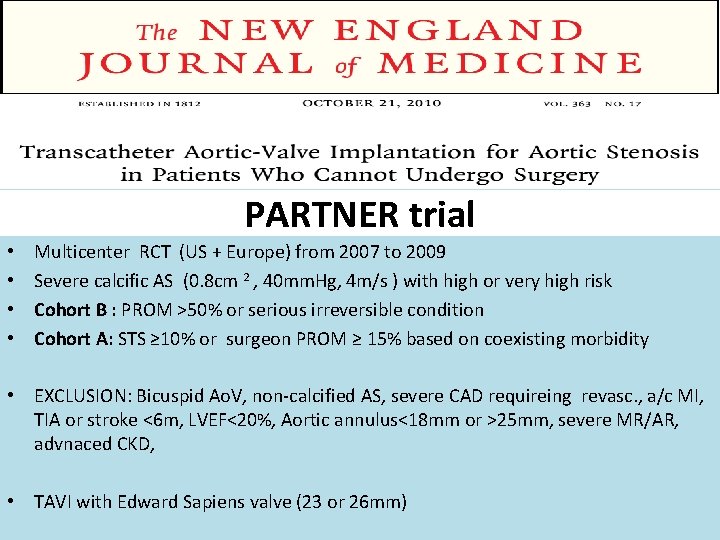
PARTNER trial • • Multicenter RCT (US + Europe) from 2007 to 2009 Severe calcific AS (0. 8 cm 2 , 40 mm. Hg, 4 m/s ) with high or very high risk Cohort B : PROM >50% or serious irreversible condition Cohort A: STS ≥ 10% or surgeon PROM ≥ 15% based on coexisting morbidity • EXCLUSION: Bicuspid Ao. V, non-calcified AS, severe CAD requireing revasc. , a/c MI, TIA or stroke <6 m, LVEF<20%, Aortic annulus<18 mm or >25 mm, severe MR/AR, advnaced CKD, • TAVI with Edward Sapiens valve (23 or 26 mm)
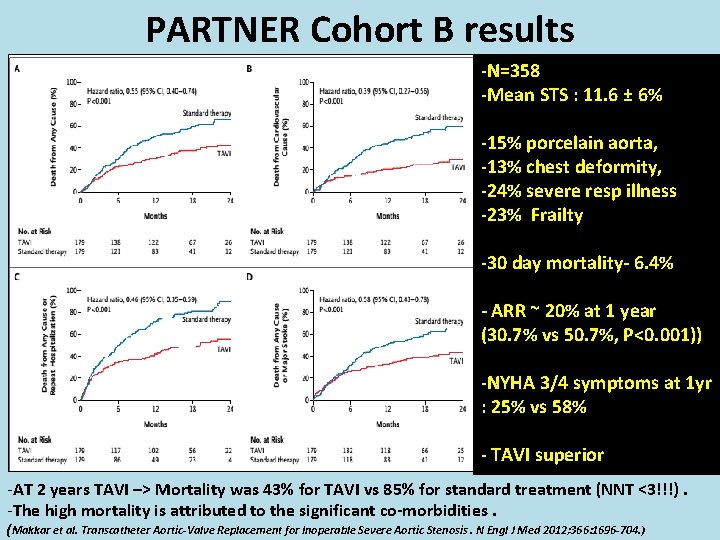
PARTNER Cohort B results -N=358 -Mean STS : 11. 6 ± 6% -15% porcelain aorta, -13% chest deformity, -24% severe resp illness -23% Frailty -30 day mortality- 6. 4% - ARR ~ 20% at 1 year (30. 7% vs 50. 7%, P<0. 001)) -NYHA 3/4 symptoms at 1 yr : 25% vs 58% - TAVI superior -AT 2 years TAVI –> Mortality was 43% for TAVI vs 85% for standard treatment (NNT <3!!!). -The high mortality is attributed to the significant co-morbidities. (Makkar et al. Transcatheter Aortic-Valve Replacement for Inoperable Severe Aortic Stenosis. N Engl J Med 2012; 366: 1696 -704. )
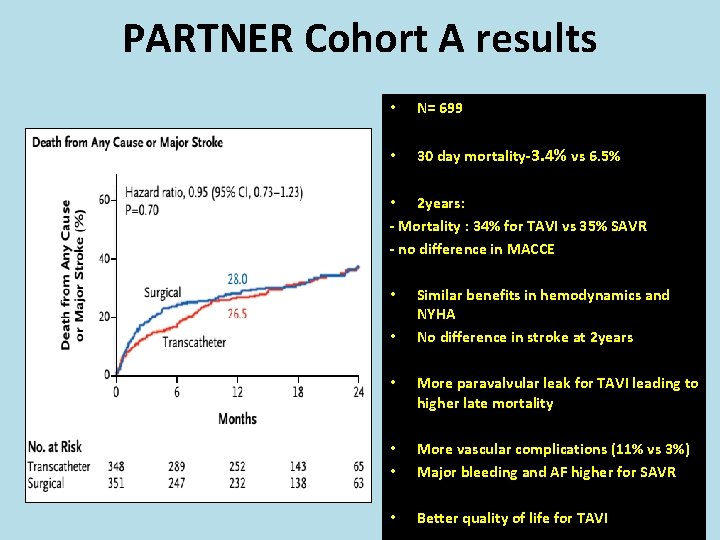
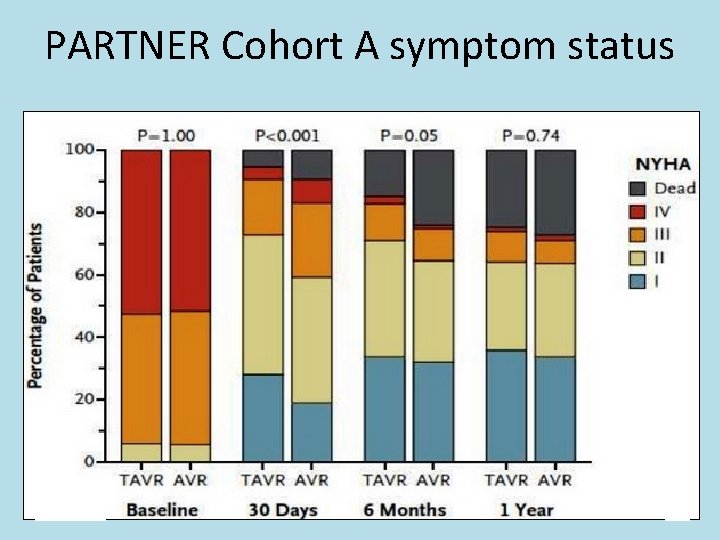
PARTNER Cohort A results • N= 699 • 30 day mortality-3. 4% vs 6. 5% • 2 years: - Mortality : 34% for TAVI vs 35% SAVR - no difference in MACCE • • Similar benefits in hemodynamics and NYHA No difference in stroke at 2 years • More paravalvular leak for TAVI leading to higher late mortality • • More vascular complications (11% vs 3%) Major bleeding and AF higher for SAVR • Better quality of life for TAVI
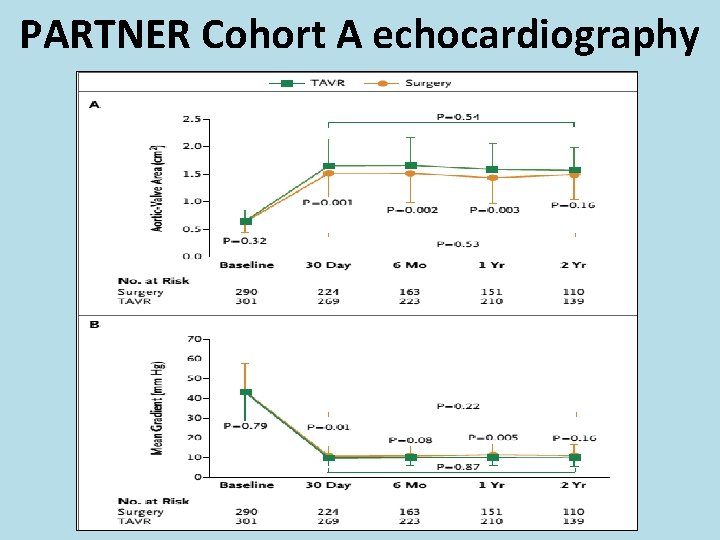
PARTNER Cohort A echocardiography
PARTNER Cohort A symptom status
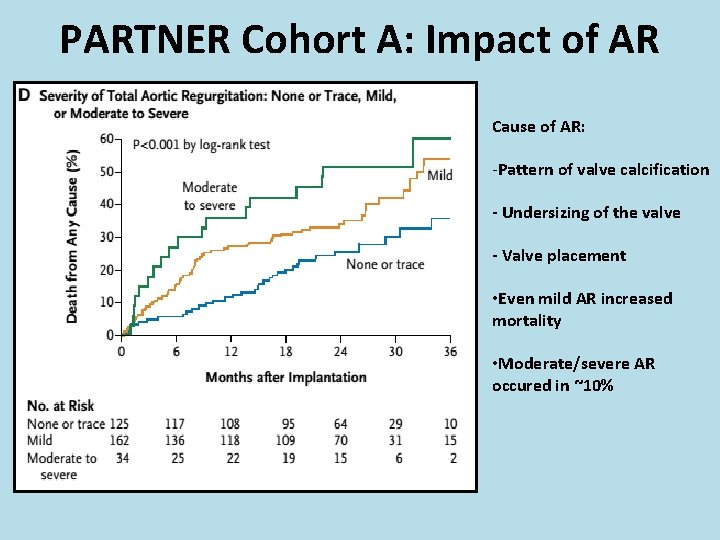
PARTNER Cohort A: Impact of AR Cause of AR: -Pattern of valve calcification - Undersizing of the valve - Valve placement • Even mild AR increased mortality • Moderate/severe AR occured in ~10%
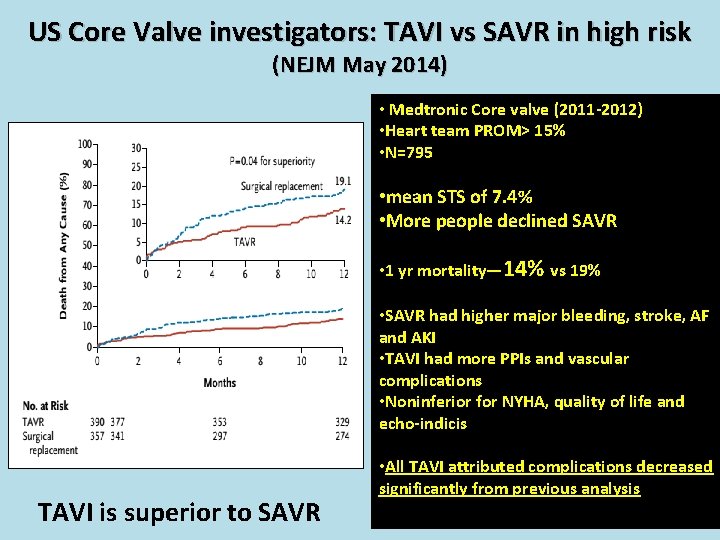
US Core Valve investigators: TAVI vs SAVR in high risk (NEJM May 2014) • Medtronic Core valve (2011 -2012) • Heart team PROM> 15% • N=795 • mean STS of 7. 4% • More people declined SAVR • 1 yr mortality— 14% vs 19% • SAVR had higher major bleeding, stroke, AF and AKI • TAVI had more PPIs and vascular complications • Noninferior for NYHA, quality of life and echo-indicis TAVI is superior to SAVR • All TAVI attributed complications decreased significantly from previous analysis 19
TAVI HARDWARE & PREPROCEDURAL PLANNING
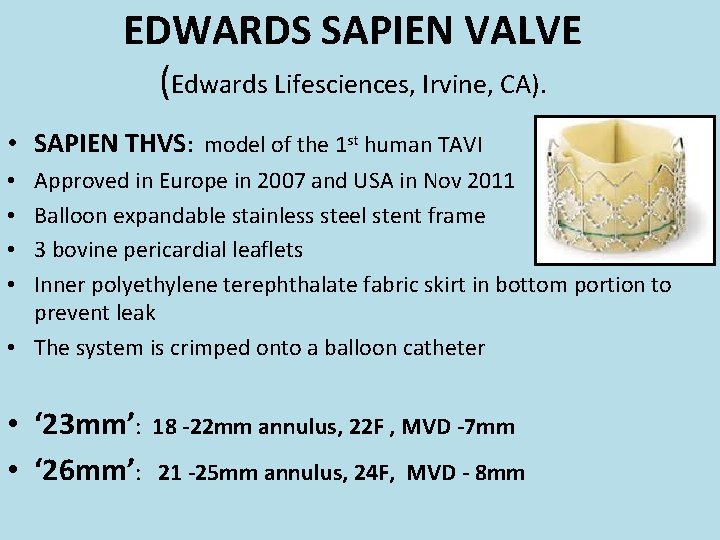
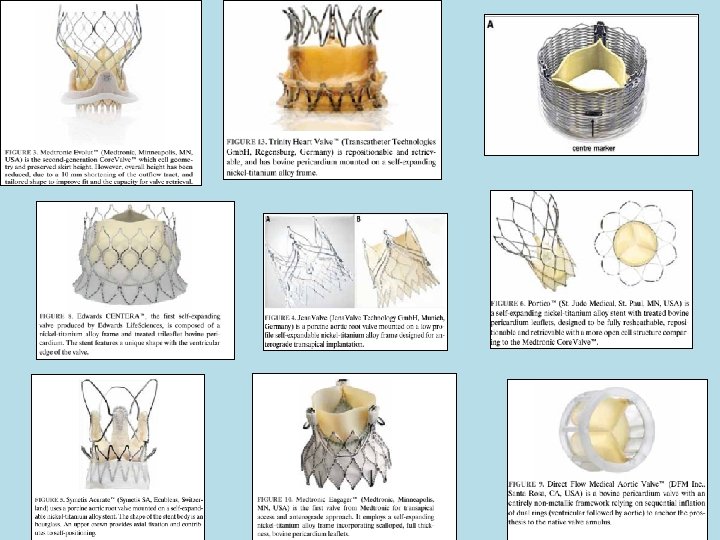
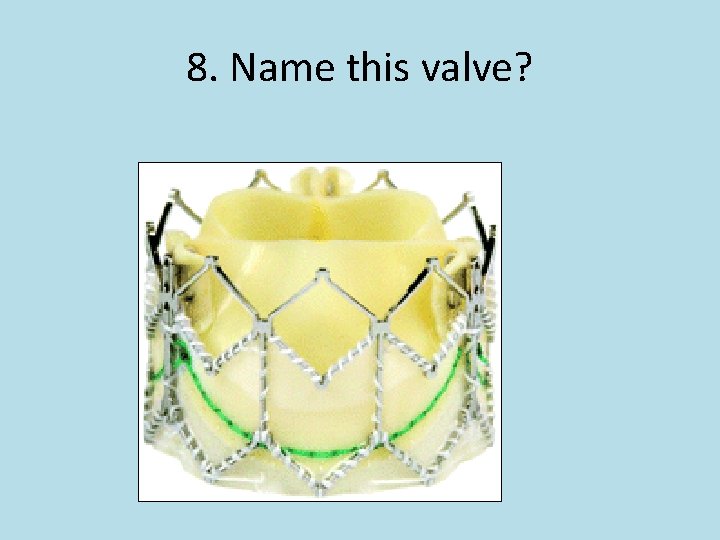
EDWARDS SAPIEN VALVE (Edwards Lifesciences, Irvine, CA). • SAPIEN THVS: model of the 1 st human TAVI Approved in Europe in 2007 and USA in Nov 2011 Balloon expandable stainless steel stent frame 3 bovine pericardial leaflets Inner polyethylene terephthalate fabric skirt in bottom portion to prevent leak • The system is crimped onto a balloon catheter • • • ‘ 23 mm’: 18 -22 mm annulus, 22 F , MVD -7 mm • ‘ 26 mm’: 21 -25 mm annulus, 24 F, MVD - 8 mm
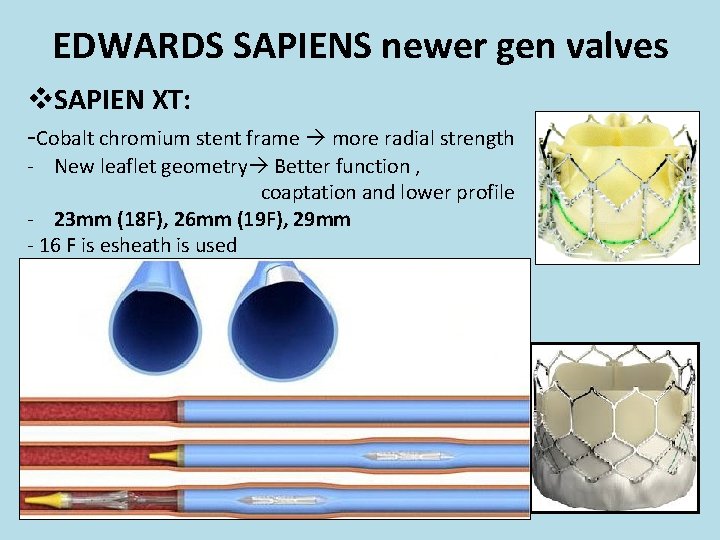
EDWARDS SAPIENS newer gen valves v. SAPIEN XT: -Cobalt chromium stent frame more radial strength - New leaflet geometry Better function , coaptation and lower profile - 23 mm (18 F), 26 mm (19 F), 29 mm - 16 F is esheath is used - Up to 27 mm annulus size v. SAPIEN 3: - 14 F - Additional outer PET fabric skirt - 20 mm, 23 mm, 26 mm, 29 mm - Annulus size from 16 mm to 28 mm - No deaths, stroke, vascular compl or >2+PVL in a study on 15 patients (Binder et al. TAVR with Sapien 3. JACC Cardiovasc Interv 2013)
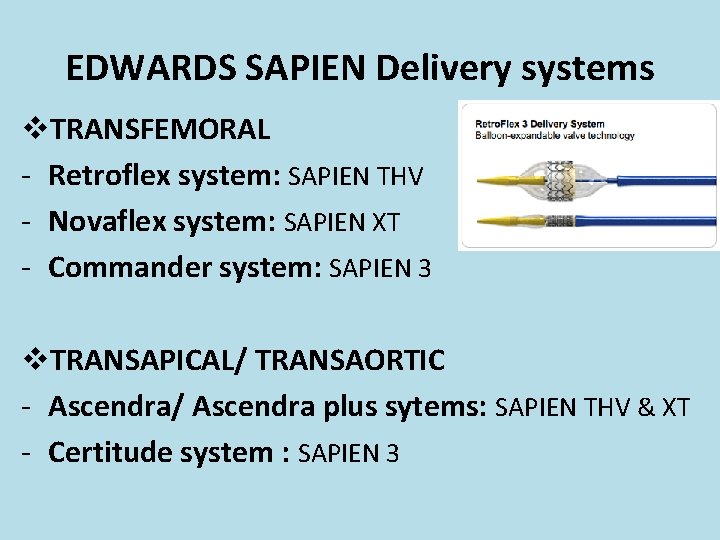
EDWARDS SAPIEN Delivery systems v. TRANSFEMORAL - Retroflex system: SAPIEN THV - Novaflex system: SAPIEN XT - Commander system: SAPIEN 3 v. TRANSAPICAL/ TRANSAORTIC - Ascendra/ Ascendra plus sytems: SAPIEN THV & XT - Certitude system : SAPIEN 3
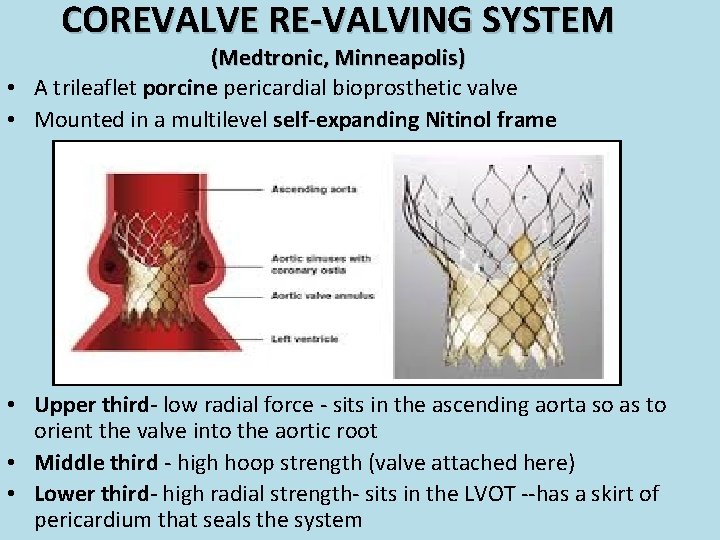
COREVALVE RE-VALVING SYSTEM (Medtronic, Minneapolis) • A trileaflet porcine pericardial bioprosthetic valve • Mounted in a multilevel self-expanding Nitinol frame • Upper third- low radial force - sits in the ascending aorta so as to orient the valve into the aortic root • Middle third - high hoop strength (valve attached here) • Lower third- high radial strength- sits in the LVOT --has a skirt of pericardium that seals the system
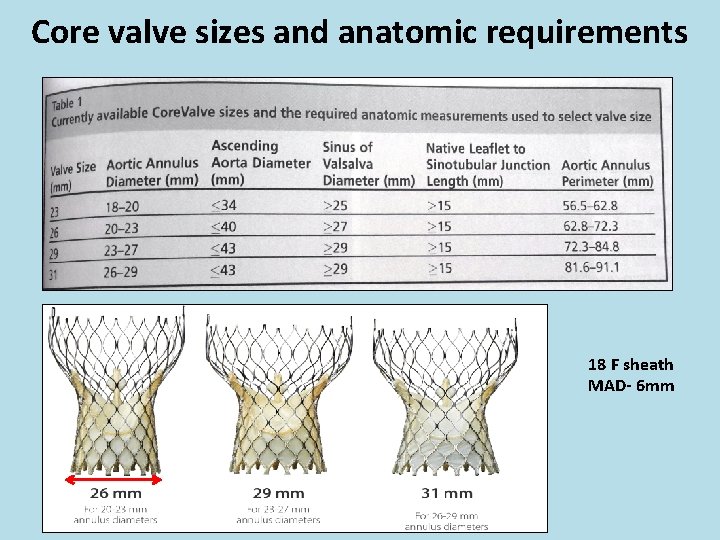
Core valve sizes and anatomic requirements 18 F sheath MAD- 6 mm
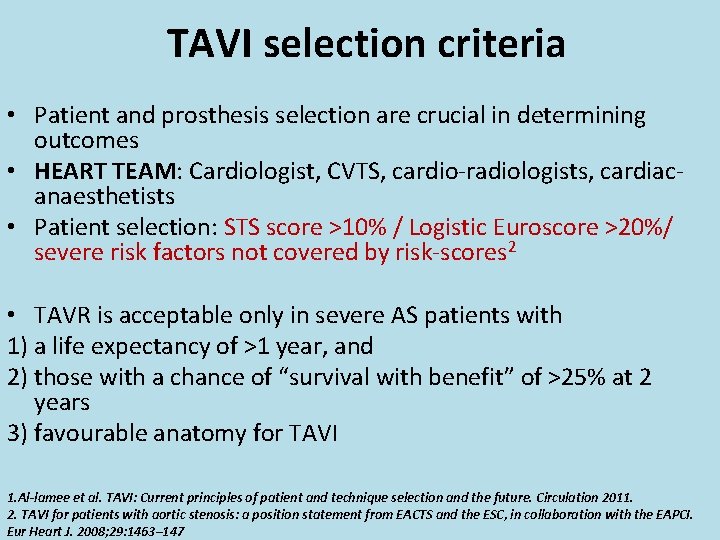
TAVI selection criteria • Patient and prosthesis selection are crucial in determining outcomes • HEART TEAM: Cardiologist, CVTS, cardio-radiologists, cardiacanaesthetists • Patient selection: STS score >10% / Logistic Euroscore >20%/ severe risk factors not covered by risk-scores 2 • TAVR is acceptable only in severe AS patients with 1) a life expectancy of >1 year, and 2) those with a chance of “survival with benefit” of >25% at 2 years 3) favourable anatomy for TAVI 1. Al-lamee et al. TAVI: Current principles of patient and technique selection and the future. Circulation 2011. 2. TAVI for patients with aortic stenosis: a position statement from EACTS and the ESC, in collaboration with the EAPCI. Eur Heart J. 2008; 29: 1463– 147
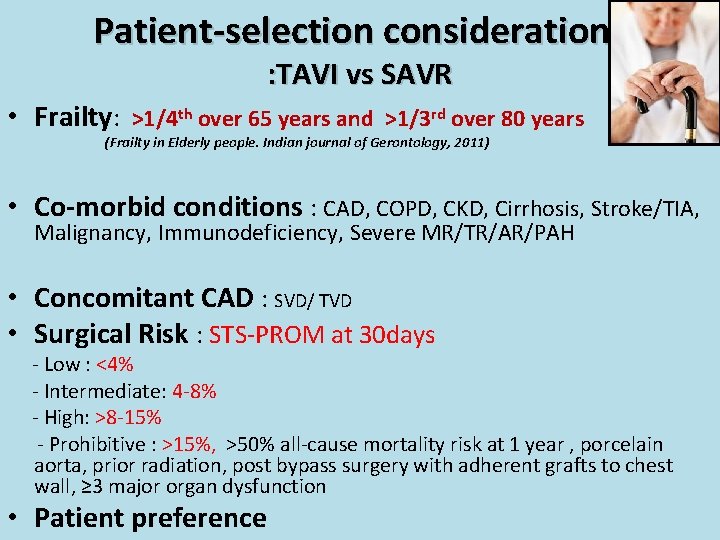
Patient-selection considerations : TAVI vs SAVR • Frailty: >1/4 th over 65 years and >1/3 rd over 80 years (Frailty in Elderly people. Indian journal of Gerontology, 2011) • Co-morbid conditions : CAD, COPD, CKD, Cirrhosis, Stroke/TIA, Malignancy, Immunodeficiency, Severe MR/TR/AR/PAH • Concomitant CAD : SVD/ TVD • Surgical Risk : STS-PROM at 30 days - Low : <4% - Intermediate: 4 -8% - High: >8 -15% - Prohibitive : >15%, >50% all-cause mortality risk at 1 year , porcelain aorta, prior radiation, post bypass surgery with adherent grafts to chest wall, ≥ 3 major organ dysfunction • Patient preference
Surgical risk scores for TAVI • Logistic Euroscore often overestimates mortality • STS is more accurate but still has suboptimal predictive power • Recent RCTs have used STS in stratifying patients • Clinical risk assessment, anatomic characterisation and functional assessment are vital for optimal TAVI results 1. The Society of Thoracic Surgeons 2008 cardiac surgery risk models: part 2—isolated valve surgery. Ann Thorac. Surg. 2009; 88: S 23–S 42. 2. Relationship between the logistic Euro. SCORE and the Society of Thoracic Surgeons Predicted Risk of Mortality score in patients implanted with the Core. Valve Re. Valving system—a Bern-Rotterdam Study. Am Heart J. 2010; 159: 323– 329.
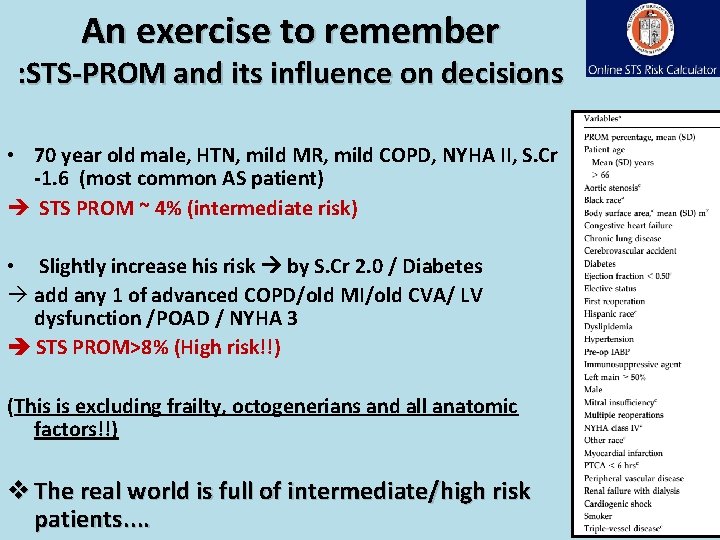
An exercise to remember : STS-PROM and its influence on decisions • 70 year old male, HTN, mild MR, mild COPD, NYHA II, S. Cr -1. 6 (most common AS patient) STS PROM ~ 4% (intermediate risk) • Slightly increase his risk by S. Cr 2. 0 / Diabetes add any 1 of advanced COPD/old MI/old CVA/ LV dysfunction /POAD / NYHA 3 STS PROM>8% (High risk!!) (This is excluding frailty, octogenerians and all anatomic factors!!) v The real world is full of intermediate/high risk patients. . 29
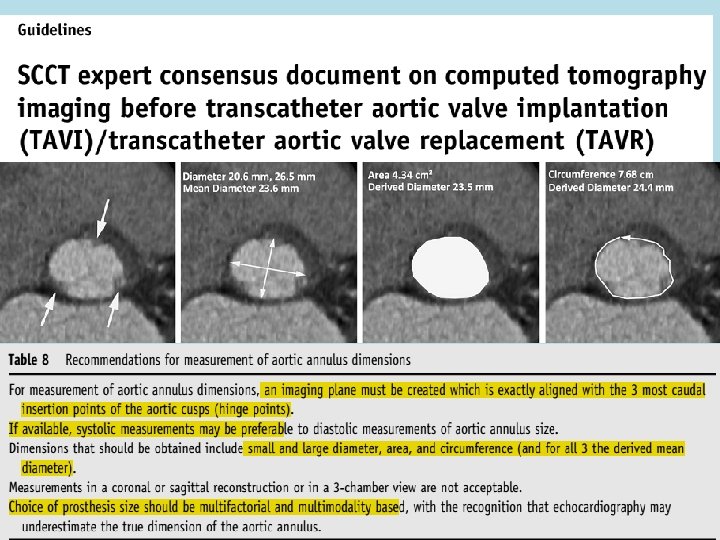
Pre-TAVI work up • Clinical assessment: Decompensated patients may require CCU care ± BAV before TAVI vs SAVR • Coronary assessment: CAG, MSCT • Annulus assessment: - Minimize paravalvular AR - Avoid device migration - Valve selection Valve size slightly greater than annulus size • Other relevant cardiac anatomy: LV anatomy and function, mitral valve, LVOT, bicuspid valve, valve calcification, coronary ostia, angulation of ascending aorta, aortic wall anatomy/calcification • Assessment of peripheral arterial system
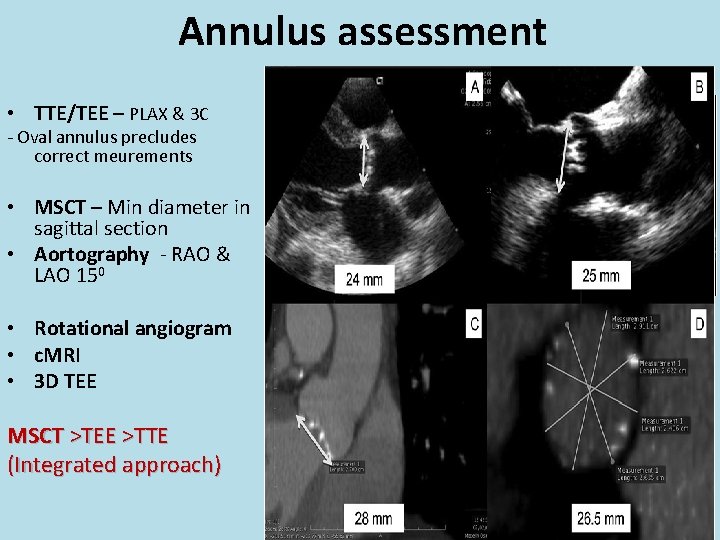
Annulus assessment TTE TEE • TTE/TEE – PLAX & 3 C - Oval annulus precludes correct meurements • MSCT – Min diameter in sagittal section • Aortography - RAO & LAO 150 • Rotational angiogram • c. MRI • 3 D TEE MSCT >TEE >TTE (Integrated approach) MSCT- Sagittal MSCT- Coronal
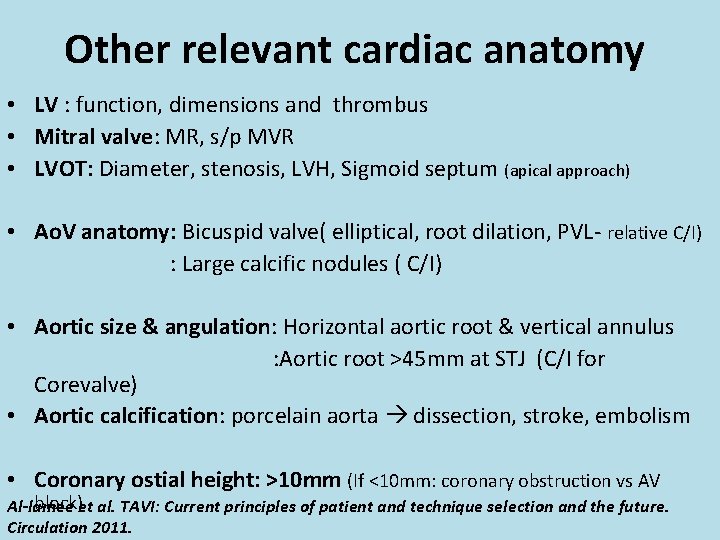
Other relevant cardiac anatomy • LV : function, dimensions and thrombus • Mitral valve: MR, s/p MVR • LVOT: Diameter, stenosis, LVH, Sigmoid septum (apical approach) • Ao. V anatomy: Bicuspid valve( elliptical, root dilation, PVL- relative C/I) : Large calcific nodules ( C/I) • Aortic size & angulation: Horizontal aortic root & vertical annulus : Aortic root >45 mm at STJ (C/I for Corevalve) • Aortic calcification: porcelain aorta dissection, stroke, embolism • Coronary ostial height: >10 mm (If <10 mm: coronary obstruction vs AV block) Al-lamee et al. TAVI: Current principles of patient and technique selection and the future. Circulation 2011.
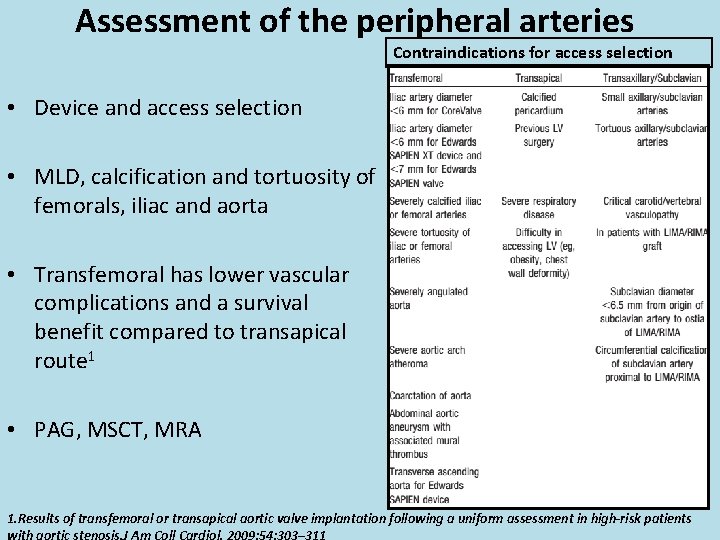
Assessment of the peripheral arteries Contraindications for access selection • Device and access selection • MLD, calcification and tortuosity of femorals, iliac and aorta • Transfemoral has lower vascular complications and a survival benefit compared to transapical route 1 • PAG, MSCT, MRA 1. Results of transfemoral or transapical aortic valve implantation following a uniform assessment in high-risk patients
TAVI PROCEDURE
Balloon aortic valvuloplasty • Also pioneered by Cribier - 1986 1) Helps as a rehearsal: assessment of RVP 2) Cracks calcification and stretches aortic wall: Easier crossing and better deployment - Crucial for Edwards Sapien and less for low profile Core Valve device Disadvantages: Higher procedure time, costs, need for RVP, more complications, independent risk factor for PPI 1 * “Simplified TAVI” has been studied for Core. Valve(18 F) in 60 TAVI procedures with similar efficacy 1. Grube et al. Feasibility of transcatheter aortic valve implantation without balloon predilation: a pilot study. J Am Coll. Cardiol Intv 2011; 4: 751– 7
PROS OF TAVI
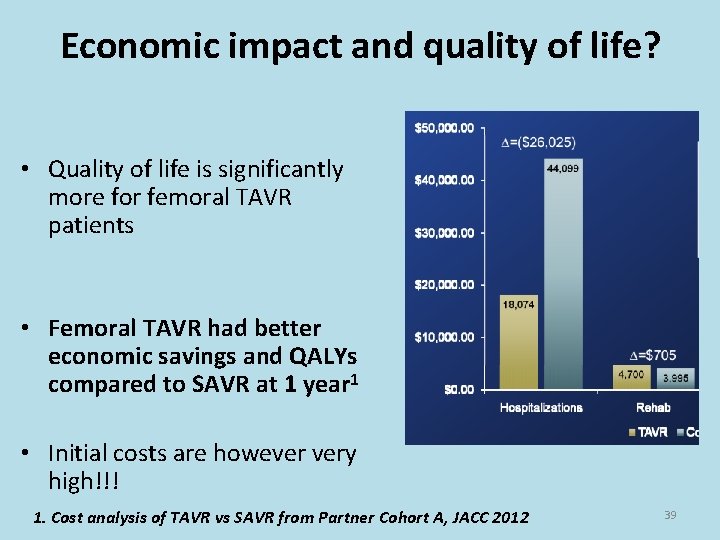
Economic impact and quality of life? • Quality of life is significantly more for femoral TAVR patients • Femoral TAVR had better economic savings and QALYs compared to SAVR at 1 year 1 • Initial costs are however very high!!! 1. Cost analysis of TAVR vs SAVR from Partner Cohort A, JACC 2012 39
HEMODYNAMICS • Coronary blood flow: Significant increase in coronary flow associated mostly with a decrease in LVEDP 1 (TEE Doppler study in 90 patients after Edward Sapiens) • TAVR patients had higher indexed EOA and lower prosthesis-patient mismatch. 2 • Most paravalvular AR is mild and non-progressive • Even >75% of moderate AR regress to trivial at 1 year (NEJM 2014) 1. 2. 3. Coronary blood flow in patients with severe aortic stenosis before and after transcatheter aortic valve implantation. AJC 2014 Hahn et al. Comparison of transcatheter and surgical aortic valve replacement in severe aortic stenosis: a longitudinal study of echocardiography parameters in cohort A of the PARTNER trial (placement of aortic transcatheter valves). J Am Coll Cardiol. 2013 Jun 25; 61(25): 2514 -21. Kim et al. A critical review of hemodynamic changes and left ventricular remodeling after surgical aortic valve replacement and percutaneous aortic valve replacement. Am Heart J. 2014 Aug; 168(2): 150 -9. e 1 -7.
PATIENT BENEFIT • Females: PARTNER A found high-risk females who underwent TAVI had better survival compared to SAVR. ( Sex-related differences in outcomes after transcatheter or surgical aortic valve replacement in patients with severe aortic stenosis: Insights from the PARTNER Trial. J Am Coll Cardiol. 2014 Apr 22; 63(15): 1522 -8. ) • Diabetics: Diabetics in PARTNER trial (N=275) had significant benefit compared to SAVR(18 % vs 27% at 2 years) (Transcatheter Versus Surgical Aortic Valve Replacement in Patients With Diabetes and Severe Aortic Stenosis at High Risk for Surgery. An Analysis of the PARTNER Trial. JACC 2014) • Renal dysfunction : Poor outcomes in SAVR, not TAVI (Impact of varying degrees of renal dysfunction on transcatheter and surgical aortic valve replacement. J Thorac. Cardiovasc Surg. 2013 ) • Major Bleeding : 13% in TAVI vs 35% in SAVR (Bleeding complications after surgical aortic valve replacement compared with transcatheter aortic valve replacement: insights from the PARTNER I Trial. J Am Coll Cardiol 2014 Mar 25; 63(11): 1100 -9) • O 2 dependent COPD : Better outcomes with TAVI (Outcomes of patients with chronic lung disease and severe aortic stenosis treated with transcatheter versus surgical aortic valve replacement or standard therapy: insights from the PARTNER trial J Am Coll Cardiol. 2014 Jan 28; 63(3): 269 -79. ) • Mod-severe MR : Increased 2 year mortality for SAVR, not TAVI (Impact of preoperative moderate/severe mitral regurgitation on 2 -year outcome after transcatheter and surgical aortic valve replacement: insight from the Placement of Aortic Transcatheter Valve (PARTNER) Trial Cohort A. Circulation. 2013 Dec)
CONS OF TAVI
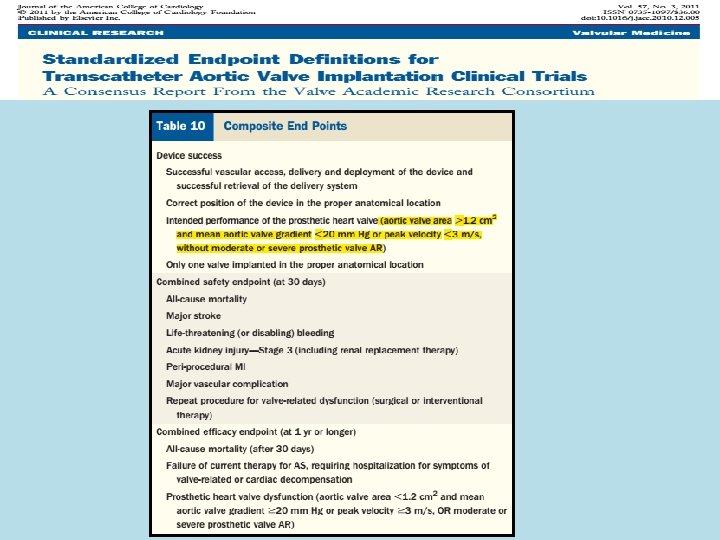
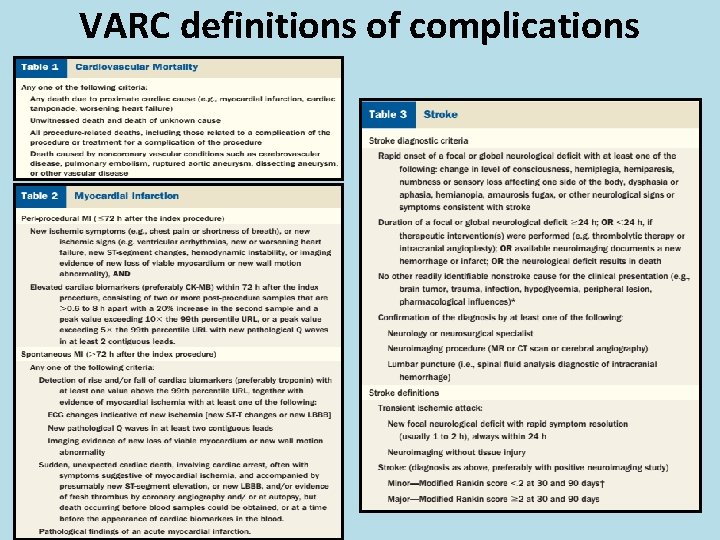
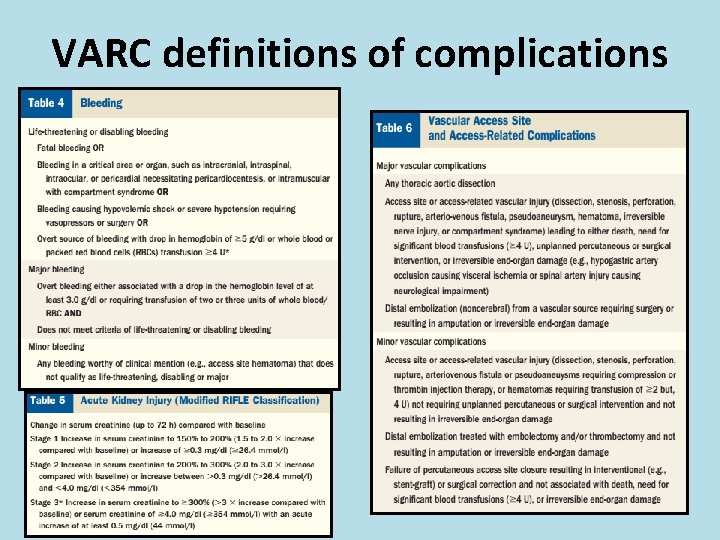
VARC definitions of complications
VARC definitions of complications
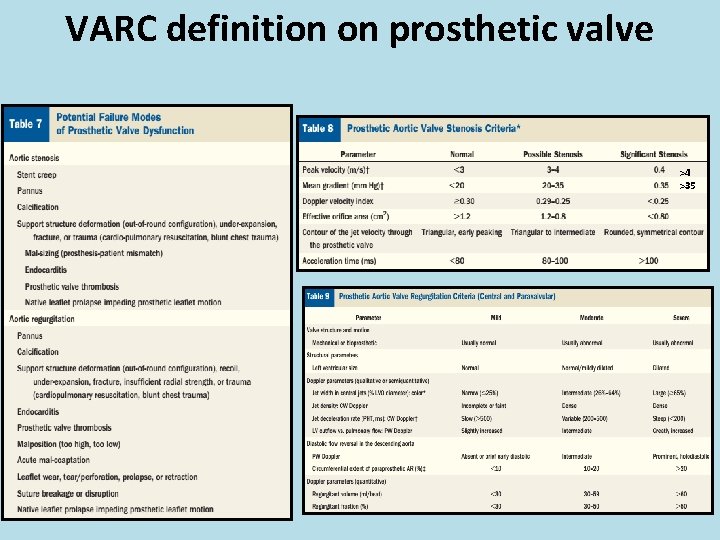
VARC definition on prosthetic valve >4 >35
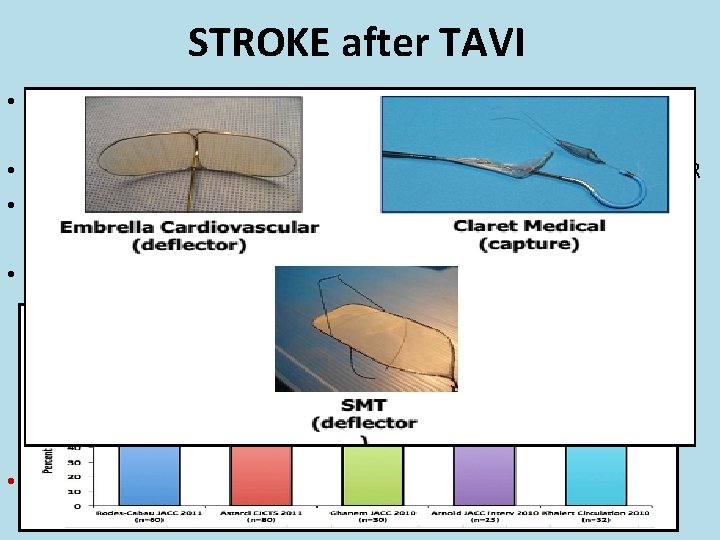
STROKE after TAVI • PARTNER-A : 8. 3% TAVI vs 4. 3% SAVR • BERN-TAVI registry(Wenaweser et al EHJ 2013) 3. 9% TAVI vs 3. 2 % SAVR • Wire, catheter, aortic anatomy, BAV, RVP, comorbidities, AF • Silent infarcts No influence on neurocognitive performance • Embolic protection devices and lower profile devices may help
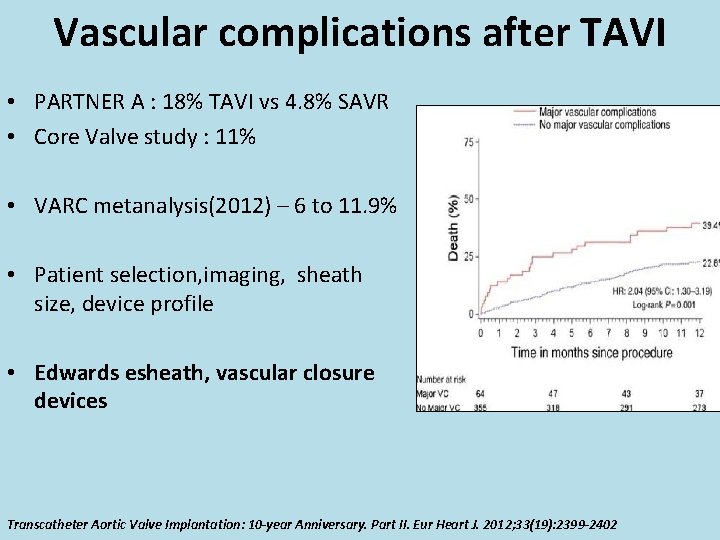
Vascular complications after TAVI • PARTNER A : 18% TAVI vs 4. 8% SAVR • Core Valve study : 11% • VARC metanalysis(2012) – 6 to 11. 9% • Patient selection, imaging, sheath size, device profile • Edwards esheath, vascular closure devices Transcatheter Aortic Valve Implantation: 10 -year Anniversary. Part II. Eur Heart J. 2012; 33(19): 2399 -2402
Paravalvular leak after TAVI • PARTNER A: >2+ AR in 7% TAVI vs 1. 9% SAVR (predictor of higher mortality) • Core-Valve study(2014) : 6% had >2+ AR • Atleast mild AR >50% 76% of those with mod/severe AR mild or no AR at 1 yr • Mechanisms of AR: 1) Malposition, 2) Undersizing, 3) Underexpansion, 4) malapposition, 5) Aggressive BAV • AR predictors: 1) “Cover index” <8% for Edward Sapiens (100* Prosthesis D- Annulus D(by TEE) / Prosthesis D) prosthesis-annulus discongruence) 2)Valve calcification degree and symmetry, 3) operator experience 4) LVOT angle and depth of implantation for Core. Valve PARTNER Trial Investigators. Two-year outcomes after transcatheter or surgical aortic-valve replacement. N Engl J Determinants of significant paravalvular regurgitation after transcatheter aortic valve: implantation impact of device Med 2012; 366: 1686 – 1695 and annulus discongruence. JACC Cardiovasc Interv. 2009 Sep; 2(9): 821 -7.
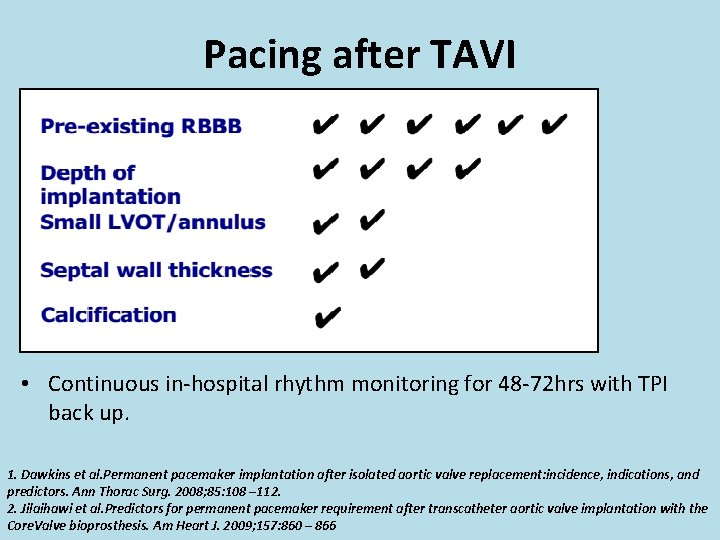
Pacing after TAVI • The AV node and LBB lies close to the NCC • Conventional SAVR in octogenarians 1 - 8. 5% • TAVI with Edwards SAPIEN - 5. 4% pacing • TAVI with Core. Valve 2 -9. 3% to 33% • New LBBB occurred in 40% after Core. Valve TAVI • Continuous in-hospital rhythm monitoring for 48 -72 hrs with TPI back up. 1. Dawkins et al. Permanent pacemaker implantation after isolated aortic valve replacement: incidence, indications, and predictors. Ann Thorac Surg. 2008; 85: 108 – 112. 2. Jilaihawi et al. Predictors for permanent pacemaker requirement after transcatheter aortic valve implantation with the Core. Valve bioprosthesis. Am Heart J. 2009; 157: 860 – 866
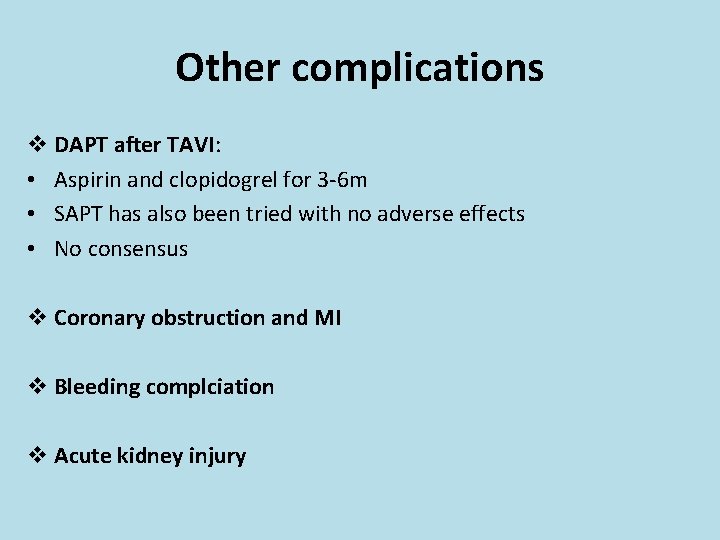
Other complications v DAPT after TAVI: • Aspirin and clopidogrel for 3 -6 m • SAPT has also been tried with no adverse effects • No consensus v Coronary obstruction and MI v Bleeding complciation v Acute kidney injury
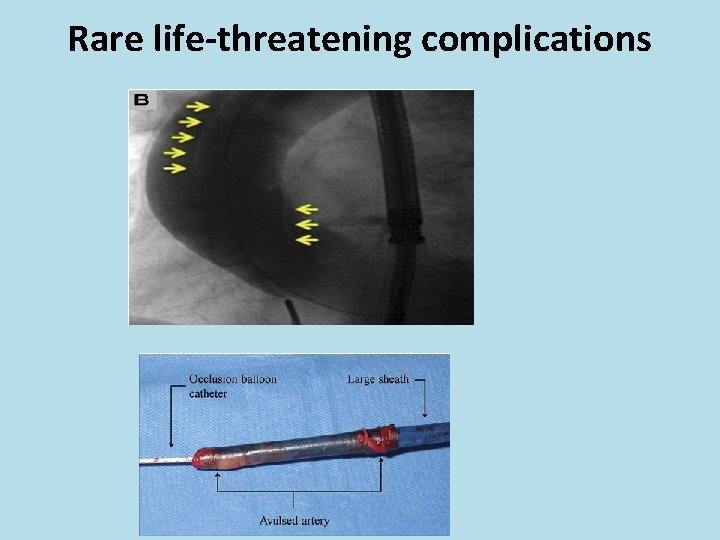
Rare life-threatening complications
OFF-LABEL INDICATIONS
Valve-in-valve TAVI • Bio-prosthetic aortic valve failure & post-TAVI failure • Reoperation in patients with degenerated bioprostheses carries an mortality risk ranging from 1. 5% to 23% depending on comorbidities 1 • 1 st case : 82 yr female with degenerated Perimount- 2008 • • Valve-in Valve in ~134 patients (as of 2011) Transapical (70%) > transfemoral(25%) Preferably not for paravalvular leak Global success rates ~96% 1. Vogt et al. Reoperative surgery for failing aortic prosthesis: predictors of mortality. Eur J Cardio. Thorac Surg 2000. 2. Transcatheter Heart Valves for Failing Bioprostheses State-of-the-Art Review of Valve-in-Valve Implantation. Circulation 2011
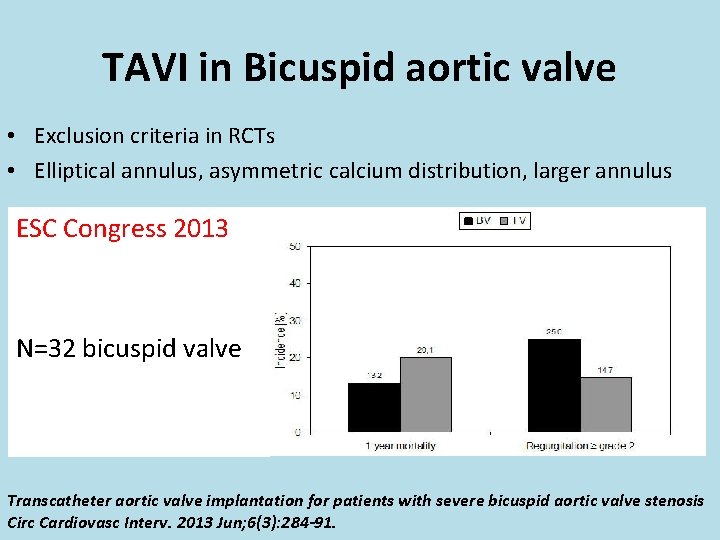
TAVI in Bicuspid aortic valve • Exclusion criteria in RCTs • Elliptical annulus, asymmetric calcium distribution, larger annulus ESC Congress 2013 • In a recent analysis of 21 BAV patients who underwent TAVI No significant difference in device success (100% vs 92. 8%; P=0. 37), risk of annulus rupture or valve migration. N=32 bicuspid valve Post-procedural mean gradient , aortic regurgitation ≥ 2 of 4, 30 -day mortality were also similar in both group Transcatheter aortic valve implantation for patients with severe bicuspid aortic valve stenosis Circ Cardiovasc Interv. 2013 Jun; 6(3): 284 -91.
Intermediate and low-risk cohort • Wenaweser et al (Swiss registry): N=389 (2009 -2011) : low(41) vs intermediate (254) vs high risk (94) Low risk fared the best (HR=0. 38, P<0. 01)1 • 30 day mortality in low risk- 2. 4% ( vs 5% and 15% respectively) • ~40 -50% of low/intermediate STS are actually high risk frailty ( >1/4 th over 65 years and>1/3 rd over 80 years ) (Frailty in Elderly people. Indian journal of Gerontology, 2011) • Ongoing trials in intermediate risk : PARTNER 2 and SURTAVI trials 1. Wenaweser et al. Clinical outcomes of patients with estimated low or intermediate surgical risk undergoing transcatheter aortic valve implantation. Eur Heart J (2013) 34 (25): 1894 -1905.
Difficult peripheral anatomy • Transaortic approach - Corevalve • Subclavian approach- Corevalve
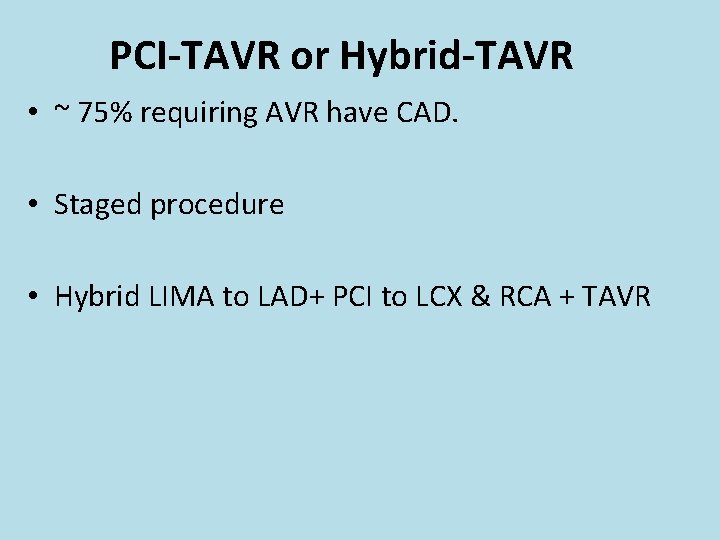
PCI-TAVR or Hybrid-TAVR • ~ 75% requiring AVR have CAD. • Staged procedure • Hybrid LIMA to LAD+ PCI to LCX & RCA + TAVR
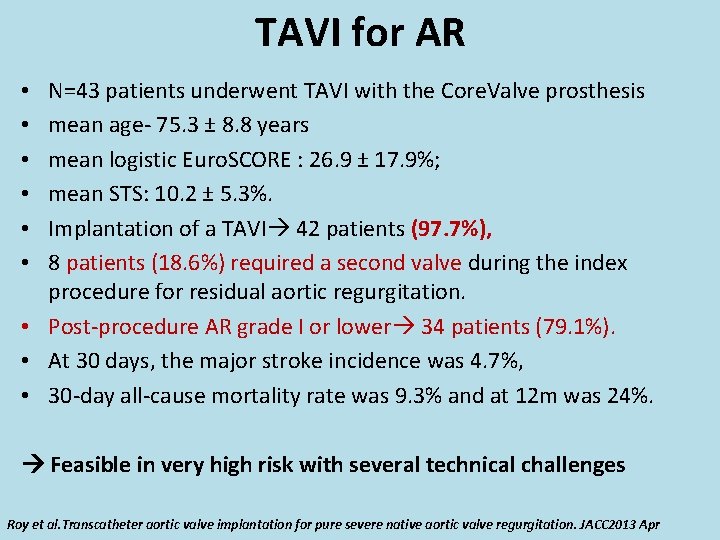
TAVI for AR N=43 patients underwent TAVI with the Core. Valve prosthesis mean age- 75. 3 ± 8. 8 years mean logistic Euro. SCORE : 26. 9 ± 17. 9%; mean STS: 10. 2 ± 5. 3%. Implantation of a TAVI 42 patients (97. 7%), 8 patients (18. 6%) required a second valve during the index procedure for residual aortic regurgitation. • Post-procedure AR grade I or lower 34 patients (79. 1%). • At 30 days, the major stroke incidence was 4. 7%, • 30 -day all-cause mortality rate was 9. 3% and at 12 m was 24%. • • • Feasible in very high risk with several technical challenges Roy et al. Transcatheter aortic valve implantation for pure severe native aortic valve regurgitation. JACC 2013 Apr
ADVANCES in TAVI
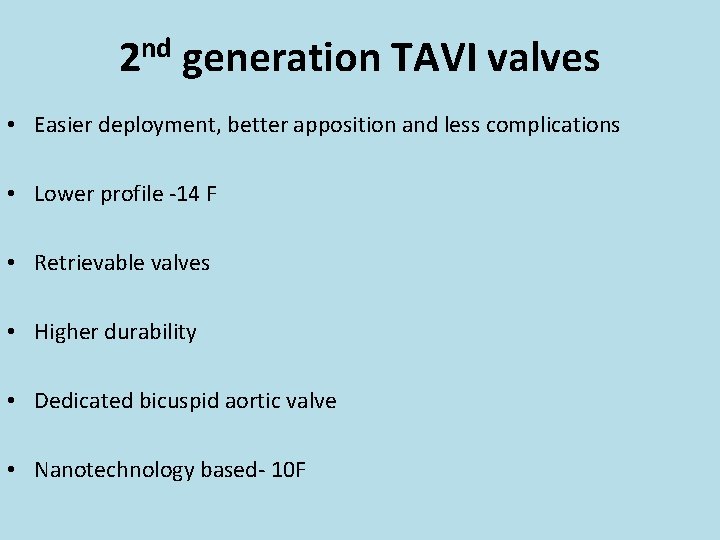
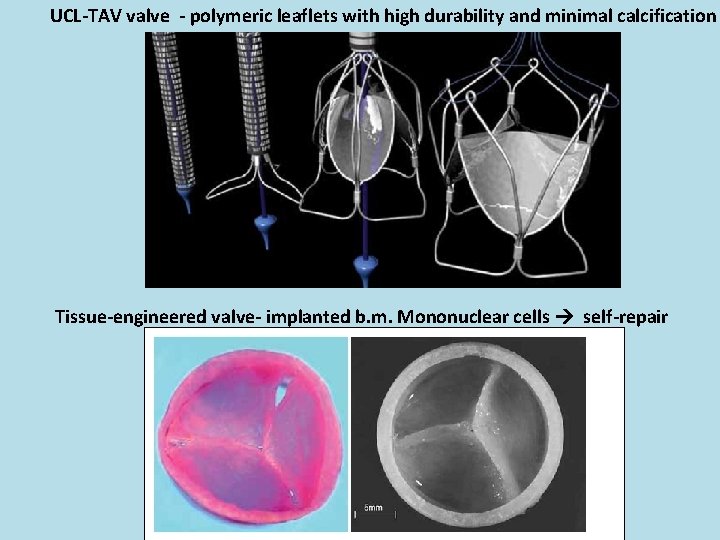
2 nd generation TAVI valves • Easier deployment, better apposition and less complications • Lower profile -14 F • Retrievable valves • Higher durability • Dedicated bicuspid aortic valve • Nanotechnology based- 10 F
UCL-TAV valve - polymeric leaflets with high durability and minimal calcification Tissue-engineered valve- implanted b. m. Mononuclear cells self-repair
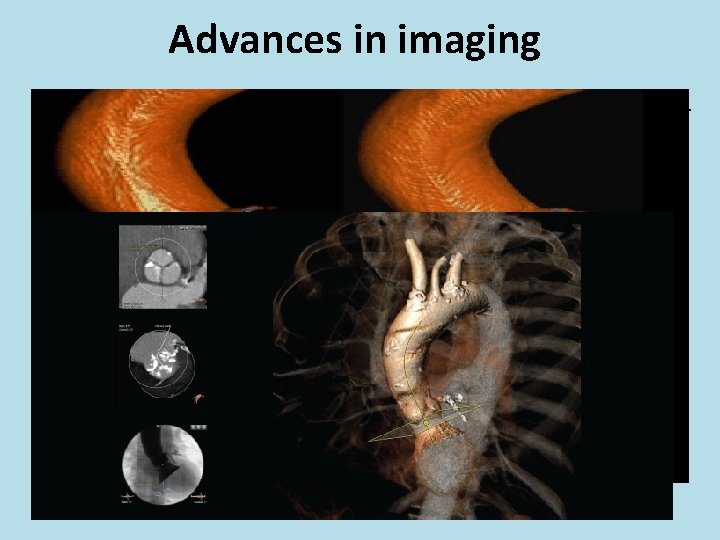
Advances in imaging • 3 mensio valve imaging with Phillips Heart. Navigator sytem • Dyna CT(Siemens) imaging
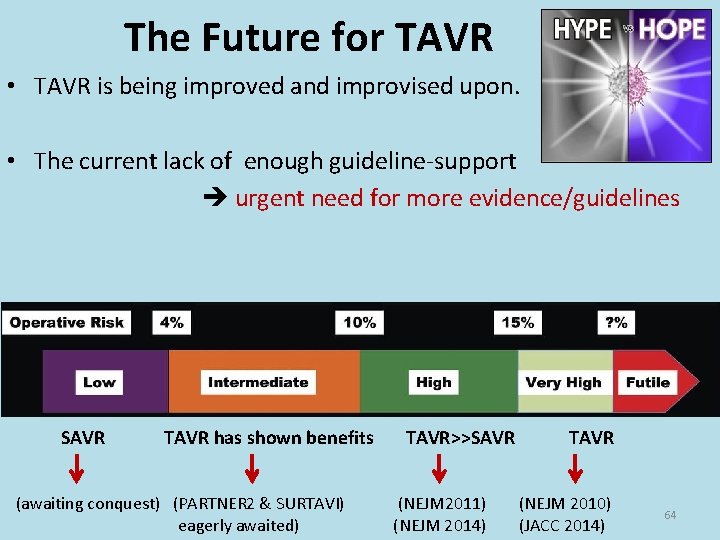
The Future for TAVR • TAVR is being improved and improvised upon. • The current lack of enough guideline-support urgent need for more evidence/guidelines SAVR TAVR has shown benefits TAVR>>SAVR TAVR (awaiting conquest) (PARTNER 2 & SURTAVI) (NEJM 2011) (NEJM 2010) eagerly awaited) (NEJM 2014) (JACC 2014) 64
Conclusion • HEART-TEAM concept is supreme : Weigh evidence and choose the best in concordance to the wishes of our patient • TAVI is now proven superior to SAVR in high-risk cohorts. • Optimism is in the air: 1 st TAVR in India(Feb 2011) v TAVI can be a true success once we identify people that may die due to AS from the group that may die with AS 65
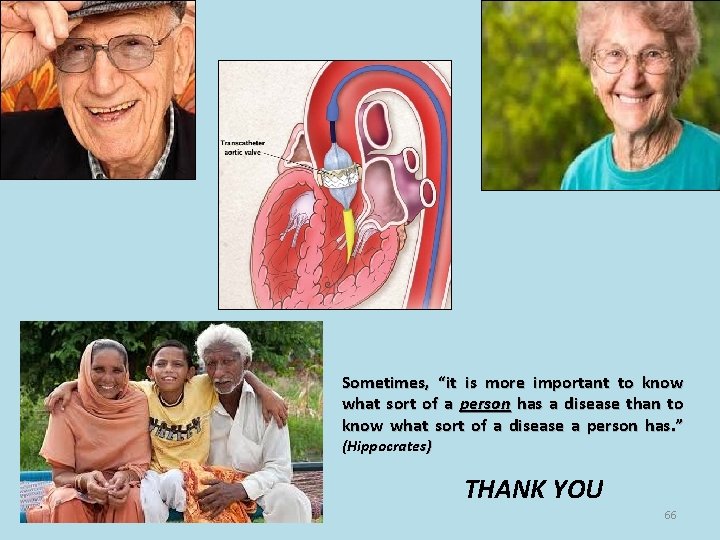
Sometimes, “it is more important to know what sort of a person has a disease than to know what sort of a disease a person has. ” (Hippocrates) THANK YOU 66
QUIZ
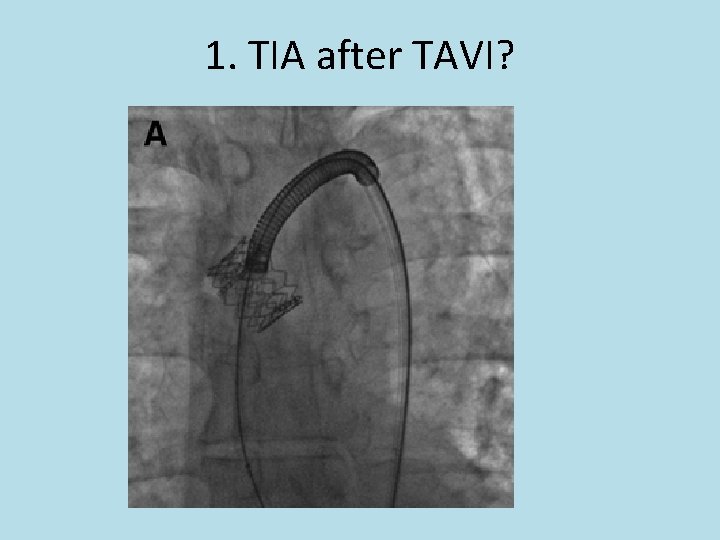
1. TIA after TAVI?
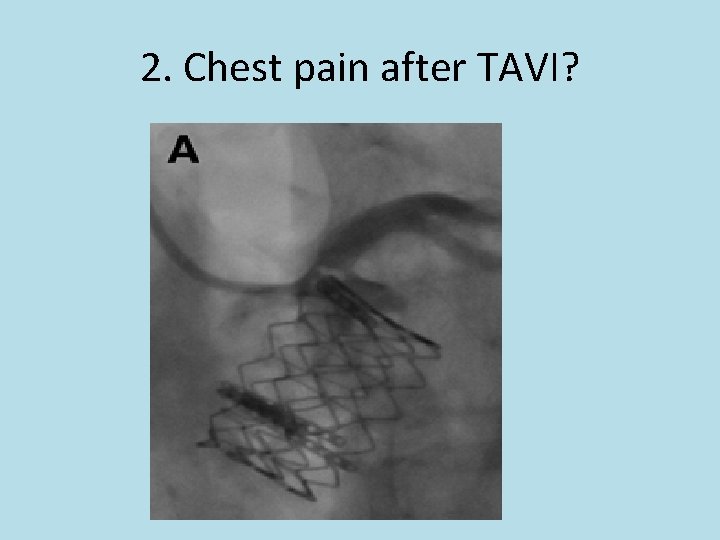
2. Chest pain after TAVI?
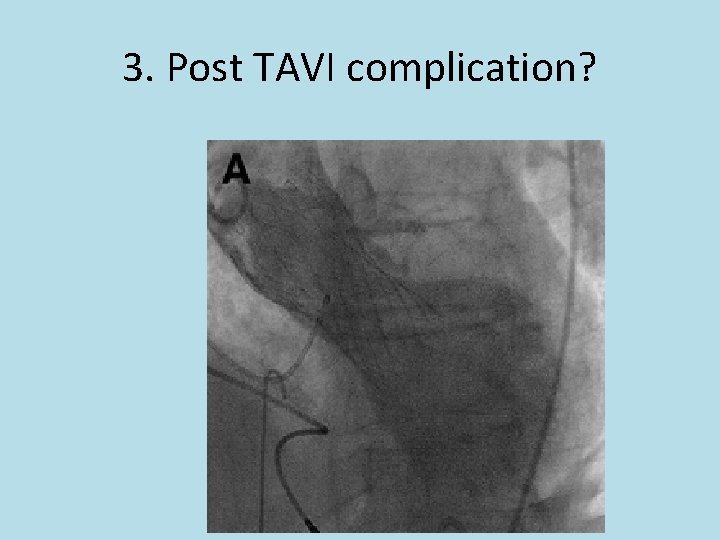
3. Post TAVI complication?
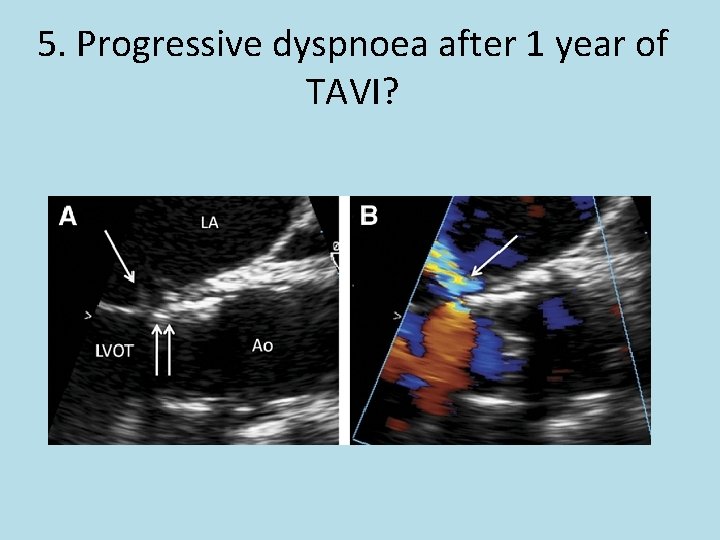
5. Progressive dyspnoea after 1 year of TAVI?
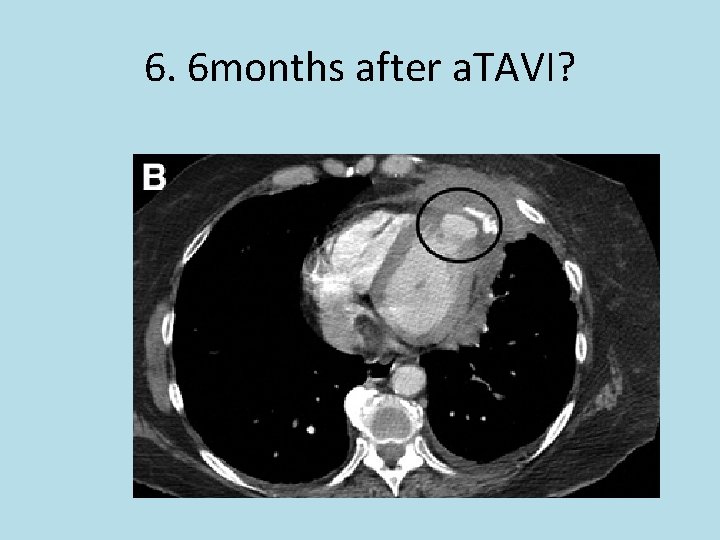
6. 6 months after a. TAVI?
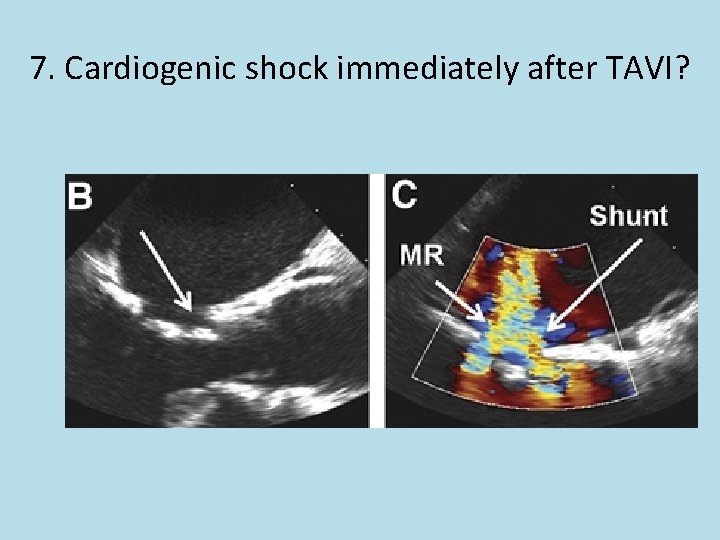
7. Cardiogenic shock immediately after TAVI?
8. Name this valve?
• • • • References Prog Cardiovasc Dis. 2014 May-Jun; 56(6): 619 -24. doi: 10. 1016/j. pcad. 2014. 02. 004. Epub 2014 Mar 3. Outcomes of surgical aortic valve replacement: the benchmark for percutaneous therapies. Bajona P JAMA. 2013 Nov 20; 310(19): 2069 -77. doi: 10. 1001/jama. 2013. 282043. Outcomes following transcatheter aortic valve replacement in the United States. Mack MJ 1, Ann Thorac Surg. 2014 Jan; 97(1): 22 -8. doi: 10. 1016/j. athoracsur. 2013. 09. 088. Epub 2013 Nov 19. Transapical versus transfemoral aortic valve implantation: a multicenter collaborative study. van der Boon RM 1 J Am Coll Cardiol. 2013 Feb 26; 61(8): 830 -6. doi: 10. 1016/j. jacc. 2012. 11. 050. Epub 2013 Jan 16. Transcatheter aortic valve implantation with the Edwards SAPIEN versus the Medtronic Core. Valve Revalving system devices: a multicenter collaborative study: the PRAGMATIC Plus Initiative (Pooled-Rotterd. Am-Milano-Toulouse In Collaboration). Chieffo A 1 J Am Coll Cardiol. 2014 Apr 22; 63(15): 1522 -8. Sex-related differences in outcomes after transcatheter or surgical aortic valve replacement in patients with severe aortic stenosis: Insights from the PARTNER Trial (Placement of Aortic Transcatheter Valve). Williams M 1 J Thorac Cardiovasc Surg. 2013 Dec; 146(6): 1399 -406; discussion 13406 -7. Impact of varying degrees of renal dysfunction on transcatheter and surgical aortic valve replacement. Nguyen TC 1 J Cardiovasc Med (Hagerstown). 2012 Apr; 13(4): 229 -41. Transcatheter vs. surgical aortic valve replacement: a retrospective analysis assessing clinical effectiveness and safety. Fusari M 1 J Thorac Cardiovasc Surg. 2013 Mar; 145(3 Suppl): S 11 -6. doi: 10. 1016/j. jtcvs. 2012. 11. 051. A comprehensive review of the PARTNER trial. Svensson LG Catheter Cardiovasc Interv. 2013 Apr; 81(5): 871 -81. doi: 10. 1002/ccd. 24623. Epub 2012 Sep 24. Clinical profile and outcome of patients with severe aortic stenosis at high surgical risk: single-center prospective evaluation according to treatment assignment. Dvir D Cardiovasc Revasc Med. 2011 Nov-Dec; 12(6): 345 -9. Comparison between Society of Thoracic Surgeons score and logistic Euro. SCORE for predicting mortality in patients referred for transcatheter aortic valve implantation. Ben-Dor I Catheter Cardiovasc Interv. 2012 Jul 1; 80(1): 128 -38. Meta-analysis of complications in aortic valve replacement: comparison of Medtronic-Corevalve, Edwards-Sapien and surgical aortic valve replacement in 8, 536 patients. Jilaihawi H 1 J Am Coll Cardiol. 2014 Jan 28; 63(3): 269 -79. Outcomes of patients with chronic lung disease and severe aortic stenosis treated with transcatheter versus surgical aortic valve replacement or standard therapy: insights from the PARTNER trial (placement of Ao. RTic Tra. Nscathet. ER Valve). Dvir D J Am Coll Cardiol. 2014 Mar 25; 63(11): 1100 -9. Bleeding complications after surgical aortic valve replacement compared with transcatheter aortic valve replacement: insights from the PARTNER I Trial (Placement of Aortic Transcatheter Valve). Généreux P
• • • Circulation. 2013 Dec 24; 128(25): 2776 -84. Impact of preoperative moderate/severe mitral regurgitation on 2 -year outcome after transcatheter and surgical aortic valve replacement: insight from the Placement of Aortic Transcatheter Valve (PARTNER) Trial Cohort A. Barbanti M 1 J Am Coll Cardiol. 2013 Jun 25; 61(25): 2514 -21. Comparison of transcatheter and surgical aortic valve replacement in severe aortic stenosis: a longitudinal study of echocardiography parameters in cohort A of the PARTNER trial (placement of aortic transcatheter valves). Hahn RT Am Heart J. 2014 Aug; 168(2): 150 -9. e 1 -7. A critical review of hemodynamic changes and left ventricular remodeling after surgical aortic valve replacement and percutaneous aortic valve replacement. Kim SJ 76