Topic 12 Quantum nuclear physics AHL 12 1
- Slides: 78
Topic 12: Quantum & nuclear physics - AHL 12. 1 – The interaction of matter with radiation Topic 12. 1 is an extension of Topics 7. 1 and 7. 2. Essential idea: The microscopic quantum world offers a range of phenomena whose interpretation and explanation require new ideas and concepts not found in the classical world. Nature of science: (1) Observations: Much of the work towards a quantum theory of atoms was guided by the need to explain the observed patterns in atomic spectra. The first quantum model of matter is the Bohr model for hydrogen. (2) Paradigm shift: The acceptance of the wave–particle duality paradox for light and particles required scientists in many fields to view research from new perspectives.
Topic 12: Quantum & nuclear physics - AHL 12. 1 – The interaction of matter with radiation Understandings: • Photons • The photoelectric effect • Matter waves • Pair production and pair annihilation • Quantization of angular momentum in the Bohr model for hydrogen • The wave function • The uncertainty principle for energy and time and position and momentum • Tunneling, potential barrier and factors affecting tunneling probability
Topic 12: Quantum & nuclear physics - AHL 12. 1 – The interaction of matter with radiation Applications and skills: • Discussing the photoelectric effect experiment and explaining which features of the experiment cannot be explained by the classical wave theory of light • Solving photoelectric problems both graphically and algebraically • Discussing experimental evidence for matter waves, including an experiment in which the wave nature of electrons is evident • Stating order of magnitude estimates from the uncertainty principle
Topic 12: Quantum & nuclear physics - AHL 12. 1 – The interaction of matter with radiation Guidance: • The order of magnitude estimates from the uncertainty principle may include (but is not limited to) estimates of the energy of the ground state of an atom, the impossibility of an electron existing within a nucleus, and the lifetime of an electron in an excited energy state • Tunneling is to be treated qualitatively using the idea of continuity of wave functions
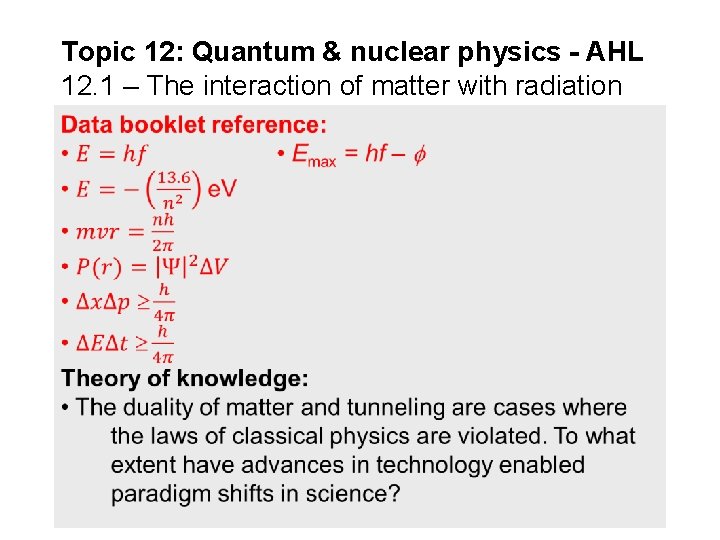
Topic 12: Quantum & nuclear physics - AHL 12. 1 – The interaction of matter with radiation
Topic 12: Quantum & nuclear physics - AHL 12. 1 – The interaction of matter with radiation Utilization: • The electron microscope and the tunneling electron microscope rely on the findings from studies in quantum physics • Probability is treated in a mathematical sense in Mathematical studies SL sub-topics 3. 6– 3. 7
Topic 12: Quantum & nuclear physics - AHL 12. 1 – The interaction of matter with radiation Aims: • Aim 1: study of quantum phenomena introduces students to an exciting new world that is not experienced at the macroscopic level. The study of tunneling is a novel phenomenon not observed in macroscopic physics. • Aim 6: the photoelectric effect can be investigated using LEDs • Aim 9: the Bohr model is very successful with hydrogen but not of any use for other elements
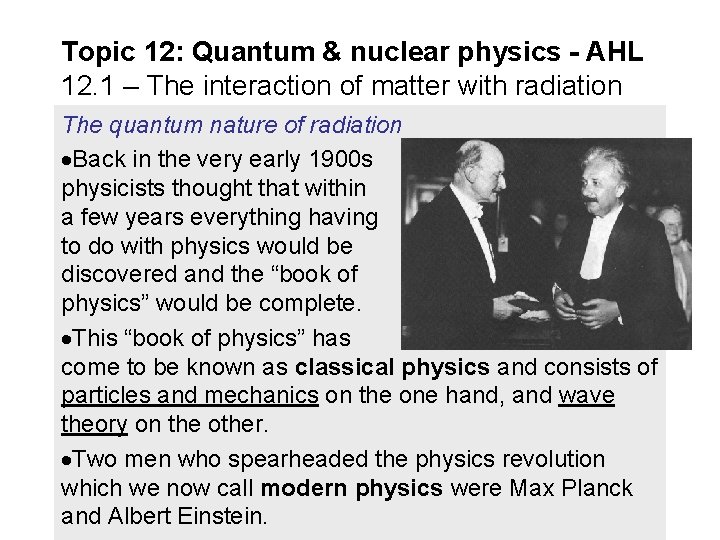
Topic 12: Quantum & nuclear physics - AHL 12. 1 – The interaction of matter with radiation The quantum nature of radiation Back in the very early 1900 s physicists thought that within a few years everything having to do with physics would be discovered and the “book of physics” would be complete. This “book of physics” has come to be known as classical physics and consists of particles and mechanics on the one hand, and wave theory on the other. Two men who spearheaded the physics revolution which we now call modern physics were Max Planck and Albert Einstein.
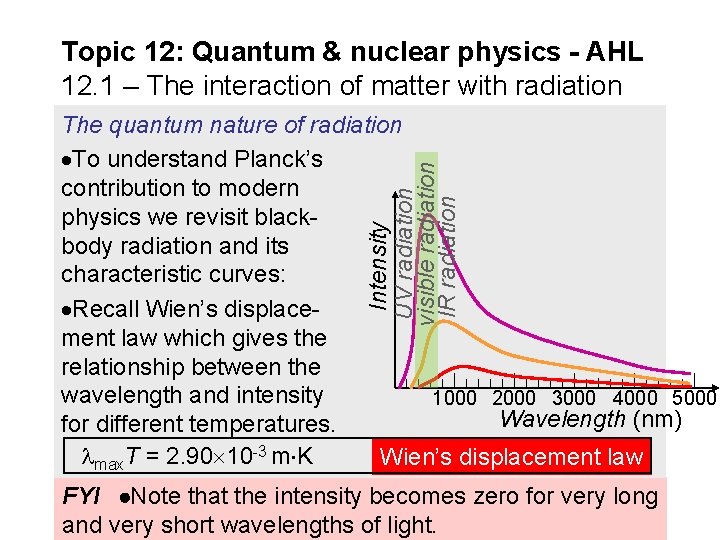
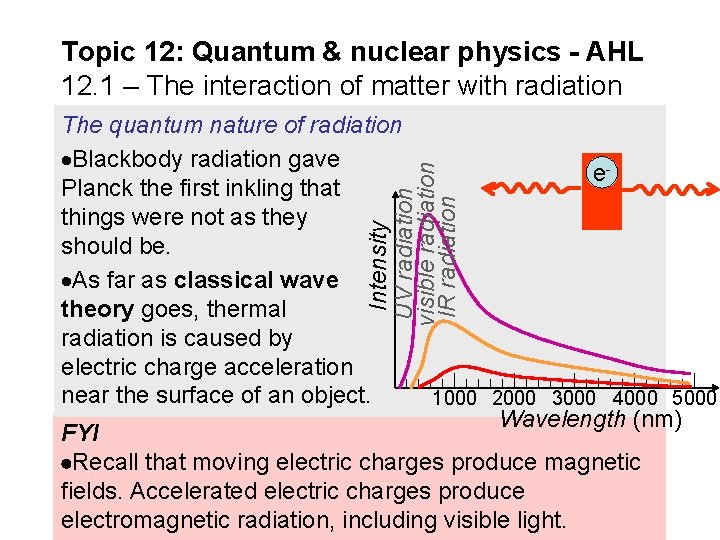
Topic 12: Quantum & nuclear physics - AHL 12. 1 – The interaction of matter with radiation Intensity UV radiation visible radiation IR radiation The quantum nature of radiation To understand Planck’s contribution to modern physics we revisit black- body radiation and its characteristic curves: Recall Wien’s displace- ment law which gives the relationship between the wavelength and intensity 1000 2000 3000 4000 5000 Wavelength (nm) for different temperatures. max. T = 2. 90 10 -3 m K Wien’s displacement law FYI Note that the intensity becomes zero for very long and very short wavelengths of light.
Topic 12: Quantum & nuclear physics - AHL 12. 1 – The interaction of matter with radiation Intensity UV radiation visible radiation IR radiation The quantum nature of radiation Blackbody radiation gave e. Planck the first inkling that things were not as they should be. As far as classical wave theory goes, thermal radiation is caused by electric charge acceleration near the surface of an object. 1000 2000 3000 4000 5000 Wavelength (nm) FYI Recall that moving electric charges produce magnetic fields. Accelerated electric charges produce electromagnetic radiation, including visible light.
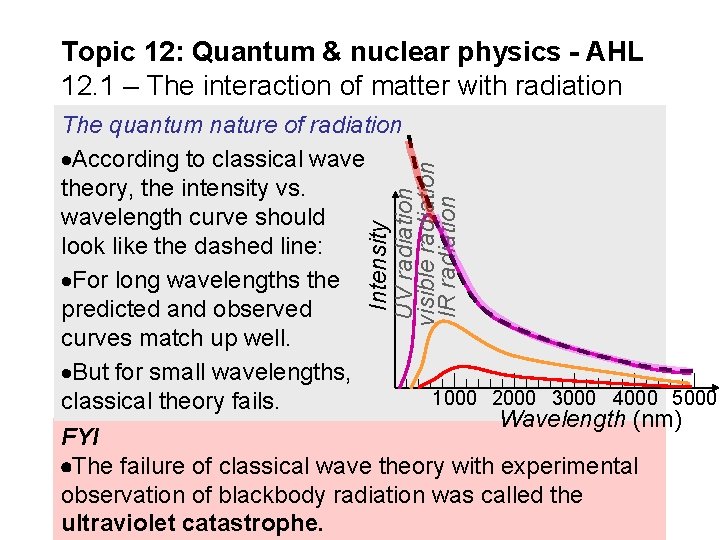
Topic 12: Quantum & nuclear physics - AHL 12. 1 – The interaction of matter with radiation Intensity UV radiation visible radiation IR radiation The quantum nature of radiation According to classical wave theory, the intensity vs. wavelength curve should look like the dashed line: For long wavelengths the predicted and observed curves match up well. But for small wavelengths, 1000 2000 3000 4000 5000 classical theory fails. Wavelength (nm) FYI The failure of classical wave theory with experimental observation of blackbody radiation was called the ultraviolet catastrophe.
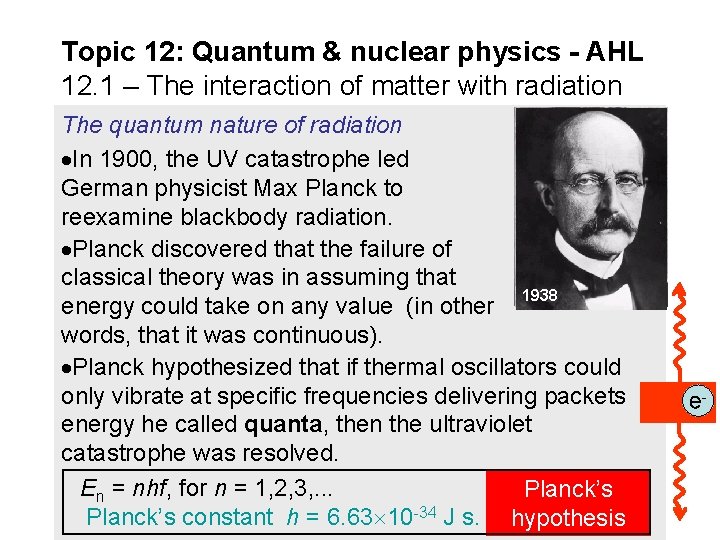
Topic 12: Quantum & nuclear physics - AHL 12. 1 – The interaction of matter with radiation The quantum nature of radiation In 1900, the UV catastrophe led German physicist Max Planck to reexamine blackbody radiation. Planck discovered that the failure of classical theory was in assuming that 1876 1901 1938 energy could take on any value (in other words, that it was continuous). Planck hypothesized that if thermal oscillators could only vibrate at specific frequencies delivering packets of eenergy he called quanta, then the ultraviolet catastrophe was resolved. En = nhf, for n = 1, 2, 3, . . . Planck’s constant h = 6. 63 10 -34 J s. hypothesis
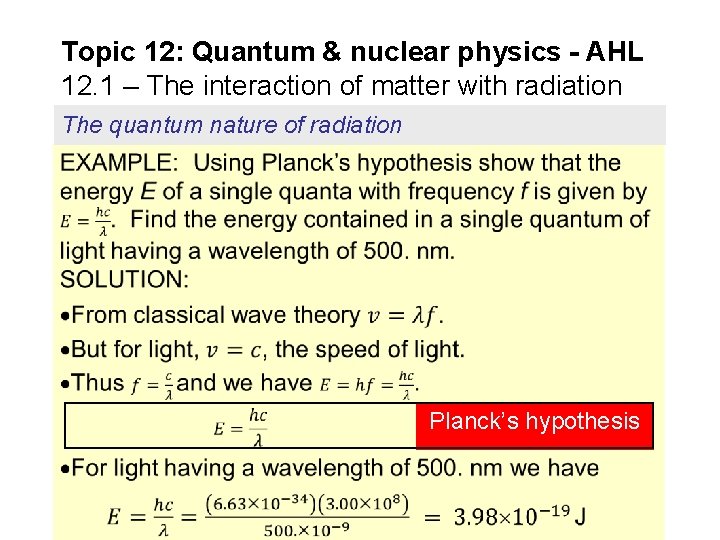
Topic 12: Quantum & nuclear physics - AHL 12. 1 – The interaction of matter with radiation The quantum nature of radiation Planck’s hypothesis
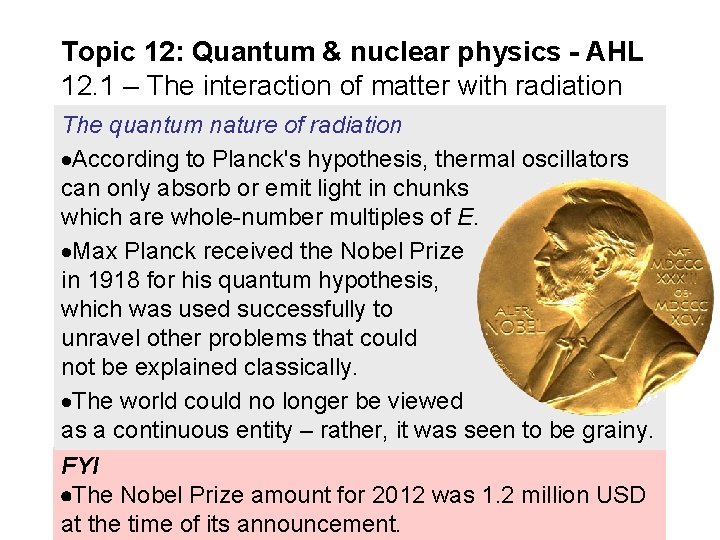
Topic 12: Quantum & nuclear physics - AHL 12. 1 – The interaction of matter with radiation The quantum nature of radiation According to Planck's hypothesis, thermal oscillators can only absorb or emit light in chunks which are whole-number multiples of E. Max Planck received the Nobel Prize in 1918 for his quantum hypothesis, which was used successfully to unravel other problems that could not be explained classically. The world could no longer be viewed as a continuous entity – rather, it was seen to be grainy. FYI The Nobel Prize amount for 2012 was 1. 2 million USD at the time of its announcement.
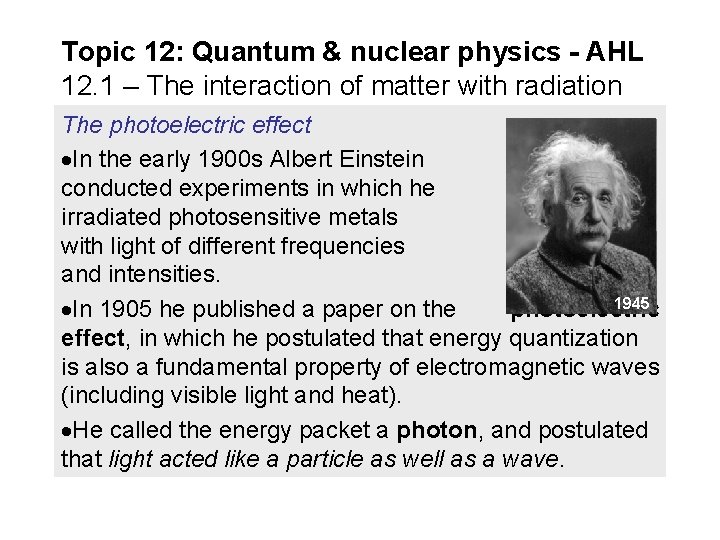
Topic 12: Quantum & nuclear physics - AHL 12. 1 – The interaction of matter with radiation The photoelectric effect In the early 1900 s Albert Einstein conducted experiments in which he irradiated photosensitive metals with light of different frequencies and intensities. 1921 1932 1945 1895 In 1905 he published a paper on the photoelectric effect, in which he postulated that energy quantization is also a fundamental property of electromagnetic waves (including visible light and heat). He called the energy packet a photon, and postulated that light acted like a particle as well as a wave.
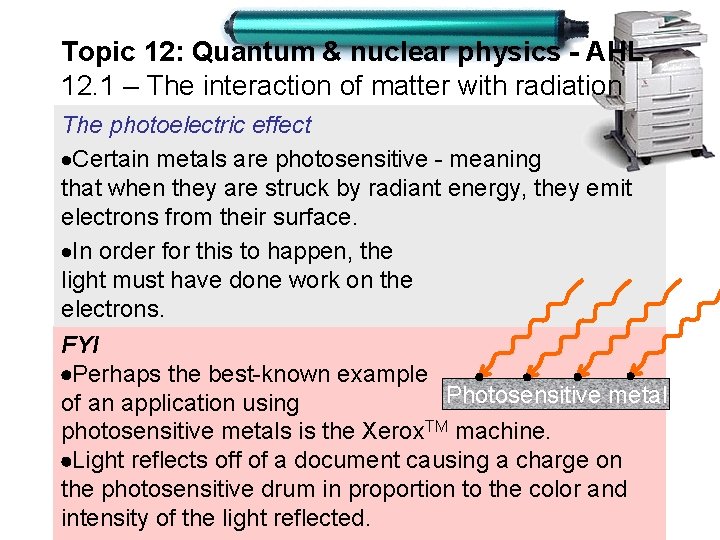
Topic 12: Quantum & nuclear physics - AHL 12. 1 – The interaction of matter with radiation The photoelectric effect Certain metals are photosensitive - meaning that when they are struck by radiant energy, they emit electrons from their surface. In order for this to happen, the light must have done work on the electrons. FYI Perhaps the best-known example Photosensitive metal of an application using photosensitive metals is the Xerox. TM machine. Light reflects off of a document causing a charge on the photosensitive drum in proportion to the color and intensity of the light reflected.
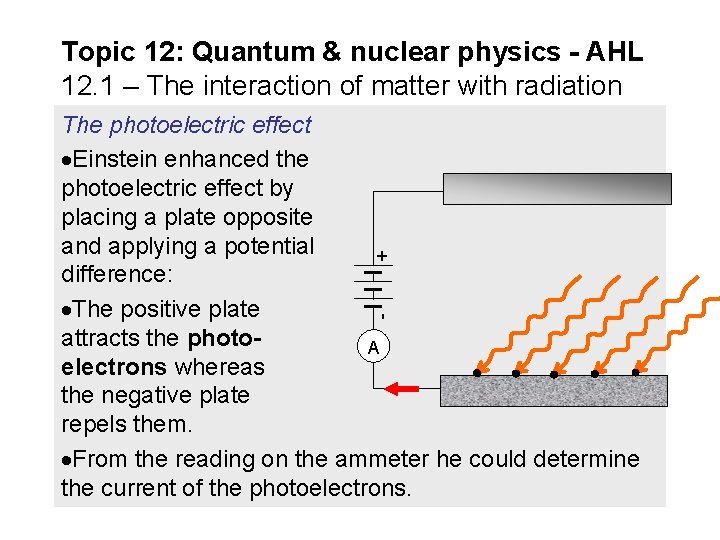
Topic 12: Quantum & nuclear physics - AHL 12. 1 – The interaction of matter with radiation + The photoelectric effect Einstein enhanced the photoelectric effect by placing a plate opposite and applying a potential difference: The positive plate attracts the photo. A electrons whereas the negative plate repels them. From the reading on the ammeter he could determine the current of the photoelectrons. -
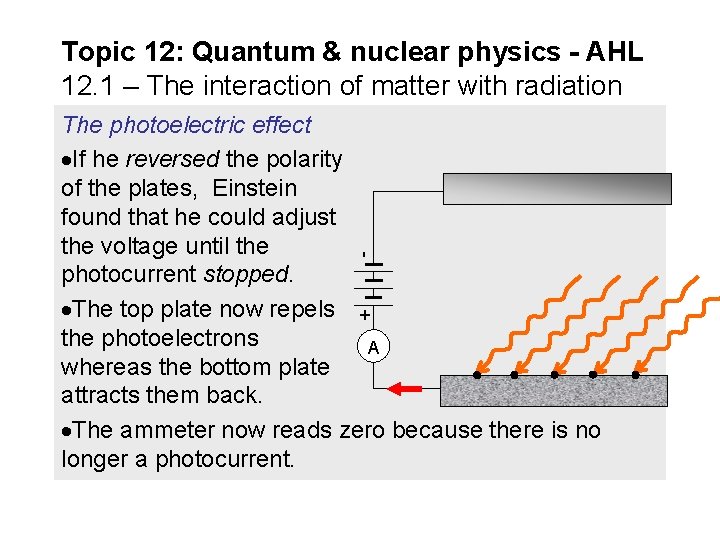
Topic 12: Quantum & nuclear physics - AHL 12. 1 – The interaction of matter with radiation + - The photoelectric effect If he reversed the polarity of the plates, Einstein found that he could adjust the voltage until the photocurrent stopped. The top plate now repels the photoelectrons A whereas the bottom plate attracts them back. The ammeter now reads zero because there is no longer a photocurrent.
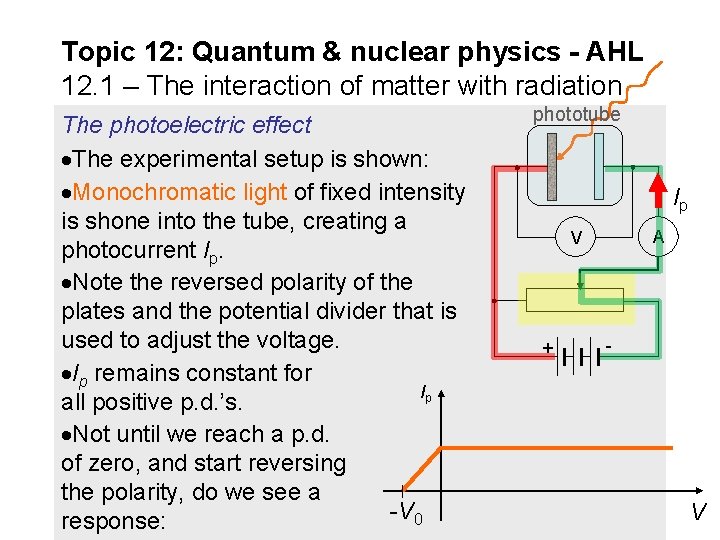
Topic 12: Quantum & nuclear physics - AHL 12. 1 – The interaction of matter with radiation phototube The photoelectric effect The experimental setup is shown: Monochromatic light of fixed intensity Ip is shone into the tube, creating a A V photocurrent Ip. Note the reversed polarity of the plates and the potential divider that is used to adjust the voltage. + Ip remains constant for Ip all positive p. d. ’s. Not until we reach a p. d. of zero, and start reversing the polarity, do we see a -V 0 V response:
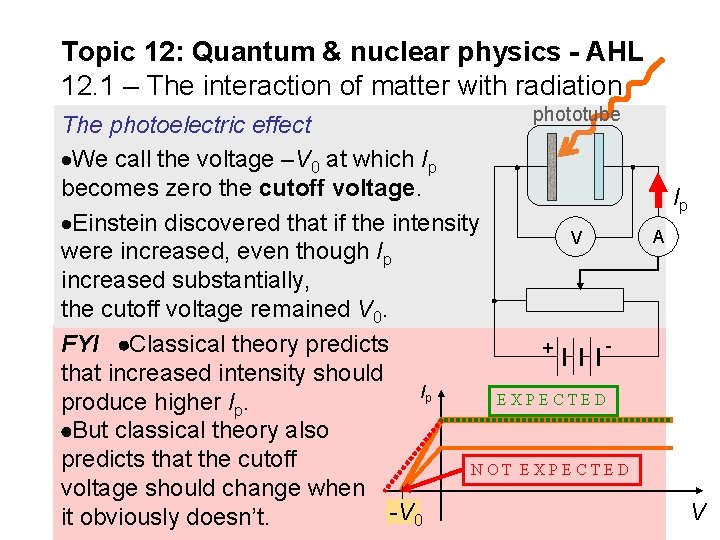
Topic 12: Quantum & nuclear physics - AHL 12. 1 – The interaction of matter with radiation phototube The photoelectric effect We call the voltage –V 0 at which Ip becomes zero the cutoff voltage. Ip Einstein discovered that if the intensity A V were increased, even though Ip increased substantially, the cutoff voltage remained V 0. FYI Classical theory predicts + that increased intensity should Ip EXPECTED produce higher Ip. But classical theory also predicts that the cutoff NOT EXPECTED voltage should change when V -V 0 it obviously doesn’t.
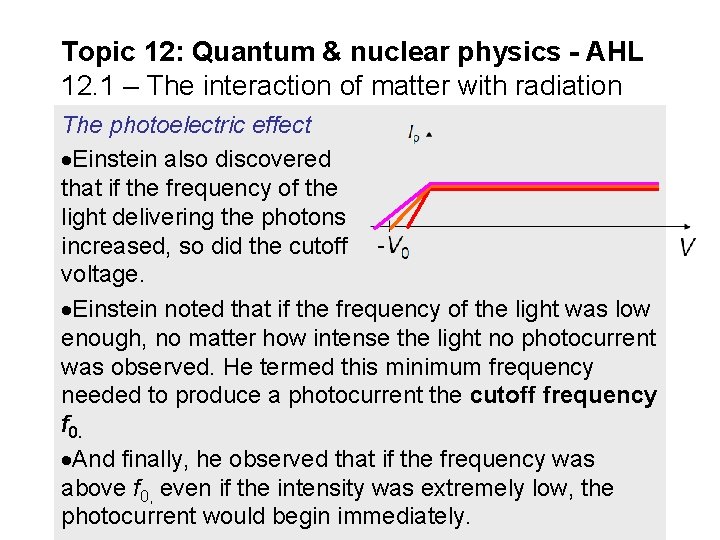
Topic 12: Quantum & nuclear physics - AHL 12. 1 – The interaction of matter with radiation The photoelectric effect Einstein also discovered that if the frequency of the light delivering the photons increased, so did the cutoff voltage. Einstein noted that if the frequency of the light was low enough, no matter how intense the light no photocurrent was observed. He termed this minimum frequency needed to produce a photocurrent the cutoff frequency f 0. And finally, he observed that if the frequency was above f 0, even if the intensity was extremely low, the photocurrent would begin immediately.
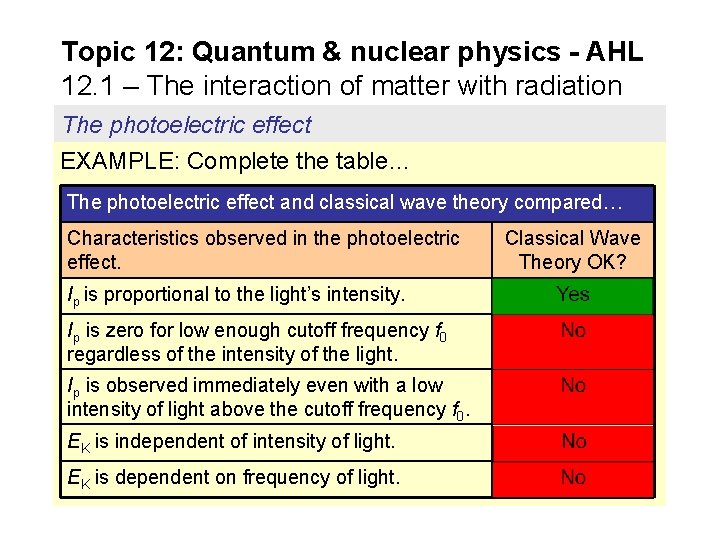
Topic 12: Quantum & nuclear physics - AHL 12. 1 – The interaction of matter with radiation The photoelectric effect EXAMPLE: Complete the table… The photoelectric effect and classical wave theory compared… Characteristics observed in the photoelectric effect. Ip is proportional to the light’s intensity. Ip is zero for low enough cutoff frequency f 0 regardless of the intensity of the light. Ip is observed immediately even with a low intensity of light above the cutoff frequency f 0. EK is independent of intensity of light. EK is dependent on frequency of light. Classical Wave Theory OK?
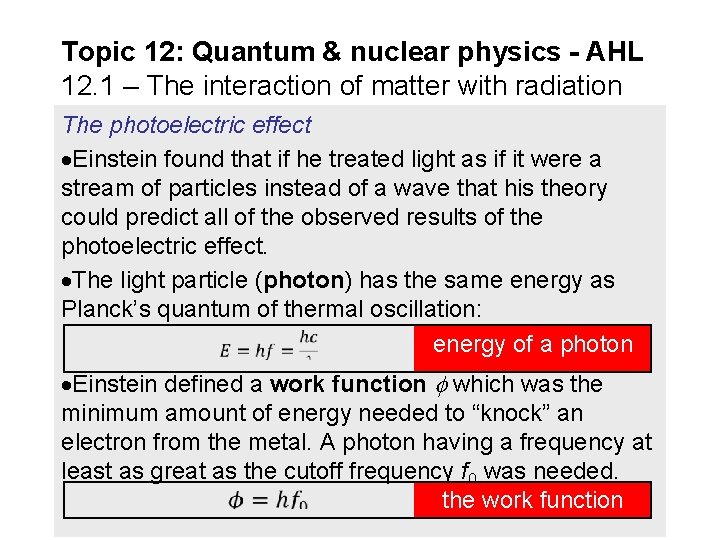
Topic 12: Quantum & nuclear physics - AHL 12. 1 – The interaction of matter with radiation The photoelectric effect Einstein found that if he treated light as if it were a stream of particles instead of a wave that his theory could predict all of the observed results of the photoelectric effect. The light particle (photon) has the same energy as Planck’s quantum of thermal oscillation: energy of a photon Einstein defined a work function which was the minimum amount of energy needed to “knock” an electron from the metal. A photon having a frequency at least as great as the cutoff frequency f 0 was needed. the work function
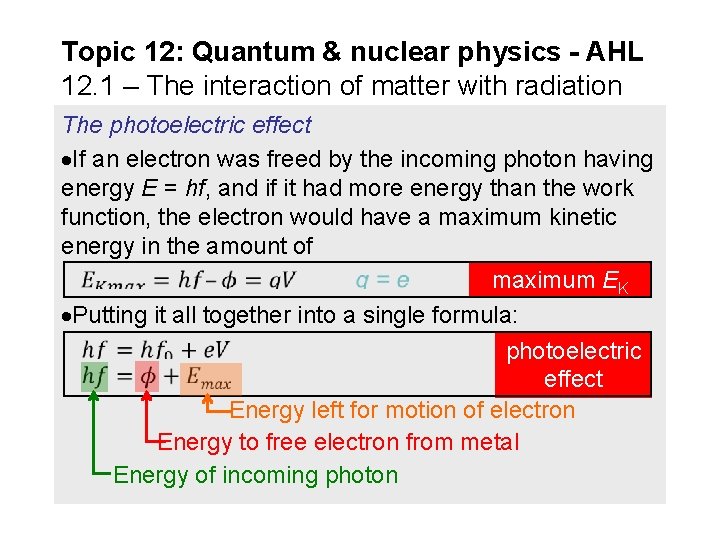
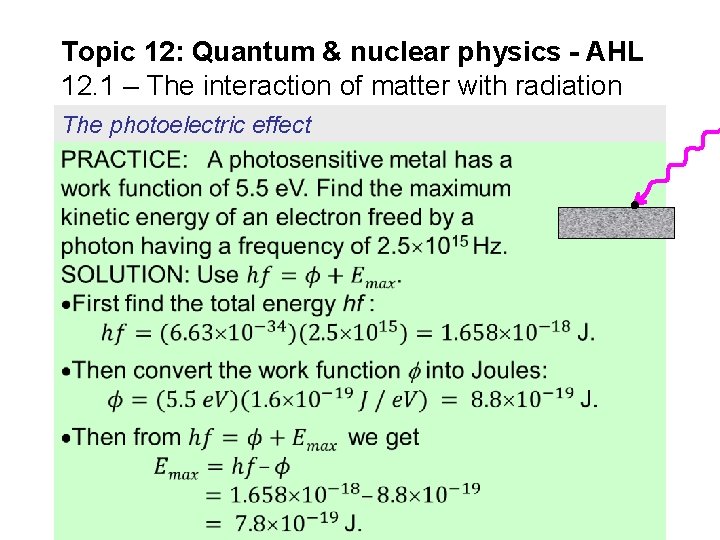
Topic 12: Quantum & nuclear physics - AHL 12. 1 – The interaction of matter with radiation The photoelectric effect If an electron was freed by the incoming photon having energy E = hf, and if it had more energy than the work function, the electron would have a maximum kinetic energy in the amount of maximum EK Putting it all together into a single formula: photoelectric effect Energy left for motion of electron Energy to free electron from metal Energy of incoming photon
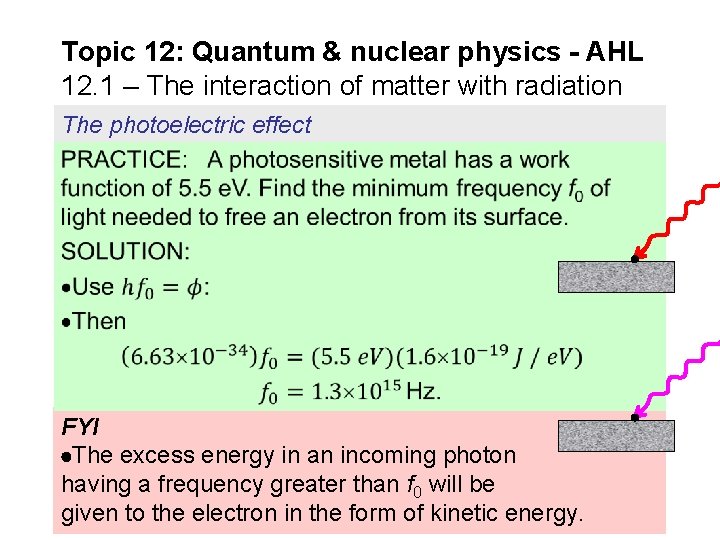
Topic 12: Quantum & nuclear physics - AHL 12. 1 – The interaction of matter with radiation The photoelectric effect FYI The excess energy in an incoming photon having a frequency greater than f 0 will be given to the electron in the form of kinetic energy.
Topic 12: Quantum & nuclear physics - AHL 12. 1 – The interaction of matter with radiation The photoelectric effect
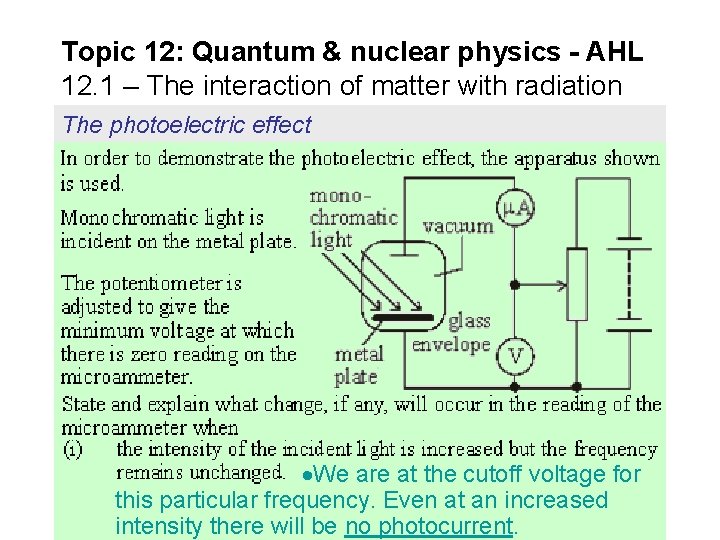
Topic 12: Quantum & nuclear physics - AHL 12. 1 – The interaction of matter with radiation The photoelectric effect We are at the cutoff voltage for this particular frequency. Even at an increased intensity there will be no photocurrent.
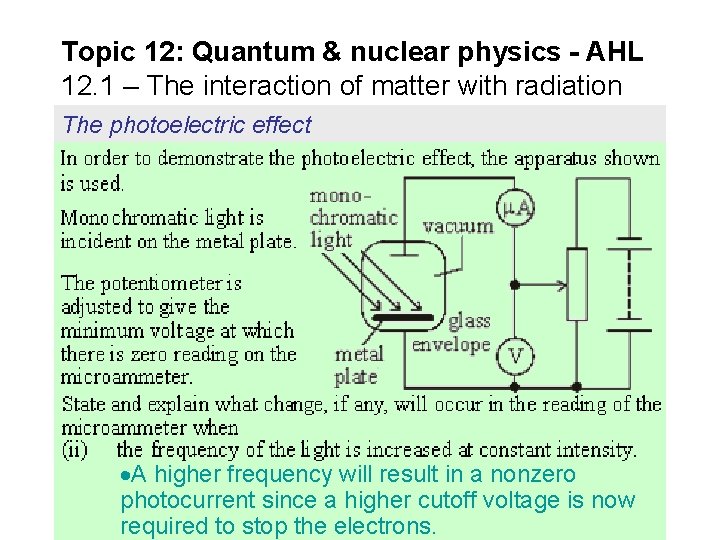
Topic 12: Quantum & nuclear physics - AHL 12. 1 – The interaction of matter with radiation The photoelectric effect A higher frequency will result in a nonzero photocurrent since a higher cutoff voltage is now required to stop the electrons.
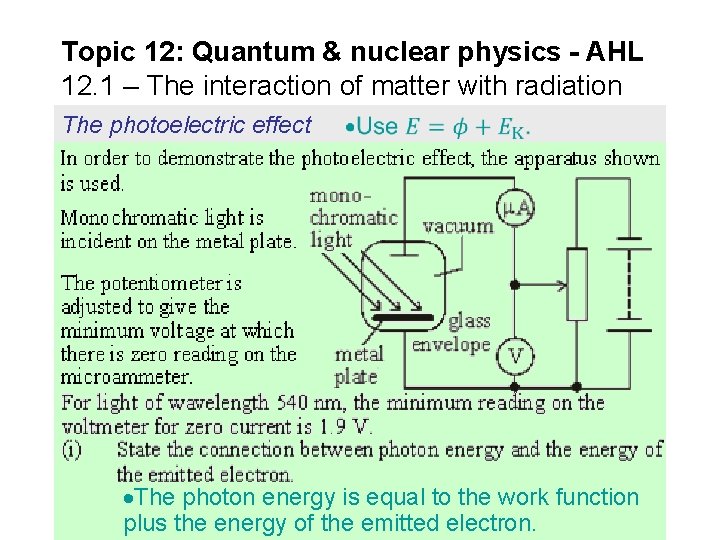
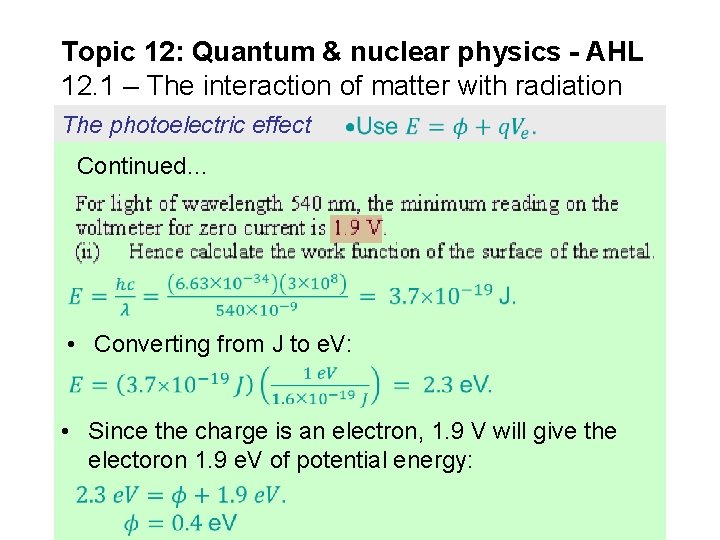
Topic 12: Quantum & nuclear physics - AHL 12. 1 – The interaction of matter with radiation The photoelectric effect The photon energy is equal to the work function plus the energy of the emitted electron.
Topic 12: Quantum & nuclear physics - AHL 12. 1 – The interaction of matter with radiation The photoelectric effect Continued… • Converting from J to e. V: • Since the charge is an electron, 1. 9 V will give the electoron 1. 9 e. V of potential energy:
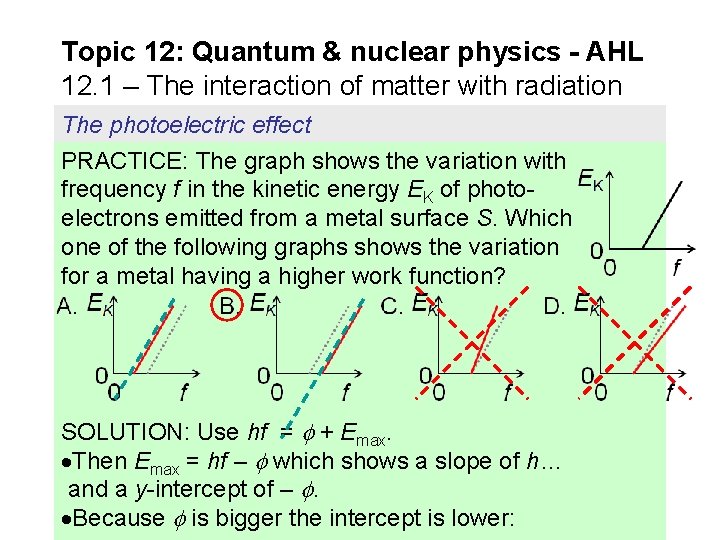
Topic 12: Quantum & nuclear physics - AHL 12. 1 – The interaction of matter with radiation The photoelectric effect PRACTICE: The graph shows the variation with frequency f in the kinetic energy EK of photo- electrons emitted from a metal surface S. Which one of the following graphs shows the variation for a metal having a higher work function? SOLUTION: Use hf = + Emax. Then Emax = hf – which shows a slope of h… and a y-intercept of – . Because is bigger the intercept is lower:
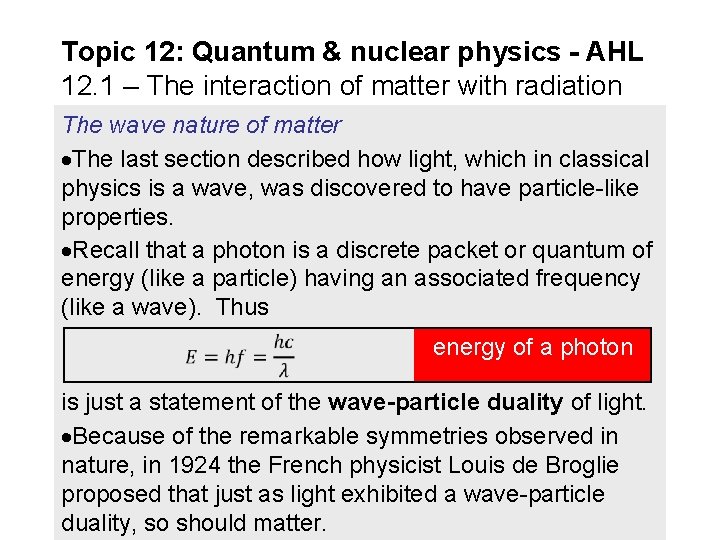
Topic 12: Quantum & nuclear physics - AHL 12. 1 – The interaction of matter with radiation The wave nature of matter The last section described how light, which in classical physics is a wave, was discovered to have particle-like properties. Recall that a photon is a discrete packet or quantum of energy (like a particle) having an associated frequency (like a wave). Thus energy of a photon is just a statement of the wave-particle duality of light. Because of the remarkable symmetries observed in nature, in 1924 the French physicist Louis de Broglie proposed that just as light exhibited a wave-particle duality, so should matter.
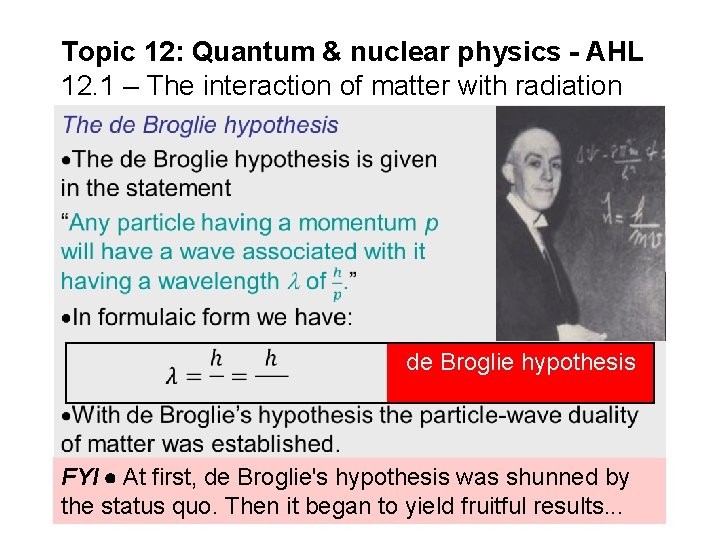
Topic 12: Quantum & nuclear physics - AHL 12. 1 – The interaction of matter with radiation de Broglie hypothesis FYI At first, de Broglie's hypothesis was shunned by the status quo. Then it began to yield fruitful results. . .
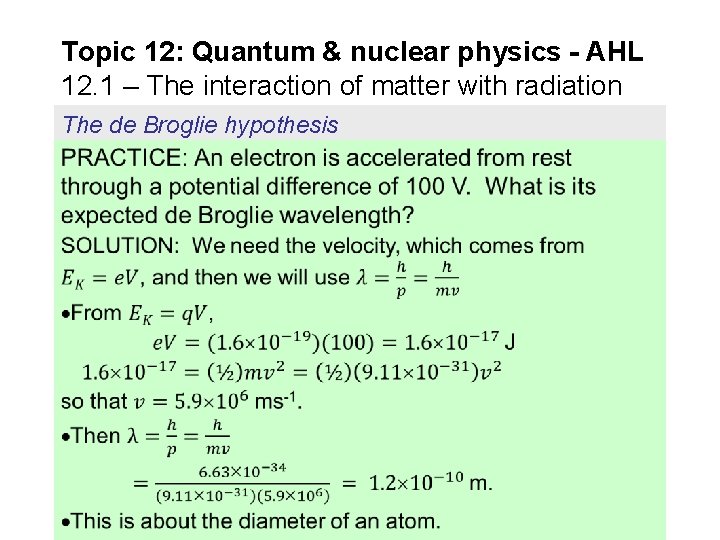
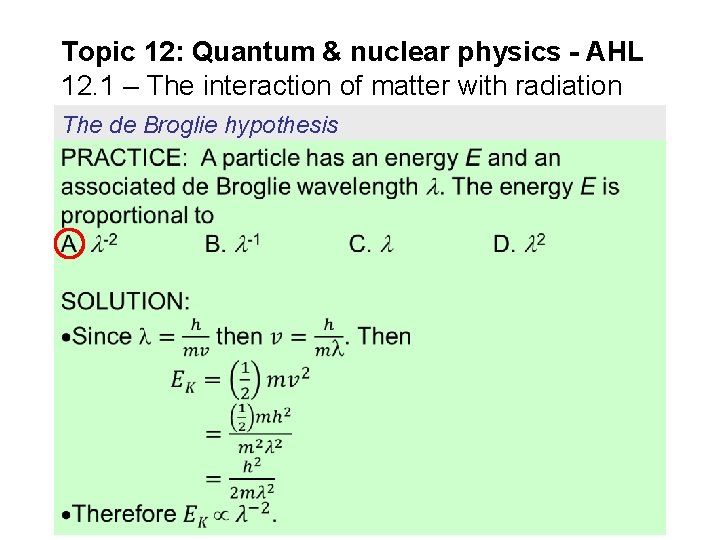
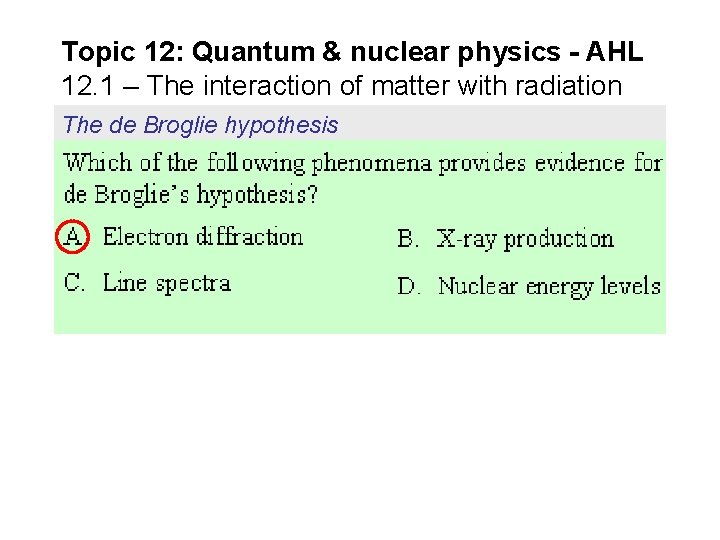
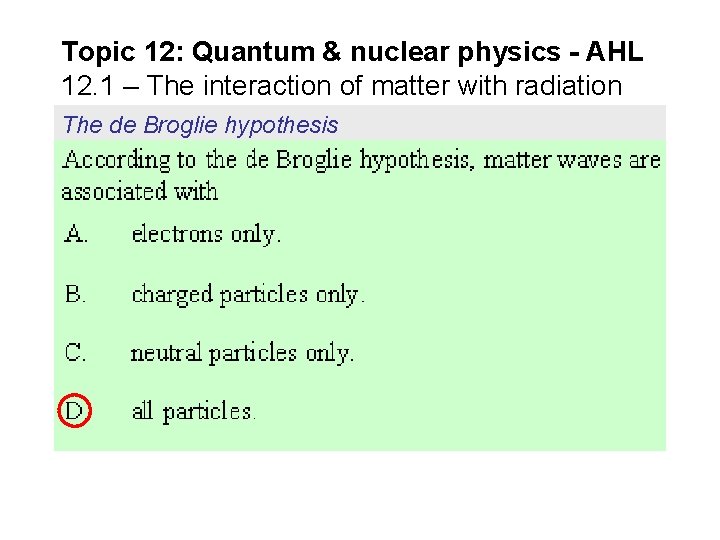
Topic 12: Quantum & nuclear physics - AHL 12. 1 – The interaction of matter with radiation The de Broglie hypothesis
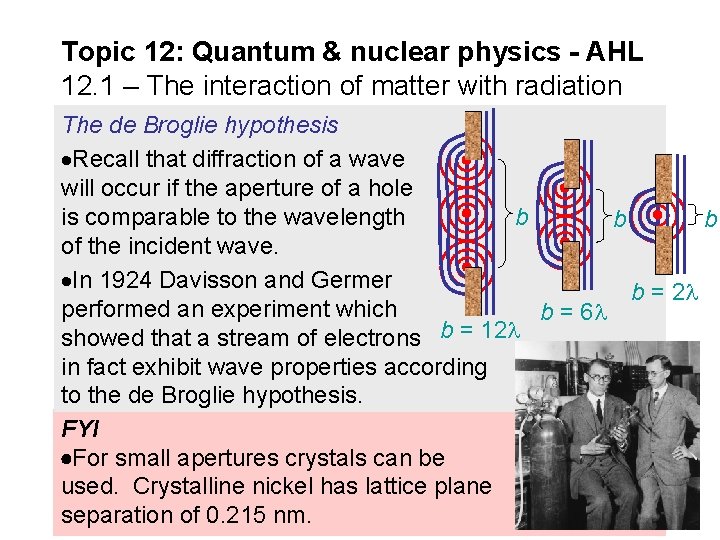
Topic 12: Quantum & nuclear physics - AHL 12. 1 – The interaction of matter with radiation The de Broglie hypothesis Recall that diffraction of a wave will occur if the aperture of a hole b is comparable to the wavelength b b of the incident wave. In 1924 Davisson and Germer b = 2 performed an experiment which b = 6 b = 12 showed that a stream of electrons in fact exhibit wave properties according to the de Broglie hypothesis. FYI For small apertures crystals can be used. Crystalline nickel has lattice plane separation of 0. 215 nm.
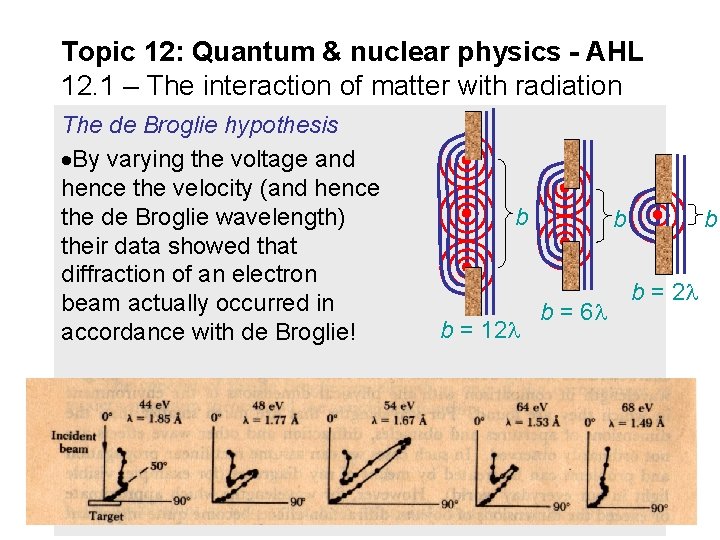
Topic 12: Quantum & nuclear physics - AHL 12. 1 – The interaction of matter with radiation The de Broglie hypothesis By varying the voltage and hence the velocity (and hence b the de Broglie wavelength) b b their data showed that diffraction of an electron b = 2 beam actually occurred in b = 6 b = 12 accordance with de Broglie!
Topic 12: Quantum & nuclear physics - AHL 12. 1 – The interaction of matter with radiation The de Broglie hypothesis
Topic 12: Quantum & nuclear physics - AHL 12. 1 – The interaction of matter with radiation The de Broglie hypothesis
Topic 12: Quantum & nuclear physics - AHL 12. 1 – The interaction of matter with radiation The de Broglie hypothesis
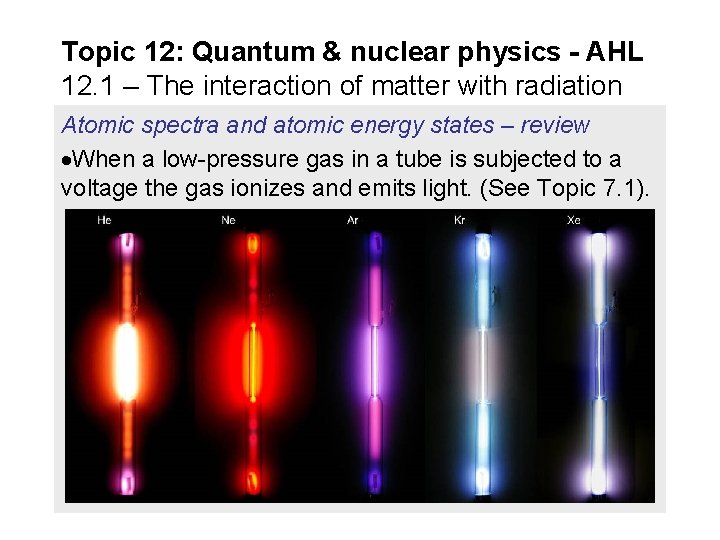
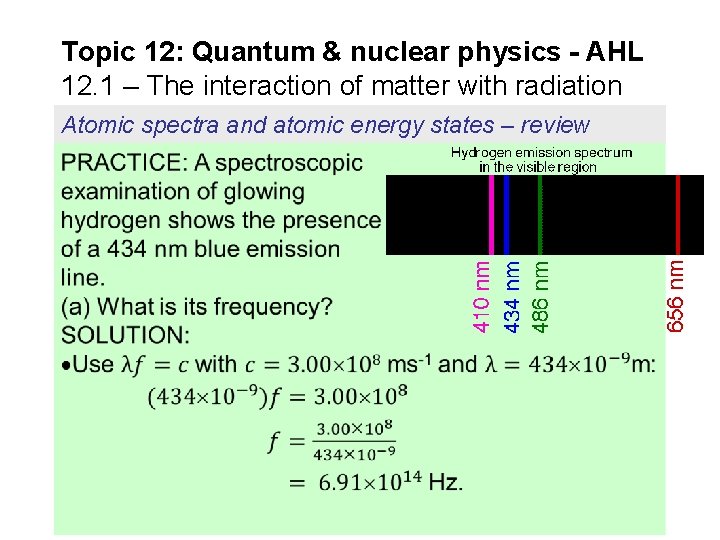
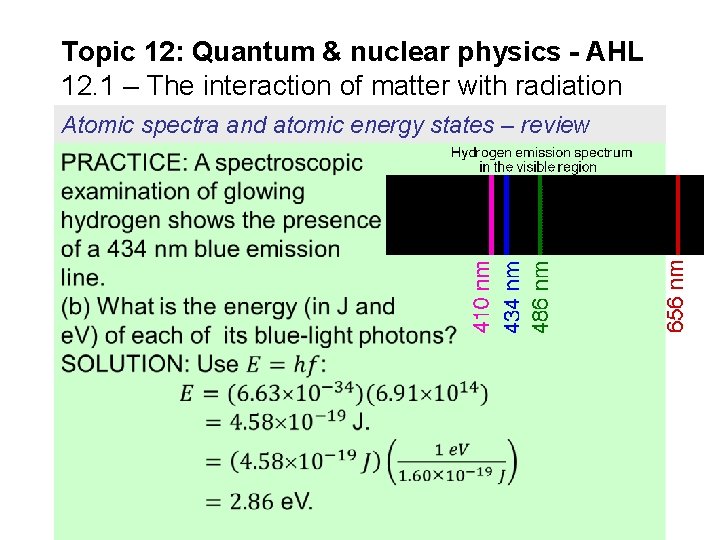
Topic 12: Quantum & nuclear physics - AHL 12. 1 – The interaction of matter with radiation Atomic spectra and atomic energy states – review When a low-pressure gas in a tube is subjected to a voltage the gas ionizes and emits light. (See Topic 7. 1).
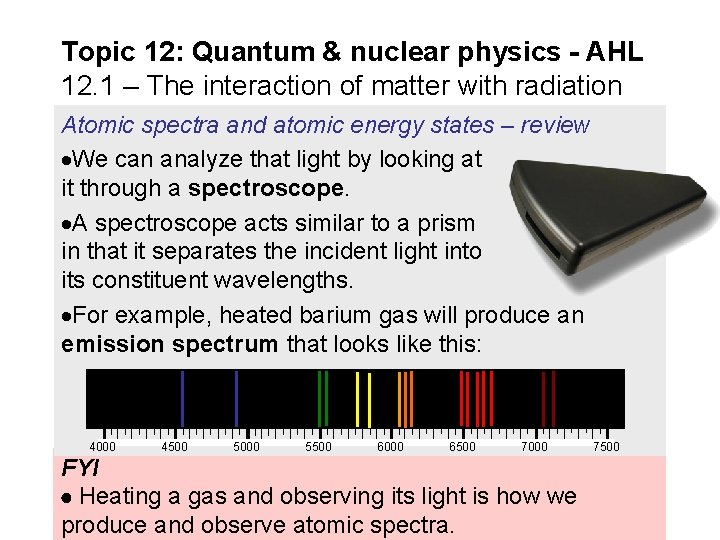
Topic 12: Quantum & nuclear physics - AHL 12. 1 – The interaction of matter with radiation Atomic spectra and atomic energy states – review We can analyze that light by looking at it through a spectroscope. A spectroscope acts similar to a prism in that it separates the incident light into its constituent wavelengths. For example, heated barium gas will produce an emission spectrum that looks like this: 4000 4500 5000 5500 6000 6500 7000 FYI Heating a gas and observing its light is how we produce and observe atomic spectra. 7500
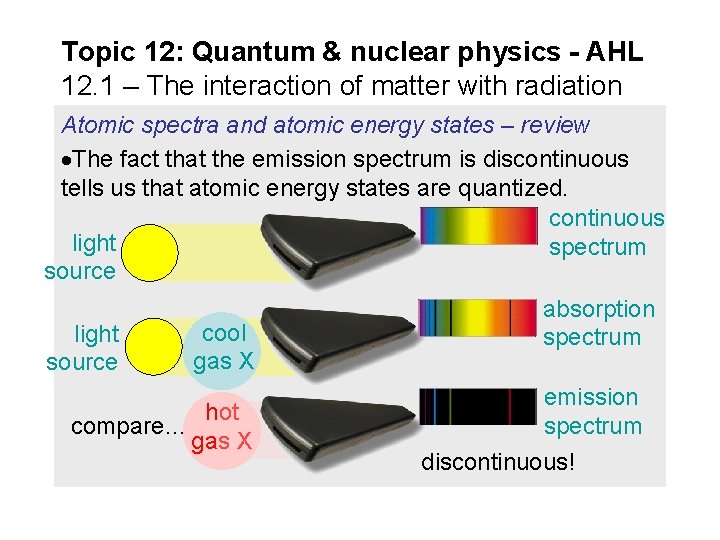
Topic 12: Quantum & nuclear physics - AHL 12. 1 – The interaction of matter with radiation Atomic spectra and atomic energy states – review The fact that the emission spectrum is discontinuous tells us that atomic energy states are quantized. continuous light spectrum source light source compare… cool gas X hot gas X absorption spectrum emission spectrum discontinuous!
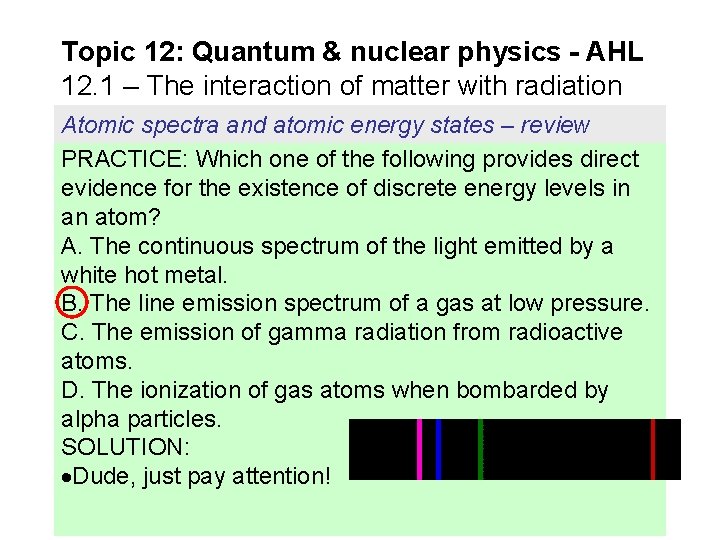
Topic 12: Quantum & nuclear physics - AHL 12. 1 – The interaction of matter with radiation Atomic spectra and atomic energy states – review PRACTICE: Which one of the following provides direct evidence for the existence of discrete energy levels in an atom? A. The continuous spectrum of the light emitted by a white hot metal. B. The line emission spectrum of a gas at low pressure. C. The emission of gamma radiation from radioactive atoms. D. The ionization of gas atoms when bombarded by alpha particles. SOLUTION: Dude, just pay attention!
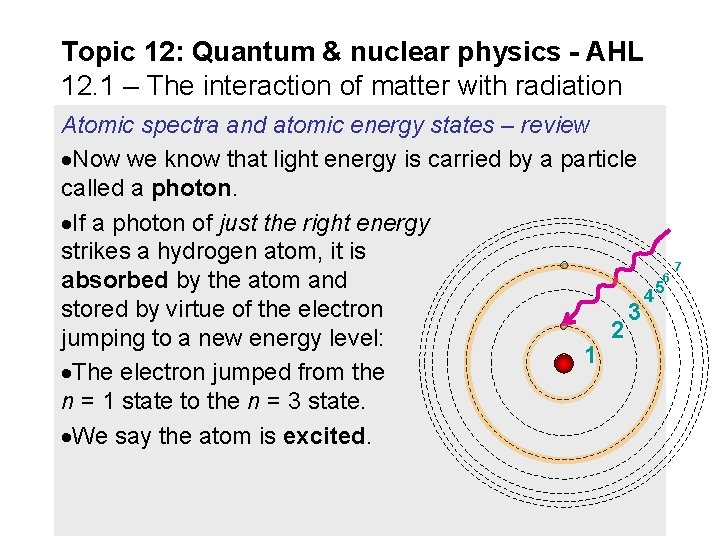
Topic 12: Quantum & nuclear physics - AHL 12. 1 – The interaction of matter with radiation Atomic spectra and atomic energy states – review Now we know that light energy is carried by a particle called a photon. If a photon of just the right energy strikes a hydrogen atom, it is 7 6 absorbed by the atom and 5 4 stored by virtue of the electron 3 2 jumping to a new energy level: 1 The electron jumped from the n = 1 state to the n = 3 state. We say the atom is excited.
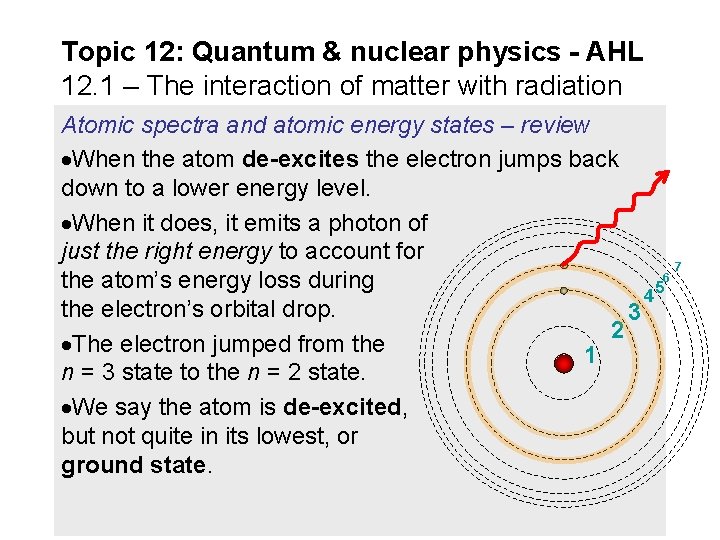
Topic 12: Quantum & nuclear physics - AHL 12. 1 – The interaction of matter with radiation Atomic spectra and atomic energy states – review When the atom de-excites the electron jumps back down to a lower energy level. When it does, it emits a photon of just the right energy to account for 7 the atom’s energy loss during 56 4 the electron’s orbital drop. 3 2 The electron jumped from the 1 n = 3 state to the n = 2 state. We say the atom is de-excited, but not quite in its lowest, or ground state.
Topic 12: Quantum & nuclear physics - AHL 12. 1 – The interaction of matter with radiation Atomic spectra and atomic energy states – review
Topic 12: Quantum & nuclear physics - AHL 12. 1 – The interaction of matter with radiation Atomic spectra and atomic energy states – review
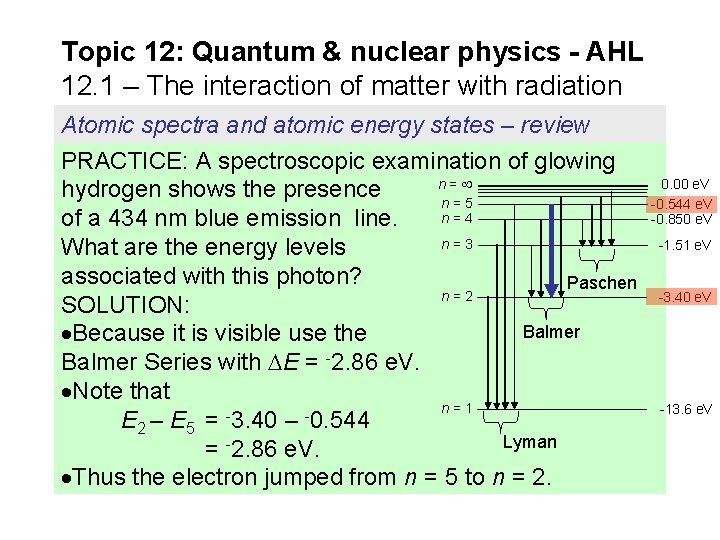
Topic 12: Quantum & nuclear physics - AHL 12. 1 – The interaction of matter with radiation Atomic spectra and atomic energy states – review PRACTICE: A spectroscopic examination of glowing 0. 00 e. V n = hydrogen shows the presence n = 5 -0. 544 e. V n = 4 -0. 850 e. V of a 434 nm blue emission line. n = 3 -1. 51 e. V What are the energy levels associated with this photon? Paschen n = 2 -3. 40 e. V SOLUTION: Balmer Because it is visible use the Balmer Series with E = -2. 86 e. V. Note that n = 1 -13. 6 e. V E 2 – E 5 = -3. 40 – -0. 544 Lyman = -2. 86 e. V. Thus the electron jumped from n = 5 to n = 2.
Topic 12: Quantum & nuclear physics - AHL 12. 1 – The interaction of matter with radiation
Topic 12: Quantum & nuclear physics - AHL 12. 1 – The interaction of matter with radiation
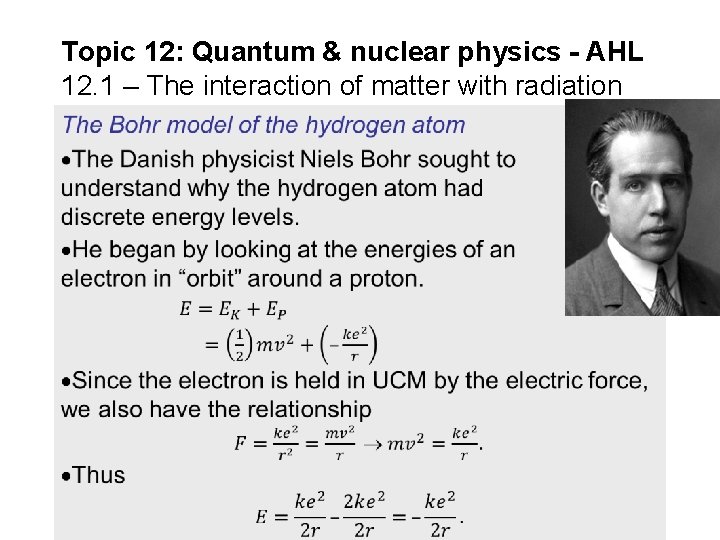
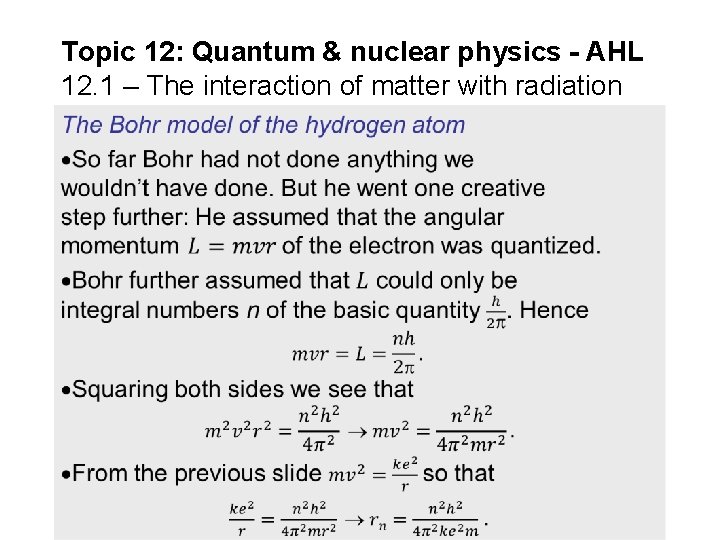
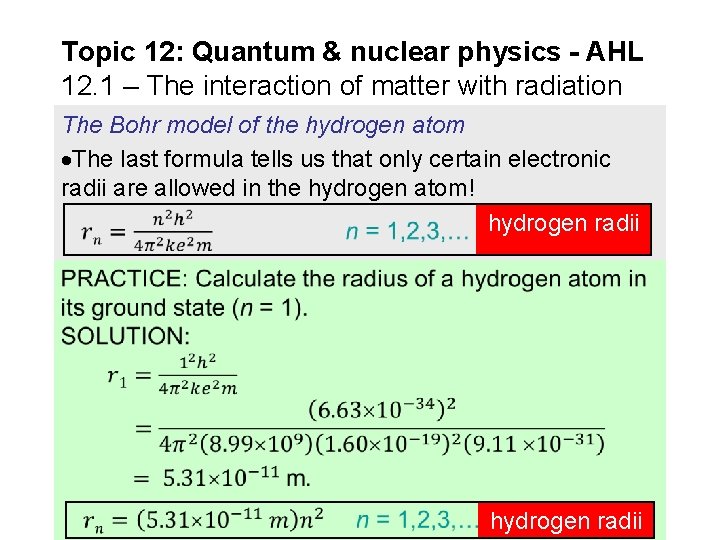
Topic 12: Quantum & nuclear physics - AHL 12. 1 – The interaction of matter with radiation The Bohr model of the hydrogen atom The last formula tells us that only certain electronic radii are allowed in the hydrogen atom! hydrogen radii
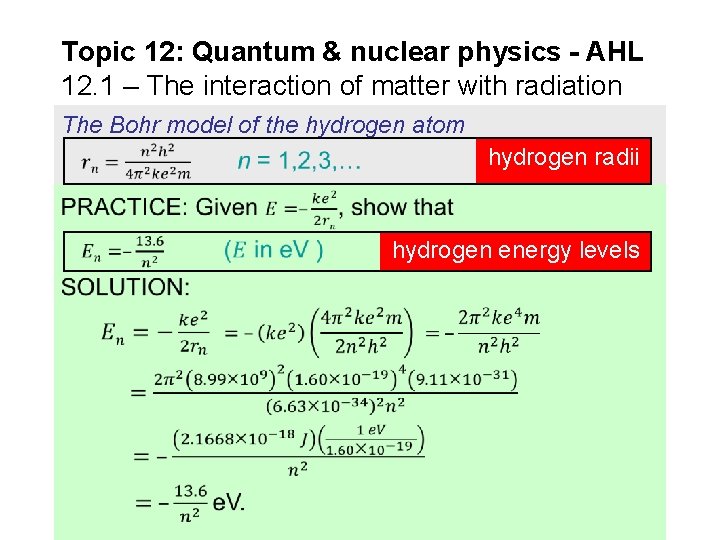
Topic 12: Quantum & nuclear physics - AHL 12. 1 – The interaction of matter with radiation The Bohr model of the hydrogen atom hydrogen radii hydrogen energy levels
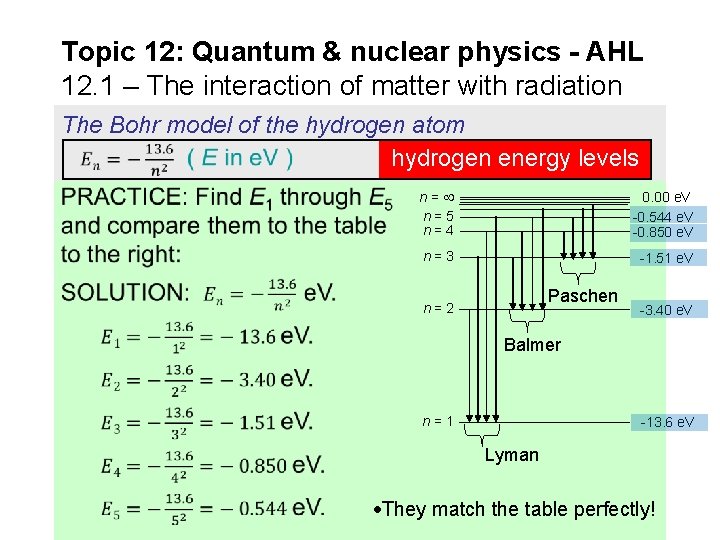
Topic 12: Quantum & nuclear physics - AHL 12. 1 – The interaction of matter with radiation The Bohr model of the hydrogen atom hydrogen energy levels n = 5 n = 4 0. 00 e. V -0. 544 e. V -0. 850 e. V n = 3 -1. 51 e. V Paschen n = 2 -3. 40 e. V Balmer n = 1 -13. 6 e. V Lyman They match the table perfectly!
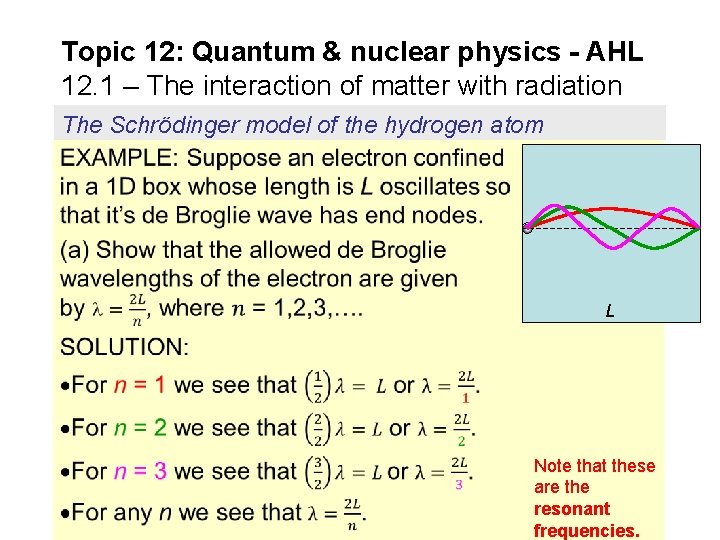
Topic 12: Quantum & nuclear physics - AHL 12. 1 – The interaction of matter with radiation The Schrödinger model of the hydrogen atom L Note that these are the resonant frequencies.
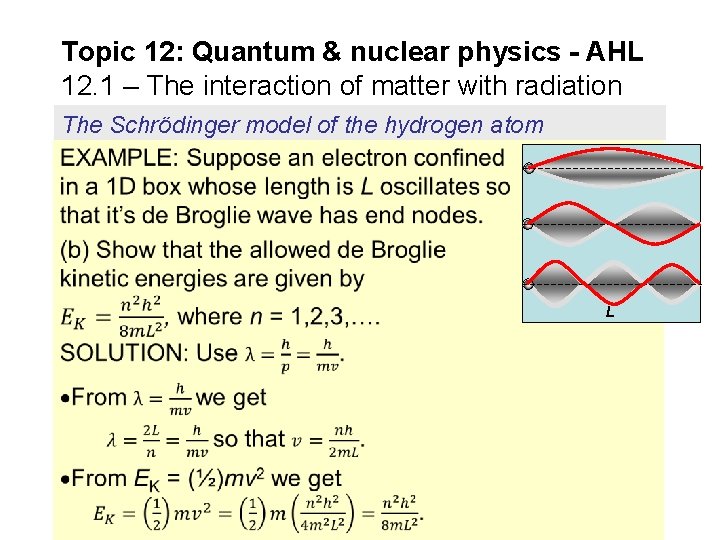
Topic 12: Quantum & nuclear physics - AHL 12. 1 – The interaction of matter with radiation The Schrödinger model of the hydrogen atom L
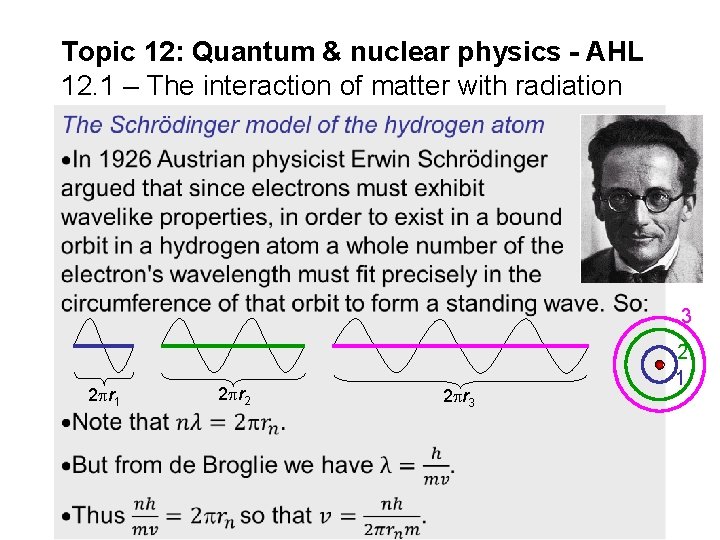
Topic 12: Quantum & nuclear physics - AHL 12. 1 – The interaction of matter with radiation 3 2 r 1 2 r 2 2 r 3 2 1
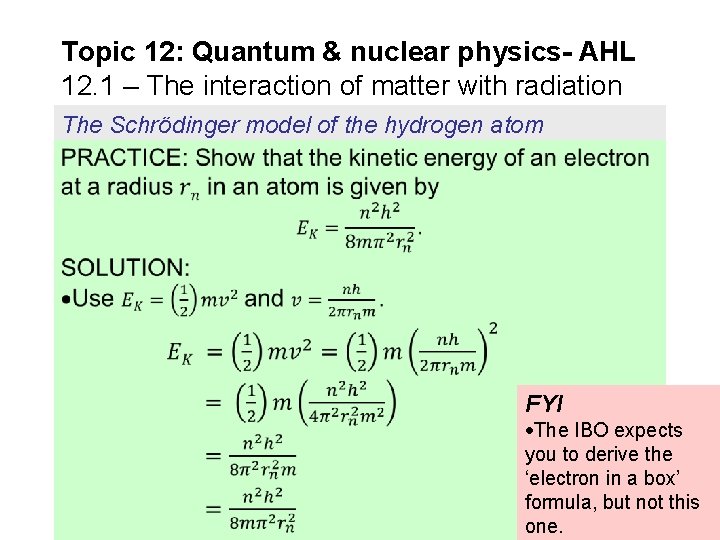
Topic 12: Quantum & nuclear physics- AHL 12. 1 – The interaction of matter with radiation The Schrödinger model of the hydrogen atom FYI The IBO expects you to derive the ‘electron in a box’ formula, but not this one.
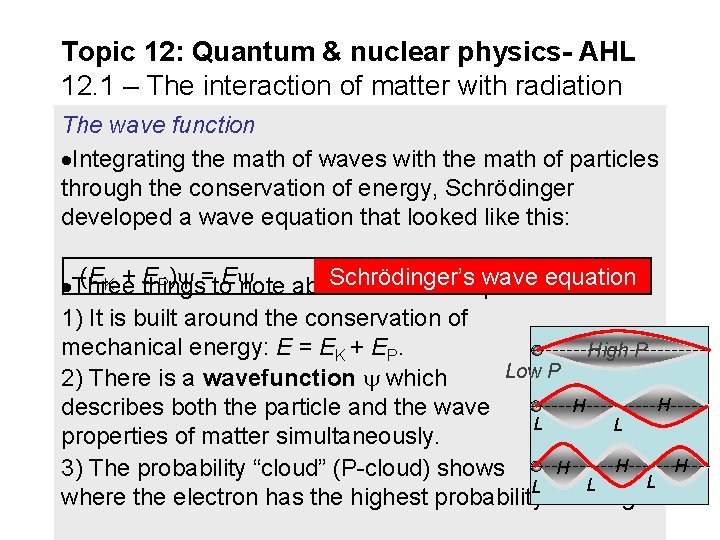
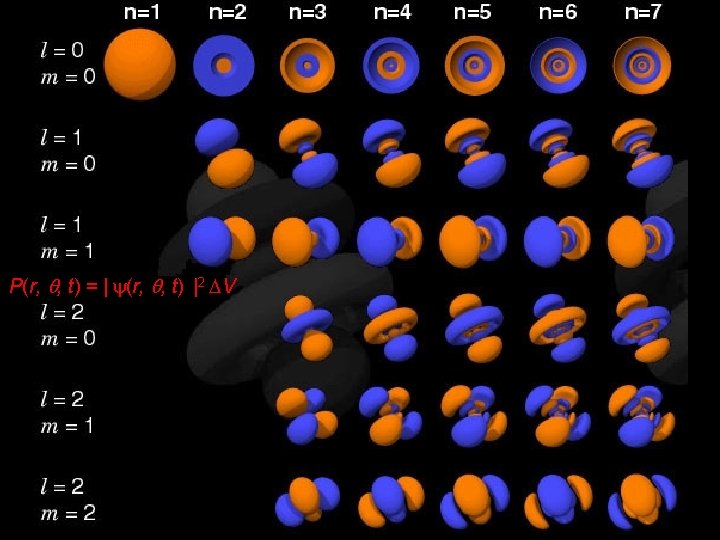
Topic 12: Quantum & nuclear physics- AHL 12. 1 – The interaction of matter with radiation The wave function Integrating the math of waves with the math of particles through the conservation of energy, Schrödinger developed a wave equation that looked like this: (EK + EP) = E Schrödinger’s wave equation Three things to note about the wave equation: 1) It is built around the conservation of mechanical energy: E = EK + EP. High P Low P 2) There is a wavefunction which H H describes both the particle and the wave L L properties of matter simultaneously. H H H 3) The probability “cloud” (P-cloud) shows L L L where the electron has the highest probability of being.
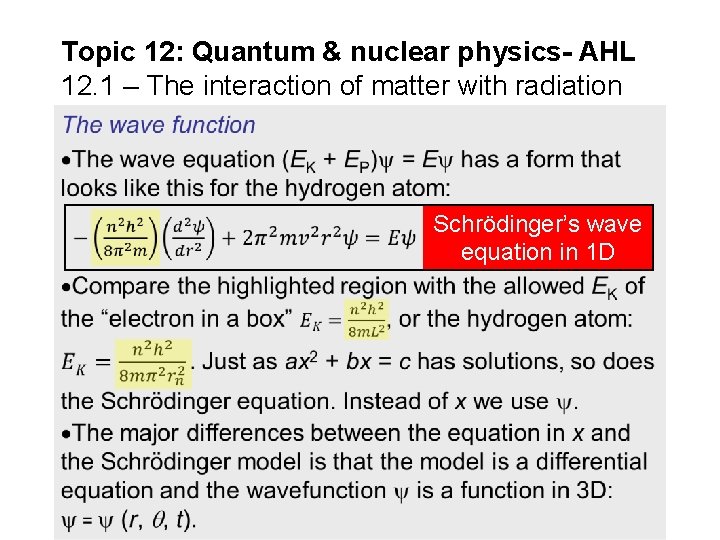
Topic 12: Quantum & nuclear physics- AHL 12. 1 – The interaction of matter with radiation Schrödinger’s wave equation in 1 D
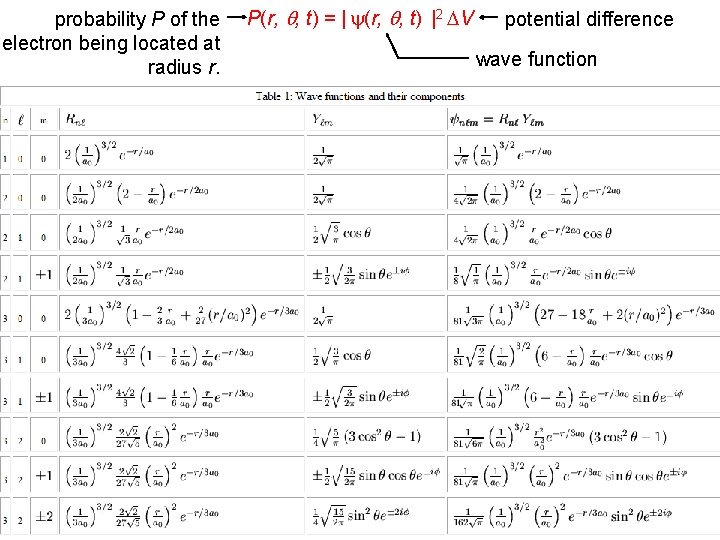
probability P of the electron being located at radius r. P(r, , t) = | (r, , t) |2 V potential difference wave function
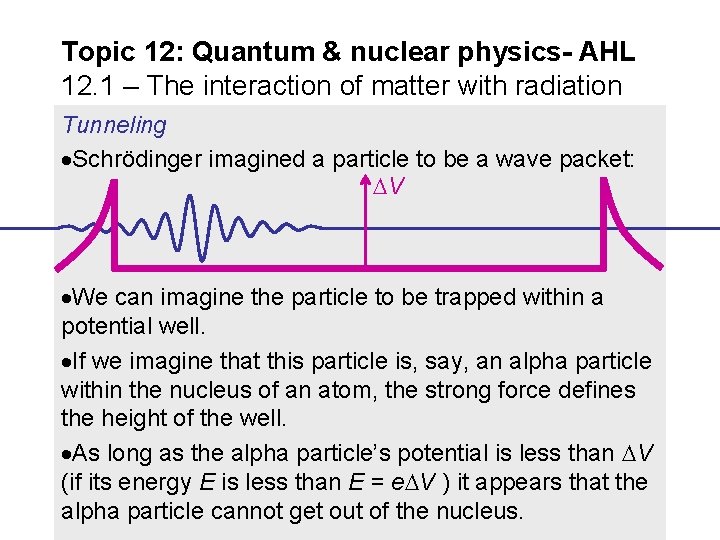
Topic 12: Quantum & nuclear physics- AHL 12. 1 – The interaction of matter with radiation Tunneling Schrödinger imagined a particle to be a wave packet: V We can imagine the particle to be trapped within a potential well. If we imagine that this particle is, say, an alpha particle within the nucleus of an atom, the strong force defines the height of the well. As long as the alpha particle’s potential is less than V (if its energy E is less than E = e V ) it appears that the alpha particle cannot get out of the nucleus.
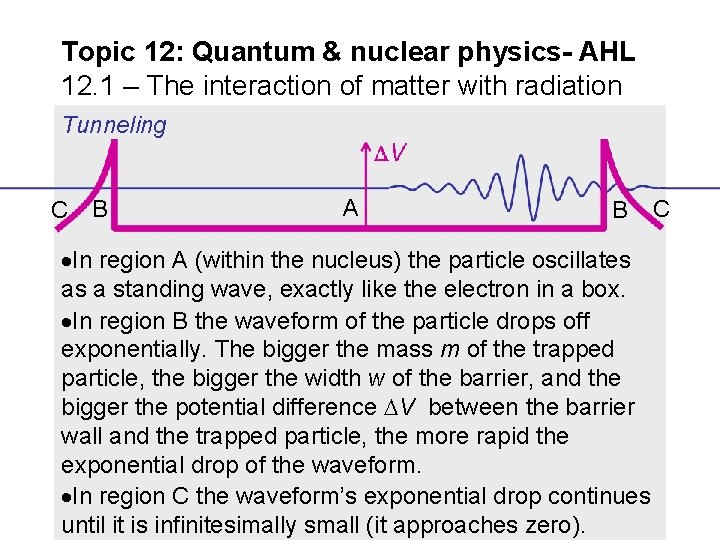
Topic 12: Quantum & nuclear physics- AHL 12. 1 – The interaction of matter with radiation Tunneling C B A B C In region A (within the nucleus) the particle oscillates as a standing wave, exactly like the electron in a box. In region B the waveform of the particle drops off exponentially. The bigger the mass m of the trapped particle, the bigger the width w of the barrier, and the bigger the potential difference V between the barrier wall and the trapped particle, the more rapid the exponential drop of the waveform. In region C the waveform’s exponential drop continues until it is infinitesimally small (it approaches zero).
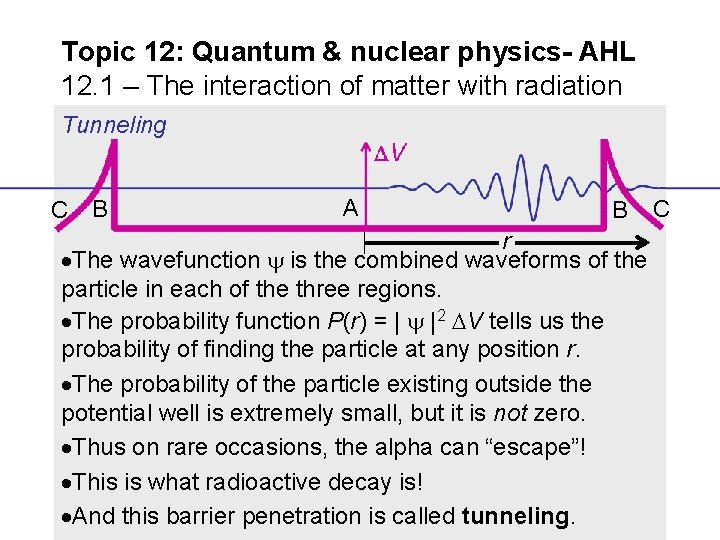
Topic 12: Quantum & nuclear physics- AHL 12. 1 – The interaction of matter with radiation Tunneling C B A B C r The wavefunction is the combined waveforms of the particle in each of the three regions. The probability function P(r) = | |2 V tells us the probability of finding the particle at any position r. The probability of the particle existing outside the potential well is extremely small, but it is not zero. Thus on rare occasions, the alpha can “escape”! This is what radioactive decay is! And this barrier penetration is called tunneling.
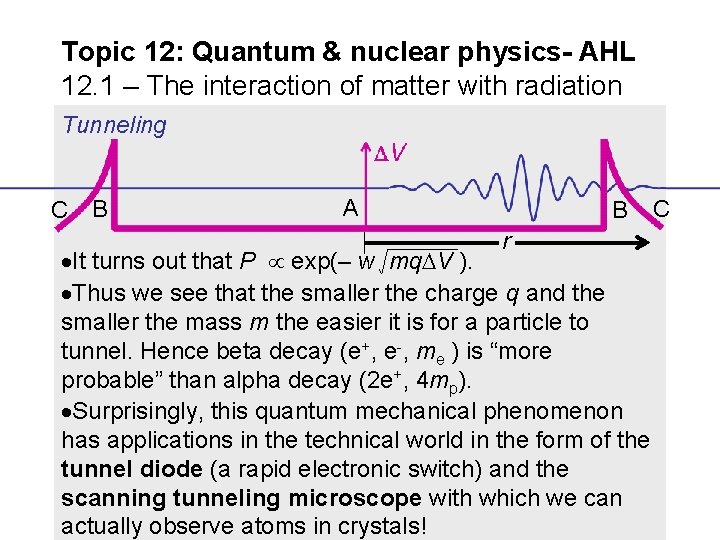
Topic 12: Quantum & nuclear physics- AHL 12. 1 – The interaction of matter with radiation Tunneling C B A B r C It turns out that P exp(– w mq V ). Thus we see that the smaller the charge q and the smaller the mass m the easier it is for a particle to tunnel. Hence beta decay (e+, e-, me ) is “more probable” than alpha decay (2 e+, 4 mp). Surprisingly, this quantum mechanical phenomenon has applications in the technical world in the form of the tunnel diode (a rapid electronic switch) and the scanning tunneling microscope with which we can actually observe atoms in crystals!
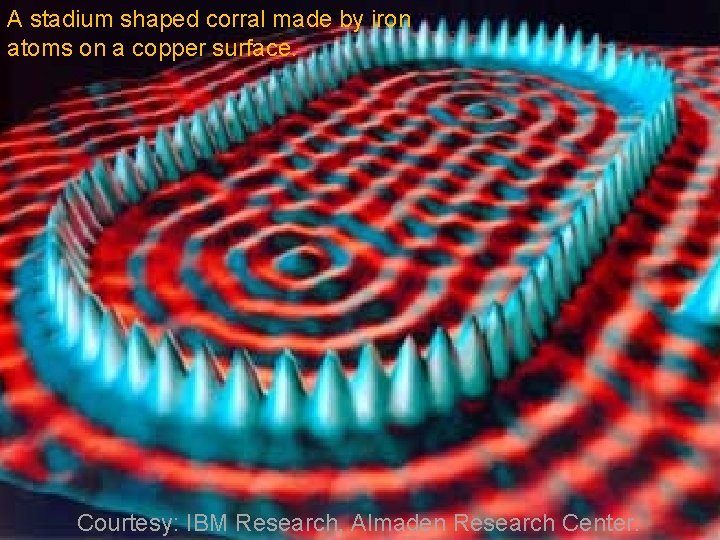
A stadium shaped corral made by iron atoms on a copper surface. Courtesy: IBM Research, Almaden Research Center.
Topic 12: Quantum & nuclear physics - AHL 12. 1 – The interaction of matter with radiation The Heisenberg uncertainty principle Suppose you want to know the position and the velocity of an electron. In order to detect the electron you have to make contact with it in what we call an "observation. " The least intrusive means of observation would be to “bounce” a photon off of it and observe the results to determine its position. And if you bounced a second photon off of it and measured the time between the two "returns" you could determine the velocity of the electron. You could send out the two photons closer and closer together and find out, to any degree of accuracy, the electron's position and velocity.
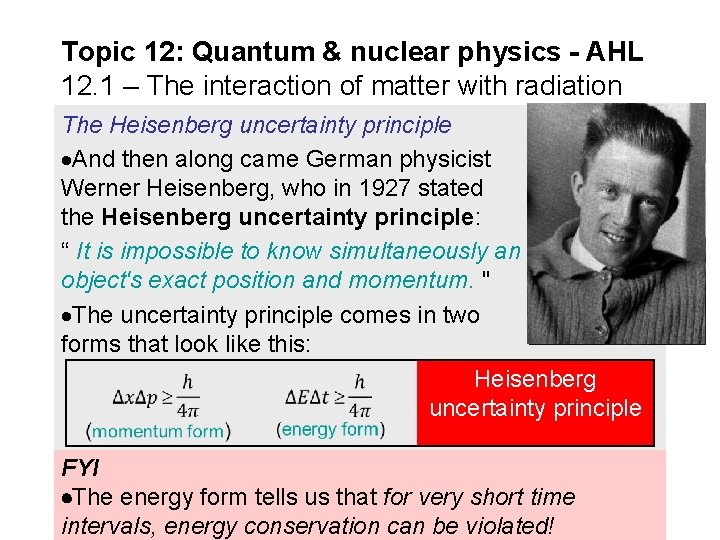
Topic 12: Quantum & nuclear physics - AHL 12. 1 – The interaction of matter with radiation The Heisenberg uncertainty principle And then along came German physicist Werner Heisenberg, who in 1927 stated the Heisenberg uncertainty principle: “ It is impossible to know simultaneously an object's exact position and momentum. " The uncertainty principle comes in two forms that look like this: Heisenberg uncertainty principle FYI The energy form tells us that for very short time intervals, energy conservation can be violated!
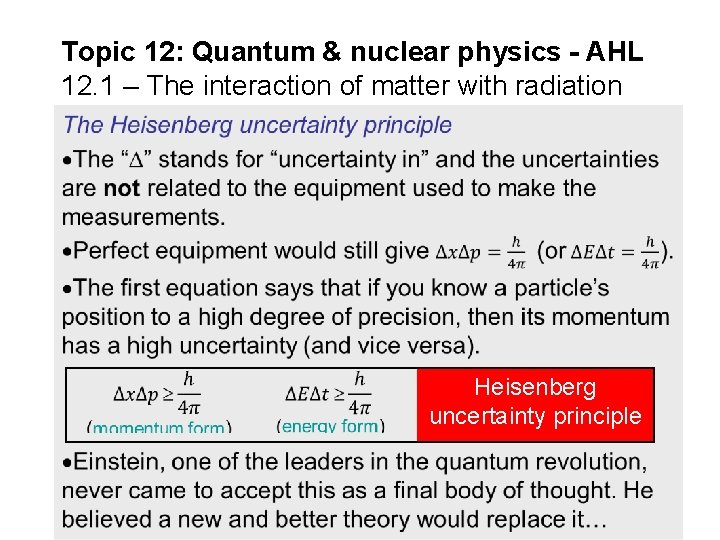
Topic 12: Quantum & nuclear physics - AHL 12. 1 – The interaction of matter with radiation Heisenberg uncertainty principle
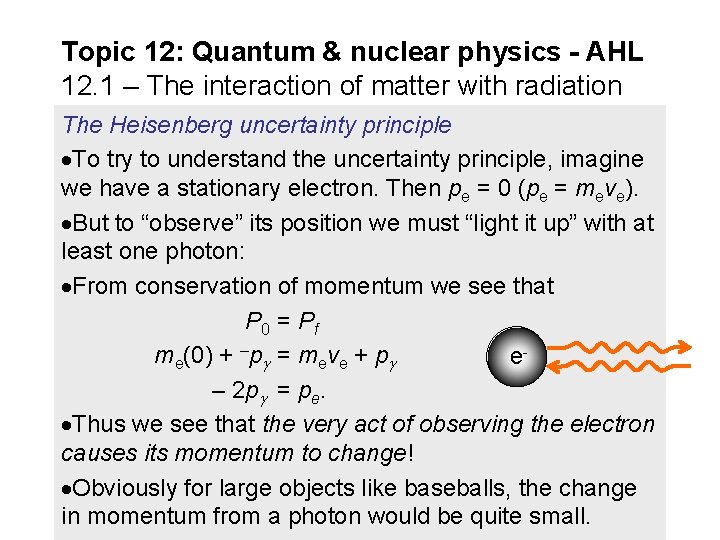
Topic 12: Quantum & nuclear physics - AHL 12. 1 – The interaction of matter with radiation The Heisenberg uncertainty principle To try to understand the uncertainty principle, imagine we have a stationary electron. Then pe = 0 (pe = meve). But to “observe” its position we must “light it up” with at least one photon: From conservation of momentum we see that P 0 = Pf me(0) + –p = meve + p e – 2 p = pe. Thus we see that the very act of observing the electron causes its momentum to change! Obviously for large objects like baseballs, the change in momentum from a photon would be quite small.
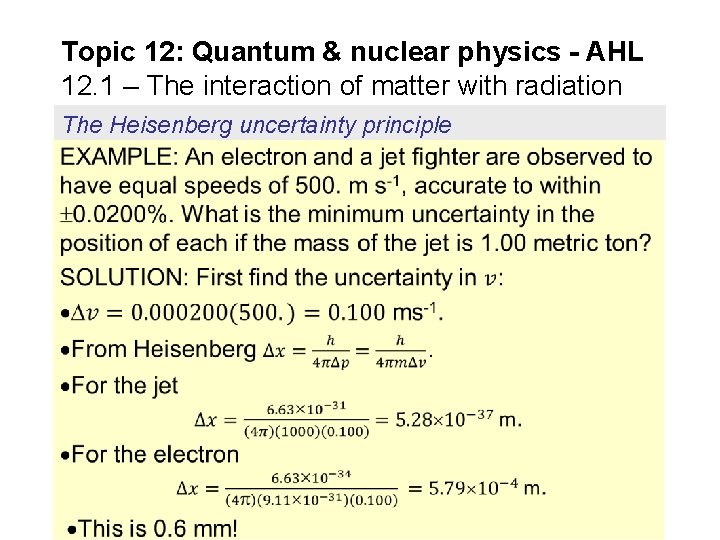
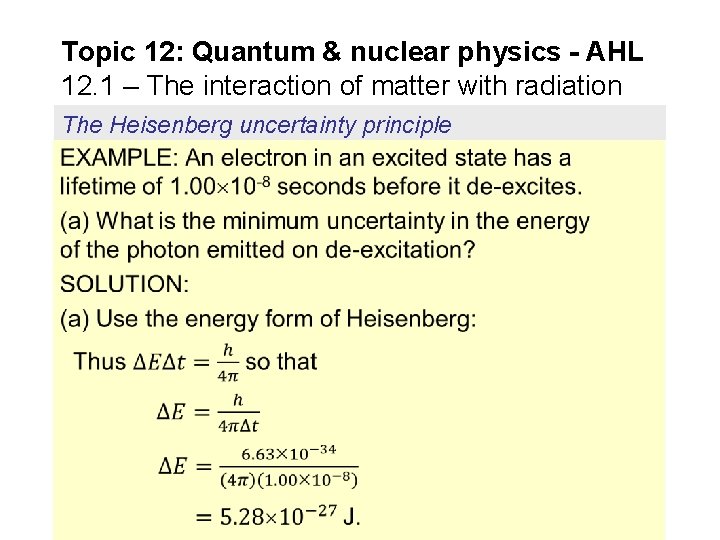
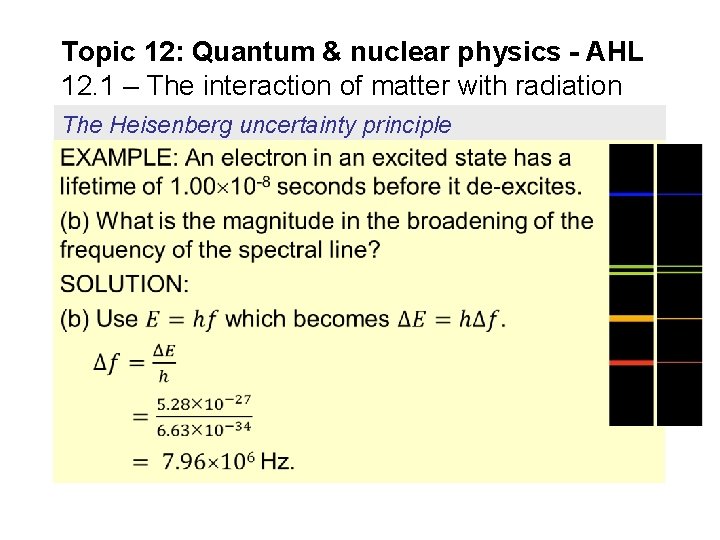
Topic 12: Quantum & nuclear physics - AHL 12. 1 – The interaction of matter with radiation The Heisenberg uncertainty principle
Topic 12: Quantum & nuclear physics - AHL 12. 1 – The interaction of matter with radiation The Heisenberg uncertainty principle
Topic 12: Quantum & nuclear physics - AHL 12. 1 – The interaction of matter with radiation The Heisenberg uncertainty principle
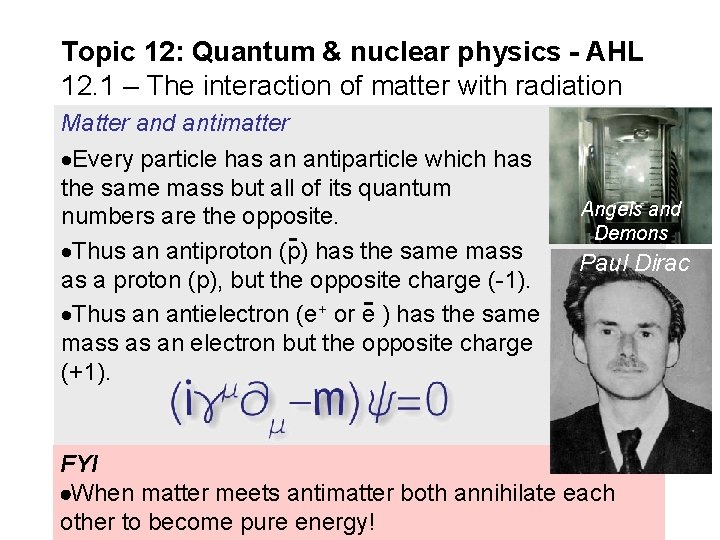
Topic 12: Quantum & nuclear physics - AHL 12. 1 – The interaction of matter with radiation Matter and antimatter Every particle has an antiparticle which has the same mass but all of its quantum Angels and numbers are the opposite. Demons Thus an antiproton (p) has the same mass Paul Dirac as a proton (p), but the opposite charge (-1). Thus an antielectron (e+ or e ) has the same mass as an electron but the opposite charge (+1). FYI When matter meets antimatter both annihilate each other to become pure energy!
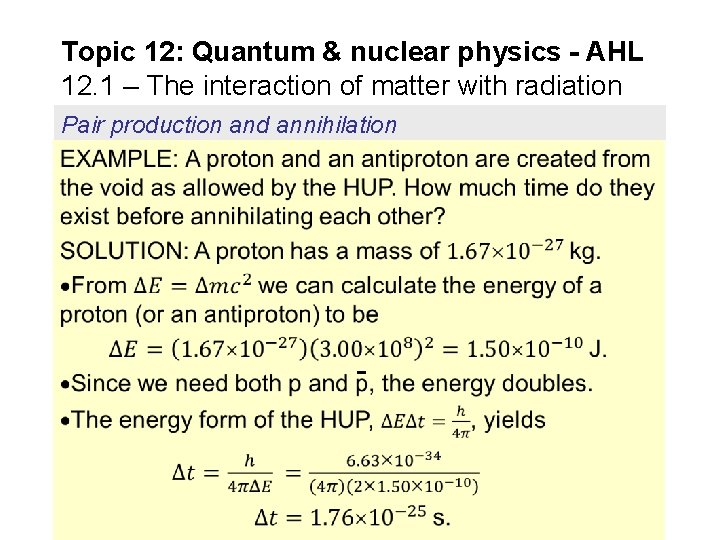
Topic 12: Quantum & nuclear physics - AHL 12. 1 – The interaction of matter with radiation Pair production and annihilation
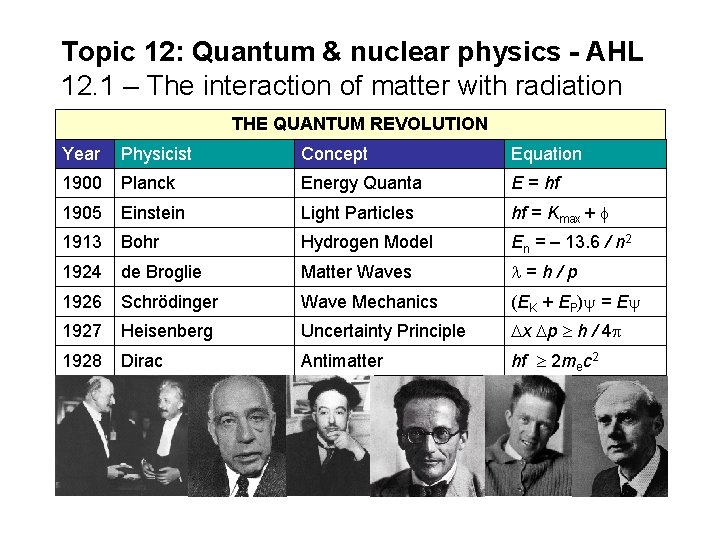
Topic 12: Quantum & nuclear physics - AHL 12. 1 – The interaction of matter with radiation THE QUANTUM REVOLUTION Year Physicist Concept Equation 1900 Planck Energy Quanta E = hf 1905 Einstein Light Particles hf = Kmax + 1913 Bohr Hydrogen Model En = – 13. 6 / n 2 1924 de Broglie Matter Waves = h / p 1926 Schrödinger Wave Mechanics (EK + EP) = E 1927 Heisenberg Uncertainty Principle x p h / 4 1928 Dirac Antimatter hf 2 mec 2
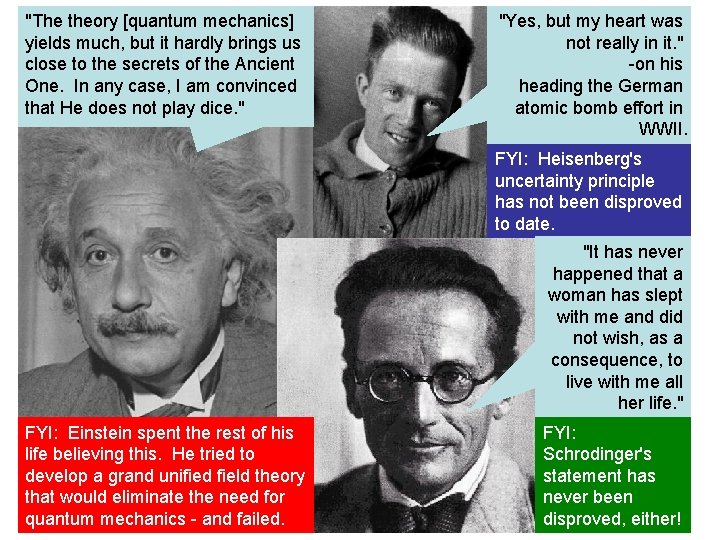
"The theory [quantum mechanics] yields much, but it hardly brings us close to the secrets of the Ancient One. In any case, I am convinced that He does not play dice. " "Yes, but my heart was not really in it. " -on his heading the German atomic bomb effort in WWII. FYI: Heisenberg's uncertainty principle has not been disproved to date. "It has never happened that a woman has slept with me and did not wish, as a consequence, to live with me all her life. " FYI: Einstein spent the rest of his life believing this. He tried to develop a grand unified field theory that would eliminate the need for quantum mechanics - and failed. FYI: Schrodinger's statement has never been disproved, either!
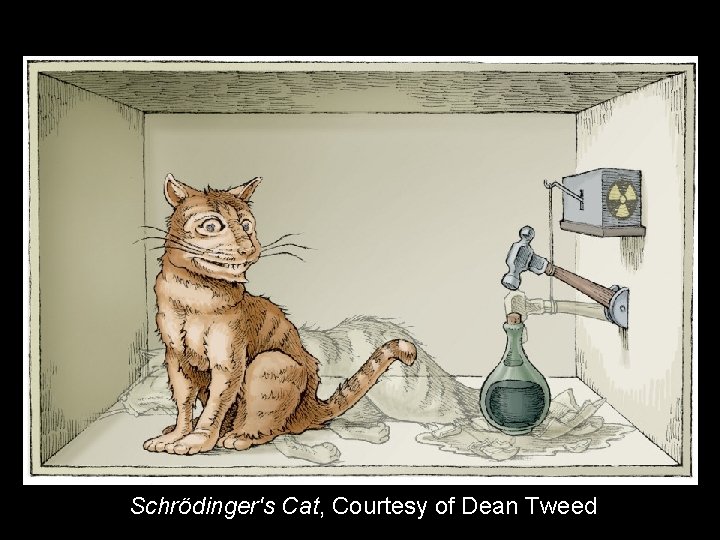
Schrödinger's Cat, Courtesy of Dean Tweed