
The Nucleus and Radioactivity Spontaneous changes in the


- Slides: 36
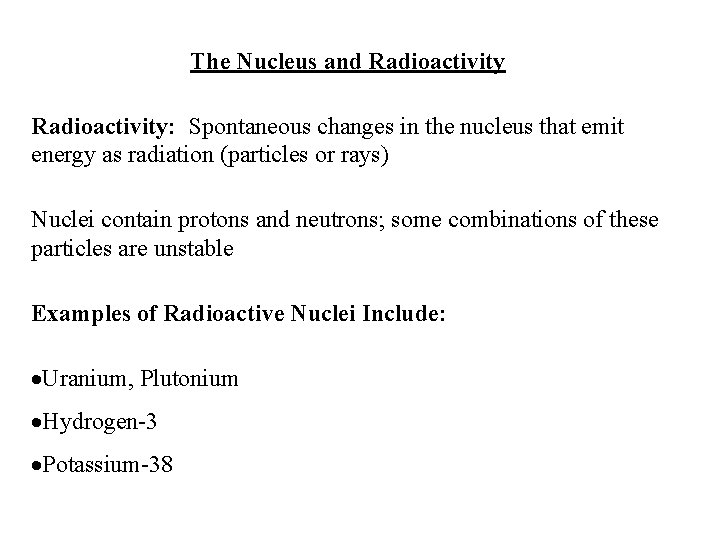
The Nucleus and Radioactivity: Spontaneous changes in the nucleus that emit energy as radiation (particles or rays) Nuclei contain protons and neutrons; some combinations of these particles are unstable Examples of Radioactive Nuclei Include: ·Uranium, Plutonium ·Hydrogen-3 ·Potassium-38
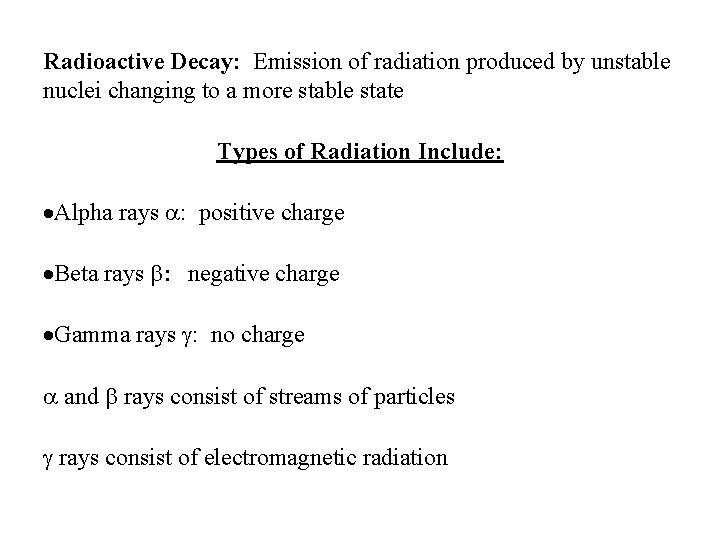
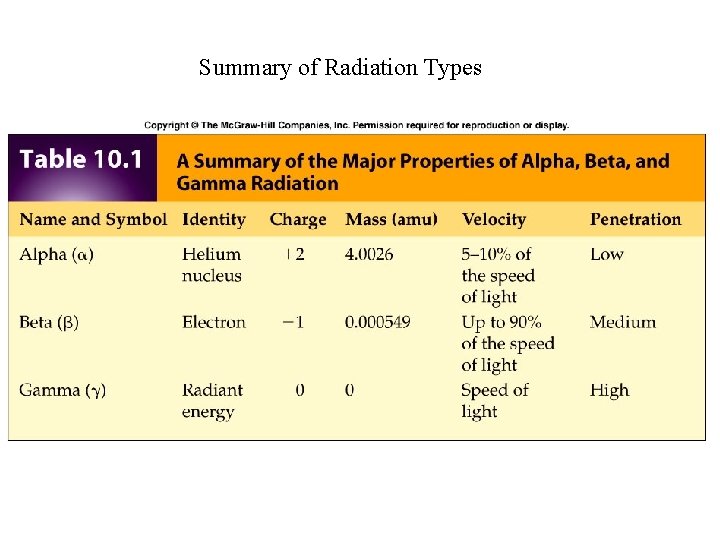
Radioactive Decay: Emission of radiation produced by unstable nuclei changing to a more stable state Types of Radiation Include: ·Alpha rays a: positive charge ·Beta rays b: negative charge ·Gamma rays : no charge a and b rays consist of streams of particles rays consist of electromagnetic radiation
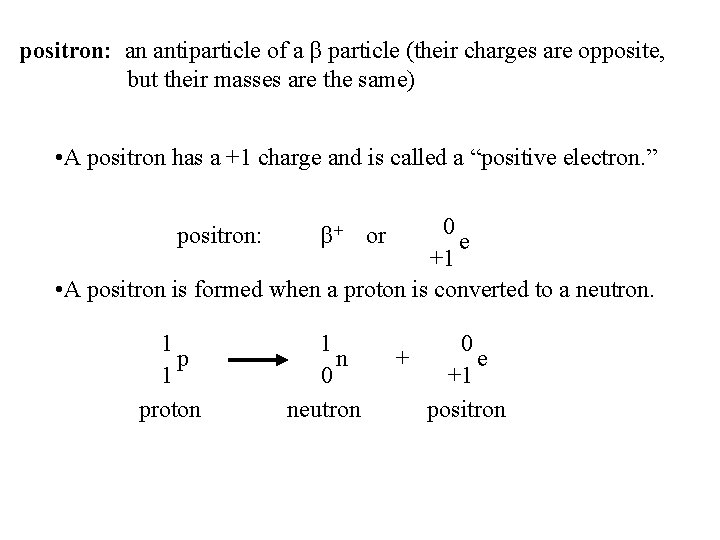
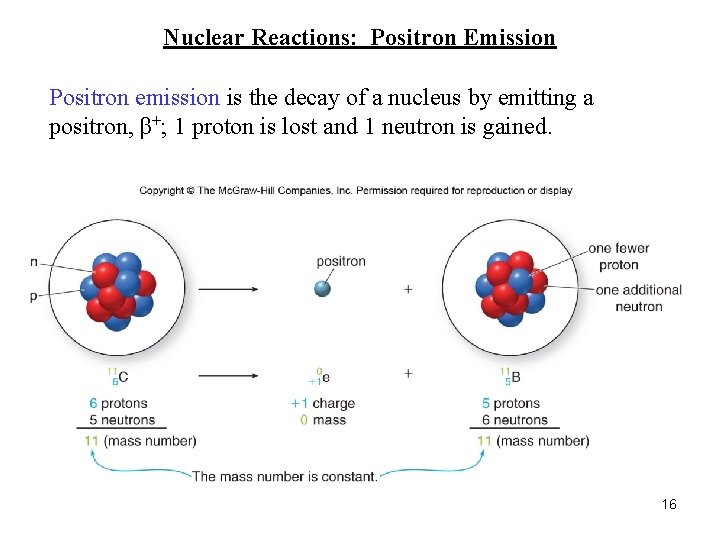
positron: an antiparticle of a β particle (their charges are opposite, but their masses are the same) • A positron has a +1 charge and is called a “positive electron. ” 0 e +1 • A positron is formed when a proton is converted to a neutron. positron: 1 proton β+ 1 n 0 neutron or 0 e + +1 positron
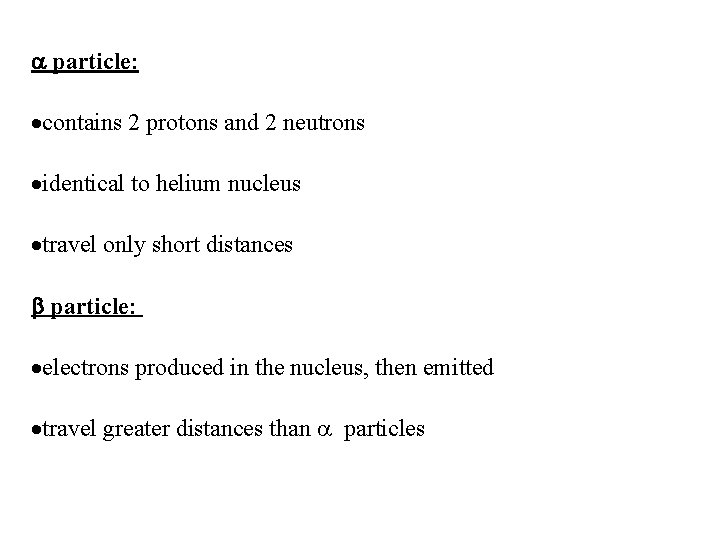
a particle: ·contains 2 protons and 2 neutrons ·identical to helium nucleus ·travel only short distances b particle: ·electrons produced in the nucleus, then emitted ·travel greater distances than a particles
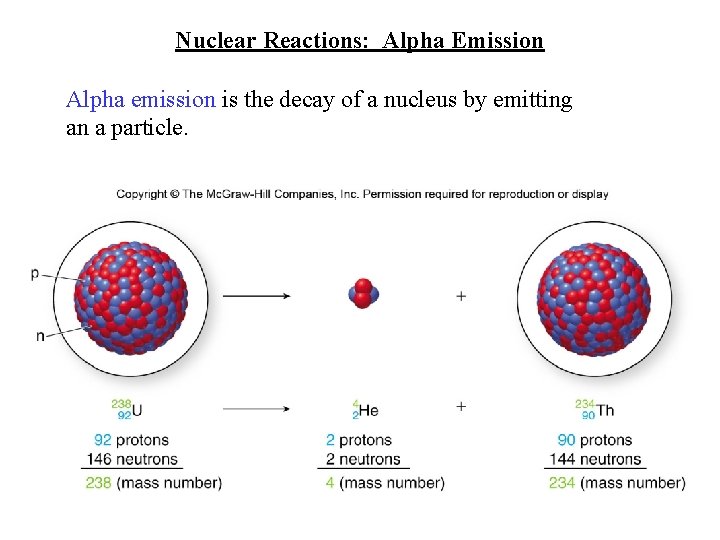
Ray: ·High-energy ray similar to an X ray ·Travel great distances Daughter Nuclei: New nuclei that result from unstable nuclei undergoing radioactive decay Example: Uranium-238 gives up an a particle, resulting in a daughter nucleus of a different element, Thorium (Th)
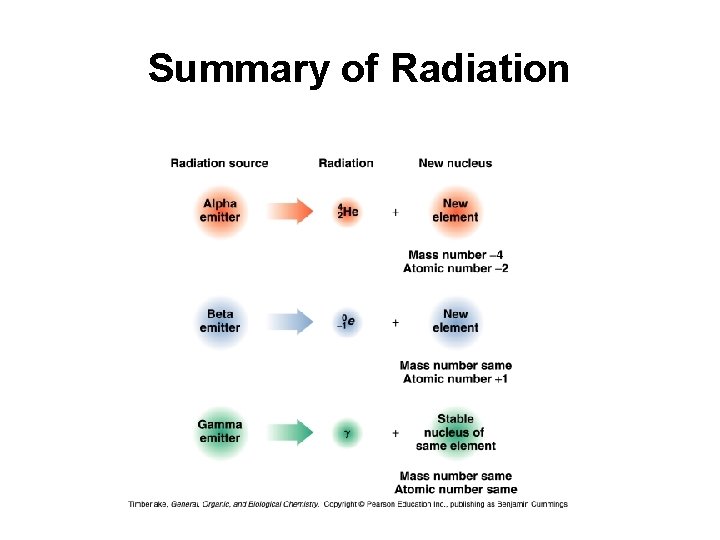
Summary of Radiation Types
Alpha Decay • When a radioactive nucleus emits an alpha particle, a new nucleus results. • The mass number of the new nucleus is 4 less than that of the initial nucleus. • The atomic number is decreased by 2.
Nuclear Reactions: Alpha Emission Alpha emission is the decay of a nucleus by emitting an a particle.
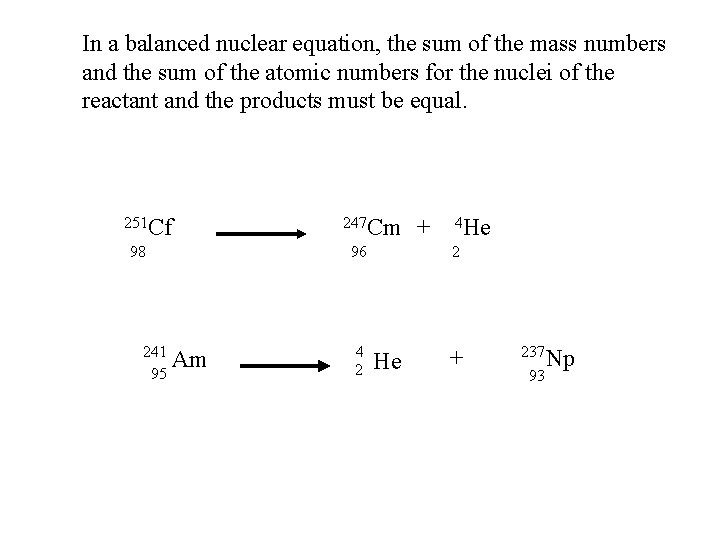
In a balanced nuclear equation, the sum of the mass numbers and the sum of the atomic numbers for the nuclei of the reactant and the products must be equal. 251 Cf 247 Cm 98 241 95 96 Am 4 2 + 4 He 2 He + 237 93 Np
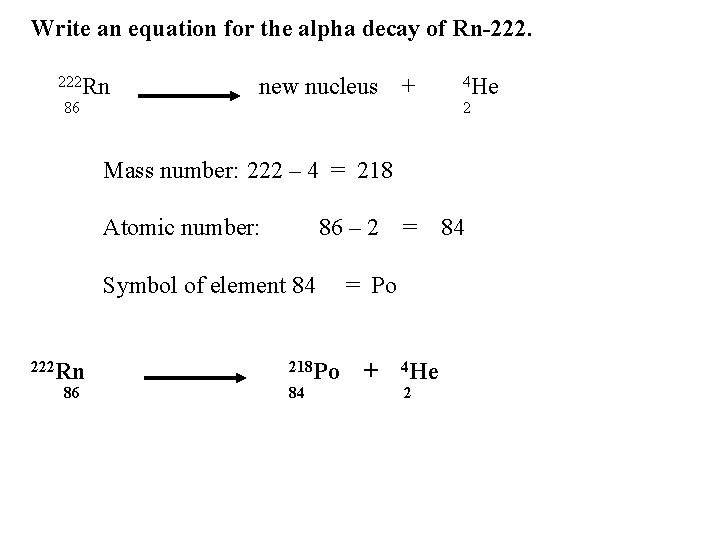
Write an equation for the alpha decay of Rn-222. 222 Rn 86 new nucleus + 4 He 2 Mass number: 222 – 4 = 218 Atomic number: 86 – 2 Symbol of element 84 222 Rn 86 218 Po 84 = = Po + 4 He 2 84
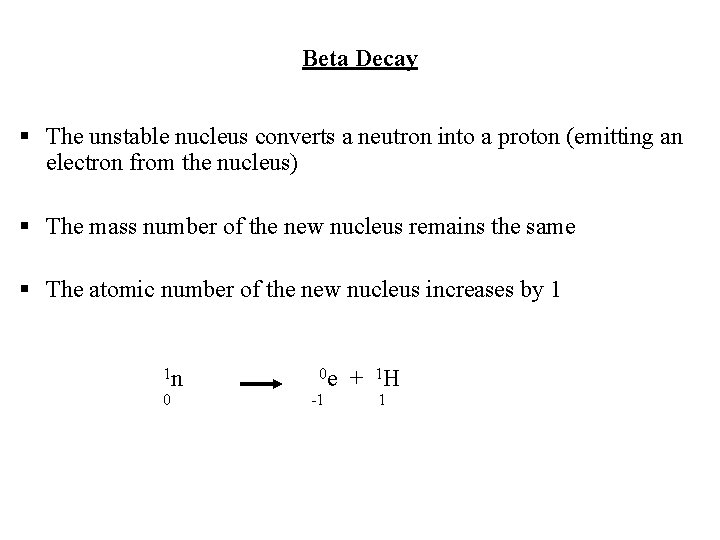
Beta Decay § The unstable nucleus converts a neutron into a proton (emitting an electron from the nucleus) § The mass number of the new nucleus remains the same § The atomic number of the new nucleus increases by 1 1 n 0 0 e -1 + 1 H 1
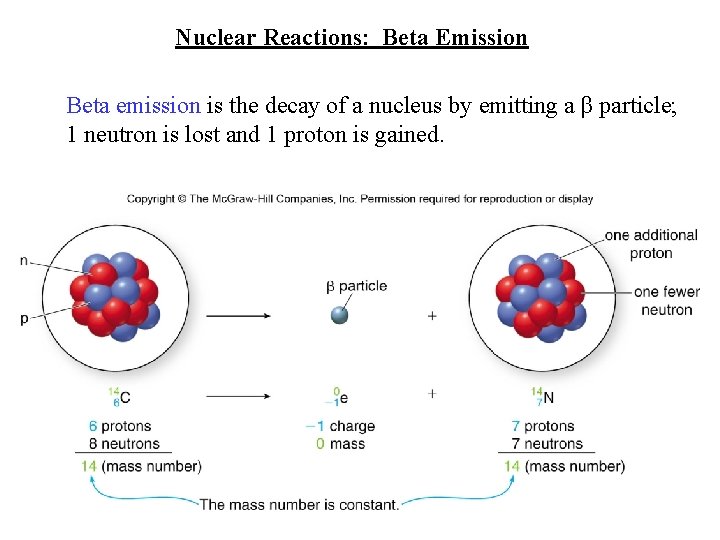
Nuclear Reactions: Beta Emission Beta emission is the decay of a nucleus by emitting a β particle; 1 neutron is lost and 1 proton is gained.
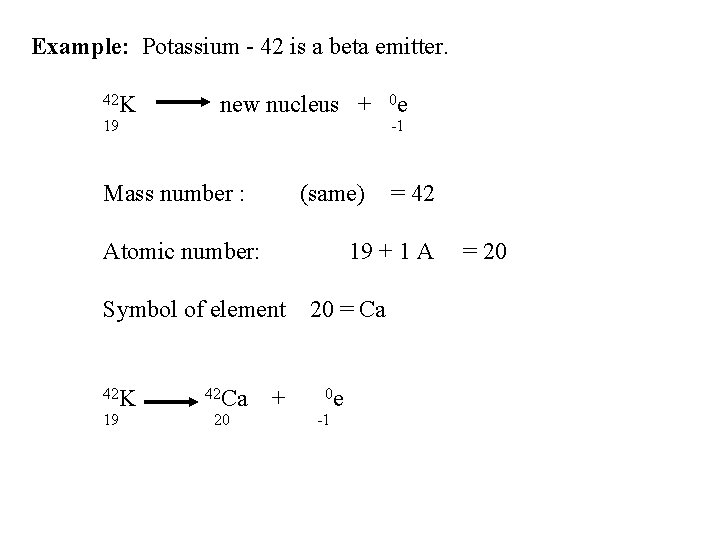
Example: Potassium - 42 is a beta emitter. 42 K 19 new nucleus + Mass number : (same) Atomic number: 19 42 Ca 20 -1 = 42 19 + 1 A Symbol of element 42 K 0 e + 20 = Ca 0 e -1 = 20
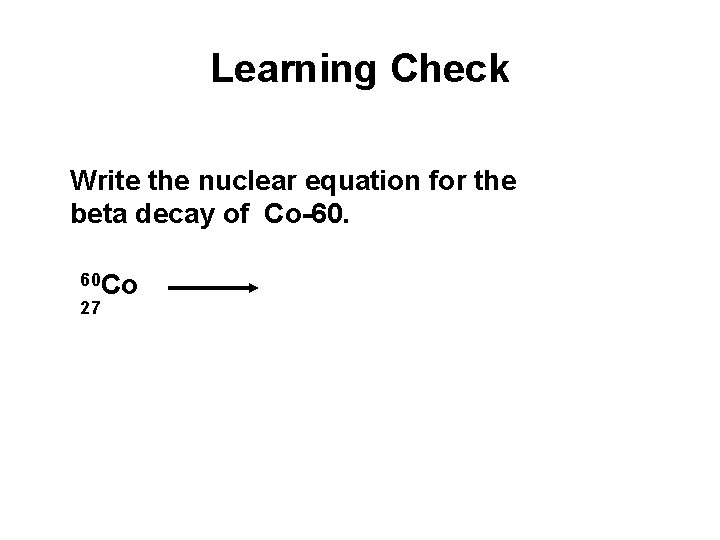
Learning Check Write the nuclear equation for the beta decay of Co-60. 60 Co 27
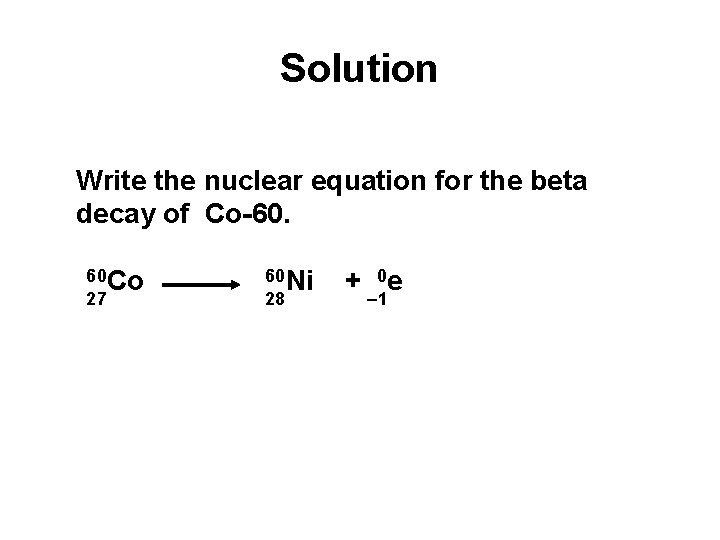
Solution Write the nuclear equation for the beta decay of Co-60. 60 Co 27 60 Ni 28 + 0 e 1
Nuclear Reactions: Positron Emission Positron emission is the decay of a nucleus by emitting a positron, β+; 1 proton is lost and 1 neutron is gained. 16
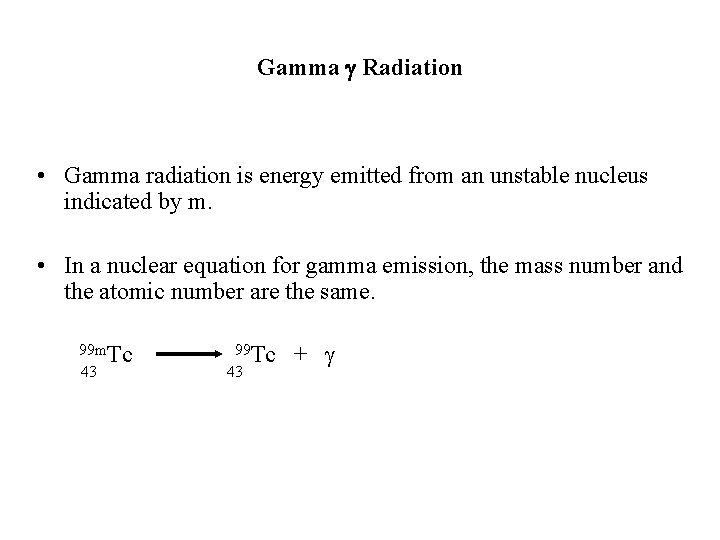
Gamma Radiation • Gamma radiation is energy emitted from an unstable nucleus indicated by m. • In a nuclear equation for gamma emission, the mass number and the atomic number are the same. 99 m. Tc 43 99 Tc 43 +
Summary of Radiation
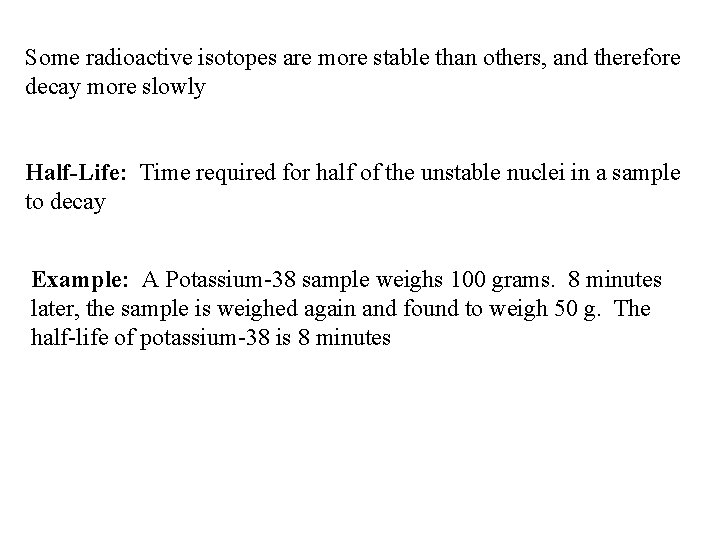
Some radioactive isotopes are more stable than others, and therefore decay more slowly Half-Life: Time required for half of the unstable nuclei in a sample to decay Example: A Potassium-38 sample weighs 100 grams. 8 minutes later, the sample is weighed again and found to weigh 50 g. The half-life of potassium-38 is 8 minutes
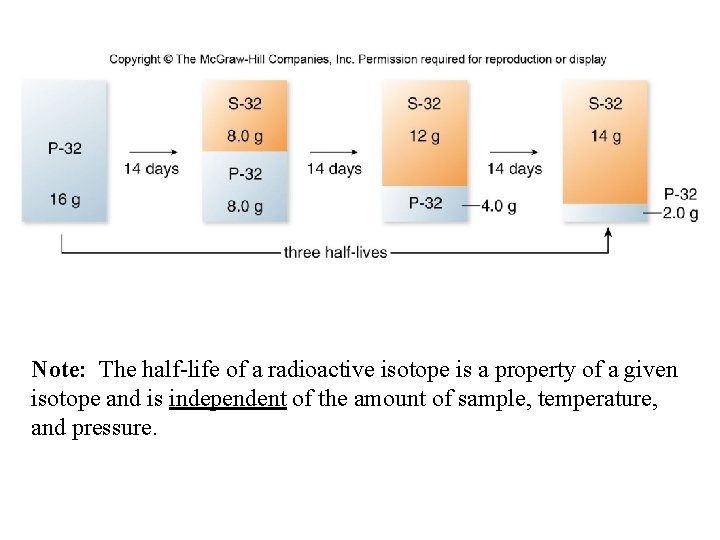
Note: The half-life of a radioactive isotope is a property of a given isotope and is independent of the amount of sample, temperature, and pressure.
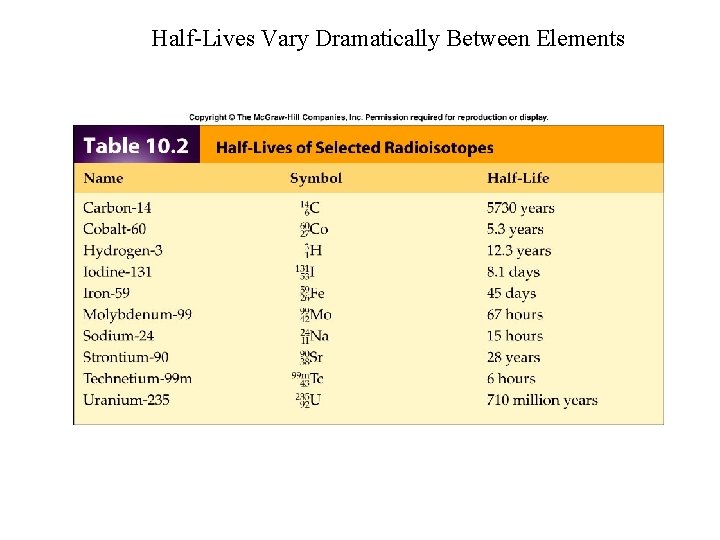
Half-Lives Vary Dramatically Between Elements
Half-Life Calculations After one half-life, 40 mg of a radioisotope will decay to 20 mg. After two half-lives, 10 mg of radioisotope remain. 40 mg x 1 = 10 mg 2 2 Initial 40 mg 1 half-life 20 mg 2 half-lives 10 mg
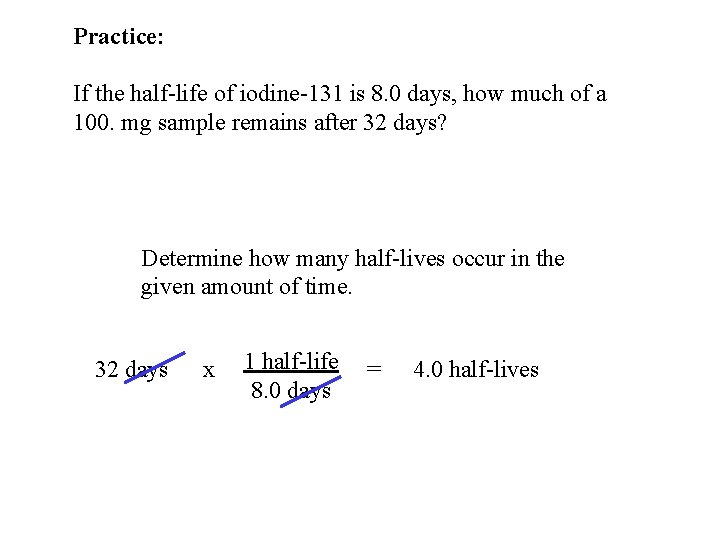
Practice: If the half-life of iodine-131 is 8. 0 days, how much of a 100. mg sample remains after 32 days? Determine how many half-lives occur in the given amount of time. 32 days x 1 half-life 8. 0 days = 4. 0 half-lives
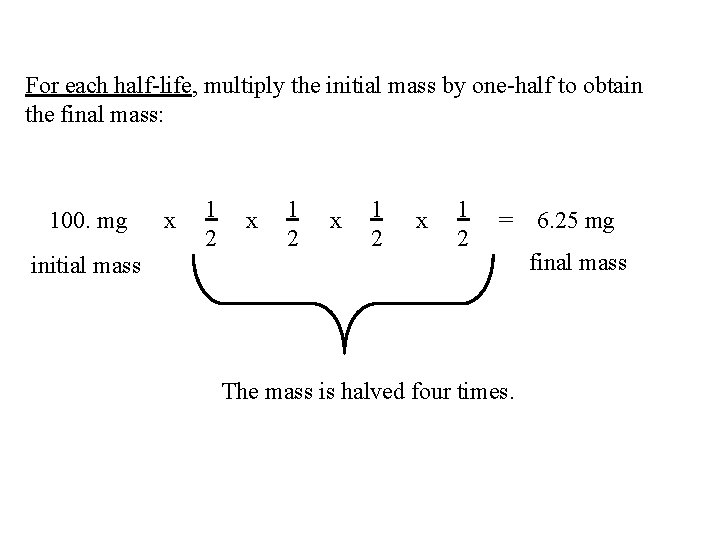
For each half-life, multiply the initial mass by one-half to obtain the final mass: 100. mg x 1 2 = initial mass The mass is halved four times. 6. 25 mg final mass
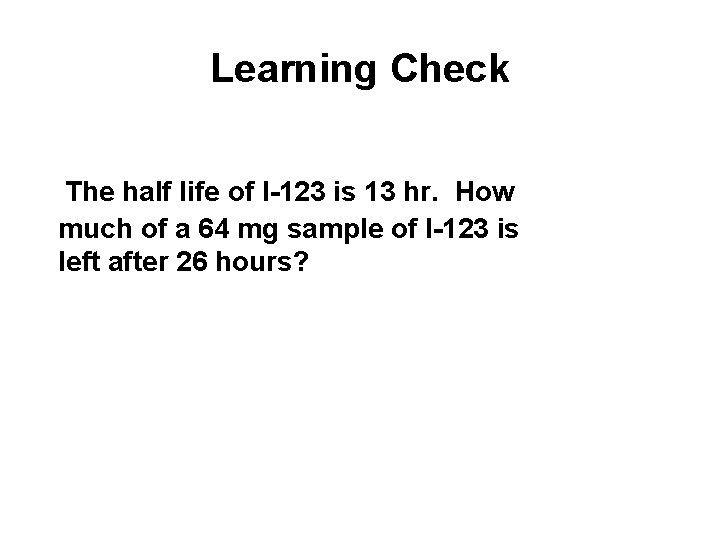
Learning Check The half life of I-123 is 13 hr. How much of a 64 mg sample of I-123 is left after 26 hours?
Solution Half life = 13 hrs Number of half lives Amount remaining = 2 = 64 mg x 1 = 16 mg 2 2 13 hrs 64 mg 13 hrs 32 mg 16 mg
Radiation and Health Free Radicals: Very reactive compounds that can cause mutations, cancer; usually caused by long-term exposure to lowlevel radiation Radiation Sickness: Illness and symptoms caused by short-term exposure to intense radiation
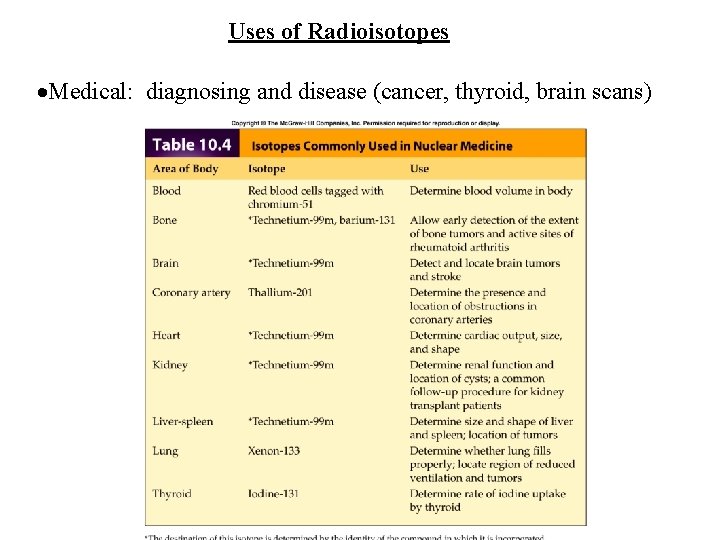
Uses of Radioisotopes ·Medical: diagnosing and disease (cancer, thyroid, brain scans)
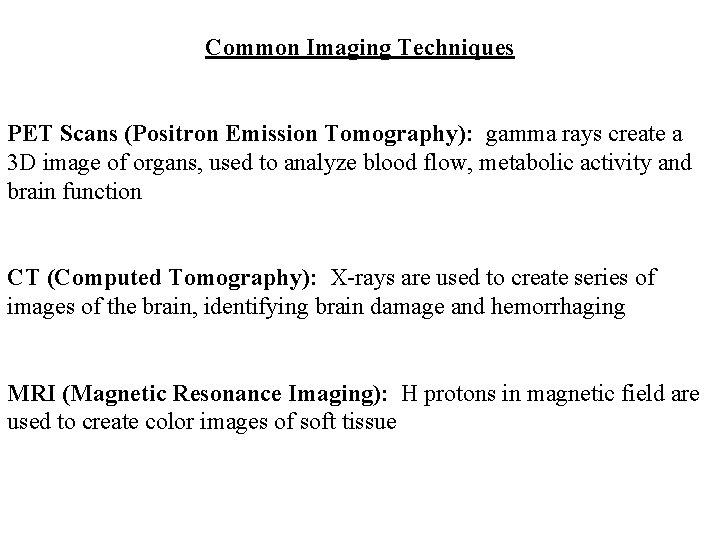
Common Imaging Techniques PET Scans (Positron Emission Tomography): gamma rays create a 3 D image of organs, used to analyze blood flow, metabolic activity and brain function CT (Computed Tomography): X-rays are used to create series of images of the brain, identifying brain damage and hemorrhaging MRI (Magnetic Resonance Imaging): H protons in magnetic field are used to create color images of soft tissue
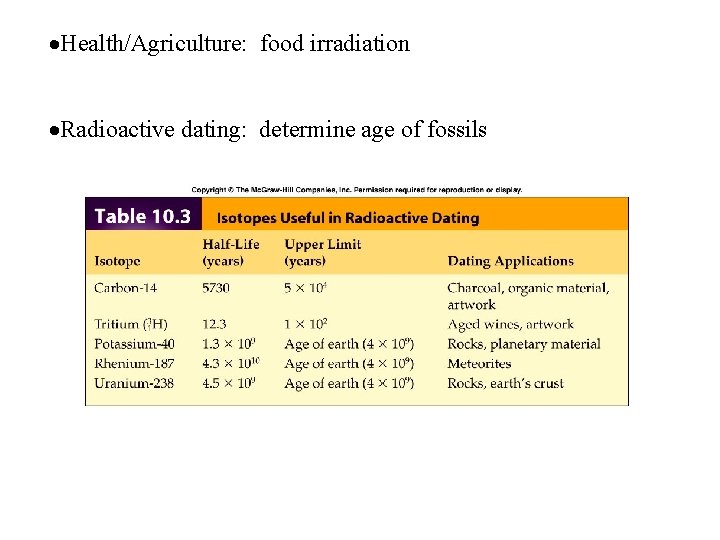
·Health/Agriculture: food irradiation ·Radioactive dating: determine age of fossils
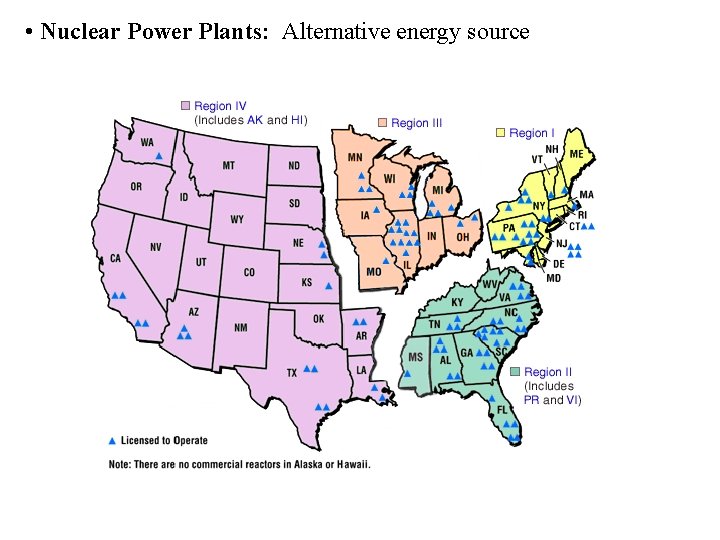
• Nuclear Power Plants: Alternative energy source
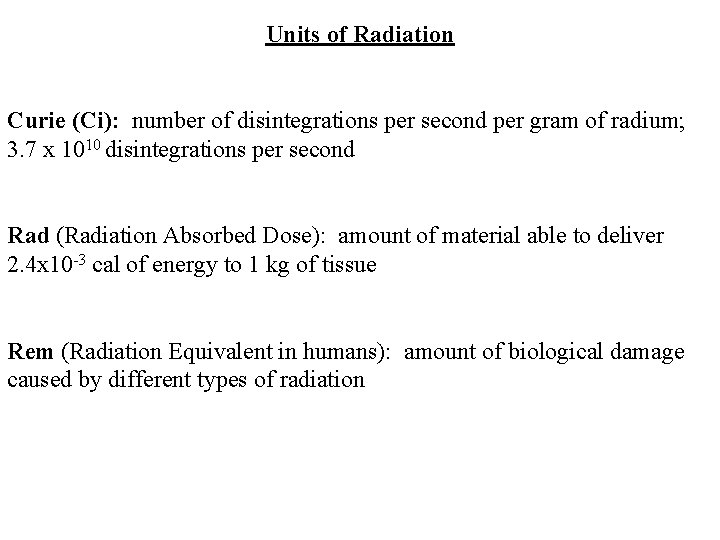
Units of Radiation Curie (Ci): number of disintegrations per second per gram of radium; 3. 7 x 10¹⁰ disintegrations per second Rad (Radiation Absorbed Dose): amount of material able to deliver 2. 4 x 10 -3 cal of energy to 1 kg of tissue Rem (Radiation Equivalent in humans): amount of biological damage caused by different types of radiation
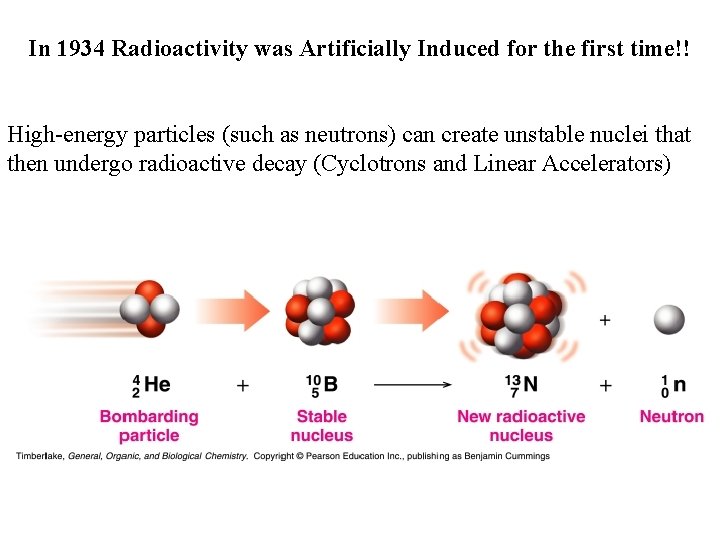
In 1934 Radioactivity was Artificially Induced for the first time!! High-energy particles (such as neutrons) can create unstable nuclei that then undergo radioactive decay (Cyclotrons and Linear Accelerators)
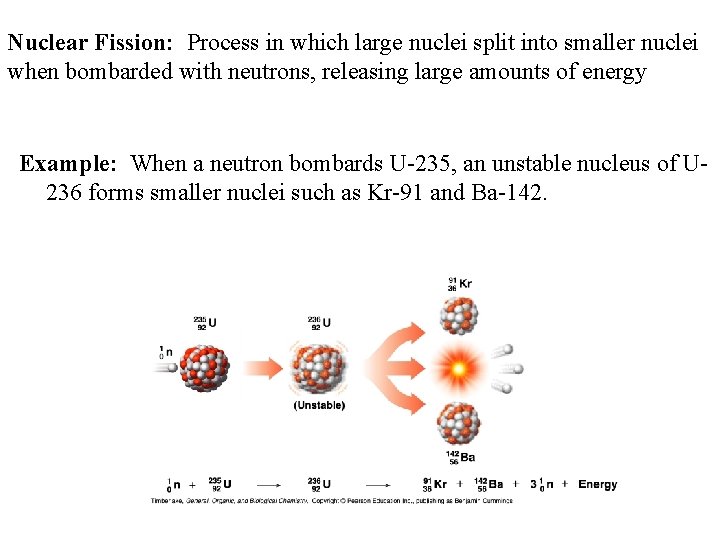
Nuclear Fission: Process in which large nuclei split into smaller nuclei when bombarded with neutrons, releasing large amounts of energy Example: When a neutron bombards U-235, an unstable nucleus of U 236 forms smaller nuclei such as Kr-91 and Ba-142.
Chain Reaction: Nuclear reaction in which the products of a reaction cause that reaction to occur repeatedly Nuclear Fusion: Process in which small nuclei combine (fuse) to form larger nuclei Example: Hydrogen nuclei combine to form Helium nuclei