The Role of the IDC in Small and

- Slides: 45
The Role of the IDC in Small and Medium Jorge Maia Head: Economic Research and Information Department Industrial Development Corporation of South Africa Stellenbosch, 6 June 2006
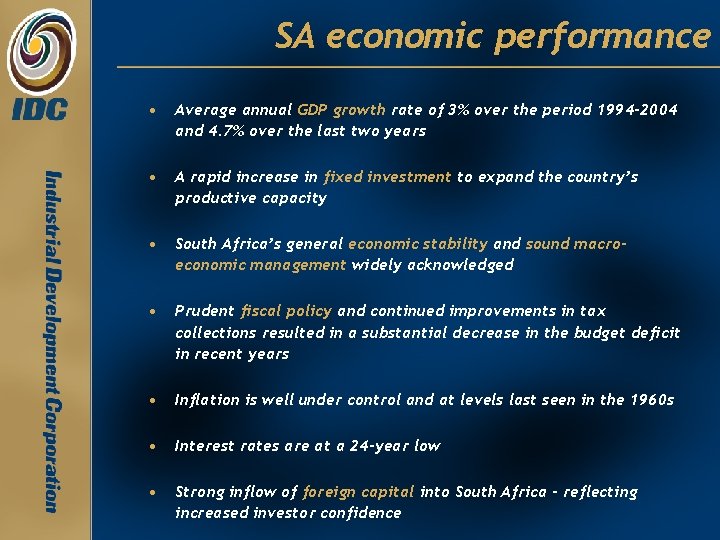
SA economic performance • Average annual GDP growth rate of 3% over the period 1994 -2004 and 4. 7% over the last two years • A rapid increase in fixed investment to expand the country’s productive capacity • South Africa’s general economic stability and sound macroeconomic management widely acknowledged • Prudent fiscal policy and continued improvements in tax collections resulted in a substantial decrease in the budget deficit in recent years • Inflation is well under control and at levels last seen in the 1960 s • Interest rates are at a 24 -year low • Strong inflow of foreign capital into South Africa – reflecting increased investor confidence
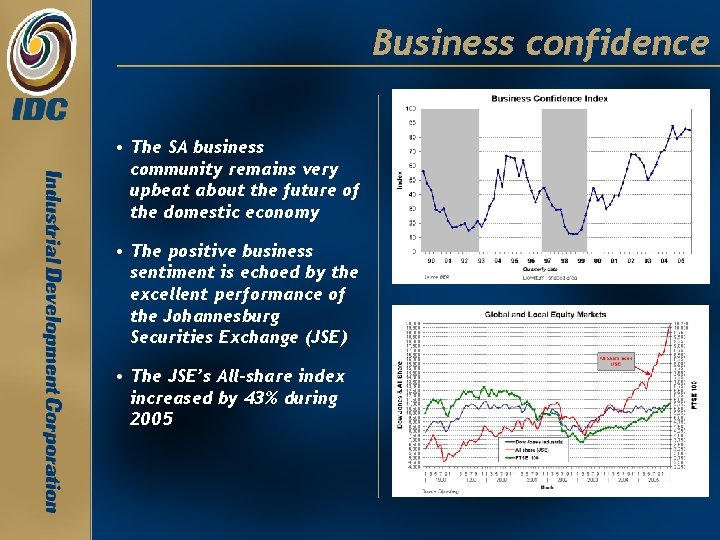
Business confidence • The SA business community remains very upbeat about the future of the domestic economy • The positive business sentiment is echoed by the excellent performance of the Johannesburg Securities Exchange (JSE) • The JSE’s All-share index increased by 43% during 2005
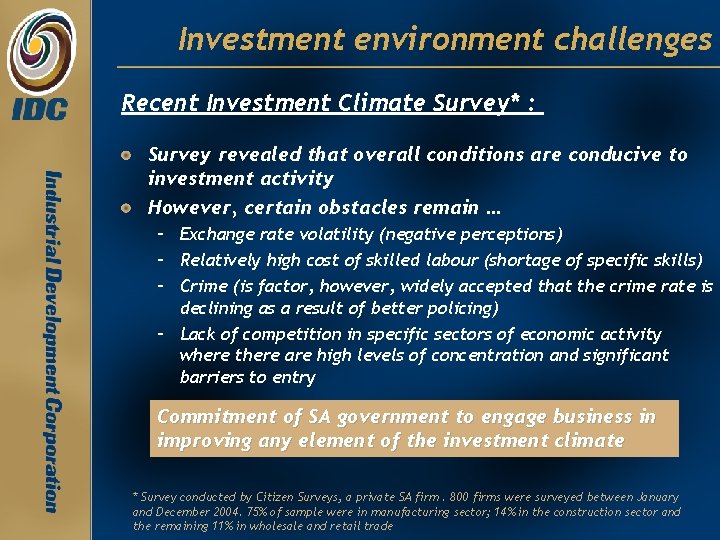
Investment environment challenges Recent Investment Climate Survey* : Survey revealed that overall conditions are conducive to investment activity However, certain obstacles remain … – Exchange rate volatility (negative perceptions) – Relatively high cost of skilled labour (shortage of specific skills) – Crime (is factor, however, widely accepted that the crime rate is declining as a result of better policing) – Lack of competition in specific sectors of economic activity where there are high levels of concentration and significant barriers to entry Commitment of SA government to engage business in improving any element of the investment climate * Survey conducted by Citizen Surveys, a private SA firm. 800 firms were surveyed between January and December 2004. 75% of sample were in manufacturing sector; 14% in the construction sector and the remaining 11% in wholesale and retail trade
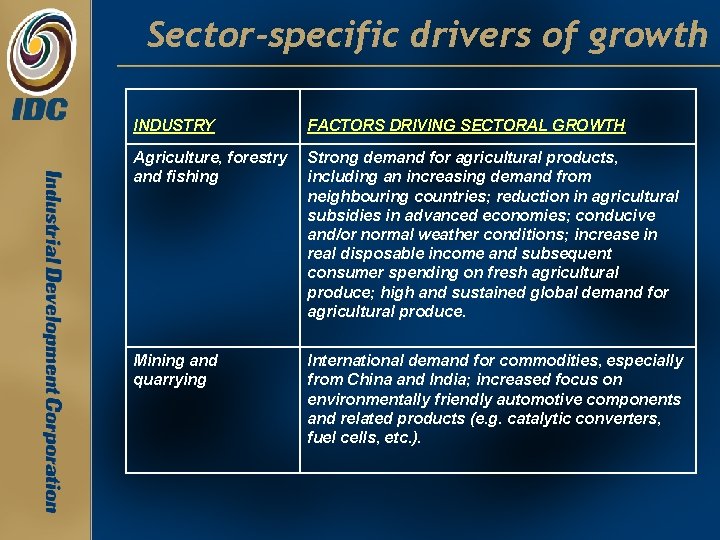
Sector-specific drivers of growth INDUSTRY FACTORS DRIVING SECTORAL GROWTH Agriculture, forestry Strong demand for agricultural products, and fishing including an increasing demand from neighbouring countries; reduction in agricultural subsidies in advanced economies; conducive and/or normal weather conditions; increase in real disposable income and subsequent consumer spending on fresh agricultural produce; high and sustained global demand for agricultural produce. Mining and quarrying International demand for commodities, especially from China and India; increased focus on environmentally friendly automotive components and related products (e. g. catalytic converters, fuel cells, etc. ).
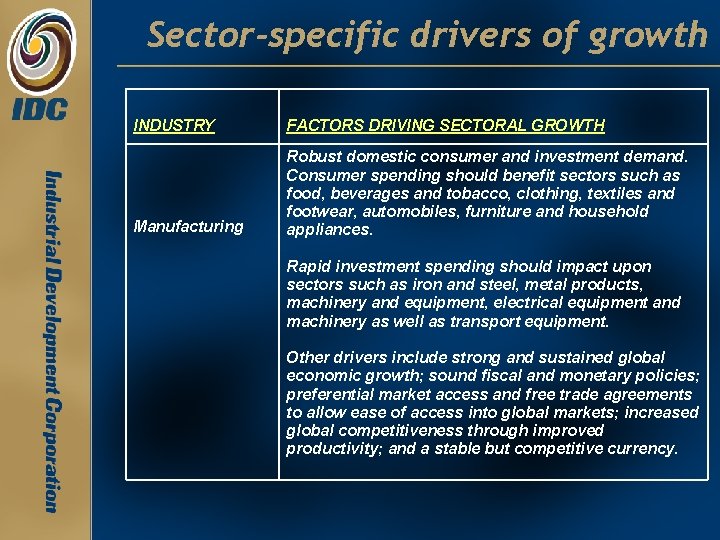
Sector-specific drivers of growth INDUSTRY FACTORS DRIVING SECTORAL GROWTH Manufacturing Robust domestic consumer and investment demand. Consumer spending should benefit sectors such as food, beverages and tobacco, clothing, textiles and footwear, automobiles, furniture and household appliances. Rapid investment spending should impact upon sectors such as iron and steel, metal products, machinery and equipment, electrical equipment and machinery as well as transport equipment. Other drivers include strong and sustained global economic growth; sound fiscal and monetary policies; preferential market access and free trade agreements to allow ease of access into global markets; increased global competitiveness through improved productivity; and a stable but competitive currency.
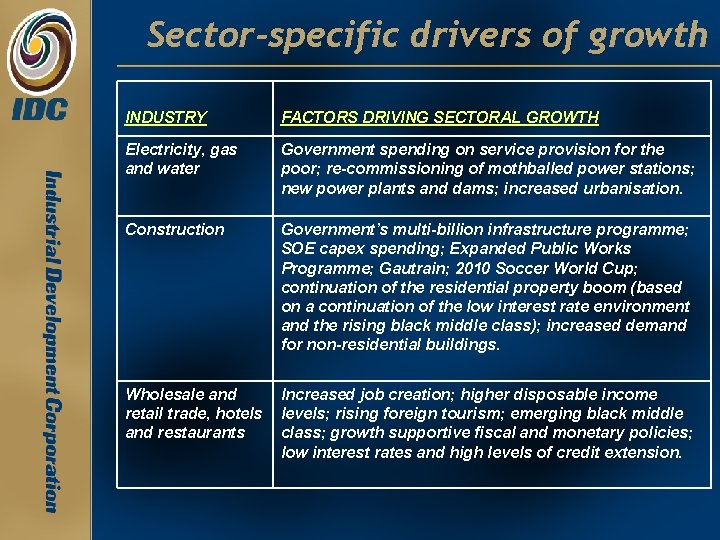
Sector-specific drivers of growth INDUSTRY FACTORS DRIVING SECTORAL GROWTH Electricity, gas and water Government spending on service provision for the poor; re-commissioning of mothballed power stations; new power plants and dams; increased urbanisation. Construction Government’s multi-billion infrastructure programme; SOE capex spending; Expanded Public Works Programme; Gautrain; 2010 Soccer World Cup; continuation of the residential property boom (based on a continuation of the low interest rate environment and the rising black middle class); increased demand for non-residential buildings. Wholesale and Increased job creation; higher disposable income retail trade, hotels levels; rising foreign tourism; emerging black middle and restaurants class; growth supportive fiscal and monetary policies; low interest rates and high levels of credit extension.
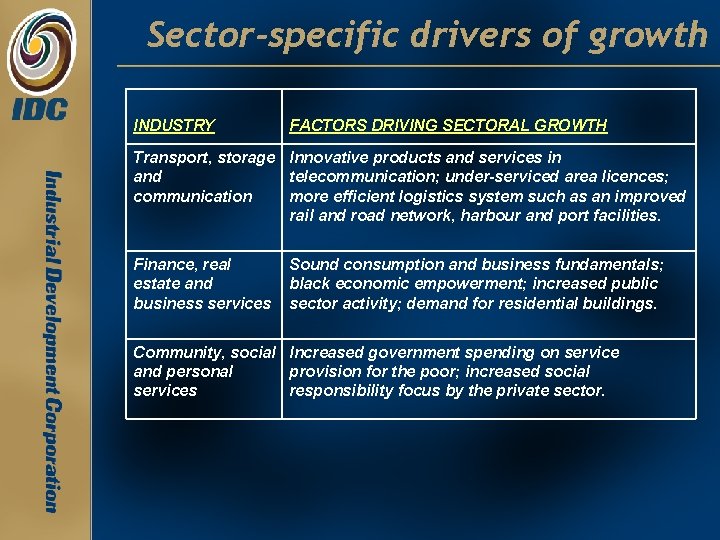
Sector-specific drivers of growth INDUSTRY FACTORS DRIVING SECTORAL GROWTH Transport, storage Innovative products and services in and telecommunication; under-serviced area licences; communication more efficient logistics system such as an improved rail and road network, harbour and port facilities. Finance, real Sound consumption and business fundamentals; estate and black economic empowerment; increased public business services sector activity; demand for residential buildings. Community, social Increased government spending on service and personal provision for the poor; increased social services responsibility focus by the private sector.
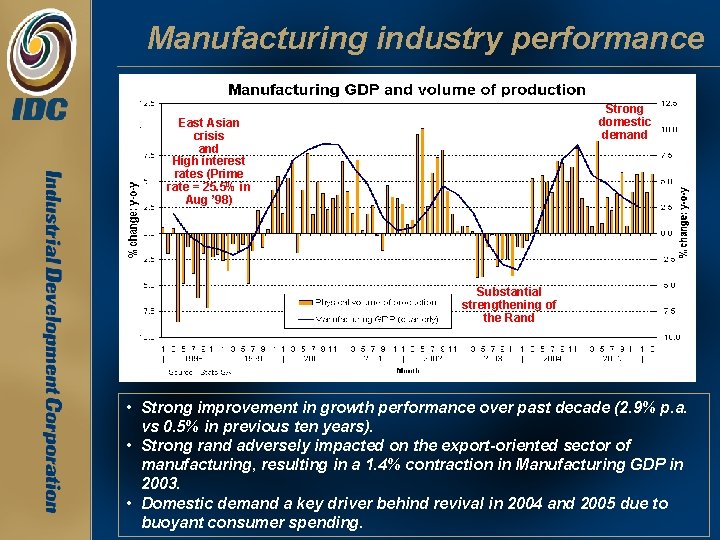
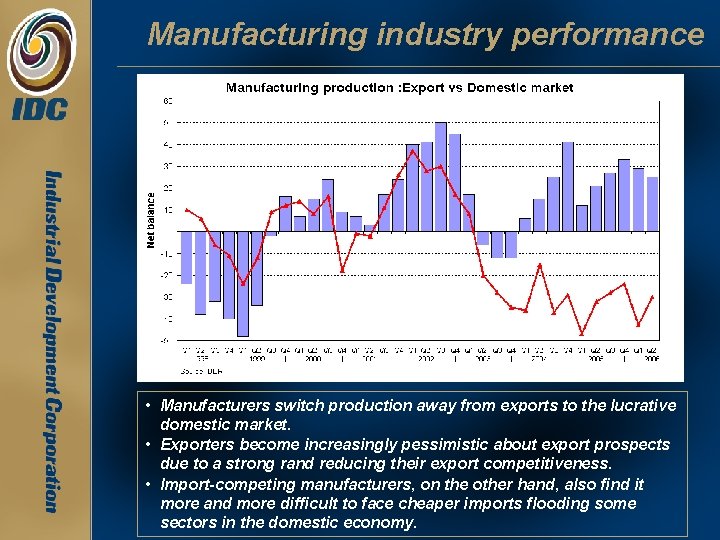
Manufacturing industry performance Strong domestic demand East Asian crisis and High interest rates (Prime rate = 25. 5% in Aug ’ 98) Substantial strengthening of the Rand • Strong improvement in growth performance over past decade (2. 9% p. a. vs 0. 5% in previous ten years). • Strong rand adversely impacted on the export-oriented sector of manufacturing, resulting in a 1. 4% contraction in Manufacturing GDP in 2003. • Domestic demand a key driver behind revival in 2004 and 2005 due to buoyant consumer spending.
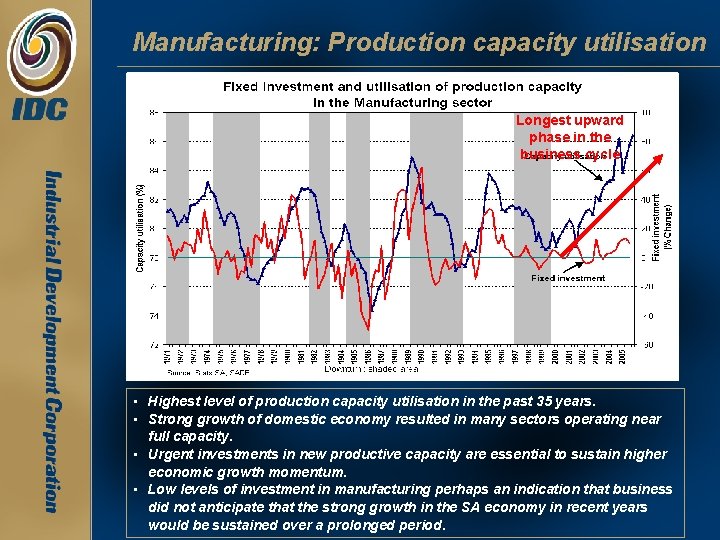
Manufacturing: Production capacity utilisation Longest upward phase in the business cycle • Highest level of production capacity utilisation in the past 35 years. • Strong growth of domestic economy resulted in many sectors operating near full capacity. • Urgent investments in new productive capacity are essential to sustain higher economic growth momentum. • Low levels of investment in manufacturing perhaps an indication that business did not anticipate that the strong growth in the SA economy in recent years would be sustained over a prolonged period.
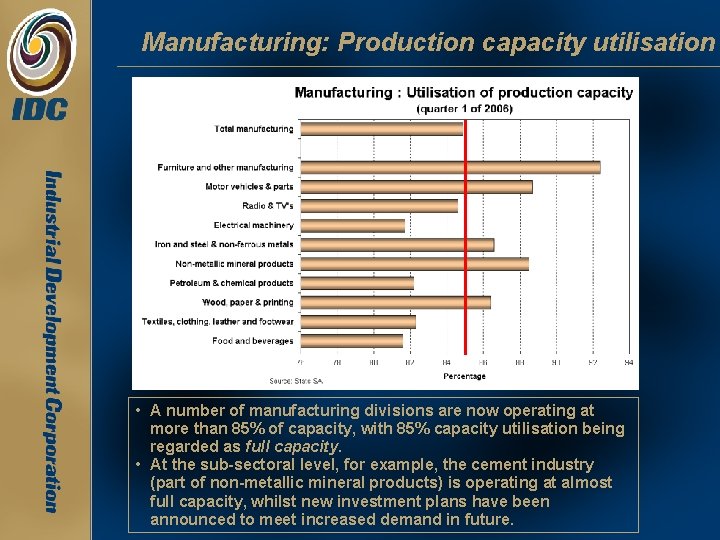
Manufacturing: Production capacity utilisation • A number of manufacturing divisions are now operating at more than 85% of capacity, with 85% capacity utilisation being regarded as full capacity. • At the sub-sectoral level, for example, the cement industry (part of non-metallic mineral products) is operating at almost full capacity, whilst new investment plans have been announced to meet increased demand in future.
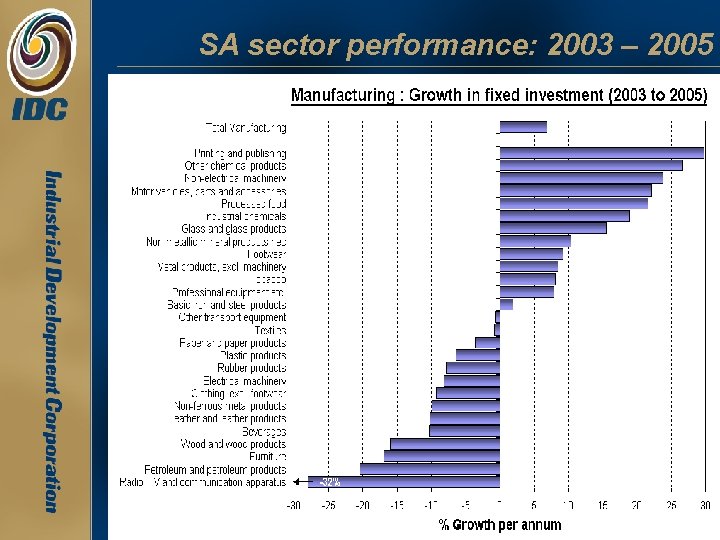
SA sector performance: 2003 – 2005
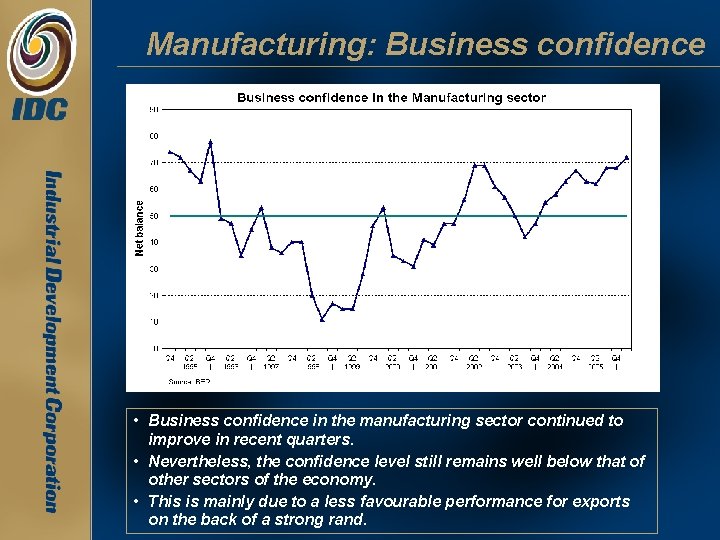
Manufacturing: Business confidence • Business confidence in the manufacturing sector continued to improve in recent quarters. • Nevertheless, the confidence level still remains well below that of other sectors of the economy. • This is mainly due to a less favourable performance for exports on the back of a strong rand.
Manufacturing industry performance • Manufacturers switch production away from exports to the lucrative domestic market. • Exporters become increasingly pessimistic about export prospects due to a strong rand reducing their export competitiveness. • Import-competing manufacturers, on the other hand, also find it more and more difficult to face cheaper imports flooding some sectors in the domestic economy.
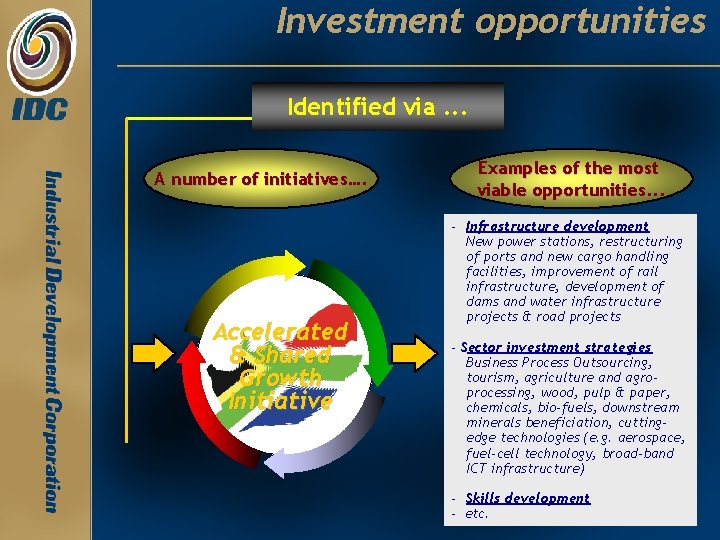
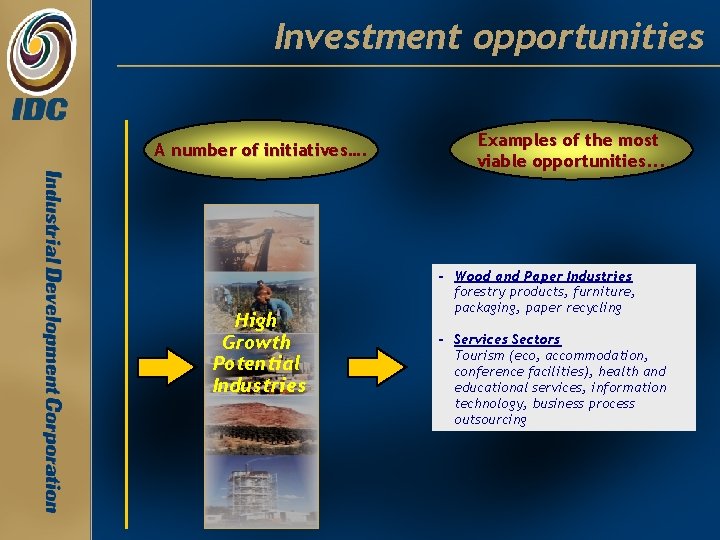
Investment opportunities Identified via. . . A number of initiatives…. Accelerated & Shared Growth Initiative Examples of the most viable opportunities. . . - Infrastructure development New power stations, restructuring of ports and new cargo handling facilities, improvement of rail infrastructure, development of dams and water infrastructure projects & road projects - Sector investment strategies Business Process Outsourcing, tourism, agriculture and agroprocessing, wood, pulp & paper, chemicals, bio-fuels, downstream minerals beneficiation, cuttingedge technologies (e. g. aerospace, fuel-cell technology, broad-band ICT infrastructure) - Skills development - etc.
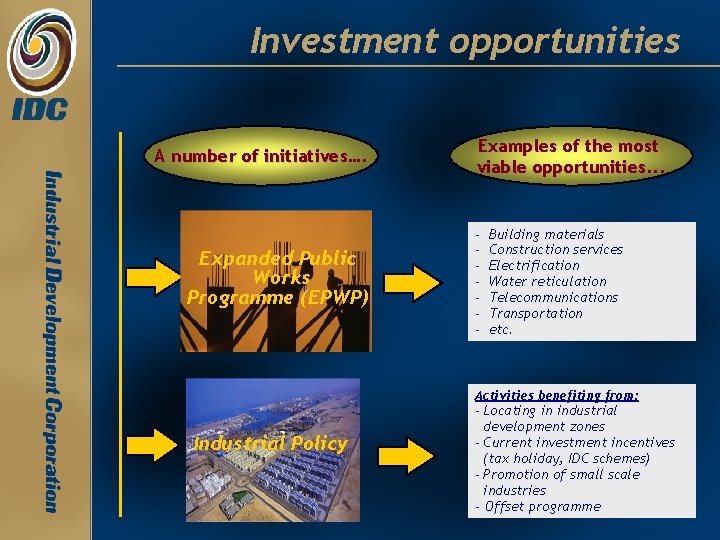
Investment opportunities A number of initiatives…. Expanded Public Works Programme (EPWP) Examples of the most viable opportunities. . . - Building materials Construction services Electrification Water reticulation Telecommunications Transportation etc. Activities benefiting from: Industrial Policy - Locating in industrial development zones - Current investment incentives (tax holiday, IDC schemes) - Promotion of small scale industries - Offset programme
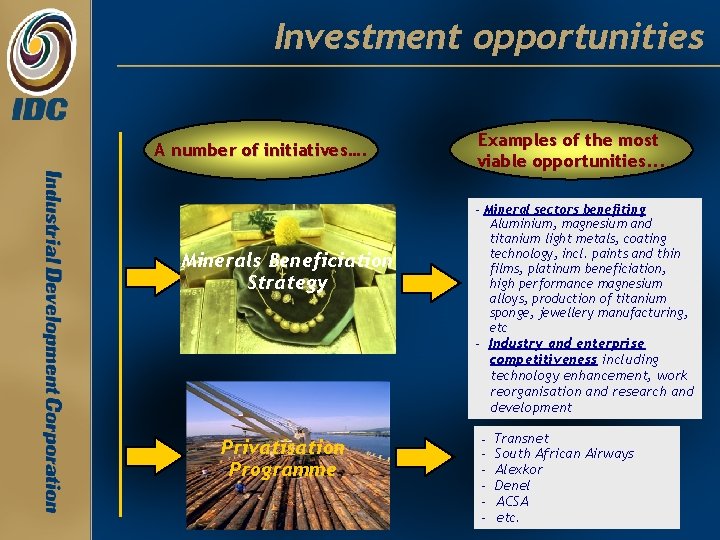
Investment opportunities A number of initiatives…. Minerals Beneficiation Strategy Examples of the most viable opportunities. . . - Mineral sectors benefiting Aluminium, magnesium and titanium light metals, coating technology, incl. paints and thin films, platinum beneficiation, high performance magnesium alloys, production of titanium sponge, jewellery manufacturing, etc - Industry and enterprise competitiveness including technology enhancement, work reorganisation and research and development Privatisation Programme - Transnet - South African Airways Alexkor Denel ACSA etc.
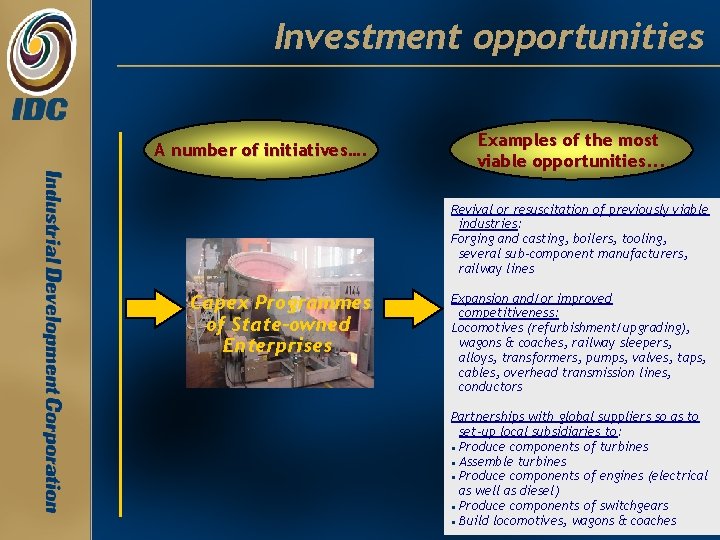
Investment opportunities A number of initiatives…. Examples of the most viable opportunities. . . Revival or resuscitation of previously viable industries: Forging and casting, boilers, tooling, several sub-component manufacturers, railway lines Capex Programmes of State-owned Enterprises Expansion and/or improved competitiveness: Locomotives (refurbishment/upgrading), wagons & coaches, railway sleepers, alloys, transformers, pumps, valves, taps, cables, overhead transmission lines, conductors Partnerships with global suppliers so as to set-up local subsidiaries to: • Produce components of turbines • Assemble turbines • Produce components of engines (electrical as well as diesel) • Produce components of switchgears • Build locomotives, wagons & coaches
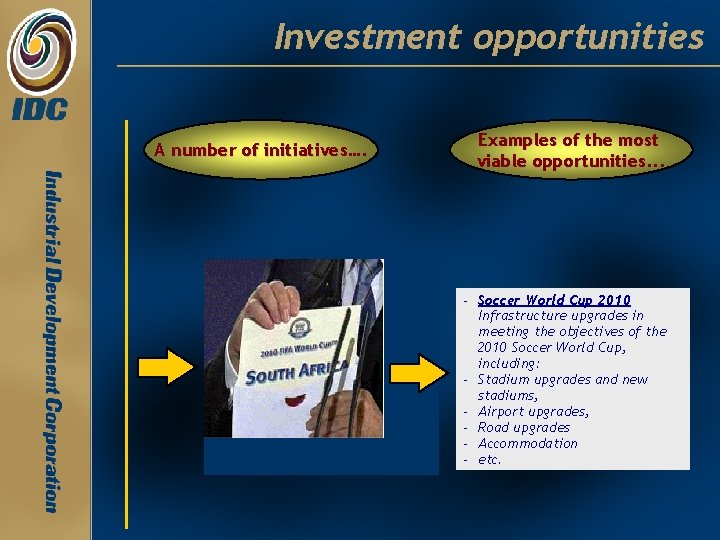
Investment opportunities A number of initiatives…. Examples of the most viable opportunities. . . - Soccer World Cup 2010 Infrastructure upgrades in meeting the objectives of the 2010 Soccer World Cup, including: - Stadium upgrades and new stadiums, - Airport upgrades, - Road upgrades - Accommodation - etc.
Investment opportunities A number of initiatives…. Examples of the most viable opportunities. . . Transport Services & Logistics Road freight, commuter bus service, port services, ship maintenance High Growth Potential Industries Chemicals Industries Bio-fuels, man-made fibres, tubes and pipes, composites, soaps and other cleaning products, plastics for automotive industry Wholesale & Retail Trade Shopping centre development in townships and rural areas, convenience stores, franchising investments, warehousing facilities
Investment opportunities A number of initiatives…. High Growth Potential Industries Examples of the most viable opportunities. . . - Construction project development (Soccer World Cup 2010, Eskom & Transnet capital expenditure programmes, Power generation projects, Gautrain Project, etc), building materials (cement plants, concrete making, concrete recycling); mobile brick plants; construction services - Mining and Mineral Beneficiation Platinum group metals, iron ore, coal, diamond cutting and polishing, jewellery manufacturing - Waste Management waste treatment, waste recycling (paper and board, plastics, metal & glass)
Investment opportunities A number of initiatives…. High Growth Potential Industries Examples of the most viable opportunities. . . - Wood and Paper Industries forestry products, furniture, packaging, paper recycling - Services Sectors Tourism (eco, accommodation, conference facilities), health and educational services, information technology, business process outsourcing
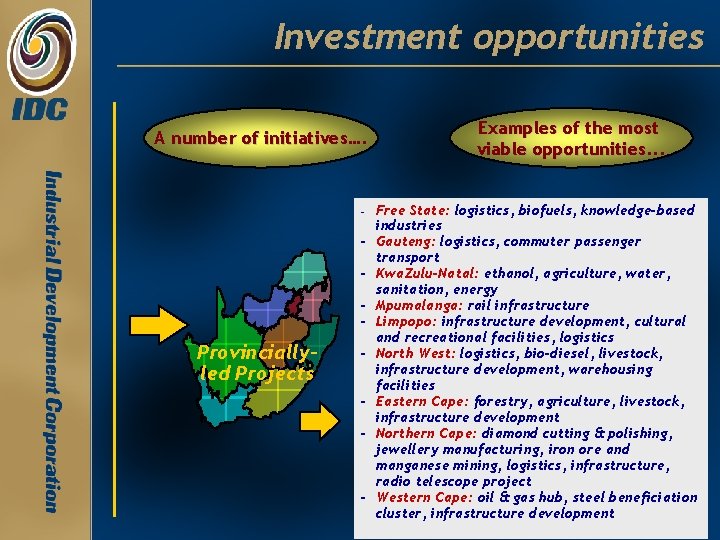
Investment opportunities A number of initiatives…. Examples of the most viable opportunities. . . - Free State: logistics, biofuels, knowledge-based - • Provinciallyled Projects - - industries Gauteng: logistics, commuter passenger transport Kwa. Zulu-Natal: ethanol, agriculture, water, sanitation, energy Mpumalanga: rail infrastructure Limpopo: infrastructure development, cultural and recreational facilities, logistics North West: logistics, bio-diesel, livestock, infrastructure development, warehousing facilities Eastern Cape: forestry, agriculture, livestock, infrastructure development Northern Cape: diamond cutting & polishing, jewellery manufacturing, iron ore and manganese mining, logistics, infrastructure, radio telescope project Western Cape: oil & gas hub, steel beneficiation cluster, infrastructure development
The IDC: Corporate profile Established in 1940, the IDC is a selffinancing, state-owned development finance institution Provides financing to entrepreneurs engaged in competitive industries Follows normal company policy and procedures in its operations Pays income tax at corporates and dividends to the shareholder Independent Board of Directors Reports on a fully consolidated basis, with its Annual Report freely available to the public IDC Head Office in Sandton, South Africa
Vision and mission “To be the primary driving force of commercially sustainable industrial development and innovation to the benefit of South and the rest of Africa” Contribute to the generation of balanced, sustainable economic growth in South Africa and Africa Economically empower the South African and African population Promote entrepreneurship through the building of competitive industries and enterprises based on sound business principles
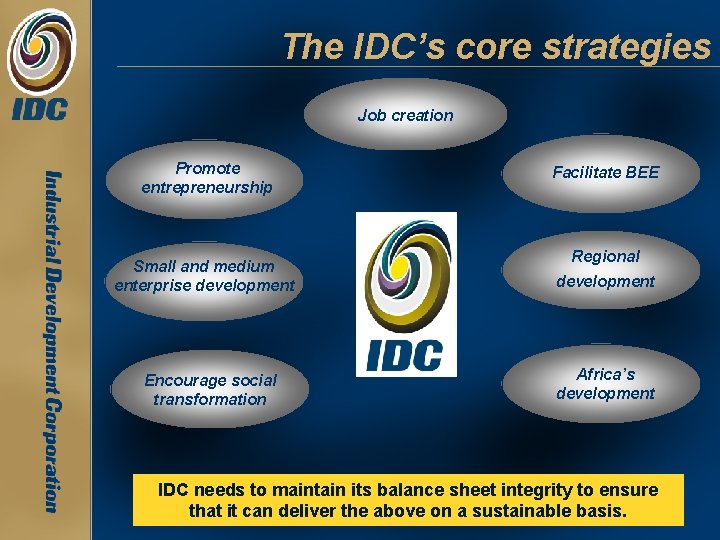
The IDC’s core strategies Job creation Promote entrepreneurship Small and medium enterprise development Encourage social transformation Facilitate BEE Regional development Africa’s development IDC needs to maintain its balance sheet integrity to ensure that it can deliver the above on a sustainable basis.
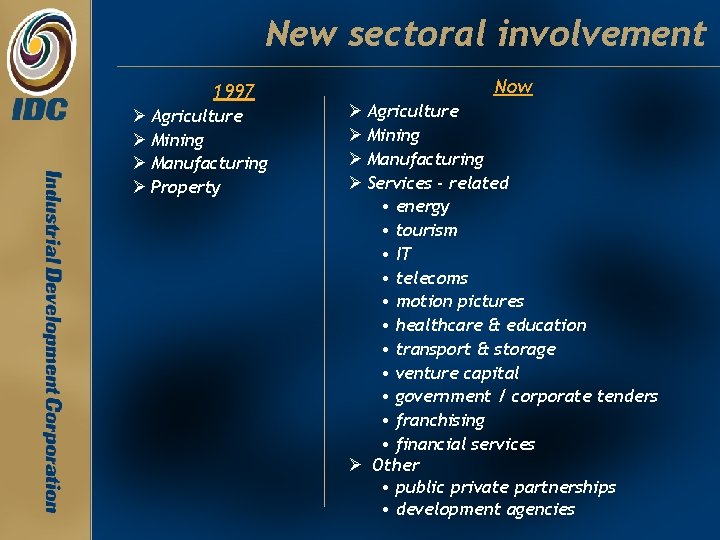
New sectoral involvement 1997 Ø Agriculture Ø Mining Ø Manufacturing Ø Property Now Ø Agriculture Ø Mining Ø Manufacturing Ø Services - related • energy • tourism • IT • telecoms • motion pictures • healthcare & education • transport & storage • venture capital • government / corporate tenders • franchising • financial services Ø Other • public private partnerships • development agencies
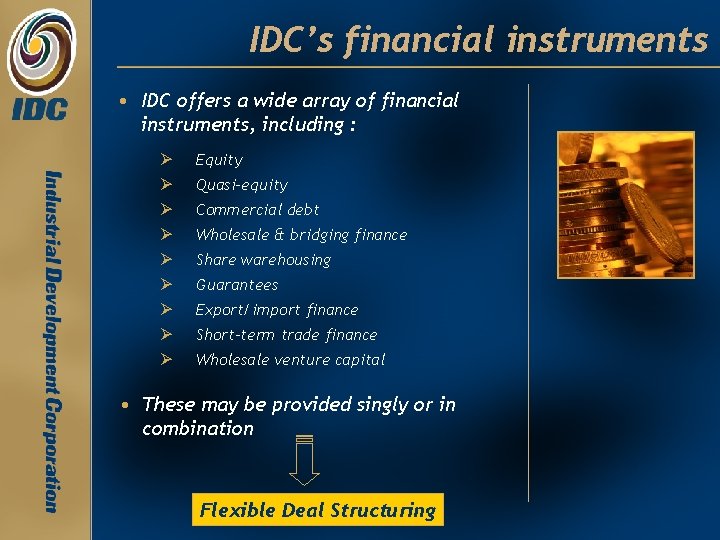
IDC’s financial instruments • IDC offers a wide array of financial instruments, including : Ø Ø Ø Ø Ø Equity Quasi-equity Commercial debt Wholesale & bridging finance Share warehousing Guarantees Export/import finance Short-term trade finance Wholesale venture capital • These may be provided singly or in combination Flexible Deal Structuring
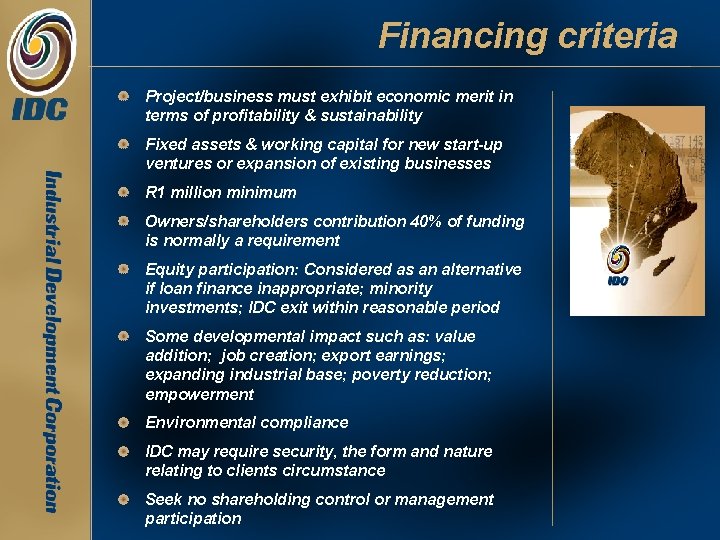
Financing criteria Project/business must exhibit economic merit in terms of profitability & sustainability Fixed assets & working capital for new start-up ventures or expansion of existing businesses R 1 million minimum Owners/shareholders contribution 40% of funding is normally a requirement Equity participation: Considered as an alternative if loan finance inappropriate; minority investments; IDC exit within reasonable period Some developmental impact such as: value addition; job creation; export earnings; expanding industrial base; poverty reduction; empowerment Environmental compliance IDC may require security, the form and nature relating to clients circumstance Seek no shareholding control or management participation
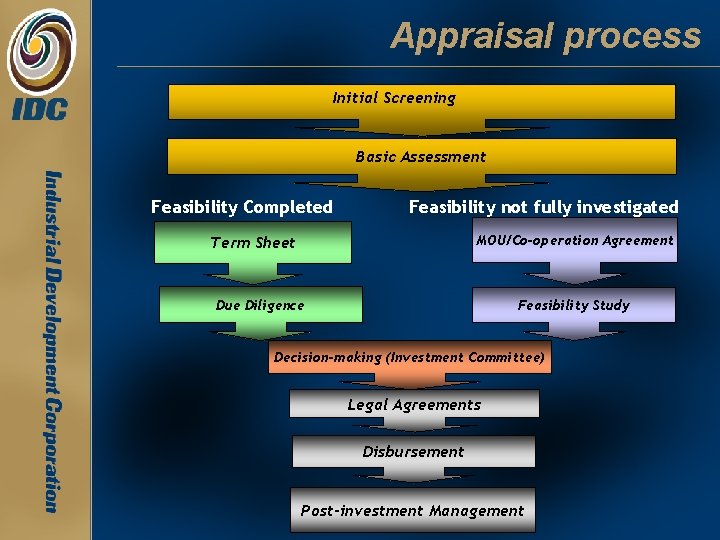
Appraisal process Initial Screening Basic Assessment Feasibility Completed Feasibility not fully investigated MOU/Co-operation Agreement Term Sheet Due Diligence Feasibility Study Decision-making (Investment Committee) Legal Agreements Disbursement Post-investment Management
The IDC’s approach to SME development
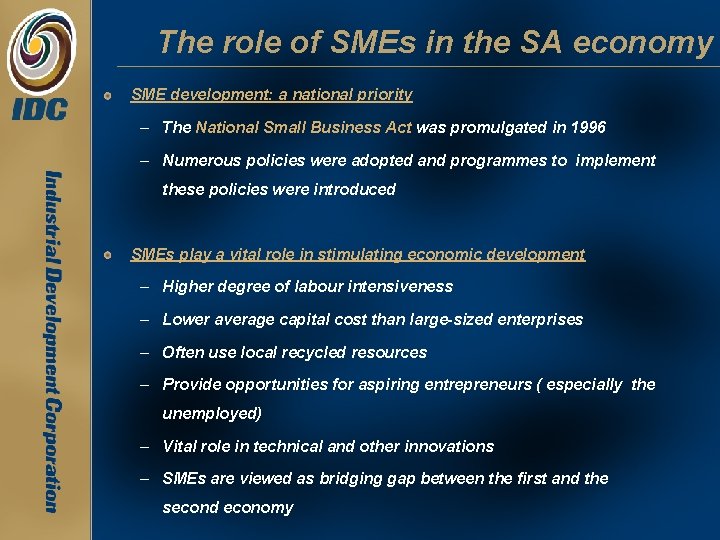
The role of SMEs in the SA economy SME development: a national priority – The National Small Business Act was promulgated in 1996 – Numerous policies were adopted and programmes to implement these policies were introduced SMEs play a vital role in stimulating economic development – Higher degree of labour intensiveness – Lower average capital cost than large-sized enterprises – Often use local recycled resources – Provide opportunities for aspiring entrepreneurs ( especially the unemployed) – Vital role in technical and other innovations – SMEs are viewed as bridging gap between the first and the second economy
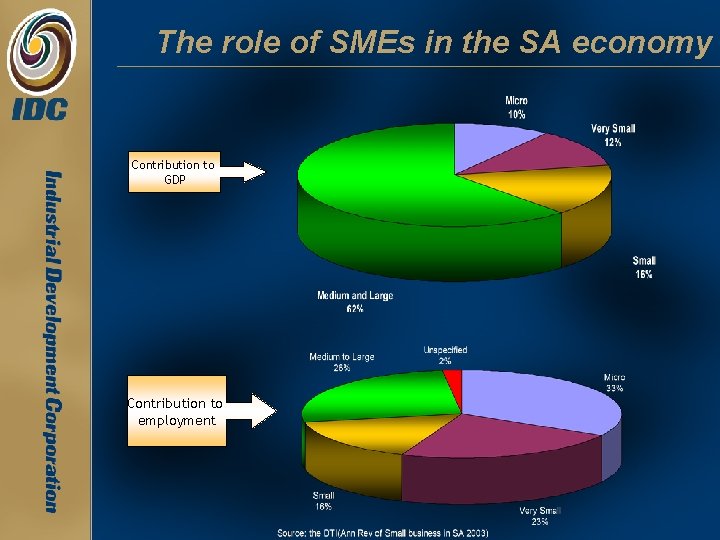
The role of SMEs in the SA economy Contribution to GDP Contribution to employment
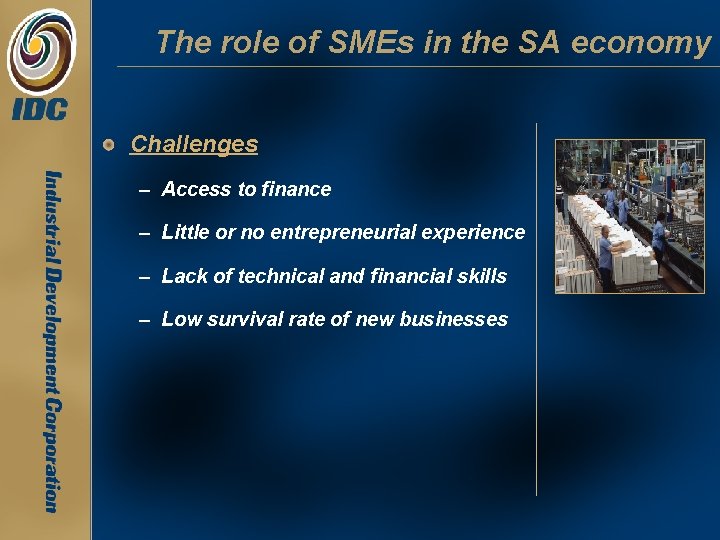
The role of SMEs in the SA economy Challenges – Access to finance – Little or no entrepreneurial experience – Lack of technical and financial skills – Low survival rate of new businesses
IDC financing of SMEs Definition IDC’s focus of the definition is on small to medium enterprises (excluding the micro enterprise segment) A business is classified as small medium enterprise (SME) if it fits any two of the following criteria: – Less than 100 employees – Less than R 50 million annual turnover – Less than R 30 million total assets value
IDC financing of SMEs Various approaches geared towards developing SMEs: – Franchising (providing finance to franchisor and franchisee) – Agency Development and Support (serves as a support and resource facility to fulfill IDC’s developmental role through the establishment of agencies -particularly in rural areas) – Risk Capital Facility (targets private SME sector through BEE) – Special development financing schemes (Pro-SME Jobs Scheme)
IDC financing of SMEs Pro SME Jobs Scheme … Capital allocation: R 600 million. Key objectives: To promote employment creation and SME development by encouraging businesses to embark on labour intensive start-ups / expansions. Pricing and individual loan limits: Interest rate of prime less 5% applicable for the full period of the loan (max. 7 years). This period includes any grace period for capital repayments. The low interest rate finance will be limited to R 25 million per project.
IDC financing of SMEs Pro SME Jobs Scheme (cont) … Criteria: • The financing is available for SMEs in all sectors within the IDC’s development mandate. • Applicants must be independent companies or groups complying with at least 2 of the following 3 parameters: less than 200 employees; or less than R 35 million turnover; or less than R 40 million in total assets at application date - or after the 1 st year of full production in the case of start-ups. • The business must have economic merit, i. e. have prospects of acceptable profitability, and must comply with the IDC’s normal funding criteria.
IDC financing of SMEs Pro SME Jobs Scheme (cont) … Criteria (cont. ): • At least 10, direct, permanent new jobs must be created. • The total capital cost of the new or additional assets (buildings, machinery and working capital) must not exceed R 150 000 per job opportunity (calculated at peak funding requirement). The new or additional assets are the total assets involved in the start-up or expansion – not only the portion to be financed by IDC.
Development Financing Schemes (cont. ) Generic issues • All schemes are effective as from 10 November 2005, and will be on offer until 1 December 2006 or earlier if the R 1 billion capital allocation is depleted. • In cases where the results of the financing provided under the schemes are not in line with the set objectives, IDC has the right to increase the interest rate to a “prime based risk adjusted rate”. • All the normal IDC fees (including the breakage/cancellation fee) will be applicable except for the Pro Franchising and Pro Orchards schemes. • The minimum IDC facility is R 1 million (except for franchising). • Only direct, permanent new jobs will be taken into account for the purposes of qualifying for finance, with the cost per job calculated at peak.
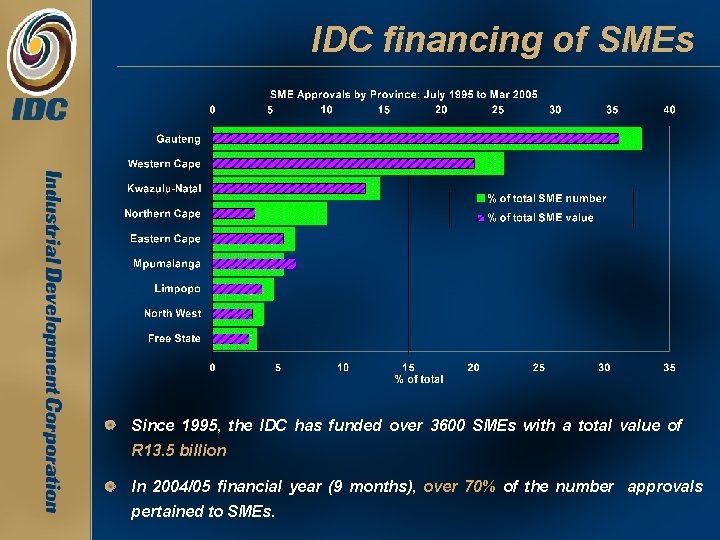
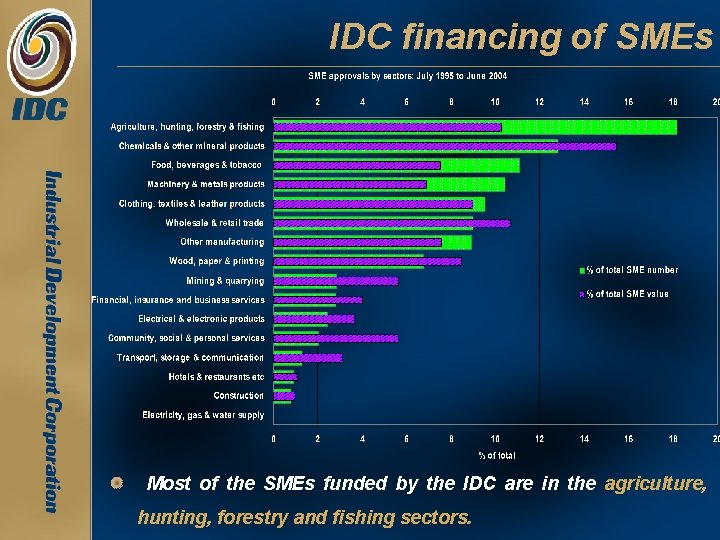
IDC financing of SMEs Since 1995, the IDC has funded over 3600 SMEs with a total value of R 13. 5 billion In 2004/05 financial year (9 months), over 70% of the number approvals pertained to SMEs.
IDC financing of SMEs Most of the SMEs funded by the IDC are in the agriculture, hunting, forestry and fishing sectors.
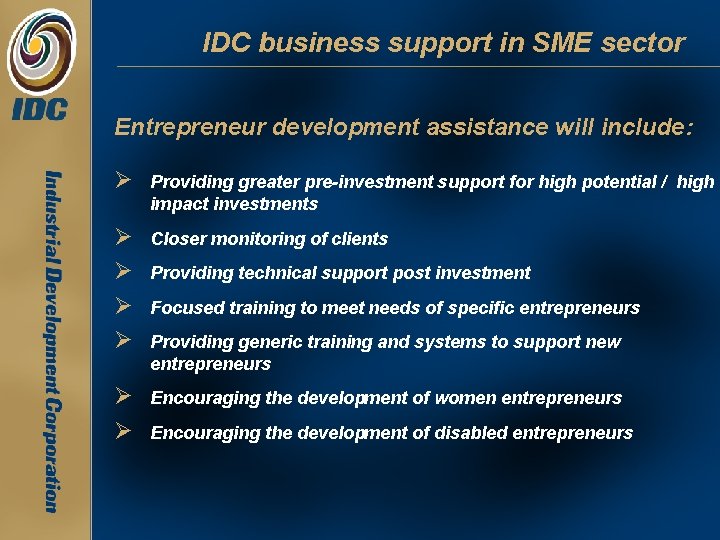
IDC business support in SME sector Entrepreneur development assistance will include: Ø Providing greater pre-investment support for high potential / high impact investments Ø Ø Closer monitoring of clients Ø Ø Encouraging the development of women entrepreneurs Providing technical support post investment Focused training to meet needs of specific entrepreneurs Providing generic training and systems to support new entrepreneurs Encouraging the development of disabled entrepreneurs
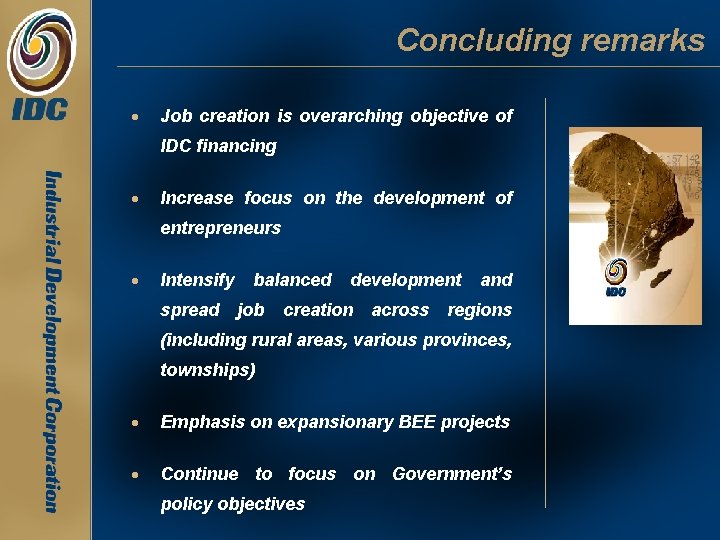
Concluding remarks · Job creation is overarching objective of IDC financing · Increase focus on the development of entrepreneurs · Intensify balanced development and spread job creation across regions (including rural areas, various provinces, townships) · Emphasis on expansionary BEE projects · Continue to focus on Government’s policy objectives
Thank You