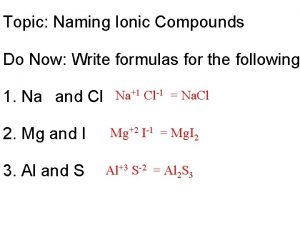
Naming Ionic Compounds Chemical reactions occur when atoms
- Slides: 54
Naming Ionic Compounds
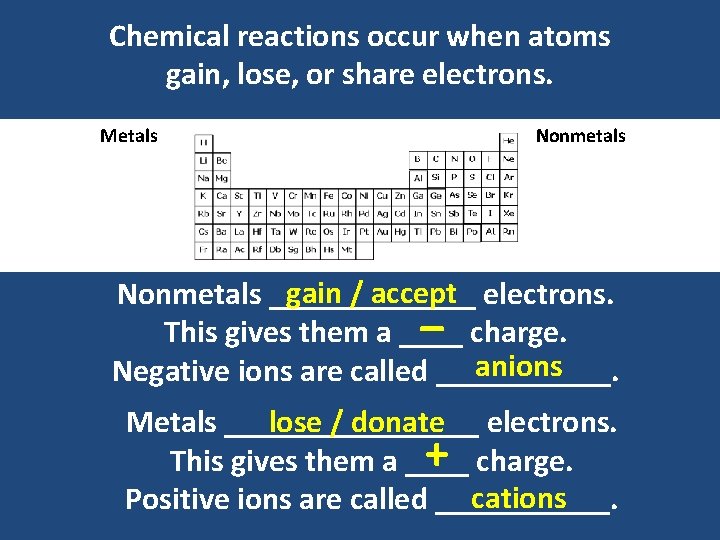
Chemical reactions occur when atoms gain, lose, or share electrons. Metals Nonmetals gain / accept electrons. Nonmetals _______ This gives them a ____ charge. anions Negative ions are called ______. _ Metals ________ lose / donate electrons. + charge. This gives them a ____ cations Positive ions are called ______.
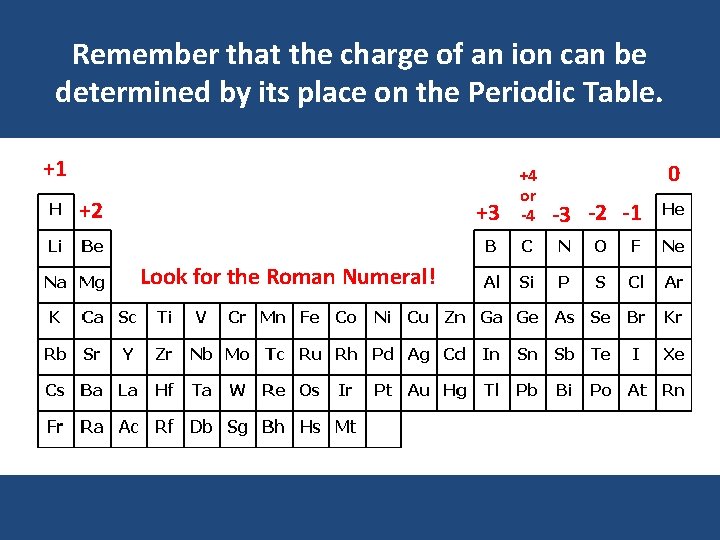
Remember that the charge of an ion can be determined by its place on the Periodic Table. +1 +2 +3 Look for the Roman Numeral! +4 or -4 0 -3 -2 -1
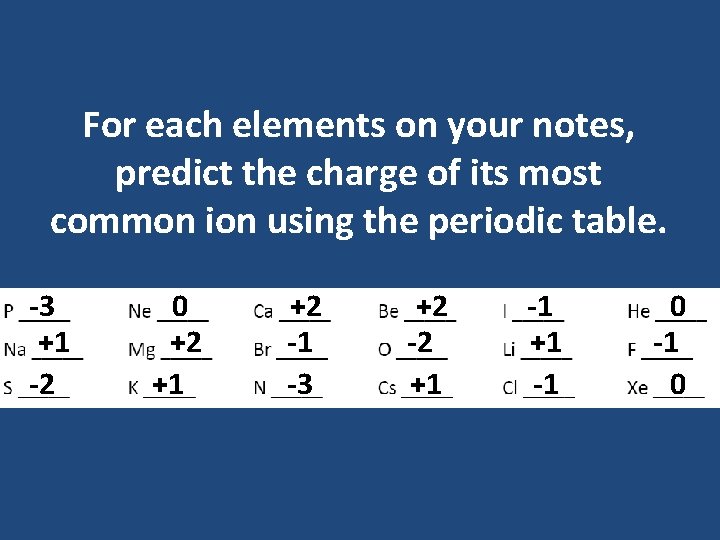
For each elements on your notes, predict the charge of its most common ion using the periodic table. -3 +1 -2 0 +2 +1 +2 -1 -3 +2 -2 +1 -1 0
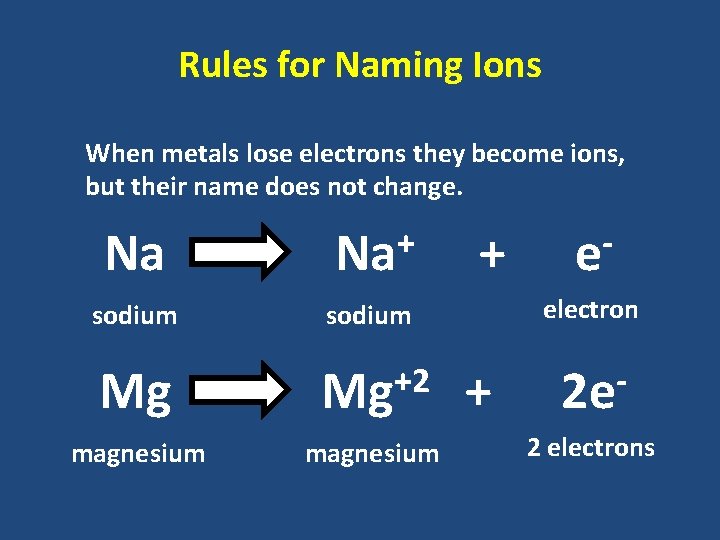
Rules for Naming Ions When metals lose electrons they become ions, but their name does not change. Na + sodium electron Mg +2 Mg 2 e magnesium + e 2 electrons
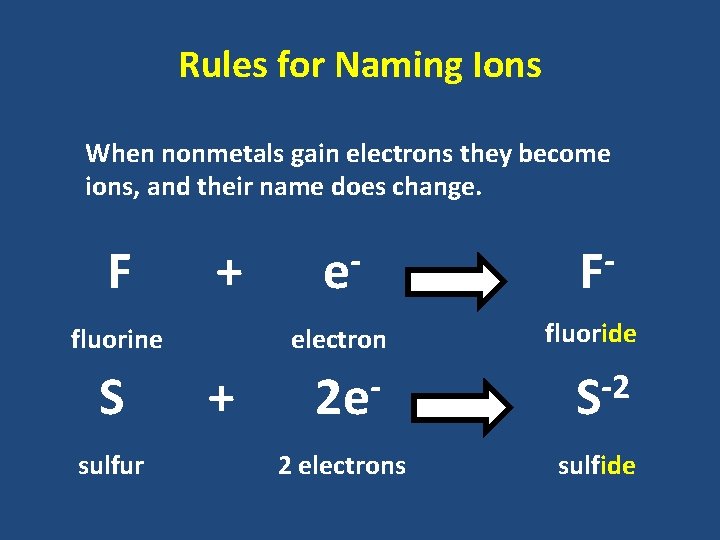
Rules for Naming Ions When nonmetals gain electrons they become ions, and their name does change. F + fluorine S sulfur + e F electron fluoride 2 e -2 S 2 electrons sulfide
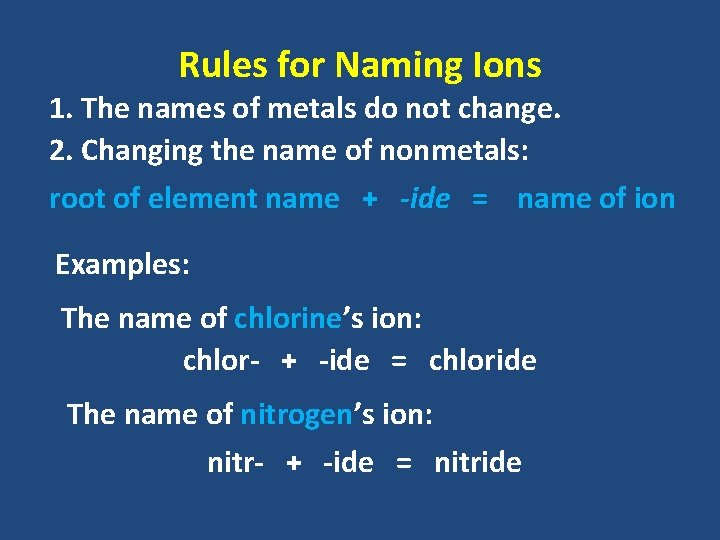
Rules for Naming Ions 1. The names of metals do not change. 2. Changing the name of nonmetals: root of element name + -ide = name of ion Examples: The name of chlorine’s ion: chlor- + -ide = chloride The name of nitrogen’s ion: nitr- + -ide = nitride
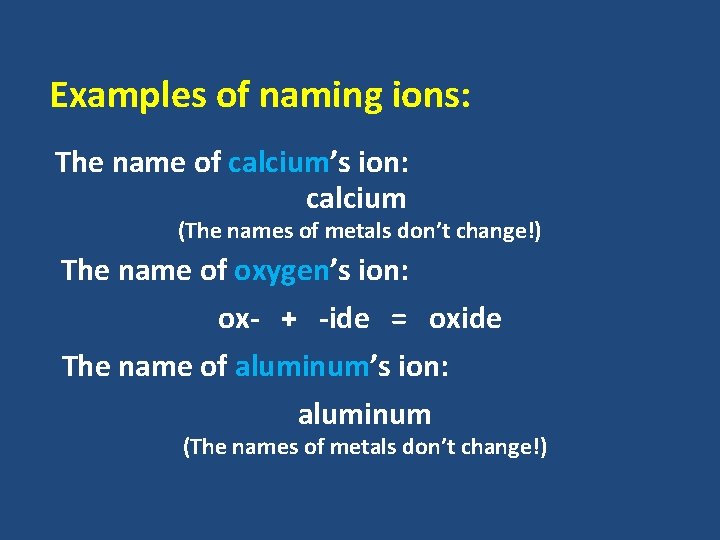
Examples of naming ions: The name of calcium’s ion: calcium (The names of metals don’t change!) The name of oxygen’s ion: ox- + -ide = oxide The name of aluminum’s ion: aluminum (The names of metals don’t change!)
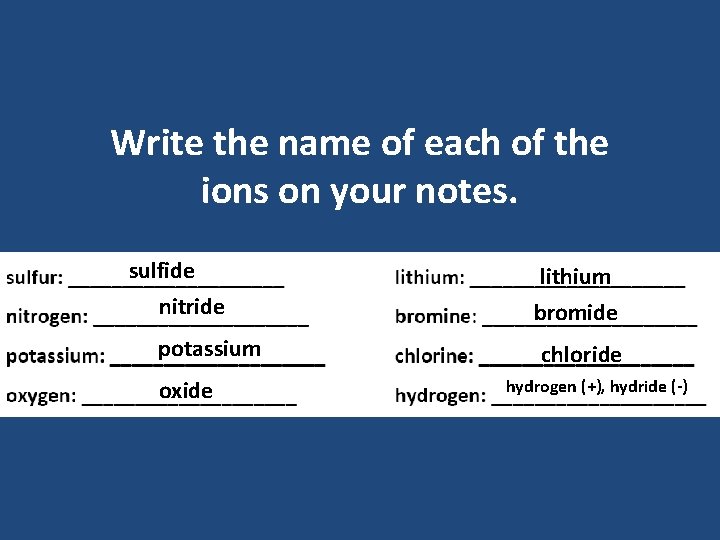
Write the name of each of the ions on your notes. sulfide nitride potassium oxide lithium bromide chloride hydrogen (+), hydride (-)
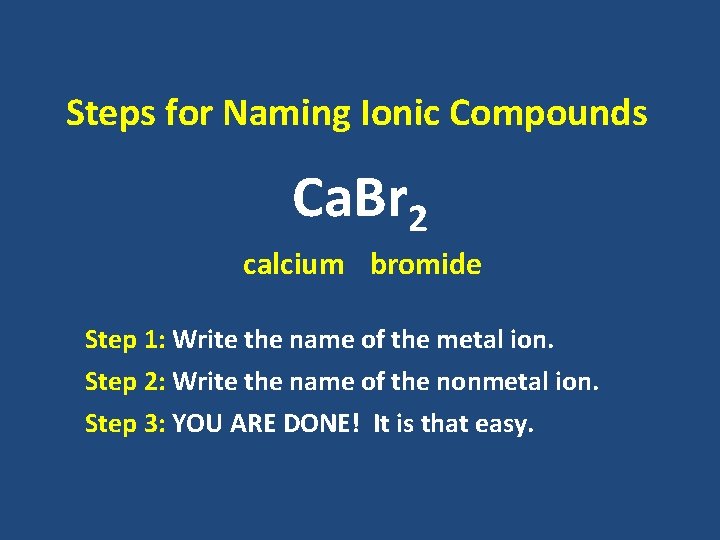
Steps for Naming Ionic Compounds Ca. Br 2 calcium bromide Step 1: Write the name of the metal ion. Step 2: Write the name of the nonmetal ion. Step 3: YOU ARE DONE! It is that easy.
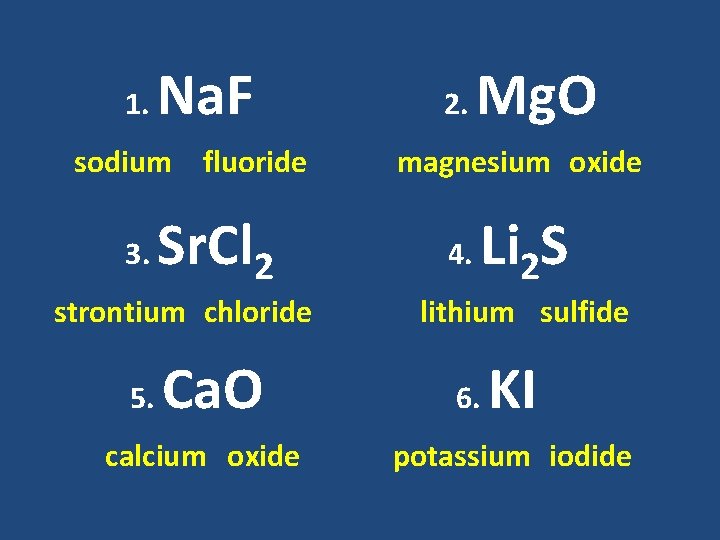
1. Na. F sodium fluoride 3. Sr. Cl 2 strontium chloride 5. Ca. O calcium oxide 2. Mg. O magnesium oxide 4. Li 2 S lithium sulfide 6. KI potassium iodide
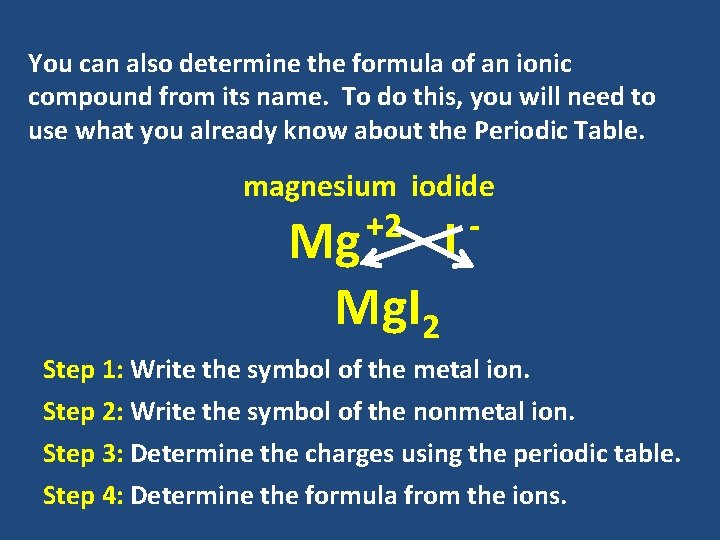
You can also determine the formula of an ionic compound from its name. To do this, you will need to use what you already know about the Periodic Table. magnesium iodide +2 Mg I Mg. I 2 - Step 1: Write the symbol of the metal ion. Step 2: Write the symbol of the nonmetal ion. Step 3: Determine the charges using the periodic table. Step 4: Determine the formula from the ions.
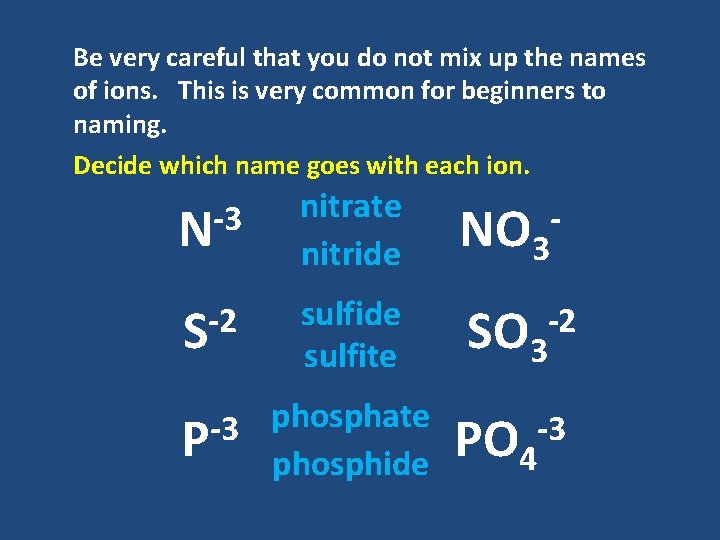
Be very careful that you do not mix up the names of ions. This is very common for beginners to naming. Decide which name goes with each ion. -3 N nitrate nitride NO 3 -2 S sulfide sulfite SO 3 phosphate -3 P phosphide PO 4 - -2 -3
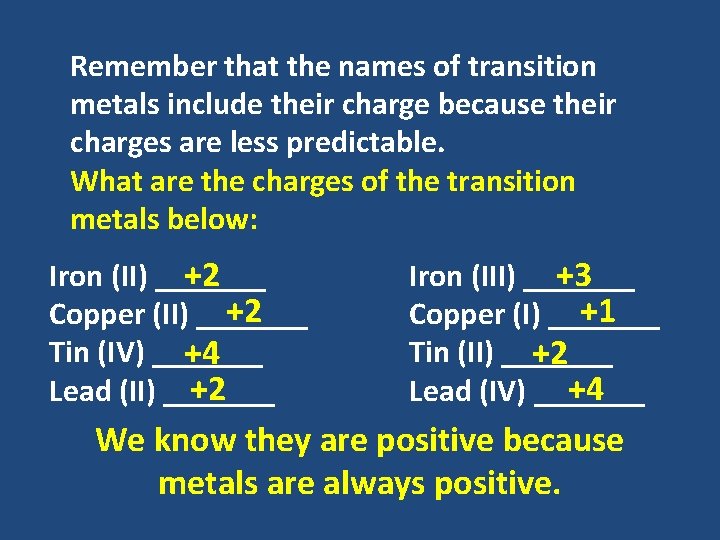
Remember that the names of transition metals include their charge because their charges are less predictable. What are the charges of the transition metals below: Iron (II) _______ +2 +2 Copper (II) _______ Tin (IV) _______ +4 +2 Lead (II) _______ Iron (III) _______ +3 +1 Copper (I) _______ Tin (II) _______ +2 +4 Lead (IV) _______ We know they are positive because metals are always positive.
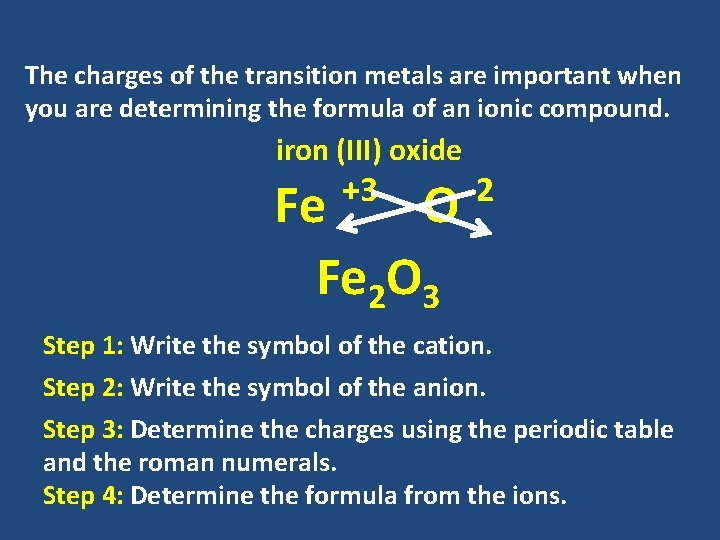
The charges of the transition metals are important when you are determining the formula of an ionic compound. iron (III) oxide +3 Fe O Fe 2 O 3 -2 Step 1: Write the symbol of the cation. Step 2: Write the symbol of the anion. Step 3: Determine the charges using the periodic table and the roman numerals. Step 4: Determine the formula from the ions.
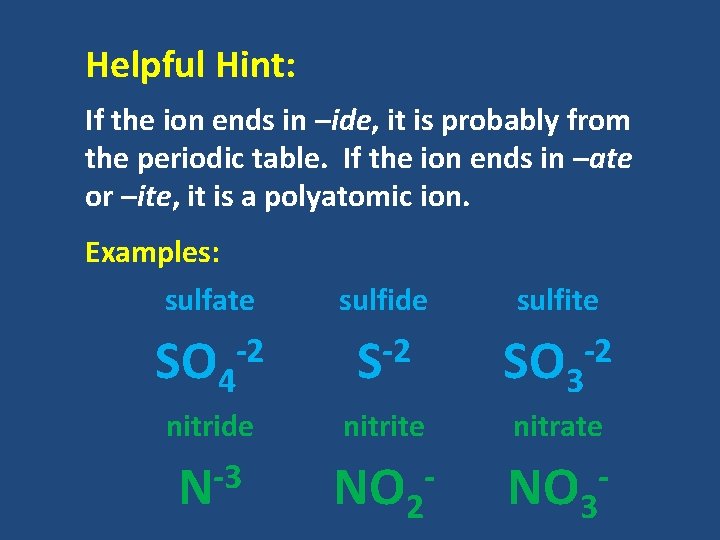
Helpful Hint: If the ion ends in –ide, it is probably from the periodic table. If the ion ends in –ate or –ite, it is a polyatomic ion. Examples: sulfate SO 4 -2 sulfide -2 S sulfite SO 3 -2 nitride nitrite nitrate -3 N NO 2 NO 3 - -
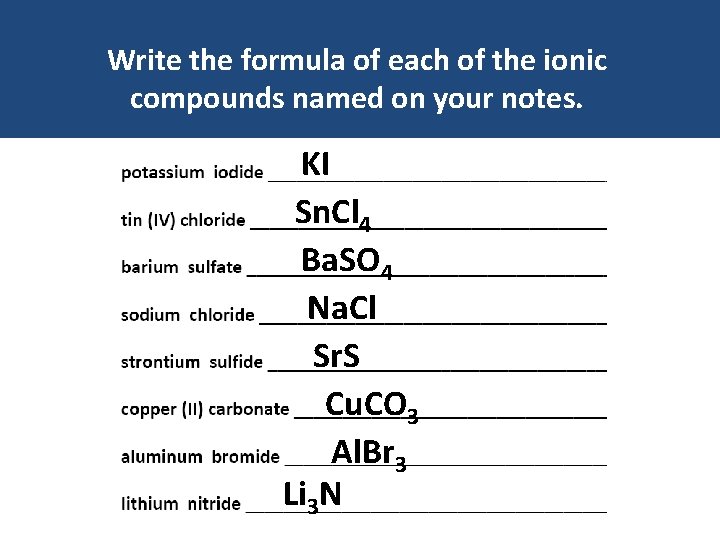
Write the formula of each of the ionic compounds named on your notes. KI Sn. Cl 4 Ba. SO 4 Na. Cl Sr. S Cu. CO 3 Al. Br 3 Li 3 N
Naming Binary Covalent Compounds
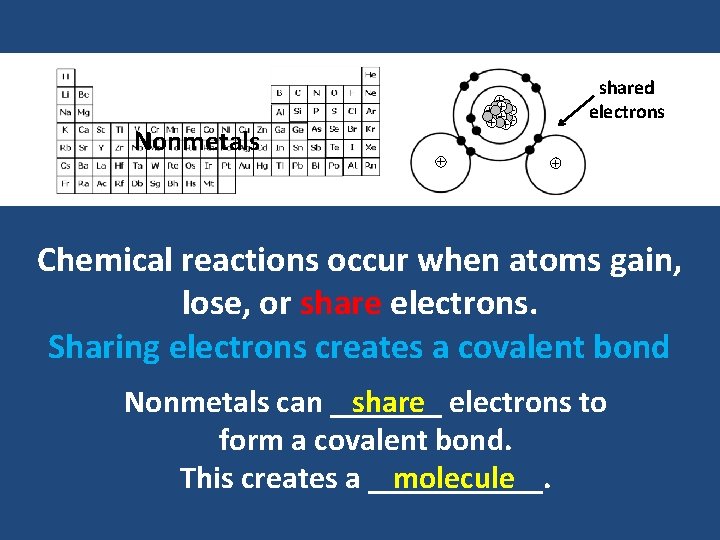
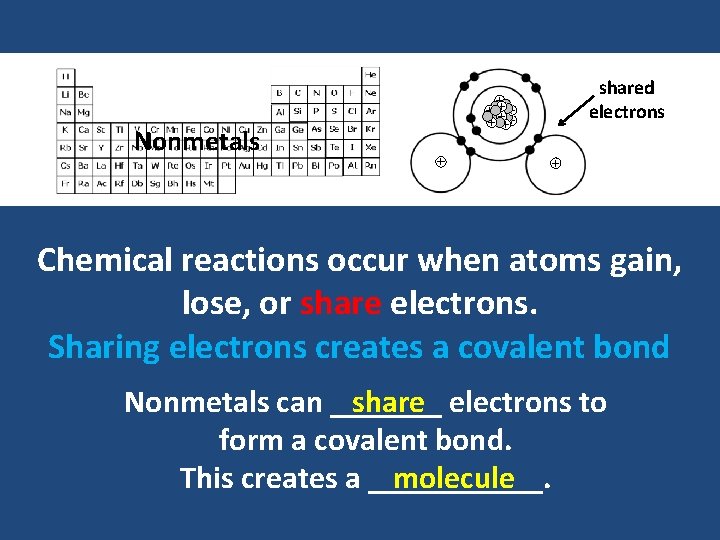
Nonmetals shared electrons Chemical reactions occur when atoms gain, lose, or share electrons. Sharing electrons creates a covalent bond Nonmetals can _______ share electrons to form a covalent bond. molecule This creates a ______.
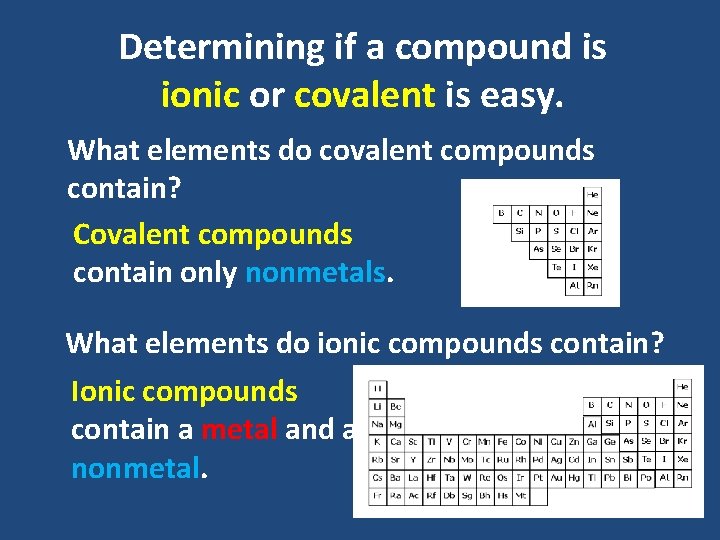
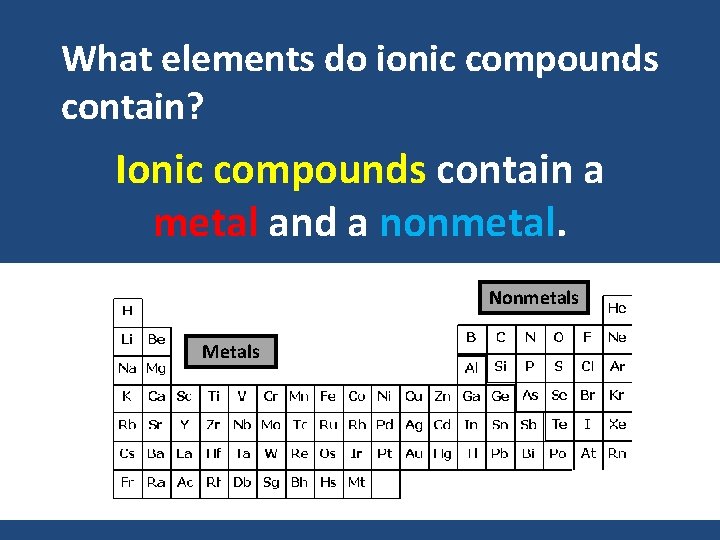
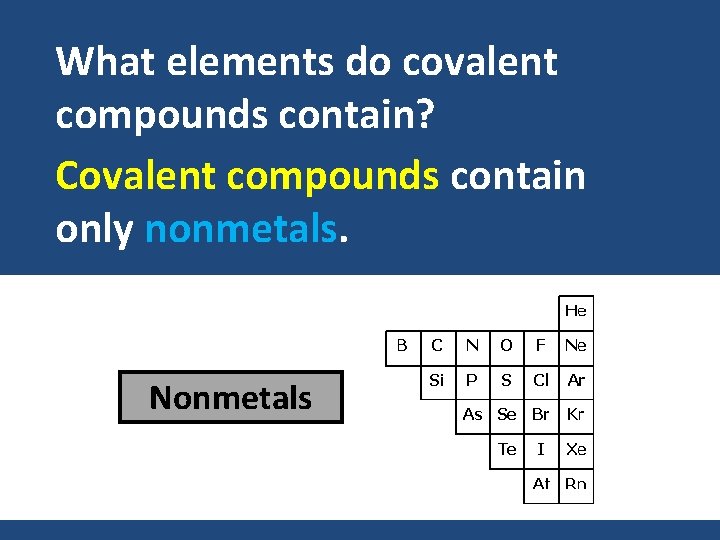
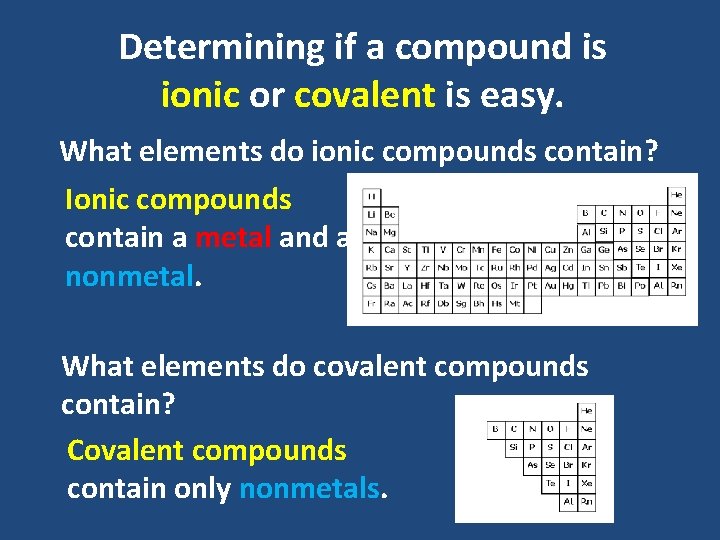
Determining if a compound is ionic or covalent is easy. What elements do covalent compounds contain? Covalent compounds contain only nonmetals. What elements do ionic compounds contain? Ionic compounds contain a metal and a nonmetal.
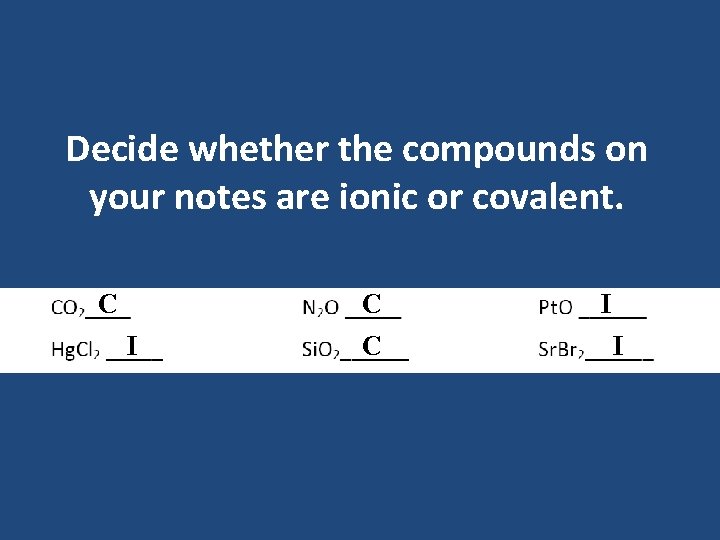
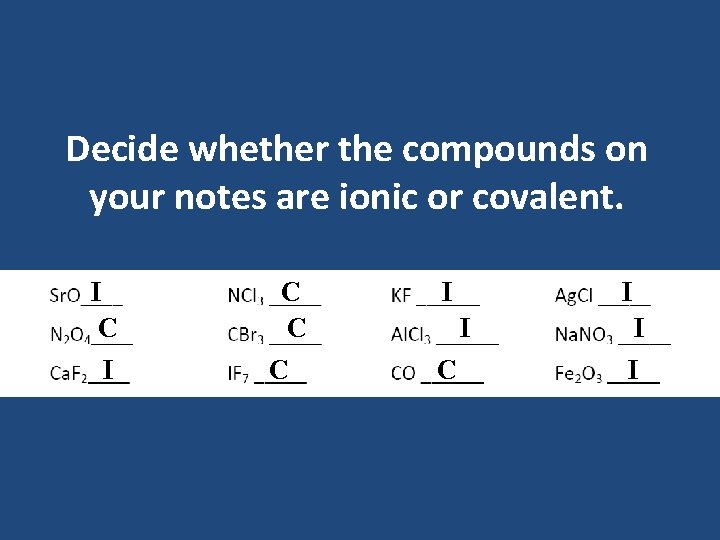
Decide whether the compounds on your notes are ionic or covalent. C I C C I I
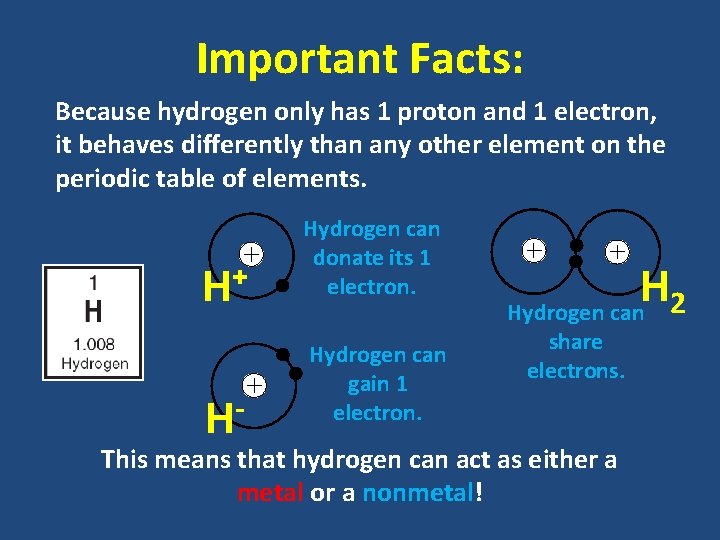
Important Facts: Because hydrogen only has 1 proton and 1 electron, it behaves differently than any other element on the periodic table of elements. + H H Hydrogen can donate its 1 electron. Hydrogen can gain 1 electron. H Hydrogen can 2 share electrons. This means that hydrogen can act as either a metal or a nonmetal!
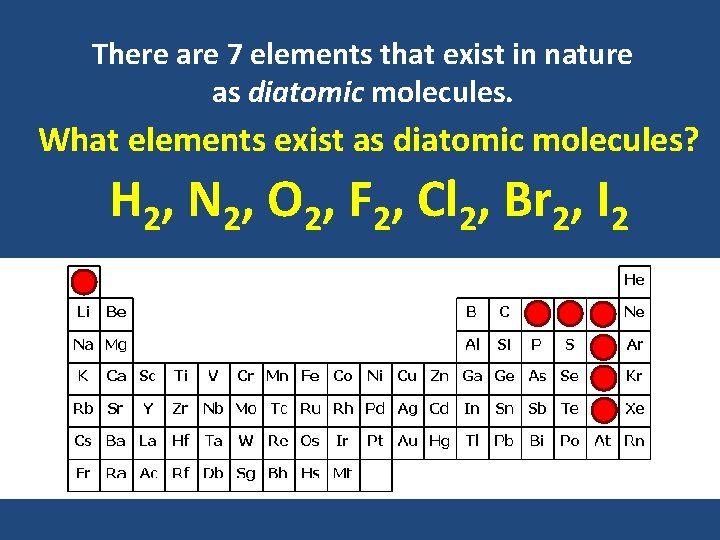
There are 7 elements that exist in nature as diatomic molecules. What elements exist as diatomic molecules? H 2, N 2, O 2, F 2, Cl 2, Br 2, I 2
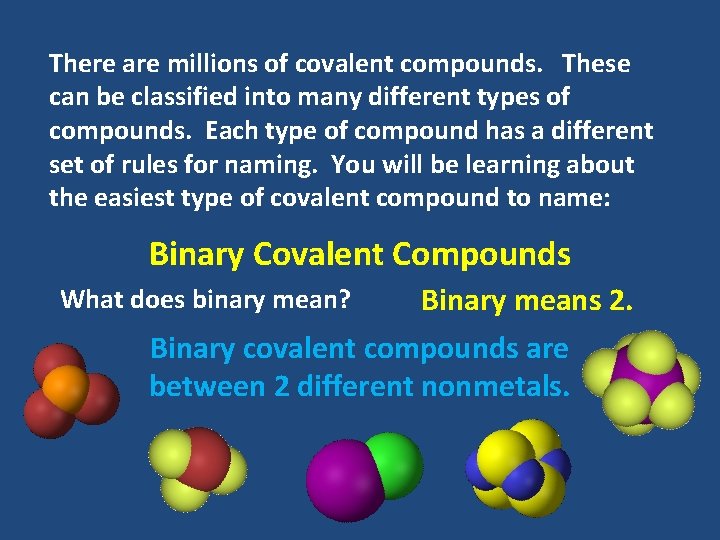
There are millions of covalent compounds. These can be classified into many different types of compounds. Each type of compound has a different set of rules for naming. You will be learning about the easiest type of covalent compound to name: Binary Covalent Compounds Binary means 2. Binary covalent compounds are between 2 different nonmetals. What does binary mean?
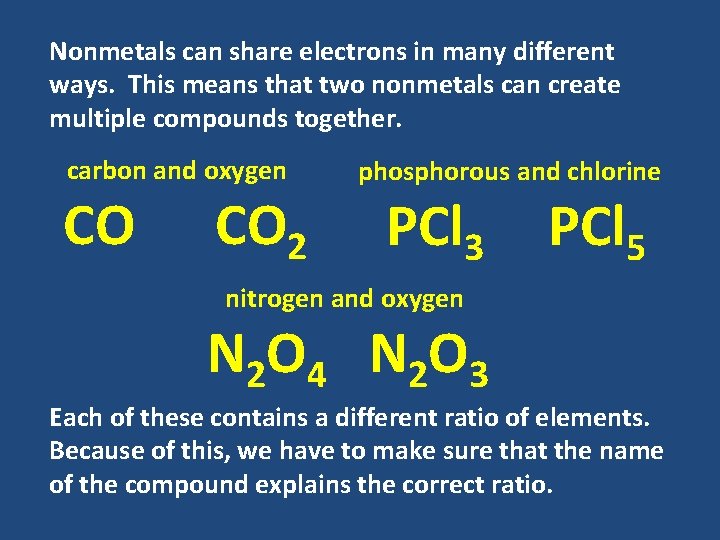
Nonmetals can share electrons in many different ways. This means that two nonmetals can create multiple compounds together. carbon and oxygen CO CO 2 phosphorous and chlorine PCl 3 PCl 5 nitrogen and oxygen N 2 O 4 N 2 O 3 Each of these contains a different ratio of elements. Because of this, we have to make sure that the name of the compound explains the correct ratio.
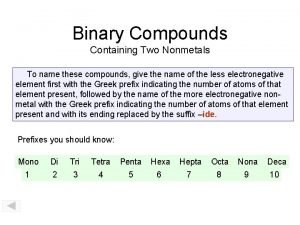
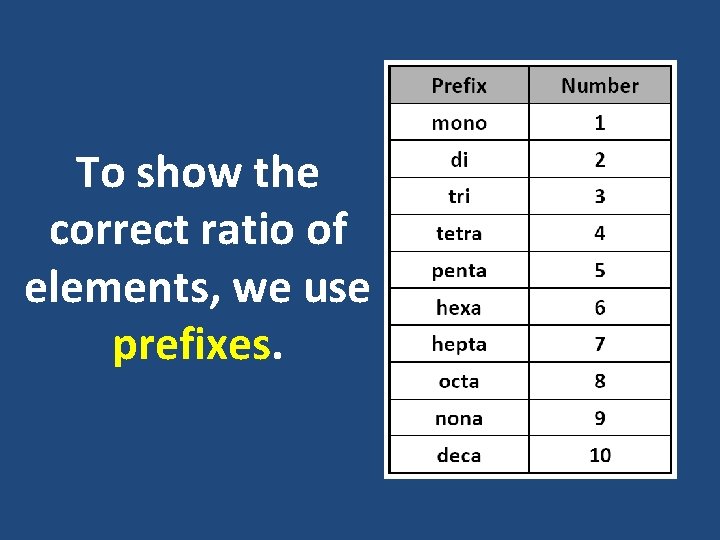
To show the correct ratio of elements, we use prefixes.
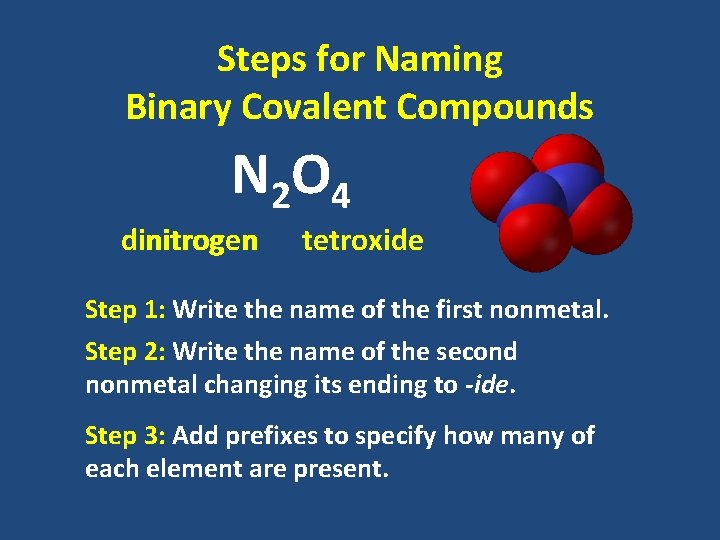
Steps for Naming Binary Covalent Compounds N 2 O 4 dinitrogen tetroxide Step 1: Write the name of the first nonmetal. Step 2: Write the name of the second nonmetal changing its ending to -ide. Step 3: Add prefixes to specify how many of each element are present.
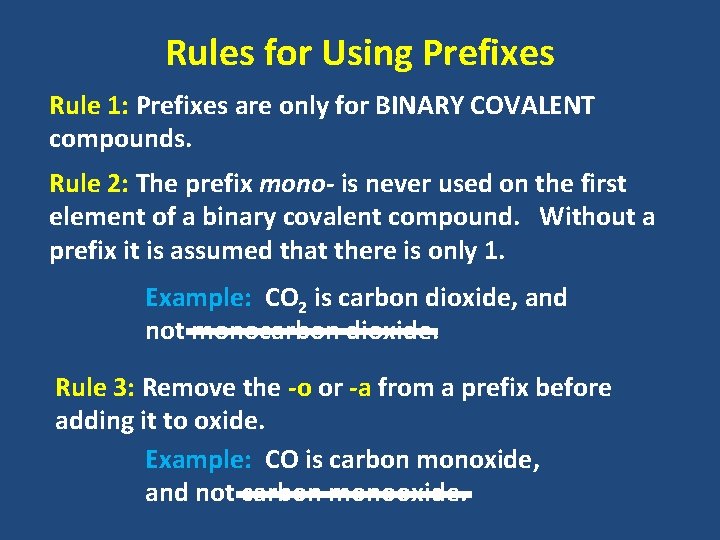
Rules for Using Prefixes Rule 1: Prefixes are only for BINARY COVALENT compounds. Rule 2: The prefix mono- is never used on the first element of a binary covalent compound. Without a prefix it is assumed that there is only 1. Example: CO 2 is carbon dioxide, and not monocarbon dioxide. Rule 3: Remove the -o or -a from a prefix before adding it to oxide. Example: CO is carbon monoxide, and not carbon monooxide.
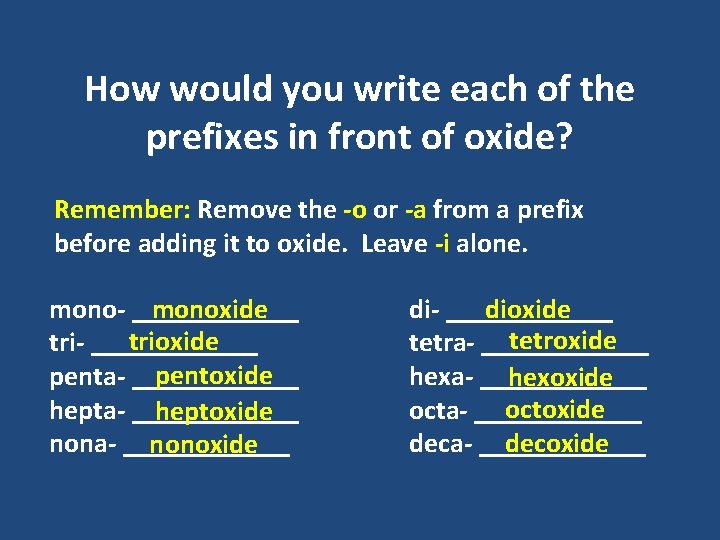
How would you write each of the prefixes in front of oxide? Remember: Remove the -o or -a from a prefix before adding it to oxide. Leave -i alone. mono- ______ monoxide tri- ______ pentoxide penta- ____________ heptoxide nona- ______ nonoxide di- ______ dioxide tetra- ____________ hexoxide octa- ____________ decoxide
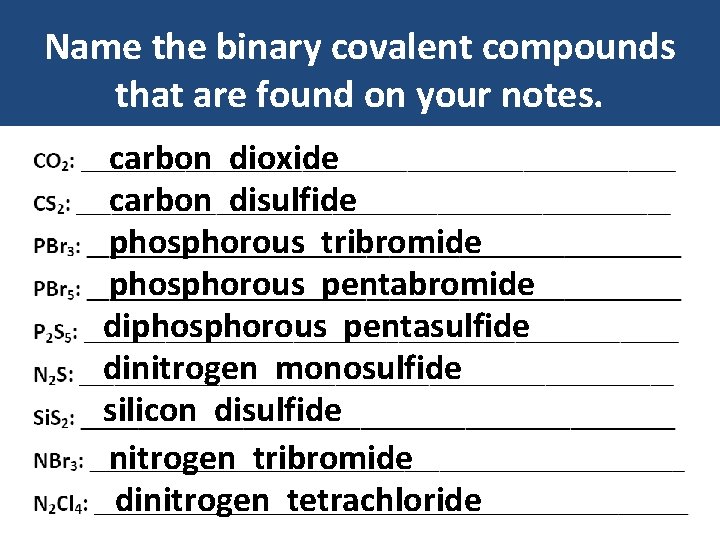
Name the binary covalent compounds that are found on your notes. carbon dioxide carbon disulfide phosphorous tribromide phosphorous pentabromide diphosphorous pentasulfide dinitrogen monosulfide silicon disulfide nitrogen tribromide dinitrogen tetrachloride
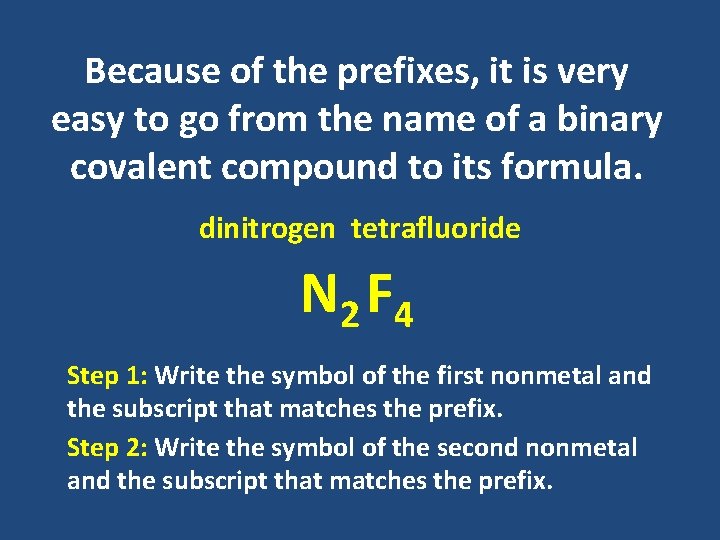
Because of the prefixes, it is very easy to go from the name of a binary covalent compound to its formula. dinitrogen tetrafluoride N 2 F 4 Step 1: Write the symbol of the first nonmetal and the subscript that matches the prefix. Step 2: Write the symbol of the second nonmetal and the subscript that matches the prefix.
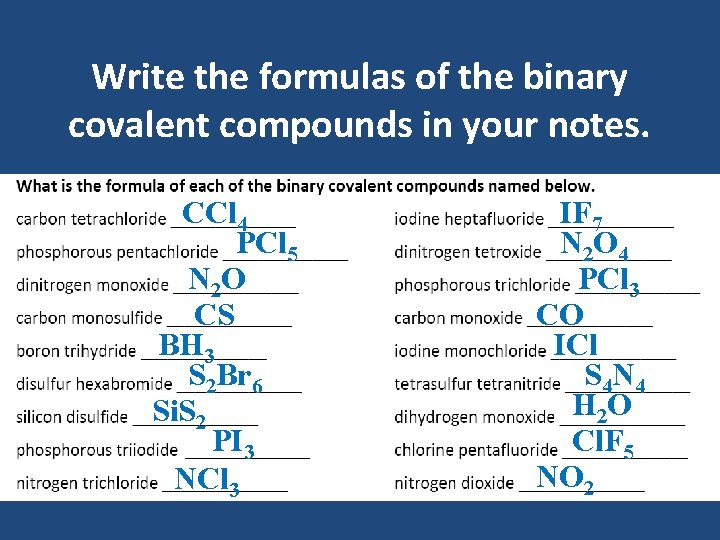
Write the formulas of the binary covalent compounds in your notes. CCl 4 PCl 5 N 2 O CS BH 3 S 2 Br 6 Si. S 2 PI 3 NCl 3 IF 7 N 2 O 4 PCl 3 CO ICl S 4 N 4 H 2 O Cl. F 5 NO 2
Naming Ionic and Covalent Compounds Review
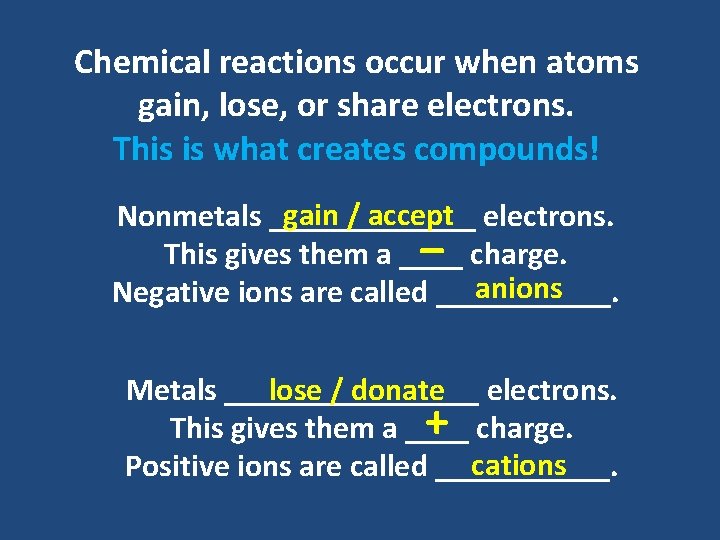
Chemical reactions occur when atoms gain, lose, or share electrons. This is what creates compounds! gain / accept electrons. Nonmetals _______ This gives them a ____ charge. anions Negative ions are called ______. _ Metals ________ lose / donate electrons. + charge. This gives them a ____ cations Positive ions are called ______.
What elements do ionic compounds contain? Ionic compounds contain a metal and a nonmetal. Nonmetals Metals
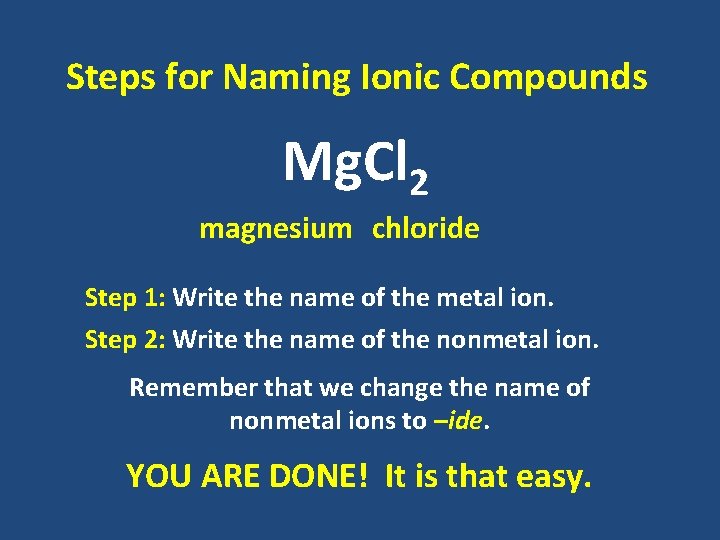
Steps for Naming Ionic Compounds Mg. Cl 2 magnesium chloride Step 1: Write the name of the metal ion. Step 2: Write the name of the nonmetal ion. Remember that we change the name of nonmetal ions to –ide. YOU ARE DONE! It is that easy.
Nonmetals shared electrons Chemical reactions occur when atoms gain, lose, or share electrons. Sharing electrons creates a covalent bond Nonmetals can _______ share electrons to form a covalent bond. molecule This creates a ______.
What elements do covalent compounds contain? Covalent compounds contain only nonmetals. Nonmetals
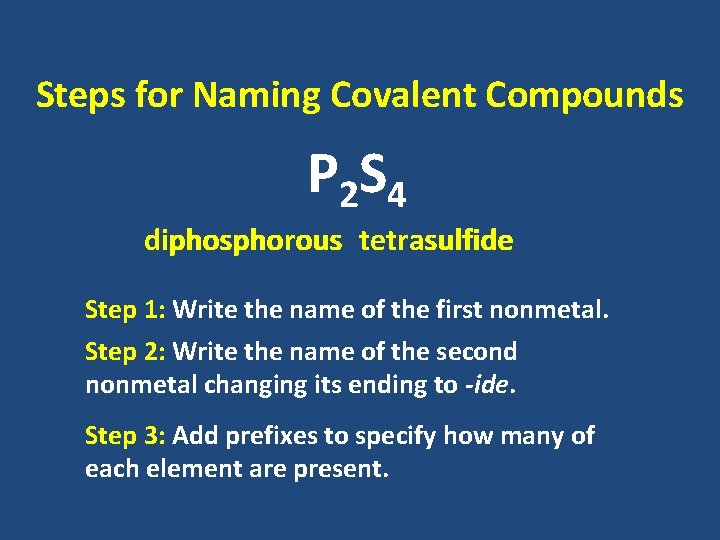
Steps for Naming Covalent Compounds P 2 S 4 phosphorous tetrasulfide diphosphorous Step 1: Write the name of the first nonmetal. Step 2: Write the name of the second nonmetal changing its ending to -ide. Step 3: Add prefixes to specify how many of each element are present.
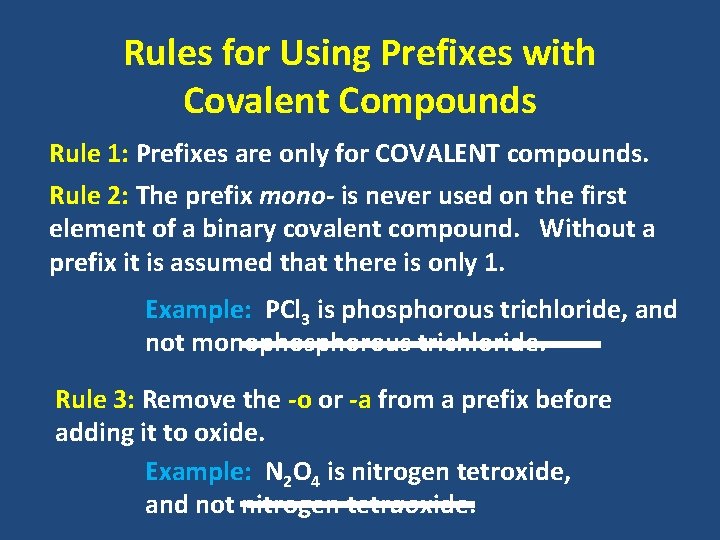
Rules for Using Prefixes with Covalent Compounds Rule 1: Prefixes are only for COVALENT compounds. Rule 2: The prefix mono- is never used on the first element of a binary covalent compound. Without a prefix it is assumed that there is only 1. Example: PCl 3 is phosphorous trichloride, and not monophosphorous trichloride. Rule 3: Remove the -o or -a from a prefix before adding it to oxide. Example: N 2 O 4 is nitrogen tetroxide, and not nitrogen tetraoxide.
Determining if a compound is ionic or covalent is easy. What elements do ionic compounds contain? Ionic compounds contain a metal and a nonmetal. What elements do covalent compounds contain? Covalent compounds contain only nonmetals.
Decide whether the compounds on your notes are ionic or covalent. I C C C I I I C I I
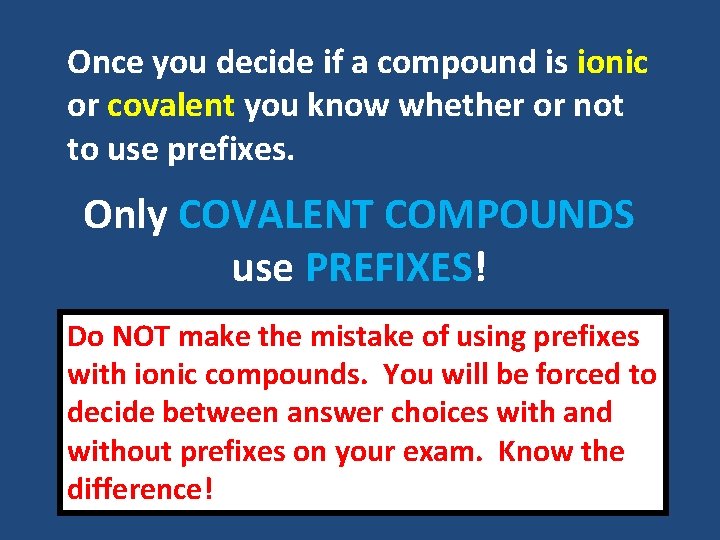
Once you decide if a compound is ionic or covalent you know whether or not to use prefixes. Only COVALENT COMPOUNDS use PREFIXES! Do NOT make the mistake of using prefixes with ionic compounds. You will be forced to decide between answer choices with and without prefixes on your exam. Know the difference!
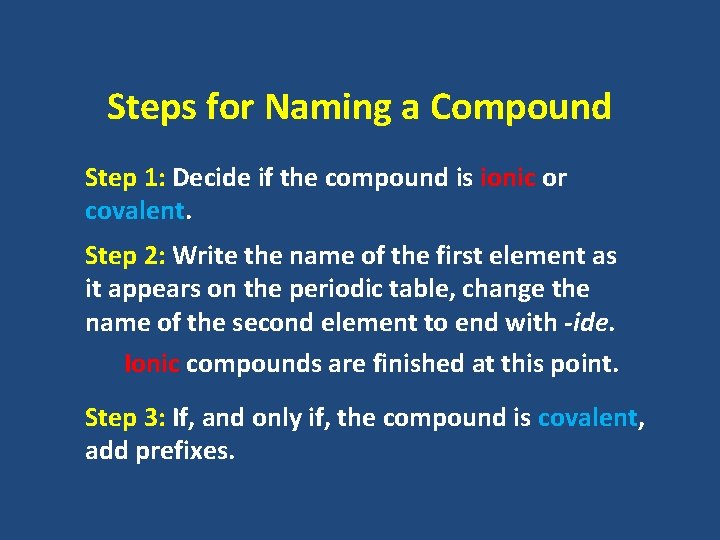
Steps for Naming a Compound Step 1: Decide if the compound is ionic or covalent. Step 2: Write the name of the first element as it appears on the periodic table, change the name of the second element to end with -ide. Ionic compounds are finished at this point. Step 3: If, and only if, the compound is covalent, add prefixes.
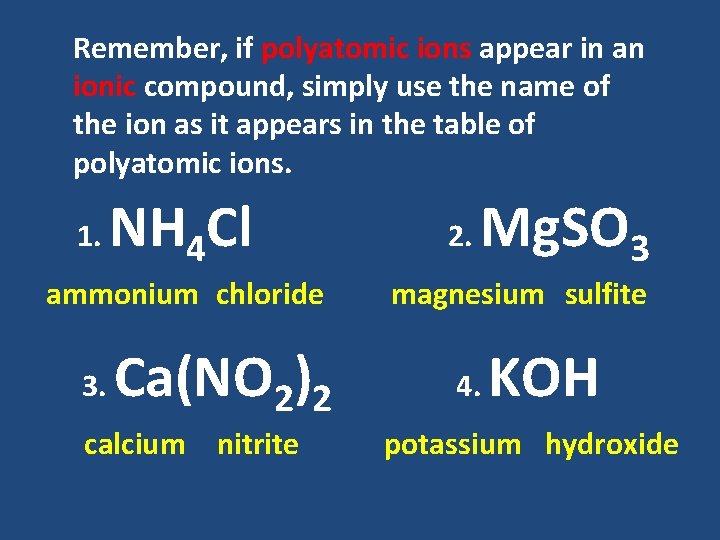
Remember, if polyatomic ions appear in an ionic compound, simply use the name of the ion as it appears in the table of polyatomic ions. 1. NH 4 Cl ammonium chloride 3. Ca(NO 2)2 calcium nitrite 2. Mg. SO 3 magnesium sulfite 4. KOH potassium hydroxide
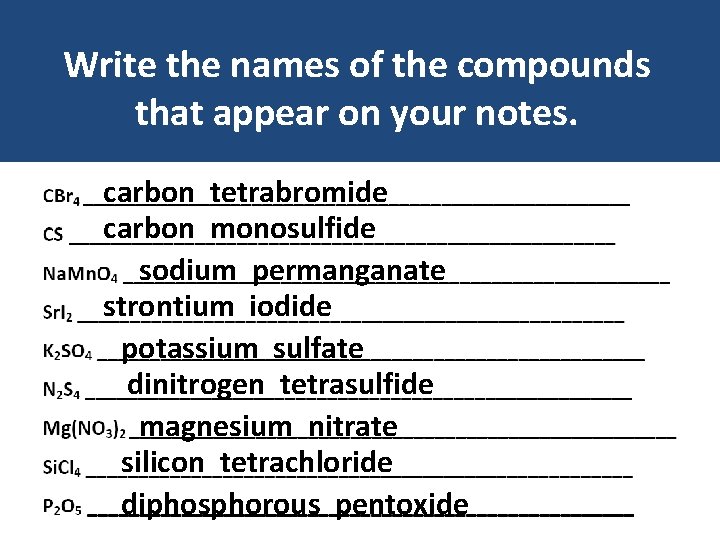
Write the names of the compounds that appear on your notes. carbon tetrabromide carbon monosulfide sodium permanganate strontium iodide potassium sulfate dinitrogen tetrasulfide magnesium nitrate silicon tetrachloride diphosphorous pentoxide
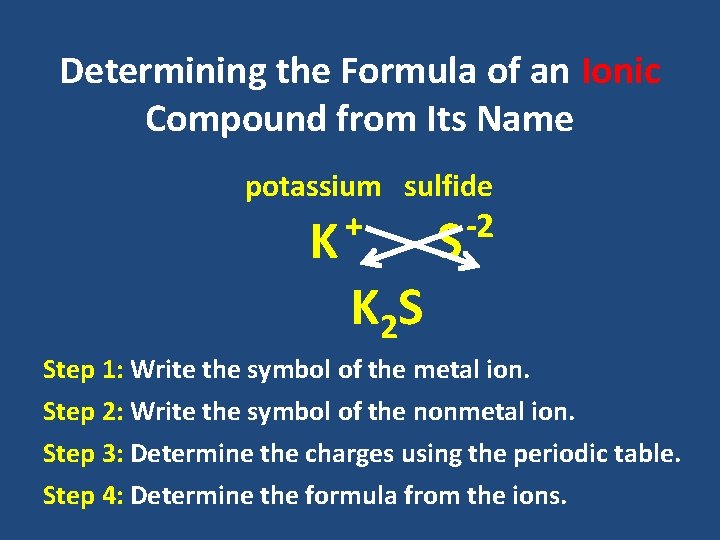
Determining the Formula of an Ionic Compound from Its Name potassium sulfide K + S -2 K 2 S Step 1: Write the symbol of the metal ion. Step 2: Write the symbol of the nonmetal ion. Step 3: Determine the charges using the periodic table. Step 4: Determine the formula from the ions.
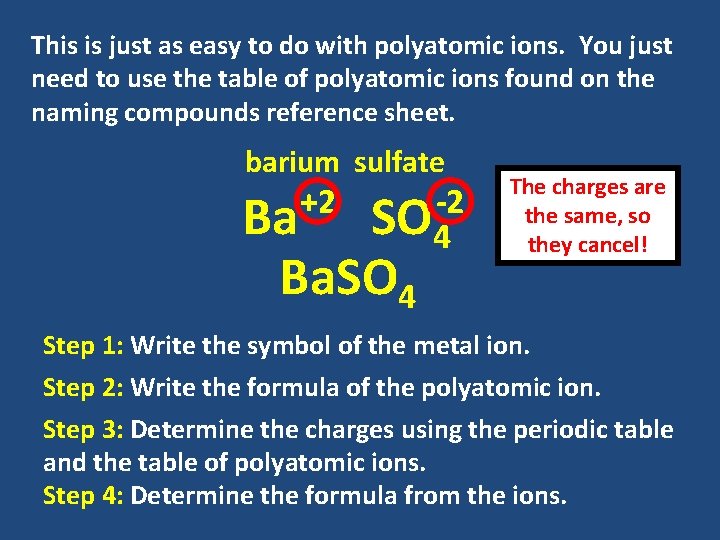
This is just as easy to do with polyatomic ions. You just need to use the table of polyatomic ions found on the naming compounds reference sheet. barium sulfate +2 -2 SO 4 Ba Ba. SO 4 The charges are the same, so they cancel! Step 1: Write the symbol of the metal ion. Step 2: Write the formula of the polyatomic ion. Step 3: Determine the charges using the periodic table and the table of polyatomic ions. Step 4: Determine the formula from the ions.
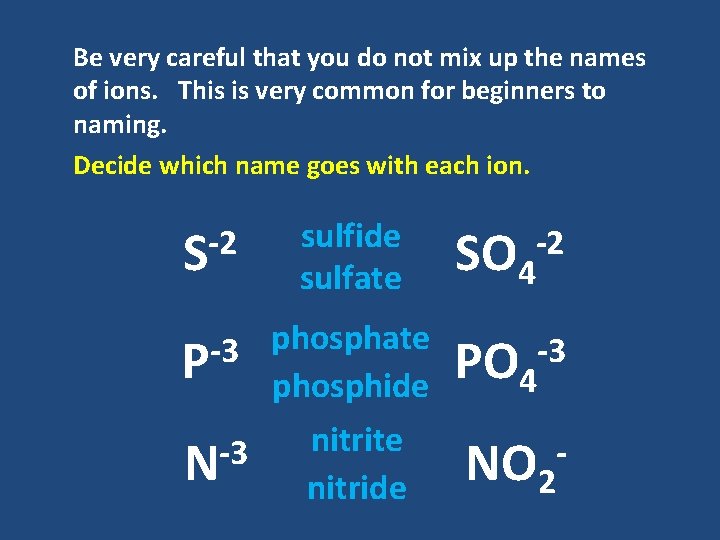
Be very careful that you do not mix up the names of ions. This is very common for beginners to naming. Decide which name goes with each ion. -2 S sulfide sulfate phosphate -3 P phosphide -3 N nitrite nitride SO 4 -2 PO 4 -3 NO 2 -
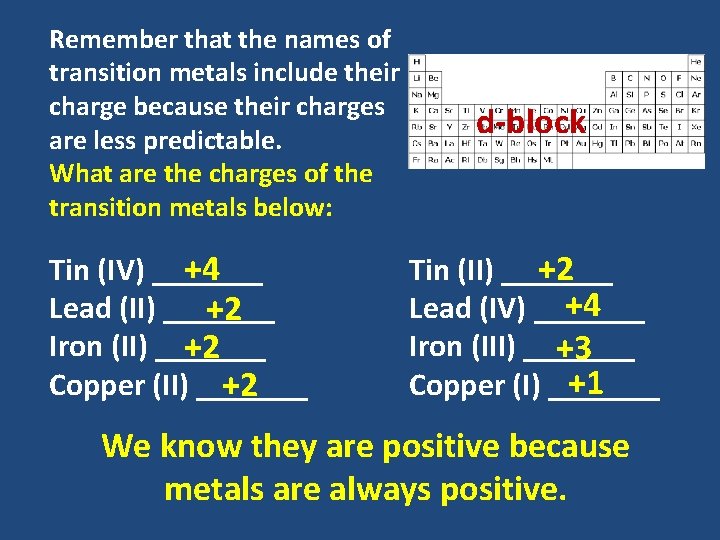
Remember that the names of transition metals include their charge because their charges are less predictable. What are the charges of the transition metals below: Tin (IV) _______ +4 Lead (II) _______ +2 Iron (II) _______ +2 Copper (II) _______ +2 d-block Tin (II) _______ +2 +4 Lead (IV) _______ Iron (III) _______ +3 +1 Copper (I) _______ We know they are positive because metals are always positive.
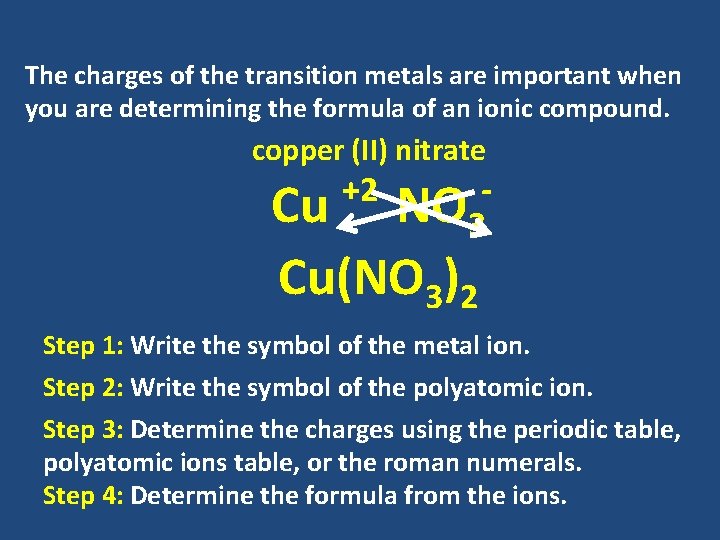
The charges of the transition metals are important when you are determining the formula of an ionic compound. copper (II) nitrate +2 NO 3 Cu Cu(NO 3)2 Step 1: Write the symbol of the metal ion. Step 2: Write the symbol of the polyatomic ion. Step 3: Determine the charges using the periodic table, polyatomic ions table, or the roman numerals. Step 4: Determine the formula from the ions.
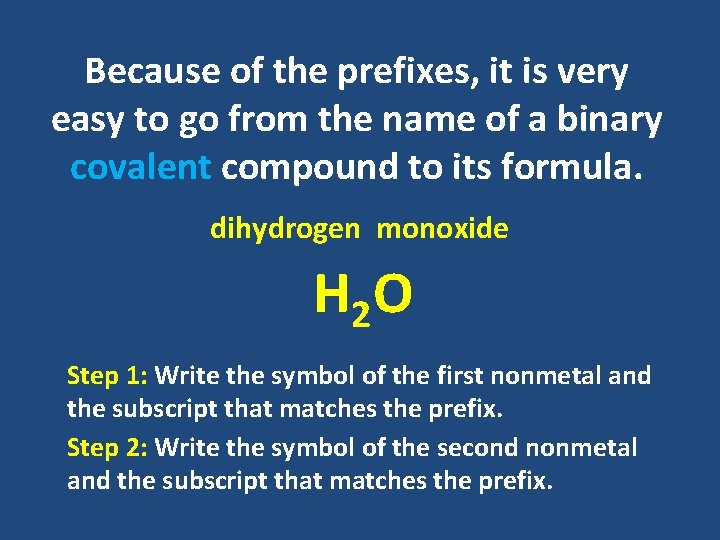
Because of the prefixes, it is very easy to go from the name of a binary covalent compound to its formula. dihydrogen monoxide H 2 O Step 1: Write the symbol of the first nonmetal and the subscript that matches the prefix. Step 2: Write the symbol of the second nonmetal and the subscript that matches the prefix.
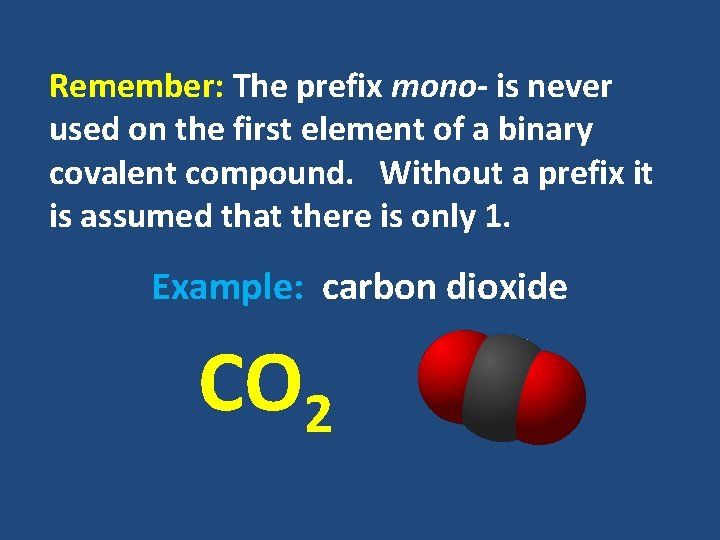
Remember: The prefix mono- is never used on the first element of a binary covalent compound. Without a prefix it is assumed that there is only 1. Example: carbon dioxide CO 2
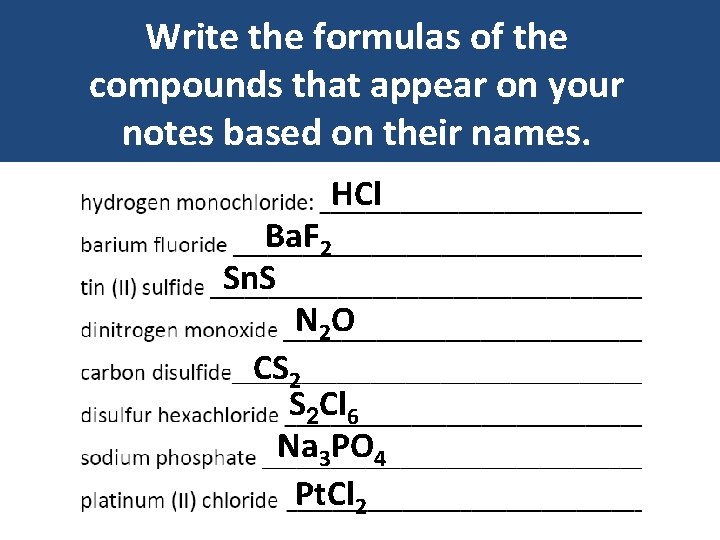
Write the formulas of the compounds that appear on your notes based on their names. HCl Ba. F 2 Sn. S N 2 O CS 2 S 2 Cl 6 Na 3 PO 4 Pt. Cl 2