
NAMING COMPOUNDS TYPES OF COMPOUNDS Molecular compound covalent







- Slides: 50
NAMING COMPOUNDS
TYPES OF COMPOUNDS Molecular compound (covalent bonds) Compound made of two nonmetals NBr 5 Ionic compound Compound made of a metal and a nonmetal Na. Cl Acid (ionic bonds) Compound that can donate a hydrogen ion HCl
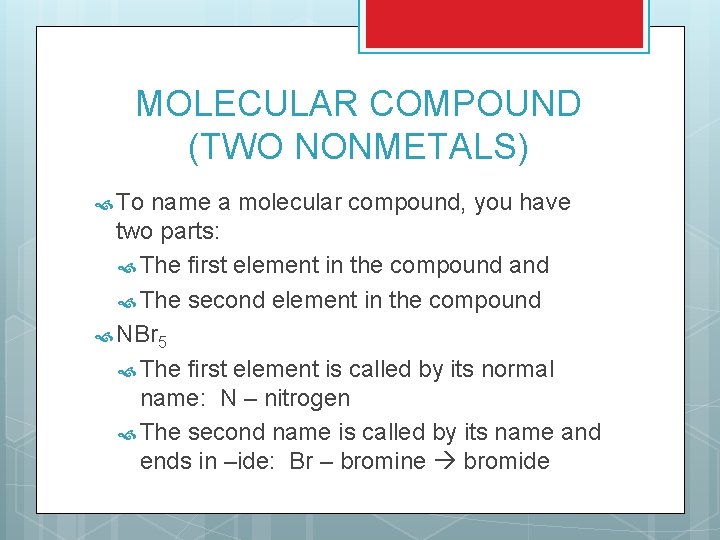
MOLECULAR COMPOUND (TWO NONMETALS) To name a molecular compound, you have two parts: The first element in the compound and The second element in the compound NBr 5 The first element is called by its normal name: N – nitrogen The second name is called by its name and ends in –ide: Br – bromine bromide
PREFIXES In addition to naming the elements, you have to name how many they are. To do this you need prefixes. The prefix goes in the front of the name of the element
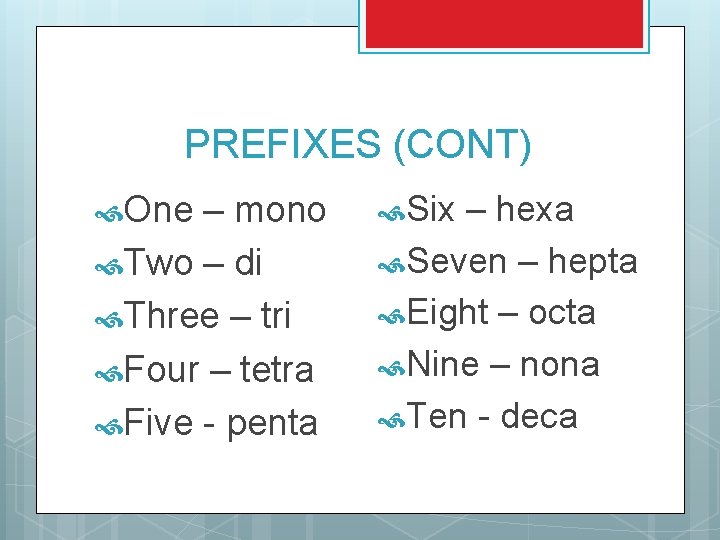
PREFIXES (CONT) One – mono Two – di Three – tri Four – tetra Five - penta Six – hexa Seven – hepta Eight – octa Nine – nona Ten - deca
MOLECULAR COMPOUND (CONT) Therefore if you start with NBr 5: Mononitrogen pentabromide BUT wait, if you only have one element in the beginning part of the compound, you don’t have to put the prefix: Nitrogen pentabromide
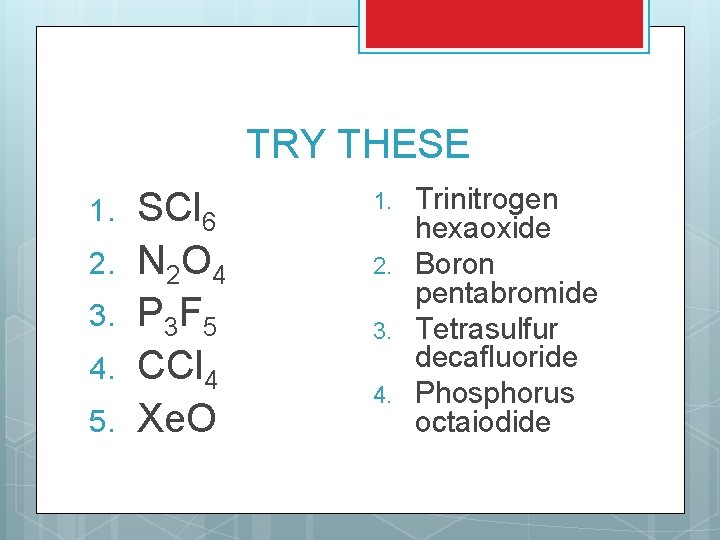
TRY THESE 1. 2. 3. 4. 5. SCl 6 N 2 O 4 P 3 F 5 CCl 4 Xe. O 1. 2. 3. 4. Trinitrogen hexaoxide Boron pentabromide Tetrasulfur decafluoride Phosphorus octaiodide
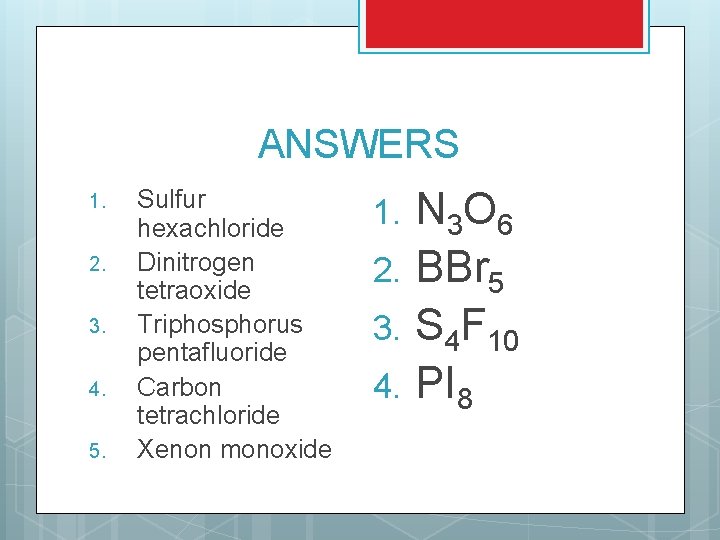
ANSWERS 1. 2. 3. 4. 5. Sulfur hexachloride Dinitrogen tetraoxide Triphosphorus pentafluoride Carbon tetrachloride Xenon monoxide 1. 2. 3. 4. N 3 O 6 BBr 5 S 4 F 10 PI 8
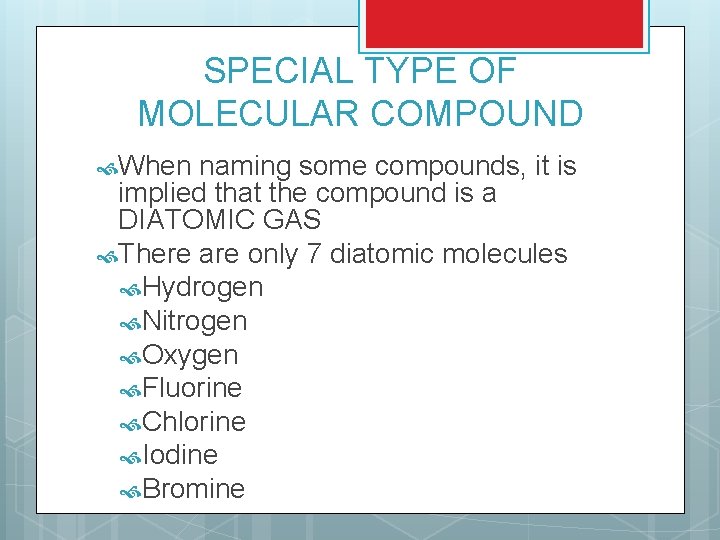
SPECIAL TYPE OF MOLECULAR COMPOUND When naming some compounds, it is implied that the compound is a DIATOMIC GAS There are only 7 diatomic molecules Hydrogen Nitrogen Oxygen Fluorine Chlorine Iodine Bromine
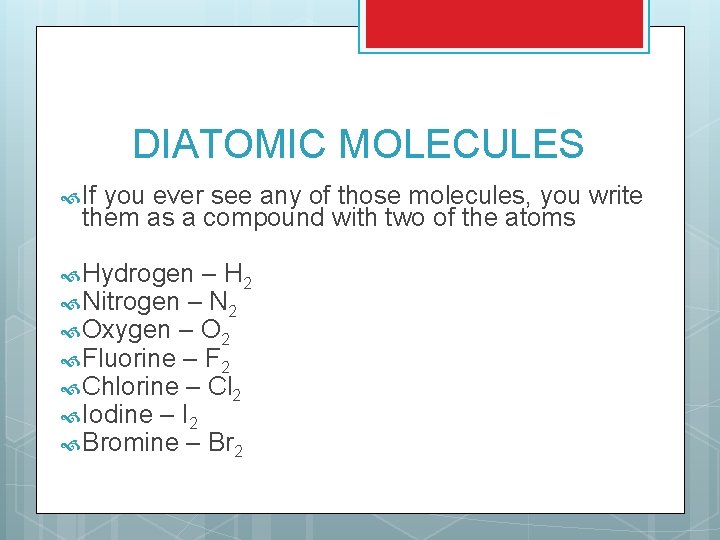
DIATOMIC MOLECULES If you ever see any of those molecules, you write them as a compound with two of the atoms Hydrogen – H 2 Nitrogen – N 2 Oxygen – O 2 Fluorine – F 2 Chlorine – Cl 2 Iodine – I 2 Bromine – Br 2
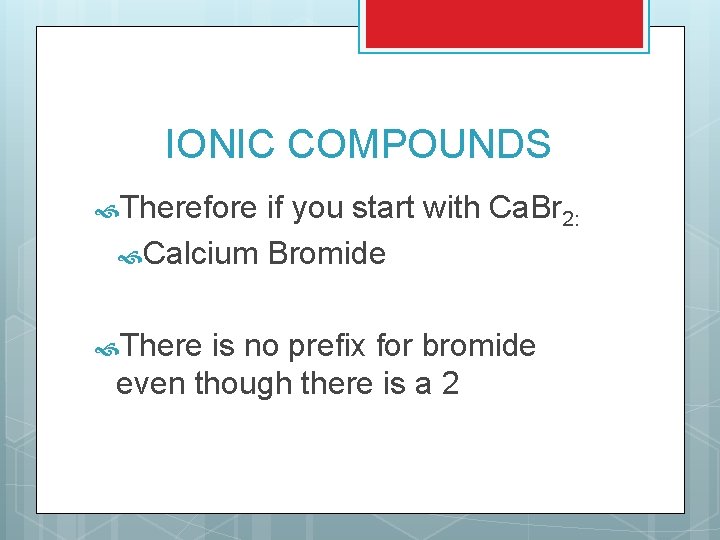
IONIC COMPOUNDS (METAL AND NONMETAL) The two parts of naming an ionic compound: The first element is always the metal The second element is the nonmetal Ca. Br 2 The first element is called by its normal name: Ca Calcium The second element is named like a molecular compound: Br bromide The only difference is that you do not use a prefix ever
IONIC COMPOUNDS Therefore if you start with Ca. Br 2: Calcium Bromide There is no prefix for bromide even though there is a 2
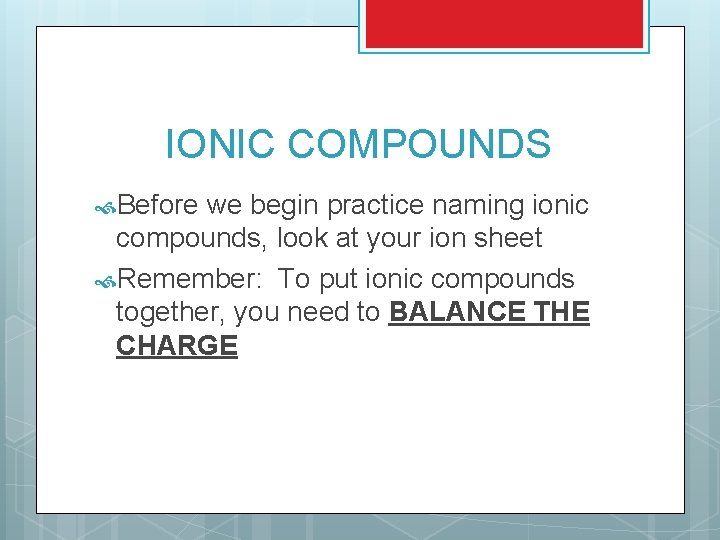
IONIC COMPOUNDS Before we begin practice naming ionic compounds, look at your ion sheet Remember: To put ionic compounds together, you need to BALANCE THE CHARGE
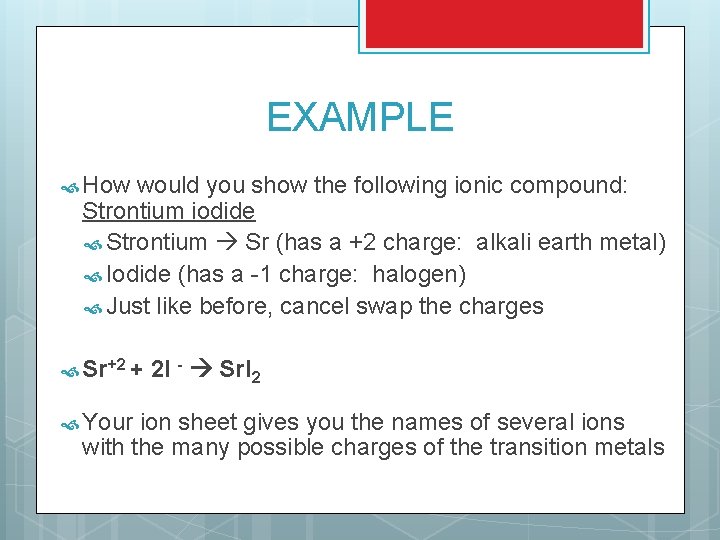
EXAMPLE How would you show the following ionic compound: Strontium iodide Strontium Sr (has a +2 charge: alkali earth metal) Iodide (has a -1 charge: halogen) Just like before, cancel swap the charges Sr+2 + Your 2 I - Sr. I 2 ion sheet gives you the names of several ions with the many possible charges of the transition metals
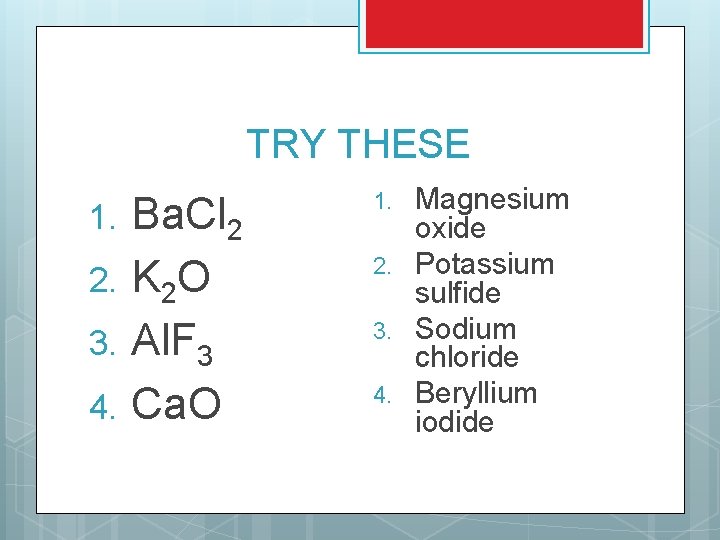
TRY THESE 1. 2. 3. 4. Ba. Cl 2 K 2 O Al. F 3 Ca. O 1. 2. 3. 4. Magnesium oxide Potassium sulfide Sodium chloride Beryllium iodide
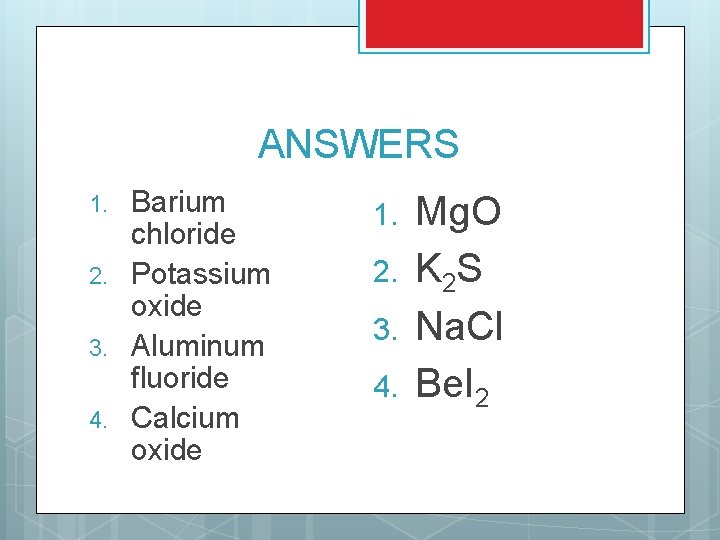
ANSWERS 1. 2. 3. 4. Barium chloride Potassium oxide Aluminum fluoride Calcium oxide 1. 2. 3. 4. Mg. O K 2 S Na. Cl Be. I 2
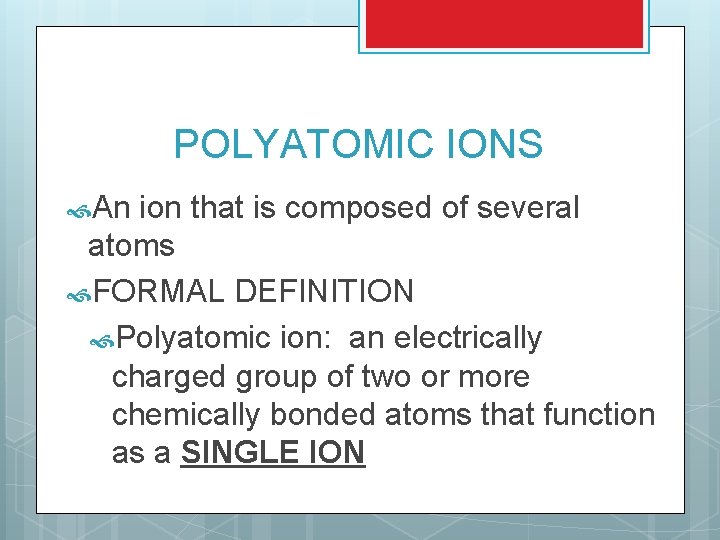
POLYATOMIC IONS An ion that is composed of several atoms FORMAL DEFINITION Polyatomic ion: an electrically charged group of two or more chemically bonded atoms that function as a SINGLE ION
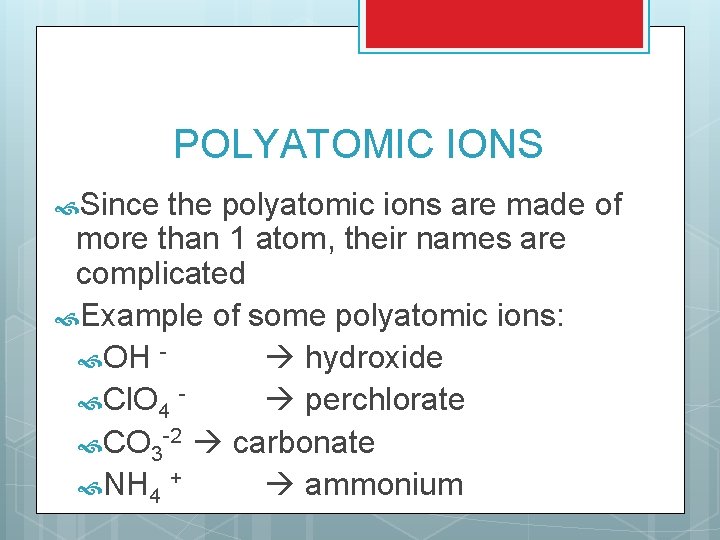
POLYATOMIC IONS Since the polyatomic ions are made of more than 1 atom, their names are complicated Example of some polyatomic ions: OH hydroxide Cl. O 4 perchlorate CO 3 -2 carbonate NH 4 + ammonium
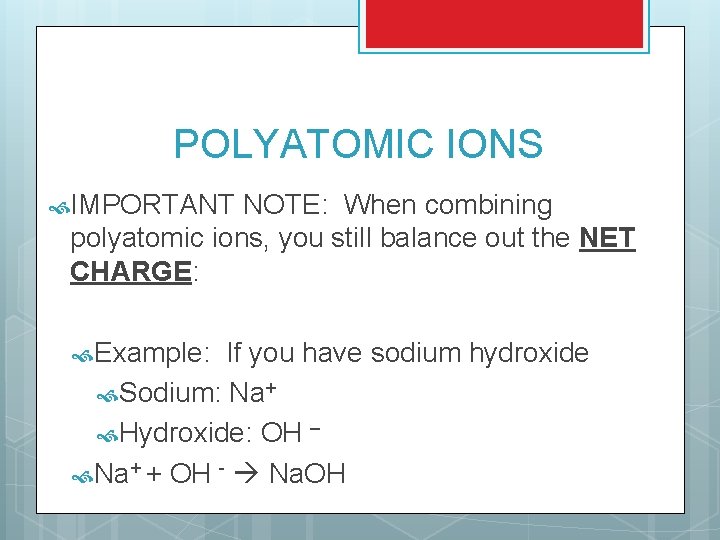
POLYATOMIC IONS IMPORTANT NOTE: When combining polyatomic ions, you still balance out the NET CHARGE: Example: If you have sodium hydroxide Sodium: Na+ Hydroxide: OH – Na+ + OH - Na. OH
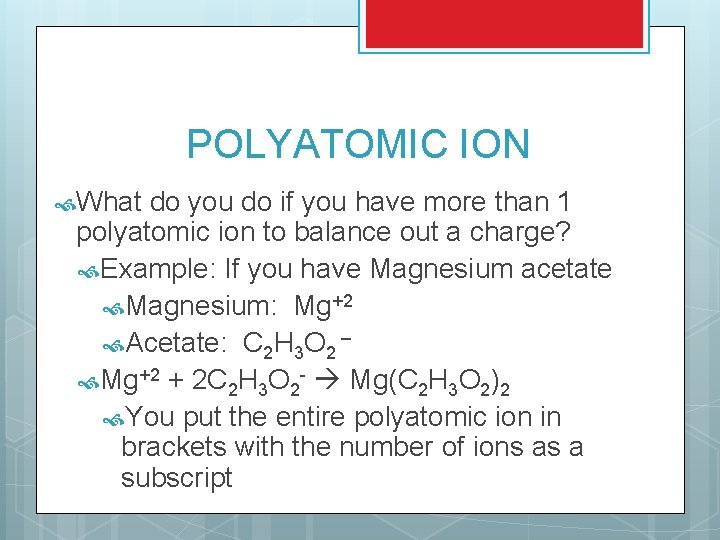
POLYATOMIC ION What do you do if you have more than 1 polyatomic ion to balance out a charge? Example: If you have Magnesium acetate Magnesium: Mg+2 Acetate: C 2 H 3 O 2 – Mg+2 + 2 C 2 H 3 O 2 - Mg(C 2 H 3 O 2)2 You put the entire polyatomic ion in brackets with the number of ions as a subscript
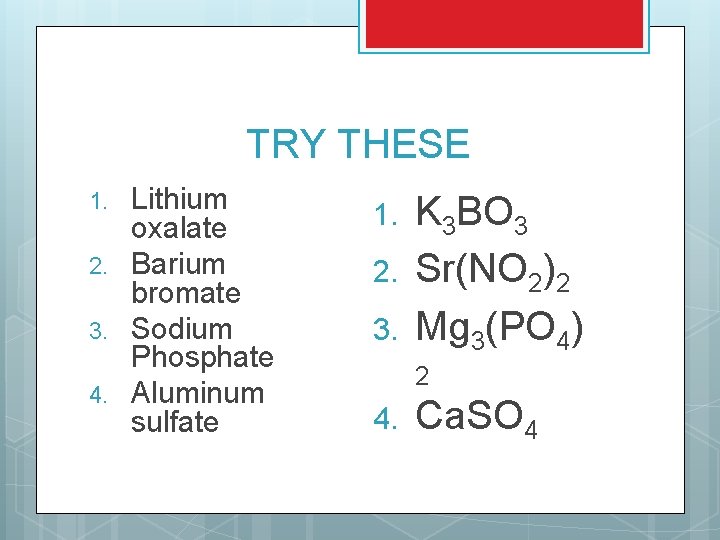
TRY THESE 1. 2. 3. 4. Lithium oxalate Barium bromate Sodium Phosphate Aluminum sulfate 1. 2. 3. K 3 BO 3 Sr(NO 2)2 Mg 3(PO 4) 2 4. Ca. SO 4
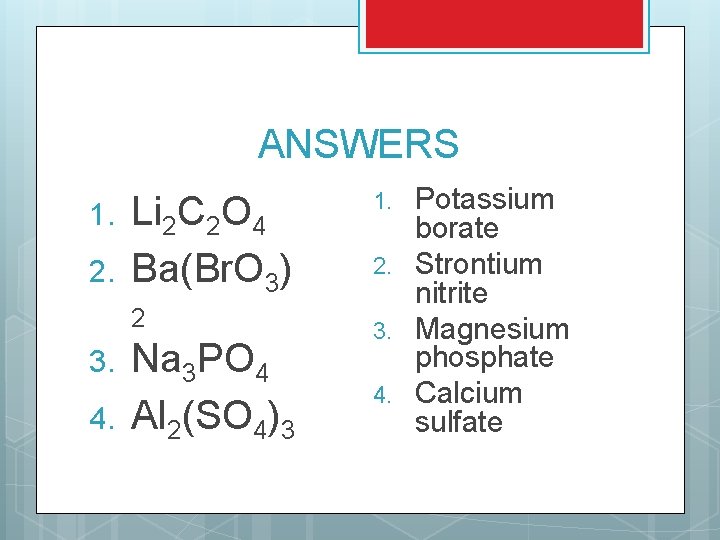
ANSWERS 1. 2. Li 2 C 2 O 4 Ba(Br. O 3) 2 3. 4. Na 3 PO 4 Al 2(SO 4)3 1. 2. 3. 4. Potassium borate Strontium nitrite Magnesium phosphate Calcium sulfate
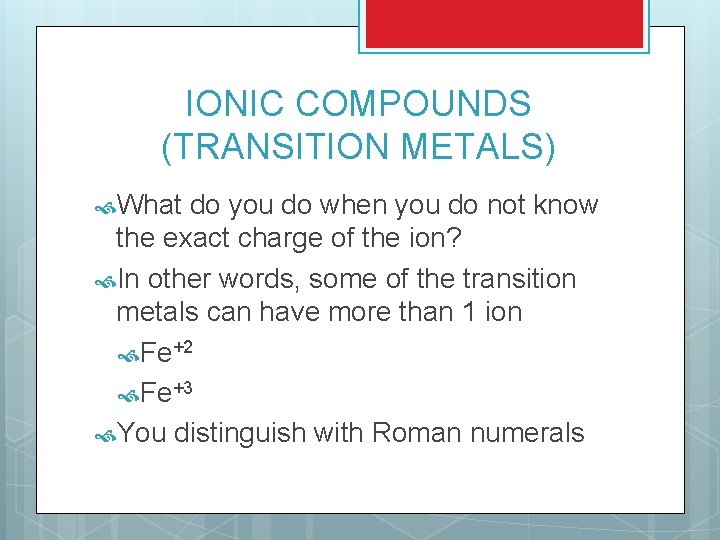
IONIC COMPOUNDS (TRANSITION METALS) What do you do when you do not know the exact charge of the ion? In other words, some of the transition metals can have more than 1 ion Fe+2 Fe+3 You distinguish with Roman numerals
IONIC COMPOUNDS (TRANSITION METALS) Solution: The name of the compound tells you the charge. If you have a compound of iron and oxygen, an example would be: Iron (III) oxide This means that iron has a +3 charge 2 Fe+3 + 3 O-2 Fe 2 O 3
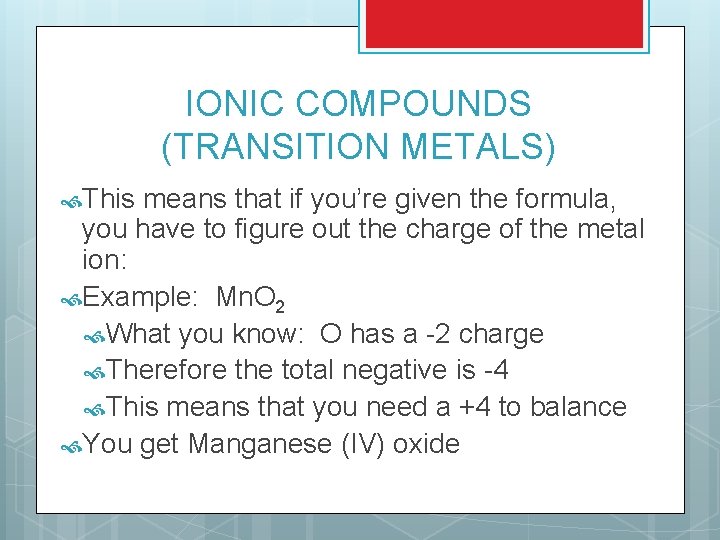
IONIC COMPOUNDS (TRANSITION METALS) This means that if you’re given the formula, you have to figure out the charge of the metal ion: Example: Mn. O 2 What you know: O has a -2 charge Therefore the total negative is -4 This means that you need a +4 to balance You get Manganese (IV) oxide
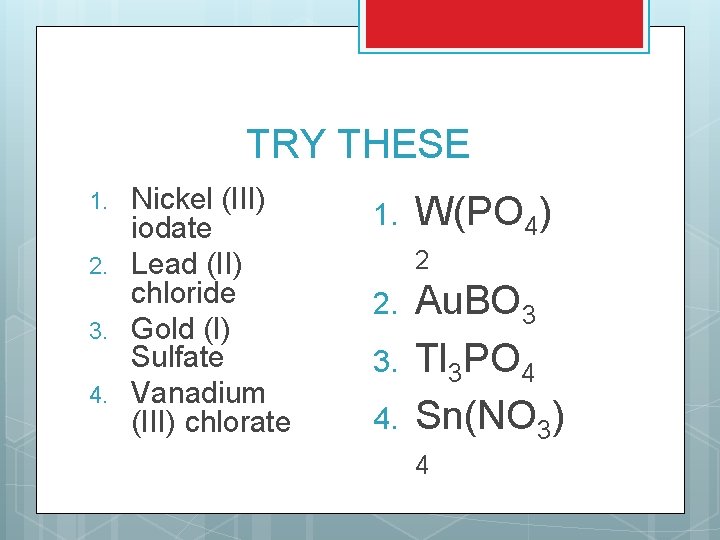
TRY THESE 1. 2. 3. 4. Nickel (III) iodate Lead (II) chloride Gold (I) Sulfate Vanadium (III) chlorate 1. W(PO 4) 2 2. 3. 4. Au. BO 3 Tl 3 PO 4 Sn(NO 3) 4
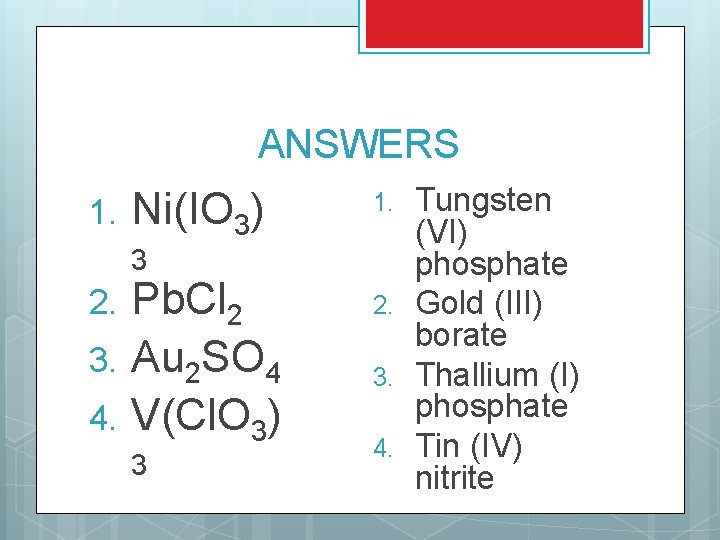
ANSWERS 1. Ni(IO 3) 1. 3 2. 3. 4. Pb. Cl 2 Au 2 SO 4 V(Cl. O 3) 3 2. 3. 4. Tungsten (VI) phosphate Gold (III) borate Thallium (I) phosphate Tin (IV) nitrite
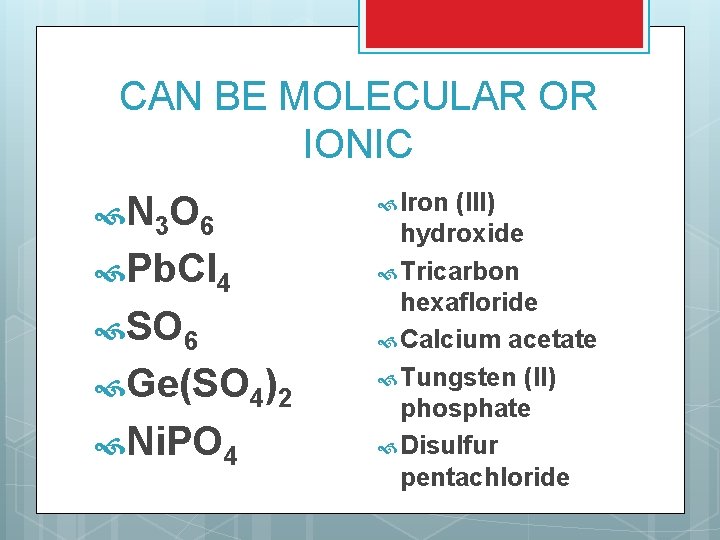
CAN BE MOLECULAR OR IONIC N 3 O 6 Pb. Cl 4 SO 6 Ge(SO 4)2 Ni. PO 4 Iron (III) hydroxide Tricarbon hexafloride Calcium acetate Tungsten (II) phosphate Disulfur pentachloride
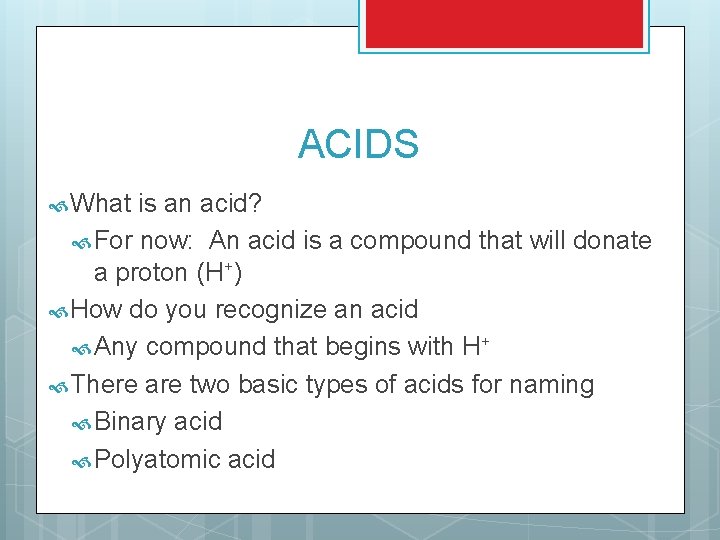
ACIDS What is an acid? For now: An acid is a compound that will donate a proton (H+) How do you recognize an acid Any compound that begins with H+ There are two basic types of acids for naming Binary acid Polyatomic acid
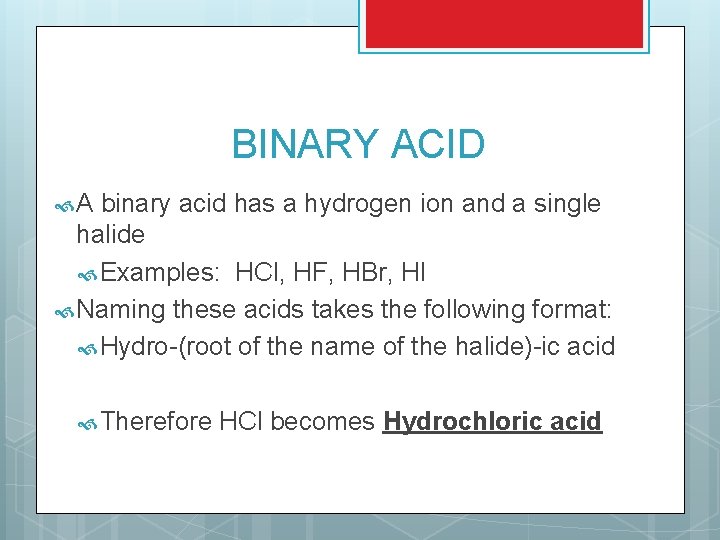
BINARY ACID A binary acid has a hydrogen ion and a single halide Examples: HCl, HF, HBr, HI Naming these acids takes the following format: Hydro-(root of the name of the halide)-ic acid Therefore HCl becomes Hydrochloric acid
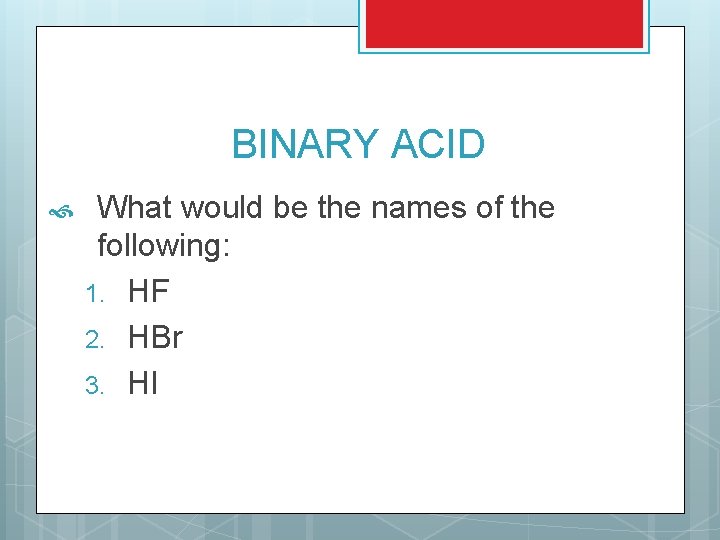
BINARY ACID What would be the names of the following: 1. HF 2. HBr 3. HI
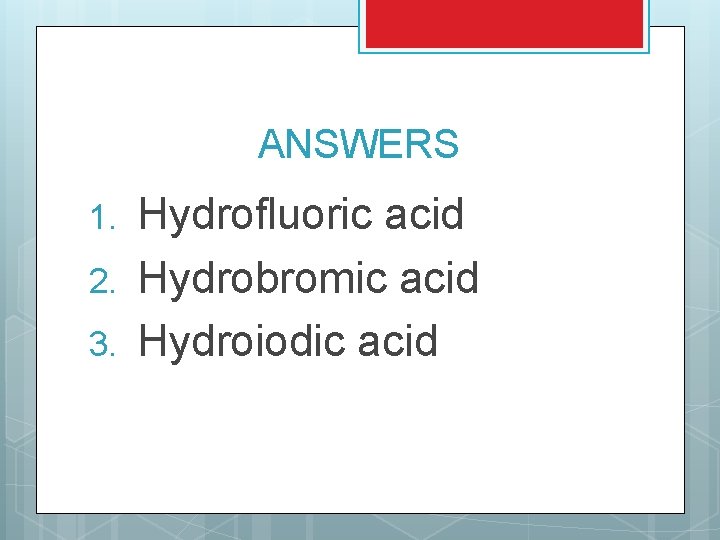
ANSWERS 1. 2. 3. Hydrofluoric acid Hydrobromic acid Hydroiodic acid
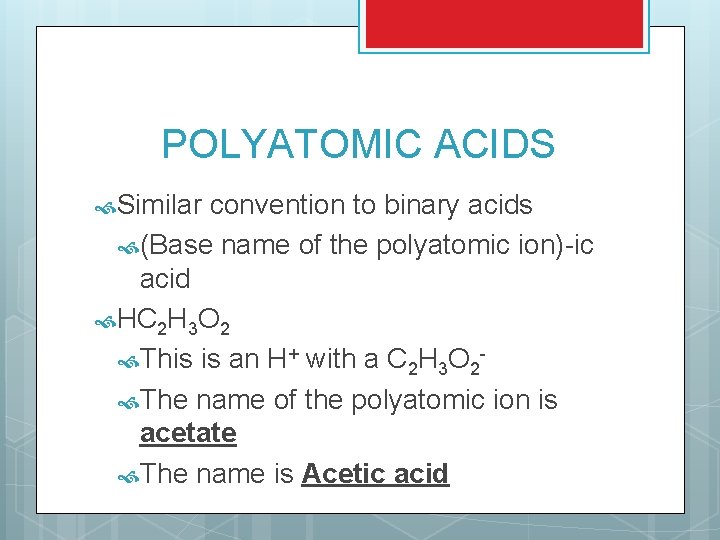
POLYATOMIC ACIDS Similar convention to binary acids (Base name of the polyatomic ion)-ic acid HC 2 H 3 O 2 This is an H+ with a C 2 H 3 O 2 The name of the polyatomic ion is acetate The name is Acetic acid
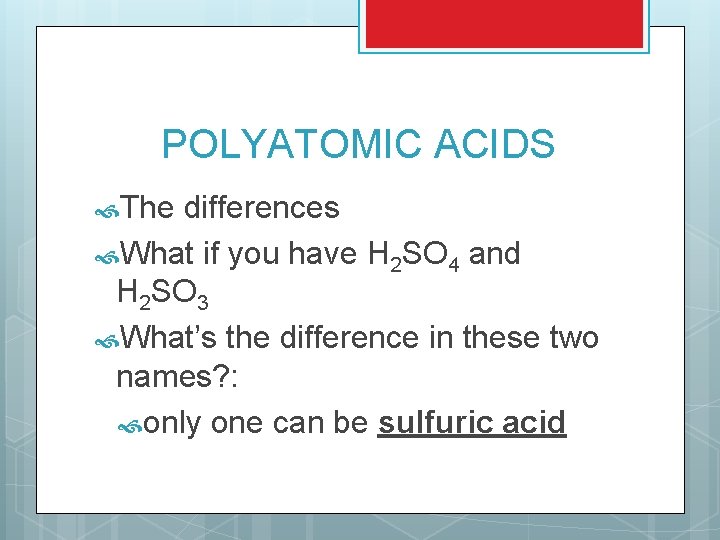
POLYATOMIC ACIDS The differences What if you have H 2 SO 4 and H 2 SO 3 What’s the difference in these two names? : only one can be sulfuric acid
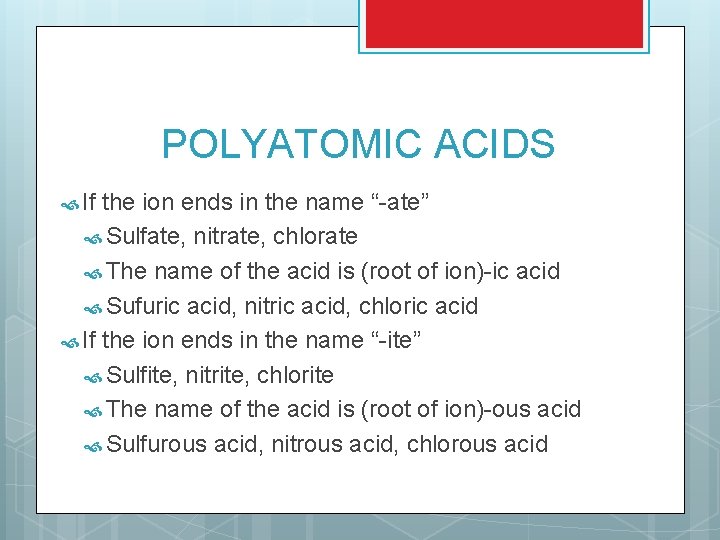
POLYATOMIC ACIDS If the ion ends in the name “-ate” Sulfate, nitrate, chlorate The name of the acid is (root of ion)-ic acid Sufuric acid, nitric acid, chloric acid If the ion ends in the name “-ite” Sulfite, nitrite, chlorite The name of the acid is (root of ion)-ous acid Sulfurous acid, nitrous acid, chlorous acid
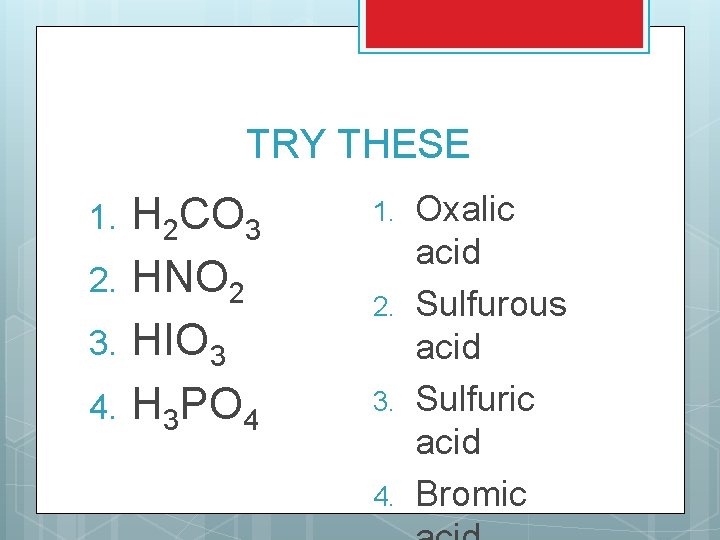
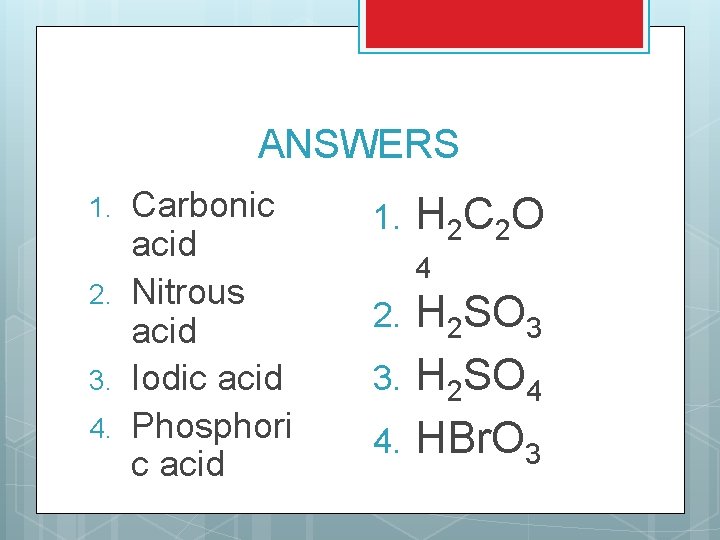
TRY THESE 1. 2. 3. 4. H 2 CO 3 HNO 2 HIO 3 H 3 PO 4 1. 2. 3. 4. Oxalic acid Sulfurous acid Sulfuric acid Bromic
ANSWERS 1. 2. 3. 4. Carbonic acid Nitrous acid Iodic acid Phosphori c acid 1. H 2 C 2 O 4 2. 3. 4. H 2 SO 3 H 2 SO 4 HBr. O 3
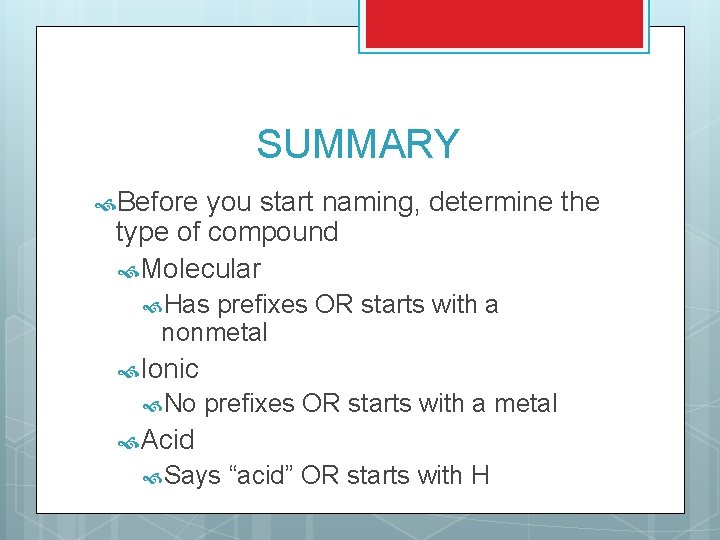
SUMMARY Before you start naming, determine the type of compound Molecular Has prefixes OR starts with a nonmetal Ionic No prefixes OR starts with a metal Acid Says “acid” OR starts with H
INDICATE THE TYPE OF COMPOUND AND NAME H 2 SO 4 Fe(OH)3 Al. Cl 3 HBr Cr 2(SO 4)3 PBr 3 Disulfur hexaoxide Sodium phosphate Gold (I) nitrite Hydrochoric acid Bromic acid Trinitrogen octaiodide Calcium acetate
SUMMARY (CONT) Naming molecular compounds (nonmetal and nonmetal) Name of the first element Base name of the second element + ide Make sure you use the prefix indicating number of atoms
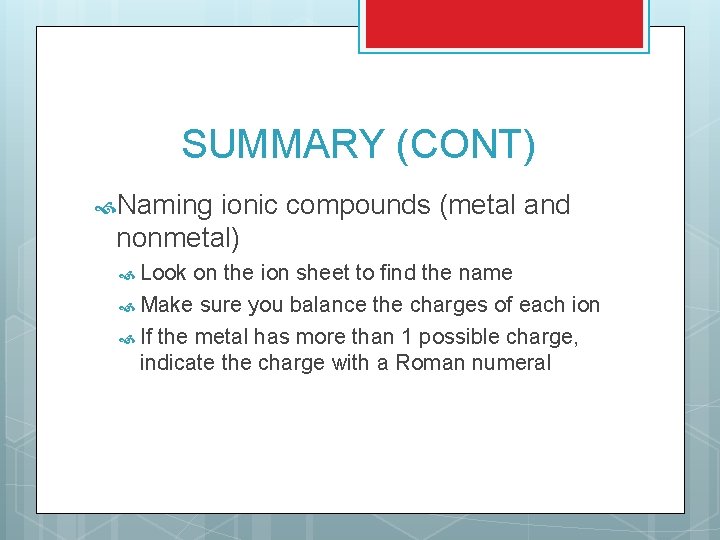
SUMMARY (CONT) Naming ionic compounds (metal and nonmetal) Look on the ion sheet to find the name Make sure you balance the charges of each ion If the metal has more than 1 possible charge, indicate the charge with a Roman numeral
SUMMARY (CONT) Acids (the compound has a hydrogen ion H+) Binary acids Hydro (base name of the halogen)-ic acid Polyatomic acids (Base name of the polyatomic ion w/ – ic acid (Base name of the polyatomic ion w/ – ous acid “-ate”) “-ite”)
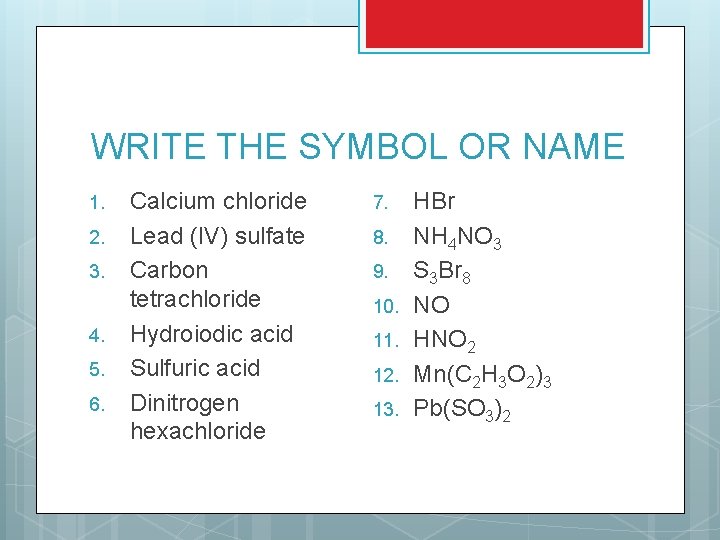
WRITE THE SYMBOL OR NAME 1. 2. 3. 4. 5. 6. Calcium chloride Lead (IV) sulfate Carbon tetrachloride Hydroiodic acid Sulfuric acid Dinitrogen hexachloride 7. 8. 9. 10. 11. 12. 13. HBr NH 4 NO 3 S 3 Br 8 NO HNO 2 Mn(C 2 H 3 O 2)3 Pb(SO 3)2
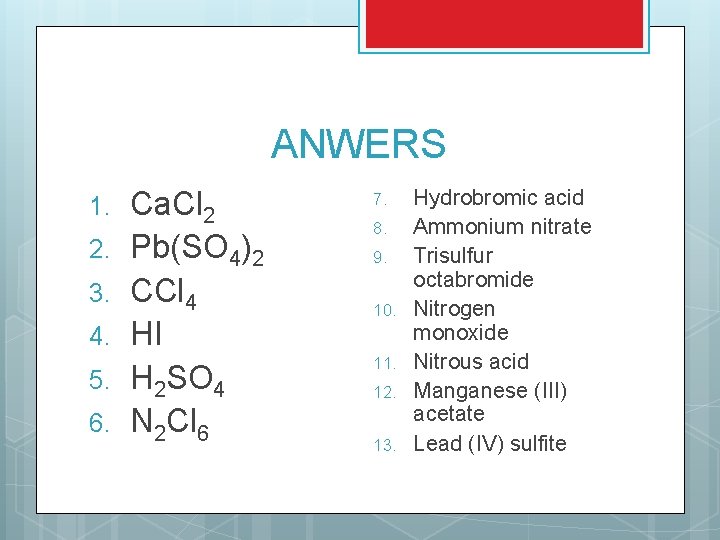
ANWERS 1. 2. 3. 4. 5. 6. Ca. Cl 2 Pb(SO 4)2 CCl 4 HI H 2 SO 4 N 2 Cl 6 7. 8. 9. 10. 11. 12. 13. Hydrobromic acid Ammonium nitrate Trisulfur octabromide Nitrogen monoxide Nitrous acid Manganese (III) acetate Lead (IV) sulfite
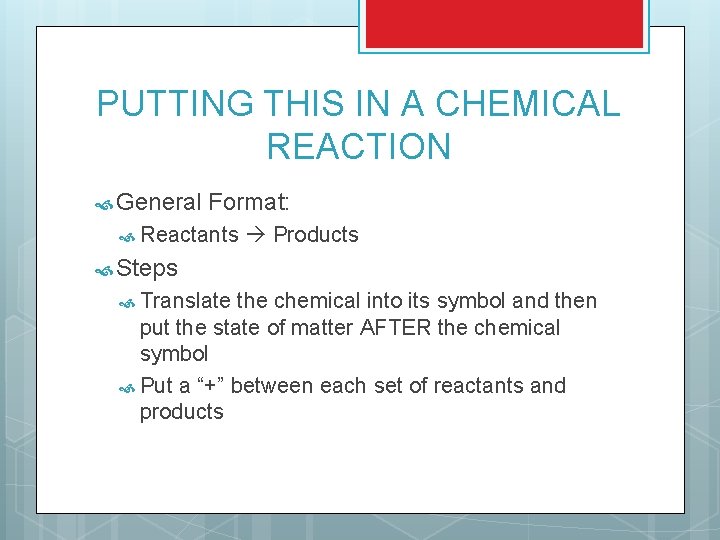
PUTTING THIS IN A CHEMICAL REACTION General Format: Reactants Products Steps Translate the chemical into its symbol and then put the state of matter AFTER the chemical symbol Put a “+” between each set of reactants and products
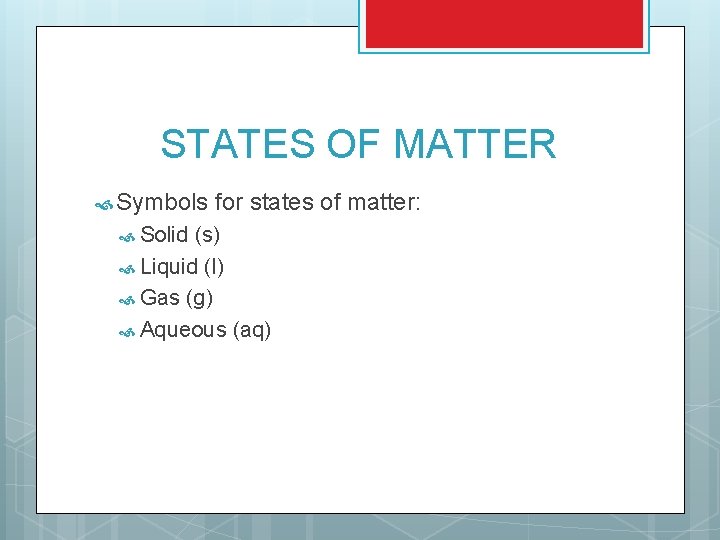
STATES OF MATTER Symbols Solid for states of matter: (s) Liquid (l) Gas (g) Aqueous (aq)
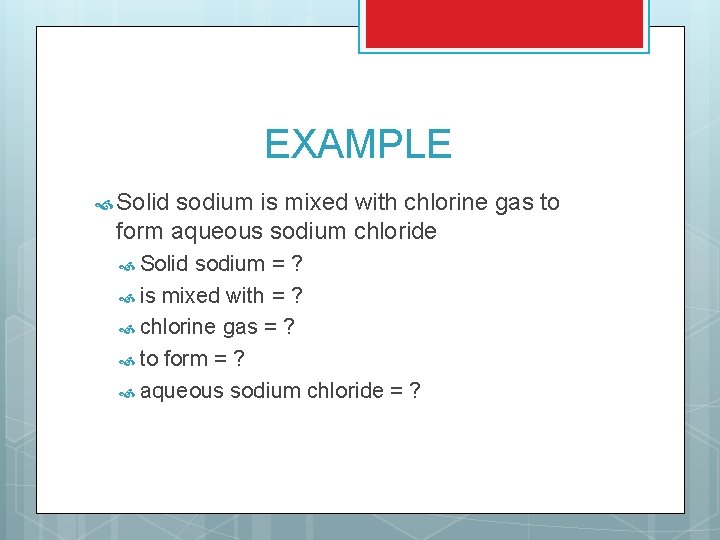
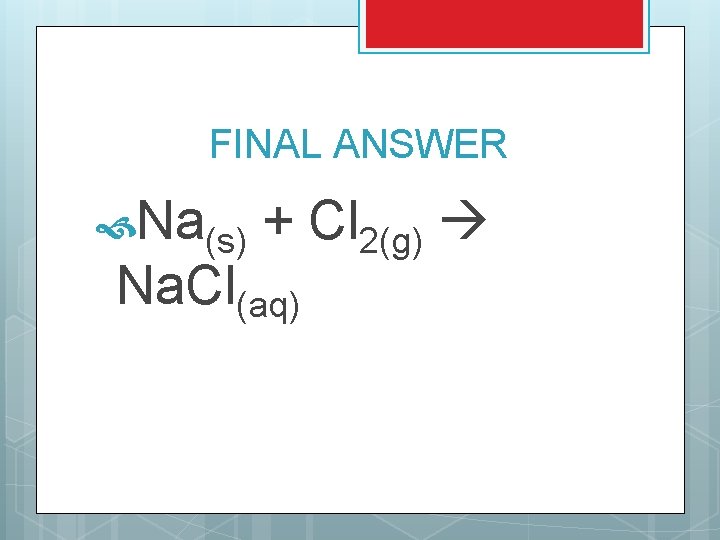
EXAMPLE Solid sodium is mixed with chlorine gas to form aqueous sodium chloride Solid sodium = ? is mixed with = ? chlorine gas = ? to form = ? aqueous sodium chloride = ?
FINAL ANSWER Na(s) + Cl 2(g) Na. Cl(aq)
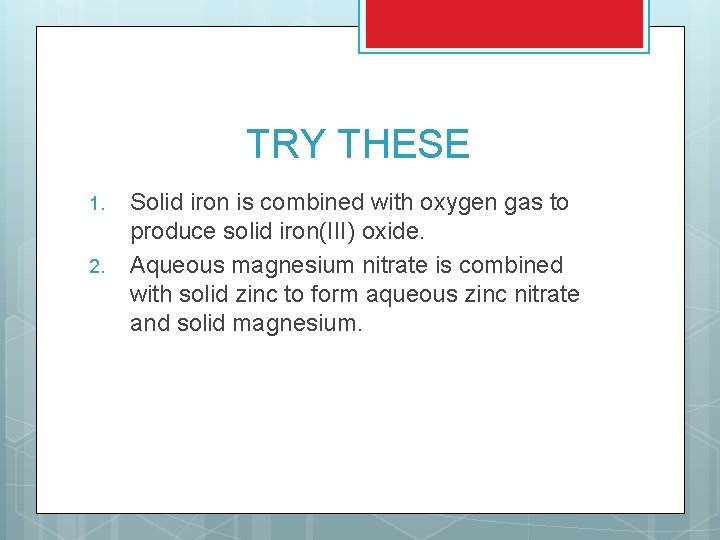
TRY THESE 1. 2. Solid iron is combined with oxygen gas to produce solid iron(III) oxide. Aqueous magnesium nitrate is combined with solid zinc to form aqueous zinc nitrate and solid magnesium.
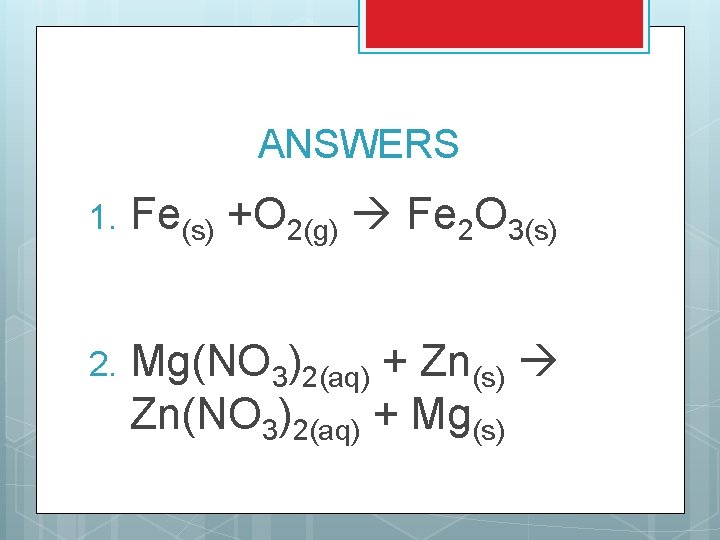
ANSWERS 1. Fe(s) +O 2(g) Fe 2 O 3(s) 2. Mg(NO 3)2(aq) + Zn(s) Zn(NO 3)2(aq) + Mg(s)