
Chapter 3 Chemical Compounds Copyright The Mc GrawHill
- Slides: 76
Chapter 3: Chemical Compounds Copyright © The Mc. Graw-Hill Companies, Inc. Permission required for reproduction or display. 3 -1
Chapter 3 Topics: 1. 2. 3. 4. 5. 6. 7. Ionic and Molecular Compounds Monatomic and Polyatomic Ions Formulas for Ionic Compounds Naming and Writing Formulas for Molecular Compounds Acids and Bases Predicting Properties and Naming Compounds 3 -2
Types of Compounds n n n Ionic – electrolytes Molecular – nonelectrolytes Acids and Bases - electrolytes 3 -3
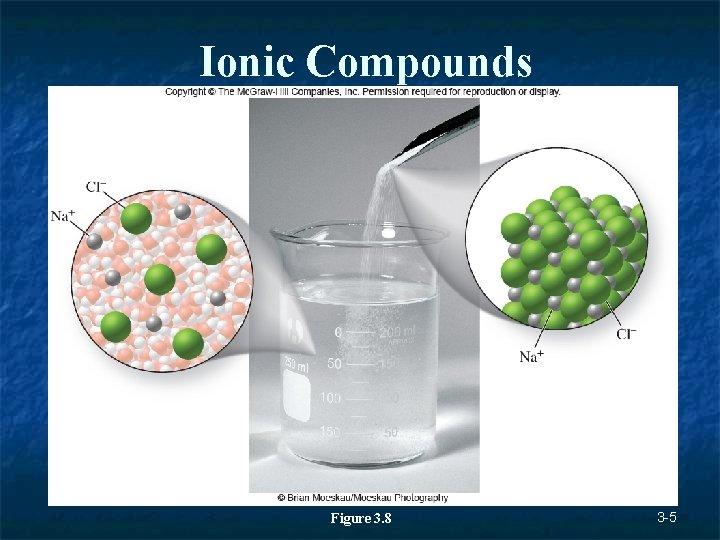
Ionic Compounds n n Are usually composed of a metal cation and a nonmetal anion n Metals cations are positively charged ions n Nonmetals anions are negatively charged ions Their cations and anions exist in proportions that give electrical neutrality. n These ions are arranged in a crystal lattice. Also called salts Are one of the major categories of chemical compounds 3 -4
Ionic Compounds Figure 3. 8 3 -5
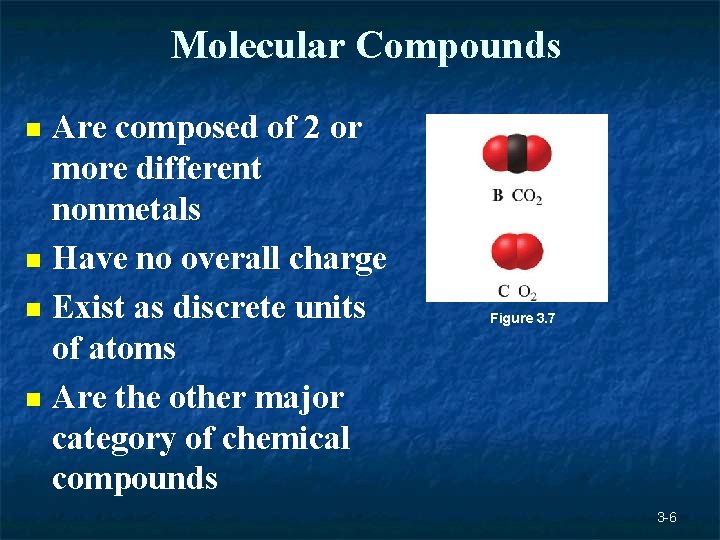
Molecular Compounds Are composed of 2 or more different nonmetals n Have no overall charge n Exist as discrete units of atoms n Are the other major category of chemical compounds n Figure 3. 7 3 -6
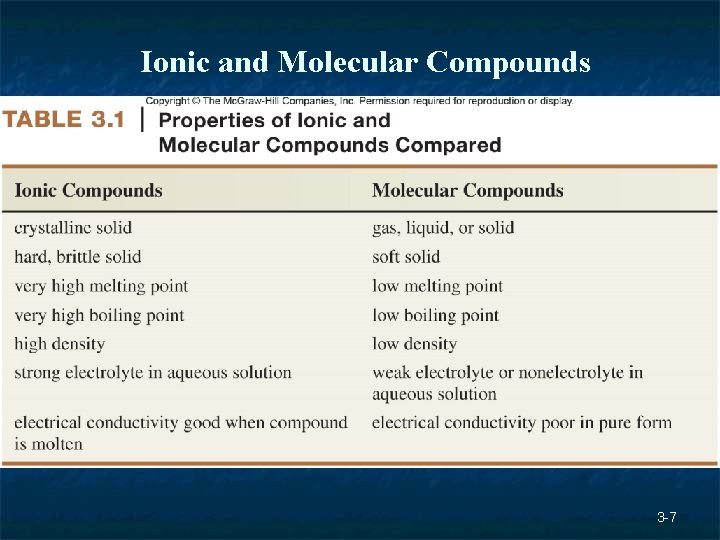
Ionic and Molecular Compounds 3 -7
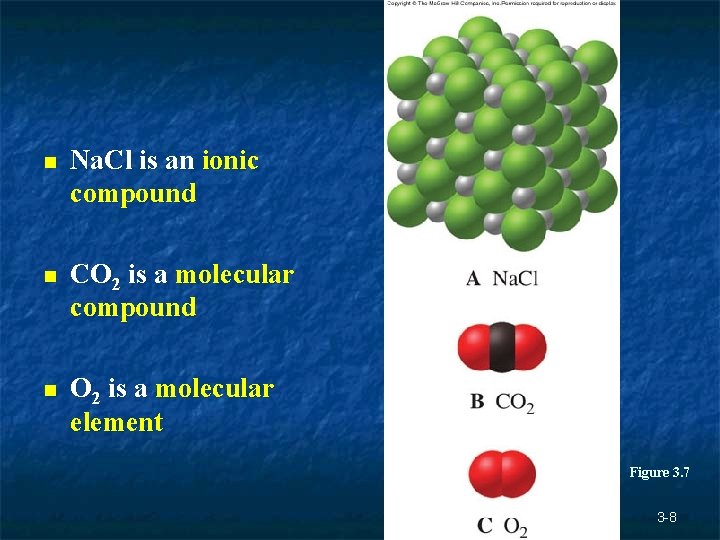
n Na. Cl is an ionic compound n CO 2 is a molecular compound n O 2 is a molecular element Figure 3. 7 3 -8
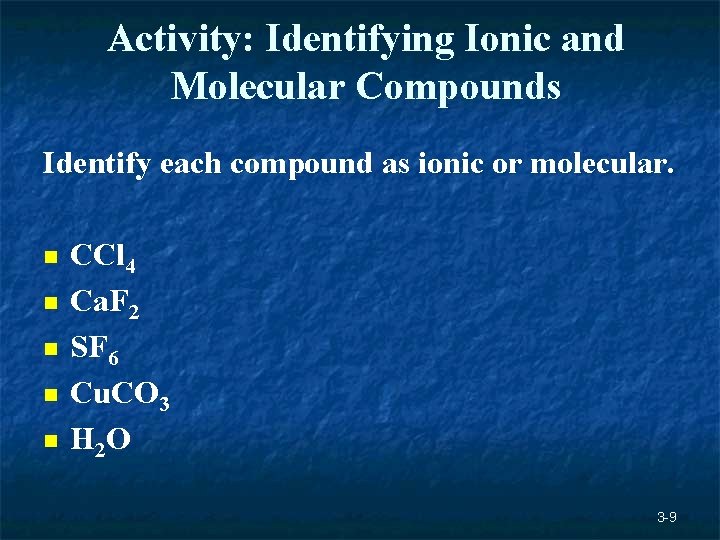
Activity: Identifying Ionic and Molecular Compounds Identify each compound as ionic or molecular. n n n CCl 4 Ca. F 2 SF 6 Cu. CO 3 H 2 O 3 -9
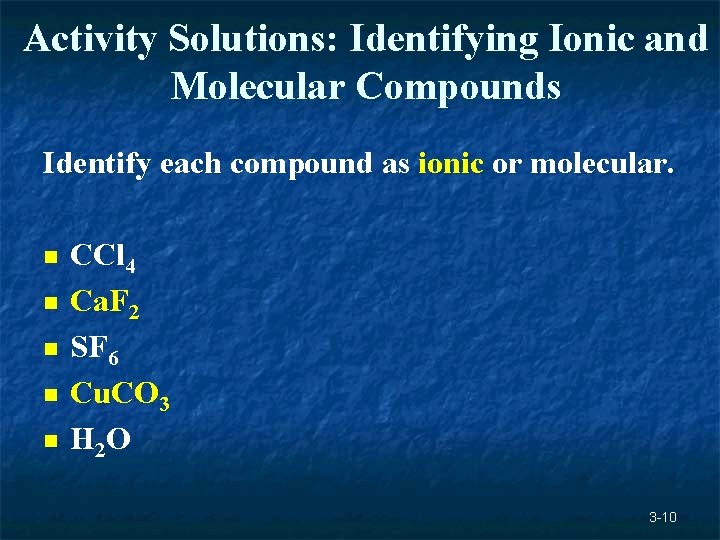
Activity Solutions: Identifying Ionic and Molecular Compounds Identify each compound as ionic or molecular. n n n CCl 4 Ca. F 2 SF 6 Cu. CO 3 H 2 O 3 -10
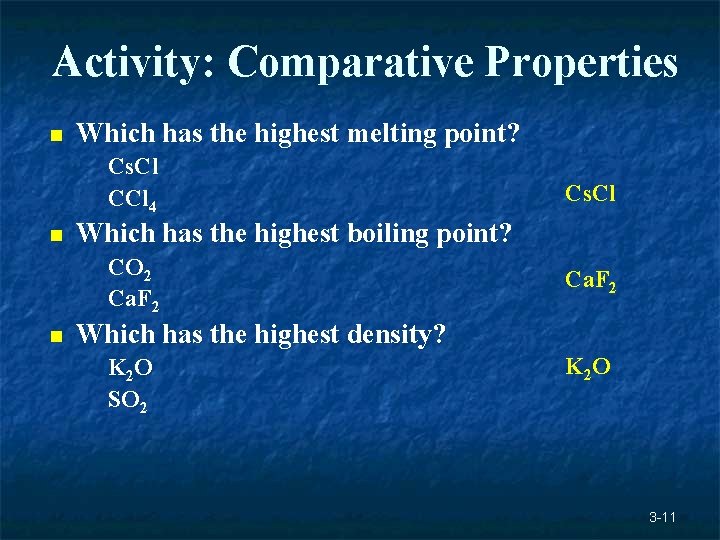
Activity: Comparative Properties n Which has the highest melting point? Cs. Cl CCl 4 n Which has the highest boiling point? CO 2 Ca. F 2 n Cs. Cl Ca. F 2 Which has the highest density? K 2 O SO 2 K 2 O 3 -11
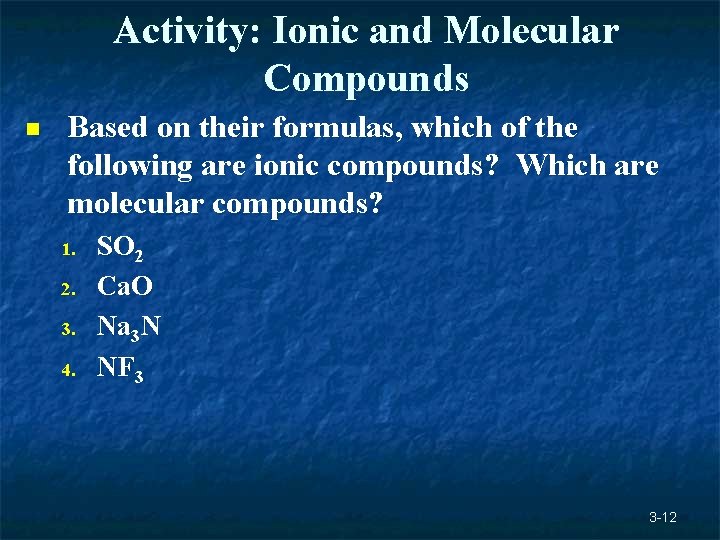
Activity: Ionic and Molecular Compounds n Based on their formulas, which of the following are ionic compounds? Which are molecular compounds? 1. 2. 3. 4. SO 2 Ca. O Na 3 N NF 3 3 -12
Activity Solutions: Ionic and Molecular Compounds n Based on their formulas, which of the following are ionic compounds? Which are molecular compounds? 1. SO 2 – molecular compound 2. Ca. O – ionic compound 3. Na 3 N – ionic compound 4. NF 3 – molecular compound 3 -13
Activity: Ionic and Molecular Compounds n Which of the following compounds has a higher boiling point? KCl or CCl 4 2. SO 3 or Na 2 SO 4 3. Cu 3 PO 4 or P 4 O 10 1. 3 -14
Activity Solutions: Ionic and Molecular Compounds n Which of the following compounds has a higher boiling point? 1. KCl or CCl 4 – KCl (ionic compounds have high boiling points) 2. SO 3 or Na 2 SO 4 – Na 2 SO 4 3. Cu 3 PO 4 or P 4 O 10 – Cu 3 PO 4 3 -15
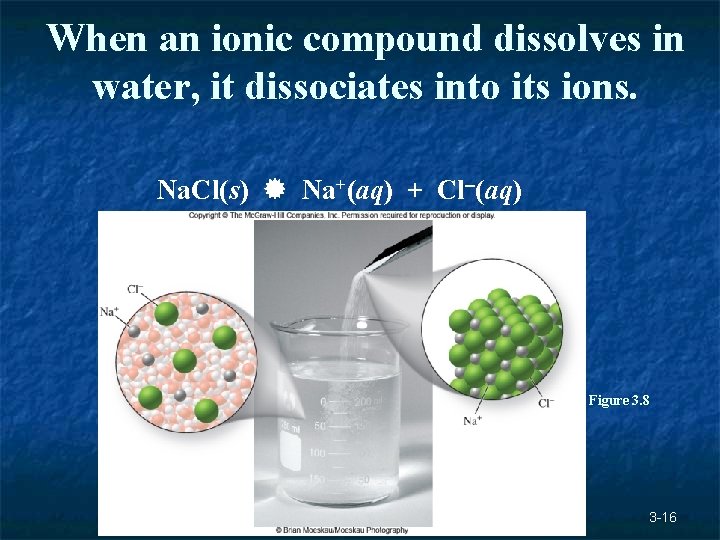
When an ionic compound dissolves in water, it dissociates into its ions. Na. Cl(s) Na+(aq) + Cl (aq) Figure 3. 8 3 -16
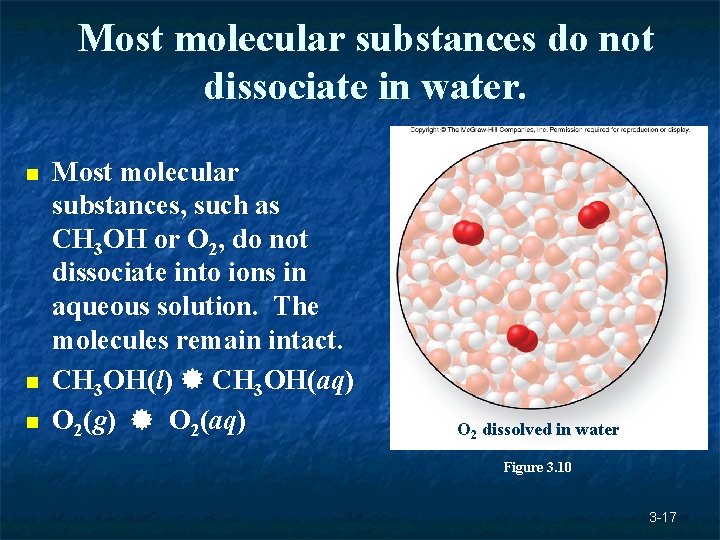
Most molecular substances do not dissociate in water. n n n Most molecular substances, such as CH 3 OH or O 2, do not dissociate into ions in aqueous solution. The molecules remain intact. CH 3 OH(l) CH 3 OH(aq) O 2(g) O 2(aq) O 2 dissolved in water Figure 3. 10 3 -17
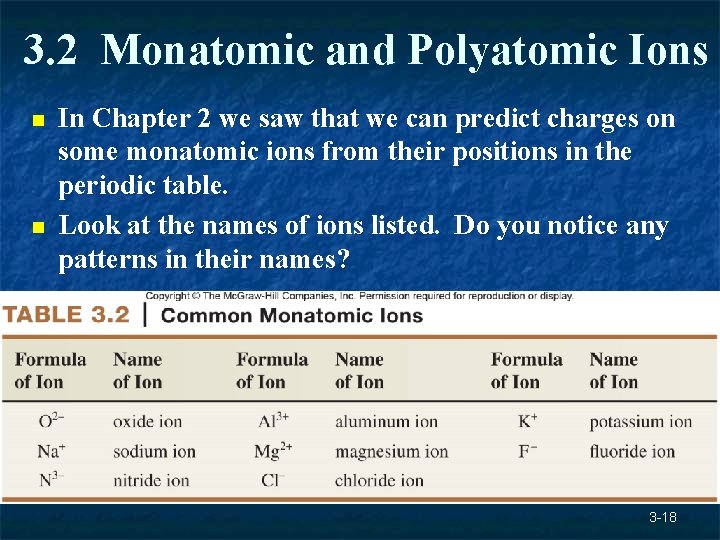
3. 2 Monatomic and Polyatomic Ions n n In Chapter 2 we saw that we can predict charges on some monatomic ions from their positions in the periodic table. Look at the names of ions listed. Do you notice any patterns in their names? 3 -18
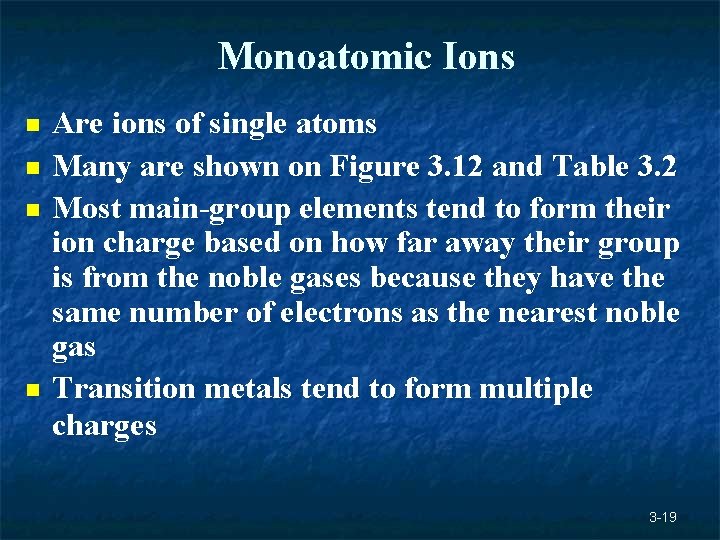
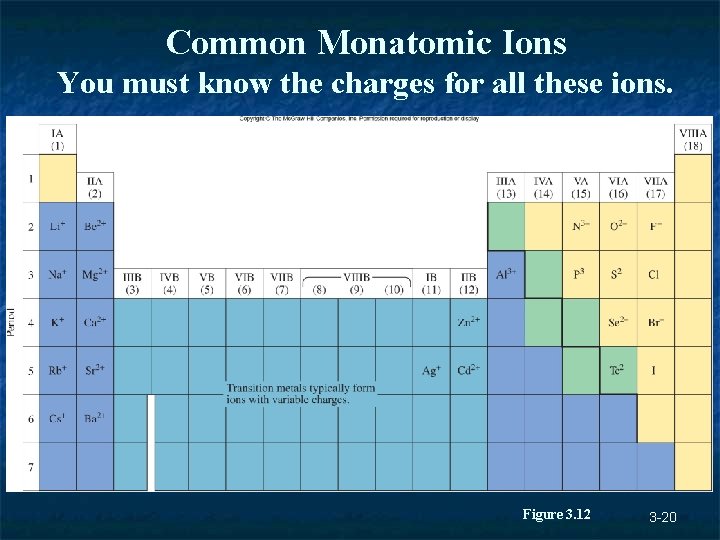
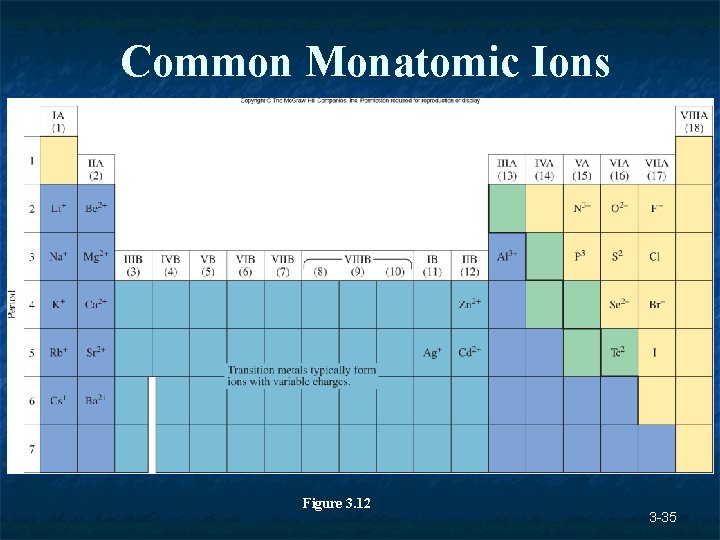
Monoatomic Ions n n Are ions of single atoms Many are shown on Figure 3. 12 and Table 3. 2 Most main-group elements tend to form their ion charge based on how far away their group is from the noble gases because they have the same number of electrons as the nearest noble gas Transition metals tend to form multiple charges 3 -19
Common Monatomic Ions You must know the charges for all these ions. Figure 3. 12 3 -20
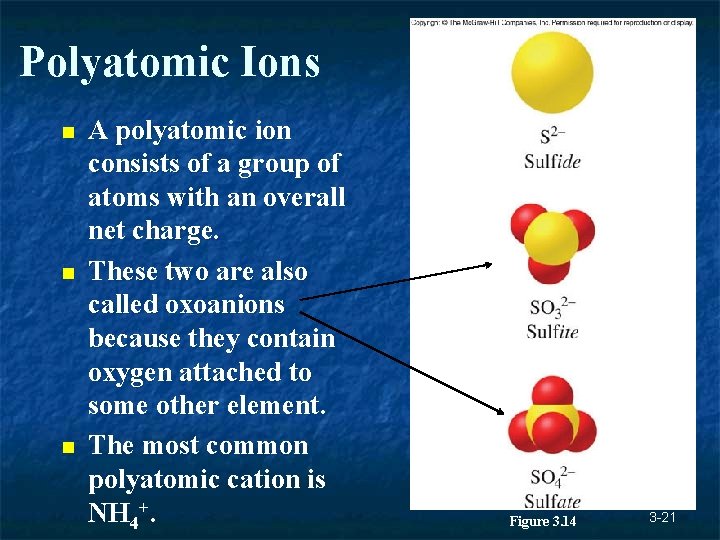
Polyatomic Ions n n n A polyatomic ion consists of a group of atoms with an overall net charge. These two are also called oxoanions because they contain oxygen attached to some other element. The most common polyatomic cation is NH 4+. Figure 3. 14 3 -21
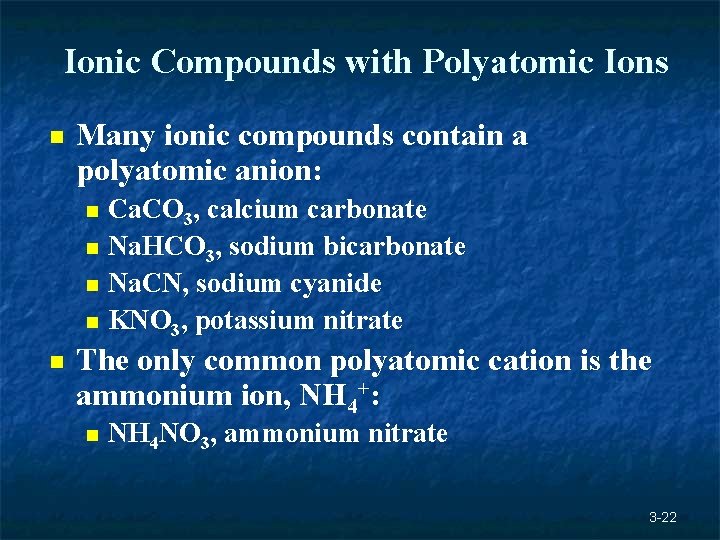
Ionic Compounds with Polyatomic Ions n Many ionic compounds contain a polyatomic anion: Ca. CO 3, calcium carbonate n Na. HCO 3, sodium bicarbonate n Na. CN, sodium cyanide n KNO 3, potassium nitrate n n The only common polyatomic cation is the ammonium ion, NH 4+: n NH 4 NO 3, ammonium nitrate 3 -22
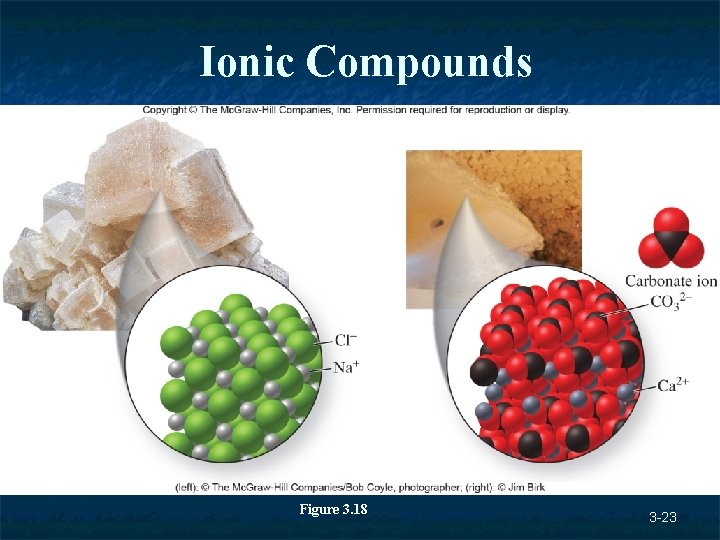
Ionic Compounds Figure 3. 18 3 -23
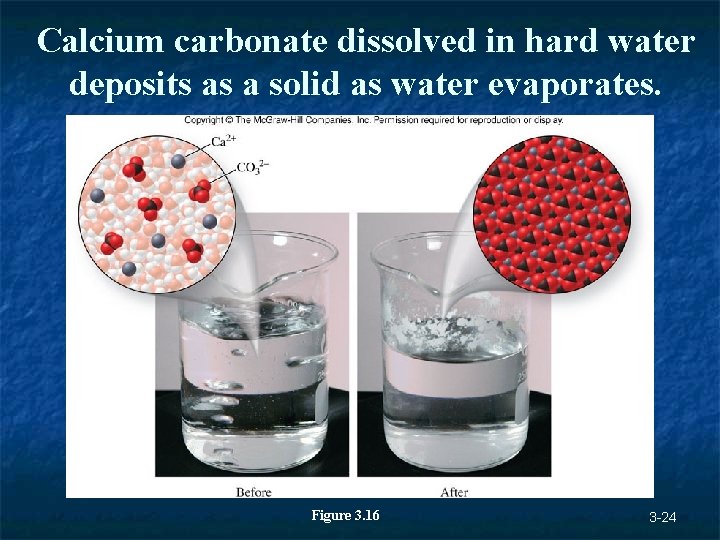
Calcium carbonate dissolved in hard water deposits as a solid as water evaporates. Figure 3. 16 3 -24
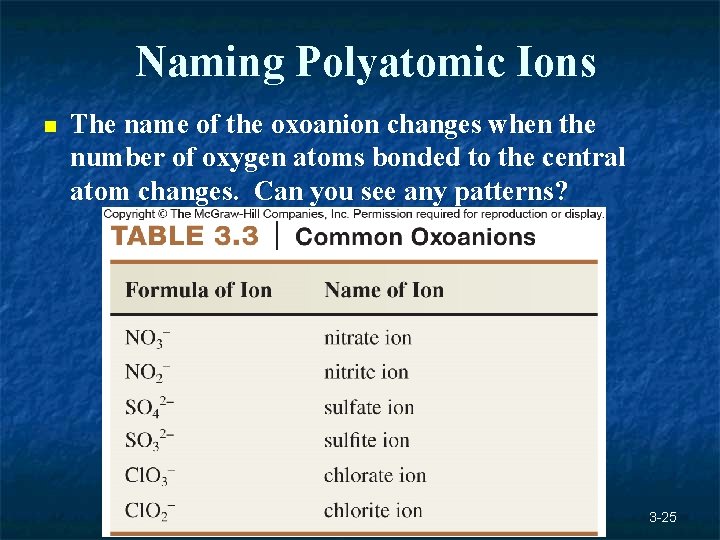
Naming Polyatomic Ions n The name of the oxoanion changes when the number of oxygen atoms bonded to the central atom changes. Can you see any patterns? 3 -25
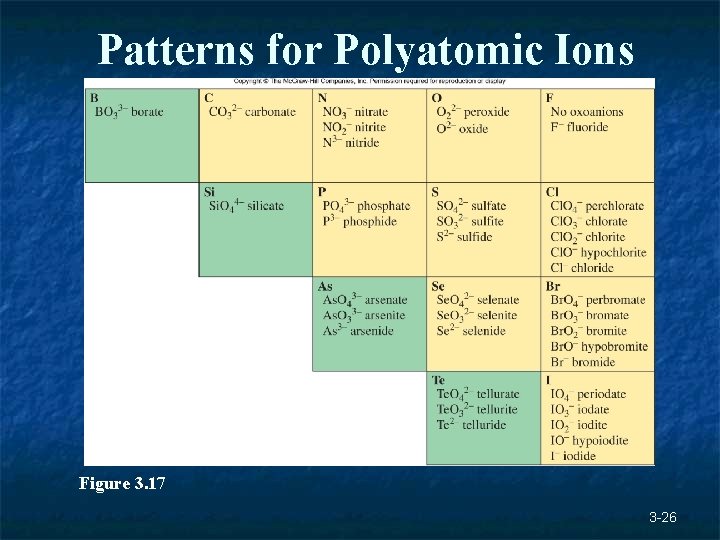
Patterns for Polyatomic Ions Figure 3. 17 3 -26
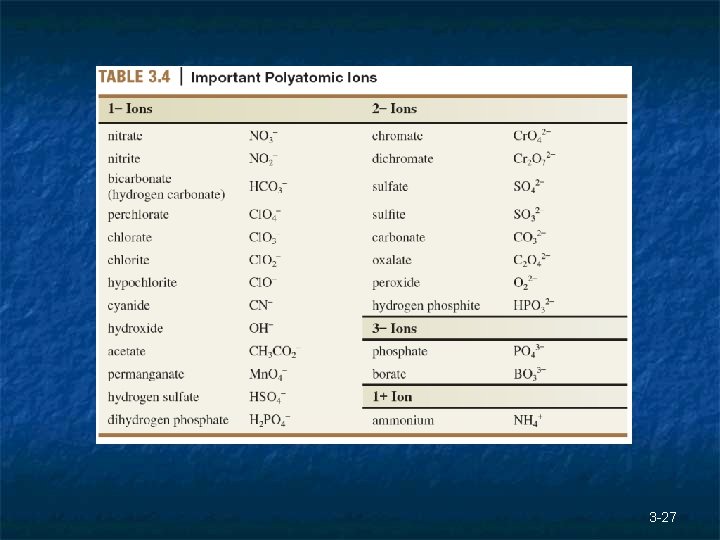
3 -27
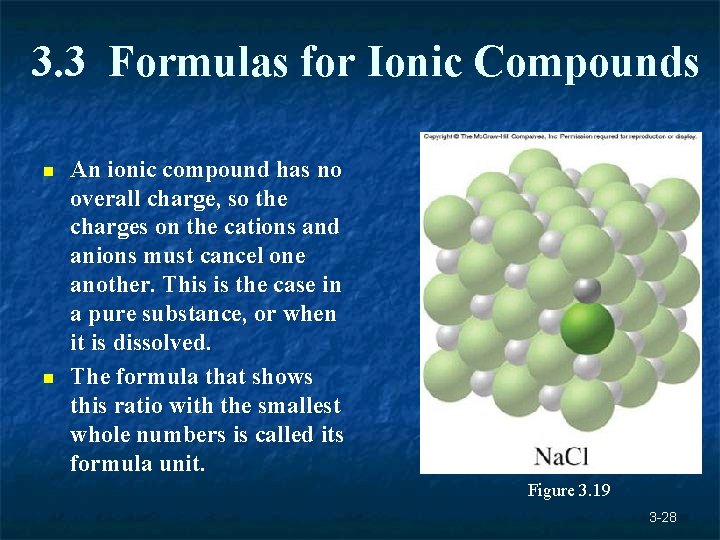
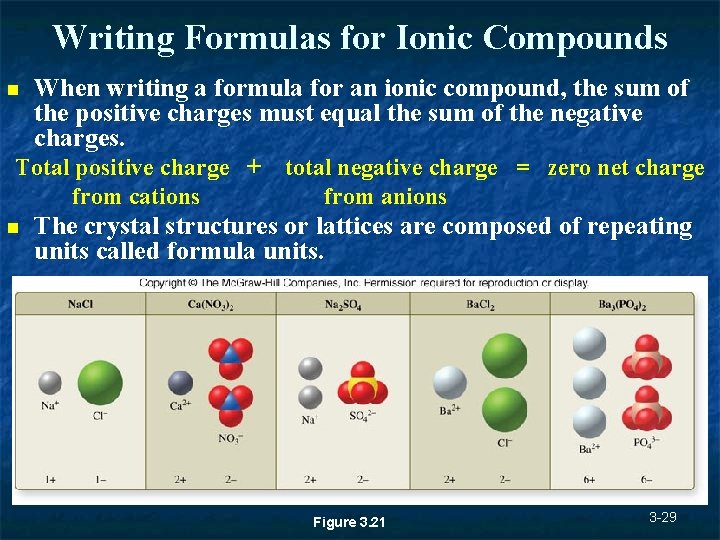
3. 3 Formulas for Ionic Compounds n n An ionic compound has no overall charge, so the charges on the cations and anions must cancel one another. This is the case in a pure substance, or when it is dissolved. The formula that shows this ratio with the smallest whole numbers is called its formula unit. Figure 3. 19 3 -28
Writing Formulas for Ionic Compounds n When writing a formula for an ionic compound, the sum of the positive charges must equal the sum of the negative charges. Total positive charge + total negative charge = zero net charge from cations from anions n The crystal structures or lattices are composed of repeating units called formula units. Figure 3. 21 3 -29
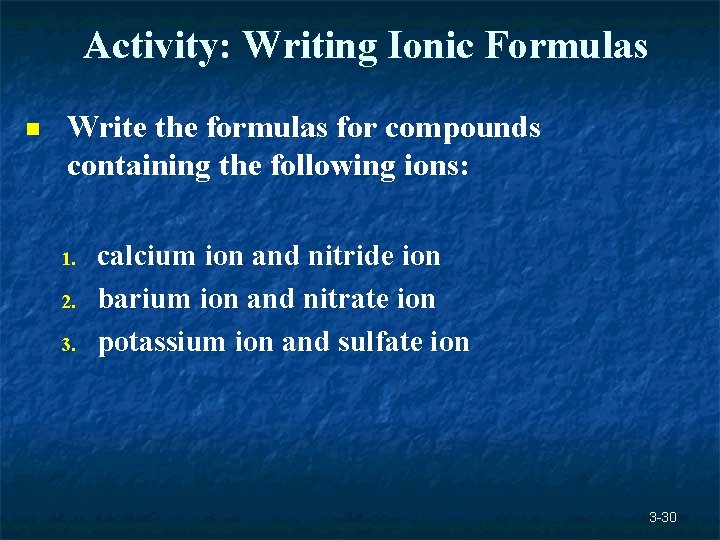
Activity: Writing Ionic Formulas n Write the formulas for compounds containing the following ions: 1. 2. 3. calcium ion and nitride ion barium ion and nitrate ion potassium ion and sulfate ion 3 -30
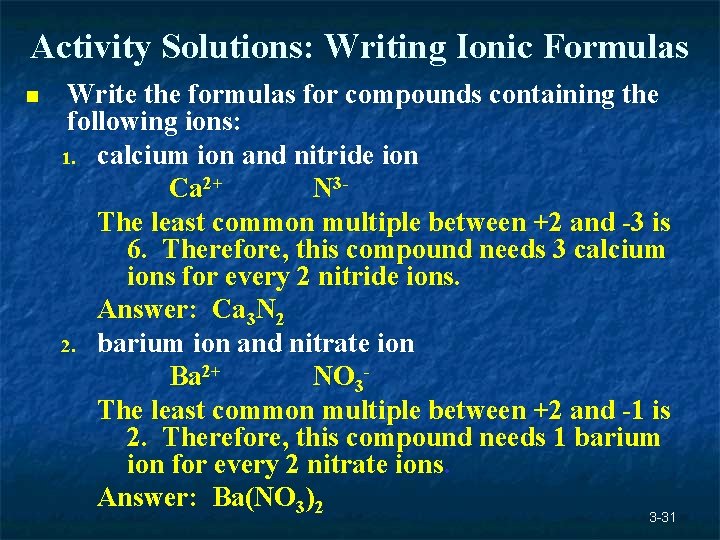
Activity Solutions: Writing Ionic Formulas n Write the formulas for compounds containing the following ions: 1. calcium ion and nitride ion Ca 2+ N 3 The least common multiple between +2 and -3 is 6. Therefore, this compound needs 3 calcium ions for every 2 nitride ions. Answer: Ca 3 N 2 2. barium ion and nitrate ion Ba 2+ NO 3 The least common multiple between +2 and -1 is 2. Therefore, this compound needs 1 barium ion for every 2 nitrate ions. Answer: Ba(NO 3)2 3 -31
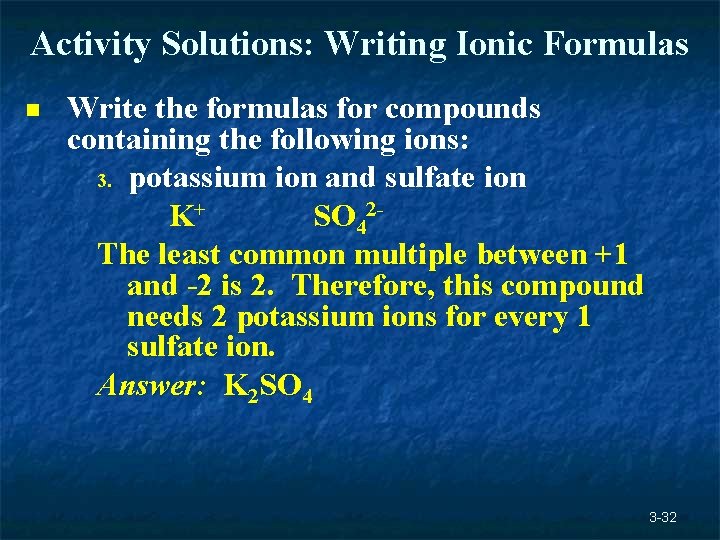
Activity Solutions: Writing Ionic Formulas n Write the formulas for compounds containing the following ions: 3. potassium ion and sulfate ion K+ SO 42 The least common multiple between +1 and -2 is 2. Therefore, this compound needs 2 potassium ions for every 1 sulfate ion. Answer: K 2 SO 4 3 -32
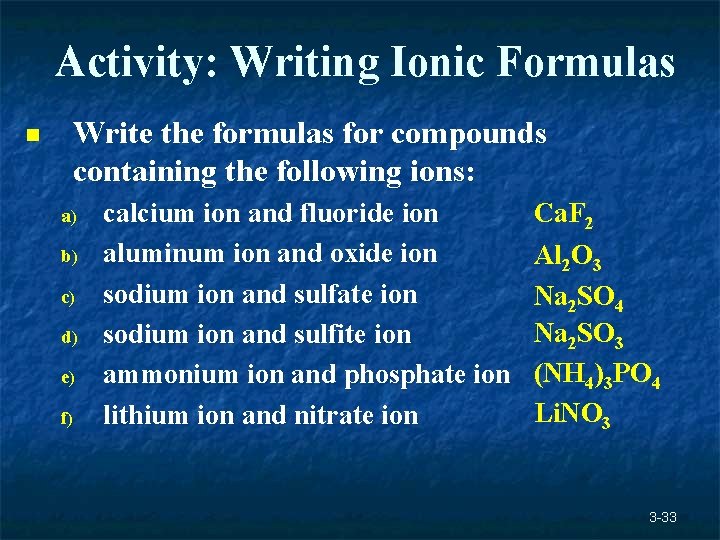
Activity: Writing Ionic Formulas n Write the formulas for compounds containing the following ions: a) b) c) d) e) f) calcium ion and fluoride ion aluminum ion and oxide ion sodium ion and sulfate ion sodium ion and sulfite ion ammonium ion and phosphate ion lithium ion and nitrate ion Ca. F 2 Al 2 O 3 Na 2 SO 4 Na 2 SO 3 (NH 4)3 PO 4 Li. NO 3 3 -33
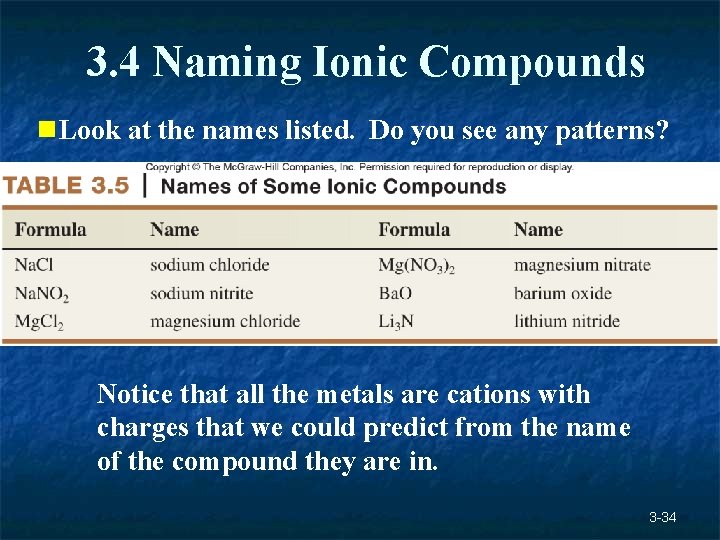
3. 4 Naming Ionic Compounds n. Look at the names listed. Do you see any patterns? Notice that all the metals are cations with charges that we could predict from the name of the compound they are in. 3 -34
Common Monatomic Ions Figure 3. 12 3 -35
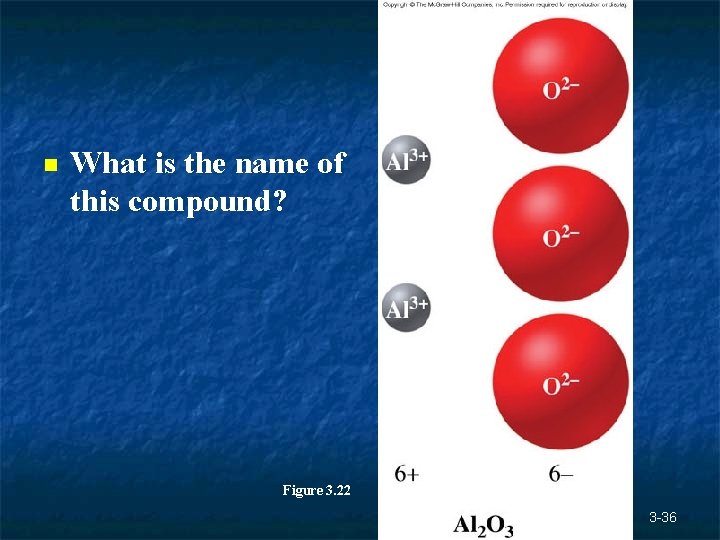
n What is the name of this compound? Figure 3. 22 3 -36
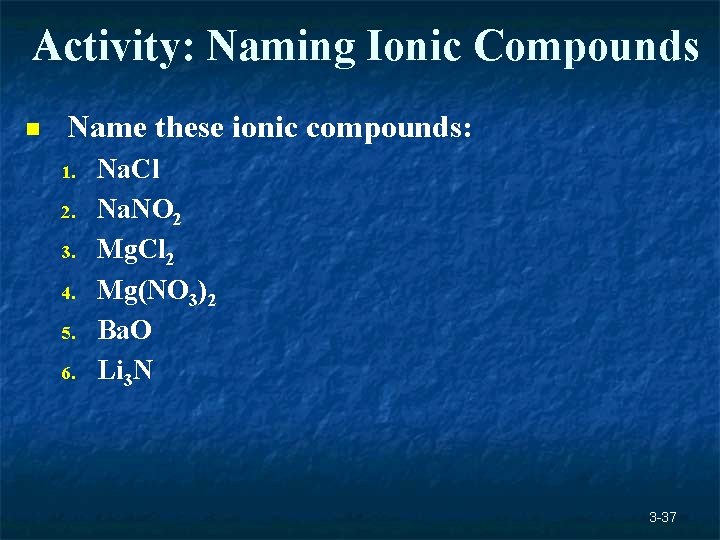
Activity: Naming Ionic Compounds n Name these ionic compounds: 1. 2. 3. 4. 5. 6. Na. Cl Na. NO 2 Mg. Cl 2 Mg(NO 3)2 Ba. O Li 3 N 3 -37
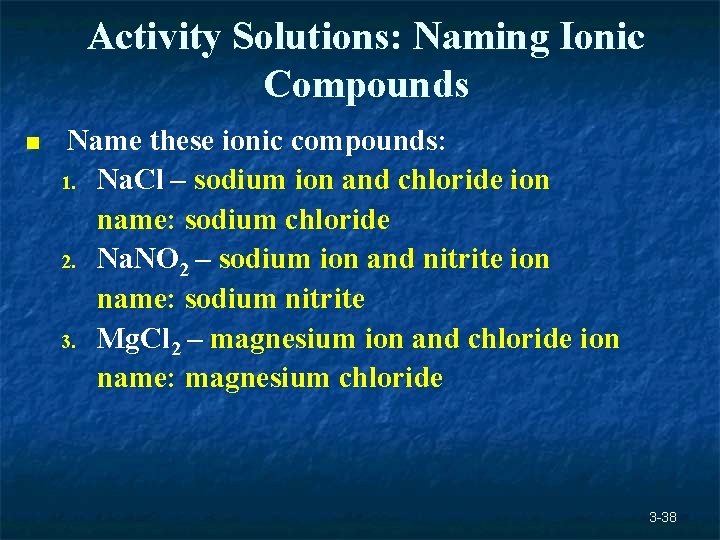
Activity Solutions: Naming Ionic Compounds n Name these ionic compounds: 1. Na. Cl – sodium ion and chloride ion name: sodium chloride 2. Na. NO 2 – sodium ion and nitrite ion name: sodium nitrite 3. Mg. Cl 2 – magnesium ion and chloride ion name: magnesium chloride 3 -38
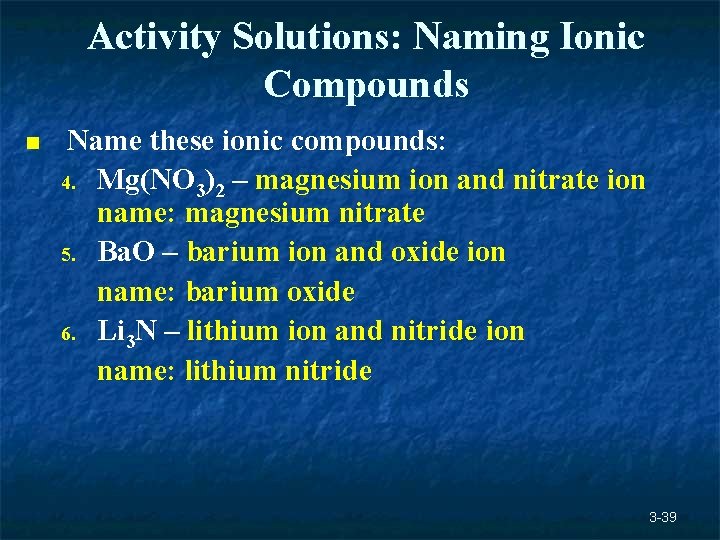
Activity Solutions: Naming Ionic Compounds n Name these ionic compounds: 4. Mg(NO 3)2 – magnesium ion and nitrate ion name: magnesium nitrate 5. Ba. O – barium ion and oxide ion name: barium oxide 6. Li 3 N – lithium ion and nitride ion name: lithium nitride 3 -39
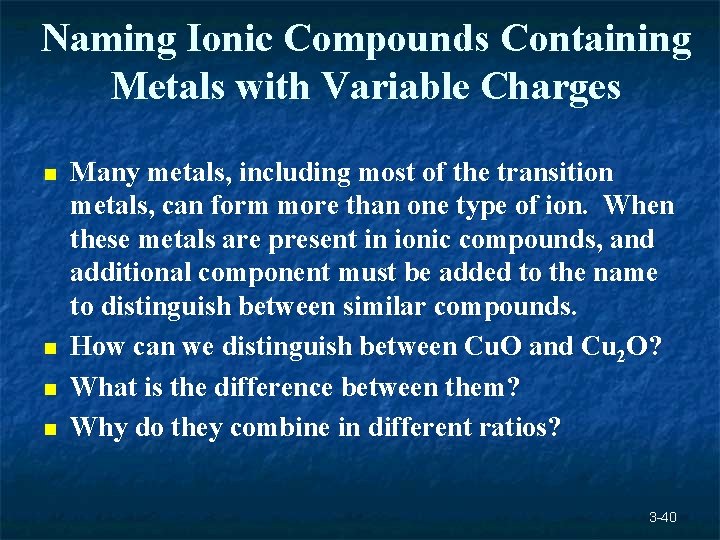
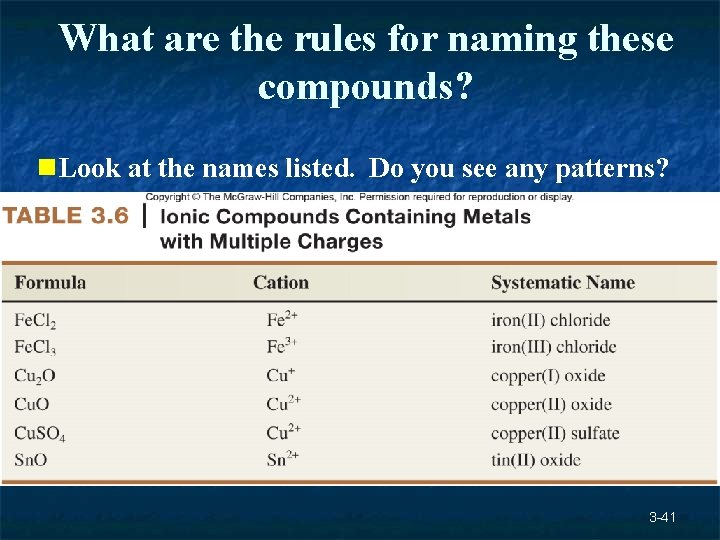
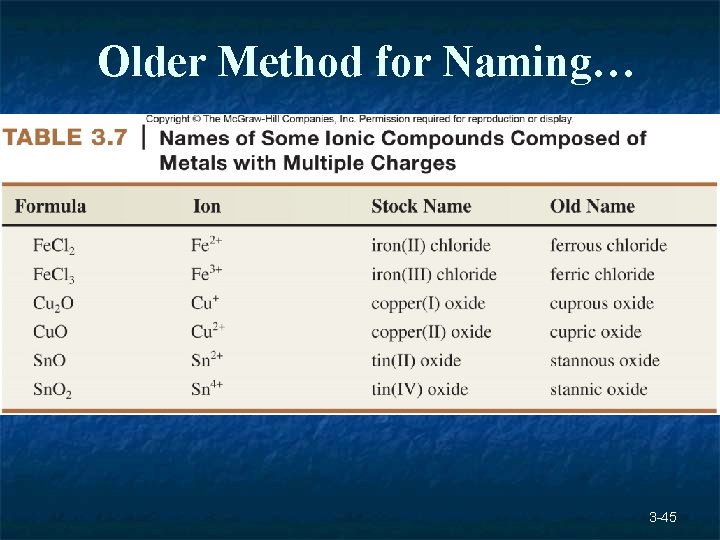
Naming Ionic Compounds Containing Metals with Variable Charges n n Many metals, including most of the transition metals, can form more than one type of ion. When these metals are present in ionic compounds, and additional component must be added to the name to distinguish between similar compounds. How can we distinguish between Cu. O and Cu 2 O? What is the difference between them? Why do they combine in different ratios? 3 -40
What are the rules for naming these compounds? n. Look at the names listed. Do you see any patterns? 3 -41
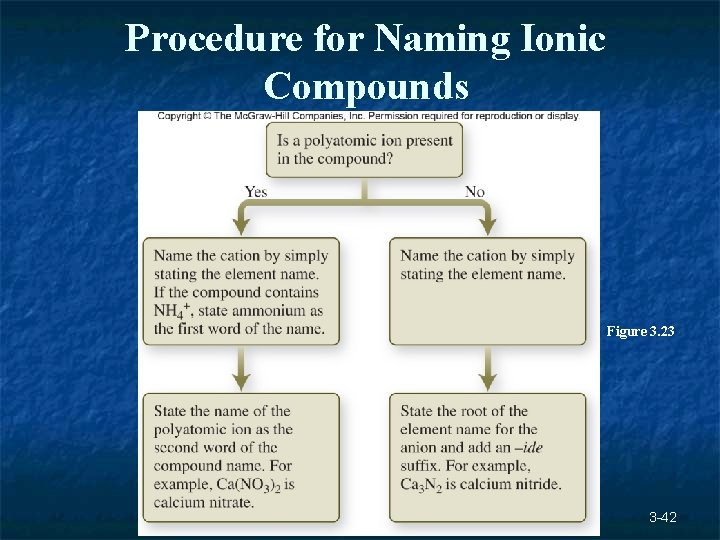
Procedure for Naming Ionic Compounds Figure 3. 23 3 -42
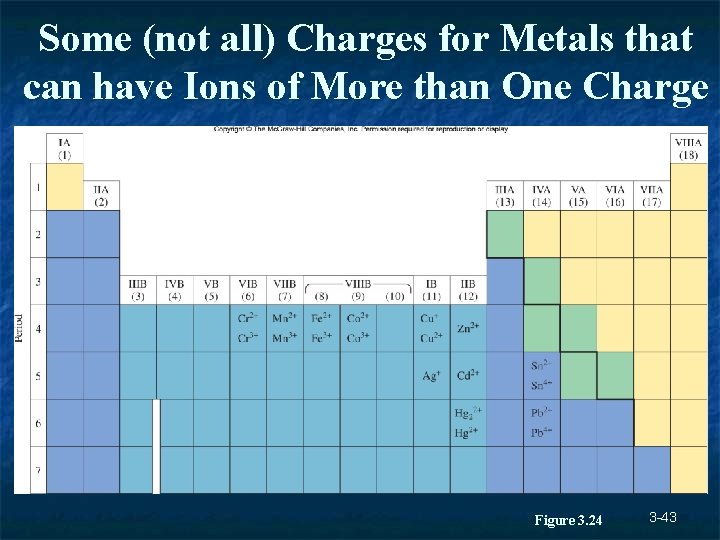
Some (not all) Charges for Metals that can have Ions of More than One Charge Figure 3. 24 3 -43
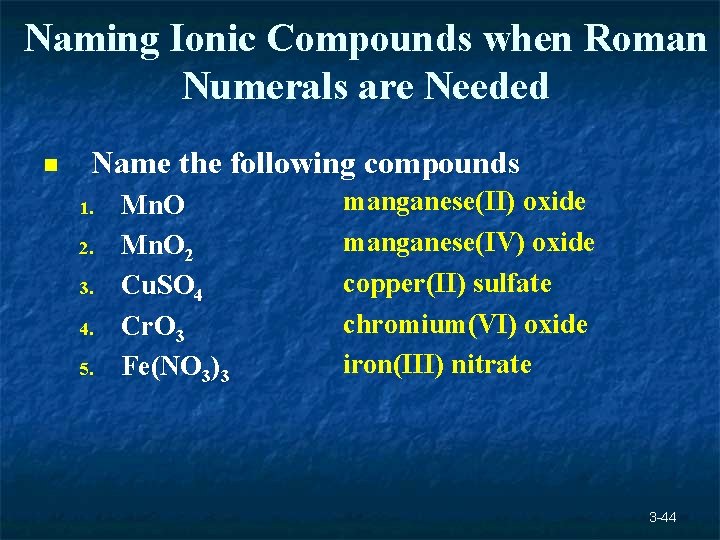
Naming Ionic Compounds when Roman Numerals are Needed n Name the following compounds 1. 2. 3. 4. 5. Mn. O 2 Cu. SO 4 Cr. O 3 Fe(NO 3)3 manganese(II) oxide manganese(IV) oxide copper(II) sulfate chromium(VI) oxide iron(III) nitrate 3 -44
Older Method for Naming… 3 -45
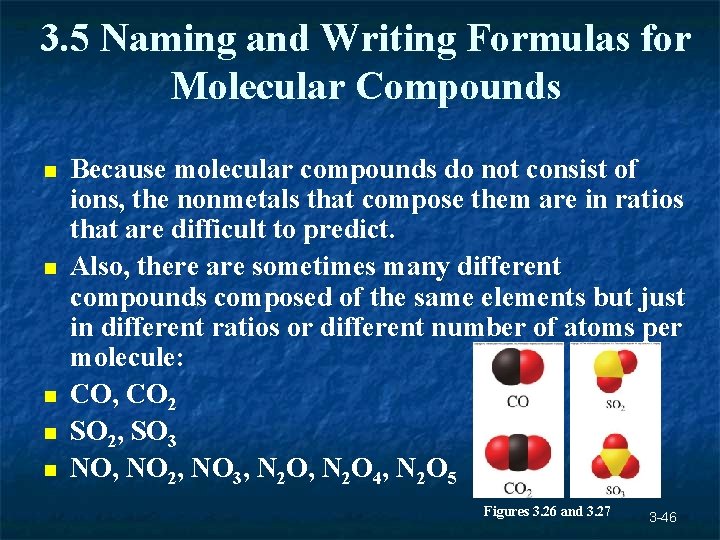
3. 5 Naming and Writing Formulas for Molecular Compounds n n n Because molecular compounds do not consist of ions, the nonmetals that compose them are in ratios that are difficult to predict. Also, there are sometimes many different compounds composed of the same elements but just in different ratios or different number of atoms per molecule: CO, CO 2 SO 2, SO 3 NO, NO 2, NO 3, N 2 O 4, N 2 O 5 Figures 3. 26 and 3. 27 3 -46
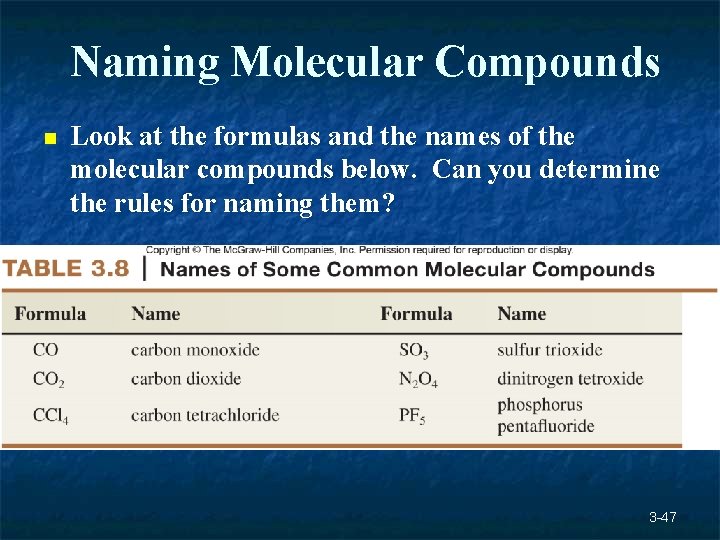
Naming Molecular Compounds n Look at the formulas and the names of the molecular compounds below. Can you determine the rules for naming them? 3 -47
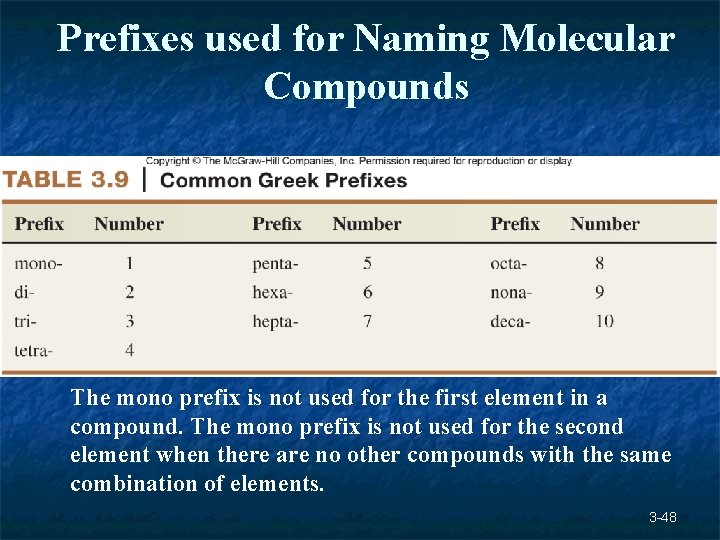
Prefixes used for Naming Molecular Compounds The mono prefix is not used for the first element in a compound. The mono prefix is not used for the second element when there are no other compounds with the same combination of elements. 3 -48
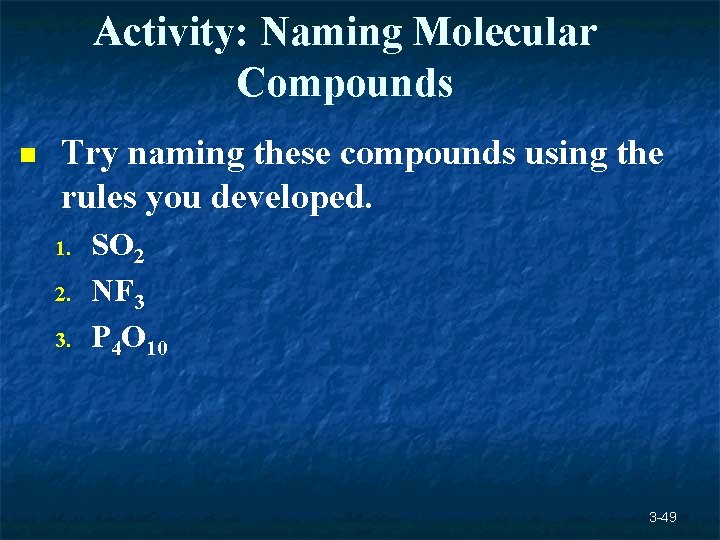
Activity: Naming Molecular Compounds n Try naming these compounds using the rules you developed. 1. 2. 3. SO 2 NF 3 P 4 O 10 3 -49
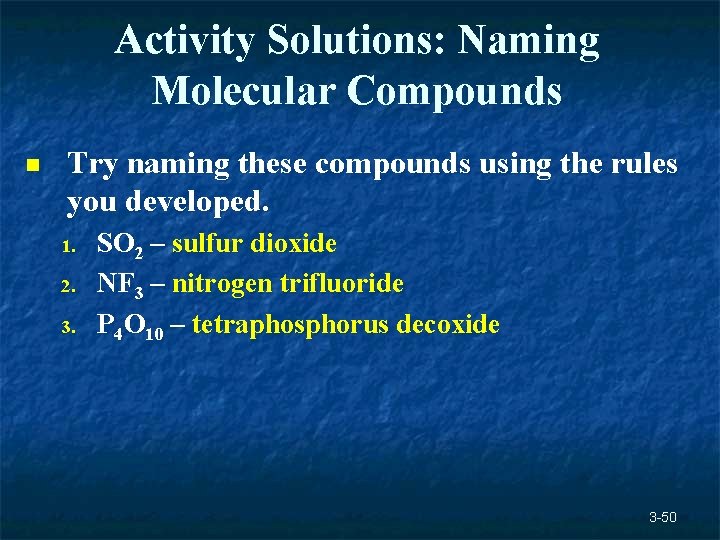
Activity Solutions: Naming Molecular Compounds n Try naming these compounds using the rules you developed. 1. 2. 3. SO 2 – sulfur dioxide NF 3 – nitrogen trifluoride P 4 O 10 – tetraphosphorus decoxide 3 -50
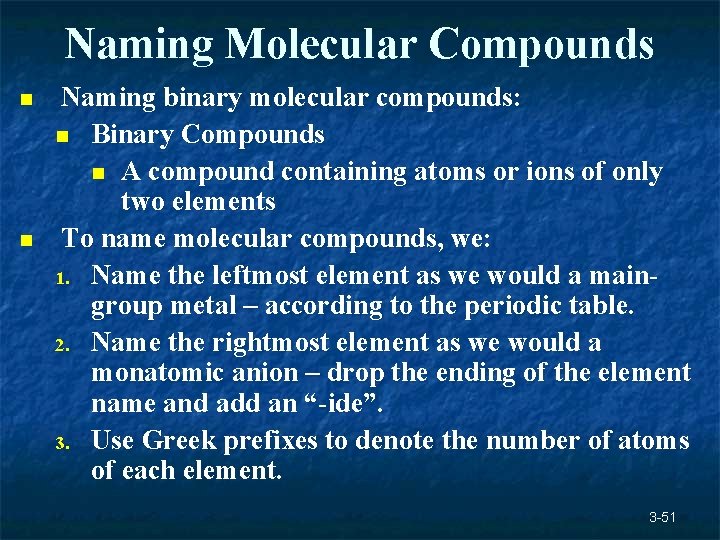
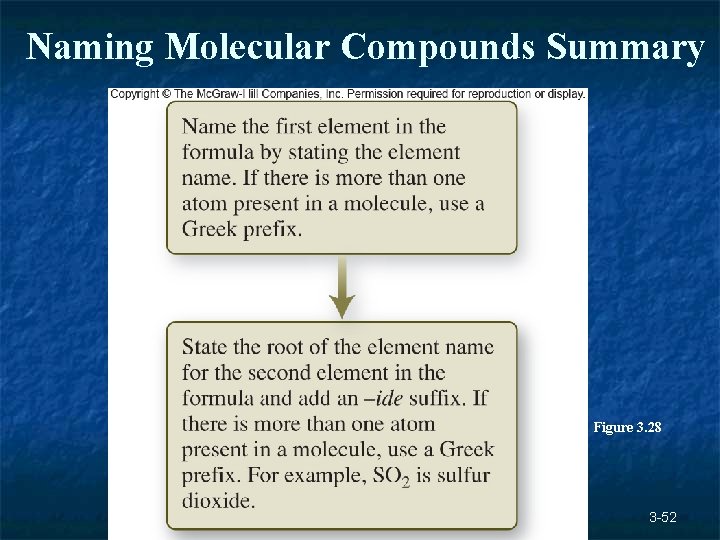
Naming Molecular Compounds n n Naming binary molecular compounds: n Binary Compounds n A compound containing atoms or ions of only two elements To name molecular compounds, we: 1. Name the leftmost element as we would a maingroup metal – according to the periodic table. 2. Name the rightmost element as we would a monatomic anion – drop the ending of the element name and add an “-ide”. 3. Use Greek prefixes to denote the number of atoms of each element. 3 -51
Naming Molecular Compounds Summary Figure 3. 28 3 -52
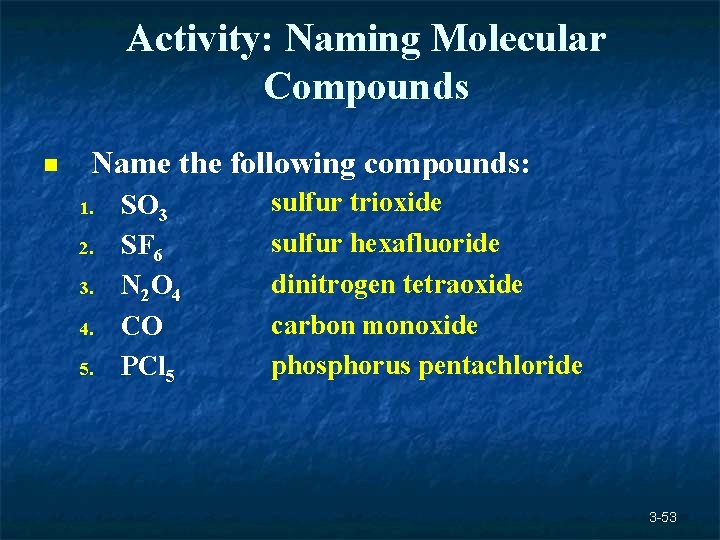
Activity: Naming Molecular Compounds n Name the following compounds: 1. 2. 3. 4. 5. SO 3 SF 6 N 2 O 4 CO PCl 5 sulfur trioxide sulfur hexafluoride dinitrogen tetraoxide carbon monoxide phosphorus pentachloride 3 -53
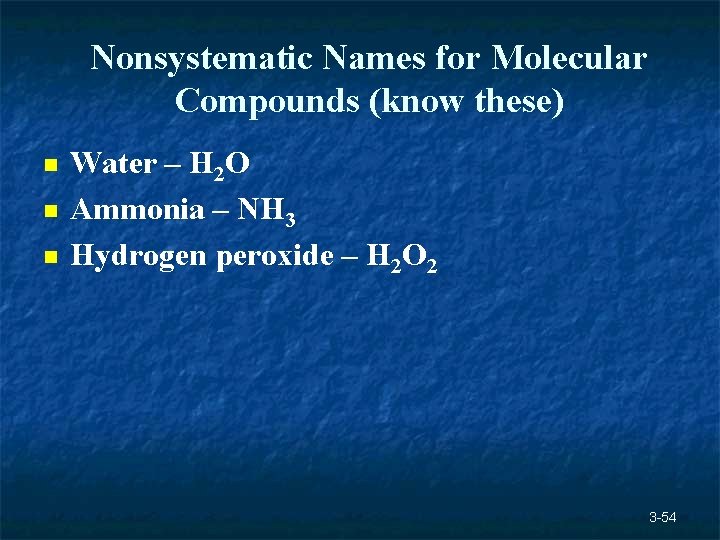
Nonsystematic Names for Molecular Compounds (know these) n n n Water – H 2 O Ammonia – NH 3 Hydrogen peroxide – H 2 O 2 3 -54
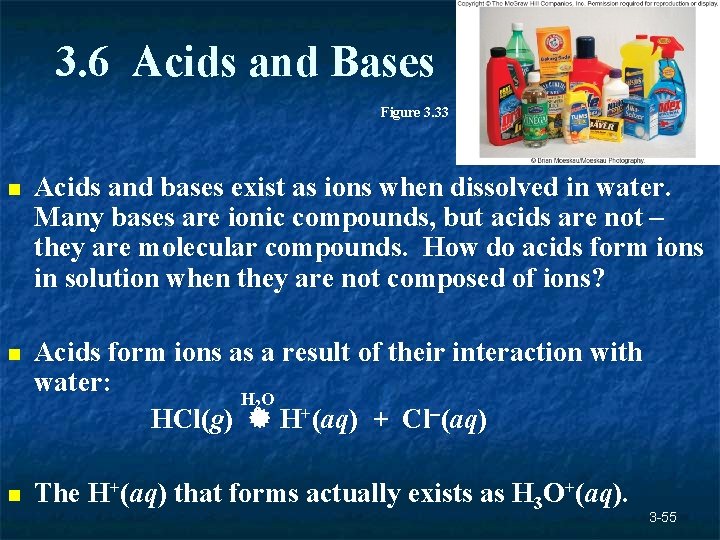
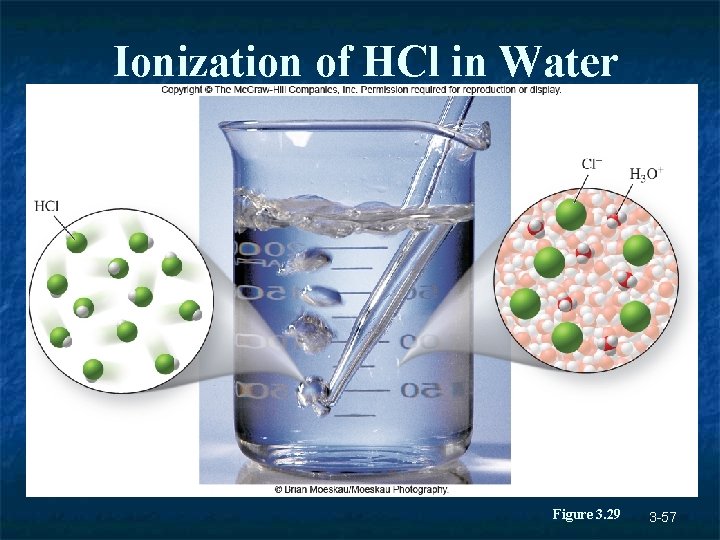
3. 6 Acids and Bases Figure 3. 33 n Acids and bases exist as ions when dissolved in water. Many bases are ionic compounds, but acids are not – they are molecular compounds. How do acids form ions in solution when they are not composed of ions? n Acids form ions as a result of their interaction with water: H 2 O HCl(g) H+(aq) + Cl (aq) n The H+(aq) that forms actually exists as H 3 O+(aq). 3 -55
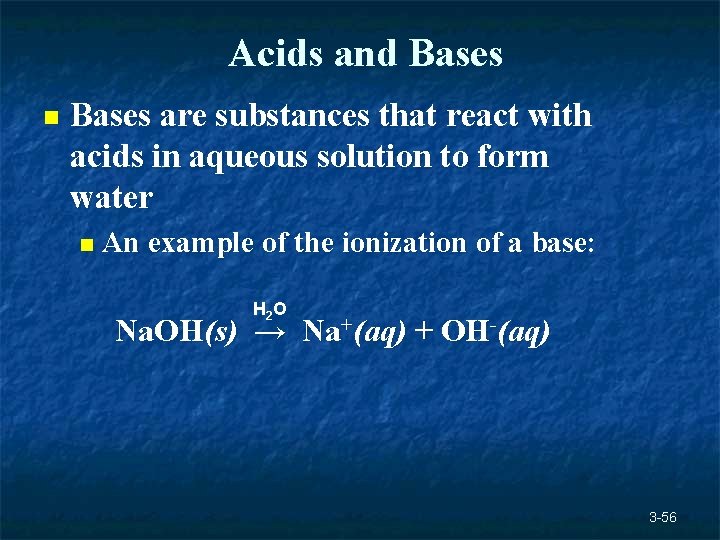
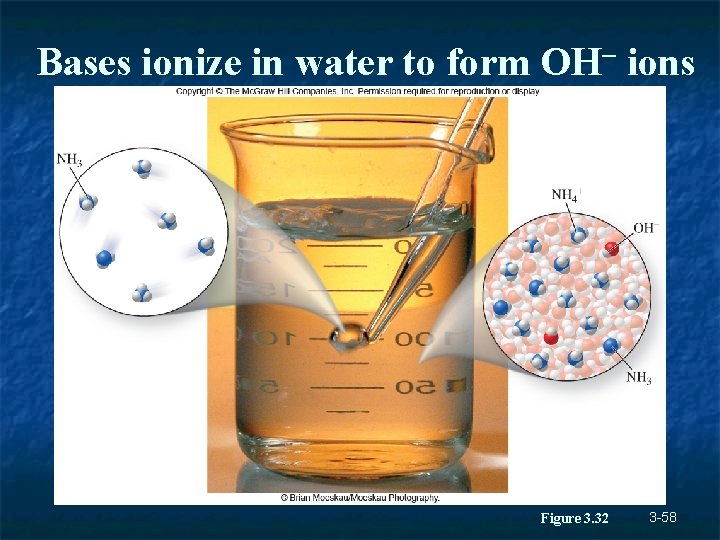
Acids and Bases n Bases are substances that react with acids in aqueous solution to form water n An example of the ionization of a base: H 2 O Na. OH(s) → Na+(aq) + OH-(aq) 3 -56
Ionization of HCl in Water Cl H 3 O+ Figure 3. 29 3 -57
Bases ionize in water to form OH ions Figure 3. 32 3 -58
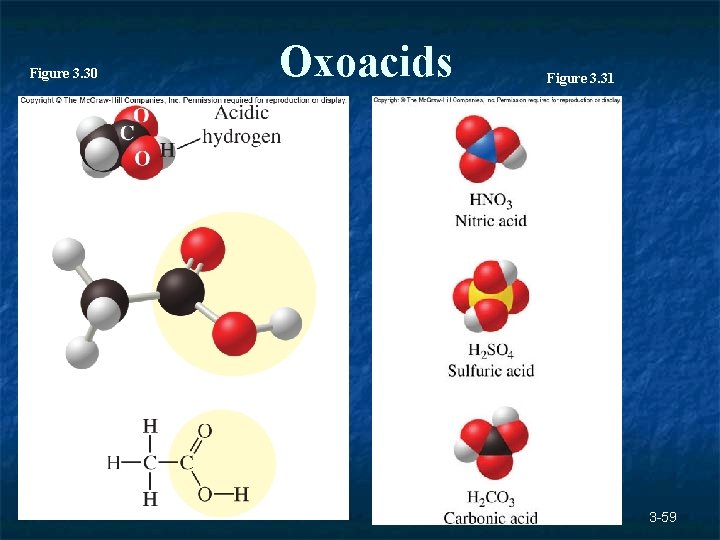
Figure 3. 30 Oxoacids Figure 3. 31 3 -59
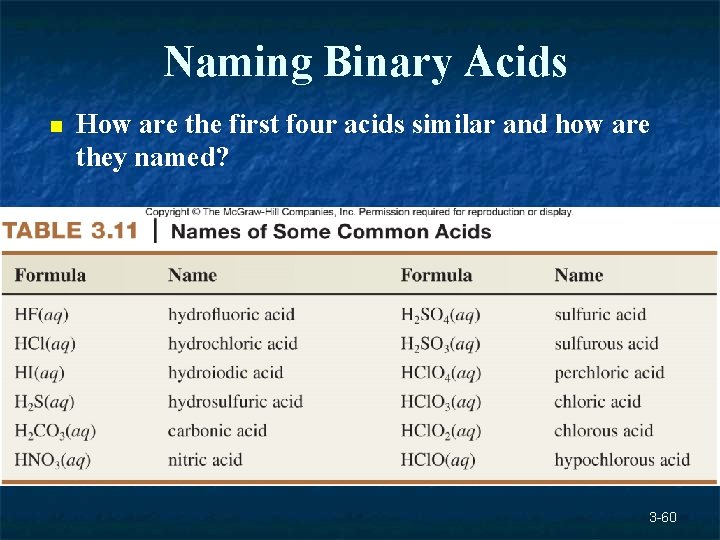
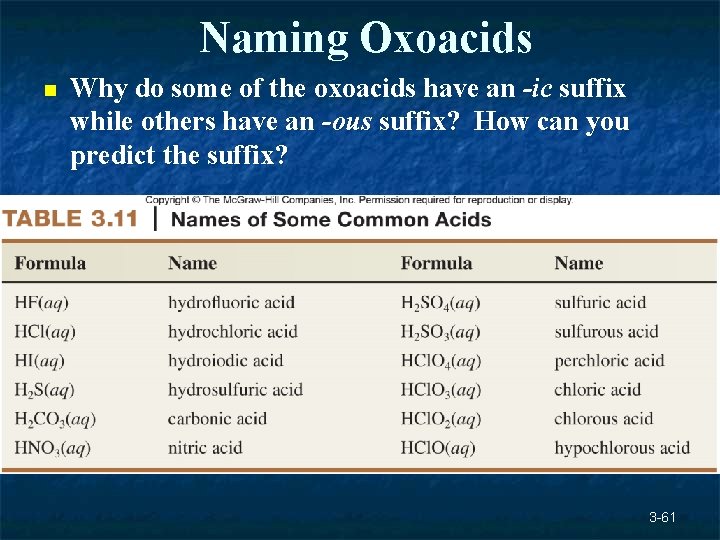
Naming Binary Acids n How are the first four acids similar and how are they named? 3 -60
Naming Oxoacids n Why do some of the oxoacids have an -ic suffix while others have an -ous suffix? How can you predict the suffix? 3 -61
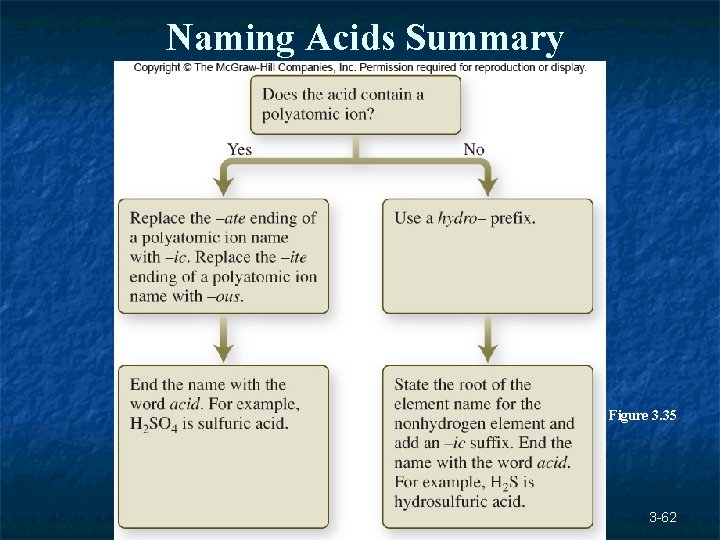
Naming Acids Summary Figure 3. 35 3 -62
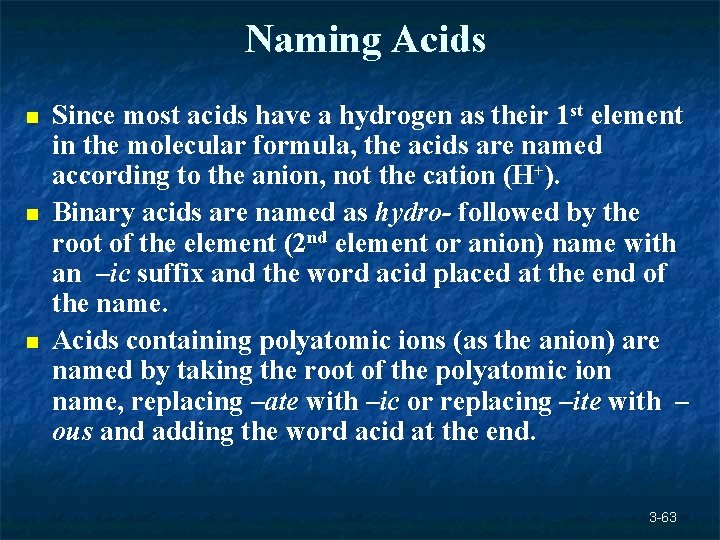
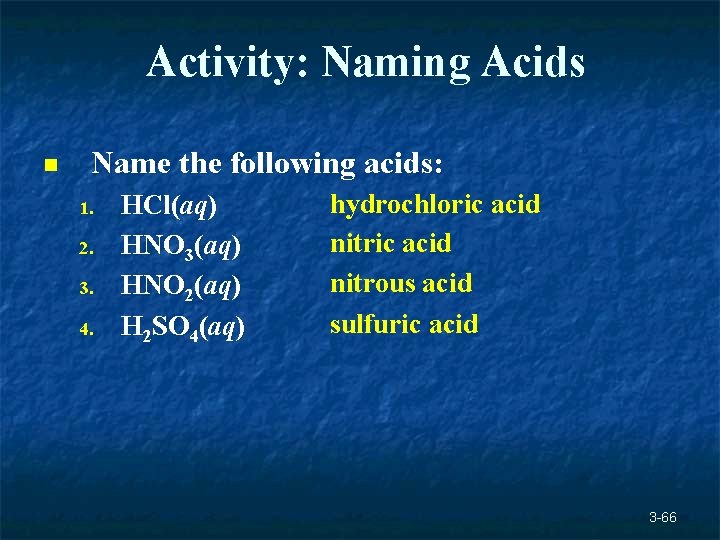
Naming Acids n n n Since most acids have a hydrogen as their 1 st element in the molecular formula, the acids are named according to the anion, not the cation (H+). Binary acids are named as hydro- followed by the root of the element (2 nd element or anion) name with an –ic suffix and the word acid placed at the end of the name. Acids containing polyatomic ions (as the anion) are named by taking the root of the polyatomic ion name, replacing –ate with –ic or replacing –ite with – ous and adding the word acid at the end. 3 -63
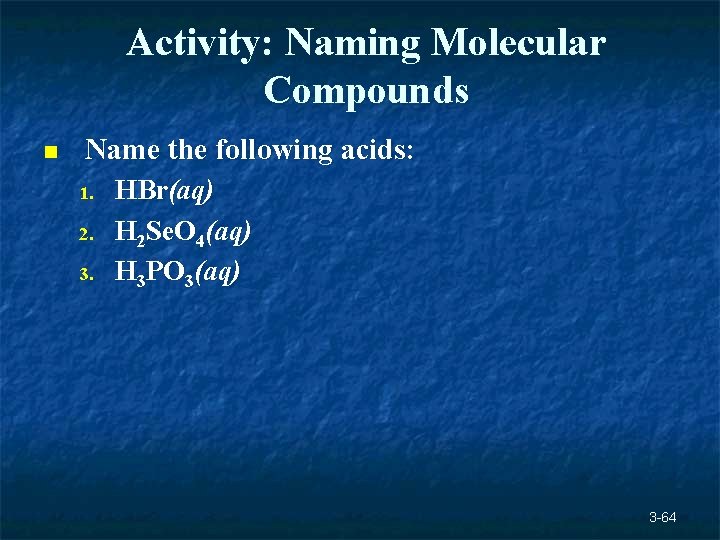
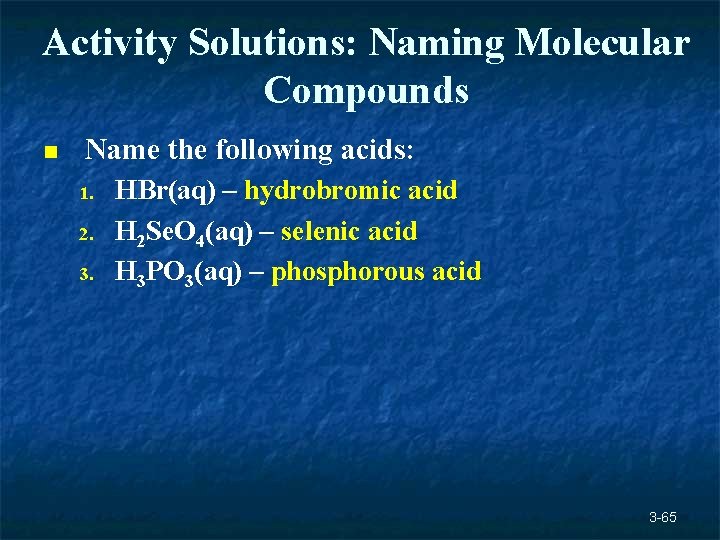
Activity: Naming Molecular Compounds n Name the following acids: 1. 2. 3. HBr(aq) H 2 Se. O 4(aq) H 3 PO 3(aq) 3 -64
Activity Solutions: Naming Molecular Compounds n Name the following acids: 1. 2. 3. HBr(aq) – hydrobromic acid H 2 Se. O 4(aq) – selenic acid H 3 PO 3(aq) – phosphorous acid 3 -65
Activity: Naming Acids n Name the following acids: 1. 2. 3. 4. HCl(aq) HNO 3(aq) HNO 2(aq) H 2 SO 4(aq) hydrochloric acid nitrous acid sulfuric acid 3 -66
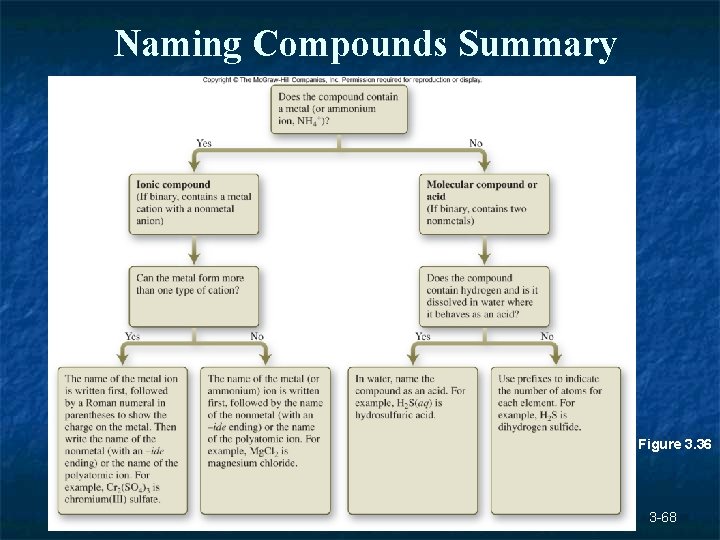
3. 7 Predicting Properties and Naming Compounds n Before naming a compound, you must first classify it as either an ionic compound, molecular compound, or acid. n n If it is an ionic compound, you must also decide if the cation is an ion that can vary in charge. These classifications allow you to name the compound with the proper rules. 3 -67
Naming Compounds Summary Figure 3. 36 3 -68
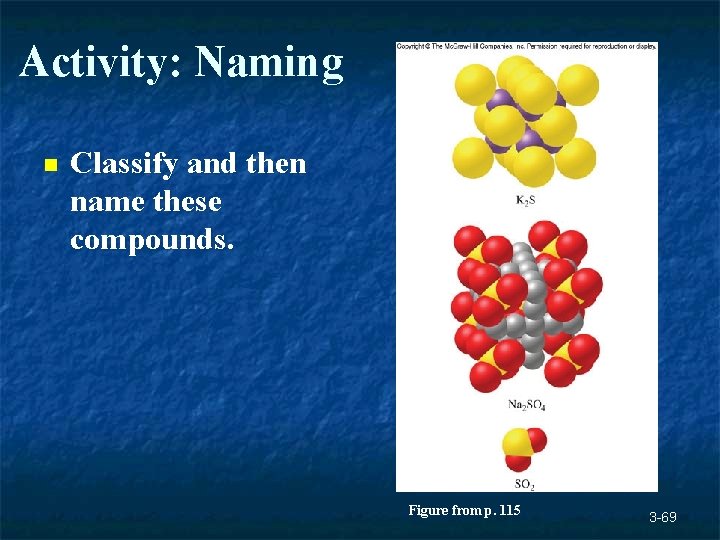
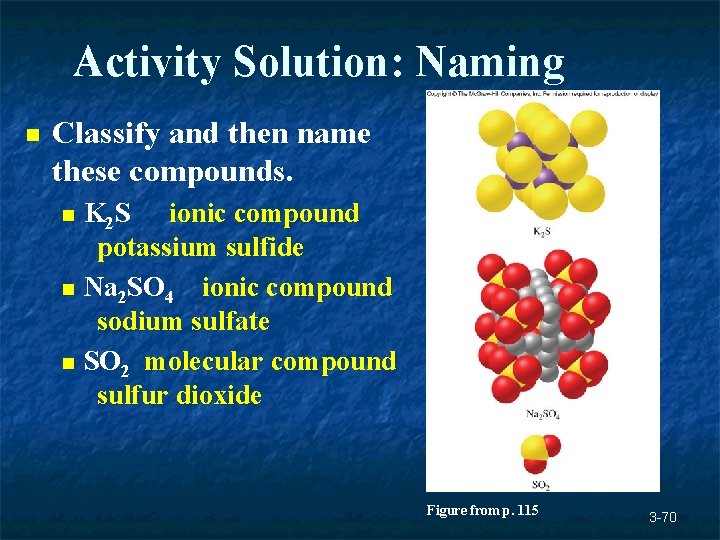
Activity: Naming n Classify and then name these compounds. Figure from p. 115 3 -69
Activity Solution: Naming n Classify and then name these compounds. K 2 S ionic compound potassium sulfide n Na 2 SO 4 ionic compound sodium sulfate n SO 2 molecular compound sulfur dioxide n Figure from p. 115 3 -70
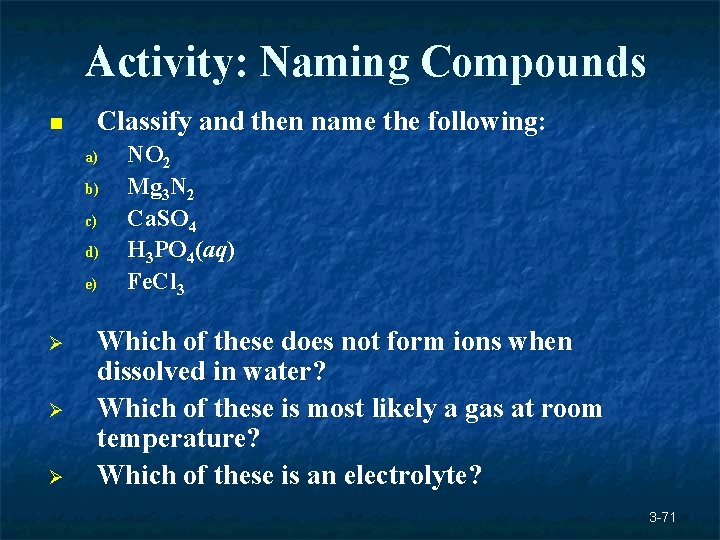
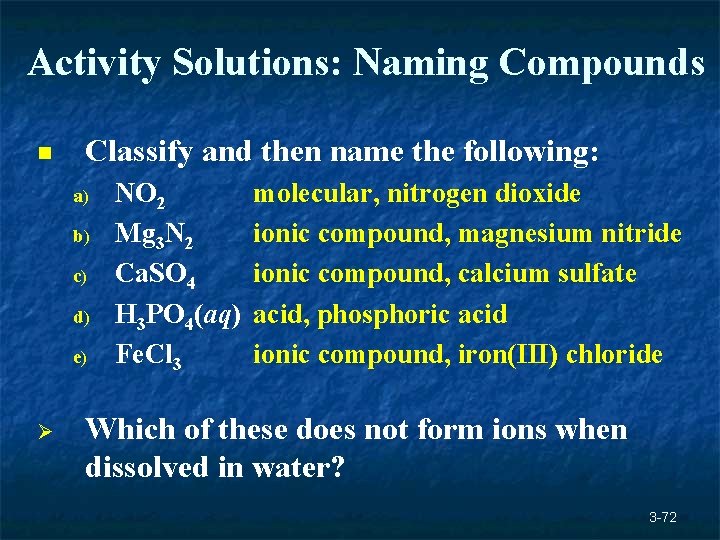
Activity: Naming Compounds n Classify and then name the following: a) b) c) d) e) Ø Ø Ø NO 2 Mg 3 N 2 Ca. SO 4 H 3 PO 4(aq) Fe. Cl 3 Which of these does not form ions when dissolved in water? Which of these is most likely a gas at room temperature? Which of these is an electrolyte? 3 -71
Activity Solutions: Naming Compounds n Classify and then name the following: a) b) c) d) e) Ø NO 2 Mg 3 N 2 Ca. SO 4 H 3 PO 4(aq) Fe. Cl 3 molecular, nitrogen dioxide ionic compound, magnesium nitride ionic compound, calcium sulfate acid, phosphoric acid ionic compound, iron(III) chloride Which of these does not form ions when dissolved in water? 3 -72
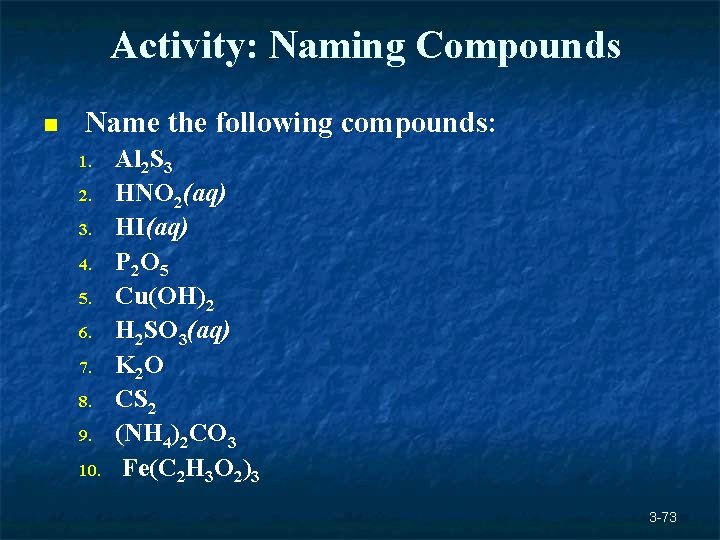
Activity: Naming Compounds n Name the following compounds: 1. 2. 3. 4. 5. 6. 7. 8. 9. 10. Al 2 S 3 HNO 2(aq) HI(aq) P 2 O 5 Cu(OH)2 H 2 SO 3(aq) K 2 O CS 2 (NH 4)2 CO 3 Fe(C 2 H 3 O 2)3 3 -73
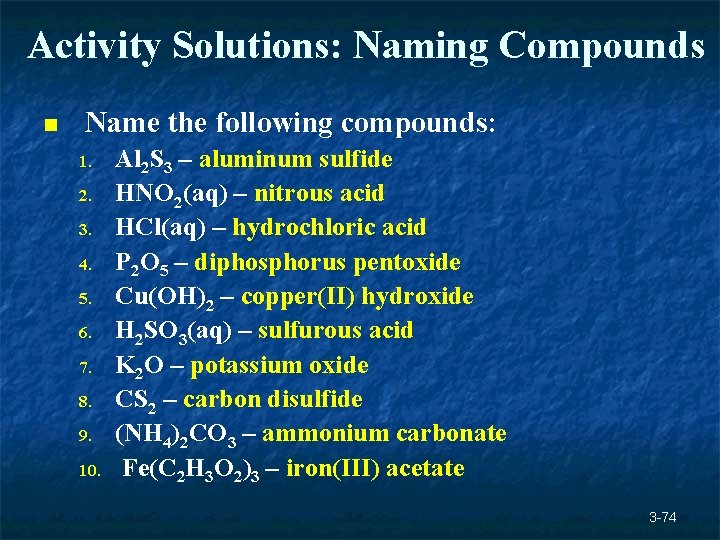
Activity Solutions: Naming Compounds n Name the following compounds: 1. 2. 3. 4. 5. 6. 7. 8. 9. 10. Al 2 S 3 – aluminum sulfide HNO 2(aq) – nitrous acid HCl(aq) – hydrochloric acid P 2 O 5 – diphosphorus pentoxide Cu(OH)2 – copper(II) hydroxide H 2 SO 3(aq) – sulfurous acid K 2 O – potassium oxide CS 2 – carbon disulfide (NH 4)2 CO 3 – ammonium carbonate Fe(C 2 H 3 O 2)3 – iron(III) acetate 3 -74
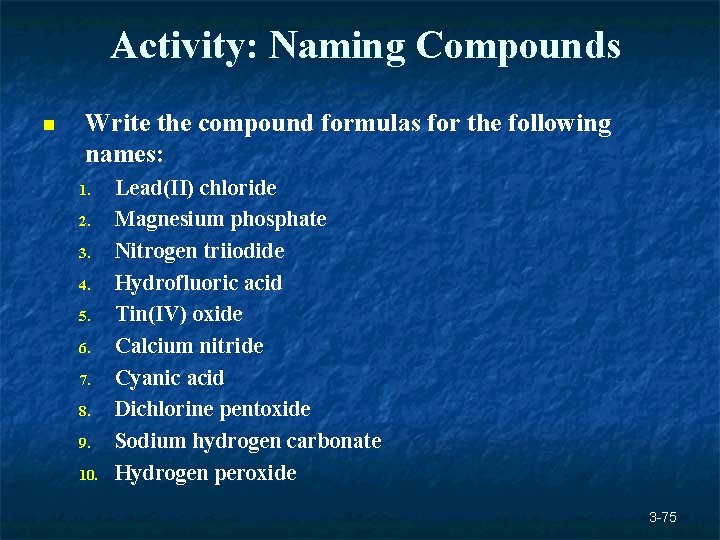
Activity: Naming Compounds n Write the compound formulas for the following names: 1. 2. 3. 4. 5. 6. 7. 8. 9. 10. Lead(II) chloride Magnesium phosphate Nitrogen triiodide Hydrofluoric acid Tin(IV) oxide Calcium nitride Cyanic acid Dichlorine pentoxide Sodium hydrogen carbonate Hydrogen peroxide 3 -75
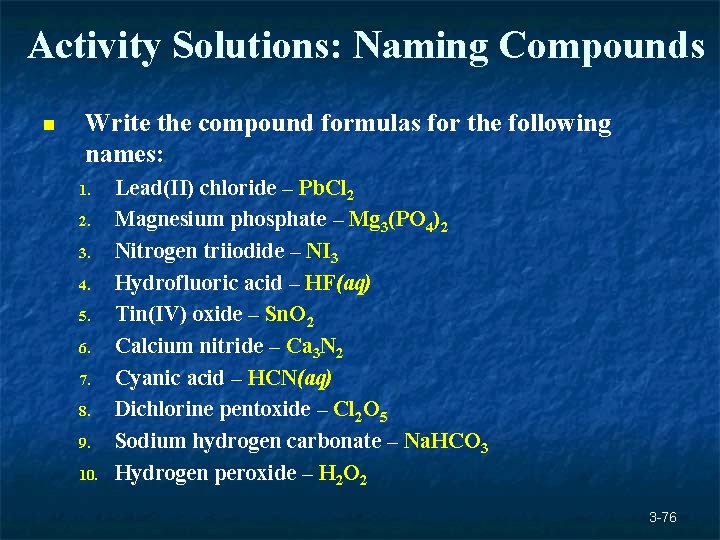
Activity Solutions: Naming Compounds n Write the compound formulas for the following names: 1. 2. 3. 4. 5. 6. 7. 8. 9. 10. Lead(II) chloride – Pb. Cl 2 Magnesium phosphate – Mg 3(PO 4)2 Nitrogen triiodide – NI 3 Hydrofluoric acid – HF(aq) Tin(IV) oxide – Sn. O 2 Calcium nitride – Ca 3 N 2 Cyanic acid – HCN(aq) Dichlorine pentoxide – Cl 2 O 5 Sodium hydrogen carbonate – Na. HCO 3 Hydrogen peroxide – H 2 O 2 3 -76