Ionic Compounds Metals Vs Non Metals Left of



- Slides: 47
Ionic Compounds
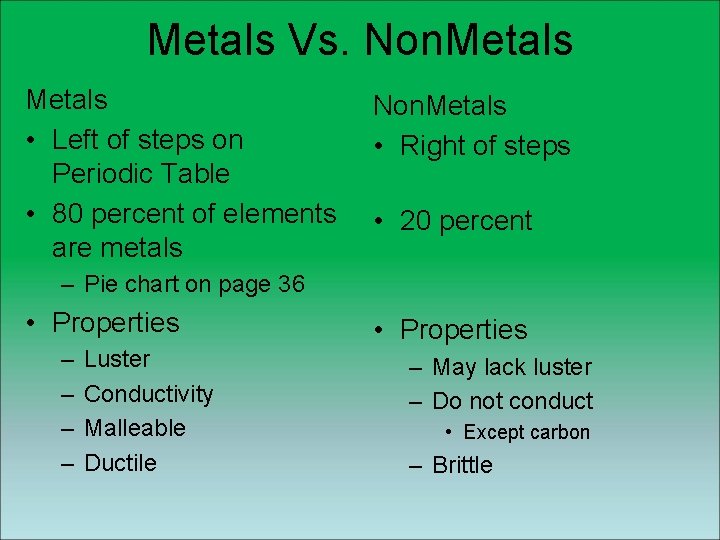
Metals Vs. Non. Metals • Left of steps on Periodic Table • 80 percent of elements are metals Non. Metals • Right of steps • 20 percent – Pie chart on page 36 • Properties – – Luster Conductivity Malleable Ductile • Properties – May lack luster – Do not conduct • Except carbon – Brittle
Electron Configuration • The properties of metals and nonmetals are greatly influenced by the electron configurations of atoms.
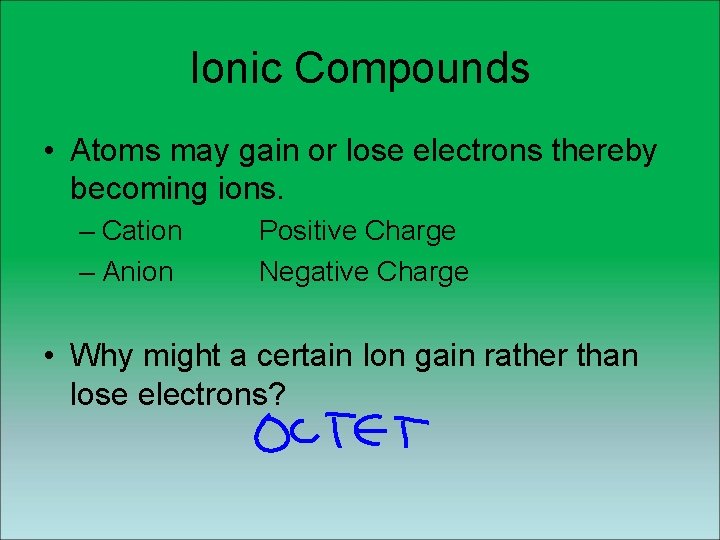
Ionic Compounds • Atoms may gain or lose electrons thereby becoming ions. – Cation – Anion Positive Charge Negative Charge • Why might a certain Ion gain rather than lose electrons?
Electron Configuration • Number of electrons in the outermost shell is key. • Few electrons Tend to lose them • Close to full Shell Tend to gain • Tendency towards stability
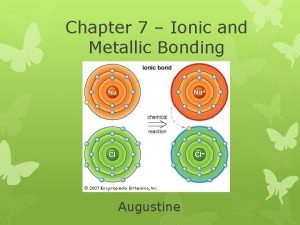
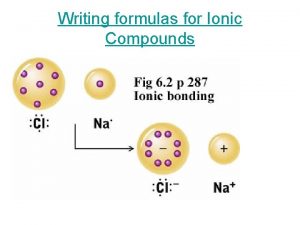
Compounds and Ionic Bonding • A compound is a substance which is made of two or more kinds of atoms or ions which have joined together. • Attractive force between positive and negative ions creates Ionic Compounds. • Na. Cl Na+ Cl- • The force of attraction between the positive and negative ions is known as an Ionic bond.
IMPORTANT • When we talk about stability we are referring to the number of electrons in the valence shell.
Review • • • Atom Ion Cation Anion Why does an atom lose or gain electrons? Predictions – Fluorine, Potassium, Lithium • How many Chloride ions bond with Magnesium ions?
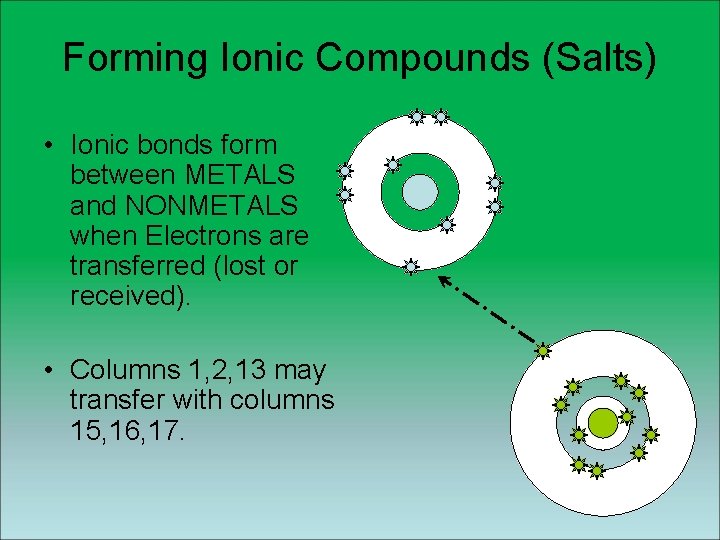
Forming Ionic Compounds (Salts) • Ionic bonds form between METALS and NONMETALS when Electrons are transferred (lost or received). • Columns 1, 2, 13 may transfer with columns 15, 16, 17.
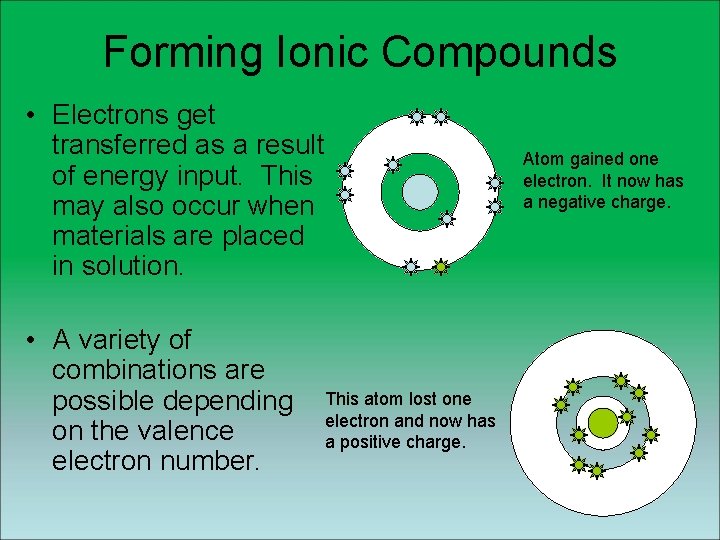
Forming Ionic Compounds • Electrons get transferred as a result of energy input. This may also occur when materials are placed in solution. • A variety of combinations are possible depending on the valence electron number. Atom gained one electron. It now has a negative charge. This atom lost one electron and now has a positive charge.
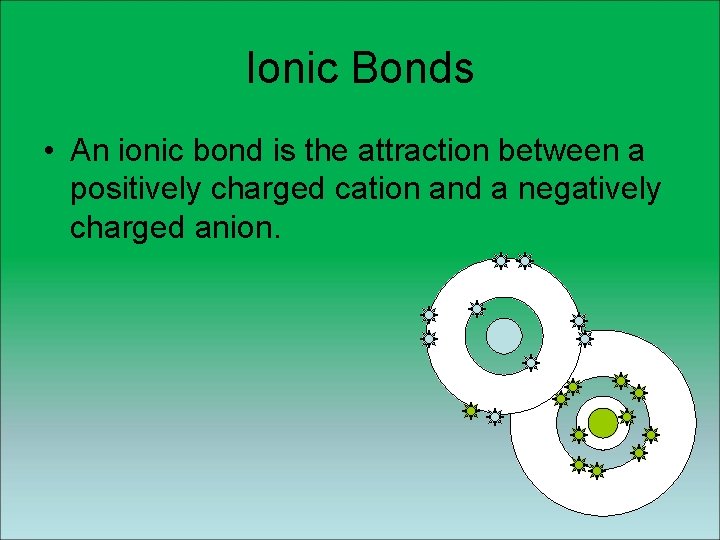
Ionic Bonds • An ionic bond is the attraction between a positively charged cation and a negatively charged anion.
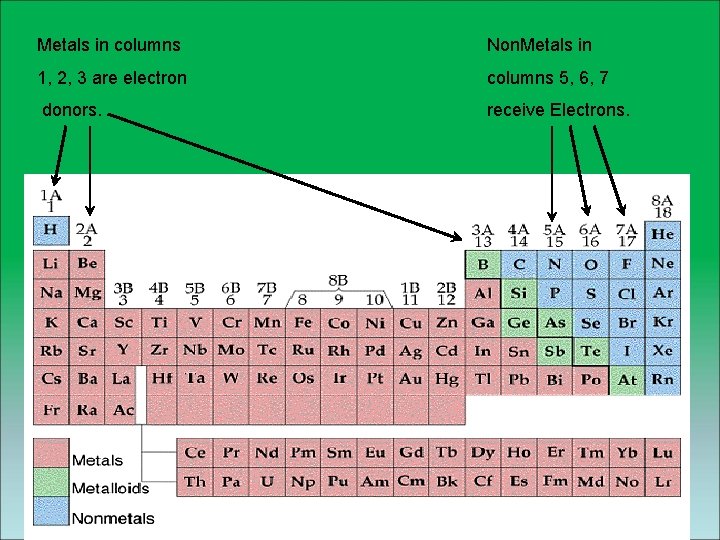
Metals in columns Non. Metals in 1, 2, 3 are electron columns 5, 6, 7 donors. receive Electrons.
Which Elements form Ionic Bonds? • The central idea (for the 50 th time) is that electrons, one or more, are transferred between the outer shells of adjacent atoms. This Creates Ions/Charged Atoms. • Metals and Non. Metals. • Certain Elements may donate or receive more than one electron. It can therefore bond with multiple elements.
Example #1 Na and Cl • How many valence electrons does each atom have? • Which atom will tend to Receive e-? Donate? • What is the charge on each ion? • What will the ratio between Na and Cl be?
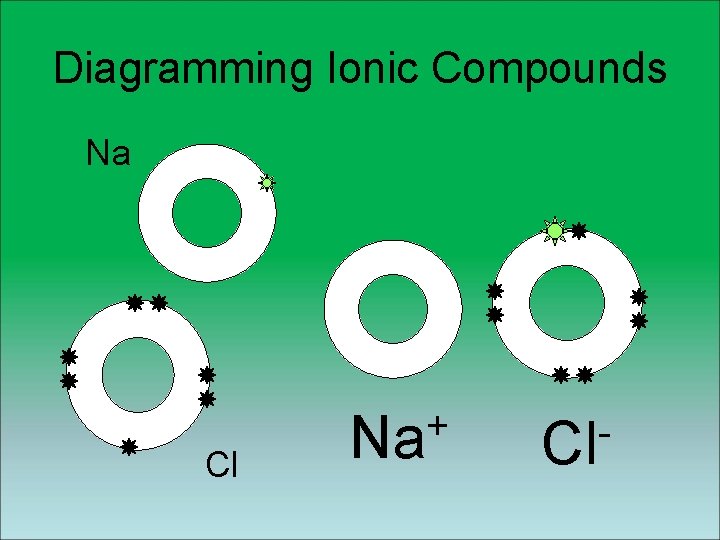
Example #1 Na and Cl • Sodium would lose one electron and become positively charged, while Chlorine would gain one electron becoming negatively charged. • The positive/negative charge attraction would hold the two ions together.
Example #2 Mg and O • How many valence electrons does each atom have? • Which atom will tend to Donate e-? Receive? • What is the charge on each ion? • What will the ratio between Mg and O be?
Example #2 Mg and O • The Magnesium would lose two electrons, becoming +2 charged and the Oxygen would gain the two electrons becoming -2 charged in the process. • The negative/positive charge attraction (+2/-2) (four times as much as +1/-1) would hold the two ions together.
Example #3 Mg and Cl • How many valence electrons does each atom have? • Which atom will tend to gain e-? Donate? • What is the charge on each ion? • What will the ratio between Mg and Cl be?
Example #3 Mg and Cl • The Magnesium would lose two electrons, becoming +2 charged and two chlorines (not one) would each gain one electron, each becoming -1 charged in the process. • The three atoms would bond to each other by the positive/negative attraction between the ions.
Naming Ionic Compounds • The same as naming individual ions. • Cation, Electron Donor, or Metal in compound is said first. • Anion name is changed to ……. ide and said second.
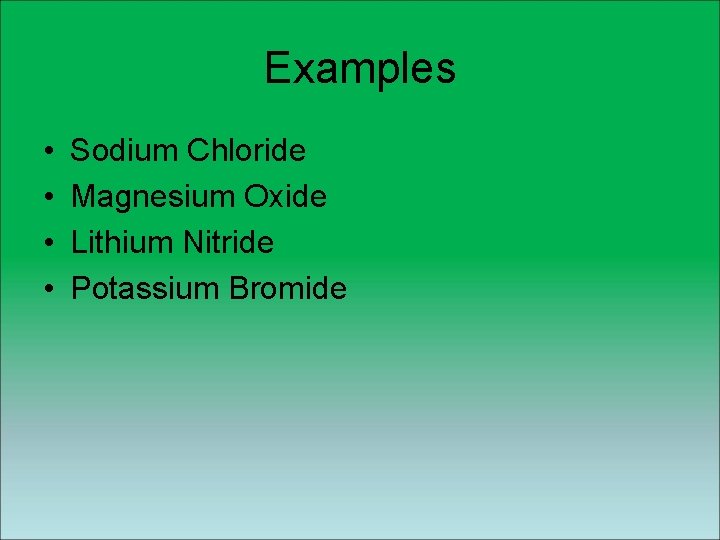
Examples • • Sodium Chloride Magnesium Oxide Lithium Nitride Potassium Bromide
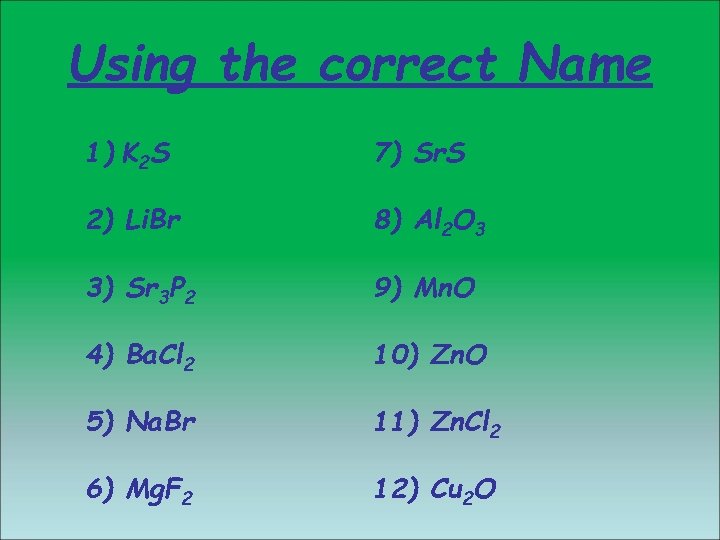
Using the correct Name 1) K 2 S 7) Sr. S 2) Li. Br 8) Al 2 O 3 3) Sr 3 P 2 9) Mn. O 4) Ba. Cl 2 10) Zn. O 5) Na. Br 11) Zn. Cl 2 6) Mg. F 2 12) Cu 2 O
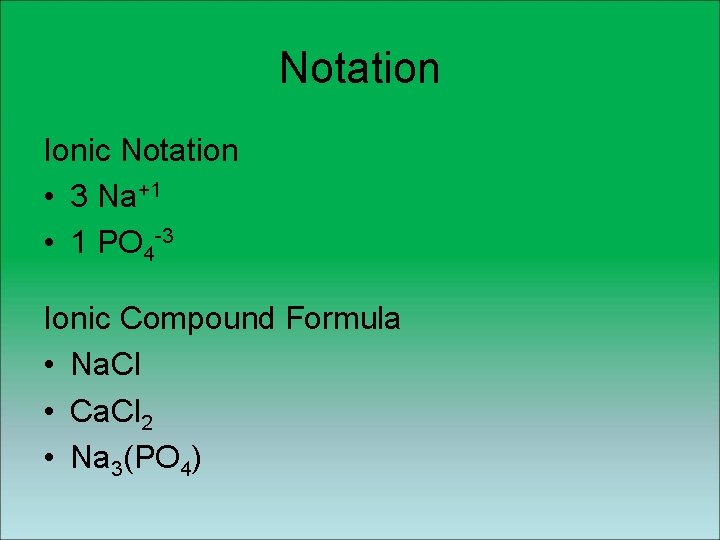
Notation Ionic Notation • 3 Na+1 • 1 PO 4 -3 Ionic Compound Formula • Na. Cl • Ca. Cl 2 • Na 3(PO 4)
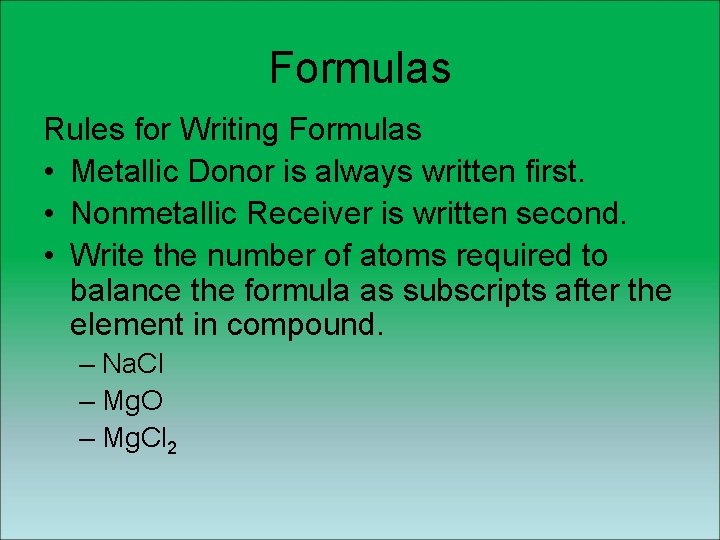
Formulas Rules for Writing Formulas • Metallic Donor is always written first. • Nonmetallic Receiver is written second. • Write the number of atoms required to balance the formula as subscripts after the element in compound. – Na. Cl – Mg. O – Mg. Cl 2
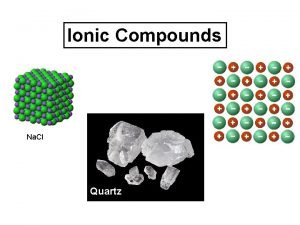
The Ionic Compound Na. Cl
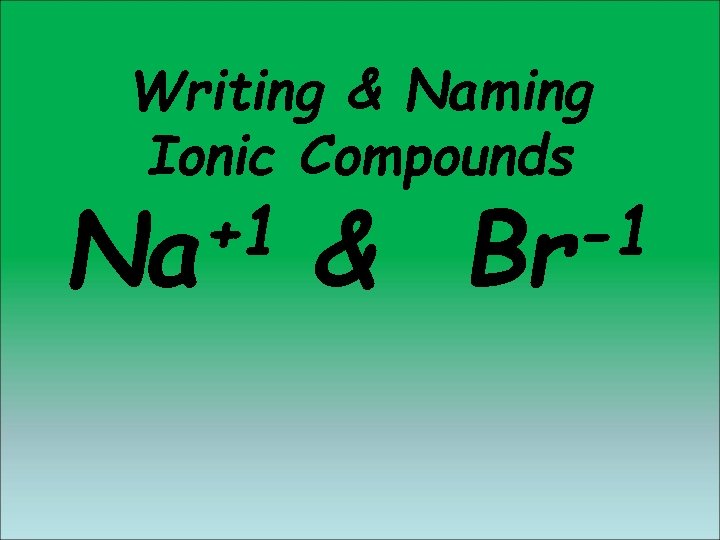
Writing & Naming Ionic Compounds +1 Na & -1 Br
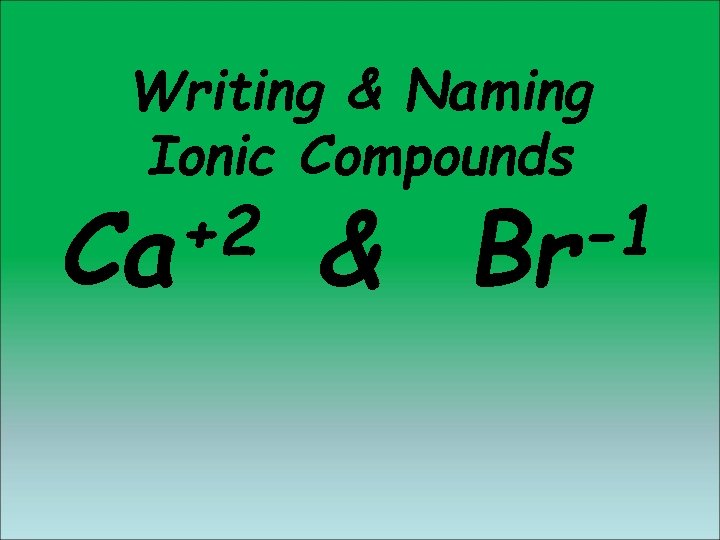
Writing & Naming Ionic Compounds +2 Ca & -1 Br
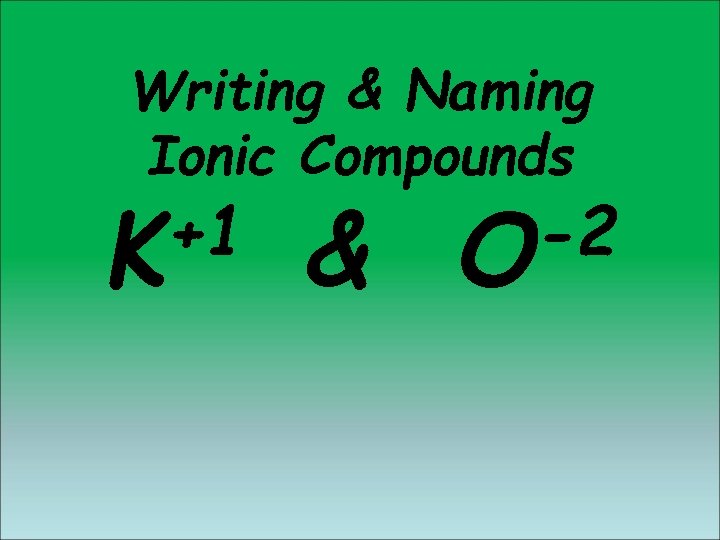
Writing & Naming Ionic Compounds +1 K & -2 O
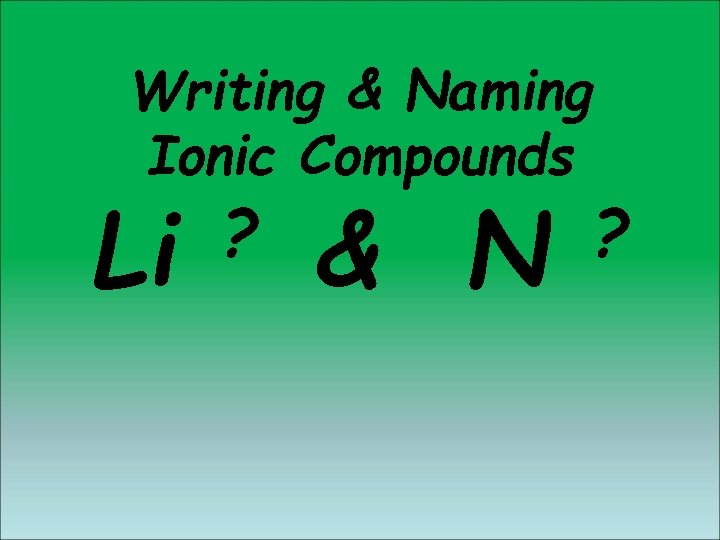
Writing & Naming Ionic Compounds Li ? & N ?
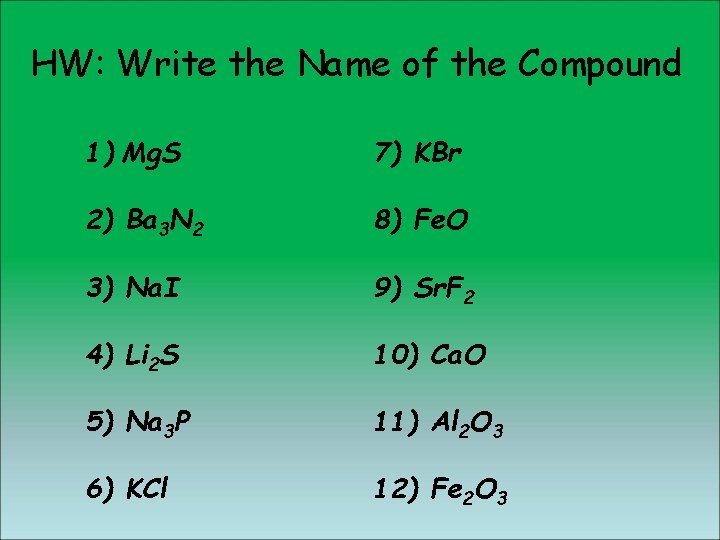
HW: Write the Name of the Compound 1) Mg. S 7) KBr 2) Ba 3 N 2 8) Fe. O 3) Na. I 9) Sr. F 2 4) Li 2 S 10) Ca. O 5) Na 3 P 11) Al 2 O 3 6) KCl 12) Fe 2 O 3
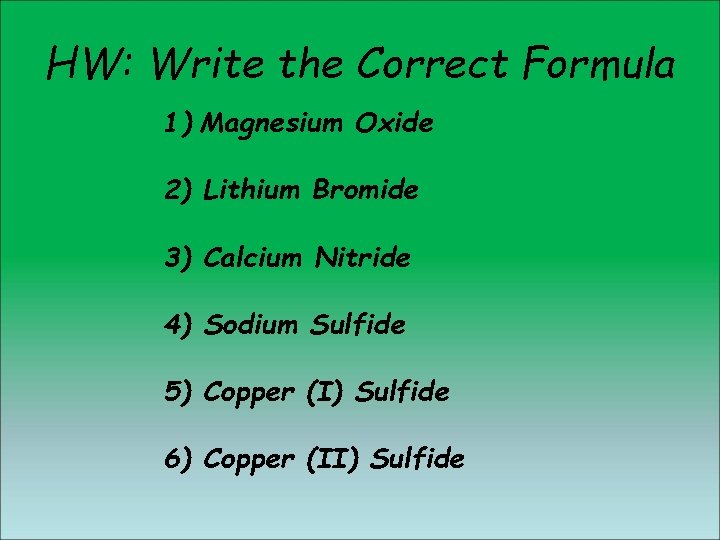
HW: Write the Correct Formula 1) Magnesium Oxide 2) Lithium Bromide 3) Calcium Nitride 4) Sodium Sulfide 5) Copper (I) Sulfide 6) Copper (II) Sulfide
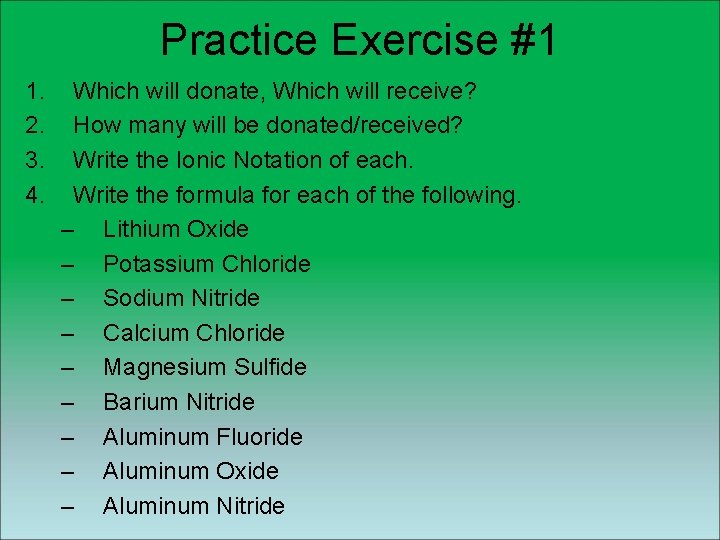
Practice Exercise #1 1. 2. 3. 4. Which will donate, Which will receive? How many will be donated/received? Write the Ionic Notation of each. Write the formula for each of the following. – Lithium Oxide – Potassium Chloride – Sodium Nitride – Calcium Chloride – Magnesium Sulfide – Barium Nitride – Aluminum Fluoride – Aluminum Oxide – Aluminum Nitride
Diagramming Ionic Compounds • Lewis Structures – Diagram valence shell. • Place valence electrons around nucleus as they would be according to the octet rule
Diagramming Ionic Compounds Na Cl + Na Cl
Practice Exercise #2 • Diagram the following Ionic Compounds: – Lithium Oxide – Potassium Chloride – Sodium Nitride – Calcium Chloride – Magnesium Sulfide – Barium Nitride – Aluminum Fluoride – Aluminum Oxide – Aluminum Nitride
Transition Metals • d block elements that can form more than one kind of ion. • Lose electrons • Why can they lose different numbers of electrons? • Copper – Cu I or Cu II • Iron – Fe II or Fe III
Implications • Copper and Iron as well as other transition metals can form multiple ionic compounds.
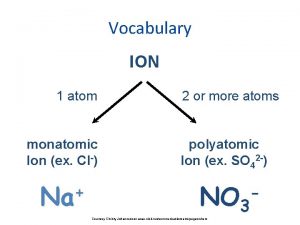
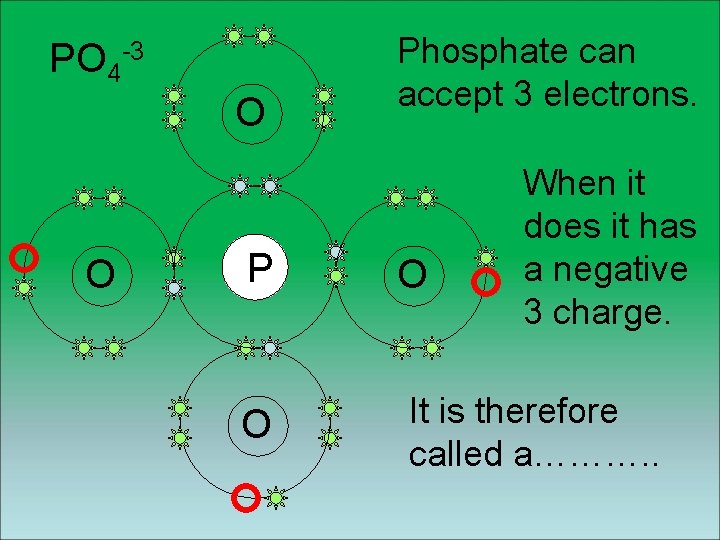
Polyatomic Ions • Compound Ions • A group of COVALENTLY bonded atoms that have a net charge (anion or cation) • Most, but not all are Anions.
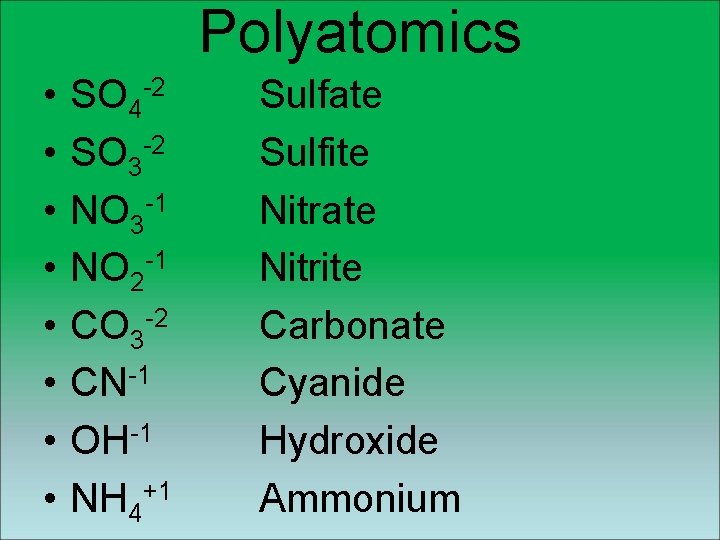
Polyatomics • • SO 4 -2 SO 3 -2 NO 3 -1 NO 2 -1 CO 3 -2 CN-1 OH-1 NH 4+1 Sulfate Sulfite Nitrate Nitrite Carbonate Cyanide Hydroxide Ammonium
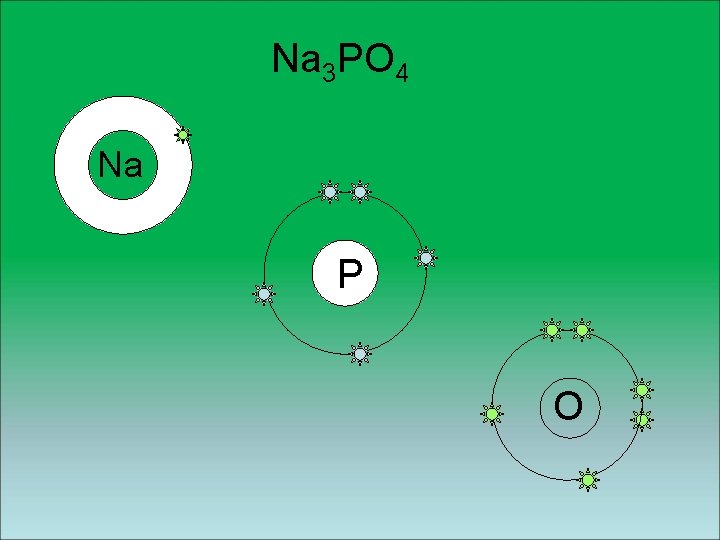
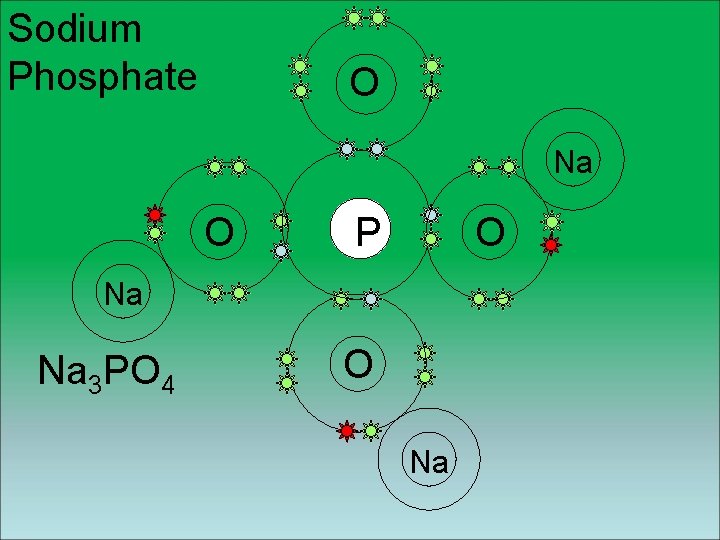
Na 3 PO 4 Na P O
PO 4 -3 O O Phosphate can accept 3 electrons. O When it does it has a negative 3 charge. It is therefore called a………. .
Sodium Phosphate O Na O P O Na Na 3 PO 4 O Na
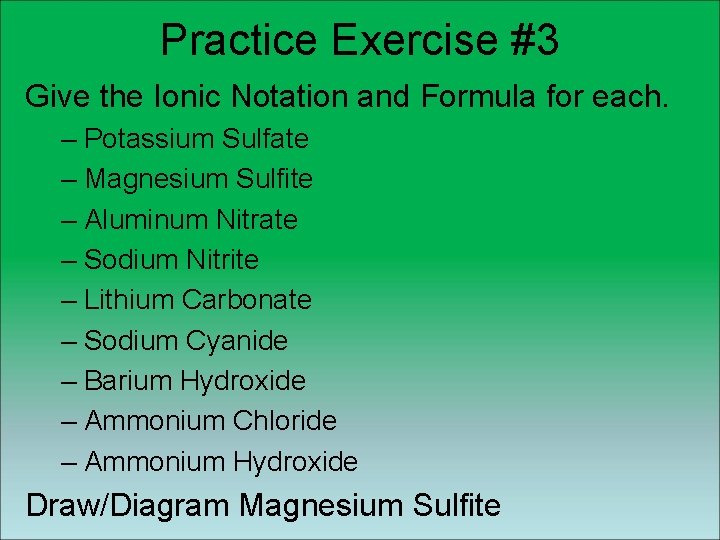
Practice Exercise #3 Give the Ionic Notation and Formula for each. – Potassium Sulfate – Magnesium Sulfite – Aluminum Nitrate – Sodium Nitrite – Lithium Carbonate – Sodium Cyanide – Barium Hydroxide – Ammonium Chloride – Ammonium Hydroxide Draw/Diagram Magnesium Sulfite
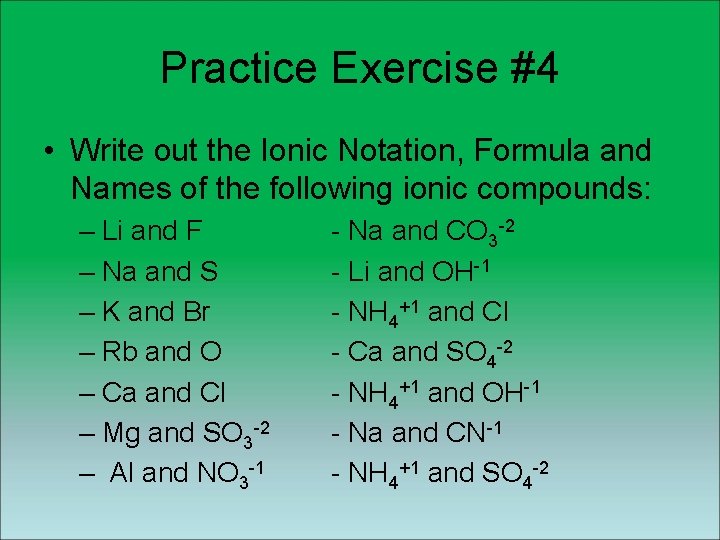
Practice Exercise #4 • Write out the Ionic Notation, Formula and Names of the following ionic compounds: – Li and F – Na and S – K and Br – Rb and O – Ca and Cl – Mg and SO 3 -2 – Al and NO 3 -1 - Na and CO 3 -2 - Li and OH-1 - NH 4+1 and Cl - Ca and SO 4 -2 - NH 4+1 and OH-1 - Na and CN-1 - NH 4+1 and SO 4 -2