Introduction to Nuclear physics The nucleus a complex
- Slides: 54
Introduction to Nuclear physics; The nucleus a complex system Héloïse Goutte GANIL Caen, France goutte@ganil. fr Héloïse Goutte CERN Summer student program 2010 1
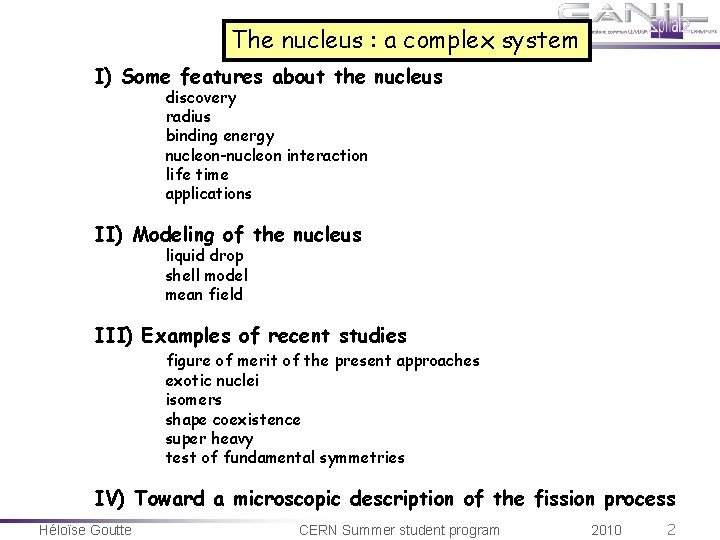
The nucleus : a complex system I) Some features about the nucleus discovery radius binding energy nucleon-nucleon interaction life time applications II) Modeling of the nucleus liquid drop shell model mean field III) Examples of recent studies figure of merit of the present approaches exotic nuclei isomers shape coexistence super heavy test of fundamental symmetries IV) Toward a microscopic description of the fission process Héloïse Goutte CERN Summer student program 2010 2
III) Examples of recent studies Héloïse Goutte CERN Summer student program 2010 3
1) Figure of merit of the present approaches Héloïse Goutte CERN Summer student program 2010 4
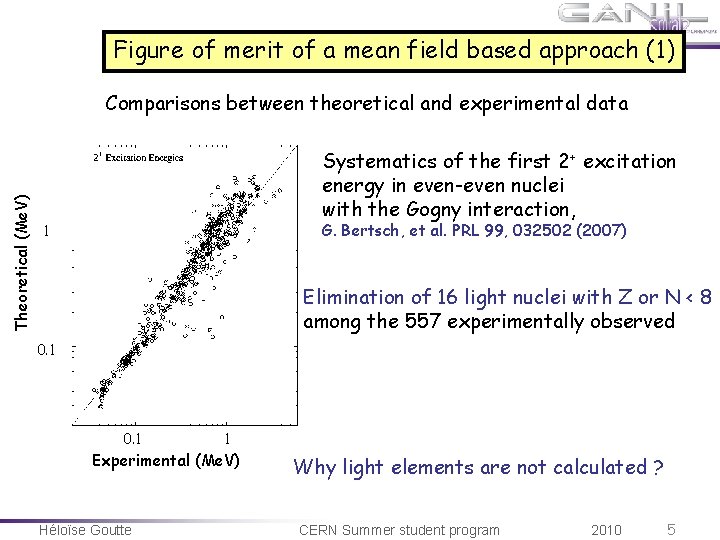
Figure of merit of a mean field based approach (1) Theoretical (Me. V) Comparisons between theoretical and experimental data Systematics of the first 2+ excitation energy in even-even nuclei with the Gogny interaction, G. Bertsch, et al. PRL 99, 032502 (2007) 1 Elimination of 16 light nuclei with Z or N < 8 among the 557 experimentally observed 0. 1 1 Experimental (Me. V) Héloïse Goutte Why light elements are not calculated ? CERN Summer student program 2010 5
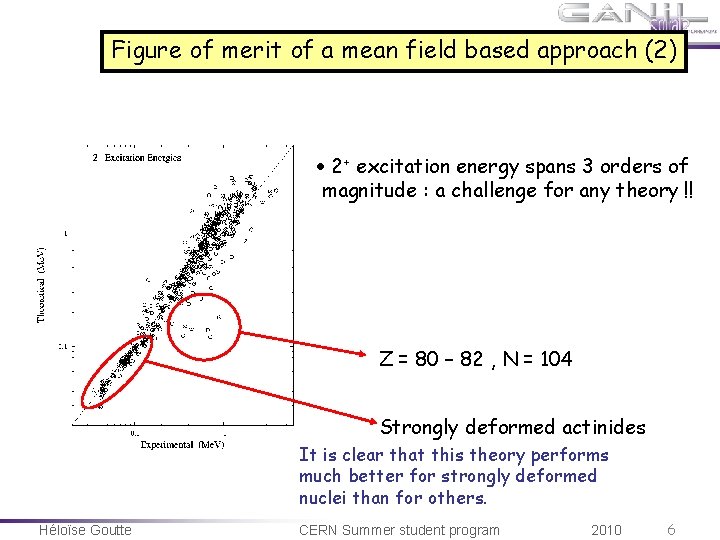
Figure of merit of a mean field based approach (2) 2+ excitation energy spans 3 orders of magnitude : a challenge for any theory !! Z = 80 – 82 , N = 104 Strongly deformed actinides It is clear that this theory performs much better for strongly deformed nuclei than for others. Héloïse Goutte CERN Summer student program 2010 6
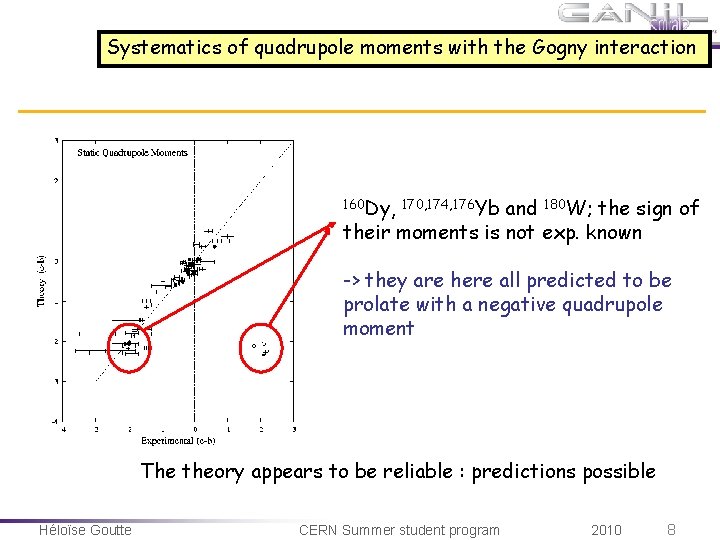
Systematics of quadrupole moments with the Gogny interaction 160 Dy, 170, 174, 176 Yb and 180 W; the sign of their moments is not exp. known -> they are here all predicted to be prolate with a negative quadrupole moment The theory appears to be reliable : predictions possible Héloïse Goutte CERN Summer student program 2010 8
2) Exotic nuclei Héloïse Goutte CERN Summer student program 2010 9
Héloïse Goutte CERN Summer student program 2010 10
Exotic nuclei : some open questions • What are the limits to nuclear existence ? • What new forms will be found in nuclei ? • What happens to the well-known shell structure seen in stable nuclei as we move away from stability ? Héloïse Goutte CERN Summer student program 2010 11
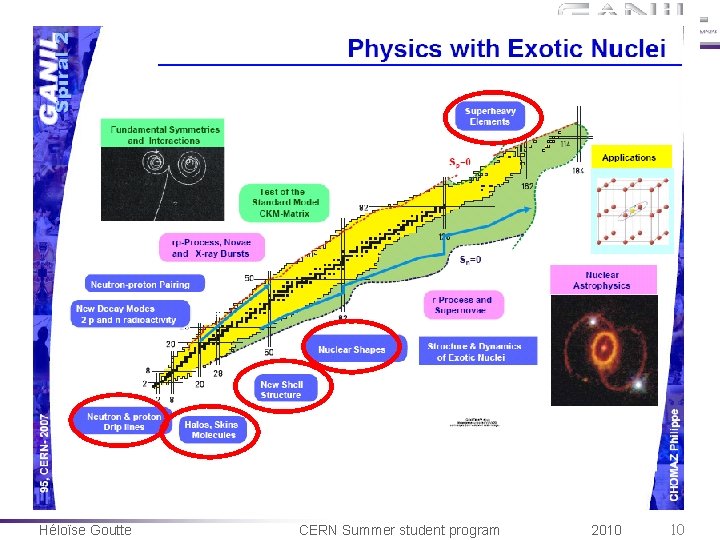
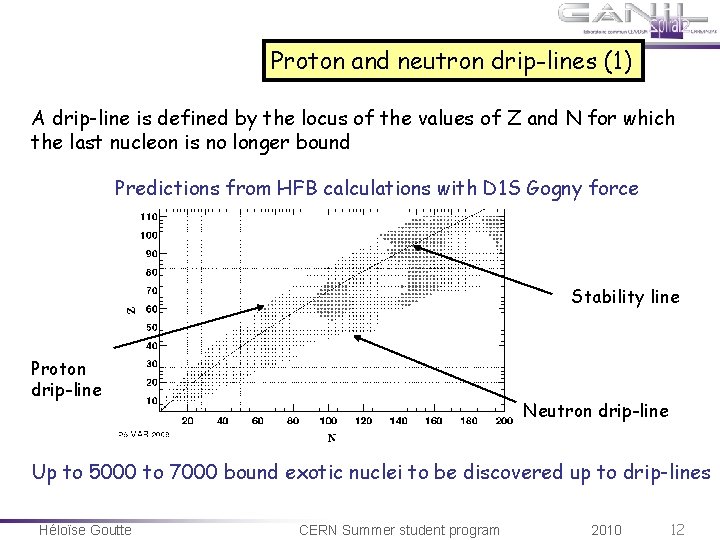
Proton and neutron drip-lines (1) A drip-line is defined by the locus of the values of Z and N for which the last nucleon is no longer bound Predictions from HFB calculations with D 1 S Gogny force Stability line Proton drip-line Neutron drip-line Up to 5000 to 7000 bound exotic nuclei to be discovered up to drip-lines Héloïse Goutte CERN Summer student program 2010 12
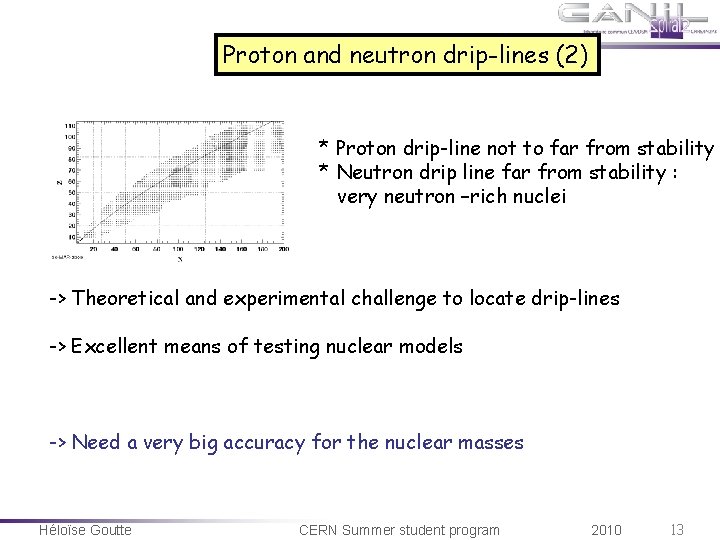
Proton and neutron drip-lines (2) * Proton drip-line not to far from stability * Neutron drip line far from stability : very neutron –rich nuclei -> Theoretical and experimental challenge to locate drip-lines -> Excellent means of testing nuclear models -> Need a very big accuracy for the nuclear masses Héloïse Goutte CERN Summer student program 2010 13
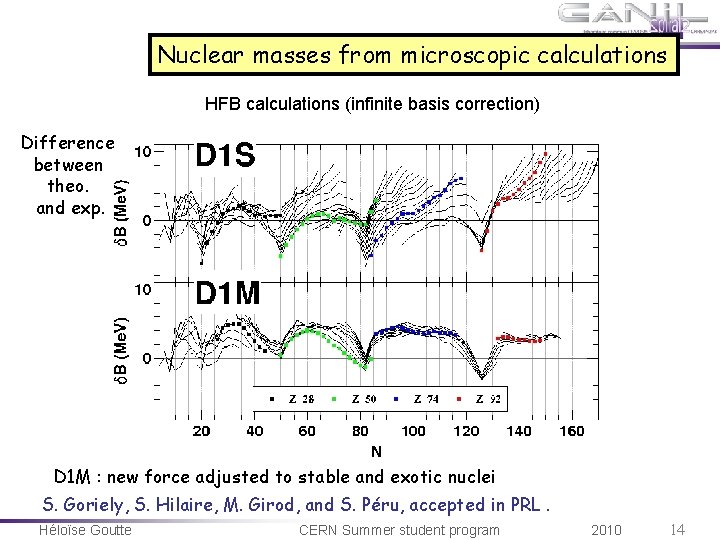
Nuclear masses from microscopic calculations HFB calculations (infinite basis correction) Difference between theo. and exp. D 1 M : new force adjusted to stable and exotic nuclei S. Goriely, S. Hilaire, M. Girod, and S. Péru, accepted in PRL. Héloïse Goutte CERN Summer student program 2010 14
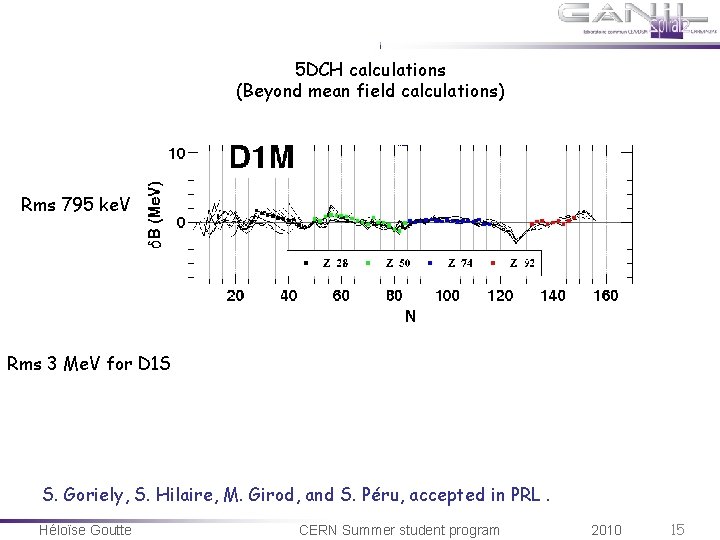
5 DCH calculations (Beyond mean field calculations) Rms 795 ke. V Rms 3 Me. V for D 1 S S. Goriely, S. Hilaire, M. Girod, and S. Péru, accepted in PRL. Héloïse Goutte CERN Summer student program 2010 15
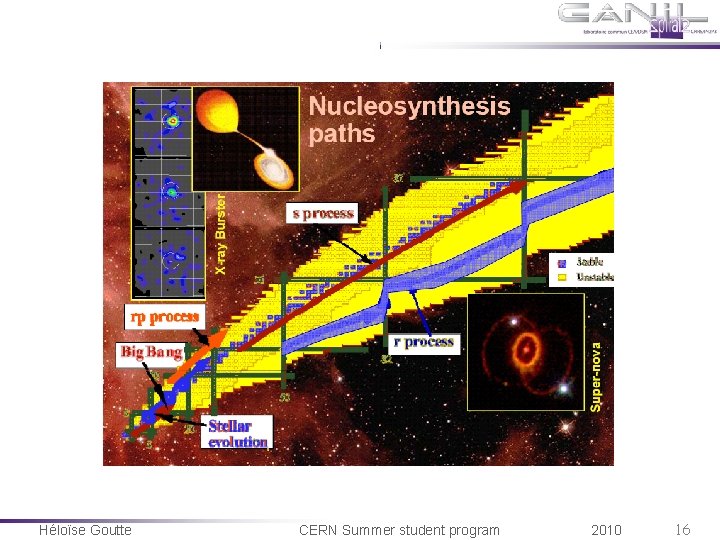
Héloïse Goutte CERN Summer student program 2010 16
3) New magic numbers in exotic nuclei ? Héloïse Goutte CERN Summer student program 2010 18
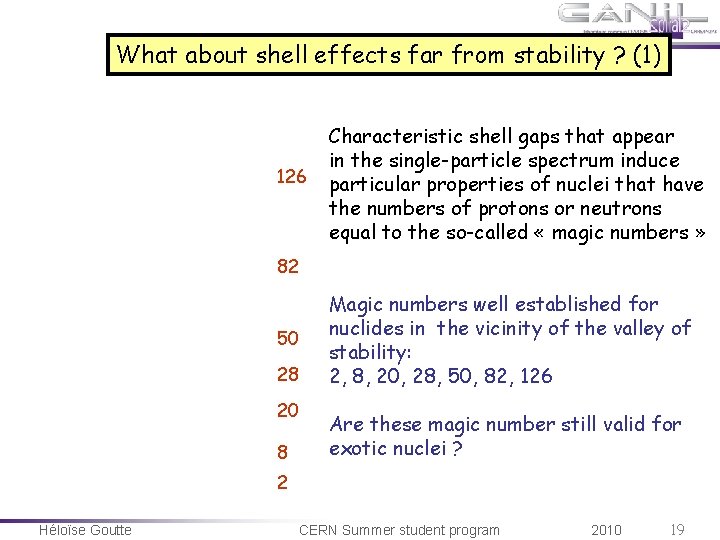
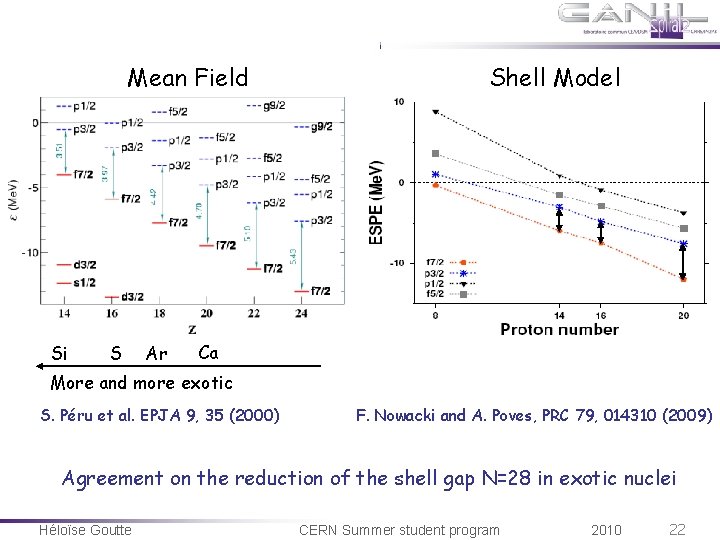
What about shell effects far from stability ? (1) 126 Characteristic shell gaps that appear in the single-particle spectrum induce particular properties of nuclei that have the numbers of protons or neutrons equal to the so-called « magic numbers » 82 50 28 20 8 Magic numbers well established for nuclides in the vicinity of the valley of stability: 2, 8, 20, 28, 50, 82, 126 Are these magic number still valid for exotic nuclei ? 2 Héloïse Goutte CERN Summer student program 2010 19
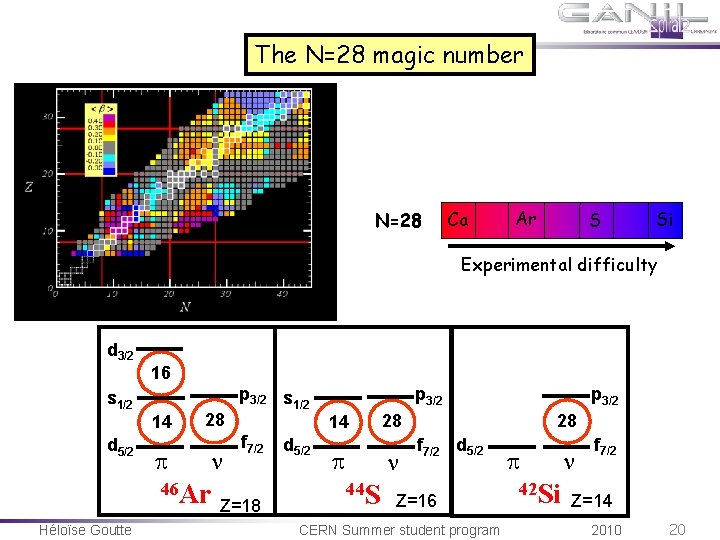
The N=28 magic number N=28 Ca Ar S Si Experimental difficulty d 3/2 16 s 1/2 14 d 5/2 p 28 n 46 Ar Héloïse Goutte p 3/2 s 1/2 14 f 7/2 Z=18 d 5/2 p 3/2 p n 44 S 28 28 f 7/2 d 5/2 Z=16 CERN Summer student program p 42 Si n f 7/2 Z=14 2010 20
Mean Field Si S Ar Shell Model Ca More and more exotic S. Péru et al. EPJA 9, 35 (2000) F. Nowacki and A. Poves, PRC 79, 014310 (2009) Agreement on the reduction of the shell gap N=28 in exotic nuclei Héloïse Goutte CERN Summer student program 2010 22
How to sign experimentally a magic number ? Magic nuclei have increased particle stability, spherical form, and require a larger energy to be excited Magic gaps are signaled by peaks in the 2+ energies and dips in B(E 2, 2+->0+) values in even-even nuclei. Héloïse Goutte CERN Summer student program 2010
O. Sorlin, M. G. Porquet, Prog. Part. Nucl. Phys. 61, 602 (2008) N= 28 is not a magic number for exotic nuclei. Héloïse Goutte CERN Summer student program 2010 23
4) Isomers Héloïse Goutte CERN Summer student program 2010 25
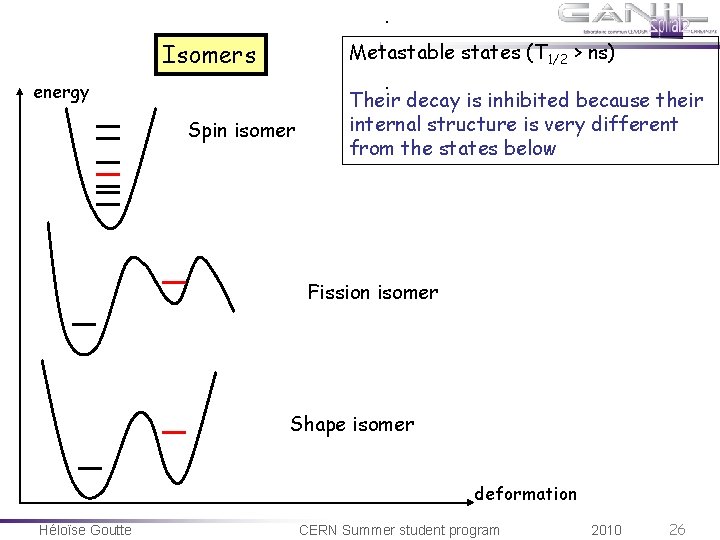
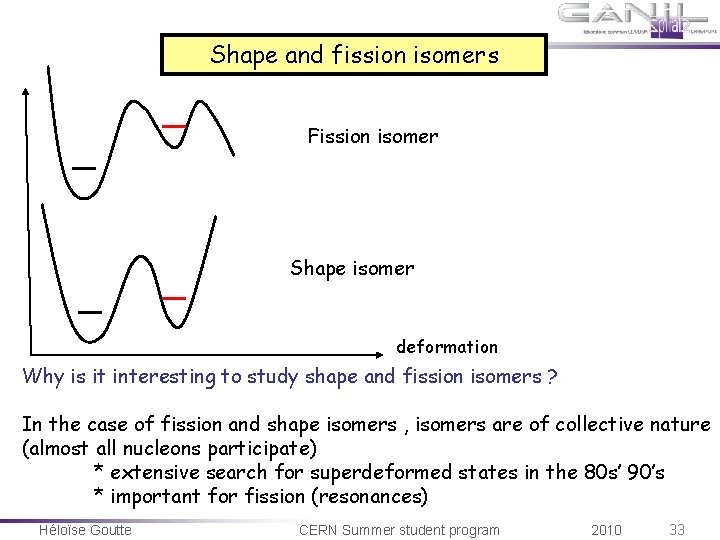
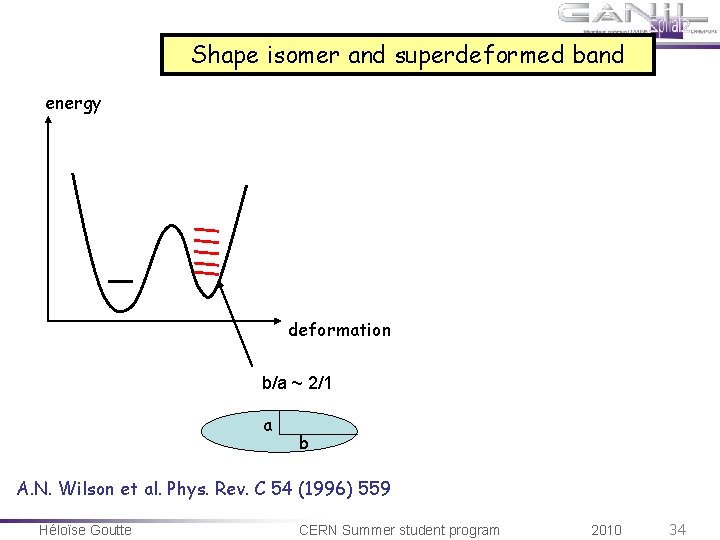
Metastable states (T 1/2 > ns) Isomers energy Spin isomer Their decay is inhibited because their internal structure is very different from the states below Fission isomer Shape isomer deformation Héloïse Goutte CERN Summer student program 2010 26
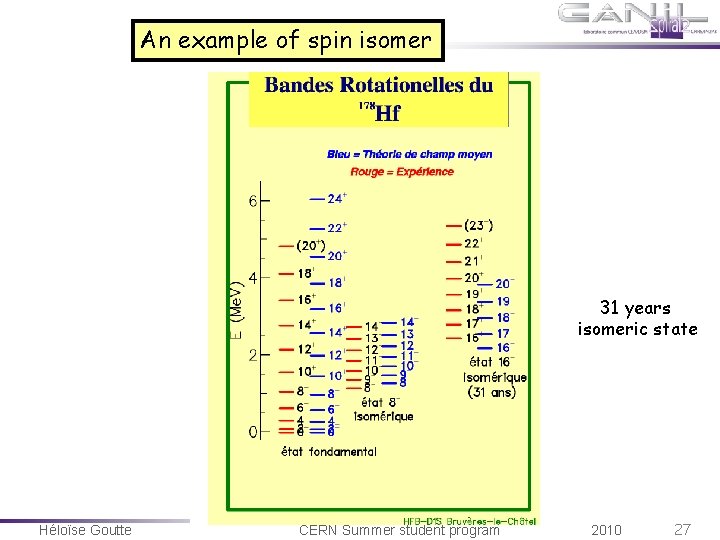
An example of spin isomer 31 years isomeric state Héloïse Goutte CERN Summer student program 2010 27
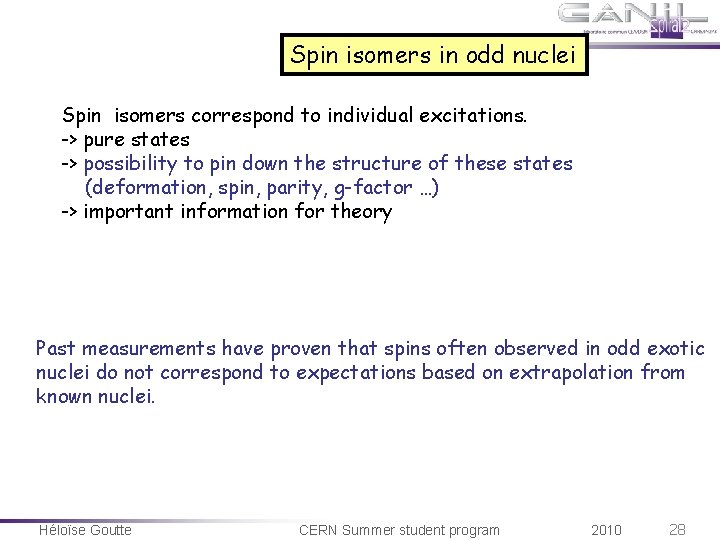
Spin isomers in odd nuclei Spin isomers correspond to individual excitations. -> pure states -> possibility to pin down the structure of these states (deformation, spin, parity, g-factor …) -> important information for theory Past measurements have proven that spins often observed in odd exotic nuclei do not correspond to expectations based on extrapolation from known nuclei. Héloïse Goutte CERN Summer student program 2010 28
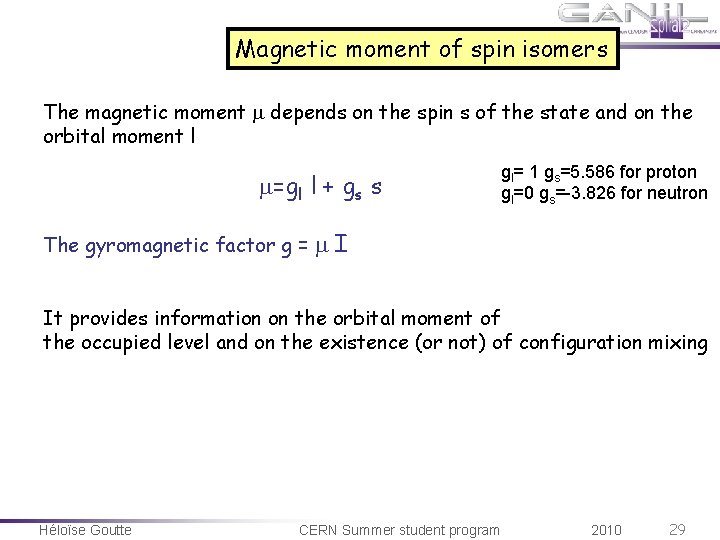
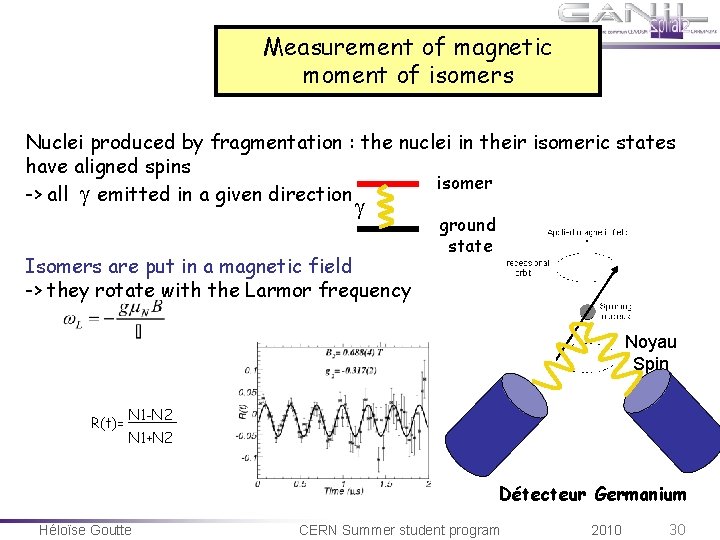
Magnetic moment of spin isomers The magnetic moment depends on the spin s of the state and on the orbital moment l =gl l + gs s The gyromagnetic factor g = gl= 1 gs=5. 586 for proton gl=0 gs=-3. 826 for neutron I It provides information on the orbital moment of the occupied level and on the existence (or not) of configuration mixing Héloïse Goutte CERN Summer student program 2010 29
Measurement of magnetic moment of isomers Nuclei produced by fragmentation : the nuclei in their isomeric states have aligned spins isomer -> all emitted in a given direction Isomers are put in a magnetic field -> they rotate with the Larmor frequency ground state Noyau Spin R(t)= N 1 -N 2 N 1+N 2 Détecteur Germanium Héloïse Goutte CERN Summer student program 2010 30
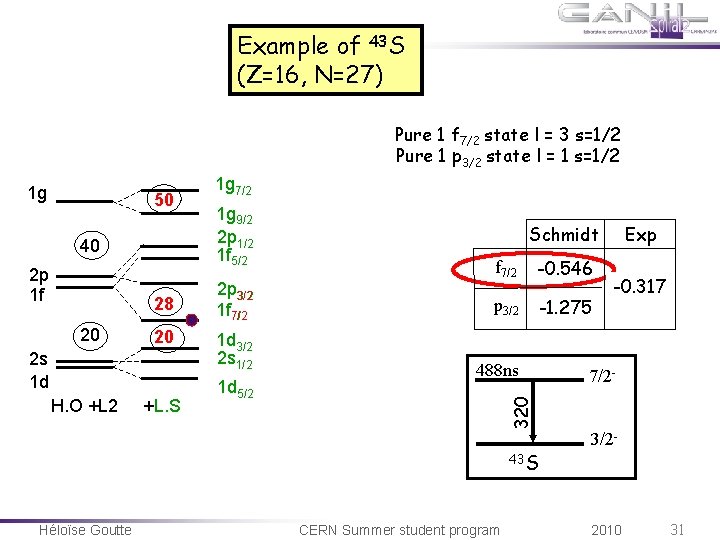
Example of 43 S (Z=16, N=27) Pure 1 f 7/2 state l = 3 s=1/2 Pure 1 p 3/2 state l = 1 s=1/2 50 40 2 p 1 f 28 20 20 2 s 1 d H. O +L 2 +L. S 1 g 7/2 1 g 9/2 2 p 1/2 1 f 5/2 2 p 3/2 1 f 7/2 -0. 546 p 3/2 -1. 275 1 d 3/2 2 s 1/2 488 ns 1 d 5/2 43 S Héloïse Goutte Exp Schmidt 320 1 g CERN Summer student program -0. 317 7/23/2 - 2010 31
Shape and fission isomers Héloïse Goutte CERN Summer student program 2010 32
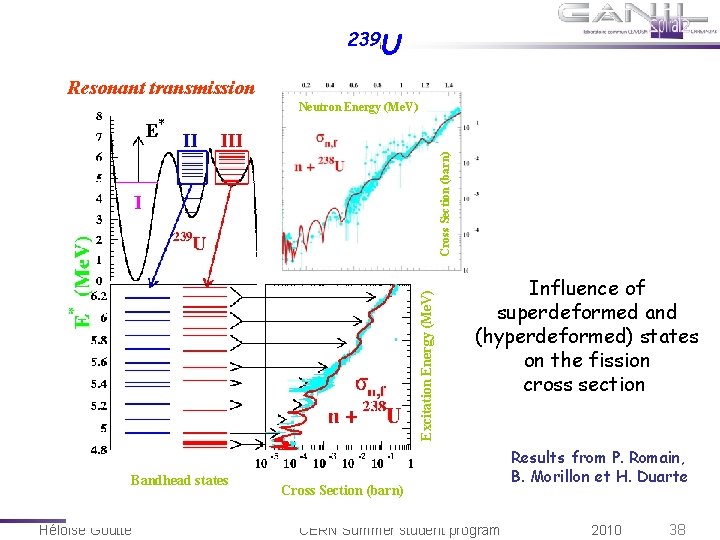
Shape and fission isomers Fission isomer Shape isomer deformation Why is it interesting to study shape and fission isomers ? In the case of fission and shape isomers , isomers are of collective nature (almost all nucleons participate) * extensive search for superdeformed states in the 80 s’ 90’s * important for fission (resonances) Héloïse Goutte CERN Summer student program 2010 33
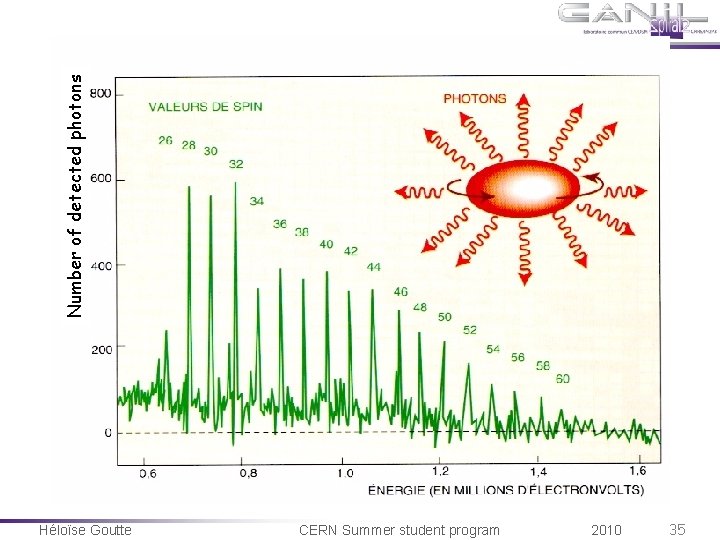
Shape isomer and superdeformed band energy deformation b/a ~ 2/1 a b A. N. Wilson et al. Phys. Rev. C 54 (1996) 559 Héloïse Goutte CERN Summer student program 2010 34
Number of detected photons Héloïse Goutte CERN Summer student program 2010 35
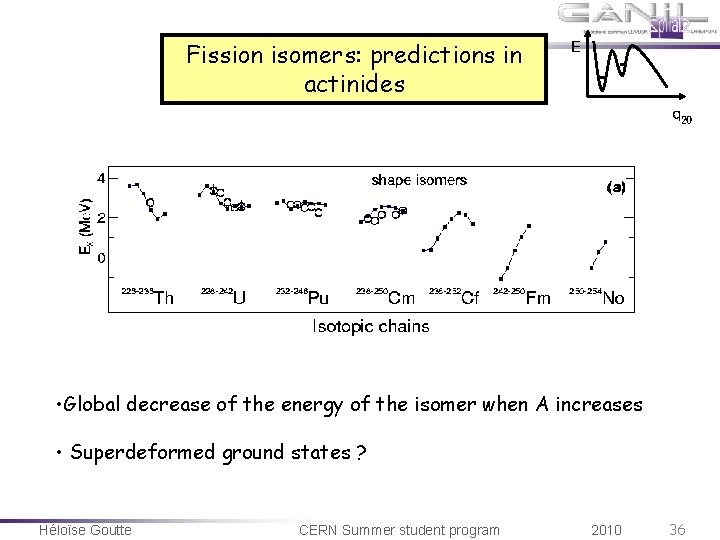
Fission isomers: predictions in actinides E q 20 • Global decrease of the energy of the isomer when A increases • Superdeformed ground states ? Héloïse Goutte CERN Summer student program 2010 36
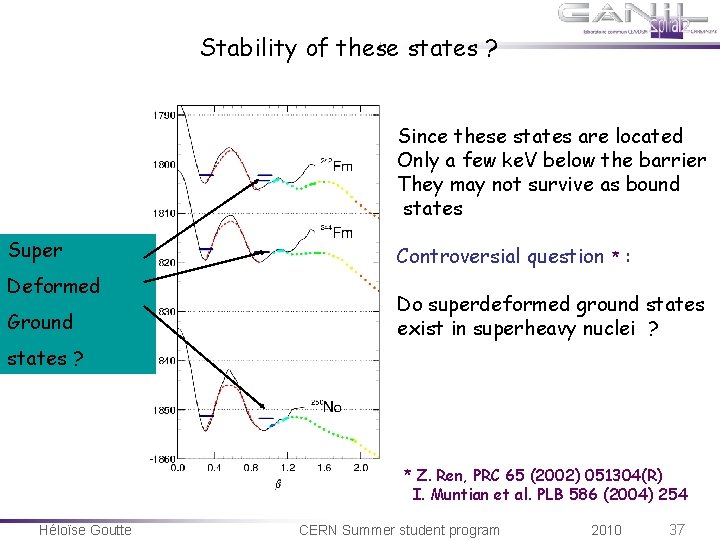
Stability of these states ? Since these states are located Only a few ke. V below the barrier They may not survive as bound states Super Deformed Ground Controversial question * : Do superdeformed ground states exist in superheavy nuclei ? states ? * Z. Ren, PRC 65 (2002) 051304(R) I. Muntian et al. PLB 586 (2004) 254 Héloïse Goutte CERN Summer student program 2010 37
239 U Resonant transmission Excitation Energy (Me. V) Cross Section (barn) Neutron Energy (Me. V) Bandhead states Héloïse Goutte Influence of superdeformed and (hyperdeformed) states on the fission cross section Cross Section (barn) CERN Summer student program Results from P. Romain, B. Morillon et H. Duarte 2010 38
5) Shape coexistence Héloïse Goutte CERN Summer student program 2010 39
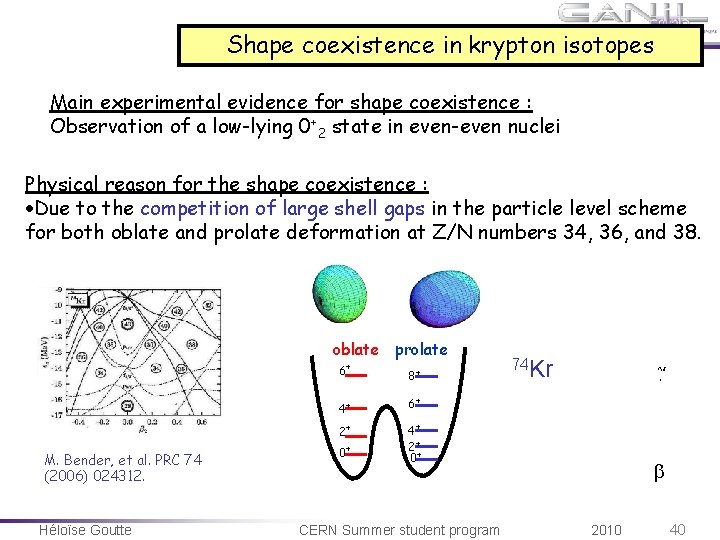
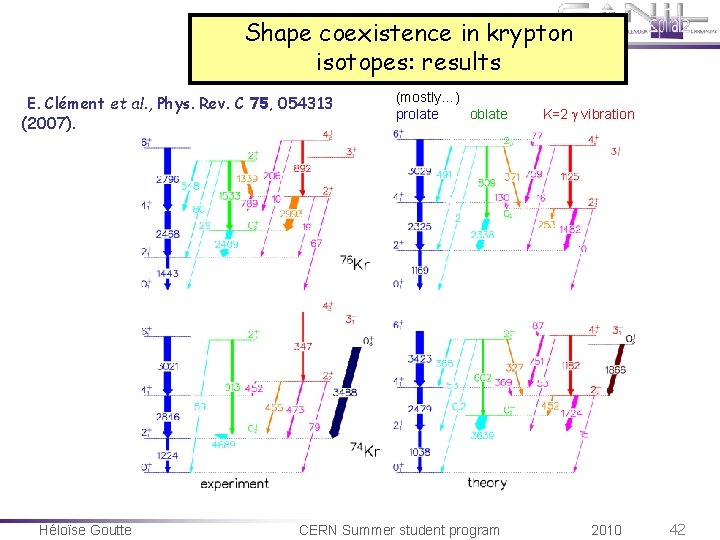
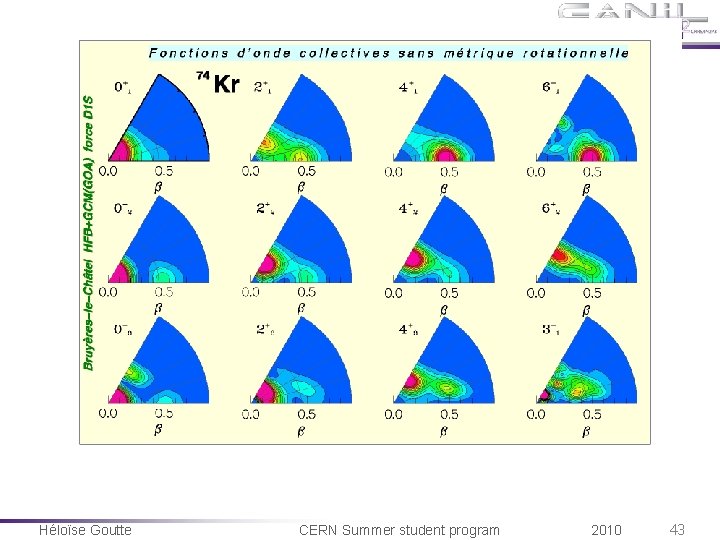
Shape coexistence in krypton isotopes Main experimental evidence for shape coexistence : Observation of a low-lying 0+2 state in even-even nuclei Physical reason for the shape coexistence : Due to the competition of large shell gaps in the particle level scheme for both oblate and prolate deformation at Z/N numbers 34, 36, and 38. oblate prolate M. Bender, et al. PRC 74 (2006) 024312. Héloïse Goutte 6+ 8+ 4+ 6+ 2+ 4+ 2+ 0+ 0+ CERN Summer student program 74 Kr 2010 40
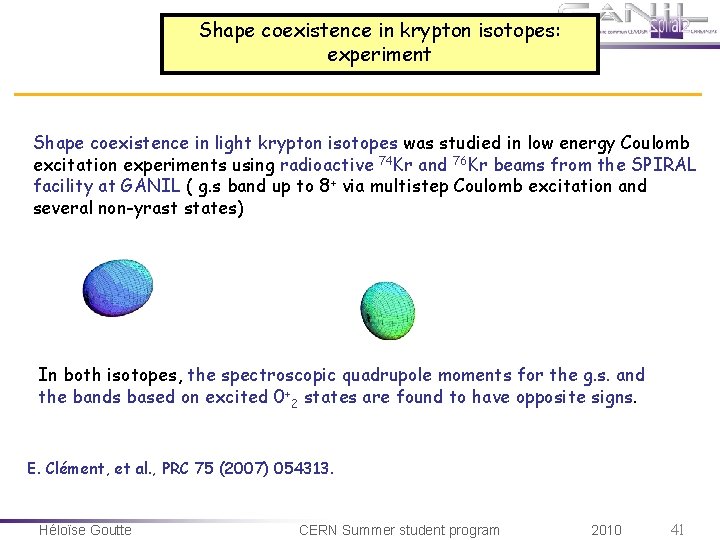
Shape coexistence in krypton isotopes: experiment Shape coexistence in light krypton isotopes was studied in low energy Coulomb excitation experiments using radioactive 74 Kr and 76 Kr beams from the SPIRAL facility at GANIL ( g. s band up to 8+ via multistep Coulomb excitation and several non-yrast states) In both isotopes, the spectroscopic quadrupole moments for the g. s. and the bands based on excited 0+2 states are found to have opposite signs. E. Clément, et al. , PRC 75 (2007) 054313. Héloïse Goutte CERN Summer student program 2010 41
Shape coexistence in krypton isotopes: results E. Clément et al. , Phys. Rev. C 75, 054313 (2007). Héloïse Goutte (mostly…) prolate oblate CERN Summer student program K=2 vibration 2010 42
Héloïse Goutte CERN Summer student program 2010 43
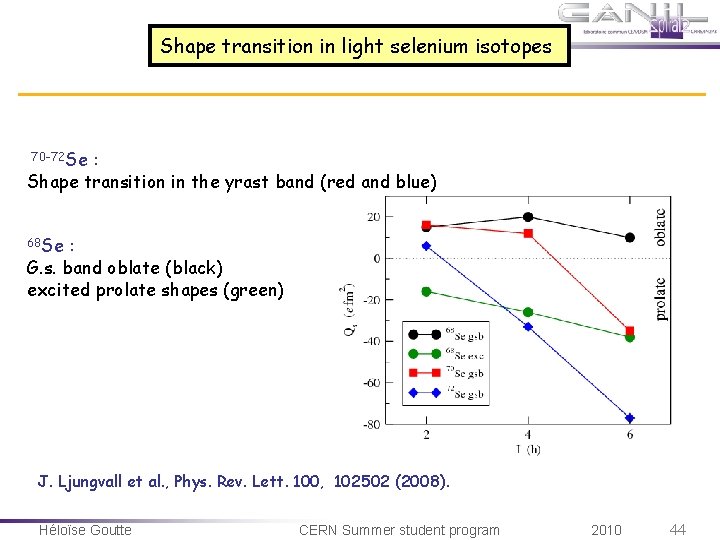
Shape transition in light selenium isotopes 70 -72 Se : Shape transition in the yrast band (red and blue) 68 Se : G. s. band oblate (black) excited prolate shapes (green) J. Ljungvall et al. , Phys. Rev. Lett. 100, 102502 (2008). Héloïse Goutte CERN Summer student program 2010 44
6) New structures ? Héloïse Goutte CERN Summer student program 2010 45
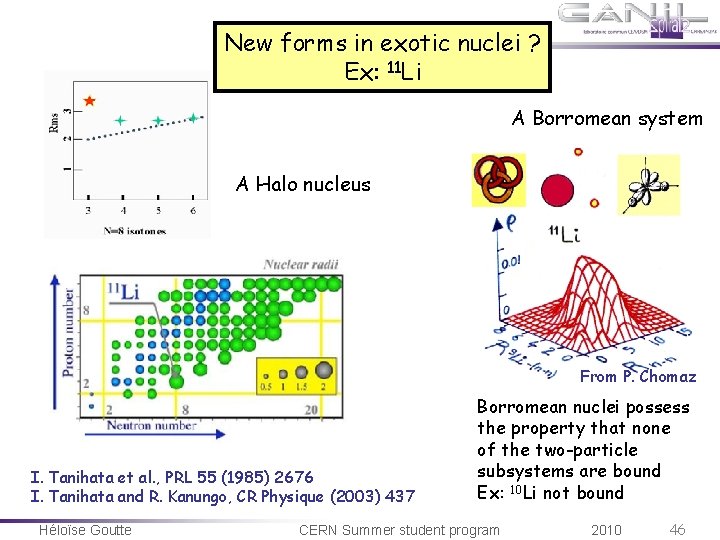
New forms in exotic nuclei ? Ex: 11 Li A Borromean system A Halo nucleus From P. Chomaz I. Tanihata et al. , PRL 55 (1985) 2676 I. Tanihata and R. Kanungo, CR Physique (2003) 437 Héloïse Goutte Borromean nuclei possess the property that none of the two-particle subsystems are bound Ex: 10 Li not bound CERN Summer student program 2010 46
Alpha cluster model calculations Héloïse Goutte CERN Summer student program 2010 47
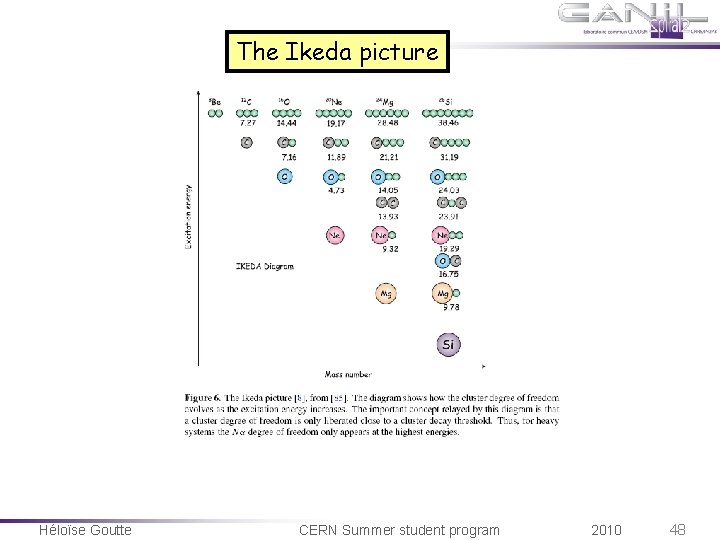
The Ikeda picture Héloïse Goutte CERN Summer student program 2010 48
10 Be Alpha decay threshold : 7. 409 Me. V M. Freer, Rep. Prog. Phys. 70 (2007) 2149. Héloïse Goutte CERN Summer student program 2010 49
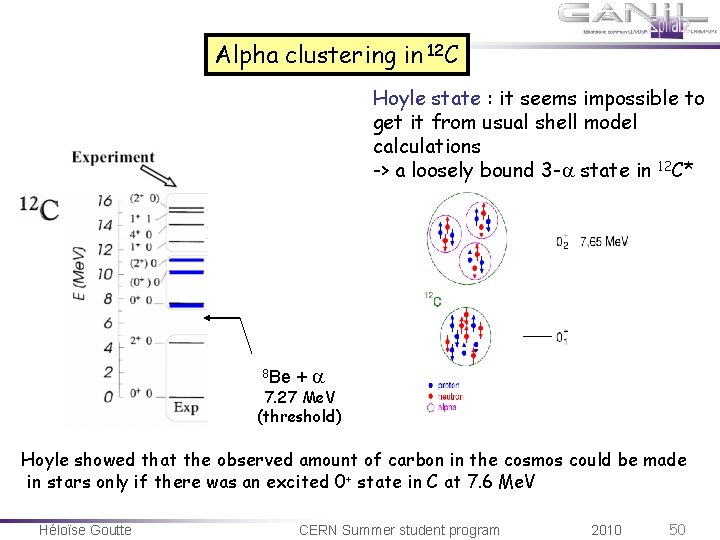
Alpha clustering in 12 C Hoyle state : it seems impossible to get it from usual shell model calculations -> a loosely bound 3 - state in 12 C* 8 Be + 7. 27 Me. V (threshold) Hoyle showed that the observed amount of carbon in the cosmos could be made in stars only if there was an excited 0+ state in C at 7. 6 Me. V Héloïse Goutte CERN Summer student program 2010 50
7) Super heavy elements Héloïse Goutte CERN Summer student program 2010 51
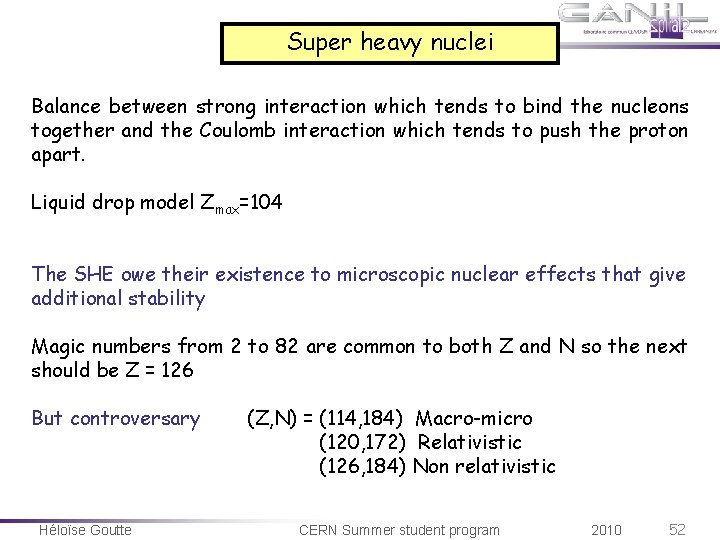
Super heavy nuclei Balance between strong interaction which tends to bind the nucleons together and the Coulomb interaction which tends to push the proton apart. Liquid drop model Zmax=104 The SHE owe their existence to microscopic nuclear effects that give additional stability Magic numbers from 2 to 82 are common to both Z and N so the next should be Z = 126 But controversary Héloïse Goutte (Z, N) = (114, 184) Macro-micro (120, 172) Relativistic (126, 184) Non relativistic CERN Summer student program 2010 52
8) Fundamental symmetries and interactions Héloïse Goutte CERN Summer student program 2010 53
Fundamental symmetries and interactions Experiments in nuclear -decay contribute : 1* to test unitarity of the CKM matrix 2* to test fundamental symmetries of the weak interaction (Parity and Time reversal) 3* investigate the structure of the weak interaction. For 1: need for precision measurements of Q value, branching ratio, half-life -> use of traps (Penning, Paul, ) For 2 and 3 : need for correlations betweens the spins and momenta of the particles involved -> need for polarized nuclei Héloïse Goutte CERN Summer student program 2010 54
Precise testing of CKM Weak interaction mix the quark flavours : quarks participate in the weak interaction with a mixture of their mass eigenstates -> This mixing is described by the Cabibbo Kobayashi Maskawa matrix The standard Model implies unitary conditions Vud 2+Vus 2+Vub 2=1 Vud can be extracted from superallowed nuclear beta decay -> need for precision measurement of mass measurements Héloïse Goutte CERN Summer student program 2010 55
Test of fundamental symmetries The weak interaction in the standard model has been introduced as a pure vector –axial vector interaction. The presence of non Standard Model V-A interactions as well as of other more exotic interactions can be probed by observing various types of correlations between the spins and the momenta of the particles involved in the -decay. Héloïse Goutte CERN Summer student program 2010 56
Examples of recent studies: summary • Exotic nuclei • Drip – lines not experimentally reached • more than 5000 nuclei predicted • new shell structures • Exotic structures • halo nuclei • alpha clusters • shape coexistence • Isomers • spin isomers (individual excitations) • shape isomers • Search for super heavy nuclei • Test of fundamental symmetries • … Héloïse Goutte CERN Summer student program 2010 57