I Evolution II Selection A The Nature of
- Slides: 54
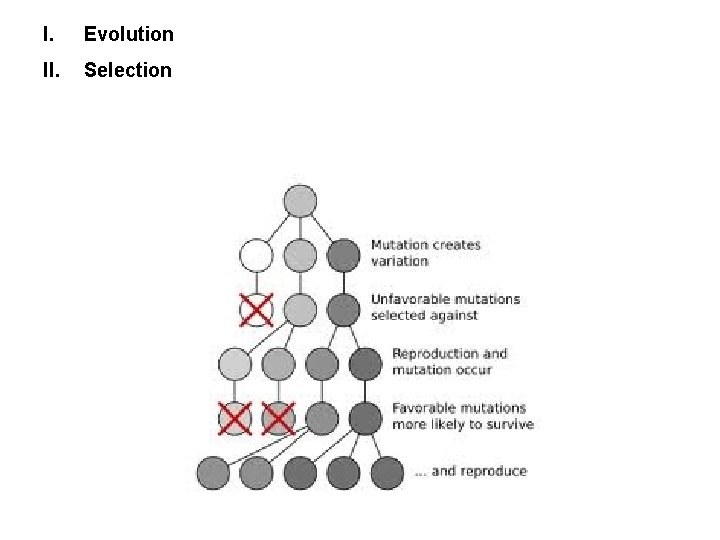
I. Evolution II. Selection
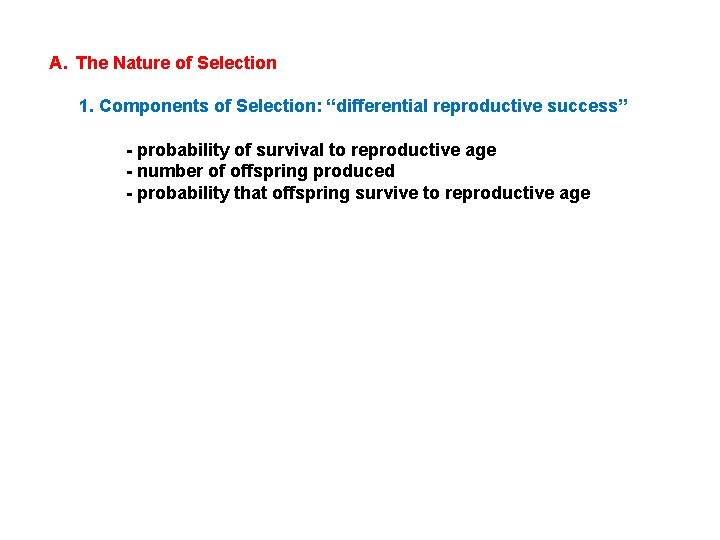
A. The Nature of Selection 1. Components of Selection: “differential reproductive success” - probability of survival to reproductive age - number of offspring produced - probability that offspring survive to reproductive age
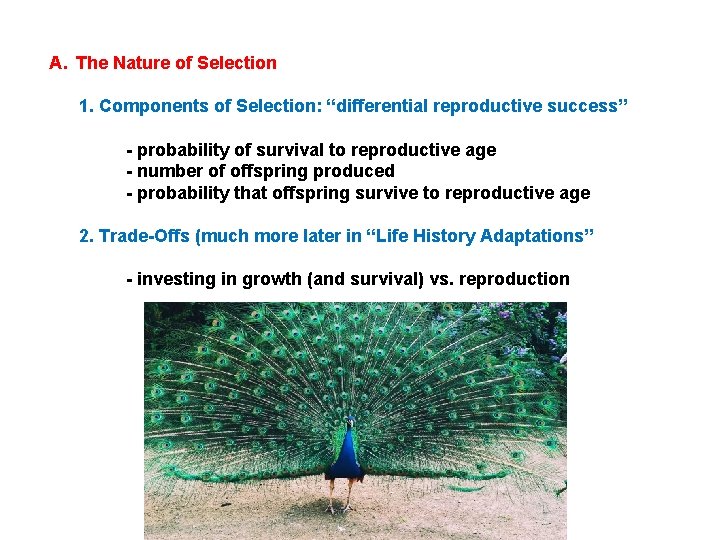
A. The Nature of Selection 1. Components of Selection: “differential reproductive success” - probability of survival to reproductive age - number of offspring produced - probability that offspring survive to reproductive age 2. Trade-Offs (much more later in “Life History Adaptations” - investing in growth (and survival) vs. reproduction
A. The Nature of Selection 1. Components of Selection: “differential reproductive success” - probability of survival to reproductive age - number of offspring produced - probability that offspring survive to reproductive age 2. Trade-Offs (much more later in “Life History Adaptations”) 3. Changes in the environment may change the ‘balance’ - as variation in survivorship declines, variance in reproductive success increases as a determinant of the pace and direction of evolutionary change.
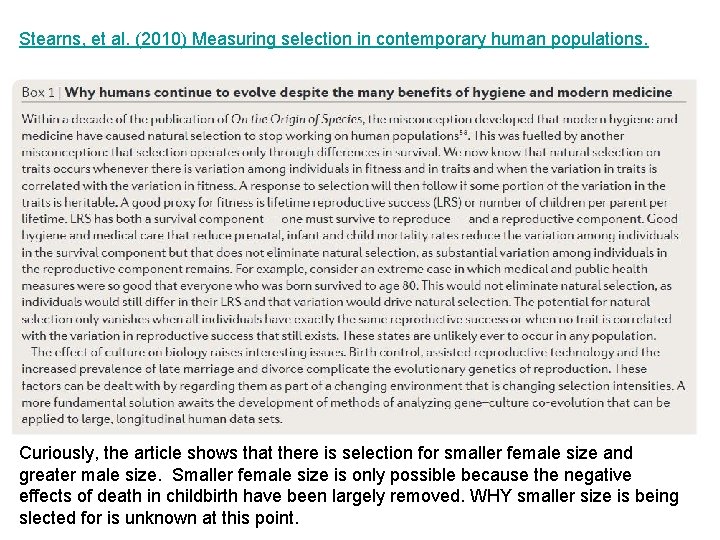
Stearns, et al. (2010) Measuring selection in contemporary human populations. Curiously, the article shows that there is selection for smaller female size and greater male size. Smaller female size is only possible because the negative effects of death in childbirth have been largely removed. WHY smaller size is being slected for is unknown at this point.
B. ‘Artificial Selection’ and Domesticated Animals and Plants
B. ‘Artificial Selection’ and Domesticated Animals and Plants
B. ‘Artificial Selection’ and Domesticated Animals and Plants
B. ‘Artificial Selection’ and Domesticated Animals and Plants
B. ‘Artificial Selection’ and Domesticated Animals and Plants
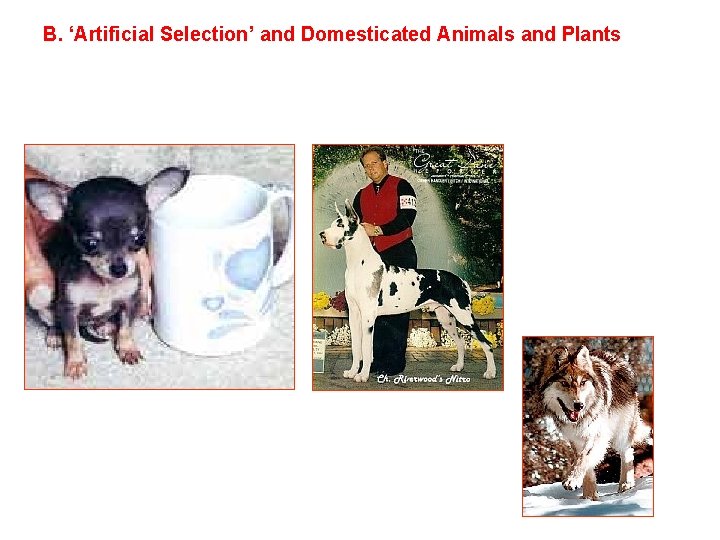
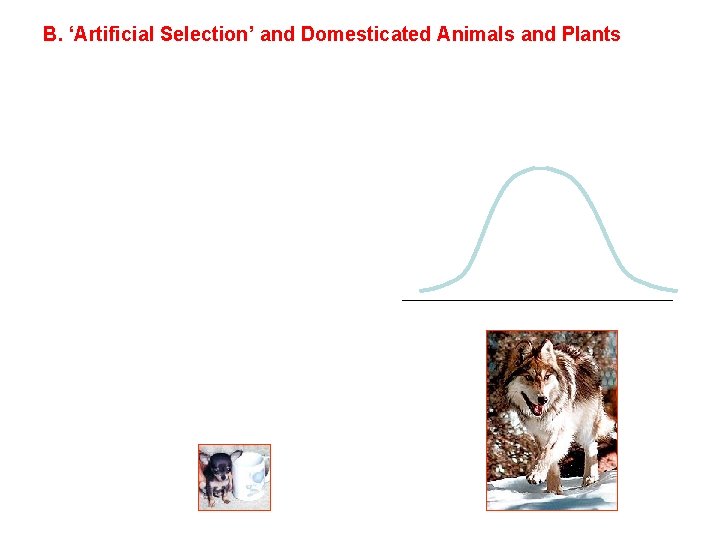
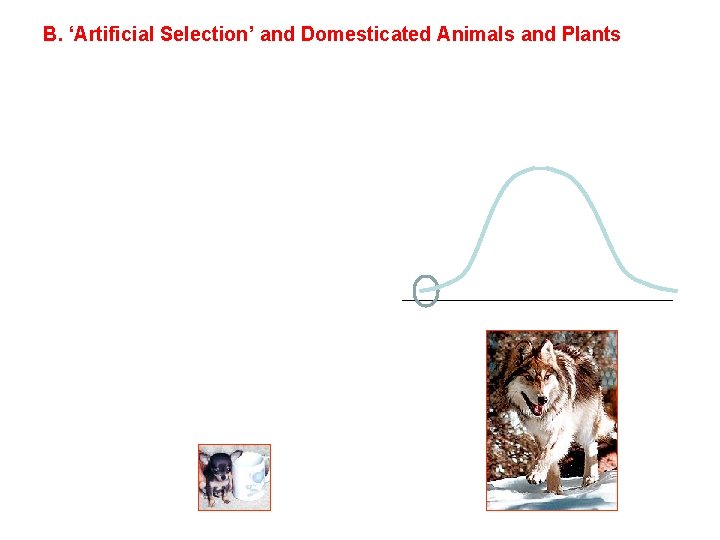
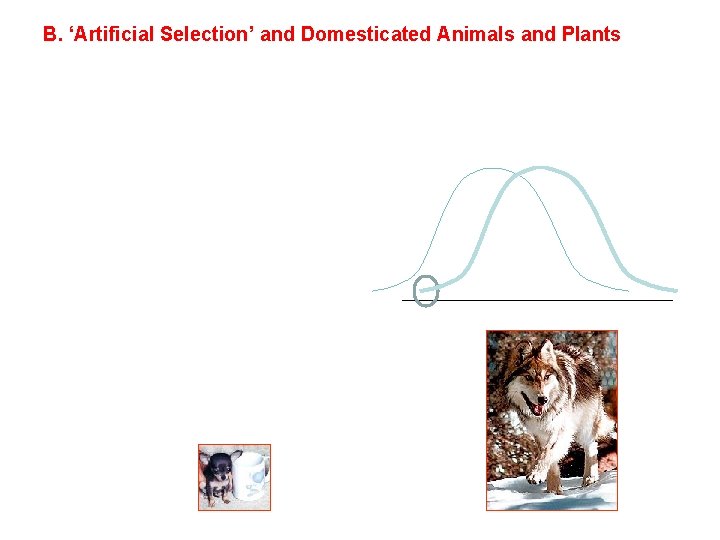
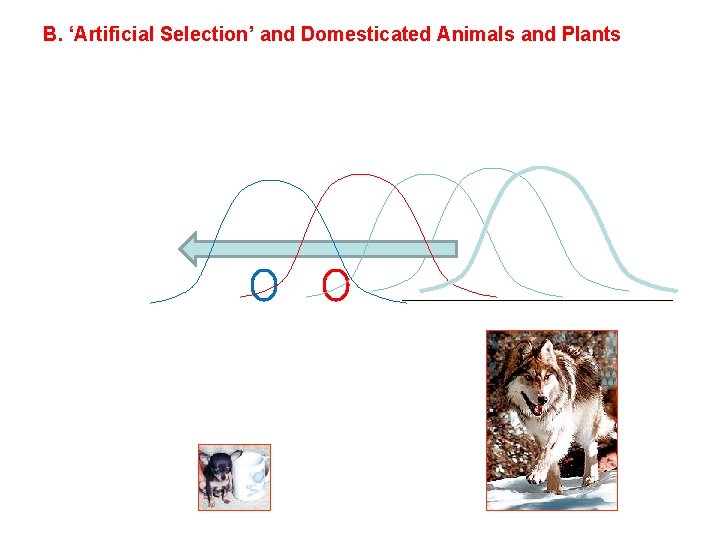
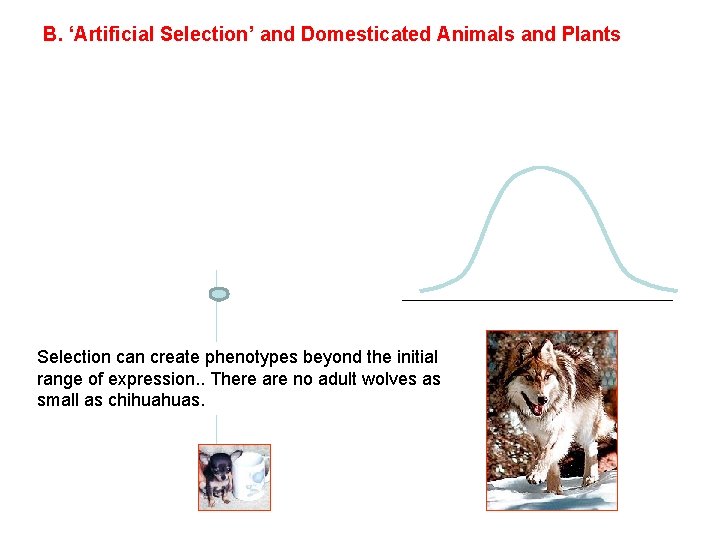
B. ‘Artificial Selection’ and Domesticated Animals and Plants Selection can create phenotypes beyond the initial range of expression. . There are no adult wolves as small as chihuahuas.
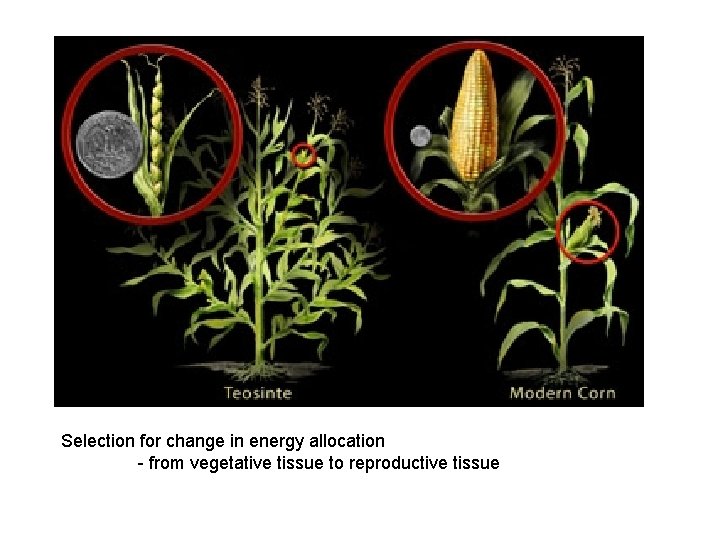
Selection for change in energy allocation - from vegetative tissue to reproductive tissue
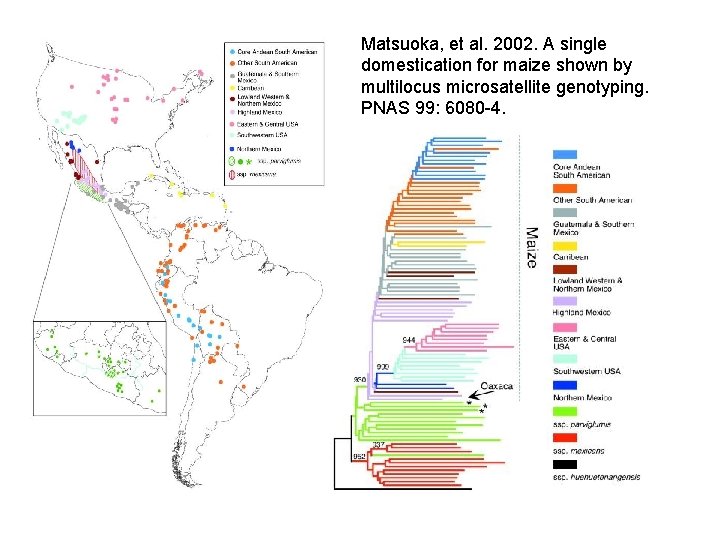
Matsuoka, et al. 2002. A single domestication for maize shown by multilocus microsatellite genotyping. PNAS 99: 6080 -4.
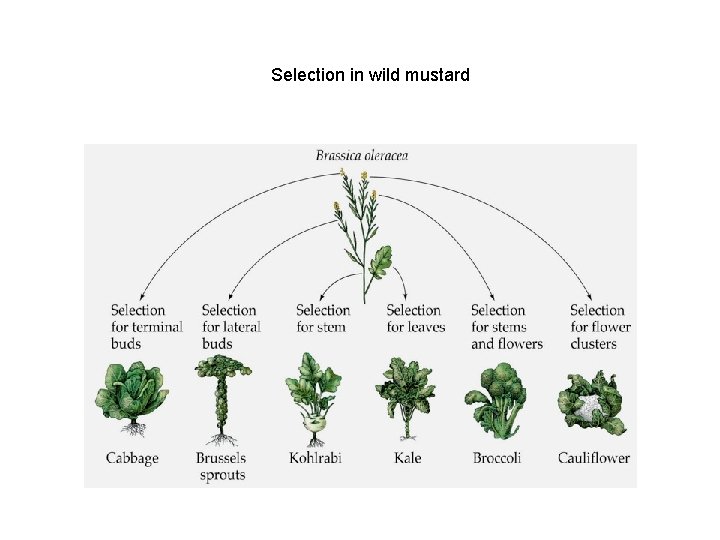
Selection in wild mustard
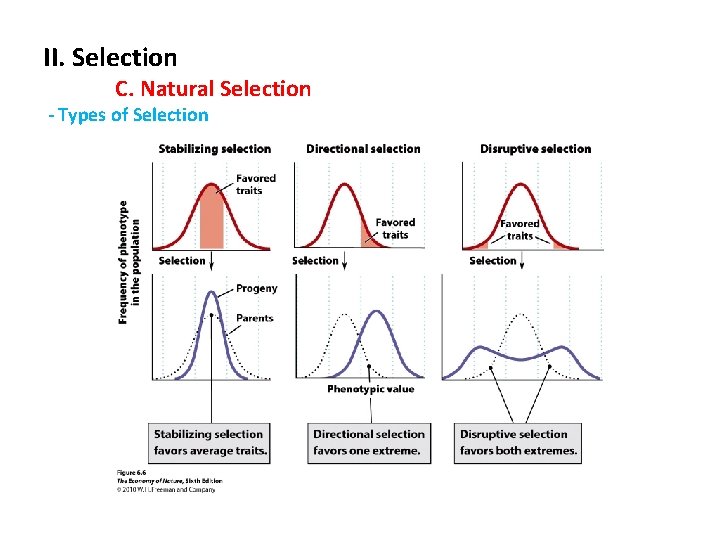
II. Selection C. Natural Selection - Types of Selection
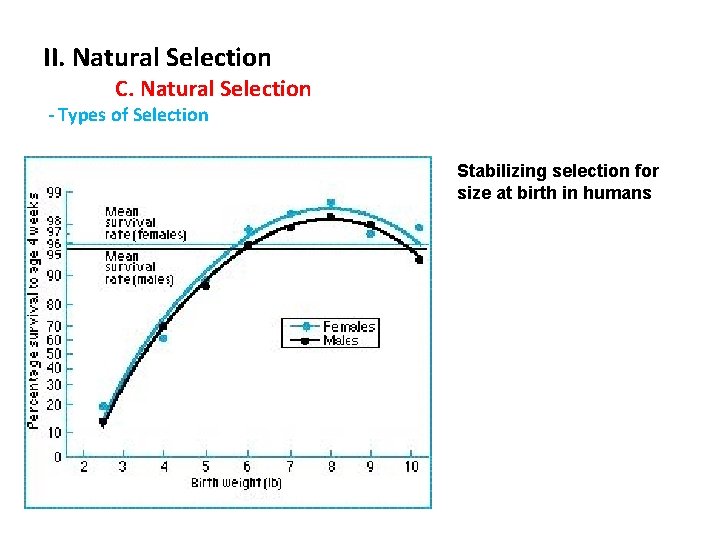
II. Natural Selection C. Natural Selection - Types of Selection Stabilizing selection for size at birth in humans
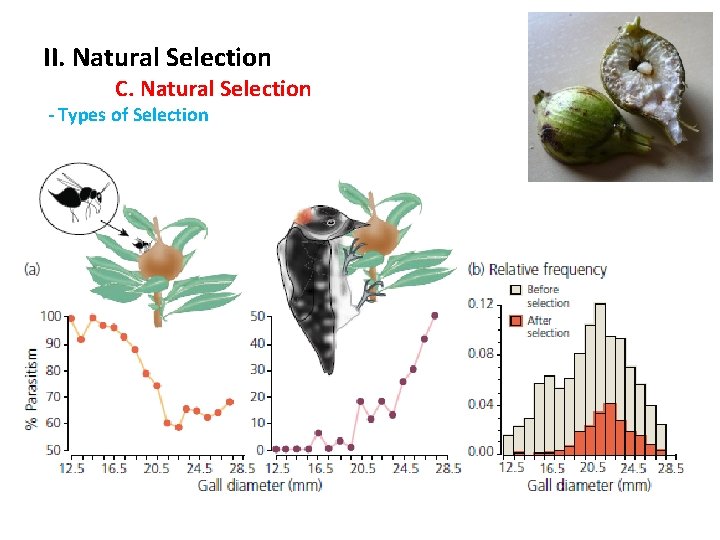
II. Natural Selection C. Natural Selection - Types of Selection
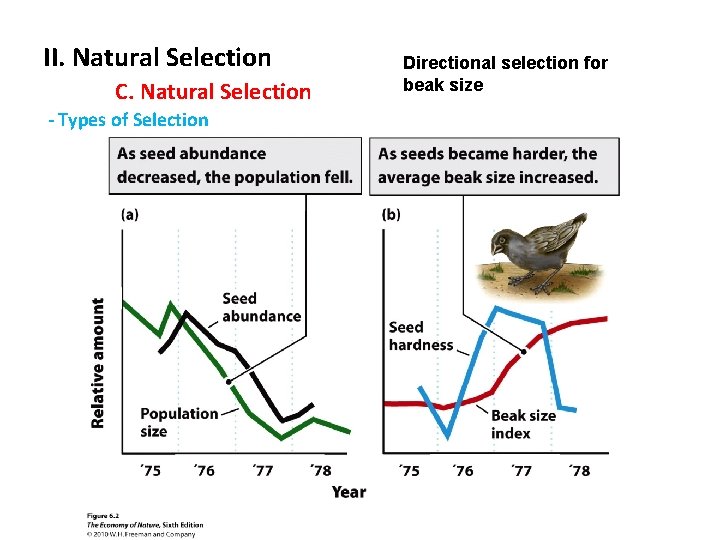
II. Natural Selection C. Natural Selection - Types of Selection Directional selection for beak size
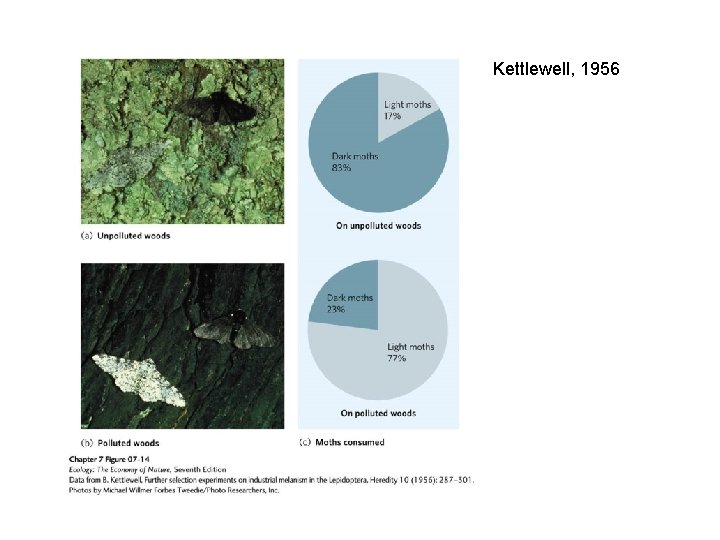
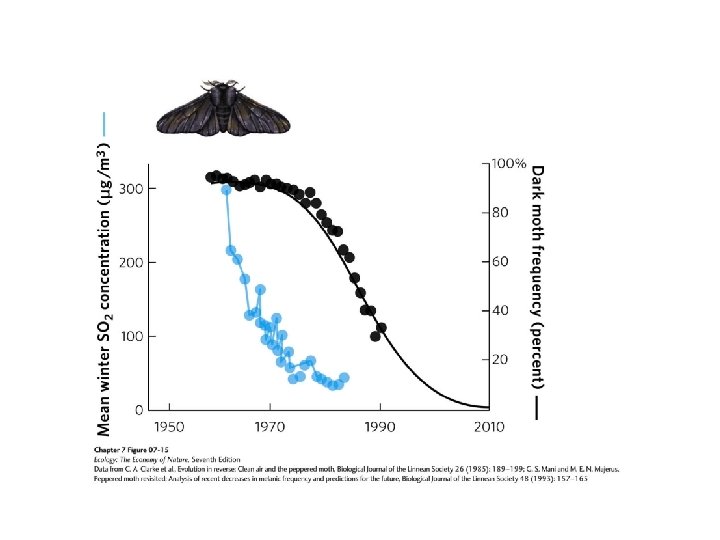
Kettlewell, 1956
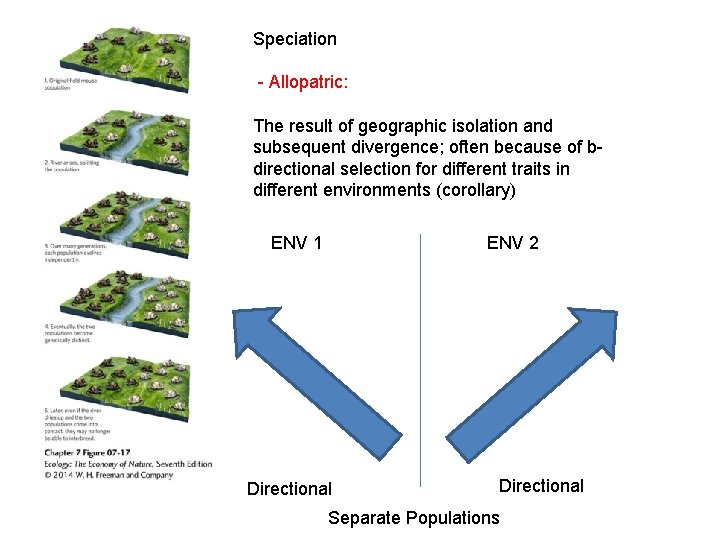
Speciation - Allopatric: The result of geographic isolation and subsequent divergence; often because of bdirectional selection for different traits in different environments (corollary) ENV 1 ENV 2 Directional Separate Populations
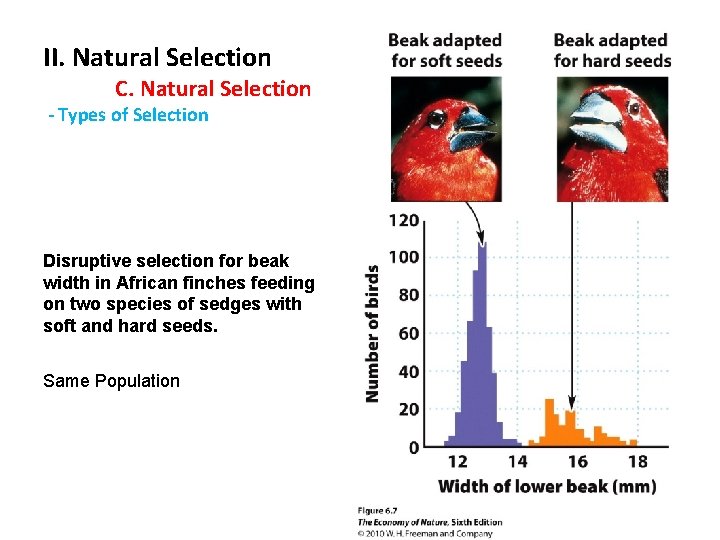
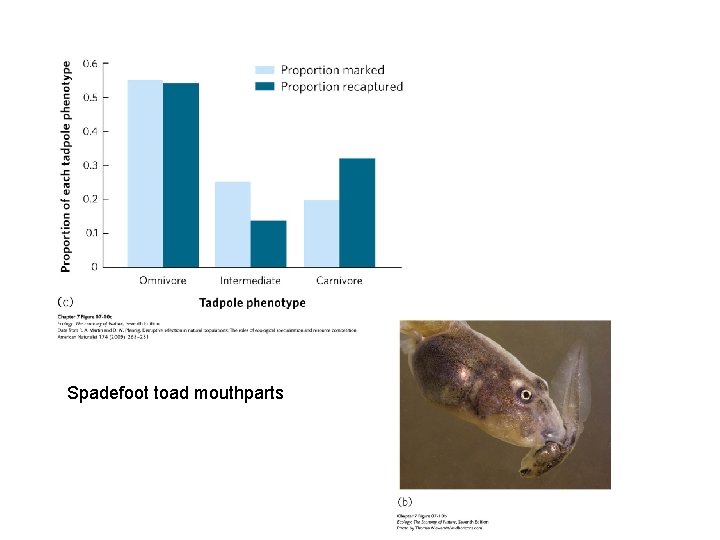
II. Natural Selection C. Natural Selection - Types of Selection Disruptive selection for beak width in African finches feeding on two species of sedges with soft and hard seeds. Same Population
Spadefoot toad mouthparts
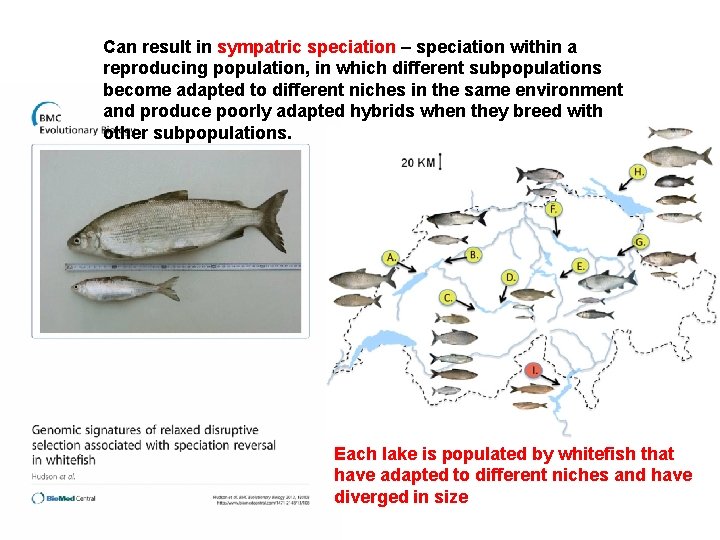
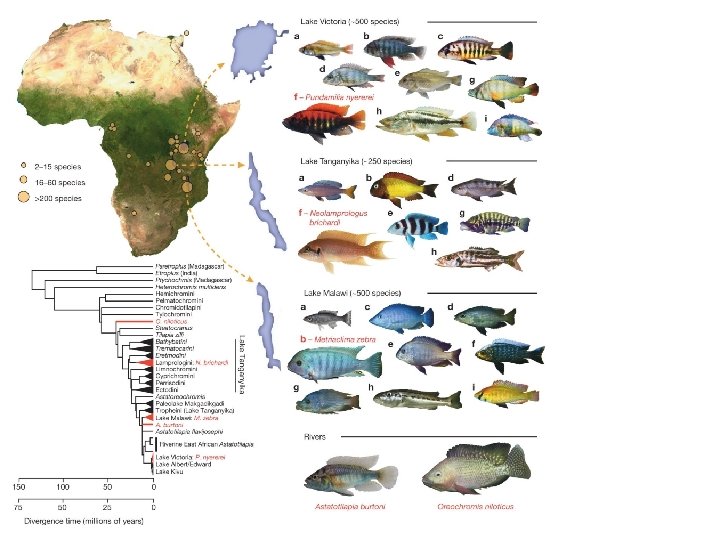
Can result in sympatric speciation – speciation within a reproducing population, in which different subpopulations become adapted to different niches in the same environment and produce poorly adapted hybrids when they breed with other subpopulations. Each lake is populated by whitefish that have adapted to different niches and have diverged in size
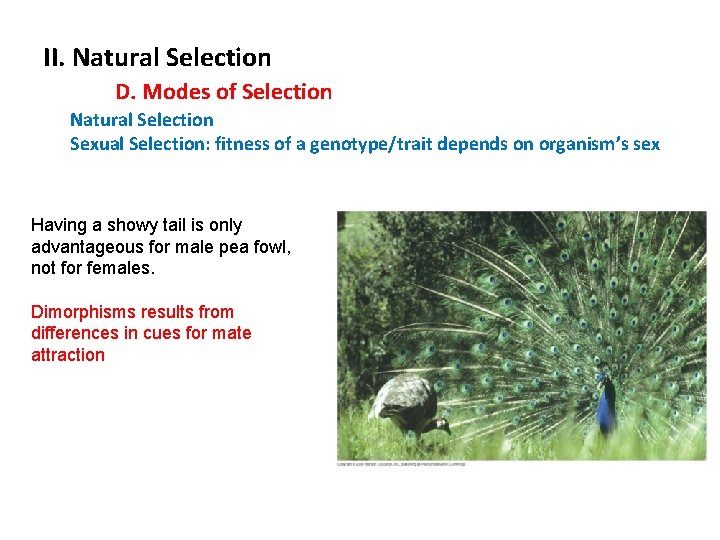
II. Natural Selection D. Modes of Selection Natural Selection Sexual Selection: fitness of a genotype/trait depends on organism’s sex Having a showy tail is only advantageous for male pea fowl, not for females. Dimorphisms results from differences in cues for mate attraction
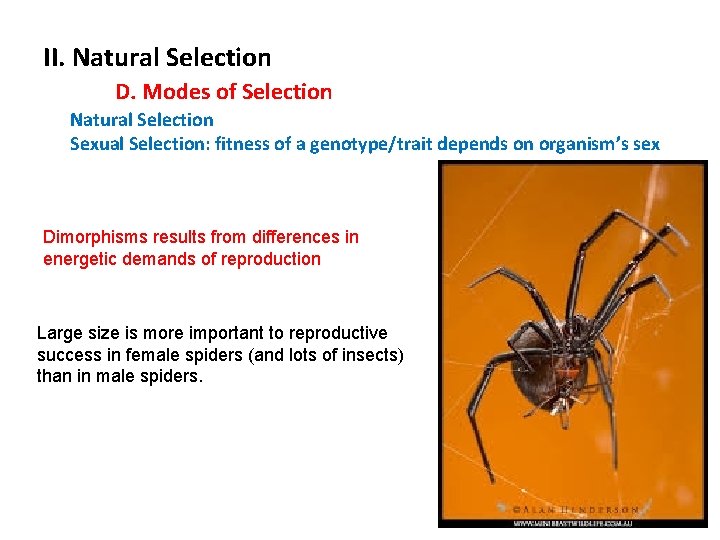
II. Natural Selection D. Modes of Selection Natural Selection Sexual Selection: fitness of a genotype/trait depends on organism’s sex Dimorphisms results from differences in energetic demands of reproduction Large size is more important to reproductive success in female spiders (and lots of insects) than in male spiders.
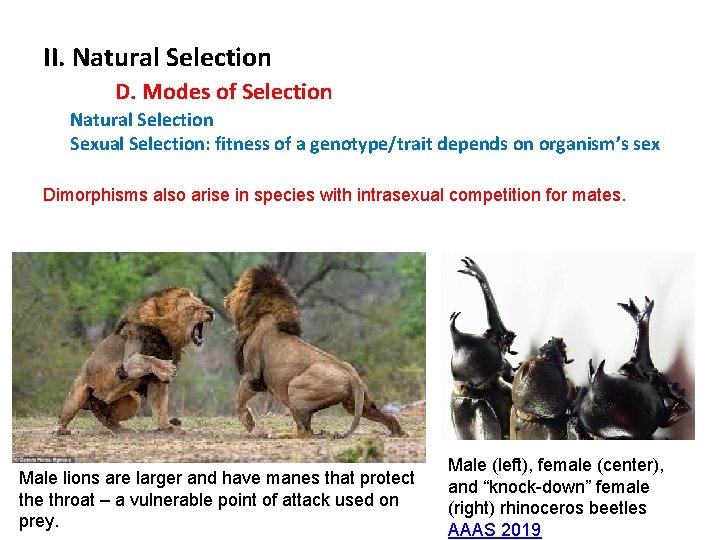
II. Natural Selection D. Modes of Selection Natural Selection Sexual Selection: fitness of a genotype/trait depends on organism’s sex Dimorphisms also arise in species with intrasexual competition for mates. Male lions are larger and have manes that protect the throat – a vulnerable point of attack used on prey. Male (left), female (center), and “knock-down” female (right) rhinoceros beetles AAAS 2019
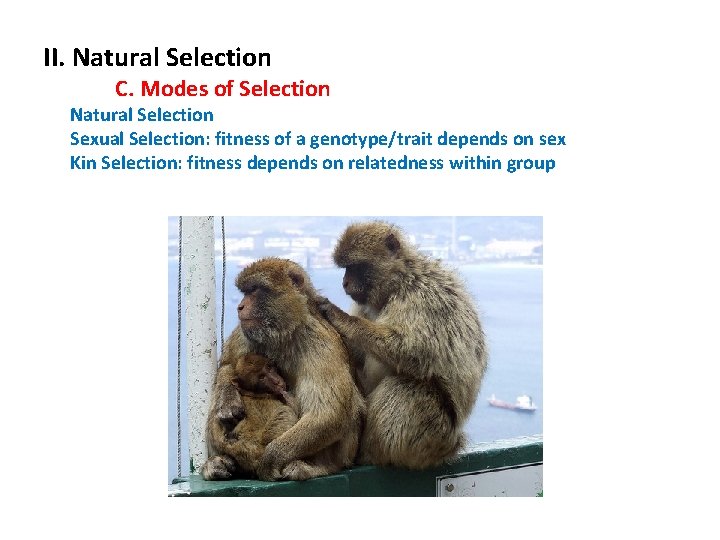
II. Natural Selection C. Modes of Selection Natural Selection Sexual Selection: fitness of a genotype/trait depends on sex Kin Selection: fitness depends on relatedness within group
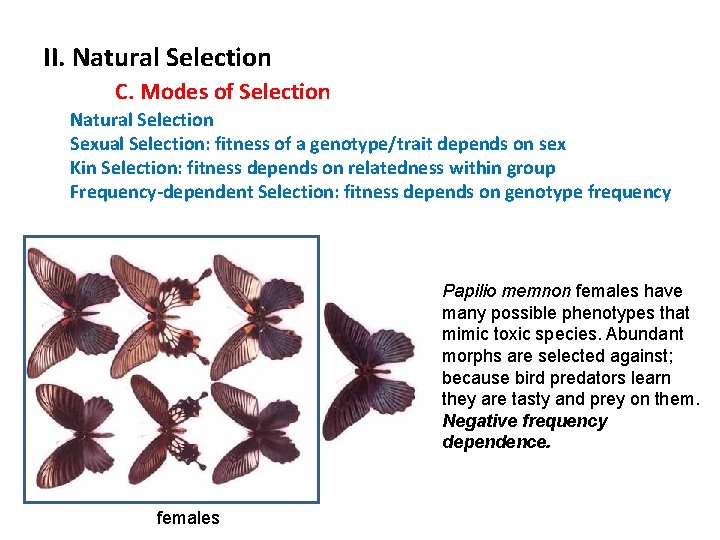
II. Natural Selection C. Modes of Selection Natural Selection Sexual Selection: fitness of a genotype/trait depends on sex Kin Selection: fitness depends on relatedness within group Frequency-dependent Selection: fitness depends on genotype frequency Papilio memnon females have many possible phenotypes that mimic toxic species. Abundant morphs are selected against; because bird predators learn they are tasty and prey on them. Negative frequency dependence. females
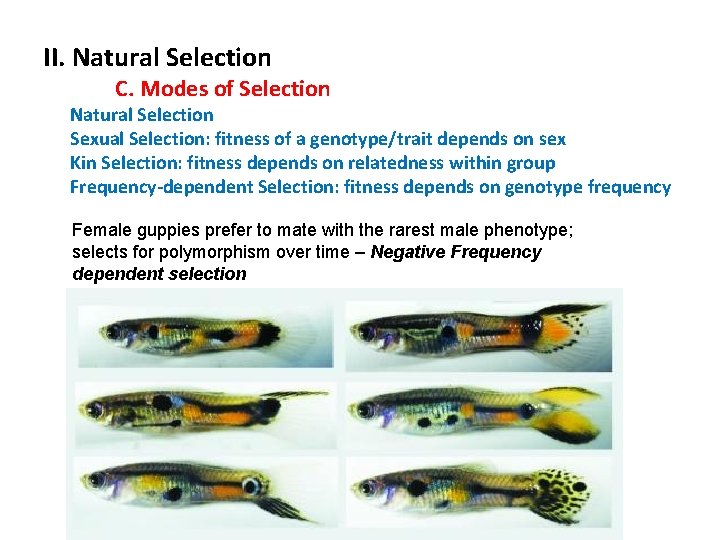
II. Natural Selection C. Modes of Selection Natural Selection Sexual Selection: fitness of a genotype/trait depends on sex Kin Selection: fitness depends on relatedness within group Frequency-dependent Selection: fitness depends on genotype frequency Female guppies prefer to mate with the rarest male phenotype; selects for polymorphism over time – Negative Frequency dependent selection
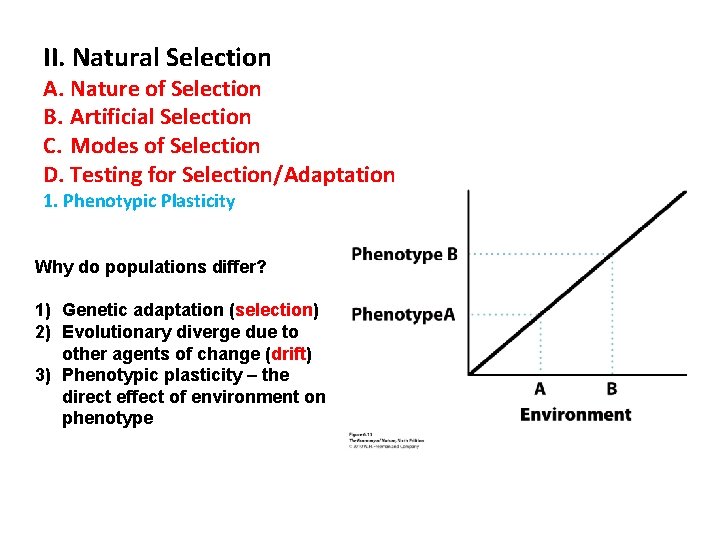
II. Natural Selection A. Nature of Selection B. Artificial Selection C. Modes of Selection D. Testing for Selection/Adaptation 1. Phenotypic Plasticity Why do populations differ? 1) Genetic adaptation (selection) 2) Evolutionary diverge due to other agents of change (drift) 3) Phenotypic plasticity – the direct effect of environment on phenotype
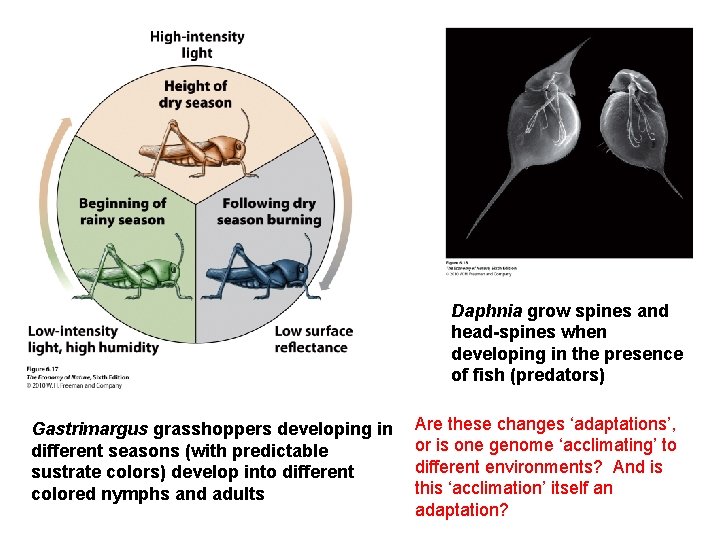
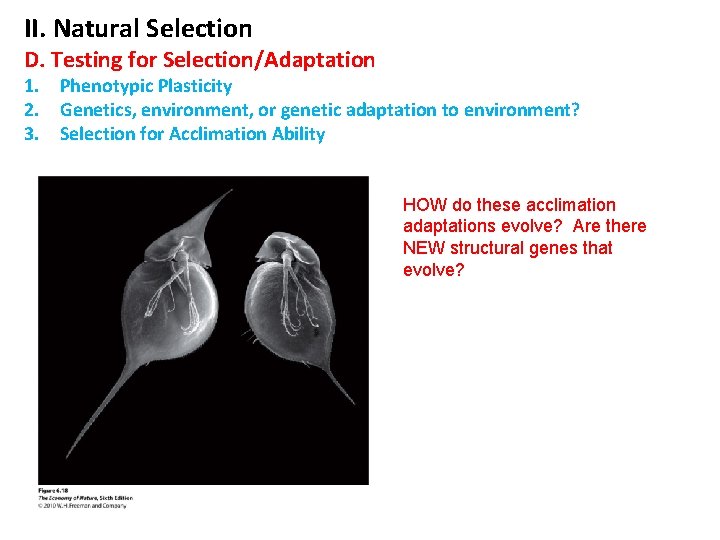
Daphnia grow spines and head-spines when developing in the presence of fish (predators) Gastrimargus grasshoppers developing in different seasons (with predictable sustrate colors) develop into different colored nymphs and adults Are these changes ‘adaptations’, or is one genome ‘acclimating’ to different environments? And is this ‘acclimation’ itself an adaptation?
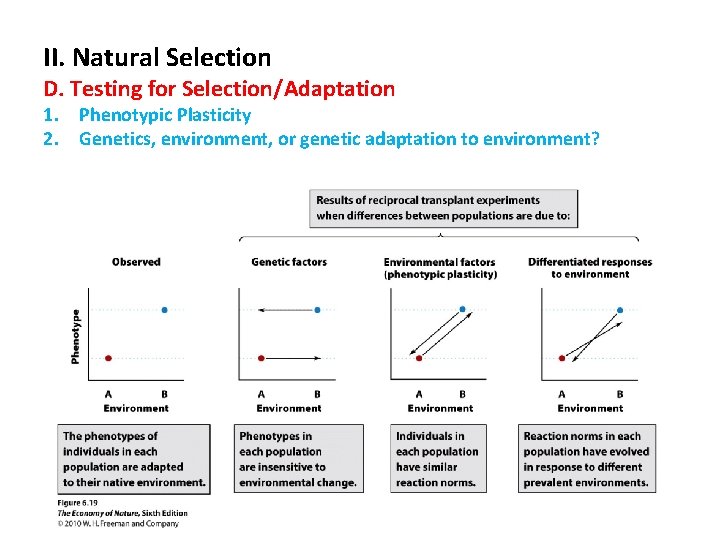
II. Natural Selection D. Testing for Selection/Adaptation 1. Phenotypic Plasticity 2. Genetics, environment, or genetic adaptation to environment?
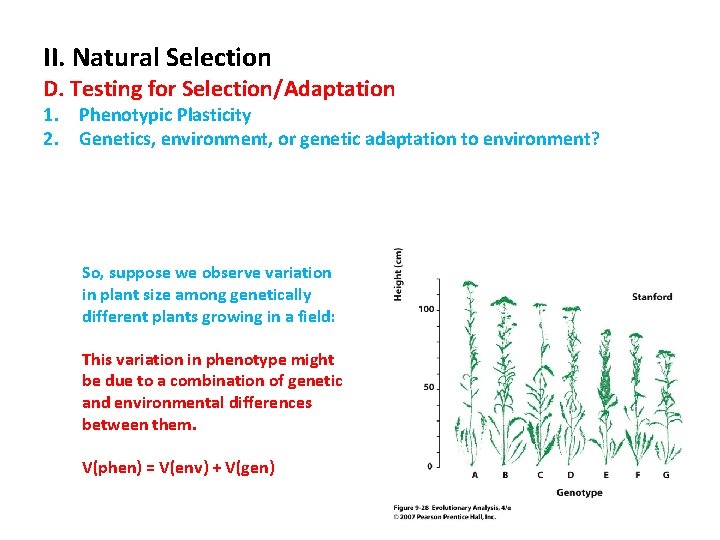
II. Natural Selection D. Testing for Selection/Adaptation 1. Phenotypic Plasticity 2. Genetics, environment, or genetic adaptation to environment? So, suppose we observe variation in plant size among genetically different plants growing in a field: This variation in phenotype might be due to a combination of genetic and environmental differences between them. V(phen) = V(env) + V(gen)
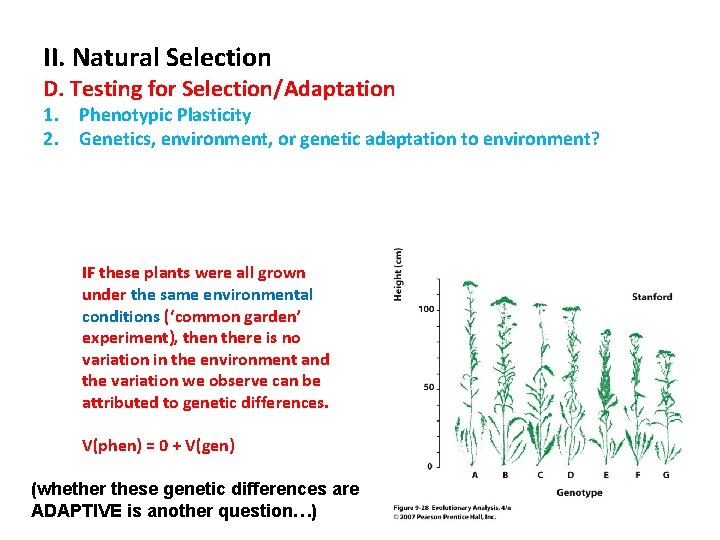
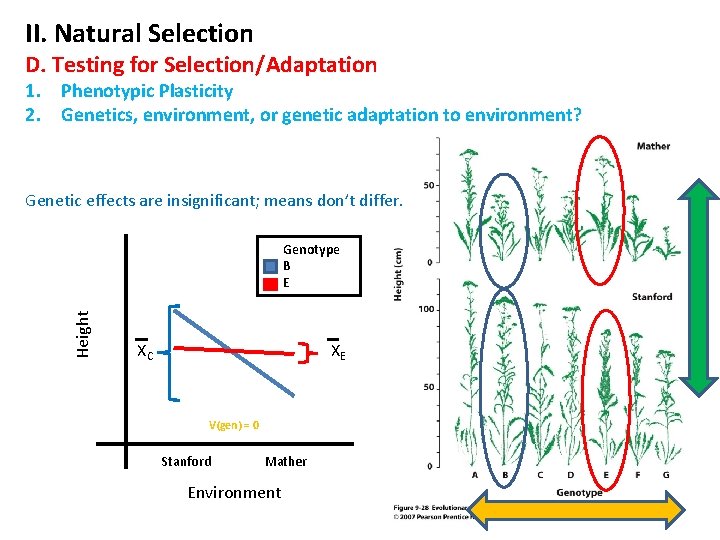
II. Natural Selection D. Testing for Selection/Adaptation 1. Phenotypic Plasticity 2. Genetics, environment, or genetic adaptation to environment? IF these plants were all grown under the same environmental conditions (‘common garden’ experiment), then there is no variation in the environment and the variation we observe can be attributed to genetic differences. V(phen) = 0 + V(gen) (whether these genetic differences are ADAPTIVE is another question…)
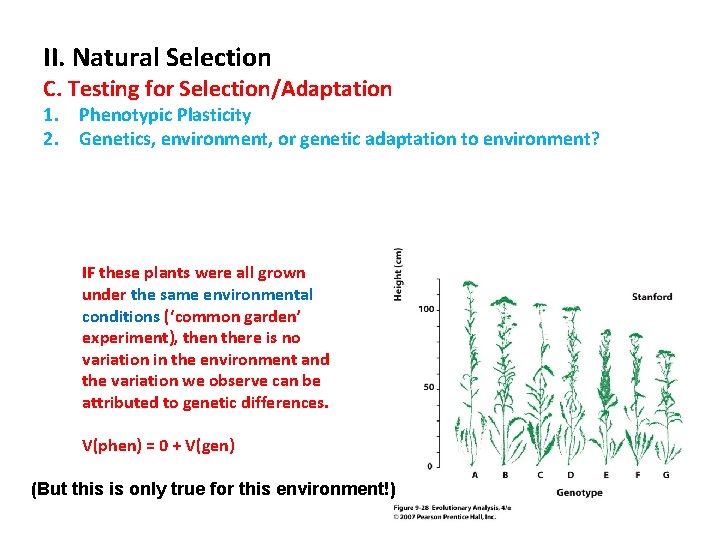
II. Natural Selection C. Testing for Selection/Adaptation 1. Phenotypic Plasticity 2. Genetics, environment, or genetic adaptation to environment? IF these plants were all grown under the same environmental conditions (‘common garden’ experiment), then there is no variation in the environment and the variation we observe can be attributed to genetic differences. V(phen) = 0 + V(gen) (But this is only true for this environment!)
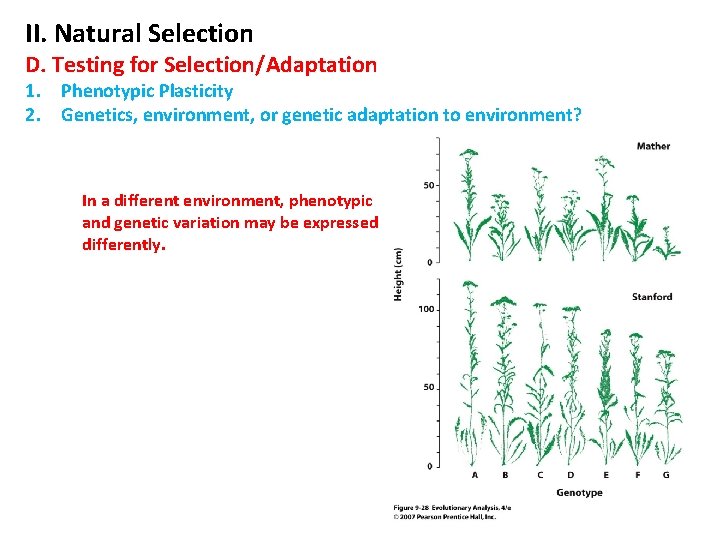
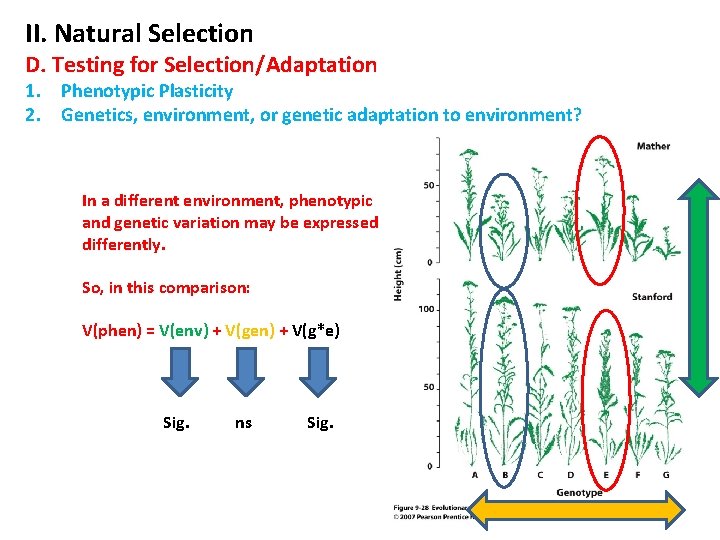
II. Natural Selection D. Testing for Selection/Adaptation 1. Phenotypic Plasticity 2. Genetics, environment, or genetic adaptation to environment? In a different environment, phenotypic and genetic variation may be expressed differently.
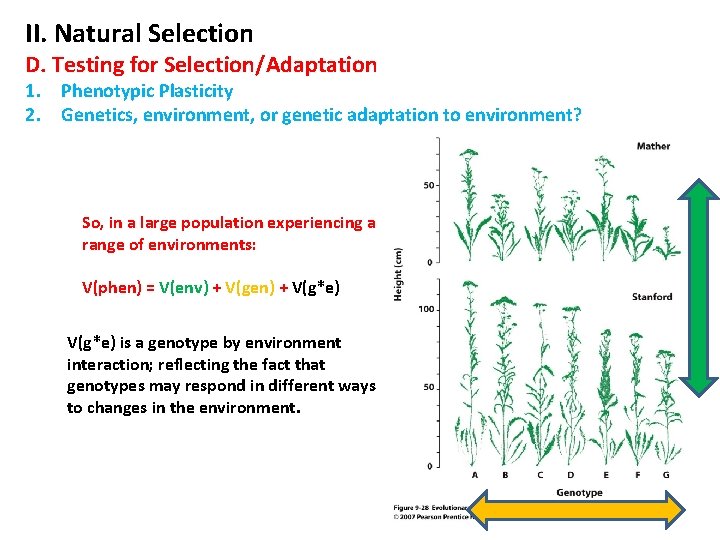
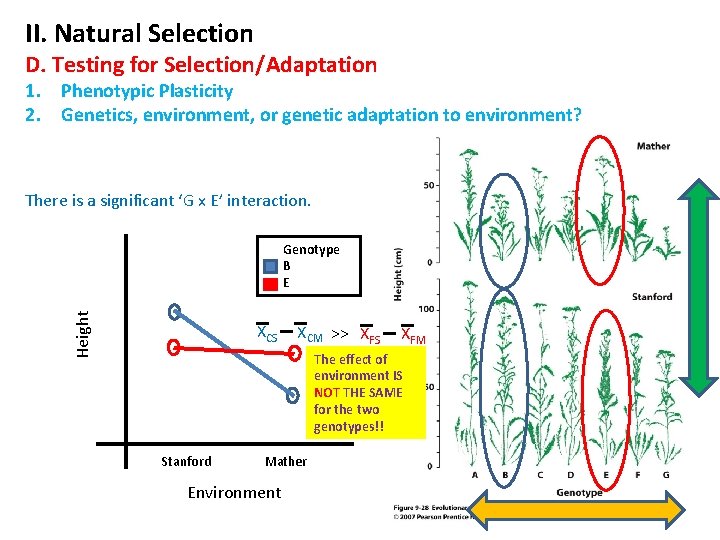
II. Natural Selection D. Testing for Selection/Adaptation 1. Phenotypic Plasticity 2. Genetics, environment, or genetic adaptation to environment? So, in a large population experiencing a range of environments: V(phen) = V(env) + V(gen) + V(g*e) is a genotype by environment interaction; reflecting the fact that genotypes may respond in different ways to changes in the environment.
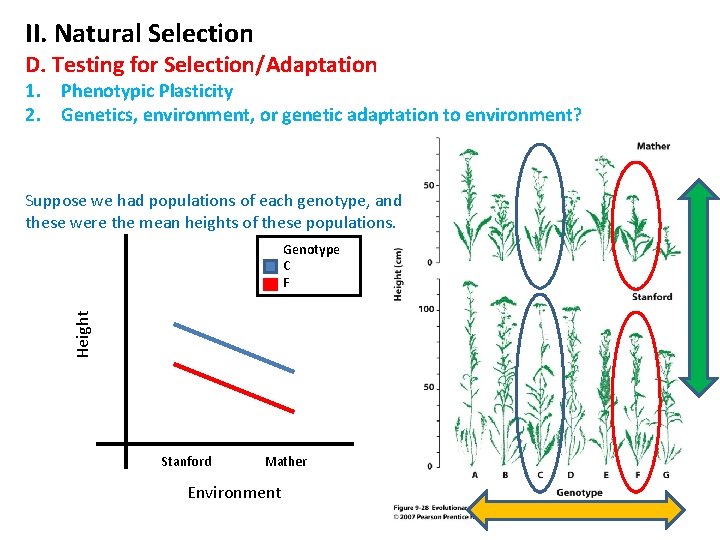
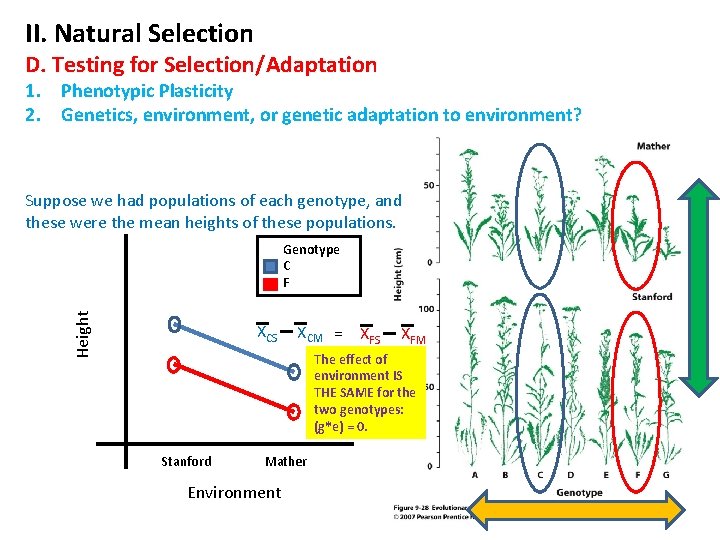
II. Natural Selection D. Testing for Selection/Adaptation 1. Phenotypic Plasticity 2. Genetics, environment, or genetic adaptation to environment? Suppose we had populations of each genotype, and these were the mean heights of these populations. Height Genotype C F Stanford Mather Environment
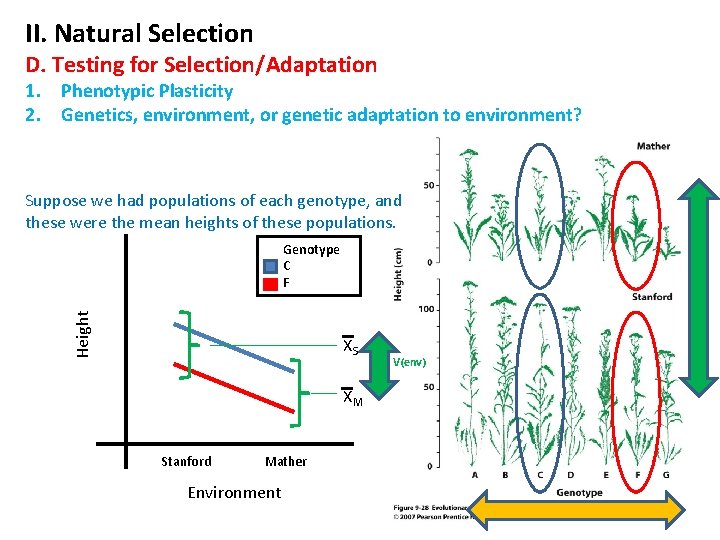
II. Natural Selection D. Testing for Selection/Adaptation 1. Phenotypic Plasticity 2. Genetics, environment, or genetic adaptation to environment? Suppose we had populations of each genotype, and these were the mean heights of these populations. Height Genotype C F XS XM Stanford Mather Environment V(env)
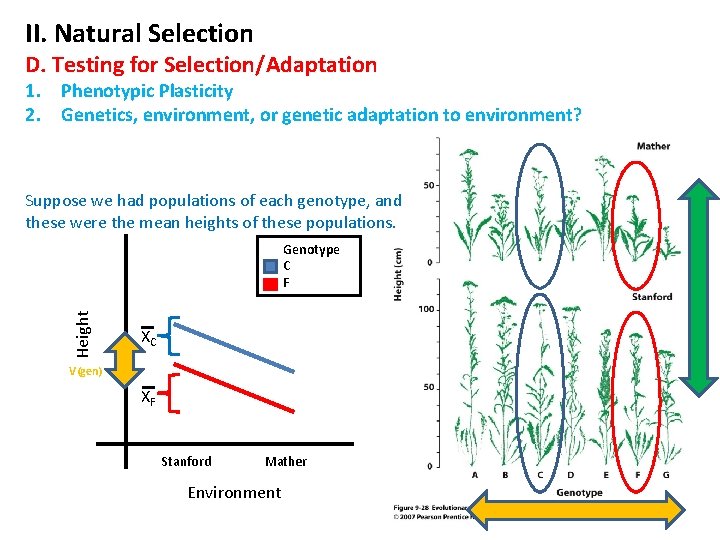
II. Natural Selection D. Testing for Selection/Adaptation 1. Phenotypic Plasticity 2. Genetics, environment, or genetic adaptation to environment? Suppose we had populations of each genotype, and these were the mean heights of these populations. Height Genotype C F XC V(gen) XF Stanford Mather Environment
II. Natural Selection D. Testing for Selection/Adaptation 1. Phenotypic Plasticity 2. Genetics, environment, or genetic adaptation to environment? Suppose we had populations of each genotype, and these were the mean heights of these populations. Height Genotype C F XCS XCM = XFS XFM The effect of environment IS THE SAME for the two genotypes: (g*e) = 0. Stanford Mather Environment
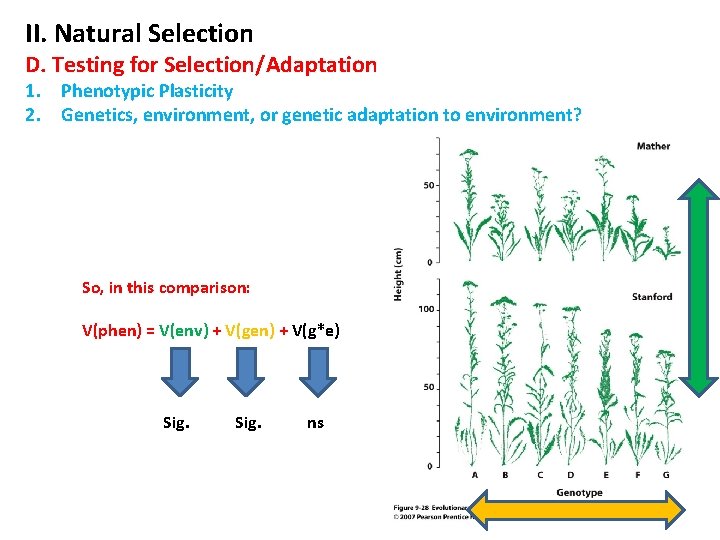
II. Natural Selection D. Testing for Selection/Adaptation 1. Phenotypic Plasticity 2. Genetics, environment, or genetic adaptation to environment? So, in this comparison: V(phen) = V(env) + V(gen) + V(g*e) Sig. ns
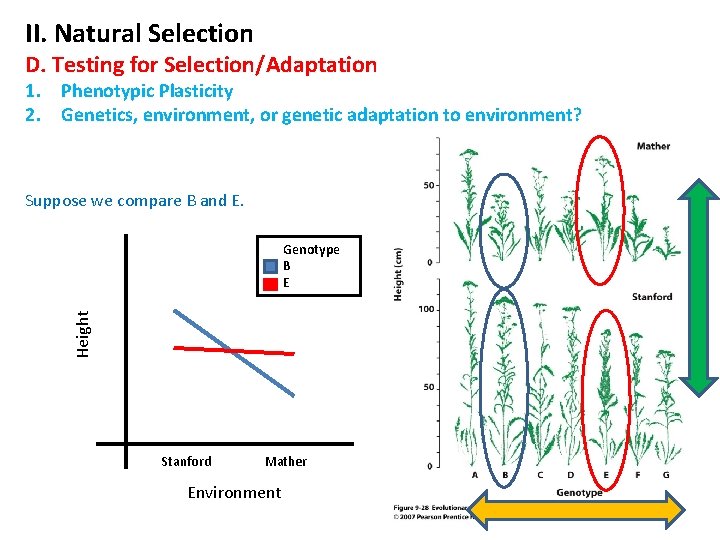
II. Natural Selection D. Testing for Selection/Adaptation 1. Phenotypic Plasticity 2. Genetics, environment, or genetic adaptation to environment? Suppose we compare B and E. Height Genotype B E Stanford Mather Environment
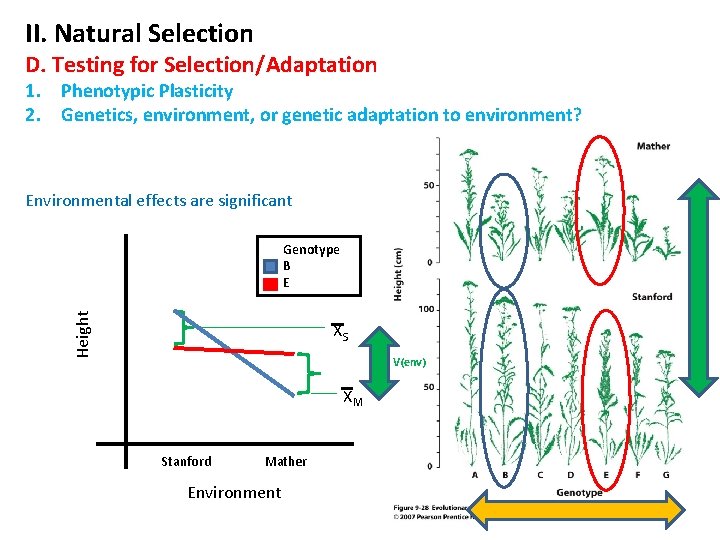
II. Natural Selection D. Testing for Selection/Adaptation 1. Phenotypic Plasticity 2. Genetics, environment, or genetic adaptation to environment? Environmental effects are significant Height Genotype B E XS V(env) XM Stanford Mather Environment
II. Natural Selection D. Testing for Selection/Adaptation 1. Phenotypic Plasticity 2. Genetics, environment, or genetic adaptation to environment? Genetic effects are insignificant; means don’t differ. Height Genotype B E XC XE V(gen) = 0 Stanford Mather Environment
II. Natural Selection D. Testing for Selection/Adaptation 1. Phenotypic Plasticity 2. Genetics, environment, or genetic adaptation to environment? There is a significant ‘G x E’ interaction. Height Genotype B E XCS XCM >> XFS XFM The effect of environment IS NOT THE SAME for the two genotypes!! Stanford Mather Environment
II. Natural Selection D. Testing for Selection/Adaptation 1. Phenotypic Plasticity 2. Genetics, environment, or genetic adaptation to environment? In a different environment, phenotypic and genetic variation may be expressed differently. So, in this comparison: V(phen) = V(env) + V(gen) + V(g*e) Sig. ns Sig.
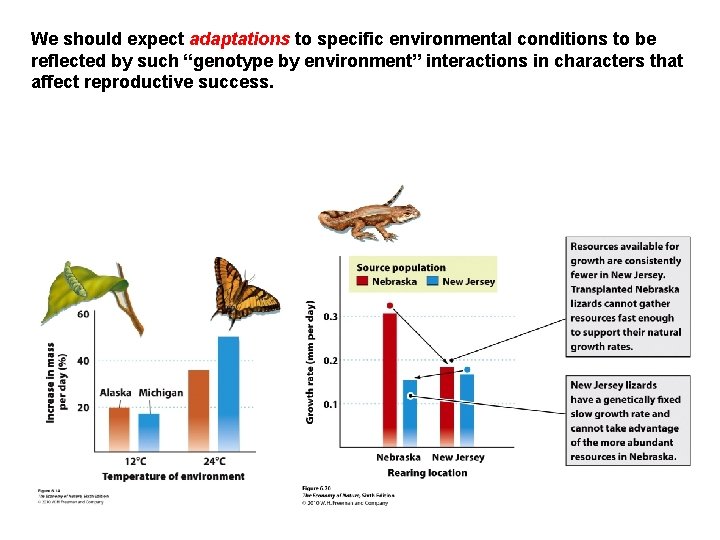
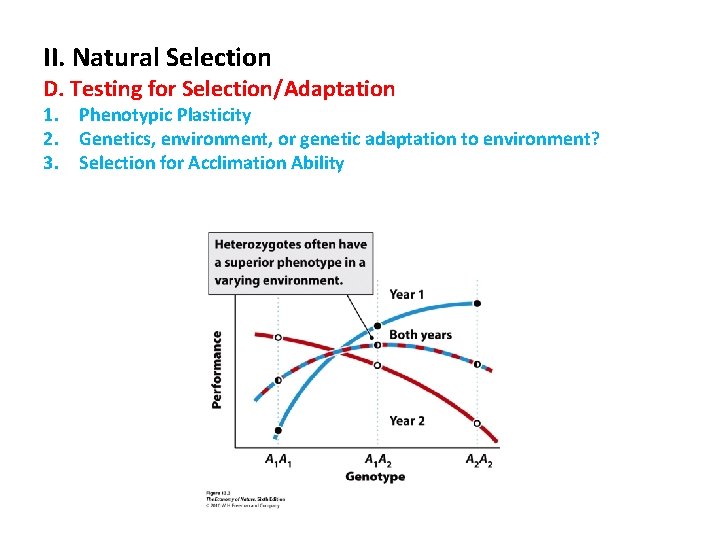
We should expect adaptations to specific environmental conditions to be reflected by such “genotype by environment” interactions in characters that affect reproductive success.
II. Natural Selection D. Testing for Selection/Adaptation 1. Phenotypic Plasticity 2. Genetics, environment, or genetic adaptation to environment? 3. Selection for Acclimation Ability
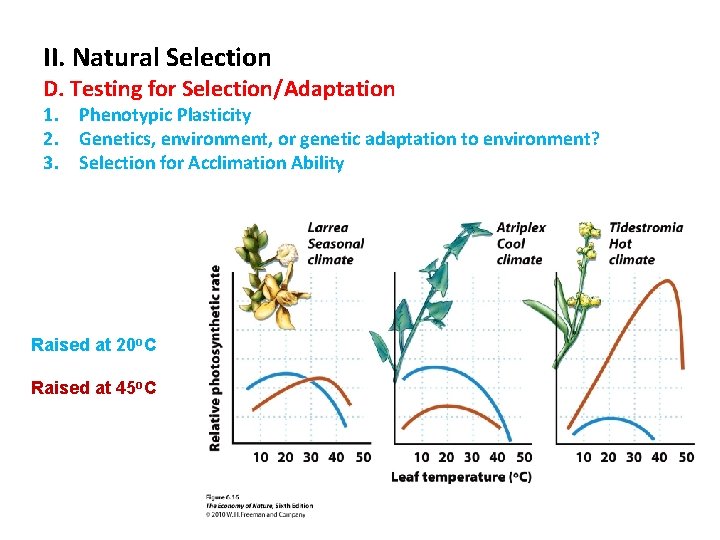
II. Natural Selection D. Testing for Selection/Adaptation 1. Phenotypic Plasticity 2. Genetics, environment, or genetic adaptation to environment? 3. Selection for Acclimation Ability Raised at 20 o. C Raised at 45 o. C
II. Natural Selection D. Testing for Selection/Adaptation 1. Phenotypic Plasticity 2. Genetics, environment, or genetic adaptation to environment? 3. Selection for Acclimation Ability HOW do these acclimation adaptations evolve? Are there NEW structural genes that evolve?
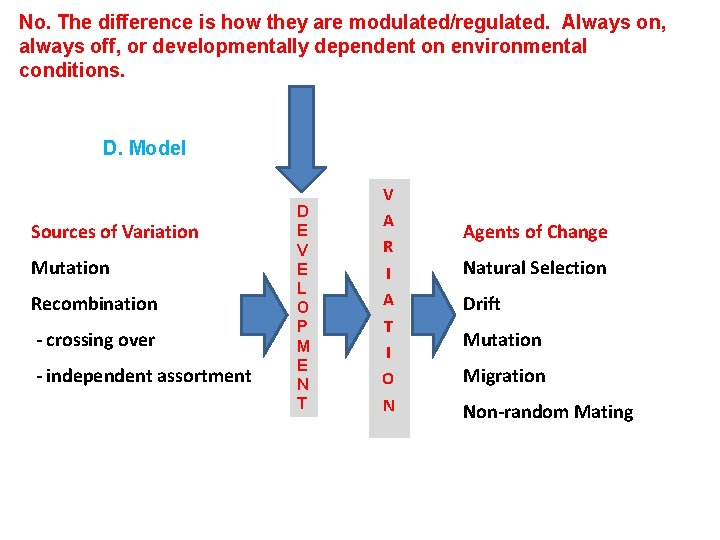
No. The difference is how they are modulated/regulated. Always on, always off, or developmentally dependent on environmental conditions. D. Model Sources of Variation Mutation Recombination - crossing over - independent assortment D E V E L O P M E N T V A R I A T I O N Agents of Change Natural Selection Drift Mutation Migration Non-random Mating