CPS 506 Comparative Programming Languages Winter 2010 Ryerson
- Slides: 123
CPS 506 Comparative Programming Languages Winter 2010 Ryerson University
Course Outline • • Introduction Syntax and Semantic Specification Type Systems, Semantics and Data Types Names, Scope, Expression Control Structures Sub-program and Parameter Passing Exception Handling Abstract Data Type and Encapsulation 2
Course Outline (con’t) • Programming Language Paradigms – Imperative (C, Pascal, …) – Object-Oriented (C++, C#, Java, …) – Logic (Prolog, Mercury) – Functional (ML, Scheme, Haskell, …) – Even-driven (Visual Basic, Java, …) – Concurrent or Parallel (SR, Linda, …) – Multi-Paradigm (Ruby, Python, Perl, …) 3
Course Outline (con’t) • Languages Survey – ML (Meta Language) (1990 s) • Functional language – Ruby (1993) • A balanced functional and imperative languages – Python (1991) • Object-Oriented, functional and imperative language 4
Textbook • Concepts of Programming Languages, 9 th Edition – By Robert W. Sebesta http: //www. coursesmart. com/0136073476 • Programming Languages: Principles and Paradigms, 2 nd Edition – By Allen Tucker and Robert Noonan • … http: //www. mhhe. com/engcs/compsci/tucker/ 5
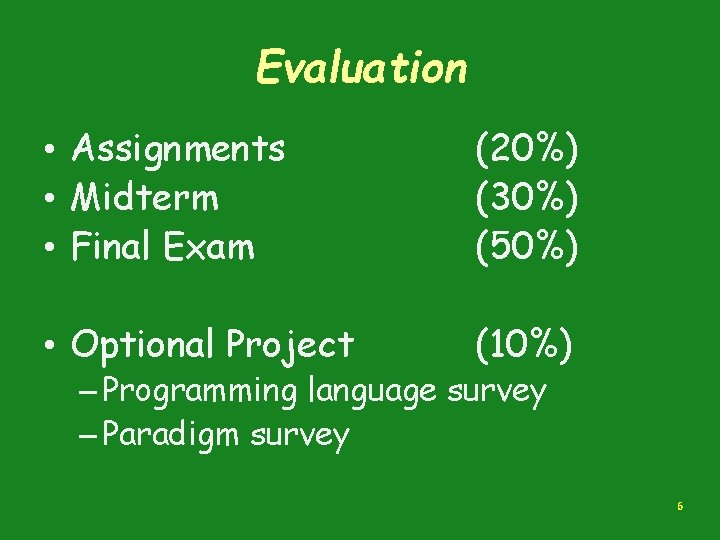
Evaluation • Assignments • Midterm • Final Exam (20%) (30%) (50%) • Optional Project (10%) – Programming language survey – Paradigm survey 6
Contact Information • Course Web Page www. scs. ryerson. ca/~ssamet/ (check every three days) • Contact Email ssamet@scs. ryerson. ca • Office Hours TBA • Teaching Assistant TBA 7
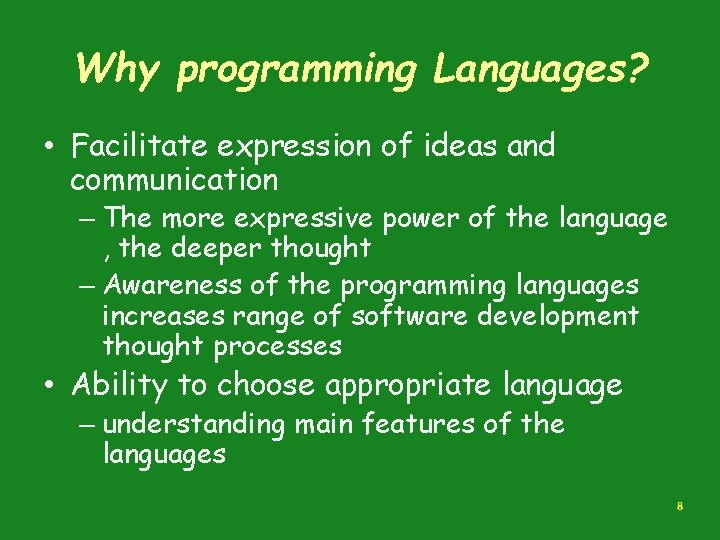
Why programming Languages? • Facilitate expression of ideas and communication – The more expressive power of the language , the deeper thought – Awareness of the programming languages increases range of software development thought processes • Ability to choose appropriate language – understanding main features of the languages 8
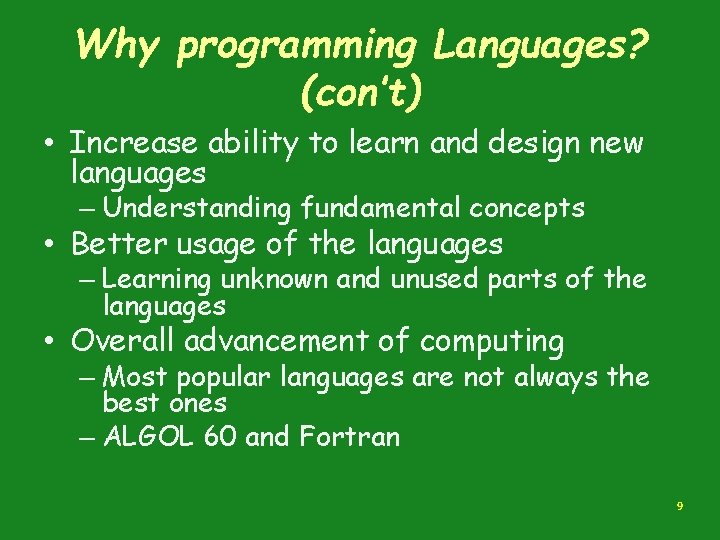
Why programming Languages? (con’t) • Increase ability to learn and design new languages – Understanding fundamental concepts • Better usage of the languages – Learning unknown and unused parts of the languages • Overall advancement of computing – Most popular languages are not always the best ones – ALGOL 60 and Fortran 9
Introduction (con’t) • Different from natural languages – Narrower expressive domain (Algorithmic ideas) – Communication between human and computer • Future programming languages – Understand features, strengths and weaknesses – New application needs 10
Programming Language Qualities • Criteria – Readability • Ease of reading and understanding a program • Before 1970 s – Efficiency and Machine readability – Design from the point of view of computer • 1970 s and after – Software life-cycle concept – Maintenance – Machine orientation -> Human orientation • Consider in the context of the domain 11
Programming Language Qualities • Criteria (con’t) – Writability • How easily a language can be used • Tough relation with readability • Consider in the context of the domain – VB for GUI – C for system programs 12
Programming Language Qualities • Criteria (con’t) – Reliability • Performs according to the specifications under all conditions • Crucial criterion for embedded, scientific, real-time and human related systems 13
Programming Language Qualities • Characteristics – Simplicity and Clarity • How easily a program is written and read • Knowledge difference of author and reader – Binding • Language definition, implementation time, program writing time, compile time, run time 14
Programming Language Qualities (con’t) • Characteristics (con’t) – Orthogonality • Small set of primitive constructs can be combined in a small number of ways to define the components of a language • Not too many ways for doing the same thing • A symbol or reserve word always have the same meaning – Type checking • Testing for type errors • Expensive in run-time • Original C language had no parameter type checking 15
Programming Language Qualities (con’t) • Characteristics (con’t) – Exception handling • Ability to intercept run-time errors • Prevent system crash – Aliasing • Same memory, two or more names • Side-effect • Difficult program verification – Applicability • Support for the application domain 16
Programming Language Qualities (con’t) • Characteristics (con’t) – Abstraction • Complex s structures without specifying the detail implementation – Efficient Implementation • Problems like in early implementation of Java and Ada 17
Programming Language Qualities (con’t) • Cost – Training, Writing, Compiling, Executing, Maintenance, Implementation environment • Portability – One program on different platforms • Generality – Applicability to wide range of application domain 18
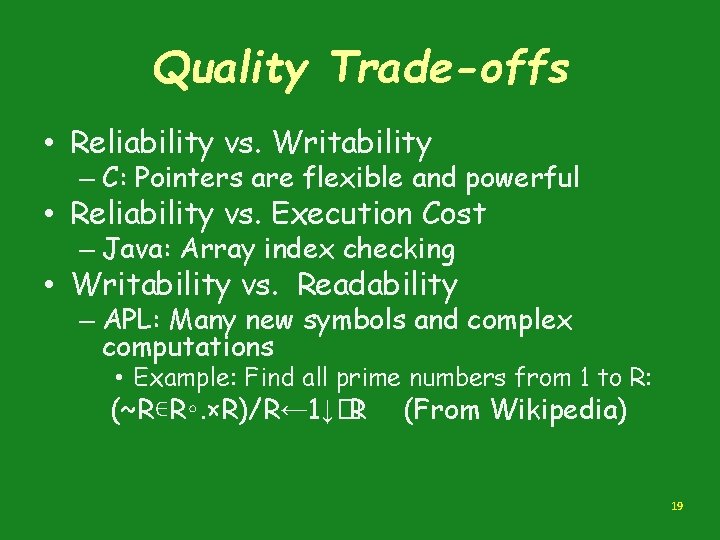
Quality Trade-offs • Reliability vs. Writability – C: Pointers are flexible and powerful • Reliability vs. Execution Cost – Java: Array index checking • Writability vs. Readability – APL: Many new symbols and complex computations • Example: Find all prime numbers from 1 to R: (~R∊R∘. ×R)/R← 1↓�R (From Wikipedia) 19
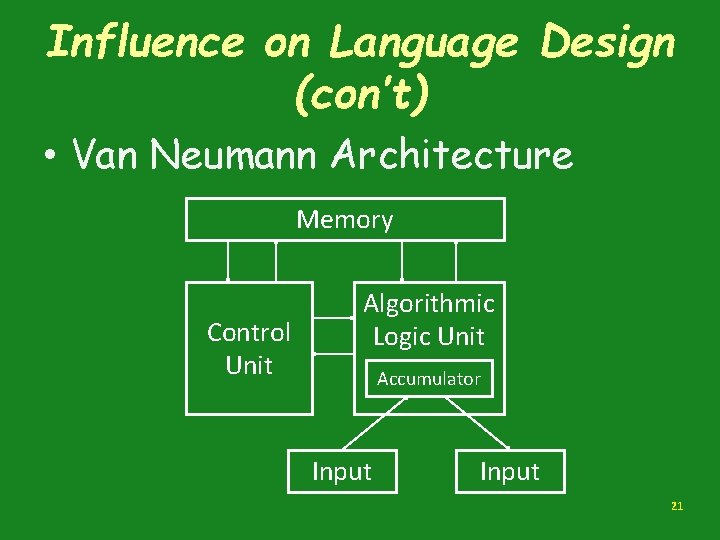
Influence on Language Design • Computer Architecture – Many languages are designed according to the prevalent architecture, Van Neumann – Imperative languages – Both data and program in the same memory – CPU is separate from memory – Data and instructions piped to CPU – Results moved back to memory 20
Influence on Language Design (con’t) • Van Neumann Architecture Memory Control Unit Algorithmic Logic Unit Accumulator Input 21
Influence on Language Design (con’t) • Computer Architecture (con’t) – Variables model memory cell – Assignments statements based on piping operation – Iterative form of repetition: efficient way to implement loops (instructions stored in adjacent cells) – Fetch-Execute cycle 22
Influence on Language Design (con’t) • Software Development Methodologies – New paradigm, new languages 23
Programming methodologies influences • 1950 s and early 1960 s: Simple applications; machine efficiency problem • Late 1960 s: Efficiency became important; readability; better control structures – structured programming – top-down design 24
Programming methodologies influences (con’t) • Late 1970 s: Process-oriented to dataoriented – data abstraction • Mid 1980 s: Object-oriented programming – Data abstraction; inheritance; dynamic method binding (polymorphism) 25
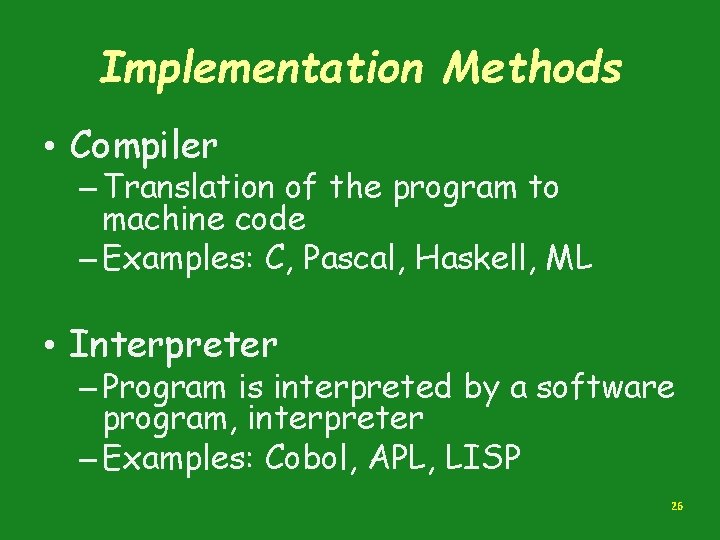
Implementation Methods • Compiler – Translation of the program to machine code – Examples: C, Pascal, Haskell, ML • Interpreter – Program is interpreted by a software program, interpreter – Examples: Cobol, APL, LISP 26
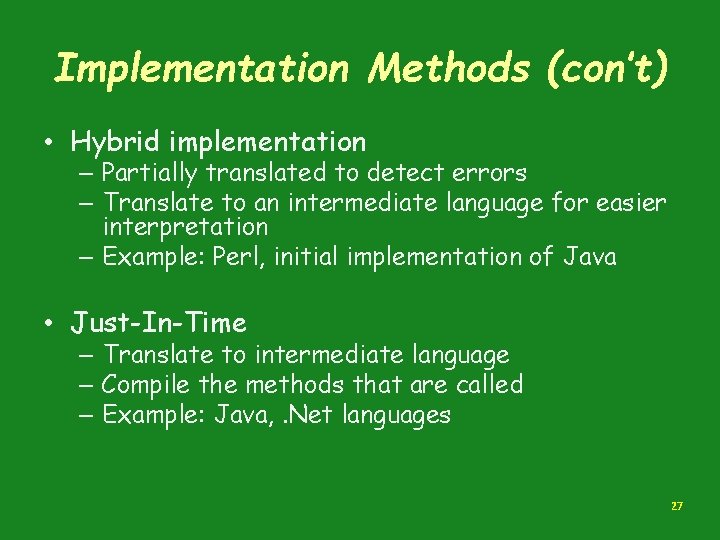
Implementation Methods (con’t) • Hybrid implementation – Partially translated to detect errors – Translate to an intermediate language for easier interpretation – Example: Perl, initial implementation of Java • Just-In-Time – Translate to intermediate language – Compile the methods that are called – Example: Java, . Net languages 27
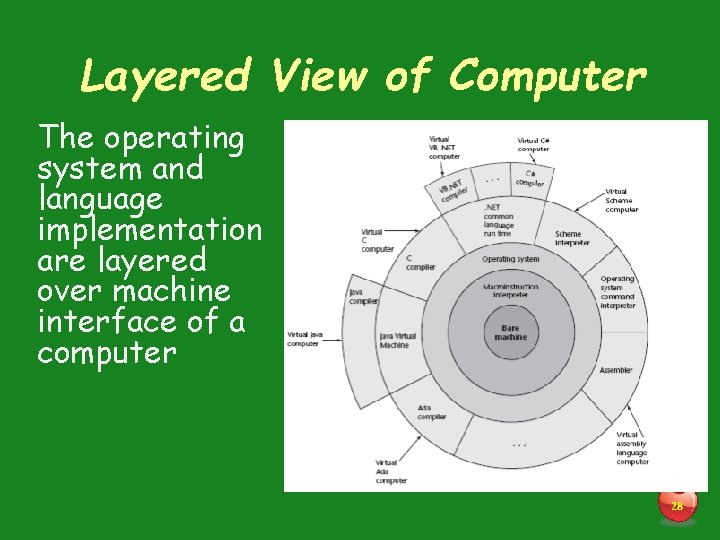
Layered View of Computer The operating system and language implementation are layered over machine interface of a computer 28
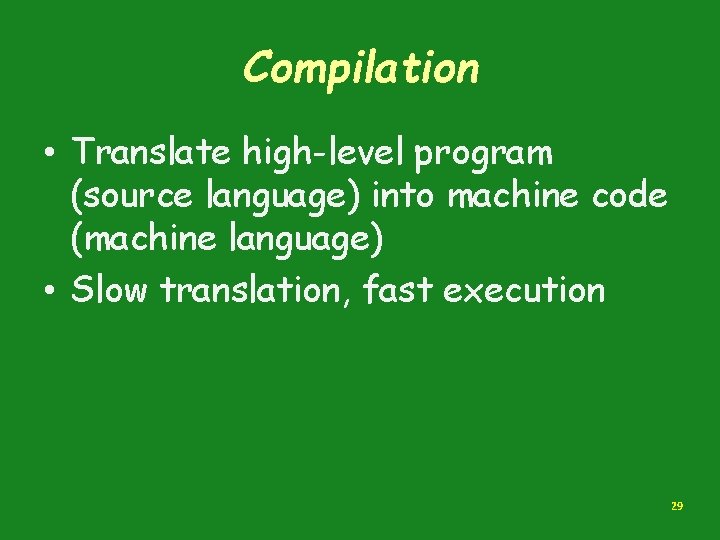
Compilation • Translate high-level program (source language) into machine code (machine language) • Slow translation, fast execution 29
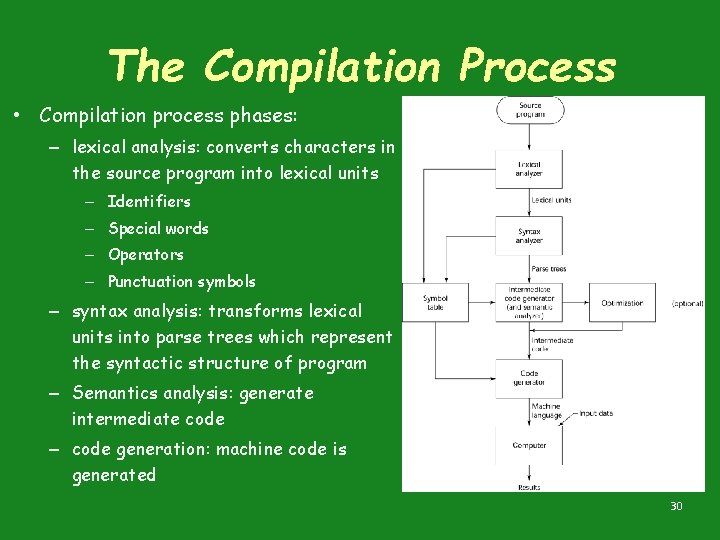
The Compilation Process • Compilation process phases: – lexical analysis: converts characters in the source program into lexical units – Identifiers – Special words – Operators – Punctuation symbols – syntax analysis: transforms lexical units into parse trees which represent the syntactic structure of program – Semantics analysis: generate intermediate code – code generation: machine code is generated 30
Additional Compilation Terminologies • Load module (executable image): the user and system code together • Linking and loading: the process of collecting system program units and linking them to a user program 31
Von Neumann Bottleneck • Connection speed between a computer’s memory and its processor determines the speed of a computer • Program instructions often can be executed much faster than the speed of the connection; the connection speed thus results in a bottleneck • Known as the von Neumann bottleneck; it is the primary limiting factor in the speed of computers • Motivation for research and development of parallel computers 32
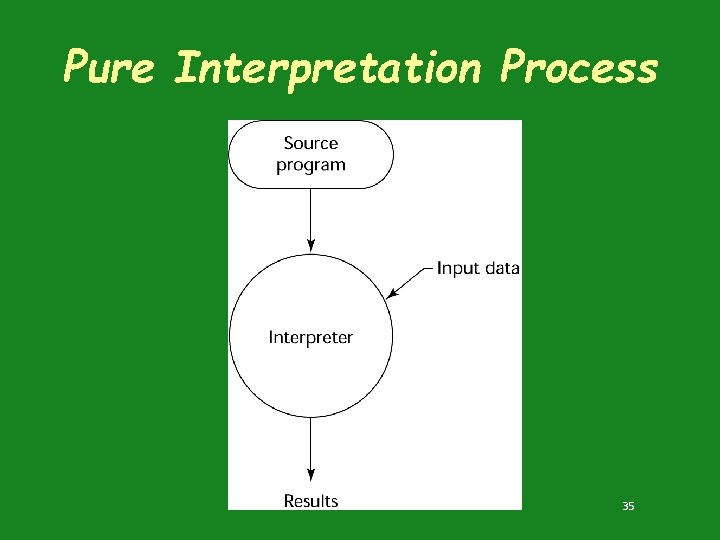
Pure Interpretation • No translation • Works as a software simulation of a machine • Easier implementation of programs (run-time errors can easily and immediately be displayed) • Slower execution (10 to 100 times slower than compiled programs) – Decoding high-level language statements – Statements are decoded every time executed – Bottleneck is statement decoding and not the communication between memory and processor 33
Pure Interpretation (con’t) • Often requires more space – In addition of source, symbol table has to be present during interpretation – Storing source program in a form for easy access and modification and not in minimal size • Pure interpreters (1960 s) – APL, SNOBOL, LISP • Rarely used in high-level languages (by the 1980 s) • Significant comeback with some Web scripting languages – Java. Script – PHP 34
Pure Interpretation Process 35
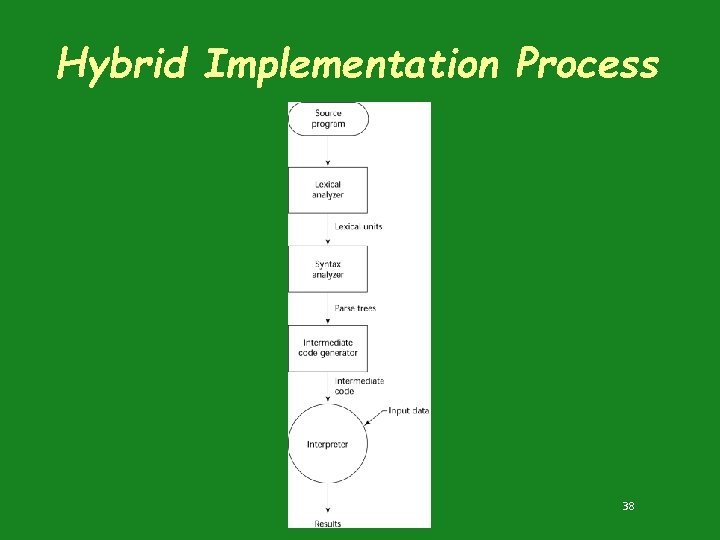
Hybrid Implementation Systems • A compromise between compilers and pure interpreters • A high-level language program is translated to an intermediate language that allows easy interpretation – Faster than pure interpretation – Source statements are decoded only once 36
Hybrid Implementation Systems • Examples – Perl programs are partially compiled to • Detect errors before interpretation • Simplify the interpreter – Initial implementations of Java were hybrid; the intermediate form, byte code, provides portability to any machine that has • Byte code interpreter • Associated run-time system • Together, these are called Java Virtual Machine – New versions translate Java byte code into machine code for faster execution 37
Hybrid Implementation Process 38
Just-in-Time Implementation Systems • Initially translate programs to an intermediate language • Then compile the intermediate language of the subprograms into machine code when they are called • Machine code version is kept for subsequent calls • JIT systems are widely used for Java programs • . NET languages are implemented with a JIT system 39
Preprocessors • Preprocessor macros (instructions) are commonly used to specify that code from another file is to be included • A preprocessor processes a program immediately before the program is compiled to expand embedded preprocessor macros • A well-known example: C preprocessor – expands #include, #define, and similar macros • Possible side effect 40
Principles of language design • Basic vocabulary to express language structures, meaning, …, borrowed from – Linguistics – Mathematics • Principles categories – Syntax – Type Systems and Semantics – Memory Management – Exception Handling 41
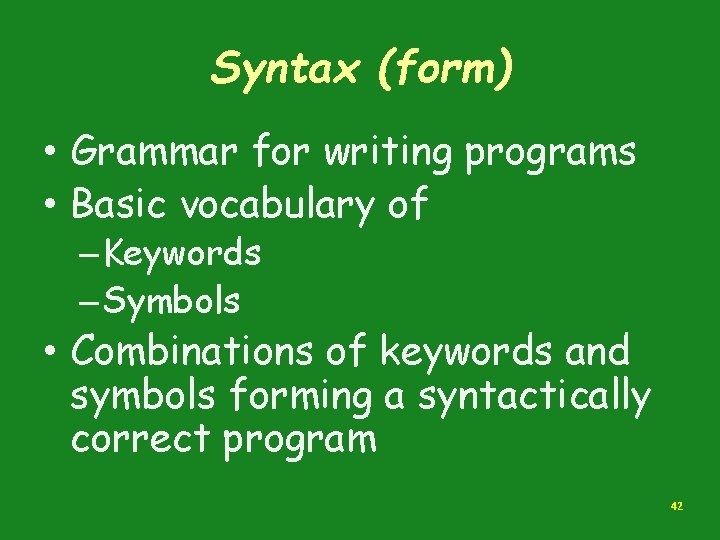
Syntax (form) • Grammar for writing programs • Basic vocabulary of – Keywords – Symbols • Combinations of keywords and symbols forming a syntactically correct program 42
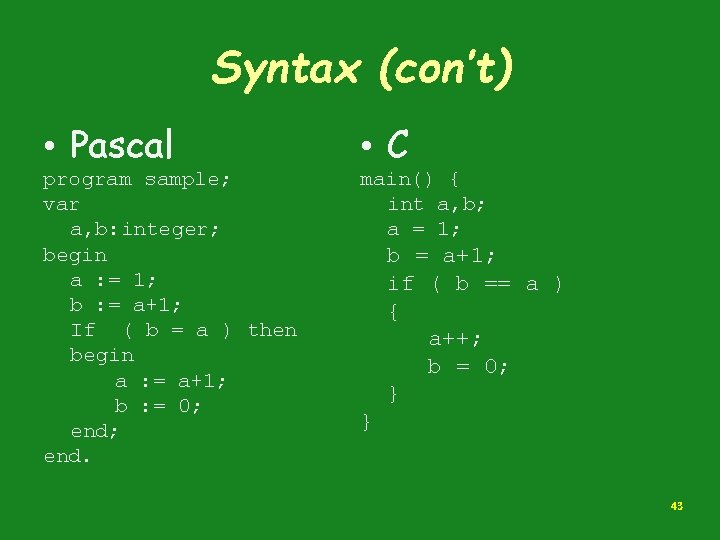
Syntax (con’t) • Pascal program sample; var a, b: integer; begin a : = 1; b : = a+1; If ( b = a ) then begin a : = a+1; b : = 0; end. • C main() { int a, b; a = 1; b = a+1; if ( b == a ) { a++; b = 0; } } 43
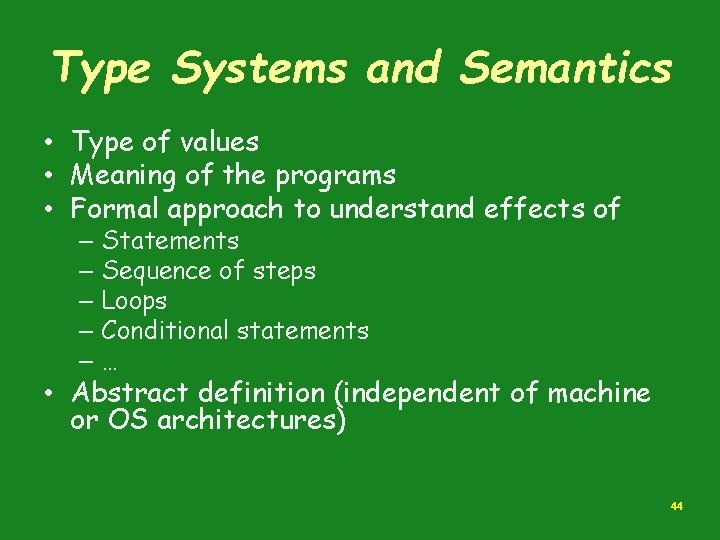
Type Systems and Semantics • Type of values • Meaning of the programs • Formal approach to understand effects of – – – Statements Sequence of steps Loops Conditional statements … • Abstract definition (independent of machine or OS architectures) 44
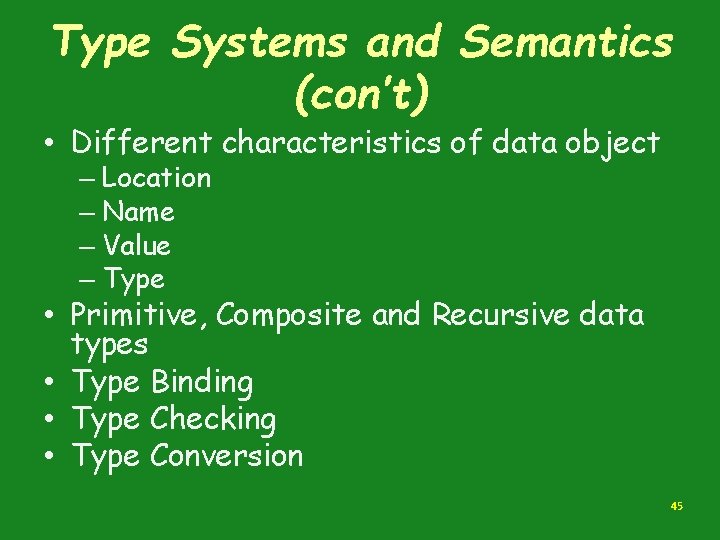
Type Systems and Semantics (con’t) • Different characteristics of data object – Location – Name – Value – Type • Primitive, Composite and Recursive data types • Type Binding • Type Checking • Type Conversion 45
Memory Management • Mapping of values, data structures, and program structures to the memory • Static memory (Stack) • Dynamic memory (Heap) • Objects lifetime • Garbage collection 46
Exception Handling • Unexpected input error • Unexpected division by zero • Unexpected unsuccessful space allocation in the heap • A fundamental feature in modern languages 47
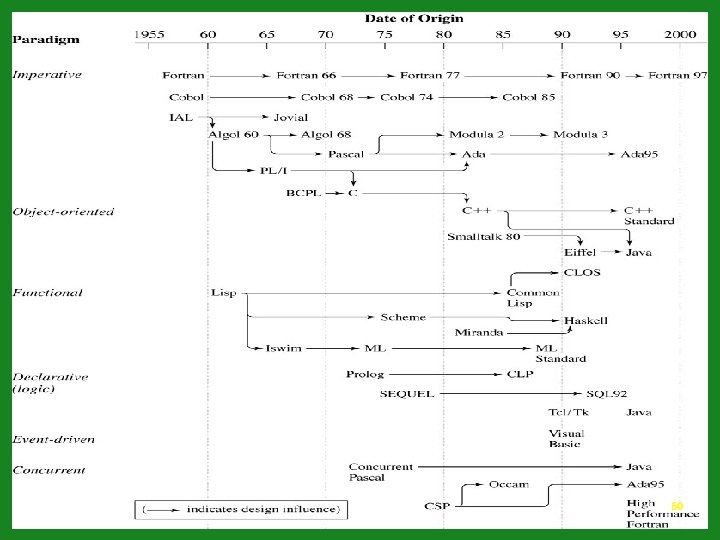
Programming Paradigms • Imperative – Series of steps • Calculate • Retrieve input • Produce output – Procedural Abstraction • • Assignments Loops Sequences Conditional Statements – Examples • Cobol, Fortran, C, C++ 48
Programming Paradigms (con’t) • Object Oriented – Collection of objects interact with each other – Building blocks • Object modeling • Classification • Inheritance – Examples • Java, Smalltalk, C++, C#, Ruby, Ada 95 49
Programming Paradigms (con’t) • Logic – Collection of declarative rules – “What outcome” instead of “How accomplish” – Natural vehicle for expressing nondeterminism – A series of possible solutions to a problem – Examples • Prolog 50
Programming Paradigms (con’t) • Functional – Collection of mathematical functions – One input (domain) and one result (range) – Functions interacts using • Composition • Conditionals • Recursion – Examples • Lisp, Scheme, ML, Haskell 51
Programming Paradigms (con’t) • Event-driven – Continuous loop that responds to events – Events could be in various orders • Keystroke, mouse click, … – Examples • Visual Basic, Java 52
Programming Paradigms (con’t) • Concurrent – Collection of parallel processes or treads – Sharing information – Processes could be executed asynchronously – Parallelism in one process – Examples • SR, Linda, High Performance Fortran 53
Programming Paradigms (con’t) • Multi-Paradigm – Support more than one programming paradigm – Frameworks providing a variety of styles for programmer to use a mix constructs from various paradigms – Idea: There is no single paradigm to solve the problems efficiently and easily – Examples • Oz, Ruby, Python, Perl, … 54
Application Domains • Scientific – Complex calculations – Fast process – Accurate results – Imperative and parallel paradigms – Fortran 90, C, High Performance Fortran 55
Application Domains (con’t) • Management Information Systems (MIS) – Business and commercial systems – Database management – Imperative, Declarative and event -driven paradigms – Cobol, RPG, SQL, Java, Tcl/Tk 56
Application Domains (con’t) • Artificial Intelligence (AI) – Modeling human intelligent bahavior – Logical deduction – Cognition – Functional and logic paradigms – Prolog, CLP 57
Application Domains (con’t) • Systems – Operating systems – Network software – Compilers – Imperative, event-driven, and parallel paradigms –C 58
Application Domains (con’t) • Web-centric – E-Commerce – E-Government – Event-driven, and Object. Oriented paradigms – Perl, Tcl/Tk, Visual Basic, Java 59
60
Zuse’s Plankalkül (Plan Calculus) • Designed in 1945, but not published until 1972 • First compiler in 1998 • Engineering Purpose • Never implemented • Advanced data structures – floating point, arrays, records 61
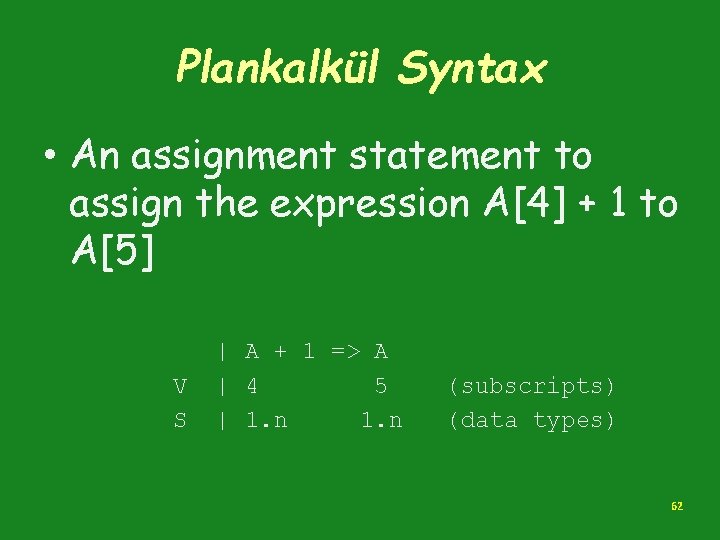
Plankalkül Syntax • An assignment statement to assign the expression A[4] + 1 to A[5] V S | A + 1 => A | 4 5 | 1. n (subscripts) (data types) 62
Minimal Hardware Programming: Pseudocodes • What was wrong with using machine code? –Poor readability –Poor modifiability –Expression coding was tedious –Machine deficiencies--no indexing or floating point 63
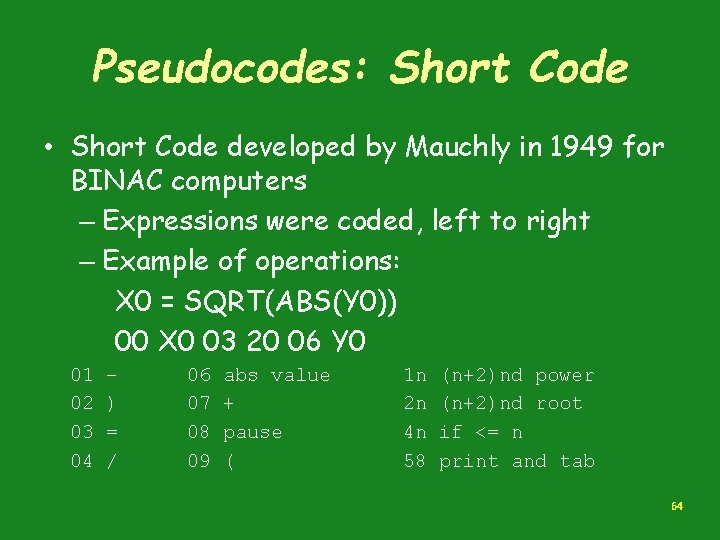
Pseudocodes: Short Code • Short Code developed by Mauchly in 1949 for BINAC computers – Expressions were coded, left to right – Example of operations: X 0 = SQRT(ABS(Y 0)) 00 X 0 03 20 06 Y 0 01 02 03 04 – ) = / 06 07 08 09 abs value + pause ( 1 n 2 n 4 n 58 (n+2)nd power (n+2)nd root if <= n print and tab 64
Pseudocodes: Speedcoding • Speedcoding developed by Backus in 1954 for IBM 701 – Pseudo ops for arithmetic and math functions – Conditional and unconditional branching – Auto-increment registers for array access – Slow! – Only 700 words left for user program 65
IBM 704 and Fortran • • Fortran 0: 1954 - not implemented Fortran I: 1957 – Designed for the new IBM 704, which had index registers and floating point hardware - This led to the idea of compiled programming languages, because there was no place to hide the cost of interpretation – Environment of development • Computers had small memories, slow and unreliable • Applications were scientific • No programming methodology or tools • Machine efficiency was the most important concern 66
Design Process of Fortran • Impact of environment on design of Fortran I – No need for dynamic storage – Need good array handling and counting loops – No string handling, decimal arithmetic, or powerful input/output (for business software) 67
Fortran I Overview • First implemented version of Fortran – Names could have up to six characters – Post-test counting loop (DO) – Formatted I/O – User-defined subprograms – Three-way selection statement (arithmetic IF) – No data typing statements 68
Fortran I Overview (con’t) • First implemented version of FORTRAN – No separate compilation – Compiler released in April 1957, after 18 worker-years of effort – Programs larger than 400 lines rarely compiled correctly, mainly due to poor reliability of 704 – Code was very fast – Quickly became widely used 69
Fortran II • Distributed in 1958 –Independent compilation –Fixed the bugs 70
Fortran IV • Evolved during 1960 -62 –Explicit type declarations –Logical selection statement –Subprogram names could be parameters –ANSI standard in 1966 71
Fortran 77 • Became the new standard in 1978 –Character string handling –Logical loop control statement –IF-THEN-ELSE statement 72
Fortran 90 • Most significant changes from Fortran 77 – Modules – Dynamic arrays – Pointers – Recursion – CASE statement – Parameter type checking 73
Latest versions of Fortran • Fortran 95 – relatively minor additions, plus some deletions • Fortran 2003 - ditto 74
Fortran Evaluation • Highly optimizing compilers (all versions before 90) – Types and storage of all variables are fixed before run time • Dramatically changed forever the way computers are used • Characterized as the lingua franca of the computing world 75
Functional Programming: LISP • LISt Processing language – Designed at MIT by Mc. Carthy • AI research needed a language to – Process data in lists (rather than arrays) – Symbolic computation (rather than numeric) • Only two data types: atoms and lists • Syntax is based on lambda calculus 76
Representation of Two LISP Lists Representing the lists (A B C D) and (A (B C) D (E (F G))) 77
LISP Evaluation • Pioneered functional programming – No need for variables or assignment – Control via recursion and conditional expressions • Still the dominant language for AI • COMMON LISP and Scheme are contemporary dialects of LISP • ML, Miranda, and Haskell are related languages 78
Scheme • • • Developed at MIT in mid 1970 s Small Extensive use of static scoping Functions as first-class entities Simple syntax (and small size) make it ideal for educational applications 79
COMMON LISP • An effort to combine features of several dialects of LISP into a single language • Large, complex 80
The First Step Toward Sophistication: ALGOL 60 • Environment of development – FORTRAN had (barely) arrived for IBM 70 x – Many other languages were being developed, all for specific machines – No portable language; all were machinedependent – No universal language for communicating algorithms • ALGOL 60 was the result of efforts to design a universal language 81
Early Design Process • ACM and GAMM met for four days for design (May 27 to June 1, 1958) • Goals of the language – Close to mathematical notation – Good for describing algorithms – Must be translatable to machine code 82
ALGOL 58 • • • Concept of type was formalized Names could be any length Arrays could have any number of subscripts Parameters were separated by mode (in & out) Subscripts were placed in brackets Compound statements (begin. . . end) Semicolon as a statement separator Assignment operator was : = if had an else-if clause No I/O - “would make it machine dependent” 83
ALGOL 58 Implementation • Not meant to be implemented, but variations of it were (MAD, JOVIAL) • Although IBM was initially enthusiastic, all support was dropped by mid 1959 84
ALGOL 60 Overview • Modified ALGOL 58 at 6 -day meeting in Paris • New features – Block structure (local scope) – Two parameter passing methods – Subprogram recursion – Stack-dynamic arrays – Still no I/O and no string handling 85
ALGOL 60 Evaluation • Successes – It was the standard way to publish algorithms for over 20 years – All subsequent imperative languages are based on it – First machine-independent language – First language whose syntax was formally defined (BNF) 86
ALGOL 60 Evaluation (con’t) • Failure – Never widely used, especially in U. S. – Reasons • Lack of I/O and the character set made programs non-portable • Too flexible--hard to implement • Entrenchment of Fortran • Formal syntax description • Lack of support from IBM 87
Computerizing Business Records: COBOL • Environment of development – UNIVAC was beginning to use FLOW-MATIC – USAF was beginning to use AIMACO – IBM was developing COMTRAN 88
COBOL Historical Background • Based on FLOW-MATIC • FLOW-MATIC features – Names up to 12 characters, with embedded hyphens – English names for arithmetic operators (no arithmetic expressions) – Data and code were completely separate – The first word in every statement was a verb 89
COBOL Design Process • First Design Meeting (Pentagon) - May 1959 • Design goals – Must look like simple English – Must be easy to use, even if that means it will be less powerful – Must broaden the base of computer users – Must not be biased by current compiler problems • Design committee members were all from computer manufacturers and Do. D branches • Design Problems: arithmetic expressions? subscripts? Fights among manufacturers 90
COBOL Evaluation • Contributions – First macro facility in a high-level language – Hierarchical data structures (records) – Nested selection statements – Long names (up to 30 characters), with hyphens – Separate data division 91
COBOL: Do. D Influence • First language required by Do. D –would have failed without Do. D • Still the most widely used business applications language 92
The Beginning of Timesharing: BASIC • Designed by Kemeny & Kurtz at Dartmouth • Design Goals: – Easy to learn and use for non-science students – Must be “pleasant and friendly” – Fast turnaround for homework – Free and private access – User time is more important than computer time • Current popular dialect: Visual BASIC • First widely used language with time sharing 93
Everything for Everybody: PL/I • Designed by IBM and SHARE • Computing situation in 1964 (IBM's point of view) – Scientific computing • IBM 1620 and 7090 computers • FORTRAN • SHARE user group – Business computing • IBM 1401, 7080 computers • COBOL • GUIDE user group 94
PL/I: Background • By 1963 – Scientific users began to need more elaborate I/O, like COBOL had; business users began to need floating point and arrays for MIS – It looked like many shops would begin to need two kinds of computers, languages, and support staff--too costly • The obvious solution – Build a new computer to do both kinds of applications – Design a new language to do both kinds of applications 95
PL/I: Design Process • Designed in five months by the 3 X 3 Committee – Three members from IBM, three members from SHARE • Initial concept – An extension of Fortran IV • Initially called NPL (New Programming Language) • Name changed to PL/I in 1965 96
PL/I: Evaluation • PL/I contributions – First unit-level concurrency – First exception handling – Switch-selectable recursion – First pointer data type – First array cross sections • Concerns – Many new features were poorly designed – Too large and too complex 97
Two Early Dynamic Languages: APL and SNOBOL • Characterized by dynamic typing and dynamic storage allocation • Variables are untyped – A variable acquires a type when it is assigned a value • Storage is allocated to a variable when it is assigned a value 98
APL: A Programming Language • Designed as a hardware description language at IBM by Ken Iverson around 1960 – Highly expressive (many operators, for both scalars and arrays of various dimensions) – Programs are very difficult to read • Still in use; minimal changes 99
SNOBOL • Designed as a string manipulation language at Bell Labs by Farber, Griswold, and Polensky in 1964 • Powerful operators for string pattern matching • Slower than alternative languages (and thus no longer used for writing editors) • Still used for certain text processing tasks 100
The Beginning of Data Abstraction: SIMULA 67 • Designed primarily for system simulation in Norway by Nygaard and Dahl • Based on ALGOL 60 and SIMULA I • Primary Contributions – Coroutines - a kind of subprogram – Classes, objects, and inheritance 101
Orthogonal Design: ALGOL 68 • From the continued development of ALGOL 60 but not a superset of that language • Source of several new ideas (even though the language itself never achieved widespread use) • Design is based on the concept of orthogonality – A few basic concepts, plus a few combining mechanisms 102
ALGOL 68 Evaluation • Contributions – User-defined data structures – Reference types – Dynamic arrays (called flex arrays) • Comments – Less usage than ALGOL 60 – Had strong influence on subsequent languages, especially Pascal, C, and Ada 103
Pascal - 1971 • Developed by Wirth (a former member of the ALGOL 68 committee) • Designed for teaching structured programming • Small, simple, nothing really new • Largest impact was on teaching programming – From mid-1970 s until the late 1990 s, it was the most widely used language for teaching programming 104
C - 1972 • Designed for systems programming (at Bell Labs by Dennis Richie) • Evolved primarily from BCLP, B, but also ALGOL 68 • Powerful set of operators, but poor type checking • Initially spread through UNIX • Many areas of application 105
Programming Based on Logic: Prolog • Developed, by Comerauer and Roussel (University of Aix-Marseille), with help from Kowalski ( University of Edinburgh) • Based on formal logic • Non-procedural • Can be summarized as being an intelligent database system that uses an inferencing process to infer the truth of given queries • Highly inefficient, small application areas 106
History’s Largest Design Effort: Ada • Huge design effort, involving hundreds of people, much money, and about eight years – Strawman requirements (April 1975) – Woodman requirements (August 1975) – Tinman requirements (1976) – Ironman equipments (1977) – Steelman requirements (1978) • Named Ada after Augusta Ada Byron, the first programmer 107
Ada Evaluation • • Contributions – Packages - support for data abstraction – Exception handling - elaborate – Generic program units – Concurrency - through the tasking model Comments – Competitive design – Included all that was then known about software engineering and language design – First compilers were very difficult; the first really usable compiler came nearly five years after the language design was completed 108
Ada 95 • Ada 95 (began in 1988) – Support for OOP through type derivation – Better control mechanisms for shared data – New concurrency features – More flexible libraries • Popularity suffered because the Do. D no longer requires its use but also because of popularity of C++ 109
Object-Oriented Programming: Smalltalk • Developed at Xerox PARC, initially by Alan Kay, later by Adele Goldberg • First full implementation of an objectoriented language (data abstraction, inheritance, and dynamic binding) • Pioneered the graphical user interface design • Promoted OOP 110
Combining Imperative and Object. Oriented Programming: C++ • Developed at Bell Labs by Stroustrup in 1980 • Evolved from C and SIMULA 67 • Facilities for object-oriented programming, taken partially from SIMULA 67 • Provides exception handling • A large and complex language, in part because it supports both procedural and OO programming • Rapidly grew in popularity, along with OOP • ANSI standard approved in November 1997 • Microsoft’s version (released with. NET in 2002): Managed C++ – delegates, interfaces, no multiple inheritance 111
Related OOP Languages • Eiffel (designed by Bertrand Meyer - 1992) – Not directly derived from any other language – Smaller and simpler than C++, but still has most of the power – Lacked popularity of C++ because many C++ enthusiasts were already C programmers • Delphi (Borland) – Pascal plus features to support OOP – More elegant and safer than C++ 112
An Imperative-Based Object-Oriented Language: Java • Developed at Sun in the early 1990 s – C and C++ were not satisfactory for embedded electronic devices • Based on C++ – Significantly simplified (does not include struct, union, enum, pointer arithmetic, and half of the assignment coercions of C++) – Supports only OOP – Has references, but not pointers – Includes support for applets and a form of concurrency 113
Java Evaluation • Eliminated many unsafe features of C++ • Supports concurrency • Libraries for applets, GUIs, database access • Portable: Java Virtual Machine concept, JIT compilers • Widely used for Web programming • Use increased faster than any previous language • Most recent version, 5. 0, released in 2004 114
Scripting Languages for the Web • Perl – Designed by Larry Wall—first released in 1987 – Variables are statically typed but implicitly declared – Three distinctive namespaces, denoted by the first character of a variable’s name – Powerful, but somewhat dangerous – Gained widespread use for CGI programming on the Web – Also used for a replacement for UNIX system administration language 115
Scripting Languages for the Web • Java. Script – Began at Netscape, but later became a joint venture of Netscape and Sun Microsystems – A client-side HTML-embedded scripting language, often used to create dynamic HTML documents – Purely interpreted – Related to Java only through similar syntax 116
Scripting Languages for the Web • PHP – PHP: Hypertext Preprocessor, designed by Rasmus Lerdorf – A server-side HTML-embedded scripting language, often used form processing and database access through the Web – Purely interpreted 117
Scripting Languages for the Web • Python – An OO interpreted scripting language – Type checked but dynamically typed – Used for CGI programming and form processing – Dynamically typed, but type checked – Supports lists, tuples, and hashes 118
Scripting Languages for the Web • Lua – An OO interpreted scripting language – Type checked but dynamically typed – Used for CGI programming and form processing – Dynamically typed, but type checked – Supports lists, tuples, and hashes, all with its single data structure, the table – Easily extendable 119
Scripting Languages for the Web • Ruby – Designed in Japan by Yukihiro Matsumoto (a. k. a, “Matz”) – Began as a replacement for Perl and Python – A pure object-oriented scripting language - All data are objects – Most operators are implemented as methods, which can be redefined by user code – Purely interpreted 120
A C-Based Language for the New Millennium: C# • Part of the. NET development platform (2000) • Based on C++ , Java, and Delphi • Provides a language for component-based software development • All. NET languages use Common Type System (CTS), which provides a common class library 121
Markup/Programming Hybrid Languages • XSLT – e. Xtensible Markup Language (XML): a metamarkup language – e. Xtensible Stylesheet Language Transformation (XSTL) transforms XML documents for display – Programming constructs (e. g. , looping) 122
Markup/Programming Hybrid Languages • JSP – Java Server Pages: a collection of technologies to support dynamic Web documents – servlet: a Java program that resides on a Web server and is enacted when called by a requested HTML document; a servlet’s output is displayed by the browser – JSTL includes programming constructs in the form of HTML elements 123