Student Success Programs at Ryerson Two Modes of
- Slides: 63
Student Success Programs at Ryerson: Two Modes of Delivery Don Kinder Bob Jackson Ryerson University Library
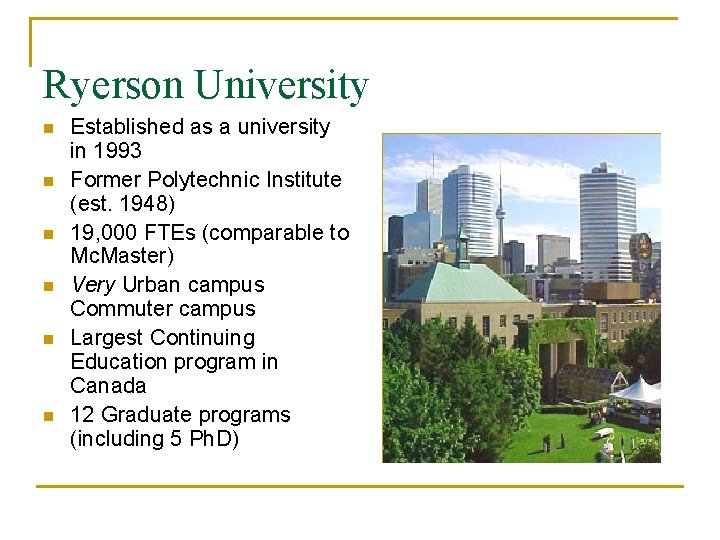
Ryerson University n n n Established as a university in 1993 Former Polytechnic Institute (est. 1948) 19, 000 FTEs (comparable to Mc. Master) Very Urban campus Commuter campus Largest Continuing Education program in Canada 12 Graduate programs (including 5 Ph. D)
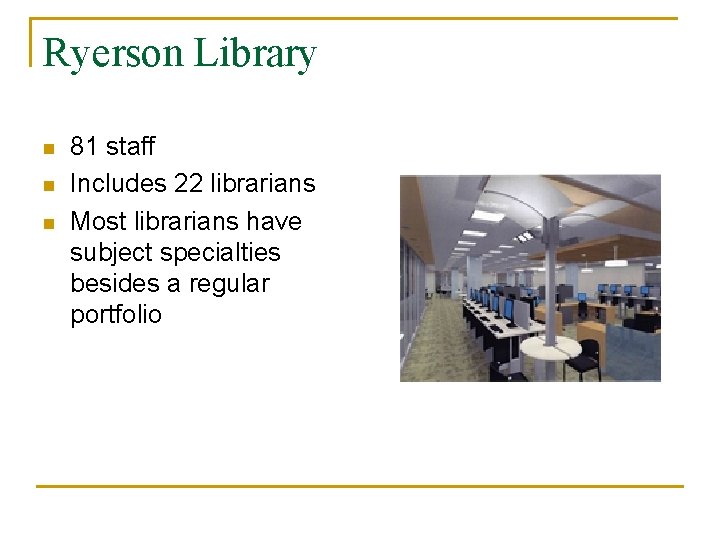
Ryerson Library n n n 81 staff Includes 22 librarians Most librarians have subject specialties besides a regular portfolio
Session Outline n Background: Student Success courses at Ryerson, library involvement, collaboration with faculty n Library’s experience with: q q Business 100 (BUS 100) “Strategies for Success” Arts and Contemporary Studies 102 (ACS 102) “Learning and Development Strategies”
Student Success & Retention: Backround n Student success courses relatively new at Ryerson (last 4 years) n Student Retention: driving force behind student success courses Significant attrition problems at Ryerson in certain programs, e. g. Business, Sciences/ Engineering n
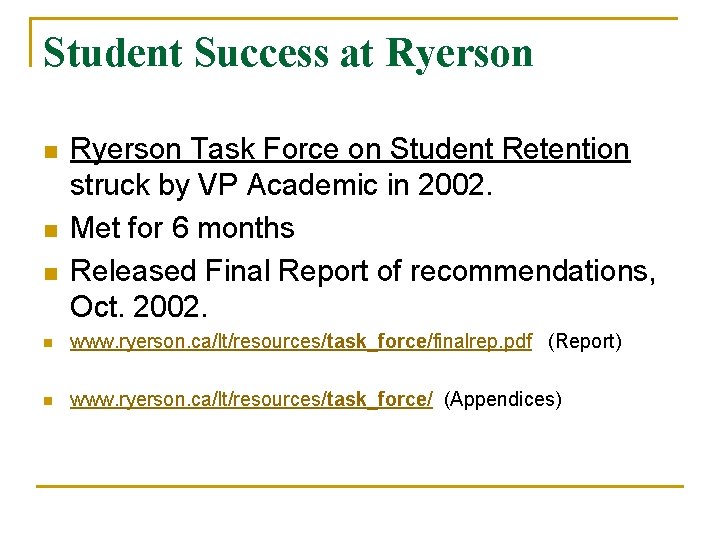
Student Success at Ryerson n Ryerson Task Force on Student Retention struck by VP Academic in 2002. Met for 6 months Released Final Report of recommendations, Oct. 2002. n www. ryerson. ca/lt/resources/task_force/finalrep. pdf (Report) n www. ryerson. ca/lt/resources/task_force/ (Appendices)
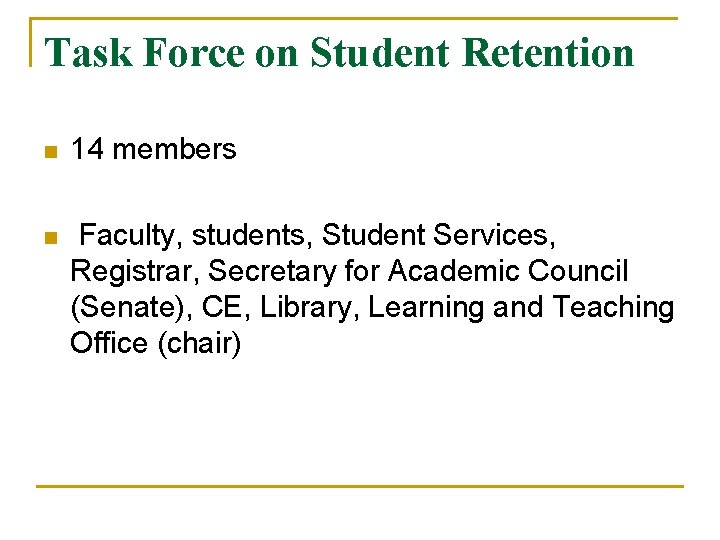
Task Force on Student Retention n 14 members n Faculty, students, Student Services, Registrar, Secretary for Academic Council (Senate), CE, Library, Learning and Teaching Office (chair)
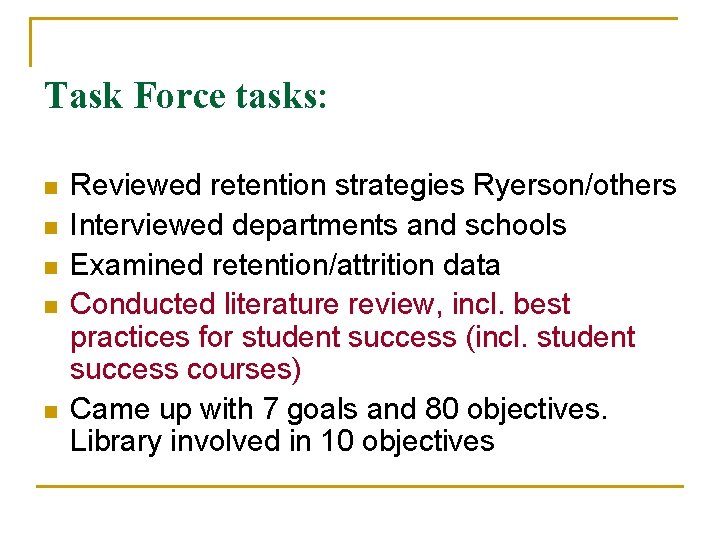
Task Force tasks: n n n Reviewed retention strategies Ryerson/others Interviewed departments and schools Examined retention/attrition data Conducted literature review, incl. best practices for student success (incl. student success courses) Came up with 7 goals and 80 objectives. Library involved in 10 objectives
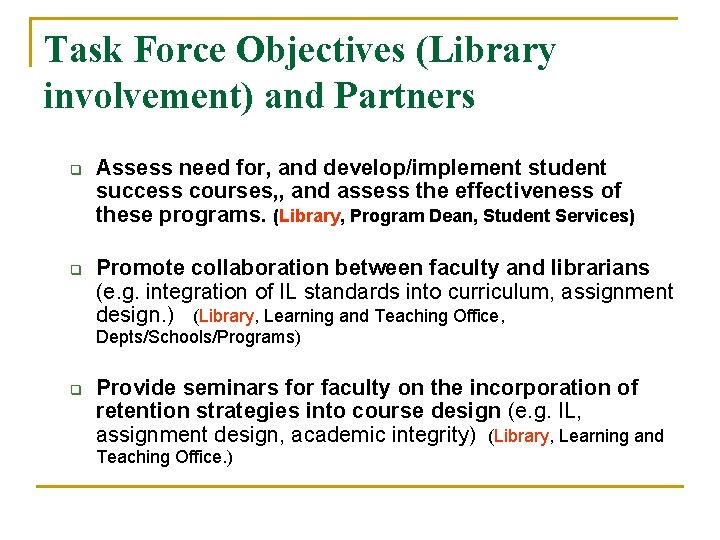
Task Force Objectives (Library involvement) and Partners q q Assess need for, and develop/implement student success courses, , and assess the effectiveness of these programs. (Library, Program Dean, Student Services) Promote collaboration between faculty and librarians (e. g. integration of IL standards into curriculum, assignment design. ) (Library, Learning and Teaching Office, Depts/Schools/Programs) q Provide seminars for faculty on the incorporation of retention strategies into course design (e. g. IL, assignment design, academic integrity) (Library, Learning and Teaching Office. )
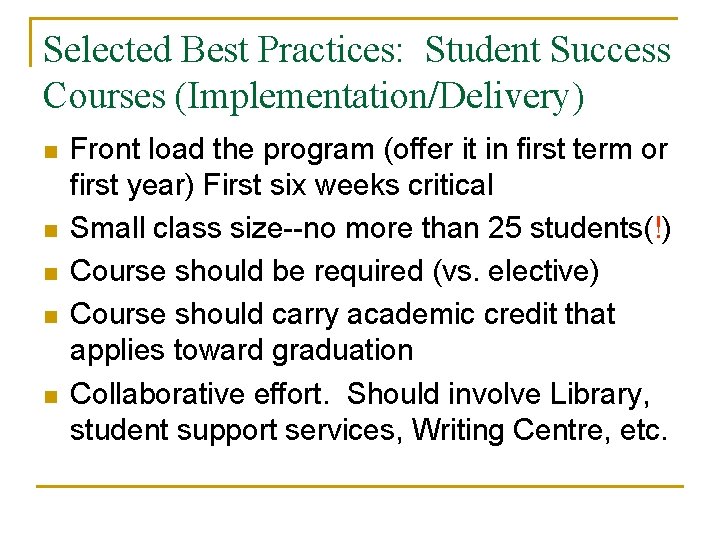
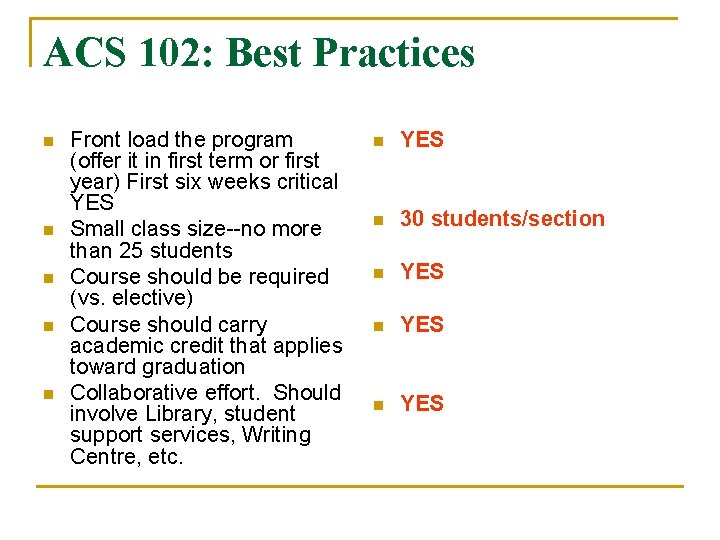
Selected Best Practices: Student Success Courses (Implementation/Delivery) n n n Front load the program (offer it in first term or first year) First six weeks critical Small class size--no more than 25 students(!) Course should be required (vs. elective) Course should carry academic credit that applies toward graduation Collaborative effort. Should involve Library, student support services, Writing Centre, etc.
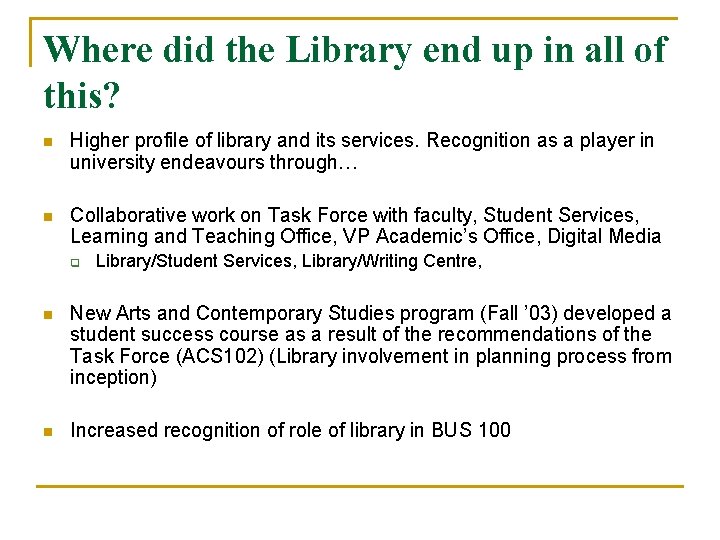
Where did the Library end up in all of this? n Higher profile of library and its services. Recognition as a player in university endeavours through… n Collaborative work on Task Force with faculty, Student Services, Learning and Teaching Office, VP Academic’s Office, Digital Media q Library/Student Services, Library/Writing Centre, n New Arts and Contemporary Studies program (Fall ’ 03) developed a student success course as a result of the recommendations of the Task Force (ACS 102) (Library involvement in planning process from inception) n Increased recognition of role of library in BUS 100
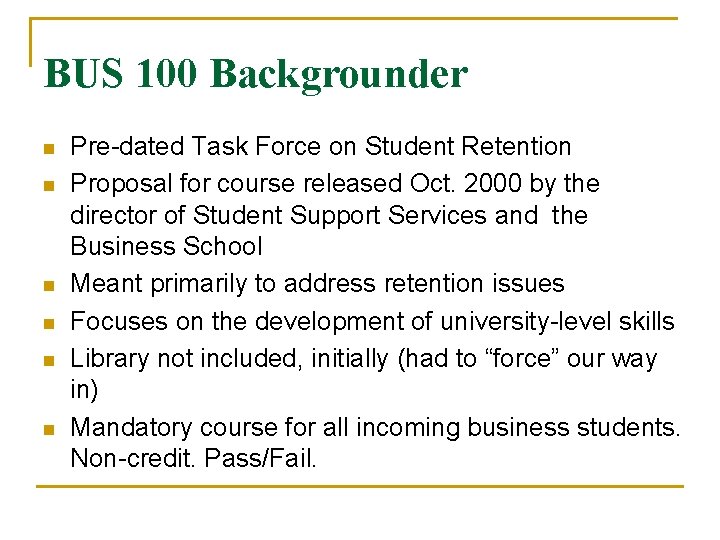
BUS 100 Backgrounder n n n Pre-dated Task Force on Student Retention Proposal for course released Oct. 2000 by the director of Student Support Services and the Business School Meant primarily to address retention issues Focuses on the development of university-level skills Library not included, initially (had to “force” our way in) Mandatory course for all incoming business students. Non-credit. Pass/Fail.
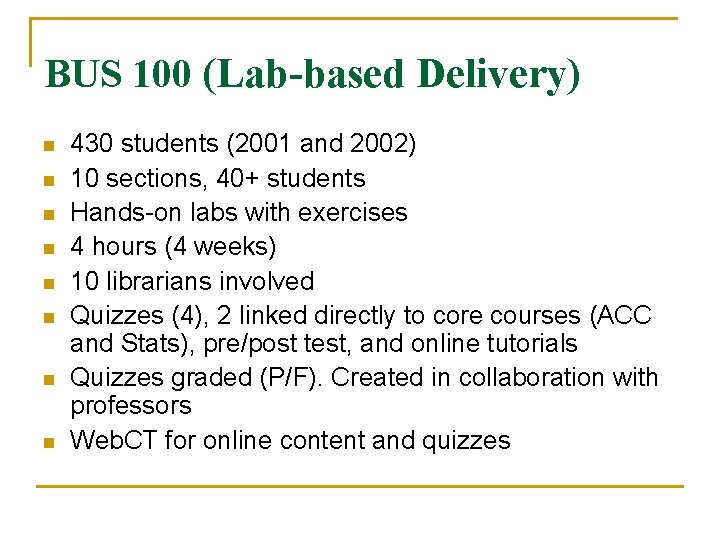
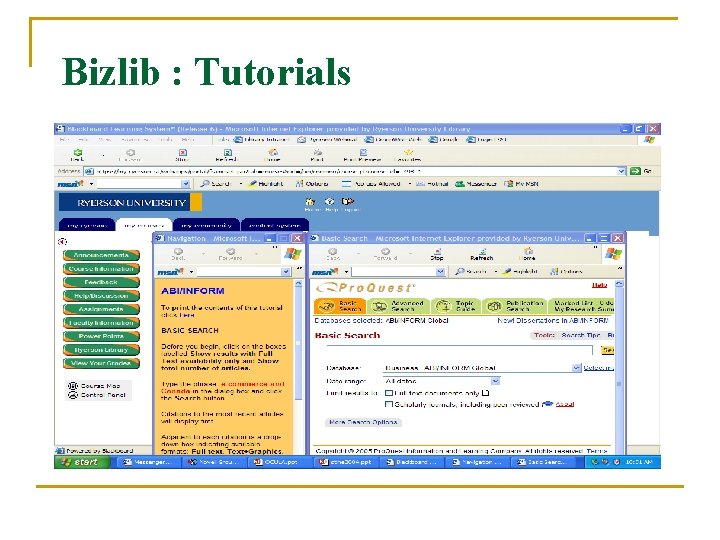
BUS 100 (Lab-based Delivery) n n n n 430 students (2001 and 2002) 10 sections, 40+ students Hands-on labs with exercises 4 hours (4 weeks) 10 librarians involved Quizzes (4), 2 linked directly to core courses (ACC and Stats), pre/post test, and online tutorials Quizzes graded (P/F). Created in collaboration with professors Web. CT for online content and quizzes
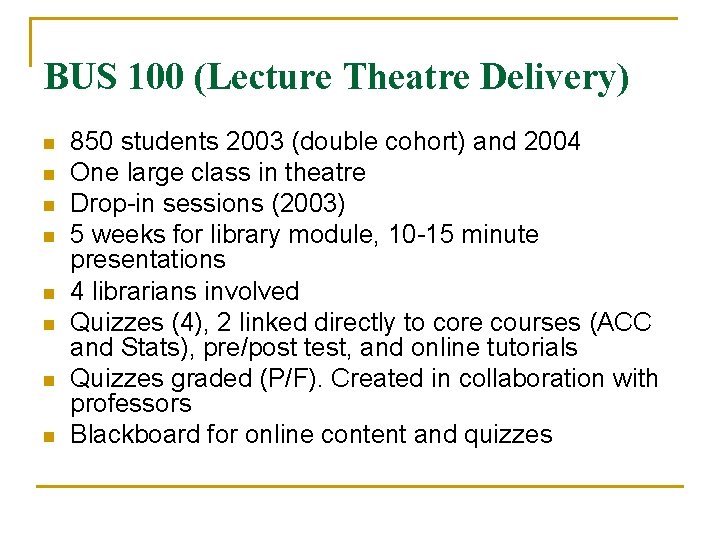
BUS 100 (Lecture Theatre Delivery) n n n n 850 students 2003 (double cohort) and 2004 One large class in theatre Drop-in sessions (2003) 5 weeks for library module, 10 -15 minute presentations 4 librarians involved Quizzes (4), 2 linked directly to core courses (ACC and Stats), pre/post test, and online tutorials Quizzes graded (P/F). Created in collaboration with professors Blackboard for online content and quizzes
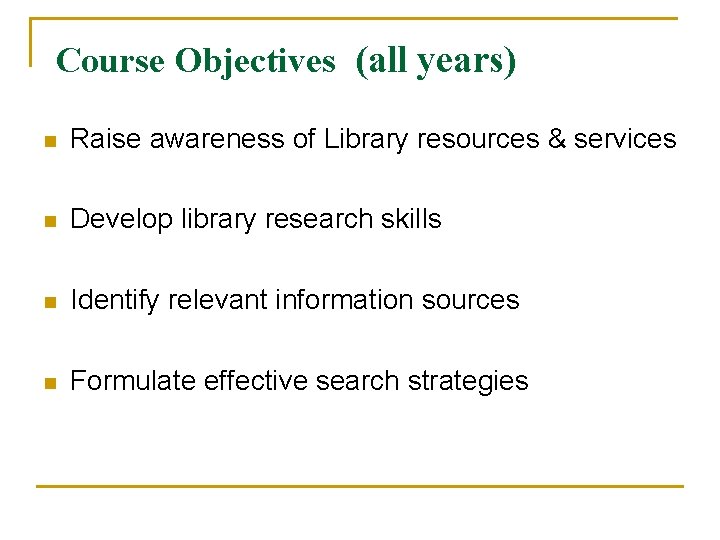
Course Objectives (all years) n Raise awareness of Library resources & services n Develop library research skills n Identify relevant information sources n Formulate effective search strategies
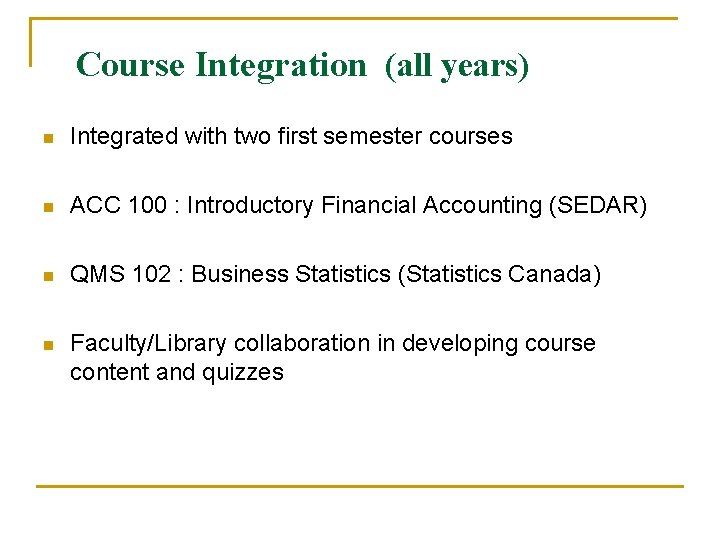
Course Integration (all years) n Integrated with two first semester courses n ACC 100 : Introductory Financial Accounting (SEDAR) n QMS 102 : Business Statistics (Statistics Canada) n Faculty/Library collaboration in developing course content and quizzes
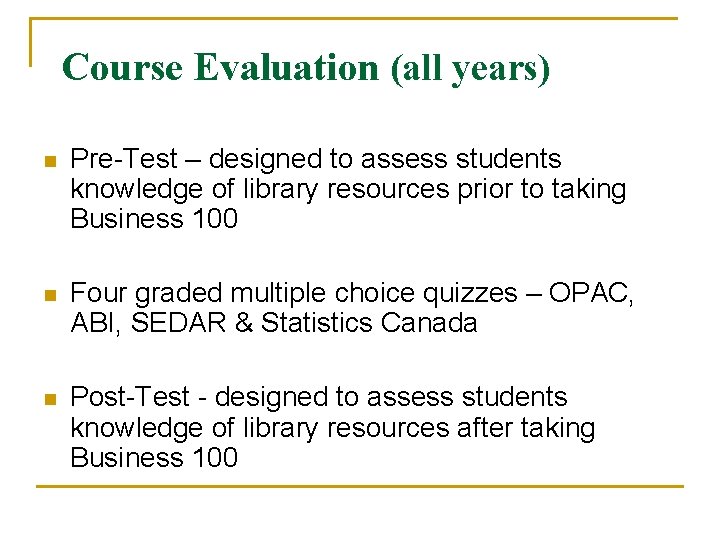
Course Evaluation (all years) n Pre-Test – designed to assess students knowledge of library resources prior to taking Business 100 n Four graded multiple choice quizzes – OPAC, ABI, SEDAR & Statistics Canada n Post-Test - designed to assess students knowledge of library resources after taking Business 100
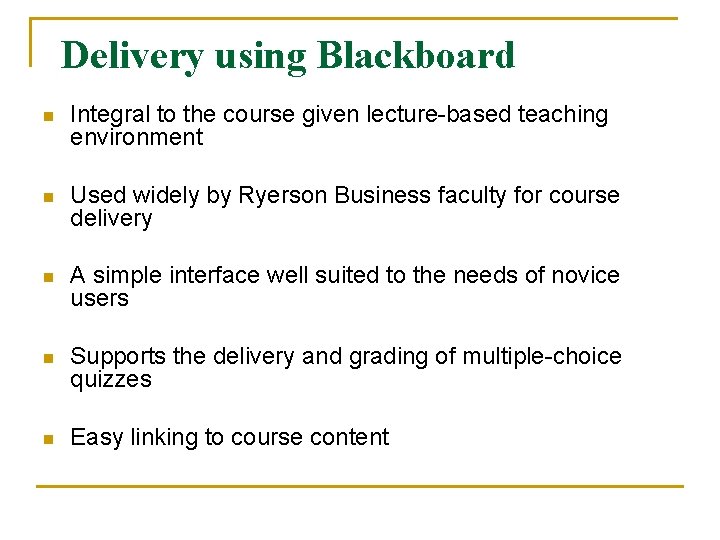
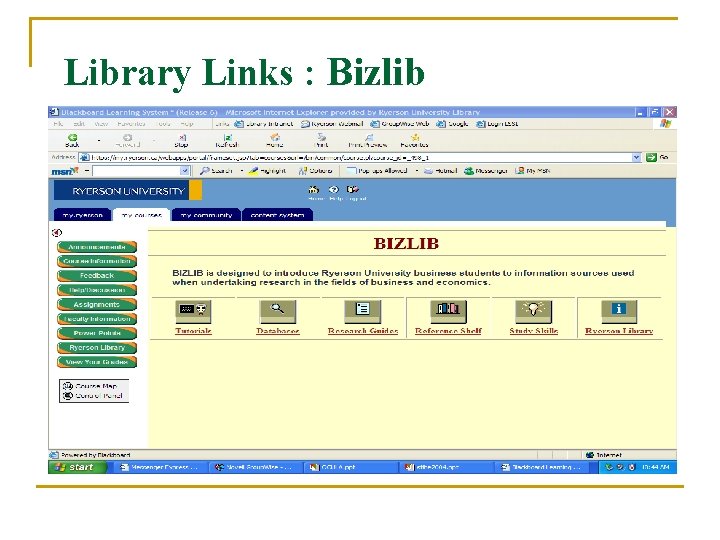
Delivery using Blackboard n Integral to the course given lecture-based teaching environment n Used widely by Ryerson Business faculty for course delivery n A simple interface well suited to the needs of novice users n Supports the delivery and grading of multiple-choice quizzes n Easy linking to course content
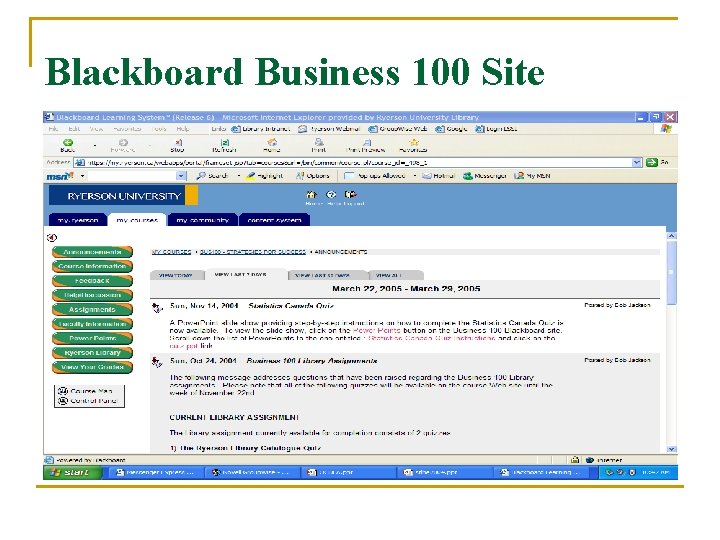
Blackboard Business 100 Site
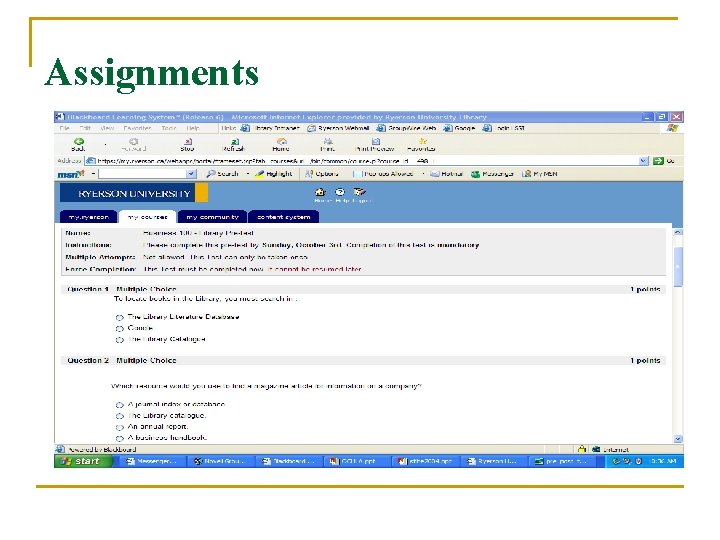
Assignments
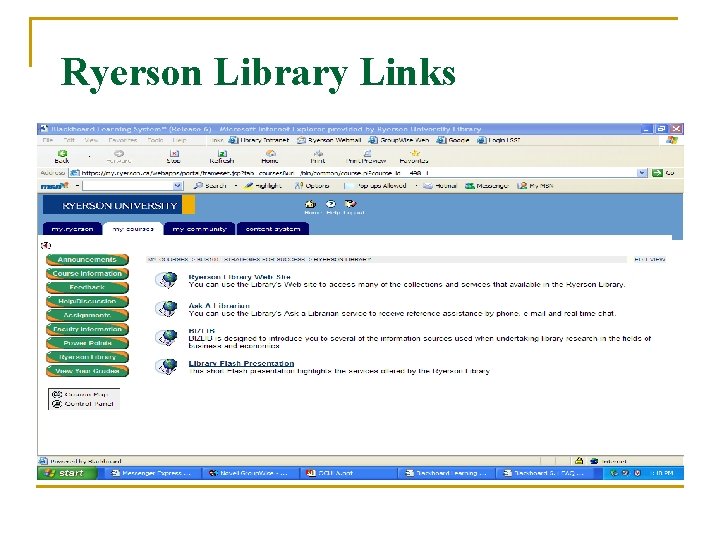
Ryerson Library Links
Library Links : Bizlib
Bizlib : Tutorials
Lectures : Instruction or Entertainment? n Delivered Monday mornings in the Ryerson Theatre n Up to 850 first-year students (without coffee!) n Not a lecture theatre (no writing surfaces, etc. ) n Shared “air-time” with other performers n Presentations limited to 10 -15 minutes
Lectures : Breaking the Ice n Emphasis on Accessibility & Service n Frequent use images to augment lecture content n Pop-cultural references used for emphasis n Infomercial format – short “sight bites”
Lectures : The Top Ten … n The Top Ten reasons why you may benefit from the Library’s Business 100 program…. http: //www. dandersonillustration. com/car_David_Letterman_big. jpg [for graphic]
10 … n The last time you visited a library, Barney was still your favourite TV show www. cs. utah. edu/ ~riloff/personal. html [for graphic]
8… n The last time you used a library card was to pick a lock http: //www. ahajokes. com/crt 891. html [for graphic]
7… n [Graphic of Conrad Black] You think that peer review refers to the recent trials and tribulations of a well known author and publisher
5… n You’ve attempted to use a style guide to coordinate your wardrobe http: //www. waynewolfe. com/images/Drag%20 Queen. jpg [for graphic]
Lectures : Illustrating the Basic Concepts of Library Research n Using images to convey empathy and accessibility n Using pop-cultural imagery to illustrate the basics of library research – defining a topic, developing a search strategy n Reinforced through brief real-time demos of library-based resources
You Begin by Defining Your Topic Definition is important! Which words or concepts best define or describe your research topic? [Graphic of very well-defined male and female]
Then Developing a Search Strategy Often combining 2 or more single concepts… [graphic] Jlo AND Ben
To obtain specific results… [graphic] Jlo AND Ben
[graphic] Jlo OR Ben
[graphic] Jlo NOT Ben
Assessing the Outcome n Comparison of Pre-test and Post-test results n Reviewing student ratings n Reviewing student comments
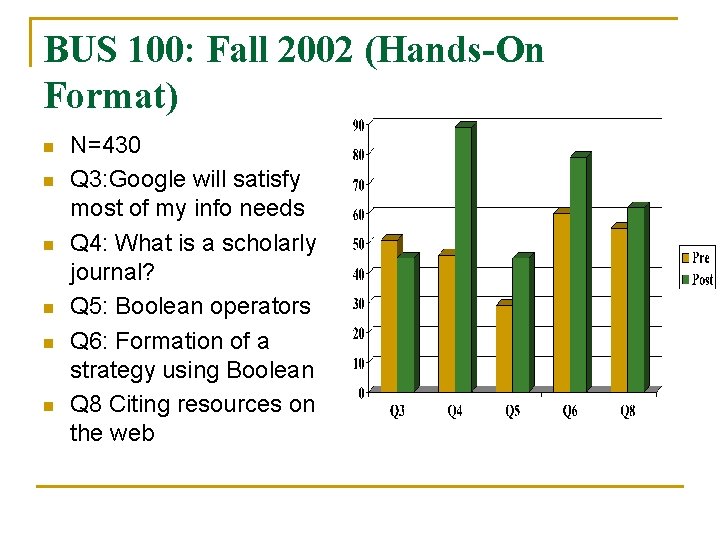
BUS 100: Fall 2002 (Hands-On Format) n n n N=430 Q 3: Google will satisfy most of my info needs Q 4: What is a scholarly journal? Q 5: Boolean operators Q 6: Formation of a strategy using Boolean Q 8 Citing resources on the web
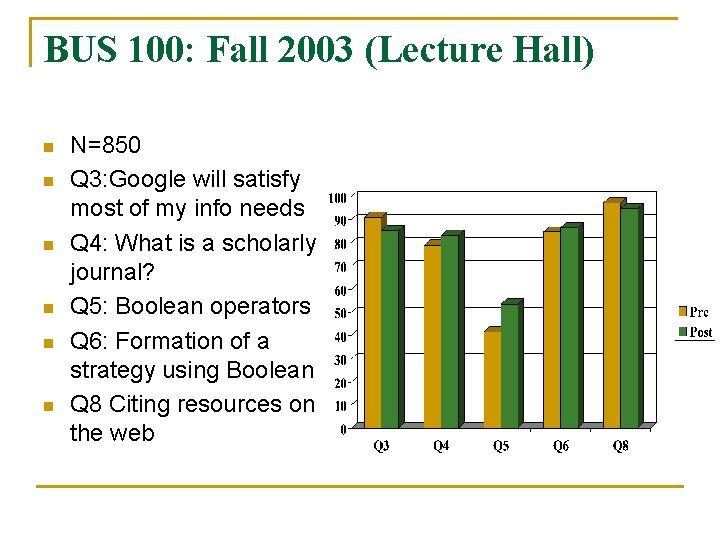
BUS 100: Fall 2003 (Lecture Hall) n n n N=850 Q 3: Google will satisfy most of my info needs Q 4: What is a scholarly journal? Q 5: Boolean operators Q 6: Formation of a strategy using Boolean Q 8 Citing resources on the web
Data Comparison: 2002 to 2003 n n 2003 data (less improvement evident between pre- and post test) may reflect increased class size (430 in 2002 to 850 in 2003) Lecture format (2003) with little or no personal contact with student. (Lab-based format (2002) allowed for smaller classes of 40 students, hands-on practice, personal help with assignments
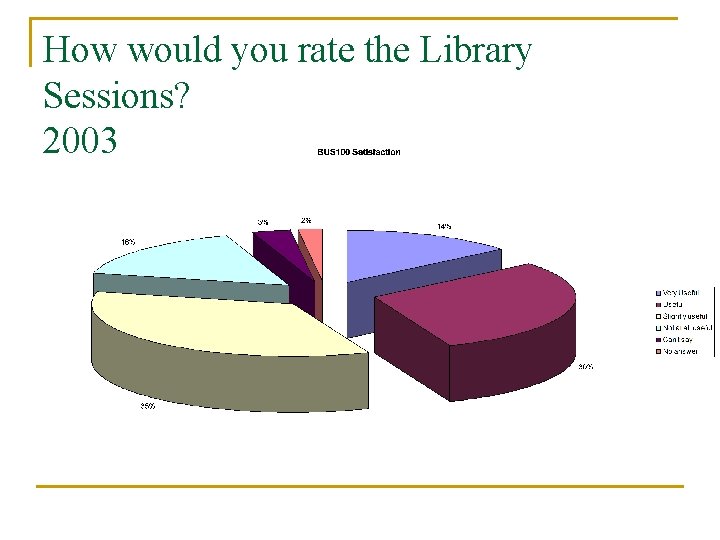
How would you rate the Library Sessions? 2003
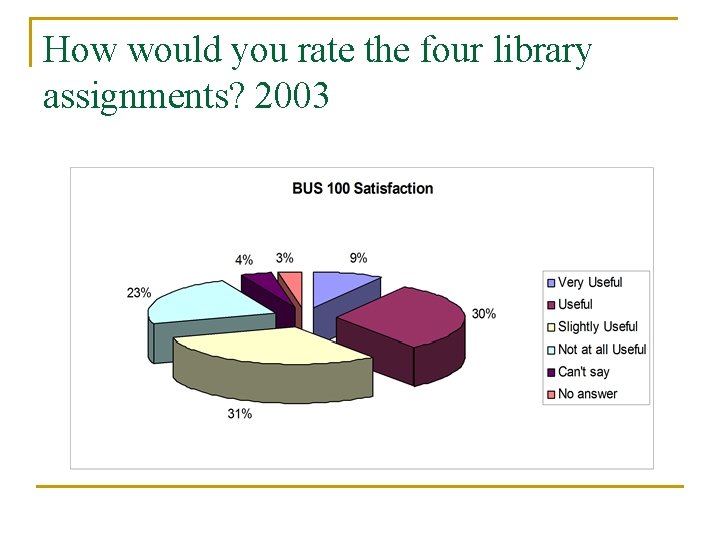
How would you rate the four library assignments? 2003
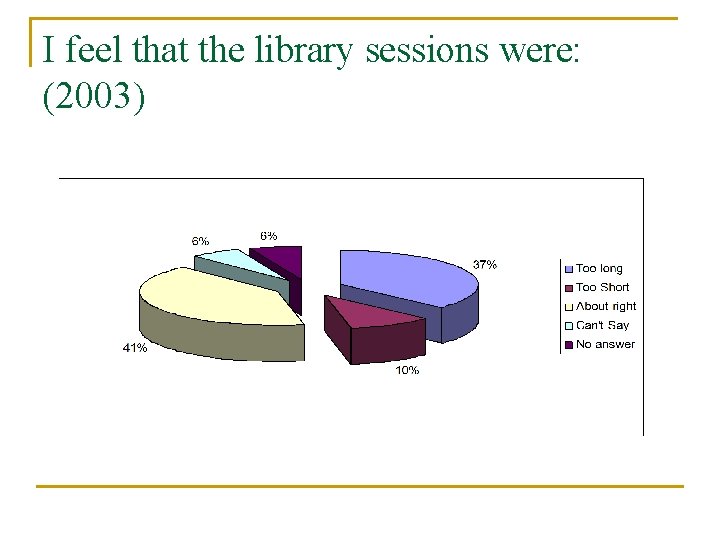
I feel that the library sessions were: (2003)
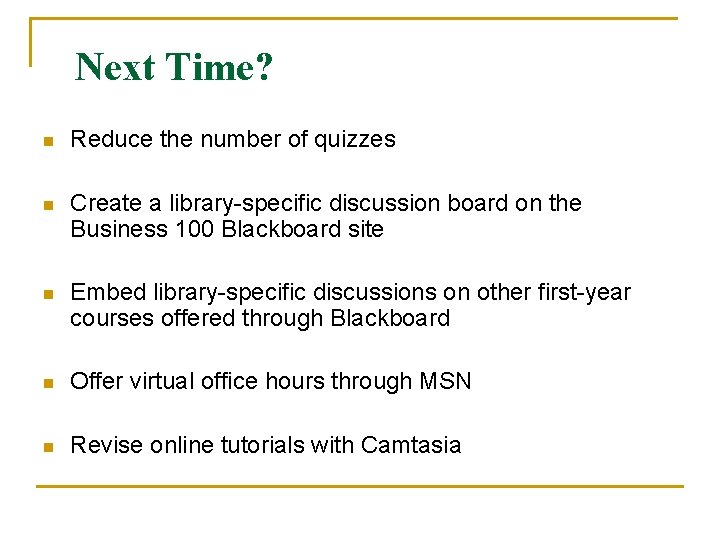
Next Time? n Reduce the number of quizzes n Create a library-specific discussion board on the Business 100 Blackboard site n Embed library-specific discussions on other first-year courses offered through Blackboard n Offer virtual office hours through MSN n Revise online tutorials with Camtasia
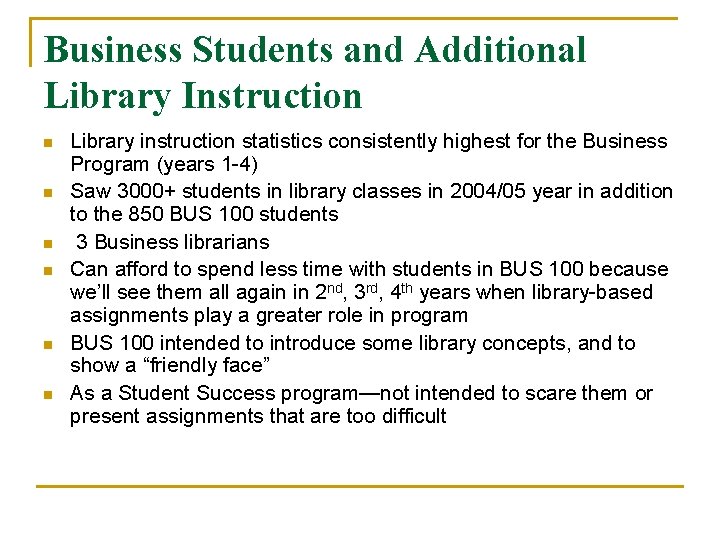
Business Students and Additional Library Instruction n n n Library instruction statistics consistently highest for the Business Program (years 1 -4) Saw 3000+ students in library classes in 2004/05 year in addition to the 850 BUS 100 students 3 Business librarians Can afford to spend less time with students in BUS 100 because we’ll see them all again in 2 nd, 3 rd, 4 th years when library-based assignments play a greater role in program BUS 100 intended to introduce some library concepts, and to show a “friendly face” As a Student Success program—not intended to scare them or present assignments that are too difficult
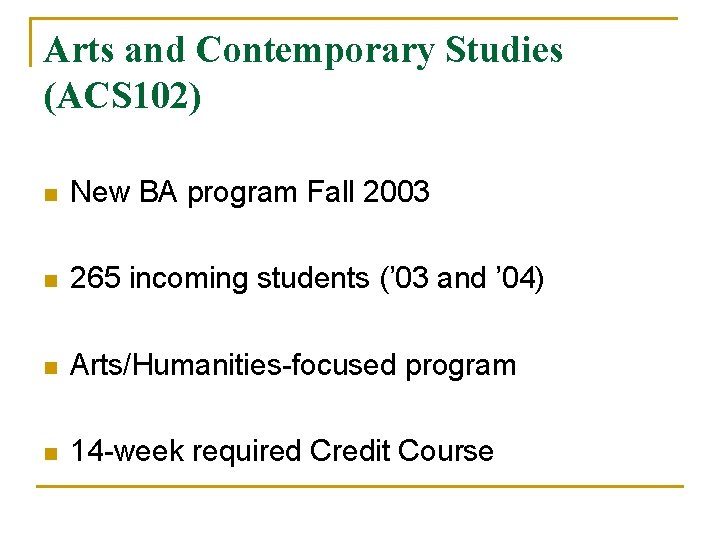
Arts and Contemporary Studies (ACS 102) n New BA program Fall 2003 n 265 incoming students (’ 03 and ’ 04) n Arts/Humanities-focused program n 14 -week required Credit Course
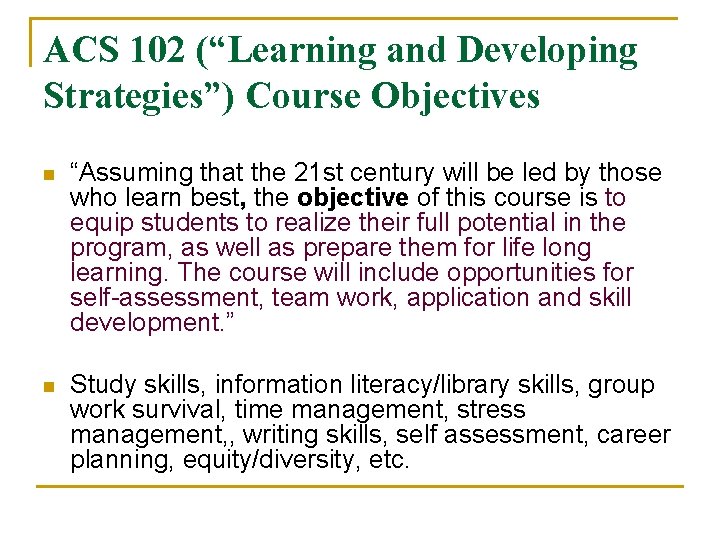
ACS 102 (“Learning and Developing Strategies”) Course Objectives n “Assuming that the 21 st century will be led by those who learn best, the objective of this course is to equip students to realize their full potential in the program, as well as prepare them for life long learning. The course will include opportunities for self-assessment, team work, application and skill development. ” n Study skills, information literacy/library skills, group work survival, time management, stress management, , writing skills, self assessment, career planning, equity/diversity, etc.
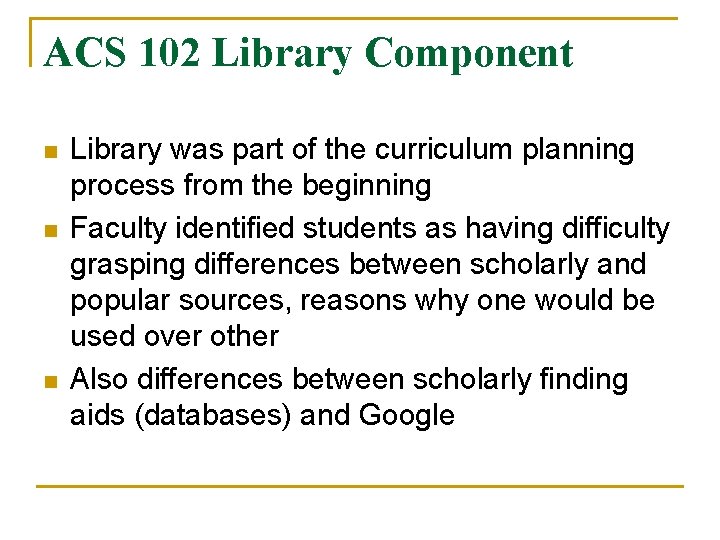
ACS 102 Library Component n n n Library was part of the curriculum planning process from the beginning Faculty identified students as having difficulty grasping differences between scholarly and popular sources, reasons why one would be used over other Also differences between scholarly finding aids (databases) and Google
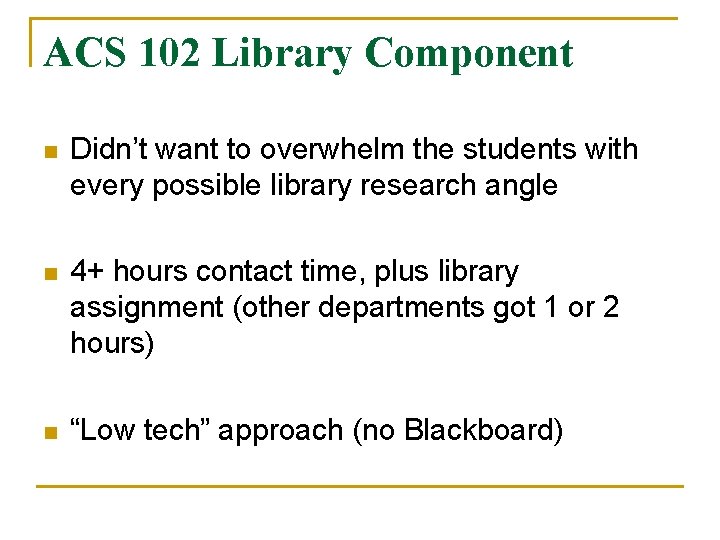
ACS 102 Library Component n Didn’t want to overwhelm the students with every possible library research angle n 4+ hours contact time, plus library assignment (other departments got 1 or 2 hours) n “Low tech” approach (no Blackboard)
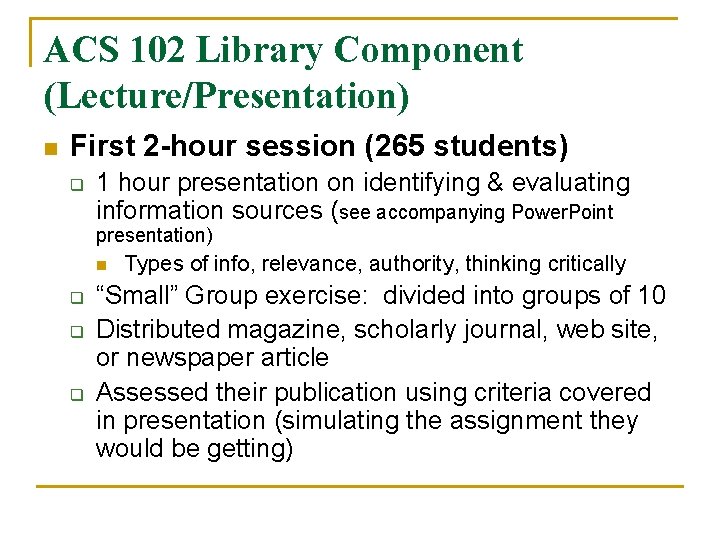
ACS 102 Library Component (Lecture/Presentation) n First 2 -hour session (265 students) q 1 hour presentation on identifying & evaluating information sources (see accompanying Power. Point presentation) n q q q Types of info, relevance, authority, thinking critically “Small” Group exercise: divided into groups of 10 Distributed magazine, scholarly journal, web site, or newspaper article Assessed their publication using criteria covered in presentation (simulating the assignment they would be getting)
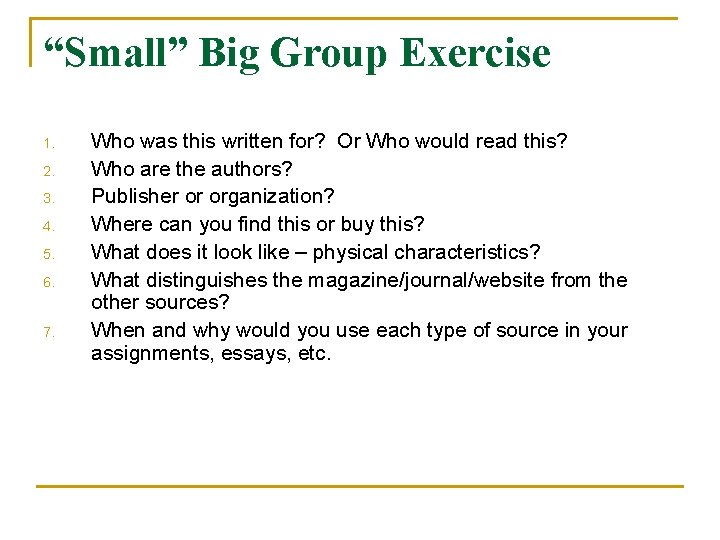
“Small” Big Group Exercise 1. 2. 3. 4. 5. 6. 7. Who was this written for? Or Who would read this? Who are the authors? Publisher or organization? Where can you find this or buy this? What does it look like – physical characteristics? What distinguishes the magazine/journal/website from the other sources? When and why would you use each type of source in your assignments, essays, etc.
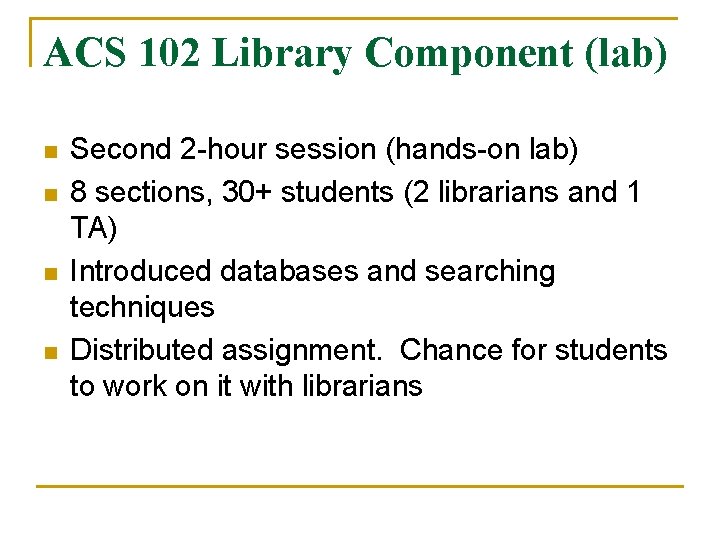
ACS 102 Library Component (lab) n n Second 2 -hour session (hands-on lab) 8 sections, 30+ students (2 librarians and 1 TA) Introduced databases and searching techniques Distributed assignment. Chance for students to work on it with librarians
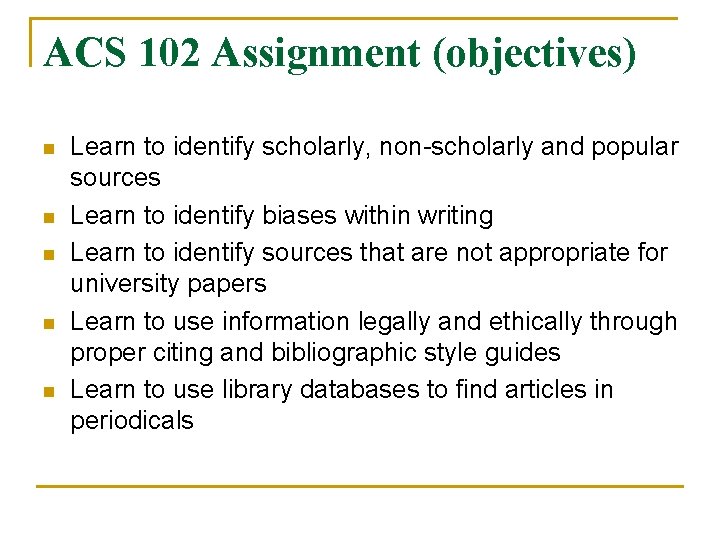
ACS 102 Assignment (objectives) n n n Learn to identify scholarly, non-scholarly and popular sources Learn to identify biases within writing Learn to identify sources that are not appropriate for university papers Learn to use information legally and ethically through proper citing and bibliographic style guides Learn to use library databases to find articles in periodicals
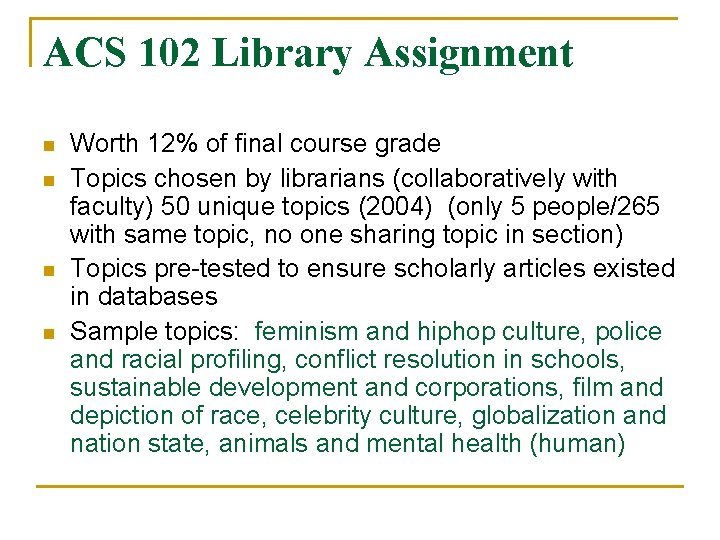
ACS 102 Library Assignment n n Worth 12% of final course grade Topics chosen by librarians (collaboratively with faculty) 50 unique topics (2004) (only 5 people/265 with same topic, no one sharing topic in section) Topics pre-tested to ensure scholarly articles existed in databases Sample topics: feminism and hiphop culture, police and racial profiling, conflict resolution in schools, sustainable development and corporations, film and depiction of race, celebrity culture, globalization and nation state, animals and mental health (human)
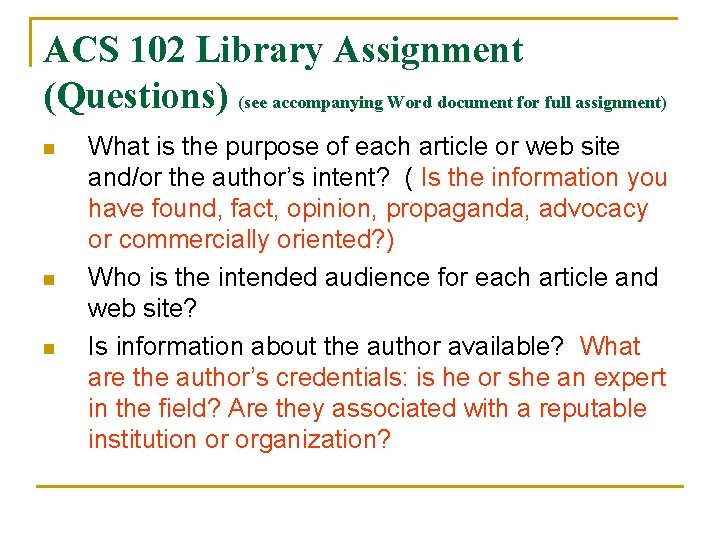
ACS 102 Library Assignment (Questions) (see accompanying Word document for full assignment) n n n What is the purpose of each article or web site and/or the author’s intent? ( Is the information you have found, fact, opinion, propaganda, advocacy or commercially oriented? ) Who is the intended audience for each article and web site? Is information about the author available? What are the author’s credentials: is he or she an expert in the field? Are they associated with a reputable institution or organization?
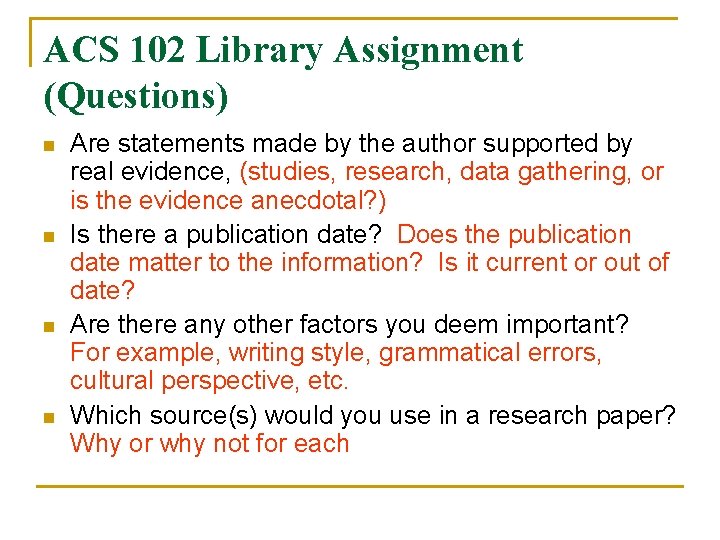
ACS 102 Library Assignment (Questions) n n Are statements made by the author supported by real evidence, (studies, research, data gathering, or is the evidence anecdotal? ) Is there a publication date? Does the publication date matter to the information? Is it current or out of date? Are there any other factors you deem important? For example, writing style, grammatical errors, cultural perspective, etc. Which source(s) would you use in a research paper? Why or why not for each
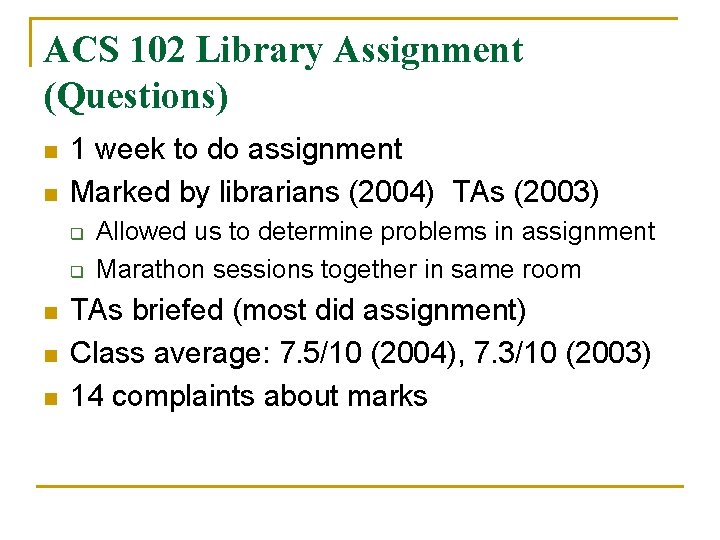
ACS 102 Library Assignment (Questions) n n 1 week to do assignment Marked by librarians (2004) TAs (2003) q q n n n Allowed us to determine problems in assignment Marathon sessions together in same room TAs briefed (most did assignment) Class average: 7. 5/10 (2004), 7. 3/10 (2003) 14 complaints about marks
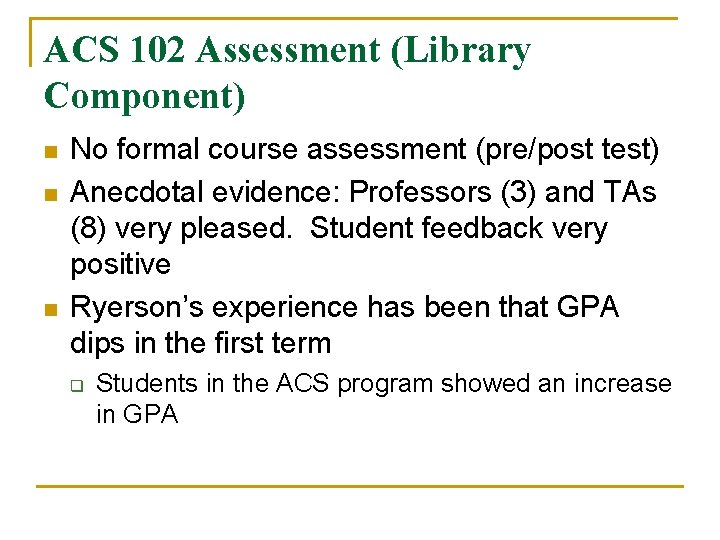
ACS 102 Assessment (Library Component) n n n No formal course assessment (pre/post test) Anecdotal evidence: Professors (3) and TAs (8) very pleased. Student feedback very positive Ryerson’s experience has been that GPA dips in the first term q Students in the ACS program showed an increase in GPA
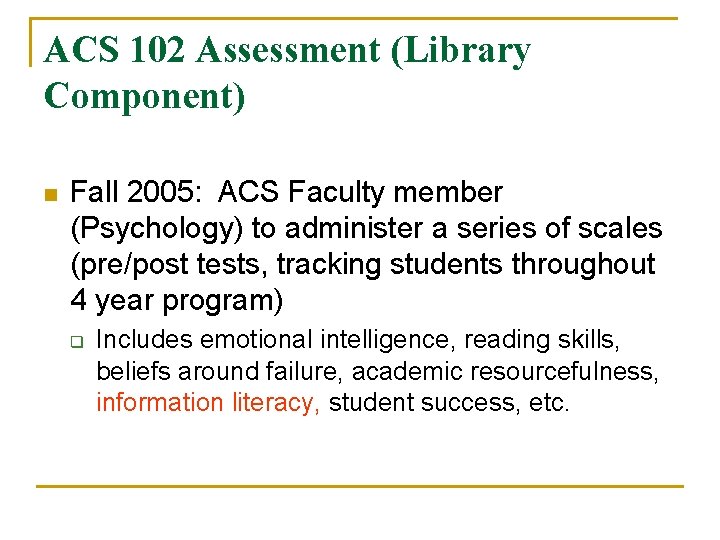
ACS 102 Assessment (Library Component) n Fall 2005: ACS Faculty member (Psychology) to administer a series of scales (pre/post tests, tracking students throughout 4 year program) q Includes emotional intelligence, reading skills, beliefs around failure, academic resourcefulness, information literacy, student success, etc.
ACS 102: Best Practices n n n Front load the program (offer it in first term or first year) First six weeks critical YES Small class size--no more than 25 students Course should be required (vs. elective) Course should carry academic credit that applies toward graduation Collaborative effort. Should involve Library, student support services, Writing Centre, etc. n YES n 30 students/section n YES
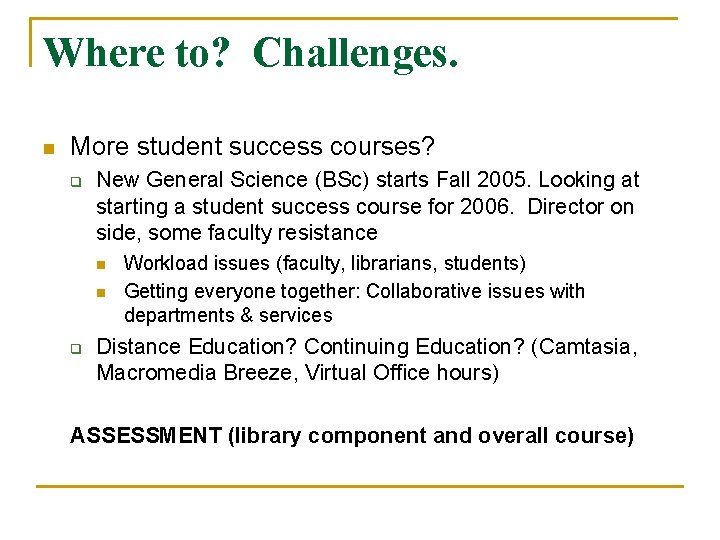
Where to? Challenges. n More student success courses? q New General Science (BSc) starts Fall 2005. Looking at starting a student success course for 2006. Director on side, some faculty resistance n n q Workload issues (faculty, librarians, students) Getting everyone together: Collaborative issues with departments & services Distance Education? Continuing Education? (Camtasia, Macromedia Breeze, Virtual Office hours) ASSESSMENT (library component and overall course)
A Selection of Other Library/Ryerson Community Collaborative Efforts n “Foundations of Social Work” Tutorial http: //www. ryerson. ca/library/tutorial/sw/ n Ryerson Academic Integrity Model q q Campus-wide initiative—resources for students, faculty, parents (all web-based). Will be branded, heavily publicized. Graphical online tutorial for students, with quizzes In time, may be mandatory upon entry to Ryerson Library asked to chair Planning Committee: Director of Provost’s Office, Student Services, Learning and Teaching Office, Digital Media Office www. ryerson. ca/acadcouncil/acadintegmodel. pdf
Contacts: Don Kinder Coordinator, Library Education Ryerson University Library dkinder@ryerson. ca Bob Jackson Manager, Ronald G. Besse Information and Learning Commons Ryerson University Library bjackson@ryerson. ca www. library. ryerson. ca