
Topic 6 Addressing Modes of 8086 By Mr
Topic 6: Addressing Modes of 8086 By: Mr. Binu Joy
Why study addressing modes? Addressing modes help us to understand the types of operands and the way they are accessed while executing an instruction.
What are we going to study? Addressing modes We will see the types of addressing modes present in 8086. We will study each addressing mode with example.
Types of addressing mode in 8086 1. Immediate addressing mode 2. Direct addressing mode 3. Register addressing mode 4. Register Indirect addressing mode 5. Indexed addressing mode 6. Register relative addressing mode 7. Base plus index addressing mode 8. Base relative plus index addressing mode
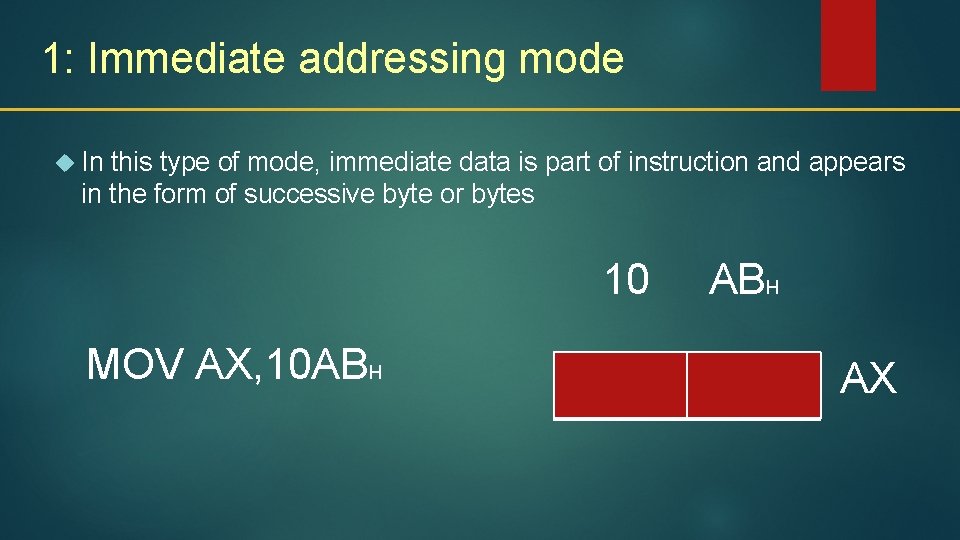
1: Immediate addressing mode In this type of mode, immediate data is part of instruction and appears in the form of successive byte or bytes 10 MOV AX, 10 ABH AX

2: Direct addressing mode In this type of addressing mode a 16 -bit memory address is directly specified in the instruction as a part of it. Memory 22 33 MOV AX, [5000 H] 5000 5001 5002 AX
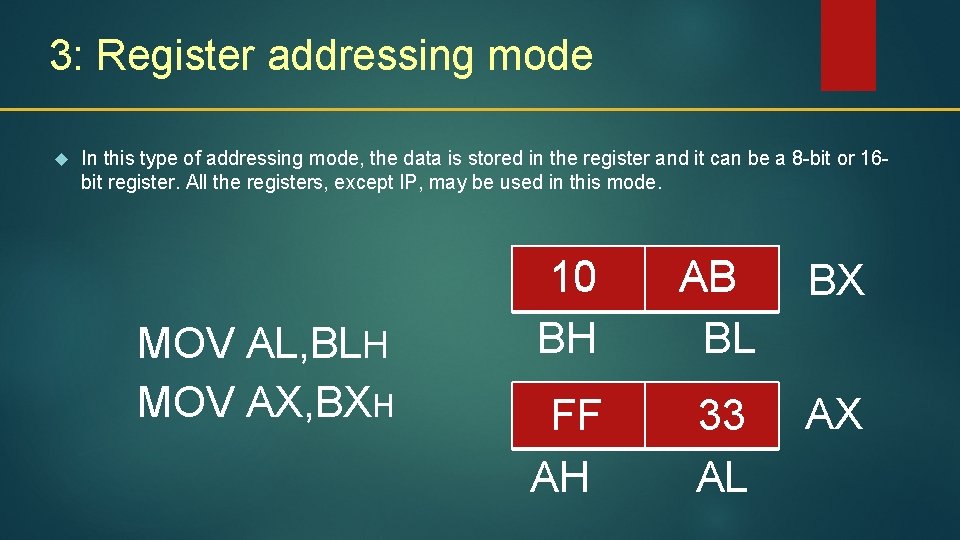
3: Register addressing mode In this type of addressing mode, the data is stored in the register and it can be a 8 -bit or 16 bit register. All the registers, except IP, may be used in this mode. MOV AL, BLH MOV AX, BXH 10 BH AB BL BX FF AH 33 AL AX
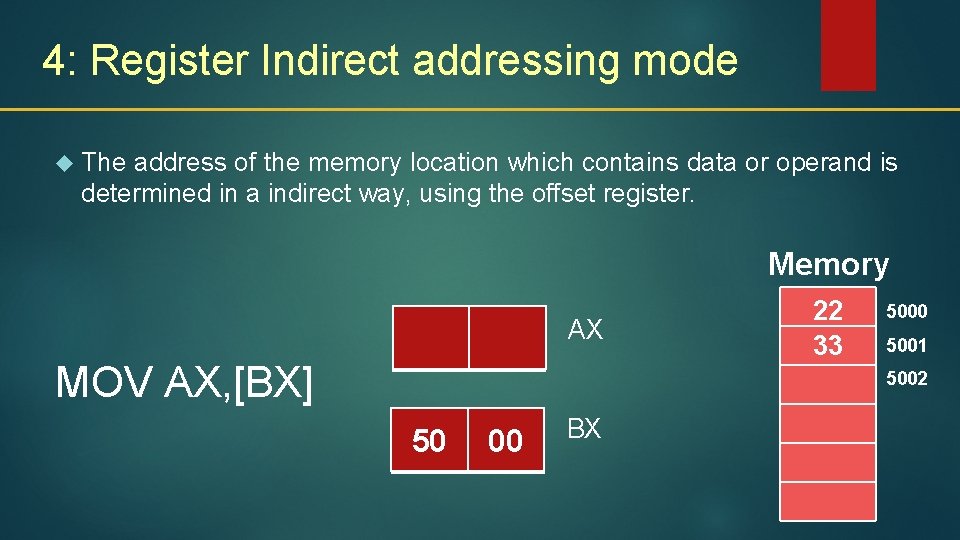
4: Register Indirect addressing mode The address of the memory location which contains data or operand is determined in a indirect way, using the offset register. Memory AX MOV AX, [BX] 22 33 5000 5001 5002 50 00 BX
![Reflection Spot MOV [7000 H], CX Q) Which addressing does instruction above belong, and](http://slidetodoc.com/presentation_image_h2/5d2bfc82c0dd6b7dcf7c8dfdd1457c79/image-9.jpg "Reflection Spot MOV [7000 H], CX Q) Which addressing does instruction above belong, and")
Reflection Spot MOV [7000 H], CX Q) Which addressing does instruction above belong, and why?
![Reflection Spot MOV [7000 H], CX Q) Which addressing does instruction above belonging and](http://slidetodoc.com/presentation_image_h2/5d2bfc82c0dd6b7dcf7c8dfdd1457c79/image-10.jpg "Reflection Spot MOV [7000 H], CX Q) Which addressing does instruction above belonging and")
Reflection Spot MOV [7000 H], CX Q) Which addressing does instruction above belonging and why? Memory Ans) Direct addressing mode 7000 22 33 7001 7002 CX 43 56
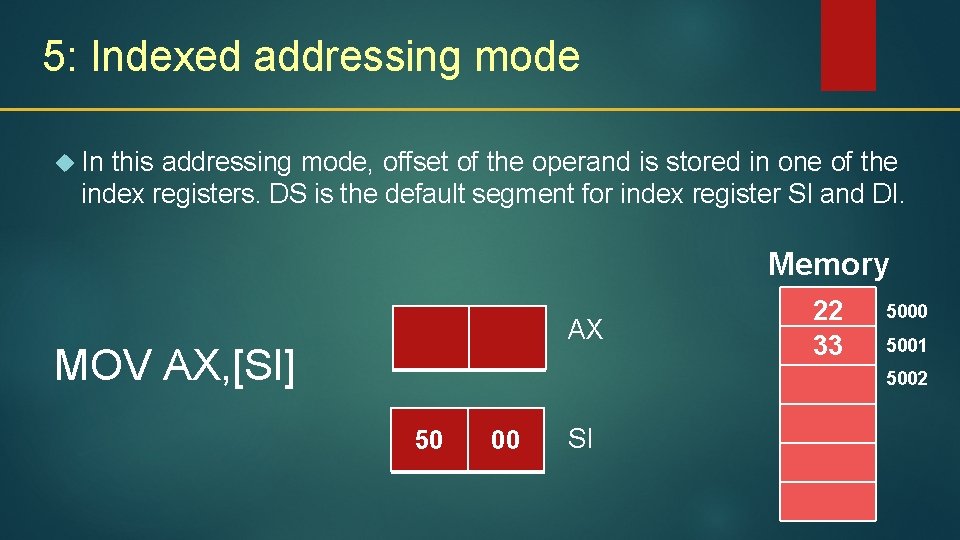
5: Indexed addressing mode In this addressing mode, offset of the operand is stored in one of the index registers. DS is the default segment for index register SI and DI. Memory AX MOV AX, [SI] 22 33 5000 5001 5002 50 00 SI
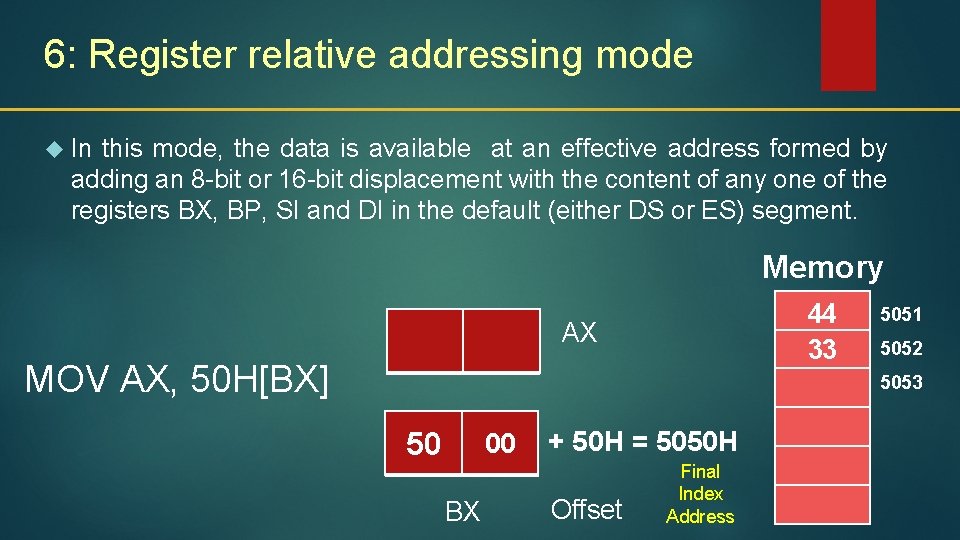
6: Register relative addressing mode In this mode, the data is available at an effective address formed by adding an 8 -bit or 16 -bit displacement with the content of any one of the registers BX, BP, SI and DI in the default (either DS or ES) segment. Memory 44 33 AX MOV AX, 50 H[BX] 5051 5052 5053 50 00 BX + 50 H = 5050 H Offset Final Index Address
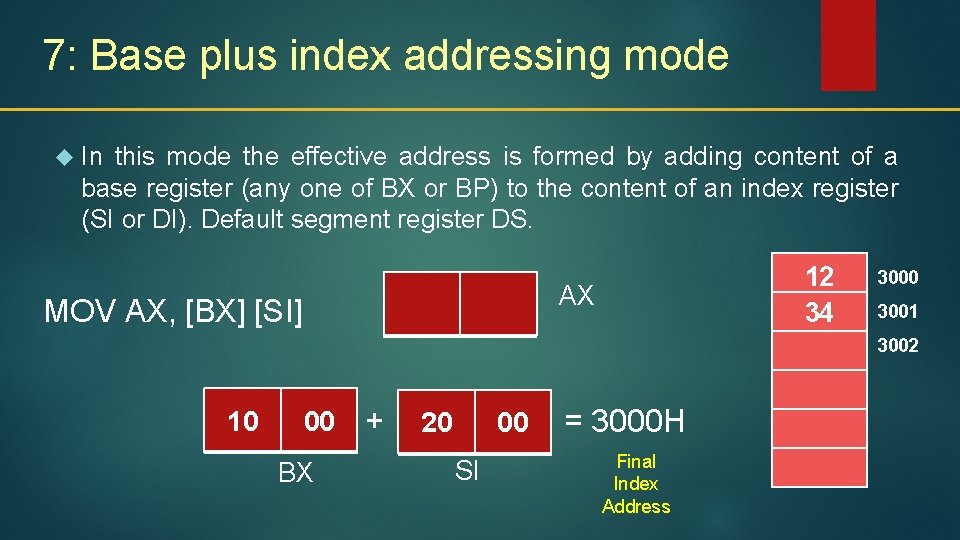
7: Base plus index addressing mode In this mode the effective address is formed by adding content of a base register (any one of BX or BP) to the content of an index register (SI or DI). Default segment register DS. 12 34 AX MOV AX, [BX] [SI] 3000 3001 3002 10 00 BX + 20 00 SI = 3000 H Final Index Address
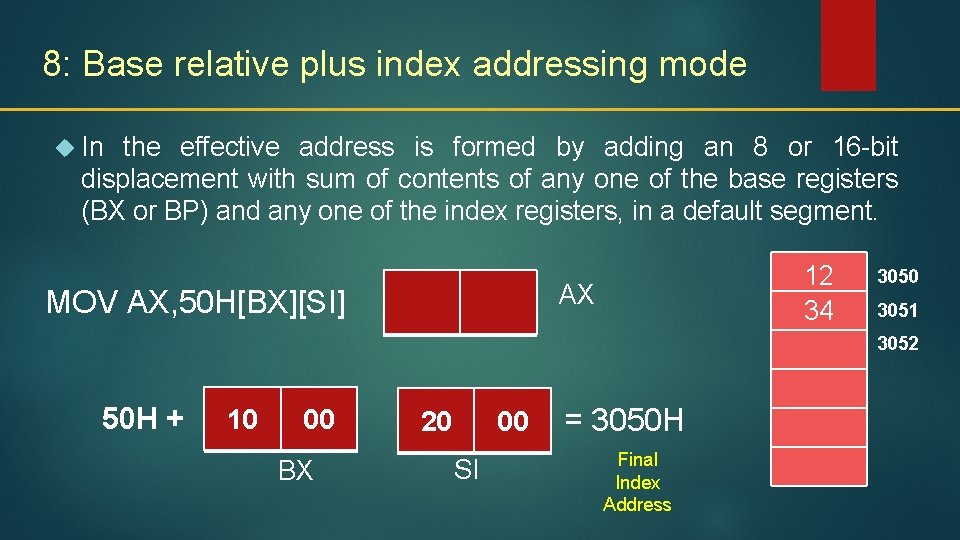
8: Base relative plus index addressing mode In the effective address is formed by adding an 8 or 16 -bit displacement with sum of contents of any one of the base registers (BX or BP) and any one of the index registers, in a default segment. 12 34 AX MOV AX, 50 H[BX][SI] 3050 3051 3052 50 H + 10 00 BX 20 00 SI = 3050 H Final Index Address
Summery What we have learnt Different types of addressing modes present in 8086. Location of operands with respect to different addressing modes.
References Advanced Microprocessors and Peripheral - By K Bhurchandi, A. K. Ray

This presentation is licensed to the public Text is available under the Creative Commons Attribution-Share. Alike License
- Slides: 17