Cse 321 Programming Languages and Compilers Lecture 12

- Slides: 46
Cse 321, Programming Languages and Compilers Lecture #12, Feb. 21, 2007 • Basic Types • Constructed Types • Representing types as data • Describing type systems as rules • Type rules for ML • Type equality • Type coercions • Sub typing • Purpose of type systems • Kinds of type systems • Primitive types • Constructed types • Type checking • Attribute grammars • Inherited attributes • Synthesized attributes • Adding attributes to trees • Programs for computing attribute computations. 10/2/2020 1
Cse 321, Programming Languages and Compilers Assignments • Reading • Chapter 4, – – 10/2/2020 Sections 4. 3 (Attribute Grammar) 4. 4 (Adhoc syntax directed translation). Pages 171 -200 Quiz on all of chapter 4 read so far (4. 1 -4. 4) on Monday. 2
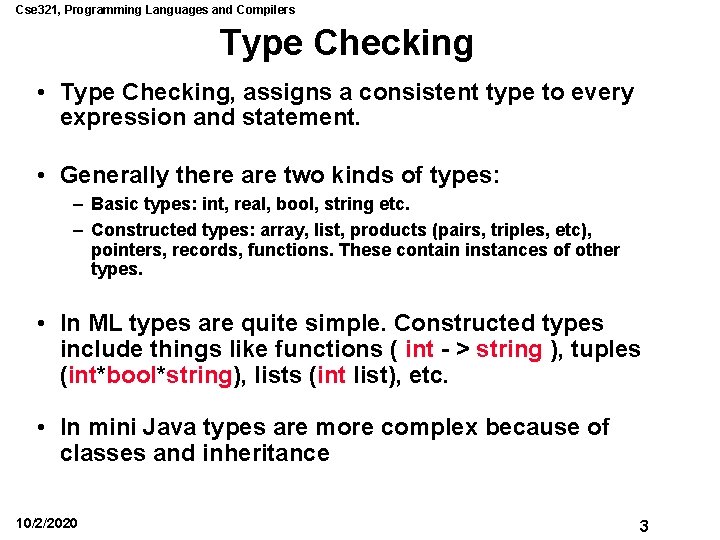
Cse 321, Programming Languages and Compilers Type Checking • Type Checking, assigns a consistent type to every expression and statement. • Generally there are two kinds of types: – Basic types: int, real, bool, string etc. – Constructed types: array, list, products (pairs, triples, etc), pointers, records, functions. These contain instances of other types. • In ML types are quite simple. Constructed types include things like functions ( int - > string ), tuples (int*bool*string), lists (int list), etc. • In mini Java types are more complex because of classes and inheritance 10/2/2020 3
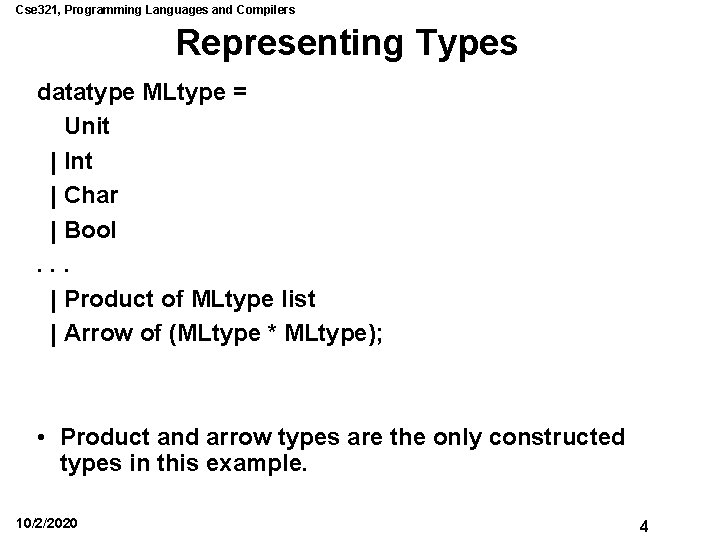
Cse 321, Programming Languages and Compilers Representing Types datatype MLtype = Unit | Int | Char | Bool. . . | Product of MLtype list | Arrow of (MLtype * MLtype); • Product and arrow types are the only constructed types in this example. 10/2/2020 4
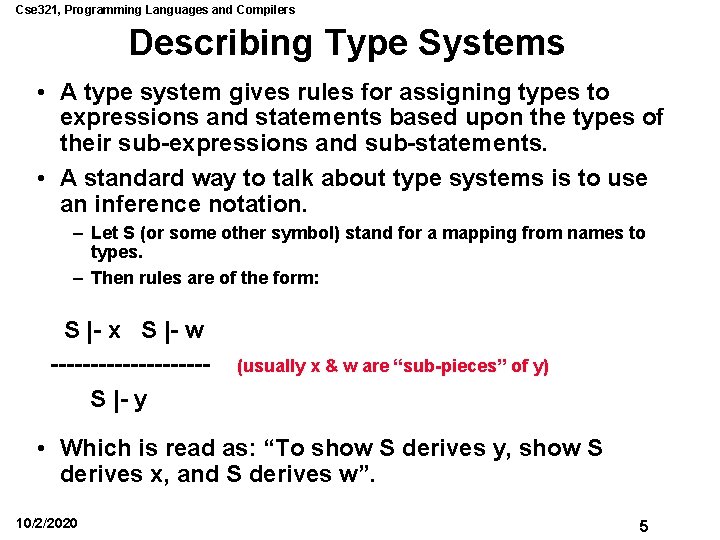
Cse 321, Programming Languages and Compilers Describing Type Systems • A type system gives rules for assigning types to expressions and statements based upon the types of their sub-expressions and sub-statements. • A standard way to talk about type systems is to use an inference notation. – Let S (or some other symbol) stand for a mapping from names to types. – Then rules are of the form: S |- x S |- w ----------S |- y (usually x & w are “sub-pieces” of y) • Which is read as: “To show S derives y, show S derives x, and S derives w”. 10/2/2020 5
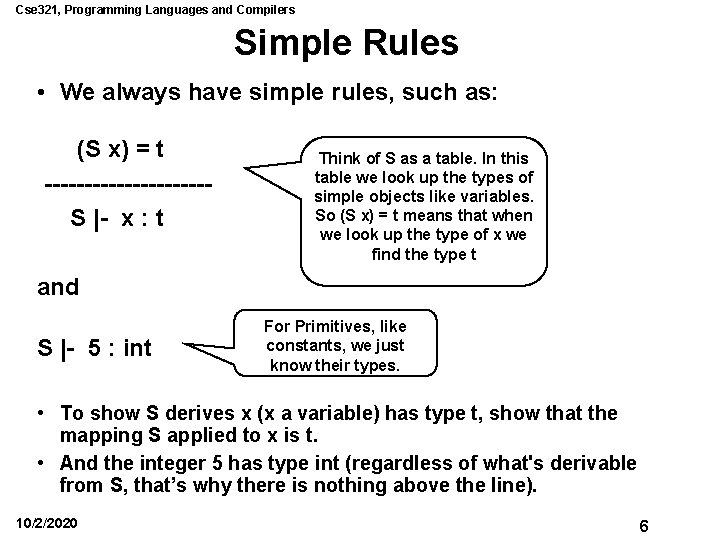
Cse 321, Programming Languages and Compilers Simple Rules • We always have simple rules, such as: (S x) = t ----------S |- x : t Think of S as a table. In this table we look up the types of simple objects like variables. So (S x) = t means that when we look up the type of x we find the type t and S |- 5 : int For Primitives, like constants, we just know their types. • To show S derives x (x a variable) has type t, show that the mapping S applied to x is t. • And the integer 5 has type int (regardless of what's derivable from S, that’s why there is nothing above the line). 10/2/2020 6
Cse 321, Programming Languages and Compilers Complex Rules • To implement rules like this we would use an attribute computation. • Note that the mapping, S, might change as we move around the program. – Declarations add to S, adding types to new variables. – Exiting a local scope means removing things from S • S is usually implemented as an inherited attribute. And the types that we derive annotate the tree and are a synthesized attributes. 10/2/2020 7
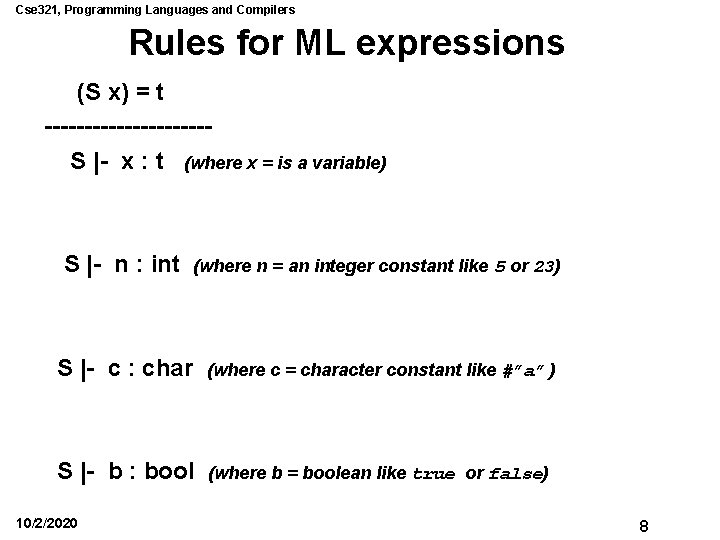
Cse 321, Programming Languages and Compilers Rules for ML expressions (S x) = t ----------S |- x : t (where x = is a variable) S |- n : int (where n = an integer constant like 5 or 23) S |- c : char (where c = character constant like #”a” ) S |- b : bool (where b = boolean like true or false) 10/2/2020 8
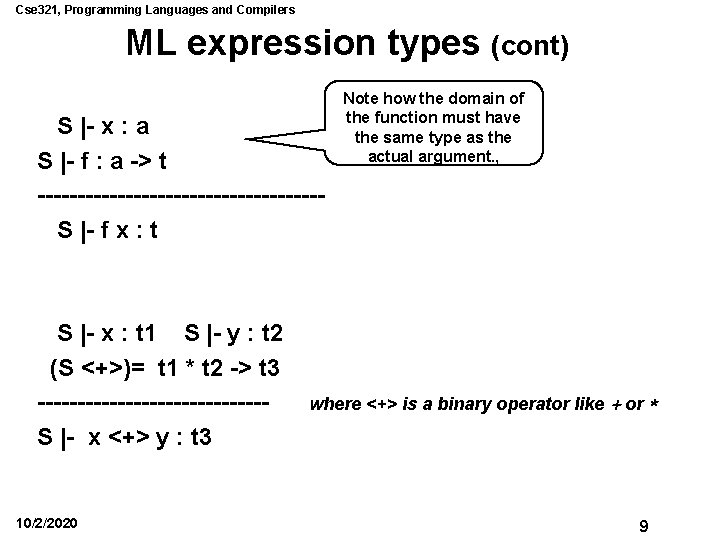
Cse 321, Programming Languages and Compilers ML expression types (cont) S |- x : a S |- f : a -> t ------------------S |- f x : t S |- x : t 1 S |- y : t 2 (S <+>)= t 1 * t 2 -> t 3 --------------S |- x <+> y : t 3 10/2/2020 Note how the domain of the function must have the same type as the actual argument. , where <+> is a binary operator like + or * 9
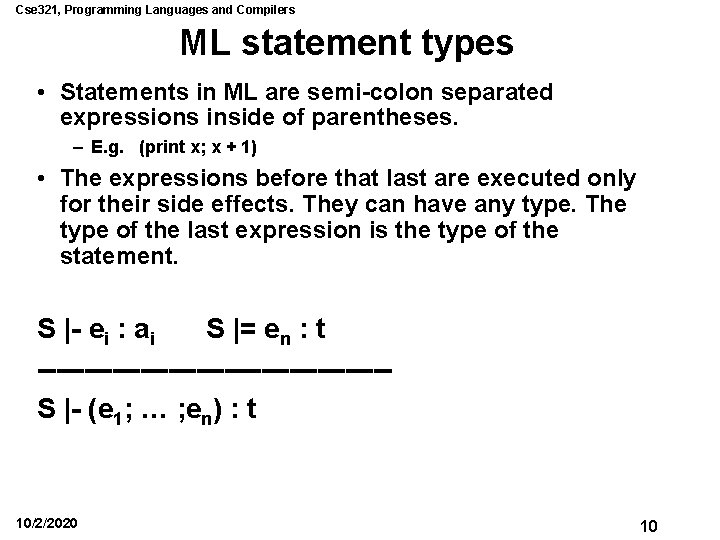
Cse 321, Programming Languages and Compilers ML statement types • Statements in ML are semi-colon separated expressions inside of parentheses. – E. g. (print x; x + 1) • The expressions before that last are executed only for their side effects. They can have any type. The type of the last expression is the type of the statement. S |- ei : ai S |= en : t -------------------S |- (e 1; … ; en) : t 10/2/2020 10
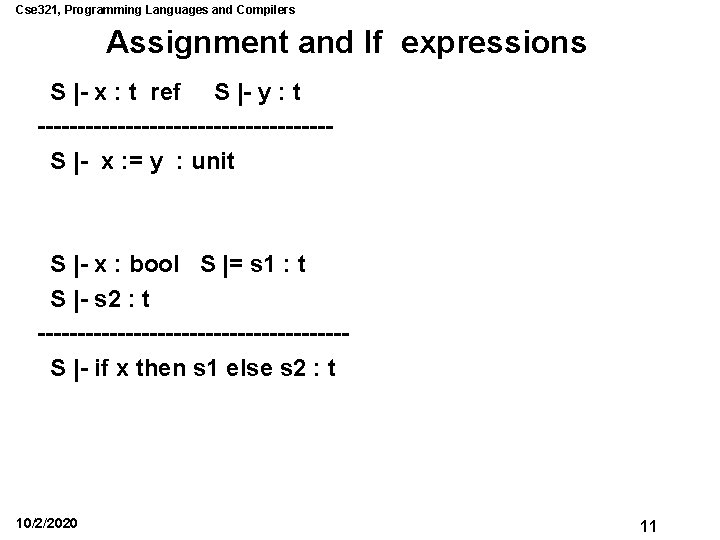
Cse 321, Programming Languages and Compilers Assignment and If expressions S |- x : t ref S |- y : t ------------------S |- x : = y : unit S |- x : bool S |= s 1 : t S |- s 2 : t -------------------S |- if x then s 1 else s 2 : t 10/2/2020 11
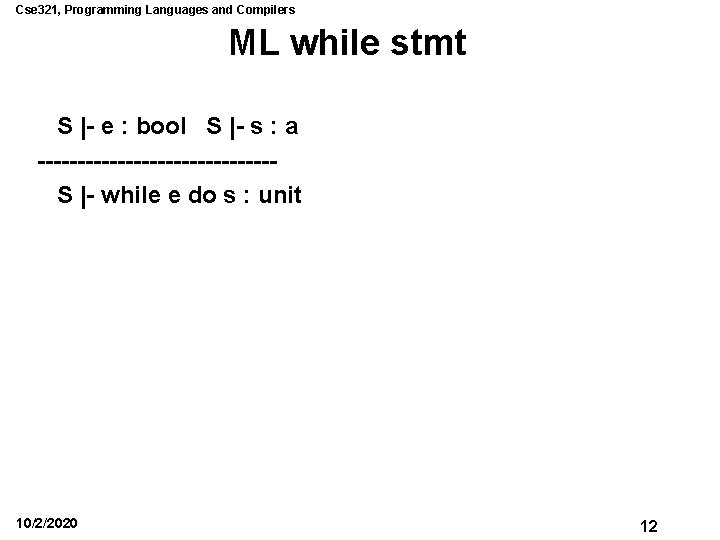
Cse 321, Programming Languages and Compilers ML while stmt S |- e : bool S |- s : a ---------------S |- while e do s : unit 10/2/2020 12
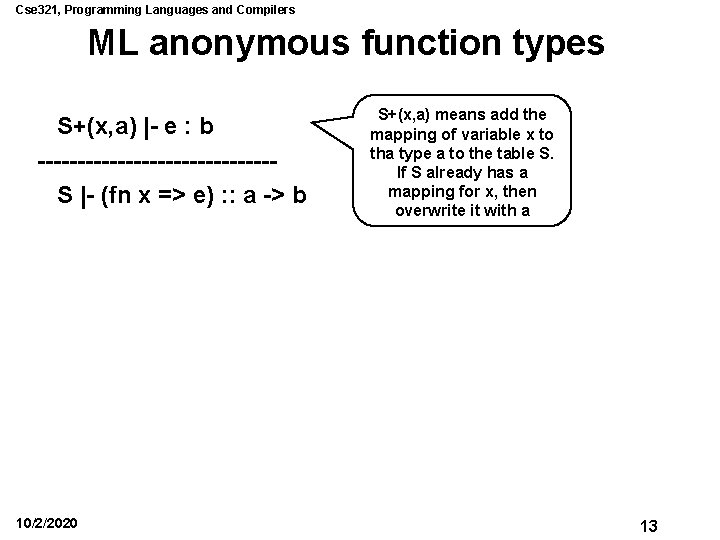
Cse 321, Programming Languages and Compilers ML anonymous function types S+(x, a) |- e : b ---------------S |- (fn x => e) : : a -> b 10/2/2020 S+(x, a) means add the mapping of variable x to tha type a to the table S. If S already has a mapping for x, then overwrite it with a 13
Cse 321, Programming Languages and Compilers Implementing the Rules • To implement the rules, use an inductive function which takes an expression and returns a MLtype. • Any error that occurs indicates the expression can’t be well typed. • The mapping S is an inherited attribute. – That means it changes as we move around the program • If a type appears more than once in any rule, it must be the same for all occurrences. • This requires that we check that two types are equal. • In an language without polymorphic types, this is simple. The function below illustrates structural 10/2/2020 equality for types 14
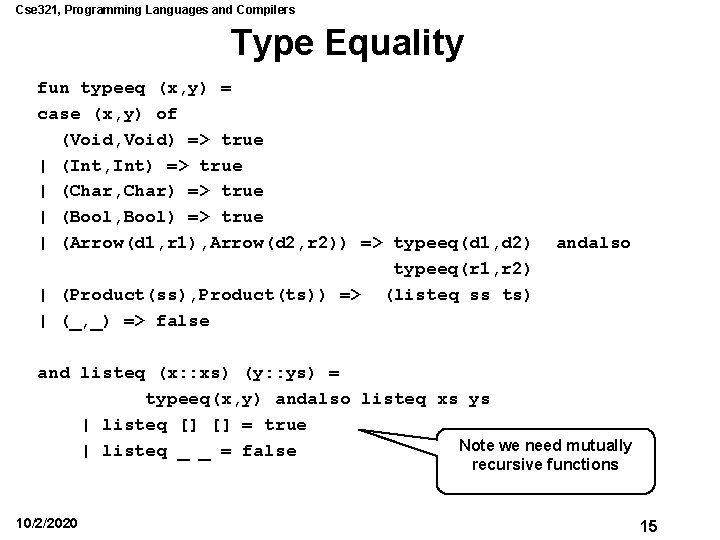
Cse 321, Programming Languages and Compilers Type Equality fun typeeq (x, y) = case (x, y) of (Void, Void) => true | (Int, Int) => true | (Char, Char) => true | (Bool, Bool) => true | (Arrow(d 1, r 1), Arrow(d 2, r 2)) => typeeq(d 1, d 2) typeeq(r 1, r 2) | (Product(ss), Product(ts)) => (listeq ss ts) | (_, _) => false andalso and listeq (x: : xs) (y: : ys) = typeeq(x, y) andalso listeq xs ys | listeq [] [] = true Note we need mutually | listeq _ _ = false recursive functions 10/2/2020 15
Cse 321, Programming Languages and Compilers Type Equality in more complicated type systems • For more complicated type systems type equality can be quite difficult without some simplifying rules. • For example any type system that allows names for types, or recursive type definitions may not be able to use structural equality. – Why? A system with names says before comparing for equality substitute out each name. – What if a name has a recursive definition? • Names are important in real systems because they allow recursive definitions, but hard to test for equality. Such systems often have two ways of declaring types. And use name equality. – i. e. . don’t substitute a definition for a name. – Two types with different names could have identical definitions, but not be equal. 10/2/2020 16
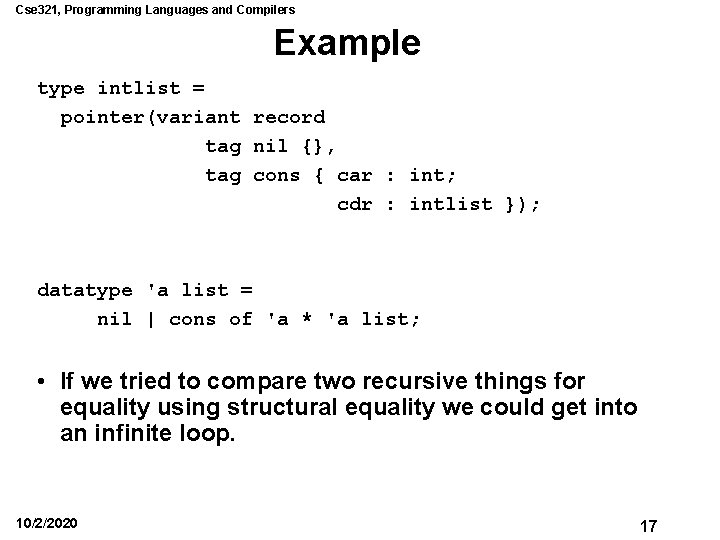
Cse 321, Programming Languages and Compilers Example type intlist = pointer(variant record tag nil {}, tag cons { car : int; cdr : intlist }); datatype 'a list = nil | cons of 'a * 'a list; • If we tried to compare two recursive things for equality using structural equality we could get into an infinite loop. 10/2/2020 17
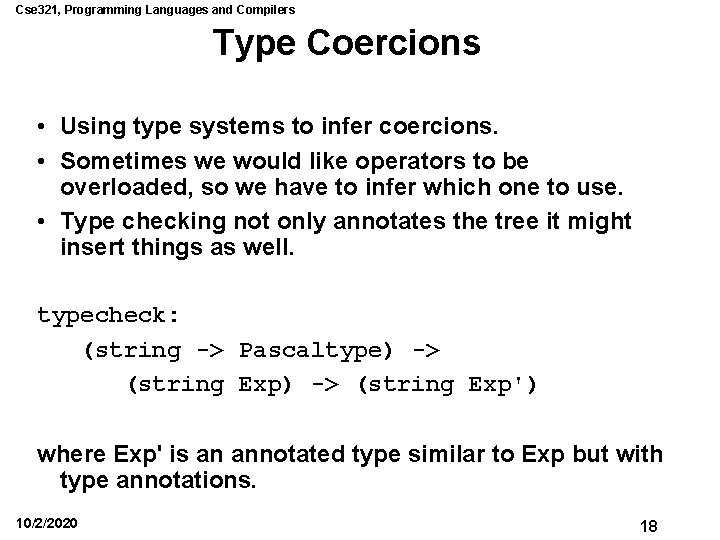
Cse 321, Programming Languages and Compilers Type Coercions • Using type systems to infer coercions. • Sometimes we would like operators to be overloaded, so we have to infer which one to use. • Type checking not only annotates the tree it might insert things as well. typecheck: (string -> Pascaltype) -> (string Exp') where Exp' is an annotated type similar to Exp but with type annotations. 10/2/2020 18
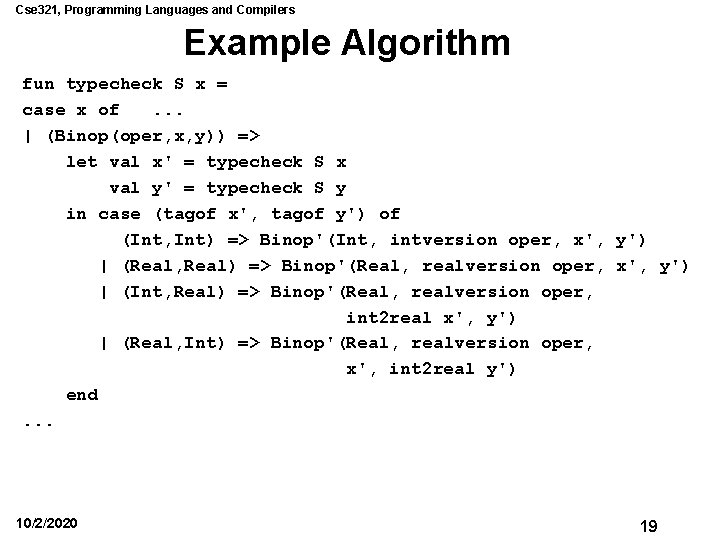
Cse 321, Programming Languages and Compilers Example Algorithm fun typecheck S x = case x of. . . | (Binop(oper, x, y)) => let val x' = typecheck S x val y' = typecheck S y in case (tagof x', tagof y') of (Int, Int) => Binop'(Int, intversion oper, x', y') | (Real, Real) => Binop'(Real, realversion oper, x', y') | (Int, Real) => Binop'(Real, realversion oper, int 2 real x', y') | (Real, Int) => Binop'(Real, realversion oper, x', int 2 real y') end. . . 10/2/2020 19
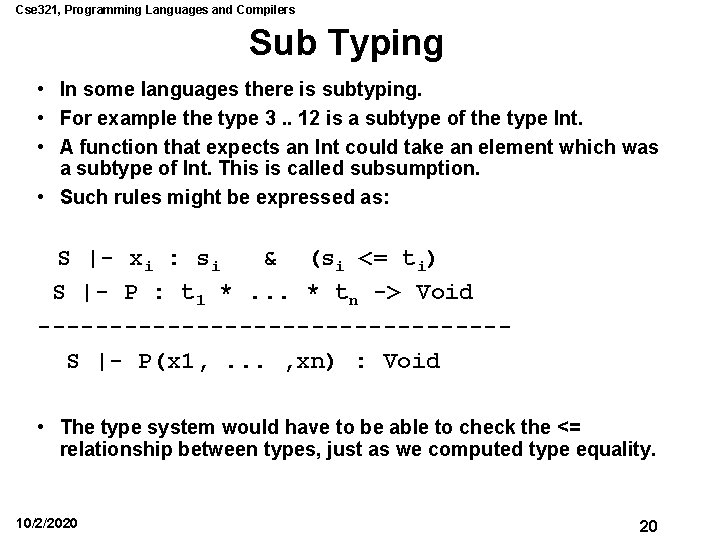
Cse 321, Programming Languages and Compilers Sub Typing • In some languages there is subtyping. • For example the type 3. . 12 is a subtype of the type Int. • A function that expects an Int could take an element which was a subtype of Int. This is called subsumption. • Such rules might be expressed as: S |- xi : si & (si <= ti) S |- P : t 1 *. . . * tn -> Void ----------------S |- P(x 1, . . . , xn) : Void • The type system would have to be able to check the <= relationship between types, just as we computed type equality. 10/2/2020 20
Cse 321, Programming Languages and Compilers Types • Purpose – Types describe both the form and behavior of valid programs – Safety » Bad things do not happen – Expressiveness » Operator overloading • Context sensiitve meaning • Can’t be expressed in the syntax of the language without richer types of grammars. – Efficiency » By choosing implementation that depend on type information the most efficient ones can be used – Representation information » Types often express knowledge about how a value is represented • How much space it takes up • Whether it is a pointer 10/2/2020 21
Cse 321, Programming Languages and Compilers Kinds of Type Systems • Untyped – No type information is carried by the data – No type checking is done, any kind of type mistake causes a run time error. The error is often mysterious » Core dump – Examples: parts of C, assembly language • Dynamically typed – Data carries type information » Tags » Pointers into discreet ranges – Operations test the type information before running – Type errors are caught at run-time, often tell what exactly went wrong – E. g. Lisp, Basic, certain parts of the class herrachy in Java • Statically typed – Data may or may not have type information – Errors are caught be disallowing programs that don’t type check – E. g. ML, Haskel, Parts of Java. 10/2/2020 22
Cse 321, Programming Languages and Compilers Basic Types • Numbers – – Int 64 Unsigned. . . • Characters – Traditionally 8 bit – Usually 16 or 32 bit with the advent of unicode and extended character sets. • Booleans – Sometimes 1 bit – Often the same representation as int 10/2/2020 23
Cse 321, Programming Languages and Compilers Constructed Types • Arrays – Homogeneous – Contiguous • Strings – Usually special syntax for string constants – Sometimes arrays – Sometimes linked list representation • Enumerated types – Finite number of elements – In ML » Datatype Color = Red | Blue | Green | Yellow | Purple | Orange 10/2/2020 24
Cse 321, Programming Languages and Compilers Products • Products are heterogeneous aggregates • Structures • Tuples • Records • Sometimes have named fields, sometimes uses pattern matching or integer indexing • person. age • fun f (name, age, address) =. . . • person. #1 10/2/2020 25
Cse 321, Programming Languages and Compilers Pointers • Pointers are a low level (implementation level) mechanism to describe indirection. • In some languages, Notably C, one can do pointer arithmetic. • Advantages – Uniform representation size. All pointers have the same size. – Sharing (change what is pointed to, all other pointers observe the change). • Disadvantages – Null or dangling pointers – Sometimes hard to know what type is the thoing pointed to 10/2/2020 26
Cse 321, Programming Languages and Compilers Unions • When an element of a type can take on one of a number of different forms • • Variants Unions Datatypes in ML Classes in Java 10/2/2020 27
Cse 321, Programming Languages and Compilers Type Checking • Trys to catch errors where data is used in a manner inconsistent with its definition • • Operators take specific types as operands Functions take specific types are arguments Only pointer types can be de-referenced Only union types can be “cased” over 10/2/2020 28
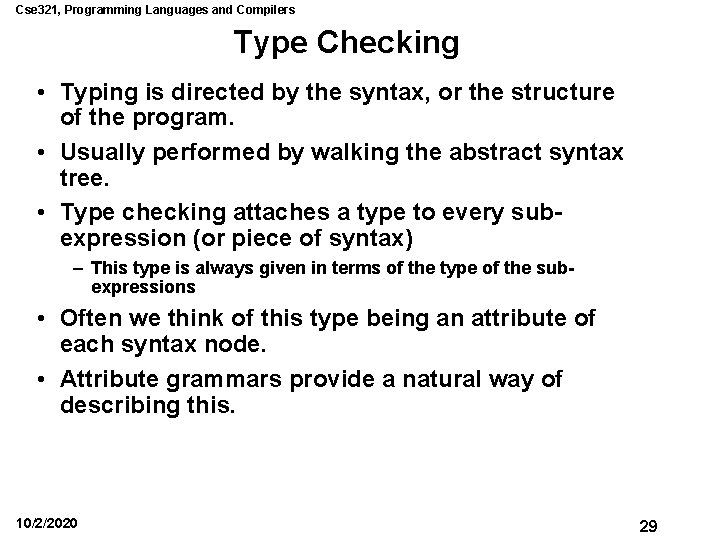
Cse 321, Programming Languages and Compilers Type Checking • Typing is directed by the syntax, or the structure of the program. • Usually performed by walking the abstract syntax tree. • Type checking attaches a type to every subexpression (or piece of syntax) – This type is always given in terms of the type of the subexpressions • Often we think of this type being an attribute of each syntax node. • Attribute grammars provide a natural way of describing this. 10/2/2020 29
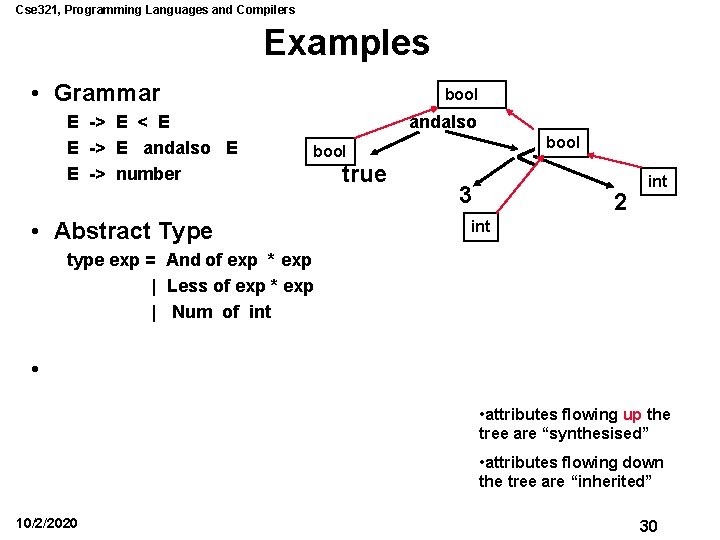
Cse 321, Programming Languages and Compilers Examples • Grammar E -> E < E E -> E andalso E E -> number bool andalso < bool • Abstract Type true 3 bool 2 int type exp = And of exp * exp | Less of exp * exp | Num of int • • attributes flowing up the tree are “synthesised” • attributes flowing down the tree are “inherited” 10/2/2020 30
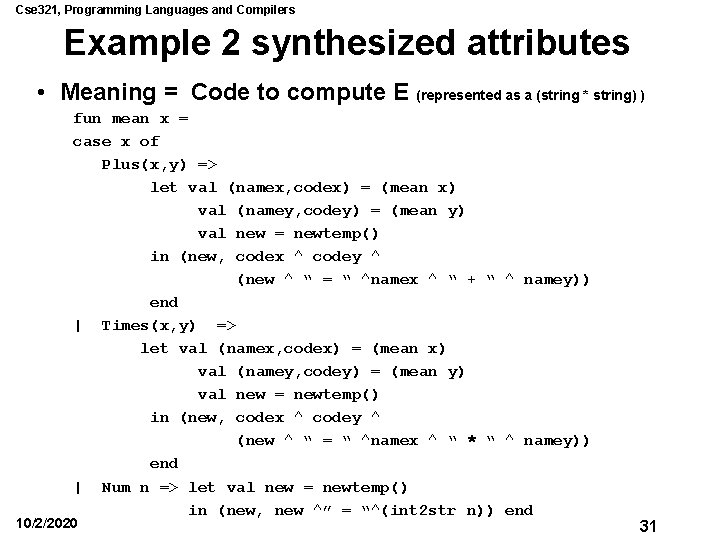
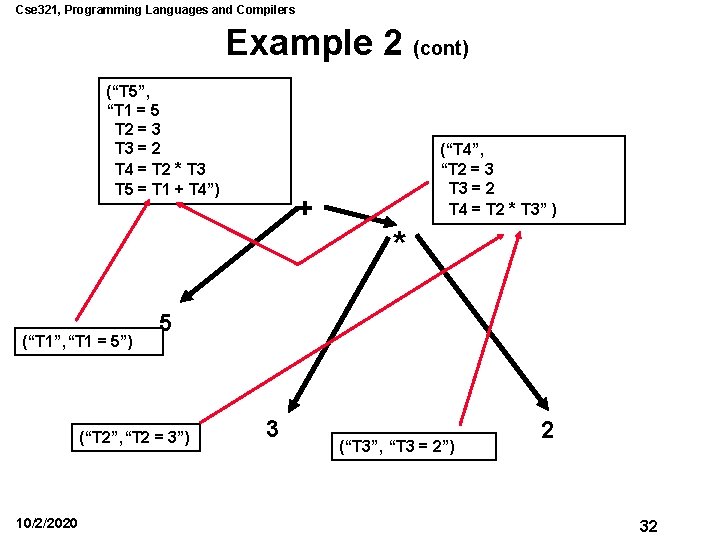
Cse 321, Programming Languages and Compilers Example 2 synthesized attributes • Meaning = Code to compute E (represented as a (string * string) ) fun mean x = case x of Plus(x, y) => let val (namex, codex) = (mean x) val (namey, codey) = (mean y) val new = newtemp() in (new, codex ^ codey ^ (new ^ “ = “ ^namex ^ “ + “ ^ namey)) end | Times(x, y) => let val (namex, codex) = (mean x) val (namey, codey) = (mean y) val new = newtemp() in (new, codex ^ codey ^ (new ^ “ = “ ^namex ^ “ * “ ^ namey)) end | Num n => let val new = newtemp() in (new, new ^” = “^(int 2 str n)) end 10/2/2020 31
Cse 321, Programming Languages and Compilers Example 2 (cont) (“T 5”, “T 1 = 5 T 2 = 3 T 3 = 2 T 4 = T 2 * T 3 T 5 = T 1 + T 4”) (“T 1”, “T 1 = 5”) * 5 (“T 2”, “T 2 = 3”) 10/2/2020 + (“T 4”, “T 2 = 3 T 3 = 2 T 4 = T 2 * T 3” ) 3 (“T 3”, “T 3 = 2”) 2 32
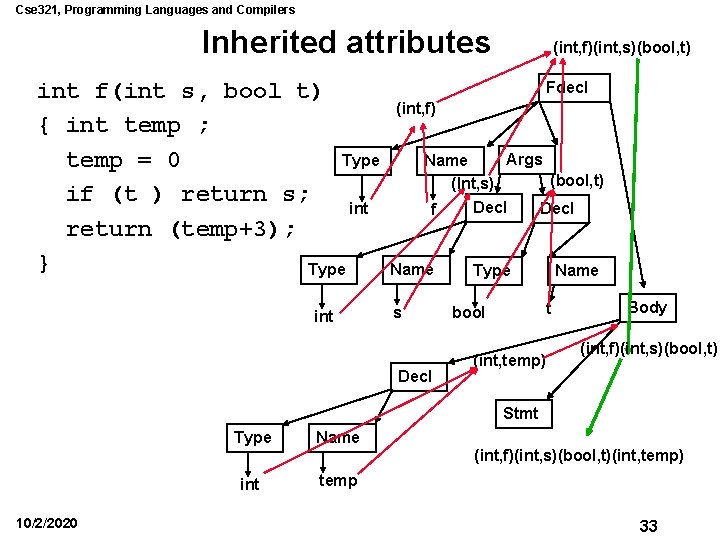
Cse 321, Programming Languages and Compilers Inherited attributes int f(int s, bool t) { int temp ; Type temp = 0 if (t ) return s; int return (temp+3); } Type int (int, f)(int, s)(bool, t) Fdecl (int, f) Args Name (bool, t) (Int, s) Decl f Name s Decl Type Name t bool (int, temp) Body (int, f)(int, s)(bool, t) Stmt Type Name (int, f)(int, s)(bool, t)(int, temp) int 10/2/2020 temp 33
Cse 321, Programming Languages and Compilers Attribute Grammar Computations • Decorating the syntax tree. • Computing Synthesized attributes proceeds from the leaves to the root. – Synthesized computations are implemented by an inductive function, where the value computed (returned) is the synthesized attribute. • Computing Inherited attributes passes information from the root to the leaves. – Inherited computations are implemented by an inductive function with an extra parameter. 10/2/2020 34
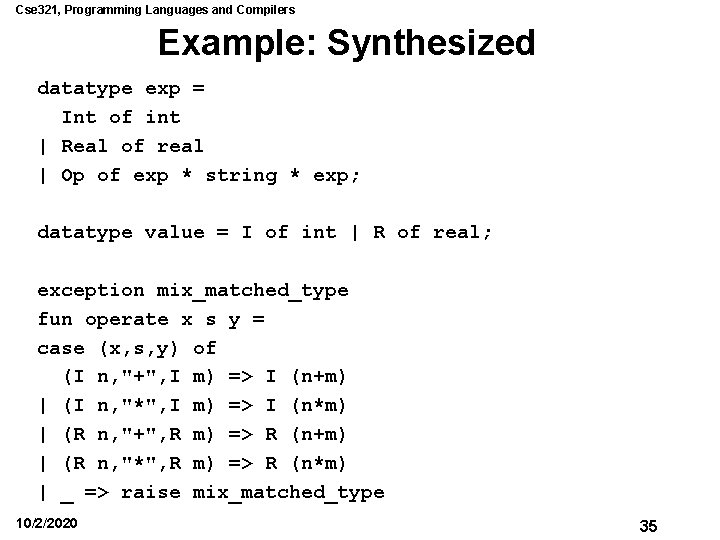
Cse 321, Programming Languages and Compilers Example: Synthesized datatype exp = Int of int | Real of real | Op of exp * string * exp; datatype value = I of int | R of real; exception mix_matched_type fun operate x s y = case (x, s, y) of (I n, "+", I m) => I (n+m) | (I n, "*", I m) => I (n*m) | (R n, "+", R m) => R (n+m) | (R n, "*", R m) => R (n*m) | _ => raise mix_matched_type 10/2/2020 35
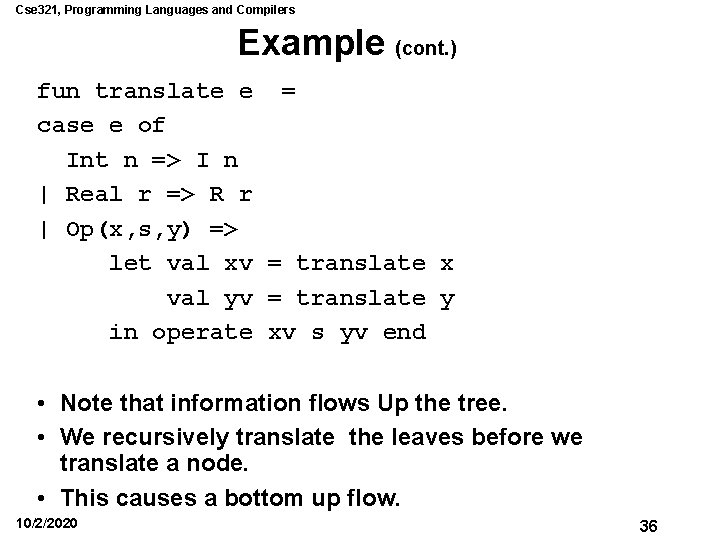
Cse 321, Programming Languages and Compilers Example (cont. ) fun translate e = case e of Int n => I n | Real r => R r | Op(x, s, y) => let val xv = translate x val yv = translate y in operate xv s yv end • Note that information flows Up the tree. • We recursively translate the leaves before we translate a node. • This causes a bottom up flow. 10/2/2020 36
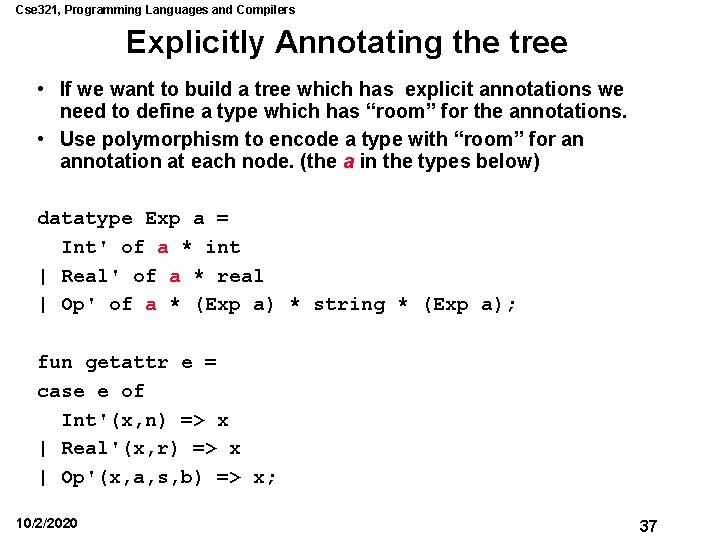
Cse 321, Programming Languages and Compilers Explicitly Annotating the tree • If we want to build a tree which has explicit annotations we need to define a type which has “room” for the annotations. • Use polymorphism to encode a type with “room” for an annotation at each node. (the a in the types below) datatype Exp a = Int' of a * int | Real' of a * real | Op' of a * (Exp a) * string * (Exp a); fun getattr e = case e of Int'(x, n) => x | Real'(x, r) => x | Op'(x, a, s, b) => x; 10/2/2020 37
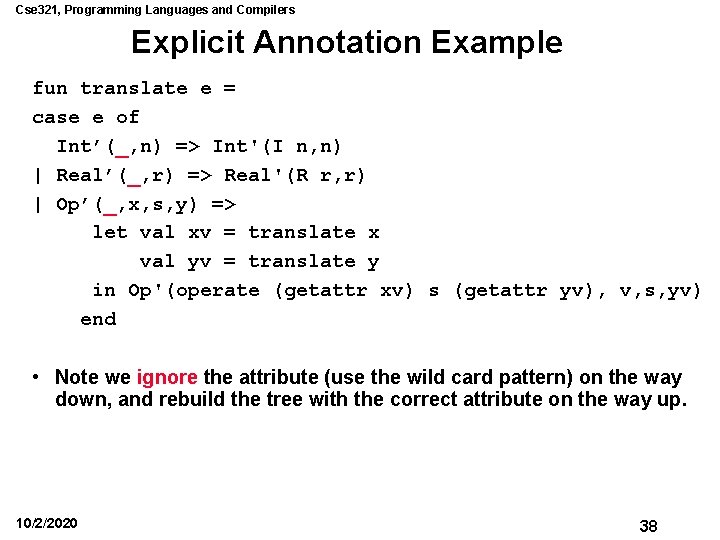
Cse 321, Programming Languages and Compilers Explicit Annotation Example fun translate e = case e of Int’(_, n) => Int'(I n, n) | Real’(_, r) => Real'(R r, r) | Op’(_, x, s, y) => let val xv = translate x val yv = translate y in Op'(operate (getattr xv) s (getattr yv), v, s, yv) end • Note we ignore the attribute (use the wild card pattern) on the way down, and rebuild the tree with the correct attribute on the way up. 10/2/2020 38
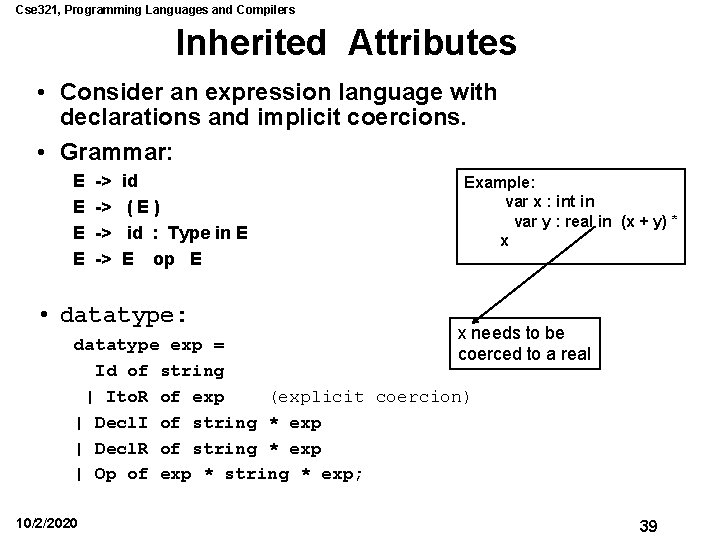
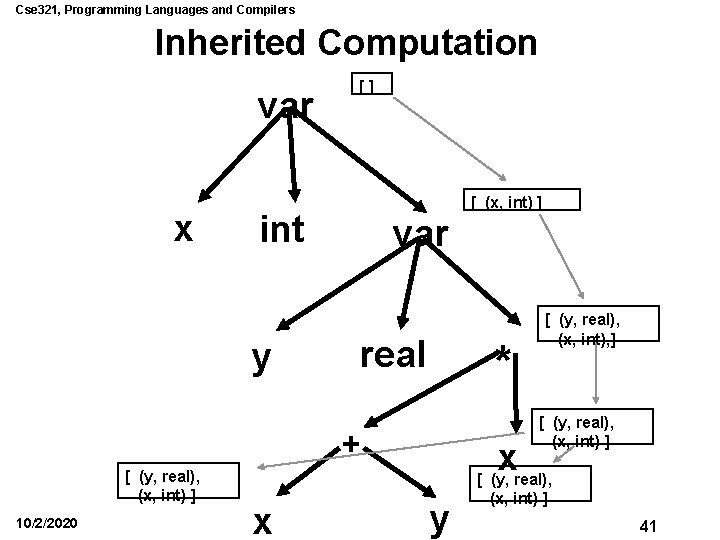
Cse 321, Programming Languages and Compilers Inherited Attributes • Consider an expression language with declarations and implicit coercions. • Grammar: E E -> -> id (E) id : Type in E E op E Example: var x : int in var y : real in (x + y) * x • datatype: x needs to be datatype exp = coerced to a real Id of string | Ito. R of exp (explicit coercion) | Decl. I of string * exp | Decl. R of string * exp | Op of exp * string * exp; 10/2/2020 39
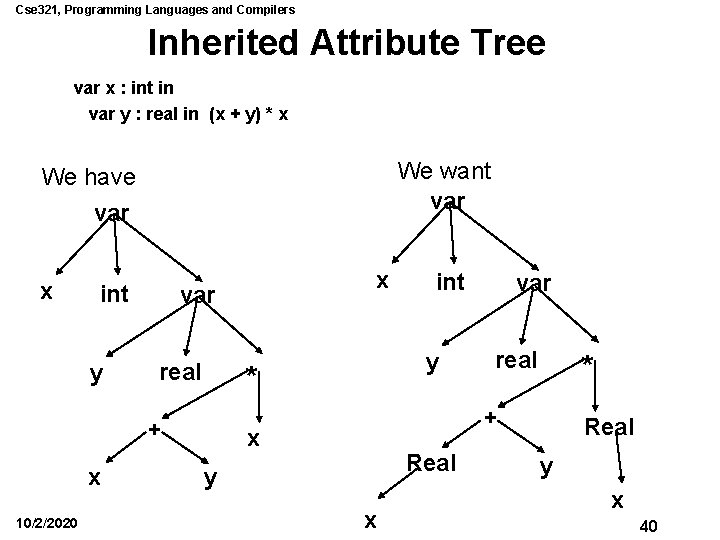
Cse 321, Programming Languages and Compilers Inherited Attribute Tree var x : int in var y : real in (x + y) * x We want var We have var x int y real 10/2/2020 int y * + x x var real * + x Real y x 40
Cse 321, Programming Languages and Compilers Inherited Computation var x [] [ (x, int) ] int y var real * [ (y, real), (x, int) ] + [ (y, real), (x, int) ] 10/2/2020 x [ (y, real), (x, int), ] x [ (y, real), y (x, int) ] 41
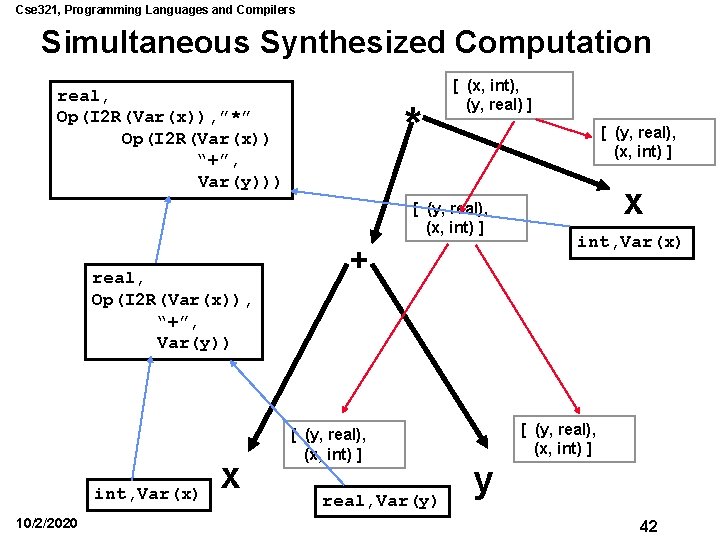
Cse 321, Programming Languages and Compilers Simultaneous Synthesized Computation real, Op(I 2 R(Var(x)), ”*” Op(I 2 R(Var(x)) “+”, Var(y))) * [ (x, int), (y, real) ] [ (y, real), (x, int) ] real, Op(I 2 R(Var(x)), “+”, Var(y)) int, Var(x) 10/2/2020 x + [ (y, real), (x, int) ] real, Var(y) x int, Var(x) [ (y, real), (x, int) ] y 42
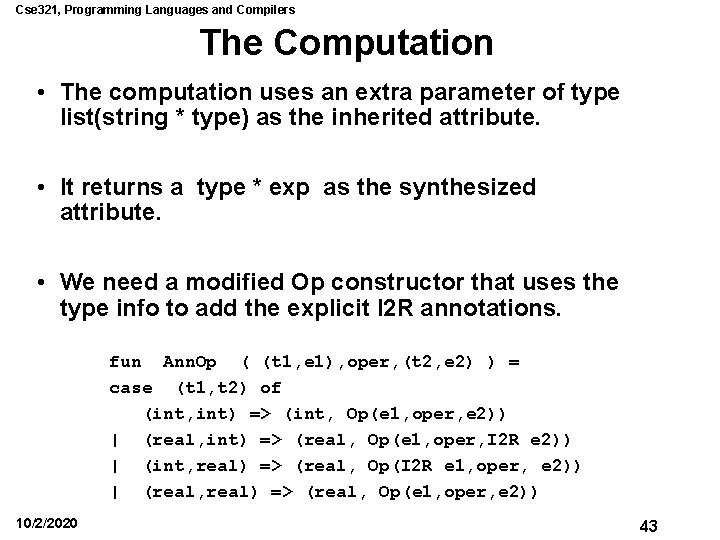
Cse 321, Programming Languages and Compilers The Computation • The computation uses an extra parameter of type list(string * type) as the inherited attribute. • It returns a type * exp as the synthesized attribute. • We need a modified Op constructor that uses the type info to add the explicit I 2 R annotations. fun Ann. Op ( (t 1, e 1), oper, (t 2, e 2) ) = case (t 1, t 2) of (int, int) => (int, Op(e 1, oper, e 2)) | (real, int) => (real, Op(e 1, oper, I 2 R e 2)) | (int, real) => (real, Op(I 2 R e 1, oper, e 2)) | (real, real) => (real, Op(e 1, oper, e 2)) 10/2/2020 43
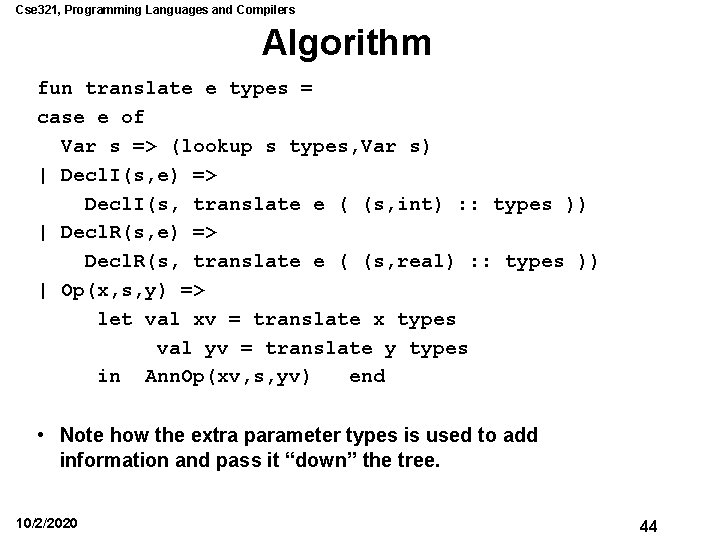
Cse 321, Programming Languages and Compilers Algorithm fun translate e types = case e of Var s => (lookup s types, Var s) | Decl. I(s, e) => Decl. I(s, translate e ( (s, int) : : types )) | Decl. R(s, e) => Decl. R(s, translate e ( (s, real) : : types )) | Op(x, s, y) => let val xv = translate x types val yv = translate y types in Ann. Op(xv, s, yv) end • Note how the extra parameter types is used to add information and pass it “down” the tree. 10/2/2020 44
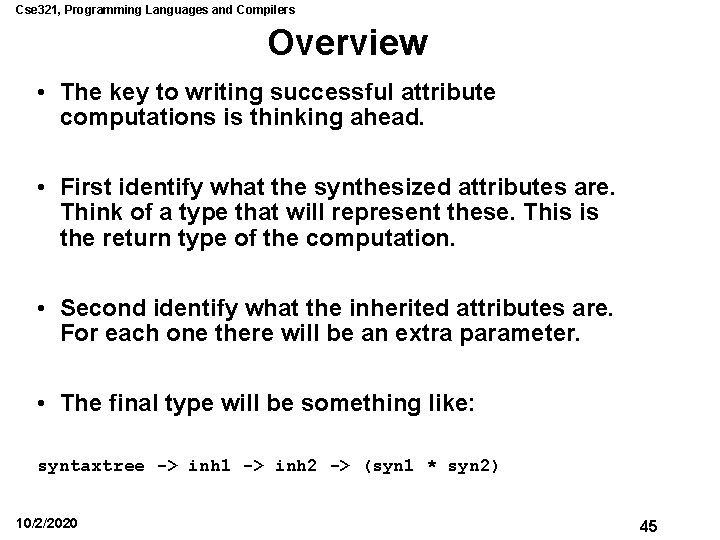
Cse 321, Programming Languages and Compilers Overview • The key to writing successful attribute computations is thinking ahead. • First identify what the synthesized attributes are. Think of a type that will represent these. This is the return type of the computation. • Second identify what the inherited attributes are. For each one there will be an extra parameter. • The final type will be something like: syntaxtree -> inh 1 -> inh 2 -> (syn 1 * syn 2) 10/2/2020 45
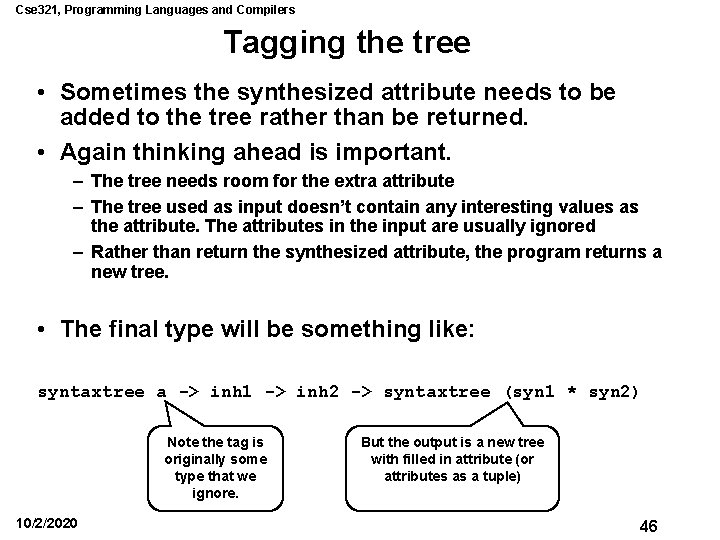
Cse 321, Programming Languages and Compilers Tagging the tree • Sometimes the synthesized attribute needs to be added to the tree rather than be returned. • Again thinking ahead is important. – The tree needs room for the extra attribute – The tree used as input doesn’t contain any interesting values as the attribute. The attributes in the input are usually ignored – Rather than return the synthesized attribute, the program returns a new tree. • The final type will be something like: syntaxtree a -> inh 1 -> inh 2 -> syntaxtree (syn 1 * syn 2) Note the tag is originally some type that we ignore. 10/2/2020 But the output is a new tree with filled in attribute (or attributes as a tuple) 46