
Instrumentation for Automated High Throughput Industrial LAICPMS Analysis
- Slides: 29
Instrumentation for Automated, High Throughput, Industrial LA-ICP-MS Analysis Ciaran O’Connor Laser Ablation Product Marketing Manager, ESI
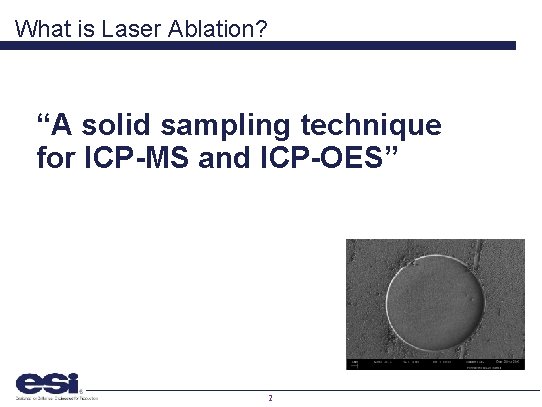
What is Laser Ablation? “A solid sampling technique for ICP-MS and ICP-OES” 2
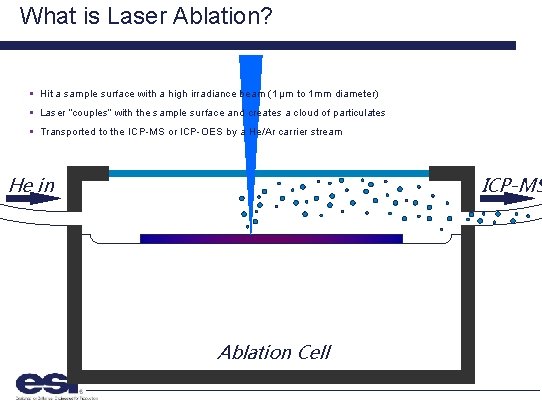
What is Laser Ablation? § Hit a sample surface with a high irradiance beam (1 µm to 1 mm diameter) § Laser “couples” with the sample surface and creates a cloud of particulates § Transported to the ICP-MS or ICP-OES by a He/Ar carrier stream He in ICP-MS Ablation Cell
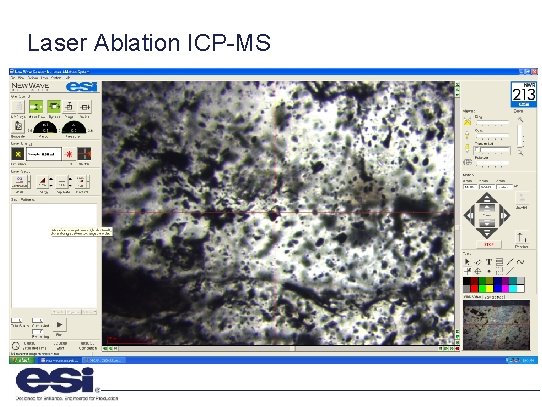
Laser Ablation ICP-MS
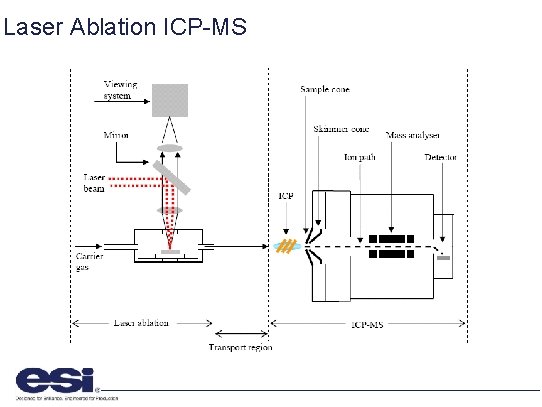
Laser Ablation ICP-MS
Why use Laser Ablation? • Quick and efficient sample introduction • • • Some samples are difficult to digest • • • E. g. PGE metals No loss of volatiles during digestion Can perform bulk analysis? • • Direct route from sample to ICP Any sample! How much X is in this sample? Large beam size (1 mm) for high sensitivity and homogeneity Can be automated for high sample throughput Can also perform high spatial resolution imaging • • How does the distribution of X change in my sample e. g. zonation Variable beam size (<1 micron) 6
Relevance to SMA…. We are here to learn how LA-ICP-MS/OES can be applied…. 1. Front end of the process…. . exploration…. grading 2. Back end of the process…. . final product testing…. ………. From a bulk analysis perspective. ESI Confidential 7
1. Front End…. mineral exploration ESI Confidential 8
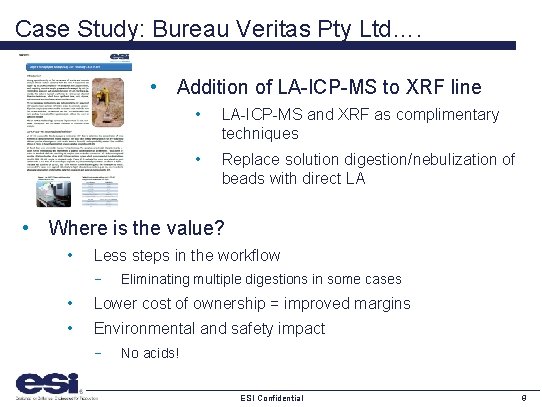
Case Study: Bureau Veritas Pty Ltd…. • Addition of LA-ICP-MS to XRF line • LA-ICP-MS and XRF as complimentary techniques • Replace solution digestion/nebulization of beads with direct LA • Where is the value? • Less steps in the workflow − Eliminating multiple digestions in some cases • Lower cost of ownership = improved margins • Environmental and safety impact − No acids! ESI Confidential 9
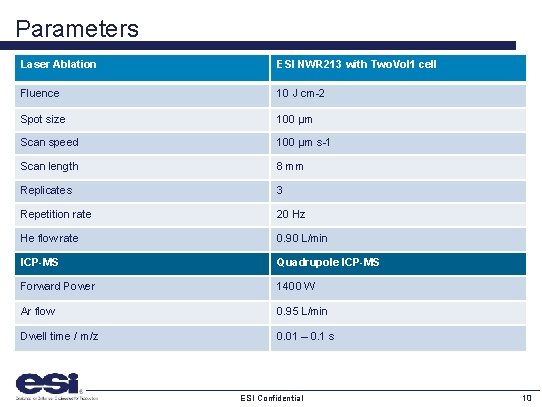
Parameters Laser Ablation ESI NWR 213 with Two. Vol 1 cell Fluence 10 J cm-2 Spot size 100 µm Scan speed 100 µm s-1 Scan length 8 mm Replicates 3 Repetition rate 20 Hz He flow rate 0. 90 L/min ICP-MS Quadrupole ICP-MS Forward Power 1400 W Ar flow 0. 95 L/min Dwell time / m/z 0. 01 – 0. 1 s ESI Confidential 10
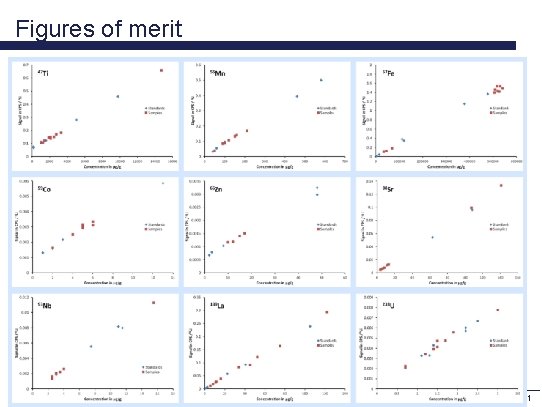
Figures of merit ESI Confidential 11
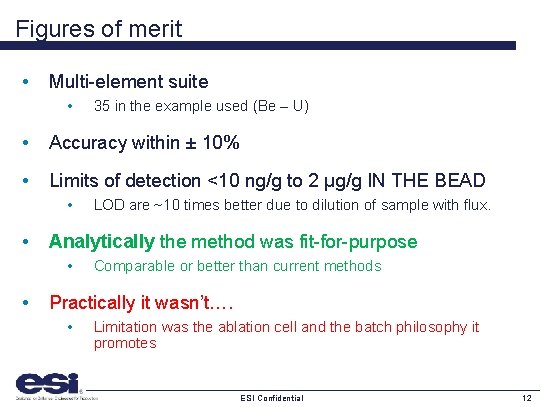
Figures of merit • Multi-element suite • 35 in the example used (Be – U) • Accuracy within ± 10% • Limits of detection <10 ng/g to 2 μg/g IN THE BEAD • • Analytically the method was fit-for-purpose • • LOD are ~10 times better due to dilution of sample with flux. Comparable or better than current methods Practically it wasn’t…. • Limitation was the ablation cell and the batch philosophy it promotes ESI Confidential 12
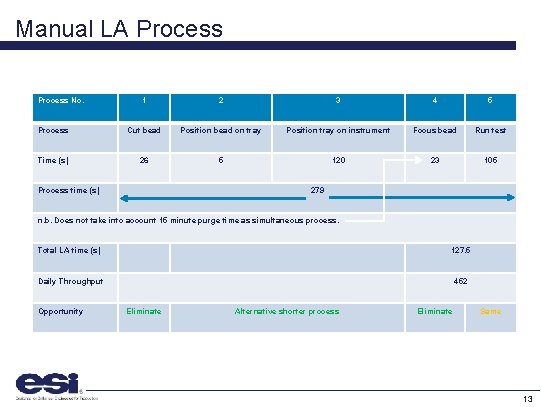
Manual LA Process No. 1 2 3 4 5 Process Cut bead Position bead on tray Position tray on instrument Focus bead Run test Time (s) 26 5 120 23 105 Process time (s) 279 n. b. Does not take into account 15 minute purge time as simultaneous process. Total LA time (s) 127. 5 Daily Throughput 452 Opportunity Eliminate Alternative shorter process Eliminate Same 13
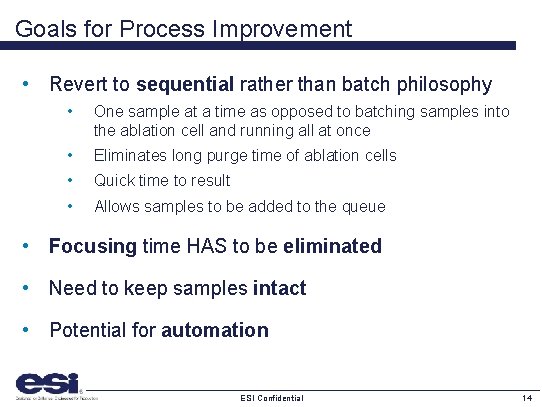
Goals for Process Improvement • Revert to sequential rather than batch philosophy • One sample at a time as opposed to batching samples into the ablation cell and running all at once • Eliminates long purge time of ablation cells • Quick time to result • Allows samples to be added to the queue • Focusing time HAS to be eliminated • Need to keep samples intact • Potential for automation ESI Confidential 14
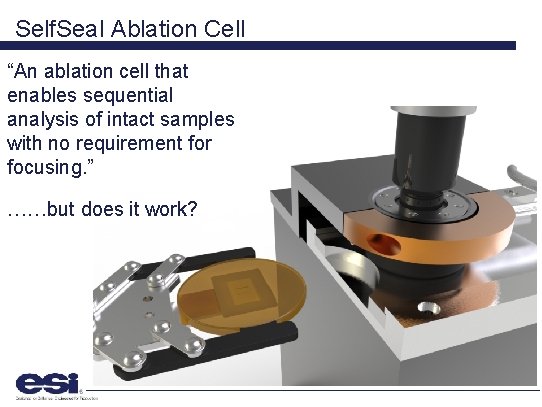
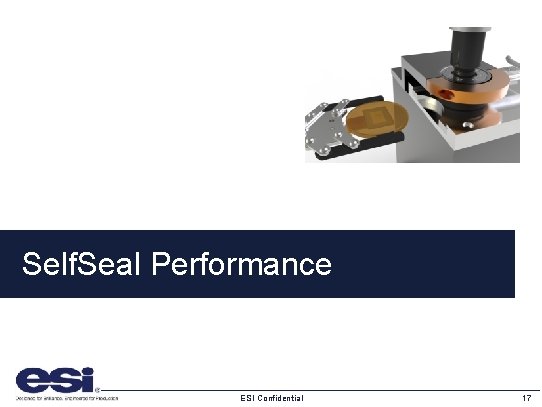
Self. Seal Ablation Cell “An ablation cell that enables sequential analysis of intact samples with no requirement for focusing. ” ……but does it work?
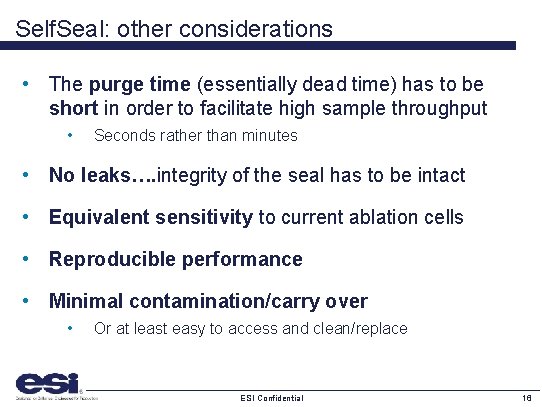
Self. Seal: other considerations • The purge time (essentially dead time) has to be short in order to facilitate high sample throughput • Seconds rather than minutes • No leaks…. integrity of the seal has to be intact • Equivalent sensitivity to current ablation cells • Reproducible performance • Minimal contamination/carry over • Or at least easy to access and clean/replace ESI Confidential 16
Self. Seal Performance ESI Confidential 17
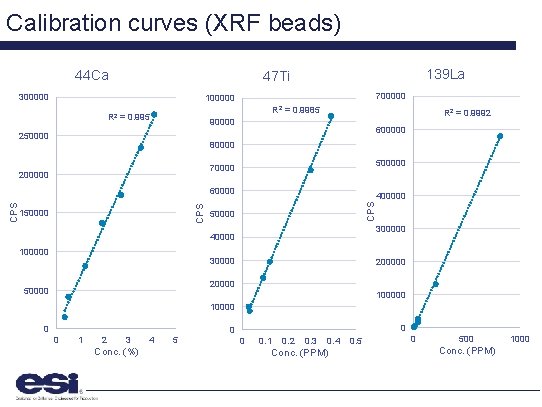
Calibration curves (XRF beads) 44 Ca 139 La 47 Ti 300000 700000 100000 R 2 = 0. 995 = 0. 9985 R 2 = 0. 9992 90000 250000 600000 80000 500000 70000 200000 150000 400000 CPS CPS 60000 50000 300000 40000 100000 30000 20000 50000 10000 0 0 1 2 3 Conc. (%) 4 5 0 0. 1 0. 2 0. 3 0. 4 Conc. (PPM) 0. 5 0 500 Conc. (PPM) 1000
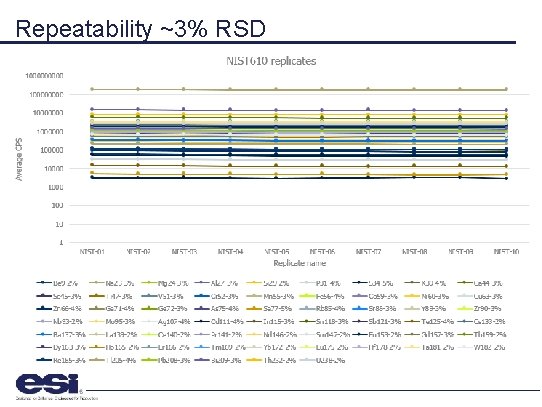
Repeatability ~3% RSD
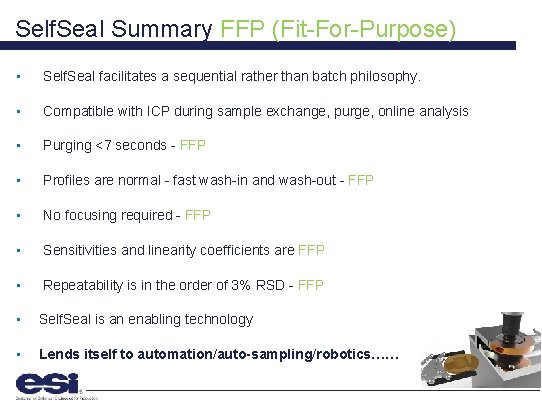
Self. Seal Summary FFP (Fit-For-Purpose) • Self. Seal facilitates a sequential rather than batch philosophy. • Compatible with ICP during sample exchange, purge, online analysis • Purging <7 seconds - FFP • Profiles are normal - fast wash-in and wash-out - FFP • No focusing required - FFP • Sensitivities and linearity coefficients are FFP • Repeatability is in the order of 3% RSD - FFP • Self. Seal is an enabling technology • Lends itself to automation/auto-sampling/robotics……
Automation and auto-sampling ESI Confidential 21
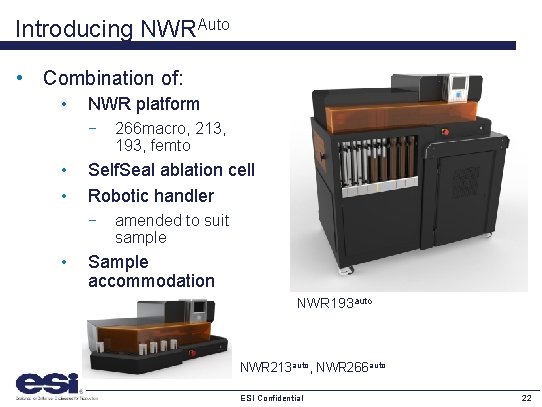
Introducing NWRAuto • Combination of: • NWR platform − • • Self. Seal ablation cell Robotic handler − • 266 macro, 213, 193, femto amended to suit sample Sample accommodation NWR 193 auto NWR 213 auto, NWR 266 auto ESI Confidential 22
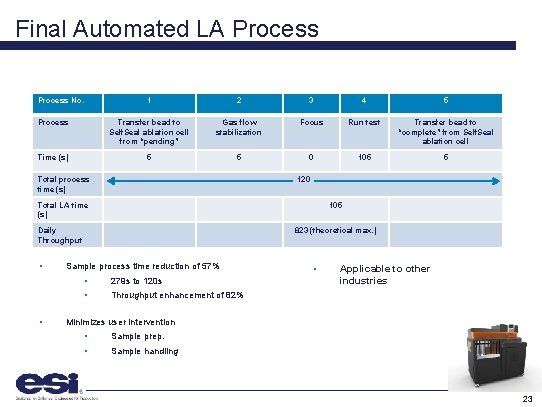
Final Automated LA Process No. 1 2 3 4 5 Process Transfer bead to Self. Seal ablation cell from “pending” Gas flow stabilization Focus Run test Transfer bead to “complete” from Self. Seal ablation cell Time (s) 5 5 0 105 5 Total process time (s) 120 Total LA time (s) 105 Daily Throughput • • 823 (theoretical max. ) Sample process time reduction of 57% • 279 s to 120 s • Throughput enhancement of 82% • Applicable to other industries Minimizes user intervention • Sample prep. • Sample handling 23
2: Back End…. Metals and Alloys ESI Confidential 24
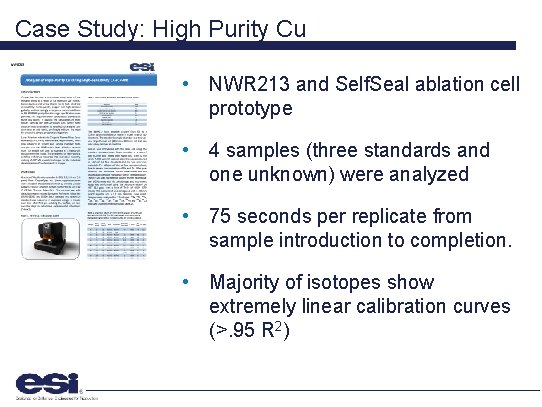
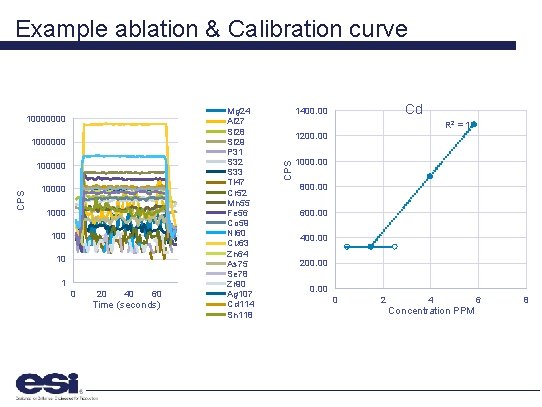
Case Study: High Purity Cu • NWR 213 and Self. Seal ablation cell prototype • 4 samples (three standards and one unknown) were analyzed • 75 seconds per replicate from sample introduction to completion. • Majority of isotopes show extremely linear calibration curves (>. 95 R 2)
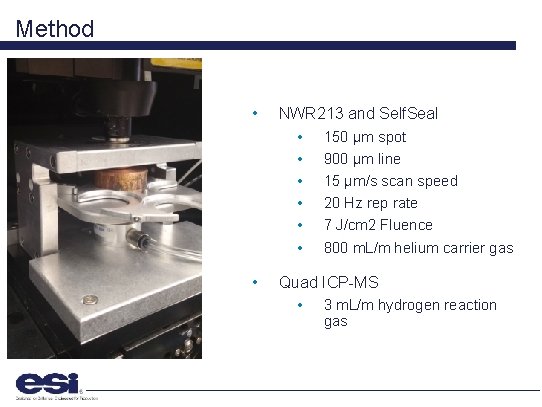
Method • NWR 213 and Self. Seal • 150 µm spot • 900 µm line • 15 µm/s scan speed • 20 Hz rep rate • 7 J/cm 2 Fluence • 800 m. L/m helium carrier gas • Quad ICP-MS • 3 m. L/m hydrogen reaction gas
Example ablation & Calibration curve 1000000 CPS 100000 1000 10 1 0 20 40 60 Time (seconds) Mg 24 Al 27 Si 28 Si 29 P 31 S 32 S 33 Ti 47 Cr 52 Mn 55 Fe 56 Co 59 Ni 60 Cu 63 Zn 64 As 75 Se 78 Zr 90 Ag 107 Cd 114 Sn 118 Cd 1400. 00 R 2 = 1 1200. 00 CPS 10000000 1000. 00 800. 00 600. 00 400. 00 200. 00 0 2 4 Concentration PPM 6 8
Figures of Merit • Multi-element suite • 24 in the example used • Accuracy within ± 10% • Precision ~ 2%RSD • Limits of detection <100 ng/g with Pb, Sb, Bi <10 ng/g • Analytically the method was fit-for-purpose • Has been applied to other metals including PGEs
Conclusions • We believe that LA-ICP-MS has the potential to provide value to this industry: • • Front end: complimentary technique to XRF Back end: purity testing of product • Selfseal is applicable to any uniform sample and enables a sequential methodology as opposed to batch • • Requires a flat, smooth surface to enable a good seal. Think XRF bead or metal slug • Automation exists with potential for ~1000 samples per day per instrument