Prototypes Fall 2010 Contents n n n n



- Slides: 113
Prototypes Fall 2010
Contents n n n n Recitation Chapter 13 –Openness Chapter 14 –Localness Chapter 15 –A Manager’s Time Chapter 16 –Ending the war between work and family Chapter 17 –Microworlds: Technology for the Learning Organization Chapter 18 –The Leader’s New Work 2
Recitation n What is the role of the subconscious in personal mastery? February 19, 2004 3
Recitation n n Mental Models are important because… Shared vision has the effect of…. . Team learning is supported by what other disciplines? Inquiry and reflection are used by what discipline? What two conversational techniques does Team Learning use? February 19, 2004 4
Part IV: Prototypes Senge, Chapter 13 --OPENNESS THE FIFTH DISCIPLINE
Prototypes n n n Are essential to discovering and solving key problems We are in the prototyping stage Significant innovation requires prototyping 6
Where are we (in the Rawls COBA)? n n n Somewhere between invention and innovation To what extent are we open to innovation? To what extent are we willing to address n n new curricula new organizational structures Prepared by James R. Burns 7
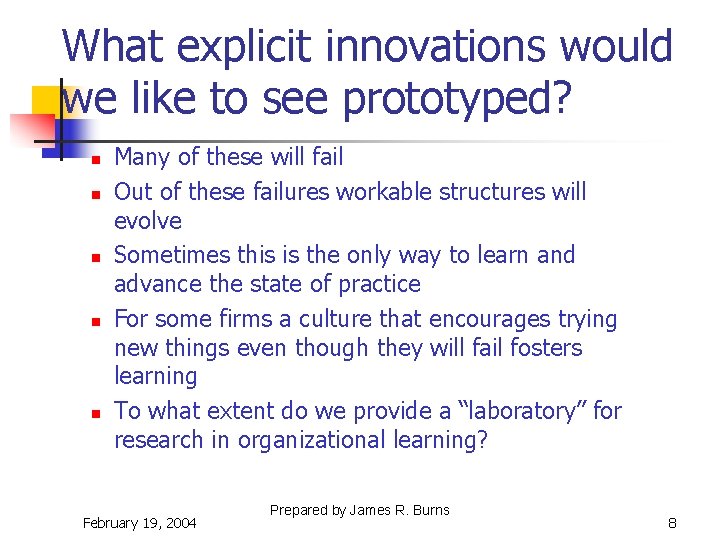
What explicit innovations would we like to see prototyped? n n n Many of these will fail Out of these failures workable structures will evolve Sometimes this is the only way to learn and advance the state of practice For some firms a culture that encourages trying new things even though they will fail fosters learning To what extent do we provide a “laboratory” for research in organizational learning? February 19, 2004 Prepared by James R. Burns 8
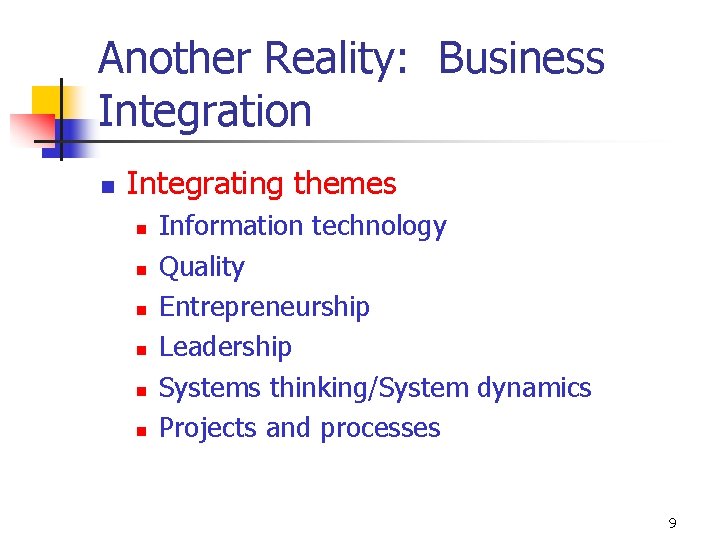
Another Reality: Business Integration n Integrating themes n n n Information technology Quality Entrepreneurship Leadership Systems thinking/System dynamics Projects and processes 9
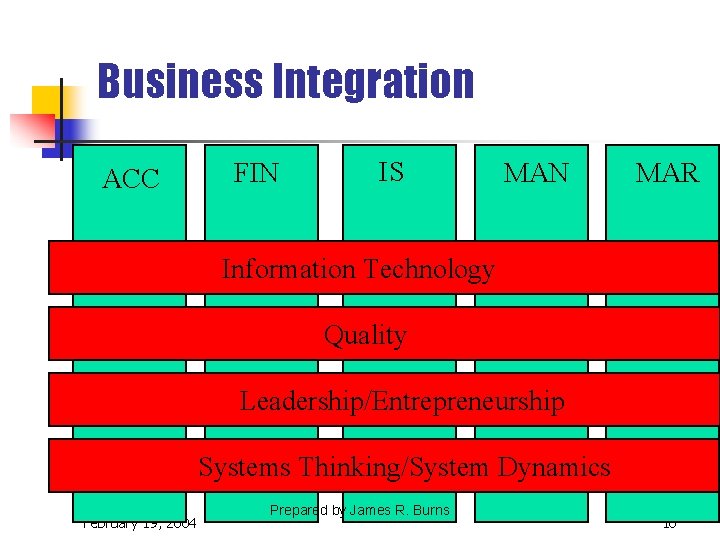
Business Integration ACC FIN IS MAN MAR Information Technology Quality Leadership/Entrepreneurship Systems Thinking/System Dynamics February 19, 2004 Prepared by James R. Burns 10
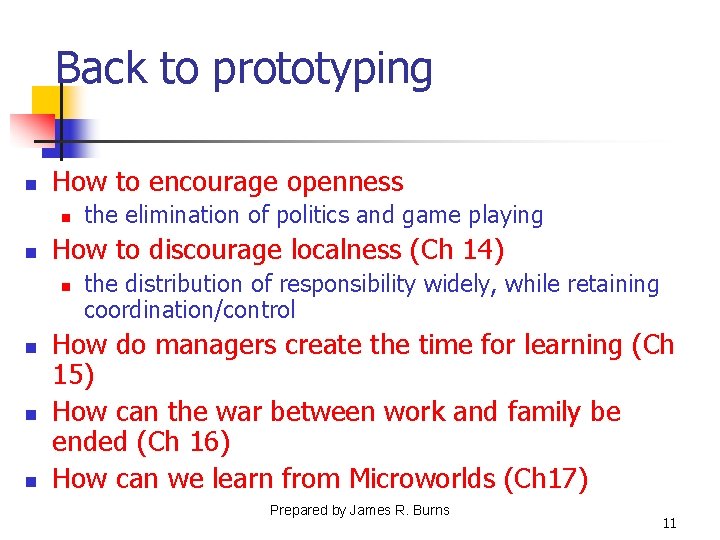
Back to prototyping n How to encourage openness n n How to discourage localness (Ch 14) n n the elimination of politics and game playing the distribution of responsibility widely, while retaining coordination/control How do managers create the time for learning (Ch 15) How can the war between work and family be ended (Ch 16) How can we learn from Microworlds (Ch 17) Prepared by James R. Burns 11
Openness--Chapter 13 -Outline n n n How to eliminate politics and game playing Building an environment where self interest is not paramount Participative Openness and Reflective Openness & Complexity The Spirit of Openness Freedom February 19, 2004 Prepared by James R. Burns 12
How to eliminate politics and game playing n A political environment is one in which “WHO” is more important than “WHAT” n n Who proposes the idea is more important than the idea itself Some individuals lose political power at the expense of others n The wielding of arbitrary power over others is the essence of authoritarianism February 19, 2004 Prepared by James R. Burns 13
Is there anything that can be done about org. politics? ? n n n In most orgs, no, Senge says, so don’t even dwell on it Yet very few people want to live in organizations corrupted by internal politics and game playing Challenging the grip of politics and game playing starts with building shared vision February 19, 2004 Prepared by James R. Burns 14
Shared vision n n Galvanizes people beyond their personal agendas and self interest We want an organizational climate dominated by merit rather than politics, where doing what is right predominates over who wants what done. February 19, 2004 Prepared by James R. Burns 15
Openness n n n The norm of speaking openly -participative openness The capacity to continually challenge one’s own thinking -- reflective openness Openness is needed to break down the game playing that is deeply embedded in most organizations February 19, 2004 Prepared by James R. Burns 16
Building an environment where self interest is not paramount n n Badaracco and Ellsworth in Leadership and the Quest for Integrity assume that practitioners believe that people are motivated by self-interest and by a search for power and wealth The assumption can be self-fulfilling; assume this and you will have a very political org. Really, people want to be part of something larger than themselves Personal Mastery encourages people to look beyond themselves for personal vision February 19, 2004 Prepared by James R. Burns 17
Shared Visions n n Draw forth this broader commitment and concern Begins to establish a sense of trust that comes naturally Start by getting people to talk about what is really important to them When people hear each other’s visions, the political environment begins to crumble February 19, 2004 Prepared by James R. Burns 18
Honesty begins to Prevail n n Honesty and forthrightness must pervade every relationship Cannot sanction lying to anyone, administrators, students February 19, 2004 Prepared by James R. Burns 19
Unlearning the habits of politics and game playing n Shared vision, once it takes root, does not completely dissolve game playing February 19, 2004 Prepared by James R. Burns 20
Participative Openness and Reflective Openness n n Most Common, Part. Openness-the freedom to speak one’s mind Because participative management is widely espoused. But total honesty does not prevail There is little real learning February 19, 2004 Prepared by James R. Burns 21
Reflective Openness n n While Part. Openness gets people speaking out, reflective openness gets people looking inward Starts with the willingness to challenge our own thinking February 19, 2004 22
Reflective Openness, Continued n n Requires that we test our views, assumptions against other peoples views, assumptions and revise them as necessary Requires inquiry and reflection discussed in the mental models chapter February 19, 2004 Prepared by James R. Burns 23
Localness Senge: Chapter 14 THE FIFTH DISCIPLINE
How to achieve control without controlling n n LOCALNESS--extending authority and power as far from the top or corporate center as possible More akin to the word EMPOWERMENT Learning organizations are ones in which thinking and acting are merged for every participant Localness is especially needed in times of rapid change February 19, 2004 25
Two new challenges emerge n n How to get senior managers to give up control to local managers How to make local control work February 19, 2004 26
Giving up control: n n Will this make senior managers dispensable? Senior managers must assume responsibility for continually enhancing the organization’s capacity for learning-THEIR NEW ROLE February 19, 2004 27
Other questions about localness: n n How can locally controlled organizations achieve coordination? Synergy between business units? Collaborative efforts toward common corporate-wide objectives? How can the local organization be something other than just a holding company February 19, 2004 28
What experience has shown: n n n Rigid authoritarian hierarchies thwart learning Hierarchies fail to harness the spirit, enthusiasm, and knowledge of people throughout the organization and to be responsible for shifting business conditions Failure has sprung up from not being able to relinquish control February 19, 2004 29
Learning organizations: n n n do less controlling of people’s behavior invest in improving the quality of people’s thinking invest in improving the capacity for reflection and learning develop shared visions develop shared understandings February 19, 2004 30
The illusion of being in control n n n Most senior managers would rather give up anything than control Senge illustrates the illusion of control from the top with roller skates connected by springs Even though senior managers think they are in control, they are not February 19, 2004 31
Vacillation n n When business is going well, localness prevails When business is not going well, control gets returned to central management Such vacillation is a testament to a deep lack of confidence Is an example of a “shifting the burden” archetype February 19, 2004 32
Beliefs n Unless senior management believes: n n n that the quality of learning the ability to adapt the excitement and enthusiasm the human growth ARE WORTH THE RISK, they will never choose to build a locally controlled organization February 19, 2004 33
Today: Expediency n n n Many organizations are cutting management levels Becoming more locally controlled, to cut costs But these arrangements do not last a business downturn, usually February 19, 2004 34
Control without controlling n n Local decision making may not be wise Local decisions can be myopic, failing to appreciate the impacts of decisions Just because no one is in control does not mean that there is no control Central control is too slow and too unaware of what is happening locally February 19, 2004 35
The Tragedy of the Commons Archetype n n n What is right for each part is wrong for the whole This is also called “suboptimization” in the context of quality management Each individual focuses only on his own needs, not on the needs of the whole February 19, 2004 36
Tragedy of the Commons Archetype, Continued n n Occur frequently in businesses where localness is valued When several divisions share a common support group February 19, 2004 Prepared by James R. Burns 37
Corporations’ Depletable Commons n n financial capital, productive capital, technology community reputation, good-will of customers and suppliers, morale of employees When a company decentralizes, local divisions compete with each other for those limited resources Andersen… February 19, 2004 38
The experience n n Breaking business into smaller pieces is supposed to encourage local initiative and risk taking IN FACT, IT DOES JUST THE OPPOSITE February 19, 2004 39
The experience, Continued n n Divisionalization and autonomy has created more short-term oriented managers, managers who are more driven by the bottom line These aggressive division managers are driven by short-term profits only February 19, 2004 Prepared by James R. Burns 40
Managing COMMONS structures n n Who will manage the commons? Depletion of the commons will work to everyone’s disadvantage Establish signals that will alert local actors that a commons is in danger Do not take “below the waterline risks” as was the case for the Titanic February 19, 2004 41
The new role of central management n n Identifying and managing the COMMONS Become a researcher and designer n n n Test new structures in a simulative environment, and recommend those that succeed Encourage organizational learning Encourage risk-taking February 19, 2004 42
Forgiveness n n Localness must encourage risk taking To do so is to practice forgiveness “If you are making mistakes, that means you are making decisions and taking risks--and we won’t grow unless you take risks “Making the mistake is punishment enough” February 19, 2004 43
A Manager’s Time Senge: Chapter 15 THE FIFTH DISCIPLINE
How do manager’s create the time for learning? n n How do we expect people to learn when they have little time to think and reflect, individually and collaboratively? Even when there is time to reflect, …. . . n n Most managers do not consider the impact their actions have had carefully Managers are too busy contemplating their next move to consider why their previous policy did not pan out February 19, 2004 45
What do American Managers do? n n n They adopt a strategy When it runs into problems, they switch to another strategy Then to another and another Possibly to 4 or 6 different strategies, without once examining why a strategy seems to be failing Senge calls this the READY, FIRE, AIM atmosphere of American Corporations February 19, 2004 46
Learning takes time n When managing mental models, it takes considerable time to surface assumptions, examine their consistency, their accuracy, and see how different models can be knit together into more systemic perspectives February 19, 2004 47
The example of Hanover’s O’Brien n Doesn’t schedule short meetings Only considers complex, dilemma-like “divergent” issues Only makes 12 decisions a year February 19, 2004 48
Hanover’s O’Brien, Continued n n If a manager is making 20 decisions a day, the manager is looking at convergent issues that should be dealt with more locally or is giving insufficient time to complex problems Either way its a sign that management work is being handled poorly February 19, 2004 Prepared by James R. Burns 49
For top level managers n Their job should be consumed with identifying important issues the organization must address and helping others sort through decisions they must make February 19, 2004 50
In the future, Senge suggests n n High-level managers will spend more time reflecting, modeling and designing learner processes Because reflection and inquiry are integral to the development of valid mental models February 19, 2004 51
Managers must set aside time for thinking n The way each of us go about managing our time will say a good deal about our commitment to learning February 19, 2004 52
Ending the War Between Work and Family Senge, Chapter 16 THE FIFTH DISCIPLINE
Introduction n n Finding a balance between work and family-number one issue Learning organizations will, Senge believes, end the imbalance between work and family Personal visions are multifaceted--personal, professional and family lives The boundary between work and family is anathema to system thinkers February 19, 2004 Prepared by James R. Burns 54
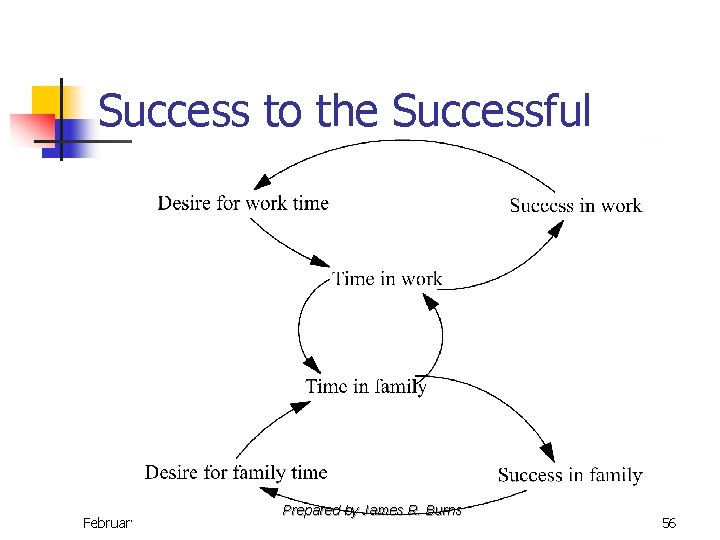
The Structure of Work/Family Imbalance n Success to the Successful Archetype, page 308 February 19, 2004 Prepared by James R. Burns 55
Success to the Successful February 19, 2004 Prepared by James R. Burns 56
This is very unstable n n Once it starts to drift one way or another, it will tend to continue to drift There are several reasons why it tends to drift toward more and more time at work n n n Income pushing ahead at work becomes a convenient excuse for avoiding the anguish of going home to an unhappy spouse The imbalance is not self-correcting--it gets worse over time February 19, 2004 Prepared by James R. Burns 57
The Futility of Managing your Life Within this Structure n n One-time improvements in family tend to get overwhelmed by escalating pressures at work Eventually, people realize that the structure itself must get changed February 19, 2004 Prepared by James R. Burns 58
The Individual’s Role in changing the structure n n Is it really your vision to have a balance between work and family? Making a conscious choice will entail setting clear personal goals for time at home. n n being home for dinner, giving up weekends for family, reduce evening business meetings Be willing to pay a price for taking a stand for a vision of balance between work and family February 19, 2004 Prepared by James R. Burns 59
The Organization’s Role n n n By fostering such conflict, orgs. distract and un-empower their members By fostering such conflict, orgs. fail to exploit a potential synergy that can exist between learning orgs, learning individuals, learning families Bill O’Brien says the skills of leadership in a learning organization are the skills of effective parenting. February 19, 2004 Prepared by James R. Burns 60
What does Leading involve in a Learning Organization? n n n Supporting people in clarifying and pursuing their own visions Helping people discover underlying causes of problems, and empowering them to make choices Looking for synergy between productive family and productive work life February 19, 2004 Prepared by James R. Burns 61
Senge believes n n these changes will lead more organizations to undo divisive pressures and demands that create family/work imbalances orgs will acknowledge that strong companies cannot be built on a foundation of broken homes and strained personal relationships February 19, 2004 Prepared by James R. Burns 62
Steps Orgs. can Take n n Provide day care for single parents Support personal mastery as a part of the org’s philosophy and strategy Make it acceptable for people to acknowledge family issues Where needed, help people obtain counseling and guidance for how to make effective use of their family time February 19, 2004 Prepared by James R. Burns 63
The conflict of work and home is. . . n n n a conflict of time a conflict of values but can be perceived as something else entirely February 19, 2004 Prepared by James R. Burns 64
What the parent learns at home…. n n can be used at work how to build self-esteem works in both contexts, for example February 19, 2004 Prepared by James R. Burns 65
Let’s take a break n n Stand up Walk around the room—in single file n n Bet its been a few years since you’ve been asked to do that Now return to your chair Now, touch the top of your head with your left hand Now sit down February 19, 2004 66
Microworlds: The Technology of the Learning Organization Senge, Chapter 17 THE FIFTH DISCIPLINE
How can we rediscover the child learner within us? n n n Human beings learn best through firsthand experience. Learning by doing only works so long as the feedback from our actions is rapid and unambiguous But learning from experience is neither rapid nor unambiguous because the consequences of our actions are separated from us in time and space February 19, 2004 68
How then can we learn? Microworlds (MW) n n n MWs enable managers and management teams to begin “learning by doing” MWs are nothing more or less than interactive simulations MWs compress time and space so that it becomes possible to experiment and to learn when the consequences are in the distant future and in distant parts of the organization February 19, 2004 69
Transitional objects: the way children learn n n Children have a rate of learning that is truly astounding They rehearse with transitional objects: dolls, blocks, play-houses, etc. . Managers too have their transitional objects: MWs When teams go white-water rafting, participate in a role playing exercise, participate in a dialogue practice session, they are engaging in a microworld. February 19, 2004 70
Transitional objects: Are they the best? n n A white-water rafting trip doesn’t produce powerful insights into strategic business issues Role-playing exercises do not show us whether our personnel policies are aligned with our manufacturing and marketing policies February 19, 2004 71
What about computer simulations? n n PC is ubiquitous and getting more powerful every month These simulations will prove to be a critical technology for implementing the disciplines of the learning organization February 19, 2004 72
How Does Organizational Learning Occur? n n According to Shell’s Arie de Geus, by Changing the rules of the game (through openness and localness) Through play Microworlds are places for relevant play February 19, 2004 73
MWs allow for…. n n n issues and dynamics of complex business situations to be explored through trying out new strategies and policies and seeing what might happen Costs of failed experiments disappear Organizational sanctions against experimentation are nonexistent February 19, 2004 74
MWs are being used today by managers…. n n for managing growth for product development for improving quality in both service and manufacturing business and they build upon the system archetypes February 19, 2004 75
MW 1: Future Learning: Discovering Internal Contradictions in a Strategy n n Lying behind all strategies are assumptions, which remain implicit and untested These assumptions have internal contradictions Such internal contradictions cause the strategy to also have internal contradictions Such internal contradictions make the strategy difficult to implement February 19, 2004 76
The Business Plan of Index Computer Company n n GOAL: reach 2 billion in sales in four years Reqd. James Sawyer, vice pres. of sales, to double his sales force Other top managers were unsympathetic saying “you will work it out” While uncomfortable, Mr. Sawyer did not want to become a “nay sayer. ” February 19, 2004 77
Executives split into 3 -person microworld teams to play out the consequences of the sales plan n n They constructed an explicit model of the assumptions behind the plan 20% annual sales growth Hire 20% more salespeople and you make 20% more sales Sawyer says “wait a minute. . . not all salespeople are equal…there is much they have to learn…before they can sell a single system February 19, 2004 78
Sawyer continues. . . n n n we got most of our sales people originally by hiring away from competitors today 20% is so many people that we cannot possibly get experienced people from our competitors assumptions were changed to show inexperienced sales people to be only 1/3 to 1/4 as productive as experienced salespeople February 19, 2004 79
Consequences n n could not reach goal of $2 billion in sales in four years could only get to $1. 5 billion Attempts to get to $2 billion resulted in having to double the sales force in the fourth year alone This would wreak havoc on the sales organization and the personnel budget February 19, 2004 80
Sawyer’s assessment n n n There would be a lot of pressure on our veterans And, our veterans would have to train the new salespeople This wold result in more veterans leaving This would create a vicious cycle Many of our veterans came to us to escape this kind of situation somewhere else February 19, 2004 81
Then Susan Willis, Director of Human Resources had her say n sales people resist any call to invest their time in training and developing new salespeople February 19, 2004 82
Further, Susan Willis said: n Sawyer said this was because of hiring the most aggressive salespeople who get their kicks and their commissions from closing a sale in the field n n There are no incentives or commissions for helping newcomers The proposed strategic plan would simply reinforce this problem February 19, 2004 83
Conclusions of the MW session at Index n n Train new sales people more quickly Establish new rewards for sales managers to develop their staffs Get more support to help senior sales people mentor and train new sales people Create a MW for training new sales people February 19, 2004 84
MW 2: Seeing Hidden Strategic Opportunities: How our Beliefs Influence our Customer’s Preferences n n n Here again MWs are helpful in surfacing different assumptions and discovering how they can be related in a larger understanding Bill Seaver and John Henry are president and VP for Meadowlands Shelving Company They have reached an impasse in the way they saw their customers and their market February 19, 2004 85
Seaver believes. . . n That the key to success in the market place lays in having good products priced competitively February 19, 2004 86
Henry agrees but. . . n n Also felt service quality could play a big part in whether or not customers chose Meadowlands Believed the company should invest in upgrading its service through training Meadowlands dealers in performing a wide range of services from better account management to office design and troubleshooting customers problems February 19, 2004 87
Seaver’s response was. . . n These are good ideas but he didn’t support spending significantly more on dealer support because he was convinced that it would not have significant impact on Meadowlands’ sales. February 19, 2004 88
Sales people said. . . n n n “Our competitors are discounting like mad and we can only hold our own if we match or better them” When Henry himself talked with customers, frequently they said they would rather have 5% off on their sales order than have better service after the sale Still he held onto his belief that there must be a way to gain competitive advantage through better service February 19, 2004 89
What the MW showed. . . n n Continual discounts in the face of poor service quality became a vicious circle Efforts to maintain customers with better service quality lacked credibility because they had experienced poor service for so long February 19, 2004 90
Further, the MW showed… n Investing in service quality took a long time to exhibit its effects because n n customers have to experience improved service before they take it seriously the repurchasing delay in the shelving industry took two-to-four years February 19, 2004 91
Both Seaver and Henry were right…. n n n Seaver was right in the short run Henry, in the long Both learned a lot about the way the company interacted with its customers and within itself. MW 3: Discovering Untapped Leverage: The Drift to Low Quality in Service Businesses February 19, 2004 92
The Leader’s New Work Peter Senge, THE FIFTH DISCIPLINE, Chapter 18
Self-directed teams require a new leadership style n n n The traditional style of clear directions and well-intentioned manipulation doesn’t work People with a sense of their own vision and commitment would naturally reject efforts of a leader to get them committed. One leader did not know what to do, now that he had a self-directed team February 19, 2004 94
Our view of leaders…. n n n Is wrong Especially in the West, leaders are heros --great men who rise to the occasion This view reinforces a focus on events and charismatic control of those events rather than on systemic forces and collective learning February 19, 2004 95
Our view of leaders, continued n At its heart, the traditional view of leadership is based on assumptions of people’s powerlessness, their lack of personal vision and inability to master the forces of change February 19, 2004 96
The new view of leadership in learning organizations n n n Leaders are designers, stewards, and teachers Leaders build organizations where people continually expand their capacity to understand complexity, clarify vision, and improve shared mental models That is, leaders are responsible for creating a culture where learning is rewarded February 19, 2004 97
Leader as …. . n Suppose your org is an ocean liner and you are the leader. What is your role? n n The commonest answer, not surprisingly, is “the captain. ” Other less common answers include the helmsman, the navigator, the social director (making sure everybody is involved, and communicating) February 19, 2004 98
The neglected leadership role is … n n the designer of the ship. No one has a more sweeping influence than the designer. It does no good for the captain of the ship to say turn starboard 30 deg. when the designer only allowed for 15 deg. Yet NO ONE thinks of the designer when they think of the leader’s new role!! February 19, 2004 99
Why did no one think of the designer n n Lao-tzu: little credit goes to the designer The functions of design are rarely visible Consequences today are the result of work done long ago in the past Design work today will show its consequences long in the future February 19, 2004 100
What must leaders design? n n n n Policies, strategies, “systems, ” organizations, specifically Selection policies Vision strategies Value systems Culture systems Measurement systems Rewards systems Criteria by which excellence will be determined February 19, 2004 101
And what of Design? n It is an integrative initiative n n n All of the parts must fit together and work well together as a whole under a variety of circumstances The leader must view the firm as a “system” -- Ray Strata Corporate executives must become organizational architects -- Ed Simon February 19, 2004 102
Gives rise to a new discipline: Business Design n n n Must loose focus on the P&L statement Look at the long term, instead Have to get away from piecemeal reactions to problems Have to integrate the five component technologies Must integrate vision, values, purpose, systems thinking, and mental models The synergy of the disciplines can propel an organization to major breakthroughs February 19, 2004 103
First tasks of Business Design n n Design the governing ideas--purpose, vision, and core values Building shared vision is important because it fosters a longer-term orientation and an imperative for learning Get the systems thinking going early on Get the concept of mental models and surfacing underlying assumptions going early as well February 19, 2004 104
Subsequent tasks of Business Design n n Design the learning processes Get personal mastery going February 19, 2004 105
The Leader as Steward n Leaders have a purpose story n n This is an overarching explanation of why they do what they do how their organizations need to evolve how that evolution is part of something larger Most gifted leaders have a “larger story” February 19, 2004 106
The Leader as Teacher n n n First job of leader is to define reality Leader must help people achieve more accurate, more insightful and more empowering views of reality Must view reality at four levels: events, patterns, structures and ultimately a “purpose story” February 19, 2004 107
Creative Tension n What role does it play in leadership? February 19, 2004 108
How can such Leaders be Developed? ? February 19, 2004 109
Time to Choose n n n Learning or not Systems thinking or not PM or not MM or not SV or not TL or not February 19, 2004 110
THE END That is all, Folks See you tomorrow
February 19, 2004 112
February 19, 2004 113