Prolog Programming in Logic with some mention of
![homepage(html(head(title("Peter A. Flach")), body([img([align=right, src="logo. jpg"]), One big term img([align=left, src="peter. jpg"]), representing h](https://slidetodoc.com/presentation_image_h/79b08e21040a7065c4eff74a7ca6dd41/image-47.jpg "homepage(html(head(title(\"Peter A. Flach\")), body([img([align=right, src=\"logo. jpg\"]), One big term img([align=left, src=\"peter. jpg\"]), representing h")







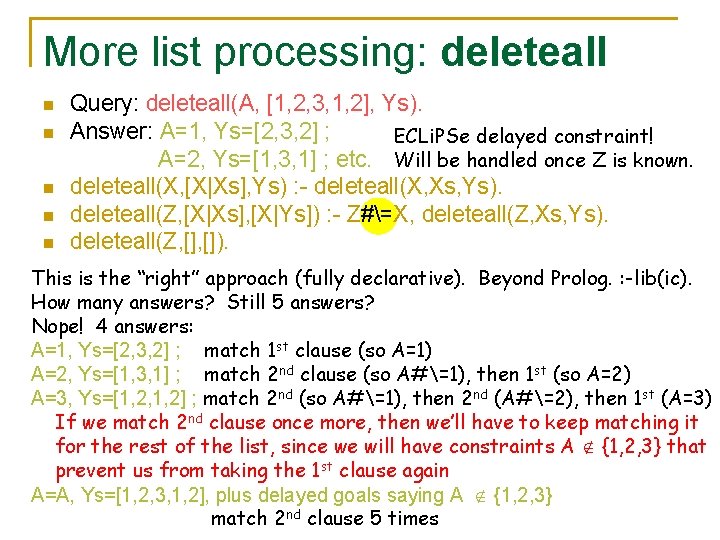
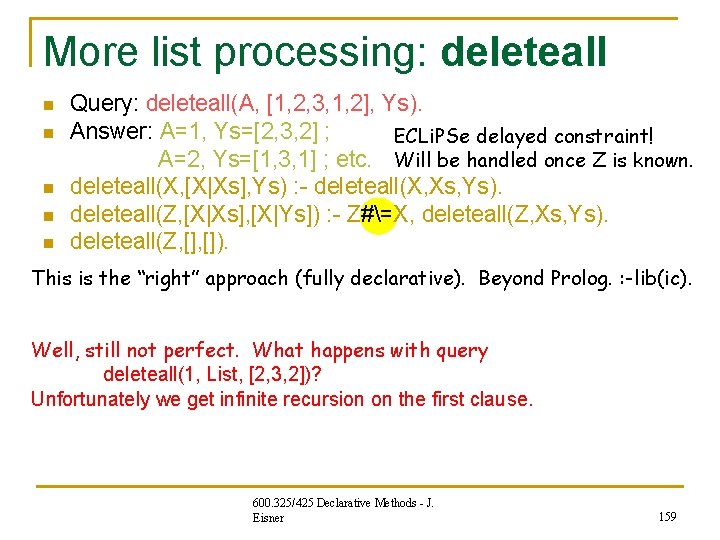
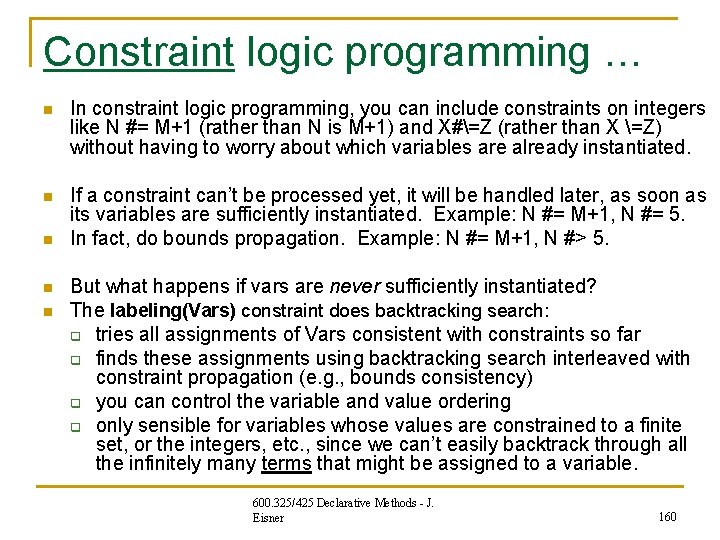
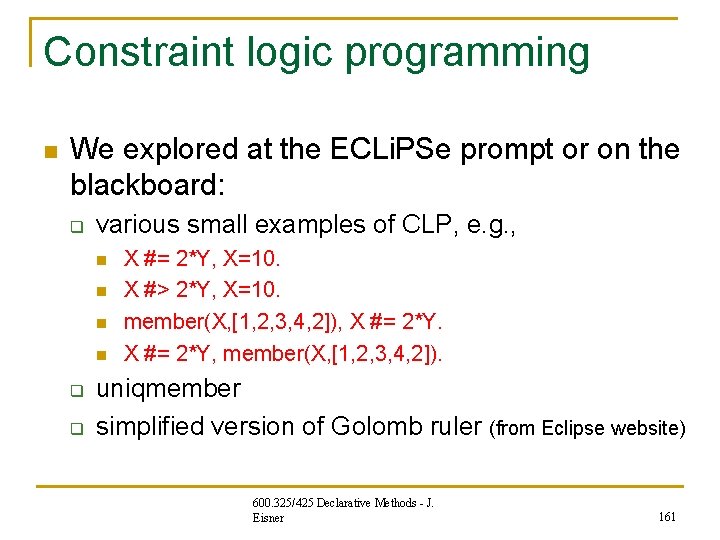
- Slides: 162
Prolog: Programming in Logic with some mention of Datalog and Constraint Logic Programming 600. 325/425 Declarative Methods - J. Eisner 1
The original declarative programming language n Courses in programming languages … q q n Prolog is always the declarative language they teach. (imperative, functional, object-oriented, declarative) Alain Colmeraeur & Philippe Roussel, 1971 -1973 q q q With help from theorem proving folks such as Robert Kowalski Original project: Type in French statements & questions n Computer needed NLP and deductive reasoning Efficiency by David Warren, 1977 (compiler, virtual machine) Colmerauer & Roussel wrote 20 years later: “Prolog is so simple that one has the sense that sooner or later someone had to discover it … that period of our lives remains one of the happiest in our memories. “We have had the pleasure of recalling it for this paper over almonds accompanied by a dry martini. ” 600. 325/425 Declarative Methods - J. Eisner 2
Prolog vs. ECLi. PSe n Most common free Prolog implementation is SWI Prolog. q n Very nice, though faster ones are for sale (e. g. , SICSTUS Prolog). To run Prolog, you can just run ECLi. PSe! q ECLi. PSe is a perfectly good Prolog implementation, although so far we’ve concentrated only on its “extra” features. 600. 325/425 Declarative Methods - J. Eisner 3
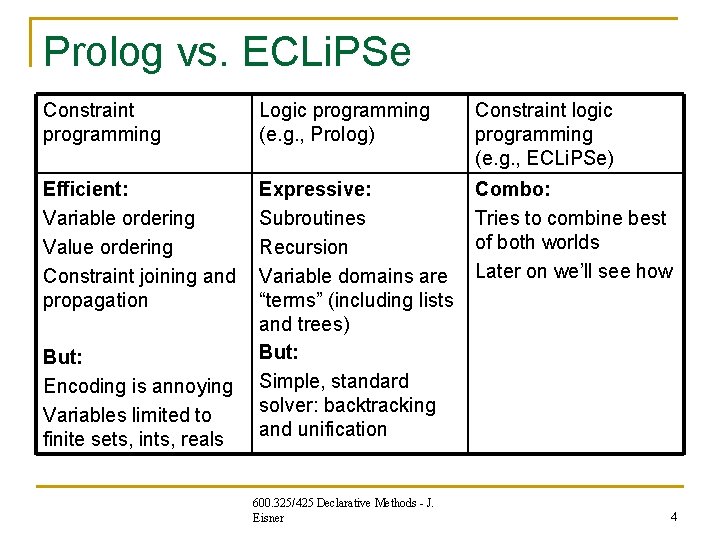
Prolog vs. ECLi. PSe Constraint programming Logic programming (e. g. , Prolog) Constraint logic programming (e. g. , ECLi. PSe) Efficient: Variable ordering Value ordering Constraint joining and propagation Expressive: Subroutines Recursion Variable domains are “terms” (including lists and trees) But: Simple, standard solver: backtracking and unification Combo: Tries to combine best of both worlds Later on we’ll see how But: Encoding is annoying Variables limited to finite sets, ints, reals 600. 325/425 Declarative Methods - J. Eisner 4
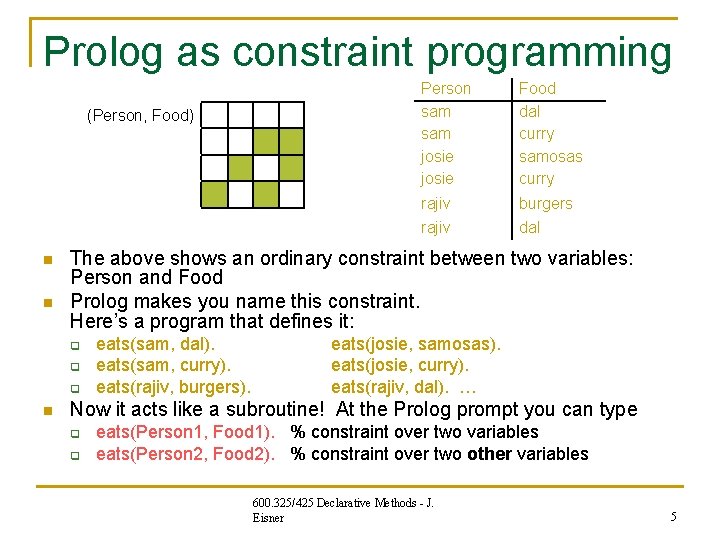
Prolog as constraint programming (Person, Food) n n Food dal curry samosas curry rajiv burgers rajiv dal The above shows an ordinary constraint between two variables: Person and Food Prolog makes you name this constraint. Here’s a program that defines it: q q q n Person sam josie eats(sam, dal). eats(sam, curry). eats(rajiv, burgers). eats(josie, samosas). eats(josie, curry). eats(rajiv, dal). … Now it acts like a subroutine! At the Prolog prompt you can type q q eats(Person 1, Food 1). % constraint over two variables eats(Person 2, Food 2). % constraint over two other variables 600. 325/425 Declarative Methods - J. Eisner 5
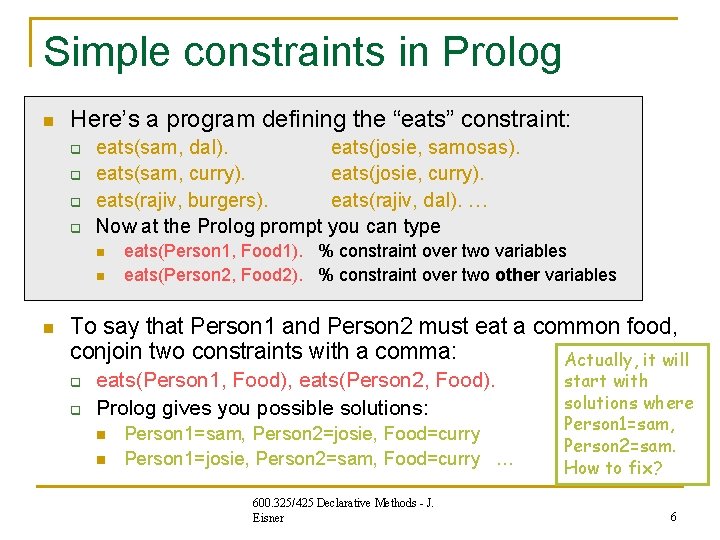
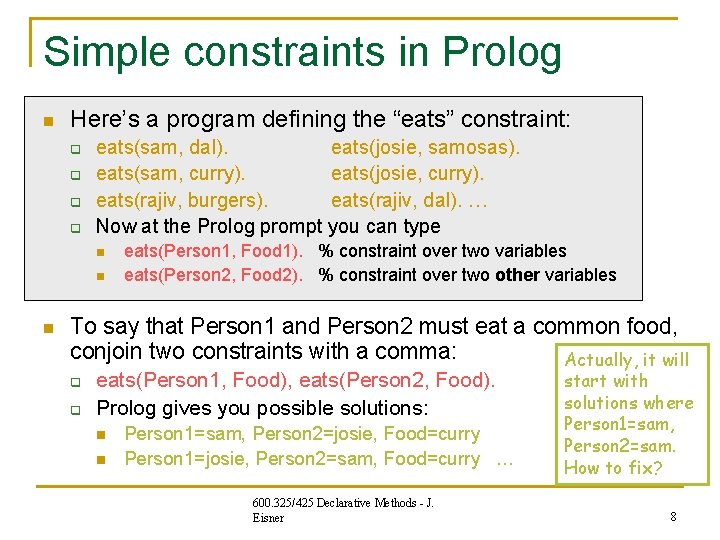
Simple constraints in Prolog n Here’s a program defining the “eats” constraint: q q eats(sam, dal). eats(josie, samosas). eats(sam, curry). eats(josie, curry). eats(rajiv, burgers). eats(rajiv, dal). … Now at the Prolog prompt you can type n n n eats(Person 1, Food 1). % constraint over two variables eats(Person 2, Food 2). % constraint over two other variables To say that Person 1 and Person 2 must eat a common food, conjoin two constraints with a comma: Actually, it will q q eats(Person 1, Food), eats(Person 2, Food). Prolog gives you possible solutions: n n Person 1=sam, Person 2=josie, Food=curry Person 1=josie, Person 2=sam, Food=curry … 600. 325/425 Declarative Methods - J. Eisner start with solutions where Person 1=sam, Person 2=sam. How to fix? 6
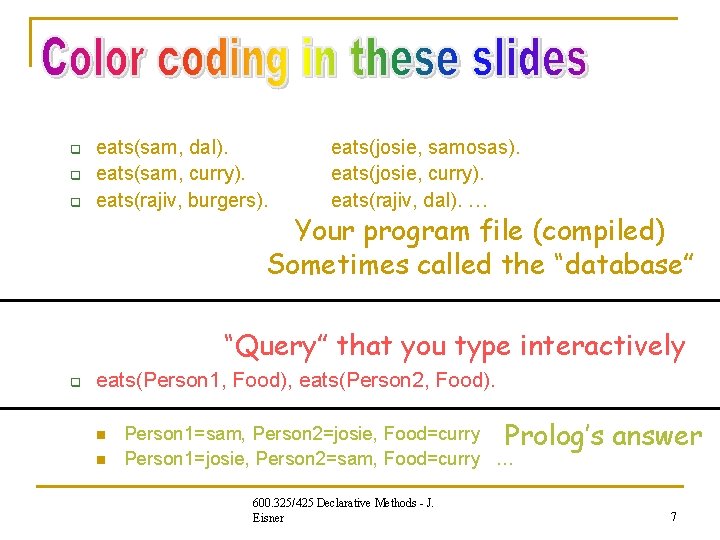
q q q eats(sam, dal). eats(sam, curry). eats(rajiv, burgers). eats(josie, samosas). eats(josie, curry). eats(rajiv, dal). … Your program file (compiled) Sometimes called the “database” “Query” that you type interactively q eats(Person 1, Food), eats(Person 2, Food). n n Person 1=sam, Person 2=josie, Food=curry Prolog’s Person 1=josie, Person 2=sam, Food=curry … 600. 325/425 Declarative Methods - J. Eisner answer 7
Simple constraints in Prolog n Here’s a program defining the “eats” constraint: q q eats(sam, dal). eats(josie, samosas). eats(sam, curry). eats(josie, curry). eats(rajiv, burgers). eats(rajiv, dal). … Now at the Prolog prompt you can type n n n eats(Person 1, Food 1). % constraint over two variables eats(Person 2, Food 2). % constraint over two other variables To say that Person 1 and Person 2 must eat a common food, conjoin two constraints with a comma: Actually, it will q q eats(Person 1, Food), eats(Person 2, Food). Prolog gives you possible solutions: n n Person 1=sam, Person 2=josie, Food=curry Person 1=josie, Person 2=sam, Food=curry … 600. 325/425 Declarative Methods - J. Eisner start with solutions where Person 1=sam, Person 2=sam. How to fix? 8
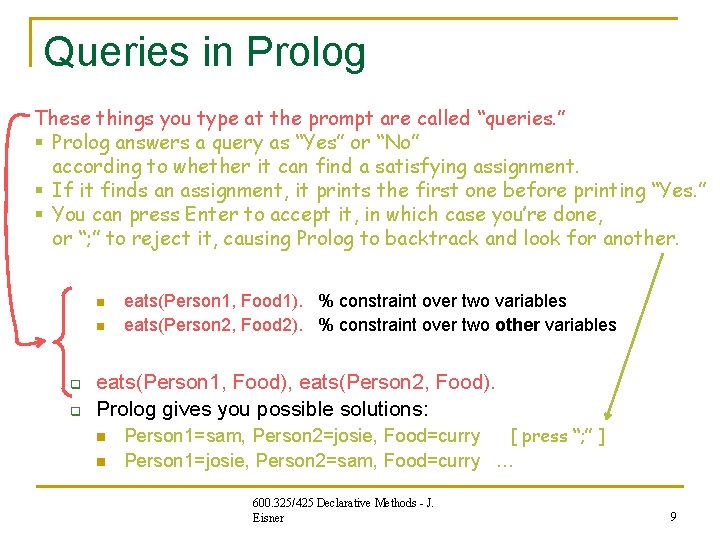
Queries in Prolog These things you type at the prompt are called “queries. ” § Prolog answers a query as “Yes” or “No” according to whether it can find a satisfying assignment. § If it finds an assignment, it prints the first one before printing “Yes. ” § You can press Enter to accept it, in which case you’re done, or “; ” to reject it, causing Prolog to backtrack and look for another. n n q q eats(Person 1, Food 1). % constraint over two variables eats(Person 2, Food 2). % constraint over two other variables eats(Person 1, Food), eats(Person 2, Food). Prolog gives you possible solutions: n n Person 1=sam, Person 2=josie, Food=curry [ press “; ” ] Person 1=josie, Person 2=sam, Food=curry … 600. 325/425 Declarative Methods - J. Eisner 9
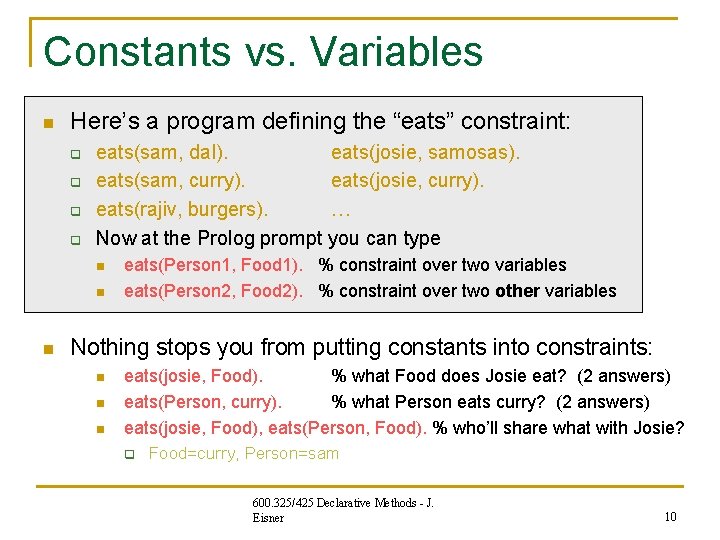
Constants vs. Variables n Here’s a program defining the “eats” constraint: q q eats(sam, dal). eats(josie, samosas). eats(sam, curry). eats(josie, curry). eats(rajiv, burgers). … Now at the Prolog prompt you can type n n n eats(Person 1, Food 1). % constraint over two variables eats(Person 2, Food 2). % constraint over two other variables Nothing stops you from putting constants into constraints: n n n eats(josie, Food). % what Food does Josie eat? (2 answers) eats(Person, curry). % what Person eats curry? (2 answers) eats(josie, Food), eats(Person, Food). % who’ll share what with Josie? q Food=curry, Person=sam 600. 325/425 Declarative Methods - J. Eisner 10
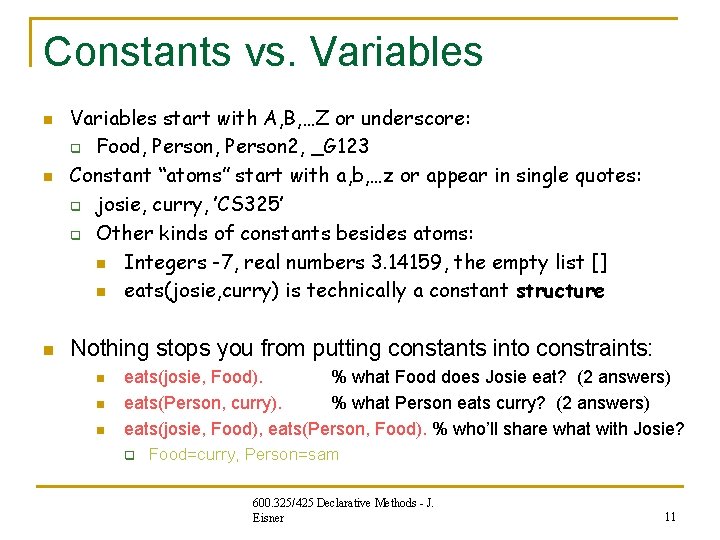
Constants vs. Variables n n n Variables start with A, B, …Z or underscore: q Food, Person 2, _G 123 Constant “atoms” start with a, b, …z or appear in single quotes: q josie, curry, ’CS 325’ q Other kinds of constants besides atoms: n Integers -7, real numbers 3. 14159, the empty list [] n eats(josie, curry) is technically a constant structure Nothing stops you from putting constants into constraints: n n n eats(josie, Food). % what Food does Josie eat? (2 answers) eats(Person, curry). % what Person eats curry? (2 answers) eats(josie, Food), eats(Person, Food). % who’ll share what with Josie? q Food=curry, Person=sam 600. 325/425 Declarative Methods - J. Eisner 11
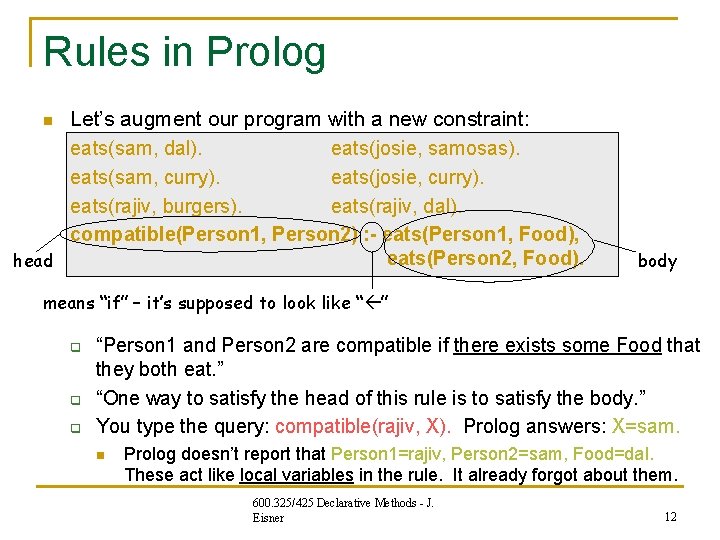
Rules in Prolog Let’s augment our program with a new constraint: eats(sam, dal). eats(josie, samosas). eats(sam, curry). eats(josie, curry). eats(rajiv, burgers). eats(rajiv, dal). compatible(Person 1, Person 2) : - eats(Person 1, Food), eats(Person 2, Food). head n body means “if” – it’s supposed to look like “ ” q q q “Person 1 and Person 2 are compatible if there exists some Food that they both eat. ” “One way to satisfy the head of this rule is to satisfy the body. ” You type the query: compatible(rajiv, X). Prolog answers: X=sam. n Prolog doesn’t report that Person 1=rajiv, Person 2=sam, Food=dal. These act like local variables in the rule. It already forgot about them. 600. 325/425 Declarative Methods - J. Eisner 12
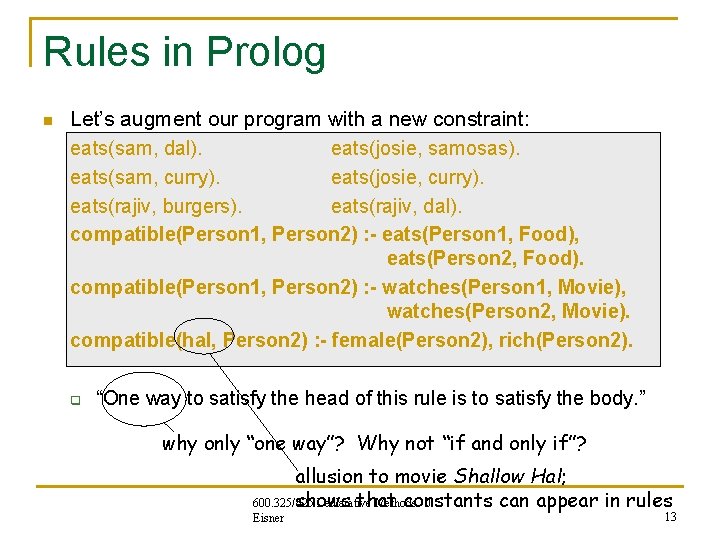
Rules in Prolog n Let’s augment our program with a new constraint: eats(sam, dal). eats(josie, samosas). eats(sam, curry). eats(josie, curry). eats(rajiv, burgers). eats(rajiv, dal). compatible(Person 1, Person 2) : - eats(Person 1, Food), eats(Person 2, Food). compatible(Person 1, Person 2) : - watches(Person 1, Movie), watches(Person 2, Movie). compatible(hal, Person 2) : - female(Person 2), rich(Person 2). q “One way to satisfy the head of this rule is to satisfy the body. ” why only “one way”? Why not “if and only if”? allusion to movie Shallow Hal; 600. 325/425 Declarative Methods - J. shows that constants can appear in rules Eisner 13
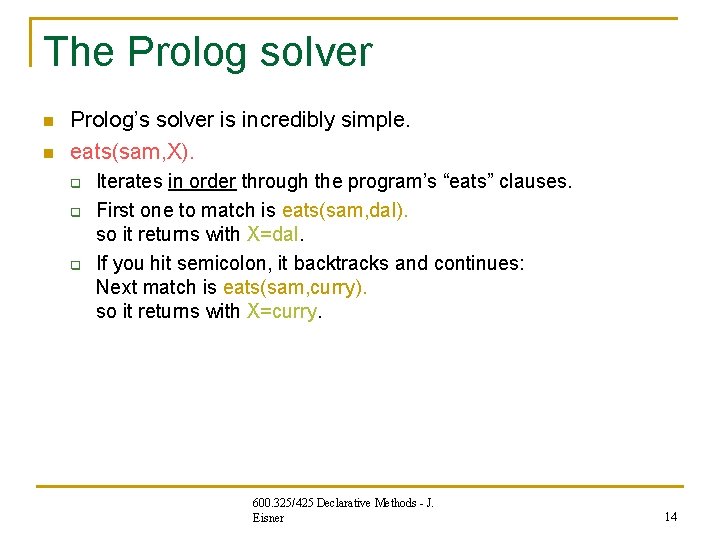
The Prolog solver n n Prolog’s solver is incredibly simple. eats(sam, X). q q q Iterates in order through the program’s “eats” clauses. First one to match is eats(sam, dal). so it returns with X=dal. If you hit semicolon, it backtracks and continues: Next match is eats(sam, curry). so it returns with X=curry. 600. 325/425 Declarative Methods - J. Eisner 14
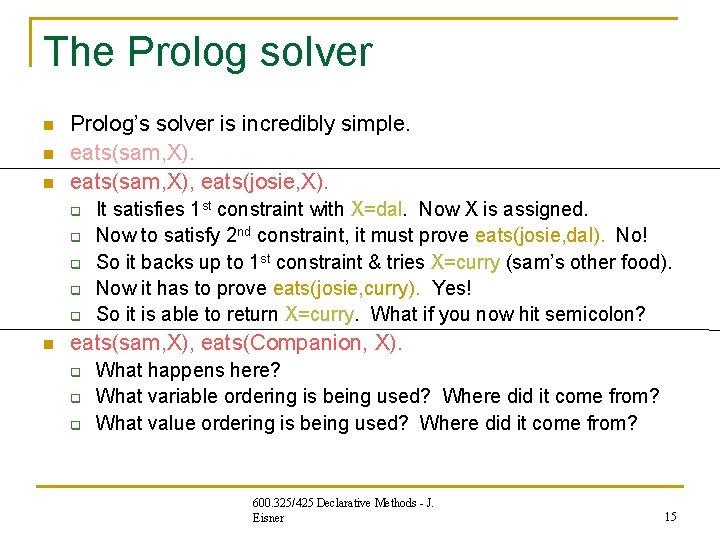
The Prolog solver n n n Prolog’s solver is incredibly simple. eats(sam, X), eats(josie, X). q q q n It satisfies 1 st constraint with X=dal. Now X is assigned. Now to satisfy 2 nd constraint, it must prove eats(josie, dal). No! So it backs up to 1 st constraint & tries X=curry (sam’s other food). Now it has to prove eats(josie, curry). Yes! So it is able to return X=curry. What if you now hit semicolon? eats(sam, X), eats(Companion, X). q q q What happens here? What variable ordering is being used? Where did it come from? What value ordering is being used? Where did it come from? 600. 325/425 Declarative Methods - J. Eisner 15
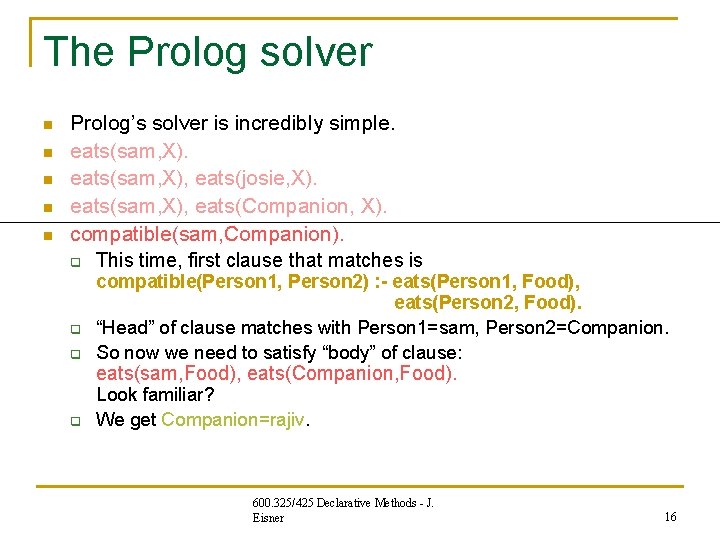
The Prolog solver n n n Prolog’s solver is incredibly simple. eats(sam, X), eats(josie, X). eats(sam, X), eats(Companion, X). compatible(sam, Companion). q This time, first clause that matches is q q compatible(Person 1, Person 2) : - eats(Person 1, Food), eats(Person 2, Food). “Head” of clause matches with Person 1=sam, Person 2=Companion. So now we need to satisfy “body” of clause: eats(sam, Food), eats(Companion, Food). q Look familiar? We get Companion=rajiv. 600. 325/425 Declarative Methods - J. Eisner 16
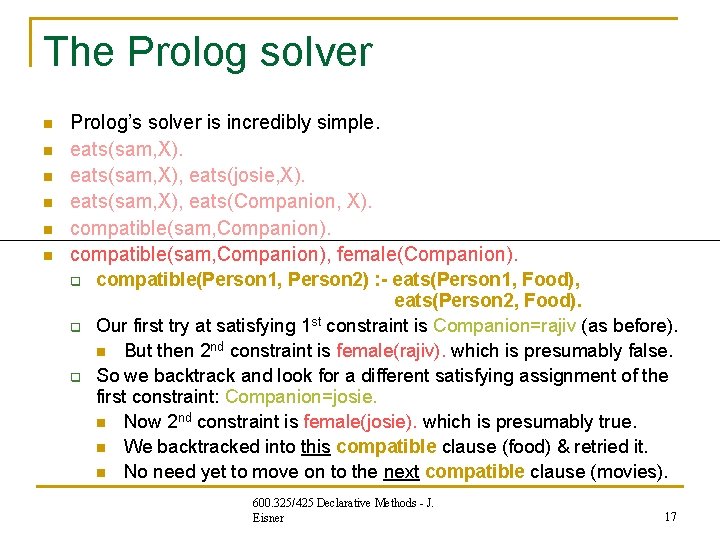
The Prolog solver n n n Prolog’s solver is incredibly simple. eats(sam, X), eats(josie, X). eats(sam, X), eats(Companion, X). compatible(sam, Companion), female(Companion). q q q compatible(Person 1, Person 2) : - eats(Person 1, Food), eats(Person 2, Food). Our first try at satisfying 1 st constraint is Companion=rajiv (as before). n But then 2 nd constraint is female(rajiv). which is presumably false. So we backtrack and look for a different satisfying assignment of the first constraint: Companion=josie. n Now 2 nd constraint is female(josie). which is presumably true. n We backtracked into this compatible clause (food) & retried it. n No need yet to move on to the next compatible clause (movies). 600. 325/425 Declarative Methods - J. Eisner 17
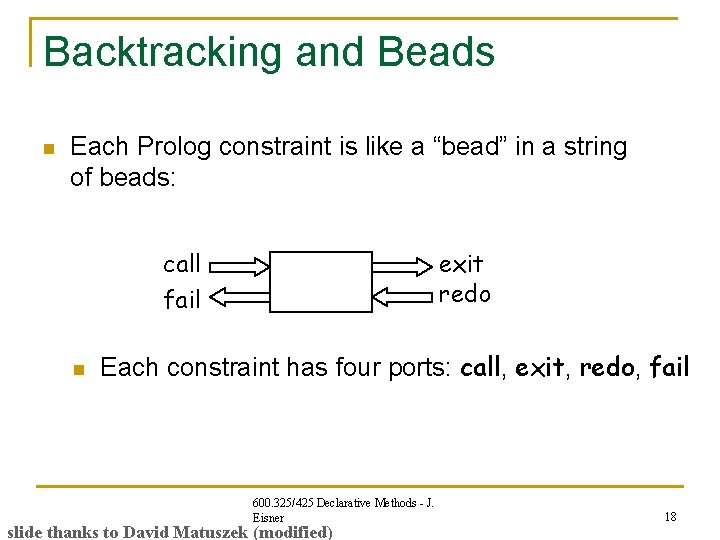
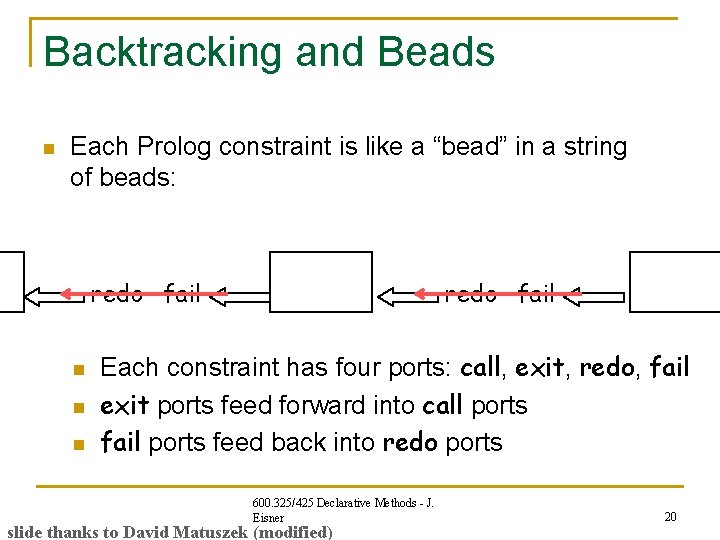
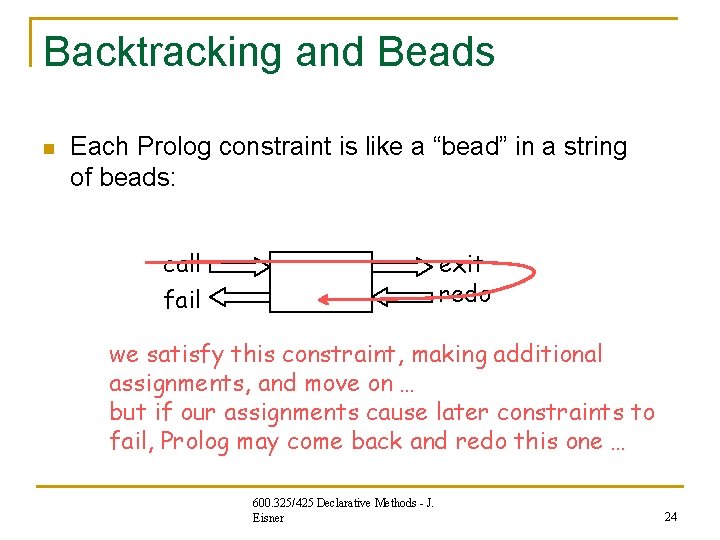
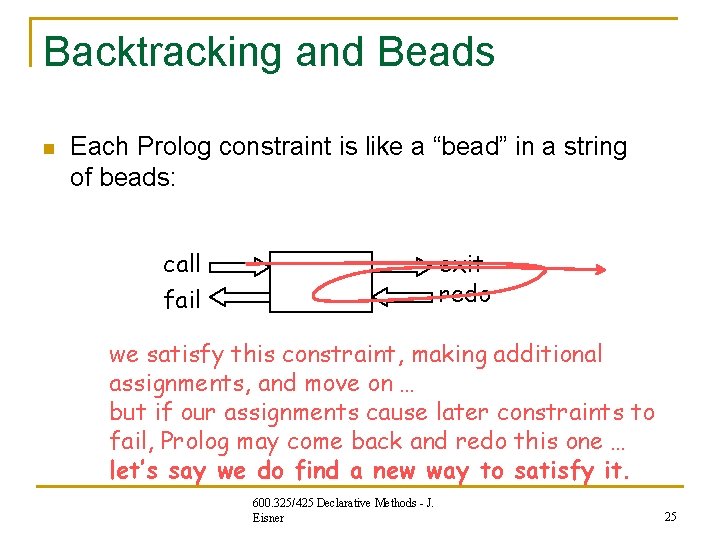
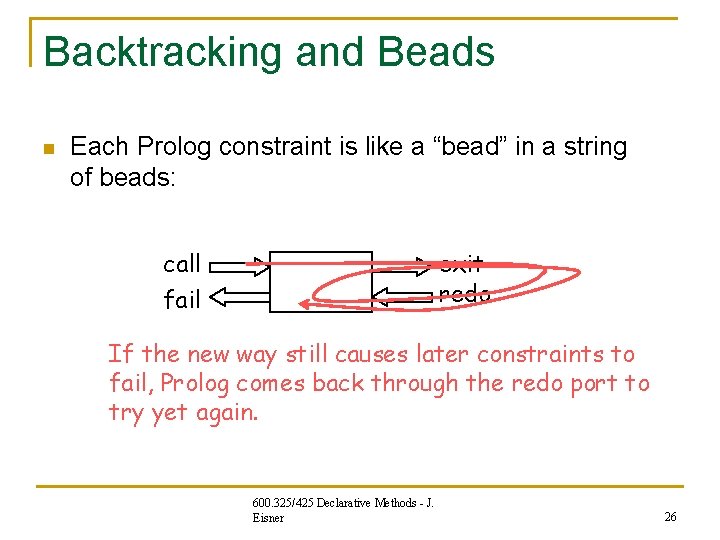
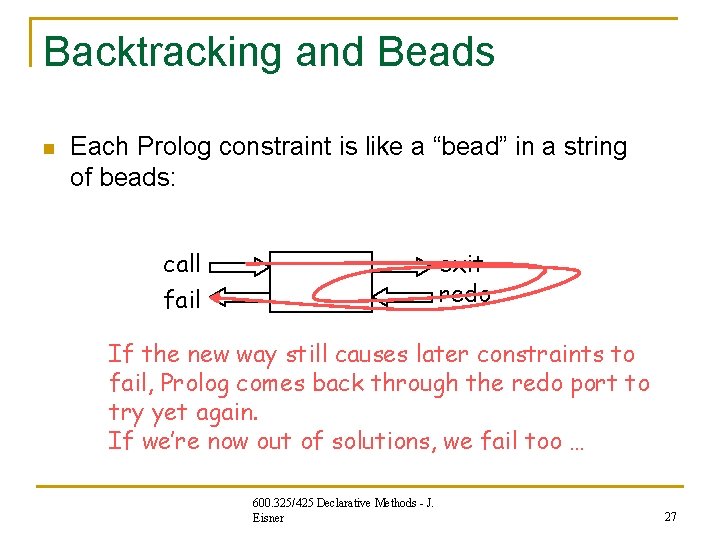
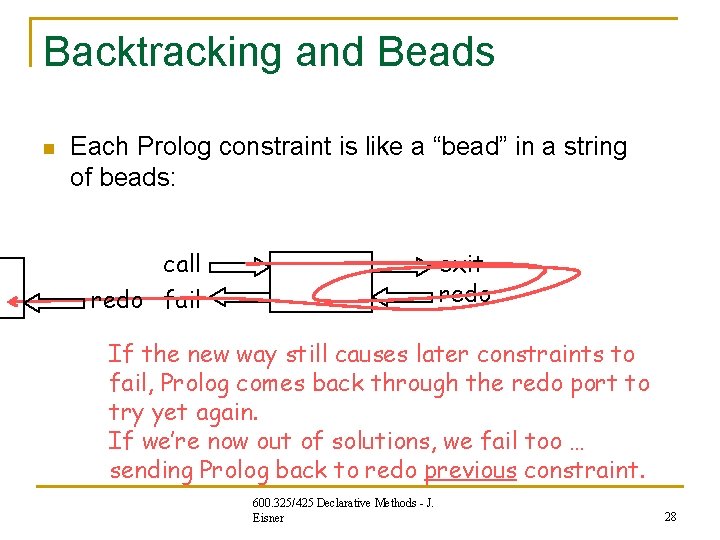
Backtracking and Beads n Each Prolog constraint is like a “bead” in a string of beads: call exit redo fail n Each constraint has four ports: call, exit, redo, fail 600. 325/425 Declarative Methods - J. Eisner slide thanks to David Matuszek (modified) 18
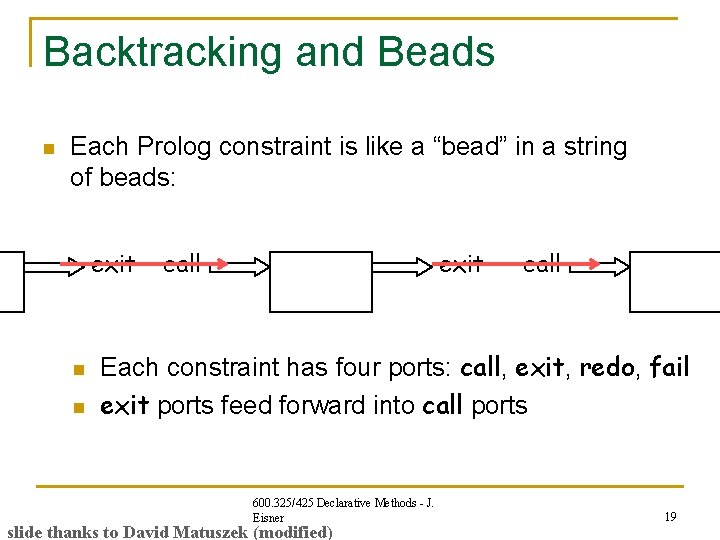
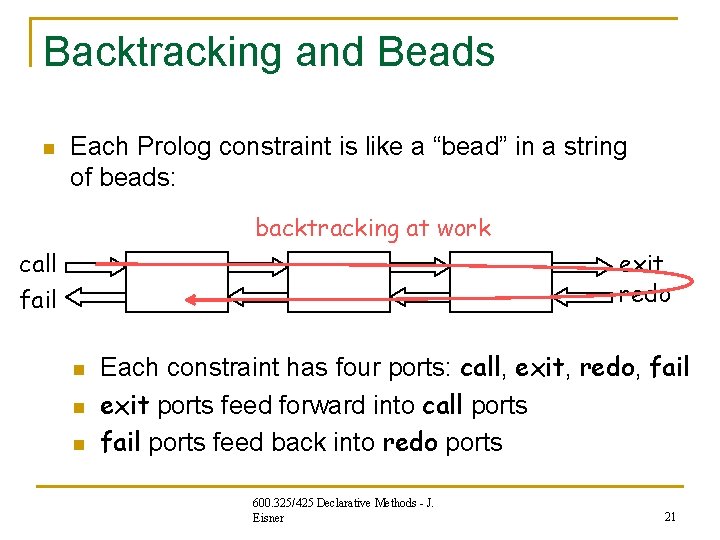
Backtracking and Beads n Each Prolog constraint is like a “bead” in a string of beads: exit n n call exit call Each constraint has four ports: call, exit, redo, fail exit ports feed forward into call ports 600. 325/425 Declarative Methods - J. Eisner slide thanks to David Matuszek (modified) 19
Backtracking and Beads n Each Prolog constraint is like a “bead” in a string of beads: redo fail n n n redo fail Each constraint has four ports: call, exit, redo, fail exit ports feed forward into call ports fail ports feed back into redo ports 600. 325/425 Declarative Methods - J. Eisner slide thanks to David Matuszek (modified) 20
Backtracking and Beads n Each Prolog constraint is like a “bead” in a string of beads: backtracking at work call exit redo fail n n n Each constraint has four ports: call, exit, redo, fail exit ports feed forward into call ports fail ports feed back into redo ports 600. 325/425 Declarative Methods - J. Eisner 21
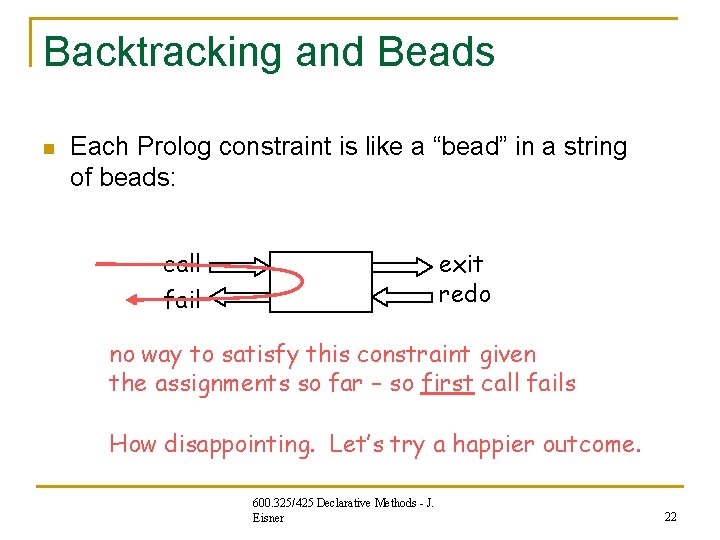
Backtracking and Beads n Each Prolog constraint is like a “bead” in a string of beads: call exit redo fail no way to satisfy this constraint given the assignments so far – so first call fails How disappointing. Let’s try a happier outcome. 600. 325/425 Declarative Methods - J. Eisner 22
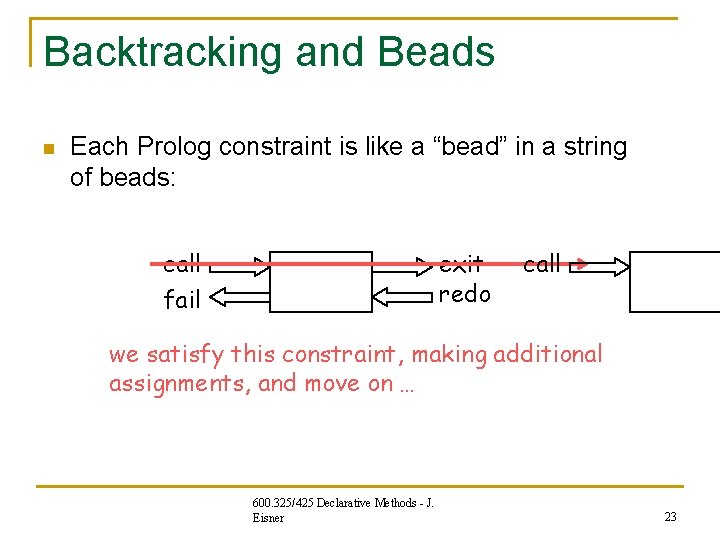
Backtracking and Beads n Each Prolog constraint is like a “bead” in a string of beads: call exit redo fail call we satisfy this constraint, making additional assignments, and move on … 600. 325/425 Declarative Methods - J. Eisner 23
Backtracking and Beads n Each Prolog constraint is like a “bead” in a string of beads: call exit redo fail we satisfy this constraint, making additional assignments, and move on … but if our assignments cause later constraints to fail, Prolog may come back and redo this one … 600. 325/425 Declarative Methods - J. Eisner 24
Backtracking and Beads n Each Prolog constraint is like a “bead” in a string of beads: call exit redo fail we satisfy this constraint, making additional assignments, and move on … but if our assignments cause later constraints to fail, Prolog may come back and redo this one … let’s say we do find a new way to satisfy it. 600. 325/425 Declarative Methods - J. Eisner 25
Backtracking and Beads n Each Prolog constraint is like a “bead” in a string of beads: call exit redo fail If the new way still causes later constraints to fail, Prolog comes back through the redo port to try yet again. 600. 325/425 Declarative Methods - J. Eisner 26
Backtracking and Beads n Each Prolog constraint is like a “bead” in a string of beads: call exit redo fail If the new way still causes later constraints to fail, Prolog comes back through the redo port to try yet again. If we’re now out of solutions, we fail too … 600. 325/425 Declarative Methods - J. Eisner 27
Backtracking and Beads n Each Prolog constraint is like a “bead” in a string of beads: call exit redo fail If the new way still causes later constraints to fail, Prolog comes back through the redo port to try yet again. If we’re now out of solutions, we fail too … sending Prolog back to redo previous constraint. 600. 325/425 Declarative Methods - J. Eisner 28
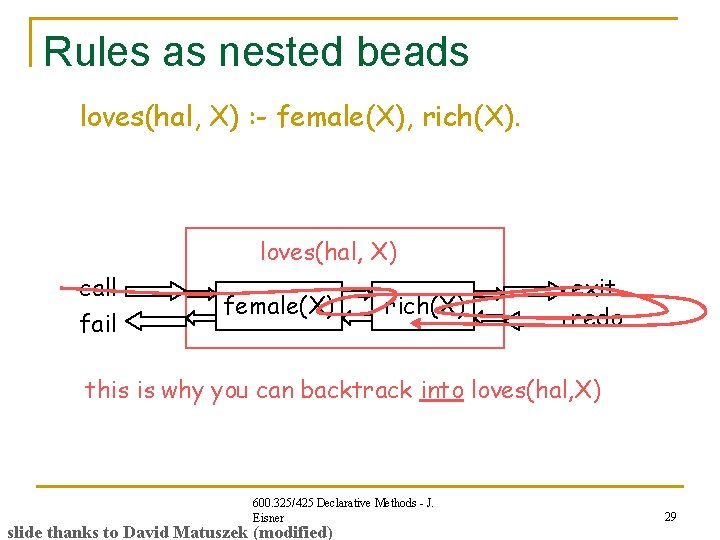
Rules as nested beads loves(hal, X) : - female(X), rich(X). loves(hal, X) call fail female(X) rich(X) exit redo this is why you can backtrack into loves(hal, X) 600. 325/425 Declarative Methods - J. Eisner slide thanks to David Matuszek (modified) 29
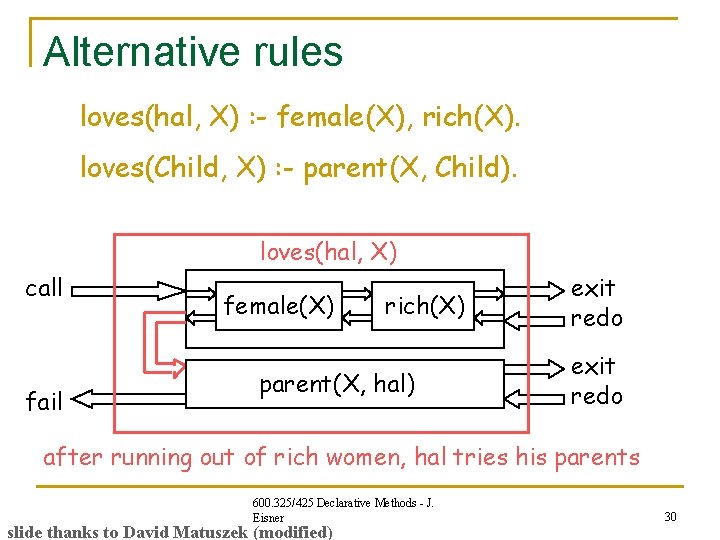
Alternative rules loves(hal, X) : - female(X), rich(X). loves(Child, X) : - parent(X, Child). loves(hal, X) call fail female(X) rich(X) parent(X, hal) exit redo after running out of rich women, hal tries his parents 600. 325/425 Declarative Methods - J. Eisner slide thanks to David Matuszek (modified) 30
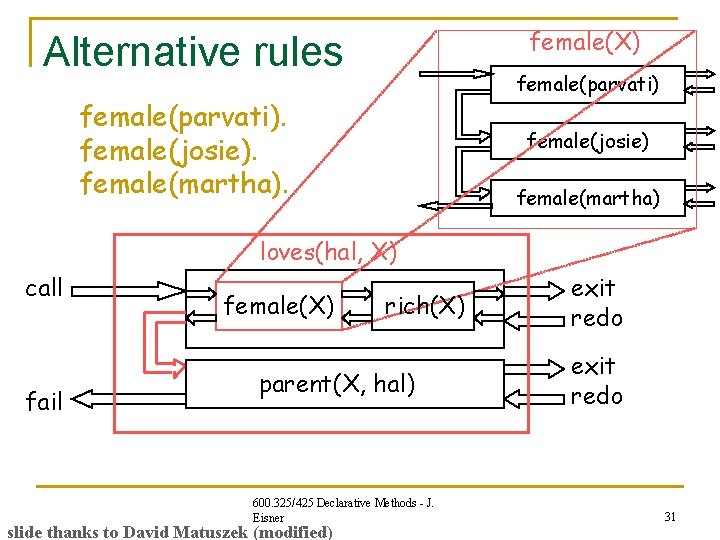
female(X) Alternative rules female(parvati). female(josie). female(martha). female(josie) female(martha) loves(hal, X) call fail female(X) rich(X) parent(X, hal) 600. 325/425 Declarative Methods - J. Eisner slide thanks to David Matuszek (modified) exit redo 31
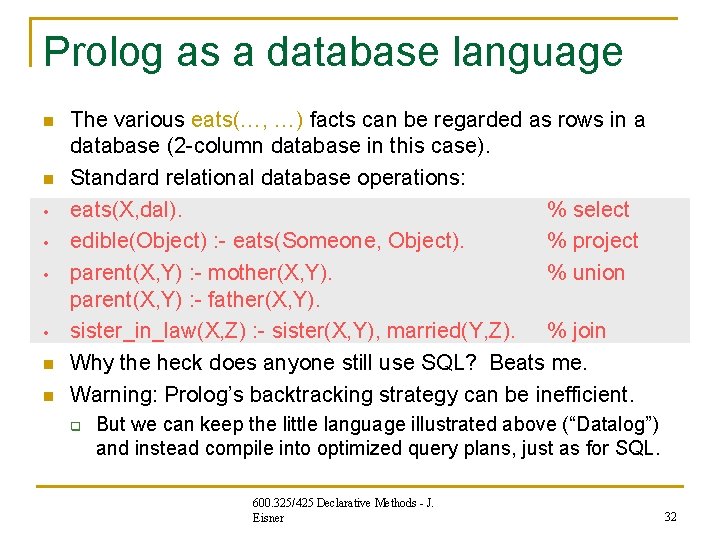
Prolog as a database language n n • • n n The various eats(…, …) facts can be regarded as rows in a database (2 -column database in this case). Standard relational database operations: eats(X, dal). % select edible(Object) : - eats(Someone, Object). % project parent(X, Y) : - mother(X, Y). % union parent(X, Y) : - father(X, Y). sister_in_law(X, Z) : - sister(X, Y), married(Y, Z). % join Why the heck does anyone still use SQL? Beats me. Warning: Prolog’s backtracking strategy can be inefficient. q But we can keep the little language illustrated above (“Datalog”) and instead compile into optimized query plans, just as for SQL. 600. 325/425 Declarative Methods - J. Eisner 32
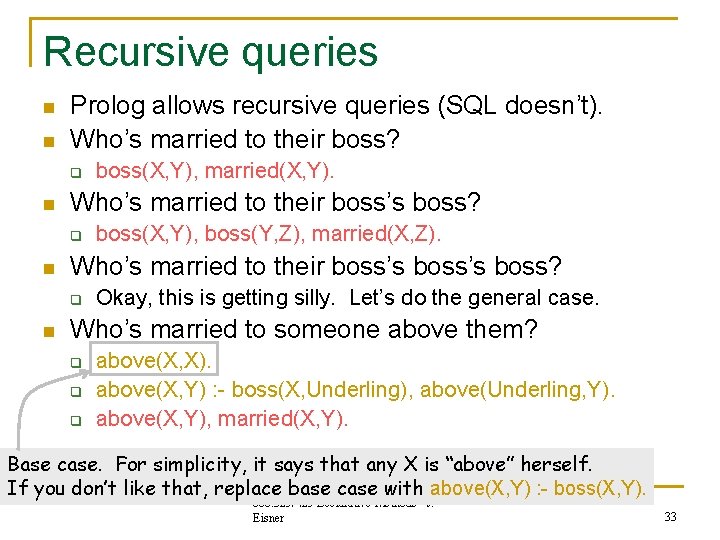
Recursive queries n n Prolog allows recursive queries (SQL doesn’t). Who’s married to their boss? q n Who’s married to their boss’s boss? q n boss(X, Y), boss(Y, Z), married(X, Z). Who’s married to their boss’s boss? q n boss(X, Y), married(X, Y). Okay, this is getting silly. Let’s do the general case. Who’s married to someone above them? q q q above(X, X). above(X, Y) : - boss(X, Underling), above(Underling, Y). above(X, Y), married(X, Y). Base case. For simplicity, it says that any X is “above” herself. If you don’t like that, replace base case with above(X, Y) : - boss(X, Y). 600. 325/425 Declarative Methods - J. Eisner 33
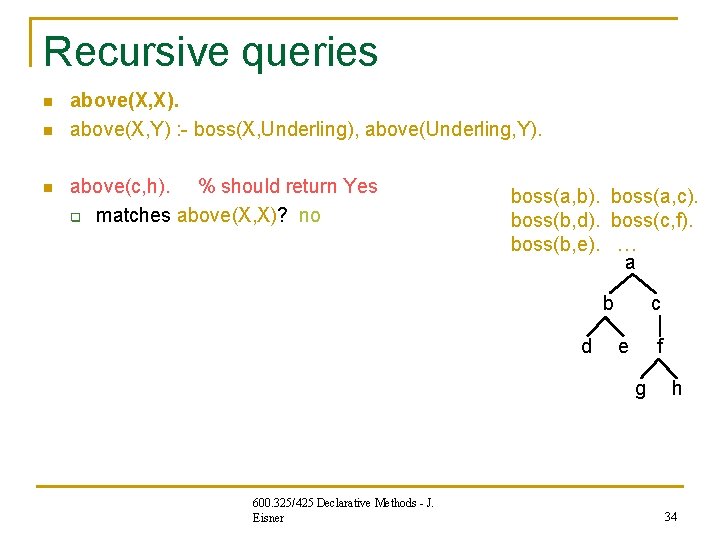
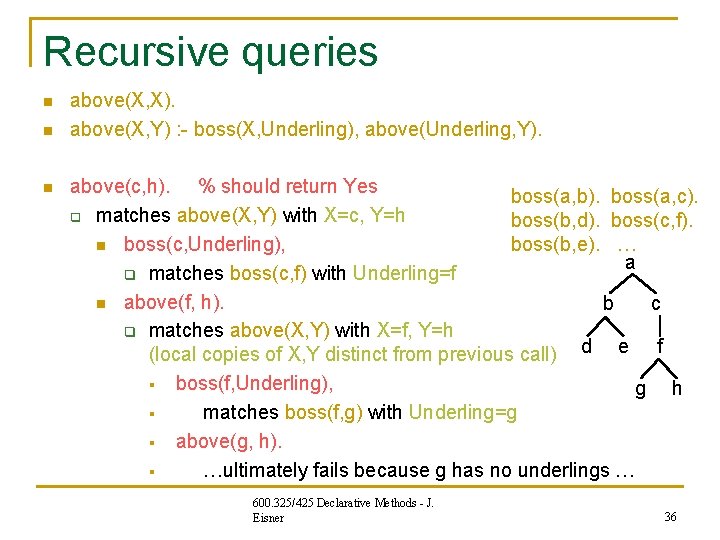
Recursive queries n n n above(X, X). above(X, Y) : - boss(X, Underling), above(Underling, Y). above(c, h). % should return Yes q matches above(X, X)? no boss(a, b). boss(a, c). boss(b, d). boss(c, f). boss(b, e). … a b d c e f g 600. 325/425 Declarative Methods - J. Eisner h 34
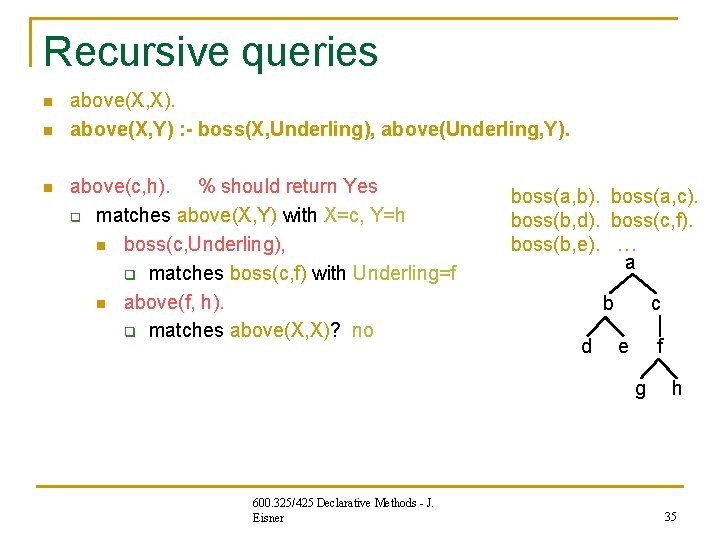
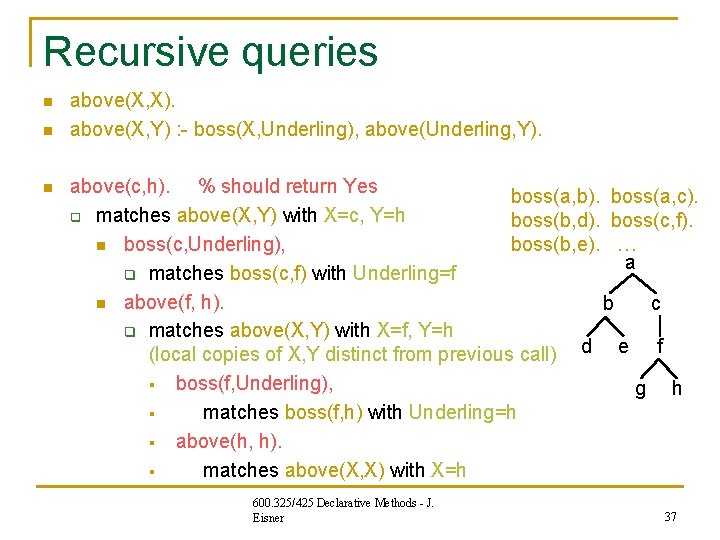
Recursive queries n n n above(X, X). above(X, Y) : - boss(X, Underling), above(Underling, Y). above(c, h). % should return Yes q matches above(X, Y) with X=c, Y=h n boss(c, Underling), q matches boss(c, f) with Underling=f n above(f, h). q matches above(X, X)? no boss(a, b). boss(a, c). boss(b, d). boss(c, f). boss(b, e). … a b d c e f g 600. 325/425 Declarative Methods - J. Eisner h 35
Recursive queries n n n above(X, X). above(X, Y) : - boss(X, Underling), above(Underling, Y). above(c, h). % should return Yes boss(a, b). boss(a, c). q matches above(X, Y) with X=c, Y=h boss(b, d). boss(c, f). n boss(c, Underling), boss(b, e). … a q matches boss(c, f) with Underling=f n above(f, h). b c q matches above(X, Y) with X=f, Y=h (local copies of X, Y distinct from previous call) d e f § boss(f, Underling), g h § matches boss(f, g) with Underling=g § above(g, h). § …ultimately fails because g has no underlings … 600. 325/425 Declarative Methods - J. Eisner 36
Recursive queries n n n above(X, X). above(X, Y) : - boss(X, Underling), above(Underling, Y). above(c, h). % should return Yes boss(a, b). boss(a, c). q matches above(X, Y) with X=c, Y=h boss(b, d). boss(c, f). n boss(c, Underling), boss(b, e). … a q matches boss(c, f) with Underling=f n above(f, h). b c q matches above(X, Y) with X=f, Y=h (local copies of X, Y distinct from previous call) d e f § boss(f, Underling), g h § matches boss(f, h) with Underling=h § above(h, h). § matches above(X, X) with X=h 600. 325/425 Declarative Methods - J. Eisner 37
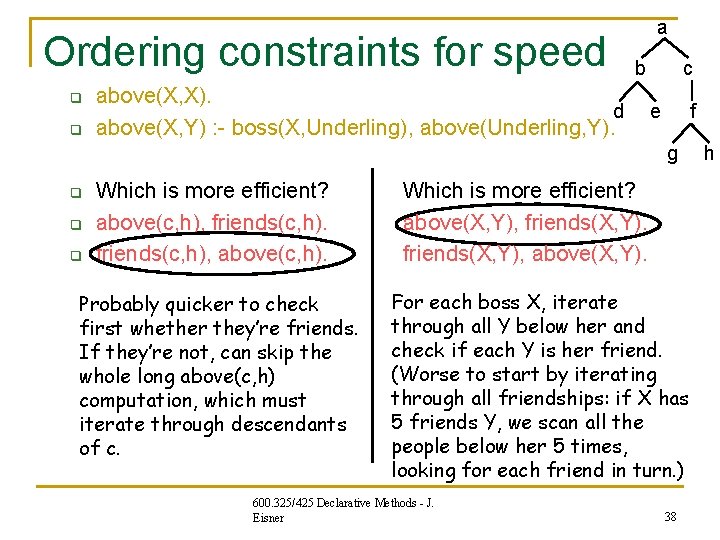
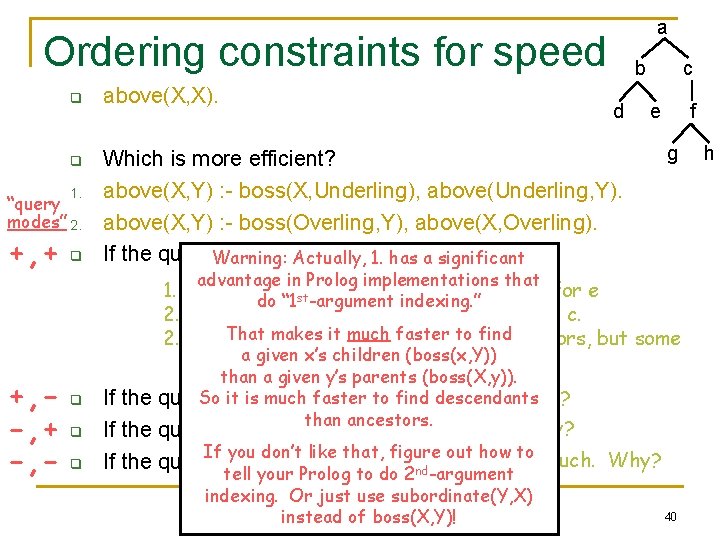
Ordering constraints for speed q q a b above(X, X). d above(X, Y) : - boss(X, Underling), above(Underling, Y). c e f g q q q Which is more efficient? above(c, h), friends(c, h), above(c, h). Probably quicker to check first whether they’re friends. If they’re not, can skip the whole long above(c, h) computation, which must iterate through descendants of c. Which is more efficient? above(X, Y), friends(X, Y), above(X, Y). For each boss X, iterate through all Y below her and check if each Y is her friend. (Worse to start by iterating through all friendships: if X has 5 friends Y, we scan all the people below her 5 times, looking for each friend in turn. ) 600. 325/425 Declarative Methods - J. Eisner 38 h
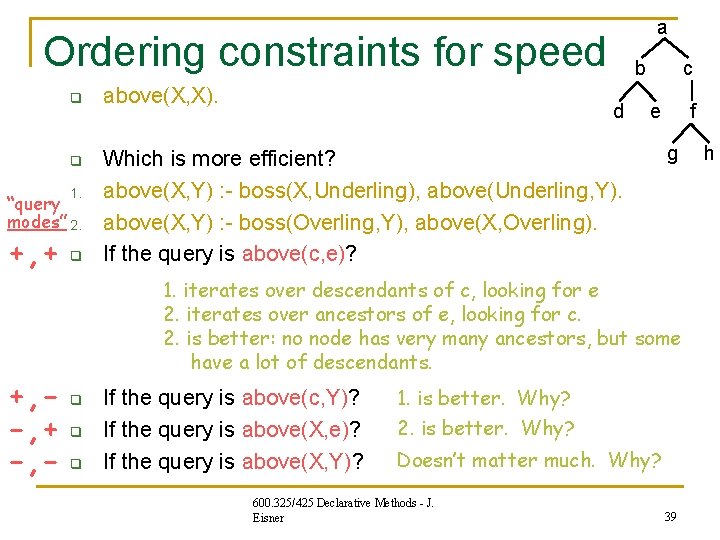
a Ordering constraints for speed q q 1. “query modes” 2. +, + +, -, + -, - q above(X, X). b d c e Which is more efficient? above(X, Y) : - boss(X, Underling), above(Underling, Y). above(X, Y) : - boss(Overling, Y), above(X, Overling). If the query is above(c, e)? f g 1. iterates over descendants of c, looking for e 2. iterates over ancestors of e, looking for c. 2. is better: no node has very many ancestors, but some have a lot of descendants. q q q If the query is above(c, Y)? If the query is above(X, e)? If the query is above(X, Y)? 1. is better. Why? 2. is better. Why? Doesn’t matter much. Why? 600. 325/425 Declarative Methods - J. Eisner 39 h
a Ordering constraints for speed q q 1. “query modes” 2. +, + +, -, + -, - q above(X, X). b d c e Which is more efficient? above(X, Y) : - boss(X, Underling), above(Underling, Y). above(X, Y) : - boss(Overling, Y), above(X, Overling). If the query is above(c, e)? Warning: Actually, 1. has a significant f g advantage in Prolog implementations that 1. iteratesdo over descendants of c, looking for e “ 1 st-argument indexing. ” 2. iterates over ancestors of e, looking for c. That makes it much to find 2. is better: no node has faster very many ancestors, but some given children (boss(x, Y)) have aa lot ofx’s descendants. q q q than a given y’s parents (boss(X, y)). So it is much faster to find 1. is descendants better. Why? If the query is above(c, Y)? than ancestors. 2. is better. Why? If the query is above(X, e)? If you don’t like that, figure outmatter how to much. Why? Doesn’t If the query is above(X, Y)? nd tell your Prolog to do 2 -argument indexing. Or Declarative just use subordinate(Y, X) 600. 325/425 Methods - J. Eisnerinstead of boss(X, Y)! 40 h
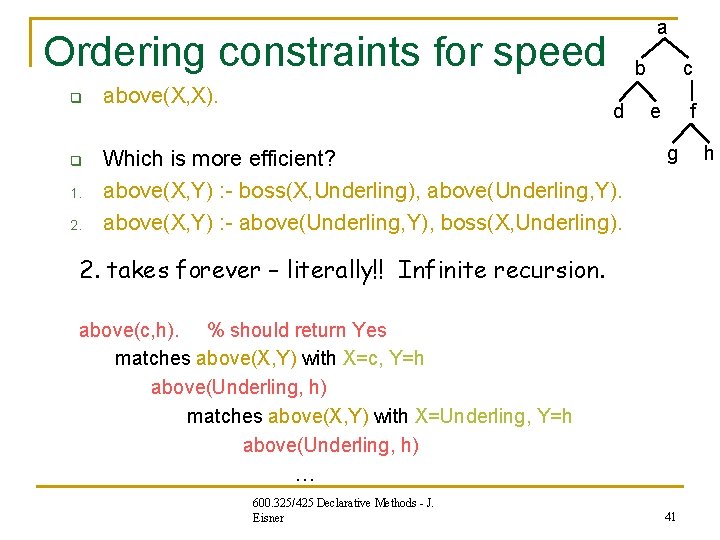
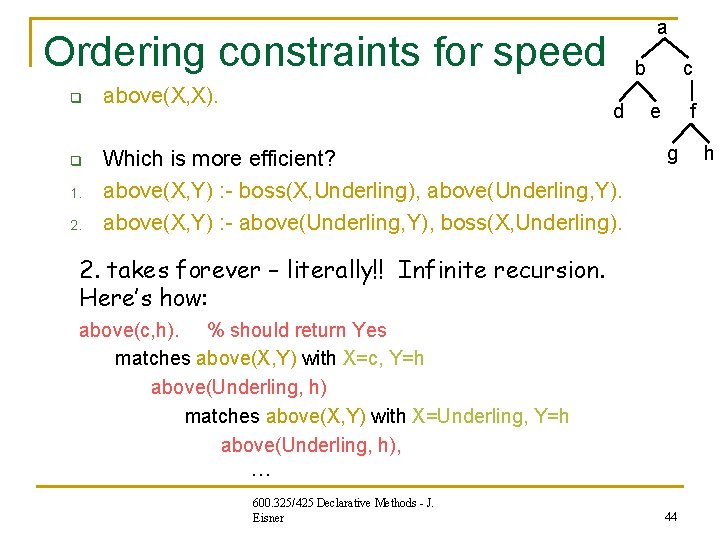
a Ordering constraints for speed q q 1. 2. above(X, X). b d Which is more efficient? above(X, Y) : - boss(X, Underling), above(Underling, Y). above(X, Y) : - above(Underling, Y), boss(X, Underling). c e f g 2. takes forever – literally!! Infinite recursion. above(c, h). % should return Yes matches above(X, Y) with X=c, Y=h above(Underling, h) matches above(X, Y) with X=Underling, Y=h above(Underling, h) … 600. 325/425 Declarative Methods - J. Eisner 41 h
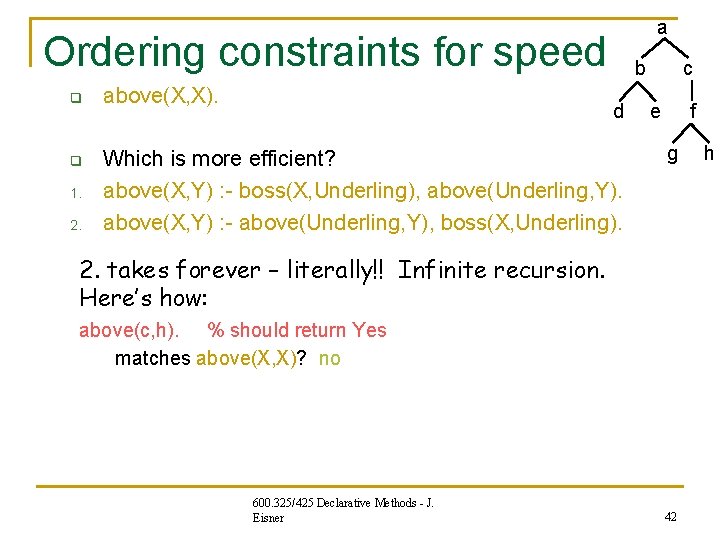
a Ordering constraints for speed q q 1. 2. above(X, X). b d Which is more efficient? above(X, Y) : - boss(X, Underling), above(Underling, Y). above(X, Y) : - above(Underling, Y), boss(X, Underling). c e f g 2. takes forever – literally!! Infinite recursion. Here’s how: above(c, h). % should return Yes matches above(X, X)? no 600. 325/425 Declarative Methods - J. Eisner 42 h
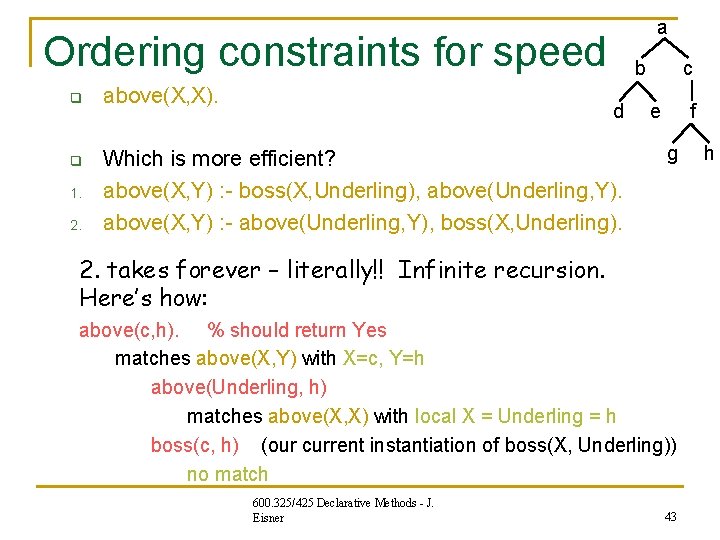
a Ordering constraints for speed q q 1. 2. above(X, X). b d Which is more efficient? above(X, Y) : - boss(X, Underling), above(Underling, Y). above(X, Y) : - above(Underling, Y), boss(X, Underling). c e f g 2. takes forever – literally!! Infinite recursion. Here’s how: above(c, h). % should return Yes matches above(X, Y) with X=c, Y=h above(Underling, h) matches above(X, X) with local X = Underling = h boss(c, h) (our current instantiation of boss(X, Underling)) no match 600. 325/425 Declarative Methods - J. Eisner 43 h
a Ordering constraints for speed q q 1. 2. above(X, X). b d Which is more efficient? above(X, Y) : - boss(X, Underling), above(Underling, Y). above(X, Y) : - above(Underling, Y), boss(X, Underling). c e f g 2. takes forever – literally!! Infinite recursion. Here’s how: above(c, h). % should return Yes matches above(X, Y) with X=c, Y=h above(Underling, h) matches above(X, Y) with X=Underling, Y=h above(Underling, h), … 600. 325/425 Declarative Methods - J. Eisner 44 h
Prolog also allows complex terms n What we’ve seen so far is called Datalog: “databases in logic. ” n Prolog is “programming in logic. ” It goes a little bit further by allowing complex terms, including records, lists and trees. n These complex terms are the source of the only hard thing about Prolog, “unification. ” 600. 325/425 Declarative Methods - J. Eisner 45
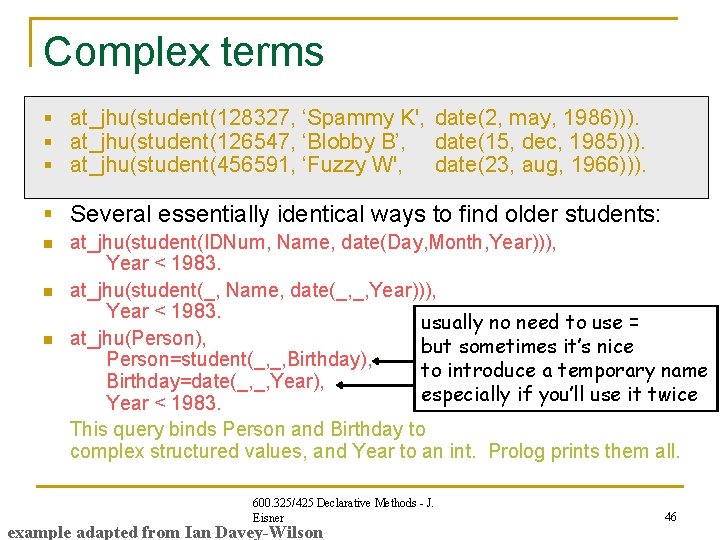
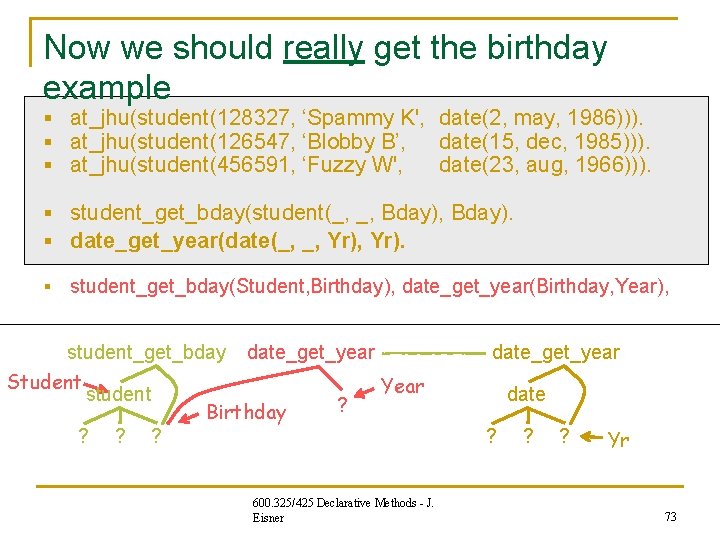
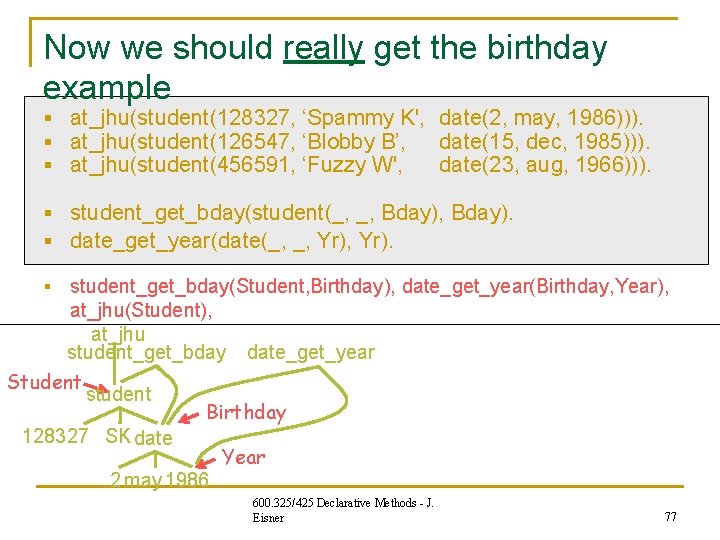
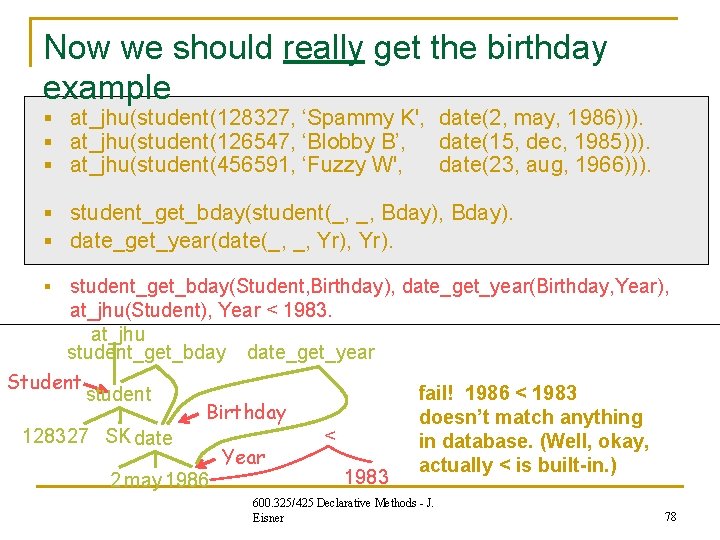
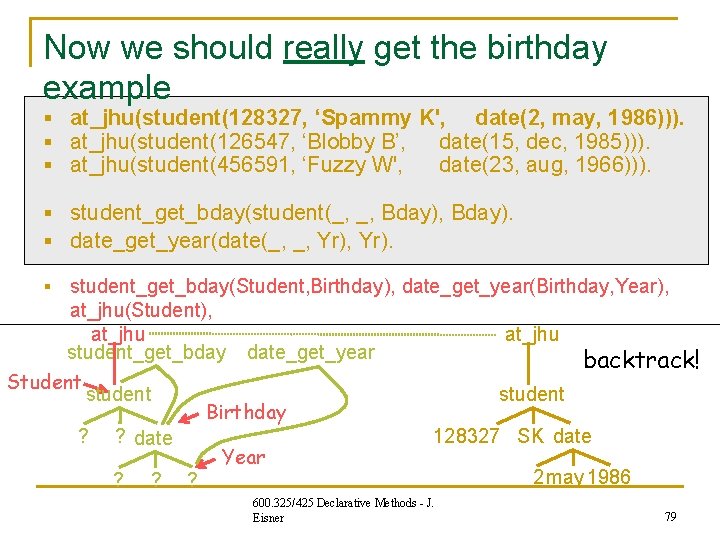
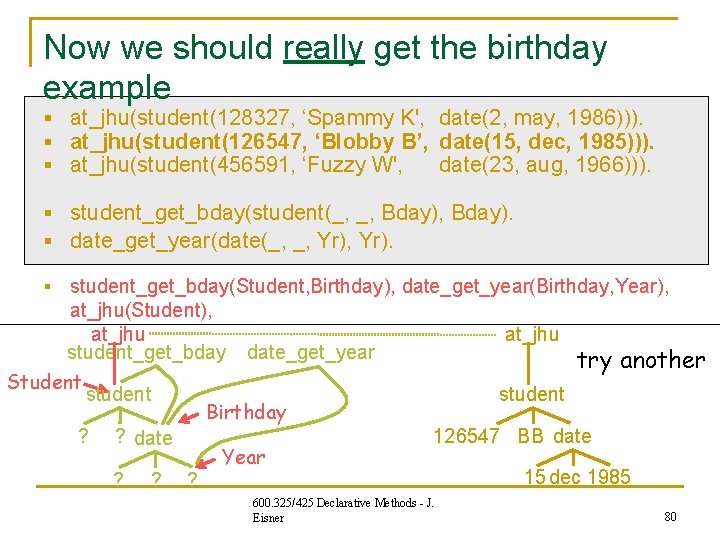
Complex terms § at_jhu(student(128327, ‘Spammy K', date(2, may, 1986))). § at_jhu(student(126547, ‘Blobby B’, date(15, dec, 1985))). § at_jhu(student(456591, ‘Fuzzy W', date(23, aug, 1966))). § Several essentially identical ways to find older students: n n n at_jhu(student(IDNum, Name, date(Day, Month, Year))), Year < 1983. at_jhu(student(_, Name, date(_, _, Year))), Year < 1983. usually no need to use = at_jhu(Person), but sometimes it’s nice Person=student(_, _, Birthday), to introduce a temporary name Birthday=date(_, _, Year), especially if you’ll use it twice Year < 1983. This query binds Person and Birthday to complex structured values, and Year to an int. Prolog prints them all. 600. 325/425 Declarative Methods - J. Eisner example adapted from Ian Davey-Wilson 46
homepage(html(head(title("Peter A. Flach")), body([img([align=right, src="logo. jpg"]), One big term img([align=left, src="peter. jpg"]), representing h 1("Peter Flach's homepage"), an HTML web page. The style on h 2("Research interests"), the previous ul([li("Learning from structured data"), slide could get. . . , unmanageable. li(a([href="CV. pdf"], "Full CV"))]), h 2("Current activities"), . . . , You have to h 2("Past activities"), remember that. . . , birthday is h 2("Archives"), argument #3 of. . . , pagetype(Webpage, researcher): person, etc. hr, address(…) page_get_head(Webpage, Head), ]) head_get_title(Head, Title), )). This nondeterministic query asks person(Title), whether the page title is a person and “Research” appears in some heading on the page. slide thanks to Peter A. Flach (modified) page_get_body(Webpage, Body), body_get_heading(Body, Heading), substring("Research", Heading).
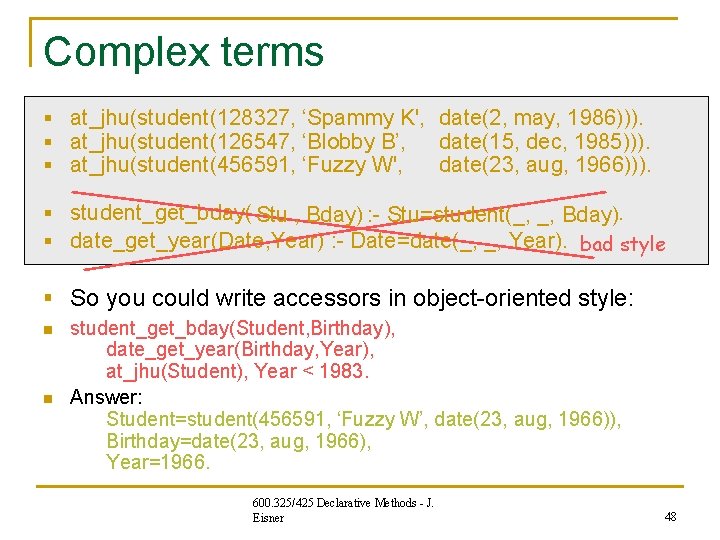
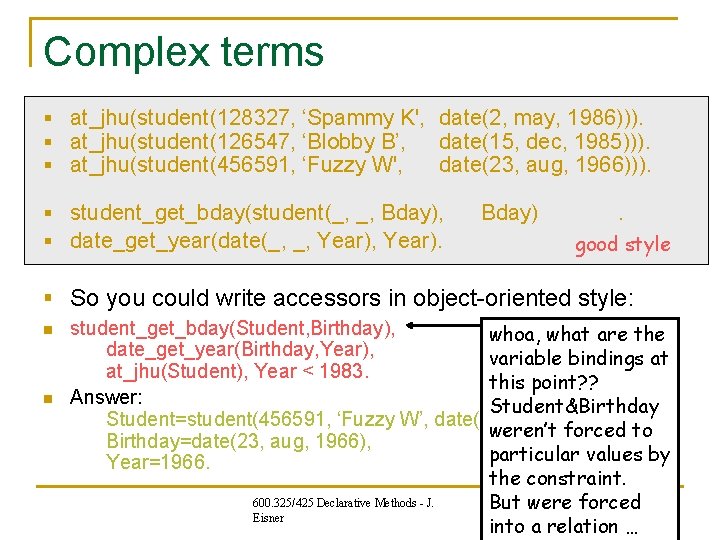
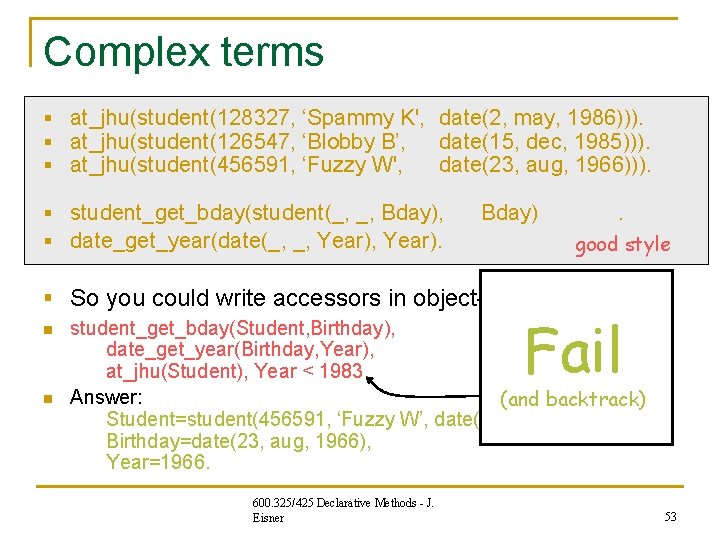
Complex terms § at_jhu(student(128327, ‘Spammy K', date(2, may, 1986))). § at_jhu(student(126547, ‘Blobby B’, date(15, dec, 1985))). § at_jhu(student(456591, ‘Fuzzy W', date(23, aug, 1966))). § student_get_bday( . Stu , Bday) : - Stu=student(_, _, Bday) § date_get_year(Date, Year) : - Date=date(_, _, Year). bad style § So you could write accessors in object-oriented style: n n student_get_bday(Student, Birthday), date_get_year(Birthday, Year), at_jhu(Student), Year < 1983. Answer: Student=student(456591, ‘Fuzzy W’, date(23, aug, 1966)), Birthday=date(23, aug, 1966), Year=1966. 600. 325/425 Declarative Methods - J. Eisner 48
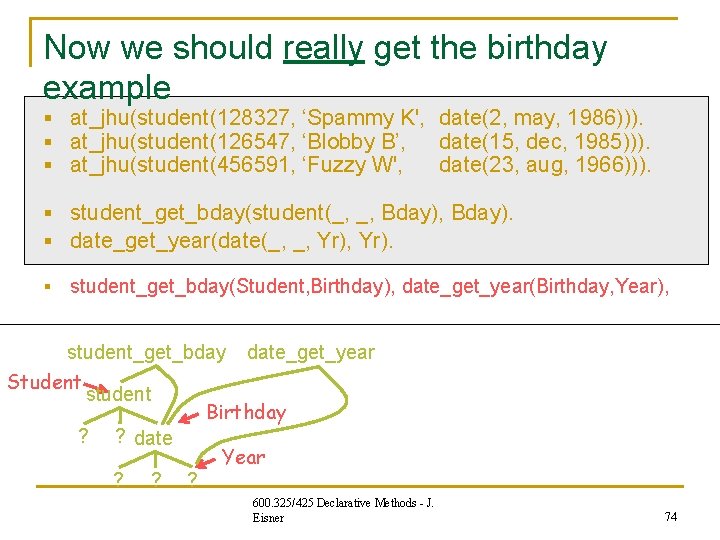
Complex terms § at_jhu(student(128327, ‘Spammy K', date(2, may, 1986))). § at_jhu(student(126547, ‘Blobby B’, date(15, dec, 1985))). § at_jhu(student(456591, ‘Fuzzy W', date(23, aug, 1966))). § student_get_bday(student(_, _, Bday), Bday) . § date_get_year(date(_, _, Year). good style § So you could write accessors in object-oriented style: n n student_get_bday(Student, Birthday), whoa, what are the date_get_year(Birthday, Year), variable bindings at at_jhu(Student), Year < 1983. this point? ? Answer: Student&Birthday Student=student(456591, ‘Fuzzy W’, date(23, aug, 1966)), weren’t forced to Birthday=date(23, aug, 1966), particular values by Year=1966. the constraint. 600. 325/425 Declarative Methods - J. But were forced 49 Eisner into a relation …
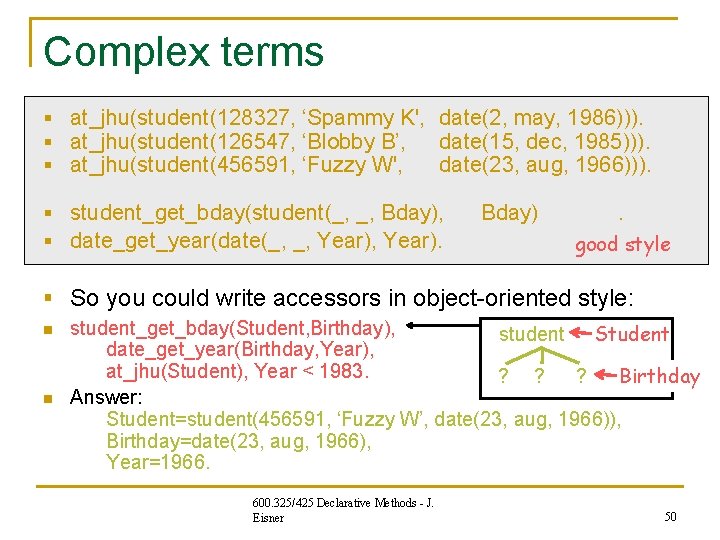
Complex terms § at_jhu(student(128327, ‘Spammy K', date(2, may, 1986))). § at_jhu(student(126547, ‘Blobby B’, date(15, dec, 1985))). § at_jhu(student(456591, ‘Fuzzy W', date(23, aug, 1966))). § student_get_bday(student(_, _, Bday), Bday) . § date_get_year(date(_, _, Year). good style § So you could write accessors in object-oriented style: n n student_get_bday(Student, Birthday), student Student date_get_year(Birthday, Year), at_jhu(Student), Year < 1983. Birthday ? ? ? Answer: Student=student(456591, ‘Fuzzy W’, date(23, aug, 1966)), Birthday=date(23, aug, 1966), Year=1966. 600. 325/425 Declarative Methods - J. Eisner 50
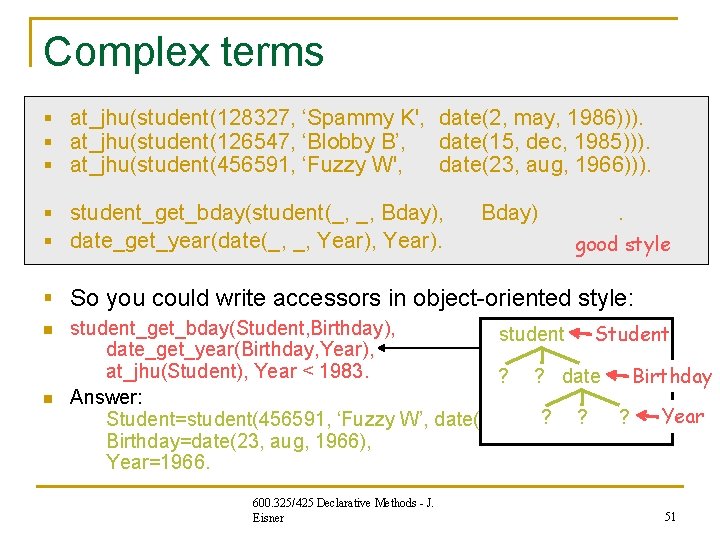
Complex terms § at_jhu(student(128327, ‘Spammy K', date(2, may, 1986))). § at_jhu(student(126547, ‘Blobby B’, date(15, dec, 1985))). § at_jhu(student(456591, ‘Fuzzy W', date(23, aug, 1966))). § student_get_bday(student(_, _, Bday), Bday) . § date_get_year(date(_, _, Year). good style § So you could write accessors in object-oriented style: n n student_get_bday(Student, Birthday), student Student date_get_year(Birthday, Year), at_jhu(Student), Year < 1983. Birthday ? ? date Answer: Year ? ? ? Student=student(456591, ‘Fuzzy W’, date(23, aug, 1966)), Birthday=date(23, aug, 1966), Year=1966. 600. 325/425 Declarative Methods - J. Eisner 51
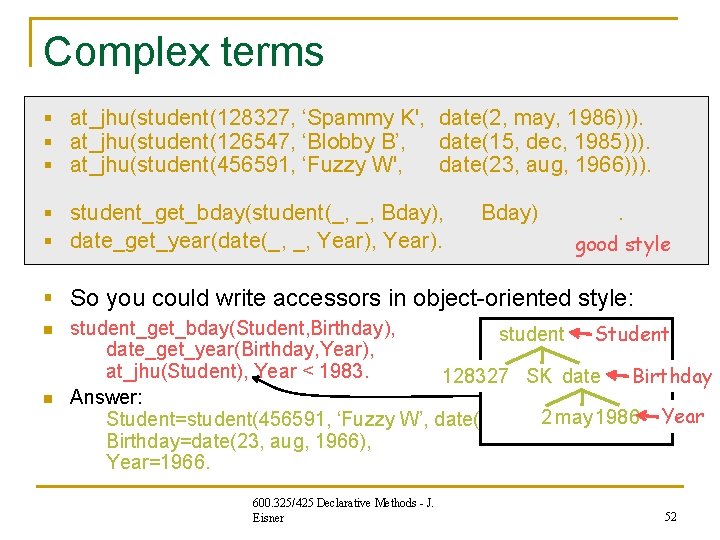
Complex terms § at_jhu(student(128327, ‘Spammy K', date(2, may, 1986))). § at_jhu(student(126547, ‘Blobby B’, date(15, dec, 1985))). § at_jhu(student(456591, ‘Fuzzy W', date(23, aug, 1966))). § student_get_bday(student(_, _, Bday), Bday) . § date_get_year(date(_, _, Year). good style § So you could write accessors in object-oriented style: n n student_get_bday(Student, Birthday), student Student date_get_year(Birthday, Year), at_jhu(Student), Year < 1983. Birthday 128327 SK date Answer: 2 may 1986 Year Student=student(456591, ‘Fuzzy W’, date(23, aug, 1966)), Birthday=date(23, aug, 1966), Year=1966. 600. 325/425 Declarative Methods - J. Eisner 52
Complex terms § at_jhu(student(128327, ‘Spammy K', date(2, may, 1986))). § at_jhu(student(126547, ‘Blobby B’, date(15, dec, 1985))). § at_jhu(student(456591, ‘Fuzzy W', date(23, aug, 1966))). § student_get_bday(student(_, _, Bday), Bday) . § date_get_year(date(_, _, Year). good style § So you could write accessors in object-oriented style: n n Fail student_get_bday(Student, Birthday), date_get_year(Birthday, Year), at_jhu(Student), Year < 1983. Answer: (and backtrack) Student=student(456591, ‘Fuzzy W’, date(23, aug, 1966)), Birthday=date(23, aug, 1966), Year=1966. 600. 325/425 Declarative Methods - J. Eisner 53
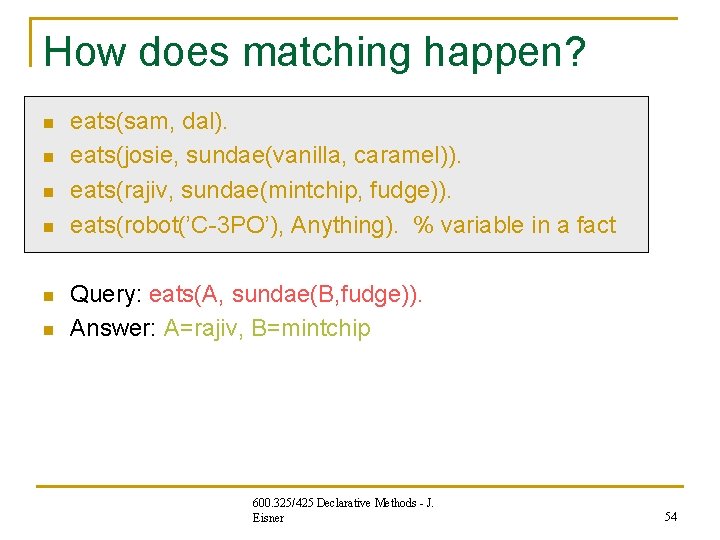
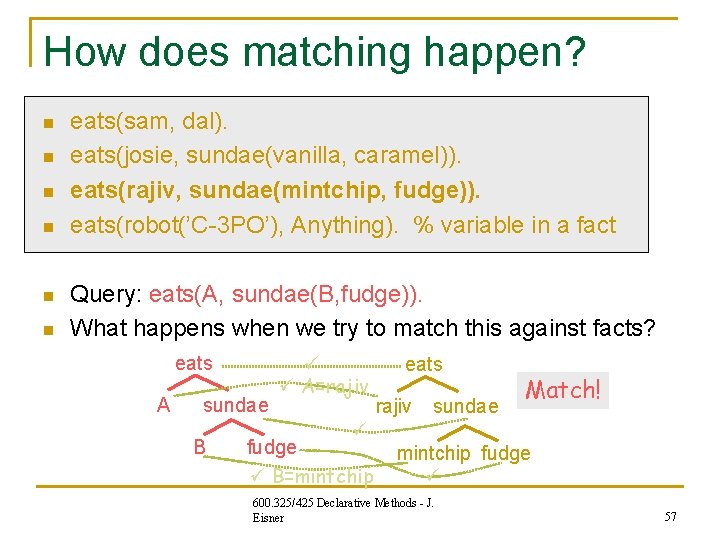
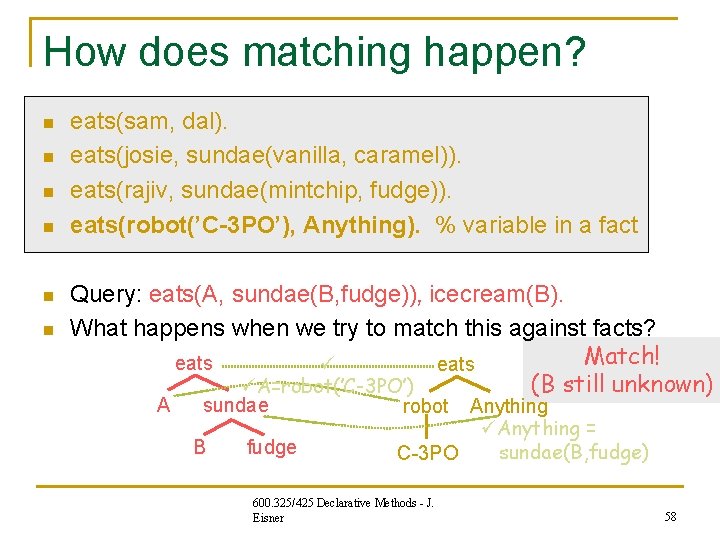
How does matching happen? n n n eats(sam, dal). eats(josie, sundae(vanilla, caramel)). eats(rajiv, sundae(mintchip, fudge)). eats(robot(’C-3 PO’), Anything). % variable in a fact Query: eats(A, sundae(B, fudge)). Answer: A=rajiv, B=mintchip 600. 325/425 Declarative Methods - J. Eisner 54
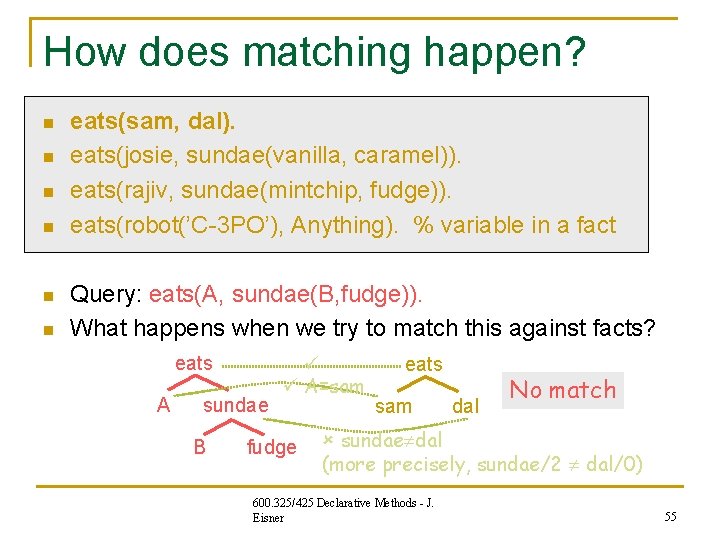
How does matching happen? n n n eats(sam, dal). eats(josie, sundae(vanilla, caramel)). eats(rajiv, sundae(mintchip, fudge)). eats(robot(’C-3 PO’), Anything). % variable in a fact Query: eats(A, sundae(B, fudge)). What happens when we try to match this against facts? eats A sundae B A=sam fudge eats sam dal No match sundae dal (more precisely, sundae/2 dal/0) 600. 325/425 Declarative Methods - J. Eisner 55
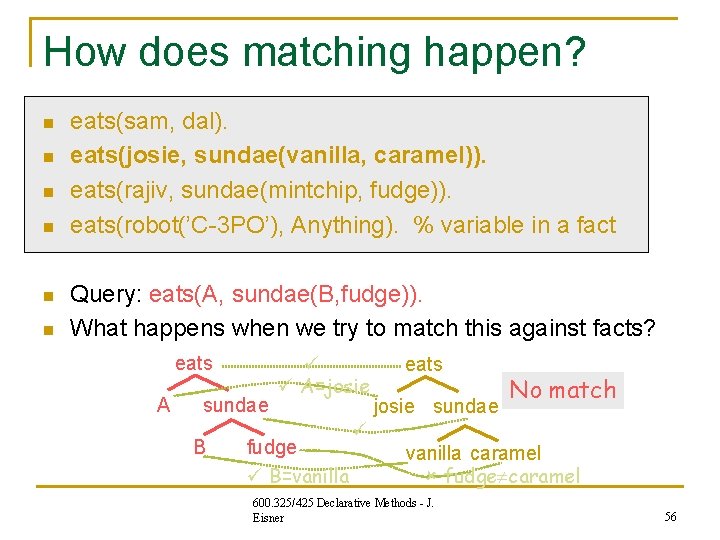
How does matching happen? n n n eats(sam, dal). eats(josie, sundae(vanilla, caramel)). eats(rajiv, sundae(mintchip, fudge)). eats(robot(’C-3 PO’), Anything). % variable in a fact Query: eats(A, sundae(B, fudge)). What happens when we try to match this against facts? eats A sundae B A=josie fudge B=vanilla eats josie sundae No match vanilla caramel fudge caramel 600. 325/425 Declarative Methods - J. Eisner 56
How does matching happen? n n n eats(sam, dal). eats(josie, sundae(vanilla, caramel)). eats(rajiv, sundae(mintchip, fudge)). eats(robot(’C-3 PO’), Anything). % variable in a fact Query: eats(A, sundae(B, fudge)). What happens when we try to match this against facts? eats A sundae B A=rajiv eats rajiv sundae Match! fudge B=mintchip fudge 600. 325/425 Declarative Methods - J. Eisner 57
How does matching happen? n n n eats(sam, dal). eats(josie, sundae(vanilla, caramel)). eats(rajiv, sundae(mintchip, fudge)). eats(robot(’C-3 PO’), Anything). % variable in a fact Query: eats(A, sundae(B, fudge)). , icecream(B). What happens when we try to match this against facts? Match! eats (B still unknown) A=robot(’C-3 PO’) A sundae B fudge robot Anything = sundae(B, fudge) C-3 PO 600. 325/425 Declarative Methods - J. Eisner 58
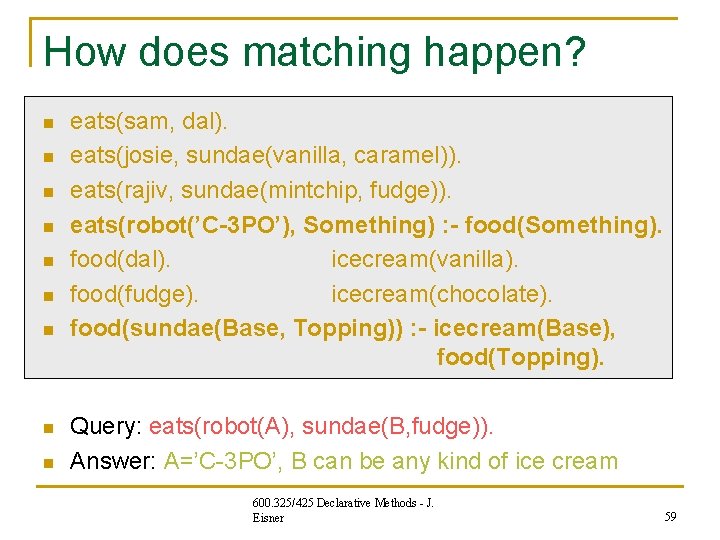
How does matching happen? n n n n n eats(sam, dal). eats(josie, sundae(vanilla, caramel)). eats(rajiv, sundae(mintchip, fudge)). eats(robot(’C-3 PO’), Something) : - food(Something). food(dal). icecream(vanilla). food(fudge). icecream(chocolate). food(sundae(Base, Topping)) : - icecream(Base), food(Topping). Query: eats(robot(A), sundae(B, fudge)). Answer: A=’C-3 PO’, B can be any kind of ice cream 600. 325/425 Declarative Methods - J. Eisner 59
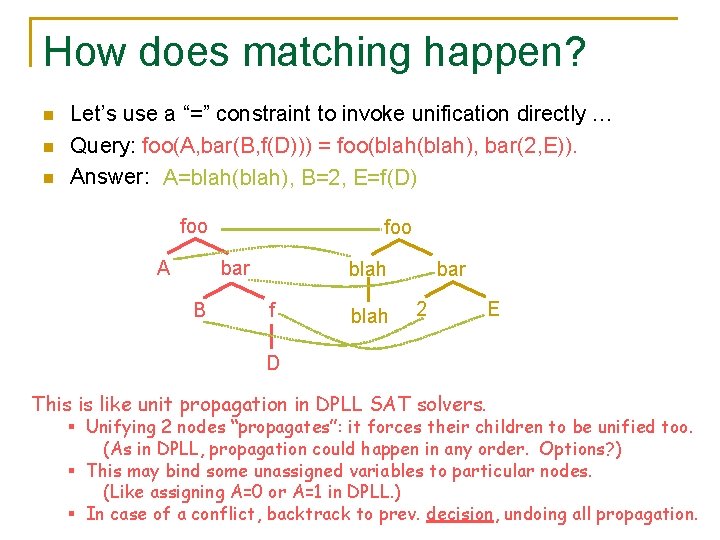
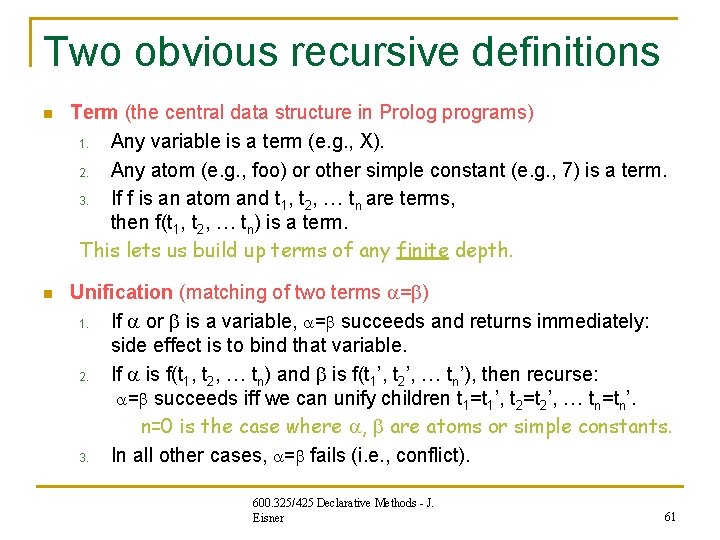
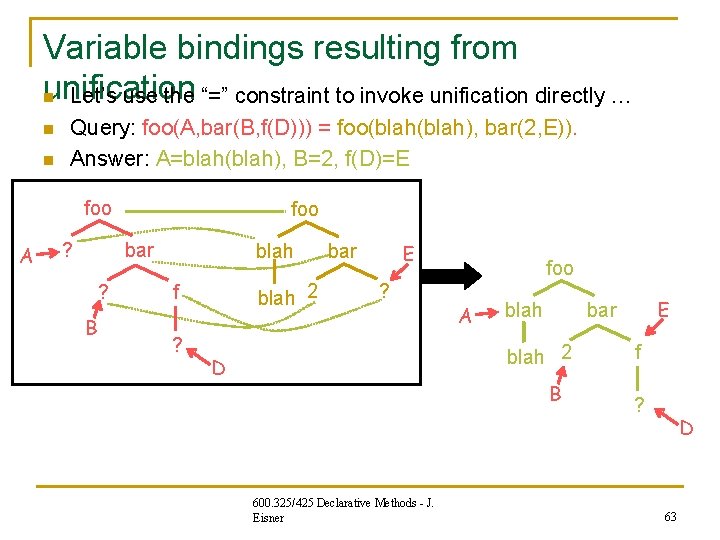
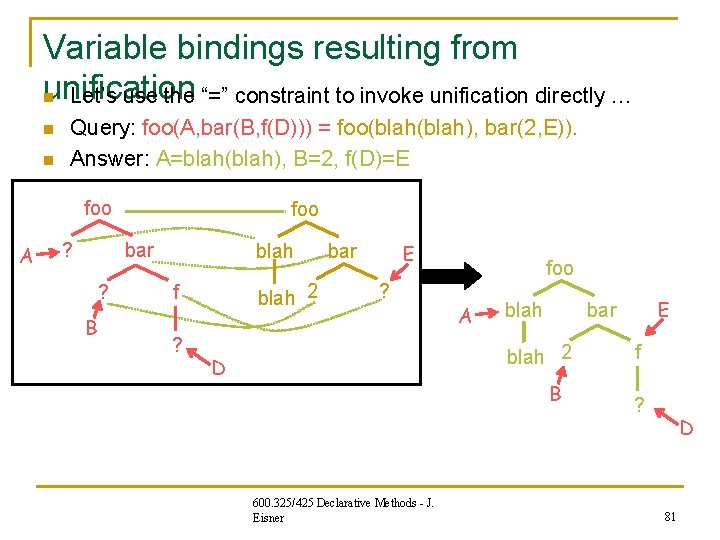
How does matching happen? n n n Let’s use a “=” constraint to invoke unification directly … Query: foo(A, bar(B, f(D))) = foo(blah), bar(2, E)). Answer: A=blah(blah), B=2, E=f(D) foo A foo bar B blah f blah bar 2 E D This is like unit propagation in DPLL SAT solvers. § Unifying 2 nodes “propagates”: it forces their children to be unified too. (As in DPLL, propagation could happen in any order. Options? ) § This may bind some unassigned variables to particular nodes. (Like assigning A=0 or A=1 in DPLL. ) 600. 325/425 Declarative Methods - J. § In case of a conflict, Eisner backtrack to prev. decision, undoing all propagation. 60
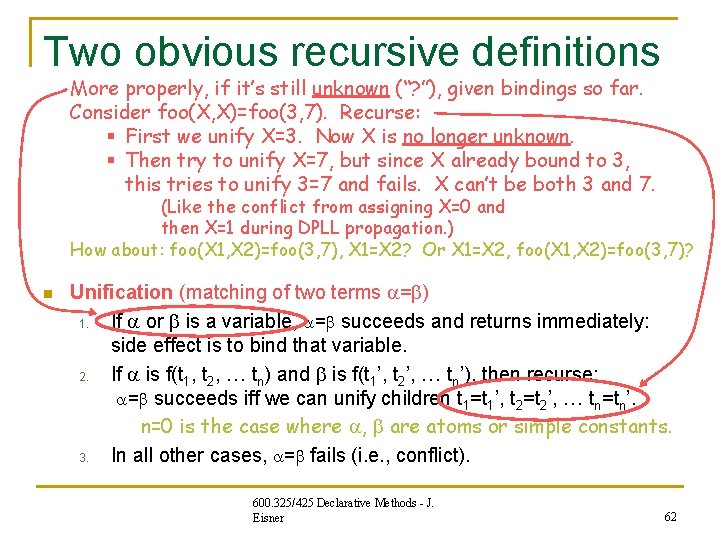
Two obvious recursive definitions n Term (the central data structure in Prolog programs) 1. Any variable is a term (e. g. , X). 2. Any atom (e. g. , foo) or other simple constant (e. g. , 7) is a term. 3. If f is an atom and t 1, t 2, … tn are terms, then f(t 1, t 2, … tn) is a term. This lets us build up terms of any finite depth. n Unification (matching of two terms = ) 1. If or is a variable, = succeeds and returns immediately: side effect is to bind that variable. 2. If is f(t 1, t 2, … tn) and is f(t 1’, t 2’, … tn’), then recurse: = succeeds iff we can unify children t 1=t 1’, t 2=t 2’, … tn=tn’. n=0 is the case where , are atoms or simple constants. 3. In all other cases, = fails (i. e. , conflict). 600. 325/425 Declarative Methods - J. Eisner 61
Two obvious recursive definitions More properly, if it’s still unknown (“? ”), given bindings so far. Consider foo(X, X)=foo(3, 7). Recurse: § First we unify X=3. Now X is no longer unknown. § Then try to unify X=7, but since X already bound to 3, this tries to unify 3=7 and fails. X can’t be both 3 and 7. (Like the conflict from assigning X=0 and then X=1 during DPLL propagation. ) How about: foo(X 1, X 2)=foo(3, 7), X 1=X 2? Or X 1=X 2, foo(X 1, X 2)=foo(3, 7)? n Unification (matching of two terms = ) 1. If or is a variable, = succeeds and returns immediately: side effect is to bind that variable. 2. If is f(t 1, t 2, … tn) and is f(t 1’, t 2’, … tn’), then recurse: = succeeds iff we can unify children t 1=t 1’, t 2=t 2’, … tn=tn’. n=0 is the case where , are atoms or simple constants. 3. In all other cases, = fails (i. e. , conflict). 600. 325/425 Declarative Methods - J. Eisner 62
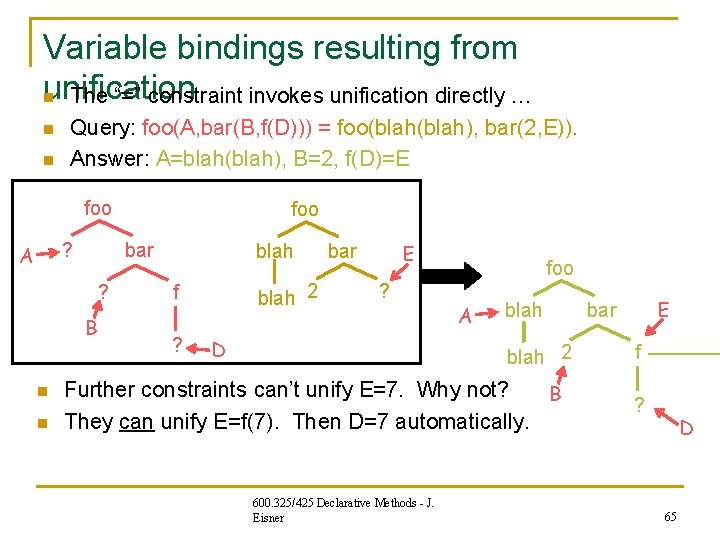
Variable bindings resulting from unification n Let’s use the “=” constraint to invoke unification directly … n n Query: foo(A, bar(B, f(D))) = foo(blah), bar(2, E)). Answer: A=blah(blah), B=2, f(D)=E foo A ? foo bar ? B blah 2 f ? E bar ? foo A blah 2 D B 600. 325/425 Declarative Methods - J. Eisner E bar f ? D 63
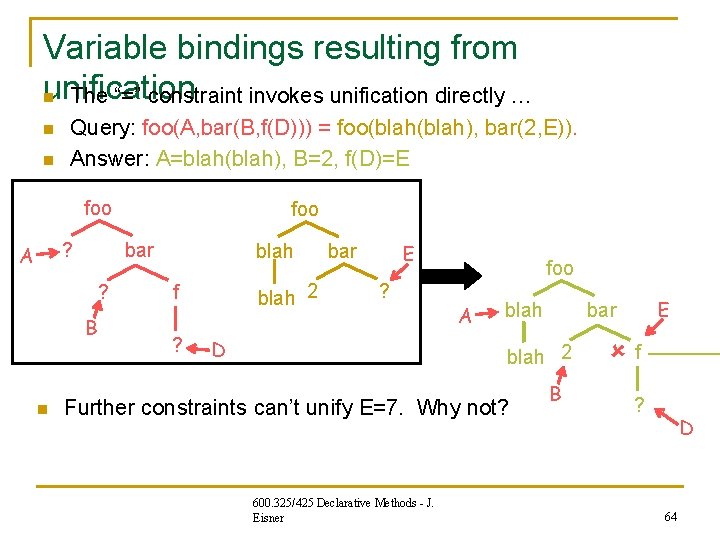
Variable bindings resulting from unification n The “=” constraint invokes unification directly … n n Query: foo(A, bar(B, f(D))) = foo(blah), bar(2, E)). Answer: A=blah(blah), B=2, f(D)=E foo ? A bar ? B n foo blah 2 f ? E bar ? D foo A blah 2 Further constraints can’t unify E=7. Why not? 600. 325/425 Declarative Methods - J. Eisner E bar B f ? D 64
Variable bindings resulting from unification n The “=” constraint invokes unification directly … n n Query: foo(A, bar(B, f(D))) = foo(blah), bar(2, E)). Answer: A=blah(blah), B=2, f(D)=E foo ? A bar ? B n n foo blah 2 f ? E bar ? D foo A blah 2 Further constraints can’t unify E=7. Why not? B They can unify E=f(7). Then D=7 automatically. 600. 325/425 Declarative Methods - J. Eisner E bar f ? D 65
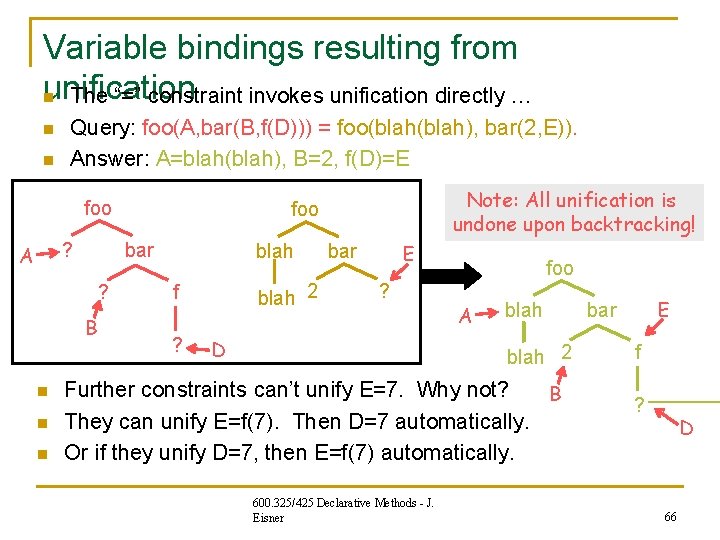
Variable bindings resulting from unification n The “=” constraint invokes unification directly … n n Query: foo(A, bar(B, f(D))) = foo(blah), bar(2, E)). Answer: A=blah(blah), B=2, f(D)=E foo ? A bar ? B n n n Note: All unification is undone upon backtracking! foo blah 2 f ? E bar ? D foo A blah 2 Further constraints can’t unify E=7. Why not? B They can unify E=f(7). Then D=7 automatically. Or if they unify D=7, then E=f(7) automatically. 600. 325/425 Declarative Methods - J. Eisner E bar f ? D 66
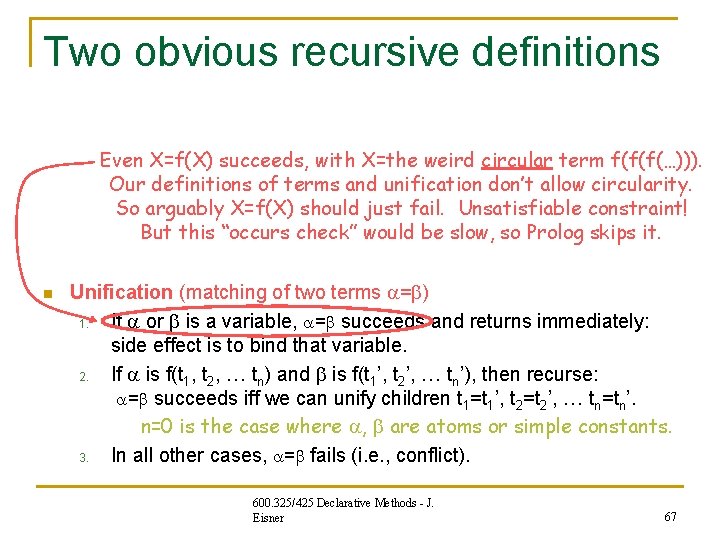
Two obvious recursive definitions Even X=f(X) succeeds, with X=the weird circular term f(f(f(…))). Our definitions of terms and unification don’t allow circularity. So arguably X=f(X) should just fail. Unsatisfiable constraint! But this “occurs check” would be slow, so Prolog skips it. n Unification (matching of two terms = ) 1. If or is a variable, = succeeds and returns immediately: side effect is to bind that variable. 2. If is f(t 1, t 2, … tn) and is f(t 1’, t 2’, … tn’), then recurse: = succeeds iff we can unify children t 1=t 1’, t 2=t 2’, … tn=tn’. n=0 is the case where , are atoms or simple constants. 3. In all other cases, = fails (i. e. , conflict). 600. 325/425 Declarative Methods - J. Eisner 67
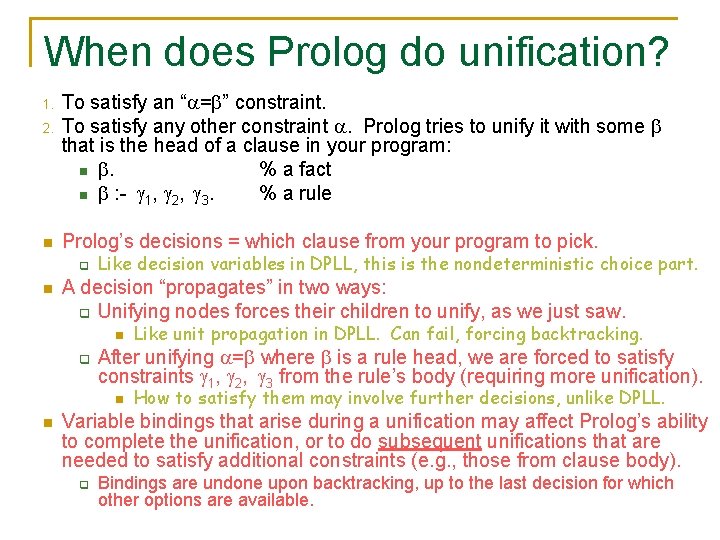
When does Prolog do unification? 1. 2. n To satisfy an “ = ” constraint. To satisfy any other constraint . Prolog tries to unify it with some that is the head of a clause in your program: n . % a fact n : - 1, 2, 3. % a rule Prolog’s decisions = which clause from your program to pick. q n Like decision variables in DPLL, this is the nondeterministic choice part. A decision “propagates” in two ways: q Unifying nodes forces their children to unify, as we just saw. n q After unifying = where is a rule head, we are forced to satisfy constraints 1, 2, 3 from the rule’s body (requiring more unification). n n Like unit propagation in DPLL. Can fail, forcing backtracking. How to satisfy them may involve further decisions, unlike DPLL. Variable bindings that arise during a unification may affect Prolog’s ability to complete the unification, or to do subsequent unifications that are needed to satisfy additional constraints (e. g. , those from clause body). q Bindings are undone upon backtracking, up to the last decision for which other options are available. 600. 325/425 Declarative Methods - J. Eisner 68
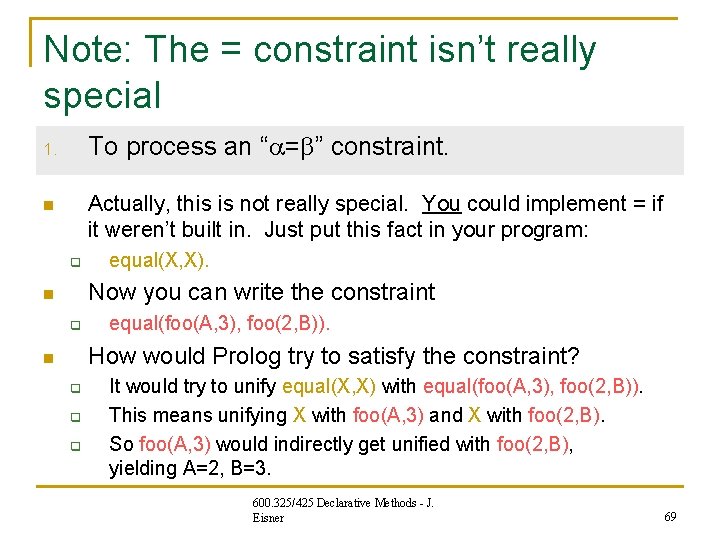
Note: The = constraint isn’t really special To process an “ = ” constraint. 1. Actually, this is not really special. You could implement = if it weren’t built in. Just put this fact in your program: n q equal(X, X). Now you can write the constraint n q equal(foo(A, 3), foo(2, B)). How would Prolog try to satisfy the constraint? n q q q It would try to unify equal(X, X) with equal(foo(A, 3), foo(2, B)). This means unifying X with foo(A, 3) and X with foo(2, B). So foo(A, 3) would indirectly get unified with foo(2, B), yielding A=2, B=3. 600. 325/425 Declarative Methods - J. Eisner 69
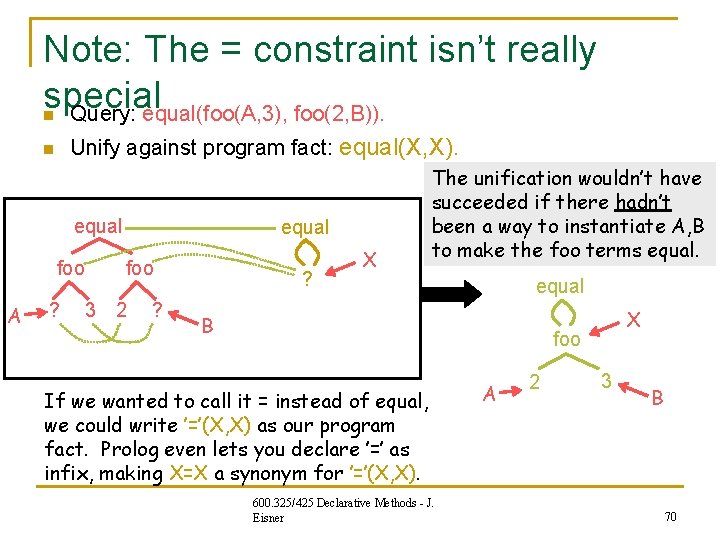
Note: The = constraint isn’t really special Query: equal(foo(A, 3), foo(2, B)). n n Unify against program fact: equal(X, X). equal foo A ? equal foo 3 2 ? ? X The unification wouldn’t have succeeded if there hadn’t been a way to instantiate A, B to make the foo terms equal B X foo If we wanted to call it = instead of equal, we could write ’=’(X, X) as our program fact. Prolog even lets you declare ’=’ as infix, making X=X a synonym for ’=’(X, X). 600. 325/425 Declarative Methods - J. Eisner A 2 3 B 70
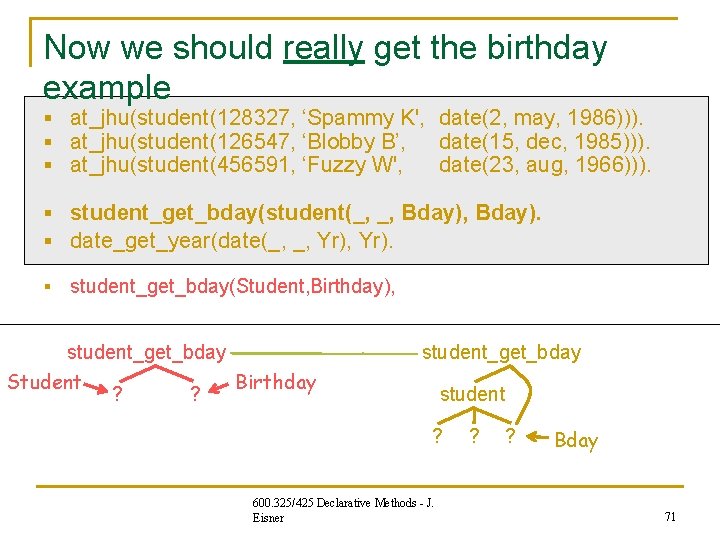
Now we should really get the birthday example § at_jhu(student(128327, ‘Spammy K', date(2, may, 1986))). § at_jhu(student(126547, ‘Blobby B’, date(15, dec, 1985))). § at_jhu(student(456591, ‘Fuzzy W', date(23, aug, 1966))). § student_get_bday(student(_, _, Bday). § date_get_year(date(_, _, Yr). § student_get_bday(Student, Birthday), student_get_bday Student Birthday ? ? student_get_bday student ? 600. 325/425 Declarative Methods - J. Eisner ? ? Bday 71
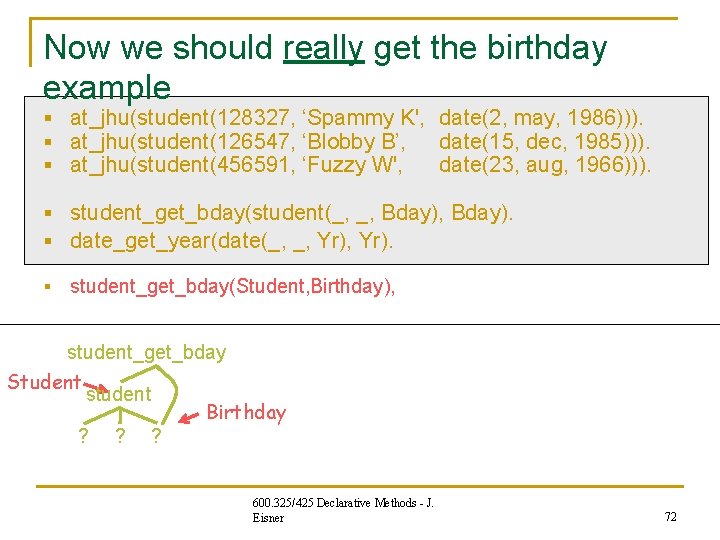
Now we should really get the birthday example § at_jhu(student(128327, ‘Spammy K', date(2, may, 1986))). § at_jhu(student(126547, ‘Blobby B’, date(15, dec, 1985))). § at_jhu(student(456591, ‘Fuzzy W', date(23, aug, 1966))). § student_get_bday(student(_, _, Bday). § date_get_year(date(_, _, Yr). § student_get_bday(Student, Birthday), student_get_bday Student student Birthday ? ? ? 600. 325/425 Declarative Methods - J. Eisner 72
Now we should really get the birthday example § at_jhu(student(128327, ‘Spammy K', date(2, may, 1986))). § at_jhu(student(126547, ‘Blobby B’, date(15, dec, 1985))). § at_jhu(student(456591, ‘Fuzzy W', date(23, aug, 1966))). § student_get_bday(student(_, _, Bday). § date_get_year(date(_, _, Yr). § student_get_bday(Student, Birthday), date_get_year(Birthday, Year), student_get_bday date_get_year Student Year student ? Birthday ? ? ? 600. 325/425 Declarative Methods - J. Eisner date_get_year date ? ? ? Yr 73
Now we should really get the birthday example § at_jhu(student(128327, ‘Spammy K', date(2, may, 1986))). § at_jhu(student(126547, ‘Blobby B’, date(15, dec, 1985))). § at_jhu(student(456591, ‘Fuzzy W', date(23, aug, 1966))). § student_get_bday(student(_, _, Bday). § date_get_year(date(_, _, Yr). § student_get_bday(Student, Birthday), date_get_year(Birthday, Year), student_get_bday date_get_year Student student Birthday ? ? date Year ? ? ? 600. 325/425 Declarative Methods - J. Eisner 74
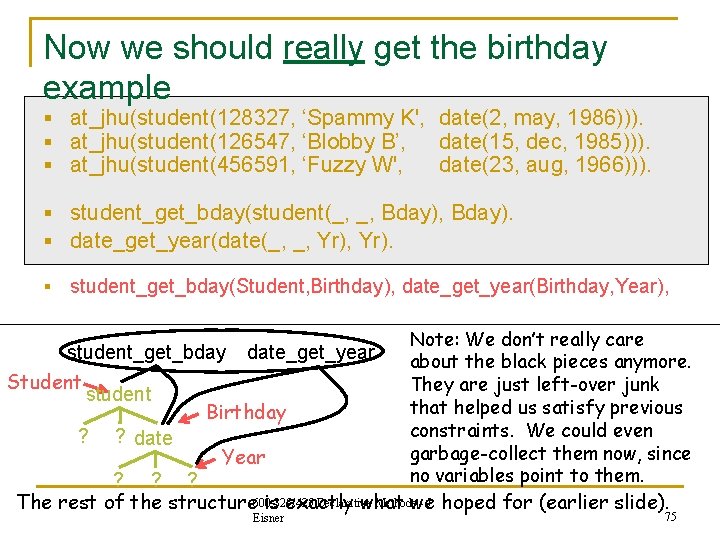
Now we should really get the birthday example § at_jhu(student(128327, ‘Spammy K', date(2, may, 1986))). § at_jhu(student(126547, ‘Blobby B’, date(15, dec, 1985))). § at_jhu(student(456591, ‘Fuzzy W', date(23, aug, 1966))). § student_get_bday(student(_, _, Bday). § date_get_year(date(_, _, Yr). § student_get_bday(Student, Birthday), date_get_year(Birthday, Year), Note: We don’t really care student_get_bday date_get_year about the black pieces anymore. Student They are just left-over junk student that helped us satisfy previous Birthday constraints. We could even ? ? date garbage-collect them now, since Year no variables point to them. ? ? ? Declarative Methods - J. hoped for (earlier slide). The rest of the structure 600. 325/425 is exactly what we Eisner 75
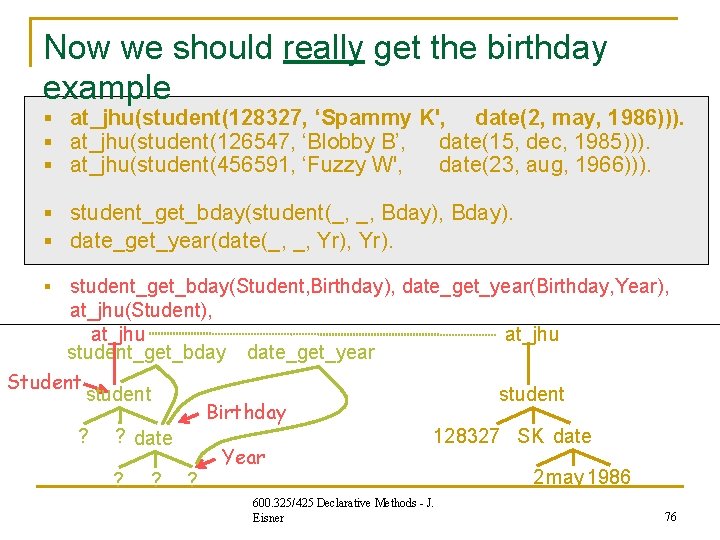
Now we should really get the birthday example § at_jhu(student(128327, ‘Spammy K', date(2, may, 1986))). § at_jhu(student(126547, ‘Blobby B’, date(15, dec, 1985))). § at_jhu(student(456591, ‘Fuzzy W', date(23, aug, 1966))). § student_get_bday(student(_, _, Bday). § date_get_year(date(_, _, Yr). student_get_bday(Student, Birthday), date_get_year(Birthday, Year), at_jhu(Student), at_jhu student_get_bday date_get_year Student student Birthday ? ? date 128327 SK date Year 2 may 1986 ? ? ? § 600. 325/425 Declarative Methods - J. Eisner 76
Now we should really get the birthday example § at_jhu(student(128327, ‘Spammy K', date(2, may, 1986))). § at_jhu(student(126547, ‘Blobby B’, date(15, dec, 1985))). § at_jhu(student(456591, ‘Fuzzy W', date(23, aug, 1966))). § student_get_bday(student(_, _, Bday). § date_get_year(date(_, _, Yr). student_get_bday(Student, Birthday), date_get_year(Birthday, Year), at_jhu(Student), at_jhu student_get_bday date_get_year Student student Birthday 128327 SK date Year 2 may 1986 § 600. 325/425 Declarative Methods - J. Eisner 77
Now we should really get the birthday example § at_jhu(student(128327, ‘Spammy K', date(2, may, 1986))). § at_jhu(student(126547, ‘Blobby B’, date(15, dec, 1985))). § at_jhu(student(456591, ‘Fuzzy W', date(23, aug, 1966))). § student_get_bday(student(_, _, Bday). § date_get_year(date(_, _, Yr). student_get_bday(Student, Birthday), date_get_year(Birthday, Year), at_jhu(Student), Year < 1983. at_jhu student_get_bday date_get_year Student fail! 1986 < 1983 student Birthday doesn’t match anything 128327 SK date < in database. (Well, okay, Year actually < is built-in. ) 1983 2 may 1986 § 600. 325/425 Declarative Methods - J. Eisner 78
Now we should really get the birthday example § at_jhu(student(128327, ‘Spammy K', date(2, may, 1986))). § at_jhu(student(126547, ‘Blobby B’, date(15, dec, 1985))). § at_jhu(student(456591, ‘Fuzzy W', date(23, aug, 1966))). § student_get_bday(student(_, _, Bday). § date_get_year(date(_, _, Yr). student_get_bday(Student, Birthday), date_get_year(Birthday, Year), at_jhu(Student), at_jhu student_get_bday date_get_year backtrack! Student student Birthday ? ? date 128327 SK date Year 2 may 1986 ? ? ? § 600. 325/425 Declarative Methods - J. Eisner 79
Now we should really get the birthday example § at_jhu(student(128327, ‘Spammy K', date(2, may, 1986))). § at_jhu(student(126547, ‘Blobby B’, date(15, dec, 1985))). § at_jhu(student(456591, ‘Fuzzy W', date(23, aug, 1966))). § student_get_bday(student(_, _, Bday). § date_get_year(date(_, _, Yr). student_get_bday(Student, Birthday), date_get_year(Birthday, Year), at_jhu(Student), at_jhu student_get_bday date_get_year try another Student student Birthday ? ? date 126547 BB date Year 15 dec 1985 ? ? ? § 600. 325/425 Declarative Methods - J. Eisner 80
Variable bindings resulting from unification n Let’s use the “=” constraint to invoke unification directly … n n Query: foo(A, bar(B, f(D))) = foo(blah), bar(2, E)). Answer: A=blah(blah), B=2, f(D)=E foo A ? foo bar ? B blah 2 f ? E bar ? foo A blah 2 D B 600. 325/425 Declarative Methods - J. Eisner E bar f ? D 81
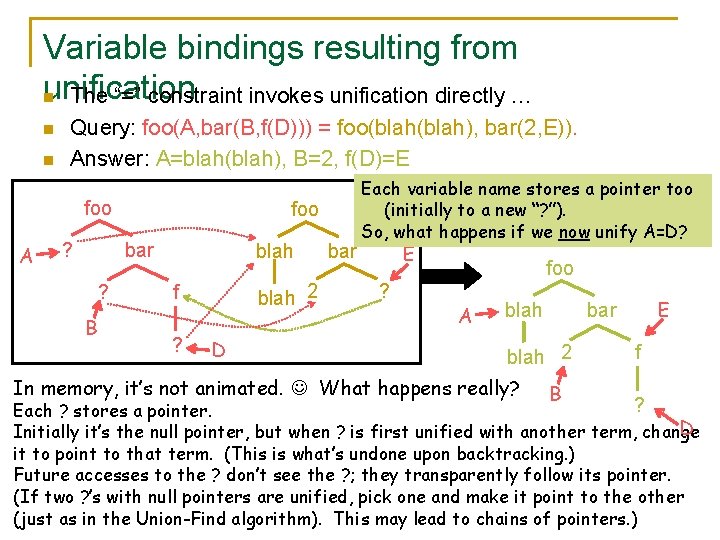
Variable bindings resulting from unification n The “=” constraint invokes unification directly … n n Query: foo(A, bar(B, f(D))) = foo(blah), bar(2, E)). Answer: A=blah(blah), B=2, f(D)=E foo A ? foo bar ? B blah 2 f ? D bar Each variable name stores a pointer too (initially to a new “? ”). So, what happens if we now unify A=D? E ? foo A blah 2 In memory, it’s not animated. What happens really? E bar B f ? Each ? stores a pointer. D Initially it’s the null pointer, but when ? is first unified with another term, change it to point to that term. (This is what’s undone upon backtracking. ) Future accesses to the ? don’t see the ? ; they transparently follow its pointer. (If two ? ’s with null pointers 600. 325/425 are unified, pick one- J. and make it point to the other Declarative Methods 82 Eisner (just as in the Union-Find algorithm). This may lead to chains of pointers. )
Time to try some programming! n Now you know how the Prolog solver works. (It helps to know in advance. ) n Let’s try some programming! n We’ll try recursion again, but this time with complex terms. 600. 325/425 Declarative Methods - J. Eisner 83
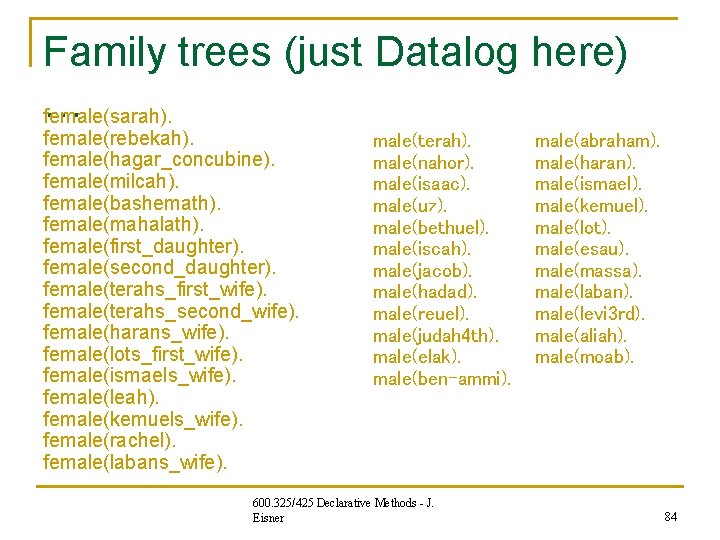
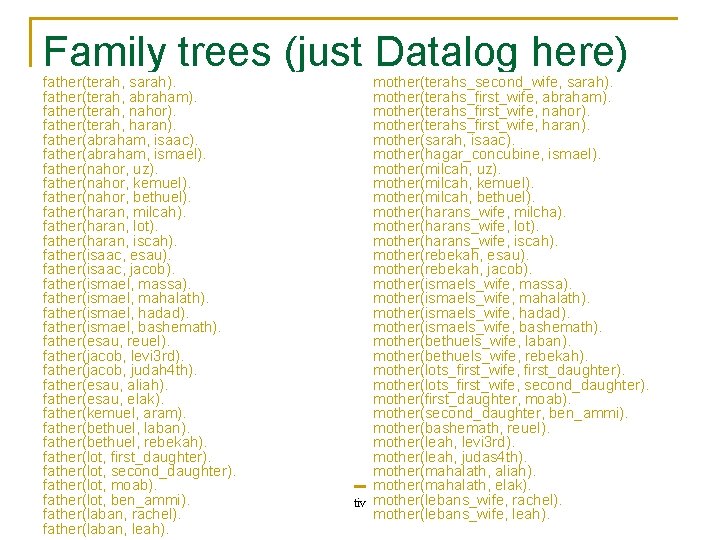
Family trees (just Datalog here) f… emale(sarah). female(rebekah). female(hagar_concubine). female(milcah). female(bashemath). female(mahalath). female(first_daughter). female(second_daughter). female(terahs_first_wife). female(terahs_second_wife). female(harans_wife). female(lots_first_wife). female(ismaels_wife). female(leah). female(kemuels_wife). female(rachel). female(labans_wife). male(terah). male(nahor). male(isaac). male(uz). male(bethuel). male(iscah). male(jacob). male(hadad). male(reuel). male(judah 4 th). male(elak). male(ben-ammi). 600. 325/425 Declarative Methods - J. Eisner male(abraham). male(haran). male(ismael). male(kemuel). male(lot). male(esau). male(massa). male(laban). male(levi 3 rd). male(aliah). male(moab). 84
Family trees (just Datalog here) … father(terah, sarah). father(terah, abraham). father(terah, nahor). father(terah, haran). father(abraham, isaac). father(abraham, ismael). father(nahor, uz). father(nahor, kemuel). father(nahor, bethuel). father(haran, milcah). father(haran, lot). father(haran, iscah). father(isaac, esau). father(isaac, jacob). father(ismael, massa). father(ismael, mahalath). father(ismael, hadad). father(ismael, bashemath). father(esau, reuel). father(jacob, levi 3 rd). father(jacob, judah 4 th). father(esau, aliah). father(esau, elak). father(kemuel, aram). father(bethuel, laban). father(bethuel, rebekah). father(lot, first_daughter). father(lot, second_daughter). father(lot, moab). father(lot, ben_ammi). father(laban, rachel). father(laban, leah). mother(terahs_second_wife, sarah). mother(terahs_first_wife, abraham). mother(terahs_first_wife, nahor). mother(terahs_first_wife, haran). mother(sarah, isaac). mother(hagar_concubine, ismael). mother(milcah, uz). mother(milcah, kemuel). mother(milcah, bethuel). mother(harans_wife, milcha). mother(harans_wife, lot). mother(harans_wife, iscah). mother(rebekah, esau). mother(rebekah, jacob). mother(ismaels_wife, massa). mother(ismaels_wife, mahalath). mother(ismaels_wife, hadad). mother(ismaels_wife, bashemath). mother(bethuels_wife, laban). mother(bethuels_wife, rebekah). mother(lots_first_wife, first_daughter). mother(lots_first_wife, second_daughter). mother(first_daughter, moab). mother(second_daughter, ben_ammi). mother(bashemath, reuel). mother(leah, levi 3 rd). mother(leah, judas 4 th). mother(mahalath, aliah). mother(mahalath, elak). 600. 325/425 Declarative mother(lebans_wife, rachel). Methods - J. mother(lebans_wife, leah). Eisner 85
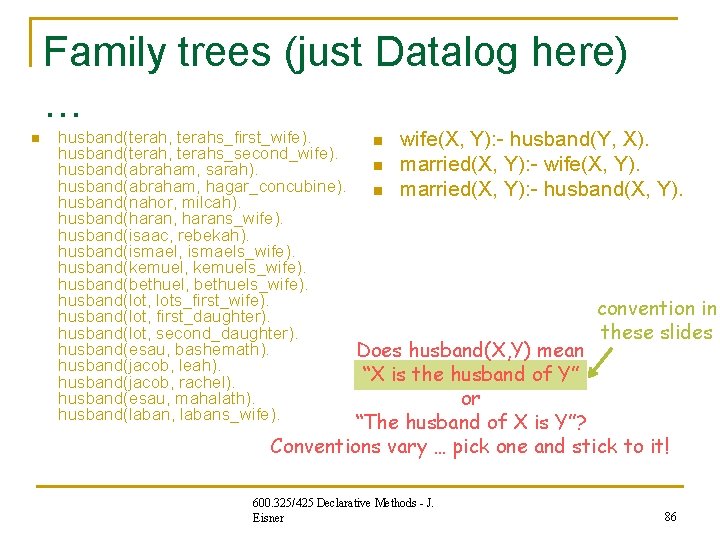
Family trees (just Datalog here) … n husband(terah, terahs_first_wife). n wife(X, Y): - husband(Y, X). husband(terah, terahs_second_wife). n married(X, Y): - wife(X, Y). husband(abraham, sarah). husband(abraham, hagar_concubine). n married(X, Y): - husband(X, Y). husband(nahor, milcah). husband(haran, harans_wife). husband(isaac, rebekah). husband(ismael, ismaels_wife). husband(kemuel, kemuels_wife). husband(bethuel, bethuels_wife). husband(lot, lots_first_wife). convention in husband(lot, first_daughter). husband(lot, second_daughter). these slides husband(esau, bashemath). Does husband(X, Y) mean husband(jacob, leah). “X is the husband of Y” husband(jacob, rachel). husband(esau, mahalath). or husband(laban, labans_wife). “The husband of X is Y”? Conventions vary … pick one and stick to it! 600. 325/425 Declarative Methods - J. Eisner 86
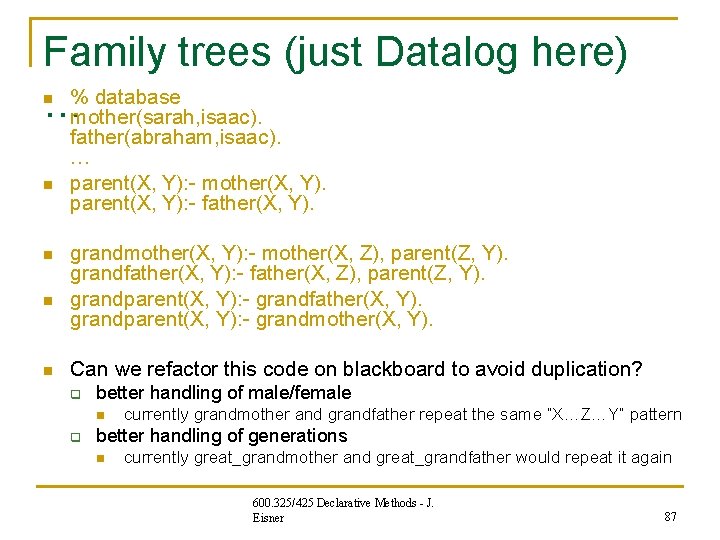
Family trees (just Datalog here) % database …mother(sarah, isaac). n n n father(abraham, isaac). … parent(X, Y): - mother(X, Y). parent(X, Y): - father(X, Y). grandmother(X, Y): - mother(X, Z), parent(Z, Y). grandfather(X, Y): - father(X, Z), parent(Z, Y). grandparent(X, Y): - grandfather(X, Y). grandparent(X, Y): - grandmother(X, Y). Can we refactor this code on blackboard to avoid duplication? q better handling of male/female n q currently grandmother and grandfather repeat the same “X…Z…Y” pattern better handling of generations n currently great_grandmother and great_grandfather would repeat it again 600. 325/425 Declarative Methods - J. Eisner 87
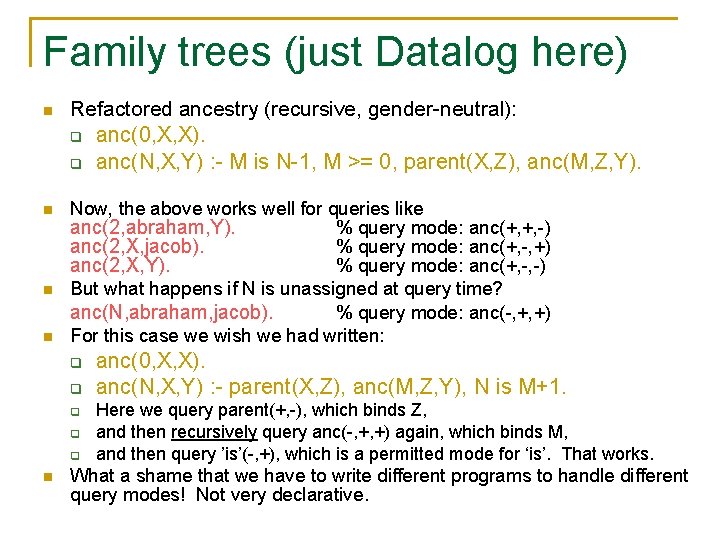
Family trees (just Datalog here) …Refactored database (now specifies parent, not mother/father): n q q n female(sarah). male(abraham). Refactored ancestry (recursive, gender-neutral): q q n parent(sarah, isaac). parent(abraham, isaac). anc(0, X, X). anc(N, X, Y) : - parent(X, Z), anc(N-1, Z, Y). Now just need one clause to define each English word: q q q parent(X, Y) : - anc(1, X, Y). mother(X, Y) : - parent(X, Y), female(X). father(X, Y) : - parent(X, Y), male(X). grandparent(X, Y) : - anc(2, X, Y). grandmother(X, Y) : - grandparent(X, Y), female(X). grandfather(X, Y) : - grandparent(X, Y), male(X). great_grandparent(X, Y) : - anc(3, X, Y). etc. 600. 325/425 Declarative Methods - J. Eisner 88
Family trees (just Datalog here) … n Refactored ancestry (recursive, gender-neutral): q q n anc(0, X, X). anc(N, X, Y) : - parent(X, Z), anc(N-1, Z, Y). Wait a minute! What does anc(2, abraham, Y) do? q q q Recurses on anc(2 -1, isaac, Y). Which recurses on anc((2 -1)-1, jacob, Y). Which recurses on anc(((2 -1)-1)-1, joseph, Y). … 600. 325/425 Declarative Methods - J. Eisner 89
Family trees (just Datalog here) … n Refactored ancestry (recursive, gender-neutral): q q n anc(0, X, X). anc(N, X, Y) : - parent(X, Z), anc(N-1, Z, Y). Wait a minute! What does anc(2, abraham, Y) do? q q Recurses on anc(2 -1, isaac, Y). Which recurses on anc((2 -1)-1, jacob, Y). n Oops! (2 -1)-1 isn’t zero. It’s ’-’(2, 1)), a compound term. anc doesn’t unify jacob Y 0 X X with 1 2 1 600. 325/425 Declarative Methods - J. Eisner 90
Family trees (just Datalog here) … n Refactored ancestry (recursive, gender-neutral): anc(0, X, X). q anc(N, X, Y) : - parent(X, Z), anc(N-1, Z, Y). N > 0, M is N-1, parent(X, Z), anc(M, Z, Y). q ’is’ does arithmetic for you: ‘is’(0, 1 -1). 0 is 1 -1. ’is’(4, 2+2). 4 is 2+2. ‘is’(24, 7*7 -5*5) 24 is 7*7 -5*5. cuts off the search for grandchildren at 2 levels (once N <= 0, it’s legal but wasteful to continue to recurse in hopes that we’ll run into 0 again if we keep subtracting 1!) 600. 325/425 Declarative Methods - J. Eisner 91
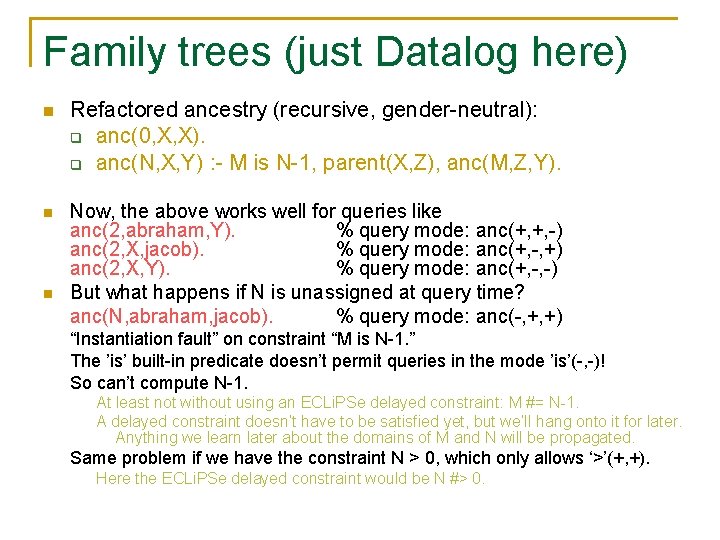
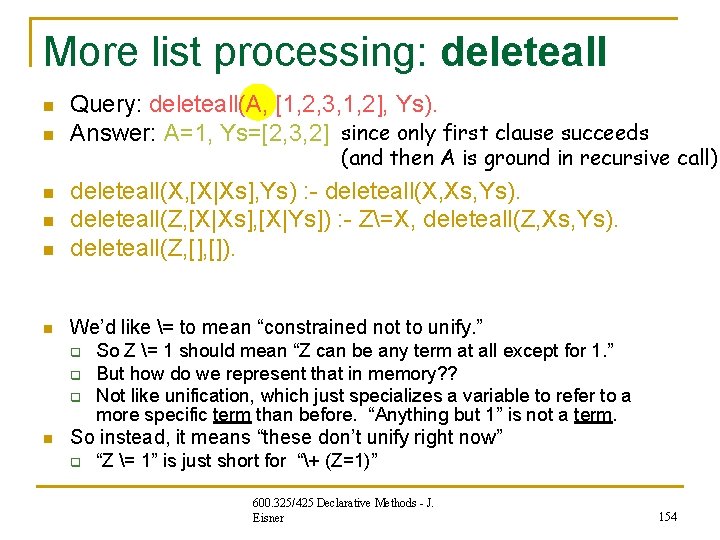
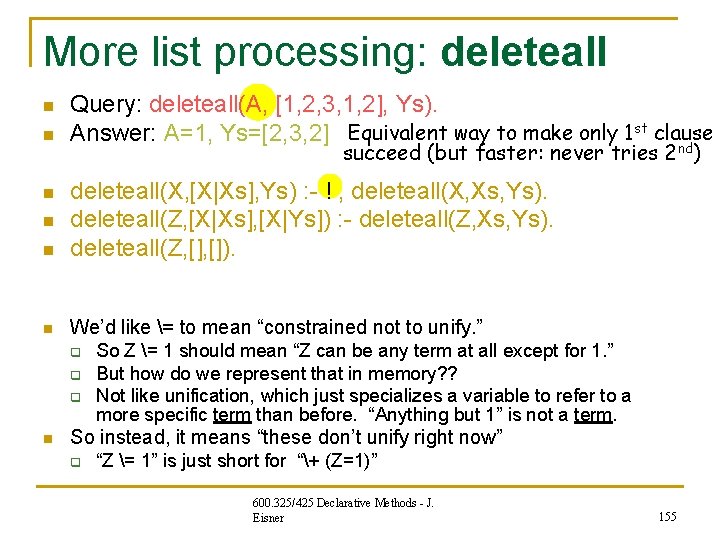
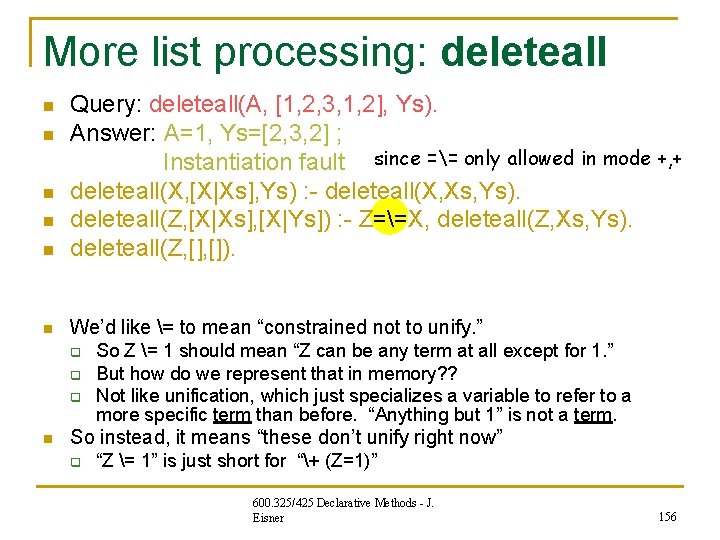
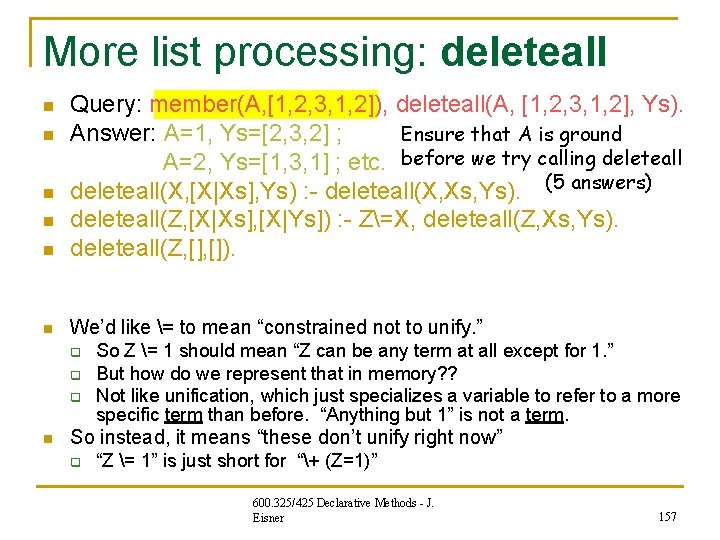
Family trees (just Datalog here) …Refactored ancestry (recursive, gender-neutral): n q q n n anc(0, X, X). anc(N, X, Y) : - M is N-1, parent(X, Z), anc(M, Z, Y). Now, the above works well for queries like anc(2, abraham, Y). % query mode: anc(+, +, -) anc(2, X, jacob). % query mode: anc(+, -, +) anc(2, X, Y). % query mode: anc(+, -, -) But what happens if N is unassigned at query time? anc(N, abraham, jacob). % query mode: anc(-, +, +) “Instantiation fault” on constraint “M is N-1. ” The ’is’ built-in predicate doesn’t permit queries in the mode ’is’(-, -)! So can’t compute N-1. At least not without using an ECLi. PSe delayed constraint: M #= N-1. A delayed constraint doesn’t have to be satisfied yet, but we’ll hang onto it for later. Anything we learn later about the domains of M and N will be propagated. Same problem if we have the constraint N > 0, which only allows ‘>’(+, +). Here the ECLi. PSe delayed constraint would be N #> 0. 600. 325/425 Declarative Methods - J. Eisner 92
Family trees (just Datalog here) …Refactored ancestry (recursive, gender-neutral): n q q n n n Now, the above works well for queries like anc(2, abraham, Y). % query mode: anc(+, +, -) anc(2, X, jacob). % query mode: anc(+, -, +) anc(2, X, Y). % query mode: anc(+, -, -) But what happens if N is unassigned at query time? anc(N, abraham, jacob). % query mode: anc(-, +, +) For this case we wish we had written: q q q n anc(0, X, X). anc(N, X, Y) : - M is N-1, M >= 0, parent(X, Z), anc(M, Z, Y). anc(0, X, X). anc(N, X, Y) : - parent(X, Z), anc(M, Z, Y), N is M+1. Here we query parent(+, -), which binds Z, and then recursively query anc(-, +, +) again, which binds M, and then query ’is’(-, +), which is a permitted mode for ‘is’. That works. What a shame that we have to write different programs to handle different query modes! Not very declarative. 600. 325/425 Declarative Methods - J. Eisner 93
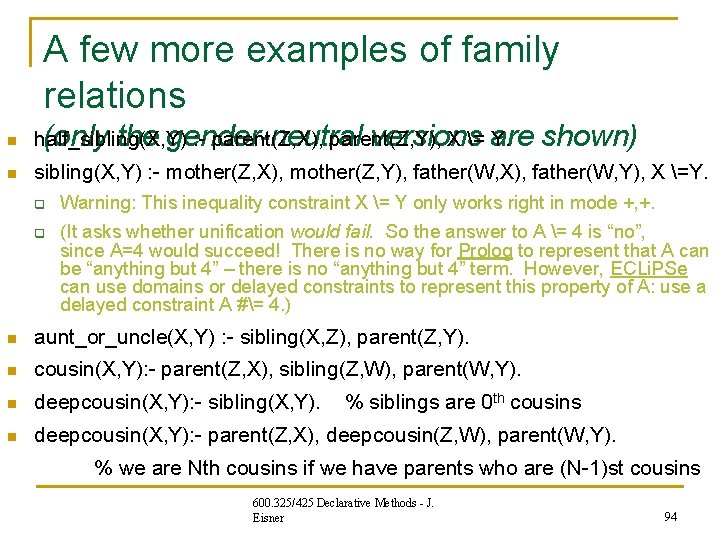
A few more examples of family relations n (only the gender-neutral versions are half_sibling(X, Y) : - parent(Z, X), parent(Z, Y), X = Y. n sibling(X, Y) : - mother(Z, X), mother(Z, Y), father(W, X), father(W, Y), X =Y. q q shown) Warning: This inequality constraint X = Y only works right in mode +, +. (It asks whether unification would fail. So the answer to A = 4 is “no”, since A=4 would succeed! There is no way for Prolog to represent that A can be “anything but 4” – there is no “anything but 4” term. However, ECLi. PSe can use domains or delayed constraints to represent this property of A: use a delayed constraint A #= 4. ) n aunt_or_uncle(X, Y) : - sibling(X, Z), parent(Z, Y). n cousin(X, Y): - parent(Z, X), sibling(Z, W), parent(W, Y). n deepcousin(X, Y): - sibling(X, Y). % siblings are 0 th cousins n deepcousin(X, Y): - parent(Z, X), deepcousin(Z, W), parent(W, Y). % we are Nth cousins if we have parents who are (N-1)st cousins 600. 325/425 Declarative Methods - J. Eisner 94
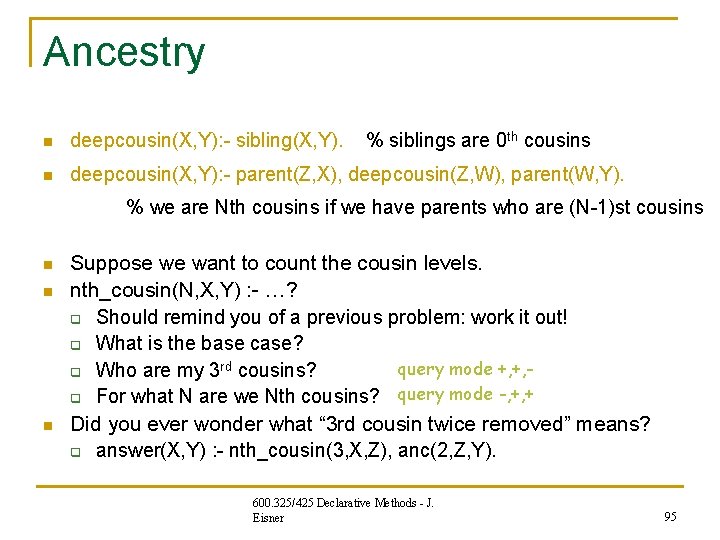
Ancestry n deepcousin(X, Y): - sibling(X, Y). % siblings are 0 th cousins n deepcousin(X, Y): - parent(Z, X), deepcousin(Z, W), parent(W, Y). % we are Nth cousins if we have parents who are (N-1)st cousins n n n Suppose we want to count the cousin levels. nth_cousin(N, X, Y) : - …? q Should remind you of a previous problem: work it out! q What is the base case? query mode +, +, q Who are my 3 rd cousins? q For what N are we Nth cousins? query mode -, +, + Did you ever wonder what “ 3 rd cousin twice removed” means? q answer(X, Y) : - nth_cousin(3, X, Z), anc(2, Z, Y). 600. 325/425 Declarative Methods - J. Eisner 95
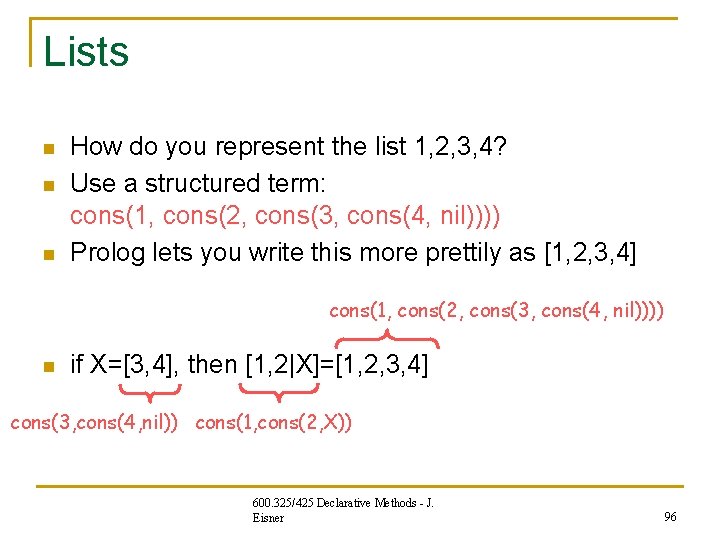
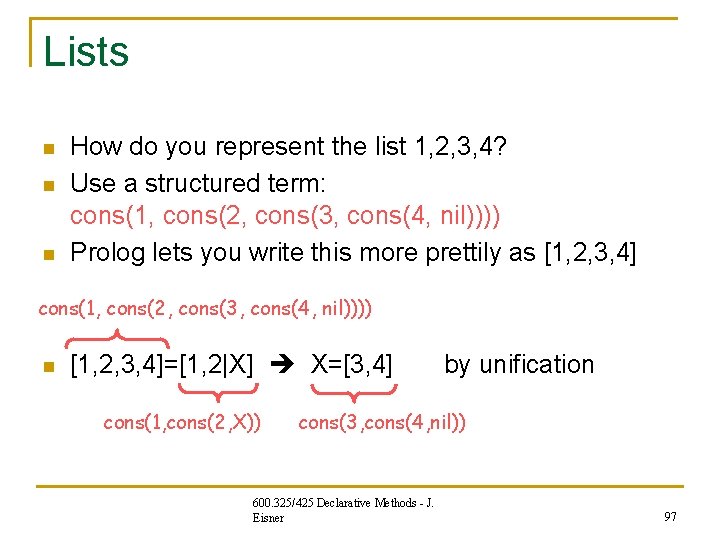
Lists n n n How do you represent the list 1, 2, 3, 4? Use a structured term: cons(1, cons(2, cons(3, cons(4, nil)))) Prolog lets you write this more prettily as [1, 2, 3, 4] cons(1, cons(2, cons(3, cons(4, nil)))) n if X=[3, 4], then [1, 2|X]=[1, 2, 3, 4] cons(3, cons(4, nil)) cons(1, cons(2, X)) 600. 325/425 Declarative Methods - J. Eisner 96
Lists n n n How do you represent the list 1, 2, 3, 4? Use a structured term: cons(1, cons(2, cons(3, cons(4, nil)))) Prolog lets you write this more prettily as [1, 2, 3, 4] cons(1, cons(2, cons(3, cons(4, nil)))) n [1, 2, 3, 4]=[1, 2|X] X=[3, 4] by unification cons(1, cons(2, X)) cons(3, cons(4, nil)) 600. 325/425 Declarative Methods - J. Eisner 97
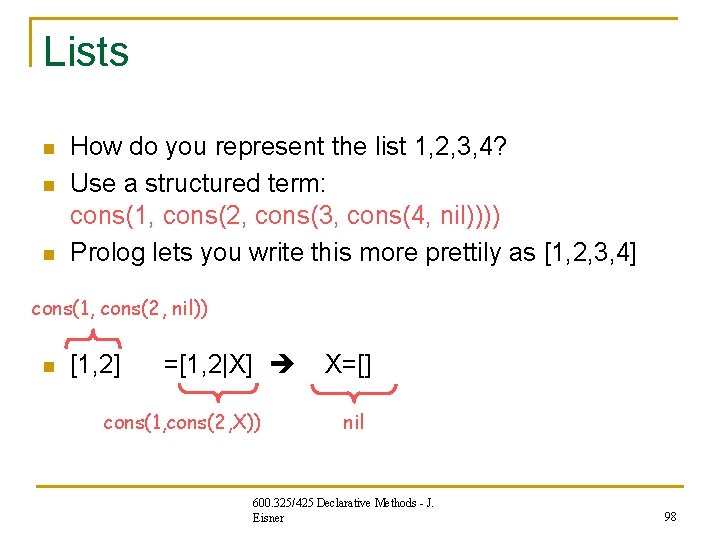
Lists n n n How do you represent the list 1, 2, 3, 4? Use a structured term: cons(1, cons(2, cons(3, cons(4, nil)))) Prolog lets you write this more prettily as [1, 2, 3, 4] cons(1, cons(2, nil)) n [1, 2] =[1, 2|X] X=[] cons(1, cons(2, X)) nil 600. 325/425 Declarative Methods - J. Eisner 98
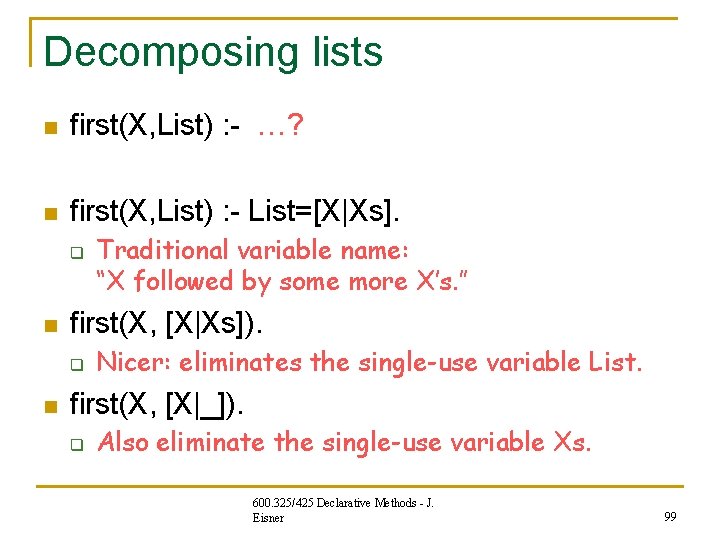
Decomposing lists n first(X, List) : - …? n first(X, List) : - List=[X|Xs]. q n first(X, [X|Xs]). q n Traditional variable name: “X followed by some more X’s. ” Nicer: eliminates the single-use variable List. first(X, [X|_]). q Also eliminate the single-use variable Xs. 600. 325/425 Declarative Methods - J. Eisner 99
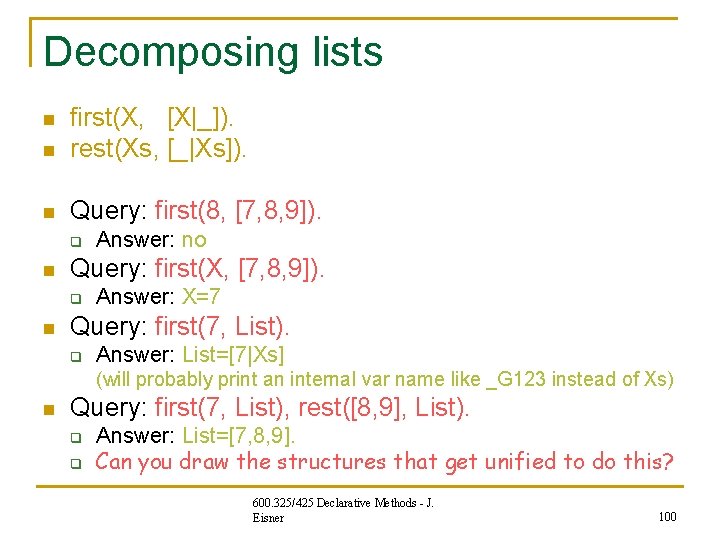
Decomposing lists n first(X, [X|_]). rest(Xs, [_|Xs]). n Query: first(8, [7, 8, 9]). n q n Query: first(X, [7, 8, 9]). q n Answer: no Answer: X=7 Query: first(7, List). q Answer: List=[7|Xs] (will probably print an internal var name like _G 123 instead of Xs) n Query: first(7, List), rest([8, 9], List). q q Answer: List=[7, 8, 9]. Can you draw the structures that get unified to do this? 600. 325/425 Declarative Methods - J. Eisner 100
Decomposing lists n n In practice, no one ever actually defines rules for “first” and “rest. ” Just do the same thing by pattern matching: write things like [X|Xs] directly in your other rules. 600. 325/425 Declarative Methods - J. Eisner 101
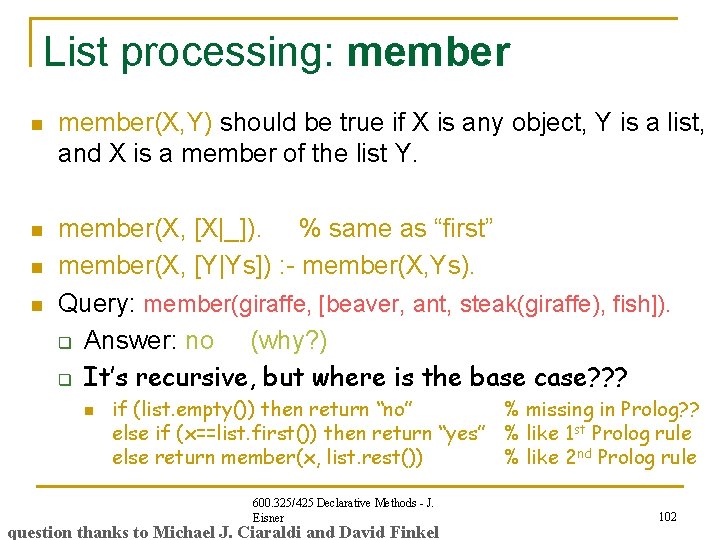
List processing: member n member(X, Y) should be true if X is any object, Y is a list, and X is a member of the list Y. n member(X, [X|_]). % same as “first” member(X, [Y|Ys]) : - member(X, Ys). Query: member(giraffe, [beaver, ant, steak(giraffe), fish]). q Answer: no (why? ) q It’s recursive, but where is the base case? ? ? n n n if (list. empty()) then return “no” % missing in Prolog? ? else if (x==list. first()) then return “yes” % like 1 st Prolog rule else return member(x, list. rest()) % like 2 nd Prolog rule 600. 325/425 Declarative Methods - J. Eisner question thanks to Michael J. Ciaraldi and David Finkel 102
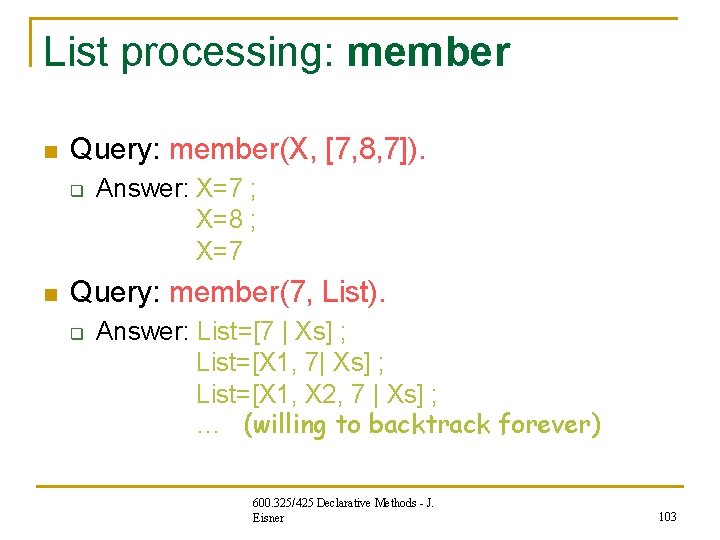
List processing: member n Query: member(X, [7, 8, 7]). q n Answer: X=7 ; X=8 ; X=7 Query: member(7, List). q Answer: List=[7 | Xs] ; List=[X 1, 7| Xs] ; List=[X 1, X 2, 7 | Xs] ; … (willing to backtrack forever) 600. 325/425 Declarative Methods - J. Eisner 103
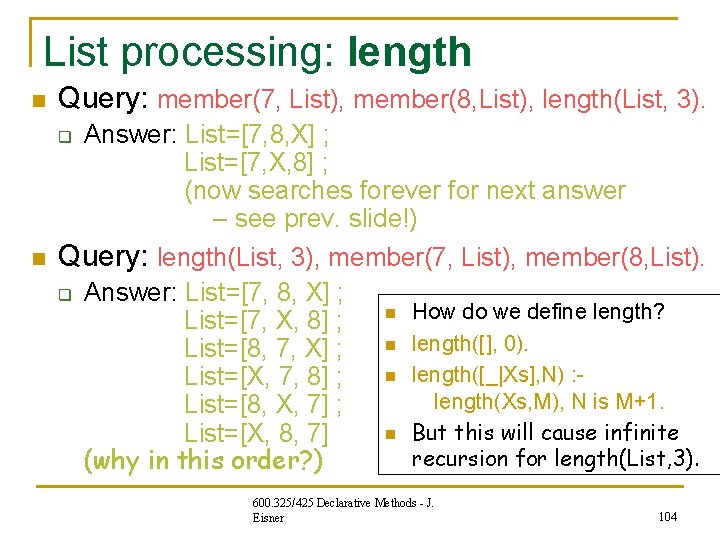
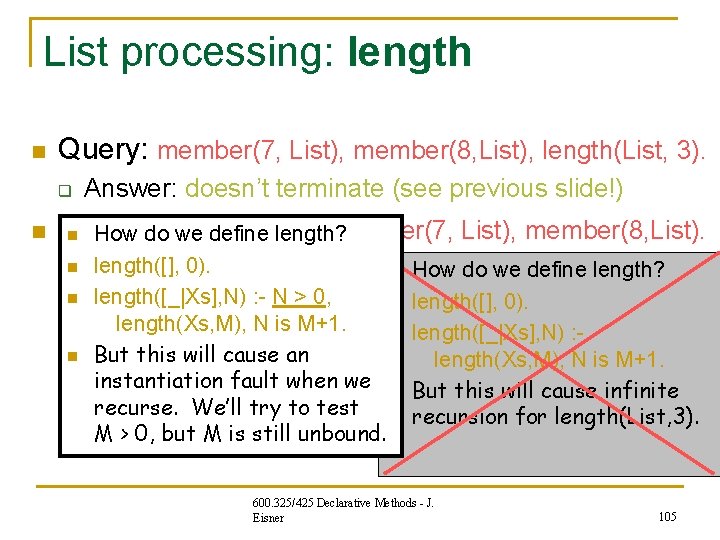
List processing: length n Query: member(7, List), member(8, List), length(List, 3). Answer: List=[7, 8, X] ; List=[7, X, 8] ; (now searches forever for next answer – see prev. slide!) Query: length(List, 3), member(7, List), member(8, List). q Answer: List=[7, 8, X] ; n How do we define length? List=[7, X, 8] ; n length([], 0). List=[8, 7, X] ; n length([_|Xs], N) : - List=[X, 7, 8] ; length(Xs, M), N is M+1. List=[8, X, 7] ; n But this will cause infinite List=[X, 8, 7] recursion for length(List, 3). (why in this order? ) q n 600. 325/425 Declarative Methods - J. Eisner 104
List processing: length n Query: member(7, List), member(8, List), length(List, 3). q n Answer: doesn’t terminate (see previous slide!) Query: length(List, 3), member(7, List), member(8, List). n How do we define length? length([], 0). n Answer: List=[7, 8, X] ; n length([_|Xs], N) : - N > 0, n List=[7, X, 8] ; length(Xs, M), N is M+1. List=[X, 7, 8] ; n n But this will cause an List=[8, 7, X] ; instantiation fault when we n List=[8, X, 7] ; recurse. We’ll try to test List=[X, 8, 7] M > 0, but M is still unbound. qn How do we define length? length([], 0). length([_|Xs], N) : - length(Xs, M), N is M+1. But this will cause infinite recursion for length(List, 3). 600. 325/425 Declarative Methods - J. Eisner 105
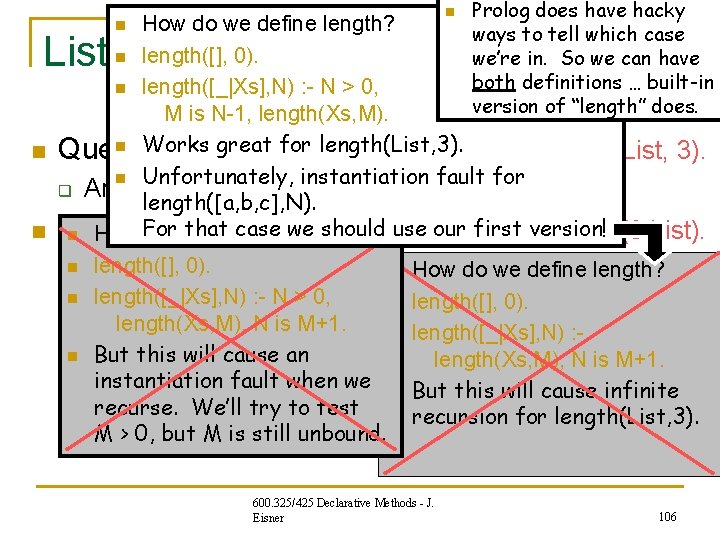
n Prolog does have hacky How do we define length? ways to tell which case n length([], 0). we’re in. So we can have both definitions … built-in n length([_|Xs], N) : - N > 0, version of “length” does. M is N-1, length(Xs, M). n Works great for length(List, 3). n Query: member(7, List), member(8, List), length(List, 3). n Unfortunately, instantiation fault for q Answer: doesn’t terminate (see previous slide!) length([a, b, c], N). For that case we should use our first version! n Query: length(List, 3), member(7, List), member(8, List). n How do we define length? length([], 0). n How do we define length? qn Answer: List=[7, 8, X] ; n length([_|Xs], N) : - N > 0, n length([], 0). List=[7, X, 8] ; length(Xs, M), N is M+1. List=[X, 7, 8] ; n length([_|Xs], N) : - n But this will cause an length(Xs, M), N is M+1. List=[8, 7, X] ; instantiation fault when we n But this will cause infinite List=[8, X, 7] ; recurse. We’ll try to test recursion for length(List, 3). List=[X, 8, 7] M > 0, but M is still unbound. n List processing: length 600. 325/425 Declarative Methods - J. Eisner 106
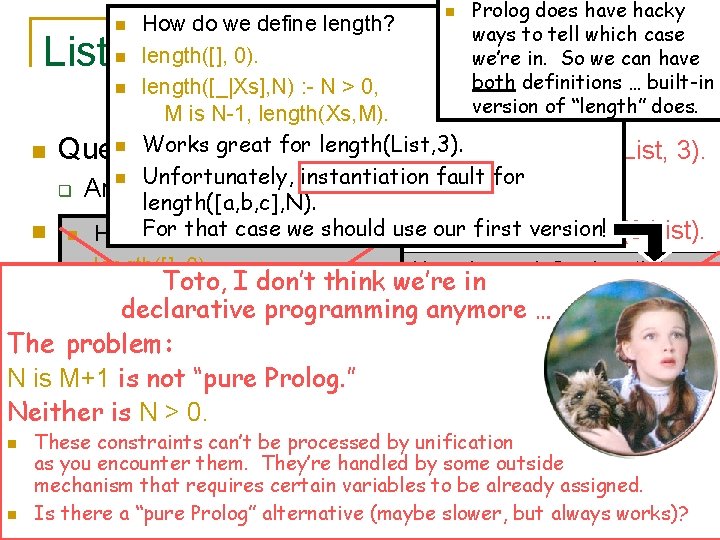
n Prolog does have hacky How do we define length? ways to tell which case n length([], 0). we’re in. So we can have both definitions … built-in n length([_|Xs], N) : - N > 0, version of “length” does. M is N-1, length(Xs, M). n Works great for length(List, 3). n Query: member(7, List), member(8, List), length(List, 3). n Unfortunately, instantiation fault for q Answer: doesn’t terminate (see previous slide!) length([a, b, c], N). For that case we should use our first version! n Query: length(List, 3), member(7, List), member(8, List). n How do we define length? length([], 0). How do we define length? qn Answer: List=[7, 8, X] ; Toto, I don’t thinknwe’re in. n length([_|Xs], N) : - N > 0, n length([], 0). List=[7, X, 8] ; declarative programming anymore …. length(Xs, M), M is N+1. List=[X, 7, 8] ; n length([_|Xs], N) : - The problem: n But this will cause an length(Xs, M), N is M+1. List=[8, 7, X] ; N is M+1 is not “pure Prolog. ” instantiation fault when we n But this will cause infinite List=[8, X, 7] ; and try to test M > 0. recursion for length(List, 3). Neitherrecurse is N > 0. List=[X, 8, 7] M is still unbound. n These constraints can’t be processed by unification n List processing: length n as you encounter them. They’re handled by some outside mechanism that requires certain variables to be already assigned. 600. 325/425 Declarative Methods - J. Is there a “pure Prolog”Eisner alternative (maybe slower, but always works)? 107
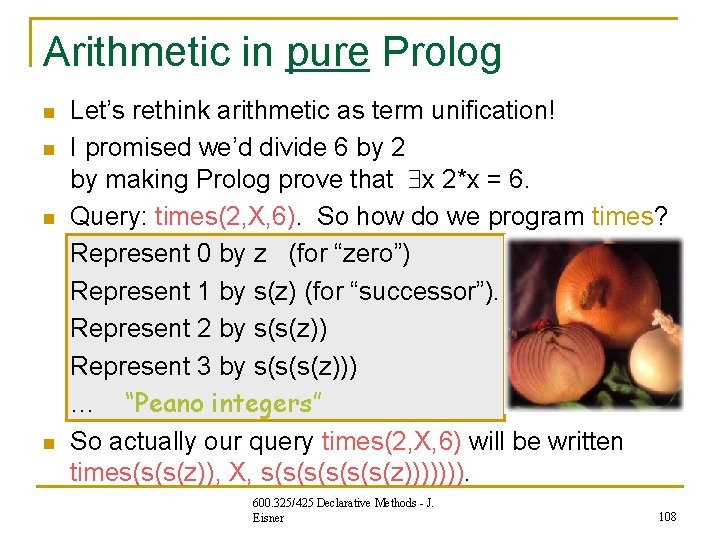
Arithmetic in pure Prolog n n Let’s rethink arithmetic as term unification! I promised we’d divide 6 by 2 by making Prolog prove that x 2*x = 6. Query: times(2, X, 6). So how do we program times? Represent 0 by z (for “zero”) Represent 1 by s(z) (for “successor”). Represent 2 by s(s(z)) Represent 3 by s(s(s(z))) … “Peano integers” So actually our query times(2, X, 6) will be written times(s(s(z)), X, s(s(s(z))))))). 600. 325/425 Declarative Methods - J. Eisner 108
A pure Prolog definition of length n n length([ ], z). length([_|Xs], s(N)) : - length(Xs, N). This is pure Prolog and will work perfectly everywhere. Yeah, it’s a bit annoying to use Peano integers for input/output: q q n Query: length([[a, b], [c, d], [e, f]], N). Answer: N=s(s(s(z))) Query: length(List, s(s(s(z)))). Answer: List=[A, B, C] yuck? But you could use impure Prolog to convert them to “ordinary” numbers just at input and output time … 600. 325/425 Declarative Methods - J. Eisner 109
A pure Prolog definition of length n n length([ ], z). length([_|Xs], s(N)) : - length(Xs, N). This is pure Prolog and will work perfectly everywhere. Converting between Peano integers and ordinary numbers: q q n n Query: length([[a, b], [c, d], [e, f]], N), decode(N, D). Answer: N=s(s(s(z))), D=3 Query: encode(3, N), length(List, N). Answer: N=s(s(s(z))), List=[A, B, C] decode(z, 0). decode(s(N), D) : - decode(N, E), D is E+1. encode(0, z). encode(D, s(N)) : - D > 0, E is D-1, encode(E, N). 600. 325/425 Declarative Methods - J. Eisner 110
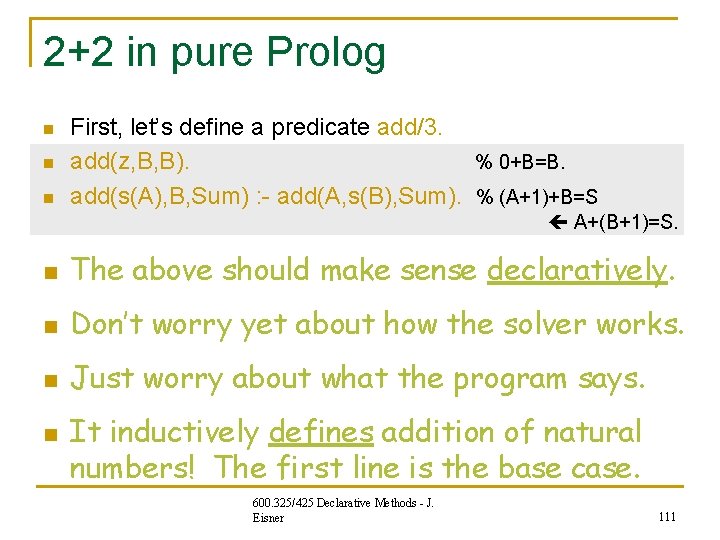
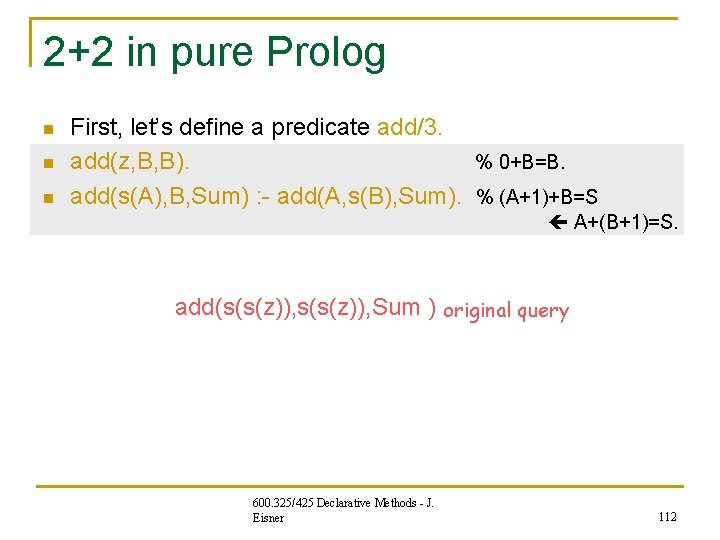
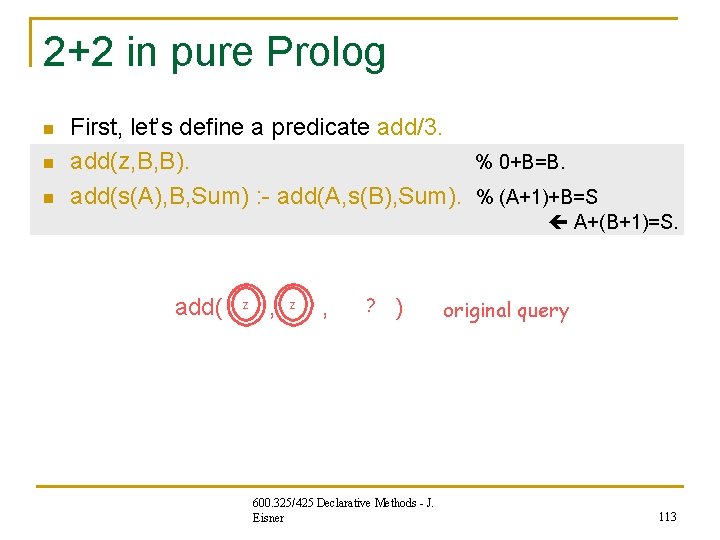
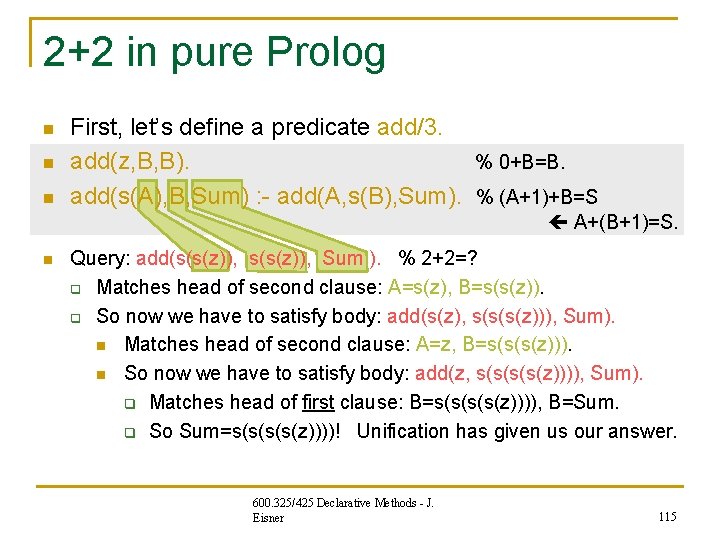
2+2 in pure Prolog n n n First, let’s define a predicate add/3. add(z, B, B). % 0+B=B. add(s(A), B, Sum) : - add(A, s(B), Sum). % (A+1)+B=S A+(B+1)=S. n The above should make sense declaratively. n Don’t worry yet about how the solver works. n Just worry about what the program says. n It inductively defines addition of natural numbers! The first line is the base case. 600. 325/425 Declarative Methods - J. Eisner 111
2+2 in pure Prolog n n n First, let’s define a predicate add/3. add(z, B, B). % 0+B=B. add(s(A), B, Sum) : - add(A, s(B), Sum). % (A+1)+B=S A+(B+1)=S. add(s(s(z)), Sum ) original query 600. 325/425 Declarative Methods - J. Eisner 112
2+2 in pure Prolog n n n First, let’s define a predicate add/3. add(z, B, B). % 0+B=B. add(s(A), B, Sum) : - add(A, s(B), Sum). % (A+1)+B=S A+(B+1)=S. z z ? add( , , ) 600. 325/425 Declarative Methods - J. Eisner original query 113
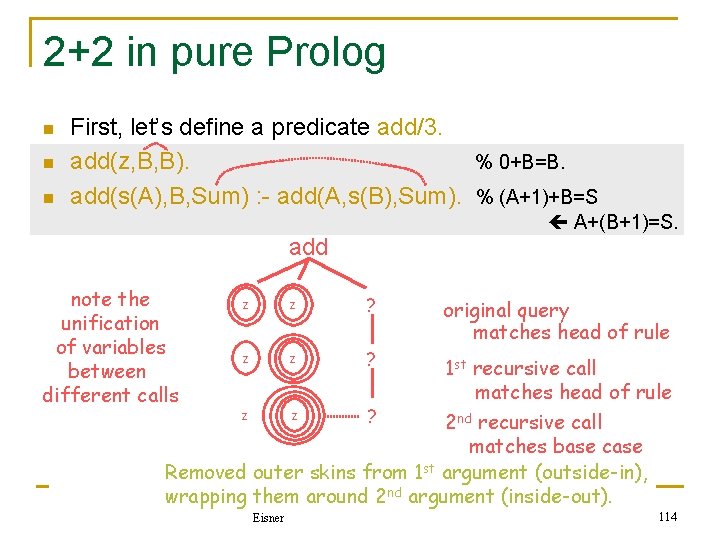
2+2 in pure Prolog n n n First, let’s define a predicate add/3. add(z, B, B). % 0+B=B. add(s(A), B, Sum) : - add(A, s(B), Sum). % (A+1)+B=S A+(B+1)=S. add note the unification of variables between different calls z z ? original query matches head of rule 1 st recursive call matches head of rule z z ? 2 nd recursive call matches base case Removed outer skins from 1 st argument (outside-in), wrapping them around 2 nd argument (inside-out). 600. 325/425 Declarative Methods - J. Eisner 114
2+2 in pure Prolog n n n First, let’s define a predicate add/3. add(z, B, B). % 0+B=B. add(s(A), B, Sum) : - add(A, s(B), Sum). % (A+1)+B=S A+(B+1)=S. n Query: add(s(s(z)), Sum ). % 2+2=? q Matches head of second clause: A=s(z), B=s(s(z)). q So now we have to satisfy body: add(s(z), s(s(s(z))), Sum). n Matches head of second clause: A=z, B=s(s(s(z))). n So now we have to satisfy body: add(z, s(s(z)))), Sum). q Matches head of first clause: B=s(s(z)))), B=Sum. q So Sum=s(s(z))))! Unification has given us our answer. 600. 325/425 Declarative Methods - J. Eisner 115
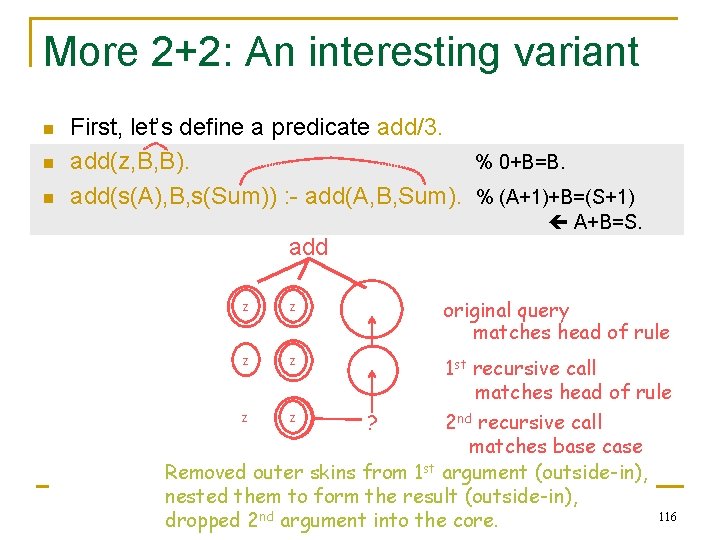
More 2+2: An interesting variant n n n First, let’s define a predicate add/3. add(z, B, B). % 0+B=B. add(s(A), B, s(Sum)) : - add(A, B, Sum). % (A+1)+B=(S+1) A+B=S. add z z ? original query matches head of rule 1 st recursive call matches head of rule z z ? 2 nd recursive call matches base case Removed outer skins from 1 st argument (outside-in), nested them to form the result (outside-in), 600. 325/425 Declarative Methods - J. nd argument into the core. 116 dropped 2 Eisner
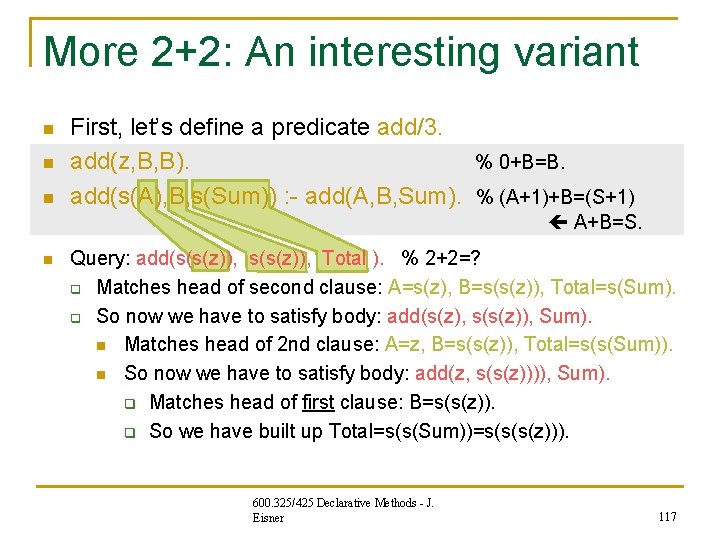
More 2+2: An interesting variant n n n First, let’s define a predicate add/3. add(z, B, B). % 0+B=B. add(s(A), B, s(Sum)) : - add(A, B, Sum). % (A+1)+B=(S+1) A+B=S. n Query: add(s(s(z)), Total ). % 2+2=? q Matches head of second clause: A=s(z), B=s(s(z)), Total=s(Sum). q So now we have to satisfy body: add(s(z), s(s(z)), Sum). n Matches head of 2 nd clause: A=z, B=s(s(z)), Total=s(s(Sum)). n So now we have to satisfy body: add(z, s(s(z)))), Sum). q Matches head of first clause: B=s(s(z)). q So we have built up Total=s(s(Sum))=s(s(s(z))). 600. 325/425 Declarative Methods - J. Eisner 117
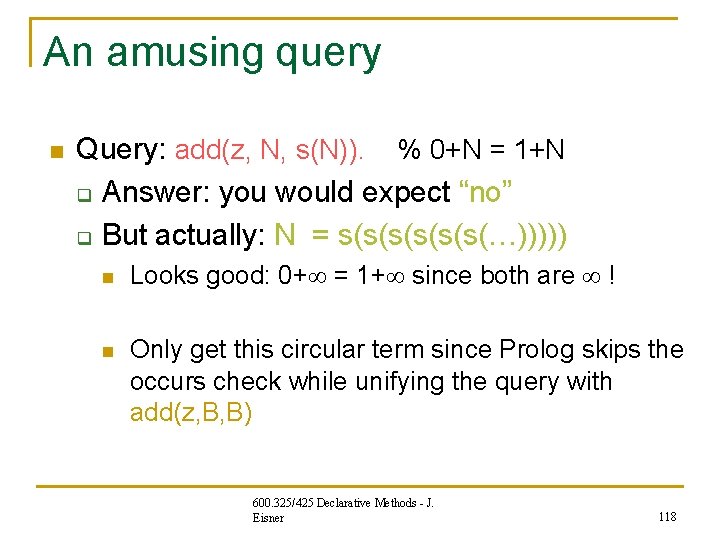
An amusing query n Query: add(z, N, s(N)). % 0+N = 1+N q Answer: you would expect “no” q But actually: N = s(s(s(…))))) n Looks good: 0+ = 1+ since both are ! n Only get this circular term since Prolog skips the occurs check while unifying the query with add(z, B, B) 600. 325/425 Declarative Methods - J. Eisner 118
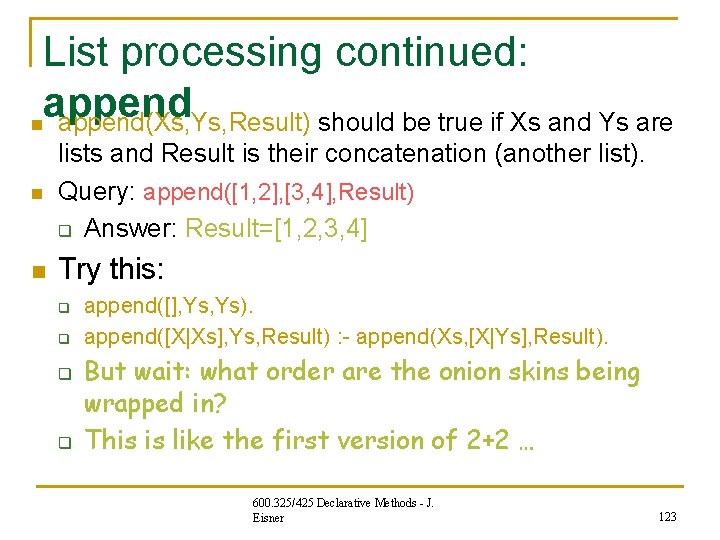
List processing continued: append n n You probably already know how to write a non-destructive append(Xs, Ys) function in a conventional language, using recursion. append(Xs, Ys): if (Xs. empty()) return Ys else subproblem = Xs. rest(); // all but the 1 st element subsolution = append(subproblem, Ys) return cons(Xs. first(), subsolution) 600. 325/425 Declarative Methods - J. Eisner 119
List processing continued: append n n You probably already know how to write a non-destructive append(Xs, Ys) function in a conventional language, using recursion. In more Prologgy notation: append([], Ys): return Ys append([X|Xs], Ys): return [X | append(Xs, Ys)] 600. 325/425 Declarative Methods - J. Eisner 120
List processing continued: append n You probably already know how to write a non-destructive append(Xs, Ys) function in a conventional language, using recursion. n In actual Prolog, the function looks much the same, but once you’ve written it, you can also run it backwards! In Prolog there are no return values. Rather, the return value is a third argument: append(Xs, Ys, Result). This is a constraint saying that Result must be the append of the other lists. Any of the three arguments may be known (or partly known) at runtime. We look for satisfying assignments to the others. n n n 600. 325/425 Declarative Methods - J. Eisner 121
List processing continued: append n append(Xs, Ys, Result) should be true if Xs and Ys are n lists and Result is their concatenation (another list). Query: append([1, 2], [3, 4], Result) q Answer: Result=[1, 2, 3, 4] n Try this: q append([], Ys). q append([X|Xs], Ys, Result) : - … ? 600. 325/425 Declarative Methods - J. Eisner 122
List processing continued: append n append(Xs, Ys, Result) should be true if Xs and Ys are n lists and Result is their concatenation (another list). Query: append([1, 2], [3, 4], Result) q Answer: Result=[1, 2, 3, 4] n Try this: q q append([], Ys). append([X|Xs], Ys, Result) : - append(Xs, [X|Ys], Result). But wait: what order are the onion skins being wrapped in? This is like the first version of 2+2 … 600. 325/425 Declarative Methods - J. Eisner 123
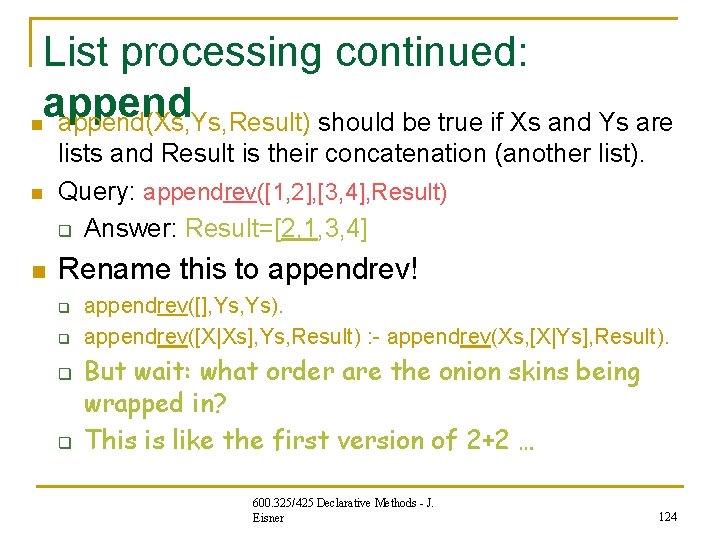
List processing continued: append n append(Xs, Ys, Result) should be true if Xs and Ys are n lists and Result is their concatenation (another list). Query: appendrev([1, 2], [3, 4], Result) q Answer: Result=[2, 1, 3, 4] n Rename this to appendrev! q q appendrev([], Ys). appendrev([X|Xs], Ys, Result) : - appendrev(Xs, [X|Ys], Result). But wait: what order are the onion skins being wrapped in? This is like the first version of 2+2 … 600. 325/425 Declarative Methods - J. Eisner 124
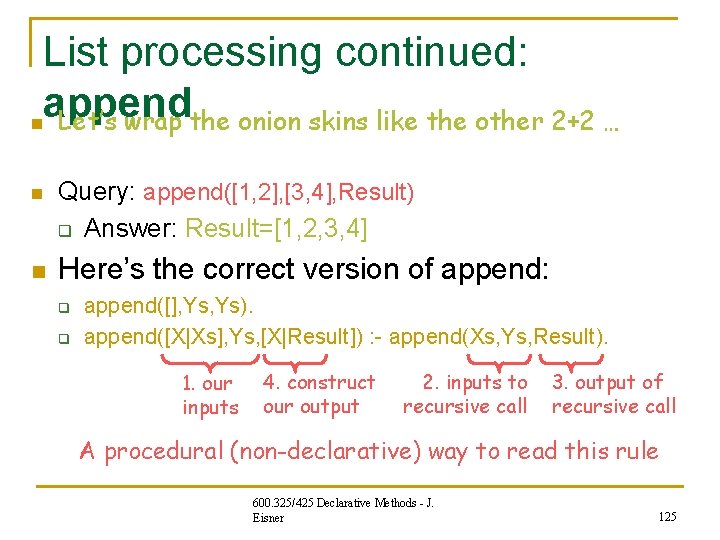
List processing continued: append n Let’s wrap the onion skins like the other 2+2 … n n Query: append([1, 2], [3, 4], Result) q Answer: Result=[1, 2, 3, 4] Here’s the correct version of append: q q append([], Ys). append([X|Xs], Ys, [X|Result]) : - append(Xs, Ys, Result). 1. our inputs 4. construct our output 2. inputs to recursive call 3. output of recursive call A procedural (non-declarative) way to read this rule 600. 325/425 Declarative Methods - J. Eisner 125
List processing continued: append n Let’s wrap the onion skins like the other 2+2 … n n Query: append([1, 2], [3, 4], Result) q Answer: Result=[1, 2, 3, 4] Here’s the correct version of append: q q append([], Ys). append([X|Xs], Ys, [X|Result]) : - append(Xs, Ys, Result). This version also makes perfect sense declaratively. And we still have a use for the other version, appendrev: n appendrev(Xs, [], Ys). reverse(Xs, Ys) : - …? 600. 325/425 Declarative Methods - J. Eisner 126
Arithmetic continued: Subtraction n add(z, B, B). % 0+B=B. n add(s(A), B, Sum) : - add(A, s(B), Sum). % (A+1)+B=S A+(B+1)=S. n add(z, B, B). % 0+B=B. n add(s(A), B, s(Sum)) : - add(A, B, Sum). % (A+1)+B=(S+1) A+B=S. n add(s(s(z)), X, s(s(s(z)))))). add(s(s(s(z))))), X, s(s(z))). n Pure Prolog gives you subtraction for free! n 600. 325/425 Declarative Methods - J. Eisner 127
Multiplication and division n n How do you define multiplication? (Then division will come for free. ) 600. 325/425 Declarative Methods - J. Eisner 128
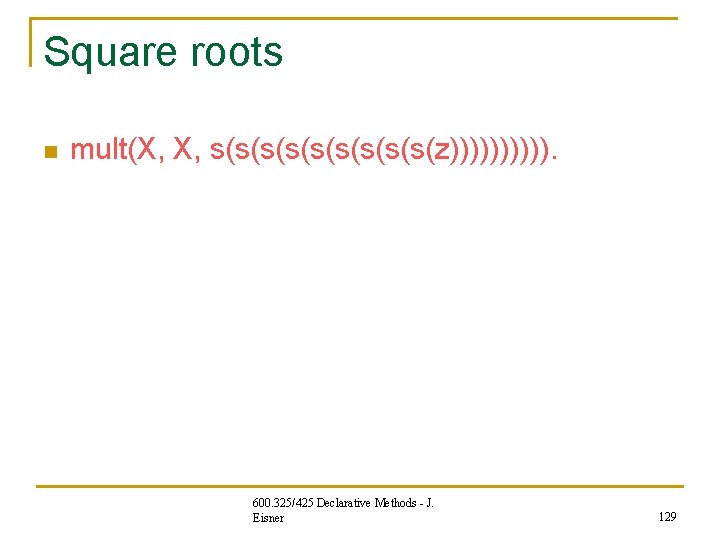
Square roots n mult(X, X, s(s(s(s(s(z))))). 600. 325/425 Declarative Methods - J. Eisner 129
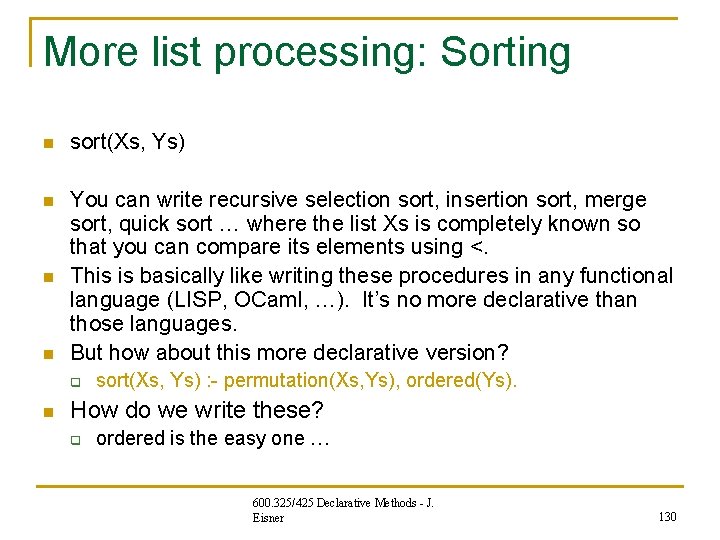
More list processing: Sorting n sort(Xs, Ys) n You can write recursive selection sort, insertion sort, merge sort, quick sort … where the list Xs is completely known so that you can compare its elements using <. This is basically like writing these procedures in any functional language (LISP, OCaml, …). It’s no more declarative than those languages. But how about this more declarative version? n n q n sort(Xs, Ys) : - permutation(Xs, Ys), ordered(Ys). How do we write these? q ordered is the easy one … 600. 325/425 Declarative Methods - J. Eisner 130
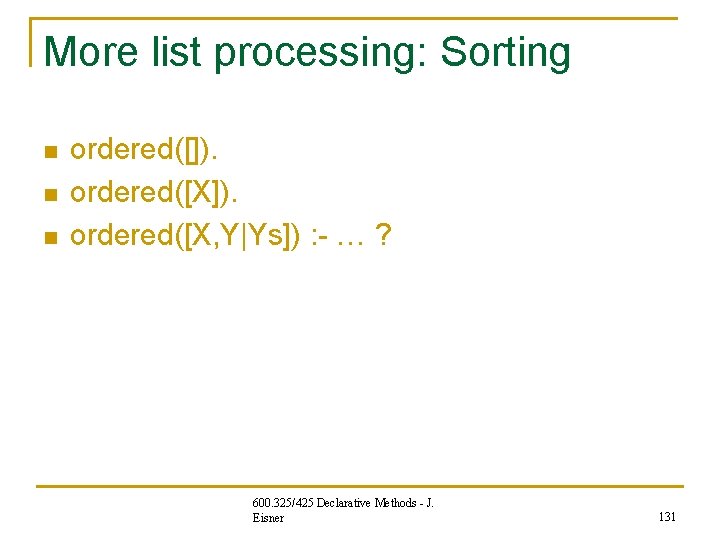
More list processing: Sorting n n n ordered([]). ordered([X, Y|Ys]) : - … ? 600. 325/425 Declarative Methods - J. Eisner 131
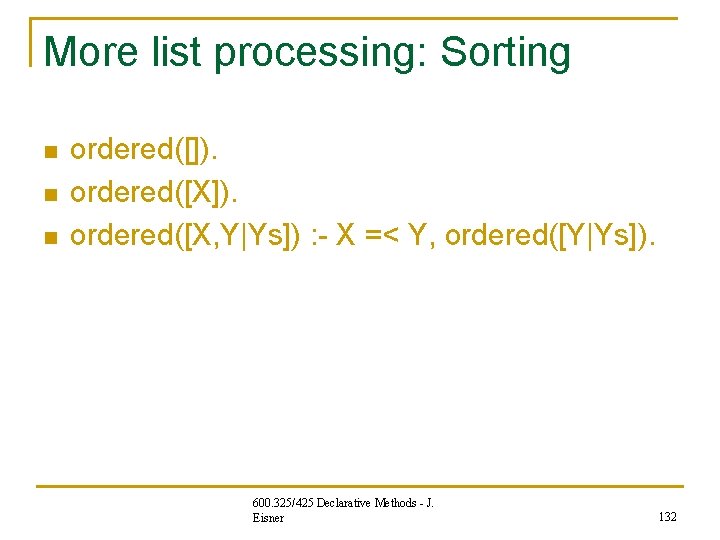
More list processing: Sorting n n n ordered([]). ordered([X, Y|Ys]) : - X =< Y, ordered([Y|Ys]). 600. 325/425 Declarative Methods - J. Eisner 132
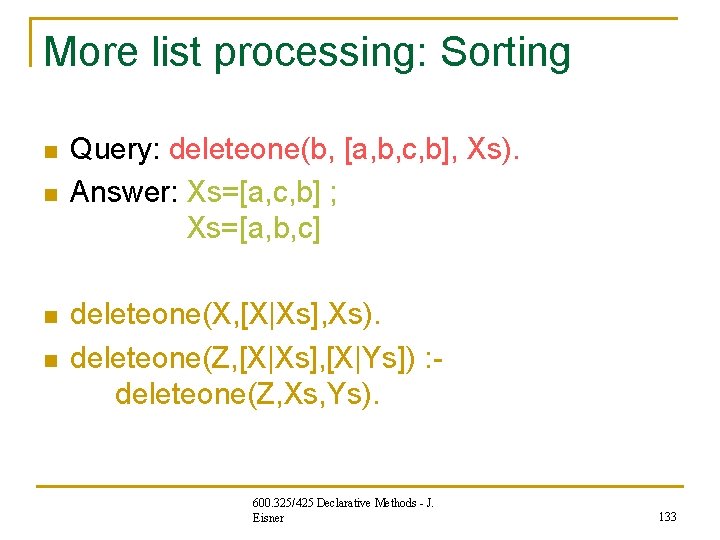
More list processing: Sorting n n Query: deleteone(b, [a, b, c, b], Xs). Answer: Xs=[a, c, b] ; Xs=[a, b, c] deleteone(X, [X|Xs], Xs). deleteone(Z, [X|Xs], [X|Ys]) : - deleteone(Z, Xs, Ys). 600. 325/425 Declarative Methods - J. Eisner 133
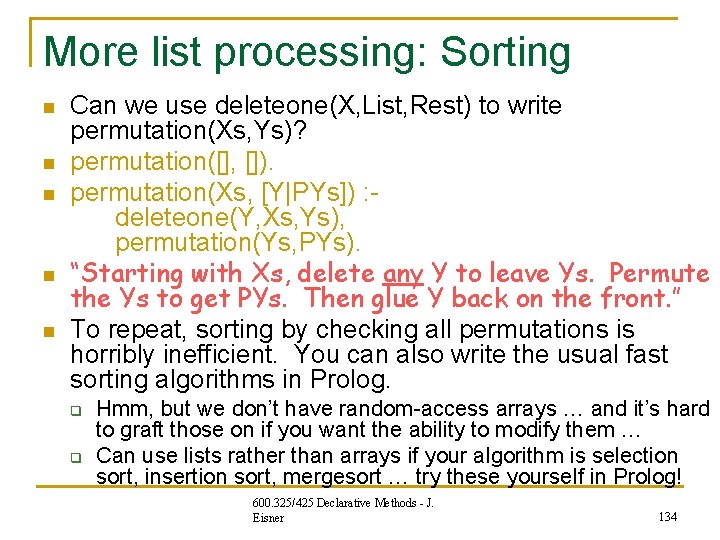
More list processing: Sorting n n n Can we use deleteone(X, List, Rest) to write permutation(Xs, Ys)? permutation([], []). permutation(Xs, [Y|PYs]) : - deleteone(Y, Xs, Ys), permutation(Ys, PYs). “Starting with Xs, delete any Y to leave Ys. Permute the Ys to get PYs. Then glue Y back on the front. ” To repeat, sorting by checking all permutations is horribly inefficient. You can also write the usual fast sorting algorithms in Prolog. q q Hmm, but we don’t have random-access arrays … and it’s hard to graft those on if you want the ability to modify them … Can use lists rather than arrays if your algorithm is selection sort, insertion sort, mergesort … try these yourself in Prolog! 600. 325/425 Declarative Methods - J. Eisner 134
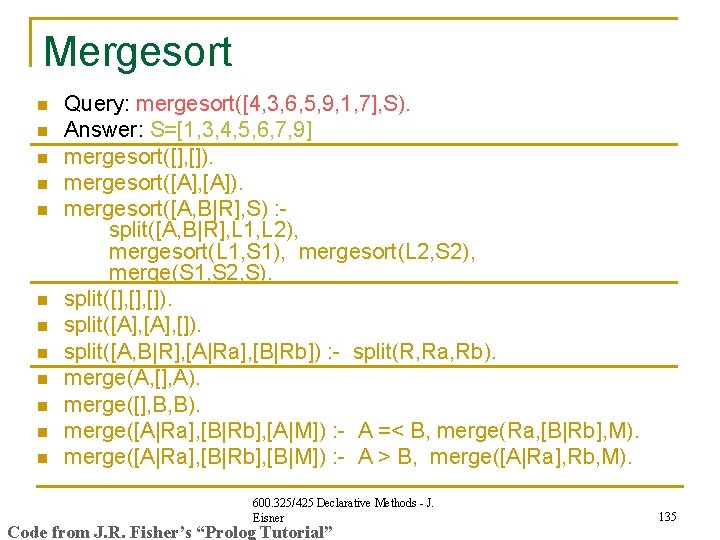
Mergesort n n n Query: mergesort([4, 3, 6, 5, 9, 1, 7], S). Answer: S=[1, 3, 4, 5, 6, 7, 9] mergesort([], []). mergesort([A], [A]). mergesort([A, B|R], S) : - split([A, B|R], L 1, L 2), mergesort(L 1, S 1), mergesort(L 2, S 2), merge(S 1, S 2, S). split([], []). split([A], []). split([A, B|R], [A|Ra], [B|Rb]) : - split(R, Ra, Rb). merge(A, [], A). merge([], B, B). merge([A|Ra], [B|Rb], [A|M]) : - A =< B, merge(Ra, [B|Rb], M). merge([A|Ra], [B|Rb], [B|M]) : - A > B, merge([A|Ra], Rb, M). 600. 325/425 Declarative Methods - J. Eisner Code from J. R. Fisher’s “Prolog Tutorial” 135
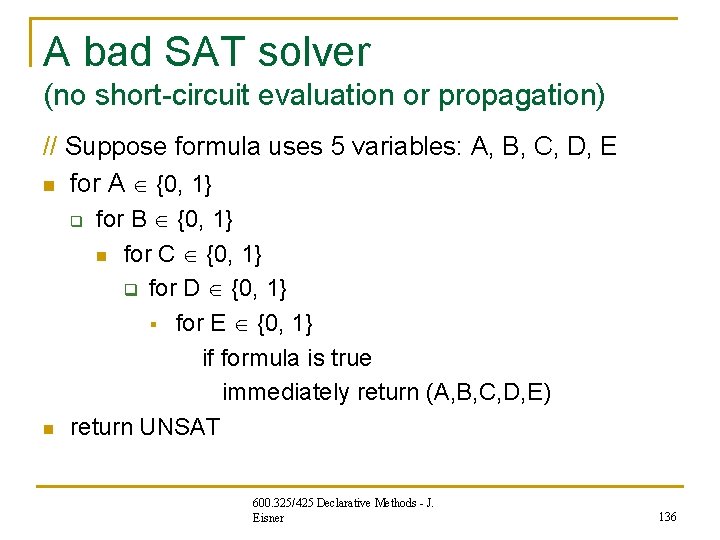
A bad SAT solver (no short-circuit evaluation or propagation) // Suppose formula uses 5 variables: A, B, C, D, E n for A {0, 1} for B {0, 1} n for C {0, 1} q for D {0, 1} § for E {0, 1} if formula is true immediately return (A, B, C, D, E) return UNSAT q n 600. 325/425 Declarative Methods - J. Eisner 136
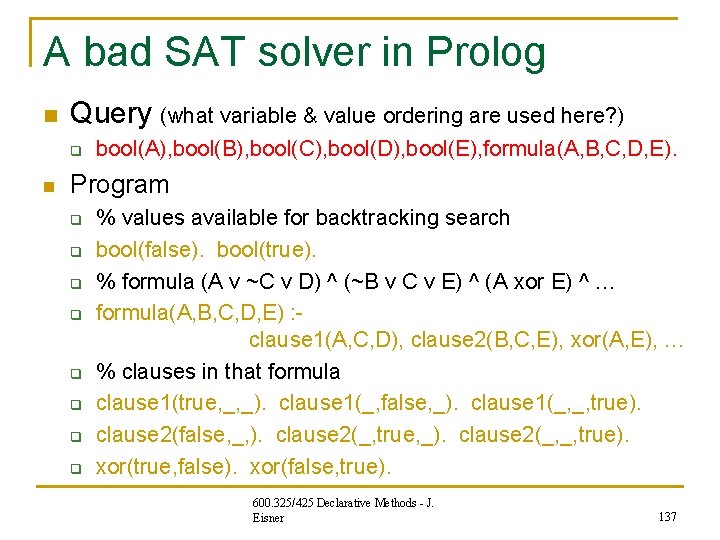
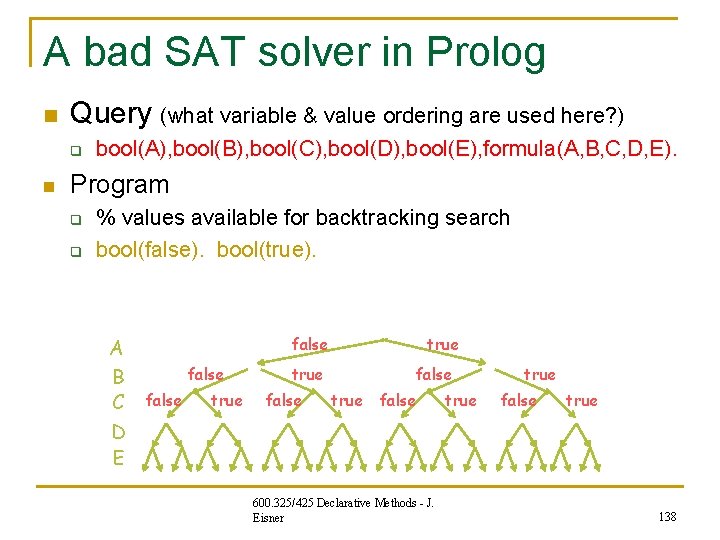
A bad SAT solver in Prolog n Query (what variable & value ordering are used here? ) q n bool(A), bool(B), bool(C), bool(D), bool(E), formula(A, B, C, D, E). Program q q q q % values available for backtracking search bool(false). bool(true). % formula (A v ~C v D) ^ (~B v C v E) ^ (A xor E) ^ … formula(A, B, C, D, E) : - clause 1(A, C, D), clause 2(B, C, E), xor(A, E), … % clauses in that formula clause 1(true, _, _). clause 1(_, false, _). clause 1(_, _, true). clause 2(false, _, ). clause 2(_, true, _). clause 2(_, _, true). xor(true, false). xor(false, true). 600. 325/425 Declarative Methods - J. Eisner 137
A bad SAT solver in Prolog n Query (what variable & value ordering are used here? ) q n bool(A), bool(B), bool(C), bool(D), bool(E), formula(A, B, C, D, E). Program q q % values available for backtracking search bool(false). bool(true). A B C D E false true false 600. 325/425 Declarative Methods - J. Eisner true false true 138
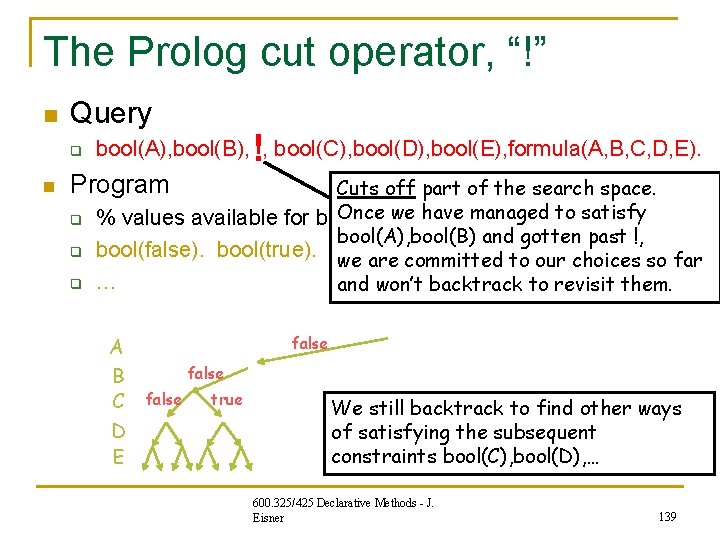
The Prolog cut operator, “!” n Query q n ! bool(A), bool(B), , bool(C), bool(D), bool(E), formula(A, B, C, D, E). Program q q q Cuts off part of the search space. Once we have managed to satisfy % values available for backtracking search bool(A), bool(B) and gotten past !, bool(false). bool(true). we are committed to our choices so far … and won’t backtrack to revisit them. A B C D E false true We still backtrack to find other ways of satisfying the subsequent constraints bool(C), bool(D), … 600. 325/425 Declarative Methods - J. Eisner 139
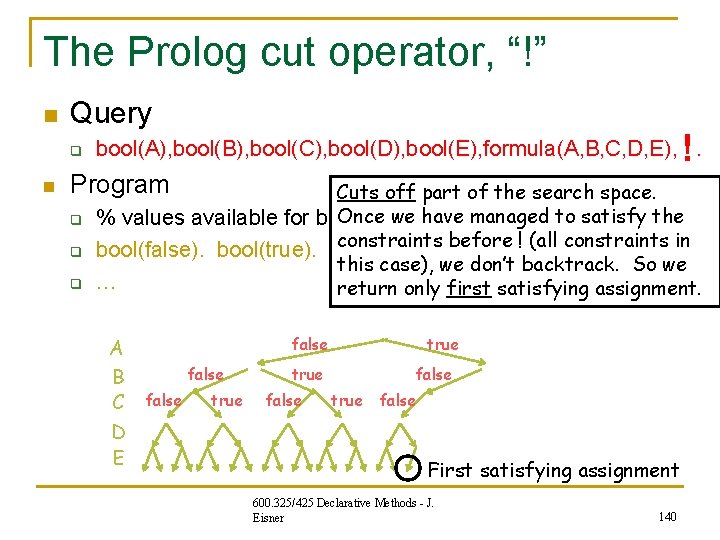
The Prolog cut operator, “!” n Query q n ! bool(A), bool(B), bool(C), bool(D), bool(E), formula(A, B, C, D, E), . Program q q q Cuts off part of the search space. Once we have managed to satisfy the % values available for backtracking search bool(false). bool(true). constraints before ! (all constraints in this case), we don’t backtrack. So we … return only first satisfying assignment. A B C D E false true false First satisfying assignment 600. 325/425 Declarative Methods - J. Eisner 140
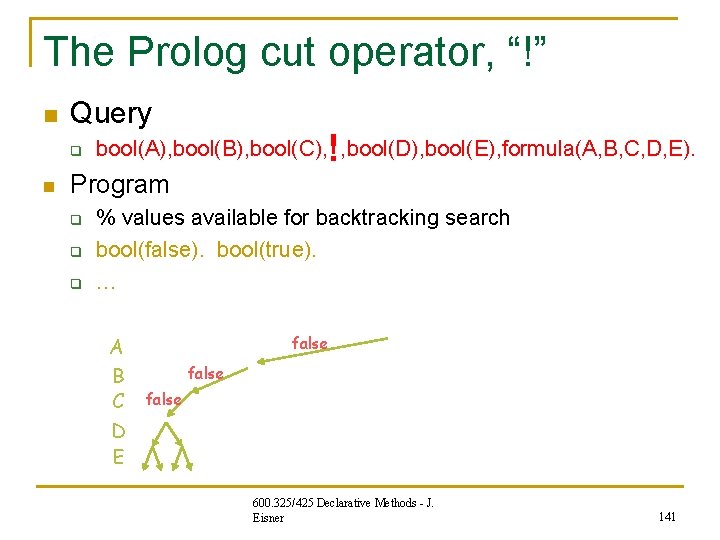
The Prolog cut operator, “!” n Query q n ! bool(A), bool(B), bool(C), , bool(D), bool(E), formula(A, B, C, D, E). Program q q q % values available for backtracking search bool(false). bool(true). … A B C D E false 600. 325/425 Declarative Methods - J. Eisner 141
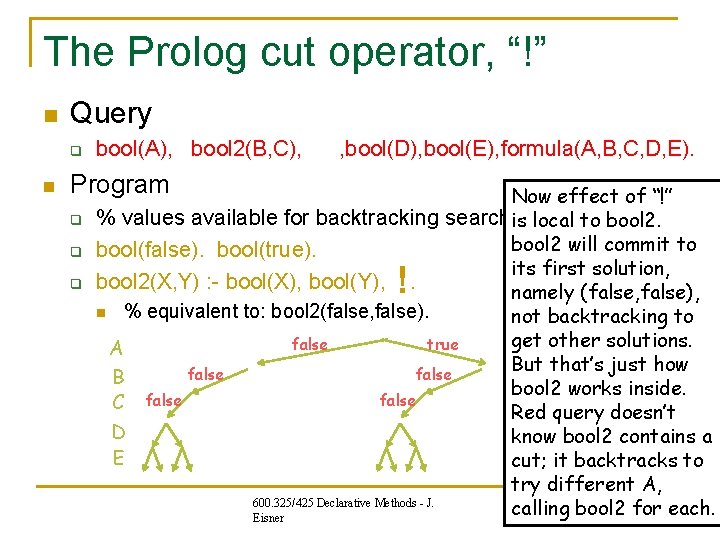
The Prolog cut operator, “!” n Query q n ! bool(A), bool 2(B, C), , bool(D), bool(E), formula(A, B, C, D, E). Program q q q Same effect, using a subroutine. % values available for backtracking search bool(false). bool(true). bool 2(X, Y) : - bool(X), bool(Y). A B C D E false 600. 325/425 Declarative Methods - J. Eisner 142
The Prolog cut operator, “!” n Query q n bool(A), bool 2(B, C), , bool(D), bool(E), formula(A, B, C, D, E). Program q q q Now effect of “!” % values available for backtracking search is local to bool 2 will commit to bool(false). bool(true). its first solution, bool 2(X, Y) : - bool(X), bool(Y), . namely (false, false), n % equivalent to: bool 2(false, false). not backtracking to get other solutions. false true A But that’s just how false B bool 2 works inside. false C Red query doesn’t D know bool 2 contains a E cut; it backtracks to try different A, 600. 325/425 Declarative Methods - J. calling bool 2 for 143 each. Eisner !
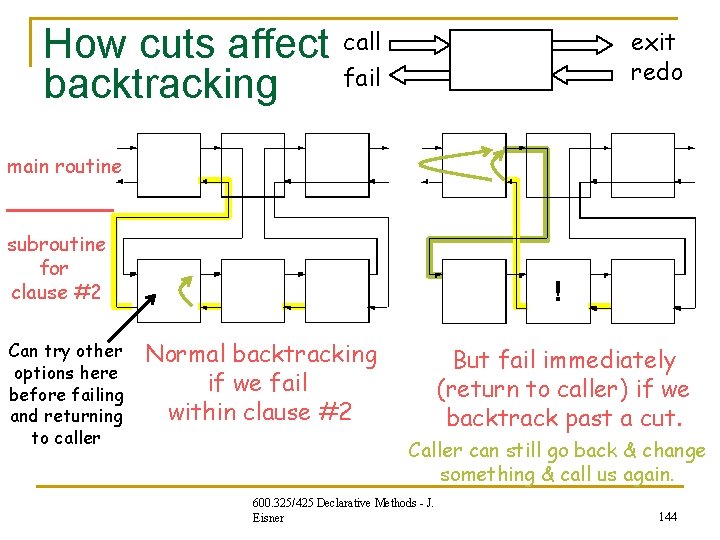
How cuts affect call fail backtracking exit redo main routine subroutine for clause #2 Can try other options here before failing and returning to caller Normal backtracking if we fail within clause #2 But fail immediately (return to caller) if we backtrack past a cut. Caller can still go back & change something & call us again. 600. 325/425 Declarative Methods - J. Eisner 144
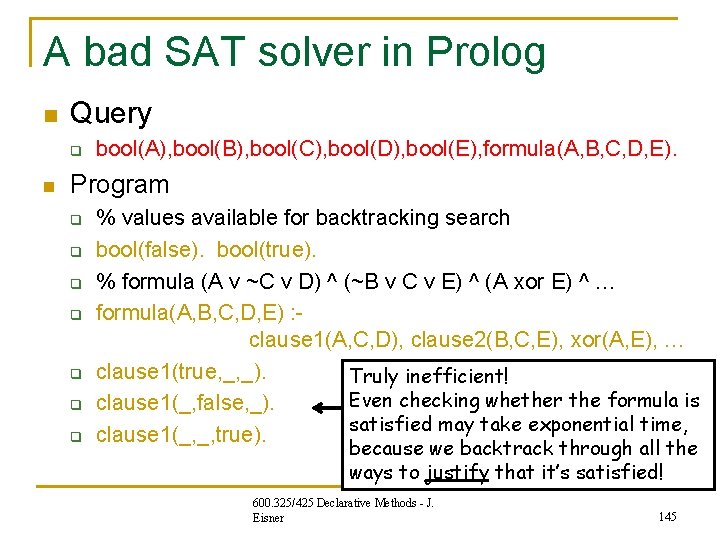
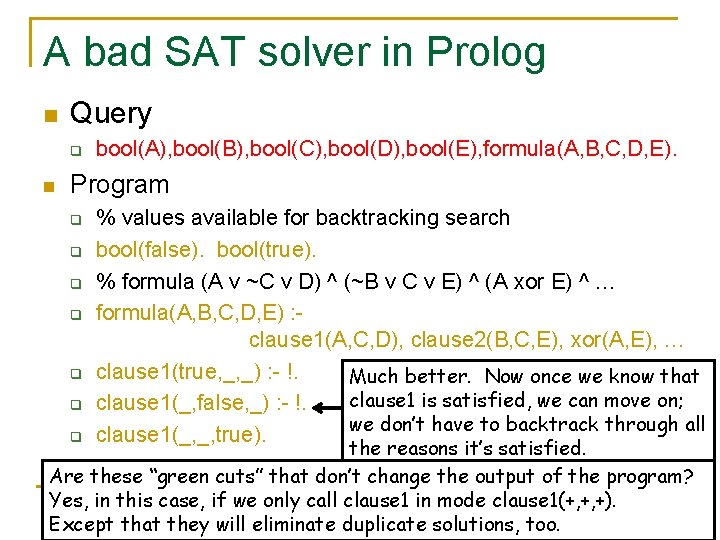
A bad SAT solver in Prolog n Query q n bool(A), bool(B), bool(C), bool(D), bool(E), formula(A, B, C, D, E). Program q q q q % values available for backtracking search bool(false). bool(true). % formula (A v ~C v D) ^ (~B v C v E) ^ (A xor E) ^ … formula(A, B, C, D, E) : - clause 1(A, C, D), clause 2(B, C, E), xor(A, E), … clause 1(true, _, _). Truly inefficient! Even checking whether the formula is clause 1(_, false, _). satisfied may take exponential time, clause 1(_, _, true). because we backtrack through all the ways to justify that it’s satisfied! 600. 325/425 Declarative Methods - J. Eisner 145
A bad SAT solver in Prolog n Query q n bool(A), bool(B), bool(C), bool(D), bool(E), formula(A, B, C, D, E). Program q q q q % values available for backtracking search bool(false). bool(true). % formula (A v ~C v D) ^ (~B v C v E) ^ (A xor E) ^ … formula(A, B, C, D, E) : - clause 1(A, C, D), clause 2(B, C, E), xor(A, E), … clause 1(true, _, _) : - !. Much better. Now once we know that clause 1(_, false, _) : - !. clause 1 is satisfied, we can move on; we don’t have to backtrack through all clause 1(_, _, true). the reasons it’s satisfied. Are these “green cuts” that don’t change the output of the program? Yes, in this case, if we 600. 325/425 only call clause 1 Declarative Methodsin - J. mode clause 1(+, +, +). 146 Eisner Except that they will eliminate duplicate solutions, too.
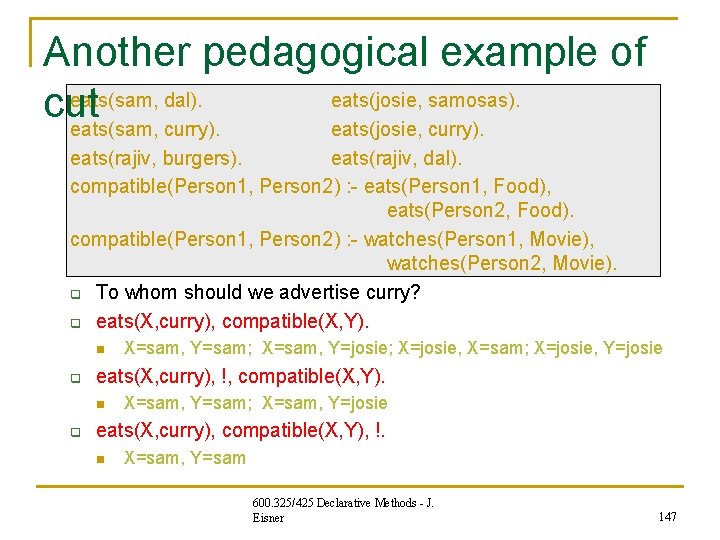
Another pedagogical example of eats(sam, dal). eats(josie, samosas). cut eats(sam, curry). eats(josie, curry). eats(rajiv, burgers). eats(rajiv, dal). compatible(Person 1, Person 2) : - eats(Person 1, Food), eats(Person 2, Food). compatible(Person 1, Person 2) : - watches(Person 1, Movie), watches(Person 2, Movie). q To whom should we advertise curry? q eats(X, curry), compatible(X, Y). n q eats(X, curry), !, compatible(X, Y). n q X=sam, Y=sam; X=sam, Y=josie; X=josie, X=sam; X=josie, Y=josie X=sam, Y=sam; X=sam, Y=josie eats(X, curry), compatible(X, Y), !. n X=sam, Y=sam 600. 325/425 Declarative Methods - J. Eisner 147
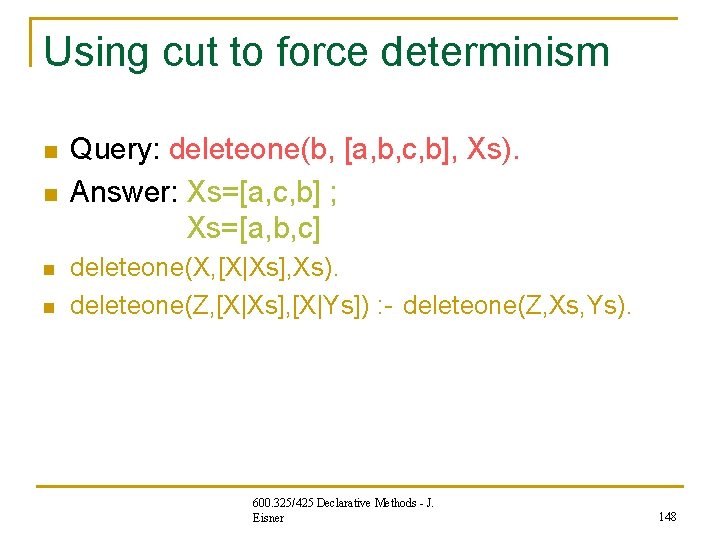
Using cut to force determinism n n Query: deleteone(b, [a, b, c, b], Xs). Answer: Xs=[a, c, b] ; Xs=[a, b, c] deleteone(X, [X|Xs], Xs). deleteone(Z, [X|Xs], [X|Ys]) : - deleteone(Z, Xs, Ys). 600. 325/425 Declarative Methods - J. Eisner 148
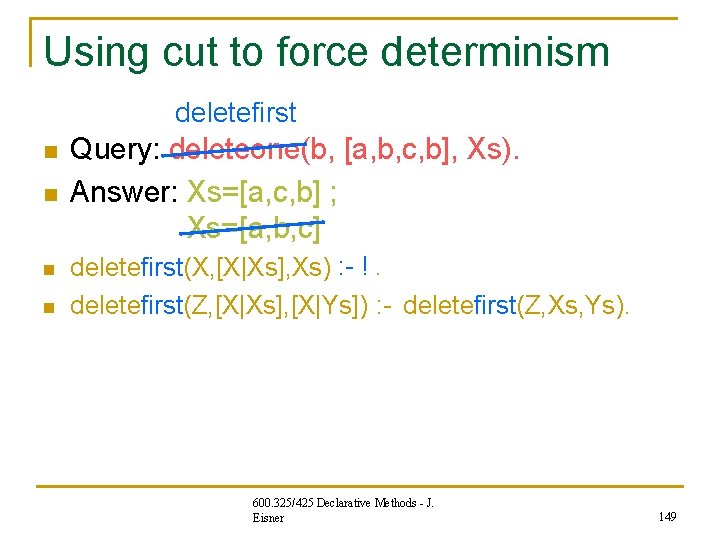
Using cut to force determinism deletefirst n n Query: deleteone(b, [a, b, c, b], Xs). Answer: Xs=[a, c, b] ; Xs=[a, b, c] deletefirst(X, [X|Xs], Xs). : - !. deletefirst(Z, [X|Xs], [X|Ys]) : - deletefirst(Z, Xs, Ys). 600. 325/425 Declarative Methods - J. Eisner 149
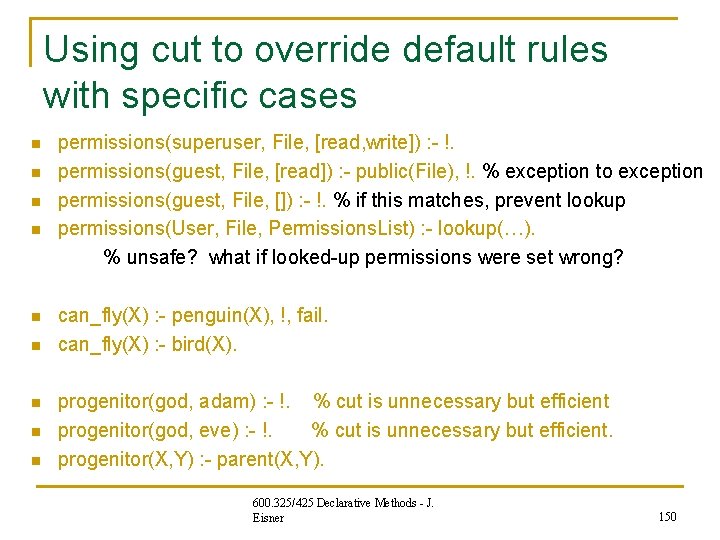
Using cut to override default rules with specific cases n n n n n permissions(superuser, File, [read, write]) : - !. permissions(guest, File, [read]) : - public(File), !. % exception to exception permissions(guest, File, []) : - !. % if this matches, prevent lookup permissions(User, File, Permissions. List) : - lookup(…). % unsafe? what if looked-up permissions were set wrong? can_fly(X) : - penguin(X), !, fail. can_fly(X) : - bird(X). progenitor(god, adam) : - !. % cut is unnecessary but efficient progenitor(god, eve) : - !. % cut is unnecessary but efficient. progenitor(X, Y) : - parent(X, Y). 600. 325/425 Declarative Methods - J. Eisner 150
Using cut to get negation, sort of eats(sam, dal). eats(sam, curry). eats(rajiv, burgers). q + eats(sam, dal). % + means “not provable” n q Yes + eats(sam, X). n q No + eats(sam, rutabaga). n q eats(josie, samosas). eats(josie, curry). eats(rajiv, dal). No % since we can prove that sam does eat some X + eats(robot, X). n Yes % since we can’t currently prove that robot eats anything 600. 325/425 Declarative Methods - J. Eisner 151
Using cut to get negation, sort of eats(sam, dal). eats(josie, samosas). eats(sam, curry). eats(josie, curry). eats(rajiv, burgers). eats(rajiv, dal). avoids(Person, Food) : - eats(Person, Food), !, fail. avoids(Person, Food). q avoids(sam, dal). % “avoids” is implemented in the same way as + n q avoids(sam, rutabaga). n q Yes If we can prove “eats, ” we commit with ! to not being able to prove “avoid” Otherwise we can prove “avoid”! avoids(sam, X). n q No No % since we can prove that sam does eat some X avoids(robot, X). n Yes % since we can’t currently prove that robot eats anything 600. 325/425 Declarative Methods - J. Eisner 152
More list processing: deleteall n n n n Query: deleteall(2, [1, 2, 3, 1, 2], Ys). Answer: Ys=[1, 3, 1] deleteall(X, [X|Xs], Ys) : - deleteall(X, Xs, Ys). deleteall(Z, [X|Xs], [X|Ys]) : - Z=X, deleteall(Z, Xs, Ys). Works fine for ground terms : deleteall(Z, []). 2 = 1, so we don’t delete 1. But how about deleteall(Z, [1, 2, 3, 1, 2], Ys)? We’d like = to mean “constrained not to unify. ” q q q n So Z = 1 should mean “Z can be any term at all except for 1. ” But how do we represent that in memory? ? Not like unification, which just specializes a variable to refer to a more specific term than before. “Anything but 1” is not a term. So instead, it means “these don’t unify right now” q “Z = 1” is just short for “+ (Z=1)” 600. 325/425 Declarative Methods - J. Eisner 153
More list processing: deleteall n n Query: deleteall(A, [1, 2, 3, 1, 2], Ys). Answer: A=1, Ys=[2, 3, 2] since only first clause succeeds (and then A is ground in recursive call) n deleteall(X, [X|Xs], Ys) : - deleteall(X, Xs, Ys). deleteall(Z, [X|Xs], [X|Ys]) : - Z=X, deleteall(Z, Xs, Ys). deleteall(Z, []). n We’d like = to mean “constrained not to unify. ” n n q q q n So Z = 1 should mean “Z can be any term at all except for 1. ” But how do we represent that in memory? ? Not like unification, which just specializes a variable to refer to a more specific term than before. “Anything but 1” is not a term. So instead, it means “these don’t unify right now” q “Z = 1” is just short for “+ (Z=1)” 600. 325/425 Declarative Methods - J. Eisner 154
More list processing: deleteall n n Query: deleteall(A, [1, 2, 3, 1, 2], Ys). Answer: A=1, Ys=[2, 3, 2] Equivalent way to make only 1 st clause succeed (but faster: never tries 2 nd) n deleteall(X, [X|Xs], Ys) : - ! , deleteall(X, Xs, Ys). deleteall(Z, [X|Xs], [X|Ys]) : - deleteall(Z, Xs, Ys). deleteall(Z, []). n We’d like = to mean “constrained not to unify. ” n n q q q n So Z = 1 should mean “Z can be any term at all except for 1. ” But how do we represent that in memory? ? Not like unification, which just specializes a variable to refer to a more specific term than before. “Anything but 1” is not a term. So instead, it means “these don’t unify right now” q “Z = 1” is just short for “+ (Z=1)” 600. 325/425 Declarative Methods - J. Eisner 155
More list processing: deleteall Query: deleteall(A, [1, 2, 3, 1, 2], Ys). n Answer: A=1, Ys=[2, 3, 2] ; Instantiation fault since == only allowed in mode +, + n deleteall(X, [X|Xs], Ys) : - deleteall(X, Xs, Ys). n deleteall(Z, [X|Xs], [X|Ys]) : - Z==X, deleteall(Z, Xs, Ys). n deleteall(Z, []). n n We’d like = to mean “constrained not to unify. ” q q q n So Z = 1 should mean “Z can be any term at all except for 1. ” But how do we represent that in memory? ? Not like unification, which just specializes a variable to refer to a more specific term than before. “Anything but 1” is not a term. So instead, it means “these don’t unify right now” q “Z = 1” is just short for “+ (Z=1)” 600. 325/425 Declarative Methods - J. Eisner 156
More list processing: deleteall Query: member(A, [1, 2, 3, 1, 2]), deleteall(A, [1, 2, 3, 1, 2], Ys). n Answer: A=1, Ys=[2, 3, 2] ; Ensure that A is ground A=2, Ys=[1, 3, 1] ; etc. before we try calling deleteall (5 answers) n deleteall(X, [X|Xs], Ys) : - deleteall(X, Xs, Ys). n deleteall(Z, [X|Xs], [X|Ys]) : - Z=X, deleteall(Z, Xs, Ys). n deleteall(Z, []). n n We’d like = to mean “constrained not to unify. ” q q q n So Z = 1 should mean “Z can be any term at all except for 1. ” But how do we represent that in memory? ? Not like unification, which just specializes a variable to refer to a more specific term than before. “Anything but 1” is not a term. So instead, it means “these don’t unify right now” q “Z = 1” is just short for “+ (Z=1)” 600. 325/425 Declarative Methods - J. Eisner 157
More list processing: deleteall Query: deleteall(A, [1, 2, 3, 1, 2], Ys). n Answer: A=1, Ys=[2, 3, 2] ; ECLi. PSe delayed constraint! A=2, Ys=[1, 3, 1] ; etc. Will be handled once Z is known. n deleteall(X, [X|Xs], Ys) : - deleteall(X, Xs, Ys). n deleteall(Z, [X|Xs], [X|Ys]) : - Z#=X, deleteall(Z, Xs, Ys). n deleteall(Z, []). n This is the “right” approach (fully declarative). Beyond Prolog. : -lib(ic). How many answers? Still 5 answers? Nope! 4 answers: A=1, Ys=[2, 3, 2] ; match 1 st clause (so A=1) A=2, Ys=[1, 3, 1] ; match 2 nd clause (so A#=1), then 1 st (so A=2) A=3, Ys=[1, 2, 1, 2] ; match 2 nd (so A#=1), then 2 nd (A#=2), then 1 st (A=3) If we match 2 nd clause once more, then we’ll have to keep matching it for the rest of the list, since we will have constraints A {1, 2, 3} that prevent us from taking the 1 st clause again A=A, Ys=[1, 2, 3, 1, 2], plus delayed goals saying A {1, 2, 3} 600. 325/425 Declarative Methods - J. 158 Eisner match 2 nd clause 5 times
More list processing: deleteall Query: deleteall(A, [1, 2, 3, 1, 2], Ys). n Answer: A=1, Ys=[2, 3, 2] ; ECLi. PSe delayed constraint! A=2, Ys=[1, 3, 1] ; etc. Will be handled once Z is known. n deleteall(X, [X|Xs], Ys) : - deleteall(X, Xs, Ys). n deleteall(Z, [X|Xs], [X|Ys]) : - Z#=X, deleteall(Z, Xs, Ys). n deleteall(Z, []). n This is the “right” approach (fully declarative). Beyond Prolog. : -lib(ic). Well, still not perfect. What happens with query deleteall(1, List, [2, 3, 2])? Unfortunately we get infinite recursion on the first clause. 600. 325/425 Declarative Methods - J. Eisner 159
Constraint logic programming … n In constraint logic programming, you can include constraints on integers like N #= M+1 (rather than N is M+1) and X#=Z (rather than X =Z) without having to worry about which variables are already instantiated. n If a constraint can’t be processed yet, it will be handled later, as soon as its variables are sufficiently instantiated. Example: N #= M+1, N #= 5. In fact, do bounds propagation. Example: N #= M+1, N #> 5. n n n But what happens if vars are never sufficiently instantiated? The labeling(Vars) constraint does backtracking search: q tries all assignments of Vars consistent with constraints so far q finds these assignments using backtracking search interleaved with constraint propagation (e. g. , bounds consistency) q you can control the variable and value ordering q only sensible for variables whose values are constrained to a finite set, or the integers, etc. , since we can’t easily backtrack through all the infinitely many terms that might be assigned to a variable. 600. 325/425 Declarative Methods - J. Eisner 160
Constraint logic programming n We explored at the ECLi. PSe prompt or on the blackboard: q various small examples of CLP, e. g. , n n q q X #= 2*Y, X=10. X #> 2*Y, X=10. member(X, [1, 2, 3, 4, 2]), X #= 2*Y, member(X, [1, 2, 3, 4, 2]). uniqmember simplified version of Golomb ruler (from Eclipse website) 600. 325/425 Declarative Methods - J. Eisner 161
Constraint logic programming: alldifferent n Wrong answer: q q n alldiff([]). alldiff([X|Xs]) : - member(Y, Xs), X #= Y, alldiff(Xs). Right answer (although it lacks the strong propagator from ECLi. PSe’s standard alldifferent): q q alldiff([]). … ? (see homework) 600. 325/425 Declarative Methods - J. Eisner 162