
Prolog Programming in Logic 19 Feb21 SWIProlog n
Prolog Programming in Logic 19 -Feb-21

SWI-Prolog n n n SWI-Prolog is a good, standard Prolog for Windows and Linux It's licensed under GPL, therefore free Downloadable from: http: //www. swi-prolog. org/
Syllogisms n n n “Prolog” is all about programming in logic. Aristotle described syllogisms 2300 years ago Sample syllogism: n n Socrates is a man. All men are mortal. Therefore, Socrates is mortal. This is logic. Can Prolog do it?
Forward and backward reasoning n A syllogism gives two premises, then asks, "What can we conclude? " n n n This is forward reasoning -- from premises to conclusions it's inefficient when you have lots of premises Instead, you ask Prolog specific questions n Prolog uses backward reasoning -- from (potential) conclusions to facts

Syllogisms in Prolog Syllogism Prolog Socrates is a man(socrates). All men are mortal(X) : - man(X). Is Socrates mortal? ? - mortal(socrates).
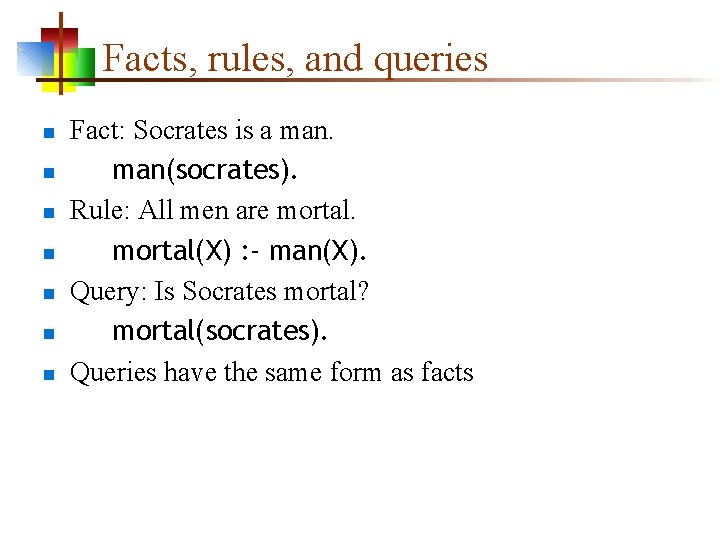
Facts, rules, and queries n n n n Fact: Socrates is a man(socrates). Rule: All men are mortal(X) : - man(X). Query: Is Socrates mortal? mortal(socrates). Queries have the same form as facts
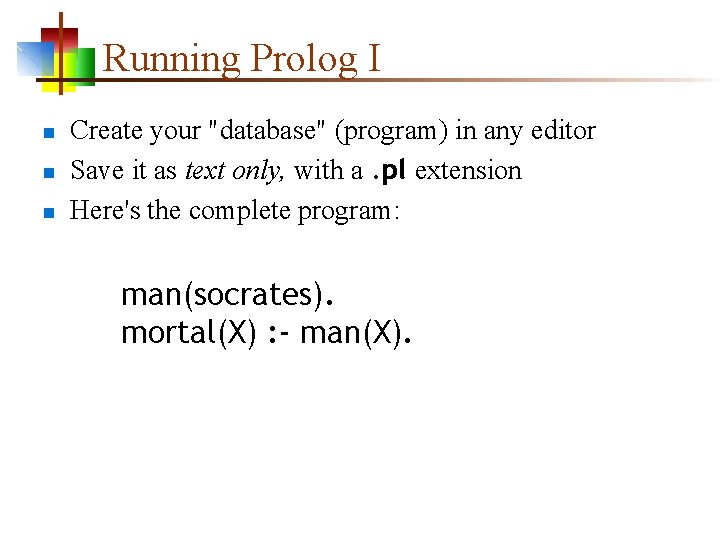
Running Prolog I n n n Create your "database" (program) in any editor Save it as text only, with a. pl extension Here's the complete program: man(socrates). mortal(X) : - man(X).
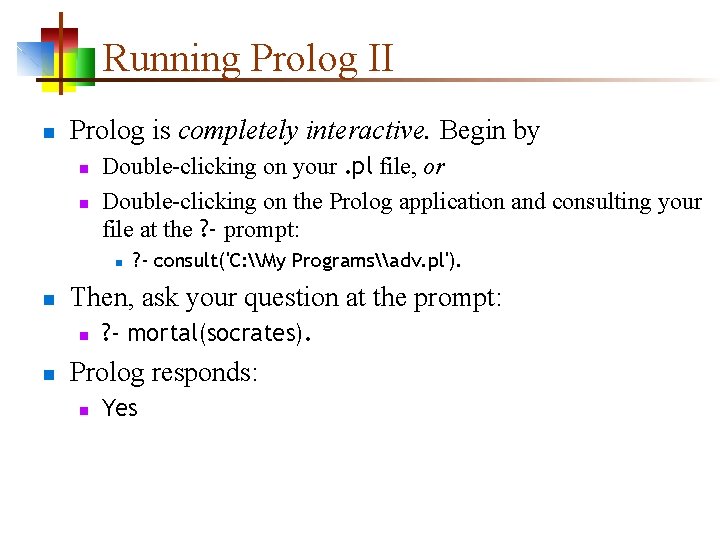
Running Prolog II n Prolog is completely interactive. Begin by n n Double-clicking on your. pl file, or Double-clicking on the Prolog application and consulting your file at the ? - prompt: n n Then, ask your question at the prompt: n n ? - consult('C: \My Programs\adv. pl'). ? - mortal(socrates). Prolog responds: n Yes
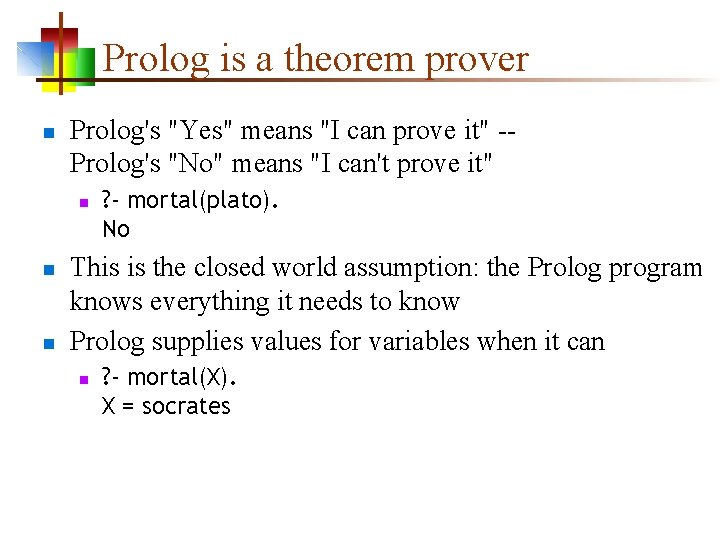
Prolog is a theorem prover n Prolog's "Yes" means "I can prove it" -Prolog's "No" means "I can't prove it" n n n ? - mortal(plato). No This is the closed world assumption: the Prolog program knows everything it needs to know Prolog supplies values for variables when it can n ? - mortal(X). X = socrates
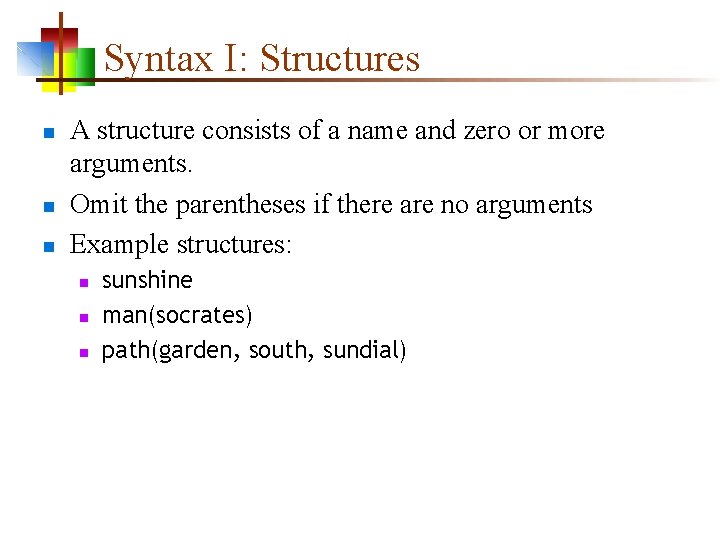
Syntax I: Structures n n n A structure consists of a name and zero or more arguments. Omit the parentheses if there are no arguments Example structures: n n n sunshine man(socrates) path(garden, south, sundial)
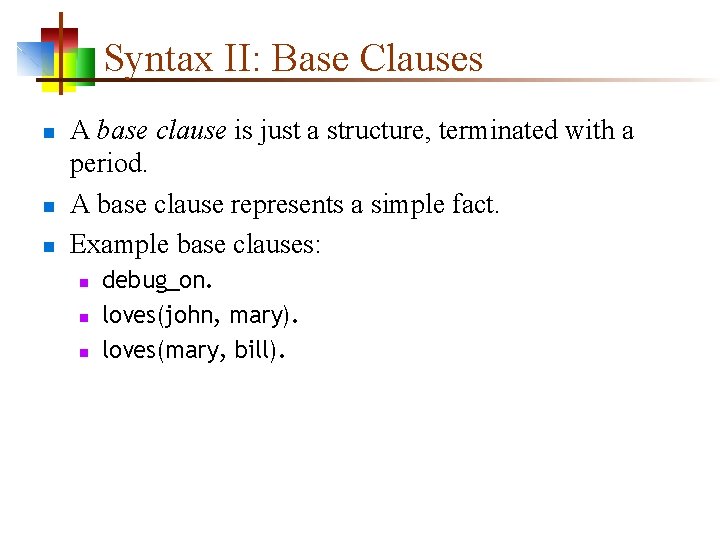
Syntax II: Base Clauses n n n A base clause is just a structure, terminated with a period. A base clause represents a simple fact. Example base clauses: n n n debug_on. loves(john, mary). loves(mary, bill).
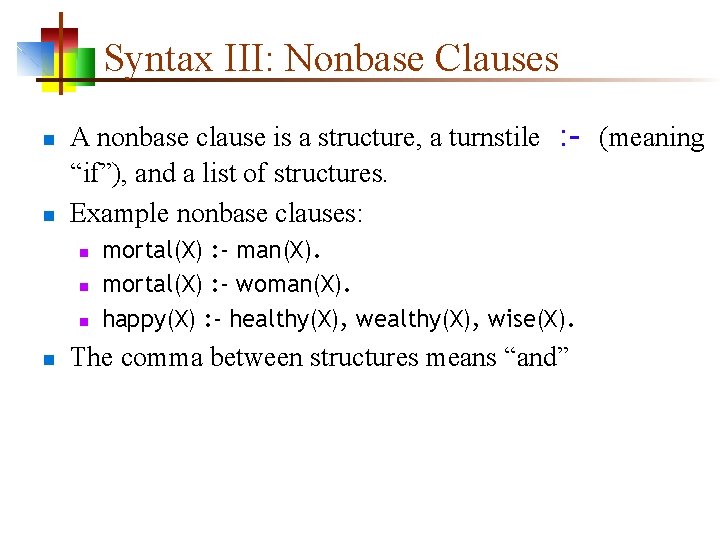
Syntax III: Nonbase Clauses n n A nonbase clause is a structure, a turnstile “if”), and a list of structures. Example nonbase clauses: n n : - mortal(X) : - man(X). mortal(X) : - woman(X). happy(X) : - healthy(X), wise(X). The comma between structures means “and” (meaning
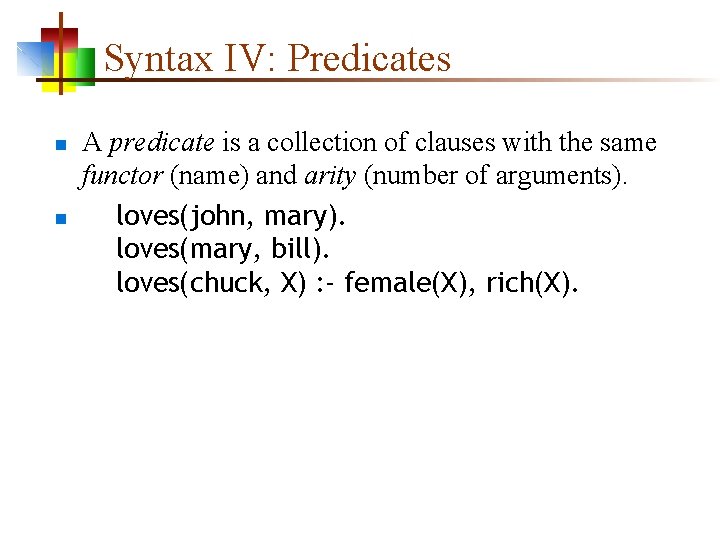
Syntax IV: Predicates n n A predicate is a collection of clauses with the same functor (name) and arity (number of arguments). loves(john, mary). loves(mary, bill). loves(chuck, X) : - female(X), rich(X).
Syntax V: Programs n n n A program is a collection of predicates. Predicates can be in any order. Clauses within a predicate are used in the order in which they occur.
Syntax VI: Variables and atoms n n n Variables begin with a capital letter: X, Socrates, _result Atoms do not begin with a capital letter: x, socrates Atoms containing special characters, or beginning with a capital letter, must be enclosed in single quotes: n 'C: \My Documents\examples. pl'
Syntax VII: Strings are atoms n In a quoted atom, a single quote must be doubled or backslashed: n n 'Can''t, or won't? ' Backslashes in file names must also be doubled: n 'C: \My Documents\examples. pl'
Common problems n n Capitalization is meaningful! No space is allowed between a functor and its argument list: man(socrates), not man (socrates). Double quotes indicate a list of ASCII character values, not a string Don’t forget the period! (But you can put it on the next line. )
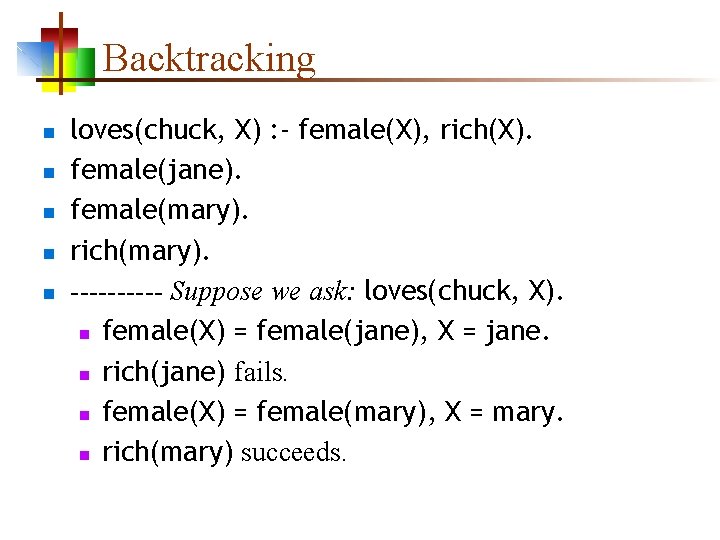
Backtracking n n n loves(chuck, X) : - female(X), rich(X). female(jane). female(mary). rich(mary). ----- Suppose we ask: loves(chuck, X). n female(X) = female(jane), X = jane. n rich(jane) fails. n female(X) = female(mary), X = mary. n rich(mary) succeeds.

Backtracking and Beads n Each Prolog call is like a “bead” in a string of beads: call fail n n exit redo Each structure has four ports: call, exit, redo, fail Exit ports connect to call ports; fail ports connect to redo ports
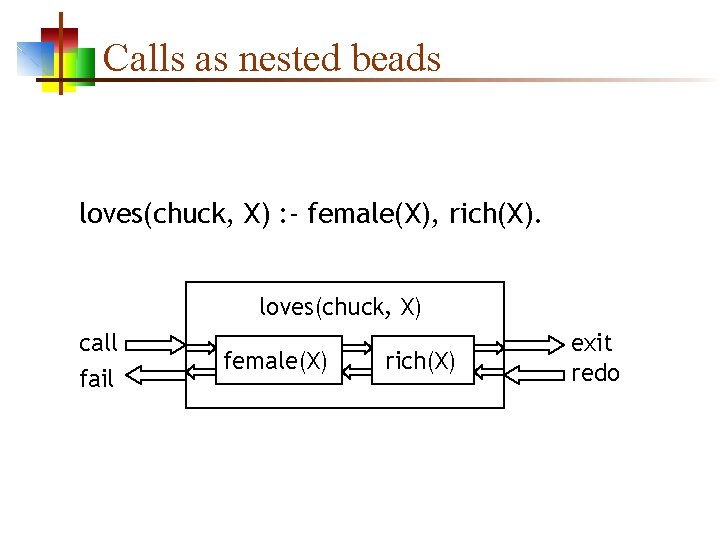
Calls as nested beads loves(chuck, X) : - female(X), rich(X). loves(chuck, X) call fail female(X) rich(X) exit redo
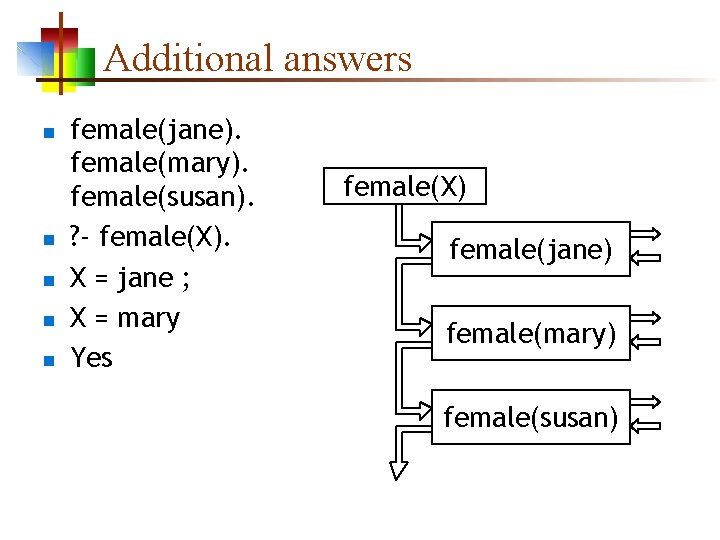
Additional answers n n n female(jane). female(mary). female(susan). ? - female(X). X = jane ; X = mary Yes female(X) female(jane) female(mary) female(susan)
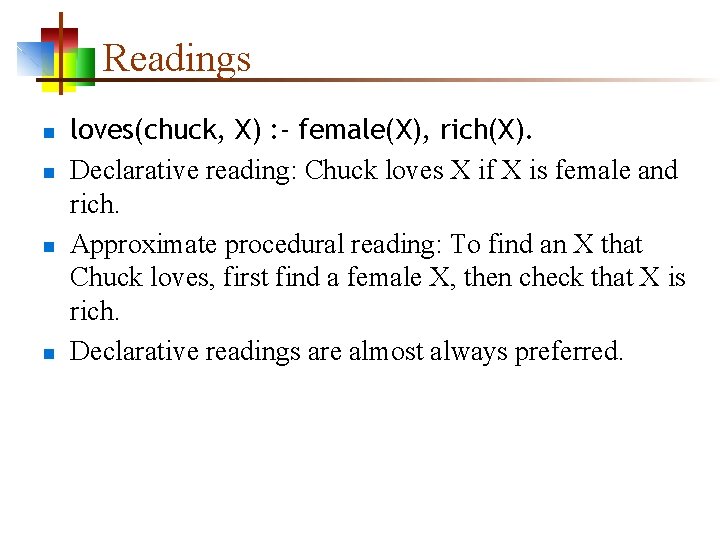
Readings n n loves(chuck, X) : - female(X), rich(X). Declarative reading: Chuck loves X if X is female and rich. Approximate procedural reading: To find an X that Chuck loves, first find a female X, then check that X is rich. Declarative readings are almost always preferred.
Monotonic logic n n Standard logic is monotonic: once you prove something is true, it is true forever Logic isn't a good fit to reality If the wallet is in the purse, and the purse in is the car, we can conclude that the wallet is in the car But what if we take the purse out of the car?
Nonmonotonic logic n n Prolog uses nonmonotonic logic Facts and rules can be changed at any time n n such facts and rules are said to be dynamic assert(. . . ) adds a fact or rule retract(. . . ) removes a fact or rule assert and retract are said to be extralogical predicates
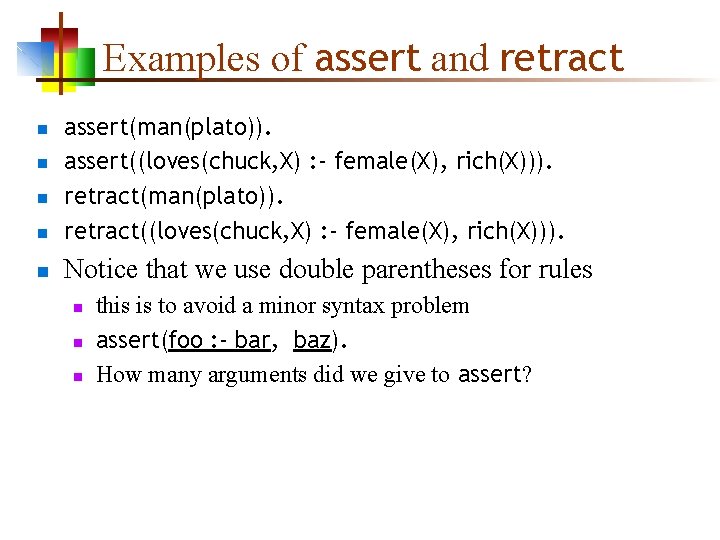
Examples of assert and retract n assert(man(plato)). assert((loves(chuck, X) : - female(X), rich(X))). retract(man(plato)). retract((loves(chuck, X) : - female(X), rich(X))). n Notice that we use double parentheses for rules n n n this is to avoid a minor syntax problem assert(foo : - bar, baz). How many arguments did we give to assert?
Limitations of backtracking n n In Prolog, backtracking over something generally undoes it Output can't be undone by backtracking Neither can assert and retract be undone by backtracking Perform any necessary testing before you use write, nl, assert, or retract
Modeling “real life” n n Real life isn't monotonic; things change Prolog is superb for modeling change Games are often a model of real (or fantasy!) life Prolog is just about ideal for adventure games
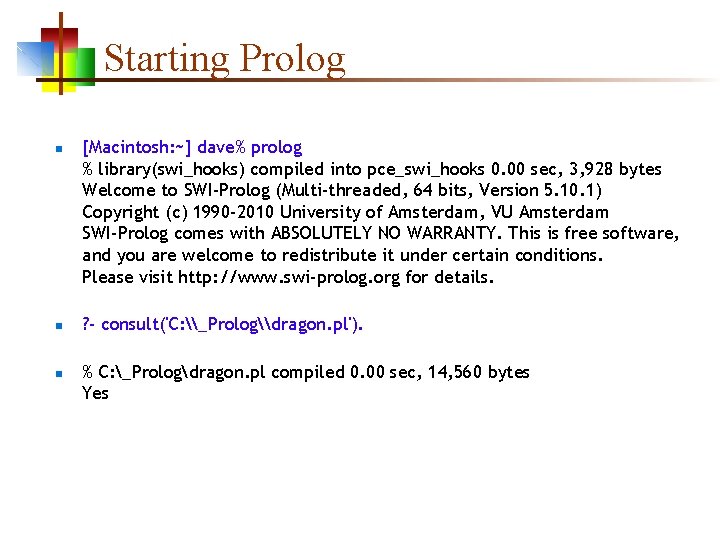
Starting Prolog n n n [Macintosh: ~] dave% prolog % library(swi_hooks) compiled into pce_swi_hooks 0. 00 sec, 3, 928 bytes Welcome to SWI-Prolog (Multi-threaded, 64 bits, Version 5. 10. 1) Copyright (c) 1990 -2010 University of Amsterdam, VU Amsterdam SWI-Prolog comes with ABSOLUTELY NO WARRANTY. This is free software, and you are welcome to redistribute it under certain conditions. Please visit http: //www. swi-prolog. org for details. ? - consult('C: \_Prolog\dragon. pl'). % C: _Prologdragon. pl compiled 0. 00 sec, 14, 560 bytes Yes
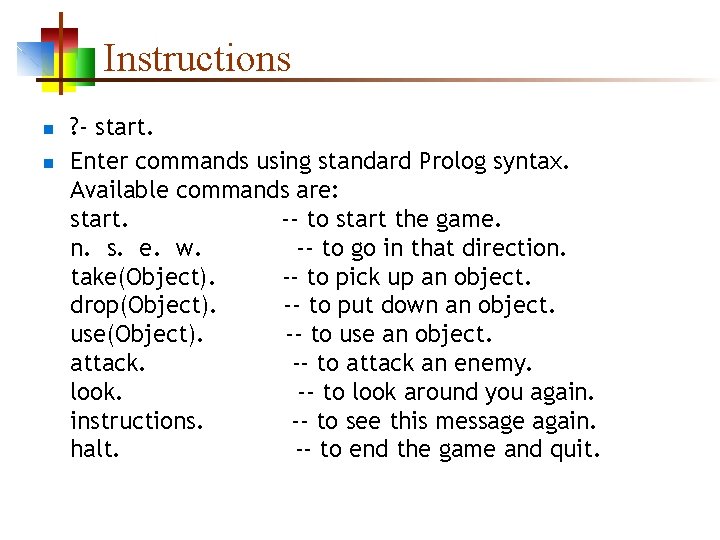
Instructions n n ? - start. Enter commands using standard Prolog syntax. Available commands are: start. -- to start the game. n. s. e. w. -- to go in that direction. take(Object). -- to pick up an object. drop(Object). -- to put down an object. use(Object). -- to use an object. attack. -- to attack an enemy. look. -- to look around you again. instructions. -- to see this message again. halt. -- to end the game and quit.
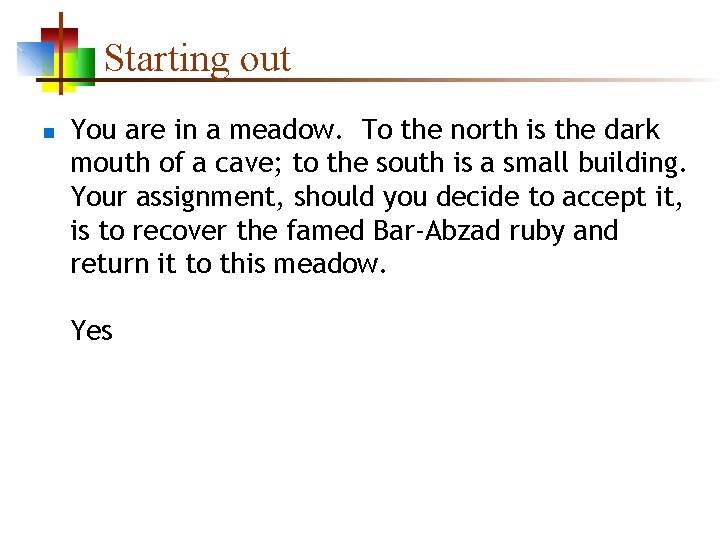
Starting out n You are in a meadow. To the north is the dark mouth of a cave; to the south is a small building. Your assignment, should you decide to accept it, is to recover the famed Bar-Abzad ruby and return it to this meadow. Yes
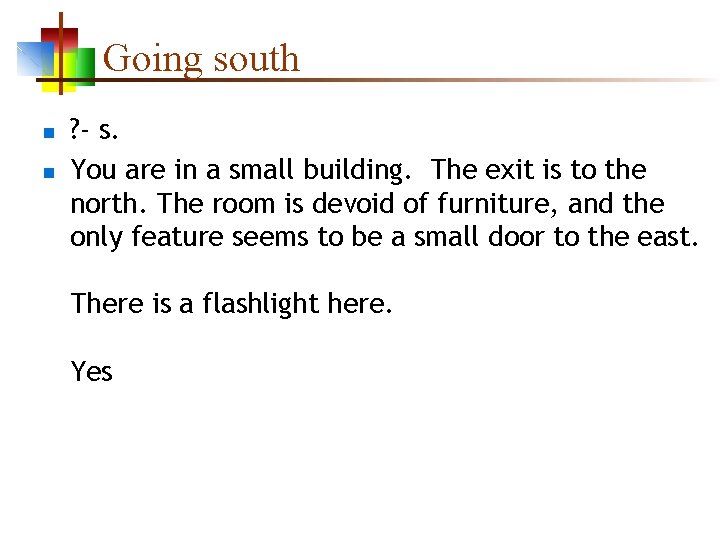
Going south n n ? - s. You are in a small building. The exit is to the north. The room is devoid of furniture, and the only feature seems to be a small door to the east. There is a flashlight here. Yes
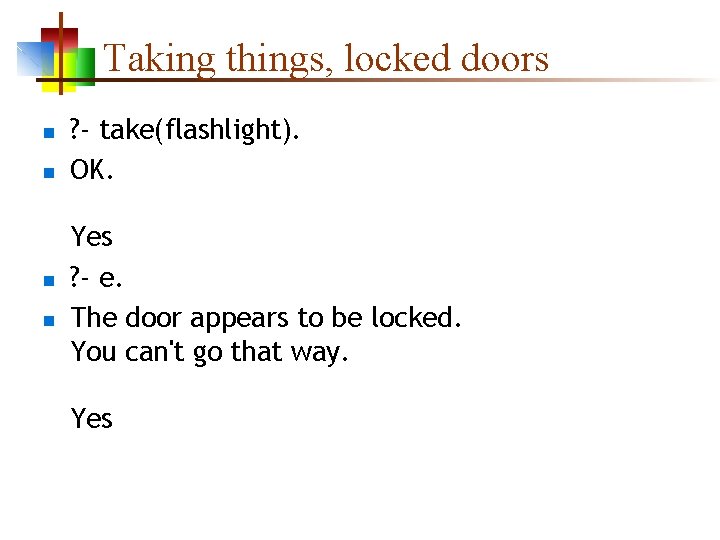
Taking things, locked doors n n ? - take(flashlight). OK. Yes ? - e. The door appears to be locked. You can't go that way. Yes
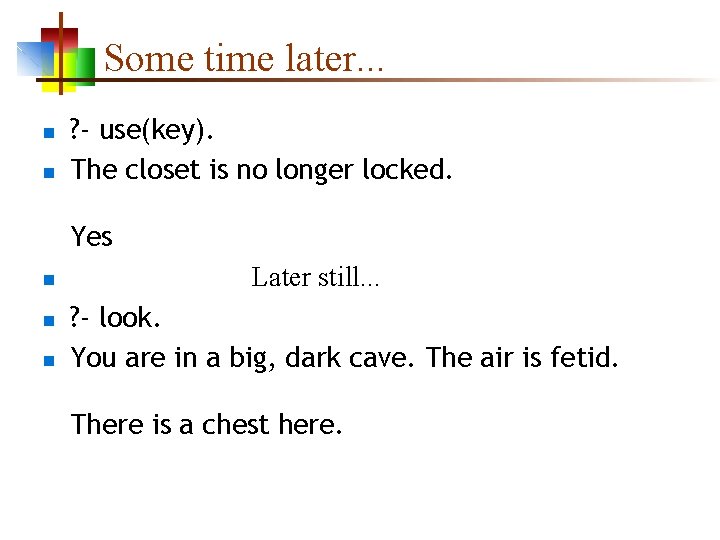
Some time later. . . n n ? - use(key). The closet is no longer locked. Yes n n n Later still. . . ? - look. You are in a big, dark cave. The air is fetid. There is a chest here.
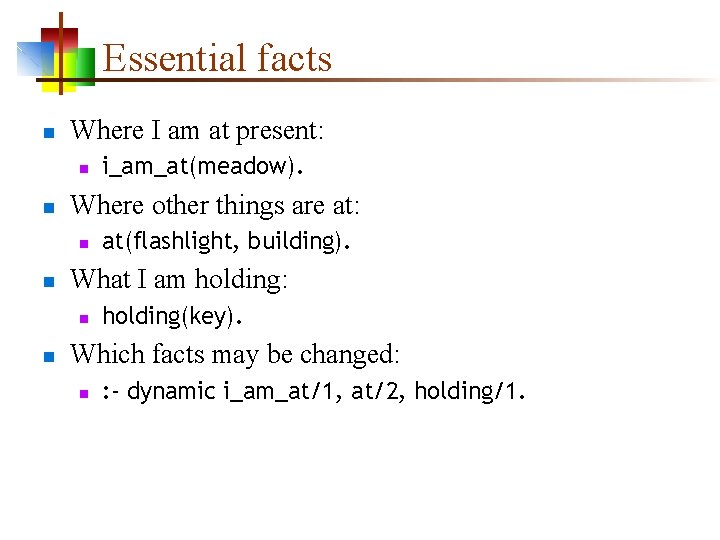
Essential facts n Where I am at present: n n Where other things are at: n n at(flashlight, building). What I am holding: n n i_am_at(meadow). holding(key). Which facts may be changed: n : - dynamic i_am_at/1, at/2, holding/1.
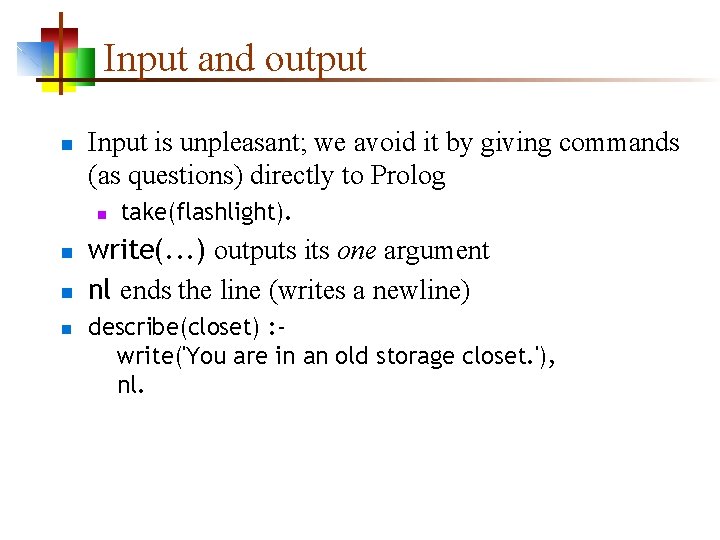
Input and output n Input is unpleasant; we avoid it by giving commands (as questions) directly to Prolog n n take(flashlight). write(. . . ) outputs its one argument nl ends the line (writes a newline) describe(closet) : write('You are in an old storage closet. '), nl.
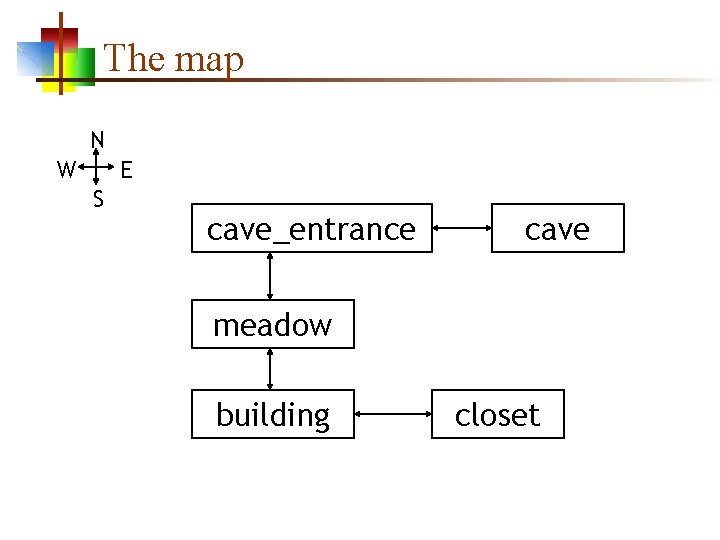
The map N W E S cave_entrance cave meadow building closet
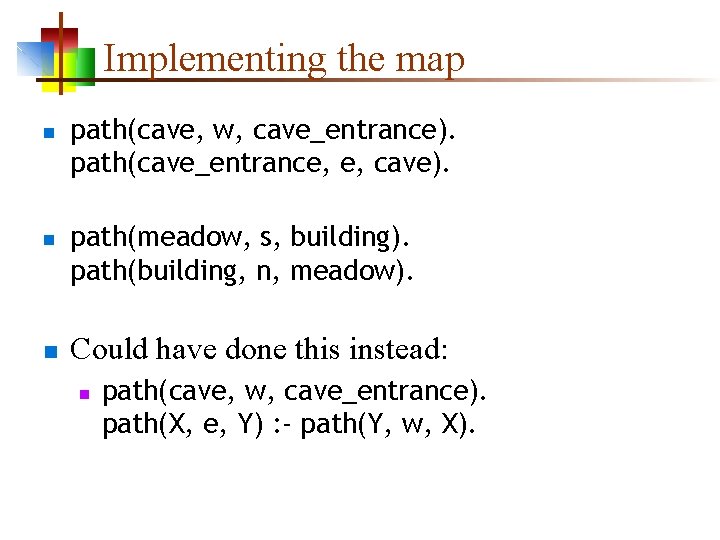
Implementing the map n n n path(cave, w, cave_entrance). path(cave_entrance, e, cave). path(meadow, s, building). path(building, n, meadow). Could have done this instead: n path(cave, w, cave_entrance). path(X, e, Y) : - path(Y, w, X).
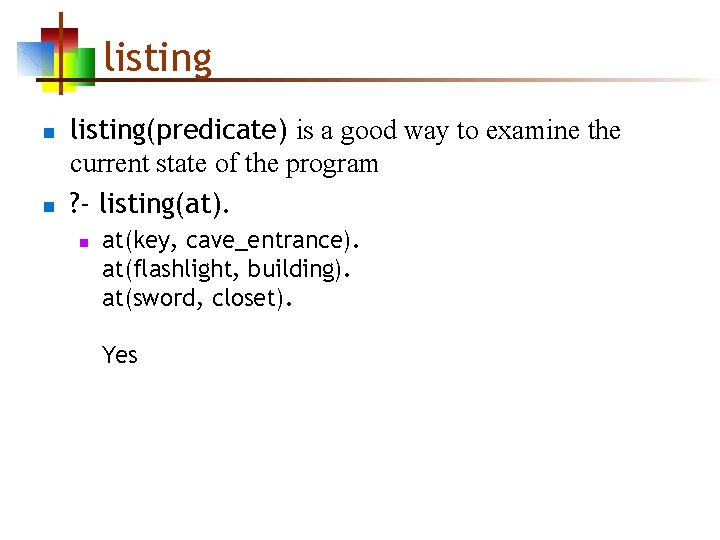
listing n n listing(predicate) is a good way to examine the current state of the program ? - listing(at). n at(key, cave_entrance). at(flashlight, building). at(sword, closet). Yes
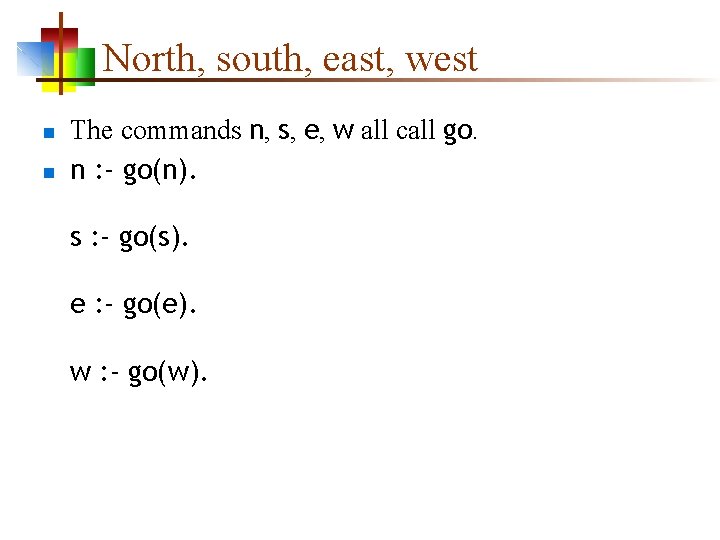
North, south, east, west n n The commands n, s, e, w all call go. n : - go(n). s : - go(s). e : - go(e). w : - go(w).
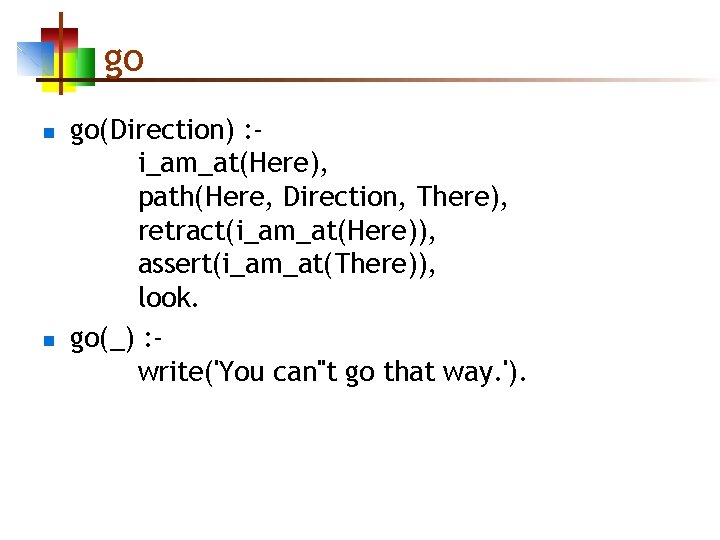
go n n go(Direction) : i_am_at(Here), path(Here, Direction, There), retract(i_am_at(Here)), assert(i_am_at(There)), look. go(_) : write('You can''t go that way. ').
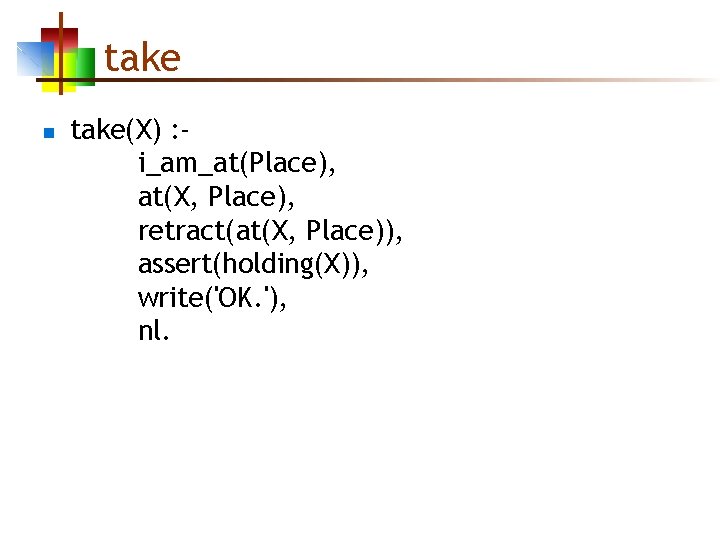
take n take(X) : i_am_at(Place), at(X, Place), retract(at(X, Place)), assert(holding(X)), write('OK. '), nl.
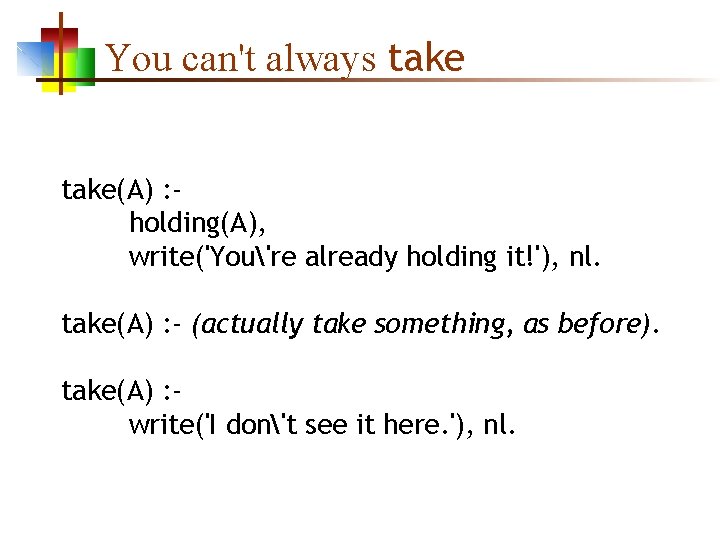
You can't always take(A) : holding(A), write('You're already holding it!'), nl. take(A) : - (actually take something, as before). take(A) : write('I don't see it here. '), nl.
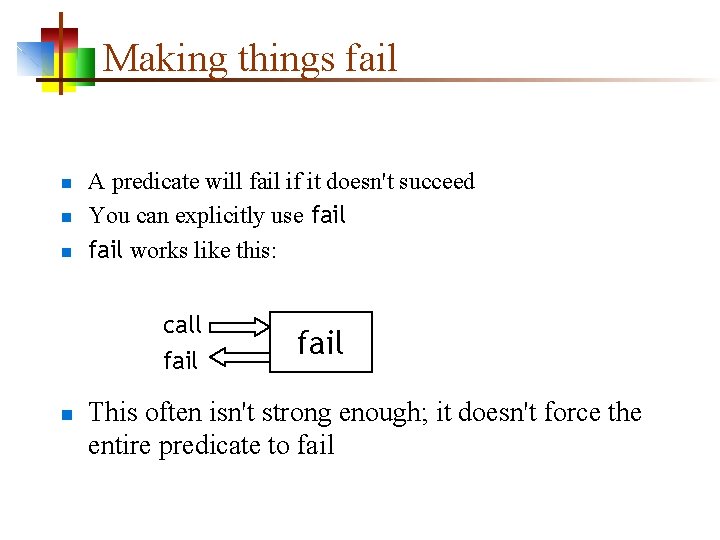
Making things fail n n n A predicate will fail if it doesn't succeed You can explicitly use fail works like this: call fail n fail This often isn't strong enough; it doesn't force the entire predicate to fail
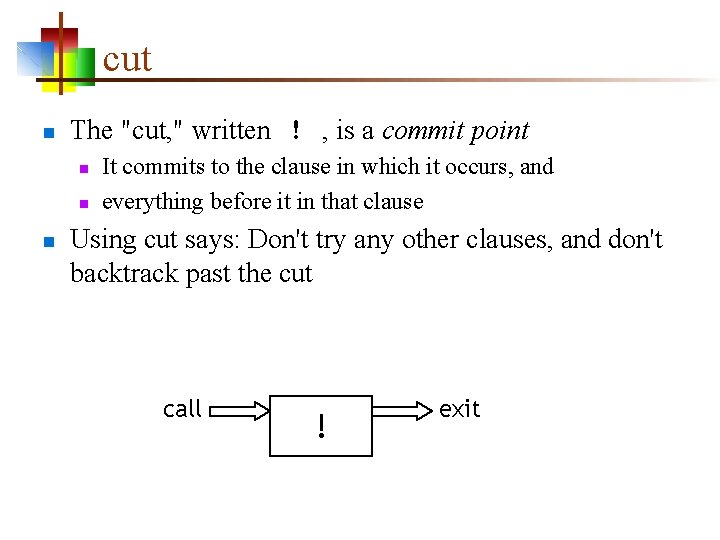
cut n The "cut, " written ! , is a commit point n n n It commits to the clause in which it occurs, and everything before it in that clause Using cut says: Don't try any other clauses, and don't backtrack past the cut call ! exit
cut-fail n n n The cut-fail combination: !, fail means really fail It commits to this clause, then fails This means no other clauses of this predicate will be tried, so the predicate as a whole fails
A locked door n n n path(building, e, closet) : locked(closet), write('The door appears to be locked. '), nl, !, fail. path(building, e, closet). If the closet door isn't locked, the first clause fails "normally, " and the second clause is used If the closet door is locked, the cut prevents the second clause from ever being reached
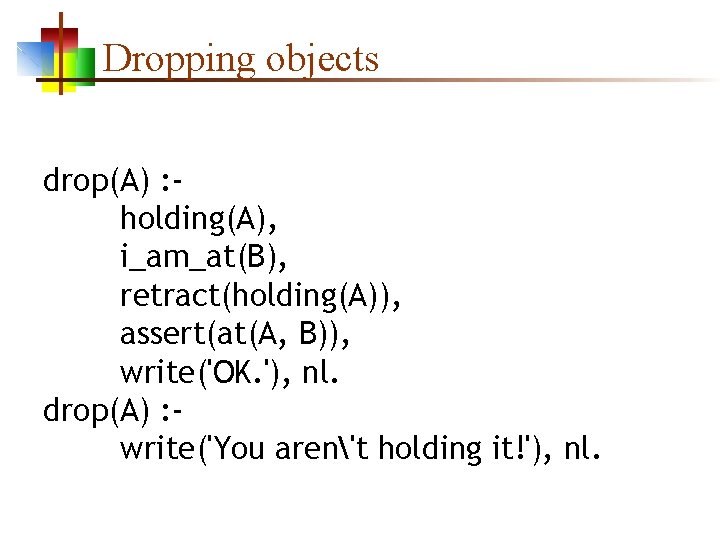
Dropping objects drop(A) : holding(A), i_am_at(B), retract(holding(A)), assert(at(A, B)), write('OK. '), nl. drop(A) : write('You aren't holding it!'), nl.
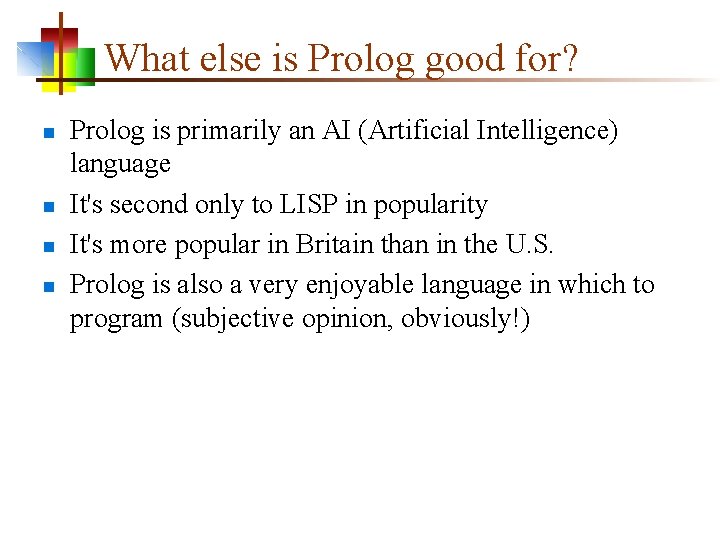
What else is Prolog good for? n n Prolog is primarily an AI (Artificial Intelligence) language It's second only to LISP in popularity It's more popular in Britain than in the U. S. Prolog is also a very enjoyable language in which to program (subjective opinion, obviously!)
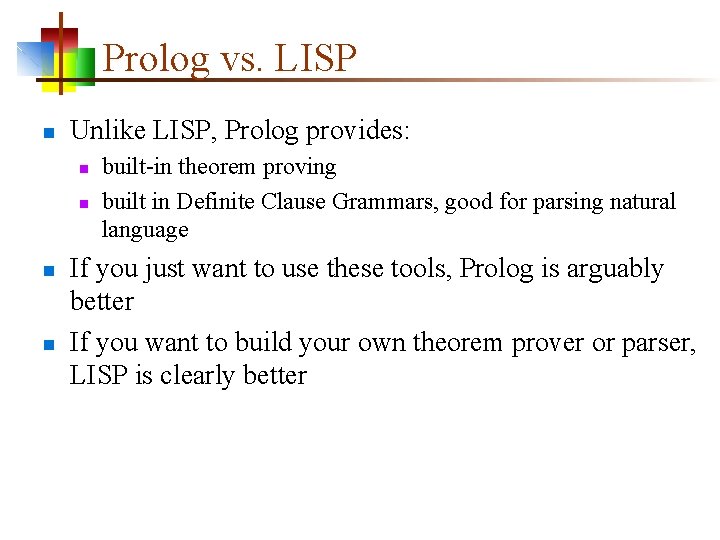
Prolog vs. LISP n Unlike LISP, Prolog provides: n n built-in theorem proving built in Definite Clause Grammars, good for parsing natural language If you just want to use these tools, Prolog is arguably better If you want to build your own theorem prover or parser, LISP is clearly better
The End
- Slides: 51