NO NON POLY ATTIRE IDs AROUND YOUR NECK








- Slides: 133
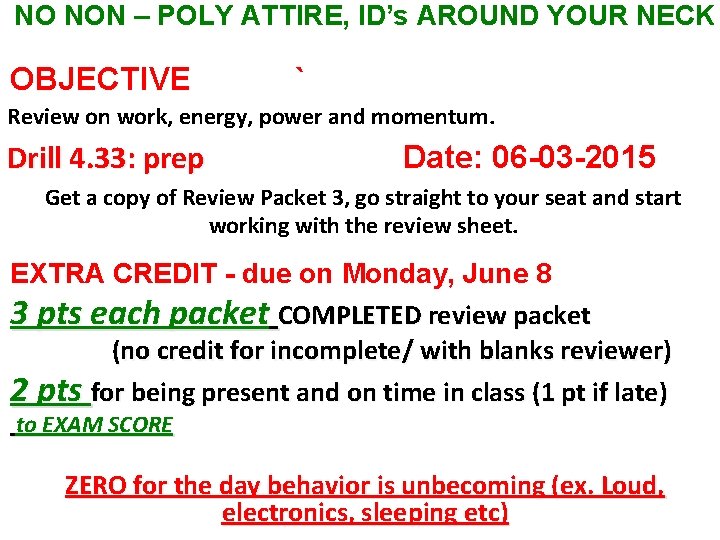
NO NON – POLY ATTIRE, ID’s AROUND YOUR NECK OBJECTIVE ` Review on work, energy, power and momentum. Drill 4. 33: prep Date: 06 -03 -2015 Get a copy of Review Packet 3, go straight to your seat and start working with the review sheet. EXTRA CREDIT - due on Monday, June 8 3 pts each packet COMPLETED review packet (no credit for incomplete/ with blanks reviewer) 2 pts for being present and on time in class (1 pt if late) to EXAM SCORE ZERO for the day behavior is unbecoming (ex. Loud, electronics, sleeping etc)
REVIEW PACKETS Due by 8: 05 on Monday, June 8 PLACE ALL THE 5 -PACKETS IN YOUR CLASS BINS
HOMEWORK Everything we CANNOT DO IN CLASS
No HOMEWORK If we can finish each packet in class
MULTIPLE CHOICE Circle the letter of your answer (equations for problem solving questions)
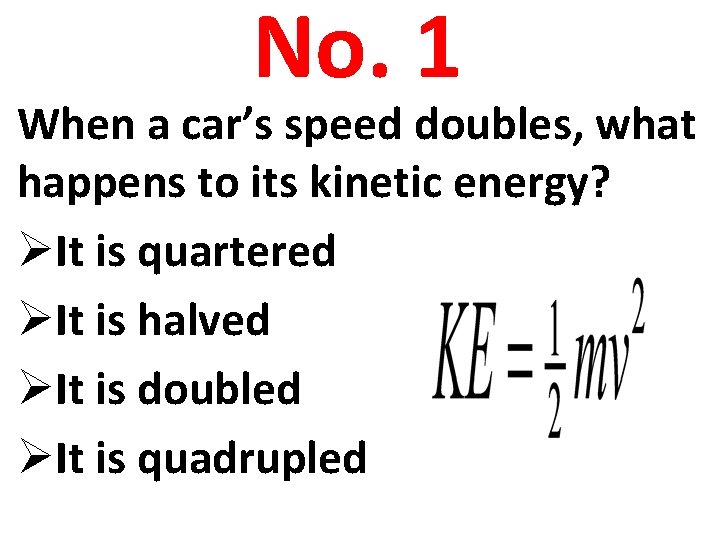
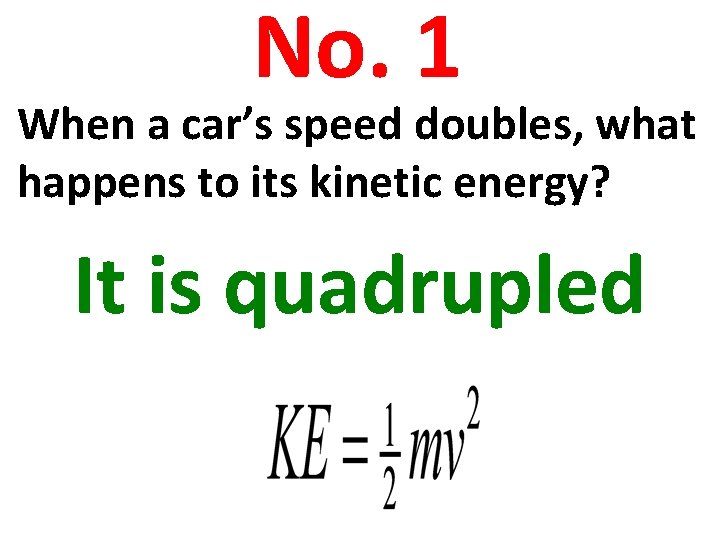
No. 1 When a car’s speed doubles, what happens to its kinetic energy? ØIt is quartered ØIt is halved ØIt is doubled ØIt is quadrupled
No. 1 When a car’s speed doubles, what happens to its kinetic energy? It is quadrupled
No. 2 Which energy transformation occurs as a book falls from the top of your book shelf? Ø the book’s potential energy and kinetic energy decreases Ø the book’s potential energy increases and it’s kinetic energy decreases Ø the book’s potential energy decreases and it’s kinetic energy increases Ø the book’s potential energy and kinetic energy increases
No. 2 Which energy transformation occurs as a book falls from the top of your book shelf? the book’s potential energy decreases and it’s kinetic energy increases
No. 3 The main difference between kinetic energy and potential energy is that Ø kinetic energy involves position and potential energy involves motion. Ø kinetic energy involves motion and potential energy involves position. Ø although both energies involve motion, only kinetic involves position. Ø although both energies involve position, only potential involves motion.
No. 3 The main difference between kinetic energy and potential energy is that kinetic energy involves motion and potential energy involves position.
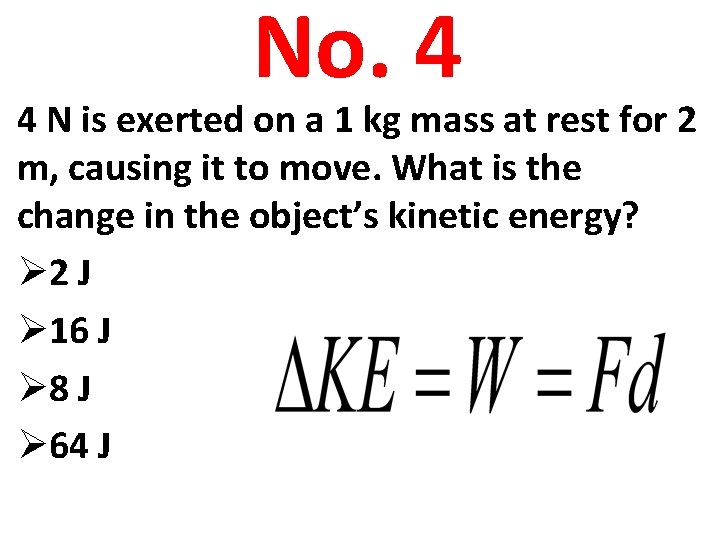
No. 4 4 N is exerted on a 1 kg mass at rest for 2 m, causing it to move. What is the change in the object’s kinetic energy? Ø 2 J Ø 16 J Ø 8 J Ø 64 J
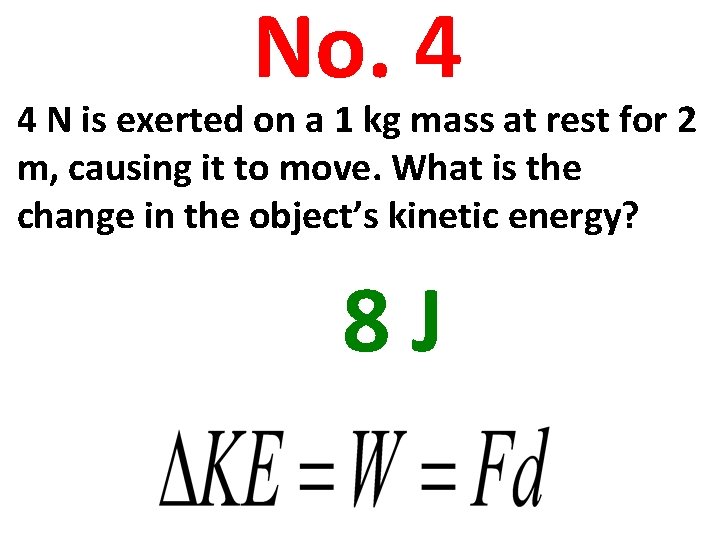
No. 4 4 N is exerted on a 1 kg mass at rest for 2 m, causing it to move. What is the change in the object’s kinetic energy? 8 J
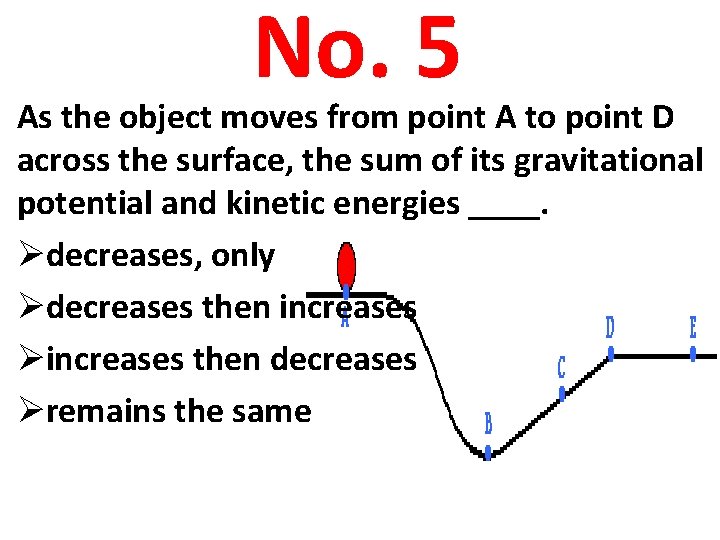
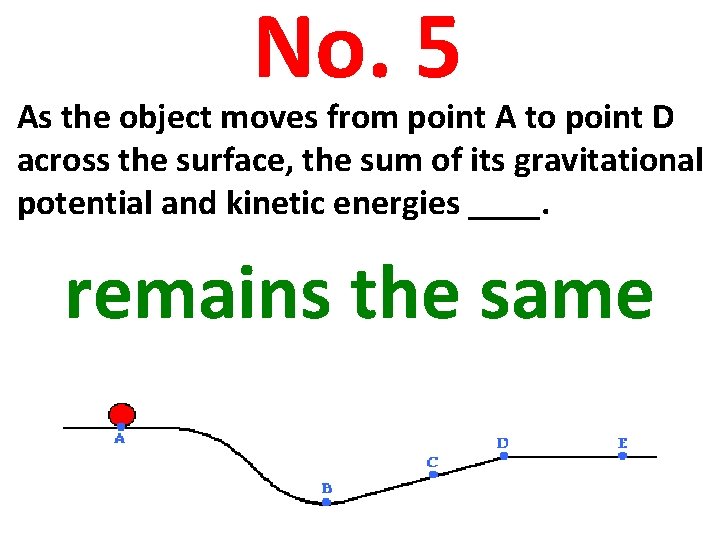
No. 5 As the object moves from point A to point D across the surface, the sum of its gravitational potential and kinetic energies ____. Ødecreases, only Ødecreases then increases Øincreases then decreases Øremains the same
No. 5 As the object moves from point A to point D across the surface, the sum of its gravitational potential and kinetic energies ____. remains the same
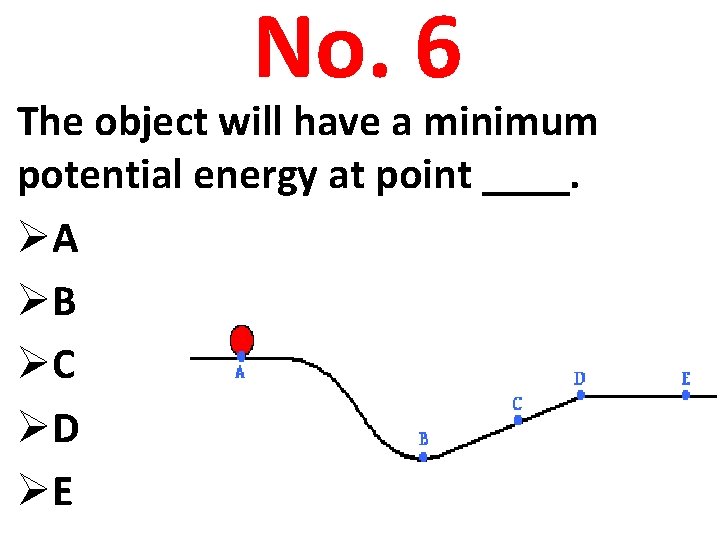
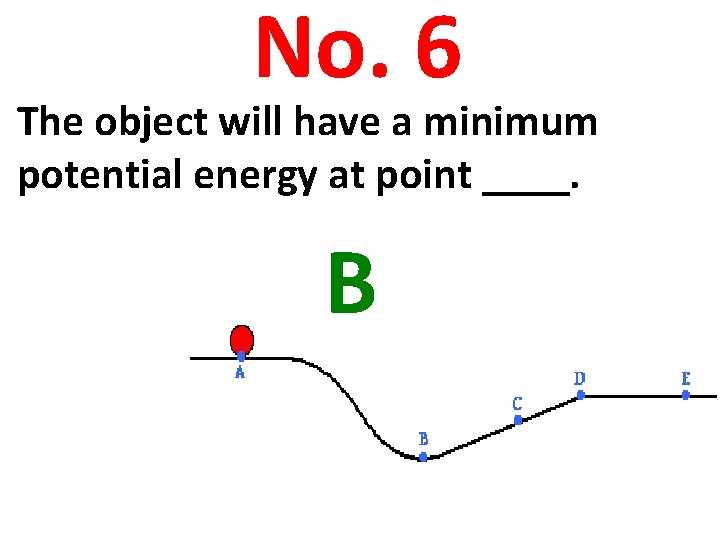
No. 6 The object will have a minimum potential energy at point ____. ØA ØB ØC ØD ØE
No. 6 The object will have a minimum potential energy at point ____. B
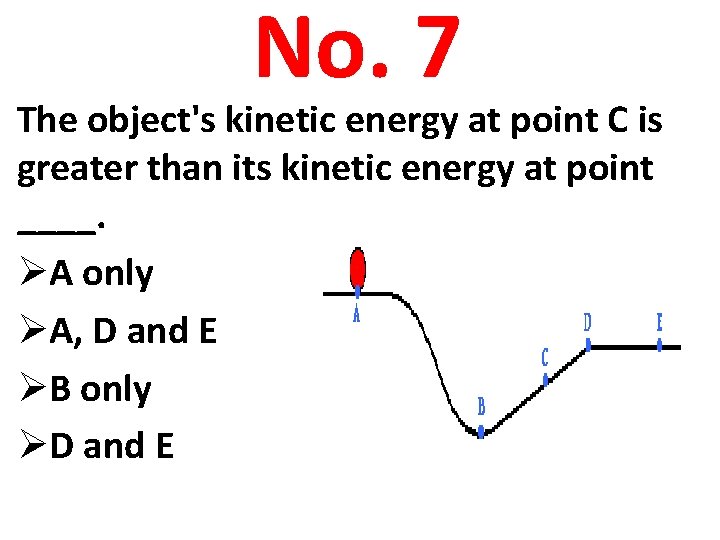
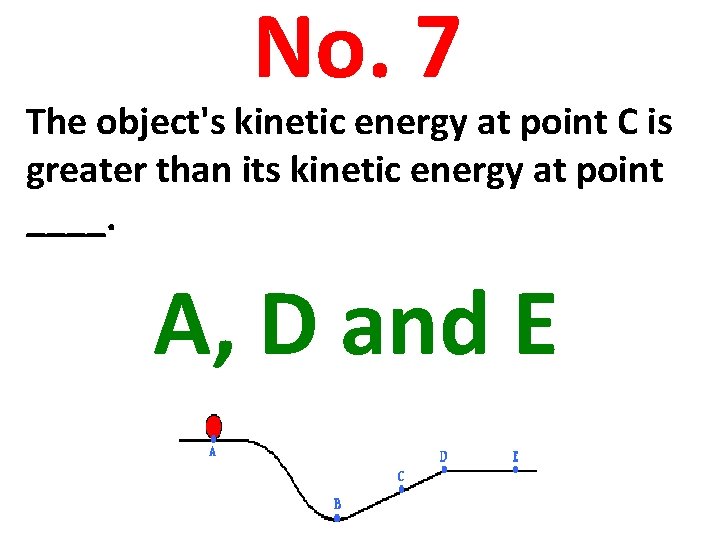
No. 7 The object's kinetic energy at point C is greater than its kinetic energy at point ____. ØA only ØA, D and E ØB only ØD and E
No. 7 The object's kinetic energy at point C is greater than its kinetic energy at point ____. A, D and E
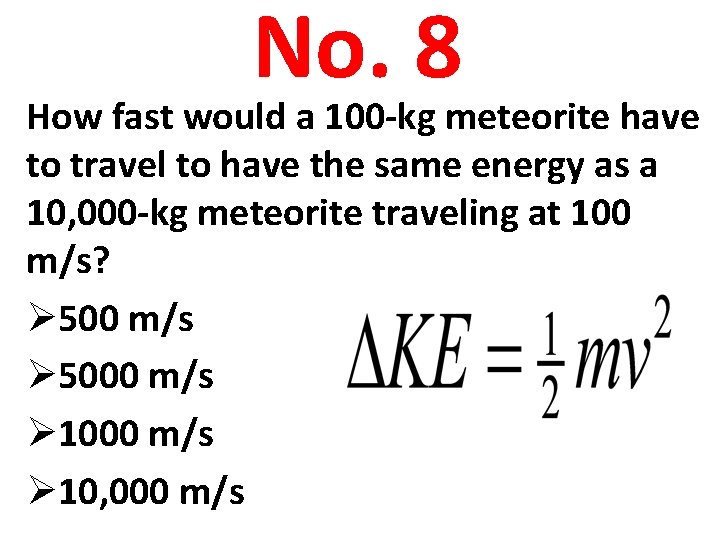
No. 8 How fast would a 100 -kg meteorite have to travel to have the same energy as a 10, 000 -kg meteorite traveling at 100 m/s? Ø 500 m/s Ø 5000 m/s Ø 10, 000 m/s
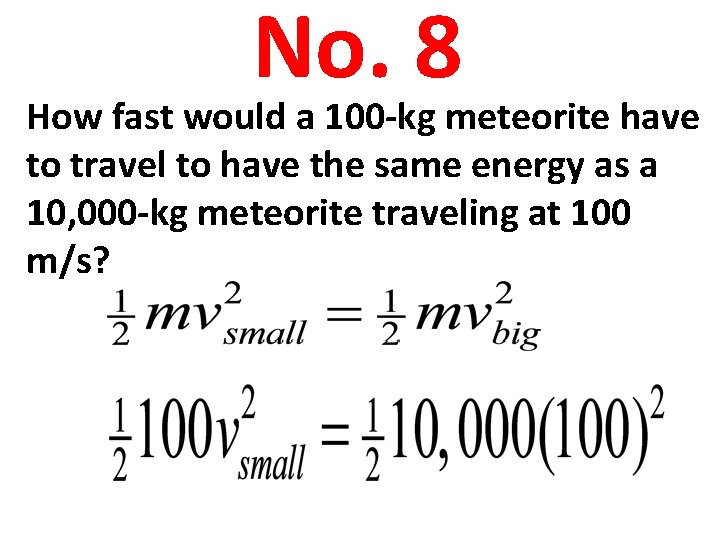
No. 8 How fast would a 100 -kg meteorite have to travel to have the same energy as a 10, 000 -kg meteorite traveling at 100 m/s?
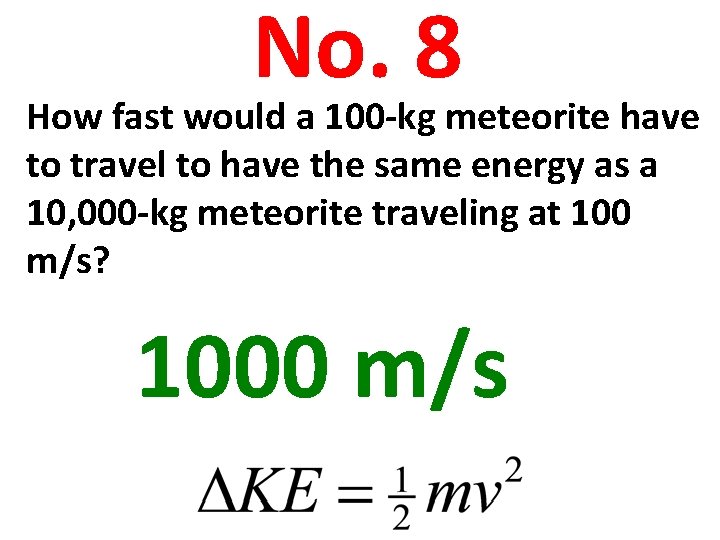
No. 8 How fast would a 100 -kg meteorite have to travel to have the same energy as a 10, 000 -kg meteorite traveling at 100 m/s? 1000 m/s
No. 9 The law of conservation of energy states that : Ø in a closed, isolated system, the total amount of energy is constant Ø the total amount of energy in any system is the sum of its kinetic and gravitational potential energies Ø Energy can increase or decrease, it depends on the work done Ø the total amount of energy in any system is its mechanical energy
No. 9 The law of conservation of energy states that : in a closed, isolated system, the total amount of energy is constant
No. 10 The sum of the kinetic and gravitational potential energies of a system is called ØReserved Energy ØConserved Energy ØMomentum ØMechanical Energy
No. 10 The sum of the kinetic and gravitational potential energies of a system is called Mechanical Energy
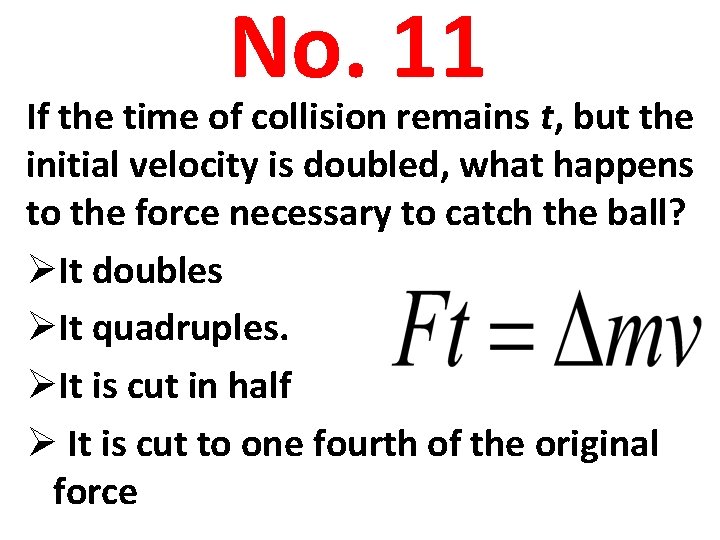
No. 11 If the time of collision remains t, but the initial velocity is doubled, what happens to the force necessary to catch the ball? ØIt doubles ØIt quadruples. ØIt is cut in half Ø It is cut to one fourth of the original force
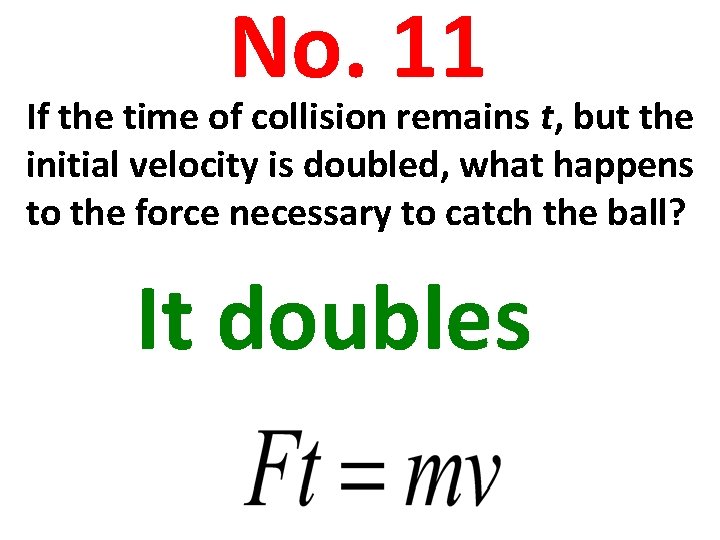
No. 11 If the time of collision remains t, but the initial velocity is doubled, what happens to the force necessary to catch the ball? It doubles
No. 12 An impulse acts on an object when _______ is applied _____ ØA velocity, to a mass Øa force, for a time ØAcceleration, over a distance Øfriction, while it moves
No. 12 An impulse acts on an object when _______ is applied _____ a force, for a time
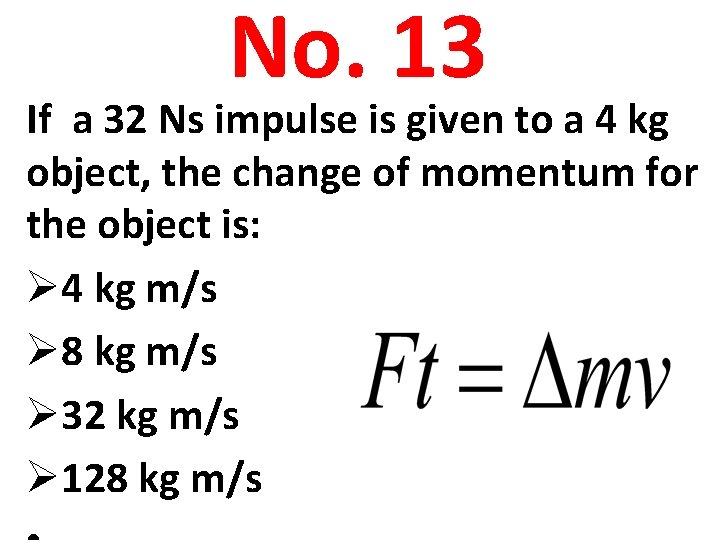
No. 13 If a 32 Ns impulse is given to a 4 kg object, the change of momentum for the object is: Ø 4 kg m/s Ø 8 kg m/s Ø 32 kg m/s Ø 128 kg m/s
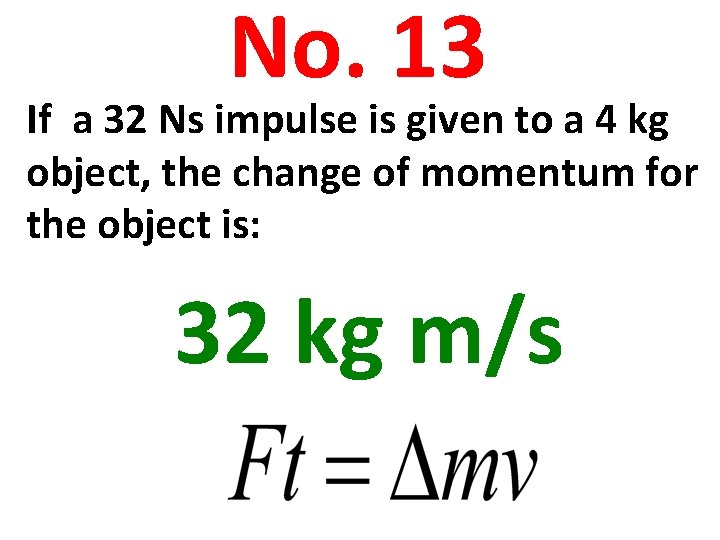
No. 13 If a 32 Ns impulse is given to a 4 kg object, the change of momentum for the object is: 32 kg m/s
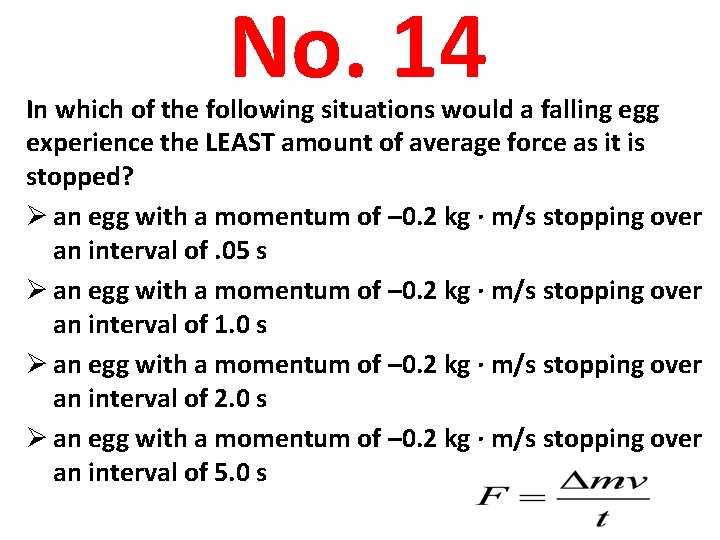
No. 14 In which of the following situations would a falling egg experience the LEAST amount of average force as it is stopped? Ø an egg with a momentum of – 0. 2 kg · m/s stopping over an interval of. 05 s Ø an egg with a momentum of – 0. 2 kg · m/s stopping over an interval of 1. 0 s Ø an egg with a momentum of – 0. 2 kg · m/s stopping over an interval of 2. 0 s Ø an egg with a momentum of – 0. 2 kg · m/s stopping over an interval of 5. 0 s
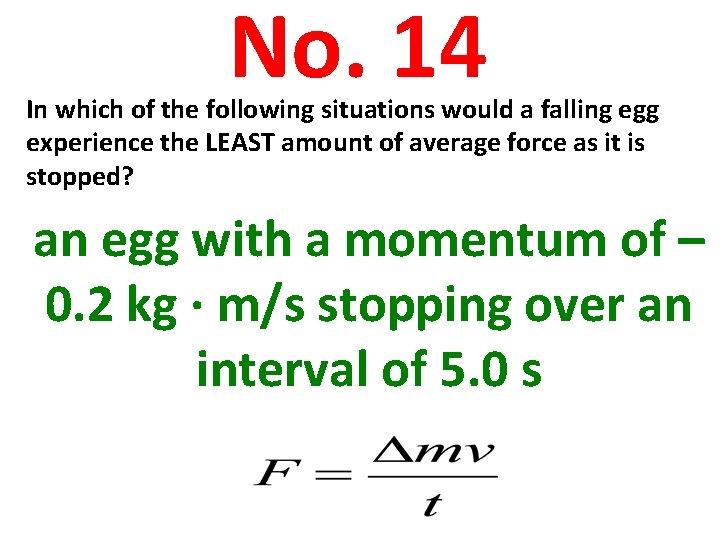
No. 14 In which of the following situations would a falling egg experience the LEAST amount of average force as it is stopped? an egg with a momentum of – 0. 2 kg · m/s stopping over an interval of 5. 0 s
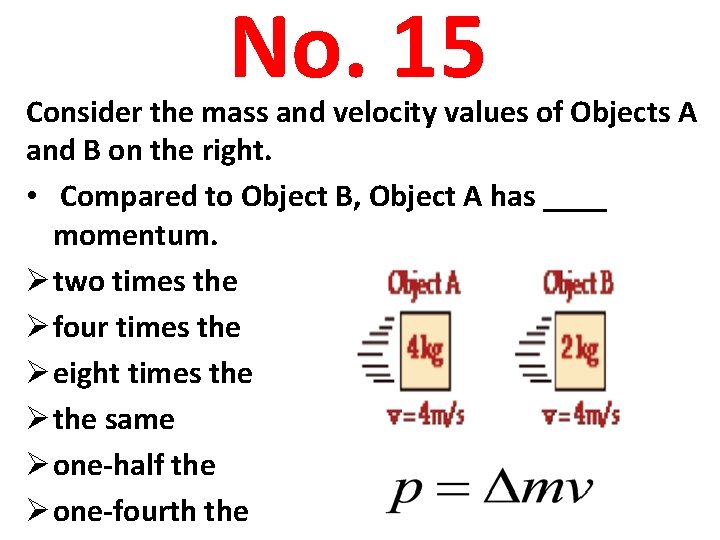
No. 15 Consider the mass and velocity values of Objects A and B on the right. • Compared to Object B, Object A has ____ momentum. Ø two times the Ø four times the Ø eight times the Ø the same Ø one-half the Ø one-fourth the
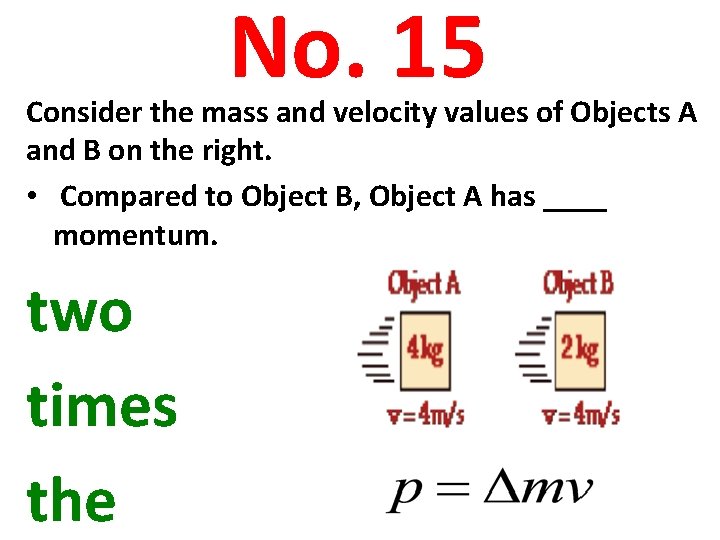
No. 15 Consider the mass and velocity values of Objects A and B on the right. • Compared to Object B, Object A has ____ momentum. two times the
No. 16 Which quantity has both a magnitude and a direction? ØEnergy ØPower ØMomentum ØWork
No. 16 Which quantity has both a magnitude and a direction? Momentum
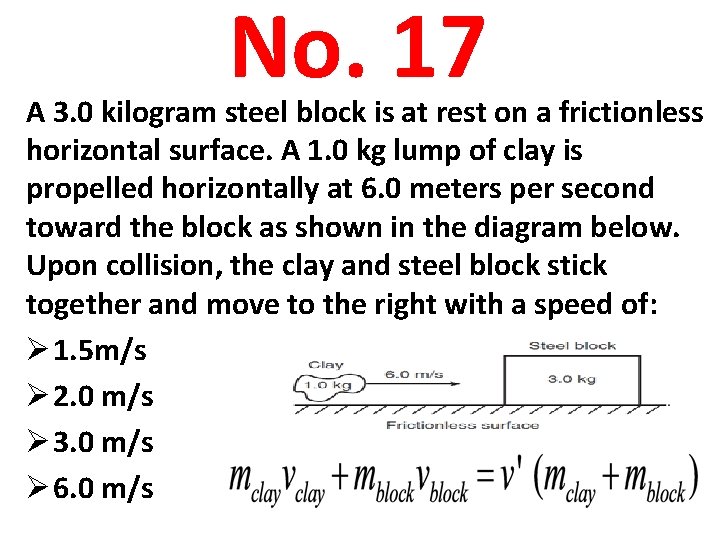
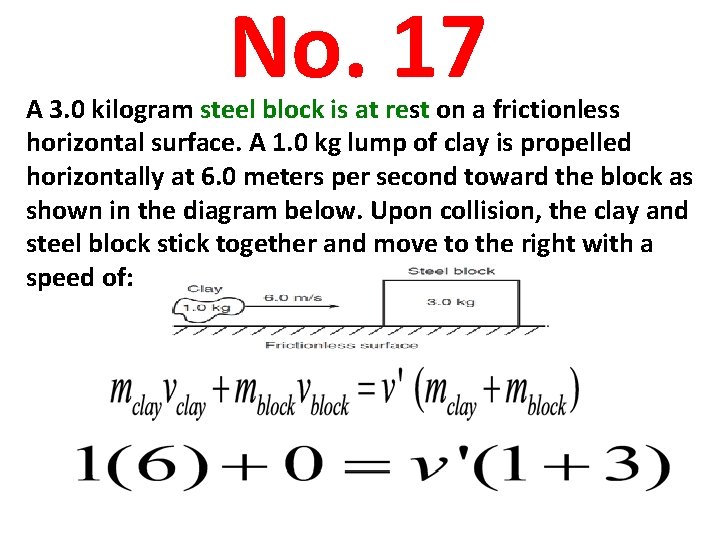
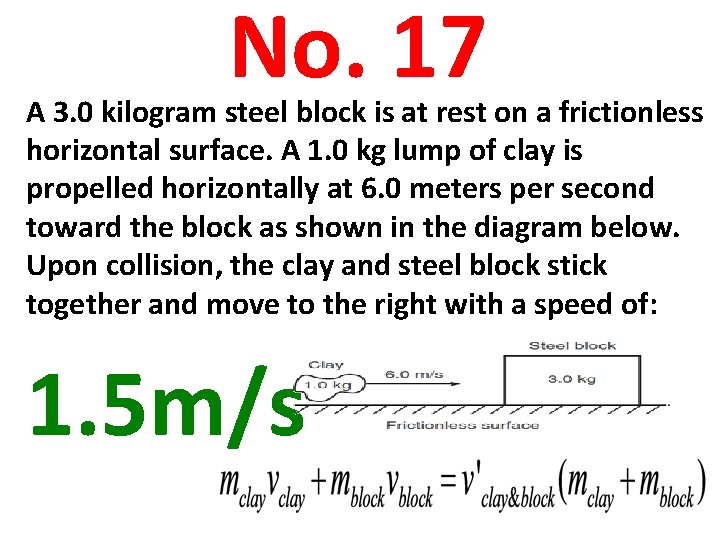
No. 17 A 3. 0 kilogram steel block is at rest on a frictionless horizontal surface. A 1. 0 kg lump of clay is propelled horizontally at 6. 0 meters per second toward the block as shown in the diagram below. Upon collision, the clay and steel block stick together and move to the right with a speed of: Ø 1. 5 m/s Ø 2. 0 m/s Ø 3. 0 m/s Ø 6. 0 m/s
No. 17 A 3. 0 kilogram steel block is at rest on a frictionless horizontal surface. A 1. 0 kg lump of clay is propelled horizontally at 6. 0 meters per second toward the block as shown in the diagram below. Upon collision, the clay and steel block stick together and move to the right with a speed of:
No. 17 A 3. 0 kilogram steel block is at rest on a frictionless horizontal surface. A 1. 0 kg lump of clay is propelled horizontally at 6. 0 meters per second toward the block as shown in the diagram below. Upon collision, the clay and steel block stick together and move to the right with a speed of: 1. 5 m/s
No. 18 Same as no. 12
No. 19 SAME AS NO. 13
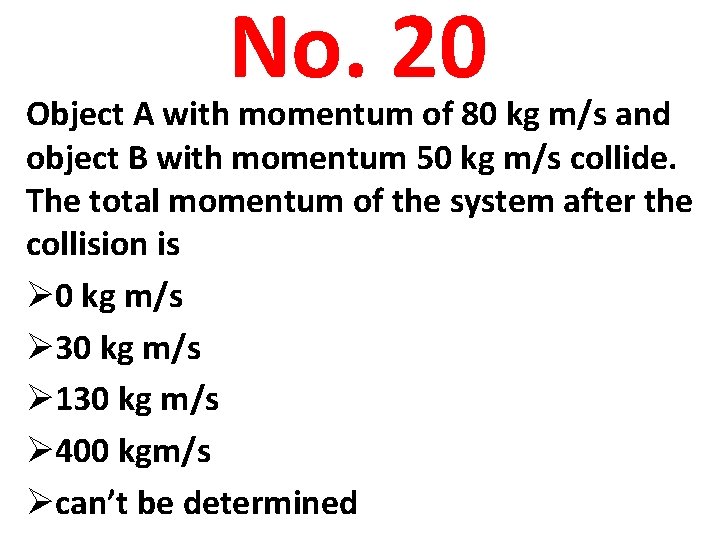
No. 20 Object A with momentum of 80 kg m/s and object B with momentum 50 kg m/s collide. The total momentum of the system after the collision is Ø 0 kg m/s Ø 30 kg m/s Ø 130 kg m/s Ø 400 kgm/s Øcan’t be determined
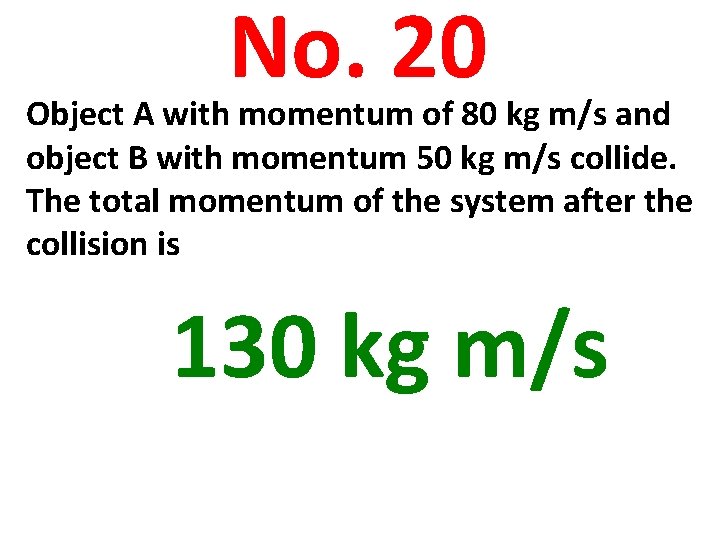
No. 20 Object A with momentum of 80 kg m/s and object B with momentum 50 kg m/s collide. The total momentum of the system after the collision is 130 kg m/s
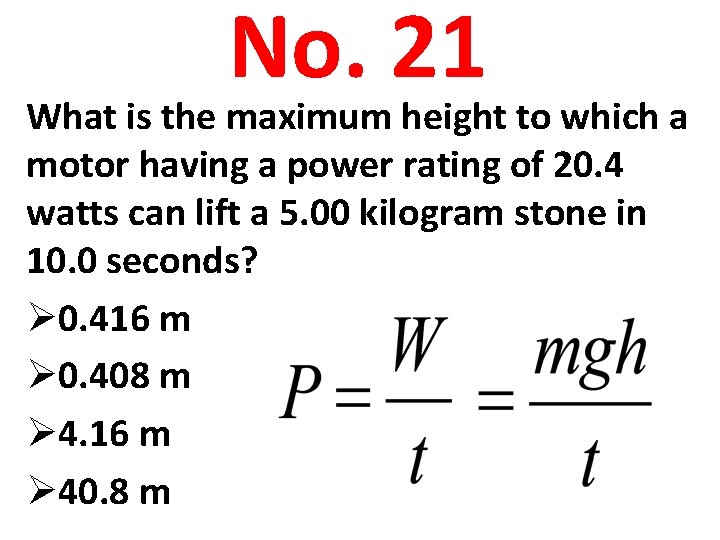
No. 21 What is the maximum height to which a motor having a power rating of 20. 4 watts can lift a 5. 00 kilogram stone in 10. 0 seconds? Ø 0. 416 m Ø 0. 408 m Ø 4. 16 m Ø 40. 8 m
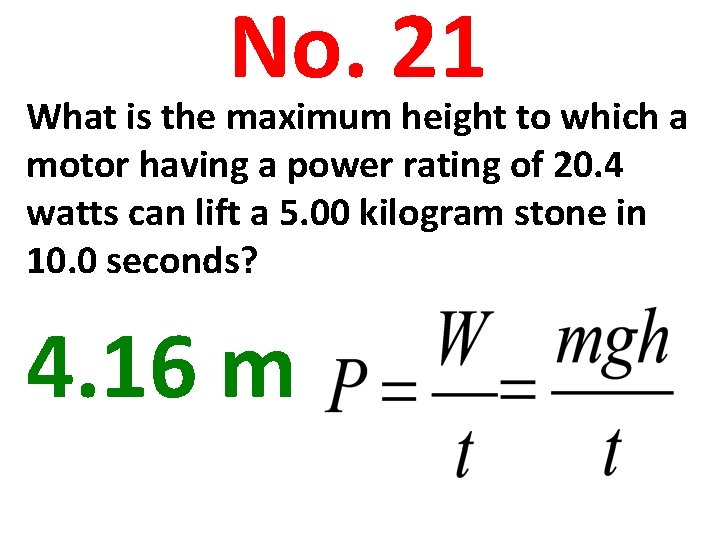
No. 21 What is the maximum height to which a motor having a power rating of 20. 4 watts can lift a 5. 00 kilogram stone in 10. 0 seconds? 4. 16 m
No. 22 Object 1 and Object 2 are traveling at the same speed, but the kinetic energy of Object 1 is greater than the kinetic energy of Object 2. How does the weight of Object 1 compare to the weight of Object 2? Ø Object 1 weighs more than Object 2. Ø Object 1 weighs less than Object 2. Ø Object 1 weighs the same as Object 2 Ø More information is needed to compare the weights of the objects.
No. 22 Object 1 and Object 2 are traveling at the same speed, but the kinetic energy of Object 1 is greater than the kinetic energy of Object 2. How does the weight of Object 1 compare to the weight of Object 2? Object 1 weighs more than Object 2.
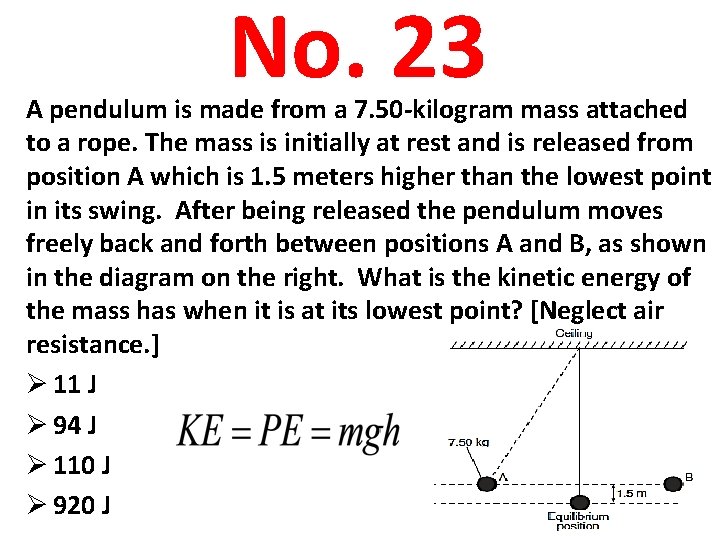
No. 23 A pendulum is made from a 7. 50 -kilogram mass attached to a rope. The mass is initially at rest and is released from position A which is 1. 5 meters higher than the lowest point in its swing. After being released the pendulum moves freely back and forth between positions A and B, as shown in the diagram on the right. What is the kinetic energy of the mass has when it is at its lowest point? [Neglect air resistance. ] Ø 11 J Ø 94 J Ø 110 J Ø 920 J
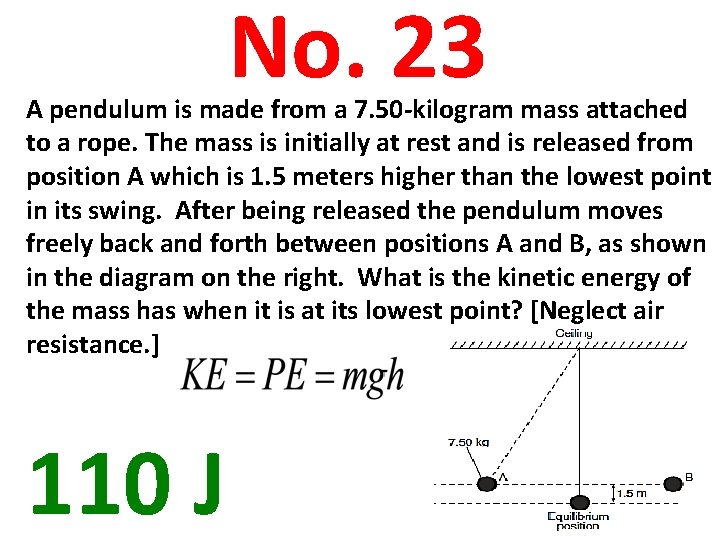
No. 23 A pendulum is made from a 7. 50 -kilogram mass attached to a rope. The mass is initially at rest and is released from position A which is 1. 5 meters higher than the lowest point in its swing. After being released the pendulum moves freely back and forth between positions A and B, as shown in the diagram on the right. What is the kinetic energy of the mass has when it is at its lowest point? [Neglect air resistance. ] 110 J
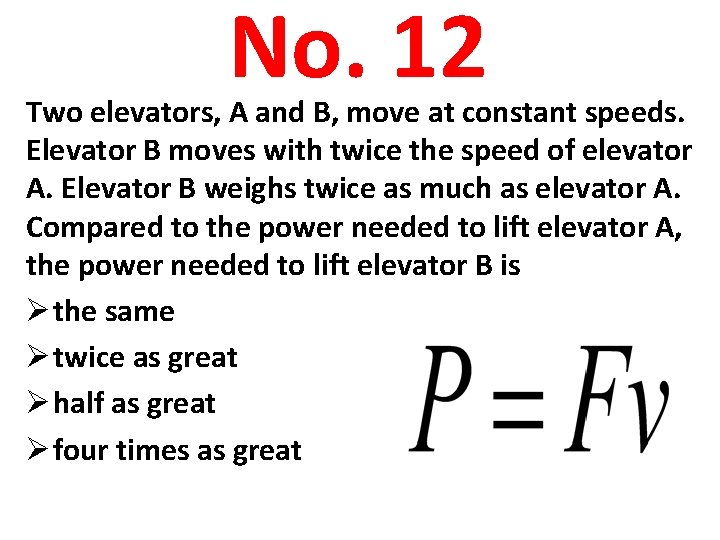
No. 12 Two elevators, A and B, move at constant speeds. Elevator B moves with twice the speed of elevator A. Elevator B weighs twice as much as elevator A. Compared to the power needed to lift elevator A, the power needed to lift elevator B is Ø the same Ø twice as great Ø half as great Ø four times as great
No. 12 Two elevators, A and B, move at constant speeds. Elevator B moves with twice the speed of elevator A. Elevator B weighs twice as much as elevator A. Compared to the power needed to lift elevator A, the power needed to lift elevator B is four times as great
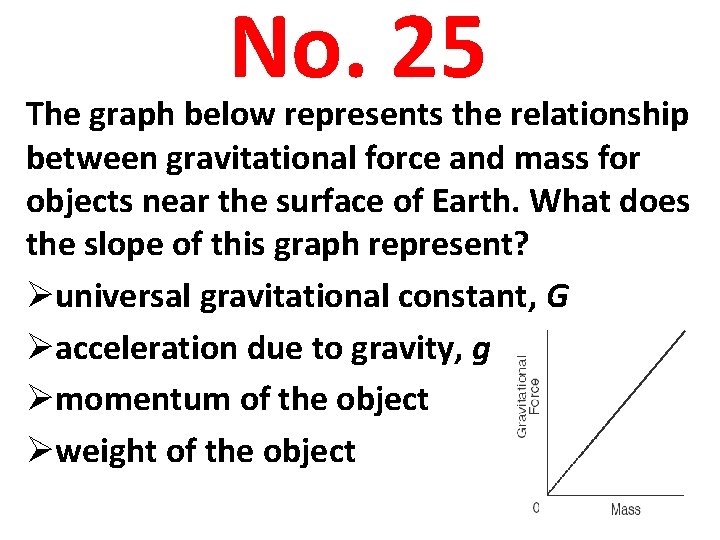
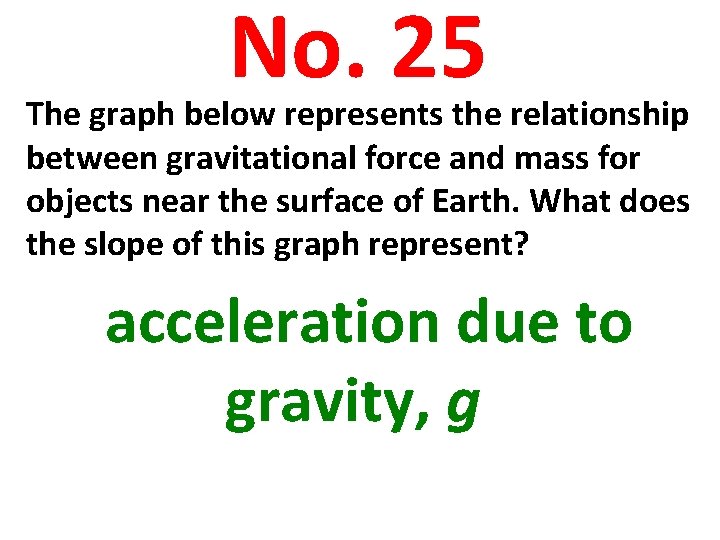
No. 25 The graph below represents the relationship between gravitational force and mass for objects near the surface of Earth. What does the slope of this graph represent? Øuniversal gravitational constant, G Øacceleration due to gravity, g Ømomentum of the object Øweight of the object
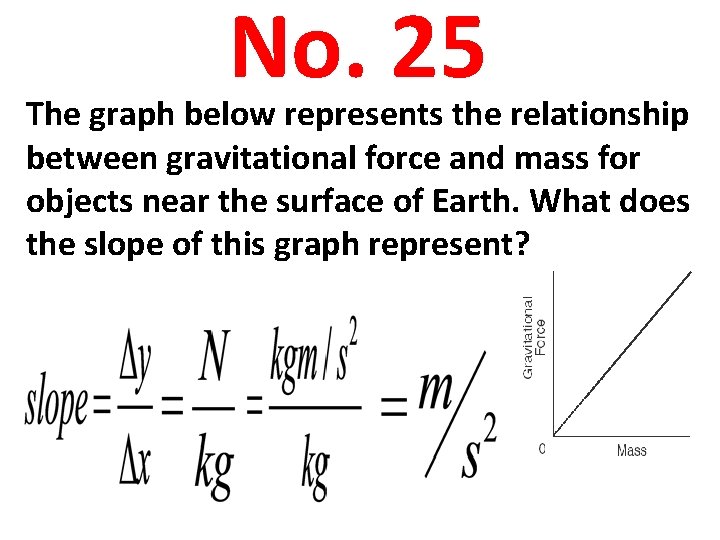
No. 25 The graph below represents the relationship between gravitational force and mass for objects near the surface of Earth. What does the slope of this graph represent?
No. 25 The graph below represents the relationship between gravitational force and mass for objects near the surface of Earth. What does the slope of this graph represent? acceleration due to gravity, g
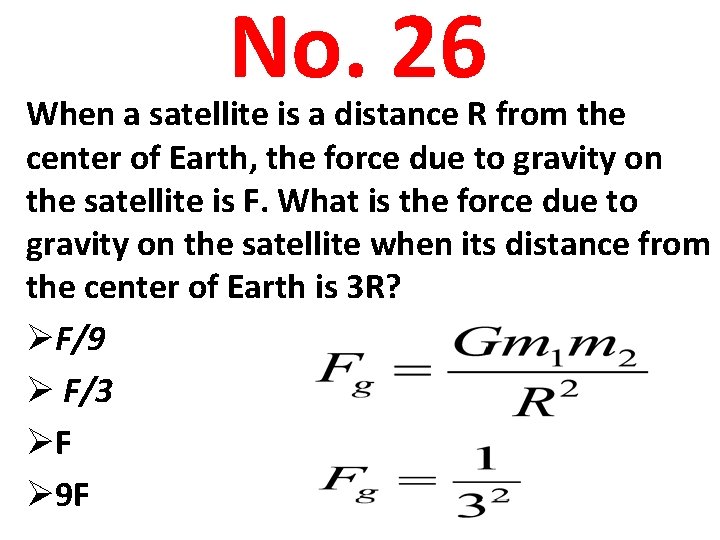
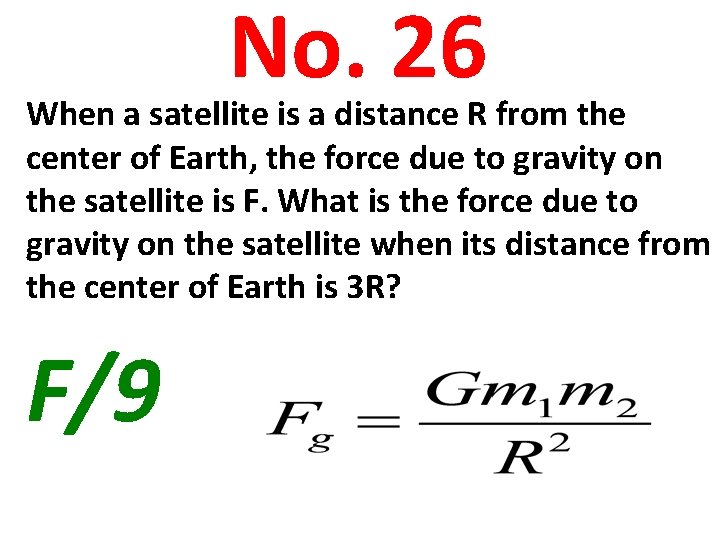
No. 26 When a satellite is a distance R from the center of Earth, the force due to gravity on the satellite is F. What is the force due to gravity on the satellite when its distance from the center of Earth is 3 R? ØF/9 Ø F/3 ØF Ø 9 F
No. 26 When a satellite is a distance R from the center of Earth, the force due to gravity on the satellite is F. What is the force due to gravity on the satellite when its distance from the center of Earth is 3 R? F/9
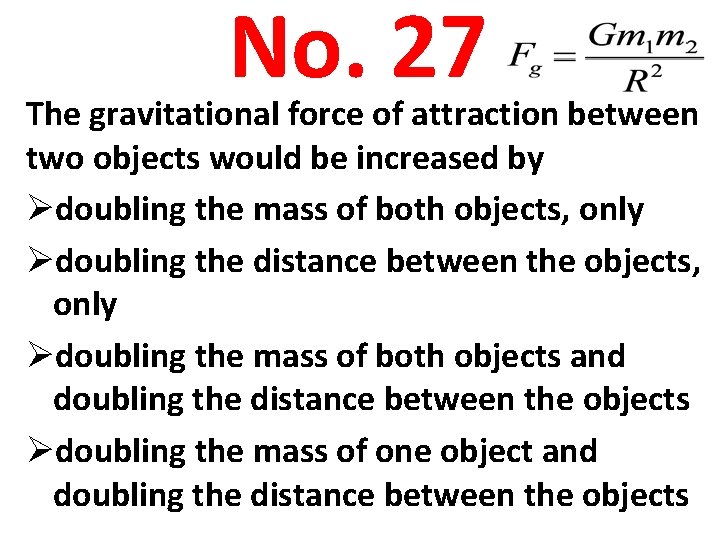
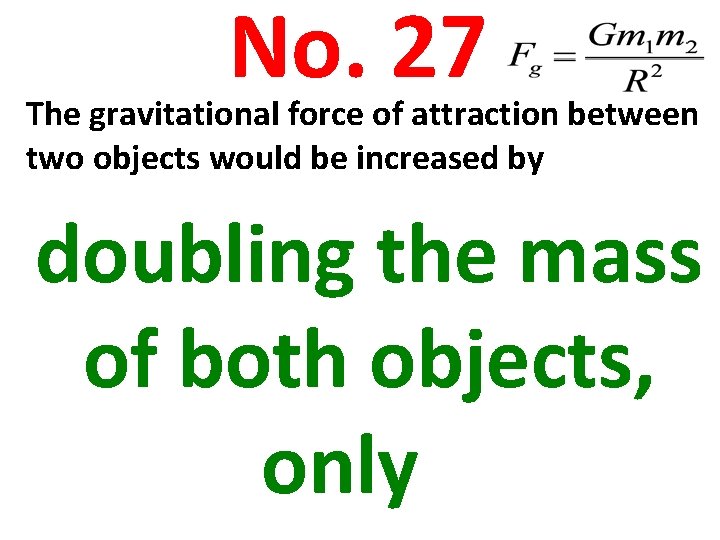
No. 27 The gravitational force of attraction between two objects would be increased by Ødoubling the mass of both objects, only Ødoubling the distance between the objects, only Ødoubling the mass of both objects and doubling the distance between the objects Ødoubling the mass of one object and doubling the distance between the objects
No. 27 The gravitational force of attraction between two objects would be increased by doubling the mass of both objects, only
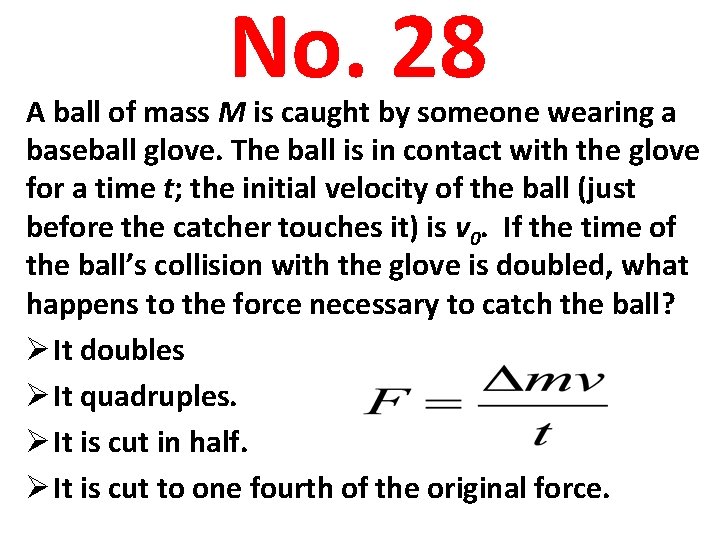
No. 28 A ball of mass M is caught by someone wearing a baseball glove. The ball is in contact with the glove for a time t; the initial velocity of the ball (just before the catcher touches it) is v 0. If the time of the ball’s collision with the glove is doubled, what happens to the force necessary to catch the ball? Ø It doubles Ø It quadruples. Ø It is cut in half. Ø It is cut to one fourth of the original force.
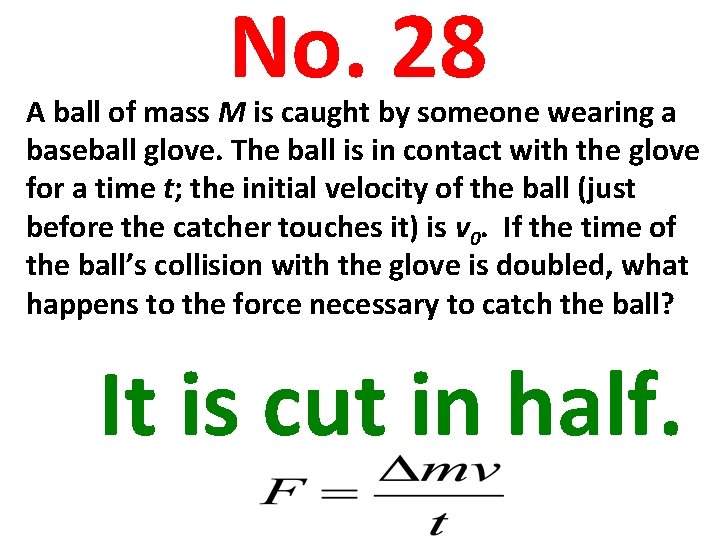
No. 28 A ball of mass M is caught by someone wearing a baseball glove. The ball is in contact with the glove for a time t; the initial velocity of the ball (just before the catcher touches it) is v 0. If the time of the ball’s collision with the glove is doubled, what happens to the force necessary to catch the ball? It is cut in half.
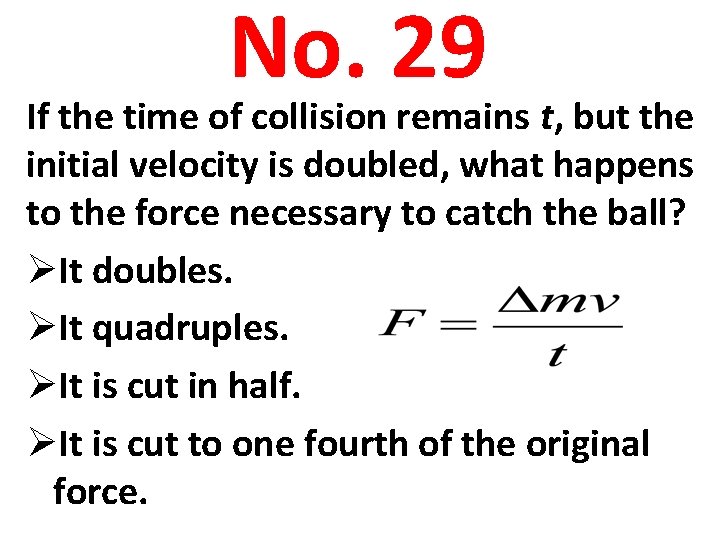
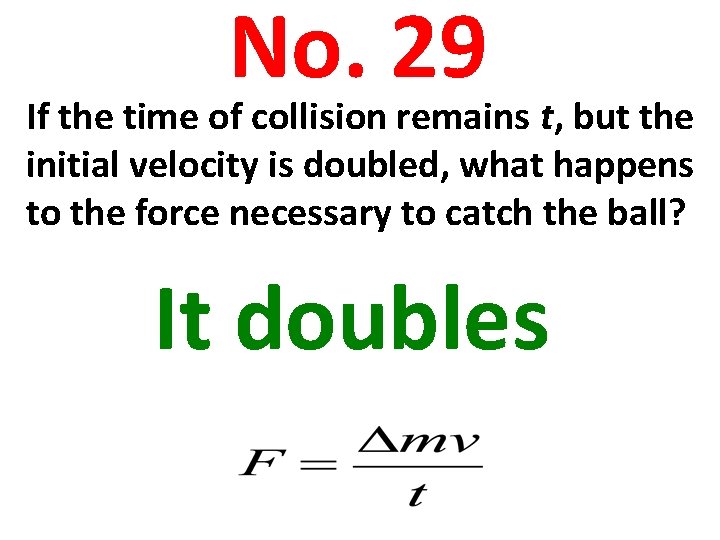
No. 29 If the time of collision remains t, but the initial velocity is doubled, what happens to the force necessary to catch the ball? ØIt doubles. ØIt quadruples. ØIt is cut in half. ØIt is cut to one fourth of the original force.
No. 29 If the time of collision remains t, but the initial velocity is doubled, what happens to the force necessary to catch the ball? It doubles
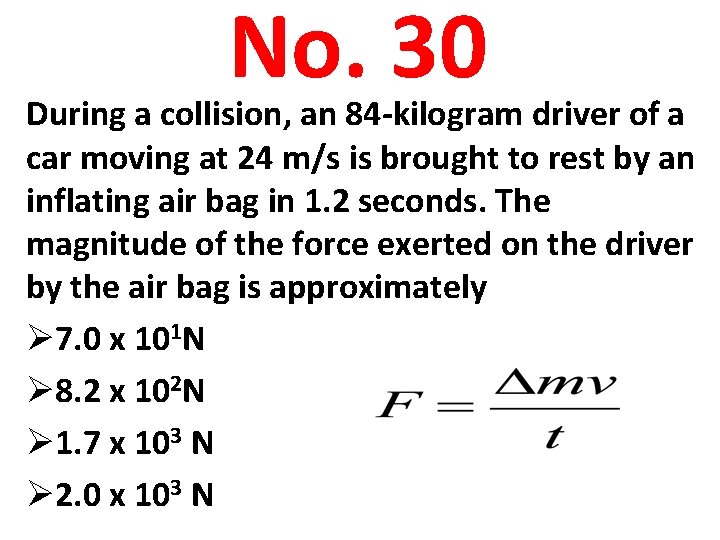
No. 30 During a collision, an 84 -kilogram driver of a car moving at 24 m/s is brought to rest by an inflating air bag in 1. 2 seconds. The magnitude of the force exerted on the driver by the air bag is approximately Ø 7. 0 x 101 N Ø 8. 2 x 10² N Ø 1. 7 x 10³ N Ø 2. 0 x 103 N
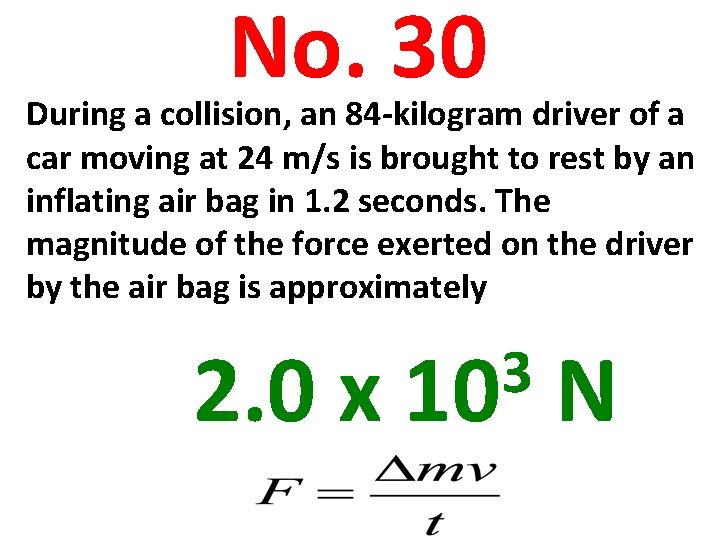
No. 30 During a collision, an 84 -kilogram driver of a car moving at 24 m/s is brought to rest by an inflating air bag in 1. 2 seconds. The magnitude of the force exerted on the driver by the air bag is approximately 3 2. 0 x 10 N
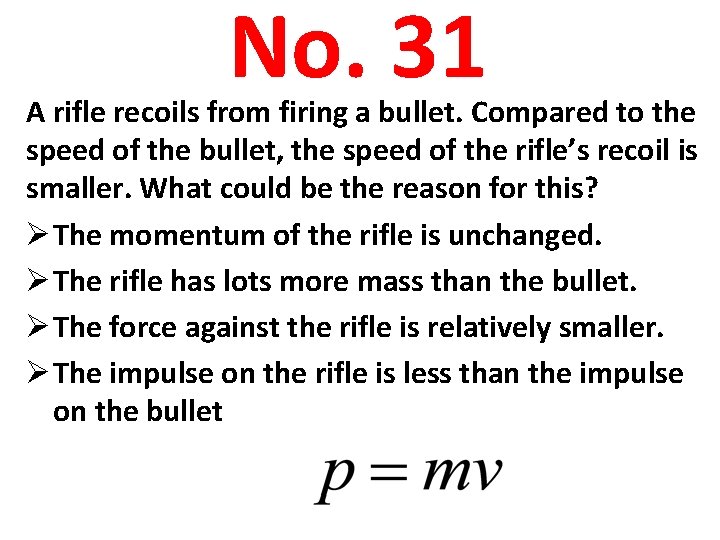
No. 31 A rifle recoils from firing a bullet. Compared to the speed of the bullet, the speed of the rifle’s recoil is smaller. What could be the reason for this? Ø The momentum of the rifle is unchanged. Ø The rifle has lots more mass than the bullet. Ø The force against the rifle is relatively smaller. Ø The impulse on the rifle is less than the impulse on the bullet
No. 31 A rifle recoils from firing a bullet. Compared to the speed of the bullet, the speed of the rifle’s recoil is smaller. What could be the reason for this? The rifle has lots more mass than the bullet
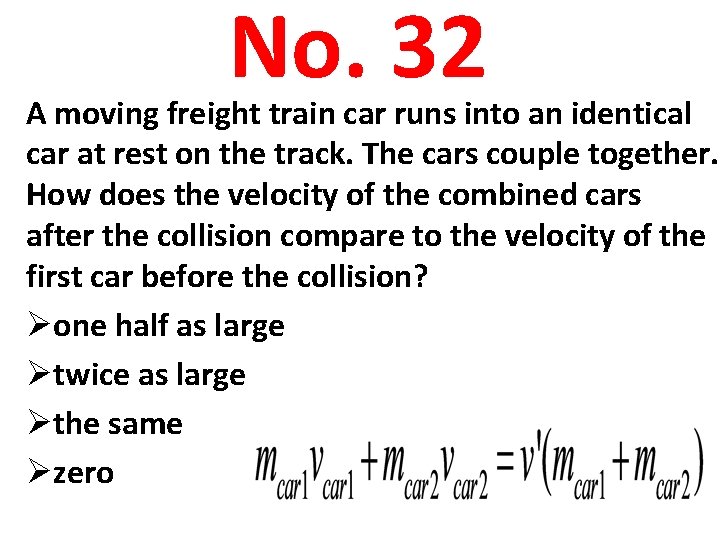
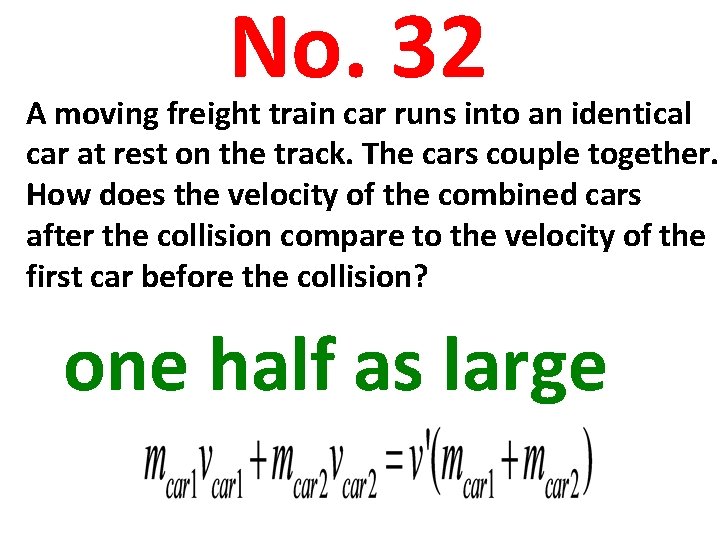
No. 32 A moving freight train car runs into an identical car at rest on the track. The cars couple together. How does the velocity of the combined cars after the collision compare to the velocity of the first car before the collision? Øone half as large Øtwice as large Øthe same Øzero
No. 32 A moving freight train car runs into an identical car at rest on the track. The cars couple together. How does the velocity of the combined cars after the collision compare to the velocity of the first car before the collision? one half as large
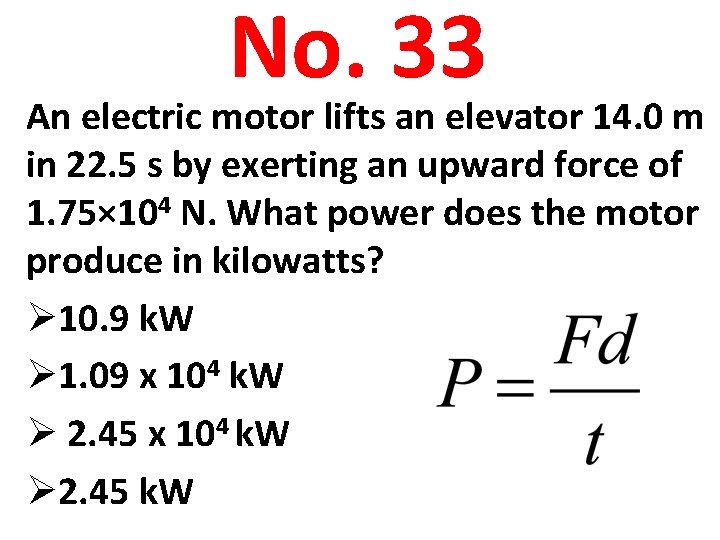
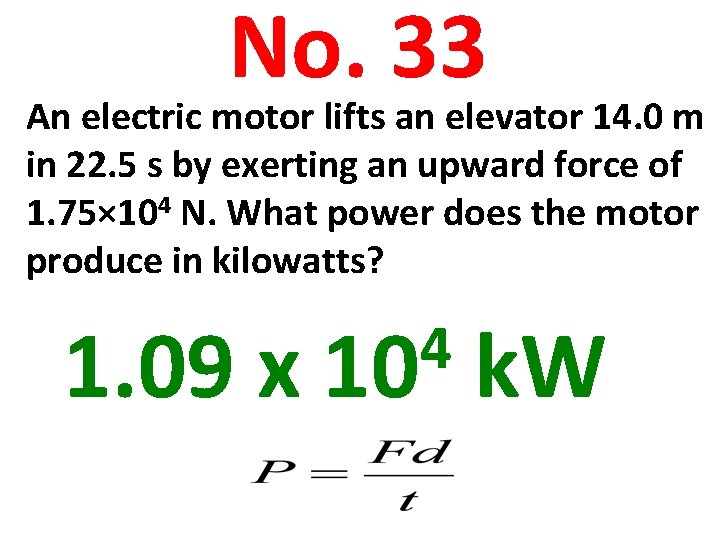
No. 33 An electric motor lifts an elevator 14. 0 m in 22. 5 s by exerting an upward force of 1. 75× 104 N. What power does the motor produce in kilowatts? Ø 10. 9 k. W Ø 1. 09 x 104 k. W Ø 2. 45 k. W
No. 33 An electric motor lifts an elevator 14. 0 m in 22. 5 s by exerting an upward force of 1. 75× 104 N. What power does the motor produce in kilowatts? 4 1. 09 x 10 k. W
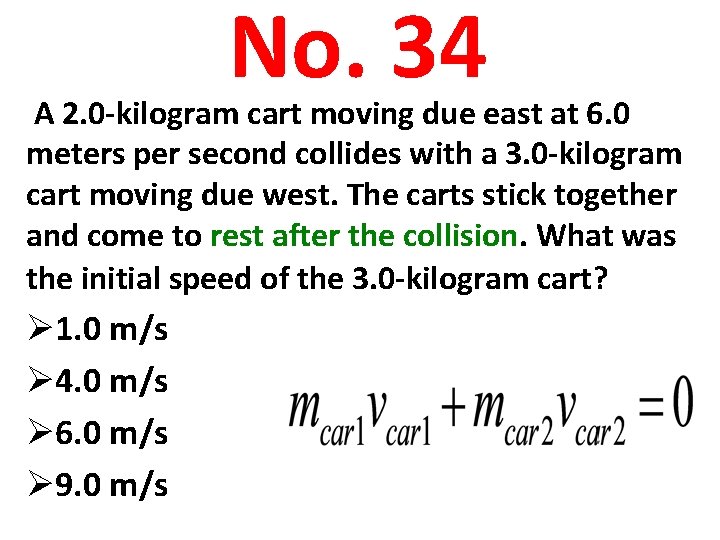
No. 34 A 2. 0 -kilogram cart moving due east at 6. 0 meters per second collides with a 3. 0 -kilogram cart moving due west. The carts stick together and come to rest after the collision. What was the initial speed of the 3. 0 -kilogram cart? Ø 1. 0 m/s Ø 4. 0 m/s Ø 6. 0 m/s Ø 9. 0 m/s
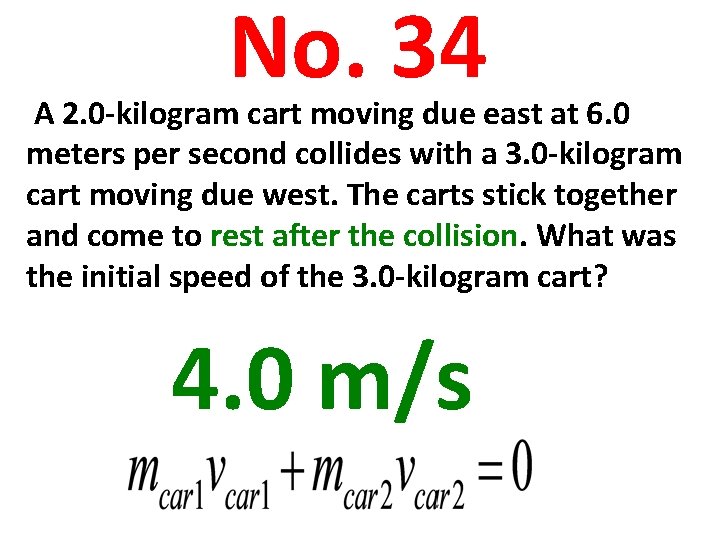
No. 34 A 2. 0 -kilogram cart moving due east at 6. 0 meters per second collides with a 3. 0 -kilogram cart moving due west. The carts stick together and come to rest after the collision. What was the initial speed of the 3. 0 -kilogram cart? 4. 0 m/s
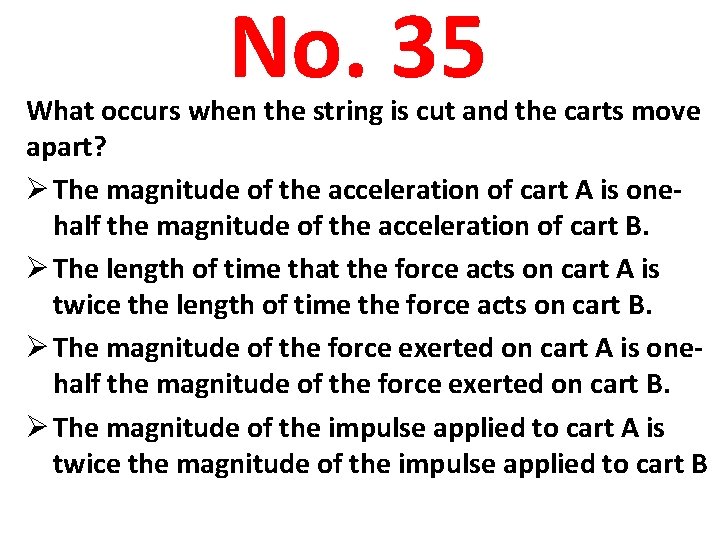
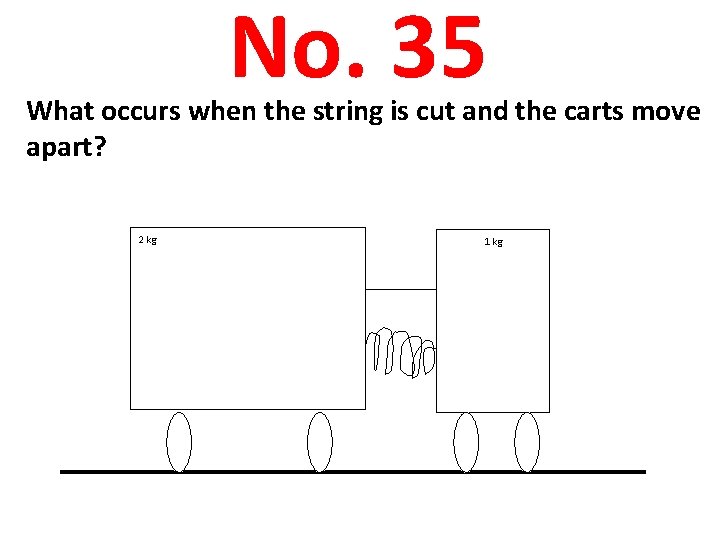
No. 35 What occurs when the string is cut and the carts move apart? Ø The magnitude of the acceleration of cart A is onehalf the magnitude of the acceleration of cart B. Ø The length of time that the force acts on cart A is twice the length of time the force acts on cart B. Ø The magnitude of the force exerted on cart A is onehalf the magnitude of the force exerted on cart B. Ø The magnitude of the impulse applied to cart A is twice the magnitude of the impulse applied to cart B
No. 35 What occurs when the string is cut and the carts move apart? 2 kg 1 kg
No. 35 What occurs when the string is cut and the carts move apart? The magnitude of the acceleration of cart A is onehalf the magnitude of the acceleration of cart B.
No. 36 After the string is cut and the two carts move apart, the magnitude of which quantity is the same for both carts? ØMomentum Øvelocity Øinertia Økinetic energy
No. 36 After the string is cut and the two carts move apart, the magnitude of which quantity is the same for both carts? Momentum
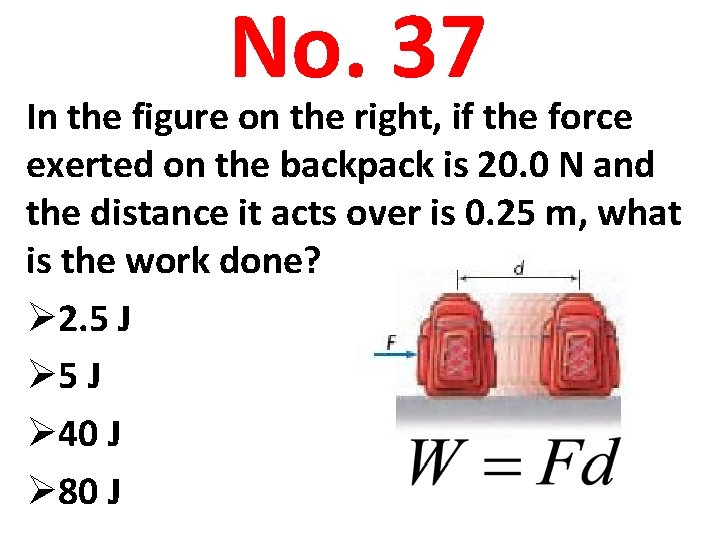
No. 37 In the figure on the right, if the force exerted on the backpack is 20. 0 N and the distance it acts over is 0. 25 m, what is the work done? Ø 2. 5 J Ø 5 J Ø 40 J Ø 80 J
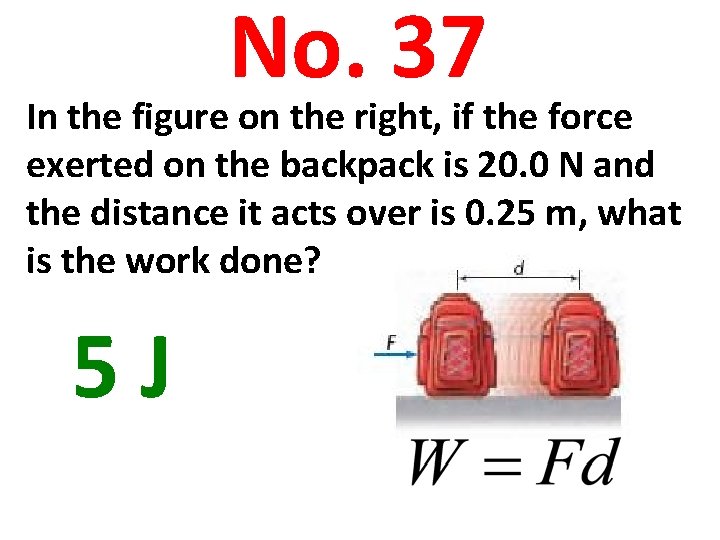
No. 37 In the figure on the right, if the force exerted on the backpack is 20. 0 N and the distance it acts over is 0. 25 m, what is the work done? 5 J
No. 38 One _____ is one joule of work done in one second. Øcalorie Ønewton Øvolt Øwatt
No. 38 One _____ is one joule of work done in one second. newton
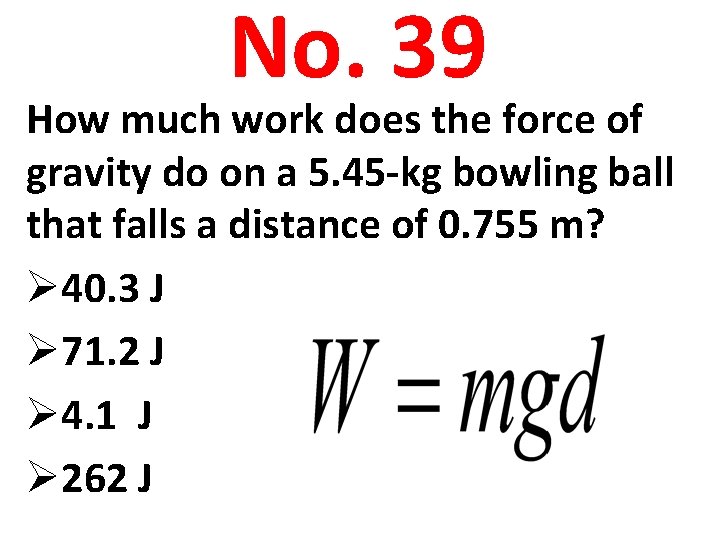
No. 39 How much work does the force of gravity do on a 5. 45 -kg bowling ball that falls a distance of 0. 755 m? Ø 40. 3 J Ø 71. 2 J Ø 4. 1 J Ø 262 J
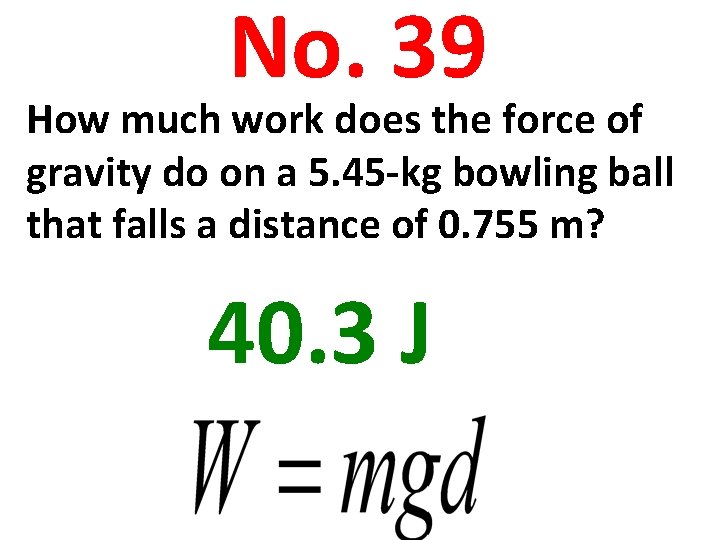
No. 39 How much work does the force of gravity do on a 5. 45 -kg bowling ball that falls a distance of 0. 755 m? 40. 3 J
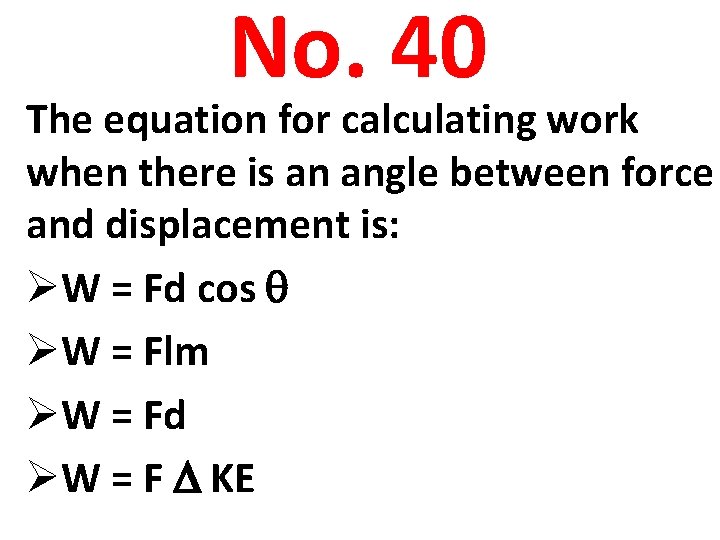
No. 40 The equation for calculating work when there is an angle between force and displacement is: ØW = Fd cos ØW = Flm ØW = Fd ØW = F KE
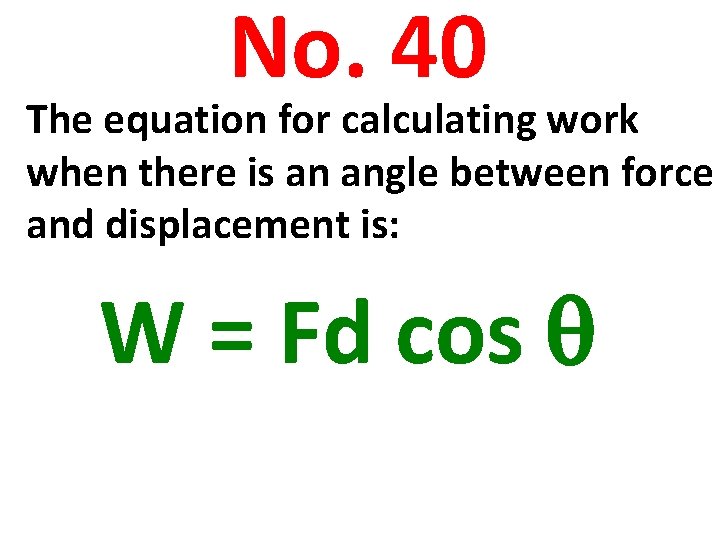
No. 40 The equation for calculating work when there is an angle between force and displacement is: W = Fd cos
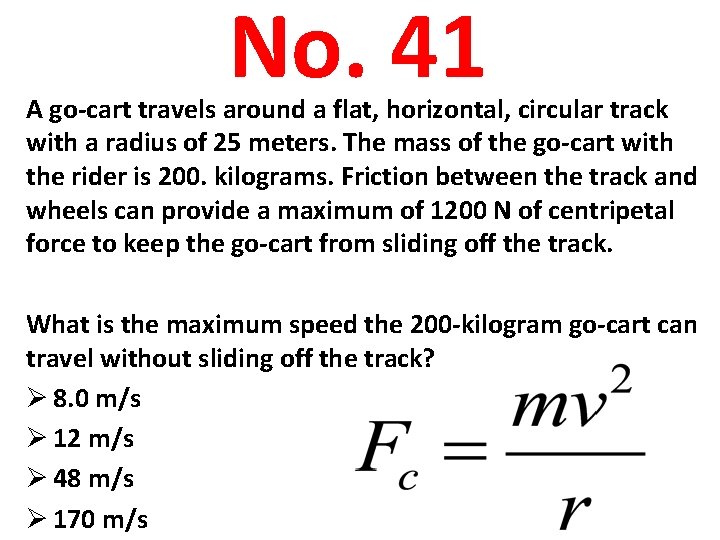
No. 41 A go-cart travels around a flat, horizontal, circular track with a radius of 25 meters. The mass of the go-cart with the rider is 200. kilograms. Friction between the track and wheels can provide a maximum of 1200 N of centripetal force to keep the go-cart from sliding off the track. What is the maximum speed the 200 -kilogram go-cart can travel without sliding off the track? Ø 8. 0 m/s Ø 12 m/s Ø 48 m/s Ø 170 m/s
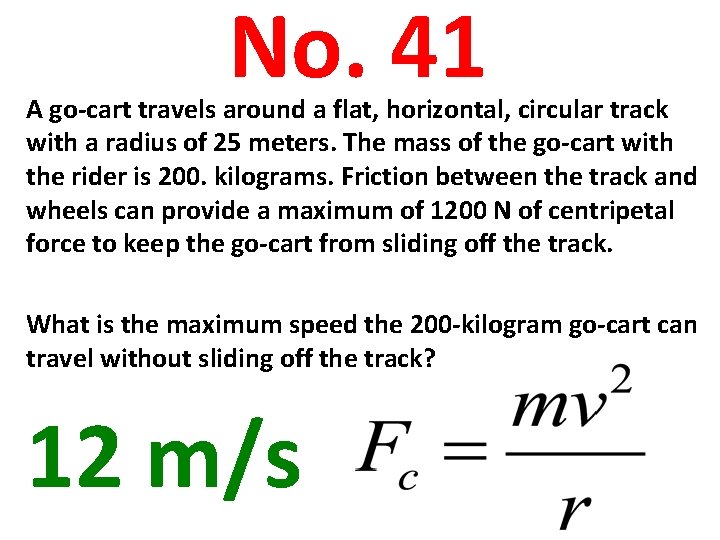
No. 41 A go-cart travels around a flat, horizontal, circular track with a radius of 25 meters. The mass of the go-cart with the rider is 200. kilograms. Friction between the track and wheels can provide a maximum of 1200 N of centripetal force to keep the go-cart from sliding off the track. What is the maximum speed the 200 -kilogram go-cart can travel without sliding off the track? 12 m/s
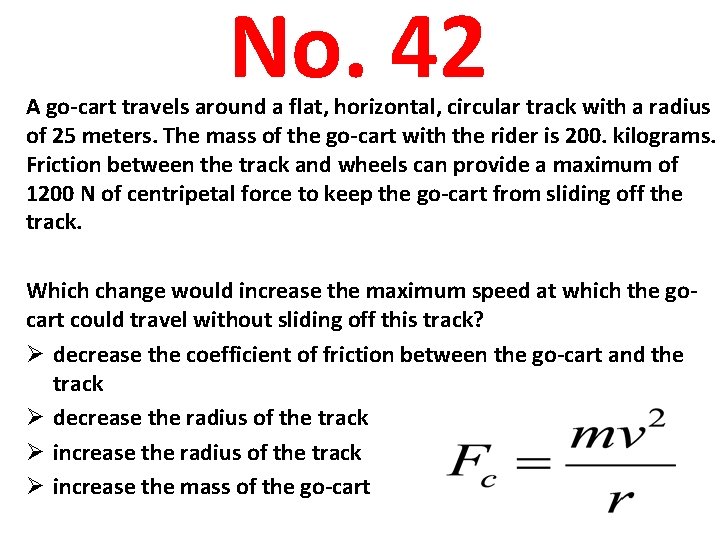
No. 42 A go-cart travels around a flat, horizontal, circular track with a radius of 25 meters. The mass of the go-cart with the rider is 200. kilograms. Friction between the track and wheels can provide a maximum of 1200 N of centripetal force to keep the go-cart from sliding off the track. Which change would increase the maximum speed at which the gocart could travel without sliding off this track? Ø decrease the coefficient of friction between the go-cart and the track Ø decrease the radius of the track Ø increase the mass of the go-cart
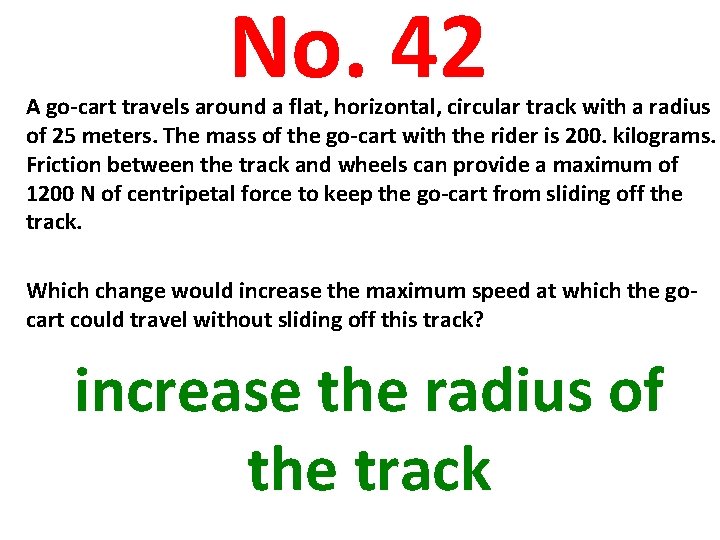
No. 42 A go-cart travels around a flat, horizontal, circular track with a radius of 25 meters. The mass of the go-cart with the rider is 200. kilograms. Friction between the track and wheels can provide a maximum of 1200 N of centripetal force to keep the go-cart from sliding off the track. Which change would increase the maximum speed at which the gocart could travel without sliding off this track? increase the radius of the track
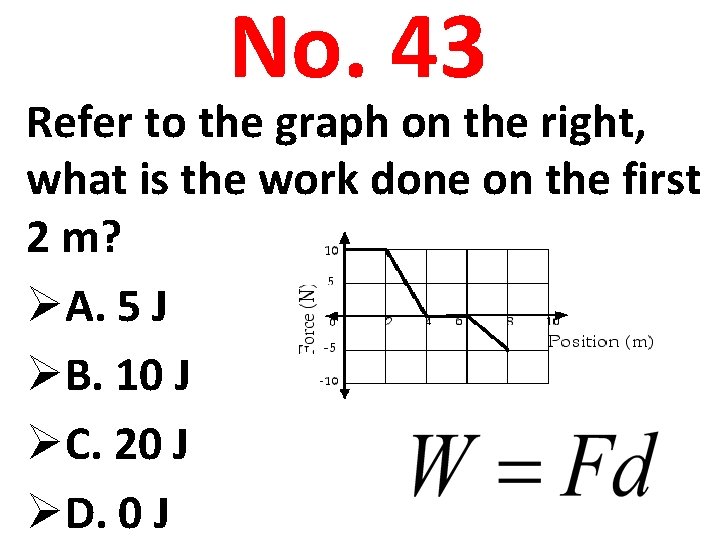
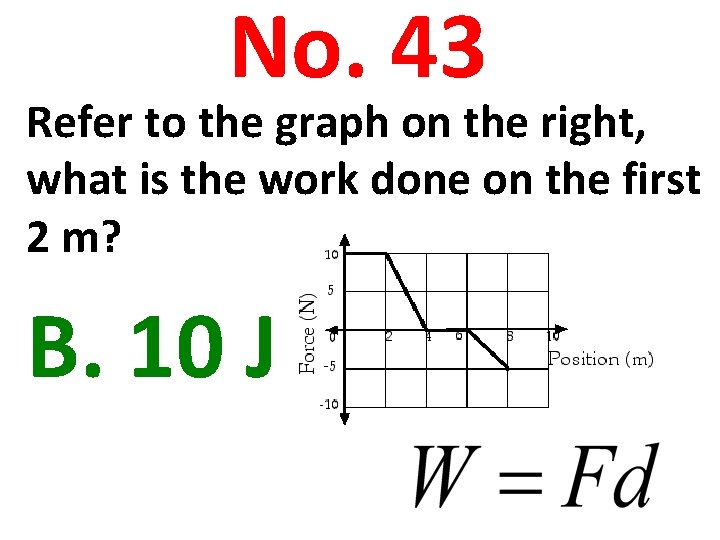
No. 43 Refer to the graph on the right, what is the work done on the first 2 m? ØA. 5 J ØB. 10 J ØC. 20 J ØD. 0 J
No. 43 Refer to the graph on the right, what is the work done on the first 2 m? B. 10 J
No. 44 In which of the following situations is NO WORK done on a book? Øcarrying the book down the hall Øpicking up the book Ødropping the book Øpushing the book across the desk
No. 44 In which of the following situations is NO WORK done on a book? carrying the book down the hall
No. 45 Work is done on an object when a constant force is exerted on the object causing the object to be displaced Øopposite the direction of the force Øperpendicular to the force Øat an angle to the force Øin the direction of the force
No. 45 Work is done on an object when a constant force is exerted on the object causing the object to be displaced in the direction of the
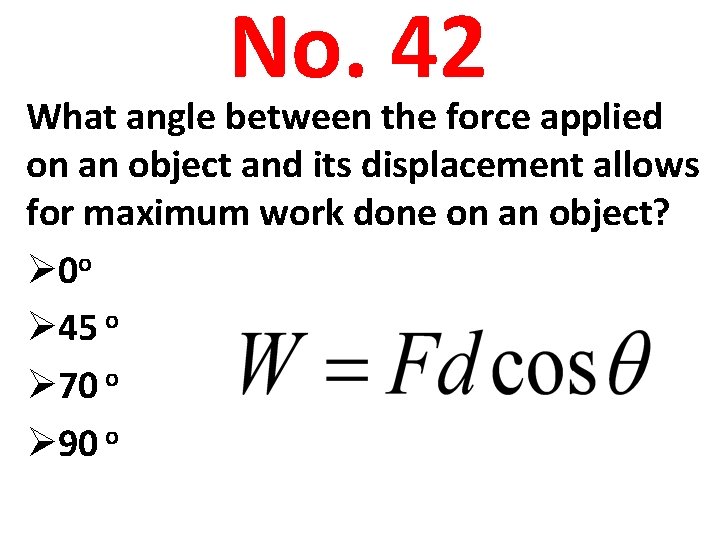
No. 42 What angle between the force applied on an object and its displacement allows for maximum work done on an object? Ø 0 o Ø 45 o Ø 70 o Ø 90 o
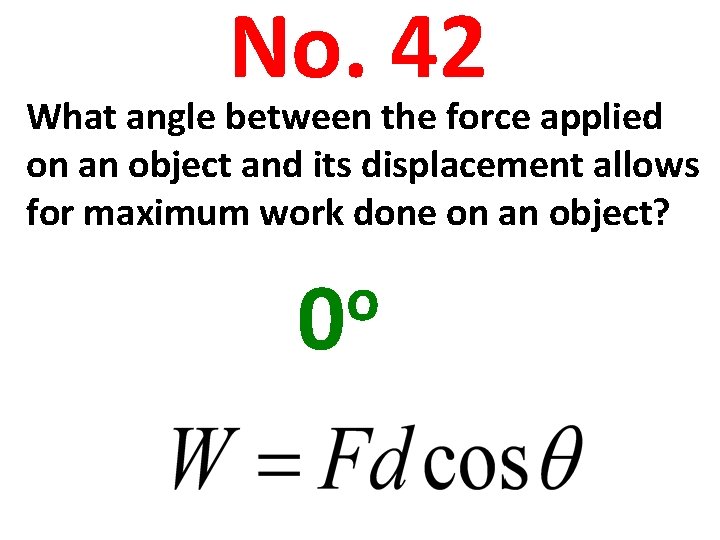
No. 42 What angle between the force applied on an object and its displacement allows for maximum work done on an object? o 0
No. 46 The rate of doing work: ØEffort Øforce Øpower Øenergy
No. 46 The rate of doing work: power
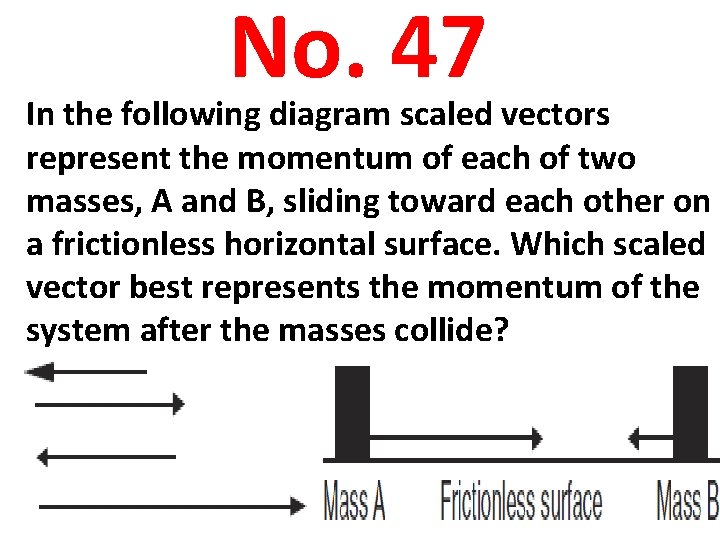
No. 47 In the following diagram scaled vectors represent the momentum of each of two masses, A and B, sliding toward each other on a frictionless horizontal surface. Which scaled vector best represents the momentum of the system after the masses collide?
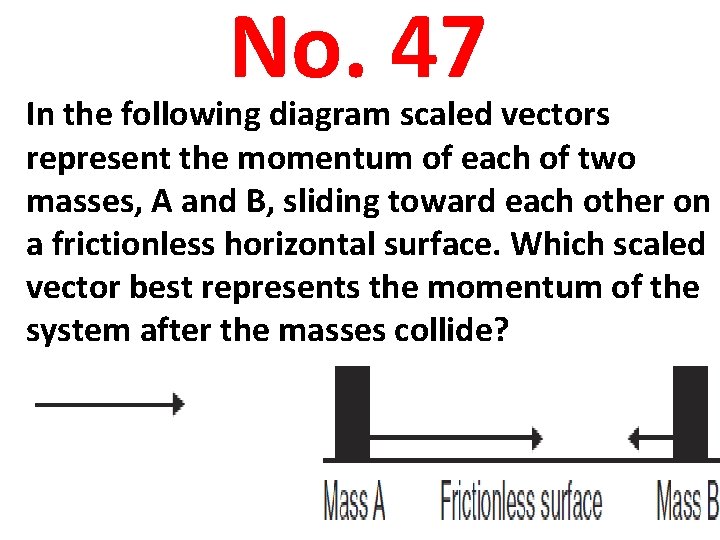
No. 47 In the following diagram scaled vectors represent the momentum of each of two masses, A and B, sliding toward each other on a frictionless horizontal surface. Which scaled vector best represents the momentum of the system after the masses collide?
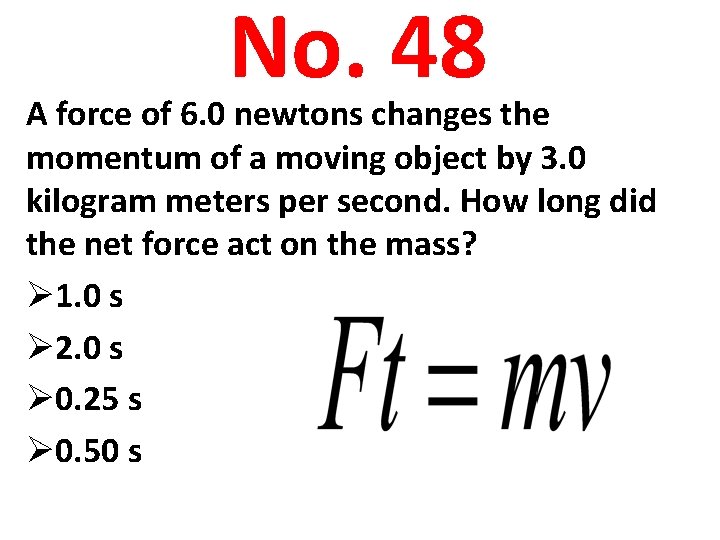
No. 48 A force of 6. 0 newtons changes the momentum of a moving object by 3. 0 kilogram meters per second. How long did the net force act on the mass? Ø 1. 0 s Ø 2. 0 s Ø 0. 25 s Ø 0. 50 s
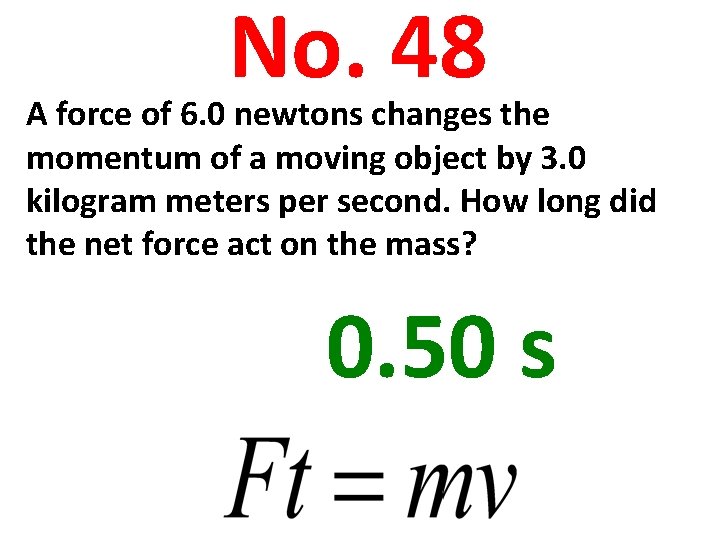
No. 48 A force of 6. 0 newtons changes the momentum of a moving object by 3. 0 kilogram meters per second. How long did the net force act on the mass? 0. 50 s
No. 49 The work done in lifting an apple one meter near Earth's surface is approximately: Ø 0. 01 J Ø 1000 J
No. 49 The work done in lifting an apple one meter near Earth's surface is approximately: 1 J
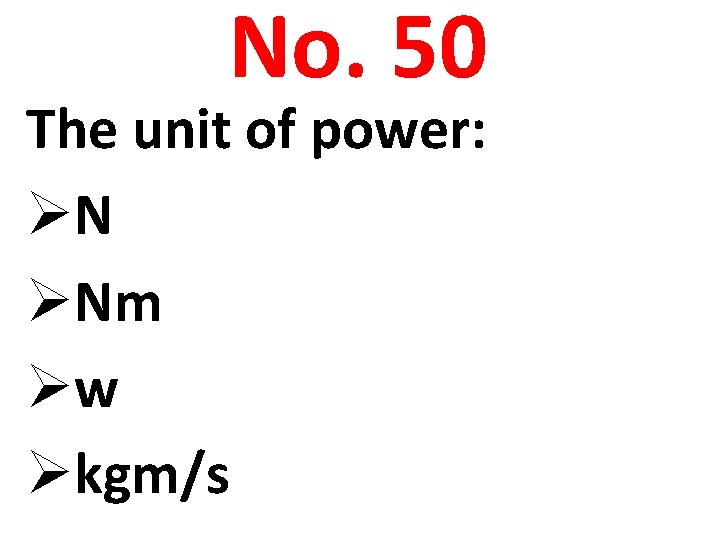
No. 50 The unit of power: ØN ØNm Øw Økgm/s
No. 50 The unit of power: w
PROBLEM SOLVING Write the equation, solve it later.
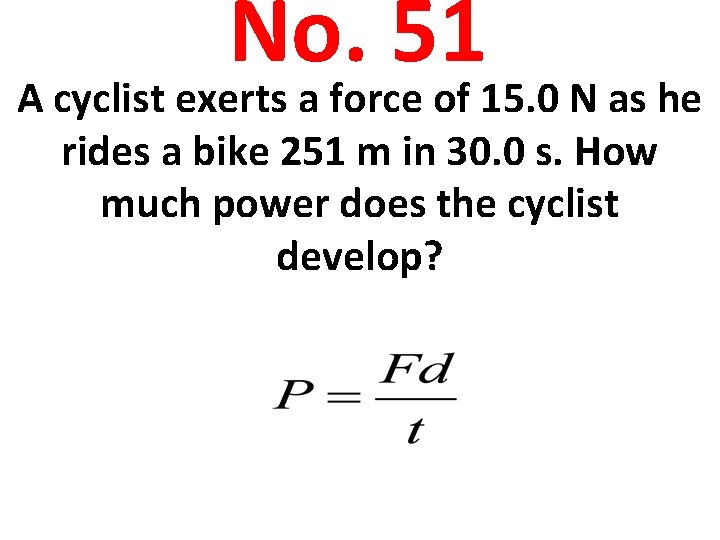
No. 51 A cyclist exerts a force of 15. 0 N as he rides a bike 251 m in 30. 0 s. How much power does the cyclist develop?
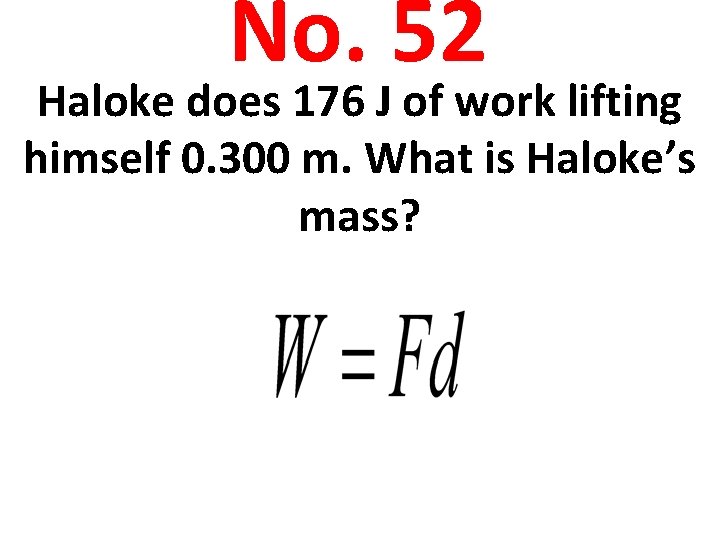
No. 52 Haloke does 176 J of work lifting himself 0. 300 m. What is Haloke’s mass?
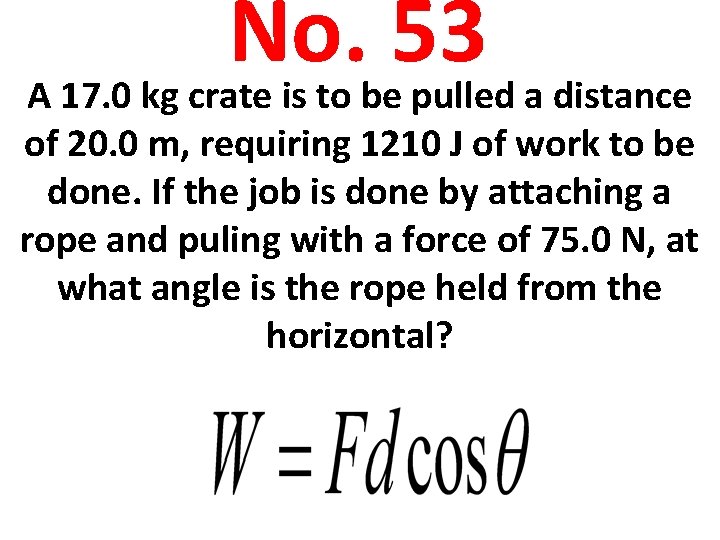
No. 53 A 17. 0 kg crate is to be pulled a distance of 20. 0 m, requiring 1210 J of work to be done. If the job is done by attaching a rope and puling with a force of 75. 0 N, at what angle is the rope held from the horizontal?
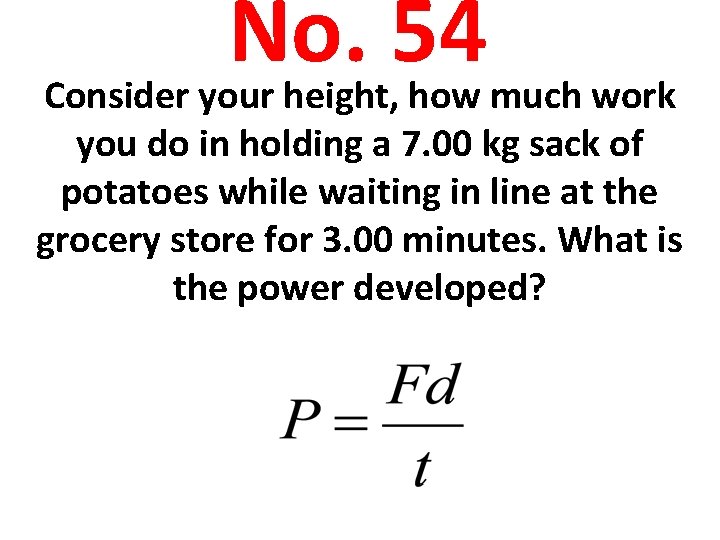
No. 54 Consider your height, how much work you do in holding a 7. 00 kg sack of potatoes while waiting in line at the grocery store for 3. 00 minutes. What is the power developed?
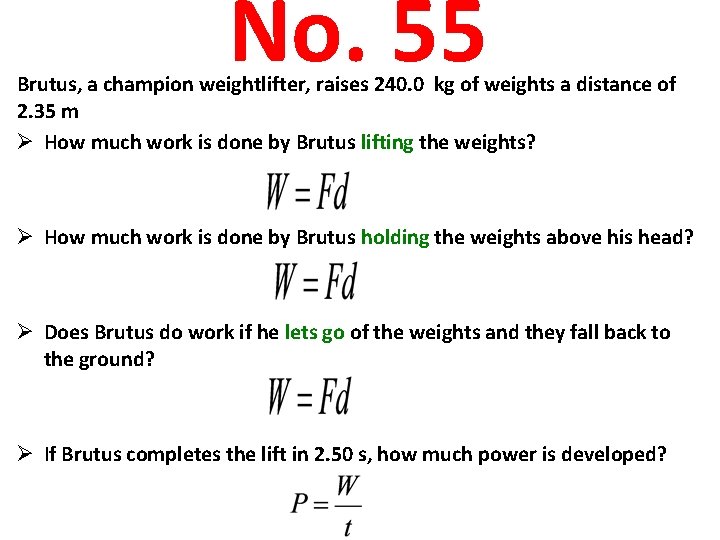
No. 55 Brutus, a champion weightlifter, raises 240. 0 kg of weights a distance of 2. 35 m Ø How much work is done by Brutus lifting the weights? Ø How much work is done by Brutus holding the weights above his head? Ø Does Brutus do work if he lets go of the weights and they fall back to the ground? Ø If Brutus completes the lift in 2. 50 s, how much power is developed?
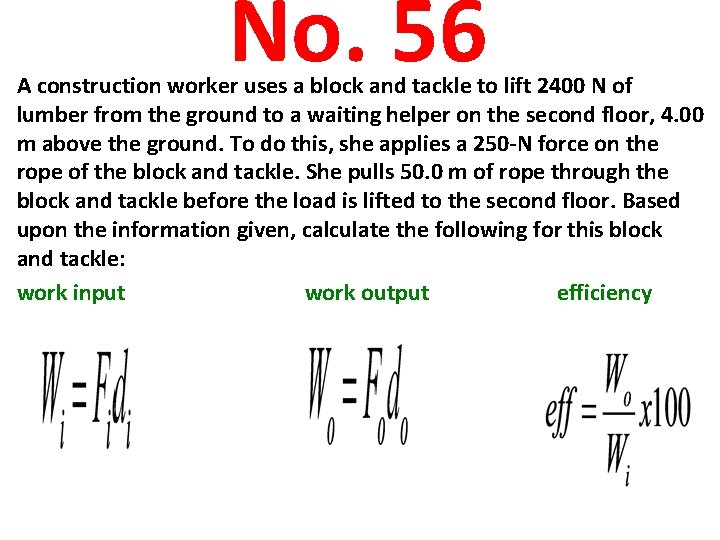
No. 56 A construction worker uses a block and tackle to lift 2400 N of lumber from the ground to a waiting helper on the second floor, 4. 00 m above the ground. To do this, she applies a 250 -N force on the rope of the block and tackle. She pulls 50. 0 m of rope through the block and tackle before the load is lifted to the second floor. Based upon the information given, calculate the following for this block and tackle: work input work output efficiency
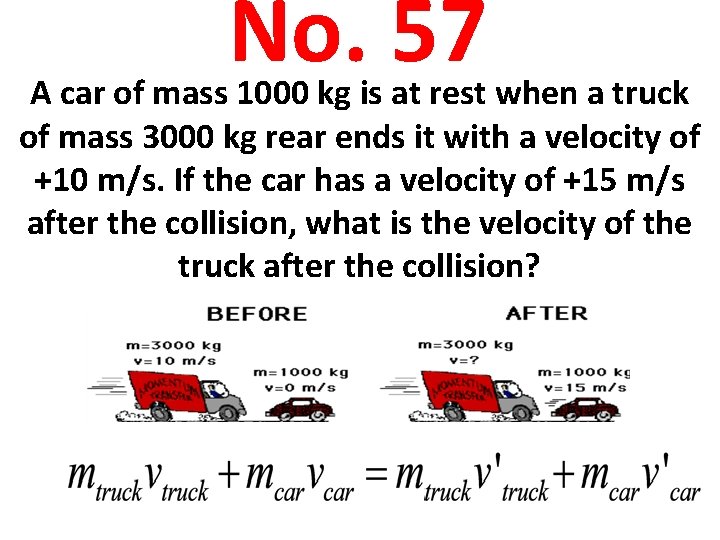
No. 57 A car of mass 1000 kg is at rest when a truck of mass 3000 kg rear ends it with a velocity of +10 m/s. If the car has a velocity of +15 m/s after the collision, what is the velocity of the truck after the collision?
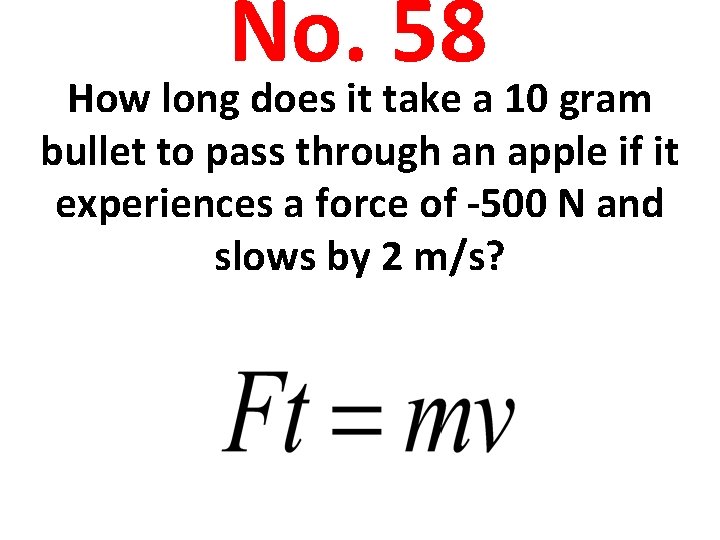
No. 58 How long does it take a 10 gram bullet to pass through an apple if it experiences a force of -500 N and slows by 2 m/s?
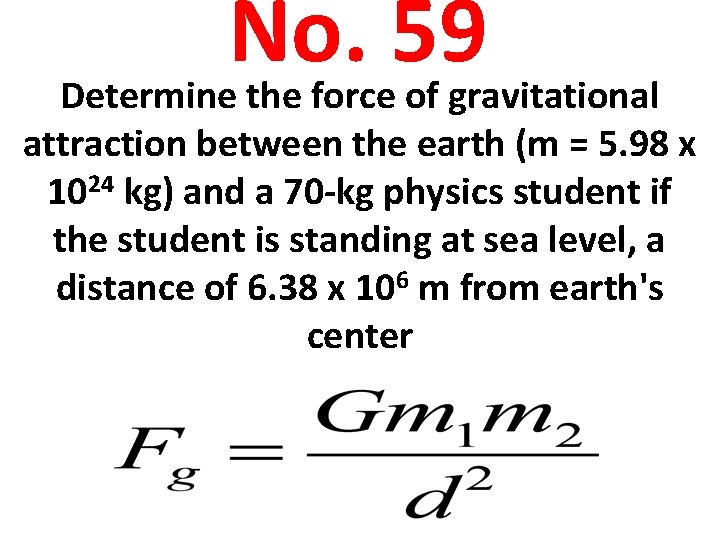
No. 59 Determine the force of gravitational attraction between the earth (m = 5. 98 x 1024 kg) and a 70 -kg physics student if the student is standing at sea level, a distance of 6. 38 x 106 m from earth's center
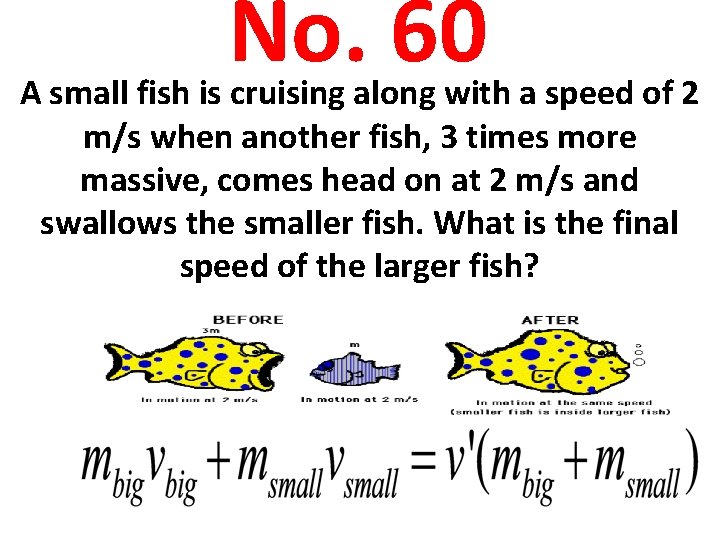
No. 60 A small fish is cruising along with a speed of 2 m/s when another fish, 3 times more massive, comes head on at 2 m/s and swallows the smaller fish. What is the final speed of the larger fish?
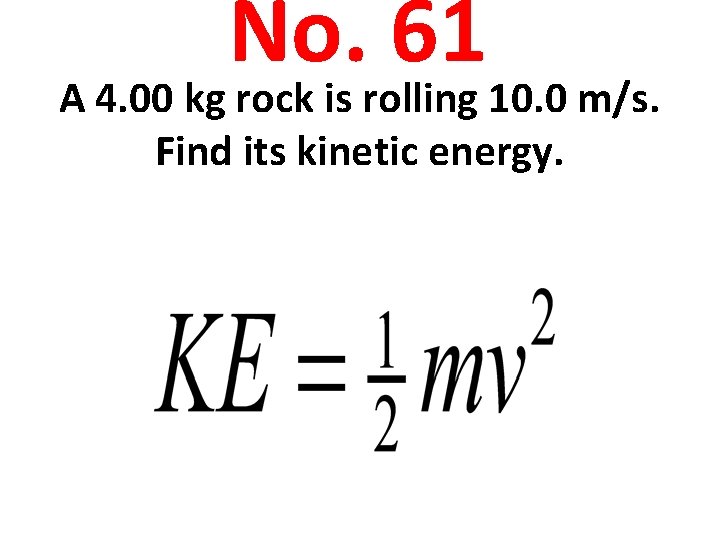
No. 61 A 4. 00 kg rock is rolling 10. 0 m/s. Find its kinetic energy.
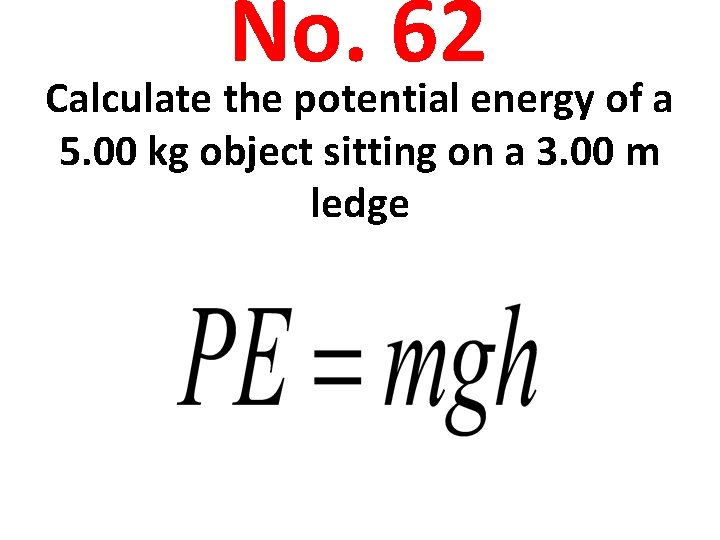
No. 62 Calculate the potential energy of a 5. 00 kg object sitting on a 3. 00 m ledge
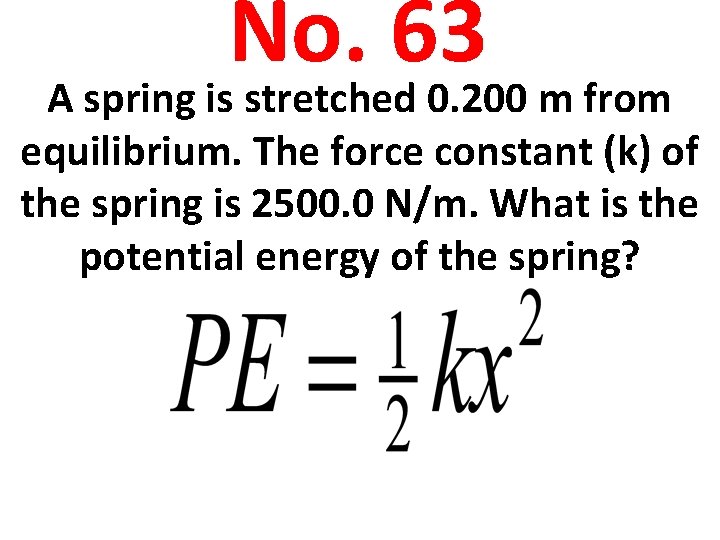
No. 63 A spring is stretched 0. 200 m from equilibrium. The force constant (k) of the spring is 2500. 0 N/m. What is the potential energy of the spring?
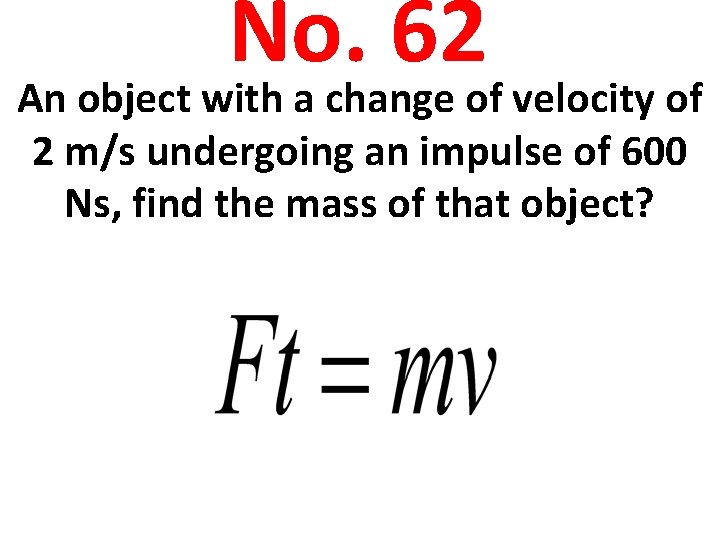
No. 62 An object with a change of velocity of 2 m/s undergoing an impulse of 600 Ns, find the mass of that object?
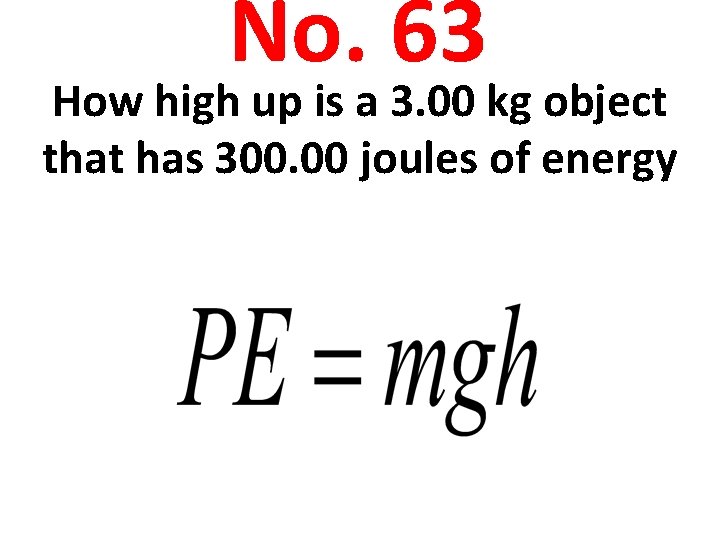
No. 63 How high up is a 3. 00 kg object that has 300. 00 joules of energy
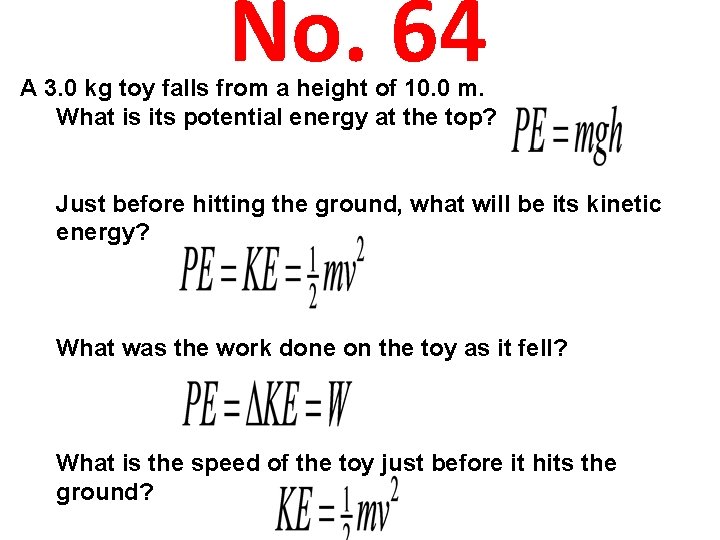
No. 64 A 3. 0 kg toy falls from a height of 10. 0 m. What is its potential energy at the top? Just before hitting the ground, what will be its kinetic energy? What was the work done on the toy as it fell? What is the speed of the toy just before it hits the ground?
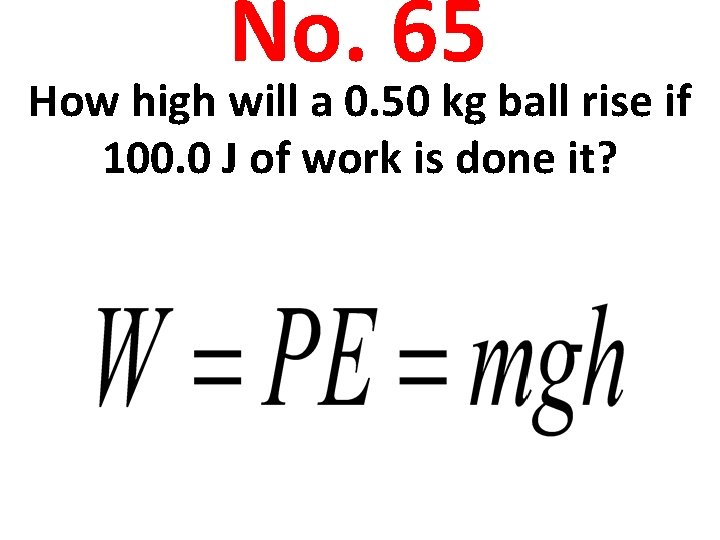
No. 65 How high will a 0. 50 kg ball rise if 100. 0 J of work is done it?
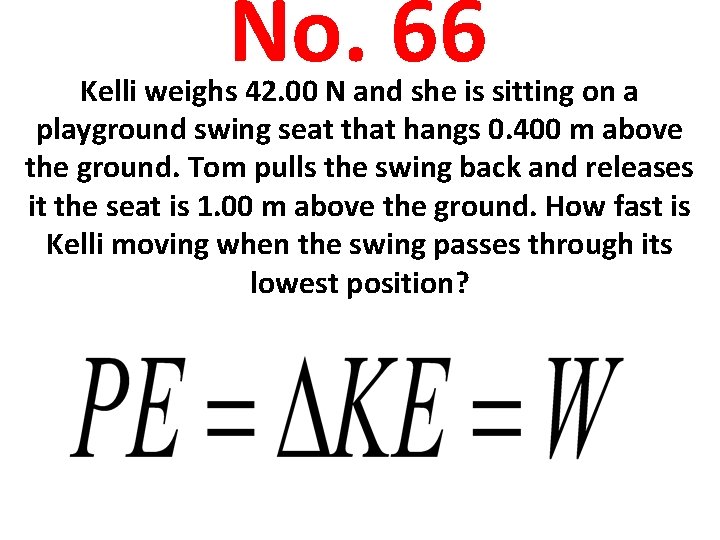
No. 66 Kelli weighs 42. 00 N and she is sitting on a playground swing seat that hangs 0. 400 m above the ground. Tom pulls the swing back and releases it the seat is 1. 00 m above the ground. How fast is Kelli moving when the swing passes through its lowest position?
HOMEWORK Answer the rest of the questions!
WRAP UP None EXTRA CREDIT - due on Physics Day Exam Added to EXAM GRADE / COMPLETED review packet & attendance in class (no credit for incomplete/ with blanks reviewer) You may lose your extra credit if behavior is unbecoming. TEACHER DISMISSES THE CLASS NOT THE BELL. Wait in your seat silently for the teacher to say “CLASS
CLASS DISMISS May the POSITIVE FORCE be with you! 131
HR TO DO TODAY 1. Athletic Interest Survey 2. Prom Venue Ballot 3. Exam Schedule Correction > Monday Exam 1 is Science Exam 2 is English
HR TO DO TODAY Pass Both Surveys forward Those who are seated in front just leave it on your desk