
Applied Anomaly Based IDS Craig Buchanan University of

Applied Anomaly Based IDS Craig Buchanan University of Illinois at Urbana-Champaign CS 598 MCC 4/30/13
Outline • • K-Nearest Neighbor Neural Networks Support Vector Machines Lightweight Network Intrusion Detection (LNID)
K-Nearest Neighbor • “Use of K-Nearest Neighbor classifier for intrusion detection” [Liao, Computers and Security]

K-nearest neighbor on text 1. Categorize training documents into vector space model, A • Word-by-document matrix A • Rows = words • Columns = documents • Represents weight of each word in set of documents 2. 3. Build vector for test document, X Classify X into A using K-nearest neighbor

Text categorization •

Text categorization •

Text categorization • System call = “word” • Program execution = “document” • Close, execve, open, mmap, munmap, mmap, close, …, exit

Document Classification •
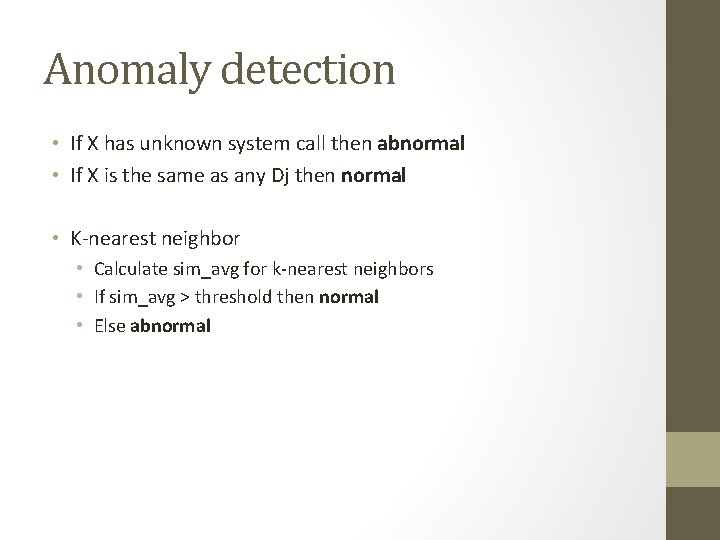
Anomaly detection • If X has unknown system call then abnormal • If X is the same as any Dj then normal • K-nearest neighbor • Calculate sim_avg for k-nearest neighbors • If sim_avg > threshold then normal • Else abnormal
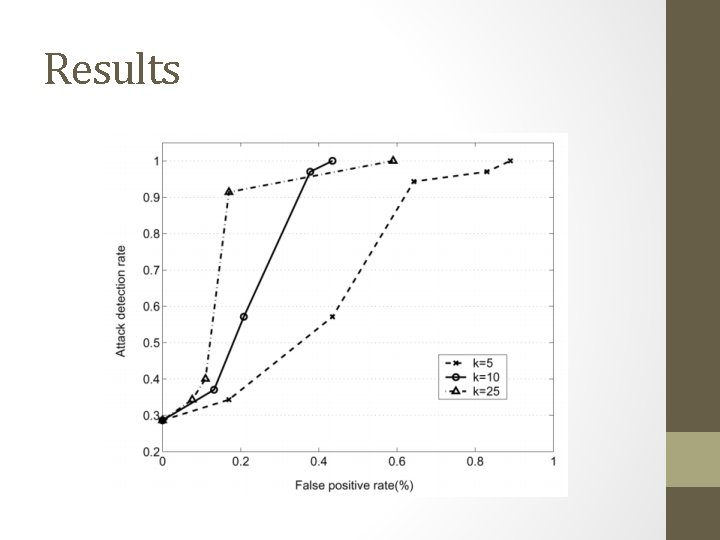
Results
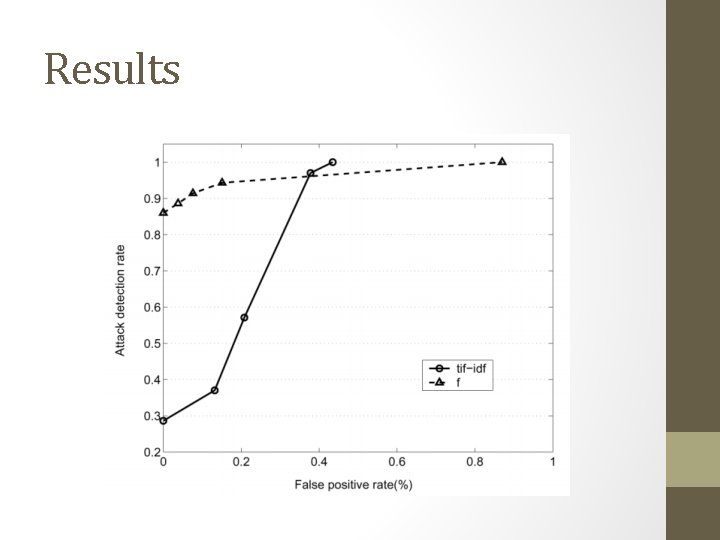
Results
Neural Networks • Intrusion Detection with Neural Networks [Ryan, AAAI Technical Report 1997] • Learn user profiles (“prints”) to detect intrusion
NNID System 1. Collect training data Audit logs from each user • 2. 3. 4. Train the neural network Obtain new command distribution vector Compare to training data Anomaly if: • • • Associated with a different user Not clearly associated with any user
Collect training data • Type of data • as, awk, bc, bibtex, calendar, cat, chmod, comsat, cpp, cut, cvs, date, df, diff, du, dvips, egrep, elm, emacs, …, w, wc, whereis, xbiff++, xcalc, xdvi, xhost, xterm • Type of platform • Audit trail logging • Small number of users • Not a large target
Train Neural Network • Map frequency of command to nonlinear scale • • 0. 0 to 1. 0 in 0. 1 increments 0. 0 – never used 0. 1 – used once or twice 1. 0 – used > 500 x • Concatenate values to 100 -dimensional command distribution vector
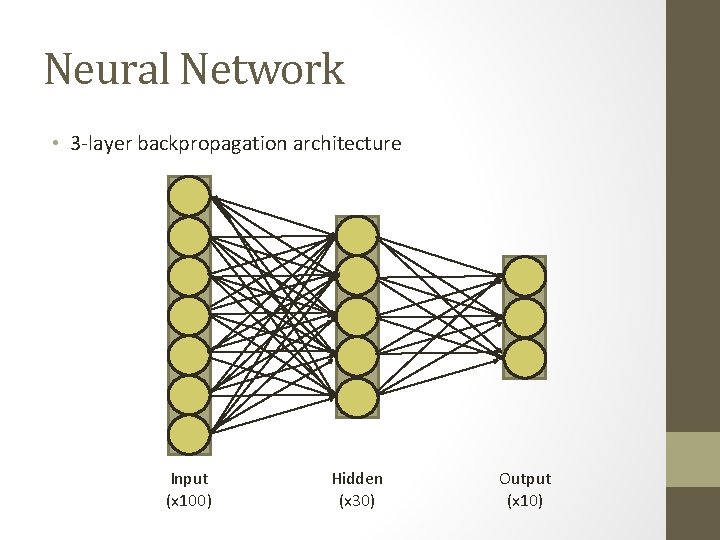
Neural Network • 3 -layer backpropagation architecture Input (x 100) Hidden (x 30) Output (x 10)
Results
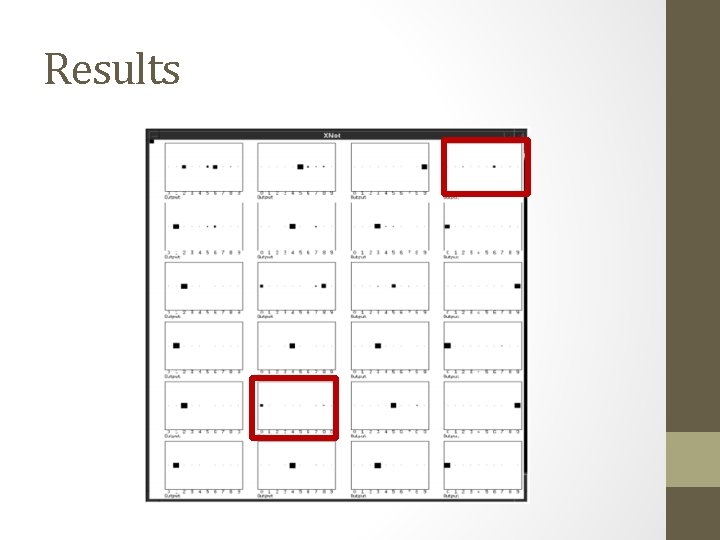
Results • Rejected 63% random user vectors • Anomaly detection rate 96% • Correctly identified user 93% • False alarm rate 7%

Support Vector Machines • Intrusion Detection Using Neural Networks and Support Vector Machines [Mukkamala, IEEE 2002]
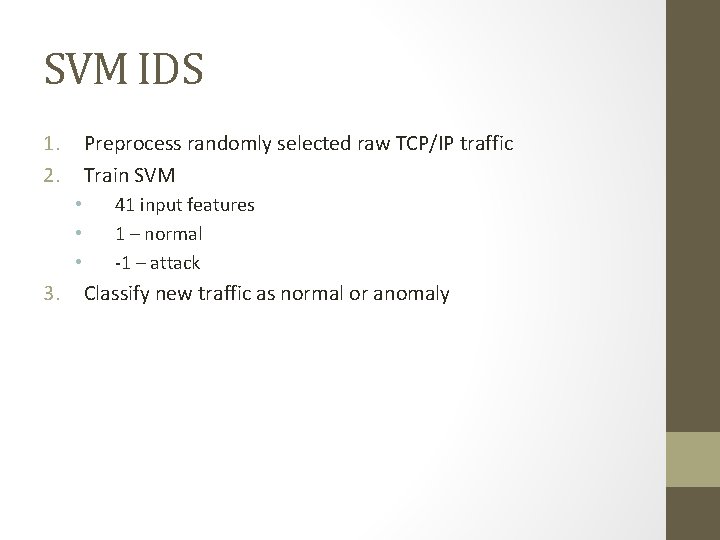
SVM IDS 1. 2. Preprocess randomly selected raw TCP/IP traffic Train SVM • • • 3. 41 input features 1 – normal -1 – attack Classify new traffic as normal or anomaly
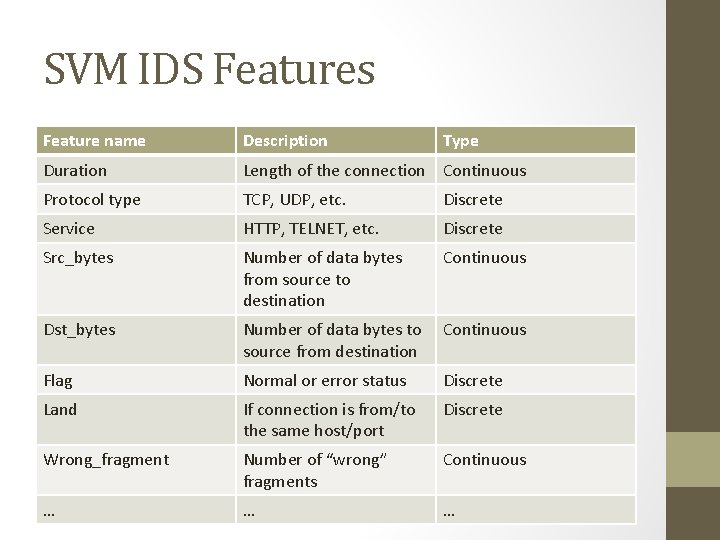
SVM IDS Features Feature name Description Type Duration Length of the connection Continuous Protocol type TCP, UDP, etc. Discrete Service HTTP, TELNET, etc. Discrete Src_bytes Number of data bytes from source to destination Continuous Dst_bytes Number of data bytes to Continuous source from destination Flag Normal or error status Discrete Land If connection is from/to the same host/port Discrete Wrong_fragment Number of “wrong” fragments Continuous … … …
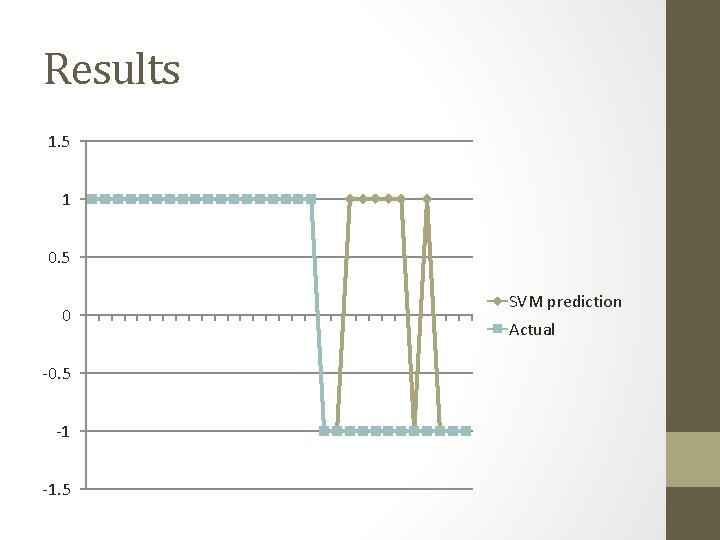
Results 1. 5 1 0. 5 0 -0. 5 -1 -1. 5 SVM prediction Actual
Recent Anomaly-based IDS • An efficient network intrusion detection [Chen, Computer Communications 2010] • Lightweight Network Intrusion Detection (LNID) system
LNID Approach • Detect R 2 L and U 2 R • Assume attack is in first few packets • Calculate anomaly score of packets
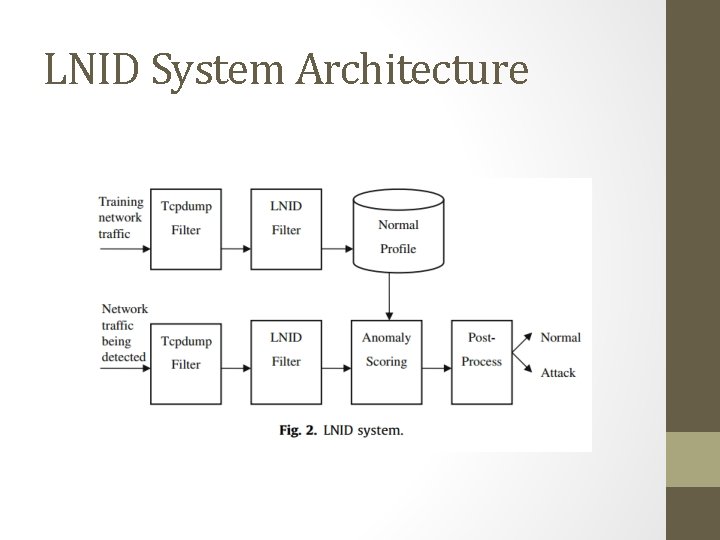
LNID System Architecture
Anomaly Score • Based on Mahoney’s network IDS [21 -24] • M. V. Mahoney, P. K. Chan, PHAD: packet header anomaly detection for identifying hostile network traffic, Florida Institute of Technology Technical Report CS-2001 -04, 2001. • M. V. Mahoney, P. K. Chan, Learning nonstationary models of normal network traffic for detecting novel attacks, in: Proceedings of the 8 th ACM SIGKDD International Conference on Knowledge Discovery and Data Mining, 2002 a, pp. 276 -385. • M. V. Mahoney, P. K. Chan, Learning models of network traffic for detecting novel attacks, Florida Institute of Technology Technical Report CS-2002 -08, 2002 b. • M. V. Mahoney, Network traffic anomaly detection based on packet bytes, in: Proceedings of the 2003 ACM Symposium on Applied Computing, 2003, pp. 346 -350.
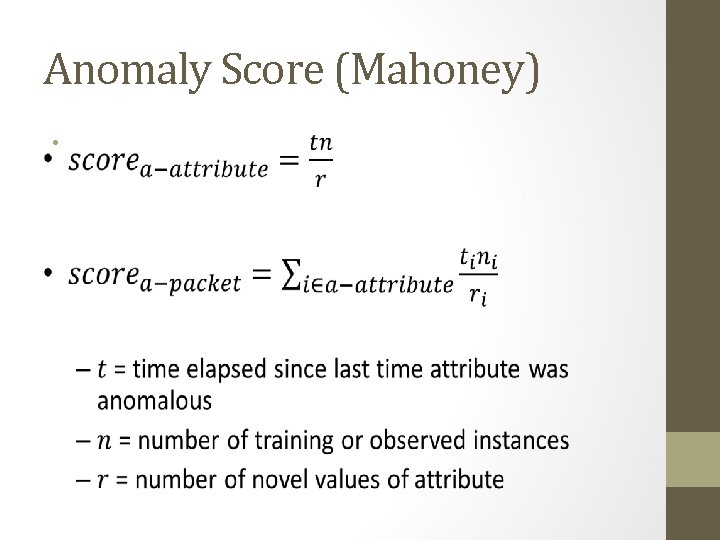
Anomaly Score (Mahoney) •
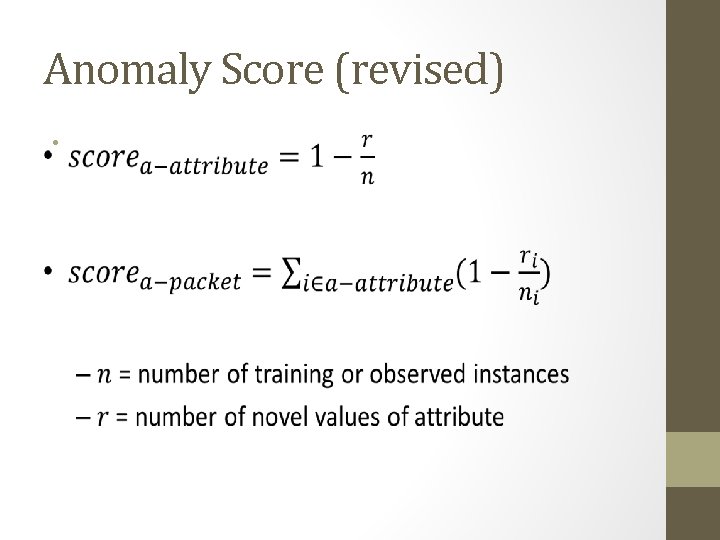
Anomaly Score (revised) •
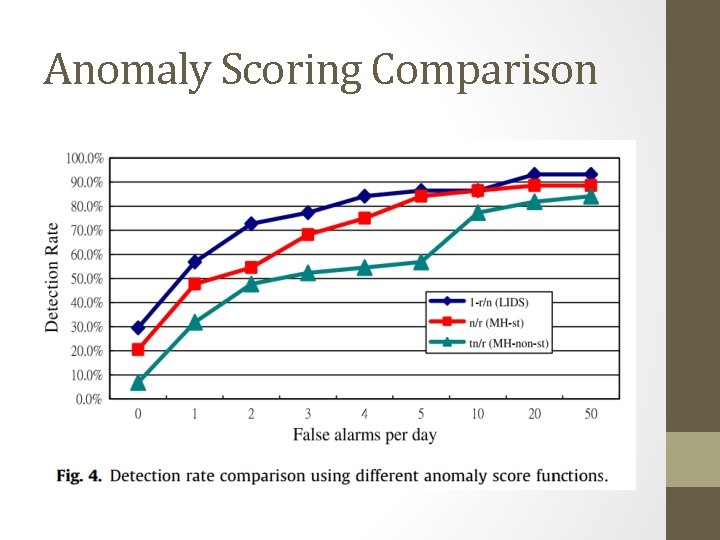
Anomaly Scoring Comparison
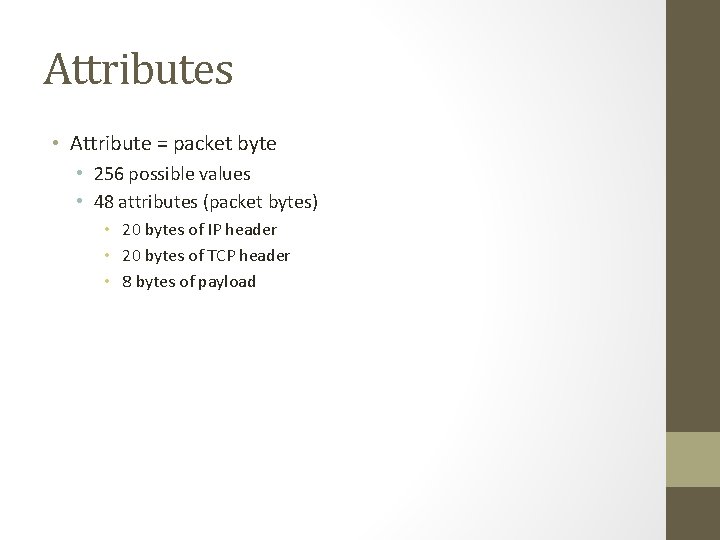
Attributes • Attribute = packet byte • 256 possible values • 48 attributes (packet bytes) • 20 bytes of IP header • 20 bytes of TCP header • 8 bytes of payload
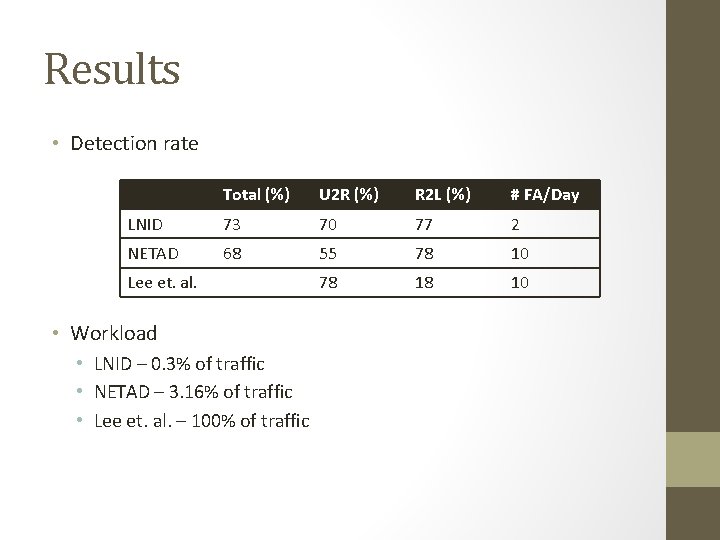
Results • Detection rate Total (%) U 2 R (%) R 2 L (%) # FA/Day LNID 73 70 77 2 NETAD 68 55 78 10 78 18 10 Lee et. al. • Workload • LNID – 0. 3% of traffic • NETAD – 3. 16% of traffic • Lee et. al. – 100% of traffic
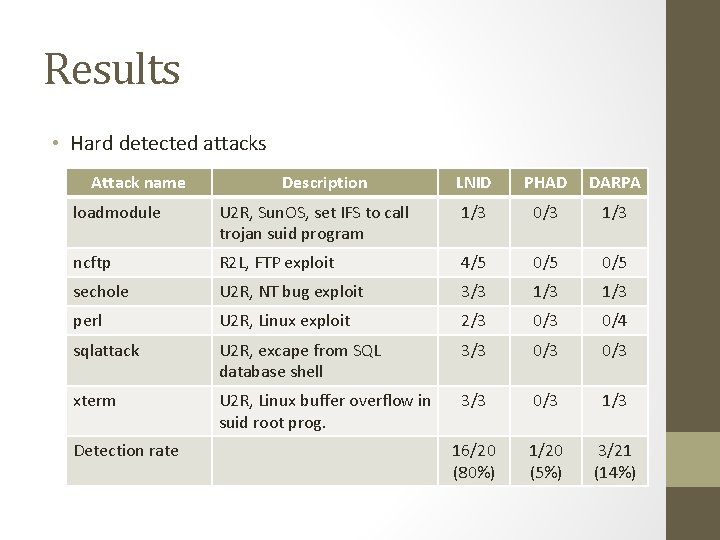
Results • Hard detected attacks Attack name Description LNID PHAD DARPA loadmodule U 2 R, Sun. OS, set IFS to call trojan suid program 1/3 0/3 1/3 ncftp R 2 L, FTP exploit 4/5 0/5 sechole U 2 R, NT bug exploit 3/3 1/3 perl U 2 R, Linux exploit 2/3 0/4 sqlattack U 2 R, excape from SQL database shell 3/3 0/3 xterm U 2 R, Linux buffer overflow in suid root prog. 3/3 0/3 16/20 (80%) 1/20 (5%) 3/21 (14%) Detection rate

Questions or Comments
- Slides: 33