
Machine Vision 1 VISION the most powerful sense
![References [1] MACHINE VISION Jain-Kasturi-Schunck [2] EE 701 Robot Vision Lecture Notes A. Aydin](https://slidetodoc.com/presentation_image_h2/1ac80367aeb9a6358a0d236696d51104/image-42.jpg "References [1] MACHINE VISION Jain-Kasturi-Schunck [2] EE 701 Robot Vision Lecture Notes A. Aydin")

- Slides: 43
Machine Vision 1
VISION the most powerful sense 2
OUTLINE 1. Properties of Machine Vision Systems Methods in Machine Vision 2. Example: Fingerprint Recognition System 3
Machine Vision System • creates a model of the real world from images • recovers useful information about a scene from its two dimensional projections 4
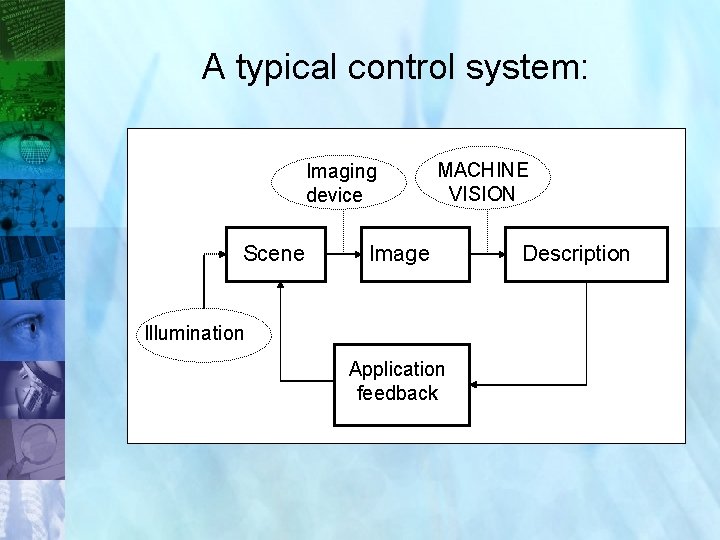
A typical control system: Imaging device Scene MACHINE VISION Image Description Illumination Application feedback 5
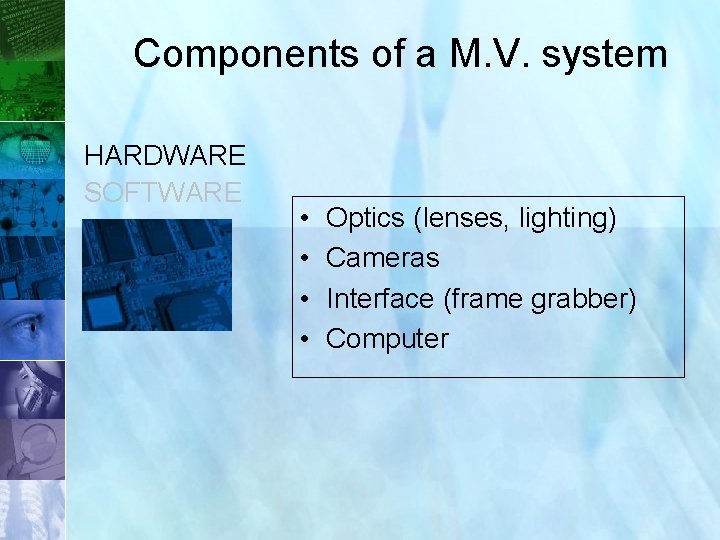
Components of a M. V. system HARDWARE SOFTWARE • • Optics (lenses, lighting) Cameras Interface (frame grabber) Computer 6
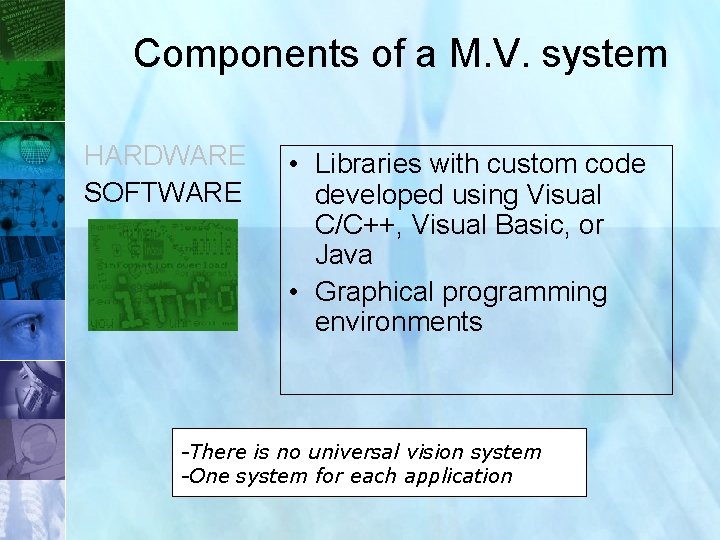
Components of a M. V. system HARDWARE SOFTWARE • Libraries with custom code developed using Visual C/C++, Visual Basic, or Java • Graphical programming environments -There is no universal vision system -One system for each application 7
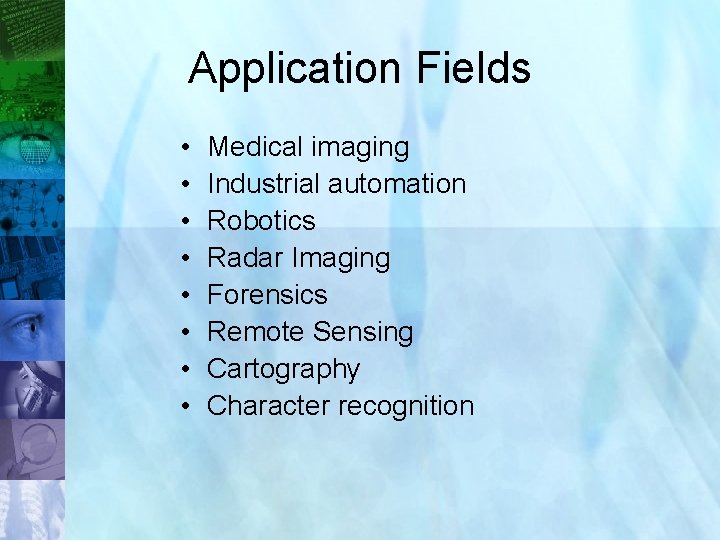
Application Fields • • Medical imaging Industrial automation Robotics Radar Imaging Forensics Remote Sensing Cartography Character recognition 8
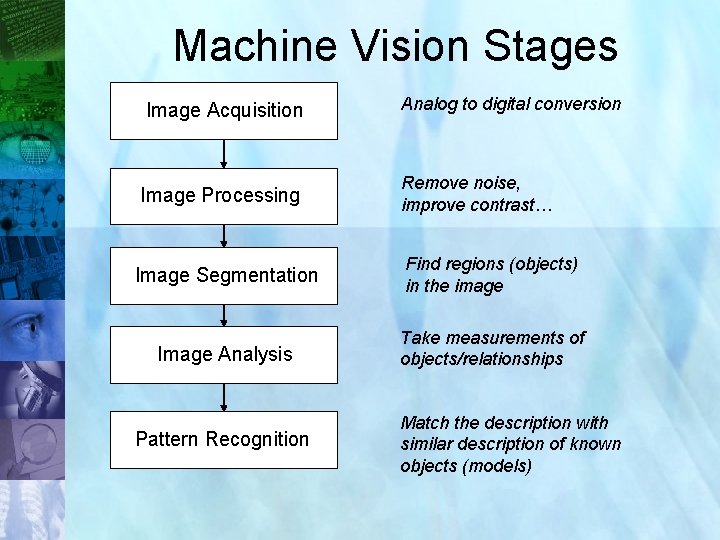
Machine Vision Stages Image Acquisition Image Processing Analog to digital conversion Remove noise, improve contrast… Image Segmentation Find regions (objects) in the image Image Analysis Take measurements of objects/relationships Pattern Recognition Match the description with similar description of known objects (models) 9
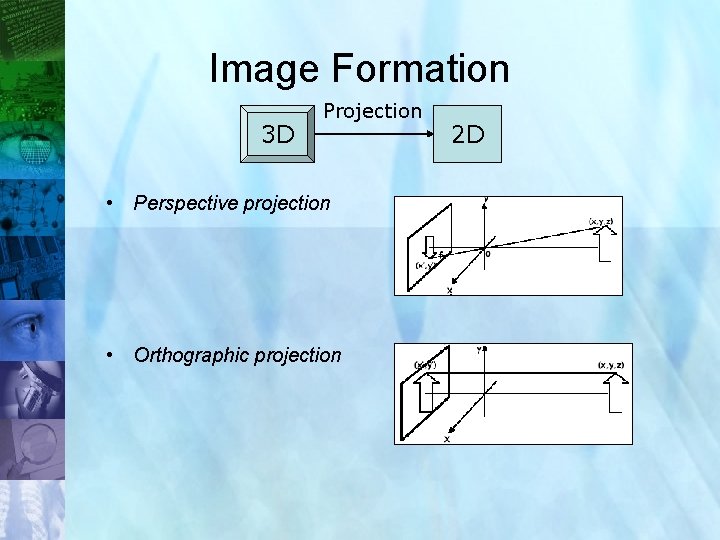
Image Formation 3 D Projection 2 D • Perspective projection • Orthographic projection 10
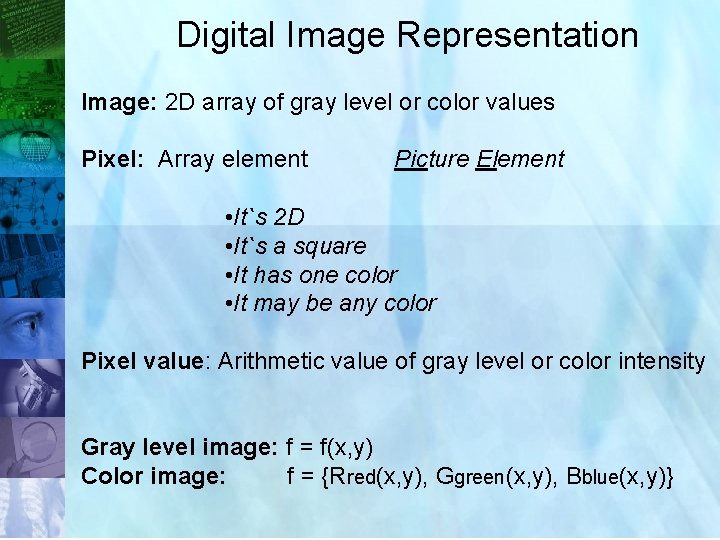
Digital Image Representation Image: 2 D array of gray level or color values Pixel: Array element Picture Element • It`s 2 D • It`s a square • It has one color • It may be any color Pixel value: Arithmetic value of gray level or color intensity Gray level image: f = f(x, y) Color image: f = {Rred(x, y), Ggreen(x, y), Bblue(x, y)} 11
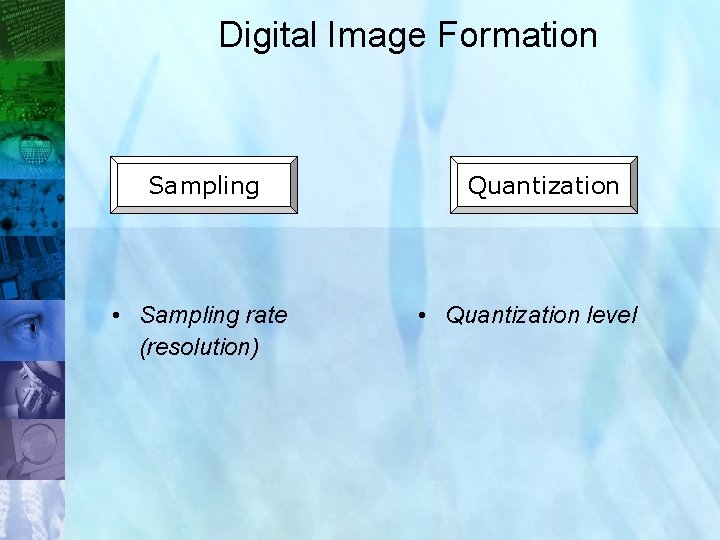
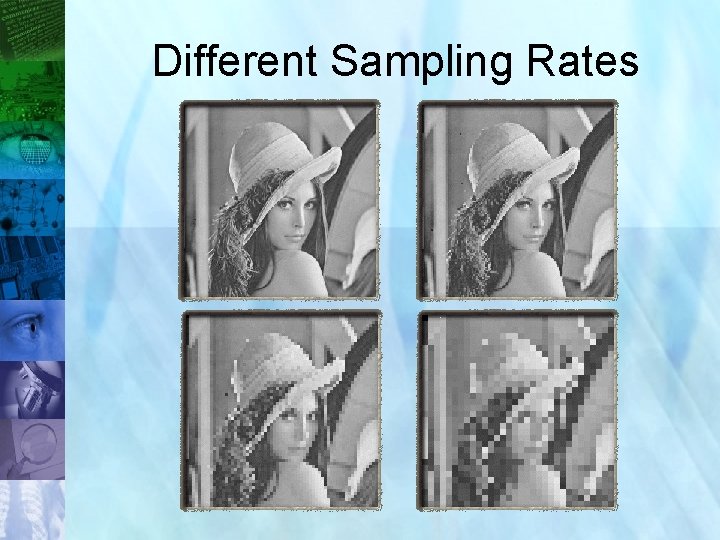
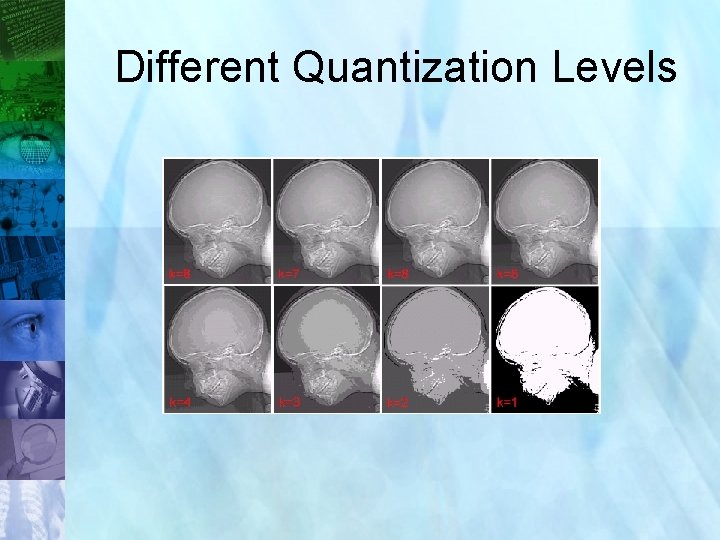
Digital Image Formation Sampling • Sampling rate (resolution) Quantization • Quantization level 12
Different Sampling Rates 13
Different Quantization Levels 14
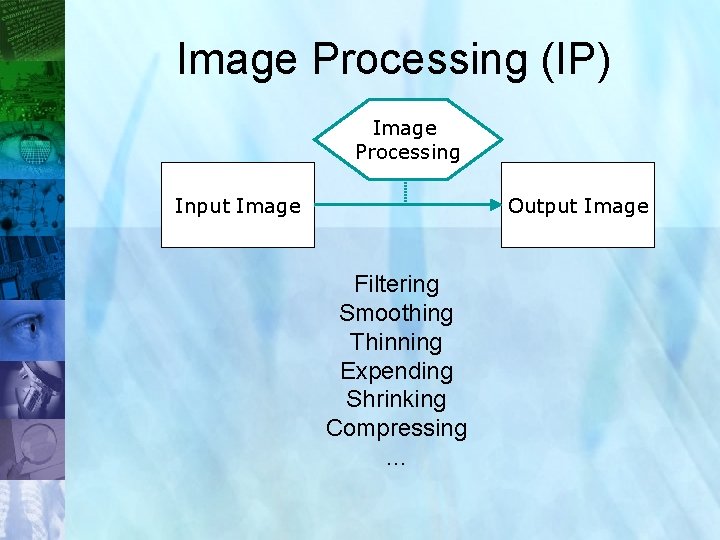
Image Processing (IP) Image Processing Output Image Input Image Filtering Smoothing Thinning Expending Shrinking Compressing … 15
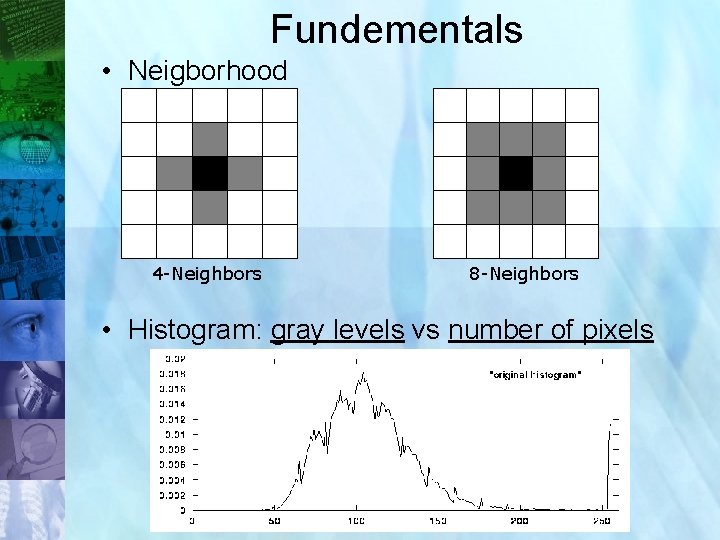
Fundementals • Neigborhood 4 -Neighbors 8 -Neighbors • Histogram: gray levels vs number of pixels 16
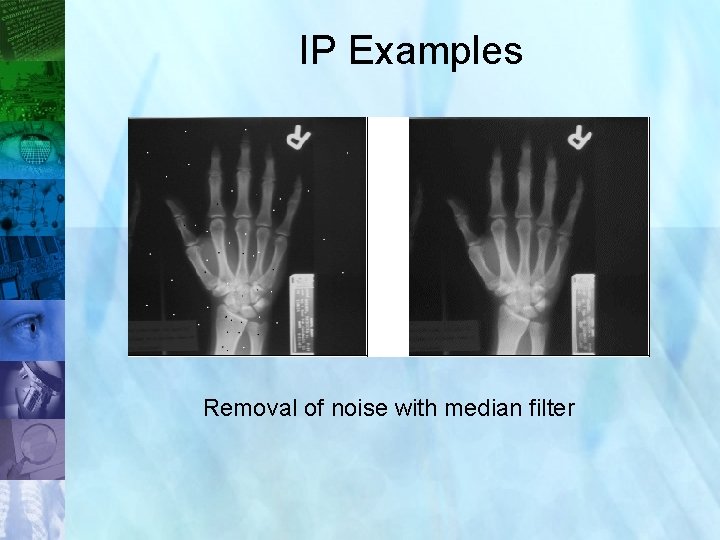
IP Examples Removal of noise with median filter 17
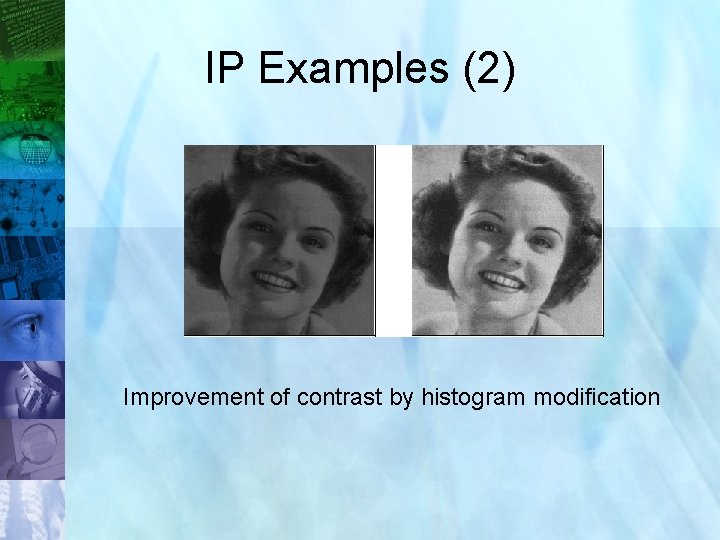
IP Examples (2) Improvement of contrast by histogram modification 18
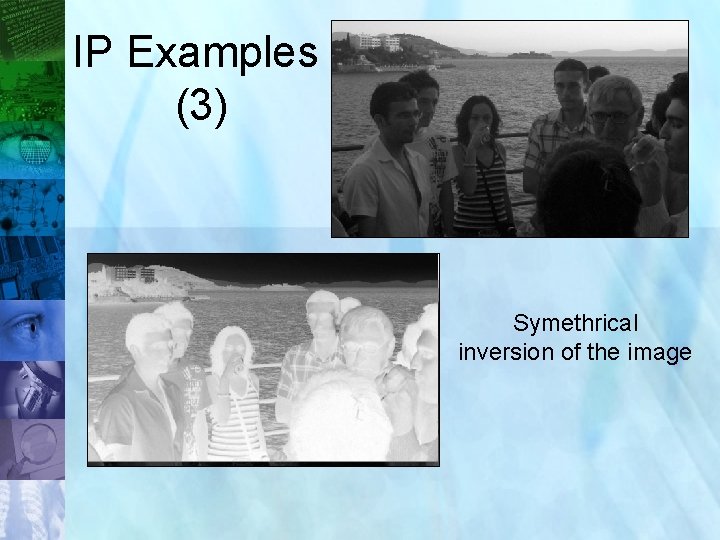
IP Examples (3) Symethrical inversion of the image 19
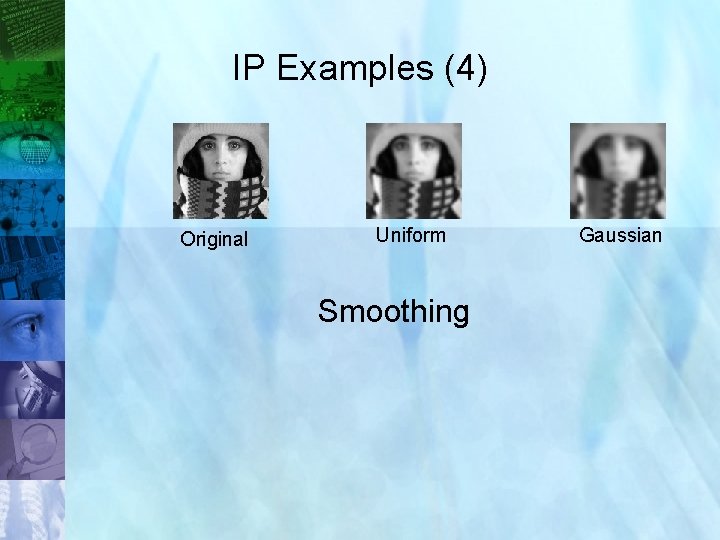
IP Examples (4) Original Uniform Gaussian Smoothing 20
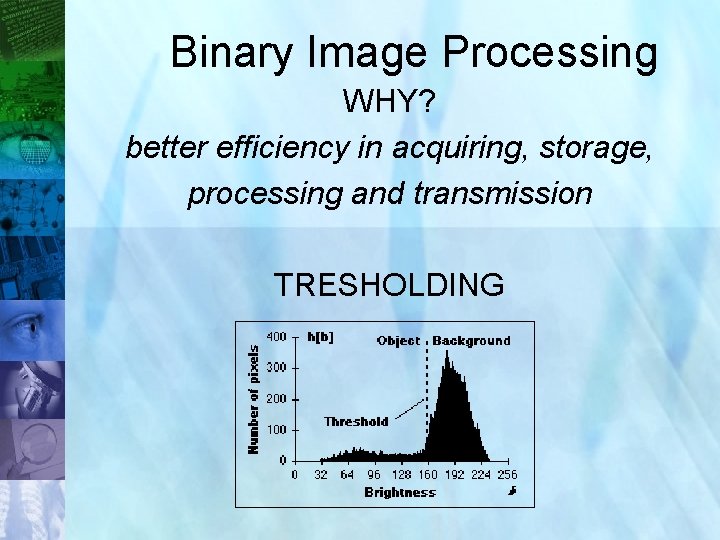
Binary Image Processing WHY? better efficiency in acquiring, storage, processing and transmission TRESHOLDING 21
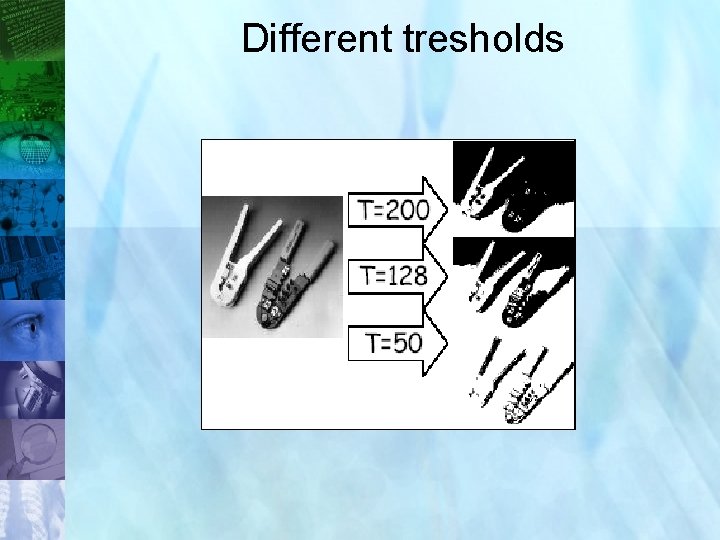
Different tresholds 22
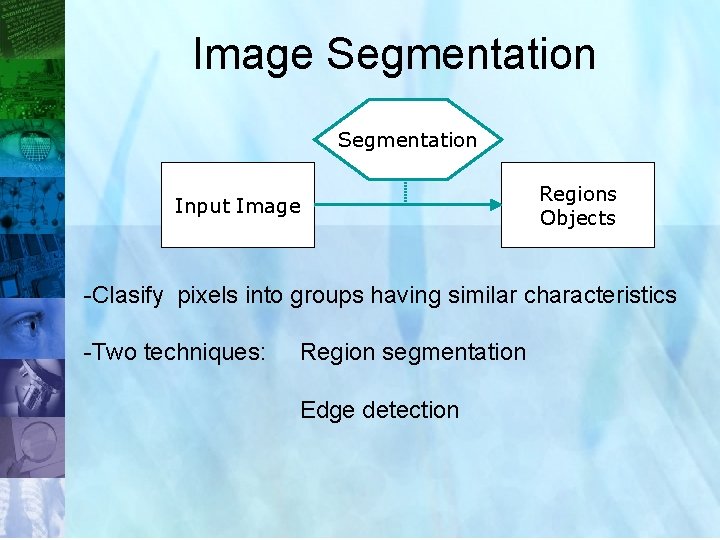
Image Segmentation Input Image Regions Objects -Clasify pixels into groups having similar characteristics -Two techniques: Region segmentation Edge detection 23
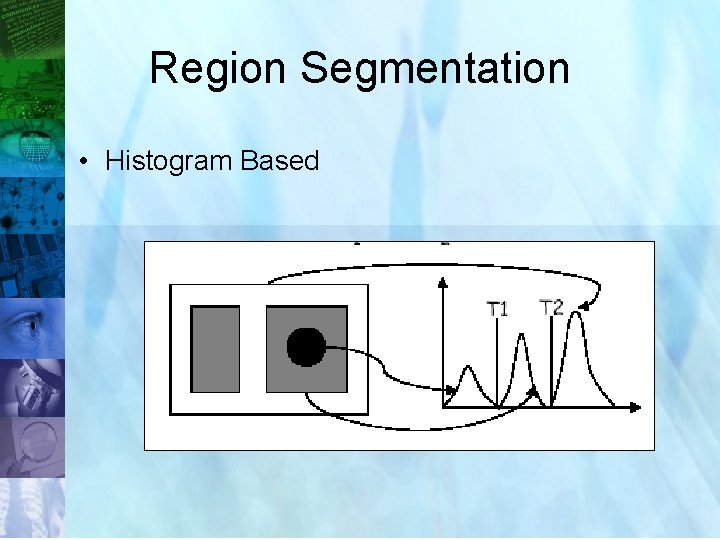
Region Segmentation • Histogram Based 24
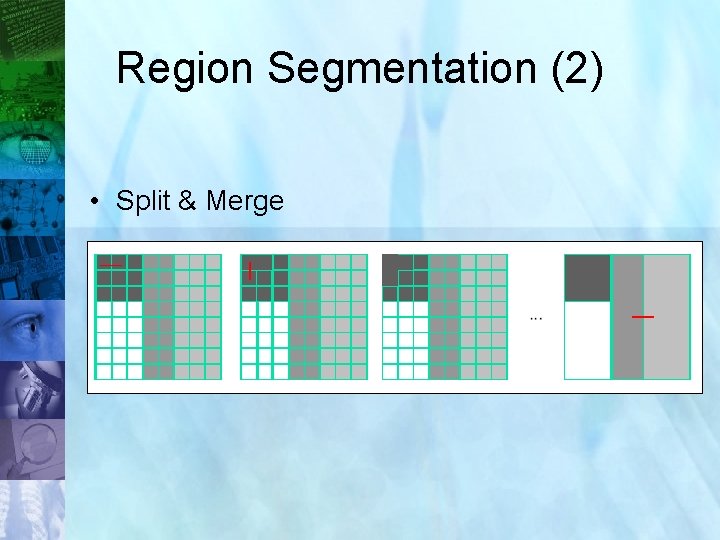
Region Segmentation (2) • Split & Merge 25
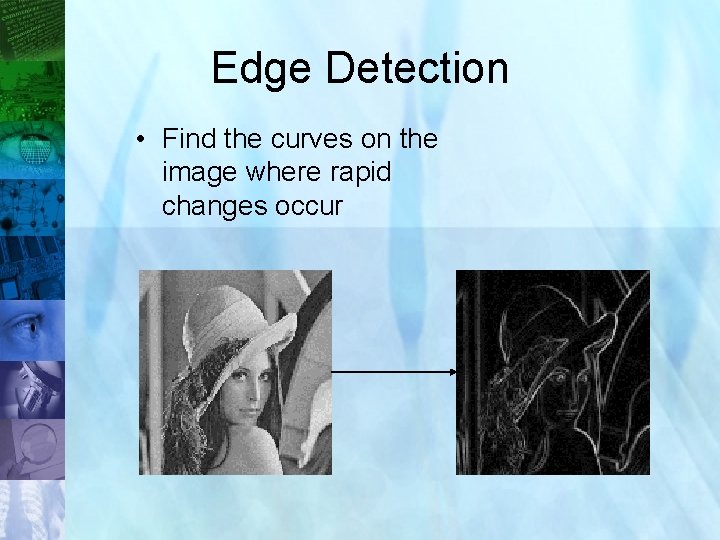
Edge Detection • Find the curves on the image where rapid changes occur 26
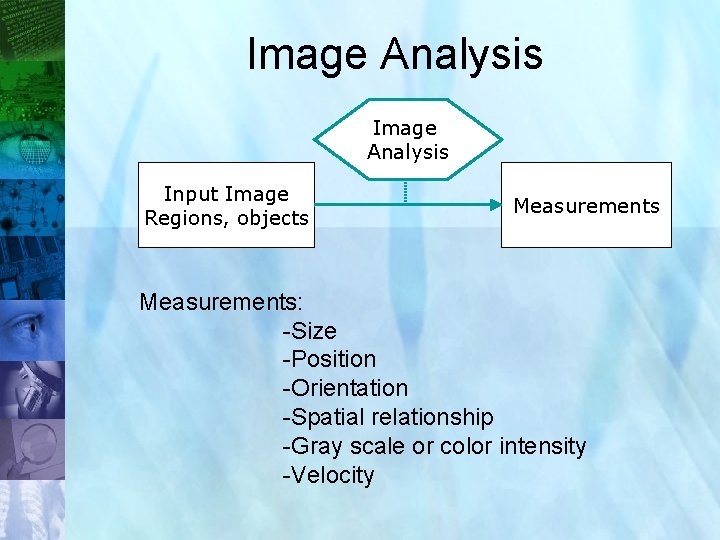
Image Analysis Input Image Regions, objects Measurements: -Size -Position -Orientation -Spatial relationship -Gray scale or color intensity -Velocity 27
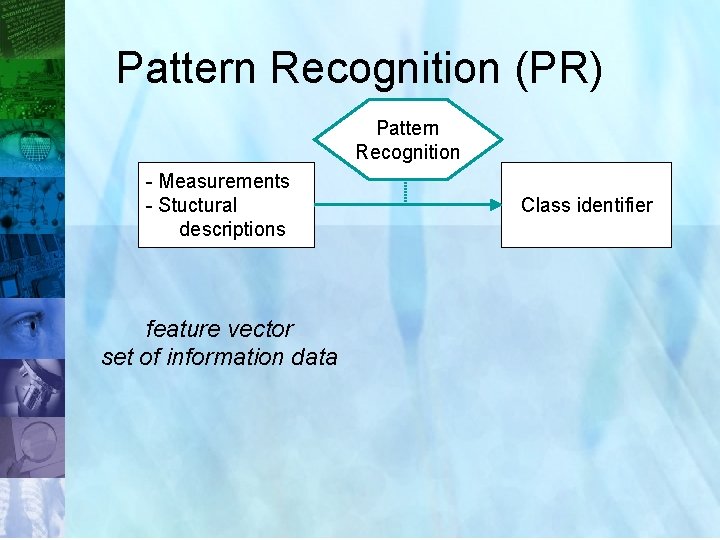
Pattern Recognition (PR) Pattern Recognition - Measurements - Stuctural descriptions Class identifier feature vector set of information data 28
Approaches to PR Statistical Structural Neural 29
• 3 D VISION • Dynamic Vision 30
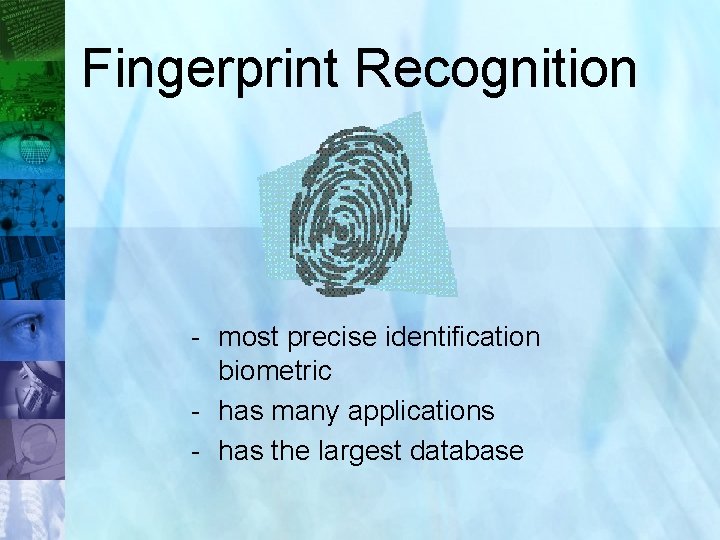
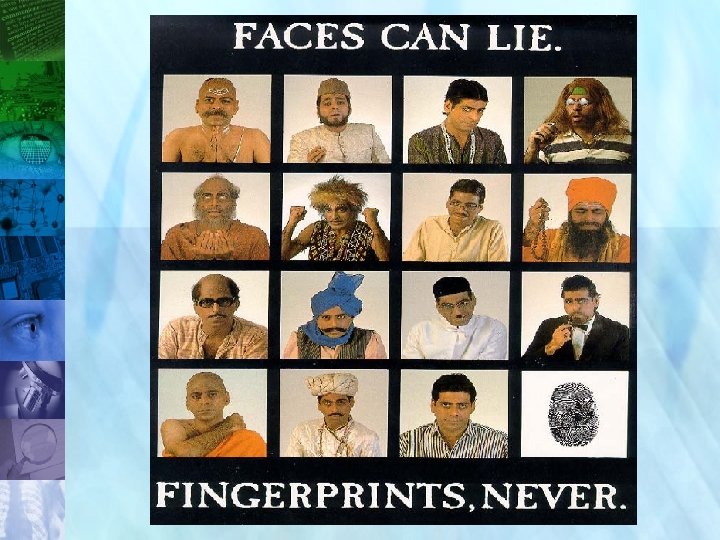
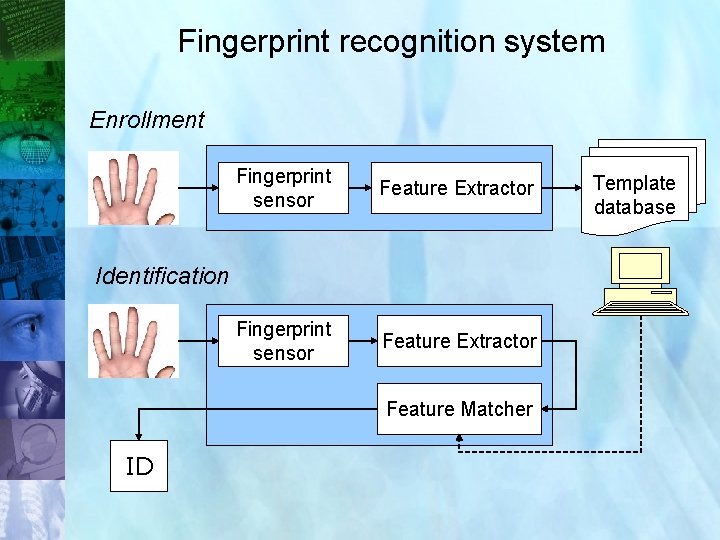
Fingerprint Recognition - most precise identification biometric - has many applications - has the largest database 31
32
Fingerprint recognition system Enrollment Fingerprint sensor Feature Extractor Template database Identification Feature Matcher ID 33
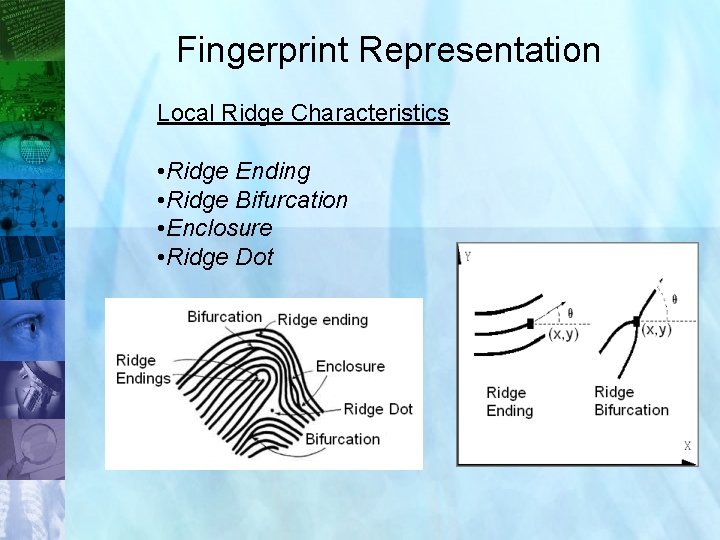
Fingerprint Representation Local Ridge Characteristics • Ridge Ending • Ridge Bifurcation • Enclosure • Ridge Dot 34
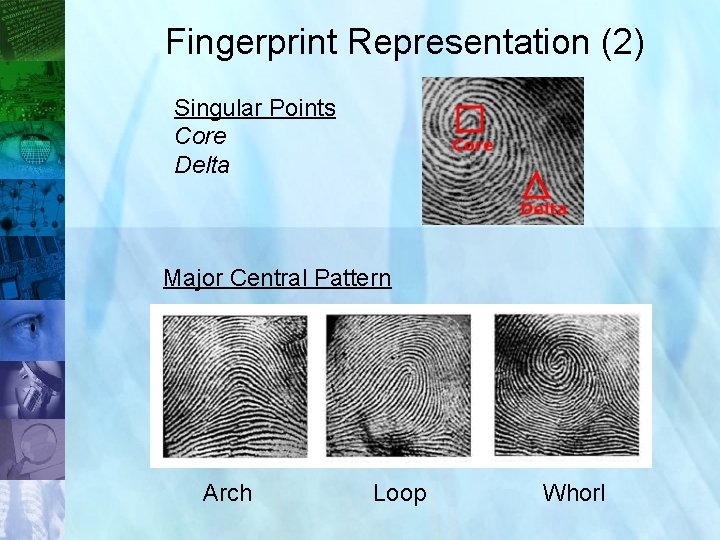
Fingerprint Representation (2) Singular Points Core Delta Major Central Pattern Arch Loop Whorl 35
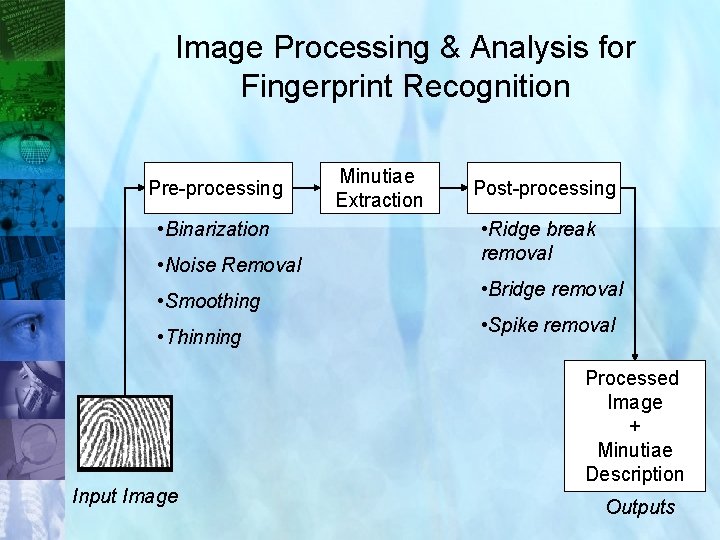
Image Processing & Analysis for Fingerprint Recognition Pre-processing • Binarization • Noise Removal • Smoothing • Thinning Input Image Minutiae Extraction Post-processing • Ridge break removal • Bridge removal • Spike removal Processed Image + Minutiae Description 36 Outputs
Pre-Processing • Binarization search through array pixel by pixel; if current byte colour value is above threshold then change value to white; else change colour to black • Noise Removal if the pixel is white and all immediate surrounding pixels are black then change pixel to black; else if the pixel is black and all immediate surrounding pixels are white then change pixel to white; 37
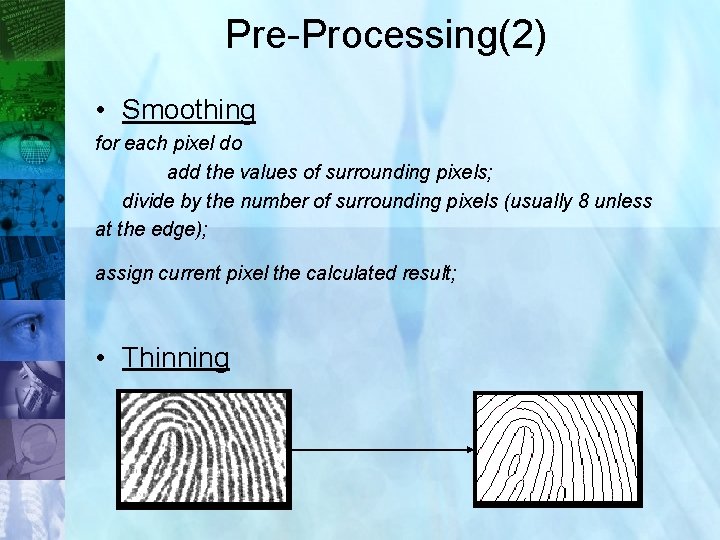
Pre-Processing(2) • Smoothing for each pixel do add the values of surrounding pixels; divide by the number of surrounding pixels (usually 8 unless at the edge); assign current pixel the calculated result; • Thinning 38
Extraction if pixel has exactly one neighbour then pixel is a ridge ending; calculate x value of pixel; calculate y value of pixel; calculate angle of ridge ending; write data to database; else if pixel has exactly three neighbours then pixel is a bifurcation; calculate x value of pixel; calculate y value of pixel; calculate angle of bifurcation; write data to database; 39
Post-Processing • Ridge break removal If A and B are facing each other and are less then a minimum distance (D) then A and B are false minutia points; remove A and B from ridge end point set; update database; Bridge removal • Spike removal For each ridge ending point (A) For each bifurcation point (B) If A and B are less than minimum distance (D)apart and they are connected then A and B are false minutia points; remove A and B from their sets; 40
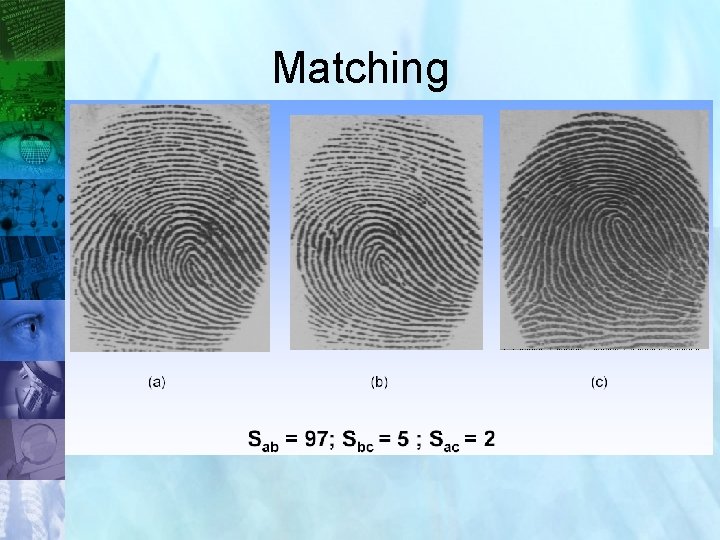
Matching 41
References [1] MACHINE VISION Jain-Kasturi-Schunck [2] EE 701 Robot Vision Lecture Notes A. Aydin Alatan – METU [3] Tutorial on Machine Vision Petrakis [4] Multimodel User Interfaces Anil Jain [5] Automatic Fingerprint Recognition System Tony Walsh 42
THANK YOU! 43