
Vision our most dominant sense Vision Purpose of


- Slides: 57
Vision – our most dominant sense
Vision Purpose of the visual system –transform light energy into an electro-chemical neural response –represent characteristics of objects in our environment such as size, color, shape, and location
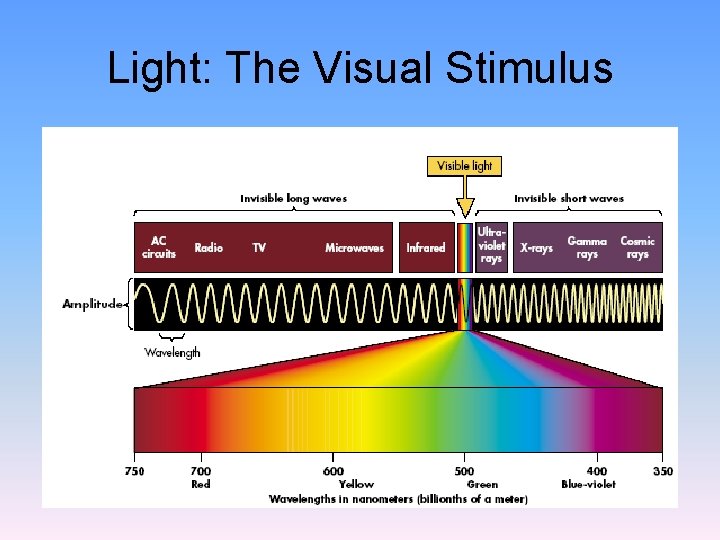
Light: The Visual Stimulus
Light: The Visual Stimulus • Light can be described as both a particle and a wave. • Wavelength of a light is the distance of one complete cycle of the wave. • Visible light has wavelengths from about 400 nm to 700 nm. • Wavelength of light is related to its perceived color.
Module 9: Sensation The Visual System: The Structure of the Visual System
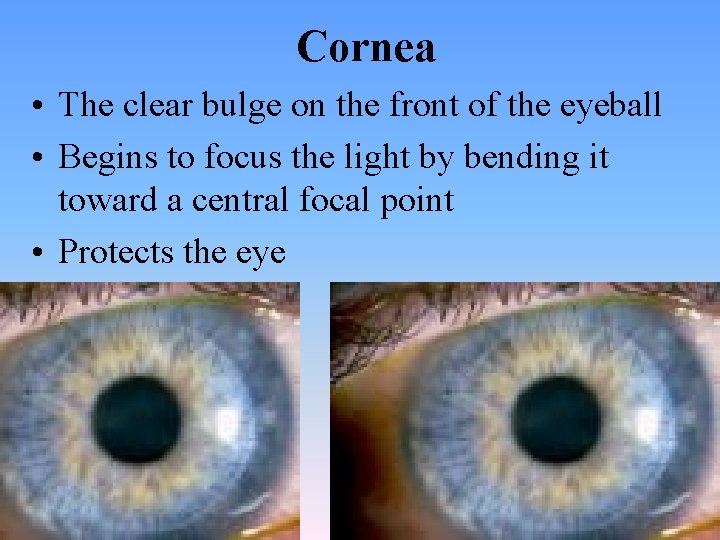
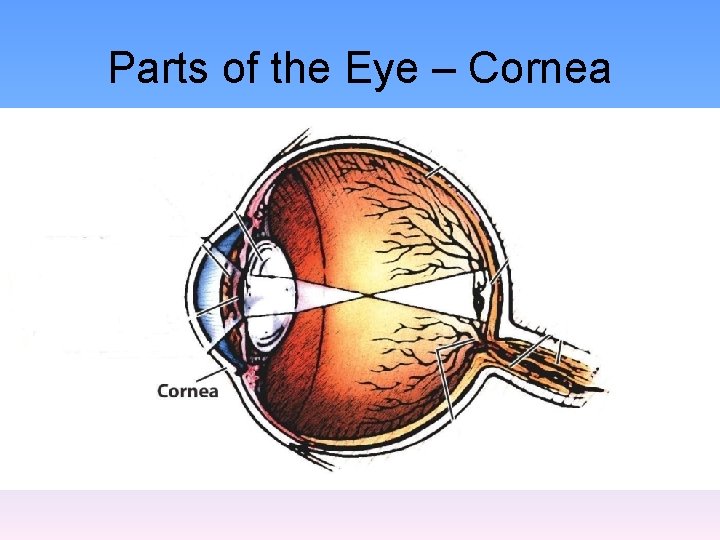
Cornea • The clear bulge on the front of the eyeball • Begins to focus the light by bending it toward a central focal point • Protects the eye
Parts of the Eye – Cornea
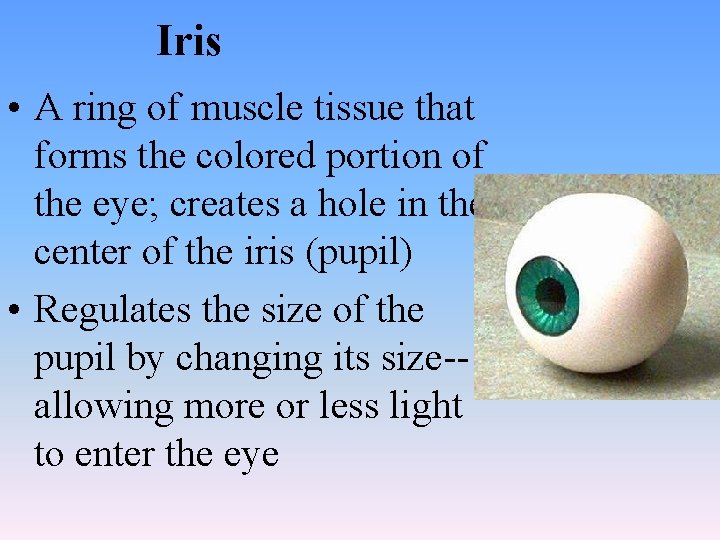
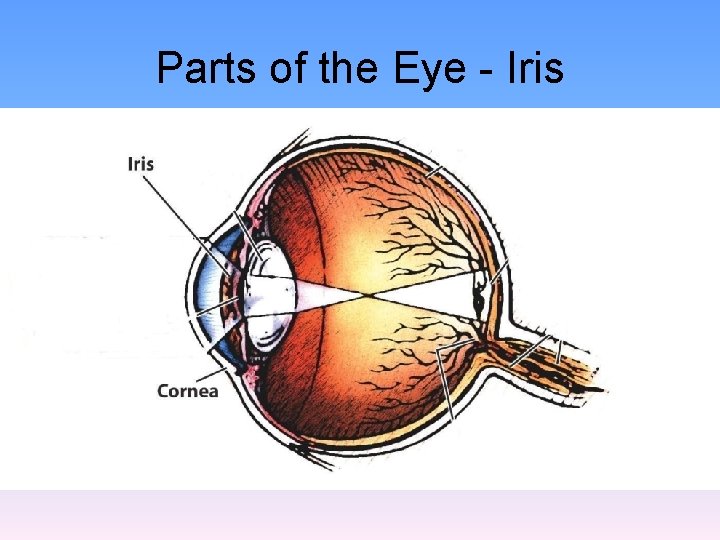
Iris • A ring of muscle tissue that forms the colored portion of the eye; creates a hole in the center of the iris (pupil) • Regulates the size of the pupil by changing its size-allowing more or less light to enter the eye
Parts of the Eye - Iris
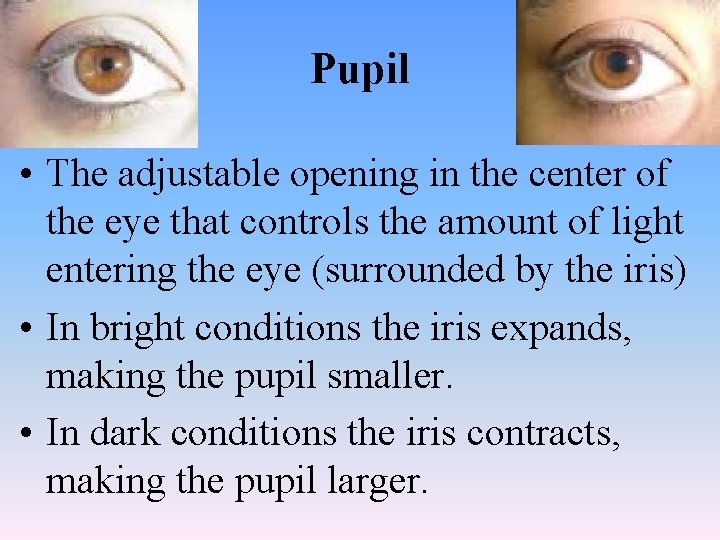
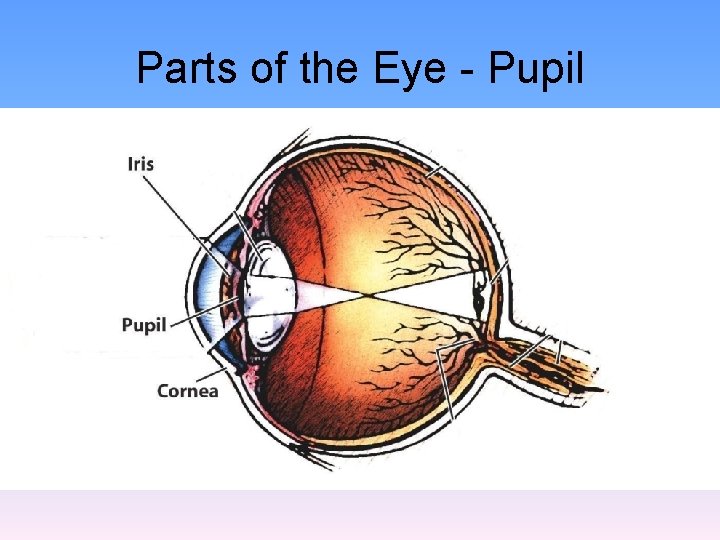
Pupil • The adjustable opening in the center of the eye that controls the amount of light entering the eye (surrounded by the iris) • In bright conditions the iris expands, making the pupil smaller. • In dark conditions the iris contracts, making the pupil larger.
Parts of the Eye - Pupil
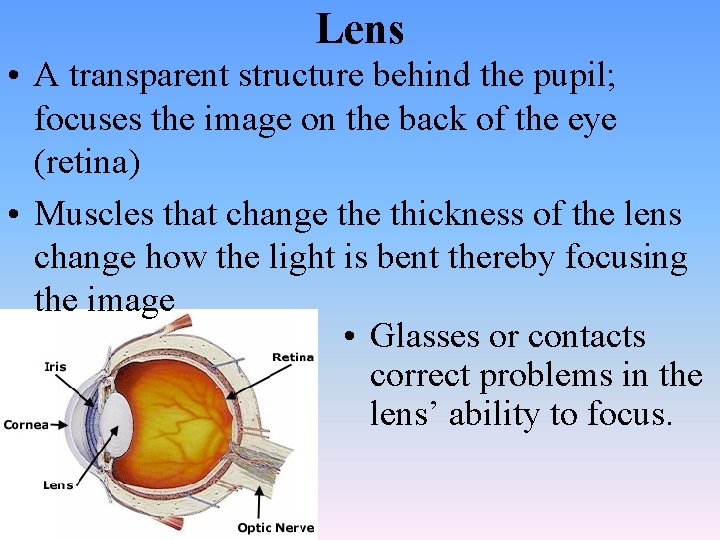
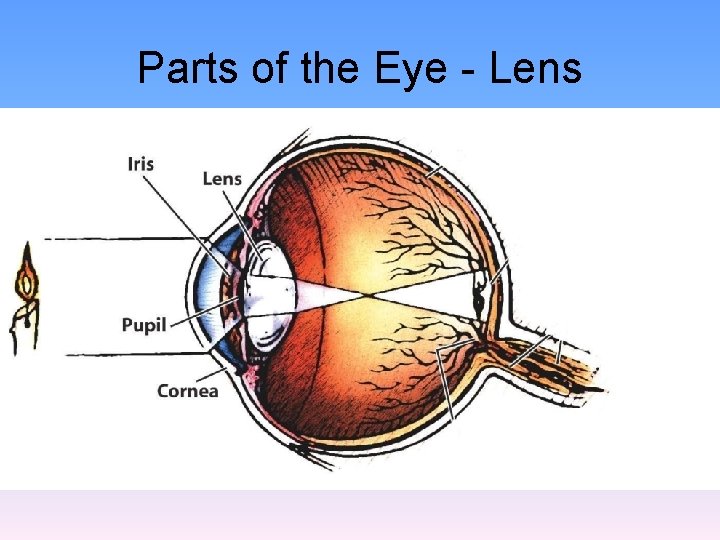
Lens • A transparent structure behind the pupil; focuses the image on the back of the eye (retina) • Muscles that change thickness of the lens change how the light is bent thereby focusing the image • Glasses or contacts correct problems in the lens’ ability to focus.
Parts of the Eye - Lens
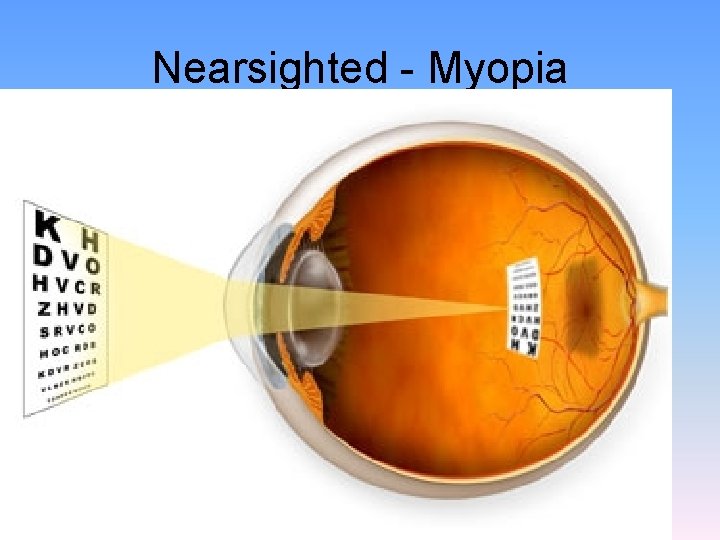
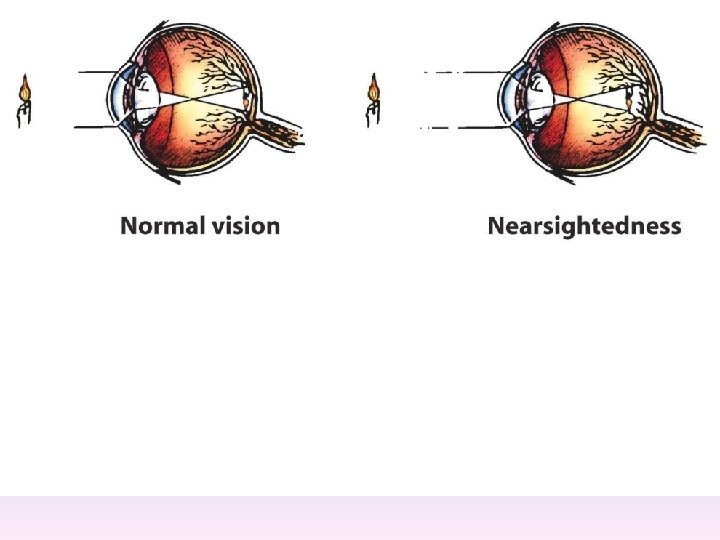
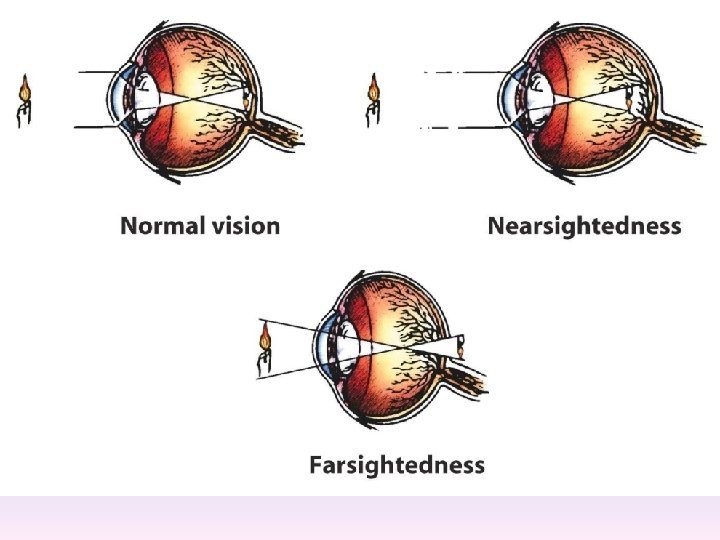
Nearsighted - Myopia
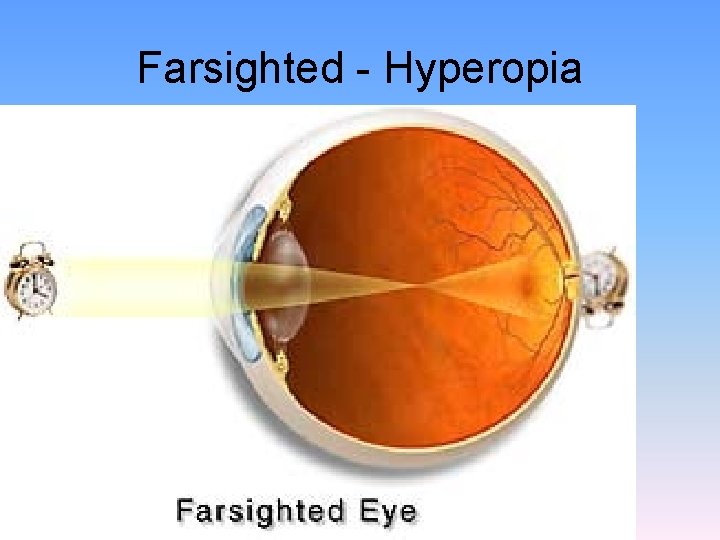
Farsighted - Hyperopia
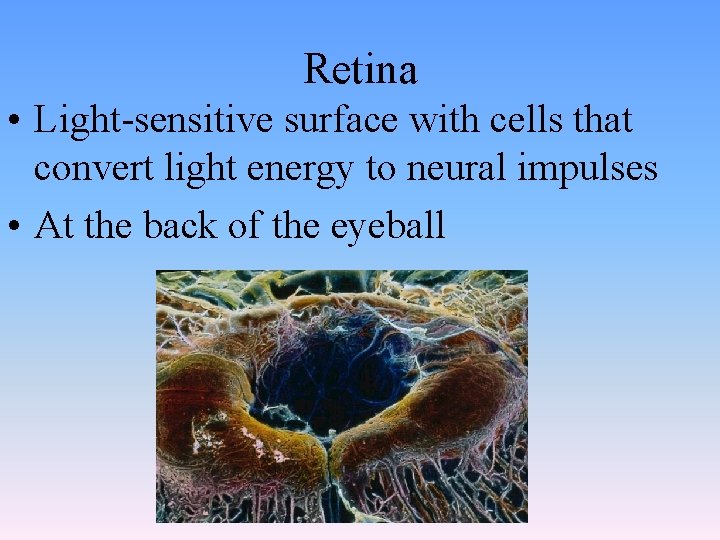
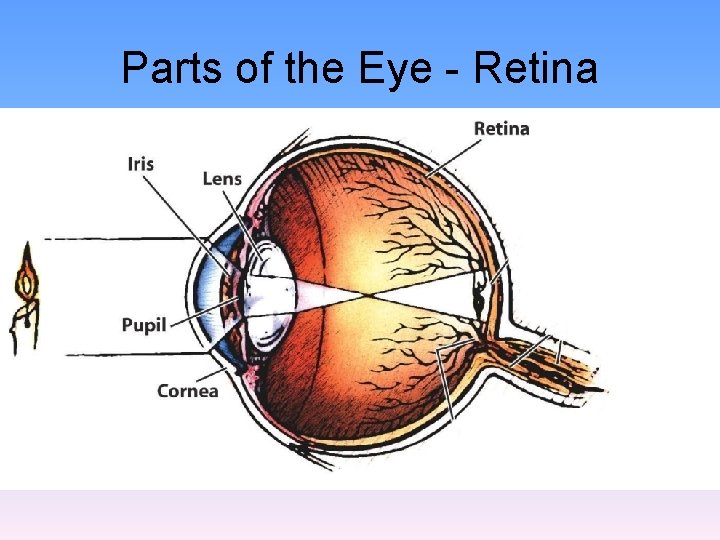
Retina • Light-sensitive surface with cells that convert light energy to neural impulses • At the back of the eyeball
Parts of the Eye - Retina
Receptor Cells • These cells are present in every sensory system to change (transduce) some other form of energy into neural impulses. • In sight they change light into neural impulses the brain can understand. • Visual system has two types of receptor cells – rods and cones
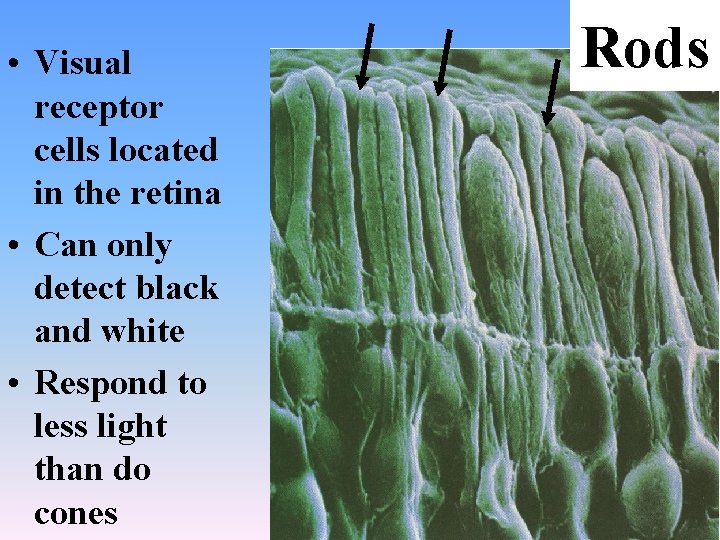
• Visual receptor cells located in the retina • Can only detect black and white • Respond to less light than do cones Rods
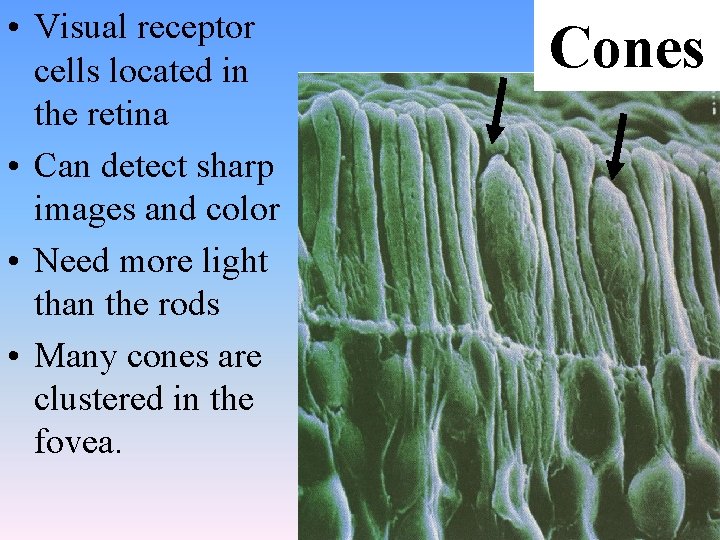
• Visual receptor cells located in the retina • Can detect sharp images and color • Need more light than the rods • Many cones are clustered in the fovea. Cones
Let’s do an experiment Now • What do you see in your peripheral vision (that’s the stuff on the side)
Get into Groups of 3
• Pick an A, B, and C
• • The experiment “A” will look straight ahead B will look A in the eyes – to make sure that A’s eyes look straight ahead C will move various colored pieces of paper in A’s peripheral vision A will guess the color – note if the person is guessing correctly they are doing it wrong
You will need to write up the results • You will need to write the following 1. Procedures – what did you do 2. Results – correct guess versus bad 3. Your conclusion
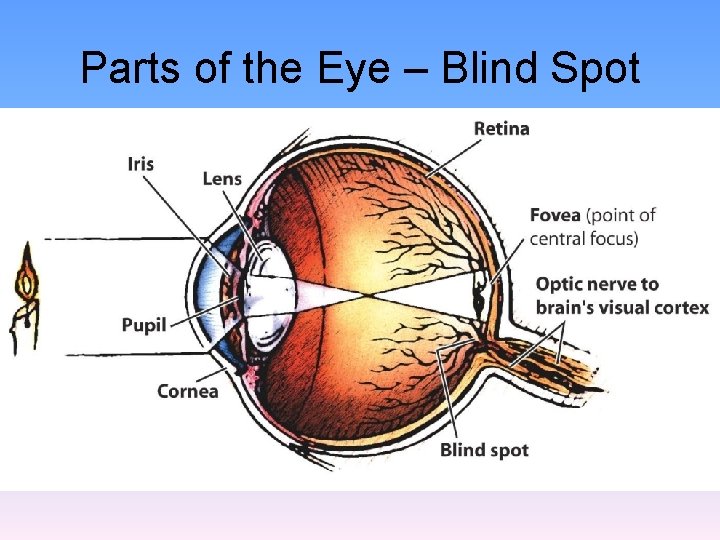
Distribution of Rods and Cones • Cones—concentrated in center of eye (fovea) – approx. 6 million • Rods—concentrated in periphery – approx. 120 million • Blind spot—region with no rods or cones
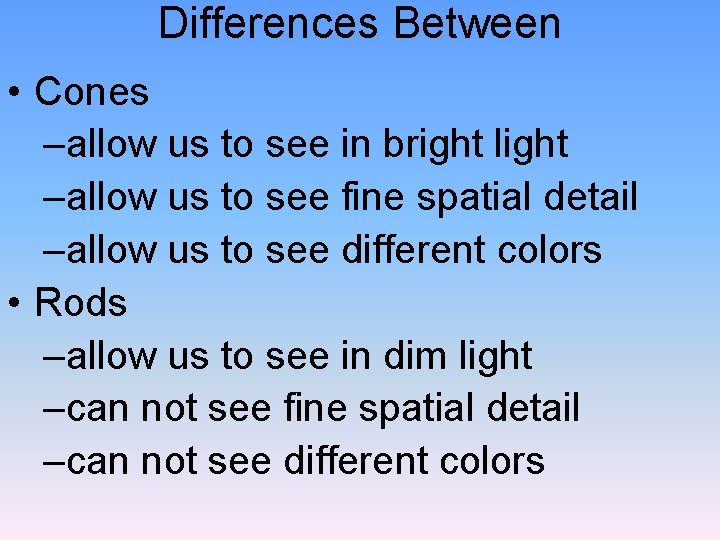
Differences Between • Cones –allow us to see in bright light –allow us to see fine spatial detail –allow us to see different colors • Rods –allow us to see in dim light –can not see fine spatial detail –can not see different colors
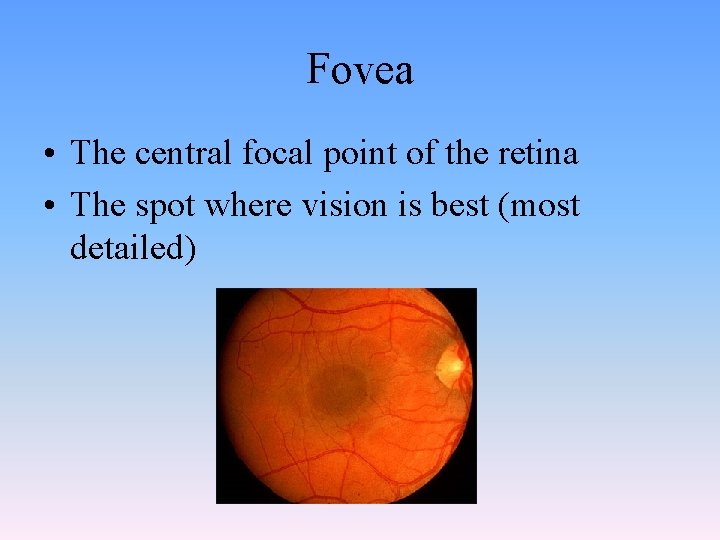
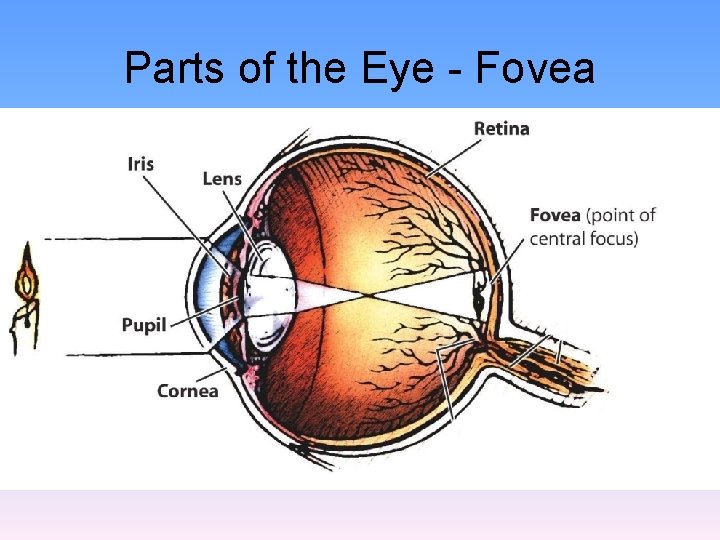
Fovea • The central focal point of the retina • The spot where vision is best (most detailed)
Parts of the Eye - Fovea
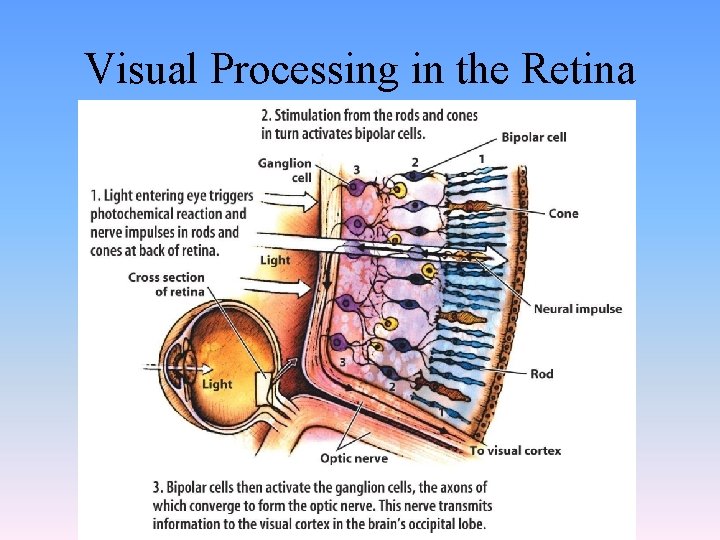
Visual Processing in the Retina
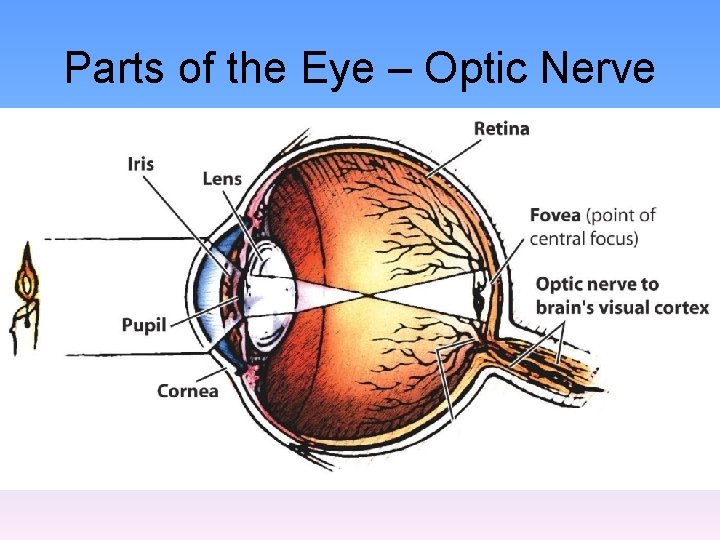
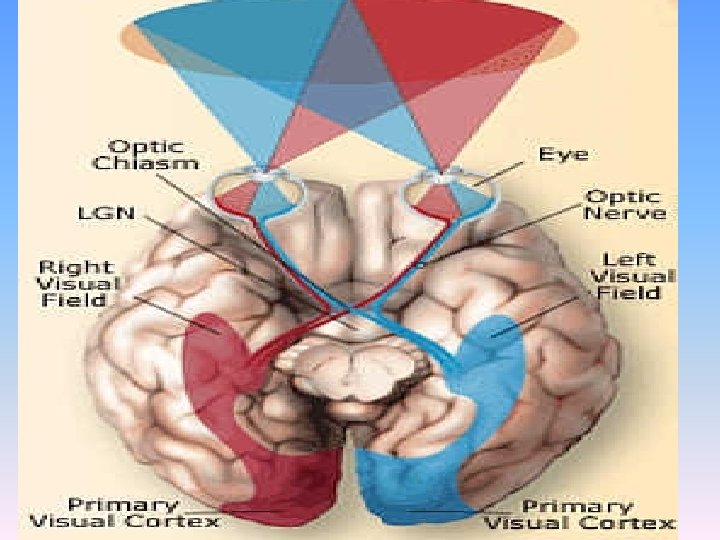
Optic Nerve • The nerve that carries visual information from the eye to the occipital lobes of the brain
Parts of the Eye – Optic Nerve
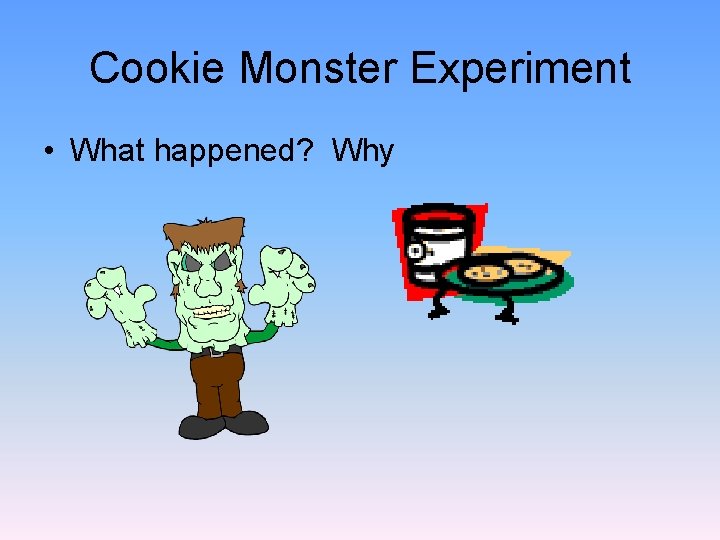
Cookie Monster Experiment • What happened? Why
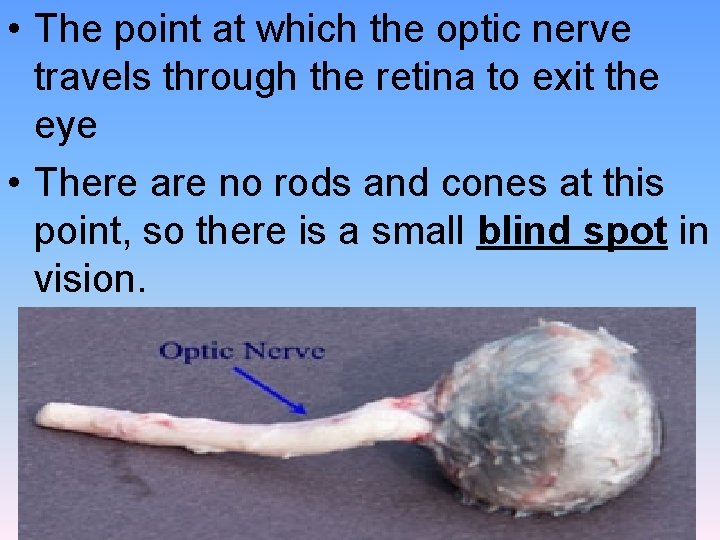
• The point at which the optic nerve travels through the retina to exit the eye Blind Spot • There are no rods and cones at this point, so there is a small blind spot in vision.
Parts of the Eye – Blind Spot
Module 9: Sensation The Visual System: Color Vision
Color Vision • Our visual system interprets differences in the wavelength of light as color. • Rods are color blind, but with the cones we can see different colors. • This difference occurs because we have only one type of rod but three types of cones.
Color Vision • There are two theories of color vision: –Trichromatic Theory –Opponent-Process Theory
Trichromatic (three-color) Theory • Theory of color vision that says cones are “tuned” to be sensitive to red, green and blue light • All the colors we see are a combination of these three colors. • Similar to the design of a color TV
How do we see color? • Trichromatic (three color) Theory –three different retinal color receptors • Red green blue
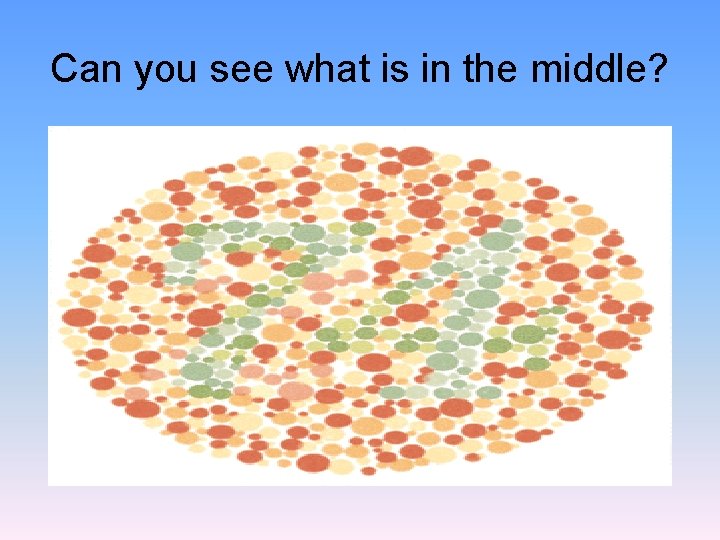
Can you see what is in the middle?
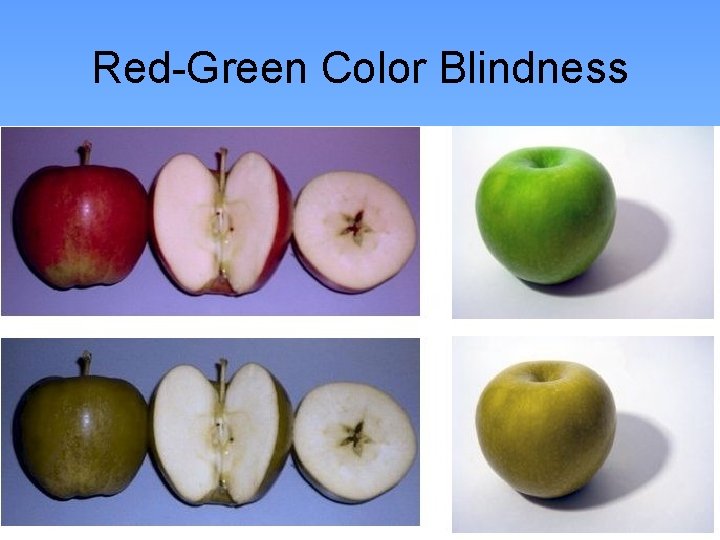
Red-Green Color Blindness
• Opponent-Process Theory- Vision from opposing pairs of color receptors- only one “side” ON at a time
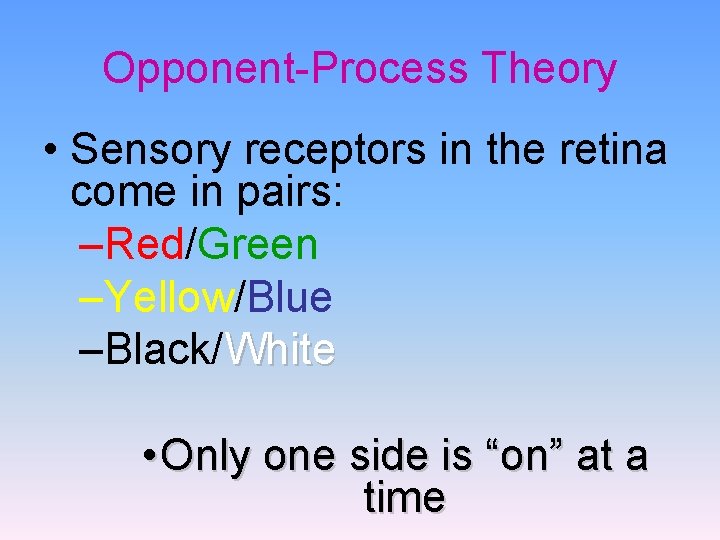
Opponent-Process Theory • Sensory receptors in the retina come in pairs: –Red/Green –Yellow/Blue –Black/White • Only one side is “on” at a time
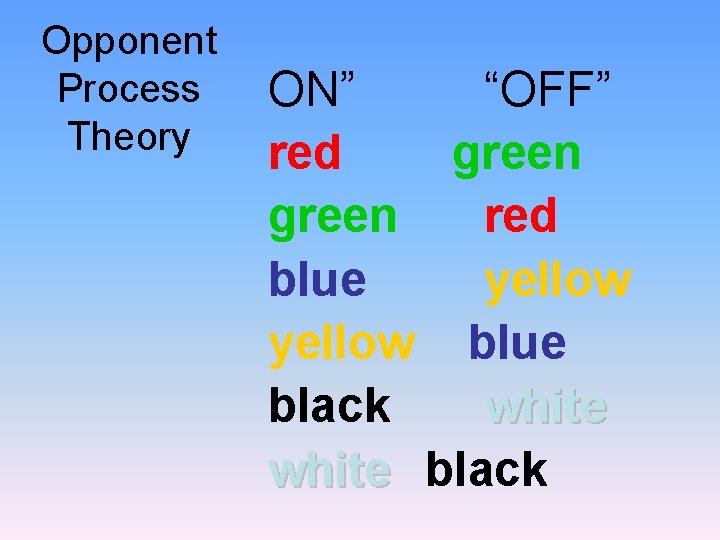
Opponent Process Theory ON” “OFF” red green red blue yellow blue black white black
Color Deficient Vision • People who lack one of the three types of cones • Usually the red or green receptors are missing • Usually referred to as color blindness • In inherited and found more in males
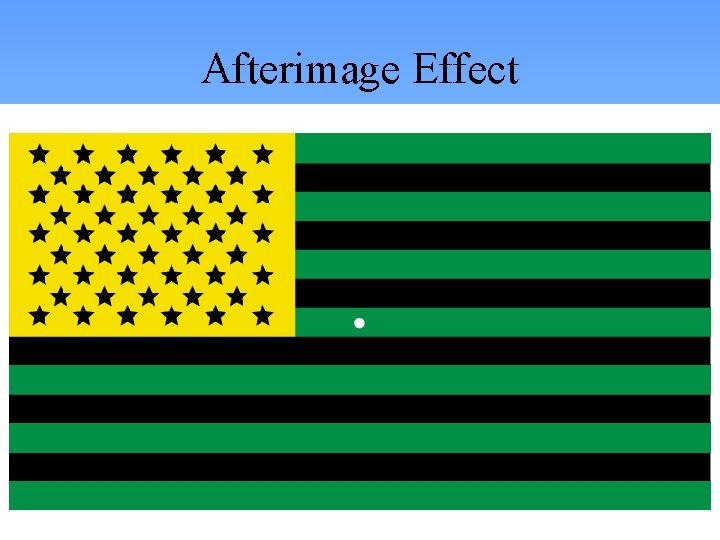
Afterimage Effect
Opponent-Process Theory • If one sensor is stimulated, the other is inhibited • If one sensor is overstimulated, and fatigues, the paired sensor will be activated, causing an afterimage
Overview of Visual System • The eye is like a camera; instead of using film to catch the light, we have rods and cones. • Cones allow us to see fine spatial detail and color but cannot function well in dim light.
Overview of Visual System • Rods enable us to see in dim light but at the loss of color and fine spatial detail. • Our color vision is based on the presence of 3 types of cones, each maximally sensitive to a different range of wavelengths.