LEADERSHIP DEVELOPMENT and Guiding Principles OneWord for Leadership

- Slides: 67
LEADERSHIP DEVELOPMENT and Guiding Principles
One-Word for Leadership • What One-Word would you use to describe what Leadership means to you? • I’ll Start…
Humility • Never Forget Where You Came From • Dr Whitesell = Bles O’Bliege • To Whom Much is Given, Much is Expected • Things Don’t Have to be Done “My Way”, or the Way I Would Do It
Humility • Just Because Someone May Do Something Different than you, doesn’t make them wrong. • I Don’t Have All the Answers
Key Leadership Characteristics • Loyalty • To your People • To Your Intent I Care About You, What You Are Thinking, or Experiencing
Key Leadership Characteristics • Curiosity • Am I Asking Questions to Learn About What People are Thinking? • Elicit Responses to Stimulate Thoughtful Consideration
Key Leadership Characteristics • Empathy • Understand Human Emotion • See Situations through the Eyes of Others • What Are the Challenges Others Are Experiencing?
Leading Peers • What People Think Leadership Is… (Hint: It’s Not…) -Telling People What to Do -Correcting, Critiquing -Making Adjustments -Bossing People Around
Leading Peers • Leadership is About Developing People, not “Fixing” Them • Not “Things” to be “Fixed” • People to be Developed
Assisting Your Peers • Cheerleading Style • It’s Ok, You Got This • Don’t Worry About It • You’ll Get It Next Time Effective?
Assisting Your Peers • The “Fixer” • You Screwed That Up • What You Need to Do Is This • You Really Messed that Up • Here’s What You Have to “Fix”
Assisting Your Peers • Neither the “Cheerleader” nor the “Fixer” Actually Really Helps Anyone • Cheerleader = Might Feel Better, Doesn’t Really Result in Improvement • Fixer = Makes People Feel Worse, Still Doesn’t Really Result in Improvement What Then?
Assisting Your Peers • Instead, Ask, “What Happened? ” • Helps Individual Identify & Diagnose Issue Themselves (Identify Their Own Solution) • If Response is, “I Don’t Know…” Inquire, “Can I Help You Figure it Out”, or “Maybe We Can Figure it Out Together? ”
Assisting Your Peers • This Opens the Door To Meaningful Exchange of Information, Thoughts, Ideas. Equals Developing
The 3 M’s • The Men • The Mission • And Me Each are interconnected. If one is neglected, the others are each affected.
The Men • Two things a Leader MUST do -Care for the welfare of the men -Show courage The two are inextricably linked. You cannot be good at one without being good at the other.
The Men • Take care of them by LISTENING to them • Lead with sound tactics and techniques • Have the courage of your convictions to do right by them.
The Mission • The purpose for which you’re doing what you’re doing • Understand it • Must make legal, moral, and ethical sense • Guides decisions
And Me • Comes last for a reason • NEVER put your own personal well-being and/or advancement ahead of taking care of the Men, and the Mission your tasked with accomplishing. • If you do the right thing for the Men, and the right things for the Mission, it will be the right thing for “Me”.
Leadership Development • Before we proceed, we should review how we “think” • Critical in understanding and connecting concepts presented.
How the Human Mind Works • 3 Elementary Phases When Thinking -Saturate -Incubate -Illuminate These generally occur in order, although all 3 are in continuous process. We are constantly cycling through all 3 phases.
Saturation • Occurs when mind is first exposed to something • Saturating mind with facts, assumptions, insights, sensory cues.
Incubation • Critical phase for innovation • Mind needs time to incubate • Mind subconsciously sorts through all the inputs to recognize patterns, imagine concepts, and generate ideas.
Illumination • Results of the incubation phase • Known as “Eureka” or “Light bulb” moments • Mind translates information into actionable ideas • Once you recognize the patterns that inform the behavior of your opponent, you can adapt to them, and overcome them.
GUIDING PRINCIPLES
Don’t get Treed by a Chihuahua • Metaphor for making decisions without context • Context = Reality of the situation around us • Without context, we “connect” the dots without “collecting” all the dots • Before making mission-critical decisions, ALWAYS make sure you have context.
Imagine the Unimaginable • Imagination allows us to recognize patterns and options that we’ve never been able to see before • Imagination = Ability to discover, invent, innovate, and adapt.
Humor Your Imagination • Humor and imagination are indelibly linked • Humor begets imagination, begets innovation = finding solutions • Increases ability to out-think and out-imagine your opponent.
Risk Aversion • Direct by-product of not understanding context • Another version of getting treed by a chihuahua • Risk aversion results in the paradox of “zero-defect” operations.
Traditional Military/Government Decision Making Process • Step by step doctrinal framework for decision making and planning • Decisions made in a bubble • Follows rigidly sequenced step by step process • Usually race to meet some self-imposed time restraint, instead of focusing on results.
Traditional Military/Government Decision Making Process • Produces elaborately detailed plan, usually not very adaptable, flexible, or practical. • Stifles creativity and imagination.
Alternative/Improved Decision Making Process • More accurately referred to as a “Problem Solving” process • Used by Fortune 500 companies (GE, Microsoft, Cisco) and by Tier One Level Special Operations Units • The organization makes the individual it’s number one priority in the process.
Decision Making/Problem Solving Process • Is based on a modified model of the Delphi method, developed by the RAND Corp. • Teaches, nurtures, and implements “bottom-up” planning, in which the individuals in actual contact with the “problem” develop their plan or course of action.
Decision Making/Problem Solving Process • Direct opposite of traditional processes and thinking, which are doctrinally rigid, inflexible, and driven from the top, down • Instills bottom-up planning, and bottom-up leadership. • Empowers decision making at the lowest possible level (where it is most effective)
Decision Making/Problem Solving Process • The group (the persons directly involved in the activity) are elicited for their combined expertise. • Inevitably results in the best plans/decision possible. • Identifies best practices, fosters good ideas, capitalizes on continuing institutional experiences.
Decision Making/Problem Solving Process • The benefits to this process are obvious, it is utter foolishness to exclude the individuals with the most experience from the process • Fosters shared knowledge and cultivation of organizational strength • Must be fully understood and embraced by everyone in the process
Decision Making/Problem Solving Process • Interaction should be face-to-face for process to be most effective • Solution development should ENCOURAGE an adversarial process and exploratory thinking
Decision Making/Problem Solving Process • Leadership role is NOT to have all the answers • Instead, the leader should guide the process, keep it moving, and prevent group-thinking or other interferences from taking over • Once accomplished, the leader formats and packages the results, syncs them with the mission, and briefs others as needed.
Decision Making/Problem Solving Process • For most positive thinking and solution identifying environment, ego’s must be checked at the door (including the leaders!) • Provides progressive leadership, organizational ingenuity, unique expertise, and unparalleled vision in decision making/problem solving • Harnesses collective energy of the group.
Develop the Situation • Common sense approach to dealing with complexity • Knowing what’s going on around you = situational awareness, aka: “context” • Discovers the Art of the Possible.
Develop the Situation • Both a method and a mind-set, it uses time and our minds to actively build context, recognize patterns, discover options, and master our future (Saturate, Incubate, Illuminate) • Think of it as enlightened procrastination.
Develop the Situation • Shift away from traditional planning and processes • Focus on developing the situation • Unenlightened might consider this a perceived lack of structure.
ADVANTAGES OF DEVELOPING THE SITUATION Makes the unknown, known!
Advantages of Developing the Situation • Innovation: Discovering innovative options instead of defaulting to the status quo • Adaptation: Flexibility to adapt to uncertainties instead of avoiding them because they weren’t part of the plan • Audacity: Having the audacity to seize opportunities, instead of neglecting them due to risk aversion and fear of the unknown.
Innovation • Product of saturate, incubate, illuminate • Actively building context • Uncovers options hidden from traditional planning • Treats situations more fluidly, less statically.
Adaptation • Happenstance, nature, and unpredictability (especially human behavior) interact within an environment to constantly alter a situation. No environment is static • Flexibility to choose from as many options as possible • Should feel comfortable changing our minds and/or methods as the situation develops.
Audacity • Natural by-product of developing the situation and understanding context • Another name for courage of our convictions to take action • Risk aversion is the polar opposite of audacity.
Always Listen to the Guy on the Ground • When it comes to understanding what’s going on around you, there’s no better external source of reality-revealing context than to always listen to the guy on the ground. • “Guy on the Ground” = Metaphor for the people who are actually interacting with the environment.
Always Listen to the Guy on the Ground • Best source for understanding the reality of the situation • “Listening” is just that: Listening! • Doesn’t mean abdicating responsibility or doing everything the individual says (although you might!) • Only implies that you listen to them as one of your primary inputs.
Always Listen to the Guy on the Ground • “Guy on the Ground” possesses “tacit knowledge” • Tacit knowledge is contextualized knowledge of people, places, ideas, and experiences • Involves knowledge of how to achieve desired results, and when and where to act on them.
Always Listen to the Guy on the Ground • Knowledge developed from direct experience and action. • Usually shared best through highly interactive conversation and shared experience • Tacit knowledge is difficult to share by articulation or in writing (imagine trying to teach someone to swim or drive an automobile by e-mail or via telephone!)
Always Listen to the Guy on the Ground • To obtain tacit knowledge, face to face contact is essential, and must be context-specific • If someone has tacit knowledge that can contribute to accomplish our goals, we must be willing to listen, add their skills and talents to ours, no matter how different that person is from us, even if it implies that everything we planned or thought we knew was incorrect.
Always Listen to the Guy on the Ground • To do this, we must be capable of separating the reality from our emotions • Pride and hubris are two of the most common de-railers of our common sense • Leaders must realize that it’s okay for our initial thought processes and decisions to be wrong.
Always Listen to the Guy on the Ground • In fact, until we obtain the ground-contextualized input, we should expect that most of what we think will likely turn out to be incorrect, or at least incomplete • This mind-set allows us to maintain the freedom to change our minds, and liberate our thinking from common-sense blocking emotions like pride and hubris.
Always Listen to the Guy on the Ground • Bottom Line____To make optimal decisions, you must have context. The best external source of reality-revealing context is to ALWAYS listen to the “guy on the ground” • The operative assumption for leaders today is that someone, somewhere, has key information or a better idea. The operative compulsion should be to find out who has that information/idea, learn it, and put it into action…FAST!
Traditional Hierarchical Decision Making Process/Structure • Implies that the leader at every level of the pyramid is the “person in charge” of deciding and directing everything below them • By proxy, the highest ranking individual is the one who always has the best answers, the deepest understanding, the best solutions.
Traditional Hierarchical Decision Making Process/Structure • This process is simply unsuitable to EVER produce optimized decisions to fast-moving and complex situations • Rigid adherence to this hierarchy is enforced by leaders who lack confidence, operational experience, situational awareness, and context.
Traditional Hierarchical Decision Making Process/Structure • Each leader in this precarious chain likely feels the implied cultural pressure to provide “the answer” • Ironically, the most contributive ways to demonstrate leadership in these circumstances is not to answer at all, but to ask, “What’s Your Recommendation? ”
What’s Your Recommendation? • Should be asked first by good leaders • Once the “guy on the ground” begins describing the situation in front of him, he almost always reveals the solution • Good leaders listen first, then ask “what’s your recommendation? ”
IT’S NOT REALITY UNLESS IT’S SHARED How we operationalize thoughts, decisions, and how to organize, communicate between, and lead an organization
HOW WOULD WE ORGANIZE IF WE DIDN’T KNOW HOW WE SHOULD ORGANIZE?
Organize • Organize to the strengths of your group/people, & for the tasks at hand • Forget traditional roles -they create artificial, unnecessary boundaries
Communicate! • Communicate with one philosophy: Boundaryless! • Means no boundaries, in all directions • Openness is good; compartmentalization and secrecy are not • Sharing information = accurate portrayal of the situation.
Communicate! • Makes the whole wiser than the individual parts • Serves as a system of checks and balances • Corrects misinterpretations by individuals who don’t have all the pieces of the puzzle • Take action to make action • Take time to research, contextualize • Saturate, Incubate, Illuminate.
Leading • Ask “what’s your recommendation? ” • What you receive is pure, unadulterated tacit knowledge of what to do; and where to act! • The power of the question goes beyond just the contextrich tacit knowledge it elicits • It also has a potent intrinsic effect on the responders to identify their own solutions.
LEADERSHIP IRONY The Less You Are Needed, the More Effective Leader You Are.
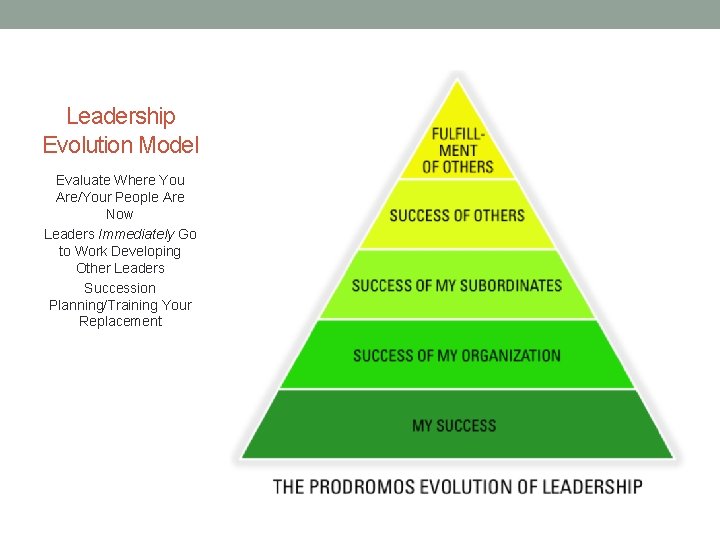
Leadership Evolution Model Evaluate Where You Are/Your People Are Now Leaders Immediately Go to Work Developing Other Leaders Succession Planning/Training Your Replacement