
Divide and Conquer Recall Complexity Analysis Comparison of



















- Slides: 108
Divide and Conquer
Recall • Complexity Analysis – Comparison of algorithm – Big O • Simplification • From source code – Recursive
Today Topic • Divide and Conquer
DIVIDE AND CONQUER Algorithm Design Technique
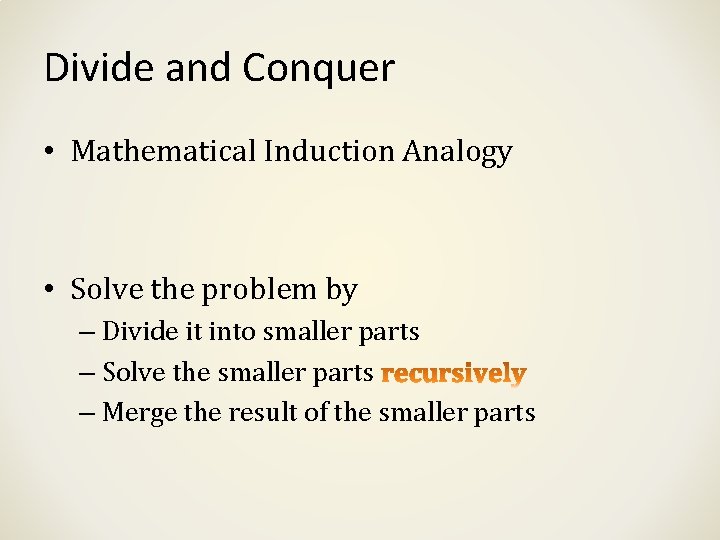
Divide and Conquer • Mathematical Induction Analogy • Solve the problem by – Divide it into smaller parts – Solve the smaller parts – Merge the result of the smaller parts
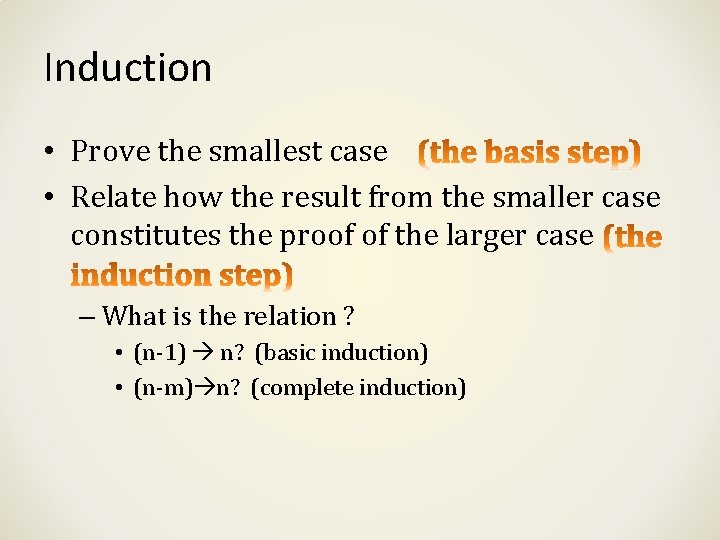
Induction • Prove the smallest case • Relate how the result from the smaller case constitutes the proof of the larger case – What is the relation ? • (n-1) n? (basic induction) • (n-m) n? (complete induction)
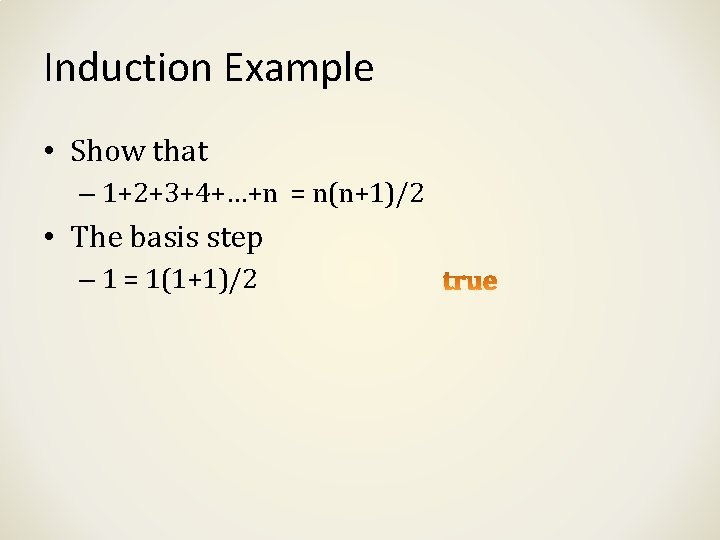
Induction Example • Show that – 1+2+3+4+…+n = n(n+1)/2 • The basis step – 1 = 1(1+1)/2
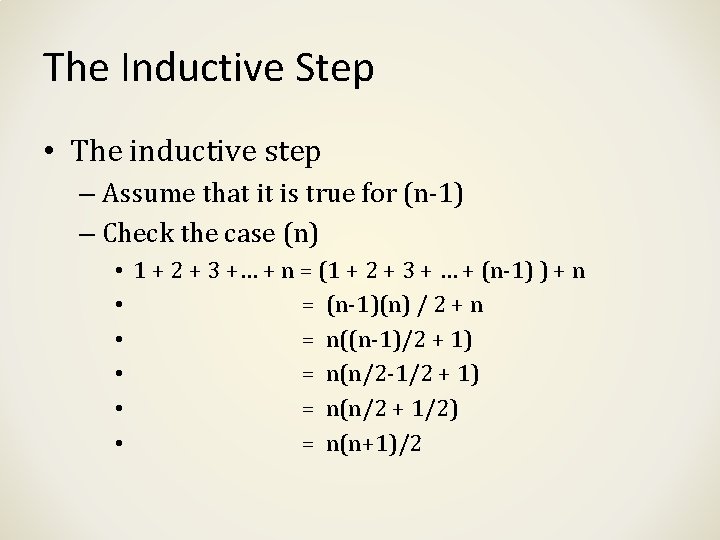
The Inductive Step • The inductive step – Assume that it is true for (n-1) – Check the case (n) • 1 + 2 + 3 +… + n = (1 + 2 + 3 + … + (n-1) ) + n • = (n-1)(n) / 2 + n • = n((n-1)/2 + 1) • = n(n/2 -1/2 + 1) • = n(n/2 + 1/2) • = n(n+1)/2
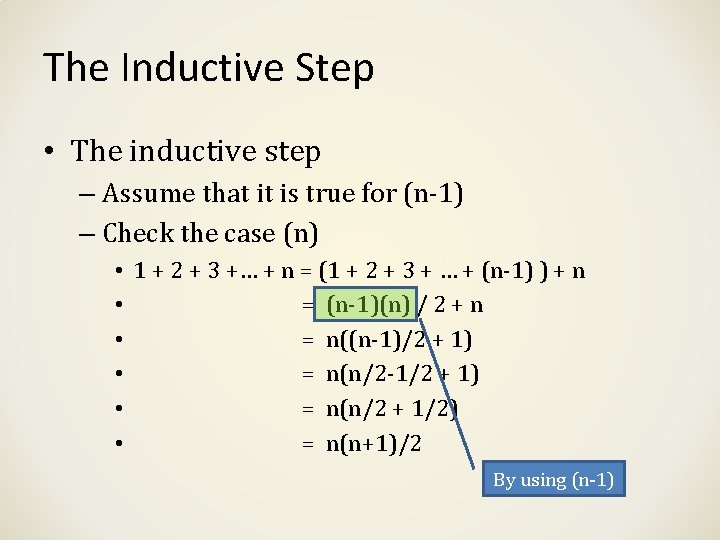
The Inductive Step • The inductive step – Assume that it is true for (n-1) – Check the case (n) • 1 + 2 + 3 +… + n = (1 + 2 + 3 + … + (n-1) ) + n • = (n-1)(n) / 2 + n • = n((n-1)/2 + 1) • = n(n/2 -1/2 + 1) • = n(n/2 + 1/2) • = n(n+1)/2 By using (n-1)
The Induction • By using the result of the smaller case • We can proof the larger case
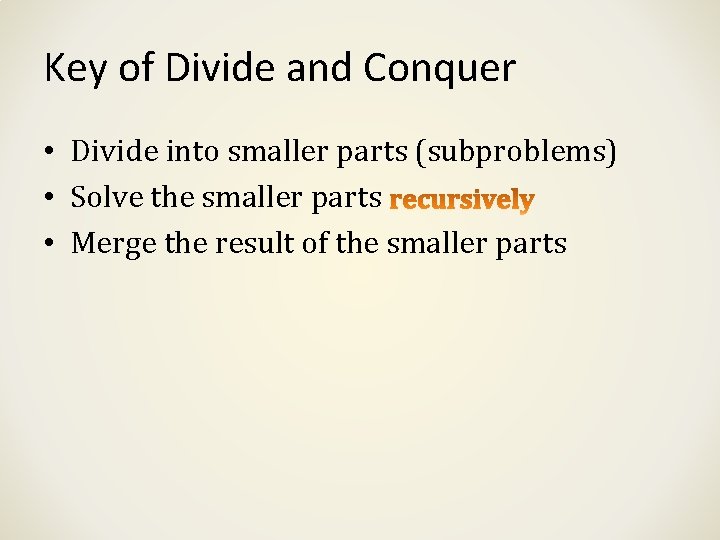
Key of Divide and Conquer • Divide into smaller parts (subproblems) • Solve the smaller parts • Merge the result of the smaller parts
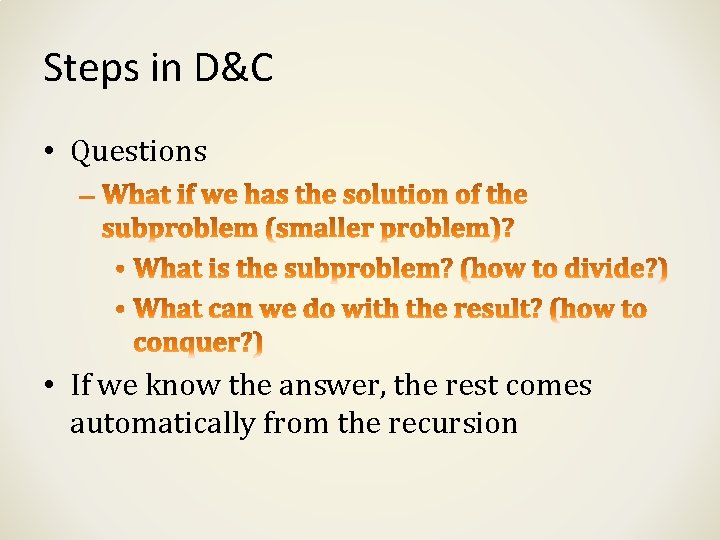
Steps in D&C • Questions • If we know the answer, the rest comes automatically from the recursion
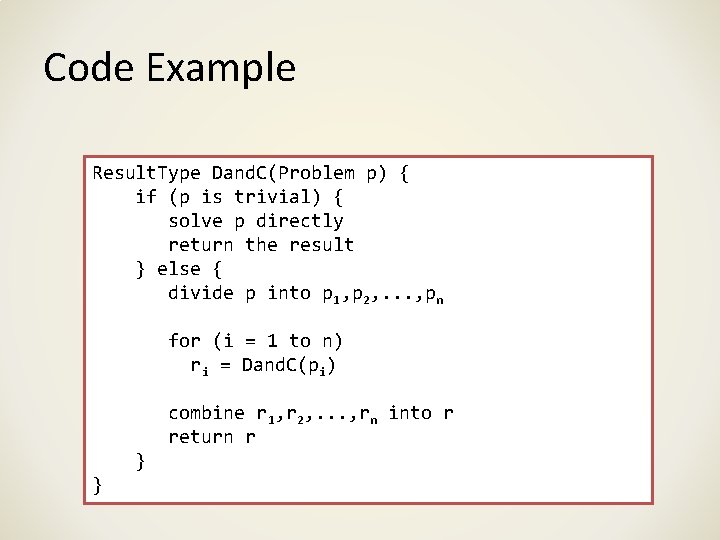
Code Example Result. Type Dand. C(Problem p) { if (p is trivial) { solve p directly return the result } else { divide p into p 1, p 2, . . . , pn for (i = 1 to n) ri = Dand. C(pi) combine r 1, r 2, . . . , rn into r return r } }
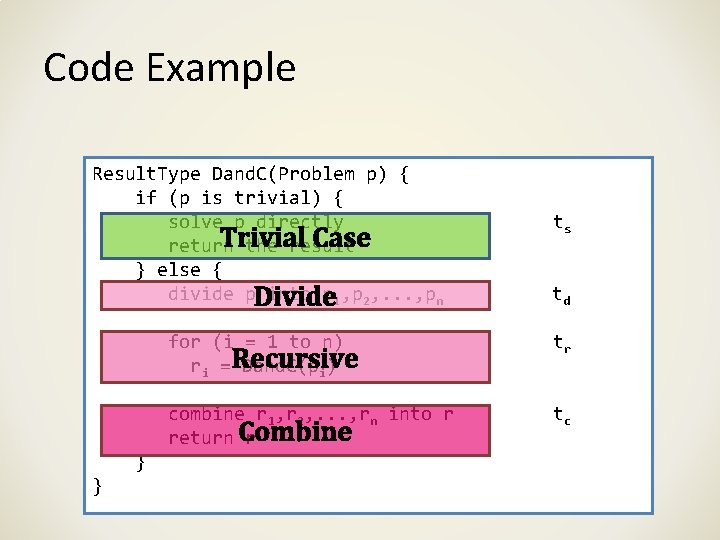
Code Example Result. Type Dand. C(Problem p) { if (p is trivial) { solve p directly Trivial Case return the result } else { divide p. Divide into p 1, p 2, . . . , pn } } ts td for (i = 1 to n) ri = Recursive Dand. C(pi) tr combine r 1, r 2, . . . , rn into r return Combine r tc
Examples • Let’s see some examples
MERGE SORT
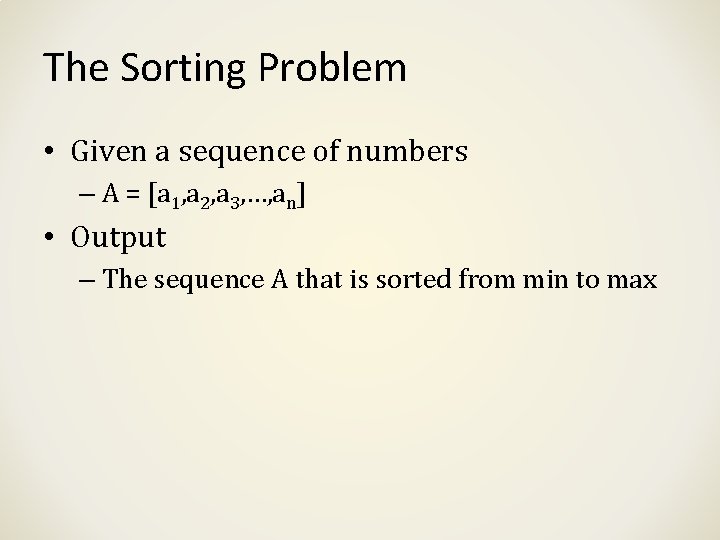
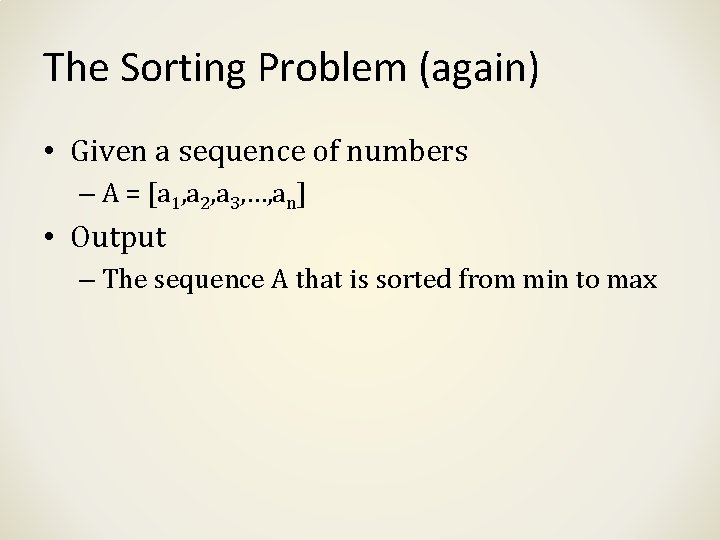
The Sorting Problem • Given a sequence of numbers – A = [a 1, a 2, a 3, …, an] • Output – The sequence A that is sorted from min to max
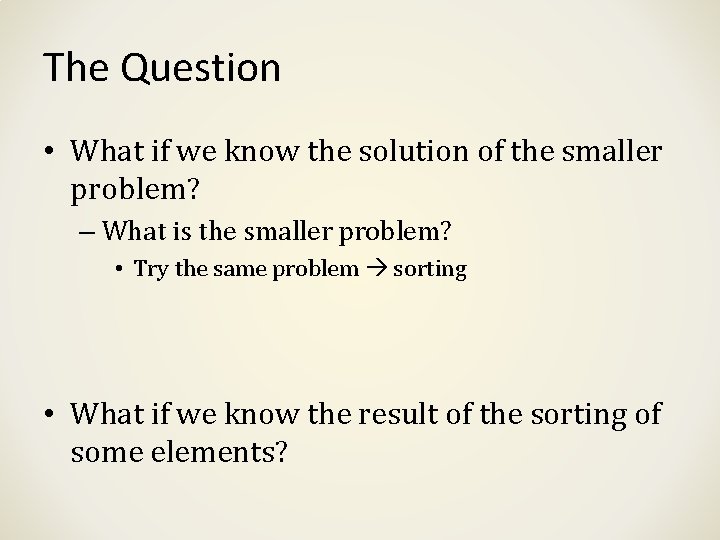
The Question • What if we know the solution of the smaller problem? – What is the smaller problem? • Try the same problem sorting • What if we know the result of the sorting of some elements?
The Question • How to divide? – Let’s try sorting of the smaller array • Divide exactly at the half of the array • How to conquer? – Merge the result directly
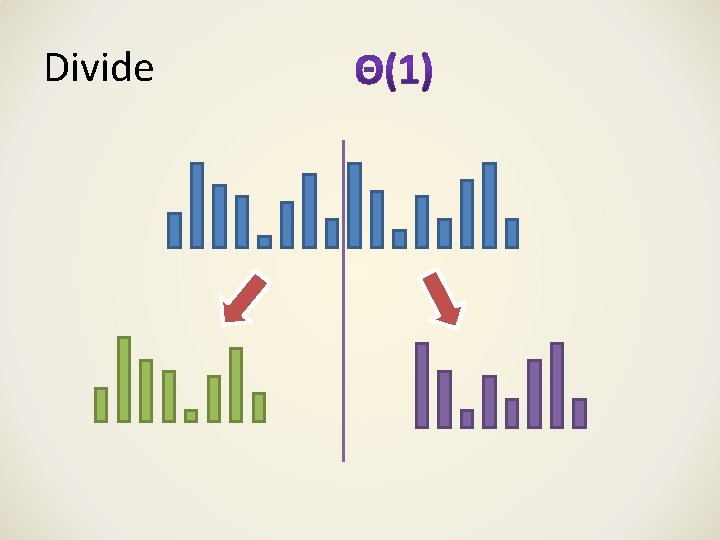
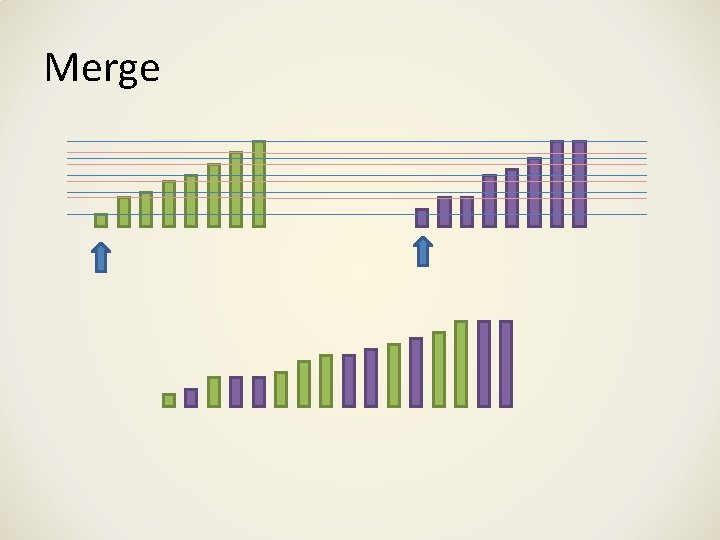
Idea • Simplest dividing – Divide array into two array of half size • Laborious conquer – Merge the result
Divide
Divide
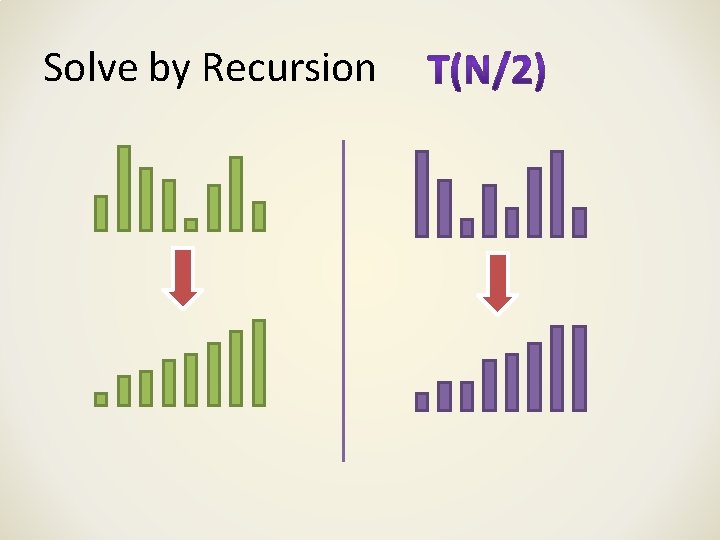
Solve by Recursion
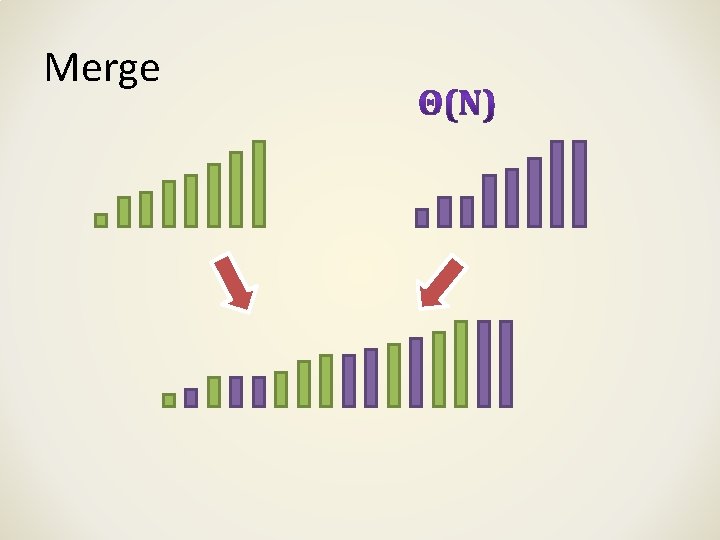
Merge
Merge
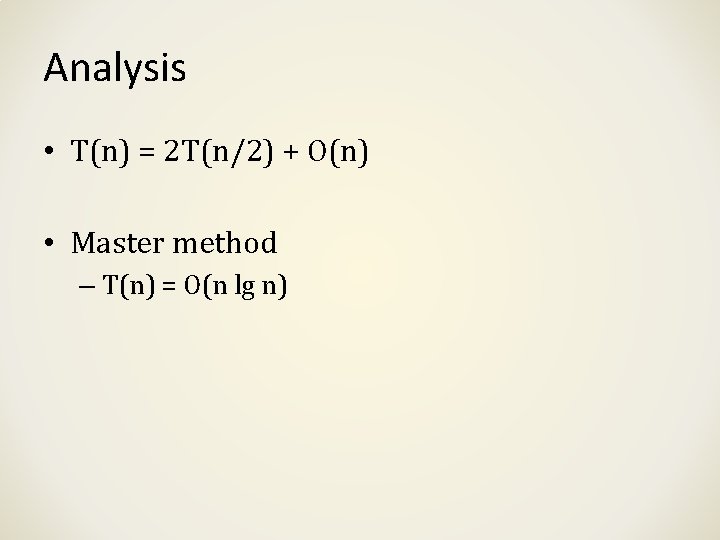
Analysis • T(n) = 2 T(n/2) + O(n) • Master method – T(n) = O(n lg n)
QUICK SORT
The Sorting Problem (again) • Given a sequence of numbers – A = [a 1, a 2, a 3, …, an] • Output – The sequence A that is sorted from min to max
Problem of Merge Sort • Need the use of external memory for merging • Are there any other way such that conquering is not that complex?
The Question • How to divide? – Try doing the same thing as the merge sort – Add that every element in the first half is less than the second half • Can we do that? • How to conquer? – The sorted result should be easier to merge?
Idea • Laborious dividing – Divide array into two arrays • Add the requirement of value of the array • Simplest conquer – Simply connect the result
Is dividing scheme possible? • Can we manage to have two subproblems of equal size – That satisfy our need? • Any trade off?
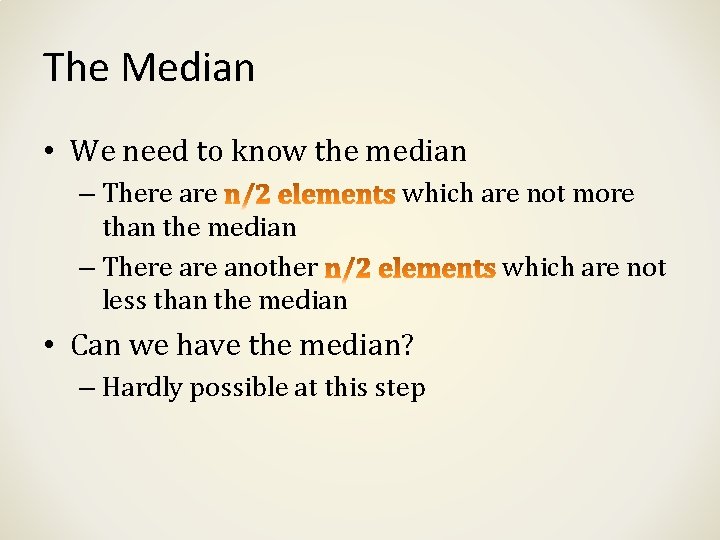
The Median • We need to know the median – There are than the median – There another less than the median which are not more • Can we have the median? – Hardly possible at this step which are not
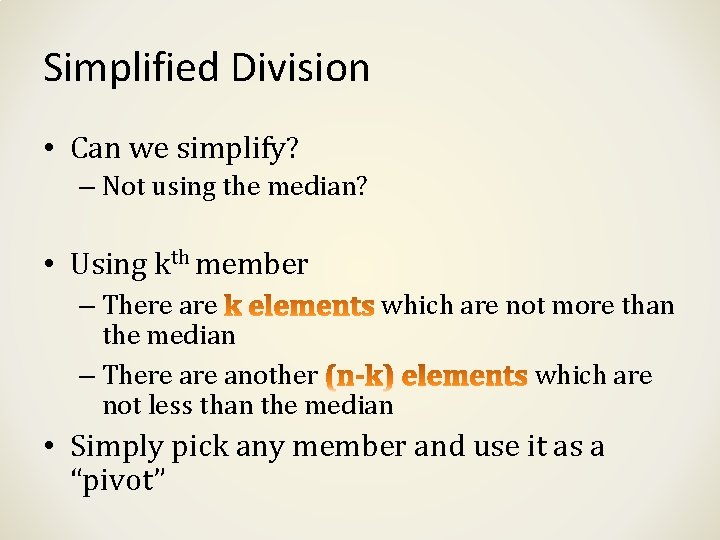
Simplified Division • Can we simplify? – Not using the median? • Using kth member – There are which are not more than the median – There another which are not less than the median • Simply pick any member and use it as a “pivot”
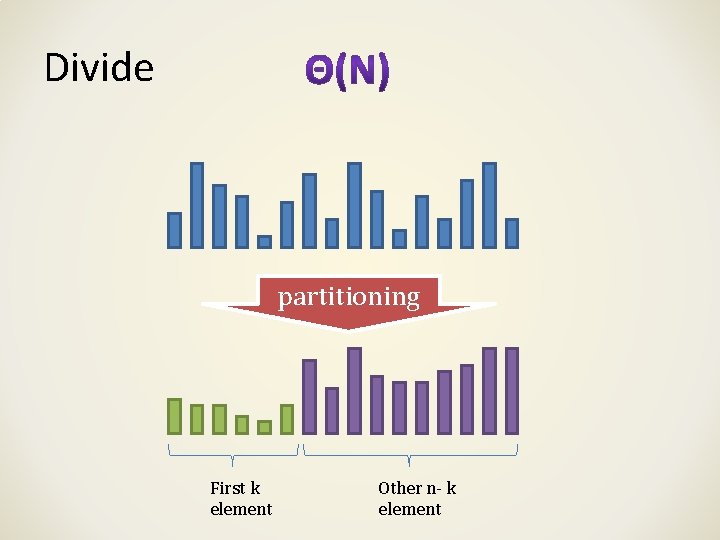
Divide partitioning First k element Other n- k element
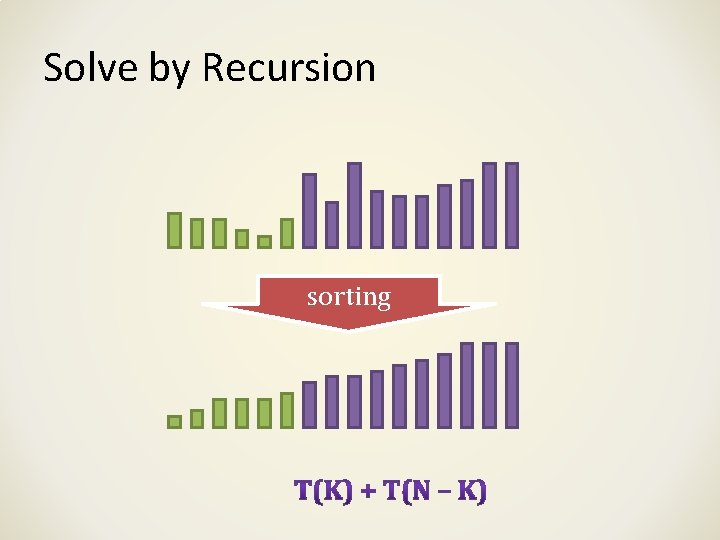
Solve by Recursion sorting
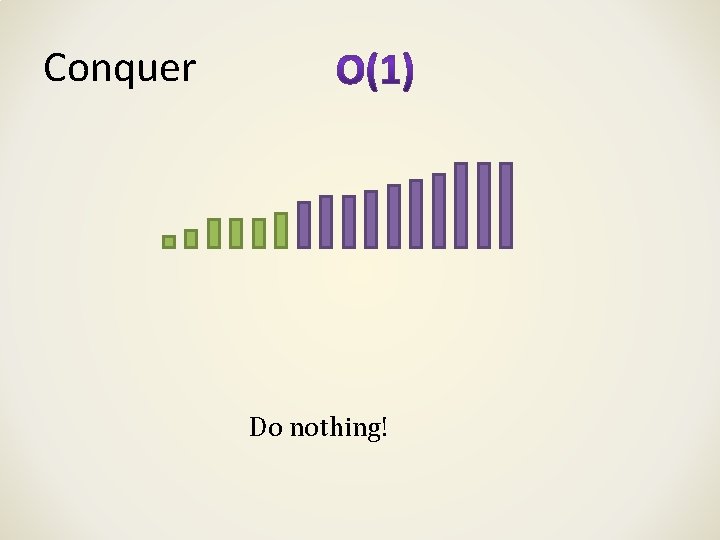
Conquer Do nothing!
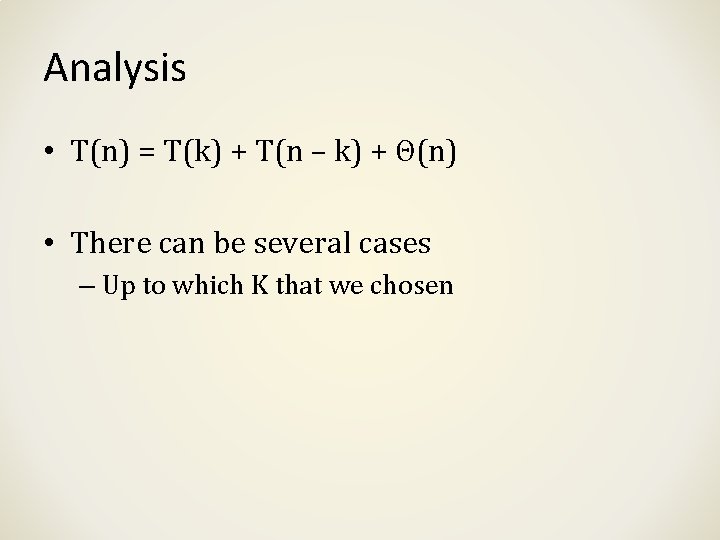
Analysis • T(n) = T(k) + T(n – k) + Θ(n) • There can be several cases – Up to which K that we chosen
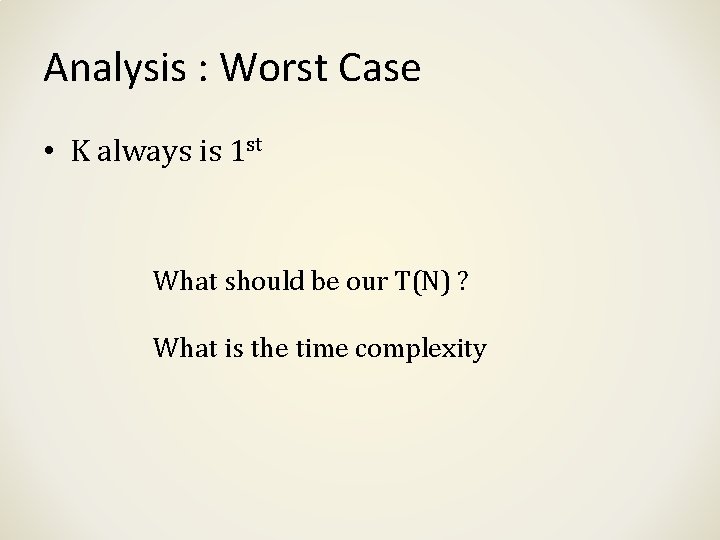
Analysis : Worst Case • K always is 1 st What should be our T(N) ? What is the time complexity
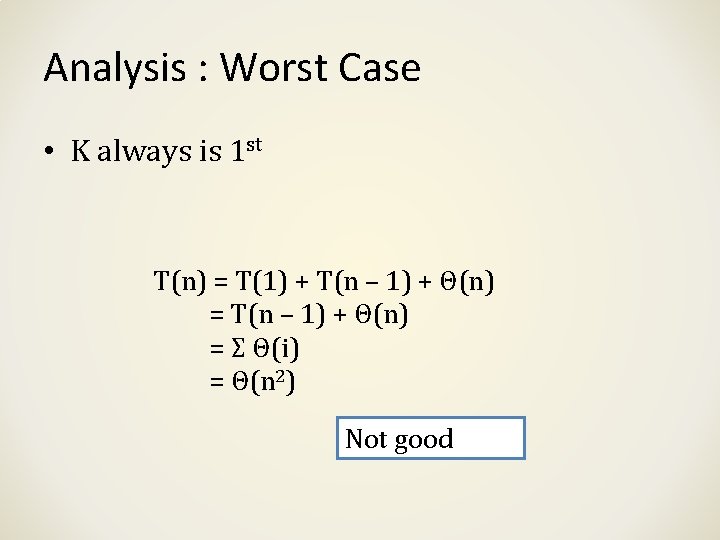
Analysis : Worst Case • K always is 1 st T(n) = T(1) + T(n – 1) + Θ(n) = Σ Θ(i) = Θ(n 2) Not good
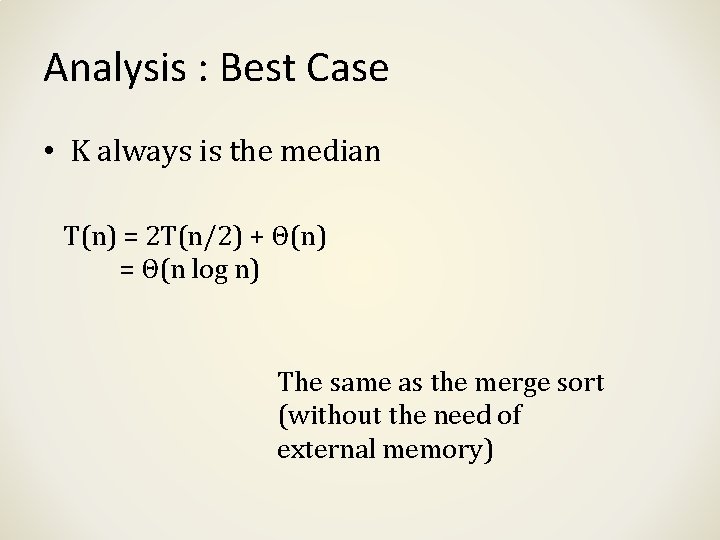
Analysis : Best Case • K always is the median What should be our T(N) ? What is the time complexity
Analysis : Best Case • K always is the median T(n) = 2 T(n/2) + Θ(n) = Θ(n log n) The same as the merge sort (without the need of external memory)
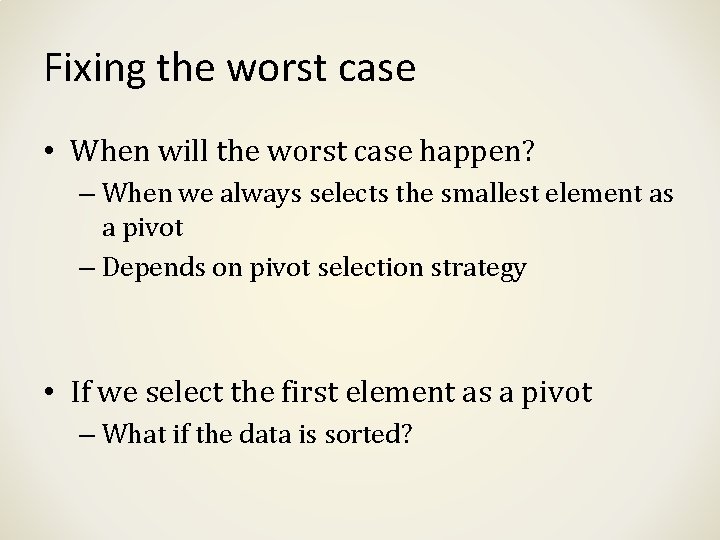
Fixing the worst case • When will the worst case happen? – When we always selects the smallest element as a pivot – Depends on pivot selection strategy • If we select the first element as a pivot – What if the data is sorted?
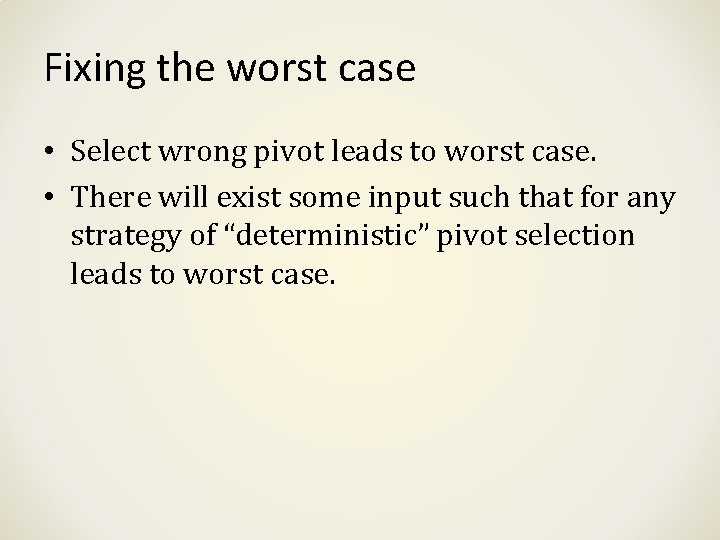
Fixing the worst case • Select wrong pivot leads to worst case. • There will exist some input such that for any strategy of “deterministic” pivot selection leads to worst case.
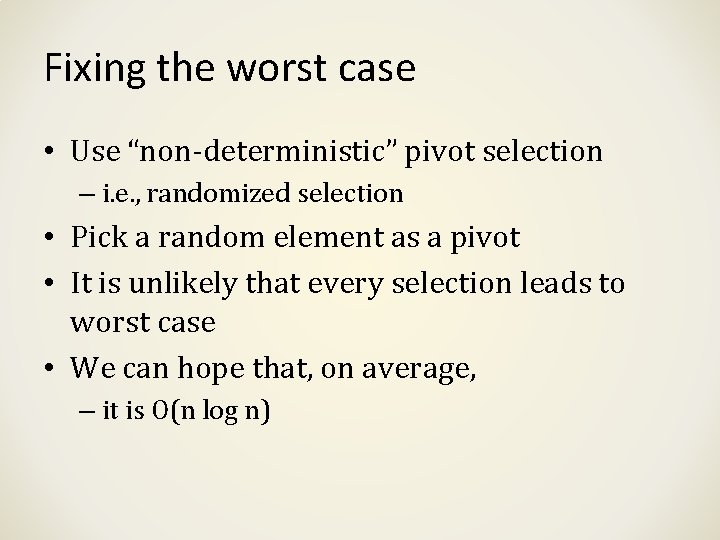
Fixing the worst case • Use “non-deterministic” pivot selection – i. e. , randomized selection • Pick a random element as a pivot • It is unlikely that every selection leads to worst case • We can hope that, on average, – it is O(n log n)
MODULO EXPONENTIAL
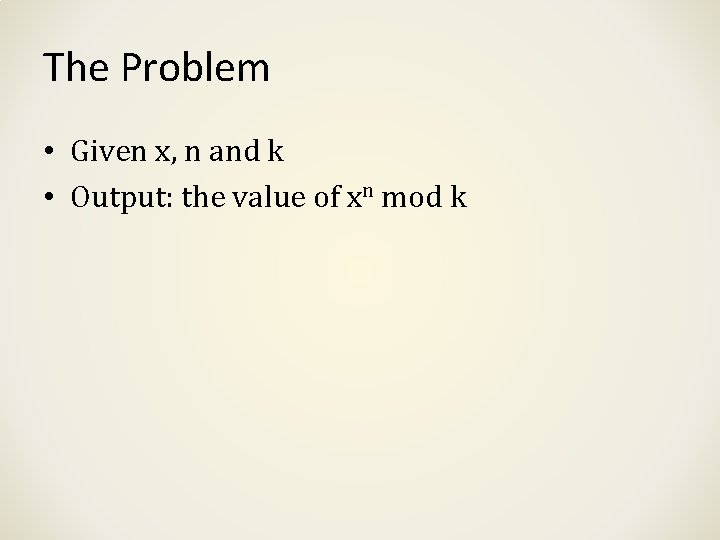
The Problem • Given x, n and k • Output: the value of xn mod k
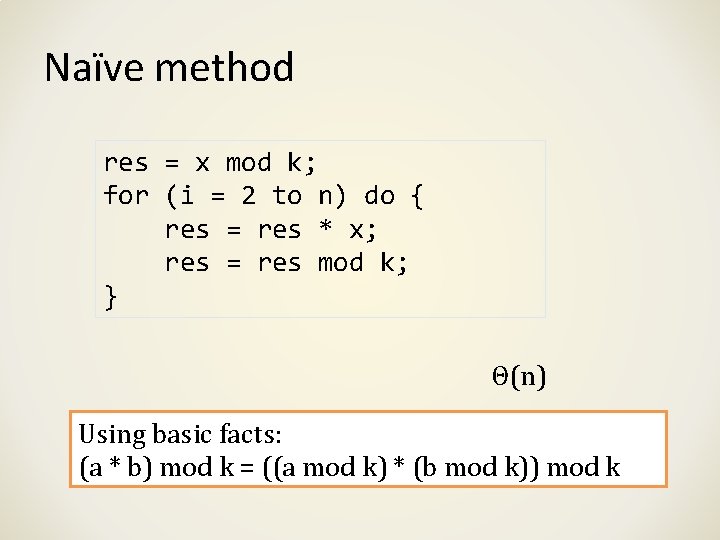
Naïve method res = x mod k; for (i = 2 to n) do { res = res * x; res = res mod k; } Θ(n) Using basic facts: (a * b) mod k = ((a mod k) * (b mod k)) mod k
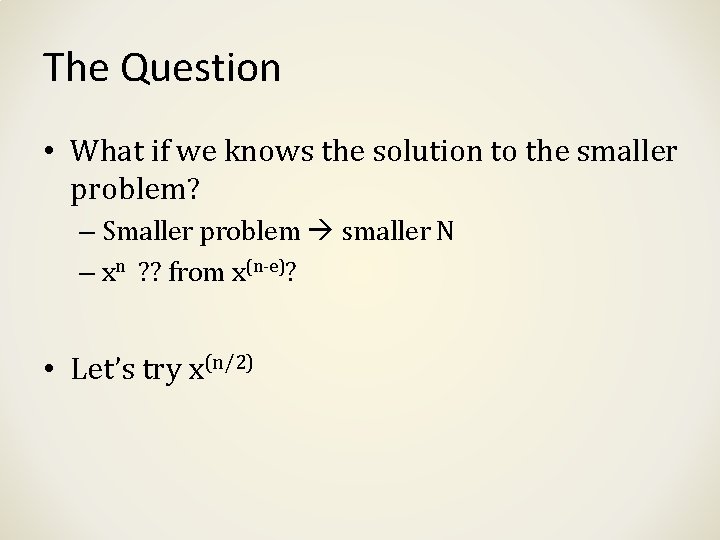
The Question • What if we knows the solution to the smaller problem? – Smaller problem smaller N – xn ? ? from x(n-e)? • Let’s try x(n/2)
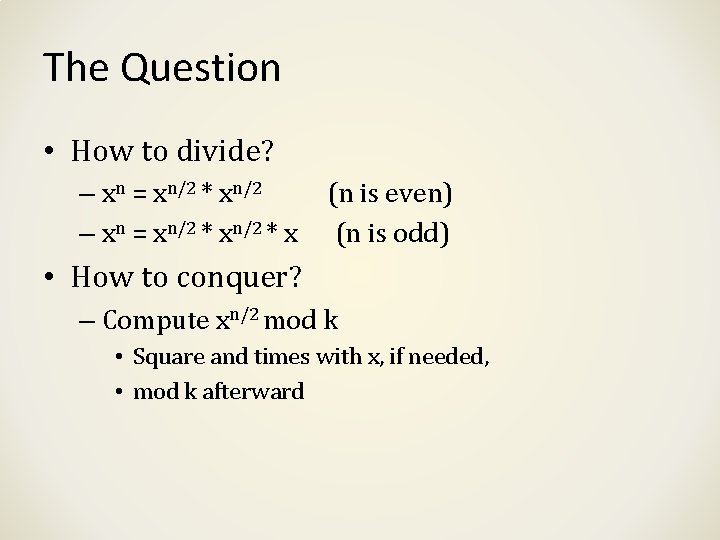
The Question • How to divide? – xn = xn/2 * x (n is even) (n is odd) • How to conquer? – Compute xn/2 mod k • Square and times with x, if needed, • mod k afterward
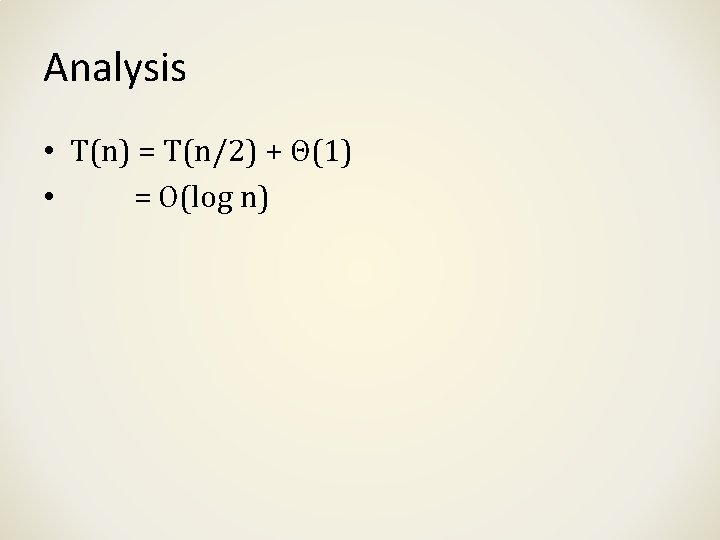
Analysis • T(n) = T(n/2) + Θ(1) • = O(log n)
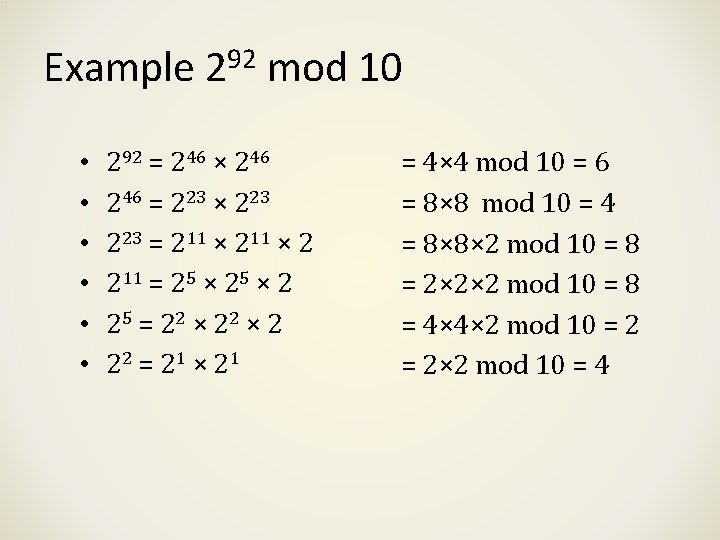
Example 292 mod 10 • • • 292 = 246 × 246 = 223 × 223 = 211 × 2 211 = 25 × 2 25 = 2 2 × 2 22 = 2 1 × 2 1 = 4× 4 mod 10 = 6 = 8× 8 mod 10 = 4 = 8× 8× 2 mod 10 = 8 = 2× 2× 2 mod 10 = 8 = 4× 4× 2 mod 10 = 2× 2 mod 10 = 4
MAXIMUM CONTIGUOUS SUM OF SUBSEQUENCE (MCS)
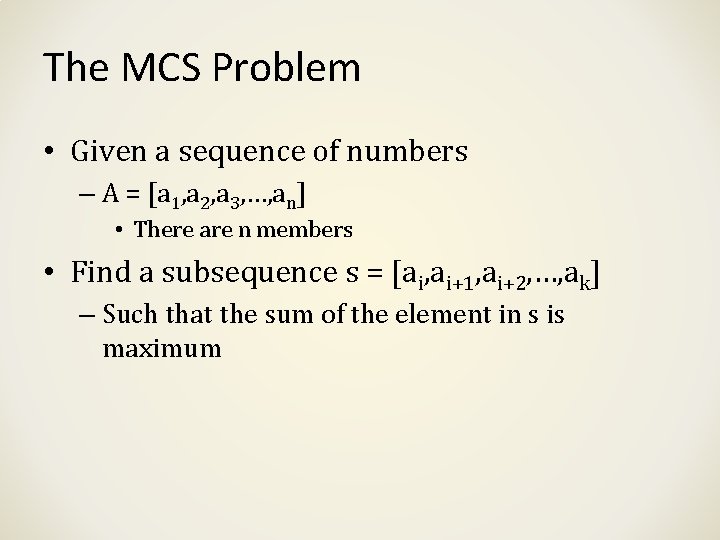
The MCS Problem • Given a sequence of numbers – A = [a 1, a 2, a 3, …, an] • There are n members • Find a subsequence s = [ai, ai+1, ai+2, …, ak] – Such that the sum of the element in s is maximum
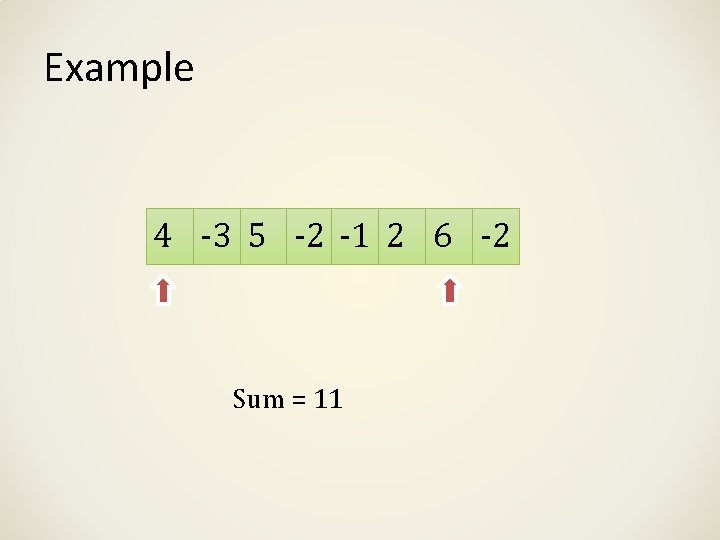
Example 4 -3 5 -2 -1 2 6 -2 Sum = 11
Naïve approach • Try all possible sequences – How many sequence? – How much time does it use to compute the sum?
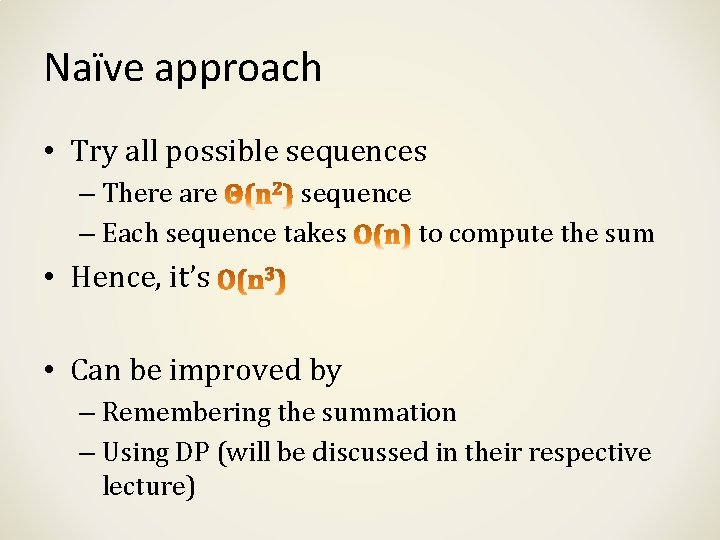
Naïve approach • Try all possible sequences – There are sequence – Each sequence takes to compute the sum • Hence, it’s • Can be improved by – Remembering the summation – Using DP (will be discussed in their respective lecture)
The DC Approach • What if we know the solution of the smaller problem – What if we know MSS of the first half and the second half?
The Question • How to divide? – By half of the member • How to conquer? – Does the result of the subproblems can be used to compute the solution? – Let’s see
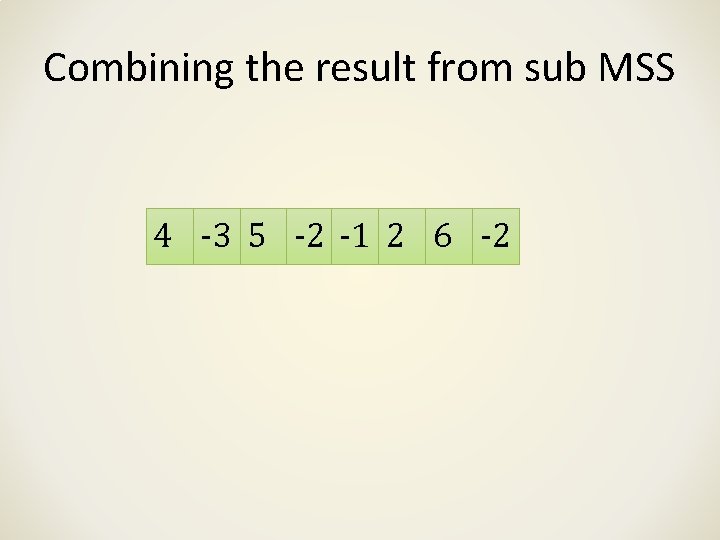
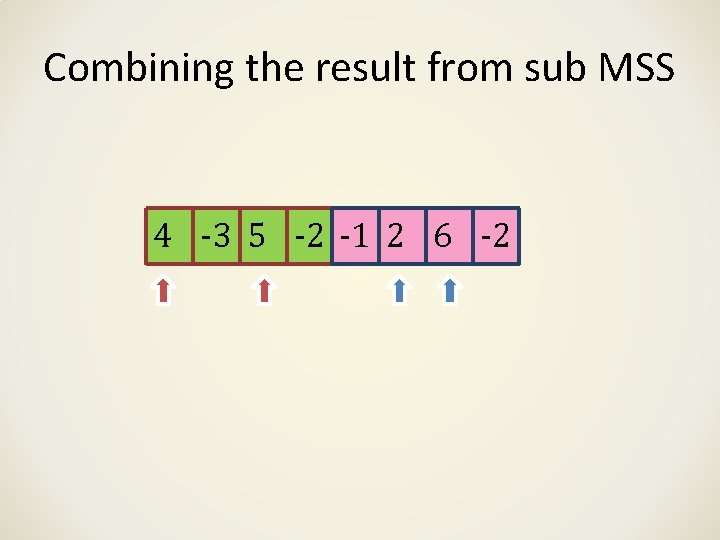
Combining the result from sub MSS 4 -3 5 -2 -1 2 6 -2
Combining the result from sub MSS 4 -3 5 -2 -1 2 6 -2
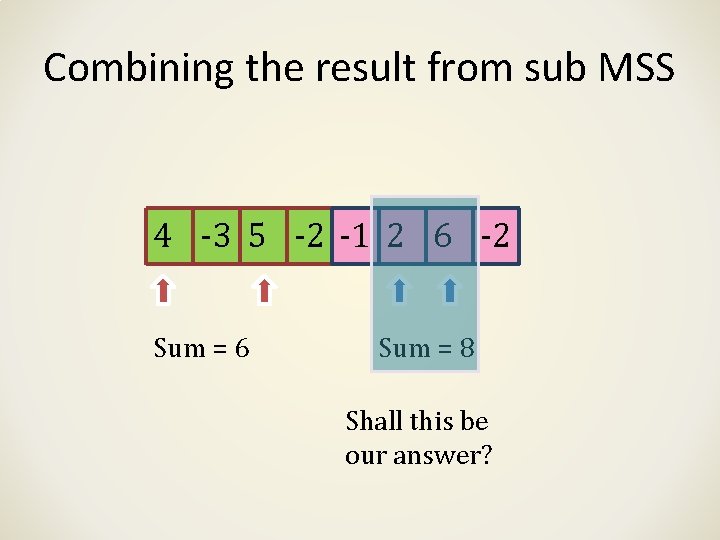
Combining the result from sub MSS 4 -3 5 -2 -1 2 6 -2 Sum = 6 Sum = 8 Shall this be our answer?
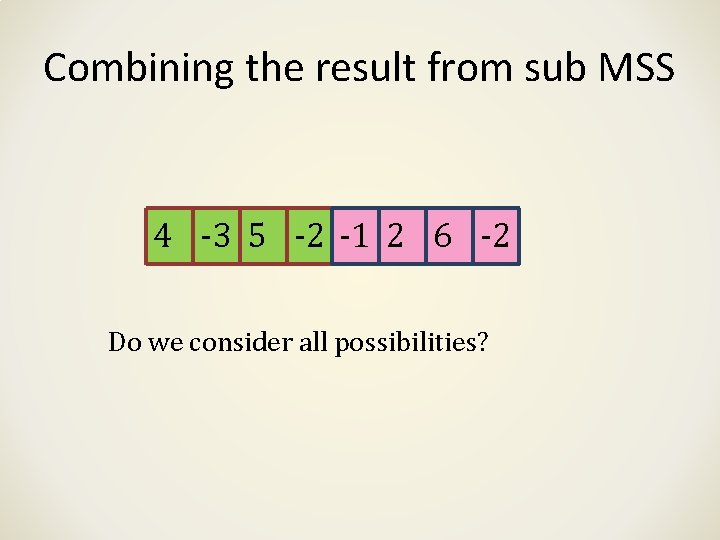
Combining the result from sub MSS 4 -3 5 -2 -1 2 6 -2 Do we consider all possibilities?
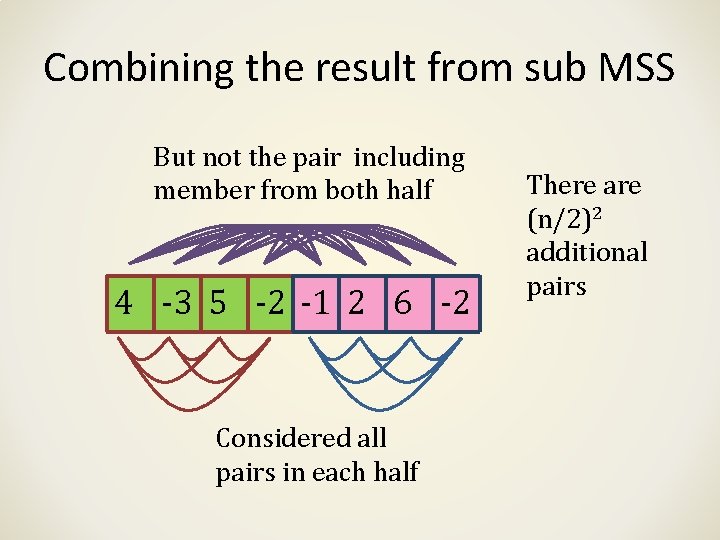
Combining the result from sub MSS But not the pair including member from both half 4 -3 5 -2 -1 2 6 -2 Considered all pairs in each half There are (n/2)2 additional pairs
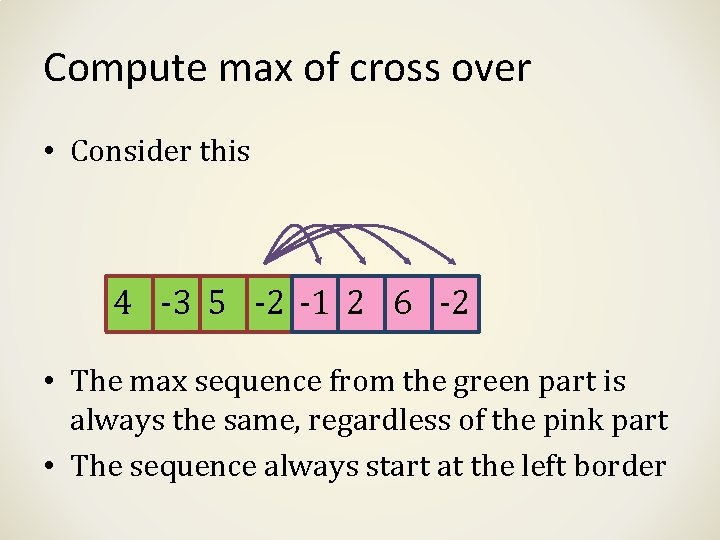
Compute max of cross over • Consider this 4 -3 5 -2 -1 2 6 -2 • The max sequence from the green part is always the same, regardless of the pink part • The sequence always start at the left border
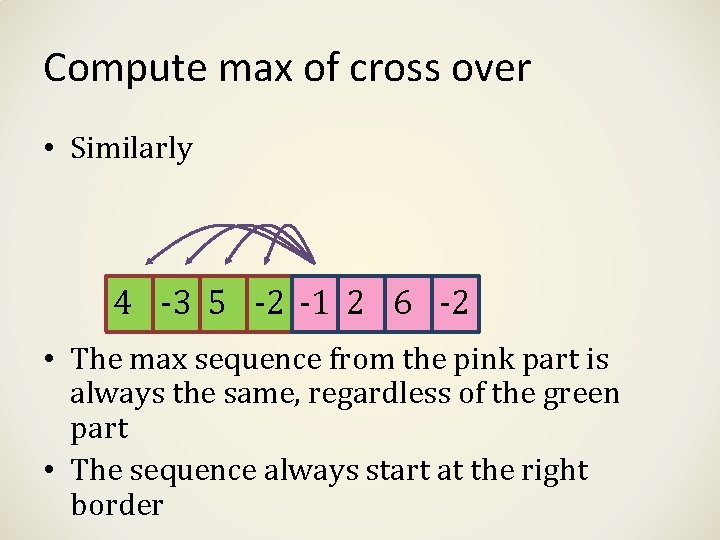
Compute max of cross over • Similarly 4 -3 5 -2 -1 2 6 -2 • The max sequence from the pink part is always the same, regardless of the green part • The sequence always start at the right border
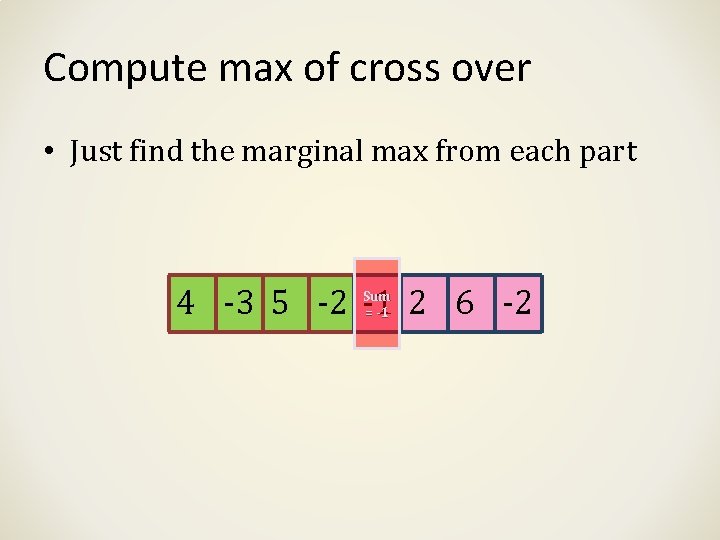
Compute max of cross over • Just find the marginal max from each part 4 -3 5 -2 -1 2 6 -2 Sum = -1
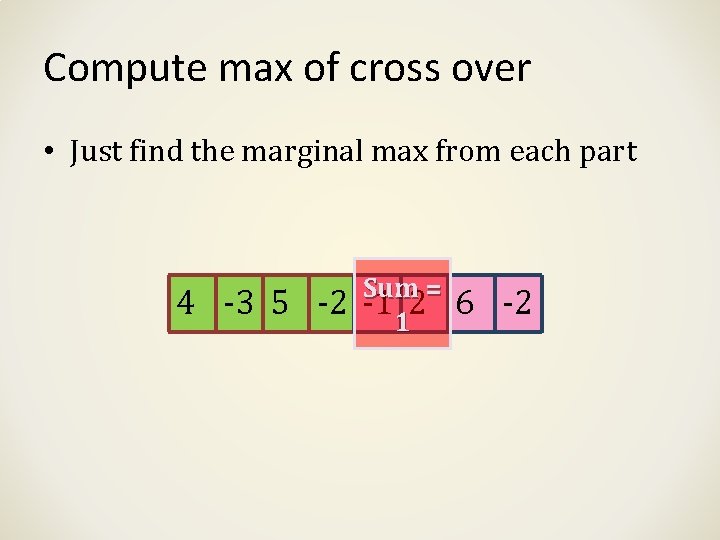
Compute max of cross over • Just find the marginal max from each part 4 -3 5 -2 Sum = -112 6 -2
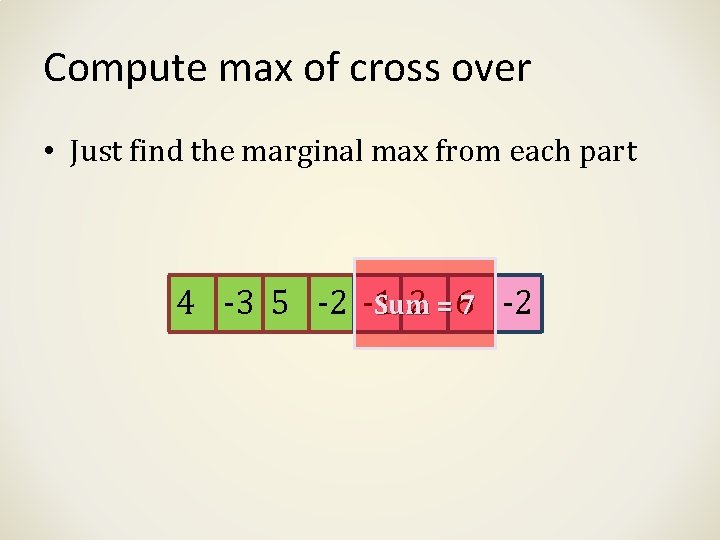
Compute max of cross over • Just find the marginal max from each part 4 -3 5 -2 -1 2 = 67 -2 Sum
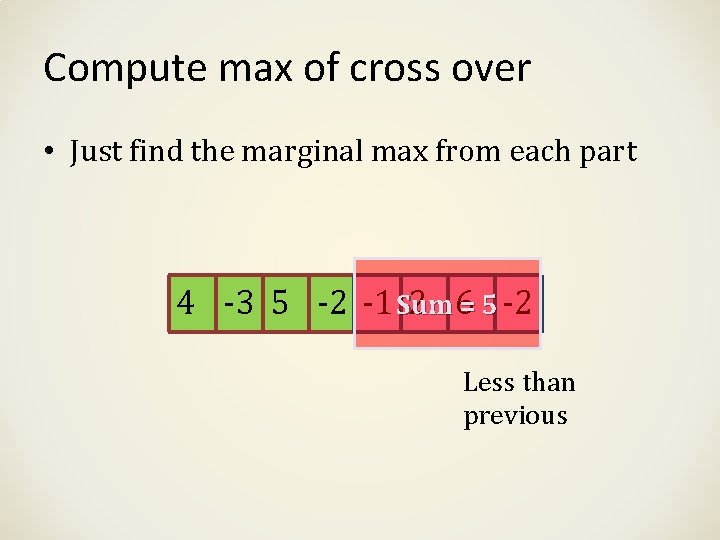
Compute max of cross over • Just find the marginal max from each part 4 -3 5 -2 -1 Sum 2 6= 5 -2 Less than previous
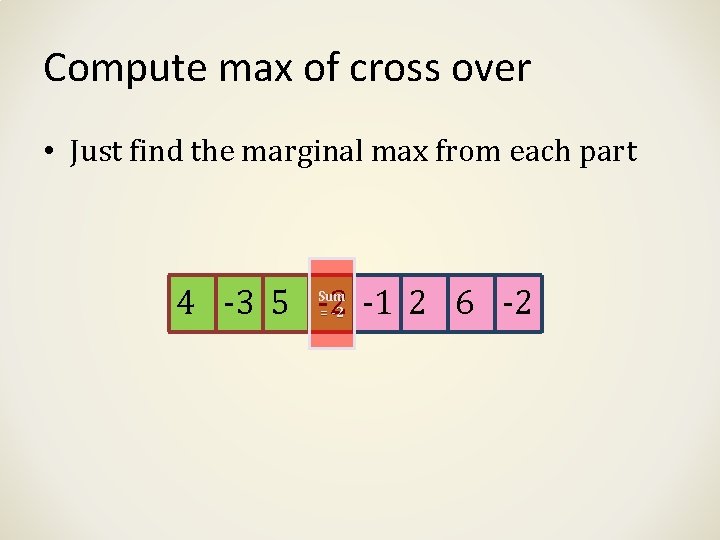
Compute max of cross over • Just find the marginal max from each part 4 -3 5 -2 -1 2 6 -2 Sum = -2
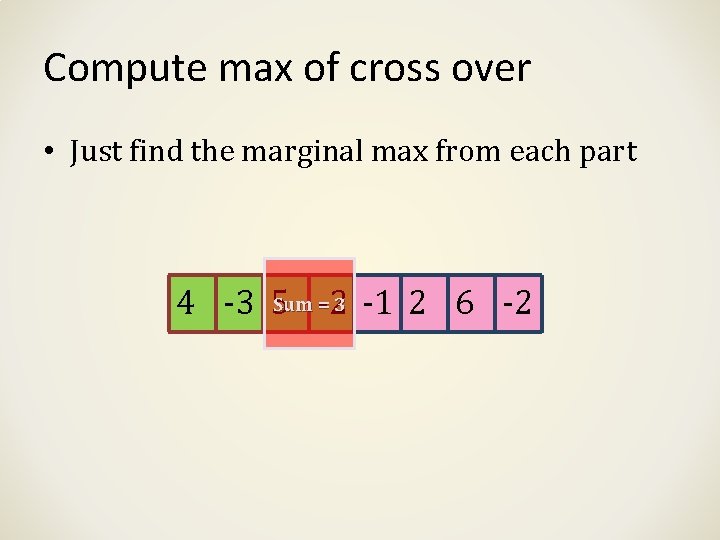
Compute max of cross over • Just find the marginal max from each part = 3 -1 2 6 -2 4 -3 5 Sum -2
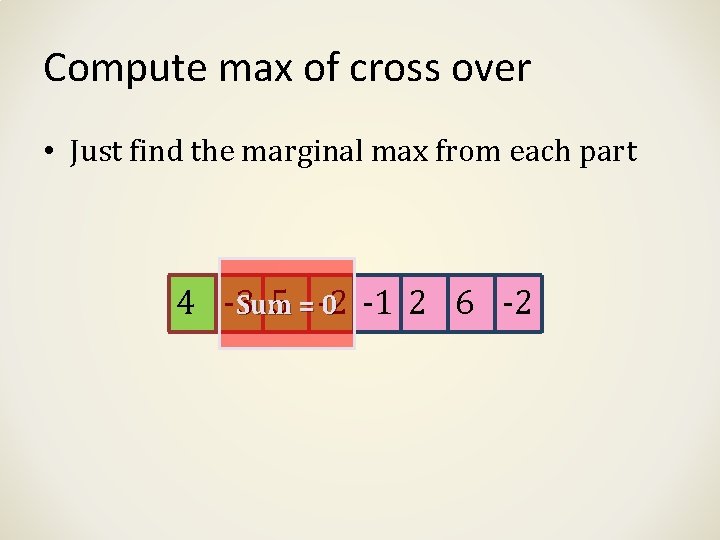
Compute max of cross over • Just find the marginal max from each part 4 -3 5 = -2 Sum 0 -1 2 6 -2
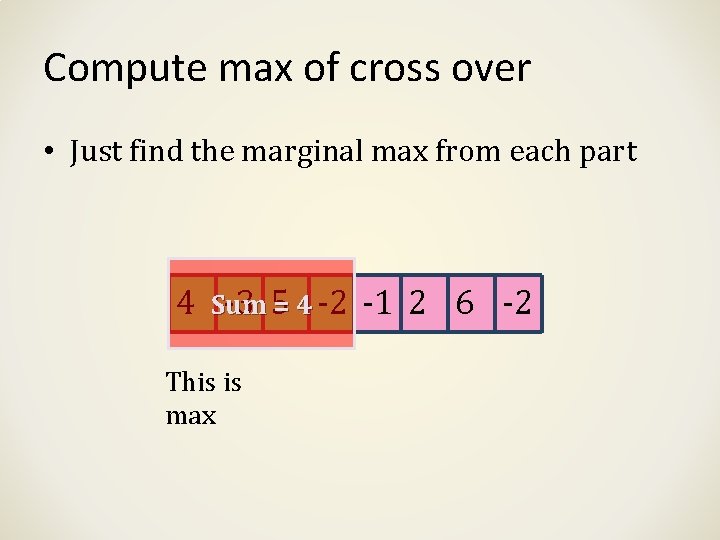
Compute max of cross over • Just find the marginal max from each part 4 Sum -3 5= 4 -2 -1 2 6 -2 This is max
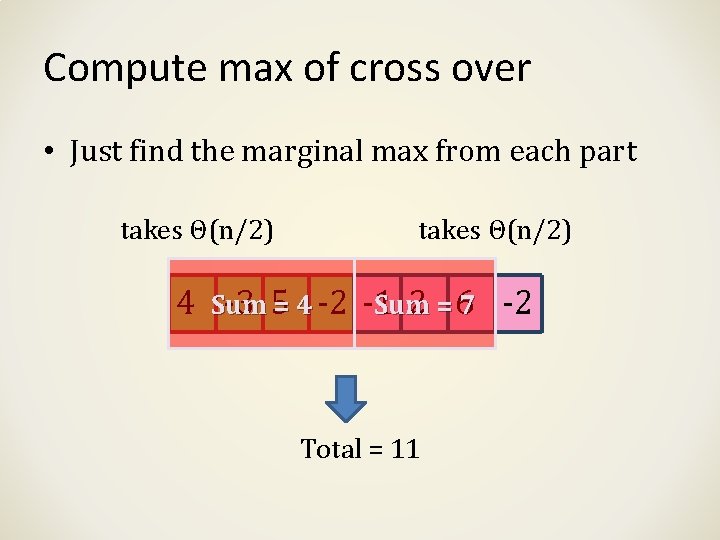
Compute max of cross over • Just find the marginal max from each part takes Θ(n/2) 4 Sum -3 5= 4 -2 -1 2 = 67 -2 Sum Total = 11
Combine • Max from the three parts – The left half – The right half – The cross over part • Use the one that is maximum
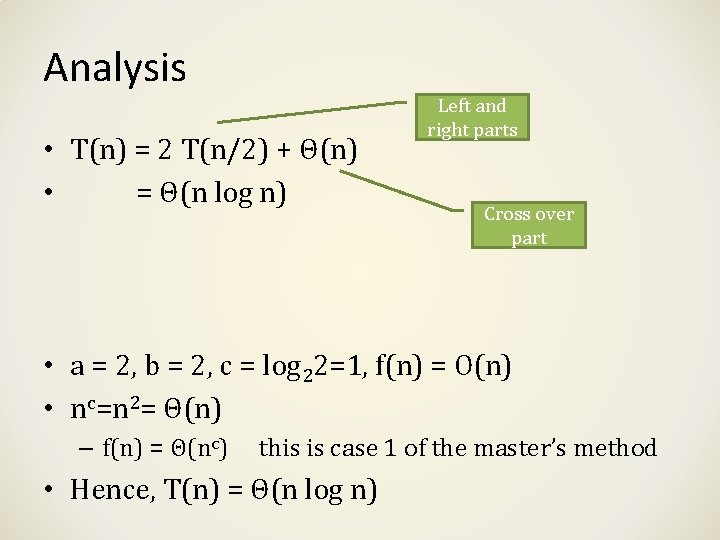
Analysis • T(n) = 2 T(n/2) + Θ(n) • = Θ(n log n) Left and right parts Cross over part • a = 2, b = 2, c = log 22=1, f(n) = O(n) • nc=n 2= Θ(n) – f(n) = Θ(nc) this is case 1 of the master’s method • Hence, T(n) = Θ(n log n)
CLOSEST PAIR
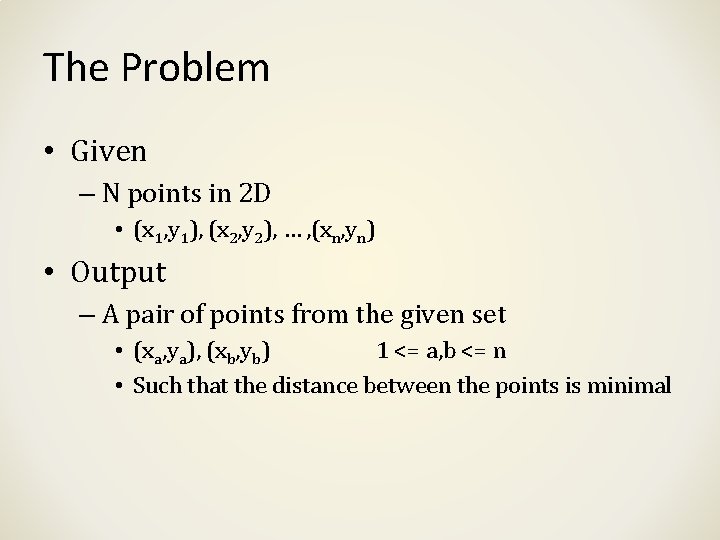
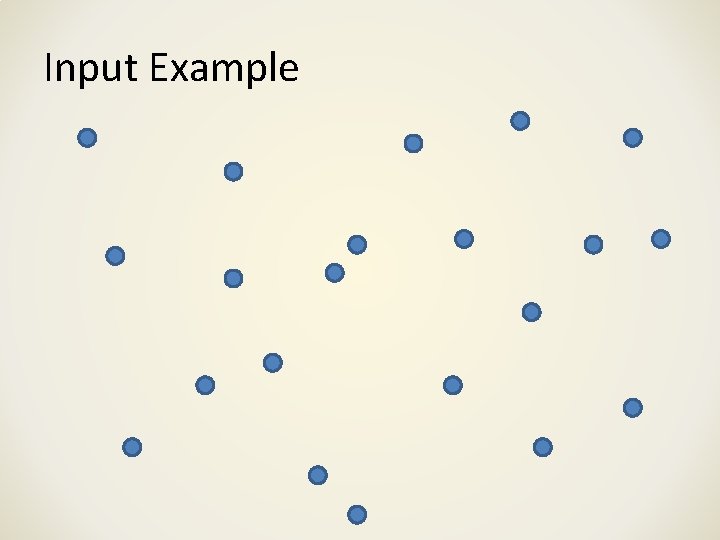
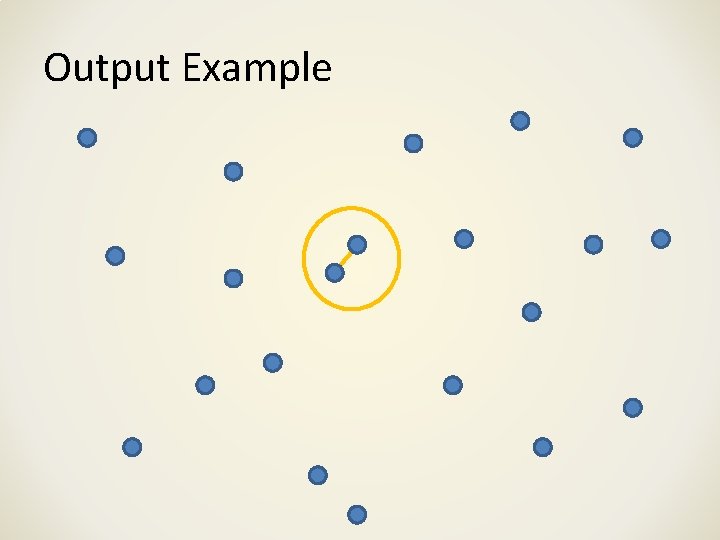
The Problem • Given – N points in 2 D • (x 1, y 1), (x 2, y 2), … , (xn, yn) • Output – A pair of points from the given set • (xa, ya), (xb, yb) 1 <= a, b <= n • Such that the distance between the points is minimal
Input Example
Output Example
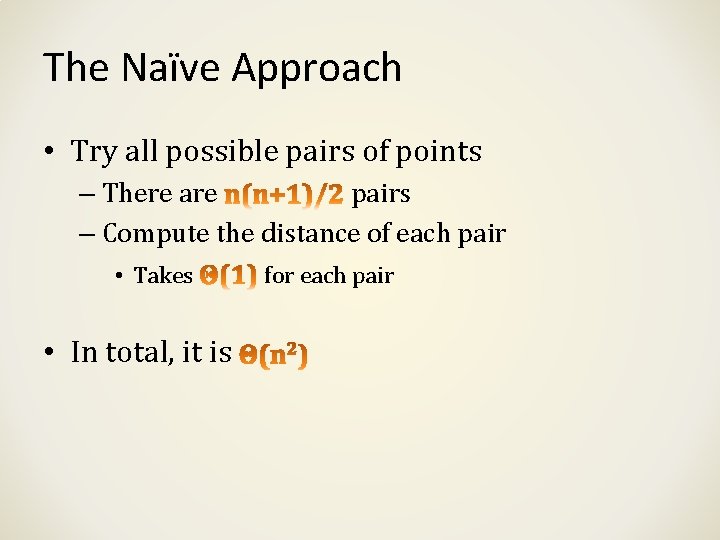
The Naïve Approach • Try all possible pairs of points – There are pairs – Compute the distance of each pair • Takes • In total, it is for each pair
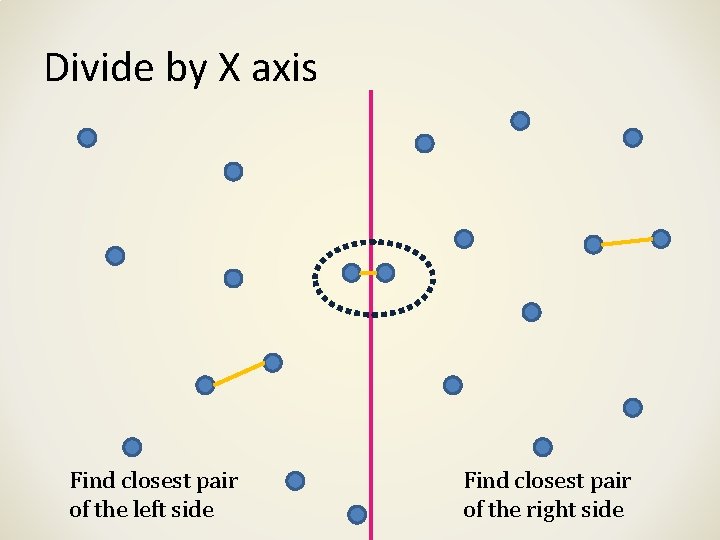
DC approach • What if we know the solution of the smaller problem – What if we know the Closest Pair of half of the points? • Which half?
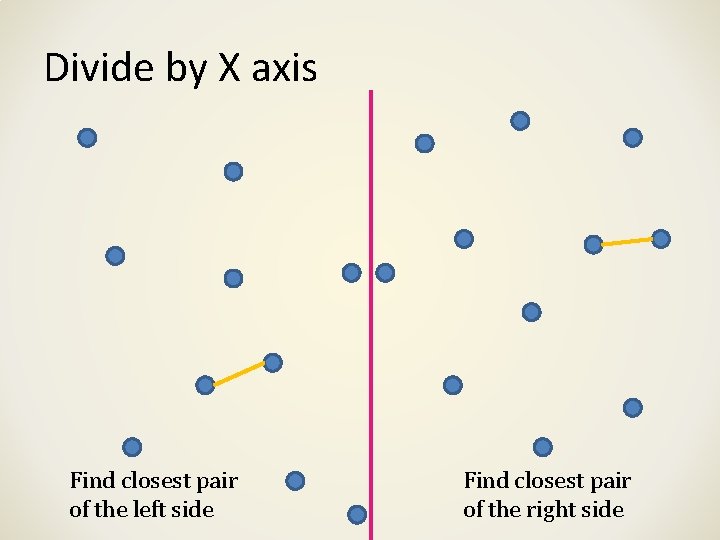
Divide by X axis Find closest pair of the left side Find closest pair of the right side
Conquer • Like the MSS problem – Solutions of the subproblems do not cover every possible pair of points – Missing the pairs that “span” over the boundary
Divide by X axis Find closest pair of the left side Find closest pair of the right side
Conquer • Like the MSS problem – Solutions of the subproblems do not cover every possible pair of points – Missing the pairs that “span” over the boundary – There are such pairs – Again, if we simply consider everything, it would be still quadratic running time – Can we do better?
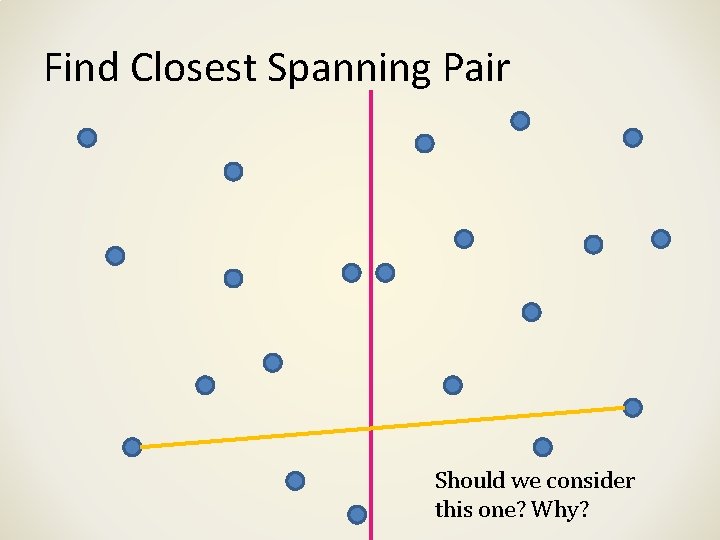
Find Closest Spanning Pair Should we consider this one? Why?
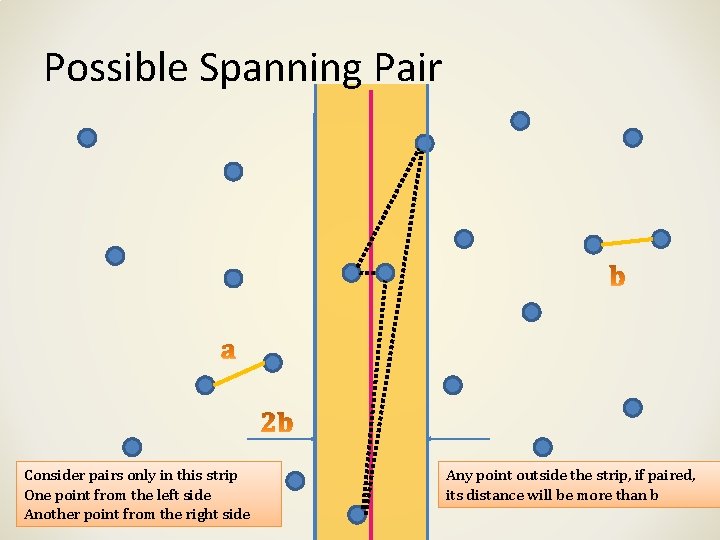
Find Closest Spanning Pair • Should not consider the pair on the far left with that on the far right • Should consider only the “nearer” pairs – How we know that they are too far away – Anything that we can use to guarantee that some particular pairs should not be considered
Possible Spanning Pair Consider pairs only in this strip One point from the left side Another point from the right side Any point outside the strip, if paired, its distance will be more than b
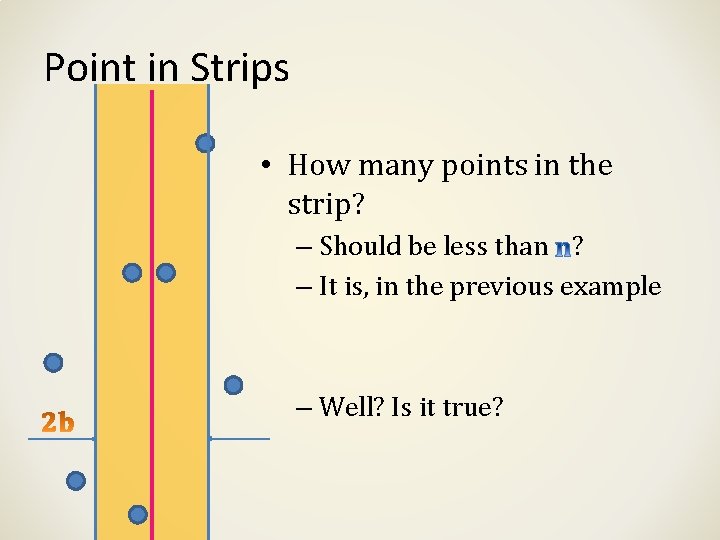
Point in Strips • How many points in the strip? – Should be less than ? – It is, in the previous example – Well? Is it true?
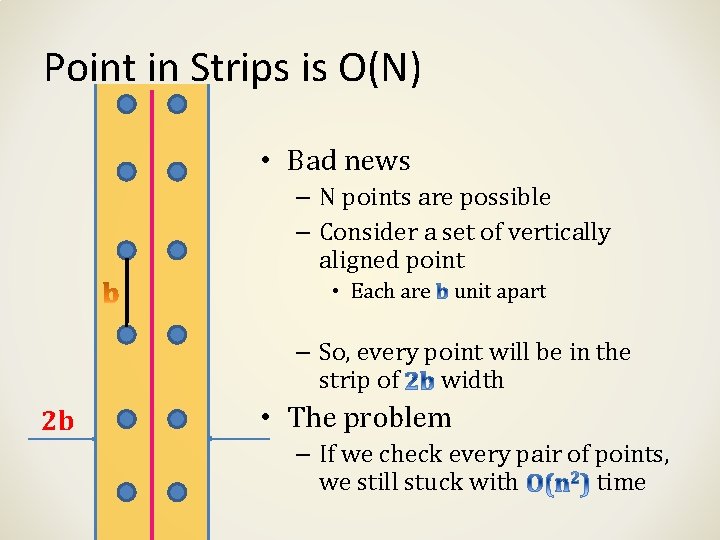
Point in Strips is O(N) • Bad news – N points are possible – Consider a set of vertically aligned point • Each are unit apart – So, every point will be in the strip of width 2 b • The problem – If we check every pair of points, we still stuck with time
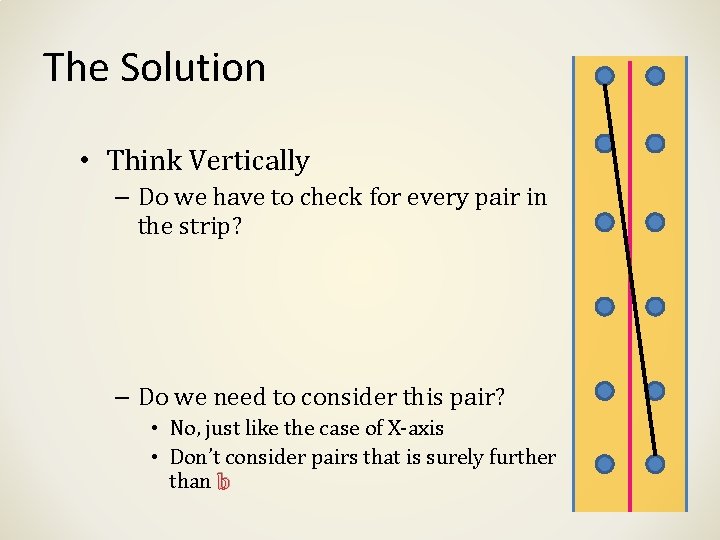
The Solution • Think Vertically – Do we have to check for every pair in the strip? – Do we need to consider this pair? • No, just like the case of X-axis • Don’t consider pairs that is surely further than b
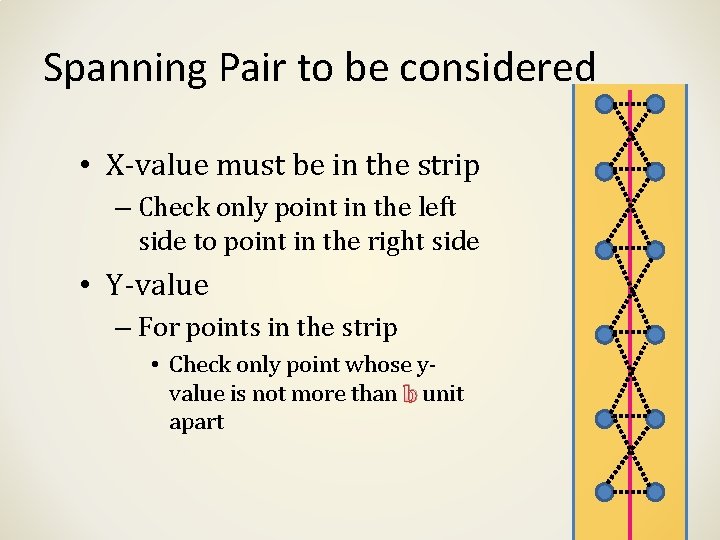
Spanning Pair to be considered • X-value must be in the strip – Check only point in the left side to point in the right side • Y-value – For points in the strip • Check only point whose yvalue is not more than b unit apart
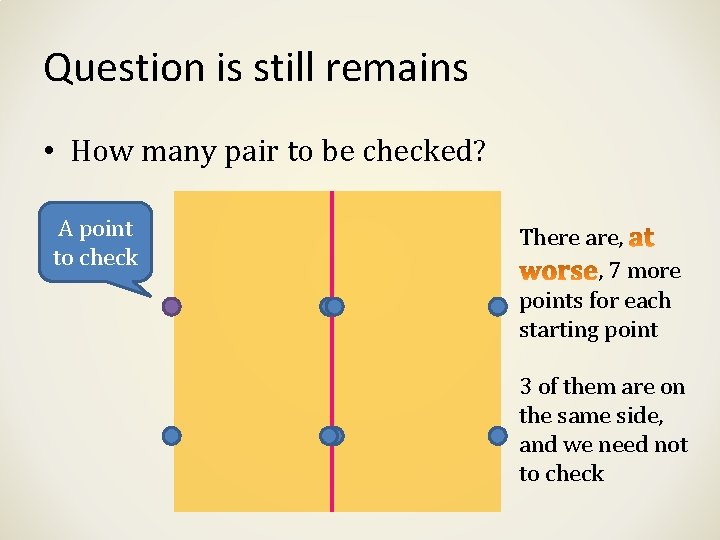
Question is still remains • How many pair to be checked? A point to check There are, , 7 more points for each starting point 3 of them are on the same side, and we need not to check
Implementation Detail • In practice, to check just only those 4 points lying on the opposite side • If we loops over every button first to test whether the y-value falls within range – That is still !!!! • The points must be sorted!!! – ? ? ? Additional work ? ?
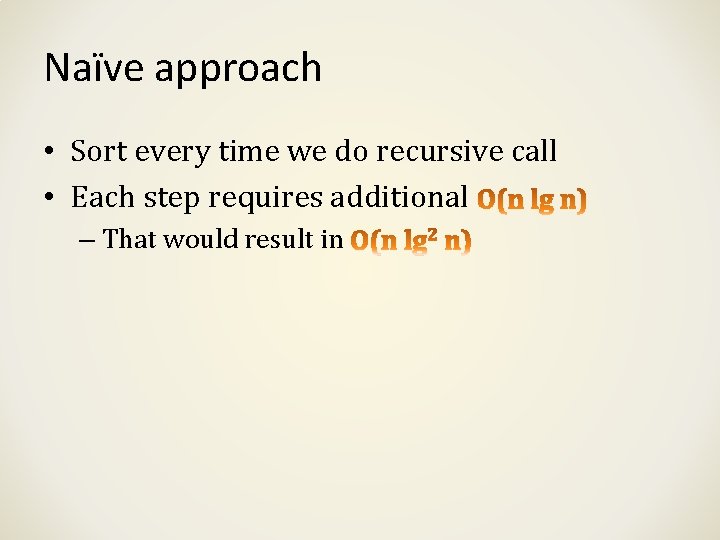
Naïve approach • Sort every time we do recursive call • Each step requires additional – That would result in
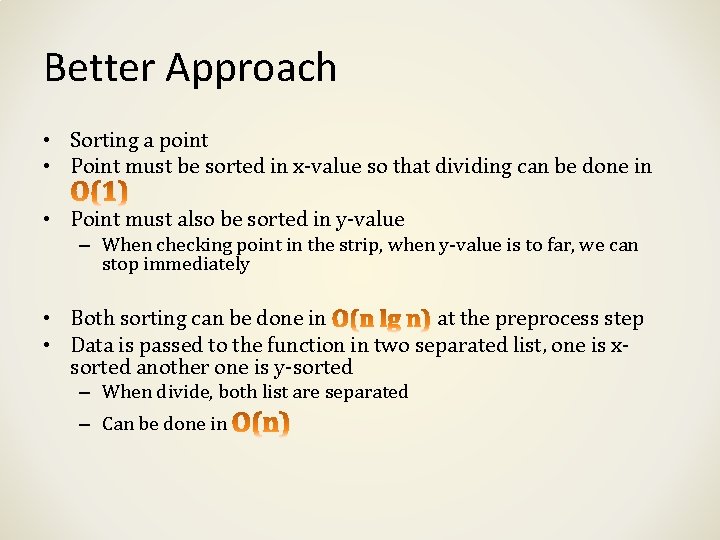
Better Approach • Sorting a point • Point must be sorted in x-value so that dividing can be done in • Point must also be sorted in y-value – When checking point in the strip, when y-value is to far, we can stop immediately • Both sorting can be done in at the preprocess step • Data is passed to the function in two separated list, one is xsorted another one is y-sorted – When divide, both list are separated – Can be done in
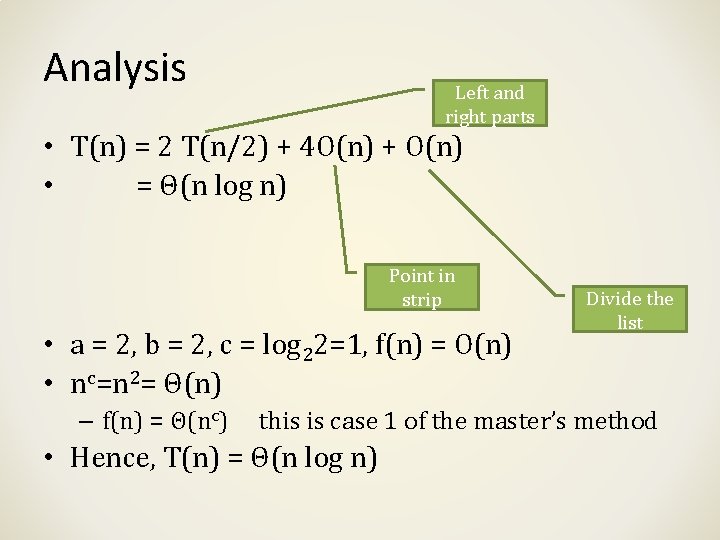
Analysis Left and right parts • T(n) = 2 T(n/2) + 4 O(n) + O(n) • = Θ(n log n) Point in strip • a = 2, b = 2, c = log 22=1, f(n) = O(n) • nc=n 2= Θ(n) – f(n) = Θ(nc) Divide the list this is case 1 of the master’s method • Hence, T(n) = Θ(n log n)
MATRIX MULTIPLICATION
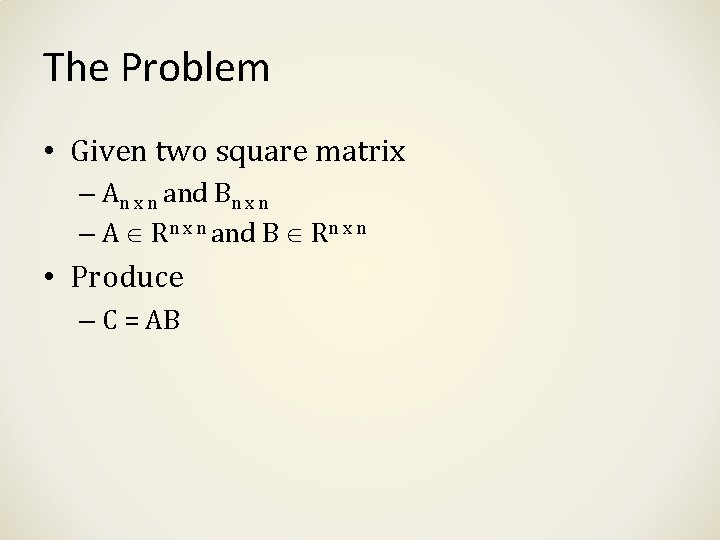
The Problem • Given two square matrix – An x n and Bn x n – A Rn x n and B Rn x n • Produce – C = AB
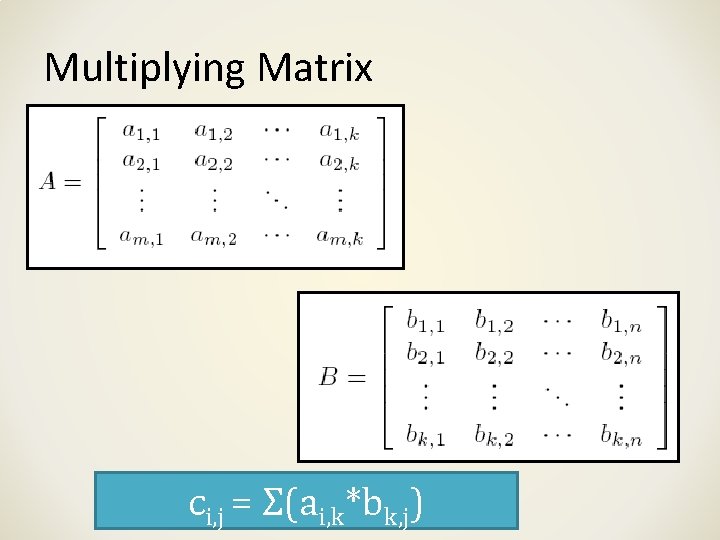
Multiplying Matrix ci, j = Σ(ai, k*bk, j)
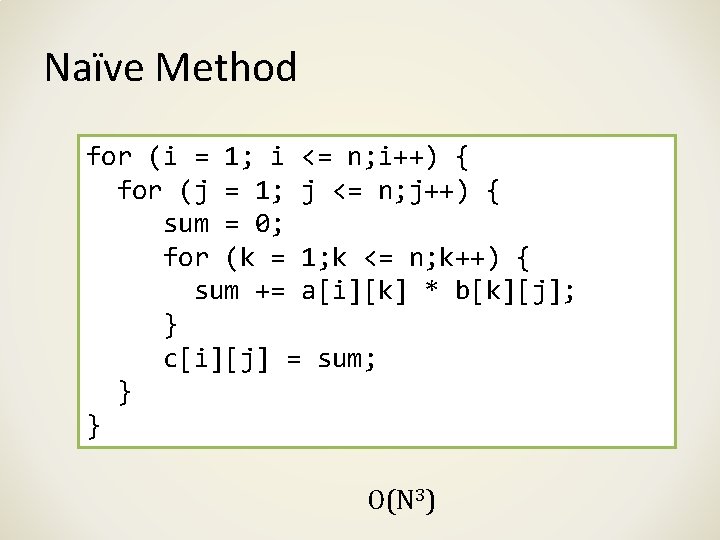
Naïve Method for (i = 1; i <= n; i++) { for (j = 1; j <= n; j++) { sum = 0; for (k = 1; k <= n; k++) { sum += a[i][k] * b[k][j]; } c[i][j] = sum; } } O(N 3)
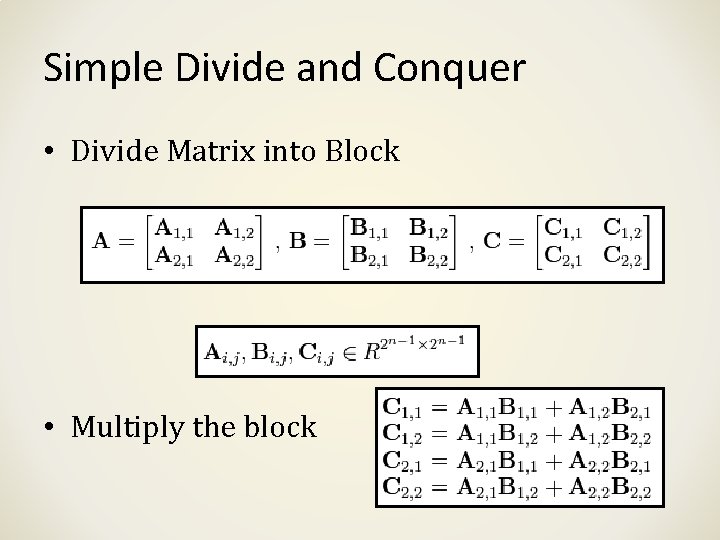
Simple Divide and Conquer • Divide Matrix into Block • Multiply the block
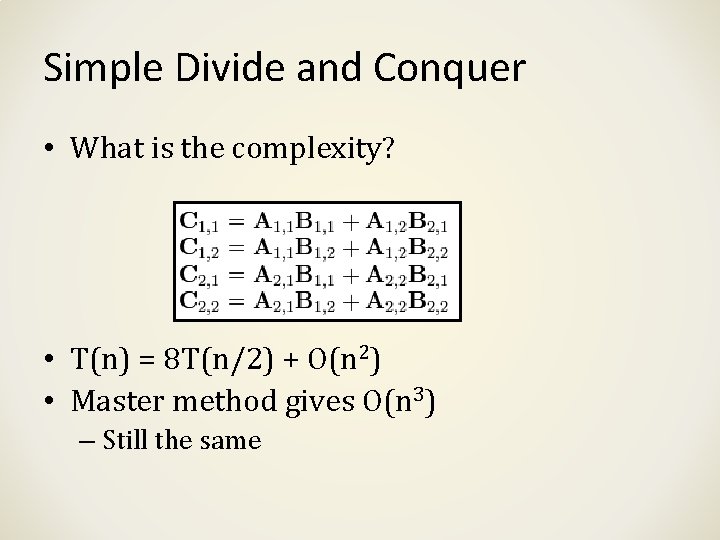
Simple Divide and Conquer • What is the complexity? • T(n) = 8 T(n/2) + O(n 2) • Master method gives O(n 3) – Still the same
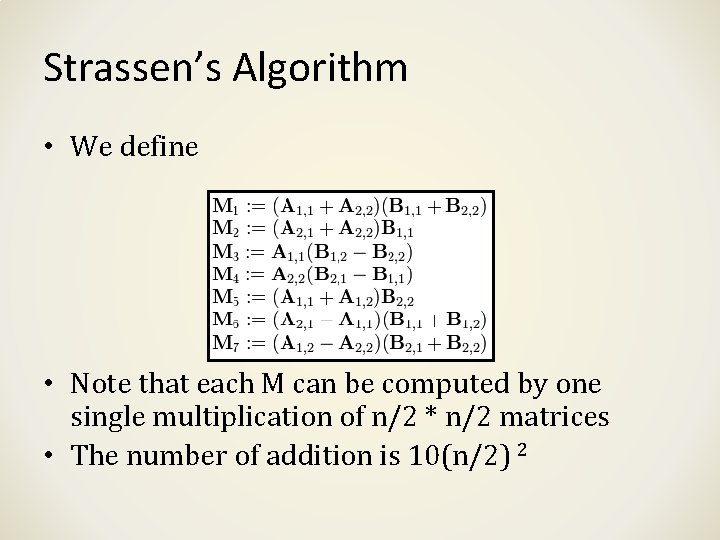
Strassen’s Algorithm • We define • Note that each M can be computed by one single multiplication of n/2 * n/2 matrices • The number of addition is 10(n/2) 2
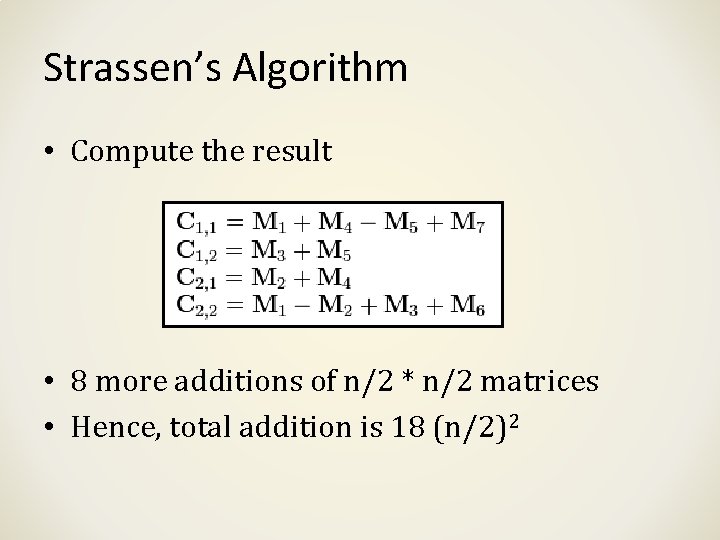
Strassen’s Algorithm • Compute the result • 8 more additions of n/2 * n/2 matrices • Hence, total addition is 18 (n/2)2
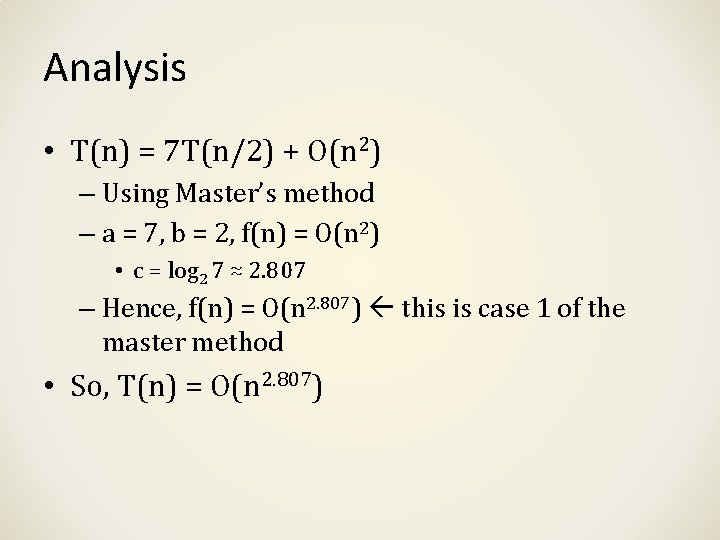
Analysis • T(n) = 7 T(n/2) + O(n 2) – Using Master’s method – a = 7, b = 2, f(n) = O(n 2) • c = log 2 7 ≈ 2. 807 – Hence, f(n) = O(n 2. 807) this is case 1 of the master method • So, T(n) = O(n 2. 807)