NORMATIVE PRINCIPLES Anil Talawar Assistant Professor Department of



- Slides: 24
NORMATIVE PRINCIPLES Anil Talawar Assistant Professor Department of library & information science, Karnatak university dharwad
Introduction Normative Principles: A model An authoritative standard A Law comprehending many subordinare truths A Law on which others are founded or others derived These have provided a scientific basis to the field of cataloguing
Cont 1. 2. 3. Ranganathan has adopted a convention regarding the use of terms Laws: major Discipline e. g. Library Science Canons: Division of the First order e. g. Cataloguing Principles: Division of Second order e. g. : Alphabetization in Cataloguing
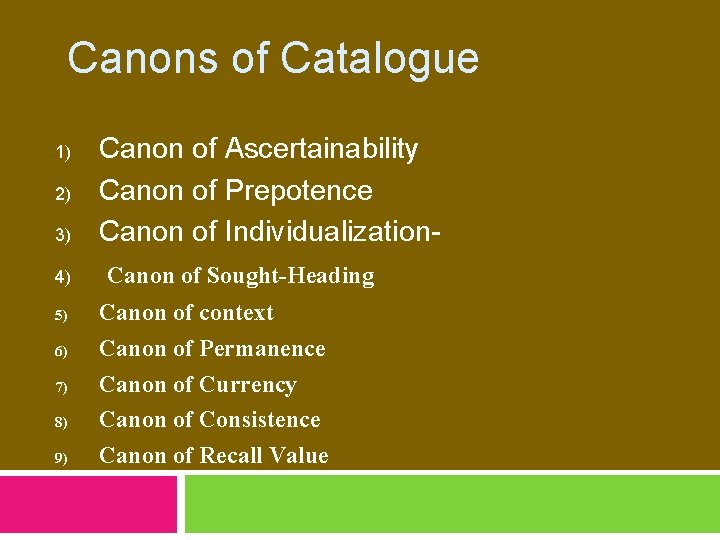
Canons of Catalogue 1) 2) 3) 4) 5) 6) 7) 8) 9) Canon of Ascertainability Canon of Prepotence Canon of Individualization. Canon of Sought-Heading Canon of context Canon of Permanence Canon of Currency Canon of Consistence Canon of Recall Value
Usefulness of N M The specific normative principles applicable to cataloguing-that is, to the Drafting of a Catalogue Code including the formulation of each rule; Interpretation of the rules to meet new situations brought up by a particular document or by changes in the practice of book production; and Provision of suitable guidance for cataloguing work.
Laws The specific normative principles applicable to any problems arising in library science, Library Service and library practice 1. Books are for use 2. Every reader his /her book 3. Every book its reader 4. Save the Time of the Reader 5. Library is a growing organism If any conflict arises between the canons, it is resolved by an appeal to the Five laws. Five Laws are like the Head of the state, in whose name and on whose authority, every govt. action is done by the ministers and the secretaries, without his explicit and immediate interention.
1. Canon of Ascertainability: - The principle prescribing that the information found in the title–page of the document catalogued and its over-flow pages should determine the choice.
2. Canon of Prepotence 1. Canon of Prepotence: The principle that The potency to decide the position of an entry among the various entries in a catalogue should, if possible, be concentrated totally in the Leading section; and even there 2. It should be concentrated, as much as possible , in the entry element; and further 3. If total concentration in the Leading Section is not possible, the minimum possible potency should be allowed to overflow beyond it later sections ; and 4. Even this spill-over should be distributed in the later sections in a decreasing sequence of intensity.
3. Canon of Individualization- The principle that the name of any entity-be it of a person, a geographical entity, a corporate body, a series, a document , a subject, or a language –used as the Hearing of a catalogue entry should be made to denote one and only one entity, by adding to it the necessary and sufficient number of Individualizing Elements
4. Canon of Sought-Heading-The principle that the decision whether an entry. 1. With a particular type of heading, or 2. With a particular choice for that heading, or 3. With a particular rendering of that choice, or 4. A particular added entry arising out of it, should be based on the answer to the question: ”Is reader or library staff likely to look for a book under the particular type or choice or rendering of heading or in the particular added entry.
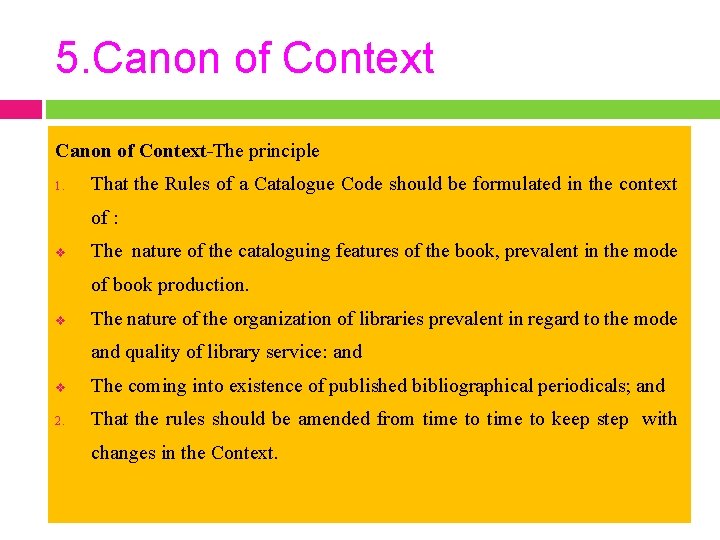
5. Canon of Context-The principle 1. That the Rules of a Catalogue Code should be formulated in the context of : v The nature of the cataloguing features of the book, prevalent in the mode of book production. v The nature of the organization of libraries prevalent in regard to the mode and quality of library service: and v The coming into existence of published bibliographical periodicals; and 2. That the rules should be amended from time to keep step with changes in the Context.
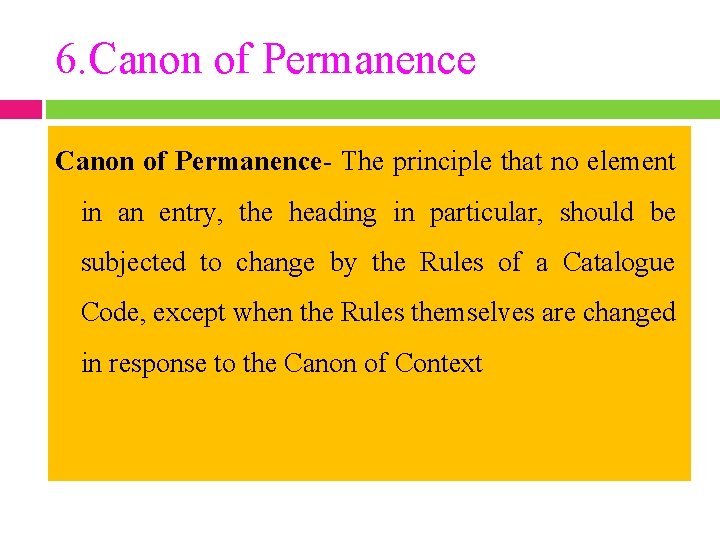
6. Canon of Permanence- The principle that no element in an entry, the heading in particular, should be subjected to change by the Rules of a Catalogue Code, except when the Rules themselves are changed in response to the Canon of Context
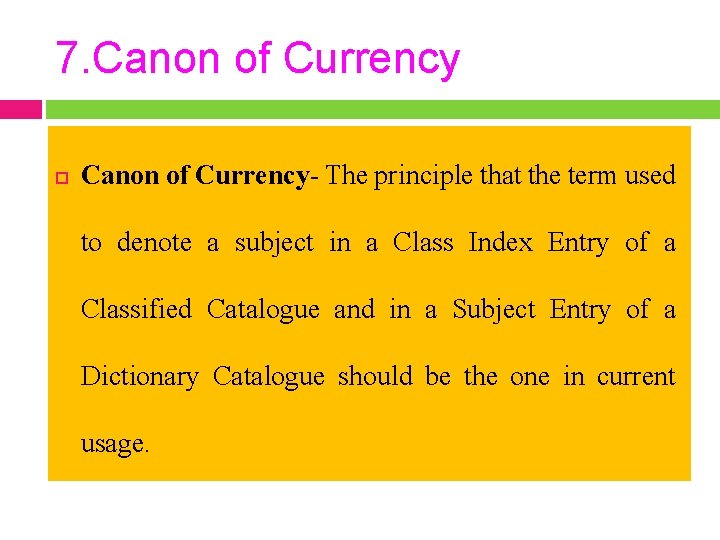
7. Canon of Currency- The principle that the term used to denote a subject in a Class Index Entry of a Classified Catalogue and in a Subject Entry of a Dictionary Catalogue should be the one in current usage.
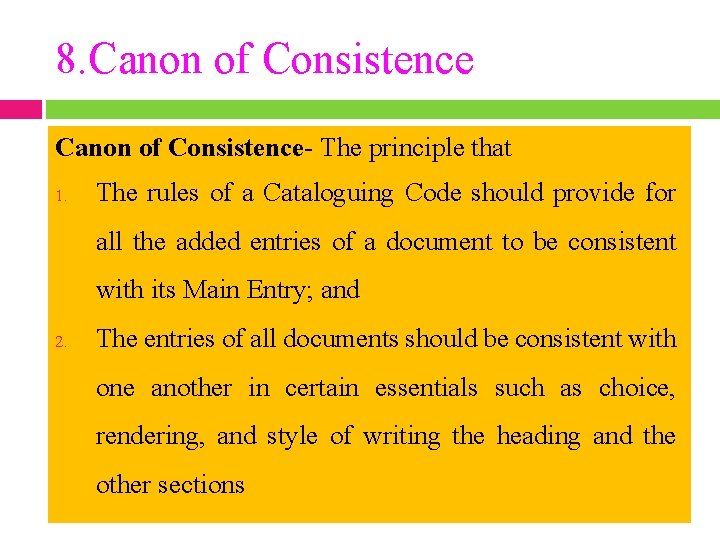
8. Canon of Consistence- The principle that 1. The rules of a Cataloguing Code should provide for all the added entries of a document to be consistent with its Main Entry; and 2. The entries of all documents should be consistent with one another in certain essentials such as choice, rendering, and style of writing the heading and the other sections
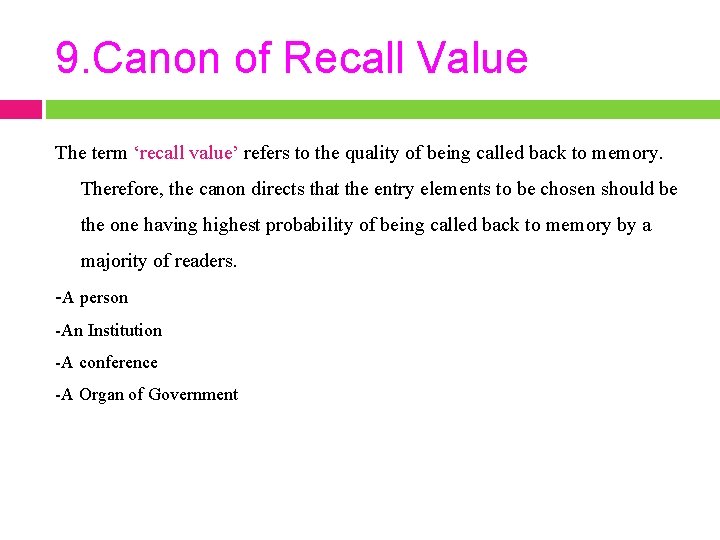
9. Canon of Recall Value The term ‘recall value’ refers to the quality of being called back to memory. Therefore, the canon directs that the entry elements to be chosen should be the one having highest probability of being called back to memory by a majority of readers. -A person -An Institution -A conference -A Organ of Government
cont General Normative Principles
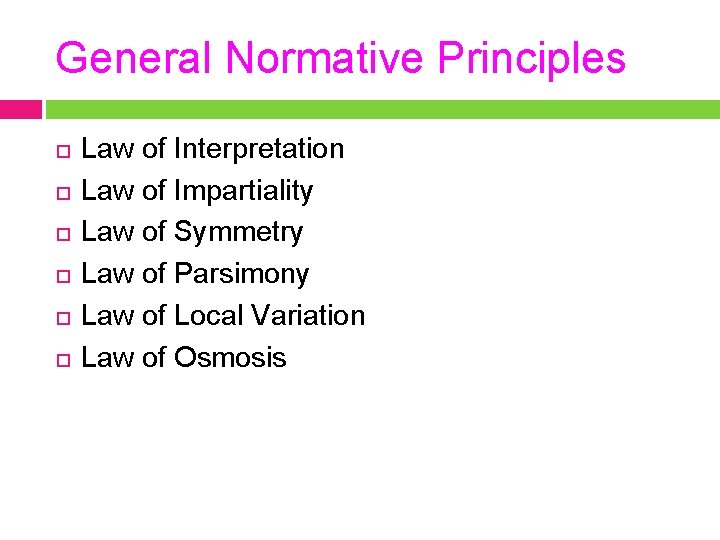
General Normative Principles Law of Interpretation Law of Impartiality Law of Symmetry Law of Parsimony Law of Local Variation Law of Osmosis
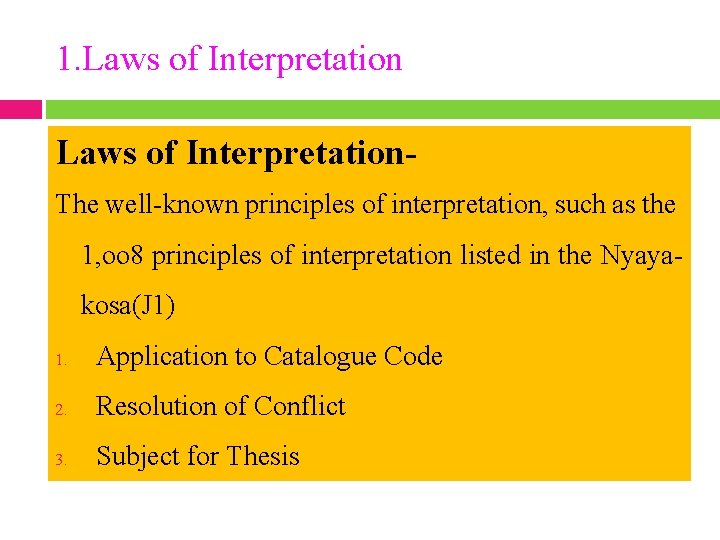
1. Laws of Interpretation. The well-known principles of interpretation, such as the 1, oo 8 principles of interpretation listed in the Nyayakosa(J 1) 1. Application to Catalogue Code 2. Resolution of Conflict 3. Subject for Thesis
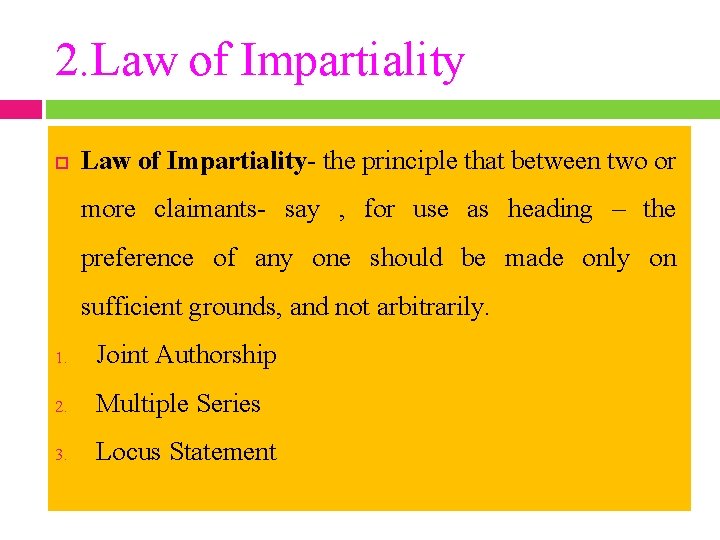
2. Law of Impartiality- the principle that between two or more claimants- say , for use as heading – the preference of any one should be made only on sufficient grounds, and not arbitrarily. 1. Joint Authorship 2. Multiple Series 3. Locus Statement
3. Law of Symmetry-The principle that of two entities or situations which admit of being regarded as symmetrical counter-parts of each other, if one of the entities or the situations is given weight in any particular context, the other entity or situation should also be given a corresponding weight. 1. Joint Authorship 2. Concurrent Prescription 3. Conflict with Law of Parsimony
4. Law of Parsimony – The principle that between two or more possible alternative rules bearing on a particular phenomenon, the one leading to overall economy of man-power, material, money, and time considered together with proper weightage, is to be preferred. 1. Sorbing the Chain Procedure 2. Pruning According to Context 3. Printed vs. Written Card
5. Principle of Local Variation-The principle that 1. The International Catalogue Code should mark out the factors to be left to the care of each National Catalogue Code. 2. A National Catalogue Code should mark out the factors to be left to the care of each Linguistic Catalogue Code in a multilingual country such as India; 3. A National Catalogue Code or a Linguistic Catalogue Code, as the case may be, should mark out the factors, to be left to the care of Local Catalogue Code of each individual library; 4. The Catalogue Codes in each hierarchical line should be consistent with one another without any mutual contradiction; and 5. Each lower link in each hierarchical line should be a Supplement to all the upper links taken together.
6. Principle of Osmosis- The principle that, when a change in the Catalogue Code or in the Scheme of Classification becomes necessary in deference to the Canon of Context, on and after a chosen date 1. All the new accessions be catalogued and classified according to the new Catalogue Code and new Scheme of Classification. 2. Just those of the old collection as are known to be in much use be recatalogued and reclassified, with an additional temporary staff, if necessary, during the first few months; 3. The new accession and the recatalogued and reclassified books be kept in New Collection;
Cont 4. The rest of the old collection be kept as old collection and similarly their catalogue cards too be kept as Old Collection; 5. Reader’s attention be invited by Reference Librarian to the existence of the Two Collection; 6. If any book is taken out by a reader from the Old Collection, on its return by him it be recatalogued and reclassified and absorbed in the New Collection and Similarly with its catalogue cards