
Know Your Transcriptome Integrative Bioinformatic Approaches Anil Jegga
Know Your Transcriptome Integrative Bioinformatic Approaches Anil Jegga Biomedical Informatics Contact Information: Anil Jegga Biomedical Informatics Room # 232, S Building 10 th Floor CCHMC Homepage: http: //anil. cchmc. org Tel: 513 -636 -0261 E-mail: anil. jegga@cchmc. org
Slides and Example data sets available for download at: http: //anil. cchmc. org/dhc. html Workshop Evaluation: Please provide your valuable feedback on the evaluation sheet provided along with the hand-outs This workshop is about the analysis of transcriptome and does not cover microarray data analysis Contact Huan Xu (huan. xu@cchmc. org for Gene. Spring related questions or microarray data analysis All the applications/servers/databases used in this workshop are free for academic-use. Applications that are not free for use (e. g. Ingenuity Pathway Analysis, Mat. Inspector, etc. ) are not covered here. However, we have licensed access to both of these and please contact us if you are interested in using them.
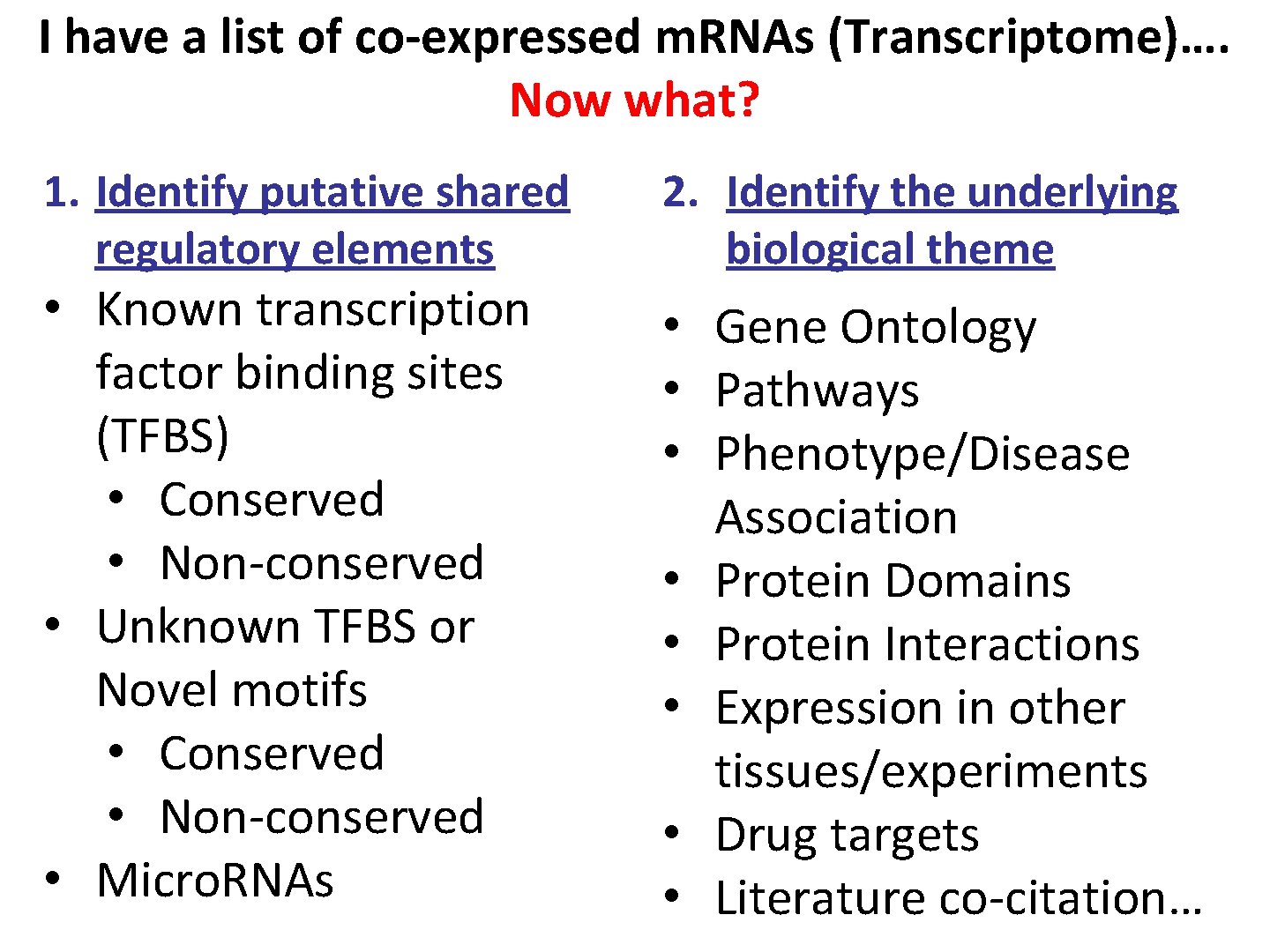
I have a list of co-expressed m. RNAs (Transcriptome)…. Now what? 1. Identify putative shared regulatory elements • Known transcription factor binding sites (TFBS) • Conserved • Non-conserved • Unknown TFBS or Novel motifs • Conserved • Non-conserved • Micro. RNAs 2. Identify the underlying biological theme • Gene Ontology • Pathways • Phenotype/Disease Association • Protein Domains • Protein Interactions • Expression in other tissues/experiments • Drug targets • Literature co-citation…
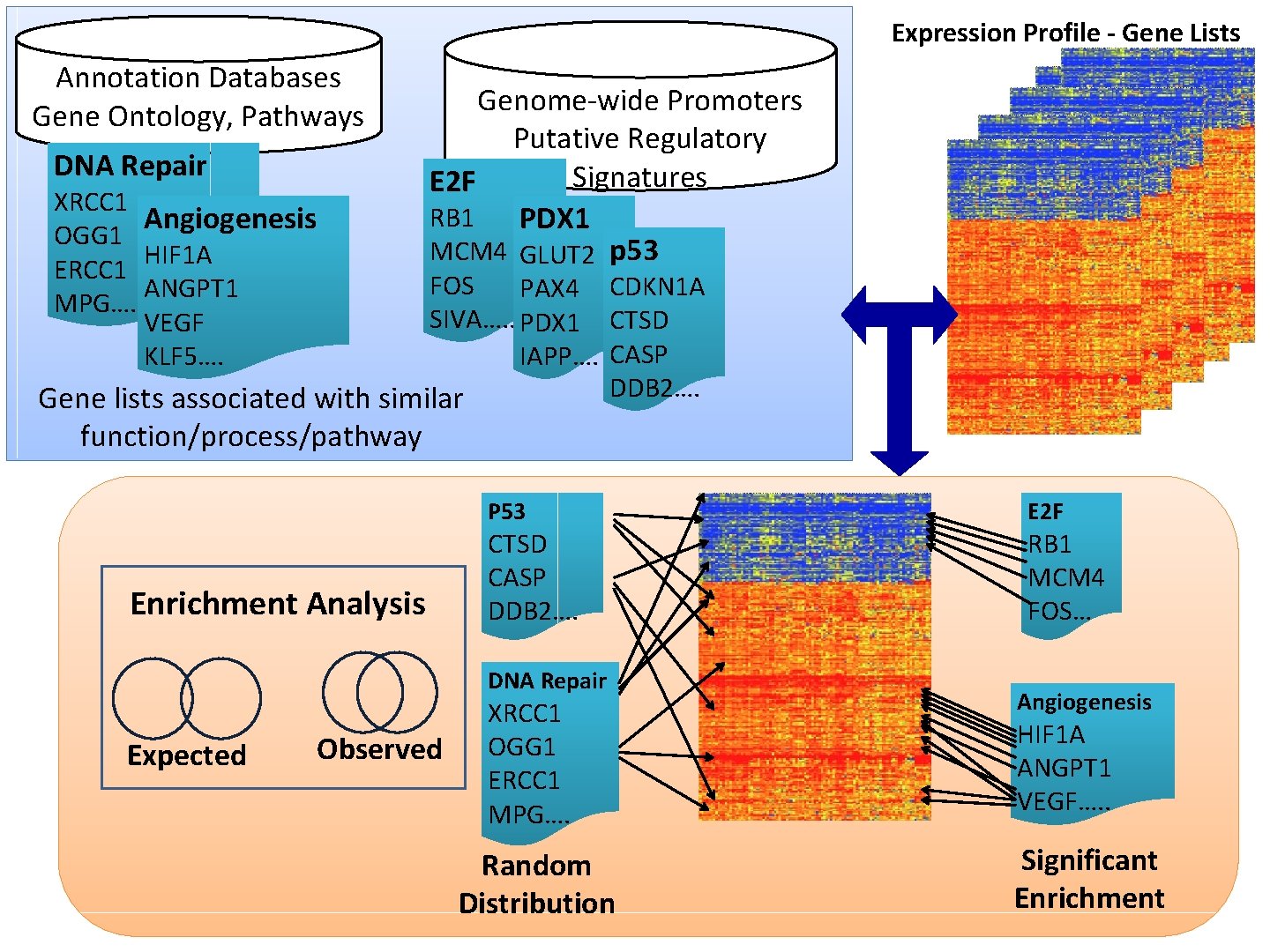
Expression Profile - Gene Lists Annotation Databases Gene Ontology, Pathways DNA Repair XRCC 1 Angiogenesis OGG 1 HIF 1 A ERCC 1 ANGPT 1 MPG…. . VEGF KLF 5…. Genome-wide Promoters Putative Regulatory Signatures E 2 F RB 1 PDX 1 MCM 4 GLUT 2 p 53 FOS PAX 4 CDKN 1 A SIVA…. . PDX 1 CTSD IAPP…. CASP DDB 2…. Gene lists associated with similar function/process/pathway P 53 Enrichment Analysis CTSD CASP DDB 2…. DNA Repair Expected Observed XRCC 1 OGG 1 ERCC 1 MPG…. Random Distribution E 2 F RB 1 MCM 4 FOS… Angiogenesis HIF 1 A ANGPT 1 VEGF…. . Significant Enrichment
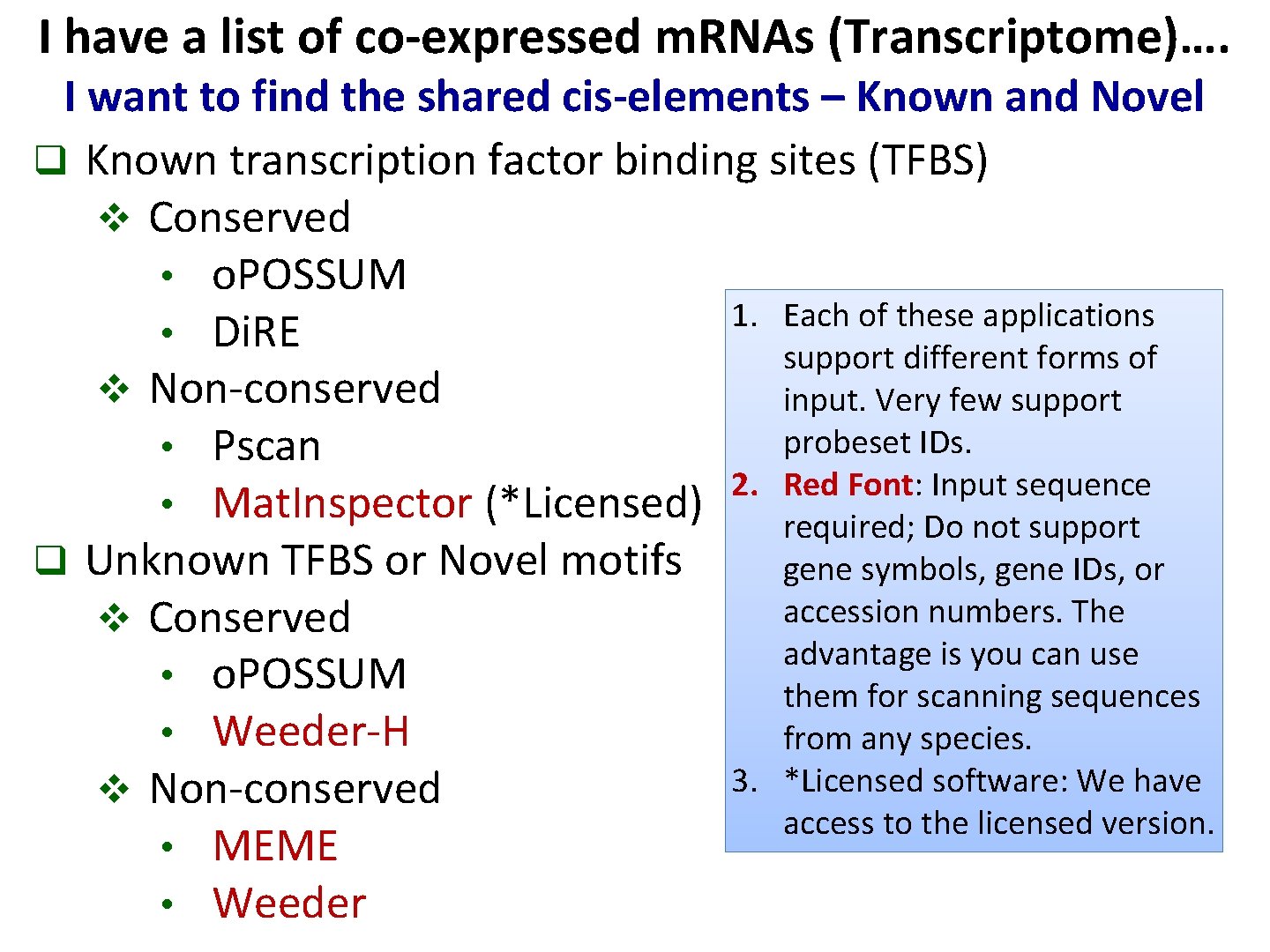
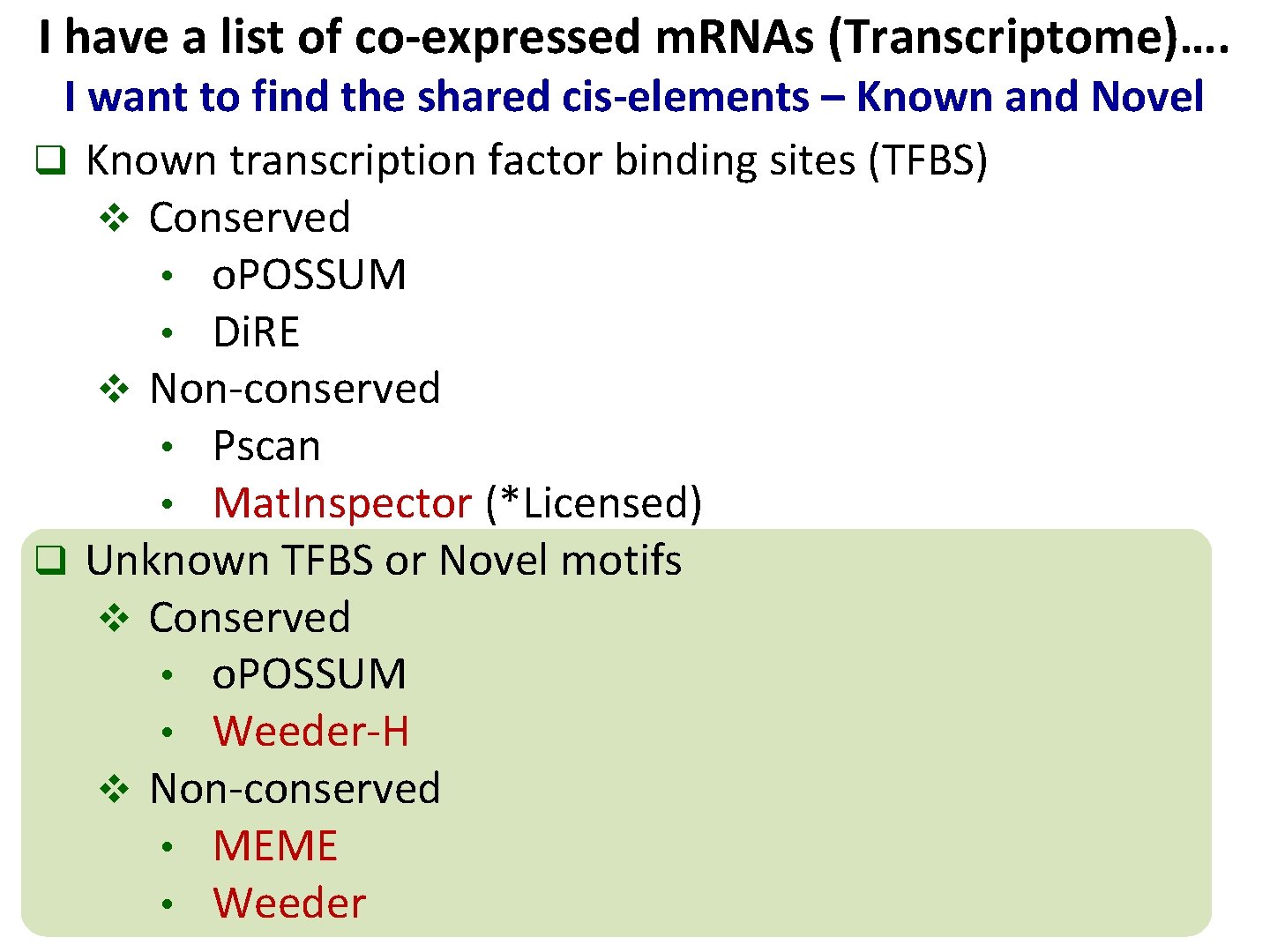
I have a list of co-expressed m. RNAs (Transcriptome)…. I want to find the shared cis-elements – Known and Novel q Known transcription factor binding sites (TFBS) v Conserved • o. POSSUM 1. Each of these applications • Di. RE support different forms of v Non-conserved input. Very few support probeset IDs. • Pscan 2. Red Font: Input sequence • Mat. Inspector (*Licensed) required; Do not support q Unknown TFBS or Novel motifs gene symbols, gene IDs, or accession numbers. The v Conserved advantage is you can use • o. POSSUM them for scanning sequences • Weeder-H from any species. 3. *Licensed software: We have v Non-conserved access to the licensed version. • MEME • Weeder
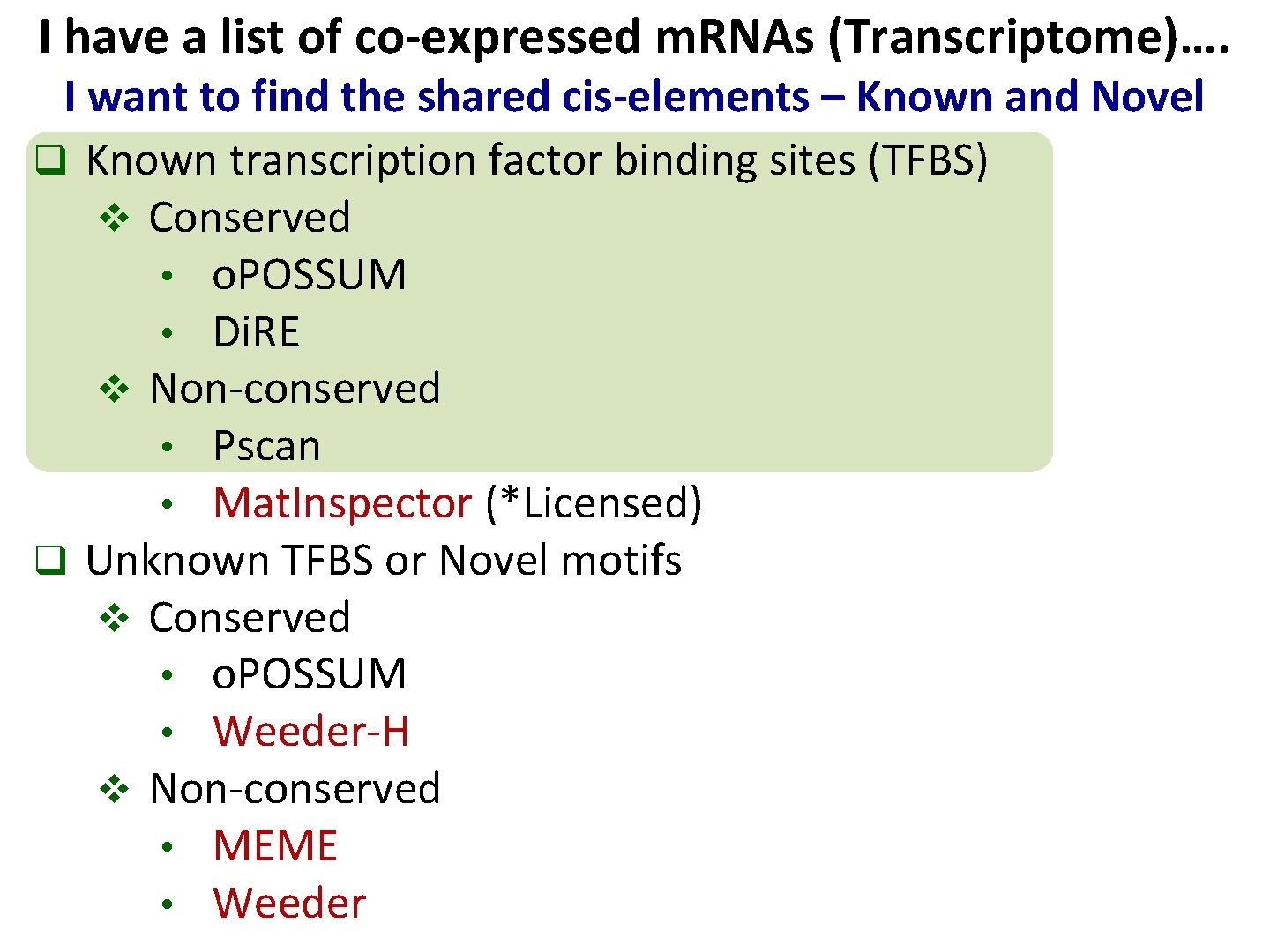
I have a list of co-expressed m. RNAs (Transcriptome)…. I want to find the shared cis-elements – Known and Novel q Known transcription factor binding sites (TFBS) v Conserved • o. POSSUM • Di. RE v Non-conserved • Pscan • Mat. Inspector (*Licensed) q Unknown TFBS or Novel motifs v Conserved • o. POSSUM • Weeder-H v Non-conserved • MEME • Weeder
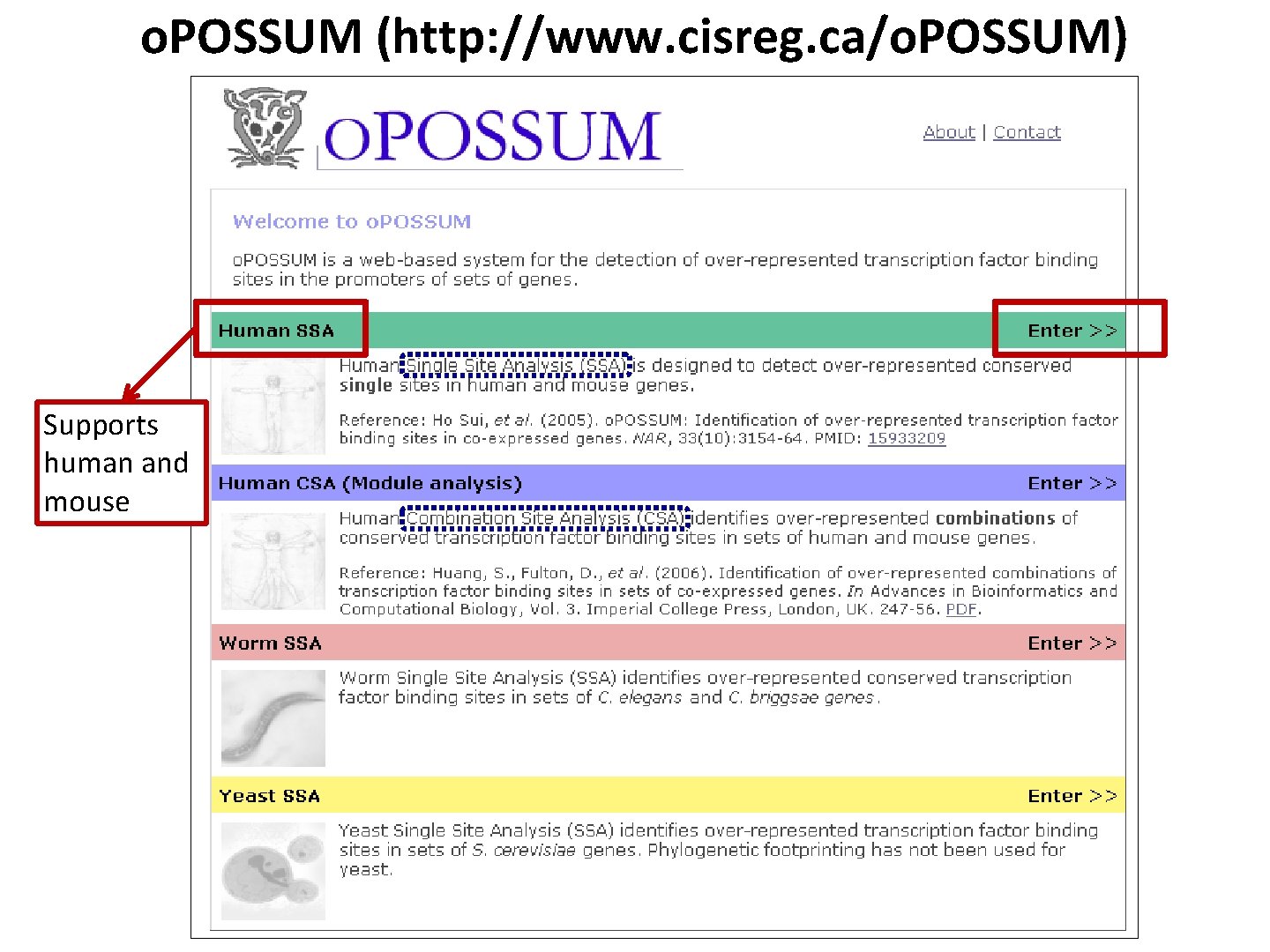
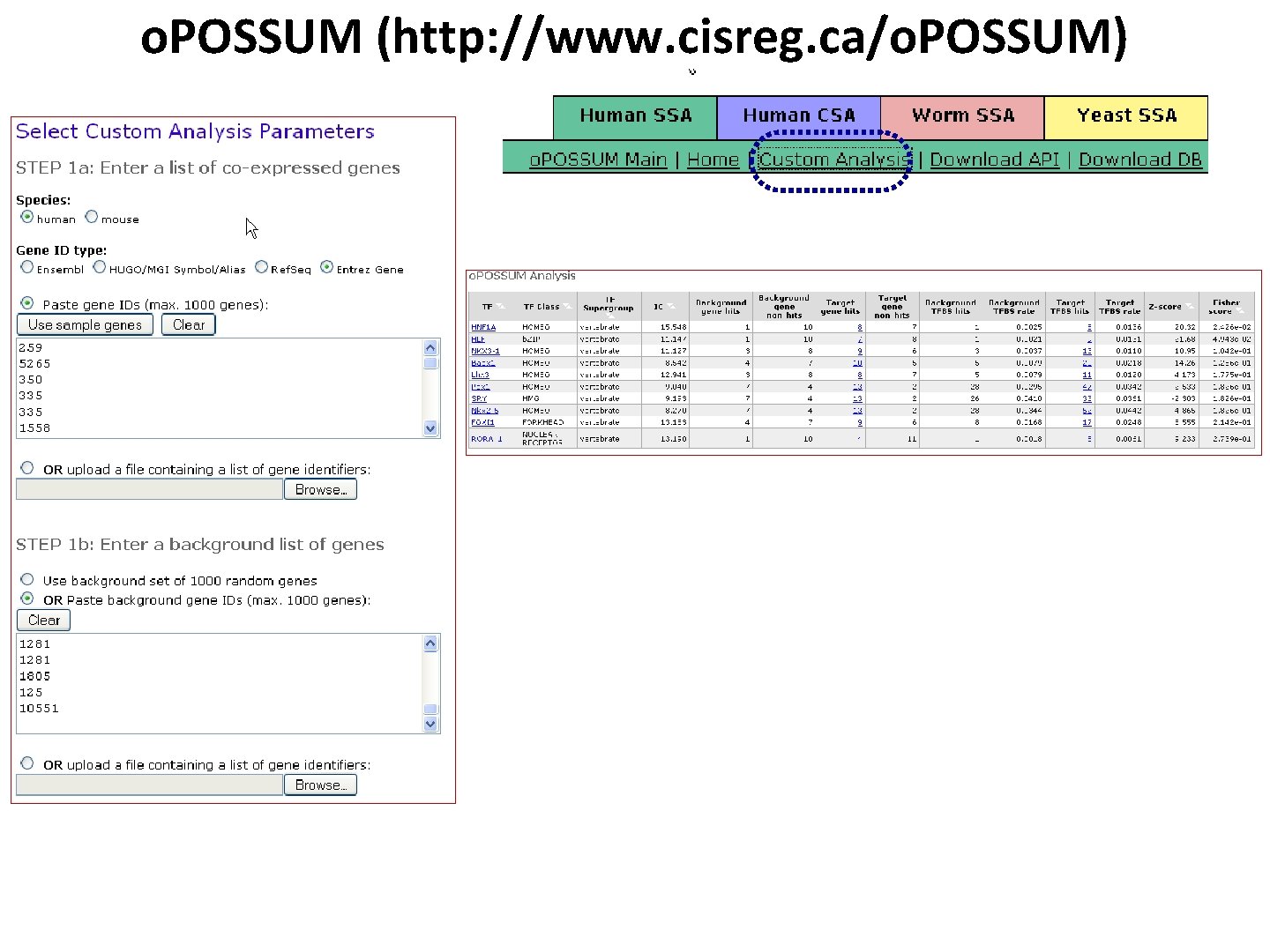
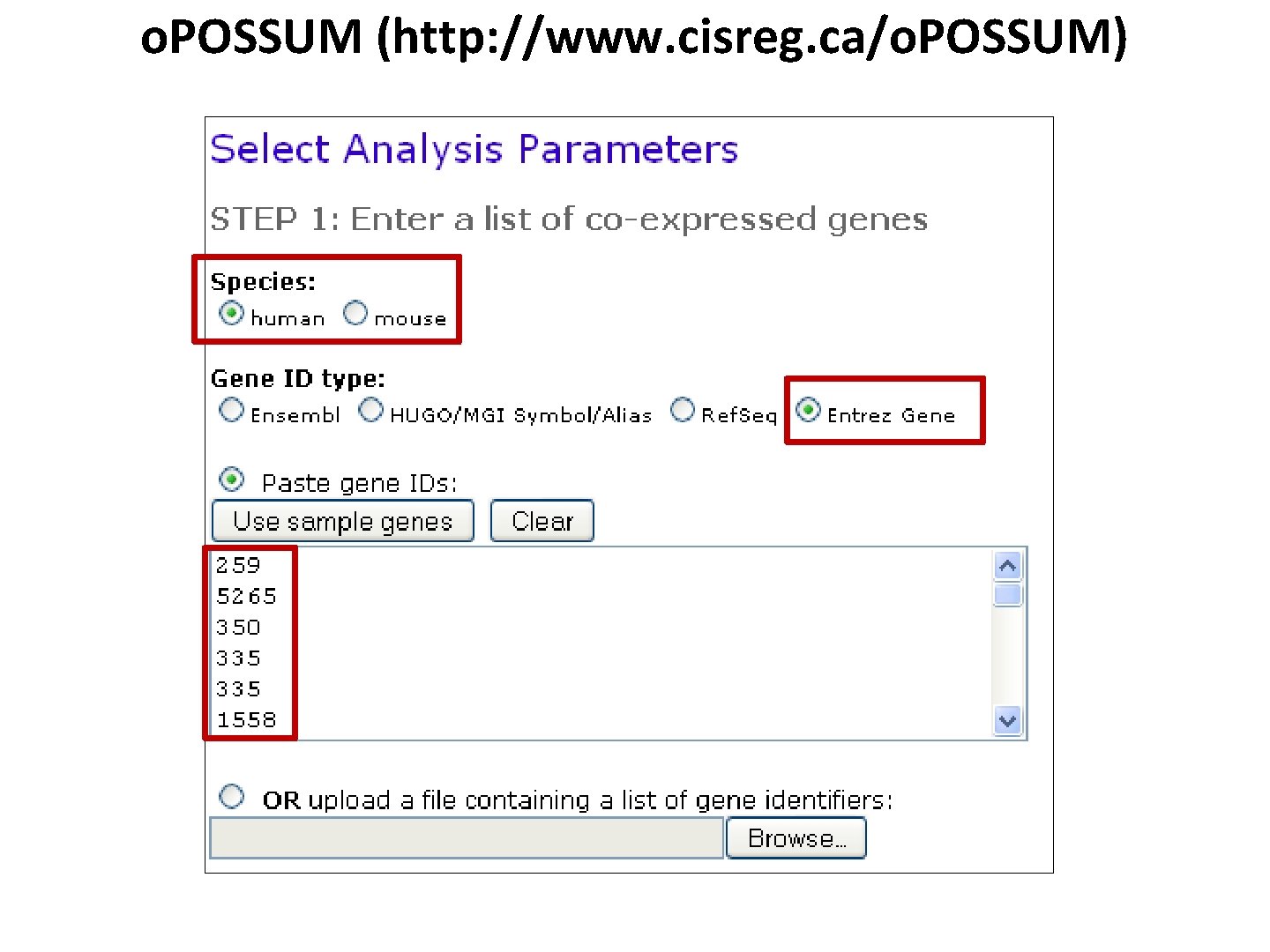
o. POSSUM (http: //www. cisreg. ca/o. POSSUM) Supports human and mouse
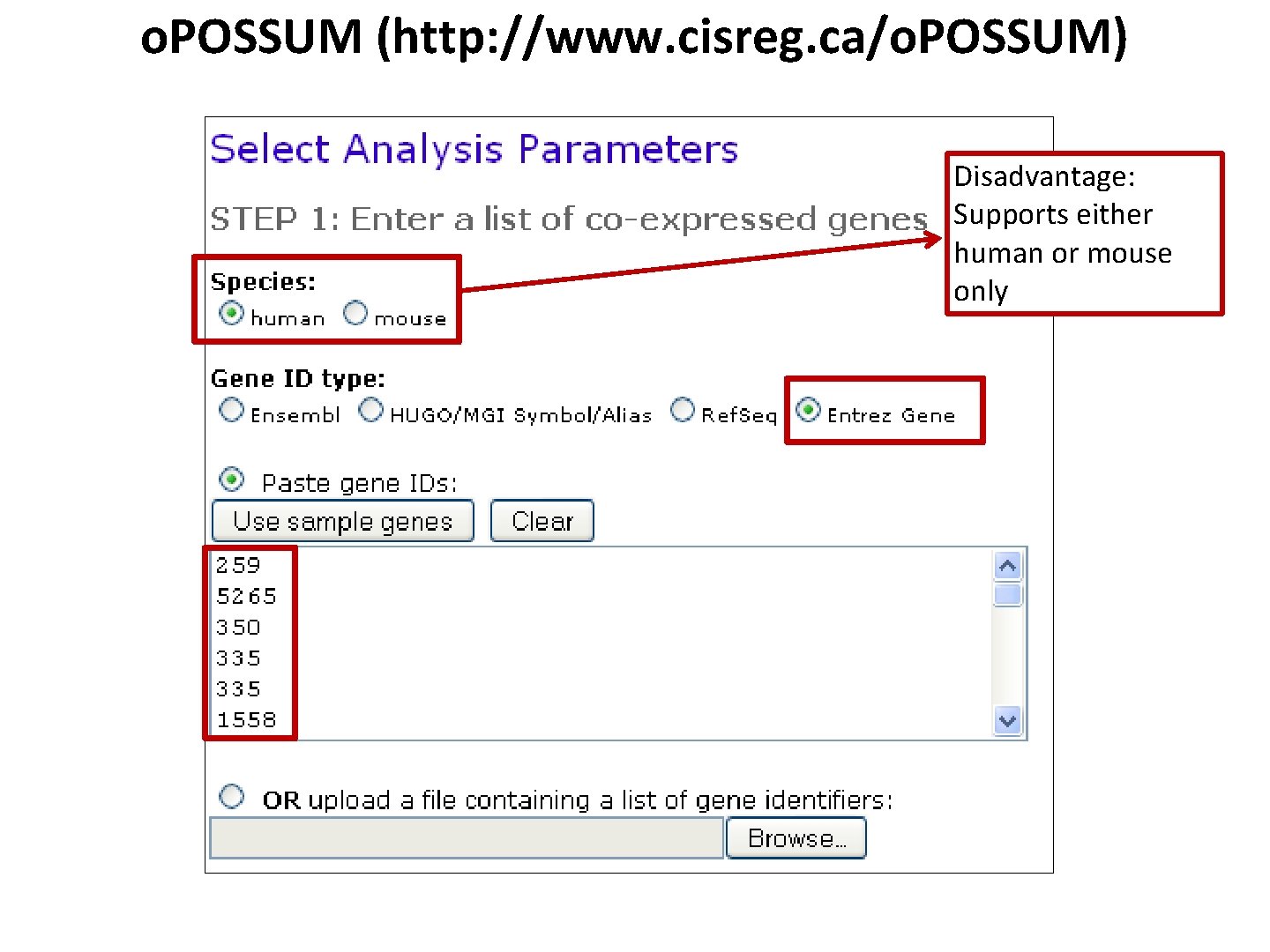
o. POSSUM (http: //www. cisreg. ca/o. POSSUM) Disadvantage: Supports either human or mouse only
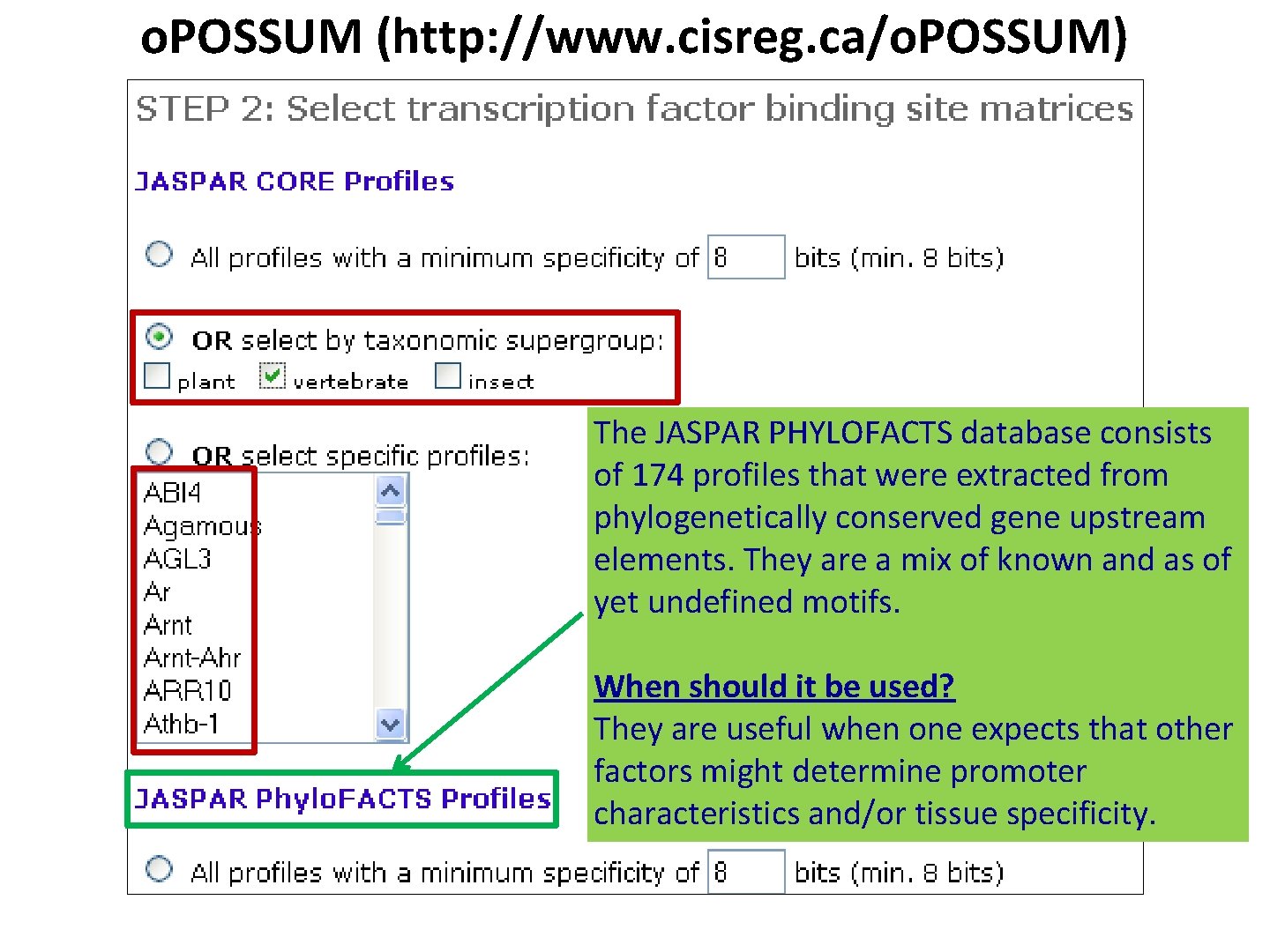
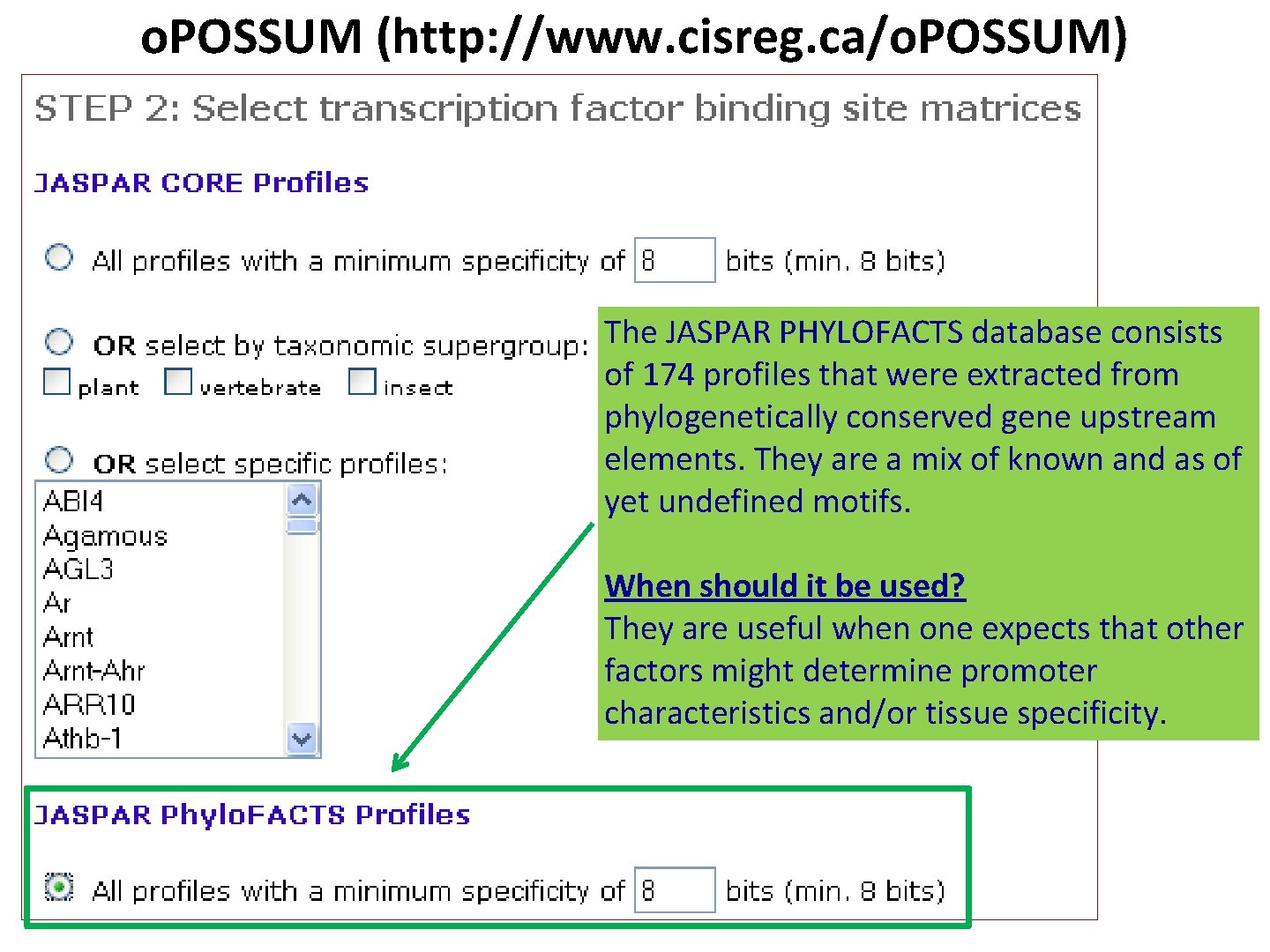
o. POSSUM (http: //www. cisreg. ca/o. POSSUM) The JASPAR PHYLOFACTS database consists of 174 profiles that were extracted from phylogenetically conserved gene upstream elements. They are a mix of known and as of yet undefined motifs. When should it be used? They are useful when one expects that other factors might determine promoter characteristics and/or tissue specificity.
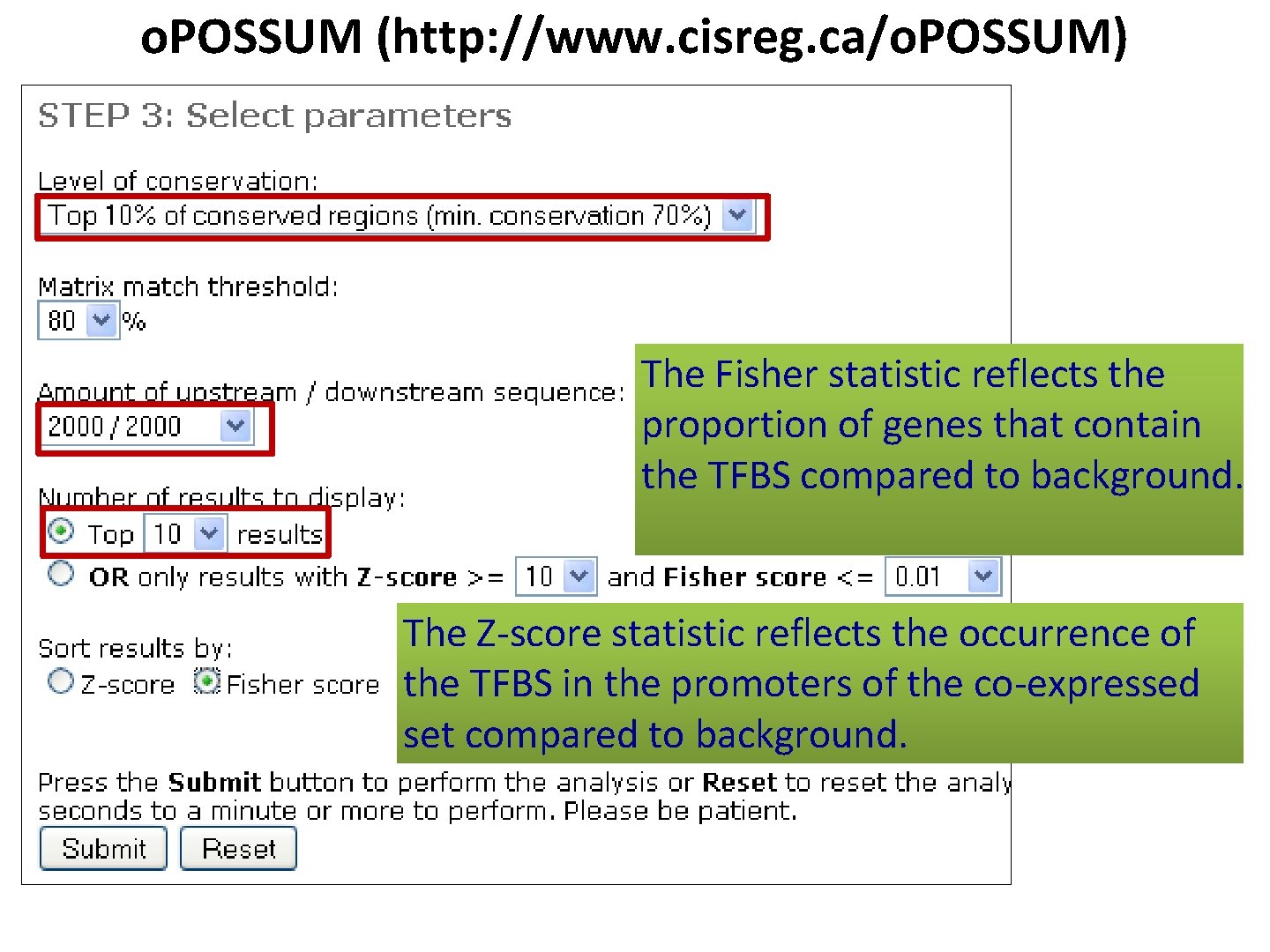
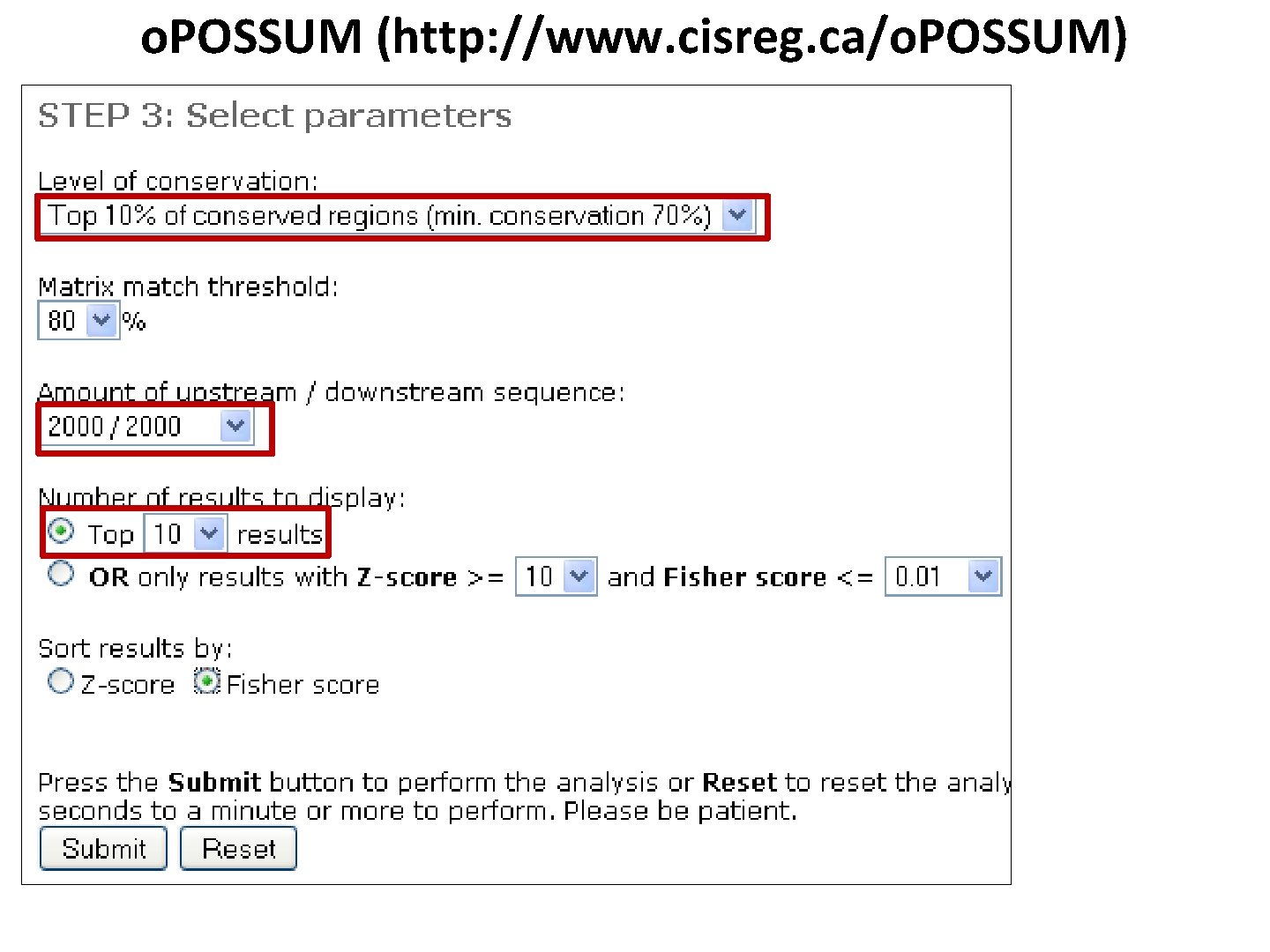
o. POSSUM (http: //www. cisreg. ca/o. POSSUM) The Fisher statistic reflects the proportion of genes that contain the TFBS compared to background. The Z-score statistic reflects the occurrence of the TFBS in the promoters of the co-expressed set compared to background.
o. POSSUM (http: //www. cisreg. ca/o. POSSUM)
o. POSSUM (http: //www. cisreg. ca/o. POSSUM)
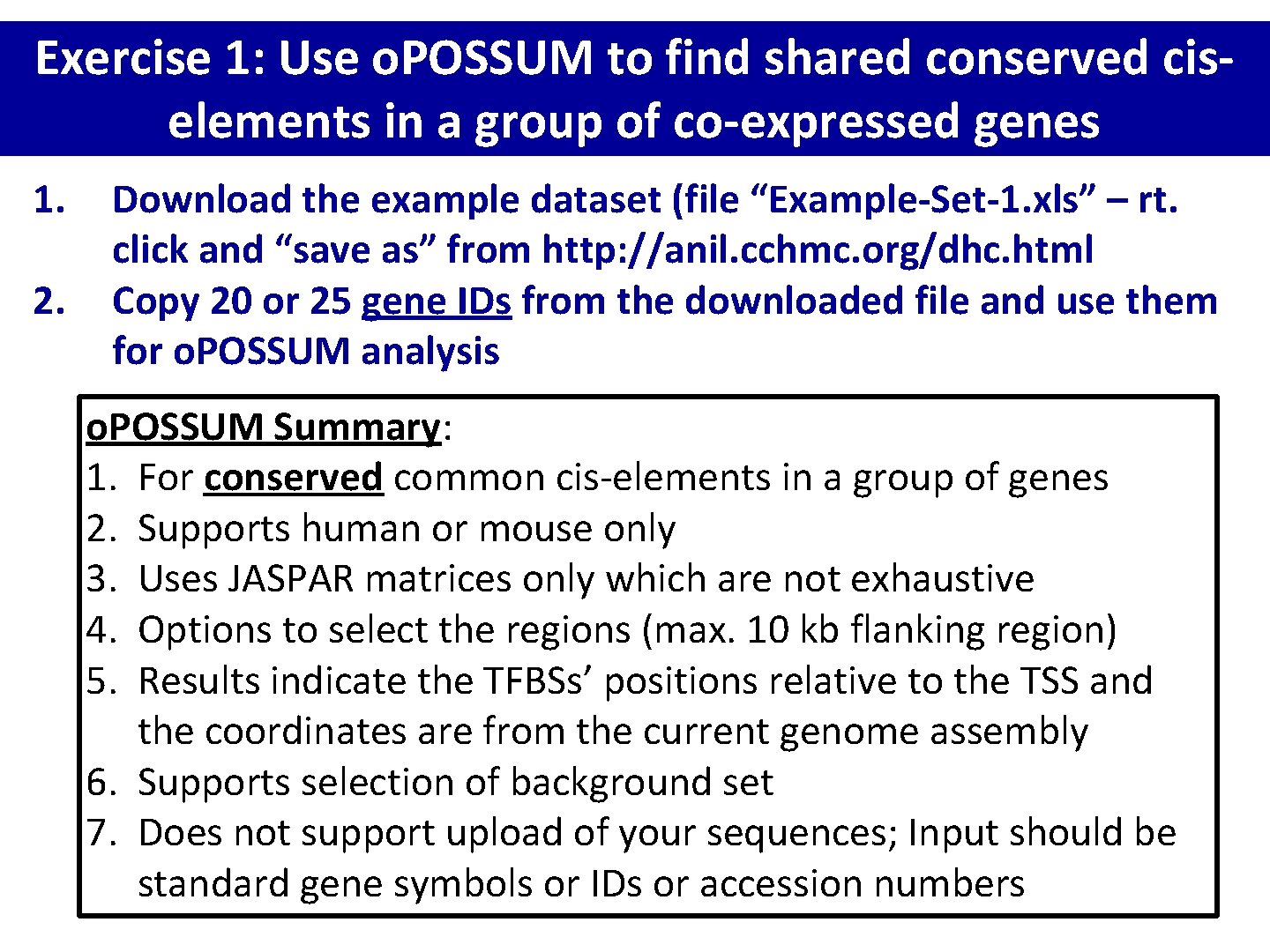
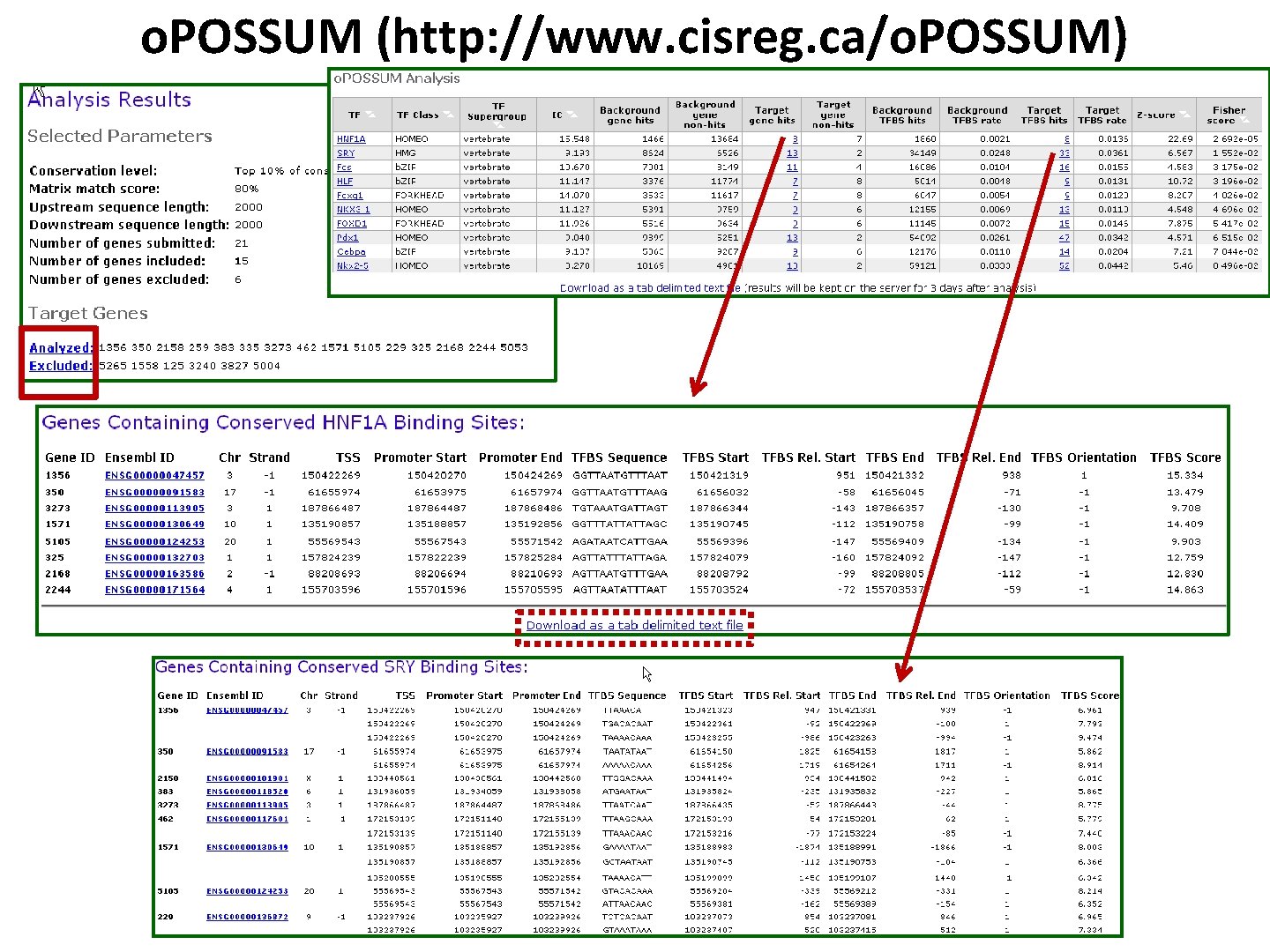
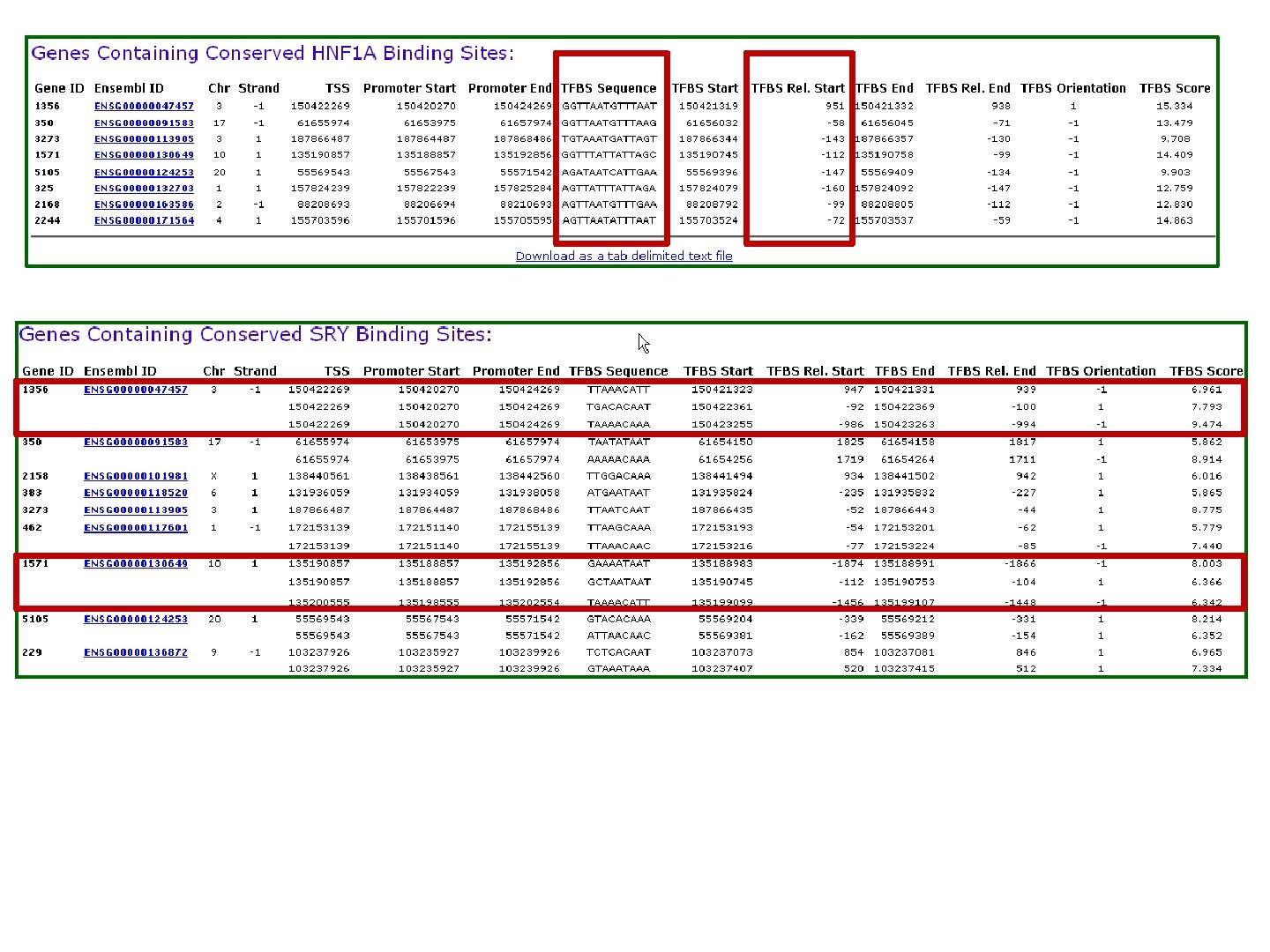
Exercise 1: Use o. POSSUM to find shared conserved ciselements in a group of co-expressed genes 1. 2. Download the example dataset (file “Example-Set-1. xls” – rt. click and “save as” from http: //anil. cchmc. org/dhc. html Copy 20 or 25 gene IDs from the downloaded file and use them for o. POSSUM analysis o. POSSUM Summary: 1. For conserved common cis-elements in a group of genes 2. Supports human or mouse only 3. Uses JASPAR matrices only which are not exhaustive 4. Options to select the regions (max. 10 kb flanking region) 5. Results indicate the TFBSs’ positions relative to the TSS and the coordinates are from the current genome assembly 6. Supports selection of background set 7. Does not support upload of your sequences; Input should be standard gene symbols or IDs or accession numbers
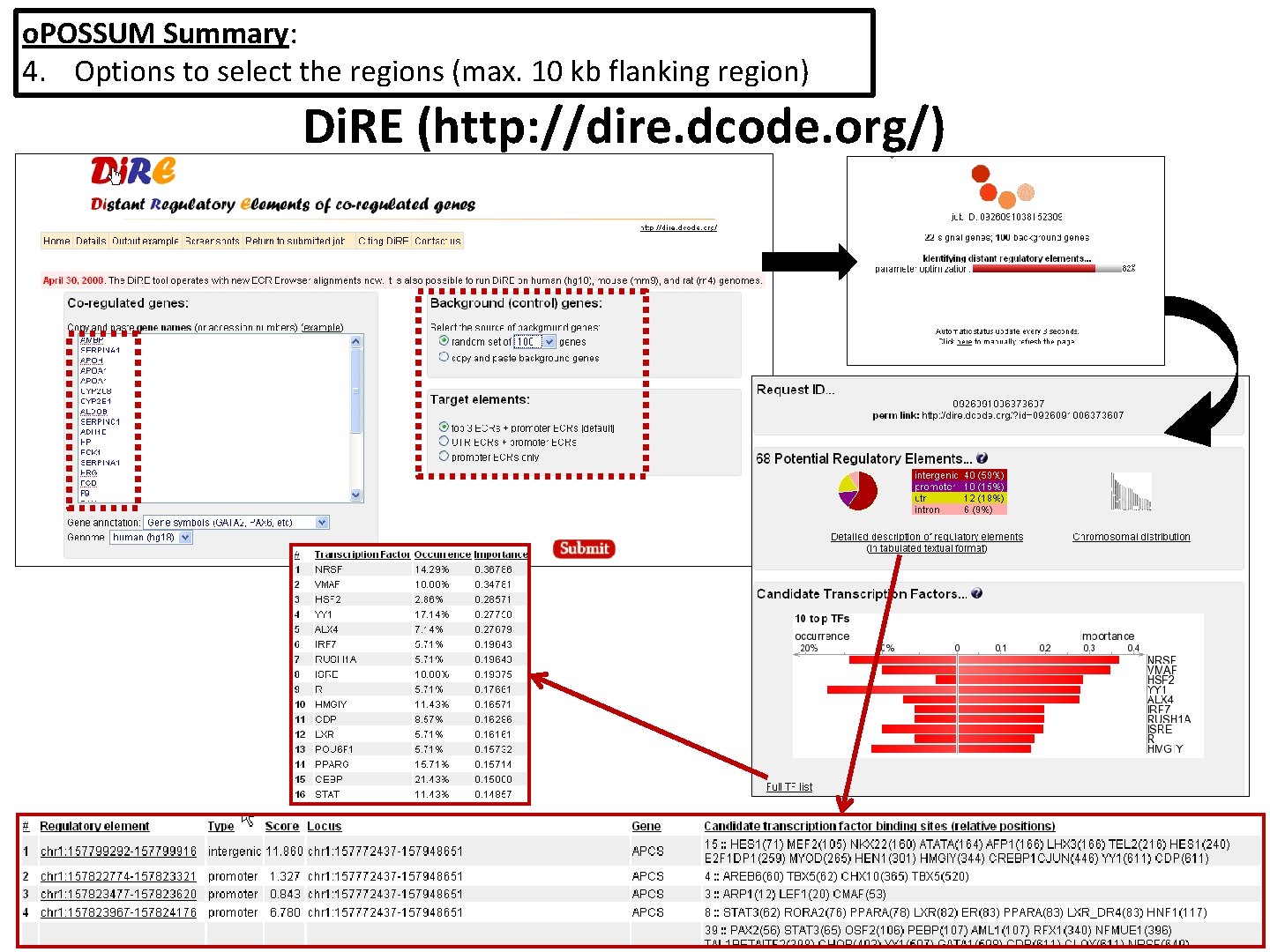
o. POSSUM Summary: 4. Options to select the regions (max. 10 kb flanking region) Di. RE (http: //dire. dcode. org/)
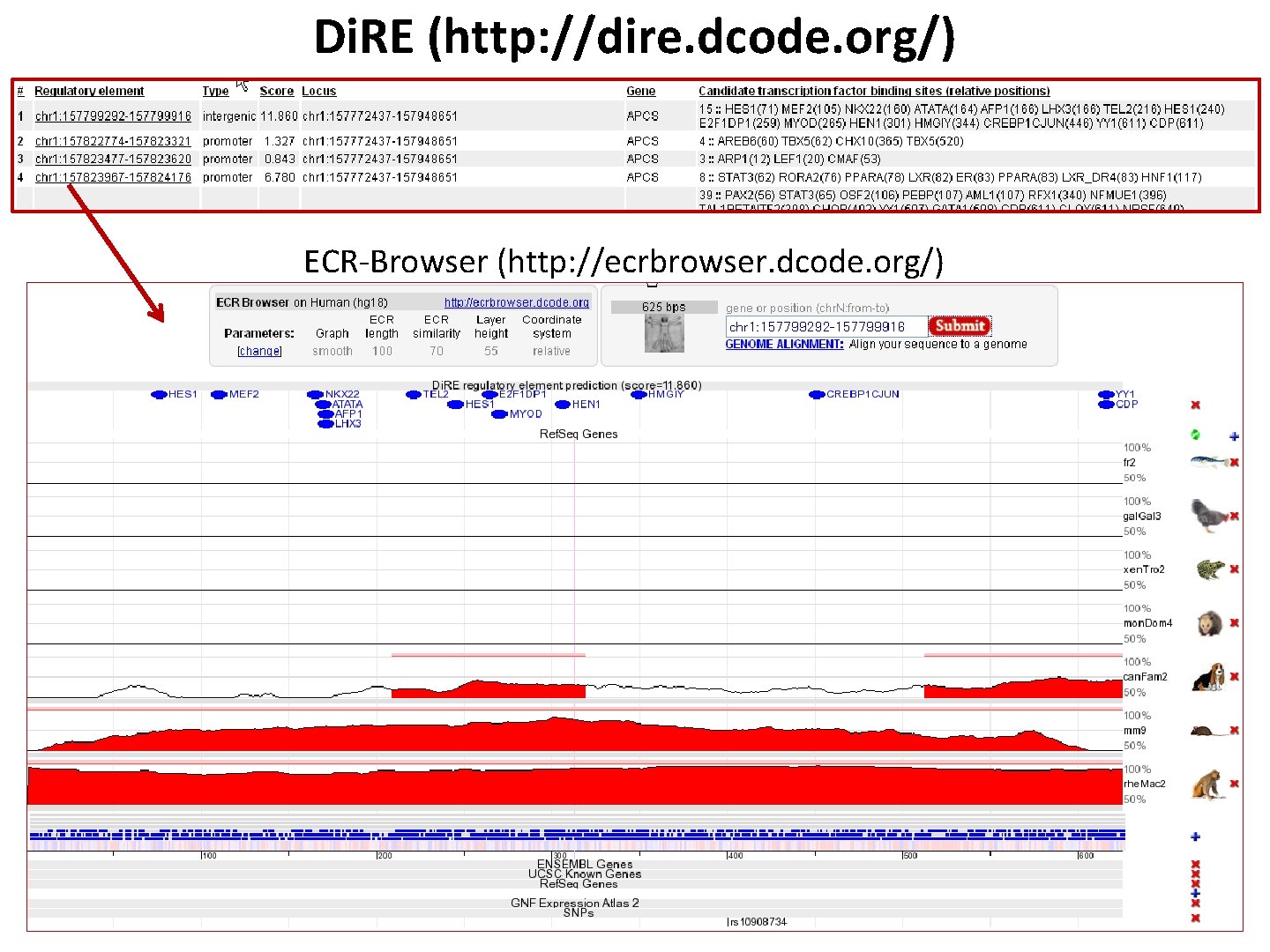
Di. RE (http: //dire. dcode. org/) ECR-Browser (http: //ecrbrowser. dcode. org/)
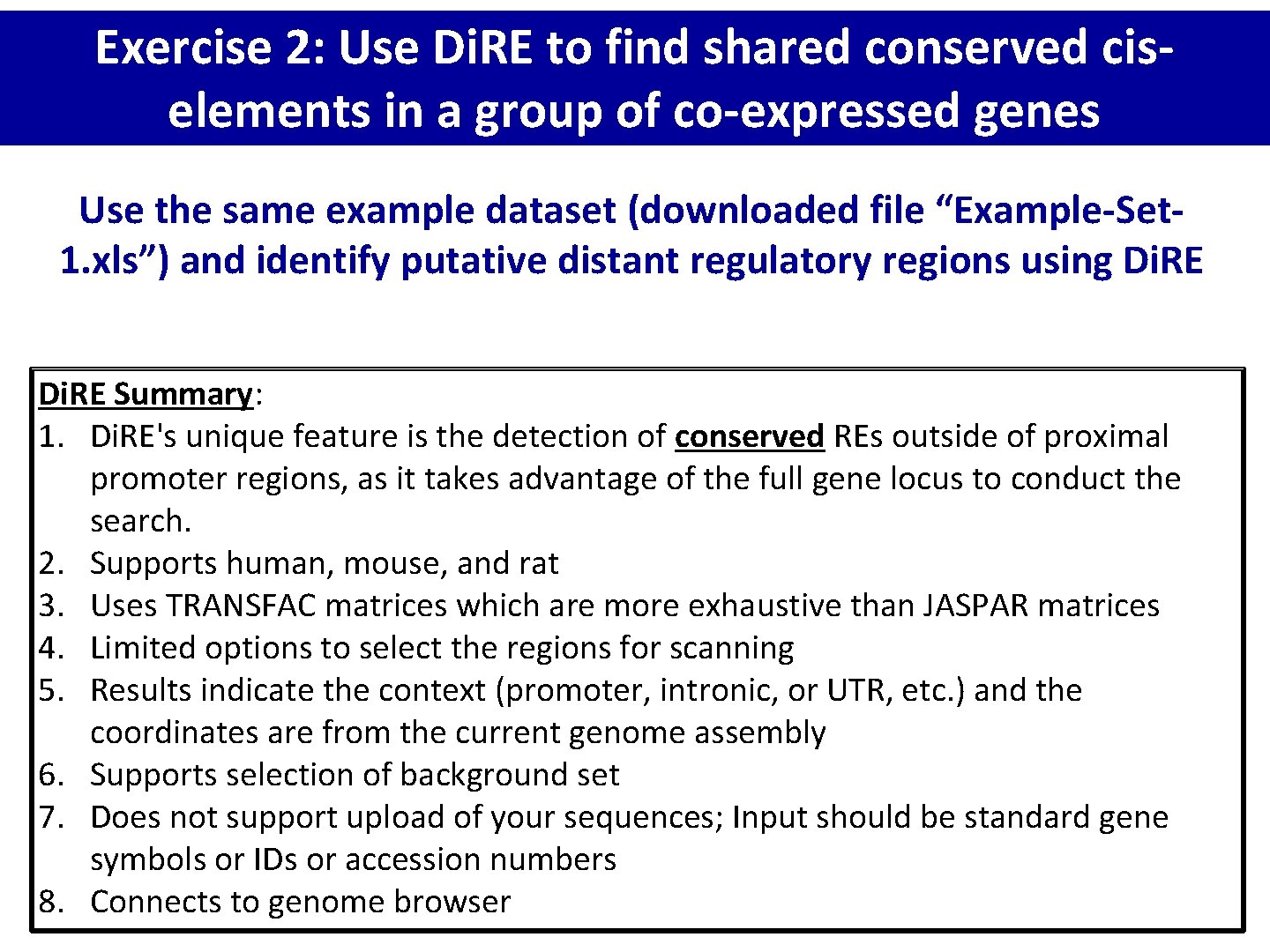
Exercise 2: Use Di. RE to find shared conserved ciselements in a group of co-expressed genes Use the same example dataset (downloaded file “Example-Set 1. xls”) and identify putative distant regulatory regions using Di. RE Summary: 1. Di. RE's unique feature is the detection of conserved REs outside of proximal promoter regions, as it takes advantage of the full gene locus to conduct the search. 2. Supports human, mouse, and rat 3. Uses TRANSFAC matrices which are more exhaustive than JASPAR matrices 4. Limited options to select the regions for scanning 5. Results indicate the context (promoter, intronic, or UTR, etc. ) and the coordinates are from the current genome assembly 6. Supports selection of background set 7. Does not support upload of your sequences; Input should be standard gene symbols or IDs or accession numbers 8. Connects to genome browser
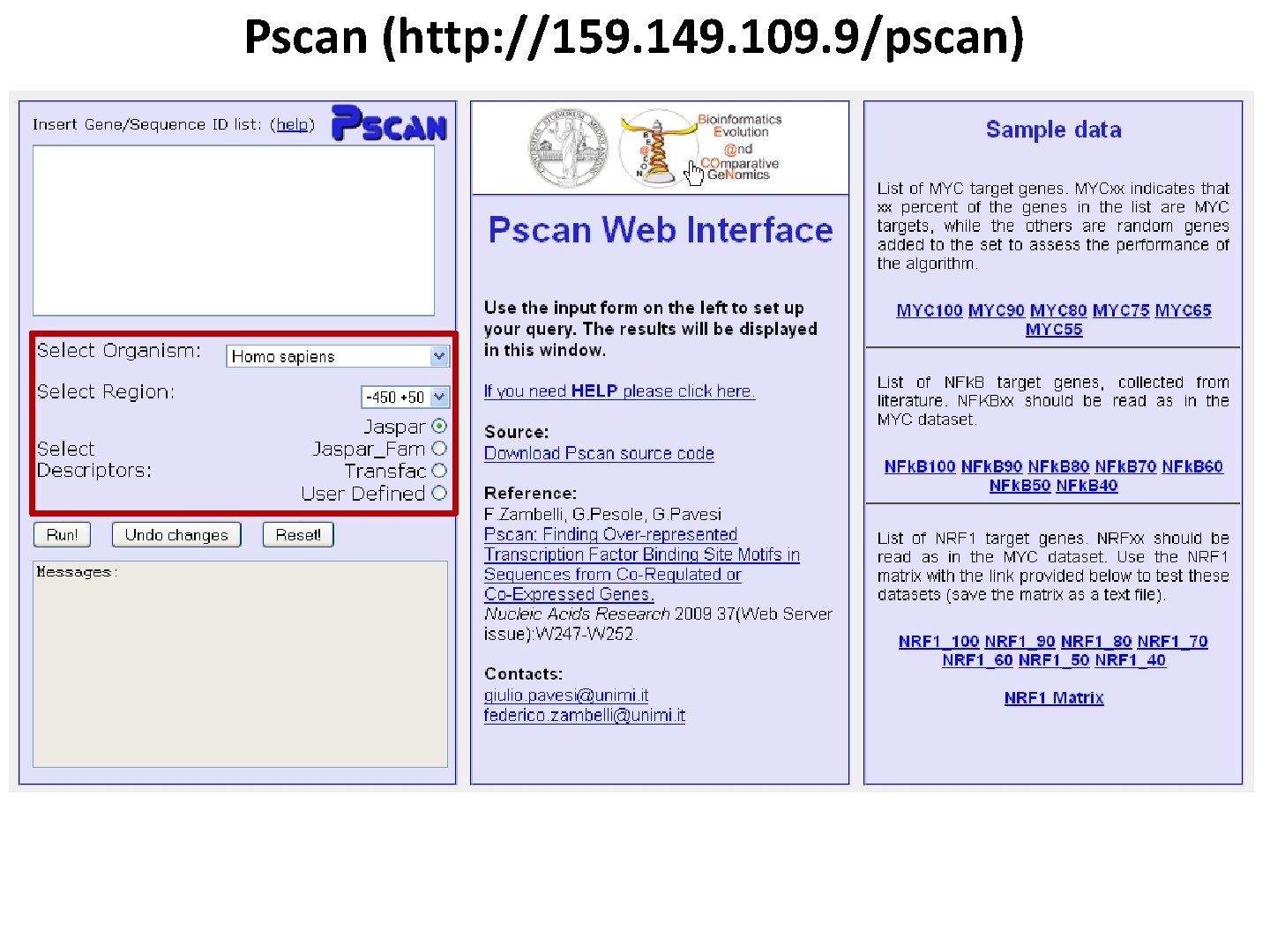
Pscan (http: //159. 149. 109. 9/pscan)
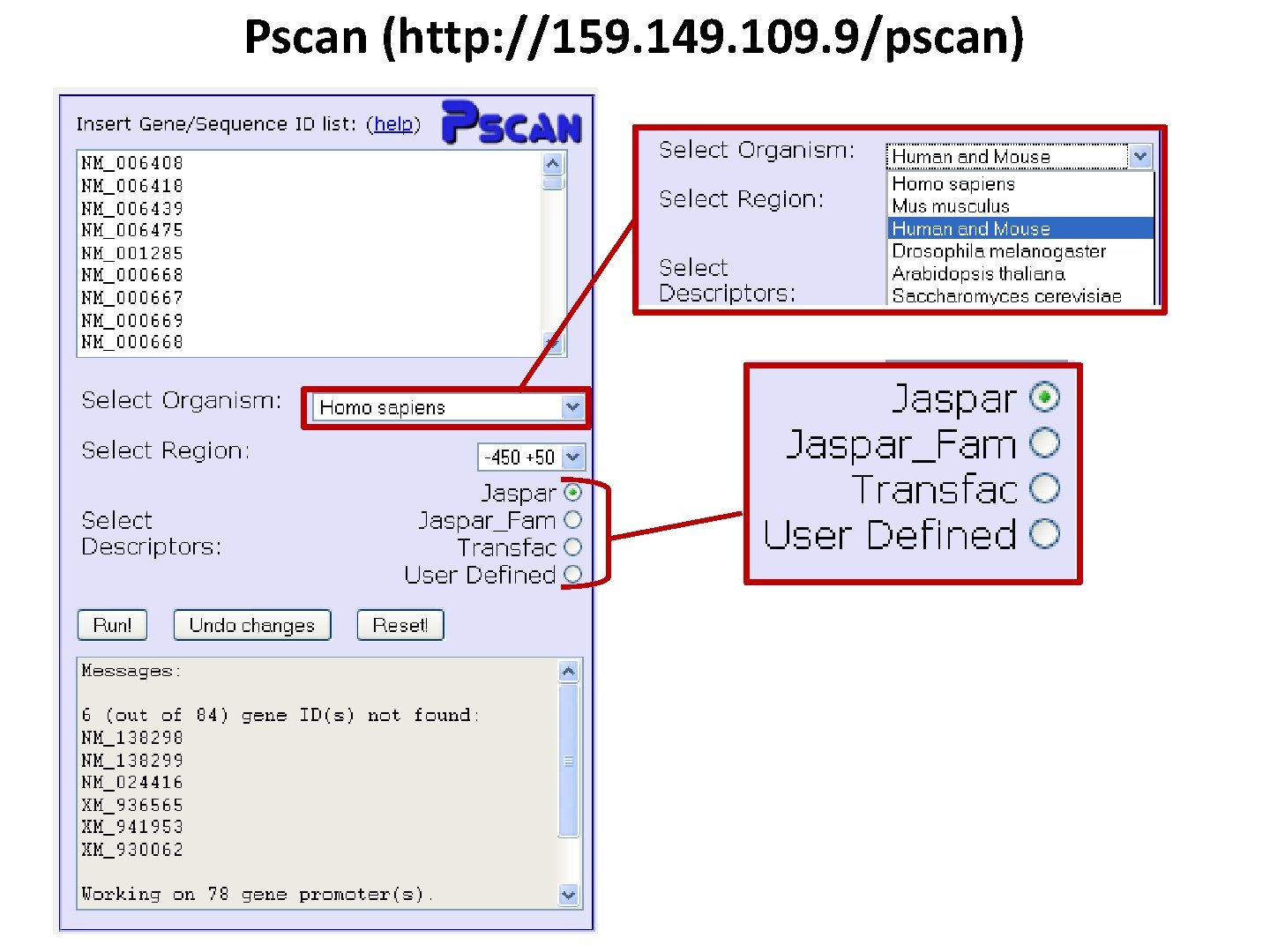
Pscan (http: //159. 149. 109. 9/pscan)
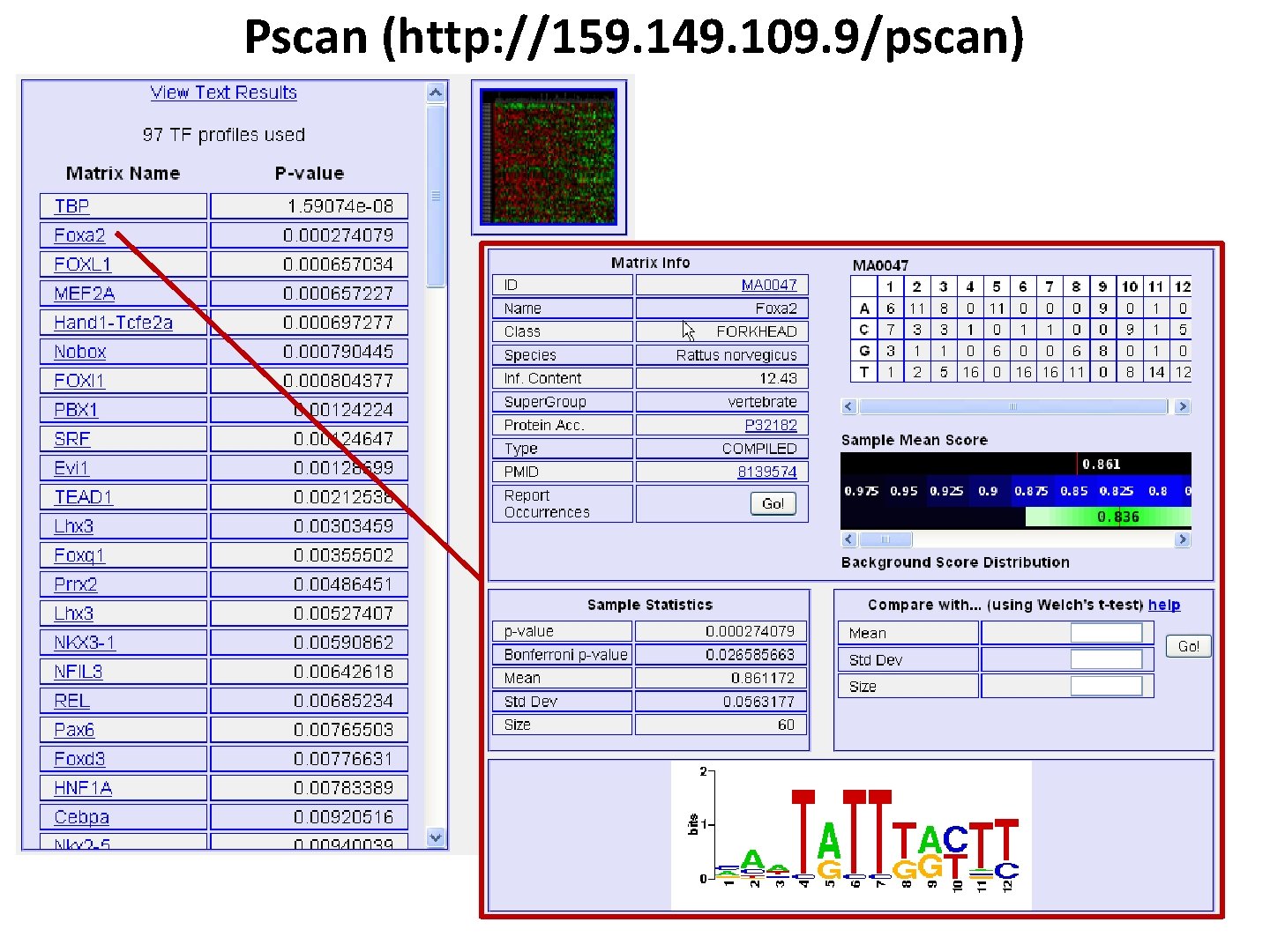
Pscan (http: //159. 149. 109. 9/pscan)
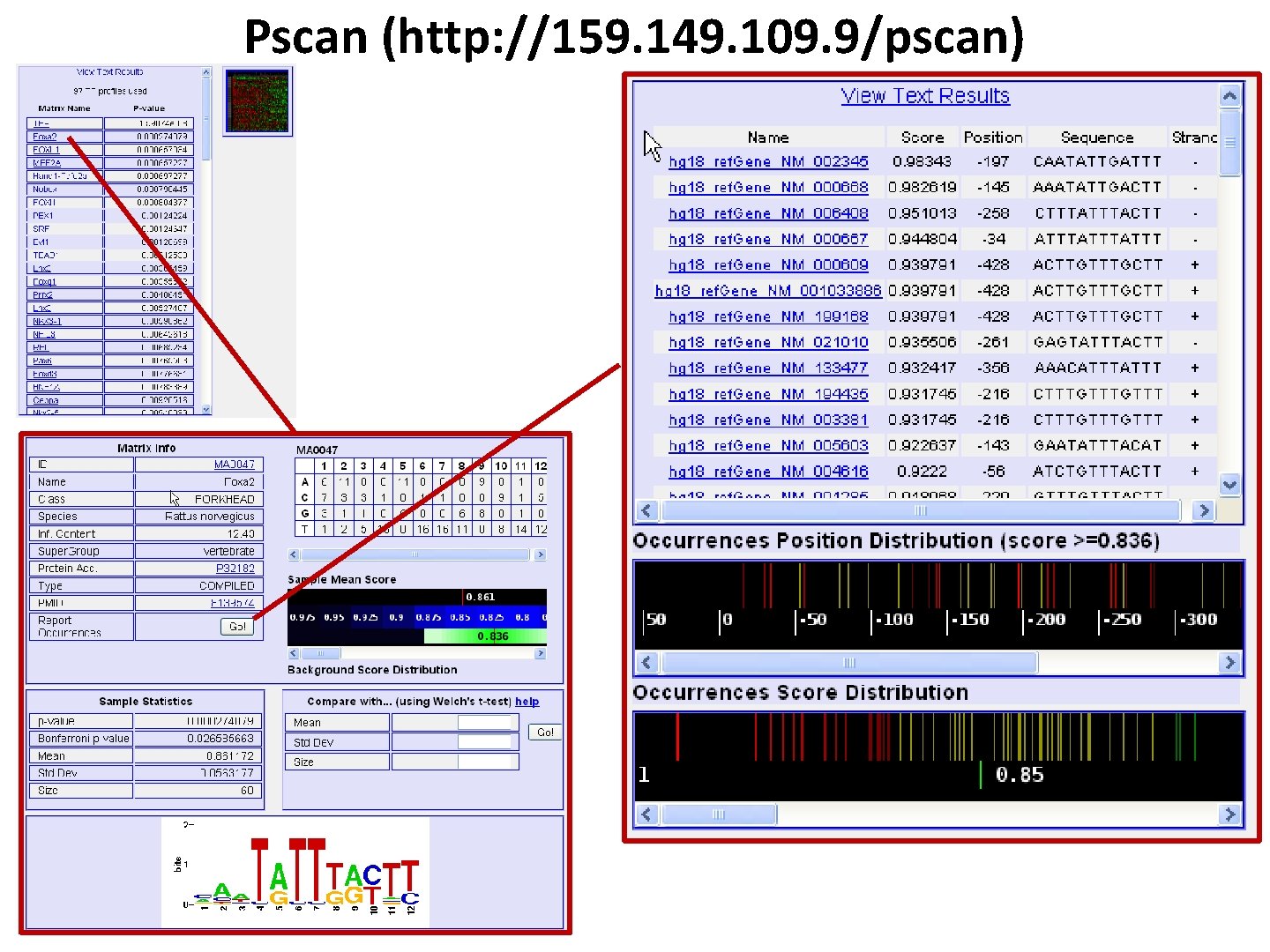
Pscan (http: //159. 149. 109. 9/pscan)
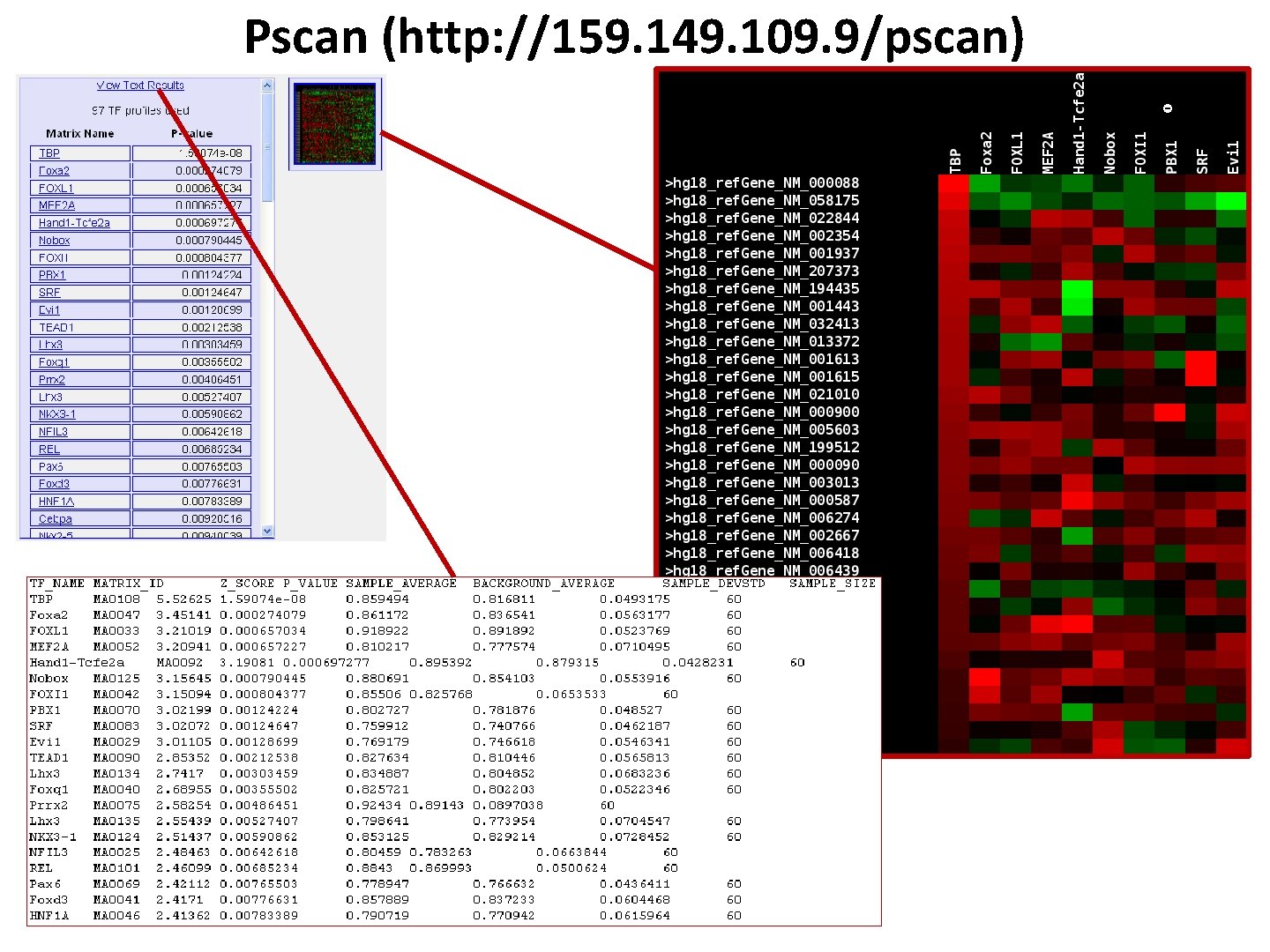
Pscan (http: //159. 149. 109. 9/pscan)
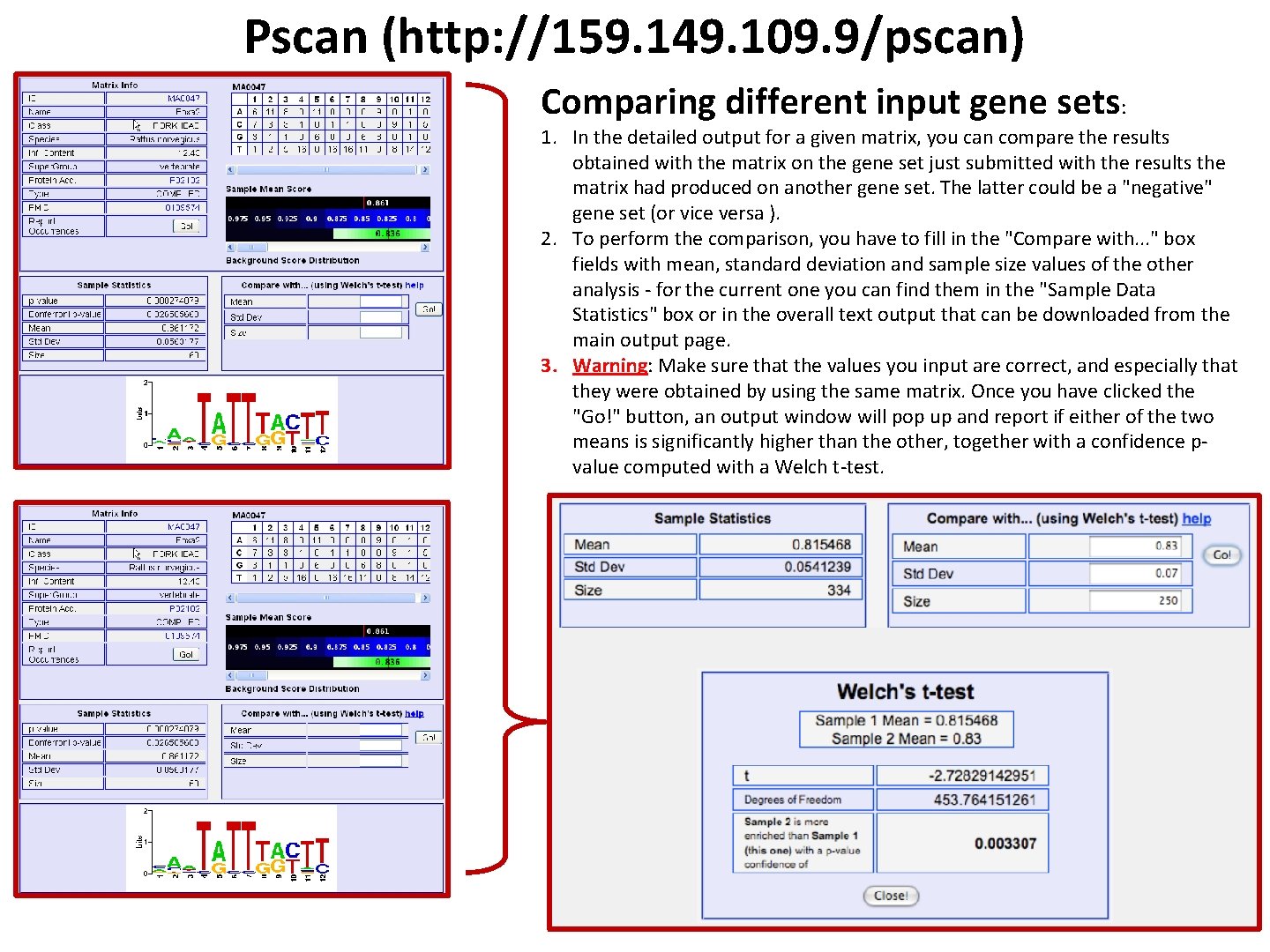
Pscan (http: //159. 149. 109. 9/pscan) Comparing different input gene sets: 1. In the detailed output for a given matrix, you can compare the results obtained with the matrix on the gene set just submitted with the results the matrix had produced on another gene set. The latter could be a "negative" gene set (or vice versa ). 2. To perform the comparison, you have to fill in the "Compare with. . . " box fields with mean, standard deviation and sample size values of the other analysis - for the current one you can find them in the "Sample Data Statistics" box or in the overall text output that can be downloaded from the main output page. 3. Warning: Make sure that the values you input are correct, and especially that they were obtained by using the same matrix. Once you have clicked the "Go!" button, an output window will pop up and report if either of the two means is significantly higher than the other, together with a confidence pvalue computed with a Welch t-test.
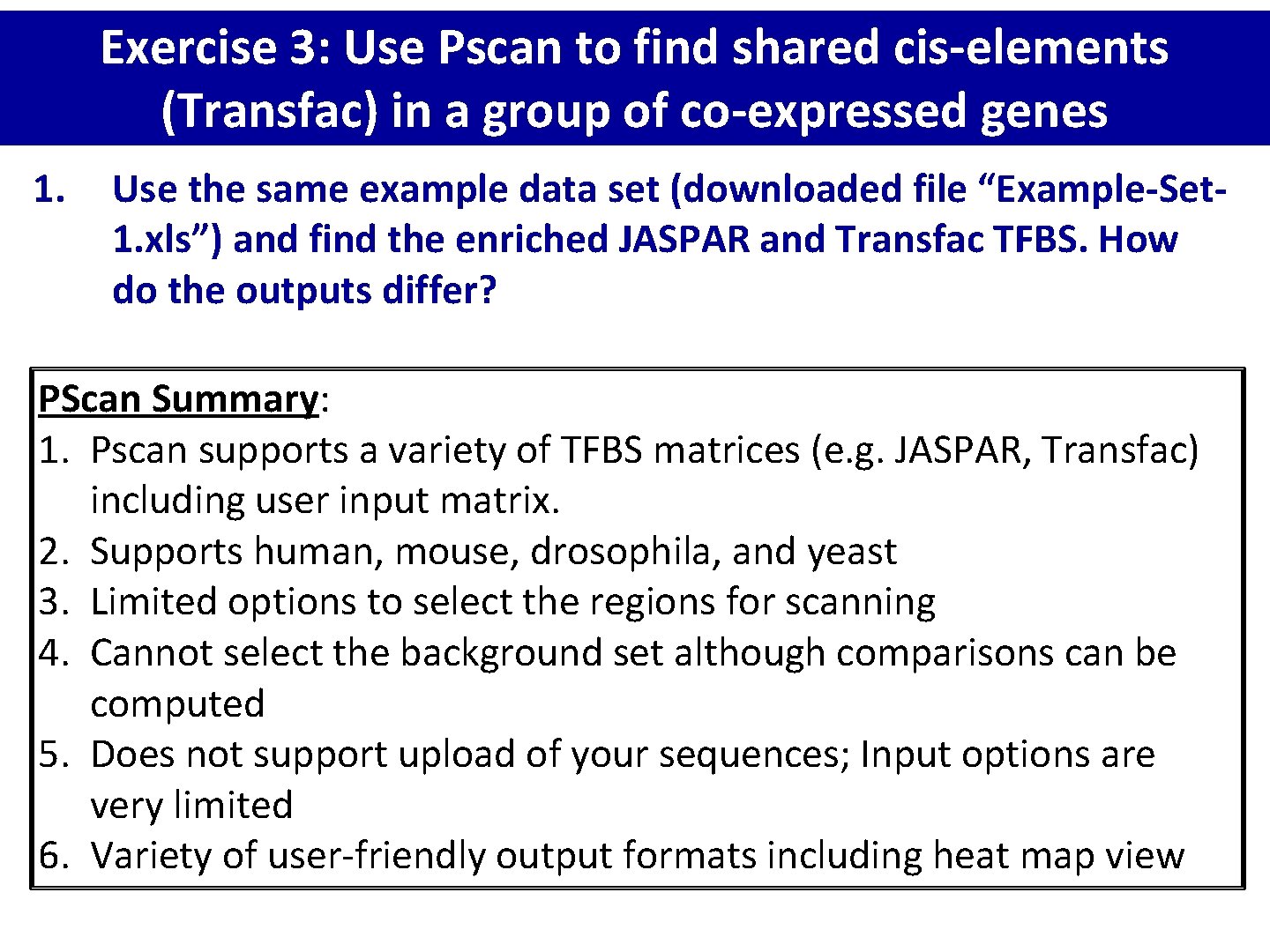
Exercise 3: Use Pscan to find shared cis-elements (Transfac) in a group of co-expressed genes 1. Use the same example data set (downloaded file “Example-Set 1. xls”) and find the enriched JASPAR and Transfac TFBS. How do the outputs differ? PScan Summary: 1. Pscan supports a variety of TFBS matrices (e. g. JASPAR, Transfac) including user input matrix. 2. Supports human, mouse, drosophila, and yeast 3. Limited options to select the regions for scanning 4. Cannot select the background set although comparisons can be computed 5. Does not support upload of your sequences; Input options are very limited 6. Variety of user-friendly output formats including heat map view
I have a list of co-expressed m. RNAs (Transcriptome)…. I want to find the shared cis-elements – Known and Novel q Known transcription factor binding sites (TFBS) v Conserved • o. POSSUM • Di. RE v Non-conserved • Pscan • Mat. Inspector (*Licensed) q Unknown TFBS or Novel motifs v Conserved • o. POSSUM • Weeder-H v Non-conserved • MEME • Weeder
o. POSSUM (http: //www. cisreg. ca/o. POSSUM)
o. POSSUM (http: //www. cisreg. ca/o. POSSUM) The JASPAR PHYLOFACTS database consists of 174 profiles that were extracted from phylogenetically conserved gene upstream elements. They are a mix of known and as of yet undefined motifs. When should it be used? They are useful when one expects that other factors might determine promoter characteristics and/or tissue specificity.
o. POSSUM (http: //www. cisreg. ca/o. POSSUM)
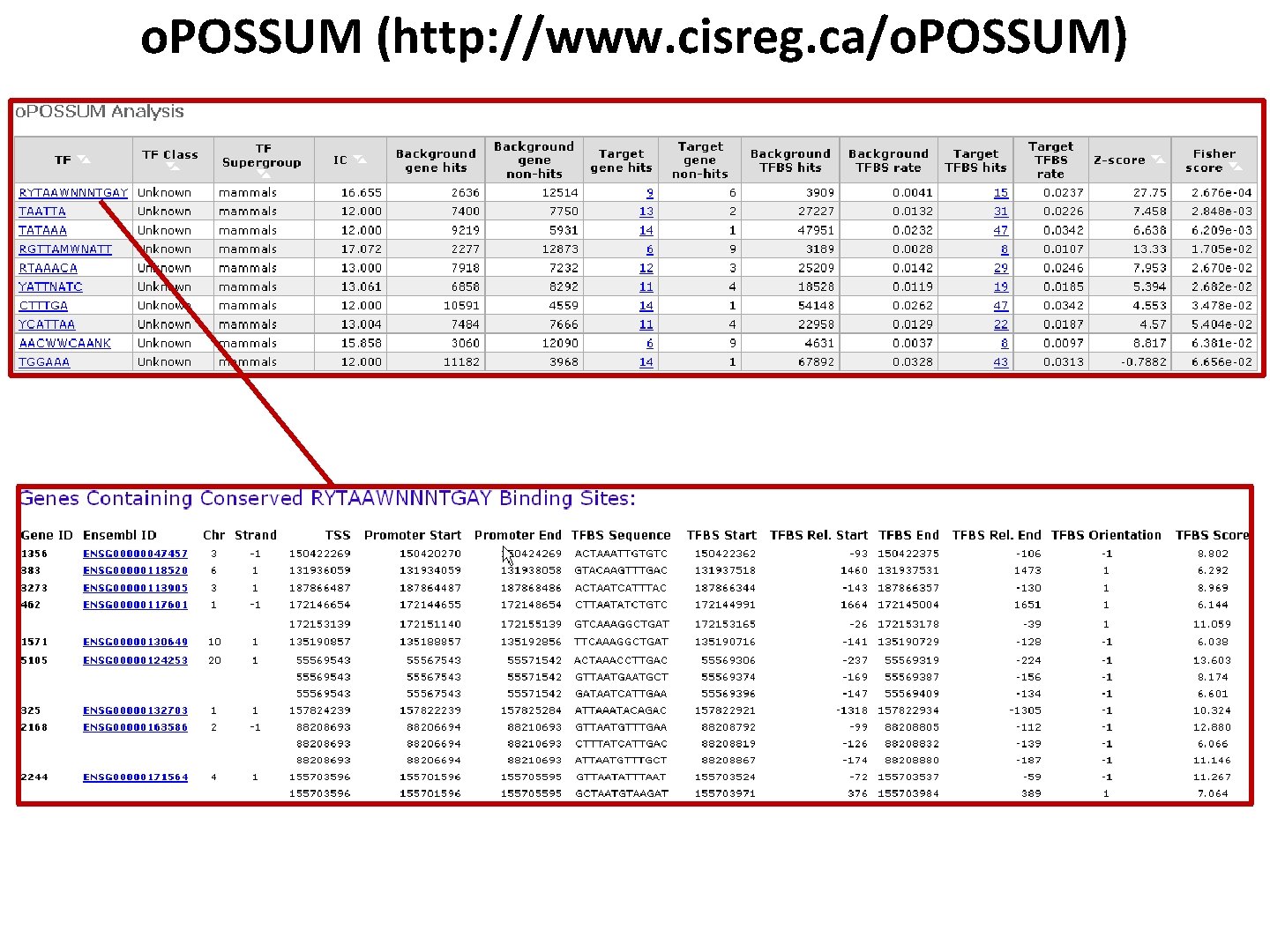
o. POSSUM (http: //www. cisreg. ca/o. POSSUM)
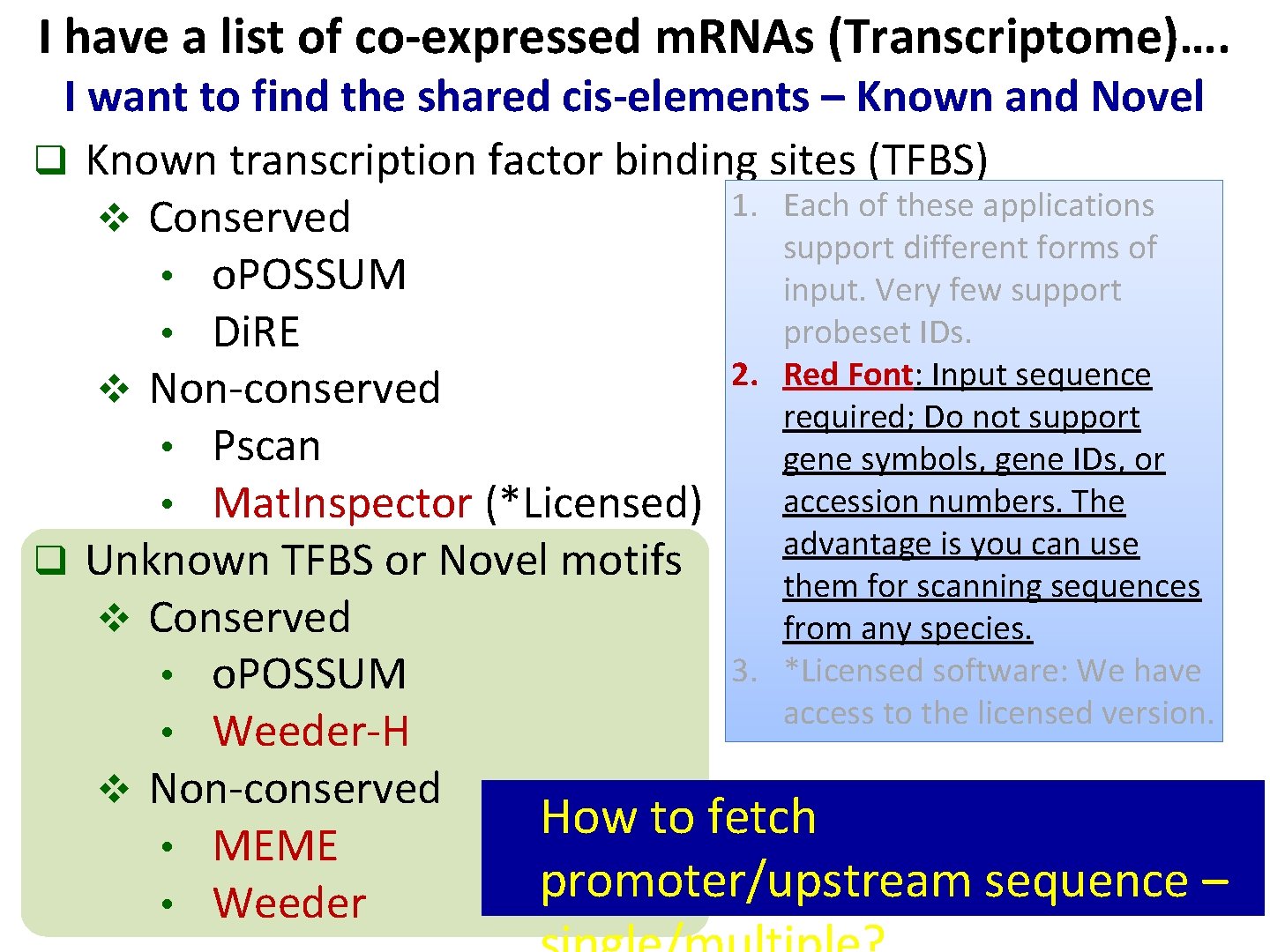
I have a list of co-expressed m. RNAs (Transcriptome)…. I want to find the shared cis-elements – Known and Novel q Known transcription factor binding sites (TFBS) 1. Each of these applications v Conserved support different forms of • o. POSSUM input. Very few support probeset IDs. • Di. RE 2. Red Font: Input sequence v Non-conserved required; Do not support • Pscan gene symbols, gene IDs, or accession numbers. The • Mat. Inspector (*Licensed) advantage is you can use q Unknown TFBS or Novel motifs them for scanning sequences v Conserved from any species. 3. *Licensed software: We have • o. POSSUM access to the licensed version. • Weeder-H v Non-conserved How to fetch • MEME promoter/upstream sequence – • Weeder
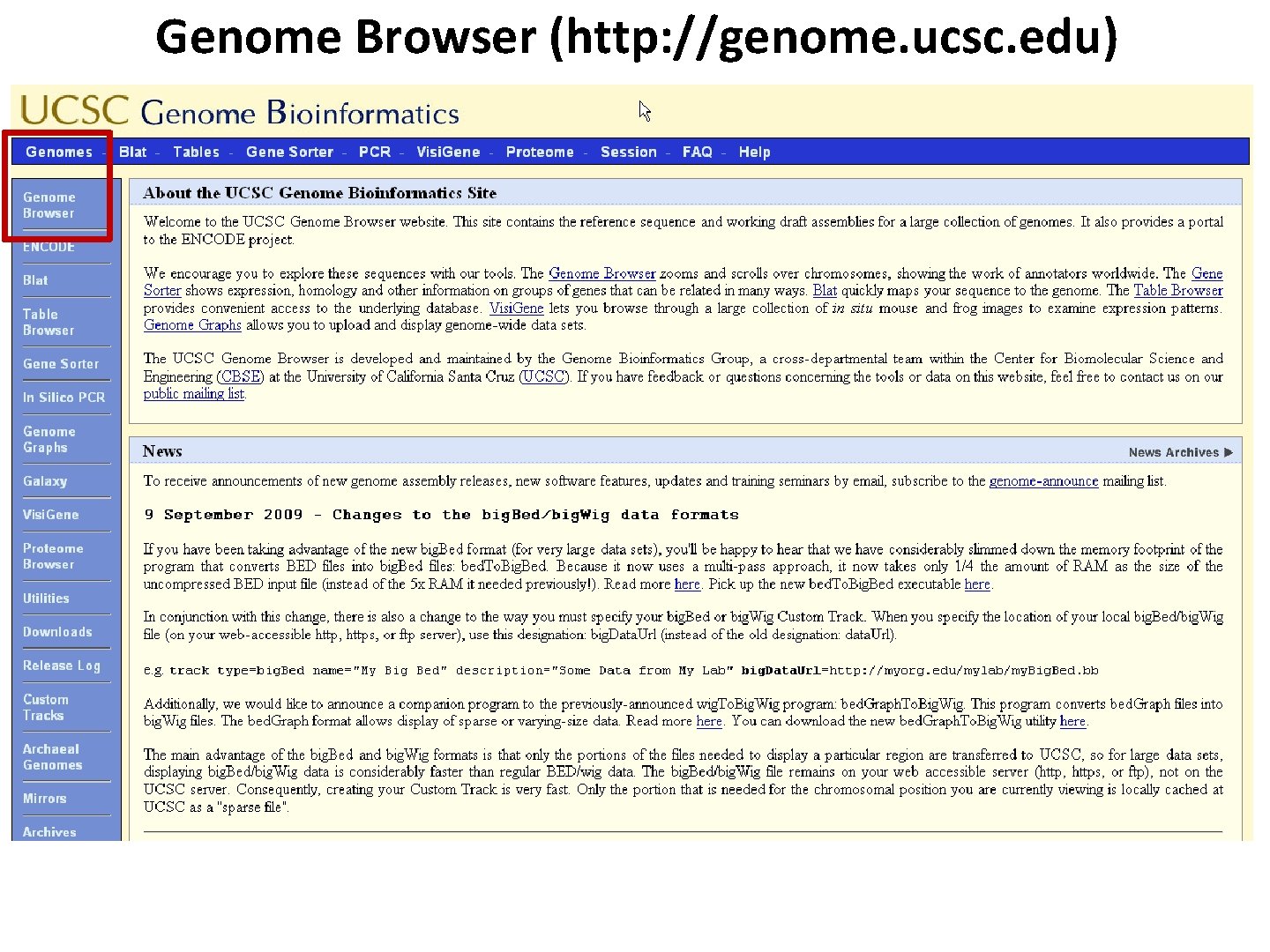
Genome Browser (http: //genome. ucsc. edu)
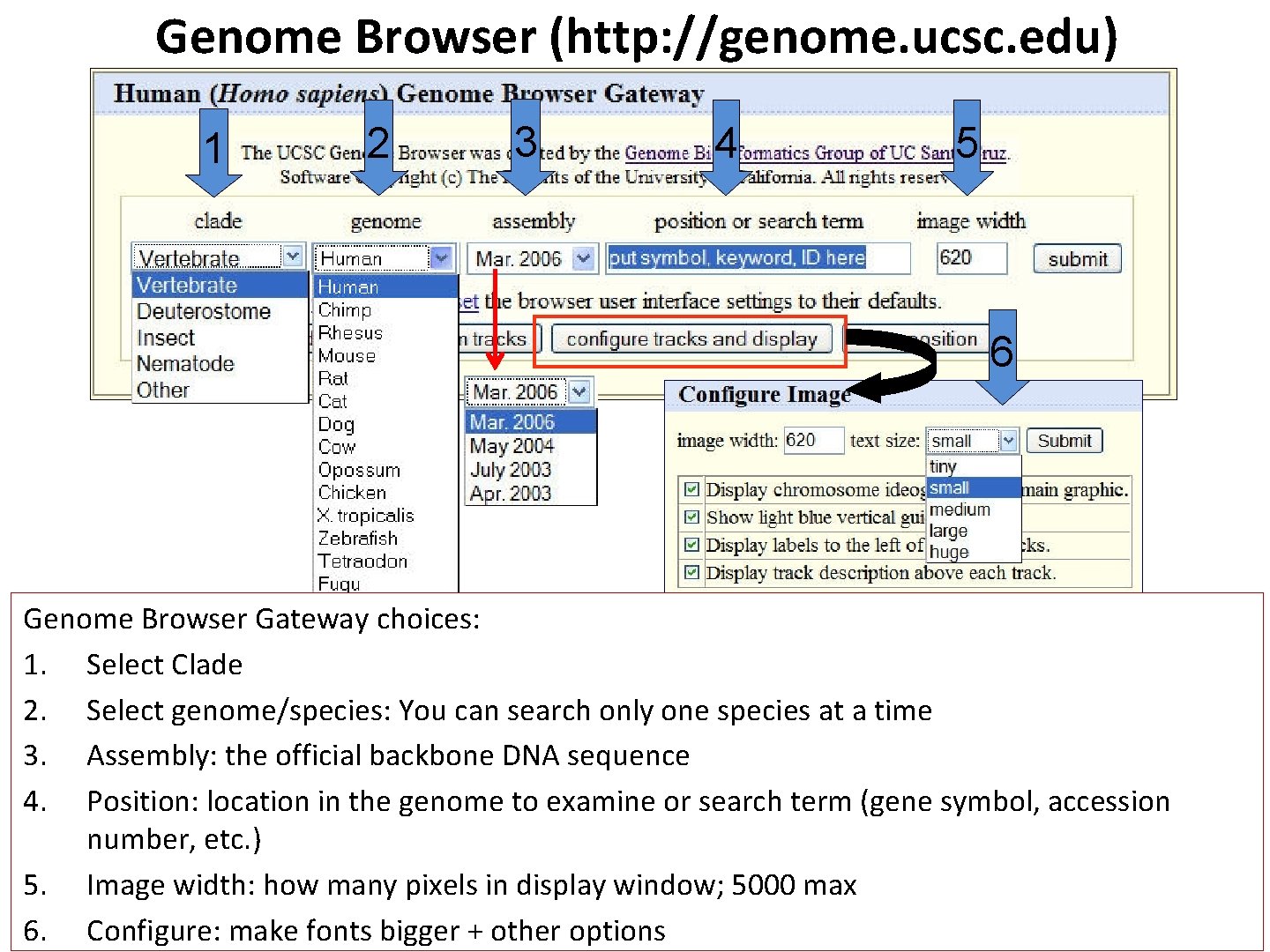
Genome Browser (http: //genome. ucsc. edu) 1 2 3 4 5 6 Genome Browser Gateway choices: 1. Select Clade 2. Select genome/species: You can search only one species at a time 3. Assembly: the official backbone DNA sequence 4. Position: location in the genome to examine or search term (gene symbol, accession number, etc. ) 5. Image width: how many pixels in display window; 5000 max 6. Configure: make fonts bigger + other options
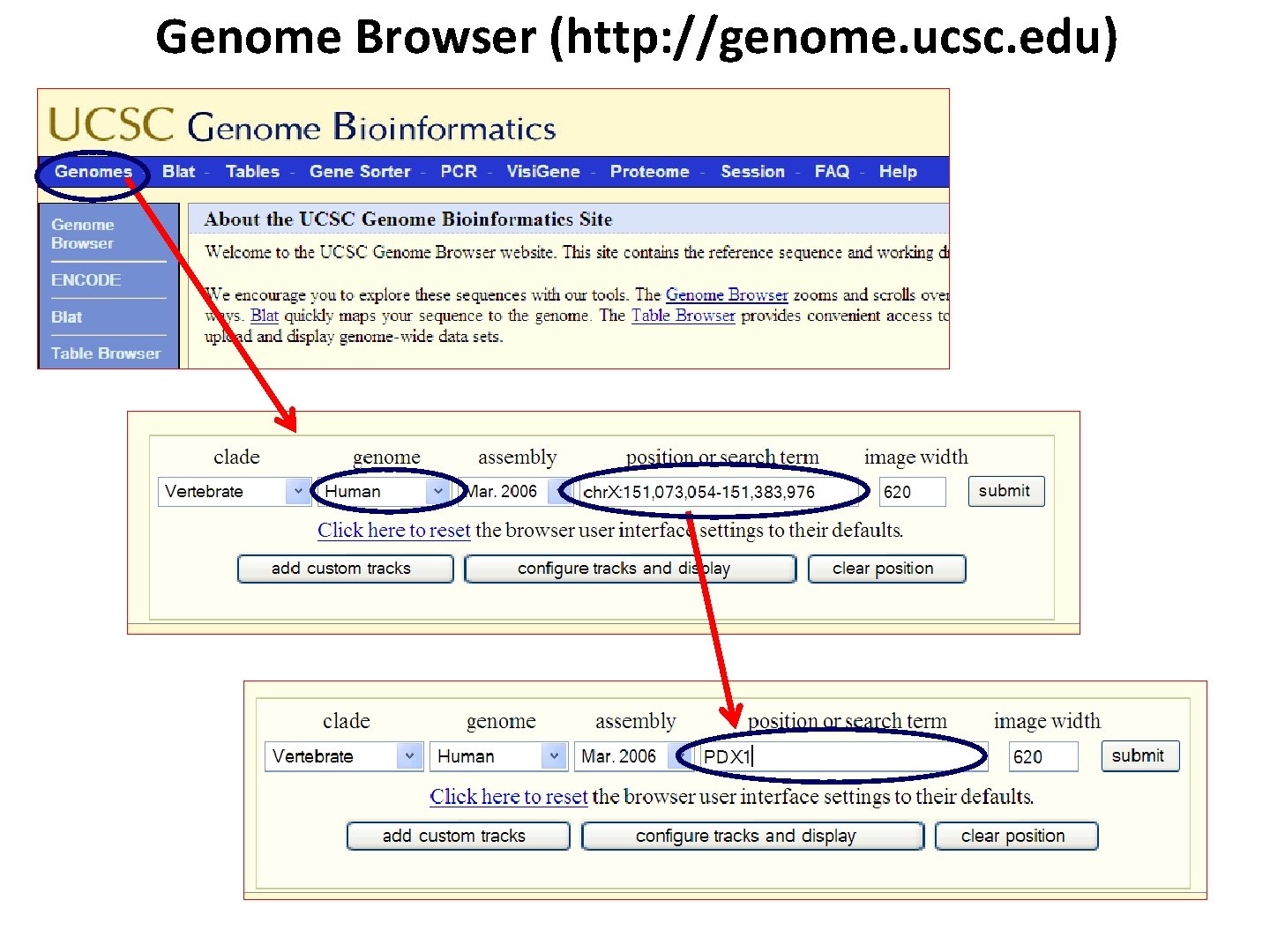
Genome Browser (http: //genome. ucsc. edu)
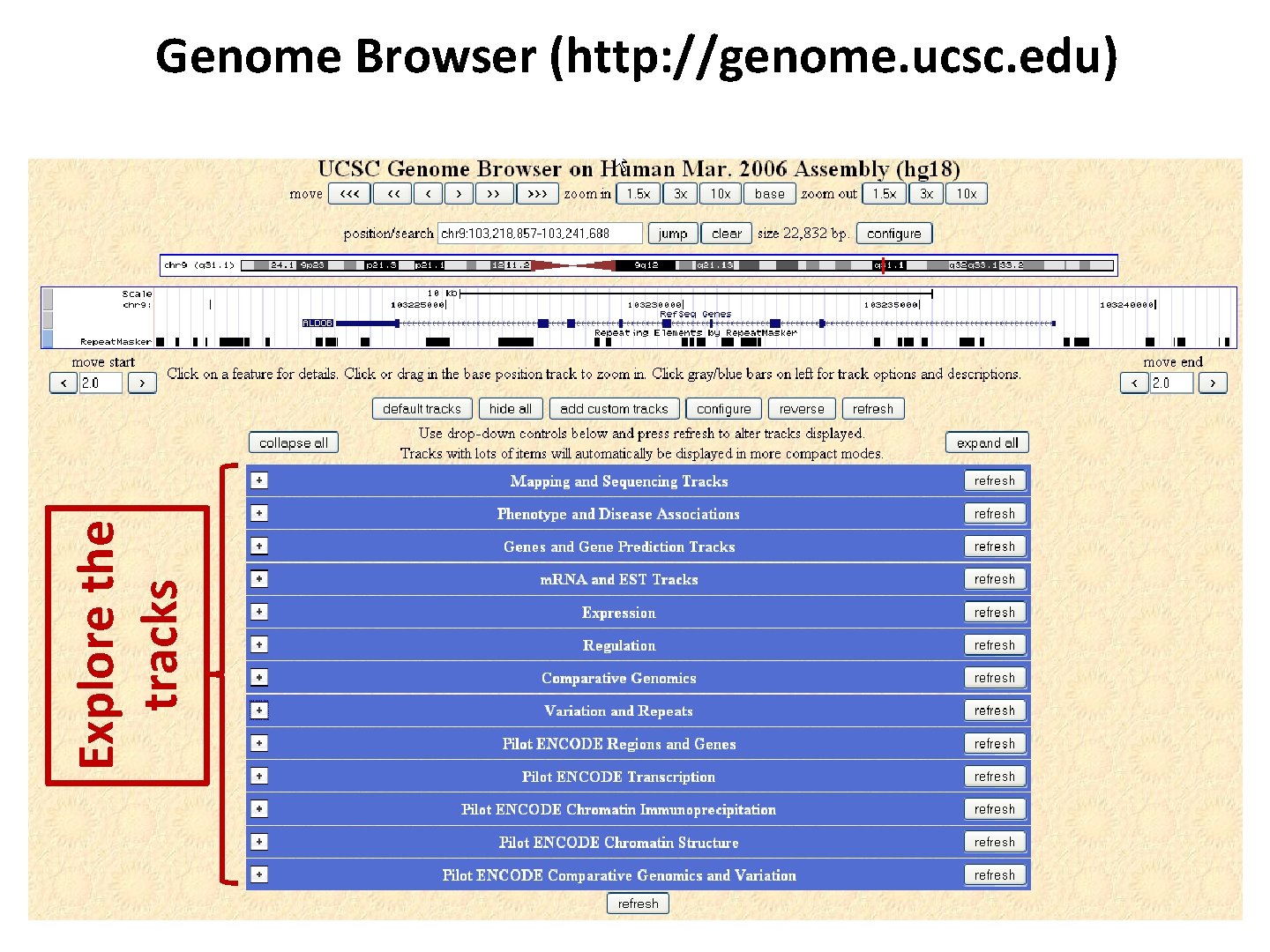
Explore the tracks Genome Browser (http: //genome. ucsc. edu)
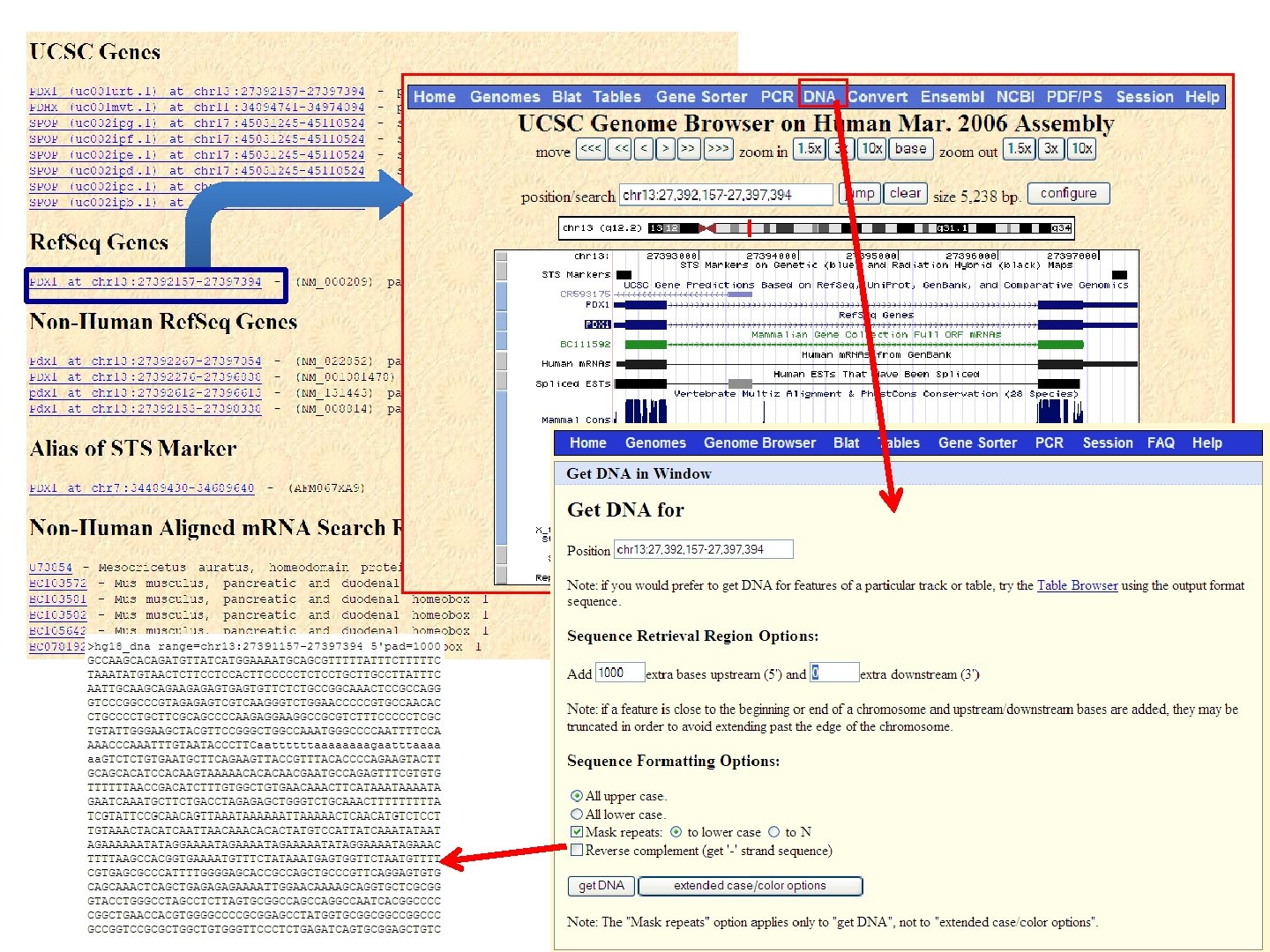
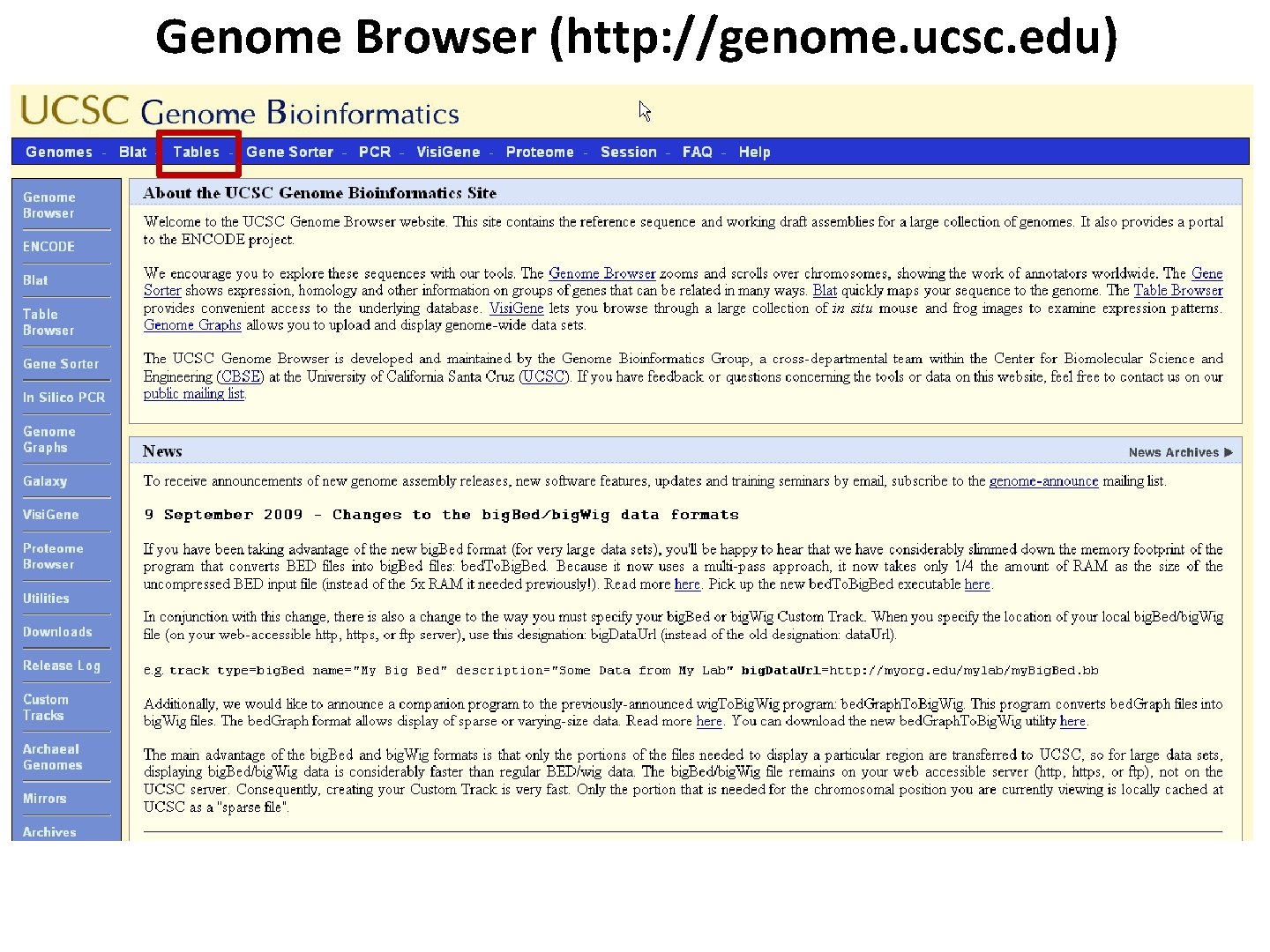
Genome Browser (http: //genome. ucsc. edu)
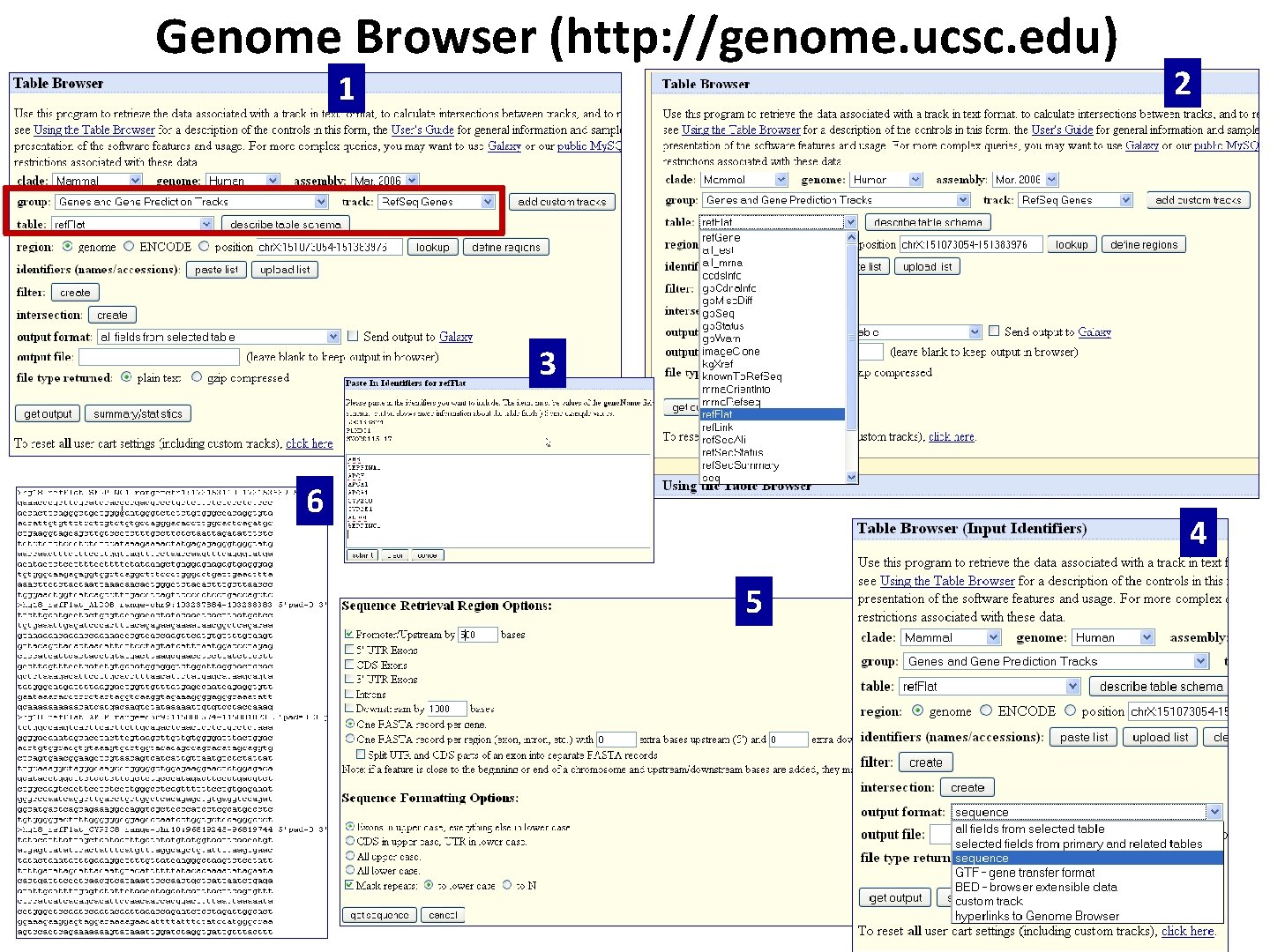
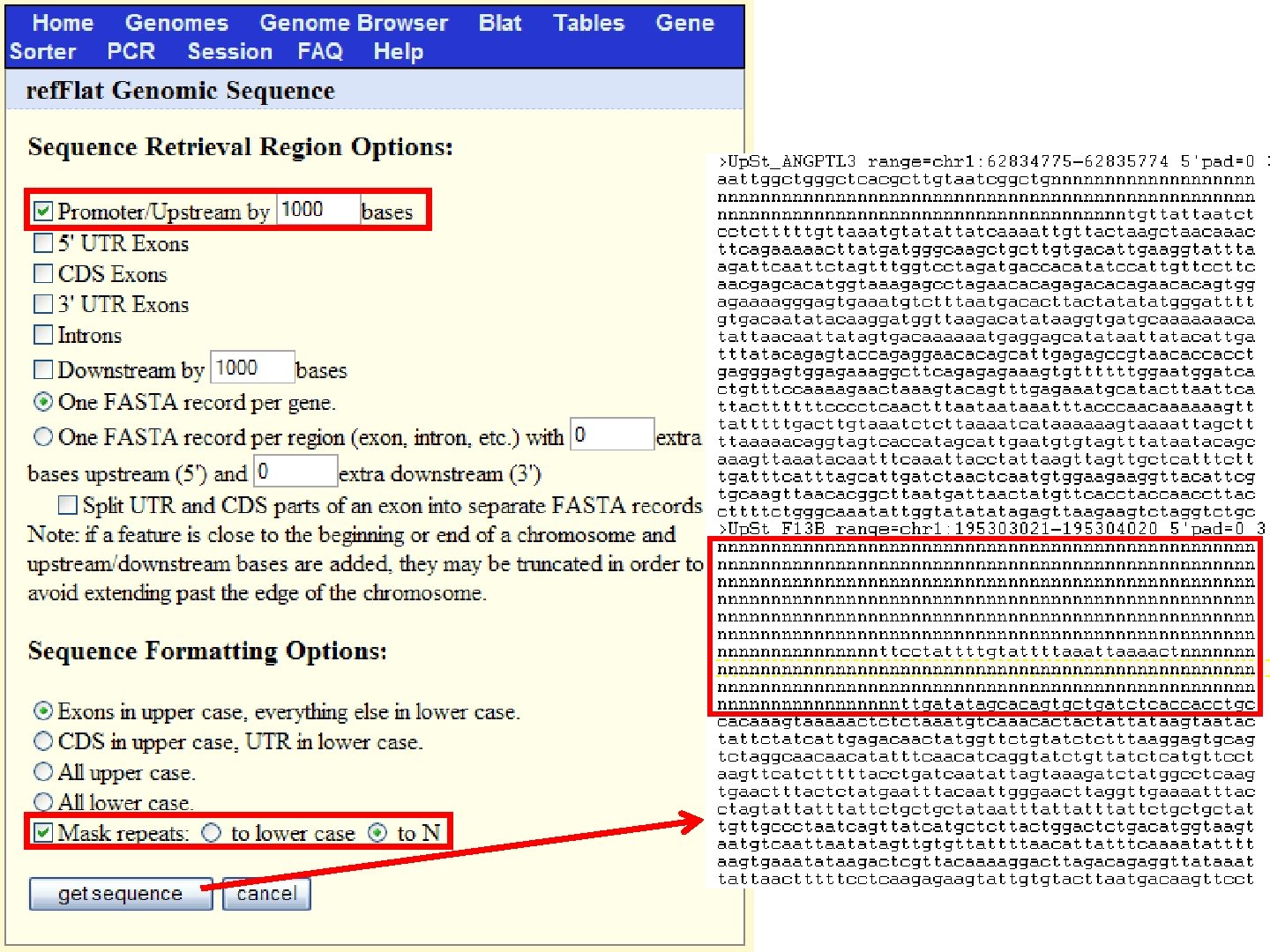
Genome Browser (http: //genome. ucsc. edu) 1 2 3 6 4 5
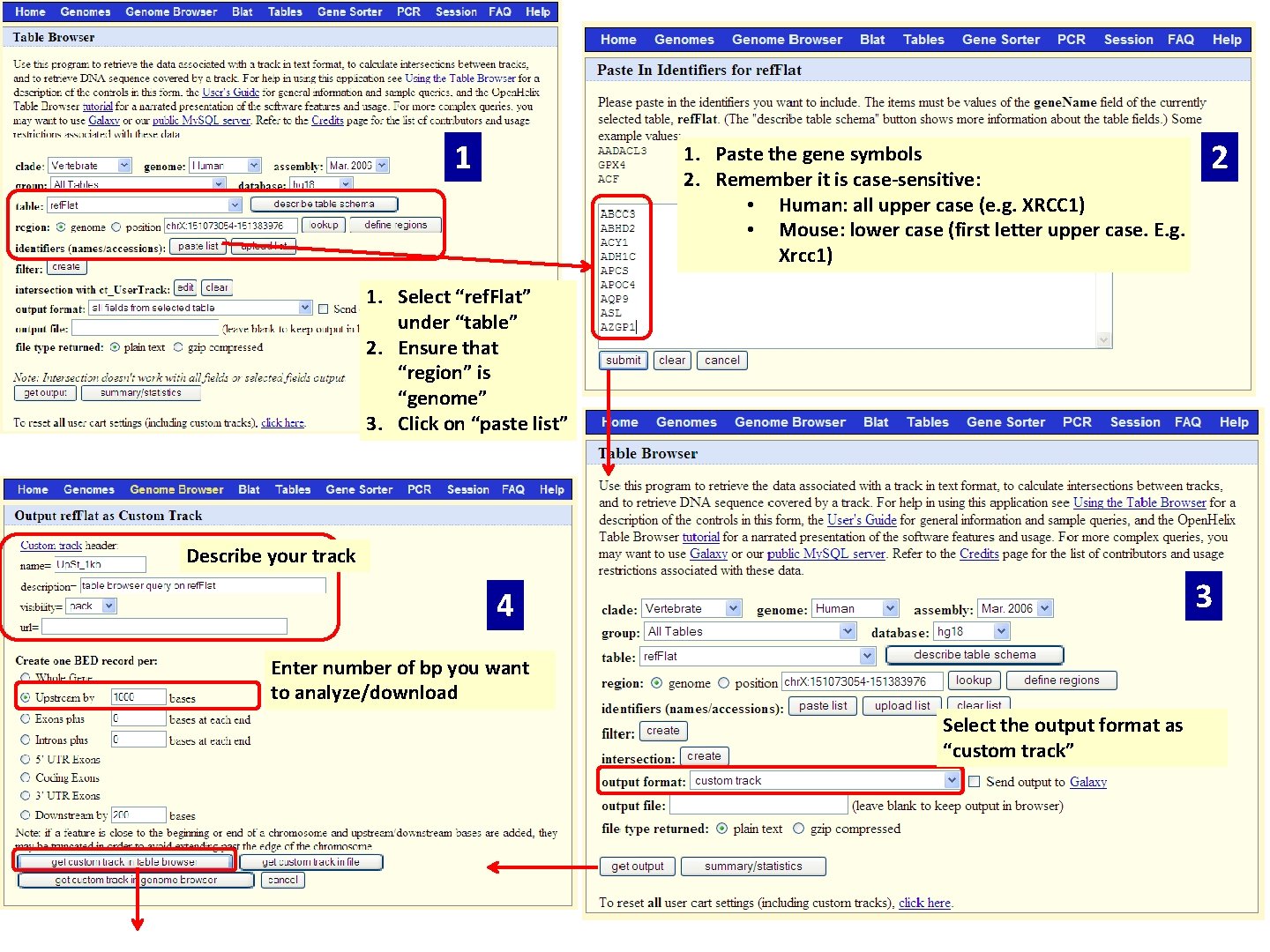
1 1. Paste the gene symbols 2. Remember it is case-sensitive: • Human: all upper case (e. g. XRCC 1) • Mouse: lower case (first letter upper case. E. g. Xrcc 1) 2 1. Select “ref. Flat” under “table” 2. Ensure that “region” is “genome” 3. Click on “paste list” Describe your track 3 4 Enter number of bp you want to analyze/download Select the output format as “custom track”
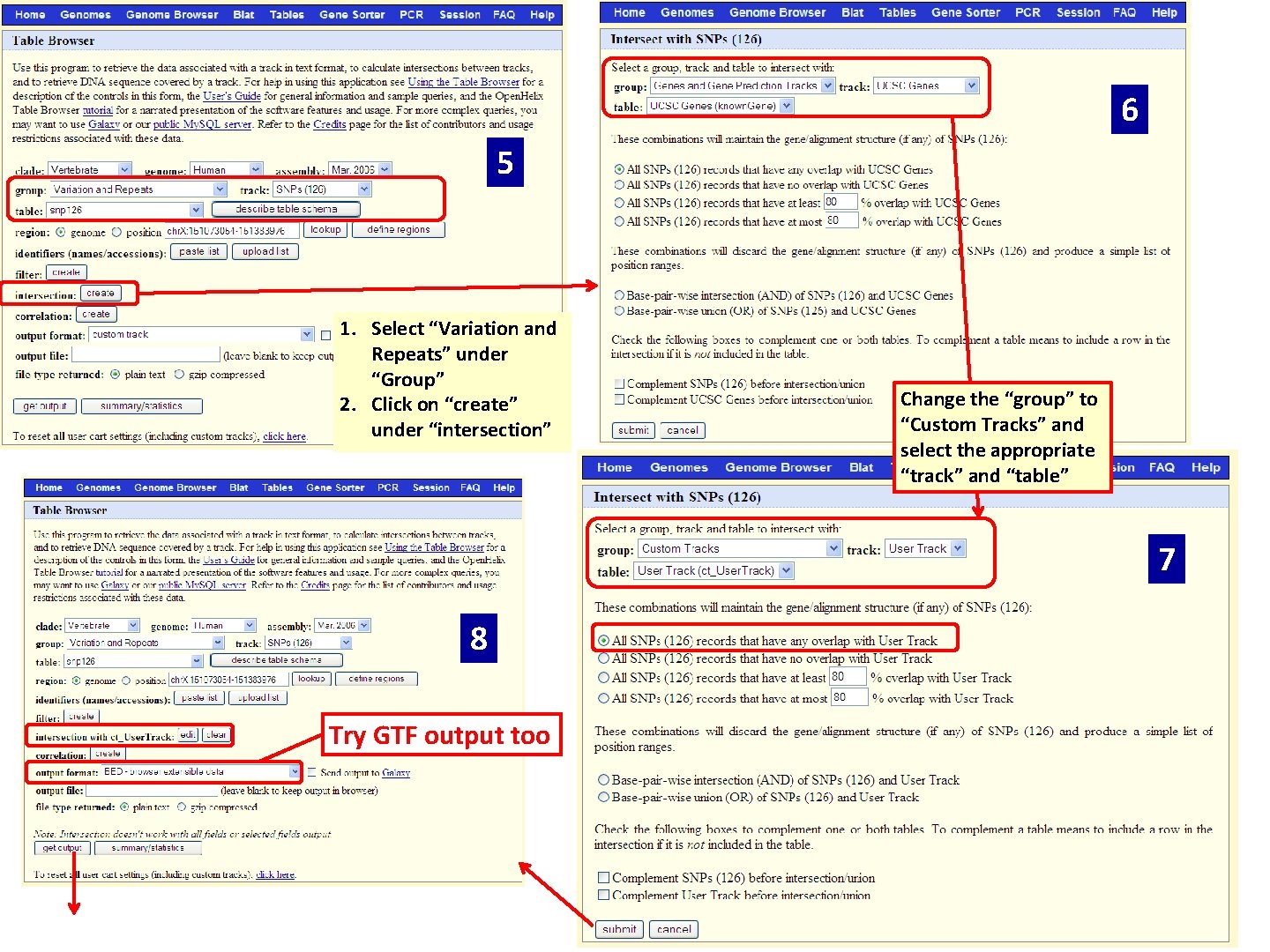
6 5 1. Select “Variation and Repeats” under “Group” 2. Click on “create” under “intersection” Change the “group” to “Custom Tracks” and select the appropriate “track” and “table” 7 8 Try GTF output too
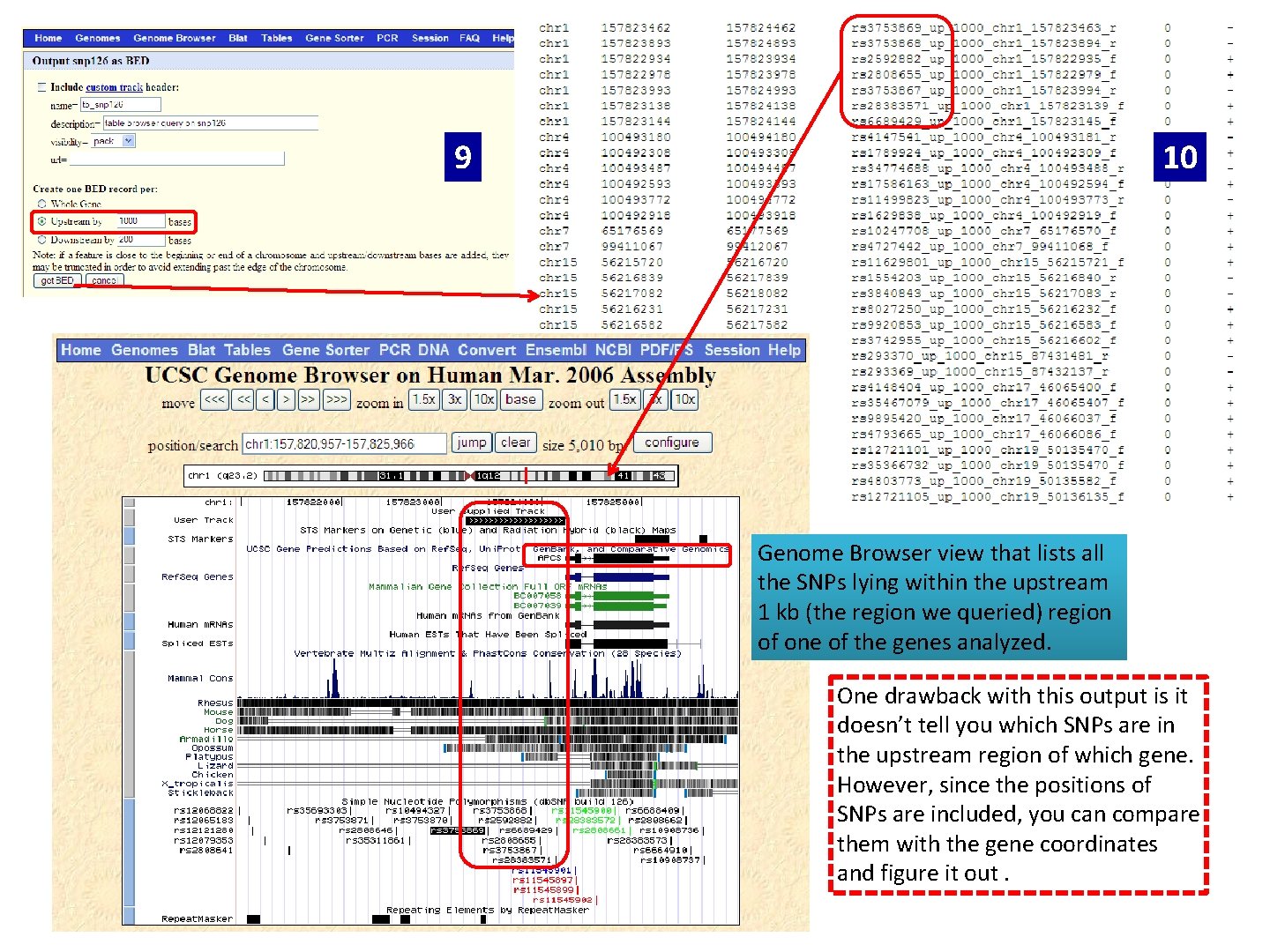
9 10 Genome Browser view that lists all the SNPs lying within the upstream 1 kb (the region we queried) region of one of the genes analyzed. One drawback with this output is it doesn’t tell you which SNPs are in the upstream region of which gene. However, since the positions of SNPs are included, you can compare them with the gene coordinates and figure it out.
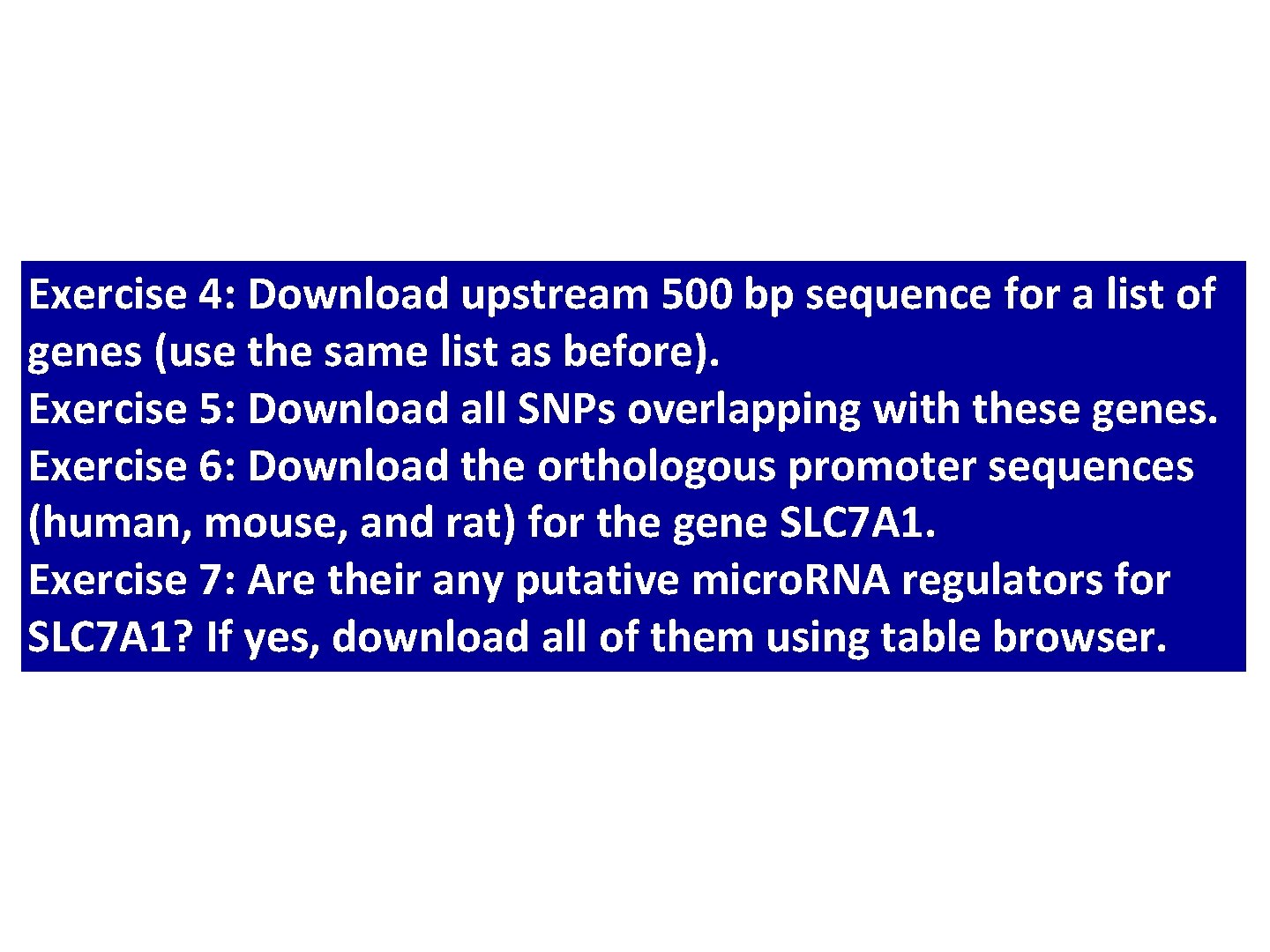
Exercise 4: Download upstream 500 bp sequence for a list of genes (use the same list as before). Exercise 5: Download all SNPs overlapping with these genes. Exercise 6: Download the orthologous promoter sequences (human, mouse, and rat) for the gene SLC 7 A 1. Exercise 7: Are their any putative micro. RNA regulators for SLC 7 A 1? If yes, download all of them using table browser.
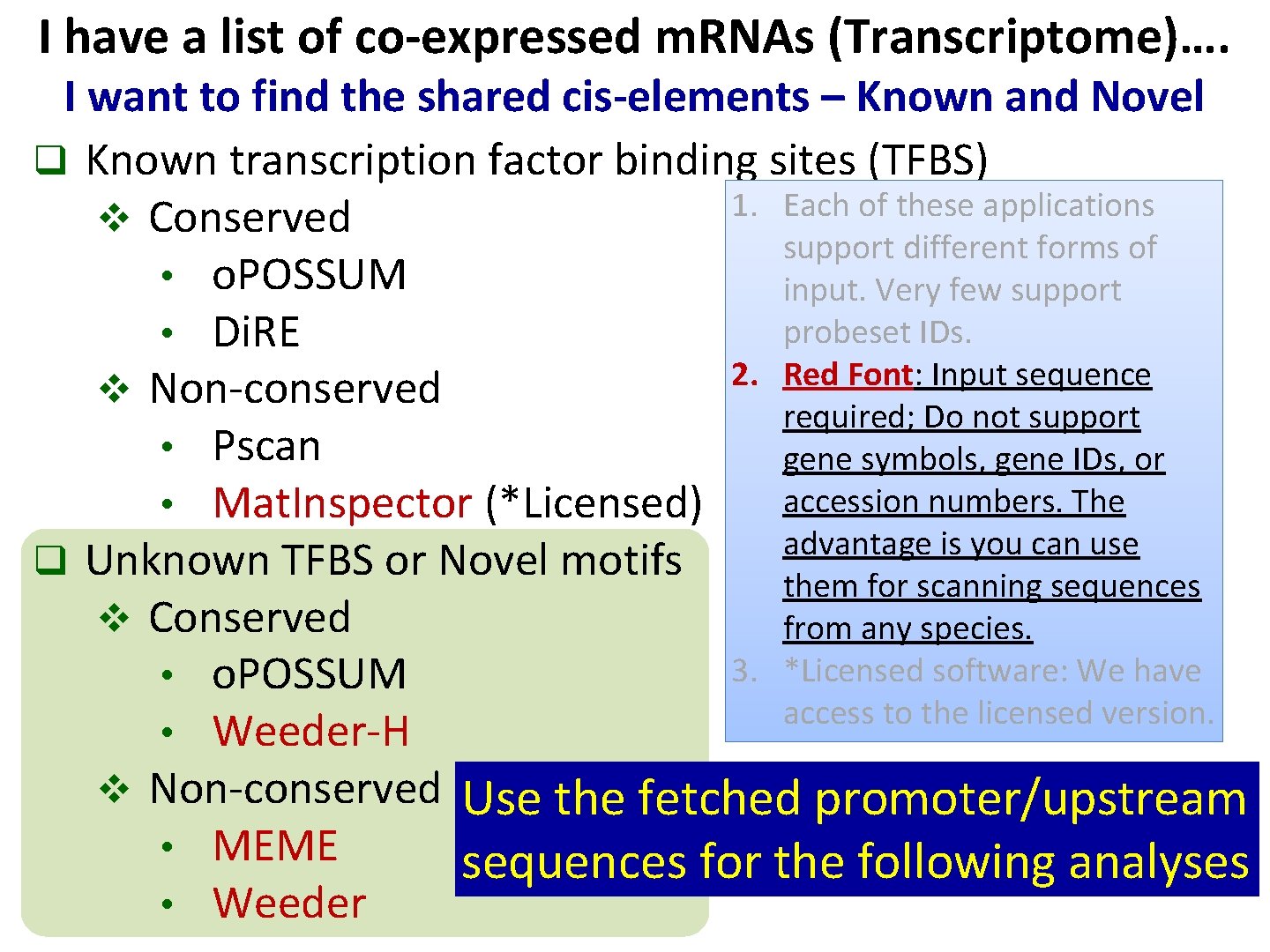
I have a list of co-expressed m. RNAs (Transcriptome)…. I want to find the shared cis-elements – Known and Novel q Known transcription factor binding sites (TFBS) 1. Each of these applications v Conserved support different forms of • o. POSSUM input. Very few support probeset IDs. • Di. RE 2. Red Font: Input sequence v Non-conserved required; Do not support • Pscan gene symbols, gene IDs, or accession numbers. The • Mat. Inspector (*Licensed) advantage is you can use q Unknown TFBS or Novel motifs them for scanning sequences v Conserved from any species. 3. *Licensed software: We have • o. POSSUM access to the licensed version. • Weeder-H v Non-conserved Use the fetched promoter/upstream • MEME sequences for the following analyses • Weeder
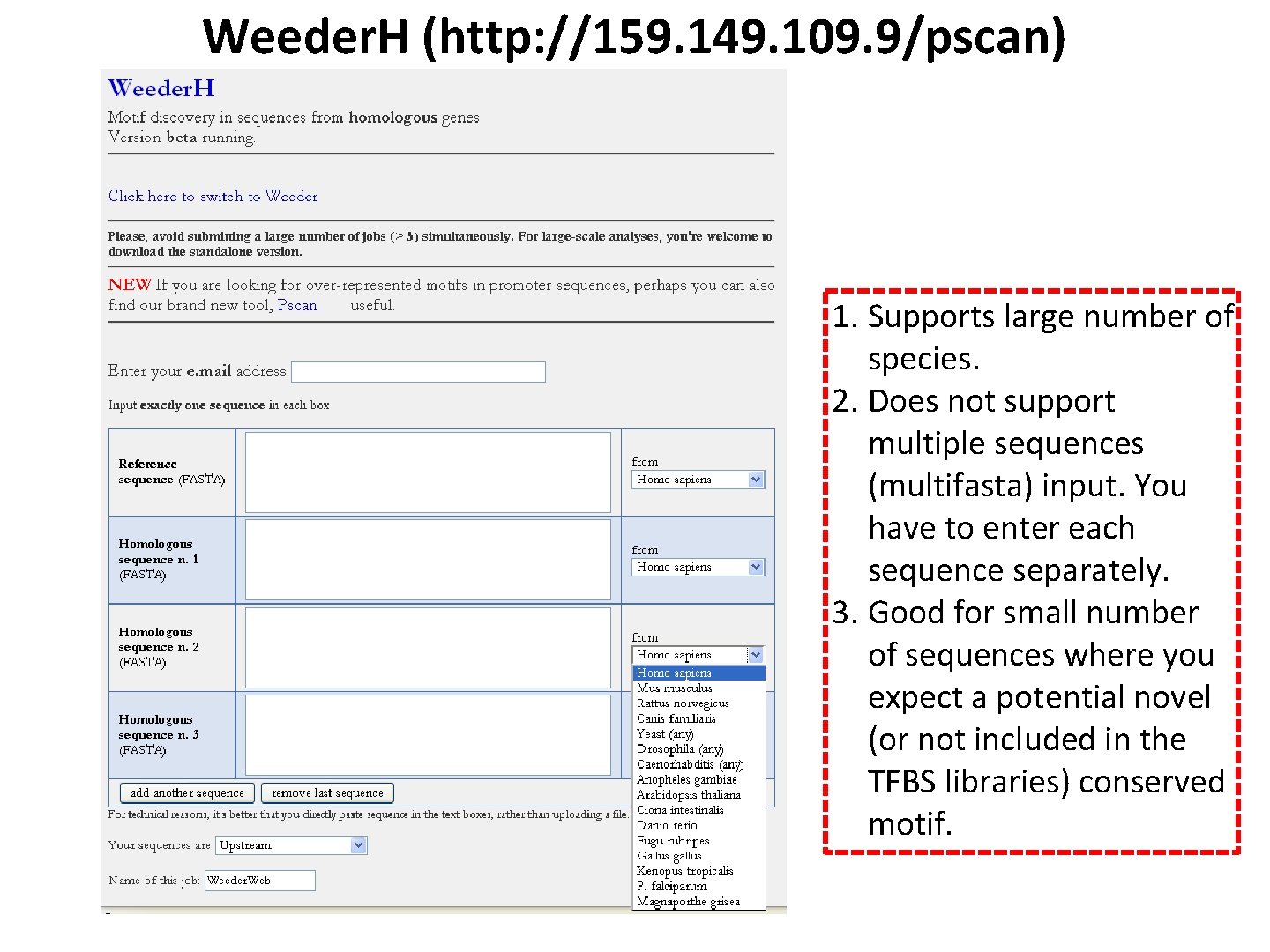
Weeder. H (http: //159. 149. 109. 9/pscan) 1. Supports large number of species. 2. Does not support multiple sequences (multifasta) input. You have to enter each sequence separately. 3. Good for small number of sequences where you expect a potential novel (or not included in the TFBS libraries) conserved motif.
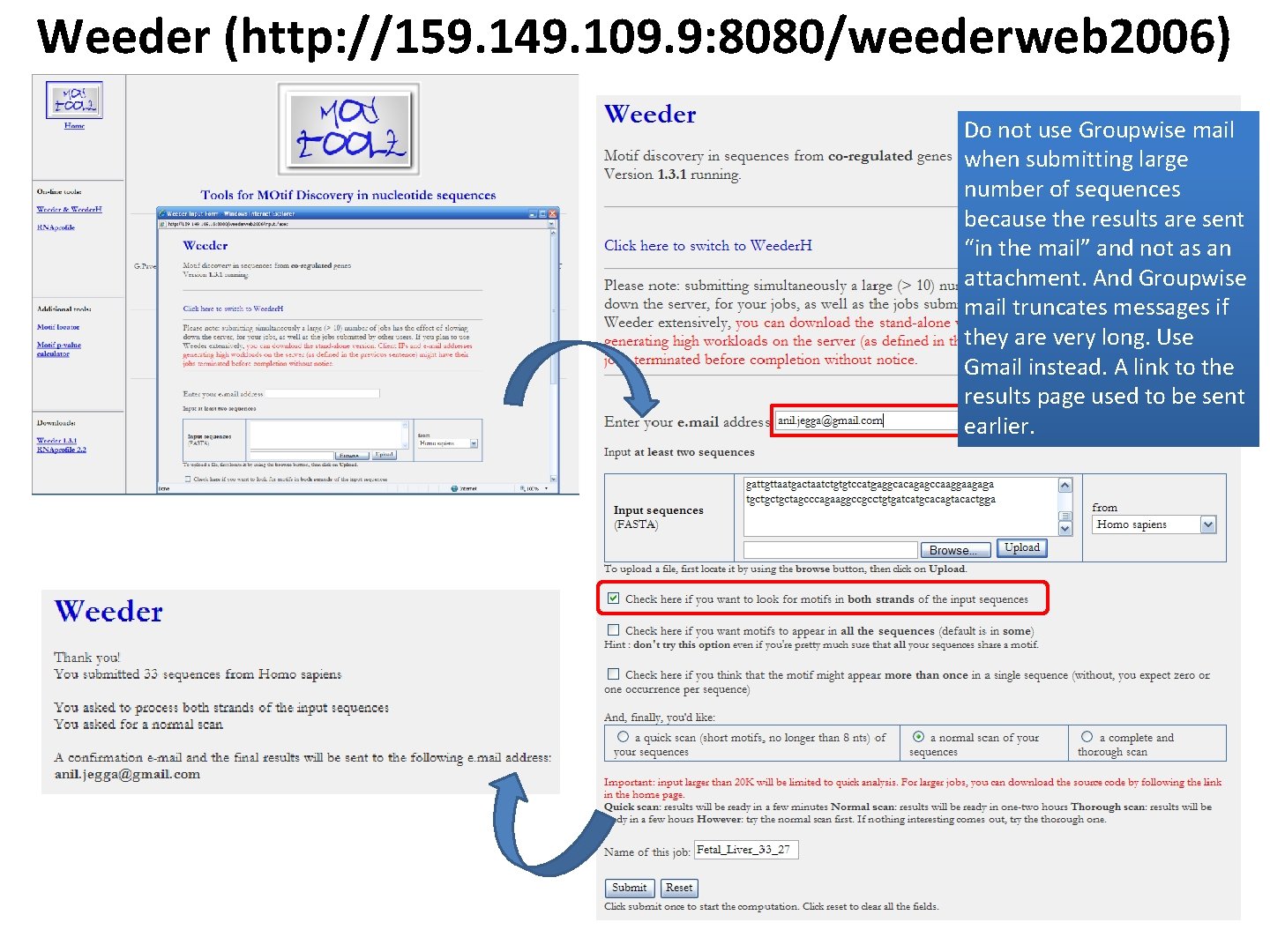
Weeder (http: //159. 149. 109. 9: 8080/weederweb 2006) Do not use Groupwise mail when submitting large number of sequences because the results are sent “in the mail” and not as an attachment. And Groupwise mail truncates messages if they are very long. Use Gmail instead. A link to the results page used to be sent earlier.
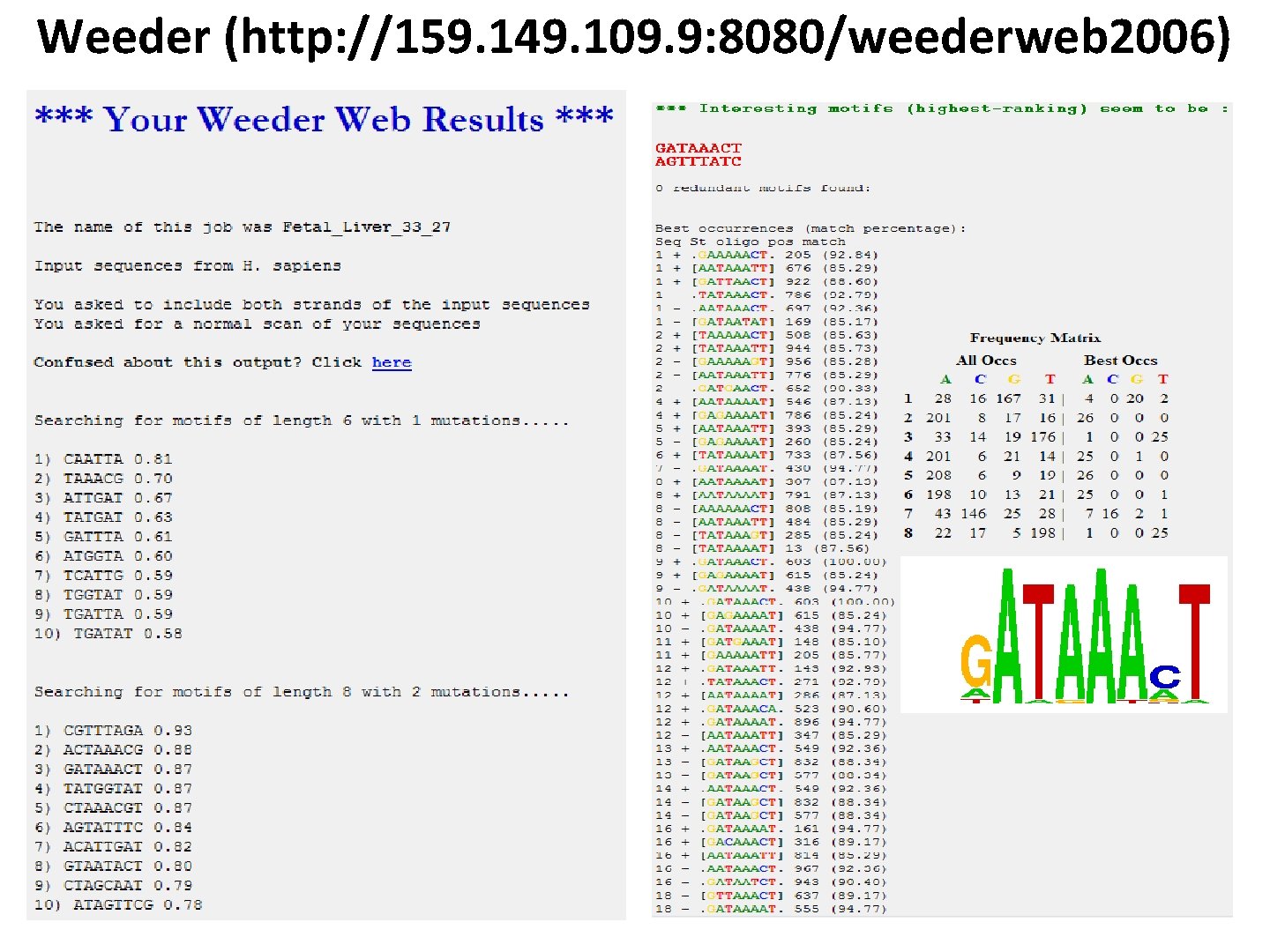
Weeder (http: //159. 149. 109. 9: 8080/weederweb 2006)
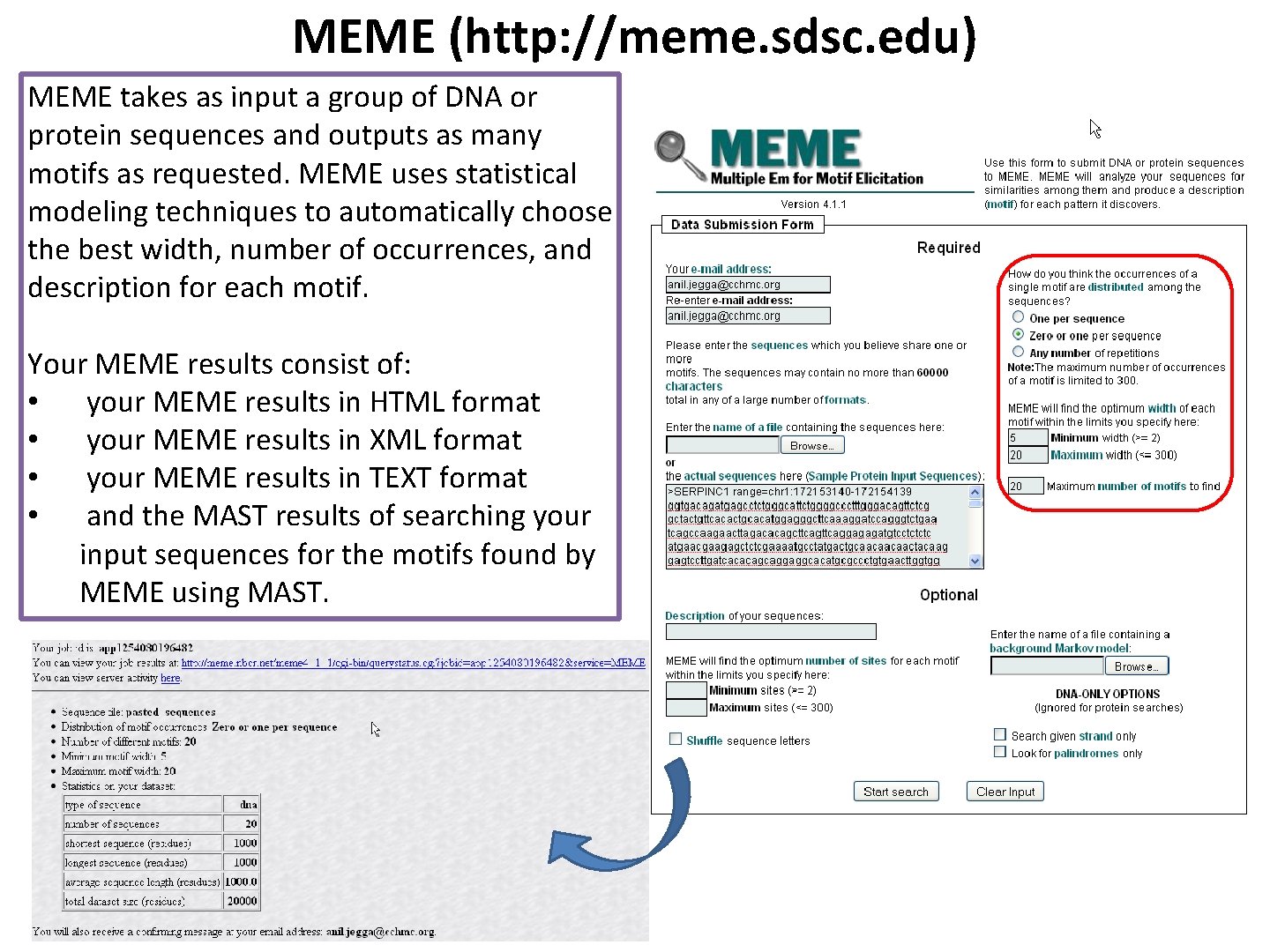
MEME (http: //meme. sdsc. edu) MEME takes as input a group of DNA or protein sequences and outputs as many motifs as requested. MEME uses statistical modeling techniques to automatically choose the best width, number of occurrences, and description for each motif. Your MEME results consist of: • your MEME results in HTML format • your MEME results in XML format • your MEME results in TEXT format • and the MAST results of searching your input sequences for the motifs found by MEME using MAST.
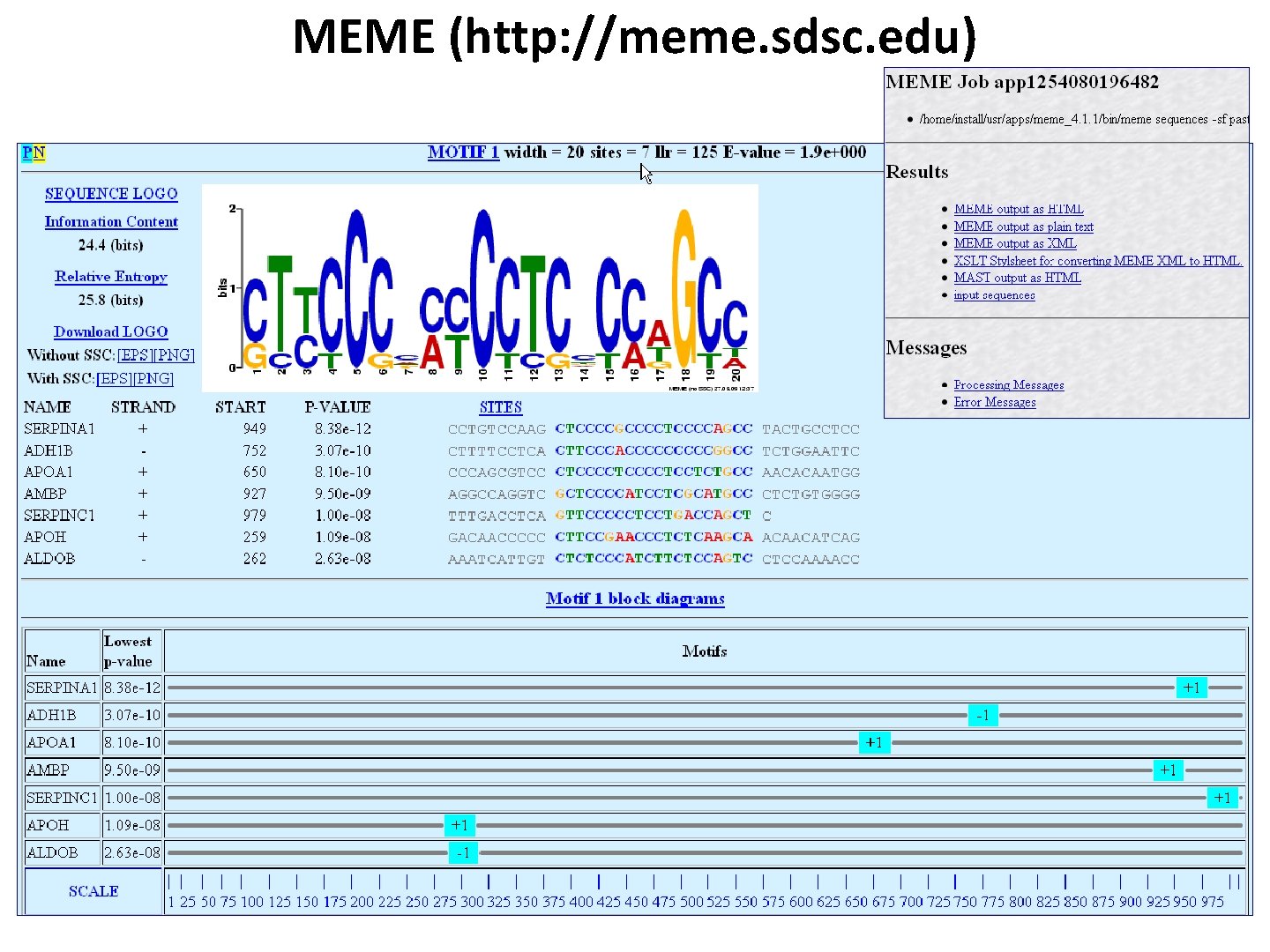
MEME (http: //meme. sdsc. edu)
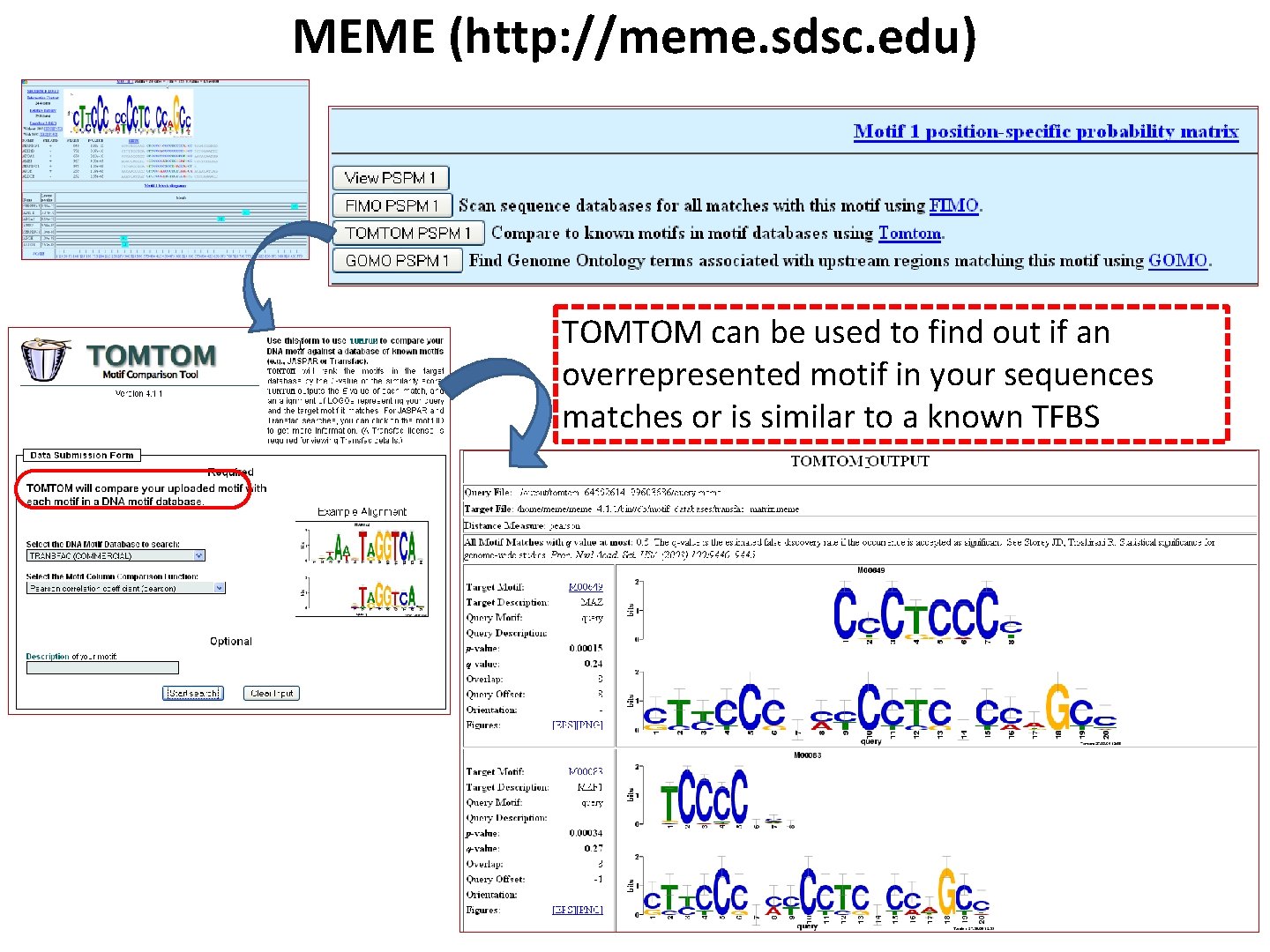
MEME (http: //meme. sdsc. edu) TOMTOM can be used to find out if an overrepresented motif in your sequences matches or is similar to a known TFBS
Exercise 8: Use the downloaded SLC 7 A 1 ortholog promoter sequences to find out common motifs using Weeder. H Exercise 9: Use the downloaded promoter sequences (from Exercise 4) to find out common motifs using Weeder and MEME Exercise 10: Does any of the motifs found by Meme match known TFBS?
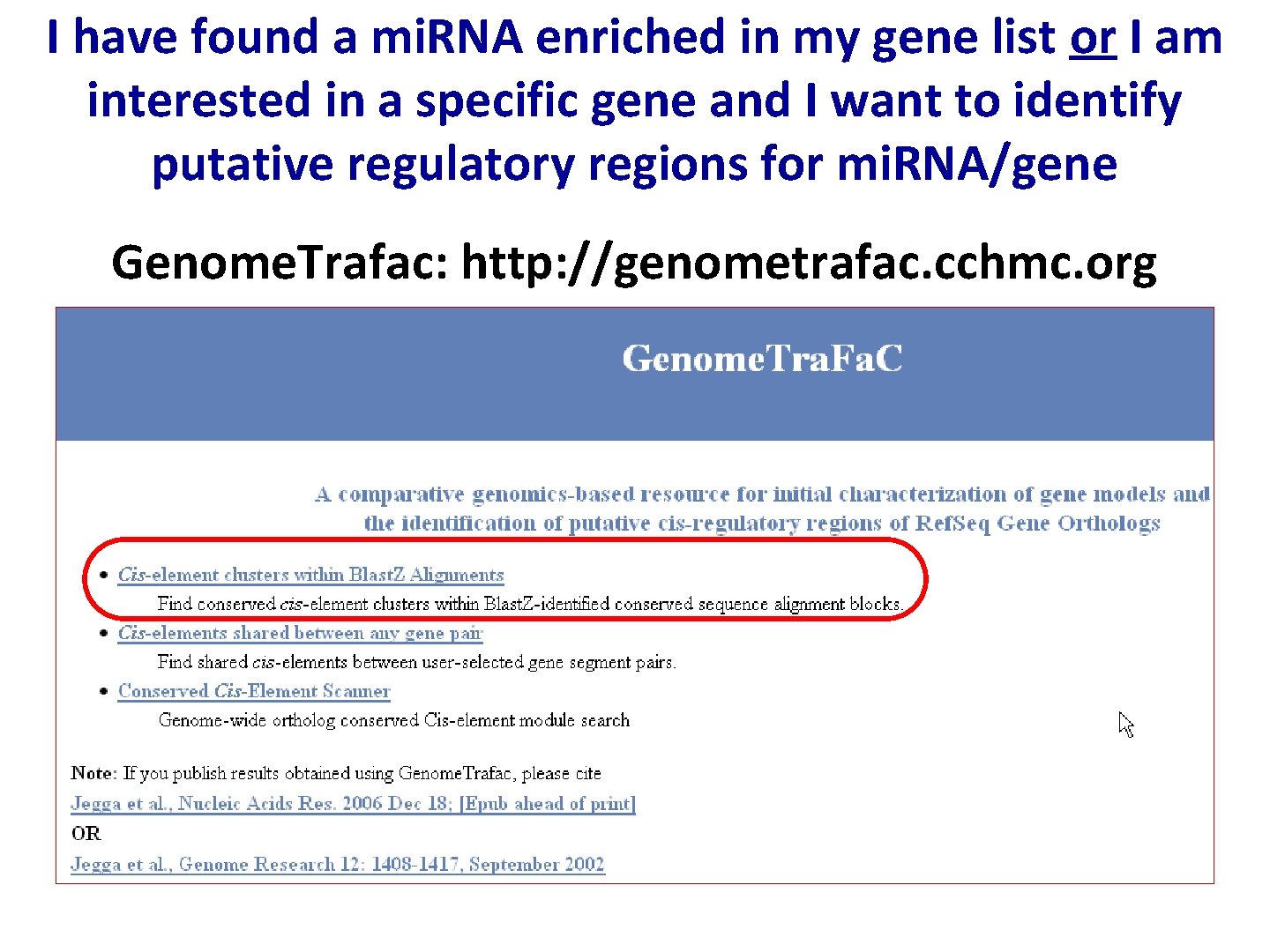
I have found a mi. RNA enriched in my gene list or I am interested in a specific gene and I want to identify putative regulatory regions for mi. RNA/gene Genome. Trafac: http: //genometrafac. cchmc. org
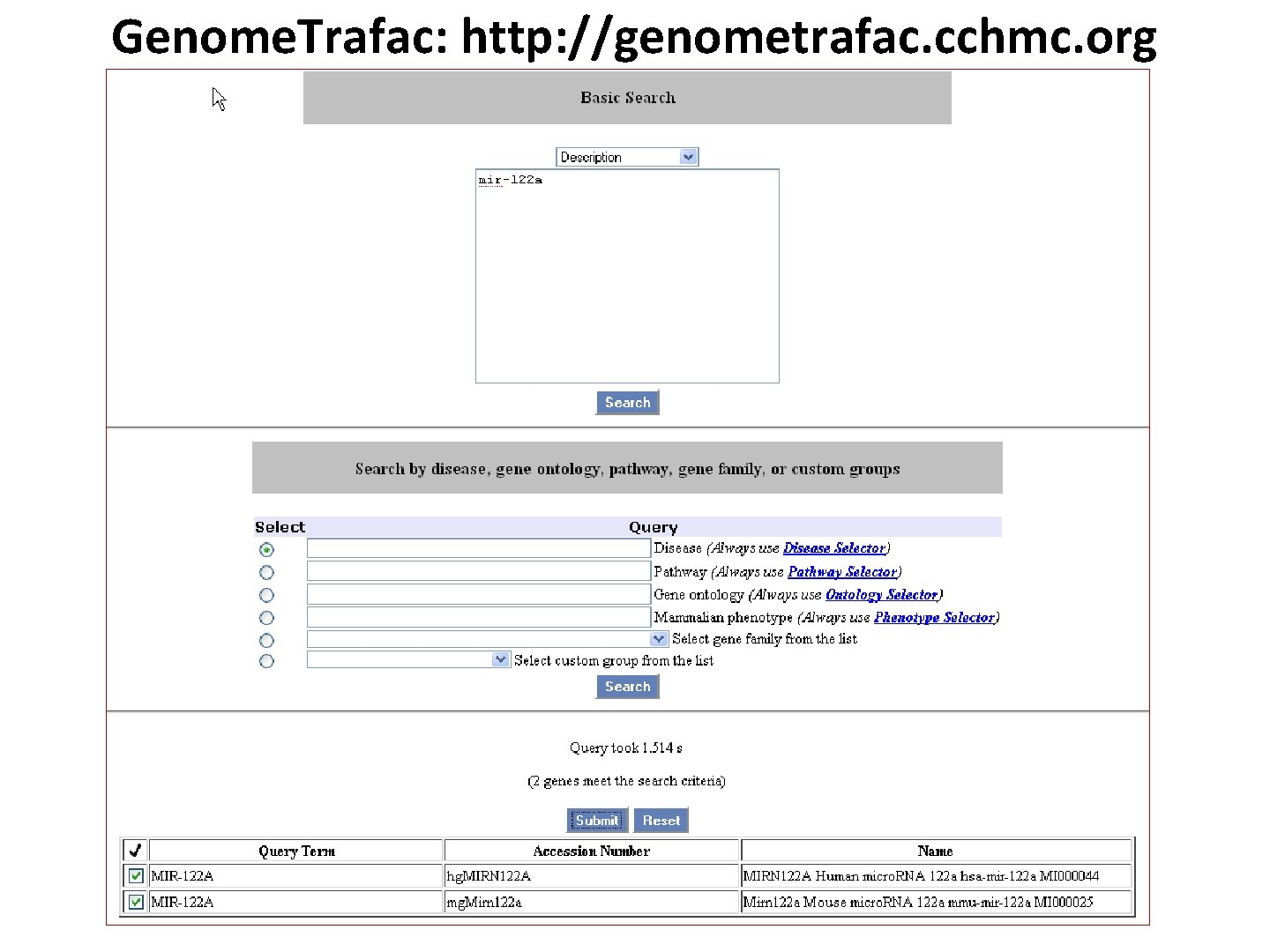
Genome. Trafac: http: //genometrafac. cchmc. org
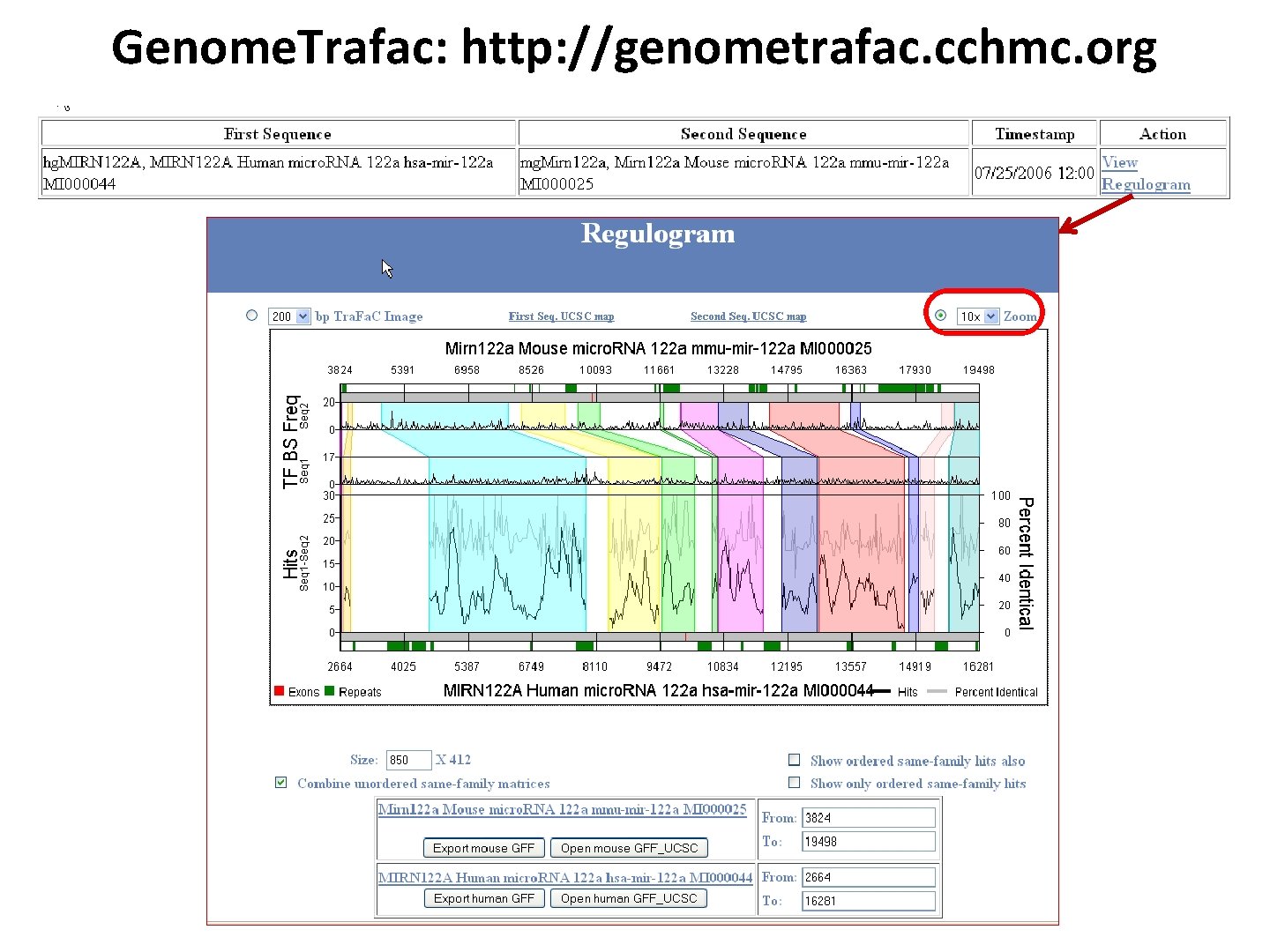
Genome. Trafac: http: //genometrafac. cchmc. org
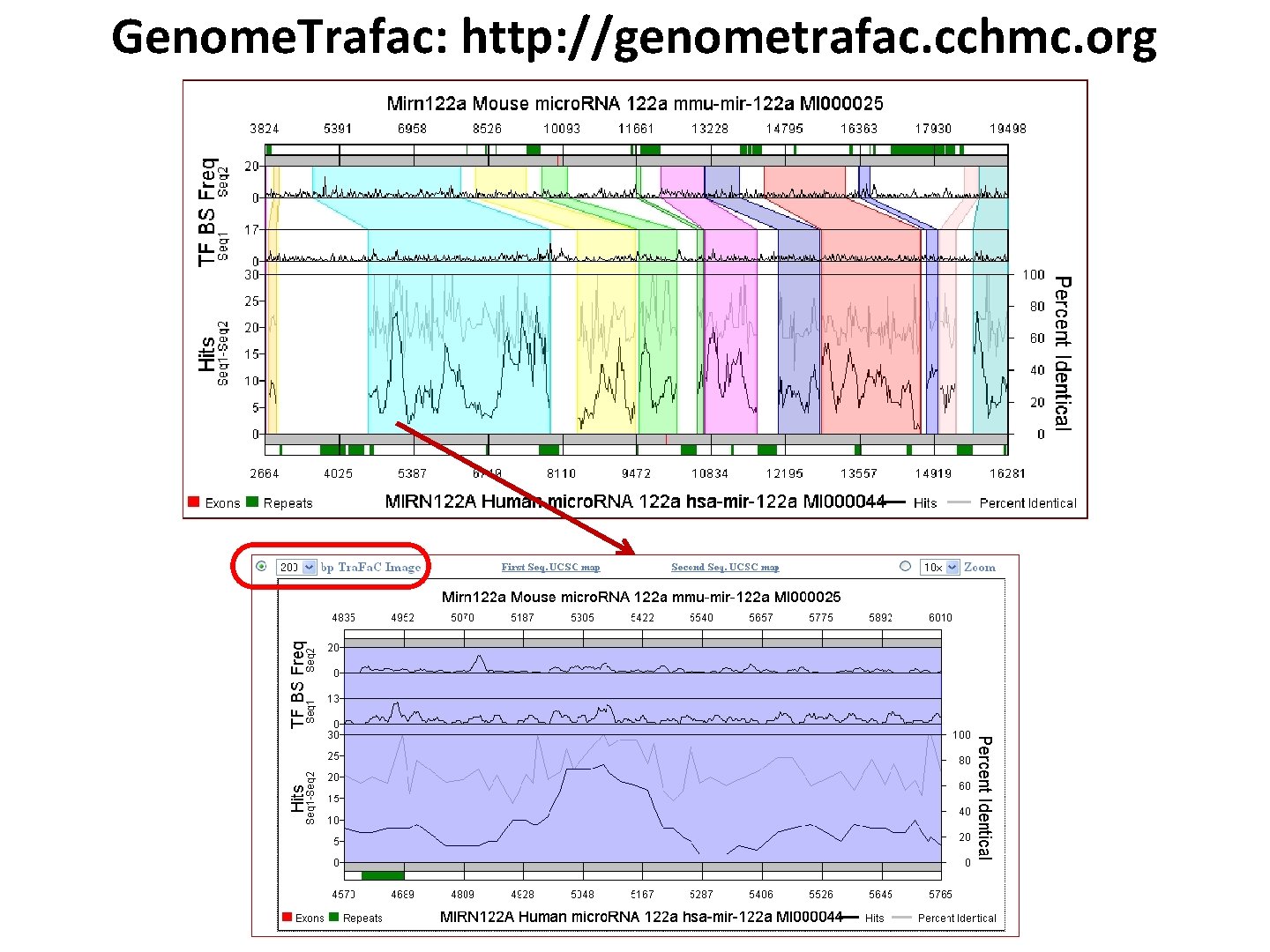
Genome. Trafac: http: //genometrafac. cchmc. org
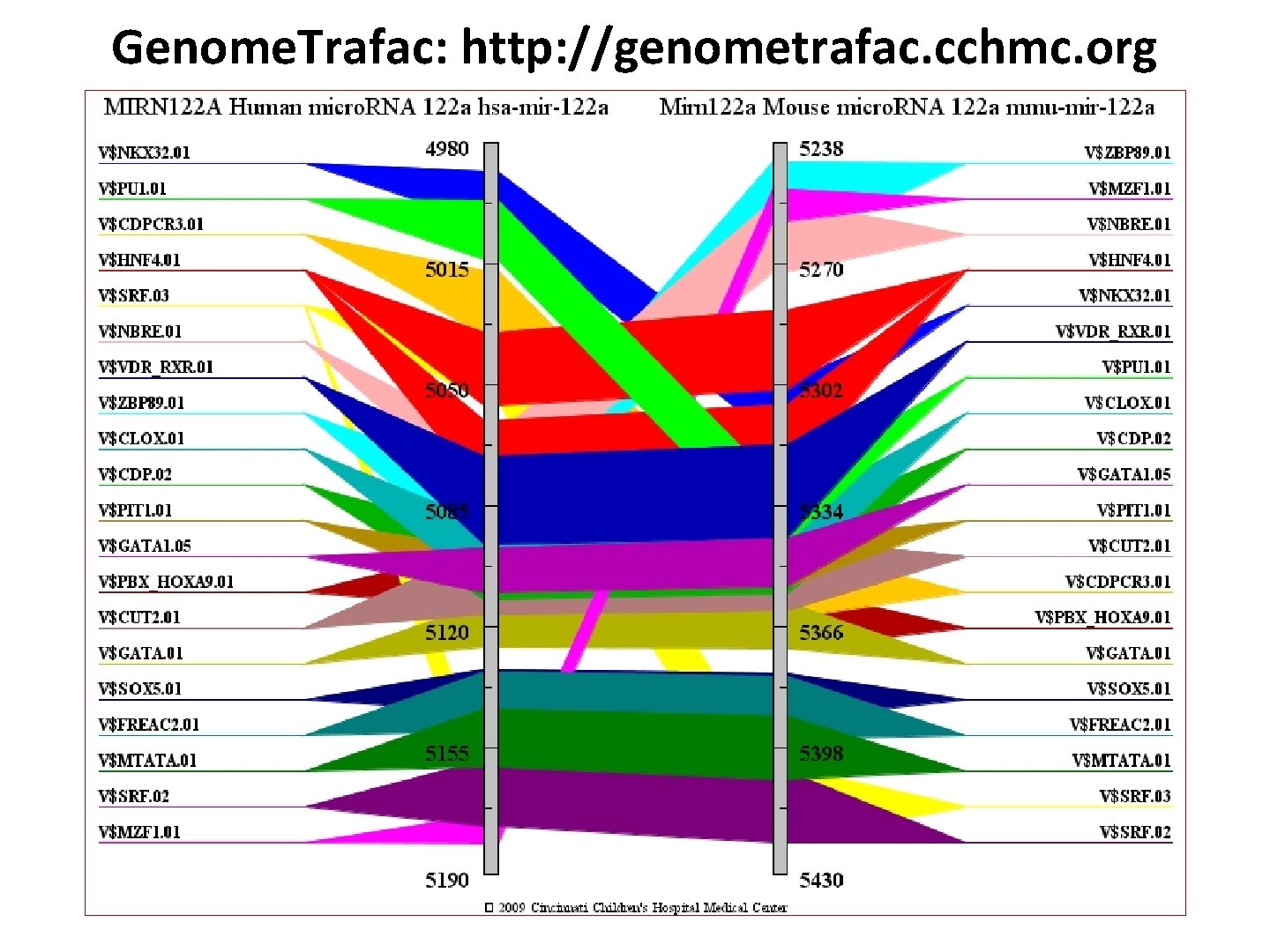
Genome. Trafac: http: //genometrafac. cchmc. org
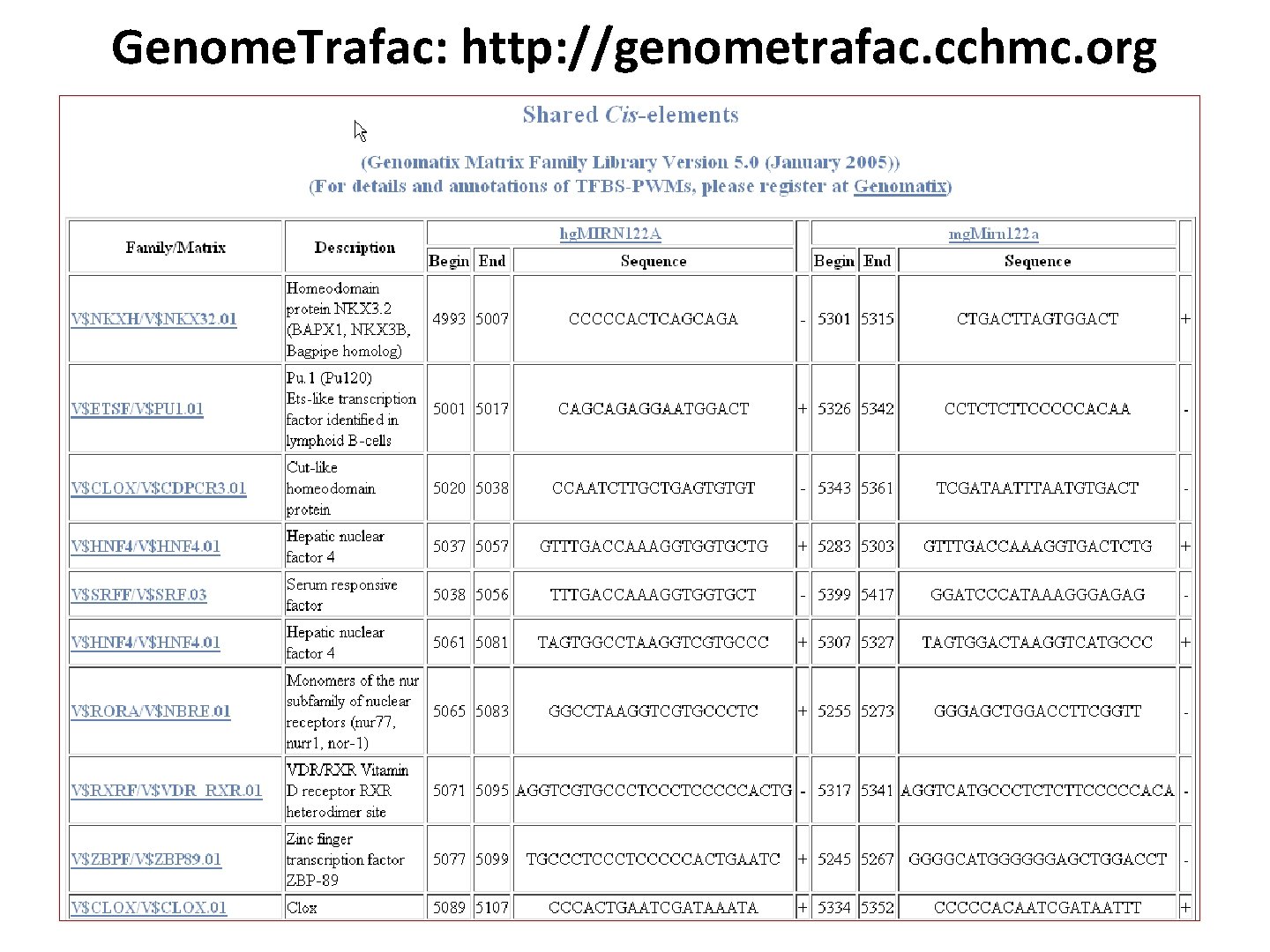
Genome. Trafac: http: //genometrafac. cchmc. org
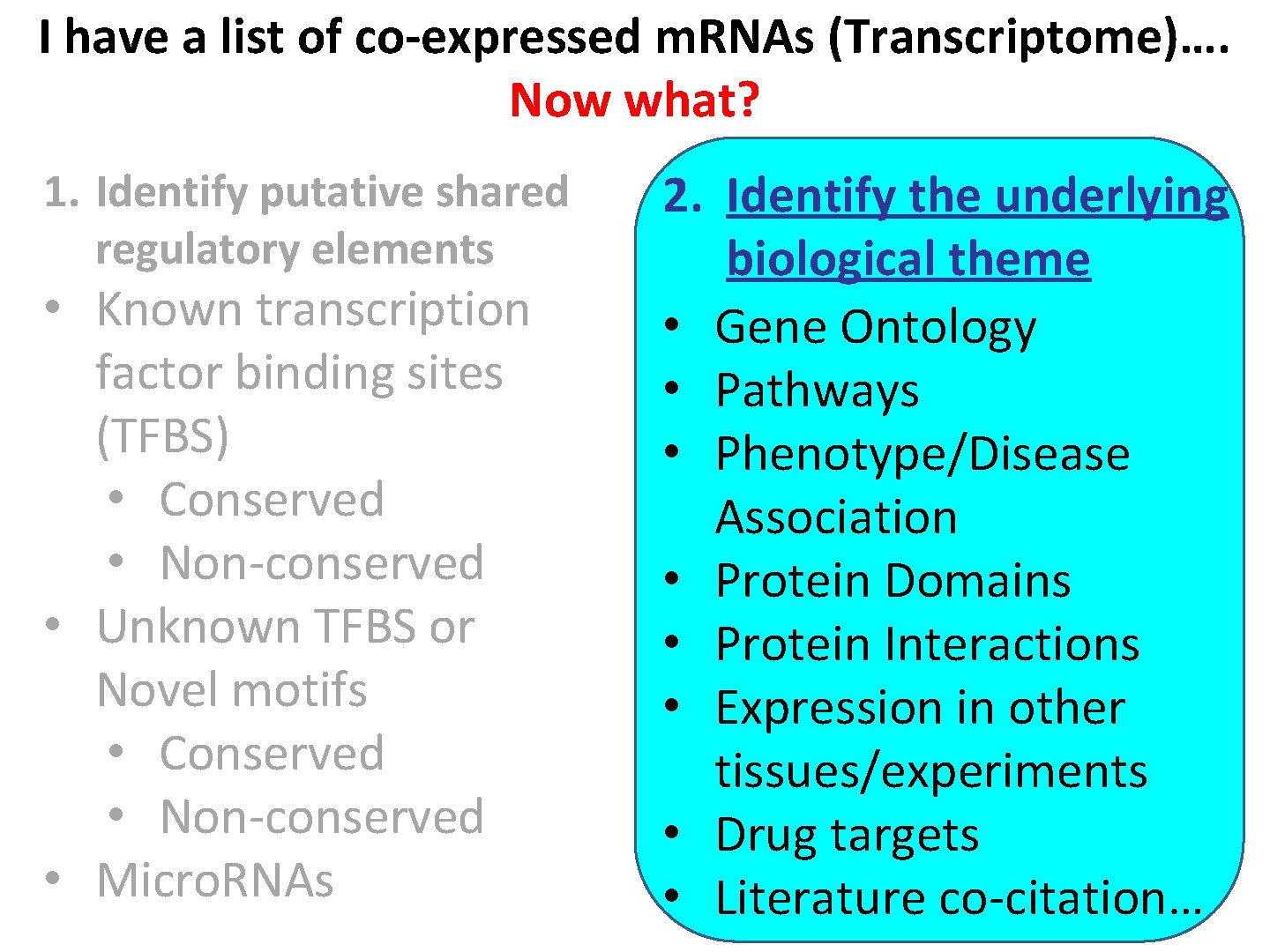
I have a list of co-expressed m. RNAs (Transcriptome)…. Now what? 1. Identify putative shared regulatory elements • Known transcription factor binding sites (TFBS) • Conserved • Non-conserved • Unknown TFBS or Novel motifs • Conserved • Non-conserved • Micro. RNAs 2. Identify the underlying biological theme • Gene Ontology • Pathways • Phenotype/Disease Association • Protein Domains • Protein Interactions • Expression in other tissues/experiments • Drug targets • Literature co-citation…
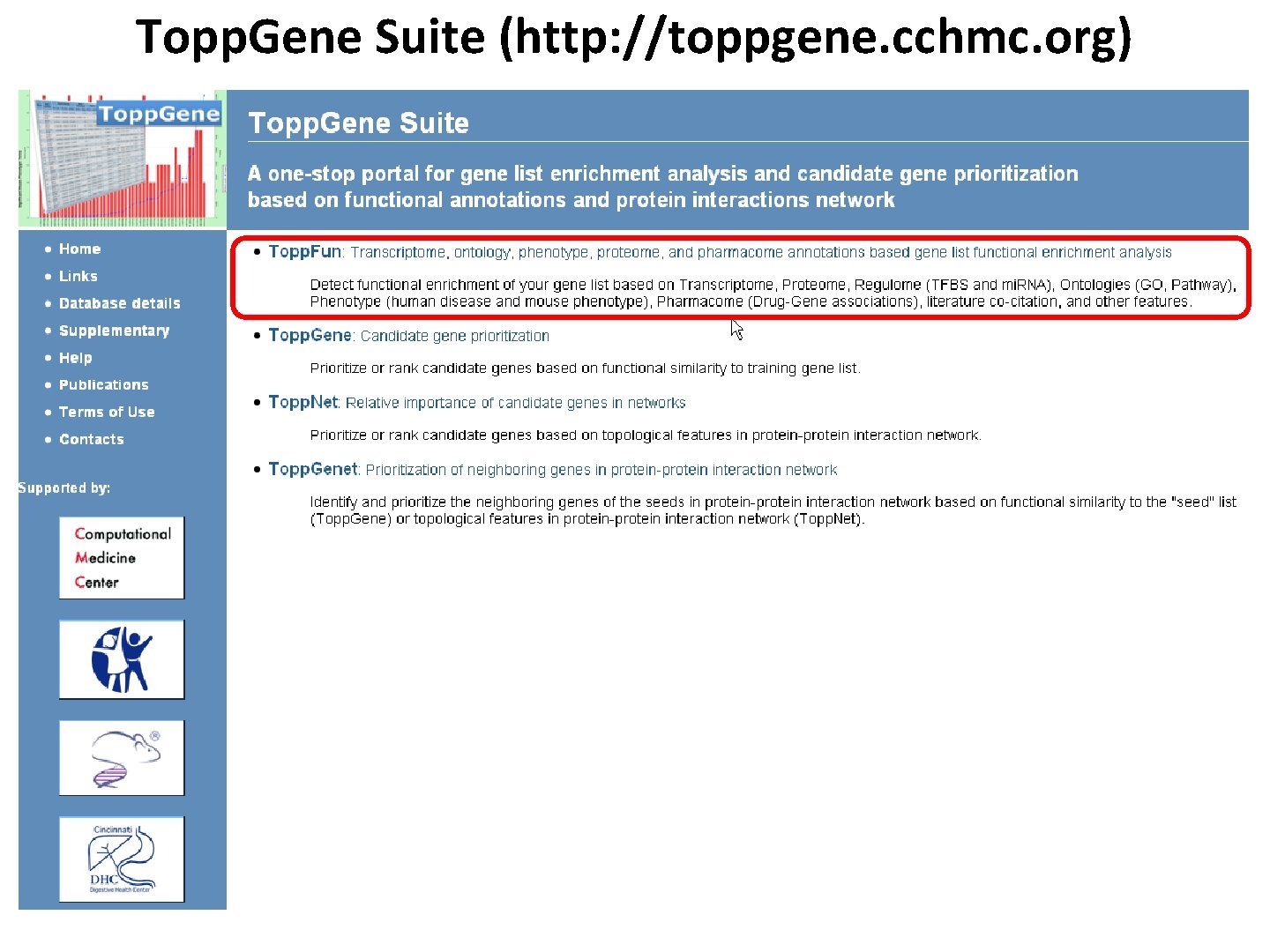
Topp. Gene Suite (http: //toppgene. cchmc. org)
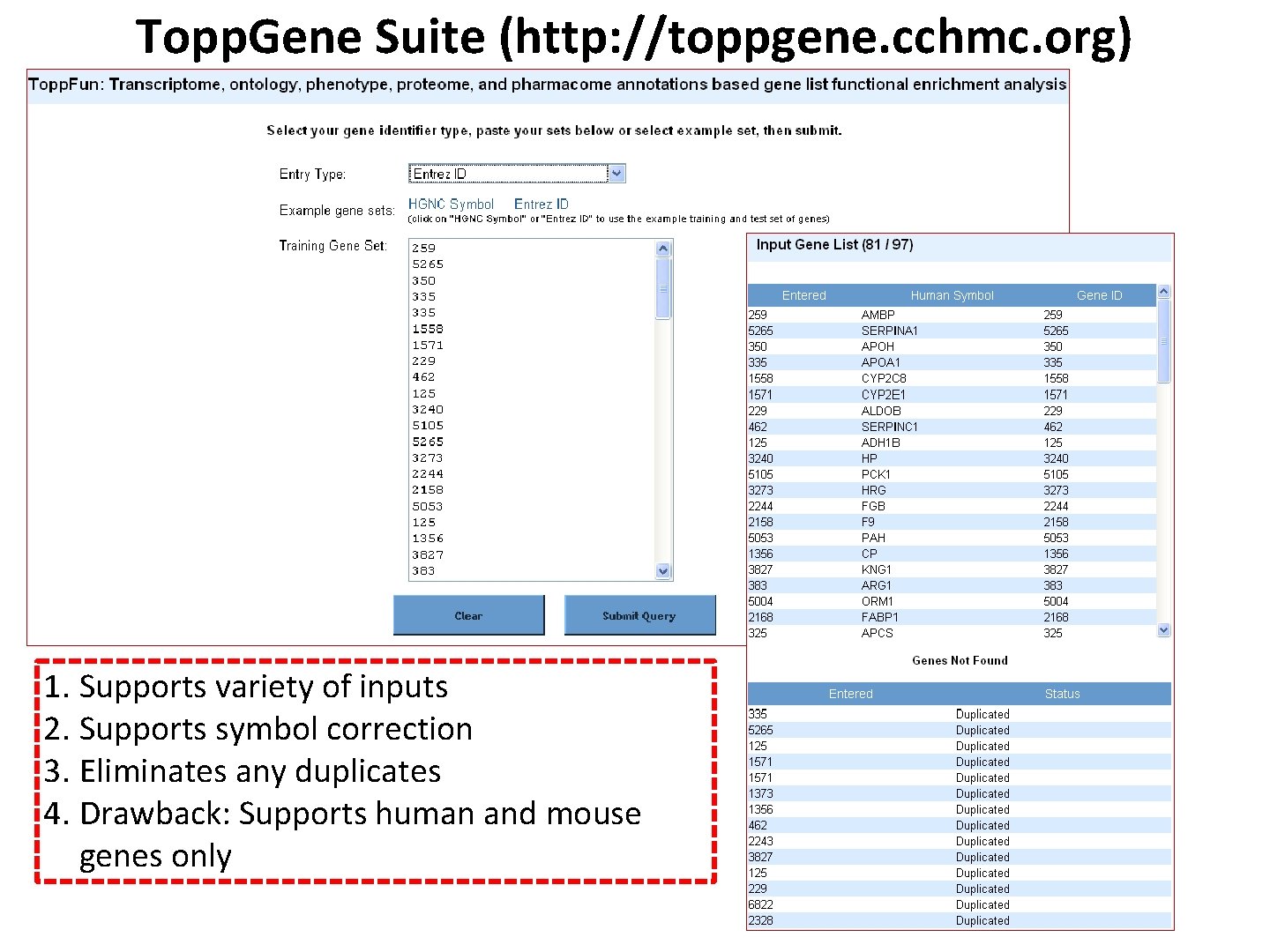
Topp. Gene Suite (http: //toppgene. cchmc. org) 1. Supports variety of inputs 2. Supports symbol correction 3. Eliminates any duplicates 4. Drawback: Supports human and mouse genes only
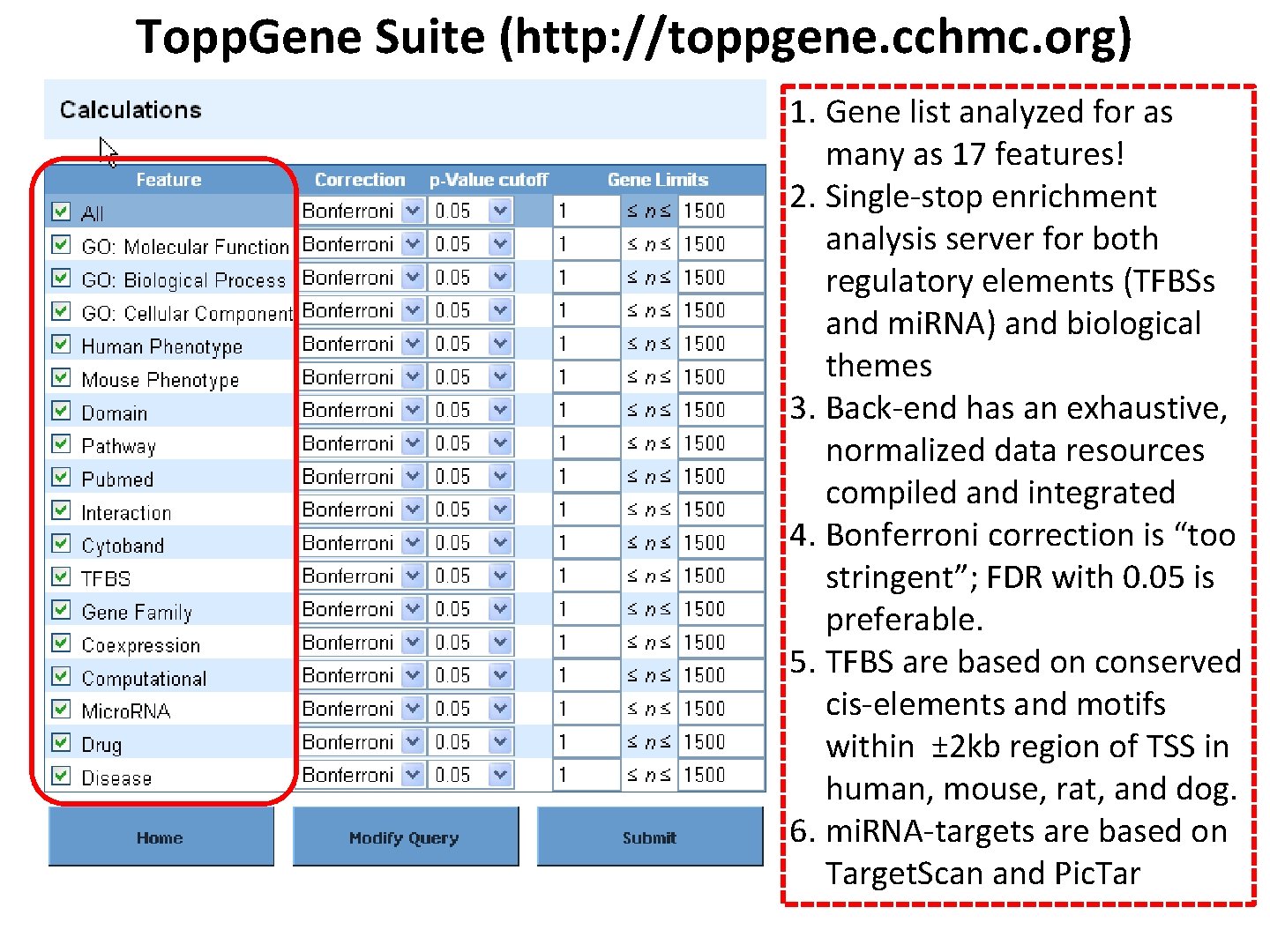
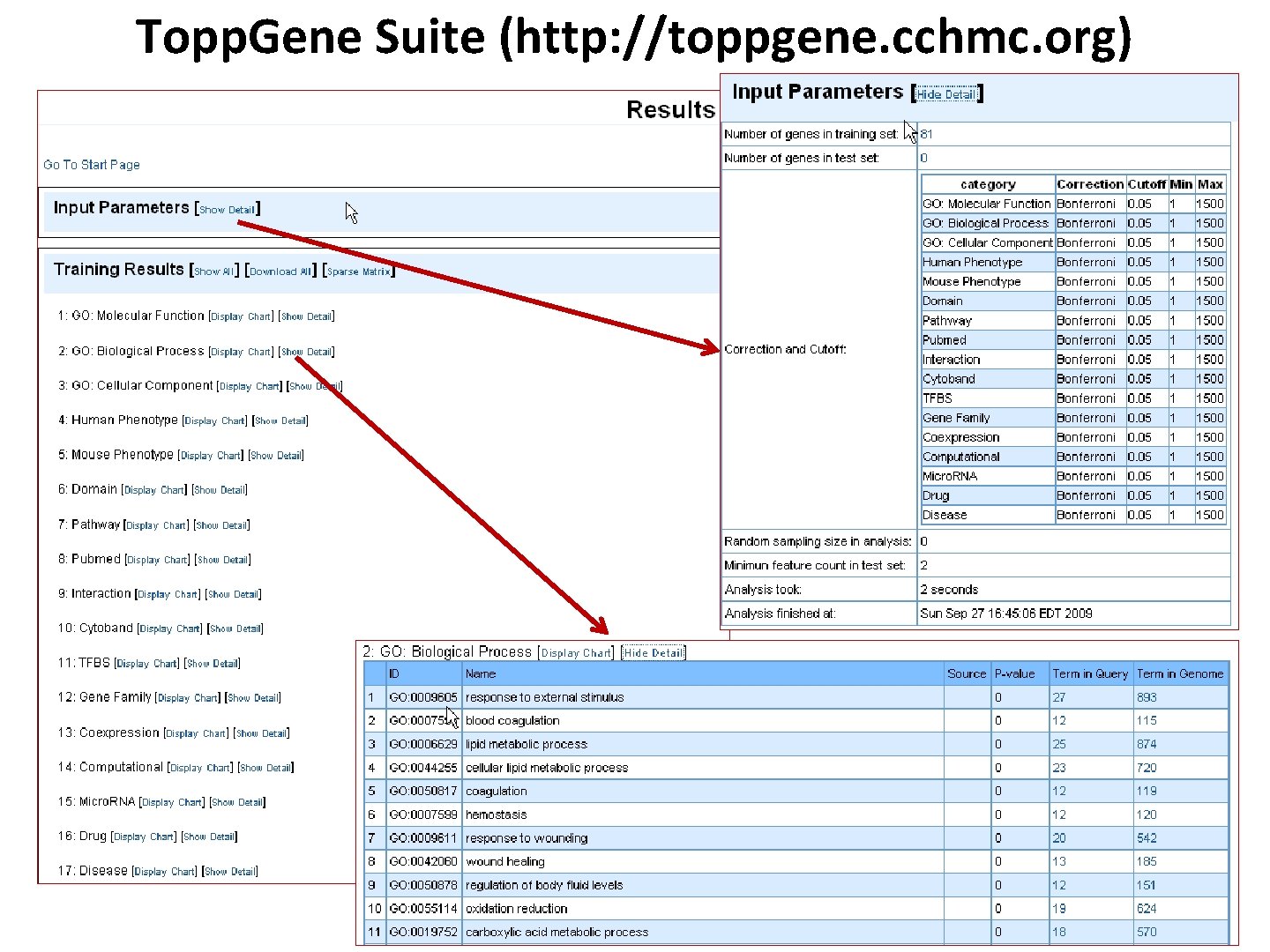
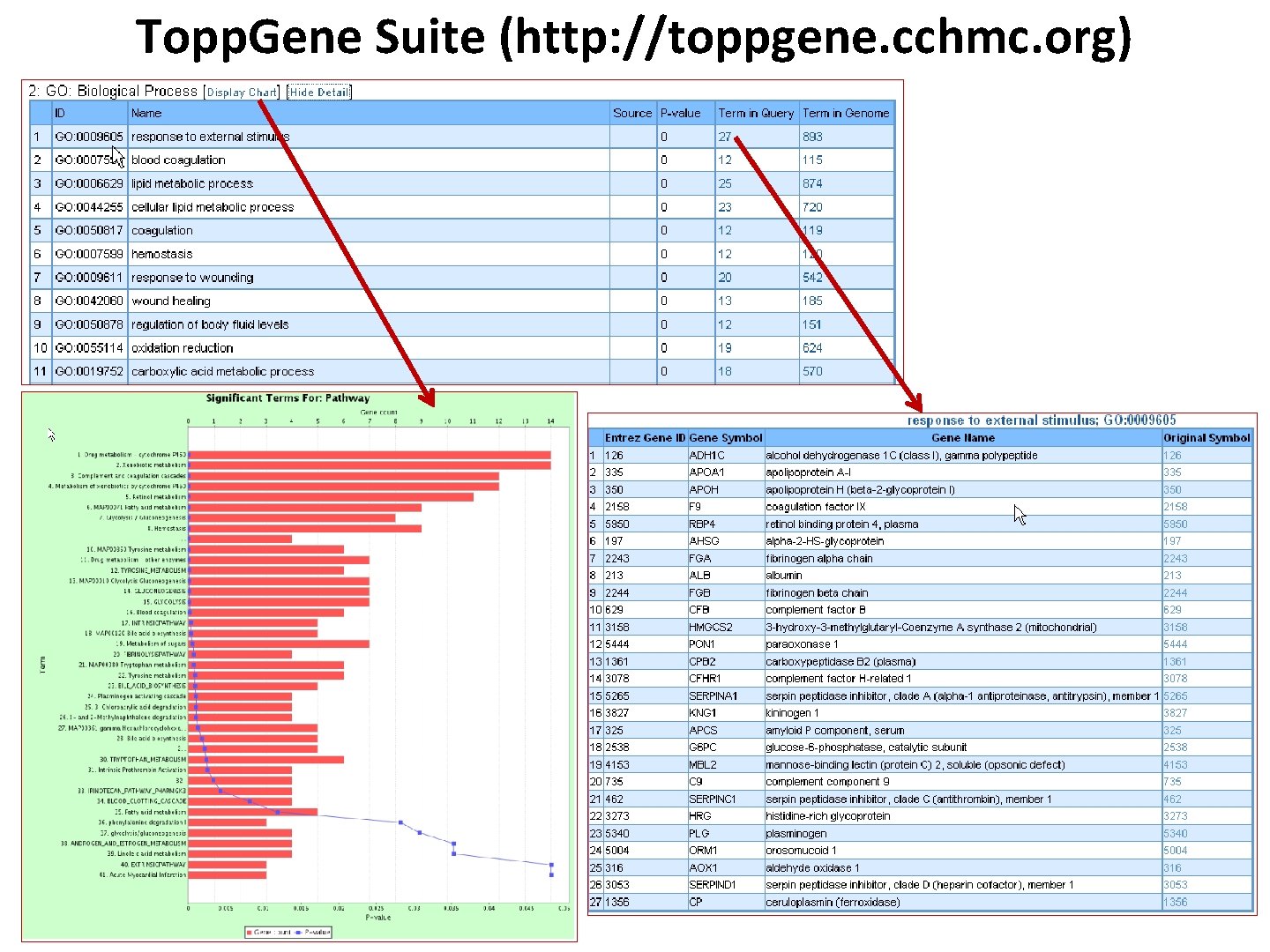
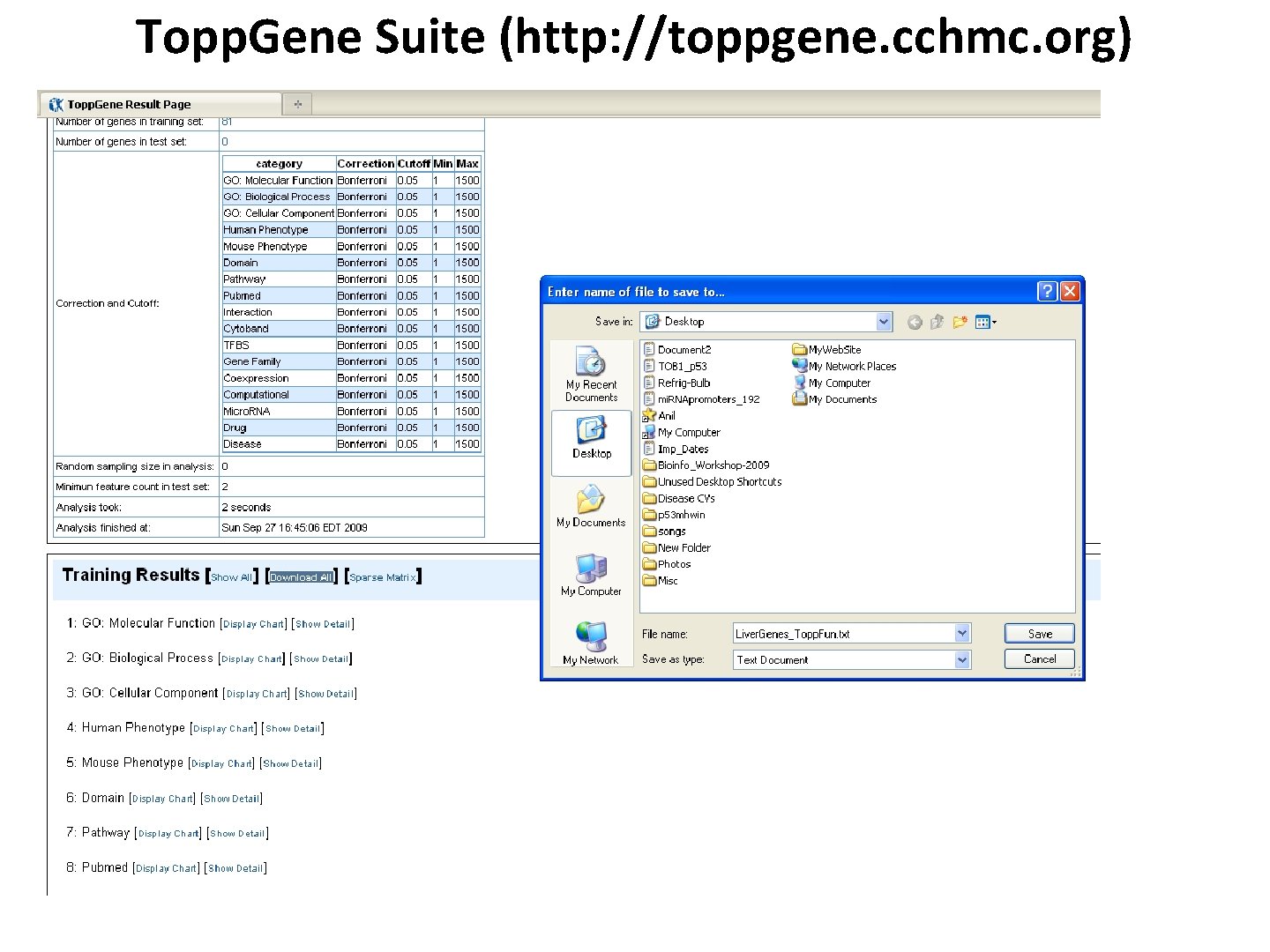
Topp. Gene Suite (http: //toppgene. cchmc. org) 1. Gene list analyzed for as many as 17 features! 2. Single-stop enrichment analysis server for both regulatory elements (TFBSs and mi. RNA) and biological themes 3. Back-end has an exhaustive, normalized data resources compiled and integrated 4. Bonferroni correction is “too stringent”; FDR with 0. 05 is preferable. 5. TFBS are based on conserved cis-elements and motifs within ± 2 kb region of TSS in human, mouse, rat, and dog. 6. mi. RNA-targets are based on Target. Scan and Pic. Tar
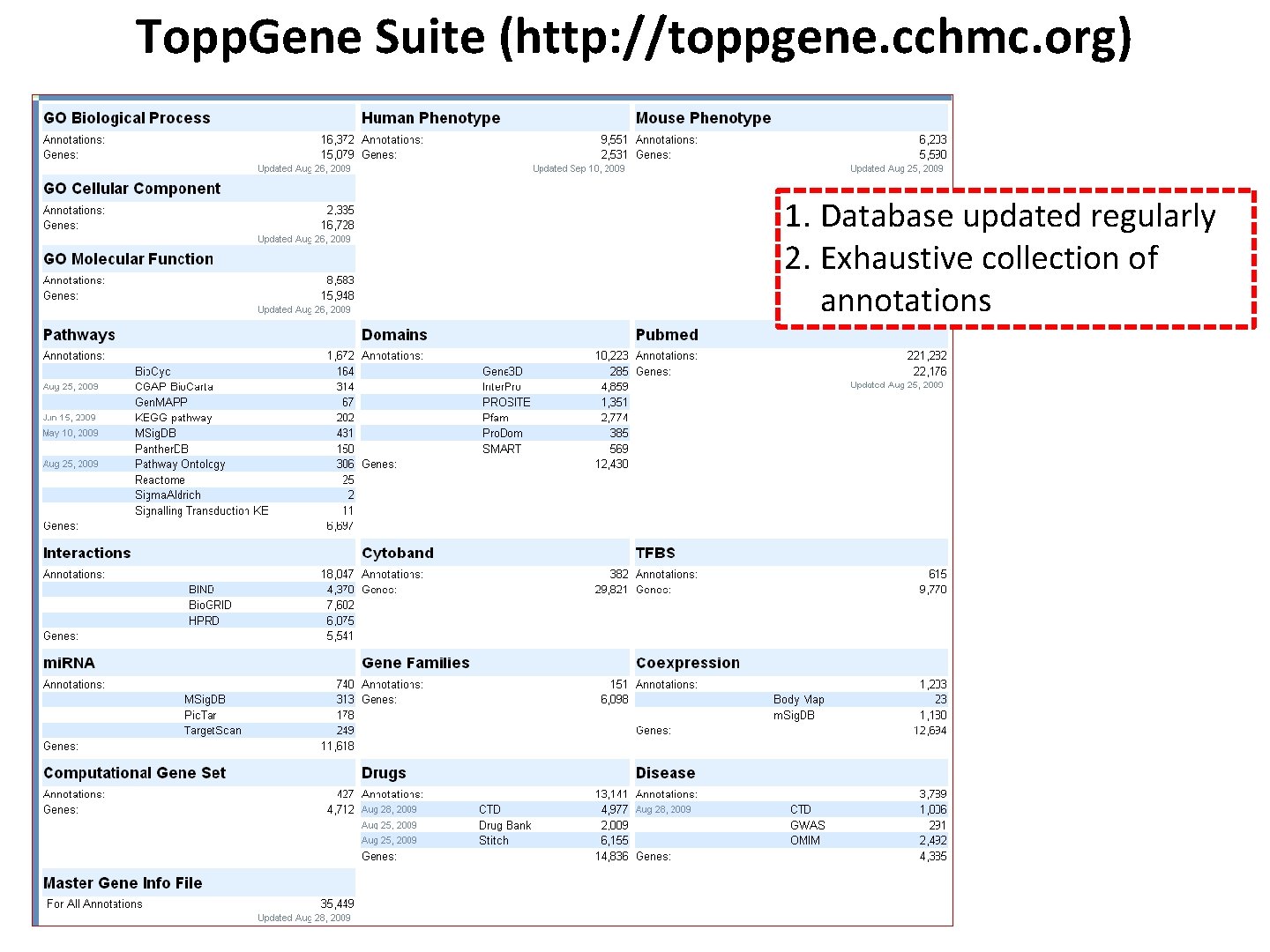
Topp. Gene Suite (http: //toppgene. cchmc. org) 1. Database updated regularly 2. Exhaustive collection of annotations
Topp. Gene Suite (http: //toppgene. cchmc. org)
Topp. Gene Suite (http: //toppgene. cchmc. org)
Topp. Gene Suite (http: //toppgene. cchmc. org)
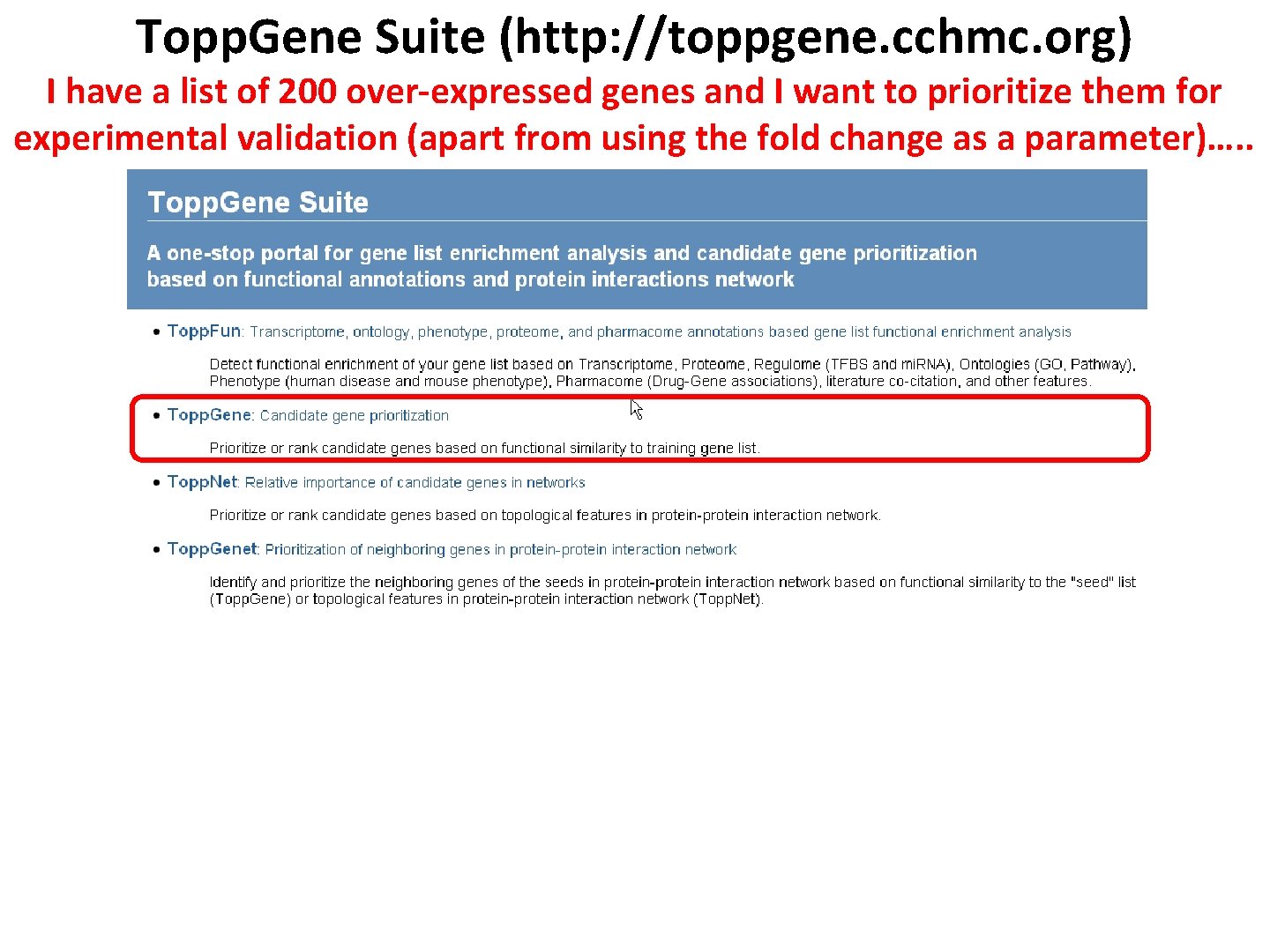
Topp. Gene Suite (http: //toppgene. cchmc. org) I have a list of 200 over-expressed genes and I want to prioritize them for experimental validation (apart from using the fold change as a parameter)…. .
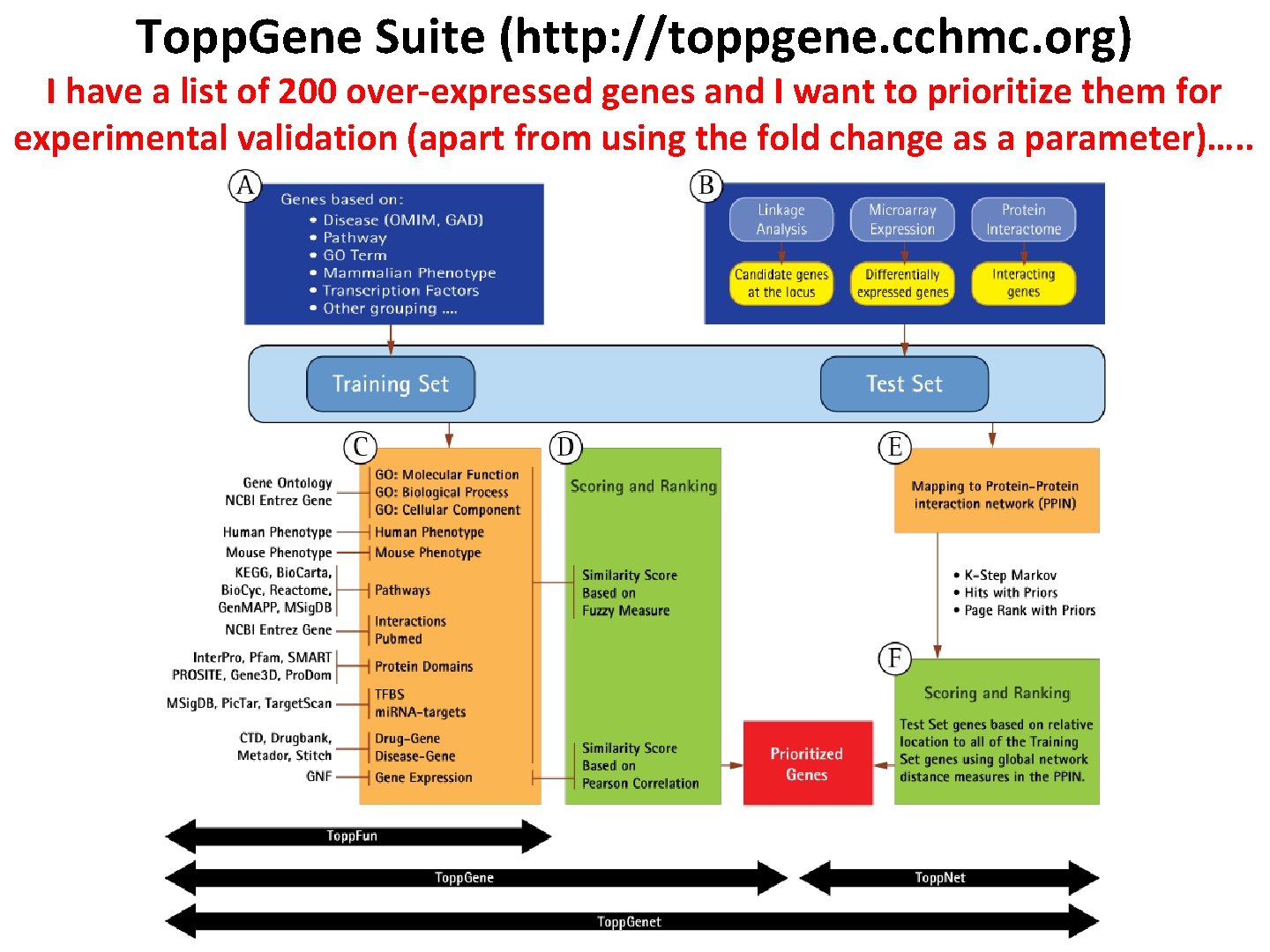
Topp. Gene Suite (http: //toppgene. cchmc. org) I have a list of 200 over-expressed genes and I want to prioritize them for experimental validation (apart from using the fold change as a parameter)…. .
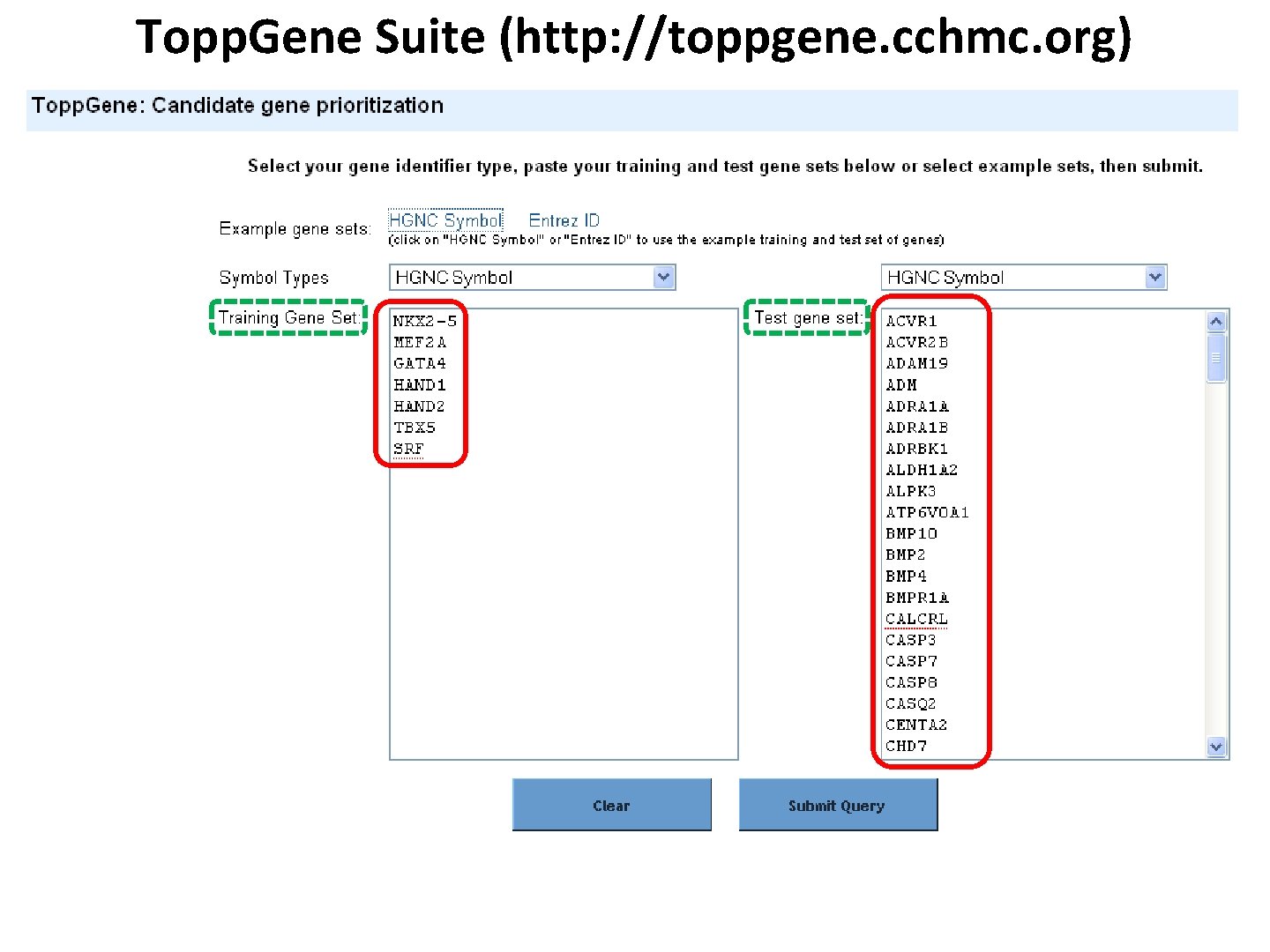
Topp. Gene Suite (http: //toppgene. cchmc. org)
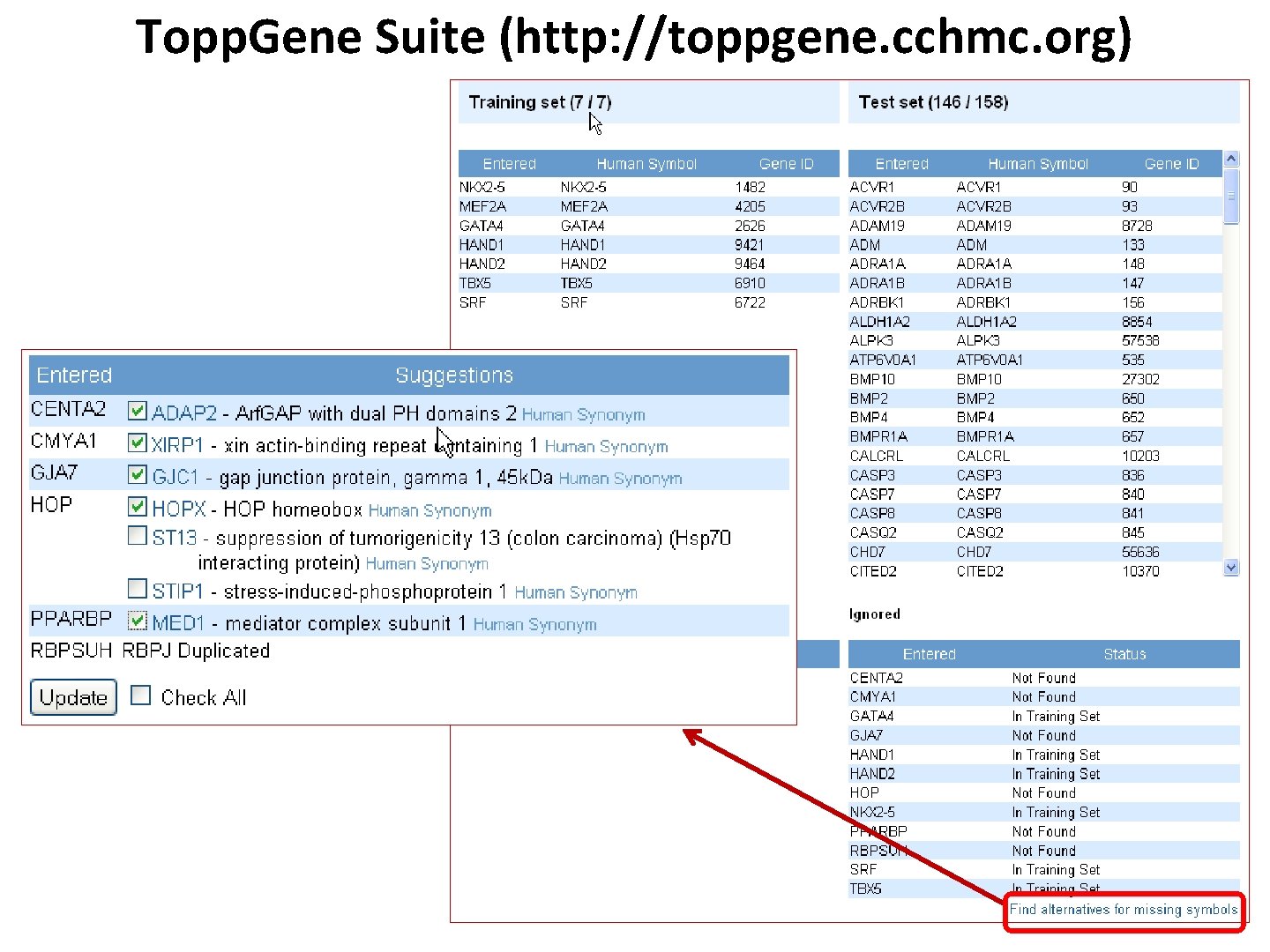
Topp. Gene Suite (http: //toppgene. cchmc. org)
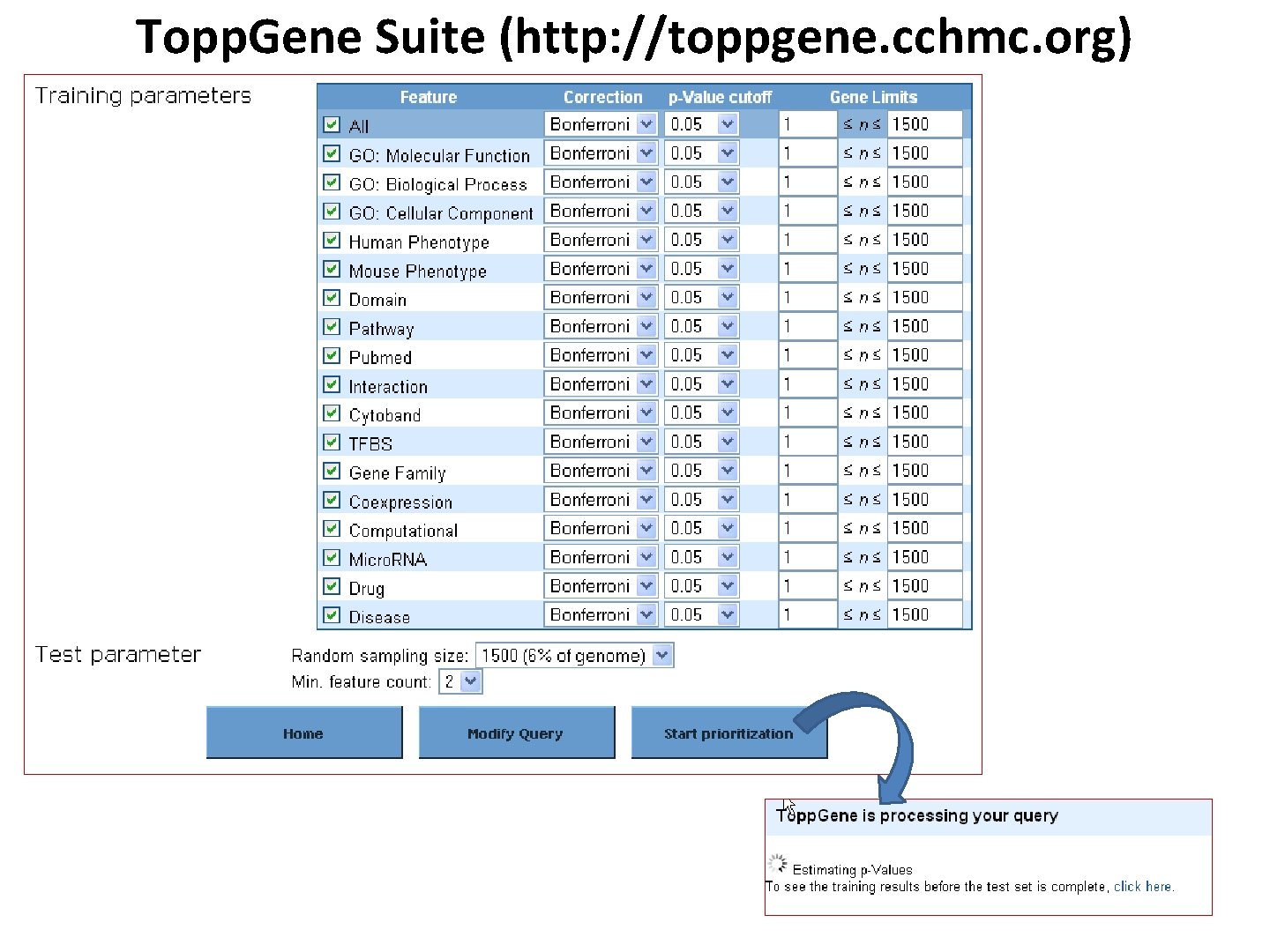
Topp. Gene Suite (http: //toppgene. cchmc. org)
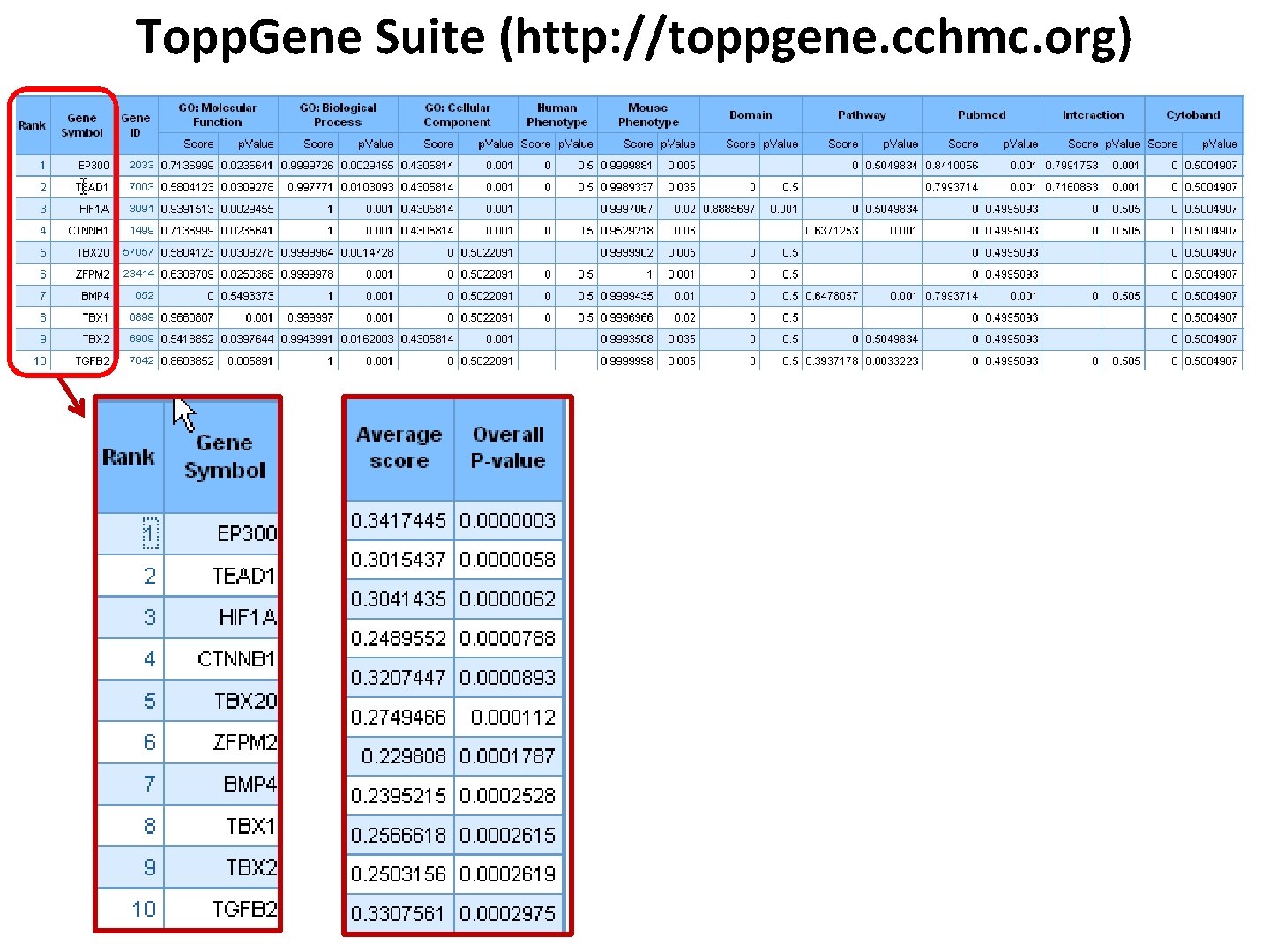
Topp. Gene Suite (http: //toppgene. cchmc. org)
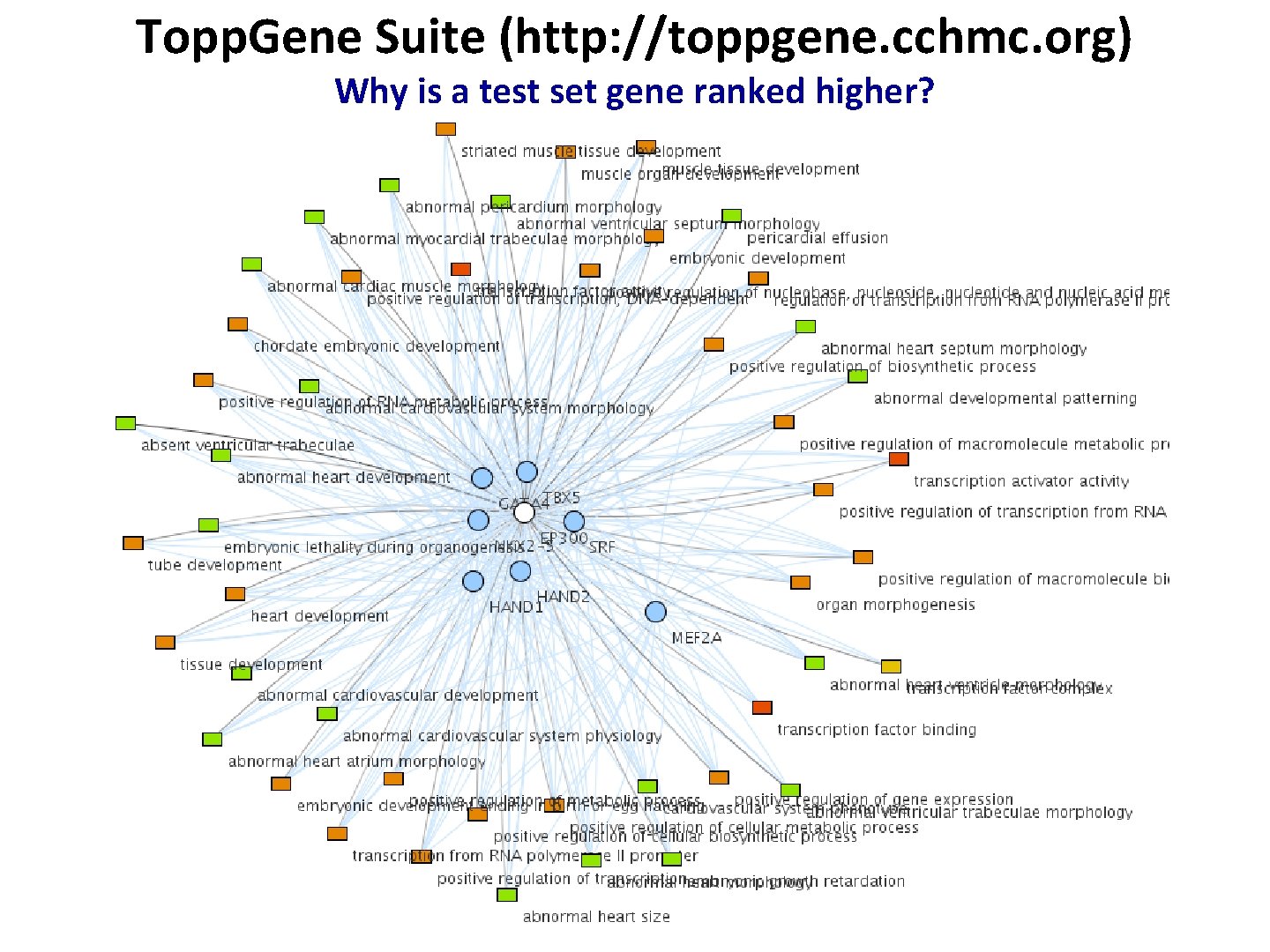
Topp. Gene Suite (http: //toppgene. cchmc. org) Why is a test set gene ranked higher?
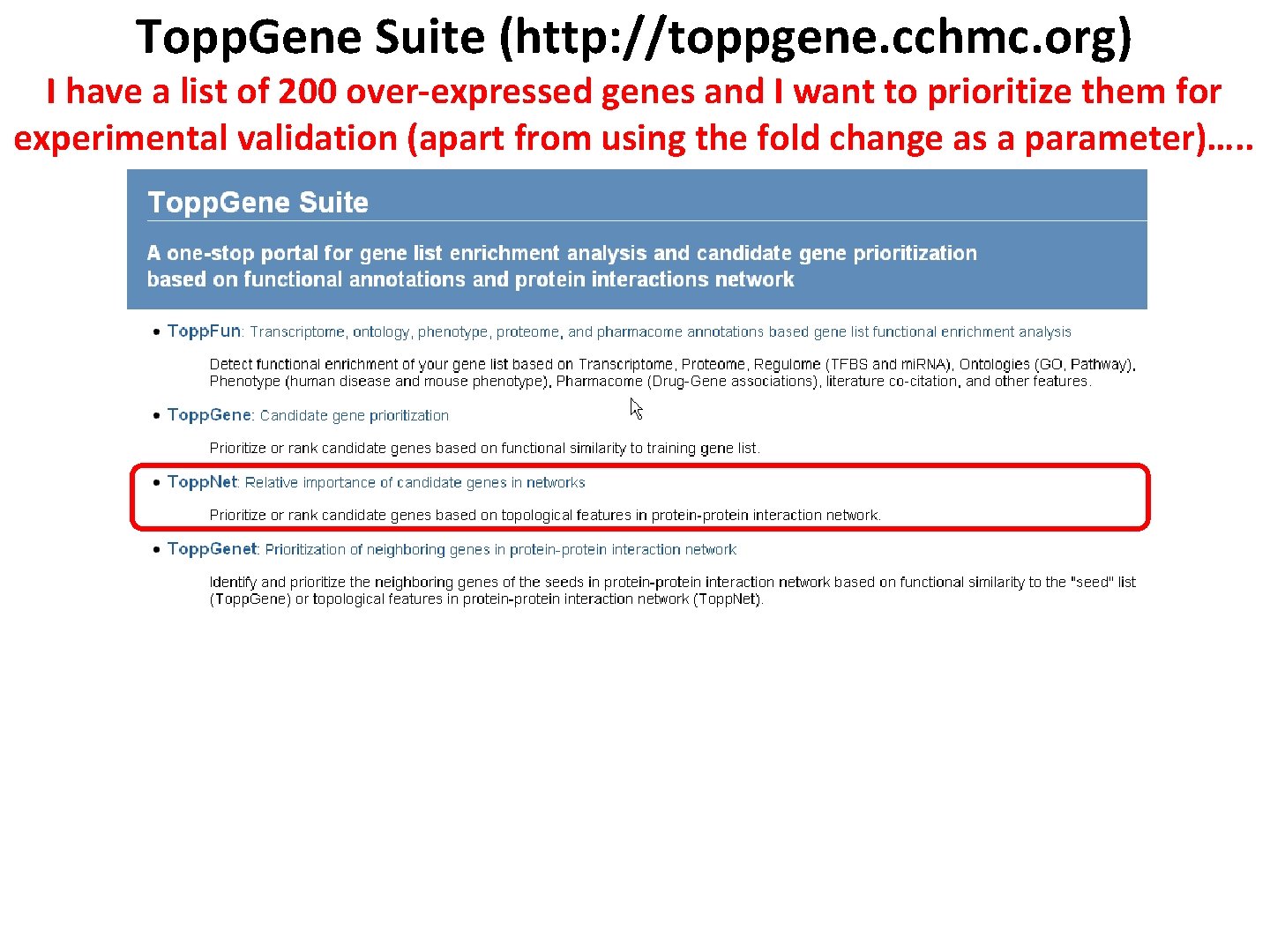
Topp. Gene Suite (http: //toppgene. cchmc. org) I have a list of 200 over-expressed genes and I want to prioritize them for experimental validation (apart from using the fold change as a parameter)…. .
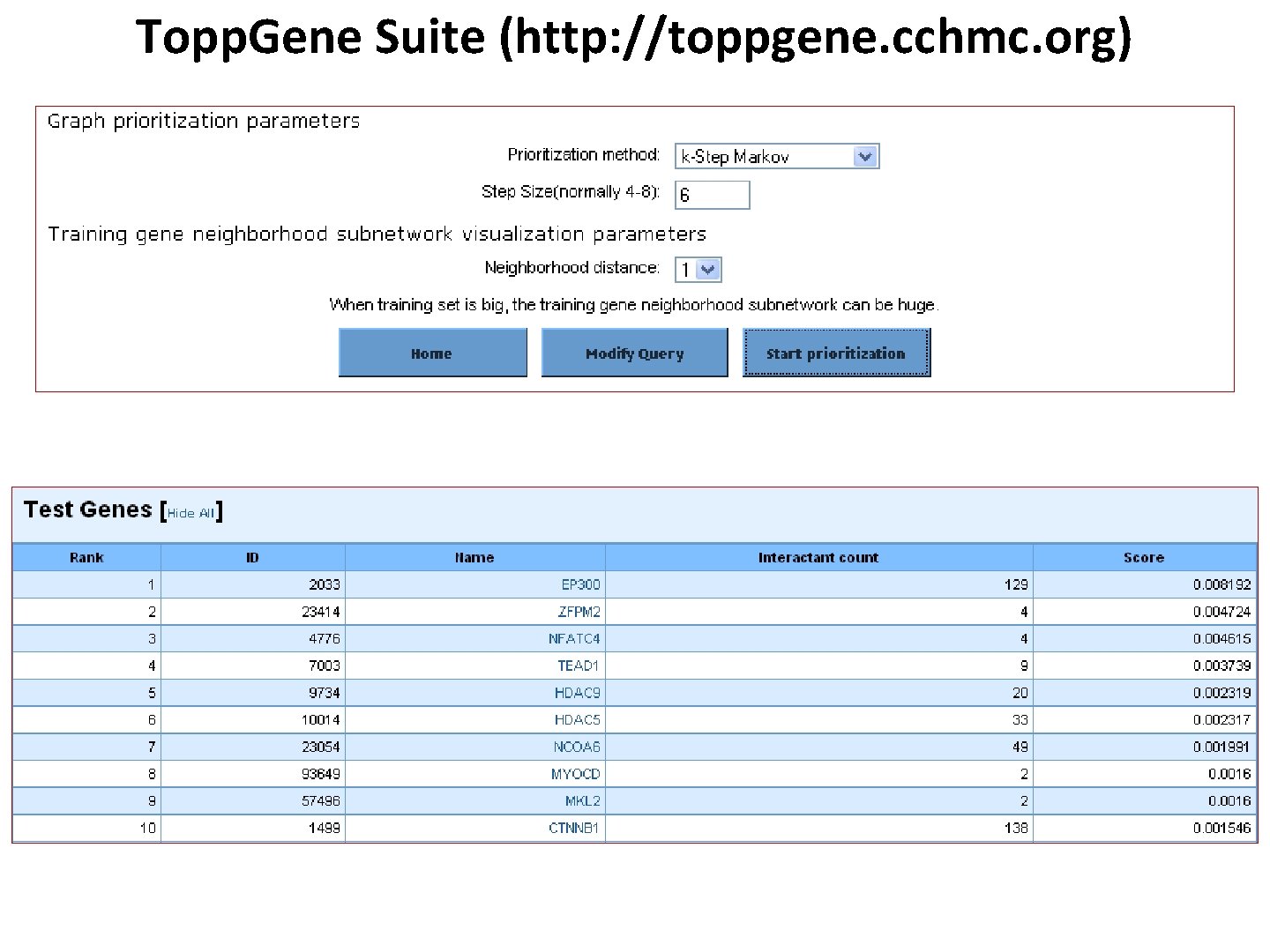
Topp. Gene Suite (http: //toppgene. cchmc. org)
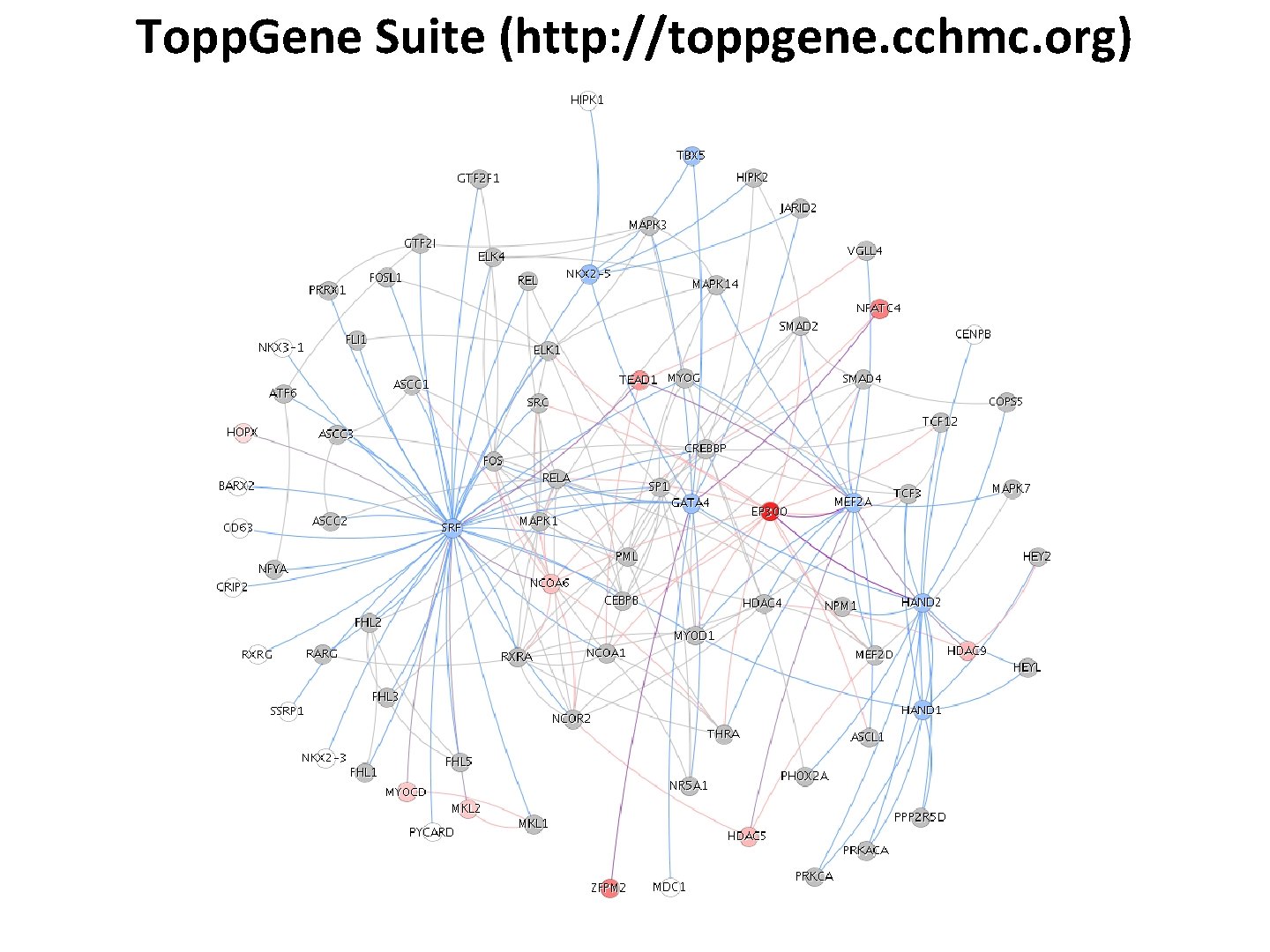
Topp. Gene Suite (http: //toppgene. cchmc. org)
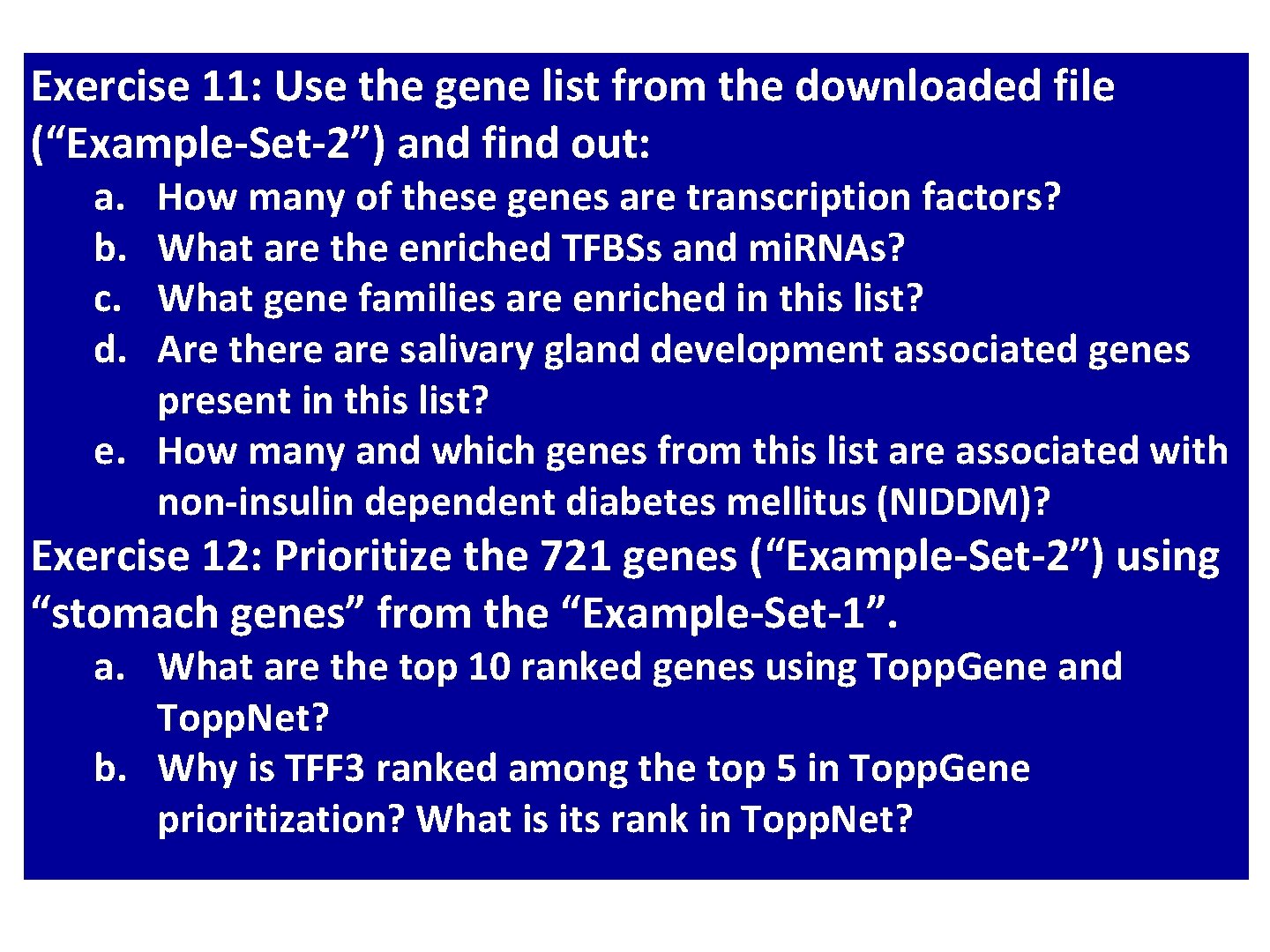
Exercise 11: Use the gene list from the downloaded file (“Example-Set-2”) and find out: a. b. c. d. How many of these genes are transcription factors? What are the enriched TFBSs and mi. RNAs? What gene families are enriched in this list? Are there are salivary gland development associated genes present in this list? e. How many and which genes from this list are associated with non-insulin dependent diabetes mellitus (NIDDM)? Exercise 12: Prioritize the 721 genes (“Example-Set-2”) using “stomach genes” from the “Example-Set-1”. a. What are the top 10 ranked genes using Topp. Gene and Topp. Net? b. Why is TFF 3 ranked among the top 5 in Topp. Gene prioritization? What is its rank in Topp. Net?
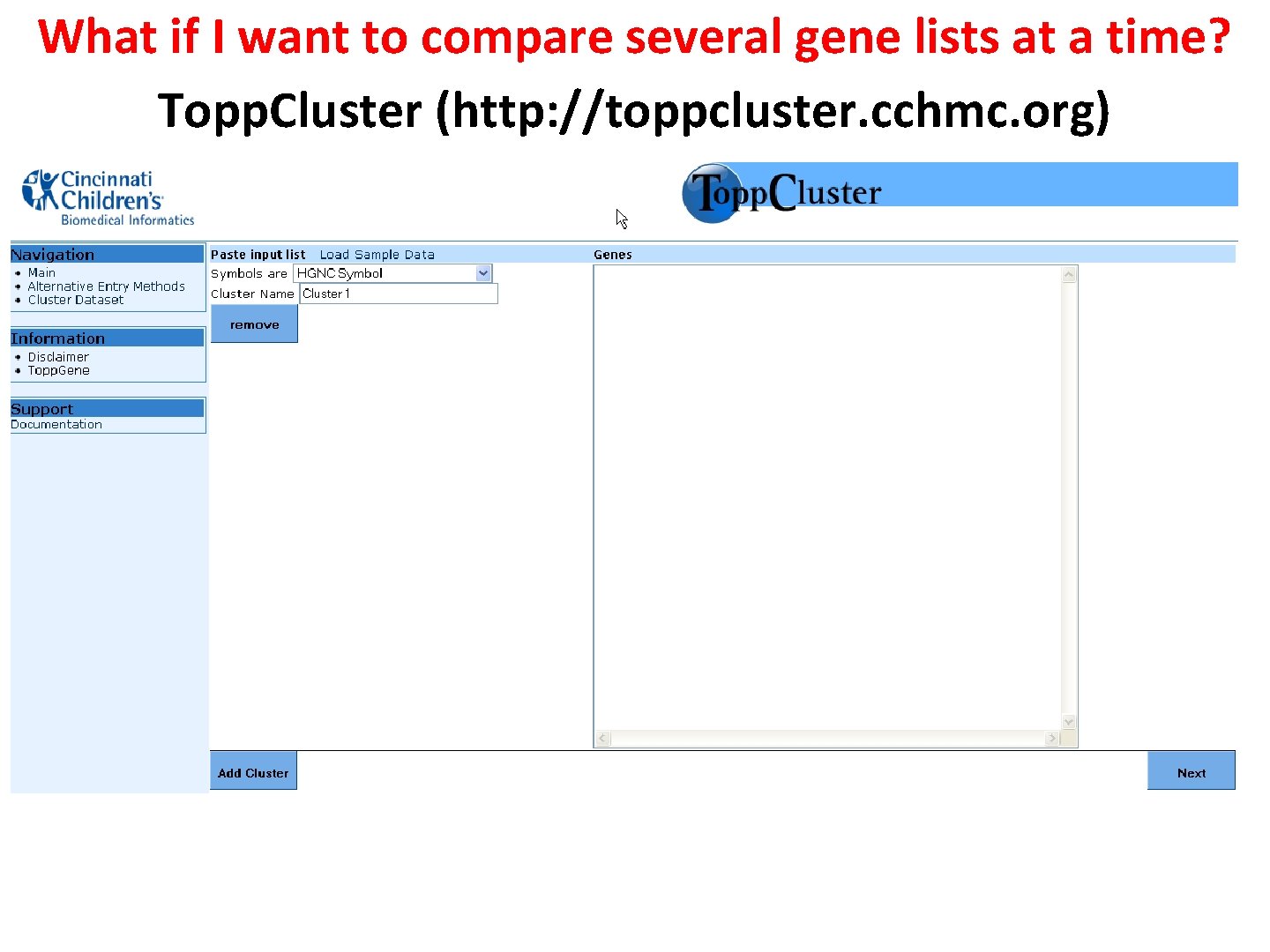
What if I want to compare several gene lists at a time? Topp. Cluster (http: //toppcluster. cchmc. org)
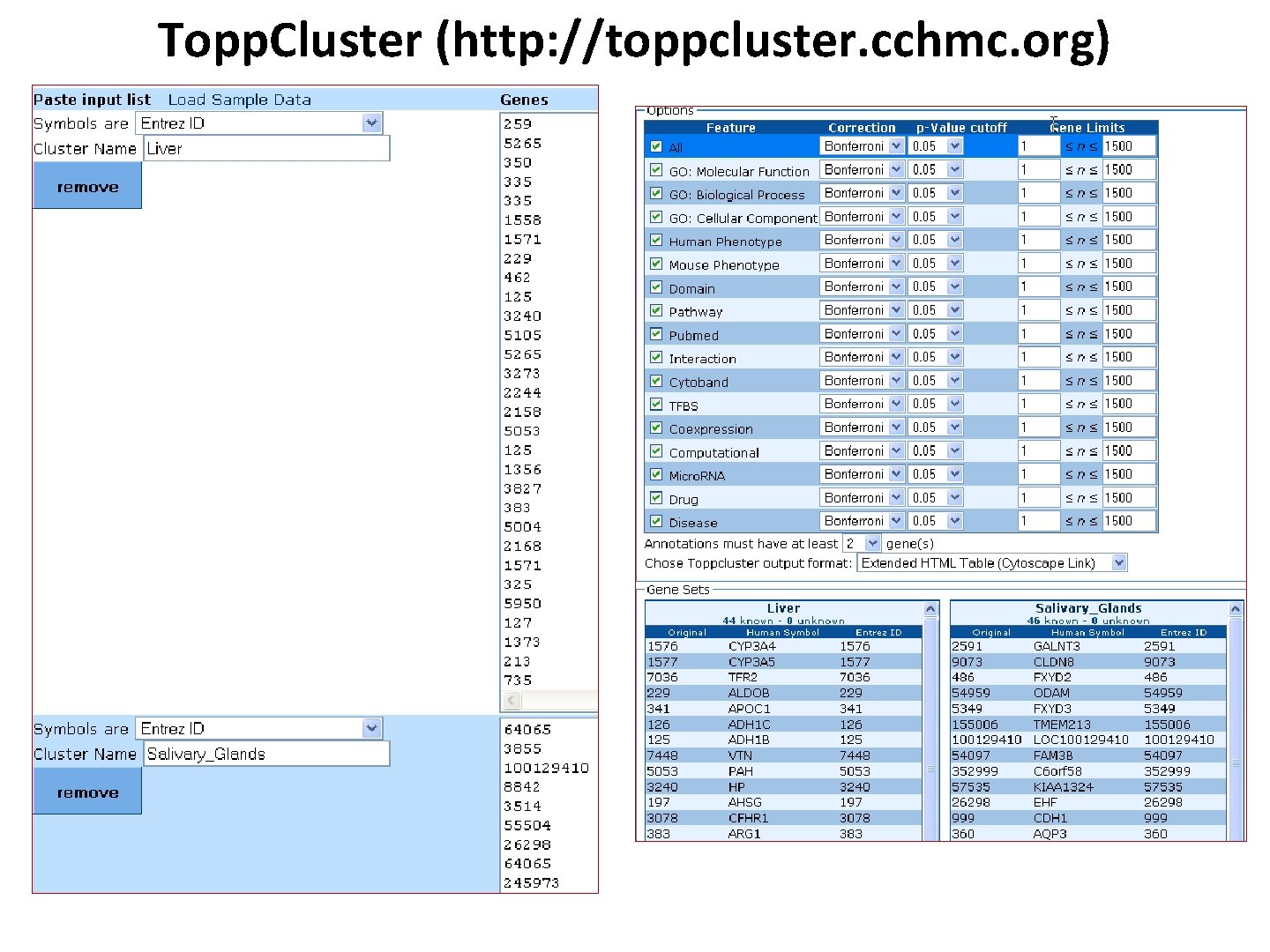
Topp. Cluster (http: //toppcluster. cchmc. org)
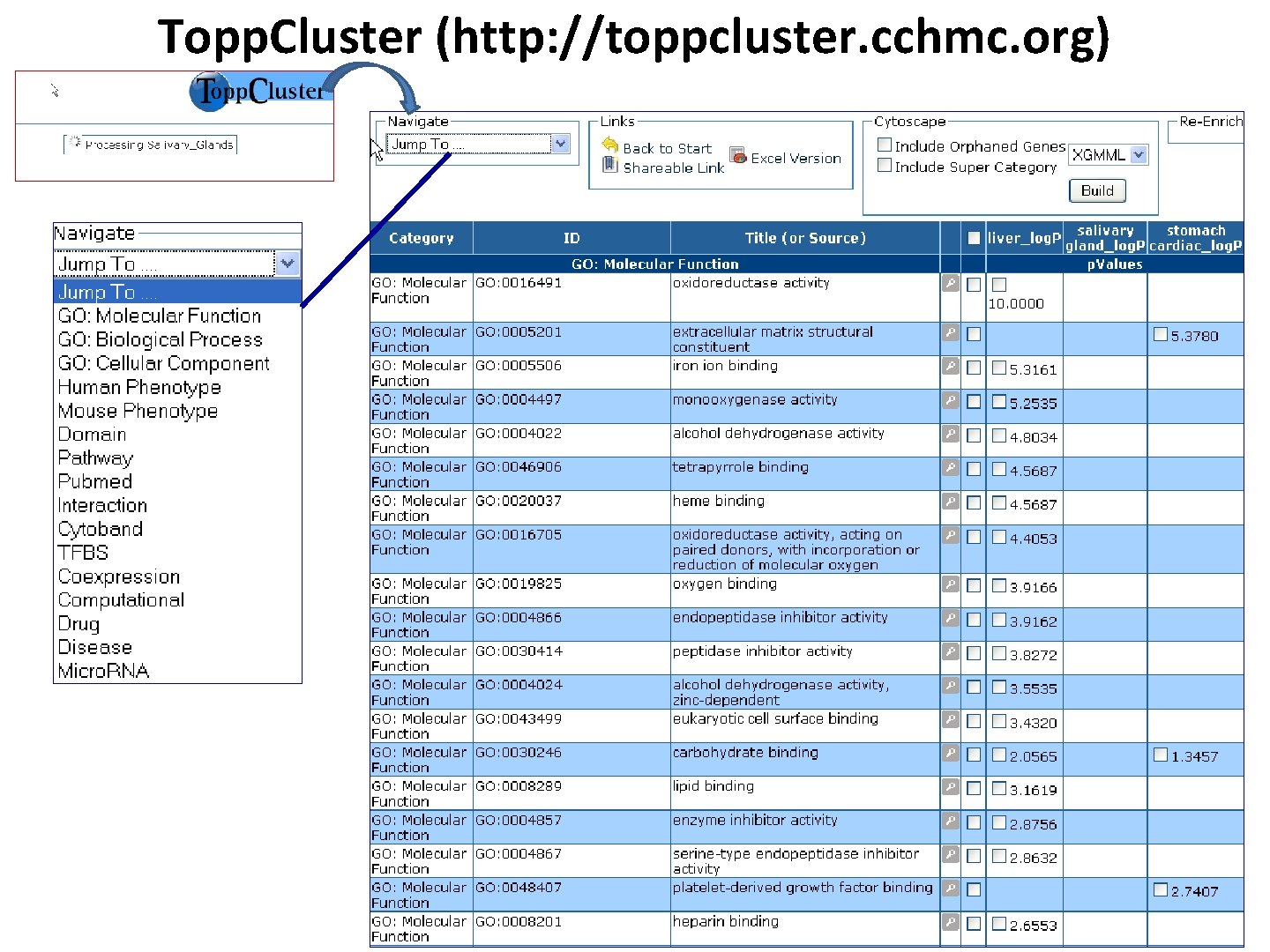
Topp. Cluster (http: //toppcluster. cchmc. org)
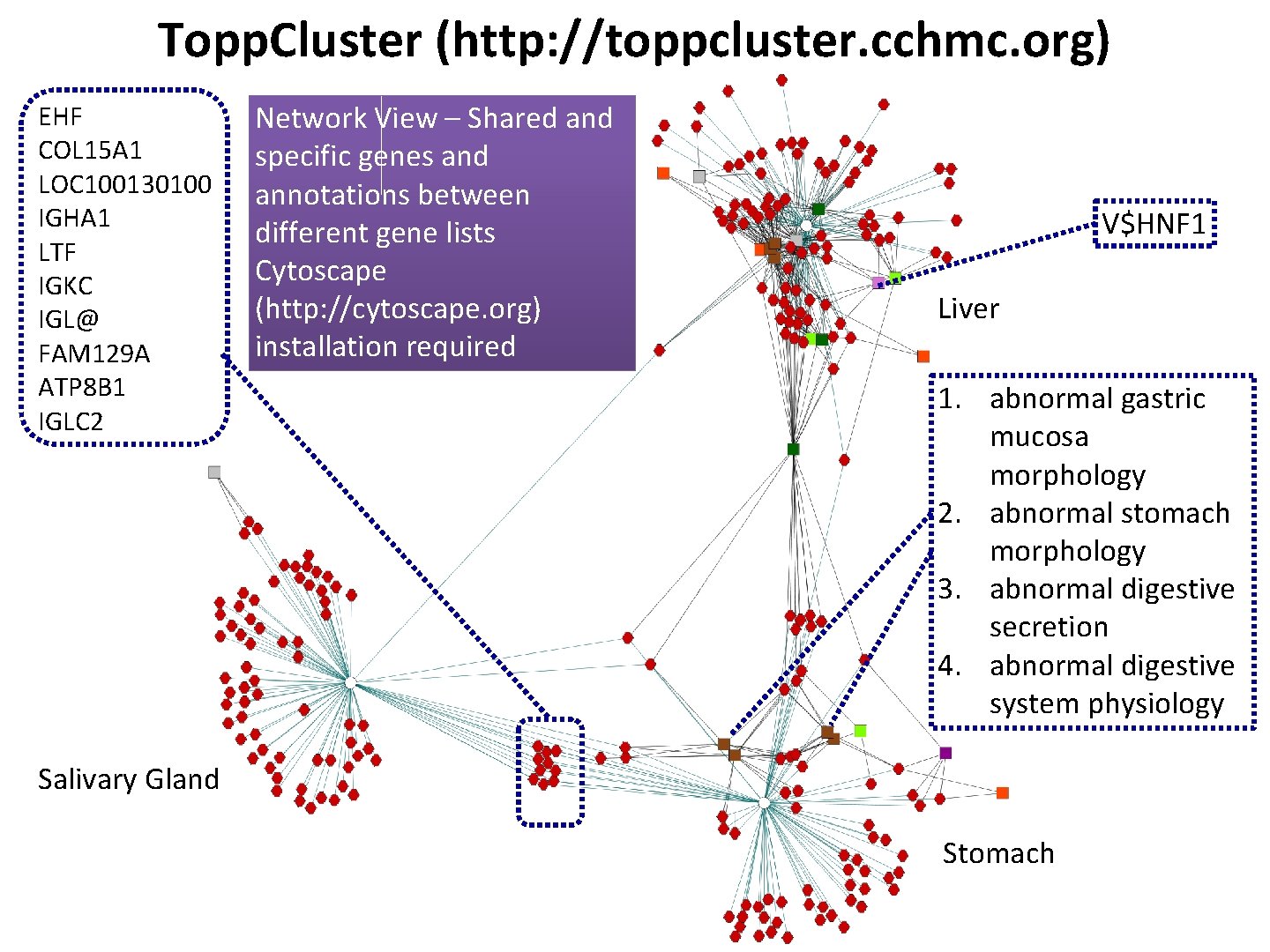
Topp. Cluster (http: //toppcluster. cchmc. org) EHF COL 15 A 1 LOC 100130100 IGHA 1 LTF IGKC IGL@ FAM 129 A ATP 8 B 1 IGLC 2 Network View – Shared and specific genes and annotations between different gene lists Cytoscape (http: //cytoscape. org) installation required V$HNF 1 Liver 1. abnormal gastric mucosa morphology 2. abnormal stomach morphology 3. abnormal digestive secretion 4. abnormal digestive system physiology Salivary Gland Stomach
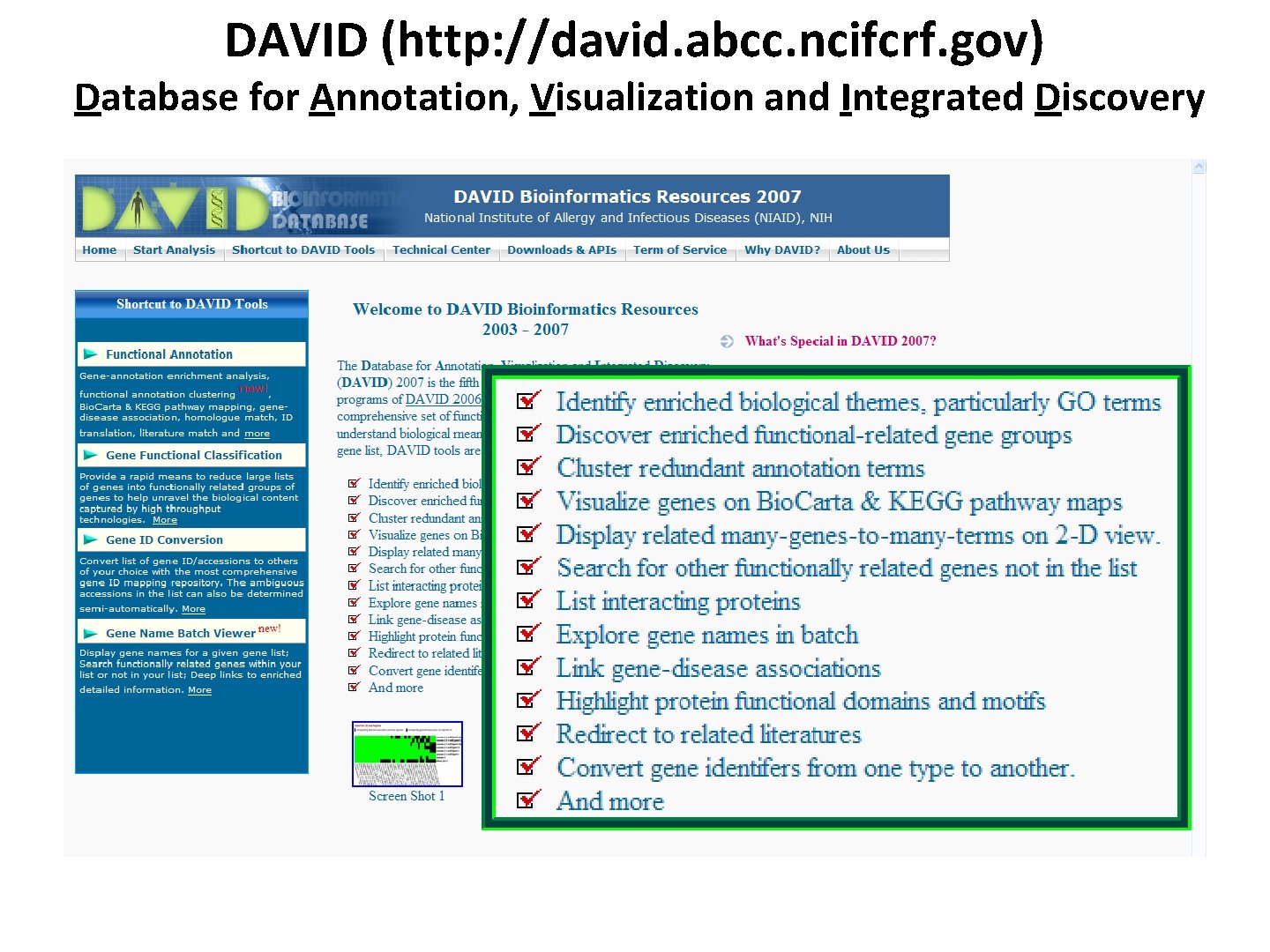
DAVID (http: //david. abcc. ncifcrf. gov) Database for Annotation, Visualization and Integrated Discovery
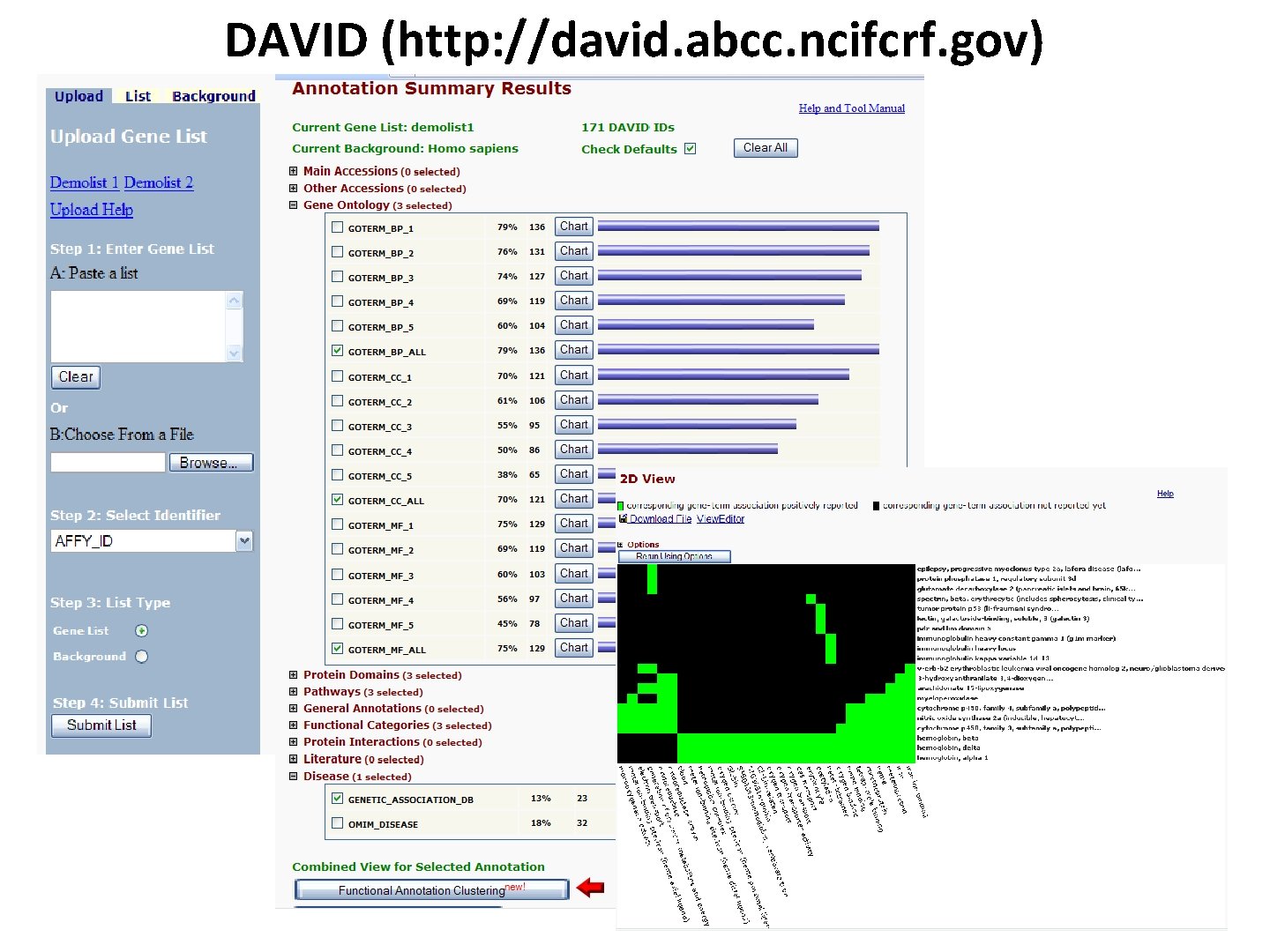
DAVID (http: //david. abcc. ncifcrf. gov)
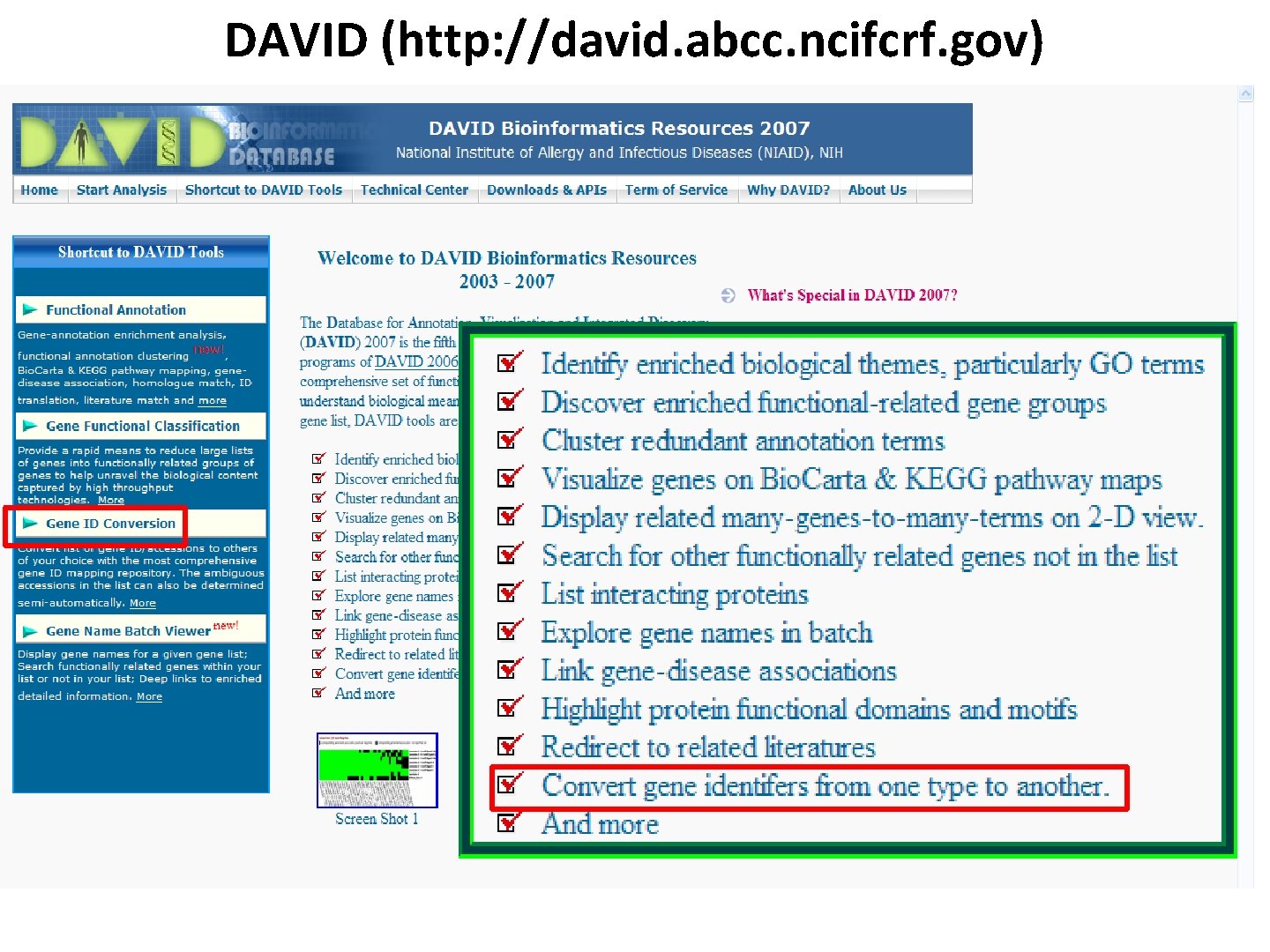
DAVID (http: //david. abcc. ncifcrf. gov)
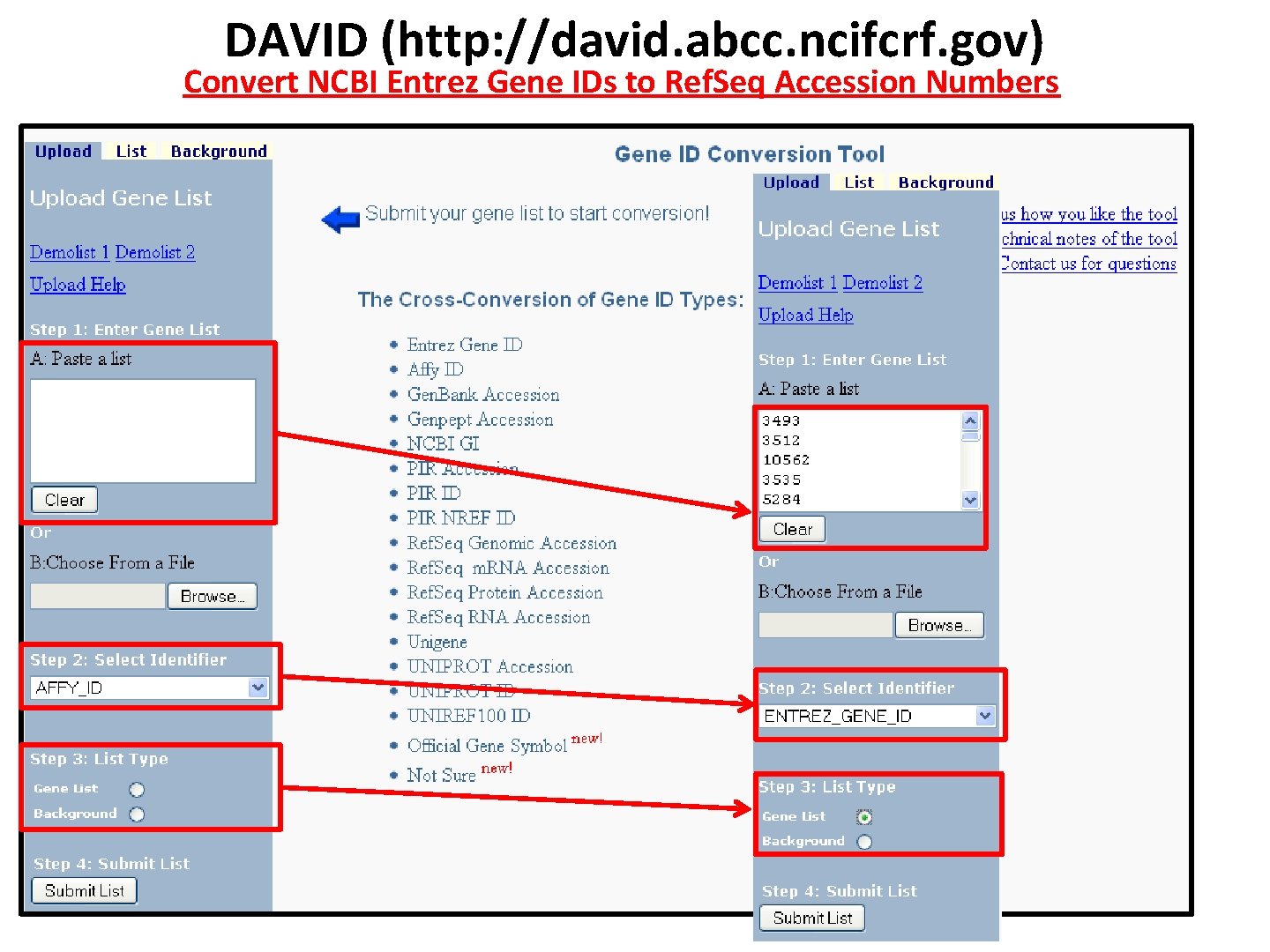
DAVID (http: //david. abcc. ncifcrf. gov) Convert NCBI Entrez Gene IDs to Ref. Seq Accession Numbers
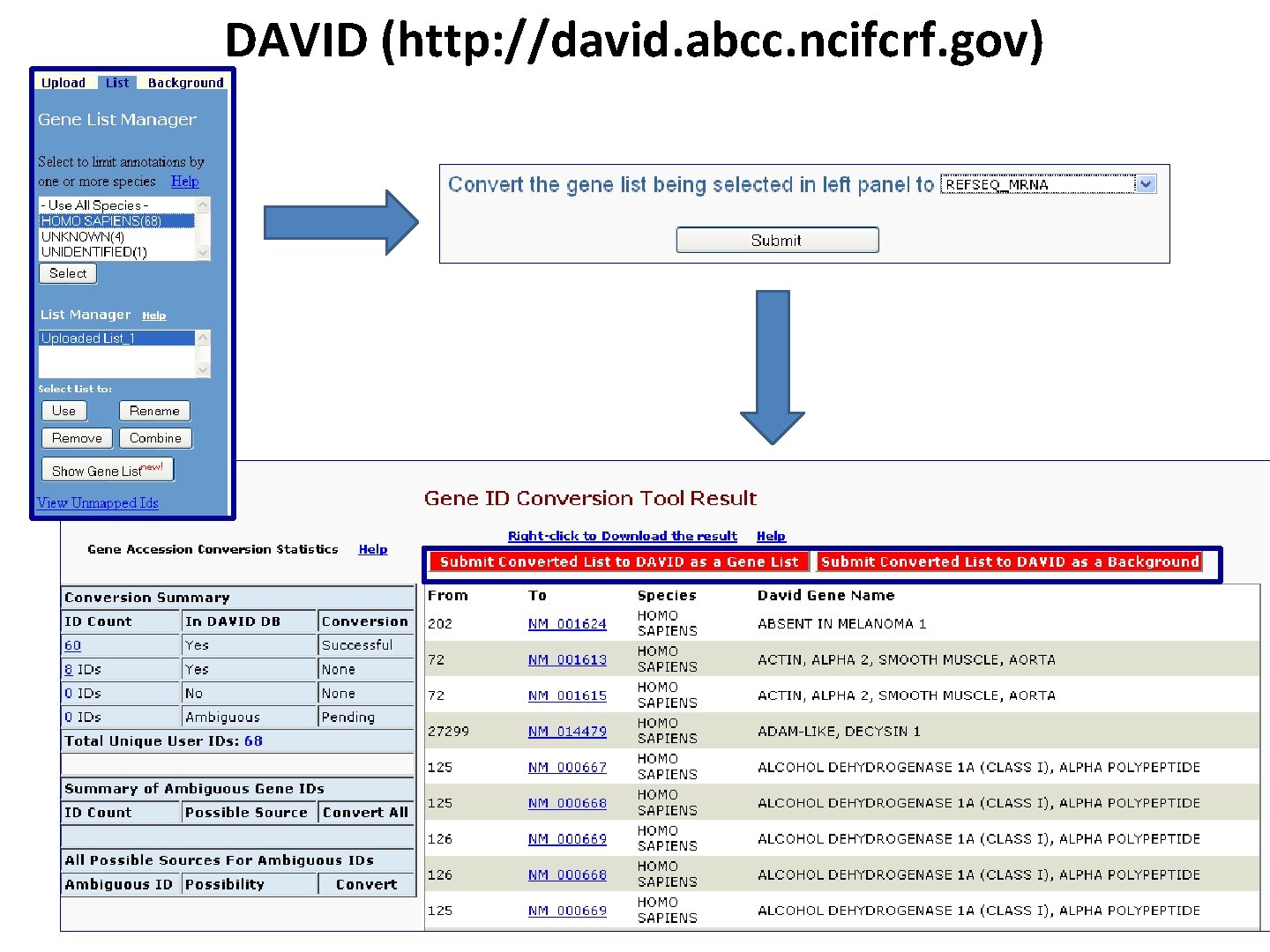
DAVID (http: //david. abcc. ncifcrf. gov)
Exercise 13: Convert affymetrix probeset IDs to gene symbols Exercise 14: What are the enriched pathways and diseases for this gene set? From the same example data set (“Example-Set-1. xls”), use the nd probe set IDs (2 column) and extract their Ref. Seq accession numbers
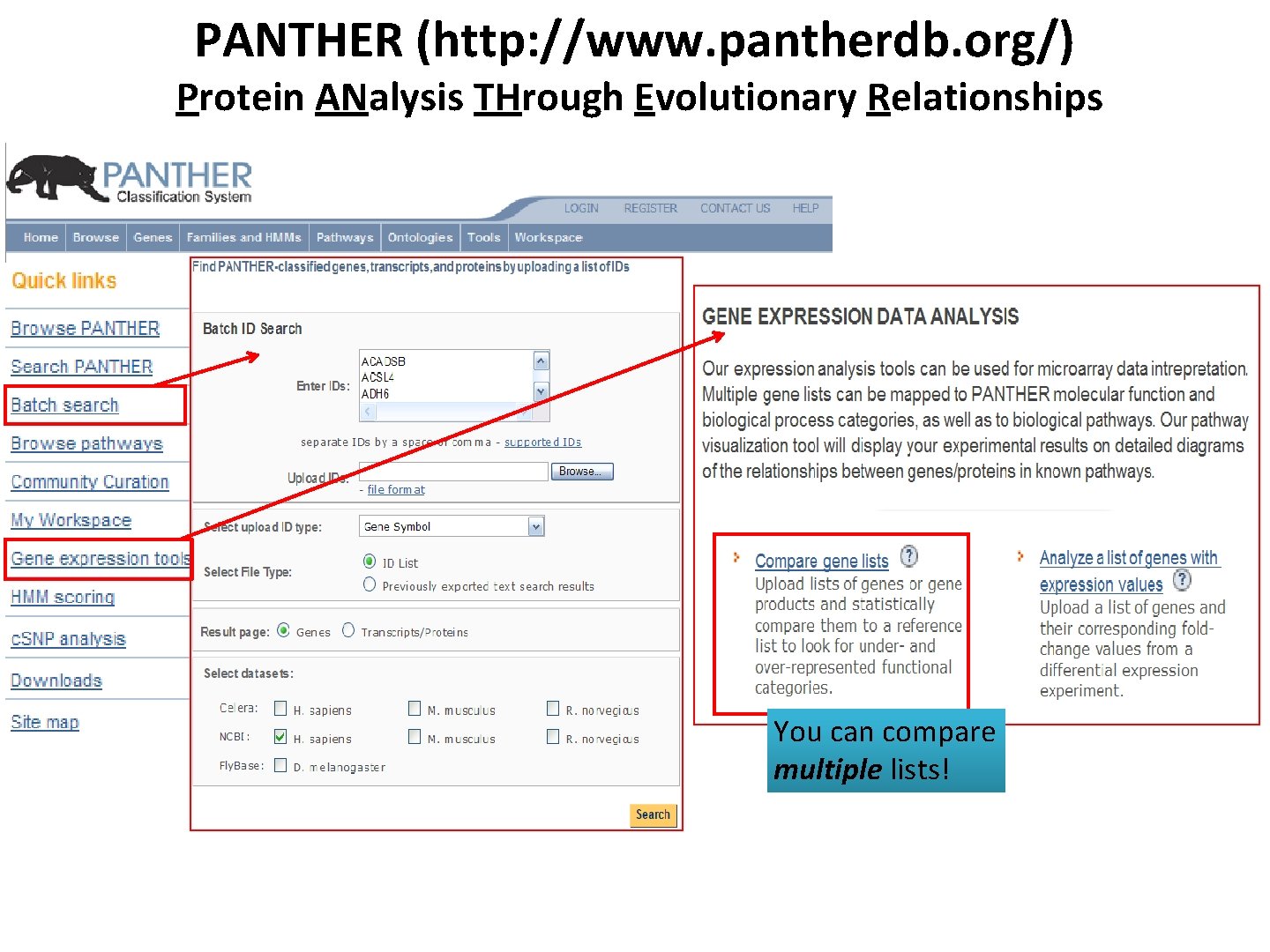
PANTHER (http: //www. pantherdb. org/) Protein ANalysis THrough Evolutionary Relationships You can compare multiple lists!
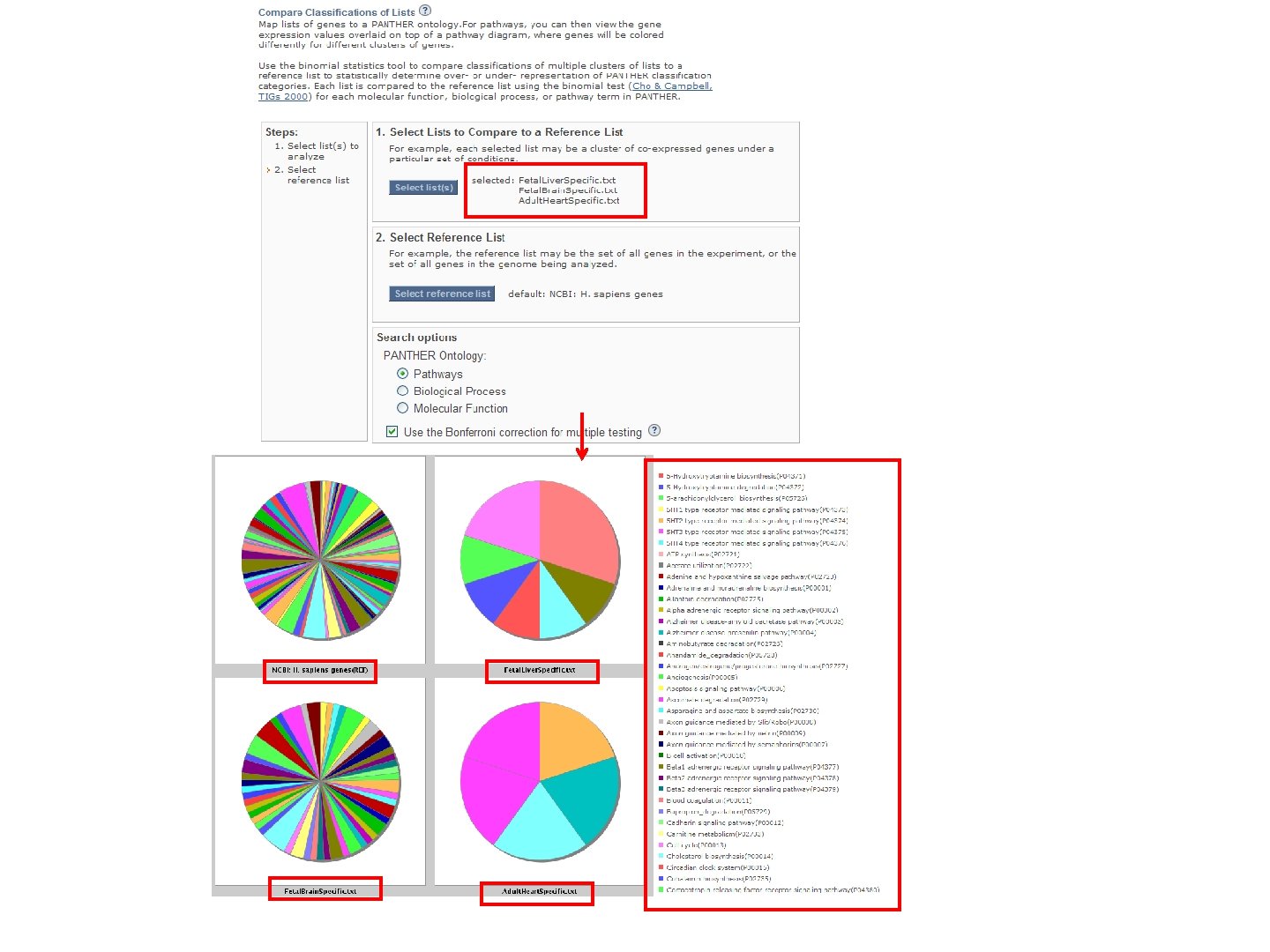
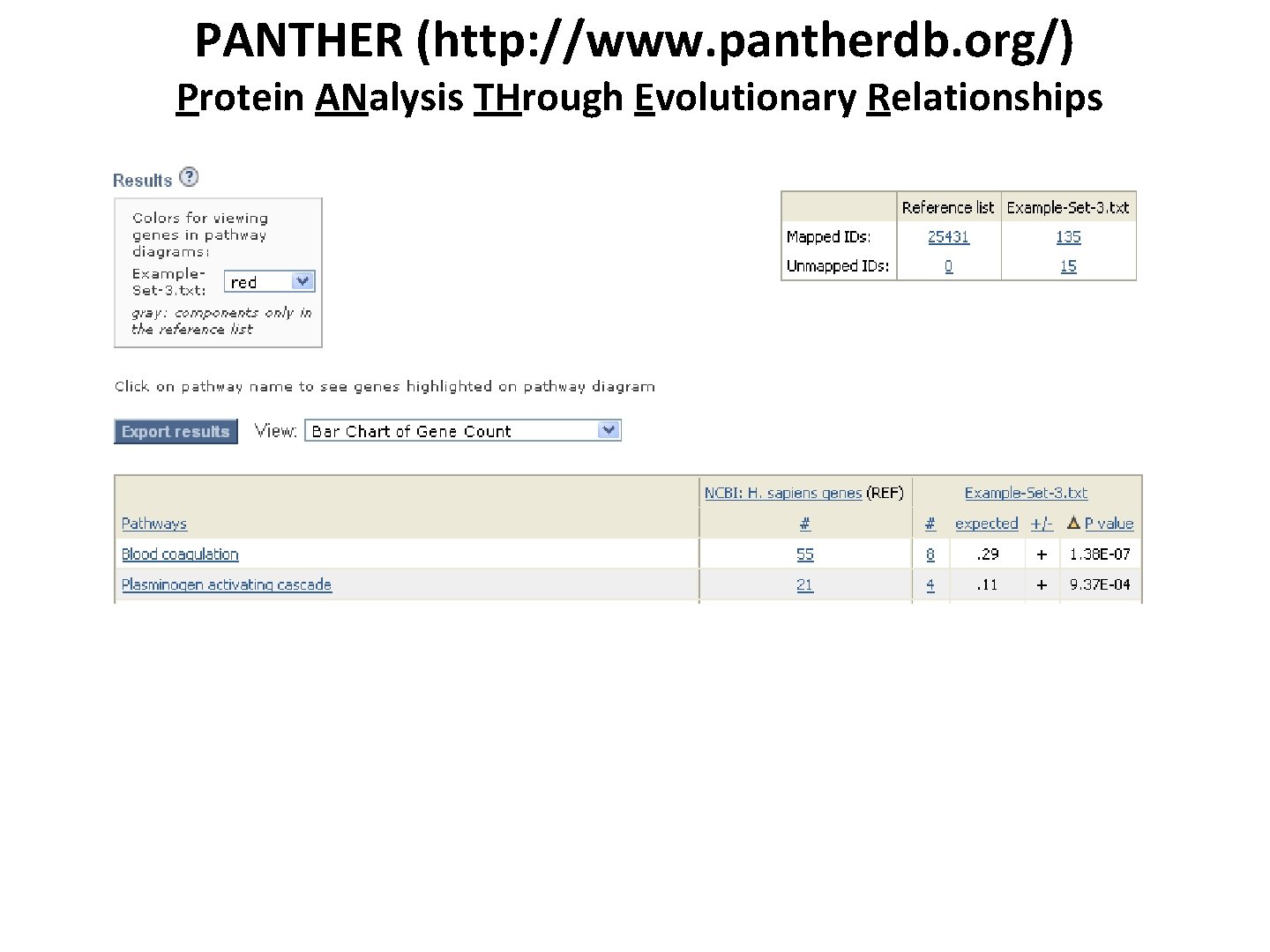
PANTHER (http: //www. pantherdb. org/) Protein ANalysis THrough Evolutionary Relationships

PANTHER (http: //www. pantherdb. org/)
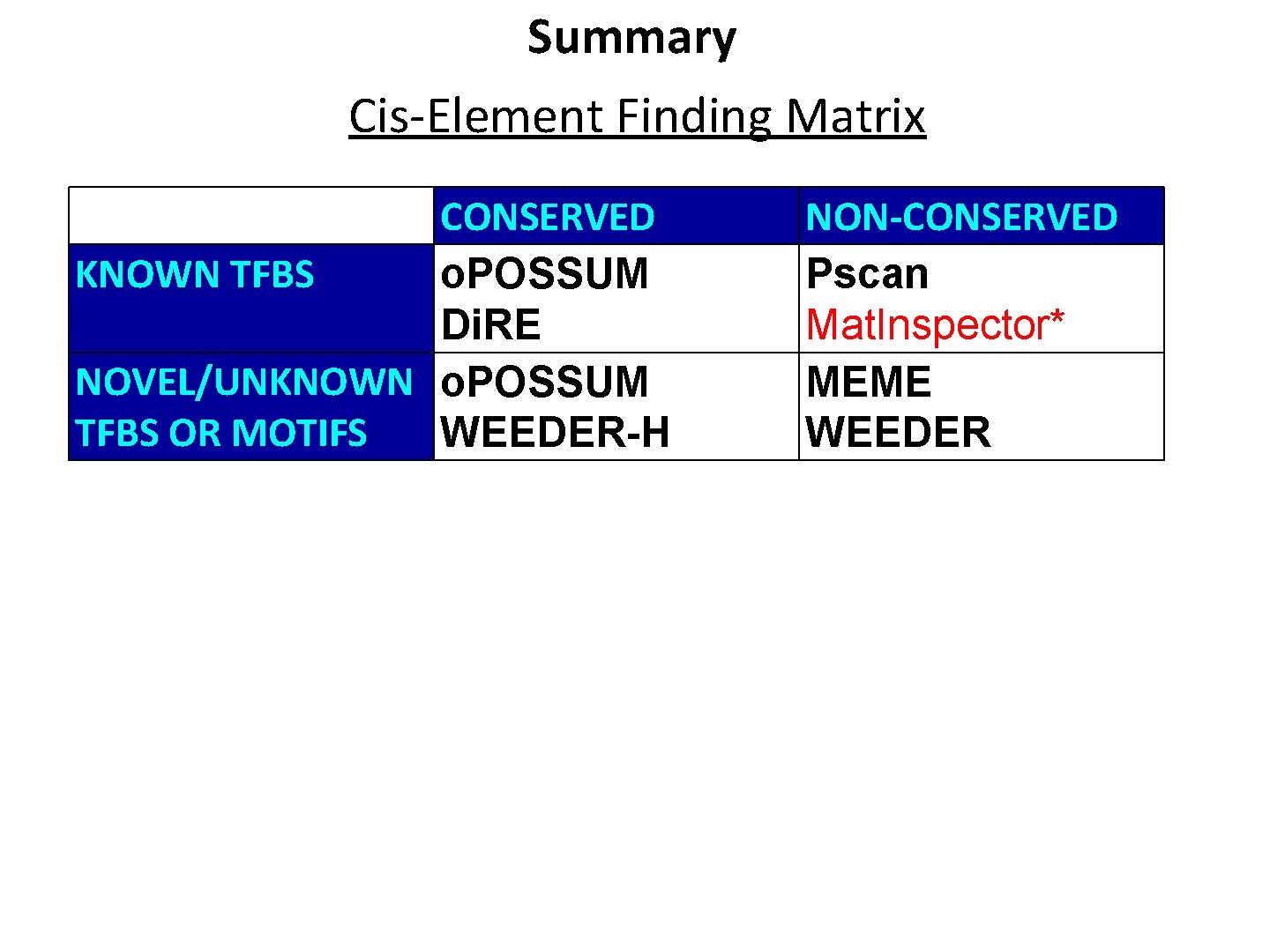
Summary Cis-Element Finding Matrix CONSERVED KNOWN TFBS o. POSSUM Di. RE NOVEL/UNKNOWN o. POSSUM TFBS OR MOTIFS WEEDER-H NON-CONSERVED Pscan Mat. Inspector* MEME WEEDER
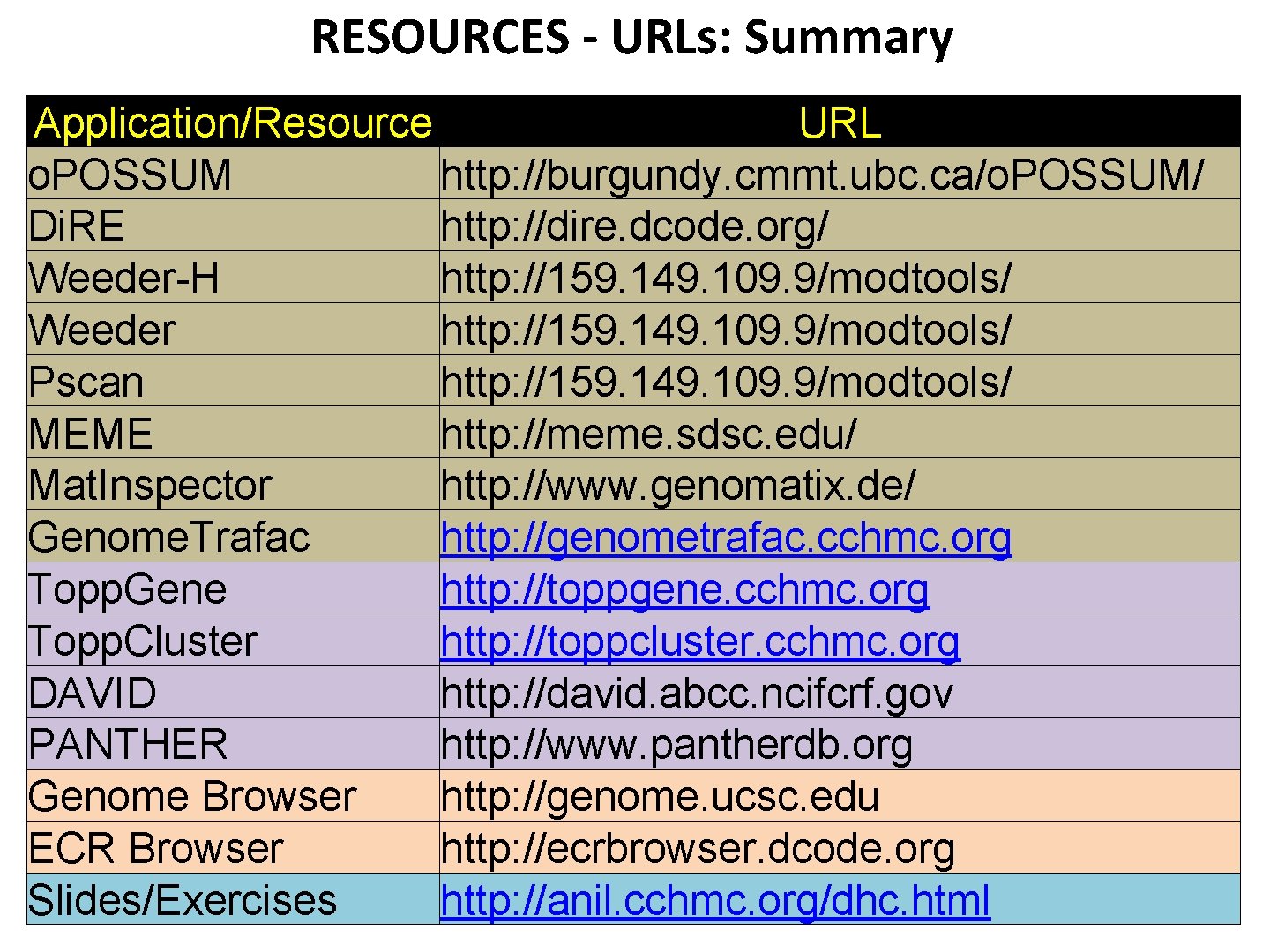
RESOURCES - URLs: Summary Application/Resource URL o. POSSUM http: //burgundy. cmmt. ubc. ca/o. POSSUM/ Di. RE http: //dire. dcode. org/ Weeder-H http: //159. 149. 109. 9/modtools/ Weeder http: //159. 149. 109. 9/modtools/ Pscan http: //159. 149. 109. 9/modtools/ MEME http: //meme. sdsc. edu/ Mat. Inspector http: //www. genomatix. de/ Genome. Trafac http: //genometrafac. cchmc. org Topp. Gene http: //toppgene. cchmc. org Topp. Cluster http: //toppcluster. cchmc. org DAVID http: //david. abcc. ncifcrf. gov PANTHER http: //www. pantherdb. org Genome Browser http: //genome. ucsc. edu ECR Browser http: //ecrbrowser. dcode. org Slides/Exercises http: //anil. cchmc. org/dhc. html
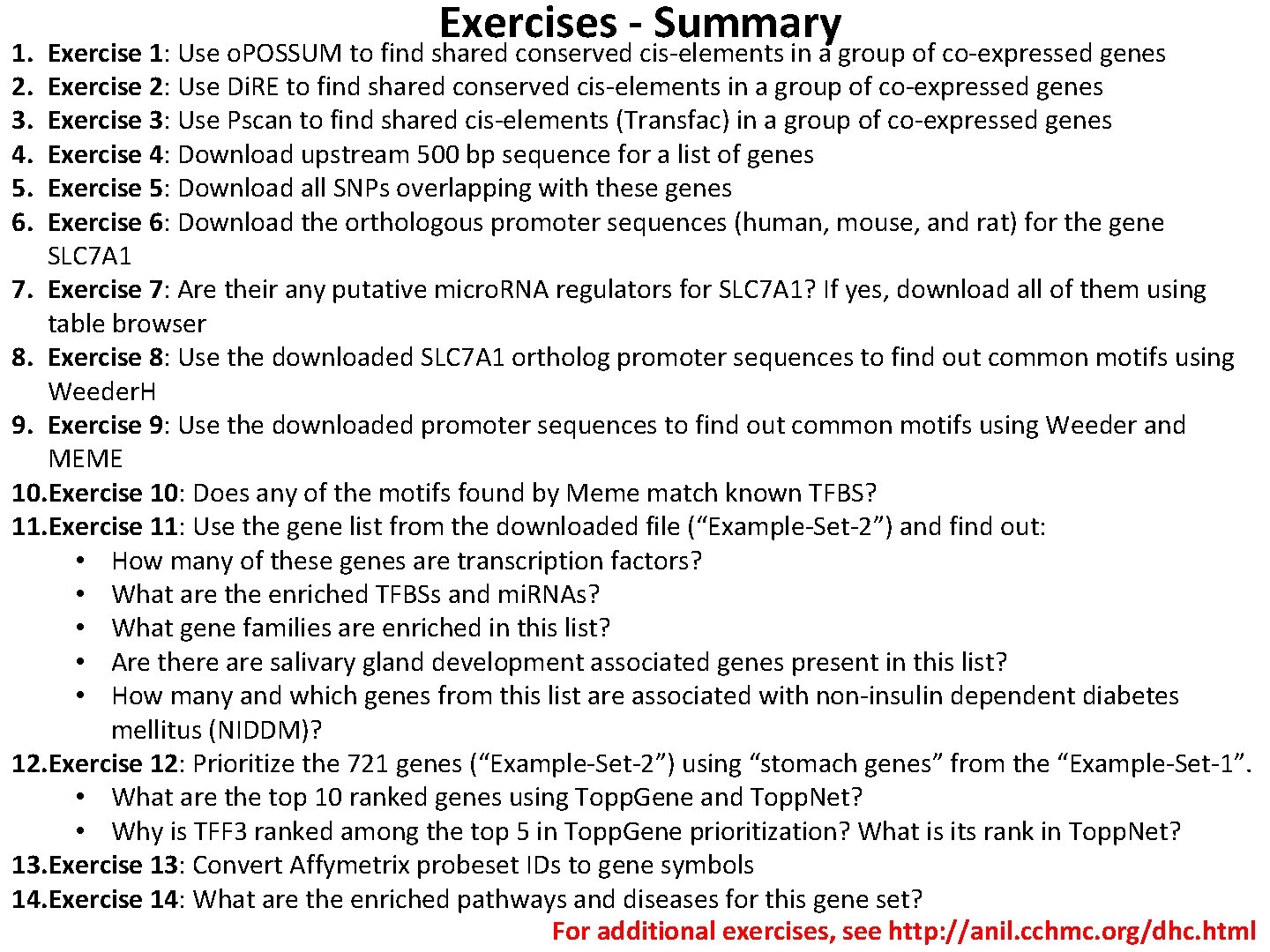
1. 2. 3. 4. 5. 6. Exercises - Summary Exercise 1: Use o. POSSUM to find shared conserved cis-elements in a group of co-expressed genes Exercise 2: Use Di. RE to find shared conserved cis-elements in a group of co-expressed genes Exercise 3: Use Pscan to find shared cis-elements (Transfac) in a group of co-expressed genes Exercise 4: Download upstream 500 bp sequence for a list of genes Exercise 5: Download all SNPs overlapping with these genes Exercise 6: Download the orthologous promoter sequences (human, mouse, and rat) for the gene SLC 7 A 1 7. Exercise 7: Are their any putative micro. RNA regulators for SLC 7 A 1? If yes, download all of them using table browser 8. Exercise 8: Use the downloaded SLC 7 A 1 ortholog promoter sequences to find out common motifs using Weeder. H 9. Exercise 9: Use the downloaded promoter sequences to find out common motifs using Weeder and MEME 10. Exercise 10: Does any of the motifs found by Meme match known TFBS? 11. Exercise 11: Use the gene list from the downloaded file (“Example-Set-2”) and find out: • How many of these genes are transcription factors? • What are the enriched TFBSs and mi. RNAs? • What gene families are enriched in this list? • Are there are salivary gland development associated genes present in this list? • How many and which genes from this list are associated with non-insulin dependent diabetes mellitus (NIDDM)? 12. Exercise 12: Prioritize the 721 genes (“Example-Set-2”) using “stomach genes” from the “Example-Set-1”. • What are the top 10 ranked genes using Topp. Gene and Topp. Net? • Why is TFF 3 ranked among the top 5 in Topp. Gene prioritization? What is its rank in Topp. Net? 13. Exercise 13: Convert Affymetrix probeset IDs to gene symbols 14. Exercise 14: What are the enriched pathways and diseases for this gene set? For additional exercises, see http: //anil. cchmc. org/dhc. html
- Slides: 92