
Toward a Refined Model of an Atom Recall


- Slides: 76
Toward a Refined Model of an Atom • Recall Rutherford’s experiment and model, ~1910 (Week 2!) – Tiny, positive nucleus; electrons outside – No details about electrons’ “structure” • i. e. , are they all equivalent? How do they “move”? Etc. • It turns out, that refinement of the model relied on the interaction of light (a type of energy) with matter (atoms) Copyright © Houghton Mifflin Company. All rights reserved. 7– 1
“Classical” Physics • Before ~1900 • Things are either waves or particles • Waves: – Have energy, but no mass – Generally need a medium to travel through • Water waves (through water) • Sound waves (through air) – Involve an “oscillation” of some kind • Repeating cycle (next slide) • Viewed light as a wave phenomenon – Although no medium required Copyright © Houghton Mifflin Company. All rights reserved. 7– 2
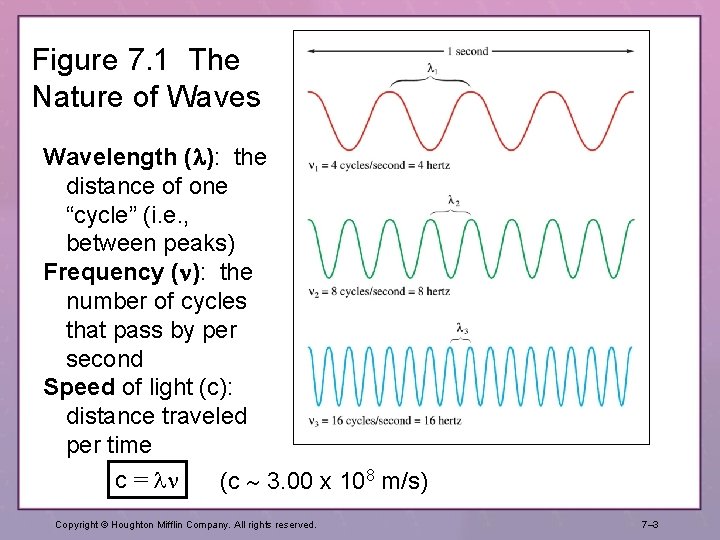
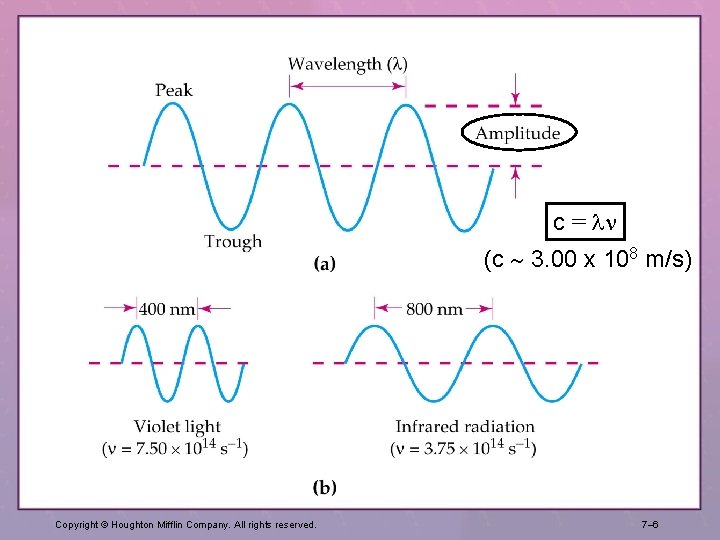
Figure 7. 1 The Nature of Waves Wavelength (l): the distance of one “cycle” (i. e. , between peaks) Frequency (n): the number of cycles that pass by per second Speed of light (c): distance traveled per time c = ln (c ~ 3. 00 x 108 m/s) Copyright © Houghton Mifflin Company. All rights reserved. 7– 3
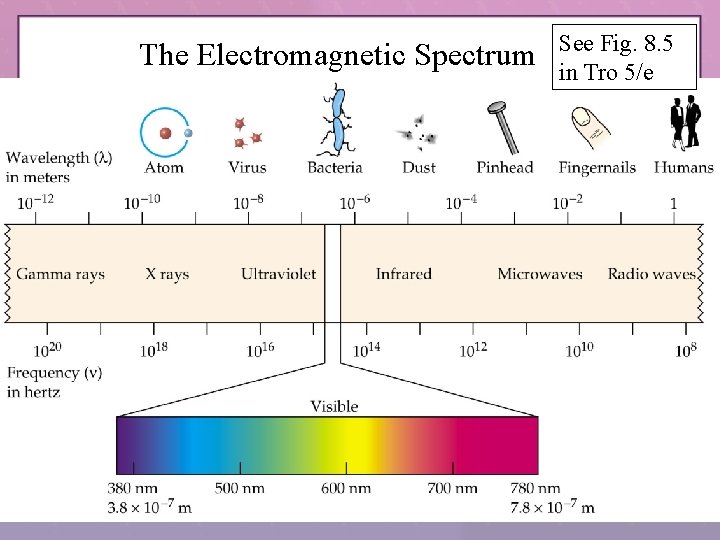
Light is “Electromagnetic Radiation” (EMR) • Some (actually most!) light is not “visible” to humans – Infrared, ultraviolet “light”, X-rays, radio waves • Speed of (any kind of) light is about 3. 00 x 108 m/s in a vacuum – Does not depend on wavelength / freq. • NOTE: l and n are inversely proportional Copyright © Houghton Mifflin Company. All rights reserved. 7– 4
The Electromagnetic Spectrum See Fig. 8. 5 in Tro 5/e
c = ln (c ~ 3. 00 x 108 m/s) Copyright © Houghton Mifflin Company. All rights reserved. 7– 6
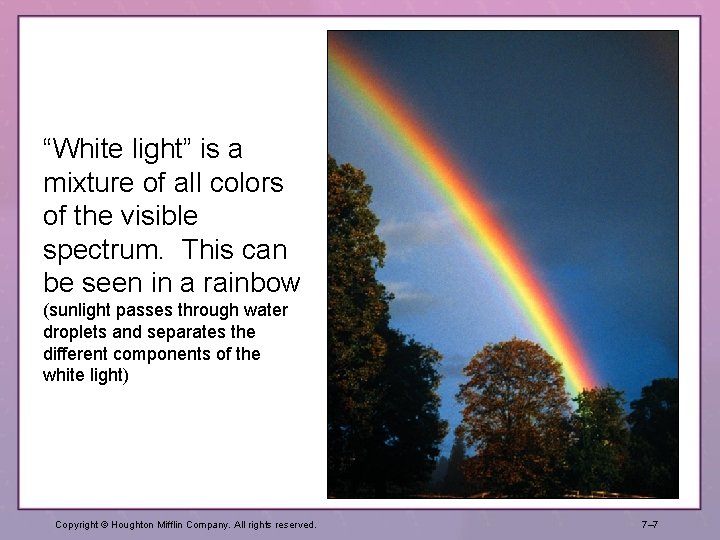
“White light” is a mixture of all colors of the visible spectrum. This can be seen in a rainbow (sunlight passes through water droplets and separates the different components of the white light) Copyright © Houghton Mifflin Company. All rights reserved. 7– 7
Planck’s Contribution (1900) • Suggests radical hypothesis that (vibrational) energy (in hot objects) is not continuous – it’s “quantized”—it comes in tiny, irreducible packets, each called a “quantum” • Equantum = h nvibration (h is a constant = 6. 626 x 10 -34 J x s) – Why did he suggest this? Because it’s the only way he could get theory to match experimental observations on “black body radiation” – Is laughed out of the scientific community (at first) Copyright © Houghton Mifflin Company. All rights reserved. 7– 8
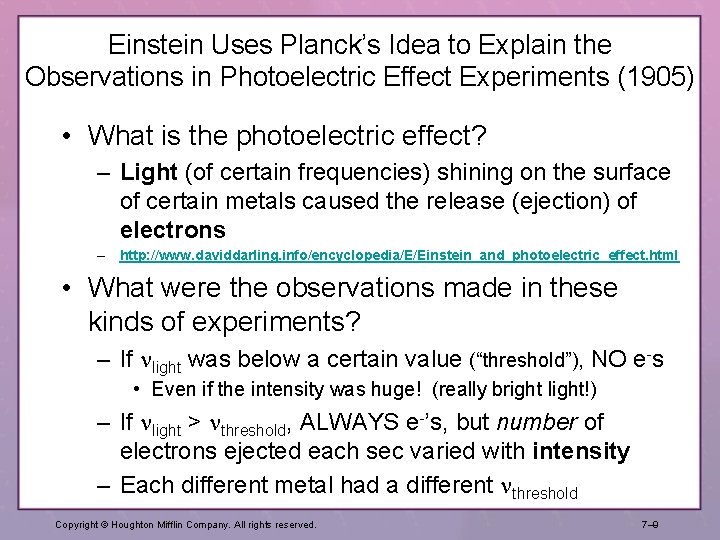
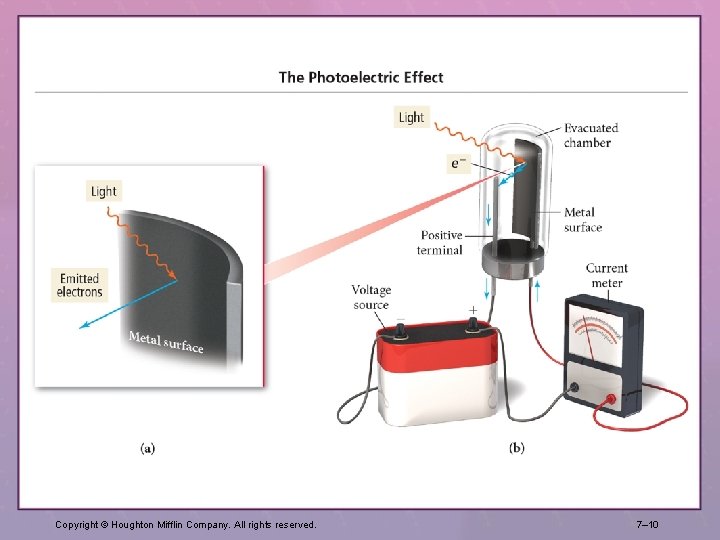
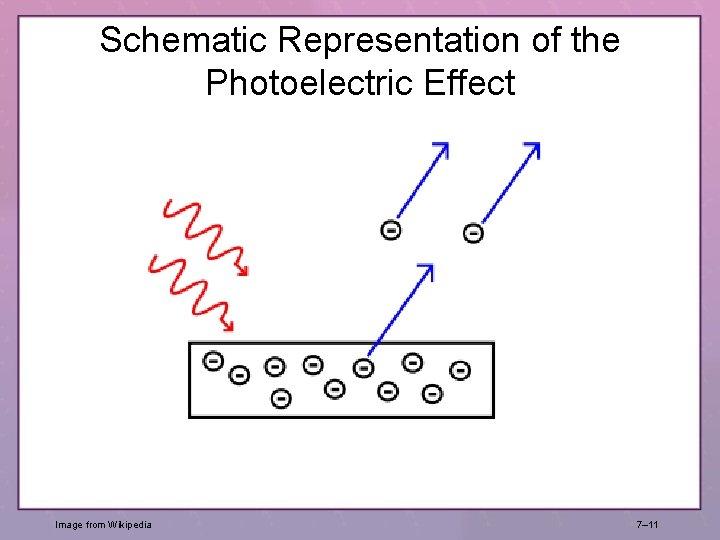
Einstein Uses Planck’s Idea to Explain the Observations in Photoelectric Effect Experiments (1905) • What is the photoelectric effect? – Light (of certain frequencies) shining on the surface of certain metals caused the release (ejection) of electrons – http: //www. daviddarling. info/encyclopedia/E/Einstein_and_photoelectric_effect. html • What were the observations made in these kinds of experiments? – If nlight was below a certain value (“threshold”), NO e-s • Even if the intensity was huge! (really bright light!) – If nlight > nthreshold, ALWAYS e-’s, but number of electrons ejected each sec varied with intensity – Each different metal had a different nthreshold Copyright © Houghton Mifflin Company. All rights reserved. 7– 9
Copyright © Houghton Mifflin Company. All rights reserved. 7– 10
Schematic Representation of the Photoelectric Effect Image from Wikipedia 7– 11
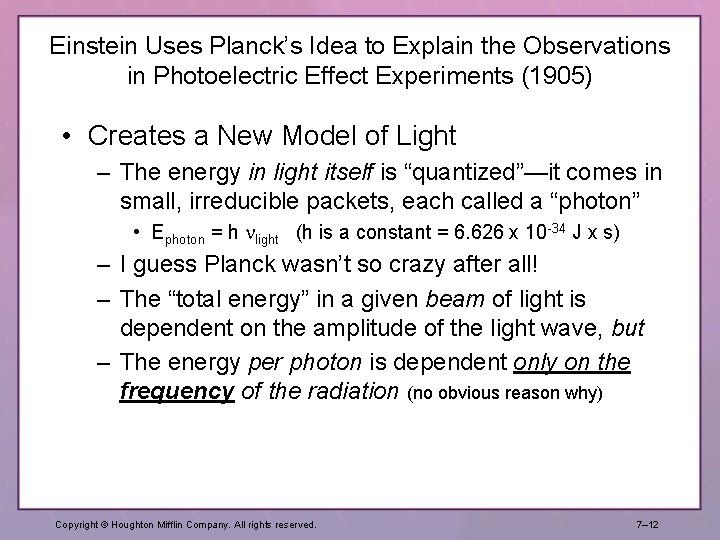
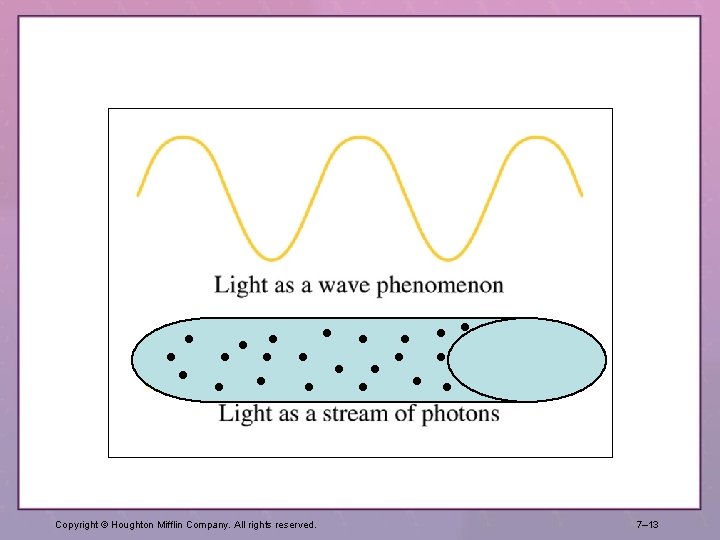
Einstein Uses Planck’s Idea to Explain the Observations in Photoelectric Effect Experiments (1905) • Creates a New Model of Light – The energy in light itself is “quantized”—it comes in small, irreducible packets, each called a “photon” • Ephoton = h nlight (h is a constant = 6. 626 x 10 -34 J x s) – I guess Planck wasn’t so crazy after all! – The “total energy” in a given beam of light is dependent on the amplitude of the light wave, but – The energy per photon is dependent only on the frequency of the radiation (no obvious reason why) Copyright © Houghton Mifflin Company. All rights reserved. 7– 12
Copyright © Houghton Mifflin Company. All rights reserved. 7– 13
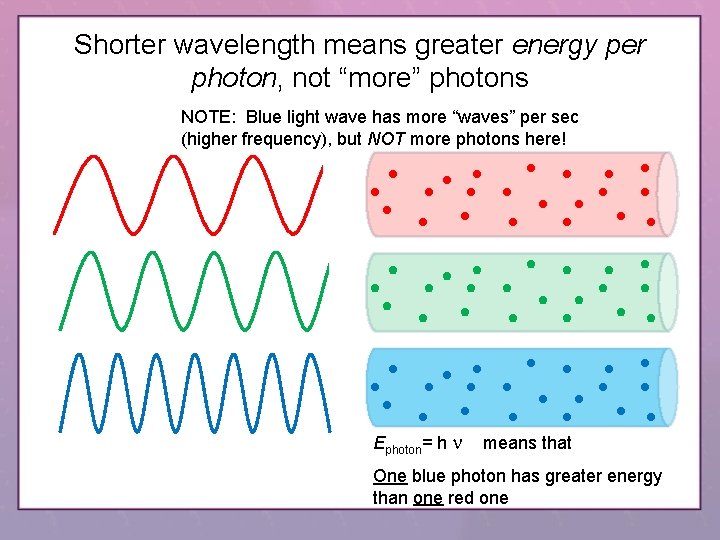
Shorter wavelength means greater energy per photon, not “more” photons NOTE: Blue light wave has more “waves” per sec (higher frequency), but NOT more photons here! Ephoton= h n means that One blue photon has greater energy than one red one
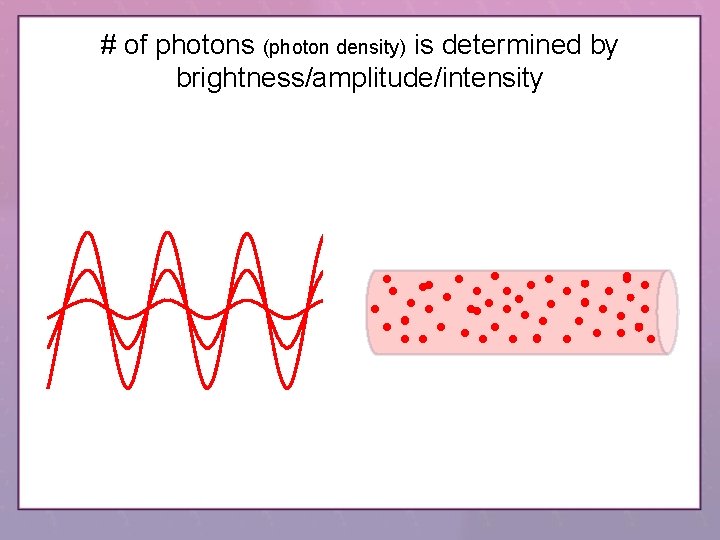
# of photons (photon density) is determined by brightness/amplitude/intensity
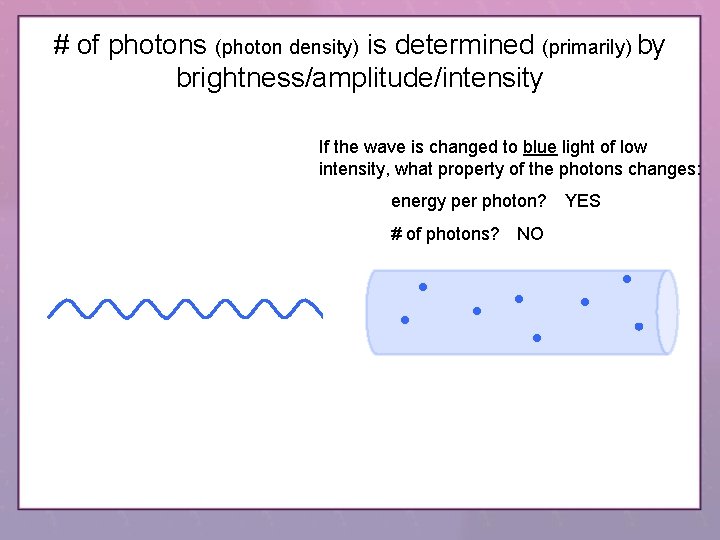
# of photons (photon density) is determined (primarily) by brightness/amplitude/intensity If the wave is changed to blue light of low intensity, what property of the photons changes: energy per photon? YES # of photons? NO
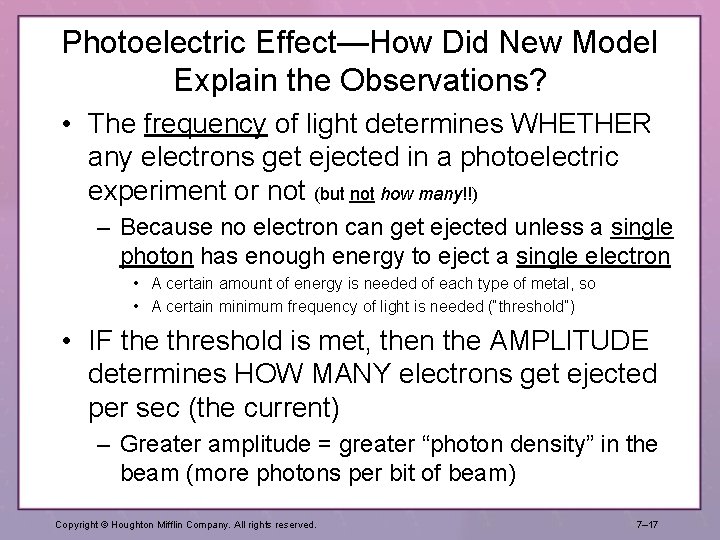
Photoelectric Effect—How Did New Model Explain the Observations? • The frequency of light determines WHETHER any electrons get ejected in a photoelectric experiment or not (but not how many!!) – Because no electron can get ejected unless a single photon has enough energy to eject a single electron • A certain amount of energy is needed of each type of metal, so • A certain minimum frequency of light is needed (“threshold”) • IF the threshold is met, then the AMPLITUDE determines HOW MANY electrons get ejected per sec (the current) – Greater amplitude = greater “photon density” in the beam (more photons per bit of beam) Copyright © Houghton Mifflin Company. All rights reserved. 7– 17
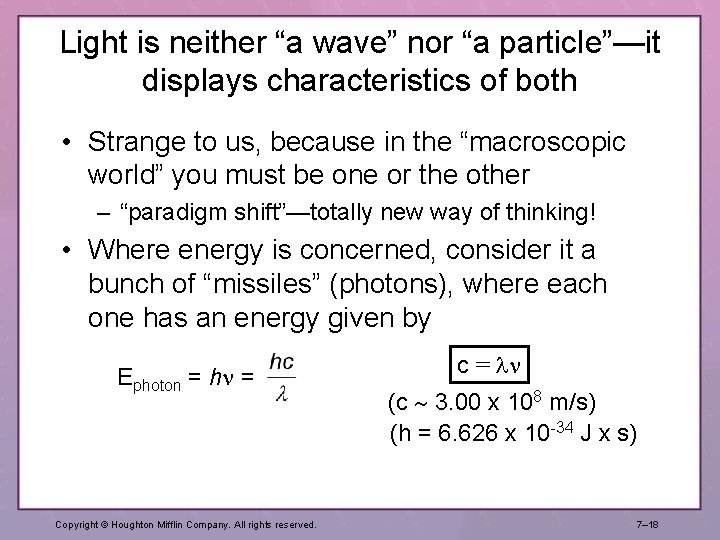
Light is neither “a wave” nor “a particle”—it displays characteristics of both • Strange to us, because in the “macroscopic world” you must be one or the other – “paradigm shift”—totally new way of thinking! • Where energy is concerned, consider it a bunch of “missiles” (photons), where each one has an energy given by Ephoton = hn = Copyright © Houghton Mifflin Company. All rights reserved. c = ln (c ~ 3. 00 x 108 m/s) (h = 6. 626 x 10 -34 J x s) 7– 18
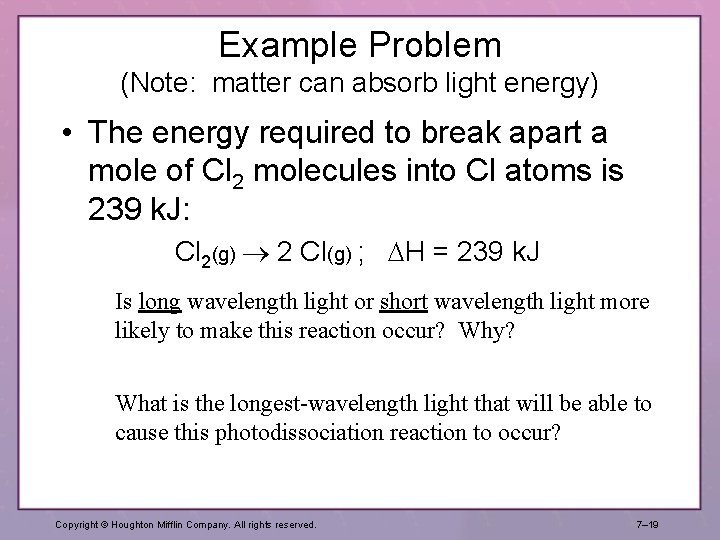
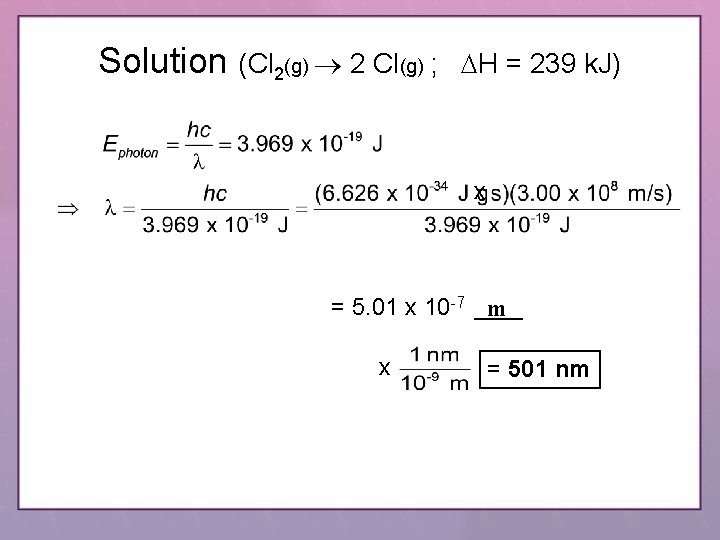
Example Problem (Note: matter can absorb light energy) • The energy required to break apart a mole of Cl 2 molecules into Cl atoms is 239 k. J: Cl 2(g) 2 Cl(g) ; DH = 239 k. J Is long wavelength light or short wavelength light more likely to make this reaction occur? Why? What is the longest-wavelength light that will be able to cause this photodissociation reaction to occur? Copyright © Houghton Mifflin Company. All rights reserved. 7– 19
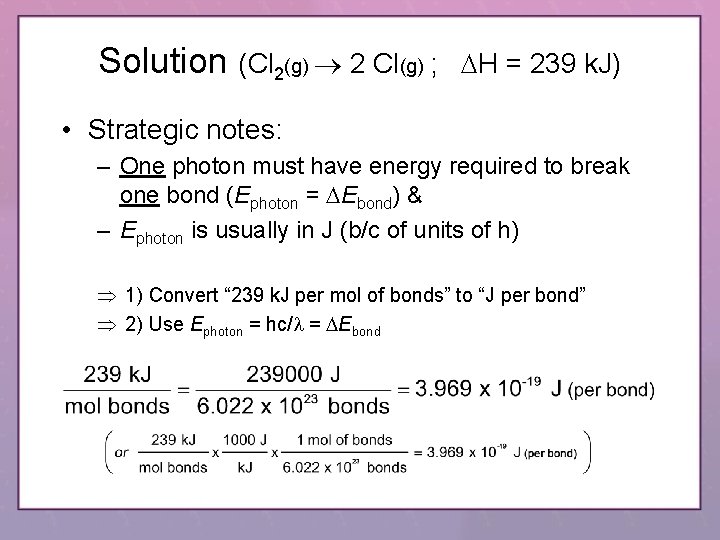
Solution (Cl 2(g) 2 Cl(g) ; DH = 239 k. J) • Strategic notes: – One photon must have energy required to break one bond (Ephoton = DEbond) & – Ephoton is usually in J (b/c of units of h) 1) Convert “ 239 k. J per mol of bonds” to “J per bond” 2) Use Ephoton = hc/l = DEbond
Solution (Cl 2(g) 2 Cl(g) ; DH = 239 k. J) x = 5. 01 x 10 -7 ____ m x = 501 nm
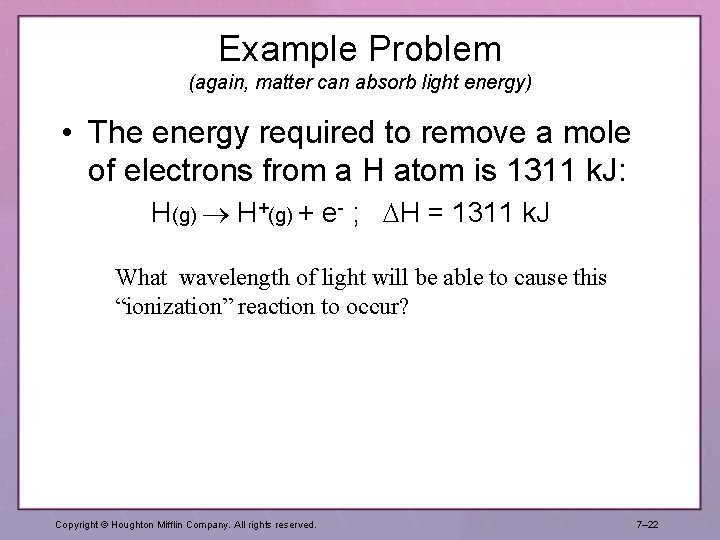
Example Problem (again, matter can absorb light energy) • The energy required to remove a mole of electrons from a H atom is 1311 k. J: H(g) H+(g) + e- ; DH = 1311 k. J What wavelength of light will be able to cause this “ionization” reaction to occur? Copyright © Houghton Mifflin Company. All rights reserved. 7– 22
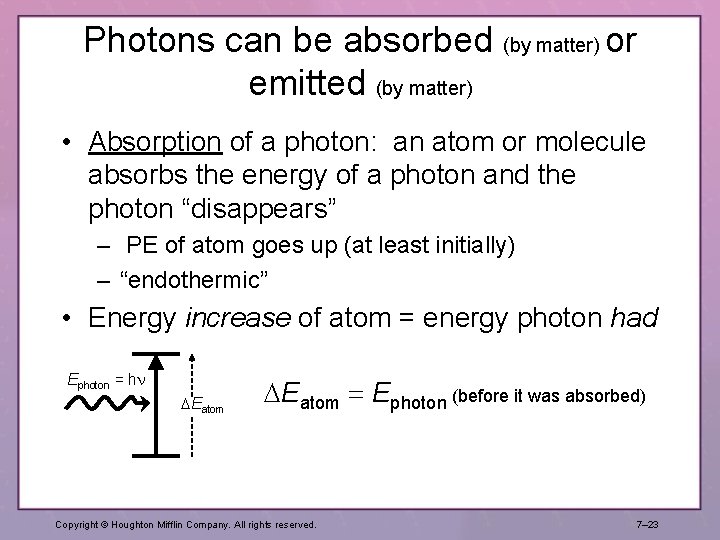
Photons can be absorbed (by matter) or emitted (by matter) • Absorption of a photon: an atom or molecule absorbs the energy of a photon and the photon “disappears” – PE of atom goes up (at least initially) – “endothermic” • Energy increase of atom = energy photon had Ephoton = hn DEatom = Ephoton (before it was absorbed) Copyright © Houghton Mifflin Company. All rights reserved. 7– 23
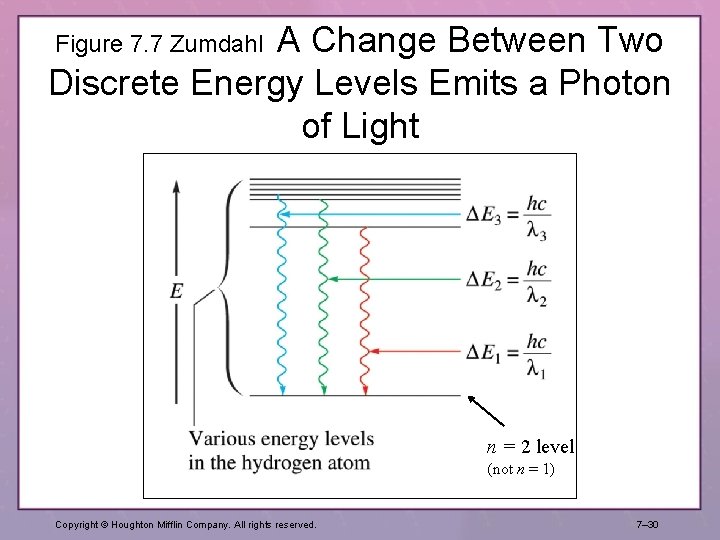
Photons can be absorbed or emitted • Emission of a photon: energy is released by an atom AS a photon (which “flies away”) – PE of atom goes down – energy “turned into” a photon (created) • E decrease of atom = E of photon created Ephoton = hn DEatom -DEatom = Ephoton (that is released) Copyright © Houghton Mifflin Company. All rights reserved. 7– 24
Photons can be absorbed or emitted • Absorption of a photon: an • Emission of a photon: if atom or molecule absorbs the energy is released by an energy of a photon and the atom AS a photon “disappears” – PE of atom goes down; energy – PE goes up (at least initially) – “endothermic” “turned into” a photon (creates one) Fig. 7. 20 (Tro 4/e) Light & Color 25
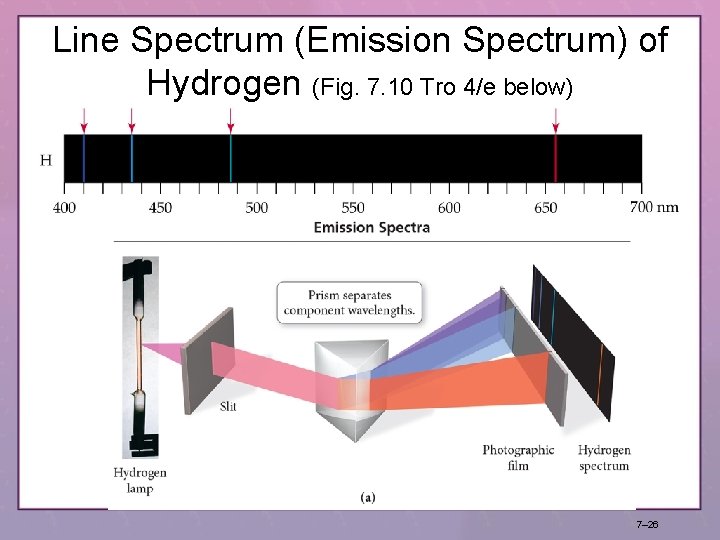
Line Spectrum (Emission Spectrum) of Hydrogen (Fig. 7. 10 Tro 4/e below) 7– 26
To see emission spectra of other elements: • http: //portia. astrophysik. unikiel. de/~koeppen/discharge/index. html (new and better link!) • http: //homework. uoregon. edu/run/eleme nts/ (old link) Copyright © Houghton Mifflin Company. All rights reserved. 7– 27
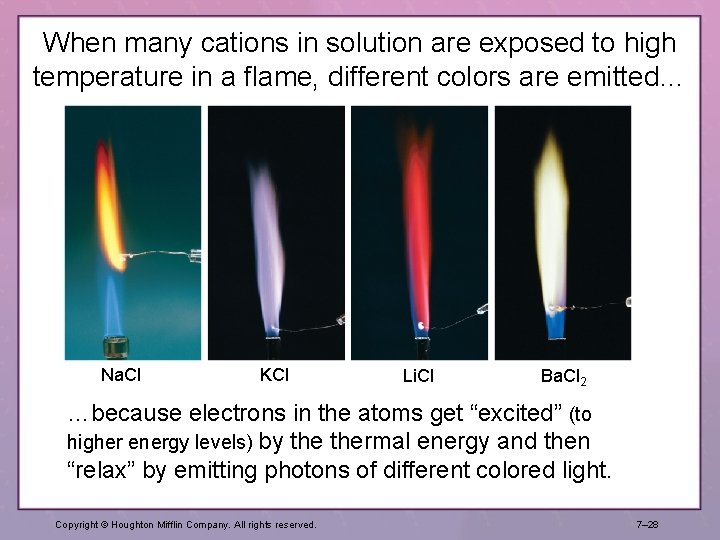
When many cations in solution are exposed to high temperature in a flame, different colors are emitted… Na. Cl KCl Li. Cl Ba. Cl 2 …because electrons in the atoms get “excited” (to higher energy levels) by thermal energy and then “relax” by emitting photons of different colored light. Copyright © Houghton Mifflin Company. All rights reserved. 7– 28
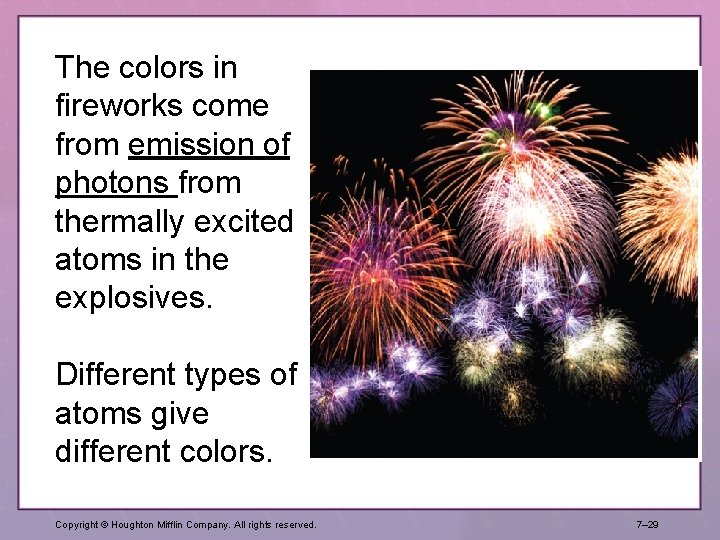
The colors in fireworks come from emission of photons from thermally excited atoms in the explosives. Different types of atoms give different colors. Copyright © Houghton Mifflin Company. All rights reserved. 7– 29
Figure 7. 7 Zumdahl A Change Between Two Discrete Energy Levels Emits a Photon of Light n = 2 level (not n = 1) Copyright © Houghton Mifflin Company. All rights reserved. 7– 30
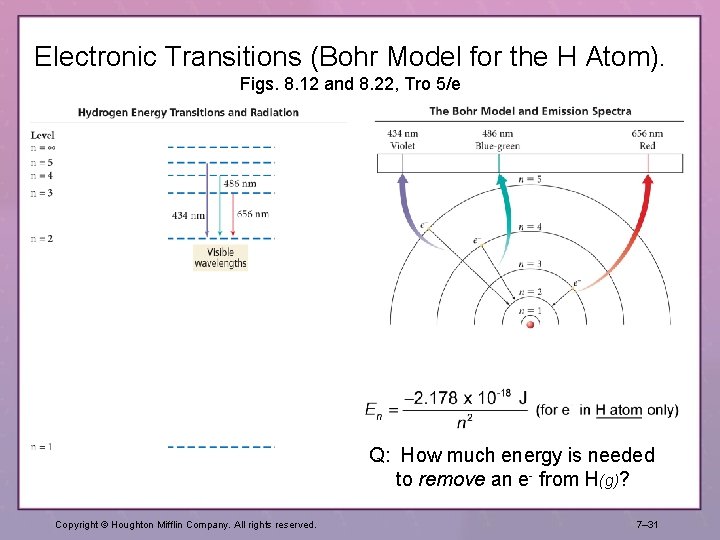
Electronic Transitions (Bohr Model for the H Atom). Figs. 8. 12 and 8. 22, Tro 5/e Q: How much energy is needed to remove an e- from H(g)? Copyright © Houghton Mifflin Company. All rights reserved. 7– 31
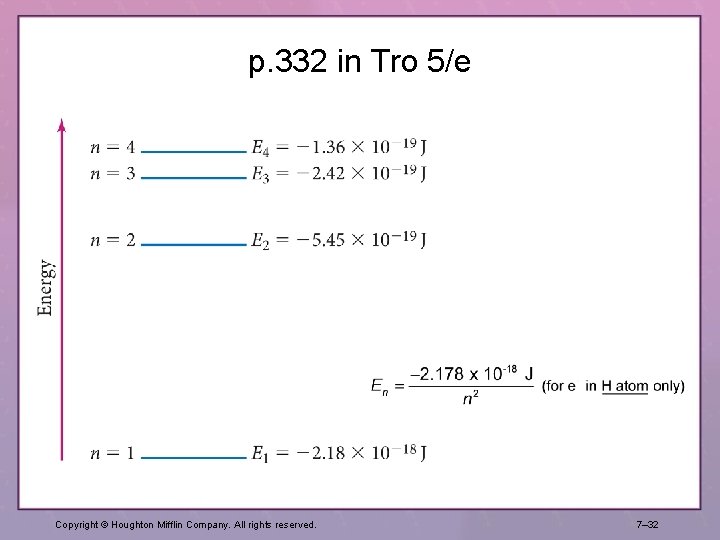
p. 332 in Tro 5/e Copyright © Houghton Mifflin Company. All rights reserved. 7– 32
Great Simulation Applet • http: //phet. colorado. edu/simulations/sim s. php? sim=Models_of_the_Hydrogen_A tom • This was a cool (different kind of) applet… • https: //web. phys. ksu. edu/vqm/software/ online/vqm/html/h 2 spec. html (…but it may no longer work in current browsers) Copyright © Houghton Mifflin Company. All rights reserved. 7– 33
Problems with Bohr Model • Only worked for H atom • No explanation for why energy of electron was “quantized” (why limited to only certain orbits? • No explanation for why electron doesn’t crash into nucleus after awhile – Orbiting planets / charges ultimately will • Heisenberg’s Ideas – The act of measuring a system changes it • T of cold water in a thimble using a room temperature thermometer? • Finding the position of an electron in an atom changes the atom – Can’t simultaneously know both position and direction of an electron • “orbit” idea not feasible anymore Copyright © Houghton Mifflin Company. All rights reserved. 7– 34
Schrodinger’s “Wave” Model (Quantum Mechanical Model) • Wave-particle duality concept – Light has particle properties (photons) as well as wave properties (Einstein) – Maybe particles (i. e. , an electron) have some wave properties! (de Broglie, 1923) • Electron beam diffracts like a beam of light? • Yes! Electron microscopes! • Properties only show up for tiny particles • Treat electrons with “wave math” Copyright © Houghton Mifflin Company. All rights reserved. 7– 35
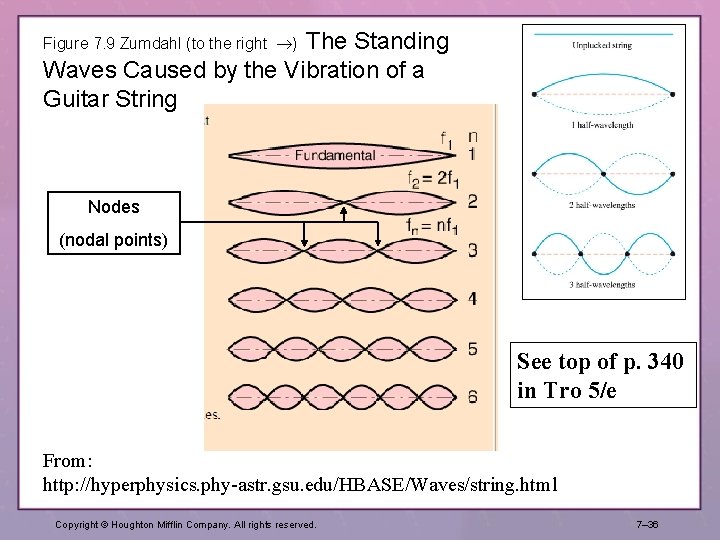
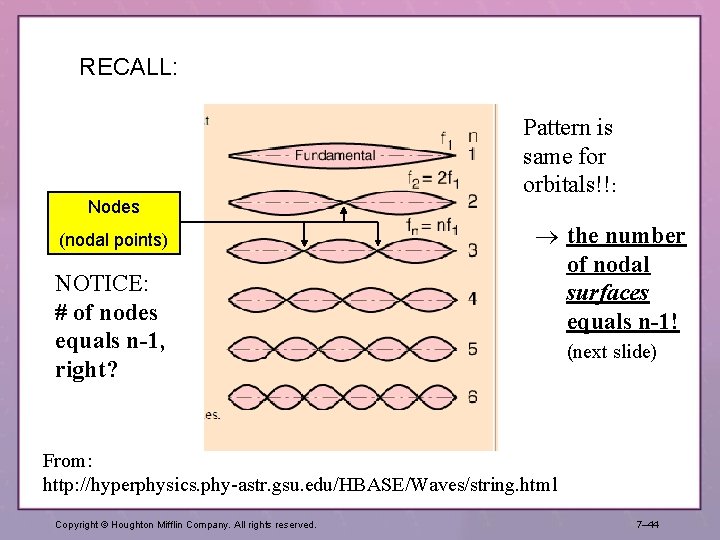
Figure 7. 9 Zumdahl (to the right ) The Standing Waves Caused by the Vibration of a Guitar String Nodes (nodal points) See top of p. 340 in Tro 5/e From: http: //hyperphysics. phy-astr. gsu. edu/HBASE/Waves/string. html Copyright © Houghton Mifflin Company. All rights reserved. 7– 36
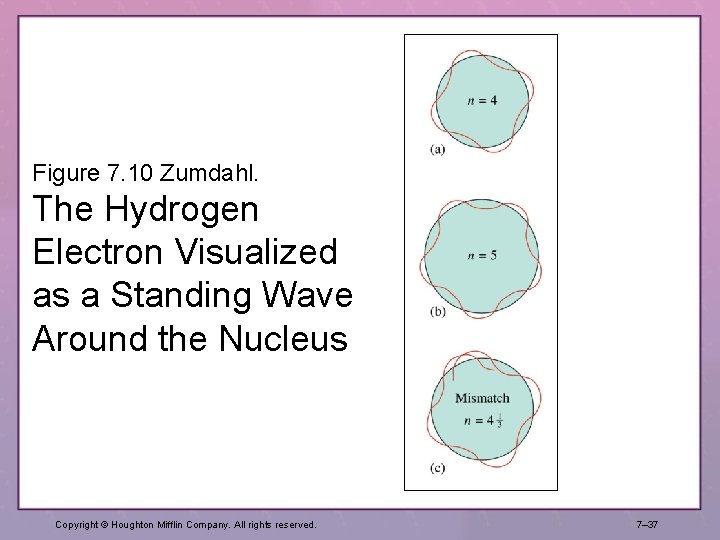
Figure 7. 10 Zumdahl. The Hydrogen Electron Visualized as a Standing Wave Around the Nucleus Copyright © Houghton Mifflin Company. All rights reserved. 7– 37
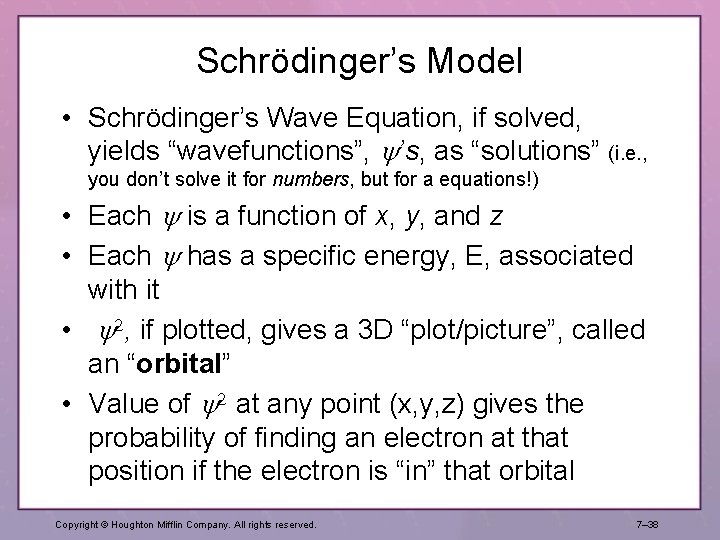
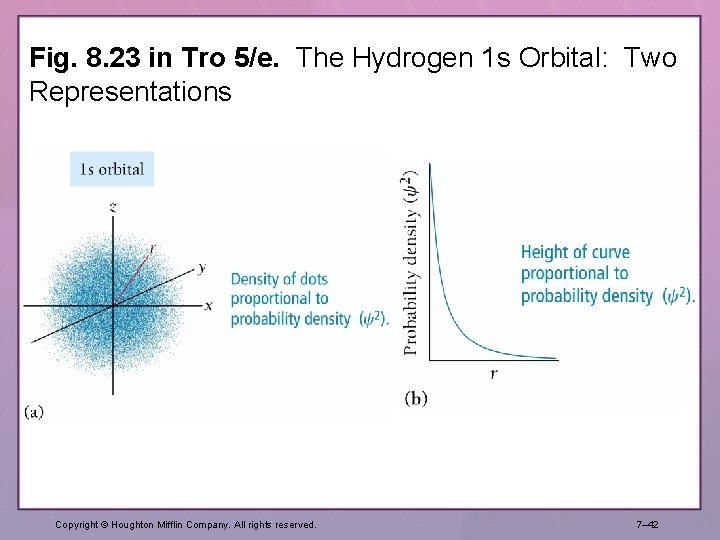
Schrödinger’s Model • Schrödinger’s Wave Equation, if solved, yields “wavefunctions”, y’s, as “solutions” (i. e. , you don’t solve it for numbers, but for a equations!) • Each y is a function of x, y, and z • Each y has a specific energy, E, associated with it • y 2, if plotted, gives a 3 D “plot/picture”, called an “orbital” • Value of y 2 at any point (x, y, z) gives the probability of finding an electron at that position if the electron is “in” that orbital Copyright © Houghton Mifflin Company. All rights reserved. 7– 38
Schrödinger’s Model (cont. ) • Every kind of orbital you’ve learned about came from a y that was a solution to the Schrodinger equation for the H atom! • Orbitals have designations – 1 s, 4 p, 3 d, 6 f • The number in front of s, p, d, f is called “n”, the “principal quantum number” – Associated with the energy “level” the electron is “in” • Generally, the greater the n, the greater the energy of the electron • Each orbital has a “shape” (associated with the letter) Copyright © Houghton Mifflin Company. All rights reserved. 7– 39
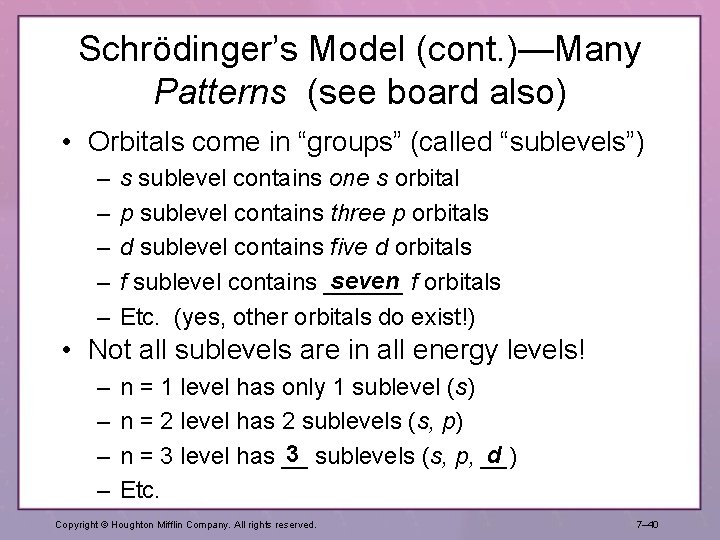
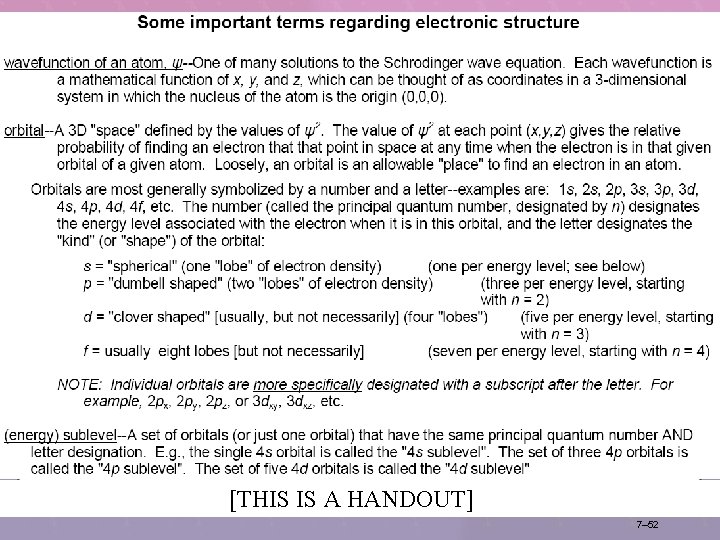
Schrödinger’s Model (cont. )—Many Patterns (see board also) • Orbitals come in “groups” (called “sublevels”) – – – s sublevel contains one s orbital p sublevel contains three p orbitals d sublevel contains five d orbitals seven f sublevel contains ______ f orbitals Etc. (yes, other orbitals do exist!) • Not all sublevels are in all energy levels! – – n = 1 level has only 1 sublevel (s) n = 2 level has 2 sublevels (s, p) 3 d n = 3 level has __ sublevels (s, p, __) Etc. Copyright © Houghton Mifflin Company. All rights reserved. 7– 40
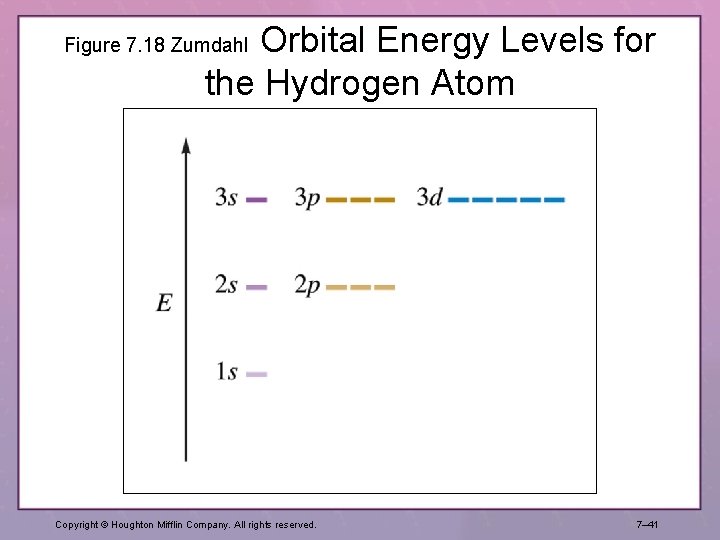
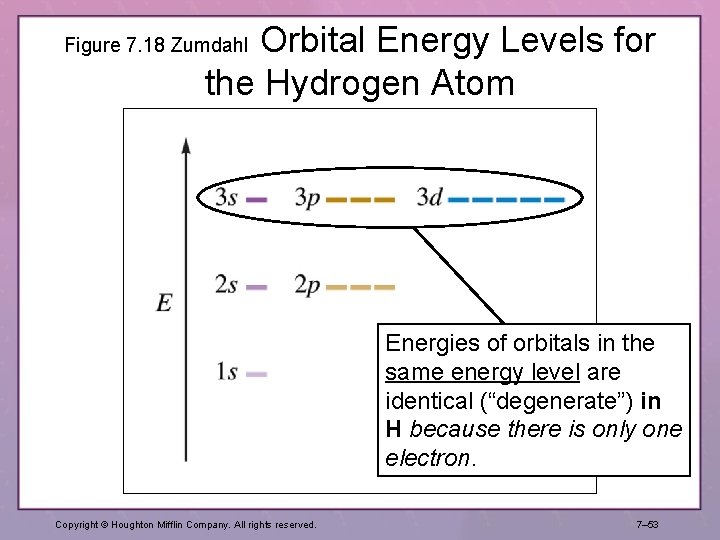
Orbital Energy Levels for the Hydrogen Atom Figure 7. 18 Zumdahl Copyright © Houghton Mifflin Company. All rights reserved. 7– 41
Fig. 8. 23 in Tro 5/e. The Hydrogen 1 s Orbital: Two Representations Copyright © Houghton Mifflin Company. All rights reserved. 7– 42
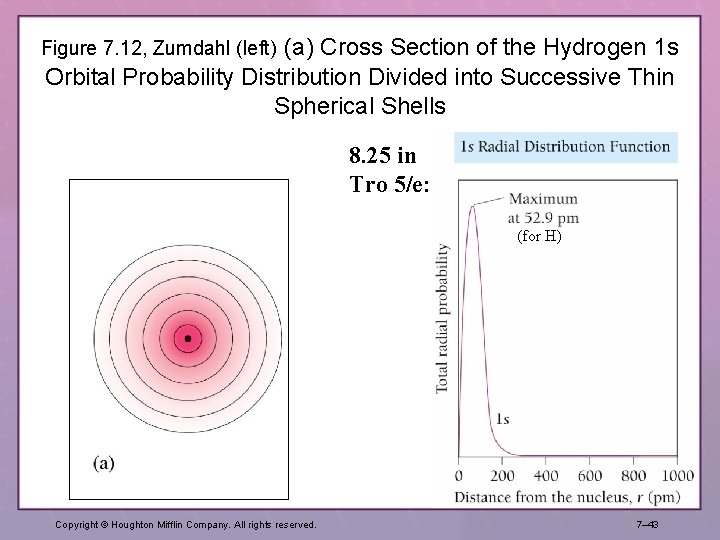
Figure 7. 12, Zumdahl (left) (a) Cross Section of the Hydrogen 1 s Orbital Probability Distribution Divided into Successive Thin Spherical Shells 8. 25 in Tro 5/e: (for H) Copyright © Houghton Mifflin Company. All rights reserved. 7– 43
RECALL: Nodes (nodal points) NOTICE: # of nodes equals n-1, right? Pattern is same for orbitals!!: the number of nodal surfaces equals n-1! (next slide) From: http: //hyperphysics. phy-astr. gsu. edu/HBASE/Waves/string. html Copyright © Houghton Mifflin Company. All rights reserved. 7– 44
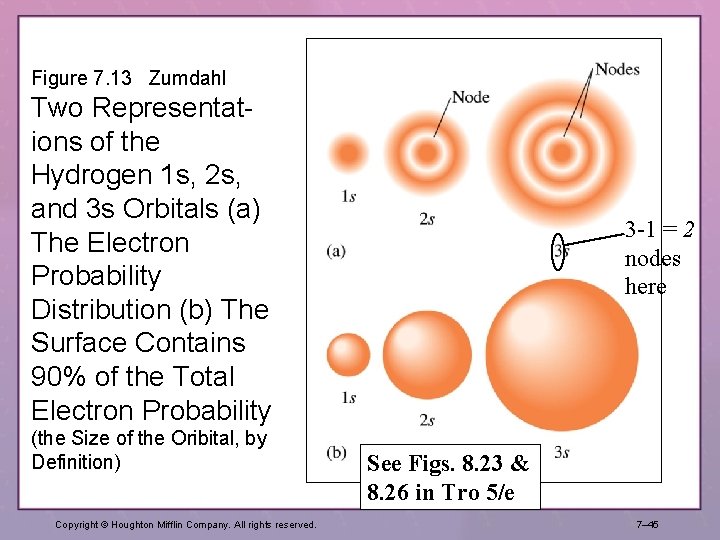
Figure 7. 13 Zumdahl Two Representations of the Hydrogen 1 s, 2 s, and 3 s Orbitals (a) The Electron Probability Distribution (b) The Surface Contains 90% of the Total Electron Probability (the Size of the Oribital, by Definition) Copyright © Houghton Mifflin Company. All rights reserved. 3 -1 = 2 nodes here See Figs. 8. 23 & 8. 26 in Tro 5/e 7– 45
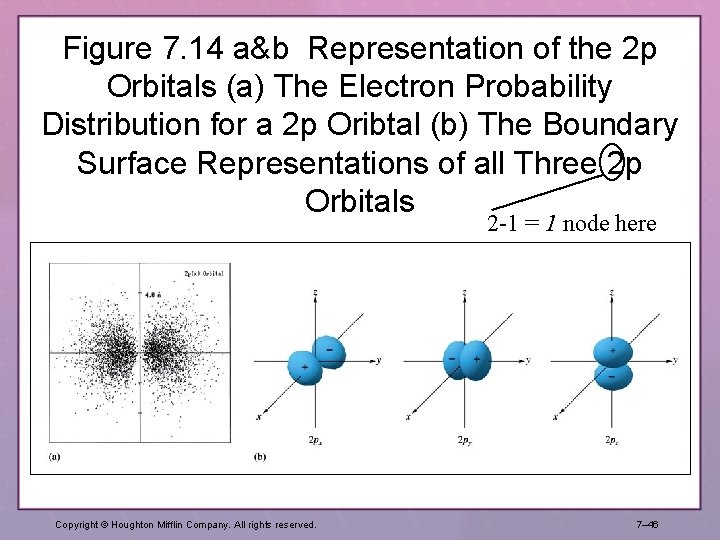
Figure 7. 14 a&b Representation of the 2 p Orbitals (a) The Electron Probability Distribution for a 2 p Oribtal (b) The Boundary Surface Representations of all Three 2 p Orbitals 2 -1 = 1 node here Copyright © Houghton Mifflin Company. All rights reserved. 7– 46
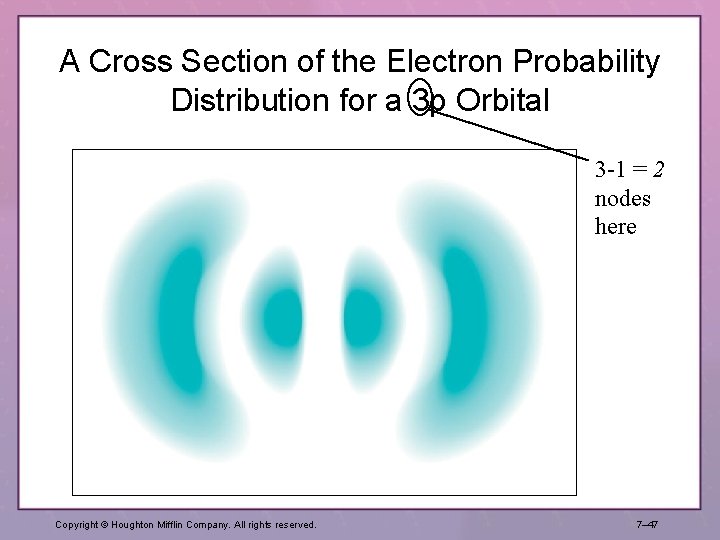
A Cross Section of the Electron Probability Distribution for a 3 p Orbital 3 -1 = 2 nodes here Copyright © Houghton Mifflin Company. All rights reserved. 7– 47
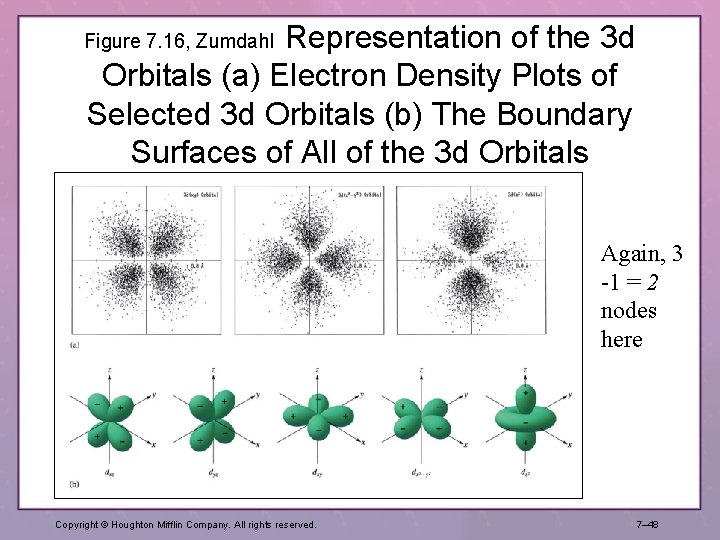
Representation of the 3 d Orbitals (a) Electron Density Plots of Selected 3 d Orbitals (b) The Boundary Surfaces of All of the 3 d Orbitals Figure 7. 16, Zumdahl Again, 3 -1 = 2 nodes here Copyright © Houghton Mifflin Company. All rights reserved. 7– 48
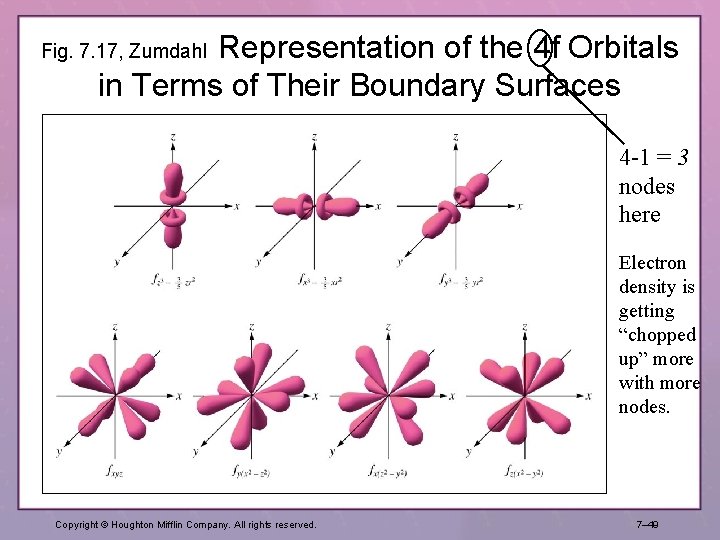
Representation of the 4 f Orbitals in Terms of Their Boundary Surfaces Fig. 7. 17, Zumdahl 4 -1 = 3 nodes here Electron density is getting “chopped up” more with more nodes. Copyright © Houghton Mifflin Company. All rights reserved. 7– 49
7– 50
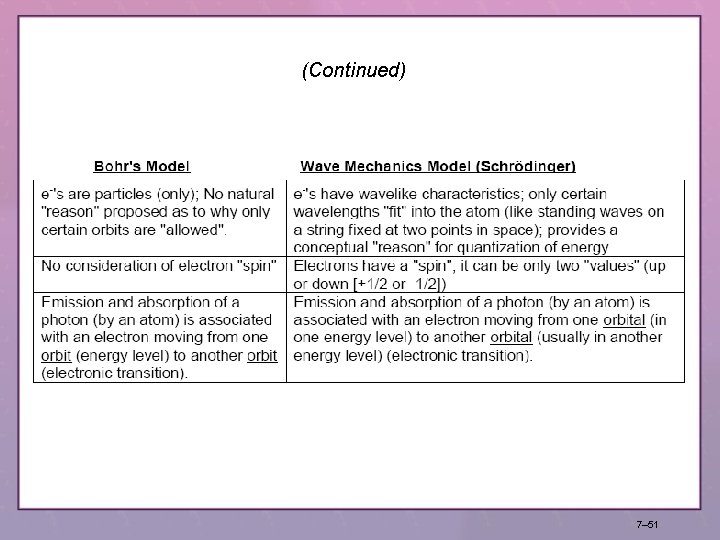
(Continued) 7– 51
[THIS IS A HANDOUT] 7– 52
Orbital Energy Levels for the Hydrogen Atom Figure 7. 18 Zumdahl Energies of orbitals in the same energy level are identical (“degenerate”) in H because there is only one electron. Copyright © Houghton Mifflin Company. All rights reserved. 7– 53
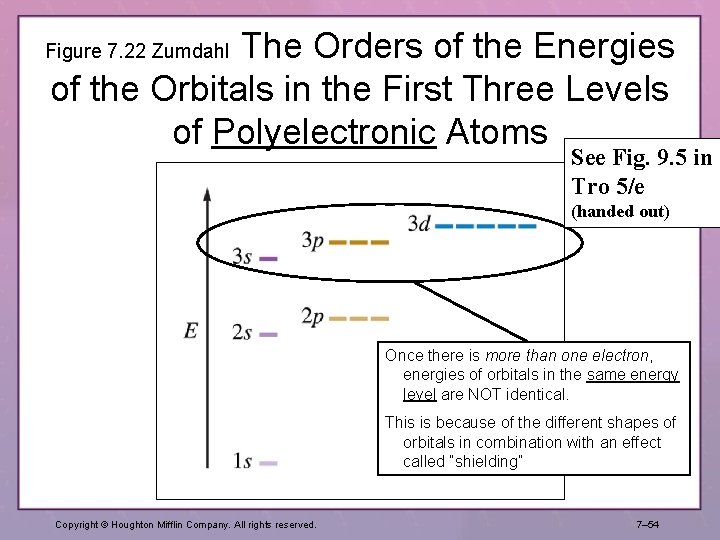
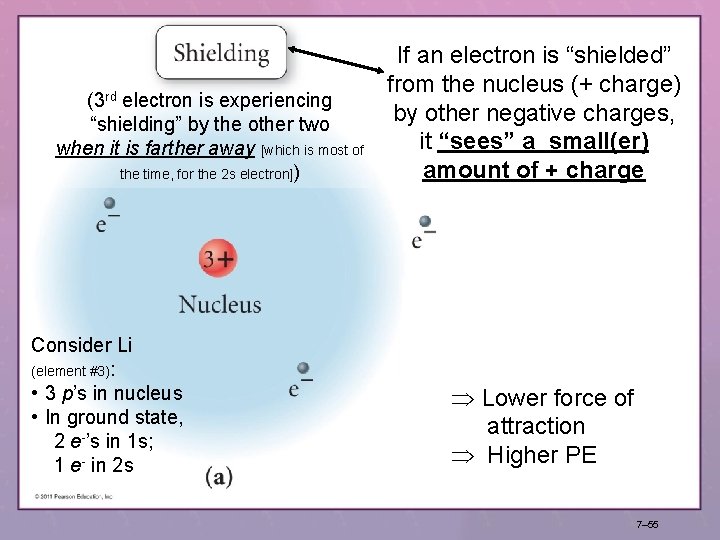
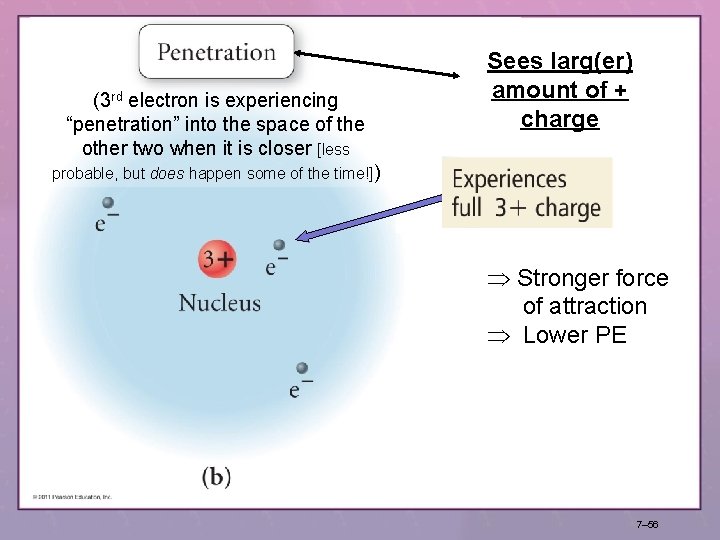
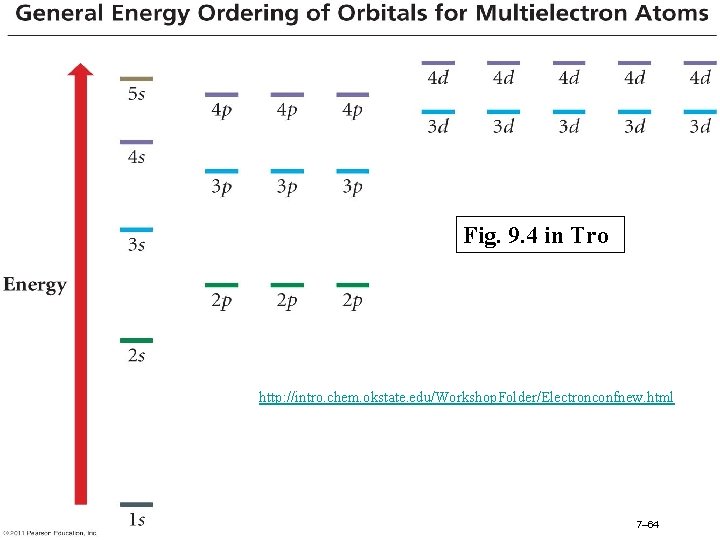
The Orders of the Energies of the Orbitals in the First Three Levels of Polyelectronic Atoms Figure 7. 22 Zumdahl See Fig. 9. 5 in Tro 5/e (handed out) Once there is more than one electron, energies of orbitals in the same energy level are NOT identical. This is because of the different shapes of orbitals in combination with an effect called “shielding” Copyright © Houghton Mifflin Company. All rights reserved. 7– 54
(3 rd electron is experiencing “shielding” by the other two when it is farther away [which is most of the time, for the 2 s electron]) Consider Li (element #3): • 3 p’s in nucleus • In ground state, 2 e-’s in 1 s; 1 e- in 2 s If an electron is “shielded” from the nucleus (+ charge) by other negative charges, it “sees” a small(er) amount of + charge Lower force of attraction Higher PE 7– 55
(3 rd electron is experiencing “penetration” into the space of the other two when it is closer [less Sees larg(er) amount of + charge probable, but does happen some of the time!]) Stronger force of attraction Lower PE 7– 56
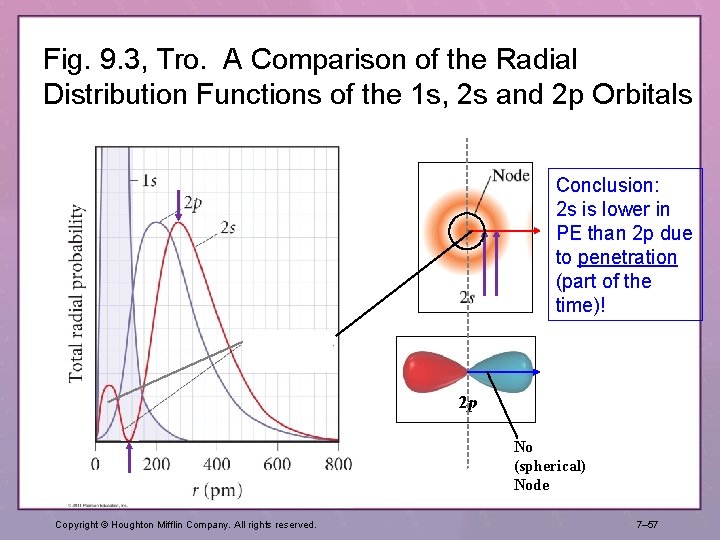
Fig. 9. 3, Tro. A Comparison of the Radial Distribution Functions of the 1 s, 2 s and 2 p Orbitals Conclusion: 2 s is lower in PE than 2 p due to penetration (part of the time)! 2 p No (spherical) Node Copyright © Houghton Mifflin Company. All rights reserved. 7– 57
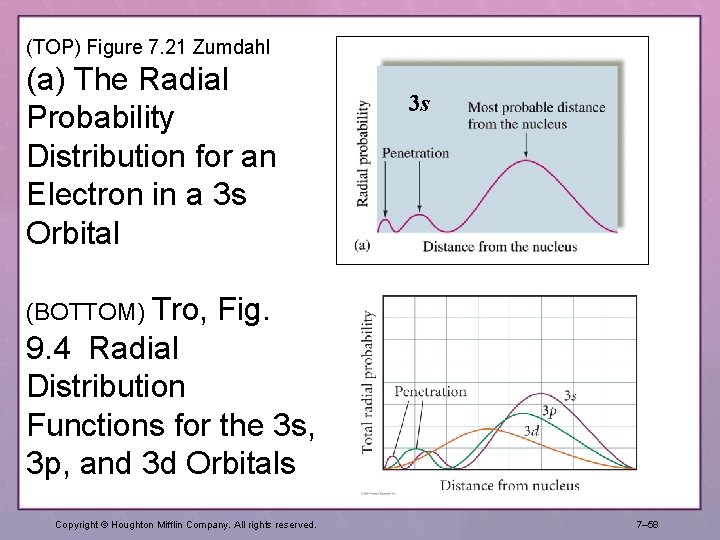
(TOP) Figure 7. 21 Zumdahl (a) The Radial Probability Distribution for an Electron in a 3 s Orbital (BOTTOM) Tro, Fig. 9. 4 Radial Distribution Functions for the 3 s, 3 p, and 3 d Orbitals Copyright © Houghton Mifflin Company. All rights reserved. 3 s 7– 58
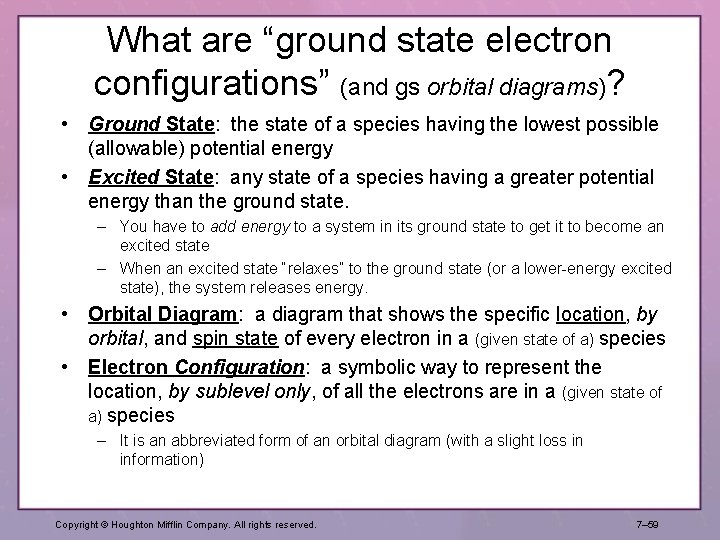
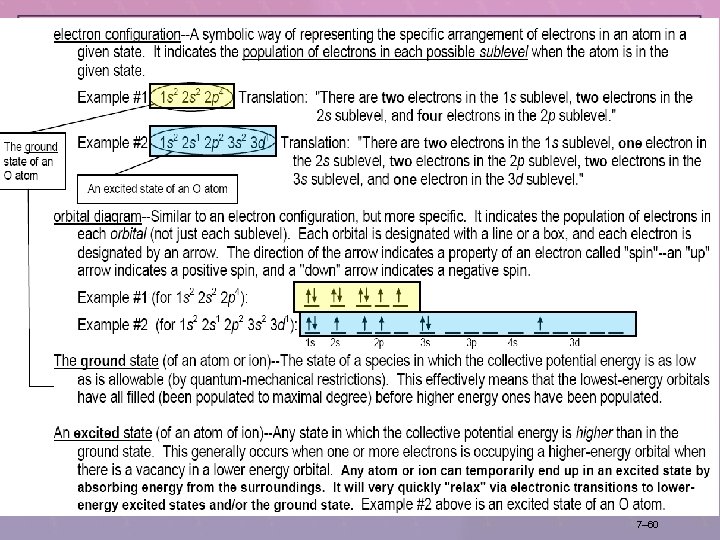
What are “ground state electron configurations” (and gs orbital diagrams)? • Ground State: the state of a species having the lowest possible (allowable) potential energy • Excited State: any state of a species having a greater potential energy than the ground state. – You have to add energy to a system in its ground state to get it to become an excited state – When an excited state “relaxes” to the ground state (or a lower-energy excited state), the system releases energy. • Orbital Diagram: a diagram that shows the specific location, by orbital, and spin state of every electron in a (given state of a) species • Electron Configuration: a symbolic way to represent the location, by sublevel only, of all the electrons are in a (given state of a) species – It is an abbreviated form of an orbital diagram (with a slight loss in information) Copyright © Houghton Mifflin Company. All rights reserved. 7– 59
7– 60
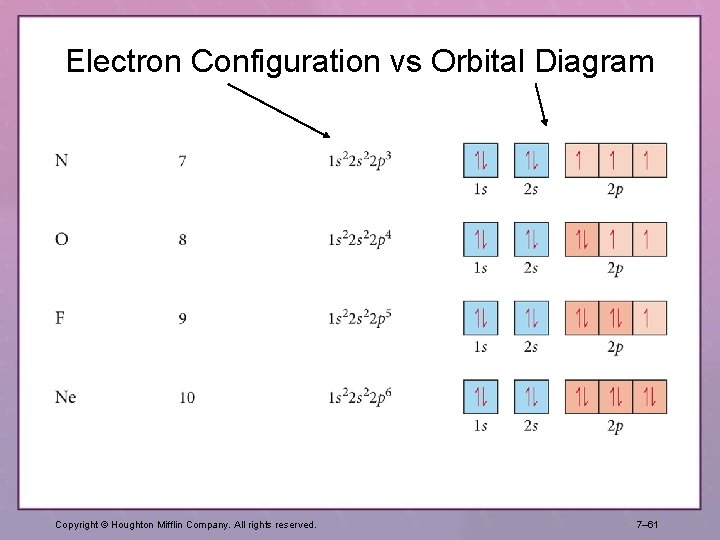
Electron Configuration vs Orbital Diagram Copyright © Houghton Mifflin Company. All rights reserved. 7– 61
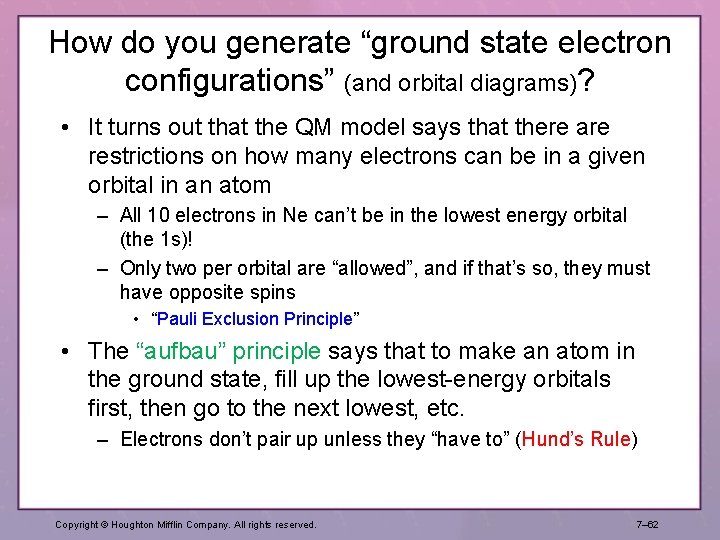
How do you generate “ground state electron configurations” (and orbital diagrams)? • It turns out that the QM model says that there are restrictions on how many electrons can be in a given orbital in an atom – All 10 electrons in Ne can’t be in the lowest energy orbital (the 1 s)! – Only two per orbital are “allowed”, and if that’s so, they must have opposite spins • “Pauli Exclusion Principle” • The “aufbau” principle says that to make an atom in the ground state, fill up the lowest-energy orbitals first, then go to the next lowest, etc. – Electrons don’t pair up unless they “have to” (Hund’s Rule) Copyright © Houghton Mifflin Company. All rights reserved. 7– 62
Ground State Electron Configs • See Board Copyright © Houghton Mifflin Company. All rights reserved. 7– 63
Fig. 9. 4 in Tro http: //intro. chem. okstate. edu/Workshop. Folder/Electronconfnew. html 7– 64
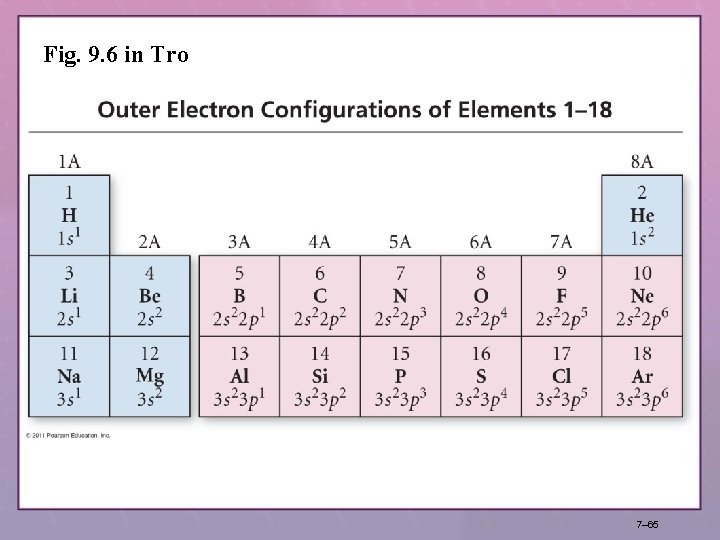
Fig. 9. 6 in Tro 7– 65
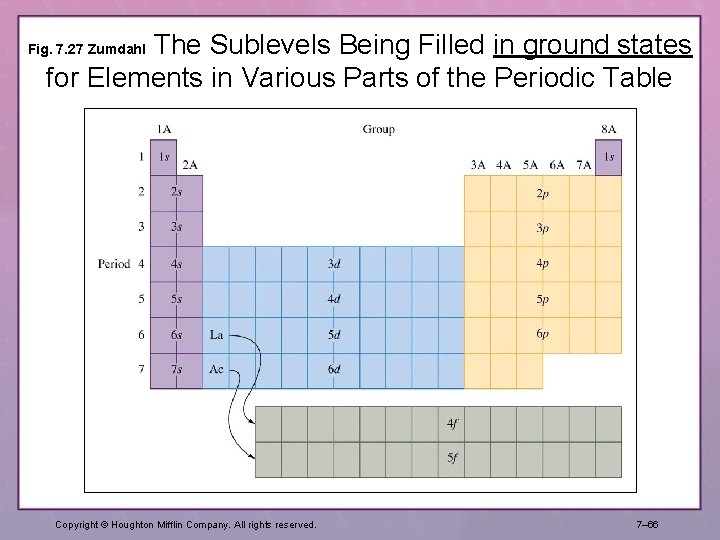
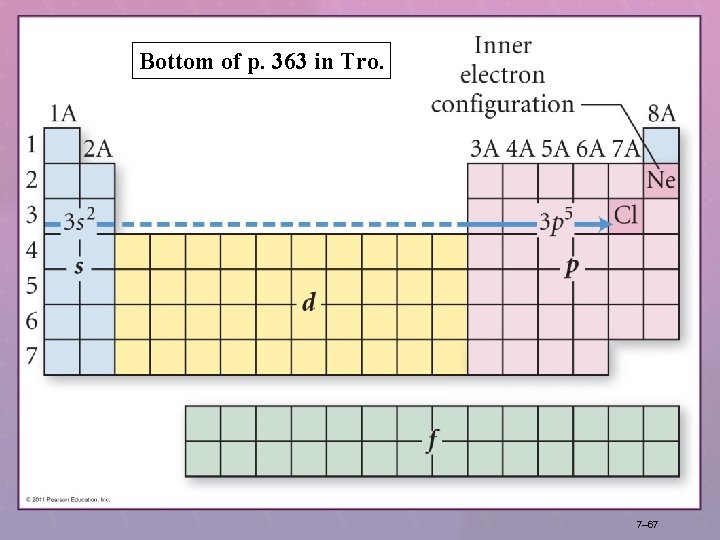
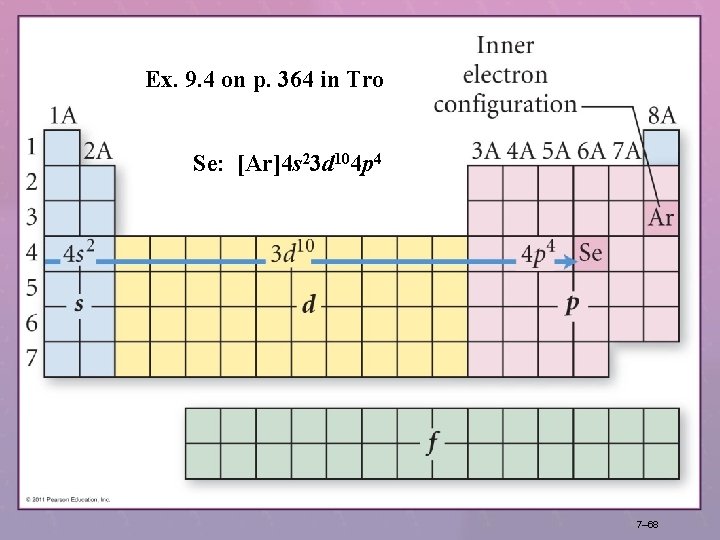
The Sublevels Being Filled in ground states for Elements in Various Parts of the Periodic Table Fig. 7. 27 Zumdahl Copyright © Houghton Mifflin Company. All rights reserved. 7– 66
Bottom of p. 363 in Tro. 7– 67
Ex. 9. 4 on p. 364 in Tro Se: [Ar]4 s 23 d 104 p 4 7– 68
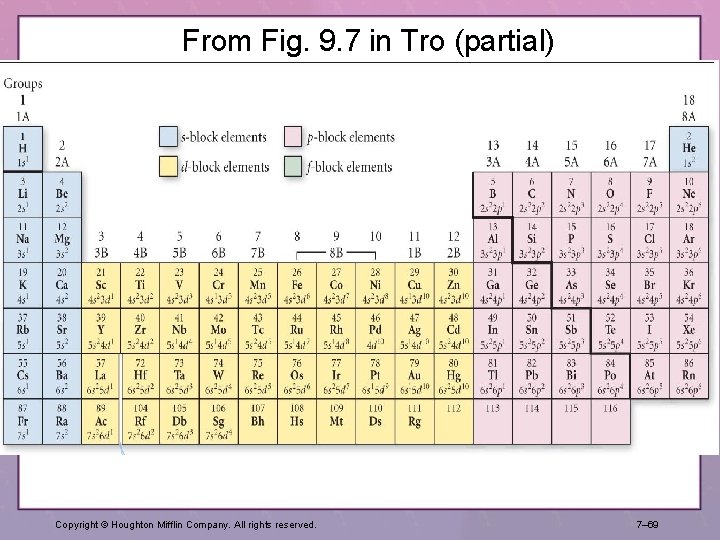
From Fig. 9. 7 in Tro (partial) Copyright © Houghton Mifflin Company. All rights reserved. 7– 69
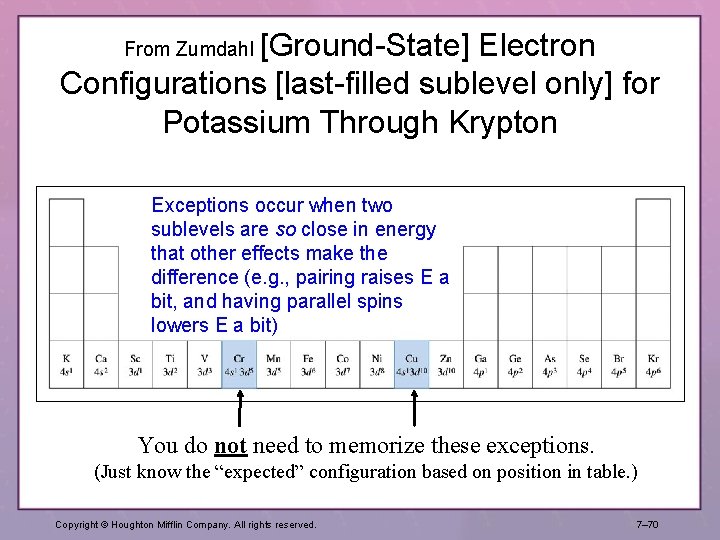
[Ground-State] Electron Configurations [last-filled sublevel only] for Potassium Through Krypton From Zumdahl Exceptions occur when two sublevels are so close in energy that other effects make the difference (e. g. , pairing raises E a bit, and having parallel spins lowers E a bit) You do not need to memorize these exceptions. (Just know the “expected” configuration based on position in table. ) Copyright © Houghton Mifflin Company. All rights reserved. 7– 70
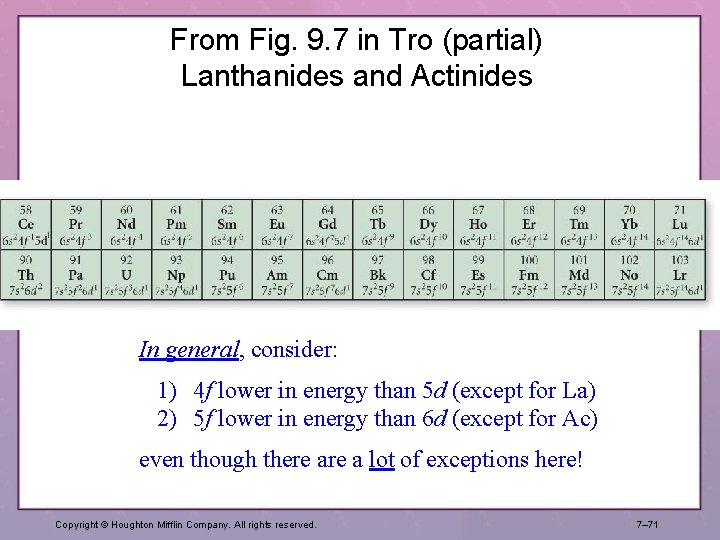
From Fig. 9. 7 in Tro (partial) Lanthanides and Actinides In general, consider: 1) 4 f lower in energy than 5 d (except for La) 2) 5 f lower in energy than 6 d (except for Ac) even though there a lot of exceptions here! Copyright © Houghton Mifflin Company. All rights reserved. 7– 71
Final Related Topics • Abbreviated electron configurations – Use prior noble gas (e. g. , [Ar]4 s 1) • Paramagnetism (and “# of unpaired e-’s”) – Occurs if any unpaired electrons • (called “paramagnetic”, b/c an unpaired electron attracts a magnetic field, but paired electrons do not) – Need to look at orbital diagram to “see” this • Excited state electron configurations • “Allowable” orbitals vs. “not filled in gd st. ” • Core vs. Valence Electrons 7– 72
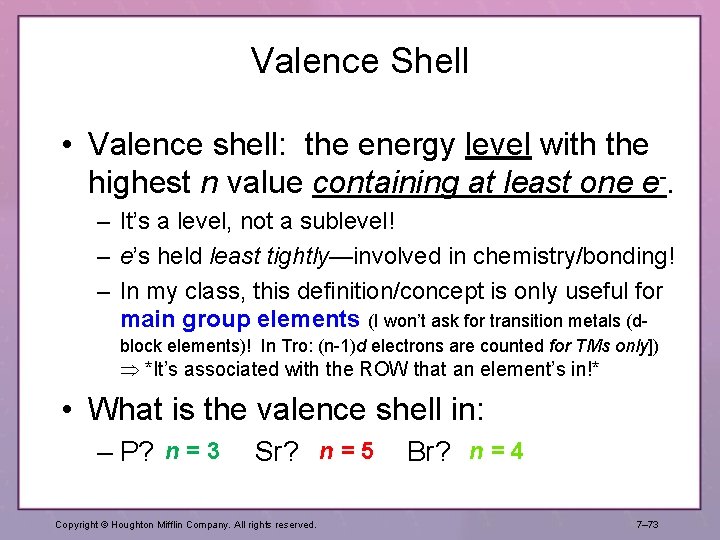
Valence Shell • Valence shell: the energy level with the highest n value containing at least one e-. – It’s a level, not a sublevel! – e’s held least tightly—involved in chemistry/bonding! – In my class, this definition/concept is only useful for main group elements (I won’t ask for transition metals (dblock elements)! In Tro: (n-1)d electrons are counted for TMs only]) *It’s associated with the ROW that an element’s in!* • What is the valence shell in: n=3 n=5 n=4 – P? Sr? Br? Copyright © Houghton Mifflin Company. All rights reserved. 7– 73
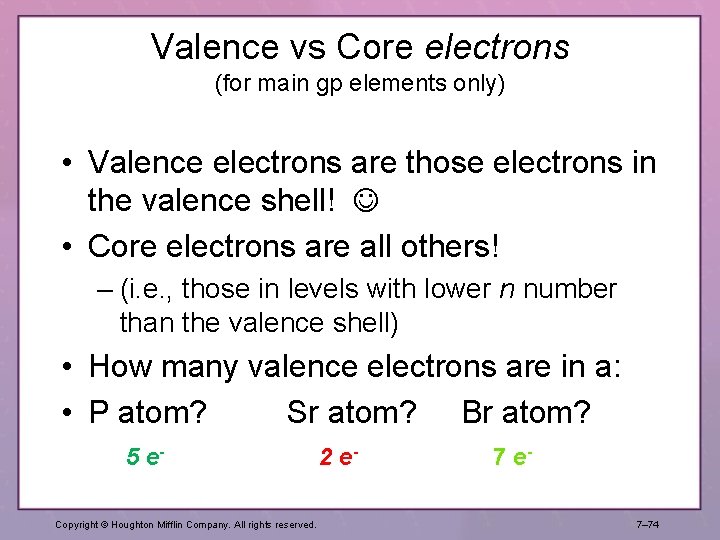
Valence vs Core electrons (for main gp elements only) • Valence electrons are those electrons in the valence shell! • Core electrons are all others! – (i. e. , those in levels with lower n number than the valence shell) • How many valence electrons are in a: • P atom? Sr atom? Br atom? 5 e. Copyright © Houghton Mifflin Company. All rights reserved. 2 e- 7 e 7– 74
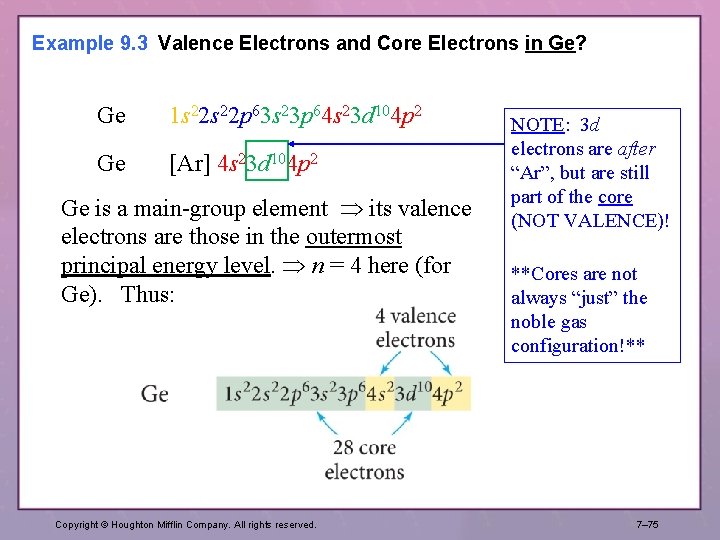
Example 9. 3 Valence Electrons and Core Electrons in Ge? Ge 1 s 22 p 63 s 23 p 64 s 23 d 104 p 2 Ge [Ar] 4 s 23 d 104 p 2 Ge is a main-group element its valence electrons are those in the outermost principal energy level. n = 4 here (for Ge). Thus: Copyright © Houghton Mifflin Company. All rights reserved. NOTE: 3 d electrons are after “Ar”, but are still part of the core (NOT VALENCE)! **Cores are not always “just” the noble gas configuration!** 7– 75
Importance of Valence vs Core electrons • Core electrons are, on average, closer to the nucleus and are attracted to it more strongly (“held more tightly”) [see Ppt 21] • Valence electrons are “outermost electrons”—they are held less tightly – They are the ones either “given”, “taken”, or “shared”—they are involved in bonding Copyright © Houghton Mifflin Company. All rights reserved. 7– 76