Alcohols 9102020 Dr Mohammad Nahid Siddiqui 1 Section
- Slides: 77
Alcohols 9/10/2020 Dr. Mohammad Nahid Siddiqui 1
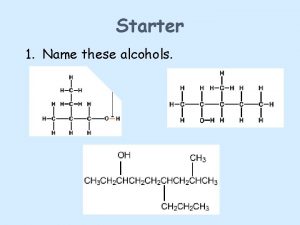
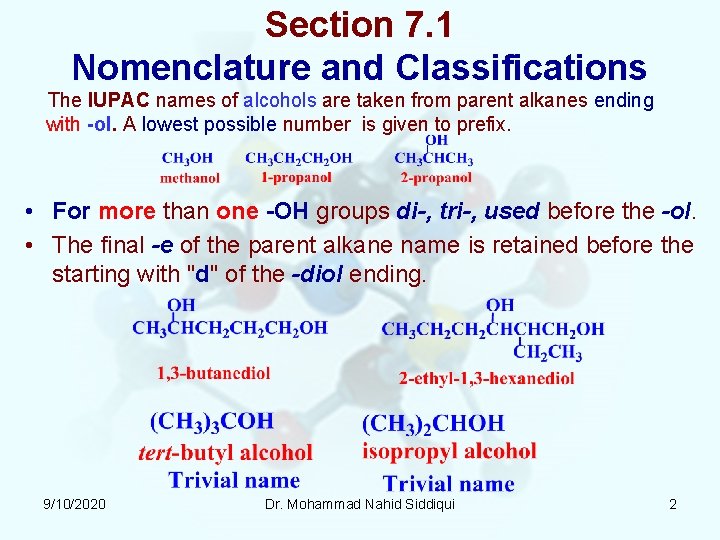
Section 7. 1 Nomenclature and Classifications The IUPAC names of alcohols are taken from parent alkanes ending with -ol. A lowest possible number is given to prefix. • For more than one -OH groups di-, tri-, used before the -ol. • The final -e of the parent alkane name is retained before the starting with "d" of the -diol ending. 9/10/2020 Dr. Mohammad Nahid Siddiqui 2
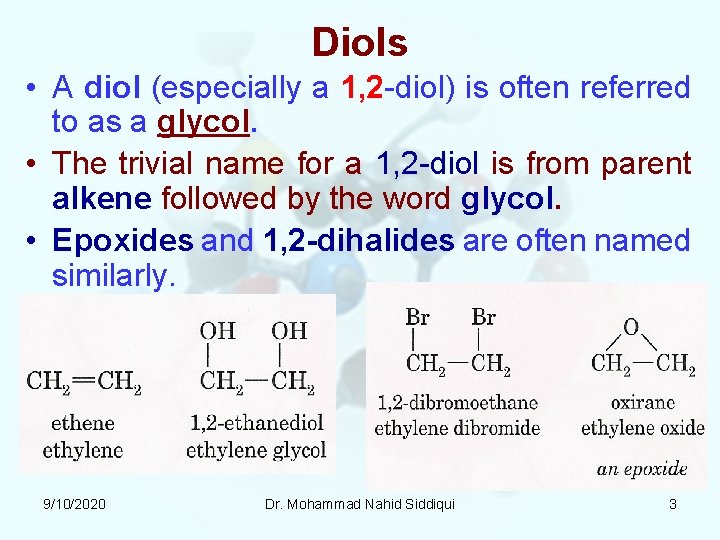
Diols • A diol (especially a 1, 2 -diol) is often referred to as a glycol. • The trivial name for a 1, 2 -diol is from parent alkene followed by the word glycol. • Epoxides and 1, 2 -dihalides are often named similarly. 9/10/2020 Dr. Mohammad Nahid Siddiqui 3
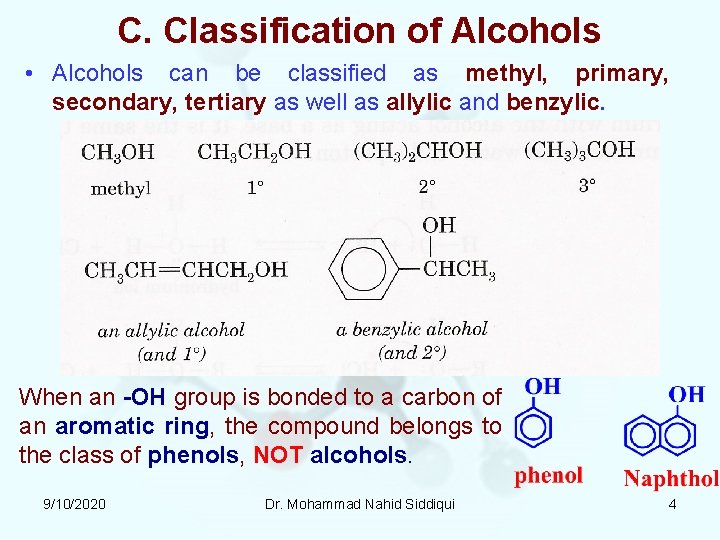
C. Classification of Alcohols • Alcohols can be classified as methyl, primary, secondary, tertiary as well as allylic and benzylic. When an -OH group is bonded to a carbon of an aromatic ring, the compound belongs to the class of phenols, NOT alcohols. 9/10/2020 Dr. Mohammad Nahid Siddiqui 4
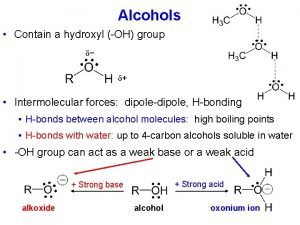
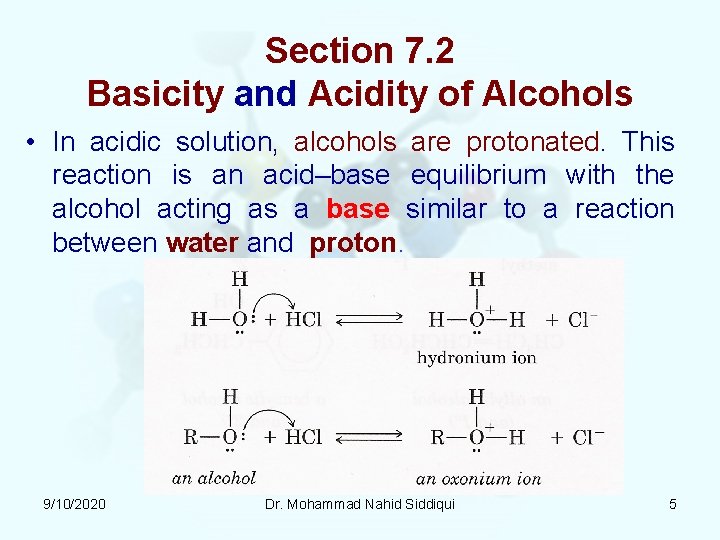
Section 7. 2 Basicity and Acidity of Alcohols • In acidic solution, alcohols are protonated. This reaction is an acid–base equilibrium with the alcohol acting as a base similar to a reaction between water and proton. 9/10/2020 Dr. Mohammad Nahid Siddiqui 5
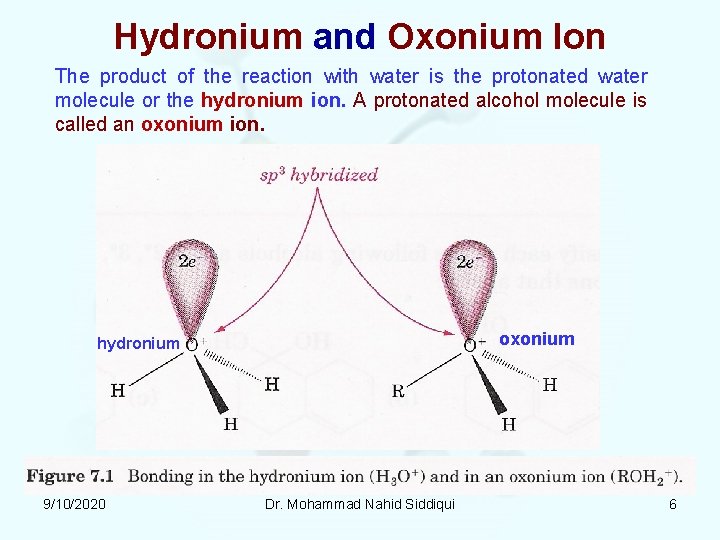
Hydronium and Oxonium Ion The product of the reaction with water is the protonated water molecule or the hydronium ion. A protonated alcohol molecule is called an oxonium ion. oxonium hydronium 9/10/2020 Dr. Mohammad Nahid Siddiqui 6
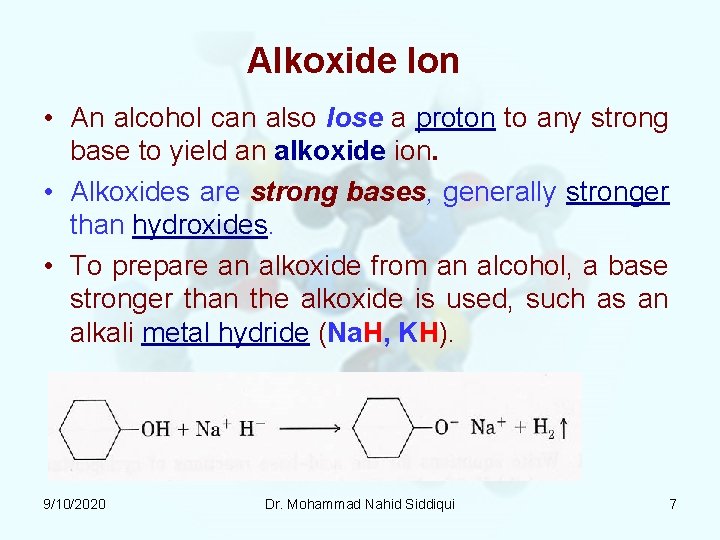
Alkoxide Ion • An alcohol can also lose a proton to any strong base to yield an alkoxide ion. • Alkoxides are strong bases, generally stronger than hydroxides. • To prepare an alkoxide from an alcohol, a base stronger than the alkoxide is used, such as an alkali metal hydride (Na. H, KH). 9/10/2020 Dr. Mohammad Nahid Siddiqui 7
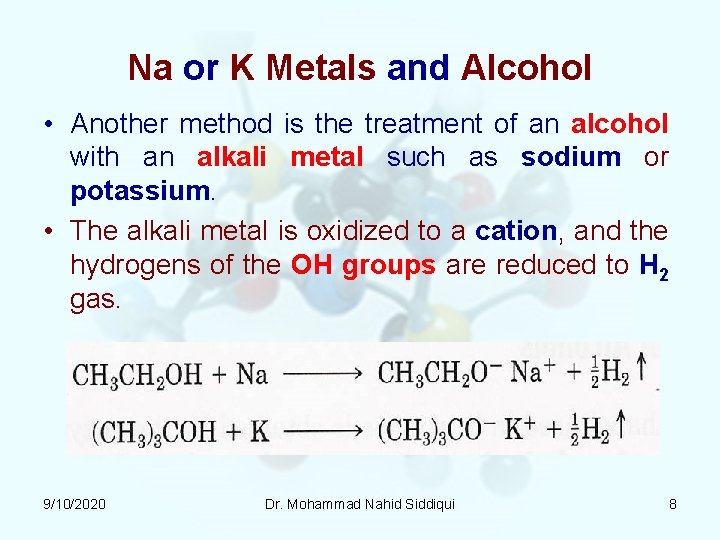
Na or K Metals and Alcohol • Another method is the treatment of an alcohol with an alkali metal such as sodium or potassium. • The alkali metal is oxidized to a cation, and the hydrogens of the OH groups are reduced to H 2 gas. 9/10/2020 Dr. Mohammad Nahid Siddiqui 8
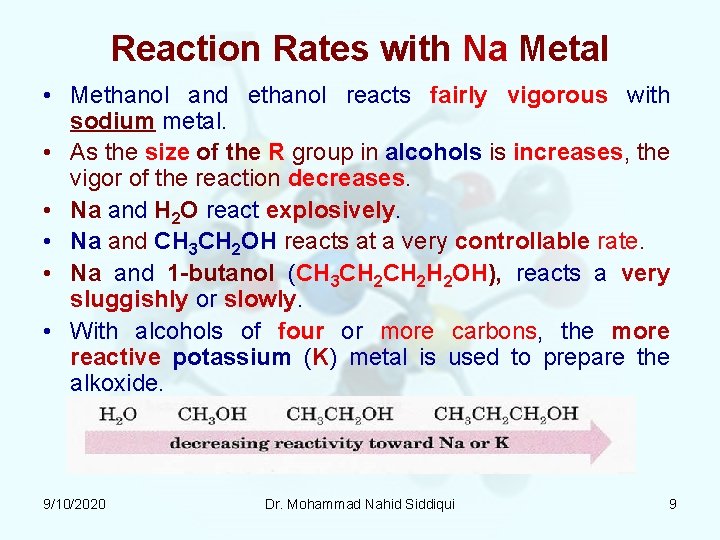
Reaction Rates with Na Metal • Methanol and ethanol reacts fairly vigorous with sodium metal. • As the size of the R group in alcohols is increases, the vigor of the reaction decreases. • Na and H 2 O react explosively. • Na and CH 3 CH 2 OH reacts at a very controllable rate. • Na and 1 -butanol (CH 3 CH 2 H 2 OH), reacts a very sluggishly or slowly. • With alcohols of four or more carbons, the more reactive potassium (K) metal is used to prepare the alkoxide. 9/10/2020 Dr. Mohammad Nahid Siddiqui 9
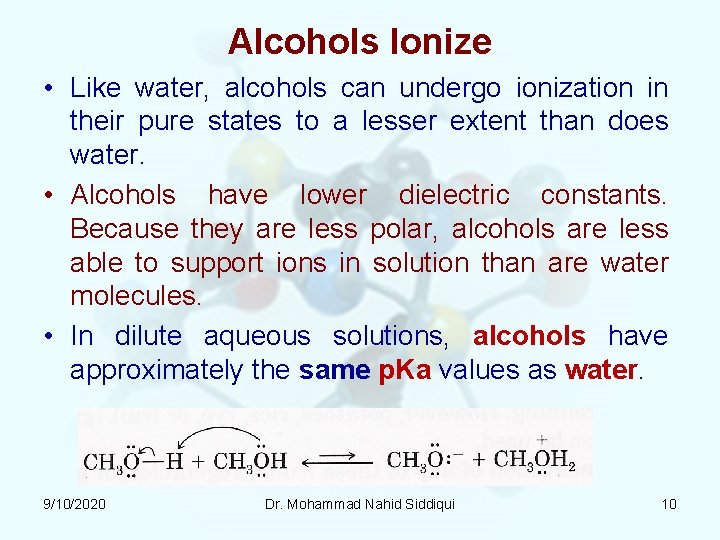
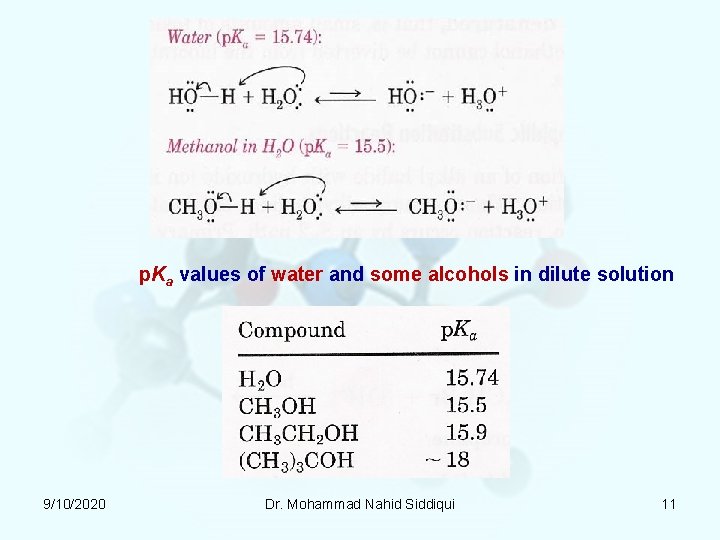
Alcohols Ionize • Like water, alcohols can undergo ionization in their pure states to a lesser extent than does water. • Alcohols have lower dielectric constants. Because they are less polar, alcohols are less able to support ions in solution than are water molecules. • In dilute aqueous solutions, alcohols have approximately the same p. Ka values as water. 9/10/2020 Dr. Mohammad Nahid Siddiqui 10
p. Ka values of water and some alcohols in dilute solution 9/10/2020 Dr. Mohammad Nahid Siddiqui 11
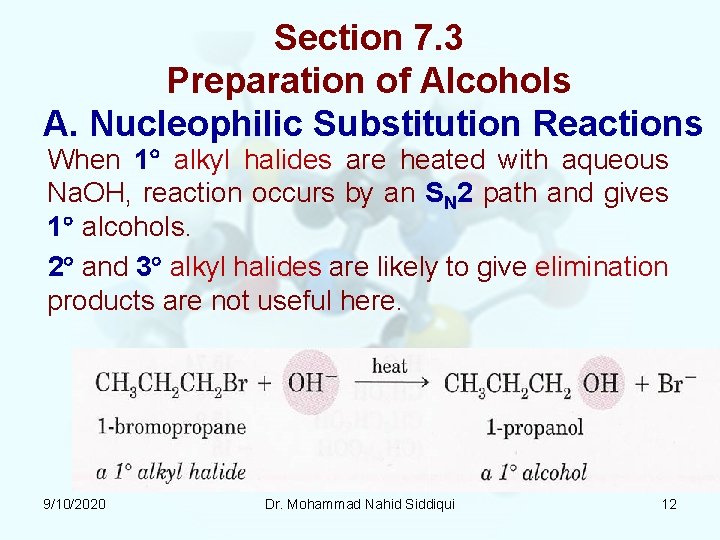
Section 7. 3 Preparation of Alcohols A. Nucleophilic Substitution Reactions When 1 alkyl halides are heated with aqueous Na. OH, reaction occurs by an SN 2 path and gives 1 alcohols. 2 and 3 alkyl halides are likely to give elimination products are not useful here. 9/10/2020 Dr. Mohammad Nahid Siddiqui 12
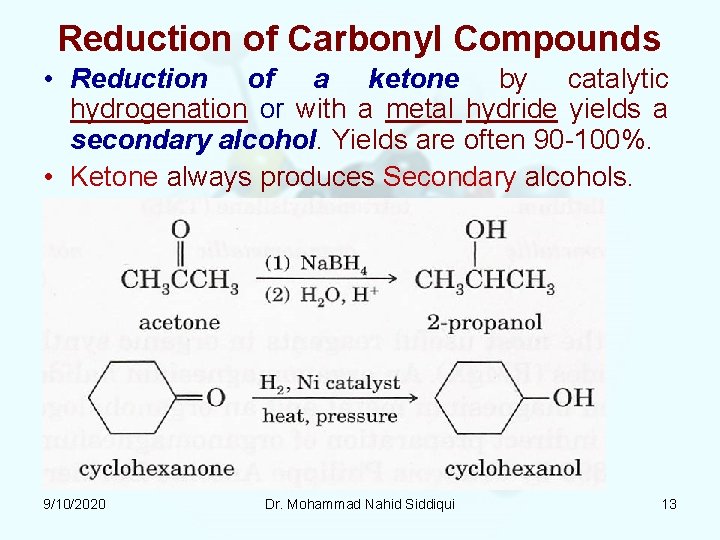
Reduction of Carbonyl Compounds • Reduction of a ketone by catalytic hydrogenation or with a metal hydride yields a secondary alcohol. Yields are often 90 -100%. • Ketone always produces Secondary alcohols. 9/10/2020 Dr. Mohammad Nahid Siddiqui 13
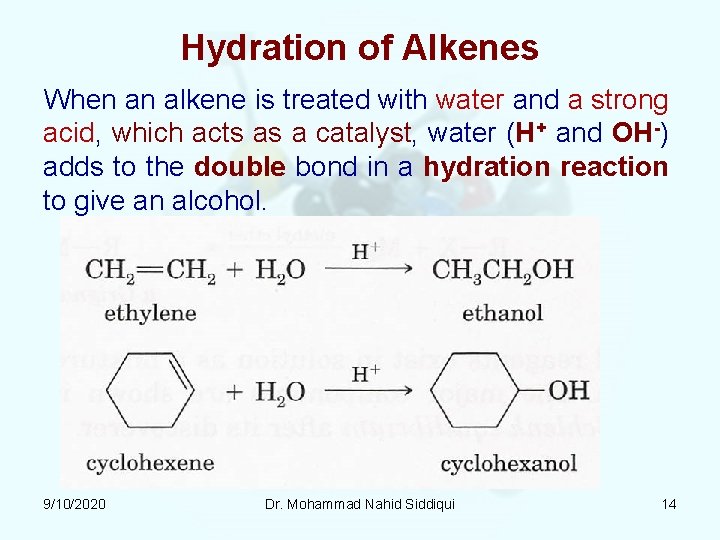
Hydration of Alkenes When an alkene is treated with water and a strong acid, which acts as a catalyst, water (H+ and OH-) adds to the double bond in a hydration reaction to give an alcohol. 9/10/2020 Dr. Mohammad Nahid Siddiqui 14
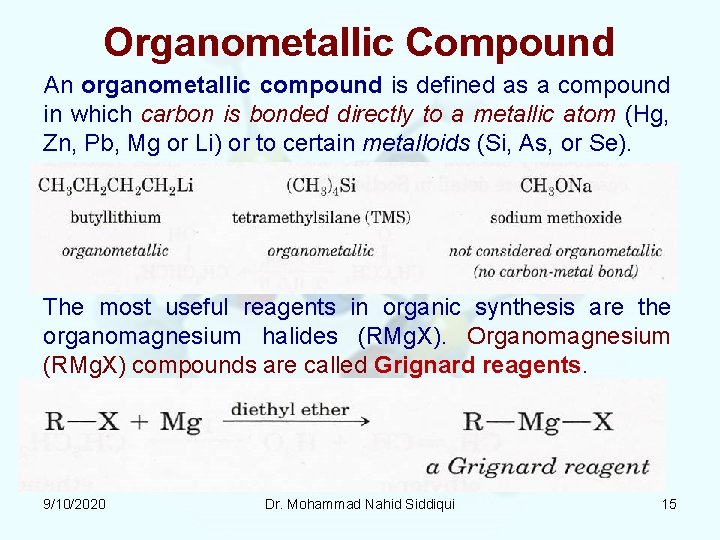
Organometallic Compound An organometallic compound is defined as a compound in which carbon is bonded directly to a metallic atom (Hg, Zn, Pb, Mg or Li) or to certain metalloids (Si, As, or Se). The most useful reagents in organic synthesis are the organomagnesium halides (RMg. X). Organomagnesium (RMg. X) compounds are called Grignard reagents. 9/10/2020 Dr. Mohammad Nahid Siddiqui 15
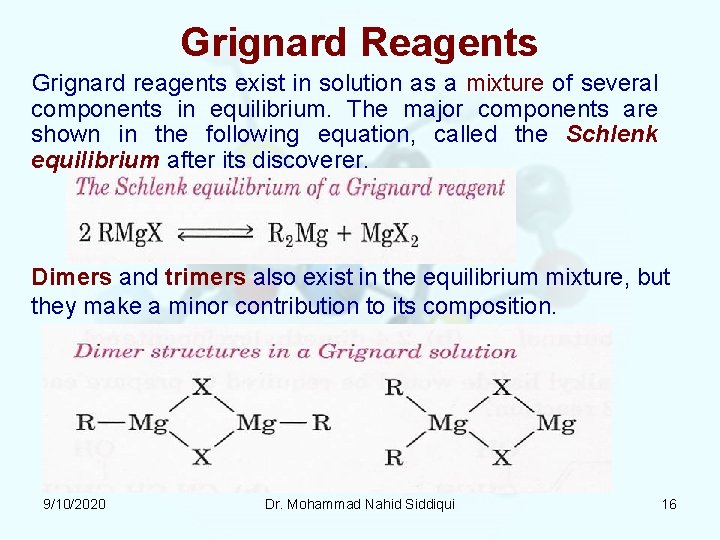
Grignard Reagents Grignard reagents exist in solution as a mixture of several components in equilibrium. The major components are shown in the following equation, called the Schlenk equilibrium after its discoverer. Dimers and trimers also exist in the equilibrium mixture, but they make a minor contribution to its composition. 9/10/2020 Dr. Mohammad Nahid Siddiqui 16
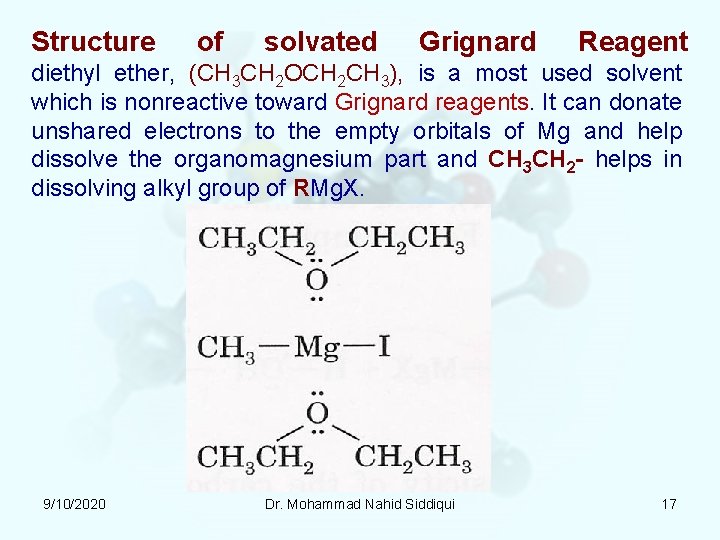
Structure of solvated Grignard Reagent diethyl ether, (CH 3 CH 2 OCH 2 CH 3), is a most used solvent which is nonreactive toward Grignard reagents. It can donate unshared electrons to the empty orbitals of Mg and help dissolve the organomagnesium part and CH 3 CH 2 - helps in dissolving alkyl group of RMg. X. 9/10/2020 Dr. Mohammad Nahid Siddiqui 17
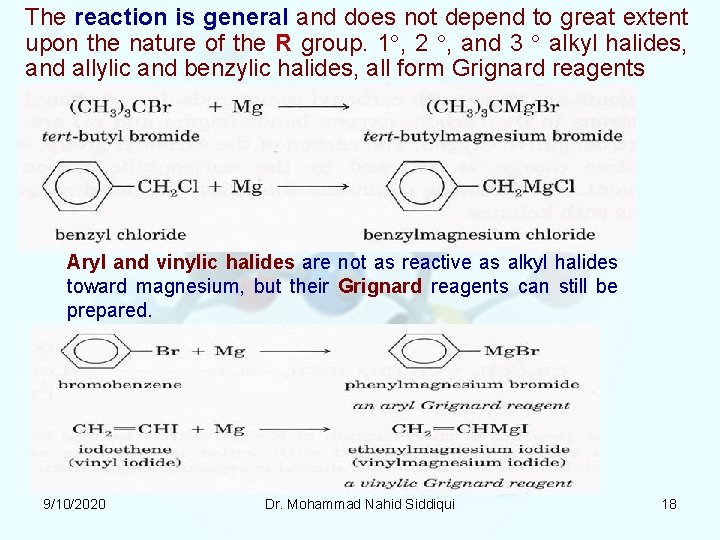
The reaction is general and does not depend to great extent upon the nature of the R group. 1 , 2 , and 3 alkyl halides, and allylic and benzylic halides, all form Grignard reagents Aryl and vinylic halides are not as reactive as alkyl halides toward magnesium, but their Grignard reagents can still be prepared. 9/10/2020 Dr. Mohammad Nahid Siddiqui 18
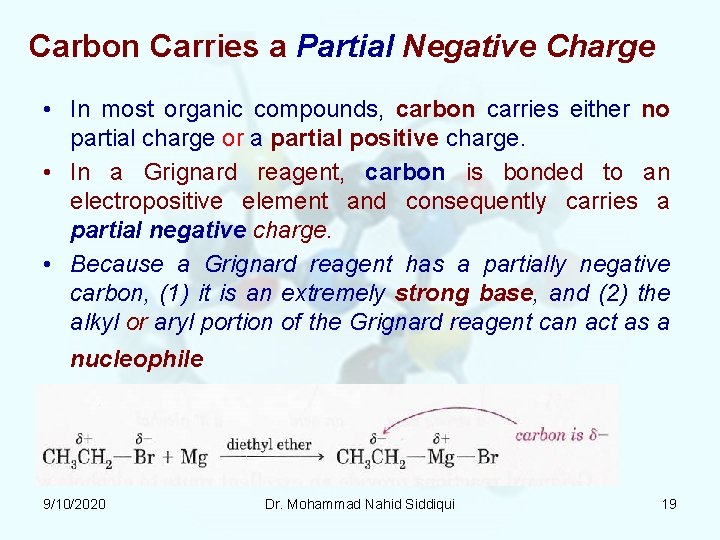
Carbon Carries a Partial Negative Charge • In most organic compounds, carbon carries either no partial charge or a partial positive charge. • In a Grignard reagent, carbon is bonded to an electropositive element and consequently carries a partial negative charge. • Because a Grignard reagent has a partially negative carbon, (1) it is an extremely strong base, and (2) the alkyl or aryl portion of the Grignard reagent can act as a nucleophile 9/10/2020 Dr. Mohammad Nahid Siddiqui 19
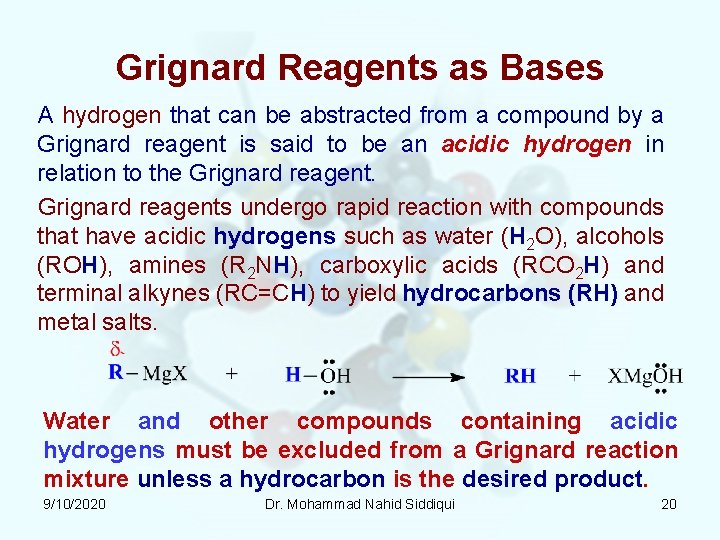
Grignard Reagents as Bases A hydrogen that can be abstracted from a compound by a Grignard reagent is said to be an acidic hydrogen in relation to the Grignard reagents undergo rapid reaction with compounds that have acidic hydrogens such as water (H 2 O), alcohols (ROH), amines (R 2 NH), carboxylic acids (RCO 2 H) and terminal alkynes (RC=CH) to yield hydrocarbons (RH) and metal salts. Water and other compounds containing acidic hydrogens must be excluded from a Grignard reaction mixture unless a hydrocarbon is the desired product. 9/10/2020 Dr. Mohammad Nahid Siddiqui 20
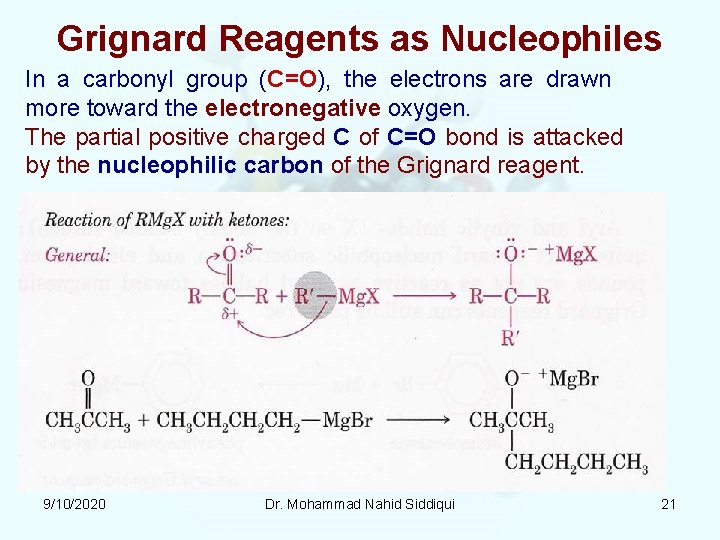
Grignard Reagents as Nucleophiles In a carbonyl group (C=O), the electrons are drawn more toward the electronegative oxygen. The partial positive charged C of C=O bond is attacked by the nucleophilic carbon of the Grignard reagent. 9/10/2020 Dr. Mohammad Nahid Siddiqui 21
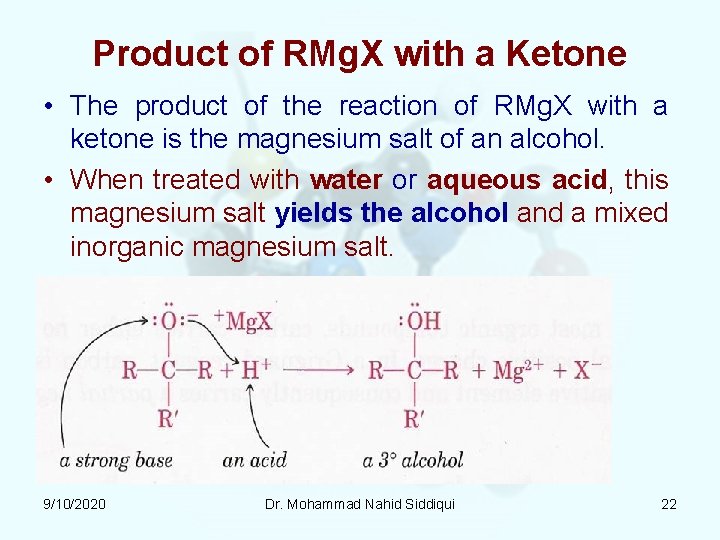
Product of RMg. X with a Ketone • The product of the reaction of RMg. X with a ketone is the magnesium salt of an alcohol. • When treated with water or aqueous acid, this magnesium salt yields the alcohol and a mixed inorganic magnesium salt. 9/10/2020 Dr. Mohammad Nahid Siddiqui 22
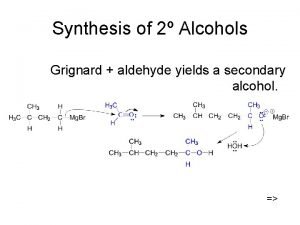
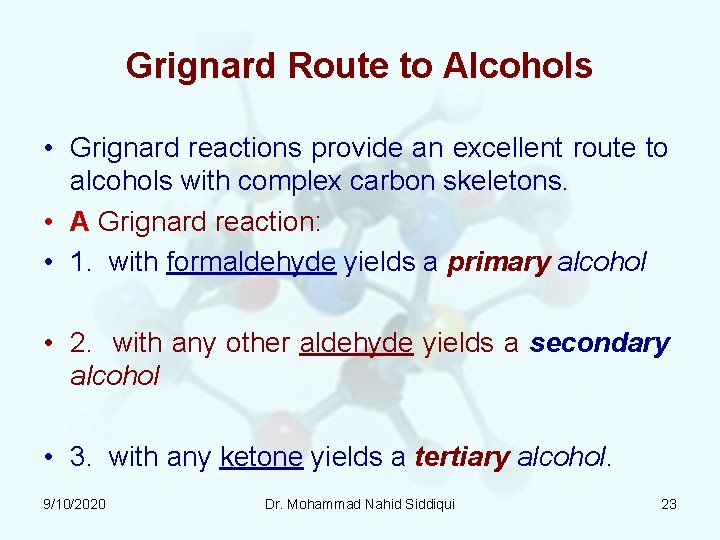
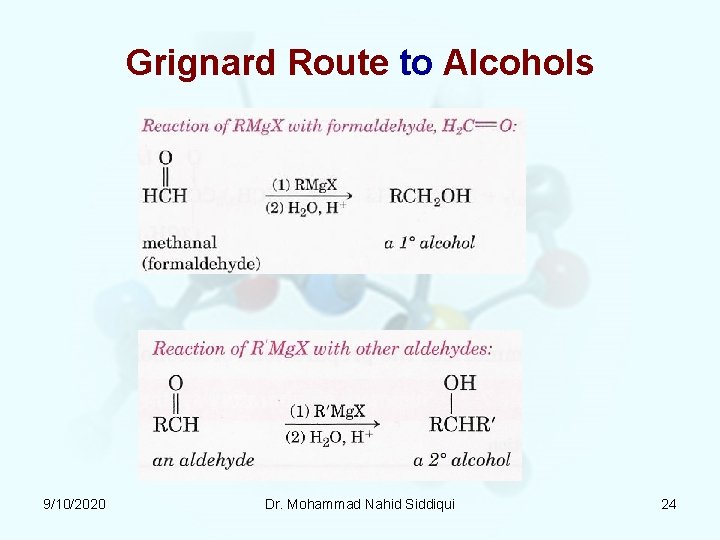
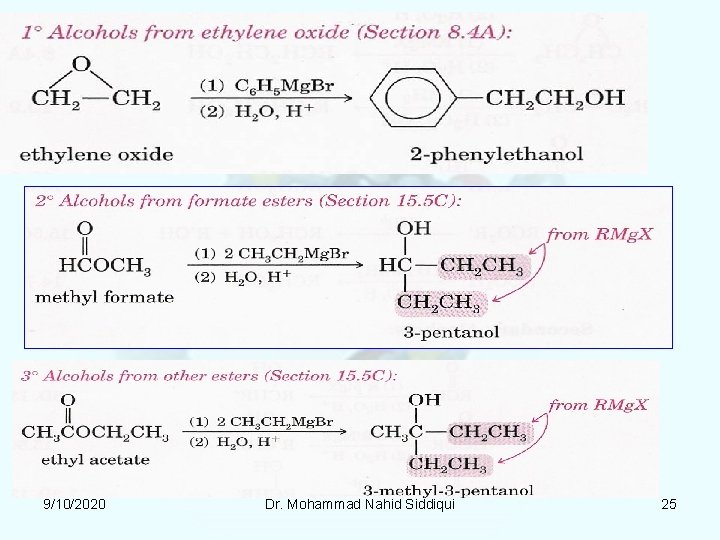
Grignard Route to Alcohols • Grignard reactions provide an excellent route to alcohols with complex carbon skeletons. • A Grignard reaction: • 1. with formaldehyde yields a primary alcohol • 2. with any other aldehyde yields a secondary alcohol • 3. with any ketone yields a tertiary alcohol. 9/10/2020 Dr. Mohammad Nahid Siddiqui 23
Grignard Route to Alcohols 9/10/2020 Dr. Mohammad Nahid Siddiqui 24
9/10/2020 Dr. Mohammad Nahid Siddiqui 25
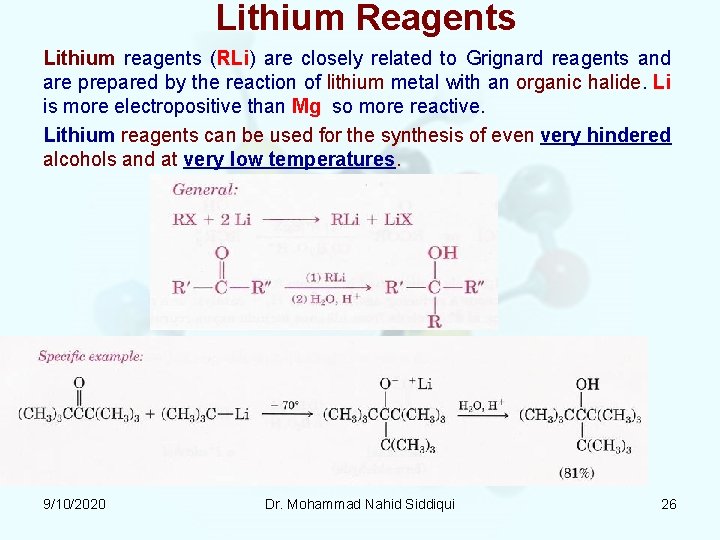
Lithium Reagents Lithium reagents (RLi) are closely related to Grignard reagents and are prepared by the reaction of lithium metal with an organic halide. Li is more electropositive than Mg so more reactive. Lithium reagents can be used for the synthesis of even very hindered alcohols and at very low temperatures. 9/10/2020 Dr. Mohammad Nahid Siddiqui 26
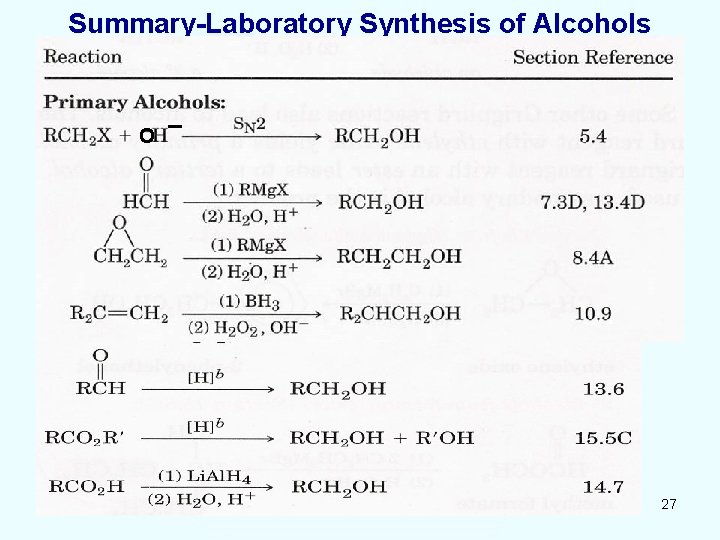
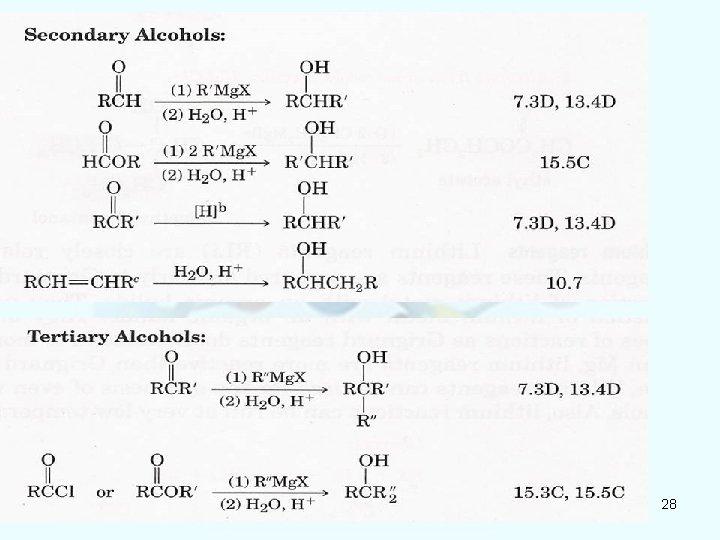
Summary-Laboratory Synthesis of Alcohols O 9/10/2020 _ Dr. Mohammad Nahid Siddiqui 27
9/10/2020 Dr. Mohammad Nahid Siddiqui 28
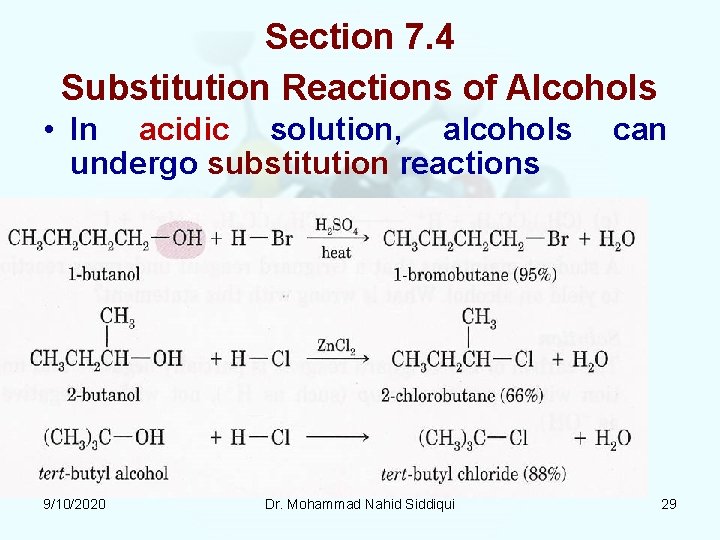
Section 7. 4 Substitution Reactions of Alcohols • In acidic solution, alcohols undergo substitution reactions 9/10/2020 Dr. Mohammad Nahid Siddiqui can 29
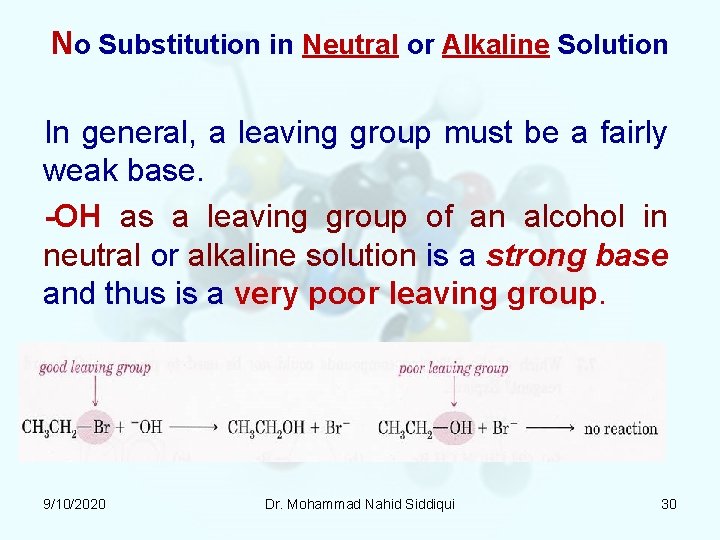
No Substitution in Neutral or Alkaline Solution In general, a leaving group must be a fairly weak base. -OH as a leaving group of an alcohol in neutral or alkaline solution is a strong base and thus is a very poor leaving group. 9/10/2020 Dr. Mohammad Nahid Siddiqui 30
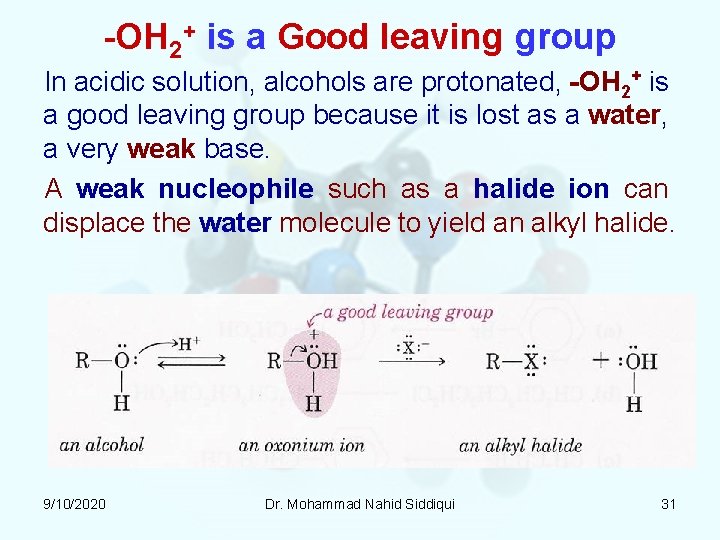
-OH 2+ is a Good leaving group In acidic solution, alcohols are protonated, -OH 2+ is a good leaving group because it is lost as a water, a very weak base. A weak nucleophile such as a halide ion can displace the water molecule to yield an alkyl halide. 9/10/2020 Dr. Mohammad Nahid Siddiqui 31
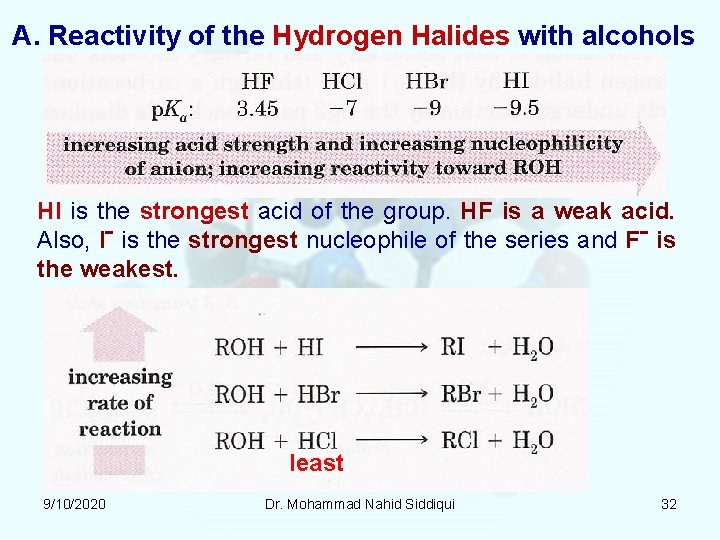
A. Reactivity of the Hydrogen Halides with alcohols HI is the strongest acid of the group. HF is a weak acid. Also, I‾ is the strongest nucleophile of the series and F‾ is the weakest. least 9/10/2020 Dr. Mohammad Nahid Siddiqui 32
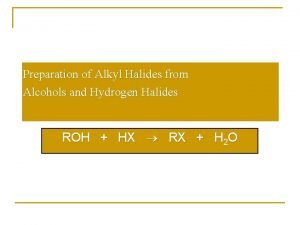
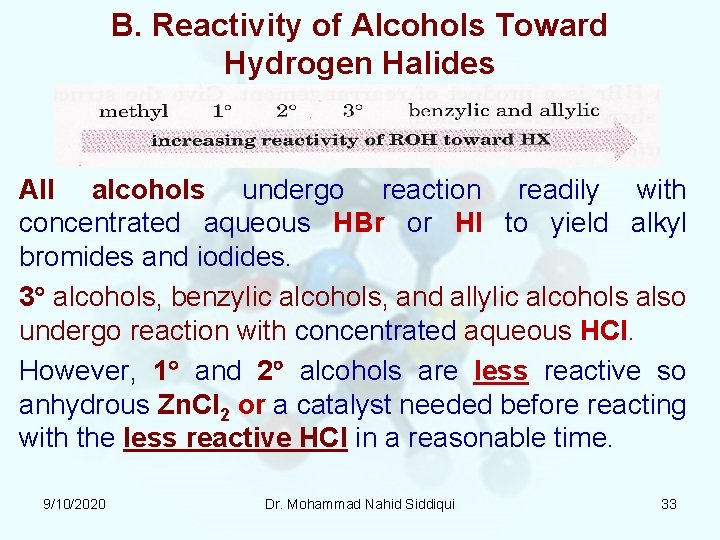
B. Reactivity of Alcohols Toward Hydrogen Halides All alcohols undergo reaction readily with concentrated aqueous HBr or HI to yield alkyl bromides and iodides. 3 alcohols, benzylic alcohols, and allylic alcohols also undergo reaction with concentrated aqueous HCl. However, 1 and 2 alcohols are less reactive so anhydrous Zn. Cl 2 or a catalyst needed before reacting with the less reactive HCl in a reasonable time. 9/10/2020 Dr. Mohammad Nahid Siddiqui 33
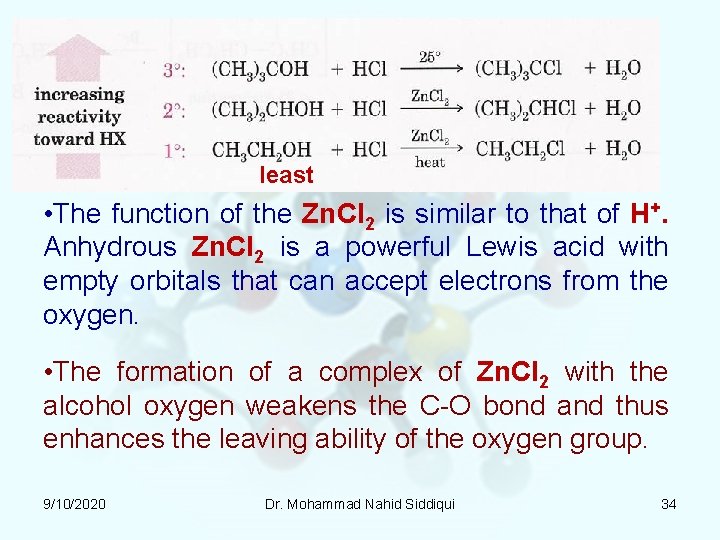
least • The function of the Zn. Cl 2 is similar to that of H+. Anhydrous Zn. Cl 2 is a powerful Lewis acid with empty orbitals that can accept electrons from the oxygen. • The formation of a complex of Zn. Cl 2 with the alcohol oxygen weakens the C-O bond and thus enhances the leaving ability of the oxygen group. 9/10/2020 Dr. Mohammad Nahid Siddiqui 34
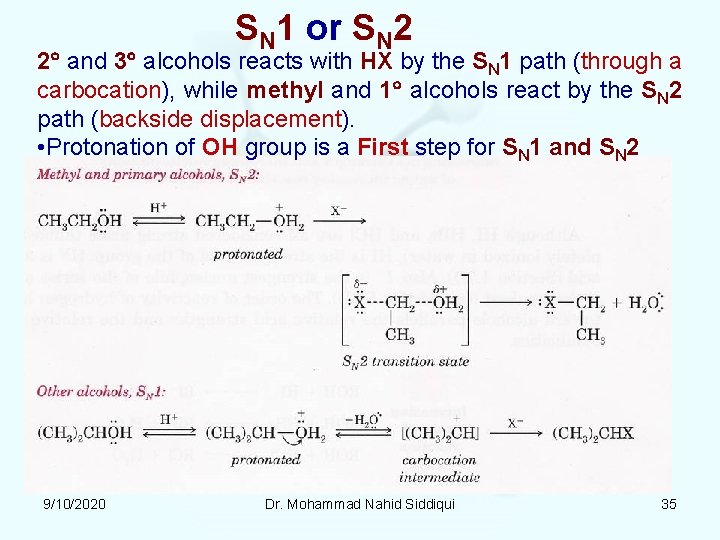
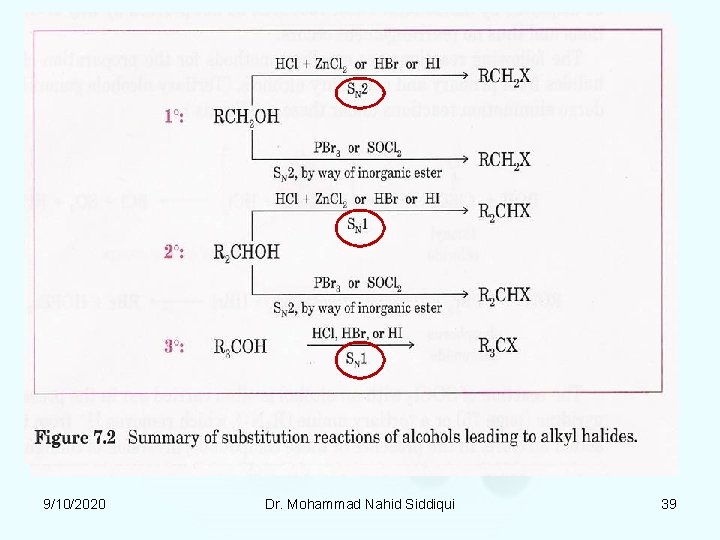
SN 1 or SN 2 2 and 3 alcohols reacts with HX by the SN 1 path (through a carbocation), while methyl and 1 alcohols react by the SN 2 path (backside displacement). • Protonation of OH group is a First step for SN 1 and SN 2 9/10/2020 Dr. Mohammad Nahid Siddiqui 35
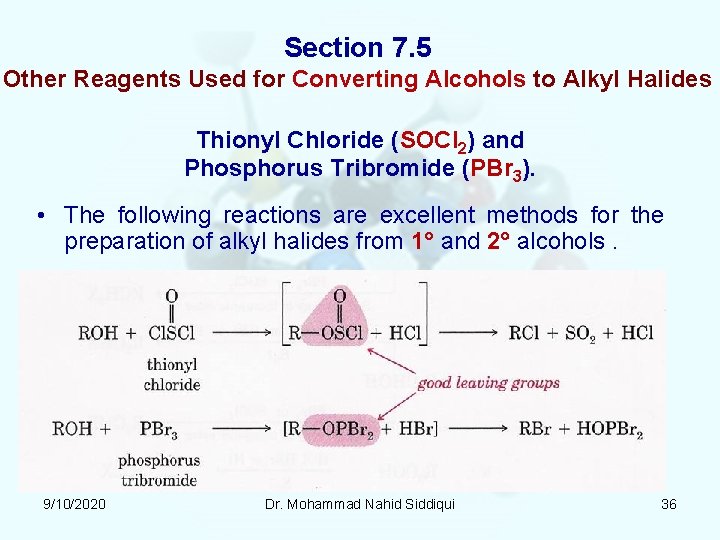
Section 7. 5 Other Reagents Used for Converting Alcohols to Alkyl Halides Thionyl Chloride (SOCl 2) and Phosphorus Tribromide (PBr 3). • The following reactions are excellent methods for the preparation of alkyl halides from 1 and 2 alcohols. 9/10/2020 Dr. Mohammad Nahid Siddiqui 36
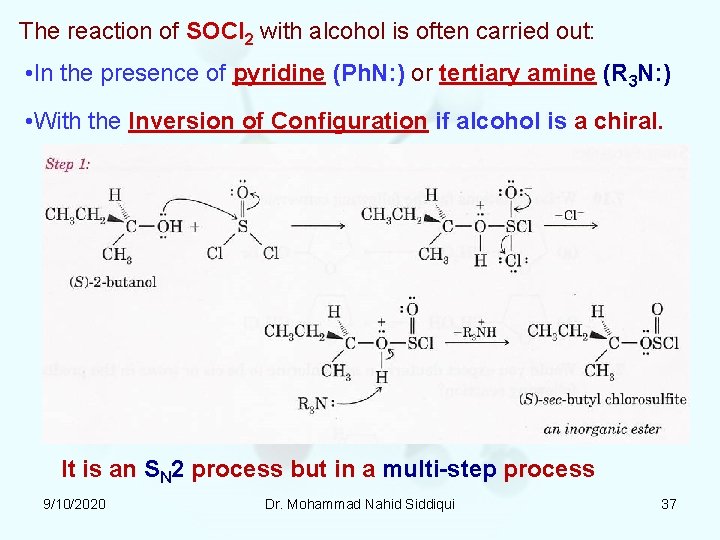
The reaction of SOCl 2 with alcohol is often carried out: • In the presence of pyridine (Ph. N: ) or tertiary amine (R 3 N: ) • With the Inversion of Configuration if alcohol is a chiral. It is an SN 2 process but in a multi-step process 9/10/2020 Dr. Mohammad Nahid Siddiqui 37
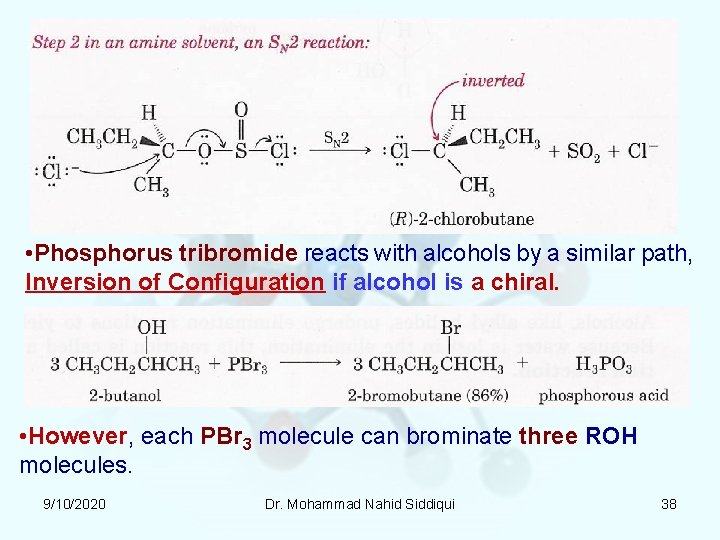
• Phosphorus tribromide reacts with alcohols by a similar path, Inversion of Configuration if alcohol is a chiral. • However, each PBr 3 molecule can brominate three ROH molecules. 9/10/2020 Dr. Mohammad Nahid Siddiqui 38
9/10/2020 Dr. Mohammad Nahid Siddiqui 39
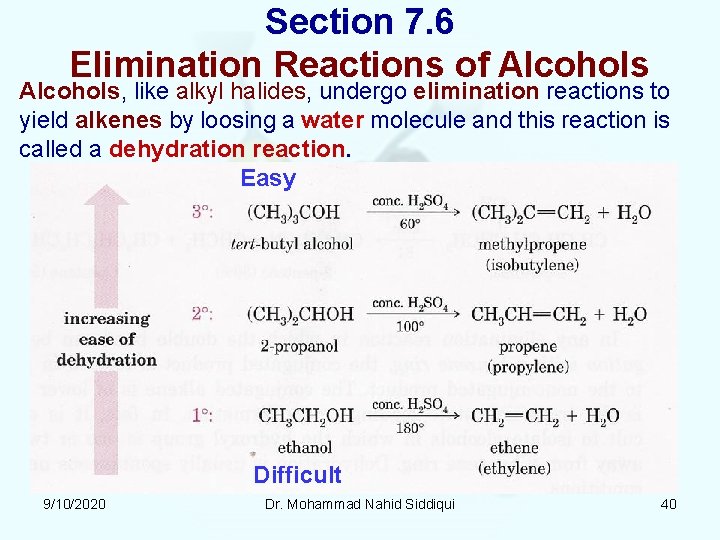
Section 7. 6 Elimination Reactions of Alcohols, like alkyl halides, undergo elimination reactions to yield alkenes by loosing a water molecule and this reaction is called a dehydration reaction. Easy Difficult 9/10/2020 Dr. Mohammad Nahid Siddiqui 40
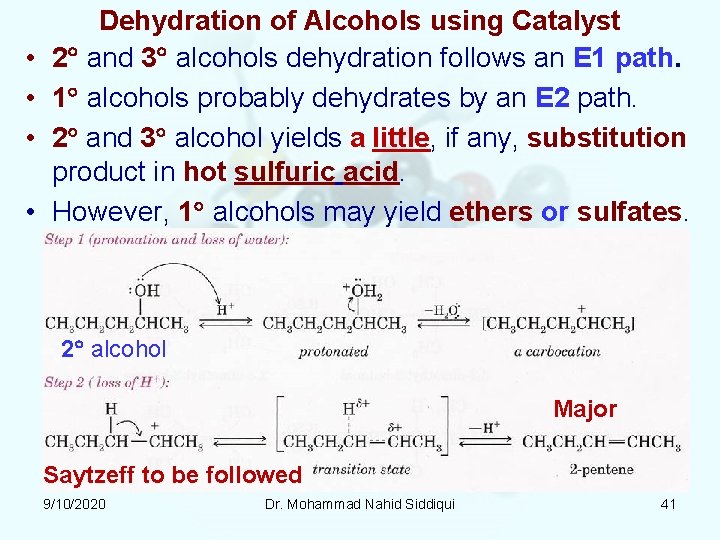
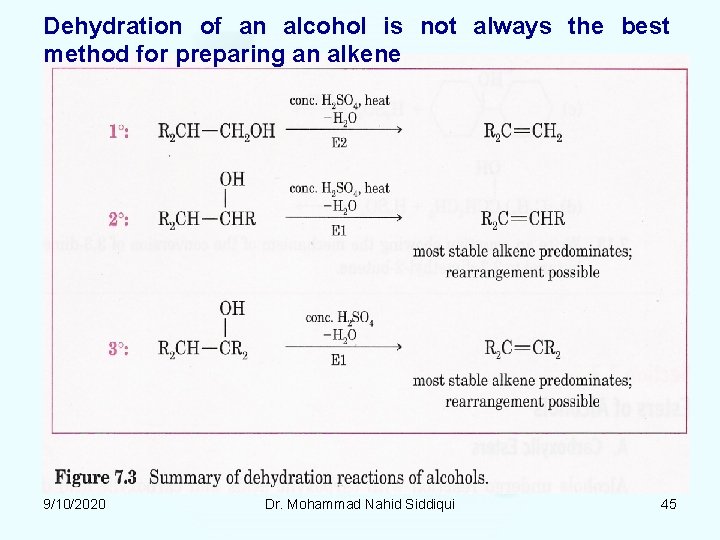
• • Dehydration of Alcohols using Catalyst 2 and 3 alcohols dehydration follows an E 1 path. 1 alcohols probably dehydrates by an E 2 path. 2 and 3 alcohol yields a little, if any, substitution product in hot sulfuric acid. However, 1 alcohols may yield ethers or sulfates. 2 alcohol Major Saytzeff to be followed 9/10/2020 Dr. Mohammad Nahid Siddiqui 41
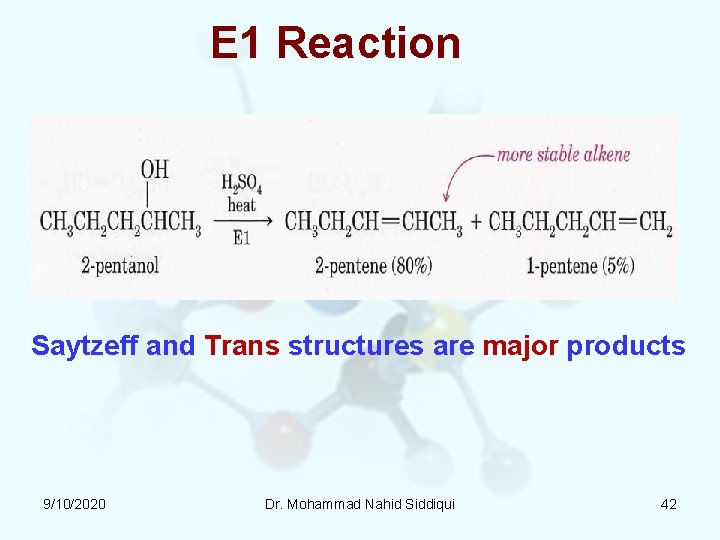
E 1 Reaction Saytzeff and Trans structures are major products 9/10/2020 Dr. Mohammad Nahid Siddiqui 42
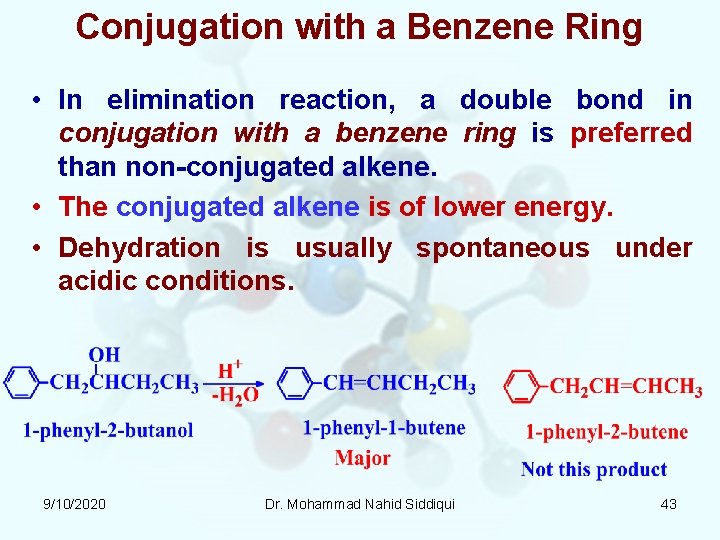
Conjugation with a Benzene Ring • In elimination reaction, a double bond in conjugation with a benzene ring is preferred than non-conjugated alkene. • The conjugated alkene is of lower energy. • Dehydration is usually spontaneous under acidic conditions. 9/10/2020 Dr. Mohammad Nahid Siddiqui 43
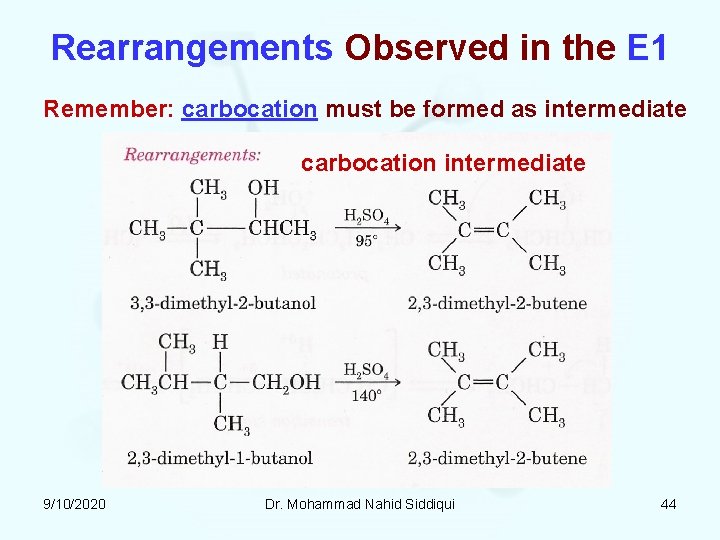
Rearrangements Observed in the E 1 Remember: carbocation must be formed as intermediate carbocation intermediate 9/10/2020 Dr. Mohammad Nahid Siddiqui 44
Dehydration of an alcohol is not always the best method for preparing an alkene 9/10/2020 Dr. Mohammad Nahid Siddiqui 45
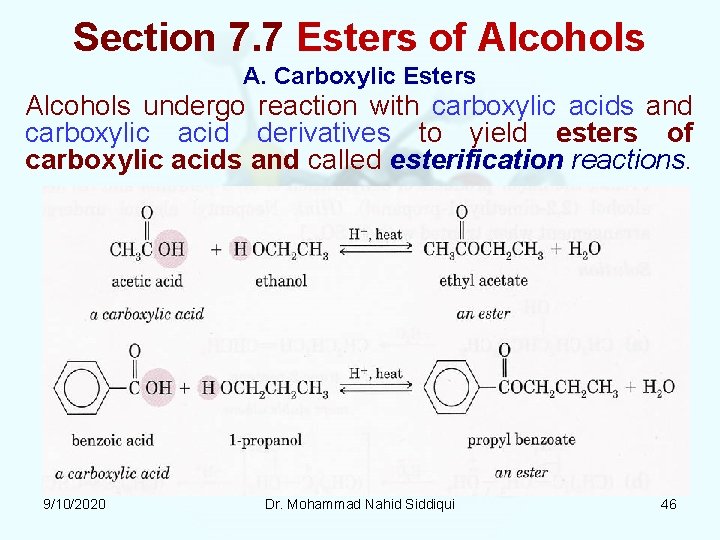
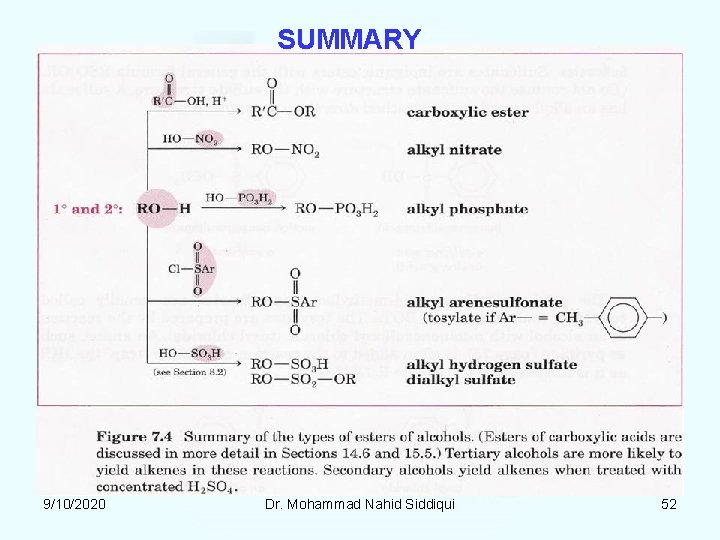
Section 7. 7 Esters of Alcohols A. Carboxylic Esters Alcohols undergo reaction with carboxylic acids and carboxylic acid derivatives to yield esters of carboxylic acids and called esterification reactions. 9/10/2020 Dr. Mohammad Nahid Siddiqui 46
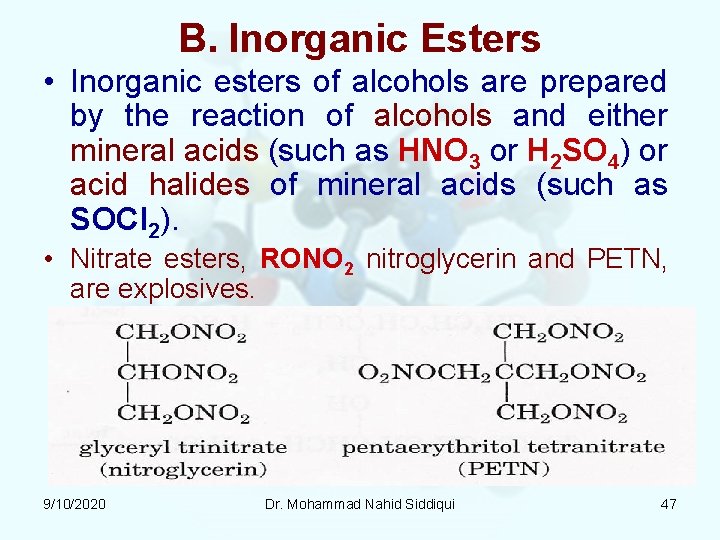
B. Inorganic Esters • Inorganic esters of alcohols are prepared by the reaction of alcohols and either mineral acids (such as HNO 3 or H 2 SO 4) or acid halides of mineral acids (such as SOCl 2). • Nitrate esters, RONO 2 nitroglycerin and PETN, are explosives. 9/10/2020 Dr. Mohammad Nahid Siddiqui 47
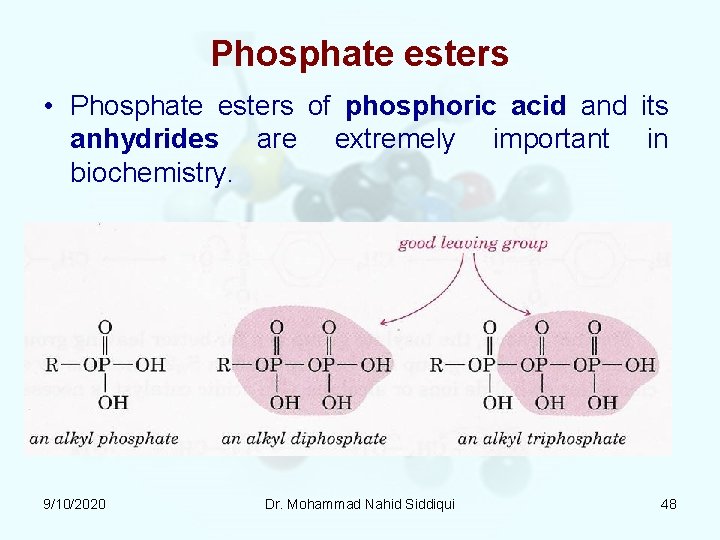
Phosphate esters • Phosphate esters of phosphoric acid and its anhydrides are extremely important in biochemistry. 9/10/2020 Dr. Mohammad Nahid Siddiqui 48
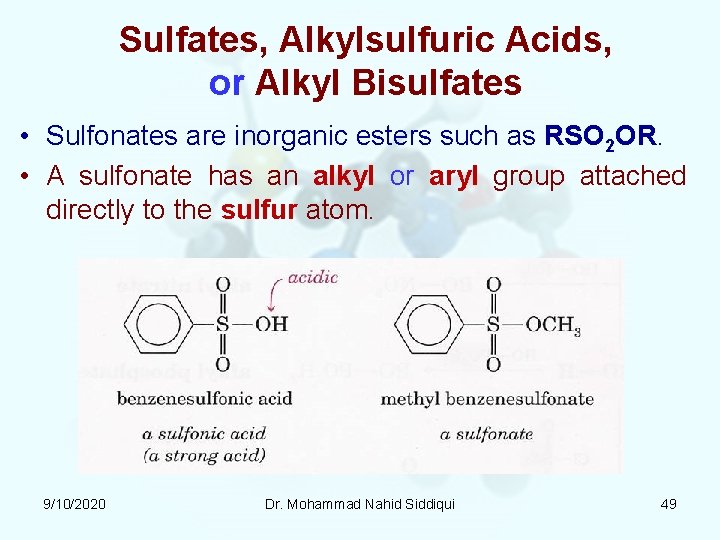
Sulfates, Alkylsulfuric Acids, or Alkyl Bisulfates • Sulfonates are inorganic esters such as RSO 2 OR. • A sulfonate has an alkyl or aryl group attached directly to the sulfur atom. 9/10/2020 Dr. Mohammad Nahid Siddiqui 49
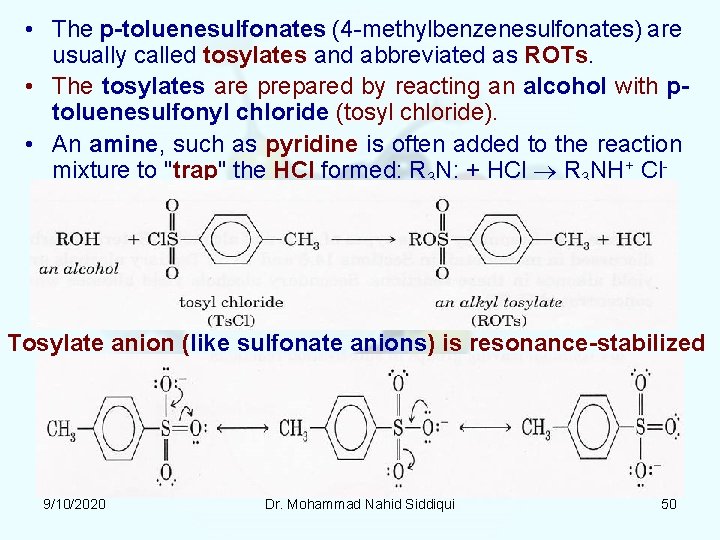
• The p-toluenesulfonates (4 -methylbenzenesulfonates) are usually called tosylates and abbreviated as ROTs. • The tosylates are prepared by reacting an alcohol with ptoluenesulfonyl chloride (tosyl chloride). • An amine, such as pyridine is often added to the reaction mixture to "trap" the HCl formed: R 3 N: + HCl R 3 NH+ Cl- Tosylate anion (like sulfonate anions) is resonance-stabilized 9/10/2020 Dr. Mohammad Nahid Siddiqui 50
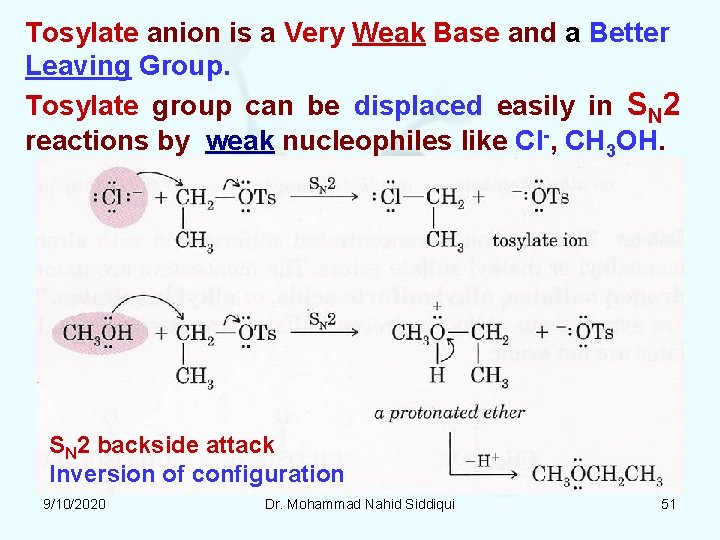
Tosylate anion is a Very Weak Base and a Better Leaving Group. Tosylate group can be displaced easily in SN 2 reactions by weak nucleophiles like Cl-, CH 3 OH. SN 2 backside attack Inversion of configuration 9/10/2020 Dr. Mohammad Nahid Siddiqui 51
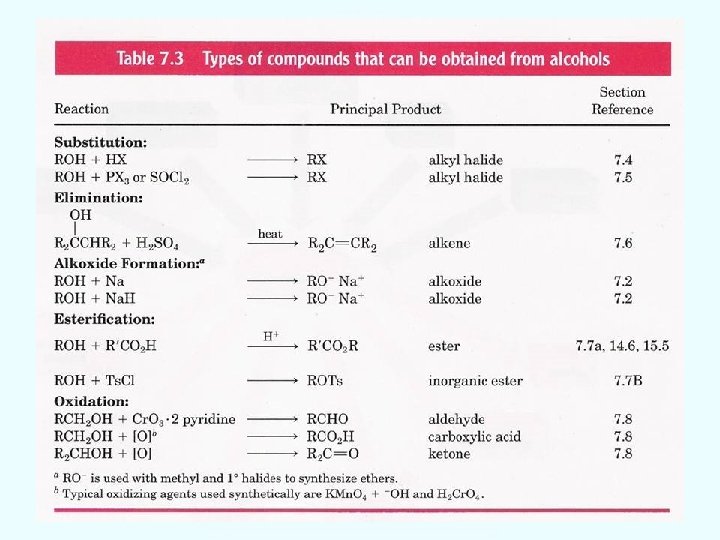
SUMMARY 9/10/2020 Dr. Mohammad Nahid Siddiqui 52
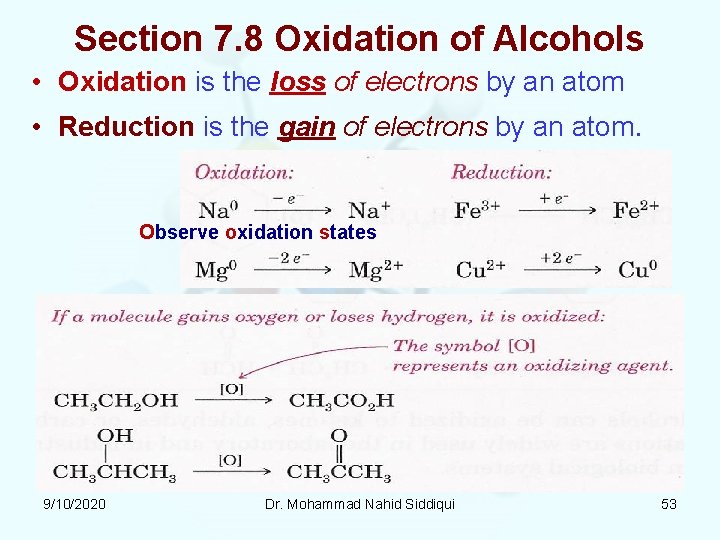
Section 7. 8 Oxidation of Alcohols • Oxidation is the loss of electrons by an atom • Reduction is the gain of electrons by an atom. Observe oxidation states 9/10/2020 Dr. Mohammad Nahid Siddiqui 53
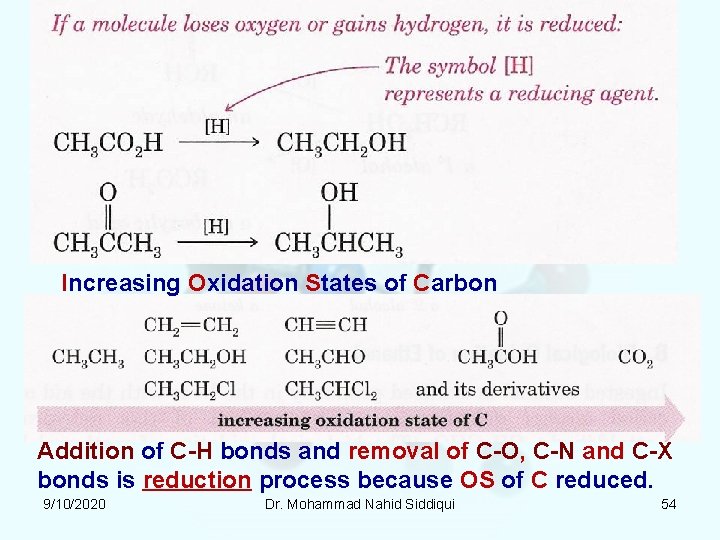
Increasing Oxidation States of Carbon Addition of C-H bonds and removal of C-O, C-N and C-X bonds is reduction process because OS of C reduced. 9/10/2020 Dr. Mohammad Nahid Siddiqui 54
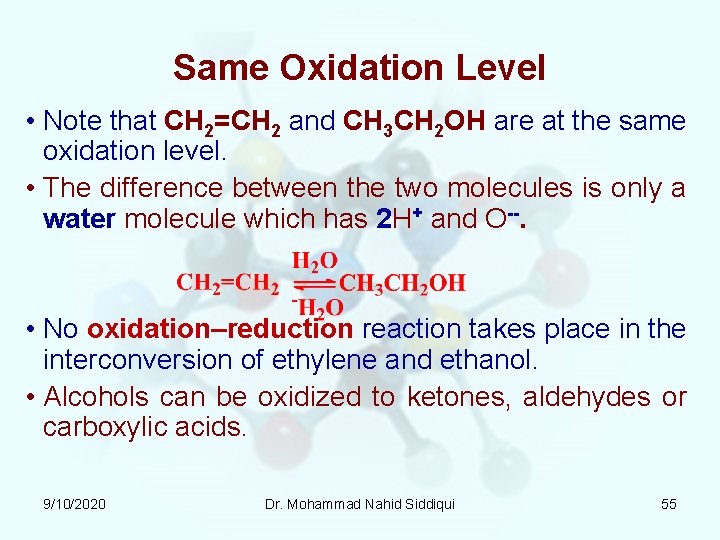
Same Oxidation Level • Note that CH 2=CH 2 and CH 3 CH 2 OH are at the same oxidation level. • The difference between the two molecules is only a water molecule which has 2 H+ and O--. • No oxidation–reduction reaction takes place in the interconversion of ethylene and ethanol. • Alcohols can be oxidized to ketones, aldehydes or carboxylic acids. 9/10/2020 Dr. Mohammad Nahid Siddiqui 55
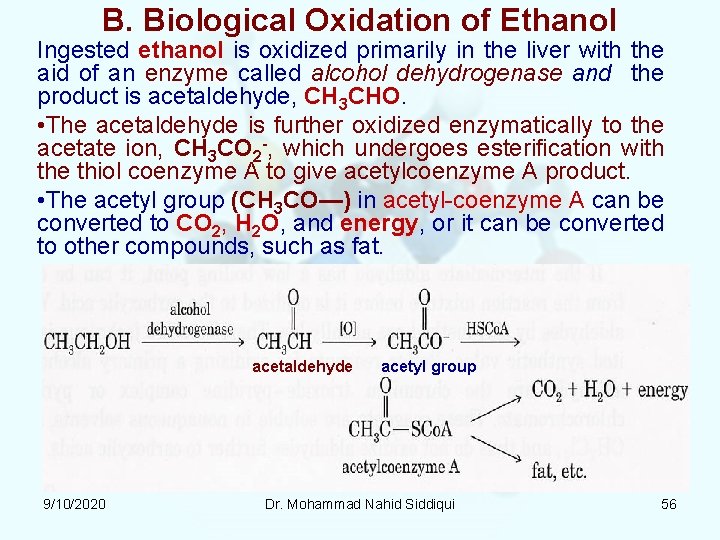
B. Biological Oxidation of Ethanol Ingested ethanol is oxidized primarily in the liver with the aid of an enzyme called alcohol dehydrogenase and the product is acetaldehyde, CH 3 CHO. • The acetaldehyde is further oxidized enzymatically to the acetate ion, CH 3 CO 2 -, which undergoes esterification with the thiol coenzyme A to give acetylcoenzyme A product. • The acetyl group (CH 3 CO—) in acetyl-coenzyme A can be converted to CO 2, H 2 O, and energy, or it can be converted to other compounds, such as fat. acetaldehyde 9/10/2020 acetyl group Dr. Mohammad Nahid Siddiqui 56
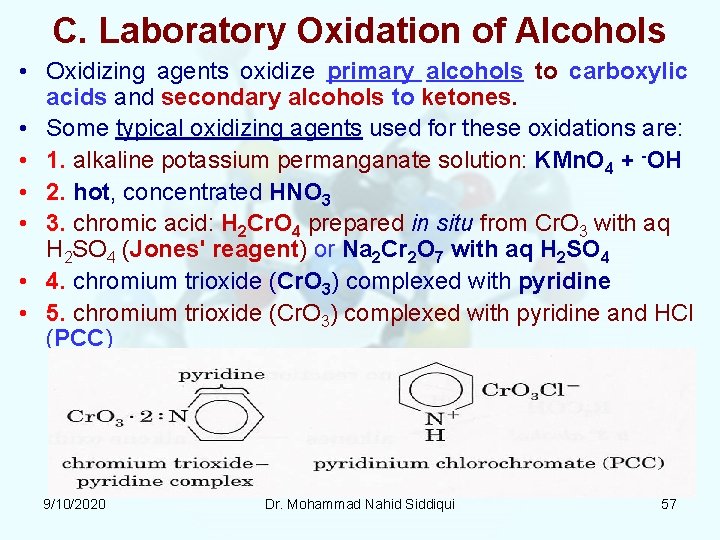
C. Laboratory Oxidation of Alcohols • Oxidizing agents oxidize primary alcohols to carboxylic acids and secondary alcohols to ketones. • Some typical oxidizing agents used for these oxidations are: • 1. alkaline potassium permanganate solution: KMn. O 4 + -OH • 2. hot, concentrated HNO 3 • 3. chromic acid: H 2 Cr. O 4 prepared in situ from Cr. O 3 with aq H 2 SO 4 (Jones' reagent) or Na 2 Cr 2 O 7 with aq H 2 SO 4 • 4. chromium trioxide (Cr. O 3) complexed with pyridine • 5. chromium trioxide (Cr. O 3) complexed with pyridine and HCl (PCC) 9/10/2020 Dr. Mohammad Nahid Siddiqui 57
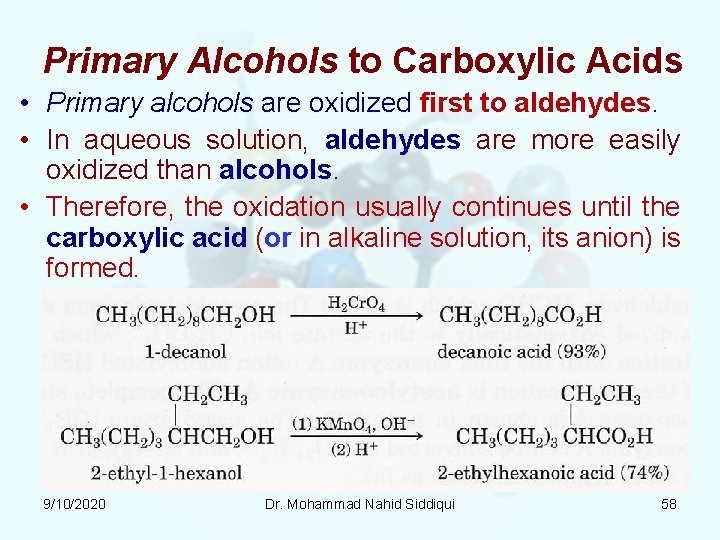
Primary Alcohols to Carboxylic Acids • Primary alcohols are oxidized first to aldehydes. • In aqueous solution, aldehydes are more easily oxidized than alcohols. • Therefore, the oxidation usually continues until the carboxylic acid (or in alkaline solution, its anion) is formed. 9/10/2020 Dr. Mohammad Nahid Siddiqui 58
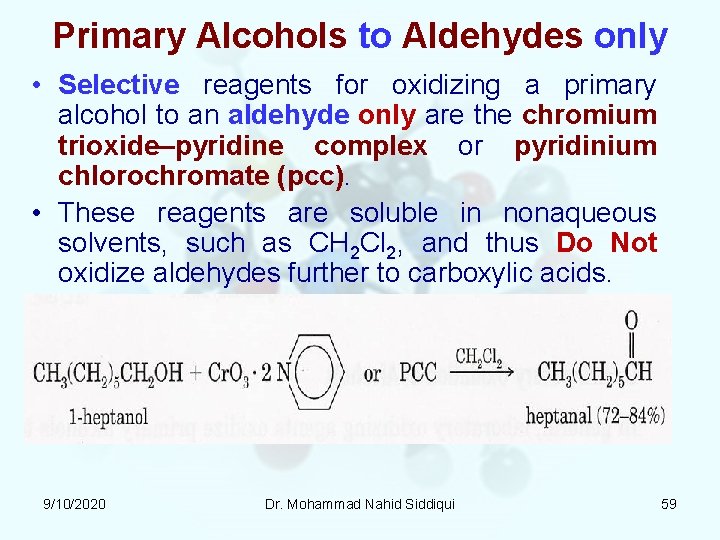
Primary Alcohols to Aldehydes only • Selective reagents for oxidizing a primary alcohol to an aldehyde only are the chromium trioxide–pyridine complex or pyridinium chlorochromate (pcc). • These reagents are soluble in nonaqueous solvents, such as CH 2 Cl 2, and thus Do Not oxidize aldehydes further to carboxylic acids. 9/10/2020 Dr. Mohammad Nahid Siddiqui 59
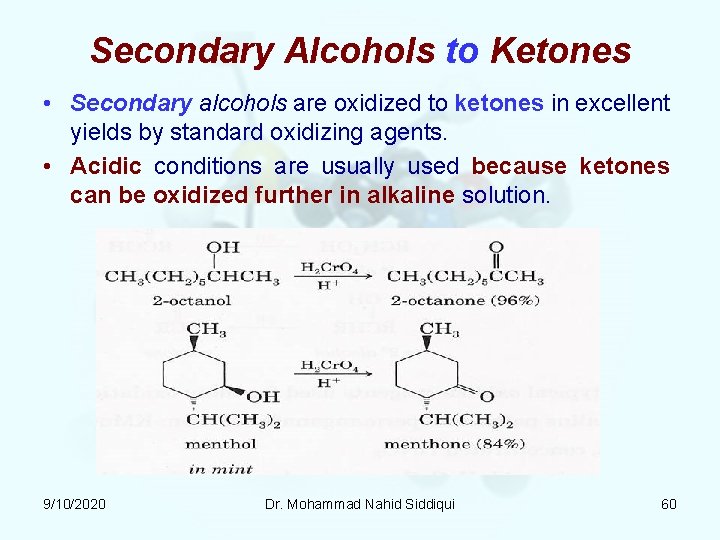
Secondary Alcohols to Ketones • Secondary alcohols are oxidized to ketones in excellent yields by standard oxidizing agents. • Acidic conditions are usually used because ketones can be oxidized further in alkaline solution. 9/10/2020 Dr. Mohammad Nahid Siddiqui 60
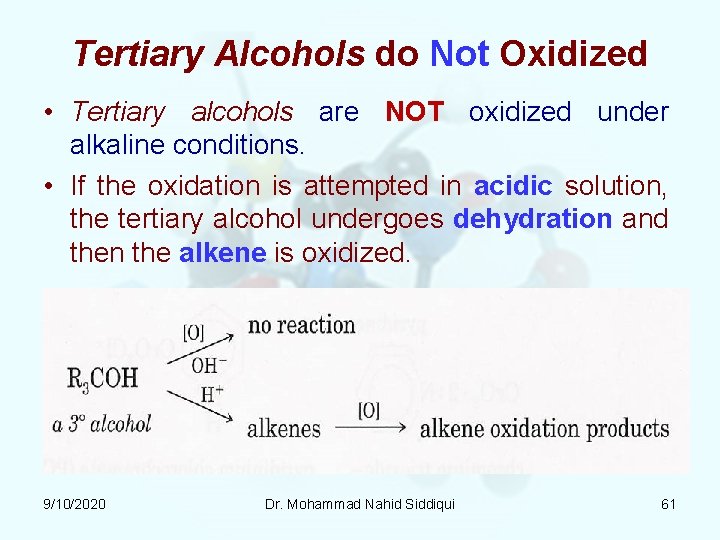
Tertiary Alcohols do Not Oxidized • Tertiary alcohols are NOT oxidized under alkaline conditions. • If the oxidation is attempted in acidic solution, the tertiary alcohol undergoes dehydration and then the alkene is oxidized. 9/10/2020 Dr. Mohammad Nahid Siddiqui 61
9/10/2020 Dr. Mohammad Nahid Siddiqui 62
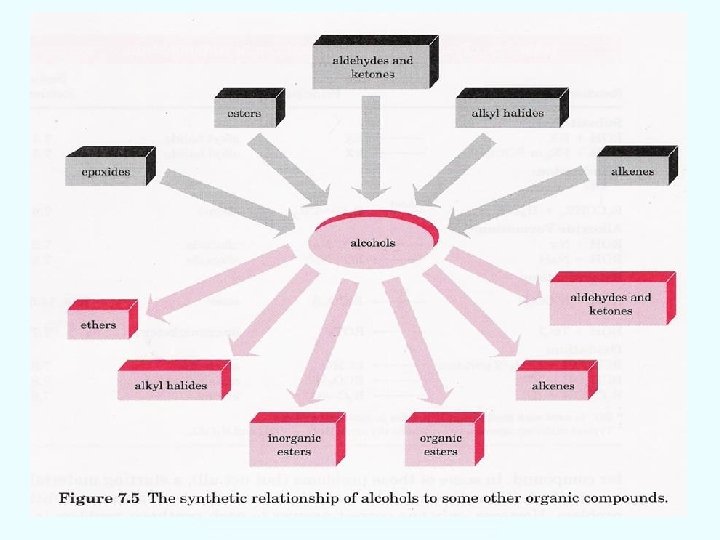
Section 7. 9 -7. 10 Use of Alcohols in Synthesis • Alcohols are versatile starting materials for the preparation of alkyl halides, alkenes, carbonyl compounds and ethers. • The syntheses may be simple and straightforward or they may be very involved. 9/10/2020 Dr. Mohammad Nahid Siddiqui 63
9/10/2020 Dr. Mohammad Nahid Siddiqui 64
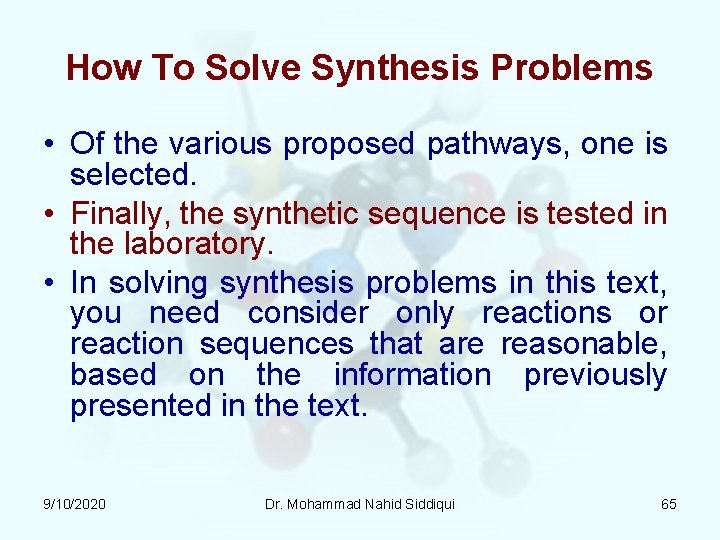
How To Solve Synthesis Problems • Of the various proposed pathways, one is selected. • Finally, the synthetic sequence is tested in the laboratory. • In solving synthesis problems in this text, you need consider only reactions or reaction sequences that are reasonable, based on the information previously presented in the text. 9/10/2020 Dr. Mohammad Nahid Siddiqui 65
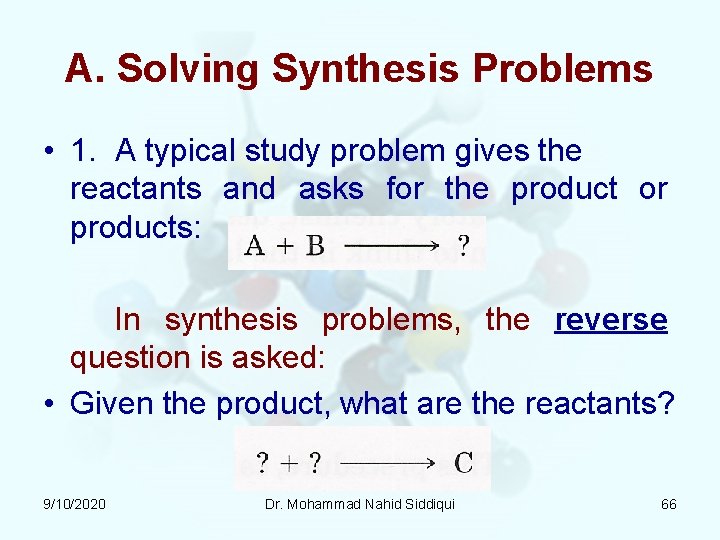
A. Solving Synthesis Problems • 1. A typical study problem gives the reactants and asks for the product or products: In synthesis problems, the reverse question is asked: • Given the product, what are the reactants? 9/10/2020 Dr. Mohammad Nahid Siddiqui 66
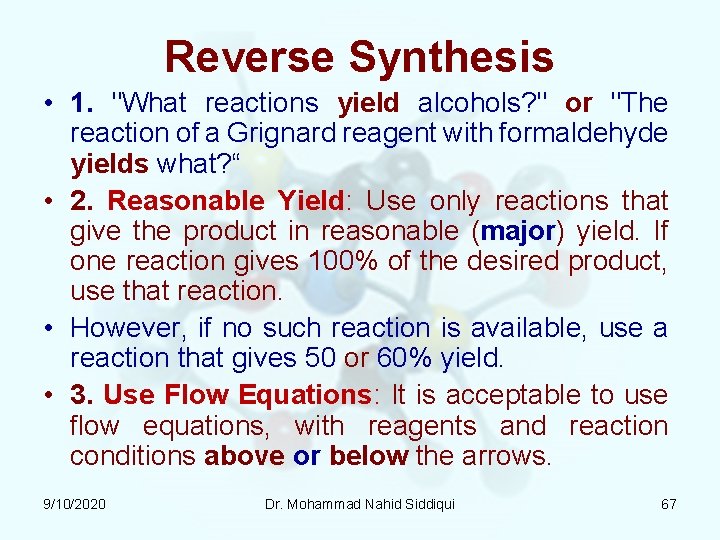
Reverse Synthesis • 1. "What reactions yield alcohols? " or "The reaction of a Grignard reagent with formaldehyde yields what? “ • 2. Reasonable Yield: Use only reactions that give the product in reasonable (major) yield. If one reaction gives 100% of the desired product, use that reaction. • However, if no such reaction is available, use a reaction that gives 50 or 60% yield. • 3. Use Flow Equations: It is acceptable to use flow equations, with reagents and reaction conditions above or below the arrows. 9/10/2020 Dr. Mohammad Nahid Siddiqui 67
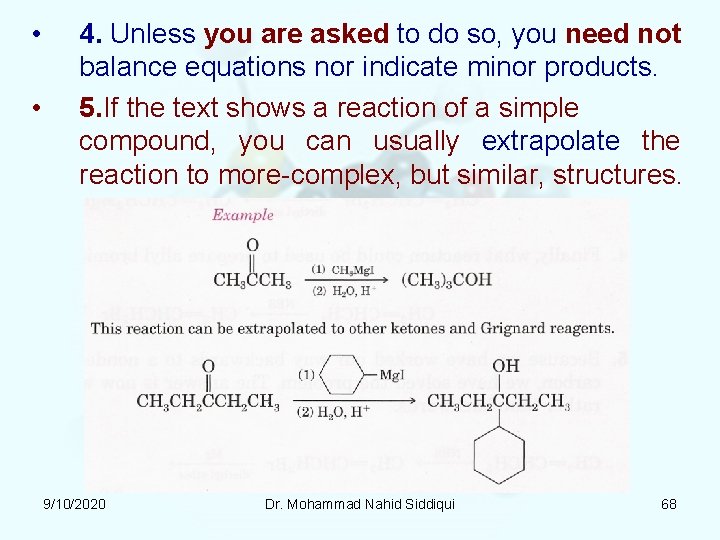
• • 4. Unless you are asked to do so, you need not balance equations nor indicate minor products. 5. If the text shows a reaction of a simple compound, you can usually extrapolate the reaction to more-complex, but similar, structures. 9/10/2020 Dr. Mohammad Nahid Siddiqui 68
• 6. In a synthesis problem, do not be confused by the complexity of a structure, but focus your attention on the functional groups. • Inspect the structure for its important features and worry only about the small portion that undergoes reaction. • When you have a larger vocabulary of organic reactions, you will want to inspect a complex structure for other functional groups that might also undergo reaction under the same conditions. 9/10/2020 Dr. Mohammad Nahid Siddiqui 69
B. Multistep Synthetic Problems • Most syntheses in the laboratory require more than a single step from commercially available starting materials to desired products. • When you are confronted with a synthesis that will require two or more steps and a reaction sequence is not immediately evident, do not choose a likely starting material and try to convert it to the product. 9/10/2020 Dr. Mohammad Nahid Siddiqui 70
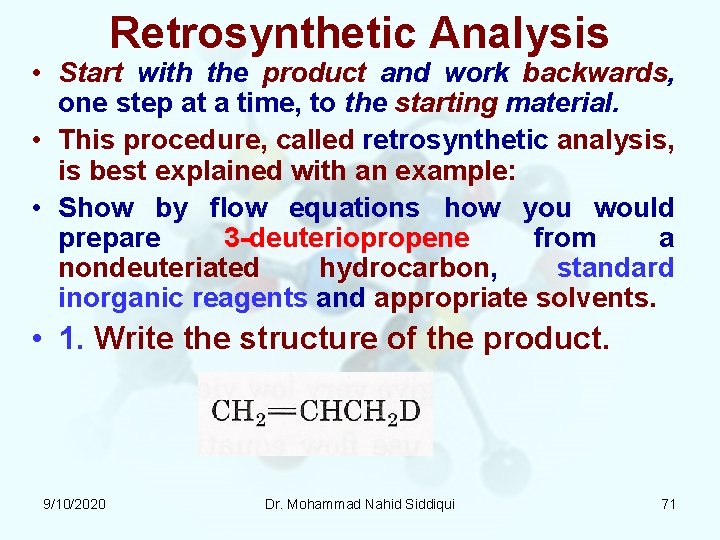
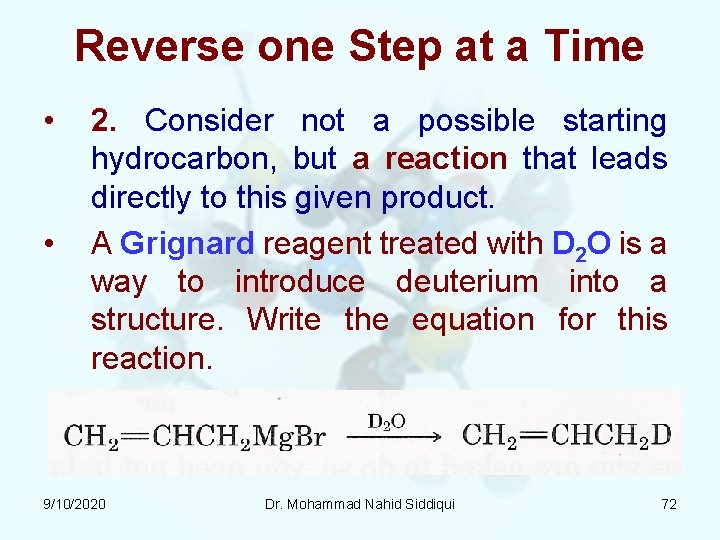
Retrosynthetic Analysis • Start with the product and work backwards, one step at a time, to the starting material. • This procedure, called retrosynthetic analysis, is best explained with an example: • Show by flow equations how you would prepare 3 -deuteriopropene from a nondeuteriated hydrocarbon, standard inorganic reagents and appropriate solvents. • 1. Write the structure of the product. 9/10/2020 Dr. Mohammad Nahid Siddiqui 71
Reverse one Step at a Time • • 2. Consider not a possible starting hydrocarbon, but a reaction that leads directly to this given product. A Grignard reagent treated with D 2 O is a way to introduce deuterium into a structure. Write the equation for this reaction. 9/10/2020 Dr. Mohammad Nahid Siddiqui 72
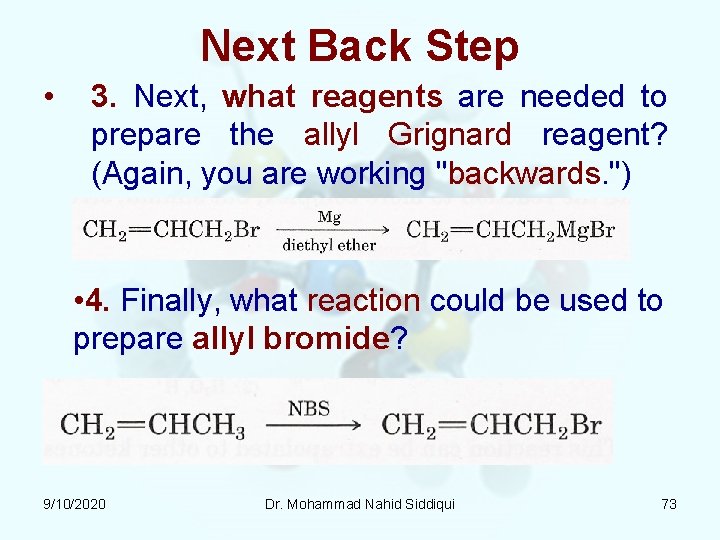
Next Back Step • 3. Next, what reagents are needed to prepare the allyl Grignard reagent? (Again, you are working "backwards. ") • 4. Finally, what reaction could be used to prepare allyl bromide? 9/10/2020 Dr. Mohammad Nahid Siddiqui 73
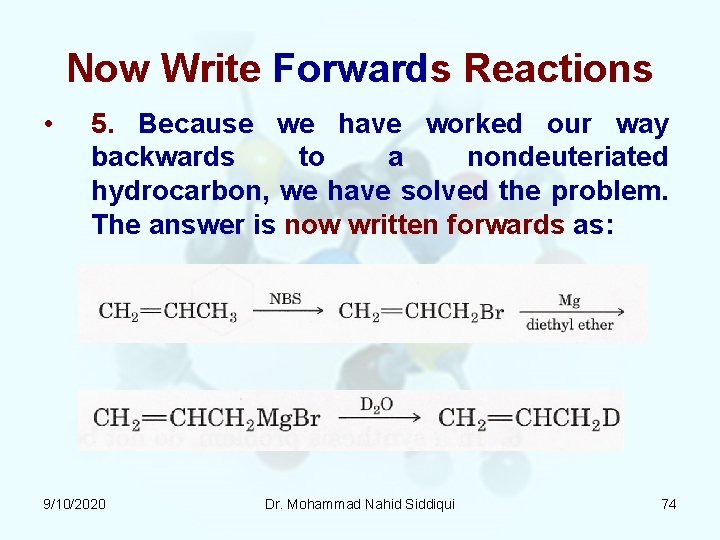
Now Write Forwards Reactions • 5. Because we have worked our way backwards to a nondeuteriated hydrocarbon, we have solved the problem. The answer is now written forwards as: 9/10/2020 Dr. Mohammad Nahid Siddiqui 74
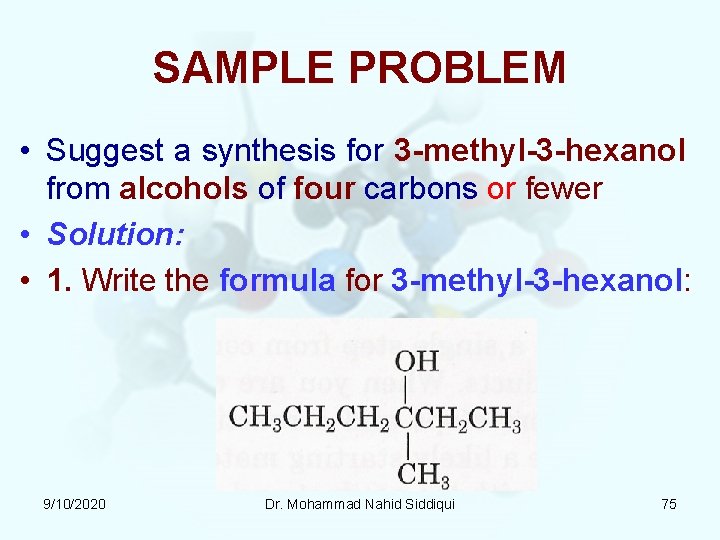
SAMPLE PROBLEM • Suggest a synthesis for 3 -methyl-3 -hexanol from alcohols of four carbons or fewer • Solution: • 1. Write the formula for 3 -methyl-3 -hexanol: 9/10/2020 Dr. Mohammad Nahid Siddiqui 75
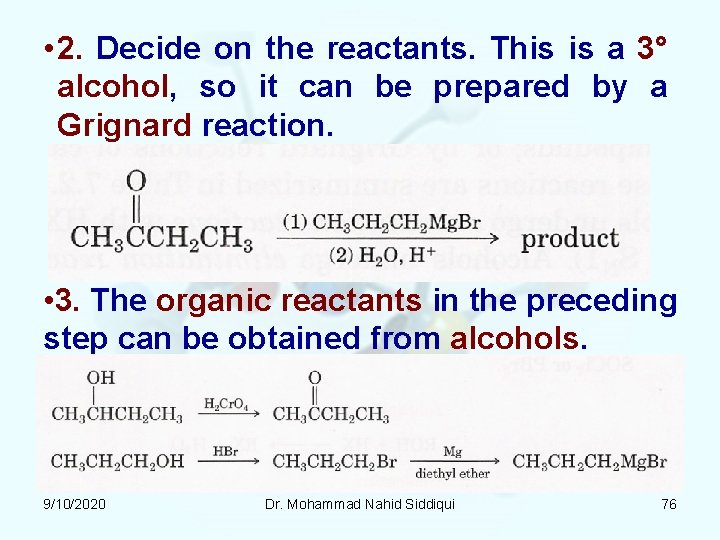
• 2. Decide on the reactants. This is a 3° alcohol, so it can be prepared by a Grignard reaction. • 3. The organic reactants in the preceding step can be obtained from alcohols. 9/10/2020 Dr. Mohammad Nahid Siddiqui 76
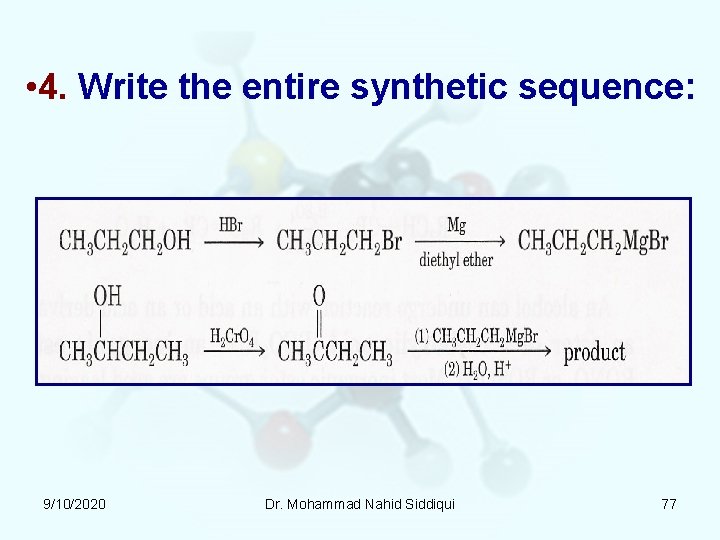
• 4. Write the entire synthetic sequence: 9/10/2020 Dr. Mohammad Nahid Siddiqui 77