Sugar alcohols An overview of manufacturing as a










- Slides: 33
Sugar alcohols: An overview of manufacturing as a nutritive sweeteners Osama O. Ibrahim, Ph. D Consultant Biotechnology Gurnee IL. 60031 U. S. A. bioinnovation 04@yahoo. com 1
Agenda • • • Most common sugar alcohols. Benefits. Applications. Manufacturing process. Conclusion. 2
Sugar alcohols • Know as sugar relatives. • Naturally occurring in fruits and vegetables. • Intermediate metabolites for microbial fermentation and in human body. • Produced commercially by chemicals or microbial enzymes via the reduction (hydrogenation) of both mono-saccharides and di-saccharides. 3
Most common sugar alcohols • Derived from mono-saccharides: Xylitol Xylose Sorbitol Glucose Mannitol Fructose • Derived from di-saccharides: Isomalt Sucrose Lactitol Lactose Maltitol Maltose 4
Benefits • low calorie bulk sweeteners. • Provide about 2. 5 Kcal/g. • Excellent humactent, texturizing, and anti-crystallizing. • Doesn't contribute to the formation of dental decay. • May be useful as an alternative to sugars for people with diabetes. 5
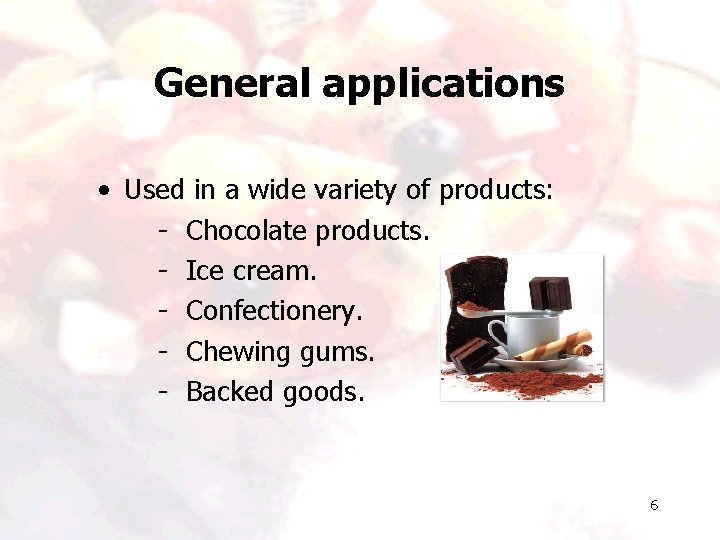
General applications • Used in a wide variety of products: - Chocolate products. - Ice cream. - Confectionery. - Chewing gums. - Backed goods. 6
Xylitol • 2. 4 kcal /g. • 100% sweetness as sucrose • Xylitol metabolism independently of insulin. [five-carbon polyol] 7
Xylitol production process • Can be produced by chemical or microbial process via the reduction of xylose from xylan rich hemi-cellulose hydrolysate. • Xylan rich hemicellulose such as: - Sugar cane baggas. - Rice straw. - Nut shell. - Oat. Sugar cane 8
Chemical process • Xylitol are chemically produced from hemicelluloses via acid hydrolysis. • The hemi-cellulose hydrolysate composition are xylose, arabinose, mannose, galactose and glucose. • Catalytic hydrogenation in the presence of raney nickel at 1350 C and 40 psi for 2. 5 hr. • Hydrogenation results from hemi-celluloses hydrolysate are: 73 % xylitol, 6 % arabinitol, 9% mannitol, 5% galactitol, and 6. 8% sorbitol. 9
Chemical process (Xylitol recovery) • The xylitol can be separated from other sugar alcohols mixture by crystallization. • Un-crystallized xylitol can be separated by liquid chromatography method. 10
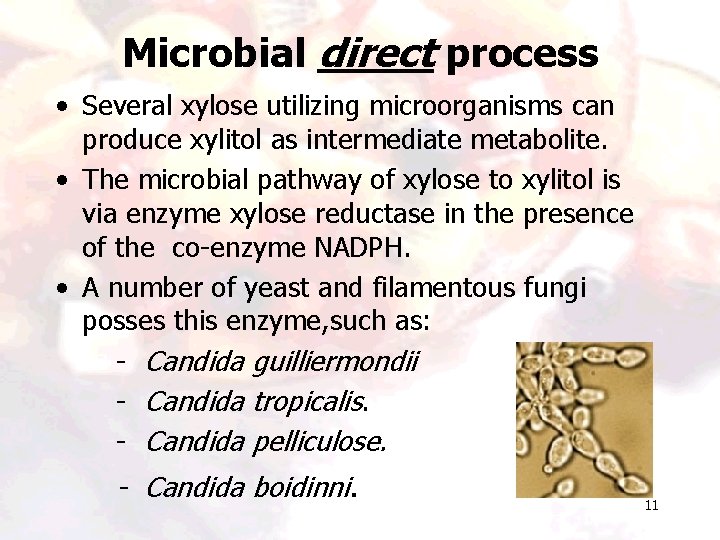
Microbial direct process • Several xylose utilizing microorganisms can produce xylitol as intermediate metabolite. • The microbial pathway of xylose to xylitol is via enzyme xylose reductase in the presence of the co-enzyme NADPH. • A number of yeast and filamentous fungi posses this enzyme, such as: - Candida guilliermondii - Candida tropicalis. - Candida pelliculose. - Candida boidinni. 11
Factors effecting the microbial production of Xylitol • Xylose optimum concentration (10%). • Presence of other sugars (addition of glucose in the fermentation medium increase xylitol yield). • Culture optimum conditions (inoculums size, PH, temperature, aeration, and agitation). • Example: - Microbial fermentation of rice straw hydrolysate resulted in bioconversion efficiency of 69%. - Microorganism used fermentation is Candida guillermondii. 12
Microbial indirect process • Isomerization of Xylose to Xyloluse: - Immobilized of Microbial enzyme Xylose isomerase. • Converting xyloluse to xylitol: - Microbial fermentation using Mycobacterium smagematise. Or - Chemical hydrogenation using catalyst (raney nickel) at 1200 C. • Xylitol recovery: - Xylitol concentration to 84% solids. - Crystallization of Xylitol. 13
Sorbitol • 2. 6 kcal/g. • 40 -70% sweetness of sucrose • Produced on large scale for over fifty years. • Total consumption in US. , Europe, and Japan 700, 000 MT/year. [six- carbon polyol] 14
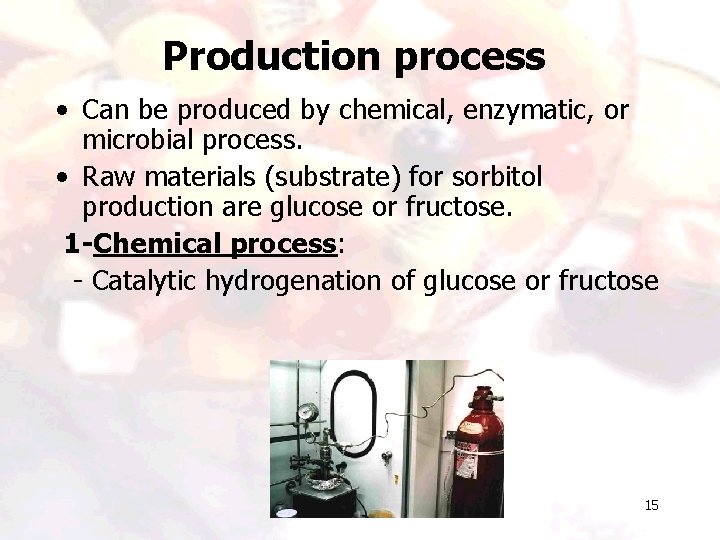
Production process • Can be produced by chemical, enzymatic, or microbial process. • Raw materials (substrate) for sorbitol production are glucose or fructose. 1 -Chemical process: - Catalytic hydrogenation of glucose or fructose 15
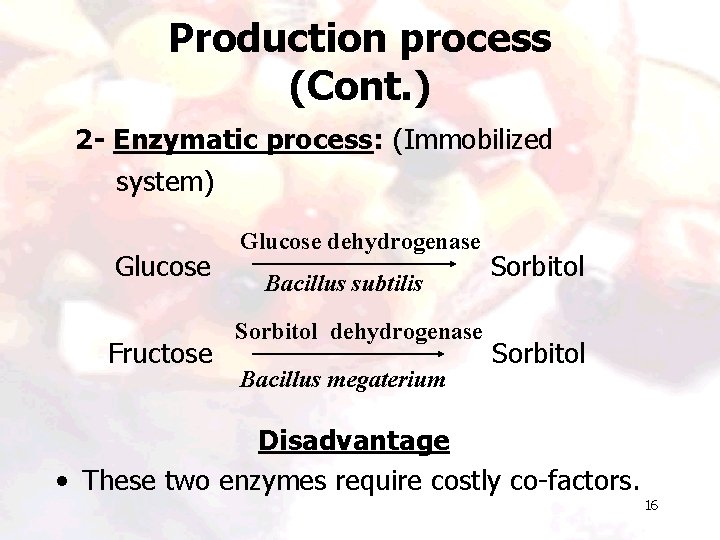
Production process (Cont. ) 2 - Enzymatic process: (Immobilized system) Glucose Fructose Glucose dehydrogenase Bacillus subtilis Sorbitol dehydrogenase Bacillus megaterium Sorbitol Disadvantage • These two enzymes require costly co-factors. 16
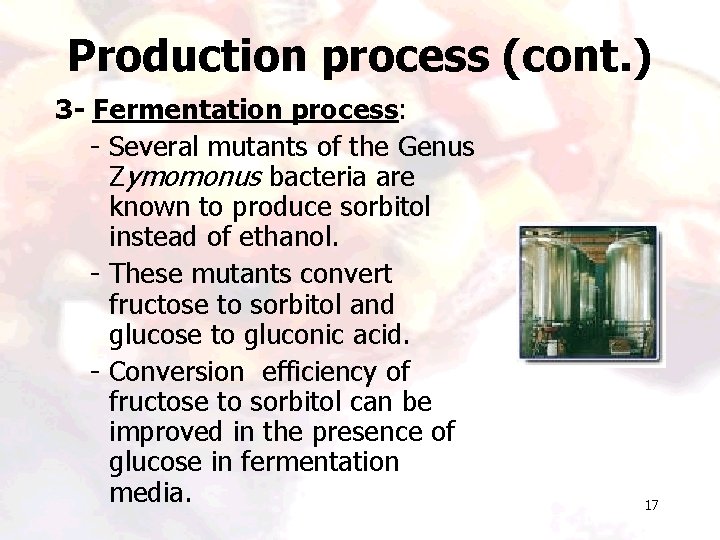
Production process (cont. ) 3 - Fermentation process: - Several mutants of the Genus Zymomonus bacteria are known to produce sorbitol instead of ethanol. - These mutants convert fructose to sorbitol and glucose to gluconic acid. - Conversion efficiency of fructose to sorbitol can be improved in the presence of glucose in fermentation media. 17
Fermentation process (cont. ) - Zymomonus mutants produce the enzyme glucose/fructose trans-hydrogenase as intracellular enzyme. - This enzyme transfer hydrogen atom from glucose to fructose through the co-enzyme NADP. - The gluconic acid produced from glucose can be converted to ethanol via 6 -phosphogluconate pathway. 18
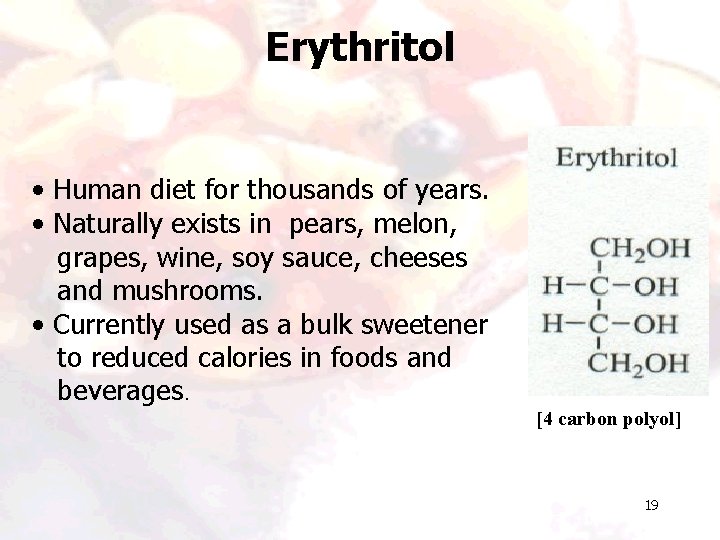
Erythritol • Human diet for thousands of years. • Naturally exists in pears, melon, grapes, wine, soy sauce, cheeses and mushrooms. • Currently used as a bulk sweetener to reduced calories in foods and beverages. [4 carbon polyol] 19
Production process • It can be produced by fermentation using wild osmophillic yeasts such as: Trichosporon, Pichia, Candida, Torulopsis, and Trichosporonoides. • All these wild microorganisms can not be applied for production on large scale because it produce glycerol and ribitol as by-products. • Microorganisms used commercially are mutants of Aureobasidium sp. Moniliella pollinis and Torula corallina. • These industrial mutants do not produce these two by-products of glycerol and ribitol. 20
Optimum fermentation conditions • These mutants under the following conditions are capable to produce up to 20 % erythritol yield and over 49% conversion rate of glucose to erythritol : - Controlling glucose concentration in fed-batch process ( 30 -40 %). - Addition of Cu 2+ (3. 2 -12. 9 m. M) in fermentation media to improve catabolic repression of fumarate from glucose and Co 2 (fumarate inhibits the enzyme erythrose reductase). - Adding in the fermentation media inisitol & phytic acid (growth factors) and Mn 2+ (enzymes activator). 21
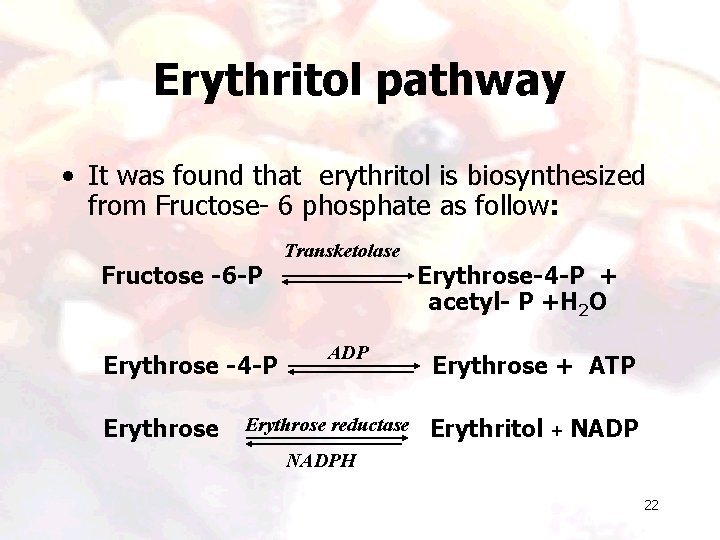
Erythritol pathway • It was found that erythritol is biosynthesized from Fructose- 6 phosphate as follow: Fructose -6 -P Erythrose -4 -P Erythrose Transketolase ADP Erythrose reductase Erythrose-4 -P + acetyl- P +H 2 O Erythrose + ATP Erythritol + NADPH 22
Erythritol Applications • • It is Generally Recognized as Safe (GRAS). It has a caloric value of 0. 2 calories/ gram. Used as sugar substitutes. Its general applications are as flavor enhancer, formulation aid, humectants, nutritive sweetener, stabilizer and thickener. • Its applications in foods are: - Cakes, cookies and bakery fillings. - Hard & soft candies and chewing gum. - Dairy drinks, frozen dairy desserts and yogurt. - Puddings. - Reduced and low-calorie carbonated & noncarbonated beverages. 23
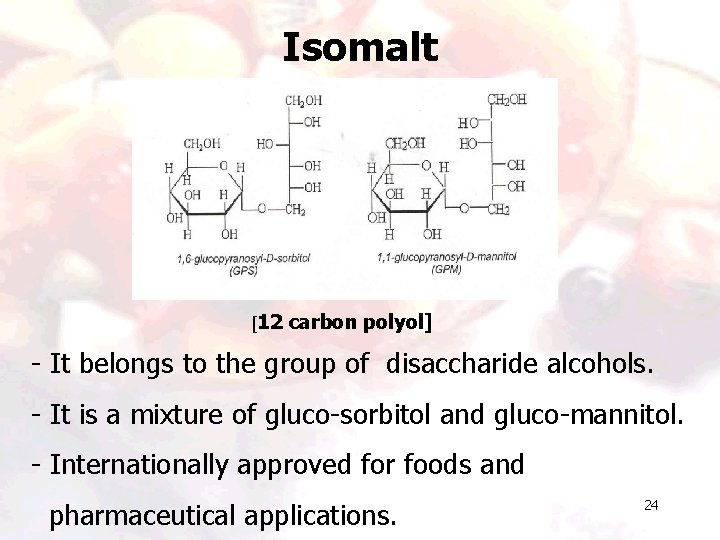
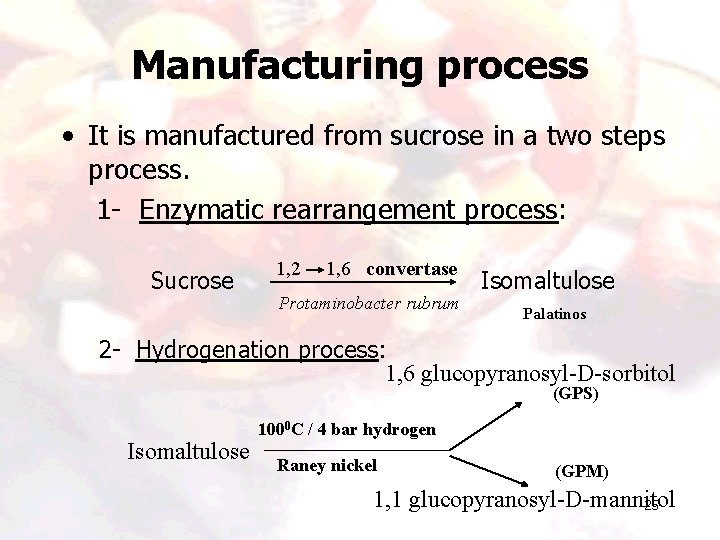
Isomalt [12 carbon polyol] - It belongs to the group of disaccharide alcohols. - It is a mixture of gluco-sorbitol and gluco-mannitol. - Internationally approved for foods and pharmaceutical applications. 24
Manufacturing process • It is manufactured from sucrose in a two steps process. 1 - Enzymatic rearrangement process: Sucrose 1, 2 1, 6 convertase Protaminobacter rubrum Isomaltulose Palatinos 2 - Hydrogenation process: 1, 6 glucopyranosyl-D-sorbitol (GPS) Isomaltulose 1000 C / 4 bar hydrogen Raney nickel (GPM) 1, 1 glucopyranosyl-D-mannitol 25
Isomalt Applications • Isomalt is low caloric sweetener (2 Kcal. /g) with unique, excellent tasting sugar-free bulk sweetener. • Food products with Isomalt have the same appearance and texture as those made with sugar. • It is being used in USA for several years in products such as hard candies, toffees, chewing gum, chocolates, backed goods, nutritional supplements, cough drops and throat lozenges. • Currently used in a wide variety of products in Europe and in more than 70 countries. 26
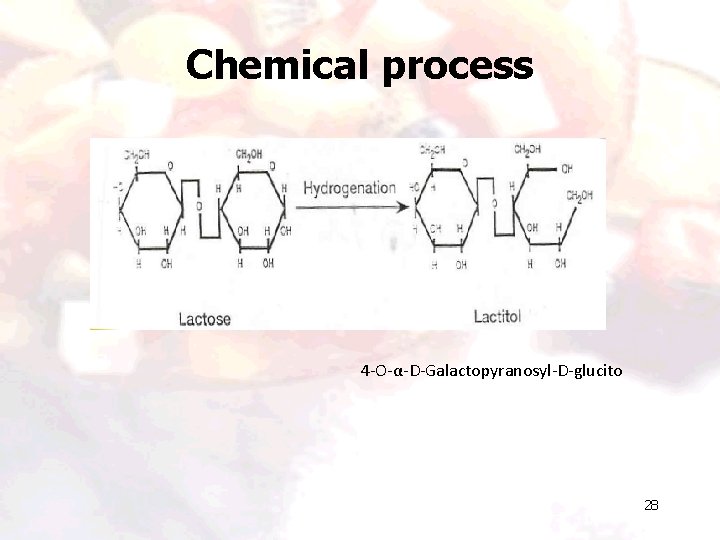
Lactitol • It is sugar alcohol derived from di-saccharide lactose. • It is low calorie sweetener with about 40% the sweetness of sugar (sucrose). • Used as bulk sweetener for low calorie foods • It is also used medically as a laxative. 27
Chemical process 4 -O-α-D-Galactopyranosyl-D-glucito 28
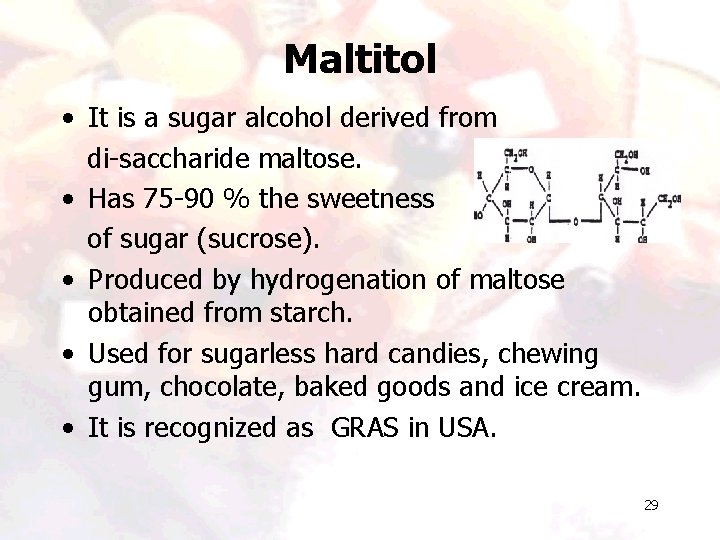
Maltitol • It is a sugar alcohol derived from di-saccharide maltose. • Has 75 -90 % the sweetness of sugar (sucrose). • Produced by hydrogenation of maltose obtained from starch. • Used for sugarless hard candies, chewing gum, chocolate, baked goods and ice cream. • It is recognized as GRAS in USA. 29
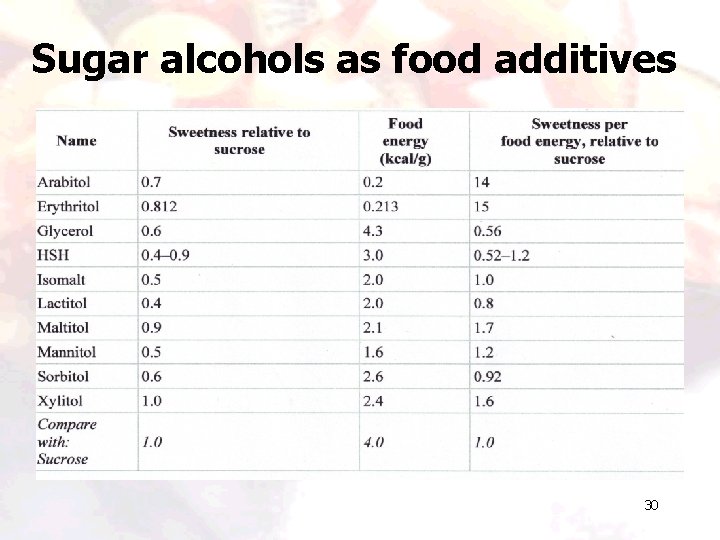
Sugar alcohols as food additives 30
Sugar alcohols applications 31
Global sugar alcohols Market • Sugar alcohols industry grow from ~ $1. 9 billion in 2011 to ~$ 2. 0 billion in 2012. • The market is expected to grow at CAGR (compound annual growth rate) of 7. 9 % and reach value ~ $ 3. 0 billion by 2017. • The biggest consumer market for sugar alcohols are in Europe. • Due to the future demand, there are needs to increase sugar alcohols production capacity • The major manufacturing bases in the world are China and India. 32
Summary • There a worldwide need for healthy food products that are lower in calories. • The USA consumption of sugar alcohols estimated about 376, 640 tons per year. • Sorbitol consumption in USA is about 54% of total sugar alcohols. • Other sugar alcohols consumption in USA are sharing the 46%. • Other sugar alcohols are showing market share increase. 33