
Starter 1 Name these alcohols Learning Intention To



- Slides: 31
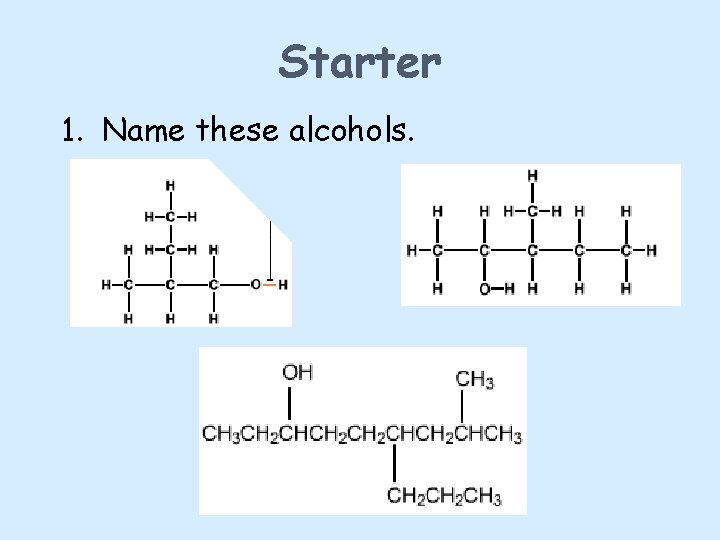
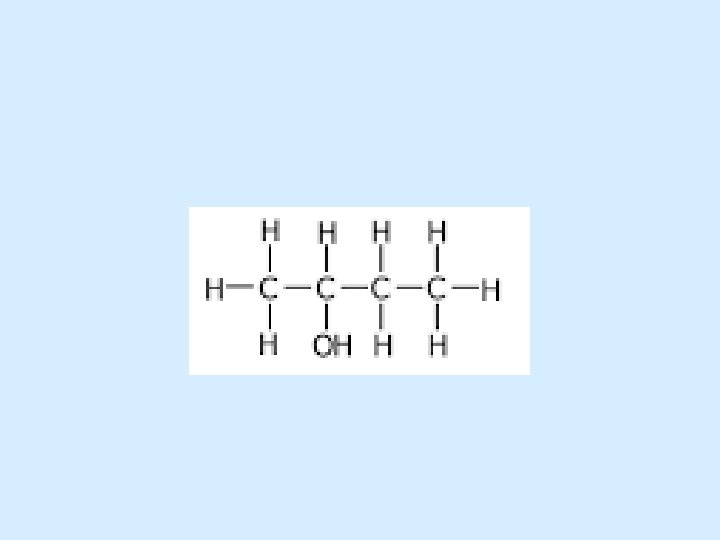
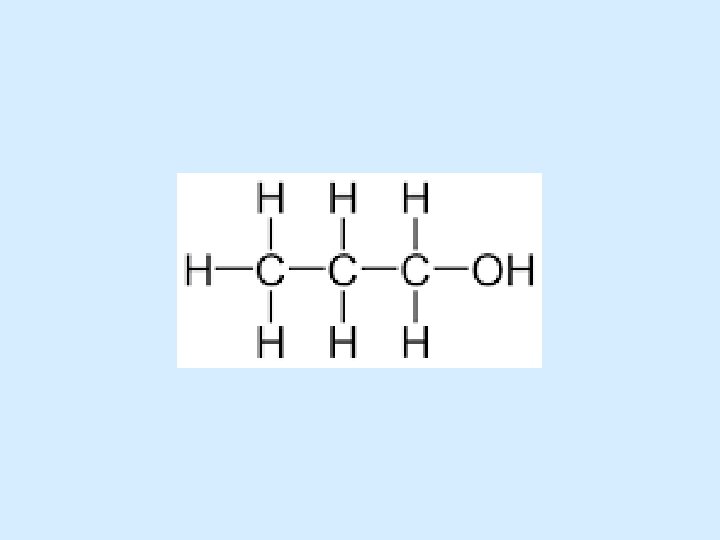
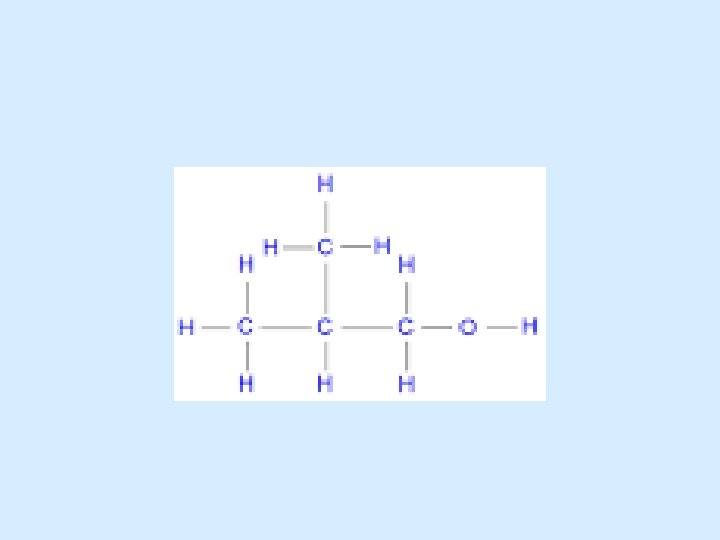
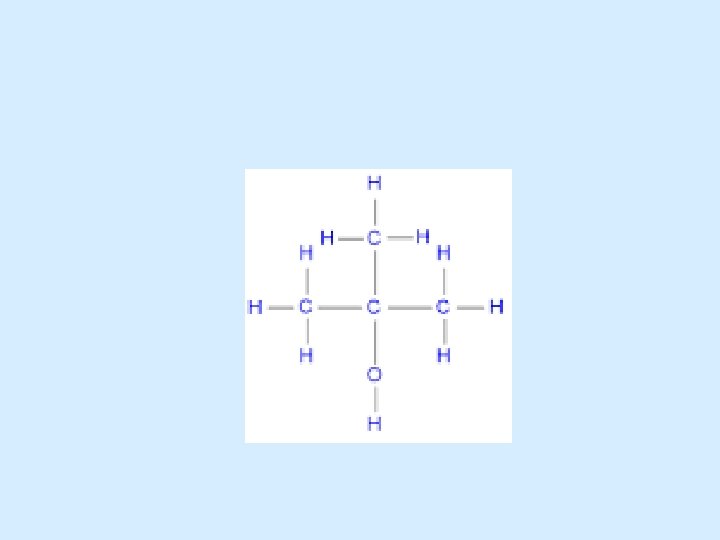
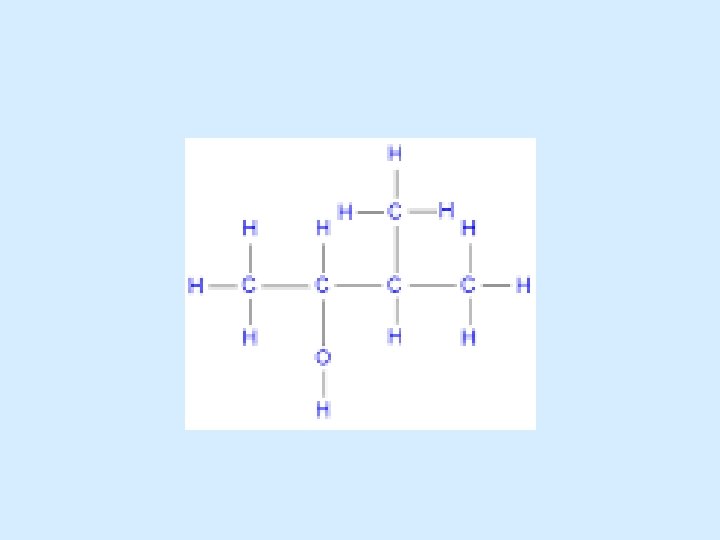
Starter 1. Name these alcohols.
Learning Intention To be able to state the products of the oxidation of alcohols. Success Criteria • I can state the products of the oxidation of alcohols • I can name the functional group in aldehydes and ketones • I can state the difference between aldehydes and ketones
Think Turn your jotter length ways. Draw the following down the left hand side of your jotter leaving space between them. 1. butan-1 -ol 2. butan-2 -ol 3. 2 -methyl propan-2 -ol
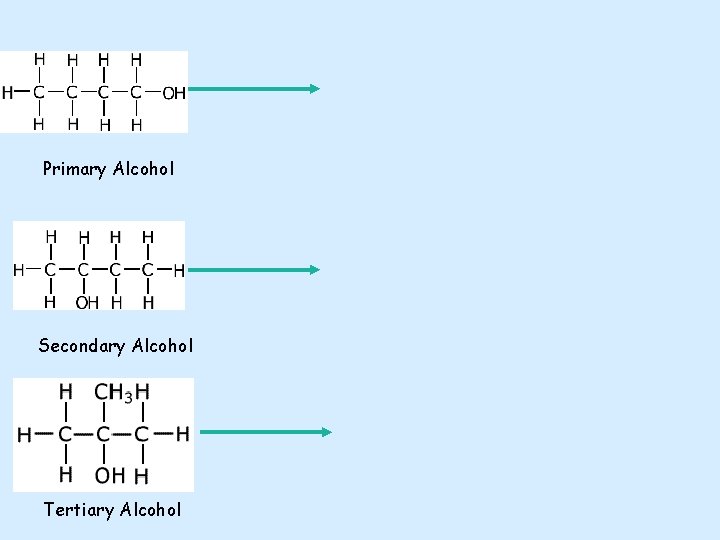
Classification of alcohols H H H C C H OH CH 3 H H Primary alcohol, ONE C joined to the C bonded to the OH group CH 3 C CH 3 O H Label your alcohols as primary, secondary or Secondary alcohol, tertiary TWO C’s joined to the C bonded to the OH group H H C C C H OH H propan-2 -ol CH 3 C C H O Tertiary alcohol, THREE C’s joined to the C bonded to the OH group CH 3 H H 3 C C CH 3 OH 2 -methylpropan-2 -ol
Primary Alcohol Secondary Alcohol Tertiary Alcohol
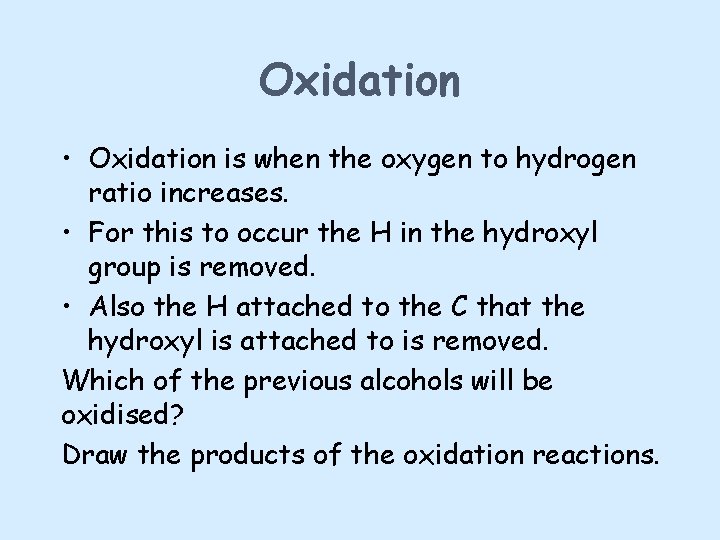
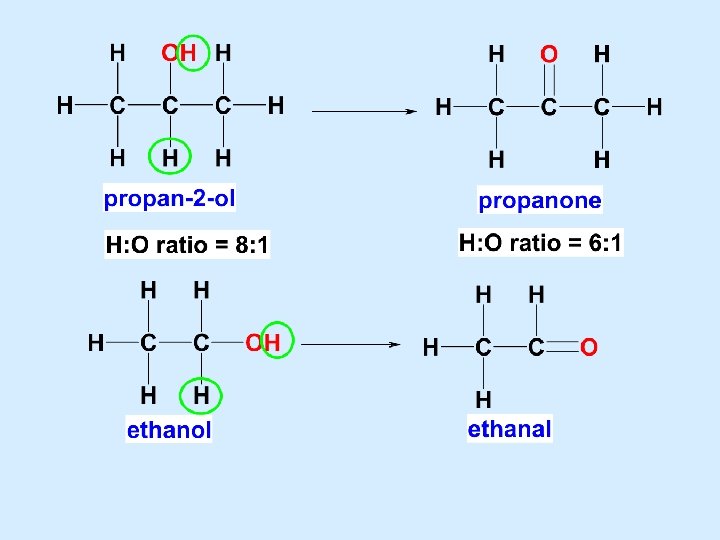
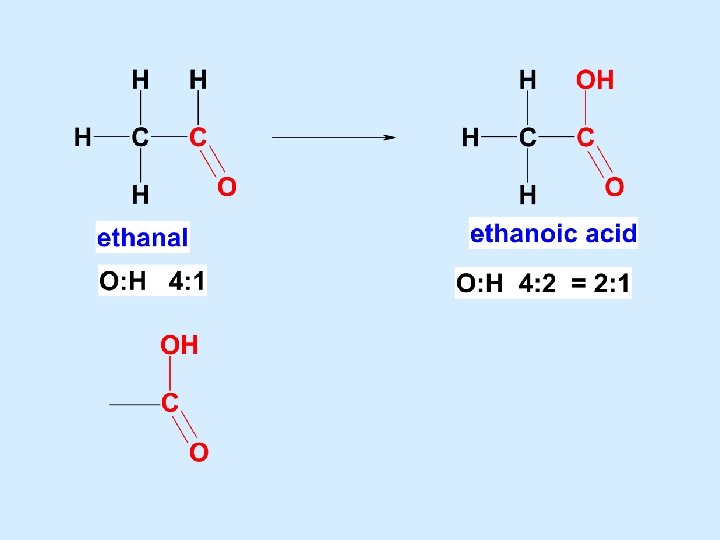
Oxidation • Oxidation is when the oxygen to hydrogen ratio increases. • For this to occur the H in the hydroxyl group is removed. • Also the H attached to the C that the hydroxyl is attached to is removed. Which of the previous alcohols will be oxidised? Draw the products of the oxidation reactions.
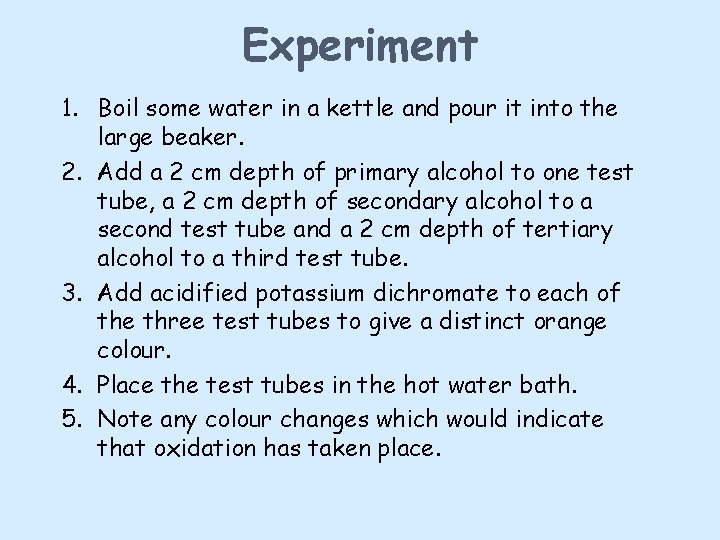
Experiment 1. Boil some water in a kettle and pour it into the large beaker. 2. Add a 2 cm depth of primary alcohol to one test tube, a 2 cm depth of secondary alcohol to a second test tube and a 2 cm depth of tertiary alcohol to a third test tube. 3. Add acidified potassium dichromate to each of the three test tubes to give a distinct orange colour. 4. Place the test tubes in the hot water bath. 5. Note any colour changes which would indicate that oxidation has taken place.
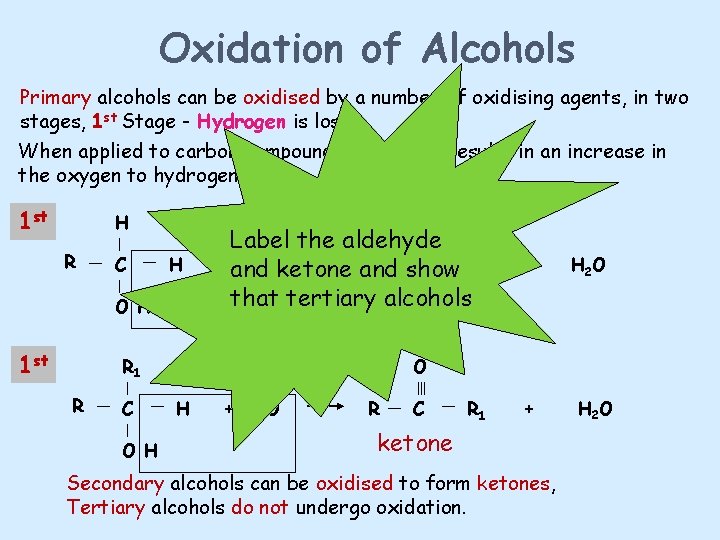
Oxidation of Alcohols Primary alcohols can be oxidised by a number of oxidising agents, in two stages, 1 st Stage - Hydrogen is lost. When applied to carbon compounds, oxidation results in an increase in the oxygen to hydrogen ratio. 1 st H R C H O H 1 st Label the aldehyde + and O ketone Rand show C H that tertiaryaldehyde alcohols R 1 R C O H O oxidation + O H 2 O O oxidation H + R C R 1 + ketone Secondary alcohols can be oxidised to form ketones, Tertiary alcohols do not undergo oxidation. H 2 O
Primary Alcohol Secondary Alcohol Tertiary Alcohol Aldehyde Ketone
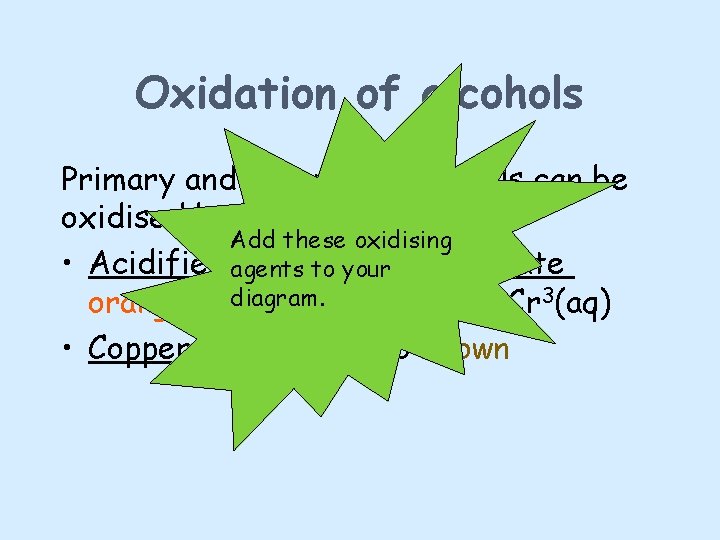
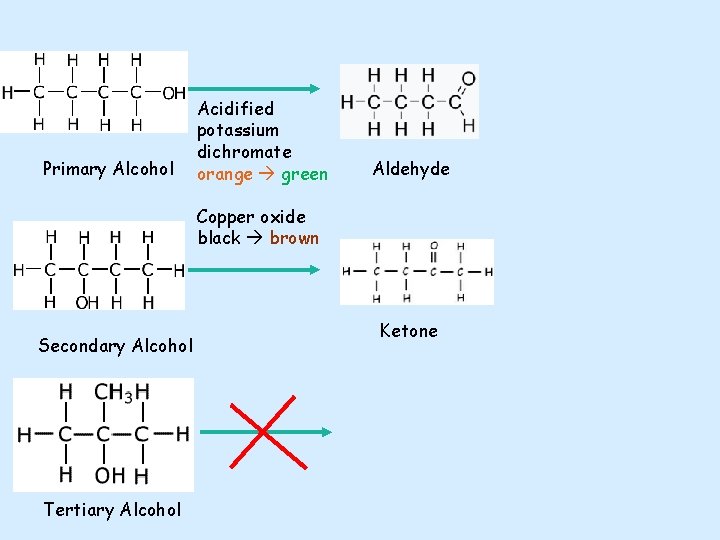
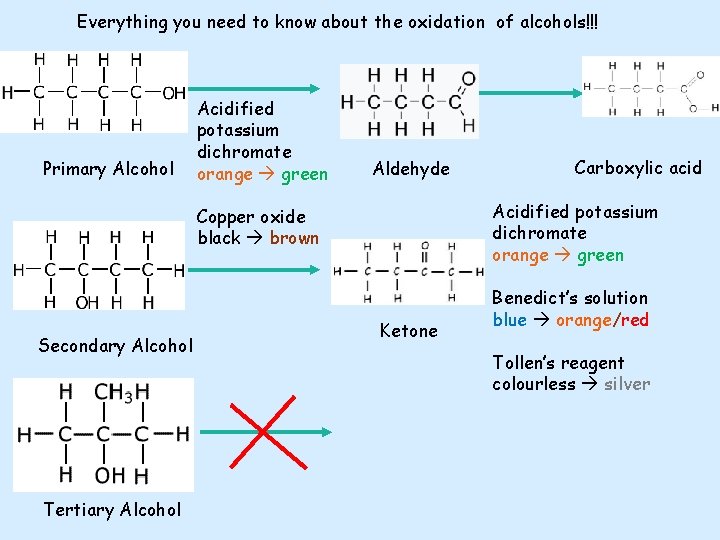
Oxidation of alcohols Primary and secondary alcohols can be oxidised by Add these oxidising • Acidified agents Potassium to your. Dichromate 2 -(aq) to green Cr 3(aq) orange Crdiagram. O 2 7 • Copper oxide black to brown
Primary Alcohol Acidified potassium dichromate orange green Aldehyde Copper oxide black brown Secondary Alcohol Tertiary Alcohol Ketone
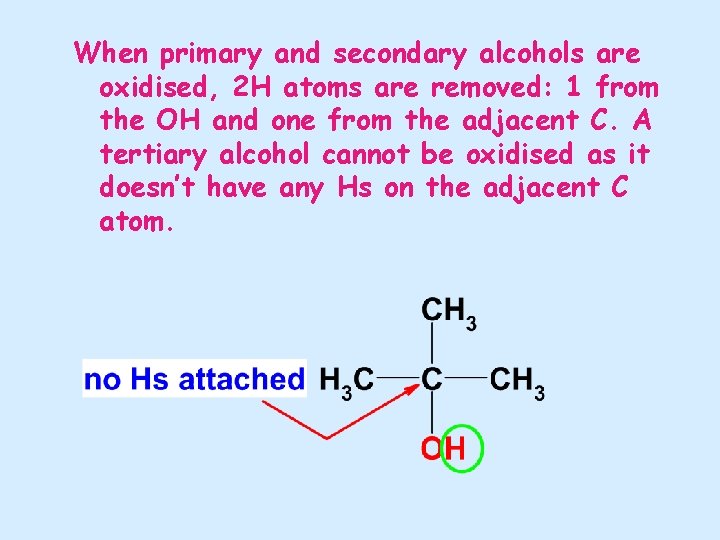
When primary and secondary alcohols are oxidised, 2 H atoms are removed: 1 from the OH and one from the adjacent C. A tertiary alcohol cannot be oxidised as it doesn’t have any Hs on the adjacent C atom.
Think Oxidation can happen again to either the aldehyde or the ketone. Which one do you think will go through oxidation? How can this be achieved? (Think about the definition for oxidation. )
Oxidation of Alcohols 2 nd Stage - oxygen is gained. When applied to carbon compounds, oxidation results in an increase in the oxygen to hydrogen ratio. 1 st O R oxidation C H + O R O C H Carboxylic acid O 2 nd R C ketone R 1
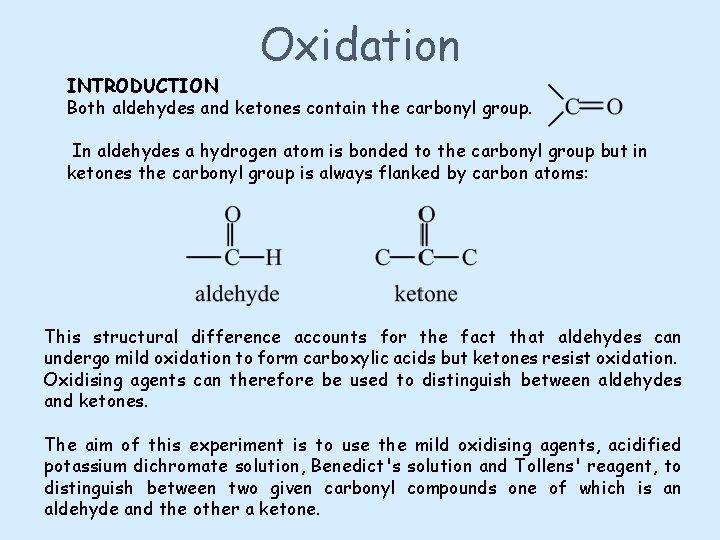
Oxidation INTRODUCTION Both aldehydes and ketones contain the carbonyl group. In aldehydes a hydrogen atom is bonded to the carbonyl group but in ketones the carbonyl group is always flanked by carbon atoms: This structural difference accounts for the fact that aldehydes can undergo mild oxidation to form carboxylic acids but ketones resist oxidation. Oxidising agents can therefore be used to distinguish between aldehydes and ketones. The aim of this experiment is to use the mild oxidising agents, acidified potassium dichromate solution, Benedict's solution and Tollens' reagent, to distinguish between two given carbonyl compounds one of which is an aldehyde and the other a ketone.
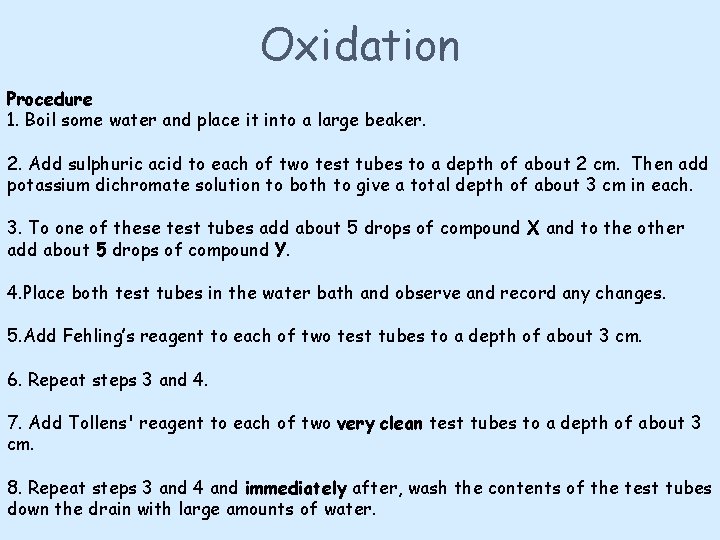
Oxidation Procedure 1. Boil some water and place it into a large beaker. 2. Add sulphuric acid to each of two test tubes to a depth of about 2 cm. Then add potassium dichromate solution to both to give a total depth of about 3 cm in each. 3. To one of these test tubes add about 5 drops of compound X and to the other add about 5 drops of compound Y. 4. Place both test tubes in the water bath and observe and record any changes. 5. Add Fehling’s reagent to each of two test tubes to a depth of about 3 cm. 6. Repeat steps 3 and 4. 7. Add Tollens' reagent to each of two very clean test tubes to a depth of about 3 cm. 8. Repeat steps 3 and 4 and immediately after, wash the contents of the test tubes down the drain with large amounts of water.
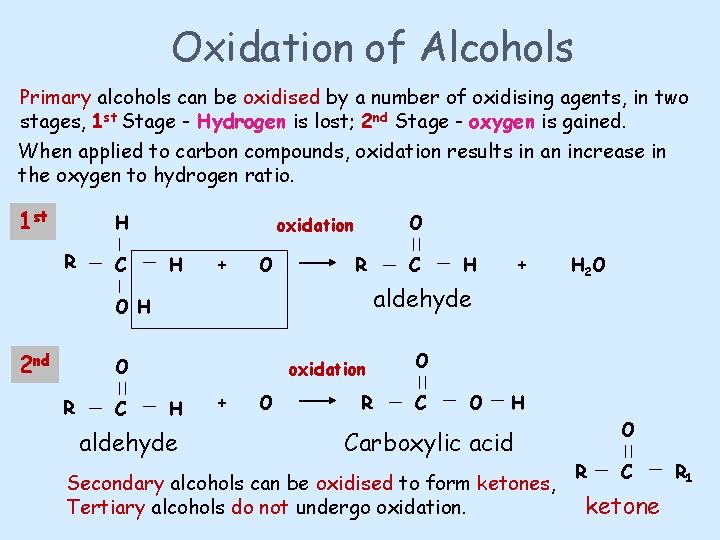
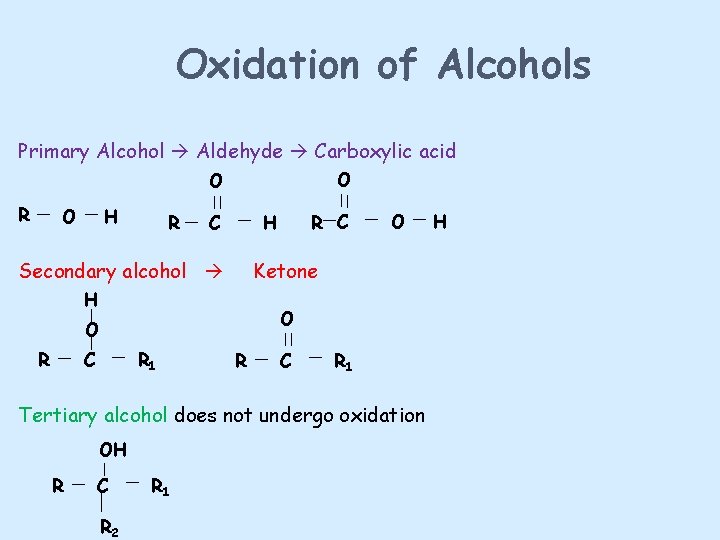
Oxidation of Alcohols Primary alcohols can be oxidised by a number of oxidising agents, in two stages, 1 st Stage - Hydrogen is lost; 2 nd Stage - oxygen is gained. When applied to carbon compounds, oxidation results in an increase in the oxygen to hydrogen ratio. 1 st H R C O oxidation H + O R C H + H 2 O aldehyde O H 2 nd C oxidation H aldehyde + O R O C O H Carboxylic acid Secondary alcohols can be oxidised to form ketones, Tertiary alcohols do not undergo oxidation. O R C ketone R 1
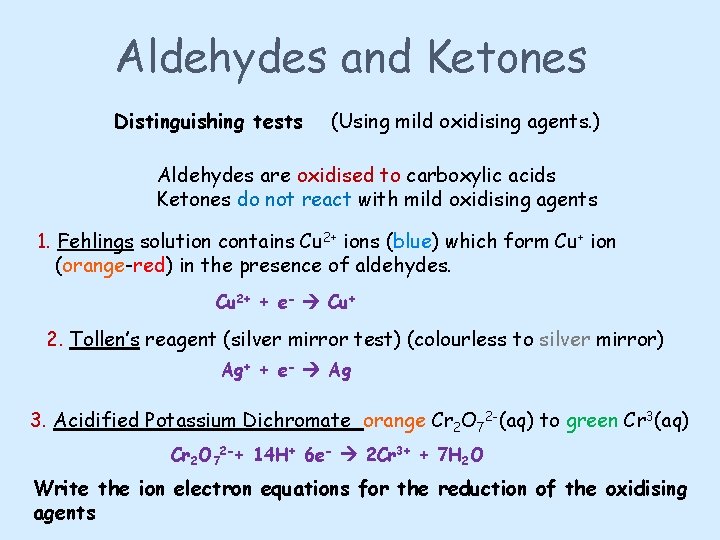
Aldehydes and Ketones Distinguishing tests (Using mild oxidising agents. ) Aldehydes are oxidised to carboxylic acids Ketones do not react with mild oxidising agents 1. Fehlings solution contains Cu 2+ ions (blue) which form Cu+ ion (orange-red) in the presence of aldehydes. Cu 2+ + e- Cu+ 2. Tollen’s reagent (silver mirror test) (colourless to silver mirror) Ag+ + e- Ag 3. Acidified Potassium Dichromate orange Cr 2 O 72 -(aq) to green Cr 3(aq) Cr 2 O 72 -+ 14 H+ 6 e- 2 Cr 3+ + 7 H 2 O Write the ion electron equations for the reduction of the oxidising agents
Everything you need to know about the oxidation of alcohols!!! Primary Alcohol Acidified potassium dichromate orange green Aldehyde Acidified potassium dichromate orange green Copper oxide black brown Secondary Alcohol Tertiary Alcohol Carboxylic acid Ketone Benedict’s solution blue orange/red Tollen’s reagent colourless silver
Oxidation of Alcohols Primary Alcohol Aldehyde Carboxylic acid O O R O H R C Secondary alcohol O Ketone H O O R R C H C R 1 R C R 1 Tertiary alcohol does not undergo oxidation OH R C R 2 R 1 H
Naming alcohols, aldehydes and ketones Information from BBC Bitesize on the rules for naming organic compounds. Oxidising reagents Information on the colour changes for different oxidising agents
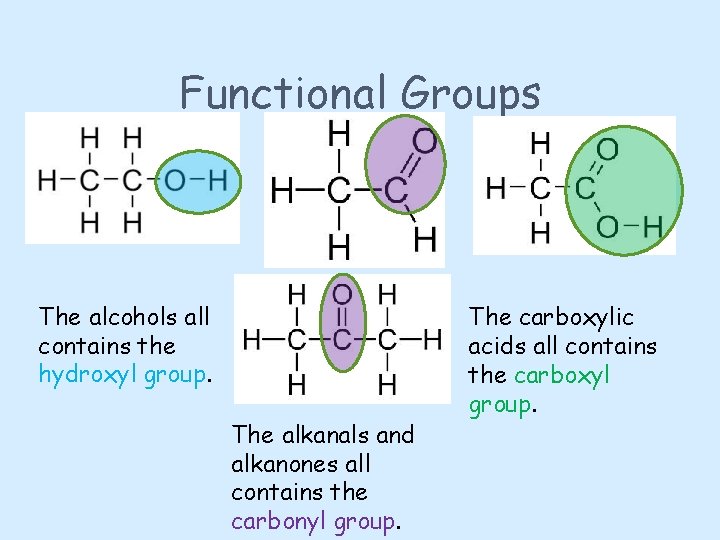
Functional Groups The alcohols all contains the hydroxyl group. The alkanals and alkanones all contains the carbonyl group. The carboxylic acids all contains the carboxyl group.
Starter