
INVESTIGATION OF AN EPIDEMIC Dr Amna Rehana Siddiqui
- Slides: 54
INVESTIGATION OF AN EPIDEMIC Dr. Amna Rehana Siddiqui Department of Family and Community Medicine February 28, 2011
OBJECTIVES n List and explain the steps of investigation of an epidemic n Draw & interpret the epidemic curve n Compare food specific attack rates to identify possible vehicles n List reasons for investigating an epidemic
WHAT IS AN EPIDEMIC ? The occurrence of more cases in a place (or population) and time than expected (can be 1 case if endemicity was 0) The terms outbreak and epidemic are used interchangeably It is due to breaks in a system that needs to be identified & corrected
Types of Epidemics/Outbreaks n Propagated Indicative of person to person transmission e. g. Measles n Point-source Indicative of a common exposure to a contaminated vehicle or reservoir e. g. food poisoning
ENDEMIC SITUATION One that is usually present in a given geographical area of a population group in comparison with other areas or populations
FROM ENDEMIC TO EPIDEMIC ? n Observation n Increase in disease events n Increase in risk factors n Surveillance (ongoing) reports n Predefined Threshold value
WHY INVESTIGATE? n n n n Identify source of infection/s urgently Detect weakness in existing system To prevent mortality and morbidity To highlight public health needs Could result in policy changes To improve public health To be well informed about agent, host, and environment.
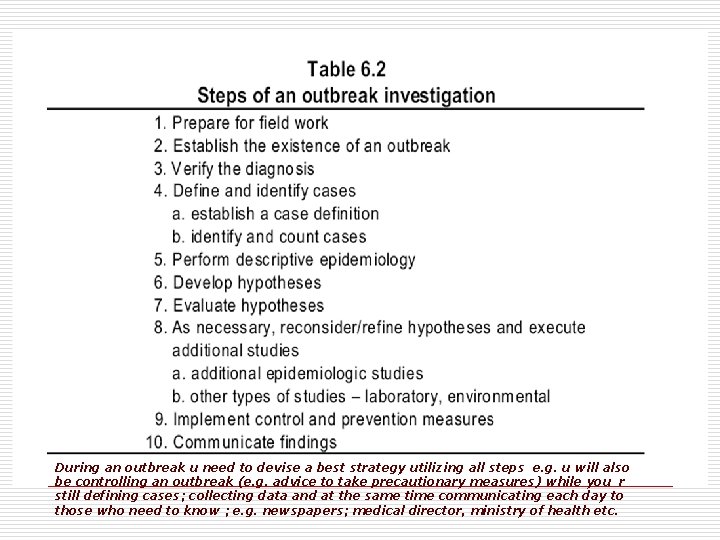
During an outbreak u need to devise a best strategy utilizing all steps e. g. u will also be controlling an outbreak (e. g. advice to take precautionary measures) while you r still defining cases; collecting data and at the same time communicating each day to those who need to know ; e. g. newspapers; medical director, ministry of health etc.
HOW TO INVESTIGATE ? Example 1: An undiagnosed case of Crimean Congo hemorrhagic fever (CCHF) infects a hospital worker who gets moderately sick Example 2: You are requested to investigate food poisoning cases after a gathering at a local community hall
STEP 1. Prepare for fieldwork n n n Identify potential investigation team Research the disease Make administrative arrangements Clarify your and team members’ role Identify & arrange for resources Develop communication strategies for team, hospital employees, and public
STEP 2: Establish the existence of epidemic Does the observed number of cases exceed the existing number ? n n n Literature search Consult the experts / Government Surveillance records Previous reports Is there a confirmed case ? Are there additional cases?
STEP 3 Verify the diagnosis n Speak directly with the persons who are affected n Clinical criteria n Laboratory methods available ? n Arrange to send samples to relevant laboratories n Initial reports correct ? n Possible modes of spread PS: STEPS ARE NOT IN ANY ORDER
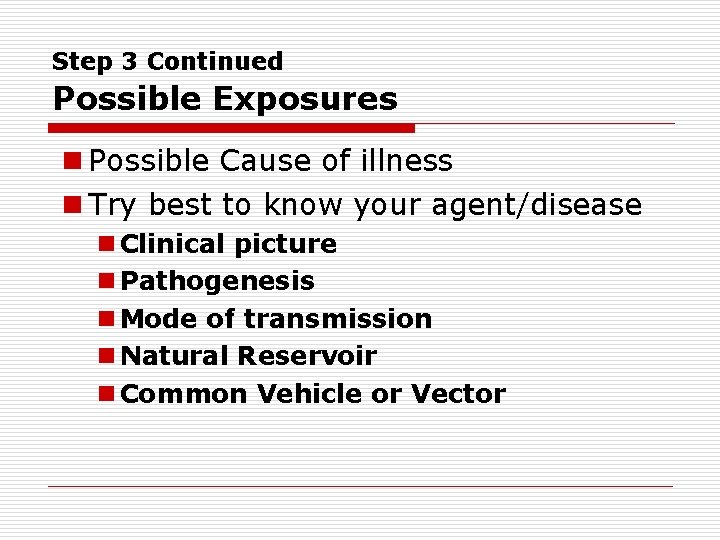
Step 3 Continued Possible Exposures n Possible Cause of illness n Try best to know your agent/disease n Clinical picture n Pathogenesis n Mode of transmission n Natural Reservoir n Common Vehicle or Vector
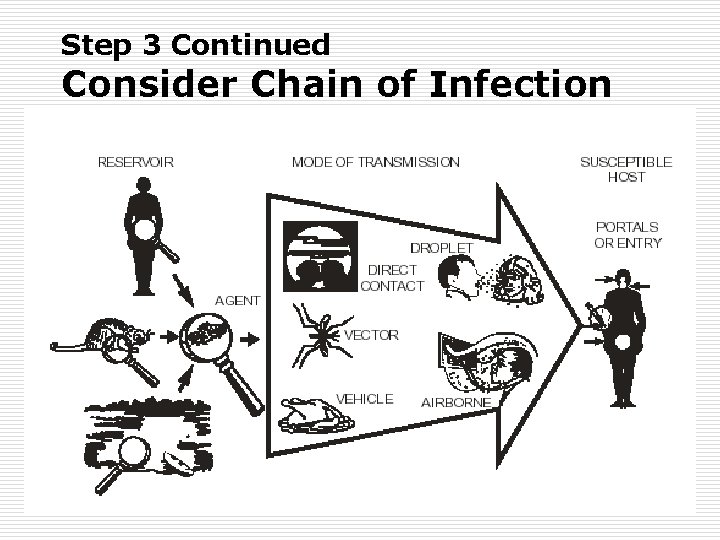
Step 3 Continued Consider Chain of Infection
STEP 4 Define and identify cases n Develop a case definition, identify and count cases n Develop a line listing for all n Create a working case definition for CCHF n For hospital workers/Contacts Any one with fever &/ sore throat n For Cases Anyone with undiagnosed fever, or has any type of bleeding PS: STEPS ARE NOT IN ANY ORDER during outbreak
Step 4 a: Establishing a Case Definition o A case definition is a standard set of criteria for deciding whether an individual should be classified as having the health condition of interest. o A case definition includes clinical criteria and--particularly in the setting of an outbreak investigation --restrictions by time, place and person. o Apply them consistently and without bias to all persons under investigation.
CASE DEFINITION o To be classified as confirmed, a case usually must have laboratory verification. A case classified as probable usually has typical clinical features of the disease without laboratory confirmation. A case classified as possible usually has fewer of the typical clinical features.
DEFINING CASES o Early in an investigation, investigators often use a WORKING case definition which includes confirmed, probable, and even possible cases. o Later on, when hypotheses have come into sharper focus, the investigator may “tighten” the case definition ACCORDINGLY /by dropping the possible category.
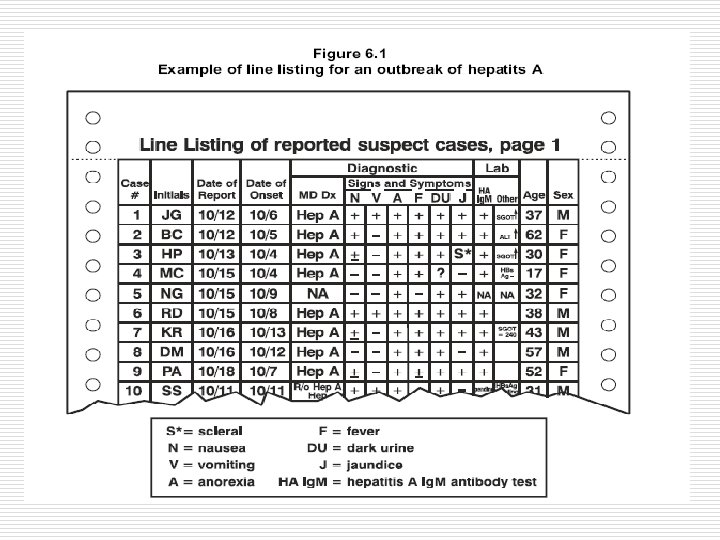
Step 4 continued Case finding and Line listing /Spread Sheet Each row represents data for a subject and columns represent following n Identification n Symptom onset date and time n Symptoms present n Suspected exposure date if known n Residence n Age n Gender n Laboratory tests n Confirmed case
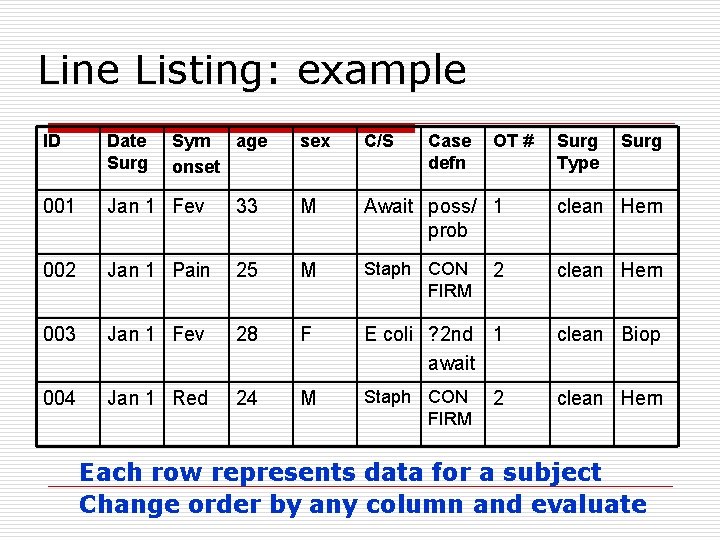
Line Listing: example ID Date Surg Sym age onset sex C/S 001 Jan 1 Fev 002 Case defn OT # 33 M Await poss/ 1 prob clean Hern Jan 1 Pain 25 M Staph CON FIRM 2 clean Hern 003 Jan 1 Fev 28 F E coli ? 2 nd 1 await clean Biop 004 Jan 1 Red 24 M Staph CON FIRM clean Hern 2 Surg Type Surg Each row represents data for a subject Change order by any column and evaluate
STEP 5 Descriptive epidemiology Find cases systematically Epidemic / Outbreak curve Map Identify demographic and other characteristics of persons at risk n Tabulate and orient the data in terms of n n n Person n Place n Time PS: STEPS ARE NOT IN ANY ORDER
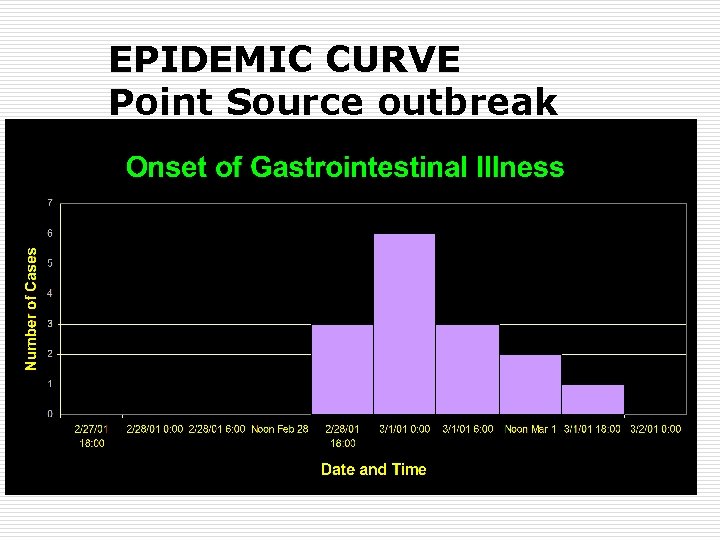
STEP 5 Continued Epidemic Curve n Graph showing number of cases on ‘Y’ axis and time line on ‘X’ axis n Indicates the magnitude of epidemic over time n Can distinguish epidemic from an endemic situation n Indicates pattern of spread n Outliers
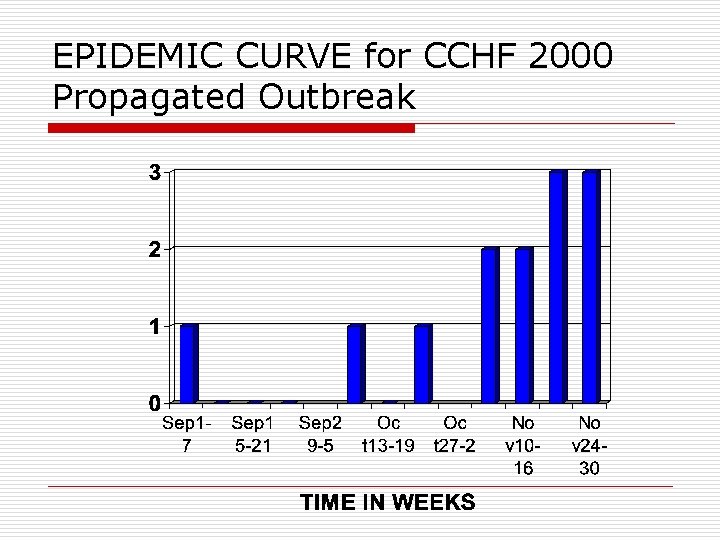
EPIDEMIC CURVE for CCHF 2000 Propagated Outbreak
EPIDEMIC CURVE Point Source outbreak
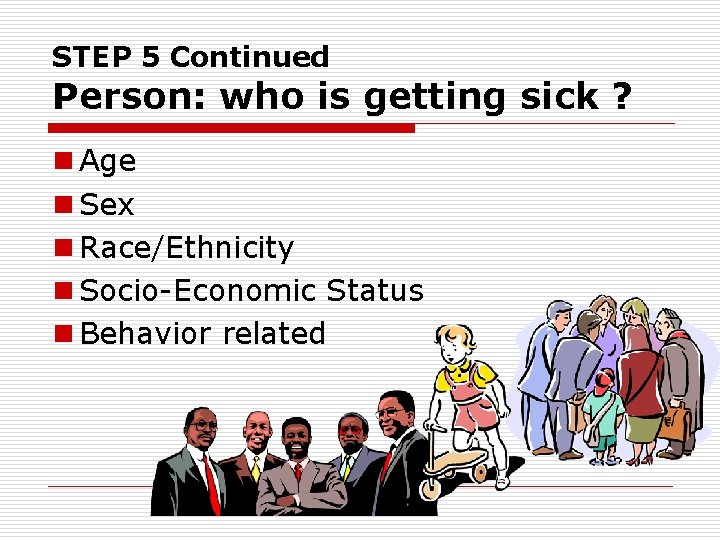
STEP 5 Continued Person: who is getting sick ? n Age n Sex n Race/Ethnicity n Socio-Economic Status n Behavior related
STEP 5 Continued Place: where are the cases coming from ? n Geographic Distribution n Homes n Work n School n Orphanages n Hospitals/Clinics
STEP 5 Continued Time: when are they getting sick? n Onset of symptoms n Incubation Period n Infectious Period n Seasonality n Baseline vs. epidemic
STEP 6 DEVELOP HYPOTHESES Following things help n Open ended and wide ranging interviews/history of travel/foods eaten n Descriptive epidemiology n Occupation/residence/raw meat use n Line listing of all subjects n Epidemic curve n Existing knowledge of disease
Step 6: Developing Hypotheses o All aspects of the investigation should be addressed: - source of the agent, - mode of transmission, (vehicle/vector), - exposures that caused the disease, - any additional time, person, & place factors e. g. CCHF transmitted by blood and body fluids what other means as there were patients from occupations who were not exposed to blood and body fluids?
First, consider what you know about the disease itself: o What is the agent’s usual reservoir? o How is it usually transmitted? o What vehicles are commonly implicated? o What are the known risk factors? DO EXTENSIVE Literature Search; Be familiar with the disease
STEP 7 EVALUATE HYPOTHESES n Further analyze existing data n Compare ill populations with not ill populations n Compare attack rates n Conduct statistical tests n Recommend Control Measures
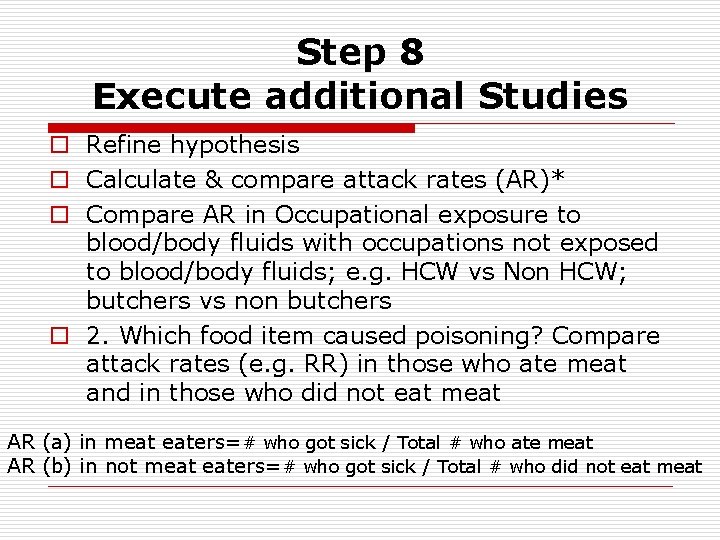
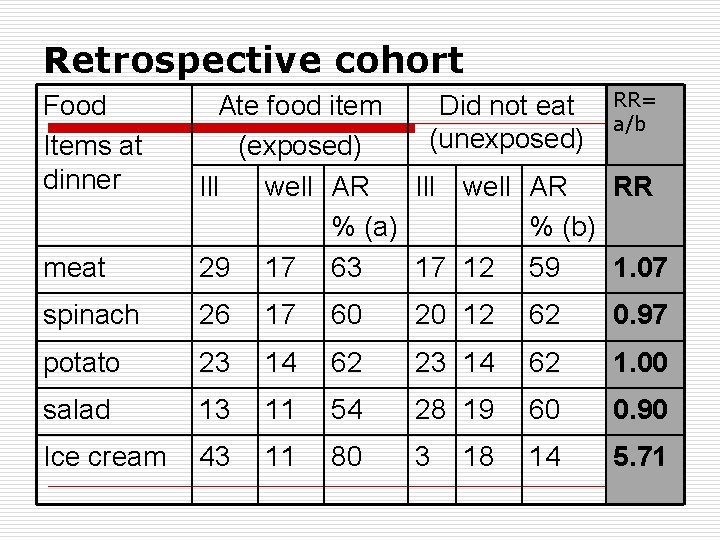
Step 8 Execute additional Studies o Refine hypothesis o Calculate & compare attack rates (AR)* o Compare AR in Occupational exposure to blood/body fluids with occupations not exposed to blood/body fluids; e. g. HCW vs Non HCW; butchers vs non butchers o 2. Which food item caused poisoning? Compare attack rates (e. g. RR) in those who ate meat and in those who did not eat meat AR (a) in meat eaters=# who got sick / Total # who ate meat AR (b) in not meat eaters=# who got sick / Total # who did not eat meat
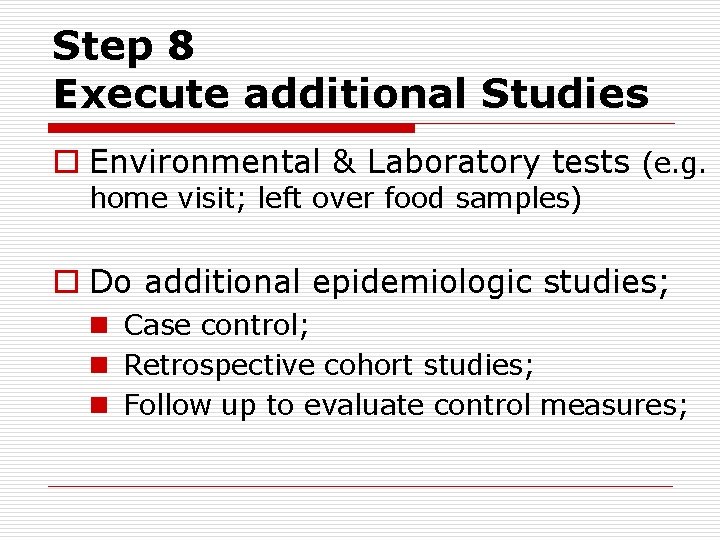
Step 8 Execute additional Studies o Environmental & Laboratory tests (e. g. home visit; left over food samples) o Do additional epidemiologic studies; n Case control; n Retrospective cohort studies; n Follow up to evaluate control measures;
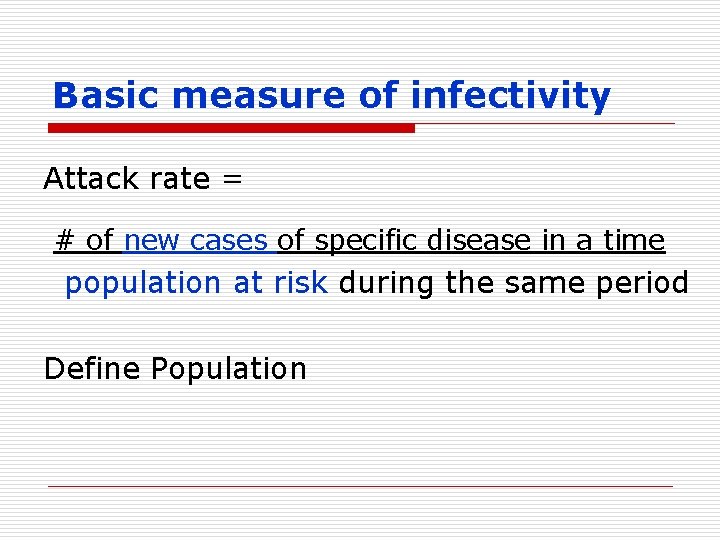
Basic measure of infectivity Attack rate = # of new cases of specific disease in a time population at risk during the same period Define Population
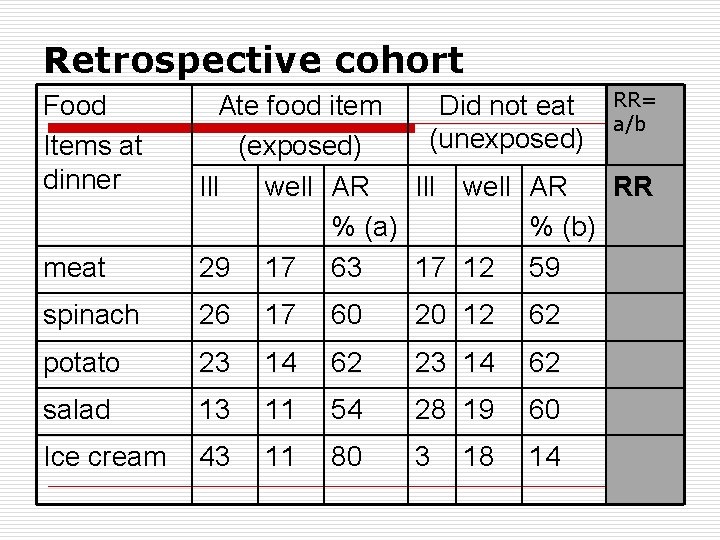
Retrospective cohort meat Ate food item Did not eat RR= a/b (unexposed) (exposed) Ill well AR RR % (a) % (b) 29 17 63 17 12 59 spinach 26 17 60 20 12 62 potato 23 14 62 salad 13 11 54 28 19 60 Ice cream 43 11 80 3 14 Food Items at dinner 18
Retrospective cohort meat Ate food item Did not eat RR= a/b (unexposed) (exposed) Ill well AR RR % (a) % (b) 29 17 63 17 12 59 1. 07 spinach 26 17 60 20 12 62 0. 97 potato 23 14 62 1. 00 salad 13 11 54 28 19 60 0. 90 Ice cream 43 11 80 3 14 5. 71 Food Items at dinner 18
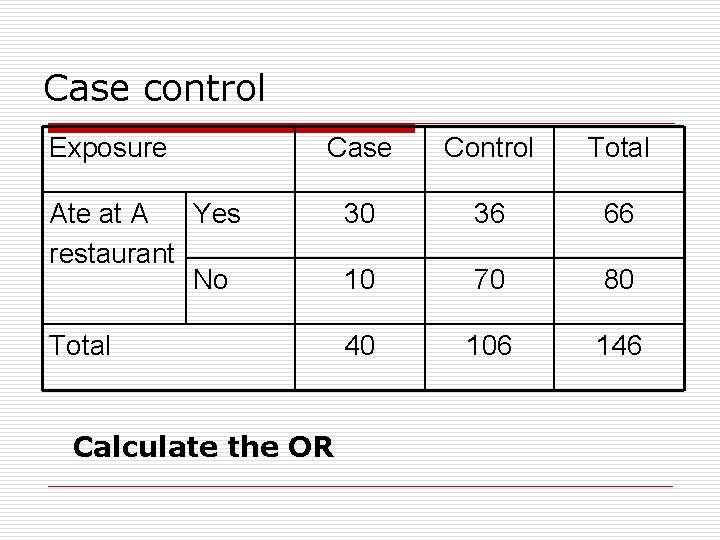
Case control Exposure Case Control Total Ate at A Yes restaurant No 30 36 66 10 70 80 Total 40 106 146 Calculate the OR
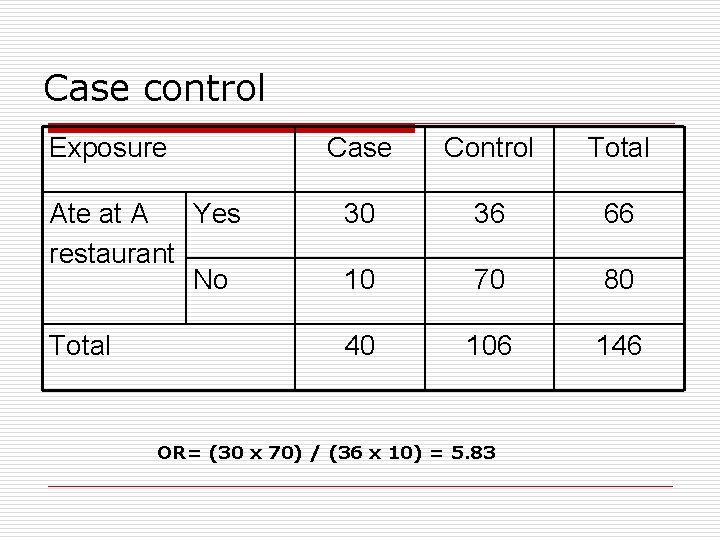
Case control Exposure Case Control Total Ate at A Yes restaurant No 30 36 66 10 70 80 Total 40 106 146 OR= (30 x 70) / (36 x 10) = 5. 83
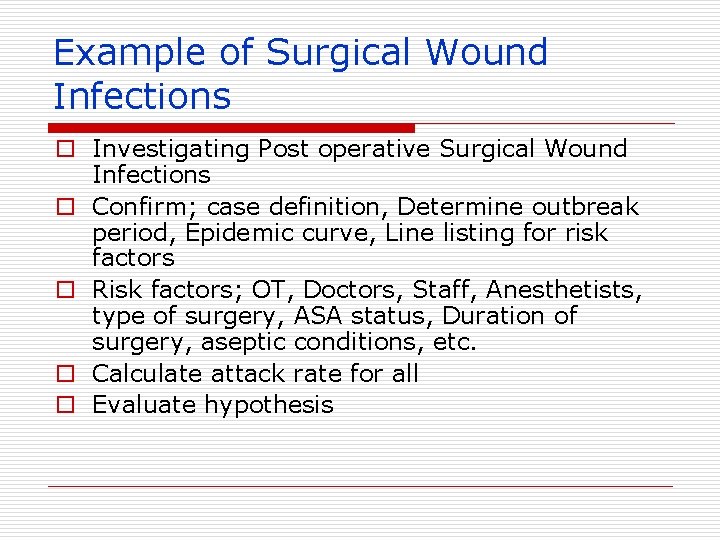
Example of Surgical Wound Infections o Investigating Post operative Surgical Wound Infections o Confirm; case definition, Determine outbreak period, Epidemic curve, Line listing for risk factors o Risk factors; OT, Doctors, Staff, Anesthetists, type of surgery, ASA status, Duration of surgery, aseptic conditions, etc. o Calculate attack rate for all o Evaluate hypothesis
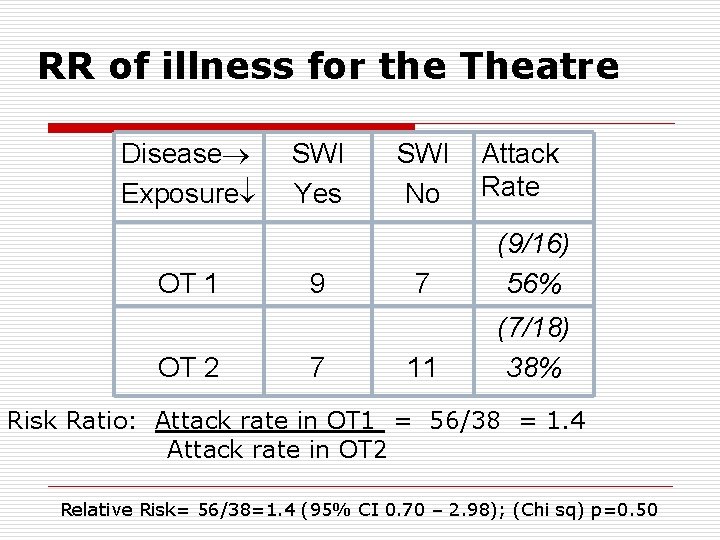
RR of illness for the Theatre Disease Exposure OT 1 OT 2 SWI Yes 9 7 SWI No Attack Rate 7 (9/16) 56% 11 (7/18) 38% Risk Ratio: Attack rate in OT 1 = 56/38 = 1. 4 Attack rate in OT 2 Relative Risk= 56/38=1. 4 (95% CI 0. 70 – 2. 98); (Chi sq) p=0. 50
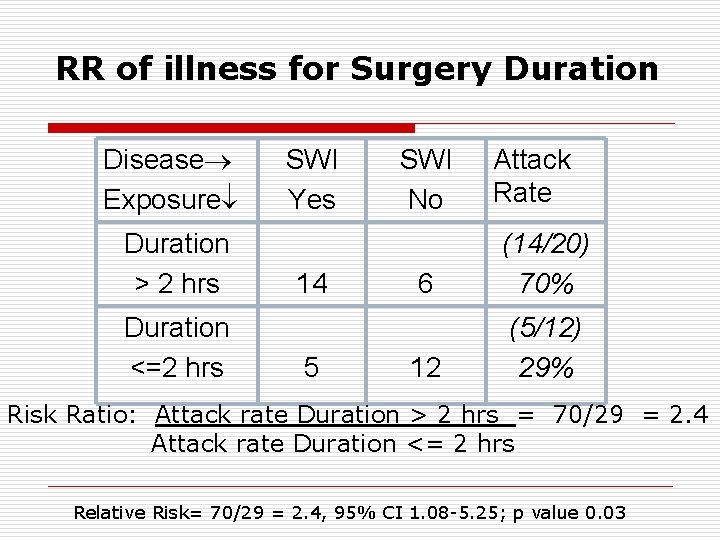
RR of illness for Surgery Duration Disease Exposure Duration > 2 hrs Duration <=2 hrs SWI Yes 14 5 SWI No Attack Rate 6 (14/20) 70% 12 (5/12) 29% Risk Ratio: Attack rate Duration > 2 hrs = 70/29 = 2. 4 Attack rate Duration <= 2 hrs Relative Risk= 70/29 = 2. 4, 95% CI 1. 08 -5. 25; p value 0. 03
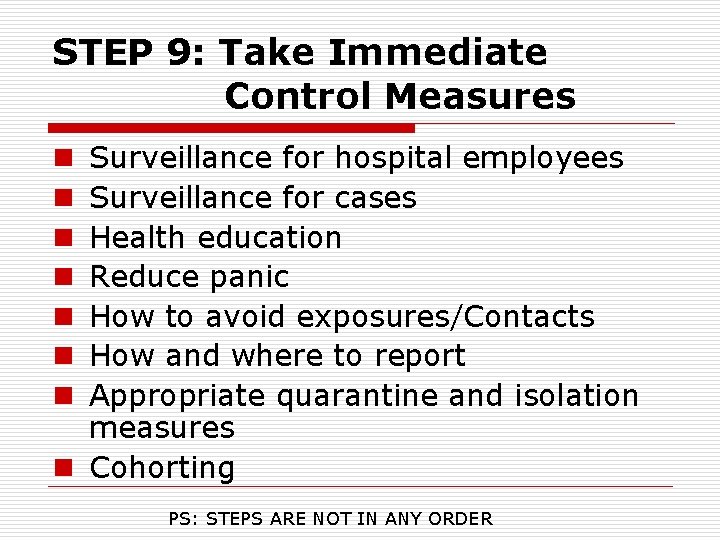
STEP 9: Take Immediate Control Measures Surveillance for hospital employees Surveillance for cases Health education Reduce panic How to avoid exposures/Contacts How and where to report Appropriate quarantine and isolation measures n Cohorting n n n n PS: STEPS ARE NOT IN ANY ORDER
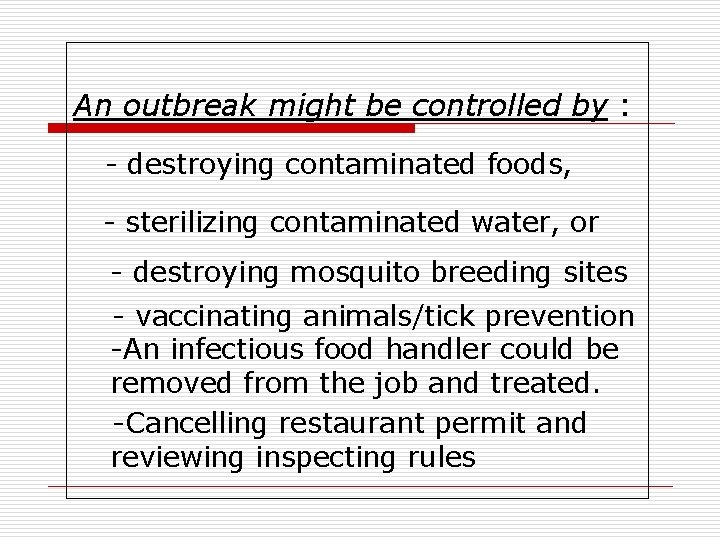
An outbreak might be controlled by : - destroying contaminated foods, - sterilizing contaminated water, or - destroying mosquito breeding sites - vaccinating animals/tick prevention -An infectious food handler could be removed from the job and treated. -Cancelling restaurant permit and reviewing inspecting rules
Control Measures reducing host susceptibility , - Immunization , - chemoprophylaxis for travelers
STEP 10 COMMUNICATE FINDINGS n Summarize investigation for requesting authority n Prepare written report n Prevention of future similar outbreaks
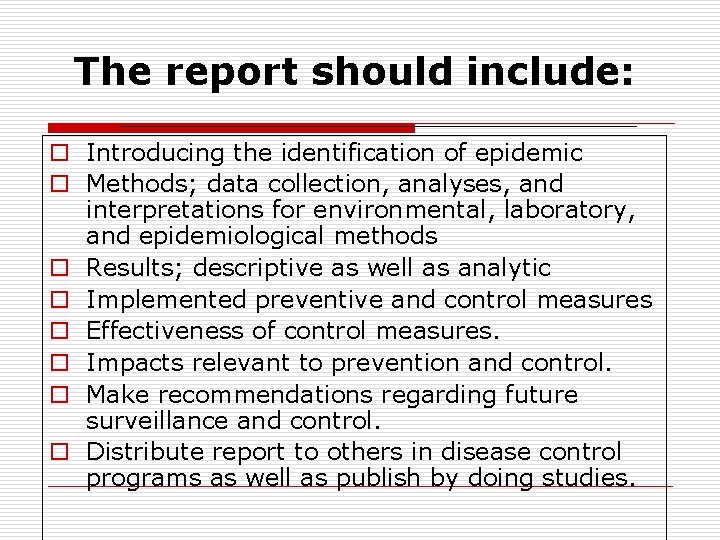
The report should include: o Introducing the identification of epidemic o Methods; data collection, analyses, and interpretations for environmental, laboratory, and epidemiological methods o Results; descriptive as well as analytic o Implemented preventive and control measures o Effectiveness of control measures. o Impacts relevant to prevention and control. o Make recommendations regarding future surveillance and control. o Distribute report to others in disease control programs as well as publish by doing studies.
The report: o A record of performance and a document for potential legal issues. o Reference if the health department encounters a similar situation in the future. o Broader purpose for contributing to the knowledge base of epidemiology and public health.
STEP 10 FOLLOW UP n May execute further additional studies n Maintain surveillance for a pre-defined period of time n Evaluate interventions and control measures n Formulate recommendations
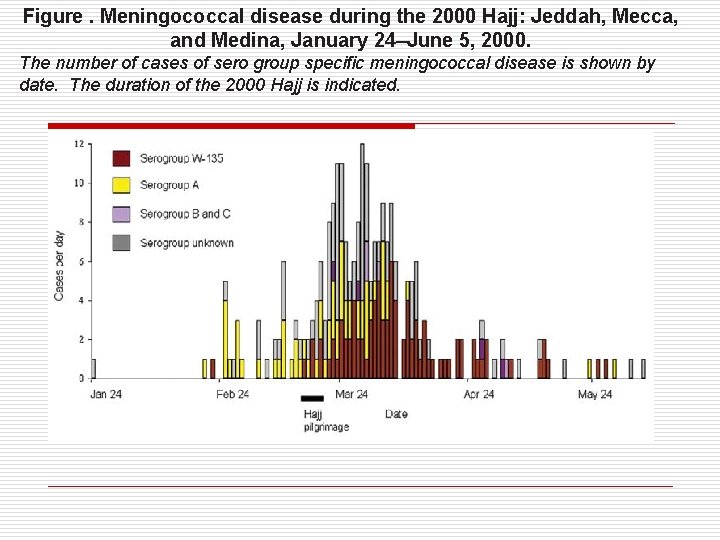
Figure. Meningococcal disease during the 2000 Hajj: Jeddah, Mecca, and Medina, January 24–June 5, 2000. The number of cases of sero group specific meningococcal disease is shown by date. The duration of the 2000 Hajj is indicated.
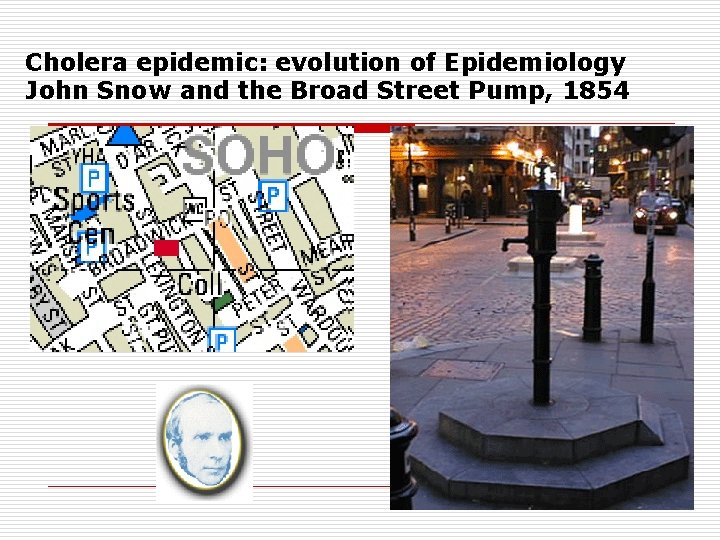
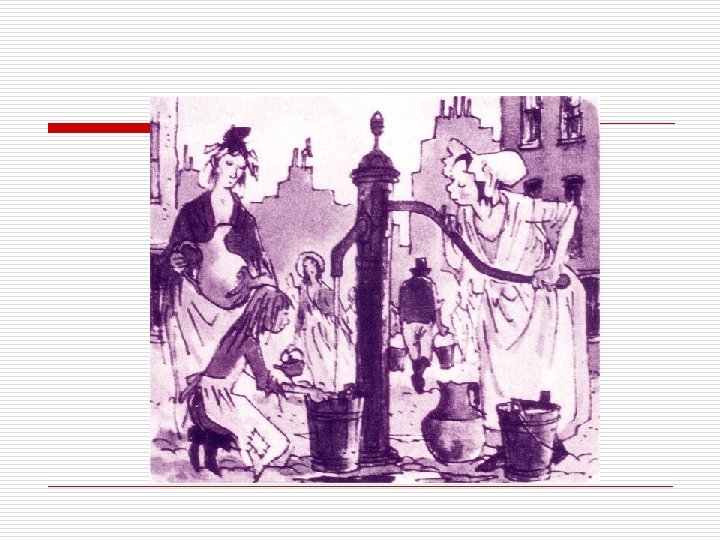
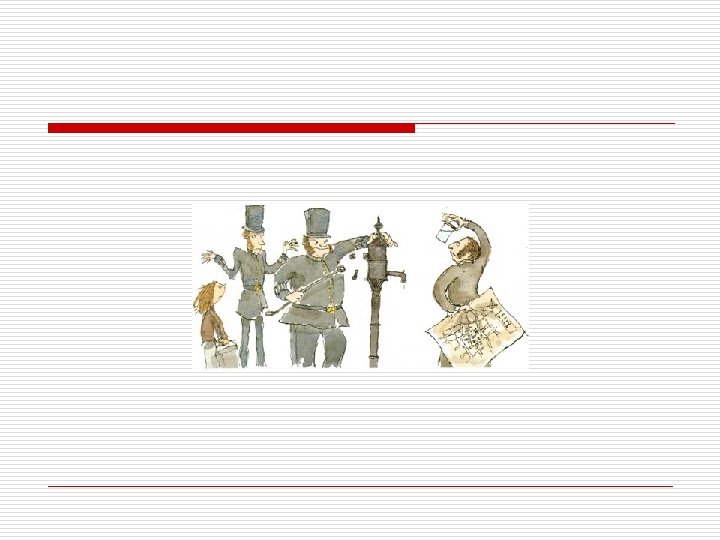
Cholera epidemic: evolution of Epidemiology John Snow and the Broad Street Pump, 1854
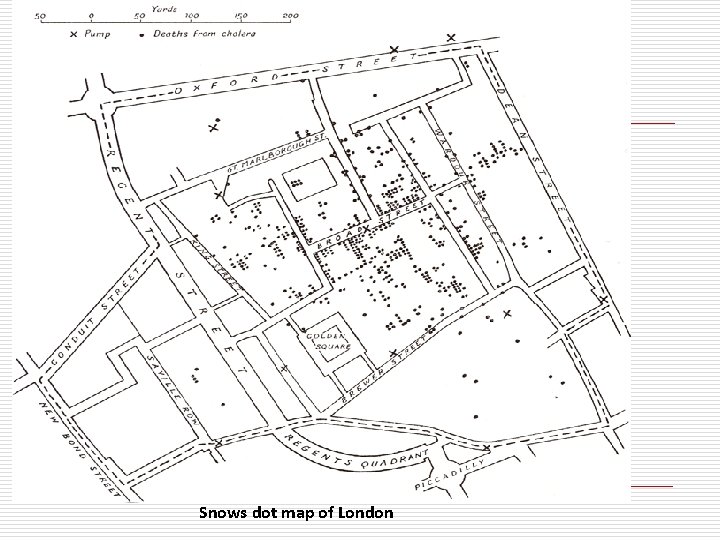
Snows dot map of London