
Instructor Details Dr Mohammad Nahid Siddiqui Room 4




- Slides: 82
Instructor Details • Dr. Mohammad Nahid Siddiqui Room: # 4 / 114 Tel: 860 -2529 office; Mobile: 0508460810 • E-mail: mnahid@kfupm. edu. sa Personal Homepage: • http: //faculty. kfupm. edu. sa/chem/mnahid 11/1/2020 Dr. Mohammad Nahid Siddiqui 1
Office Hours Sat, Mon, and Wed • 09: 30 -11: 00 AM also by appointment 11/1/2020 Dr. Mohammad Nahid Siddiqui 2
Organic Chemistry 201 COURSE OUTLINE: CHEM 201 (112) : Organic Chemistry I Textbook: “ORGANIC CHEMISTRY” by R. J. Fessenden & J. S. Fessenden, 6 th Edition. 11/1/2020 Dr. Mohammad Nahid Siddiqui 3
Grading System • http: //webcourses. kfupm. edu. sa 11/1/2020 Dr. Mohammad Nahid Siddiqui 4
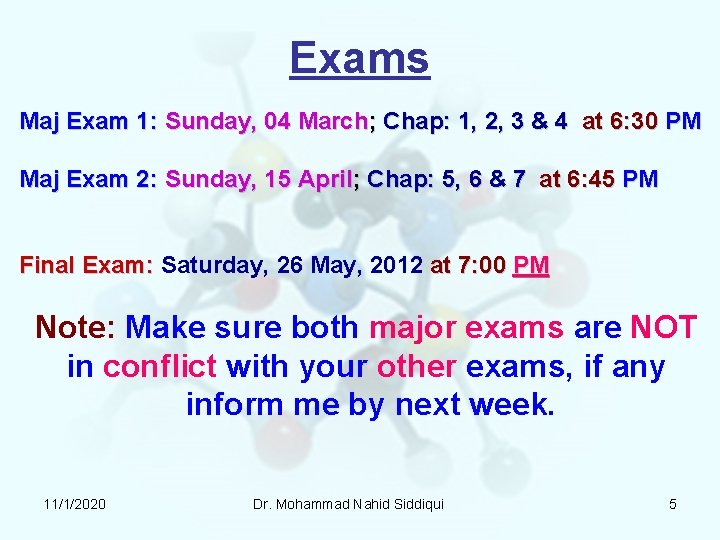
Exams Maj Exam 1: Sunday, 04 March; Chap: 1, 2, 3 & 4 at 6: 30 PM Maj Exam 2: Sunday, 15 April; Chap: 5, 6 & 7 at 6: 45 PM Final Exam: Saturday, 26 May, 2012 at 7: 00 PM Note: Make sure both major exams are NOT in conflict with your other exams, if any inform me by next week. 11/1/2020 Dr. Mohammad Nahid Siddiqui 5
Chapter 1. Atoms and molecules 11/1/2020 Dr. Mohammad Nahid Siddiqui 6
The Evolution of Organic Chemistry • Organic Chemistry was originally the chemistry of compounds which had been obtained from living things, plants and animals. • Now Organic Chemistry is the chemistry of the compounds of carbon. 11/1/2020 Dr. Mohammad Nahid Siddiqui 7
Why Carbon? • Carbon has the ability to bond covalently to other carbon atoms as well to many other elements in a variety of ways. • It forms simple compounds such as methane (CH 4) as well as very complex compounds containing thousands of atoms, such as proteins and the genetic code. 11/1/2020 Dr. Mohammad Nahid Siddiqui 8
Who Needs Organic Chemistry? • Organic chemistry is indispensable to many scientists and engineers. Living systems contain primary water and organic compounds. Areas that require organic chemistry include medicine biochemistry, microbiology, agriculture and petrochemistry. • Most importantly, Engineering used in the chemical and petroleum industry. 11/1/2020 Dr. Mohammad Nahid Siddiqui 9
Section 1. 1 Electronic Structure of the Atom A. Atomic Orbitals • Most important type of atomic orbitals in organic chemistry are s & p. • The first three rows of the atoms in the periodic table are made up primarily of s and p orbitals. 11/1/2020 Dr. Mohammad Nahid Siddiqui 10
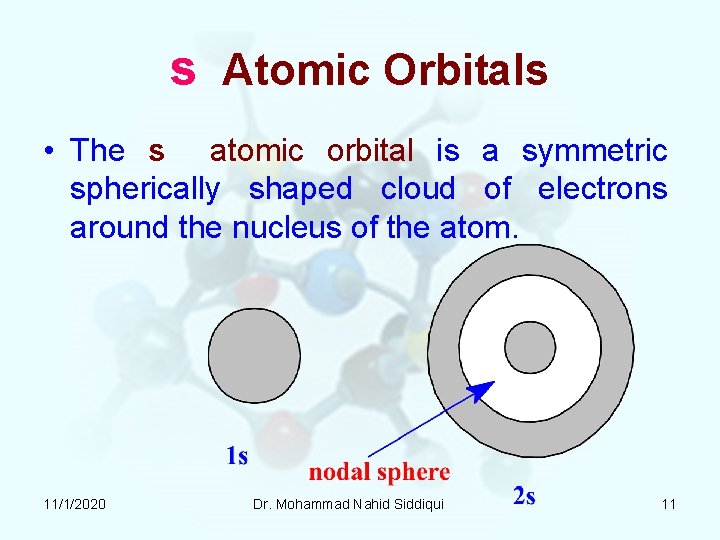
s Atomic Orbitals • The s atomic orbital is a symmetric spherically shaped cloud of electrons around the nucleus of the atom. 11/1/2020 Dr. Mohammad Nahid Siddiqui 11
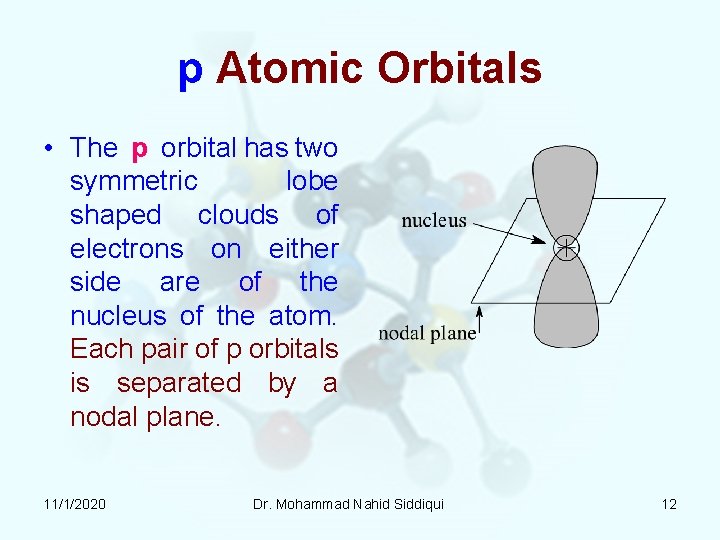
p Atomic Orbitals • The p orbital has two symmetric lobe shaped clouds of electrons on either side are of the nucleus of the atom. Each pair of p orbitals is separated by a nodal plane. 11/1/2020 Dr. Mohammad Nahid Siddiqui 12
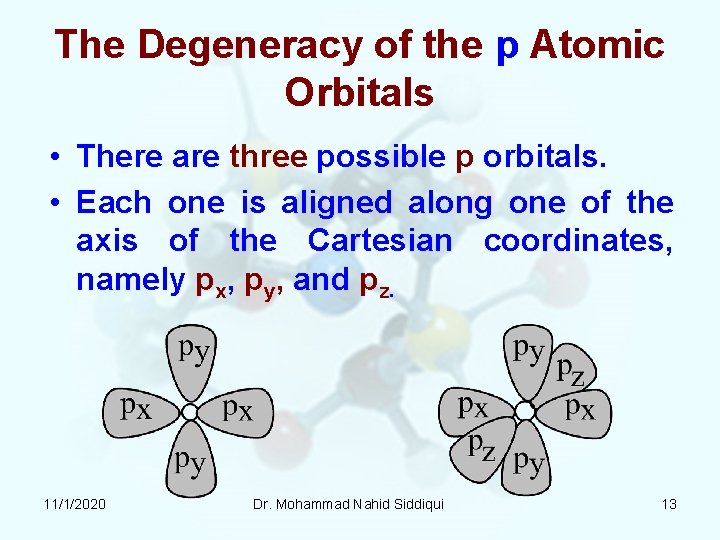
The Degeneracy of the p Atomic Orbitals • There are three possible p orbitals. • Each one is aligned along one of the axis of the Cartesian coordinates, namely px, py, and pz. 11/1/2020 Dr. Mohammad Nahid Siddiqui 13
Filling the Orbitals • Electrons have spin. • Since they have a charge they also have a magnetic moment. • The opposing magnetic moments minimize the repulsion between the negative charges. • Each atomic orbital band has two paired electrons. 11/1/2020 Dr. Mohammad Nahid Siddiqui 14
Aufbau Principle (building up) • The lowest energy orbitals are filled first with two paired electrons in each orbital period (1 s, 2 px, 2 py, 2 pz, 3 s, 3 p…. • The electronic structure of an atom is called the electronic configuration. • An example of a configuration is 1 s 2 2 s 1, which is the electronic configuration for lithium. 11/1/2020 Dr. Mohammad Nahid Siddiqui 15
Hund’s Rule • Degenerate orbitals receive one electron at a time until they are all filled, then a second electron is added to each orbital. • For example carbon has an electronic configuration 1 s 22 px 12 py 1 • Please see the table on the following slide. 11/1/2020 Dr. Mohammad Nahid Siddiqui 16
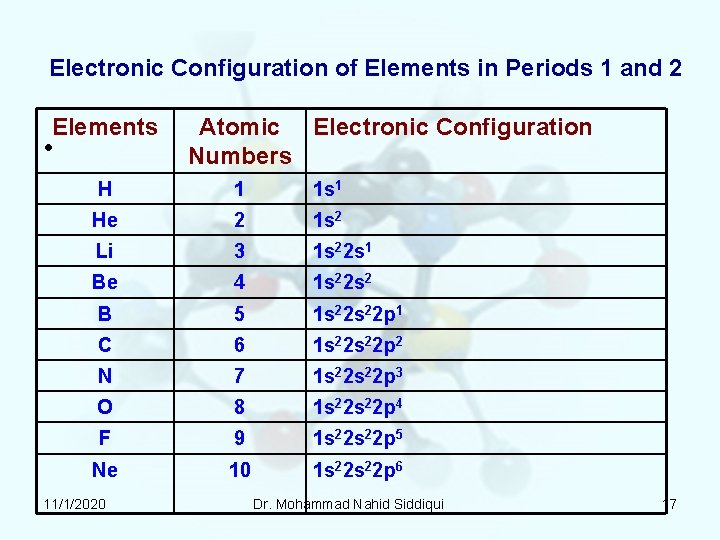
Electronic Configuration of Elements in Periods 1 and 2 Elements • Atomic Electronic Configuration Numbers H 1 1 s 1 He 2 1 s 2 Li 3 1 s 22 s 1 Be 4 1 s 22 s 2 B 5 1 s 22 p 1 C 6 1 s 22 p 2 N 7 1 s 22 p 3 O 8 1 s 22 p 4 F 9 1 s 22 p 5 Ne 10 1 s 22 p 6 11/1/2020 Dr. Mohammad Nahid Siddiqui 17
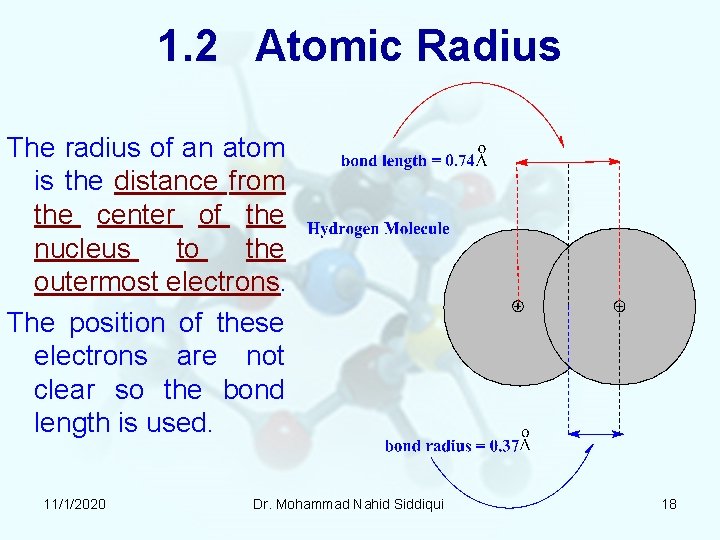
1. 2 Atomic Radius The radius of an atom is the distance from the center of the nucleus to the outermost electrons. The position of these electrons are not clear so the bond length is used. 11/1/2020 Dr. Mohammad Nahid Siddiqui 18
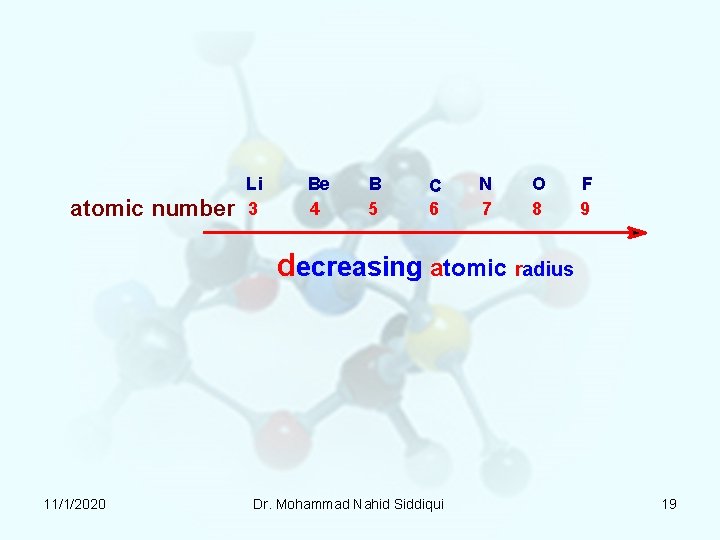
atomic number Li 3 Be 4 B 5 C 6 N 7 O 8 F 9 decreasing atomic radius 11/1/2020 Dr. Mohammad Nahid Siddiqui 19
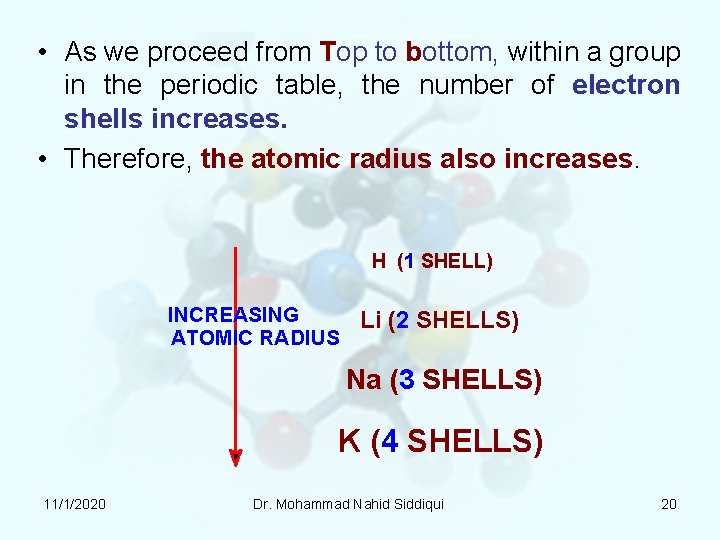
• As we proceed from Top to bottom, within a group in the periodic table, the number of electron shells increases. • Therefore, the atomic radius also increases. H (1 SHELL) INCREASING Li (2 SHELLS) ATOMIC RADIUS Na (3 SHELLS) K (4 SHELLS) 11/1/2020 Dr. Mohammad Nahid Siddiqui 20
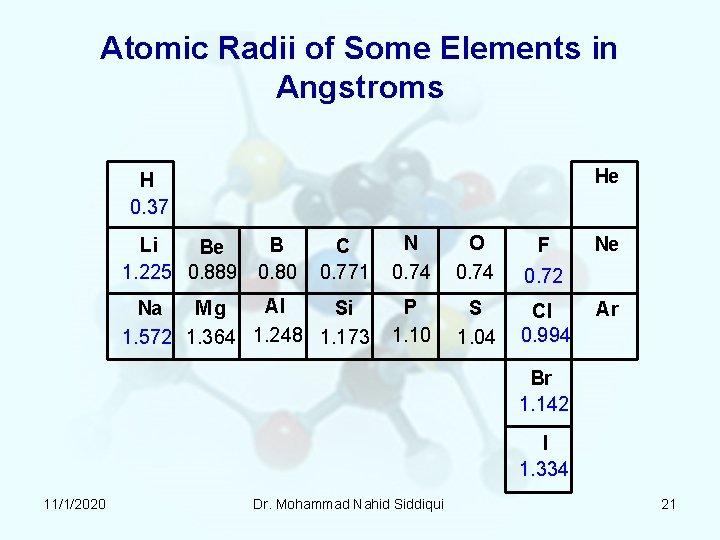
Atomic Radii of Some Elements in Angstroms He H 0. 37 C 0. 771 N 0. 74 O 0. 74 0. 72 Al Na Mg Si 1. 572 1. 364 1. 248 1. 173 P 1. 10 S 1. 04 Cl 0. 994 Li Be 1. 225 0. 889 B 0. 80 F Ne Ar Br 1. 142 I 1. 334 11/1/2020 Dr. Mohammad Nahid Siddiqui 21
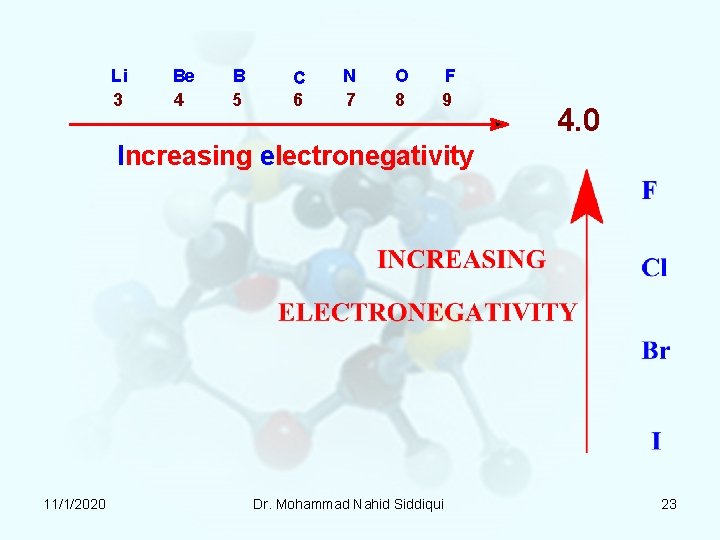
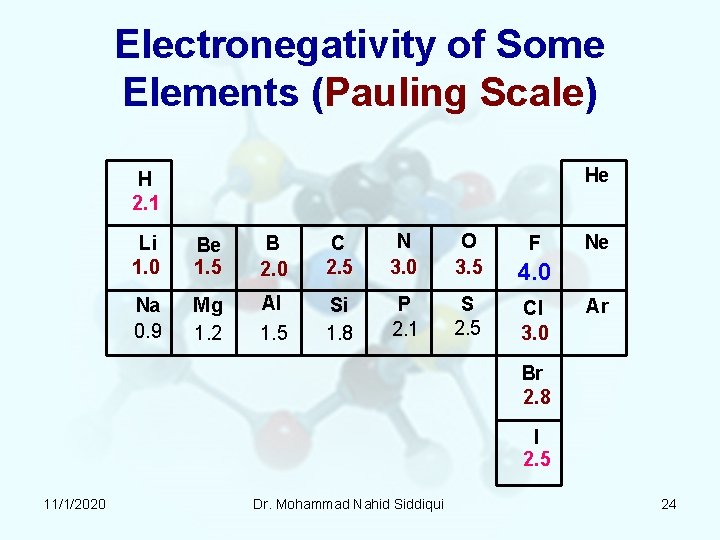
1. 3 Electronegativity • Electronegativity is a measure of the atoms attraction for its outer bonding electrons. • Electronegativity is affected by a number of protons in the nucleus and by the number of shells containing electrons. • Electronegativity increases as we go from left to right in a given period of the periodic table. 11/1/2020 Dr. Mohammad Nahid Siddiqui 22
Li 3 Be 4 B 5 C 6 N 7 O 8 F 9 4. 0 Increasing electronegativity 11/1/2020 Dr. Mohammad Nahid Siddiqui 23
Electronegativity of Some Elements (Pauling Scale) He H 2. 1 Li 1. 0 Be 1. 5 B 2. 0 C 2. 5 N 3. 0 O 3. 5 4. 0 Na 0. 9 Mg 1. 2 Al 1. 5 Si 1. 8 P 2. 1 S 2. 5 Cl 3. 0 F Ne Ar Br 2. 8 I 2. 5 11/1/2020 Dr. Mohammad Nahid Siddiqui 24
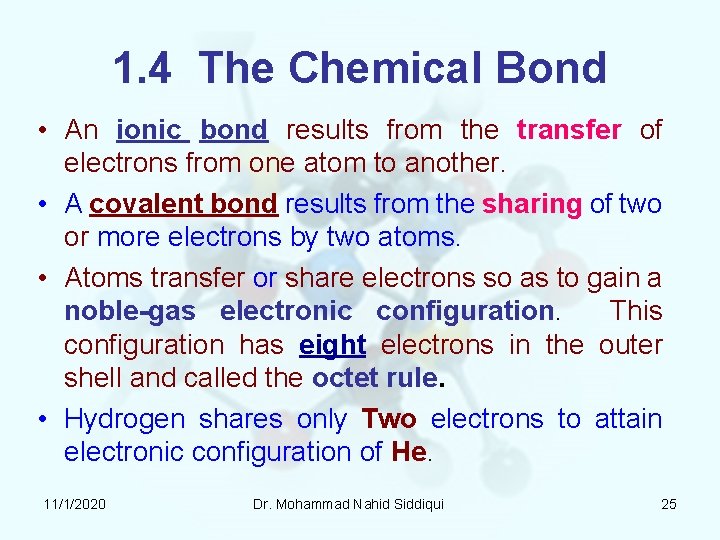
1. 4 The Chemical Bond • An ionic bond results from the transfer of electrons from one atom to another. • A covalent bond results from the sharing of two or more electrons by two atoms. • Atoms transfer or share electrons so as to gain a noble-gas electronic configuration. This configuration has eight electrons in the outer shell and called the octet rule. • Hydrogen shares only Two electrons to attain electronic configuration of He. 11/1/2020 Dr. Mohammad Nahid Siddiqui 25
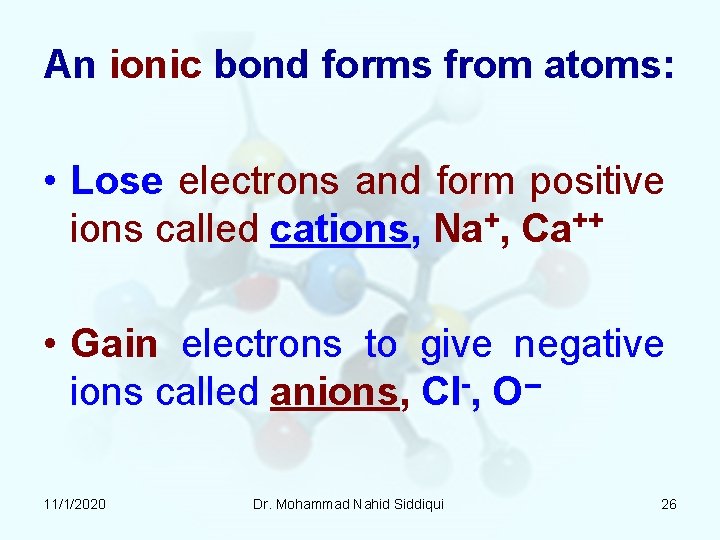
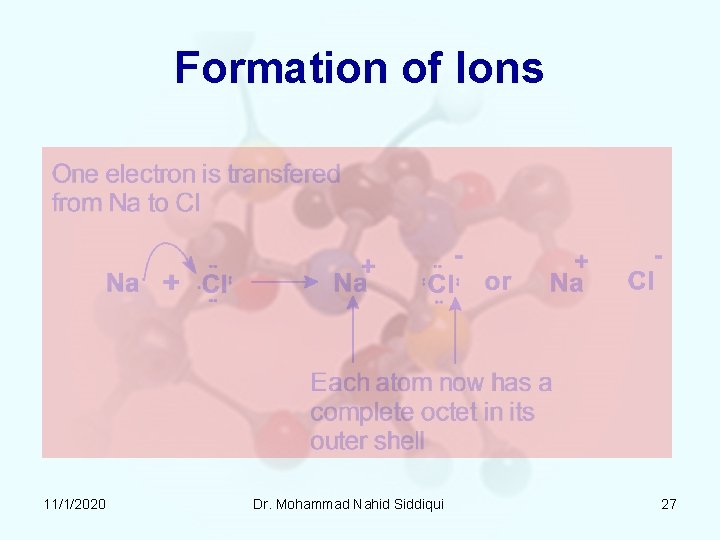
An ionic bond forms from atoms: • Lose electrons and form positive ions called cations, Na+, Ca++ • Gain electrons to give negative ions called anions, Cl-, O-11/1/2020 Dr. Mohammad Nahid Siddiqui 26
Formation of Ions 11/1/2020 Dr. Mohammad Nahid Siddiqui 27
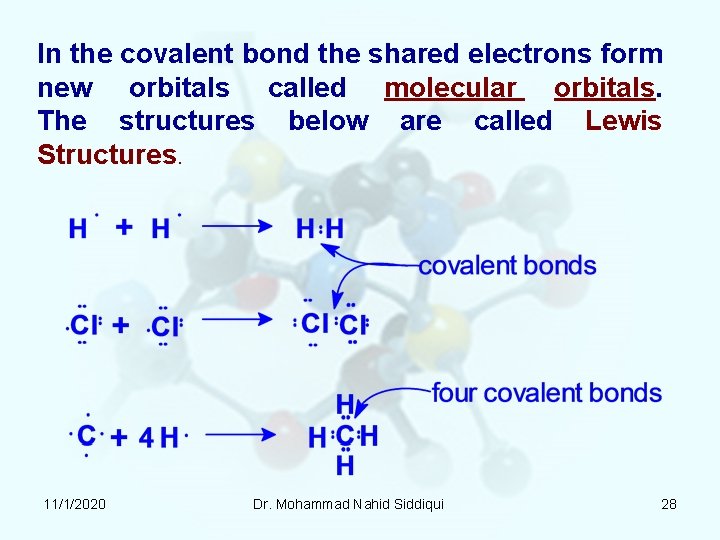
In the covalent bond the shared electrons form new orbitals called molecular orbitals. The structures below are called Lewis Structures. 11/1/2020 Dr. Mohammad Nahid Siddiqui 28
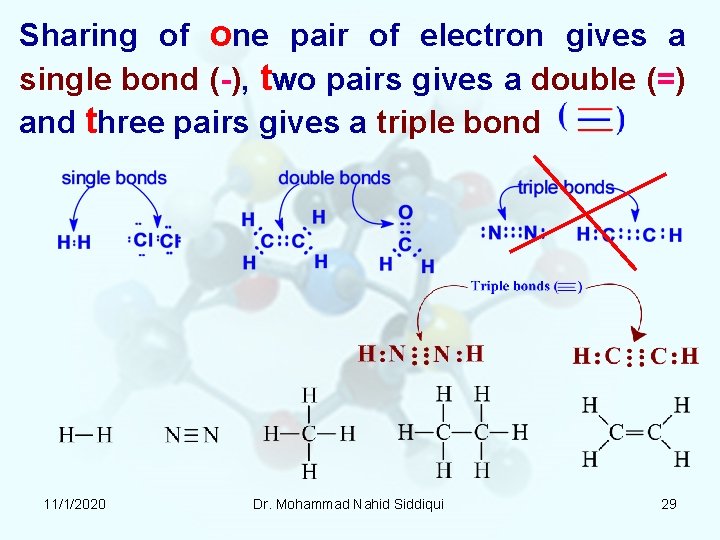
Sharing of one pair of electron gives a single bond (-), two pairs gives a double (=) and three pairs gives a triple bond 11/1/2020 Dr. Mohammad Nahid Siddiqui 29
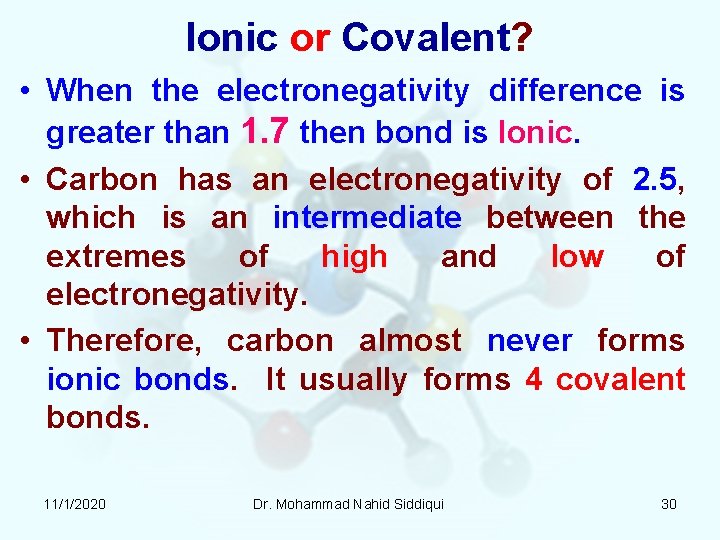
Ionic or Covalent? • When the electronegativity difference is greater than 1. 7 then bond is Ionic. • Carbon has an electronegativity of 2. 5, which is an intermediate between the extremes of high and low of electronegativity. • Therefore, carbon almost never forms ionic bonds. It usually forms 4 covalent bonds. 11/1/2020 Dr. Mohammad Nahid Siddiqui 30
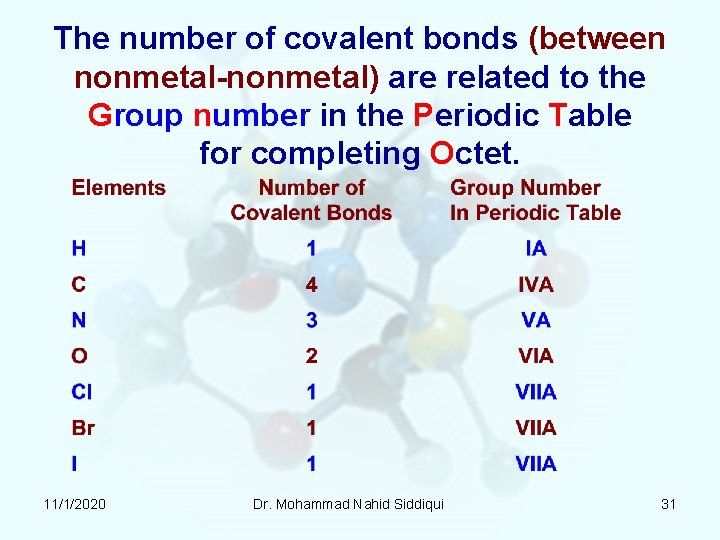
The number of covalent bonds (between nonmetal-nonmetal) are related to the Group number in the Periodic Table for completing Octet. 11/1/2020 Dr. Mohammad Nahid Siddiqui 31
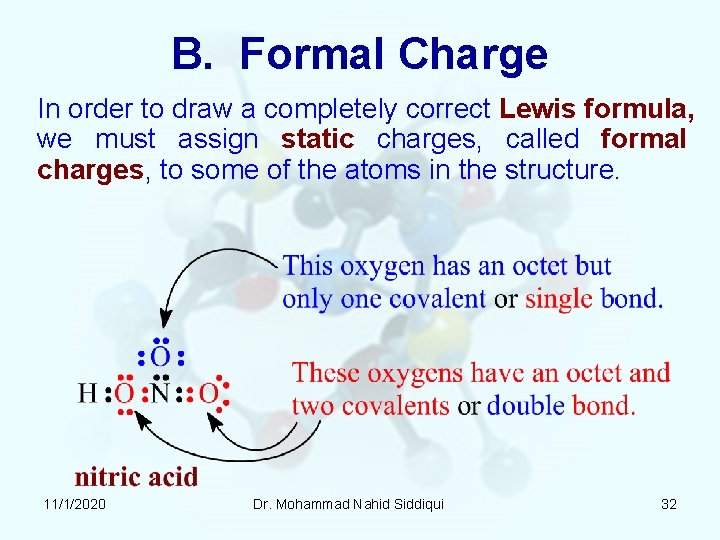
B. Formal Charge In order to draw a completely correct Lewis formula, we must assign static charges, called formal charges, to some of the atoms in the structure. 11/1/2020 Dr. Mohammad Nahid Siddiqui 32
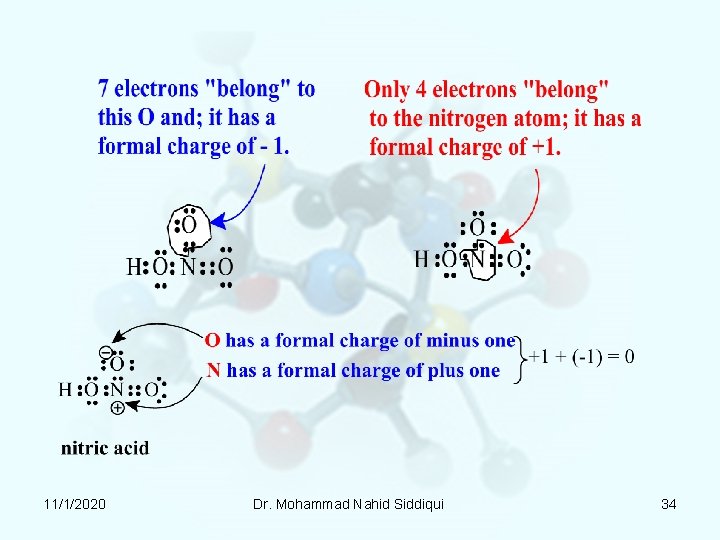
• The formula for nitric acid shows three oxygen atoms bonded to one nitrogen atom. • Each oxygen and nitrogen atom has a complete octet, but one oxygen atom is bonded by only one covalent bond instead of by the usual two. • If the two electrons in the N-O single bond were divided between the N and O, the O would have seven valence electrons one more electron than a neutral O atom has. • Therefore, this oxygen is assigned an electrostatic charge, formal charge, of – 1. 11/1/2020 Dr. Mohammad Nahid Siddiqui 33
11/1/2020 Dr. Mohammad Nahid Siddiqui 34
• Similarly, the N atom has only four valence electrons one fewer electron than a neutral N atom has. This electron-deficient nitrogen atom has a formal charge of +1. • The other atoms in nitric acid all have the same number of electrons as would their neutral atoms; their formal charges are all Zero. 11/1/2020 Dr. Mohammad Nahid Siddiqui 35
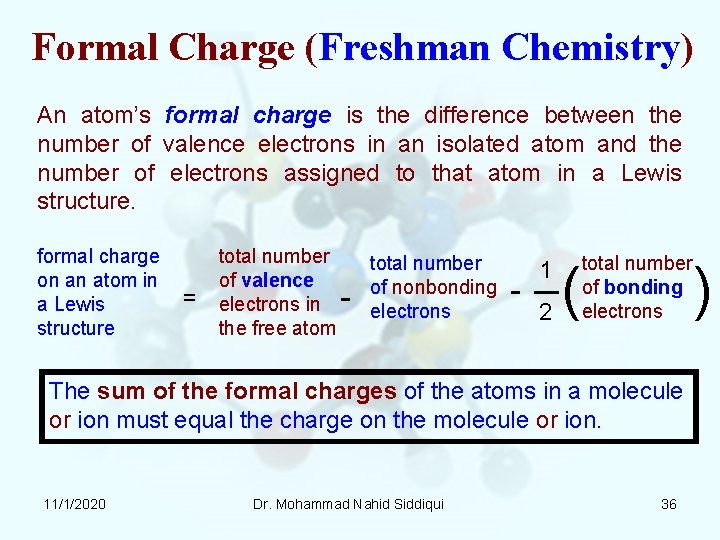
Formal Charge (Freshman Chemistry) An atom’s formal charge is the difference between the number of valence electrons in an isolated atom and the number of electrons assigned to that atom in a Lewis structure. formal charge on an atom in a Lewis structure = total number of valence electrons in the free atom - total number of nonbonding electrons - 1 2 ( total number of bonding electrons ) The sum of the formal charges of the atoms in a molecule or ion must equal the charge on the molecule or ion. 11/1/2020 Dr. Mohammad Nahid Siddiqui 36
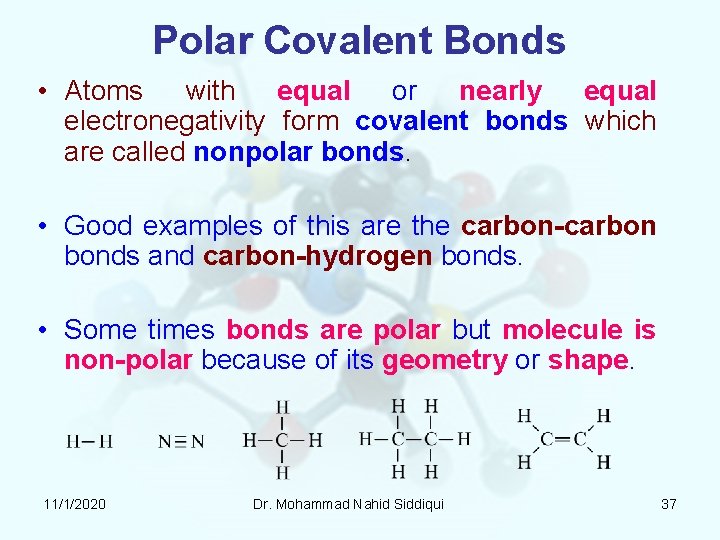
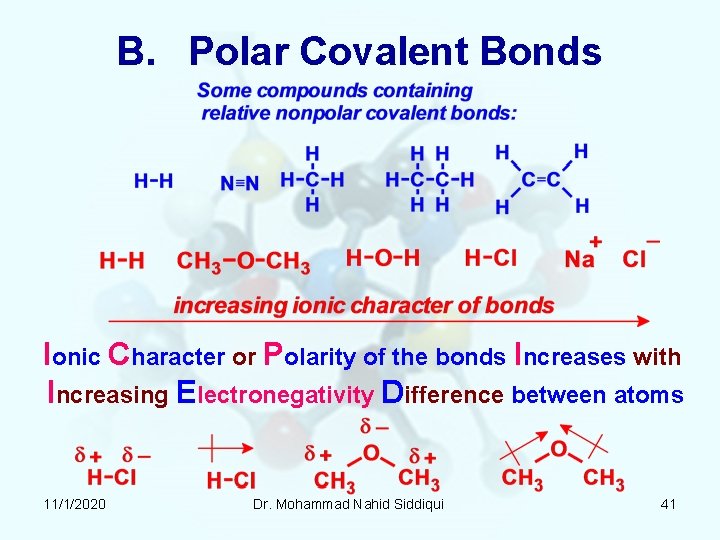
Polar Covalent Bonds • Atoms with equal or nearly equal electronegativity form covalent bonds which are called nonpolar bonds. • Good examples of this are the carbon-carbon bonds and carbon-hydrogen bonds. • Some times bonds are polar but molecule is non-polar because of its geometry or shape. 11/1/2020 Dr. Mohammad Nahid Siddiqui 37
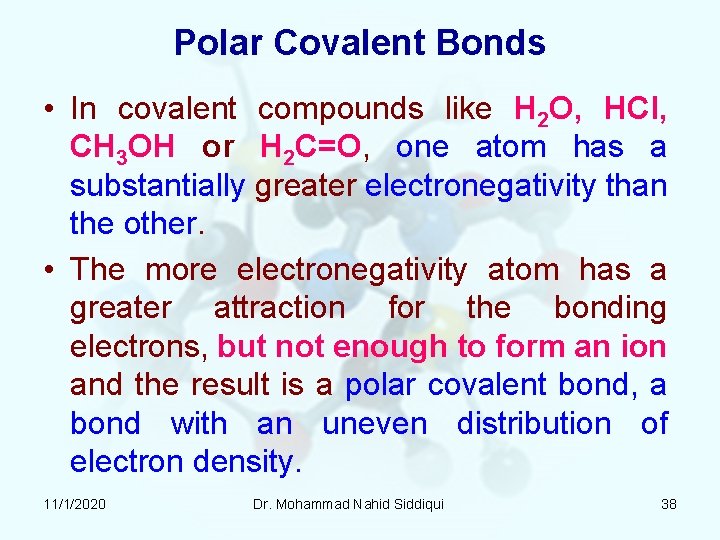
Polar Covalent Bonds • In covalent compounds like H 2 O, HCl, CH 3 OH or H 2 C=O, one atom has a substantially greater electronegativity than the other. • The more electronegativity atom has a greater attraction for the bonding electrons, but not enough to form an ion and the result is a polar covalent bond, a bond with an uneven distribution of electron density. 11/1/2020 Dr. Mohammad Nahid Siddiqui 38
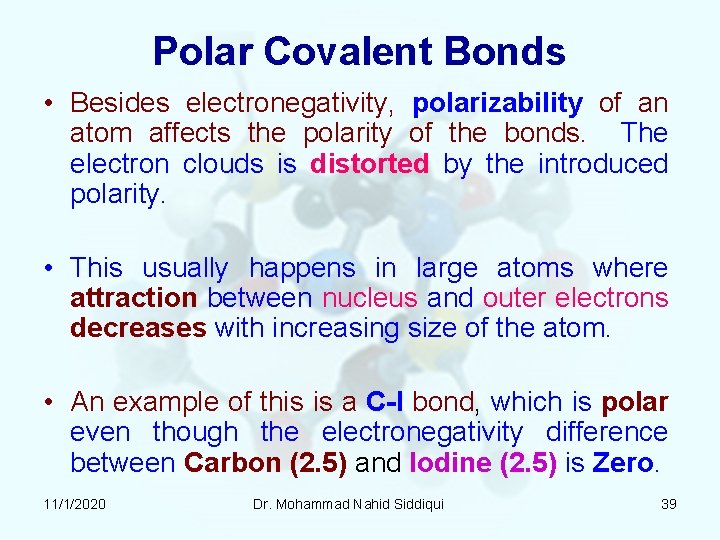
Polar Covalent Bonds • Besides electronegativity, polarizability of an atom affects the polarity of the bonds. The electron clouds is distorted by the introduced polarity. • This usually happens in large atoms where attraction between nucleus and outer electrons decreases with increasing size of the atom. • An example of this is a C-I bond, which is polar even though the electronegativity difference between Carbon (2. 5) and Iodine (2. 5) is Zero. 11/1/2020 Dr. Mohammad Nahid Siddiqui 39
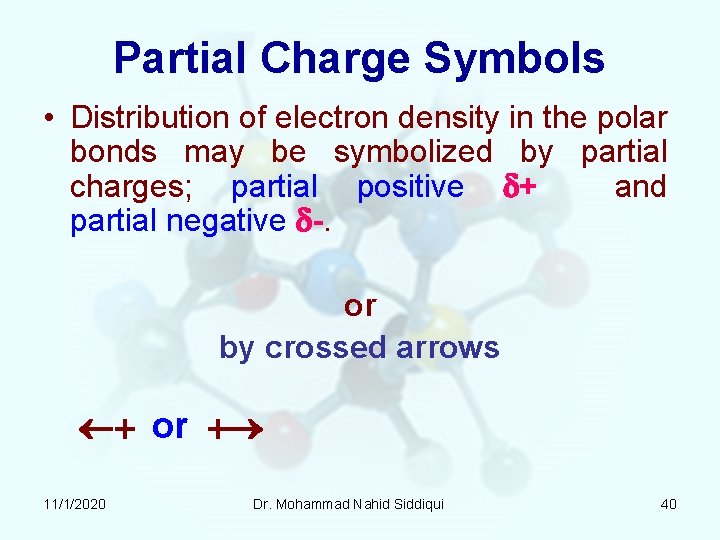
Partial Charge Symbols • Distribution of electron density in the polar bonds may be symbolized by partial charges; partial positive d+ and partial negative d-. or by crossed arrows or 11/1/2020 Dr. Mohammad Nahid Siddiqui 40
B. Polar Covalent Bonds Ionic Character or Polarity of the bonds Increases with Increasing Electronegativity Difference between atoms 11/1/2020 Dr. Mohammad Nahid Siddiqui 41
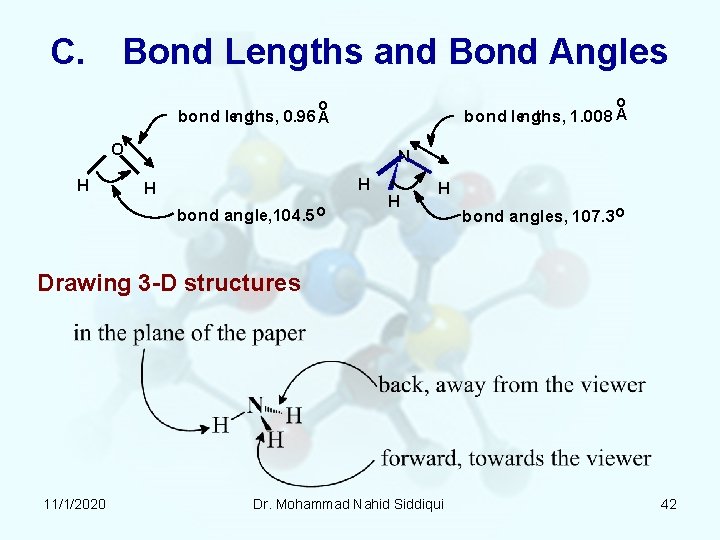
C. Bond Lengths and Bond Angles o bond lengths, 1. 008 A o bond lengths, 0. 96 A O H N H H bond angle, 104. 5 o H H bond angles, 107. 3 o Drawing 3 -D structures 11/1/2020 Dr. Mohammad Nahid Siddiqui 42
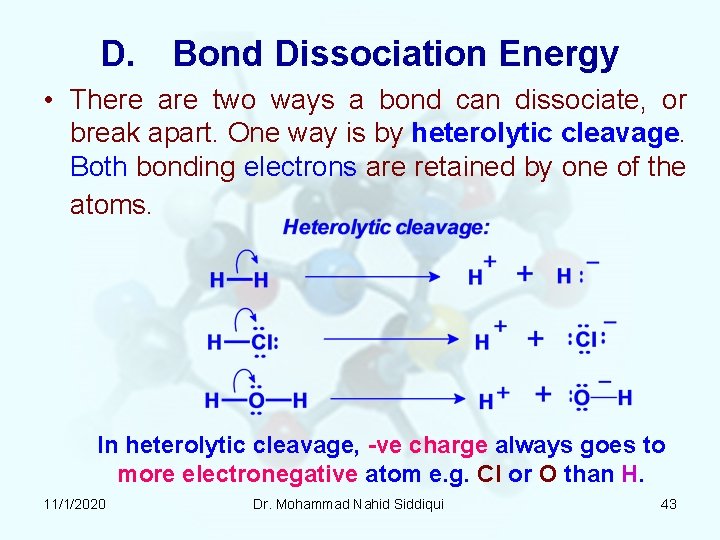
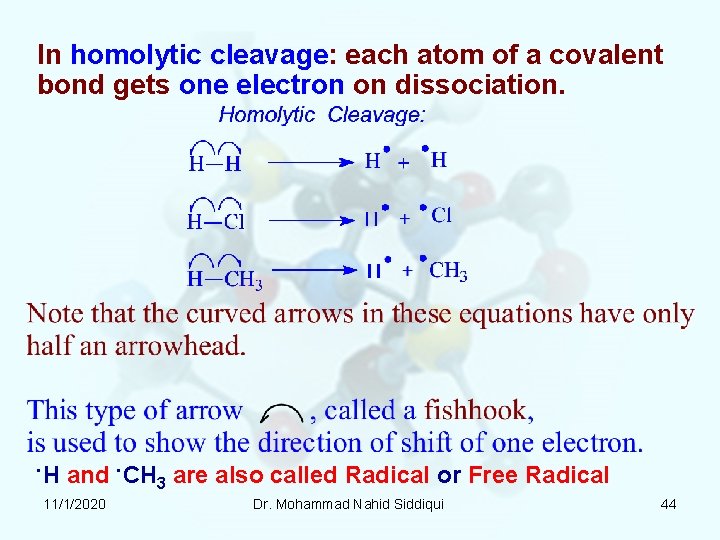
D. Bond Dissociation Energy • There are two ways a bond can dissociate, or break apart. One way is by heterolytic cleavage. Both bonding electrons are retained by one of the atoms. In heterolytic cleavage, -ve charge always goes to more electronegative atom e. g. Cl or O than H. 11/1/2020 Dr. Mohammad Nahid Siddiqui 43
In homolytic cleavage: each atom of a covalent bond gets one electron on dissociation. . H and. CH are also called Radical or Free Radical 3 11/1/2020 Dr. Mohammad Nahid Siddiqui 44
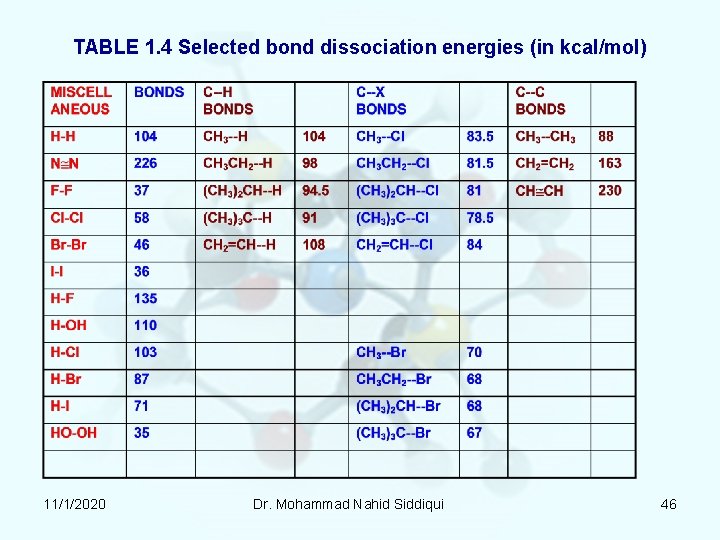
Enthalpy ∆H The change in enthalpy ∆H (change in heat content or energy) has been calculated for a large number of bond dissociations. 11/1/2020 Dr. Mohammad Nahid Siddiqui 45
TABLE 1. 4 Selected bond dissociation energies (in kcal/mol) 11/1/2020 Dr. Mohammad Nahid Siddiqui 46
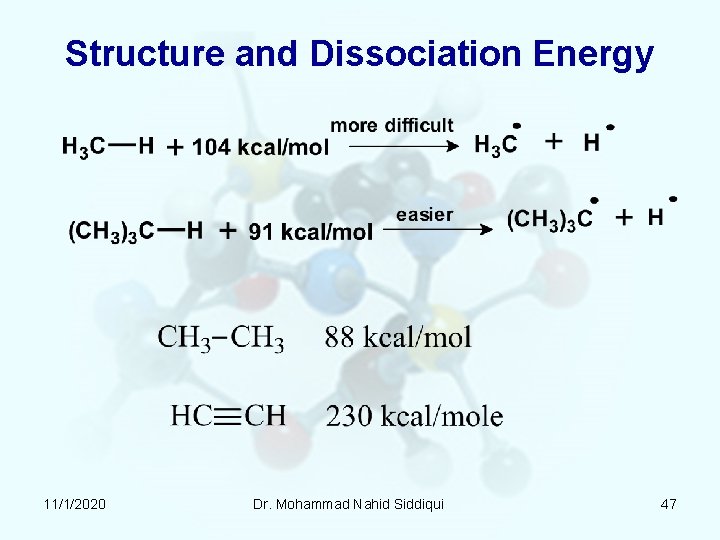
Structure and Dissociation Energy 11/1/2020 Dr. Mohammad Nahid Siddiqui 47
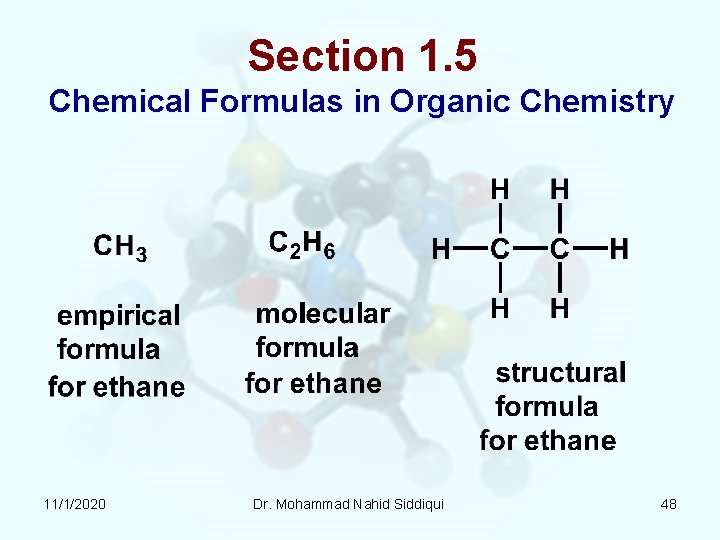
Section 1. 5 Chemical Formulas in Organic Chemistry 11/1/2020 Dr. Mohammad Nahid Siddiqui 48
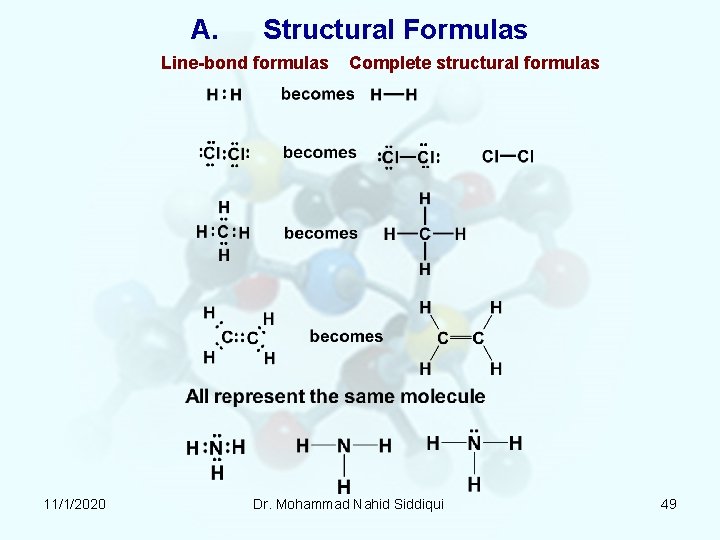
A. Structural Formulas Line-bond formulas 11/1/2020 Complete structural formulas Dr. Mohammad Nahid Siddiqui 49
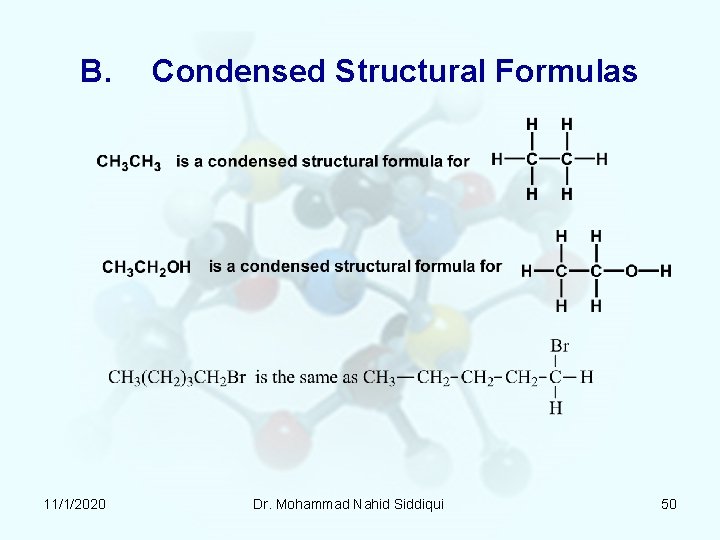
B. 11/1/2020 Condensed Structural Formulas Dr. Mohammad Nahid Siddiqui 50
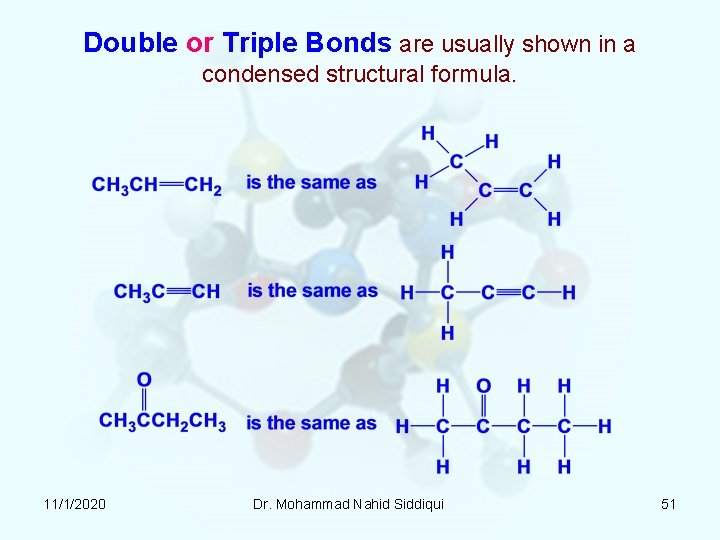
Double or Triple Bonds are usually shown in a condensed structural formula. 11/1/2020 Dr. Mohammad Nahid Siddiqui 51
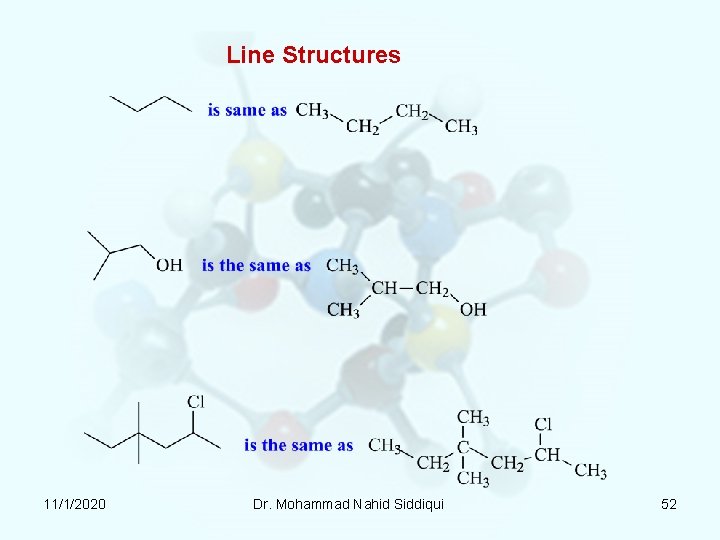
Line Structures 11/1/2020 Dr. Mohammad Nahid Siddiqui 52
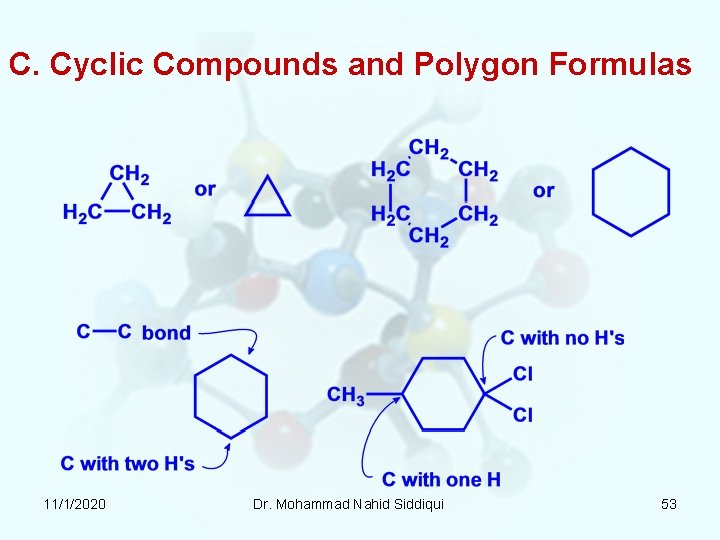
C. Cyclic Compounds and Polygon Formulas 11/1/2020 Dr. Mohammad Nahid Siddiqui 53
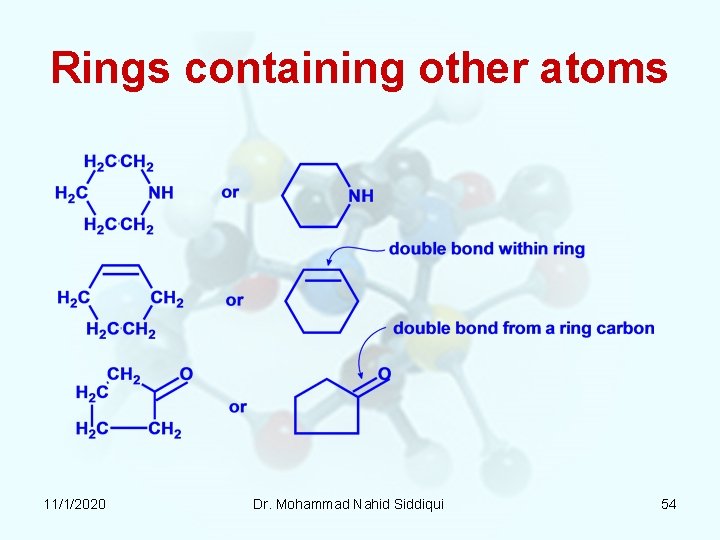
Rings containing other atoms 11/1/2020 Dr. Mohammad Nahid Siddiqui 54
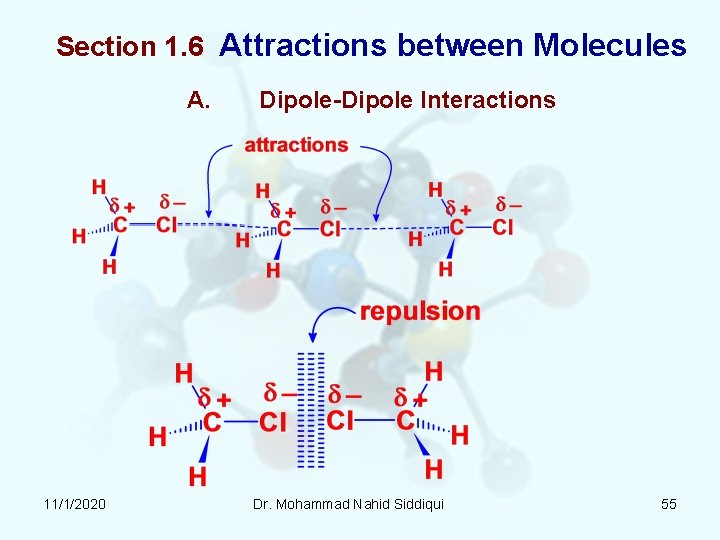
Section 1. 6 Attractions between Molecules A. 11/1/2020 Dipole-Dipole Interactions Dr. Mohammad Nahid Siddiqui 55
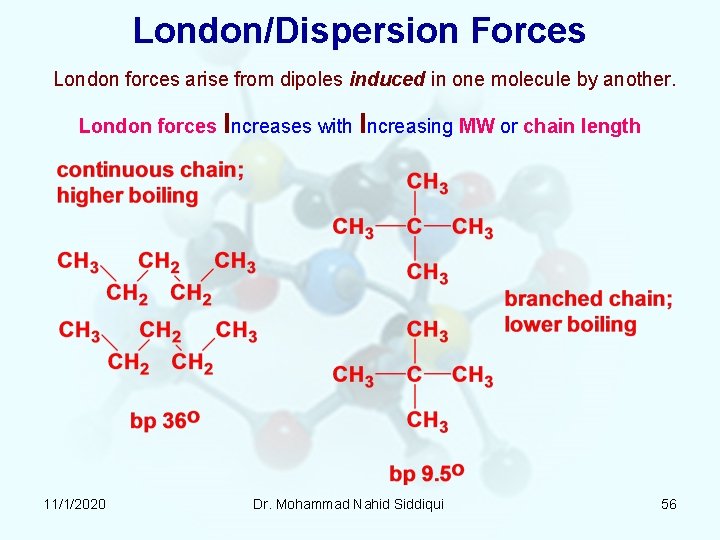
London/Dispersion Forces London forces arise from dipoles induced in one molecule by another. London forces Increases with Increasing MW or chain length 11/1/2020 Dr. Mohammad Nahid Siddiqui 56
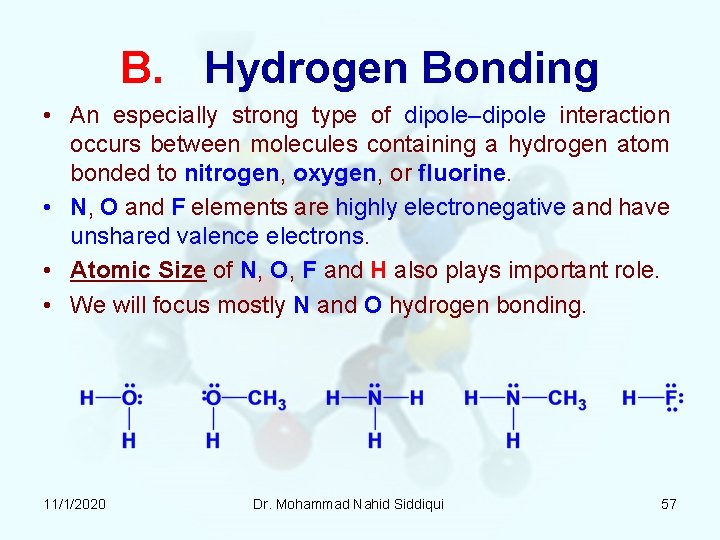
B. Hydrogen Bonding • An especially strong type of dipole–dipole interaction occurs between molecules containing a hydrogen atom bonded to nitrogen, oxygen, or fluorine. • N, O and F elements are highly electronegative and have unshared valence electrons. • Atomic Size of N, O, F and H also plays important role. • We will focus mostly N and O hydrogen bonding. 11/1/2020 Dr. Mohammad Nahid Siddiqui 57
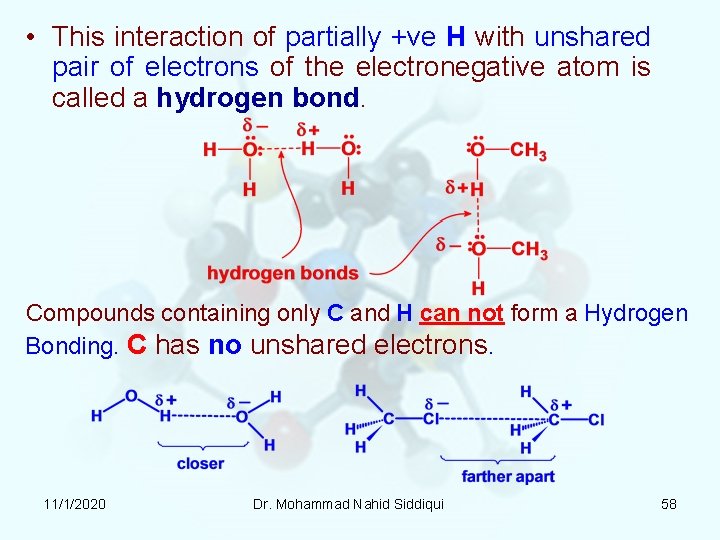
• This interaction of partially +ve H with unshared pair of electrons of the electronegative atom is called a hydrogen bond. Compounds containing only C and H can not form a Hydrogen Bonding. C has no unshared electrons. 11/1/2020 Dr. Mohammad Nahid Siddiqui 58
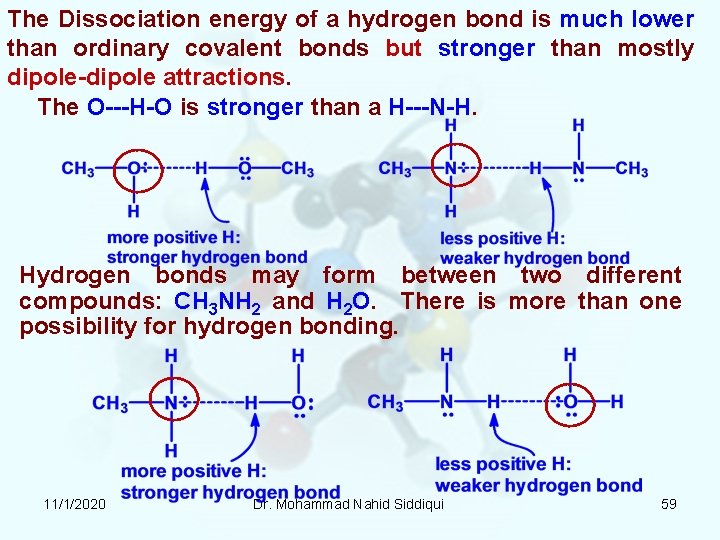
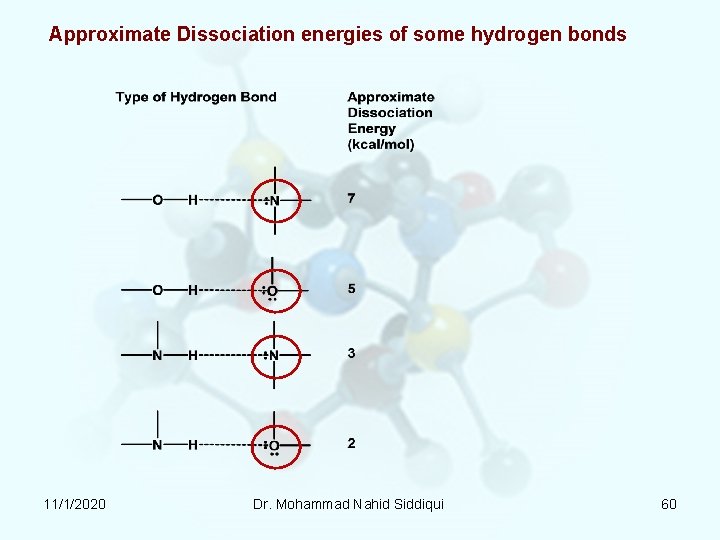
The Dissociation energy of a hydrogen bond is much lower than ordinary covalent bonds but stronger than mostly dipole-dipole attractions. The O---H-O is stronger than a H---N-H. Hydrogen bonds may form between two different compounds: CH 3 NH 2 and H 2 O. There is more than one possibility for hydrogen bonding. 11/1/2020 Dr. Mohammad Nahid Siddiqui 59
Approximate Dissociation energies of some hydrogen bonds 11/1/2020 Dr. Mohammad Nahid Siddiqui 60
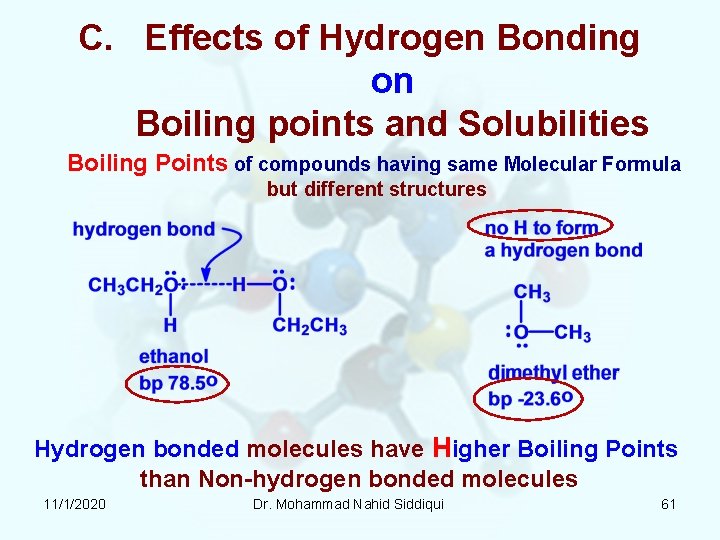
C. Effects of Hydrogen Bonding on Boiling points and Solubilities Boiling Points of compounds having same Molecular Formula but different structures Hydrogen bonded molecules have Higher Boiling Points than Non-hydrogen bonded molecules 11/1/2020 Dr. Mohammad Nahid Siddiqui 61
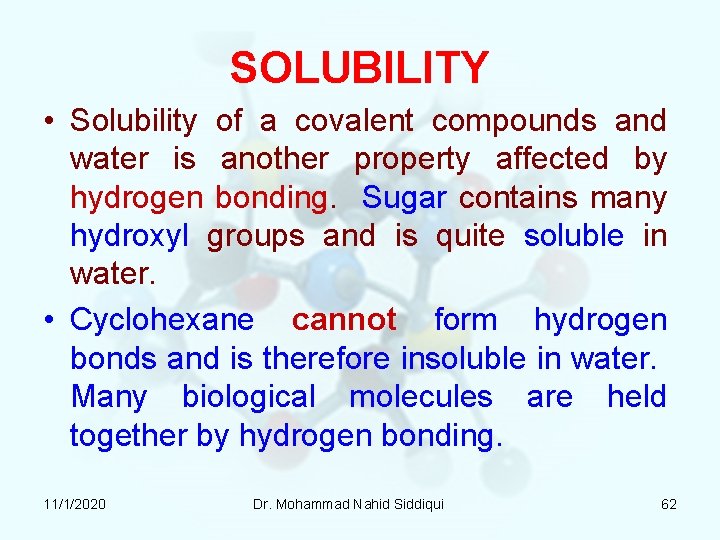
SOLUBILITY • Solubility of a covalent compounds and water is another property affected by hydrogen bonding. Sugar contains many hydroxyl groups and is quite soluble in water. • Cyclohexane cannot form hydrogen bonds and is therefore insoluble in water. Many biological molecules are held together by hydrogen bonding. 11/1/2020 Dr. Mohammad Nahid Siddiqui 62
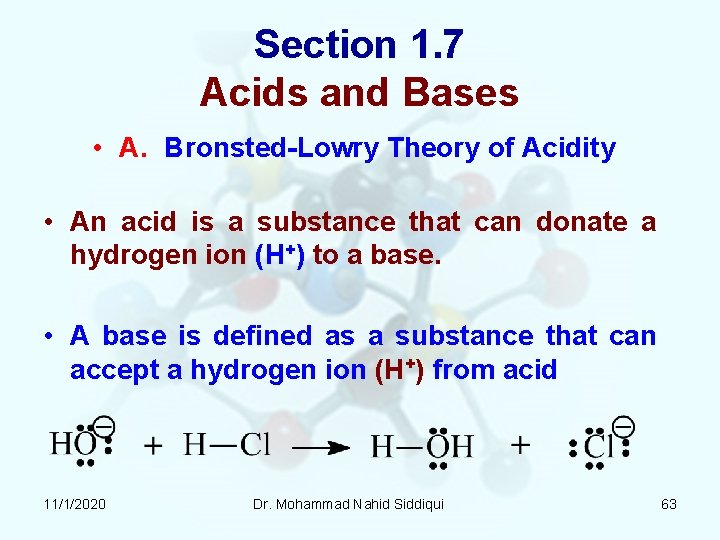
Section 1. 7 Acids and Bases • A. Bronsted-Lowry Theory of Acidity • An acid is a substance that can donate a hydrogen ion (H+) to a base. • A base is defined as a substance that can accept a hydrogen ion (H+) from acid 11/1/2020 Dr. Mohammad Nahid Siddiqui 63
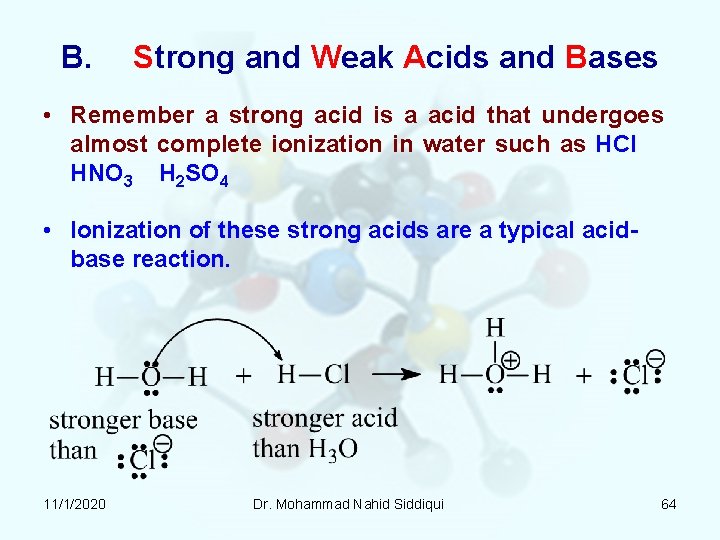
B. Strong and Weak Acids and Bases • Remember a strong acid is a acid that undergoes almost complete ionization in water such as HCl HNO 3 H 2 SO 4 • Ionization of these strong acids are a typical acidbase reaction. 11/1/2020 Dr. Mohammad Nahid Siddiqui 64
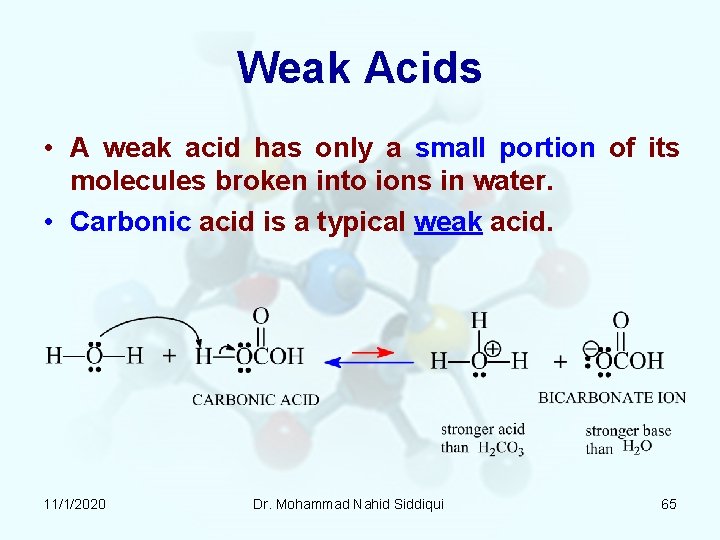
Weak Acids • A weak acid has only a small portion of its molecules broken into ions in water. • Carbonic acid is a typical weak acid. 11/1/2020 Dr. Mohammad Nahid Siddiqui 65
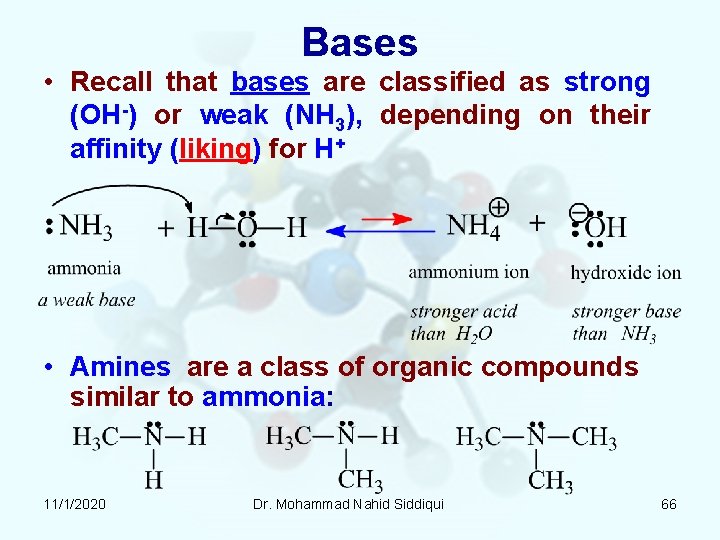
Bases • Recall that bases are classified as strong (OH-) or weak (NH 3), depending on their affinity (liking) for H+ • Amines are a class of organic compounds similar to ammonia: 11/1/2020 Dr. Mohammad Nahid Siddiqui 66
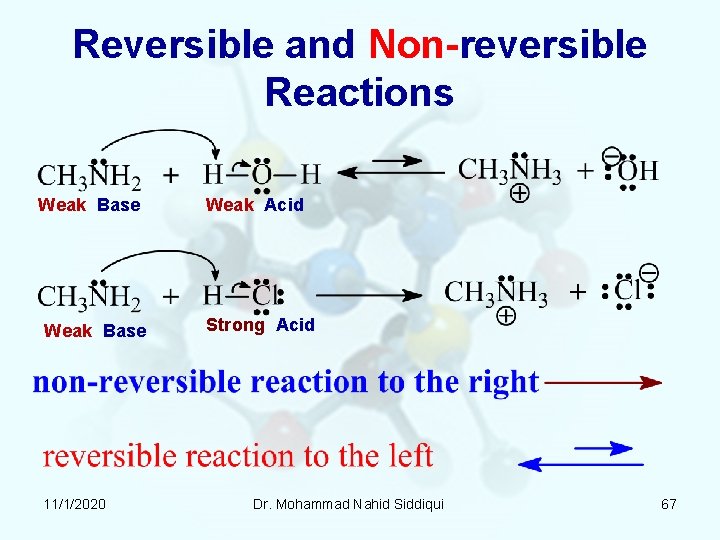
Reversible and Non-reversible Reactions Weak Base 11/1/2020 Weak Acid Strong Acid Dr. Mohammad Nahid Siddiqui 67
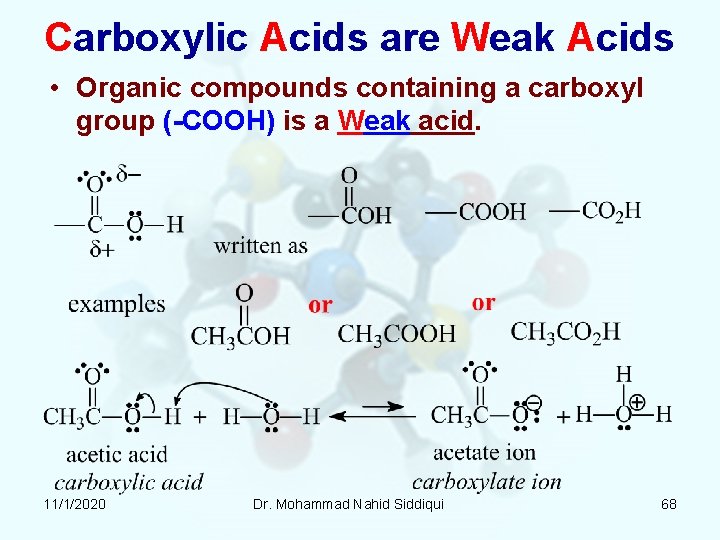
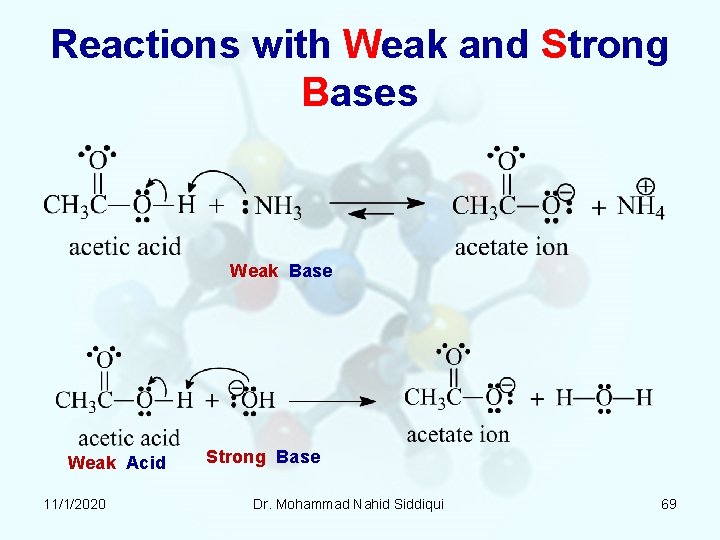
Carboxylic Acids are Weak Acids • Organic compounds containing a carboxyl group (-COOH) is a Weak acid. 11/1/2020 Dr. Mohammad Nahid Siddiqui 68
Reactions with Weak and Strong Bases Weak Base Weak Acid 11/1/2020 Strong Base Dr. Mohammad Nahid Siddiqui 69
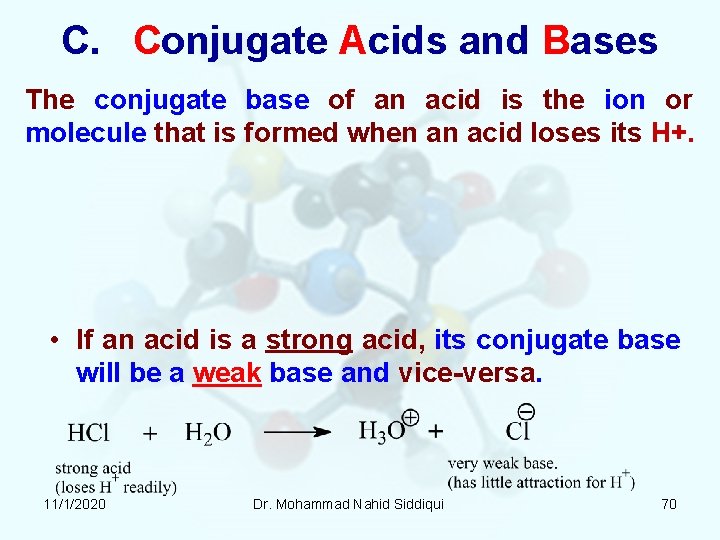
C. Conjugate Acids and Bases The conjugate base of an acid is the ion or molecule that is formed when an acid loses its H+. • If an acid is a strong acid, its conjugate base will be a weak base and vice-versa. 11/1/2020 Dr. Mohammad Nahid Siddiqui 70
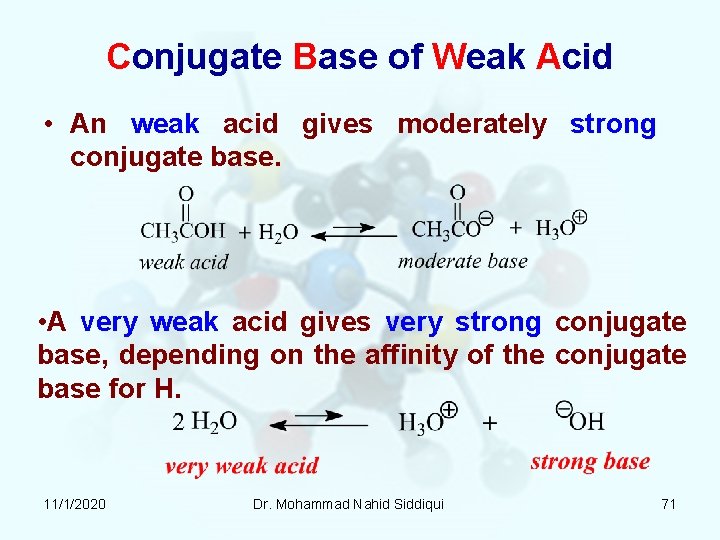
Conjugate Base of Weak Acid • An weak acid gives moderately strong conjugate base. • A very weak acid gives very strong conjugate base, depending on the affinity of the conjugate base for H. 11/1/2020 Dr. Mohammad Nahid Siddiqui 71
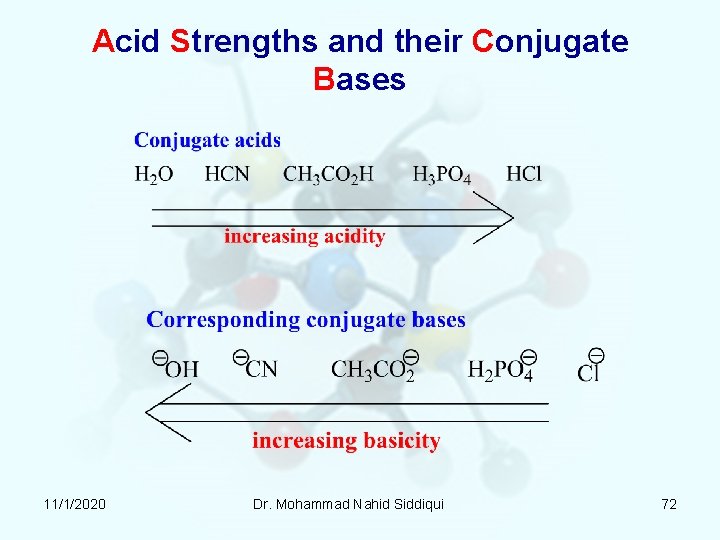
Acid Strengths and their Conjugate Bases 11/1/2020 Dr. Mohammad Nahid Siddiqui 72
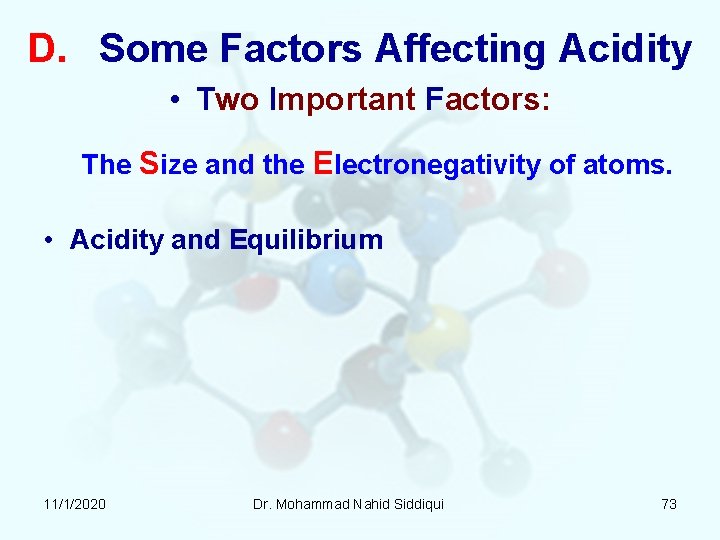
D. Some Factors Affecting Acidity • Two Important Factors: The Size and the Electronegativity of atoms. • Acidity and Equilibrium 11/1/2020 Dr. Mohammad Nahid Siddiqui 73
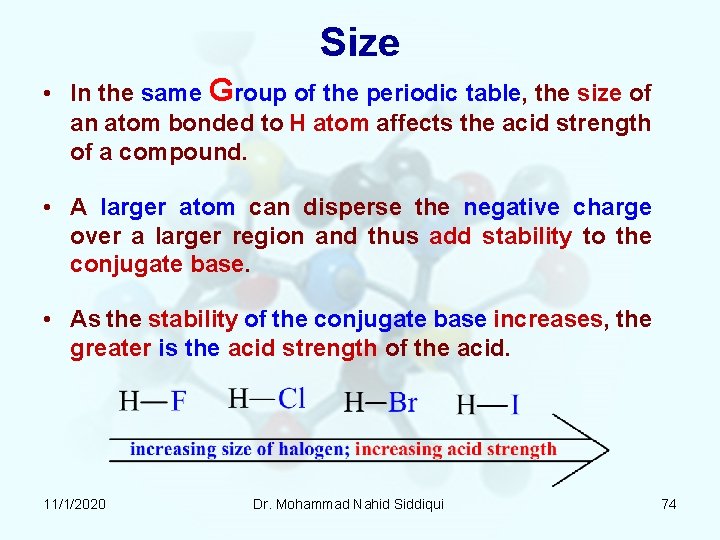
Size • In the same Group of the periodic table, the size of an atom bonded to H atom affects the acid strength of a compound. • A larger atom can disperse the negative charge over a larger region and thus add stability to the conjugate base. • As the stability of the conjugate base increases, the greater is the acid strength of the acid. 11/1/2020 Dr. Mohammad Nahid Siddiqui 74
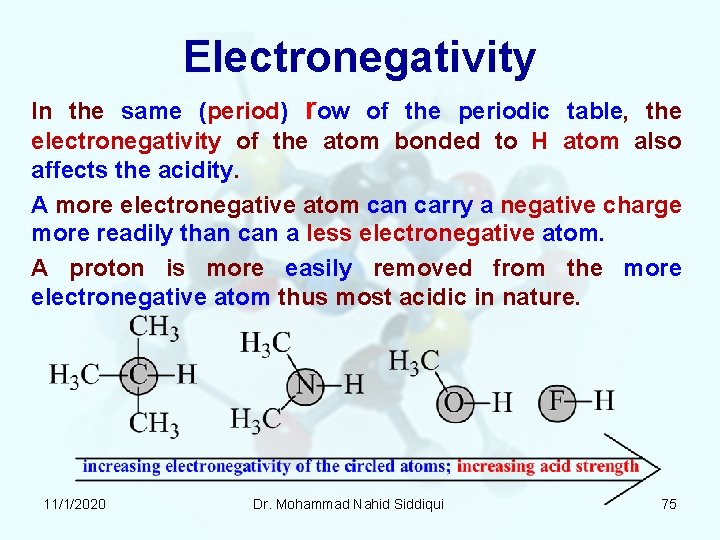
Electronegativity In the same (period) row of the periodic table, the electronegativity of the atom bonded to H atom also affects the acidity. A more electronegative atom can carry a negative charge more readily than can a less electronegative atom. A proton is more easily removed from the more electronegative atom thus most acidic in nature. 11/1/2020 Dr. Mohammad Nahid Siddiqui 75
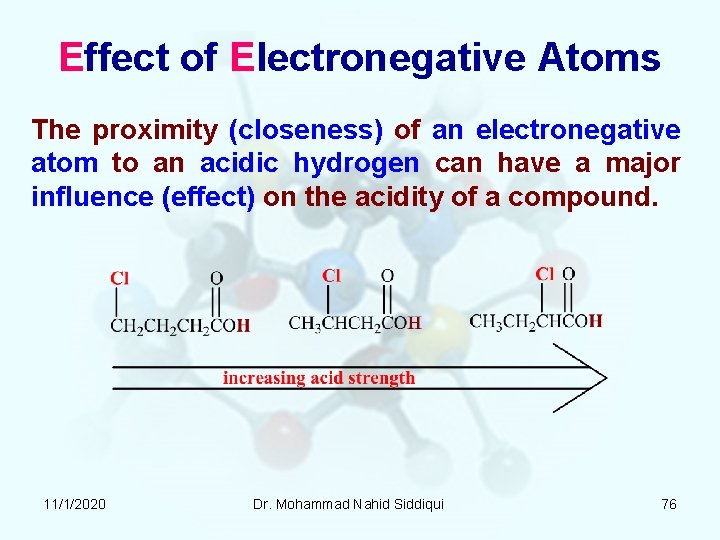
Effect of Electronegative Atoms The proximity (closeness) of an electronegative atom to an acidic hydrogen can have a major influence (effect) on the acidity of a compound. 11/1/2020 Dr. Mohammad Nahid Siddiqui 76
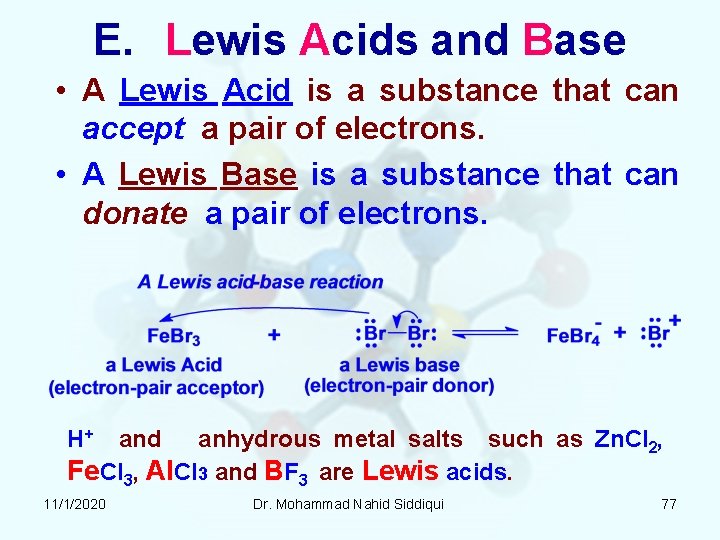
E. Lewis Acids and Base • A Lewis Acid is a substance that can accept a pair of electrons. • A Lewis Base is a substance that can donate a pair of electrons. H+ and anhydrous metal salts such as Zn. Cl 2, Fe. Cl 3, Al. Cl 3 and BF 3 are Lewis acids. 11/1/2020 Dr. Mohammad Nahid Siddiqui 77
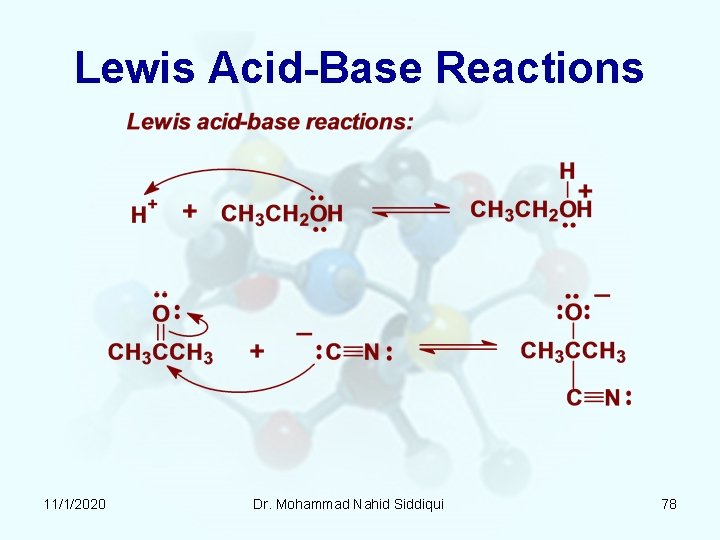
Lewis Acid-Base Reactions 11/1/2020 Dr. Mohammad Nahid Siddiqui 78
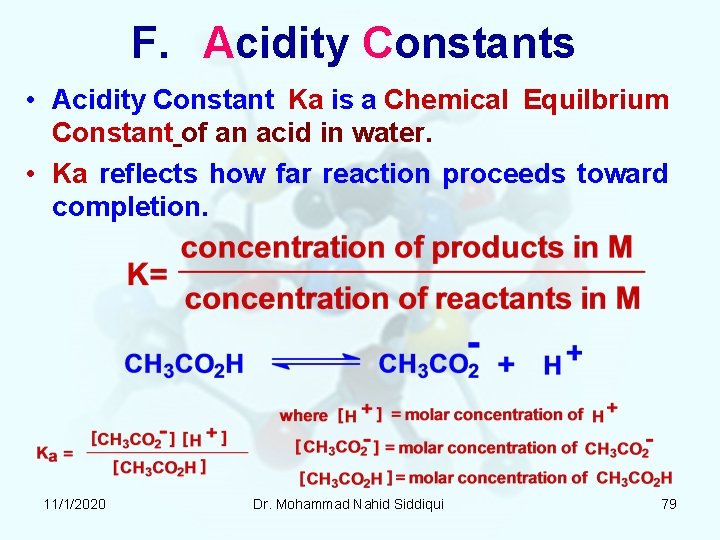
F. Acidity Constants • Acidity Constant Ka is a Chemical Equilbrium Constant of an acid in water. • Ka reflects how far reaction proceeds toward completion. 11/1/2020 Dr. Mohammad Nahid Siddiqui 79
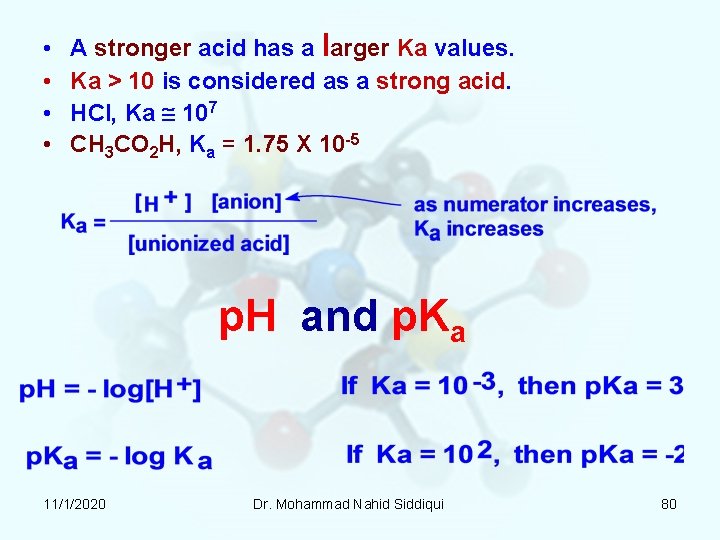
• • A stronger acid has a larger Ka values. Ka > 10 is considered as a strong acid. HCl, Ka 107 CH 3 CO 2 H, Ka = 1. 75 X 10 -5 p. H and p. Ka 11/1/2020 Dr. Mohammad Nahid Siddiqui 80
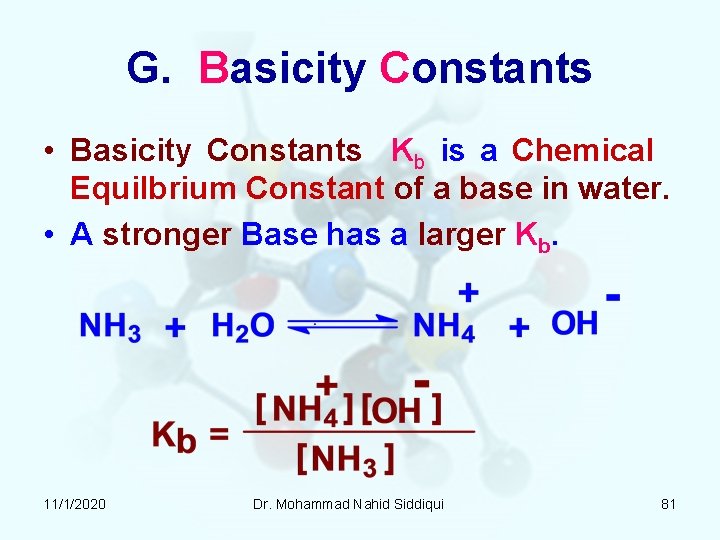
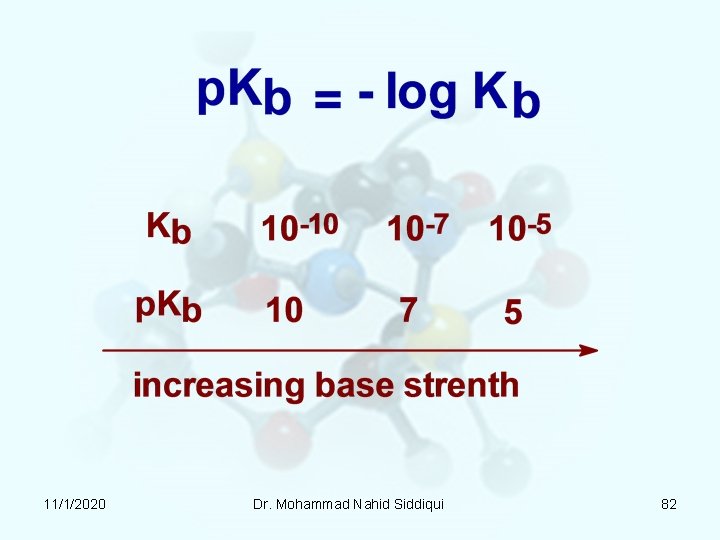
G. Basicity Constants • Basicity Constants Kb is a Chemical Equilbrium Constant of a base in water. • A stronger Base has a larger Kb. 11/1/2020 Dr. Mohammad Nahid Siddiqui 81
11/1/2020 Dr. Mohammad Nahid Siddiqui 82