Unit 12 Energy and Thermodynamics What is Energy



- Slides: 74
Unit 12: Energy and Thermodynamics
What is Energy? Energy is the ability to do work or produce heat. There are two types of energy: • • • Potential Energy – Energy of position Kinetic Energy – Energy of motion Law of Conservation of Energy: energy can be converted from one form to another but can be neither created nor destroyed Thermodynamics is the science of heat, temperature, and of the laws governing the conversion of thermal energy into mechanical, electrical, or other forms of energy.
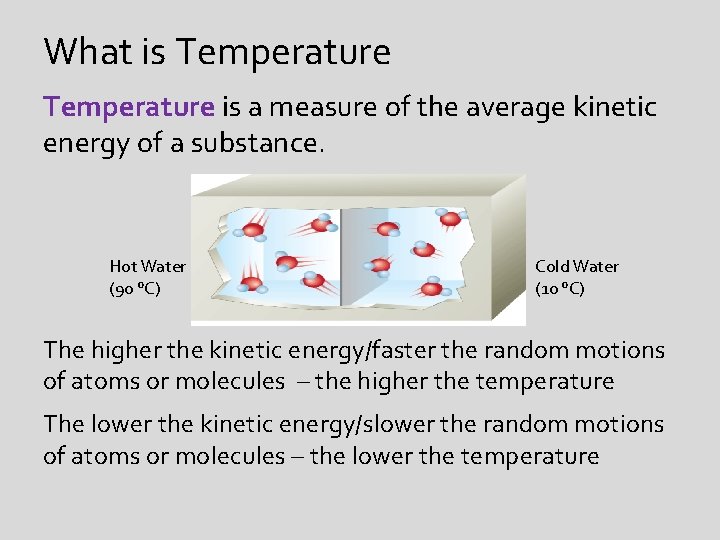
What is Temperature is a measure of the average kinetic energy of a substance. Hot Water (90 °C) Cold Water (10 °C) The higher the kinetic energy/faster the random motions of atoms or molecules – the higher the temperature The lower the kinetic energy/slower the random motions of atoms or molecules – the lower the temperature
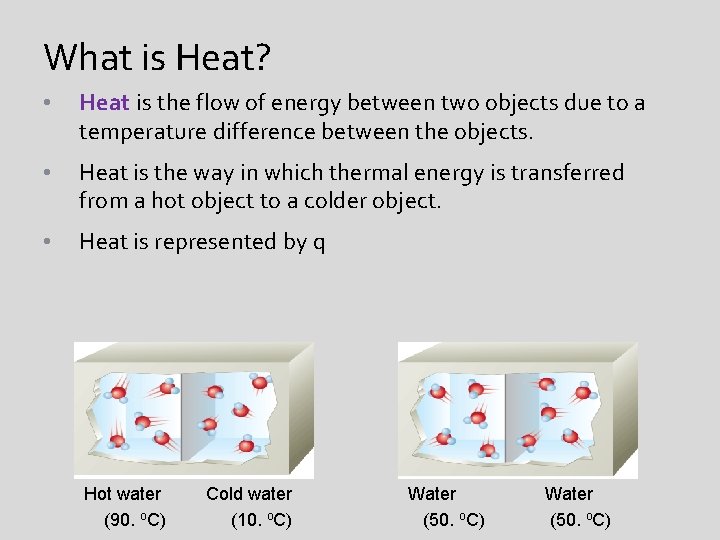
What is Heat? • Heat is the flow of energy between two objects due to a temperature difference between the objects. • Heat is the way in which thermal energy is transferred from a hot object to a colder object. • Heat is represented by q Hot water Cold water (90. o. C) (10. o. C) Water (50. o. C) (50. o. C)
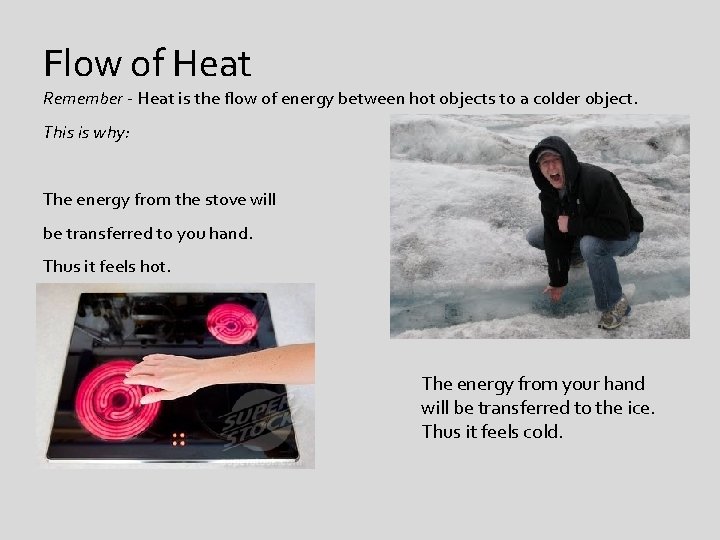
Flow of Heat Remember - Heat is the flow of energy between hot objects to a colder object. This is why: The energy from the stove will be transferred to you hand. Thus it feels hot. The energy from your hand will be transferred to the ice. Thus it feels cold.
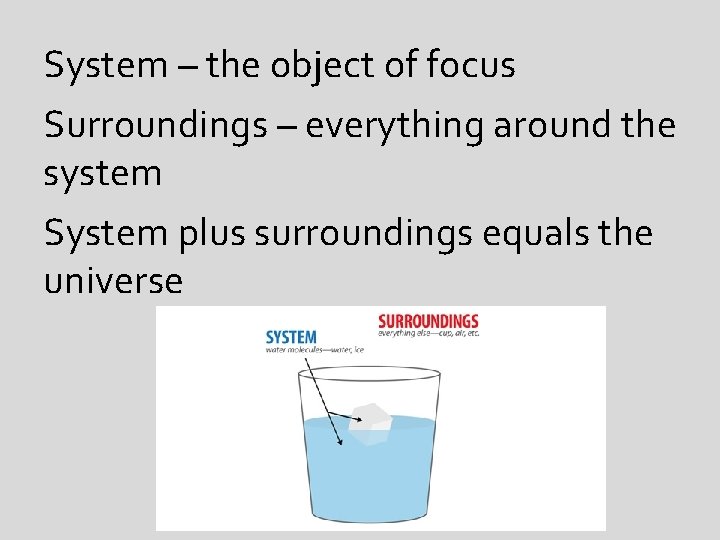
System – the object of focus Surroundings – everything around the system System plus surroundings equals the universe
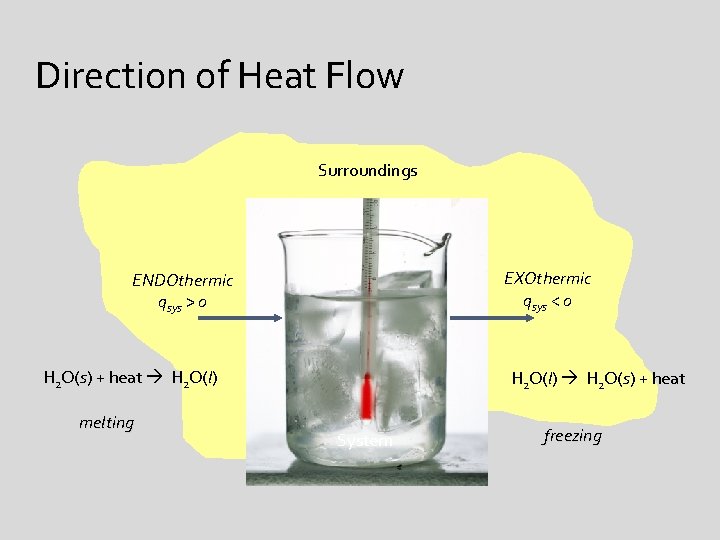
Exothermic and Endothermic Processes • Exothermic – energy flows out of the system to the surroundings • Feels hot because energy is escaping system. • Endothermic – energy flow into the system from the surroundings • Feels cold because energy is leaving you and entering the system.
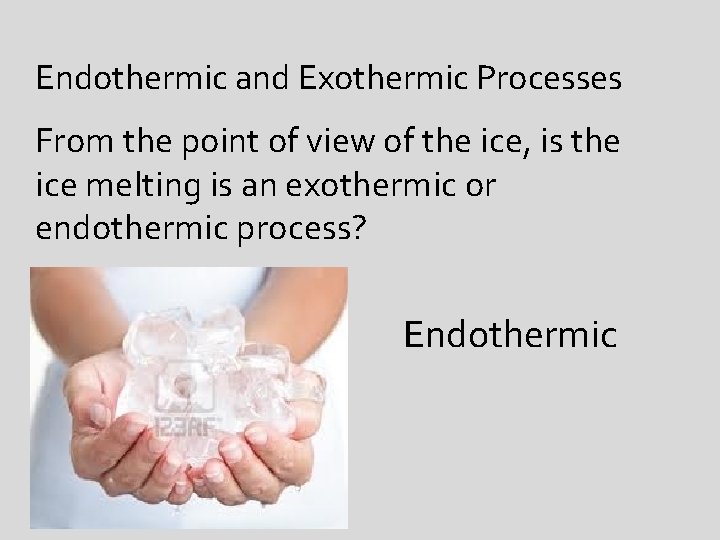
Endothermic and Exothermic Processes From the point of view of the ice, is the ice melting is an exothermic or endothermic process? Endothermic
Endothermic and Exothermic Processes Boiling water on a stove Endothermic
Direction of Heat Flow Surroundings ENDOthermic qsys > 0 System H 2 O(s) + heat H 2 O(l) melting EXOthermic qsys < 0 H 2 O(l) H 2 O(s) + heat System freezing
Energy in Reactions • Activation Energy- The minimum energy required in for a chemical reaction to occur • • • Once the reactants have gained enough energy (the activation energy), they are considered to be the activated complex • • • High activation energy slows the rate of reaction Low activation energy speeds up the rate of reaction The activated complex is an intermediate between reactants and products After the activated complex state, the products are formed Some of these reactions are reversible and the graphs can be read for the reverse reaction
Enthalpy- The amount of energy transferred between the system (the reaction) and the surroundings (how much energy is gained or lost) ΔH = Hproducts - Hreactants ΔH = + (endothermic) • More heat goes from surroundings into system ΔH = - (exothermic) • More heat leaves system and goes into surroundings • Energy is not created or destroyed just transferred between system and surroundings (Law of Conservation of Energy) • Enthalpy (∆H) is equal to heat energy (q) if pressure remains constant • q = ∆H
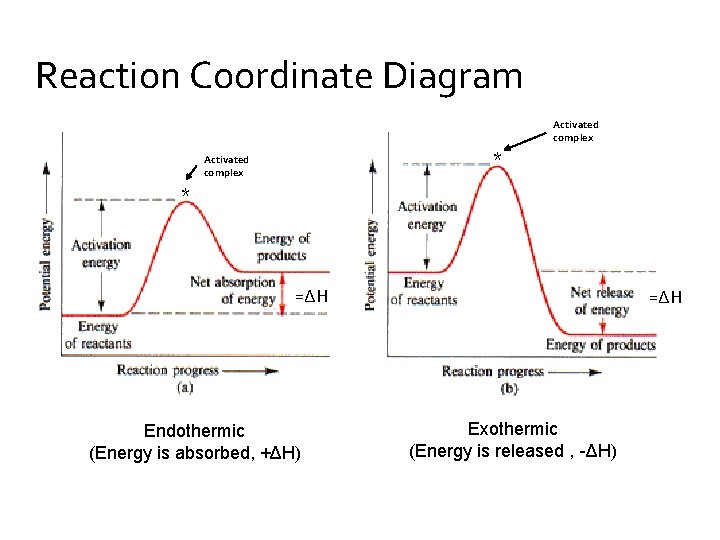
Reaction Coordinate Diagram Activated complex * =ΔH Endothermic (Energy is absorbed, +ΔH) =ΔH Exothermic (Energy is released , -ΔH)
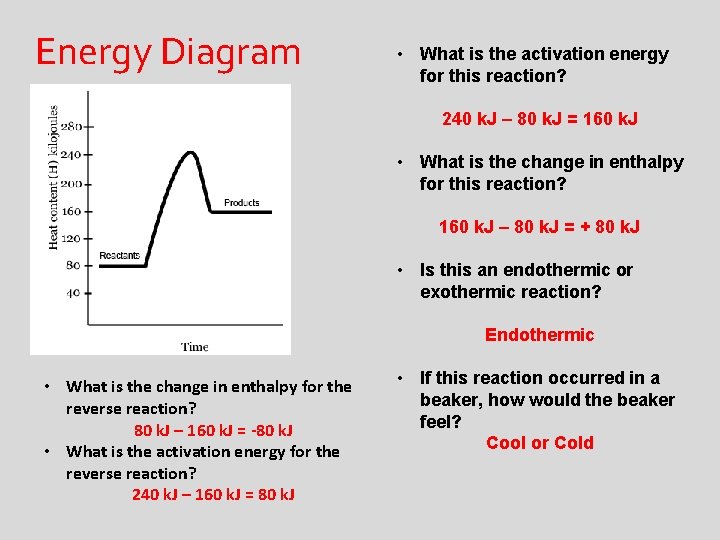
Energy Diagram • What is the activation energy for this reaction? 240 k. J – 80 k. J = 160 k. J • What is the change in enthalpy for this reaction? 160 k. J – 80 k. J = + 80 k. J • Is this an endothermic or exothermic reaction? Endothermic • What is the change in enthalpy for the reverse reaction? 80 k. J – 160 k. J = -80 k. J • What is the activation energy for the reverse reaction? 240 k. J – 160 k. J = 80 k. J • If this reaction occurred in a beaker, how would the beaker feel? Cool or Cold
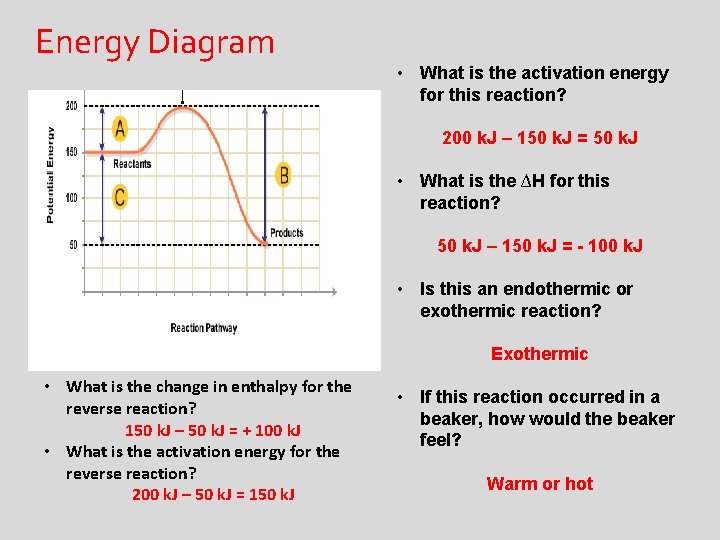
Energy Diagram • What is the activation energy for this reaction? 200 k. J – 150 k. J = 50 k. J • What is the ∆H for this reaction? 50 k. J – 150 k. J = - 100 k. J • Is this an endothermic or exothermic reaction? Exothermic • What is the change in enthalpy for the reverse reaction? 150 k. J – 50 k. J = + 100 k. J • What is the activation energy for the reverse reaction? 200 k. J – 50 k. J = 150 k. J • If this reaction occurred in a beaker, how would the beaker feel? Warm or hot
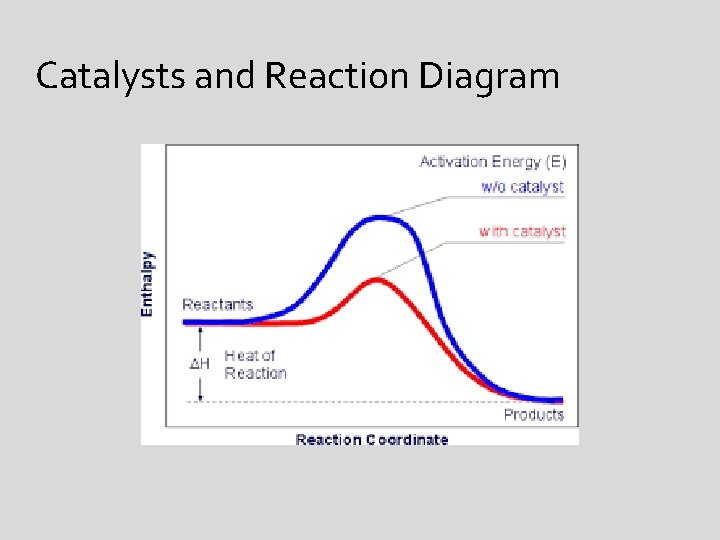
Catalysts and Inhibitors Catalysts: a substance that speeds up a reaction without being consumed (not part of the reaction) • How do catalysts work? • They lower the activation energy (Now less energy is required for the reaction to take place) • They increase the rate of the forward AND the reverse reaction • An example of a catalyst is an Enzyme • Enzyme: a large molecule, usually a protein, which catalyzes biological reactions (reactions in your body) Inhibitor: a substance that slows down a reaction without being consumed (not part of the reaction) • Decreases the rate of the forward AND reverse reaction
Catalysts and Reaction Diagram
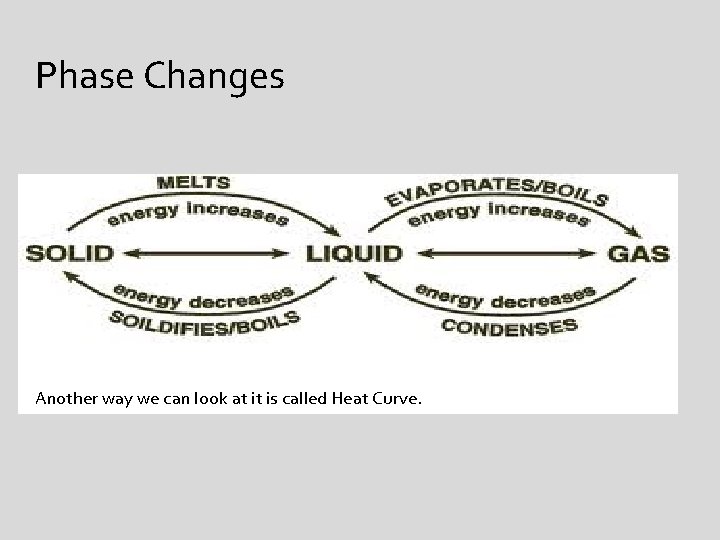
Phase Changes Another way we can look at it is called Heat Curve.
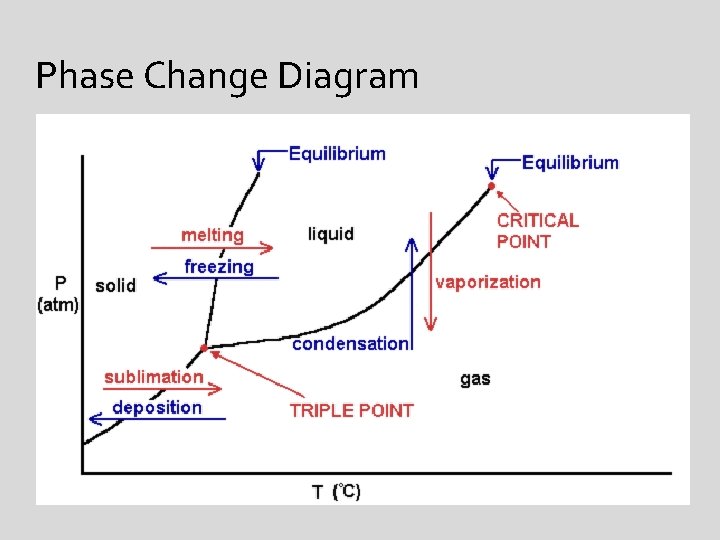
Phase Change Diagram
Phase Change Phase changes is dependent on the pressure and the temperature. • So if you change the pressure around the substance, you can change its state of matter. • Also if you change the temperature of the substance, you can change its state of matter.
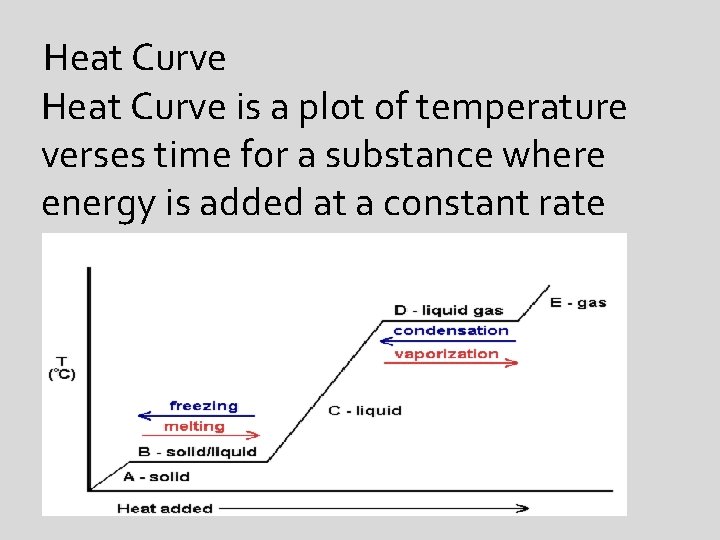
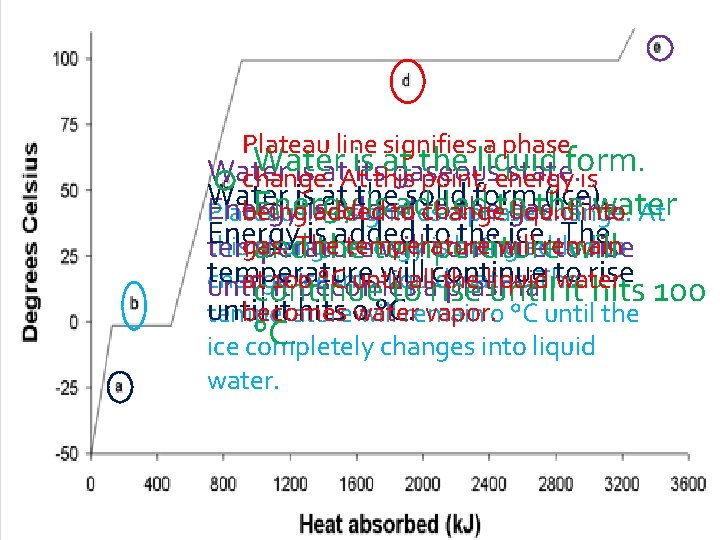
Heat Curve is a plot of temperature verses time for a substance where energy is added at a constant rate
Plateau line signifies a phase Water is at the liquid form. Water is at its gaseous state. change. At this point, energy is Water is at the solid form (ice). Energy is added to the water Energy is added to the gas. The being added to change liquid into Plateau line signifies a phase change. At Energy is added to the ice. The gas. The temperature will remain this change energy is being added to temperature will continue to rise and the temperature will continue to rise at 100 °C until all the liquid water change ice into liquid water. The until it becomes a plasma. continue to rise until it hits 100 until it hits 0 °C. becomes water vapor. temperature will remain 0 °C until the °C. ice completely changes into liquid water.
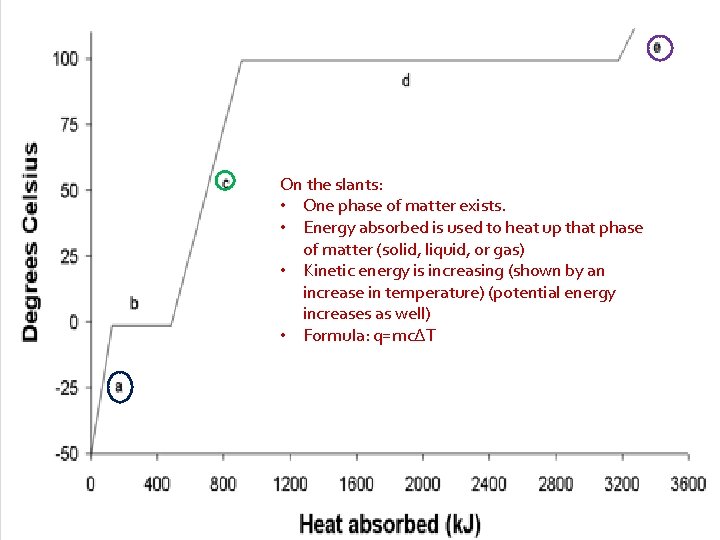
On the slants: • One phase of matter exists. • Energy absorbed is used to heat up that phase of matter (solid, liquid, or gas) • Kinetic energy is increasing (shown by an increase in temperature) (potential energy increases as well) • Formula: q=mc∆T
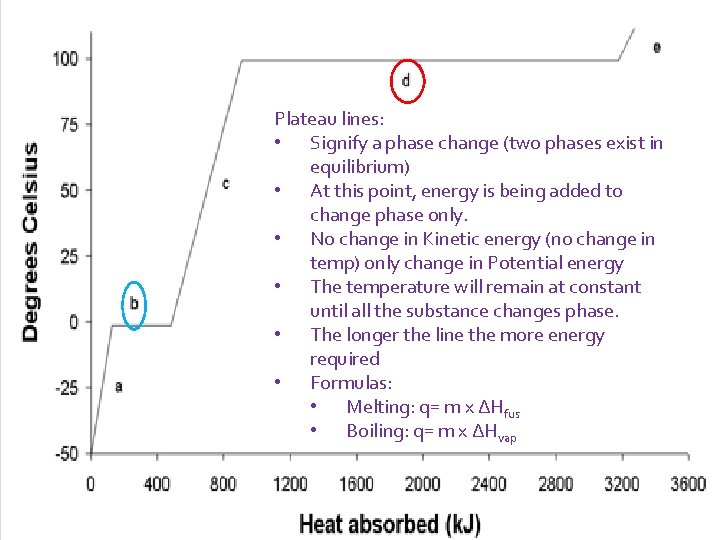
Plateau lines: • Signify a phase change (two phases exist in equilibrium) • At this point, energy is being added to change phase only. • No change in Kinetic energy (no change in temp) only change in Potential energy • The temperature will remain at constant until all the substance changes phase. • The longer the line the more energy required • Formulas: • Melting: q= m x ∆Hfus • Boiling: q= m x ∆Hvap
Energy Different material respond to heat differently. We can measure the heat that is transferred from one substance to the next. The units for energy calorie, joule. • calorie (lowercase c)– the amount of energy (heat) required to raise the temperature of one gram of water by 1°C. • The SI Unit of energy is Joule. • 1 calorie = 4. 184 joules • 1 kilocalorie is = 1 food Calorie (capital c)
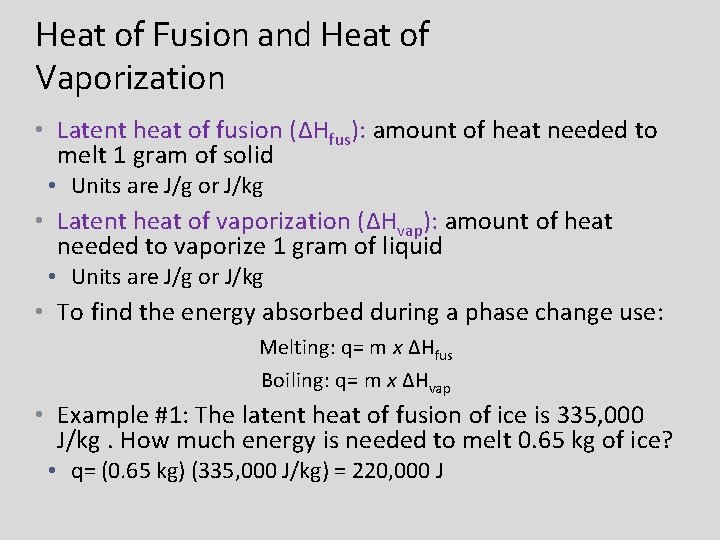
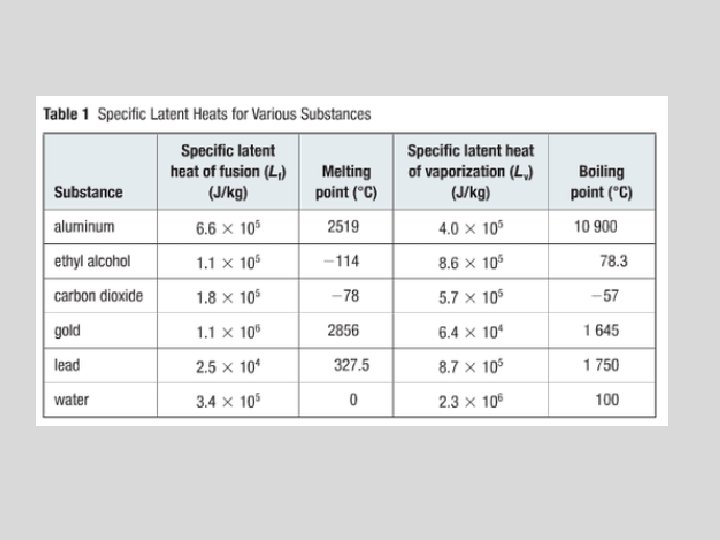
Heat of Fusion and Heat of Vaporization • Latent heat of fusion (∆Hfus): amount of heat needed to melt 1 gram of solid • Units are J/g or J/kg • Latent heat of vaporization (∆Hvap): amount of heat needed to vaporize 1 gram of liquid • Units are J/g or J/kg • To find the energy absorbed during a phase change use: Melting: q= m x ∆Hfus Boiling: q= m x ∆Hvap • Example #1: The latent heat of fusion of ice is 335, 000 J/kg. How much energy is needed to melt 0. 65 kg of ice? • q= (0. 65 kg) (335, 000 J/kg) = 220, 000 J
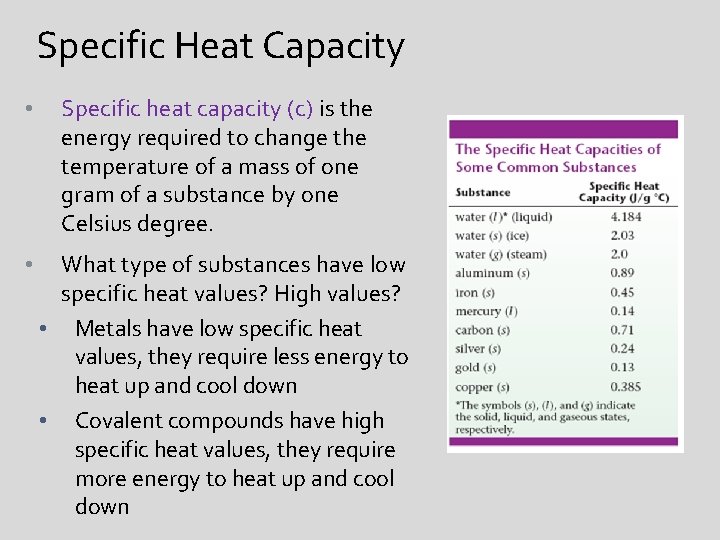
Specific Heat Capacity • Specific heat capacity (c) is the energy required to change the temperature of a mass of one gram of a substance by one Celsius degree. • What type of substances have low specific heat values? High values? • Metals have low specific heat values, they require less energy to heat up and cool down • Covalent compounds have high specific heat values, they require more energy to heat up and cool down
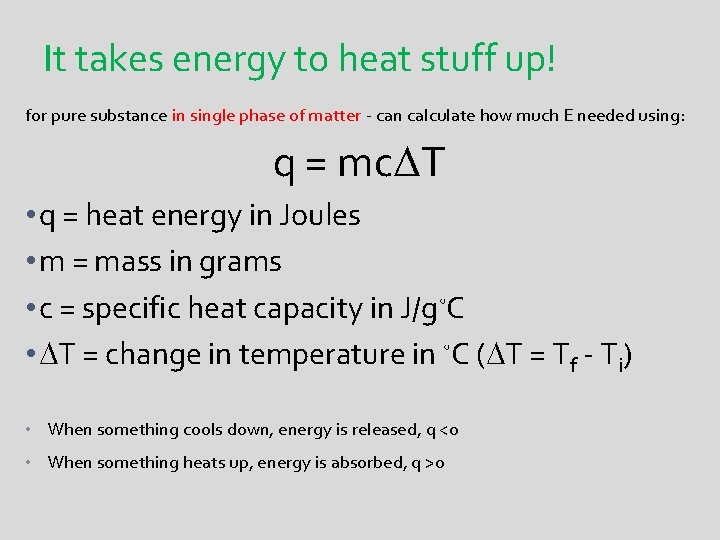
It takes energy to heat stuff up! for pure substance in single phase of matter - can calculate how much E needed using: q = mc T • q = heat energy in Joules • m = mass in grams • c = specific heat capacity in J/g◦C • T = change in temperature in ◦C ( T = Tf - Ti) • When something cools down, energy is released, q <0 • When something heats up, energy is absorbed, q >0
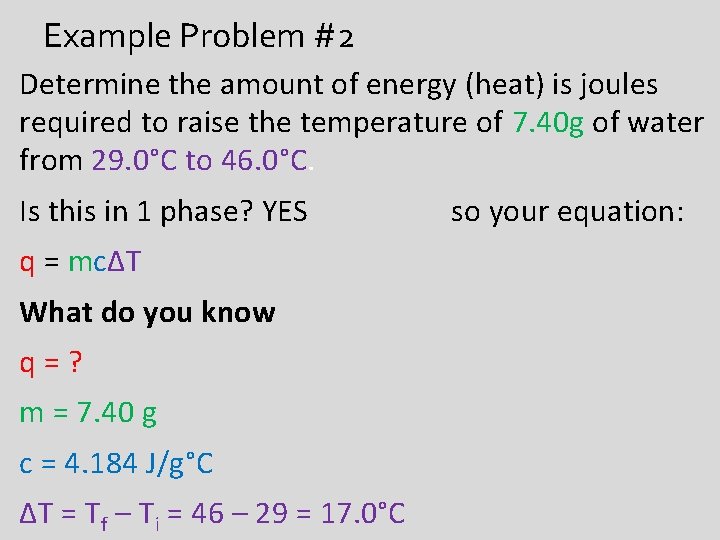
Example Problem #2 Determine the amount of energy (heat) is joules required to raise the temperature of 7. 40 g of water from 29. 0°C to 46. 0°C. Is this in 1 phase? YES q = mcΔT What do you know q = ? m = 7. 40 g c = 4. 184 J/g°C ΔT = Tf – Ti = 46 – 29 = 17. 0°C so your equation:
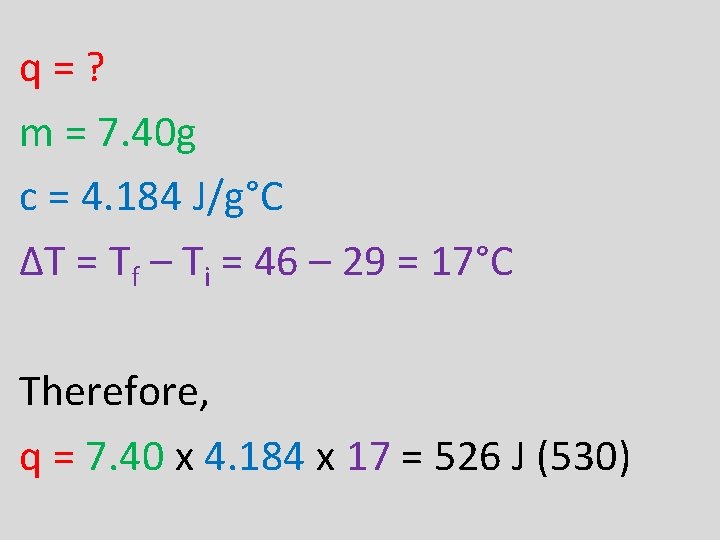
q = ? m = 7. 40 g c = 4. 184 J/g°C ΔT = Tf – Ti = 46 – 29 = 17°C Therefore, q = 7. 40 x 4. 184 x 17 = 526 J (530)
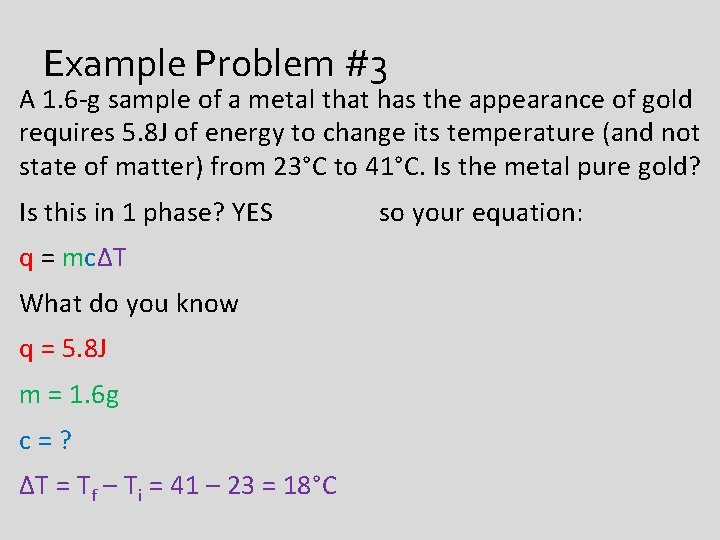
Example Problem #3 A 1. 6 -g sample of a metal that has the appearance of gold requires 5. 8 J of energy to change its temperature (and not state of matter) from 23°C to 41°C. Is the metal pure gold? Is this in 1 phase? YES q = mcΔT What do you know q = 5. 8 J m = 1. 6 g c = ? ΔT = Tf – Ti = 41 – 23 = 18°C so your equation:
Example Problem #4 What is the final temperature of a 7. 31 g piece of aluminum at 34. 0°C if 354 J of energy is applied to the aluminum? (the specific heat of Al is 0. 890 J/g°C and the melting point of Al is 660°C. ) Is this in 1 phase? YES so your equation: q = mcΔT What do you know q = 354 J m = 7. 31 g c = 0. 89 ΔT = ?
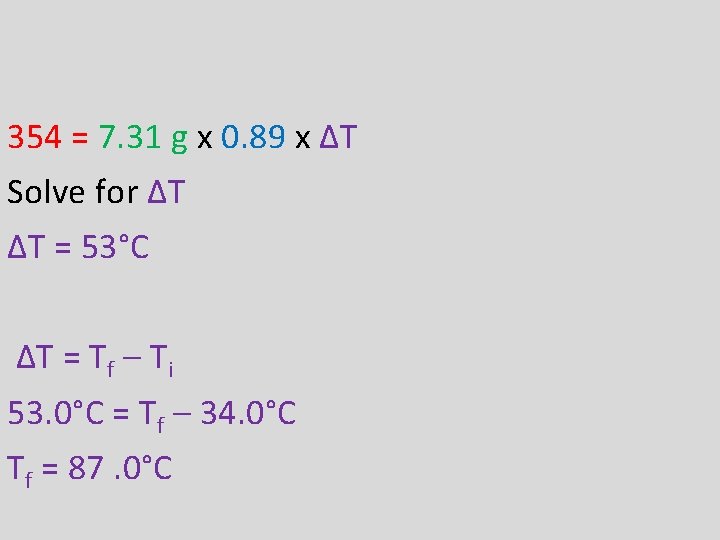
354 = 7. 31 g x 0. 89 x ΔT Solve for ΔT ΔT = 53°C ΔT = Tf – Ti 53. 0°C = Tf – 34. 0°C Tf = 87. 0°C
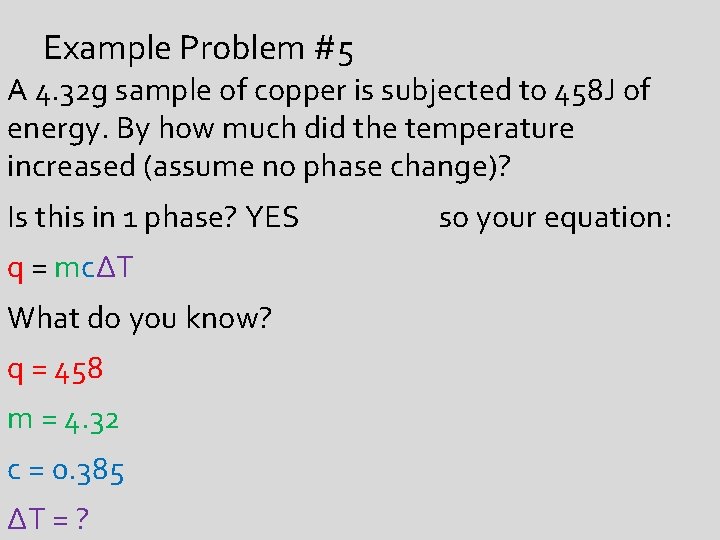
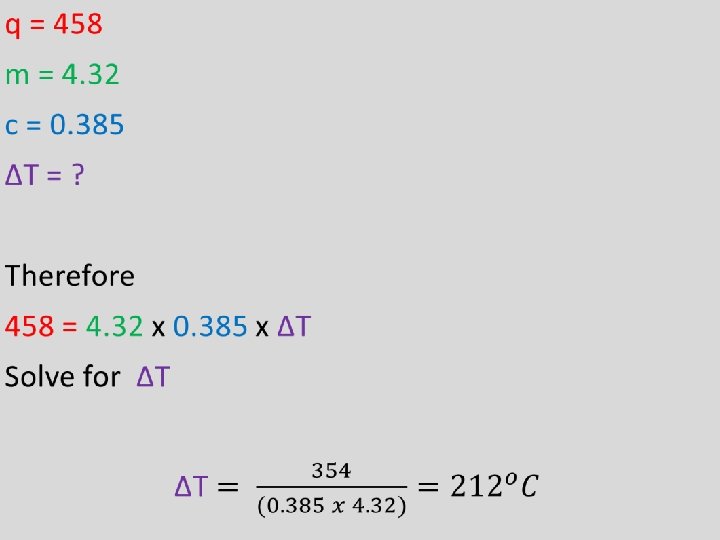
Example Problem #5 A 4. 32 g sample of copper is subjected to 458 J of energy. By how much did the temperature increased (assume no phase change)? Is this in 1 phase? YES q = mcΔT What do you know? q = 458 m = 4. 32 c = 0. 385 ΔT = ? so your equation:
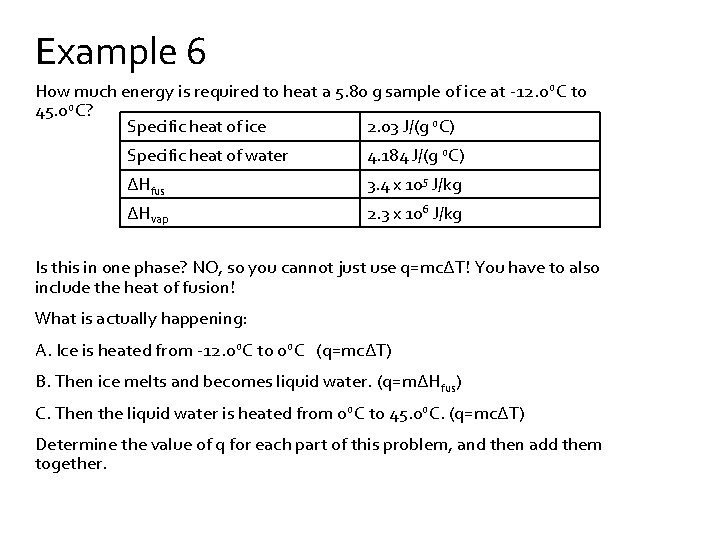
Example 6 How much energy is required to heat a 5. 80 g sample of ice at -12. 0 o. C to 45. 0 o. C? Specific heat of ice 2. 03 J/(g o. C) Specific heat of water 4. 184 J/(g o. C) ∆Hfus 3. 4 x 10⁵ J/kg ∆Hvap 2. 3 x 10⁶ J/kg Is this in one phase? NO, so you cannot just use q=mc∆T! You have to also include the heat of fusion! What is actually happening: A. Ice is heated from -12. 0 o. C to 0 o. C (q=mc∆T) B. Then ice melts and becomes liquid water. (q=m∆Hfus) C. Then the liquid water is heated from 0 o. C to 45. 0 o. C. (q=mc∆T) Determine the value of q for each part of this problem, and then add them together.
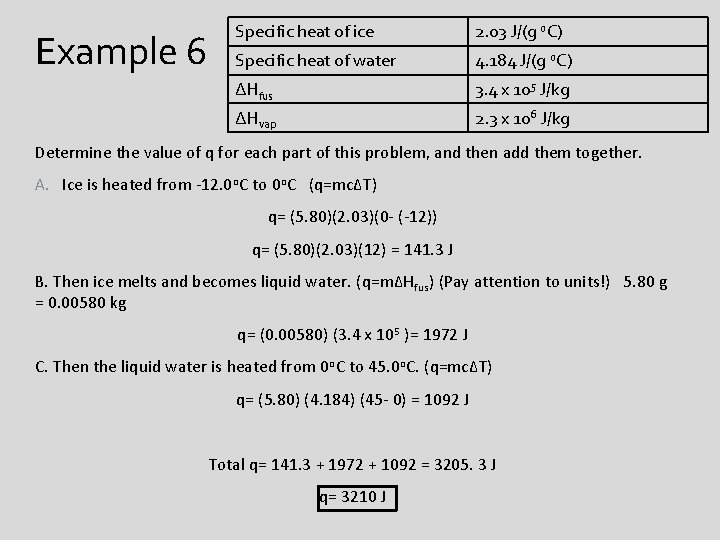
Example 6 Specific heat of ice 2. 03 J/(g o. C) Specific heat of water 4. 184 J/(g o. C) ∆Hfus 3. 4 x 10⁵ J/kg ∆Hvap 2. 3 x 10⁶ J/kg Determine the value of q for each part of this problem, and then add them together. A. Ice is heated from -12. 0 o. C to 0 o. C (q=mc∆T) q= (5. 80)(2. 03)(0 - (-12)) q= (5. 80)(2. 03)(12) = 141. 3 J B. Then ice melts and becomes liquid water. (q=m∆Hfus) (Pay attention to units!) 5. 80 g = 0. 00580 kg q= (0. 00580) (3. 4 x 10⁵ )= 1972 J C. Then the liquid water is heated from 0 o. C to 45. 0 o. C. (q=mc∆T) q= (5. 80) (4. 184) (45 - 0) = 1092 J Total q= 141. 3 + 1972 + 1092 = 3205. 3 J q= 3210 J
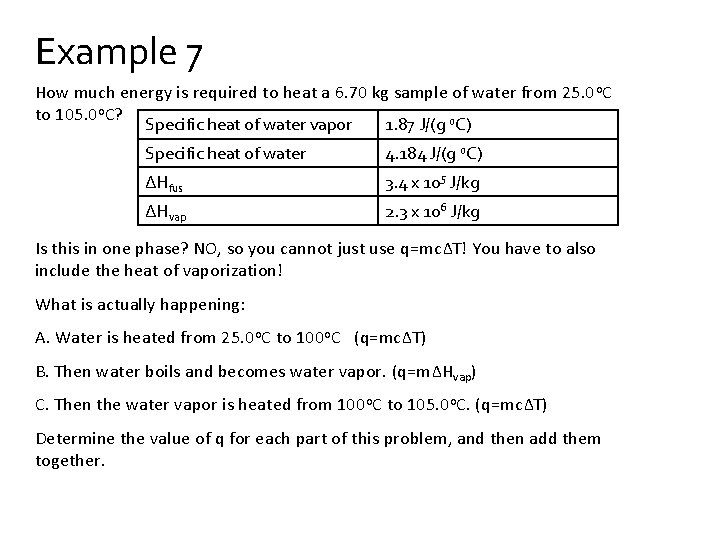
Example 7 How much energy is required to heat a 6. 70 kg sample of water from 25. 0 o. C to 105. 0 o. C? Specific heat of water vapor 1. 87 J/(g o. C) Specific heat of water 4. 184 J/(g o. C) ∆Hfus 3. 4 x 10⁵ J/kg ∆Hvap 2. 3 x 10⁶ J/kg Is this in one phase? NO, so you cannot just use q=mc∆T! You have to also include the heat of vaporization! What is actually happening: A. Water is heated from 25. 0 o. C to 100 o. C (q=mc∆T) B. Then water boils and becomes water vapor. (q=m∆Hvap) C. Then the water vapor is heated from 100 o. C to 105. 0 o. C. (q=mc∆T) Determine the value of q for each part of this problem, and then add them together.
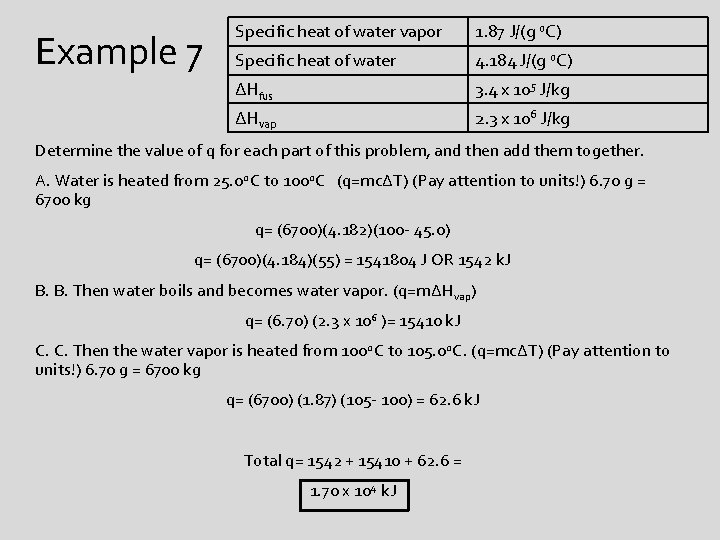
Example 7 Specific heat of water vapor 1. 87 J/(g o. C) Specific heat of water 4. 184 J/(g o. C) ∆Hfus 3. 4 x 10⁵ J/kg ∆Hvap 2. 3 x 10⁶ J/kg Determine the value of q for each part of this problem, and then add them together. A. Water is heated from 25. 0 o. C to 100 o. C (q=mc∆T) (Pay attention to units!) 6. 70 g = 6700 kg q= (6700)(4. 182)(100 - 45. 0) q= (6700)(4. 184)(55) = 1541804 J OR 1542 k. J B. B. Then water boils and becomes water vapor. (q=m∆H vap) q= (6. 70) (2. 3 x 10⁶ )= 15410 k. J C. C. Then the water vapor is heated from 100 o. C to 105. 0 o. C. (q=mc∆T) (Pay attention to units!) 6. 70 g = 6700 kg q= (6700) (1. 87) (105 - 100) = 62. 6 k. J Total q= 1542 + 15410 + 62. 6 = 1. 70 x 104 k. J
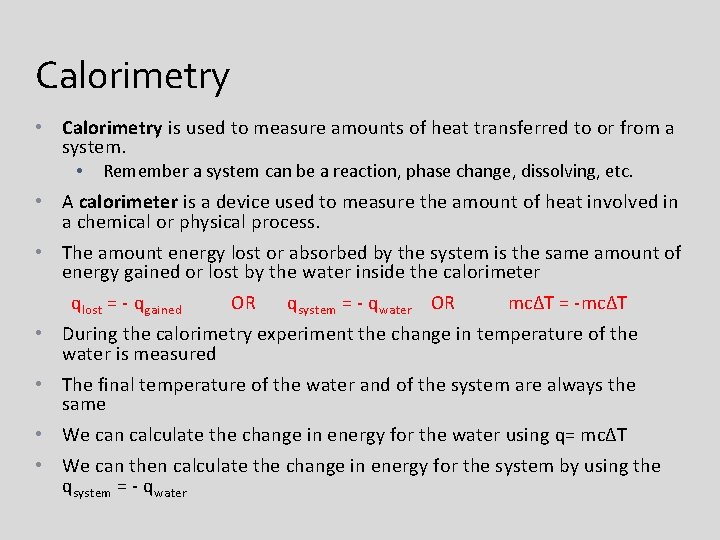
Calorimetry • Calorimetry is used to measure amounts of heat transferred to or from a system. • Remember a system can be a reaction, phase change, dissolving, etc. • A calorimeter is a device used to measure the amount of heat involved in a chemical or physical process. • The amount energy lost or absorbed by the system is the same amount of energy gained or lost by the water inside the calorimeter qlost = - qgained OR qsystem = - qwater OR mc∆T = -mc∆T • During the calorimetry experiment the change in temperature of the water is measured • The final temperature of the water and of the system are always the same • We can calculate the change in energy for the water using q= mc∆T • We can then calculate the change in energy for the system by using the qsystem = - qwater
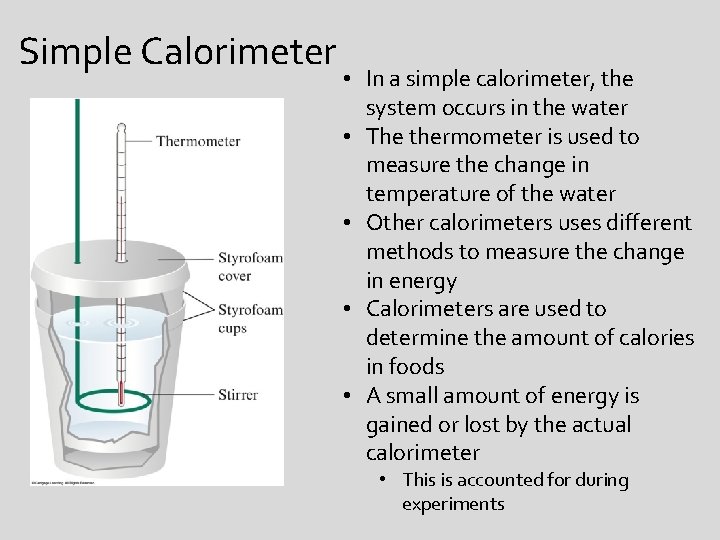
Simple Calorimeter • In a simple calorimeter, the system occurs in the water • The thermometer is used to measure the change in temperature of the water • Other calorimeters uses different methods to measure the change in energy • Calorimeters are used to determine the amount of calories in foods • A small amount of energy is gained or lost by the actual calorimeter • This is accounted for during experiments
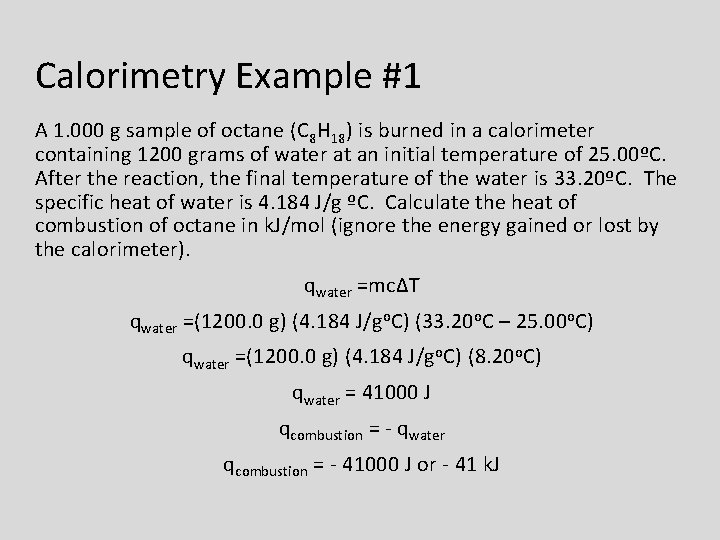
Calorimetry Example #1 A 1. 000 g sample of octane (C 8 H 18) is burned in a calorimeter containing 1200 grams of water at an initial temperature of 25. 00ºC. After the reaction, the final temperature of the water is 33. 20ºC. The specific heat of water is 4. 184 J/g ºC. Calculate the heat of combustion of octane in k. J/mol (ignore the energy gained or lost by the calorimeter). qwater =mc∆T qwater =(1200. 0 g) (4. 184 J/go. C) (33. 20 o. C – 25. 00 o. C) qwater =(1200. 0 g) (4. 184 J/go. C) (8. 20 o. C) qwater = 41000 J qcombustion = - qwater qcombustion = - 41000 J or - 41 k. J
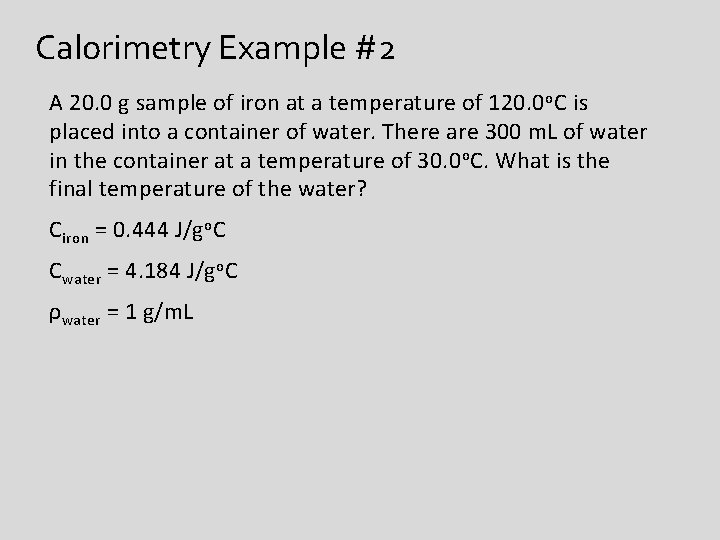
Calorimetry Example #2 A 20. 0 g sample of iron at a temperature of 120. 0 o. C is placed into a container of water. There are 300 m. L of water in the container at a temperature of 30. 0 o. C. What is the final temperature of the water? Ciron = 0. 444 J/go. C Cwater = 4. 184 J/go. C ρwater = 1 g/m. L
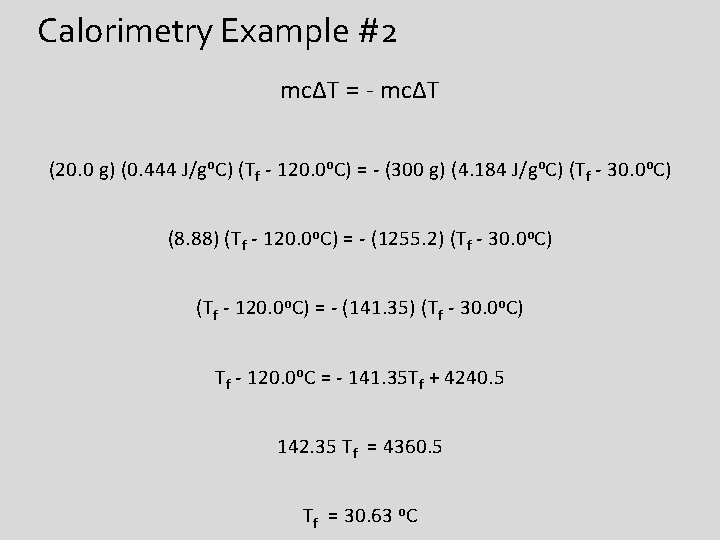
Calorimetry Example #2 mcΔT = - mcΔT (20. 0 g) (0. 444 J/go. C) (Tf - 120. 0 o. C) = - (300 g) (4. 184 J/go. C) (Tf - 30. 0 o. C) (8. 88) (Tf - 120. 0 o. C) = - (1255. 2) (Tf - 30. 0 o. C) (Tf - 120. 0 o. C) = - (141. 35) (Tf - 30. 0 o. C) Tf - 120. 0 o. C = - 141. 35 Tf + 4240. 5 142. 35 Tf = 4360. 5 Tf = 30. 63 o. C
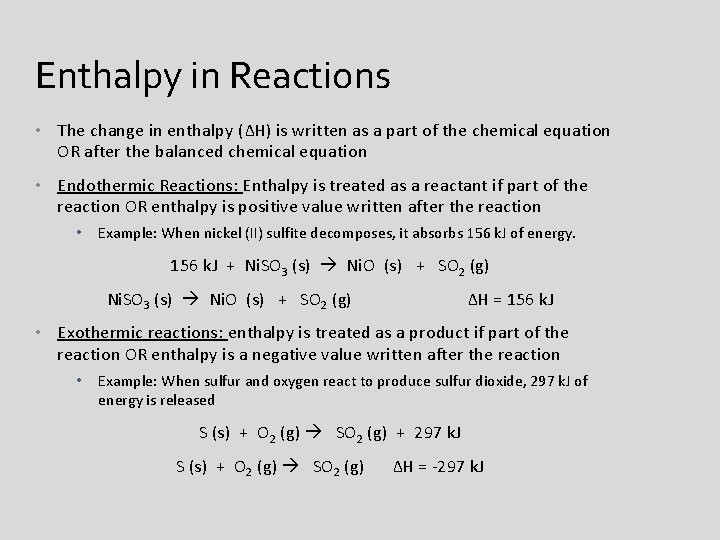
Enthalpy in Reactions • The change in enthalpy (ΔH) is written as a part of the chemical equation OR after the balanced chemical equation • Endothermic Reactions: Enthalpy is treated as a reactant if part of the reaction OR enthalpy is positive value written after the reaction • Example: When nickel (II) sulfite decomposes, it absorbs 156 k. J of energy. 156 k. J + Ni. SO 3 (s) Ni. O (s) + SO 2 (g) ΔH = 156 k. J • Exothermic reactions: enthalpy is treated as a product if part of the reaction OR enthalpy is a negative value written after the reaction • Example: When sulfur and oxygen react to produce sulfur dioxide, 297 k. J of energy is released S (s) + O 2 (g) SO 2 (g) + 297 k. J S (s) + O 2 (g) SO 2 (g) ΔH = -297 k. J
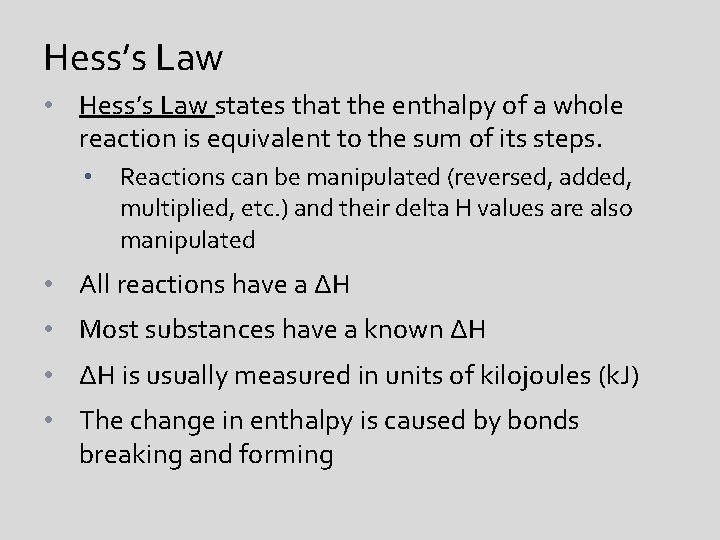
Hess’s Law • Hess’s Law states that the enthalpy of a whole reaction is equivalent to the sum of its steps. • Reactions can be manipulated (reversed, added, multiplied, etc. ) and their delta H values are also manipulated • All reactions have a ΔH • Most substances have a known ΔH • ΔH is usually measured in units of kilojoules (k. J) • The change in enthalpy is caused by bonds breaking and forming
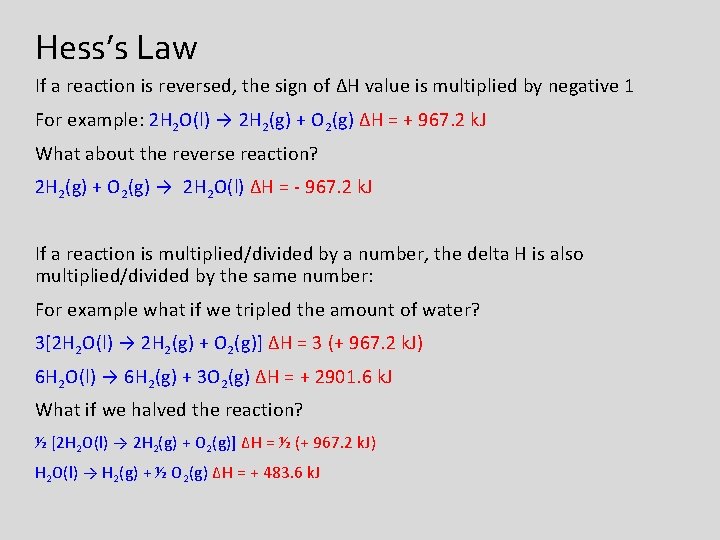
Hess’s Law If a reaction is reversed, the sign of ΔH value is multiplied by negative 1 For example: 2 H 2 O(l) → 2 H 2(g) + O 2(g) ΔH = + 967. 2 k. J What about the reverse reaction? 2 H 2(g) + O 2(g) → 2 H 2 O(l) ΔH = - 967. 2 k. J If a reaction is multiplied/divided by a number, the delta H is also multiplied/divided by the same number: For example what if we tripled the amount of water? 3[2 H 2 O(l) → 2 H 2(g) + O 2(g)] ΔH = 3 (+ 967. 2 k. J) 6 H 2 O(l) → 6 H 2(g) + 3 O 2(g) ΔH = + 2901. 6 k. J What if we halved the reaction? ½ [2 H 2 O(l) → 2 H 2(g) + O 2(g)] ΔH = ½ (+ 967. 2 k. J) H 2 O(l) → H 2(g) + ½ O 2(g) ΔH = + 483. 6 k. J
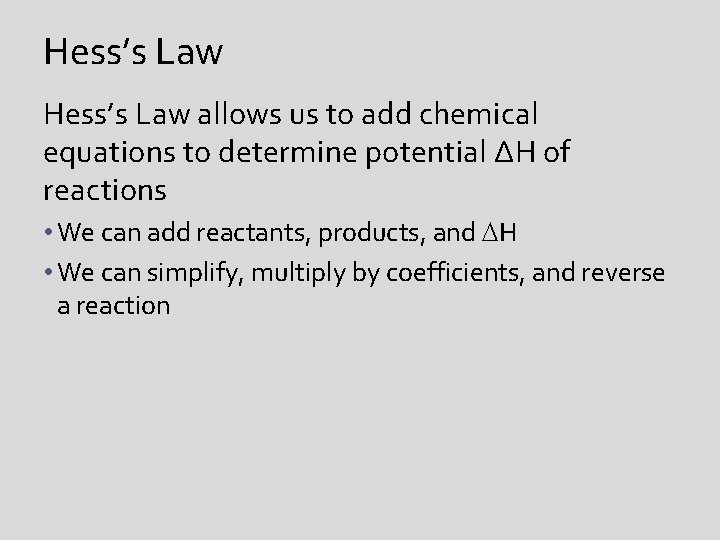
Hess’s Law allows us to add chemical equations to determine potential ΔH of reactions • We can add reactants, products, and H • We can simplify, multiply by coefficients, and reverse a reaction
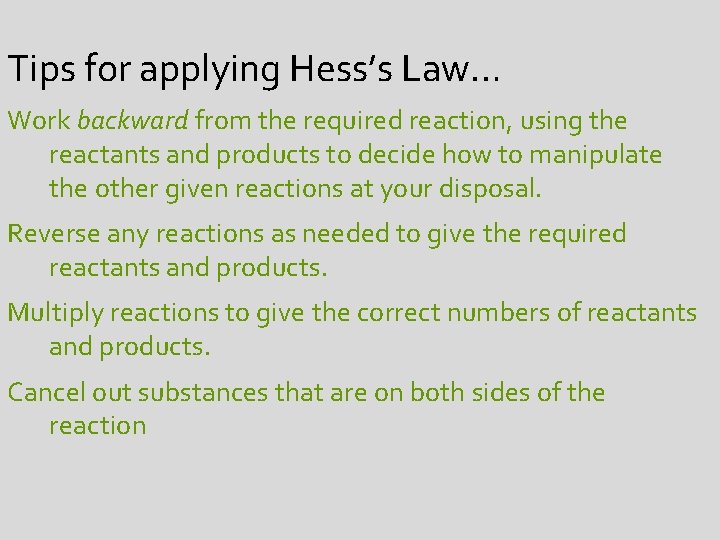
Tips for applying Hess’s Law… Work backward from the required reaction, using the reactants and products to decide how to manipulate the other given reactions at your disposal. Reverse any reactions as needed to give the required reactants and products. Multiply reactions to give the correct numbers of reactants and products. Cancel out substances that are on both sides of the reaction
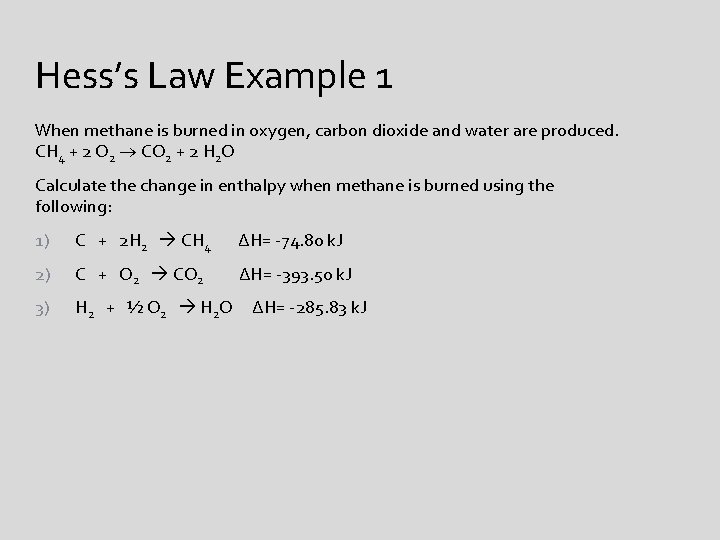
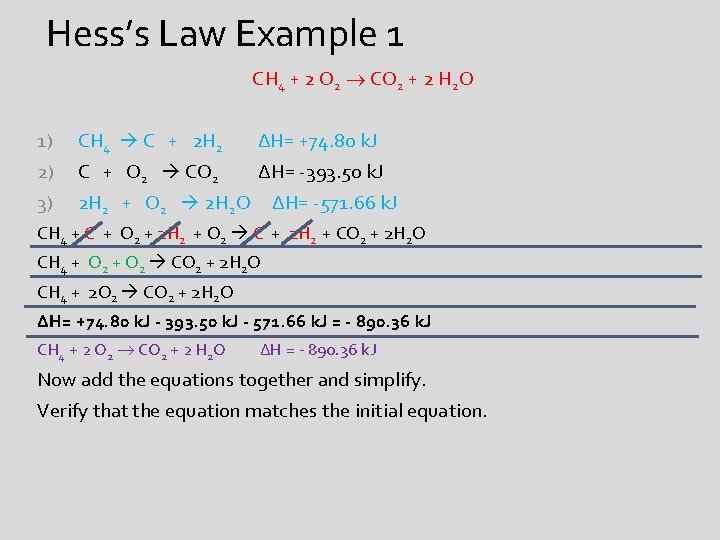
Hess’s Law Example 1 When methane is burned in oxygen, carbon dioxide and water are produced. CH 4 + 2 O 2 CO 2 + 2 H 2 O Calculate the change in enthalpy when methane is burned using the following: 1) C + 2 H 2 CH 4 ΔH= -74. 80 k. J 2) C + O 2 CO 2 ΔH= -393. 50 k. J 3) H 2 + ½ O 2 H 2 O ΔH= -285. 83 k. J
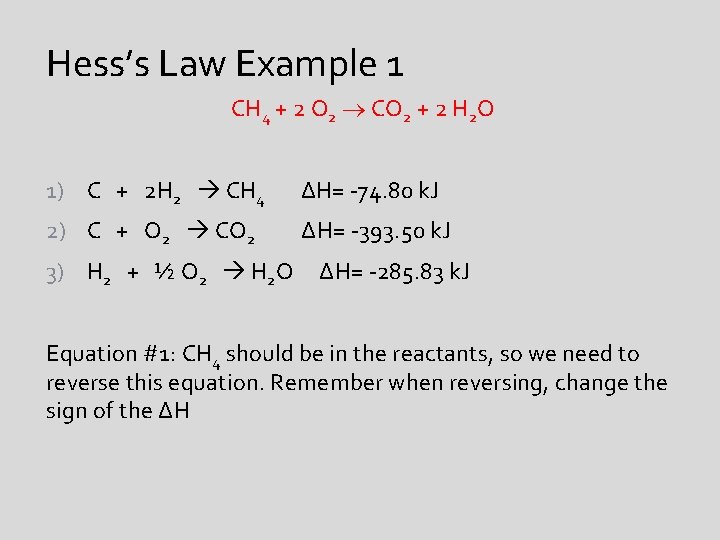
Hess’s Law Example 1 CH 4 + 2 O 2 CO 2 + 2 H 2 O 1) C + 2 H 2 CH 4 ΔH= -74. 80 k. J 2) C + O 2 CO 2 ΔH= -393. 50 k. J 3) H 2 + ½ O 2 H 2 O ΔH= -285. 83 k. J Equation #1: CH 4 should be in the reactants, so we need to reverse this equation. Remember when reversing, change the sign of the ΔH
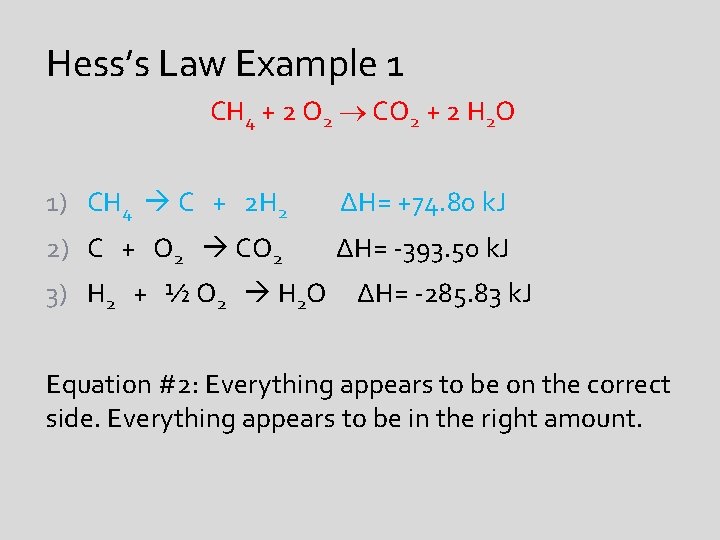
Hess’s Law Example 1 CH 4 + 2 O 2 CO 2 + 2 H 2 O 1) CH 4 C + 2 H 2 ΔH= +74. 80 k. J 2) C + O 2 CO 2 ΔH= -393. 50 k. J 3) H 2 + ½ O 2 H 2 O ΔH= -285. 83 k. J Equation #2: Everything appears to be on the correct side. Everything appears to be in the right amount.
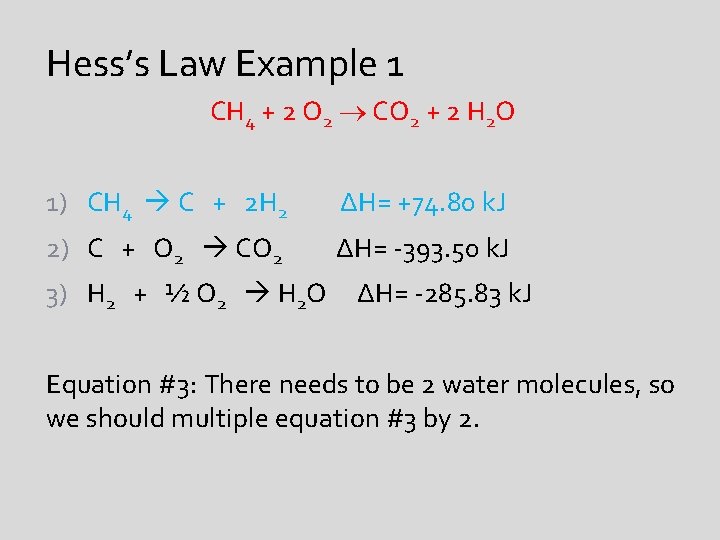
Hess’s Law Example 1 CH 4 + 2 O 2 CO 2 + 2 H 2 O 1) CH 4 C + 2 H 2 ΔH= +74. 80 k. J 2) C + O 2 CO 2 ΔH= -393. 50 k. J 3) H 2 + ½ O 2 H 2 O ΔH= -285. 83 k. J Equation #3: There needs to be 2 water molecules, so we should multiple equation #3 by 2.
Hess’s Law Example 1 CH 4 + 2 O 2 CO 2 + 2 H 2 O 1) CH 4 C + 2 H 2 2) C + O 2 CO 2 ΔH= -393. 50 k. J 3) 2 H 2 + O 2 2 H 2 O ΔH= -571. 66 k. J ΔH= +74. 80 k. J CH 4 + C + O 2 + 2 H 2 + O 2 C + 2 H 2 + CO 2 + 2 H 2 O CH 4 + O 2 CO 2 + 2 H 2 O CH 4 + 2 O 2 CO 2 + 2 H 2 O ΔH= +74. 80 k. J - 393. 50 k. J - 571. 66 k. J = - 890. 36 k. J CH 4 + 2 O 2 CO 2 + 2 H 2 O ΔH = - 890. 36 k. J Now add the equations together and simplify. Verify that the equation matches the initial equation.
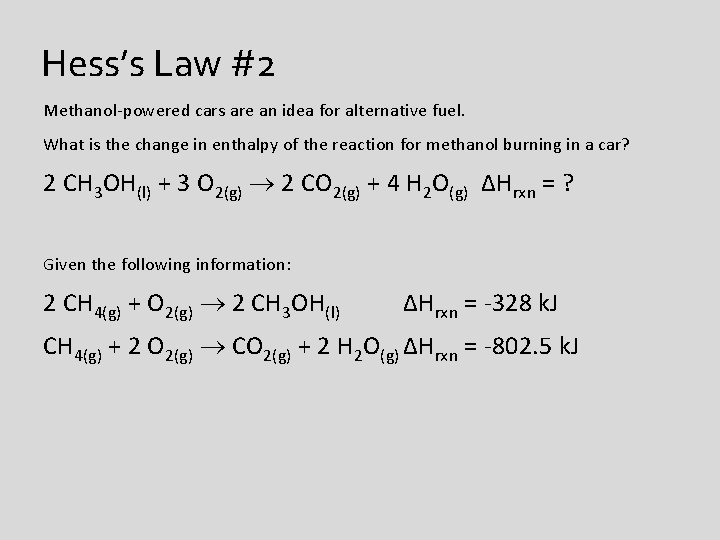
Hess’s Law #2 Methanol-powered cars are an idea for alternative fuel. What is the change in enthalpy of the reaction for methanol burning in a car? 2 CH 3 OH(l) + 3 O 2(g) 2 CO 2(g) + 4 H 2 O(g) ΔHrxn = ? Given the following information: 2 CH 4(g) + O 2(g) 2 CH 3 OH(l) ΔHrxn = -328 k. J CH 4(g) + 2 O 2(g) CO 2(g) + 2 H 2 O(g) ΔHrxn = -802. 5 k. J
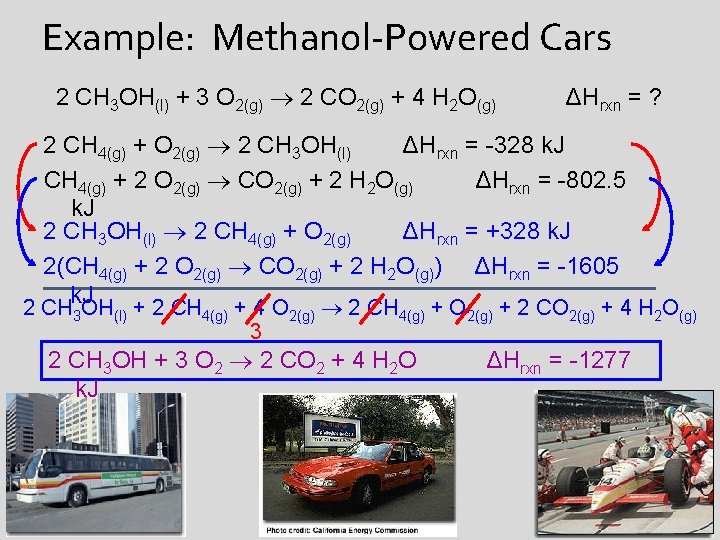
Example: Methanol-Powered Cars 2 CH 3 OH(l) + 3 O 2(g) 2 CO 2(g) + 4 H 2 O(g) ΔHrxn = ? 2 CH 4(g) + O 2(g) 2 CH 3 OH(l) ΔHrxn = -328 k. J CH 4(g) + 2 O 2(g) CO 2(g) + 2 H 2 O(g) ΔHrxn = -802. 5 k. J 2 CH 3 OH(l) 2 CH 4(g) + O 2(g) ΔHrxn = +328 k. J 2(CH 4(g) + 2 O 2(g) CO 2(g) + 2 H 2 O(g)) ΔHrxn = -1605 k. J 2 CH 3 OH(l) + 2 CH 4(g) + 4 O 2(g) 2 CH 4(g) + O 2(g) + 2 CO 2(g) + 4 H 2 O(g) 3 2 CH 3 OH + 3 O 2 2 CO 2 + 4 H 2 O k. J ΔHrxn = -1277
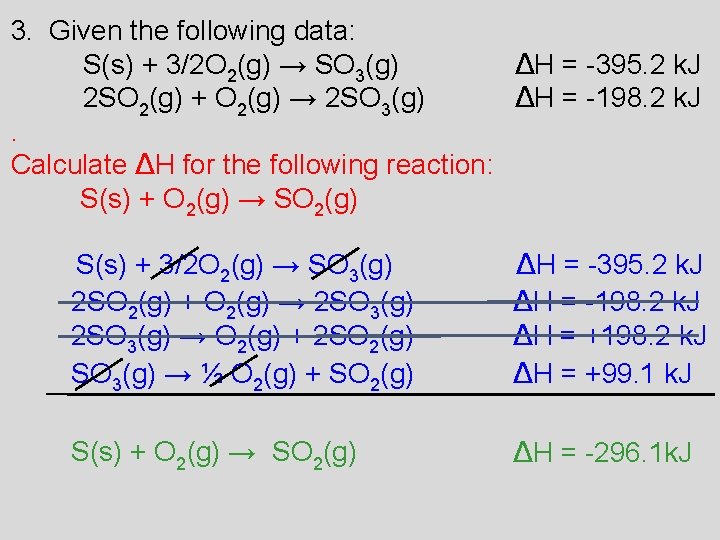
3. Given the following data: S(s) + 3/2 O 2(g) → SO 3(g) ΔH = -395. 2 k. J 2 SO 2(g) + O 2(g) → 2 SO 3(g) ΔH = -198. 2 k. J. Calculate ΔH for the following reaction: S(s) + O 2(g) → SO 2(g) S(s) + 3/2 O 2(g) → SO 3(g) 2 SO 2(g) + O 2(g) → 2 SO 3(g) → O 2(g) + 2 SO 2(g) SO 3(g) → ½ O 2(g) + SO 2(g) S(s) + O 2(g) → SO 2(g) ΔH = -395. 2 k. J ΔH = -198. 2 k. J ΔH = +99. 1 k. J ΔH = -296. 1 k. J
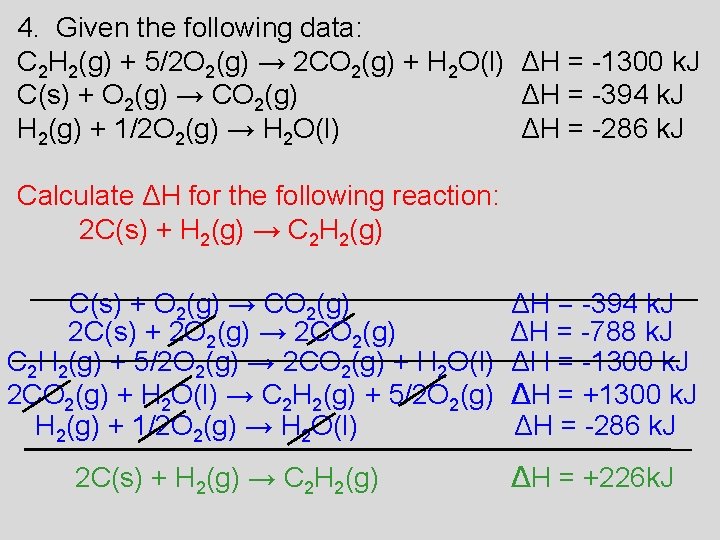
4. Given the following data: C 2 H 2(g) + 5/2 O 2(g) → 2 CO 2(g) + H 2 O(l) ΔH = -1300 k. J C(s) + O 2(g) → CO 2(g) ΔH = -394 k. J H 2(g) + 1/2 O 2(g) → H 2 O(l) ΔH = -286 k. J Calculate ΔH for the following reaction: 2 C(s) + H 2(g) → C 2 H 2(g) C(s) + O 2(g) → CO 2(g) ΔH = -394 k. J 2 C(s) + 2 O 2(g) → 2 CO 2(g) ΔH = -788 k. J C 2 H 2(g) + 5/2 O 2(g) → 2 CO 2(g) + H 2 O(l) ΔH = -1300 k. J 2 CO 2(g) + H 2 O(l) → C 2 H 2(g) + 5/2 O 2(g) ΔH = +1300 k. J H 2(g) + 1/2 O 2(g) → H 2 O(l) ΔH = -286 k. J 2 C(s) + H 2(g) → C 2 H 2(g) ΔH = +226 k. J
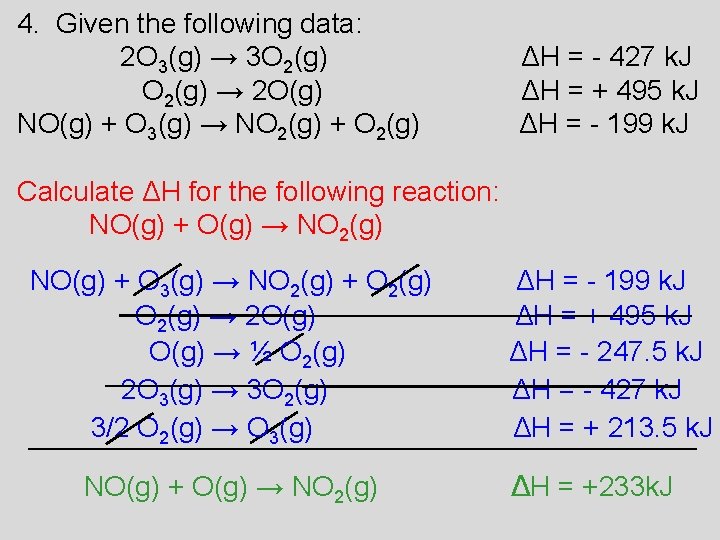
4. Given the following data: 2 O 3(g) → 3 O 2(g) ΔH = - 427 k. J O 2(g) → 2 O(g) ΔH = + 495 k. J NO(g) + O 3(g) → NO 2(g) + O 2(g) ΔH = - 199 k. J Calculate ΔH for the following reaction: NO(g) + O(g) → NO 2(g) NO(g) + O 3(g) → NO 2(g) + O 2(g) ΔH = - 199 k. J O 2(g) → 2 O(g) ΔH = + 495 k. J O(g) → ½ O 2(g) ΔH = - 247. 5 k. J 2 O 3(g) → 3 O 2(g) ΔH = - 427 k. J 3/2 O 2(g) → O 3(g) ΔH = + 213. 5 k. J NO(g) + O(g) → NO 2(g) ΔH = +233 k. J
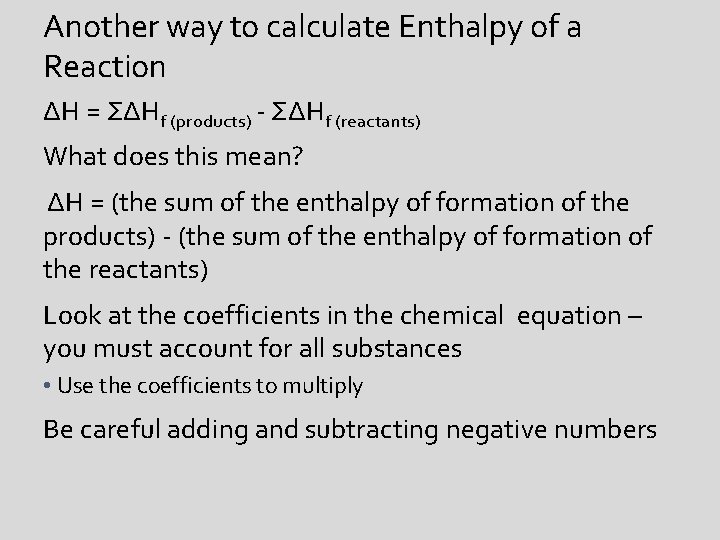
Another way to calculate Enthalpy of a Reaction ΔH = ΣΔHf (products) - ΣΔHf (reactants) What does this mean? ΔH = (the sum of the enthalpy of formation of the products) - (the sum of the enthalpy of formation of the reactants) Look at the coefficients in the chemical equation – you must account for all substances • Use the coefficients to multiply Be careful adding and subtracting negative numbers
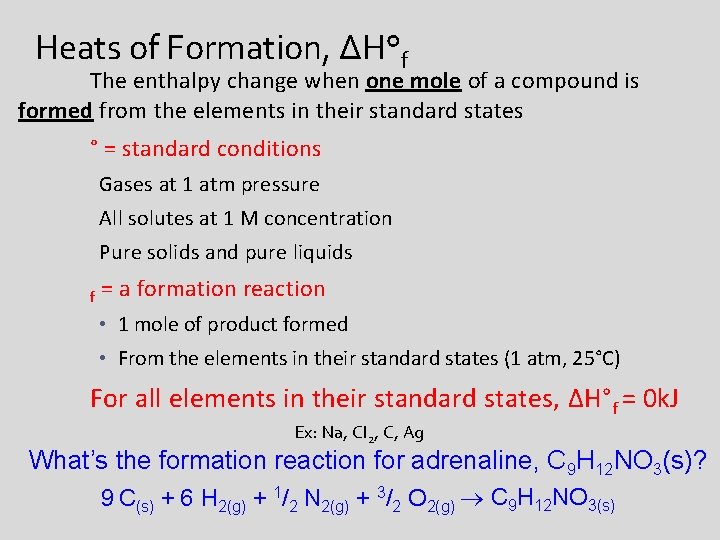
Heats of Formation, ΔH°f The enthalpy change when one mole of a compound is formed from the elements in their standard states ° = standard conditions Gases at 1 atm pressure All solutes at 1 M concentration Pure solids and pure liquids f = a formation reaction • 1 mole of product formed • From the elements in their standard states (1 atm, 25°C) For all elements in their standard states, ΔH°f = 0 k. J Ex: Na, Cl 2, C, Ag What’s the formation reaction for adrenaline, C 9 H 12 NO 3(s)? 9 C(s) + 6 H 2(g) + 1/2 N 2(g) + 3/2 O 2(g) C 9 H 12 NO 3(s)
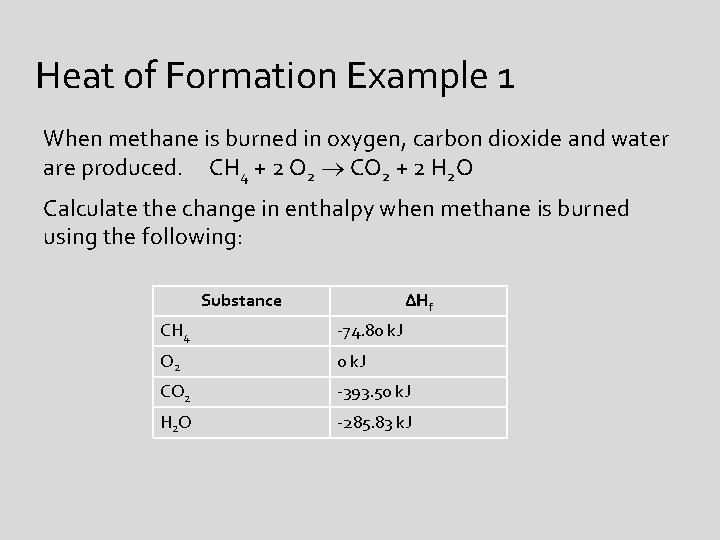
Heat of Formation Example 1 When methane is burned in oxygen, carbon dioxide and water are produced. CH 4 + 2 O 2 CO 2 + 2 H 2 O Calculate the change in enthalpy when methane is burned using the following: Substance ΔHf CH 4 -74. 80 k. J O 2 0 k. J CO 2 -393. 50 k. J H 2 O -285. 83 k. J
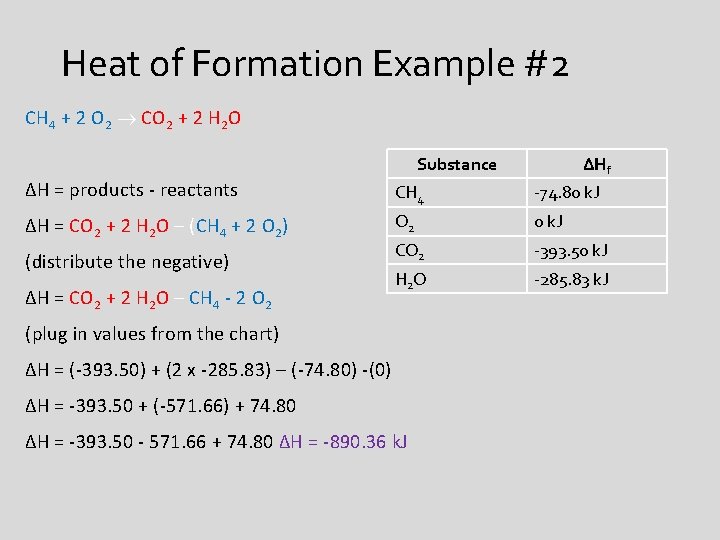
Heat of Formation Example #2 CH 4 + 2 O 2 CO 2 + 2 H 2 O Substance ΔHf ΔH = products - reactants CH 4 -74. 80 k. J ΔH = CO 2 + 2 H 2 O – (CH 4 + 2 O 2) O 2 0 k. J CO 2 -393. 50 k. J H 2 O -285. 83 k. J (distribute the negative) ΔH = CO 2 + 2 H 2 O – CH 4 - 2 O 2 (plug in values from the chart) ΔH = (-393. 50) + (2 x -285. 83) – (-74. 80) -(0) ΔH = -393. 50 + (-571. 66) + 74. 80 ΔH = -393. 50 - 571. 66 + 74. 80 ΔH = -890. 36 k. J
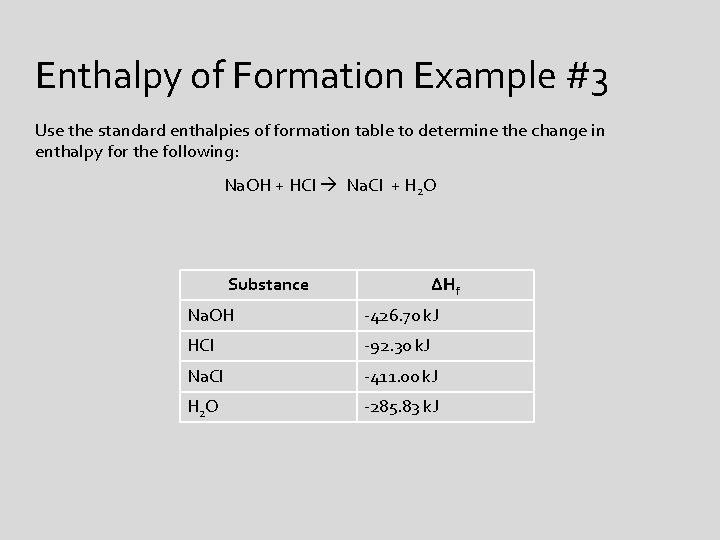
Enthalpy of Formation Example #3 Use the standard enthalpies of formation table to determine the change in enthalpy for the following: Na. OH + HCl Na. Cl + H 2 O Substance ΔHf Na. OH -426. 70 k. J HCl -92. 30 k. J Na. Cl -411. 00 k. J H 2 O -285. 83 k. J
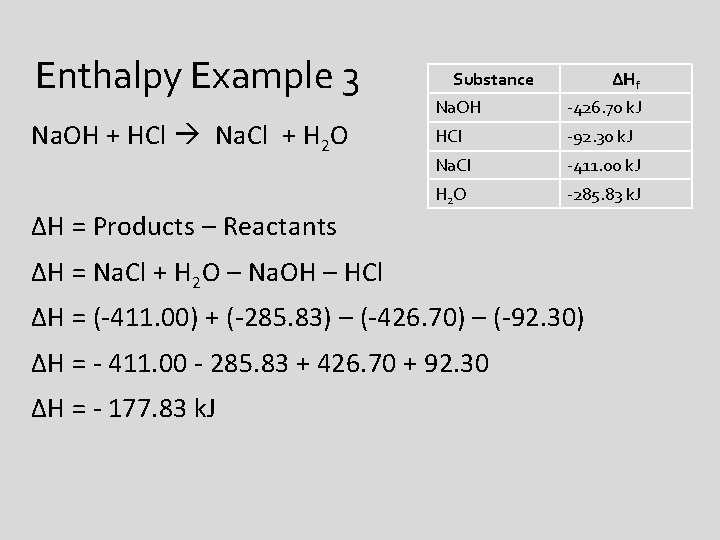
Enthalpy Example 3 Na. OH + HCl Na. Cl + H 2 O Substance ΔHf Na. OH -426. 70 k. J HCl -92. 30 k. J Na. Cl -411. 00 k. J H 2 O -285. 83 k. J ΔH = Products – Reactants ΔH = Na. Cl + H 2 O – Na. OH – HCl ΔH = (-411. 00) + (-285. 83) – (-426. 70) – (-92. 30) ΔH = - 411. 00 - 285. 83 + 426. 70 + 92. 30 ΔH = - 177. 83 k. J
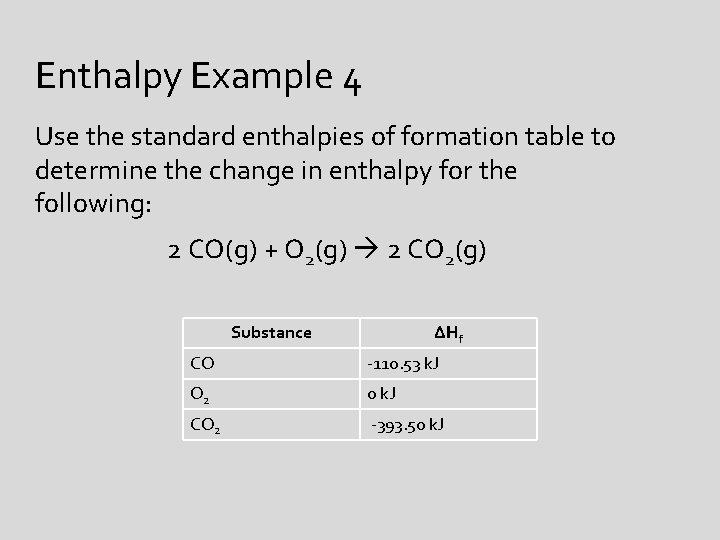
Enthalpy Example 4 Use the standard enthalpies of formation table to determine the change in enthalpy for the following: 2 CO(g) + O 2(g) 2 CO 2(g) Substance ΔHf CO -110. 53 k. J O 2 0 k. J CO 2 -393. 50 k. J
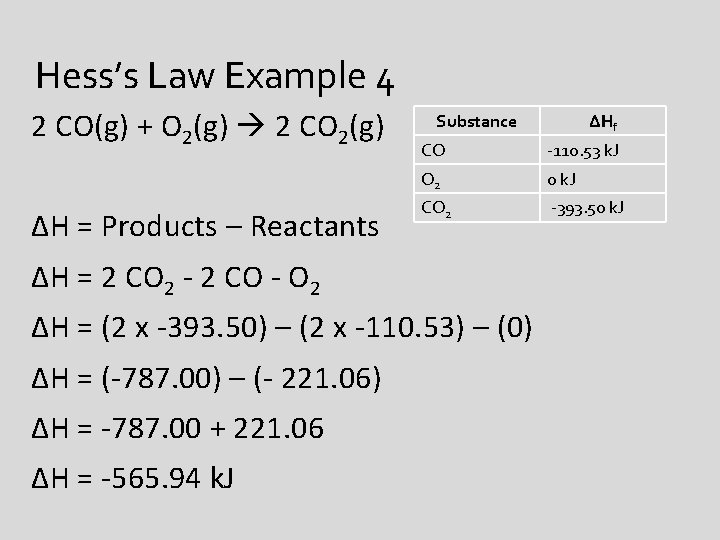
Hess’s Law Example 4 2 CO(g) + O 2(g) 2 CO 2(g) ΔH = Products – Reactants Substance CO -110. 53 k. J O 2 0 k. J CO 2 -393. 50 k. J ΔH = 2 CO 2 - 2 CO - O 2 ΔH = (2 x -393. 50) – (2 x -110. 53) – (0) ΔH = (-787. 00) – (- 221. 06) ΔH = -787. 00 + 221. 06 ΔH = -565. 94 k. J ΔHf
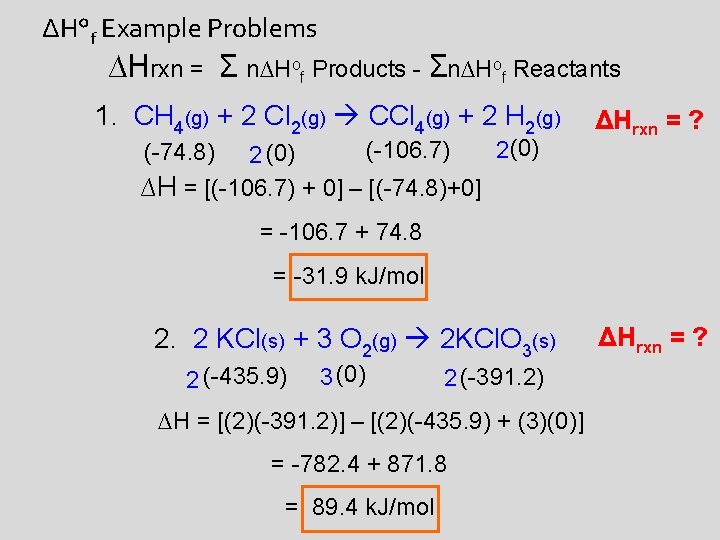
ΔH°f Example Problems ∆Hrxn = Σ n∆Hof Products - Σn∆Hof Reactants 1. CH 4(g) + 2 Cl 2(g) CCl 4(g) + 2 H 2(g) (-106. 7) 2 (0) ∆H = [(-106. 7) + 0] – [(-74. 8)+0] (-74. 8) ΔHrxn = ? = -106. 7 + 74. 8 = -31. 9 k. J/mol 2. 2 KCl(s) + 3 O 2(g) 2 KCl. O 3(s) 2 (-435. 9) 3 (0) 2 (-391. 2) ∆H = [(2)(-391. 2)] – [(2)(-435. 9) + (3)(0)] = -782. 4 + 871. 8 = 89. 4 k. J/mol ΔHrxn = ?
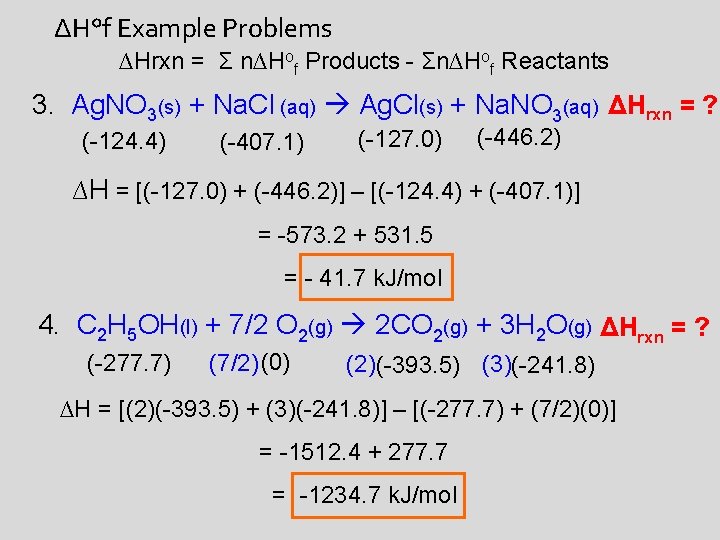
ΔH°f Example Problems ∆Hrxn = Σ n∆Hof Products - Σn∆Hof Reactants 3. Ag. NO 3(s) + Na. Cl (aq) Ag. Cl(s) + Na. NO 3(aq) ΔHrxn = ? (-124. 4) (-407. 1) (-127. 0) (-446. 2) ∆H = [(-127. 0) + (-446. 2)] – [(-124. 4) + (-407. 1)] = -573. 2 + 531. 5 = - 41. 7 k. J/mol 4. C 2 H 5 OH(l) + 7/2 O 2(g) 2 CO 2(g) + 3 H 2 O(g) ΔHrxn = ? (-277. 7) (7/2) (0) (2)(-393. 5) (3)(-241. 8) ∆H = [(2)(-393. 5) + (3)(-241. 8)] – [(-277. 7) + (7/2)(0)] = -1512. 4 + 277. 7 = -1234. 7 k. J/mol
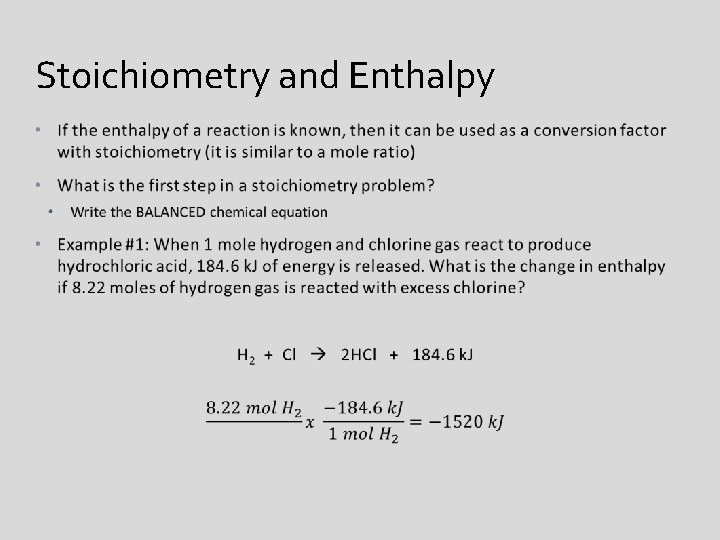
Stoichiometry and Enthalpy
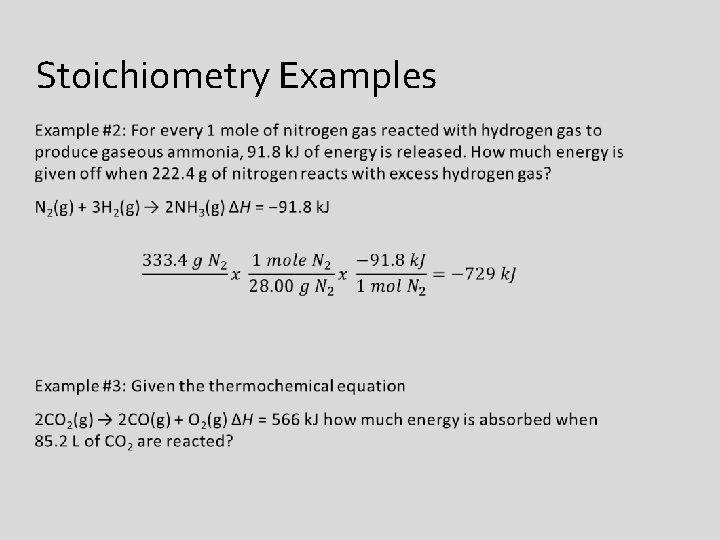
Stoichiometry Examples
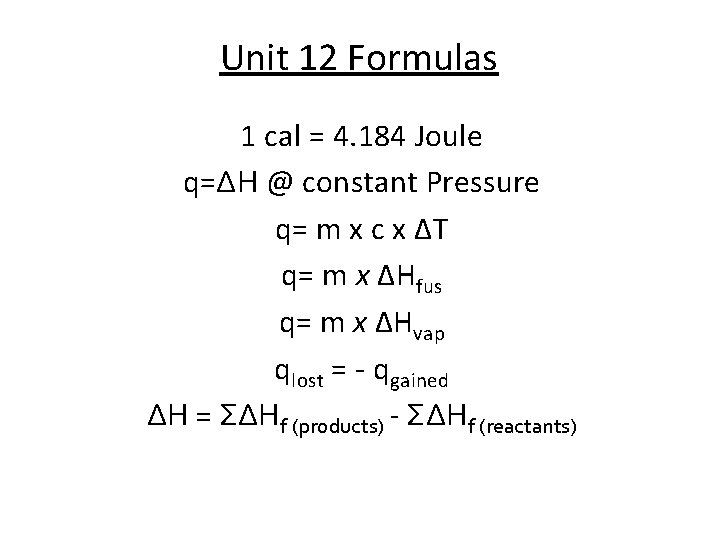
Unit 12 Formulas 1 cal = 4. 184 Joule q=ΔH @ constant Pressure q= m x c x ΔT q= m x ∆Hfus q= m x ∆Hvap qlost = - qgained ΔH = ΣΔHf (products) - ΣΔHf (reactants)