Service Component Architecture SCA Tutorial Part 1 Anish
- Slides: 99
Service Component Architecture (SCA) Tutorial : Part 1 Anish Karmarkar – Oracle Ashok Malhotra – Oracle David Booz - IBM …
SCA n A vendor-, technology-, language-neutral model for the creation of business systems using SOA by the composition and deployment of new and existing service components
Part 1 Outline n n n SCA: Introduction SCA Assembly SCA Java Common Annotations SCA Java Common APIs SCA Spring Component Implementation SCA Java Component Implementation SCA BPEL Component Implementation SCA Web Service Binding SCA JMS Binding SCA EJB Session Bean Binding Summary Demo
Part 2 Outline (Afternoon Session) n SCA Policy Framework l l l Intents Policy sets Java Annotations for policy framework Mapping intents to policy sets Intents for n n l Reliable messaging Security Demo
Introduction: Outline n n n SCA: Why? SCA: What? SCA: How and Where?
Introduction: Outline n SCA: Why? l l l n n Business drivers What we have today Where do we want to go Service-oriented architecture (SOA) SOA core elements SCA: What? SCA: How and Where?
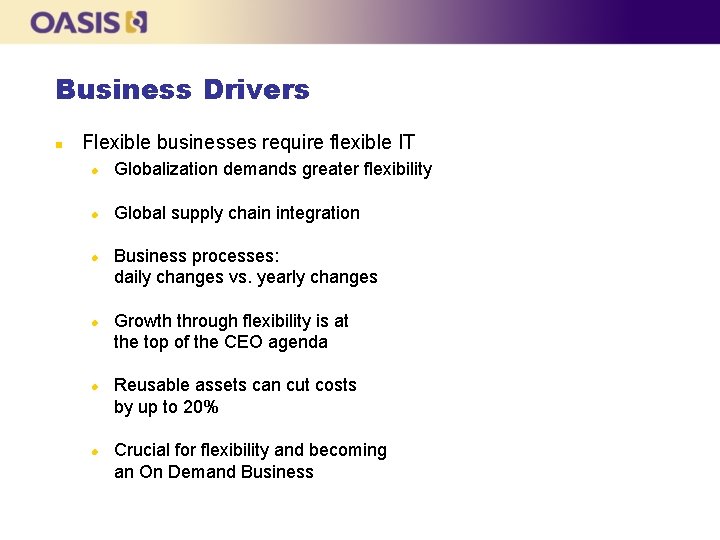
Business Drivers n Flexible businesses require flexible IT l Globalization demands greater flexibility l Global supply chain integration l l Business processes: daily changes vs. yearly changes Growth through flexibility is at the top of the CEO agenda Reusable assets can cut costs by up to 20% Crucial for flexibility and becoming an On Demand Business
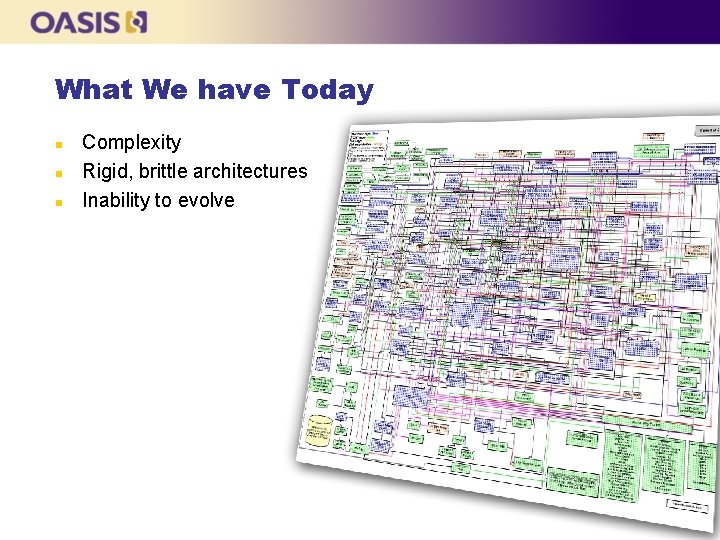
What We have Today n n n Complexity Rigid, brittle architectures Inability to evolve
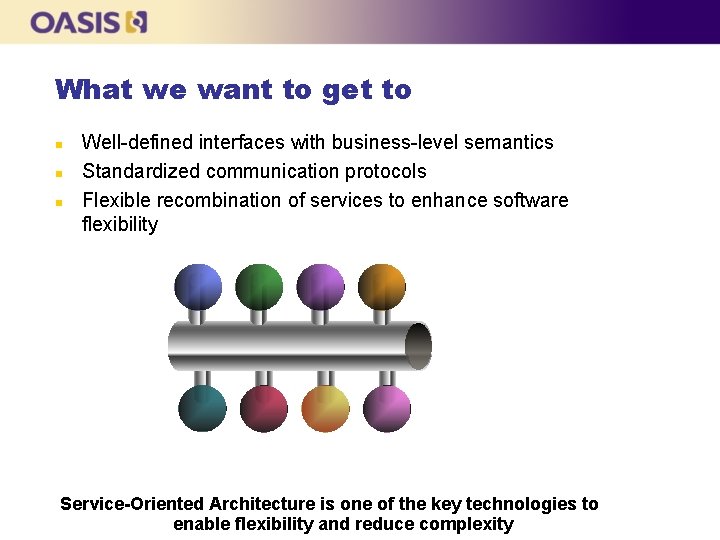
What we want to get to n n n Well-defined interfaces with business-level semantics Standardized communication protocols Flexible recombination of services to enhance software flexibility Service-Oriented Architecture is one of the key technologies to enable flexibility and reduce complexity
Service-oriented Architechture (SOA) n SOA derives its technical strategy and vision from the basic concept of a service: “A service is an abstraction that encapsulates a software function. ” “Developers build services, use services and develop solutions that aggregate services. ” “Composition of services into integrated solutions is a key activity”
SOA Core Elements n Service Assembly l n technology- and language- independent representation of the composition of services into business solutions Service Component l technology- and language-independent representation of a service which can be composed with other services
Introduction: Outline SCA: Why? § SCA: What? § SCA: Simplified Programming Model for SOA § SCA: What It Is Not § SCA: High Level View § SCA Elements § Assembly Model Concepts § SCA Interaction Model § SCA Client and Implementations § SCA Bindings § SCA Policy Framework § Policy, Profiles and Qo. S § Attaching Policies and Mapping to Policy Sets § Interaction and Implementation Policies n How and Where? n
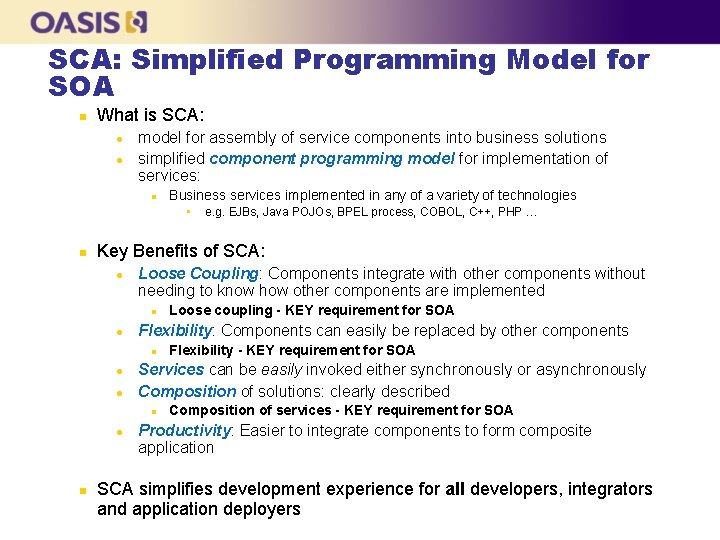
SCA: Simplified Programming Model for SOA n What is SCA: l l model for assembly of service components into business solutions simplified component programming model for implementation of services: n Business services implemented in any of a variety of technologies • n Key Benefits of SCA: l Loose Coupling: Components integrate with other components without needing to know how other components are implemented n l l l Flexibility - KEY requirement for SOA Services can be easily invoked either synchronously or asynchronously Composition of solutions: clearly described n l Loose coupling - KEY requirement for SOA Flexibility: Components can easily be replaced by other components n n e. g. EJBs, Java POJOs, BPEL process, COBOL, C++, PHP … Composition of services - KEY requirement for SOA Productivity: Easier to integrate components to form composite application SCA simplifies development experience for all developers, integrators and application deployers
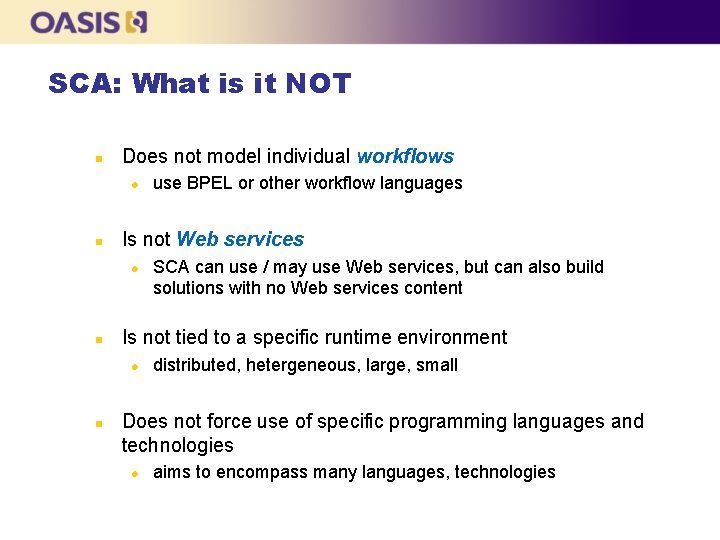
SCA: What is it NOT n Does not model individual workflows l n Is not Web services l n SCA can use / may use Web services, but can also build solutions with no Web services content Is not tied to a specific runtime environment l n use BPEL or other workflow languages distributed, hetergeneous, large, small Does not force use of specific programming languages and technologies l aims to encompass many languages, technologies
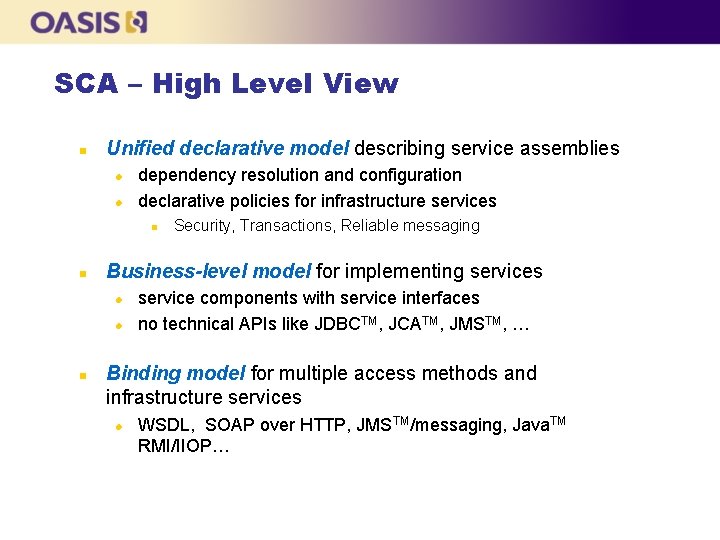
SCA – High Level View n Unified declarative model describing service assemblies l l dependency resolution and configuration declarative policies for infrastructure services n n Business-level model for implementing services l l n Security, Transactions, Reliable messaging service components with service interfaces no technical APIs like JDBCTM, JCATM, JMSTM, … Binding model for multiple access methods and infrastructure services l WSDL, SOAP over HTTP, JMSTM/messaging, Java. TM RMI/IIOP…
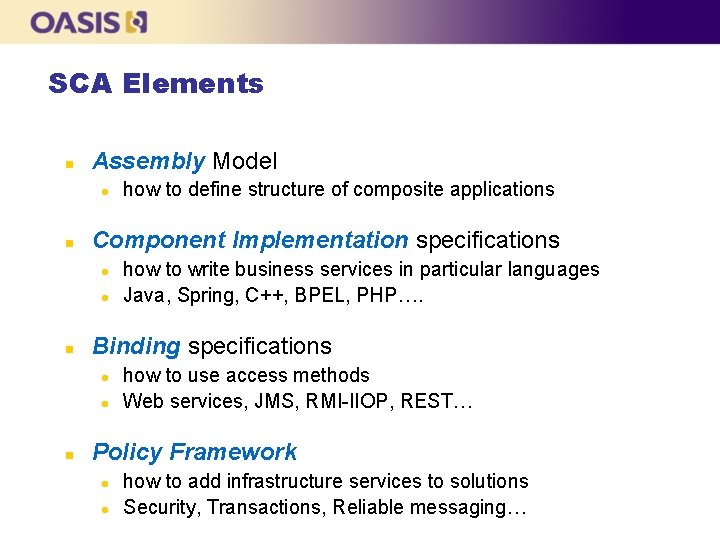
SCA Elements n Assembly Model l n Component Implementation specifications l l n how to write business services in particular languages Java, Spring, C++, BPEL, PHP…. Binding specifications l l n how to define structure of composite applications how to use access methods Web services, JMS, RMI-IIOP, REST… Policy Framework l l how to add infrastructure services to solutions Security, Transactions, Reliable messaging…
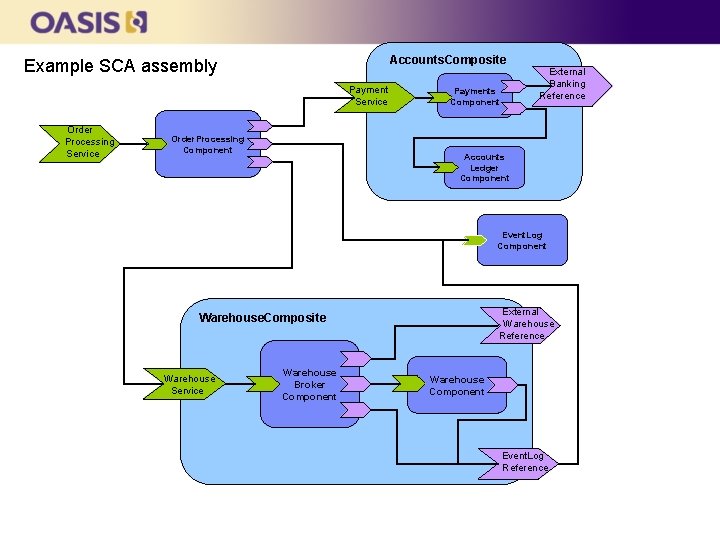
Accounts. Composite Example SCA assembly Payment Service Order Processing Service Order. Processing Component Payments Component External Banking Reference Accounts Ledger Component Event. Log Component External Warehouse Reference Warehouse. Composite Warehouse Service Warehouse Broker Component Warehouse Component Event. Log Reference
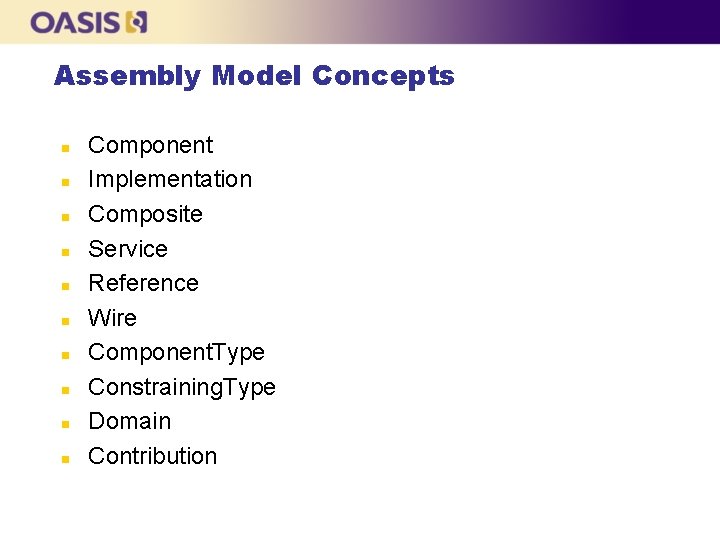
Assembly Model Concepts n n n n n Component Implementation Composite Service Reference Wire Component. Type Constraining. Type Domain Contribution
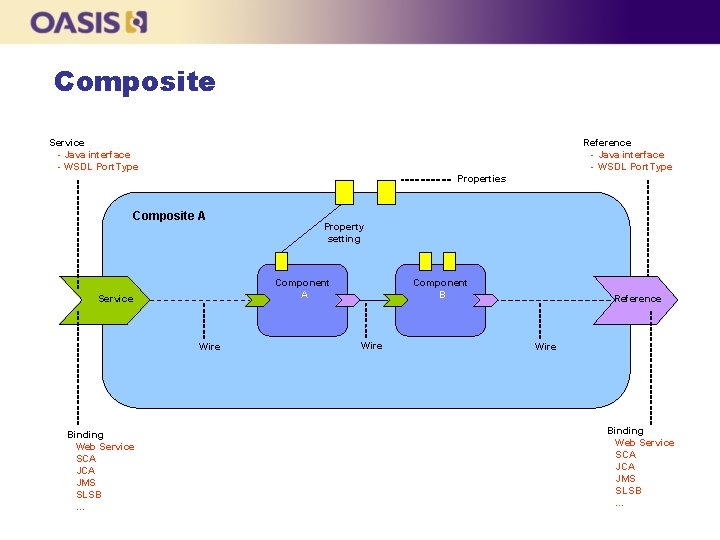
Composite Service - Java interface - WSDL Port. Type Reference - Java interface - WSDL Port. Type Properties Composite A Component A Service Wire Binding Web Service SCA JMS SLSB … Property setting Component B Wire Reference Wire Binding Web Service SCA JMS SLSB …
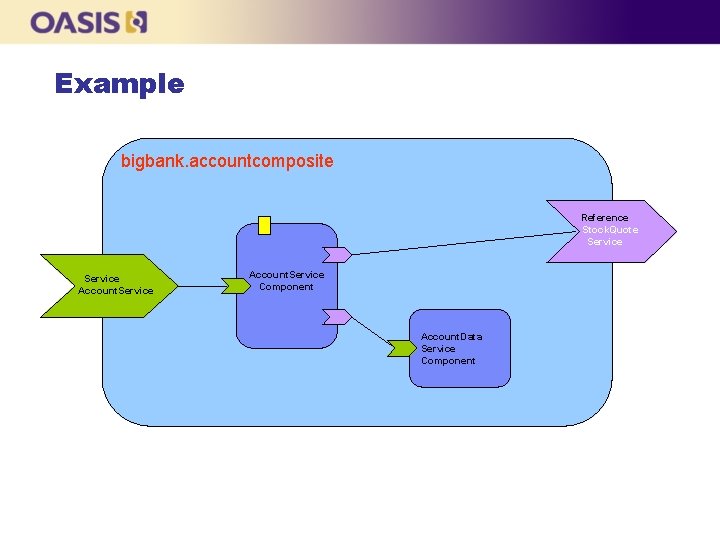
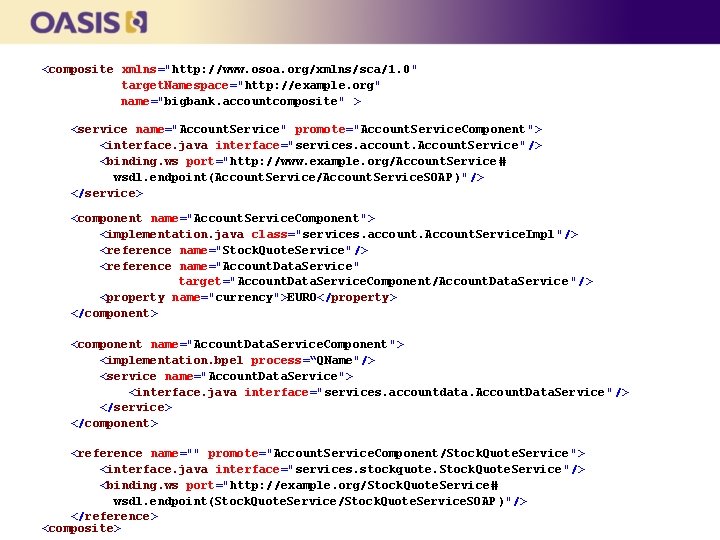
Example bigbank. accountcomposite Reference Stock. Quote Service Account. Service Component Account. Data Service Component
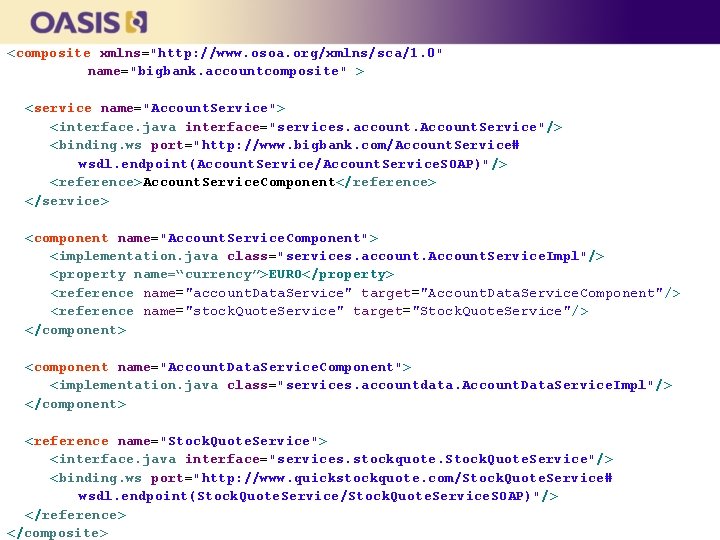
<composite xmlns="http: //www. osoa. org/xmlns/sca/1. 0" name="bigbank. accountcomposite" > <service name="Account. Service"> <interface. java interface="services. account. Account. Service"/> <binding. ws port="http: //www. bigbank. com/Account. Service# wsdl. endpoint(Account. Service/Account. Service. SOAP)"/> <reference>Account. Service. Component</reference> </service> <component name="Account. Service. Component"> <implementation. java class="services. account. Account. Service. Impl"/> <property name=“currency”>EURO</property> <reference name="account. Data. Service" target="Account. Data. Service. Component"/> <reference name="stock. Quote. Service" target="Stock. Quote. Service"/> </component> <component name="Account. Data. Service. Component"> <implementation. java class="services. accountdata. Account. Data. Service. Impl"/> </component> <reference name="Stock. Quote. Service"> <interface. java interface="services. stockquote. Stock. Quote. Service"/> <binding. ws port="http: //www. quickstockquote. com/Stock. Quote. Service# wsdl. endpoint(Stock. Quote. Service/Stock. Quote. Service. SOAP)"/> </reference> </composite>
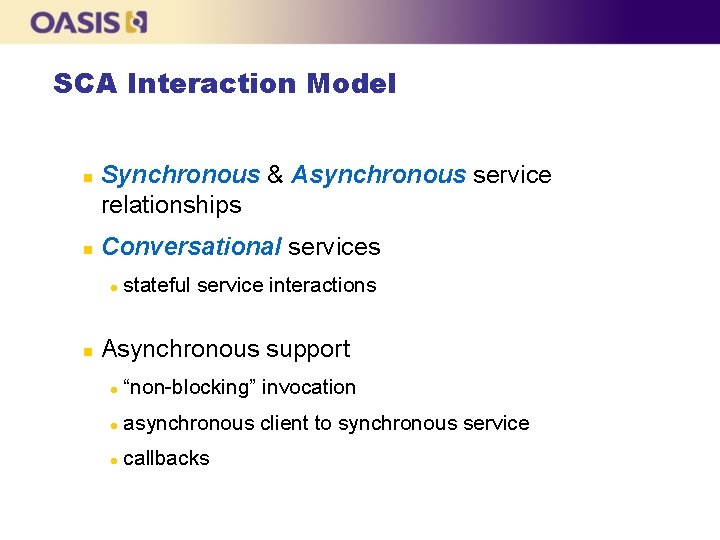
SCA Interaction Model n n Synchronous & Asynchronous service relationships Conversational services l n stateful service interactions Asynchronous support l “non-blocking” invocation l asynchronous client to synchronous service l callbacks
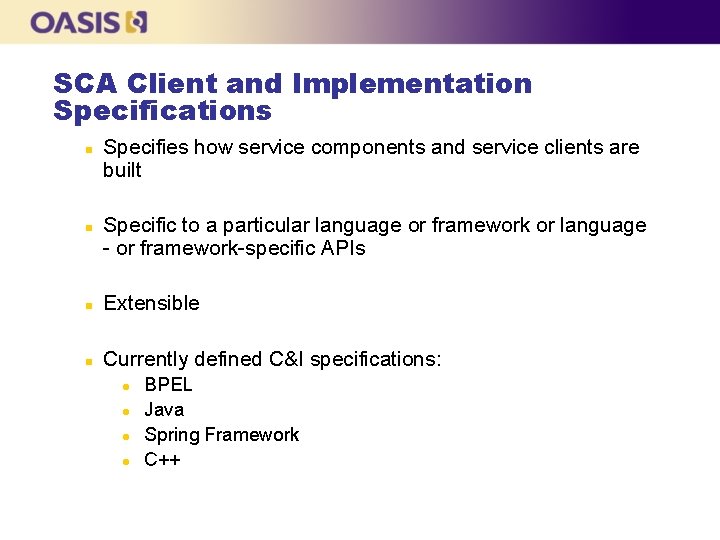
SCA Client and Implementation Specifications n n Specifies how service components and service clients are built Specific to a particular language or framework or language - or framework-specific APIs n Extensible n Currently defined C&I specifications: l l BPEL Java Spring Framework C++
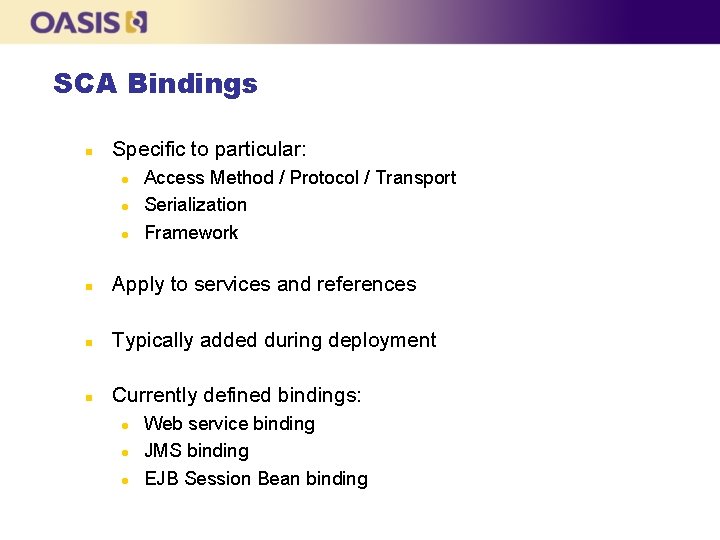
SCA Bindings n Specific to particular: l l l Access Method / Protocol / Transport Serialization Framework n Apply to services and references n Typically added during deployment n Currently defined bindings: l l l Web service binding JMS binding EJB Session Bean binding
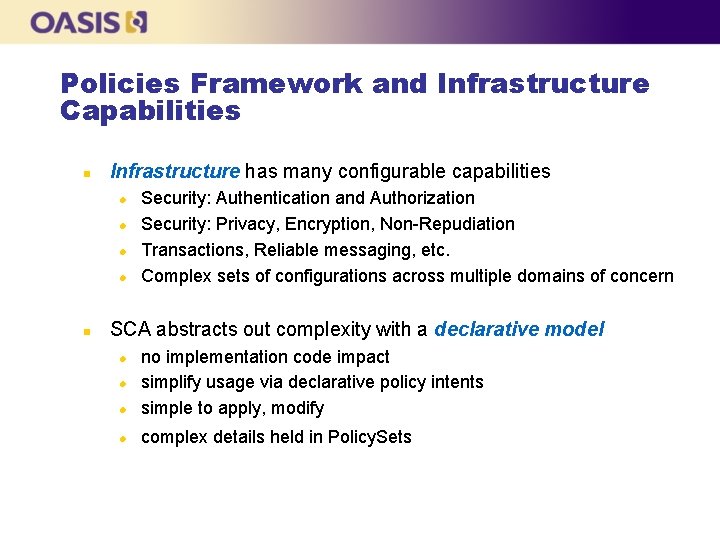
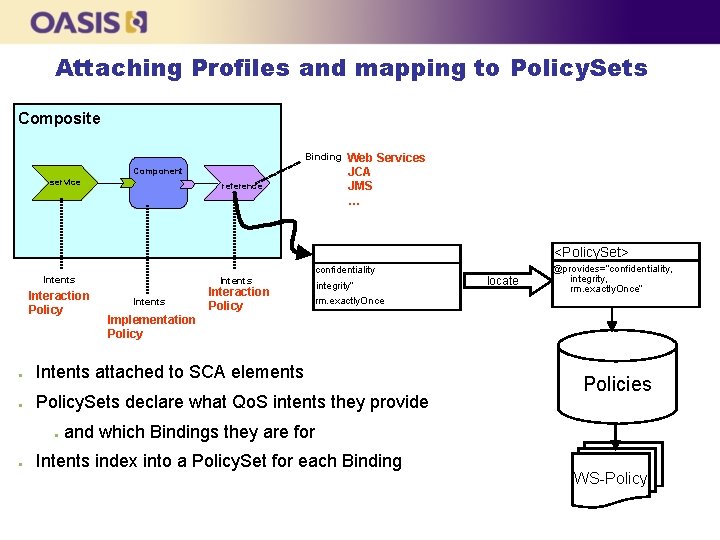
Policies Framework and Infrastructure Capabilities n Infrastructure has many configurable capabilities l l n Security: Authentication and Authorization Security: Privacy, Encryption, Non-Repudiation Transactions, Reliable messaging, etc. Complex sets of configurations across multiple domains of concern SCA abstracts out complexity with a declarative model l no implementation code impact simplify usage via declarative policy intents simple to apply, modify l complex details held in Policy. Sets l l
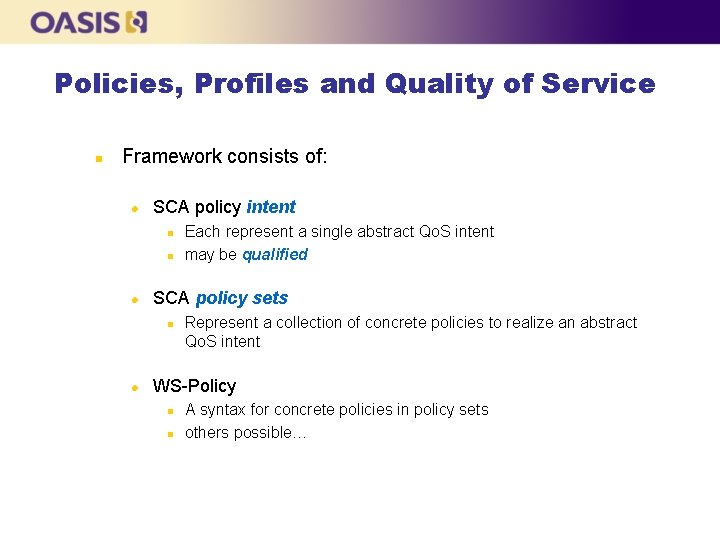
Policies, Profiles and Quality of Service n Framework consists of: l SCA policy intent n n l SCA policy sets n l Each represent a single abstract Qo. S intent may be qualified Represent a collection of concrete policies to realize an abstract Qo. S intent WS-Policy n n A syntax for concrete policies in policy sets others possible…
Attaching Profiles and mapping to Policy. Sets Composite Binding Component service reference Web Services JCA JMS … <Policy. Set> Intents Interaction Policy Intents Implementation Policy Interaction Policy confidentiality integrity” rm. exactly. Once ● Intents attached to SCA elements ● Policy. Sets declare what Qo. S intents they provide ● ● locate @provides=“confidentiality, integrity, rm. exactly. Once” Policies and which Bindings they are for Intents index into a Policy. Set for each Binding WS-Policy
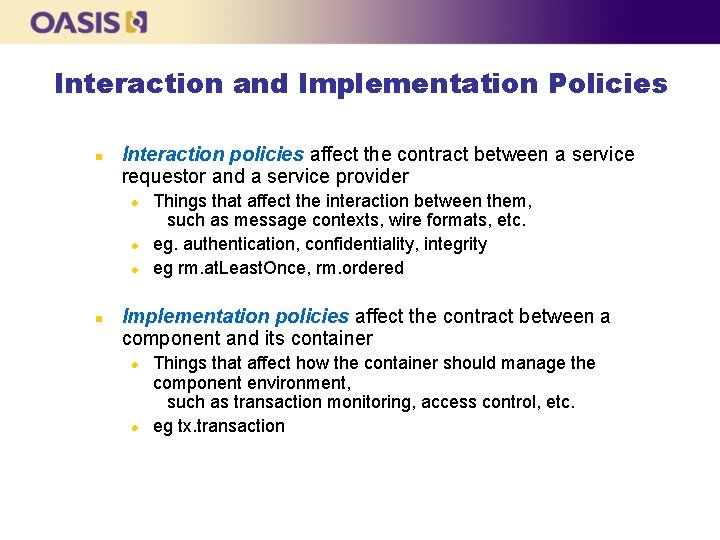
Interaction and Implementation Policies n Interaction policies affect the contract between a service requestor and a service provider l l l n Things that affect the interaction between them, such as message contexts, wire formats, etc. eg. authentication, confidentiality, integrity eg rm. at. Least. Once, rm. ordered Implementation policies affect the contract between a component and its container l l Things that affect how the container should manage the component environment, such as transaction monitoring, access control, etc. eg tx. transaction
Introduction: Outline n n n SCA: Why? SCA: What? SCA: How and Where? l l Open SOA (OSOA) Collaboration OSOA & Evolution of Specifications Implementations Useful Pointers
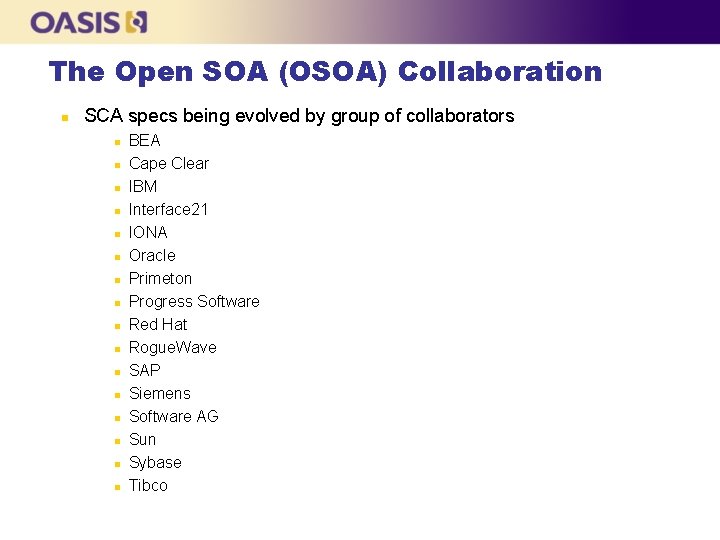
The Open SOA (OSOA) Collaboration n SCA specs being evolved by group of collaborators n n n n BEA Cape Clear IBM Interface 21 IONA Oracle Primeton Progress Software Red Hat Rogue. Wave SAP Siemens Software AG Sun Sybase Tibco
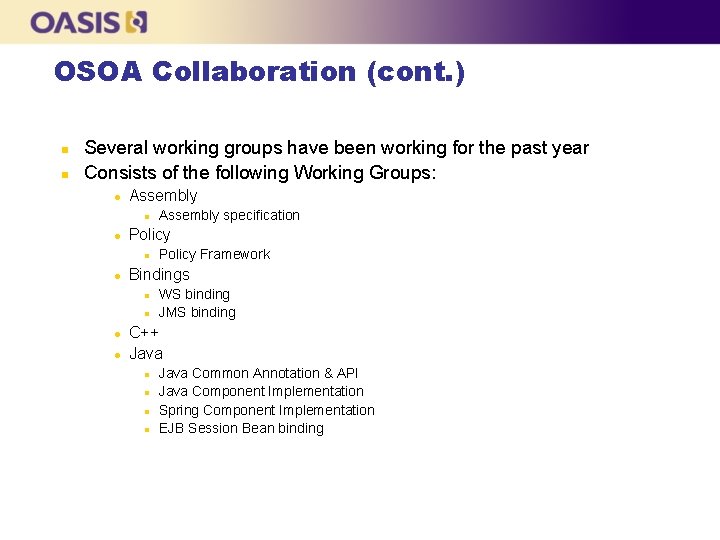
OSOA Collaboration (cont. ) n n Several working groups have been working for the past year Consists of the following Working Groups: l Assembly n l Policy Framework Bindings n l Assembly specification WS binding JMS binding C++ Java n n Java Common Annotation & API Java Component Implementation Spring Component Implementation EJB Session Bean binding
OSOA Collaboration (cont. ) n n OSOA is not a standards body Innovate rapidly and deliver the specification set to the community n Royalty Free n Public website for specifications, white papers, news, etc l l l http: //www. osoa. org comment and feedback welcome OSOA Supporters group
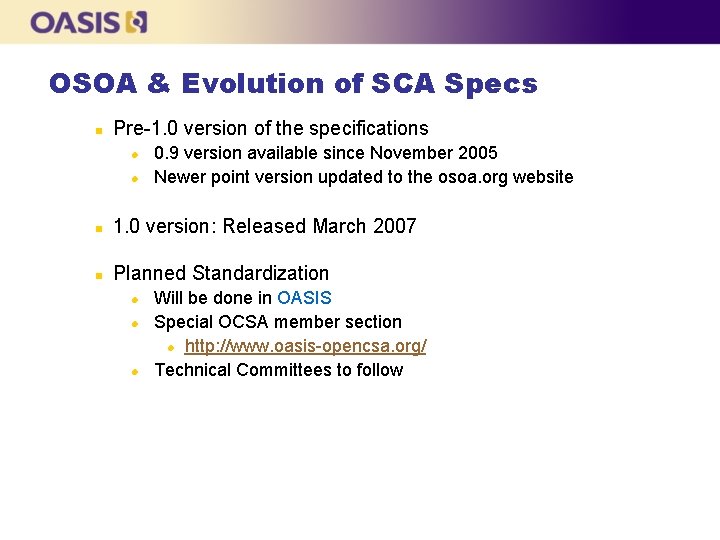
OSOA & Evolution of SCA Specs n Pre-1. 0 version of the specifications l l 0. 9 version available since November 2005 Newer point version updated to the osoa. org website n 1. 0 version: Released March 2007 n Planned Standardization l l l Will be done in OASIS Special OCSA member section l http: //www. oasis-opencsa. org/ Technical Committees to follow * = later publication date
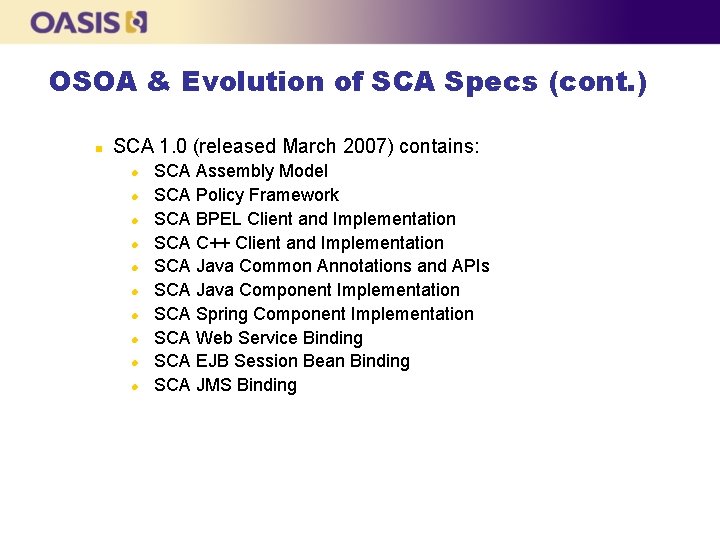
OSOA & Evolution of SCA Specs (cont. ) n SCA 1. 0 (released March 2007) contains: l l l l l SCA Assembly Model SCA Policy Framework SCA BPEL Client and Implementation SCA C++ Client and Implementation SCA Java Common Annotations and APIs SCA Java Component Implementation SCA Spring Component Implementation SCA Web Service Binding SCA EJB Session Bean Binding SCA JMS Binding * = later publication date
Implementations n n Open source: Apache and Eclipse Vendor: BEA, IBM, Oracle, SAP, Tibco, Iona, Rogue. Wave, …
Useful Pointers n SCA specifications and related material l n http: //www. osoa. org Contact: l l l anish. karmarkar@oracle. com ashok. malhotra@oracle. com booz@us. ibm. com
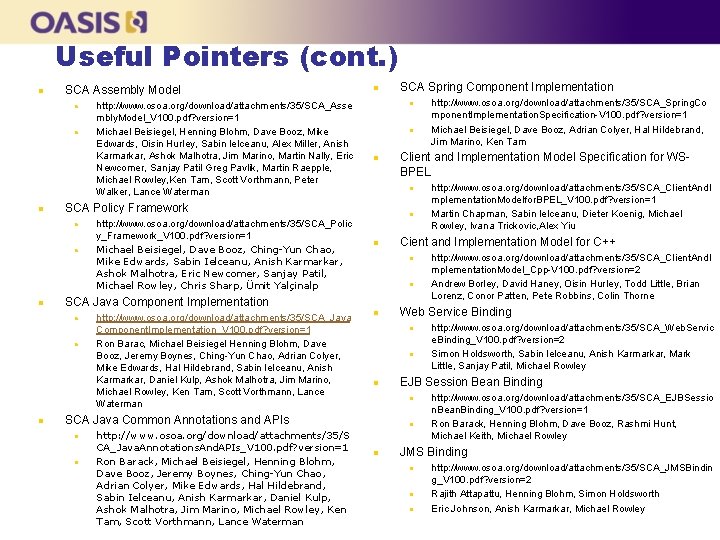
Useful Pointers (cont. ) n SCA Assembly Model l l n n n n l http: //www. osoa. org/download/attachments/35/SCA_Java Component. Implementation_V 100. pdf? version=1 Ron Barac, Michael Beisiegel Henning Blohm, Dave Booz, Jeremy Boynes, Ching-Yun Chao, Adrian Colyer, Mike Edwards, Hal Hildebrand, Sabin Ielceanu, Anish Karmarkar, Daniel Kulp, Ashok Malhotra, Jim Marino, Michael Rowley, Ken Tam, Scott Vorthmann, Lance Waterman n n http: //www. osoa. org/download/attachments/35/S CA_Java. Annotations. And. APIs_V 100. pdf? version=1 Ron Barack, Michael Beisiegel, Henning Blohm, Dave Booz, Jeremy Boynes, Ching-Yun Chao, Adrian Colyer, Mike Edwards, Hal Hildebrand, Sabin Ielceanu, Anish Karmarkar, Daniel Kulp, Ashok Malhotra, Jim Marino, Michael Rowley, Ken Tam, Scott Vorthmann, Lance Waterman n n http: //www. osoa. org/download/attachments/35/SCA_Web. Servic e. Binding_V 100. pdf? version=2 Simon Holdsworth, Sabin Ielceanu, Anish Karmarkar, Mark Little, Sanjay Patil, Michael Rowley EJB Session Bean Binding n SCA Java Common Annotations and APIs http: //www. osoa. org/download/attachments/35/SCA_Client. And. I mplementation. Model_Cpp-V 100. pdf? version=2 Andrew Borley, David Haney, Oisin Hurley, Todd Little, Brian Lorenz, Conor Patten, Pete Robbins, Colin Thorne Web Service Binding n n http: //www. osoa. org/download/attachments/35/SCA_Client. And. I mplementation. Modelfor. BPEL_V 100. pdf? version=1 Martin Chapman, Sabin Ielceanu, Dieter Koenig, Michael Rowley, Ivana Trickovic, Alex Yiu Cient and Implementation Model for C++ n n http: //www. osoa. org/download/attachments/35/SCA_Spring. Co mponent. Implementation. Specification-V 100. pdf? version=1 Michael Beisiegel, Dave Booz, Adrian Colyer, Hal Hildebrand, Jim Marino, Ken Tam Client and Implementation Model Specification for WSBPEL n SCA Java Component Implementation l n http: //www. osoa. org/download/attachments/35/SCA_Polic y_Framework_V 100. pdf? version=1 Michael Beisiegel, Dave Booz, Ching-Yun Chao, Mike Edwards, Sabin Ielceanu, Anish Karmarkar, Ashok Malhotra, Eric Newcomer, Sanjay Patil, Michael Rowley, Chris Sharp, Ümit Yalçinalp SCA Spring Component Implementation n SCA Policy Framework l n http: //www. osoa. org/download/attachments/35/SCA_Asse mbly. Model_V 100. pdf? version=1 Michael Beisiegel, Henning Blohm, Dave Booz, Mike Edwards, Oisin Hurley, Sabin Ielceanu, Alex Miller, Anish Karmarkar, Ashok Malhotra, Jim Marino, Martin Nally, Eric Newcomer, Sanjay Patil Greg Pavlik, Martin Raepple, Michael Rowley, Ken Tam, Scott Vorthmann, Peter Walker, Lance Waterman n http: //www. osoa. org/download/attachments/35/SCA_EJBSessio n. Bean. Binding_V 100. pdf? version=1 Ron Barack, Henning Blohm, Dave Booz, Rashmi Hunt, Michael Keith, Michael Rowley JMS Binding n n n http: //www. osoa. org/download/attachments/35/SCA_JMSBindin g_V 100. pdf? version=2 Rajith Attapattu, Henning Blohm, Simon Holdsworth Eric Johnson, Anish Karmarkar, Michael Rowley
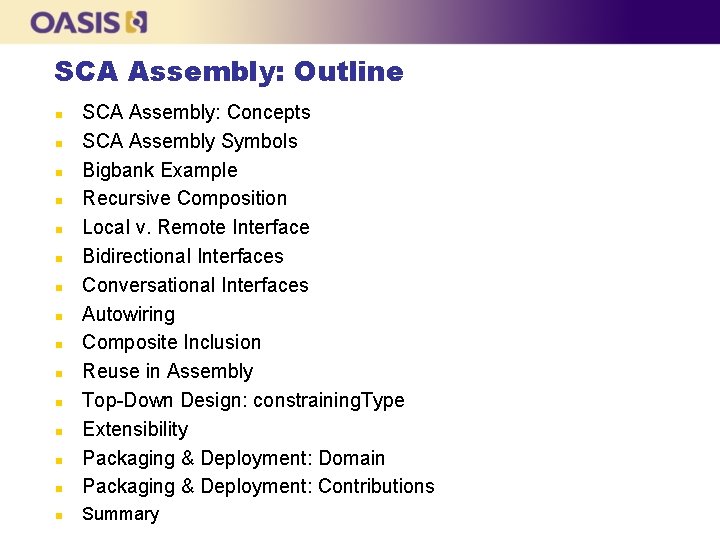
SCA Assembly: Outline n SCA Assembly: Concepts SCA Assembly Symbols Bigbank Example Recursive Composition Local v. Remote Interface Bidirectional Interfaces Conversational Interfaces Autowiring Composite Inclusion Reuse in Assembly Top-Down Design: constraining. Type Extensibility Packaging & Deployment: Domain Packaging & Deployment: Contributions n Summary n n n n
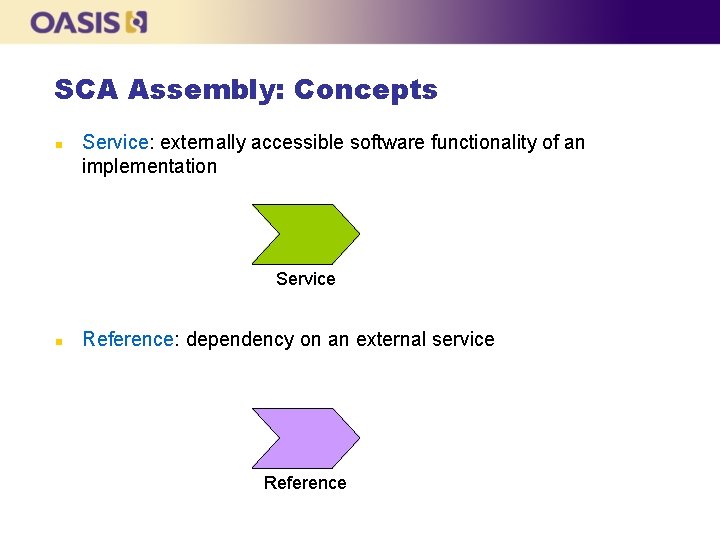
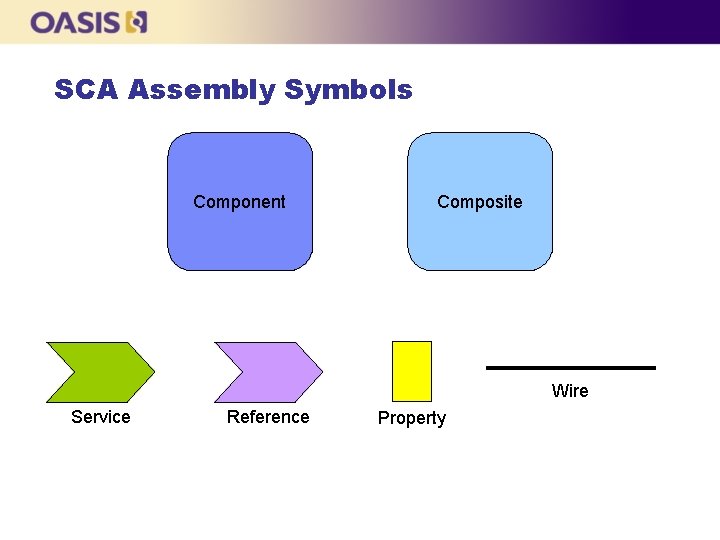
SCA Assembly: Concepts n Service: externally accessible software functionality of an implementation Service n Reference: dependency on an external service Reference
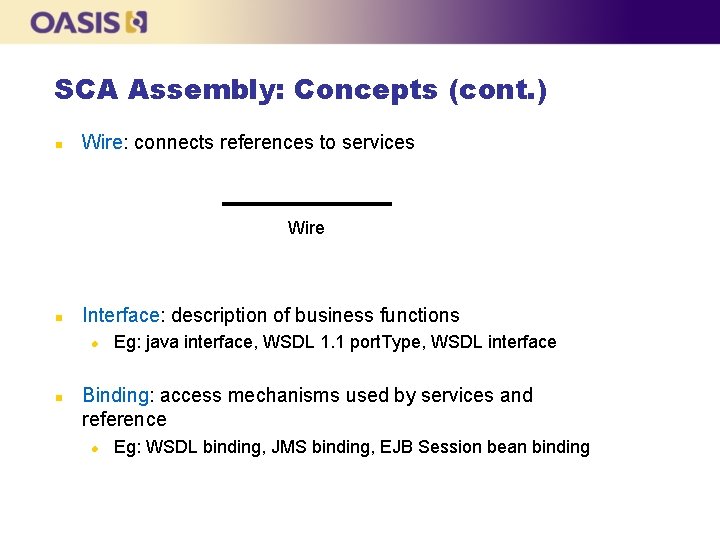
SCA Assembly: Concepts (cont. ) n Wire: connects references to services Wire n Interface: description of business functions l n Eg: java interface, WSDL 1. 1 port. Type, WSDL interface Binding: access mechanisms used by services and reference l Eg: WSDL binding, JMS binding, EJB Session bean binding
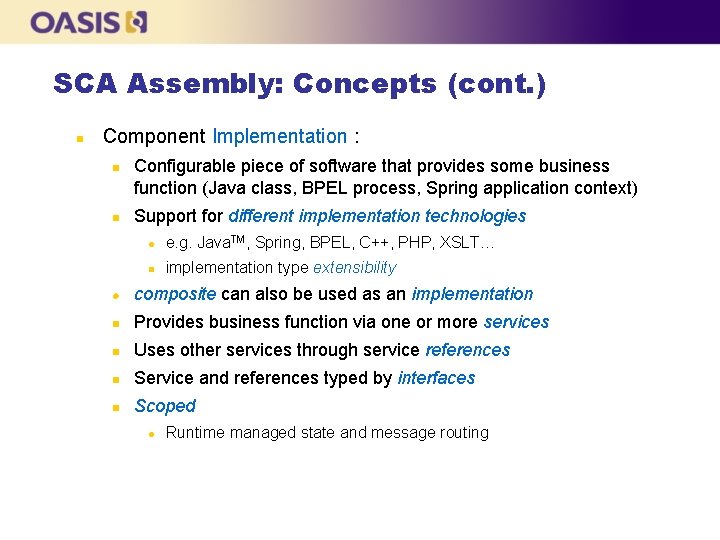
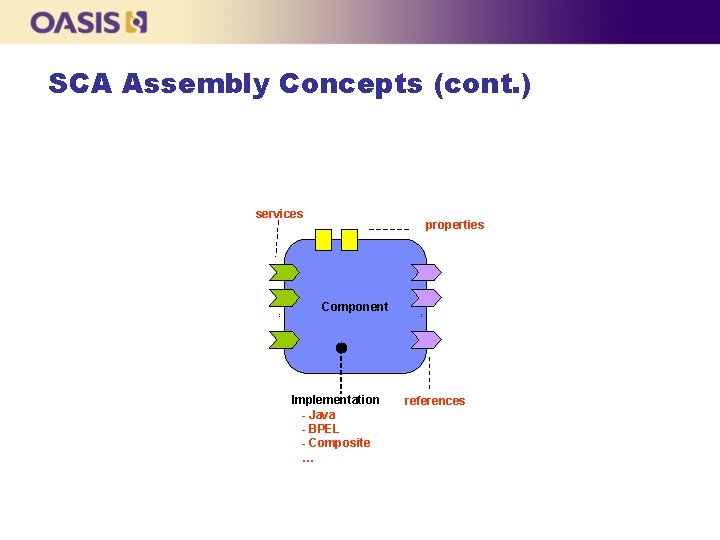
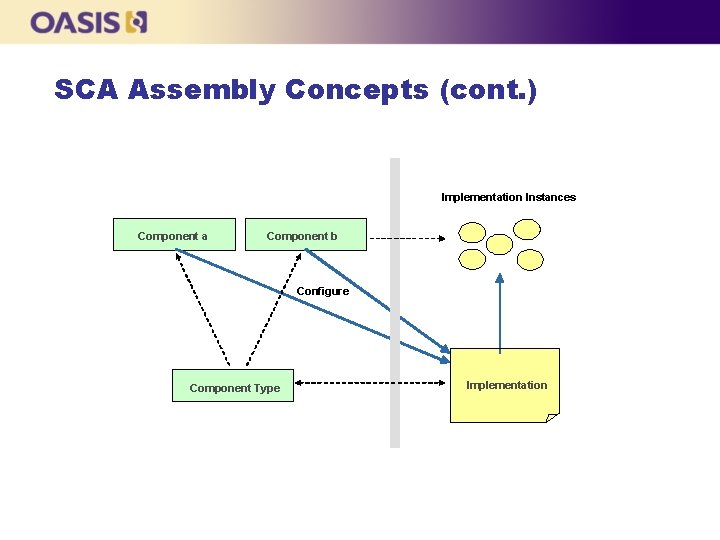
SCA Assembly: Concepts (cont. ) n Component Implementation : n n Configurable piece of software that provides some business function (Java class, BPEL process, Spring application context) Support for different implementation technologies l e. g. Java. TM, Spring, BPEL, C++, PHP, XSLT… n implementation type extensibility l composite can also be used as an implementation n Provides business function via one or more services n Uses other services through service references n Service and references typed by interfaces n Scoped l Runtime managed state and message routing
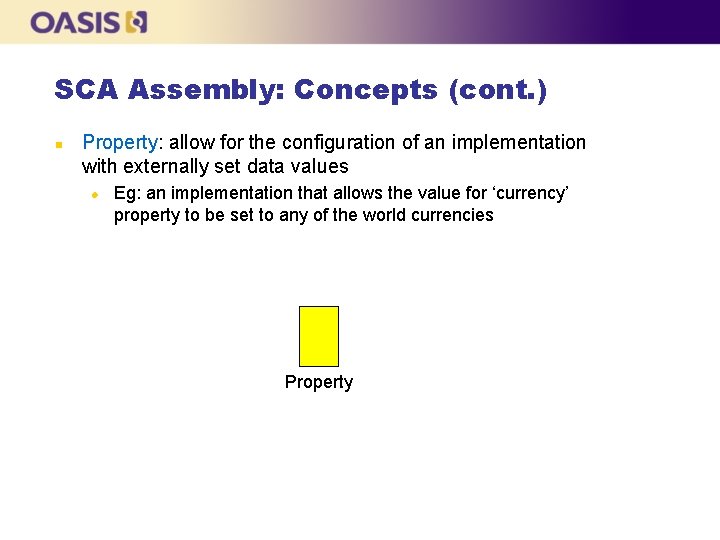
SCA Assembly: Concepts (cont. ) n Property: allow for the configuration of an implementation with externally set data values l Eg: an implementation that allows the value for ‘currency’ property to be set to any of the world currencies Property
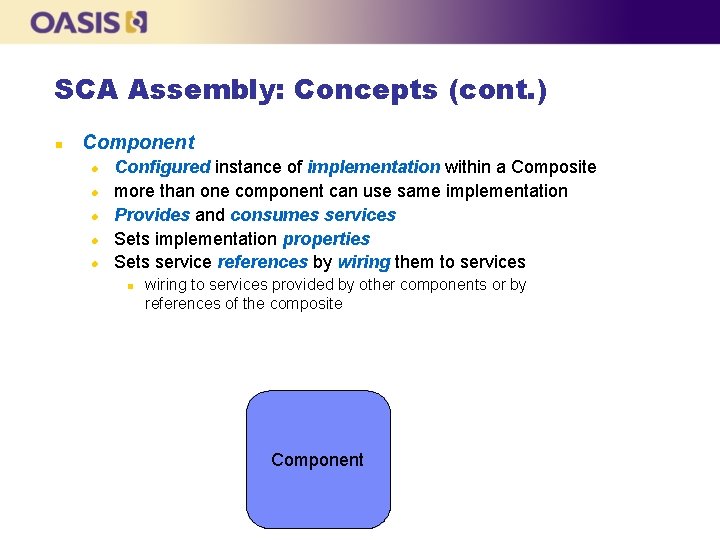
SCA Assembly: Concepts (cont. ) n Component l l l Configured instance of implementation within a Composite more than one component can use same implementation Provides and consumes services Sets implementation properties Sets service references by wiring them to services n wiring to services provided by other components or by references of the composite Component
SCA Assembly Concepts (cont. ) services properties Component … … Implementation - Java - BPEL - Composite … references
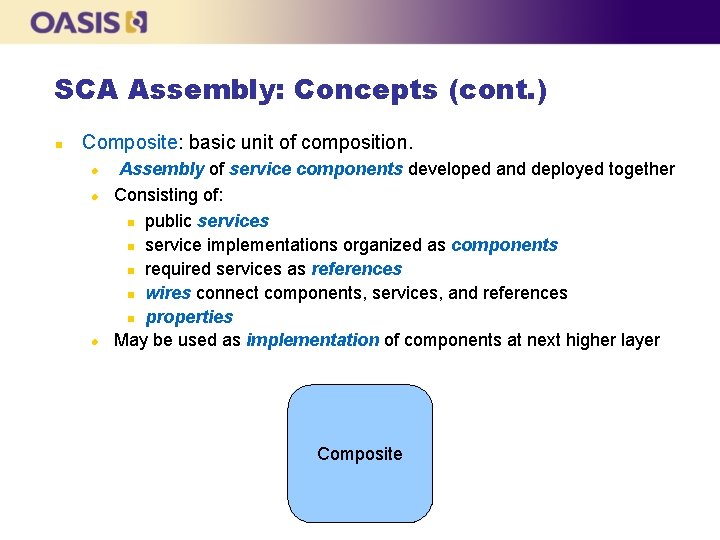
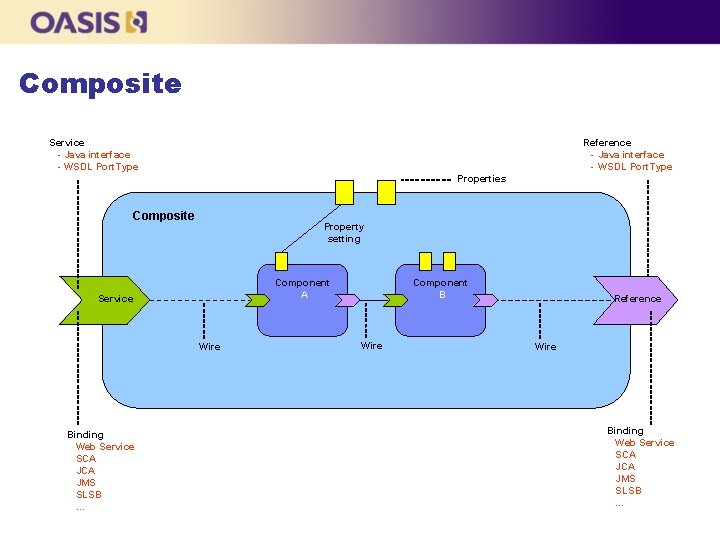
SCA Assembly: Concepts (cont. ) n Composite: basic unit of composition. l l l Assembly of service components developed and deployed together Consisting of: n public services n service implementations organized as components n required services as references n wires connect components, services, and references n properties May be used as implementation of components at next higher layer Composite
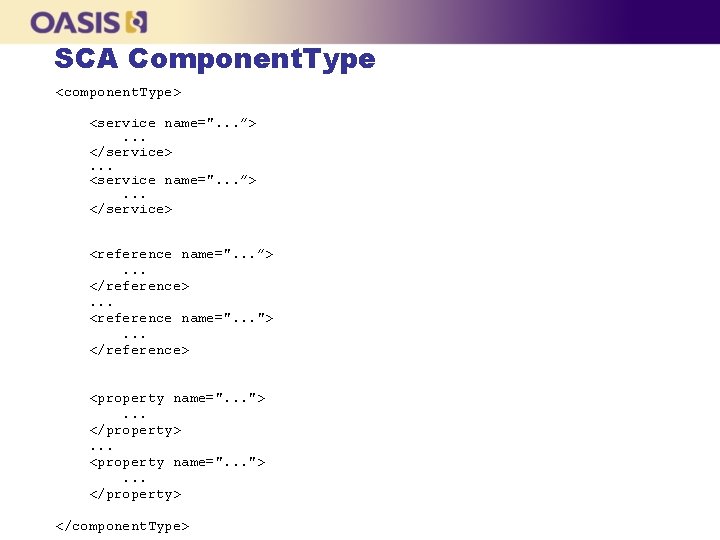
SCA Assembly: Concepts (cont. ) n Component. Type: description of an implementation l n Specifies all the references, services, properties of an implementation Constraining. Type: template for an implementation, component or composite that specifies the shape in terms of references, services, properties
SCA Component. Type <component. Type> <service name=". . . ”> . . . </service> . . . <service name=". . . ”> . . . </service> <reference name=". . . ”> . . . </reference> . . . <reference name=". . . "> . . . </reference> <property name=". . . "> . . . </property> . . . <property name=". . . "> . . . </property> </component. Type>
SCA Assembly Concepts (cont. ) Implementation Instances Component a Component b Configure Component Type Implementation
SCA Assembly Symbols Component Composite Wire Service Reference Property
Composite Service - Java interface - WSDL Port. Type Reference - Java interface - WSDL Port. Type Properties Composite Property setting Component A Service Wire Binding Web Service SCA JMS SLSB … Component B Wire Reference Wire Binding Web Service SCA JMS SLSB …
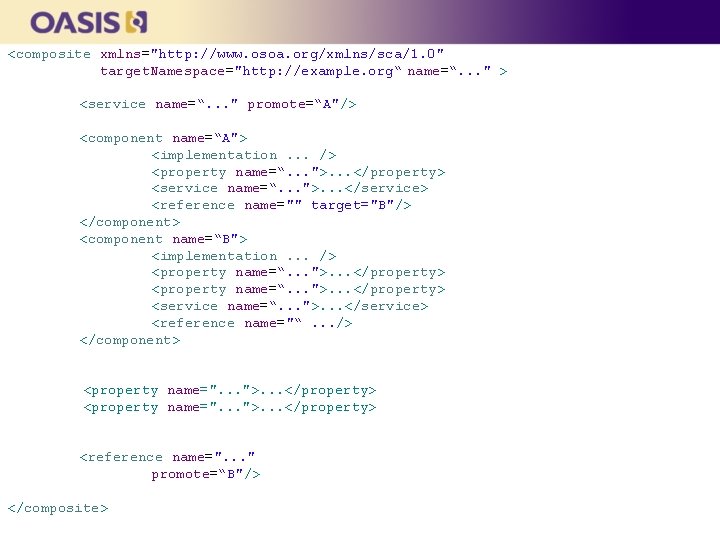
<composite xmlns="http: //www. osoa. org/xmlns/sca/1. 0" target. Namespace="http: //example. org“ name=“. . . " > <service name=“. . . " promote=“A"/> <component name=“A"> <implementation. . . /> <property name=“. . . ">. . . </property> <service name=“. . . ">. . . </service> <reference name="" target="B"/> </component> <component name=“B"> <implementation. . . /> <property name=“. . . ">. . . </property> <service name=“. . . ">. . . </service> <reference name="“. . . /> </component> <property name=". . . ">. . . </property> <reference name=". . . " promote=“B"/> </composite>
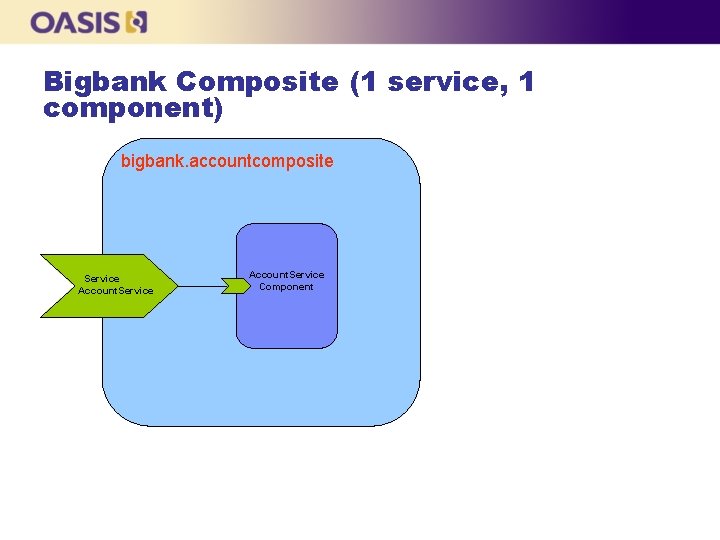
Bigbank Composite (1 service, 1 component) bigbank. accountcomposite Service Account. Service Component
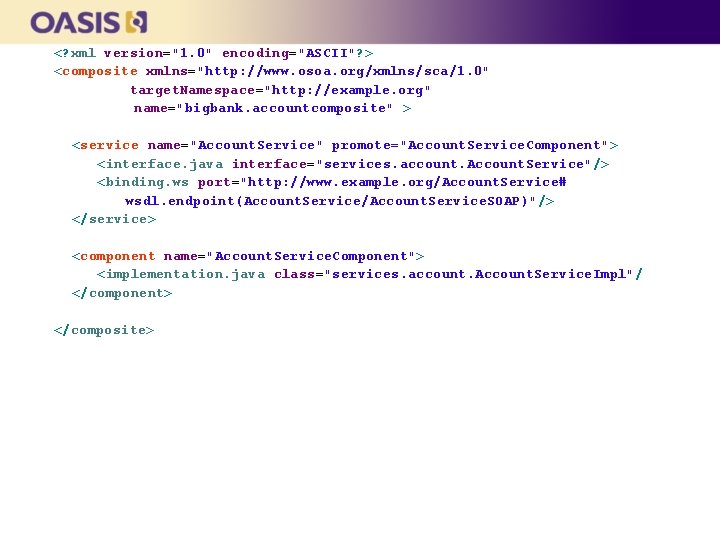
<? xml version="1. 0" encoding="ASCII"? > <composite xmlns="http: //www. osoa. org/xmlns/sca/1. 0" target. Namespace="http: //example. org" name="bigbank. accountcomposite" > <service name="Account. Service" promote="Account. Service. Component"> <interface. java interface="services. account. Account. Service"/> <binding. ws port="http: //www. example. org/Account. Service# wsdl. endpoint(Account. Service/Account. Service. SOAP)"/> </service> <component name="Account. Service. Component"> <implementation. java class="services. account. Account. Service. Impl"/ </component> </composite>
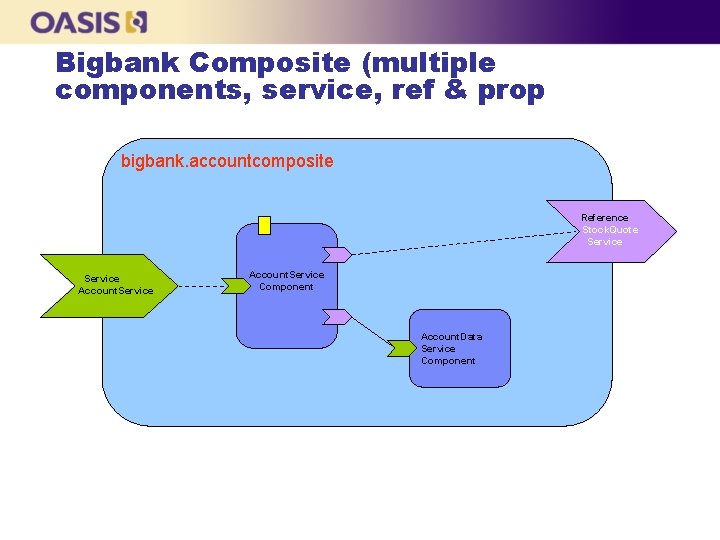
Bigbank Composite (multiple components, service, ref & prop bigbank. accountcomposite Reference Stock. Quote Service Account. Service Component Account. Data Service Component
<composite xmlns="http: //www. osoa. org/xmlns/sca/1. 0 " target. Namespace="http: //example. org" name="bigbank. accountcomposite " > <service name="Account. Service" promote="Account. Service. Component"> <interface. java interface="services. account. Account. Service "/> <binding. ws port="http: //www. example. org/Account. Service # wsdl. endpoint(Account. Service/Account. Service. SOAP )"/> </service> <component name="Account. Service. Component"> <implementation. java class="services. account. Account. Service. Impl "/> <reference name="Stock. Quote. Service"/> <reference name="Account. Data. Service" target ="Account. Data. Service. Component/Account. Data. Service "/> <property name="currency">EURO</property> </component> <component name="Account. Data. Service. Component "> <implementation. bpel process=“QName"/> <service name="Account. Data. Service"> <interface. java interface="services. accountdata. Account. Data. Service "/> </service> </component> <reference name="" promote="Account. Service. Component/Stock. Quote. Service "> <interface. java interface="services. stockquote. Stock. Quote. Service "/> <binding. ws port="http: //example. org/Stock. Quote. Service # wsdl. endpoint(Stock. Quote. Service/Stock. Quote. Service. SOAP )"/> </reference> <composite>
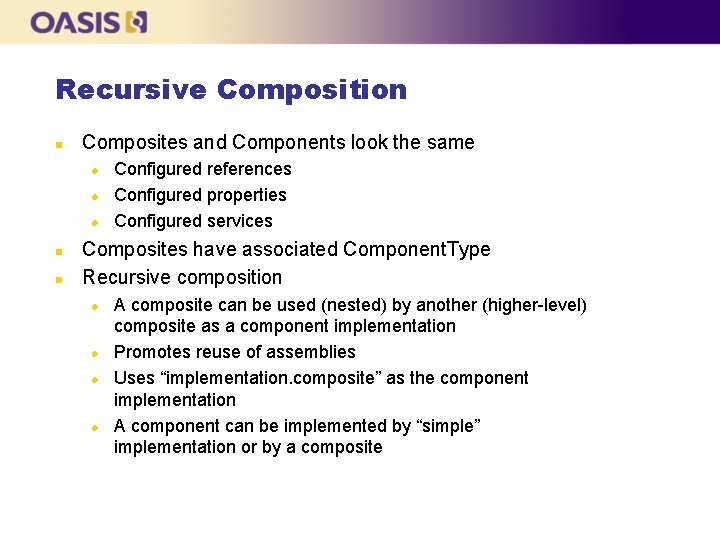
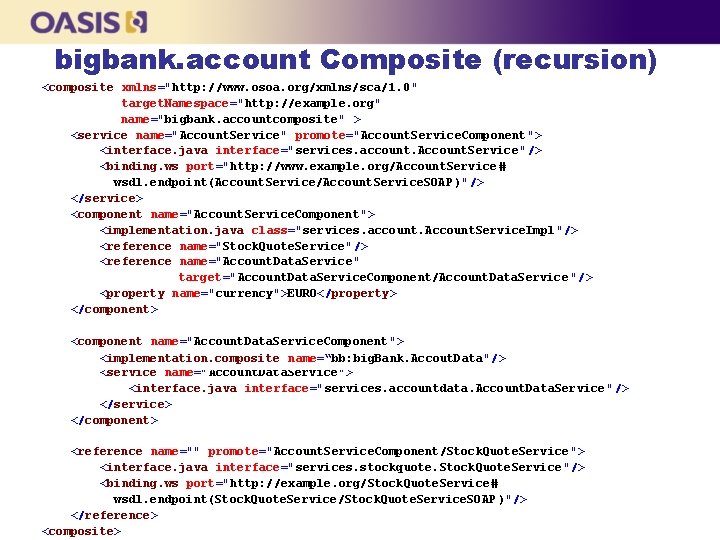
Recursive Composition n Composites and Components look the same l l l n n Configured references Configured properties Configured services Composites have associated Component. Type Recursive composition l l A composite can be used (nested) by another (higher-level) composite as a component implementation Promotes reuse of assemblies Uses “implementation. composite” as the component implementation A component can be implemented by “simple” implementation or by a composite
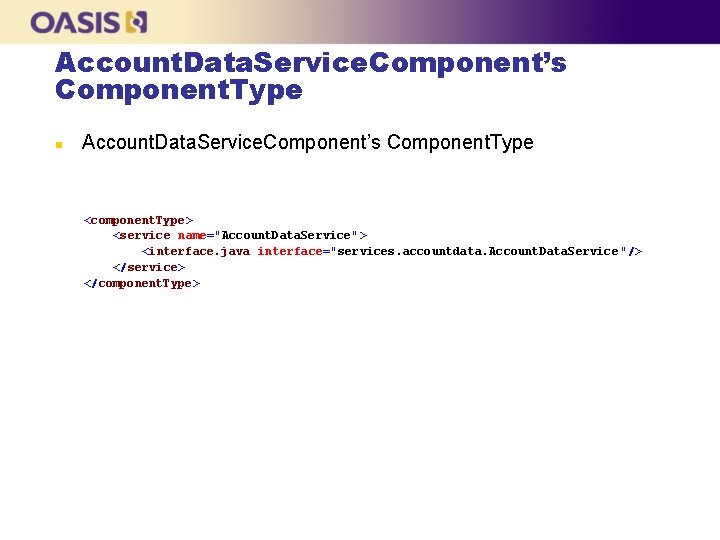
Account. Data. Service. Component’s Component. Type n Account. Data. Service. Component’s Component. Type <component. Type> <service name="Account. Data. Service"> <interface. java interface="services. accountdata. Account. Data. Service "/> </service> </component. Type>
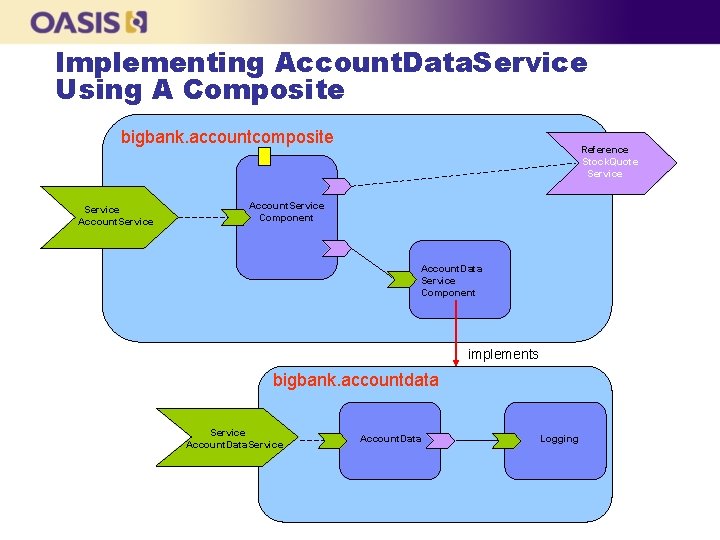
Implementing Account. Data. Service Using A Composite bigbank. accountcomposite Service Account. Service Reference Stock. Quote Service Account. Service Component Account. Data Service Component implements bigbank. accountdata Service Account. Data Logging
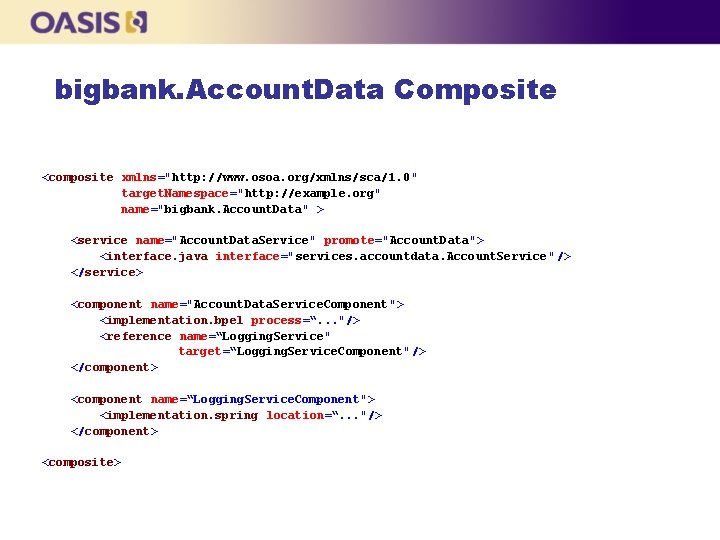
bigbank. Account. Data Composite <composite xmlns="http: //www. osoa. org/xmlns/sca/1. 0 " target. Namespace="http: //example. org" name="bigbank. Account. Data" > <service name="Account. Data. Service" promote="Account. Data"> <interface. java interface="services. accountdata. Account. Service "/> </service> <component name="Account. Data. Service. Component "> <implementation. bpel process=“. . . "/> <reference name=“Logging. Service" target =“Logging. Service. Component"/> </component> <component name=“Logging. Service. Component"> <implementation. spring location=“. . . "/> </component> <composite>
bigbank. account Composite (recursion) <composite xmlns="http: //www. osoa. org/xmlns/sca/1. 0 " target. Namespace="http: //example. org" name="bigbank. accountcomposite " > <service name="Account. Service" promote="Account. Service. Component"> <interface. java interface="services. account. Account. Service "/> <binding. ws port="http: //www. example. org/Account. Service # wsdl. endpoint(Account. Service/Account. Service. SOAP )"/> </service> <component name="Account. Service. Component"> <implementation. java class="services. account. Account. Service. Impl "/> <reference name="Stock. Quote. Service"/> <reference name="Account. Data. Service" target ="Account. Data. Service. Component/Account. Data. Service "/> <property name="currency">EURO</property> </component> <component name="Account. Data. Service. Component "> <implementation. bpel process=“QName"/> <implementation. composite name=“bb: big. Bank. Accout. Data"/> <service name="Account. Data. Service"> <interface. java interface="services. accountdata. Account. Data. Service "/> </service> </component> <reference name="" promote="Account. Service. Component/Stock. Quote. Service "> <interface. java interface="services. stockquote. Stock. Quote. Service "/> <binding. ws port="http: //example. org/Stock. Quote. Service # wsdl. endpoint(Stock. Quote. Service/Stock. Quote. Service. SOAP )"/> </reference> <composite>
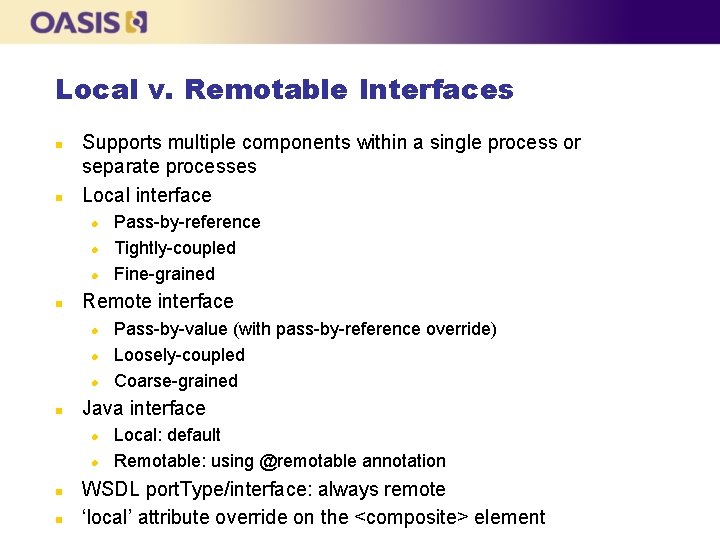
Local v. Remotable Interfaces n n Supports multiple components within a single process or separate processes Local interface l l l n Remote interface l l l n Pass-by-value (with pass-by-reference override) Loosely-coupled Coarse-grained Java interface l n Pass-by-reference Tightly-coupled Fine-grained Local: default Remotable: using @remotable annotation WSDL port. Type/interface: always remote ‘local’ attribute override on the <composite> element
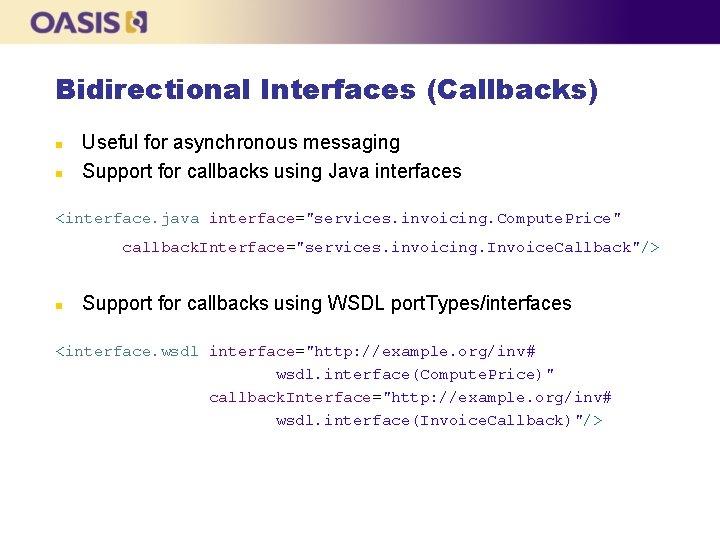
Bidirectional Interfaces (Callbacks) n n Useful for asynchronous messaging Support for callbacks using Java interfaces <interface. java interface="services. invoicing. Compute. Price" callback. Interface="services. invoicing. Invoice. Callback"/> n Support for callbacks using WSDL port. Types/interfaces <interface. wsdl interface="http: //example. org/inv# wsdl. interface(Compute. Price)" callback. Interface="http: //example. org/inv# wsdl. interface(Invoice. Callback)"/>
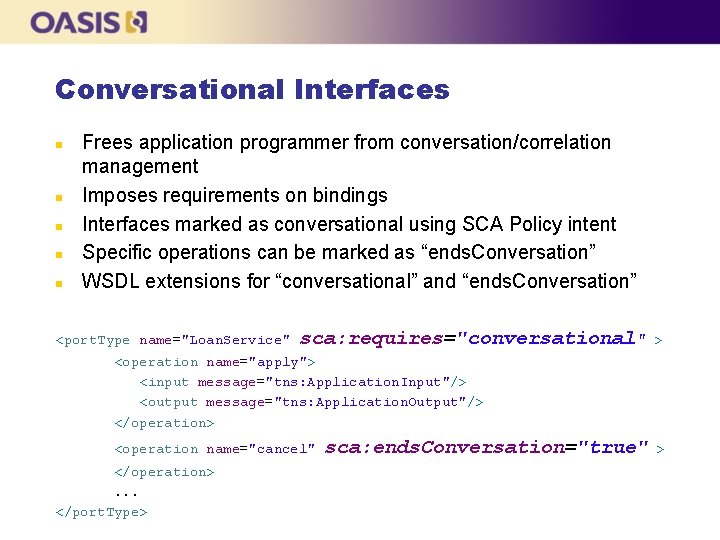
Conversational Interfaces n n n Frees application programmer from conversation/correlation management Imposes requirements on bindings Interfaces marked as conversational using SCA Policy intent Specific operations can be marked as “ends. Conversation” WSDL extensions for “conversational” and “ends. Conversation” <port. Type name="Loan. Service" sca: requires="conversational" > <operation name="apply"> <input message="tns: Application. Input"/> <output message="tns: Application. Output"/> </operation> <operation name="cancel" sca: ends. Conversation="true" > </operation> . . . </port. Type>
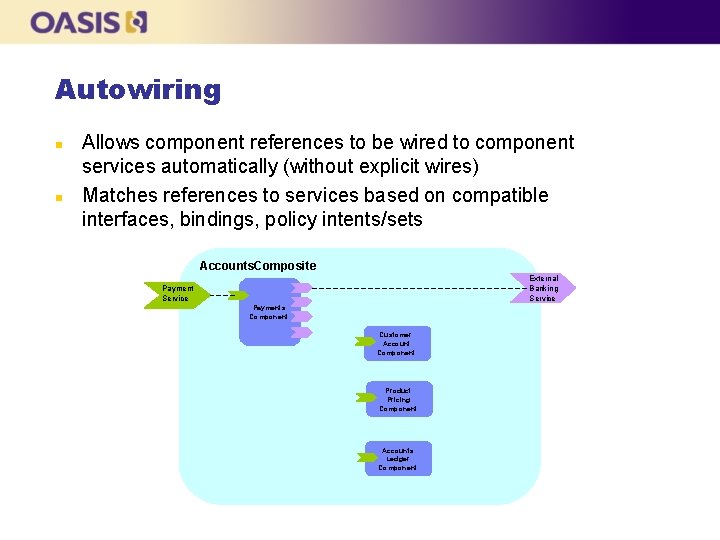
Autowiring n n Allows component references to be wired to component services automatically (without explicit wires) Matches references to services based on compatible interfaces, bindings, policy intents/sets Accounts. Composite External Banking Service Payments Component Customer Account Component Product Pricing Component Accounts Ledger Component
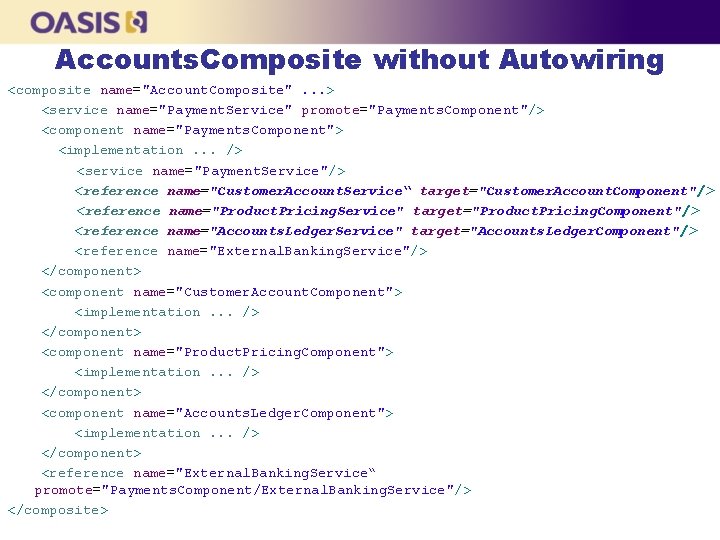
Accounts. Composite without Autowiring <composite name="Account. Composite". . . > <service name="Payment. Service" promote="Payments. Component"/> <component name="Payments. Component"> <implementation. . . /> <service name="Payment. Service"/> <reference name="Customer. Account. Service“ target="Customer. Account. Component"/> <reference name="Product. Pricing. Service" target="Product. Pricing. Component"/> <reference name="Accounts. Ledger. Service" target="Accounts. Ledger. Component"/> <reference name="External. Banking. Service"/> </component> <component name="Customer. Account. Component"> <implementation. . . /> </component> <component name="Product. Pricing. Component"> <implementation. . . /> </component> <component name="Accounts. Ledger. Component"> <implementation. . . /> </component> <reference name="External. Banking. Service“ promote="Payments. Component/External. Banking. Service"/> </composite>
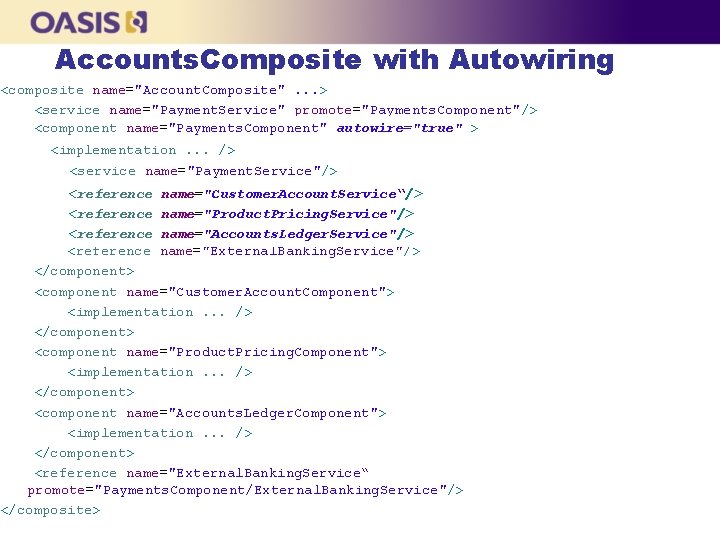
Accounts. Composite with Autowiring <composite name="Account. Composite". . . > <service name="Payment. Service" promote="Payments. Component"/> <component name="Payments. Component" autowire="true" > <component name="Payments. Component"> <implementation. . . /> <service name="Payment. Service"/> <reference target="Customer. Account. Component”/> <reference name="Customer. Account. Service“/> <reference name="Product. Pricing. Service"/> name="Product. Pricing. Service" target="Product. Pricing. Component”/> <reference target="Accounts. Ledger. Component"/> <reference name="Accounts. Ledger. Service"/> <reference name="External. Banking. Service"/> </component> <component name="Customer. Account. Component"> <implementation. . . /> </component> <component name="Product. Pricing. Component"> <implementation. . . /> </component> <component name="Accounts. Ledger. Component"> <implementation. . . /> </component> <reference name="External. Banking. Service“ promote="Payments. Component/External. Banking. Service"/> </composite>
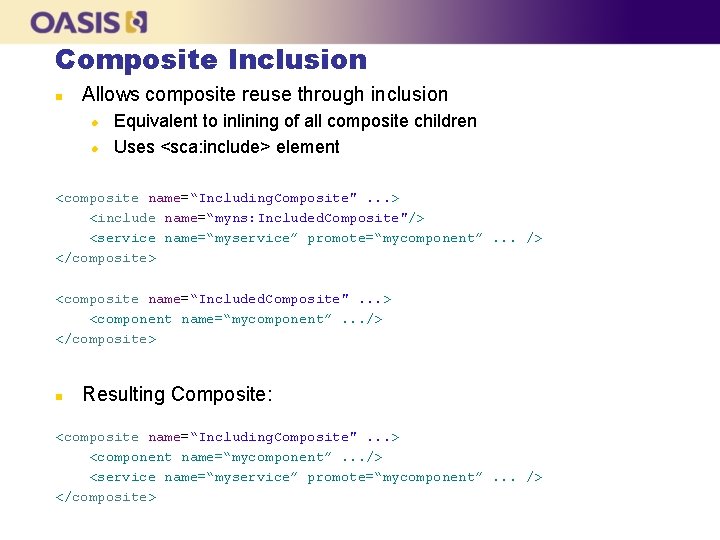
Composite Inclusion n Allows composite reuse through inclusion l l Equivalent to inlining of all composite children Uses <sca: include> element <composite name=“Including. Composite". . . > <include name=“myns: Included. Composite"/> <service name=“myservice” promote=“mycomponent”. . . /> </composite> <composite name=“Included. Composite". . . > <component name=“mycomponent”. . . /> </composite> n Resulting Composite: <composite name=“Including. Composite". . . > <component name=“mycomponent”. . . /> <service name=“myservice” promote=“mycomponent”. . . /> </composite>
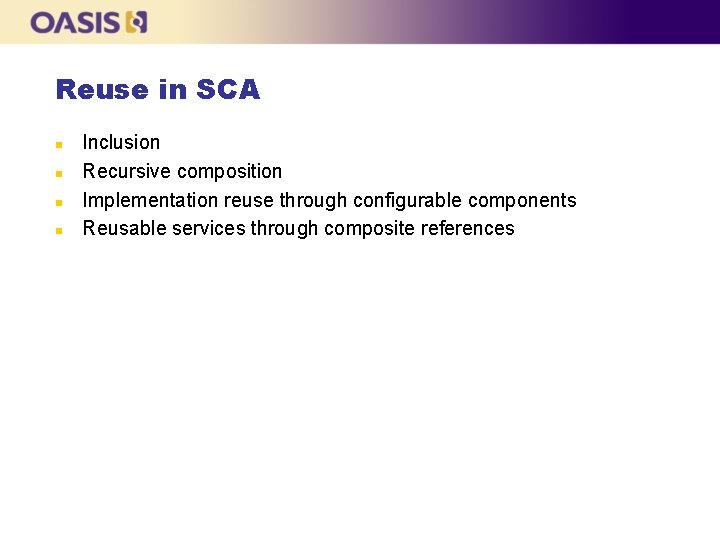
Reuse in SCA n n Inclusion Recursive composition Implementation reuse through configurable components Reusable services through composite references
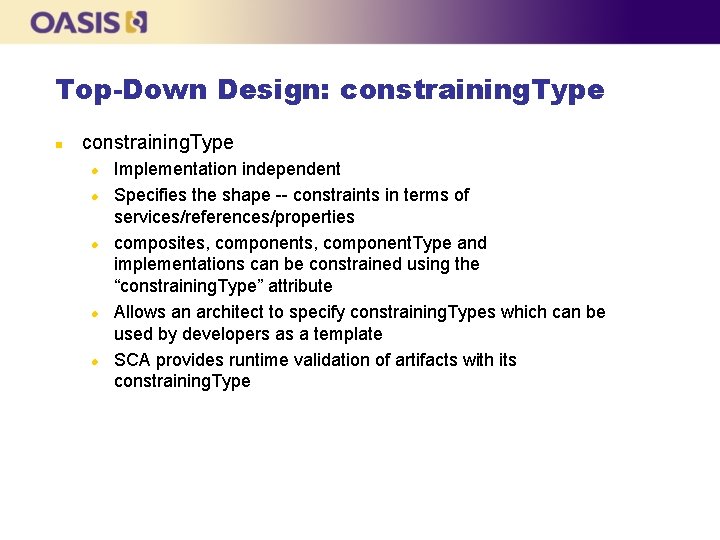
Top-Down Design: constraining. Type n constraining. Type l l l Implementation independent Specifies the shape -- constraints in terms of services/references/properties composites, component. Type and implementations can be constrained using the “constraining. Type” attribute Allows an architect to specify constraining. Types which can be used by developers as a template SCA provides runtime validation of artifacts with its constraining. Type
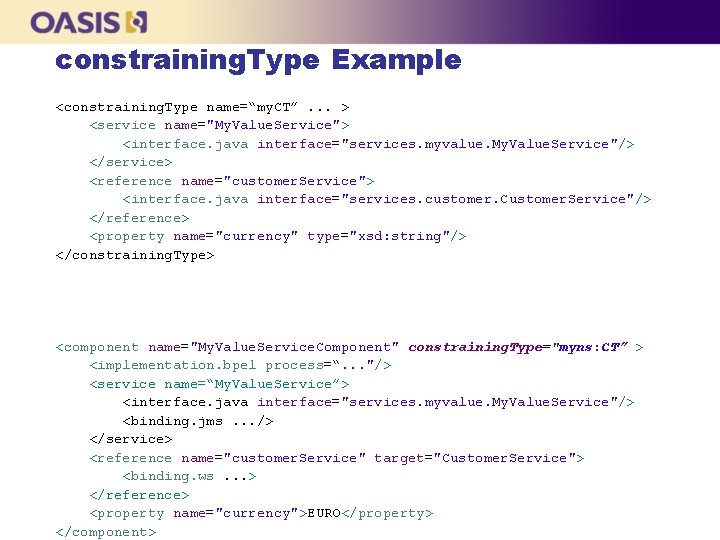
constraining. Type Example <constraining. Type name=“my. CT”. . . > <service name="My. Value. Service"> <interface. java interface="services. myvalue. My. Value. Service"/> </service> <reference name="customer. Service"> <interface. java interface="services. customer. Customer. Service"/> </reference> <property name="currency" type="xsd: string"/> </constraining. Type> <component name="My. Value. Service. Component" constraining. Type="myns: CT” > <implementation. bpel process=“. . . "/> <service name=“My. Value. Service”> <interface. java interface="services. myvalue. My. Value. Service"/> <binding. jms. . . /> </service> <reference name="customer. Service" target="Customer. Service"> <binding. ws. . . > </reference> <property name="currency">EURO</property> </component>
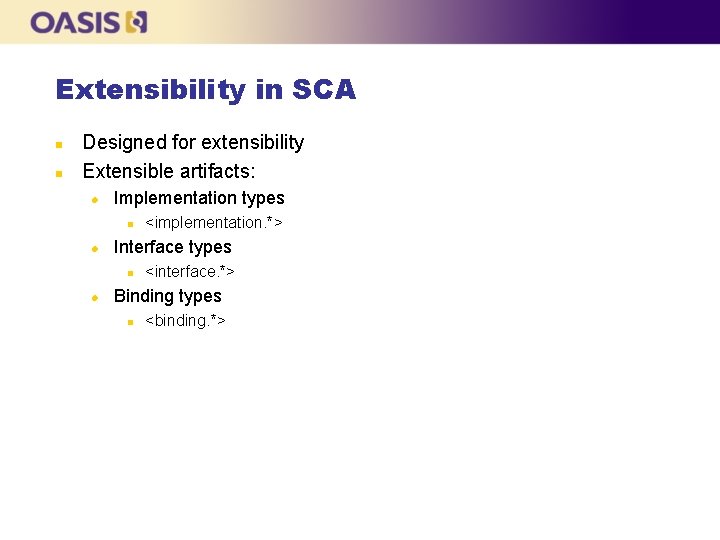
Extensibility in SCA n n Designed for extensibility Extensible artifacts: l Implementation types n l Interface types n l <implementation. *> <interface. *> Binding types n <binding. *>
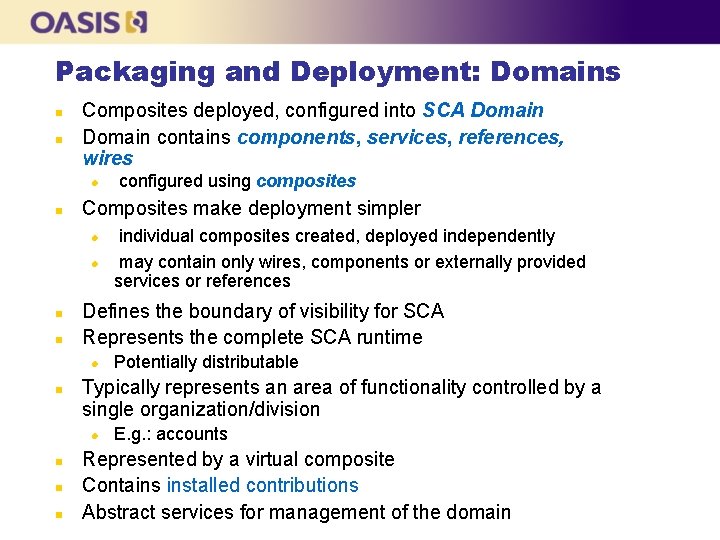
Packaging and Deployment: Domains n n Composites deployed, configured into SCA Domain contains components, services, references, wires l n Composites make deployment simpler l l n n Potentially distributable Typically represents an area of functionality controlled by a single organization/division l n individual composites created, deployed independently may contain only wires, components or externally provided services or references Defines the boundary of visibility for SCA Represents the complete SCA runtime l n configured using composites E. g. : accounts Represented by a virtual composite Contains installed contributions Abstract services for management of the domain
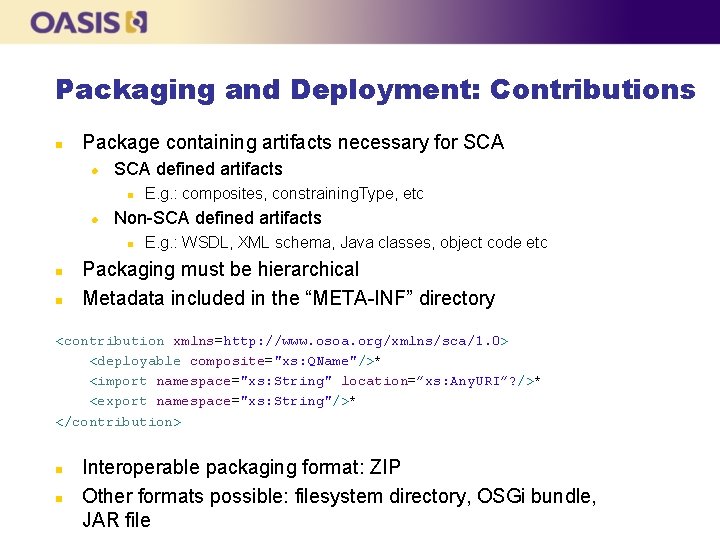
Packaging and Deployment: Contributions n Package containing artifacts necessary for SCA l SCA defined artifacts n l Non-SCA defined artifacts n n n E. g. : composites, constraining. Type, etc E. g. : WSDL, XML schema, Java classes, object code etc Packaging must be hierarchical Metadata included in the “META-INF” directory <contribution xmlns=http: //www. osoa. org/xmlns/sca/1. 0> <deployable composite="xs: QName"/>* <import namespace="xs: String" location=”xs: Any. URI”? />* <export namespace="xs: String"/>* </contribution> n n Interoperable packaging format: ZIP Other formats possible: filesystem directory, OSGi bundle, JAR file
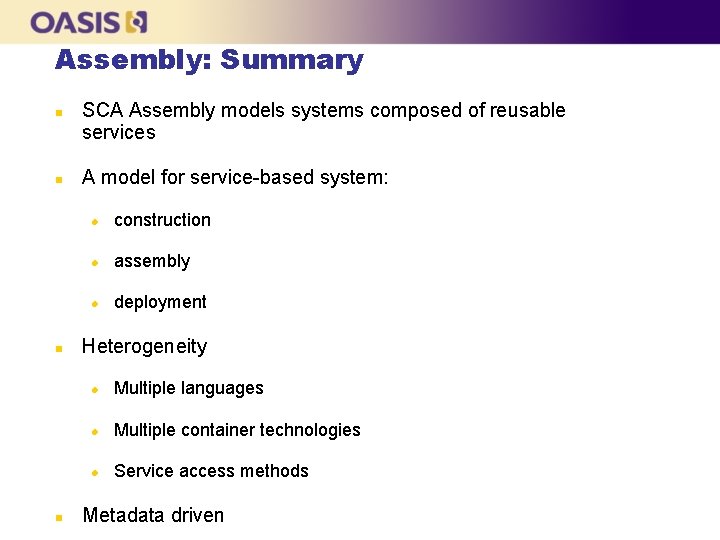
Assembly: Summary n n SCA Assembly models systems composed of reusable services A model for service-based system: l construction l assembly l deployment Heterogeneity l Multiple languages l Multiple container technologies l Service access methods Metadata driven
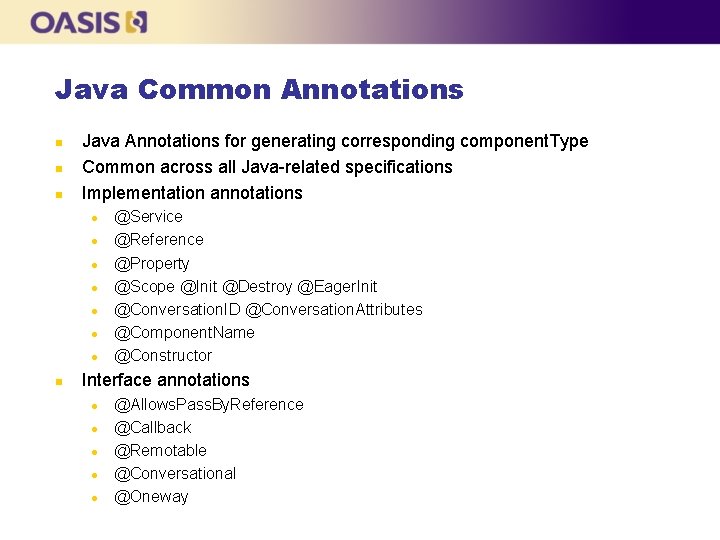
Java Common Annotations n n n Java Annotations for generating corresponding component. Type Common across all Java-related specifications Implementation annotations l l l l n @Service @Reference @Property @Scope @Init @Destroy @Eager. Init @Conversation. ID @Conversation. Attributes @Component. Name @Constructor Interface annotations l l l @Allows. Pass. By. Reference @Callback @Remotable @Conversational @Oneway
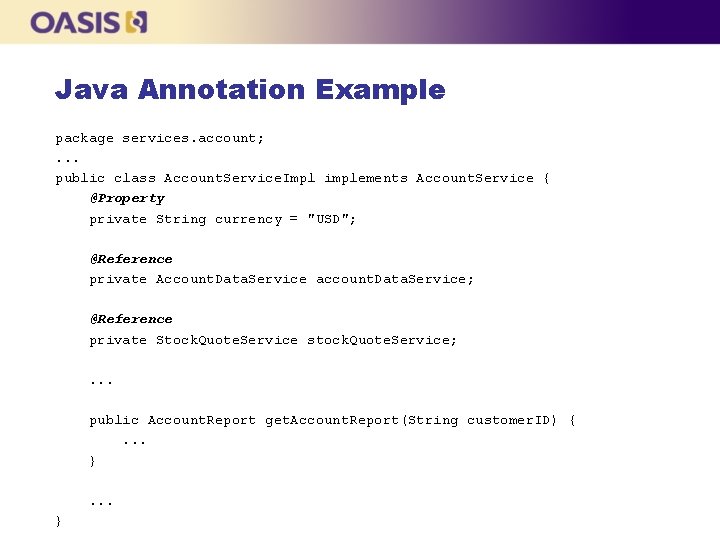
Java Annotation Example package services. account; . . . public class Account. Service. Impl implements Account. Service { @Property private String currency = "USD"; @Reference private Account. Data. Service account. Data. Service; @Reference private Stock. Quote. Service stock. Quote. Service; . . . public Account. Report get. Account. Report(String customer. ID) { . . . }
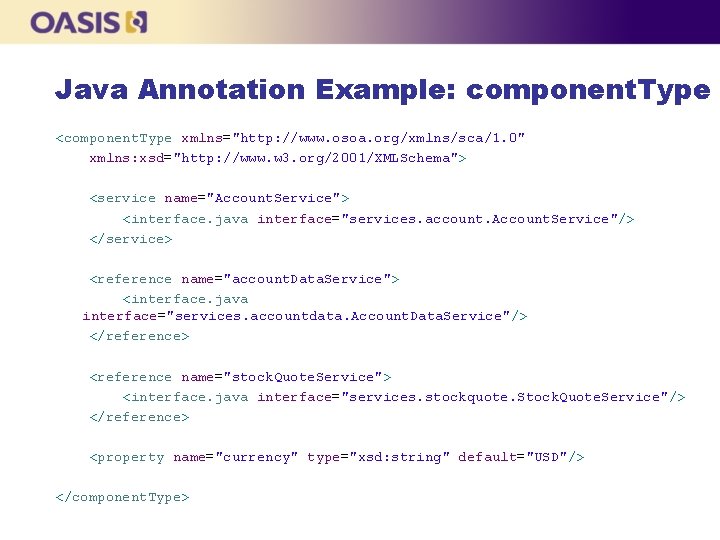
Java Annotation Example: component. Type <component. Type xmlns="http: //www. osoa. org/xmlns/sca/1. 0" xmlns: xsd="http: //www. w 3. org/2001/XMLSchema"> <service name="Account. Service"> <interface. java interface="services. account. Account. Service"/> </service> <reference name="account. Data. Service"> <interface. java interface="services. accountdata. Account. Data. Service"/> </reference> <reference name="stock. Quote. Service"> <interface. java interface="services. stockquote. Stock. Quote. Service"/> </reference> <property name="currency" type="xsd: string" default="USD"/> </component. Type>
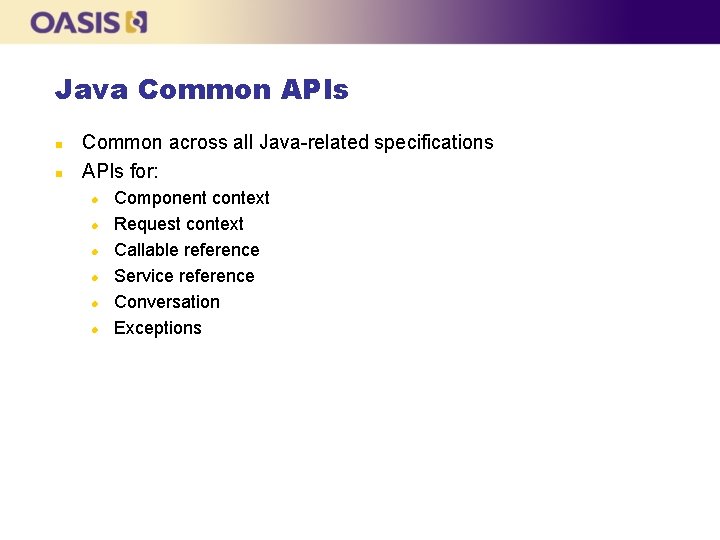
Java Common APIs n n Common across all Java-related specifications APIs for: l l l Component context Request context Callable reference Service reference Conversation Exceptions
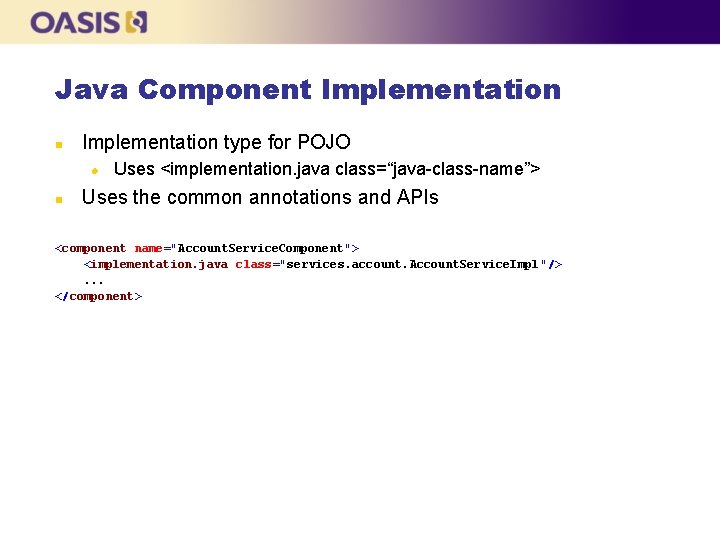
Java Component Implementation n Implementation type for POJO l n Uses <implementation. java class=“java-class-name”> Uses the common annotations and APIs <component name="Account. Service. Component"> <implementation. java class="services. account. Account. Service. Impl "/>. . . </component>
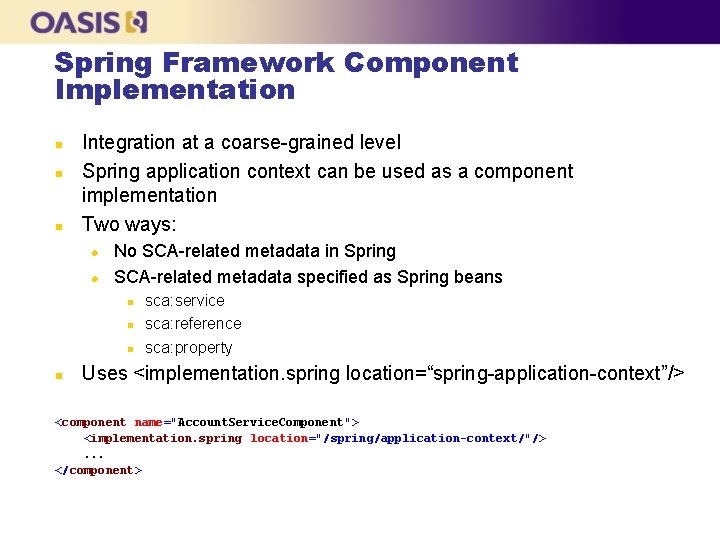
Spring Framework Component Implementation n Integration at a coarse-grained level Spring application context can be used as a component implementation Two ways: l l No SCA-related metadata in Spring SCA-related metadata specified as Spring beans n n sca: service sca: reference sca: property Uses <implementation. spring location=“spring-application-context”/> <component name="Account. Service. Component"> <implementation. spring location="/spring/application-context/"/>. . . </component>
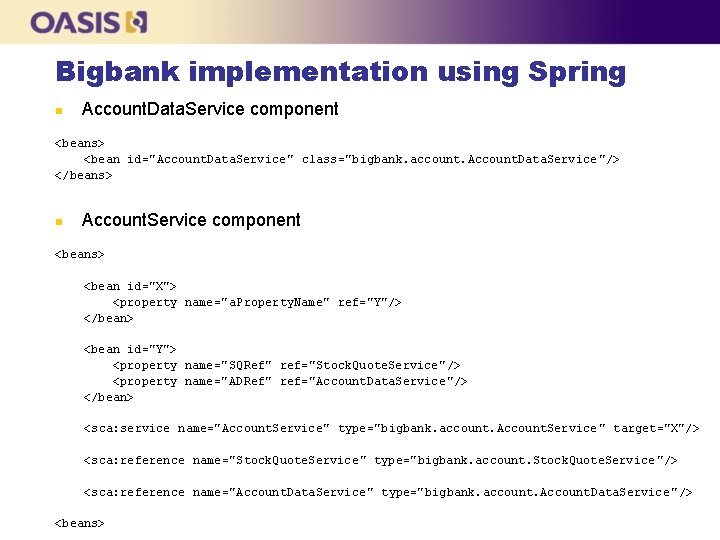
Bigbank implementation using Spring n Account. Data. Service component <beans> <bean id="Account. Data. Service" class="bigbank. account. Account. Data. Service "/> </beans> n Account. Service component <beans> <bean id="X"> <property name=" a. Property. Name" ref="Y"/> </bean> <bean id="Y"> <property name=" SQRef" ref="Stock. Quote. Service"/> <property name=" ADRef" ref="Account. Data. Service"/> </bean> <sca: service name="Account. Service" type="bigbank. account. Account. Service " target="X"/> <sca: reference name="Stock. Quote. Service" type="bigbank. account. Stock. Quote. Service "/> <sca: reference name="Account. Data. Service" type="bigbank. account. Account. Data. Service "/> <beans>
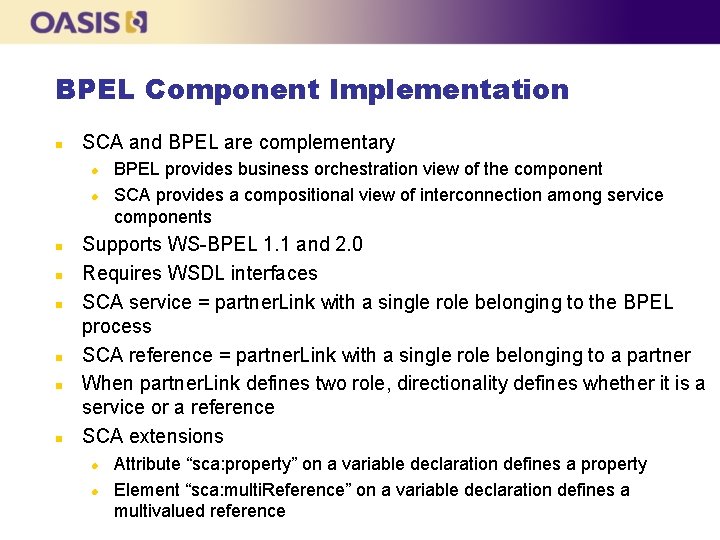
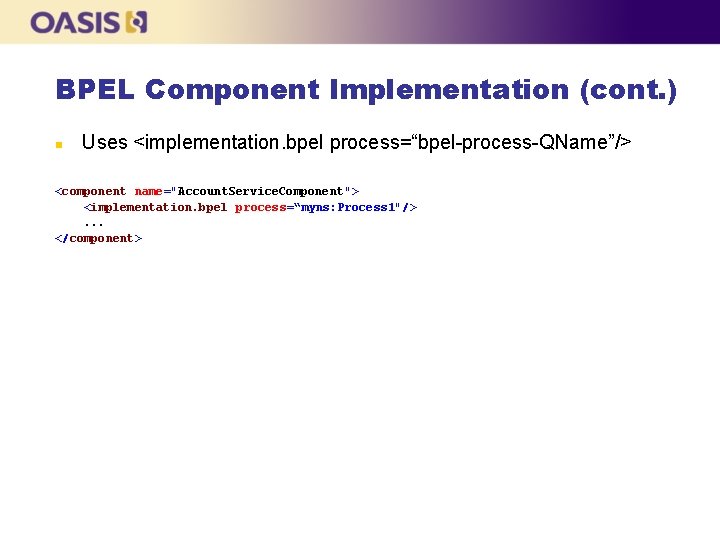
BPEL Component Implementation n SCA and BPEL are complementary l l n n n BPEL provides business orchestration view of the component SCA provides a compositional view of interconnection among service components Supports WS-BPEL 1. 1 and 2. 0 Requires WSDL interfaces SCA service = partner. Link with a single role belonging to the BPEL process SCA reference = partner. Link with a single role belonging to a partner When partner. Link defines two role, directionality defines whether it is a service or a reference SCA extensions l l Attribute “sca: property” on a variable declaration defines a property Element “sca: multi. Reference” on a variable declaration defines a multivalued reference
BPEL Component Implementation (cont. ) n Uses <implementation. bpel process=“bpel-process-QName”/> <component name="Account. Service. Component"> <implementation. bpel process=“myns: Process 1"/>. . . </component>
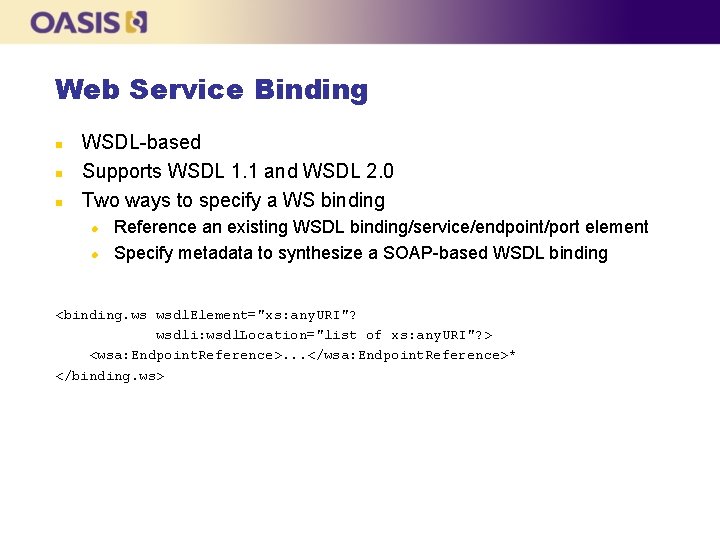
Web Service Binding n n n WSDL-based Supports WSDL 1. 1 and WSDL 2. 0 Two ways to specify a WS binding l l Reference an existing WSDL binding/service/endpoint/port element Specify metadata to synthesize a SOAP-based WSDL binding <binding. ws wsdl. Element="xs: any. URI"? wsdli: wsdl. Location="list of xs: any. URI"? > <wsa: Endpoint. Reference>. . . </wsa: Endpoint. Reference>* </binding. ws>
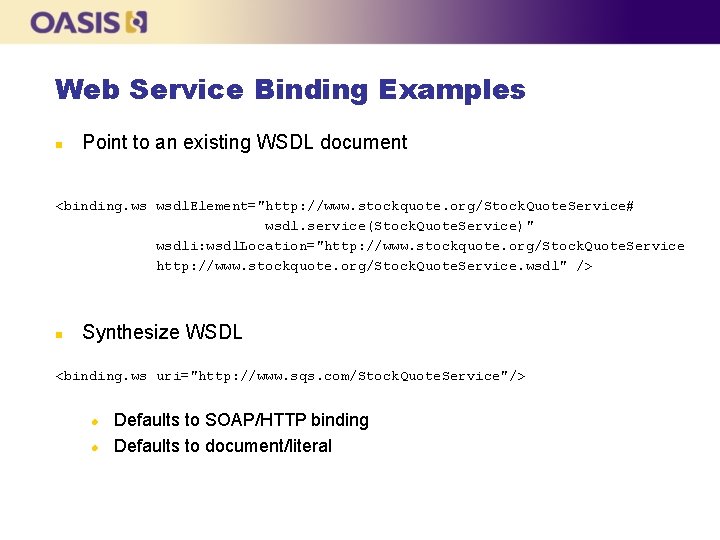
Web Service Binding Examples n Point to an existing WSDL document <binding. ws wsdl. Element="http: //www. stockquote. org/Stock. Quote. Service# wsdl. service(Stock. Quote. Service)" wsdli: wsdl. Location="http: //www. stockquote. org/Stock. Quote. Service http: //www. stockquote. org/Stock. Quote. Service. wsdl" /> n Synthesize WSDL <binding. ws uri="http: //www. sqs. com/Stock. Quote. Service"/> l l Defaults to SOAP/HTTP binding Defaults to document/literal
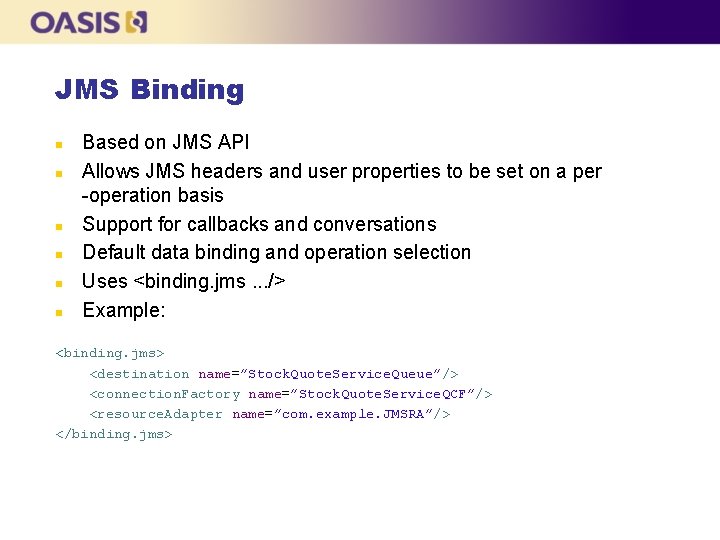
JMS Binding n n n Based on JMS API Allows JMS headers and user properties to be set on a per -operation basis Support for callbacks and conversations Default data binding and operation selection Uses <binding. jms. . . /> Example: <binding. jms> <destination name=”Stock. Quote. Service. Queue”/> <connection. Factory name=”Stock. Quote. Service. QCF”/> <resource. Adapter name=”com. example. JMSRA”/> </binding. jms>
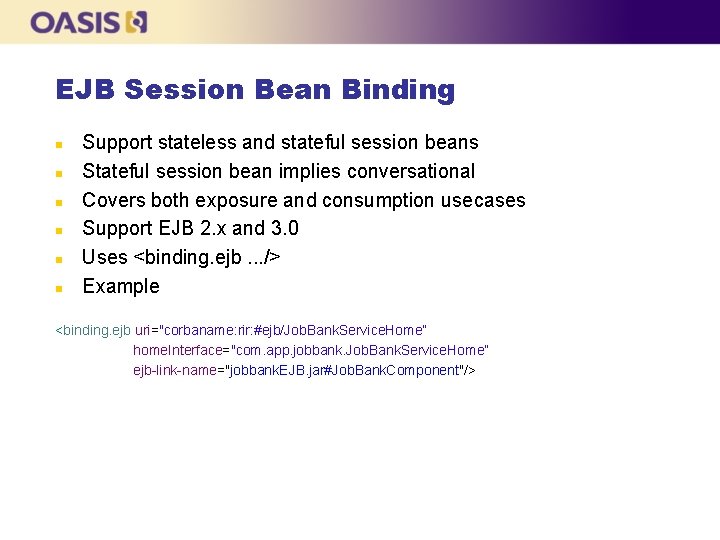
EJB Session Bean Binding n n n Support stateless and stateful session beans Stateful session bean implies conversational Covers both exposure and consumption usecases Support EJB 2. x and 3. 0 Uses <binding. ejb. . . /> Example <binding. ejb uri="corbaname: rir: #ejb/Job. Bank. Service. Home“ home. Interface="com. app. jobbank. Job. Bank. Service. Home“ ejb-link-name="jobbank. EJB. jar#Job. Bank. Component"/>
Future Work n Work will continue in the OSOA collaboration l l SCA Eventing Model SCA Client and Implementation Model for PHP n l l l other scripting languages being investigated SCA Client and Implementation Model for COBOL JCA Binding Java EE Integration other implementation languages & frameworks may follow SCA 1. 0 to be standardized in OASIS
Summary n SCA models systems built using a Service Oriented Architecture l supports Service Implementation, Service Assembly l open to many kinds of service implementation l open to many types of service access l declarative intent & policy approach to application of Security & Transaction
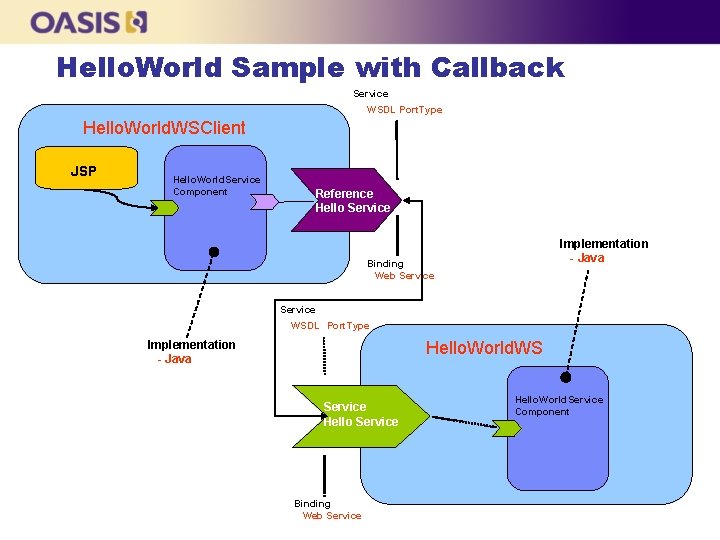
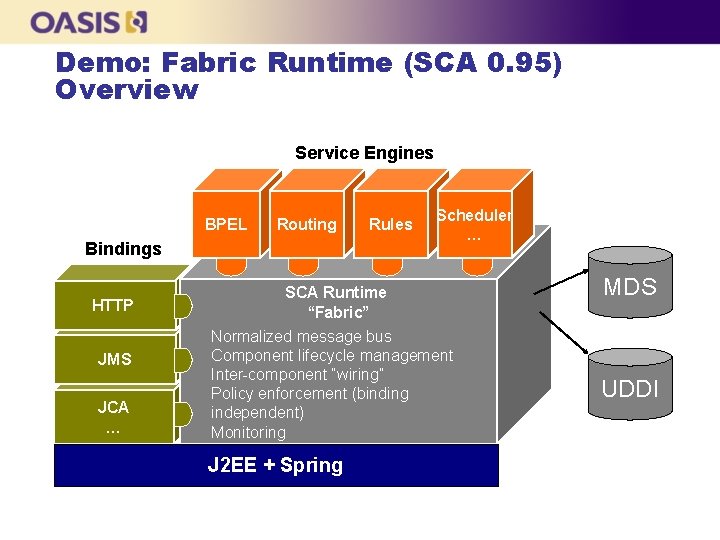
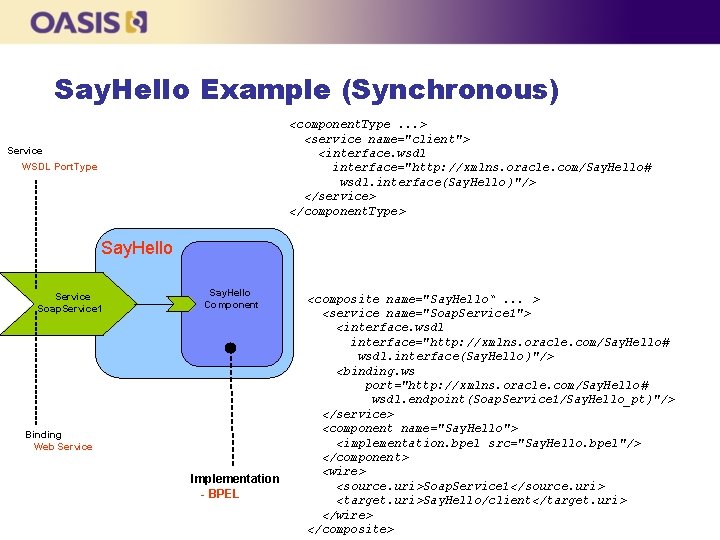
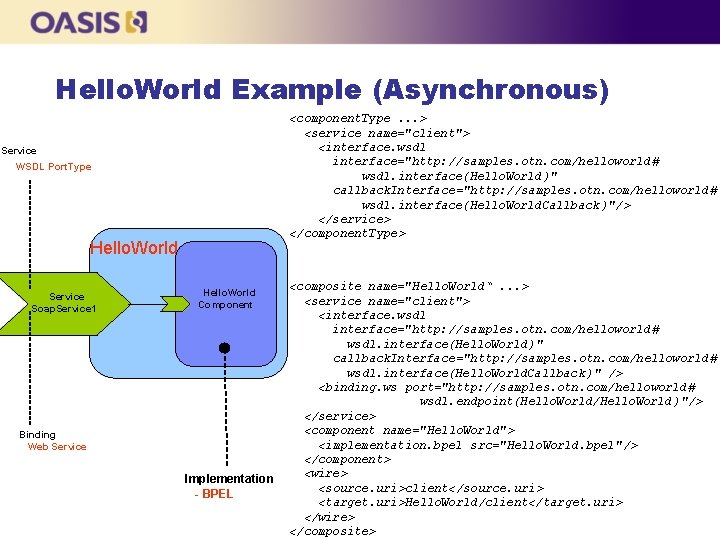
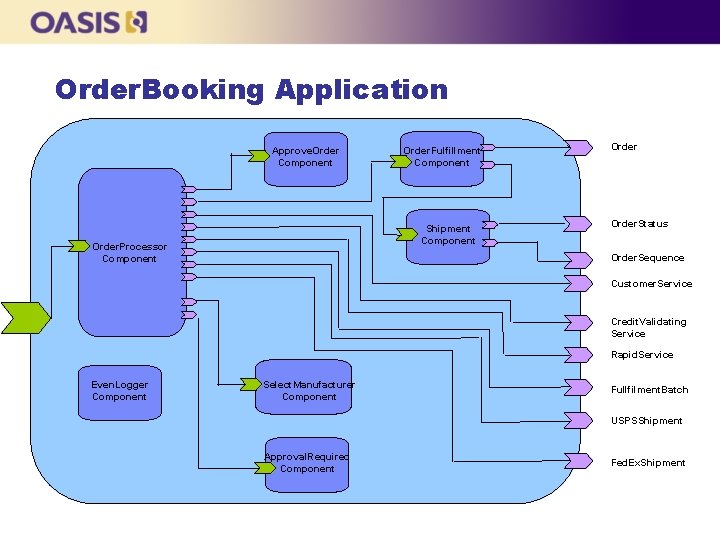
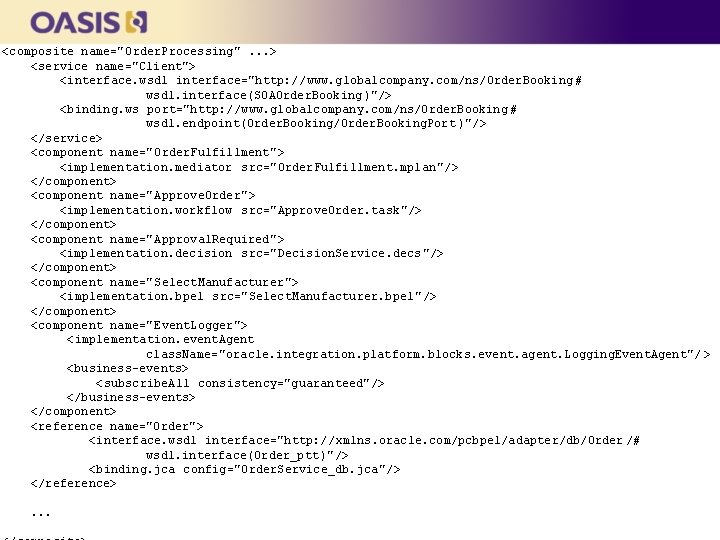
Demo n IBM Demo: l n Simple Hello. World sample with a callback (SCA V 0. 95) Oracle Demos: l l Oracle Fabric (SCA 0. 95) Overview Simple Say. Hello Example Using Jdeveloper (Synchronous) Simple Hello. World Example (Asynchronous) Order. Booking Application
Hello. World Sample with Callback Service WSDL Port. Type Hello. World. WSClient JSP Hello. World. Service Component Reference Hello Service Implementation - Java Binding Web Service WSDL Port. Type Implementation - Java Hello. World. WS Service Hello Service Binding Web Service Hello. World. Service Component
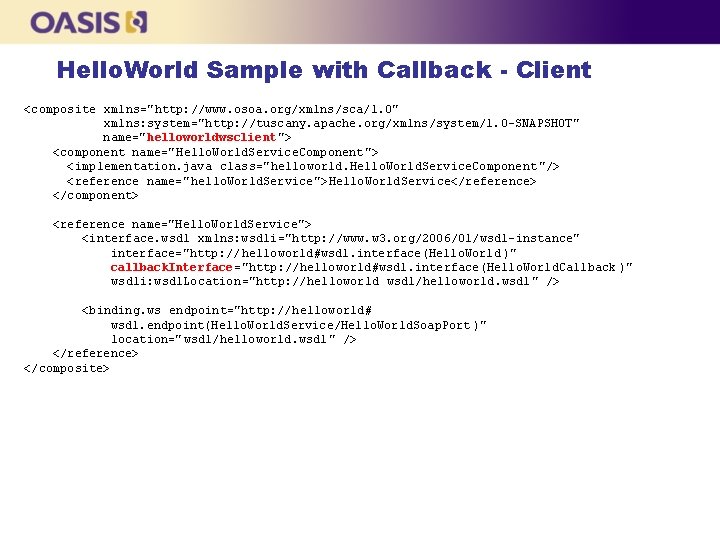
Hello. World Sample with Callback - Client <composite xmlns="http: //www. osoa. org/xmlns/sca/1. 0" xmlns: system="http: //tuscany. apache. org/xmlns/system/1. 0 -SNAPSHOT" name="helloworldwsclient"> <component name="Hello. World. Service. Component "> <implementation. java class="helloworld. Hello. World. Service. Component "/> <reference name="hello. World. Service">Hello. World. Service</reference> </component> <reference name="Hello. World. Service"> <interface. wsdl xmlns: wsdli="http: //www. w 3. org/2006/01/wsdl-instance" interface="http: // helloworld#wsdl. interface(Hello. World )" callback. Interface="http: //helloworld#wsdl. interface(Hello. World. Callback )" wsdli: wsdl. Location="http: //helloworld wsdl/helloworld. wsdl" /> <binding. ws endpoint="http: //helloworld# wsdl. endpoint(Hello. World. Service/Hello. World. Soap. Port )" location="wsdl/helloworld. wsdl" /> </reference> </composite>
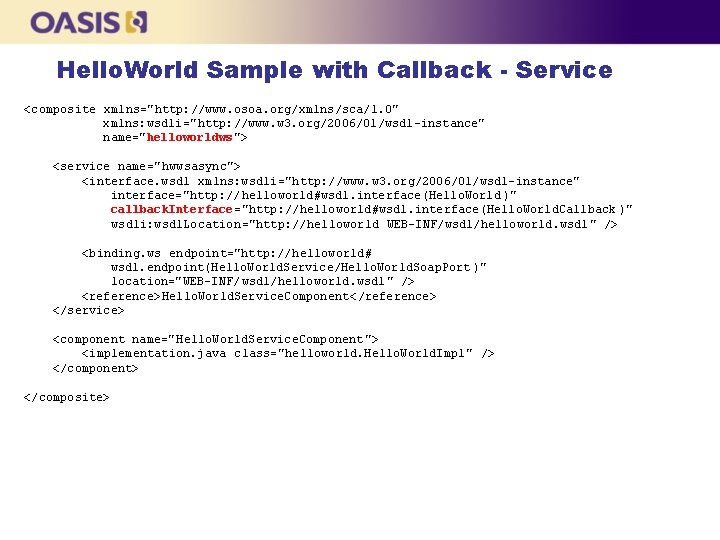
Hello. World Sample with Callback - Service <composite xmlns="http: //www. osoa. org/xmlns/sca/1. 0" xmlns: wsdli="http: //www. w 3. org/2006/01/wsdl-instance" name="helloworldws"> <service name="hwwsasync"> <interface. wsdl xmlns: wsdli="http: //www. w 3. org/2006/01/wsdl-instance" interface="http: // helloworld#wsdl. interface(Hello. World )" callback. Interface="http: //helloworld#wsdl. interface(Hello. World. Callback )" wsdli: wsdl. Location="http: //helloworld WEB-INF/wsdl/helloworld. wsdl" /> <binding. ws endpoint="http: //helloworld# wsdl. endpoint(Hello. World. Service/Hello. World. Soap. Port )" location="WEB-INF/ wsdl/helloworld. wsdl" /> <reference>Hello. World. Service. Component </reference> </service> <component name="Hello. World. Service. Component "> <implementation. java class="helloworld. Hello. World. Impl " /> </component> </composite>
Demo: Fabric Runtime (SCA 0. 95) Overview Service Engines BPEL Routing Bindings HTTP JMS JCA … Rules Scheduler … SCA Runtime “Fabric” Normalized message bus Component lifecycle management Inter-component “wiring” Policy enforcement (binding independent) Monitoring J 2 EE + Spring MDS UDDI
Say. Hello Example (Synchronous) <component. Type. . . > <service name="client"> <interface. wsdl interface="http: // xmlns. oracle. com/Say. Hello # wsdl. interface(Say. Hello)"/> </service> </component. Type> Service WSDL Port. Type Say. Hello Service Soap. Service 1 Say. Hello Component Binding Web Service Implementation - BPEL <composite name="Say. Hello“. . . > <service name="Soap. Service 1"> <interface. wsdl interface="http: // xmlns. oracle. com/Say. Hello # wsdl. interface(Say. Hello)"/> <binding. ws port="http: //xmlns. oracle. com/Say. Hello # wsdl. endpoint(Soap. Service 1/Say. Hello_pt)"/> </service> <component name="Say. Hello"> <implementation. bpel src="Say. Hello. bpel"/> </component> <wire> <source. uri>Soap. Service 1</source. uri> <target. uri>Say. Hello/client</target. uri> </wire> </composite>
Hello. World Example (Asynchronous) <component. Type. . . > <service name="client"> <interface. wsdl interface="http: // samples. otn. com/helloworld # wsdl. interface(Hello. World )" callback. Interface="http: //samples. otn. com/helloworld # wsdl. interface(Hello. World. Callback )"/> </service> </component. Type> Service WSDL Port. Type Hello. World Service Soap. Service 1 Hello. World Component Binding Web Service Implementation - BPEL <composite name="Hello. World“. . . > <service name="client"> <interface. wsdl interface="http: // samples. otn. com/helloworld # wsdl. interface(Hello. World )" callback. Interface="http: //samples. otn. com/helloworld # wsdl. interface(Hello. World. Callback )" /> <binding. ws port="http: //samples. otn. com/helloworld # wsdl. endpoint(Hello. World/Hello. World )"/> </service> <component name="Hello. World"> <implementation. bpel src="Hello. World. bpel"/> </component> <wire> <source. uri>client</source. uri> <target. uri>Hello. World/client</target. uri> </wire> </composite>
Order. Booking Application Approve. Order Component Order. Fulfillment Component Shipment Component Order. Processor Component Order. Status Order. Sequence Customer. Service Credit. Validating Service Rapid. Service Even. Logger Component Select. Manufacturer Component Fullfilment. Batch USPSShipment Approval. Required Component Fed. Ex. Shipment
<composite name="Order. Processing". . . > <service name="Client"> <interface. wsdl interface="http: //www. globalcompany. com/ns/Order. Booking # wsdl. interface(SOAOrder. Booking )"/> <binding. ws port="http: //www. globalcompany. com/ns/Order. Booking # wsdl. endpoint(Order. Booking/Order. Booking. Port )"/> </service> <component name="Order. Fulfillment"> <implementation. mediator src="Order. Fulfillment. mplan"/> </component> <component name="Approve. Order"> <implementation. workflow src="Approve. Order. task"/> </component> <component name="Approval. Required"> <implementation. decision src="Decision. Service. decs"/> </component> <component name="Select. Manufacturer"> <implementation. bpel src="Select. Manufacturer. bpel"/> </component> <component name="Event. Logger"> <implementation. event. Agent class. Name="oracle. integration. platform. blocks. event. agent. Logging. Event. Agent"/ > <business-events> <subscribe. All consistency="guaranteed"/> </business-events> </component> <reference name="Order"> <interface. wsdl interface="http: //xmlns. oracle. com/pcbpel/adapter/db/Order /# wsdl. interface(Order_ptt )"/> <binding. jca config="Order. Service_db. jca"/> </reference> . . .
Thank you! n Questions?