Data Integration with Dependent Sources Anish Das Sarma

- Slides: 36
Data Integration with Dependent Sources Anish Das Sarma, Xin (Luna) Dong, Alon Halevy Yahoo! Research, AT&T Labs-Research, Google Inc. October 31, 2020 1
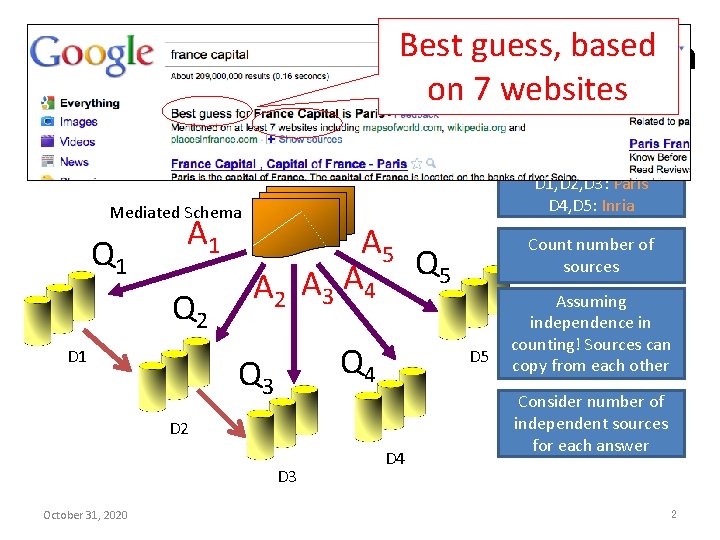
based Query Answering in Best Dataguess, Integration on 7 websites A = Ui Ai Ai’s may have conflicts: D 1, D 2, D 3: Paris D 4, D 5: Inria Q: “France capital” Mediated Schema Q 1 A 1 Q 2 D 1 A 5 Q 5 A A A 2 3 4 Q 3 D 5 D 2 D 3 October 31, 2020 Count number of sources D 4 Assuming independence in counting! Sources can copy from each other Consider number of independent sources for each answer 2
Motivation [Solomon project, Luna Dong et. al. ] • Web data consists of an ecosystem of dependent sources • Information extracted from Abe. Books. com – Data from 877 bookstores – 465 pairs of sources involved copying – 314 copiers, 202 copy from a single source – Some copy all tuples, some copy a fraction October 31, 2020 3
Goal • Build a system, IDS, for Integrating Dependent Sources • This paper: – Proposed a system for query answering with dependent sources – Address theoretical challenges in building such a system • Note: detecting dependencies is part of other work [Solomon] October 31, 2020 4
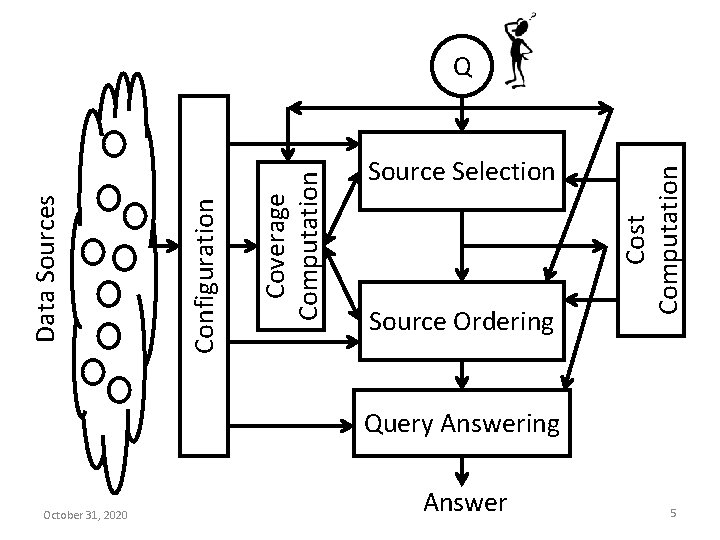
Source Selection Source Ordering Cost Computation Coverage Computation Configuration Data Sources Q Query Answering October 31, 2020 Answer 5
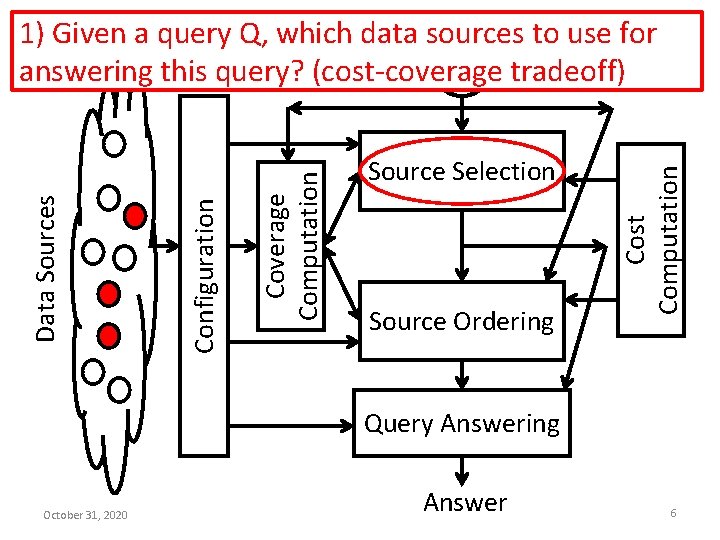
Source Selection Source Ordering Cost Computation Coverage Computation Configuration Data Sources 1) Given a query Q, which data sources to use for Q tradeoff) answering this query? (cost-coverage Query Answering October 31, 2020 Answer 6
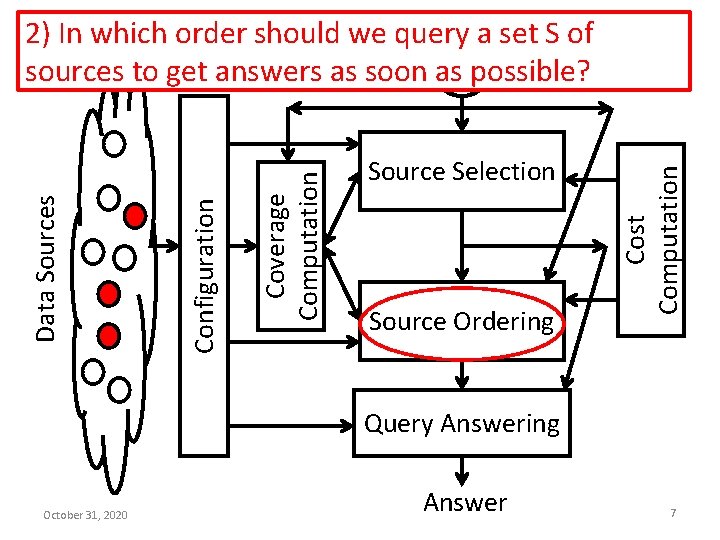
Source Selection Source Ordering Cost Computation Coverage Computation Configuration Data Sources 2) In which order should we query a set S of sources to get answers as soon as. Qpossible? Query Answering October 31, 2020 Answer 7
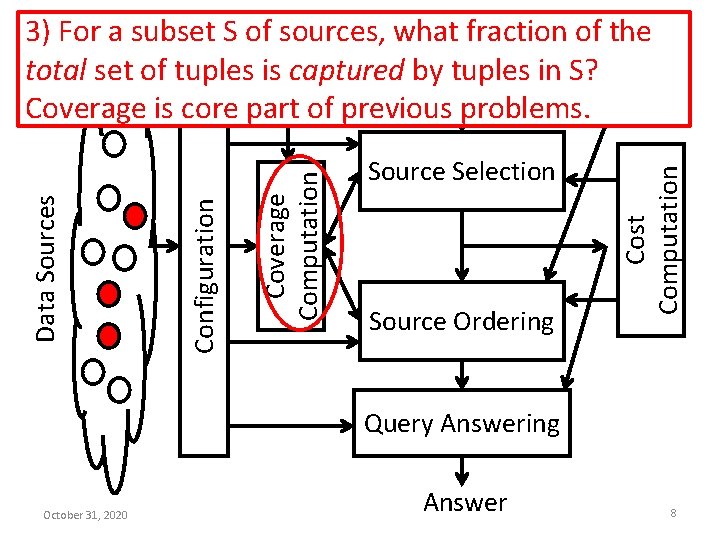
Source Selection Source Ordering Cost Computation Coverage Computation Configuration Data Sources 3) For a subset S of sources, what fraction of the Q total set of tuples is captured by tuples in S? Coverage is core part of previous problems. Query Answering October 31, 2020 Answer 8
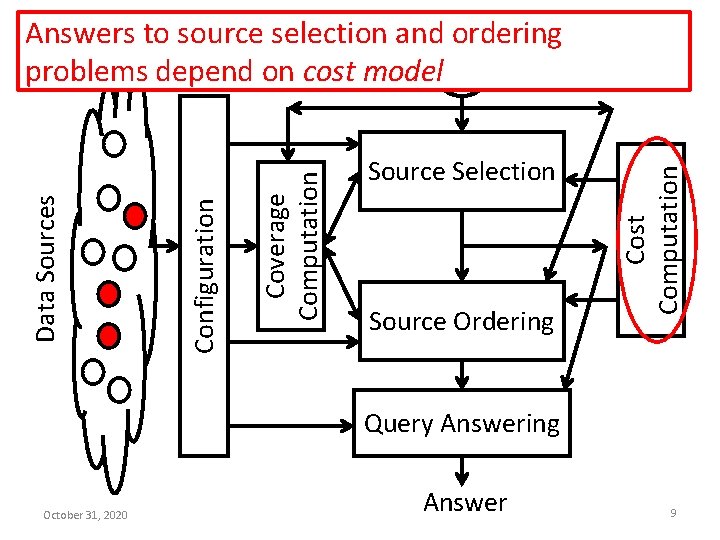
Source Selection Source Ordering Cost Computation Coverage Computation Configuration Data Sources Answers to source selection and ordering problems depend on cost model Q Query Answering October 31, 2020 Answer 9
Next • Formal problem definitions – Dependency model – Cost model for query answering – Coverage and optimization problems • Algorithms and complexity result summary – Coverage problem (CP) – Cost minimization problem (CMP) – Maximum coverage problem (MCP) – Source ordering problem (SOP) October 31, 2020 10
Next • Formal problem definitions – Dependency model – Cost model for query answering – Coverage and optimization problems • Algorithms and complexity results summary – Coverage problem (CP) – Cost minimization problem (CMP) – Maximum coverage problem (MCP) – Source ordering problem (SOP) October 31, 2020 11
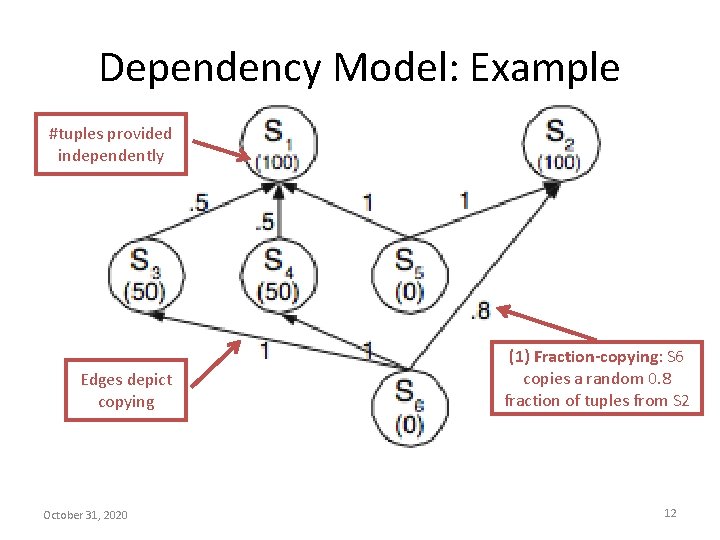
Dependency Model: Example #tuples provided independently Edges depict copying October 31, 2020 (1) Fraction-copying: S 6 copies a random 0. 8 fraction of tuples from S 2 12
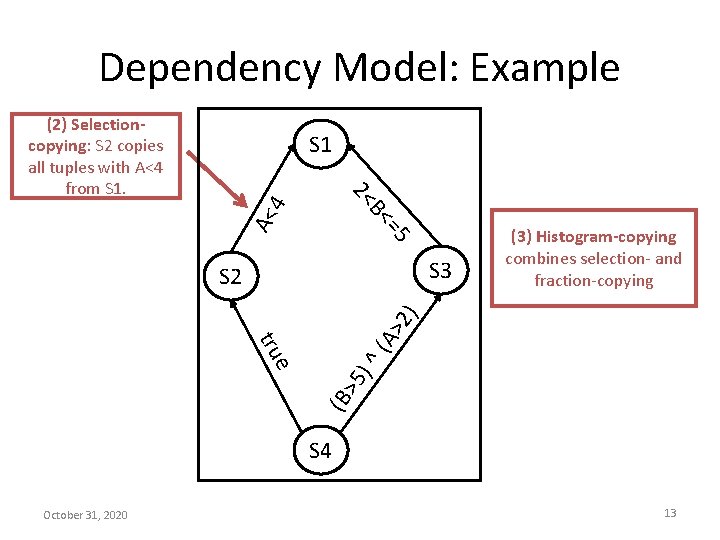
Dependency Model: Example (2) Selectioncopying: S 2 copies all tuples with A<4 from S 1 =5 B< A< 4 2< S 3 (B > 5) e ^( tru A> 2) S 2 (3) Histogram-copying combines selection- and fraction-copying S 4 October 31, 2020 13
Query Answering • This talk: query to find all tuples (``select *’’) • Given set S = {S 1, …, Sn}, we want Q(S) = UQ(Si) • Technical point: • Assume each tuple t annotated with the source S providing it; i. e. , ``tuple’’ is (t, S) • Extension of results for other queries in paper • Selections, projections, joins October 31, 2020 15
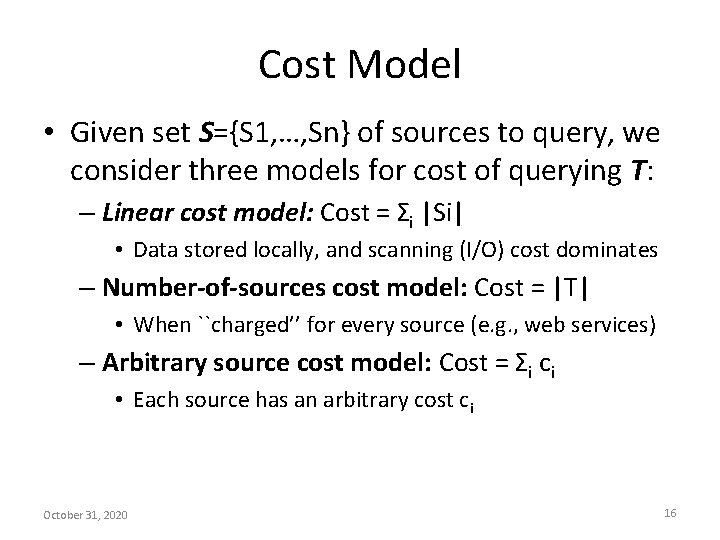
Cost Model • Given set S={S 1, …, Sn} of sources to query, we consider three models for cost of querying T: – Linear cost model: Cost = Σi |Si| • Data stored locally, and scanning (I/O) cost dominates – Number-of-sources cost model: Cost = |T| • When ``charged’’ for every source (e. g. , web services) – Arbitrary source cost model: Cost = Σi ci • Each source has an arbitrary cost ci October 31, 2020 16
Next • Formal problem definitions – Dependency model – Cost model for query answering – Coverage and optimization problems • Algorithms and complexity results summary – Coverage problem (CP) – Cost minimization problem (CMP) – Maximum coverage problem (MCP) – Source ordering problem (SOP) October 31, 2020 17
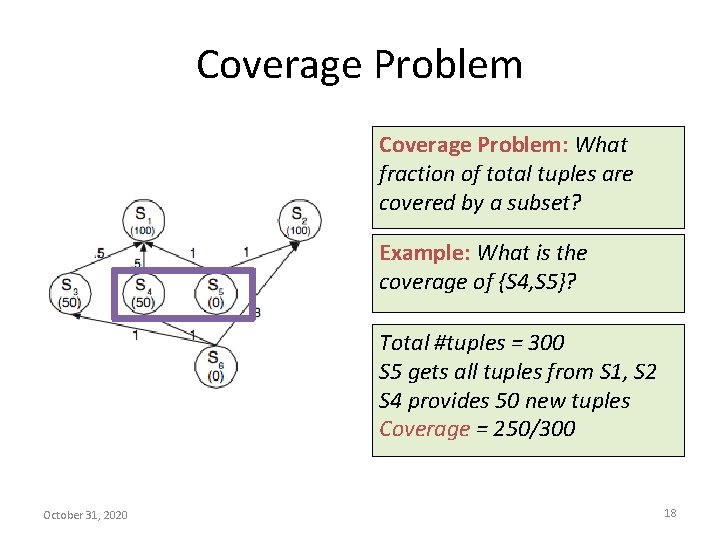
Coverage Problem: What fraction of total tuples are covered by a subset? Example: What is the coverage of {S 4, S 5}? Total #tuples = 300 S 5 gets all tuples from S 1, S 2 S 4 provides 50 new tuples Coverage = 250/300 October 31, 2020 18
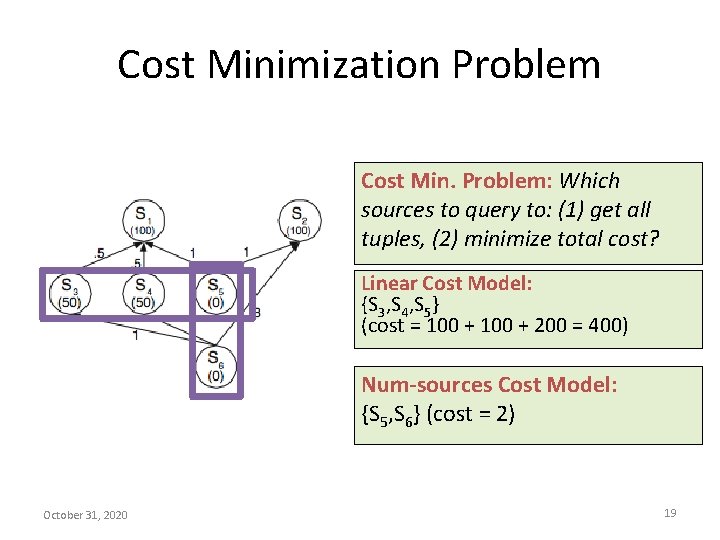
Cost Minimization Problem Cost Min. Problem: Which sources to query to: (1) get all tuples, (2) minimize total cost? Linear Cost Model: {S 3, S 4, S 5} (cost = 100 + 200 = 400) Num-sources Cost Model: {S 5, S 6} (cost = 2) October 31, 2020 19
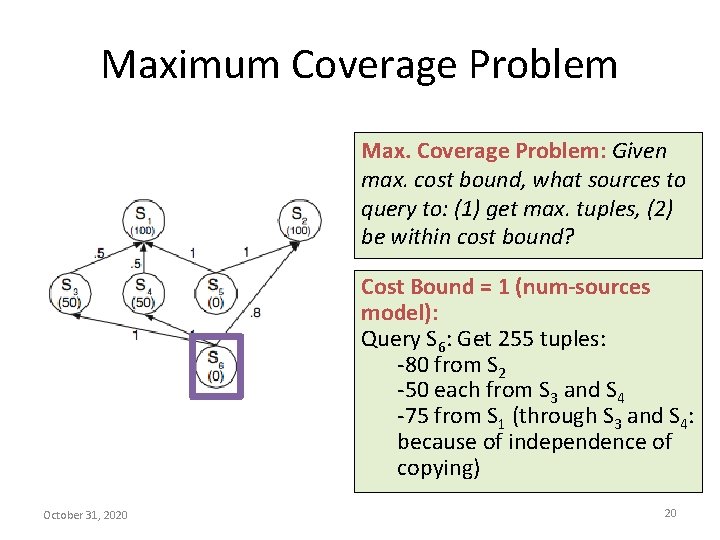
Maximum Coverage Problem Max. Coverage Problem: Given max. cost bound, what sources to query to: (1) get max. tuples, (2) be within cost bound? Cost Bound = 1 (num-sources model): Query S 6: Get 255 tuples: -80 from S 2 -50 each from S 3 and S 4 -75 from S 1 (through S 3 and S 4: because of independence of copying) October 31, 2020 20
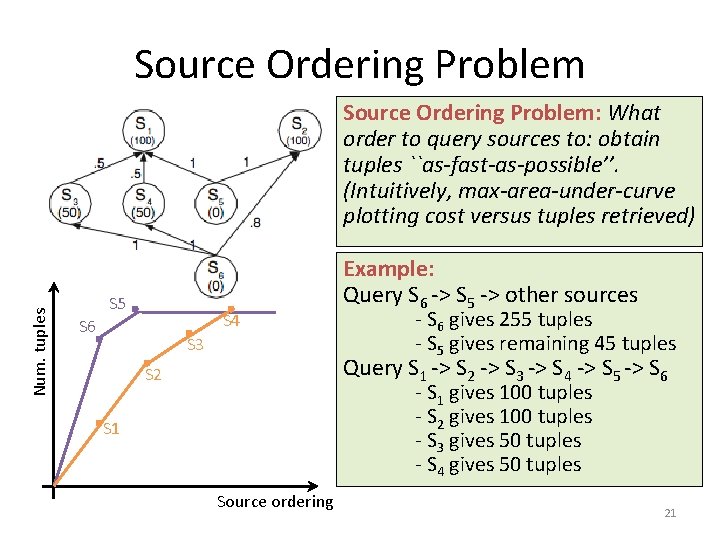
Source Ordering Problem Num. tuples Source Ordering Problem: What order to query sources to: obtain tuples ``as-fast-as-possible’’. (Intuitively, max-area-under-curve plotting cost versus tuples retrieved) S 5 S 4 S 6 S 3 Example: Query S 6 -> S 5 -> other sources - S 6 gives 255 tuples - S 5 gives remaining 45 tuples Query S 1 -> S 2 -> S 3 -> S 4 -> S 5 -> S 6 S 2 - S 1 gives 100 tuples - S 2 gives 100 tuples - S 3 gives 50 tuples - S 4 gives 50 tuples S 1 Source ordering 21
Next • Formal problem definitions – Dependency model – Cost model for query answering – Coverage and optimization problems • Algorithms and complexity results summary – Coverage problem (CP) – Cost minimization problem (CMP) – Maximum coverage problem (MCP) – Source ordering problem (SOP) October 31, 2020 25
Summary of results • Paper presents detailed theoretical investigation: – All four problems: coverage, cost-minimization, maxcoverage, source-ordering – All cost models: linear, num-sources, arbitrary – Hardness results, polynomial-time algorithms, tractable sub-classes, approximations • Next: – 1 -2 slides on each of the problems, highlighting main results – Focus on fraction-copying model October 31, 2020 26
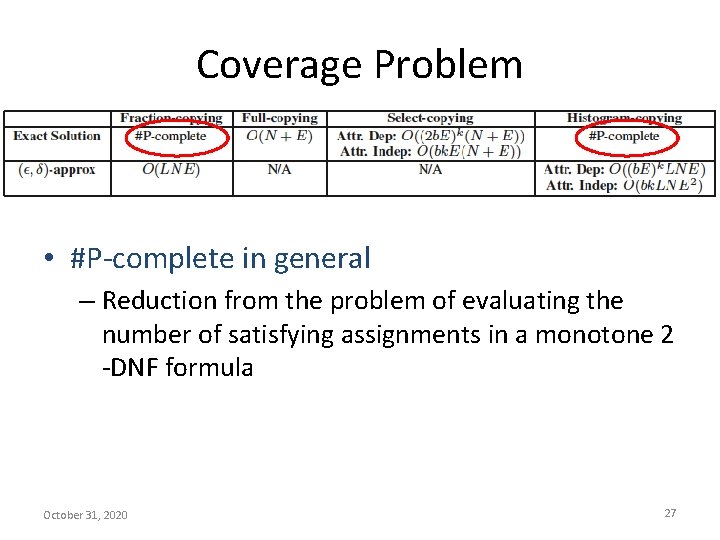
Coverage Problem • #P-complete in general – Reduction from the problem of evaluating the number of satisfying assignments in a monotone 2 -DNF formula October 31, 2020 27
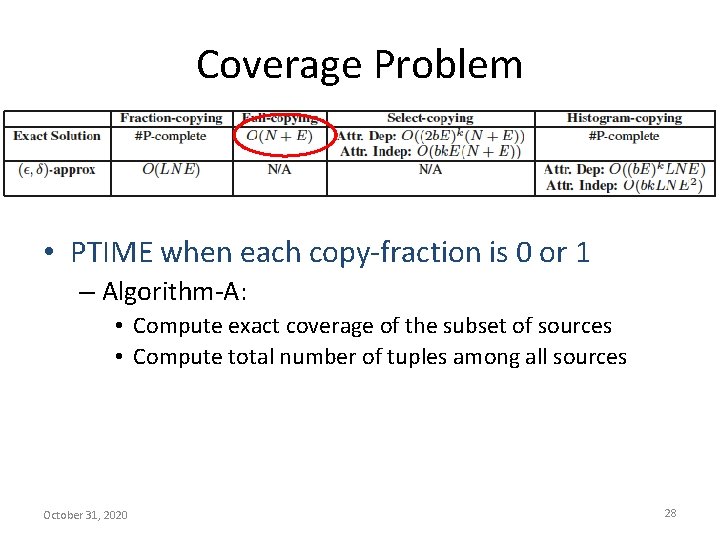
Coverage Problem • PTIME when each copy-fraction is 0 or 1 – Algorithm-A: • Compute exact coverage of the subset of sources • Compute total number of tuples among all sources October 31, 2020 28
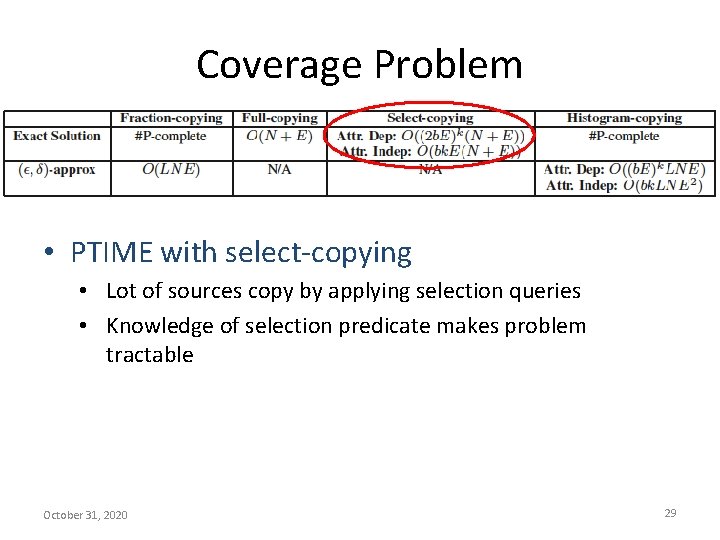
Coverage Problem • PTIME with select-copying • Lot of sources copy by applying selection queries • Knowledge of selection predicate makes problem tractable October 31, 2020 29
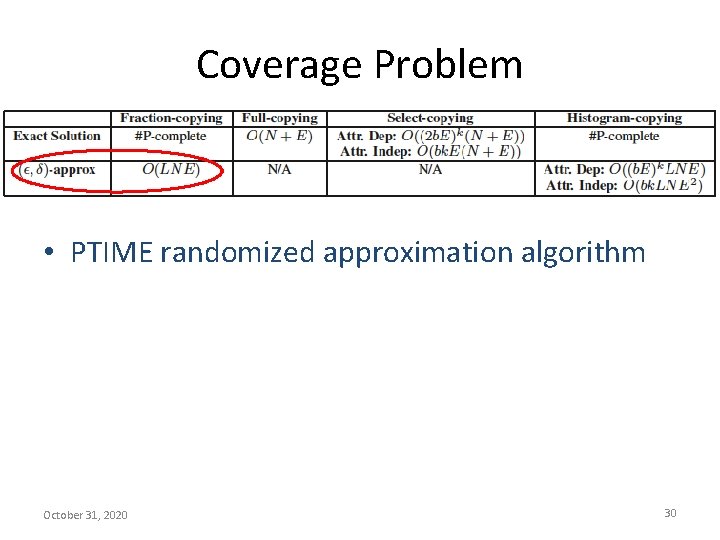
Coverage Problem • PTIME randomized approximation algorithm October 31, 2020 30
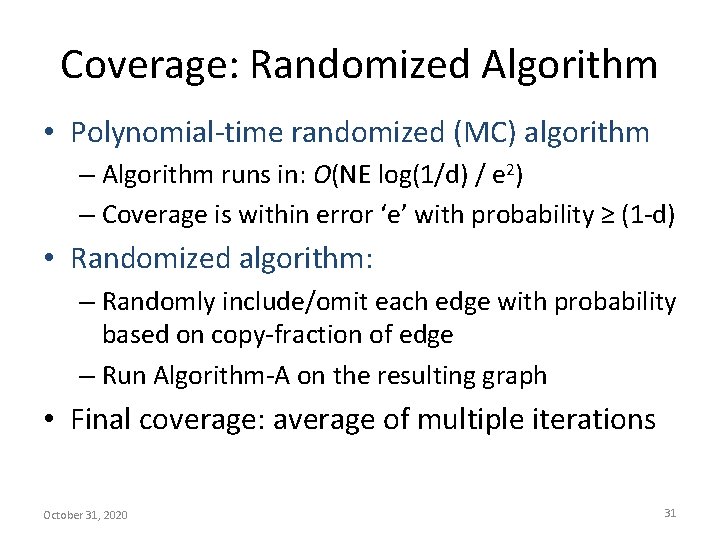
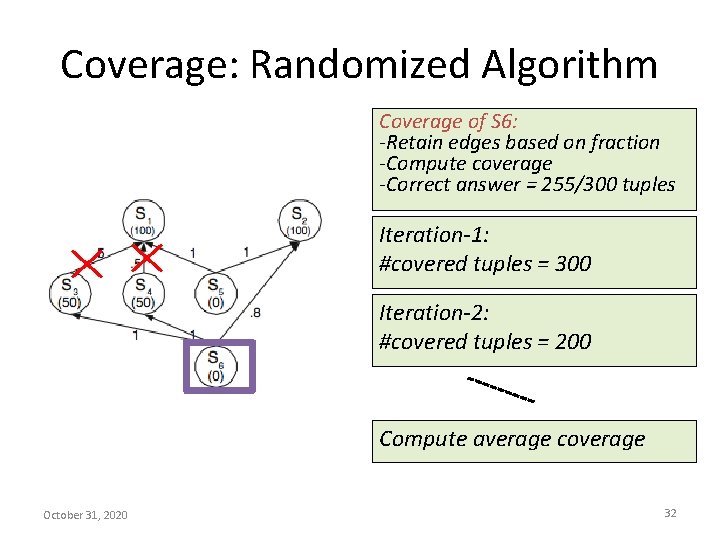
Coverage: Randomized Algorithm • Polynomial-time randomized (MC) algorithm – Algorithm runs in: O(NE log(1/d) / e 2) – Coverage is within error ‘e’ with probability ≥ (1 -d) • Randomized algorithm: – Randomly include/omit each edge with probability based on copy-fraction of edge – Run Algorithm-A on the resulting graph • Final coverage: average of multiple iterations October 31, 2020 31
Coverage: Randomized Algorithm Coverage of S 6: -Retain edges based on fraction -Compute coverage -Correct answer = 255/300 tuples Iteration-1: #covered tuples = 300 Iteration-2: #covered tuples = 200 Compute average coverage October 31, 2020 32
Next • Formal problem definitions – Dependency model – Cost model for query answering – Coverage and optimization problems • Algorithms and complexity results summary – Coverage problem (CP) – Cost minimization problem (CMP) – Maximum coverage problem (MCP) – Source ordering problem (SOP) October 31, 2020 33
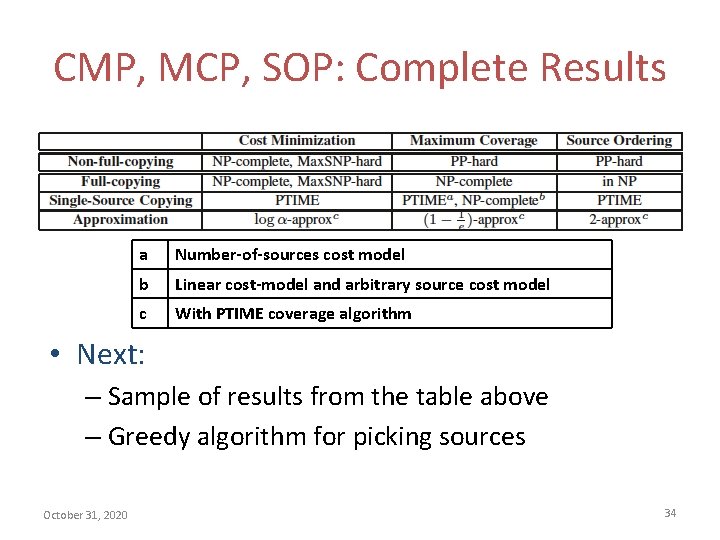
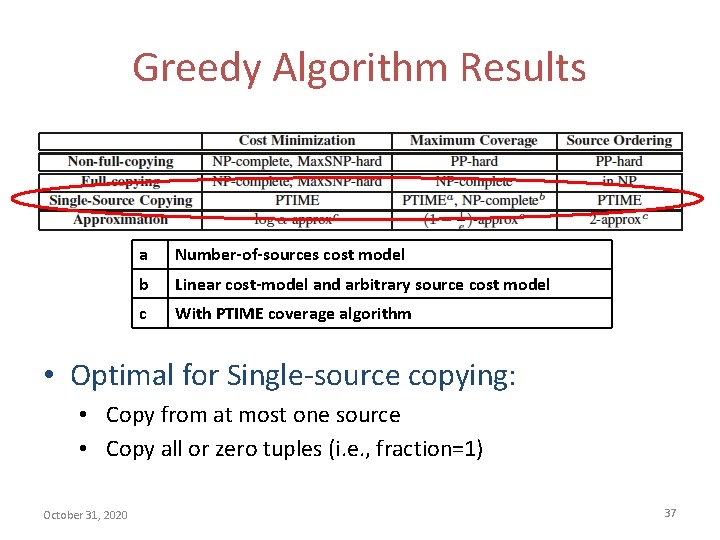
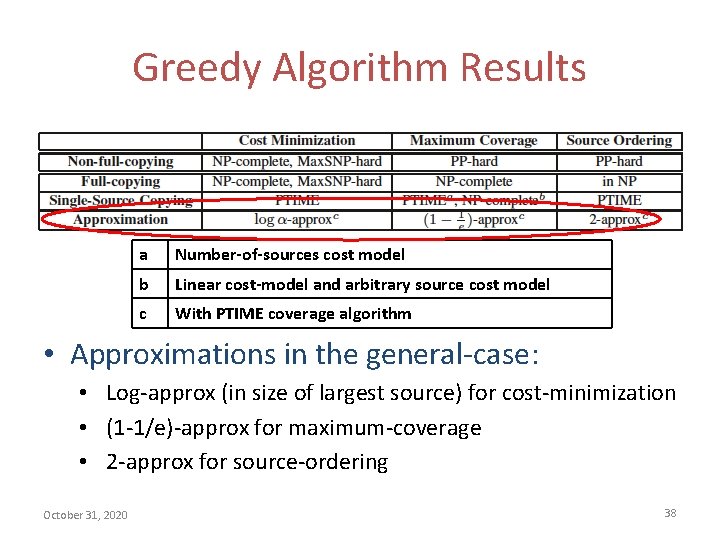
CMP, MCP, SOP: Complete Results a Number-of-sources cost model b Linear cost-model and arbitrary source cost model c With PTIME coverage algorithm • Next: – Sample of results from the table above – Greedy algorithm for picking sources October 31, 2020 34
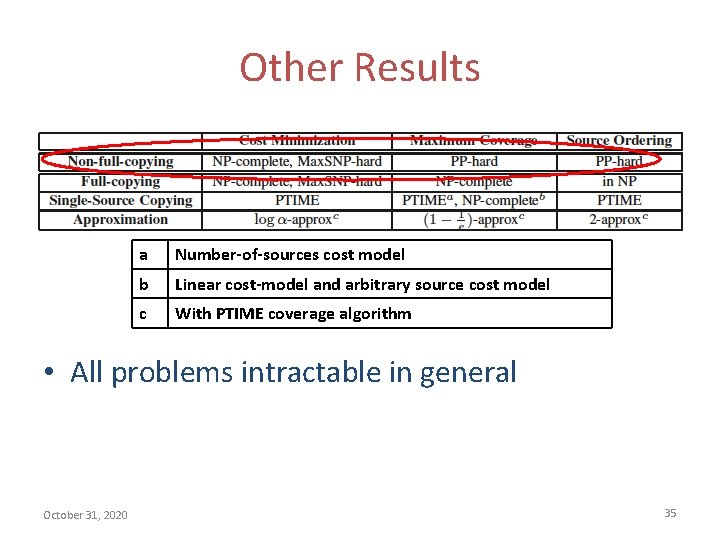
Other Results a Number-of-sources cost model b Linear cost-model and arbitrary source cost model c With PTIME coverage algorithm • All problems intractable in general October 31, 2020 35
Greedy Algorithm • Greedy algorithm for cost-minimization, maximum coverage, source ordering: – Pick the source S maximizing I(S)/c(S) – I(S) = total number of new tuples – c(S) = cost of querying S • Greedy algorithm is optimal when all sources: – Copy from at most one source – Copy all or zero tuples (i. e. , fraction=1) October 31, 2020 36
Greedy Algorithm Results a Number-of-sources cost model b Linear cost-model and arbitrary source cost model c With PTIME coverage algorithm • Optimal for Single-source copying: • Copy from at most one source • Copy all or zero tuples (i. e. , fraction=1) October 31, 2020 37
Greedy Algorithm Results a Number-of-sources cost model b Linear cost-model and arbitrary source cost model c With PTIME coverage algorithm • Approximations in the general-case: • Log-approx (in size of largest source) for cost-minimization • (1 -1/e)-approx for maximum-coverage • 2 -approx for source-ordering October 31, 2020 38
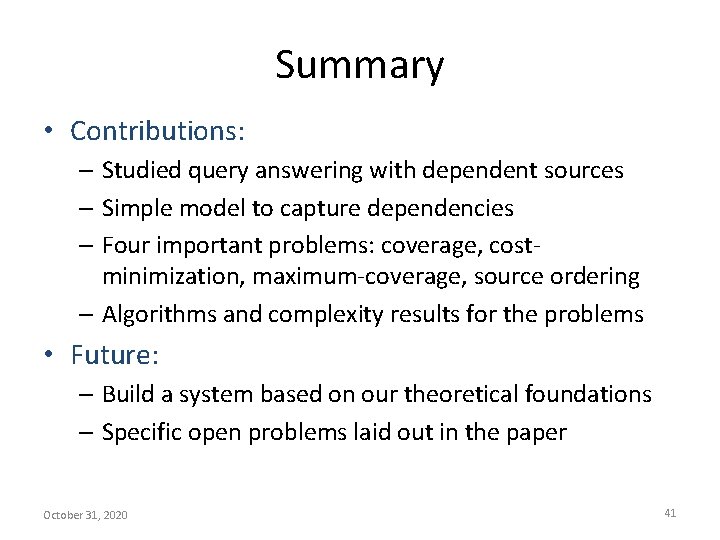
Summary • Contributions: – Studied query answering with dependent sources – Simple model to capture dependencies – Four important problems: coverage, costminimization, maximum-coverage, source ordering – Algorithms and complexity results for the problems • Future: – Build a system based on our theoretical foundations – Specific open problems laid out in the paper October 31, 2020 41
Thanks! October 31, 2020 42