
DANIEL TSUI LECTURE BEIJING 2005 SANKAR DAS SARMA
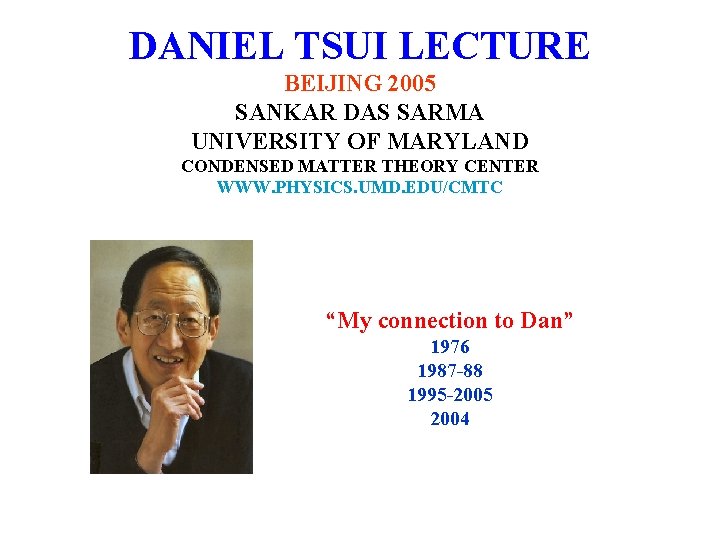
DANIEL TSUI LECTURE BEIJING 2005 SANKAR DAS SARMA UNIVERSITY OF MARYLAND CONDENSED MATTER THEORY CENTER WWW. PHYSICS. UMD. EDU/CMTC “My connection to Dan” 1976 1987 -88 1995 -2005 2004
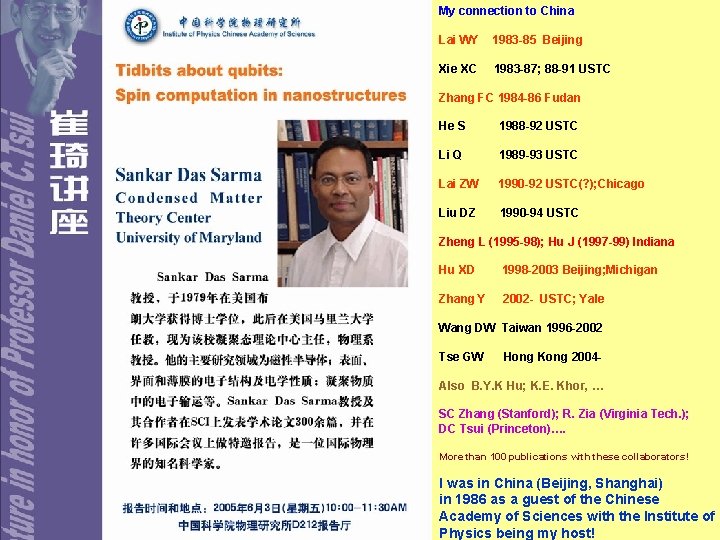
My connection to China Lai WY 1983 -85 Beijing Xie XC 1983 -87; 88 -91 USTC Zhang FC 1984 -86 Fudan He S 1988 -92 USTC Li Q 1989 -93 USTC Lai ZW 1990 -92 USTC(? ); Chicago Liu DZ 1990 -94 USTC Zheng L (1995 -98); Hu J (1997 -99) Indiana Hu XD 1998 -2003 Beijing; Michigan Zhang Y 2002 - USTC; Yale Wang DW Taiwan 1996 -2002 Tse GW Hong Kong 2004 - Also B. Y. K Hu; K. E. Khor, … SC Zhang (Stanford); R. Zia (Virginia Tech. ); DC Tsui (Princeton)…. More than 100 publications with these collaborators! I was in China (Beijing, Shanghai) in 1986 as a guest of the Chinese Academy of Sciences with the Institute of Physics being my host!
TIDBITS ABOUT QUBITS Sankar Das Sarma • QUBITS = TWO-LEVEL QUANTUM SYSTEM • LINEAR SUPERPOSITION • QUANTUM ENTANGLEMENT • QUANTUM PARALLELISM TOPOLOGICAL QUANTUM COMPUTATION www. physics. umd. edu/cmtc
A (VERY) BRIEF HISTORY OF COMPUTATION • • UNARY: 10, 000 YEARS AGO BINARY: 1, 000 YEARS AGO; BITS ANALOG COMPUTERS: ~ 1000 years BOOLEAN ALGEBRA: BITS DIGITAL COMPUTERS: ~ 100 years QUANTUM MECH. : 100 YEARS AGO QUBITS: NOW (PERHAPS) QUANTUM COMPUTERS: ? ?

Spin Quantum Computation in Semiconductor Nanostructures Localized Spin 12 qubits in Semiconductor Nanostructures (Heisenberg Coupling) X. Hu; R. de Sousa; B. Koiller; V. Scarola; W. Witzel ARDA, ARO, UMD, LPS, NSA
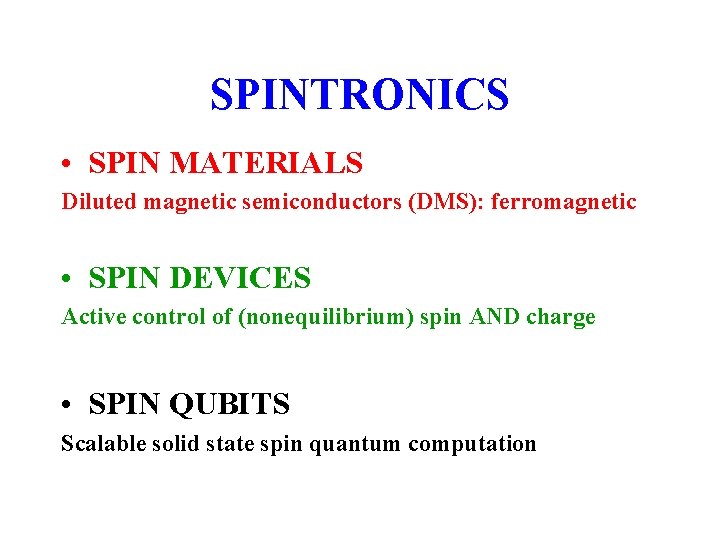
SPINTRONICS • SPIN MATERIALS Diluted magnetic semiconductors (DMS): ferromagnetic • SPIN DEVICES Active control of (nonequilibrium) spin AND charge • SPIN QUBITS Scalable solid state spin quantum computation
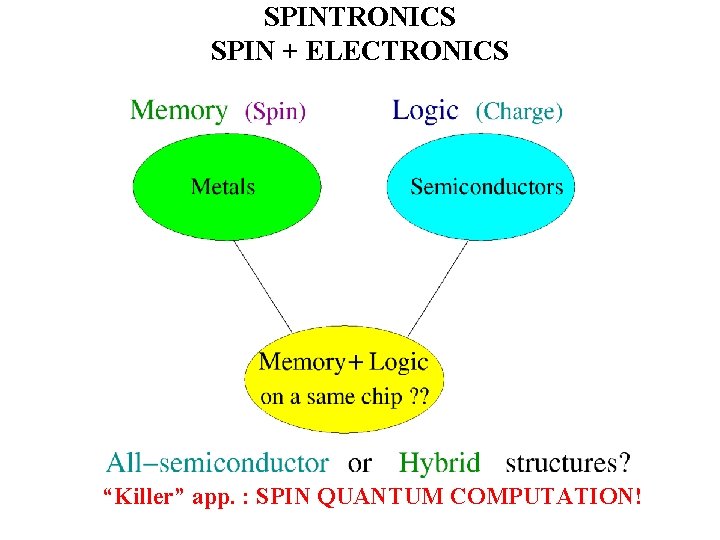
SPINTRONICS SPIN + ELECTRONICS “Killer” app. : SPIN QUANTUM COMPUTATION!
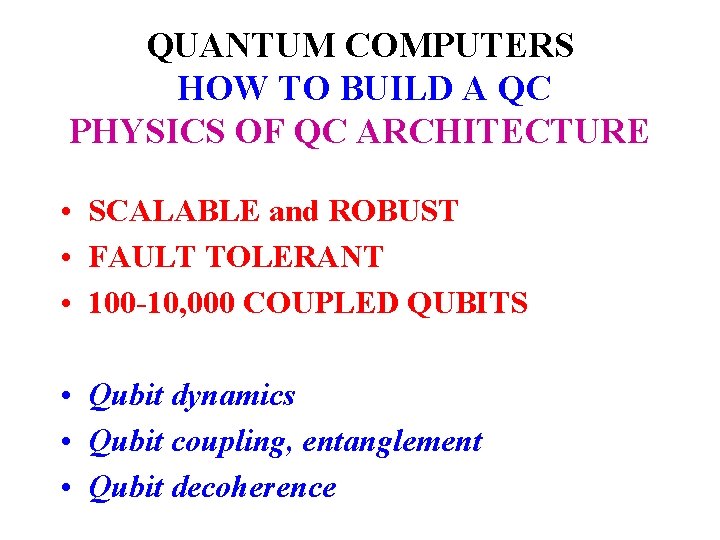
QUANTUM COMPUTERS HOW TO BUILD A QC PHYSICS OF QC ARCHITECTURE • SCALABLE and ROBUST • FAULT TOLERANT • 100 -10, 000 COUPLED QUBITS • Qubit dynamics • Qubit coupling, entanglement • Qubit decoherence
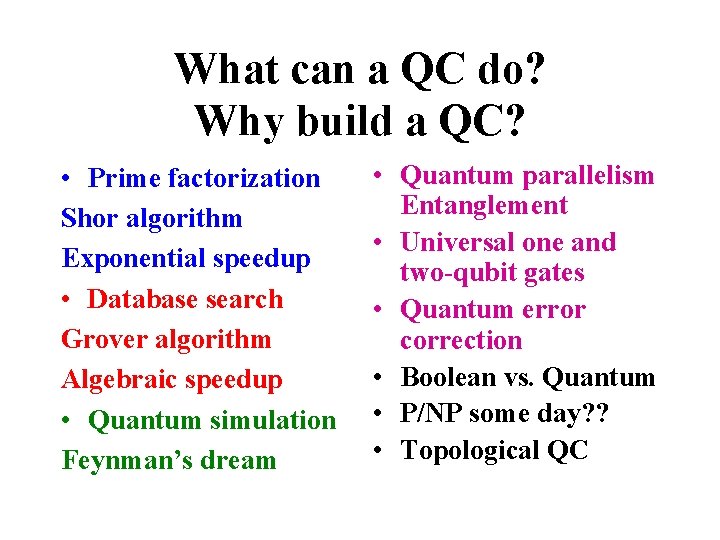
What can a QC do? Why build a QC? • Prime factorization Shor algorithm Exponential speedup • Database search Grover algorithm Algebraic speedup • Quantum simulation Feynman’s dream • Quantum parallelism Entanglement • Universal one and two-qubit gates • Quantum error correction • Boolean vs. Quantum • P/NP some day? ? • Topological QC
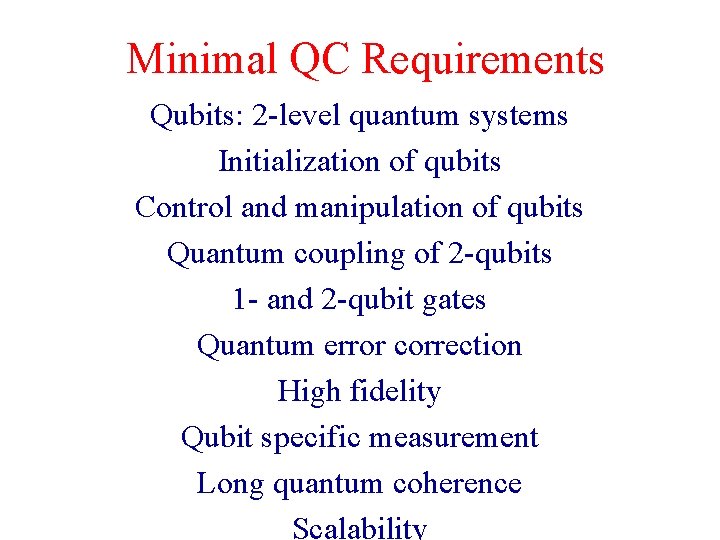
Minimal QC Requirements Qubits: 2 -level quantum systems Initialization of qubits Control and manipulation of qubits Quantum coupling of 2 -qubits 1 - and 2 -qubit gates Quantum error correction High fidelity Qubit specific measurement Long quantum coherence Scalability
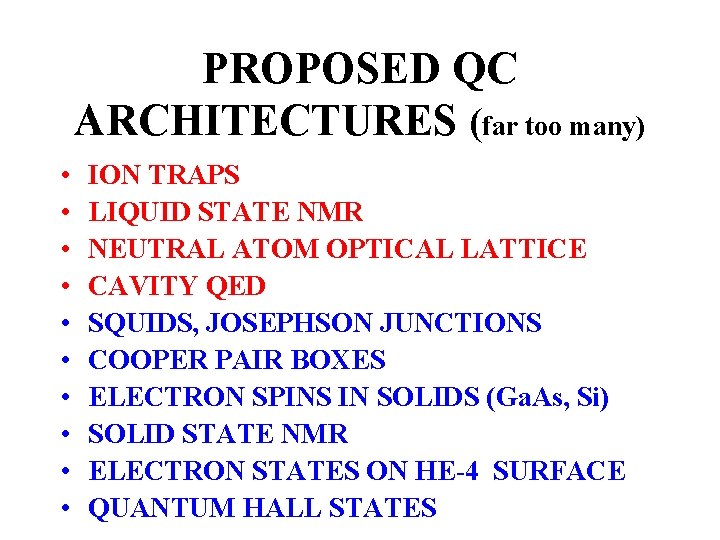
PROPOSED QC ARCHITECTURES (far too many) • • • ION TRAPS LIQUID STATE NMR NEUTRAL ATOM OPTICAL LATTICE CAVITY QED SQUIDS, JOSEPHSON JUNCTIONS COOPER PAIR BOXES ELECTRON SPINS IN SOLIDS (Ga. As, Si) SOLID STATE NMR ELECTRON STATES ON HE-4 SURFACE QUANTUM HALL STATES
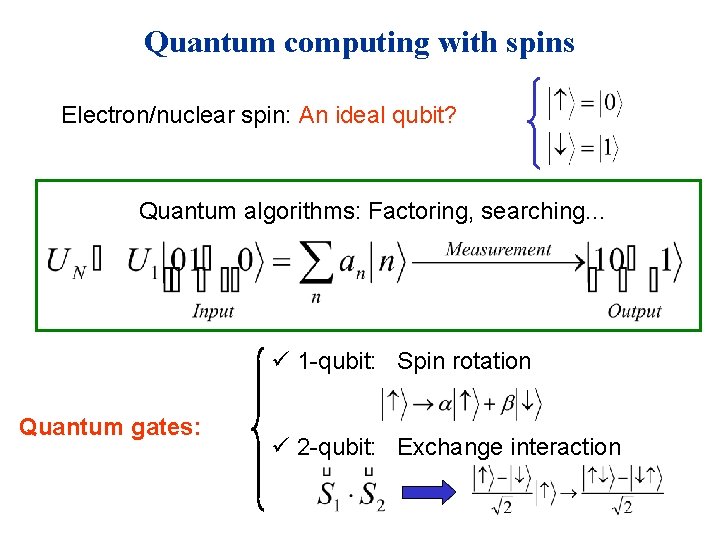
Quantum computing with spins Electron/nuclear spin: An ideal qubit? Quantum algorithms: Factoring, searching. . . 1 -qubit: Spin rotation Quantum gates: 2 -qubit: Exchange interaction
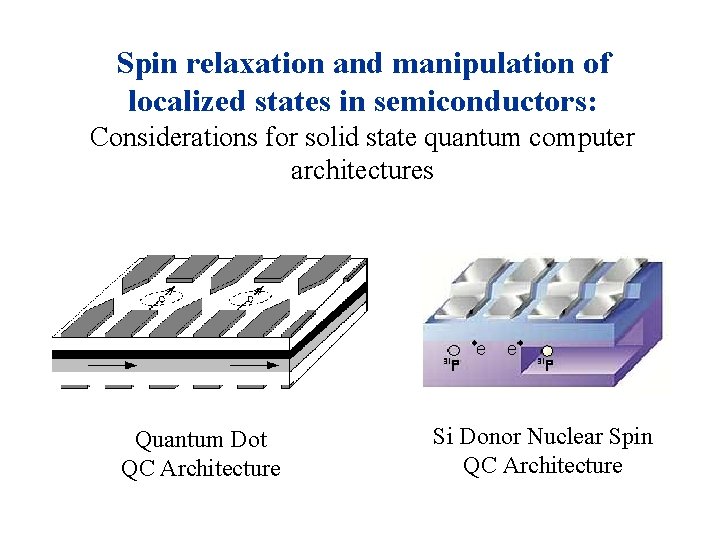
Spin relaxation and manipulation of localized states in semiconductors: Considerations for solid state quantum computer architectures Quantum Dot QC Architecture Si Donor Nuclear Spin QC Architecture
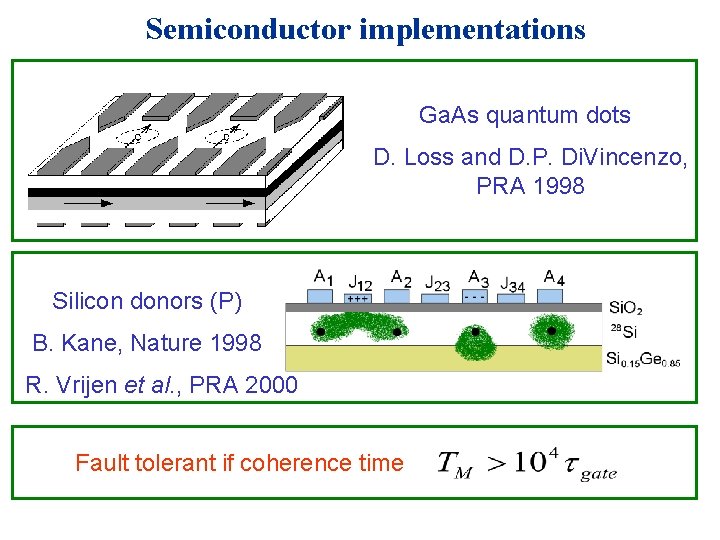
Semiconductor implementations Ga. As quantum dots D. Loss and D. P. Di. Vincenzo, PRA 1998 Silicon donors (P) B. Kane, Nature 1998 R. Vrijen et al. , PRA 2000 Fault tolerant if coherence time
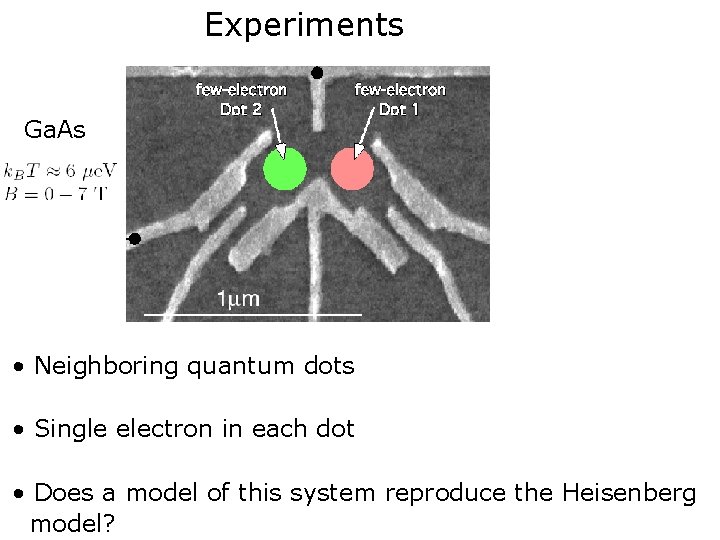
Experiments Ga. As • Neighboring quantum dots • Single electron in each dot • Does a model of this system reproduce the Heisenberg model?
Spin Transitions in Few Electron Quantum Dots Exact Diagonalization Theory Going beyond perturbative/Heitler-London exchange gate calculations in coupled dot QC architectures ATOM to MOLECULE Vito Scarola WHEN IS THE 2 -ELECTRON QUNTUM DOT A ‘MOLECULE’ WITH TUNABLE EXCHANGE COUPLING? WHEN IS IT JUST AN ARTIFICIAL 2 ATOM SYSTEM?
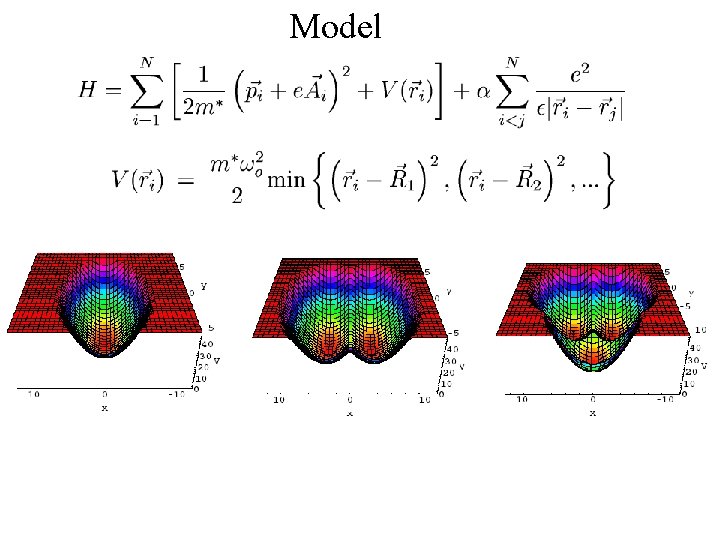
Model
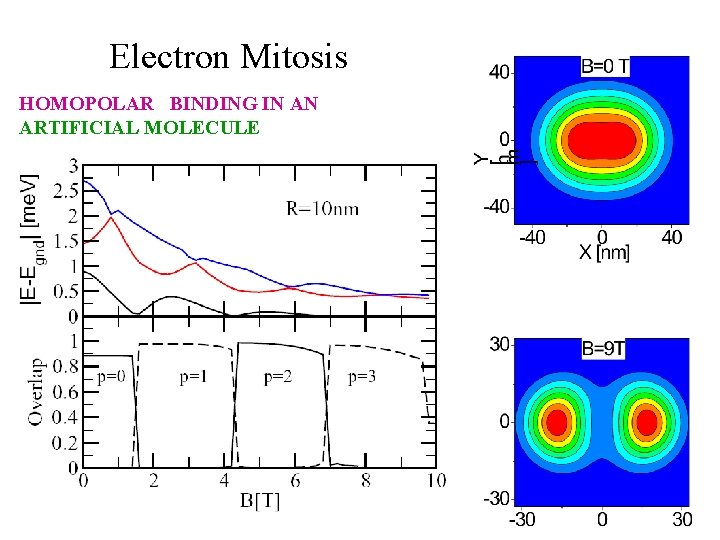
Electron Mitosis HOMOPOLAR BINDING IN AN ARTIFICIAL MOLECULE
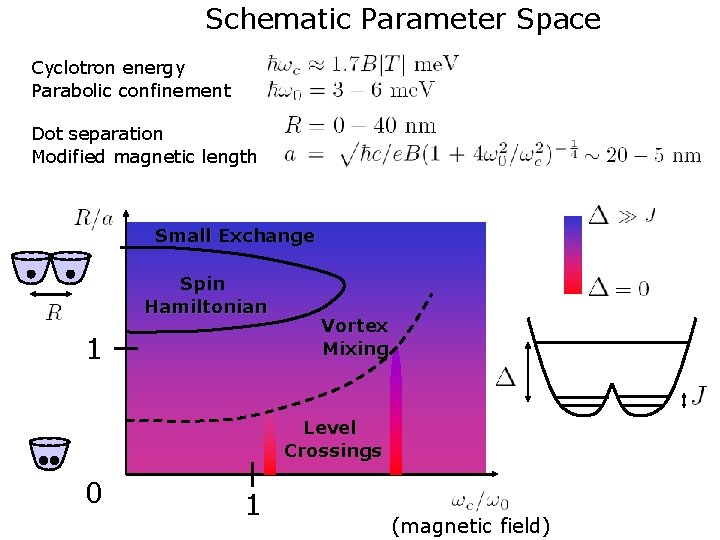
Schematic Parameter Space Cyclotron energy Parabolic confinement Dot separation Modified magnetic length Small Exchange Spin Hamiltonian 1 Vortex Mixing Level Crossings 0 1 (magnetic field)
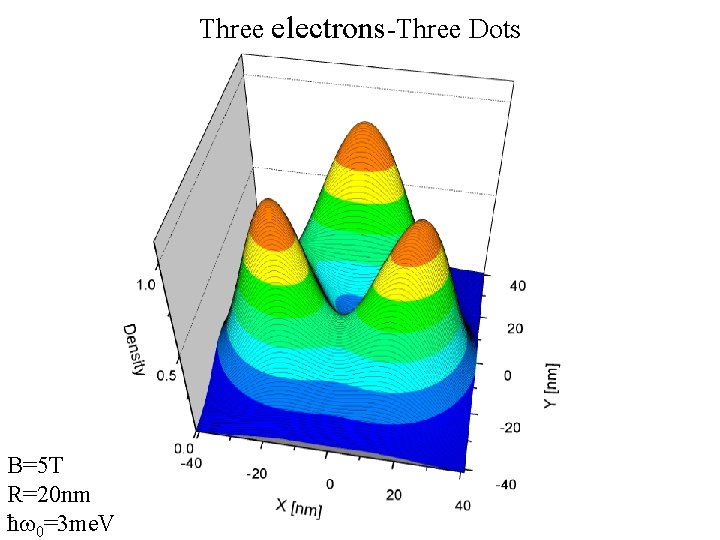
Three electrons-Three Dots B=5 T R=20 nm ħw 0=3 me. V
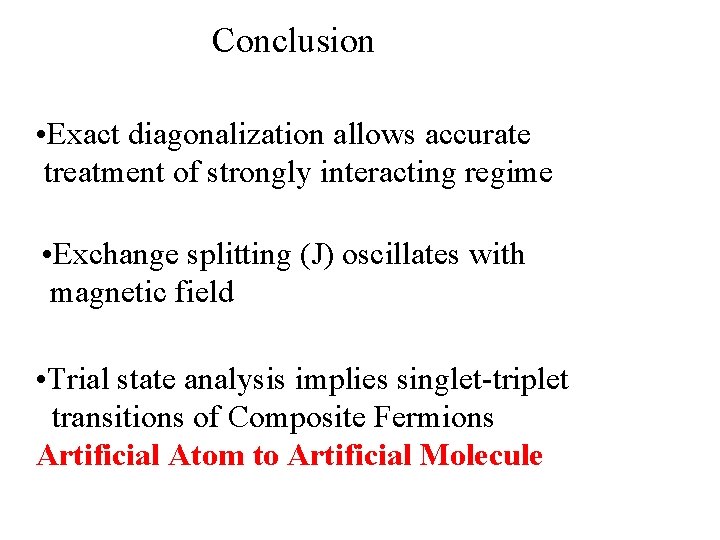
Conclusion • Exact diagonalization allows accurate treatment of strongly interacting regime • Exchange splitting (J) oscillates with magnetic field • Trial state analysis implies singlet-triplet transitions of Composite Fermions Artificial Atom to Artificial Molecule
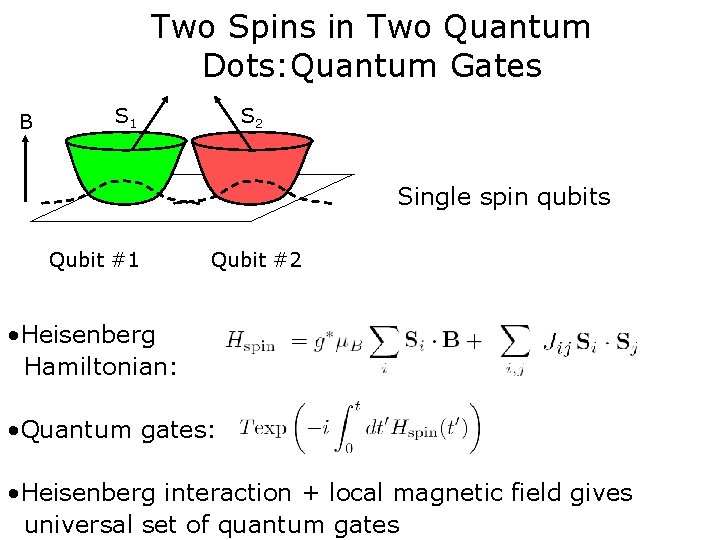
Two Spins in Two Quantum Dots: Quantum Gates B S 1 S 2 Single spin qubits Qubit #1 Qubit #2 • Heisenberg Hamiltonian: • Quantum gates: • Heisenberg interaction + local magnetic field gives universal set of quantum gates
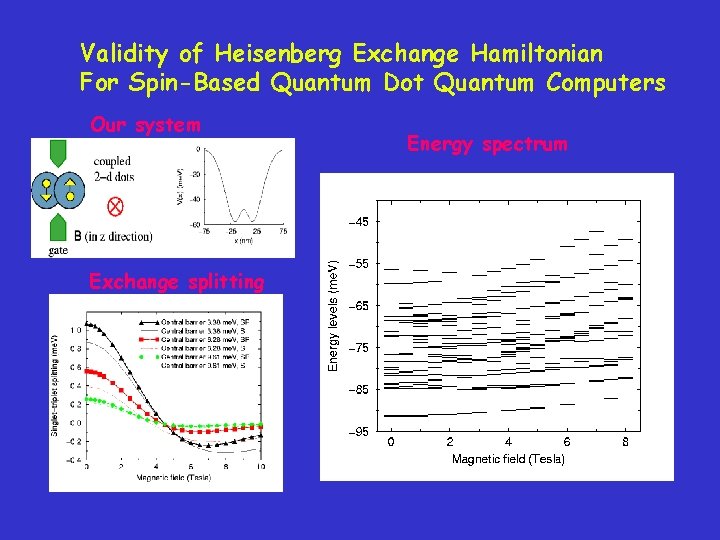
Validity of Heisenberg Exchange Hamiltonian For Spin-Based Quantum Dot Quantum Computers Our system Exchange splitting Energy spectrum
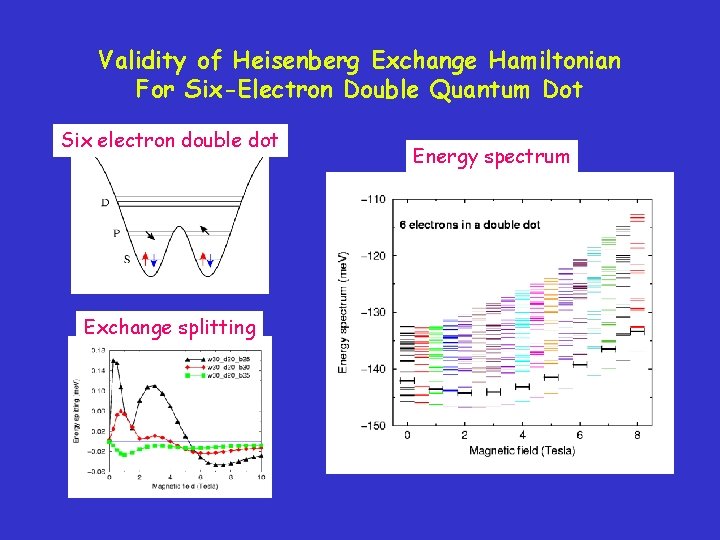
Validity of Heisenberg Exchange Hamiltonian For Six-Electron Double Quantum Dot Six electron double dot Exchange splitting Energy spectrum
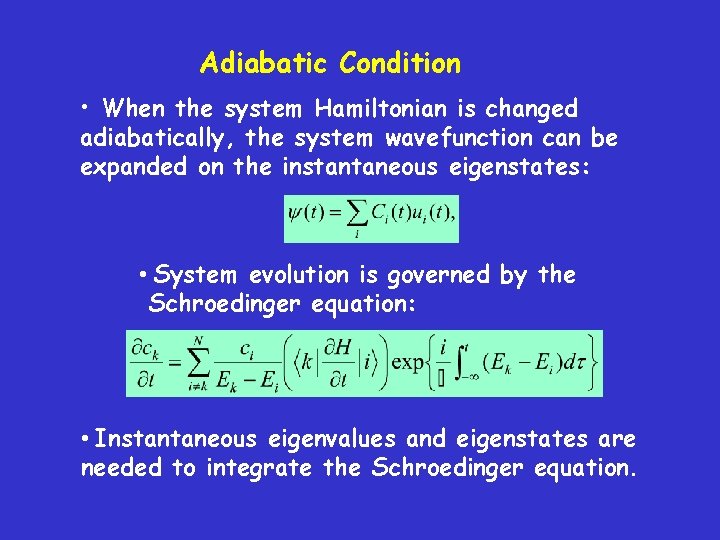
Adiabatic Condition • When the system Hamiltonian is changed adiabatically, the system wavefunction can be expanded on the instantaneous eigenstates: • System evolution is governed by the Schroedinger equation: • Instantaneous eigenvalues and eigenstates are needed to integrate the Schroedinger equation.
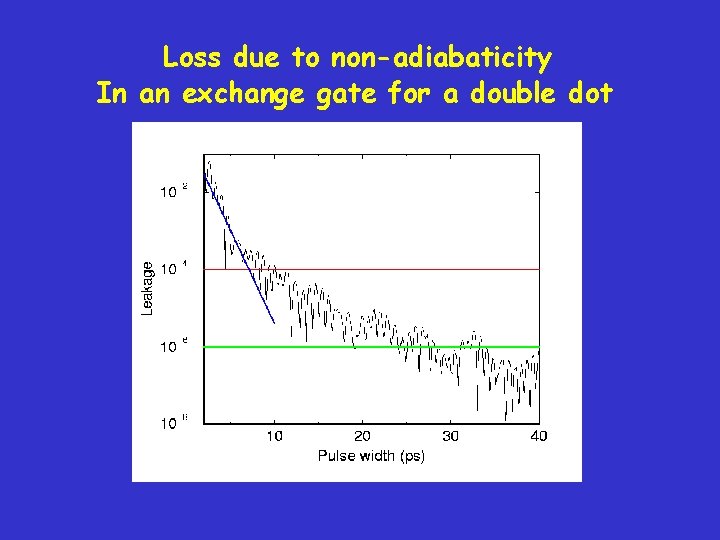
Loss due to non-adiabaticity In an exchange gate for a double dot
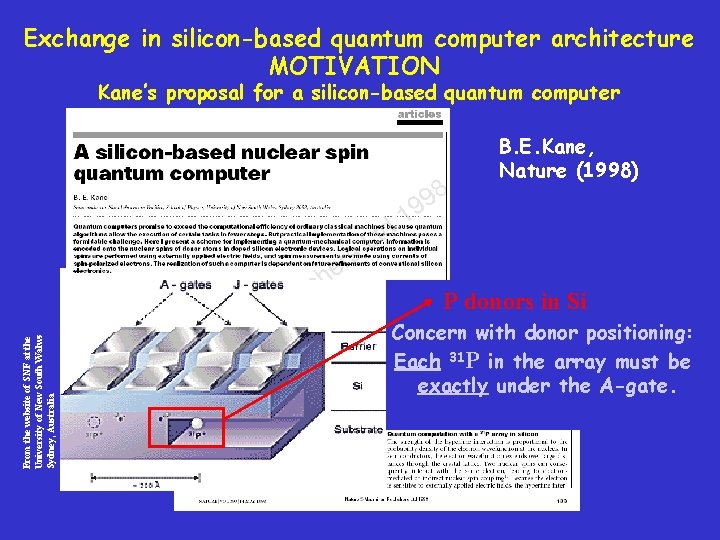
Exchange in silicon-based quantum computer architecture MOTIVATION Kane’s proposal for a silicon-based quantum computer B. E. Kane, Nature (1998) From the website of SNF at the University of New South Walws Sydney, Australia P donors in Si Concern with donor positioning: Each 31 P in the array must be exactly under the A-gate.
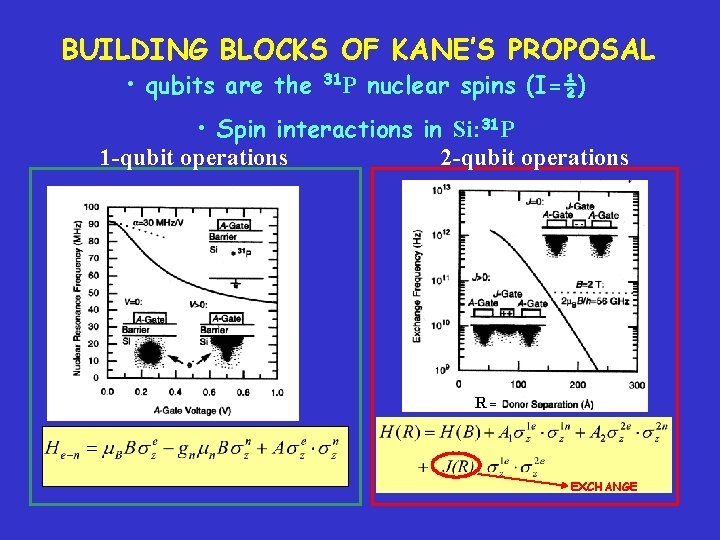
BUILDING BLOCKS OF KANE’S PROPOSAL • qubits are the 31 P nuclear spins (I=½) • Spin interactions in Si: 31 P 1 -qubit operations 2 -qubit operations R= EXCHANGE
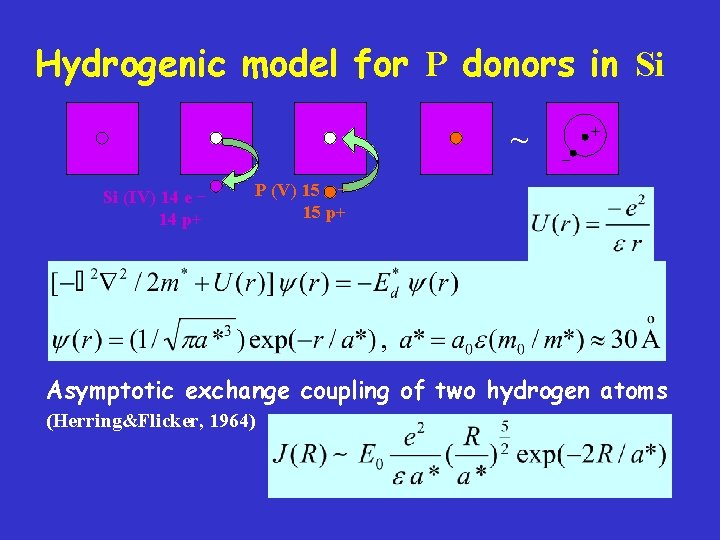
Hydrogenic model for P donors in Si ~ Si (IV) 14 e – 14 p+ + _ P (V) 15 e – 15 p+ Asymptotic exchange coupling of two hydrogen atoms (Herring&Flicker, 1964)
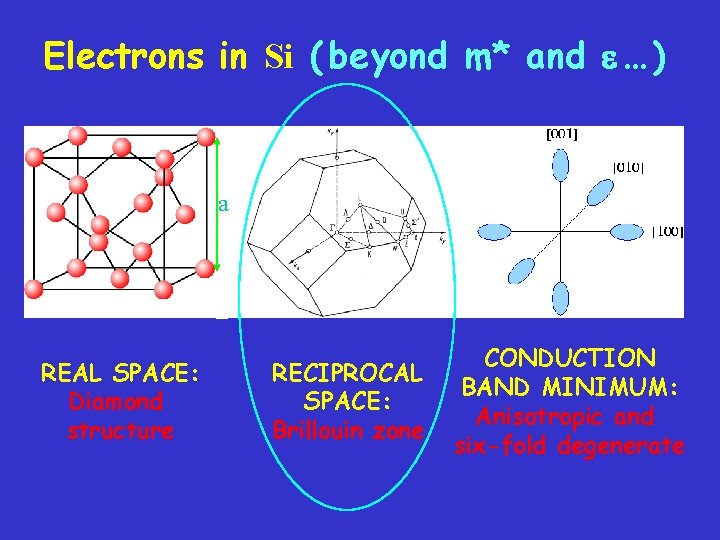
Electrons in Si ( beyond m* and … ) a REAL SPACE: Diamond structure RECIPROCAL SPACE: Brillouin zone CONDUCTION BAND MINIMUM: Anisotropic and six-fold degenerate
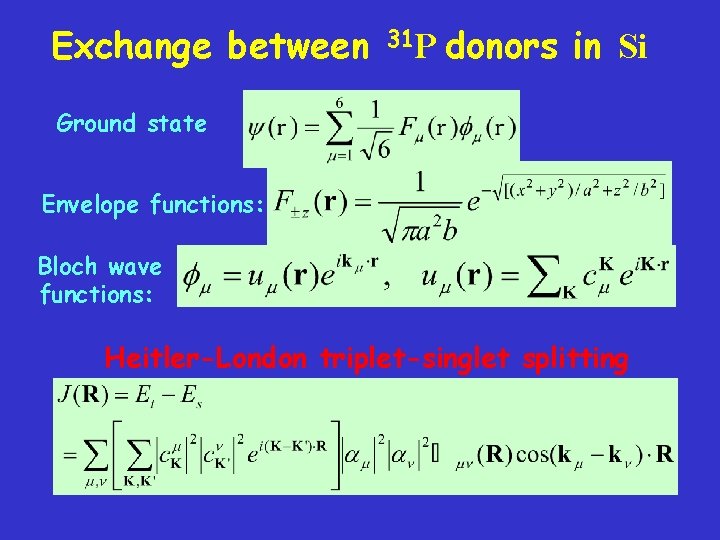
Exchange between 31 P donors in Si Ground state Envelope functions: Bloch wave functions: Heitler-London triplet-singlet splitting
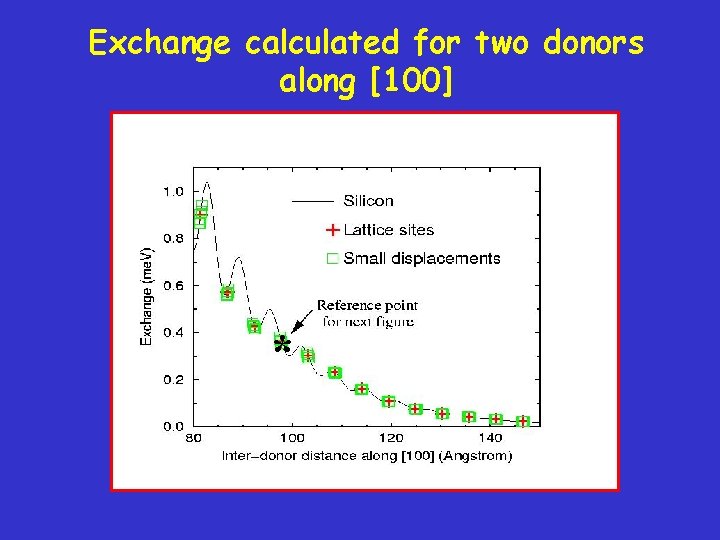
Exchange calculated for two donors along [100] *
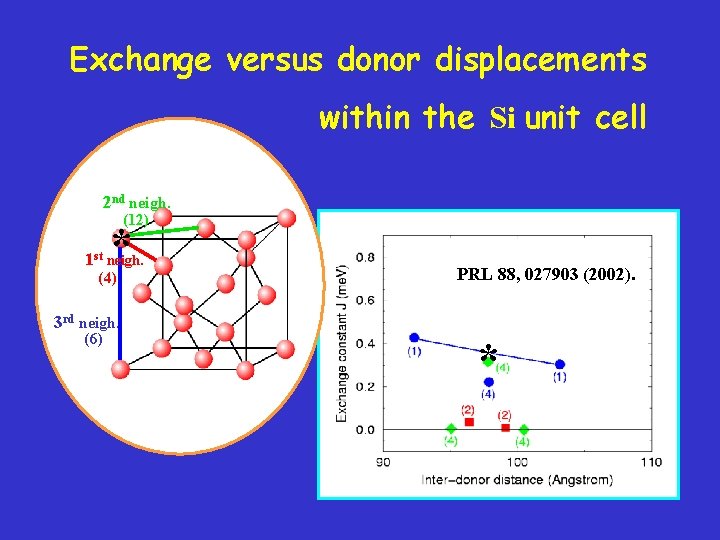
Exchange versus donor displacements within the Si unit cell 2 nd neigh. (12) * 1 st neigh. (4) PRL 88, 027903 (2002). 3 rd neigh. (6) *
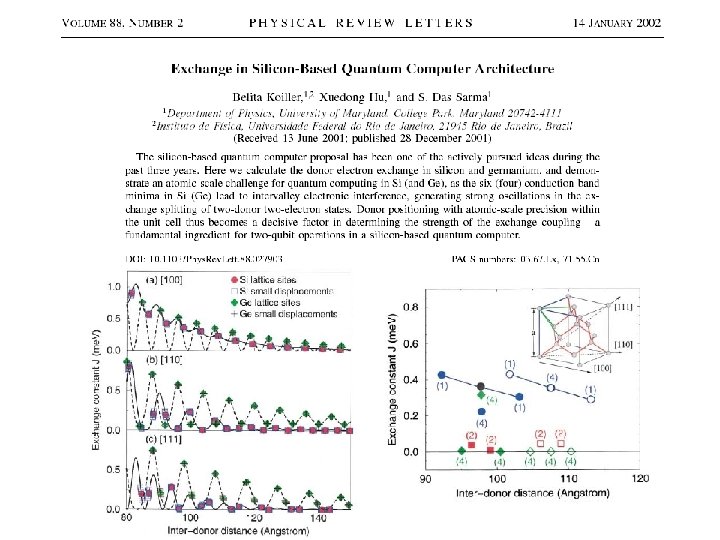
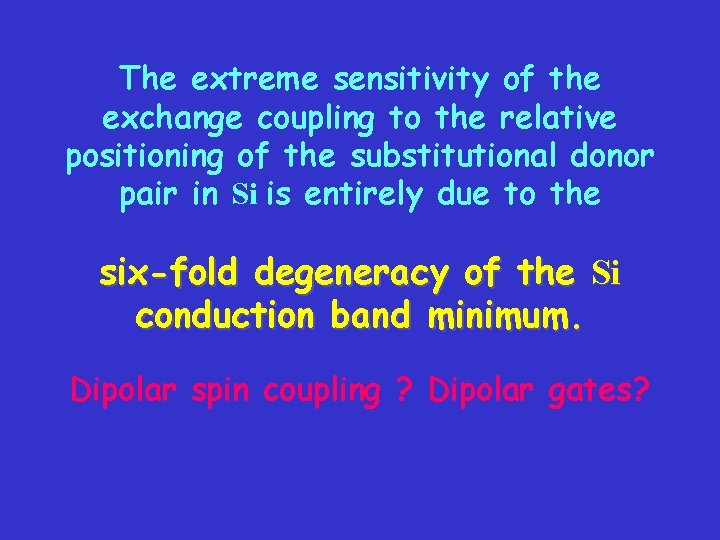
The extreme sensitivity of the exchange coupling to the relative positioning of the substitutional donor pair in Si is entirely due to the six-fold degeneracy of the Si conduction band minimum. Dipolar spin coupling ? Dipolar gates?
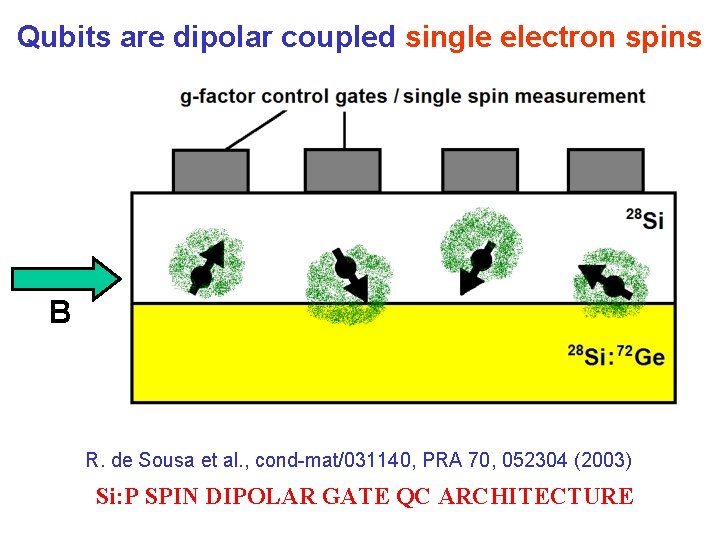
Qubits are dipolar coupled single electron spins B R. de Sousa et al. , cond-mat/031140, PRA 70, 052304 (2003) Si: P SPIN DIPOLAR GATE QC ARCHITECTURE
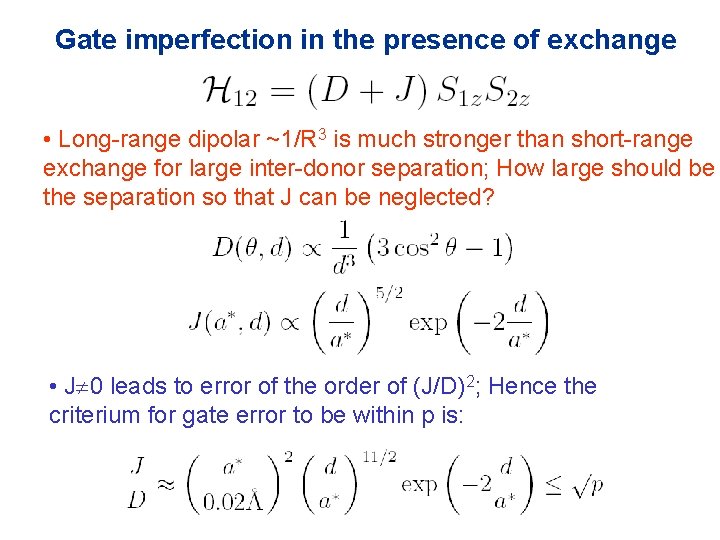
Gate imperfection in the presence of exchange • Long-range dipolar ~1/R 3 is much stronger than short-range exchange for large inter-donor separation; How large should be the separation so that J can be neglected? • J 0 leads to error of the order of (J/D)2; Hence the criterium for gate error to be within p is:
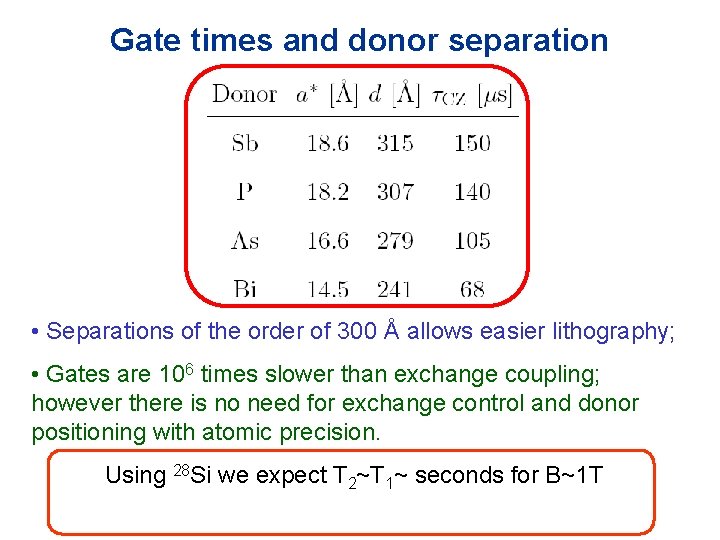
Gate times and donor separation • Separations of the order of 300 Å allows easier lithography; • Gates are 106 times slower than exchange coupling; however there is no need for exchange control and donor positioning with atomic precision. Using 28 Si we expect T 2~T 1~ seconds for B~1 T
Si Dipolar QC • Long range couplings are corrected with no overhead in gate time (ability to -pulse within 5 s is required). • Dipolar implementation is reliable, its advantages/disadvantages should be compared with other proposals without exchange (for example, Skinner, Davenport, Kane, PRL 2003, which requires electron shuttling between donors); • Dipolar coupling insensitive to electronic structure: No inter -valley interference, interstitial defects are also good qubits; • “Top-down” construction schemes based on implantation can be used even though they lack atomic precision in donor positioning. • Can be scaled up
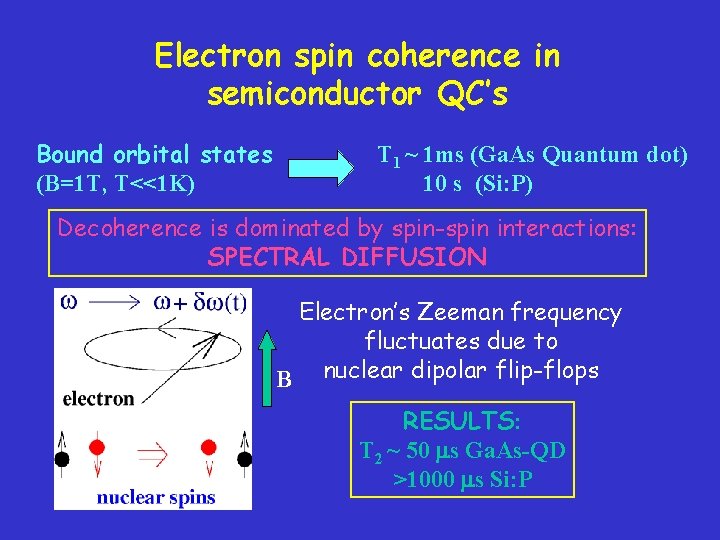
Electron spin coherence in semiconductor QC’s Bound orbital states (B=1 T, T<<1 K) T 1 ~ 1 ms (Ga. As Quantum dot) 10 s (Si: P) Decoherence is dominated by spin-spin interactions: SPECTRAL DIFFUSION Electron’s Zeeman frequency fluctuates due to B nuclear dipolar flip-flops RESULTS: T 2 ~ 50 ms Ga. As-QD >1000 ms Si: P
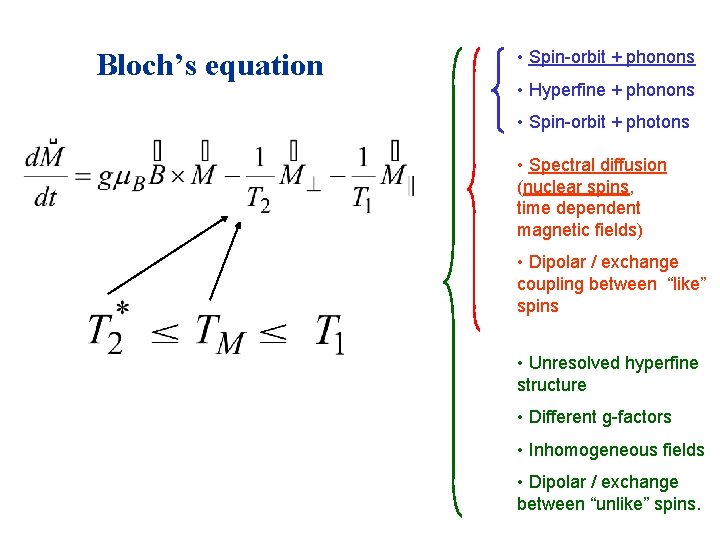
Bloch’s equation • Spin-orbit + phonons • Hyperfine + phonons • Spin-orbit + photons • Spectral diffusion (nuclear spins, time dependent magnetic fields) • Dipolar / exchange coupling between “like” spins • Unresolved hyperfine structure • Different g-factors • Inhomogeneous fields • Dipolar / exchange between “unlike” spins.
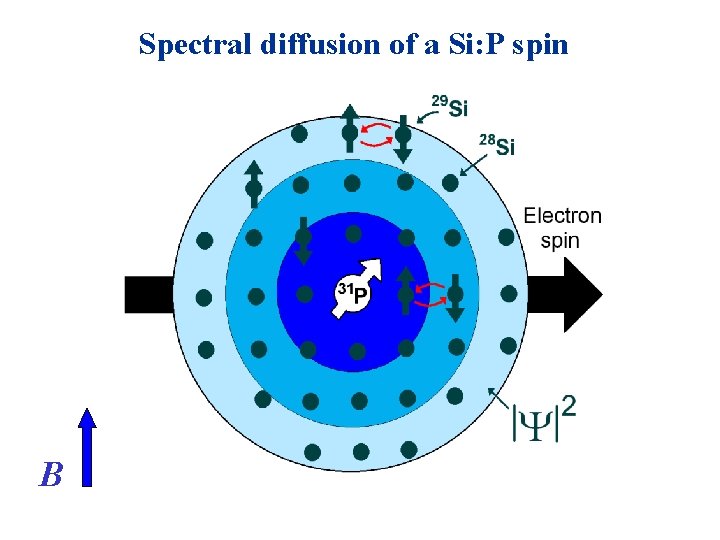
Spectral diffusion of a Si: P spin B
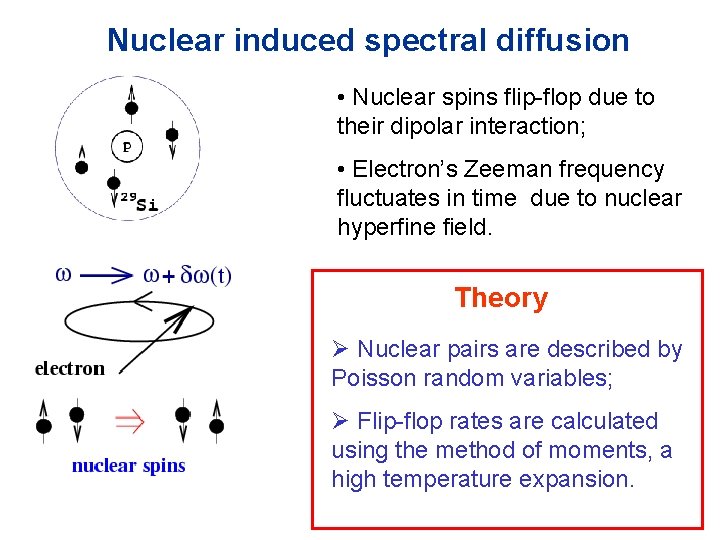
Nuclear induced spectral diffusion • Nuclear spins flip-flop due to their dipolar interaction; • Electron’s Zeeman frequency fluctuates in time due to nuclear hyperfine field. Theory Ø Nuclear pairs are described by Poisson random variables; Ø Flip-flop rates are calculated using the method of moments, a high temperature expansion.
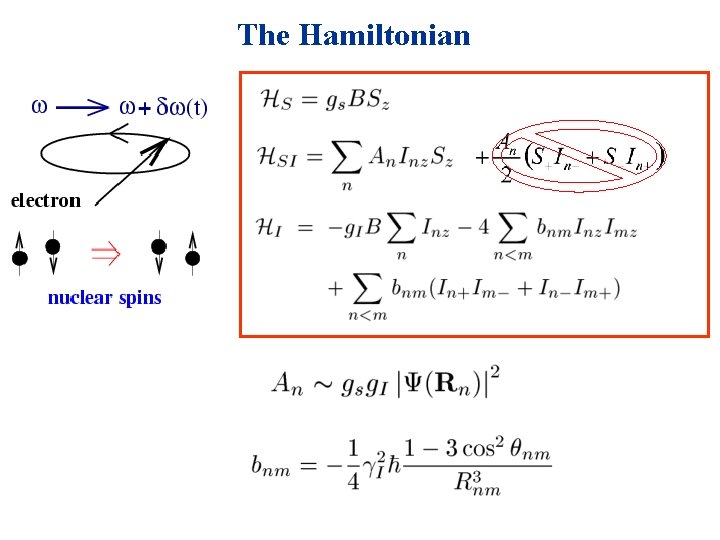
The Hamiltonian
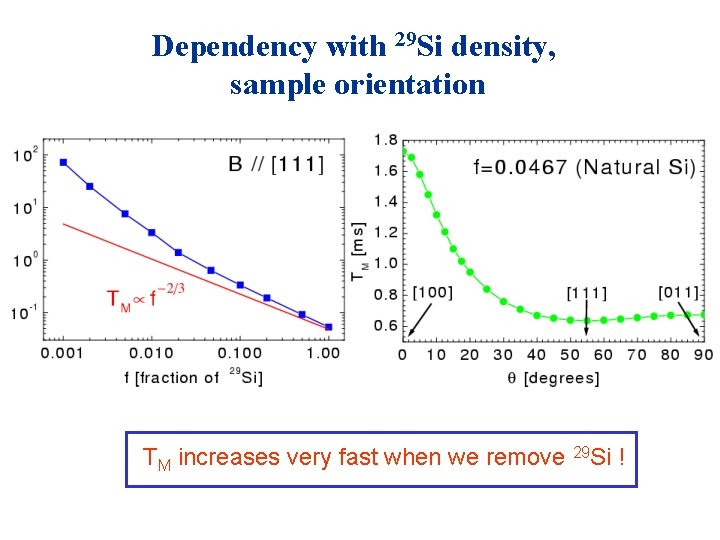
Dependency with 29 Si density, sample orientation TM increases very fast when we remove 29 Si !
Spin-1/2 theory of nuclear spectral diffusion: Comparison with experiment
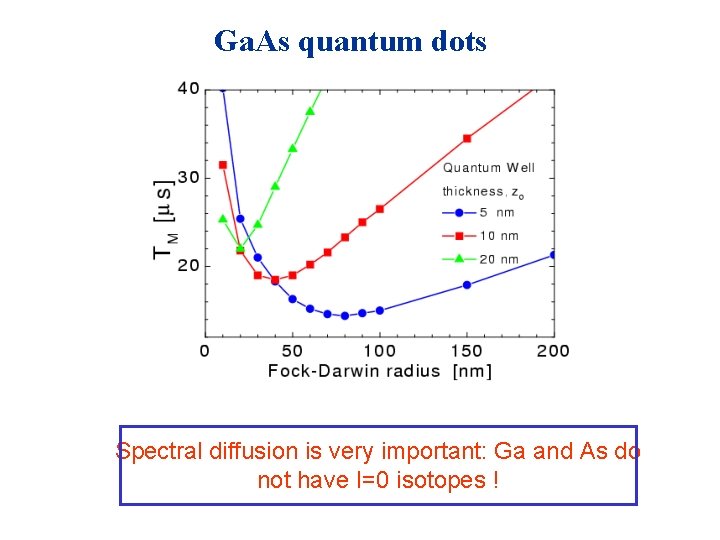
Ga. As quantum dots Spectral diffusion is very important: Ga and As do not have I=0 isotopes !
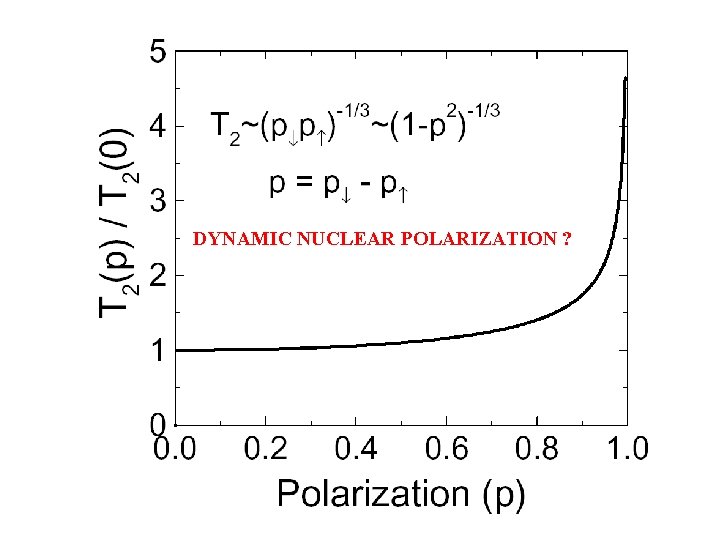
DYNAMIC NUCLEAR POLARIZATION ?
Quantum theory of spectral diffusion: Cluster expansion results [W. M. Witzel, R. de Sousa, S. Das Sarma, cond-mat/0501503]
Conclusions • Electrical control of single spin dynamics is promising for III-V quantum dots because of spinorbit coupling; • The spin of localized states interact weakly with the phonons at low T: Nuclear induced spectral diffusion if the dominant decoherence mechanism; • Isotopically purified Si: P donor spins can be coherent for ~1000 s (B = 0. 3 Tesla); 60 ms already measured ! (S. A. Lyon, 2003) • Ga. As quantum dots (or donors) coherent for only 1 – 100 s, but TM / J > 106 !
Making a quantum computer What is the right analogy? Aviation? Manhattan project? Controlled fusion? Integrated circuits (“chips”)? Toy paper airplane to 747 jumbo aircrafts 10 -15 YEARS FOR <100 QUBITS RESEARCH QC PERHAPS 50 YEARS FOR A ‘COMMERCIAL’ QC BASED ON LINEAR EXTRAPOLATION
Solid state spin quantum computation in semiconductors CMTC/UMD Spin Quantum Computation Group • • Sankar Das Sarma Vito Scarola Kwon Park SDS, Michael Freedman, Chetan Nayak cond-mat/0412343 (PRL 2005) Belita Koiller Xuedong Hu Rogerio De Sousa, Wayne Witzel Juan Delgado, Magdalena Constantin Supported by NSA, LPS, ARO, ARDA, UMD
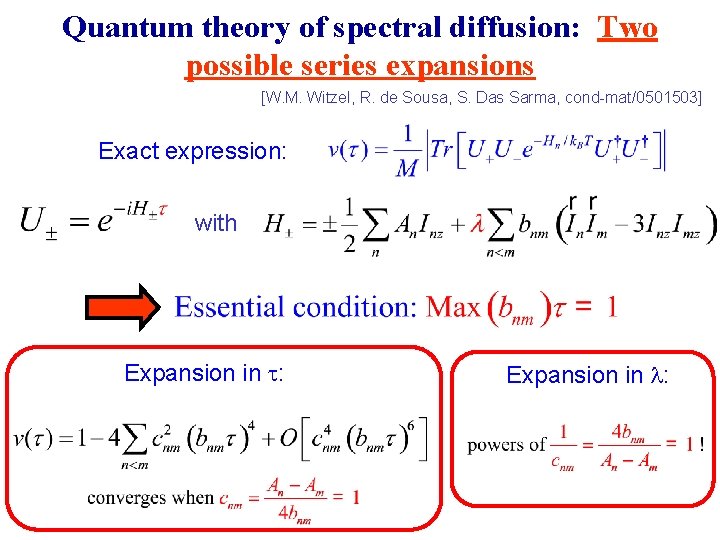
Quantum theory of spectral diffusion: Two possible series expansions [W. M. Witzel, R. de Sousa, S. Das Sarma, cond-mat/0501503] Exact expression: with Expansion in : Expansion in l:
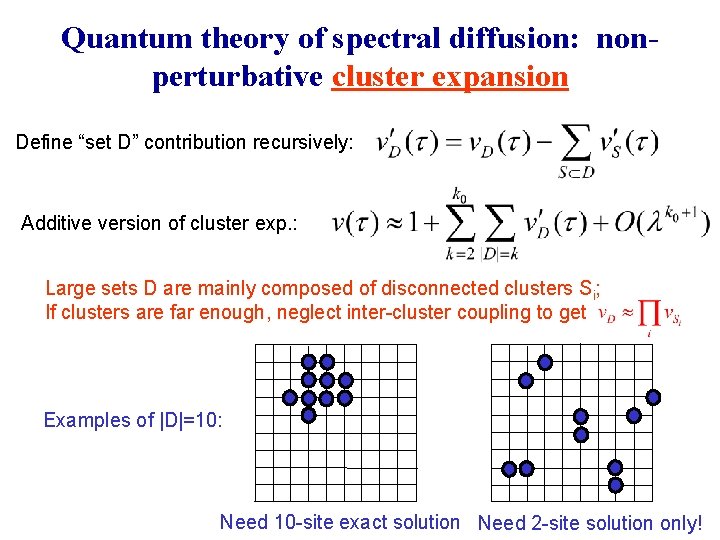
Quantum theory of spectral diffusion: nonperturbative cluster expansion Define “set D” contribution recursively: Additive version of cluster exp. : Large sets D are mainly composed of disconnected clusters Si; If clusters are far enough, neglect inter-cluster coupling to get Examples of |D|=10: Need 10 -site exact solution Need 2 -site solution only!
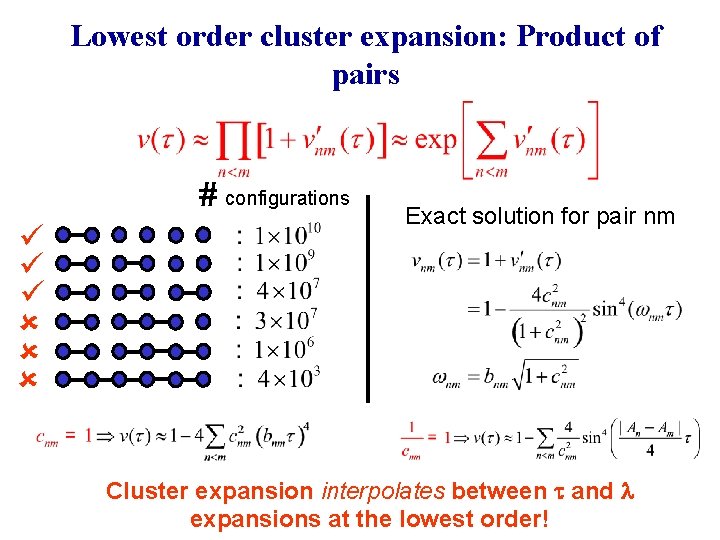
Lowest order cluster expansion: Product of pairs configurations Exact solution for pair nm Cluster expansion interpolates between t and l expansions at the lowest order!
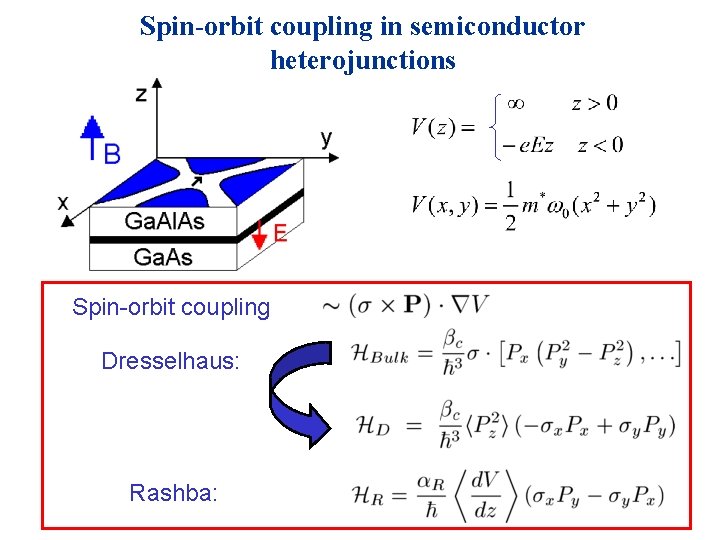
Spin-orbit coupling in semiconductor heterojunctions Spin-orbit coupling Dresselhaus: Rashba:
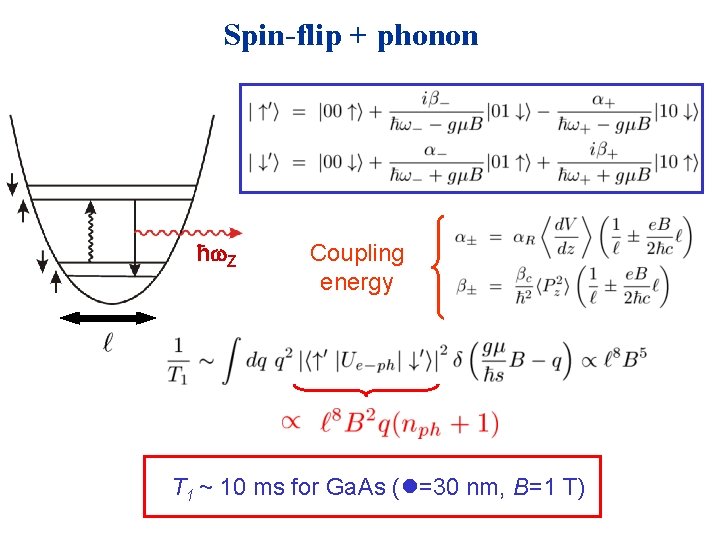
Spin-flip + phonon ħ Z Coupling energy T 1 ~ 10 ms for Ga. As ( =30 nm, B=1 T)
Spin relaxation in III-V quantum dots
Electrical control of g-factor Electron penetration into Al. Ga. As barrier D. D. Awschalom, Nature 2001 E. Yablonovitch, PRB 2001 But even without barrier penetration: Dresselhaus! Rashba! for E~105 Volt/cm !
Electrical manipulation of g-factor in Ga. As E=104 V/cm 105 V/cm Dresselhaus dominated!
Electrical manipulation of g-factor in In. As Rashba dominated! E=104 V/cm
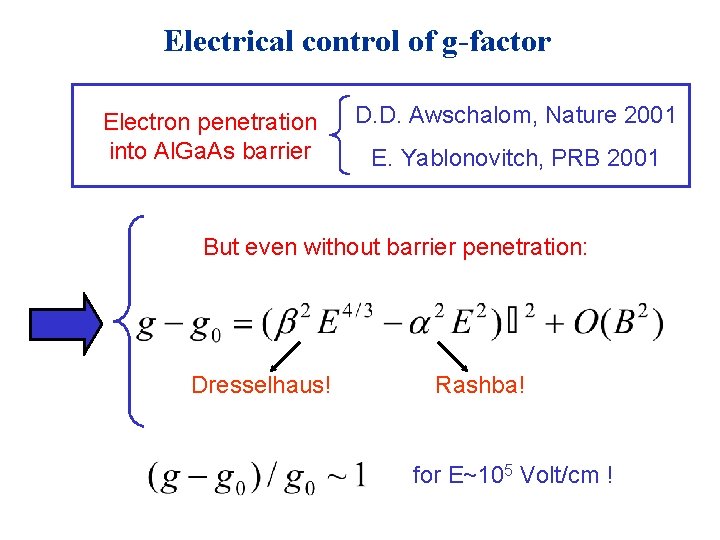
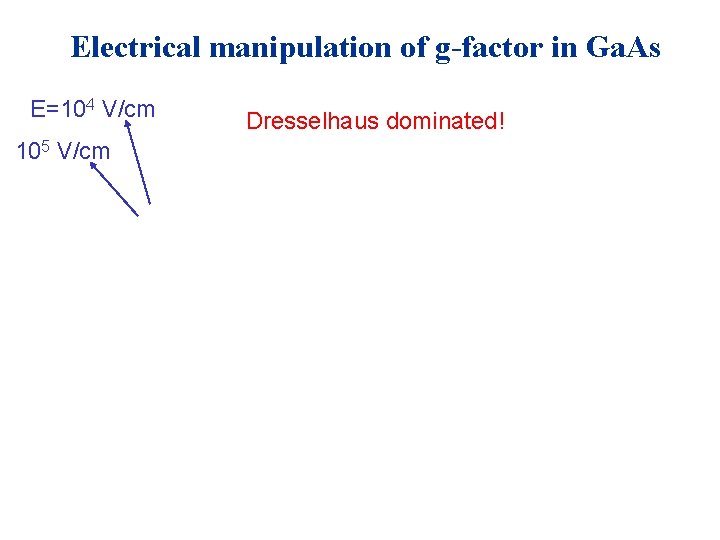
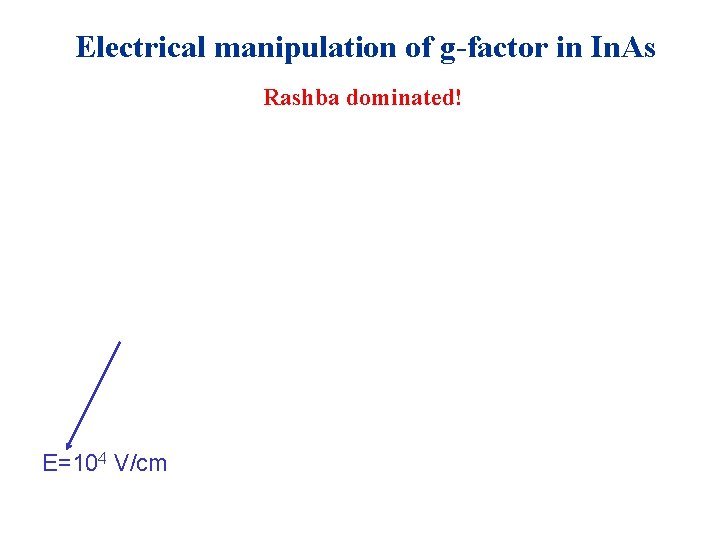
g-factor control T 1 control !!
- Slides: 62