
Ubi Com Book Slides Chapter 1 Ubiquitous Computing
Ubi. Com Book Slides Chapter 1 Ubiquitous Computing: Basics and Vision Name: Email/Web: Ubiquitous computing: smart devices, environments and interaction 1

Overview • Living in a Digital World • Modelling the Key Ubiquitous Computing Properties • Ubiquitous System Environment Interaction • Architectural Design for Ubi. Com Systems: Smart DEI Model • Course Outline Ubiquitous computing: smart devices, environments and interaction 2
Ubiquitous Computing (Ubi. Com) • A vision for computing to: – Enable computer-based services to be made available everywhere (Ubiquitous) – Support intuitive human usage – But yet, appear to be invisible to the user. – Also referred to as pervasive computing etc Ubiquitous computing: smart devices, environments and interaction 3
Living in an Increasingly Digital, Interconnected World • What are the current technology trends in Ubi. Com? Ubiquitous computing: smart devices, environments and interaction 4
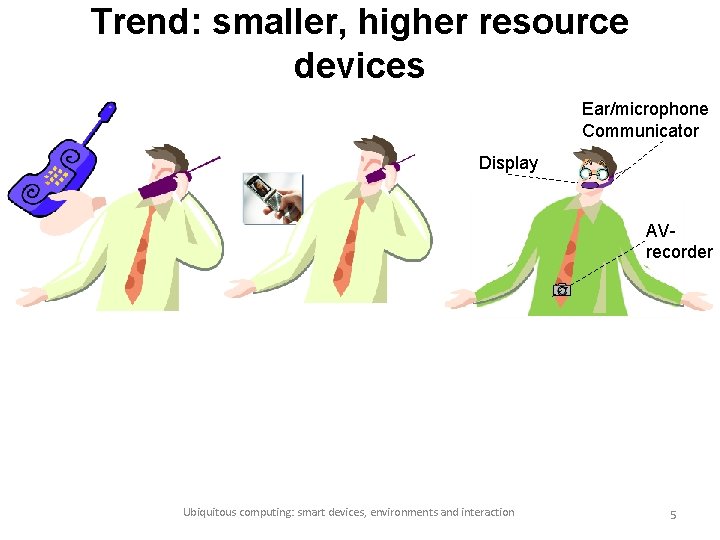
Trend: smaller, higher resource devices Ear/microphone Communicator Display AVrecorder Ubiquitous computing: smart devices, environments and interaction 5

Trend: Weiser’s 3 waves of computing Ubiquitous computing: smart devices, environments and interaction 6

Living in an Increasingly Digital, Interconnected World • What will the future be like? Ubiquitous computing: smart devices, environments and interaction 7
Scenarios • • 4 scenarios illustrate a range of benefits and challenges of ubiquitous computing: Personal memories 21 st Century Scheduled Transport Service Foodstuff management Utility regulation N. B. many other scenarios & applications given later • e. g. , Chapter 2 describes some key projects and gives an overview of applications. Ubiquitous computing: smart devices, environments and interaction 8
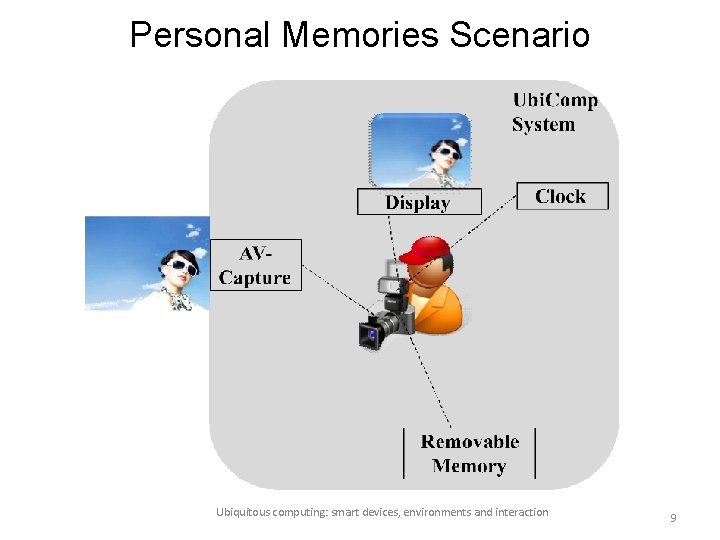
Personal Memories Scenario Ubiquitous computing: smart devices, environments and interaction 9
Personal Memories Scenario • How can we enhance the personal memories service using Ubi. Com? Ubiquitous computing: smart devices, environments and interaction 10
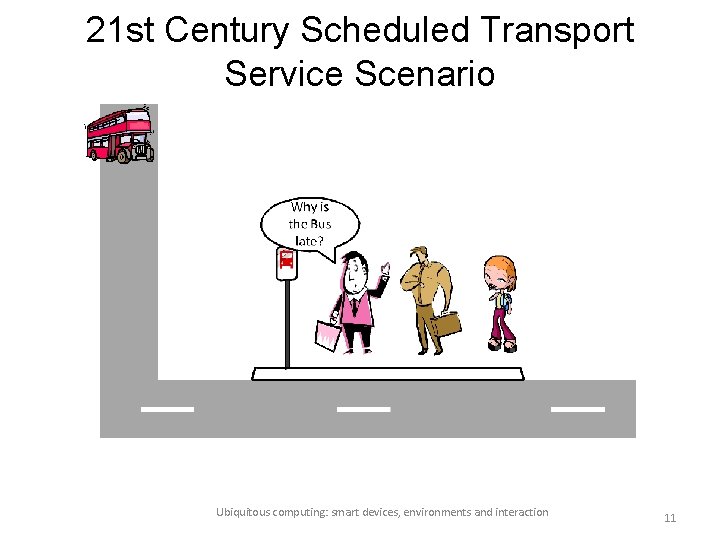
21 st Century Scheduled Transport Service Scenario Ubiquitous computing: smart devices, environments and interaction 11
21 st Century Scheduled Transport Service How can we enhance the transport service using Ubi. Com? Ubiquitous computing: smart devices, environments and interaction 12
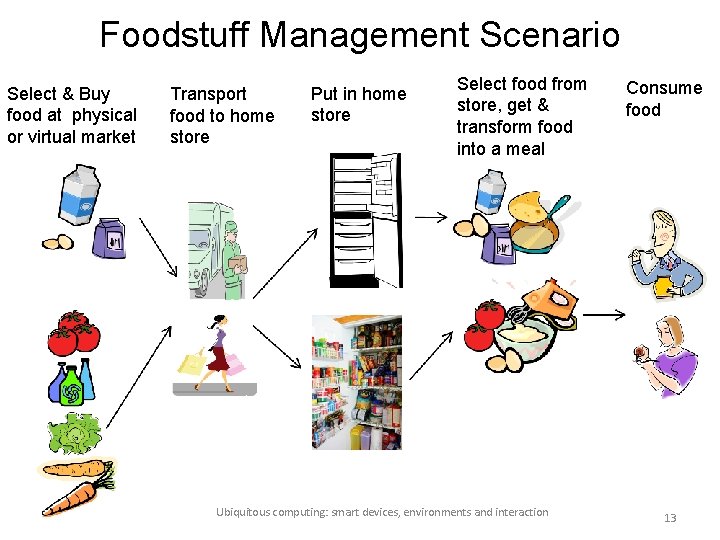
Foodstuff Management Scenario Select & Buy food at physical or virtual market Transport food to home store Put in home store Select food from store, get & transform food into a meal Ubiquitous computing: smart devices, environments and interaction Consume food 13
Foodstuff Management Scenario How can Ubi. Com enhance the foodstuff management scenario? Ubiquitous computing: smart devices, environments and interaction 14

Utility Regulation Scenario Ubiquitous computing: smart devices, environments and interaction
Utility Regulation Scenario • Utility regulation concerns energy, water, waste regulation by end-users. How can Ubi. Com enhance the Utility Regulation scenario? Ubiquitous computing: smart devices, environments and interaction 16
Ubi. Com System Design For these scenarios • Which system designs should be used for: – comms. , data storage, processing, sensing, control etc • How to model system - physical world interaction? • How to model human computer system interaction? • These are covered later in this course. Ubiquitous computing: smart devices, environments and interaction 17
Overview • Living in a Digital World • Modelling the Key Ubiquitous Computing Properties • Ubiquitous System Environment Interaction • Architectural Design for Ubi. Com Systems: Smart DEI Model • Course Outline Ubiquitous computing: smart devices, environments and interaction 18
Ubi. Com: Different Combinations of Core Properties versus a Single Definition • No single, absolute definition for ubiquitous computing. • Instead propose many different kinds of Ubi. Com based upon combining different sets of core properties • What core system properties would you propose to define ubiquitous computing? . Ubiquitous computing: smart devices, environments and interaction 19
Ubi. Com: Weiser’s 3 Internal System Properties 3 main properties for Ubi. Com Systems were proposed by Weiser (1991) 1. Computers need to be networked, distributed and transparently accessible – In 1991, little wireless computing, Internet far less pervasive 2. Computer Interaction with Humans needs to be more hidden – Because much HCI is overly intrusive 3. Computers need to be aware of environment context – In order to optimise their operation in their physical & human environment. Ubiquitous computing: smart devices, environments and interaction 20
Devices: Extended set of Internal System Properties To which two additional properties are added: 4. Computers can operate autonomously, without human intervention, be self-governed 5. Computers can handle a multiplicity of dynamic actions and interactions, governed by intelligent decision-making and intelligent organisational interaction. This entails some form of artificial intelligence. Ubiquitous computing: smart devices, environments and interaction 21
Ubi. Com: Different Combinations of Core Properties versus a Single Definition • No single, absolute definition for ubiquitous computing. • Instead propose many different kinds of Ubi. Com based upon combining different sets of core properties Here are some examples proposed by others • Weiser (1991): distributed, i. HCI, physical environment context aware • Ambient Intelligence (Am. I), similar to Ubi. Com - intelligence everywhere? • Arts and Marzano (2003) define 5 key features for Am. I to be embedded, contextaware, personalised, adaptive and anticipatory. • Buxton (1995): ubiquity and transparency • Endres et al. (2005): distributed mobile, intelligence, augmented reality • Millner (2006): autonomy, IHCI • Etc. Exercise: Do your own survey of Ubi. Com definitions and highlight the properties they define. . Ubiquitous computing: smart devices, environments and interaction 22
Five main properties for Ubi. Com Ubiquitous computing: smart devices, environments and interaction 23
Ubi. Com System Properties: Distributed • Networked ICT Devices • Transparency • Openness Ubiquitous computing: smart devices, environments and interaction 24
Distributed System: sub-properties • • Often designed middleware, set of generic services Universal, Seamless, Heterogeneous Networked Synchronised, Coordinated Open Transparent, Virtual Mobile, Nomadic (See Chapters 3 and 4) Ubiquitous computing: smart devices, environments and interaction 25
Internal System Properties: i. HCI • Concept of calm / disappearing computer has several dimensions • Implicit (i. HCI) versus Explicit HCI • Embodied Virtuality as opposite of VR (people in virtual world) Ubiquitous computing: smart devices, environments and interaction 26
Devices: Extended set of Internal System Properties Ubiquitous computing: smart devices, environments and interaction 27
i. HCI: Sub-Properties • • • Implicit Human Device Interaction (i. HCI) Non-intrusive, Hidden, Invisible, Calm, computing Tangible, Natural Anticipatory, Speculative, Proactive Affective, Emotive User-aware Post. Human Sense of Presence Immersed, Virtual , Mediated reality (See chapter 5) Ubiquitous computing: smart devices, environments and interaction 28
Internal System Properties: contextaware • Often Context-based ubiquity rather than global ubiquity – Why? 3 Main Types of Context • Physical Environment Context • Human Context (or User context or person context) • ICT Context or Virtual Environment Context: Ubiquitous computing: smart devices, environments and interaction 29
Context-aware: sub-properties • Also referred to as Sentient, Unique, Localised, Situated • Presupposes sensing of environment to be aware of its context • Adaptive: active versus passive context-aware Types of environment aware • Person-aware, User-aware, Personalised, Tailored, • Environment-aware, Context-aware, Physical contextaware • ICT infrastructure aware • (See Chapter 7) Ubiquitous computing: smart devices, environments and interaction 30
Internal System Properties: Autonomy • Challenge 1: increasing computer systems can overload humans – humans become a bottleneck • What can be done? Ubiquitous computing: smart devices, environments and interaction 31
Internal System Properties: Autonomy • Challenge 2: automated system can be become to complex to maintain - must reduce maintenance of complex systems • What can be done? Ubiquitous computing: smart devices, environments and interaction 32
Autonomy: Sub-Properties • • Automatic Embedded, Encapsulated Embodied Resource-constrained Untethered, Amorphous Autonomic, Self-managing, self-star properties Emergent, self-organising (See Chapter 10) Ubiquitous computing: smart devices, environments and interaction 33
Internal System Properties: Intelligence Intelligent Ubi. Com systems (IS) can: • Act more proactively, dynamically & humanely through: • Model how their environment changes when deciding how it acts. • Goal-based / planning • Reasoning for re-planning • Handle uncertainty. • semantic based interaction • etc Ubiquitous computing: smart devices, environments and interaction 34
Individual Intelligence: Sub-Properties • Referred to as Intelligent Systems, AI, agent-based system etc. Sub-Properties (sub-types of individual intelligence) • Reactive, Reflex • Model-based, • Rule/Policy-based • Logic/Reasoning • Goal-oriented, Planned, Proactive • Utility-based, Game theoretic • Learning, Adaptive (See Chapter 8) Ubiquitous computing: smart devices, environments and interaction 35
Multiple Intelligence: Sub-Properties • Referred to as Distributed AI, Multi-Agent Systems, Collective or Social Intelligence Sub-Properties • Cooperative , Collaborative, Benevolent • Competitive, self-interested, antagonistic, adversarial • Orchestrated, Choreographed, Mediated • Task-sharing • Communal, shared meaning • Shared knowledge • Speech-act based , Intentional, Mentalistic • (See Chapter 9) Ubiquitous computing: smart devices, environments and interaction 36
Overview • Living in a Digital World • Modelling the Key Ubiquitous Computing Properties • Ubiquitous System Environment Interaction • Architectural Design for Ubi. Com Systems: Smart DEI Model • Course Outline Ubiquitous computing: smart devices, environments and interaction 37
Ubi. Com System versus ICT System focus • Conventional focus on ICT systems • Systems situated in a virtual world, in an environment of other ICT systems -> a system of ICT systems • Conventional use a restrict view of physical environment interaction: • Conventional ICT systems often require humans in the loop • Ubi. Com represents a powerful shift in computation: Ubiquitous computing: smart devices, environments and interaction 38
Different Degrees of HCI Ubiquitous computing: smart devices, environments and interaction 39
Different Degrees of HCI • From less to more C Interaction with H • H 2 H: human interaction • H 2 C or explicit (e)HCI: • C 2 H or implicit (i)HCI: • C 2 C: Ubiquitous computing: smart devices, environments and interaction 40
Different Degrees of CPI Ubiquitous computing: smart devices, environments and interaction 41
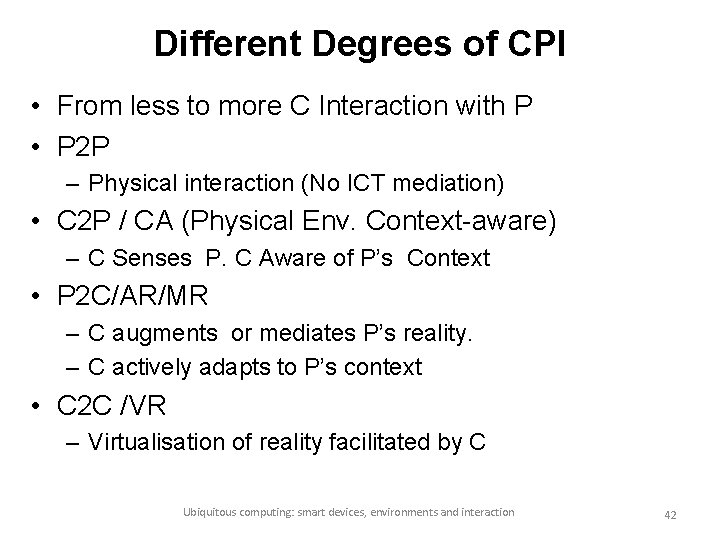
Different Degrees of CPI • From less to more C Interaction with P • P 2 P – Physical interaction (No ICT mediation) • C 2 P / CA (Physical Env. Context-aware) – C Senses P. C Aware of P’s Context • P 2 C/AR/MR – C augments or mediates P’s reality. – C actively adapts to P’s context • C 2 C /VR – Virtualisation of reality facilitated by C Ubiquitous computing: smart devices, environments and interaction 42
Overview • Living in a Digital World • Modelling the Key Ubiquitous Computing Properties • Ubiquitous System Environment Interaction • Architectural Design for Ubi. Com Systems: • Course Outline Ubiquitous computing: smart devices, environments and interaction 43
Ubi. Com System Model: Smart DEI • No single type of Ubi. Com system • Different Ubi. Com systems support: • 3 basic architectural design patterns for Ubi. Com: – smart Devices, smart Environments, smart Interaction • ‘Smart’ means systems are: – active, digital, networked, autonomous, reconfigurable, local control of its own resources, e. g. , energy, data storage etc. Ubiquitous computing: smart devices, environments and interaction 44
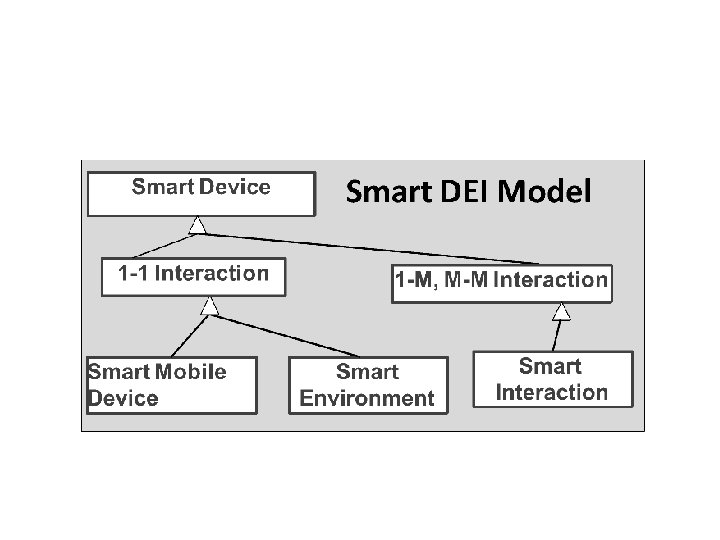
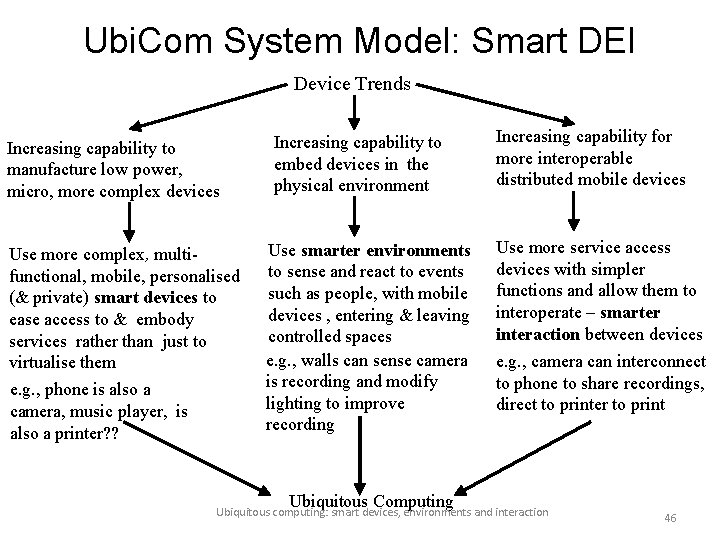
Ubi. Com System Model: Smart DEI Device Trends Increasing capability to manufacture low power, micro, more complex devices Use more complex, multifunctional, mobile, personalised (& private) smart devices to ease access to & embody services rather than just to virtualise them e. g. , phone is also a camera, music player, is also a printer? ? Increasing capability to embed devices in the physical environment Use smarter environments to sense and react to events such as people, with mobile devices , entering & leaving controlled spaces e. g. , walls can sense camera is recording and modify lighting to improve recording Ubiquitous Computing Increasing capability for more interoperable distributed mobile devices Use more service access devices with simpler functions and allow them to interoperate – smarter interaction between devices e. g. , camera can interconnect to phone to share recordings, direct to printer to print Ubiquitous computing: smart devices, environments and interaction 46
Smart DEI Model: types of smart device • 3 main types of Ubi. Com system may themselves contain smart sub-systems at a lower level of granularity – e. g. , a smart environment device may consist of smart sensors and smart controllers Ubiquitous computing: smart devices, environments and interaction 47
Ubi. Com System: Smart Sub-Systems or Components Ubiquitous computing: smart devices, environments and interaction 48
Smart Device Form Factors • Devices tend to become smaller and lighter in weight, cheaper to produce. • Devices can become prevalent, made more portable and can appear less obtrusive. Weiser proposed a range of device sizes 1. Smart Tabs 2. Smart Pads: 3. Smart Boards: Ubiquitous computing: smart devices, environments and interaction 49
Smart Device Form Factors (2) Form Factors can be extended to support 4. Smart Dust 5. Smart Skins 6. Smart Clay (See Chapters 5, 6) Ubiquitous computing: smart devices, environments and interaction 50
Design challenges in Using Varying Form Factors • What are the design Challenges? Ubiquitous computing: smart devices, environments and interaction 51
Smart Device: Variations • Many variations or sub-types of smart devices, – – – e. g. smart mobile device, smart environment device Use different combinations of sub-components Support different combinations of Ubi. Com properties Interact in different types of environment Take different form factors Ubiquitous computing: smart devices, environments and interaction 52
Smart Device Variations: Smart Mobile Device • Many flavours or variants of these basic designs • One of the most important variants of the smart device is the smart mobile device • Combines several main types of Ubi. Com property: • Note mobile devices are sometimes taken to be synonymous with wireless devices but these are different (see Chapter 11 Ubiquitous computing: smart devices, environments and interaction 53
Smart Mobile Devices • Multi-purpose ICT devices, operating as a single portal to multiple services • eases access & interoperability versus decreased openness • Usually personalised devices, specified owner. • Locus of control and user interface resides in the smart device. • Main characteristics: mobility, open service discovery, intermittent resource access. Ubiquitous computing: smart devices, environments and interaction 54
Smart Devices: Mobility • • Many dimensions for mobility Static: Accompanied: Wearable: Embedded (into objects): Implanted (into humans): Untethered or unanchored: Division between statics and mobiles can be more finely grained and multi-dimensional (see Chapter 4) Ubiquitous computing: smart devices, environments and interaction 55
Volatile Service Access • Devices access software services and hardware intermittently. Why? • Devices can dynamically discover services available. • Context-aware discovery can improve basic discovery. • Asymmetric remote service access, more downloads than uploads, tends to occur. Ubiquitous computing: smart devices, environments and interaction 56
Smart Mobile Devices: Context-Aware • Can use contexts to filter information & service access. • Often designed to work with a reference location in physical environment called a home location, • Mobile devices are ICT resource constrained. • Mobile devices tend to use a finite internal energy cache. • Devices’ configuration, operation tends to be personalised Ubiquitous computing: smart devices, environments and interaction 57
Smart Environment (Devices) • Definitions • Consists of a set of smart devices specialised to interact with their (virtual, phys. , human) environments. • Typically, embedded single task devices; not MTOS devices • Can automatically respond to or anticipate users, using i. HCI • Smart environments support bounded, local user context • Smart environment devices may also be: – fixed versus anchored mobile versus unanchored mobile devices – macro to micro to nano • Smart environment device design issues what? – See Chapter 6, 7 • Smart environment device management issues what? – See Chapter 12 Ubiquitous computing: smart devices, environments and interaction 58
Types of Smart Environment Device Interaction • • • Tagging and Annotating Sensing & monitoring Filtering Adapting Controlling – Assembling – Regulating Ubiquitous computing: smart devices, environments and interaction 59
Smart Interaction • Additional type of design is needed to knit together many individual system components and interactions. • Smart interaction promotes unified & continuous interaction model between Ubi. Com applications & their Ubi. Com infrastructure, physical world & human environments. • Internal self-organising system vs. externally driven system • Components can interact cooperatively versus competitively • Several benefits to designs based upon set of interacting components: • A range of levels of interaction between Ubi. Com System components • Distinguish between (basic) interaction and (smart) interaction Ubiquitous computing: smart devices, environments and interaction 60
Basic Interaction • Typically involves two interlinked parties, a sender and a receiver. • Sender knows things in advance: • Two main types of basic interaction synchronous versus asynchronous • (Chapter 11) Ubiquitous computing: smart devices, environments and interaction 61
Smart Interaction • • • Smart Interaction extends basic interactions as follows. Coordinated interactions Cooperative versus competitive interaction Policy and Convention based Interaction Dynamic Organisational Interaction Semantic and Linguistic Interaction (See Chapter 9) Ubiquitous computing: smart devices, environments and interaction 62
Smart DEI Model Summary • Basic Smart Device has many variations – 6 different physical form factors – 5 different groups of internal properties & over 70 subproperties • Multiple flavours of smart device, – e. g. , Smart Mobile type of Smart device – e. g. , Smart Environment type of Smart Device • Ubi. Com System interact across 3 main types of environment: physical, virtual & human • System of systems models in terms of multiple device combinations and interactions Ubiquitous computing: smart devices, environments and interaction 63
Common Myths of Ubiquitous Computing 1. There is a single definition which will accurately characterises Ubiquitous Computing 2. The ideal type of Ubiquitous computing is where all the properties of ubiquitous must be fully supported 3. Ubiquitous computing means making computing services accessible everywhere. 4. Ubiquitous computing is boundless computing 5. Ubiquitous computing is just about HCI 6. Calm Computing should be used as a model for all HCI. 7. Ubiquitous computing is just about augmenting reality Ubiquitous computing: smart devices, environments and interaction 64
Common Myths of Ubiquitous Computing 2 8. Ubiquitous computing is just distributed or virtual computing 9. Ubiquitous computing is just mobile wireless computing 10. Ubiquitous computing is just about smart environments 11. Ubiquitous computing need to be highly autonomous systems 12. Ubiquitous computing is just about physical world contextawareness 13. Ubiquitous computing is just distributed intelligence 14. Ubiquitous computing systems can operate effectively in all kinds of environments: Ubiquitous computing: smart devices, environments and interaction 65
Overview • Living in a Digital World • Modelling the Key Ubiquitous Computing Properties • Ubiquitous System Environment Interaction • Architectural Design for Ubi. Com Systems: Smart DEI Model • Course Outline Ubiquitous computing: smart devices, environments and interaction 66
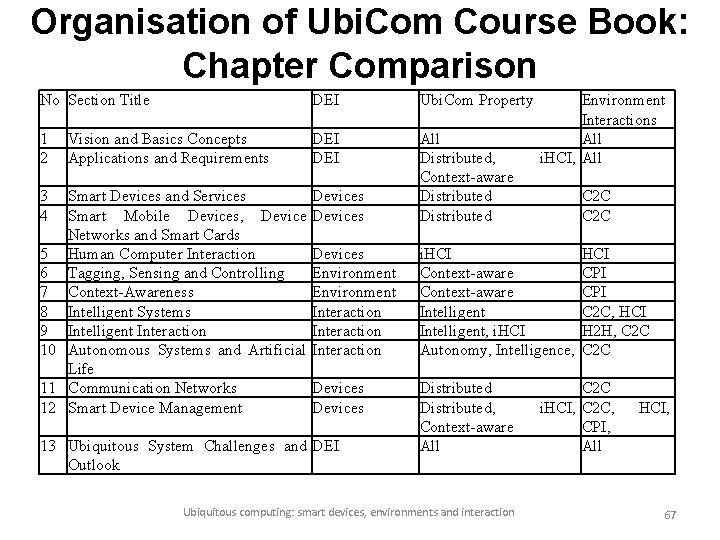
Organisation of Ubi. Com Course Book: Chapter Comparison No Section Title DEI Ubi. Com Property 1 2 DEI Devices All Distributed, Context-aware Distributed Devices Environment Interaction i. HCI Context-aware Intelligent, i. HCI Autonomy, Intelligence, Devices Distributed, Context-aware All 3 4 Vision and Basics Concepts Applications and Requirements Smart Devices and Services Smart Mobile Devices, Device Networks and Smart Cards 5 Human Computer Interaction 6 Tagging, Sensing and Controlling 7 Context-Awareness 8 Intelligent Systems 9 Intelligent Interaction 10 Autonomous Systems and Artificial Life 11 Communication Networks 12 Smart Device Management 13 Ubiquitous System Challenges and DEI Outlook Ubiquitous computing: smart devices, environments and interaction Environment Interactions All i. HCI, All C 2 C HCI CPI C 2 C, HCI H 2 H, C 2 C i. HCI, C 2 C, CPI, All HCI, 67
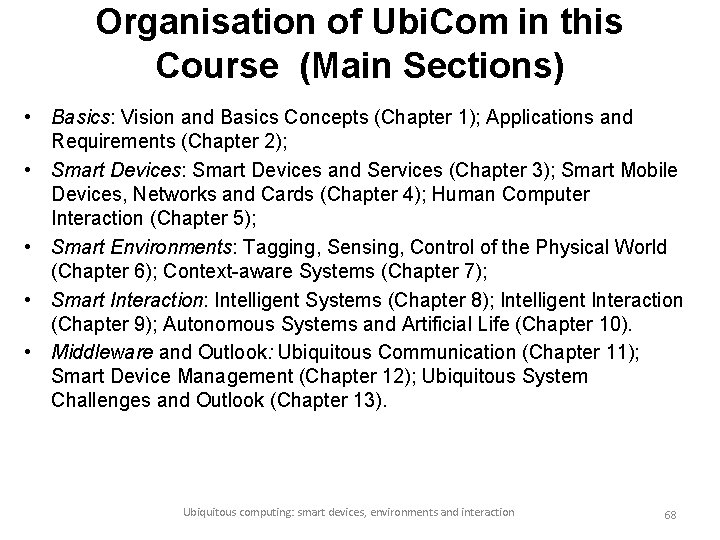
Organisation of Ubi. Com in this Course (Main Sections) • Basics: Vision and Basics Concepts (Chapter 1); Applications and Requirements (Chapter 2); • Smart Devices: Smart Devices and Services (Chapter 3); Smart Mobile Devices, Networks and Cards (Chapter 4); Human Computer Interaction (Chapter 5); • Smart Environments: Tagging, Sensing, Control of the Physical World (Chapter 6); Context-aware Systems (Chapter 7); • Smart Interaction: Intelligent Systems (Chapter 8); Intelligent Interaction (Chapter 9); Autonomous Systems and Artificial Life (Chapter 10). • Middleware and Outlook: Ubiquitous Communication (Chapter 11); Smart Device Management (Chapter 12); Ubiquitous System Challenges and Outlook (Chapter 13). Ubiquitous computing: smart devices, environments and interaction 68
Overview • Living in a Digital World • Modelling the Key Ubiquitous Computing Properties • Ubiquitous System Environment Interaction • Architectural Design for Ubi. Com Systems: Smart DEI Model • Course Outline Ubiquitous computing: smart devices, environments and interaction 69
Summary & Revision For each chapter • See book web-site for chapter summaries, references, resources etc. • Identify new terms & concepts • Apply new terms and concepts: define, use in old and new situations & problems • Debate problems, challenges and solutions • See Chapter exercises on web-site Ubiquitous computing: smart devices, environments and interaction 70
Exercises: Define New Concepts • Ubiquitous Computing, etc Ubiquitous computing: smart devices, environments and interaction 71
Exercise: Applying New Concepts • What are the main properties of Ubi. Com? • etc Ubiquitous computing: smart devices, environments and interaction 72
- Slides: 72