Secure Coding in C and C Integer Security


- Slides: 105
Secure Coding in C and C++ Integer Security Lecture 7 Acknowledgement: These slides are based on author Seacord’s original presentation
Integer Security l l Integers represent a growing and underestimated source of vulnerabilities in C and C++ programs. Integer range checking has not been systematically applied in the development of most C and C++ software. security flaws involving integers exist l a portion of these are likely to be vulnerabilities l l A software vulnerability may result when a program evaluates an integer to an unexpected value.
Integer Representation l l Signed-magnitude One’s complement Two’s complement These integer representations vary in how they represent negative numbers
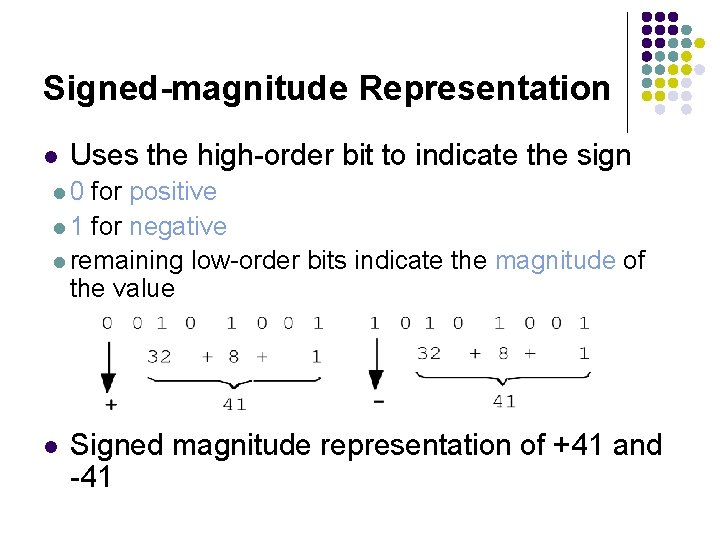
Signed-magnitude Representation l Uses the high-order bit to indicate the sign l 0 for positive l 1 for negative l remaining low-order bits indicate the magnitude of the value l Signed magnitude representation of +41 and -41
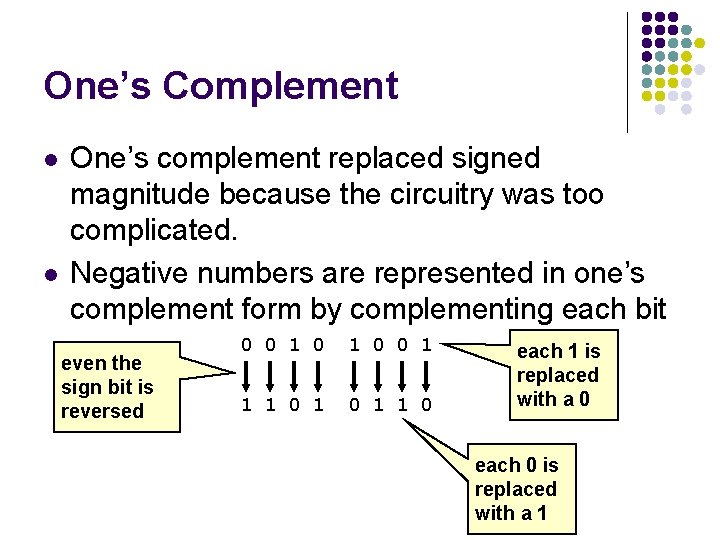
One’s Complement l l One’s complement replaced signed magnitude because the circuitry was too complicated. Negative numbers are represented in one’s complement form by complementing each bit even the sign bit is reversed 0 0 1 1 1 0 each 1 is replaced with a 0 each 0 is replaced with a 1
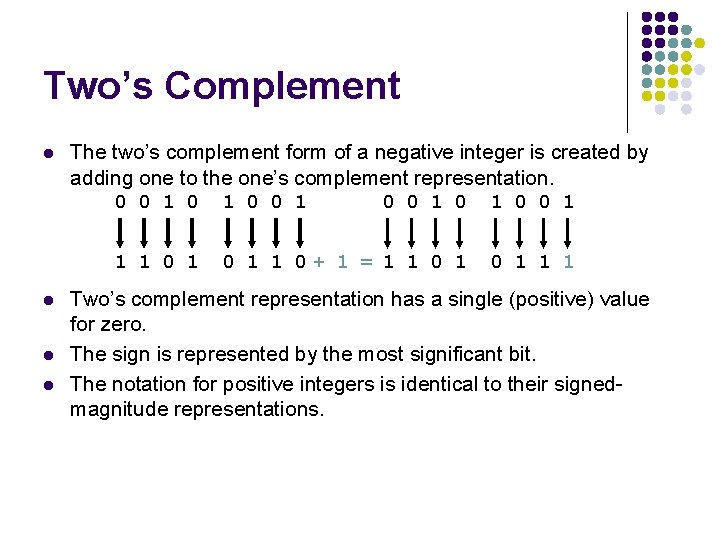
Two’s Complement l The two’s complement form of a negative integer is created by adding one to the one’s complement representation. 0 0 1 0 1 0 0 1 1 1 0 + 1 = 1 1 0 1 1 1 l l l Two’s complement representation has a single (positive) value for zero. The sign is represented by the most significant bit. The notation for positive integers is identical to their signedmagnitude representations.
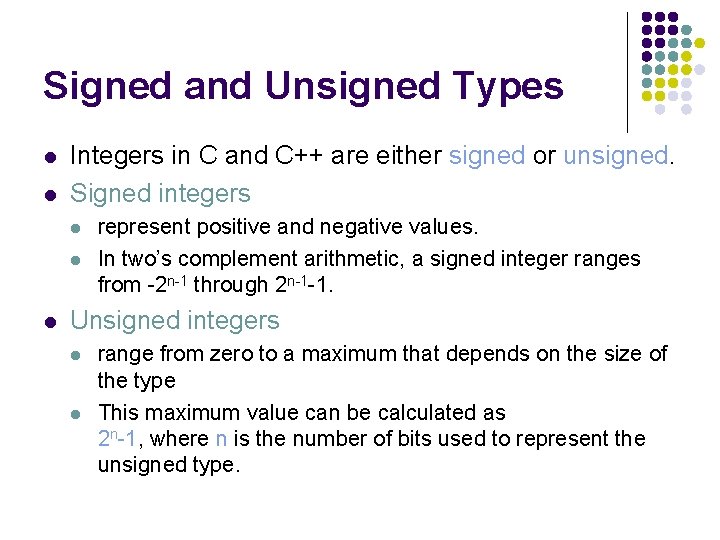
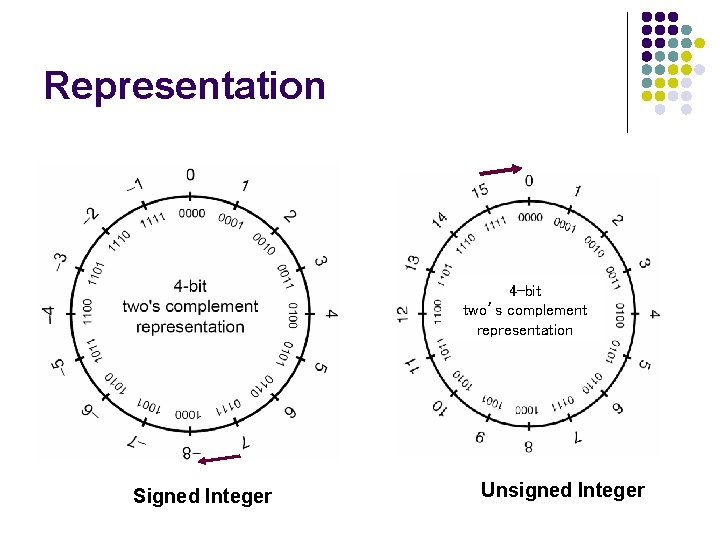
Signed and Unsigned Types l l Integers in C and C++ are either signed or unsigned. Signed integers l l l represent positive and negative values. In two’s complement arithmetic, a signed integer ranges from -2 n-1 through 2 n-1 -1. Unsigned integers l l range from zero to a maximum that depends on the size of the type This maximum value can be calculated as 2 n-1, where n is the number of bits used to represent the unsigned type.
Representation 4 -bit two’s complement representation Signed Integer Unsigned Integer
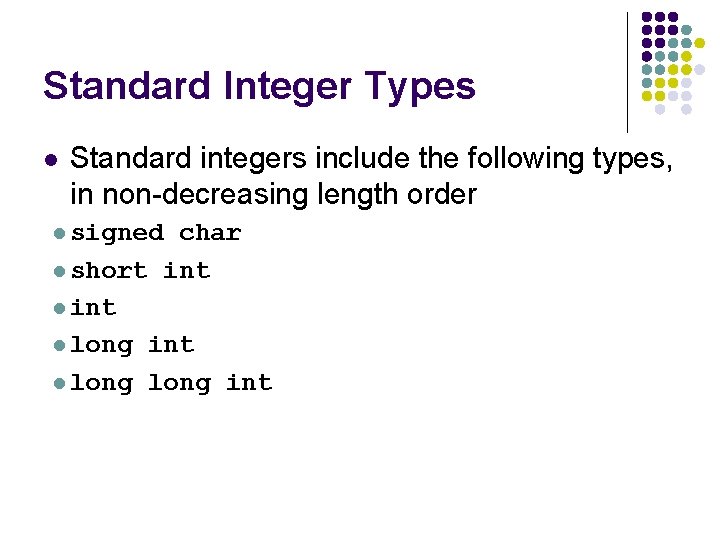
Standard Integer Types l Standard integers include the following types, in non-decreasing length order l signed char l short int l long int
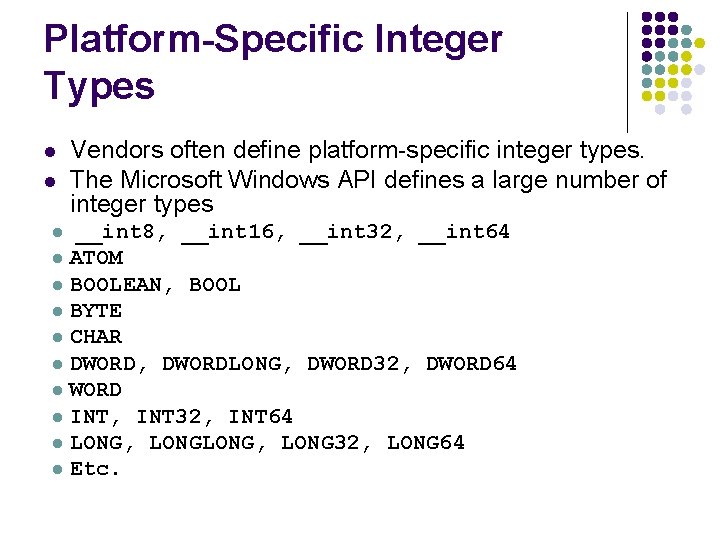
Platform-Specific Integer Types l l Vendors often define platform-specific integer types. The Microsoft Windows API defines a large number of integer types __int 8, __int 16, __int 32, __int 64 l ATOM l BOOLEAN, BOOL l BYTE l CHAR l DWORD, DWORDLONG, DWORD 32, DWORD 64 l WORD l INT, INT 32, INT 64 l LONG, LONG 32, LONG 64 l Etc. l
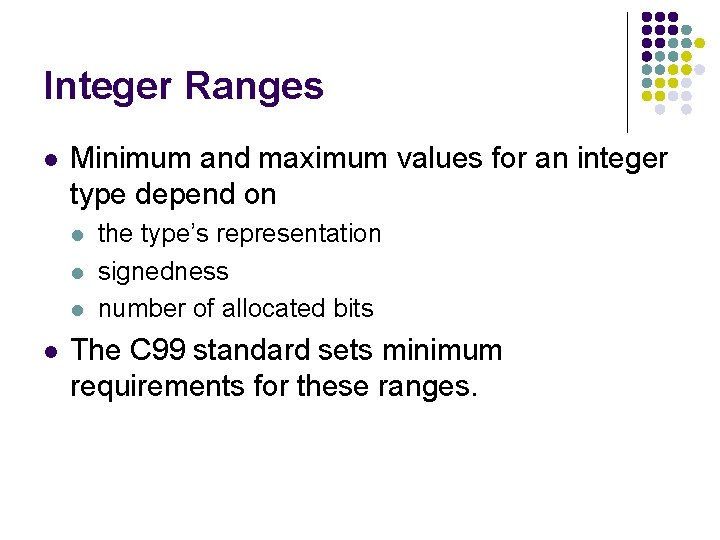
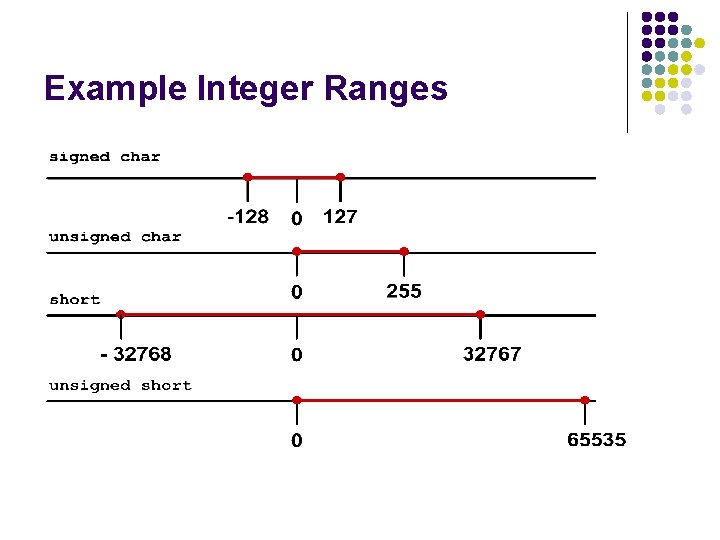
Integer Ranges l Minimum and maximum values for an integer type depend on l l the type’s representation signedness number of allocated bits The C 99 standard sets minimum requirements for these ranges.
Example Integer Ranges
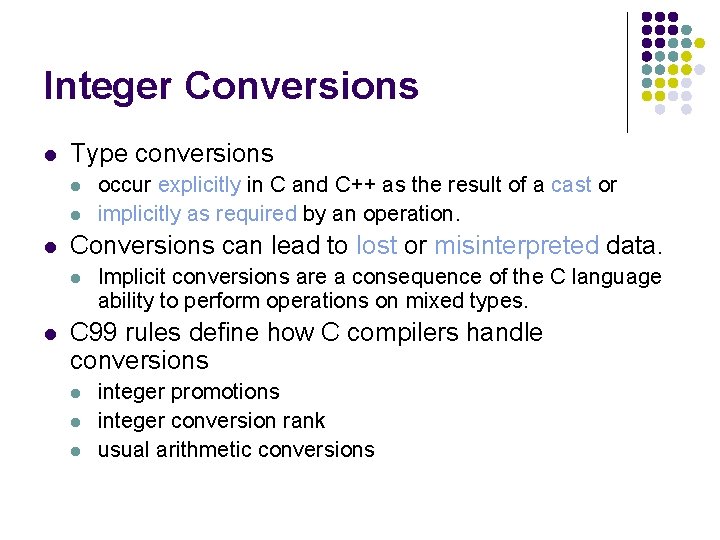
Integer Conversions l Type conversions l l l Conversions can lead to lost or misinterpreted data. l l occur explicitly in C and C++ as the result of a cast or implicitly as required by an operation. Implicit conversions are a consequence of the C language ability to perform operations on mixed types. C 99 rules define how C compilers handle conversions l l l integer promotions integer conversion rank usual arithmetic conversions
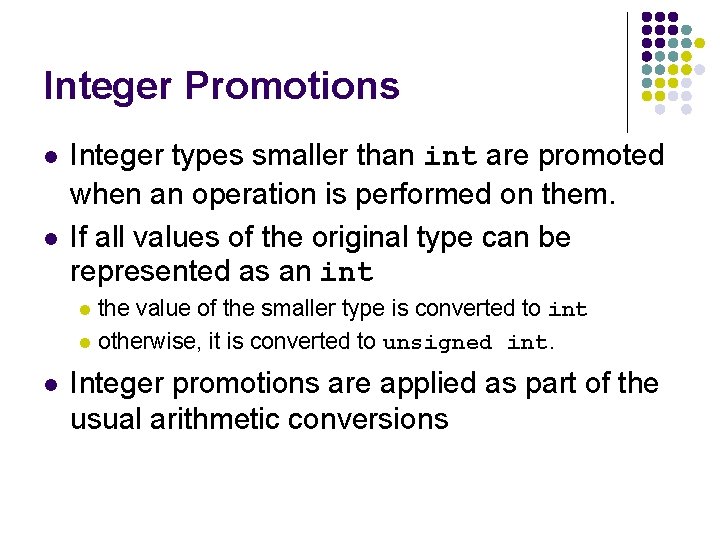
Integer Promotions l l Integer types smaller than int are promoted when an operation is performed on them. If all values of the original type can be represented as an int the value of the smaller type is converted to int l otherwise, it is converted to unsigned int. l l Integer promotions are applied as part of the usual arithmetic conversions
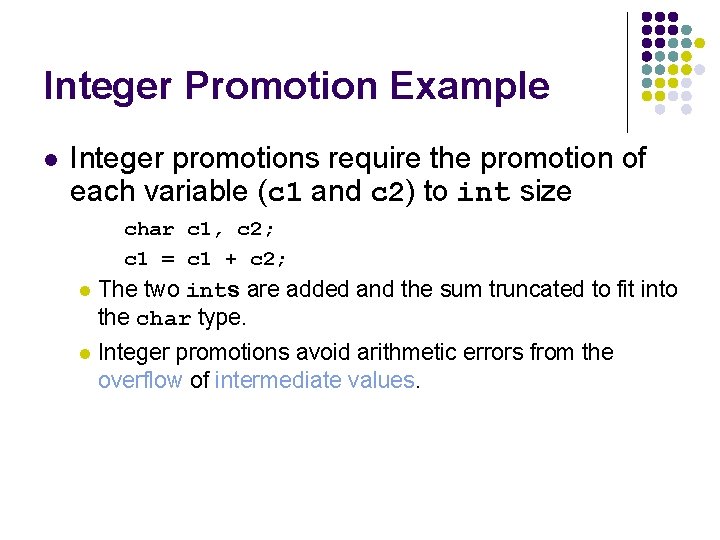
Integer Promotion Example l Integer promotions require the promotion of each variable (c 1 and c 2) to int size char c 1, c 2; c 1 = c 1 + c 2; l The two ints are added and the sum truncated to fit into the char type. l Integer promotions avoid arithmetic errors from the overflow of intermediate values.
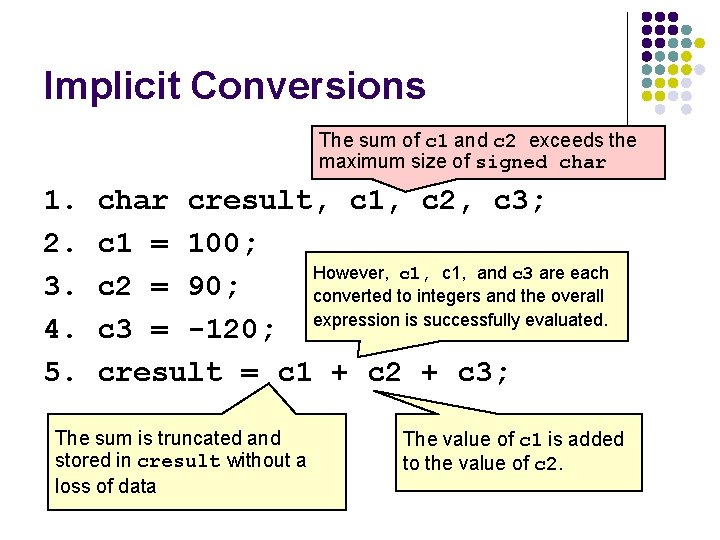
Implicit Conversions The sum of c 1 and c 2 exceeds the maximum size of signed char 1. char cresult, c 1, c 2, c 3; 2. c 1 = 100; However, c 1, and c 3 are each 3. c 2 = 90; converted to integers and the overall 4. c 3 = -120; expression is successfully evaluated. 5. cresult = c 1 + c 2 + c 3; The sum is truncated and stored in cresult without a loss of data The value of c 1 is added to the value of c 2.
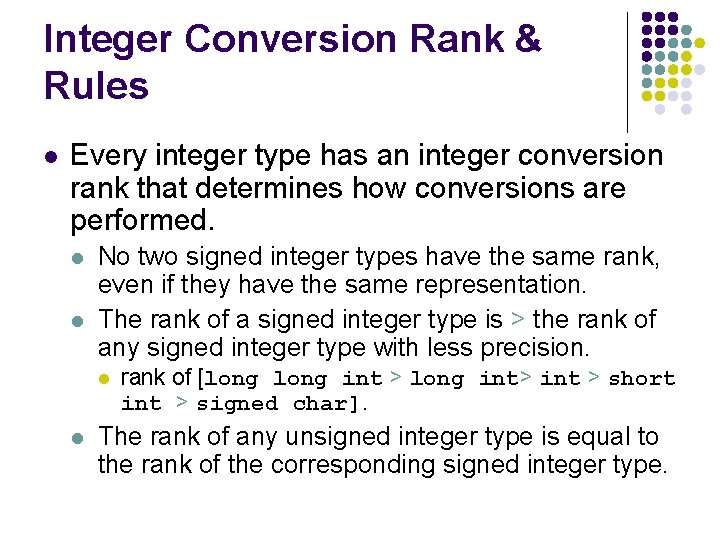
Integer Conversion Rank & Rules l Every integer type has an integer conversion rank that determines how conversions are performed. l l No two signed integer types have the same rank, even if they have the same representation. The rank of a signed integer type is > the rank of any signed integer type with less precision. l l rank of [long int > long int> int > short int > signed char]. The rank of any unsigned integer type is equal to the rank of the corresponding signed integer type.
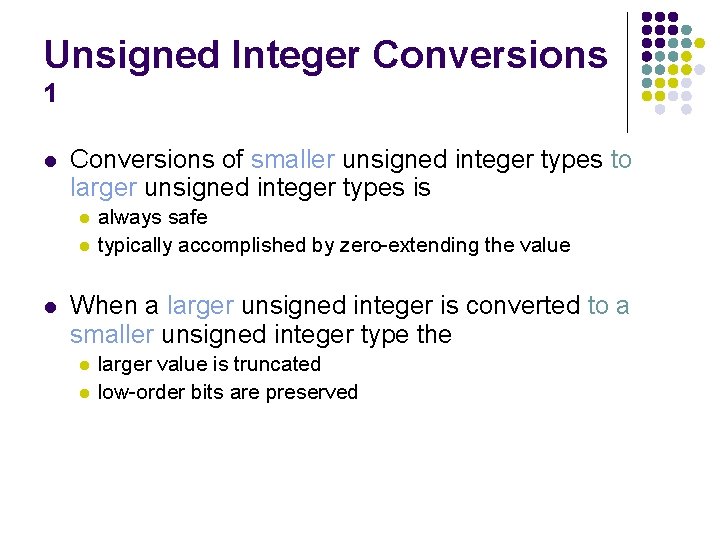
Unsigned Integer Conversions 1 l Conversions of smaller unsigned integer types to larger unsigned integer types is l l l always safe typically accomplished by zero-extending the value When a larger unsigned integer is converted to a smaller unsigned integer type the l l larger value is truncated low-order bits are preserved
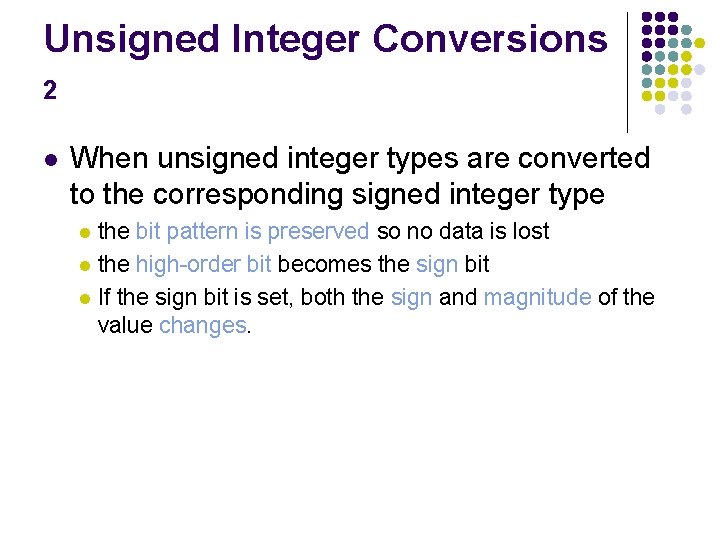
Unsigned Integer Conversions 2 l When unsigned integer types are converted to the corresponding signed integer type the bit pattern is preserved so no data is lost l the high-order bit becomes the sign bit l If the sign bit is set, both the sign and magnitude of the value changes. l
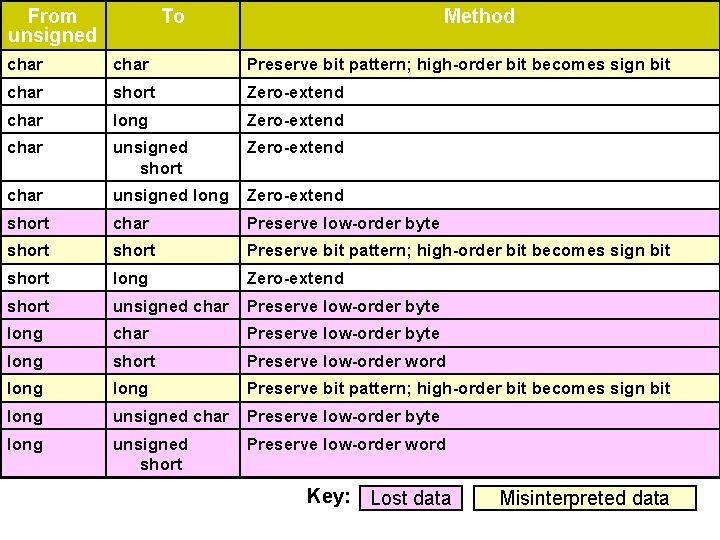
From unsigned To Method char Preserve bit pattern; high-order bit becomes sign bit char short Zero-extend char long Zero-extend char unsigned short Zero-extend char unsigned long Zero-extend short char Preserve low-order byte short Preserve bit pattern; high-order bit becomes sign bit short long Zero-extend short unsigned char Preserve low-order byte long short Preserve low-order word long Preserve bit pattern; high-order bit becomes sign bit long unsigned char Preserve low-order byte long unsigned short Preserve low-order word Key: Lost data Misinterpreted data
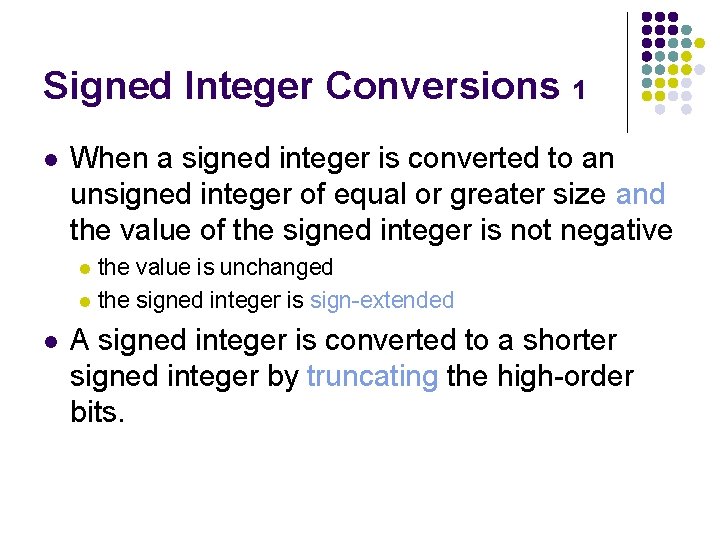
Signed Integer Conversions 1 l When a signed integer is converted to an unsigned integer of equal or greater size and the value of the signed integer is not negative the value is unchanged l the signed integer is sign-extended l l A signed integer is converted to a shorter signed integer by truncating the high-order bits.
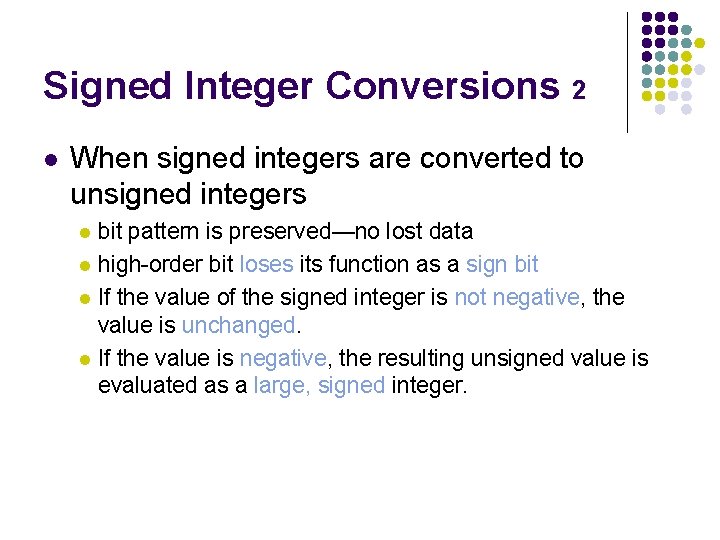
Signed Integer Conversions 2 l When signed integers are converted to unsigned integers bit pattern is preserved—no lost data l high-order bit loses its function as a sign bit l If the value of the signed integer is not negative, the value is unchanged. l If the value is negative, the resulting unsigned value is evaluated as a large, signed integer. l
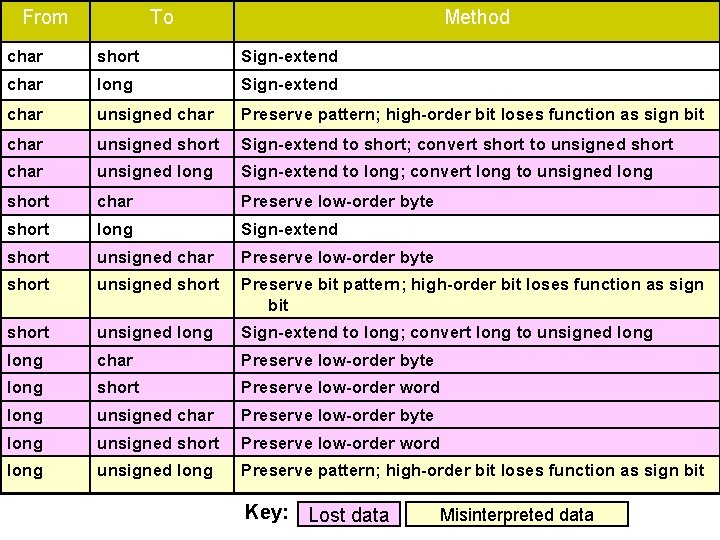
From To Method char short Sign-extend char long Sign-extend char unsigned char Preserve pattern; high-order bit loses function as sign bit char unsigned short Sign-extend to short; convert short to unsigned short char unsigned long Sign-extend to long; convert long to unsigned long short char Preserve low-order byte short long Sign-extend short unsigned char Preserve low-order byte short unsigned short Preserve bit pattern; high-order bit loses function as sign bit short unsigned long Sign-extend to long; convert long to unsigned long char Preserve low-order byte long short Preserve low-order word long unsigned char Preserve low-order byte long unsigned short Preserve low-order word long unsigned long Preserve pattern; high-order bit loses function as sign bit Key: Lost data Misinterpreted data
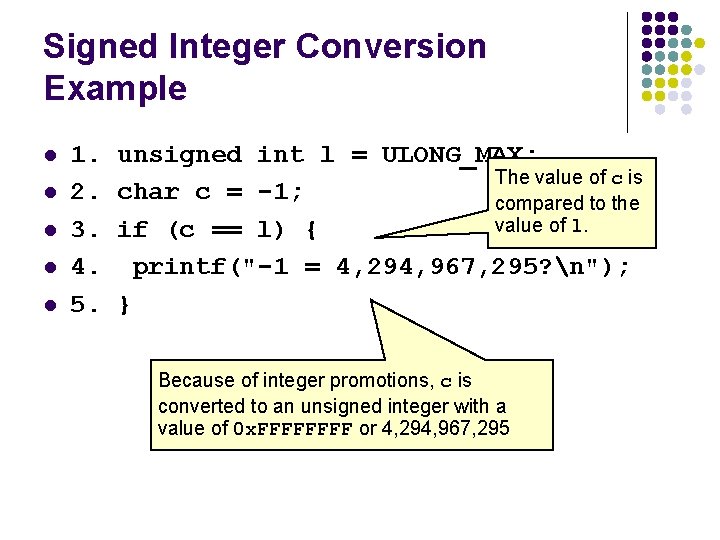
Signed Integer Conversion Example l l l 1. unsigned int l = ULONG_MAX; The value of c is 2. char c = -1; compared to the value of l. 3. if (c == l) { 4. printf("-1 = 4, 294, 967, 295? n"); 5. } Because of integer promotions, c is converted to an unsigned integer with a value of 0 x. FFFF or 4, 294, 967, 295
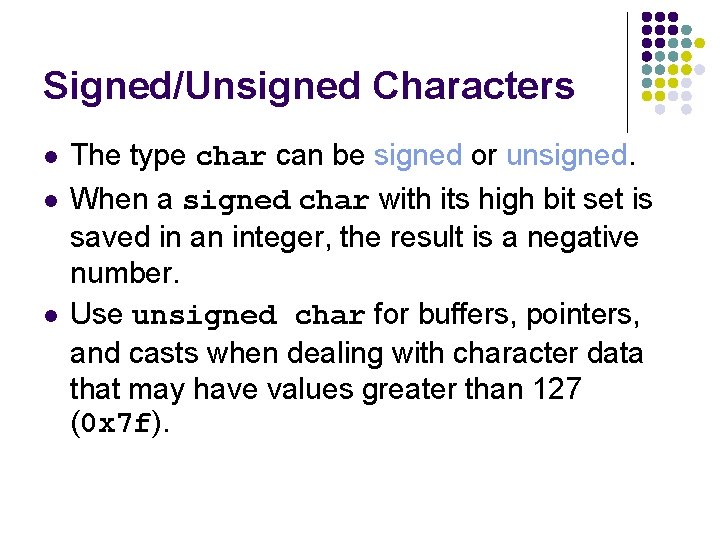
Signed/Unsigned Characters l l l The type char can be signed or unsigned. When a signed char with its high bit set is saved in an integer, the result is a negative number. Use unsigned char for buffers, pointers, and casts when dealing with character data that may have values greater than 127 (0 x 7 f).
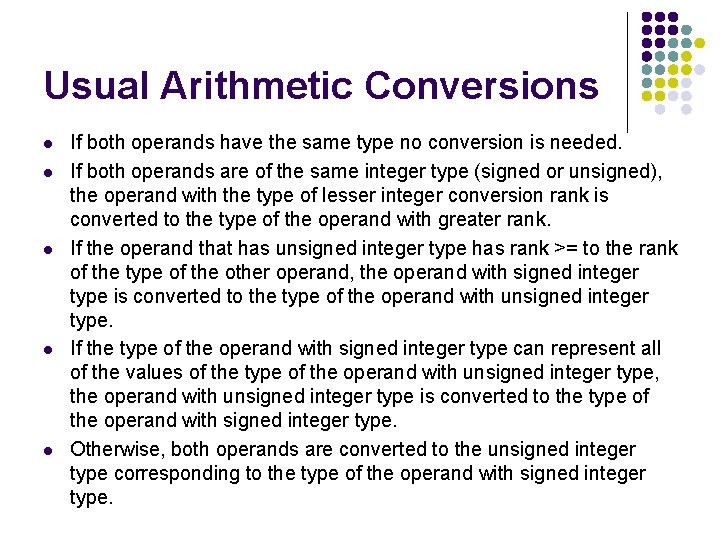
Usual Arithmetic Conversions l l l If both operands have the same type no conversion is needed. If both operands are of the same integer type (signed or unsigned), the operand with the type of lesser integer conversion rank is converted to the type of the operand with greater rank. If the operand that has unsigned integer type has rank >= to the rank of the type of the other operand, the operand with signed integer type is converted to the type of the operand with unsigned integer type. If the type of the operand with signed integer type can represent all of the values of the type of the operand with unsigned integer type, the operand with unsigned integer type is converted to the type of the operand with signed integer type. Otherwise, both operands are converted to the unsigned integer type corresponding to the type of the operand with signed integer type.
Integer Error Conditions l Integer operations can resolve to unexpected values as a result of an l l l overflow sign error truncation
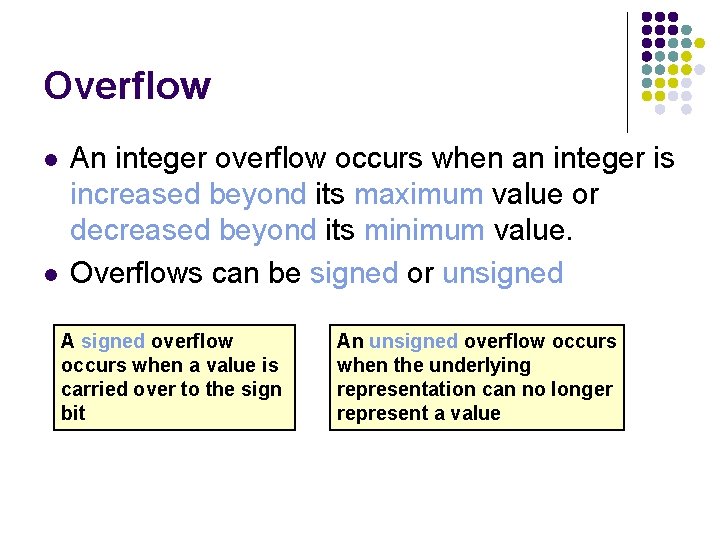
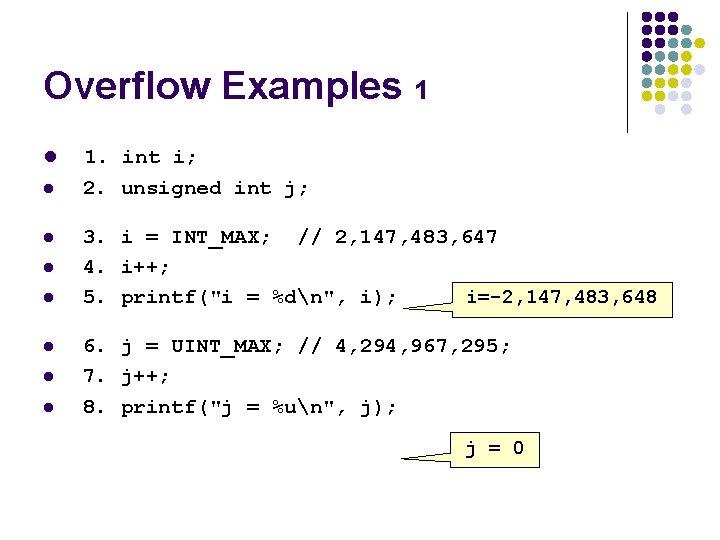
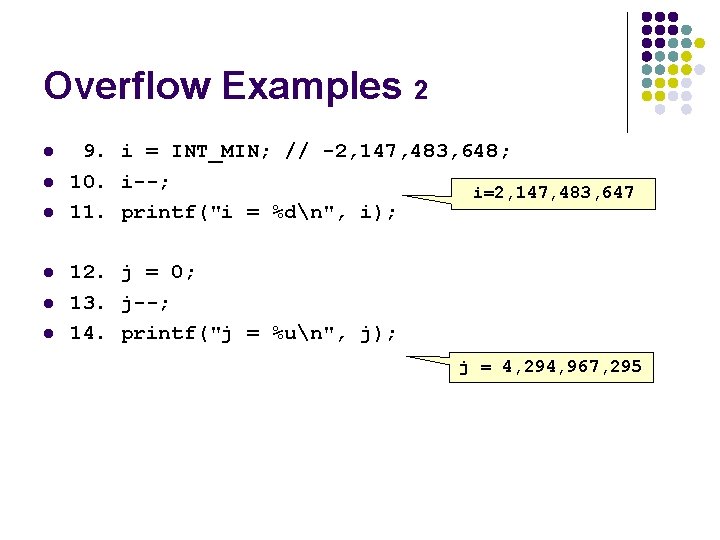
Overflow l l An integer overflow occurs when an integer is increased beyond its maximum value or decreased beyond its minimum value. Overflows can be signed or unsigned A signed overflow occurs when a value is carried over to the sign bit An unsigned overflow occurs when the underlying representation can no longer represent a value
Overflow Examples 1 l 1. int i; l 2. unsigned int j; l 3. i = INT_MAX; // 2, 147, 483, 647 4. i++; 5. printf("i = %dn", i); i=-2, 147, 483, 648 l l l 6. j = UINT_MAX; // 4, 294, 967, 295; 7. j++; 8. printf("j = %un", j); j = 0
Overflow Examples 2 l l l 9. i = INT_MIN; // -2, 147, 483, 648; 10. i--; i=2, 147, 483, 647 11. printf("i = %dn", i); 12. j = 0; 13. j--; 14. printf("j = %un", j); j = 4, 294, 967, 295
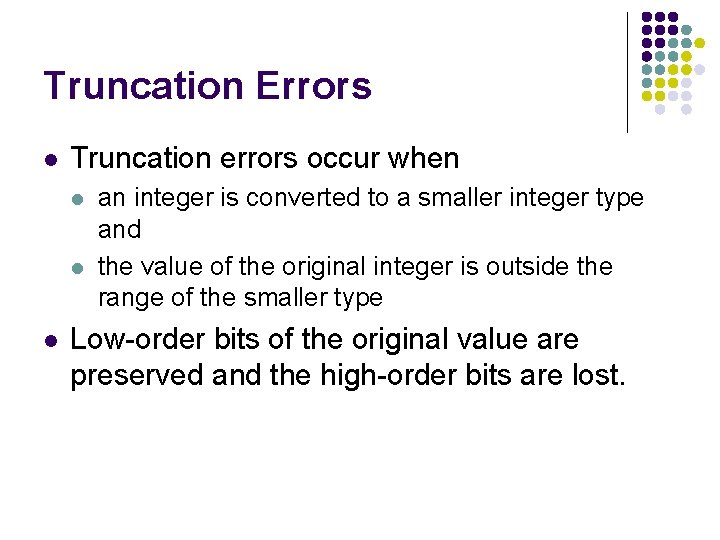
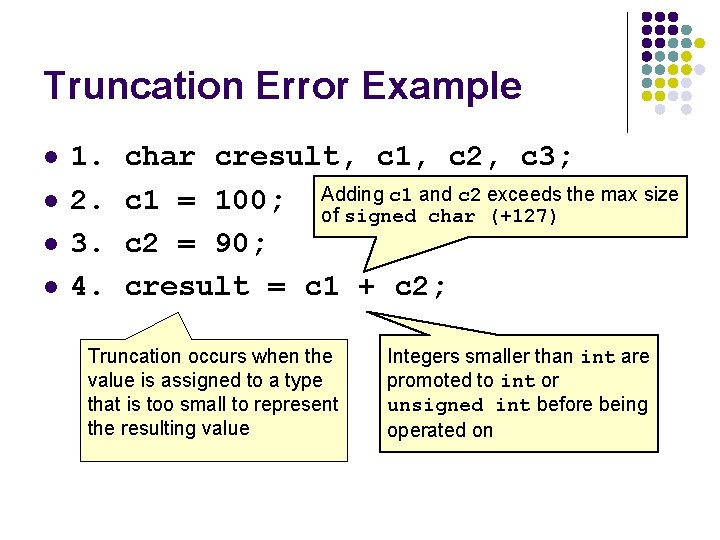
Truncation Errors l Truncation errors occur when l l l an integer is converted to a smaller integer type and the value of the original integer is outside the range of the smaller type Low-order bits of the original value are preserved and the high-order bits are lost.
Truncation Error Example l l 1. char cresult, c 1, c 2, c 3; 2. c 1 = 100; Adding c 1 and c 2 exceeds the max size of signed char (+127) 3. c 2 = 90; 4. cresult = c 1 + c 2; Truncation occurs when the value is assigned to a type that is too small to represent the resulting value Integers smaller than int are promoted to int or unsigned int before being operated on
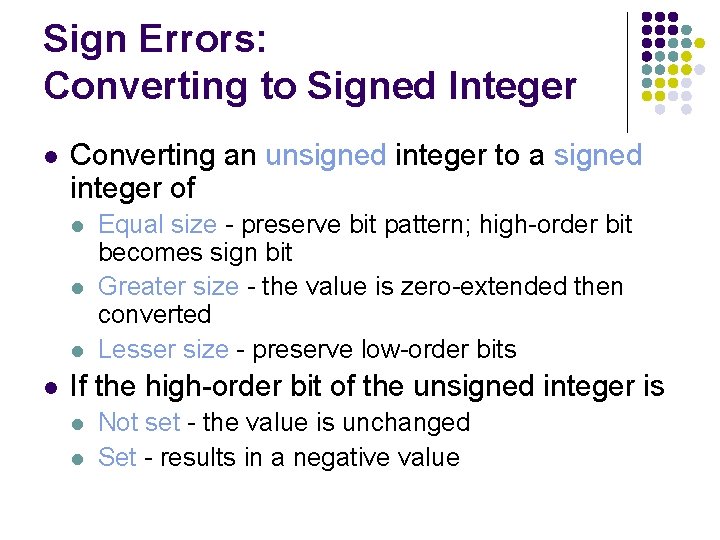
Sign Errors: Converting to Signed Integer l Converting an unsigned integer to a signed integer of l l Equal size - preserve bit pattern; high-order bit becomes sign bit Greater size - the value is zero-extended then converted Lesser size - preserve low-order bits If the high-order bit of the unsigned integer is l l Not set - the value is unchanged Set - results in a negative value
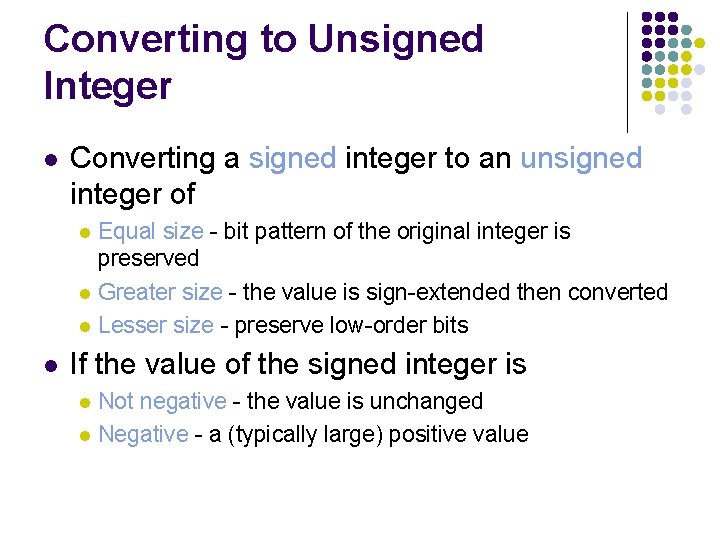
Converting to Unsigned Integer l Converting a signed integer to an unsigned integer of Equal size - bit pattern of the original integer is preserved l Greater size - the value is sign-extended then converted l Lesser size - preserve low-order bits l l If the value of the signed integer is Not negative - the value is unchanged l Negative - a (typically large) positive value l
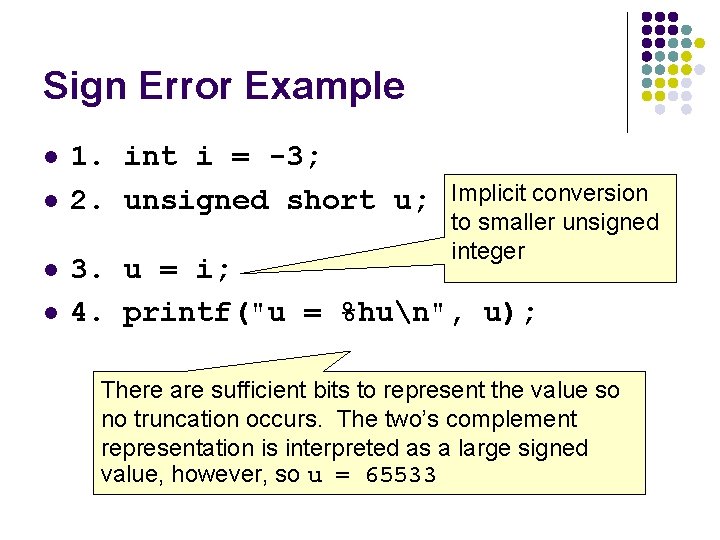
Sign Error Example l l 1. int i = -3; 2. unsigned short u; Implicit conversion to smaller unsigned integer 3. u = i; 4. printf("u = %hun", u); There are sufficient bits to represent the value so no truncation occurs. The two’s complement representation is interpreted as a large signed value, however, so u = 65533
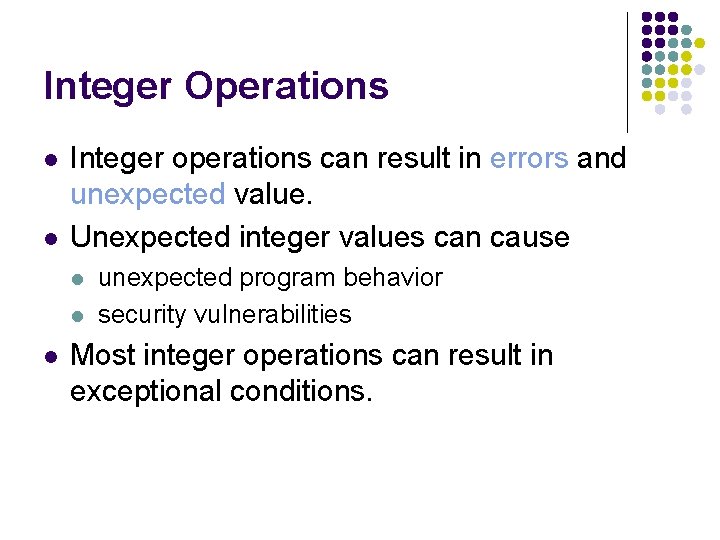
Integer Operations l l Integer operations can result in errors and unexpected value. Unexpected integer values can cause l l l unexpected program behavior security vulnerabilities Most integer operations can result in exceptional conditions.
Integer Addition l l l Addition can be used to add two arithmetic operands or a pointer and an integer. If both operands are of arithmetic type, the usual arithmetic conversions are performed on them. Integer addition can result in an overflow if the sum cannot be represented in the number allocated bits
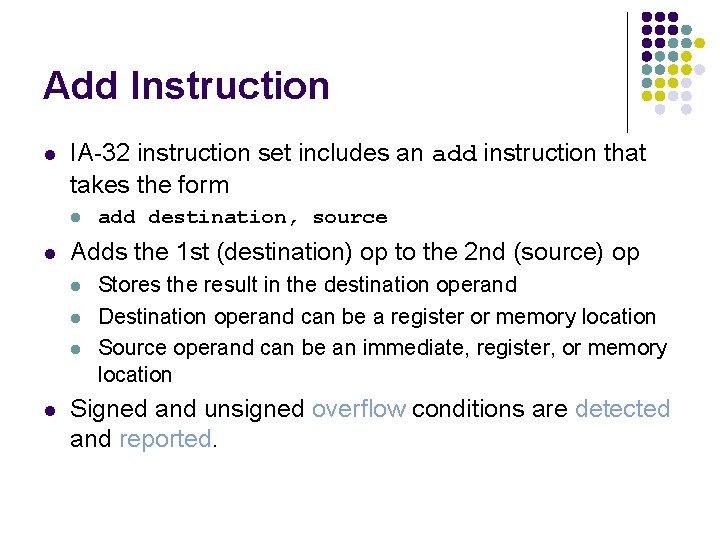
Add Instruction l IA-32 instruction set includes an add instruction that takes the form l l Adds the 1 st (destination) op to the 2 nd (source) op l l add destination, source Stores the result in the destination operand Destination operand can be a register or memory location Source operand can be an immediate, register, or memory location Signed and unsigned overflow conditions are detected and reported.
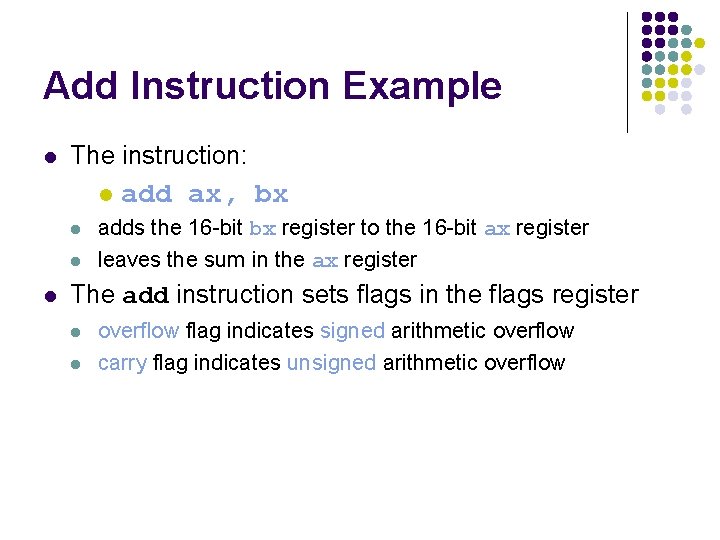
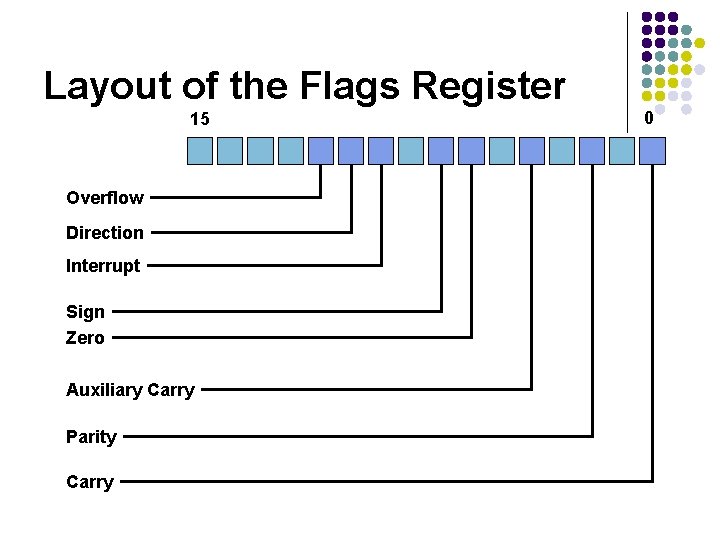
Add Instruction Example l The instruction: l l add ax, bx adds the 16 -bit bx register to the 16 -bit ax register leaves the sum in the ax register The add instruction sets flags in the flags register l l overflow flag indicates signed arithmetic overflow carry flag indicates unsigned arithmetic overflow
Layout of the Flags Register 15 Overflow Direction Interrupt Sign Zero Auxiliary Carry Parity Carry 0
Interpreting Flags l l There are no distinctions between the addition of signed and unsigned integers at the machine level. Overflow and carry flags must be interpreted in context
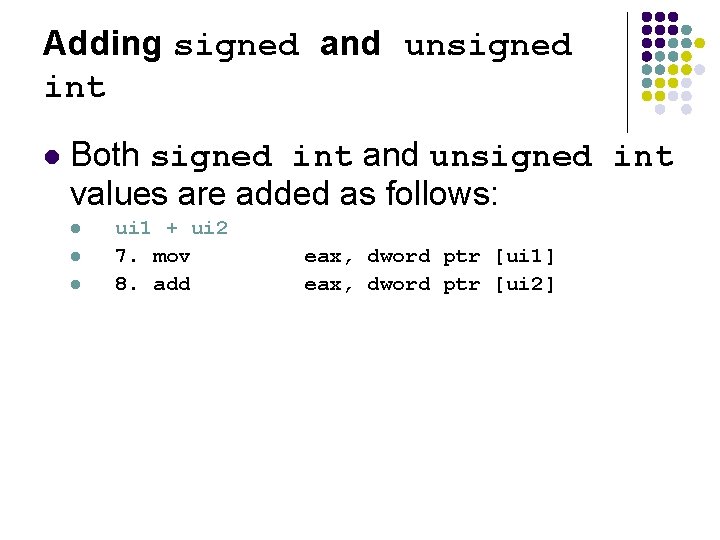
Adding signed and unsigned int l Both signed int and unsigned int values are added as follows: l l l ui 1 + ui 2 7. mov eax, dword ptr [ui 1] 8. add eax, dword ptr [ui 2]
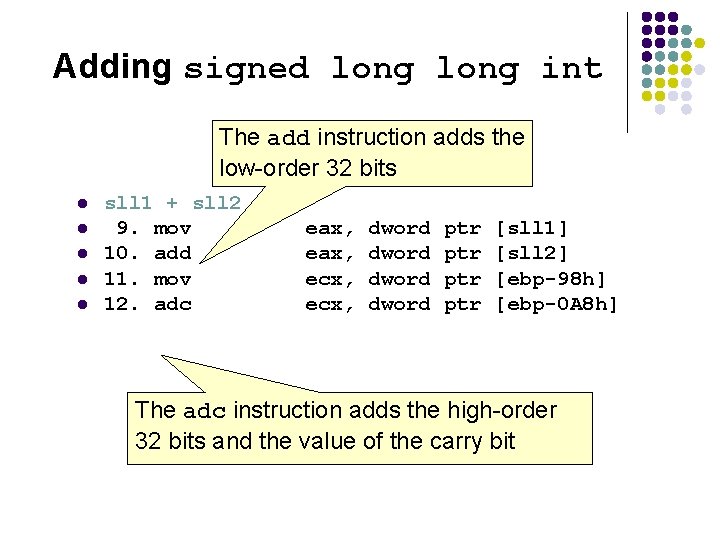
Adding signed long int The add instruction adds the low-order 32 bits l l l sll 1 + sll 2 9. mov eax, dword ptr [sll 1] 10. add eax, dword ptr [sll 2] 11. mov ecx, dword ptr [ebp-98 h] 12. adc ecx, dword ptr [ebp-0 A 8 h] The adc instruction adds the high-order 32 bits and the value of the carry bit
Unsigned Overflow Detection l l The carry flag denotes an unsigned arithmetic overflow Unsigned overflows can be detected using the l l l jc instruction (jump if carry) jnc instruction (jump if not carry) Conditional jump instructions are placed after the l l add instruction in the 32 -bit case adc instruction in the 64 -bit case
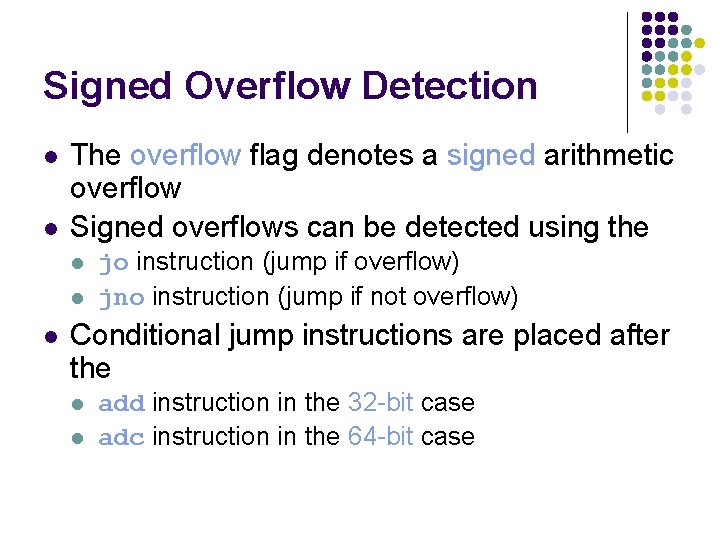
Signed Overflow Detection l l The overflow flag denotes a signed arithmetic overflow Signed overflows can be detected using the l l l jo instruction (jump if overflow) jno instruction (jump if not overflow) Conditional jump instructions are placed after the l l add instruction in the 32 -bit case adc instruction in the 64 -bit case
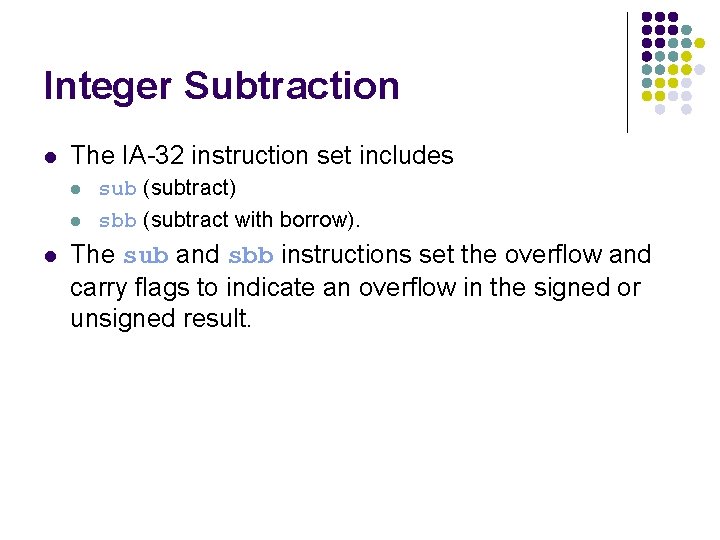
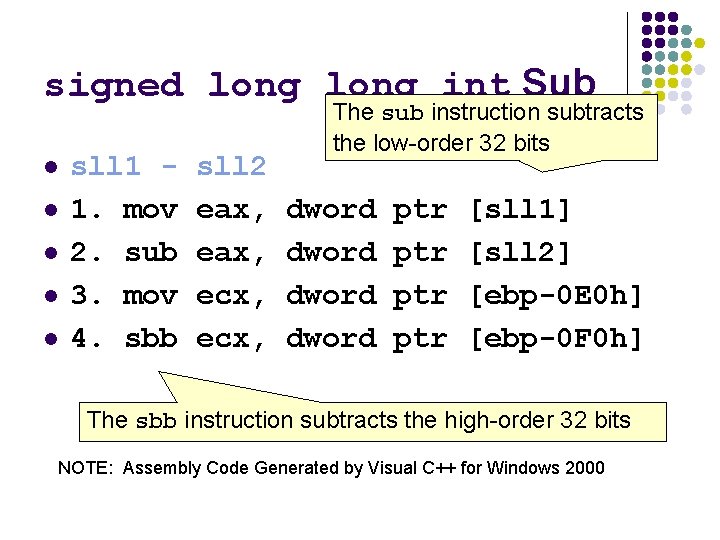
Integer Subtraction l The IA-32 instruction set includes l l l sub (subtract) sbb (subtract with borrow). The sub and sbb instructions set the overflow and carry flags to indicate an overflow in the signed or unsigned result.
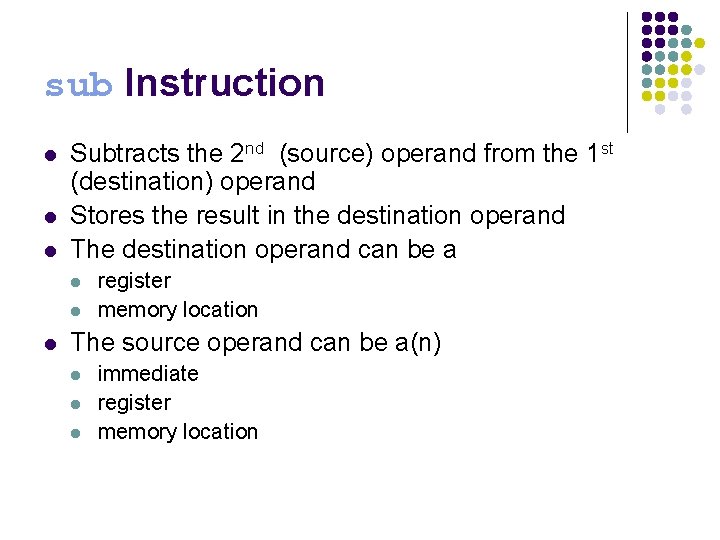
sub Instruction l l l Subtracts the 2 nd (source) operand from the 1 st (destination) operand Stores the result in the destination operand The destination operand can be a l l l register memory location The source operand can be a(n) l l l immediate register memory location
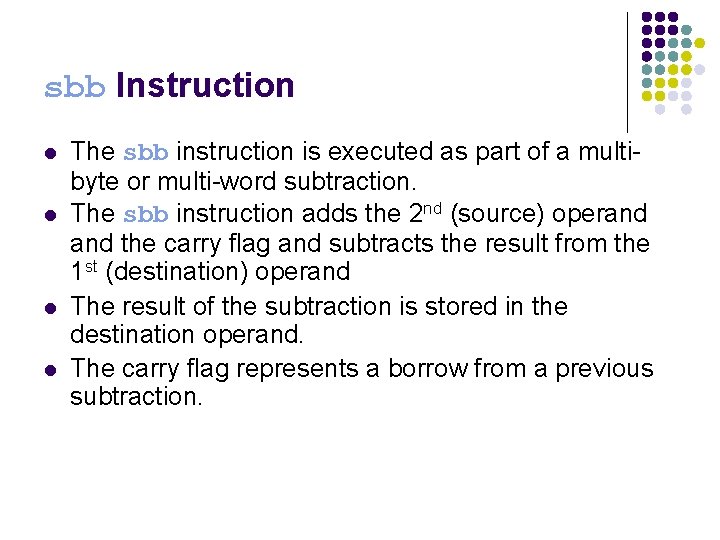
sbb Instruction l l The sbb instruction is executed as part of a multibyte or multi-word subtraction. The sbb instruction adds the 2 nd (source) operand the carry flag and subtracts the result from the 1 st (destination) operand The result of the subtraction is stored in the destination operand. The carry flag represents a borrow from a previous subtraction.
signed long int Sub l l l The sub instruction subtracts the low-order 32 bits sll 1 - sll 2 1. mov eax, dword ptr [sll 1] 2. sub eax, dword ptr [sll 2] 3. mov ecx, dword ptr [ebp-0 E 0 h] 4. sbb ecx, dword ptr [ebp-0 F 0 h] The sbb instruction subtracts the high-order 32 bits NOTE: Assembly Code Generated by Visual C++ for Windows 2000
Integer Multiplication l l Multiplication is prone to overflow errors because relatively small operands can overflow One solution is to allocate storage for the product that is twice the size of the larger of the two operands.
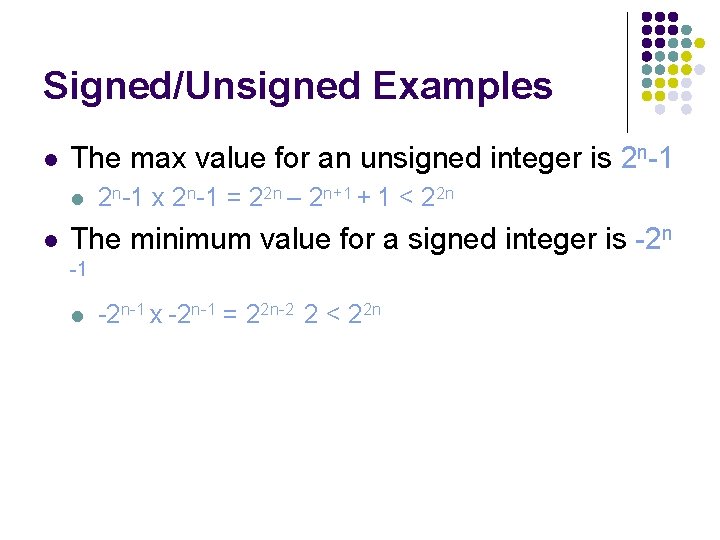
Signed/Unsigned Examples l The max value for an unsigned integer is 2 n-1 l l 2 n-1 x 2 n-1 = 22 n – 2 n+1 + 1 < 22 n The minimum value for a signed integer is -2 n -1 l -2 n-1 x -2 n-1 = 22 n-2 2 < 22 n
Multiplication Instructions l The IA-32 instruction set includes a l l l mul (unsigned multiply) instruction imul (signed multiply) instruction The mul instruction l l performs an unsigned multiplication of the 1 st (destination) operand the 2 nd (source) operand stores the result in the destination operand.
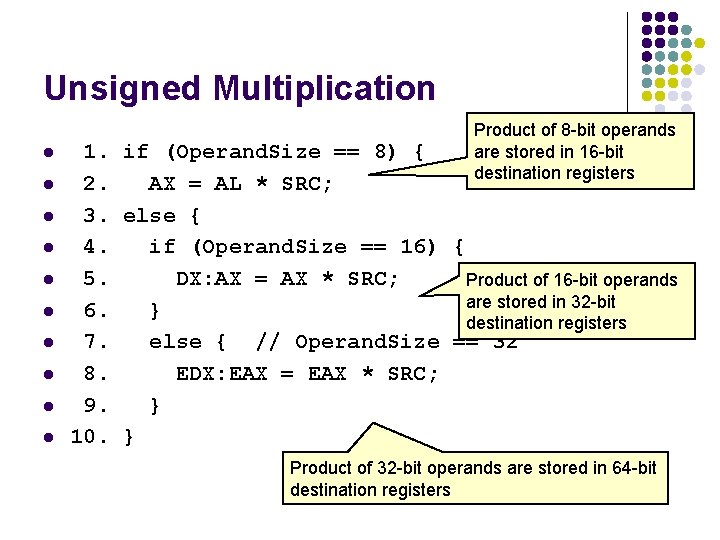
Unsigned Multiplication l l l l l Product of 8 -bit operands are stored in 16 -bit destination registers 1. if (Operand. Size == 8) { 2. AX = AL * SRC; 3. else { 4. if (Operand. Size == 16) { 5. DX: AX = AX * SRC; Product of 16 -bit operands are stored in 32 -bit 6. } destination registers 7. else { // Operand. Size == 32 8. EDX: EAX = EAX * SRC; 9. } 10. } Product of 32 -bit operands are stored in 64 -bit destination registers
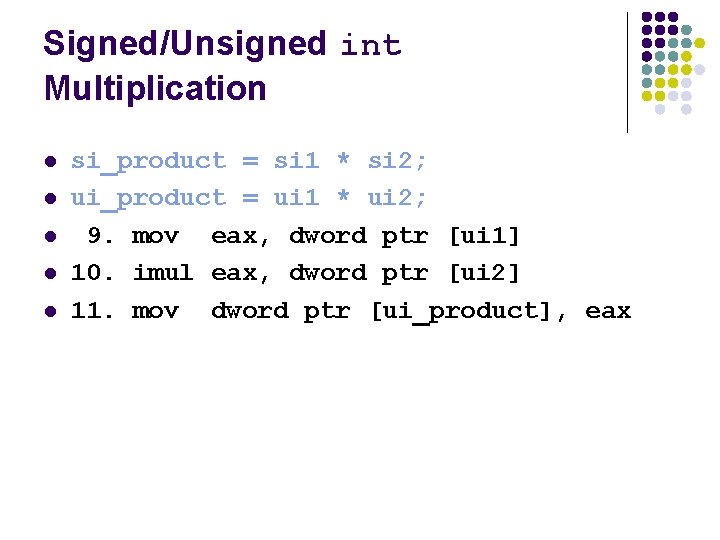
Signed/Unsigned int Multiplication l l l si_product = si 1 * si 2; ui_product = ui 1 * ui 2; 9. mov eax, dword ptr [ui 1] 10. imul eax, dword ptr [ui 2] 11. mov dword ptr [ui_product], eax
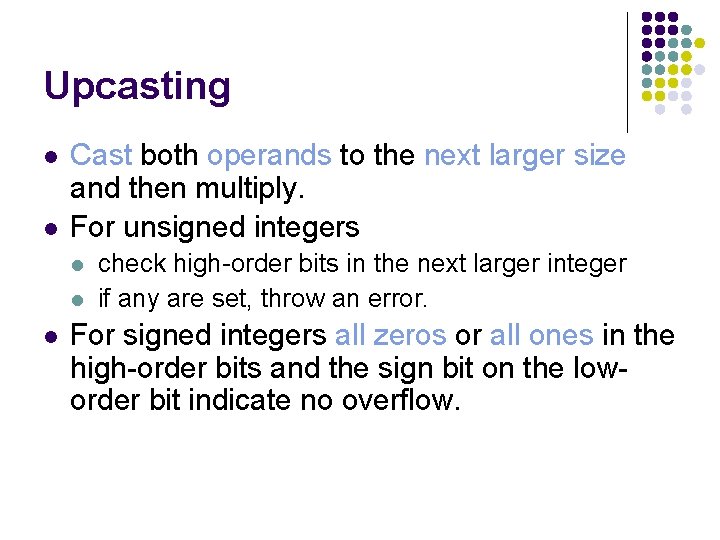
Upcasting l l Cast both operands to the next larger size and then multiply. For unsigned integers l l l check high-order bits in the next larger integer if any are set, throw an error. For signed integers all zeros or all ones in the high-order bits and the sign bit on the loworder bit indicate no overflow.
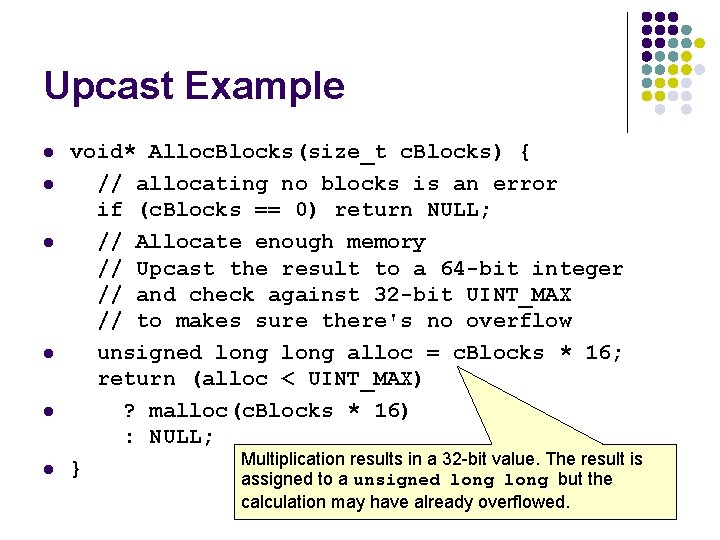
Upcast Example l l l void* Alloc. Blocks(size_t c. Blocks) { // allocating no blocks is an error if (c. Blocks == 0) return NULL; // Allocate enough memory // Upcast the result to a 64 -bit integer // and check against 32 -bit UINT_MAX // to makes sure there's no overflow unsigned long alloc = c. Blocks * 16; return (alloc < UINT_MAX) ? malloc(c. Blocks * 16) : NULL; Multiplication results in a 32 -bit value. The result is } assigned to a unsigned long but the calculation may have already overflowed.
Standard Compliance l l l To be compliant with C 99, multiplying two 32 -bit numbers in this context must yield a 32 -bit result. The language was not modified because the result would be burdensome on architectures that do not have widening multiply instructions. The correct result could be achieved by casting one of the operands.
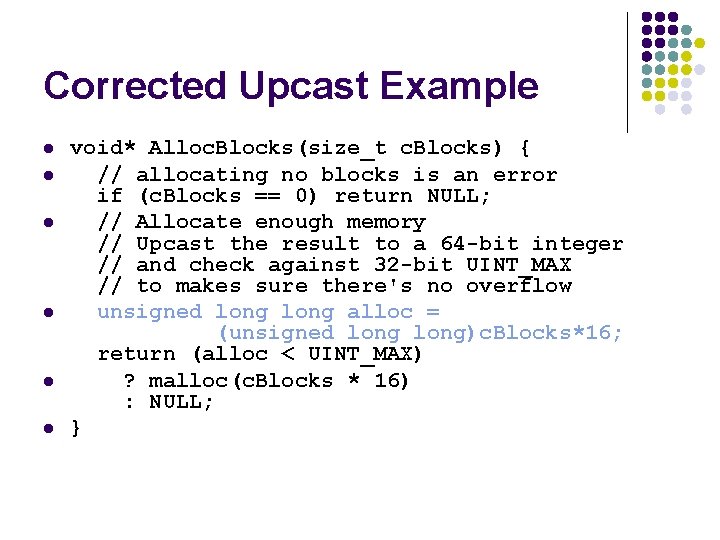
Corrected Upcast Example l l l void* Alloc. Blocks(size_t c. Blocks) { // allocating no blocks is an error if (c. Blocks == 0) return NULL; // Allocate enough memory // Upcast the result to a 64 -bit integer // and check against 32 -bit UINT_MAX // to makes sure there's no overflow unsigned long alloc = (unsigned long)c. Blocks*16; return (alloc < UINT_MAX) ? malloc(c. Blocks * 16) : NULL; }
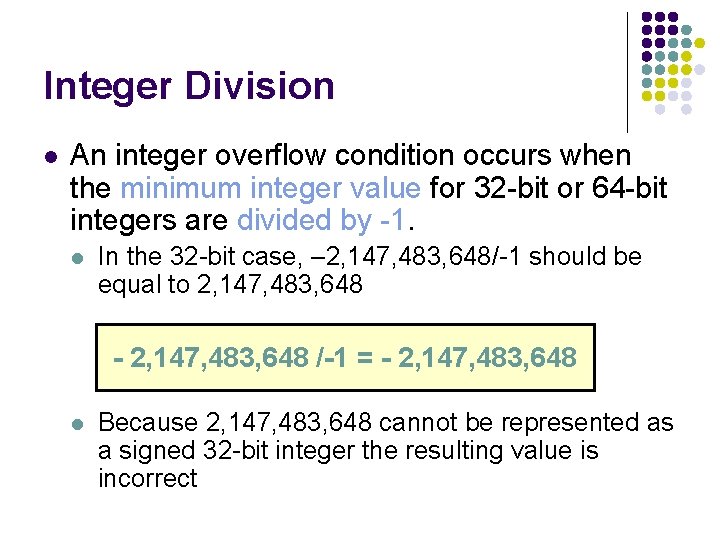
Integer Division l An integer overflow condition occurs when the minimum integer value for 32 -bit or 64 -bit integers are divided by -1. l In the 32 -bit case, – 2, 147, 483, 648/-1 should be equal to 2, 147, 483, 648 - 2, 147, 483, 648 /-1 = - 2, 147, 483, 648 l Because 2, 147, 483, 648 cannot be represented as a signed 32 -bit integer the resulting value is incorrect
Error Detection l l The IA-32 instruction set includes the div and idiv instructions The div instruction l l l divides the (unsigned) integer value in the ax, dx: ax, or edx: eax registers (dividend) by the source operand (divisor) stores the result in the ax (ah: al), dx: ax, or edx: eax registers The idiv instruction performs the same operations on (signed) values.
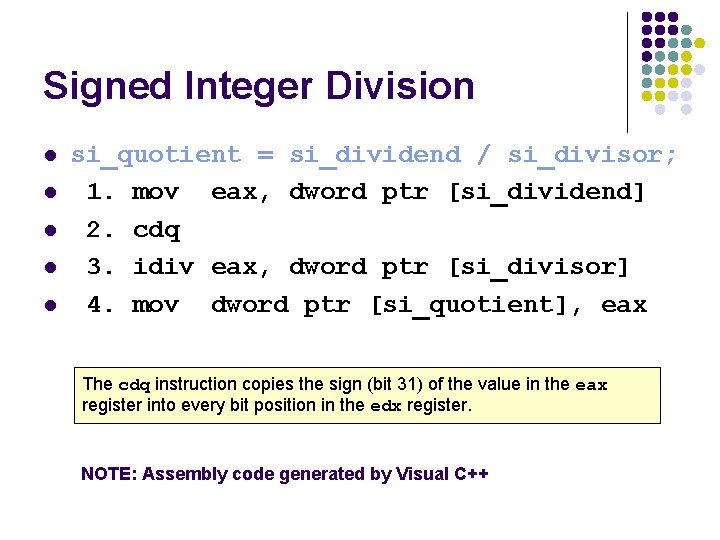
Signed Integer Division l l l si_quotient = si_dividend / si_divisor; 1. mov eax, dword ptr [si_dividend] 2. cdq 3. idiv eax, dword ptr [si_divisor] 4. mov dword ptr [si_quotient], eax The cdq instruction copies the sign (bit 31) of the value in the eax register into every bit position in the edx register. NOTE: Assembly code generated by Visual C++
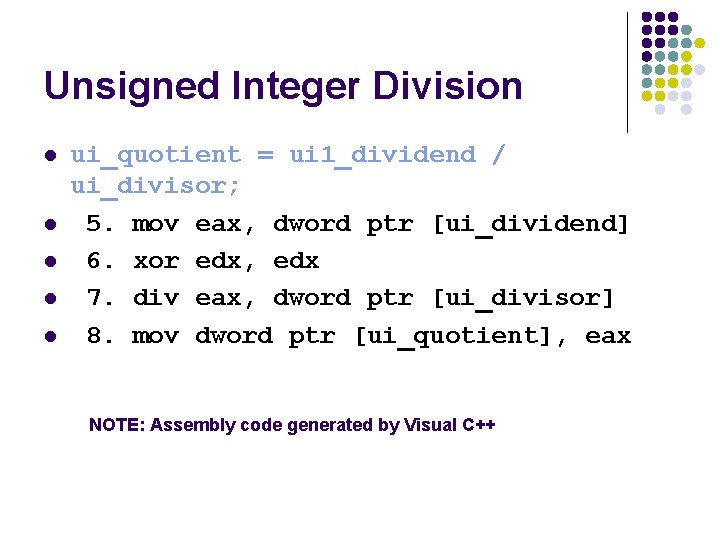
Unsigned Integer Division l l l ui_quotient = ui 1_dividend / ui_divisor; 5. mov eax, dword ptr [ui_dividend] 6. xor edx, edx 7. div eax, dword ptr [ui_divisor] 8. mov dword ptr [ui_quotient], eax NOTE: Assembly code generated by Visual C++
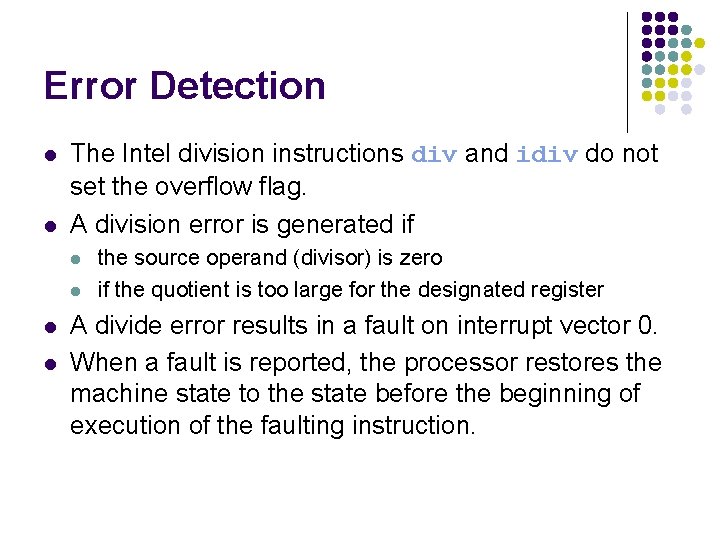
Error Detection l l The Intel division instructions div and idiv do not set the overflow flag. A division error is generated if l l the source operand (divisor) is zero if the quotient is too large for the designated register A divide error results in a fault on interrupt vector 0. When a fault is reported, the processor restores the machine state to the state before the beginning of execution of the faulting instruction.
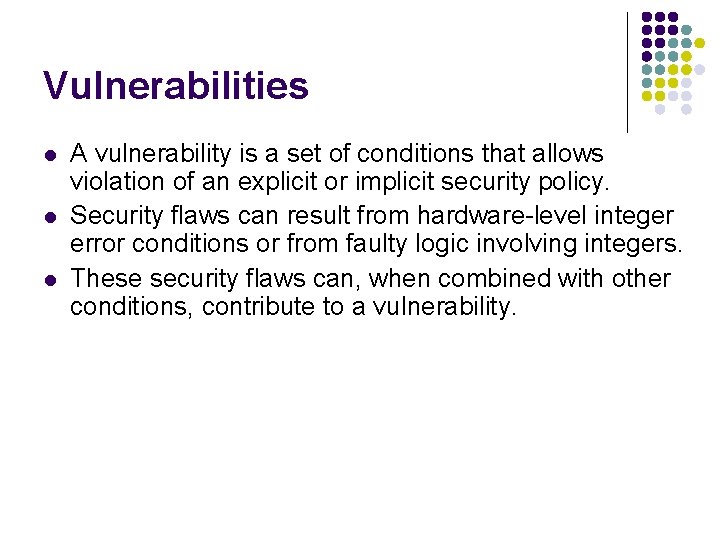
Vulnerabilities l l l A vulnerability is a set of conditions that allows violation of an explicit or implicit security policy. Security flaws can result from hardware-level integer error conditions or from faulty logic involving integers. These security flaws can, when combined with other conditions, contribute to a vulnerability.
Vulnerabilities Section Agenda l l Integer overflow Sign error Truncation Non-exceptional
JPEG Example l l Based on a real-world vulnerability in the handling of the comment field in JPEG files Comment field includes a two-byte length field indicating the length of the comment, including the two-byte length field. To determine the length of the comment string (for memory allocation), the function reads the value in the length field and subtracts two. The function then allocates the length of the comment plus one byte for the terminating null byte.
Integer Overflow Example l l l 1. void get. Comment(unsigned int len, char *src) { 2. unsigned int size; 0 byte malloc() succeeds 3. size = len - 2; 4. char *comment = (char *)malloc(size + 1); 5. memcpy(comment, src, size); 6. return; Size is interpreted as a large 7. } positive value of 0 xffff 8. int _tmain(int argc, _TCHAR* argv[]) { 9. get. Comment(1, "Comment "); 10. return 0; 11. } Possible to cause an overflow by creating an image with a comment length field of 1
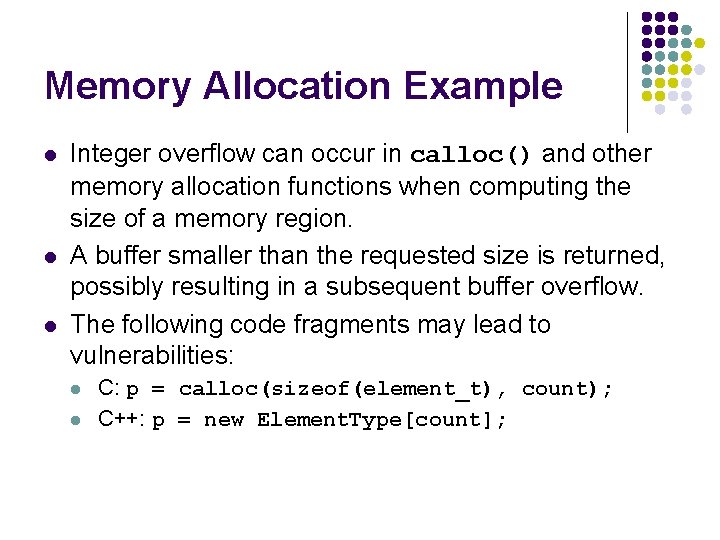
Memory Allocation Example l l l Integer overflow can occur in calloc() and other memory allocation functions when computing the size of a memory region. A buffer smaller than the requested size is returned, possibly resulting in a subsequent buffer overflow. The following code fragments may lead to vulnerabilities: l l C: p = calloc(sizeof(element_t), count); C++: p = new Element. Type[count];
Memory Allocation l The calloc() library call accepts two arguments l l the storage size of the element type the number of elements The element type size is not specified explicitly in the case of new operator in C++. To compute the size of the memory required, the storage size is multiplied by the number of elements.
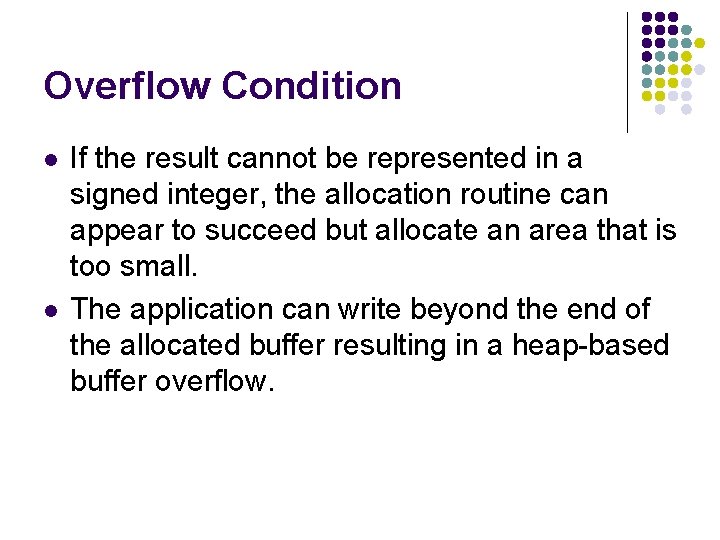
Overflow Condition l l If the result cannot be represented in a signed integer, the allocation routine can appear to succeed but allocate an area that is too small. The application can write beyond the end of the allocated buffer resulting in a heap-based buffer overflow.
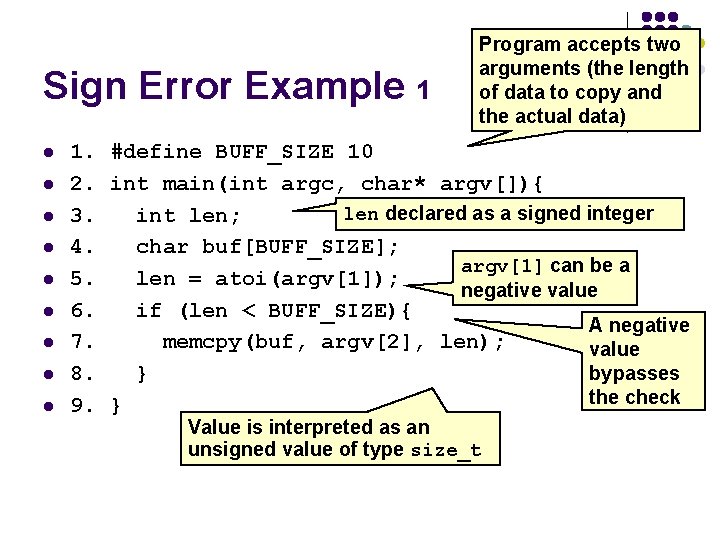
Sign Error Example 1 l l l l l Program accepts two arguments (the length of data to copy and the actual data) 1. #define BUFF_SIZE 10 2. int main(int argc, char* argv[]){ len declared as a signed integer 3. int len; 4. char buf[BUFF_SIZE]; argv[1] can be a 5. len = atoi(argv[1]); negative value 6. if (len < BUFF_SIZE){ A negative 7. memcpy(buf, argv[2], len); value 8. } bypasses the check 9. } Value is interpreted as an unsigned value of type size_t
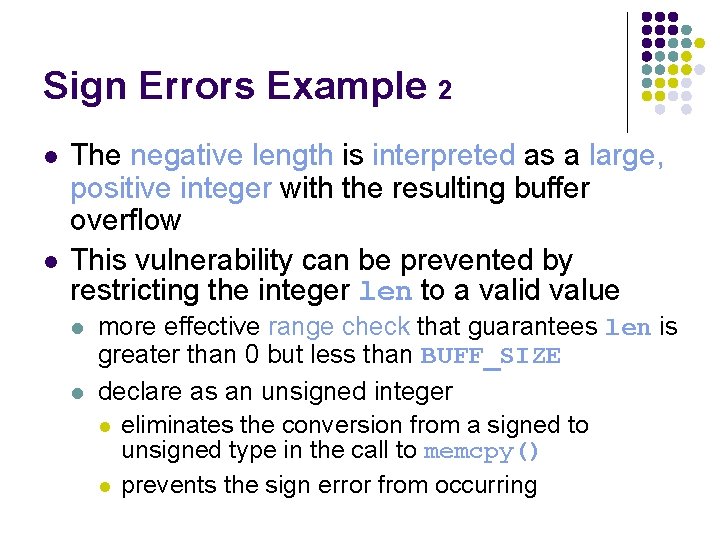
Sign Errors Example 2 l l The negative length is interpreted as a large, positive integer with the resulting buffer overflow This vulnerability can be prevented by restricting the integer len to a valid value l l more effective range check that guarantees len is greater than 0 but less than BUFF_SIZE declare as an unsigned integer l eliminates the conversion from a signed to unsigned type in the call to memcpy() l prevents the sign error from occurring
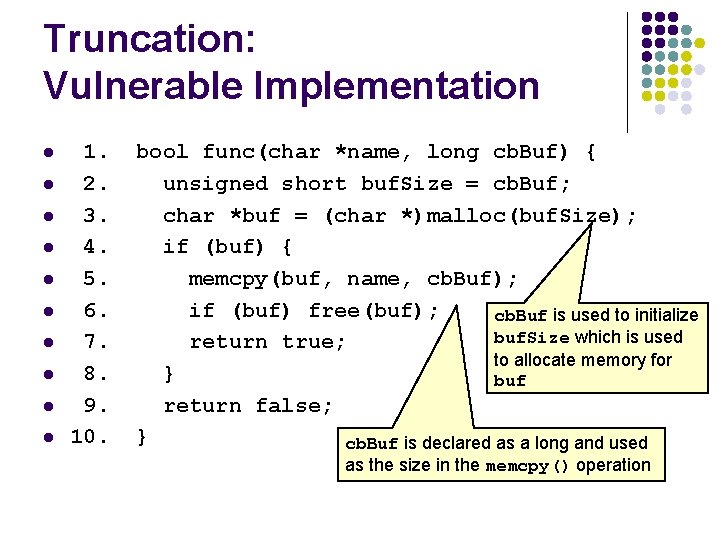
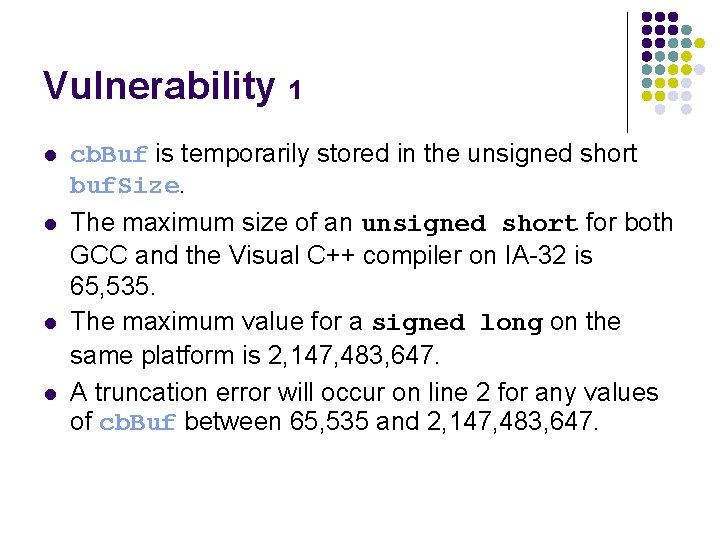
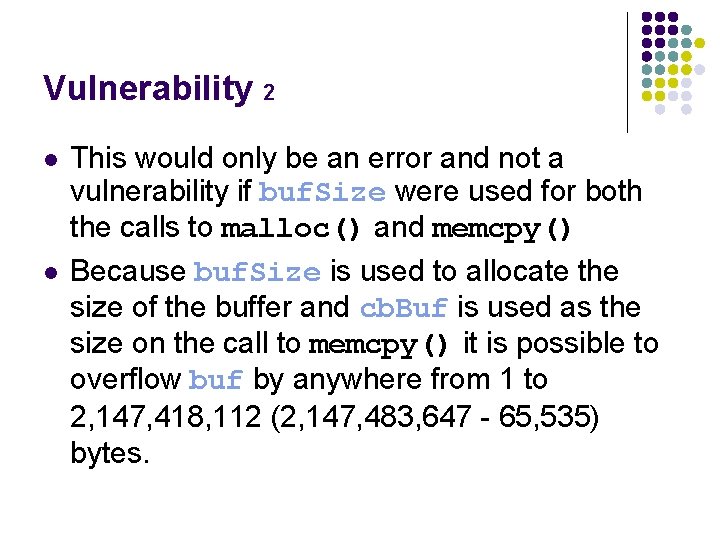
Truncation: Vulnerable Implementation l l l l l 1. bool func(char *name, long cb. Buf) { 2. unsigned short buf. Size = cb. Buf; 3. char *buf = (char *)malloc(buf. Size); 4. if (buf) { 5. memcpy(buf, name, cb. Buf); 6. if (buf) free(buf); cb. Buf is used to initialize buf. Size which is used 7. return true; to allocate memory for 8. } buf 9. return false; 10. } cb. Buf is declared as a long and used as the size in the memcpy() operation
Vulnerability 1 l l cb. Buf is temporarily stored in the unsigned short buf. Size. The maximum size of an unsigned short for both GCC and the Visual C++ compiler on IA-32 is 65, 535. The maximum value for a signed long on the same platform is 2, 147, 483, 647. A truncation error will occur on line 2 for any values of cb. Buf between 65, 535 and 2, 147, 483, 647.
Vulnerability 2 l l This would only be an error and not a vulnerability if buf. Size were used for both the calls to malloc() and memcpy() Because buf. Size is used to allocate the size of the buffer and cb. Buf is used as the size on the call to memcpy() it is possible to overflow buf by anywhere from 1 to 2, 147, 418, 112 (2, 147, 483, 647 - 65, 535) bytes.
Non-Exceptional Integer Errors l Integer related errors can occur without an exceptional condition (such as an overflow) occurring
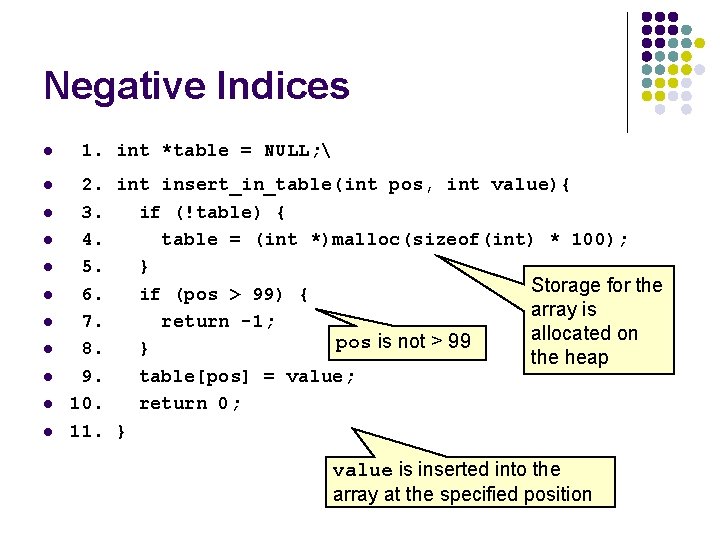
Negative Indices l 1. int *table = NULL; l 2. int insert_in_table(int pos, int value){ 3. if (!table) { 4. table = (int *)malloc(sizeof(int) * 100); 5. } Storage for the 6. if (pos > 99) { array is 7. return -1; allocated on pos is not > 99 8. } the heap 9. table[pos] = value; 10. return 0; 11. } l l l l l value is inserted into the array at the specified position
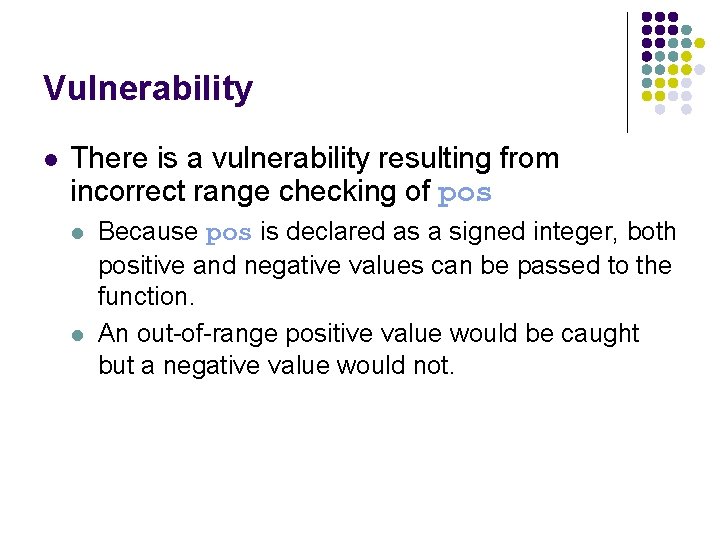
Vulnerability l There is a vulnerability resulting from incorrect range checking of pos l l Because pos is declared as a signed integer, both positive and negative values can be passed to the function. An out-of-range positive value would be caught but a negative value would not.
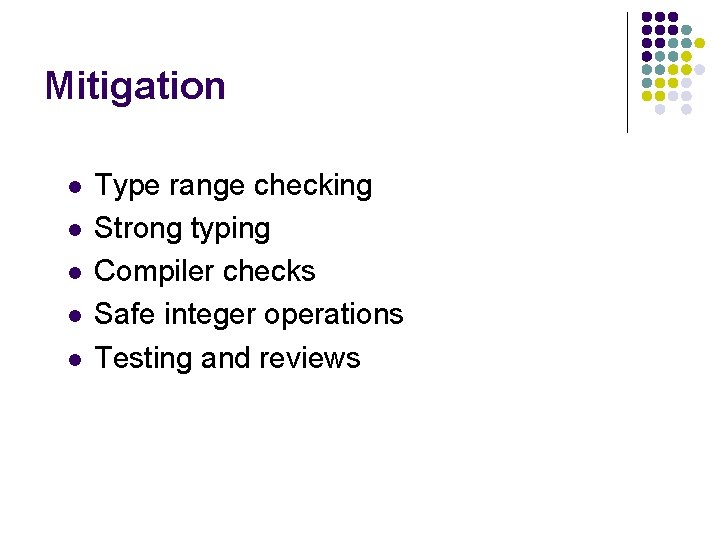
Mitigation l l l Type range checking Strong typing Compiler checks Safe integer operations Testing and reviews
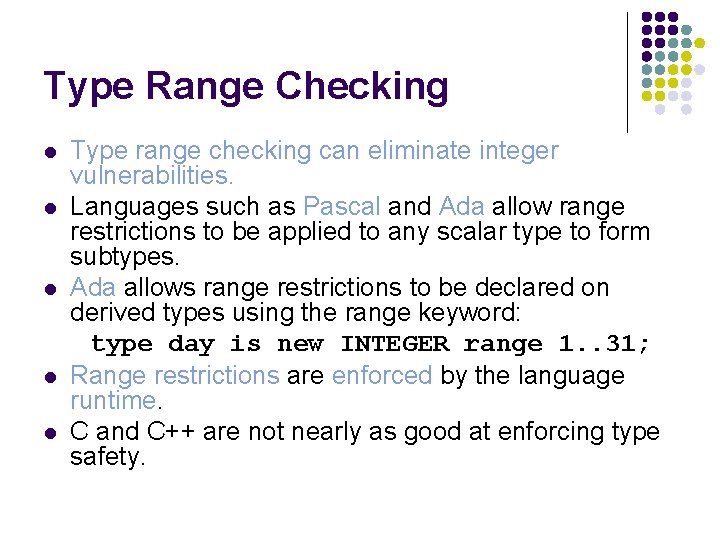
Type Range Checking Type range checking can eliminate integer vulnerabilities. l Languages such as Pascal and Ada allow range restrictions to be applied to any scalar type to form subtypes. l Ada allows range restrictions to be declared on derived types using the range keyword: type day is new INTEGER range 1. . 31; l Range restrictions are enforced by the language runtime. l C and C++ are not nearly as good at enforcing type safety. l
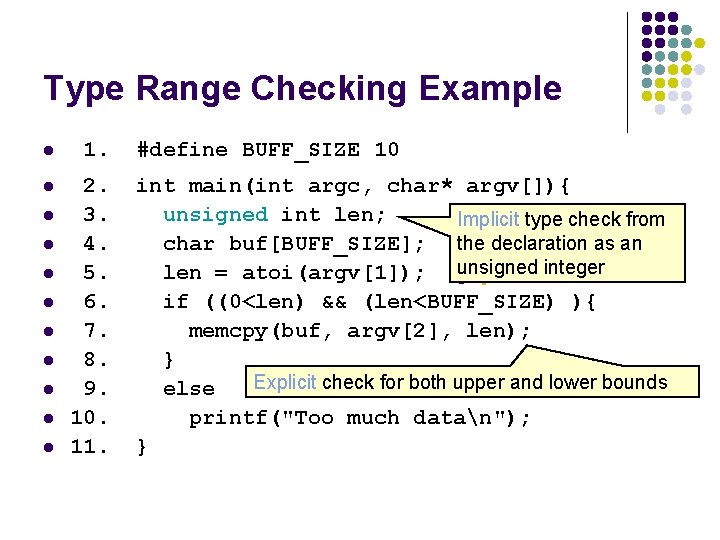
Type Range Checking Example l 1. #define BUFF_SIZE 10 l 2. int main(int argc, char* argv[]){ 3. unsigned int len; Implicit type check from 4. char buf[BUFF_SIZE]; the declaration as an 5. len = atoi(argv[1]); lunsigned integer. 6. if ((0<len) && (len<BUFF_SIZE) ){ 7. memcpy(buf, argv[2], len); 8. } Explicit check for both upper and lower bounds 9. else 10. printf("Too much datan"); 11. } l l l l l
Range Checking l External inputs should be evaluated to determine whethere are identifiable upper and lower bounds. l l these limits should be enforced by the interface easier to find and correct input problems than it is to trace internal errors back to faulty inputs Limit input of excessively large or small integers Typographic conventions can be used in code to l l distinguish constants from variables distinguish externally influenced variables from locally used variables with well-defined ranges
Strong Typing l l One way to provide better type checking is to provide better types. Using an unsigned type can guarantee that a variable does not contain a negative value. This solution does not prevent overflow. Strong typing should be used so that the compiler can be more effective in identifying range problems.
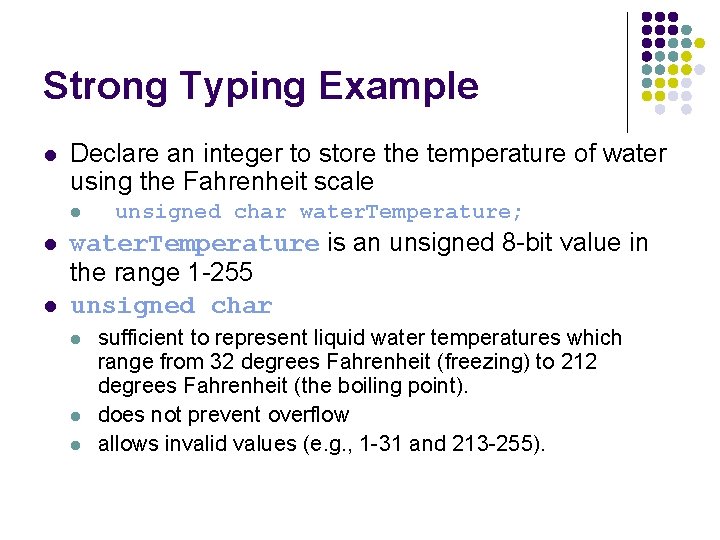
Strong Typing Example l Declare an integer to store the temperature of water using the Fahrenheit scale l l l unsigned char water. Temperature; water. Temperature is an unsigned 8 -bit value in the range 1 -255 unsigned char l l l sufficient to represent liquid water temperatures which range from 32 degrees Fahrenheit (freezing) to 212 degrees Fahrenheit (the boiling point). does not prevent overflow allows invalid values (e. g. , 1 -31 and 213 -255).
Abstract Data Type l l One solution is to create an abstract data type in which water. Temperature is private and cannot be directly accessed by the user. A user of this data abstraction can only access, update, or operate on this value through public method calls. These methods must provide type safety by ensuring that the value of the water. Temperature does not leave the valid range. If implemented properly, there is no possibility of an integer type range error occurring.
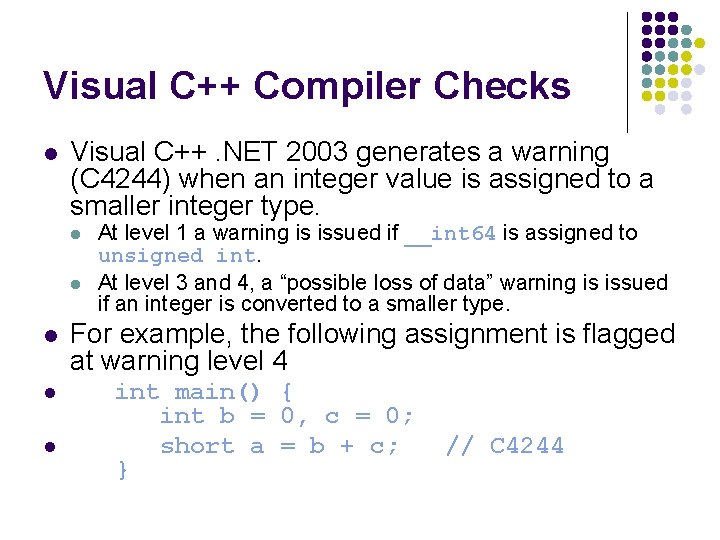
Visual C++ Compiler Checks l Visual C++. NET 2003 generates a warning (C 4244) when an integer value is assigned to a smaller integer type. l l l At level 1 a warning is issued if __int 64 is assigned to unsigned int. At level 3 and 4, a “possible loss of data” warning is issued if an integer is converted to a smaller type. For example, the following assignment is flagged at warning level 4 int main() { int b = 0, c = 0; short a = b + c; // C 4244 }
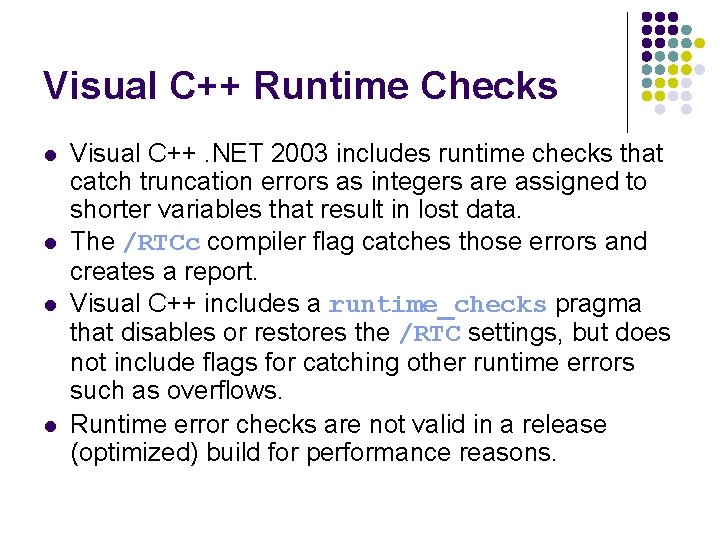
Visual C++ Runtime Checks l l Visual C++. NET 2003 includes runtime checks that catch truncation errors as integers are assigned to shorter variables that result in lost data. The /RTCc compiler flag catches those errors and creates a report. Visual C++ includes a runtime_checks pragma that disables or restores the /RTC settings, but does not include flags for catching other runtime errors such as overflows. Runtime error checks are not valid in a release (optimized) build for performance reasons.
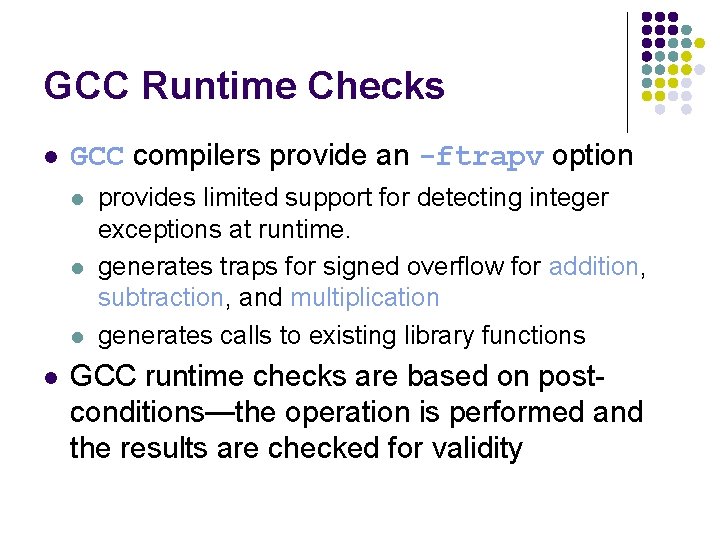
GCC Runtime Checks l GCC compilers provide an -ftrapv option l l provides limited support for detecting integer exceptions at runtime. generates traps for signed overflow for addition, subtraction, and multiplication generates calls to existing library functions GCC runtime checks are based on postconditions—the operation is performed and the results are checked for validity
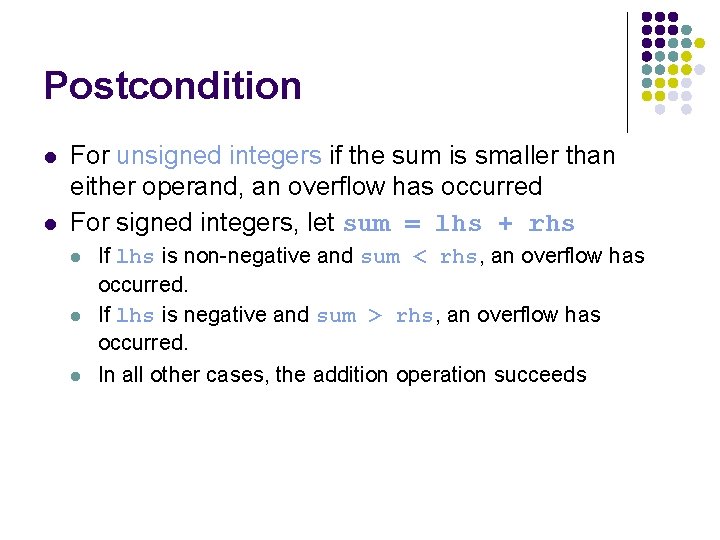
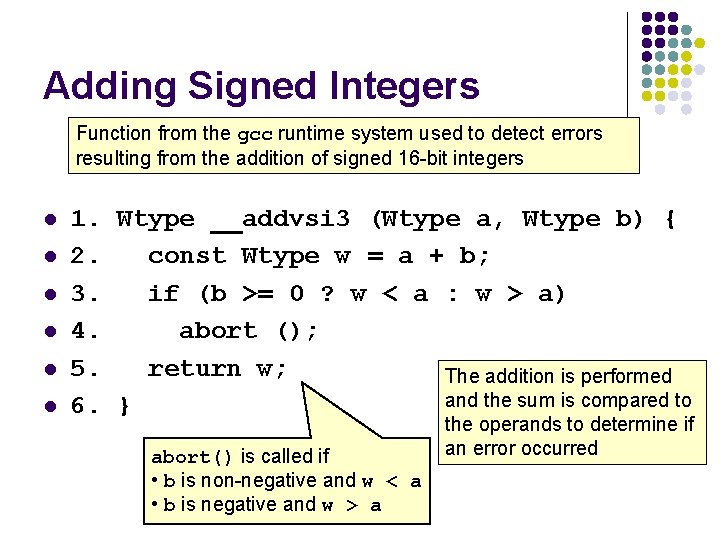
Postcondition l l For unsigned integers if the sum is smaller than either operand, an overflow has occurred For signed integers, let sum = lhs + rhs l l l If lhs is non-negative and sum < rhs, an overflow has occurred. If lhs is negative and sum > rhs, an overflow has occurred. In all other cases, the addition operation succeeds
Adding Signed Integers Function from the gcc runtime system used to detect errors resulting from the addition of signed 16 -bit integers l l l 1. Wtype __addvsi 3 (Wtype a, Wtype b) { 2. const Wtype w = a + b; 3. if (b >= 0 ? w < a : w > a) 4. abort (); 5. return w; The addition is performed and the sum is compared to 6. } abort() is called if • b is non-negative and w < a • b is negative and w > a the operands to determine if an error occurred
Safe Integer Operations 1 l l Integer operations can result in error conditions and possible lost data. The first line of defense against integer vulnerabilities should be range checking l l l Explicitly Implicitly - through strong typing It is difficult to guarantee that multiple input variables cannot be manipulated to cause an error to occur in some operation somewhere in a program.
Safe Integer Operations 2 l l l An alternative or ancillary approach is to protect each operation. This approach can be labor intensive and expensive to perform. Use a safe integer library for all operations on integers where one or more of the inputs could be influenced by an untrusted source.
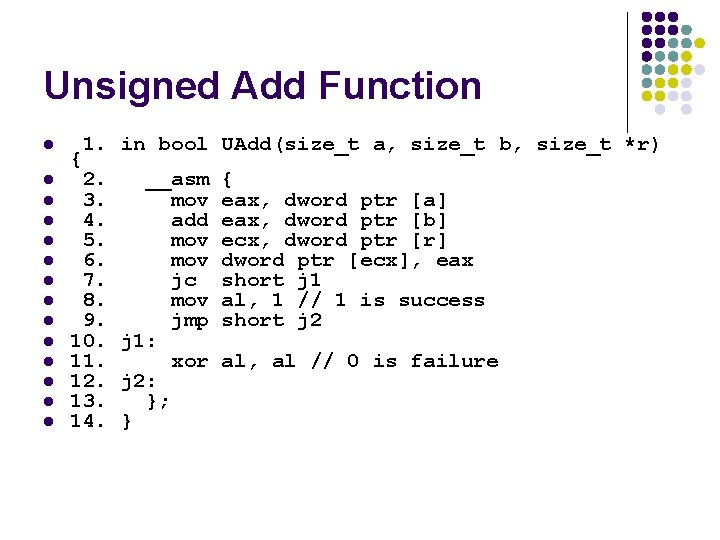
Safe Integer Solutions l C language compatible library l l Written by Michael Howard at Microsoft Detects integer overflow conditions using IA-32 specific mechanisms
Unsigned Add Function l l l l 1. in bool UAdd(size_t a, size_t b, size_t *r) { 2. __asm { 3. mov eax, dword ptr [a] 4. add eax, dword ptr [b] 5. mov ecx, dword ptr [r] 6. mov dword ptr [ecx], eax 7. jc short j 1 8. mov al, 1 // 1 is success 9. jmp short j 2 10. j 1: 11. xor al, al // 0 is failure 12. j 2: 13. }; 14. }
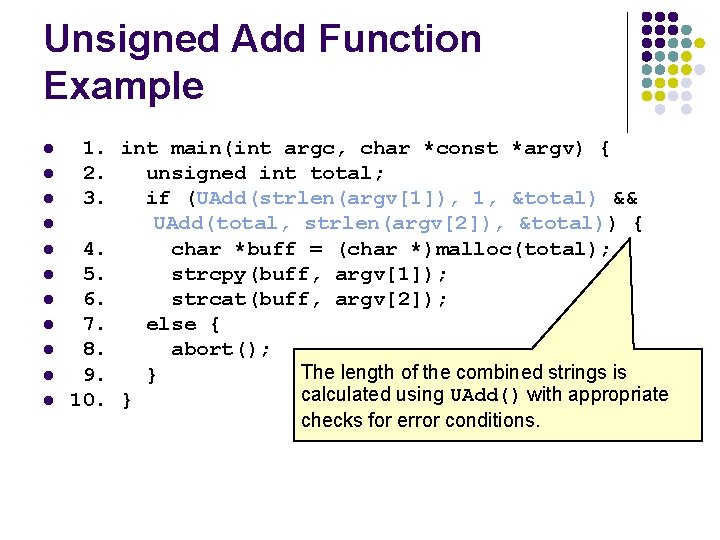
Unsigned Add Function Example l l l 1. int main(int argc, char *const *argv) { 2. unsigned int total; 3. if (UAdd(strlen(argv[1]), 1, &total) && UAdd(total, strlen(argv[2]), &total)) { 4. char *buff = (char *)malloc(total); 5. strcpy(buff, argv[1]); 6. strcat(buff, argv[2]); 7. else { 8. abort(); The length of the combined strings is 9. } calculated using UAdd() with appropriate 10. } checks for error conditions.
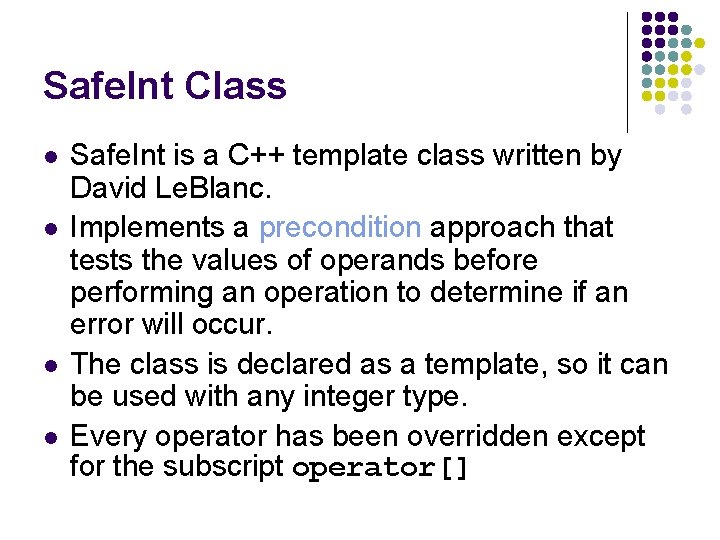
Safe. Int Class l l Safe. Int is a C++ template class written by David Le. Blanc. Implements a precondition approach that tests the values of operands before performing an operation to determine if an error will occur. The class is declared as a template, so it can be used with any integer type. Every operator has been overridden except for the subscript operator[]
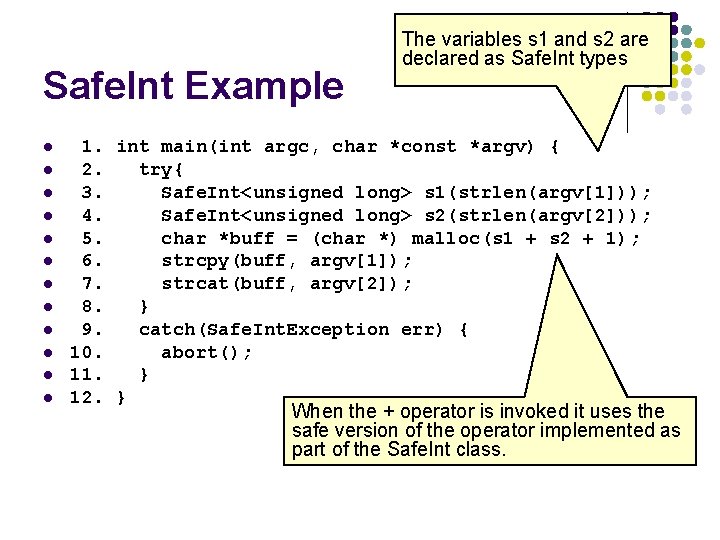
Safe. Int Example l l l The variables s 1 and s 2 are declared as Safe. Int types 1. int main(int argc, char *const *argv) { 2. try{ 3. Safe. Int<unsigned long> s 1(strlen(argv[1])); 4. Safe. Int<unsigned long> s 2(strlen(argv[2])); 5. char *buff = (char *) malloc(s 1 + s 2 + 1); 6. strcpy(buff, argv[1]); 7. strcat(buff, argv[2]); 8. } 9. catch(Safe. Int. Exception err) { 10. abort(); 11. } 12. } When the + operator is invoked it uses the safe version of the operator implemented as part of the Safe. Int class.
Addition l Addition of unsigned integers can result in an integer overflow if the sum of the left-hand side (LHS) and right-hand side (RHS) of an addition operation is greater than l l UINT_MAX for addition of unsigned int type ULLONG_MAX for addition of unsigned long type
Safe Integer Solutions Compared l Safe. Int library has several advantages l l more portable than safe arithmetic operations that depend on assembly language instructions. more usable l l operators can be used inline in expressions Safe. Int uses C++ exception handling better performance (with optimized code) Fails to provide correct integer promotion behavior
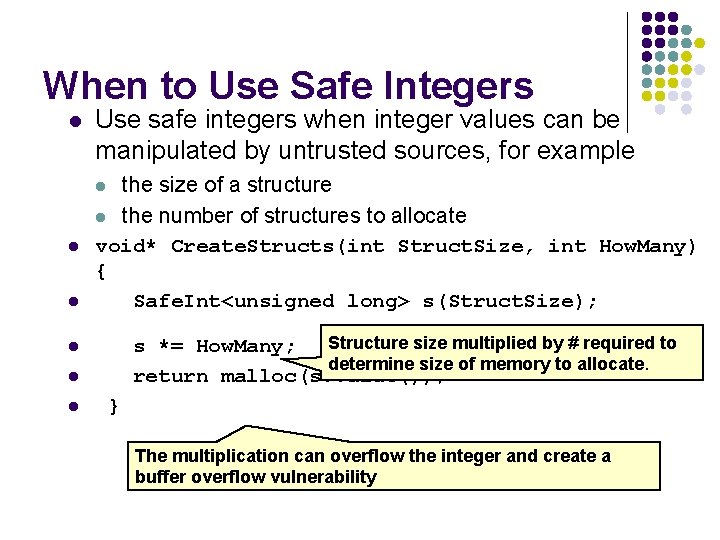
When to Use Safe Integers l Use safe integers when integer values can be manipulated by untrusted sources, for example the size of a structure l the number of structures to allocate void* Create. Structs(int Struct. Size, int How. Many) { Safe. Int<unsigned long> s(Struct. Size); l l l s *= How. Many; Structure size multiplied by # required to determine size of memory to allocate. return malloc(s. Value()); } The multiplication can overflow the integer and create a buffer overflow vulnerability
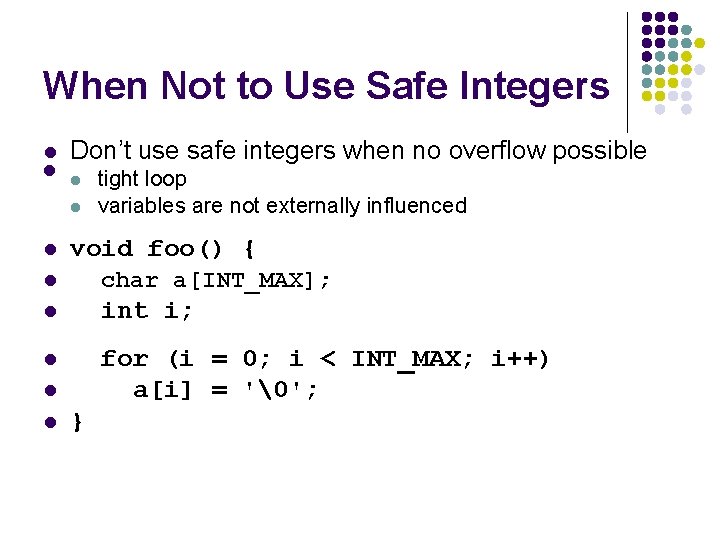
When Not to Use Safe Integers l l Don’t use safe integers when no overflow possible l tight loop l l l l variables are not externally influenced void foo() { char a[INT_MAX]; int i; for (i = 0; i < INT_MAX; i++) a[i] = ''; }
Testing 1 l l Input validation does not guarantee that subsequent operations on integers will not result in an overflow or other error condition. Testing does not provide any guarantees either l l It is impossible to cover all ranges of possible inputs on anything but the most trivial programs. If applied correctly, testing can increase confidence that the code is secure.
Testing 2 l Integer vulnerability tests should include boundary conditions for all integer variables. l l If type range checks are inserted in the code, test that they function correctly for upper and lower bounds. If boundary tests have not been included, test for minimum and maximum integer values for the various integer sizes used. Use white box testing to determine the types of integer variables. If source code is not available, run tests with the various maximum and minimum values for each type.
Source Code Audit l l Source code should be audited or inspected for possible integer range errors When auditing, check for the following: l l Integer type ranges are properly checked. Input values are restricted to a valid range based on their intended use. Integers that do not require negative values are declared as unsigned and properly range-checked for upper and lower bounds. Operations on integers originating from untrusted sources are performed using a safe integer library.
Notable Vulnerabilities l Integer Overflow In XDR Library l l l Windows Direct. X MIDI Library l l l Sun. RPC xdr_array buffer overflow http: //www. iss. net/security_center/static/9170. php e. Eye Digital Security advisory AD 20030723 http: //www. eeye. com/html/Research/Advisories/AD 200307 23. html Bash l l CERT Advisory CA-1996 -22 http: //www. cert. org/advisories/CA-1996 -22. html