
Coding and Billing for Optometrists Relative Value Units
Coding and Billing for Optometrists: Relative Value Units (RVUs) in VHA Module 5: Examples of Coding and Frequently Asked Questions VA Optometry IT Subcommittee

Authors • • • Ballinger, Rex OD Baltimore, MD Cordes, Matthew OD The Villages, FL Fuhr, Patti OD, PHD Salisbury, NC Ihrig, Carolyn OD Buffalo, NY Katzenberger, Ann OD American Lake, WA Kawasaki, Brian OD Las Vegas, NV Lazarou, Zoe OD Baltimore, MD Ryan, Raymond OD Eureka, CA Whitesell, Bethany Fayetteville, AR Zimbalist, Richard OD Columbia, MO
Background • Optometry is now included in the Relative Value Unit (RVU) based VA productivity methodology: – DSS (Decision Support System) RVU (do not confuse with clinical decision support systems) – CMS RVU (Relative Value Unit) system (VA specific) • These systems are a costs accounting and clinical activity relational database system. • All patient services will need to be correctly and accurately documented to ensure proper resource allocation and utilization. • Resources include labor, equipment, support and other expenses.
VA Relative Value Unit (RVUs) Quick Review… There are two different types of RVUs used in VA 1. DSS RVUs used for budgeting, cost accounting, and workload… all of which are time related This is directly related to stop codes, clinic appointment set up, and RVU times assigned at the DSS level. 2. CMS RVUs which are used to capture workload times as well as exam complexity coding This is related to CPT codes!! This is the RVU measure in the Office of Productivity, Efficiency and Staffing (OPES).
Background • All optometrists who have outpatient and inpatient PCE (Patient Care Encounter) encounter workload with CPT coding is used in calculating physician productivity within VA. • However, this applies to paid clinicians only. • Productivity is expressed in Relative Value Units (RVUs) per physician provider FTEE that is dedicated to clinical duties.
VA w. RVU Data Sources and Methods • Physicians, chiropractors, optometrists, podiatrists, and psychologists who are transmitting outpatient and inpatient PCE (Patient Care Encounter) encounter workload with CPT coding which is used in calculating physician productivity (w. RVUs). • The database contains workload for VA PAID physicians, In House FEE physicians, residents not assigned to providers on encounter forms, without compensation physician providers (WOCs) and contract physician providers (DSS RVUs).

Understand… YOU CAN’T BILL FOR WHAT YOU DO… YOU CAN ONLY BILL FOR WHAT IS DOCUMENTED • YOU CAN’T GET PROPER CREDIT FOR YOUR WORKLOAD UNLESS YOU CODE CORRECTLY and are MAPPED correctly • YOUR CODING MUST BE TIMELY!! – Your DSS workload is captured monthly your encounters must be in by the monthly deadline or your work is NOT captured and never will be!!!
Remember… Notes should include for I&R (interpretation and reporting): • What you asked • What you did • Why you did it • What you found • and what you plan to do about it Documentation as above supports your coding!
CPT Codes • This is the key to developing the correct RVU data. • Be sure you carefully document all your CPT codes. • We covered all of the pertinent CPT code information for you in the CPT training module. • These codes must be supported by your diagnosis codes which we will cover in this module.
Coding Review • ICD 9 Code review
ICD 9 Coding • The following slides highlight the important issues regarding ICD 9 Coding. • There are many more specific issues that are beyond the scope of this module. • Please refer to the latest edition of the ICD 9 CM Official Guidelines for Coding and Reporting.
ICD 9 Coding • For accurate reporting of ICD 9 CM diagnosis codes, the documentation should describe the patient's condition, using terminology which includes specific diagnoses as well as symptoms, problems, or reasons for the encounter. • There are ICD 9 CM codes to describe all of these situations.
ICD 9 Coding • Codes that describe symptoms and signs, as opposed to diagnoses, are acceptable for reporting purposes when an established diagnosis has not been diagnosed (confirmed) by the physician.
ICD 9 Coding • ICD 9 CM provides codes to deal with encounters for circumstances other than a disease or injury.
Important! • An ICD 9 code is invalid if it has not been coded to the full number of digits required for coded to the that code.
Correct ICD 9 Coding • List first the ICD 9 CM code for the diagnosis, condition, problem, or other reason for encounter/visit shown in the medical record to be chiefly responsible for the services provided. • List additional codes that describe any co existing conditions.
Correct ICD 9 Coding • Do not code diagnoses documented as "probable", "suspected, " "questionable, " "rule out, " or working diagnosis. • Rather, code the condition(s) to the highest degree of certainty for that encounter/visit, such as symptoms, signs, abnormal test results, or other reason for the visit.
Chronic Diseases • Chronic diseases treated on an ongoing basis may be coded and reported as many times as the patient receives treatment and care for the condition(s).
Correct Coding • Code all documented conditions that co exist at the time of the encounter/visit, and require or affect patient care treatment or management. • Do not code conditions that were previously treated and no longer exist. • However, history codes (V 10 V 19) may be used as secondary codes if the historical condition or family history has an impact on current care or influences treatment.
Correct Coding • Again, for patients receiving diagnostic services only during an encounter/visit, sequence first the diagnosis, condition, problem, or other reason for encounter/visit shown in the medical record to be chiefly responsible for the outpatient services provided during the encounter/visit. • Codes for other diagnoses (e. g. , chronic conditions) may be sequenced as additional diagnoses.
Correct Coding • For patients receiving therapeutic services only during an encounter/visit, sequence first the diagnosis, condition, problem, or other reason for encounter/visit shown in the medical record to be chiefly responsible for the outpatient services provided during the encounter/visit.
Combination Code A combination code is a single code used to classify: • Two diagnoses, or • A diagnosis with an associated secondary process (manifestation), or • A diagnosis with an associated complication.
Combination Codes • Are identified by referring to sub term entries in the Alphabetic Index and by reading the inclusion and exclusion notes in the Tabular List. • Assign only the combination code when that code fully identifies the diagnostic conditions involved or when the Alphabetic Index so directs. • Multiple coding should not be used when the classification provides a combination code that clearly identifies all of the elements documented in the diagnosis.

Correct Coding • When the combination code lacks necessary specificity in describing the manifestation or complication, an additional code should be used as a secondary code.
Example Combination Code • 250. 00 diabetes with 362. 04 mild non proliferative diabetic retinopathy • More than one code from category 250 may be used with as many manifestation codes as are needed to fully describe the patient’s complete diabetic condition.
Combination Coding • Certain conditions have both an underlying etiology and multiple body system manifestations due to the underlying etiology. • For such conditions, the ICD 9 CM has a coding convention that requires the underlying condition be sequenced first followed by the manifestation.

Other Descriptive Abbreviations • NEC “Not Elsewhere Classifiable”: This abbreviation in the Alphabetical Index represents “other specified” when a specific code is not available for a condition; the Alphabetical Index directs the coder to the “other specified” code in the Tabular List. • NOS “Not Otherwise Specified”: This abbreviation is the equivalent of unspecified.

Includes and Excludes Notes and Inclusion Terms • Includes Note: This note appears immediately under a three digit code title to further define, or give examples of, the content of the category. • Excludes Note: An excludes note under a code indicates that the terms excluded from the code are to be coded elsewhere. • Inclusion Terms: The list of terms is included under certain four and five digit codes.
Other and Unspecified Codes • “Other” Codes: These codes are for use when the information in the medical record provides detail for which a specific code does not exist. • “Unspecified” Codes: These codes are for use when the information in the medical record is insufficient to assign a more specific code.
Etiology/Manifestation Convention • Certain conditions have both an underlying etiology and multiple body system manifestations due to the underlying etiology. • For such conditions, the ICD 9 CM has a coding convention that requires the underlying condition be sequenced first followed by the manifestation.

Etiology/Manifestation Convention • Wherever such a combination exists, there is a “use additional code” note for the etiology code, and a “code first” note for the manifestation code. • These instructional notes indicate the proper sequencing order of the codes, with etiology followed by manifestation.
Etiology/Manifestation Convention • The most commonly used etiology/manifestation combinations are the codes for Diabetes mellitus, category 250. • For each code under category 250 there is a use additional code note for the manifestation that is specific for that particular diabetic manifestation. • Should a patient have more than one manifestation of diabetes, more than one code from category 250 may be used with as many manifestation codes as are needed to fully describe the patient’s complete diabetic condition.
Signs and Symptoms • Codes that describe signs and symptoms, as opposed to diagnoses, are acceptable for reporting purposes when a related definitive diagnosis has not been established (confirmed) by the provider.
Conditions That Are An Integral Part Of A Disease Process • Signs and symptoms that are associated routinely with a disease process should not be assigned as additional codes, unless otherwise instructed by the classification.
Conditions That Are Not An Integral Part Of A Disease Process • Additional signs and symptoms that may not be associated routinely with a disease process should be coded when present.
Acute and Chronic Conditions • If the same condition is described as both acute (sub acute) and chronic, and separate subentries exist in the Alphabetic Index at the same indentation level, code both and sequence the acute (sub acute) code first.
Reporting Same Diagnosis Code More Than Once • Each unique ICD 9 CM diagnosis code may be reported only once for an encounter. • This applies to bilateral conditions or two different conditions classified to the same ICD 9 CM diagnosis code.
Eyeglasses Fitting – Minimal documentation requirements for optometrist or technician for the use of codes 92340 92342 include: • measurements of anatomical facial characteristics, • records the laboratory specifications, and • performs the final adjustment of the spectacles to the visual axes and anatomical topography. – If the final adjustment is performed on a later date, use V 53. 1, fitting & adjustment of other device: spectacles & contact lenses. – The supporting documentation must be contained within the medical record.
Ophthalmic Technician • When the technician provides services for a patient in conjunction with an optometrist or ophthalmologist: – The technician is reported in ADM as an additional provider using the designation paraprofessional. – Additional codes for any procedures the technician performs (e. g. , spectacle ordering, visual field testing) are to be reported.
Technicians • When a technician provides services at a separate encounter, the correct procedures (e. g. , 99173, visual acuity screening) are entered in the CPT/HCPCS field. • Example: Patient seen by technician for vision exam portion of routine physical: – V 70. 5_2 Routine annual physical – 99173 Screening test of visual acuity • If a technician performs one of these procedures (99172 or 99173) at a separate encounter no E/M level is assigned and one of these codes is assigned.
Frequently Asked Coding Questions • The following provides common questions and answers regarding coding and billing.
Question 1 • Question 1: Shouldn’t we get RVU credit if we enter the interpretation into the patient chart as a historical visit on the day of the Visual Field testing? • Answer 1: The professional interpretation CPT code 92083 with modifier code 26 will suffice for RVU credit if your note has sufficient documentation to support it.
Question 2 • Can we bill Medicare for both an intermediate established patient exam and a gonioscopy exam? Also, is gonioscopy a bilateral procedure?
Answer 2 • Gonioscopy is inherently bilateral the Physician Fee Schedule has valued the procedure based on the work involved for both eyes. • If you perform gonioscopy on only one eye, append modifier 52 (Reduced services) to 92020.
Question 3 • I know in the actual coding scheme of things (i. e. private sector), procedure codes are linked to diagnosis codes, but since our encounter templates don’t require that, most of the VA optometrists here are unaware of these connections. Here’s where this may be an issue. We are often coding the refraction procedure, but may not have the refractive code in the diagnosis list (not even as a secondary). Do we need that code in there to get credit for the refractive procedure?
Guidance • For outpatient claims, providers report the full diagnosis code for the diagnosis shown to be chiefly responsible for the outpatient services. If a patient is seen on an outpatient basis for an evaluation of a symptom for which a definitive diagnosis is not made, the symptom is reported. • If, during the course of the outpatient evaluation and treatment, a definitive diagnosis is made, the definitive diagnosis is reported.
Answer 3 • If you report a procedure code, your note details must support this and you should also code for the diagnosis to support the procedure. They must be linked. • Just because you are not reminded in CPRS to do this, you should code all diagnosis and procedures to get full credit, otherwise the billing and RVU capture will be incomplete.
Question 4 • We’ve having some in depth discussions regarding coding (99000 codes) here and the question came up if there are templates/ documents in use that we might export for use at our eye clinic (For example, forms to use in ROS, examination templates set up for E&M coding, etc. ).

Answer 4 • Templates are being developed at this time and are not yet widely available. When available, they will initially have minimal capabilities.
Question 5 • Do you know if anyone has ever put in a CPRS ticket to fix the problem on the ENCOUNTER FORM with the diagnoses JUMPING to another line when clicking a diagnosis? This certainly results in errors if the user doesn’t notice that it jumped. It seems to have been like this for years and I’m surprised it hasn’t been fixed. Maybe the CPRS software engineers don’t know?

Answer 5 • This is a national encounter code set. Each and every VA facility uses the same code set. There are no exceptions. • However, if there is a missing common code set, the national folks need to know about it. • The jumping issue is due to computer code programming and will be worked out, the timeline is unknown. At this time, a national ticket has been submitted.
Question 6 • I am wondering if anyone has run into any problems with your coding department regarding using exam elements from the technician’s note when coding a level 4 exam. Our technicians do visual acuity, confrontations, EOMs, pupils, IOP and complete their own intake note. We have a statement on the top of the provider’s note that reads: “Agree with Optometry Technician/Nurse note of this date. ” But, coding is now saying that we have to have these exam elements actually IN the provider’s note to get credit. They also say they do not want us copying and pasting.
Answer 6 • When a tech does the testing (e. g. perimetry) but the patient is not seen that day by the doctor, the procedure code can be entered (due to there being a technical component and a separate professional component) but the only other code that can be billed is 99211…. which is for the technician’s time spent doing the testing. Also, see question 14.
Question 7 • Does time spent by an optometric resident count towards “doctor time, ” or does the time tracked with the patient need to be the primary signer’s time. Still, I easily spend 25 minutes with the patient even if they’re being seen by a resident over the course of a 1 hour exam, and that’s a Level 4 for an established patient (which they all are we do the health check in the regular optometry clinic first).
Answer 7 • The resident if a licensed/privileged provider can generate billing for services. The RVUs are mapped and documented under the optometry resident. The time element is not captured by the attending as a separate RVU because the resident is mapped seperately. However, the clinic workload is captured as well. Teaching residents is captured attending RVU’s if you are correctly mapped and provide formal classroom teaching.
Question 8 • There is some confusion, about usage and/or implementation here regarding 99205 and 99215 at our department. • I am trying to determine if ODs should even use these codes. When I practiced at a surgery center before joining the VA, we did routinely bill with those codes, but here, there is greater cautiousness and hesitation from my peers. • If you could possible give some guidelines or criteria, it would be truly helpful.
Answer 8 • The 99205 or 99215 represents the highest level of care for new or established patients seen in the office. Usually the problems are of moderate to high severity. • The documentation for this encounter requires THREE out of THREE of the following for 99205, and TWO out of THREE of the following for 99215: 1) Comprehensive History 2) Comprehensive Exam 3) High Complexity Medical Decision Making (incl. consult with report) • If the complexity and severity of the case is properly documented and the exam elements warrants and supports a level 5 code, you should code it. Do not code at a lower level. • Granted, if you do a lot of level 5 coding, this will raise flags. • Also be aware of time elements (documented time> 40 mins w/ pt. )
Question 9 • If the patient sees a tele retinal imager within the past three years (but has never seen an optometrist/ophthalmologist) are they considered new to optometry/ophthalmology or established when coding?
Answer 9 • For VA purposes, if there has been over two years since the patient’s last visit, they are considered a New patient for that service. For Medicare & Medicaid it is three years. Hence some confusion here. • However, note that tele retinal imaging is under a difference service stop code. So if a patient is new to the eye clinic and was previously seen in tele retinal imaging, that patient is a new Eye Clinic patient from a DSS standpoint.
Question 10 • The optometrists/ophthalmologist are in one department at our VA hospital. • Our stop codes (408 and 407) are different. So when coding new versus established patients, does it matter what stop code the patient was seen in previously?
Answer 10 • If in the same department, the specialties are considered the same for billing and insurance purposes. • So if a new patient was seen in one specialty and then seen in the other, the second specialty would code as established even though they are new to that specialty for billing; however for RVU purposes each stop code is different. • DSS RVU data should be captured separately under the different stop codes.
Question 11 • Is New versus Established based only on the patient having a 92 xxx exam code visit regardless of the type of provider that examined the patient, e. g. OD or OMD?
Answer 11 • This is similar to the previous question and the answer is No. For billing purposes, Centers for Medicare and Medicaid Services (CMS) is determined on a 3 year cycle. For OPES, New versus Established is determined on a 2 year cycle in the VA. Additionally it depends on who in your service see the patient first especially if both OD and OMD are under the same service. (see previous question and answer. )
Question 12 • The VA defines a New patient as someone that has not been seen in 24 months within a particular stop code. If we use three year CMS model to code a patient as “New”, would this affect VA tracking of New patient clinic access based on the 2 year definition?
Answer 12 • Hopefully, the VA definition of New patients will become co incident with the CMS definition. • If using the 3 year CMS definition, this would still meet the VA guideline as a New patient. • Where this could be problematic is when the recommendations are for the patient to have eye exams biennially or annually, and the patient does not complete the appointment(s). • You could not code for a New patient visit on the VA two year cycle.
Answer 12 Addition • If the patient comes from a different facility/CBOC system then they would be considered a new patient. • A helpful way to define it …if one facility can only find previous eye history on Vision. Web/ Remote Data Access, then they could be considered new to the facility looking that up and therefore a new patient. (be sure to set the right search criteria ((dates)) before searching)
Question 13 • If I have a patient with background diabetic retinopathy, macular drusen, & visually significant cataracts with decreased vision, and I run a retinal scan to look for foveal edema or SRNV, can I use the diagnosis codes of retinal edema and/or wet macular degeneration if the scan is negative? A second example is a patient concerned about recent onset of flashes and floaters. Do I use retinal detachment as the diagnosis code since that is what I am looking for?
Answer 13 • It is inappropriate to use any diagnosis code unless the patient actually has the condition. It is recommended to use the diagnosis code for the condition(s) that the patient actually has, assuming that those diagnoses are germane to the day's visit. In your first example, you would report diabetic retinopathy and possibly macular drusen. For the second example, you could use 379. 24, vitreous floaters, with V 80. 2 as the second code, indicating you're looking for other eye problems. V 80. 2 is used to indicate that you're looking for an ophthalmic condition other than glaucoma (V 80. 1 is used if you're looking for glaucoma). Understand that some major medicals may not pay for screenings for medical conditions such as detached retina, no matter how you code it on the claim.
Question 14 • Regarding using exam elements from the technician’s note when coding a level 4 exam, our technicians do visual acuity, confrontations, EOMs, pupils, IOP and complete their own intake note. We have a statement on the top of the provider’s note that reads: “Agree with Optometry Technician/Nurse note of this date. ” Coding and billing is saying that we have to have these exam elements actually in the provider’s note to get credit. Copying and pasting the info is not allowed.

Answer 14 • You have to have the proper elements of an exam in your note to support your level of coding. • In most cases, physician entries are the only appropriate sources from which to garner diagnosis codes. • If the technician has performed some aspects of information gathering, that could be brought into your note with an interpretation of these findings relative to clinical significance, this would be sufficient for coding and billing. • Never code from the technician’s note (see Question 6).
Question 15 • My question is about informed consent. Is this necessary for all minor surgical procedures such as epilation, foreign body removal, lacrimal dilation, anterior stromal puncture, etc. ? Do we need to fill out a detailed post operative report for minor surgical procedures?
Answer 15 • Be sure that there is a clear 'order' in the patient’s chart for the surgery, and it is imperative to have the patient sign an informed consent form before performing the procedure. The record should include notes about what you did, what the outcome was, and that you instructed the patient regarding any post op concerns, follow up visits, etc. The order or the post surgical report does not have to be very long, but should contain pertinent details. As for getting an informed consent from a guardian or POA before treating, that is another good idea. Again, keep it short and simple to make it very easy to comply with VA policy consistently.
Question 16 • Question 16: The CPT code 76514 describes ultrasonic pachymetry only. What about optical pachymetry? • Answer 16: Optical pachymetry should be coded using the unlisted ophthalmological procedure code, 92499, and will be valued equal to the ultrasonic code.
Additional Answer 16 • Procedure code 76514 is classified a bilateral procedure, the bilateral adjustment does not apply; the Physicians Fee Schedule amount represents payment for both eyes. The procedure should be reported on a single claim line without the 50 or RT/LT modifiers. In the event that the procedure is performed on only one eye per DOS the procedure may be reported with a 52 modifier – (reduced service) and a reduction to the physician’s usual charge.
Question 17 • Question 17: Which modifier should you report to indicate when a party other than the treating or reporting physician performs laboratory procedures? • Answer 17: Use Modifier 90.
Question 18 • Question 18: What are the best ICD 9 and CPT (E/M vs 920 xx) codes to bill for ruling out toxicities to medications (i. e. Plaquenil, Interferon, etc. )? • Answer 18: Use three ICD codes: 1) The code for the condition (e. g. rheumatoid arthritis with Plaquenil); 2) V 58. 69 (long term use of high risk meds); and 3) The E code for the medication last.
Additional Answer 18 • E codes are supplemental codes that capture the external cause of injury or poisoning or the intent and the place where the event occurred. They are intended to provide data for injury research and prevention strategies and are never used as a primary diagnosis. • If there is no toxicity, then we would just code for the condition being treated with the medication, as well as the V 58. 69 code.
Question 19 • Question 19: What determines whether a patient should be coded as a New or an Established patient? For example say a patient comes in for a 99203, and six weeks later wants an eye exam. Should they be considered new? • Answer 19: A New patient is described as one who has not received services from this doctor or another doctor of same specialty (which means either an MD or an ophthalmologist) in this office or another office with the same ownership, within the previous three years. In the case you describe, the second visit, six weeks after the first visit, would be reported using Established patient codes.
Question 20 Eye Codes versus E/M Codes • Question: As an optometrist should I use/ choose Eye Codes or E/M codes? • Answer: Neither. Most providers use a combination. This is dependent on the level of services provided.
Question 21 Eye Codes versus E/M Codes • Question: Is there an advantage to using Eye Codes more than E/M Codes? • Answer: Yes there may be, depending on the documentation: – Eye code definitions use familiar terminology. – Two levels of service: comprehensive and intermediate. – Specificity: Vision care provider specific codes. They draw less attention than E/M codes.
Question 22 Eye Codes versus E/M Codes • Question: Is there any financial advantage to using Eye Codes instead of E/M Codes? • Answer: This requires payer by payer analysis. Also, RVUs generated differ between the two codes. Refer to the earlier module on CPT coding to see the differences.
Question 23 Eye Codes versus E/M Codes • Question: My facility will only accept Eye codes. Why? • Answer: You should not just be using only eye codes. The facility must use both sets. They are not to be excluded. Please inform your facility that this is in error.
Question 24 Eye Codes versus E/M Codes • Question: Are the Eye Codes used for refractions and the E/M Codes for ocular and systemic diseases? • Answer: No. Medicare accepts Eye Codes or E/M Codes regardless of the diagnosis. Keep in mind that Medicare coverage depends on chief complaint and the diagnosis related to chief complaint. Other payers may have more specific policies.
Question 25 Eye Codes versus E/M Codes • Question: If Eye Codes are easier to use, why not just use them only? • Answer: The Eye Codes do not cover all types of office visits. For example, a complex case requiring complicated testing and which carries a high risk, must use an E/M code. Of course the documentation must support the E/M Code used. Conversely, straight forward conditions that don’t meet an Eye Code will likely need the use of a lower level E/M Code.
Question 26 • Question: How do I select the di ag no sis code(s) when re viewing my as ses sment(s)? • Answer: The diagnosis code should correlate with the chief complaint. The ICD 9 guidelines instruct users to list chronic conditions or secondary diagnoses only if pertinent to the visit.
Question 27 • Question: What if a patient presents with a complaint or symptom, but there is no conclusive diagnosis? • Answer: Code to the highest degree of certainty. Diagnosis documented as “probable, suspected or questionable” should not be coded as if the diagnosis is confirmed. Codes that describe symptoms as opposed to diagnosis are acceptable if this is the highest level of certainty.
Question 28 • Question: Is dilation required to code a complete exam? • Answer: Medicare’s language on this is murky. It is not required for billing; however, this is a standard of care issue. The provider must determine what tests to do based on the presentation of the patient’s chief complaint, symptoms, history, etc. One must be prepared to justify the reasoning if dilation is not done.
V Codes • The Supplementary Classification of Factors Influencing Health Status and Contact with Health Services (V 01. 0 V 91. 99) is provided to deal with occasions when circumstances other than a disease or injury (codes 001 999) are recorded as a diagnosis or problem.
V Codes • V Codes are for use in any healthcare setting. • V Codes may be used as either a first listed (principal diagnosis code in the inpatient setting) or secondary code, depending on the circumstances of the encounter. • Certain V Codes may only be used as first listed codes, others only as secondary codes.
V Codes • They are not procedure codes. • A corresponding procedure code must accompany a V Code to describe the procedure performed. • Please review additional documentation regarding use of these codes: – ICD 9 CM Official Guidelines for Coding and reporting – ICD 9 CM 2013 Physician Codebook Volume 1 2 Effective October 1, 2013 or later from the American Medical Association.
Question 29 • Question: When should I use “V” Codes? • Answer: There are three main circumstances in Eye Care when a V Code should be used: 1) When a person who is not currently sick and presents for another reason, such as to receive prophylactic care or to receive counseling on health related issues. 2) When a person with a resolving or chronic disease, injury or condition presents for aftercare of that disease or injury such as dialysis for renal disease; chemotherapy for malignancy; or a cast change. 3) When circumstances or problems influence a person's health status but are not in themselves a current illness or injury.
V Code Examples • V 80. 2 as the second code, indicating that you're looking for other eye problems. V 80. 2 is used to indicate you're looking for an ophthalmic condition other than glaucoma. • V 80. 1 is used if you're looking for glaucoma. • Example: You could use 379. 24, vitreous floaters, with V 80. 2 as the second code, indicating you're looking for other eye problems. • Use a V Code for the supply of the lens. • Use 92072 for fitting of the lens when using a V Code for dispensing the lens.
V Coding Continued • Question: If a patient receives treatment and the condition was resolved, which ICD 9 code should I report if the patient returns in six months for a follow up visit? • Answer: The most accurate way to code visits to follow up on treatment for a previous condition is to report a V Code as the primary diagnosis, with the condition that the optometrist is following up on as the secondary diagnosis. • You can find the follow up V codes in the V 67. x series in the ICD 9 manual. Although none specifically mention eye treatments, these are some examples of V Codes that might be applicable: • V 67. 00 — Follow-up examination; following surgery, unspecified • V 67. 59 — … following other treatment; other • V 67. 6 — … following combined treatment • V 67. 9 — … unspecified follow-up examination.
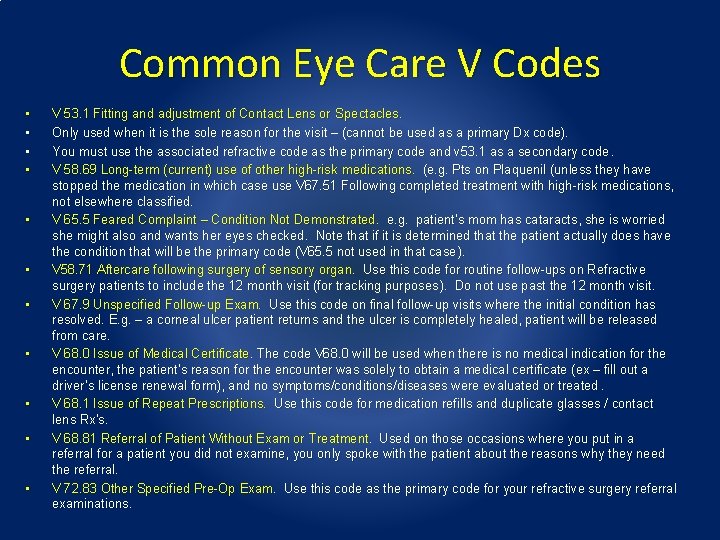
Common Eye Care V Codes • • • V 53. 1 Fitting and adjustment of Contact Lens or Spectacles. Only used when it is the sole reason for the visit – (cannot be used as a primary Dx code). You must use the associated refractive code as the primary code and v 53. 1 as a secondary code. V 58. 69 Long-term (current) use of other high-risk medications. (e. g. Pts on Plaquenil (unless they have stopped the medication in which case use V 67. 51 Following completed treatment with high-risk medications, not elsewhere classified. V 65. 5 Feared Complaint – Condition Not Demonstrated. e. g. patient’s mom has cataracts, she is worried she might also and wants her eyes checked. Note that if it is determined that the patient actually does have the condition that will be the primary code (V 65. 5 not used in that case ). V 58. 71 Aftercare following surgery of sensory organ. Use this code for routine follow-ups on Refractive surgery patients to include the 12 month visit (for tracking purposes ). Do not use past the 12 month visit. V 67. 9 Unspecified Follow-up Exam. Use this code on final follow-up visits where the initial condition has resolved. E. g. – a corneal ulcer patient returns and the ulcer is completely healed, patient will be released from care. V 68. 0 Issue of Medical Certificate. The code V 68. 0 will be used when there is no medical indication for the encounter, the patient’s reason for the encounter was solely to obtain a medical certificate (ex – fill out a driver’s license renewal form), and no symptoms/conditions/diseases were evaluated or treated. V 68. 1 Issue of Repeat Prescriptions. Use this code for medication refills and duplicate glasses / contact lens Rx’s. V 68. 81 Referral of Patient Without Exam or Treatment. Used on those occasions where you put in a referral for a patient you did not examine, you only spoke with the patient about the reasons why they need the referral. V 72. 83 Other Specified Pre-Op Exam. Use this code as the primary code for your refractive surgery referral examinations.
Question 30 • Question: In CPRS, in the encounter section, the names and available codes are sometimes at odds or missing entirely. Why is this? • Answer: This is a national code set that is rolled out to each center regularly and cannot be modified locally. You can still enter in codes manually for those that are not listed. Common ones missing should be addressed to the national staff.
Question 31 • Question: Can interpretation of a VF/OCT/etc. be completed on printout (if using paper) or does this need to be completed in CPRS? • Answer: It is best to complete this in CPRS because this is what the coders will see to verify the care provided.
Summary • This module covers most general issues and highlights regarding ICD 9, CPT and V Coding. • There are many more details covering this topic in the ICD 9 manuals which are too lengthy for this brief synopsis please refer to the manuals for specifics, especially if you have a complex coding case. • All facilities also have coders with the manuals or someone who can help you determine the right code(s) to use. • Additionally, refer to the references/links for additional help.
References: • http: //www. icd 9 data. com/Data. Files/ • http: //www. cms. gov/Medicare/Coding/ICD 9 P rovider. Diagnostic. Codes/codes. html
- Slides: 98