
Chapter 5 Section 2 5 2 Integer Exponents

- Slides: 17
Chapter 5 Section 2
5. 2 Integer Exponents and the Quotient Rule Objectives 1 Use 0 as an exponent. 2 Use negative numbers as exponents. 3 Use the quotient rule for exponents. 4 Use combinations of rules. Copyright © 2012, 2008, 2004 Pearson Education, Inc.
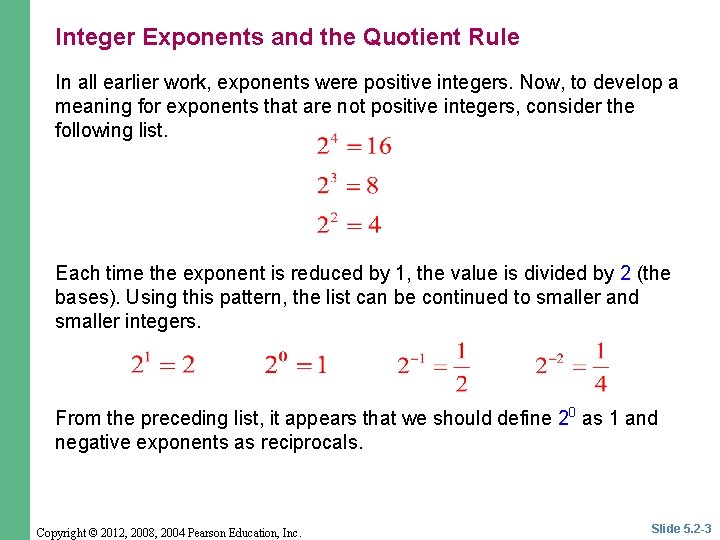
Integer Exponents and the Quotient Rule In all earlier work, exponents were positive integers. Now, to develop a meaning for exponents that are not positive integers, consider the following list. Each time the exponent is reduced by 1, the value is divided by 2 (the bases). Using this pattern, the list can be continued to smaller and smaller integers. From the preceding list, it appears that we should define 20 as 1 and negative exponents as reciprocals. Copyright © 2012, 2008, 2004 Pearson Education, Inc. Slide 5. 2 -3
Objective 1 Use 0 as an exponent. Copyright © 2012, 2008, 2004 Pearson Education, Inc. Slide 5. 2 -4
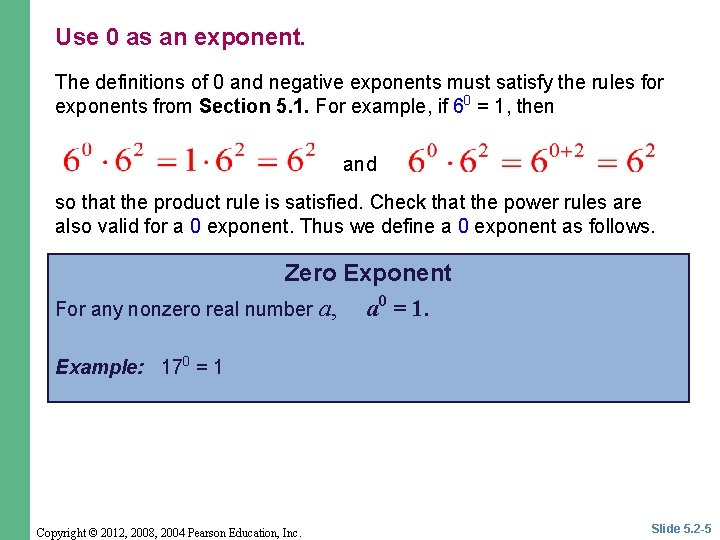
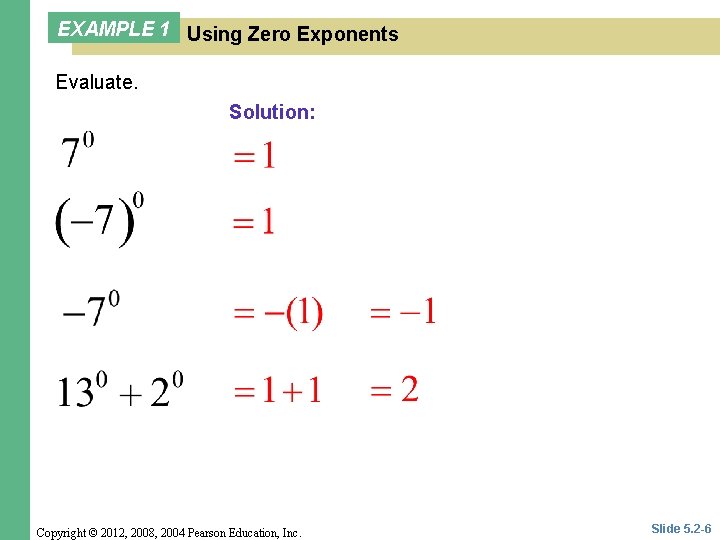
Use 0 as an exponent. The definitions of 0 and negative exponents must satisfy the rules for exponents from Section 5. 1. For example, if 60 = 1, then and so that the product rule is satisfied. Check that the power rules are also valid for a 0 exponent. Thus we define a 0 exponent as follows. Zero Exponent For any nonzero real number a, a 0 = 1. Example: 170 = 1 Copyright © 2012, 2008, 2004 Pearson Education, Inc. Slide 5. 2 -5
EXAMPLE 1 Using Zero Exponents Evaluate. Solution: Copyright © 2012, 2008, 2004 Pearson Education, Inc. Slide 5. 2 -6
Objective 2 Use negative numbers as exponents. Copyright © 2012, 2008, 2004 Pearson Education, Inc. Slide 5. 2 -7
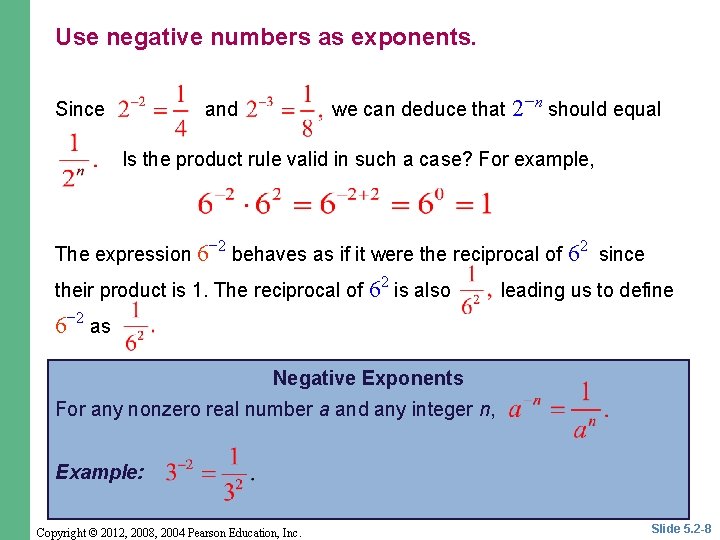
Use negative numbers as exponents. Since and we can deduce that 2−n should equal Is the product rule valid in such a case? For example, The expression 6− 2 behaves as if it were the reciprocal of 62 since their product is 1. The reciprocal of 62 is also leading us to define 6− 2 as Negative Exponents For any nonzero real number a and any integer n, Example: Copyright © 2012, 2008, 2004 Pearson Education, Inc. Slide 5. 2 -8
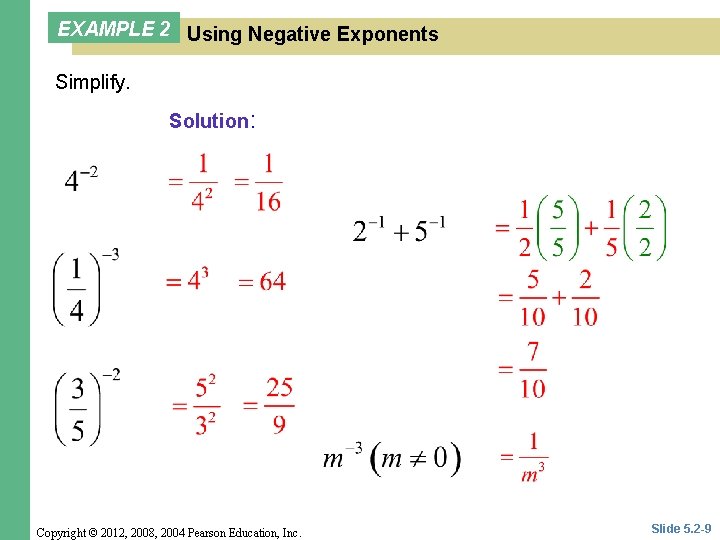
EXAMPLE 2 Using Negative Exponents Simplify. Solution: Copyright © 2012, 2008, 2004 Pearson Education, Inc. Slide 5. 2 -9
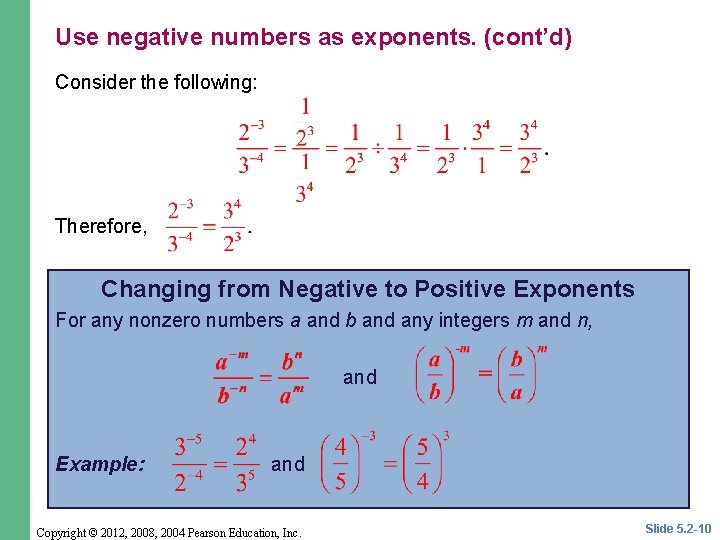
Use negative numbers as exponents. (cont’d) Consider the following: Therefore, Changing from Negative to Positive Exponents For any nonzero numbers a and b and any integers m and n, and Example: and Copyright © 2012, 2008, 2004 Pearson Education, Inc. Slide 5. 2 -10
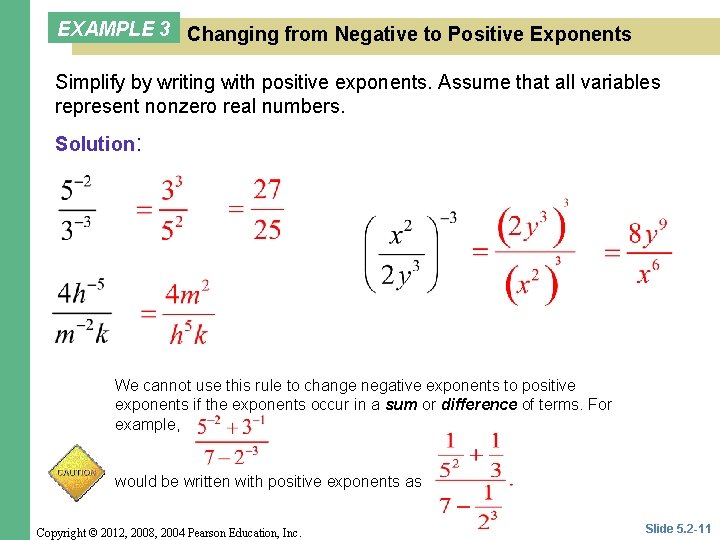
EXAMPLE 3 Changing from Negative to Positive Exponents Simplify by writing with positive exponents. Assume that all variables represent nonzero real numbers. Solution: We cannot use this rule to change negative exponents to positive exponents if the exponents occur in a sum or difference of terms. For example, would be written with positive exponents as Copyright © 2012, 2008, 2004 Pearson Education, Inc. Slide 5. 2 -11
Objective 3 Use the quotient rule for exponents. Copyright © 2012, 2008, 2004 Pearson Education, Inc. Slide 5. 2 -12
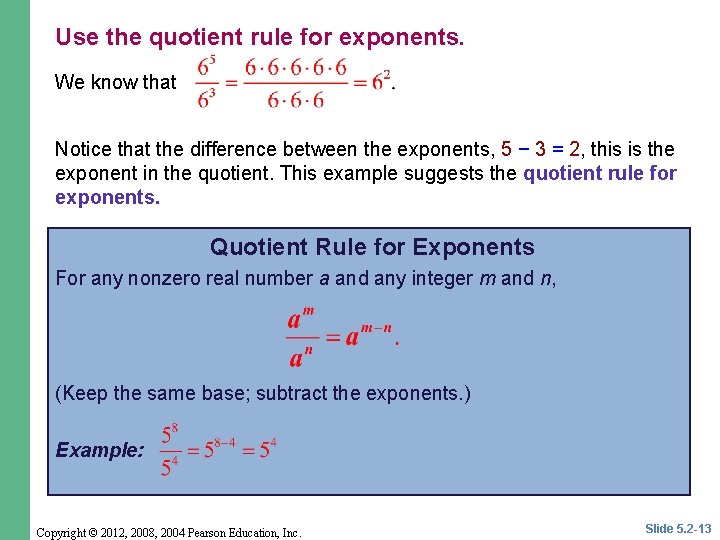
Use the quotient rule for exponents. We know that Notice that the difference between the exponents, 5 − 3 = 2, this is the exponent in the quotient. This example suggests the quotient rule for exponents. Quotient Rule for Exponents For any nonzero real number a and any integer m and n, (Keep the same base; subtract the exponents. ) Example: Copyright © 2012, 2008, 2004 Pearson Education, Inc. Slide 5. 2 -13
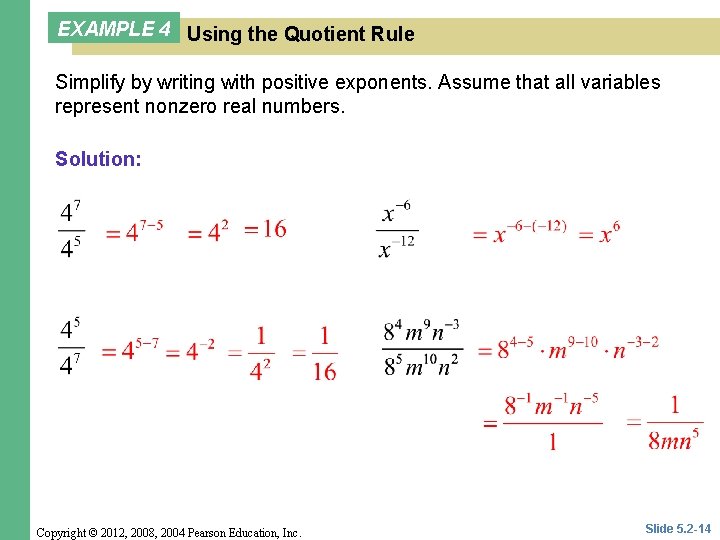
EXAMPLE 4 Using the Quotient Rule Simplify by writing with positive exponents. Assume that all variables represent nonzero real numbers. Solution: Copyright © 2012, 2008, 2004 Pearson Education, Inc. Slide 5. 2 -14
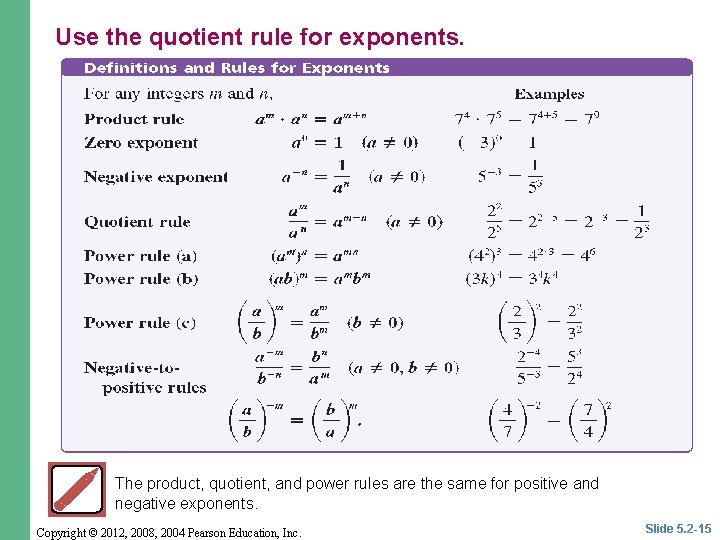
Use the quotient rule for exponents. The product, quotient, and power rules are the same for positive and negative exponents. Copyright © 2012, 2008, 2004 Pearson Education, Inc. Slide 5. 2 -15
Objective 4 Use combinations of rules. Copyright © 2012, 2008, 2004 Pearson Education, Inc. Slide 5. 2 -16
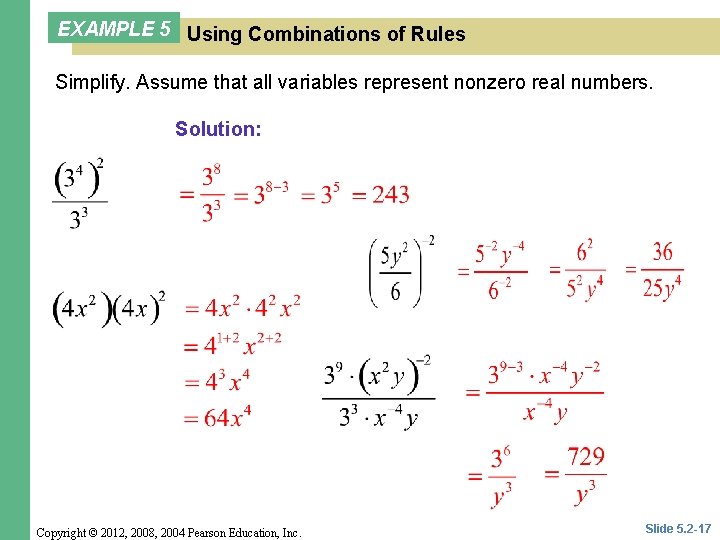
EXAMPLE 5 Using Combinations of Rules Simplify. Assume that all variables represent nonzero real numbers. Solution: Copyright © 2012, 2008, 2004 Pearson Education, Inc. Slide 5. 2 -17