
PA 193 Secure coding principles and practices Language
- Slides: 69
PA 193 - Secure coding principles and practices Language level vulnerabilities: Buffer overflow, type overflow, strings Petr Švenda svenda@fi. muni. cz
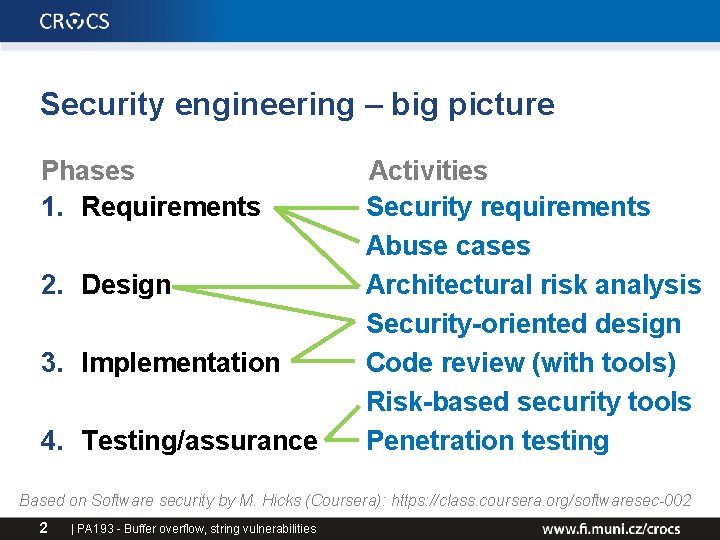
Security engineering – big picture Phases 1. Requirements 2. Design 3. Implementation 4. Testing/assurance Activities Security requirements Abuse cases Architectural risk analysis Security-oriented design Code review (with tools) Risk-based security tools Penetration testing Based on Software security by M. Hicks (Coursera): https: //class. coursera. org/softwaresec-002 2 | PA 193 - Buffer overflow, string vulnerabilities
Overview • Lecture: problems, prevention – – buffer overflow (stack/heap/type) string formatting problems compiler protection platform protections (DEP, ASLR) • Labs – compiler flags, buffer overflow exercises 3 | PA 193 - Buffer overflow, string vulnerabilities
PROBLEM? 4 | PA 193 - Buffer overflow, string vulnerabilities
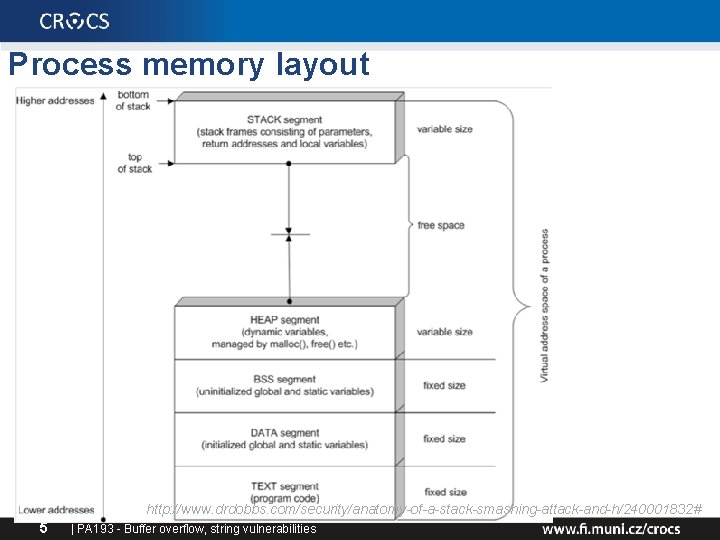
Process memory layout http: //www. drdobbs. com/security/anatomy-of-a-stack-smashing-attack-and-h/240001832# 5 | PA 193 - Buffer overflow, string vulnerabilities
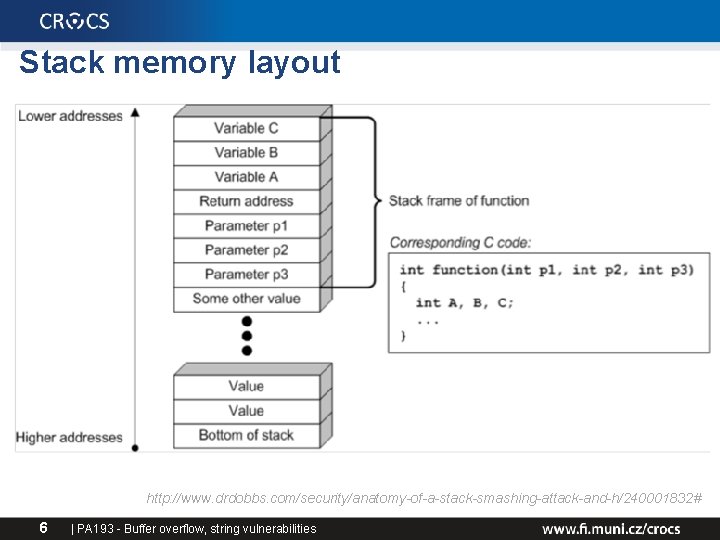
Stack memory layout http: //www. drdobbs. com/security/anatomy-of-a-stack-smashing-attack-and-h/240001832# 6 | PA 193 - Buffer overflow, string vulnerabilities
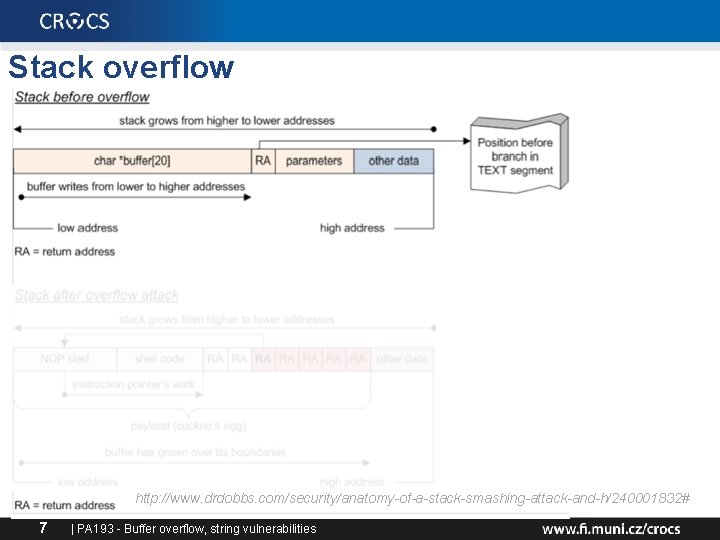
Stack overflow http: //www. drdobbs. com/security/anatomy-of-a-stack-smashing-attack-and-h/240001832# 7 | PA 193 - Buffer overflow, string vulnerabilities
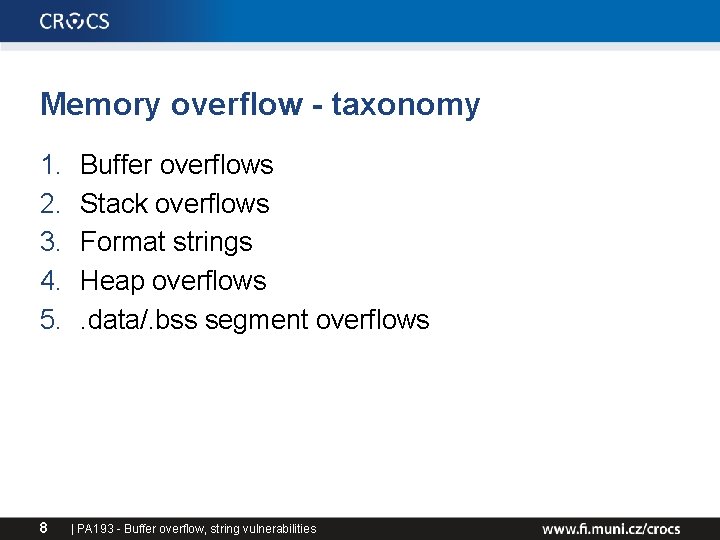
Memory overflow - taxonomy 1. 2. 3. 4. 5. 8 Buffer overflows Stack overflows Format strings Heap overflows. data/. bss segment overflows | PA 193 - Buffer overflow, string vulnerabilities
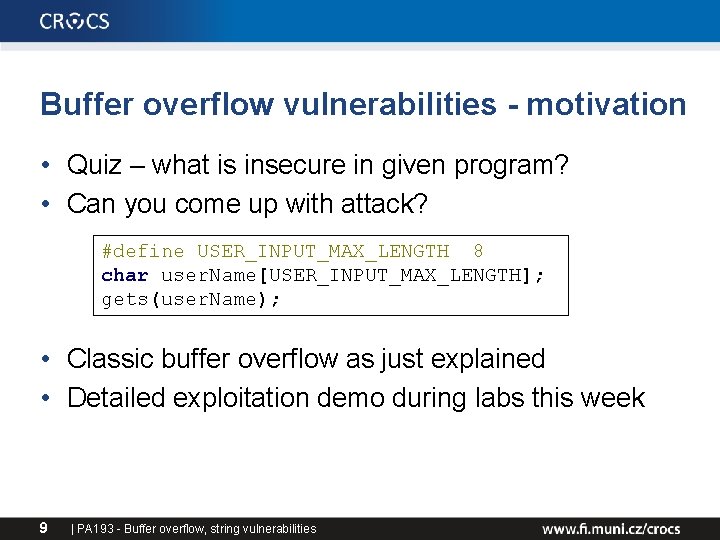
Buffer overflow vulnerabilities - motivation • Quiz – what is insecure in given program? • Can you come up with attack? #define USER_INPUT_MAX_LENGTH 8 char user. Name[USER_INPUT_MAX_LENGTH]; gets(user. Name); • Classic buffer overflow as just explained • Detailed exploitation demo during labs this week 9 | PA 193 - Buffer overflow, string vulnerabilities
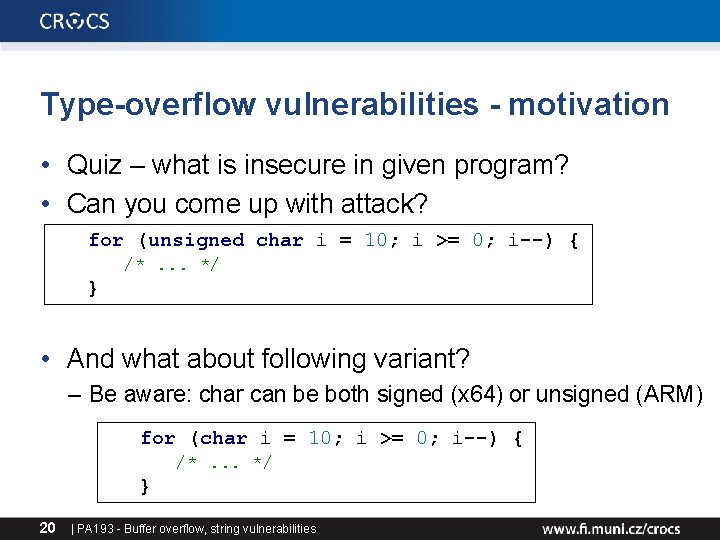
Type-overflow vulnerabilities - motivation • Quiz – what is insecure in given program? • Can you come up with attack? for (unsigned char i = 10; i >= 0; i--) { /*. . . */ } • And what about following variant? – Be aware: char can be both signed (x 64) or unsigned (ARM) for (char i = 10; i >= 0; i--) { /*. . . */ } 20 | PA 193 - Buffer overflow, string vulnerabilities
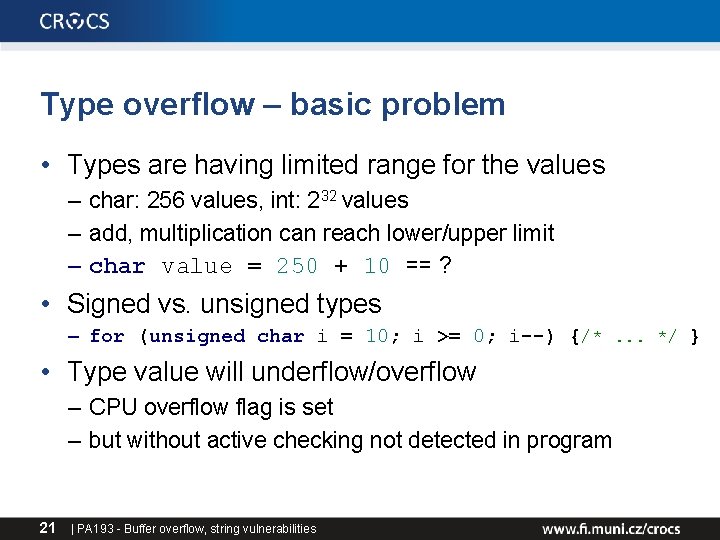
Type overflow – basic problem • Types are having limited range for the values – char: 256 values, int: 232 values – add, multiplication can reach lower/upper limit – char value = 250 + 10 == ? • Signed vs. unsigned types – for (unsigned char i = 10; i >= 0; i--) {/*. . . */ } • Type value will underflow/overflow – CPU overflow flag is set – but without active checking not detected in program 21 | PA 193 - Buffer overflow, string vulnerabilities
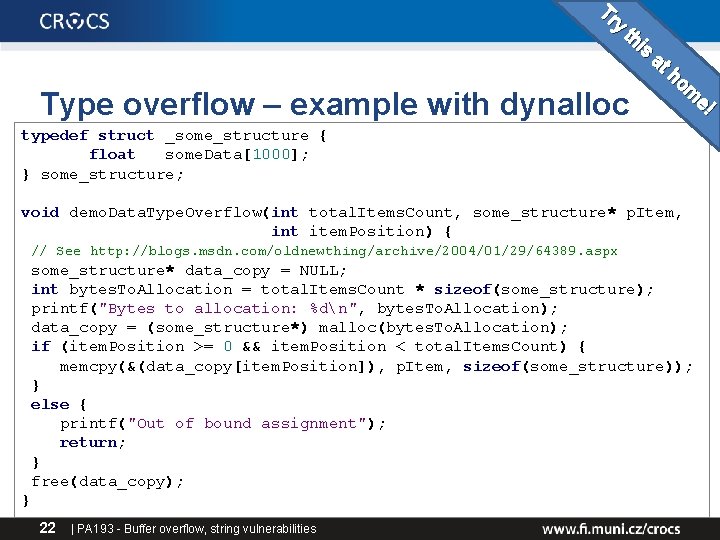
Tr y th is at h om e! Type overflow – example with dynalloc typedef struct _some_structure { float some. Data[1000]; } some_structure; void demo. Data. Type. Overflow(int total. Items. Count, some_structure* p. Item, int item. Position) { // See http: //blogs. msdn. com/oldnewthing/archive/2004/01/29/64389. aspx some_structure* data_copy = NULL; int bytes. To. Allocation = total. Items. Count * sizeof(some_structure); printf("Bytes to allocation: %dn", bytes. To. Allocation); data_copy = (some_structure*) malloc(bytes. To. Allocation); if (item. Position >= 0 && item. Position < total. Items. Count) { memcpy(&(data_copy[item. Position]), p. Item, sizeof(some_structure)); } else { printf("Out of bound assignment"); return; } free(data_copy); } 22 | PA 193 - Buffer overflow, string vulnerabilities
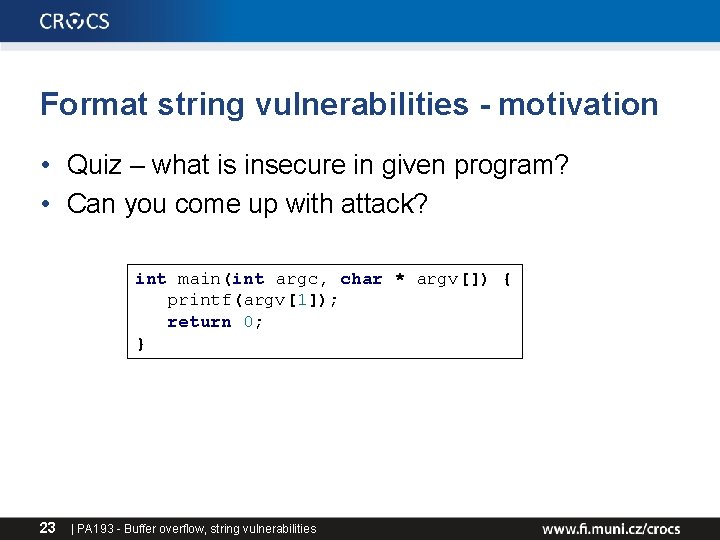
Format string vulnerabilities - motivation • Quiz – what is insecure in given program? • Can you come up with attack? int main(int argc, char * argv[]) { printf(argv[1]); return 0; } 23 | PA 193 - Buffer overflow, string vulnerabilities
Format string vulnerabilities • Wide class of functions accepting format string – – printf(“%s”, X); resulting string is returned to user (= attacker) formatting string can be under attackers control variables formatted into string can be controlled • Resulting vulnerability – memory content from stack is formatted into string – possibly any memory if attacker control buffer pointer 24 | PA 193 - Buffer overflow, string vulnerabilities
Information disclosure vulnerabilities • Exploitable memory vulnerability leading to read access (not write access) – attacker learns some information from the memory • Direct exploitation – secret information (cryptographic key, password. . . ) • Precursor for next step (very important with DEP&ASRL) – module version – current memory layout after ASRL (stack/heap pointers) – stack protection cookies (/GS) 25 | PA 193 - Buffer overflow, string vulnerabilities
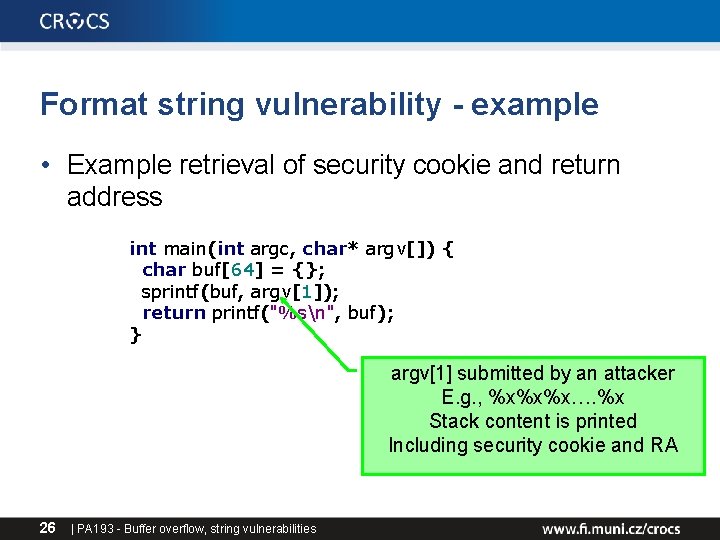
Format string vulnerability - example • Example retrieval of security cookie and return address int main(int argc, char* argv[]) { char buf[64] = {}; sprintf(buf, argv[1]); return printf("%sn", buf); } argv[1] submitted by an attacker E. g. , %x%x%x…. %x Stack content is printed Including security cookie and RA 26 | PA 193 - Buffer overflow, string vulnerabilities
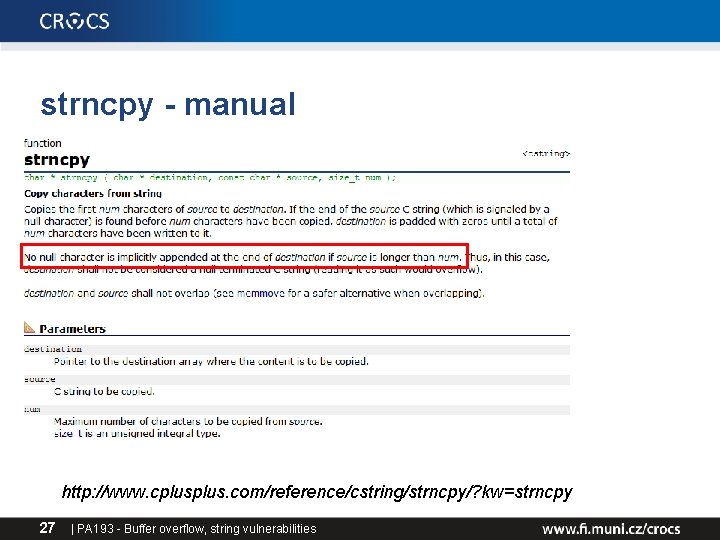
strncpy - manual http: //www. cplus. com/reference/cstring/strncpy/? kw=strncpy 27 | PA 193 - Buffer overflow, string vulnerabilities
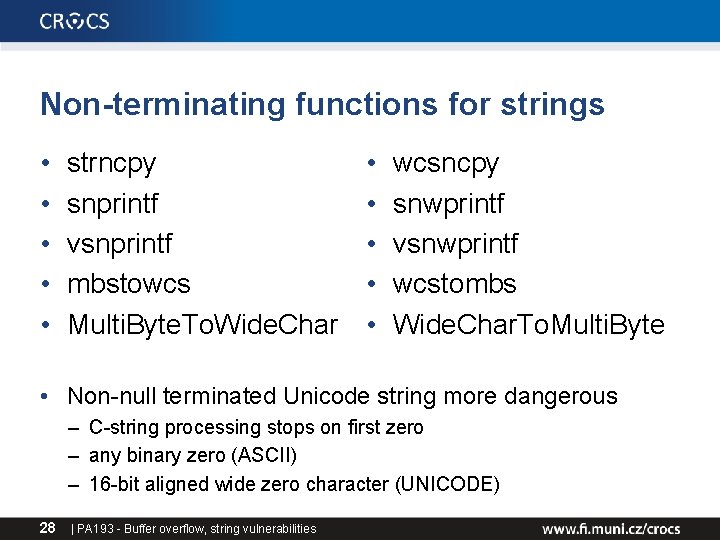
Non-terminating functions for strings • • • strncpy snprintf vsnprintf mbstowcs Multi. Byte. To. Wide. Char • • • wcsncpy snwprintf vsnwprintf wcstombs Wide. Char. To. Multi. Byte • Non-null terminated Unicode string more dangerous – C-string processing stops on first zero – any binary zero (ASCII) – 16 -bit aligned wide zero character (UNICODE) 28 | PA 193 - Buffer overflow, string vulnerabilities
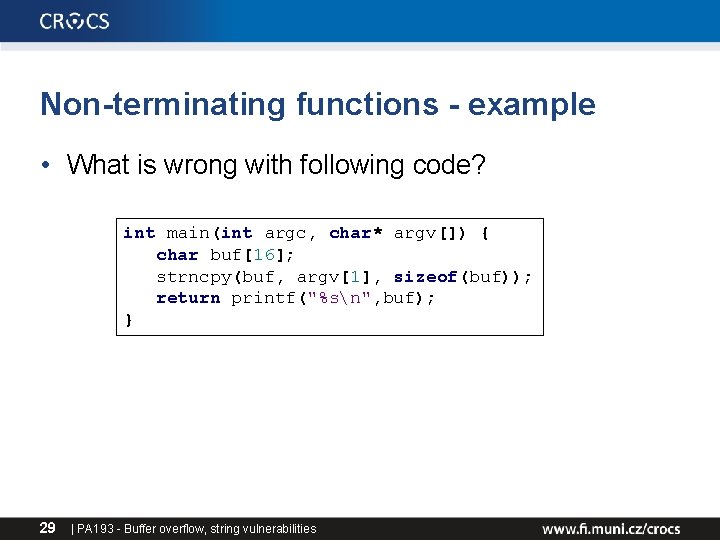
Non-terminating functions - example • What is wrong with following code? int main(int argc, char* argv[]) { char buf[16]; strncpy(buf, argv[1], sizeof(buf)); return printf("%sn", buf); } 29 | PA 193 - Buffer overflow, string vulnerabilities
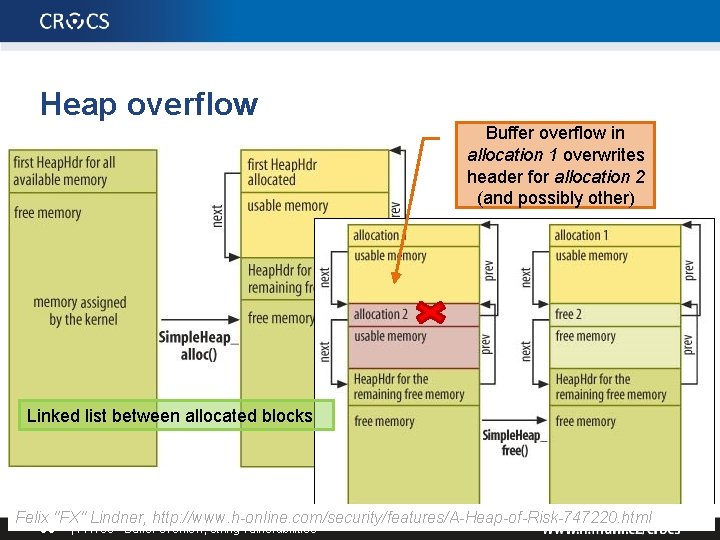
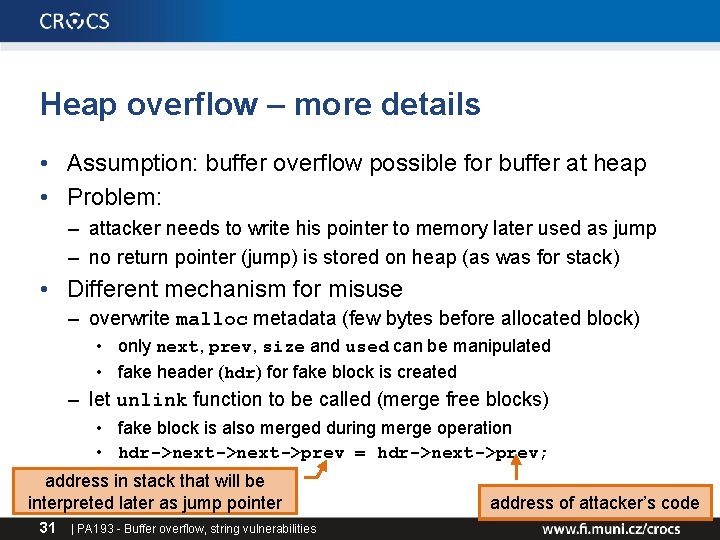
Heap overflow Buffer overflow in allocation 1 overwrites header for allocation 2 (and possibly other) Linked list between allocated blocks Felix "FX" Lindner, http: //www. h-online. com/security/features/A-Heap-of-Risk-747220. html 30 | PA 193 - Buffer overflow, string vulnerabilities
Heap overflow – more details • Assumption: buffer overflow possible for buffer at heap • Problem: – attacker needs to write his pointer to memory later used as jump – no return pointer (jump) is stored on heap (as was for stack) • Different mechanism for misuse – overwrite malloc metadata (few bytes before allocated block) • only next, prev, size and used can be manipulated • fake header (hdr) for fake block is created – let unlink function to be called (merge free blocks) • fake block is also merged during merge operation • hdr->next->prev = hdr->next->prev; address in stack that will be interpreted later as jump pointer 31 | PA 193 - Buffer overflow, string vulnerabilities address of attacker’s code
SOURCE CODE PREVENTION 32 | PA 193 - Buffer overflow, string vulnerabilities
How to detect and prevent problems? 1. Protection on the source code level – languages with/without implicit protection • containers/languages with array boundary checking – usage of safe alternatives to vulnerable function (this lecture) • vulnerable and safe functions for string manipulations – proper input checking – automatic detection by static and dynamic checkers – security testing, fuzzing 2. Protection by compiler (+ compiler flags) (this lecture) – runtime checks introduced by compiler (stack protection) 3. Protection by execution environment (this lecture) – DEP, ASRL. . . 33 | PA 193 - Buffer overflow, string vulnerabilities
How to write code securely (w. r. t. BO) I. • • • Be aware of possibilities and principles Never trust user’s input, always check defensively Use safe versions of string/memory functions Always provide a format string argument Use self-resizing strings (C++ std: : string) • Use automatic bounds checking if possible – C++ std: : vector. at(i)instead of vector[i] 34 | PA 193 - Buffer overflow, string vulnerabilities
How to write code securely (w. r. t. BO) II. • • 35 Run application with lowest possible privileges Let your code to be reviewed Use compiler-added protection Use protection offered by platform (privileges, DEP, ASRL, sandboxing. . . ) | PA 193 - Buffer overflow, string vulnerabilities
Secure C library • Secure versions of commonly misused functions – bounds checking for string handling functions – better error handling • Also added to new C standard ISO/IEC 9899: 2011 • Microsoft Security-Enhanced Versions of CRT Functions – MSVC compiler issue warning C 4996, more functions then in C 11 • Secure C Library – – 36 http: //docwiki. embarcadero. com/RADStudio/XE 3/en/Secure_C_Library http: //msdn. microsoft. com/en-us/library/8 ef 0 s 5 kh%28 v=vs. 80%29. aspx http: //msdn. microsoft. com/en-us/library/wd 3 wzwts%28 v=vs. 80%29. aspx http: //www. drdobbs. com/cpp/the-new-c-standard-explored/232901670 | PA 193 - Buffer overflow, string vulnerabilities
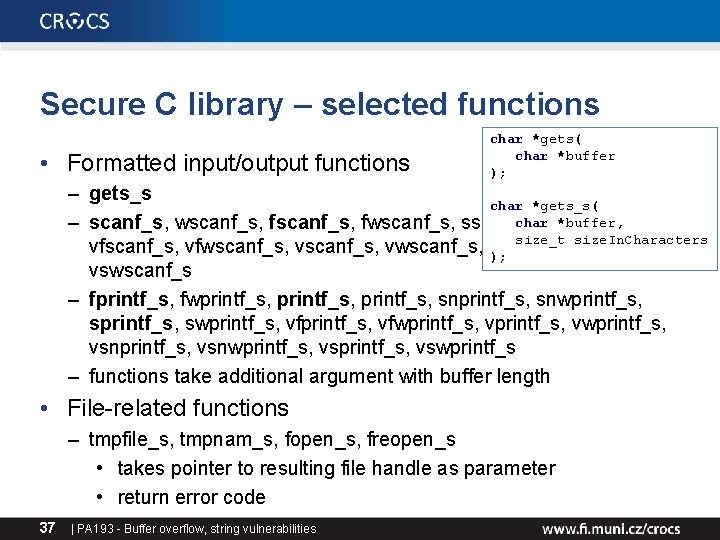
Secure C library – selected functions • Formatted input/output functions char *gets( char *buffer ); – gets_s char *gets_s( char *buffer, – scanf_s, wscanf_s, fwscanf_s, swscanf_s, size_t size. In. Characters vfscanf_s, vfwscanf_s, vwscanf_s, vsscanf_s, ); vswscanf_s – fprintf_s, fwprintf_s, snwprintf_s, sprintf_s, swprintf_s, vfwprintf_s, vwprintf_s, vsnprintf_s, vsnwprintf_s, vswprintf_s – functions take additional argument with buffer length • File-related functions – tmpfile_s, tmpnam_s, fopen_s, freopen_s • takes pointer to resulting file handle as parameter • return error code 37 | PA 193 - Buffer overflow, string vulnerabilities
Secure C library – selected functions • Environment, utilities – getenv_s, wgetenv_s – bsearch_s, qsort_s • Memory copy functions – memcpy_s, memmove_s, strcpy_s, wcscpy_s, strncpy_s, wcsncpy_s • Concatenation functions – strcat_s, wcscat_s, strncat_s, wcsncat_s • Search functions – strtok_s, wcstok_s • Time manipulation functions. . . 38 | PA 193 - Buffer overflow, string vulnerabilities
CERT C/C++ Coding Standard • CERT C Coding Standard – https: //www. securecoding. cert. org/confluence/display/seccode/CE RT+C+Coding+Standard • CERT C++ Coding Standard – https: //www. securecoding. cert. org/confluence/pages/viewpage. acti on? page. Id=637 • Cern secure coding recommendation for C – https: //security. web. cern. ch/security/recommendations/en/codetool s/c. shtml • Smashing the stack in 2011 – https: //paulmakowski. wordpress. com/2011/01/25/smashing-thestack-in-2011/ 39 | PA 193 - Buffer overflow, string vulnerabilities
COMPILER PREVENTIONS 40 | PA 193 - Buffer overflow, string vulnerabilities
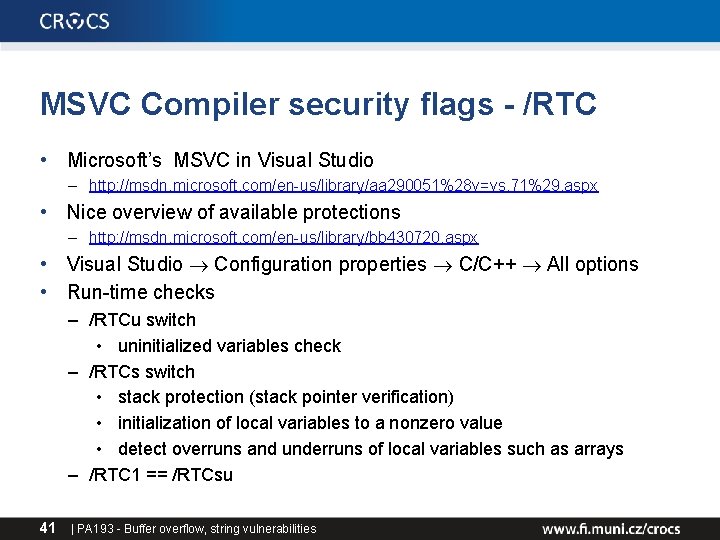
MSVC Compiler security flags - /RTC • Microsoft’s MSVC in Visual Studio – http: //msdn. microsoft. com/en-us/library/aa 290051%28 v=vs. 71%29. aspx • Nice overview of available protections – http: //msdn. microsoft. com/en-us/library/bb 430720. aspx • Visual Studio Configuration properties C/C++ All options • Run-time checks – /RTCu switch • uninitialized variables check – /RTCs switch • stack protection (stack pointer verification) • initialization of local variables to a nonzero value • detect overruns and underruns of local variables such as arrays – /RTC 1 == /RTCsu 41 | PA 193 - Buffer overflow, string vulnerabilities
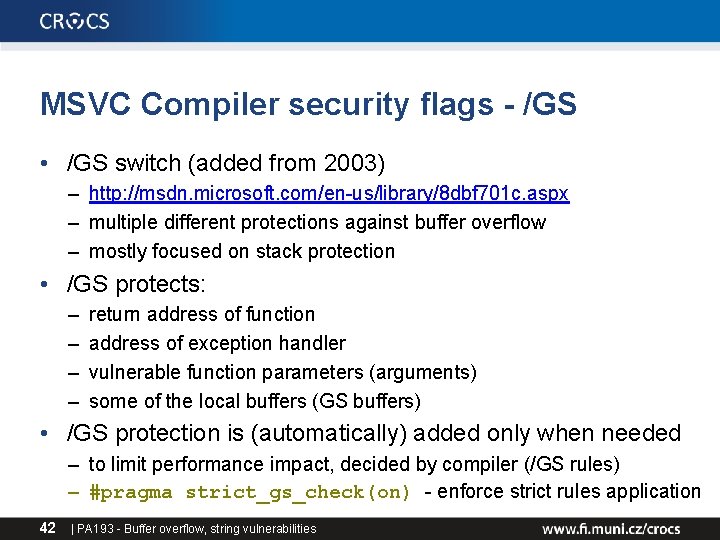
MSVC Compiler security flags - /GS • /GS switch (added from 2003) – http: //msdn. microsoft. com/en-us/library/8 dbf 701 c. aspx – multiple different protections against buffer overflow – mostly focused on stack protection • /GS protects: – – return address of function address of exception handler vulnerable function parameters (arguments) some of the local buffers (GS buffers) • /GS protection is (automatically) added only when needed – to limit performance impact, decided by compiler (/GS rules) – #pragma strict_gs_check(on) - enforce strict rules application 42 | PA 193 - Buffer overflow, string vulnerabilities
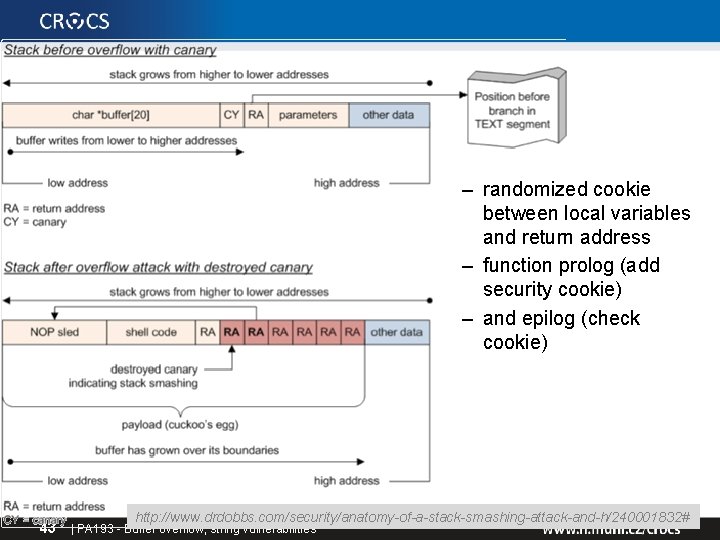
– randomized cookie between local variables and return address – function prolog (add security cookie) – and epilog (check cookie) 43 http: //www. drdobbs. com/security/anatomy-of-a-stack-smashing-attack-and-h/240001832# | PA 193 - Buffer overflow, string vulnerabilities
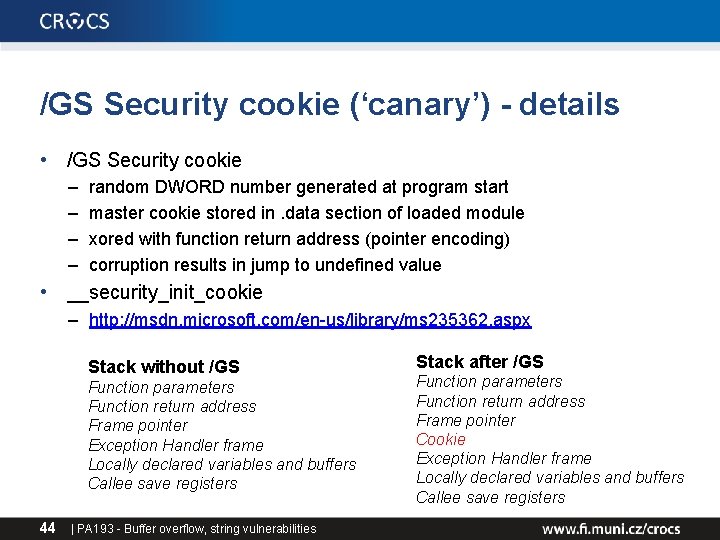
/GS Security cookie (‘canary’) - details • /GS Security cookie – – random DWORD number generated at program start master cookie stored in. data section of loaded module xored with function return address (pointer encoding) corruption results in jump to undefined value • __security_init_cookie – http: //msdn. microsoft. com/en-us/library/ms 235362. aspx Stack without /GS Function parameters Function return address Frame pointer Exception Handler frame Locally declared variables and buffers Callee save registers 44 | PA 193 - Buffer overflow, string vulnerabilities Stack after /GS Function parameters Function return address Frame pointer Cookie Exception Handler frame Locally declared variables and buffers Callee save registers
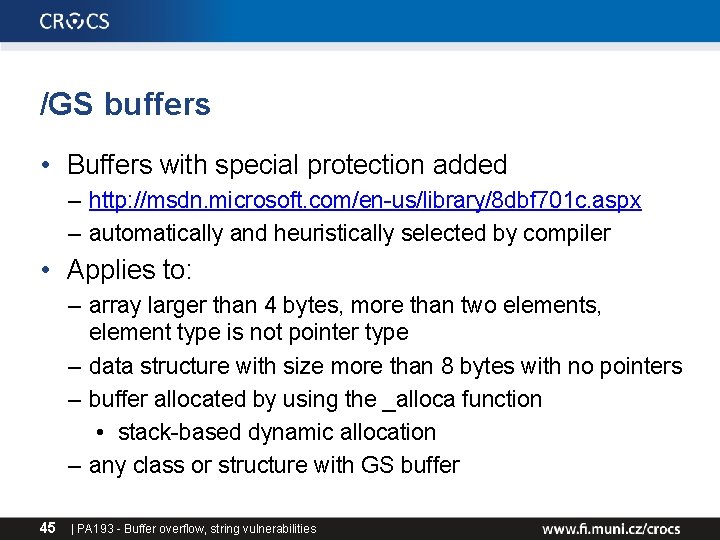
/GS buffers • Buffers with special protection added – http: //msdn. microsoft. com/en-us/library/8 dbf 701 c. aspx – automatically and heuristically selected by compiler • Applies to: – array larger than 4 bytes, more than two elements, element type is not pointer type – data structure with size more than 8 bytes with no pointers – buffer allocated by using the _alloca function • stack-based dynamic allocation – any class or structure with GS buffer 45 | PA 193 - Buffer overflow, string vulnerabilities
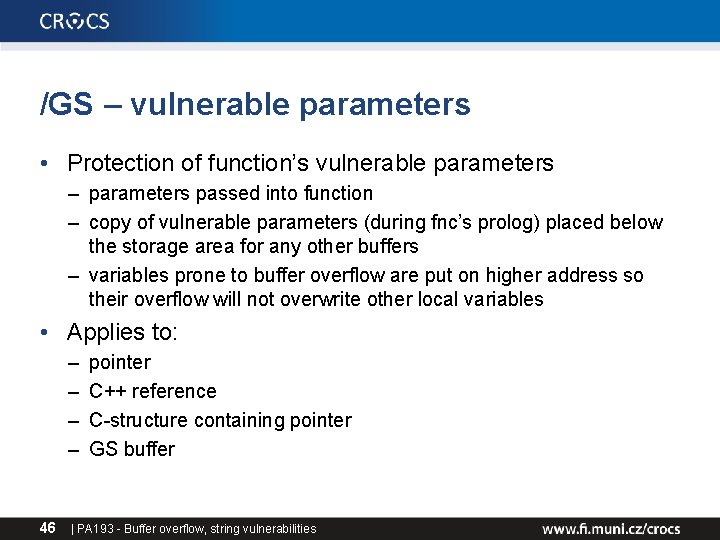
/GS – vulnerable parameters • Protection of function’s vulnerable parameters – parameters passed into function – copy of vulnerable parameters (during fnc’s prolog) placed below the storage area for any other buffers – variables prone to buffer overflow are put on higher address so their overflow will not overwrite other local variables • Applies to: – – 46 pointer C++ reference C-structure containing pointer GS buffer | PA 193 - Buffer overflow, string vulnerabilities
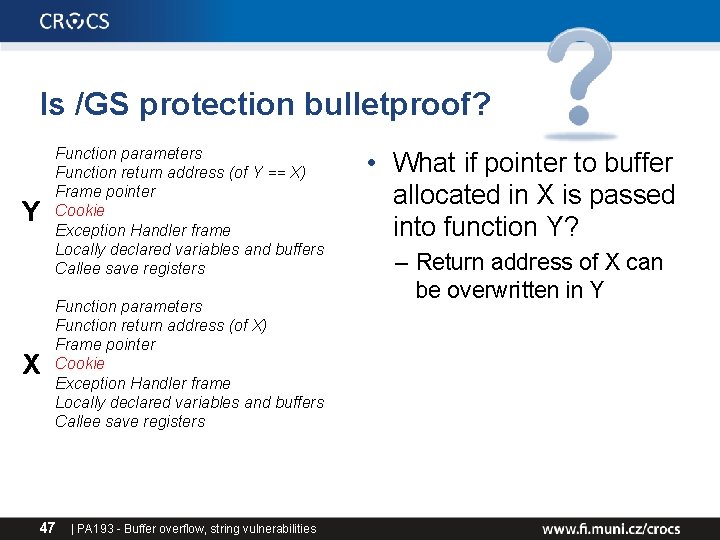
Is /GS protection bulletproof? Y X Function parameters Function return address (of Y == X) Frame pointer Cookie Exception Handler frame Locally declared variables and buffers Callee save registers Function parameters Function return address (of X) Frame pointer Cookie Exception Handler frame Locally declared variables and buffers Callee save registers 47 | PA 193 - Buffer overflow, string vulnerabilities • What if pointer to buffer allocated in X is passed into function Y? – Return address of X can be overwritten in Y
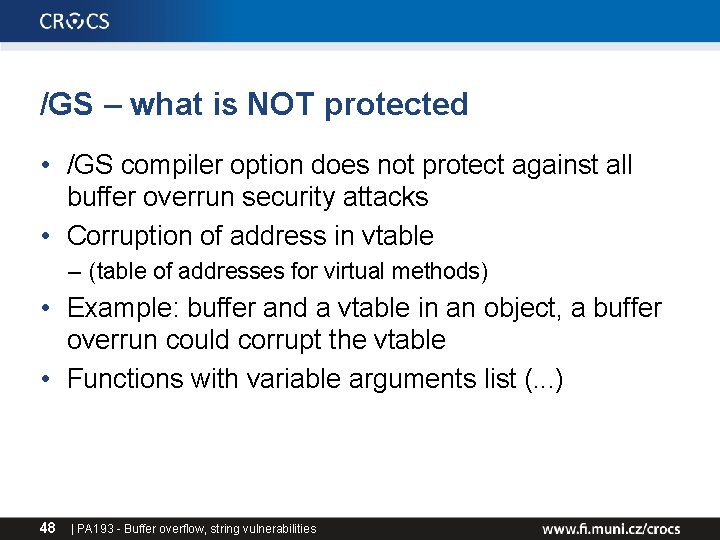
/GS – what is NOT protected • /GS compiler option does not protect against all buffer overrun security attacks • Corruption of address in vtable – (table of addresses for virtual methods) • Example: buffer and a vtable in an object, a buffer overrun could corrupt the vtable • Functions with variable arguments list (. . . ) 48 | PA 193 - Buffer overflow, string vulnerabilities
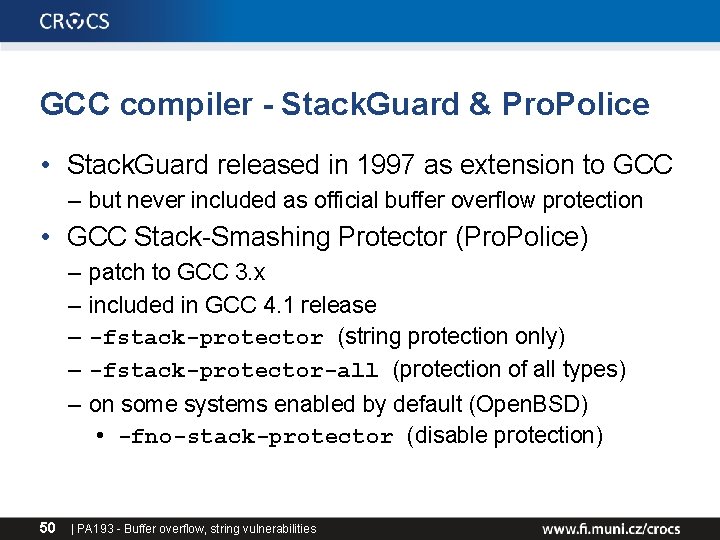
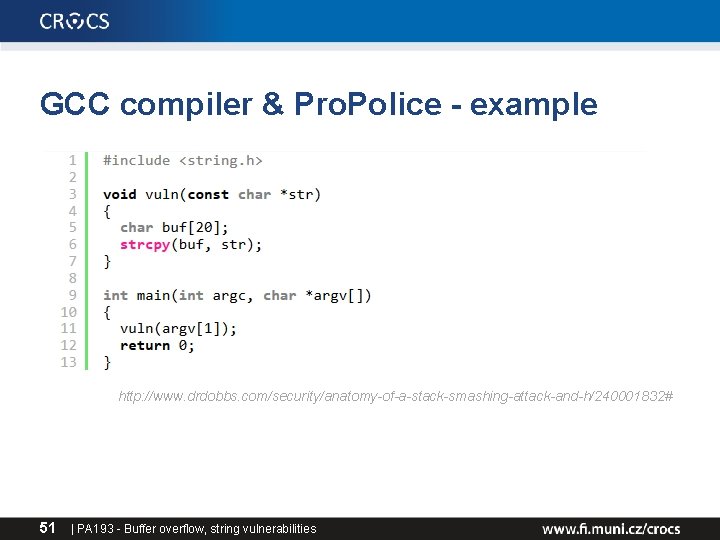
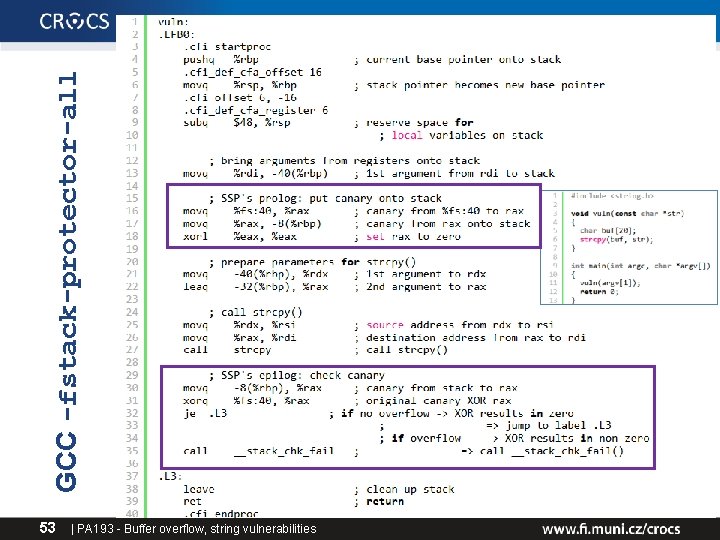
GCC compiler - Stack. Guard & Pro. Police • Stack. Guard released in 1997 as extension to GCC – but never included as official buffer overflow protection • GCC Stack-Smashing Protector (Pro. Police) – – – 50 patch to GCC 3. x included in GCC 4. 1 release -fstack-protector (string protection only) -fstack-protector-all (protection of all types) on some systems enabled by default (Open. BSD) • -fno-stack-protector (disable protection) | PA 193 - Buffer overflow, string vulnerabilities
GCC compiler & Pro. Police - example http: //www. drdobbs. com/security/anatomy-of-a-stack-smashing-attack-and-h/240001832# 51 | PA 193 - Buffer overflow, string vulnerabilities
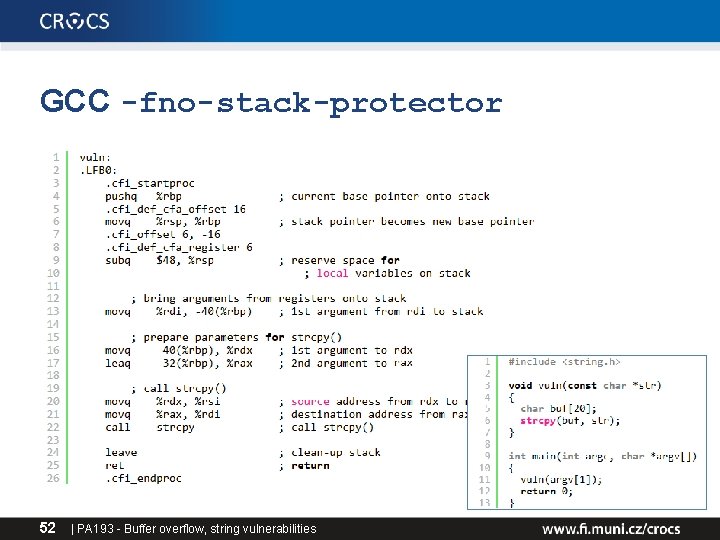
GCC -fno-stack-protector 52 | PA 193 - Buffer overflow, string vulnerabilities
GCC -fstack-protector-all 53 | PA 193 - Buffer overflow, string vulnerabilities
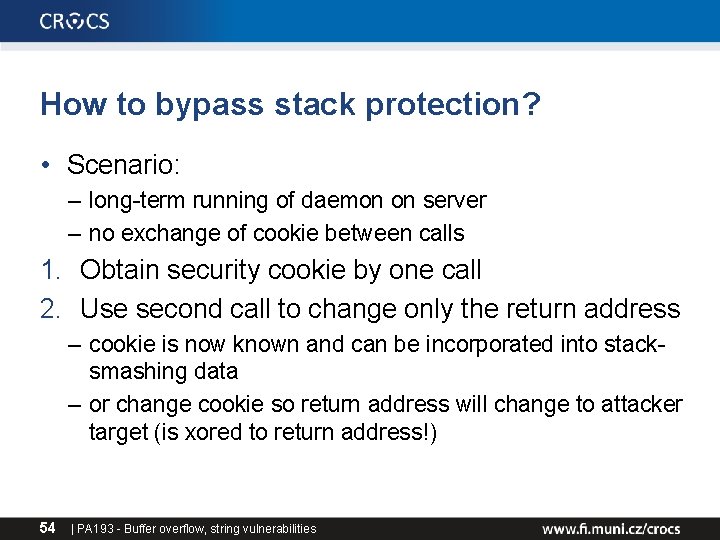
How to bypass stack protection? • Scenario: – long-term running of daemon on server – no exchange of cookie between calls 1. Obtain security cookie by one call 2. Use second call to change only the return address – cookie is now known and can be incorporated into stacksmashing data – or change cookie so return address will change to attacker target (is xored to return address!) 54 | PA 193 - Buffer overflow, string vulnerabilities
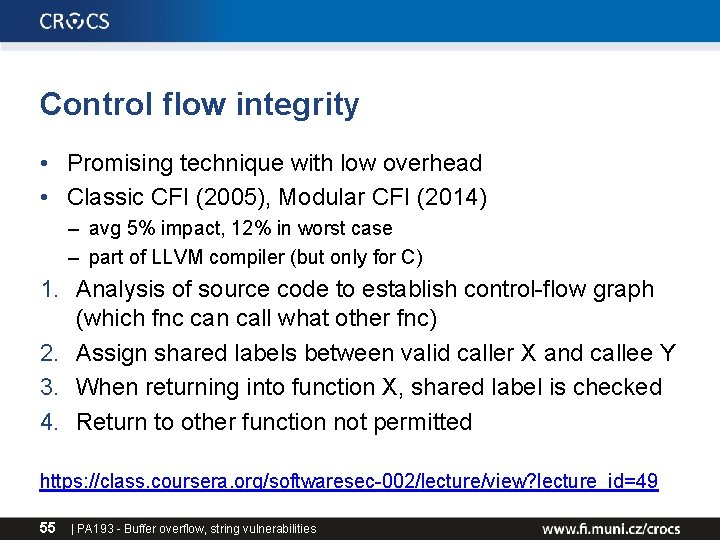
Control flow integrity • Promising technique with low overhead • Classic CFI (2005), Modular CFI (2014) – avg 5% impact, 12% in worst case – part of LLVM compiler (but only for C) 1. Analysis of source code to establish control-flow graph (which fnc can call what other fnc) 2. Assign shared labels between valid caller X and callee Y 3. When returning into function X, shared label is checked 4. Return to other function not permitted https: //class. coursera. org/softwaresec-002/lecture/view? lecture_id=49 55 | PA 193 - Buffer overflow, string vulnerabilities
PLATFORM PROTECTIONS 56 | PA 193 - Buffer overflow, string vulnerabilities
Data Execution Prevention (DEP) • Motto: When boundary between code and data blurs (buffer overflow, SQL injection…) then exploitation might be possible. • Data Execution Prevention (DEP) – prevents application to execute code from non-executable memory region – available in modern operating systems • Linux kernel > 2. 6. 8, Win. XP SP 2, Mac OS X, i. OS, Android – difference between ‘hardware’ and ‘software’ based DEP 57 | PA 193 - Buffer overflow, string vulnerabilities
Hardware DEP • Supported from AMD 64 and Intel Pentium 4 – OS must add support of this feature (around 2004) • CPU marks memory page as non-executable – most significant bit (63 th) in page table entry (NX bit) – 0 == execute, 1 == data-only (non-executable) • Protection typically against buffer overflows • Cannot protect against all attacks! – e. g. , code compiled at runtime (produced by JIT compiler) must have both instructions and data in executable page – attacker redirect execution to generated code (JIT spray) – used to bypass Adobe PDF and Flash security features 58 | PA 193 - Buffer overflow, string vulnerabilities
Software DEP • Unrelated to NX bit (no CPU support required) • When exception is raised, OS checks if exception handling routine pointer is in executable area – Microsoft’s Safe Structured Exception Handling • Software DEP is not preventing general execution in non-executable pages – different form of protection than hardware DEP 59 | PA 193 - Buffer overflow, string vulnerabilities
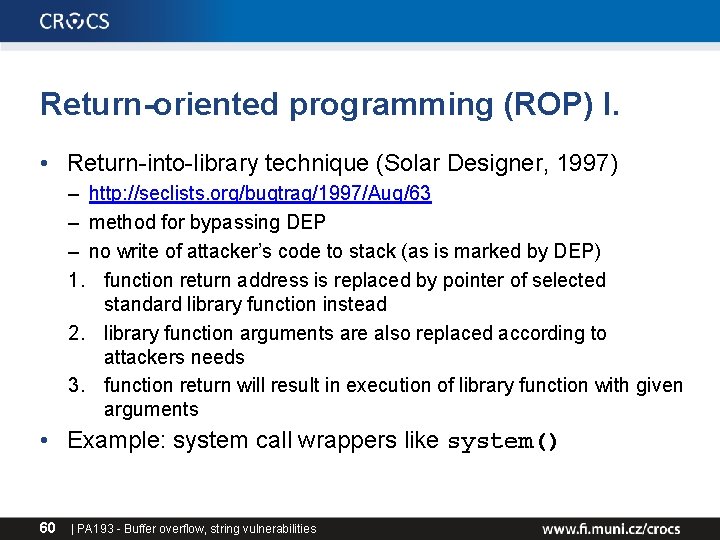
Return-oriented programming (ROP) I. • Return-into-library technique (Solar Designer, 1997) – http: //seclists. org/bugtraq/1997/Aug/63 – method for bypassing DEP – no write of attacker’s code to stack (as is marked by DEP) 1. function return address is replaced by pointer of selected standard library function instead 2. library function arguments are also replaced according to attackers needs 3. function return will result in execution of library function with given arguments • Example: system call wrappers like system() 60 | PA 193 - Buffer overflow, string vulnerabilities
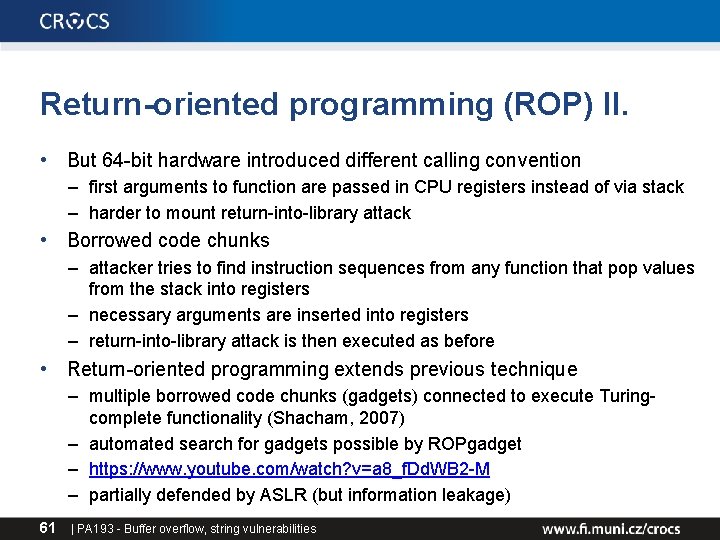
Return-oriented programming (ROP) II. • But 64 -bit hardware introduced different calling convention – first arguments to function are passed in CPU registers instead of via stack – harder to mount return-into-library attack • Borrowed code chunks – attacker tries to find instruction sequences from any function that pop values from the stack into registers – necessary arguments are inserted into registers – return-into-library attack is then executed as before • Return-oriented programming extends previous technique – multiple borrowed code chunks (gadgets) connected to execute Turingcomplete functionality (Shacham, 2007) – automated search for gadgets possible by ROPgadget – https: //www. youtube. com/watch? v=a 8_f. Dd. WB 2 -M – partially defended by ASLR (but information leakage) 61 | PA 193 - Buffer overflow, string vulnerabilities
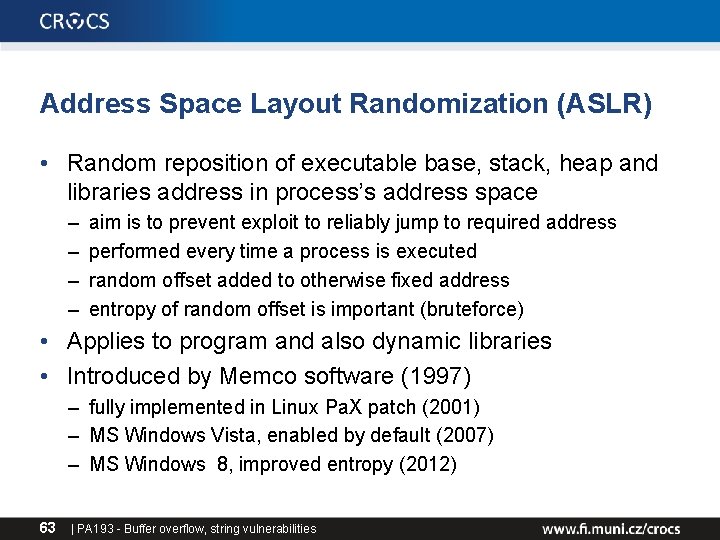
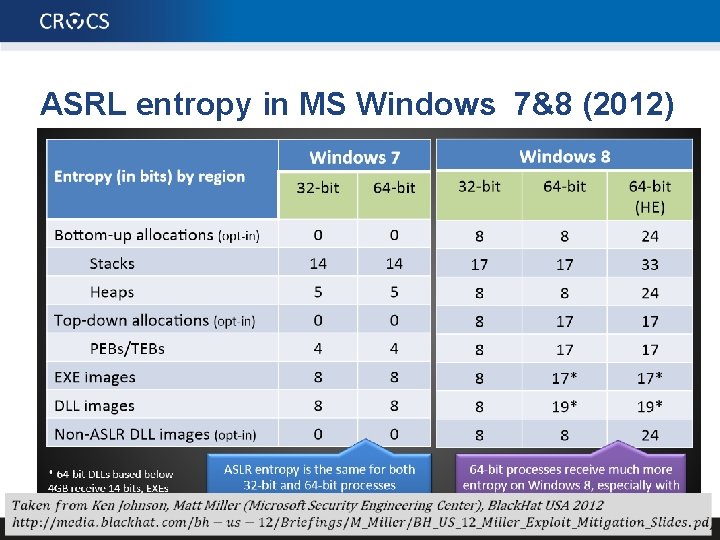
Address Space Layout Randomization (ASLR) • Random reposition of executable base, stack, heap and libraries address in process’s address space – – aim is to prevent exploit to reliably jump to required address performed every time a process is executed random offset added to otherwise fixed address entropy of random offset is important (bruteforce) • Applies to program and also dynamic libraries • Introduced by Memco software (1997) – fully implemented in Linux Pa. X patch (2001) – MS Windows Vista, enabled by default (2007) – MS Windows 8, improved entropy (2012) 63 | PA 193 - Buffer overflow, string vulnerabilities
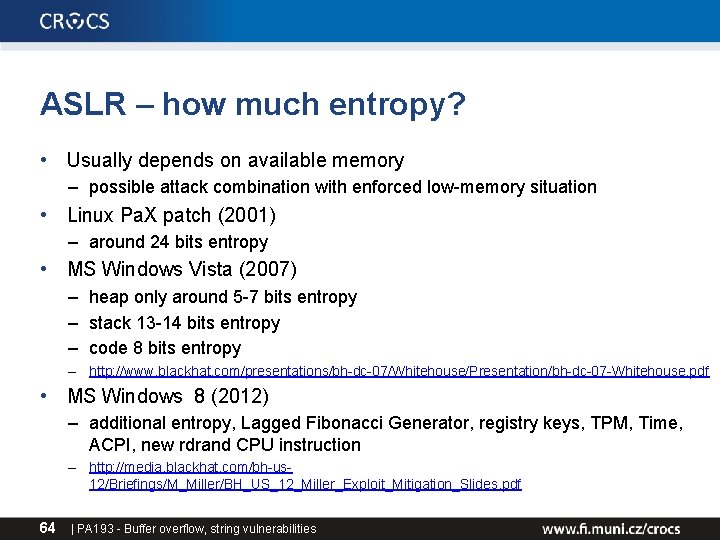
ASLR – how much entropy? • Usually depends on available memory – possible attack combination with enforced low-memory situation • Linux Pa. X patch (2001) – around 24 bits entropy • MS Windows Vista (2007) – heap only around 5 -7 bits entropy – stack 13 -14 bits entropy – code 8 bits entropy – http: //www. blackhat. com/presentations/bh-dc-07/Whitehouse/Presentation/bh-dc-07 -Whitehouse. pdf • MS Windows 8 (2012) – additional entropy, Lagged Fibonacci Generator, registry keys, TPM, Time, ACPI, new rdrand CPU instruction – http: //media. blackhat. com/bh-us 12/Briefings/M_Miller/BH_US_12_Miller_Exploit_Mitigation_Slides. pdf 64 | PA 193 - Buffer overflow, string vulnerabilities
ASRL entropy in MS Windows 7&8 (2012) 65 | PA 193 - Buffer overflow, string vulnerabilities
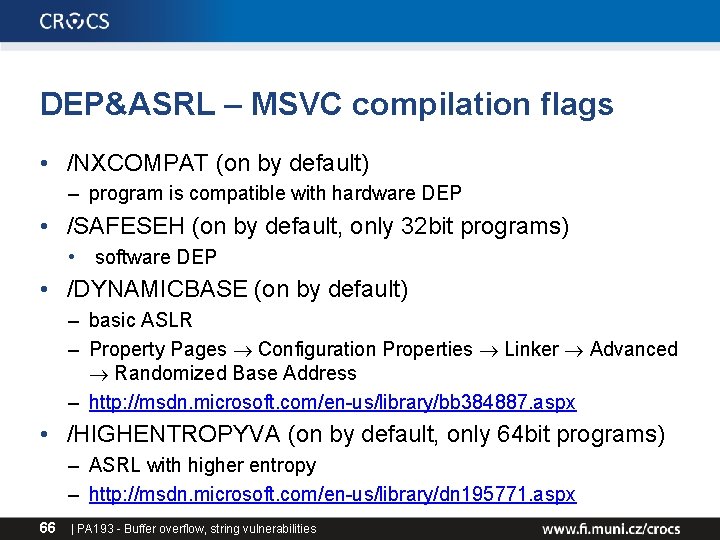
DEP&ASRL – MSVC compilation flags • /NXCOMPAT (on by default) – program is compatible with hardware DEP • /SAFESEH (on by default, only 32 bit programs) • software DEP • /DYNAMICBASE (on by default) – basic ASLR – Property Pages Configuration Properties Linker Advanced Randomized Base Address – http: //msdn. microsoft. com/en-us/library/bb 384887. aspx • /HIGHENTROPYVA (on by default, only 64 bit programs) – ASRL with higher entropy – http: //msdn. microsoft. com/en-us/library/dn 195771. aspx 66 | PA 193 - Buffer overflow, string vulnerabilities
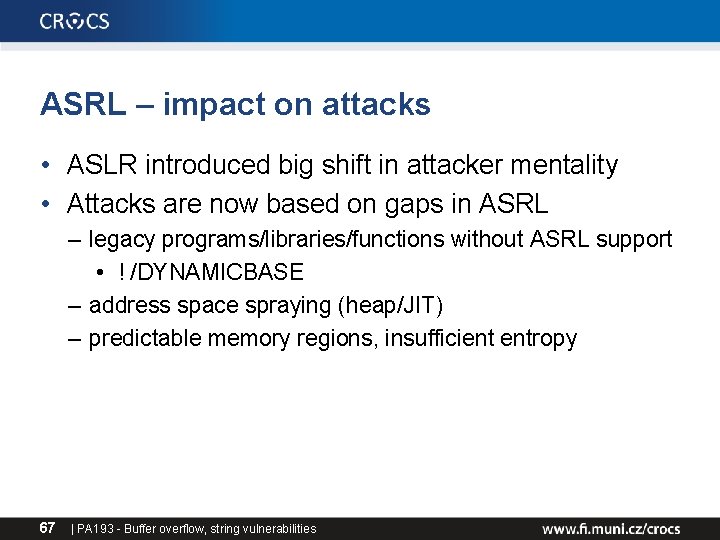
ASRL – impact on attacks • ASLR introduced big shift in attacker mentality • Attacks are now based on gaps in ASRL – legacy programs/libraries/functions without ASRL support • ! /DYNAMICBASE – address space spraying (heap/JIT) – predictable memory regions, insufficient entropy 67 | PA 193 - Buffer overflow, string vulnerabilities
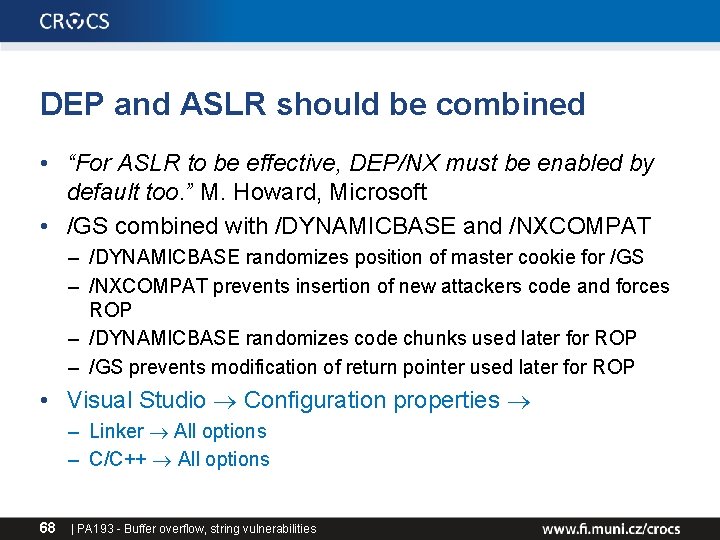
DEP and ASLR should be combined • “For ASLR to be effective, DEP/NX must be enabled by default too. ” M. Howard, Microsoft • /GS combined with /DYNAMICBASE and /NXCOMPAT – /DYNAMICBASE randomizes position of master cookie for /GS – /NXCOMPAT prevents insertion of new attackers code and forces ROP – /DYNAMICBASE randomizes code chunks used later for ROP – /GS prevents modification of return pointer used later for ROP • Visual Studio Configuration properties – Linker All options – C/C++ All options 68 | PA 193 - Buffer overflow, string vulnerabilities
SUMMARY 69 | PA 193 - Buffer overflow, string vulnerabilities
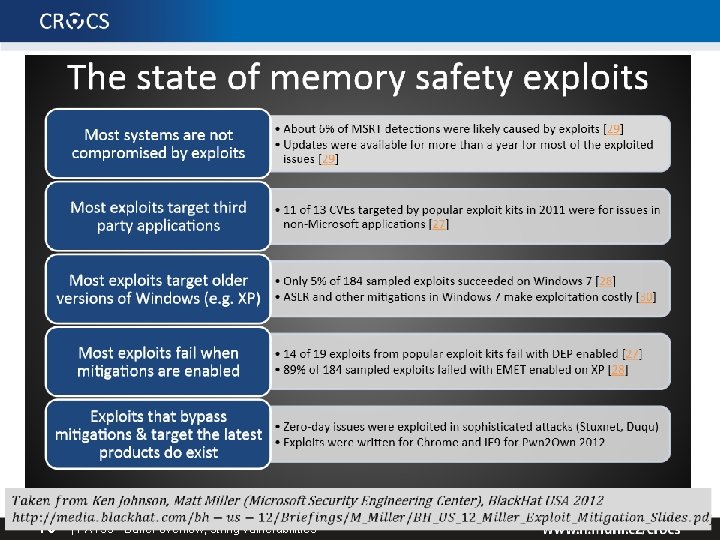
70 | PA 193 - Buffer overflow, string vulnerabilities
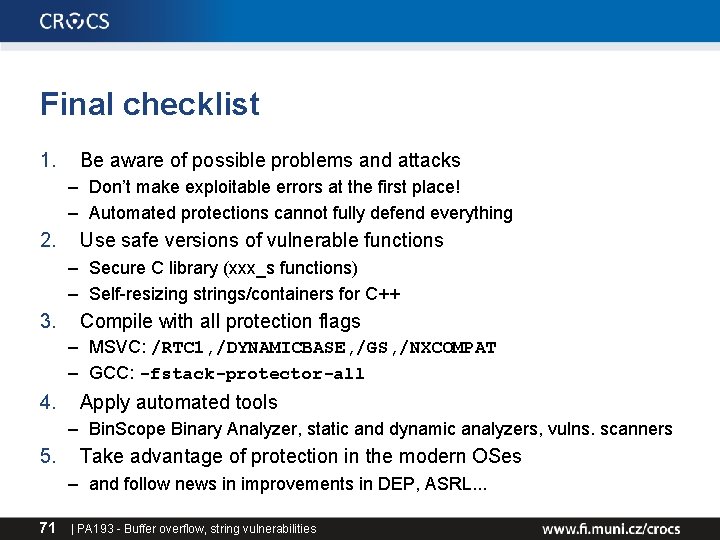
Final checklist 1. Be aware of possible problems and attacks – Don’t make exploitable errors at the first place! – Automated protections cannot fully defend everything 2. Use safe versions of vulnerable functions – Secure C library (xxx_s functions) – Self-resizing strings/containers for C++ 3. Compile with all protection flags – MSVC: /RTC 1, /DYNAMICBASE, /GS, /NXCOMPAT – GCC: -fstack-protector-all 4. Apply automated tools – Bin. Scope Binary Analyzer, static and dynamic analyzers, vulns. scanners 5. Take advantage of protection in the modern OSes – and follow news in improvements in DEP, ASRL. . . 71 | PA 193 - Buffer overflow, string vulnerabilities
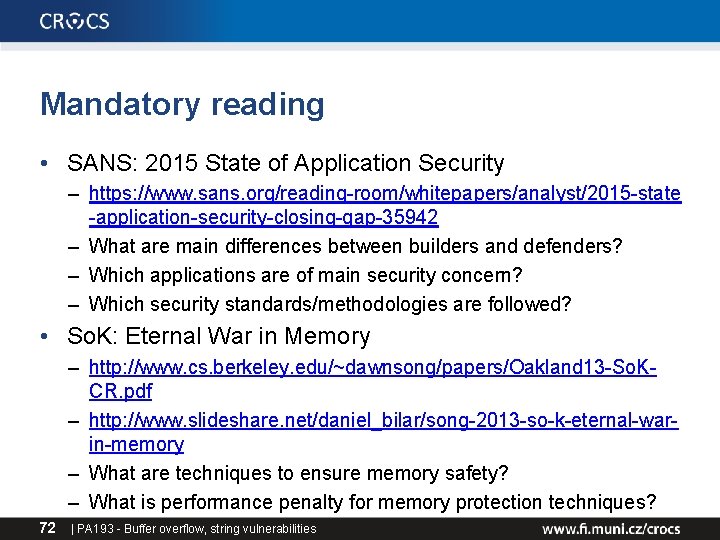
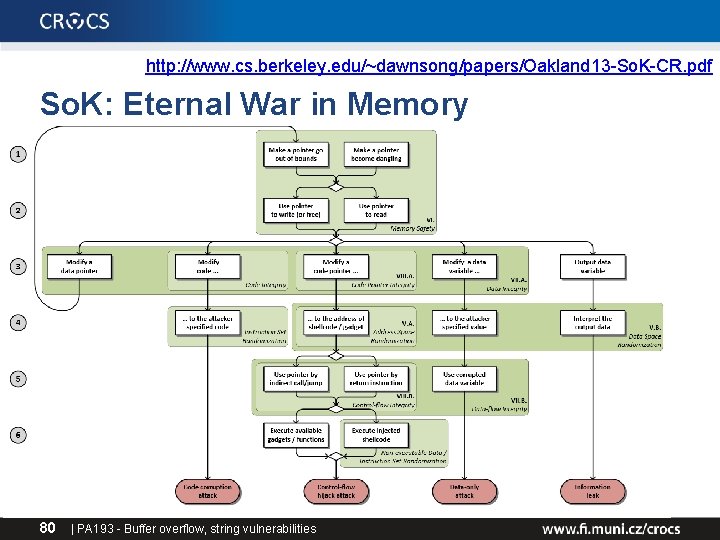
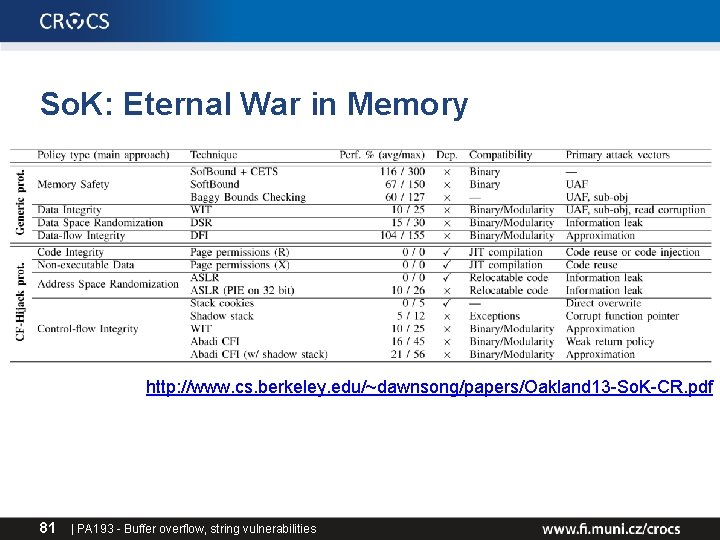
Mandatory reading • SANS: 2015 State of Application Security – https: //www. sans. org/reading-room/whitepapers/analyst/2015 -state -application-security-closing-gap-35942 – What are main differences between builders and defenders? – Which applications are of main security concern? – Which security standards/methodologies are followed? • So. K: Eternal War in Memory – http: //www. cs. berkeley. edu/~dawnsong/papers/Oakland 13 -So. KCR. pdf – http: //www. slideshare. net/daniel_bilar/song-2013 -so-k-eternal-warin-memory – What are techniques to ensure memory safety? – What is performance penalty for memory protection techniques? 72 | PA 193 - Buffer overflow, string vulnerabilities
Questions 73 | PA 193 - Buffer overflow, string vulnerabilities
74 | PA 193 - Buffer overflow, string
Additional reading • Compiler Security Checks In Depth (MS) – http: //msdn. microsoft. com/en-us/library/aa 290051%28 v=vs. 71%29. aspx • GS cookie effectiveness (MS) – http: //blogs. technet. com/b/srd/archive/2009/03/16/gs-cookie-protectioneffectiveness-and-limitations. aspx • Design Your Program for Security – http: //www. dwheeler. com/secure-programs/Secure-Programs-HOWTO/internals. html • Smashing The Stack For Fun And Profit – http: //www-inst. cs. berkeley. edu/~cs 161/fa 08/papers/stack_smashing. pdf • Practical return oriented programming – http: //365. rsaconference. com/servlet/Jive. Servlet/preview. Body/2573 -102 -1 -3232/RR-304. pdf 75 | PA 193 - Buffer overflow, string vulnerabilities
Books - optional • Writing secure code, chap. 5 • Security Development Lifecycle, chap. 11 • Embedded Systems Security, D. , M. Kleidermacher 76 | PA 193 - Buffer overflow, string vulnerabilities
Tutorials - optional • Buffer Overflow Exploitation Megaprimer (Linux) – http: //www. securitytube. net/groups? operation=view&group. Id=4 • Tenouk Buffer Overflow tutorial (Linux) – http: //www. tenouk. com/Bufferoverflowc/bufferoverflowvulexploitde mo. html • Format string vulnerabilities primer (Linux) – http: //www. securitytube. net/groups? operation=view&group. Id=3 • Buffer overflow in Easy RM to MP 3 utility (Windows) – https: //www. corelan. be/index. php/2009/07/19/exploit-writing-tutorial -part-1 -stack-based-overflows/ 77 | PA 193 - Buffer overflow, string vulnerabilities
Heap overflow - references • Detailed explanation (Felix "FX" Lindner, 2006) – http: //www. h-online. com/security/features/A-Heap-of-Risk 747161. html? view=print • Explanation in Phrack magazine (blackngel, 2009) – http: //www. phrack. org/issues. html? issue=66&id=10#article • Defeating heap protection (Alexander Anisimov) – http: //www. ptsecurity. com/download/defeating-xpsp 2 -heapprotection. pdf • Diehard – drop-in replacement for malloc with memory randomization – http: //plasma. cs. umass. edu/emery/diehard. html – https: //github. com/emeryberger/Die. Hard 78 | PA 193 - Buffer overflow, string vulnerabilities
ROP - references • Explanation of ROP – https: //www. usenix. org/legacy/event/sec 11/tech/full_paper s/Schwartz. pdf • Blind ROP – Return-oriented programming without source code – http: //www. scs. stanford. edu/brop/ • Automatic search for ROP gadgets – https: //github. com/0 vercl 0 k/rp 79 | PA 193 - Buffer overflow, string vulnerabilities
http: //www. cs. berkeley. edu/~dawnsong/papers/Oakland 13 -So. K-CR. pdf So. K: Eternal War in Memory 80 | PA 193 - Buffer overflow, string vulnerabilities
So. K: Eternal War in Memory http: //www. cs. berkeley. edu/~dawnsong/papers/Oakland 13 -So. K-CR. pdf 81 | PA 193 - Buffer overflow, string vulnerabilities