
2 3 4 History of qualitative research Qualitative

















































































- Slides: 101
2
3
4
History of qualitative research Qualitative research was one of the first forms of social studies but in the 1950 s and 1960 s - as quantitative science reached its peak of popularity – it was diminished in importance and began to regain recognition only in the 1970 s. Qualitative Research 6
History The phrase 'qualitative research' was until then restricted as a discipline of anthropology or sociology, and terms like ethnography, fieldwork, participant observation Qualitative Research 7
History During 1970 s and 1980 s qualitative research began to be used in other disciplines, and became a significant type of research in the fields of education social work women's studies, disability studies, information studies, management studies, nursing service studies, psychology, communication studies, and consumer products industry. Qualitative Research 8
History In the late 1980 s and 1990 s new methods of qualitative research evolved, to address the perceived problems with reliability and imprecise modes of data analysis. In the last thirty years the acceptance of qualitative research by journal publishers and editors has been growing. Qualitative Research 9
What is qualitative research? Any kind of research that produces findings not arrived at by means of statistical procedures or other means of quantification. " (Strauss & Corbin, 1990) To care for people and promote change in behavior, it is required to understand in-depth concepts such as experience, believes, motivations and intentions. So, listening and observing may give more information than sending questions. Qualitative Research 10
What is qualitative research? (cont. ) It is interactive, inductive, flexible, holistic and reflexive method of data collection and analysis. Qualitative Research 11
Distinctions from quantitative research 1. sampling is purposive. 2. The role of the researcher is key. Researchers must reflect on their role in the research process and make this clear in the analysis. 3. Data analysis differs considerably. 4. Researchers must carefully code data and discern themes in a consistent and reliable way. 5. Exploratory (i. e. , hypothesis-generating), Qualitative Research 17
Distinctions from quantitative research Qualitative research speaks to content validity -- Qualitative data cannot always be put into a context that can be graphed or displayed as a mathematical term. 8. Qualitative data may be useful to explain puzzling quantitative results, or may be used to generate additional variables to include in an analysis. 6. 7. Qualitative Research 18
Distinctions from quantitative research 9. Highly useful in policy and evaluation research, 10. Qualitative research can yield useful insights about program implementation Qualitative Research 19
Main features of Qualitative Research 1. 2. 3. 4. 5. Exploration Inductive approach Interactive and Reflective Holistic Flexible Qualitative Research 20
Main features of Qualitative Research ( cont. ) 1. Exploration is the essential feature of qualitative approach in order to understand the perceptions and actions of participants. Exploration is to discover new people, customs, and to learn from them. Exploration is a difficult task that requires training and experience. Qualitative Research 21
Main features of Qualitative Research ( cont. ) 2. Inductive approach: The purpose of qualitative approach is to develop concepts and generates hypothesis. The researcher is open to ideas which emerge from listening or observing people. The inductive approach is useful when little is known about the topics one wants to study. Qualitative Research 22
Main features of Qualitative Research ( cont. ) Interactive and Reflexive process 3. To avoid bias in quantitative approach, the researchers try to study phenomena in a detached way. In qualitative studies, researchers use interaction between them and participants to get closer to the topic under study. The researcher becomes an instrument of data collection. Qualitative Research 23
Main features of Qualitative Research ( cont. ) Interactive and Reflexive process (cont. ) There should be trust between participants and researchers. The qualitative research should be reflexive i. e. examining not only what people say and do, but also why they say and do so. Qualitative Research 24
Main features of Qualitative Research ( cont. ) 4. Holistic exploration In quantitative research, the researcher is constrained by a number of variables to be studied. In qualitative research, participants are allowed to put their responses in context. Qualitative Research 25
Main features of Qualitative Research ( cont. ) 5. Flexible methods Qualitative research relies on personal, intimate and private world of participants. So flexible, imaginative, creative and varied strategies are used to facilitate this process. Qualitative Research 26
Data collection methods in Qualitative Research Data collection methods include; interviews, observations, group discussion, analysis of video recording, letters, diaries and other documents. Qualitative Research 27
Types Of Qualitative Research 1. Phenomenological studies : It examine human experiences through the descriptions that are provided by the people involved. “ live experiences ”. Subjects are asked to describe thin experience as they perceive them. e. g “ what is it like for a mother to live with a teenage child who is dying of AIDS ? . ” Qualitative Research 28
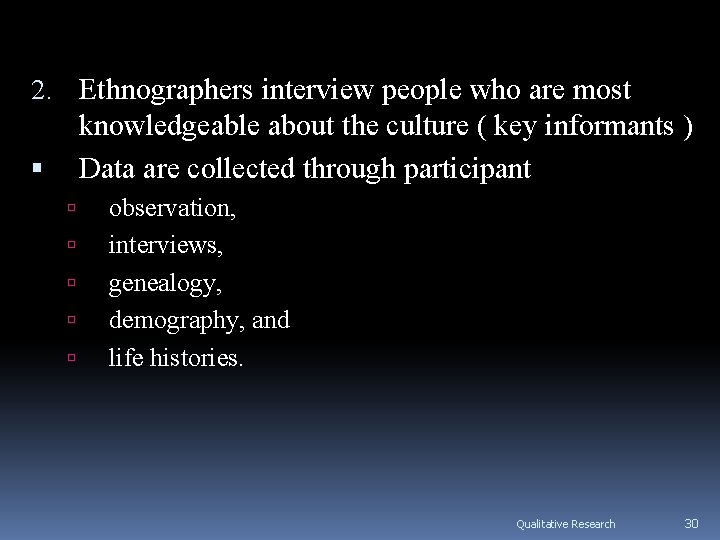
2. Ethnographers interview people who are most knowledgeable about the culture ( key informants ) Data are collected through participant observation, interviews, genealogy, demography, and life histories. Qualitative Research 30
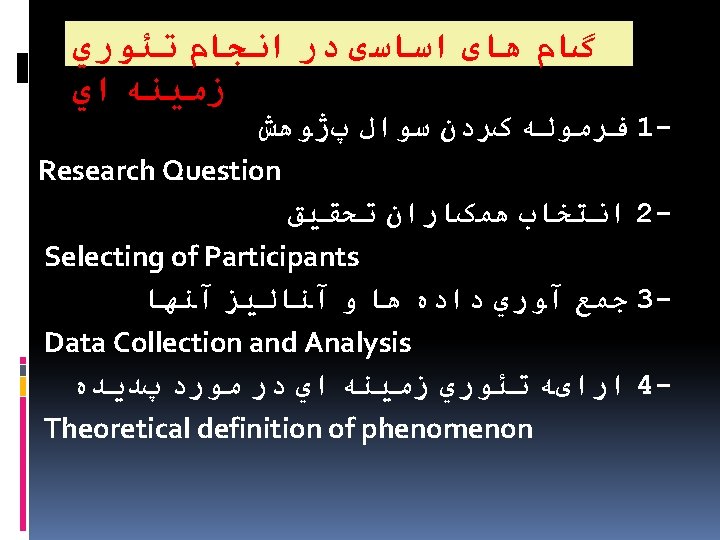
Data Collection in Ethnography: Ø Observationa Data : ( Logs, Photo, Video & Open Check List) Ø Depth Interview ﻋﻼیﻢ ﻭ ﺑیﺎﻧﻬﺎی ﻧﻤﺎﺩیﻦ Ø Field Note Ø Documents ﻋﻤﻮﻣﺎ ﻧیﻤﻪ ﺳﺎﺧﺘﺎﺭ ﻭ ﺗﻮﺟﻪ ﺑﻪ
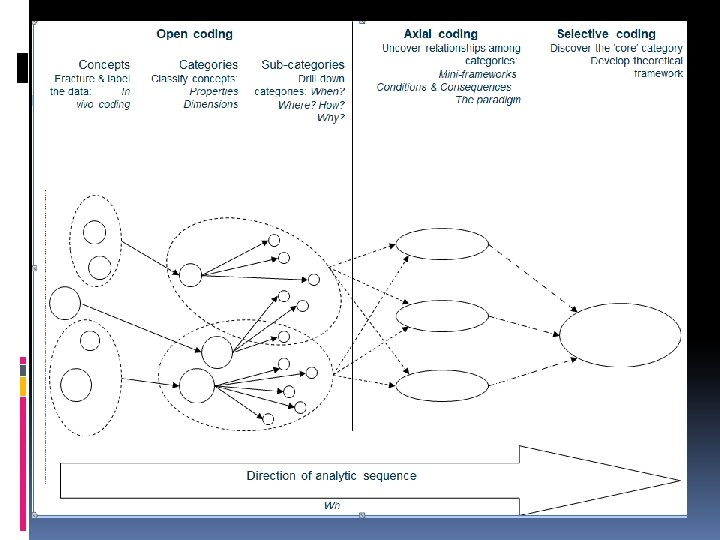
Data Analysis or Coding: Triple Phase: v Descriptive ( Open Code) ﺗﻮﺻﻴﻔی ﻣﺴﺘﻘﻴﻢ v Interpretative (Axial Code) ﺗﻔﺴﻴﺮی ﻳﺎ ﻃﺒﻘﻪ ﺑﻨﺪی کﺪﻫﺎ v Explorative (Selective Code) ﺗﺤﻠﻴﻞ ﻳﺎ ﻃﺒﻘﺎﺕ کﻠی ﻭﺍﻧﺘﺰﺍﻋی
Grounded Theory Studies : 3. Data are collected analyzed and then a theory is developed that is grounded in the data. Uses both an inductive and a deductive approach to theory development. Constructs and concepts are grounded in the data and hypotheses are tested as they arise from the research. Qualitative Research 45
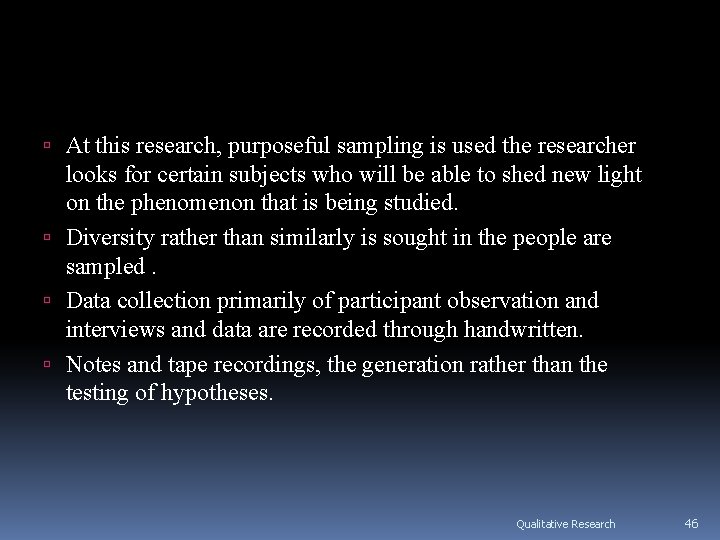
At this research, purposeful sampling is used the researcher looks for certain subjects who will be able to shed new light on the phenomenon that is being studied. Diversity rather than similarly is sought in the people are sampled. Data collection primarily of participant observation and interviews and data are recorded through handwritten. Notes and tape recordings, the generation rather than the testing of hypotheses. Qualitative Research 46
Grounded Theory • Aims to derive theory from systematic analysis of data • Based on categorization approach (called here ‘coding’) • Three levels of ‘coding’ – Open: identify categories – Axial: flesh out and link to subcategories – Selective: form theoretical scheme 50
Grounded Theory: data analysis Open coding concepts, categories, properties, code notes Memo writing Axial coding Focus on relations Connections between categories Causal conditions, intervening conditions. . . Selective coding 51
Coding Preparation for axial coding (Glaser, 1978; Spradley, 1979 a; 1979 b; Strauss, 1987; Strauss & Corbin, 1990; 1998) Reviewing memos and field notes Developing feeling, insights, hypotheses, and discussions about codes and coding process Discussions with peer reviewers 53
4. Historical Studies: Qualitative Research 54
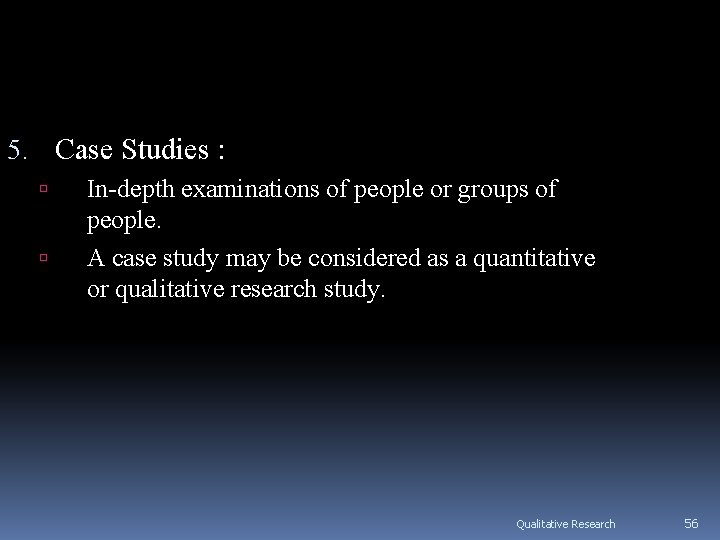
5. Case Studies : In-depth examinations of people or groups of people. A case study may be considered as a quantitative or qualitative research study. Qualitative Research 56
Case studies are not used to test hypotheses but hypotheses may be generated from case studies. Data may be collected in case studies through questionnaires interviews, observations, or written accounts by the subjects. Qualitative Research 57
A research Example Jordanian women’s perceptions of postpartum health care Khalaf, I. A. , Abu‐Moghli, F. A. , Mahadeen, A. I. , Callister, L. C. , & Al‐Hadidi, M. (2007). Jordanian women’s perceptions of post‐partum health care. International nursing review, 54(3), 288294.
Purpose To gain an understanding of post-partum women’s perceptions of their needs for health care and the post-partum healthcare services they had received. Qualitative Research 68
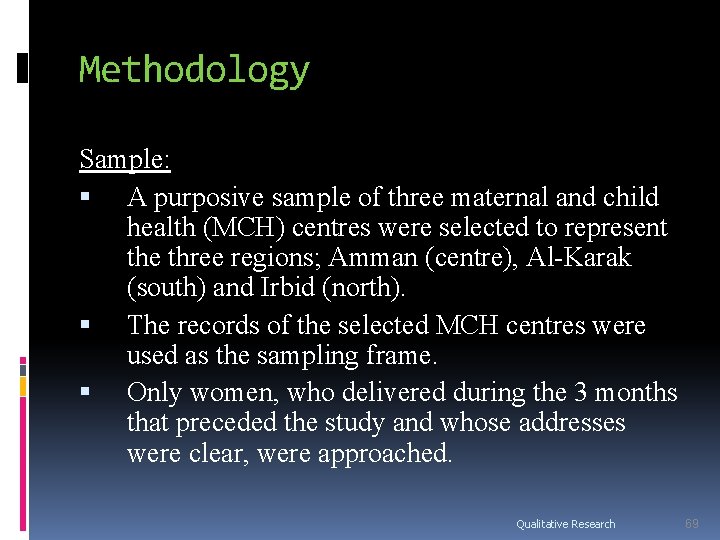
Methodology Sample: A purposive sample of three maternal and child health (MCH) centres were selected to represent the three regions; Amman (centre), Al-Karak (south) and Irbid (north). The records of the selected MCH centres were used as the sampling frame. Only women, who delivered during the 3 months that preceded the study and whose addresses were clear, were approached. Qualitative Research 69
Data collection Instrument and Methodology A screening questionnaire was used to select participants to represent diverse socioeconomic and educational levels. Women who met the criteria were invited to participate in the focus groups and were further contacted as they attended to the MCH centre for child immunization and their consent for participation was obtained. Qualitative Research 70
Data collection Instrument and Methodology Continue… Ethical Consideration: Following IRB approval, Informed consent was obtained from study participants. Throughout the study, the protection of human rights was an important priority. Audio-tapes were erased after being transcribed. Qualitative Research 71
Data collection Instrument and Methodology Continue… During the 2 -h focus group discussions, the participants were asked to describe in detail their experiences with post-partum health care. A semi-structured interview guide was used, which had been developed by the researchers and validated by a team of experts from the MOH, and UNFPA. Qualitative Research 72
Data collection Instrument and Methodology Continue The moderator used probing questions for clarification of the participants’ perceptions. The focus groups were conducted in Arabic, and the audio tapes transcribed and translated into English and back translated to ensure trustworthiness of the data. Qualitative Research 73
Data analysis Qualitative data were content analyzed. Core concepts were identified and classified into conceptually relevant categories, providing rich qualitative data from the perspectives of the women who participated in the study. Analysis was conducted concurrently with data collection, including organizing the aggregate into categories. Data analysis took into consideration focus group differences and similarities. Qualitative Research 74
Findings The women approached were enthusiastic about participating in the study and expressed a feeling of being cared for. They were appreciative of having the opportunity to express their needs and concerns related to their post-partum health care. Findings are described in the following categories: infant and maternal health concerns, access to post-partum health care, including family planning services, the characteristics and behaviour of healthcare providers, and suggestions for the provision of quality maternal postpartum health care. Qualitative Research 75
Infant and maternal health concerns The women strongly felt that assessment of the infant and education about child health and illness was the most important aspect of postpartum health care. A 24 -year-old mother of four said, ‘The most important thing they do is asking you about breastfeeding, weighing the child, and telling you to investigate the blood and urine’. Qualitative Research 76
Accessing post-partum health care Most of the women from all regions indicated they were not instructed to make maternal post -partum visits to the health centre or to receive family-planning services, but rather to bring the newborn for infant care. One woman said if she had known about the importance of such care, she would have planned her pregnancies rather than having four children in 4 years. Qualitative Research 77
Family-planning services All the women indicated they could receive family-planning services at the health centres. Many women living in the south said that their husbands discouraged utilization of familyplanning services. Some said counseling about family planning was not offered unless they specifically asked for assistance. One woman said, ‘At the first post-partum visit they will never talk to you about family planning unless you ask them’. Qualitative Research 78
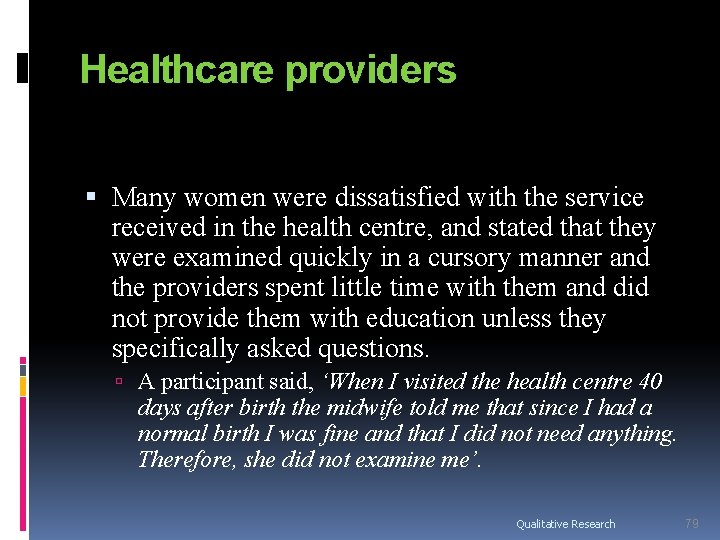
Healthcare providers Many women were dissatisfied with the service received in the health centre, and stated that they were examined quickly in a cursory manner and the providers spent little time with them and did not provide them with education unless they specifically asked questions. A participant said, ‘When I visited the health centre 40 days after birth the midwife told me that since I had a normal birth I was fine and that I did not need anything. Therefore, she did not examine me’. Qualitative Research 79
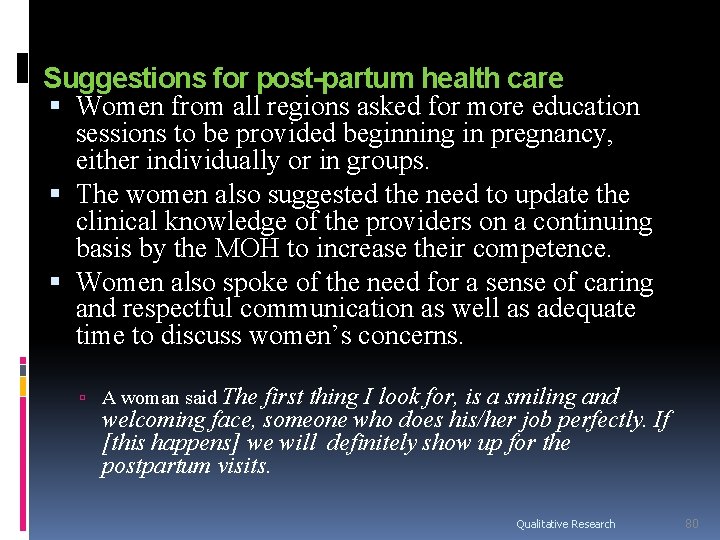
Suggestions for post-partum health care Women from all regions asked for more education sessions to be provided beginning in pregnancy, either individually or in groups. The women also suggested the need to update the clinical knowledge of the providers on a continuing basis by the MOH to increase their competence. Women also spoke of the need for a sense of caring and respectful communication as well as adequate time to discuss women’s concerns. A woman said The first thing I look for, is a smiling and welcoming face, someone who does his/her job perfectly. If [this happens] we will definitely show up for the postpartum visits. Qualitative Research 80
Discussion This study supports what is found in the literature globally regarding post-partum health care. An overriding need expressed in the focus groups was the need for a more holistic approach, implying that physical, spiritual and emotional health is inextricably linked. Qualitative Research 81
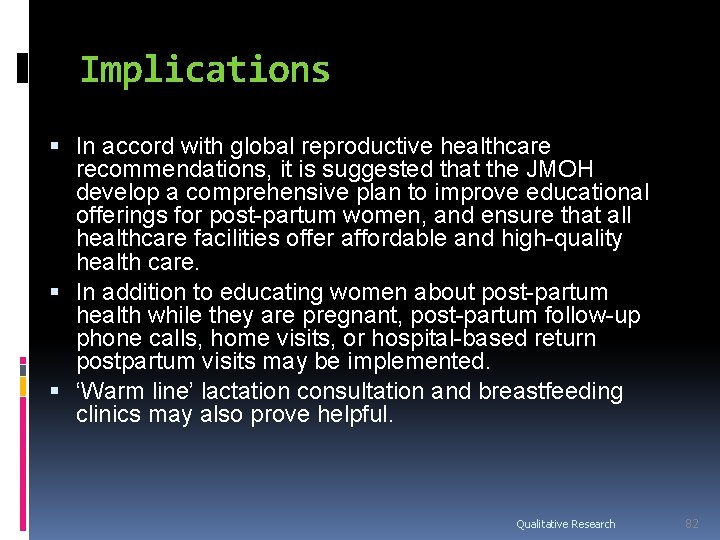
Implications In accord with global reproductive healthcare recommendations, it is suggested that the JMOH develop a comprehensive plan to improve educational offerings for post-partum women, and ensure that all healthcare facilities offer affordable and high-quality health care. In addition to educating women about post-partum health while they are pregnant, post-partum follow-up phone calls, home visits, or hospital-based return postpartum visits may be implemented. ‘Warm line’ lactation consultation and breastfeeding clinics may also prove helpful. Qualitative Research 82
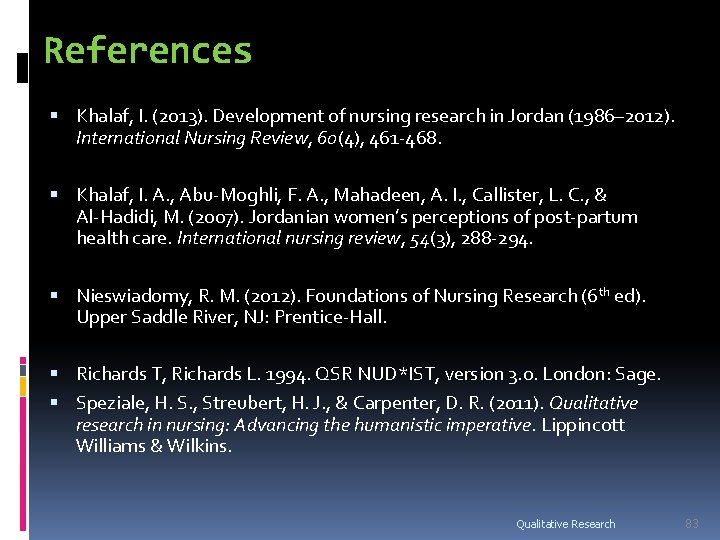
References Khalaf, I. (2013). Development of nursing research in Jordan (1986– 2012). International Nursing Review, 60(4), 461‐ 468. Khalaf, I. A. , Abu‐Moghli, F. A. , Mahadeen, A. I. , Callister, L. C. , & Al‐Hadidi, M. (2007). Jordanian women’s perceptions of post‐partum health care. International nursing review, 54(3), 288‐ 294. Nieswiadomy, R. M. (2012). Foundations of Nursing Research (6 th ed). Upper Saddle River, NJ: Prentice‐Hall. Richards T, Richards L. 1994. QSR NUD*IST, version 3. 0. London: Sage. Speziale, H. S. , Streubert, H. J. , & Carpenter, D. R. (2011). Qualitative research in nursing: Advancing the humanistic imperative. Lippincott Williams & Wilkins. Qualitative Research 83
investigating the experiences of adult individuals undergoing limb-reconstruction procedures in a large inner-city teaching hospital EXAMPLE OF GROUNDED THEORY 91
Level 1 coding Code the entire document Code sentences or paragraphs Code the data line by line 92
Level 1 coding 93
Level 1 coding 94
Level 2 coding, categorizing Compare and assign codes to clusters 95
Level 2 coding, categorizing 96
Level 3 coding, basic psychological process trying to elicit data that served to expand the properties and dimensions of the categories 97
Concept development, Reduction and Axial coding Reduction Selective sampling of the literature Selective sampling of the data Emergence of core variable 98
Level 3 coding, basic psychological process 99
Credibility, Negative case analysis 100
THANK YOU Qualitative Research 101