
Deep Neural Networks as 0 1 Mixed Integer
- Slides: 17
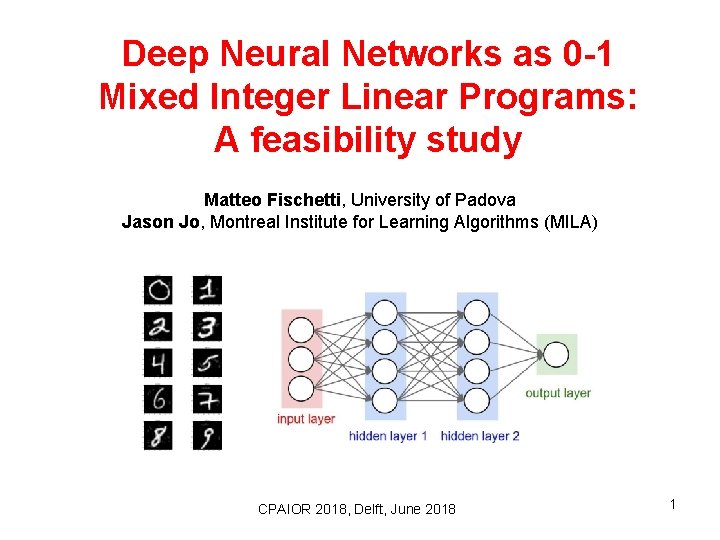
Deep Neural Networks as 0 -1 Mixed Integer Linear Programs: A feasibility study Matteo Fischetti, University of Padova Jason Jo, Montreal Institute for Learning Algorithms (MILA) CPAIOR 2018, Delft, June 2018 1
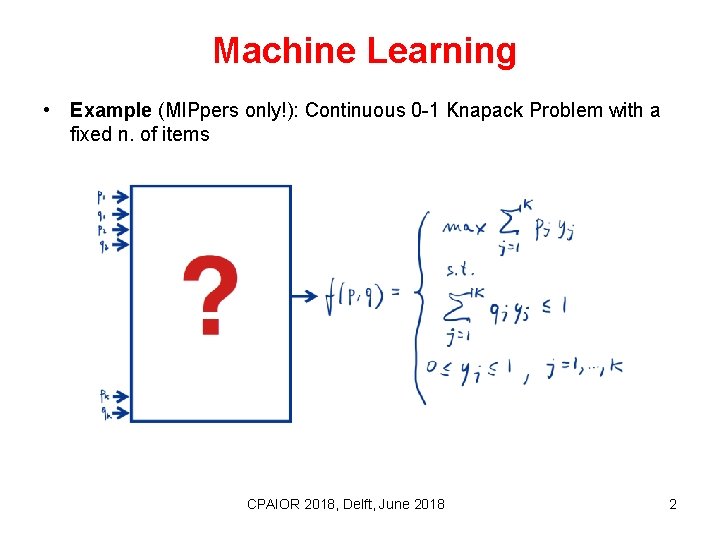
Machine Learning • Example (MIPpers only!): Continuous 0 -1 Knapack Problem with a fixed n. of items CPAIOR 2018, Delft, June 2018 2
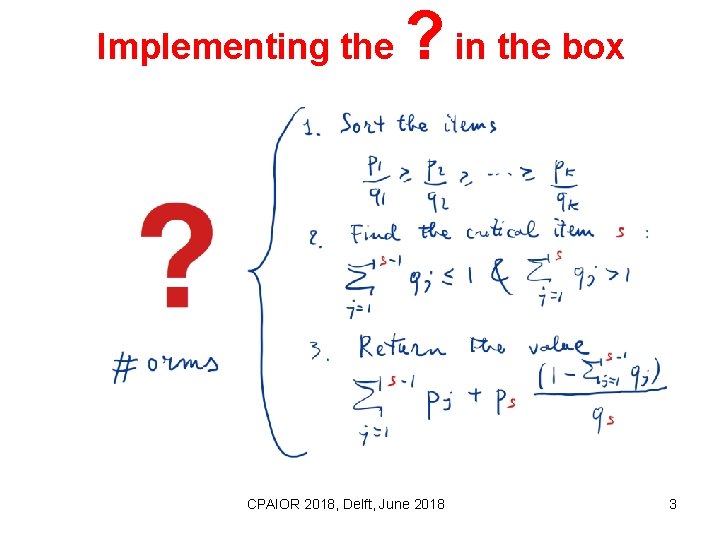
Implementing the ? in the box CPAIOR 2018, Delft, June 2018 3
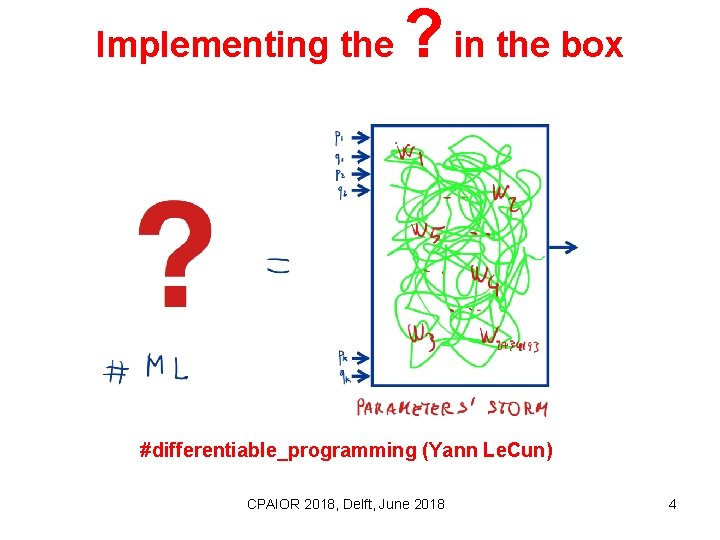
Implementing the ? in the box #differentiable_programming (Yann Le. Cun) CPAIOR 2018, Delft, June 2018 4
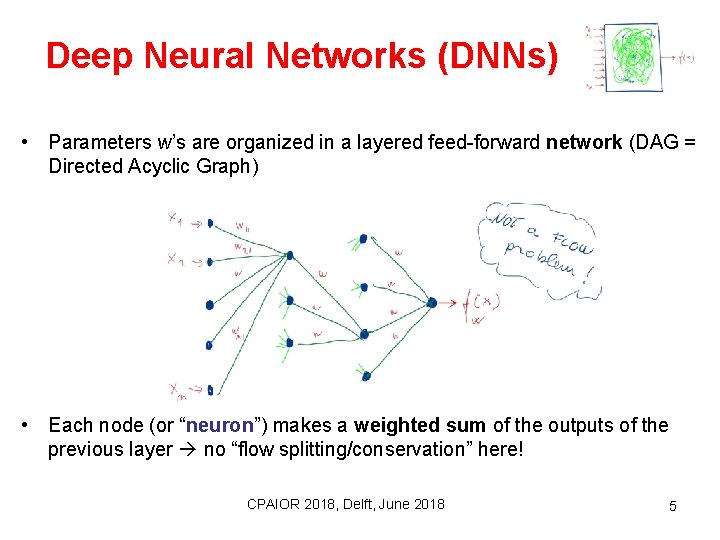
Deep Neural Networks (DNNs) • Parameters w’s are organized in a layered feed-forward network (DAG = Directed Acyclic Graph) • Each node (or “neuron”) makes a weighted sum of the outputs of the previous layer no “flow splitting/conservation” here! CPAIOR 2018, Delft, June 2018 5
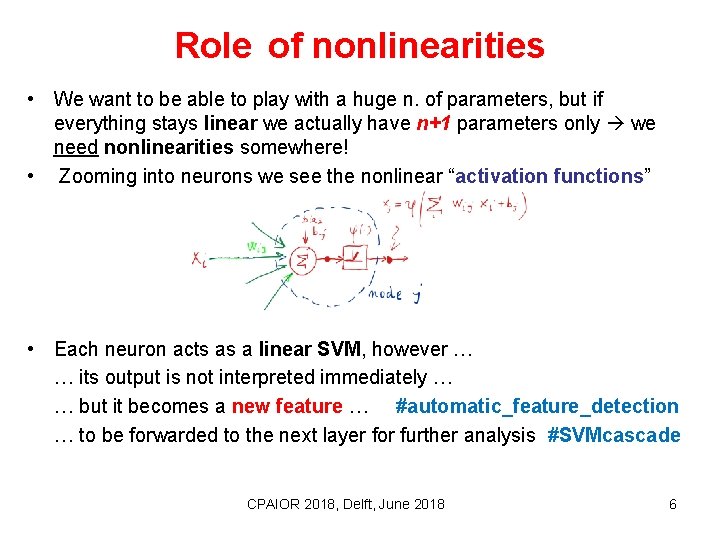
Role of nonlinearities • We want to be able to play with a huge n. of parameters, but if everything stays linear we actually have n+1 parameters only we need nonlinearities somewhere! • Zooming into neurons we see the nonlinear “activation functions” • Each neuron acts as a linear SVM, however … … its output is not interpreted immediately … … but it becomes a new feature … #automatic_feature_detection … to be forwarded to the next layer for further analysis #SVMcascade CPAIOR 2018, Delft, June 2018 6
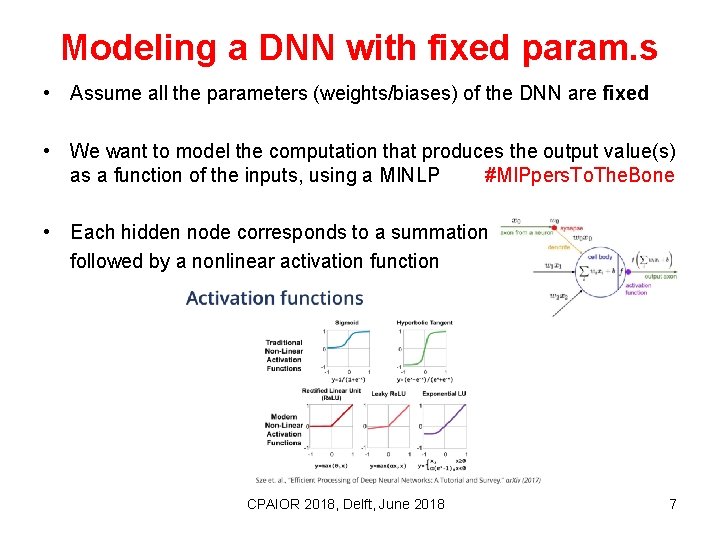
Modeling a DNN with fixed param. s • Assume all the parameters (weights/biases) of the DNN are fixed • We want to model the computation that produces the output value(s) as a function of the inputs, using a MINLP #MIPpers. To. The. Bone • Each hidden node corresponds to a summation followed by a nonlinear activation function CPAIOR 2018, Delft, June 2018 7
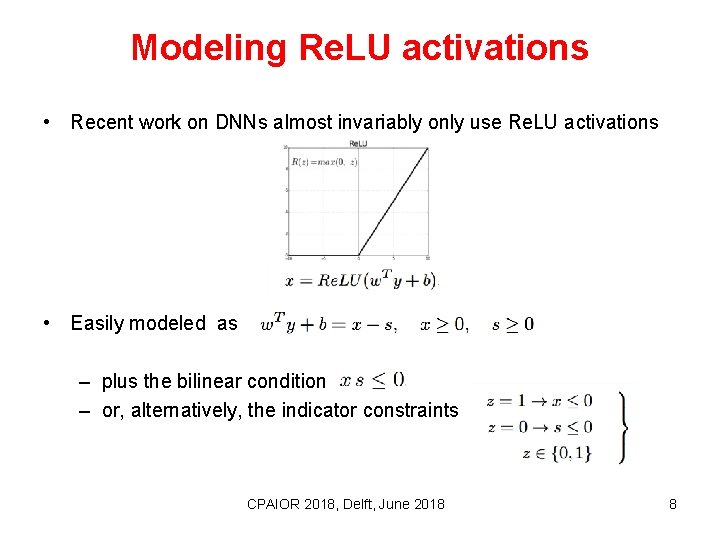
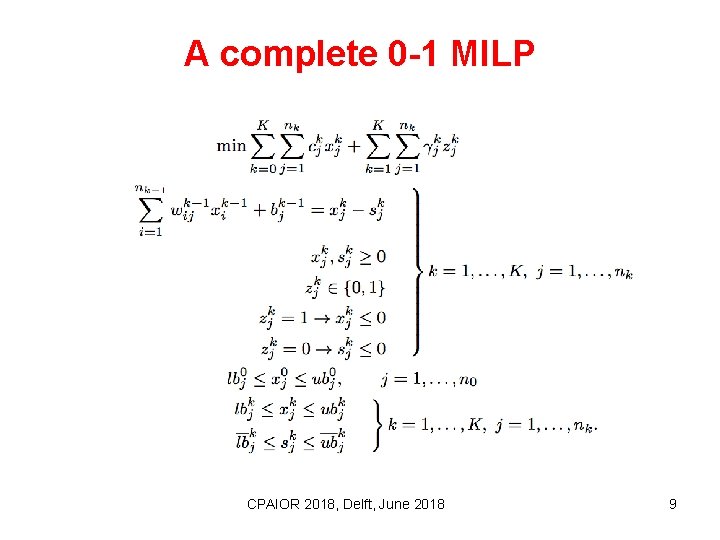
Modeling Re. LU activations • Recent work on DNNs almost invariably only use Re. LU activations • Easily modeled as – plus the bilinear condition – or, alternatively, the indicator constraints CPAIOR 2018, Delft, June 2018 8
A complete 0 -1 MILP CPAIOR 2018, Delft, June 2018 9
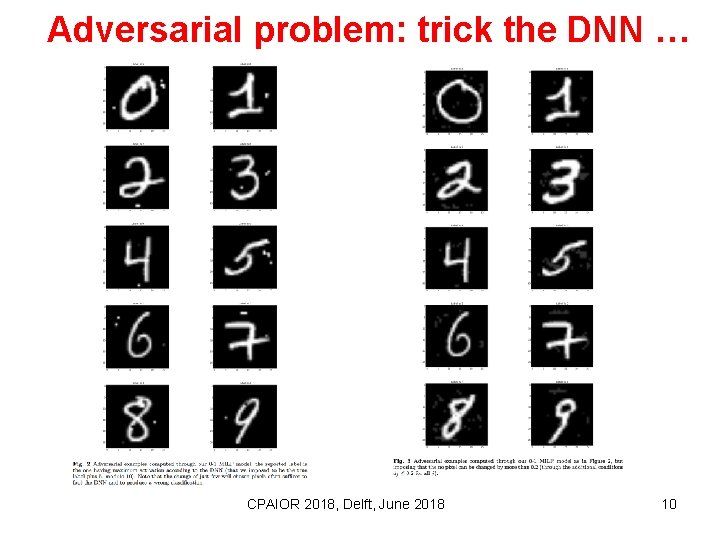
Adversarial problem: trick the DNN … CPAIOR 2018, Delft, June 2018 10
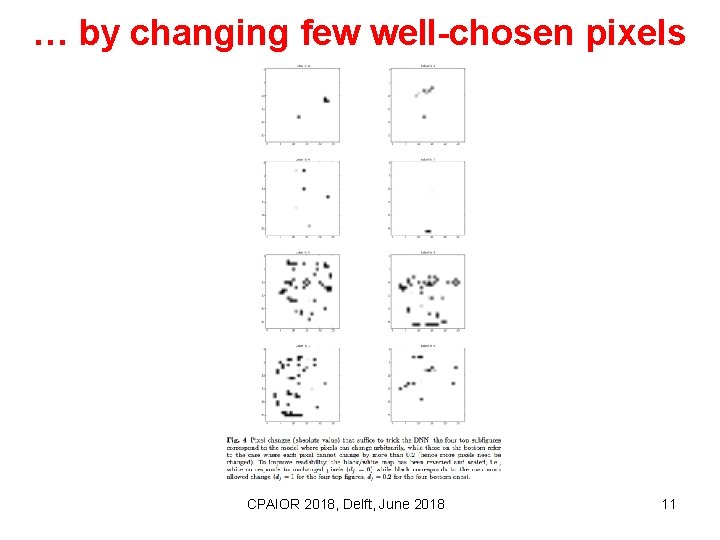
… by changing few well-chosen pixels CPAIOR 2018, Delft, June 2018 11
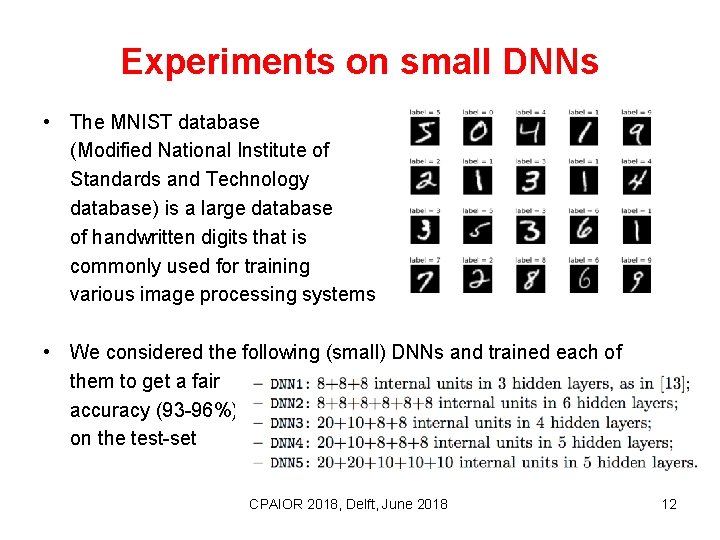
Experiments on small DNNs • The MNIST database (Modified National Institute of Standards and Technology database) is a large database of handwritten digits that is commonly used for training various image processing systems • We considered the following (small) DNNs and trained each of them to get a fair accuracy (93 -96%) on the test-set CPAIOR 2018, Delft, June 2018 12
Computational experiments • Instances: 100 MNIST training figures (each with its “true” label 0. . 9) • Goal: Change some of the 28 x 28 input pixels (real values in 0 -1) to convert the true label d into (d + 5) mod 10 (e. g. , “ 0” “ 5”, “ 6” “ 1”) • Metric: L 1 norm (sum of the abs. differences original-modified pixels) • MILP solver: IBM ILOG CPLEX 12. 7 (as black box) – Basic model: only obvious bounds on the continuous var. s – Improved model: apply a MILP-based preprocessing to compute tight lower/upper bounds on all the continuous variables, as in P. Belotti, P. Bonami, M. Fischetti, A. Lodi, M. Monaci, A. Nogales-Gomez, and D. Salvagnin. On handling indicator constraints in mixed integer programming. Computational Optimization and Applications, (65): 545– 566, 2016. CPAIOR 2018, Delft, June 2018 13
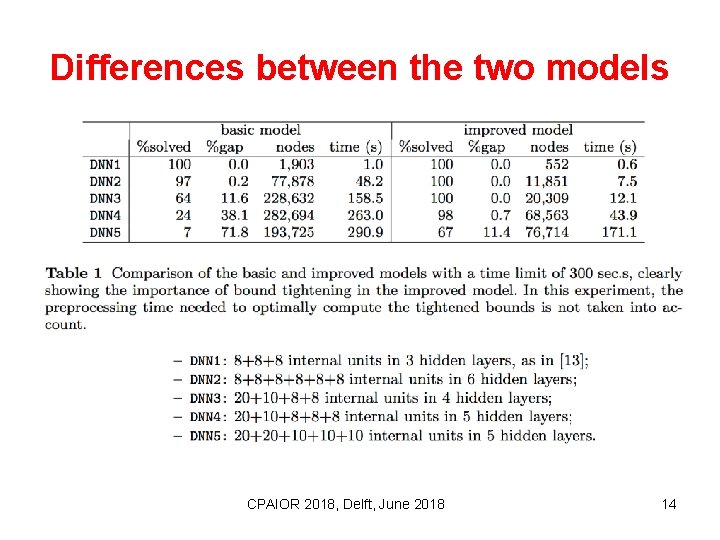
Differences between the two models CPAIOR 2018, Delft, June 2018 14
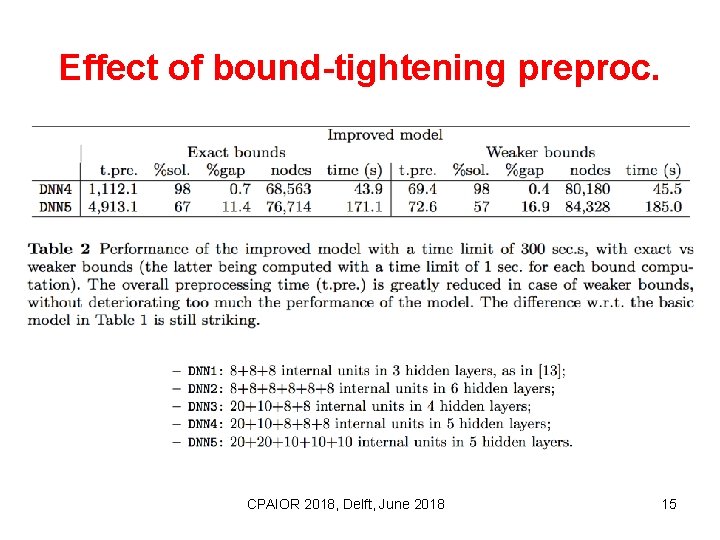
Effect of bound-tightening preproc. CPAIOR 2018, Delft, June 2018 15
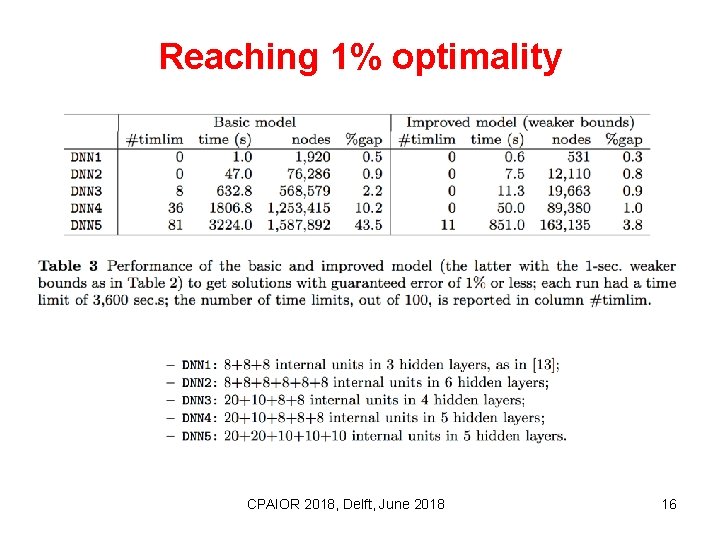
Reaching 1% optimality CPAIOR 2018, Delft, June 2018 16
Thanks for your attention! Slides available at http: //www. dei. unipd. it/~fisch/papers/slides/ Paper: M. Fischetti, J. Jo, "Deep Neural Networks as 0 -1 Mixed Integer Linear Programs: A Feasibility Study", Constraints 23(3), 296 -309, 2018. . CPAIOR 2018, Delft, June 2018 17