Models of the Atom Ms Fedor Arts and
- Slides: 41
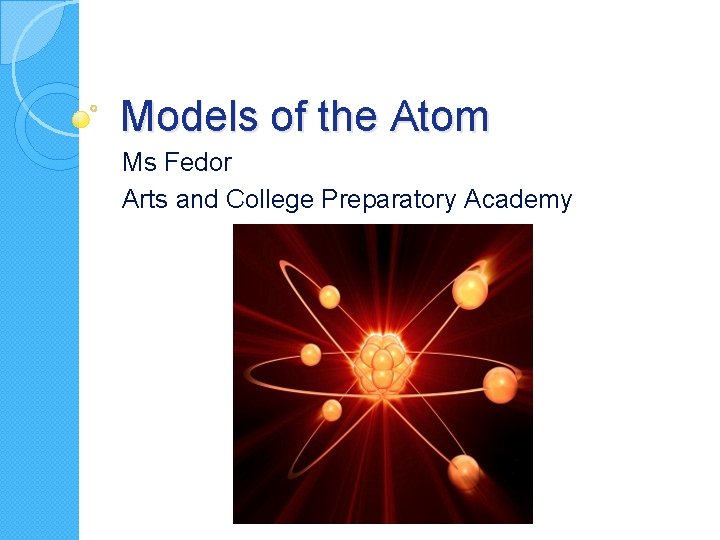
Models of the Atom Ms Fedor Arts and College Preparatory Academy
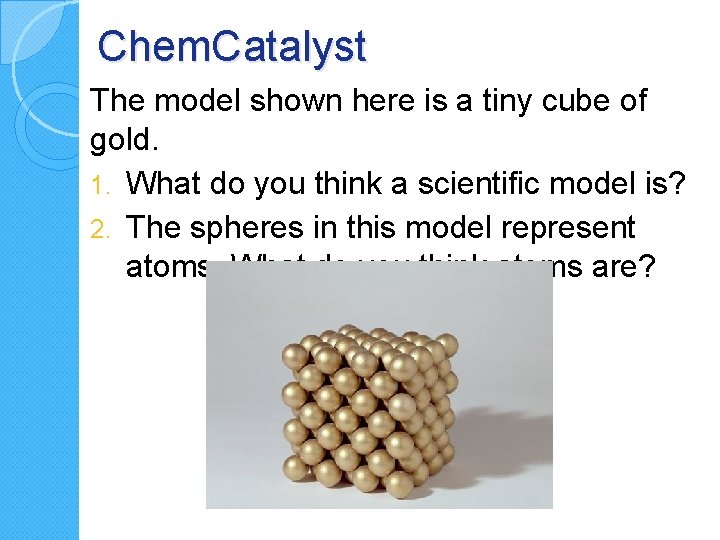
Chem. Catalyst The model shown here is a tiny cube of gold. 1. What do you think a scientific model is? 2. The spheres in this model represent atoms. What do you think atoms are?
Agenda Objectives: describe the structure of an atom, understand how atomic theory developed over time Collect Assignments 2. Notes: Atomic Structure 3. Activity: Atomic Pudding HW: �Students who have completed quiz 2: study and schedule Quiz 3 �Students who have completed Quiz 3: work on organizing your notebook, finishing your preplanning for your element project 1.
What I Need From You �Supplements for Quiz 2 ◦ Mole practice problems ◦ Chemical formulas/reactions �Activities: ◦ A New Language ◦ Copper Cycle Lab ◦ What Goes Around Comes Around
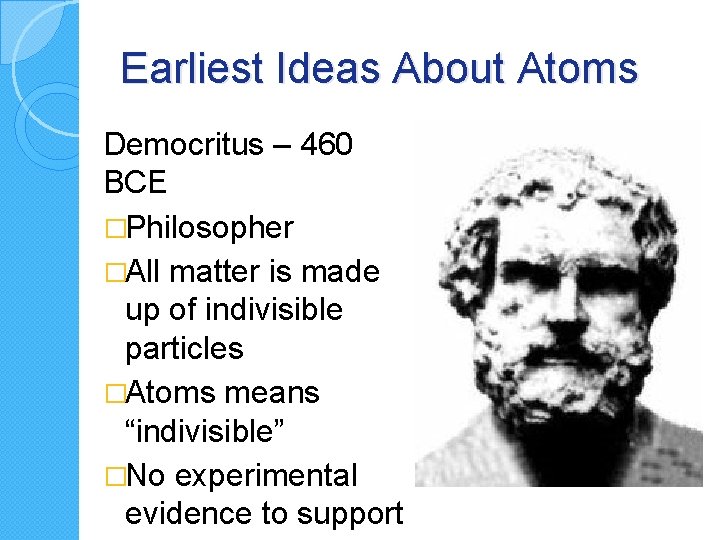
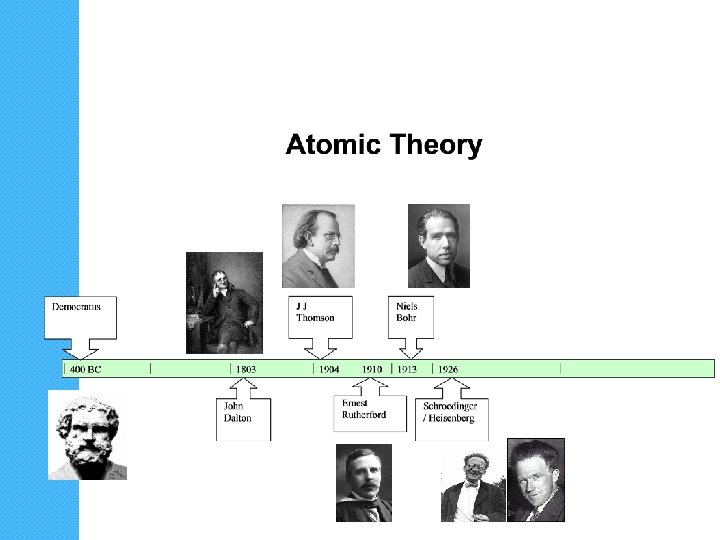
Earliest Ideas About Atoms Democritus – 460 BCE �Philosopher �All matter is made up of indivisible particles �Atoms means “indivisible” �No experimental evidence to support
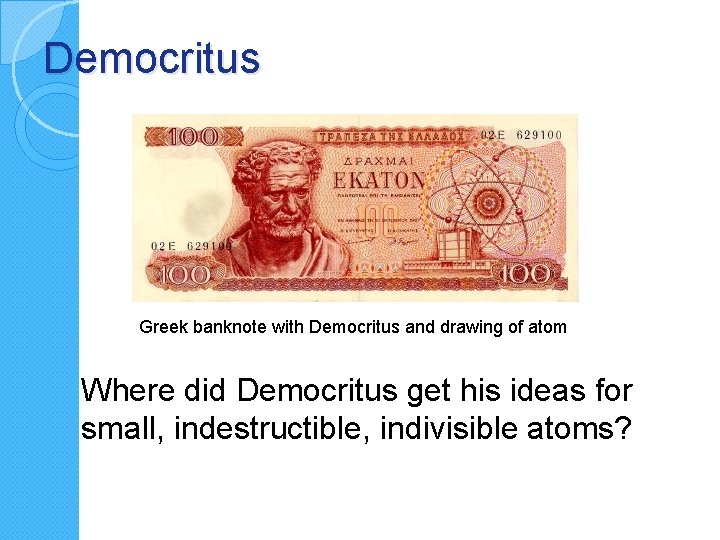
Democritus Greek banknote with Democritus and drawing of atom Where did Democritus get his ideas for small, indestructible, indivisible atoms?
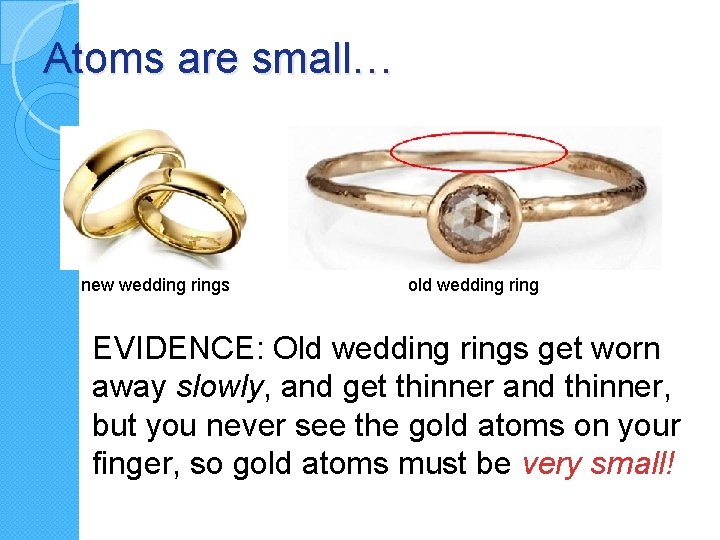
Atoms are small… new wedding rings old wedding ring EVIDENCE: Old wedding rings get worn away slowly, and get thinner and thinner, but you never see the gold atoms on your finger, so gold atoms must be very small!
Atoms are indestructible… EVIDENCE: The Earth has been around a long time. Even though mountains get washed away, the rocks continue to exist. New plants grow where old plants die. Atoms are indivisible… EVIDENCE: None. This was a HYPOTHESIS made by Democritus to explain nature as he saw it.
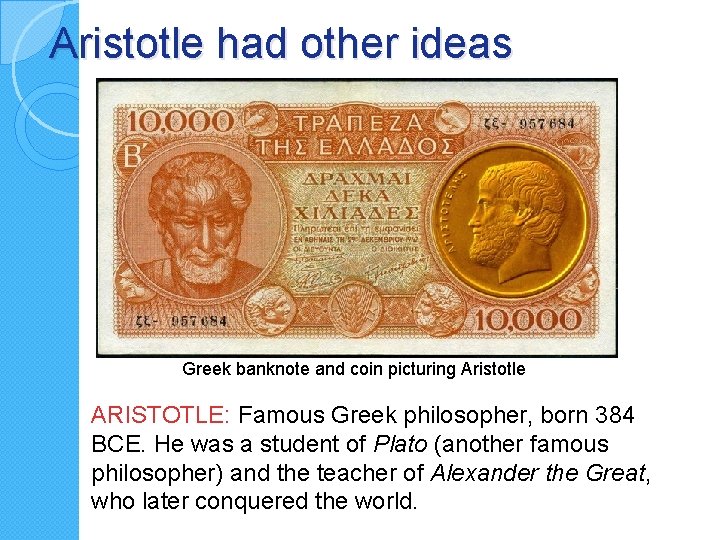
Aristotle had other ideas Greek banknote and coin picturing Aristotle ARISTOTLE: Famous Greek philosopher, born 384 BCE. He was a student of Plato (another famous philosopher) and the teacher of Alexander the Great, who later conquered the world.
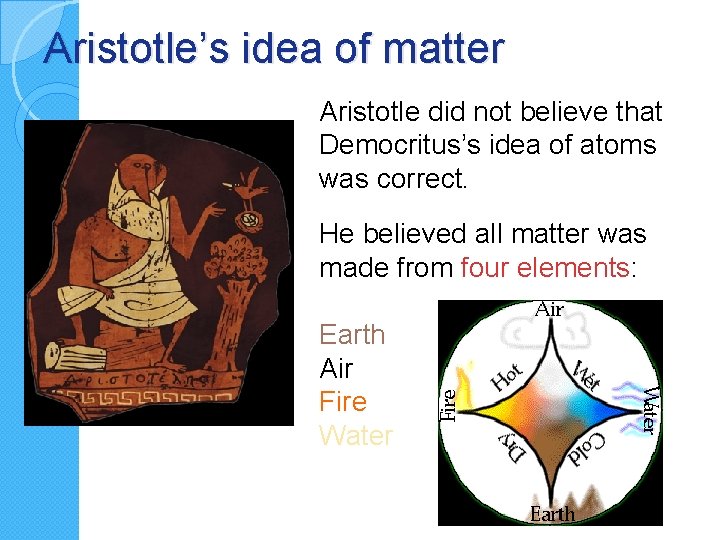
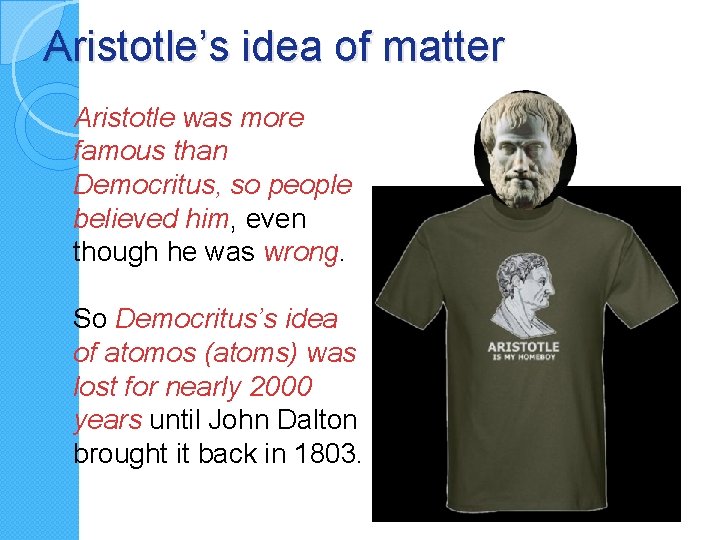
Aristotle’s idea of matter Aristotle did not believe that Democritus’s idea of atoms was correct. He believed all matter was made from four elements: Earth Air Fire Water
Aristotle’s idea of matter Aristotle was more famous than Democritus, so people believed him, even though he was wrong. So Democritus’s idea of atomos (atoms) was lost for nearly 2000 years until John Dalton brought it back in 1803.
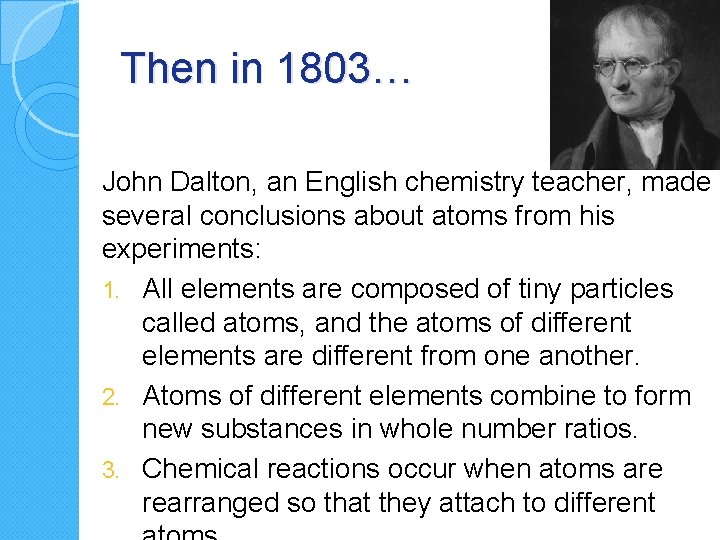
Then in 1803… John Dalton, an English chemistry teacher, made several conclusions about atoms from his experiments: 1. All elements are composed of tiny particles called atoms, and the atoms of different elements are different from one another. 2. Atoms of different elements combine to form new substances in whole number ratios. 3. Chemical reactions occur when atoms are rearranged so that they attach to different
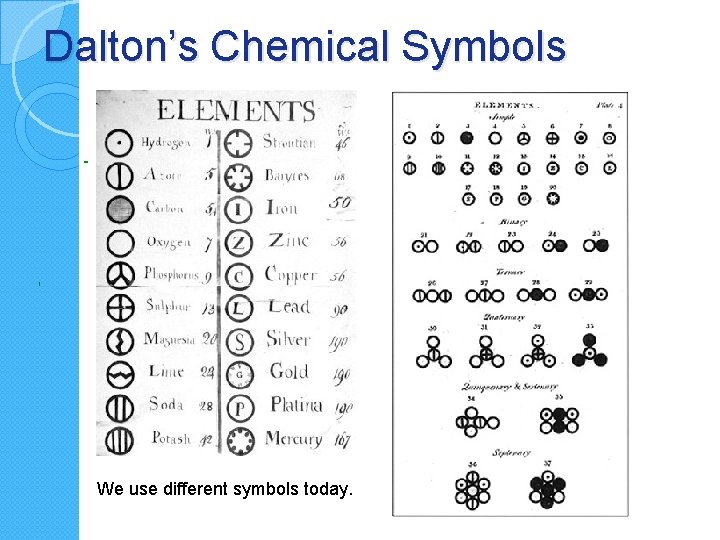
Dalton’s Chemical Symbols We use different symbols today.
Overarching Question These ideas formed the basis of atomic theory. Dalton was wrong about atoms being indivisible. So if atoms aren’t indivisible, then where does our modern idea of the atom come from?
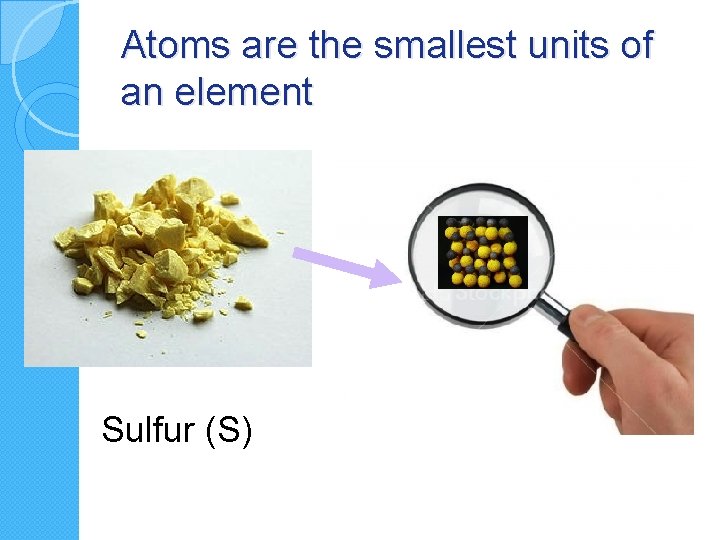
Atoms are the smallest units of an element Sulfur (S)
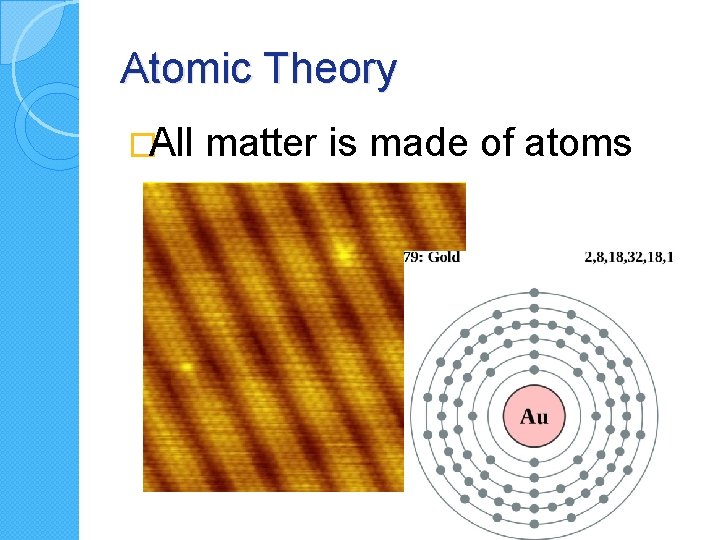
Atomic Theory �All matter is made of atoms
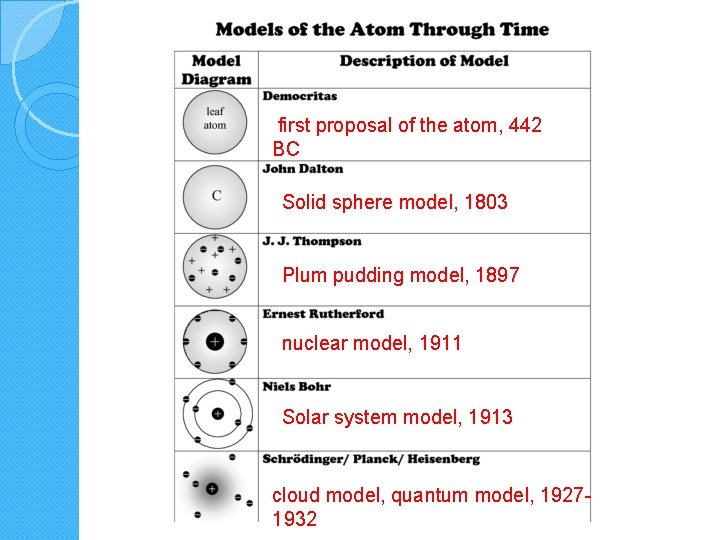
first proposal of the atom, 442 BC Solid sphere model, 1803 Plum pudding model, 1897 nuclear model, 1911 Solar system model, 1913 cloud model, quantum model, 19271932
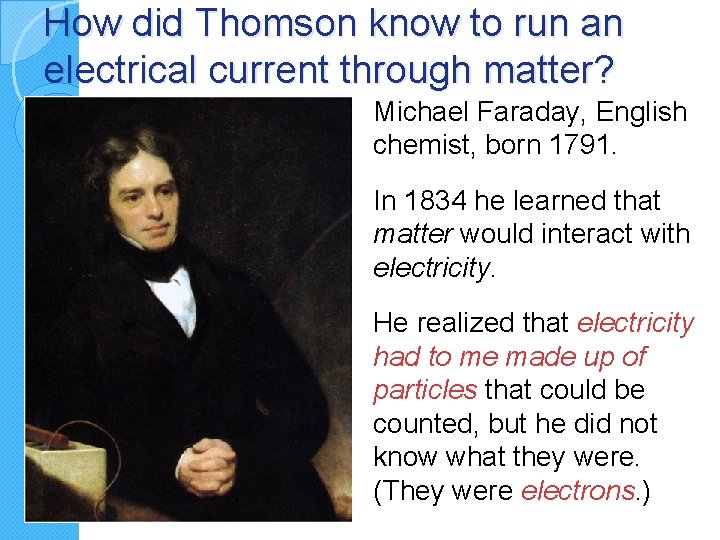
How did Thomson know to run an electrical current through matter? Michael Faraday, English chemist, born 1791. In 1834 he learned that matter would interact with electricity. He realized that electricity had to me made up of particles that could be counted, but he did not know what they were. (They were electrons. )
Chem. Catalyst �What are three particles that make up an atom? �What is the charge of each particle?
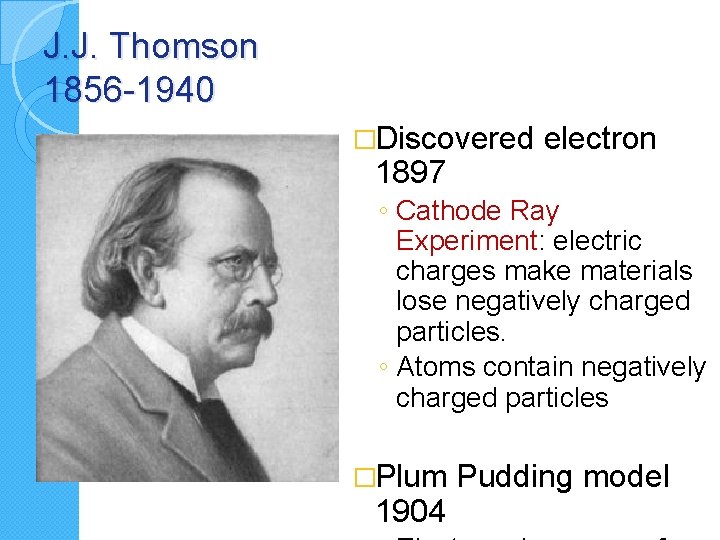
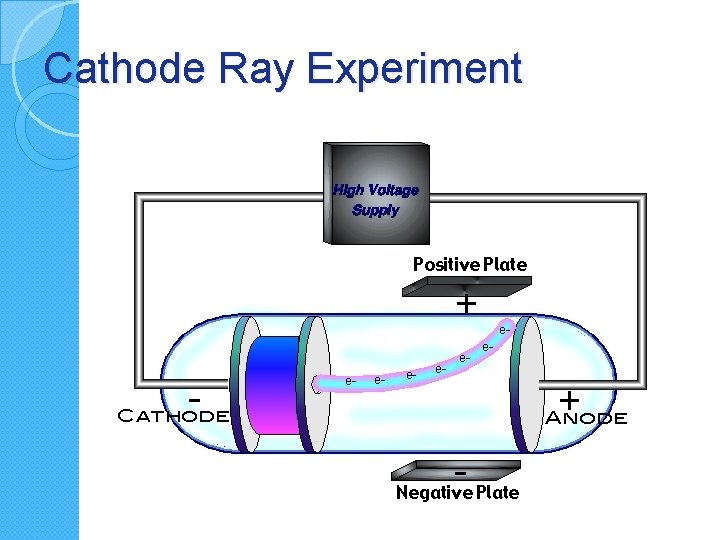
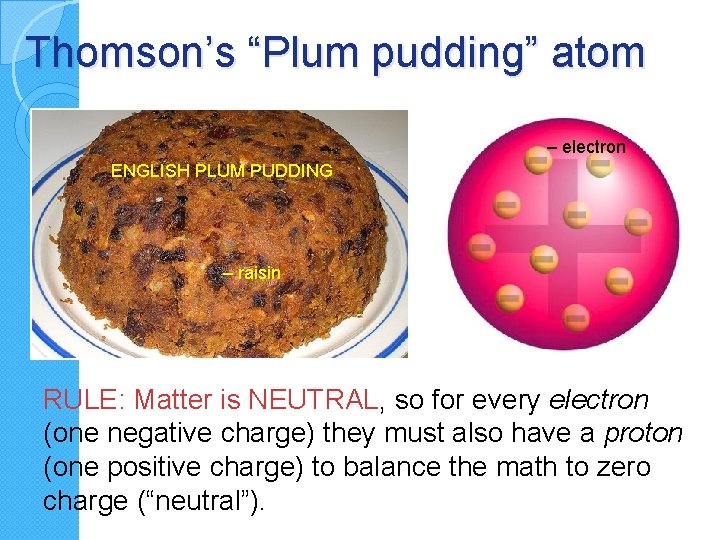
J. J. Thomson 1856 -1940 �Discovered 1897 electron ◦ Cathode Ray Experiment: electric charges make materials lose negatively charged particles. ◦ Atoms contain negatively charged particles �Plum 1904 Pudding model
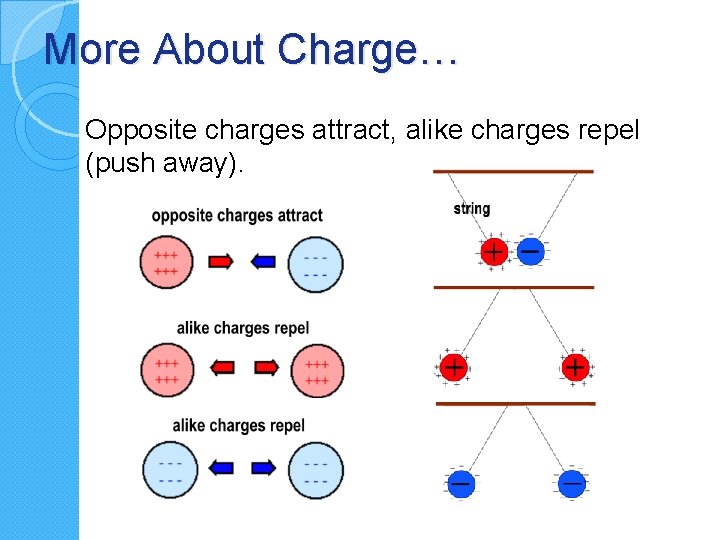
More About Charge… Opposite charges attract, alike charges repel (push away).
Cathode Ray Experiment
Thomson’s “Plum pudding” atom – electron ENGLISH PLUM PUDDING – raisin RULE: Matter is NEUTRAL, so for every electron (one negative charge) they must also have a proton (one positive charge) to balance the math to zero charge (“neutral”).
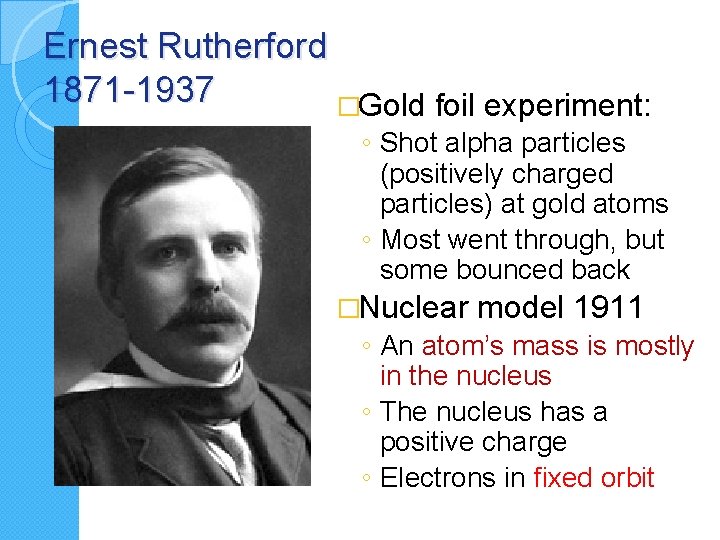
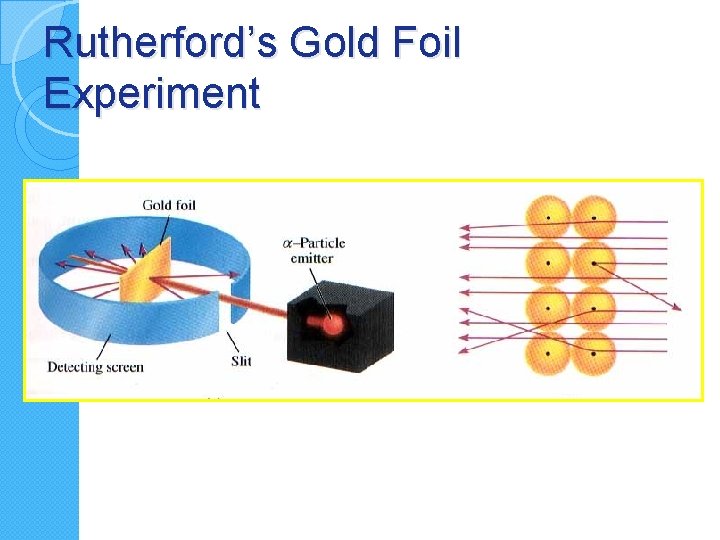
Ernest Rutherford 1871 -1937 �Gold foil experiment: ◦ Shot alpha particles (positively charged particles) at gold atoms ◦ Most went through, but some bounced back �Nuclear model 1911 ◦ An atom’s mass is mostly in the nucleus ◦ The nucleus has a positive charge ◦ Electrons in fixed orbit
Rutherford’s Gold Foil Experiment
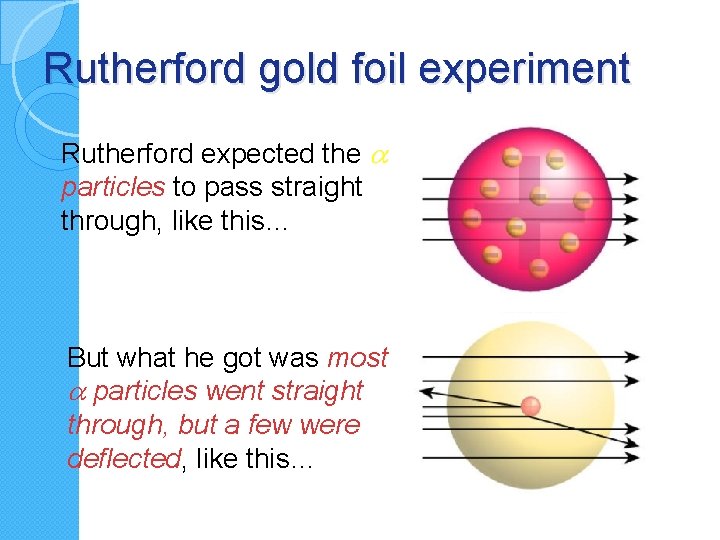
Rutherford gold foil experiment Rutherford expected the a particles to pass straight through, like this… But what he got was most a particles went straight through, but a few were deflected, like this…
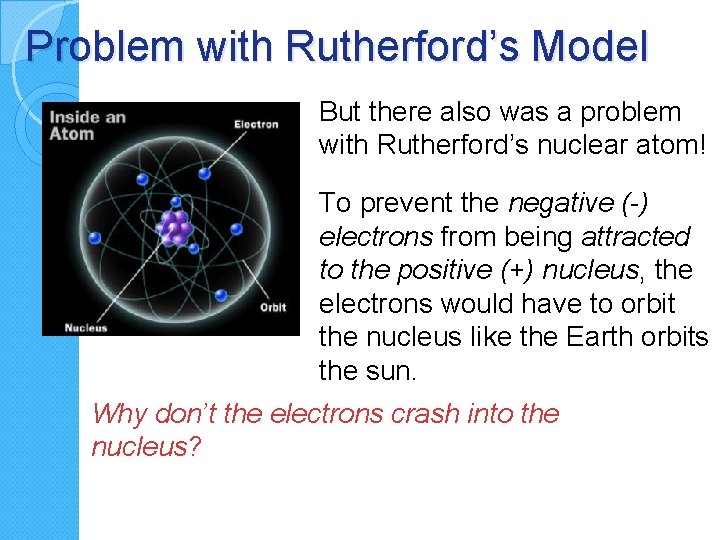
Problem with Rutherford’s Model But there also was a problem with Rutherford’s nuclear atom! To prevent the negative (-) electrons from being attracted to the positive (+) nucleus, the electrons would have to orbit the nucleus like the Earth orbits the sun. Why don’t the electrons crash into the nucleus?
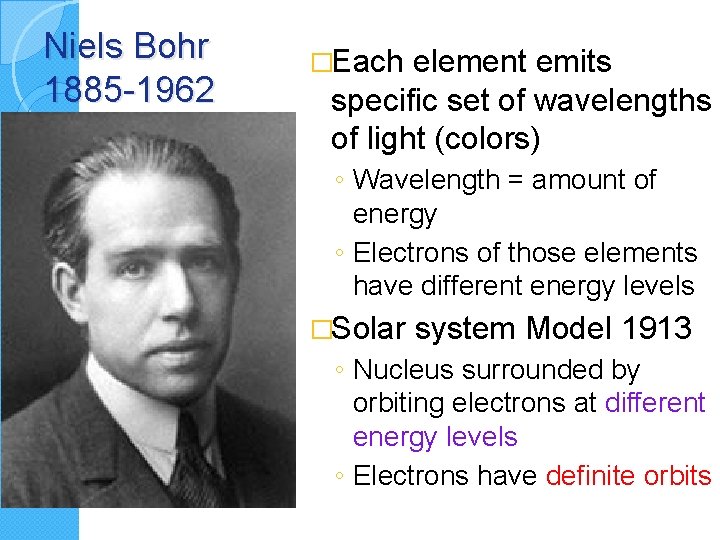
Niels Bohr 1885 -1962 �Each element emits specific set of wavelengths of light (colors) ◦ Wavelength = amount of energy ◦ Electrons of those elements have different energy levels �Solar system Model 1913 ◦ Nucleus surrounded by orbiting electrons at different energy levels ◦ Electrons have definite orbits
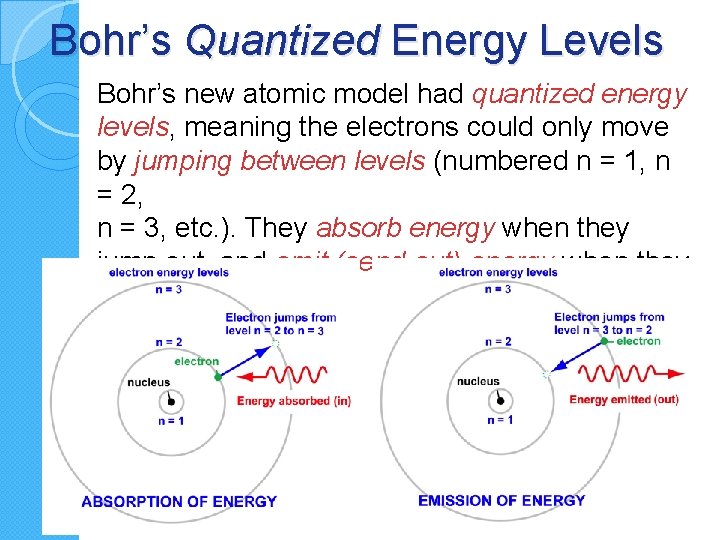
Bohr’s Quantized Energy Levels Bohr’s new atomic model had quantized energy levels, meaning the electrons could only move by jumping between levels (numbered n = 1, n = 2, n = 3, etc. ). They absorb energy when they jump out, and emit (send out) energy when they jump in.
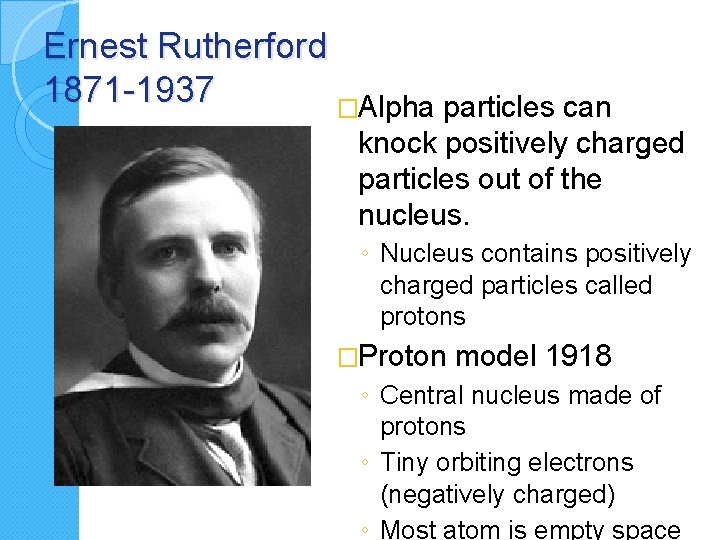
Ernest Rutherford 1871 -1937 �Alpha particles can knock positively charged particles out of the nucleus. ◦ Nucleus contains positively charged particles called protons �Proton model 1918 ◦ Central nucleus made of protons ◦ Tiny orbiting electrons (negatively charged) ◦ Most atom is empty space
Chem. Catalyst �Who discovered the electron? �What did Bohr’s research change about the atom?
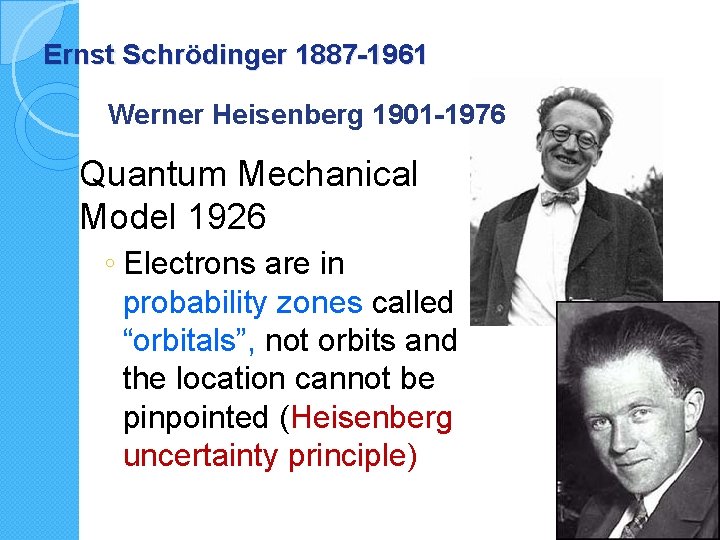
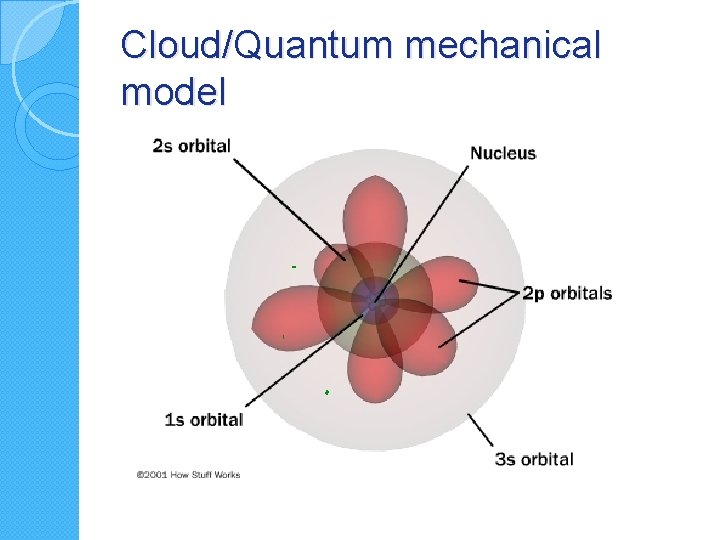
Ernst Schrödinger 1887 -1961 Werner Heisenberg 1901 -1976 Quantum Mechanical Model 1926 ◦ Electrons are in probability zones called “orbitals”, not orbits and the location cannot be pinpointed (Heisenberg uncertainty principle)
Cloud/Quantum mechanical model
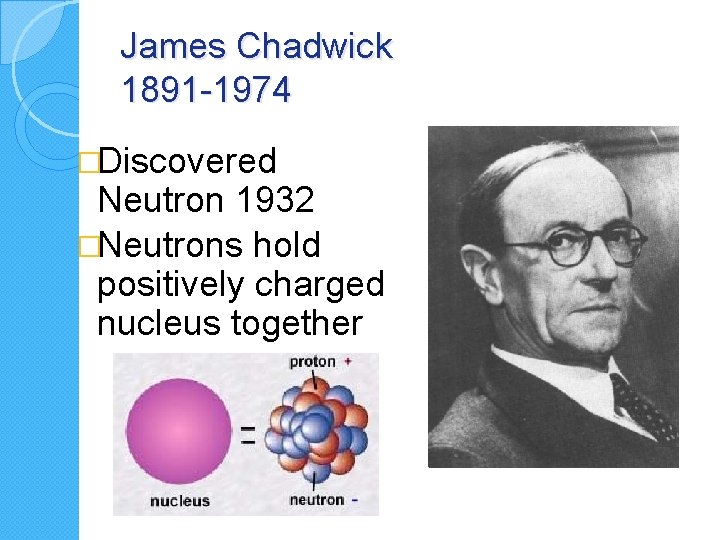
James Chadwick 1891 -1974 �Discovered Neutron 1932 �Neutrons hold positively charged nucleus together
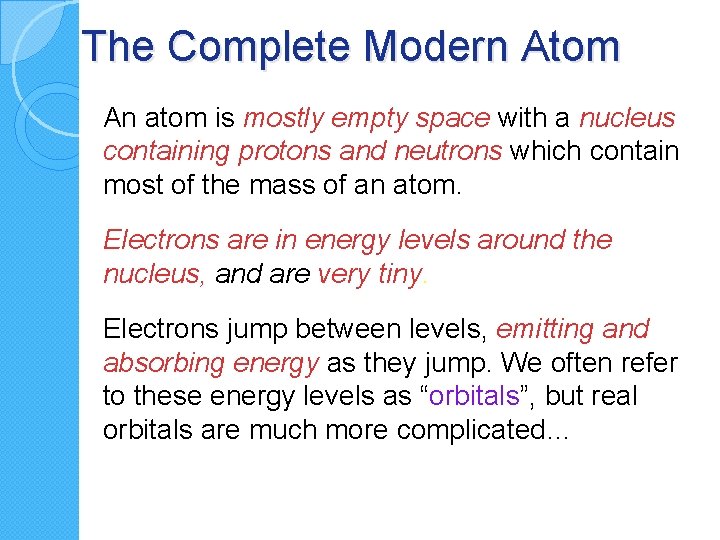
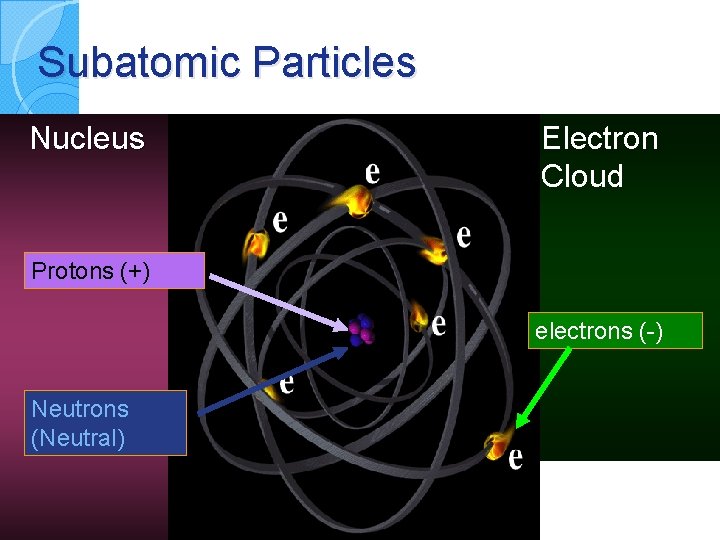
The Complete Modern Atom An atom is mostly empty space with a nucleus containing protons and neutrons which contain most of the mass of an atom. Electrons are in energy levels around the nucleus, and are very tiny. Electrons jump between levels, emitting and absorbing energy as they jump. We often refer to these energy levels as “orbitals”, but real orbitals are much more complicated…
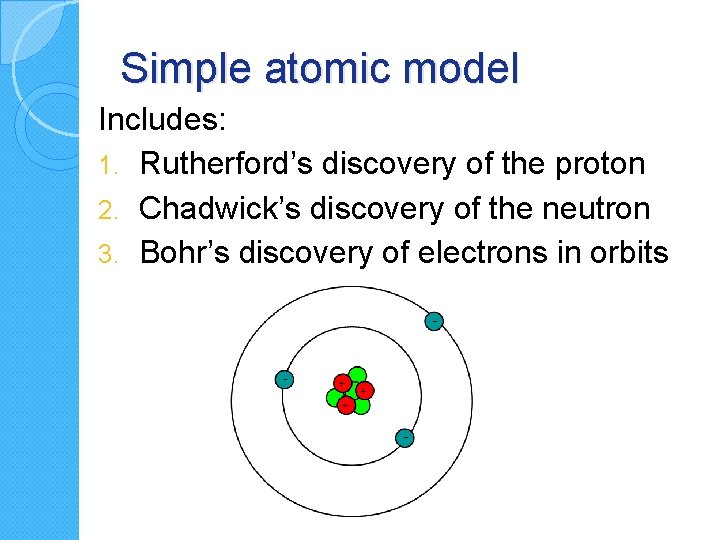
Simple atomic model Includes: 1. Rutherford’s discovery of the proton 2. Chadwick’s discovery of the neutron 3. Bohr’s discovery of electrons in orbits
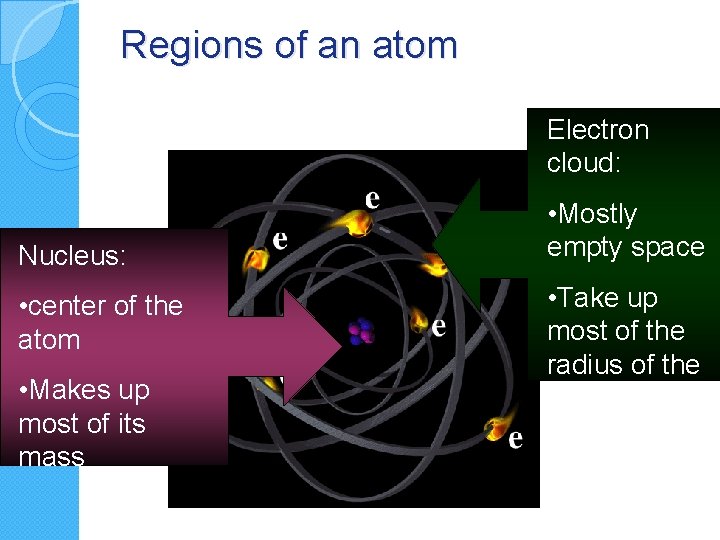
Regions of an atom Electron cloud: Nucleus: • center of the atom • Makes up most of its mass • Mostly empty space • Take up most of the radius of the atom
Subatomic Particles Nucleus Electron Cloud Protons (+) electrons (-) Neutrons (Neutral)
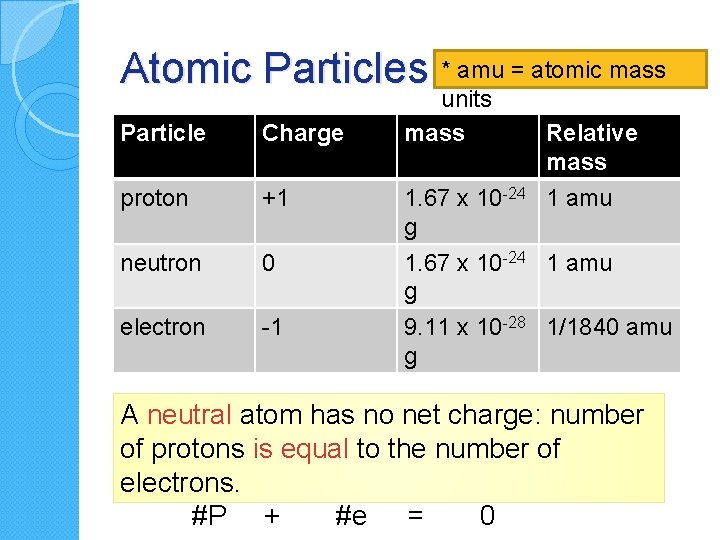
Atomic Particles * amu = atomic mass units mass Particle Charge Relative mass 1 amu proton +1 1. 67 x 10 -24 g neutron 0 1. 67 x 10 -24 1 amu g electron -1 9. 11 x 10 -28 1/1840 amu g A neutral atom has no net charge: number of protons is equal to the number of electrons. #P + #e = 0
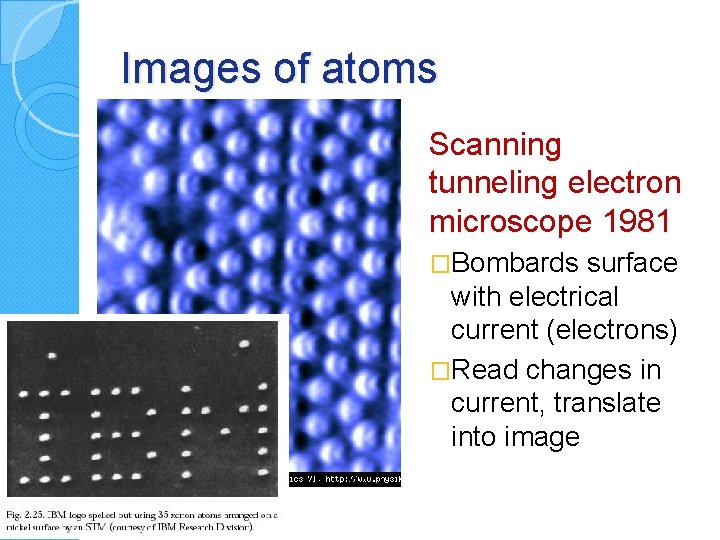
Images of atoms Scanning tunneling electron microscope 1981 �Bombards surface with electrical current (electrons) �Read changes in current, translate into image