Financial Managerial Accounting Information for Decisions Seventh Edition
- Slides: 102
Financial & Managerial Accounting Information for Decisions Seventh Edition Chapter 8 Accounting for Long-Term Assets © Mc. Graw-Hill Education. All rights reserved. Authorized only for instructor use in the classroom. No reproduction or further distribution permitted without the prior written consent of Mc. Graw-Hill Education.
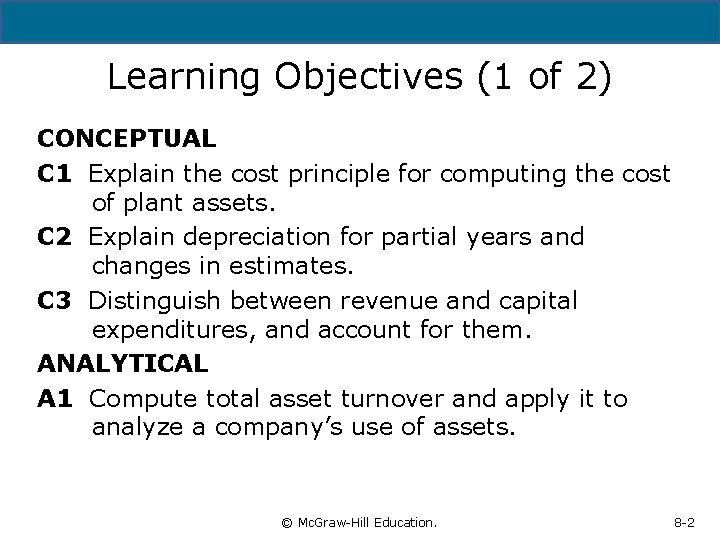
Learning Objectives (1 of 2) CONCEPTUAL C 1 Explain the cost principle for computing the cost of plant assets. C 2 Explain depreciation for partial years and changes in estimates. C 3 Distinguish between revenue and capital expenditures, and account for them. ANALYTICAL A 1 Compute total asset turnover and apply it to analyze a company’s use of assets. © Mc. Graw-Hill Education. 8 -2
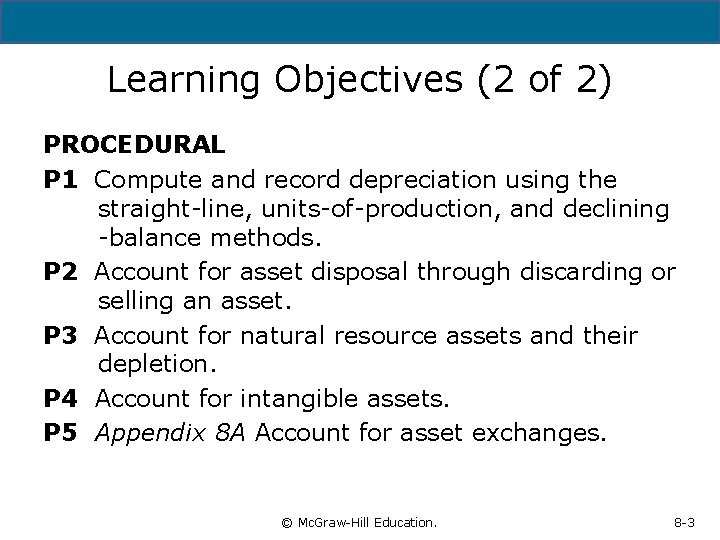
Learning Objectives (2 of 2) PROCEDURAL P 1 Compute and record depreciation using the straight-line, units-of-production, and declining -balance methods. P 2 Account for asset disposal through discarding or selling an asset. P 3 Account for natural resource assets and their depletion. P 4 Account for intangible assets. P 5 Appendix 8 A Account for asset exchanges. © Mc. Graw-Hill Education. 8 -3
Learning Objective C 1: Explain the cost principle for computing the cost of plant assets. © Mc. Graw-Hill Education. 3 -4
Plant Assets (1 of 2) Learning Objective C 1: Explain the cost principle for computing the cost of plant assets. • • Tangible in Nature Actively Used in Operations Expected to Benefit Future Periods Called Property, Plant, & Equipment © Mc. Graw-Hill Education. 8 -5
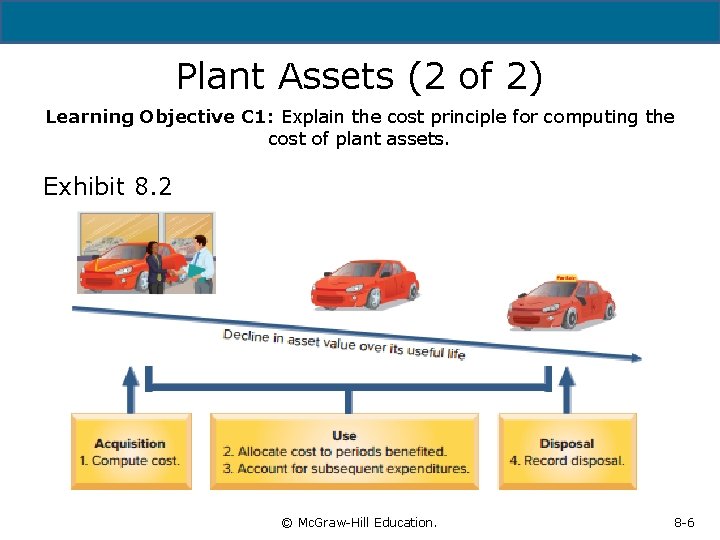
Plant Assets (2 of 2) Learning Objective C 1: Explain the cost principle for computing the cost of plant assets. Exhibit 8. 2 © Mc. Graw-Hill Education. 8 -6
Cost Determination Learning Objective C 1: Explain the cost principle for computing the cost of plant assets. • Acquisition Cost – Purchase price – Acquisition cost includes all normal and reasonable expenditures necessary to get the asset in place and ready for intended use – All expenditures needed to prepare the asset for its intended use © Mc. Graw-Hill Education. 8 -7
Machinery and Equipment Learning Objective C 1: Explain the cost principle for computing the cost of plant assets. • Machinery and Equipment – – – Taxes Transportation charges Insurance while in transit Installing, assembling, and testing Purchase price © Mc. Graw-Hill Education. 8 -8
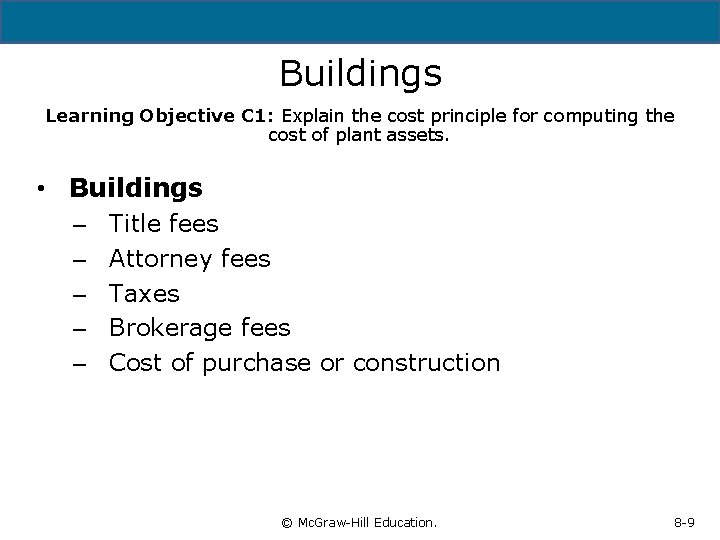
Buildings Learning Objective C 1: Explain the cost principle for computing the cost of plant assets. • Buildings – – – Title fees Attorney fees Taxes Brokerage fees Cost of purchase or construction © Mc. Graw-Hill Education. 8 -9
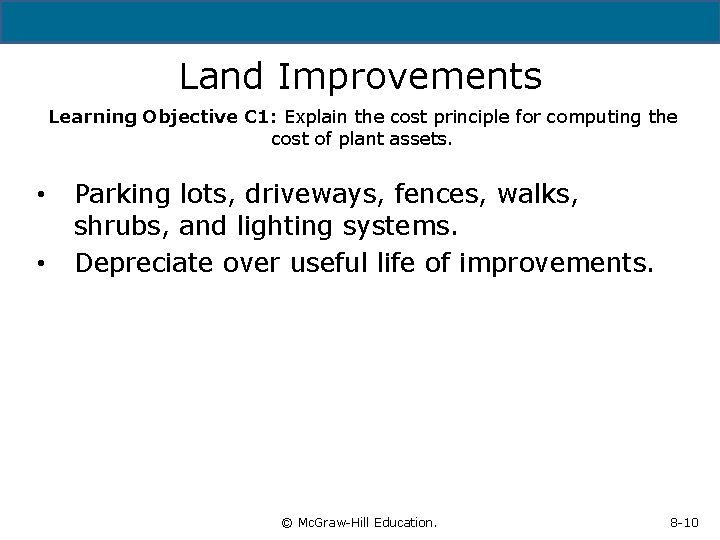
Land Improvements Learning Objective C 1: Explain the cost principle for computing the cost of plant assets. • • Parking lots, driveways, fences, walks, shrubs, and lighting systems. Depreciate over useful life of improvements. © Mc. Graw-Hill Education. 8 -10
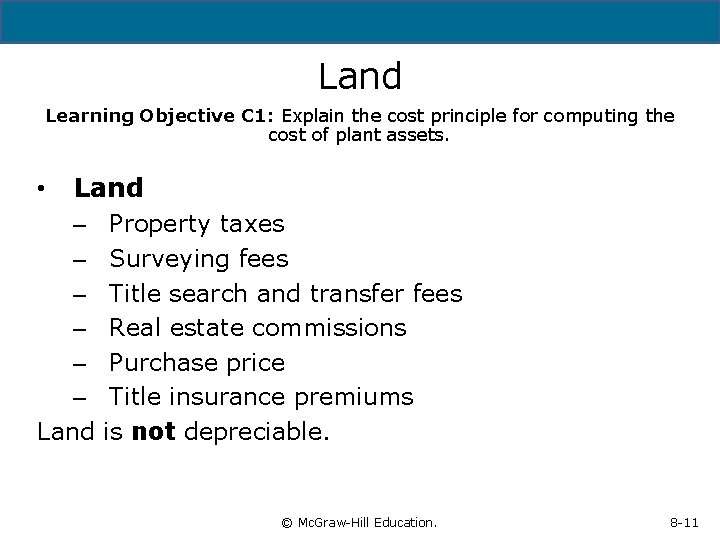
Land Learning Objective C 1: Explain the cost principle for computing the cost of plant assets. • Land – Property taxes – Surveying fees – Title search and transfer fees – Real estate commissions – Purchase price – Title insurance premiums Land is not depreciable. © Mc. Graw-Hill Education. 8 -11
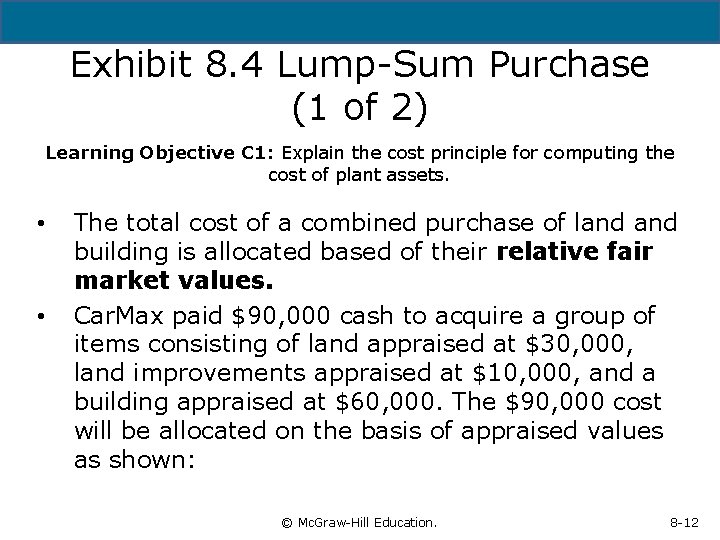
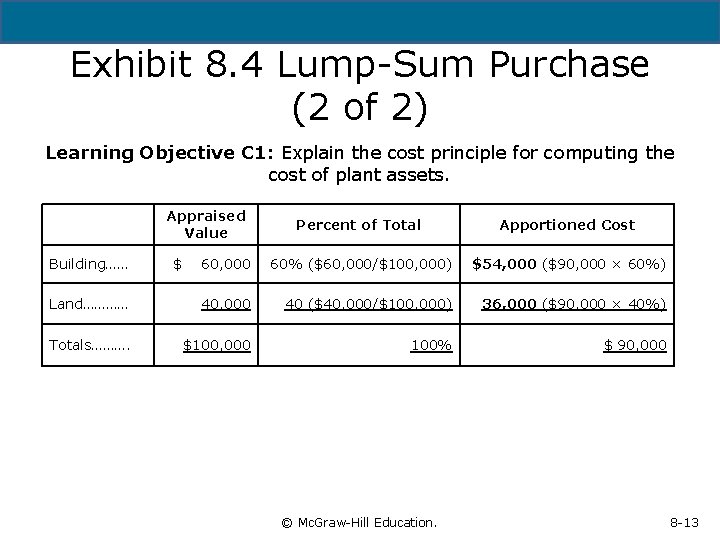
Exhibit 8. 4 Lump-Sum Purchase (1 of 2) Learning Objective C 1: Explain the cost principle for computing the cost of plant assets. • • The total cost of a combined purchase of land building is allocated based of their relative fair market values. Car. Max paid $90, 000 cash to acquire a group of items consisting of land appraised at $30, 000, land improvements appraised at $10, 000, and a building appraised at $60, 000. The $90, 000 cost will be allocated on the basis of appraised values as shown: © Mc. Graw-Hill Education. 8 -12
Exhibit 8. 4 Lump-Sum Purchase (2 of 2) Learning Objective C 1: Explain the cost principle for computing the cost of plant assets. Appraised Value Percent of Total Apportioned Cost Building…… $ 60, 000 60% ($60, 000/$100, 000) $54, 000 ($90, 000 × 60%) Land………… 40, 000 40 ($40, 000/$100, 000) 36, 000 ($90, 000 × 40%) Totals………. $100, 000 100% © Mc. Graw-Hill Education. $ 90, 000 8 -13
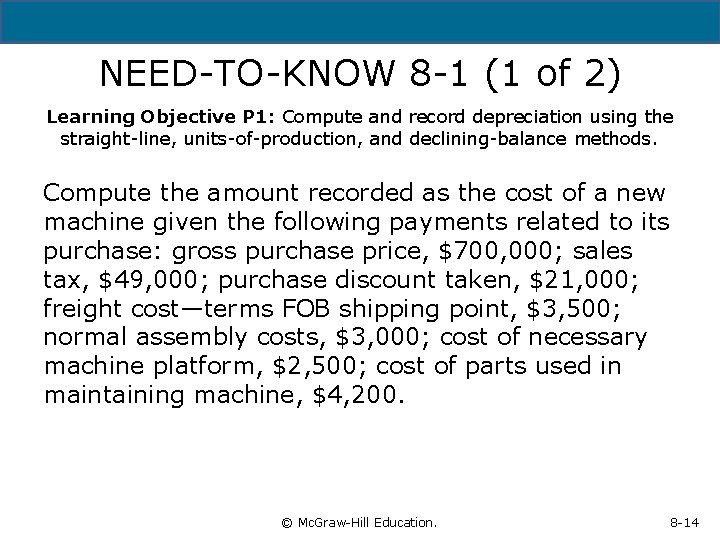
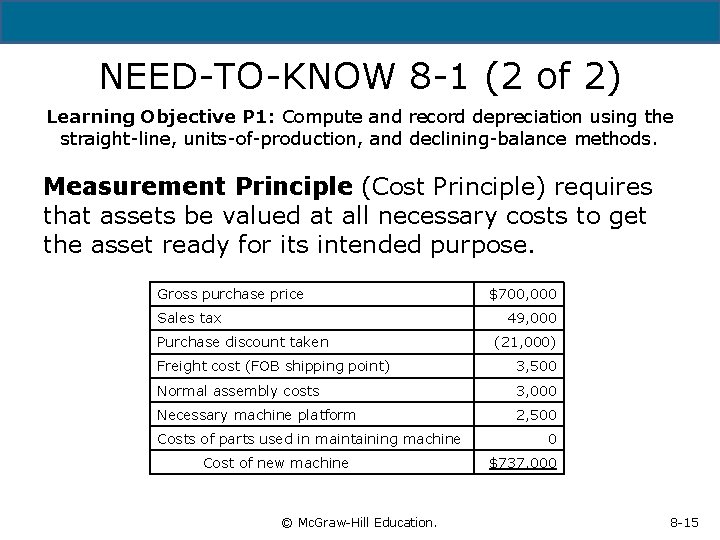
NEED-TO-KNOW 8 -1 (1 of 2) Learning Objective P 1: Compute and record depreciation using the straight-line, units-of-production, and declining-balance methods. Compute the amount recorded as the cost of a new machine given the following payments related to its purchase: gross purchase price, $700, 000; sales tax, $49, 000; purchase discount taken, $21, 000; freight cost—terms FOB shipping point, $3, 500; normal assembly costs, $3, 000; cost of necessary machine platform, $2, 500; cost of parts used in maintaining machine, $4, 200. © Mc. Graw-Hill Education. 8 -14
NEED-TO-KNOW 8 -1 (2 of 2) Learning Objective P 1: Compute and record depreciation using the straight-line, units-of-production, and declining-balance methods. Measurement Principle (Cost Principle) requires that assets be valued at all necessary costs to get the asset ready for its intended purpose. Gross purchase price Sales tax $700, 000 49, 000 Purchase discount taken (21, 000) Freight cost (FOB shipping point) 3, 500 Normal assembly costs 3, 000 Necessary machine platform 2, 500 Costs of parts used in maintaining machine Cost of new machine © Mc. Graw-Hill Education. 0 $737, 000 8 -15
Learning Objective P 1: Compute and record depreciation using the straight-line, units-of-production, and declining-balance methods. © Mc. Graw-Hill Education. 3 -16
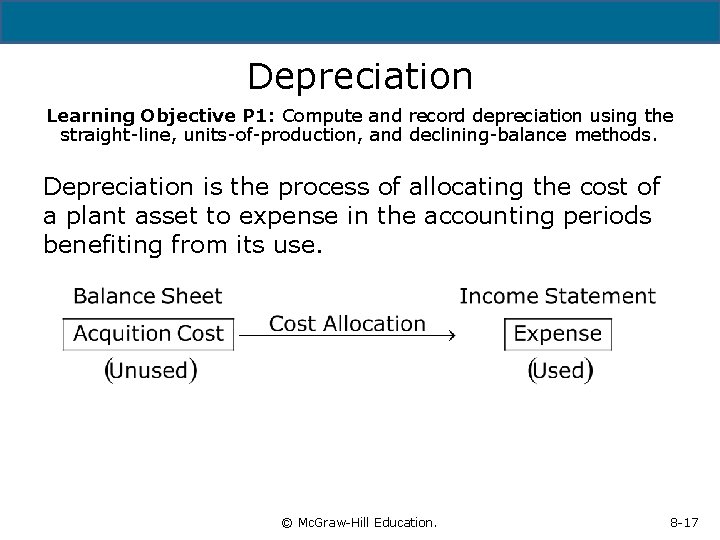
Depreciation Learning Objective P 1: Compute and record depreciation using the straight-line, units-of-production, and declining-balance methods. Depreciation is the process of allocating the cost of a plant asset to expense in the accounting periods benefiting from its use. © Mc. Graw-Hill Education. 8 -17
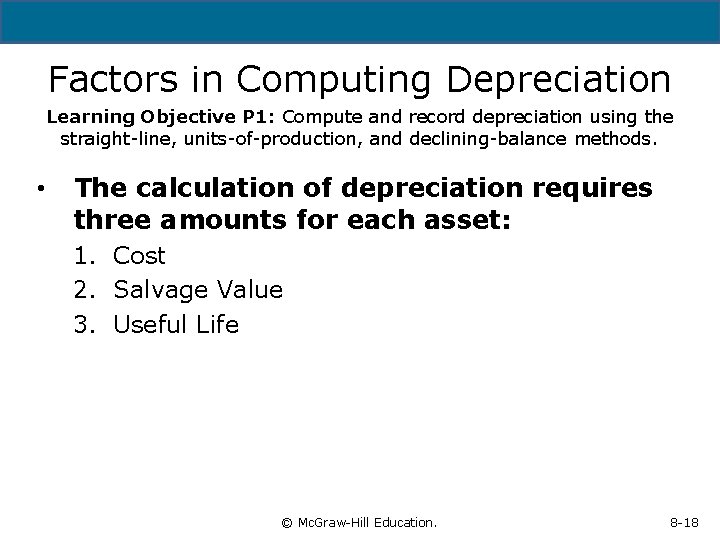
Factors in Computing Depreciation Learning Objective P 1: Compute and record depreciation using the straight-line, units-of-production, and declining-balance methods. • The calculation of depreciation requires three amounts for each asset: 1. Cost 2. Salvage Value 3. Useful Life © Mc. Graw-Hill Education. 8 -18
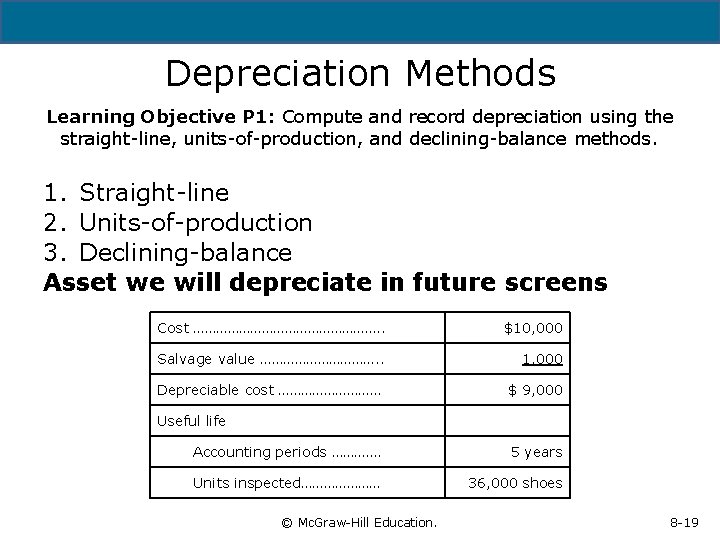
Depreciation Methods Learning Objective P 1: Compute and record depreciation using the straight-line, units-of-production, and declining-balance methods. 1. Straight-line 2. Units-of-production 3. Declining-balance Asset we will depreciate in future screens Cost ……………………. . $10, 000 Salvage value ……………. . 1, 000 Depreciable cost …………… $ 9, 000 Useful life Accounting periods …………. 5 years Units inspected………………… 36, 000 shoes © Mc. Graw-Hill Education. 8 -19
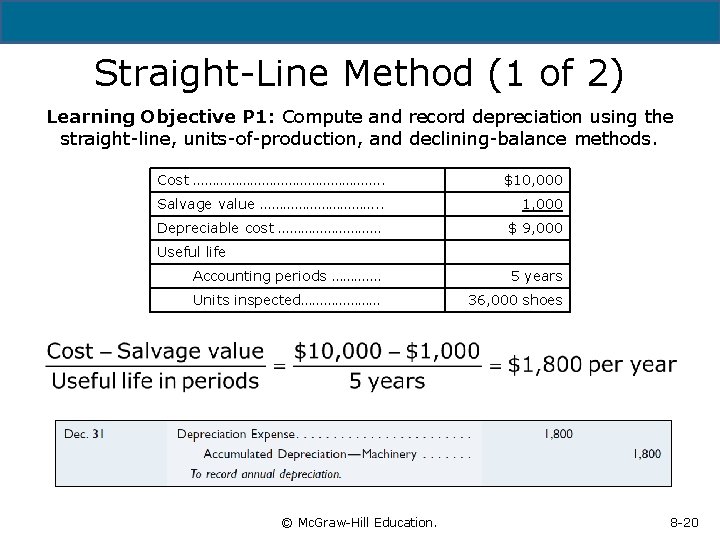
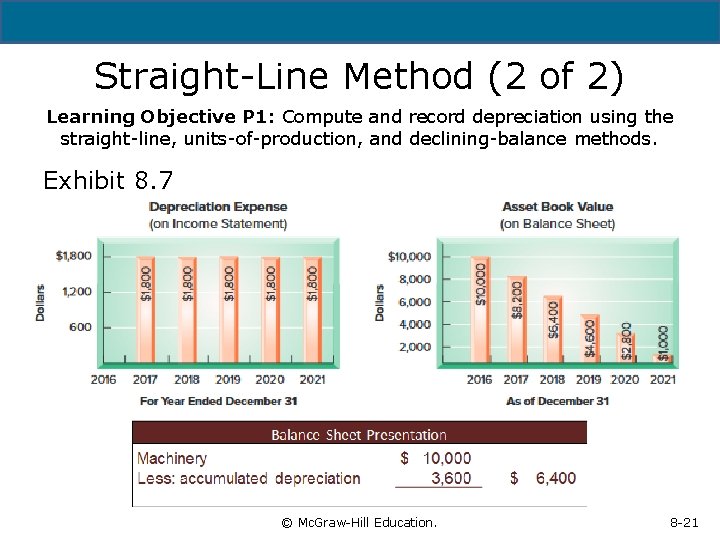
Straight-Line Method (1 of 2) Learning Objective P 1: Compute and record depreciation using the straight-line, units-of-production, and declining-balance methods. Cost ……………………. . $10, 000 Salvage value ……………. . 1, 000 Depreciable cost …………… $ 9, 000 Useful life Accounting periods …………. 5 years Units inspected………………… 36, 000 shoes © Mc. Graw-Hill Education. 8 -20
Straight-Line Method (2 of 2) Learning Objective P 1: Compute and record depreciation using the straight-line, units-of-production, and declining-balance methods. Exhibit 8. 7 © Mc. Graw-Hill Education. 8 -21
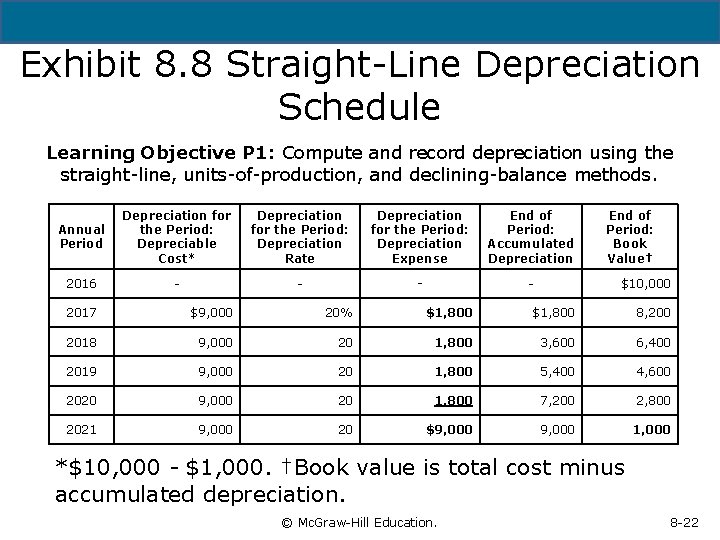
Exhibit 8. 8 Straight-Line Depreciation Schedule Learning Objective P 1: Compute and record depreciation using the straight-line, units-of-production, and declining-balance methods. Annual Period Depreciation for the Period: Depreciable Cost* Depreciation for the Period: Depreciation Rate Depreciation for the Period: Depreciation Expense End of Period: Accumulated Depreciation 2016 - - End of Period: Book Value† $10, 000 2017 $9, 000 20% $1, 800 8, 200 2018 9, 000 20 1, 800 3, 600 6, 400 2019 9, 000 20 1, 800 5, 400 4, 600 2020 9, 000 20 1, 800 7, 200 2, 800 2021 9, 000 20 $9, 000 1, 000 *$10, 000 - $1, 000. †Book value is total cost minus accumulated depreciation. © Mc. Graw-Hill Education. 8 -22
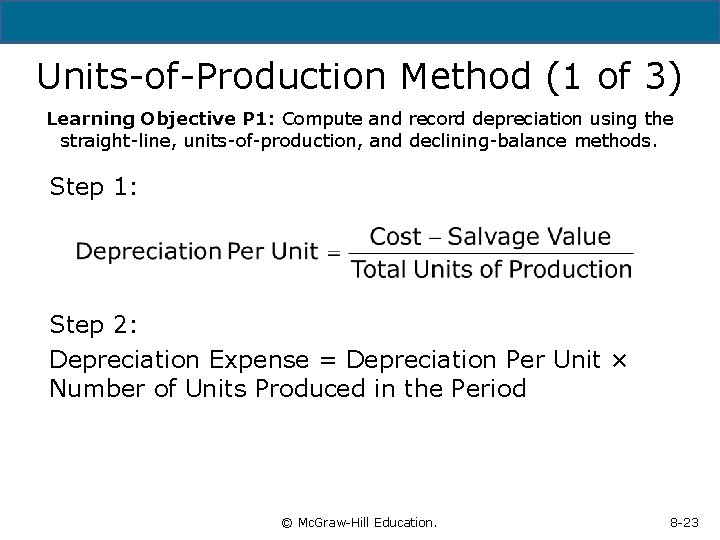
Units-of-Production Method (1 of 3) Learning Objective P 1: Compute and record depreciation using the straight-line, units-of-production, and declining-balance methods. Step 1: Step 2: Depreciation Expense = Depreciation Per Unit × Number of Units Produced in the Period © Mc. Graw-Hill Education. 8 -23
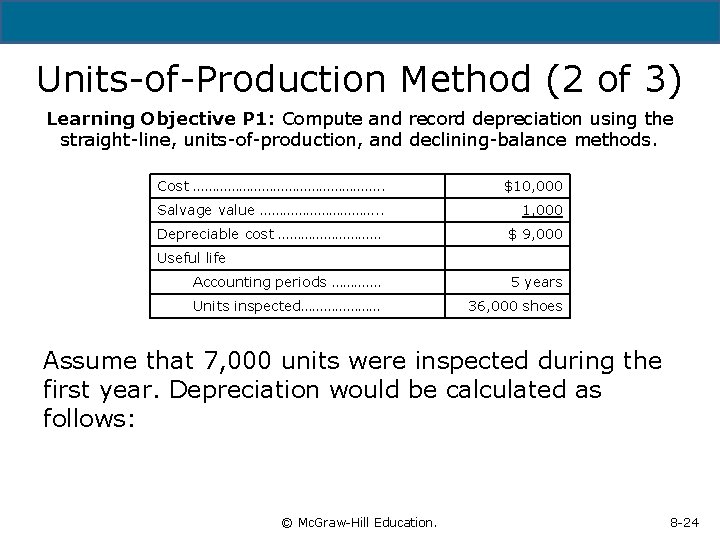
Units-of-Production Method (2 of 3) Learning Objective P 1: Compute and record depreciation using the straight-line, units-of-production, and declining-balance methods. Cost ……………………. . $10, 000 Salvage value ……………. . 1, 000 Depreciable cost …………… $ 9, 000 Useful life Accounting periods …………. 5 years Units inspected………………… 36, 000 shoes Assume that 7, 000 units were inspected during the first year. Depreciation would be calculated as follows: © Mc. Graw-Hill Education. 8 -24
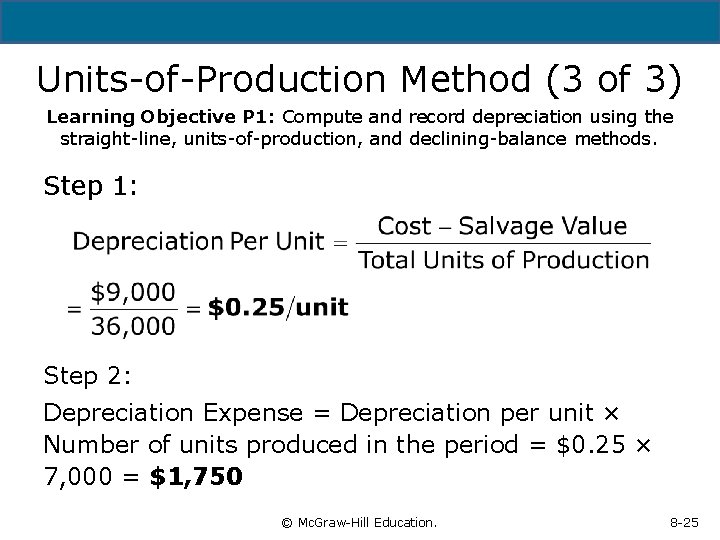
Units-of-Production Method (3 of 3) Learning Objective P 1: Compute and record depreciation using the straight-line, units-of-production, and declining-balance methods. Step 1: Step 2: Depreciation Expense = Depreciation per unit × Number of units produced in the period = $0. 25 × 7, 000 = $1, 750 © Mc. Graw-Hill Education. 8 -25
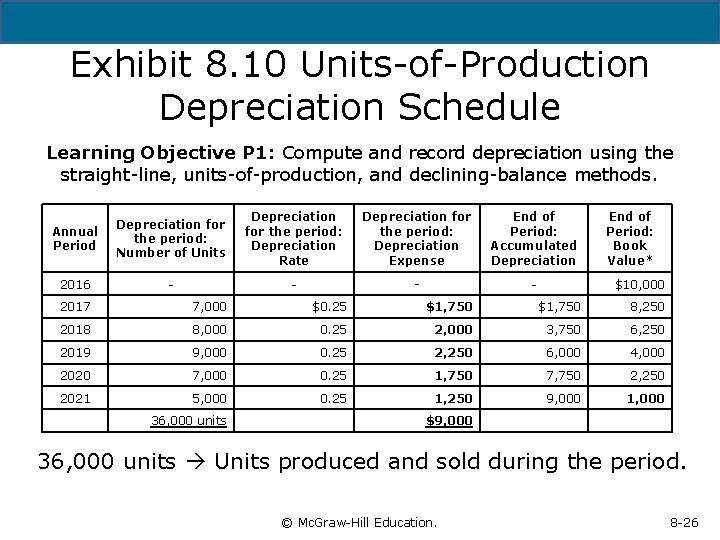
Exhibit 8. 10 Units-of-Production Depreciation Schedule Learning Objective P 1: Compute and record depreciation using the straight-line, units-of-production, and declining-balance methods. Annual Period Depreciation for the period: Number of Units Depreciation for the period: Depreciation Rate Depreciation for the period: Depreciation Expense End of Period: Accumulated Depreciation 2016 - - End of Period: Book Value* $10, 000 2017 7, 000 $0. 25 $1, 750 8, 250 2018 8, 000 0. 25 2, 000 3, 750 6, 250 2019 9, 000 0. 25 2, 250 6, 000 4, 000 2020 7, 000 0. 25 1, 750 7, 750 2, 250 2021 5, 000 0. 25 1, 250 9, 000 1, 000 36, 000 units $9, 000 36, 000 units Units produced and sold during the period. © Mc. Graw-Hill Education. 8 -26
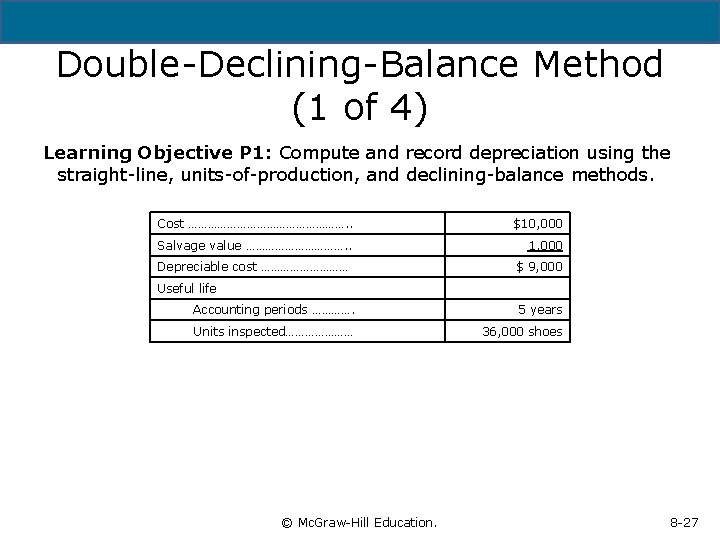
Double-Declining-Balance Method (1 of 4) Learning Objective P 1: Compute and record depreciation using the straight-line, units-of-production, and declining-balance methods. Cost ……………………. . $10, 000 Salvage value ……………. . 1, 000 Depreciable cost …………… $ 9, 000 Useful life Accounting periods …………. 5 years Units inspected………………… 36, 000 shoes © Mc. Graw-Hill Education. 8 -27
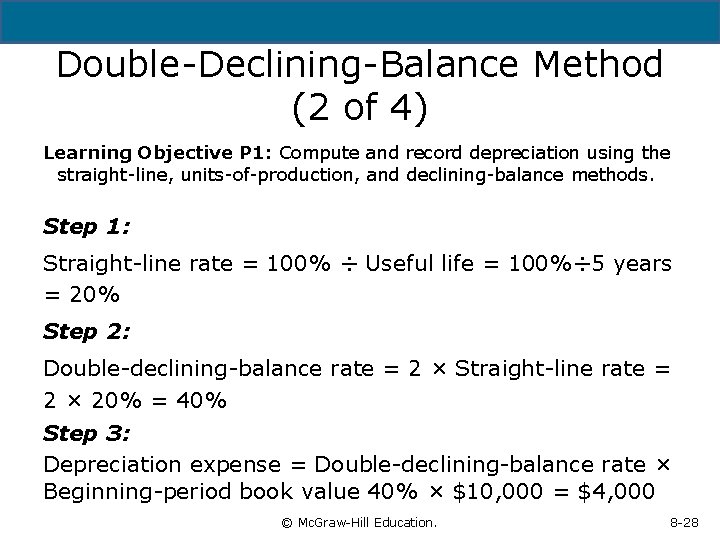
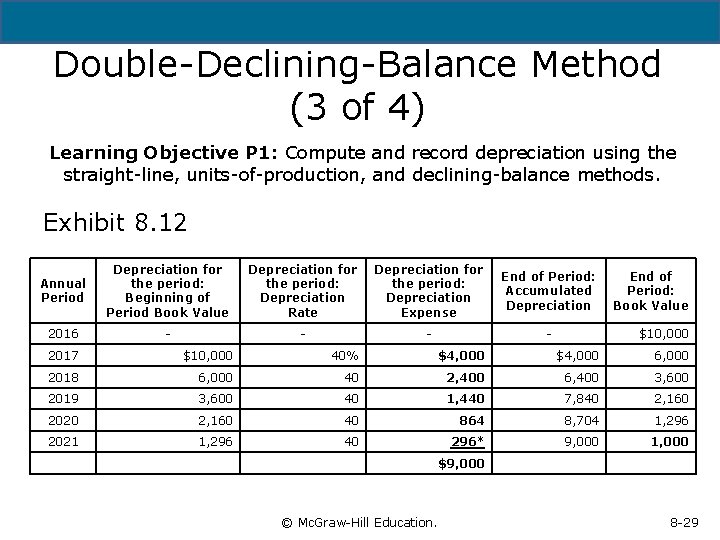
Double-Declining-Balance Method (2 of 4) Learning Objective P 1: Compute and record depreciation using the straight-line, units-of-production, and declining-balance methods. Step 1: Straight-line rate = 100% ÷ Useful life = 100%÷ 5 years = 20% Step 2: Double-declining-balance rate = 2 × Straight-line rate = 2 × 20% = 40% Step 3: Depreciation expense = Double-declining-balance rate × Beginning-period book value 40% × $10, 000 = $4, 000 © Mc. Graw-Hill Education. 8 -28
Double-Declining-Balance Method (3 of 4) Learning Objective P 1: Compute and record depreciation using the straight-line, units-of-production, and declining-balance methods. Exhibit 8. 12 Annual Period Depreciation for the period: Beginning of Period Book Value Depreciation for the period: Depreciation Rate Depreciation for the period: Depreciation Expense End of Period: Accumulated Depreciation 2016 - - End of Period: Book Value $10, 000 2017 $10, 000 40% $4, 000 6, 000 2018 6, 000 40 2, 400 6, 400 3, 600 2019 3, 600 40 1, 440 7, 840 2, 160 2020 2, 160 40 864 8, 704 1, 296 2021 1, 296 40 296* 9, 000 1, 000 $9, 000 © Mc. Graw-Hill Education. 8 -29
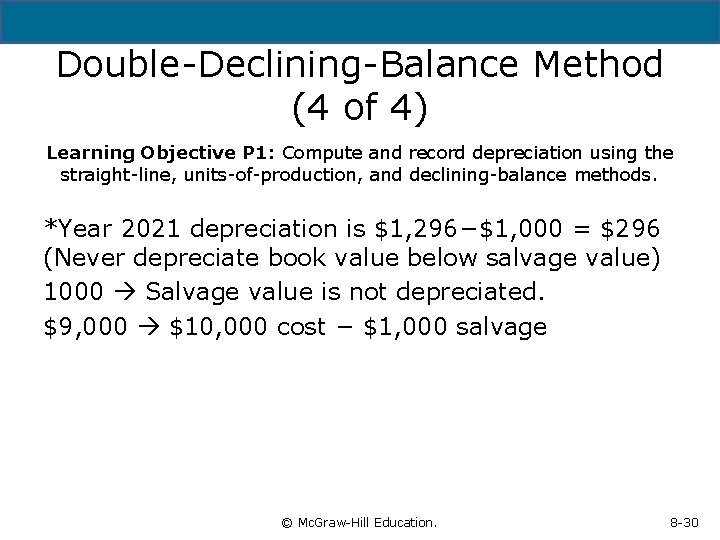
Double-Declining-Balance Method (4 of 4) Learning Objective P 1: Compute and record depreciation using the straight-line, units-of-production, and declining-balance methods. *Year 2021 depreciation is $1, 296−$1, 000 = $296 (Never depreciate book value below salvage value) 1000 Salvage value is not depreciated. $9, 000 $10, 000 cost − $1, 000 salvage © Mc. Graw-Hill Education. 8 -30
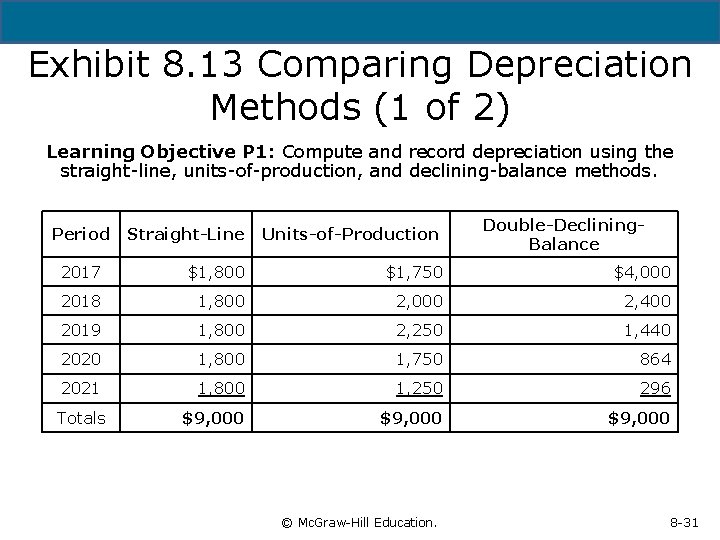
Exhibit 8. 13 Comparing Depreciation Methods (1 of 2) Learning Objective P 1: Compute and record depreciation using the straight-line, units-of-production, and declining-balance methods. Period Double-Declining. Balance Straight-Line Units-of-Production 2017 $1, 800 $1, 750 $4, 000 2018 1, 800 2, 000 2, 400 2019 1, 800 2, 250 1, 440 2020 1, 800 1, 750 864 2021 1, 800 1, 250 296 Totals $9, 000 © Mc. Graw-Hill Education. 8 -31
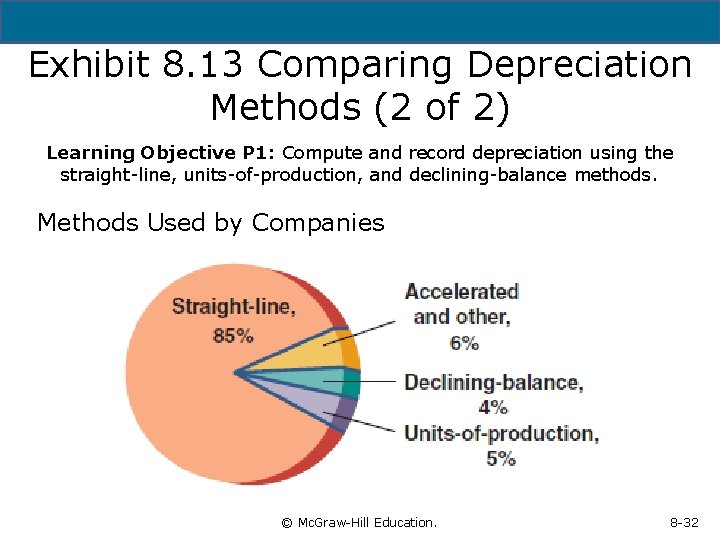
Exhibit 8. 13 Comparing Depreciation Methods (2 of 2) Learning Objective P 1: Compute and record depreciation using the straight-line, units-of-production, and declining-balance methods. Methods Used by Companies © Mc. Graw-Hill Education. 8 -32
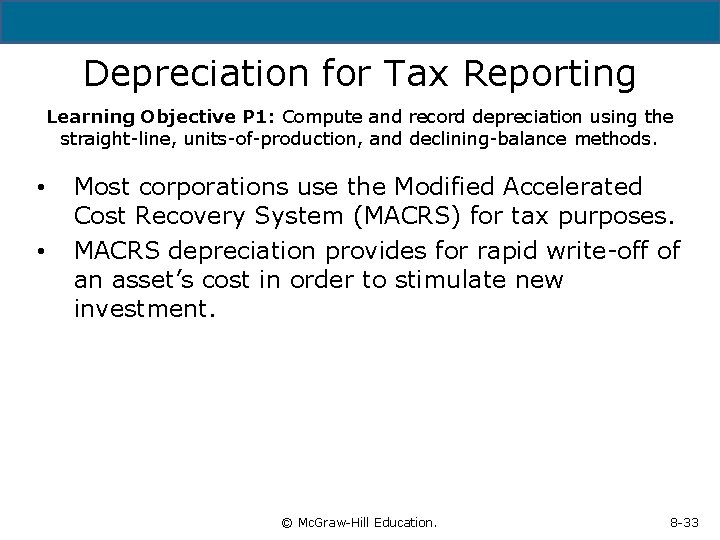
Depreciation for Tax Reporting Learning Objective P 1: Compute and record depreciation using the straight-line, units-of-production, and declining-balance methods. • • Most corporations use the Modified Accelerated Cost Recovery System (MACRS) for tax purposes. MACRS depreciation provides for rapid write-off of an asset’s cost in order to stimulate new investment. © Mc. Graw-Hill Education. 8 -33
Learning Objective C 2: Explain depreciation for partial years and changes in estimates. © Mc. Graw-Hill Education. 3 -34
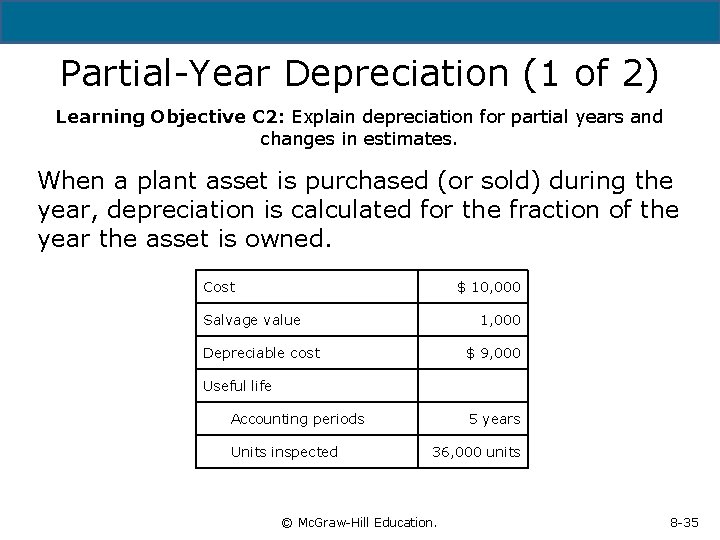
Partial-Year Depreciation (1 of 2) Learning Objective C 2: Explain depreciation for partial years and changes in estimates. When a plant asset is purchased (or sold) during the year, depreciation is calculated for the fraction of the year the asset is owned. Cost $ 10, 000 Salvage value 1, 000 Depreciable cost Useful life $ 9, 000 Accounting periods Units inspected 5 years 36, 000 units © Mc. Graw-Hill Education. 8 -35
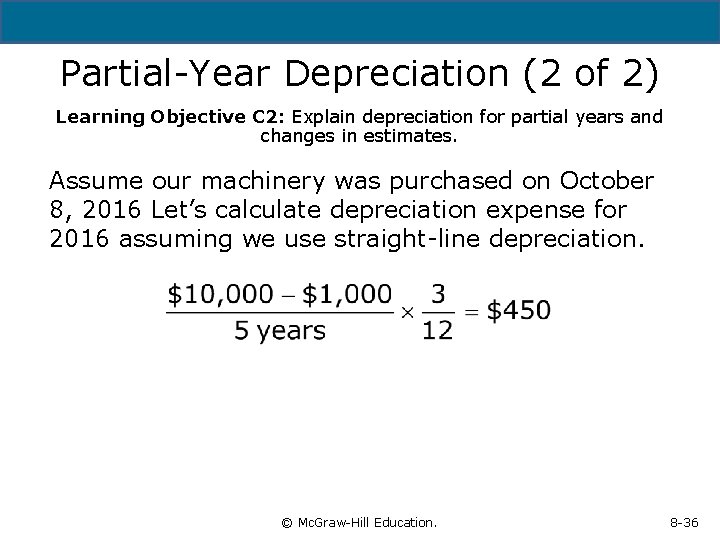
Partial-Year Depreciation (2 of 2) Learning Objective C 2: Explain depreciation for partial years and changes in estimates. Assume our machinery was purchased on October 8, 2016 Let’s calculate depreciation expense for 2016 assuming we use straight-line depreciation. © Mc. Graw-Hill Education. 8 -36
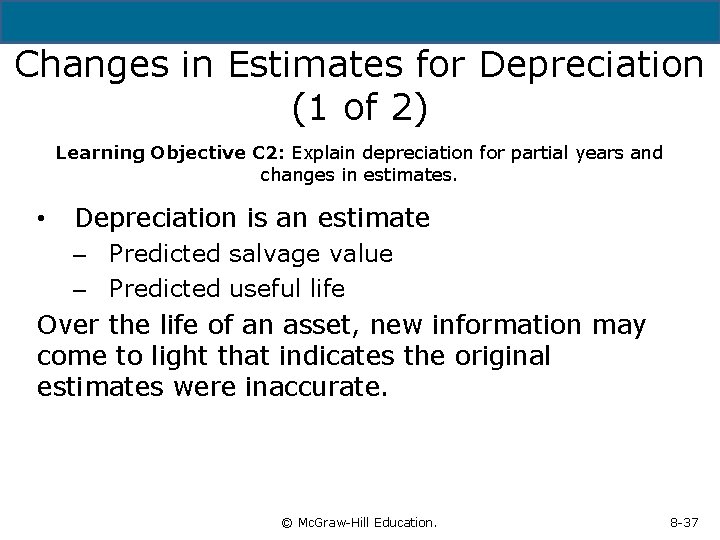
Changes in Estimates for Depreciation (1 of 2) Learning Objective C 2: Explain depreciation for partial years and changes in estimates. • Depreciation is an estimate – Predicted salvage value – Predicted useful life Over the life of an asset, new information may come to light that indicates the original estimates were inaccurate. © Mc. Graw-Hill Education. 8 -37
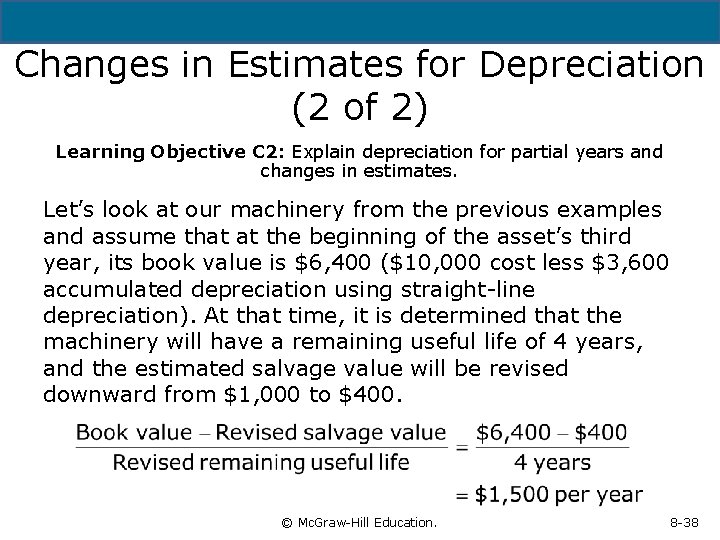
Changes in Estimates for Depreciation (2 of 2) Learning Objective C 2: Explain depreciation for partial years and changes in estimates. Let’s look at our machinery from the previous examples and assume that at the beginning of the asset’s third year, its book value is $6, 400 ($10, 000 cost less $3, 600 accumulated depreciation using straight-line depreciation). At that time, it is determined that the machinery will have a remaining useful life of 4 years, and the estimated salvage value will be revised downward from $1, 000 to $400. © Mc. Graw-Hill Education. 8 -38
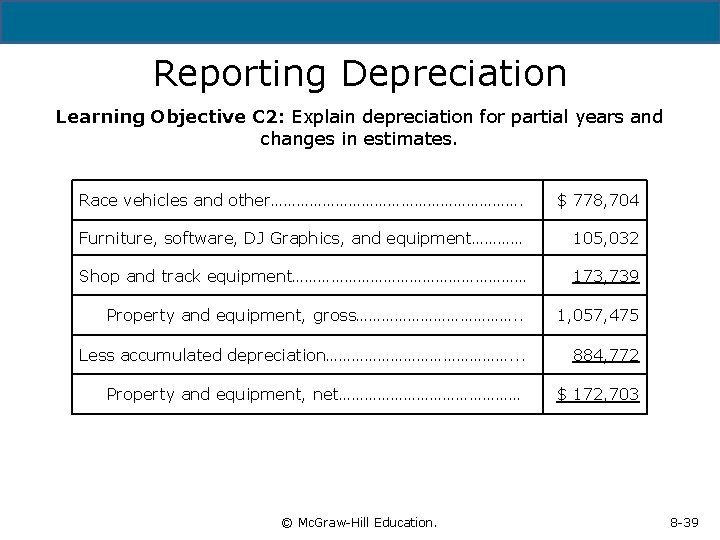
Reporting Depreciation Learning Objective C 2: Explain depreciation for partial years and changes in estimates. Race vehicles and other…………………………. $ 778, 704 Furniture, software, DJ Graphics, and equipment………… 105, 032 Shop and track equipment……………………… 173, 739 Property and equipment, gross………………. . 1, 057, 475 Less accumulated depreciation…………………. . . 884, 772 Property and equipment, net………………… $ 172, 703 © Mc. Graw-Hill Education. 8 -39
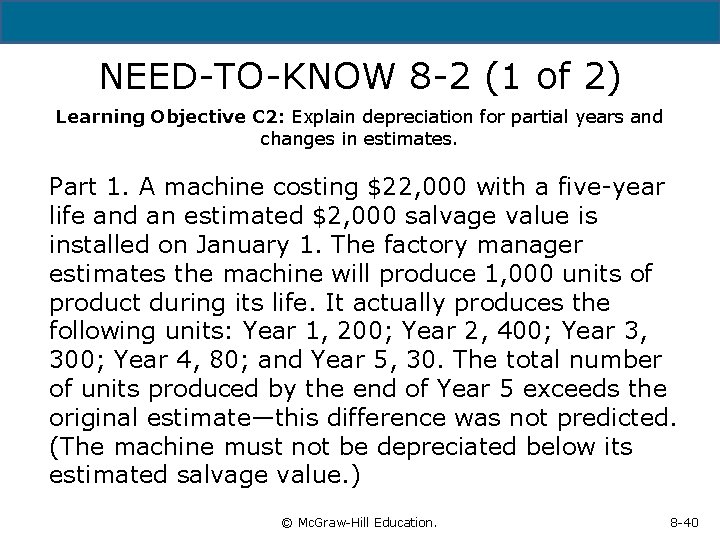
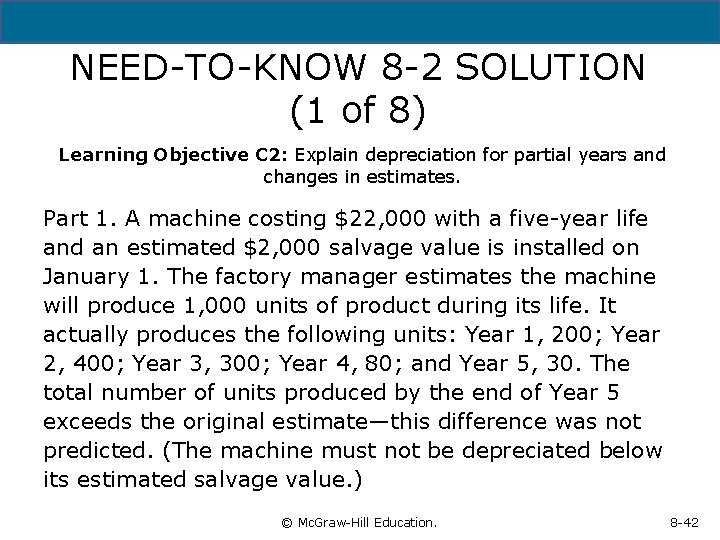
NEED-TO-KNOW 8 -2 (1 of 2) Learning Objective C 2: Explain depreciation for partial years and changes in estimates. Part 1. A machine costing $22, 000 with a five-year life and an estimated $2, 000 salvage value is installed on January 1. The factory manager estimates the machine will produce 1, 000 units of product during its life. It actually produces the following units: Year 1, 200; Year 2, 400; Year 3, 300; Year 4, 80; and Year 5, 30. The total number of units produced by the end of Year 5 exceeds the original estimate—this difference was not predicted. (The machine must not be depreciated below its estimated salvage value. ) © Mc. Graw-Hill Education. 8 -40
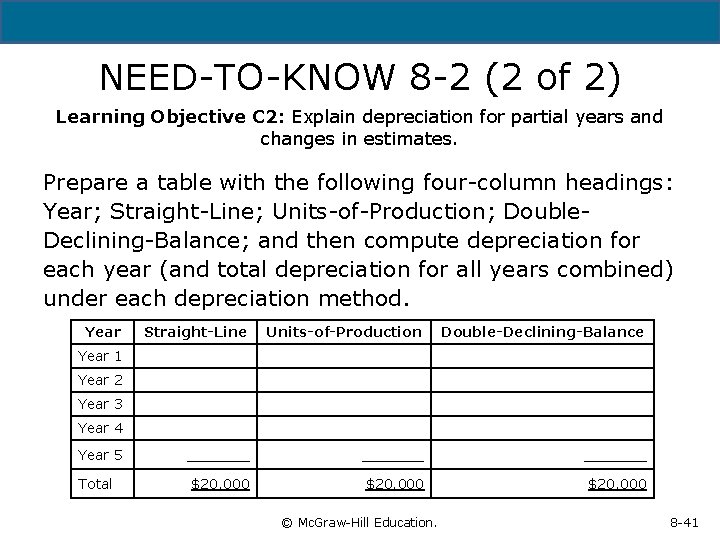
NEED-TO-KNOW 8 -2 (2 of 2) Learning Objective C 2: Explain depreciation for partial years and changes in estimates. Prepare a table with the following four-column headings: Year; Straight-Line; Units-of-Production; Double. Declining-Balance; and then compute depreciation for each year (and total depreciation for all years combined) under each depreciation method. Year Straight-Line Units-of-Production Double-Declining-Balance Year 5 _______ Total $20, 000 Year 1 Year 2 Year 3 Year 4 © Mc. Graw-Hill Education. 8 -41
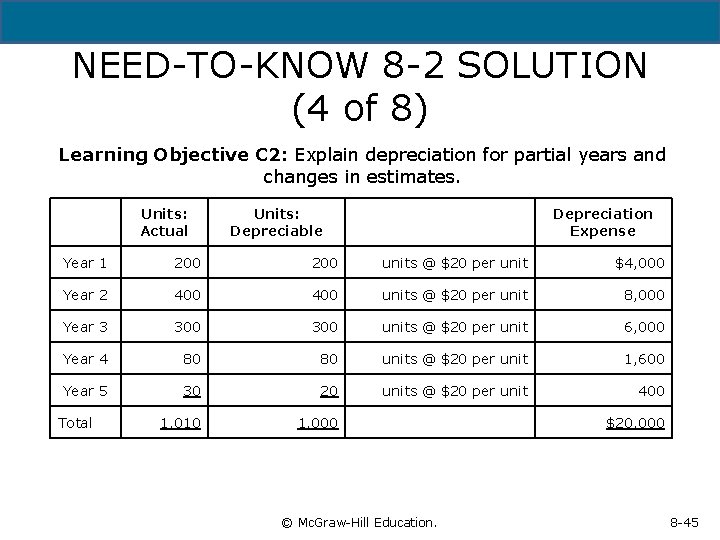
NEED-TO-KNOW 8 -2 SOLUTION (1 of 8) Learning Objective C 2: Explain depreciation for partial years and changes in estimates. Part 1. A machine costing $22, 000 with a five-year life and an estimated $2, 000 salvage value is installed on January 1. The factory manager estimates the machine will produce 1, 000 units of product during its life. It actually produces the following units: Year 1, 200; Year 2, 400; Year 3, 300; Year 4, 80; and Year 5, 30. The total number of units produced by the end of Year 5 exceeds the original estimate—this difference was not predicted. (The machine must not be depreciated below its estimated salvage value. ) © Mc. Graw-Hill Education. 8 -42
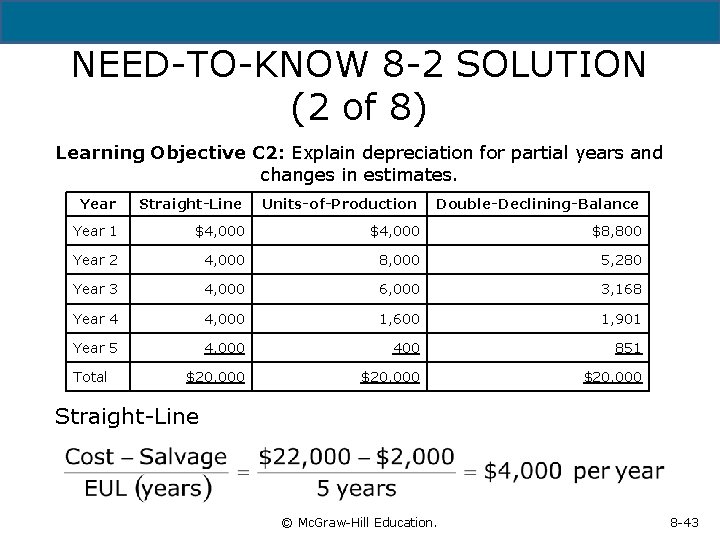
NEED-TO-KNOW 8 -2 SOLUTION (2 of 8) Learning Objective C 2: Explain depreciation for partial years and changes in estimates. Year Straight-Line Units-of-Production Double-Declining-Balance Year 1 $4, 000 $8, 800 Year 2 4, 000 8, 000 5, 280 Year 3 4, 000 6, 000 3, 168 Year 4 4, 000 1, 600 1, 901 Year 5 4, 000 400 851 $20, 000 Total Straight-Line © Mc. Graw-Hill Education. 8 -43
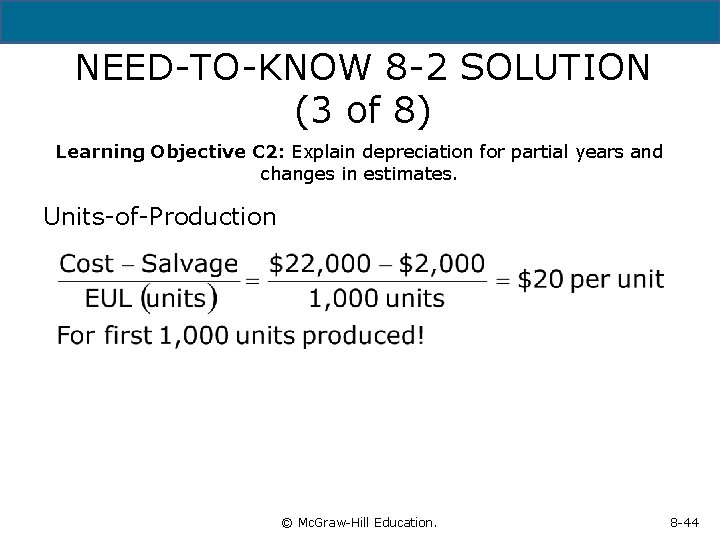
NEED-TO-KNOW 8 -2 SOLUTION (3 of 8) Learning Objective C 2: Explain depreciation for partial years and changes in estimates. Units-of-Production © Mc. Graw-Hill Education. 8 -44
NEED-TO-KNOW 8 -2 SOLUTION (4 of 8) Learning Objective C 2: Explain depreciation for partial years and changes in estimates. Units: Actual Units: Depreciable Depreciation Expense Year 1 200 units @ $20 per unit $4, 000 Year 2 400 units @ $20 per unit 8, 000 Year 3 300 units @ $20 per unit 6, 000 Year 4 80 80 units @ $20 per unit 1, 600 Year 5 30 20 units @ $20 per unit 400 1, 010 1, 000 Total © Mc. Graw-Hill Education. $20, 000 8 -45
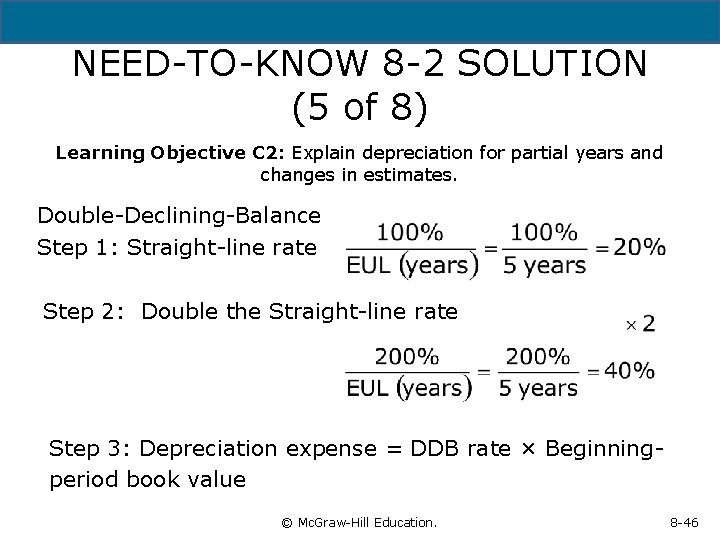
NEED-TO-KNOW 8 -2 SOLUTION (5 of 8) Learning Objective C 2: Explain depreciation for partial years and changes in estimates. Double-Declining-Balance Step 1: Straight-line rate Step 2: Double the Straight-line rate Step 3: Depreciation expense = DDB rate × Beginningperiod book value © Mc. Graw-Hill Education. 8 -46
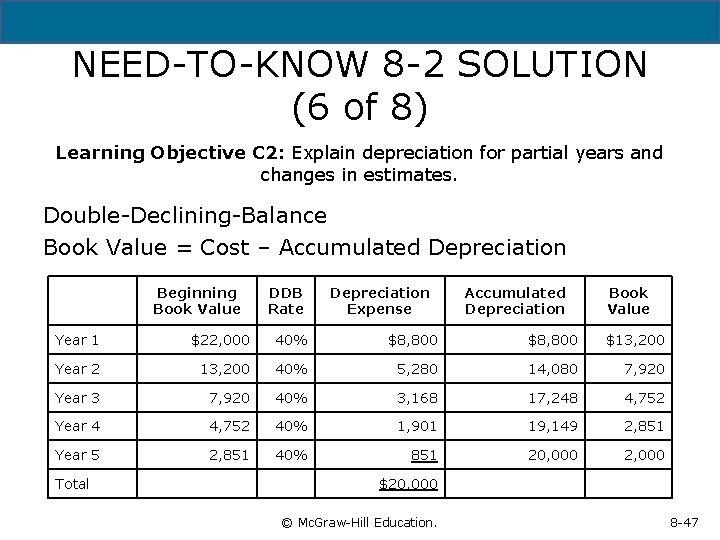
NEED-TO-KNOW 8 -2 SOLUTION (6 of 8) Learning Objective C 2: Explain depreciation for partial years and changes in estimates. Double-Declining-Balance Book Value = Cost – Accumulated Depreciation Beginning Book Value DDB Rate Depreciation Expense Accumulated Depreciation Book Value Year 1 $22, 000 40% $8, 800 $13, 200 Year 2 13, 200 40% 5, 280 14, 080 7, 920 Year 3 7, 920 40% 3, 168 17, 248 4, 752 Year 4 4, 752 40% 1, 901 19, 149 2, 851 Year 5 2, 851 40% 851 20, 000 2, 000 Total $20, 000 © Mc. Graw-Hill Education. 8 -47
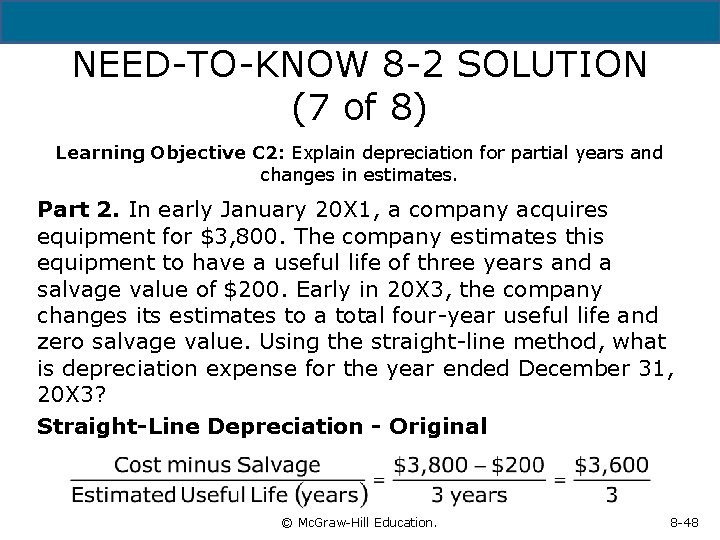
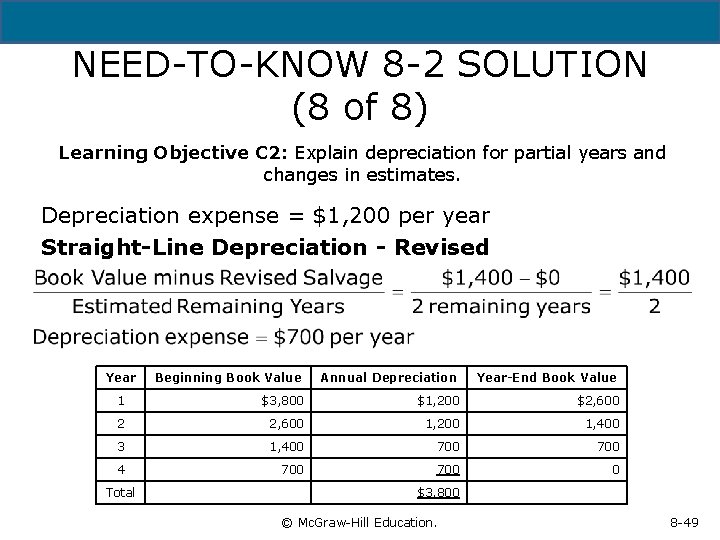
NEED-TO-KNOW 8 -2 SOLUTION (7 of 8) Learning Objective C 2: Explain depreciation for partial years and changes in estimates. Part 2. In early January 20 X 1, a company acquires equipment for $3, 800. The company estimates this equipment to have a useful life of three years and a salvage value of $200. Early in 20 X 3, the company changes its estimates to a total four-year useful life and zero salvage value. Using the straight-line method, what is depreciation expense for the year ended December 31, 20 X 3? Straight-Line Depreciation - Original © Mc. Graw-Hill Education. 8 -48
NEED-TO-KNOW 8 -2 SOLUTION (8 of 8) Learning Objective C 2: Explain depreciation for partial years and changes in estimates. Depreciation expense = $1, 200 per year Straight-Line Depreciation - Revised Year Beginning Book Value Annual Depreciation Year-End Book Value 1 $3, 800 $1, 200 $2, 600 2 2, 600 1, 200 1, 400 3 1, 400 700 4 700 0 Total $3, 800 © Mc. Graw-Hill Education. 8 -49
Learning Objective C 3: Distinguish between revenue and capital expenditures, and account for them. © Mc. Graw-Hill Education. 3 -50
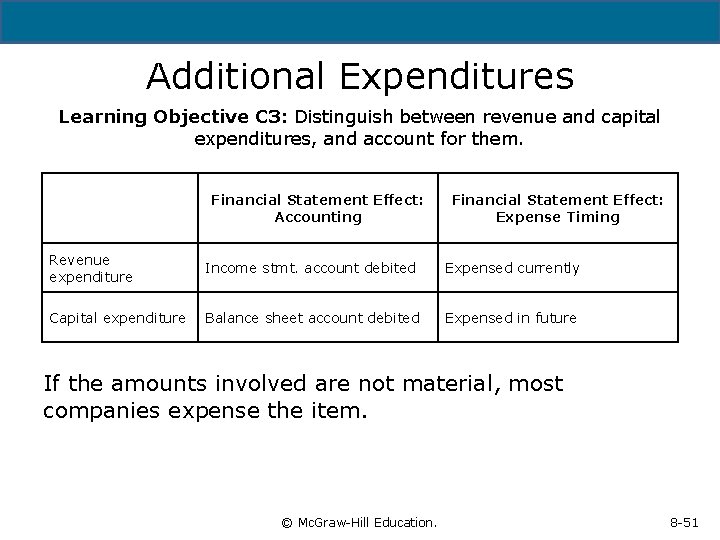
Additional Expenditures Learning Objective C 3: Distinguish between revenue and capital expenditures, and account for them. Financial Statement Effect: Accounting Financial Statement Effect: Expense Timing Revenue expenditure Income stmt. account debited Expensed currently Capital expenditure Balance sheet account debited Expensed in future If the amounts involved are not material, most companies expense the item. © Mc. Graw-Hill Education. 8 -51
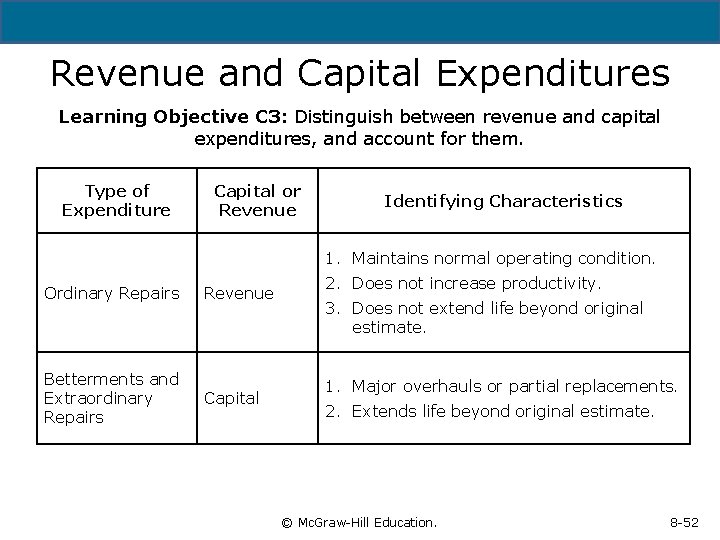
Revenue and Capital Expenditures Learning Objective C 3: Distinguish between revenue and capital expenditures, and account for them. Type of Expenditure Capital or Revenue Identifying Characteristics 1. Maintains normal operating condition. Ordinary Repairs Betterments and Extraordinary Repairs Revenue Capital 2. Does not increase productivity. 3. Does not extend life beyond original estimate. 1. Major overhauls or partial replacements. 2. Extends life beyond original estimate. © Mc. Graw-Hill Education. 8 -52
Learning Objective P 2: Account for asset disposal through discarding or selling an asset. © Mc. Graw-Hill Education. 3 -53
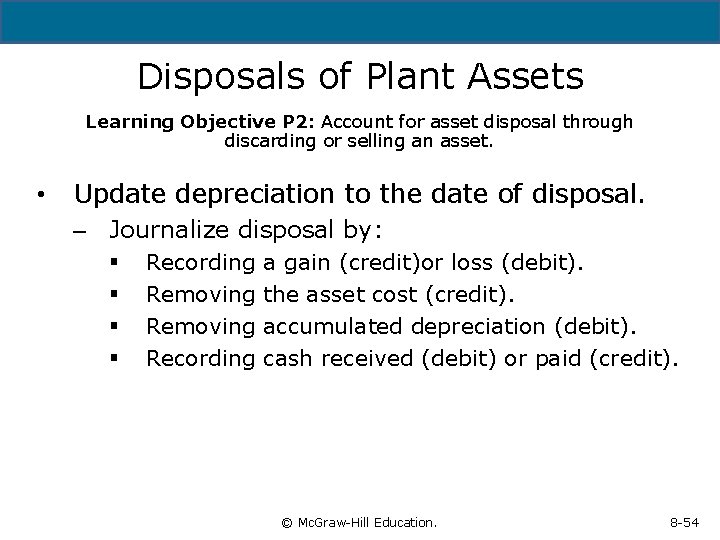
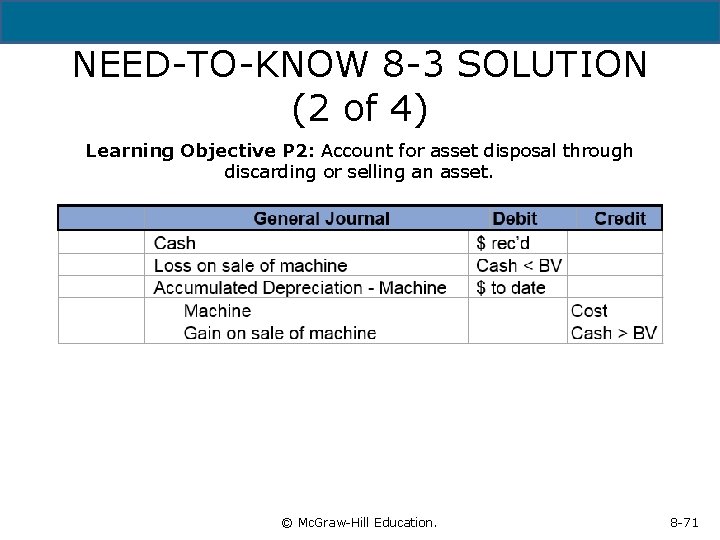
Disposals of Plant Assets Learning Objective P 2: Account for asset disposal through discarding or selling an asset. • Update depreciation to the date of disposal. – Journalize disposal by: § § Recording a gain (credit)or loss (debit). Removing the asset cost (credit). Removing accumulated depreciation (debit). Recording cash received (debit) or paid (credit). © Mc. Graw-Hill Education. 8 -54
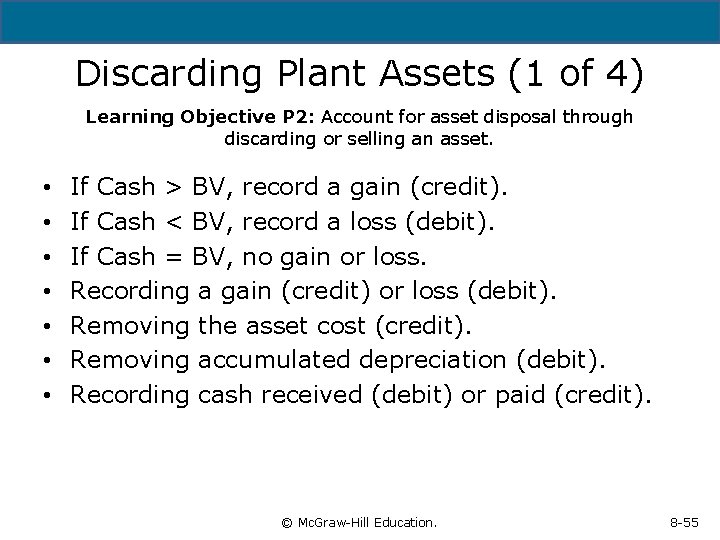
Discarding Plant Assets (1 of 4) Learning Objective P 2: Account for asset disposal through discarding or selling an asset. • • If Cash > BV, record a gain (credit). If Cash < BV, record a loss (debit). If Cash = BV, no gain or loss. Recording a gain (credit) or loss (debit). Removing the asset cost (credit). Removing accumulated depreciation (debit). Recording cash received (debit) or paid (credit). © Mc. Graw-Hill Education. 8 -55
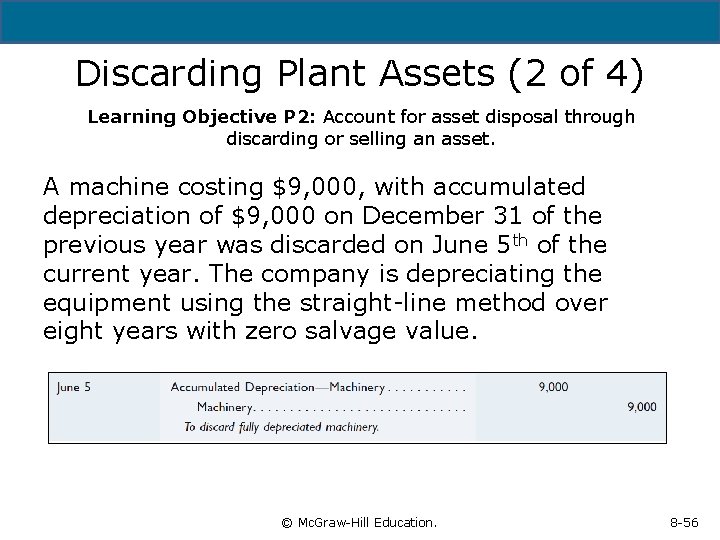
Discarding Plant Assets (2 of 4) Learning Objective P 2: Account for asset disposal through discarding or selling an asset. A machine costing $9, 000, with accumulated depreciation of $9, 000 on December 31 of the previous year was discarded on June 5 th of the current year. The company is depreciating the equipment using the straight-line method over eight years with zero salvage value. © Mc. Graw-Hill Education. 8 -56
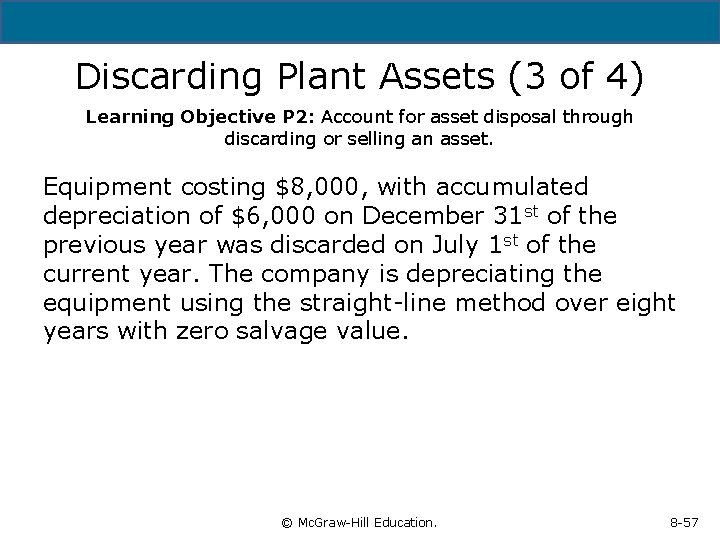
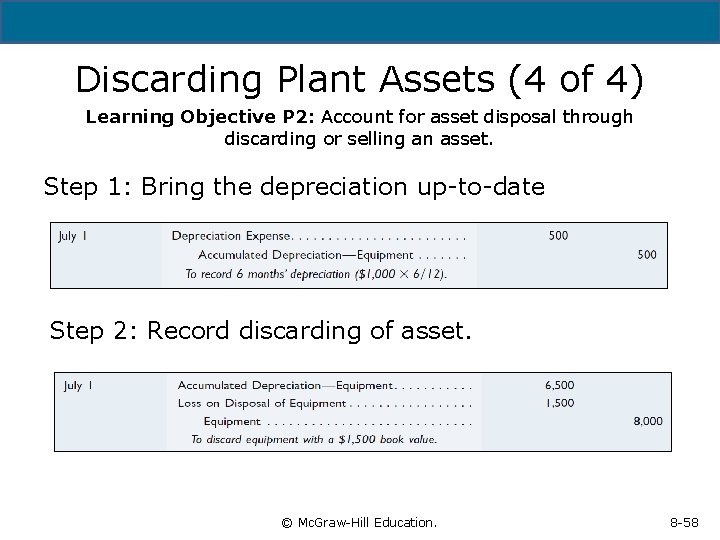
Discarding Plant Assets (3 of 4) Learning Objective P 2: Account for asset disposal through discarding or selling an asset. Equipment costing $8, 000, with accumulated depreciation of $6, 000 on December 31 st of the previous year was discarded on July 1 st of the current year. The company is depreciating the equipment using the straight-line method over eight years with zero salvage value. © Mc. Graw-Hill Education. 8 -57
Discarding Plant Assets (4 of 4) Learning Objective P 2: Account for asset disposal through discarding or selling an asset. Step 1: Bring the depreciation up-to-date Step 2: Record discarding of asset. © Mc. Graw-Hill Education. 8 -58
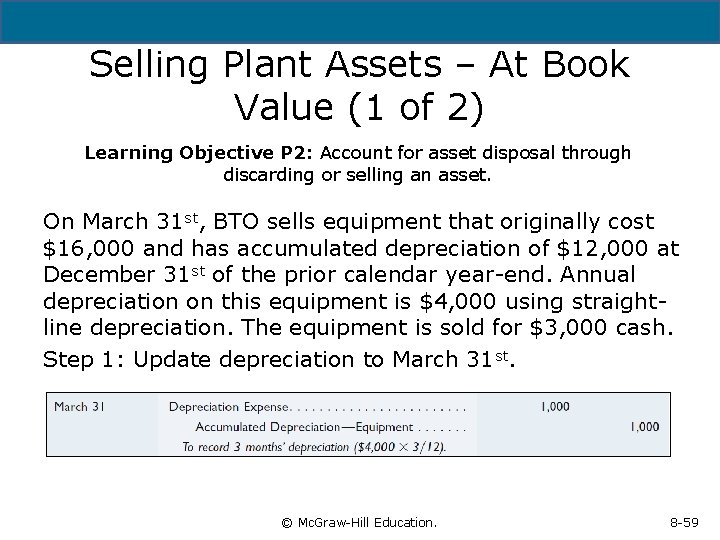
Selling Plant Assets – At Book Value (1 of 2) Learning Objective P 2: Account for asset disposal through discarding or selling an asset. On March 31 st, BTO sells equipment that originally cost $16, 000 and has accumulated depreciation of $12, 000 at December 31 st of the prior calendar year-end. Annual depreciation on this equipment is $4, 000 using straightline depreciation. The equipment is sold for $3, 000 cash. Step 1: Update depreciation to March 31 st. © Mc. Graw-Hill Education. 8 -59
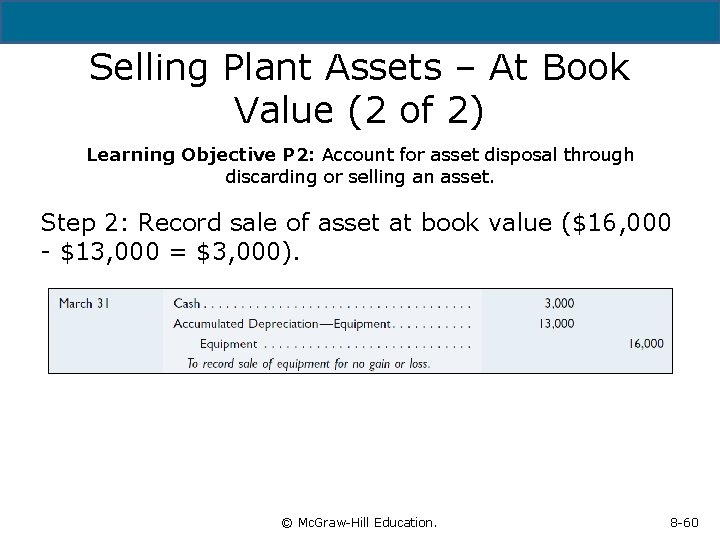
Selling Plant Assets – At Book Value (2 of 2) Learning Objective P 2: Account for asset disposal through discarding or selling an asset. Step 2: Record sale of asset at book value ($16, 000 - $13, 000 = $3, 000). © Mc. Graw-Hill Education. 8 -60
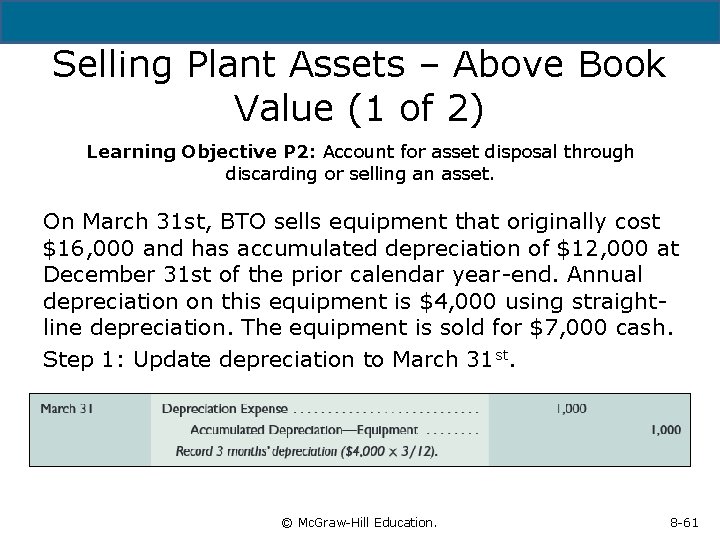
Selling Plant Assets – Above Book Value (1 of 2) Learning Objective P 2: Account for asset disposal through discarding or selling an asset. On March 31 st, BTO sells equipment that originally cost $16, 000 and has accumulated depreciation of $12, 000 at December 31 st of the prior calendar year-end. Annual depreciation on this equipment is $4, 000 using straightline depreciation. The equipment is sold for $7, 000 cash. Step 1: Update depreciation to March 31 st. © Mc. Graw-Hill Education. 8 -61
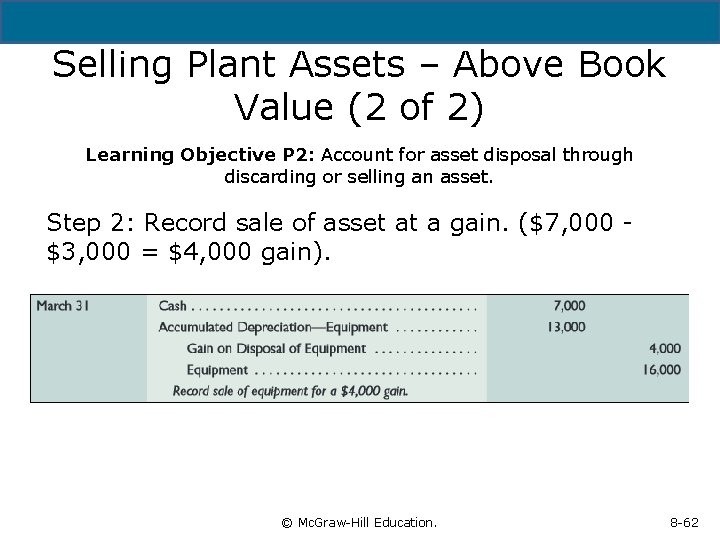
Selling Plant Assets – Above Book Value (2 of 2) Learning Objective P 2: Account for asset disposal through discarding or selling an asset. Step 2: Record sale of asset at a gain. ($7, 000 - $3, 000 = $4, 000 gain). © Mc. Graw-Hill Education. 8 -62
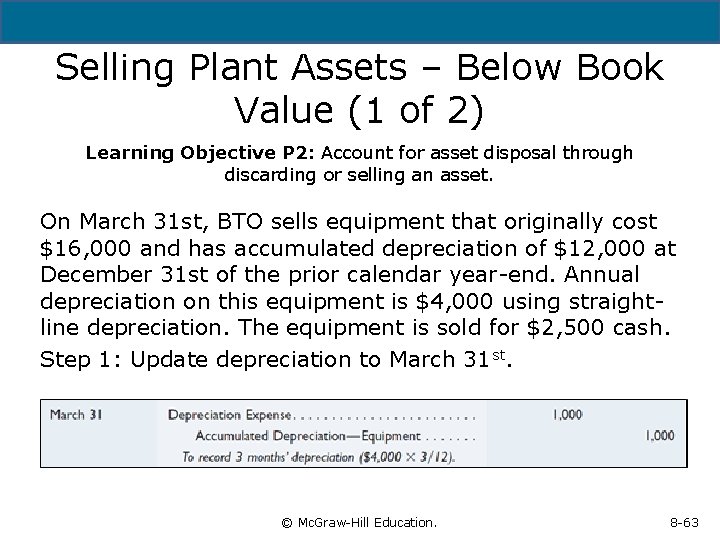
Selling Plant Assets – Below Book Value (1 of 2) Learning Objective P 2: Account for asset disposal through discarding or selling an asset. On March 31 st, BTO sells equipment that originally cost $16, 000 and has accumulated depreciation of $12, 000 at December 31 st of the prior calendar year-end. Annual depreciation on this equipment is $4, 000 using straightline depreciation. The equipment is sold for $2, 500 cash. Step 1: Update depreciation to March 31 st. © Mc. Graw-Hill Education. 8 -63
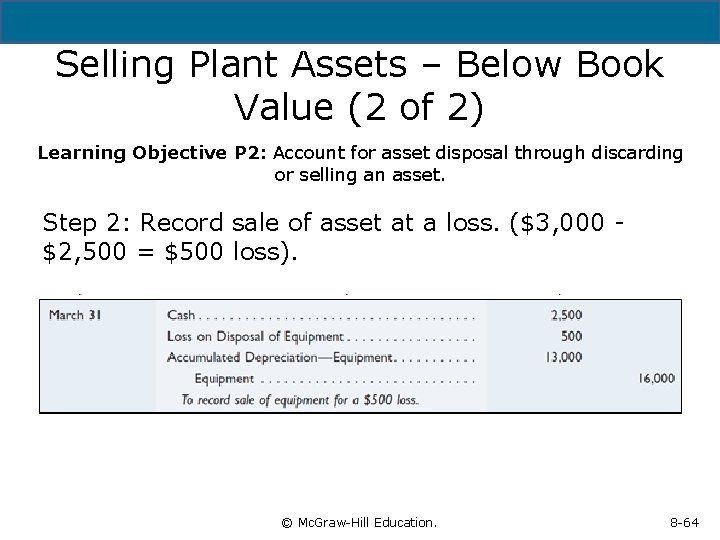
Selling Plant Assets – Below Book Value (2 of 2) Learning Objective P 2: Account for asset disposal through discarding or selling an asset. Step 2: Record sale of asset at a loss. ($3, 000 - $2, 500 = $500 loss). © Mc. Graw-Hill Education. 8 -64
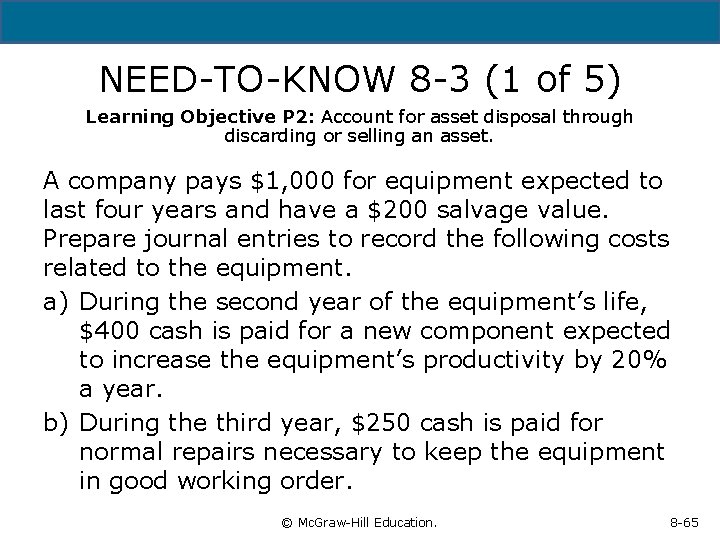
NEED-TO-KNOW 8 -3 (1 of 5) Learning Objective P 2: Account for asset disposal through discarding or selling an asset. A company pays $1, 000 for equipment expected to last four years and have a $200 salvage value. Prepare journal entries to record the following costs related to the equipment. a) During the second year of the equipment’s life, $400 cash is paid for a new component expected to increase the equipment’s productivity by 20% a year. b) During the third year, $250 cash is paid for normal repairs necessary to keep the equipment in good working order. © Mc. Graw-Hill Education. 8 -65
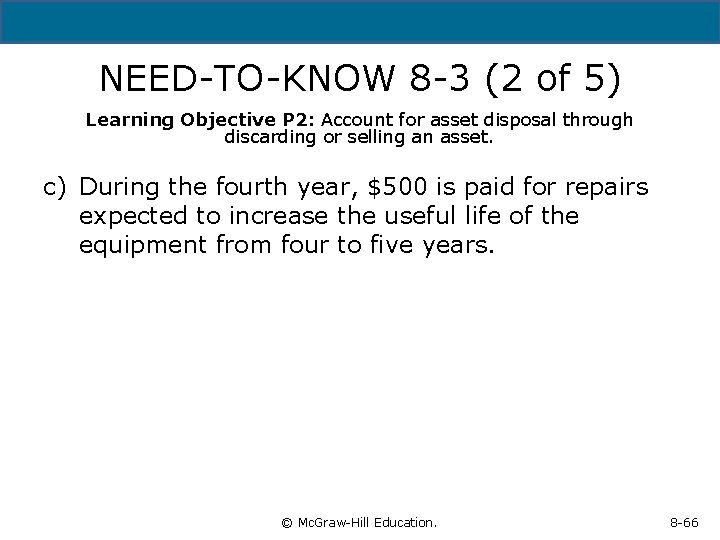
NEED-TO-KNOW 8 -3 (2 of 5) Learning Objective P 2: Account for asset disposal through discarding or selling an asset. c) During the fourth year, $500 is paid for repairs expected to increase the useful life of the equipment from four to five years. © Mc. Graw-Hill Education. 8 -66
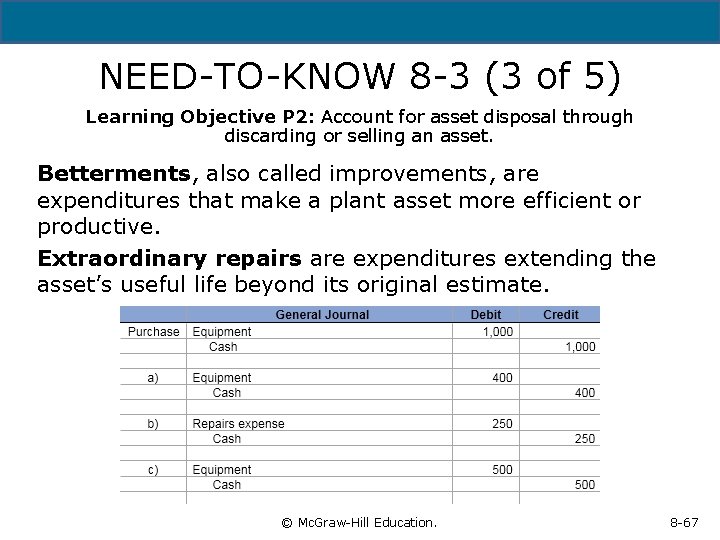
NEED-TO-KNOW 8 -3 (3 of 5) Learning Objective P 2: Account for asset disposal through discarding or selling an asset. Betterments, also called improvements, are expenditures that make a plant asset more efficient or productive. Extraordinary repairs are expenditures extending the asset’s useful life beyond its original estimate. © Mc. Graw-Hill Education. 8 -67
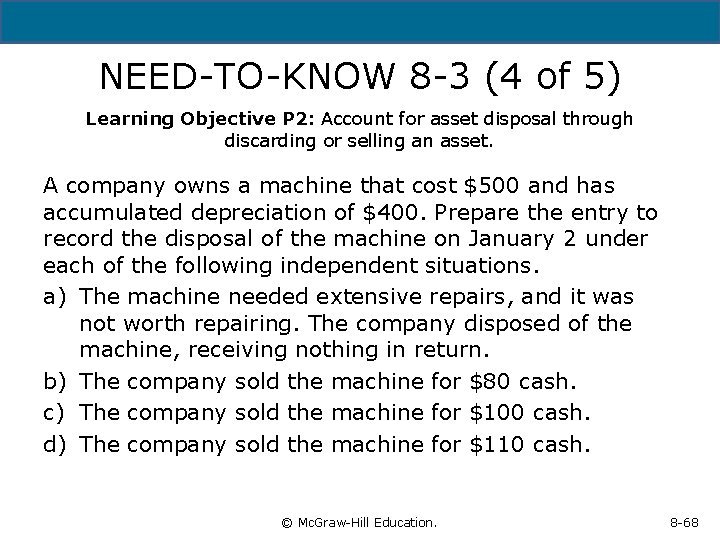
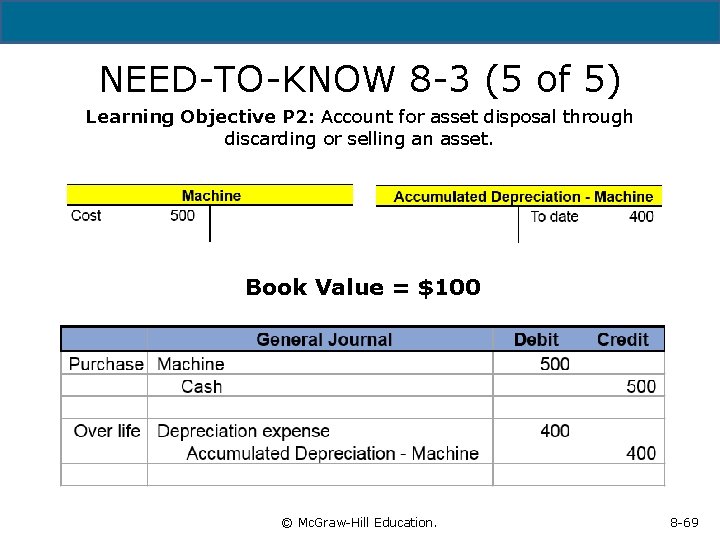
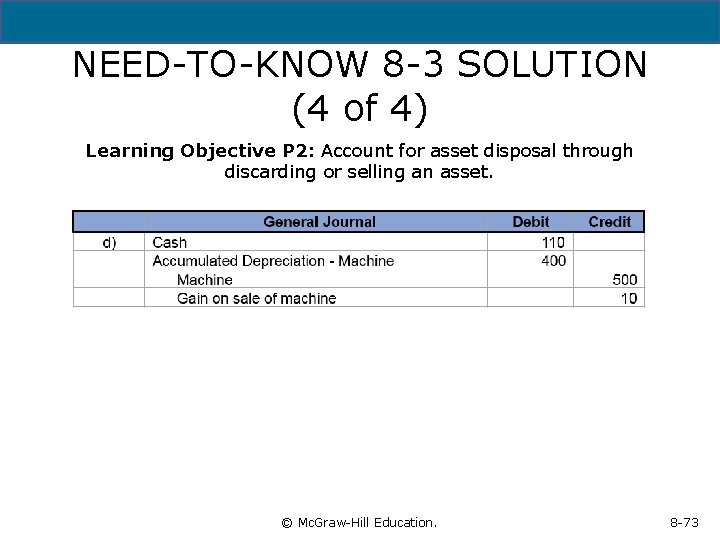
NEED-TO-KNOW 8 -3 (4 of 5) Learning Objective P 2: Account for asset disposal through discarding or selling an asset. A company owns a machine that cost $500 and has accumulated depreciation of $400. Prepare the entry to record the disposal of the machine on January 2 under each of the following independent situations. a) The machine needed extensive repairs, and it was not worth repairing. The company disposed of the machine, receiving nothing in return. b) The company sold the machine for $80 cash. c) The company sold the machine for $100 cash. d) The company sold the machine for $110 cash. © Mc. Graw-Hill Education. 8 -68
NEED-TO-KNOW 8 -3 (5 of 5) Learning Objective P 2: Account for asset disposal through discarding or selling an asset. Book Value = $100 © Mc. Graw-Hill Education. 8 -69
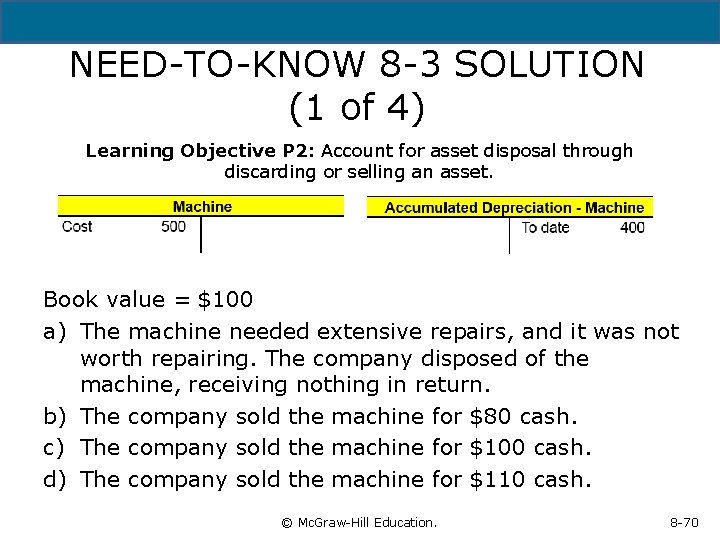
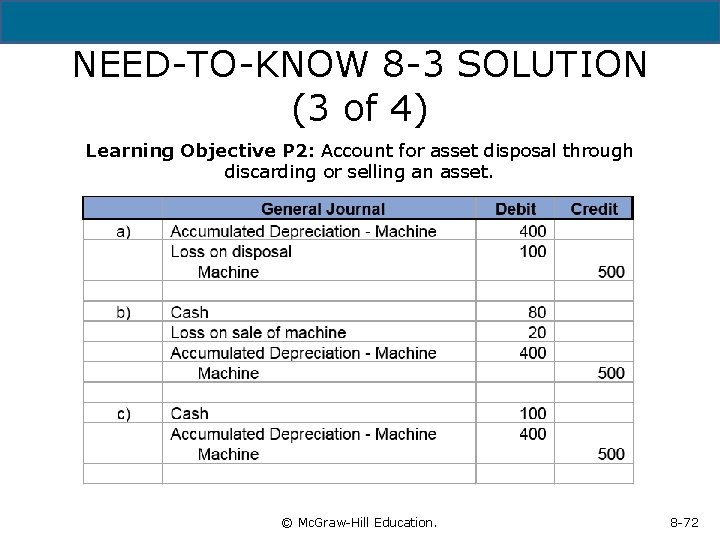
NEED-TO-KNOW 8 -3 SOLUTION (1 of 4) Learning Objective P 2: Account for asset disposal through discarding or selling an asset. Book value = $100 a) The machine needed extensive repairs, and it was not worth repairing. The company disposed of the machine, receiving nothing in return. b) The company sold the machine for $80 cash. c) The company sold the machine for $100 cash. d) The company sold the machine for $110 cash. © Mc. Graw-Hill Education. 8 -70
NEED-TO-KNOW 8 -3 SOLUTION (2 of 4) Learning Objective P 2: Account for asset disposal through discarding or selling an asset. © Mc. Graw-Hill Education. 8 -71
NEED-TO-KNOW 8 -3 SOLUTION (3 of 4) Learning Objective P 2: Account for asset disposal through discarding or selling an asset. © Mc. Graw-Hill Education. 8 -72
NEED-TO-KNOW 8 -3 SOLUTION (4 of 4) Learning Objective P 2: Account for asset disposal through discarding or selling an asset. © Mc. Graw-Hill Education. 8 -73
Learning Objective P 3: Account for natural resource assets and their depletion. © Mc. Graw-Hill Education. 3 -74
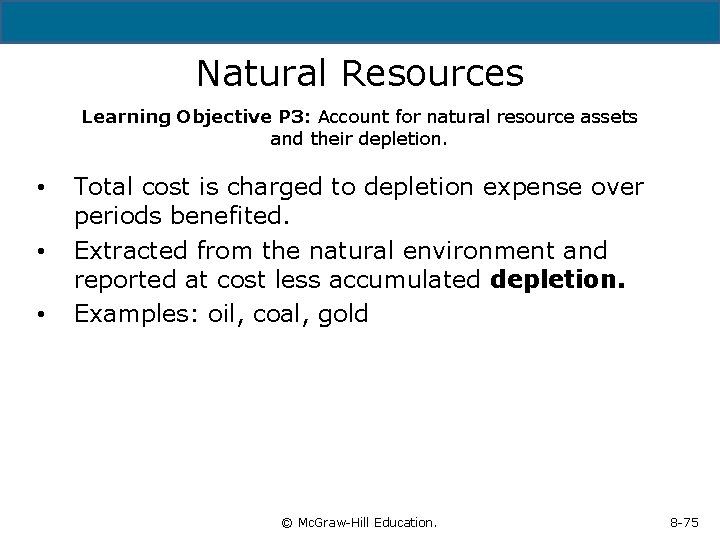
Natural Resources Learning Objective P 3: Account for natural resource assets and their depletion. • • • Total cost is charged to depletion expense over periods benefited. Extracted from the natural environment and reported at cost less accumulated depletion. Examples: oil, coal, gold © Mc. Graw-Hill Education. 8 -75
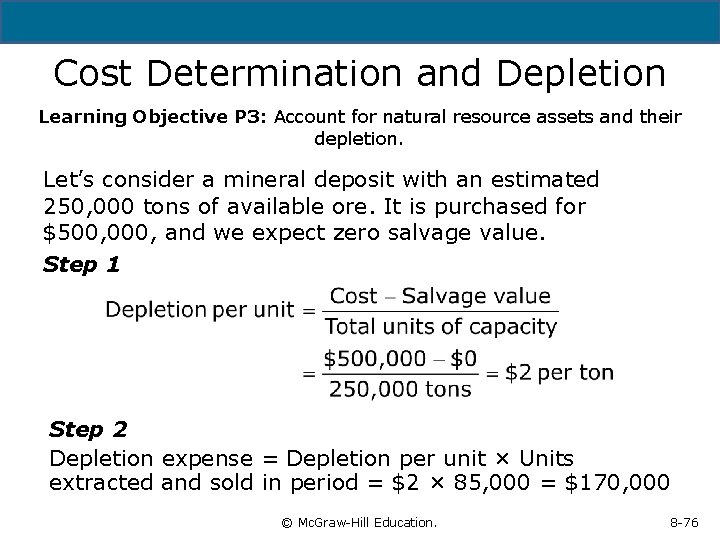
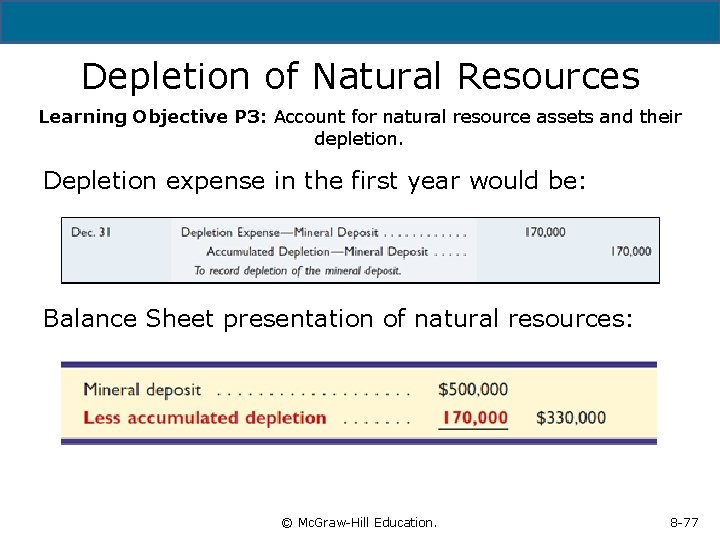
Cost Determination and Depletion Learning Objective P 3: Account for natural resource assets and their depletion. Let’s consider a mineral deposit with an estimated 250, 000 tons of available ore. It is purchased for $500, 000, and we expect zero salvage value. Step 1 Step 2 Depletion expense = Depletion per unit × Units extracted and sold in period = $2 × 85, 000 = $170, 000 © Mc. Graw-Hill Education. 8 -76
Depletion of Natural Resources Learning Objective P 3: Account for natural resource assets and their depletion. Depletion expense in the first year would be: Balance Sheet presentation of natural resources: © Mc. Graw-Hill Education. 8 -77
Plant Assets Tied into Extracting Learning Objective P 3: Account for natural resource assets and their depletion. • Specialized plant assets may be required to extract the natural resource. • These assets are recorded in a separate account and depreciated. © Mc. Graw-Hill Education. 8 -78
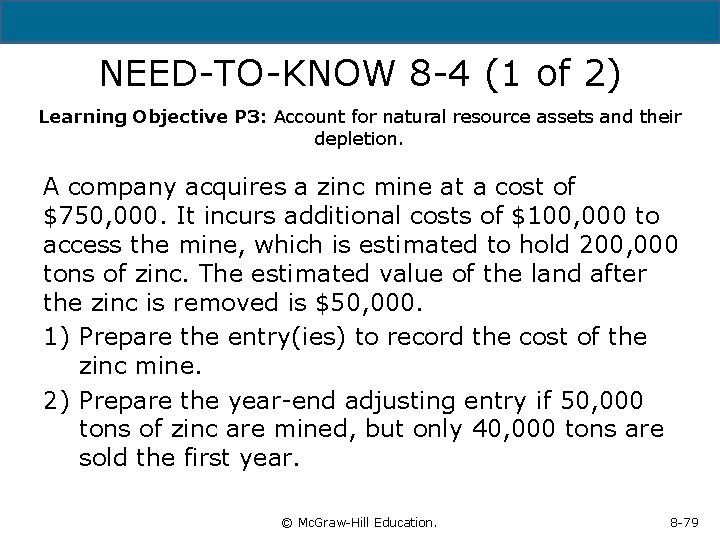
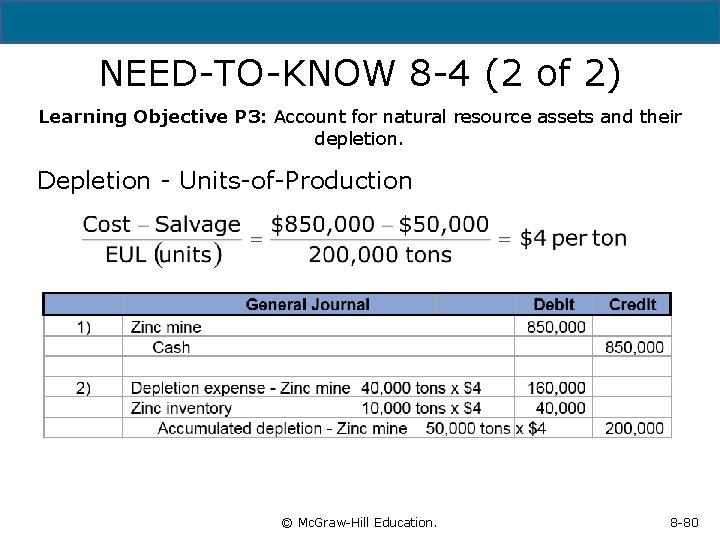
NEED-TO-KNOW 8 -4 (1 of 2) Learning Objective P 3: Account for natural resource assets and their depletion. A company acquires a zinc mine at a cost of $750, 000. It incurs additional costs of $100, 000 to access the mine, which is estimated to hold 200, 000 tons of zinc. The estimated value of the land after the zinc is removed is $50, 000. 1) Prepare the entry(ies) to record the cost of the zinc mine. 2) Prepare the year-end adjusting entry if 50, 000 tons of zinc are mined, but only 40, 000 tons are sold the first year. © Mc. Graw-Hill Education. 8 -79
NEED-TO-KNOW 8 -4 (2 of 2) Learning Objective P 3: Account for natural resource assets and their depletion. Depletion - Units-of-Production © Mc. Graw-Hill Education. 8 -80
Learning Objective P 4: Account for intangible assets. © Mc. Graw-Hill Education. 3 -81
Intangible Assets Learning Objective P 4: Account for intangible assets. • Intangible Assets – – Noncurrent assets without physical substance. Useful life is often difficult to determine. Often provide exclusive rights or privileges. Usually acquired for operational use. © Mc. Graw-Hill Education. 8 -82
Cost Determination and Amortization Learning Objective P 4: Account for intangible assets. • Record at cost, including purchase price, legal fees, and filing fees. – – – – – Patents Copyrights Franchises and Licenses Trademarks and Trade Names Goodwill Leaseholds Leasehold Improvements Research and Development Other Intangibles © Mc. Graw-Hill Education. 8 -83
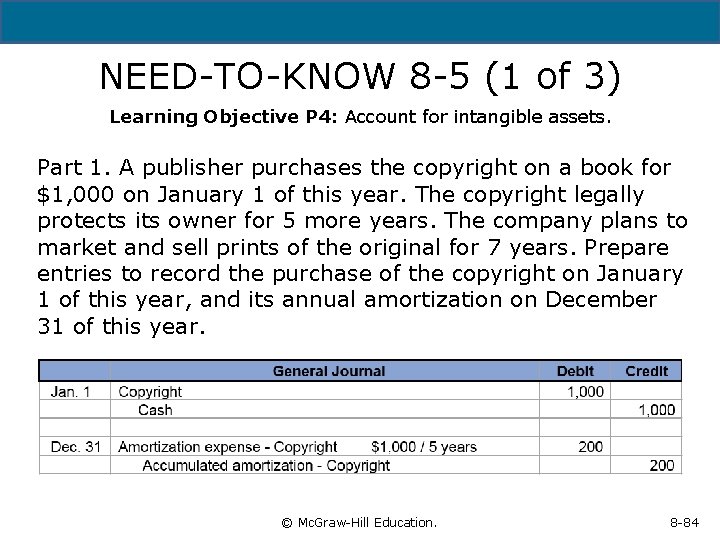
NEED-TO-KNOW 8 -5 (1 of 3) Learning Objective P 4: Account for intangible assets. Part 1. A publisher purchases the copyright on a book for $1, 000 on January 1 of this year. The copyright legally protects its owner for 5 more years. The company plans to market and sell prints of the original for 7 years. Prepare entries to record the purchase of the copyright on January 1 of this year, and its annual amortization on December 31 of this year. © Mc. Graw-Hill Education. 8 -84
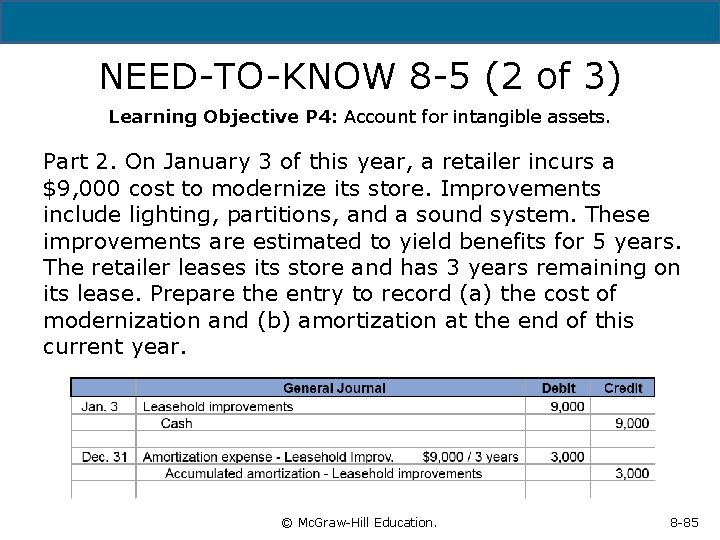
NEED-TO-KNOW 8 -5 (2 of 3) Learning Objective P 4: Account for intangible assets. Part 2. On January 3 of this year, a retailer incurs a $9, 000 cost to modernize its store. Improvements include lighting, partitions, and a sound system. These improvements are estimated to yield benefits for 5 years. The retailer leases its store and has 3 years remaining on its lease. Prepare the entry to record (a) the cost of modernization and (b) amortization at the end of this current year. © Mc. Graw-Hill Education. 8 -85
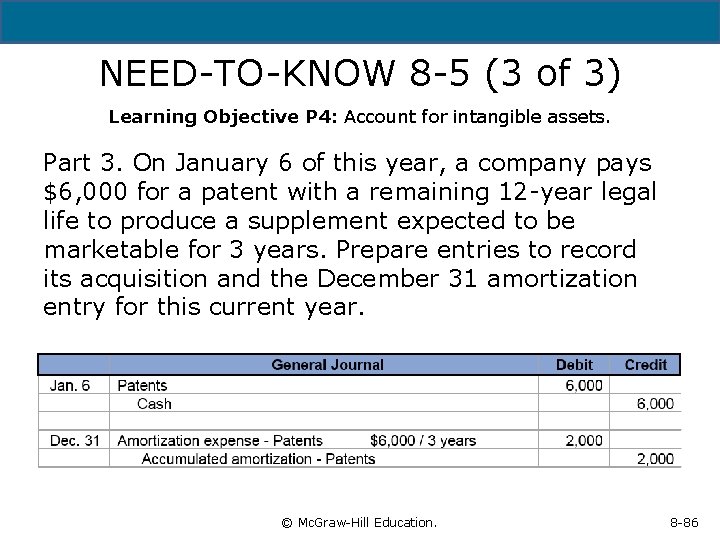
NEED-TO-KNOW 8 -5 (3 of 3) Learning Objective P 4: Account for intangible assets. Part 3. On January 6 of this year, a company pays $6, 000 for a patent with a remaining 12 -year legal life to produce a supplement expected to be marketable for 3 years. Prepare entries to record its acquisition and the December 31 amortization entry for this current year. © Mc. Graw-Hill Education. 8 -86
Learning Objective A 1: Compute total asset turnover and apply it to analyze a company’s use of assets. © Mc. Graw-Hill Education. 3 -87
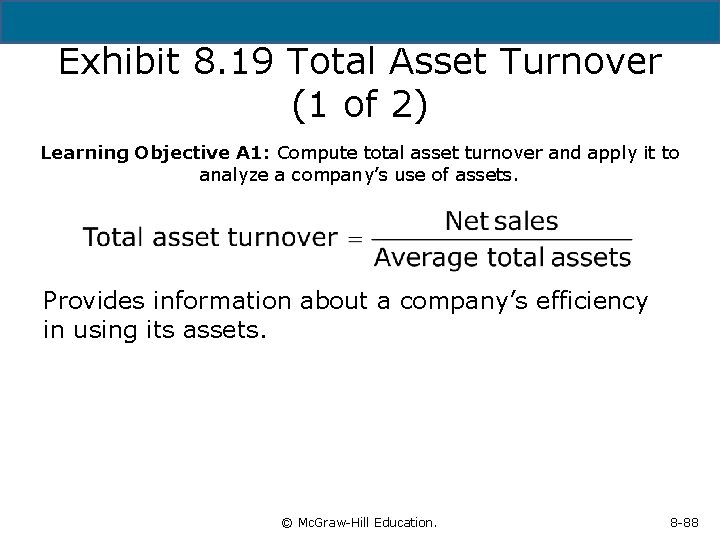
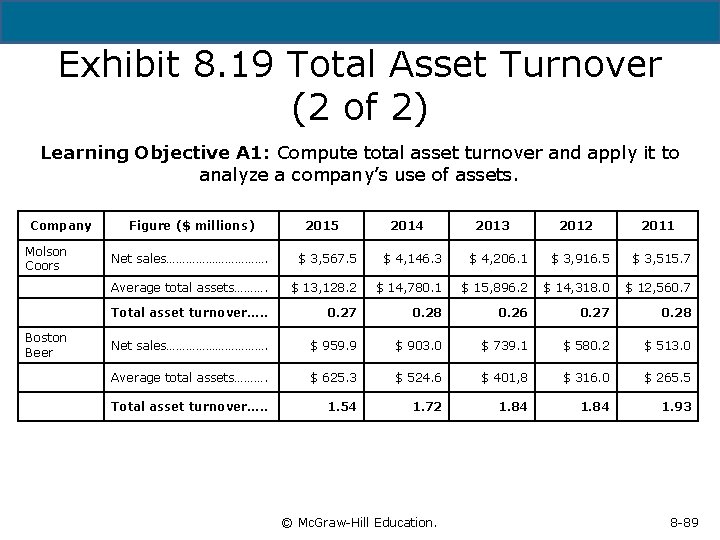
Exhibit 8. 19 Total Asset Turnover (1 of 2) Learning Objective A 1: Compute total asset turnover and apply it to analyze a company’s use of assets. Provides information about a company’s efficiency in using its assets. © Mc. Graw-Hill Education. 8 -88
Exhibit 8. 19 Total Asset Turnover (2 of 2) Learning Objective A 1: Compute total asset turnover and apply it to analyze a company’s use of assets. Company Molson Coors Boston Beer Figure ($ millions) 2015 2014 2013 2012 2011 Net sales……………. $ 3, 567. 5 $ 4, 146. 3 $ 4, 206. 1 $ 3, 916. 5 $ 3, 515. 7 Average total assets………. $ 13, 128. 2 $ 14, 780. 1 $ 15, 896. 2 $ 14, 318. 0 $ 12, 560. 7 Total asset turnover…. . 0. 27 0. 28 0. 26 0. 27 0. 28 Net sales……………. $ 959. 9 $ 903. 0 $ 739. 1 $ 580. 2 $ 513. 0 Average total assets………. $ 625. 3 $ 524. 6 $ 401, 8 $ 316. 0 $ 265. 5 Total asset turnover…. . 1. 54 1. 72 1. 84 1. 93 © Mc. Graw-Hill Education. 8 -89
Learning Objective P 5: Appendix A Account for asset exchanges. © Mc. Graw-Hill Education. 3 -90
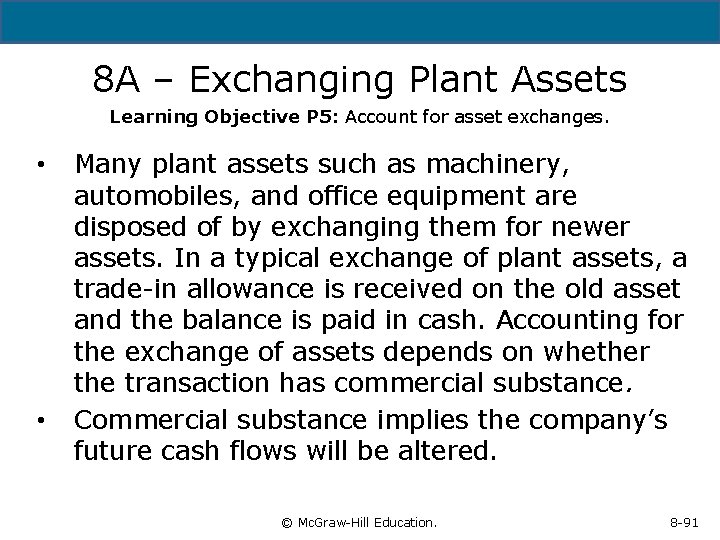
8 A – Exchanging Plant Assets Learning Objective P 5: Account for asset exchanges. • • Many plant assets such as machinery, automobiles, and office equipment are disposed of by exchanging them for newer assets. In a typical exchange of plant assets, a trade-in allowance is received on the old asset and the balance is paid in cash. Accounting for the exchange of assets depends on whether the transaction has commercial substance. Commercial substance implies the company’s future cash flows will be altered. © Mc. Graw-Hill Education. 8 -91
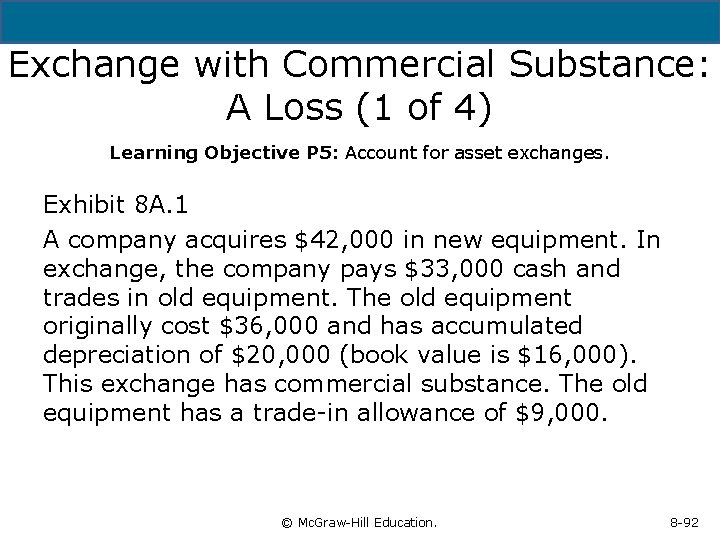
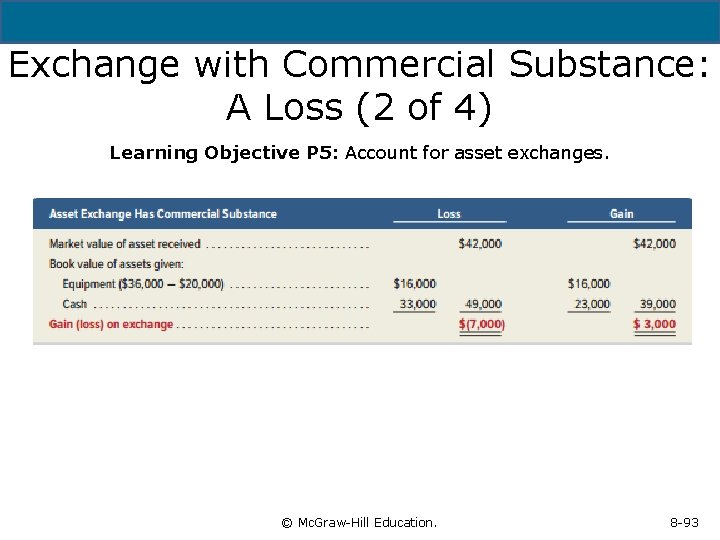
Exchange with Commercial Substance: A Loss (1 of 4) Learning Objective P 5: Account for asset exchanges. Exhibit 8 A. 1 A company acquires $42, 000 in new equipment. In exchange, the company pays $33, 000 cash and trades in old equipment. The old equipment originally cost $36, 000 and has accumulated depreciation of $20, 000 (book value is $16, 000). This exchange has commercial substance. The old equipment has a trade-in allowance of $9, 000. © Mc. Graw-Hill Education. 8 -92
Exchange with Commercial Substance: A Loss (2 of 4) Learning Objective P 5: Account for asset exchanges. © Mc. Graw-Hill Education. 8 -93
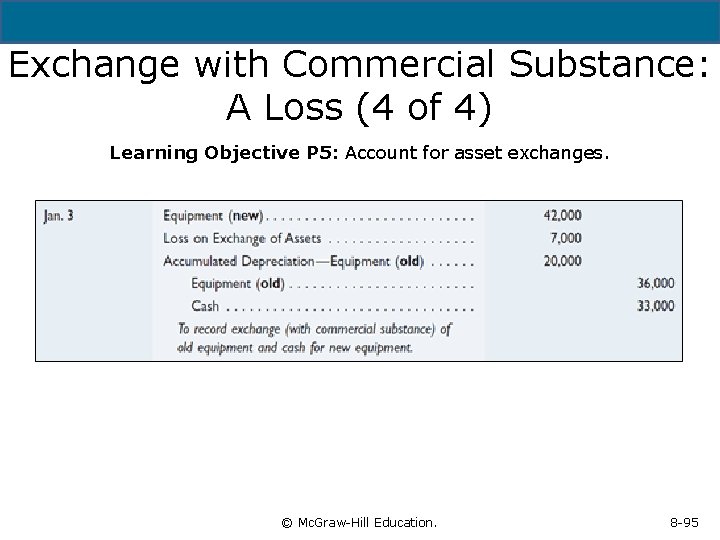
Exchange with Commercial Substance: A Loss (3 of 4) Learning Objective P 5: Account for asset exchanges. A company acquires $42, 000 in new equipment. In exchange, the company pays $33, 000 cash and trades in old equipment. The old equipment originally cost $36, 000 and has accumulated depreciation of $20, 000 (book value is $16, 000). This exchange has commercial substance. The old equipment has a trade-in allowance of $9, 000. © Mc. Graw-Hill Education. 8 -94
Exchange with Commercial Substance: A Loss (4 of 4) Learning Objective P 5: Account for asset exchanges. © Mc. Graw-Hill Education. 8 -95
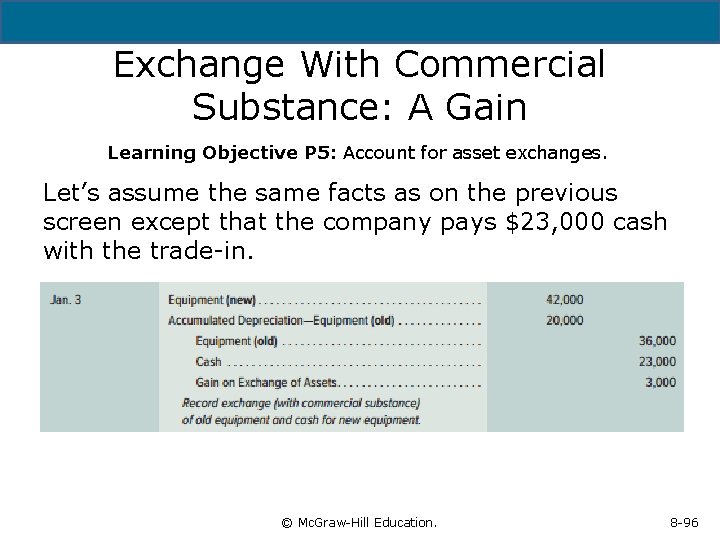
Exchange With Commercial Substance: A Gain Learning Objective P 5: Account for asset exchanges. Let’s assume the same facts as on the previous screen except that the company pays $23, 000 cash with the trade-in. © Mc. Graw-Hill Education. 8 -96
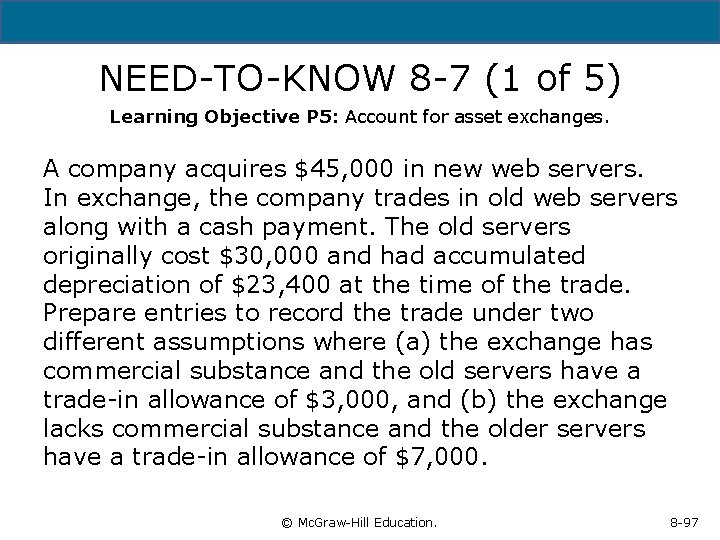
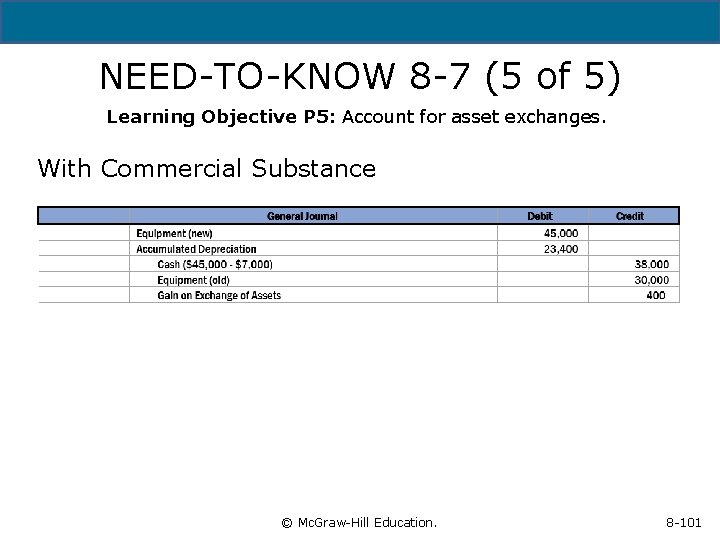
NEED-TO-KNOW 8 -7 (1 of 5) Learning Objective P 5: Account for asset exchanges. A company acquires $45, 000 in new web servers. In exchange, the company trades in old web servers along with a cash payment. The old servers originally cost $30, 000 and had accumulated depreciation of $23, 400 at the time of the trade. Prepare entries to record the trade under two different assumptions where (a) the exchange has commercial substance and the old servers have a trade-in allowance of $3, 000, and (b) the exchange lacks commercial substance and the older servers have a trade-in allowance of $7, 000. © Mc. Graw-Hill Education. 8 -97
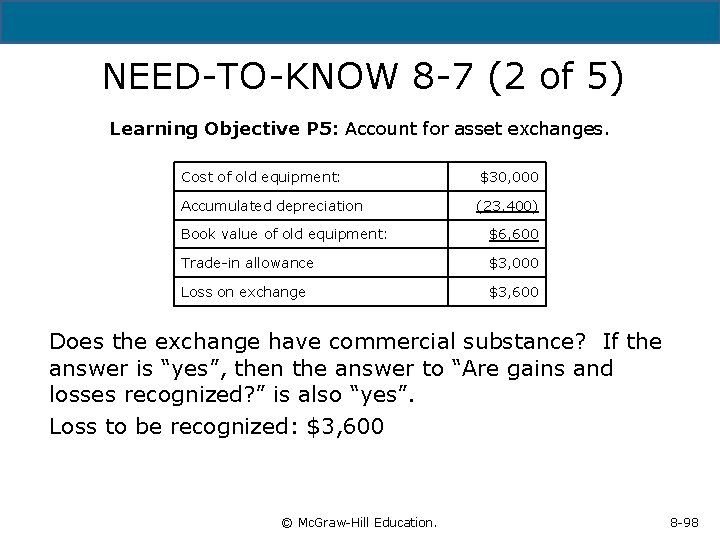
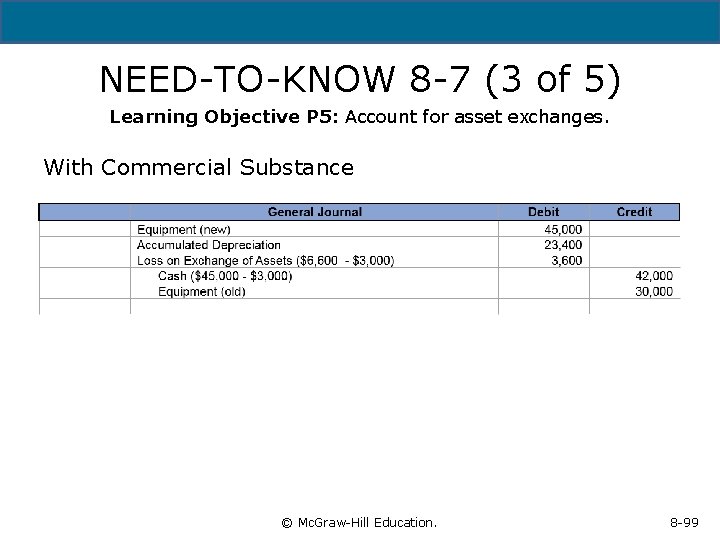
NEED-TO-KNOW 8 -7 (2 of 5) Learning Objective P 5: Account for asset exchanges. Cost of old equipment: $30, 000 Accumulated depreciation (23, 400) Book value of old equipment: $6, 600 Trade-in allowance $3, 000 Loss on exchange $3, 600 Does the exchange have commercial substance? If the answer is “yes”, then the answer to “Are gains and losses recognized? ” is also “yes”. Loss to be recognized: $3, 600 © Mc. Graw-Hill Education. 8 -98
NEED-TO-KNOW 8 -7 (3 of 5) Learning Objective P 5: Account for asset exchanges. With Commercial Substance © Mc. Graw-Hill Education. 8 -99
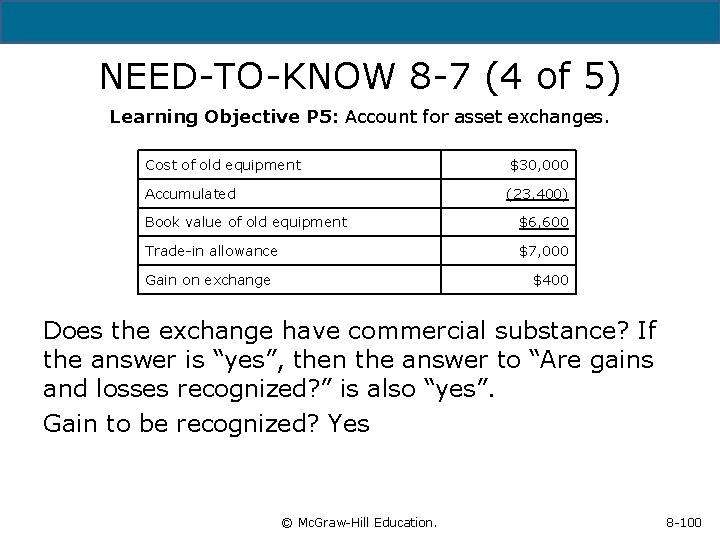
NEED-TO-KNOW 8 -7 (4 of 5) Learning Objective P 5: Account for asset exchanges. Cost of old equipment $30, 000 Accumulated (23, 400) Book value of old equipment $6, 600 Trade-in allowance $7, 000 Gain on exchange $400 Does the exchange have commercial substance? If the answer is “yes”, then the answer to “Are gains and losses recognized? ” is also “yes”. Gain to be recognized? Yes © Mc. Graw-Hill Education. 8 -100
NEED-TO-KNOW 8 -7 (5 of 5) Learning Objective P 5: Account for asset exchanges. With Commercial Substance © Mc. Graw-Hill Education. 8 -101
End of Presentation © Mc. Graw-Hill Education. All rights reserved. Authorized only for instructor use in the classroom. No reproduction or further distribution permitted without the prior written consent of Mc. Graw-Hill Education. 8 -102