
Financial and Managerial Accounting Wild Shaw and Chiappetta
- Slides: 39
Financial and Managerial Accounting Wild, Shaw, and Chiappetta Fourth Edition Mc. Graw-Hill/Irwin Copyright © 2011 by The Mc. Graw-Hill Companies, Inc. All rights reserved.
Chapter 14 Managerial Accounting Concepts and Principles
Conceptual Learning Objectives C 1: Explain the purpose and nature of managerial accounting and the role of ethics. C 2: Describe accounting concepts useful in classifying costs. C 3: Define product and period costs and explain how they impact financial statements. C 4: Explain how the balance sheets and income statements for manufacturing and merchandising companies differ. C 5: Explain manufacturing activities and the flow of manufacturing costs. C 6: Identify trends in managerial accounting. 14 -3
Analytical Learning Objectives A 1: Compute cycle time and cycle efficiency, and explain their importance to production management. 14 -4
Procedural Learning Objectives P 1: Compute cost of goods sold for a manufacturer. P 2: Prepare a manufacturing statement and explain its purpose and links to financial statements. 14 -5
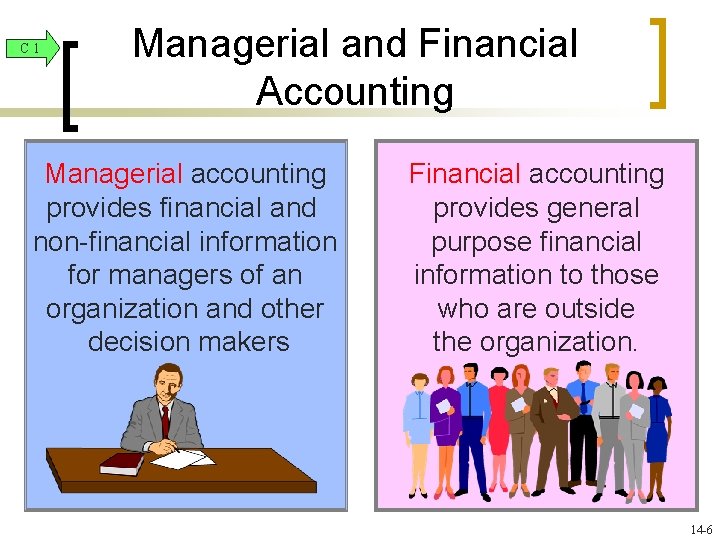
C 1 Managerial and Financial Accounting Managerial accounting provides financial and non-financial information for managers of an organization and other decision makers Financial accounting provides general purpose financial information to those who are outside the organization. 14 -6
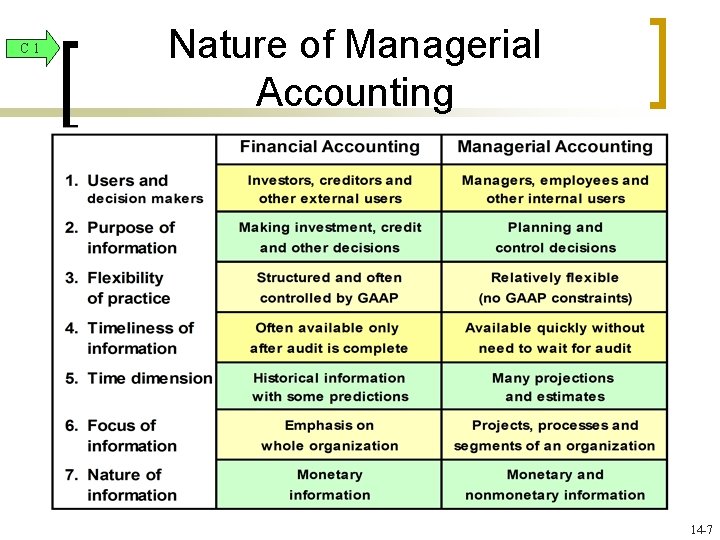
C 1 Nature of Managerial Accounting 14 -7
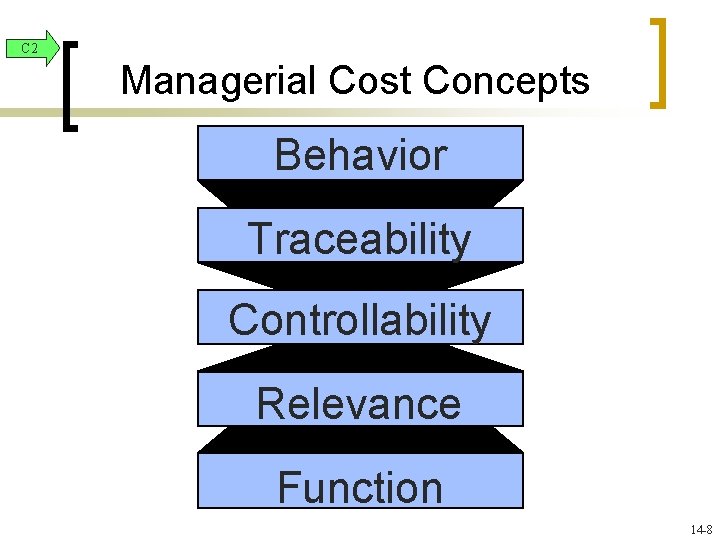
C 2 Managerial Cost Concepts Behavior Traceability Controllability Relevance Function 14 -8
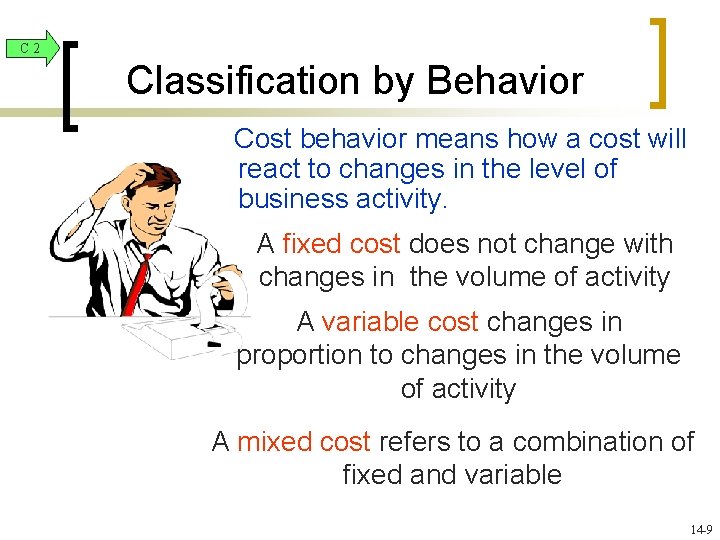
C 2 Classification by Behavior Cost behavior means how a cost will react to changes in the level of business activity. A fixed cost does not change with changes in the volume of activity A variable cost changes in proportion to changes in the volume of activity A mixed cost refers to a combination of fixed and variable 14 -9
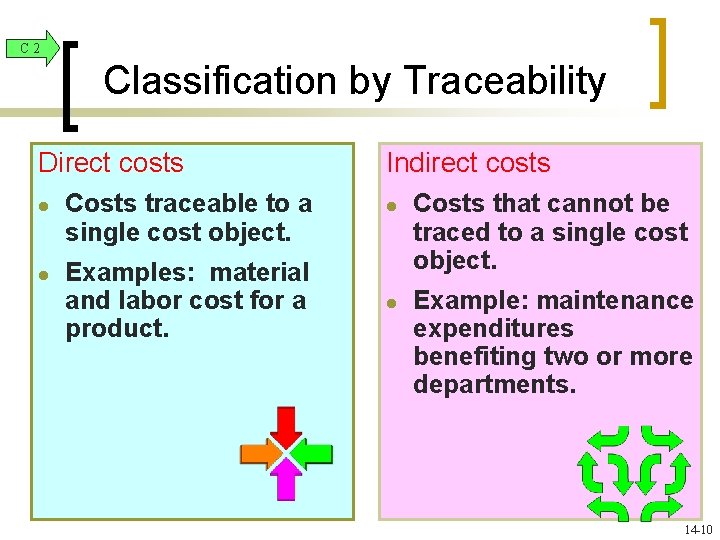
C 2 Classification by Traceability Direct costs l l Costs traceable to a single cost object. Examples: material and labor cost for a product. Indirect costs l l Costs that cannot be traced to a single cost object. Example: maintenance expenditures benefiting two or more departments. 14 -10
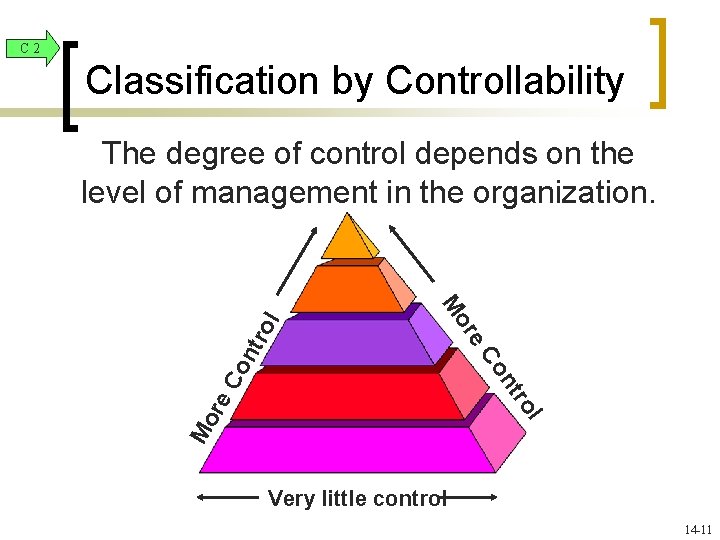
C 2 Classification by Controllability The degree of control depends on the level of management in the organization. ol ntr Mo re l ro nt Co Co e or M Very little control 14 -11
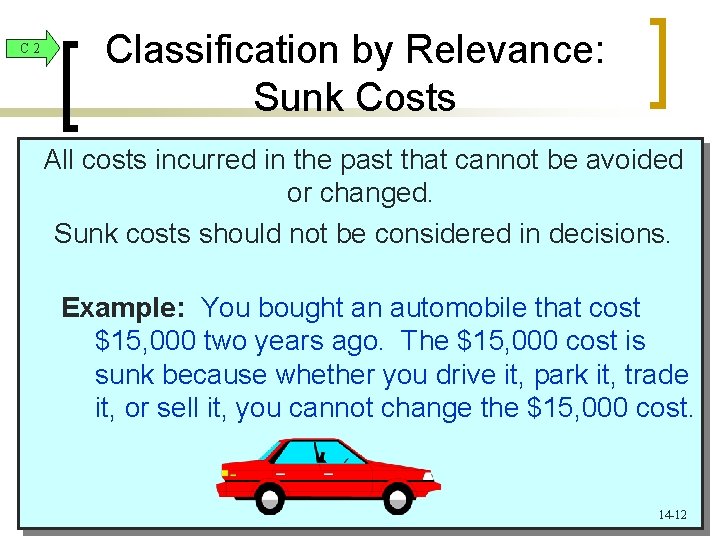
C 2 Classification by Relevance: Sunk Costs All costs incurred in the past that cannot be avoided or changed. Sunk costs should not be considered in decisions. Example: You bought an automobile that cost $15, 000 two years ago. The $15, 000 cost is sunk because whether you drive it, park it, trade it, or sell it, you cannot change the $15, 000 cost. 14 -12
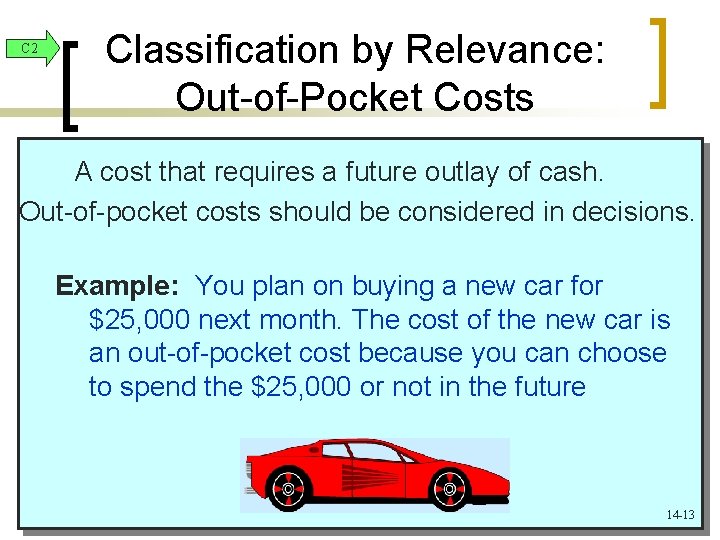
C 2 Classification by Relevance: Out-of-Pocket Costs A cost that requires a future outlay of cash. Out-of-pocket costs should be considered in decisions. Example: You plan on buying a new car for $25, 000 next month. The cost of the new car is an out-of-pocket cost because you can choose to spend the $25, 000 or not in the future 14 -13
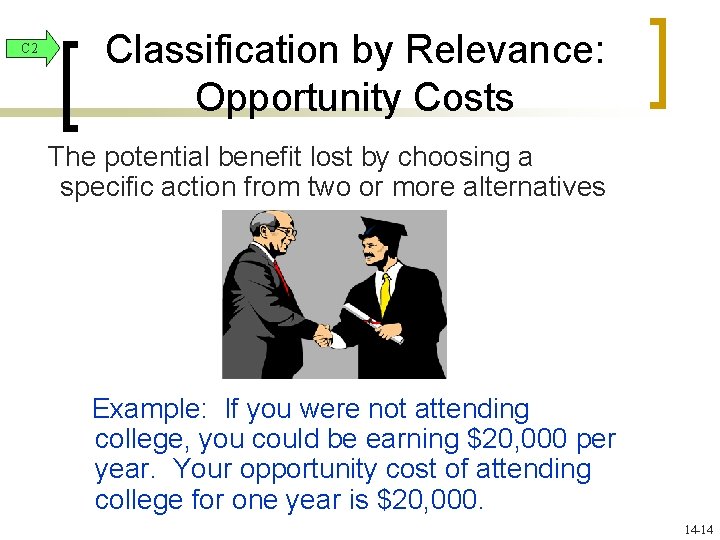
C 2 Classification by Relevance: Opportunity Costs The potential benefit lost by choosing a specific action from two or more alternatives Example: If you were not attending college, you could be earning $20, 000 per year. Your opportunity cost of attending college for one year is $20, 000. 14 -14
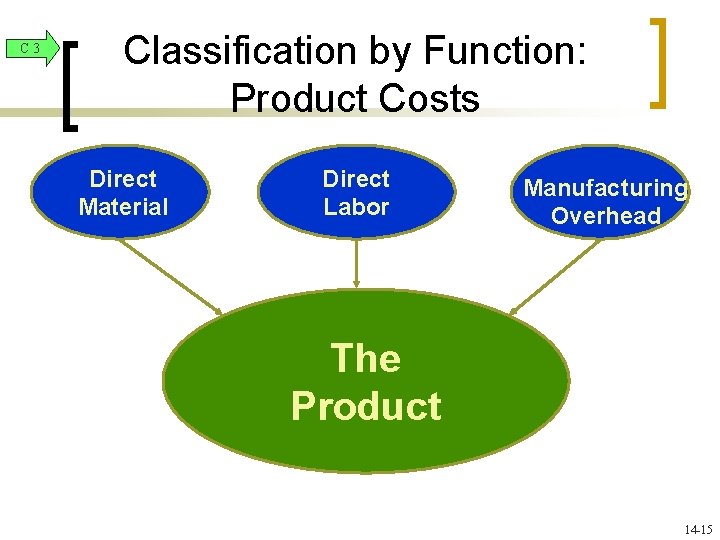
C 3 Classification by Function: Product Costs Direct Material Direct Labor Manufacturing Overhead The Product 14 -15
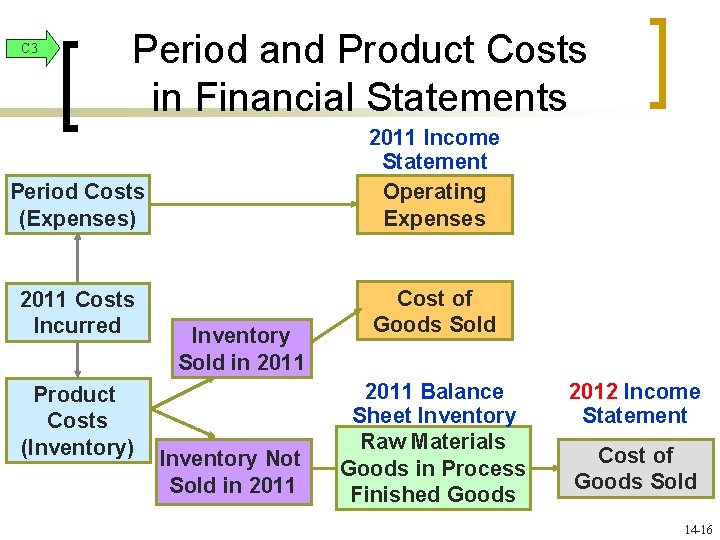
C 3 Period and Product Costs in Financial Statements Period Costs (Expenses) 2011 Income Statement Operating Expenses 2011 Costs Incurred Cost of Goods Sold Product Costs (Inventory) Inventory Sold in 2011 Inventory Not Sold in 2011 Balance Sheet Inventory Raw Materials Goods in Process Finished Goods 2012 Income Statement Cost of Goods Sold 14 -16
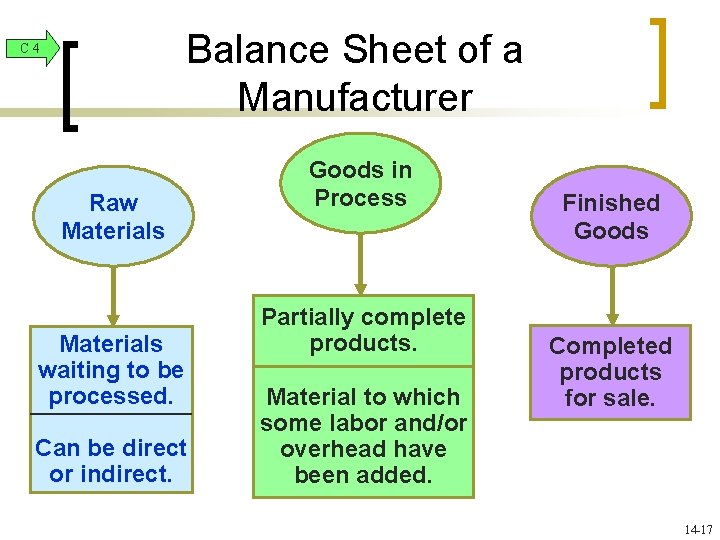
Balance Sheet of a Manufacturer C 4 Raw Materials waiting to be processed. Can be direct or indirect. Goods in Process Partially complete products. Material to which some labor and/or overhead have been added. Finished Goods Completed products for sale. 14 -17
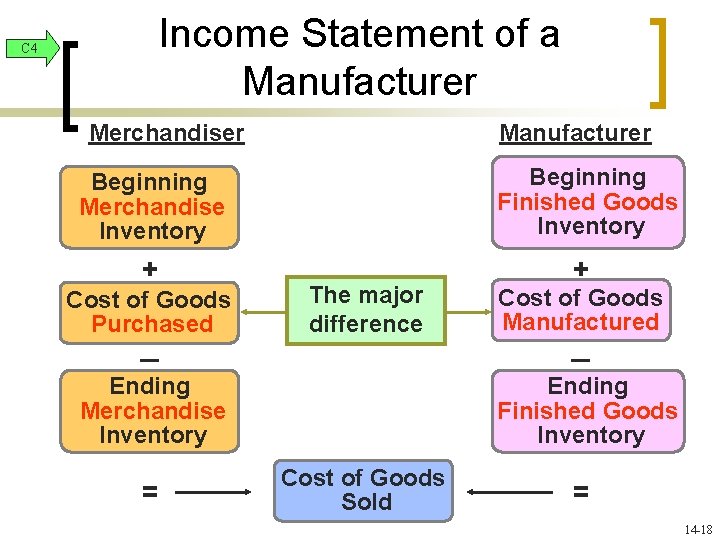
Income Statement of a Manufacturer C 4 Merchandiser Manufacturer Beginning Merchandise Inventory Beginning Finished Goods Inventory + + Cost of Goods Purchased _ The major difference Ending Merchandise Inventory = Cost of Goods Manufactured _ Ending Finished Goods Inventory Cost of Goods Sold = 14 -18
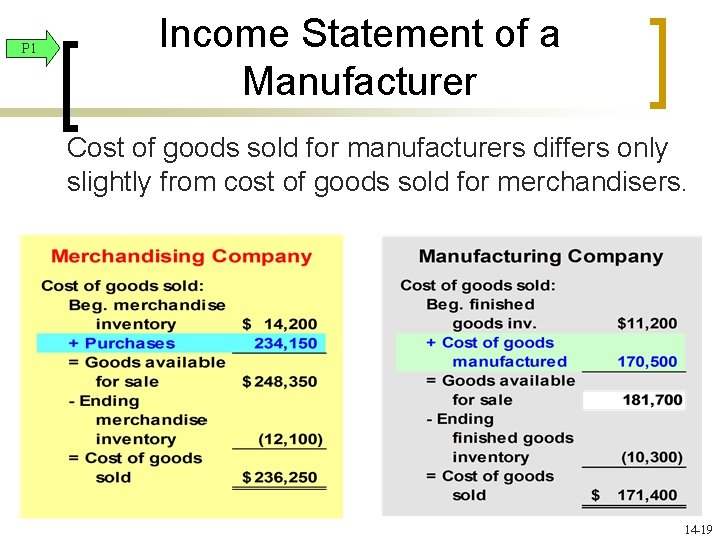
P 1 Income Statement of a Manufacturer Cost of goods sold for manufacturers differs only slightly from cost of goods sold for merchandisers. 14 -19
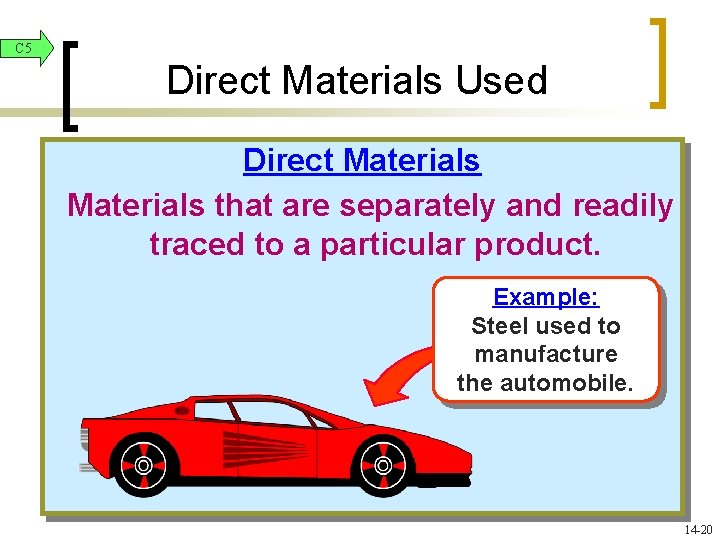
C 5 Direct Materials Used Direct Materials that are separately and readily traced to a particular product. Example: Steel used to manufacture the automobile. 14 -20
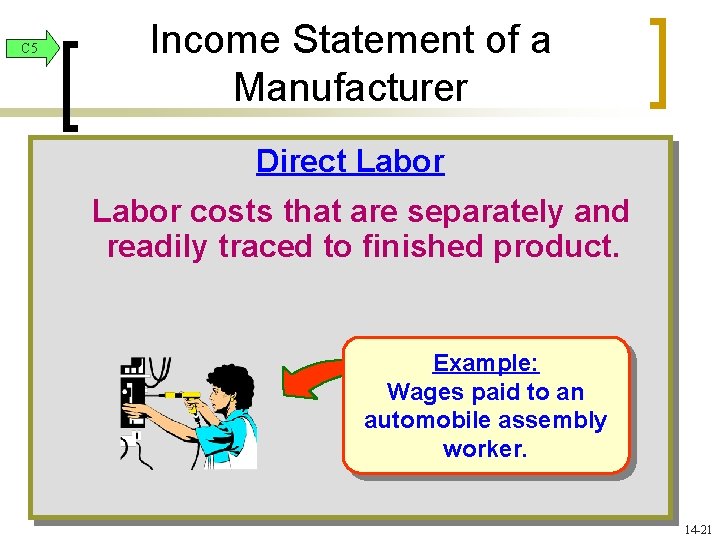
C 5 Income Statement of a Manufacturer Direct Labor costs that are separately and readily traced to finished product. Example: Wages paid to an automobile assembly worker. 14 -21
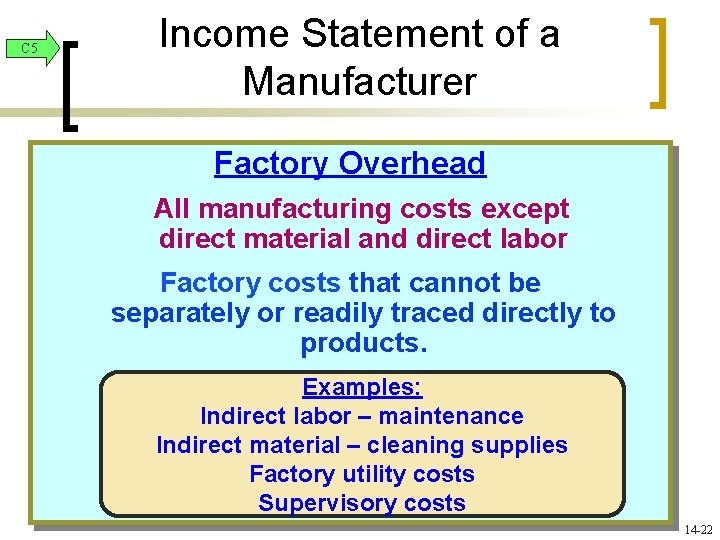
C 5 Income Statement of a Manufacturer Factory Overhead All manufacturing costs except direct material and direct labor Factory costs that cannot be separately or readily traced directly to products. Examples: Indirect labor – maintenance Indirect material – cleaning supplies Factory utility costs Supervisory costs 14 -22
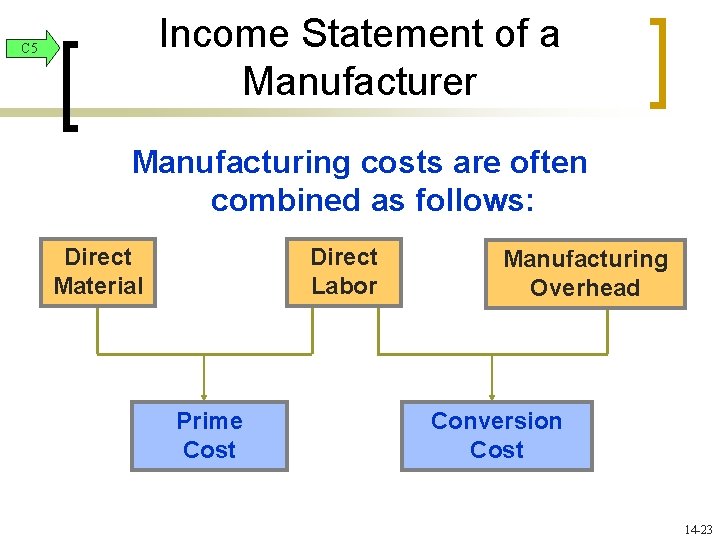
Income Statement of a Manufacturer C 5 Manufacturing costs are often combined as follows: Direct Material Direct Labor Prime Cost Manufacturing Overhead Conversion Cost 14 -23
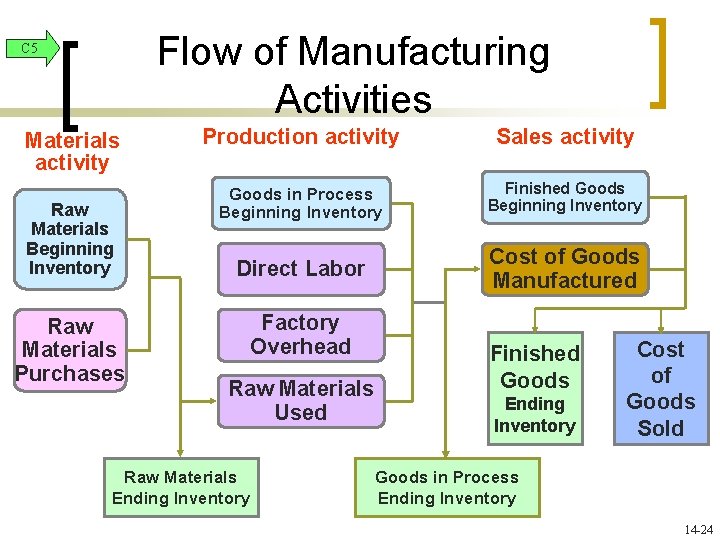
Flow of Manufacturing Activities C 5 Materials activity Raw Materials Beginning Inventory Raw Materials Purchases Production activity Sales activity Goods in Process Beginning Inventory Finished Goods Beginning Inventory Direct Labor Cost of Goods Manufactured Factory Overhead Raw Materials Used Raw Materials Ending Inventory Finished Goods Ending Inventory Cost of Goods Sold Goods in Process Ending Inventory 14 -24
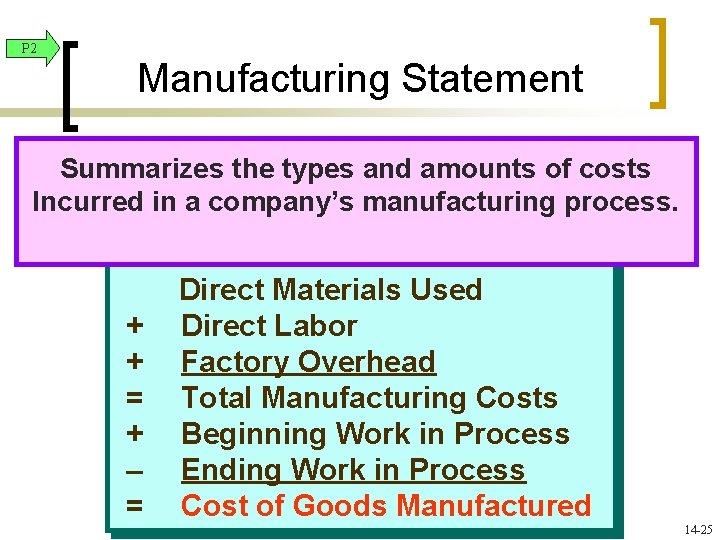
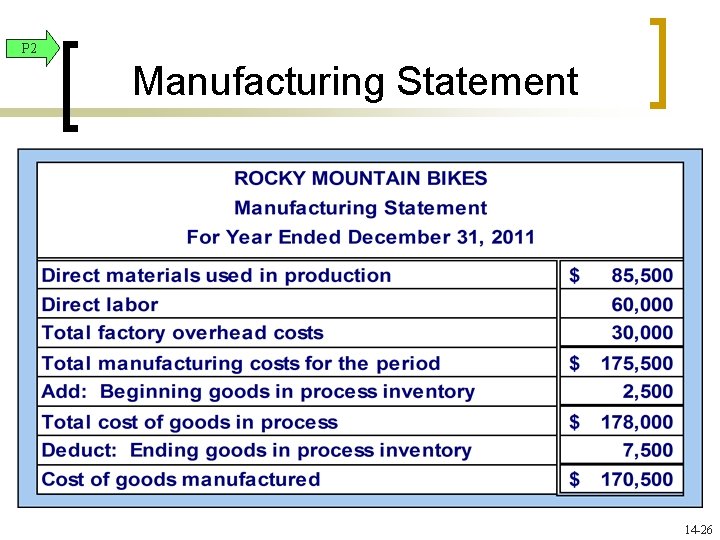
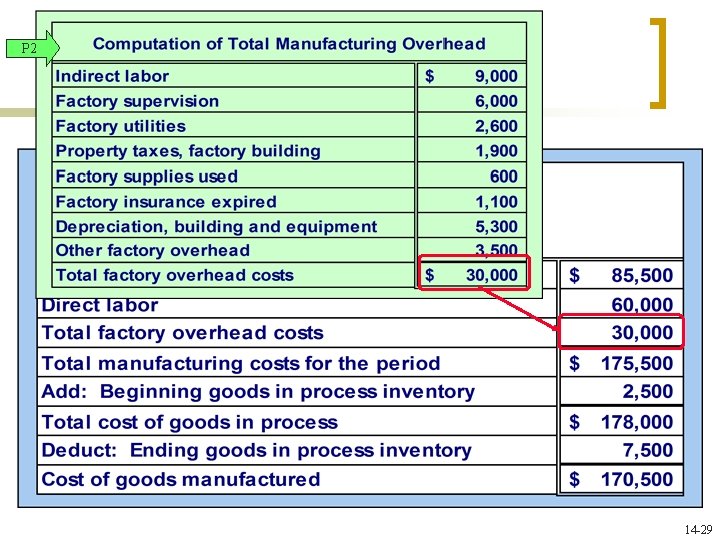
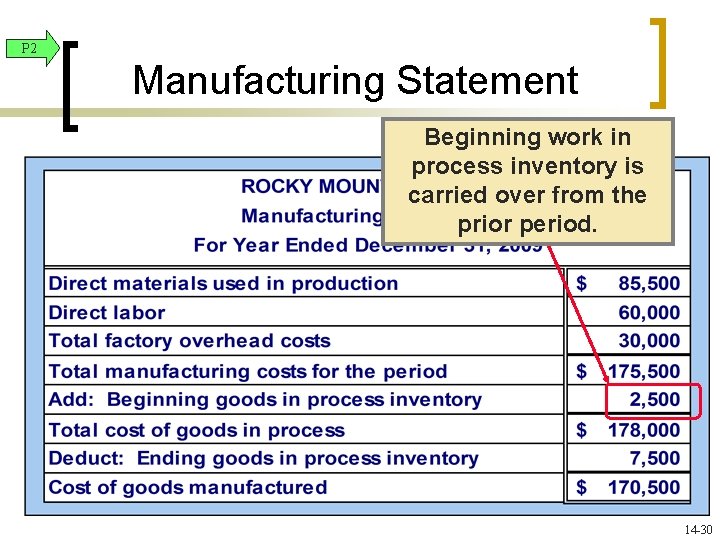
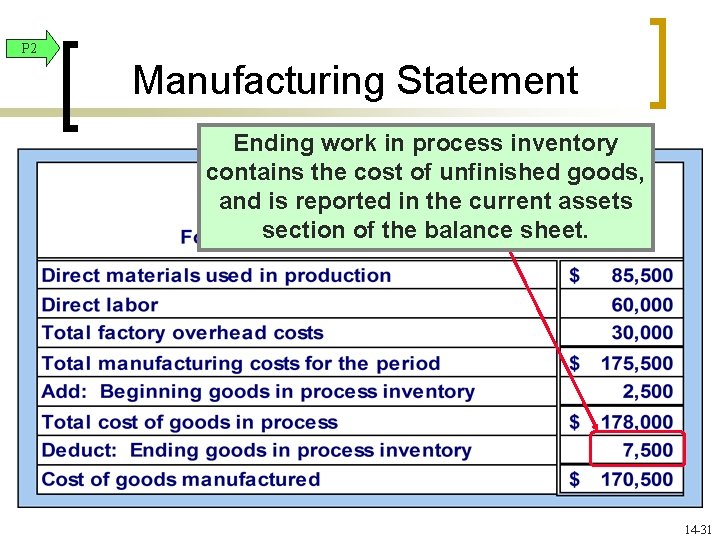
P 2 Manufacturing Statement Summarizes the types and amounts of costs Incurred in a company’s manufacturing process. + + = + – = Direct Materials Used Direct Labor Factory Overhead Total Manufacturing Costs Beginning Work in Process Ending Work in Process Cost of Goods Manufactured 14 -25
P 2 Manufacturing Statement 14 -26
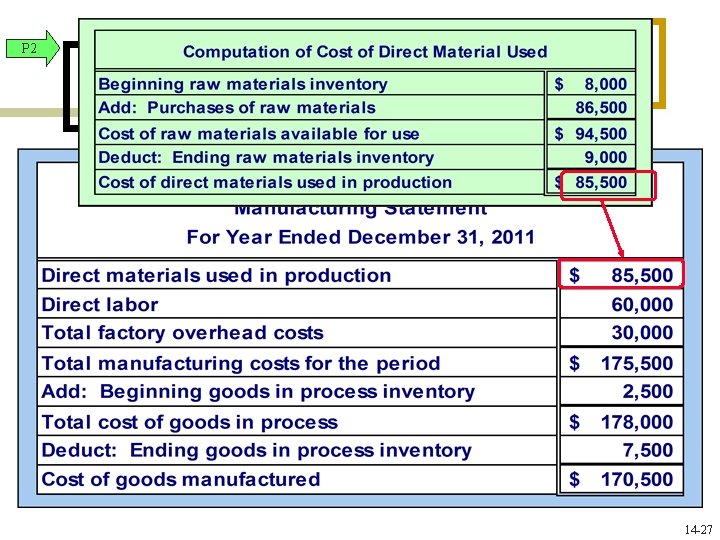
P 2 14 -27
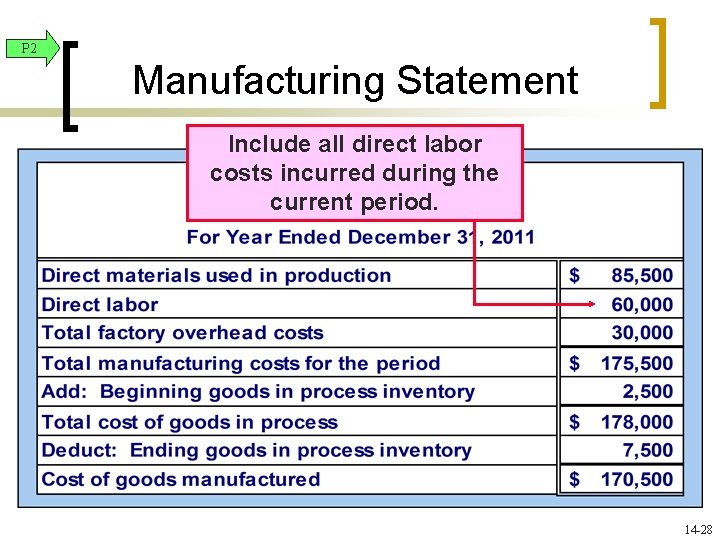
P 2 Manufacturing Statement Include all direct labor costs incurred during the current period. 14 -28
P 2 Manufacturing Statement 14 -29
P 2 Manufacturing Statement Beginning work in process inventory is carried over from the prior period. 14 -30
P 2 Manufacturing Statement Ending work in process inventory contains the cost of unfinished goods, and is reported in the current assets section of the balance sheet. 14 -31
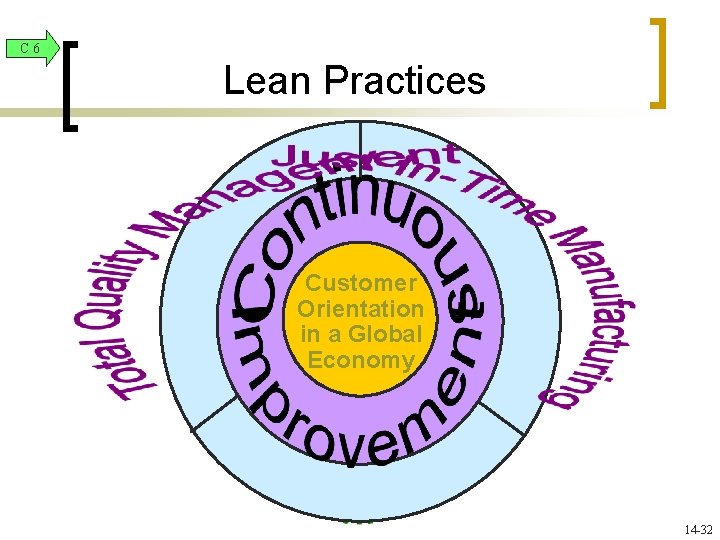
C 6 Lean Practices Customer Orientation in a Global Economy 14 -32
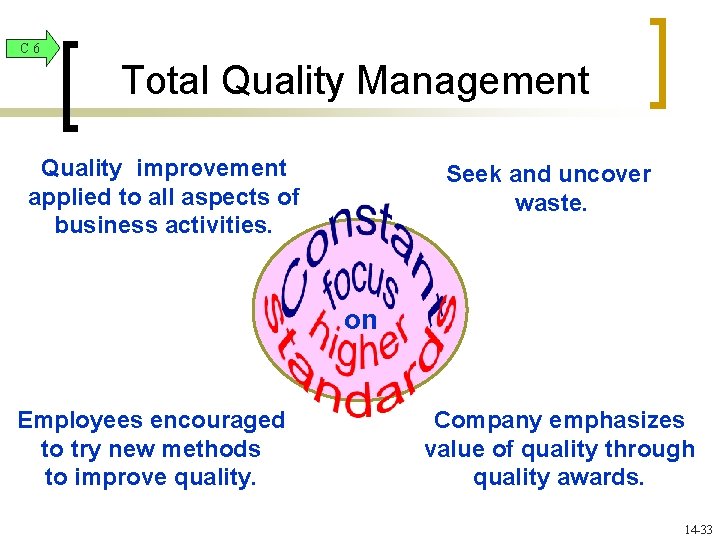
C 6 Total Quality Management Quality improvement applied to all aspects of business activities. Seek and uncover waste. on Employees encouraged to try new methods to improve quality. Company emphasizes value of quality through quality awards. 14 -33
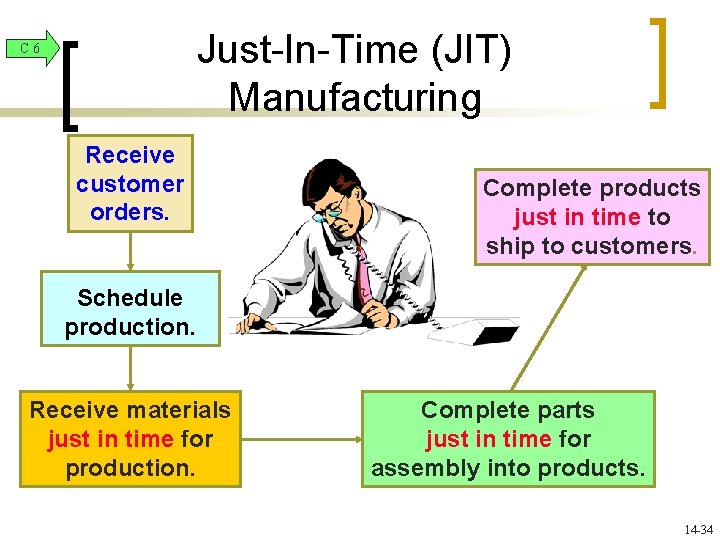
Just-In-Time (JIT) Manufacturing C 6 Receive customer orders. Complete products just in time to ship to customers. Schedule production. Receive materials just in time for production. Complete parts just in time for assembly into products. 14 -34
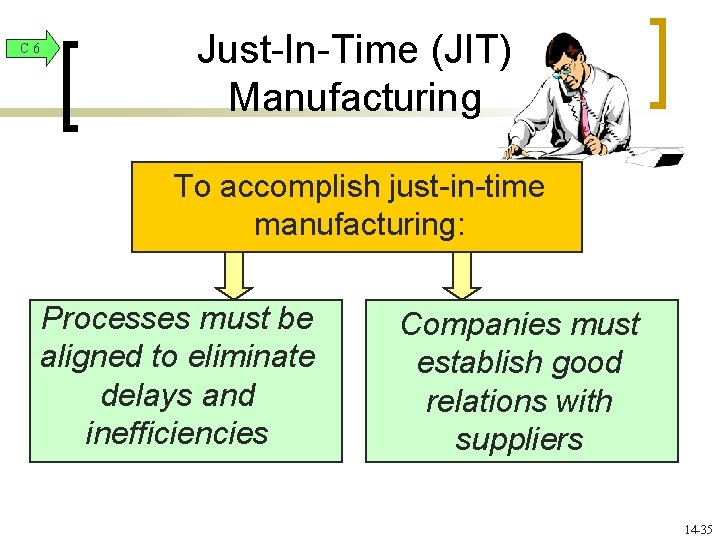
C 6 Just-In-Time (JIT) Manufacturing To accomplish just-in-time manufacturing: Processes must be aligned to eliminate delays and inefficiencies Companies must establish good relations with suppliers 14 -35
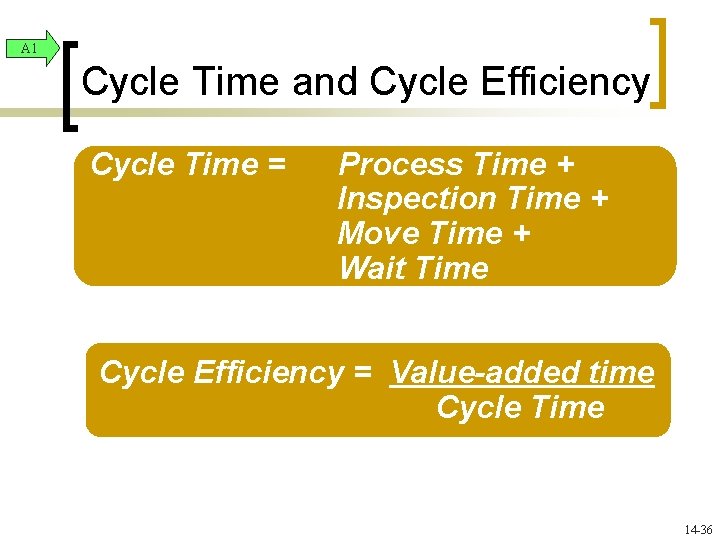
A 1 Cycle Time and Cycle Efficiency Cycle Time = Process Time + Inspection Time + Move Time + Wait Time Cycle Efficiency = Value-added time Cycle Time 14 -36
C 1 Fraud in Accounting n n n Fraud is the use of one’s job for personal gain through the deliberate misuse of the employer’s assets. It is estimated that 7% of annual revenues are lost to fraud. All fraud is committed to provide direct or indirect benefit to the perpetrator, violates the employee’s duty to his/her employer, costs the employer money, and is carried out in secret. 14 -37
C 1 Ethics in Accounting n n n Ethics are beliefs that distinguish right from wrong. They are accepted standards of good and bad behavior. The IMA’s Statement of Ethical Professional Practice requires management accountants to be competent, maintain confidentiality, act with integrity, and communicate information in a fair and credible manner. The Sarbanes-Oxley Act requires each issuer of securities to disclose whether it has adopted a code of ethics for its senior officers and the content of that code. 14 -38
End of Chapter 14 14 -39